The best live commerce software in 2026 is CommentSold for boutiques selling live on Facebook, Instagram and TikTok, Bambuser for mid-market and enterprise brands streaming on their own site, and Channelize.io for budget brands that want commission-free live shopping on Shopify or other platforms. Choose your sales channel first, then compare total cost.
Live commerce tools do different jobs, which makes fair comparison hard:
- Social-selling suites turn social comments into orders.
- Owned-site platforms embed livestreams on your storefront.
- Live marketplaces bring their own buyers.
Pricing is often hidden or stacked, and most performance claims come from the vendors themselves.
PlugRoute has no affiliate relationships with any company listed. Rankings are determined entirely by research data and objective evaluation criteria.
What Are the 4 Categories of Live Commerce Software?
Live commerce software falls into four categories. Social-selling suites turn livestream comments into orders. Owned-site live shopping platforms embed shoppable video on your storefront. Live marketplaces supply their own buyers. Hybrid networks combine an audience with an embeddable player. Decide which category fits your sales channel first, then compare tools within that category.
Live commerce software is also called livestream shopping, shoppable video or video commerce software. Native social channels such as TikTok Shop and Amazon Live sit outside these four categories and outside this ranking.
The six ranked platforms fall into these categories:
- Social-Selling Suite: CommentSold runs comment-to-buy sales on Facebook, Instagram and TikTok and manages inventory, invoicing and shipping.
- Owned-Site Live Shopping Platform: Bambuser, Channelize.io and Firework embed shoppable livestreams on a brand’s own website or app.
- Live Marketplace: Whatnot is a third-party app where sellers reach Whatnot’s buyers under Whatnot’s rules and fees.
- Hybrid Network: TalkShopLive runs its own shopping network and also offers an embeddable player with checkout.
Live sellers without a social-selling suite often handle order queues by hand. In r/TikTokshop, a daily live seller asked for an automated way to show buyers their place in the shipping queue:
“You can ad an overlay on your live if you use OBS… Suggest having an assistant.” (u/FF_06_B5, Reddit, November 2026)
Takeaway: Live sellers without order-automation software rely on broadcast overlays and extra staff to manage order queues. Social-selling suites like CommentSold are built to remove that manual work.
Choosing between your own site and a marketplace means trading audience for control:
- Owned-site streams keep checkout and customer data with the brand, but they start with no audience (Videowise, Stremify and Rankite, November 2026).
- Marketplaces such as Whatnot supply buyers on day one, but the seller does not own the checkout or the customer relationship.
- Social-selling suites such as CommentSold sit in between: they borrow reach from social platforms and keep orders in their own system.
In live commerce, the channel decision matters more than the tool decision. Marketplaces rent you an audience, owned-site platforms let you own the customer, and social-selling suites borrow social reach while keeping the orders.
How Do the Top Live Commerce Platforms Compare at a Glance?
The six platforms differ more by sales channel than by feature list. CommentSold leads on B2B review volume and operational depth. Bambuser leads on transparent owned-site pricing. Channelize.io leads on integration breadth. Whatnot leads on funding and audience. Firework leads on enterprise credentials. TalkShopLive fills the pilot niche.
| Rank | Company | Category | Best For | One-Line Summary | Key Capabilities | Primary Strength | Key Limitation |
|---|---|---|---|---|---|---|---|
| 1 | CommentSold | Social-Selling | Boutiques selling live on social channels | CommentSold has the most reviews on B2B software review sites of any vendor in this list and combines comment-to-buy livestreams with inventory, invoicing and shipping. | Comment-to-buy, stock holds, invoicing, shipping, branded apps | Largest B2B software review base in this list (193 G2 and Software Advice reviews) | Subscription ($149–$999/month) plus 4–6% of sales; cancellation complaints |
| 2 | Bambuser | Owned-Site | Mid-market and enterprise brands | Bambuser is an owned-site live shopping platform with published pricing from a free tier to enterprise and multi-region simulcasting. | Embedded live shopping, Simulcast, 1:1 video consultations | Published self-serve pricing; self-stated ISO 27001 | $0.25 per-view overage; Instagram feature loss |
| 3 | Channelize.io | Owned-Site | Budget DTC brands, including non-Shopify | Channelize.io is a commission-free, white-label live shopping platform with the broadest ecommerce-platform support in this list. | Multi-platform integrations, in-show checkout, replays, developer kits | No commission; widest integrations | Two price lists (Shopify $97–$497/month vs Capterra Free–$99); unverified company background |
| 4 | Whatnot | Marketplace | Collectibles and resale sellers | Whatnot is the best-funded company in this list and its only pure live marketplace, giving resellers an instant audience with no monthly fee. | Auctions, Buy It Now, checkout, shipping labels, Seller Protection | Built-in audience; no monthly fee | Sellers don’t own customers or checkout |
| 5 | Firework | Owned-Site | Enterprise and multi-brand retailers | Firework has the broadest feature set of the enterprise video commerce suites in this list and announced SOC 2 Type II certification. | Short video, livestream, Shop App, publisher network, SDKs | Broadest feature suite; strong funding | Opaque pricing; unverified review ratings |
| 6 | TalkShopLive | Hybrid | Creators, publishers, low-risk pilots | TalkShopLive is a no-monthly-fee live shopping network and embeddable player suited to creators and small Shopify pilots. | Embeddable player, own network, free Shopify app | $0/month entry | BBB 1.0/5; only 6 G2 reviews; card processing may apply |
Which Live Commerce Software Should I Choose for My Use Case?
Choose by your top priority. For a no-monthly-fee pilot, try TalkShopLive, Bambuser Free or Whatnot. Boutiques that need inventory and invoicing should look at CommentSold. Budget and non-Shopify brands fit Channelize.io. Enterprise teams going through a security review should consider Firework or Bambuser.
| Your #1 Priority | Recommended Tool | Why | Acceptable Alternative |
|---|---|---|---|
| Low-risk pilot, no monthly fee | TalkShopLive | $0/month with an embeddable player and a free Shopify app | Bambuser Free (owned site) or Whatnot (marketplace) |
| Shopify brand on a budget | Channelize.io | No commission; Shopify plans $97–$497/month (Shopify App Store, November 2026) | Bambuser Essential ($79/month) |
| Commission-free on any platform | Channelize.io | Usage-based pricing with no sales commission | Bambuser Essential ($79/month plus view overages) |
| Boutique needing inventory, invoicing and shipping | CommentSold | Comment-to-buy tied to stock holds, invoices and shipping | No independent comment-selling alternative identified |
| Enterprise or multi-region with security review | Firework | Announced SOC 2 Type II; broadest distribution | Bambuser Pro/Enterprise (self-stated ISO 27001) |
| Non-Shopify brand | Channelize.io | WooCommerce, Magento, PrestaShop and Wix integrations | Firework (OMS, CRM and analytics connectors) |
| Built-in audience for collectibles or resale | Whatnot | Only pure live marketplace in this list, with its own buyer audience | TalkShopLive (network audience) |
What Are the 6 Best Live Commerce Software Platforms in 2026?
PlugRoute scored the six platforms out of 45. CommentSold (38) and Bambuser (35) lead the November 2026 ranking. Independent review evidence, pricing transparency and commerce integration count double, so a lower rank often means thinner evidence rather than a weaker product. Use the category tags to compare tools that do the same job.
- CommentSold ranks #1 with a weighted score of 38/45 after a November 2026 pricing reassessment.
- Bambuser ranks #2 with a weighted score of 35/45.
- Channelize.io ranks #3 with a weighted score of 30/45 and wins the tiebreak on primary-criteria points.
- Whatnot ranks #4 with a weighted score of 30/45.
- Firework ranks #5 with a weighted score of 29/45.
- TalkShopLive ranks #6 with a weighted score of 25/45.
1. CommentSold: Top Evidence Score, Best for Boutiques Selling Live on Social
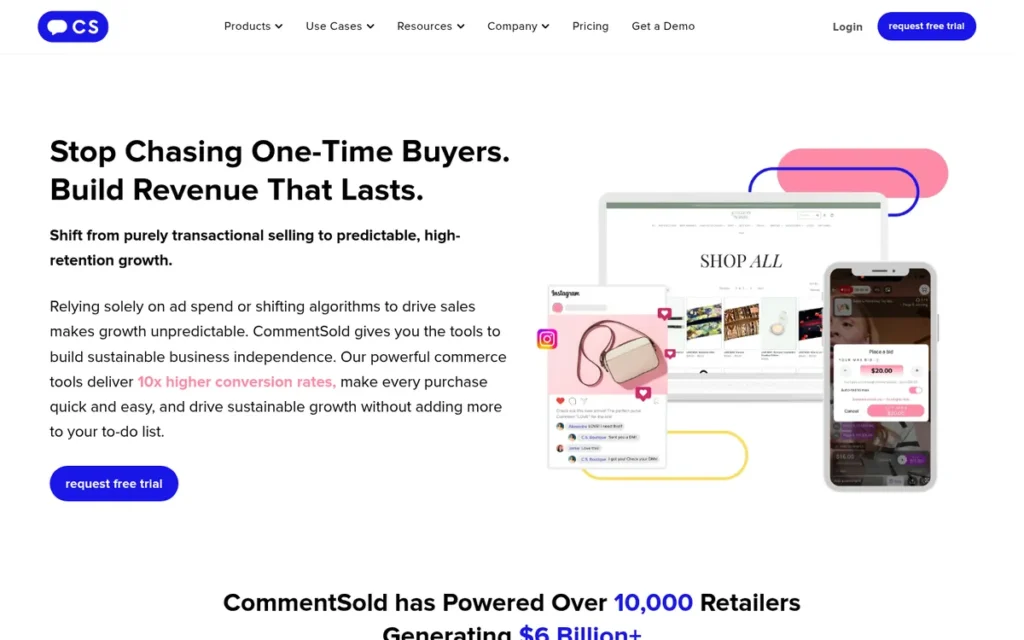
Category: Social-Selling Suite, runs comment-to-buy live sales on social channels and manages the inventory, invoicing and shipping behind them.
At a Glance
- Category: Social-Selling Suite
- Best For: Boutiques and apparel retailers that sell live several times a week on Facebook, Instagram and TikTok
- Price Range: $149–$999/month plus 4–6% of sales, with a 15-day free trial (CommentSold pricing page, November 2026)
- Primary Strength: CommentSold connects live comments directly to inventory, invoicing and shipping, which removes the order-queue work live sellers otherwise do by hand.
- Biggest Limitation: CommentSold charges 4–6% of sales on top of a monthly subscription, and reviewers report difficulty cancelling and unexpected charges.
- One-Line Summary: CommentSold has the most reviews on B2B software review sites of any vendor in this list and combines comment-to-buy livestreams with inventory, invoicing and shipping, at the cost of a subscription plus a percentage-of-sales fee.
- Last Verified: November 2026
PlugRoute Score: 38/45, C1 5, C2 4, C3 5, C4 4, C5 3, C6 3. Why #1: CommentSold has the highest combined review evidence and operational depth in this list, and its commission-on-subscription pricing holds back its cost score. CommentSold’s C2 rose from 3 to 4 in November 2026 because its official pricing page cleared up earlier conflicts between published rates.
Overview
CommentSold is a social-selling and live-commerce suite that turns Facebook, Instagram and TikTok live-sale comments into orders and runs the inventory, invoicing, shipping, webstore and branded apps behind them. It is built mainly for boutiques and apparel retailers that sell live several times a week.
CommentSold was founded in 2017 in Huntsville, Alabama (CommentSold About Us, November 2026). CommentSold also owns Videeo, a storefront live-video plugin launched in 2022, so Videeo does not get a separate entry here.
Key Features
- CommentSold’s comment-to-buy flow turns a shopper’s “sold” comment into an order, holds the stock and sends an invoice in real time.
- CommentSold manages inventory, invoicing, payments, shipping and returns in the same system that runs the livestream.
- CommentSold streams live sales to Facebook, Instagram and TikTok and also supports a branded webstore and branded mobile apps.
- CommentSold includes shoppable short video, so sellers can keep promoting products between live events.
- CommentSold offers Videeo, launched in 2022, to embed live video commerce into an existing ecommerce storefront.
Best For
CommentSold is best for boutiques whose social live sales bring in enough monthly revenue to absorb a 4–6% sales fee and that want invoicing, inventory and shipping in one place. Boutique buyers can test it with the 15-day free trial and compare it with TikTok Shop’s native live selling, which is outside this ranking.
Pricing
CommentSold combines a monthly subscription with a sales commission (CommentSold pricing page, November 2026):
- CommentSold Starter costs $149/month plus 6% of sales.
- CommentSold Starter with AI costs $249/month plus 6% of sales.
- CommentSold Small Business costs $499/month plus 5% of sales.
- CommentSold Large Business costs $999/month plus 4% of sales.
GetApp and Capterra list lower rates of 5%, 4% and 3%, which appear to come from an older price list (GetApp and Capterra, November 2026). Worked examples, excluding payment processing:
- CommentSold Starter costs about $749 at $10,000 in monthly sales.
- CommentSold Small Business becomes cheaper than Starter above about $35,000 a month in sales.
- CommentSold Large Business becomes cheaper than Small Business above about $50,000 a month in sales.
Strengths
- CommentSold has the largest review base on B2B software review sites in this list: G2 4.7/5 from 78 reviews and Software Advice 4.8/5 from 115 reviews (G2 and Software Advice, November 2026). Reviewers praise CommentSold’s ease of use and support.
- CommentSold reports more than 7,000 retailers, 170 million items sold and over $4.8 billion in total platform sales, up from the $3 billion it reported in 2022 (CommentSold, November 2026, vendor-reported).
- CommentSold’s case study reports that the boutique Whiskey Skies passed $10 million in lifetime live-selling sales (CommentSold press room, November 2026, vendor-reported).
- CommentSold received a Permira investment in 2021 and acquired Social Retail Success and Popshoplive in 2023 (CommentSold press room, 2023).
Limitations
CommentSold’s most consequential trade-off is its cost structure. A 4–6% commission is added on top of the subscription, so low-volume months can be expensive relative to revenue.
- CommentSold’s 6% Starter rate is the highest commission attached to a subscription tier in this list (CommentSold pricing page, November 2026).
- CommentSold reviewers on GetApp, Capterra and PissedConsumer report difficulty cancelling, unexpected post-trial charges and slow refunds (November 2026). These are unverified user claims, but they recur.
- PlugRoute’s research found no published SOC 2 or ISO certification for CommentSold and no independent comment-selling alternative, which limits buyers’ negotiating leverage.
A self-identified CommentSold boutique owner on r/BoutiquePolice pushed back on the platform’s published sales figures:
“I am a Commentsold boutique and opted out of my info being shared. That’s their lifetime sales on the Commentsold platform.
It’s very misleading information because many of those boutiques outrun their margins with ad spend and most of the 100m get most of their sales from TikTok and it has nothing to do with Commentsold except that Commentsold takes a fat check” Posted by u/croissantsandbagels
Takeaway: At least some CommentSold sellers see the platform’s headline sales totals as overstated and its fees as a large cut of revenue they generated through their own channels, such as TikTok.
Verdict
CommentSold is the best-evidenced live commerce platform in this list for boutiques that need comment selling tied to inventory, invoicing and shipping. No other software vendor in this list matches CommentSold’s combined 193 reviews on G2 and Software Advice or its built-in order operations. CommentSold buyers should model the commission against realistic monthly sales and get cancellation terms in writing.
2. Bambuser: Best for Mid-Market and Enterprise Brands Hosting Live Shopping on Their Own Site

Category: Owned-Site Live Shopping Platform, embeds shoppable livestreams and video on your own website or app so checkout and customer data stay with you.
At a Glance
- Category: Owned-Site Live Shopping Platform
- Best For: Mid-market and enterprise brands, including multi-region retailers, that want live shopping on their own storefront
- Price Range: Free (250 views/month), $79/month, $249/month, Enterprise on quote; $0.25 per extra view (Bambuser pricing page, November 2026)
- Primary Strength: Bambuser publishes transparent self-serve pricing with a free tier and can simulcast one live event across several regional storefronts.
- Biggest Limitation: Bambuser’s annual recurring revenue fell 12% at constant currency in 2025, and reviewers report that polls and games do not carry over to Instagram.
- One-Line Summary: Bambuser is an owned-site live shopping platform with published pricing from a free tier to enterprise, self-stated ISO 27001 certification and multi-region simulcasting, offset by a revenue trend that long-contract buyers should weigh.
- Last Verified: November 2026
PlugRoute Score: 35/45, C1 3, C2 5, C3 4, C4 4, C5 3, C6 4. Why #2: Bambuser has the most transparent owned-site pricing in this list. A smaller review base (30 G2 reviews) and a declining ARR trend keep it three points behind CommentSold.
Overview
Bambuser is a Stockholm-based live shopping and shoppable video platform that embeds livestreams, replays and one-to-one video consultations on a brand’s own website or app. It is aimed at mid-market and enterprise retailers that want checkout and customer data to stay on their own storefront.
Bambuser is publicly listed. Bambuser started as a consumer live-video app and moved to business software in 2014 (Bambuser Investor Relations, November 2026).
Key Features
- Bambuser embeds live shopping and shoppable video on a brand’s own website or app, and checkout stays on the brand’s storefront.
- Bambuser’s Simulcast feature streams one event to several regional sites, as HUGO BOSS did across 13 local storefronts.
- Bambuser offers one-to-one video consultations for personal shopping, priced separately from its live shopping plans.
- Bambuser uses social channels for reach while keeping the shopping experience on the brand’s site.
- Bambuser lists an app in the Shopify App Store for Shopify merchants.
Best For
Bambuser is best for mid-market and enterprise brands, especially multi-region retailers, that want to own the livestream audience, checkout and data, and that need ISO 27001 documentation for procurement.
Pricing
Bambuser publishes its One-to-Many pricing (Bambuser pricing page, November 2026):
- Bambuser Free costs $0 and includes 250 views per month.
- Bambuser Essential costs $79/month ($948/year).
- Bambuser Pro costs $249/month ($2,988/year).
- Bambuser Enterprise is priced on quote.
Bambuser’s overage and plan details:
- Bambuser charges $0.25 for each extra view and counts only views longer than 3 seconds, so 1,000 views over the allowance adds about $250.
- Bambuser’s pricing page showed the same 2,000-view allowance for Essential and Pro, which may be an error, so buyers should confirm it.
- Bambuser does not publish pricing for one-to-one video calling.
Strengths
- Bambuser publishes complete self-serve pricing, from a free 250-view tier to $249/month Pro, with a documented $0.25 per-view overage (Bambuser pricing page, November 2026).
- Bambuser’s case studies report a 17% conversion rate for Pai Skincare, 45% engagement for Tula and average viewing time above 15 minutes for HUGO BOSS (Bambuser customer stories, November 2026, vendor-reported). These case studies do not report revenue.
- Bambuser states that its Stockholm site is ISO 27001 certified and runs annual penetration tests (Bambuser, November 2026, self-stated), which helps with enterprise security reviews.
- Bambuser holds G2 4.6/5 from 30 reviews, the same figure quoted on Bambuser’s own site (G2, November 2026). Reviewers praise Bambuser’s interface and customer support.
Limitations
Bambuser’s most consequential trade-off is its vendor trajectory, which matters most to buyers signing multi-year contracts.
- Bambuser’s annual recurring revenue fell from SEK 95.9M at year-end 2024 to SEK 77.7M at year-end 2025, down 12% at constant exchange rates, though ARR was broadly flat quarter over quarter in Q4 2025 (Bambuser Q4 2025 year-end report, November 2026).
- Bambuser reviewers on G2 report that polls and games do not carry over to Instagram streams and that Instagram and TikTok shopping is not seamless (G2, November 2026).
- Bambuser reviewers also describe the pricing as hard for small businesses to afford and report limited customization (G2, November 2026).
- Bambuser’s review counts are modest, and PlugRoute found no public SOC 2 Type II evidence for Bambuser.
Verdict
Bambuser is the most transparently priced owned-site live shopping platform in this list for mid-market and enterprise brands, with a free entry tier, self-stated ISO 27001 certification and multi-region simulcasting. Bambuser’s case studies name brands such as HUGO BOSS and Pai Skincare but report engagement and conversion rather than revenue. Bambuser buyers should estimate per-view overage costs for their expected audience.
3. Channelize.io: Best for Budget-Conscious DTC Brands Streaming on Their Own Site
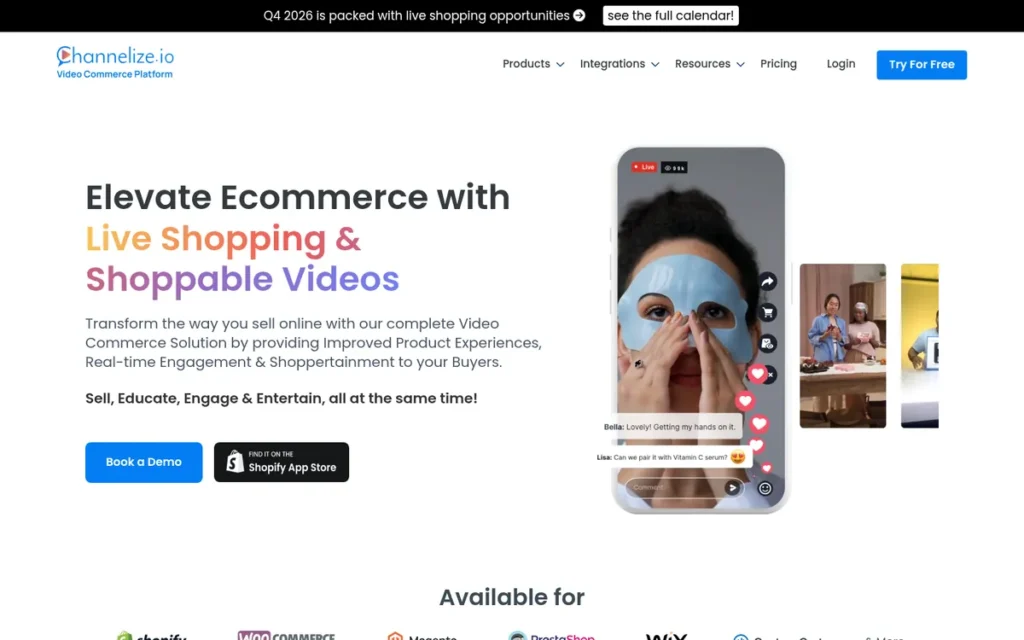
Category: Owned-Site Live Shopping Platform.
At a Glance
- Category: Owned-Site Live Shopping Platform
- Best For: Budget-conscious DTC brands on Shopify, WooCommerce, Magento, PrestaShop or Wix
- Price Range: $97–$497/month on Shopify (Capterra lists Free–$99/month); no commission (Shopify App Store and Capterra, November 2026)
- Primary Strength: Channelize.io integrates with more ecommerce platforms than any other tool in this list and charges no commission on sales.
- Biggest Limitation: Channelize.io’s two published price lists conflict, and PlugRoute could not verify Channelize.io’s company background or security certifications.
- One-Line Summary: Channelize.io is a commission-free, white-label live shopping platform with the broadest ecommerce-platform support in this list and strong review scores, best for budget-conscious brands willing to verify pricing.
- Last Verified: November 2026
PlugRoute Score: 30/45, C1 4, C2 3, C3 5, C4 3, C5 1, C6 2. Why #3: Channelize.io ties Whatnot on total score and ranks higher on primary-criteria points (12 vs 10). Channelize.io’s C2 stays at 3 because its viewing-minute overage rate is unpublished and its two price lists still conflict.
Overview
Channelize.io is a white-label live shopping and shoppable video platform that plugs into Shopify, WooCommerce, Magento, PrestaShop and Wix stores and charges no commission on sales. It suits budget-conscious DTC brands that want to host shoppable livestreams on their own site.
Channelize.io bills on usage: number of shows, show length and viewing minutes (Channelize.io, November 2026). PlugRoute could not confirm a Channelize.io BigCommerce integration.
Key Features
- Channelize.io integrates with Shopify, WooCommerce, Magento/Adobe Commerce, PrestaShop, Wix and Shoplazza and offers cart and checkout inside the show.
- Channelize.io lets hosts highlight several products at once and run multi-host events streamed from external encoders such as OBS.
- Channelize.io simulcasts live shows to social channels and keeps shoppable replays available after the event.
- Channelize.io supports private live events for logged-in customers, which suits VIP sales.
- Channelize.io provides developer kits for white-label builds inside a brand’s own site or app.
Best For
Channelize.io is best for small and mid-sized DTC brands, including brands that are not on Shopify, that want to stream shoppable events on their own storefront without paying a percentage of sales.
Pricing
Channelize.io charges no commission, but it has two price lists as of November 2026:
- Channelize.io’s Shopify App Store listing shows START at $97/month with 15,000 viewing minutes, GROW at $297/month with 50,000 and PRO at $497/month with 100,000, each with a 14-day free trial (Shopify App Store, November 2026).
- Channelize.io’s Shopify plans are 17% cheaper when billed annually (Shopify App Store, November 2026).
- Channelize.io’s Capterra listing shows a free plan, Basic at $49/month, Standard at $99/month and Enterprise on quote (Capterra, November 2026).
- Channelize.io bills extra viewing minutes per 1,000, but PlugRoute could not find the rate on either listing.
Check pricing.channelize.io/plans and get the overage rate in writing before buying.
Strengths
- Channelize.io holds 4.7/5 from 86 reviews on the Shopify App Store and 4.9/5 from 22 reviews on Capterra/Software Advice, with 5.0 sub-scores for ease of use, support and value (Shopify App Store and Capterra, November 2026).
- Channelize.io charges no commission, so its cost does not rise with live-event revenue the way commission-based platforms’ costs do.
- Channelize.io has the broadest confirmed ecommerce-platform integration list in this ranking, which makes it one of the few documented options for non-Shopify brands.
- Channelize.io shows a 2026 Shopify Build Awards badge on its Shopify App Store listing (Shopify App Store, November 2026).
Limitations
Channelize.io’s most consequential trade-off is vendor certainty. PlugRoute could not verify Channelize.io’s founding date, headquarters or headcount and found no SOC 2 or ISO evidence.
- Channelize.io caps viewing minutes on each tier (15,000 on START), so a well-attended show can push costs into an unpublished overage rate.
- Channelize.io’s named case studies, Luxury Anew and Semprefarmacia.it, publish no results.
- Channelize.io reviewers report slow iOS loading and 720p streams that looked “fuzzy and muddy” (Shopify App Store, November 2026). Channelize.io attributed the stream quality to the reviewer’s bitrate settings.
- Channelize.io reviewers on G2 cite slow support, a confusing interface and social simulcasting that is “a bit on the clunky side” (G2, November 2026).
- One Channelize.io Shopify reviewer alleges that an account was terminated and a refund refused after annual payment, which is a single unverified claim (Shopify App Store, November 2026).
Verdict
Channelize.io is the most broadly integrated commission-free live shopping platform in this list and a lower-cost option for DTC brands, with Shopify plans starting at $97/month. Channelize.io scores 4.7–4.9/5 on three independent review platforms. Channelize.io buyers should confirm viewing-minute overage rates, and enterprise buyers should request security documentation.
4. Whatnot: Best Live Marketplace for Collectibles, Cards and Sneakers
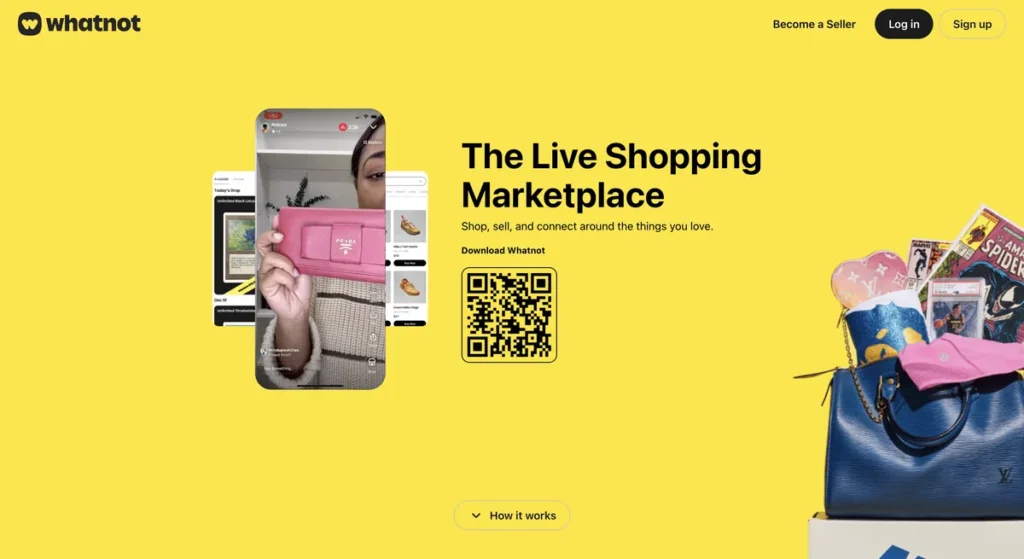
Category: Live Marketplace, a third-party app with its own buyer audience where you sell live under the marketplace’s rules and fees.
At a Glance
- Category: Live Marketplace
- Best For: Collectibles, trading card, comics, sneaker and apparel resellers who want buyers immediately
- Price Range: $0/month; 8% commission (tiers down to 3% based on rolling four-week sales since September 21, 2026) + 2.9% + $0.30 per order in the US (Whatnot Help Center, November 2026)
- Primary Strength: Whatnot provides a built-in live-shopping audience with no monthly fee and published commission rates.
- Biggest Limitation: Whatnot sellers do not own the customer relationship or checkout, and Whatnot can reduce a seller’s feed visibility.
- One-Line Summary: Whatnot is the best-funded company in this list and its only pure live marketplace, giving resellers an instant audience with no monthly fee in exchange for commission, platform rules and limited customer ownership.
- Last Verified: November 2026
PlugRoute Score: 30/45, C1 3, C2 4, C3 3, C4 2, C5 5, C6 3. Why #4: Whatnot has the strongest funding and fully published fees in this list. As a marketplace without owned checkout or simulcast reach, it scores lower on integration and channel criteria and loses the tiebreak to Channelize.io (10 vs 12 primary points).
Overview
Whatnot is a mobile-first live shopping marketplace. Sellers run auctions and fixed-price shows for Whatnot’s own buyer audience, with built-in checkout and shipping labels. It suits collectibles, trading card, sneaker and apparel resellers who want buyers from day one.
Whatnot is a sales channel, not software that adds live shopping to your own storefront. Whatnot was founded in 2019 as a Funko Pop resale site and added live streaming in 2020 (Wikipedia, November 2026).
Key Features
- Whatnot supports live auctions and Buy It Now listings inside its mobile marketplace app.
- Whatnot handles checkout and creates shipping labels, and Whatnot’s Seller Hub provides sales reports.
- Whatnot surfaces live shows to its own buyers through in-app feeds, which removes the audience-building work that owned-site streams require.
- Whatnot’s Seller Protection program handles chargebacks directly and may cover carrier losses and abusive buyer claims when sellers follow its rules.
- Whatnot’s main categories include cards, collectibles, comics, sneakers, apparel and electronics.
Best For
Whatnot is best for resellers and collectibles sellers whose products suit auction-style live selling and who value an existing audience more than owning customer data and checkout.
Pricing
Whatnot’s US fees (Whatnot Help Center, November 2026):
- Whatnot charges no monthly fee.
- Whatnot takes a standard 8% commission on the item’s sale price.
- Whatnot charges 2.9% + $0.30 payment processing on the full order, including shipping and tax.
Whatnot cost examples and tier mechanics:
- Whatnot’s fees on a $100 item with no shipping or tax come to about $11.20.
- Whatnot’s fees on a $5 item come to about $0.85, or 17%, because of the fixed $0.30.
- Since September 21, 2026, Whatnot has automatically moved eligible US sellers into lower commission tiers, as low as 3%, based on sales over a rolling four-week period. Processing still applies.
- Whatnot’s EU/UK processing is 2.42% + €/£0.25 plus VAT.
Strengths
- Whatnot raised a $225M Series F co-led by DST Global and CapitalG at an $11.5B valuation (Retail Tech Innovation Hub, October 2025). Its total funding is about $968M (VCBeast, November 2026), the most of any company in this list.
- Whatnot reported more than $3B in annual livestream sales around its Series E (VCBeast, January 2025). Dataintelo, a market-research aggregator, describes Whatnot as the largest live marketplace outside Asia (Dataintelo, November 2026).
- Whatnot publishes its full fee schedule and charges no monthly fee, so a Whatnot pilot is easy to price.
- Whatnot’s Seller Protection handles chargebacks directly (Whatnot Trust, November 2026), so sellers do not carry that dispute work themselves.
Limitations
Whatnot’s most consequential trade-off is control. Sellers do not own the checkout or customer relationship, and Whatnot can quietly reduce a seller’s feed visibility (Whatnot Help Center, November 2026).
- Whatnot’s lower commission tiers depend on rolling four-week sales, so one slow month can push a seller’s rate back up.
- Whatnot BBB complaints allege withheld funds, disputed bonuses, unclear promotion terms and support that is slow and hard to escalate (BBB, November 2026).
- Whatnot’s Trustpilot evidence is less reliable than it looks: Rankite cites 4.2/5 from 12,261 reviews, but a direct page snapshot showed 6,689 reviews (Rankite and Trustpilot, November 2026).
- Whatnot cannot replace software that hosts live shopping on a brand’s own site.
A Whatnot seller on r/whatnotapp explained how the marketplace differs from a traditional sales channel:
“Whatnot is NOT EBay or Amazon or any other shopping platform, it’s a social media app with the ability to buy direct from your favourite streamer. As sellers, we are not building a customer base, we are building a community of fans who we can engage with in real time.” Posted by u/danoxrep
Takeaway: Whatnot sellers who do well treat the app as a community-driven social channel rather than a place to own customers, which confirms that its built-in audience comes at the cost of the customer relationship.
Verdict
Whatnot is the strongest choice in this list for resellers who want an instant live-shopping audience with no monthly fee, from the best-funded company in the category. Whatnot’s fees are published and predictable, though the fixed $0.30 per-order fee hits low-priced items hard. Brands that need to own customer data should treat Whatnot as an additional channel.
5. Firework: Best for Enterprise Retailers Needing a Full Video Commerce Suite
Category: Owned-Site Live Shopping Platform.
At a Glance
- Category: Owned-Site Live Shopping Platform
- Best For: Enterprise and multi-brand retailers that want live and short-form shoppable video across site, app, email and publisher placements
- Price Range: Tiered by uploads and views; about $259/month entry per third-party sources; enterprise add-on of $1,500/month or 30% (Firework pricing page, Videowise and Rankite, November 2026)
- Primary Strength: Firework combines the broadest video commerce feature set in this list with SOC 2 Type II certification and $250M in reported funding.
- Biggest Limitation: Firework does not publish its tier base prices, and PlugRoute could not verify Firework’s independent review ratings.
- One-Line Summary: Firework has the broadest feature set of the enterprise video commerce suites in this list, with SOC 2 Type II certification and $250M in reported funding, but opaque pricing and thin verified review data make independent evaluation difficult.
- Last Verified: November 2026
PlugRoute Score: 29/45, C1 2, C2 2, C3 4, C4 5, C5 5, C6 3. Why #5: Firework earns top marks on features and credentials, but both double-weighted evidence criteria, reviews and pricing, are weak.
Overview
Firework is an enterprise video commerce suite that combines shoppable short video, livestreams with replay, social simulcasting and a publisher distribution network. It is built for enterprise and multi-brand retailers that need SDKs, CRM and analytics connectors, and SOC 2 Type II security evidence.
Firework is built by Loop Now Technologies. PlugRoute could not verify Firework’s founding date or headquarters.
Key Features
- Firework places shoppable short videos on homepages, product pages, email and SMS, and Shopify’s Shop App.
- Firework runs livestreams with replays, polls, quizzes and coupons, and simulcasts them to social channels.
- Firework imports existing Instagram and TikTok content so brands can reuse it as shoppable video.
- Firework provides mobile app integration kits and connects to order management, CRM, and Google and Adobe Analytics.
- Firework distributes brand video through a publisher and retail-media network beyond the brand’s own site.
Best For
Firework is best for enterprise and multi-brand retailers with developer resources that want one vendor for shoppable video across many surfaces and whose procurement teams require SOC 2 Type II.
Pricing
Firework prices its tiers by uploads and views, but the base prices were not visible on its pricing page (Firework pricing page, November 2026). The published mechanics:
- Firework’s entry pricing is around $259/month, according to third-party roundups (Videowise and Rankite, November 2026).
- Firework charges $10 per 1,000 extra views on mid tiers and $5 per 1,000 on higher tiers.
- Firework Enterprise adds $1,500/month or 30% of the monthly cost, whichever is higher.
Ask Firework for a written quote that shows view allowances, overage rates and how it defines a billable view, so you can compare it with Bambuser’s $0.25-per-view model.
Strengths
- Firework announced SOC 2 Type II certification (Firework press room, November 2026). A comparison written by Bambuser, a competitor, says Firework also claims HIPAA Security Rule compliance (Bambuser, November 2026).
- Firework’s $150M Series B was led by SoftBank Vision Fund 2 (TechCrunch, May 2022), and Firework now states $250M in total funding (Firework, November 2026).
- Firework’s named customer Stolen Stores saw a 10% increase in average order value (Firework, November 2026, vendor-reported). Firework’s other figures, up to 21% conversion and a 22x ROI increase, are unattributed.
- Firework’s Shopify App Store reviewers (48 reviews) describe the team as “incredibly hands on” with “24/7” responses and setup as “very easy” (Shopify App Store, November 2026).
Limitations
Firework’s most consequential trade-off is transparency. Firework’s tier base prices are unpublished, and the enterprise add-on of $1,500/month or 30% raises cost considerably.
- Firework’s G2 rating and Shopify star rating could not be verified, which leaves thin independent evidence for a market leader.
- Videowise, a competitor, says Firework needs more developer work than Shopify-native apps (Videowise, November 2026).
- Videowise, a competitor, also says Firework costs more than smaller DTC brands need and should be tested for page-speed impact (Videowise, November 2026).
Verdict
Firework is the most feature-complete and security-documented video commerce suite in this list, built for enterprise retailers that need shoppable video across many channels. Firework’s funding and SOC 2 Type II certification reduce vendor risk. Firework buyers should request written quotes, references and page-speed tests before committing.
6. TalkShopLive: Best for No-Monthly-Fee Pilots and an Embeddable Shoppable Player
Category: Hybrid Network, a live shopping network with its own audience plus an embeddable shoppable player you can place on your own site.
At a Glance
- Category: Hybrid Network
- Best For: Creators, publishers, fan-merchandise sellers and small Shopify brands running a low-risk live-selling pilot
- Price Range: $0/month; 10.25% of order value + $0.30 per item; card processing of 2.9% + $0.30 may apply (TalkShopLive pricing page and Terms of Service, November 2026)
- Primary Strength: TalkShopLive lets sellers run and embed shoppable live shows with no monthly, setup or listing fee.
- Biggest Limitation: TalkShopLive’s BBB profile showed a 1.0/5 rating from buyers, and TalkShopLive has only six G2 reviews, so its independent evidence is thin and partly negative.
- One-Line Summary: TalkShopLive is a no-monthly-fee live shopping network and embeddable player suited to creators and small Shopify pilots, though high per-item fees, thin seller reviews and buyer-side fulfillment complaints limit it at scale.
- Last Verified: November 2026
PlugRoute Score: 25/45, C1 2, C2 4, C3 3, C4 3, C5 2, C6 2. Why #6: TalkShopLive has transparent zero-monthly pricing, but only six seller reviews and modest funding.
Overview
TalkShopLive is a live shopping network and embeddable shoppable video player. Sellers can stream to TalkShopLive’s audience and embed checkout-enabled shows on blogs, newsletters and stores with no monthly fee. It suits creators, publishers and small Shopify sellers piloting live sales.
TalkShopLive was founded in 2018 in Los Angeles by Bryan Moore and Tina Moore (TechCrunch, July 2021). TalkShopLive’s publisher shows include Vogue with JLo Beauty.
Key Features
- TalkShopLive’s embeddable player puts live video with built-in checkout on blogs, newsletters, publisher sites and brand stores.
- TalkShopLive runs its own shopping network, so shows can reach buyers beyond the seller’s own channels.
- TalkShopLive’s free Shopify app syncs products and sends checkout through the seller’s own Shopify store.
- TalkShopLive creates shipping labels and sends shipping notifications to buyers.
- TalkShopLive keeps replays available after each show ends.
Best For
TalkShopLive is best for creators, publishers and small Shopify sellers who want to test live selling with no fixed monthly cost and can accept a high per-sale fee during the pilot.
Pricing
TalkShopLive’s published pricing (TalkShopLive pricing page, November 2026):
- TalkShopLive charges $0/month, with no setup or listing fee.
- TalkShopLive takes 10.25% of order value plus $0.30 per item sold.
- TalkShopLive’s terms of service say separate card processing of 2.9% + $0.30 may also apply (TalkShopLive Terms of Service, November 2026).
- TalkShopLive’s small-business page describes a flat 10% plus 0.25% on non-Shopify orders, so sellers should confirm which fee applies.
On a $100 single-item order, TalkShopLive’s platform fee is about $10.55, or about $13.75 if card processing applies. At $10,000 in monthly sales, the platform fee alone is about $1,025 plus $0.30 per item.
Strengths
- TalkShopLive charges $0/month with no setup or listing fee (TalkShopLive pricing page, November 2026), which makes it one of the lowest-risk ways to pilot live selling.
- TalkShopLive has hosted celebrity and publisher shows. Replays reached about 846,200 views for Dolly Parton and 356,200 views for Kenny Chesney (Fundraising Fox, November 2026), though view counts are not sales.
- TalkShopLive’s Shopify App Store reviewers say it helped them “grow my audience” and that syncing products to weekly shows was easy (Shopify App Store, November 2026).
- TalkShopLive holds G2 5.0/5 from only six reviews, with reviewers praising free streaming and simplicity (G2, November 2026).
Limitations
TalkShopLive’s most consequential trade-off is high variable cost. At 10.25% plus $0.30 per item, plus possible card processing, TalkShopLive’s fees grow quickly with volume.
- TalkShopLive’s six G2 reviews also mention uneven stream quality, delayed chat, slow product sync and limited customization (G2, November 2026).
- TalkShopLive’s BBB profile showed a 1.0/5 rating and 36 buyer complaints over three years (BBB, November 2026). Reddit buyers describe shipping delays and support they couldn’t reach (Reddit, November 2026).
- TalkShopLive’s reported December 2025 CEO change is unverified, and TalkShopLive’s total funding is a modest $16–18M (Caplight, November 2026; last round October 2023).
A TalkShopLive buyer on r/SignedAlbums described the fulfillment experience:
“They’re legit but I personally wouldn’t order from them. The first and only time I ordered from them was a few months ago. Ordered 2 signed books. One for me and one for a Christmas gift. After two weeks there was no shipping notification. I contacted them and got a response that said my order should have been mailed out a week prior and they’d escalate the case. Never was able to get ahold of them again and ending up having to dispute the charge to my credit card company to get my money back.” Posted by u/JerseyGirl0208
Takeaway: TalkShopLive’s buyer-side shipping and support gaps are a real reputational risk for sellers who send their customers through its network.
Verdict
TalkShopLive is the lowest-commitment way in this list to pilot embeddable live shopping, with no monthly fee and a free Shopify app. TalkShopLive suits creators, publishers and small sellers testing demand. Because its per-item fees are high, its seller reviews are thin and its buyer-side complaint record is poor, TalkShopLive works best as a pilot channel rather than a long-term platform.
What Will Live Commerce Software Actually Cost?
Live commerce software costs a subscription plus any commission, payment processing, per-order fees and view overages. On a $100 sale, Whatnot charges about $11.20 including processing, and TalkShopLive charges $10.55 to $13.75. Subscription tools cost more at low volume and less at high volume. Rerun these scenarios with your own numbers.
PlugRoute checked each price in this ranking against the vendor’s own page or app listing in November 2026. Where two sources disagree, both figures are shown.
| Platform | Starting Price (Nov 2026) | Pricing Model |
|---|---|---|
| CommentSold | $149/month + 6% of sales | Subscription plus commission |
| Bambuser | Free (250 views/month) | Subscription plus $0.25 per extra view |
| Channelize.io | $97/month on Shopify (Capterra lists Free) | Usage-based subscription, no commission |
| Whatnot | $0 + 8% + 2.9% + $0.30 | Commission plus processing |
| Firework | ~$259/month (third-party) | Tiered by uploads and views |
| TalkShopLive | $0 + 10.25% + $0.30/item | Commission; card processing may apply |
| Scenario | Platform | Estimated Cost | Assumptions |
|---|---|---|---|
| $100 single item | Whatnot | ~$11.20 | 8% + 2.9% + $0.30; processing included; no shipping or tax |
| $100 single item | TalkShopLive | ~$10.55, or ~$13.75 with card processing | 10.25% + $0.30; plus 2.9% + $0.30 if processing applies |
| $5 item | Whatnot | ~$0.85 (17%) | Fixed $0.30 dominates |
| $10,000/month in sales | CommentSold Starter | ~$749 | $149 + 6%; processing excluded |
| $10,000/month in sales | Whatnot | ~$800 commission + ~$290 processing + $0.30/order | Standard 8% tier; no shipping or tax |
| $10,000/month in sales | TalkShopLive | ~$1,025 + $0.30/item | Platform fee only; card processing may add more |
| $10,000/month in sales | Channelize.io | $97–$497 subscription, no commission | Depends on viewing minutes used |
| CommentSold tier break-even | $149 + 6% vs $499 + 5% | ~$35,000/month | Processing excluded |
| CommentSold tier break-even | $499 + 5% vs $999 + 4% | ~$50,000/month | Processing excluded |
| 1,000 views over allowance | Bambuser | ~$250 | $0.25 per view over 3 seconds |
| 1,000 views over allowance | Firework (mid tier) | ~$10 | $10 per 1,000 views |
Three patterns in these numbers matter most:
- A fixed $0.30 per-order fee becomes a 17% charge on a $5 item on Whatnot, so selling twenty $5 trading cards costs about $17 in fees. Per-order fees are the hidden cost for low-priced live sellers.
- A commission-only platform charging about 10% costs less than Channelize.io’s $97/month commission-free START plan until monthly live sales pass about $1,000. Above that, the subscription is usually cheaper.
- Vendors define a billable view differently, so ask each vendor for its definition before comparing Bambuser’s ~$250 overage with Firework’s ~$10.
How Can I Pilot Live Selling Without Overcommitting?
The safest way to pilot live selling is a 30-day test on a $0/month or free tier, such as TalkShopLive, Whatnot or Bambuser Free, before you pay for a subscription. Track orders per show and total fees, and upgrade only once monthly live sales pass the break-even point for a subscription tool.
A 30-day pilot plan:
- In week 1, pick a no-monthly-fee tool that matches your channel: Bambuser Free for your own site, Whatnot for collectibles or resale, or TalkShopLive for an embeddable player.
- In weeks 2–4, run two to four shows and record orders per show, average item price and total fees for each show.
- At day 30, compare your monthly fees with a subscription tool’s price, such as Channelize.io’s $97/month START plan (Shopify App Store, November 2026).
- A boutique that needs invoicing and shipping can use CommentSold’s 15-day free trial instead and get cancellation terms in writing before the trial ends.
Which Live Commerce Tools Work With Shopify and Other Ecommerce Platforms?
Five of the six platforms document a Shopify app or integration, and Whatnot’s Shopify sync is reported but unconfirmed. For non-Shopify stores, Channelize.io documents the most ecommerce-platform integrations. Firework documents OMS, CRM and analytics connectors. Confirm every integration in a live demo.
| Platform | Shopify | Other Confirmed Platforms | Unconfirmed or Notes | Where Checkout Happens |
|---|---|---|---|---|
| CommentSold | Via Videeo plugin | Own webstore and branded apps | Facebook, Instagram, TikTok selling | CommentSold order and invoice system |
| Bambuser | Shopify App Store app | Enterprise integrations not itemized in research | Shopify rating quoted on vendor page | Brand’s own storefront |
| Channelize.io | Yes | WooCommerce, Magento/Adobe Commerce, PrestaShop, Wix, Shoplazza | BigCommerce unconfirmed | In-show cart and checkout |
| Whatnot | Reported but unconfirmed | None | Verify in Whatnot Help Center | Whatnot marketplace |
| Firework | Shopify App Store app; Shop App | OMS, CRM, Google/Adobe Analytics connectors | Commerce-platform list not detailed | Confirm with vendor |
| TalkShopLive | Free Shopify app | None | Different fee for non-Shopify orders | Seller’s Shopify store |
What Carries Over When You Simulcast to Instagram and TikTok?
Shopping features often stop working when you simulcast to social platforms. PlugRoute’s research found that product tags, polls and checkout behave differently on Instagram and TikTok than in a vendor’s own player. If you plan to sell on social channels, test interactive features on each destination before you commit.
Documented simulcast behavior by platform:
- Bambuser reviewers report that polls and games do not carry over to Instagram and that Instagram and TikTok shopping is not seamless (G2, November 2026).
- Channelize.io reviewers describe Channelize.io’s social simulcasting as “a bit on the clunky side” (G2, November 2026).
- CommentSold streams directly to Facebook, Instagram and TikTok and uses comments as the ordering method, so CommentSold ordering does not depend on embedded shopping features.
- Firework documents simulcasting, but PlugRoute found no independent data on how Firework features hold up on social platforms.
- Whatnot runs inside its own app, so simulcasting does not apply to Whatnot.
What Red Flags Should I Watch For When Evaluating Live Commerce Software?
The biggest red flags in live commerce software are hidden or stacked costs, claims you can’t verify, and platform or vendor risk. The nine red flags below cover subscription, quote-only and marketplace pricing models equally. Each includes a dated example from the six ranked vendors, so you can spot the same pattern in any vendor you evaluate.
Red Flag #1: Commission Stacked on a Subscription A monthly subscription plus a percentage of sales can make low-volume months expensive. CommentSold, for example, charges $149/month plus 6% of sales on its Starter plan (CommentSold pricing page, November 2026), so a $2,000 month costs about $269. Model your cost at realistic monthly revenue before signing.
Red Flag #2: Quote-Only Pricing With No References A vendor with no public pricing and few independent reviews gives buyers nothing to benchmark against. Firework does not publish tier base prices (Firework, November 2026). Require named references and a written, itemized quote from any quote-only vendor.
Red Flag #3: Per-View Overages With No Cap Per-view overages with no cap can turn a successful live event into an unexpected bill. Bambuser charges $0.25 per extra view over 3 seconds, and Firework charges $5–$10 per 1,000 extra views (Bambuser and Firework pricing pages, November 2026). Ask how each vendor counts a view and whether you can set a spending cap.
Red Flag #4: Shopping Features That Disappear on Social Simulcasts Polls, product tags and checkout may work in a vendor’s own player but fail on Instagram or TikTok. Bambuser reviewers report that polls and games do not carry over to Instagram, and Channelize.io reviewers call its simulcasting “a bit on the clunky side” (G2, November 2026). Test every destination during a trial.
Red Flag #5: Performance Claims With No Named Customer Conversion multiples without a named, dated customer can’t be checked. Firework’s “22x ROI increase” is an unattributed vendor claim (Firework, November 2026). Treat such figures as marketing until a reference customer confirms them, and give named case studies with dated results more weight.
Red Flag #6: Unclear Cancellation Terms Recurring reviewer complaints about cancellation and unexpected charges point to contract risk. CommentSold reviewers report difficulty cancelling, and one Channelize.io Shopify reviewer alleges a refused refund after annual payment (GetApp, Capterra and Shopify App Store, November 2026; unverified user claims). Get cancellation steps, notice periods and refund terms in writing.
Red Flag #7: Declining Vendor Revenue on a Multi-Year Contract A vendor whose own filings show falling revenue is a risk on long contracts. Bambuser’s ARR fell from SEK 95.9M at year-end 2024 to SEK 77.7M at year-end 2025, though it was broadly flat in Q4 2025 (Bambuser Q4 2025 year-end report, November 2026). Negotiate shorter terms or exit clauses with any shrinking vendor.
Red Flag #8: Fixed Per-Order Fees on Low-Priced Items Fixed per-order or per-item fees take a large share of cheap sales. On Whatnot, a $5 item pays about $0.85 in fees, or 17%, and TalkShopLive adds $0.30 to every item sold (Whatnot Help Center and TalkShopLive pricing page, November 2026). Calculate fees at your average item price, not at $100.
Red Flag #9: Platform Control Over Visibility and Payouts Marketplaces control who sees your shows and when you get paid. Whatnot can quietly reduce a seller’s feed visibility (Whatnot Help Center, November 2026), and BBB complaints allege withheld funds and disputed bonuses (BBB, November 2026). Read a marketplace’s enforcement and payout policies, and keep an owned sales channel as a backup.
What Questions Should I Ask Before Choosing Live Commerce Software?
Before choosing live commerce software, ask each vendor seven questions. They cover total cost at your volume, checkout ownership, simulcast feature parity, inventory sync, security documentation, named references and cancellation terms. The answers expose most cost and risk gaps, and you can compare them across vendors before you sign anything.
Question #1: What is my total cost at my expected monthly sales and viewer count? Ask every vendor for a written total-cost estimate that covers subscription, commission, processing, per-order fees and overages. Compare it with PlugRoute’s worked examples: a $100 sale costs about $11.20 on Whatnot, and CommentSold Starter costs about $749 at $10,000 in monthly sales (November 2026).
Question #2: Does checkout happen on my store or the platform’s? Checkout location decides who owns customer data and repeat purchases. Owned-site tools such as Bambuser and Channelize.io keep checkout on your storefront. Whatnot keeps checkout and buyer data inside its marketplace, and CommentSold runs orders through its own invoicing system. Confirm where payment, order data and customer emails end up.
Question #3: Which features still work when I simulcast to Instagram and TikTok? Ask the vendor to list, for each simulcast destination, which polls, product tags and checkout features work. Then confirm that list in a live test. G2 reviewers report that Bambuser’s polls and games do not carry over to Instagram (G2, November 2026), and other vendors may have similar gaps.
Question #4: How does inventory sync prevent overselling across channels? Look for real-time stock holds when an item sells during a show. Selling one product on several channels at once can cause overselling (Videowise and Stremify, November 2026). CommentSold, for example, holds stock as soon as a buyer comments. Ask each vendor how its sync handles simultaneous orders.
Question #5: Can you provide SOC 2 or ISO 27001 documentation? Enterprise procurement usually requires SOC 2 Type II or ISO 27001 reports. In PlugRoute’s research, Firework announced SOC 2 Type II (Firework press room, November 2026) and Bambuser self-states ISO 27001 for its Stockholm site. No certifications were found for the other four vendors. Ask for the reports themselves.
Question #6: Can I speak to two named customers at my size? Ask every vendor for two named customers at your revenue level, and call them. References are the best substitute for missing independent reviews, which matters most for vendors such as TalkShopLive (six G2 reviews). Ask references about real costs, support response times and stream reliability.
Question #7: How do I cancel, and what notice is required? Clear, written cancellation terms protect you if a pilot underperforms. Ask about notice periods, annual-plan refunds and how trials convert to paid plans. CommentSold offers a 15-day free trial and Channelize.io a 14-day trial on Shopify (November 2026), so confirm what happens when each trial ends.
How Did We Rank These Live Commerce Software Platforms?
PlugRoute scored each platform from 1 to 5 on six published criteria. Independent review evidence, pricing transparency and commerce integration counted double, for a maximum of 45 points. Missing evidence was scored as low evidence, not as proof of a bad product. All prices and ratings were captured in November 2026.
The criteria and why each matters:
- C1. Independent review evidence (double weight): Third-party ratings with enough reviews behind them are the closest thing to independent proof of reliability and support.
- C2. Pricing transparency and total-cost predictability (double weight): Hidden prices and stacked fees make total cost hard to estimate.
- C3. Commerce integration and operational depth (double weight): Live selling must connect to inventory, checkout and fulfillment.
- C4. Channel reach and feature parity (single weight): Simulcast, replay, analytics and interactive features vary widely between tools.
- C5. Vendor stability and enterprise credentials (single weight): Funding, revenue trend and SOC 2 or ISO evidence affect contract risk.
- C6. Verifiability of performance claims (single weight): Named, dated results count for more than unattributed multiples.
On C1, a score of 1 means no verified reviews or a statistically negligible number (fewer than 5).
A developer researching the category on r/shopifyDev described how uneven the field is:
“I’m working on a shoppable video app for Shopify, and while researching I found many apps already doing something similar. Some look good, some look outdated, and some barely have any users.” Posted by u/jamsheerkrd
Takeaway: The shoppable video category is crowded with apps of uneven quality and adoption, which is why independent review volume carries double weight in PlugRoute’s live commerce ranking.
| Platform | C1 (x2) | C2 (x2) | C3 (x2) | C4 | C5 | C6 | Total /45 |
|---|---|---|---|---|---|---|---|
| CommentSold | 5 | 4 | 5 | 4 | 3 | 3 | 38 |
| Bambuser | 3 | 5 | 4 | 4 | 3 | 4 | 35 |
| Channelize.io | 4 | 3 | 5 | 3 | 1 | 2 | 30 |
| Whatnot | 3 | 4 | 3 | 2 | 5 | 3 | 30 |
| Firework | 2 | 2 | 4 | 5 | 5 | 3 | 29 |
| TalkShopLive | 2 | 4 | 3 | 3 | 2 | 2 | 25 |
Evidence was weighted and handled as follows:
- PlugRoute weighted independent review platforms above vendor-published figures and vendor figures above competitor-written comparisons, and every figure is labeled by source type.
- PlugRoute raised CommentSold’s C2 from 3 to 4 in November 2026 because its official pricing page cleared up earlier conflicts between published rates. Channelize.io’s C2 stayed at 3 because its overage rate is unpublished.
- Channelize.io and Whatnot tied at 30, and Channelize.io ranks higher because it earned more primary-criteria points (12 vs 10).
- PlugRoute excluded Videeo because it is a CommentSold product covered in CommentSold’s entry.
- Some tools were outside this evaluation’s research: eStreamly, Sprii, Videowise, Tulip, MikMak, Lengow, NOW Live and LiveMeUp. Native channels such as TikTok Shop and Amazon Live were also excluded because they are sales channels, not software you add to your own stack.
PlugRoute has no affiliate relationships with any company listed. Rankings are determined entirely by research data and objective evaluation criteria.
What Else Do Buyers Ask About Live Commerce Software?
The most common buyer questions about live commerce software cover which tool fits a small business, which works best with Shopify, and how PlugRoute builds its rankings. The short answers below use the same November 2026 evidence as the rest of this ranking, including verified pricing pages and review counts.
What’s the best live commerce software for a small business in 2026?
TalkShopLive is the lowest-risk option for a no-monthly-fee pilot, and Whatnot suits sellers of collectibles or resale goods. Bambuser Free covers up to 250 views a month on your own site (Bambuser pricing page, November 2026). Boutiques selling regularly on Facebook and Instagram should evaluate CommentSold and start with its 15-day free trial.
What’s the best live commerce software for Shopify stores?
Channelize.io is the best-evidenced budget option for Shopify, with 4.7/5 from 86 Shopify App Store reviews, plans from $97/month and no commission (Shopify App Store, November 2026). Bambuser Essential costs $79/month and holds G2 4.6/5 from 30 reviews. TalkShopLive’s free Shopify app suits pilots. Firework suits enterprise Shopify brands.
How does PlugRoute determine rankings?
PlugRoute scores every platform from 1 to 5 on six published criteria. Independent reviews, pricing transparency and commerce integration count double, for a maximum of 45 points. Each source is labeled as independent, vendor-reported or competitor-written. Missing evidence lowers a score but is reported as a finding, not as a verdict on product quality.
What Do Key Live Commerce Software Terms Mean?
Comment-to-Buy: A way of selling where a shopper types a comment such as “sold” during a social livestream, and the software turns it into an order, holds the stock and sends an invoice. It matters if you sell live on Facebook, Instagram or TikTok, because it replaces the order queues sellers otherwise manage by hand.
Owned-Site Live Shopping: Software that embeds shoppable livestreams and video on your own website or app, so checkout and customer data stay with you. The trade-off is that these streams start with no audience, so you have to bring your own viewers.
Live Marketplace: A third-party app with its own buyers, where you sell live under the marketplace’s rules and fees. You get buyers from day one, but you don’t own the checkout or the customer relationship, and the platform controls your visibility and payouts.
Hybrid Network: A live shopping network with its own audience that also offers an embeddable shoppable player for your own site. It mixes borrowed reach with your own placements, which can suit a low-risk pilot.
Simulcast: Streaming one live event to several destinations at the same time, such as social channels or several regional storefronts. Check what still works on each destination, because polls, product tags and checkout may not carry over to Instagram or TikTok.
Commission: A percentage of each sale the vendor keeps, sometimes added on top of a monthly subscription. Stacked commissions can make low-volume months expensive, so work out the cost using your realistic monthly revenue.
Per-Order Fee: A fixed charge on each order or item sold, often paid along with a percentage-based payment processing fee. On low-priced items it can take a large share of the sale, so calculate fees at your average item price.
Per-View Overage: An extra charge for each view, or each block of viewing minutes, beyond your plan’s allowance. Vendors count a billable view differently, so ask for each vendor’s definition and whether you can cap spending before you compare prices.
Usage-Based Pricing: Billing based on how much you use the platform, such as number of shows, show length and viewing minutes, instead of a share of sales. Costs don’t rise with your revenue, but a well-attended show can push you into overage charges.
Break-Even Point: The monthly sales level where a higher-priced subscription tier, or a subscription tool, becomes cheaper than a lower tier or a commission-only option. Knowing it tells you when to upgrade after a pilot.
Stock Hold: A real-time reservation of inventory the moment an item sells during a show. It matters most when you sell the same product on several channels at once, because it helps prevent overselling.
SOC 2 Type II and ISO 27001: Security certifications that enterprise procurement teams usually ask for during a vendor security review. Ask for the actual reports, since a certification a vendor announces or states about itself is not the same as documentation you have checked.
Which Live Commerce Software Is Right for You?
Key Insights
The right live commerce software depends first on whether you sell on your own site, through social channels or on a marketplace. After that, it depends on total cost once commissions, processing and overages are included. Use the Quick Decision Framework table to match your top priority to a tool, then confirm the pricing yourself.
- Live commerce buyers should choose a sales channel first (own site, social or marketplace), because each channel trades audience for control differently.
- Live commerce buyers should model total cost rather than the headline price, because commissions, processing, per-order fees and view overages can outweigh the subscription.
- Independent evidence in live commerce software is thin overall: most conversion figures are vendor-reported, and Firework and TalkShopLive lack verified review depth.
- Boutique sellers have limited vendor choice, because PlugRoute identified no independent alternative to CommentSold for comment-to-buy selling.
- Live commerce pricing changes often, as CommentSold’s official rates and Whatnot’s September 2026 tiers both show, so buyers should recheck vendor pages at least quarterly.
Live shopping conversion rates of 8–15% are measured on viewers who chose to watch, not on all site visitors (ATTN Agency, 2026). Owned-site streams also start with no audience. Grand View Research projects global live commerce at $230.3B in 2026 (Grand View Research, 2026), so expect vendors and fees to keep changing.
If you need a low-risk test, start with TalkShopLive, Bambuser Free or Whatnot before committing to a subscription. If you need to own customer data at scale, shortlist Bambuser, Firework or Channelize.io and request written quotes.
For more evidence-based comparisons, read PlugRoute’s full ranking methodology and our other independent ecommerce software reviews. We update this guide quarterly. Last updated: November 2026.