Shopify is the best overall e-commerce software for online-first small businesses in 2026. Square Online is best for physical stores and free starts, WooCommerce for WordPress owners who want full ownership, and BigCommerce for B2B and wholesale. The right platform depends on your sales channels, technical skill and total annual cost.
This guide ranks complete e-commerce platforms for running an online store, from online-first brands to physical shops, WordPress sites and B2B wholesale. If your priority is selling on phones through a mobile storefront or branded app, see Best Mobile E-Commerce Software; if you only need checkout and cart features, see Best Shopping Cart Software.
Most store builders look alike on their pricing pages, and the real differences appear after launch. Payment fees, paid apps, hosting and sales-volume upgrades raise the yearly bill. Leaving becomes expensive once you add B2B, a second storefront or a physical shop.
PlugRoute has no affiliate relationships with any company listed. Rankings are determined entirely by research data and objective evaluation criteria.
This guide ranks seven platforms across five categories on six weighted criteria, including total annual cost and exit risk. Each entry shows who the platform fits, what it really costs and where it falls short. A lower-ranked tool can still be the right one for your business.
What Are the 5 Categories of E-Commerce Software?
E-commerce software falls into the five categories below. They differ in who handles technical upkeep, how far the store can scale and how hard it is to leave. Those three factors matter more than any single feature, so pick the category before you pick the brand.
- Hosted Commerce Platform (Hosted): Shopify and BigCommerce run the servers, security and checkout for a monthly subscription, and merchants add features with apps.
- POS-Led Omnichannel Platform (POS-Led): Square Online is an online store built as an extension of an in-person register, so in-store and online sales share one inventory.
- Self-Hosted Open-Source Platform (Self-Hosted): WooCommerce is free, open-source software that merchants install on their own hosting, which gives them control and also makes them responsible for maintenance.
- Website Builder with Commerce (Builder): Squarespace Commerce and Wix eCommerce are design-first SaaS site builders with selling tools, and they work best for smaller catalogs.
- Enterprise Commerce Suite (Enterprise): Adobe Commerce is quote-priced, highly customizable software for large catalogs and complex B2B, and it needs dedicated development resources.
Your e-commerce category decides three things before you pick a brand: who patches the servers, how far the catalog can grow and what it costs to leave.
How Do the Top E-Commerce Platforms Compare at a Glance?
Shopify ranks first in PlugRoute’s weighted scoring at 3.95 out of 5. Square Online (3.70), WooCommerce (3.64) and BigCommerce (3.54) follow, then Squarespace Commerce (3.29), Wix eCommerce (3.27) and Adobe Commerce (2.42). Ranks #2 to #4 are within 0.16 points of each other, so fit with your situation matters more than rank.
| Rank | Company | Category | Best For | One-Line Summary | Key Capabilities | Primary Strength | Key Limitation |
|---|---|---|---|---|---|---|---|
| 1 | Shopify | Hosted | Online-first brands and shops that want one inventory | Shopify has the highest overall score (3.95/5) for online-first businesses in 2026, provided the merchant uses Shopify Payments and budgets for paid apps. | Native POS, 16,000+ apps, Shopify Markets, B2B on Plus | Strong ratings on high review volume, with low upkeep | 0.2%–2% fee on outside payment providers; app costs add up |
| 2 | Square Online | POS-Led | Physical stores and $0 starts | Square Online is the best e-commerce software in 2026 for physical businesses that already use Square POS or want a free way to start selling online. | Native Square POS sync, pickup, local delivery, QR ordering | Only hosted $0/mo plan that can sell | Square-only payments; 3.3% + $0.30 online rate on Free; weak B2B |
| 3 | WooCommerce | Self-Hosted | WordPress owners who want ownership | WooCommerce is the best e-commerce software in 2026 for WordPress site owners who want full ownership and can manage, or pay for, ongoing technical upkeep. | Free core, paid extensions, WooPayments | Full code and data ownership with no platform fee | Merchant handles hosting, security and updates |
| 4 | BigCommerce | Hosted | Mid-market B2B and multi-storefront sellers | BigCommerce is a strong hosted fit in 2026 for mid-market B2B and wholesale sellers that can budget for its Enterprise tier and want multiple storefronts without Adobe-level infrastructure. | Multi-storefront, Catalyst headless, B2B Edition (Enterprise tier) | B2B Edition (Enterprise tier), multi-storefront, no platform transaction fee | B2B gated to Enterprise (from about $1,499/mo); volume-triggered upgrades |
| 5 | Squarespace Commerce | Builder | Creators, service businesses, digital products | Squarespace Commerce is the best e-commerce option in 2026 for design-led creators and service businesses selling digital products or small catalogs, but not for scaling physical-goods retail. | Digital products, memberships, subscriptions, Blueprint AI | Highest Capterra rating in this comparison (4.6/5) | Weak above roughly 500 products; only four payment processors |
| 6 | Wix eCommerce | Builder | Small businesses selling products and services | Wix eCommerce is a strong e-commerce option in 2026 for small businesses selling both products and services that value design freedom, but it is the hardest platform in this comparison to migrate away from. | Drag-and-drop editor, bookings, events, Wix POS, Velo | Largest Capterra review base (10,806 reviews) | No full-site export; template can’t be switched after publishing |
| 7 | Adobe Commerce | Enterprise | Complex enterprise B2B above about $10M in sales | Adobe Commerce scored highest of the seven on scalability and B2B readiness in 2026, but its cost and developer dependence make it the wrong choice for most small and mid-sized businesses. | Shared catalogs, negotiated quotes, multi-store, code-level control | Deepest native B2B in this comparison | Quote-only pricing; highest cost and upkeep |
Which E-Commerce Software Should I Choose for My Situation?
Choose e-commerce software by your top priority, not by overall rank. Each row below matches a common priority to the platform that fits it best, plus an acceptable fallback. For many businesses, the right answer is a platform ranked below #1.
| Your #1 Priority | Recommended Tool | Why | Acceptable Alternative |
|---|---|---|---|
| Sell mainly online with no technical upkeep | Shopify | Hosted, with native POS and 4.4/5 on G2 from 5,154 reviews (G2, November 2026) | BigCommerce |
| Run a physical shop or start for $0 | Square Online | Only hosted $0/mo plan that can sell, with native POS inventory sync | Shopify (Tap to Pay works on Basic) |
| Already run WordPress and can handle upkeep | WooCommerce | Merchant owns code and data; no platform fee on any payment provider | Shopify, if you have no maintenance plan |
| Avoid platform fees on outside payment providers | WooCommerce | No platform fee on any payment provider | BigCommerce |
| Sell B2B or wholesale at mid-market scale | BigCommerce | B2B Edition on the Enterprise tier, multi-storefront, no platform transaction fee | Shopify Plus (from $2,300/mo) |
| Sell digital products, memberships or services as a creator | Squarespace Commerce | Built-in digital products and memberships; 0% store fees from the Core plan up | Wix eCommerce |
| Sell products plus bookings or events, with visual design control | Wix eCommerce | Bookings, events, courses and products in one builder | Squarespace Commerce |
| Run complex enterprise B2B above about $10M in sales, with a dev team | Adobe Commerce | Deepest native B2B suite and code-level control | BigCommerce Enterprise |
| Outgrow a website builder you already use | Shopify | Hosted, with lower documented replatforming risk than builders | WooCommerce (for full ownership) |
Specialist tools such as Sellfy and Big Cartel were not evaluated in this ranking.
What Are the 7 Best E-Commerce Software Platforms in 2026?
PlugRoute ranks the seven best e-commerce platforms for 2026 below by weighted score across six areas, from Shopify at #1 to Adobe Commerce at #7. Every entry follows the same structure and documents real strengths and limitations, so you can compare any platform on equal terms.
1. Shopify: Best Overall for Online-First Stores That Want to Scale Without Managing Technology
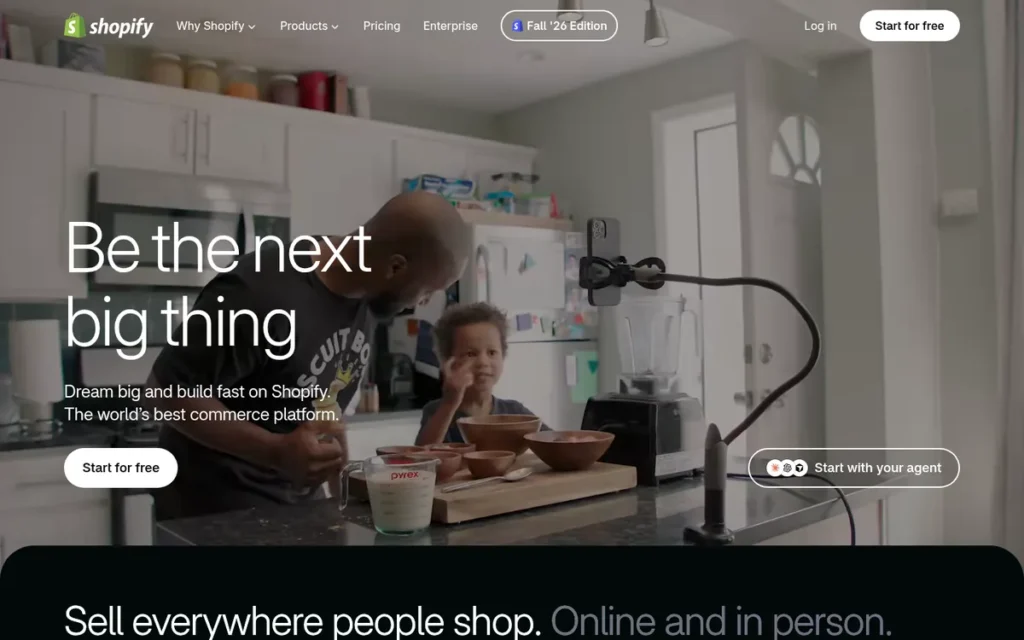
Category: Hosted Commerce Platform, fully managed software that provides storefront, checkout, hosting and payments for a monthly subscription.
At a Glance
- Category: Hosted Commerce Platform
- Best For: Online-first small and mid-sized brands, and physical shops that want one inventory across in-store and online sales
- Price Range: $29–$299/mo billed annually ($39–$399 billed monthly); Plus from $2,300/mo
- Primary Strength: Shopify combines a hosted store, native POS and an app store listing 16,000+ apps with low technical upkeep.
- Biggest Limitation: Shopify charges a 0.2%–2% platform fee on sales processed through third-party payment providers, and paid apps raise the real monthly cost.
- One-Line Summary: Shopify has the highest overall score (3.95/5) for online-first businesses in 2026, provided the merchant uses Shopify Payments and budgets for paid apps.
- Last Verified: November 2026
Overview
Shopify is a hosted all-in-one e-commerce platform for small and mid-sized businesses that want to launch an online store quickly and grow without managing servers, security patches or software updates themselves.
Shopify earned the highest weighted score in this ranking, 3.95 out of 5. Shopify’s lead over Square Online comes mainly from review evidence and scalability. Square Online scores higher on cost and in-person selling.
Shopify has the most G2 reviews in this comparison (5,154). Wix eCommerce has the most Capterra reviews (10,806) (G2 and Capterra, November 2026).
Key Features
- Shopify hosts the store, checkout and security, and Shopify states that it is PCI DSS Level 1 compliant (Shopify, 2026).
- Shopify POS shares one inventory catalog with the online store. Shopify Tap to Pay on iPhone works on every plan, including Basic, with no POS Pro subscription, as long as Shopify Payments is active (Shopify, November 2026).
- Shopify’s app store lists more than 16,000 apps for features such as reviews, subscriptions and bundles, and many of those apps charge a monthly fee.
- Shopify Markets handles international selling, and Shopify’s 2026 pricing page advertises selling “online, in person and in AI chats.”
- Shopify offers native B2B features such as company profiles, price lists and payment terms only on the Shopify Plus plan.
Best For
Shopify is best for online-first brands selling physical products and for brick-and-mortar retailers who want online and in-store inventory in one system.
Pricing (Shopify pricing page, November 2026)
- Shopify Basic costs $29/mo billed annually or $39/mo billed monthly, with online card rates from 2.9% + $0.30. New stores currently get a 3-day trial, then $1/mo for 3 months.
- Shopify Grow costs $79/mo annually or $105/mo monthly, with card rates of 2.7% + $0.30.
- Shopify Advanced costs $299/mo annually or $399/mo monthly, with card rates of 2.5% + $0.30.
- Shopify Plus starts at $2,300/mo, with card rates of 2.25% + $0.30.
- Shopify POS Pro costs $89/mo per location.
- Shopify adds a platform fee of 2% (Basic), 1% (Grow), 0.6% (Advanced) or 0.2% (Plus) when merchants use a payment provider other than Shopify Payments.
App subscriptions are the most-cited source of Shopify cost creep. PlugRoute found no reliable average app-spend figure, so budget from the specific apps your store needs.
Strengths
- Shopify had 21.8% of worldwide digital-commerce applications revenue in 2025, up from 19.5% the year before (IDC via Shopify Enterprise blog, 2025). Shopify published this figure itself, so treat it as directional. Shopify also appears on about 30% of detected US e-commerce sites (SOAX, 2026).
- Shopify holds 4.4/5 on G2 from 5,154 reviews and 4.5/5 on Capterra from 6,763 reviews (G2 and Capterra, November 2026). That is one of the strongest rating-and-volume combinations in this comparison.
- Shopify lets physical retailers run one inventory across POS and online sales. A retailer who moved from Square POS to Shopify called it the “best decision yet” (r/shopify, 2019).
- Shopify handles hosting, security and updates, which Reddit practitioners cite as the reason to choose it over WooCommerce for non-technical owners (r/Wordpress, 2025).
A market seller on r/CraftFairs shared their experience:
“I prefer Shopify to square. I sell about 70% in person at markets 30% online. I personally found the square website options pretty lacking, and the shipping options were pretty weak. Using Shopify for my website and POS had made it much easier to keep my inventory managed.” Posted by u/QuarrelsomeYeti
Takeaway: Sellers who split sales between markets and online find that Shopify’s combined website and POS keep inventory easier to manage than Square’s more limited storefront.
Limitations
Shopify trades low technical upkeep for ongoing fees. Its platform fee of up to 2% on third-party payment providers comes on top of the provider’s own rate.
- Shopify limits each product to 3 options and 2,048 variants, so catalogs with many combinations need workaround apps (Shopify Help Center, November 2026).
- Shopify uses fixed
/products/and/collections/URL paths, which can complicate SEO structure during replatforming. - Shopify reserves native B2B features for Plus, which starts at $2,300/mo (Shopify, November 2026).
- Shopify reviewers report Shopify Payments fund holds and support that refers app problems to third-party developers (G2 reviews, 2026).
Verdict
Shopify is the best default e-commerce platform in 2026 for online-first and omnichannel small businesses that use Shopify Payments and want no technical upkeep. Shopify earned the top weighted score on review evidence, ease of launch and native POS.
Merchants who need B2B below the Plus price, very high variant counts or full code ownership should compare BigCommerce or WooCommerce first.
2. Square Online: Best for Physical Stores Adding Online Sales and Best Free Way to Start
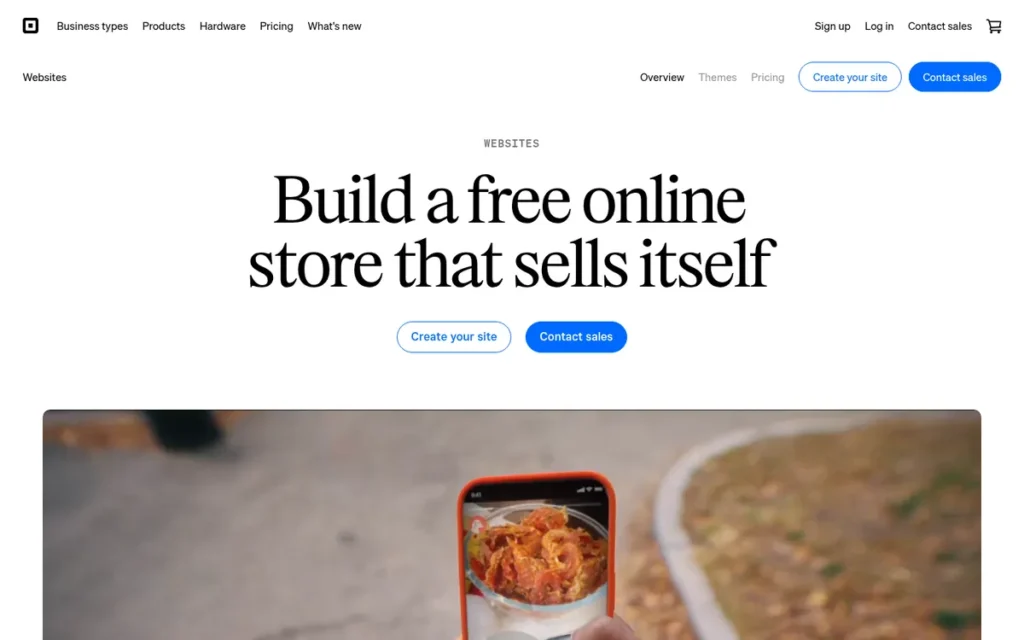
Category: POS-Led Omnichannel Platform, an online store built as an extension of an in-person point-of-sale system, sharing one inventory.
At a Glance
- Category: POS-Led Omnichannel Platform
- Best For: Brick-and-mortar retailers, restaurants and local sellers adding online sales, and anyone who wants to start at $0/mo
- Price Range: Free ($0/mo) to $149/mo per location; custom pricing above $250K in annual sales
- Primary Strength: Square Online syncs inventory, orders and customers natively with Square POS and offers a $0/mo plan that can sell.
- Biggest Limitation: Square Online accepts only Square payments and offers limited design customization, basic SEO and weak B2B features.
- One-Line Summary: Square Online is the best e-commerce software in 2026 for physical businesses that already use Square POS or want a free way to start selling online.
- Last Verified: November 2026
Overview
Square Online is an online store builder from Block, Inc. that extends the Square point-of-sale system to the web. It is built for brick-and-mortar retailers, restaurants and local sellers who want in-store and online sales to share one inventory, starting on a $0 monthly plan.
Square Online scored 3.70 out of 5, the highest of all seven platforms on cost and on in-person selling. Square Online runs on Weebly technology, which Square acquired for about $365 million (Square press release, 2018).
PlugRoute found no verified performance metrics or named case studies specific to Square Online. G2 still lists the product as “formerly Weebly.”
Key Features
- Square Online syncs catalog, inventory, orders and customer records with Square POS, which gives in-store and online sales one master inventory record.
- Square Online supports pickup, local delivery, shipping, restaurant ordering and QR ordering from one storefront.
- Square Online includes loyalty, gift cards and customer accounts that connect to in-person transactions.
- Square Online’s Free plan has no monthly subscription, and the Plus plan includes a 30-day trial.
- Square Online processes payments only through Square, which simplifies setup but removes the choice of payment provider.
Best For
Square Online is best for physical shops, cafés, market sellers and pop-ups that take most payments in person and want online orders in the same system.
Pricing (Square Online plans page, November 2026)
- Square Online Free costs $0/mo per location, with an online card rate of 3.3% + $0.30 (Square pricing via FinanceRadar and SMBCompare, November 2026).
- Square Online Plus costs $49/mo per location ($588/yr), with an online card rate of 2.9% + $0.30 (FinanceRadar and SMBCompare, November 2026).
- Square Online Premium costs $149/mo per location ($1,788/yr). Square advertises lower processing rates on Premium, but third-party rate tables show the same 2.9% + $0.30 online rate as Plus.
- Square hardware starts at $59, and Square Online charges 2.5% on gift-card loads on the Free and Plus plans.
- Square Online Plus includes 500 text messages per month (then $0.03 each), and Premium includes 2,500 (then $0.015 each).
- Square Online offers custom pricing above $250K in annual sales.
Square Online’s Free plan stays cheaper than Plus until online card sales pass about $147,000 a year (PlugRoute calculation, November 2026). On a $50 order, the Free plan charges $1.95 in card fees and Plus charges $1.75.
Square Online’s $49/mo Plus subscription pays for itself only at about $12,250 a month in online sales. Square Online charges paid tiers per location, which multiplies costs for retailers with several locations. The card rates above come from secondary sources, so confirm them with Square.
Strengths
- Square Online is the only hosted platform of the seven with a $0/mo plan that can sell online. WooCommerce’s core is also free but requires paid hosting (Square, November 2026).
- Square Online’s Free plan comes to about $1,950 a year all-in for a $50,000 store with 1,000 orders, one of the lowest documented totals in PlugRoute’s cost scenarios (PlugRoute calculation, November 2026).
- Square Online keeps POS and online inventory in one system. Reddit threads from 2019 to 2026 show that inventory drift happens when Square POS is paired with another vendor’s online store, not when merchants stay within Square.
- Square Online holds 4.2/5 on G2 from 482 reviews (G2, November 2026), and reviewers call its combination of payment processing and fast site building “hard to beat.”
- Square Online was described by a SoftwareReviews respondent as “monumental” for unifying “inventory, orders and customer data” (SoftwareReviews, 2026).
Limitations
Square Online trades low entry cost and tight POS integration for flexibility, starting with Square-only payments and no choice of processor.
- Square Online’s Free plan carries a 3.3% + $0.30 online card rate, the highest standard online card rate documented in this comparison, so the $0 plan costs more per sale (FinanceRadar, November 2026).
- Square Online reviewers say storefronts look alike: “There aren’t a ton of ways to make your site very different from the other Square Online sites out there” (G2 reviews, 2026).
- Square Online sets page titles from H2 headings by default, which weakens SEO.
- Square Online users report confusion between Weebly and Square support, and fewer new feature launches.
- Square Online has weak B2B and wholesale features, and reviewers report account reviews that temporarily hold funds.
A long-time Square seller on r/CraftFairs noted:
“Yes, Square has a lot at times to be desired. I get annoyed when I want 5 photos and they only have a template option for 3. I have particular issues with wanting things a certain way and not being able to get them that tiny bit just right.” Posted by u/Aniform
Takeaway: Even satisfied Square Online users run into rigid template limits that block fine-grained design control.
Verdict
Square Online is the strongest choice in 2026 for physical businesses that want in-store and online sales on one inventory at the lowest possible starting cost. Square Online ranked #2 because it pairs the only $0/mo hosted plan that can sell with native Square POS sync.
Online-first brands, B2B sellers and merchants who need design control or a choice of payment provider should start with Shopify or BigCommerce instead.
3. WooCommerce: Best for WordPress Sites and Merchants Who Want Full Ownership
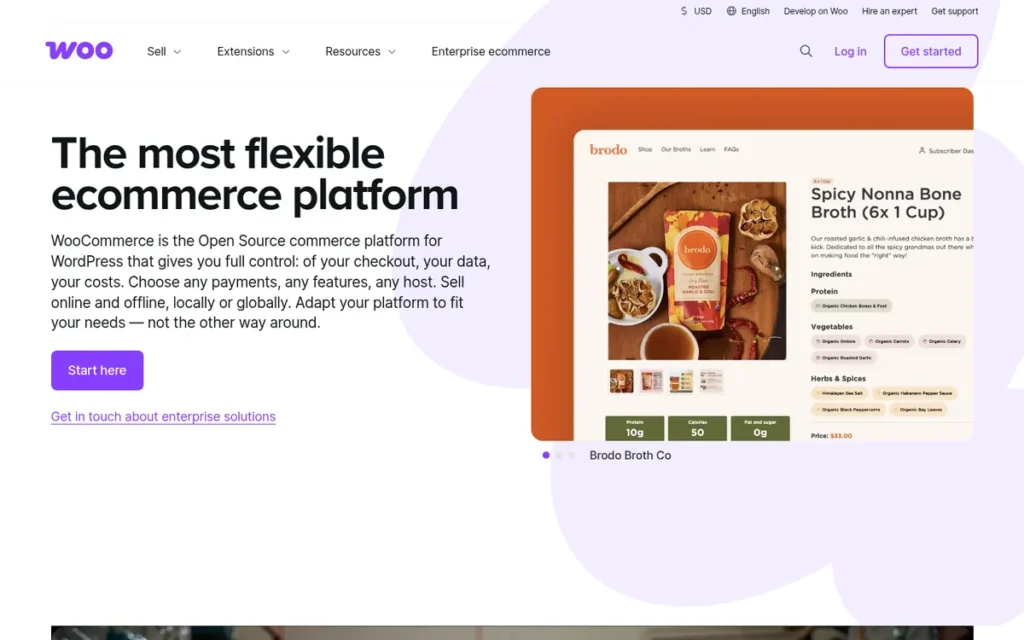
Category: Self-Hosted Open-Source Platform, free software you install on your own hosting, giving full control in exchange for handling maintenance yourself.
At a Glance
- Category: Self-Hosted Open-Source Platform
- Best For: Existing WordPress site owners and technically comfortable merchants (or those paying for maintenance) who want full ownership
- Price Range: Free core; estimated $200–$15,000+/yr real cost including hosting and extensions
- Primary Strength: WooCommerce gives merchants full ownership of code and data, with no platform fee on any payment provider.
- Biggest Limitation: WooCommerce makes the merchant responsible for hosting, security, updates and plugin conflicts, with support split across many vendors.
- One-Line Summary: WooCommerce is the best e-commerce software in 2026 for WordPress site owners who want full ownership and can manage, or pay for, ongoing technical upkeep.
- Last Verified: November 2026
Overview
WooCommerce is a free, open-source e-commerce plugin for WordPress, maintained by Automattic. It is built for WordPress site owners and technically comfortable merchants who want to own their store’s code, data and payment choices and who accept managing hosting and maintenance in return.
WooCommerce scored 3.64 out of 5, the top score of all seven on ownership and exit risk. WooCommerce trails Square Online by only 0.06 points, and the largest single gap is technical upkeep (C3: 2.0 vs 4.5).
WooCommerce launched in 2011 under WooThemes, and Automattic acquired it in 2015 (WooCommerce, 2021).
Key Features
- WooCommerce’s free core includes catalog, cart, block-based checkout, tax, shipping and coupons.
- WooCommerce charges no platform fee on any payment provider, and WooPayments costs 2.9% + $0.30 in the US.
- WooCommerce adds subscriptions, bookings, memberships and B2B or wholesale features through paid extensions that cost $79–$279/yr each.
- WooCommerce lets merchants own and export all code and data.
- WooCommerce integrates natively with WordPress content, themes and SEO plugins.
Best For
WooCommerce is best for businesses that already run on WordPress and have the technical skill, or the budget for a maintenance plan, to run a self-hosted store.
Pricing (WooCommerce, November 2026)
- WooCommerce’s core plugin costs $0.
- WooPayments (US) costs 2.9% + $0.30. It adds 1.5% for international cards, 1% for currency conversion, 1.5% for instant payouts and 1% for Stripe Billing subscriptions, and charges $15 per dispute.
- WooCommerce’s official extensions cost $79/yr for Product Add-Ons or Bundles, $149/yr for Composite Products, $199/yr for Memberships, $249/yr for Bookings and $279/yr for Subscriptions.
- WooCommerce managed hosting runs about $15–$50/mo for basic plans and $50–$300+/mo for higher tiers.
Swell estimates WooCommerce’s real annual cost in five bands:
- A very small WooCommerce store costs about $200–$800/yr before payment fees (Swell estimate, 2026).
- A small professional WooCommerce store costs about $800–$2,500/yr before payment fees (Swell estimate, 2026).
- A WooCommerce store using subscription, booking or B2B extensions costs about $1,500–$5,000+/yr (Swell estimate, 2026).
- A heavily customized WooCommerce store costs about $5,000–$15,000+/yr (Swell estimate, 2026).
- Outsourced WooCommerce maintenance commonly adds $500–$5,000+/yr (Swell estimate, 2026).
Strengths
- WooCommerce runs about 39% of online stores globally by store count (SOAX, 2026). Other 2026 estimates that count only stores on an identifiable platform put it near 48%, and many installs are small or inactive.
- WooCommerce Checkout appears on about 14% of detected US e-commerce sites, behind Shopify (30%), Wix (23%) and Squarespace (16%) (SOAX, 2026).
- WooCommerce holds 4.4/5 on G2 from 1,283 reviews and 4.5/5 on Capterra from 1,054 reviews (G2 and Capterra, November 2026). Those ratings match Shopify’s, on fewer reviews.
- WooCommerce passed 150 million downloads by its 10th anniversary (WooCommerce, 2021).
- WooCommerce has the lowest lock-in risk of the seven because merchants own their code and data. A WordPress developer credits it with “full flexibility, strong SEO options, and total ownership” (r/Wordpress, 2025).
Limitations
WooCommerce trades ownership for responsibility. Merchants handle hosting, security, updates, backups and plugin conflicts themselves.
- WooCommerce reviewers report heavy server load at scale, extension costs that add up and support split across many vendors (G2 and Capterra reviews, 2026).
- WooCommerce’s payment service has had disruptions, including a support thread titled “Woo Payments Temporarily Suspended for 15 Days Now” (WordPress.org support forum, November 2026).
- WooCommerce is recommended by Reddit practitioners only for tech-savvy owners or owners on “an ongoing maintenance plan” (r/Wordpress, 2025).
- WooCommerce needs third-party extensions for in-person selling because it has no native POS.
Users on r/woocommerce noted:
“The bigger difference from Square is that you’re responsible for more of the setup and maintenance, including hosting, WordPress updates, plugins, backups and security. So if you’re comfortable learning WordPress, it’s absolutely doable. If your main reason for switching is cost, I’d price out hosting + payment fees + any paid plugins before making the move. The savings aren’t always as big as they initially look.” Posted by u/Netalico
Takeaway: WooCommerce is workable for beginners, but its upkeep burden and add-on costs often shrink the savings merchants expect when they leave a hosted platform.
Verdict
WooCommerce is the best e-commerce platform in 2026 for WordPress site owners who value ownership and have the skills or budget to maintain a self-hosted store. WooCommerce ranked #3 for its exit flexibility, zero platform fees and strong ratings.
Non-technical owners without a maintenance plan should choose a hosted platform such as Shopify or BigCommerce.
4. BigCommerce: Best for Mid-Market B2B, Wholesale and Multi-Storefront Sellers
Category: Hosted Commerce Platform.
At a Glance
- Category: Hosted Commerce Platform
- Best For: Growing brands and mid-market B2B or wholesale sellers that need multiple storefronts on hosted infrastructure and can budget for the Enterprise tier to unlock B2B Edition
- Price Range: $29–$299/mo billed annually ($39–$399 billed monthly); Enterprise/Performance from about $1,499/mo
- Primary Strength: BigCommerce combines multi-storefront support, open APIs and no platform transaction fee on a hosted platform, with B2B Edition available on its Enterprise tier.
- Biggest Limitation: BigCommerce reserves B2B Edition for its quote-priced Enterprise/Performance tier, and its self-service plans move up automatically as sales grow.
- One-Line Summary: BigCommerce is a strong hosted fit in 2026 for mid-market B2B and wholesale sellers that can budget for its Enterprise tier and want multiple storefronts without Adobe-level infrastructure.
- Last Verified: November 2026
Overview
BigCommerce is a hosted e-commerce platform from Commerce.com, Inc. with open APIs and multi-storefront support. It is designed for growing brands and mid-market B2B or wholesale sellers that need advanced commerce features without running their own servers or enterprise infrastructure.
BigCommerce scored 3.54 out of 5. It ranks #4 for hosted multi-storefront support, open APIs, audited scale and an Enterprise-tier B2B Edition that starts below the Shopify Plus price.
BigCommerce’s parent company was renamed Commerce.com in July 2025, and its ticker changed from BIGC to CMRC (Commerce.com, 2025).
Key Features
- BigCommerce’s B2B Edition adds company accounts, buyer roles, customer price lists, quotes, purchase orders and approval workflows. It is a contracted add-on on the Enterprise/Performance tier (BigCommerce, November 2026).
- BigCommerce’s self-service Core, Growth and Scale plans include only basic B2B tools, such as customer groups.
- BigCommerce supports multiple storefronts and multi-currency selling from a single back end. It charges no platform transaction fee, although payment processor fees still apply.
- BigCommerce offers headless commerce through its Catalyst framework, plus the Makeswift visual editor and Feedonomics product-feed management.
- BigCommerce connects to in-person selling through POS integrations rather than a native POS.
Best For
BigCommerce is best for wholesale, distribution and combined B2B-and-B2C brands that need several storefronts on hosted infrastructure and can budget for the Enterprise tier to get full B2B workflows.
Pricing (BigCommerce pricing pages, November 2026)
BigCommerce renamed its plans on June 1, 2026, and some BigCommerce pages still show the older schedule with different thresholds.
- BigCommerce Core costs $29/mo billed annually or $39 billed monthly.
- BigCommerce Growth costs $79/mo annually or $105 monthly.
- BigCommerce Scale costs $299/mo annually or $399 monthly. It covers $33,333/mo in sales and charges 0.9% above that.
- BigCommerce Performance (Enterprise) starts around $1,499/mo billed annually, is quote-based and is the tier where B2B Edition is provisioned.
- BigCommerce’s pricing FAQ cites a $30K Core-to-Growth threshold and a $100K Growth-to-Scale threshold. The older schedule lists thresholds of $50K, $180K and $400K.
Elogic, an agency, estimates 3-year B2B total cost of ownership (TCO) for BigCommerce Enterprise at $150K–$400K (Elogic via Reddit, 2026). This estimate is self-promotional, so read it as directional.
Get written confirmation from BigCommerce of the plan and sales threshold that will apply to you before signing.
This aligns with community sentiment on r/bigcommerce:
“We have always struggled with customized products in bigcommerce, I will also warn you if you sell a lot the sliding pricing will kill you down the road. Bundles are very difficult to do in BC. Pick lists work but only with products that do not have variations so make sure you think through that.” Posted by u/milfolicious
Takeaway: BigCommerce’s sales-based plan upgrades and awkward handling of bundles and customized products are real long-term costs for high-volume merchants.
Strengths
- BigCommerce’s parent Commerce.com reported FY2025 revenue of $342.3M (up 3%), enterprise ARR of $287.2M (up 10%) and $31.7B in merchant GMV, up 12.3% (Commerce.com SEC filing, 2026). These audited figures are the most transparent scale data in this comparison.
- BigCommerce was named a Challenger in the 2025 Gartner Magic Quadrant for Digital Commerce, its sixth consecutive year (Commerce.com, 2025). It was also a Strong Performer in the 2022 Forrester Wave for B2C and B2B commerce.
- BigCommerce’s B2B Edition sits on a tier priced below Shopify Plus (about $1,499/mo vs $2,300/mo). It bundles B2B features that WooCommerce sells as separate extensions.
- BigCommerce reviewers on Capterra praise its “scalability, ease of use and easy import and export of large number of products” (Capterra reviews, 2026).
Limitations
BigCommerce trades zero transaction fees for tier-gated features and volume-based pricing. For B2B buyers, the most consequential gap is that B2B Edition requires the Enterprise/Performance tier.
- BigCommerce’s self-service Core, Growth and Scale plans include only basic B2B tools such as customer groups (BigCommerce B2B Edition page, November 2026).
- BigCommerce automatically moves merchants to higher plans as trailing sales grow, which is its most common pricing complaint, and BigCommerce’s own pages list conflicting thresholds.
- BigCommerce reviewers say “some relatively basic e-commerce features still require third-party apps and additional fees” and describe the interface as confusing in places (Gartner Peer Insights, 2026).
- BigCommerce’s Stencil theme framework requires specialist developers to customize.
- BigCommerce has thin community evidence. PlugRoute found no BigCommerce-specific Reddit threads, and the available praise comes from threads about other platforms (r/ecommerce, 2024; r/squarespace, 2025).
Verdict
BigCommerce is a strong mid-market e-commerce platform in 2026 for B2B and wholesale sellers that need multiple storefronts on hosted infrastructure and can budget for its Enterprise-tier B2B Edition. BigCommerce ranked #4 because its audited scale and multi-storefront depth were offset by tier-gated B2B and volume-triggered upgrades.
Small online-first stores will usually find Shopify or Square Online simpler.
5. Squarespace Commerce: Best for Design-Led Creators, Service Businesses and Digital Products

Category: Website Builder with Commerce, a design-first hosted site builder with built-in selling tools, best suited to smaller catalogs.
At a Glance
- Category: Website Builder with Commerce
- Best For: Creators, service businesses and design-led brands selling digital products, memberships or small physical catalogs
- Price Range: $19–$99/mo billed annually ($25–$139 billed monthly)
- Primary Strength: Squarespace Commerce pairs the highest Capterra rating in this comparison with design-led templates and built-in digital products and memberships.
- Biggest Limitation: Squarespace Commerce is weak for large catalogs, multi-location inventory and B2B, and it offers only four payment processors.
- One-Line Summary: Squarespace Commerce is the best e-commerce option in 2026 for design-led creators and service businesses selling digital products or small catalogs, but not for scaling physical-goods retail.
- Last Verified: November 2026
Overview
Squarespace Commerce is the selling layer of Squarespace’s design-first hosted website builder. It is built for creators, service businesses and brand-led sellers who want polished templates, digital products, memberships and a small physical catalog without technical maintenance or developer help.
Squarespace Commerce scored 3.29 out of 5, 0.02 points ahead of Wix eCommerce, which is effectively a tie. Squarespace Add to Cart appears on about 16% of detected US e-commerce sites, third behind Shopify and Wix (SOAX, 2026).
Squarespace was founded in 2003 by Anthony Casalena and launched commerce in 2013 (Squarespace newsroom, 2013). The company has been privately held since 2024.
Key Features
- Squarespace Commerce includes an online store, digital products, memberships and subscriptions in one hosted builder.
- Squarespace Commerce supports four payment options: Squarespace Payments, Stripe, PayPal and Square.
- Squarespace Commerce connects to in-person selling through Square POS rather than a native POS.
- Squarespace Commerce bundles email campaigns, domains and the Blueprint AI site builder, and Squarespace Scheduling (formerly Acuity) is available as an add-on.
- Squarespace Commerce charges 0% on store sales from the Core plan upward, and its digital-content fees vary by plan.
Best For
Squarespace Commerce is best for creators, coaches, photographers and service businesses whose site design drives sales and who sell digital products or fewer than roughly 500 physical products.
Pricing (Squarespace pricing page and transaction-fees article, November 2026)
- Squarespace Basic costs $19/mo billed annually or $25 monthly, with a 2% fee on store sales and 7% on digital content.
- Squarespace Core costs $29/mo annually or $39 monthly, with 0% on store sales and 5% on digital content.
- Squarespace Plus costs $49/mo annually or $65 monthly, with 0% on store sales and 1% on digital content.
- Squarespace Advanced costs $99/mo annually or $139 monthly, with 0% on both.
- Squarespace Payments card rates are 2.9% + $0.30 on Basic and Core, 2.7% + $0.30 on Plus and 2.5% + $0.30 on Advanced.
- Squarespace adds 1.5% for international cards. Klarna costs 5.49% + $0.30, Afterpay 6% + $0.30 and ACH 1%.
The 2% fee on Squarespace Basic is a hidden cost that adds $1,000 a year on $50,000 in sales. Legacy Squarespace plans (Personal at 3%, Business at 2%) still apply to existing accounts.
Former Google Domains customers moved to standard Squarespace renewal pricing after September 7, 2024 (Squarespace, 2024).
Strengths
- Squarespace Commerce holds 4.6/5 on Capterra from 3,431 reviews, the highest Capterra rating among the seven platforms (Capterra, November 2026).
- Squarespace Commerce charges 0% on store sales from the Core plan ($29/mo billed annually) upward, and its Advanced plan removes digital-content fees entirely (Squarespace, November 2026).
- Squarespace Commerce users on Reddit credit it with “more room for design customisation and added built-in membership and digital product functionality” (r/squarespace, 2025).
- Squarespace Commerce reviewers praise its templates, typography and low technical burden (Capterra and Experte reviews, 2026).
Limitations
Squarespace Commerce gains design quality at the cost of commerce depth. One comparison calls it unsuitable for catalogs above roughly 500 products (SaaSStatsHub, 2026), so growing physical-goods sellers will probably need to replatform.
- Squarespace Commerce has weak multi-location inventory, multi-currency and B2B features, with no unit pricing or product-level bulk discounts.
- Squarespace Commerce limits merchants to four payment processors.
- Squarespace Commerce draws criticism from a Reddit web designer who would “never recommend them for real ecommerce” (r/squarespace, 2024).
- Squarespace Commerce users report paying for plugins to fill basic gaps. One user considered a $40 plugin to get a better add-to-cart experience (r/squarespace, 2025).
- Squarespace Commerce has no public performance metrics because Squarespace is privately held.
Verdict
Squarespace Commerce is the best choice in 2026 for design-led creators and service businesses selling digital products, memberships or small catalogs. Squarespace Commerce ranked #5 for the highest Capterra rating in this comparison (4.6/5) and low upkeep, held back by weak scalability, limited payment choice and no B2B features.
Sellers who plan to scale physical-goods retail should start on Shopify or BigCommerce to avoid a later rebuild.
6. Wix eCommerce: Best for Small Businesses Selling Products and Services

Category: Website Builder with Commerce.
At a Glance
- Category: Website Builder with Commerce
- Best For: Small businesses selling both products and services that want drag-and-drop design control without code
- Price Range: $29–$159/mo billed annually for plans that can sell ($36–$172 billed monthly); Enterprise by quote
- Primary Strength: Wix eCommerce combines free-form visual design with built-in bookings, events and courses, backed by the largest Capterra review base in this comparison.
- Biggest Limitation: Wix eCommerce has the highest lock-in risk in this comparison, because templates cannot be switched after publishing and the full site cannot be exported.
- One-Line Summary: Wix eCommerce is a strong e-commerce option in 2026 for small businesses selling both products and services that value design freedom, but it is the hardest platform in this comparison to migrate away from.
- Last Verified: November 2026
Overview
Wix eCommerce is the commerce layer of Wix’s hosted drag-and-drop website builder. It is built for small businesses that sell both products and services and want design freedom, bookings, events and courses in one place without writing code or managing hosting.
Wix eCommerce scored 3.27 out of 5, 0.02 points behind Squarespace Commerce. That is effectively a tie, so fit with your situation decides between them. Wix eCommerce appears on about 23% of detected US e-commerce sites, second only to Shopify (SOAX, 2026).
Wix reports about 763,500 live stores and $4.14B in annual GMV (Wix, 2026). Wix published these figures itself, so treat them as directional.
Key Features
- Wix eCommerce includes a free-form drag-and-drop editor, an AI site builder and Velo, a JavaScript development environment.
- Wix eCommerce combines product selling with bookings, events, memberships, courses and invoicing.
- Wix eCommerce offers Wix Payments, Wix POS and multichannel selling, although PlugRoute did not verify Wix POS pricing.
- Wix eCommerce supports up to 50,000 products, 1,000 variants per product and 6 options with 100 choices each (Wix Help Center, November 2026).
- Wix eCommerce exports products, orders and contacts as CSV files but provides no full-site export.
Best For
Wix eCommerce is best for small businesses that sell products and services together, such as studios, salons, event organizers and boutique retailers with modest catalogs.
Pricing (Wix plans page, November 2026; prices are per site and vary by location)
- Wix Light costs $17/mo billed annually or $24 monthly, and it cannot sell online.
- Wix Core costs $29/mo annually or $36 monthly ($348/yr) and includes basic e-commerce and 50 GB of storage.
- Wix Business costs $39/mo annually or $46 monthly ($468/yr) and includes standard e-commerce and 100 GB.
- Wix Business Elite costs $159/mo annually or $172 monthly ($1,908/yr) and includes advanced e-commerce and unlimited storage.
- Wix Enterprise is priced by custom quote.
Wix Payments rates vary by country, and PlugRoute could not verify a rate card, so check your local rate. Wix annual plans are paid upfront, and Trustpilot reviewers report unexpected charges and auto-renewal after cancellation (Trustpilot, 2026).
Strengths
- Wix eCommerce has the largest Capterra review base in this comparison, with 10,806 reviews averaging 4.4/5. G2 rates it about 4.2/5 and TrustRadius 4.1/5 (Capterra, G2 and TrustRadius, November 2026).
- Wix eCommerce scores higher than Squarespace Commerce on in-person selling and scalability in PlugRoute’s matrix because it offers a native POS and a 50,000-product ceiling.
- Wix eCommerce bundles bookings, events, memberships and courses with product selling, which suits businesses that sell services as well as goods.
- Wix eCommerce “handles ecommerce pretty well for smaller stores with decent customization through their editor without needing code,” according to a Reddit commenter (r/ecommerce, 2025).
Limitations
Wix eCommerce trades portability for design ease. Templates can’t be switched after publishing and there is no full-site export (Wix Help Center, November 2026), so a redesign or replatforming means rebuilding the site.
- Wix eCommerce is called a “walled garden” that is “really hard to migrate later” by Reddit users (r/ecommerce, 2024).
- Wix eCommerce caps each product at 1,000 variants, which limits distributors and larger retailers.
- Wix eCommerce’s entry Light plan cannot sell online, so the real starting price for selling is $29/mo billed annually.
- Wix eCommerce receives Trustpilot complaints about billing and auto-renewal, support responsiveness and editor lag (Trustpilot, 2026).
Verdict
Wix eCommerce is a good fit in 2026 for small businesses that sell both products and services and want design control without code. Wix eCommerce ranked #6 because its strong adoption and Capterra review volume were offset by the highest lock-in risk and a 1,000-variant limit.
Merchants who expect fast catalog growth or a future platform move should prefer Shopify or WooCommerce.
7. Adobe Commerce: Best for Complex Enterprise B2B With Dedicated Development Resources

Category: Enterprise Commerce Suite, highly customizable, quote-priced commerce software for large catalogs and complex B2B, requiring dedicated development resources.
At a Glance
- Category: Enterprise Commerce Suite
- Best For: Enterprises and complex B2B sellers with more than about $10M in sales, large catalogs and in-house or agency development teams
- Price Range: Quote only; third-party estimates of about $22K–$190K+/yr license, plus $20K–$500K+ implementation
- Primary Strength: Adobe Commerce offers the deepest native B2B feature set and code-level customization in this comparison.
- Biggest Limitation: Adobe Commerce has the highest total cost and maintenance burden of the seven platforms, and it publishes no price list.
- One-Line Summary: Adobe Commerce scored highest of the seven on scalability and B2B readiness in 2026, but its cost and developer dependence make it the wrong choice for most small and mid-sized businesses.
- Last Verified: November 2026
Overview
Adobe Commerce is Adobe’s enterprise commerce platform, built on the Magento open-source codebase. It is designed for large retailers and complex B2B sellers that need shared catalogs, negotiated quotes, multi-store management and deep customization, backed by development teams and substantial budgets.
Adobe Commerce scored 2.42 out of 5 overall but had the highest score of all seven on scalability and B2B (5.0). Adobe Commerce ranks last for this small-business audience because of cost and upkeep, not capability.
Adobe Commerce also has a free, self-hosted sibling called Magento Open Source.
Key Features
- Adobe Commerce includes native B2B features: company accounts, shared catalogs, negotiated quotes, requisition lists, purchase-order approvals and company credit.
- Adobe Commerce supports multi-store management from one installation.
- Adobe Commerce integrates with Adobe Sensei AI merchandising, Adobe App Builder, Edge Delivery Services and Adobe Experience Cloud.
- Adobe Commerce runs on Cloud (platform-as-a-service) or as Adobe Commerce as a Cloud Service, a multi-tenant SaaS option generally available since June 2025 (Adobe, 2025).
- Adobe Commerce needs tuned infrastructure, such as Varnish, Redis and OpenSearch, to perform well when self-managed.
Best For
Adobe Commerce is best for enterprises with complex B2B workflows, large multi-brand catalogs and ERP integrations that can fund ongoing development.
Pricing (third-party estimates, November 2026; Adobe publishes no price list)
- Adobe Commerce license estimates for under $1M in annual sales are about $22K/yr self-hosted or $40K/yr on Adobe’s cloud (topcms.space, 2026).
- Adobe Commerce license estimates for $5M–$10M in sales are about $49K/yr self-hosted or $80K/yr on cloud (topcms.space, 2026).
- Adobe Commerce license estimates for $10M–$25M in sales are $75K–$125K/yr self-hosted or $120K–$190K+/yr on cloud (topcms.space, 2026).
- Adobe Commerce implementations cost an estimated $20K–$50K for a basic Open Source build, $100K–$250K for a mid-market build with ERP integration and $250K–$500K+ for enterprise B2B. Some of these figures come from Elogic, an agency, and are self-promotional.
- Magento Open Source hosting runs about $50–$300/mo.
As a rule of thumb, total annual Adobe Commerce cost runs 2–3× the license. One Reddit user reports that “Adobe is pushing another 15% uplift my way. 50k now” (r/Magento, 2026).
Request multi-year Adobe Commerce quotes and budget for annual license increases.
Strengths
- Adobe Commerce was named a Leader in the Forrester Wave for both B2C and B2B Commerce Suites (Forrester Wave, Q2 2020), the most recent placement PlugRoute verified. Adobe acquired Magento for $1.68B (TechCrunch, 2018).
- Adobe Commerce has the most complete native B2B suite of the seven platforms, including requisition lists and company credit.
- Adobe Commerce offers the deepest code-level control and multi-store flexibility in this comparison, and its SaaS option reduces the infrastructure burden (Adobe, 2025).
- Adobe Commerce reviewers on G2 and Gartner Peer Insights frequently praise its flexibility, B2B depth and scalability (G2 and Gartner Peer Insights, 2026).
Limitations
Adobe Commerce trades flexibility for the highest cost and maintenance burden in the category. It has no public pricing, and mid-market and enterprise implementations run $100K–$500K+.
- Adobe Commerce holds the lowest G2 rating of the seven, 4.0/5 from about 630 reviews (G2, November 2026). Reviewers cite developer dependence, complex upgrades and slow performance unless the platform is tuned.
- Adobe Commerce users on TrustRadius say return on investment may not appear until year 2 or 3 (TrustRadius, 2026).
- Adobe Commerce users on Reddit report a six-store client replatforming to Shopify over total cost, and migration scopes of “about $100k” (r/Magento, 2026).
- A Shopify-commissioned study (competitor-sponsored, retrieved November 2026) estimates Adobe Commerce total cost at 41% above Shopify, so treat it as directional only.
Verdict
Adobe Commerce is the right e-commerce platform in 2026 for complex enterprise B2B, but only for organizations with large budgets and dedicated development teams. Adobe Commerce ranked #7 for this audience because of cost and upkeep, not capability, where it scored highest.
Most growing brands should compare BigCommerce or Shopify Plus first. As one practitioner put it: “Do you want to be a retailer, or an IT shop?” (r/Magento, 2018).
What Does Each E-Commerce Platform Really Cost Per Year?
Once documented card fees are added, a $50,000-a-year online store pays about $1,950 a year on Square Online’s Free plan and about $2,100 on Shopify Basic or Squarespace Core (PlugRoute calculation, November 2026). Squarespace Basic costs about $2,980 because of its 2% fee. For this store, payment processing is the largest documented cost on every platform with published rates.
As one user on r/woocommerce described:
“Before moving the live store, I would separate the Square cost into subscription, payment processing and any POS or inventory features you use. WooCommerce can replace the storefront fee, but it will not remove card fees, and hosting, backups and a few extensions may close part of the gap.” Posted by u/1Life_Architect
Takeaway: Switching e-commerce platforms rarely removes card processing fees, so a real cost comparison has to break out subscription, payments, hosting and add-ons line by line.
Assumptions for Scenarios A and B:
- The store has $50,000 in annual online sales from 1,000 orders averaging $50.
- All cards are domestic, and no international, dispute or buy-now-pay-later fees apply.
- Each platform is on its cheapest plan that can sell, billed annually.
- Apps, extensions, themes and outsourced maintenance are excluded.
Scenario A: Online-only store using the platform’s own payments
| Platform (Plan) | Subscription per Year | Documented Card Processing | Platform Transaction Fee | Documented Annual Total |
|---|---|---|---|---|
| Square Online (Free) | $0 | $1,950 (3.3% + $0.30, third-party rate tables) | $0 | $1,950 |
| WooCommerce (core + WooPayments + basic hosting) | $180–$600 (hosting) | $1,750 (2.9% + $0.30) | $0 | $1,930–$2,350 + extensions |
| Shopify (Basic) | $348 | $1,750 (2.9% + $0.30) | $0 | $2,098 + apps |
| Squarespace Commerce (Core) | $348 | $1,750 (2.9% + $0.30) | $0 | $2,098 |
| Squarespace Commerce (Basic) | $228 | $1,750 (2.9% + $0.30) | $1,000 (2%) | $2,978 |
| Wix eCommerce (Core) | $348 | Varies by country | Not documented | $348 + local rate |
| BigCommerce (Core) | $348 | Depends on your payment provider | $0 | $348 + processor fees |
Square Online’s card rate comes from secondary sources (FinanceRadar and SMBCompare, November 2026), so check Square’s page before relying on it. BigCommerce’s FAQ lists a $30K Core-to-Growth threshold, so a $50K store may need Growth at $948/yr.
Adobe Commerce is excluded from Scenario A because third-party license estimates start around $22K/yr.
Scenario B: The same store using an outside payment provider
- Shopify adds $1,000/yr on Basic (2%), $500/yr on Grow (1%) or $300/yr on Advanced (0.6%), on top of the provider’s own fee.
- WooCommerce adds no platform fee on any payment provider.
- BigCommerce adds no platform transaction fee.
- Squarespace Commerce limits merchants to four processors, and the Basic plan’s 2% store fee still applies.
- Square Online doesn’t allow outside payment providers.
With an outside provider, Shopify Basic’s 2% fee costs more than upgrading to Grow once annual sales pass about $60,000. Above that level, the 1-point fee saving exceeds Grow’s extra $600 a year in subscription (PlugRoute calculation, November 2026).
Scenario C: A single-location shop selling in person and online
| Platform (Setup) | Subscription per Year | Notes |
|---|---|---|
| Shopify Basic + Tap to Pay on iPhone | $348 | Tap to Pay works on every plan with Shopify Payments active (Shopify, November 2026) |
| Shopify Basic + POS Pro | $1,416 | POS Pro adds $1,068/yr per location ($89/mo) |
| Square Online Free | $0 | Hardware from $59; processing fees apply |
| Square Online Plus | $588 per location | 500 texts/mo included |
| Square Online Premium | $1,788 per location | Square advertises lower rates; confirm online and in-person rates |
PlugRoute did not verify in-person pricing for three other setups:
- Wix eCommerce offers native Wix POS, but PlugRoute did not verify its pricing.
- Squarespace Commerce sells in person through a Square POS integration.
- WooCommerce requires a third-party POS extension for in-person selling.
Hidden Costs and Lock-In at a Glance
| Platform | Hosting | Entry Price That Can Sell | Fee on Outside Payment Providers | POS | B2B Status | Lock-In Risk |
|---|---|---|---|---|---|---|
| Shopify | Hosted | $29/mo billed annually | 0.2%–2% by plan | Native (POS Pro $89/mo per location) | Plus only | Medium: fixed URL paths and app dependence |
| Square Online | Hosted | $0/mo | Not allowed (Square only) | Native Square POS | Weak | Medium: Square-only payments |
| WooCommerce | Self-hosted | $0 core plus hosting | None | Extensions | Extensions | Low: merchant owns code and data |
| BigCommerce | Hosted | $29/mo billed annually | None | Integrations | Enterprise-tier add-on | Medium |
| Squarespace Commerce | Hosted | $19/mo billed annually (2% fee) | Limited to four processors | Via Square | Weak | Medium |
| Wix eCommerce | Hosted | $29/mo billed annually | Varies by country | Wix POS | Weak | Highest: no full-site export |
| Adobe Commerce | Adobe cloud or self-hosted | About $22K+/yr (estimate) | None | Integrations | Native (deepest) | High: customization debt and costly migrations |
Which E-Commerce Platforms Handle B2B and Wholesale Natively?
Adobe Commerce is the only platform in this ranking that includes a full B2B suite natively. BigCommerce offers B2B Edition as an Enterprise-tier add-on from about $1,499/mo, and Shopify reserves B2B for Plus, from $2,300/mo. WooCommerce sells B2B through paid extensions, while Square Online, Squarespace Commerce and Wix eCommerce offer weak B2B support.
| Platform | B2B Status | Documented B2B Features |
|---|---|---|
| Adobe Commerce | Native (deepest, included) | Company accounts, shared catalogs, negotiated quotes, requisition lists, PO approvals, company credit |
| BigCommerce | Plan-gated (Enterprise/Performance add-on, from about $1,499/mo) | Company accounts, buyer roles, price lists, quotes, purchase orders, approvals |
| Shopify | Plan-gated (Plus, from $2,300/mo) | Company profiles, price lists, payment terms |
| WooCommerce | Extension-based | B2B and wholesale features via paid extensions |
| Square Online | Weak | No documented B2B feature set |
| Squarespace Commerce | Weak | No unit pricing or product-level bulk discounts |
| Wix eCommerce | Weak | No documented B2B feature set |
A wholesale brand that needs quotes and purchase orders has to buy BigCommerce’s Enterprise tier or Shopify Plus. Neither BigCommerce nor Shopify offers these features on a $29 plan.
What Red Flags Should I Watch For When Evaluating E-Commerce Software?
The biggest red flags are hidden costs and hidden lock-in, and each one tends to surface months after launch, when switching platforms is expensive. PlugRoute identified seven warning signs, listed below with the platforms they affect. On every platform reviewed, the costly surprises come after launch, not from the monthly price.
Red Flag #1: Two-System Inventory
Pairing one vendor’s POS with another vendor’s online store is a recurring cause of inventory drift in Reddit merchant threads from 2019 to 2026. You can avoid the problem with a native pairing, such as Square POS with Square Online or Shopify POS with Shopify.
“Inventory management has been a nightmare with having the two separate platforms.” (u/letshavefunw_science, r/shopify (2019))
Takeaway: Inventory errors come from running POS and online sales in two different vendors’ systems. A native POS-and-store pairing keeps one master inventory.
Another merchant said a Square POS sync with an online store “has never worked correctly,” and a reply suggested nightly CSV files as a workaround (r/shopify, 2026).
Red Flag #2: Entry Plans That Can’t Sell
Some entry-level e-commerce plans cannot take payments at all, which makes their headline prices misleading. Wix’s Light plan costs $17/mo billed annually but cannot sell online, so the real starting price for a Wix store is the $29/mo Core plan (Wix, November 2026).
Before comparing headline prices, confirm that the cheapest plan you’re considering includes checkout.
Red Flag #3: Fees on Outside Payment Providers
Some platforms charge an extra fee when merchants use their own payment provider, on top of that provider’s rate. Shopify charges 2% on Basic, 1% on Grow, 0.6% on Advanced and 0.2% on Plus when merchants don’t use Shopify Payments (Shopify, November 2026).
Squarespace Basic adds a 2% fee on store sales whichever processor you use (Squarespace, November 2026). On $50,000 in annual sales, either 2% fee adds $1,000 a year.
Red Flag #4: Sales-Volume Upgrade Triggers
BigCommerce automatically moves merchants to higher-priced plans as trailing 12-month sales grow, so costs can rise without a deliberate upgrade decision. For example, BigCommerce’s Scale plan charges 0.9% on sales above $33,333 a month (BigCommerce, November 2026).
BigCommerce’s own pages list conflicting thresholds, so get the schedule that applies to you in writing before signing.
Red Flag #5: No Full-Site Export
A platform without full-site export forces a rebuild when you leave. Wix eCommerce exports only products, orders and contacts as CSV files, and templates can’t be switched after publishing (Wix Help Center, November 2026). Leaving Wix means rebuilding the site from scratch.
Shopify’s fixed URL paths are a milder version of the same exit-cost problem.
Red Flag #6: Quote-Only Pricing With Annual Uplifts
Quote-only pricing makes multi-year budgeting hard because the vendor can raise the price at each renewal. Adobe Commerce publishes no price list, and one Reddit user reported a 15% license increase that brought the license to $50K (r/Magento, 2026).
Before signing a quote-priced contract, request multi-year quotes with capped increases.
Red Flag #7: App and Extension Cost Creep
When a platform relies on paid add-ons for common features, it can cost far more than its subscription suggests, because each new feature can add another recurring fee. Shopify reviewers cite “app sprawl,” and WooCommerce’s official extensions cost $79–$279/yr each (WooCommerce, November 2026).
Before launch, list every app or extension you’ll need and price them as one total.
What Questions Should I Ask Before Choosing E-Commerce Software?
Before choosing e-commerce software, ask vendors questions that expose total annual cost and exit risk, not just features. The eight questions below cover what you’ll pay, whether you can leave, who maintains the store and whether the platform fits your catalog. Get the answers in writing, because marketing pages change.
Question #1: What will I pay per year at my expected sales volume, including processing and apps?
Annual cost is the subscription plus card fees, platform fees, required apps or extensions and any sales-volume upgrade. Card fees are usually the largest part. A $50,000 store with 1,000 orders pays about $1,750 a year at 2.9% + $0.30 (PlugRoute calculation, November 2026).
Use this formula with your own forecast:
- Subscription cost equals the monthly plan price multiplied by 12.
- Card fees equal annual sales multiplied by the percentage rate, plus the order count multiplied by $0.30.
- Platform fees equal annual sales multiplied by any outside-provider or plan fee.
- App and extension costs equal the sum of every paid add-on your store needs.
Question #2: Can I export my full store and keep my URLs if I leave?
Export rights range from full ownership to CSV-only. WooCommerce gives merchants full code and data ownership, while Wix eCommerce exports only products, orders and contacts as CSV files. Ask whether product pages, blog content, customer accounts and URL structures can move to another platform.
Exit costs can be large: Reddit users report Magento migration scopes of about $100K (r/Magento, 2026).
Question #3: Does this plan let me use my preferred payment provider without an extra fee?
Payment-provider rules differ sharply across the seven platforms. For merchants with negotiated processing rates, they can outweigh the subscription price. Before committing, check the platform fee on outside providers and whether outside providers are allowed at all, and get both answers in writing.
- WooCommerce adds no platform fee on any payment provider.
- BigCommerce adds no platform transaction fee.
- Shopify adds 0.2%–2%, depending on plan, when merchants skip Shopify Payments (Shopify, November 2026).
- Square Online accepts only Square payments.
Question #4: Who handles hosting, security and updates, and what does it cost if I can’t?
On hosted platforms the vendor handles hosting, security and updates. Self-hosted platforms make the merchant responsible for all three. If you lack the skills, budget for outsourced maintenance, which often adds $500–$5,000+ a year for a WooCommerce store (Swell, 2026).
- Shopify, BigCommerce, Squarespace Commerce, Wix eCommerce and Square Online are hosted, so each vendor handles upkeep.
- WooCommerce and self-managed Adobe Commerce make the merchant responsible for hosting, security, updates and backups.
Question #5: Will my in-store and online inventory live in one system?
In-store and online inventory stays in one system only with a native pairing, such as Square POS with Square Online or Shopify POS with Shopify. Test integration-based setups carefully. Practitioners report that “both systems cant tell the other about each other” without a master record (r/shopifyDev, 2026).
Question #6: Which B2B features are native, and which require a plan upgrade or extension?
Most platforms in this ranking limit B2B features by tier, so ask exactly what your plan includes. Adobe Commerce includes a full B2B suite natively. BigCommerce (Enterprise tier) and Shopify (Plus) keep B2B for their top plans, and WooCommerce sells it as extensions.
Confirm each of these features by name:
- Company accounts let several buyers order under one business account.
- Customer price lists set negotiated prices for each buyer.
- Quotes and purchase orders support negotiated, invoiced orders.
- Approval workflows let a buyer’s manager sign off on orders.
Question #7: What product and variant limits apply to my catalog?
Catalog limits can force you to change platforms as your range grows, so check your largest product against each limit. Shopify allows 3 options and 2,048 variants per product (Shopify Help Center, November 2026). Wix eCommerce allows 1,000 variants and 50,000 products (Wix Help Center, November 2026).
One comparison considers Squarespace Commerce unsuitable above roughly 500 products (SaaSStatsHub, 2026).
Question #8: Does the checkout show shoppers the full cost upfront?
A transparent checkout directly affects sales. Average documented cart abandonment is about 70% (Baymard Institute, 2026). Among US shoppers who abandon, 40% cite extra costs that were too high and 12% say they couldn’t see the total cost upfront.
Test each platform’s checkout for clear totals and guest checkout before launch.
Before you sign, get three things in writing:
- The vendor should confirm the plan tier that your forecast sales will trigger.
- The vendor should list every fee that applies to your preferred payment provider.
- The vendor should state which export formats are available if you leave.
How Did We Rank These E-Commerce Platforms?
PlugRoute scored each of the seven platforms from 1 to 5 on six weighted criteria. The weighted total out of 5 sets the overall rank for a general small-business audience. The criteria, weights and full scoring matrix are published below so readers can check or re-weight every score.
Ranking criteria and why each matters:
- Total Cost Transparency and Entry Cost (25%): Hidden costs are buyers’ most-cited pain point, so this criterion scores published fees, sales-volume triggers and quote-only pricing.
- Independent Review Evidence (20%): Ratings from large numbers of verified users are the most independent satisfaction signal available.
- Ease of Launch and Technical Upkeep (15%): The hosting model decides whether non-technical owners can run the store.
- Omnichannel and In-Person Selling (10%): Native POS and a single inventory prevent the stock drift that merchants report.
- Scalability and B2B Readiness (15%): Native B2B, multi-storefront support and catalog limits decide whether a merchant will outgrow the platform.
- Ownership, Lock-In and Exit Risk (15%): Export options, URL constraints and documented migration costs decide how expensive leaving would be.
How the review evidence score (C2) is calculated: C2 starts from the average of the G2 and Capterra ratings (November 2026). PlugRoute subtracts 0.3 when only one rating was retrieved, plus 0.3 for fewer than 1,500 retrieved reviews or 0.15 for 1,500–4,999.
PlugRoute then subtracts 0.2 for recurring product-capability complaints, or 0.1 for billing and support complaints, documented on Gartner Peer Insights, TrustRadius or Trustpilot. The result is rounded half up. For example, Square Online’s single 4.2 rating on 482 reviews becomes 3.6.
C5 scores the B2B capability available at any tier, including paid top-tier add-ons. The price of reaching that tier is scored in C1. Analyst recognition and Reddit sentiment are reported as context but are not scored. That includes Reddit’s tendency to treat Shopify as the default.
| Company | C1 Cost | C2 Reviews | C3 Upkeep | C4 Omnichannel | C5 Scale/B2B | C6 Exit Risk | Weighted Total |
|---|---|---|---|---|---|---|---|
| Shopify | 3.5 | 4.5 | 4.5 | 4.5 | 4.0 | 3.0 | 3.95 |
| Square Online | 4.5 | 3.6 | 4.5 | 5.0 | 2.0 | 2.5 | 3.70 |
| WooCommerce | 3.5 | 4.3 | 2.0 | 2.5 | 4.0 | 5.0 | 3.64 |
| BigCommerce | 3.0 | 3.8 | 4.0 | 3.0 | 4.5 | 3.0 | 3.54 |
| Squarespace Commerce | 3.5 | 4.2 | 4.5 | 3.0 | 1.5 | 2.5 | 3.29 |
| Wix eCommerce | 3.5 | 4.2 | 4.5 | 3.5 | 2.0 | 1.5 | 3.27 |
| Adobe Commerce | 1.5 | 3.2 | 1.0 | 2.0 | 5.0 | 2.0 | 2.42 |
Close calls:
- Square Online, WooCommerce and BigCommerce (ranks #2–#4) are within 0.16 points of each other, so fit with your situation should outweigh the rank gap.
- Squarespace Commerce leads Wix eCommerce by 0.02 only on exit risk (C6: 2.5 vs 1.5), and Wix eCommerce scores higher on in-person selling and scalability.
- Adobe Commerce ranks last on cost and upkeep but scores highest of all seven on scalability and B2B.
- If exit risk carried the same weight as cost (25% each, with upkeep and scalability cut to 10% each), WooCommerce (3.84) would edge Shopify (3.83) for #1.
How sources are labelled:
- Vendor-published figures, such as the IDC data published by Shopify and Wix’s store counts, are labelled as directional.
- Competitor-sponsored research, such as the Shopify-commissioned Adobe Commerce cost study, is labelled as sponsored.
- Agency and third-party cost estimates from Elogic, Swell and topcms.space are labelled as estimates.
Evidence gaps disclosed:
- Square Online has no verified product-specific performance metrics, and its card rates come from secondary sources.
- Squarespace is private and publishes no financials, and PlugRoute could not retrieve its G2 rating.
- PlugRoute found no BigCommerce-specific Reddit threads, and BigCommerce’s Capterra review count was not retrieved.
- Wix Payments rates vary by country and could not be verified.
- SOAX US share figures were available only for Shopify, Wix, Squarespace and WooCommerce.
PlugRoute has no affiliate relationships with any company listed. Rankings are determined entirely by research data and objective evaluation criteria.
What Else Do Buyers Ask About E-Commerce Software?
Shopify fits most online-first small businesses, Square Online is the cheapest hosted way to start, and Adobe Commerce or BigCommerce’s Enterprise tier suit complex B2B. PlugRoute scores every platform on six weighted criteria from dated sources, and a lower-ranked platform can be the right choice in specific situations.
What is the best e-commerce software for small businesses in 2026?
Shopify is the best e-commerce software for most online-first small businesses in 2026, scoring 3.95/5 in PlugRoute’s ranking for review evidence, low upkeep and native POS. Physical shops wanting a $0 start should consider Square Online, and WordPress owners should consider WooCommerce. Budget for processing fees and apps, not just Shopify’s $29/mo price.
What is the best e-commerce software for B2B and wholesale?
BigCommerce and Shopify Plus are the main hosted options for mid-market B2B and wholesale in 2026, but both keep B2B for their top tiers. BigCommerce’s Enterprise tier starts around $1,499/mo and Shopify Plus at $2,300/mo (vendor pages, November 2026). Adobe Commerce includes the deepest native B2B suite for enterprises above about $10M.
How does PlugRoute determine rankings?
PlugRoute scores each platform from 1 to 5 on six weighted criteria: cost transparency (25%), independent review evidence (20%), upkeep (15%), omnichannel selling (10%), scalability and B2B (15%) and exit risk (15%). Inputs include dated pricing pages and G2 and Capterra snapshots, and the full matrix is published. Specialist tools such as Sellfy and Big Cartel were not evaluated.
What Do Key E-Commerce Software Terms Mean?
Hosted Commerce Platform: Software where the vendor runs the servers, security, checkout and updates for a monthly subscription, and you add features through apps. It suits owners who don’t want to handle technical upkeep, though app subscriptions can raise the real monthly cost.
Self-Hosted Open-Source Platform: Free software you install on hosting you pay for, so you own the code and data. In return you handle hosting, security, updates, backups and plugin conflicts yourself, or you pay someone to do it.
Platform Transaction Fee: A percentage some platforms charge on each sale on top of the payment processor’s rate, often when you use an outside payment provider instead of the platform’s own. Even a 2% fee adds up to a large yearly cost, so check it before comparing subscription prices.
Card Processing Rate: The fee charged on each card payment, usually a percentage plus a fixed amount per order (for example, 2.9% + $0.30). This is often the biggest part of a store’s yearly cost, and switching platforms rarely gets rid of it.
Sales-Volume Upgrade Trigger: A rule that moves you to a more expensive plan, or adds a charge, once your trailing sales pass a set threshold. Your costs can then rise without you choosing to upgrade, so get the thresholds that apply to you in writing.
Native POS: A point-of-sale system made by the same vendor as the online store, so in-store and online sales share one master inventory. Pairing one vendor’s POS with another vendor’s store is a common cause of inventory drift.
Inventory Drift: Stock counts that stop matching between in-store and online sales, usually because two separate systems can’t keep each other updated. A native POS-and-store pairing is the documented way to avoid it.
B2B Edition (B2B Features): Wholesale tools such as company accounts, buyer roles, customer price lists, quotes, purchase orders and approval workflows. Many platforms offer them only on top-tier plans or as paid add-ons, so check exactly which plan includes them.
Multi-Storefront: The ability to run several separate storefronts, for example for different brands or for B2B and B2C buyers, from a single back end. It matters if you expect to add a second store and don’t want to run two systems.
Headless Commerce: A setup that separates the storefront (what shoppers see) from the commerce back end, so developers can build a custom front end. It gives more design and channel flexibility but needs developer resources.
Lock-In (Exit Risk): How hard and costly it is to leave a platform. It depends on export options, fixed URL structures, whether templates can be changed and how much you depend on apps. Platforms without a full-site export can mean rebuilding your store from scratch when you switch.
Total Cost of Ownership (TCO): Your full cost over time: subscription, card and platform fees, apps or extensions, hosting, maintenance and implementation. Use it to compare vendors instead of the headline monthly price, because most cost surprises show up after launch.
Which E-Commerce Software Is Right for You?
Key Insights
The right e-commerce software depends on where you sell, how much upkeep you can handle and what the platform costs per year at your sales volume. Shopify fits most online-first stores, but each of the other six platforms fits a specific situation better than the overall winner.
- Shopify is the best default for online-first and omnichannel small businesses in 2026, as long as the merchant uses Shopify Payments and budgets for apps.
- Square Online is the lowest-commitment hosted way to start selling online, because it is the only hosted platform reviewed with a $0/mo plan that can sell.
- WooCommerce offers the lowest exit risk and no platform fee on any payment provider, but it suits only owners who can handle or pay for upkeep.
- Adobe Commerce includes the deepest B2B suite natively, while BigCommerce (Enterprise tier) and Shopify (Plus) offer built-in B2B on their top tiers.
- Squarespace Commerce and Wix eCommerce suit design-led and products-plus-services businesses, but both carry rebuild risk if the catalog grows.
- Merchants who sell in person and online should keep one master inventory by using a native POS-and-store pairing.
If you sell mainly online, start with Shopify. If you run a physical shop, start with Square Online. WordPress owners should consider WooCommerce, and B2B sellers should compare the cost of BigCommerce’s Enterprise tier with Shopify Plus.
Judge every option on total annual cost and exit risk, not the headline monthly price. Pricing, sales thresholds and ratings will keep changing through 2027, so re-check vendor pages before signing.
Read PlugRoute’s full scoring methodology or see PlugRoute’s independent total-cost breakdown.
We update this guide quarterly. Last updated: November 2026.