The best conversational commerce platforms in 2026 are Gorgias for Shopify brands whose tickets need order actions, Zendesk for enterprise omnichannel support, and Tidio for small stores selling through website chat. Zendesk, Tidio and Richpanel sit within 0.1 weighted point of each other, so your main channel, ticket mix and store platform matter more than rank.
Helpdesks, social DM tools, chat widgets and WhatsApp platforms are all sold as “conversational commerce.” Pricing can mix seats, tickets, contacts and per-AI fees in one bill, which makes it easy to buy a tool built for a different job than yours.
PlugRoute has no affiliate relationships with any company listed, and rankings are determined entirely by research data and objective evaluation criteria.
“Either the WhatsApp part is too basic or the ticketing feels like it’s built for a call center from 2003.”, independent merchant (Reddit r/ecommerce, 2025)
Takeaway: Merchants still struggle to find one platform that handles both WhatsApp conversations and full ticketing well, so check depth in your main channel before buying.
What Are the 5 Categories of Conversational Commerce Tools?
Conversational commerce tools fall into five categories, and each one stops at a different point in the customer journey. Only helpdesks manage post-purchase tickets, and only ecommerce helpdesks act on orders natively. Match the category to your main job before you compare vendors. The categories and the tools PlugRoute evaluated in each are listed below.
The category is growing quickly. Estimates of the 2026 market range from $12.64B (Mordor Intelligence, 2026) to $14.11B (Research and Markets, 2026), and Mordor Intelligence projects $22.56B by 2031.
- Ecommerce Helpdesk (Gorgias, Richpanel, Re:amaze): An ecommerce helpdesk is a support inbox built for online stores. It shows order data in each conversation and can edit, cancel or refund orders, though how much it can do varies by tool.
- General Helpdesk (Zendesk): Zendesk is an enterprise customer service platform that ecommerce teams adapt through integrations. It stops short of native Shopify order actions.
- Live Chat + AI (Tidio): Tidio is a website chat widget with an AI agent and a bot builder. It handles pre-purchase questions and light support but stops before order changes.
- Social DM Automation (Manychat): Manychat automates Instagram, TikTok, Messenger and WhatsApp conversations to capture demand. It stops before ticketing and post-purchase support.
- WhatsApp-First Platform (Wati): Wati is a commerce and support tool built on the WhatsApp Business API, and its other channels are secondary.
Using two tools together can make sense. A social-led brand might pair Manychat for acquisition with an ecommerce helpdesk for post-purchase support. A social DM tool can start a sale, but only a helpdesk can refund it.
How Do the Top Conversational Commerce Platforms Compare at a Glance?
The table below compares all seven platforms on category, best-fit buyer, key capabilities, primary strength and key limitation as of November 2026. Gorgias leads with a 3.95/5 weighted score. Ranks 2–4 (Zendesk, Tidio and Richpanel) are less than 0.1 point apart, so read the Best For column before the Rank column.
| Rank | Company | Category | Best For | One-Line Summary | Key Capabilities | Primary Strength | Key Limitation |
|---|---|---|---|---|---|---|---|
| 1 (3.95/5) | Gorgias | Ecommerce Helpdesk | Shopify brands with many order-action tickets | Gorgias is the most order-capable conversational commerce helpdesk for Shopify brands in 2026, but its usage-based ticket and AI fees make total cost hard to forecast at scale. | 130+ AI actions, shopping assistant, 7-channel inbox | Deepest in-ticket Shopify order actions | AI interactions also count as tickets, so costs stack |
| 2 (3.70/5) | Zendesk | General Helpdesk | Enterprise, multi-brand and voice-heavy teams | Zendesk is the most analyst-recognized platform in this evaluation (Gartner MQ Leader 2026, Forrester Wave Strong Performer Q1 2026), but Shopify brands that rely on in-ticket order actions will find its ecommerce depth behind ecommerce-native helpdesks. | Ticketing, voice, AI agents, Copilot, 1,800+ integrations | Gartner and Forrester recognition in 2026 | 3.2/5 Shopify App Store rating |
| 3 (3.65/5) | Tidio | Live Chat + AI | Small stores selling through website chat | Tidio is a highly rated, low-cost live chat + AI tool for small stores led by website chat (G2 4.6/5 from 1,962 reviews, November 2026), but brands that need AI to modify orders will outgrow it. | Lyro AI, Flows, in-chat add-to-cart | 4.6/5 G2 from 1,962 reviews, plus a free plan | No AI order edits, cancellations or refunds |
| 4 (3.63/5) | Richpanel | Ecommerce Helpdesk | High-volume Shopify brands deflecting WISMO tickets | Richpanel is a self-service-first ecommerce helpdesk for Shopify brands that pairs a self-service order portal with policy-bound AI order actions at the lowest published per-conversation AI rate evaluated, with less independently verified evidence. | Self-service order portal, policy-bound AI agents, AI QA review | About $0.20 per AI-handled conversation (annual billing) | Meters handled, not resolved, conversations; non-Shopify support unverified |
| 5 (3.35/5) | Re:amaze | Ecommerce Helpdesk | Small high-volume and multi-store teams | Re:amaze is an all-in-one ecommerce helpdesk with predictable per-seat pricing and unlimited conversations, best suited to small multi-store teams willing to verify its AI and integrations in a trial. | 7-channel inbox, Cues, multi-brand on Pro | Most predictable cost model | Thinnest verified performance evidence |
| 6 (2.85/5) | Manychat | Social DM Automation | Instagram- and TikTok-led brands | Manychat is a widely used social DM automation tool (1M+ businesses, vendor-reported, 2025) for Instagram- and TikTok-led sales, but most ecommerce brands will need to pair it with a helpdesk for post-purchase support. | Comment-to-DM, story replies, AI Step | Official Meta API access for social automation | Not a helpdesk |
| 7 (2.19/5) | Wati | WhatsApp-First Platform | WhatsApp-dominant markets | Wati is the most specialized WhatsApp commerce platform in this evaluation, but its narrow channel focus and layered fees make it a fit only for brands whose customers live on WhatsApp. | Catalogs, payment links, COD flows, Astra AI | Only WhatsApp-first platform evaluated | Platform fees layered on top of Meta charges |
Which Conversational Commerce Platform Should I Choose for My Use Case?
Choose by main channel and ticket mix first, then by budget. Shopify stores where 30–40% or more of tickets need refunds or edits should shortlist Gorgias or Richpanel. That threshold is a community rule of thumb (Reddit r/CRM, 2025), not a benchmark, and some of the people who promote it work for vendors. Social-led brands need Manychat plus a helpdesk.
| Your #1 Priority | Recommended Tool | Why | Acceptable Alternative |
|---|---|---|---|
| Shopify store where 30–40%+ of tickets need refunds, cancellations or edits | Gorgias | Gorgias documents 130+ in-ticket AI order actions, with plans from $10/month plus an AI add-on (November 2026). | Richpanel |
| Deflecting high volumes of WISMO (“where is my order”) and returns tickets | Richpanel | Richpanel pairs a self-service portal with about $0.20 per AI-handled conversation, from about $299/month on annual billing (November 2026). | Gorgias |
| Enterprise, multi-brand or voice-heavy support where tickets are mostly questions | Zendesk | Zendesk offers mature voice, governance and 2026 analyst recognition, from $19/agent/month plus AI resolutions (November 2026). | Gorgias (if Shopify-heavy) |
| Small store on Shopify, WooCommerce or BigCommerce selling through website chat | Tidio | Tidio has a free plan, supports all three store platforms and has paid tiers from $24.17/month (November 2026). | Re:amaze |
| Small, high-volume or multi-store team that wants predictable bills | Re:amaze | Re:amaze charges $26.10–$62.10 per seat with unlimited conversations (November 2026). | Tidio |
| Sales start in Instagram or TikTok comments | Manychat plus a helpdesk | Manychat automates comment-to-DM through the official Meta API, with a free plan and paid tiers from $14/month (November 2026). | Tidio (for Instagram DMs alongside website chat) |
| Customers buy mainly on WhatsApp | Wati (budget for Meta fees) | Wati offers catalogs, payment links and cash-on-delivery flows from $59/month plus Meta fees (November 2026). | Gorgias or Zendesk (WhatsApp inside a full helpdesk) |
What Are the 7 Best Conversational Commerce Platforms in 2026?
The seven platforms below are ranked by weighted score across six criteria. PlugRoute recalculated every score after verifying prices in November 2026. Gorgias ranks first at 3.95/5. Zendesk (3.70), Tidio (3.65) and Richpanel (3.63) are within 0.07 point of each other, so for ranks 2–4, fit with your job matters more than order.
1. Gorgias: Best Overall for Shopify Brands Whose Tickets Need Order Actions

Category: Ecommerce Helpdesk, a support inbox built for online stores that connects conversations to orders and can act on them.
At a Glance
- Category: Ecommerce Helpdesk
- Best For: Shopify brands where a large share of tickets (community rule of thumb: 30–40%+) need refunds, cancellations or order edits
- Price Range: $10–$900/month on monthly billing (50–5,000 tickets), plus an AI Agent add-on from $30/month and $1.50 per extra automated interaction (Gorgias, November 2026)
- Primary Strength: Gorgias lets AI and human agents edit, cancel, refund and replace Shopify orders inside the ticket, with 130+ documented AI actions.
- Biggest Limitation: Gorgias costs can climb quickly with volume because each automated AI interaction also counts against the ticket allowance.
- One-Line Summary: Gorgias is the most order-capable conversational commerce helpdesk for Shopify brands in 2026, but its usage-based ticket and AI fees make total cost hard to forecast at scale.
- Last Verified: November 2026
Overview
Gorgias is an ecommerce-native helpdesk and AI agent platform. It brings seven channels, from email and chat to WhatsApp and voice, into one inbox, and it is built for Shopify brands that need AI and human agents to answer shopping questions and edit, cancel or refund orders.
Gorgias AI Agent covers both pre-purchase shopping help and post-purchase support. Gorgias builds its full feature set around Shopify, and Gorgias’s own docs restrict some features on other store platforms (Gorgias docs, 2026).
Key Features
- Gorgias AI Agent can run 130+ documented actions, including cancelling orders, starting returns, editing addresses, editing or replacing items, applying discounts and managing subscriptions (Gorgias docs, 2026).
- Gorgias AI Agent answers pre-purchase product questions, recommends products and offers discounts in connected Shopify stores.
- Gorgias brings email, chat, Instagram, Facebook, WhatsApp, SMS and voice into one shared inbox and shows Shopify order data inside each ticket.
- Gorgias includes unlimited user seats on every plan and prices by monthly ticket volume.
- Gorgias offers revenue attribution for support conversations on higher plan tiers only.
Best For
Gorgias is best for Shopify and Shopify Plus brands with growing support volume where many tickets need order actions. Gorgias suits teams that value in-ticket refunds and edits enough to accept usage-based pricing.
Pricing
- Gorgias charges per month on monthly billing, with lower annual rates and unlimited users on every plan (Gorgias, November 2026):
- Starter: $10 for 50 tickets
- Basic: $60 for 300 tickets
- Pro: $360 for 2,000 tickets
- Advanced: $900 for 5,000 tickets
- Gorgias sells AI Agent as a separate monthly add-on that includes a set number of automated interactions, such as $190 for 190 on Pro. Each extra interaction costs $1.50 (Gorgias, November 2026).
- Gorgias counts each automated interaction as a ticket and charges a ticket when a helpdesk reply is sent, so one AI-handled conversation can draw on both allowances (Gorgias docs, 2026).
Strengths
- Gorgias has consistent ratings on G2 and Capterra (November 2026):
- G2: 4.6/5 (~569 reviews)
- Capterra: 4.6/5 (135 reviews)
- Shopify App Store: 4.3/5 (~630–700 reviews)
- Trustpilot: 4.1/5
- Gorgias documents 130+ AI Agent actions, the deepest in-tool Shopify order capability among the seven platforms evaluated (Gorgias docs, 2026).
- Gorgias earns specific praise from independent merchants. One wrote that being able to “refund, cancel, or look up orders without leaving the ticket is slick” (Reddit r/CRM, 2025).
- Gorgias reports serving 17,000+ ecommerce brands and quotes an unnamed customer that set a 30% automation goal and passed 50% (vendor-reported, 2026). Gorgias also states it has SOC 2 Type II audits and GDPR compliance.
Limitations
Gorgias gives up cost predictability in exchange for order-action depth, because AI interaction fees and ticket usage both rise with volume.
- Gorgias costs can rise sharply as volume grows. One independent user reported bills of more than £500 a month (Reddit r/ecommerce, 2025).
- Gorgias AI Agent faces reliability complaints. One Reddit user called it “super buggy” (Reddit r/ecommerce, 2025), and one-star reviews describe AI closing tickets without a proper answer (Shopify App Store, 2026).
- Gorgias limits its features outside Shopify (Gorgias docs, 2026), so stores not on Shopify lose much of what earns Gorgias its rank:
- AI Agent is Shopify-only on Magento 2.
- AI support is more limited on BigCommerce.
- BigCommerce is not available on Starter, and Magento is not available on Starter or Basic.
- Gorgias one-star reviews also cite overage tickets, a spam voicemail billed as a Voice ticket and a glitchy mobile app (Shopify App Store, 2026).
A small ecommerce owner on r/CustomerService shared their experience:
“Personally I think the automations are a huge ripoff and you can achieve the same result with macros or said filters. I think it’s a case of perverse incentives, where their basic features are competing with the automations upsell.” Posted by u/ekateriv
Takeaway: Low-volume Gorgias users often find the paid automation layer hard to justify when the base plan’s macros and filters already cover their repetitive tickets.
Verdict
Gorgias is the strongest conversational commerce platform for Shopify brands whose support tickets often require refunds, cancellations or order edits, because no other platform evaluated documents as many in-ticket AI order actions. Gorgias’s matching 4.6/5 G2 and Capterra ratings support its rank.
Buyers should model ticket volume and AI add-on fees, then pilot Gorgias AI Agent on their own tickets. Merchants not on Shopify should check Gorgias’s platform docs first.
Score and Evidence Confidence
- Gorgias weighted score: 3.95/5. Criterion scores: C1 5, C2 4, C3 5, C4 3, C5 2.5, C6 3. C4 rose from 2.5 after tier prices were verified in November 2026.
- Gorgias Evidence Confidence: High, because multiple independent rating sites show substantial review volume.
2. Zendesk: Best for Enterprise and Multi-Brand Teams Needing Omnichannel Support, Voice and Governance

Category: General Helpdesk, an industry-agnostic customer service platform that ecommerce teams adapt through integrations.
At a Glance
- Category: General Helpdesk
- Best For: Enterprise, multi-brand and voice-heavy support teams, and stores whose tickets mostly need answers rather than Shopify order actions
- Price Range: $19–$115+ per agent/month billed annually, plus $1.50–$2.00 per extra automated resolution and $50/agent/month for Copilot (Zendesk, November 2026)
- Primary Strength: Zendesk offers the most mature enterprise omnichannel ticketing, voice and analytics in this evaluation, backed by Gartner and Forrester recognition in 2026.
- Biggest Limitation: Zendesk’s Shopify integration works as an add-on rather than a native build, and its 3.2/5 Shopify App Store rating is the lowest in this group.
- One-Line Summary: Zendesk is the most analyst-recognized platform in this evaluation (Gartner MQ Leader 2026, Forrester Wave Strong Performer Q1 2026), but Shopify brands that rely on in-ticket order actions will find its ecommerce depth behind ecommerce-native helpdesks.
- Last Verified: November 2026
Overview
Zendesk is an enterprise customer service platform that bundles ticketing, messaging, voice, a help center, AI agents and analytics across seven channels. Zendesk is built for large or multi-brand support teams rather than specifically for ecommerce stores.
Zendesk markets retail AI agents that take “approved actions across orders, returns, and workflows.” Zendesk’s own ecommerce roadmap describes an “80% automation goal for its Shopify MVP” (Zendesk ecommerce AI page, 2026).
Key Features
- Zendesk Suite combines tickets, messaging and live chat, voice, a help center, AI agents, Copilot, analytics and QA in one platform.
- Zendesk handles web widget, WhatsApp, Instagram, Messenger, SMS, email and voice conversations in one agent workspace.
- Zendesk says its AI agents were trained on about 20 billion ticket interactions (Zendesk, 2026).
- Zendesk’s marketplace lists 1,800+ integrations, though a strong Shopify setup often means combining several apps.
- Zendesk includes 5 AI resolutions per agent seat per month (10 on Suite Professional) and bills extra resolutions under what Zendesk calls outcome-based pricing.
Best For
Zendesk is best for enterprise and multi-brand retailers that need governed omnichannel support, voice and deep reporting. Zendesk also suits any store whose tickets are mostly questions rather than order edits.
Pricing
- Zendesk per-agent monthly prices, billed annually (Zendesk, November 2026):
- Support Team: $19
- Suite Team: $55
- Suite Professional: $115
- Suite Enterprise: by quote
- Zendesk lists extra automated resolutions at $1.50 each when committed in advance or $2.00 pay-as-you-go on its Zendesk-vs-Freshdesk page. Copilot costs $50 per agent per month (Zendesk, November 2026). Confirm the resolution rate in your quote.
- Zendesk does not include Meta’s WhatsApp message fees. A commenter who says they work in marketing at Cavalry warned that Zendesk “pricing can creep once you add the stuff you thought was included” (Reddit r/CRM, 2025).
Strengths
- Zendesk has the largest review base in this evaluation (November 2026):
- Capterra: 4.41/5 (4,092 reviews)
- G2: ~4.3/5
- Shopify App Store: 3.2/5 (94 reviews)
- Trustpilot: not captured
- Zendesk was named a Leader in the 2026 Gartner Magic Quadrant for CRM Customer Engagement Center for the second year running (Zendesk press release, November 2026). Zendesk was also a Strong Performer in the Forrester Wave: Customer Service Solutions, Q1 2026.
- Zendesk reports NOBULL resolving 50% of chats with AI at 91% AI CSAT, and Liberty cutting first-response time by 73% (vendor-reported, 2026).
- Zendesk works with any store platform through its integrations, so Shopify-only feature limits matter less than for Shopify-native tools.
Limitations
Zendesk gives up ecommerce-native depth in exchange for enterprise breadth, so its Shopify order actions run through apps rather than a native build.
- Zendesk’s Shopify app is described by a third-party reviewer as a “sidebar add-on rather than a Shopify-native build” (eesel.ai, 2026).
- Zendesk holds a 3.2/5 Shopify App Store rating. Complaints include setup trouble, a failed install and an alleged attempted annual charge of more than £8,000 (Shopify App Store, November 2026).
- Zendesk charges among the highest published per-resolution AI fees here ($1.50–$2.00), alongside Gorgias’s $1.50 overage rate, so headline seat prices understate total cost.
- Zendesk’s 286% ROI figure comes from a Forrester study Zendesk paid for, which models a composite customer, so it is not independent proof (commissioned by Zendesk, 2026).
A multi-region support lead on r/Zendesk noted:
“I currently oversee our customer support teams across the US, China, UK, and EU, focusing on both technical and after-sales support. My experience with Zendesk started off promising, with some initial support, but it quickly turned into a series of pitches for their more expensive “Enterprise” plan, which hasn’t addressed our current issues.” Posted by u/nephilimreborn
Takeaway: Zendesk buyers should expect upsell pressure toward higher tiers, so confirm that a more expensive plan actually solves their specific problem before upgrading.
Verdict
Zendesk is the strongest choice among conversational commerce platforms for enterprise and multi-brand teams that need governed omnichannel support and voice, with the best independent analyst recognition of any platform PlugRoute evaluated in 2026. Zendesk’s top credentials score (C6, 10% weight) cannot outweigh its app-based Shopify order actions (C1, 25% weight).
Shopify brands with many refund or edit tickets will get more native depth from Gorgias. Independent users note that Zendesk can be cheaper when tickets mostly need answers (Reddit r/CRM, 2025).
Score and Evidence Confidence
- Zendesk weighted score: 3.70/5. Criterion scores: C1 3, C2 3.5, C3 5, C4 3, C5 4, C6 5. No change after November 2026 verification.
- Zendesk Evidence Confidence: High, because Zendesk combines the largest review base with independent analyst placements.
3. Tidio: Best for Small Stores and Website-Chat-Led Selling on a Budget
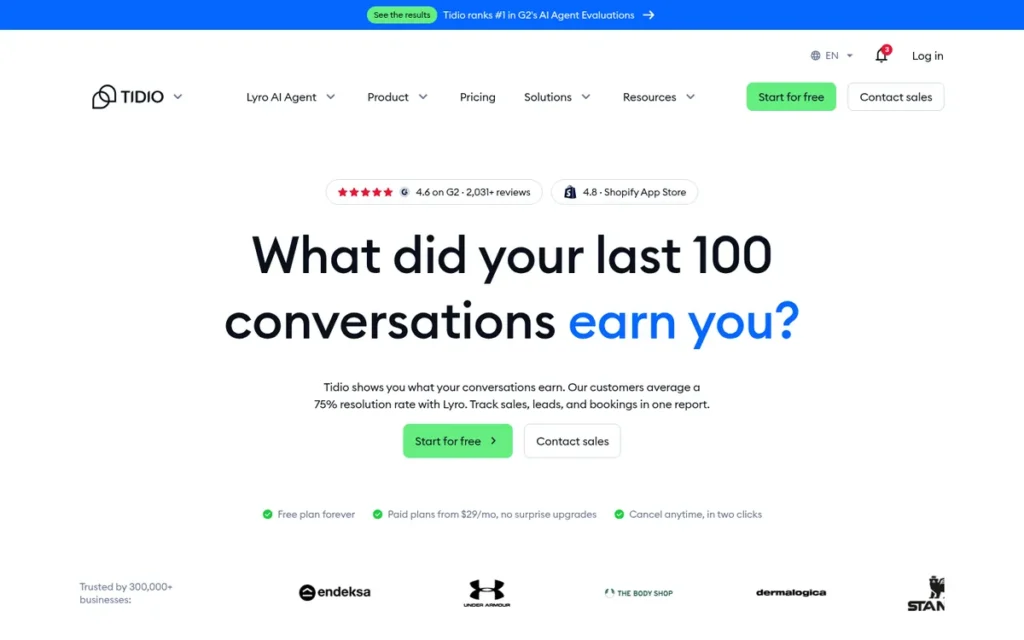
Category: Live Chat + AI, a website chat widget with an AI agent and bot builder, focused on pre-purchase questions and lightweight support.
At a Glance
- Category: Live Chat + AI
- Best For: Small and lean stores on Shopify, WooCommerce or BigCommerce whose main channel is website chat
- Price Range: Free plan; Starter $29/month ($24.17 annual, 100 conversations); Growth from $59/month ($49.17 annual); Plus from $300/month plus usage; Lyro AI from $39/month ($32.50 annual) (Tidio, November 2026)
- Primary Strength: Tidio offers a low-cost path to AI website chat, backed by a G2 rating of 4.6/5 from 1,962 reviews.
- Biggest Limitation: Tidio’s AI can recommend products and add items to carts but does not handle order edits, cancellations or refunds the way full ecommerce helpdesks do.
- One-Line Summary: Tidio is a highly rated, low-cost live chat + AI tool for small stores led by website chat (G2 4.6/5 from 1,962 reviews, November 2026), but brands that need AI to modify orders will outgrow it.
- Last Verified: November 2026
Overview
Tidio is a live chat and AI customer service tool for small and mid-sized online stores. It combines website chat, the Lyro AI agent, no-code Flows and basic ticketing, and it integrates with Shopify, WooCommerce and BigCommerce.
Tidio covers website chat, email, Messenger, Instagram and WhatsApp. Tidio’s own Lyro review says Lyro handles written inbound messages only, with no voice and no outbound campaigns (Tidio, 2026).
Key Features
- Tidio Lyro is an AI agent that answers customer questions and hands conversations off to human agents.
- Tidio Flows is a no-code bot builder with 40+ templates for automating common conversations.
- Tidio shows product cards in chat that let shoppers add items to their cart in Shopify and WooCommerce stores, with real-time catalog sync.
- Tidio connects website chat, email, Messenger, Instagram and WhatsApp alongside helpdesk tickets.
- Tidio integrates with Shopify, WooCommerce and BigCommerce, so it reaches more store platforms than most tools evaluated.
Best For
Tidio is best for solo operators and small teams that sell mainly through website chat and want AI coverage after hours. Tidio suits stores that do not need AI to change orders.
Pricing
- Tidio’s paid plans (Tidio, November 2026):
- Starter: $29/month ($24.17 billed annually) for 100 billable conversations
- Growth: from $59/month ($49.17 annually) for 250–2,000 conversations
- Plus: from $300/month plus usage
- Tidio sells Lyro separately, from $39/month ($32.50 annually) for 50 AI conversations. Every account gets its first 50 Lyro conversations free (Tidio, November 2026).
- Tidio offers a free plan and a 7-day trial on all plans. Tidio bills by conversation, so Lyro quotas and overages add to the base price.
Strengths
- Tidio has the most consistently high ratings across sites in this evaluation (November 2026):
- G2: 4.6/5 (1,962 reviews)
- Capterra: 4.7/5 (590 reviews)
- Shopify App Store: 4.8/5
- GetApp: 4.7/5
- Trustpilot: not captured
- Tidio ranked #1 of 9 CX agents in G2’s AI Marketplace evaluation (G2, 2026). The list is small and changes often.
- Tidio is one of two platforms evaluated with a free plan (Manychat is the other), and Tidio’s paid tiers start at $24.17/month billed annually (Tidio, November 2026).
- Tidio reports that NSI Australia raised its resolution rate by 60% while running support with one operator (vendor-reported, 2026).
Limitations
Tidio gives up order-action depth in exchange for simplicity and price, so post-purchase work beyond add-to-cart needs another tool.
- Tidio is weaker at post-purchase work. One merchant saw it as cheaper “for everything but order modification” (Reddit r/shopify, 2026).
- Tidio G2 reviewers report that free and lower-tier limits are “reached quickly” and that Lyro costs rise with usage. One reviewer called it “too expensive for small budgets” (G2, 2026).
- Tidio has no SMS or voice channel, and Lyro answers only written inbound messages, so Tidio covers fewer channels than full helpdesks.
- Tidio’s “up to 75%” Lyro resolution figure is vendor-reported, and independent Reddit discussion of Tidio was thin as of November 2026.
This aligns with community sentiment on r/Tidio:
“the thing that eventually moved us off tidio was pricing. once the trial ended and we needed a second operator, costs jumped fast.” Posted by u/Icy_Second_8578
Takeaway: Tidio’s low entry price can rise quickly once a small store adds a second operator, so model costs for your team size before relying on the trial price.
Verdict
Tidio is the most consistently well-rated low-cost option PlugRoute evaluated for small stores that sell mainly through website chat, with a 4.6/5 G2 rating from 1,962 reviews and a free plan. Tidio has the top ratings score but ranks third because order-action depth (C1) carries the heaviest weight.
Tidio’s support for WooCommerce and BigCommerce makes it a safer choice than Shopify-centered tools for merchants on those platforms. Stores whose tickets increasingly need refunds or edits should plan to move to an ecommerce helpdesk.
Score and Evidence Confidence
- Tidio weighted score: 3.65/5. Criterion scores: C1 2.5, C2 5, C3 3.5, C4 4, C5 4, C6 3. No change after November 2026 verification.
- Tidio Evidence Confidence: High for ratings, Low for community sentiment. Review volume is large, but independent discussion is thin.
4. Richpanel: Best for High-Volume Shopify Brands Wanting Low-Cost AI Self-Service
Category: Ecommerce Helpdesk.
At a Glance
- Category: Ecommerce Helpdesk
- Best For: High-volume Shopify and Shopify Plus brands that want to deflect repeat WISMO (“where is my order”) and returns tickets
- Price Range: About $0.20 per AI-handled conversation on annual billing ($0.60 per AI credit monthly), $200/month AI minimum, $99/seat annual or $119/seat monthly (Richpanel, November 2026)
- Primary Strength: Richpanel combines a customer self-service order portal with policy-bound AI agents at about $0.20 per AI-handled conversation on annual billing.
- Biggest Limitation: Richpanel meters AI-handled rather than resolved conversations, and its support for stores not on Shopify is unverified.
- One-Line Summary: Richpanel is a self-service-first ecommerce helpdesk for Shopify brands that pairs a self-service order portal with policy-bound AI order actions at the lowest published per-conversation AI rate evaluated, with less independently verified evidence.
- Last Verified: November 2026
Overview
Richpanel is an ecommerce helpdesk for Shopify and Shopify Plus brands that pairs a branded self-service order portal with policy-bound AI agents across seven channels. Richpanel is aimed at teams trying to deflect high ticket volume.
Richpanel positions itself as a replacement for Gorgias or Zendesk, with one-click migration. Richpanel’s own pages give conflicting company figures (3,000+ businesses versus 2,000+ brands).
Key Features
- Richpanel provides a branded self-service portal where customers can track orders, start returns or exchanges, cancel orders and change shipping addresses.
- Richpanel AI agents use tools within merchant-set policies, and a second AI reviews closed conversations.
- Richpanel brings email, live chat, Instagram, Facebook, WhatsApp, SMS and phone into one inbox, with a reported Aircall sync for voice.
- Richpanel offers migration from Gorgias and Zendesk, which G2 reviewers mention favorably.
- Richpanel prices AI per AI-handled conversation rather than per ticket.
Best For
Richpanel is best for Shopify brands with high volumes of repetitive WISMO, return and cancellation requests that want customers to resolve these themselves. Richpanel suits buyers who can commit to annual billing to get its lowest AI rate.
Pricing
- Richpanel charges about $0.20 per AI-handled conversation on annual billing, with a $200 monthly AI minimum and $99 per seat. That makes the starting total about $299 a month (Richpanel, November 2026).
- Richpanel’s monthly billing raises the rates to $0.60 per AI credit and $119 per seat, and on-demand seats cost $129 (Richpanel, November 2026).
- Richpanel was called “way more expensive than you initially think” by a reviewer because Self-Service was a paid add-on (Shopify App Store, 2026). Ask for an itemized quote.
Strengths
- Richpanel’s ratings (November 2026):
- G2: ~4.7/5
- Shopify App Store: ~4.8–5.0/5 (100+ reviews; count reported by Richpanel)
- Capterra: not captured
- Trustpilot: not captured
- Richpanel publishes the lowest per-conversation AI rate in this evaluation, about $0.20 per AI-handled conversation on annual billing (Richpanel, November 2026). Note that it bills per conversation, not per confirmed resolution.
- Richpanel received an independent switching endorsement: “Richpanel does everything Gorgias does, for way cheaper” (Reddit r/shopify, 2025). G2 reviewers praise its clean interface and help with migration (G2, 2026).
- Richpanel reports that AI resolved 63% of an unnamed wellness brand’s conversations end to end, with an AI CSAT of 4.39 versus 4.33 for the human team (vendor-reported, 2026).
Limitations
Richpanel gives up verified breadth and simple billing in exchange for Shopify focus and a low headline AI rate.
- Richpanel bills for every AI-handled conversation, including ones the AI does not resolve, so the cost of each successful resolution can exceed $0.20 (Richpanel, November 2026).
- Richpanel’s support depth for Magento, BigCommerce, WooCommerce and Recharge could not be verified as of November 2026, so merchants not on Shopify take on real risk.
- Richpanel reviewers report “occasional issues with AI,” and one called support “very poor and limited” (Shopify App Store, 2026).
- Richpanel’s own public figures conflict on customer count and founding year (2017 versus 2020), which lowers confidence in its self-reported data.
Verdict
Richpanel is the strongest self-service-first ecommerce helpdesk PlugRoute evaluated for high-volume Shopify brands that want customers to resolve order issues themselves. Richpanel ranks fourth because it bills per AI-handled conversation and some of its evidence is self-reported.
Buyers should confirm review counts, get itemized annual and monthly quotes, and test integrations beyond Shopify in a trial.
A merchant who has used both platforms on r/shopify shared their experience:
“i have used both on the past. Richpanel is more hands on when it comes to any help that you need on the other hand, I have found Gorgias being a bit more grumpy and slow to respond to queries, specially if you are on lower plans. I recommend setting up a pilot with both using limited channels and then decide what works best for your usecase. What works for other might not work for you.” Posted by u/commerce-angel
Takeaway: Richpanel’s hands-on vendor support can give it an edge over Gorgias for smaller plans, but merchants who have used both still treat a side-by-side pilot as the only reliable tiebreaker.
Score and Evidence Confidence
- Richpanel weighted score: 3.63/5. Criterion scores: C1 4.5, C2 3.5, C3 5, C4 3, C5 2, C6 2.5. C4 dropped from 3.5 after November 2026 verification showed Richpanel bills per AI-handled conversation, not per resolution.
- Richpanel Evidence Confidence: Medium. Ratings are strong, but review counts and company figures are partly self-reported.
5. Re:amaze: Best for Small Teams and Multi-Store Merchants Wanting Per-Seat Pricing
Category: Ecommerce Helpdesk.
At a Glance
- Category: Ecommerce Helpdesk
- Best For: Small Shopify teams with high conversation volume and merchants running multiple storefronts
- Price Range: $29–$69 per team member/month ($26.10–$62.10 billed annually), unlimited conversations; AI, SMS and voice charges not verified (Re:amaze, November 2026)
- Primary Strength: Re:amaze offers per-seat pricing with unlimited conversations, the most predictable cost model in this evaluation for small, high-volume teams.
- Biggest Limitation: Re:amaze has the thinnest verified performance evidence of the seven platforms, and a third-party review describes its AI as less mature than the ecommerce-native AI agents evaluated here.
- One-Line Summary: Re:amaze is an all-in-one ecommerce helpdesk with predictable per-seat pricing and unlimited conversations, best suited to small multi-store teams willing to verify its AI and integrations in a trial.
- Last Verified: November 2026
Overview
Re:amaze is a GoDaddy-owned ecommerce helpdesk that combines a shared inbox for email, chat, social, SMS and voice with a help center, chatbots and an AI agent. Re:amaze is aimed at small Shopify teams and multi-store merchants who want predictable per-seat pricing.
Re:amaze shows Shopify orders, history, tags and addresses inside conversations. GoDaddy acquired Re:amaze in 2021, according to most sources. Re:amaze’s depth on BigCommerce, WooCommerce, Wix and Magento was not verified as of November 2026.
Key Features
- Re:amaze brings email, live chat, Facebook/Messenger, Instagram, X, SMS and voice into one shared inbox.
- Re:amaze shows Shopify orders, customer history, tags and addresses inside each conversation and supports order data edits.
- Re:amaze Cues send proactive messages triggered by visitor behavior, which supports pre-purchase engagement.
- Re:amaze includes a help center, chatbots, the Re:amaze AI Agent, AI Intents, Peek screen-sharing and video calls.
- Re:amaze includes multi-brand support on its Pro plan for merchants running several storefronts.
Best For
Re:amaze is best for small Shopify support teams handling high conversation volume. Re:amaze also suits merchants running several brands who want one predictable per-seat bill.
Pricing
- Re:amaze per-team-member monthly prices, all with unlimited conversations (Re:amaze, November 2026):
- Basic: $29 ($26.10 billed annually)
- Pro: $49 ($44.10 billed annually)
- Plus: $69 ($62.10 billed annually)
- Re:amaze requires Pro for SMS and voice and offers a 14-day trial. Third-party sources also report a flat $59/month Starter option, which PlugRoute could not verify.
- Re:amaze AI allowances are reportedly tied to user count, but exact AI, SMS and voice charges were not verified as of November 2026.
Strengths
- Re:amaze’s ratings (November 2026):
- G2: 4.6/5 (140 reviews)
- Capterra: not confirmed
- Shopify App Store: not captured
- Trustpilot: not captured
- Re:amaze publishes per-seat pricing from $26.10/month billed annually with unlimited conversations (Re:amaze, November 2026). That is the most predictable pricing model here for small teams with high volume.
- Re:amaze covers seven channels, including X, SMS and voice, and includes multi-brand support on Pro rather than only on its top tier.
- Re:amaze earns praise from G2 and Shopify App Store reviewers for ease of use, value, multi-store support and order visibility (G2 and Shopify App Store, 2026).
Limitations
Re:amaze gives up proven AI depth and verified performance evidence in exchange for predictable pricing.
- Re:amaze’s AI is described by a third-party review as less mature than the ecommerce-native AI agents evaluated here, and its reporting as limited by tier (toolso.ai, 2026). No independent user quotes confirmed either claim.
- Re:amaze has no named case study with performance figures. Its only performance claim is 3,600+ businesses served (vendor-reported, 2026).
- Re:amaze G2 reviewers cite weak search and concerns about product changes since the 2021 GoDaddy acquisition (G2, November 2026).
- Re:amaze’s per-seat pricing gets expensive as the agent team grows, and its support for stores not on Shopify was not verified as of November 2026.
Verdict
Re:amaze is the most cost-predictable ecommerce helpdesk PlugRoute evaluated for small, high-volume Shopify teams and multi-store merchants, because it charges per seat with unlimited conversations. Re:amaze ranks fifth because of lighter order-action depth and the thinnest performance evidence, not because of confirmed weakness.
Buyers should use the 14-day trial to test AI accuracy and confirm AI, SMS and voice charges.
Score and Evidence Confidence
- Re:amaze weighted score: 3.35/5. Criterion scores: C1 3, C2 3.5, C3 5, C4 4, C5 2, C6 1.5. C2 rose from 2.5 after its G2 rating was verified in November 2026.
- Re:amaze Evidence Confidence: Low–Medium. Its G2 rating and pricing are verified, but it has no published performance data.
6. Manychat: Best for Instagram- and TikTok-Led Acquisition (Pair With a Helpdesk)

Category: Social DM Automation, a tool that automates Instagram, Messenger, TikTok and WhatsApp conversations to capture and convert demand, not a full support helpdesk.
At a Glance
- Category: Social DM Automation
- Best For: Brands and creators whose sales start in Instagram or TikTok comments and DMs
- Price Range: Free plan; $14–$39/month by plan and billing (250–2,500 active contacts); $0.038–$0.10 per extra contact; Meta and SMS fees extra (Manychat help center, November 2026)
- Primary Strength: Manychat turns Instagram and TikTok comments, story replies and keywords into automated DM sales conversations through the official Meta API.
- Biggest Limitation: Manychat is not a helpdesk and lacks ticketing, SLAs, routing depth, support reporting and order edit or refund actions.
- One-Line Summary: Manychat is a widely used social DM automation tool (1M+ businesses, vendor-reported, 2025) for Instagram- and TikTok-led sales, but most ecommerce brands will need to pair it with a helpdesk for post-purchase support.
- Last Verified: November 2026
Overview
Manychat is a social messaging automation platform that turns Instagram and TikTok comments, story replies and DMs into automated sales conversations. Manychat is built for brands and creators whose customers discover them on social media.
Manychat also covers Messenger, WhatsApp, SMS and email. It includes an AI Step and a Live Chat inbox for handing conversations to humans, but Manychat is not a support helpdesk.
Key Features
- Manychat automates comment-to-DM replies, story replies and keyword triggers on Instagram, and also supports Messenger, WhatsApp, TikTok, SMS and email.
- Manychat includes an AI Step for generating replies and a Live Chat inbox for human handoff.
- Manychat supports Shopify use cases including abandoned-cart recovery, product recommendations and order notifications.
- Manychat provides a visual flow builder and templates that reviewers praise for ease of use.
- Manychat is an official Meta Business Partner and connects through the official API rather than logged-in browser sessions.
Best For
Manychat is best for Instagram- and TikTok-led brands that need to capture and convert social demand. Manychat works best paired with a separate helpdesk for order-related support.
Pricing
- Manychat offers a free plan. Manychat Essential costs $17/month ($14 billed annually) for 250 active contacts (Manychat help center, November 2026).
- Manychat Pro costs $39/month ($29 annually) for 2,500 active contacts and includes AI automation, WhatsApp, 3 users and 2 Inbox seats (Manychat help center, November 2026).
- Manychat has charged $0.038–$0.10 per extra active contact since March 2, 2026, and WhatsApp (Meta) and SMS fees are billed on top.
Strengths
- Manychat’s ratings (November 2026):
- G2: ~4.5/5 (165 reviews)
- Capterra: ~4.6/5
- Shopify App Store: not captured
- Trustpilot: average score not captured
- Manychat raised a $140M Series B in April 2025, led by Summit Partners with Bessemer Venture Partners participating. That brought total funding to $163.3M (Manychat, 2025), the largest disclosed venture round among the vendors evaluated.
- Manychat is an official Meta Business Partner. That matters because independent users warn that tools driving accounts through logged-in browser sessions get accounts restricted (Reddit r/socialmedia, 2026).
- Manychat reports 1M+ businesses in 170+ countries (vendor-reported, 2025). One independent reviewer saw 18% abandoned-cart recovery versus 8% from email alone in a single setup (Hackceleration, 2026).
Limitations
Manychat gives up support depth in exchange for social acquisition strength, so using it alone means buying a tool built for a different job.
- Manychat lacks ticketing, SLAs, routing depth and support reporting, and it cannot edit, cancel or refund orders (trtc.io, 2026).
- Manychat’s contact-based pricing can spike after a viral post. At $0.038–$0.10 per extra contact, depending on plan, 10,000 extra commenters could add roughly $380–$1,000 in a month (Manychat help center, November 2026).
- Manychat faces recurring billing and cancellation complaints, including an alleged $199 charge on a $99 plan and one report of an Instagram account being flagged after connecting (Trustpilot, 2026).
- Manychat’s G2 customer-service scores trail its ease-of-use scores, and independent merchant discussion on Reddit was thin as of November 2026.
Verdict
Manychat is the strongest tool PlugRoute evaluated for turning Instagram and TikTok comments and DMs into sales conversations, but it is a social acquisition tool, not a conversational commerce helpdesk. Manychat ranks sixth because it lacks support and order-action features, not because it is weak at its core job.
Social-led brands should pair Manychat with a helpdesk and monitor active-contact counts to avoid surprise bills.
Score and Evidence Confidence
- Manychat weighted score: 2.85/5. Criterion scores: C1 1.5, C2 3, C3 3.5, C4 3.5, C5 3, C6 3.5. C4 rose from 3 after November 2026 verification resolved conflicting published prices.
- Manychat Evidence Confidence: Medium. Funding and ratings are verified, but independent merchant discussion is thin and its Trustpilot score was not captured.
7. Wati: Best for WhatsApp-First Brands in WhatsApp-Dominant Markets
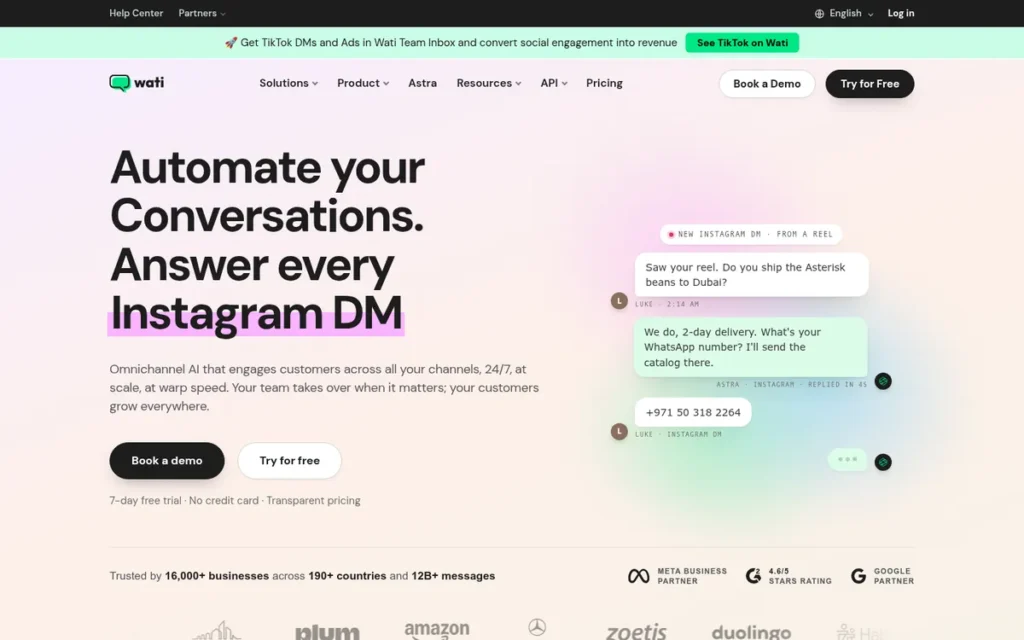
Category: WhatsApp-First Platform, a commerce and support tool built on the WhatsApp Business API, with other channels secondary.
At a Glance
- Category: WhatsApp-First Platform
- Best For: Brands where WhatsApp is the primary sales and support channel, especially in markets that use cash-on-delivery and regional payment links
- Price Range: $59–$349/month by tier and billing (Business may show as Custom by region); Shopify add-on $4.99/month; AI credit packs $30–$40/month; Meta WhatsApp fees extra (Wati, November 2026)
- Primary Strength: Wati is the only WhatsApp-first platform evaluated and offers catalogs, regional payment links, cash-on-delivery confirmation and click-to-WhatsApp ads.
- Biggest Limitation: Wati’s costs are hard to predict because its platform fees, user charges and AI credits sit on top of Meta’s per-message charges.
- One-Line Summary: Wati is the most specialized WhatsApp commerce platform in this evaluation, but its narrow channel focus and layered fees make it a fit only for brands whose customers live on WhatsApp.
- Last Verified: November 2026
Overview
Wati is a WhatsApp-first conversational commerce platform built on the WhatsApp Business API. It offers a shared team inbox, broadcasts, a chatbot builder, the Astra AI agent, catalogs and payment links for brands whose customers mainly buy and get support through WhatsApp.
Wati’s Shopify flows cover abandoned carts, cash-on-delivery confirmation, order and shipping notifications, and returns. Instagram and Messenger are secondary channels in Wati.
Key Features
- Wati Astra is an AI agent that answers product questions, recommends products and hands conversations to human agents.
- Wati supports WhatsApp catalogs and payment links through regional providers such as Razorpay and PayU.
- Wati automates Shopify flows through a $4.99/month add-on.
- Wati runs click-to-WhatsApp ads and broadcast campaigns from a shared inbox that also covers Instagram and Messenger.
- Wati provides a no-code chatbot builder for WhatsApp conversation flows.
Best For
Wati is best for brands in WhatsApp-dominant markets that sell to and support customers mainly through WhatsApp. Wati suits merchants that need cash-on-delivery and regional payment flows.
Pricing
- Wati’s published tiers (Wati, November 2026):
- Growth: $69/month ($59 billed annually), 3 users
- Pro: $149/month ($119 billed annually), 5 users, 2 Astra AI agents and 5,000 AI credits
- Business: $349/month ($279 billed annually), unlimited AI agents and 20,000 credits; shown as Custom in some regions
- Wati charges $4.99/month for the Shopify integration and lists AI credit packs at $30 and $40/month (Wati, November 2026).
- Wati customers also pay Meta’s WhatsApp fees. Meta has charged per delivered template message since July 1, 2025. Since October 1, 2026, Meta also charges for service messages beyond the first 1,000 per number per month (Meta pricing via Wati support, November 2026).
Strengths
- Wati’s ratings (November 2026):
- G2: ~4.6/5 as shown on Wati’s own site; G2 reviewers praise its ease of use and helpful technical staff
- Capterra: not captured
- Trustpilot: not captured
- Wati is an official Meta Business Partner and WhatsApp Business Solution Provider (BSP), which gives it policy-compliant access to the WhatsApp Business API (Wati, 2026).
- Wati reports two customer results (vendor-reported, 2026):
- Blacklyf’s conversion rate rose from 1.5% on its website to 4.8% with click-to-WhatsApp.
- Zellbury got 8% of its sales through WhatsApp, with 87% CSAT.
- Wati reports 16,000+ customers in 180+ countries (vendor-reported, 2026). It offers regional payment and cash-on-delivery flows that the general helpdesks evaluated here do not document.
Limitations
Wati gives up channel breadth in exchange for WhatsApp specialization, and its total cost is the hardest to forecast in this evaluation.
- Wati lacks SMS and in-tool refund or edit actions, and its email ticketing is shallow, so brands with mixed channels will need another platform.
- Wati’s bill stacks several cost layers (Wati, November 2026):
- a platform tier of $59–$349/month
- extra user charges
- AI credit packs of $30–$40/month
- Meta’s per-message fees
- Wati G2 reviewers cite “hidden charges and high fees for frequent messaging” and slow support (G2, 2026). Reddit users say WhatsApp providers, including Wati, add markups over Meta’s fixed rates (Reddit r/EcommerceWebsite, 2026).
- Wati’s independent review counts and company background could not be verified as of November 2026, and sources disagree on how many users each plan includes.
Verdict
Wati is the most specialized WhatsApp commerce platform PlugRoute evaluated, best suited to brands in WhatsApp-dominant markets that need catalogs, payment links and cash-on-delivery flows. Wati ranks last because of its narrow channel scope and low evidence confidence, not because its WhatsApp features are weak.
Buyers should get a written quote that separates Wati’s fees from Meta’s rate card and compare it with going direct to Meta.
Score and Evidence Confidence
- Wati weighted score: 2.19/5. Criterion scores: C1 1.75, C2 2, C3 3, C4 2.5, C5 2.5, C6 1.5. C4 rose from 2 after Wati published its tier prices.
- Wati Evidence Confidence: Low, because its ratings appear only on Wati’s own site and its company background is unverified.
How Do Conversational Commerce Platforms Charge?
Conversational commerce platforms bill by six different units as of November 2026, and the units are not interchangeable. Published AI rates run from about $0.20 per AI-handled conversation at Richpanel to $1.50–$2.00 per automated resolution under Zendesk’s outcome-based pricing. Compare modeled monthly totals for your own volume, not headline rates.
- Gorgias bills per ticket, with unlimited users.
- Tidio bills per conversation.
- Manychat bills per active contact.
- Re:amaze bills per seat with unlimited conversations.
- Zendesk and Richpanel bill per seat plus a per-unit AI fee.
- Wati charges a platform fee plus Meta’s message fees.
| Platform | Billing Unit | Headline Price (Nov 2026) | AI Fee | AI Billing Unit | Known Add-Ons | Cost-Spike Trigger |
|---|---|---|---|---|---|---|
| Gorgias | Per ticket, unlimited users | $10–$900/month (monthly billing) | Add-on from $30/month, then $1.50 per extra | Per automated interaction + monthly add-on | Revenue attribution on higher tiers | Ticket growth; AI interactions also count as tickets |
| Zendesk | Per agent seat | $19–$115+/agent/month (annual) | $1.50–$2.00 per extra resolution | Per automated resolution | Copilot $50/agent; Meta WhatsApp fees | Resolutions beyond seat allowance |
| Tidio | Per conversation | Free; $24.17–$300+/month | Lyro from $32.50 (annual) or $39/month | Per Lyro conversation bundle (50) | Lyro quotas and overages | Conversation and Lyro volume |
| Richpanel | Per seat plus per AI conversation | $99/seat annual or $119 monthly; $200/month AI minimum | ~$0.20 (annual) or $0.60 per credit (monthly) | Per AI-handled conversation | Paid self-service add-on | Unresolved conversations still billed |
| Re:amaze | Per seat, unlimited conversations | $26.10–$62.10/seat/month (annual) | Not verified | Not verified | SMS and voice require Pro | Adding agents |
| Manychat | Per active contact | Free; $14–$39/month | Included in Pro | Included in Pro tier | Meta and SMS fees | $0.038–$0.10 per extra contact |
| Wati | Platform tier plus Meta messages | $59–$349/month | Credit packs $30–$40/month | AI credit packs | Shopify add-on $4.99/month | Message volume; Meta service-message charges |
Since October 1, 2026, Meta bills WhatsApp service messages beyond 1,000 per number per month at utility rates (Meta pricing via Wati support, November 2026). Conversations that start from Click-to-Message ads get a free window of up to 7 days (Wati support, 2026).
Worked example: what do 600 AI conversations a month cost?
This example assumes a store with 2 agents and 600 AI-handled conversations a month, at November 2026 list prices. The three platforms below produce very different totals. Tidio, Re:amaze, Manychat and Wati are left out because their AI pricing uses bundles, credits or unverified rates.
- Richpanel: about $398 a month on annual billing, or about $598 on monthly billing.
- Annual: 2 seats × $99, plus the $200 AI minimum, which covers 600 × $0.20 = $120.
- Monthly: 2 seats × $119, plus 600 × $0.60.
- Zendesk Suite Professional: about $1,100–$1,390 a month if every handled conversation counts as resolved.
- That is 2 seats × $115 (annual rate), plus about 580 extra resolutions × $1.50–$2.00.
- Zendesk bills only resolutions, so the total falls if fewer conversations are resolved.
- Gorgias Pro: about $1,165 a month, before choosing a larger AI allowance.
- That is $360 for the helpdesk, plus $190 for the AI add-on (190 interactions), plus 410 extra interactions × $1.50.
These totals are illustrative, so ask each vendor to price this exact scenario. The cheapest headline AI rate does not always produce the cheapest bill. The only fair comparison is a modeled monthly total for your own volume.
Which Store Platforms Does Each Tool Support?
Tidio has the broadest verified store-platform support of the seven platforms, covering Shopify, WooCommerce and BigCommerce as of November 2026. Gorgias documents BigCommerce and Magento support with AI and plan-tier restrictions. Zendesk connects to any store platform through third-party integrations, and the other four document Shopify only.
| Platform | Shopify | BigCommerce | WooCommerce | Magento | Documented Restrictions |
|---|---|---|---|---|---|
| Gorgias | Verified (vendor docs, Nov 2026) | Verified (vendor docs, Nov 2026) | Not verified | Verified (vendor docs, Nov 2026) | AI Agent Shopify-only on Magento 2; limited AI on BigCommerce; BigCommerce not on Starter; Magento not on Starter or Basic |
| Zendesk | Verified (vendor docs, Nov 2026) | Via third-party integrations | Via third-party integrations | Via third-party integrations | Shopify app rated 3.2/5 |
| Tidio | Verified (vendor docs, Nov 2026) | Verified (vendor docs, Nov 2026) | Verified (vendor docs, Nov 2026) | Not verified | In-chat add-to-cart on Shopify and WooCommerce only |
| Richpanel | Verified (vendor docs, Nov 2026) | Not verified | Not verified | Not verified | None documented |
| Re:amaze | Verified (vendor docs, Nov 2026) | Not verified | Not verified | Not verified | BigCommerce mentioned in marketing only |
| Manychat | Verified (vendor docs, Nov 2026) | Not verified | Not verified | Not verified | Shopify support covers use cases, not order actions |
| Wati | Verified (vendor docs, Nov 2026) | Not verified | Not verified | Not verified | Shopify requires $4.99/month add-on |
What About Intercom, Shopify Inbox and Other Tools?
PlugRoute did not rank Intercom, Shopify Inbox or several other tools because this round of research did not collect comparable dated rating, pricing and community evidence for them. Leaving them out is not a judgment on their quality. The same rule applies to every excluded tool, and all of them are candidates for PlugRoute’s next update.
PlugRoute did not evaluate the following tools in this round:
- Intercom
- Shopify Inbox
- HubSpot
- Respond.io
- Ada
- Insider One
- Verloop.io
- Guided-selling tools such as Rep AI, Zipchat and Dialog
SMS marketing platforms such as Attentive and Postscript are outside this article’s scope, which covers combined sales and support conversations.
What Red Flags Should I Watch For When Evaluating Conversational Commerce Platforms?
The six biggest red flags involve oversold AI, hidden usage charges, unsafe account access and features that work only on Shopify. Each one comes up repeatedly in the G2, Shopify App Store and Reddit feedback PlugRoute reviewed as of November 2026, and each is easy to test before you sign.
Red Flag #1: AI Oversold in the Demo
None of the seven vendors PlugRoute evaluated publishes an independently audited AI resolution rate as of November 2026. A sales demo is therefore not evidence of how a platform’s AI will perform on your own tickets, catalog and policies.
- Every AI resolution figure in this PlugRoute evaluation is vendor-reported, including Tidio’s 75%, Richpanel’s 63% and Zendesk/NOBULL’s 50%.
- One merchant said an older Gorgias rules-based product prevented only 12 of about 2,000 monthly tickets in two weeks (Reddit r/ecommerce, 2024).
Red Flag #2: Auto-Replies Billed as Full Tickets
Per-ticket pricing can charge full rates for simple automated replies, which hits small stores with many short questions hardest. Before you sign, ask each vendor exactly which events create a billable ticket, conversation or contact, including replies sent only by the AI.
- Gorgias’s billing docs say a ticket is charged when a helpdesk reply is sent, and each automated AI interaction also counts as a ticket (Gorgias, November 2026).
- One small merchant worried that a “glorified auto responder” would count “all these little things” as full tickets (Reddit r/shopify, 2026).
Red Flag #3: Instagram Tools That Ask for Your Password
Instagram automation tools that log in with your password instead of using the official Meta API put your business account at risk of restriction. Safe tools connect through Meta’s approved API and can prove Meta Business Partner status when you ask.
- Independent users say tools “driving your account through a logged in browser session instead of the api” are the pattern that “gets accounts restricted” (Reddit r/socialmedia, 2026).
- Manychat and Wati both state they are official Meta Business Partners (Manychat, 2026; Wati, 2026). Buyers should ask any Instagram tool for the same proof.
Red Flag #4: WhatsApp Markups on Top of Meta Fees
WhatsApp providers often add platform fees, user charges and markups on top of Meta’s per-message rates, so total cost can far exceed Meta’s published pricing. Ask for a written quote that separates the provider’s fees from Meta’s rate card.
- Reddit users say Meta’s charges are fixed but providers “often add significant monthly fees, user charges, and additional markups” (Reddit r/EcommerceWebsite, 2026).
- Since October 1, 2026, Meta has billed service messages beyond 1,000 per number per month, so WhatsApp support replies now cost money on top of any platform fee (Meta pricing via Wati support, November 2026).
Red Flag #5: AI That Changes Orders Without Approval Steps
AI agents that can edit, cancel or refund orders need safeguards that keep a human in control, such as intent checks, policy limits or approval steps. Without them, one misread message can trigger a refund or cancellation that a human must then reverse.
- A Tidio employee recommended putting “anything that mutates orders behind strict intent checks or a human approval step” (Reddit r/shopify, 2026).
- Richpanel documents AI agents bound by merchant policies and a second AI that reviews closed conversations (Richpanel, 2026).
- Gorgias one-star reviews describe AI closing tickets without a proper answer (Shopify App Store, 2026).
As one user on r/Tidio described:
“We tried going pretty far with automation early on and rolled it back. FAQs and basic routing work great, but anything tied to billing or refunds we keep human. One wrong answer there caused more cleanup than the time we saved.” Posted by u/Nirraaaa
Takeaway: Merchants who over-automate conversational commerce support learn that AI errors on refunds and billing cost more to fix than they save, so money-related actions belong behind a human checkpoint.
Red Flag #6: Shopify-Only Features Sold as Universal
A platform’s headline automation may work fully only on Shopify, even when the vendor lists other store platforms as supported. Get written confirmation of feature parity for your store platform and plan tier, because these restrictions often appear only in documentation, not on pricing pages.
- Gorgias’s docs say AI Agent is Shopify-only on Magento 2 (Gorgias docs, 2026).
- Gorgias excludes BigCommerce from Starter and Magento from Starter and Basic (Gorgias, November 2026).
- Richpanel’s and Re:amaze’s support beyond Shopify could not be verified as of November 2026.
What Questions Should I Ask Before Choosing a Conversational Commerce Platform?
Before choosing a platform, ask eight questions covering ticket mix, store-platform support, the full cost of an AI conversation, piloting, handoff, add-ons, viral-volume risk and email sending. The most important is what share of your tickets need refunds, cancellations or edits, because that decides which category you need.
Question #1: What share of our tickets need refunds, cancellations or edits?
Your order-action ticket share is the strongest predictor of which category you need. If 30–40% or more of tickets need order actions, a community rule of thumb points to an ecommerce helpdesk such as Gorgias or Richpanel (Reddit r/CRM, 2025).
- If most tickets need only answers, Zendesk, Re:amaze or Tidio may cover your needs at lower cost.
- Tagging 100–200 recent tickets by type gives a usable estimate of your order-action share.
Question #2: Which features work on our store platform and plan tier?
Ask each vendor for written confirmation of which AI and automation features work on your store platform and plan tier. Feature parity often differs by platform and tier, and sales demos rarely show those restrictions.
- Gorgias’s documentation shows that features differ by store platform and plan tier (Gorgias docs, 2026).
- Richpanel’s and Re:amaze’s support for platforms other than Shopify could not be verified as of November 2026 and should be tested in a trial.
Question #3: How is one AI-resolved conversation billed in total?
Ask each vendor to price one AI-resolved conversation from start to finish, including ticket, conversation, seat and AI fees. Vendors bill different units, so a low headline AI rate can still produce a high monthly bill.
- Richpanel charges about $0.20 per AI-handled conversation on annual billing, or $0.60 per credit on monthly billing (Richpanel, November 2026).
- Zendesk lists $1.50–$2.00 per extra automated resolution (Zendesk, November 2026).
- Gorgias charges an AI add-on plus $1.50 per extra interaction, and each interaction also counts as a ticket (Gorgias, November 2026).
Question #4: Can we pilot the AI on our own past tickets before signing?
A pilot on your own past tickets is the most reliable way to test AI accuracy, because none of the seven vendors evaluated publishes an audited resolution rate. Free trials, such as Tidio’s 7-day and Re:amaze’s 14-day trials, let you do this before you buy.
- A useful pilot uses 100–200 recent tickets that cover order-status, return and product questions.
- A useful pilot measures the share of tickets the AI resolves correctly without a human edit.
- A useful pilot counts every billed conversation, not only resolved ones.
- Independent users report AI that “goes rogue” or closes tickets without a proper answer (Reddit r/ecommerce, 2025).
Question #5: How does handoff to a human preserve conversation context?
A clean handoff passes the full conversation history, order data and the AI’s actions to the human agent, so the customer never has to repeat themselves. Ask to see a live handoff during the demo rather than relying on slides.
- PlugRoute’s review of G2, Shopify App Store and Reddit feedback found repeated complaints about handoffs across the category (PlugRoute, November 2026).
- A good handoff test uses a conversation where the AI has already taken an order action.
Question #6: What add-ons (Copilot, self-service portal, store integrations) are not in the headline price?
Ask for an itemized quote that lists every add-on, because headline prices often leave out features buyers assume are included. Copilot seats, self-service portals and store integrations are the most common examples in this evaluation as of November 2026.
- Zendesk Copilot costs $50 per agent per month (Zendesk, November 2026).
- Richpanel’s self-service portal was reported as a paid add-on (Shopify App Store, 2026).
- Wati’s Shopify integration costs $4.99 per month (Wati, November 2026).
Question #7: What happens to costs if a social post goes viral?
Ask how a sudden spike in contacts or conversations would change your bill, and request caps or alerts before you sign. Per-contact, per-conversation and per-ticket pricing all carry volume risk, but per-contact pricing reacts fastest to a viral post.
- A Manychat Pro account (2,500 active contacts included) that gains 10,000 extra commenters in a month would pay about $380–$500 in contact overage at $0.038–$0.05 per contact (Manychat help center, November 2026).
- Traffic spikes can also push stores past Tidio’s conversation quotas and Gorgias’s ticket allowances.
Question #8: How does the platform send support email?
Ask whether the helpdesk sends support email through shared infrastructure or through your own email provider, because shared sending can hurt deliverability. Your sender reputation should depend only on your own sending, not on other customers of the same helpdesk.
- One Gorgias user said shared Mailgun/SendGrid sending led Yahoo to block their support emails (Reddit r/ecommerce, 2025).
- The same user said Richpanel told them it sends email through the merchant’s own email provider (Reddit r/ecommerce, 2025).
How Did We Rank These Conversational Commerce Platforms?
PlugRoute scored each platform from 1 to 5 on six weighted criteria, using only dated, source-labeled research from November 2026. The three heaviest criteria are order-action depth (25%), third-party ratings (20%) and pricing predictability (20%). Every platform’s weighted total and a separate Evidence Confidence label are published.
PlugRoute has no affiliate relationships with any company listed, and rankings are determined entirely by research data and objective evaluation criteria.
Ranking criteria and why each matters:
- C1 Ecommerce Order-Action Depth and AI Agent Scope (25%) matters because merchants choose based on whether AI and human agents can act on orders with clean handoffs.
- C2 Third-Party Ratings, Review Volume and Cross-Site Consistency (20%) matters because ratings are the most reliable signal after purchase when vendor claims are not independently audited.
- C3 Channel Coverage and Unified Inbox (15%) matters because customer conversations are split across chat, social, SMS and WhatsApp.
- C4 Pricing Transparency and Total-Cost Predictability (20%) matters because mixed billing units make total cost hard to forecast.
- C5 Store-Platform Parity Beyond Shopify (10%) matters because the strongest automation may work only on Shopify.
- C6 Independent Credentials and Evidence Quality (10%) matters because analyst placements, audits and named case studies show how durable a vendor is.
PlugRoute recalculated every score after verifying prices and ratings in November 2026, applying the same rules to every vendor. The rescoring raised Gorgias, Re:amaze, Manychat and Wati on C2 or C4 and lowered Richpanel’s C4, which moved Richpanel from #2 to #4.
| Platform | C1 (25%) | C2 (20%) | C3 (15%) | C4 (20%) | C5 (10%) | C6 (10%) | Weighted Total |
|---|---|---|---|---|---|---|---|
| Gorgias | 5 | 4 | 5 | 3 | 2.5 | 3 | 3.95 |
| Zendesk | 3 | 3.5 | 5 | 3 | 4 | 5 | 3.70 |
| Tidio | 2.5 | 5 | 3.5 | 4 | 4 | 3 | 3.65 |
| Richpanel | 4.5 | 3.5 | 5 | 3 | 2 | 2.5 | 3.63 |
| Re:amaze | 3 | 3.5 | 5 | 4 | 2 | 1.5 | 3.35 |
| Manychat | 1.5 | 3 | 3.5 | 3.5 | 3 | 3.5 | 2.85 |
| Wati | 1.75 | 2 | 3 | 2.5 | 2.5 | 1.5 | 2.19 |
Ranks 2–4 are within 0.07 point of each other. Each entry also carries a separate Evidence Confidence label (High, Medium or Low, split where evidence types differ), so thin public data is shown apart from product merit. Every source is labeled as one of these types:
- Independent user
- Vendor staff
- Competing vendor
- Vendor case study
- Commissioned study
Disclosed data gaps:
- PlugRoute could not confirm current Capterra review counts for Re:amaze, Richpanel and Wati.
- PlugRoute did not capture Trustpilot scores for Tidio and Manychat.
- PlugRoute could not verify company background for Wati and Re:amaze, and Richpanel’s own figures conflict.
- Independent Reddit discussion of Tidio, Re:amaze and Manychat was thin.
- Zendesk’s per-resolution rate appears on only one Zendesk page.
- Sources disagree on how many users each Wati plan includes.
- PlugRoute performed no hands-on testing, and all AI performance figures are vendor-reported.
PlugRoute re-checks prices and ratings in this ranking every quarter, and the next scheduled review is February 2027.
Frequently Asked Questions
What is the best conversational commerce platform for Shopify stores in 2026?
For Shopify stores in 2026, PlugRoute’s independent ranking places Gorgias first for brands whose tickets often need refunds, cancellations or order edits. Small Shopify stores that sell mainly through website chat should start with Tidio, which has a free plan. Enterprise teams should evaluate Zendesk, and brands with heavy WISMO volume should compare Richpanel’s self-service portal.
How much do conversational commerce platforms cost?
Conversational commerce platforms range from free plans to several hundred dollars a month before usage fees, as of November 2026. Tidio and Manychat start free, Gorgias starts at $10/month, Re:amaze at $26.10 per seat and Zendesk at $19 per agent. AI fees use different billing units, and WhatsApp tools add Meta’s per-message charges on top.
How does PlugRoute determine rankings?
PlugRoute ranks platforms on six weighted criteria scored from dated research: order-action depth, third-party ratings, channel coverage, pricing predictability, store-platform parity and independent credentials. Per-criterion scores and weighted totals are published, vendor-reported results are labeled, and a separate Evidence Confidence label flags thin data. PlugRoute performed no hands-on testing for this November 2026 ranking.
What Do Key Conversational Commerce Terms Mean?
Ecommerce Helpdesk: An ecommerce helpdesk is a support inbox built for online stores. It shows order data inside each conversation and can edit, cancel or refund orders. It is the only kind of tool that handles post-purchase tickets and acts on orders natively, so stores with many refund or edit requests should start here.
Order Actions: Order actions are changes that AI or human agents make to a customer’s order from inside the ticket, such as cancelling orders, editing addresses, starting returns or issuing refunds. How many order actions a platform supports varies a lot by tool. Your share of tickets that need them is the best guide to which category you should buy.
WISMO: WISMO stands for “where is my order,” the repetitive order-status questions that make up much of a store’s support volume. Platforms with self-service portals or AI agents aim to deflect these tickets so human agents can spend their time on harder cases.
Self-Service Order Portal: A self-service order portal is a branded page where customers track orders, start returns or exchanges, cancel orders and change shipping addresses on their own. It can cut ticket volume, but check whether it comes in the base price or is sold as a paid add-on.
AI-Handled Conversation vs. Automated Resolution: An AI-handled conversation is billed whenever the AI takes part, whether or not it solves the problem. An automated resolution is billed only when the AI actually resolves the issue. Because of this difference, a low per-conversation rate can still cost more per successful answer than a higher per-resolution rate.
Outcome-Based Pricing: Outcome-based pricing charges a fee for each automated resolution, usually on top of a set number of resolutions included with each agent seat. It ties cost to results, but headline seat prices understate the total once resolutions go past the included allowance.
Active Contact: An active contact is a person who interacts with your automated social or messaging flows, and some social DM tools bill by how many of these you have. This pricing reacts fastest to sudden spikes, so a viral post can bring a large overage charge in a single month.
Per-Seat Pricing: Per-seat pricing charges a fixed monthly fee for each agent or team member. When it comes with unlimited conversations, it is the most predictable cost model for small teams with high volume, but it gets expensive as the agent team grows.
WhatsApp Business API: The WhatsApp Business API is Meta’s official channel that lets businesses run sales and support on WhatsApp at scale, accessed through approved providers. Buyers pay Meta’s per-message fees on top of the provider’s platform fees, and providers may add markups, so ask for a quote that lists the two separately.
Meta Business Partner: A Meta Business Partner is a vendor that Meta has approved to connect to Instagram, Messenger and WhatsApp through the official API instead of logging in with your password. This matters because tools that drive your account through a logged-in browser session can get business accounts restricted.
Human Handoff: Human handoff is the point where an AI agent passes a conversation to a human. A good handoff carries over the full history, order data and any actions the AI already took. A poor handoff makes customers repeat themselves, so ask to see a live handoff during the demo.
Store-Platform Parity: Store-platform parity is whether a tool’s features work the same on Shopify, BigCommerce, WooCommerce or Magento. Headline automation often works fully only on Shopify, and the restrictions may appear only in documentation, so get written confirmation for your store platform and plan tier.
Which Conversational Commerce Platform Is Right for You?
Key Insights
- The right conversational commerce platform depends more on your ticket mix, main channel, store platform and team size than on rank.
- None of the seven vendors PlugRoute evaluated publishes an independently audited AI resolution rate as of November 2026.
- Published AI rates range from about $0.20 to $2.00 per unit, but vendors bill different units, so headline rates are not directly comparable (November 2026).
- Gorgias documents 130+ AI order actions, the deepest Shopify order capability evaluated, but its AI Agent is Shopify-only on Magento 2.
- Since October 1, 2026, Meta has charged for WhatsApp service replies beyond 1,000 per number per month, so WhatsApp support now costs money per message on top of any platform fee.
- The #2–#4 platforms in PlugRoute’s 2026 ranking are less than 0.1 weighted point apart, so match the platform to your main channel and ticket mix rather than rank.
Which platform fits which store?
- Gorgias fits Shopify brands with many order-action tickets.
- Zendesk fits enterprise and multi-brand teams with voice and governance needs.
- Tidio fits small stores that sell through website chat.
- Richpanel fits high-volume Shopify brands focused on self-service.
- Re:amaze fits small teams that want predictable per-seat bills.
- Manychat fits social-led brands that pair it with a helpdesk.
- Wati fits brands whose customers buy on WhatsApp.
Solo and small stores should start with Tidio, or with Re:amaze if conversation volume is high. Growing Shopify brands should measure their order-action ticket share and pilot Gorgias or Richpanel on their own tickets.
AI pricing and Meta’s WhatsApp fees keep changing, so re-check costs before you renew. We update this guide quarterly. Last updated: November 5, 2026. Read PlugRoute’s full methodology and explore our other independent reviews before you shortlist.