The best cannabis industry software depends on license type. Wherefour leads for manufacturers and processors, Cova Software for dispensaries wanting published pricing and offline selling, and Canix for cultivators and distributors in Metrc states. Only BioTrack natively spans cultivation through retail, so most vertically integrated businesses must pair an ERP with a POS.
Generic “best overall” lists treat dispensary checkout and extraction batch records as the same problem. They repeat vendor integration claims without testing them in a state system. They also skip the costs that decide the first-year bill: hardware, implementation, payment add-ons and multi-year contracts.
PlugRoute has no affiliate relationships with any company listed. Rankings are determined entirely by research data and objective evaluation criteria.
“METRC integration is a tough sell. I know loads of people who did it with various ERP software, and they all regret it… most people find metrc integration to cause more issues because you have to change your SOPs.” (u/TheObviousDilemma, r/weedbiz, 2023)
Takeaway: Plan time to rewrite SOPs during any ERP-to-Metrc rollout, whichever vendor you choose.
What Are the 4 Categories of Cannabis Industry Software?
Cannabis industry software falls into four categories, and each one is built for the compliance risk of a different license type. Picking the wrong category costs more than picking the wrong vendor. Vertically integrated operators face one more choice: a single native suite, or an ERP paired with a POS.
Responding to a dispensary software roundup on r/Connecteam, one user noted:
“Thats a solid roundup for dispensary operations. one thing that’s worth separating is software for running the retail side versus software for manufacturing and inventory behind the scenes.” Posted by u/Playful-Artist4657
Takeaway: Cannabis buyers see retail POS and back-of-house manufacturing software as separate purchases, so license type should come before vendor brand in any shortlist.
- Retail POS: Retail POS software runs dispensary checkout, purchase limits, ID scanning, inventory and state reporting. The evaluated Retail POS products are Cova Software, Dutchie, Flowhub and Treez.
- Cultivation and Distribution ERP: Cultivation and Distribution ERP software manages plants, harvests, labor, costing and wholesale manifests. Canix is the evaluated product in this category.
- Manufacturing ERP: Manufacturing ERP software manages formulas, batches, lot traceability, COAs and inventory valuation. Wherefour is the evaluated product in this category.
- Native Seed-to-Sale Suite: A Native Seed-to-Sale Suite covers cultivation, manufacturing and dispensary POS in one platform. BioTrack is the evaluated product in this category.
If you’re a vertically integrated operator choosing a paired stack, such as Canix or Wherefour plus a retail POS, check that the two systems reconcile inventory before you sign either contract.
How Do the Top Cannabis Industry Software Platforms Compare at a Glance?
Wherefour earned the highest evidence score in PlugRoute’s November 2026 evaluation. The table below lists all seven platforms in rank order. Rank reflects how strong the evidence is for each product within its own license type. The table does not name one winner for every operator, so read the Category column first.
| Rank | Company | Category | Best For | One-Line Summary | Key Capabilities | Primary Strength | Key Limitation |
|---|---|---|---|---|---|---|---|
| 1 | Wherefour | Manufacturing ERP | Manufacturers, extractors, edibles brands | Wherefour is a batch-production and lot-traceability ERP for cannabis manufacturers, with no long-term contract required. | Batch production, lot tracing, COA bundling, COGS | No long-term contract; tiers from $350/month (sources conflict, verify) | No retail POS; reporting described as clunky |
| 2 | Cova Software | Retail POS | Independent and small multi-store dispensaries | Cova Software is the only evaluated dispensary POS with published dollar tiers and a documented Offline Mode. | POS, purchase limits, Offline Mode, Metrc/BioTrack/Leaf Data | Published pricing plus documented Offline Mode | Ecommerce and loyalty rely on partners |
| 3 | Canix | Cultivation and Distribution ERP | Cultivators and distributors in Metrc states | Canix is the most-reviewed cultivation ERP in PlugRoute’s 2026 evaluation, built around bidirectional Metrc automation. | Bidirectional Metrc, RFID, offline mobile, standard costing | Deep Metrc automation with offline mobile app | Reported Metrc sync delays; no POS; quote-only |
| 4 | Dutchie | Retail POS | Dispensaries wanting one native retail stack | Dutchie is the broadest native cannabis retail stack among the four evaluated POS vendors. | POS, ecommerce, Dutchie Pay, loyalty, marketplace | Broadest native retail feature set | 4/20 outages in 2023 and 2024; undisclosed pricing |
| 5 | Flowhub | Retail POS | Independent stores in mixed Metrc/BioTrack markets | Flowhub is a compliance-first dispensary POS suited to independent stores. | iPad POS, mobile checkout, Metrc and BioTrack | Metrc relationship dating to 2015 (vendor-reported) | Smallest G2 sample among POS vendors (3.8/5, 7 reviews) |
| 6 | Treez | Retail POS | Enterprise multi-location chains with IT staff | Treez is an enterprise cannabis retail system pairing multi-store reporting with an included open API. | SellTreez POS, master catalog, TreezPay, open API | Unlimited registers and API in one package | G2 3.3/5 (11 reviews); BioTrack support unverified |
| 7 | BioTrack | Native Seed-to-Sale Suite | Vertically integrated operators wanting one system | BioTrack is the only native seed-to-retail cannabis platform in PlugRoute’s 2026 evaluation. | Cultivation, manufacturing, POS, compliance | Native cultivation-to-retail coverage | One Capterra review; state-contract losses |
Which Cannabis Software Should I Choose for My License Type?
Choose by license type first, then by your state’s traceability system, because each license type has a different best-evidenced pick. Composite rank is not the same as fit. A Florida vertically integrated operator would not buy Wherefour (#1) alone, because Wherefour has no POS. That operator’s real choice is BioTrack or a paired ERP-plus-POS stack.
| Your #1 Priority | Recommended Tool | Why | Acceptable Alternative |
|---|---|---|---|
| Single-store dispensary on a budget | Cova Software | Published pricing from $349/month and a documented Offline Mode | Flowhub |
| Native all-in-one retail stack | Dutchie | POS, ecommerce, payments and loyalty from one vendor | Treez |
| Enterprise multi-location retail with IT staff | Treez | Open API and unlimited registers included in one package | Dutchie |
| Independent store in a mixed Metrc/BioTrack market | Flowhub | Supports both systems; fast deployment | Cova Software |
| Operator in a BioTrack state (AR, CT, DE, FL, HI, ND) | BioTrack | Native BioTrack traceability from cultivation through retail | Cova Software, Flowhub or Dutchie (all claim BioTrack support); confirm Treez directly |
| Cultivator or distributor in a Metrc state | Canix | Bidirectional Metrc automation and offline mobile app | Wherefour |
| Manufacturer, extractor or edibles brand | Wherefour | Lot tracing, COA bundling, no long-term contract | Canix |
| Vertically integrated, one native system | BioTrack | Only native cultivation-to-retail platform evaluated | Paired stack below |
| Vertically integrated, best-of-breed | Canix or Wherefour + a retail POS | Deeper workflows in each segment (paired stack, so validate the integration first) | BioTrack |
What Are the 7 Best Cannabis Industry Software Platforms in 2026?
PlugRoute’s weighted evidence score ranks seven platforms: Wherefour (4.03), Cova Software (3.75), Canix (3.35), Dutchie (3.15), Flowhub (2.85), Treez (2.85) and BioTrack (2.35). Each entry uses the same structure and evidence labels. All data was verified on November 12, 2026. Wherefour’s score assumes the tiers on its cannabis ERP page stay live.
Every data point carries one of four labels:
- Independently verified means a third-party source such as G2, Capterra or a news outlet confirmed the data point.
- Vendor-reported means the data point comes from the company’s own website or case studies.
- Competitor-reported means the data point appears on a rival vendor’s comparison page.
- Unverified means PlugRoute could not confirm the data point, so check it before you buy.
Every attribution uses the format (Publisher, Year; label). An attribution with no label, such as (G2, 2026), is an independently verified third-party source.
Most quantified results in cannabis software come from vendor case studies. As of November 2026, PlugRoute found no independently audited performance figures for any of the seven platforms evaluated.
1. Wherefour: Highest Evidence Score, Best for Manufacturers, Processors and Wholesale Brands
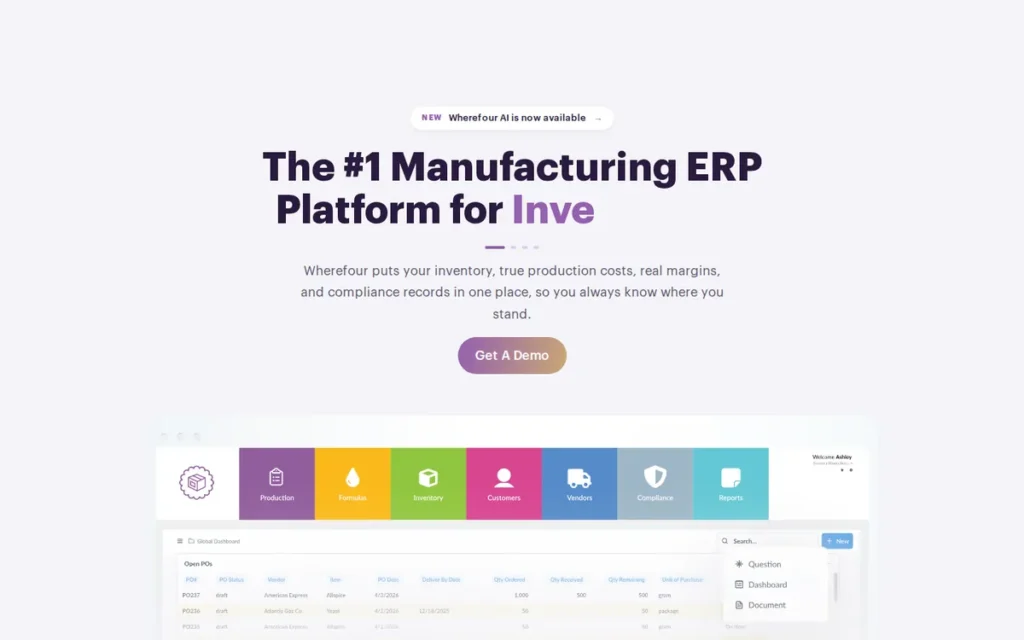
Category: Manufacturing ERP. Back-of-house software for batch production, lot traceability, COA management and costing, with no retail POS.
At a Glance
- Category: Manufacturing ERP
- Best For: Cannabis manufacturers, extractors, edible makers and wholesale brands
- Price Range: $350–$3,000/month tiers listed on Wherefour’s cannabis ERP page; Capterra lists a $600/month start; Enterprise custom
- Primary Strength: Wherefour combines forward and backward lot tracing, COA bundling and billing with no long-term contract more fully than any other evaluated product.
- Biggest Limitation: Wherefour has no native dispensary POS, and G2 reviewers describe its reporting as clunky for new users.
- One-Line Summary: Wherefour is a cannabis manufacturing ERP built for batch production, COA management and recall-ready lot traceability, and it is the only evaluated vendor that states no long-term contract is required.
- Last Verified: November 2026
Overview
Wherefour is a process-manufacturing ERP. Licensed cannabis manufacturers, extractors, edible makers and wholesale brands use it to run formulas, batch production, lot traceability, COA management and inventory costing synced to Metrc or BioTrack. Wherefour has no native retail POS.
Wherefour was founded in 2015, comes from the food, beverage and supplement industries, and says it owns its technology (Wherefour, 2026; vendor-reported). PlugRoute found no cannabis-specific operator discussion of Wherefour on Reddit, so its community signal is thin.
Key Features
- Wherefour manages formulas, bills of materials, assemblies and pick lists for batch-based production such as extraction and edibles.
- Wherefour generates forward, backward and full-recall lot traceability reports for mock recalls and audits.
- Wherefour stores cannabinoid COAs against lots and attaches them automatically to outgoing wholesale shipments.
- Wherefour tracks inventory valuation and COGS inputs such as nutrients, labor and electricity, which supports batch costing under Section 280E.
- Wherefour lists integrations with Metrc, BioTrack, QuickBooks, Xero, Sage Intacct, Epicor, MS Dynamics, Shopify, ShipStation and Zapier, plus a REST API (Wherefour, 2026; vendor-reported).
Best For
Wherefour is best for manufacturers, processors and wholesale brands whose compliance risk sits in batch records, COAs and recalls. It also suits buyers who want accounting-grade costing without a long-term contract.
Strengths
- Wherefour holds a 4.7/5 Capterra rating across 63 reviews (Capterra, 2026), the highest rating among the back-of-house products evaluated.
- Wherefour is the only evaluated vendor that states no long-term contract is required, with monthly, quarterly or annual billing (Wherefour, 2026; vendor-reported).
- Wherefour customer HighTech Labs cut recall-preparation time by 90% (Wherefour, 2026; vendor-reported).
- Wherefour’s G2 reviewers say “our mock recall activities are more detailed” and describe syncing with METRC “seamlessly” (G2, 2026).
Limitations
Wherefour’s most consequential trade-off is the lack of a retail POS. Vertically integrated operators must run and reconcile a second system for dispensary sales.
- Wherefour’s pricing is inconsistent across sources. Its cannabis ERP page lists $350, $1,000 and $3,000 tiers, but its pricing page describes customized plans (Wherefour, 2026; vendor-reported), and Capterra lists a $600/month start (Capterra, 2026).
- Wherefour’s reporting is described by G2 reviewers as “clunky” for new users, and some reports arrive by email instead of in a dashboard (G2, 2026).
- Wherefour sits in a higher price category than some competitors (ERP Research, 2026).
- Wherefour publishes no per-user or implementation fees. One customer says Wherefour came in under a $50K–$60K implementation quote from another ERP (Wherefour, 2026; vendor-reported).
- Wherefour documents no offline mode and publishes no state coverage list or data-export terms.
Verdict
Wherefour is the best-evidenced choice in PlugRoute’s 2026 evaluation for cannabis manufacturers and processors that need recall-ready lot traceability and COA management without a long-term contract.
Wherefour scores 5 on pricing transparency and 5 on accounting openness, but its #1 position depends on its published tiers. If those tiers were scored as ambiguous, Cova Software would rank first. Dispensary operators will need a separate retail POS alongside Wherefour.
2. Cova Software: Best for Dispensaries Prioritizing Reliability and Price Transparency

Category: Retail POS. Dispensary checkout, compliance and inventory software for licensed retail.
At a Glance
- Category: Retail POS
- Best For: Independent and small multi-store dispensaries that want predictable pricing and offline selling
- Price Range: $349–$599/month published tiers (Boutique, Powerhouse); Enterprise custom
- Primary Strength: Cova Software is the only evaluated dispensary POS that publishes dollar tiers and documents an Offline Mode.
- Biggest Limitation: Cova Software relies on third-party partners for ecommerce and loyalty, so operators manage more vendors.
- One-Line Summary: Cova Software is the only evaluated dispensary POS with published dollar tiers and a documented Offline Mode, and it supports Metrc, BioTrack and Leaf Data.
- Last Verified: November 2026
Overview
Cova Software is a cannabis dispensary point-of-sale system for independent and multi-store retailers in the U.S. and Canada. Retailers use it for compliant checkout, purchase-limit enforcement, inventory, reporting and Metrc, BioTrack or Leaf Data integration. It also has a documented Offline Mode.
Cova Software is operated by Retail Innovation Labs LLC and runs on Microsoft Azure (Cova Software, 2026; vendor-reported). Cova Software connects ecommerce and loyalty through partners instead of building them in.
Key Features
- Cova Software enforces purchase limits and scans IDs at checkout to support medical and adult-use retail rules.
- Cova Software integrates with Metrc, BioTrack and Leaf Data in the U.S. and offers one-click provincial reporting in Canada.
- Cova Software’s Offline Mode keeps stores selling during internet outages, although the limits of that mode are not published.
- Cova Software includes Cova Hub reporting, kiosks and Cova Pay, and its published prices are lower for stores that use Cova Pay.
- Cova Software connects to the ecommerce partners Dispense, Leafly, Weedmaps and Breadstack, and to the loyalty partners Alpine IQ and Springbig.
Best For
Cova Software is best for single-store and small multi-store dispensaries that want to know the price before a sales call, need to keep selling through outages, and value responsive support over the widest native feature set.
Strengths
- Cova Software publishes its U.S. tiers with support included. Boutique costs $349/month with Cova Pay or $389 without, and Powerhouse costs $499 or $599 (Cova Software, 2026; vendor-reported).
- Cova Software holds a 4.6/5 rating on 27 G2 reviews, with praise for ease of use and support. A second G2 product page shows no reviews (G2, 2026).
- Cova Software’s reliability has anecdotal support from one secondhand 2021 r/weedbiz comment that “Cova was the only POS that did not crash on 420” (Reddit, 2021).
- Cova Software claims 2,200+ dispensaries, 80% first-call resolution, and Emjays Retail Software of the Year in 2024 and 2025 (Cova Software, 2026; vendor-reported).
Limitations
Cova Software’s most consequential trade-off is that ecommerce and loyalty come from partners. That means more contracts and integration points than a native retail stack.
- Cova Software’s Boutique tier supports up to two POS workstations, so busier single stores may need the $499–$599 Powerhouse tier (Cova Software, 2026; vendor-reported).
- Cova Software was described in a 2023 r/weedbiz thread as reliable but possibly short on some features. Operators who switched found Dutchie more automated (Reddit, 2023; paraphrased).
- Cova Software drew positive U.S. feedback but negative Canadian feedback from one 2021 commenter (Reddit, 2021).
- Cova Software’s 4.0/5 Capterra rating appears only on a competitor’s page (Wherefour, 2026; competitor-reported), and its hardware and contract terms are not published.
In a 2025 Washington thread on r/weedbiz, another commenter called Cova “the most stable,” but the operator evaluating it explained why it fell short:
“Something to due with their CCRS reporting or lack of reporting. We did a demo a few days ago and it wasn’t doing it for us.” Posted by u/hanzo6969
Takeaway: Cova Software’s reputation for stability doesn’t make up for weak Washington CCRS reporting, so operators outside Metrc and BioTrack states should test state reporting in the demo.
Verdict
Cova Software is the best-evidenced dispensary POS in PlugRoute’s 2026 evaluation for retailers who want published pricing and documented offline selling.
Cova Software has the highest reliability score in the set (C3: 4) and ties Wherefour on pricing transparency (C4: 5), but thinner review evidence (C2: 3) keeps it below #1. Operators who want native ecommerce should compare Cova Software with Dutchie.
3. Canix: Best for Cultivators and Distributors in Metrc States
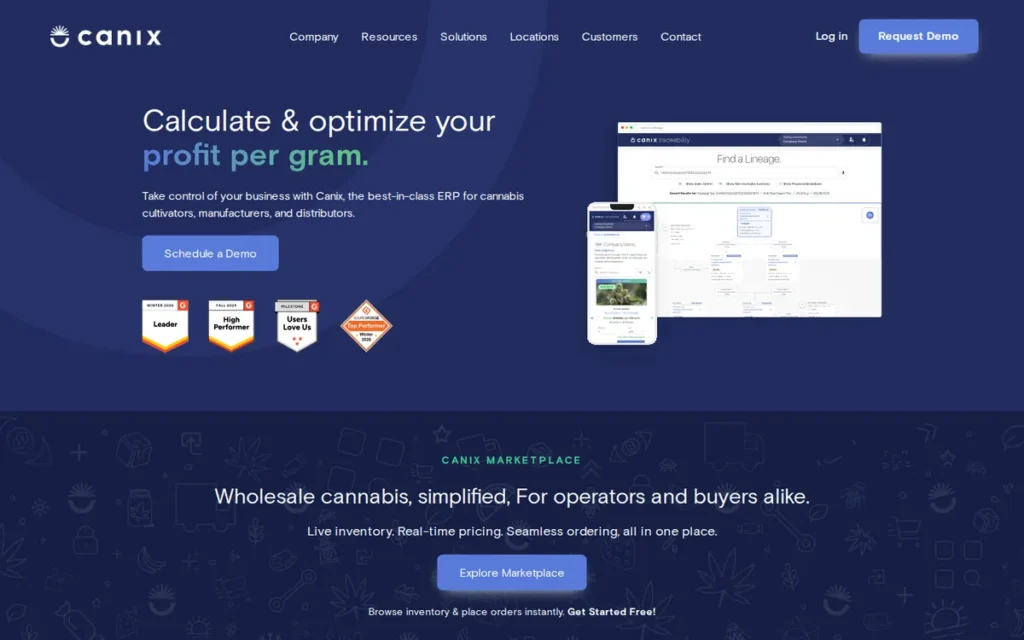
Category: Cultivation and Distribution ERP. Back-of-house seed-to-sale software for growing, processing, wholesale and Metrc automation, with no retail POS.
At a Glance
- Category: Cultivation and Distribution ERP
- Best For: Licensed cultivators, processors and distributors in Metrc states
- Price Range: Pricing on request (quote-based)
- Primary Strength: Canix automates Metrc reporting in both directions, with bulk actions, RFID-wand support and an offline-capable mobile app.
- Biggest Limitation: Canix has no native dispensary POS, and G2 reviewers report Metrc sync delays of 10–15 minutes.
- One-Line Summary: Canix is the most-reviewed cultivation ERP in PlugRoute’s 2026 evaluation, built around bidirectional Metrc automation and offline mobile workflows for growers and distributors.
- Last Verified: November 2026
Overview
Canix is a cannabis ERP and seed-to-sale platform for licensed cultivators, processors and distributors, and for the back-of-house side of vertically integrated operators. It is built around bidirectional Metrc automation, batch manufacturing, wholesale orders and standard costing. Canix has no native dispensary POS.
Canix was founded in 2019 by Stacey Hronowski, is based in San Francisco, and is a Y Combinator alum (Canix, 2026; vendor-reported). Canix reported serving 250+ operators across 23 states (Canix, 2023; vendor-reported).
Key Features
- Canix lets teams work inside Canix and push plant, harvest, package and transfer data to Metrc, with bulk actions that cut repetitive entry.
- Canix supports RFID-wand scanning of Metrc tags and an offline-capable mobile app for teams in grow rooms.
- Canix tracks plants, rooms, harvests, batch manufacturing and labor tasks, with standard costing and COGS reporting that support batch costing under Section 280E.
- Canix creates wholesale sales orders that generate wholesale manifests automatically.
- Canix integrates with QuickBooks Online and lists BioTrack (Florida and New York) and Washington CCRS file generation (Canix, 2026; vendor-reported).
Best For
Canix is best for cultivators, processors and distributors in Metrc states whose biggest cost is labor spent on compliance entry and inventory reconciliation. Vertically integrated operators can use Canix for back-of-house work, paired with a separate retail POS.
Strengths
- Canix holds a 4.4/5 G2 rating across 126 reviews (G2, 2026), the largest review sample among the evaluated cultivation and ERP vendors.
- Canix customer Redbud Roots reports saving 200+ hours a month and cutting inventory reconciliation from 5–7 days to about half a day (Canix, 2026; vendor-reported).
- Canix customer MKX cut order processing from 3–4 days to 1 day, and Bonsai Buds reports 50% less time on compliance (Canix, 2026; vendor-reported).
- Canix’s offline support was singled out in a secondhand 2021 r/weedbiz comment: “canix is the only one that really supports it” (Reddit, 2021).
Limitations
Canix’s most consequential trade-off is that its value depends on Metrc sync. Critical G2 reviews report packages taking 10–15 minutes, or several attempts, to refresh (G2, 2026).
- Canix reviewers also report freezing, stuck loading screens, invoices created in the wrong accounts, and prices that must be re-entered on transfers (G2, 2026).
- Canix requires vertically integrated operators to run and reconcile a separate retail POS.
- Canix publishes no subscription, implementation or contract terms, so ask for a written first-year quote that includes onboarding and RFID hardware (G2, 2026).
- Canix’s BioTrack and CCRS support appears shallower than its Metrc support, which matters for operators outside Metrc states (cannabisregulations.ai, 2026).
Verdict
Canix is the best-evidenced choice in PlugRoute’s 2026 evaluation for Metrc-state cultivators and distributors who want to cut compliance labor through bidirectional automation and offline mobile workflows.
Canix has the largest verified review base among cultivation ERPs, which lifts its review-evidence score to 4.5. Because of the reported sync delays and quote-only pricing, buyers should run a live pilot on their own packages before signing.
4. Dutchie: Best for Dispensaries Wanting a Native All-in-One Retail Stack
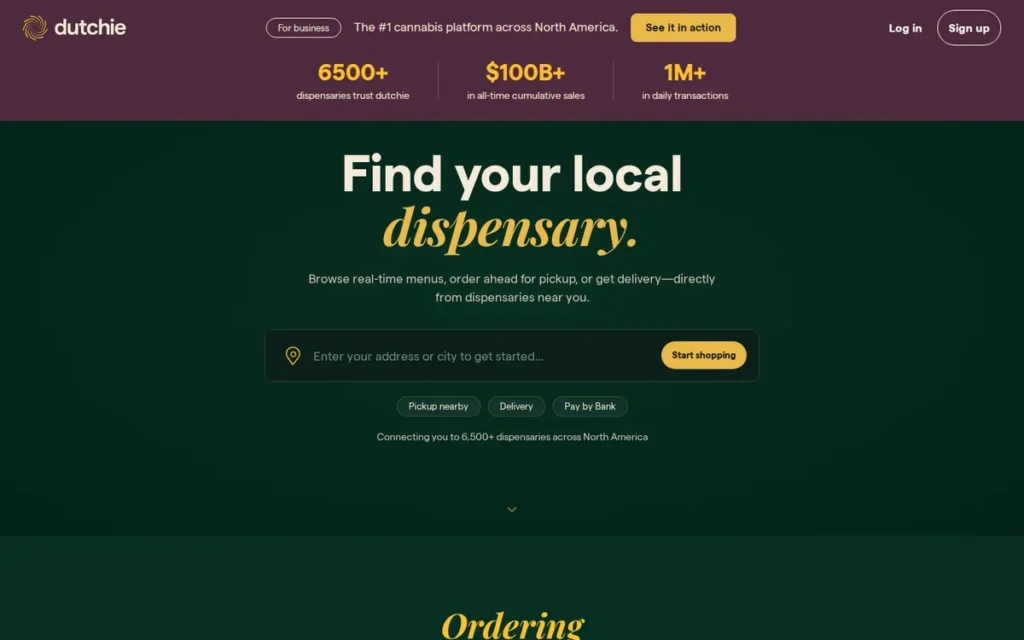
Category: Retail POS. Dispensary checkout, compliance and inventory software for licensed retail.
At a Glance
- Category: Retail POS
- Best For: Dispensaries and chains that want POS, ecommerce, payments and loyalty from one vendor
- Price Range: Pricing on request (usage-based SaaS; no public price sheet)
- Primary Strength: Dutchie offers the broadest native retail feature set among the four evaluated POS vendors.
- Biggest Limitation: Dutchie acknowledged outages on 4/20 in 2023 and 2024 and publishes no pricing.
- One-Line Summary: Dutchie is the broadest native cannabis retail stack among the four evaluated POS vendors, combining POS, ecommerce, payments and loyalty, and it has a documented history of peak-day outages.
- Last Verified: November 2026
Overview
Dutchie is an integrated cannabis retail platform for dispensaries and multi-store chains that want POS, branded ecommerce, Dutchie Pay, loyalty, kiosks and a consumer marketplace from one vendor. Dutchie supports Metrc and BioTrack and is built on Greenbits and LeafLogix technology acquired in 2021 (TechCrunch, 2022).
Dutchie was founded in Oregon in 2017 by Ross and Zach Lipson and launched its current POS in 2022 (TechCrunch, 2022).
Key Features
- Dutchie POS runs checkout on Dutchie’s own dual-screen register, launched in 2022.
- Dutchie Ecommerce provides branded menus with pickup and delivery, connected natively to the POS.
- Dutchie Pay offers bank-to-bank ACH payments to reduce reliance on cash at the register.
- Dutchie includes loyalty and CRM, kiosks, mobile apps, a consumer marketplace and “Consumer AI” product discovery.
- Dutchie supports Metrc and BioTrack integrations but does not publish exact state coverage (G2, 2026).
Best For
Dutchie is best for dispensaries and MSO retail chains that would rather buy POS, online ordering, payments and loyalty from one vendor than manage separate partner tools.
Strengths
- Dutchie holds a 4.5/5 rating across about 59 G2 reviews, with praise for ease of use and multi-store catalog sync (G2, 2026).
- Dutchie customer JARS Cannabis saw a 58% increase in loyalty purchase frequency and a 40% month-over-month GMV increase (Dutchie, 2026; vendor-reported).
- Dutchie reports handling 18,720 concurrent registers with 100% platform uptime on 4/20/2026 (Dutchie, 2026; vendor-reported).
- Dutchie raised about $603M in total and reached a $3.75B valuation, and its named customers include Ascend, Planet 13 and Good Chemistry (TechCrunch, 2021).
Limitations
Dutchie’s most consequential trade-off is concentrated risk. With the whole retail stack on one vendor, a single outage can stop checkout, online ordering and payments at once.
- Dutchie acknowledged 4/20 outages in 2023 and 2024 (HighlyObjective, 2024). A competitor ties the 2023 outage to Dutchie’s database provider (Meadow, 2026; competitor-reported).
- Dutchie crashed for part of 4/20, according to a 2023 r/weedbiz thread (Reddit, 2023; paraphrased, unverified).
- Dutchie’s G2 reviewers say reporting and discount management “could be improved” and mention slow ticket responses (G2, 2026).
- Dutchie discloses no POS, ecommerce, hardware, implementation or contract fees (G2, 2026).
- Dutchie has committed to legacy Dutchie Plus support through the end of 2026 and is directing customers to Dutchie E-Commerce Pro (BudAuthority, 2026). PlugRoute found no hard shutdown date.
A 2022 commenter on r/weedbiz, who said they work for a Dutchie competitor, offered a mixed assessment:
“They’ve built an amazing operations tool. They have not capitalized on it in a meaningful way.
Also since they bought greenbits and leaflogix the customer service has gone to shit (direct quote from DOZENS of Oregon based clients).” Posted by u/Windhorse730
Takeaway: Even a rival credits Dutchie’s operations software, but complaints that support declined after the Greenbits and LeafLogix acquisitions go back to 2022.
Verdict
Dutchie is the most complete single-vendor cannabis retail stack in PlugRoute’s 2026 evaluation, and it fits dispensaries that put native ecommerce, payments and loyalty ahead of pricing transparency.
Dutchie’s peak-day outages (C3: 2) and undisclosed pricing (C4: 1) kept it at #4. Buyers should negotiate 4/20 uptime credits and written data-export terms.
5. Flowhub: Best for Independent Dispensaries in Mixed Metrc/BioTrack Markets
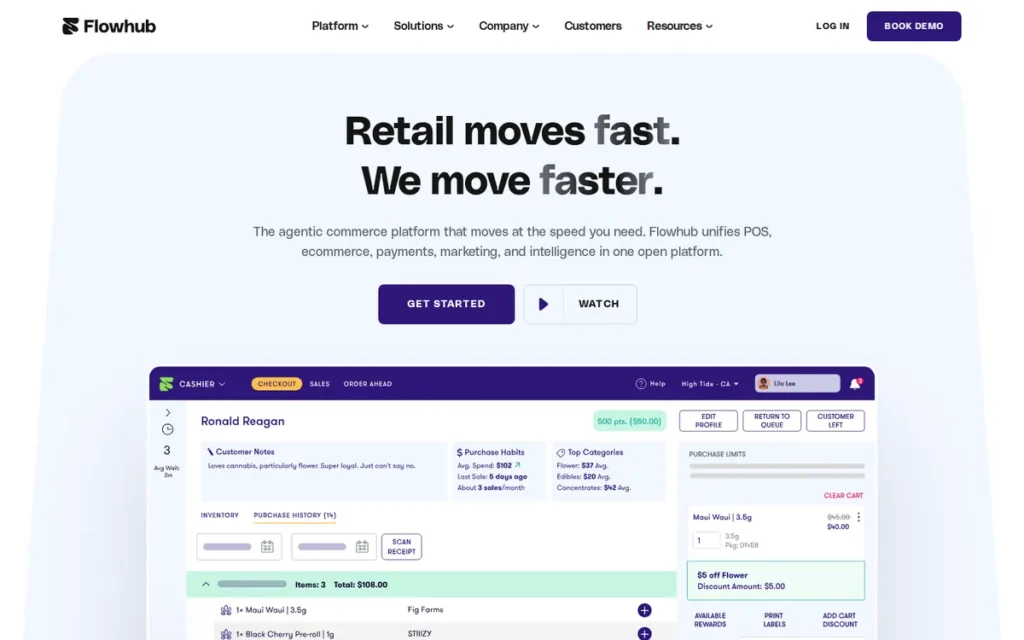
Category: Retail POS. Dispensary checkout, compliance and inventory software for licensed retail.
At a Glance
- Category: Retail POS
- Best For: Independent and mid-size dispensaries that want fast deployment and easy staff training
- Price Range: $299–$399/month per location reported by G2; the billing unit conflicts across listings
- Primary Strength: Flowhub reports a Metrc relationship dating to 2015 and supports both Metrc and BioTrack.
- Biggest Limitation: Flowhub has a 3.8/5 G2 rating on only 7 reviews, and multi-location operators cite limits on reporting.
- One-Line Summary: Flowhub is a compliance-first dispensary POS with a Metrc relationship dating to 2015, best suited to independent stores rather than complex multi-location operators.
- Last Verified: November 2026
Overview
Flowhub is a compliance-first cannabis dispensary POS, founded in 2015 and associated with Denver. Independent and mid-size retailers use it for iPad checkout, ID scanning, mobile inventory and Metrc or BioTrack reporting.
Flowhub claims to be the first Metrc integrator (Flowhub, 2026; vendor-reported). Flowhub also publishes a Cannabis Industry Statistics report, which works as both research and lead generation (Flowhub, 2026; vendor-reported).
Key Features
- Flowhub Cashier runs dispensary checkout on iPads, and Flowhub Greet handles ID scanning and customer check-in.
- Flowhub Stash and the Nug and Nug Ultra devices support mobile inventory counts and mobile checkout for budtenders on the sales floor.
- Flowhub integrates with both Metrc and BioTrack for state compliance reporting.
- Flowhub Maps provides menus and ecommerce, and Flowhub Pay offers cashless payments.
- Flowhub’s newer Maui interface is “20 times faster” than the previous system, according to customer Thrive Dispensary (Flowhub, 2026; vendor-reported).
Best For
Flowhub is best for independent and mid-size dispensaries in markets that mix Metrc and BioTrack, where fast deployment matters more than advanced multi-store reporting.
Strengths
- Flowhub traces its Metrc relationship back to 2015 (Flowhub, 2026; vendor-reported), and a third-party comparison calls it a good fit for mixed-traceability environments (cannabisregulations.ai, 2026).
- Flowhub customer Greatest Hits (MA) runs 300+ transactions a day, and its Flowhub Pay carts average 31% more than cash carts (Flowhub, 2026; vendor-reported).
- Flowhub reports 1,200+ dispensaries and $4B+ in annual sales, including STIIIZY across 60+ stores (Flowhub, 2026; vendor-reported).
- Flowhub gets credit in third-party comparisons for fast deployment and easy budtender training (dispensaries.co, 2026).
In a 2025 thread on r/weedbiz, one cannabis-industry commenter passed along secondhand praise:
“Undoubtedly Flowhub. I know some people who work there (I’m also in cannabis) and after they upgraded their platform a few years ago it’s apparently been so much better” Posted by u/Relative-Spirit8635
Takeaway: Community praise for Flowhub’s platform upgrade is real but secondhand and comes from people close to the company, so it doesn’t replace firsthand operator references.
Limitations
Flowhub’s most consequential trade-off is a ceiling on reporting and customization for multi-location operators. One 2021 operator called it “good, but a bit basic” (Reddit, 2021).
- Flowhub had a 4/20 outage in 2021 tied to the Auth0 authentication service, according to two r/weedbiz commenters (Reddit, 2021).
- Flowhub’s 3.8/5 G2 rating rests on only 7 reviews, the smallest G2 sample among the evaluated POS vendors (G2, 2026).
- Flowhub publishes no price sheet. G2 reports $299/month for a single register and $399/month per location for up to three (G2, 2026), but Software Advice lists $399 per user (Software Advice, 2026).
- Flowhub’s listed markets did not include Washington in one review (dispensaries.co, 2026), and its offline mode could not be verified.
- Flowhub’s support had declined, according to one 2023 operator anecdote (Reddit, 2023; paraphrased).
Verdict
PlugRoute’s 2026 evaluation finds Flowhub a solid compliance-first dispensary POS for independent retailers in mixed Metrc and BioTrack markets.
Flowhub wins the tie-break with Treez on compliance plus reliability (6.0 vs 5.5), but its thin review base and reporting ceiling make it a weaker fit for larger operators. Buyers should confirm the pricing unit and offline behavior in a demo.
6. Treez: Best for Enterprise Multi-Location Retailers With Internal IT Teams
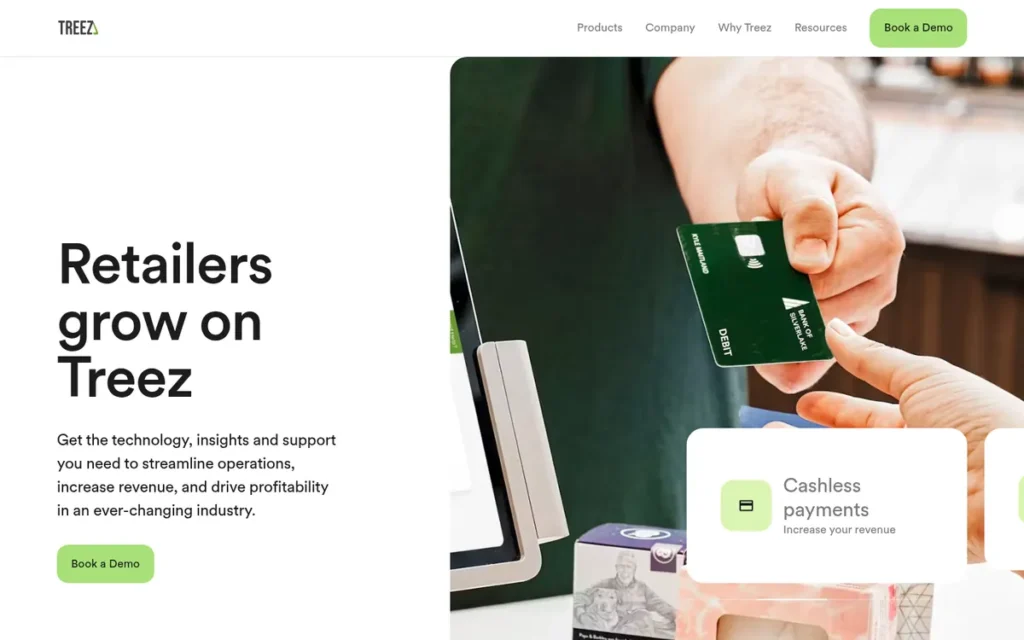
Category: Retail POS. Dispensary checkout, compliance and inventory software for licensed retail.
At a Glance
- Category: Retail POS
- Best For: Multi-location dispensary chains and MSOs in Metrc states that have IT staff
- Price Range: Pricing on request (quote-based package; ecommerce and delivery reportedly cost extra)
- Primary Strength: Treez includes unlimited registers, unlimited employees and open API access in one package, with direct bidirectional Metrc connectivity.
- Biggest Limitation: Treez holds a 3.3/5 G2 rating on 11 reviews, and its BioTrack support is unverified.
- One-Line Summary: Treez is an enterprise cannabis retail operating system that pairs deep multi-store reporting and an included open API with direct bidirectional Metrc connectivity.
- Last Verified: November 2026
Overview
Treez is an enterprise cannabis retail operating system for multi-location dispensaries and multi-state operators with internal IT teams. One quote-based package combines the SellTreez POS, a master product catalog, direct Metrc connectivity, TreezPay, analytics and an open API.
Treez markets this package as “all-inclusive” (Treez, 2026; vendor-reported). Treez bills ecommerce and delivery separately, according to a competitor-authored comparison (Meadow, 2026; competitor-reported).
Key Features
- Treez connects directly and bidirectionally to Metrc for automated reporting and manifests.
- Treez keeps a master product catalog with central discounting and user management across locations.
- Treez offers TreezPay for PIN debit, cashless ACH/pay-by-bank and QR payments.
- Treez includes unlimited registers, unlimited employees and open API access in its package.
- Treez provides analytics and ecommerce/prepaid checkout, and the ecommerce features are reportedly priced separately.
Best For
Treez is best for multi-location chains and MSOs in Metrc states that have staff to manage configuration and want API access for custom reporting.
Strengths
- Treez customer Megan’s Organic Market reported a 28% increase in average order value and a 70% cut in transaction time (Treez, 2026; vendor-reported).
- Treez customer Higher Level reported AOV up 20% on debit and more than 30% on ACH after adopting TreezPay (Treez, 2026; vendor-reported).
- Treez customer Swade reported AOV up 25% and 80% faster reporting (Treez, 2026; vendor-reported).
- Treez is positioned for larger operators with internal IT teams (cannabisregulations.ai, 2026) and received a Customer Success Award (FeaturedCustomers, 2020).
A multi-store operator on r/weedbiz shared their experience:
“IndicaOnline & Treez are the two we use across a couple stores.
We’ve tried dutchie, blaze, posabit, mjfreeway and they all kinda sucked.” Posted by u/Impressive_Arm2929
Takeaway: Treez has kept at least one multi-store operator who tried and dropped several rival POS systems, which supports its positioning for multi-location retail.
Limitations
Treez’s most consequential trade-off is that its enterprise depth comes with heavier onboarding and reported instability. G2 summaries cite bugs, outages and updates that broke existing functions (G2, 2026).
- Treez holds a 3.3/5 G2 rating across 11 reviews, the lowest G2 rating among the evaluated vendors. Early research had shown 4.9/5 on 92 reviews (G2, 2026).
- Treez’s BioTrack support is unverified. A competitor says Treez supports Metrc only (Meadow, 2026; competitor-reported), while a third-party directory lists BioTrack (Headquarters, 2026).
- Treez pricing is quote-only, and longer onboarding raises implementation cost (FeaturedCustomers, 2026).
- Treez’s founding history, funding and SOC 2 status could not be verified. Its only Reddit signal is one 2021 comment: “only Treez works with better clients” (Reddit, 2021).
Verdict
Treez is the strongest API-and-reporting option in PlugRoute’s 2026 evaluation for enterprise multi-location dispensary operators in Metrc states.
Treez’s included API and central catalog suit MSOs with technical teams. Treez fell from #4 to #6 after its G2 evidence was corrected, so buyers should check its reviews live and negotiate uptime SLAs.
7. BioTrack: Best for Vertically Integrated Operators Needing One Native System
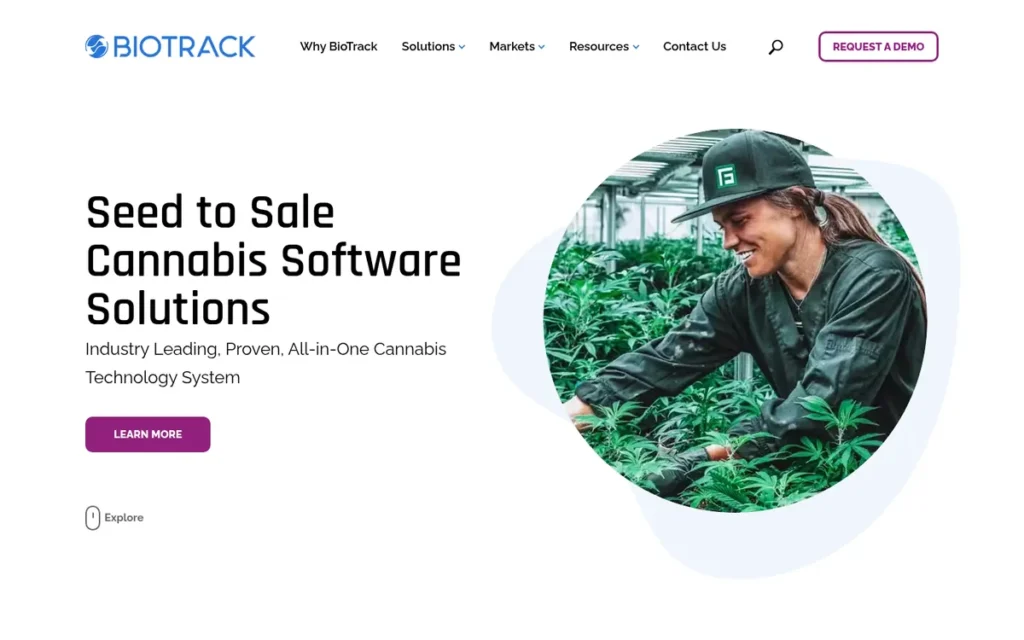
Category: Native Seed-to-Sale Suite. One platform covering cultivation, manufacturing and dispensary retail.
At a Glance
- Category: Native Seed-to-Sale Suite
- Best For: Vertically integrated operators that want cultivation, manufacturing and POS in one system
- Price Range: Pricing on request (custom quotes based on license type, facilities, modules and hosting)
- Primary Strength: BioTrack is the only evaluated platform that covers cultivation, manufacturing and dispensary POS natively, without pairing two systems.
- Biggest Limitation: BioTrack has only one Capterra review, a reputation for dated usability, and exposure to lost state contracts.
- One-Line Summary: BioTrack is the only native seed-to-retail cannabis platform in PlugRoute’s 2026 evaluation, and it trades end-to-end coverage for dated usability, thin review evidence and state-contract risk.
- Last Verified: November 2026
Overview
BioTrack is a seed-to-sale platform for vertically integrated operators that need cultivation, processing, manufacturing, dispensary POS and compliance reporting in one native system. BioTrack was formerly called BioTrackTHC and combined with Forian in 2021 (BioTrack, 2026; vendor-reported).
BioTrack also builds government traceability systems for state regulators. BioTrack’s New Mexico government contract was held by BT Government Inc. (NM RLD, 2026).
Key Features
- BioTrack tracks plants and clones, including genealogy, harvests and yields.
- BioTrack manages processing and manufacturing in the same platform it uses for cultivation and retail.
- BioTrack includes a native dispensary POS and loyalty program, so vertically integrated operators avoid a second retail vendor.
- BioTrack claims integration with all state Metrc systems in addition to its own traceability system (BioTrack, 2026; vendor-reported).
- BioTrack’s government product runs in a FedRAMP-authorized AWS GovCloud environment in Hawaii, and that authorization covers the government product only (BioTrack, 2026; vendor-reported).
Best For
BioTrack is best for vertically integrated operators, especially in BioTrack states, who care more about one native system from cultivation through retail than about modern usability.
Strengths
- BioTrack reported 2,000+ commercial facilities across 37 states and government systems used by 12 state agencies (BioTrack submission to NY State Senate, 2023; vendor-reported).
- BioTrack is the only evaluated product that natively spans cultivation, manufacturing and dispensary POS, so vertically integrated operators don’t have to stitch tools together.
- BioTrack says it has processed $20B+ in sales, and its New York system processed 2.3M+ transactions (BioTrack, 2023; vendor-reported).
- BioTrack was described in a 2021 r/weedbiz thread as having “all the functionality you need,” and another commenter called its tech support staff “awesome” (Reddit, 2021).
Limitations
BioTrack’s most consequential trade-off is that native end-to-end coverage comes with dated usability. One 2021 operator described it as “ugly and slow” (Reddit, 2021).
- BioTrack was called “slow to respond to regulatory changes” by an Oregon operator, and another operator described switching away as “a tough transition” (Reddit, 2021).
- BioTrack lost Illinois, which moved to Metrc on July 1, 2025 (cannabisregulations.ai, 2026).
- BioTrack was replaced in New Mexico by NMS2S. Industry groups sued on August 21, 2026 to delay the switch, but a judge did not halt it, and BioTrack was fully turned off on September 4, 2026 (MMJ Daily, 2026; NM RLD, 2026).
- BioTrack has one Capterra review (Wherefour, 2026; competitor-reported), and operators in BioTrack states have reported outages and sync issues (Growth Market Reports, 2026).
Verdict
BioTrack is the only native seed-to-retail platform in PlugRoute’s 2026 evaluation, which makes it worth shortlisting for vertically integrated operators even though it ranks last on overall evidence.
BioTrack’s rank reflects missing review data, undisclosed pricing and lost state contracts, not a lack of features. Buyers should compare BioTrack against a paired ERP-plus-POS stack and test it with frontline staff.
How Do I Confirm Software Works With My State’s Traceability System?
Confirming traceability support takes two steps. First, find out which system your state uses. Then ask for a live demo of your license type’s workflows running in that system. A vendor logo on a website does not prove the integration works, and states switched systems on short notice in 2025 and 2026.
State traceability systems as of November 2026 (cannabisregulations.ai, 2026):
- Metrc is used in about 24–25 states plus DC, Guam and the USVI.
- BioTrack or BT Government is used in Arkansas, Connecticut, Delaware, Florida (through the state BioTrack API), Hawaii and North Dakota.
- CCRS is Washington’s state-run traceability system.
- NMS2S is New Mexico’s system, which replaced BioTrack on September 4, 2026.
Illinois moved from BioTrack to Metrc on July 1, 2025 (cannabisregulations.ai, 2026). New Mexico shows how fast a switch can hit operators: non-retail BioTrack access ended at 5 p.m. on August 25, 2026 (NM RLD, 2026).
| Product | Metrc | BioTrack | Other Systems / Notes |
|---|---|---|---|
| Wherefour | Claimed (vendor-reported) | Claimed (vendor-reported) | No state coverage list published |
| Cova Software | Supported (vendor-reported) | Supported (vendor-reported) | Leaf Data; Canadian provincial reporting |
| Canix | Bidirectional (vendor-reported) | Florida and New York (vendor-reported) | Washington CCRS file generation |
| Dutchie | Supported (vendor-reported) | Supported (vendor-reported) | Exact state coverage not published |
| Flowhub | Supported since 2015 (vendor-reported) | Supported (vendor-reported) | Washington absent in one review |
| Treez | Direct bidirectional (vendor-reported) | Unverified (sources conflict) | Confirm directly |
| BioTrack | Claims all Metrc states (vendor-reported) | Native | Built government systems |
A 2023 r/weedbiz sales manager warned that ERP-to-Metrc rollouts often force SOP changes that operators regret (Reddit, 2023). That caution applies to any ERP-to-Metrc integration, including Canix and Wherefour, so build SOP rewrites into your pilot.
What Red Flags Should I Watch For When Evaluating Cannabis Industry Software?
The biggest red flags in cannabis software create compliance or cost risk that only shows up after you sign. PlugRoute identified six warning signs in its November 2026 research. Each one is numbered below so you can use the list as a checklist during demos and contract review.
Red Flag #1: Integration Claims Without a State- and License-Specific Demo An integration claim without a live demo of your state’s workflows is unproven, because a vendor logo does not show which license types or transactions actually sync. PlugRoute could not verify Treez’s BioTrack support or Dutchie’s exact state coverage in November 2026, which is why a demo on your own license matters.
Red Flag #2: Quote-Only Pricing With No Written First-Year Total Quote-only pricing hides costs that can push first-year spending to 2–5× the subscription (PlugRoute synthesized estimate, 2026). As of November 2026, PlugRoute found dollar tiers on the websites of only two of the seven evaluated vendors. Ask every other vendor for a written first-year total.
Red Flag #3: No Peak-Day Uptime SLA or 4/20 Credits A vendor that won’t commit to uptime on 4/20 leaves you carrying the revenue risk on the industry’s busiest sales day. The evaluated vendors with documented reliability issues are:
- Flowhub had a 4/20 outage in 2021, according to two r/weedbiz commenters (Reddit, 2021).
- Dutchie acknowledged 4/20 outages in 2023 and 2024 (HighlyObjective, 2024).
- Treez reviewers describe outages after updates in G2 summaries (G2, 2026).
- Canix reviewers report Metrc sync delays of 10–15 minutes (G2, 2026).
- BioTrack users have reported outages and sync issues in BioTrack states (Growth Market Reports, 2026).
PlugRoute found no documented outage history for Cova Software or Wherefour. No outage record is not the same as proof of uptime.
Red Flag #4: Ratings Based on Tiny or Vendor-Hosted Samples A rating based on a handful of reviews, or hosted by a vendor, is weak evidence because it can shift sharply. Treez showed 4.9/5 in early research but 3.3/5 on 11 reviews when PlugRoute checked G2 live in November 2026 (G2, 2026). BioTrack has only one Capterra review.
Red Flag #5: No Written Data-Export Rights Without written data-export rights, switching vendors can strand years of inventory, sales and compliance history. PlugRoute found no public export-rights documentation from any of the seven evaluated vendors in November 2026. Get export formats, timelines and fees written into the contract before you sign.
Red Flag #6: Product Sunset or State-Contract Exposure Product sunsets and lost state contracts can force migrations you never planned or budgeted for. Dutchie has committed to legacy Dutchie Plus support only through the end of 2026 (BudAuthority, 2026). BioTrack exited Illinois in 2025 and New Mexico in 2026 (cannabisregulations.ai, 2026; NM RLD, 2026).
What Questions Should I Ask Before Choosing Cannabis Industry Software?
Before you sign, ask each vendor seven questions that separate verified capability from marketing claims. Each question covers a gap PlugRoute could not close from public sources in November 2026. Get every answer in writing and attach it to the contract. A vendor that refuses to answer in writing has told you something.
As one grower shopping for seed-to-sale software on r/OKmarijuana described:
“I also am hunting for seed to sale simplified. Everyone I have done the demo for, over complicate the whole process. It seems they think over engineering is a selling point. Imo.” Posted by u/jsheffield09
Takeaway: Cannabis software demos often show off feature depth rather than the workflows operators actually need, so buyers should steer every demo toward their own license’s daily tasks.
Question #1: Can you demonstrate receiving, transfers, adjustments, returns, and manifests in my state’s system for my license type? A credible vendor will run each of these workflows live in your state’s traceability system on a test license that matches yours. Treat a slide-deck answer as a red flag. Ask the vendor to show how a rejected manifest gets corrected and resynced, because reviewers frequently report sync failures (G2, 2026).
Question #2: Is your company on Metrc’s approved-integrator list for my state? Metrc publishes its own list of approved integrators, and operators recommend checking it before buying (Reddit, 2021). Check the listing yourself on Metrc’s site instead of taking the vendor’s word for it. Make sure it covers your specific state, because listings can differ by state.
Question #3: What is my full first-year cost including hardware, implementation, payments, and add-ons? First-year cannabis software cost typically runs about $15K–$60K for a single dispensary and $100K+ for a vertically integrated operator, or 2–5× the subscription (PlugRoute synthesized estimate, 2026). A complete vendor answer should cover every line below:
- Subscription typically costs $300–$1,500 per location per month for POS and $1,000–$10,000+ per month for ERP (PlugRoute synthesized estimate, 2026).
- Hardware typically costs $1,000–$5,000 per store (PlugRoute synthesized estimate, 2026).
- Implementation typically costs $5K–$25K, or $50K–$150K+ for complex multi-site ERP (PlugRoute synthesized estimate, 2026).
- Data migration typically costs $2.5K–$20K+ (PlugRoute synthesized estimate, 2026).
- Payment processing typically costs about 2–4% of volume, and contracts commonly run 12, 24 or 36 months (PlugRoute synthesized estimate, 2026).
Here is a worked example. A single dispensary on a $399/month POS pays about $4,800 in subscription. Add $1,000–$5,000 in hardware, $5K–$25K in implementation and 2–4% payment processing, and year one comes to roughly $15K–$35K (PlugRoute synthesized estimate, 2026).
Here is what each vendor’s pricing looked like as of November 2026:
- Cova Software lists Boutique at $349/month with Cova Pay or $389 without (up to two workstations), Powerhouse at $499 or $599, and custom Enterprise pricing (Cova Software, 2026; vendor-reported).
- Wherefour lists $350, $1,000 and $3,000 monthly tiers on its cannabis ERP page, while its pricing page describes customized plans (Wherefour, 2026; vendor-reported).
- Flowhub publishes no price sheet, and G2 reports $299/month for a single register and $399/month per location for up to three registers (G2, 2026).
- Canix, Dutchie, Treez and BioTrack publish no dollar pricing on their websites.
Question #4: What happens during an internet outage, and what are your documented offline limits? As of November 2026, Cova Software (POS Offline Mode) and Canix (offline-capable mobile app) are the only evaluated vendors that document offline operation, and neither publishes its limits. Ask every vendor, in writing, how long offline selling lasts, which transactions are blocked, and how queued data syncs afterward.
Question #5: Can I export all my data in a usable format if I leave? PlugRoute found no public documentation of data-export rights from any of the seven evaluated vendors as of November 2026. Get export formats, timelines and fees written into the contract, and ask for a sample export before signing. One 2021 r/weedbiz operator called a switch between systems “a tough transition” (Reddit, 2021).
Question #6: Can you provide SOC 2 or equivalent security documentation? PlugRoute could not verify a SOC 2 attestation for any of the seven evaluated vendors in November 2026. BioTrack’s FedRAMP environment covers only its government product (BioTrack, 2026; vendor-reported). Ask each vendor for a current SOC 2 report or equivalent, and have your IT lead review it.
Question #7: Which accounting systems do you sync with, and how is COGS handled for 280E? Section 280E makes accurate COGS and inventory capitalization central to cannabis tax reporting (WISS, 2026). Ask the vendor to show how COGS maps to your accounting system. Also ask how payment fees are recorded, because they should not be netted against revenue (Cova Software, 2026). This is not tax advice, so confirm the treatment with your tax advisor.
How Did We Rank These Cannabis Industry Software Platforms?
PlugRoute scored each of seven products from 1 to 5 on six weighted criteria, using dated evidence collected on November 12, 2026. The overall rank is the weighted composite. It measures how strong the evidence is for each product, not which product is best for everyone. The Quick Decision Framework gives the pick for each segment.
Ranking criteria and weights:
- Traceability Integration Depth (25%) measures verified Metrc, BioTrack, CCRS or NMS2S support, because a mismatch with the state system causes compliance violations.
- Independent Review Evidence (20%) combines rating and sample size. Fewer than 10 reviews caps the score at 2, and ratings found only on vendor or competitor sites lose 0.5 until confirmed live.
- Operational Reliability and Offline Capability (20%) measures dated outage history and documented offline modes, because downtime costs revenue and creates compliance gaps.
- Pricing and Contract Transparency (15%) rewards published dollar tiers and disclosed contract terms, because operators rank hidden add-ons among their top pain points.
- Workflow Depth for Target License Type (10%) measures native depth within each product’s primary segment.
- Accounting Integration and API Openness (10%) measures accounting connectors and API access, because Section 280E makes COGS accuracy a tax-compliance requirement.
| Product | C1 (25%) | C2 (20%) | C3 (20%) | C4 (15%) | C5 (10%) | C6 (10%) | Composite |
|---|---|---|---|---|---|---|---|
| Wherefour | 3.5 | 4.5 | 3 | 5 | 4 | 5 | 4.03 |
| Cova Software | 4 | 3 | 4 | 5 | 3 | 3 | 3.75 |
| Canix | 4 | 4.5 | 3 | 1 | 4 | 3 | 3.35 |
| Dutchie | 4 | 4 | 2 | 1 | 5 | 3 | 3.15 |
| Flowhub | 4 | 2 | 2 | 3 | 3 | 3 | 2.85 |
| Treez | 3 | 2 | 2.5 | 2 | 4 | 5 | 2.85 |
| BioTrack | 4 | 1 | 2 | 1 | 4 | 2 | 2.35 |
C3 scoring note: When PlugRoute found no outage history, C3 defaults to 3. A documented offline mode adds up to 1 point, and documented outages or sync failures subtract up to 1.5.
Tie-break rule: When composites tie, the product with the higher combined C1 + C3 score ranks higher. At 2.85, Flowhub (6.0) ranks above Treez (5.5).
How rankings could change: Wherefour’s #1 position depends on its published tiers. If its pricing were scored as ambiguous (C4 = 3), its composite would fall to 3.73 and Cova Software would rank first. A composite rank is only as strong as its weakest input: one corrected G2 listing moved Treez from #4 to #6.
Not evaluated in this edition: PlugRoute did not evaluate Distru, Flourish, GrowFlow, BLAZE, 365 Cannabis, Acumatica, SAP Business One or FoodReady. AI answer engines name these vendors, but PlugRoute did not research them to the same standard.
Changelog: On November 12, 2026, PlugRoute made these corrections. Treez’s G2 evidence changed to 3.3/5 (11 reviews). Wherefour’s Capterra and Canix’s G2 figures were confirmed live. Cova Software’s tier names and the New Mexico lawsuit timeline were corrected.
PlugRoute has no affiliate relationships with any company listed. Rankings are determined entirely by research data and objective evaluation criteria.
What Do Buyers Most Often Ask About Cannabis Industry Software?
The questions below match the searches buyers run most often when they shortlist cannabis software. Each answer opens with the direct answer, stays under 60 words, and draws on evidence from PlugRoute’s November 2026 evaluation of seven cannabis software platforms.
What’s the best cannabis software for a single-store dispensary in 2026?
Cova Software is the best-evidenced pick for a single-store dispensary in PlugRoute’s November 2026 evaluation. Its Boutique tier costs $349/month with Cova Pay, and it has a documented Offline Mode (Cova Software, 2026; vendor-reported). Flowhub is a budget alternative at a G2-reported $299/month for a single register (G2, 2026). Confirm hardware and contract terms in writing.
What’s the best cannabis software for cultivators, processors and vertically integrated operators?
Canix is the best-evidenced pick for cultivators and distributors in Metrc states, and Wherefour is the best-evidenced pick for manufacturers and processors. Neither one includes a dispensary POS. Vertically integrated operators must choose between BioTrack, the only evaluated native seed-to-retail suite, and a paired stack of Canix or Wherefour plus a retail POS.
How does PlugRoute determine rankings?
PlugRoute ranks cannabis software by a weighted composite of six criteria, each scored from 1 to 5. Traceability integration carries 25%, while independent review evidence and reliability carry 20% each. Pricing transparency carries 15%, and workflow depth and accounting openness carry 10% each. The composite measures strength of evidence, not universal fit, and was last scored November 12, 2026.
What Do Key Cannabis Industry Software Terms Mean?
The terms below come up in nearly every cannabis software demo, and each one points to a compliance or cost risk. Knowing them lets you test vendor claims instead of relying on marketing pages. Each definition explains the term in plain language and why it matters to your purchase decision.
Seed-to-sale: Seed-to-sale software tracks cannabis from planting through harvest, processing and final sale. Seed-to-sale tracking matters because regulators expect an unbroken record of every unit’s movement.
State traceability system: A state traceability system is the government-mandated database where licensed businesses report inventory and transfers. Your software must work with your state’s specific system, or you risk violations.
Bidirectional integration: A bidirectional integration sends data to the state system and pulls updates back. Bidirectional integration cuts double entry, but it helps only if the sync is reliable.
Manifest: A manifest is the required document that records a transfer of cannabis between licensed businesses. Software that generates manifests automatically reduces manual errors in wholesale and distribution.
Certificate of Analysis (COA): A COA is a lab report showing the cannabinoid content and test results for a specific lot. Manufacturers and wholesalers need COAs attached to the correct lots and shipments.
Lot traceability: Lot traceability is the ability to trace any batch forward to its customers and backward to its inputs. Lot traceability decides how quickly you can respond to a recall or an audit.
Mock recall: A mock recall is a practice exercise that tests how fast you can identify and locate affected product. Good traceability software makes mock recalls faster and more detailed.
Section 280E: Section 280E is a U.S. tax rule that limits deductions for cannabis businesses to cost of goods sold. Section 280E makes accurate COGS tracking and accounting integration a tax-compliance requirement.
Inventory capitalization: Inventory capitalization assigns production costs such as labor and utilities to inventory value. Under Section 280E, accurate inventory capitalization can significantly change a cannabis business’s tax liability.
Offline mode: Offline mode lets software keep working during an internet outage. Ask vendors for documented offline limits, because outages on peak sales days cost revenue.
Quote-based pricing: Quote-based pricing means the vendor publishes no prices and quotes each customer individually. Quote-based pricing makes comparison harder and can hide implementation, hardware and add-on fees.
SOC 2: SOC 2 is an independent audit of a software company’s security and data-handling controls. Asking for a SOC 2 report helps confirm your customer and inventory data is protected.
Which Cannabis Industry Software Is Right for You?
Key Insights
- The best cannabis industry software depends on license type: Wherefour for manufacturers, Cova Software for dispensaries, Canix for Metrc-state cultivators, and BioTrack for operators who want one native seed-to-retail system.
- As of November 2026, Cova Software and Wherefour are the only evaluated vendors that post dollar tiers on their own websites, and Wherefour’s figures vary between its own pages and Capterra.
- BioTrack is the only evaluated platform that natively spans cultivation through retail, so most vertically integrated operators must pair an ERP with a POS.
- In cannabis software, “all-inclusive” rarely means the full bill. PlugRoute found no public data-export terms or verified SOC 2 for any evaluated vendor, and state systems changed in Illinois (2025) and New Mexico (2026).
If you run a single dispensary and want predictable costs, start with Cova Software. If you want one native retail stack, consider Dutchie. If you manufacture or extract, consider Wherefour. If you cultivate in a Metrc state, consider Canix.
Whichever platform you shortlist, run a two-week pilot on your own license before signing. A useful pilot covers these steps:
- The pilot should receive a real inventory delivery and record it in the state system.
- The pilot should create and send a transfer manifest.
- The pilot should post an inventory adjustment and a customer return.
- The pilot should complete and reconcile an end-of-day state sync.
Get a written first-year quote alongside your pilot results. For full scoring details and PlugRoute’s other independent software reviews, see PlugRoute’s methodology page. We update this guide quarterly. Last updated: November 12, 2026.