
The best florist software in 2026 is Floranext for independent retail and delivery shops, Details Flowers Software for budget-conscious wedding and event florists, and BloomNation for shops that need the best-documented delivery routing. Which one is right depends on whether your shop is mainly retail, wire-dependent or event-focused, and on how each vendor charges.
A general POS system wasn’t built for recipient details, card messages, future delivery dates or wire orders. Florist-specific vendors fill that gap. However, five of the seven vendors we evaluated give prices only on request, so add-ons, commissions and wire fees are hard to compare before you sign.
As one user on r/florists described:
“Anyone out there using Shopify for their floral POS and website? … I currently use Floranext in my shop for flowers, and Shopify for our gifts but I would really like to move everything over to Shopify to eliminating having two systems.” Posted by u/loveoflilac
Takeaway: Many flower shops end up splitting florist-specific and general retail software across two systems, which is why a shop’s choice of florist software should start with how much of its workflow one platform can actually hold.
PlugRoute has no affiliate relationships with any company listed. Rankings are determined entirely by research data and objective evaluation criteria.
This guide scores seven platforms on six weighted criteria and explains each vendor’s fee model, so you can estimate your total cost before a sales call.
What Are the 4 Categories of Florist Software?
Florist software falls into four categories: All-in-One Retail Platforms, Marketplace-Funded Platforms, Wire-Network POS systems and Event Studio Software. Each category charges differently and covers a different part of a florist’s work. Your shop’s main workflow (retail, wire-dependent or events) should decide which category you shortlist first.
- All-in-One Retail Platform: An All-in-One Retail Platform sells a florist POS, a website and delivery tools for a flat subscription with no wire membership. In this ranking that is Floranext.
- Marketplace-Funded Platform: A Marketplace-Funded Platform bundles a florist website, a POS and a consumer marketplace, and it earns most of its money from transaction fees and commissions. In this ranking that is BloomNation and Lovingly.
- Wire-Network POS: A Wire-Network POS is tied to a network that sends and receives orders between member florists, and it charges membership and clearinghouse fees. In this ranking that is Teleflora and FTD Mercury Technology.
- Event Studio Software: Event Studio Software handles proposals, recipes, stem counts and supplier ordering for wedding and event florists, and it is not a retail POS. In this ranking that is Details Flowers Software and Curate.
None of the seven platforms clearly covers retail, wire orders, delivery and detailed event recipe costing equally well. Shops that do both retail and weddings should expect a trade-off: a retail platform with a lighter event module, or two separate tools.
How Do the Top Florist Software Platforms Compare at a Glance?
Floranext (3.65) and Details Flowers Software (3.60) lead this ranking, but they serve different shop types. Floranext covers the most retail workflow for a flat fee. Details Flowers Software has the strongest review evidence and fully published pricing. BloomNation documents the best delivery tools. The two wire-network systems are valuable mainly for the orders their networks send.
| Rank (Score) | Company | Category | Best For | One-Line Summary | Key Capabilities | Primary Strength | Key Limitation |
|---|---|---|---|---|---|---|---|
| 1 (3.65) | Floranext | All-in-One Retail Platform | Independent retail and delivery shops | Floranext is a modular florist POS, website and wedding platform with no per-order commissions. | POS, website, GPS routing, Wedding Manager | 4.6–4.7/5 (74 Capterra reviews, moderate confidence); published add-on fees | Base prices not on its own site; event depth less proven |
| 2 (3.60) | Details Flowers Software | Event Studio Software | Budget wedding and event florists | Details Flowers Software is the highest-rated, most transparently priced event tool for wedding florists in 2026. | Proposals, stem counter, markup, Details Direct | 4.9/5 (223 Capterra reviews, high confidence); full price sheet | No retail, wire or delivery tools; event caps on lower tiers |
| 3 (3.40) | BloomNation | Marketplace-Funded Platform | Delivery-heavy shops | BloomNation is a marketplace-backed florist platform with the best-documented delivery routing in 2026. | POS 3.0, route optimization, SMS tracking, website | Most complete delivery documentation | 4.3/5 (24 Capterra reviews, moderate confidence); unclear transaction and commission costs |
| 4 (3.05) | Curate | Event Studio Software | High-volume event studios | Curate is an end-to-end event platform that links proposals to recipes and wholesaler orders. | Questionnaires, visual proposals, e-signatures, purchase orders | Most fully documented inquiry-to-wholesaler-order workflow; 4.7/5 (218 Capterra reviews, high confidence) | Pricing conflicts across sources; no free trial |
| 5 (2.55) | Teleflora | Wire-Network POS | Shops that depend on Teleflora wire orders | Teleflora is a wire-network POS provider whose main value is a 10,000+ member network. | Dove, Eagle, RTI, eFlorist websites | Largest wire network in the set | POS prices not public; 4.0/5 (1 G2 review, low confidence) |
| 6 (2.45) | Lovingly | Marketplace-Funded Platform | Website-first shops seeking marketplace orders | Lovingly is a florist website, POS and marketplace platform for website-first shops. | Websites, POS, card printing, marketplace | Website plus marketplace order flow | Repeated contract and domain-exit complaints; 3.8/5 (12 Capterra reviews, moderate confidence) |
| 7 (2.30) | FTD Mercury Technology | Wire-Network POS | Shops committed to FTD wire volume | FTD Mercury Technology is a wire-network POS whose value depends on FTD order volume. | Mercury POS, Florist Link, MercuryOnline | 9,000+ US member network | 2.3/5 (8 Capterra reviews, low confidence); POS prices not public |
Which Florist Software Should I Choose for My Shop Type?
Choose florist software by your shop’s main workflow first and by price second. Retail and delivery shops without wire dependency should start with Floranext. Delivery-heavy shops that accept fees scaling with sales should look at BloomNation. Event studios should compare Details Flowers Software and Curate. Wire-dependent shops should start with their own network’s POS.
| Your #1 Priority | Recommended Tool | Why | Acceptable Alternative |
|---|---|---|---|
| Retail and delivery shop, no wire dependency | Floranext | Flat module pricing, no commissions, POS plus website plus routing | BloomNation |
| Delivery-heavy shop comfortable with fees that scale with sales | BloomNation | Most complete documented routing and driver workflow | Floranext |
| Shop leaving Shopify or Square over card messages and delivery dates | Floranext or BloomNation | Florist-specific order fields for recipients, card messages and delivery | Lovingly (review contract terms first) |
| Freelance or low-volume event studio | Details Flowers Software | $25/month entry tier and the highest-confidence ratings | Curate |
| High-volume event studio | Curate | Recipe-to-wholesaler purchase orders across multiple events | Details Flowers Software (Business tier, unlimited events) |
| Wire-dependent shop on Teleflora | Teleflora | POS built directly on the Teleflora network | Floranext, if wire volume falls and a flat fee costs less than membership |
| Wire-dependent shop on FTD | FTD Mercury Technology | POS built directly on the Mercury Network | Teleflora |
| Website-first shop seeking marketplace orders | Lovingly (review contract terms first) | Templated websites plus marketplace order flow | BloomNation |
| Hybrid retail and event shop | Floranext or BloomNation with event module | One system for daily orders and weddings, with a lighter event module as the trade-off | Retail platform plus Details Flowers Software or Curate |
What Are the 7 Best Florist Software Platforms in 2026?
In ranked order, the seven best florist software platforms in 2026 are Floranext, Details Flowers Software, BloomNation, Curate, Teleflora, Lovingly and FTD Mercury Technology. Each was scored on six weighted criteria using dated public evidence. Floranext (3.65) and Details Flowers Software (3.60) are only 0.05 points apart, so let your shop type decide between them.
1. Floranext: Best Overall for Independent Retail Flower Shops
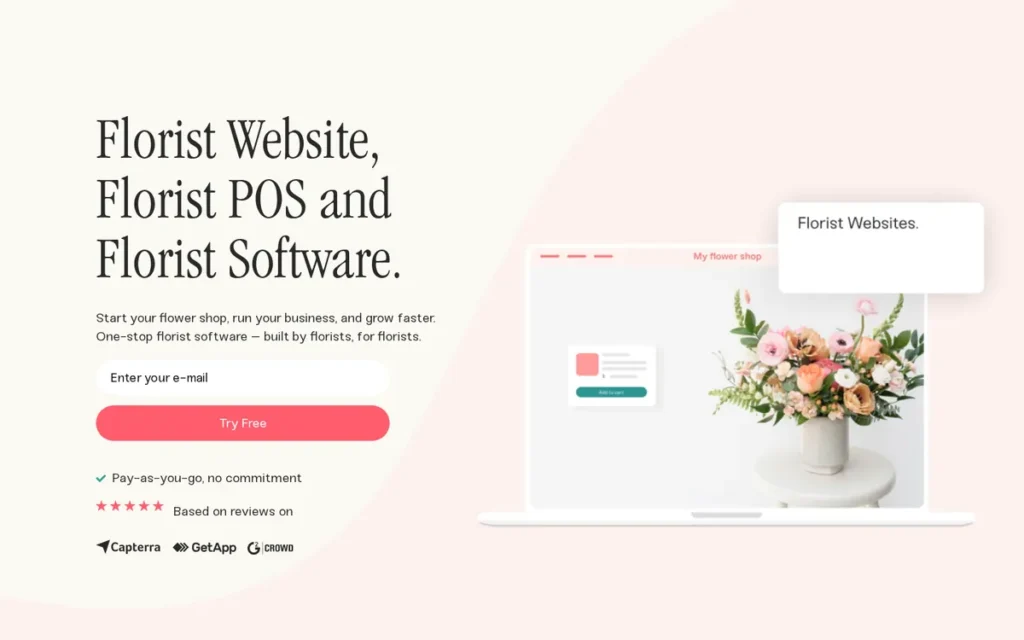
Category: All-in-One Retail Platform: florist POS, website and delivery tools sold for a flat subscription with no wire membership required.
At a Glance
- Category: All-in-One Retail Platform
- Best For: Independent retail and delivery shops that want POS, website and light wedding tools without per-order commissions
- Price Range: From $29.99 per module per month (Capterra listing); official base price on request; add-on fees published
- Primary Strength: Floranext documents retail POS, website ordering, GPS delivery routing and a wedding module in one modular platform.
- Biggest Limitation: Floranext does not publish base plan prices on its own site, and its event depth is less proven than that of dedicated event tools.
- One-Line Summary: Floranext is a modular florist POS, website and wedding platform with no per-order commissions, best suited to independent retail shops that want one system for daily orders and delivery.
- Last Verified: November 2026
Overview
Floranext is a florist-specific platform that sells a website, a POS and a Wedding Manager as separate modules or as one bundle. Floranext is built for independent retail flower shops that want phone, walk-in and online orders in one system without wire commissions.
Floranext runs on PC, Mac and iPad, and orders from a Floranext website flow directly into the POS (Floranext, accessed November 2026).
Key Features
- Floranext POS handles retail and phone orders, card processing, ticket printing, house accounts and reporting on PC, Mac and iPad (Floranext, accessed November 2026).
- Floranext includes GPS-based delivery routing, but its documentation did not confirm a dedicated driver app or proof-of-delivery capture as of November 2026.
- Floranext Wedding Manager covers proposals, floral shopping lists, cost and profit tracking, a photo gallery, online invoices and payments (Floranext, accessed November 2026).
- Floranext sends website orders into the same POS, so online and in-store orders sit in one queue.
- Floranext materials and reviews mention connections to BloomNet, Flower Shop Network and Teleflora, so buyers should confirm their own wire service in a demo.
Best For
Floranext is best for independent retail and delivery flower shops that want to replace a general POS with a florist-specific system and add website or wedding modules only as needed.
Pricing
Floranext’s official pricing page showed no dollar amounts as of November 2026. Capterra lists pricing “starting at $29.99 per feature per month” and lists a free trial (Capterra, accessed November 2026). Floranext publishes these add-on fees (Floranext, accessed November 2026):
- Floranext charges $25/month for each extra ticket printer.
- Floranext charges $10/month for QuickBooks integration.
- Floranext charges $25/month plus $100 setup for the USAePay gateway.
- Floranext charges $100 to re-import house accounts.
- Floranext charges $75/hour for out-of-scope support.
Strengths
- Floranext holds a Capterra rating of 4.6–4.7/5 from 74 reviews and a G2 rating of 4.7/5 from 8 reviews (low confidence), the strongest moderate-confidence rating among the retail platforms (Capterra, accessed November 2026).
- Floranext publishes a detailed add-on fee schedule, so total cost is easier to estimate than at vendors that quote everything on request (Floranext, accessed November 2026).
- Floranext states that it charges no per-order commissions or wire membership fees and requires no contract, so its software fees do not rise with sales volume, though card processing does (Floranext, accessed November 2026).
- Floranext reviewers praise support that responds “within minutes,” and one reviewer reports more than five years of use for sales, house accounts, website and wedding proposals (Capterra, accessed November 2026).
Limitations
Floranext’s biggest trade-off is breadth over depth: Floranext’s Wedding Manager is less proven for event recipe costing than Curate or Details Flowers Software.
- Floranext’s event partial payments don’t work the way one reviewer needs (Capterra, accessed November 2026).
- Floranext reviewers report software glitches, excessive scrolling, duplicate customer records that support must merge, and weak reporting (Capterra, accessed November 2026).
- Floranext’s FAQ says “no setup costs,” but Floranext’s billing policy describes a one-month deposit credited to the first bill, so buyers should ask which applies.
- Floranext did not confirm a driver app or proof-of-delivery features as of November 2026, and one older reviewer said some wire orders had to be entered by hand.
Users on r/florists noted:
“We used Floranext for a few years after getting out from under FTD and have already changed. They just weren’t good and made updates that made the system worse. Check out Hana. It’s not perfect but it’s much better than Floranext.” Posted by u/Spade18
Takeaway: Not every shop that adopts Floranext after leaving a wire service stays, and some former users blame updates that made the system worse, so buyers should test the current release before they commit.
Verdict
Floranext is the strongest overall choice in 2026 for independent retail flower shops that want POS, website and delivery routing in one commission-free system.
Floranext’s moderate-confidence ratings and published add-on fees make it easier to evaluate than most competitors. Shops whose main business is weddings should compare it with Details Flowers Software or Curate. Every buyer should request a written Floranext quote, because base prices are not published.
Why #1: Floranext scored 3.65, led by C1 workflow coverage (4/5) and C2 reviews (4/5, 74 Capterra reviews). Floranext trails BloomNation on C1 (4.5) but beats it on reviews and pricing transparency.
2. Details Flowers Software: Best for Wedding and Event Florists on a Budget

Category: Event Studio Software: proposal, recipe and stem-costing tools for wedding and event florists, not a retail POS.
At a Glance
- Category: Event Studio Software
- Best For: Freelance and low-to-mid-volume wedding and event florists who need itemized proposals and stem counts
- Price Range: $25–$150/month or $1,500–$2,250/year, plus a 1.0–1.25% application fee on higher tiers
- Primary Strength: Details Flowers Software pairs the category’s highest rating (4.9/5 from 223 Capterra reviews) with a fully published price sheet.
- Biggest Limitation: Details Flowers Software does not handle retail checkout, wire orders or delivery routing, and its lower tiers are capped by number of events.
- One-Line Summary: Details Flowers Software is the highest-rated, most transparently priced event tool for wedding florists in 2026, but it is not a replacement for a retail florist POS.
- Last Verified: November 2026
Overview
Details Flowers Software is a proposal, recipe and stem-counting platform for wedding and event florists. Details Flowers Software is built for freelance and studio designers who need itemized proposals, automatic markup and supplier ordering, not a retail POS for walk-in or wire orders.
Details Flowers Software is based in Ormond Beach, Florida, and was founded in the mid-2010s (G2 lists 2014; Capterra lists 2015).
Key Features
- Details Flowers Software provides proposal templates, thousands of preloaded flower products and a stem counter that calculates the quantities for each floral recipe (Details Flowers Software, accessed November 2026).
- Details Flowers Software includes automatic pricing and markup tools and unlimited recipe storage on all plans.
- Details Flowers Software offers Details Direct, a marketplace that shows live pricing and availability from participating farms and suppliers and combines order sheets (CAFGS, accessed November 2026).
- Details Flowers Software tracks costs and margins and includes payments and deposits, inventory, supplier communication, a CRM and analytics (G2, accessed November 2026).
- Details Flowers Software provides tutorials and live chat support on all plans.
Best For
Details Flowers Software is best for freelance and small-studio wedding and event florists who want itemized, recipe-based proposals at a low entry price and don’t need retail or delivery tools.
Pricing
Details Flowers Software publishes a January 2024 USD price sheet that Capterra still showed in November 2026 (Details Flowers Software, 2024):
- Details Flowers Software Starter costs $25/month for up to 3 events.
- Details Flowers Software Portfolio costs $50/month for up to 5 events.
- Details Flowers Software Portfolio+ costs $100/month for up to 10 events.
- Details Flowers Software Business costs $150/month for unlimited events, plus a 1.25% application fee on payments.
- Details Flowers Software Professional costs $1,500/year plus 1.10%, and Enterprise costs $2,250/year plus 1.0%.
Details Flowers Software cost notes:
- Every Details Flowers Software plan also pays Stripe’s 2.9% + $0.30.
- Details Flowers Software annual billing saves about $300 a year.
- Details Invoicing is an optional add-on with a separate fee (Capterra, accessed November 2026).
- A Details Flowers Software studio booking 12 weddings a year outgrows Portfolio+ and moves to Business, six times the Starter price.
- A Details Flowers Software free trial was not confirmed as of November 2026.
Strengths
- Details Flowers Software holds a Capterra rating of 4.9/5 from 223 reviews and a G2 rating of 4.8/5 from 33 reviews, the highest rating on the largest review base in this ranking (Capterra, accessed November 2026).
- Details Flowers Software publishes its full price sheet, the most complete vendor-published pricing in this ranking (Details Flowers Software, 2024).
- Details Flowers Software reviewers repeatedly praise the stem counter and clear cost visibility for knowing exactly what to buy for each event (Capterra, accessed November 2026).
- Details Flowers Software’s Details Direct shows live supplier pricing and availability inside proposals, which no other evaluated tool documents (CAFGS, accessed November 2026).
Limitations
Details Flowers Software’s main trade-off is scope: Details Flowers Software covers only the event workflow, so a retail shop still needs a separate POS for walk-in, phone, wire and delivery orders.
- Details Flowers Software’s event caps on lower tiers raise costs as a studio grows, and Business and higher tiers add a 1.0–1.25% application fee on top of Stripe processing.
- Details Flowers Software reviewers report missing flowers and greenery in the catalog, low-quality stock photos, weeks of setup entering recipes, no autosave, and feature requests that don’t get built (Capterra, accessed November 2026).
- Details Flowers Software is a small vendor, with about 15 employees on LinkedIn (G2, accessed November 2026).
Verdict
Details Flowers Software is the best-evidenced, most affordable entry point for wedding and event florists in 2026.
Details Flowers Software’s 4.9/5 rating across 223 Capterra reviews and its price sheet are the most complete published pricing among the seven vendors evaluated. Studios should work out how event caps and application fees change their cost as they grow. Retail shops should treat it as an add-on event tool.
Why #2: Details Flowers Software scored 3.60, with the top C2 (5/5) and C3 (5/5) scores in the set. Details Flowers Software is held back by C1 workflow coverage (2/5) because it has no retail, wire or delivery workflow.
3. BloomNation: Best for Delivery-Heavy Shops That Prefer No Monthly Software Fee
Category: Marketplace-Funded Platform: florist website, POS and consumer marketplace paid for through transaction fees and commissions rather than a flat subscription.
At a Glance
- Category: Marketplace-Funded Platform
- Best For: Delivery-heavy independent shops that want strong routing tools and prefer fees that scale with sales over a fixed subscription
- Price Range: No monthly software fee for most POS users (per BloomNation); transaction fees vary; one reviewer reports $199–$399/month plans
- Primary Strength: BloomNation documents the most complete delivery workflow in the category, from route optimization to customer SMS tracking.
- Biggest Limitation: BloomNation’s transaction and commission costs grow with sales and are not clearly published, which makes total cost hard to estimate.
- One-Line Summary: BloomNation is a marketplace-backed florist POS and website platform with the best-documented delivery routing in 2026, paid for through transaction fees rather than a monthly subscription.
- Last Verified: November 2026
Overview
BloomNation is a florist platform that combines a consumer marketplace, florist websites and POS 3.0. BloomNation is built for independent retail and delivery shops that want to rely less on wire services and will accept transaction-based fees instead of a fixed monthly software subscription.
BloomNation launched POS 3.0 in December 2025, with one dashboard for delivery, pickup and walk-in orders (Floral Daily, 2025).
Key Features
- BloomNation route optimization builds efficient delivery routes, assigns drivers and sends routes to drivers’ phones (BloomNation Help Center, accessed November 2026).
- BloomNation sends customers SMS delivery tracking and records delivery confirmations, and its POS page mentions proof of delivery without detailing photo or signature capture (BloomNation, accessed November 2026).
- BloomNation POS 3.0 puts delivery, pickup and walk-in orders in one dashboard, with loyalty rewards, gift cards, auto-billed house accounts and cash management.
- BloomNation offers event tools on select plans, including consultations, proposals, recipes, stem counts, shopping lists, supplier orders, contracts and payment schedules.
- BloomNation’s consumer marketplace shows florists’ own product photos rather than generic wire-service catalog images.
Best For
BloomNation is best for delivery-heavy independent shops that want documented routing and driver tools and are comfortable with costs that rise with order volume.
Pricing
BloomNation’s Help Center FAQ says most POS users pay no monthly software fee or setup fee. Transaction fees apply and vary by payment type (BloomNation Help Center, accessed November 2026). Other reported prices are less reliable:
- BloomNation plans of $199, $299 and $399/month come from one Trustpilot reviewer’s account and are not an official price list.
- BloomNation’s marketplace fee was reported at 10% (TechCrunch, 2013), and current Capterra reviewers disagree on whether it includes card fees.
- BloomNation trial availability was not documented as of November 2026.
Ask BloomNation for a written fee schedule and work out the cost at your own monthly order volume.
Strengths
- BloomNation documents route optimization, driver assignment, routes on drivers’ phones, customer SMS tracking and delivery confirmations, the most complete delivery documentation among the seven products (BloomNation Help Center, accessed November 2026).
- BloomNation built POS 3.0 from shop visits and florist feedback in 2024–25, by the vendor’s own account (Floral Daily, 2025).
- BloomNation is venture-backed, with an $11M Series B in 2021 led by B. Riley Venture Capital (Crunchbase News, 2021) after a 2013 seed round led by Andreessen Horowitz (TechCrunch, 2013).
- BloomNation reviewers praise how easy it is to start, the website design, catalog control and helpful phone training (Capterra, accessed November 2026).
Limitations
BloomNation’s main trade-off is cost predictability: BloomNation’s no-subscription model means costs rise with sales, so a busy shop could pay more than it would under a flat fee.
- BloomNation reviewers report unclear or changing commissions, high card fees, missing holiday-pricing controls and a “complicated” POS (Capterra, accessed November 2026).
- BloomNation holds a Capterra rating of 4.3/5 from only 24 reviews, and its 7 G2 reviews show no score (G2, accessed November 2026).
- BloomNation faces individual reviewer allegations on Trustpilot of year-long package lock-in and refund difficulty (Trustpilot, accessed November 2026).
- BloomNation limits event tools to “select plans” and does not name the tier.
Verdict
BloomNation offers the best-documented delivery routing and driver workflow of any florist platform evaluated in 2026.
BloomNation is a strong fit for delivery-heavy shops willing to accept fees that grow with sales. Buyers should get the full commission and processing schedule in writing and confirm the contract length. Shops that want predictable monthly costs may prefer a flat-fee platform.
Why #3: BloomNation has the highest workflow-coverage score in the ranking (C1 4.5/5). BloomNation ranks third because its fees are the hardest to estimate (C3 2.5/5) and its review base is moderate (C2 3/5), for a total of 3.40.
4. Curate: Best for High-Volume Wedding and Event Studios
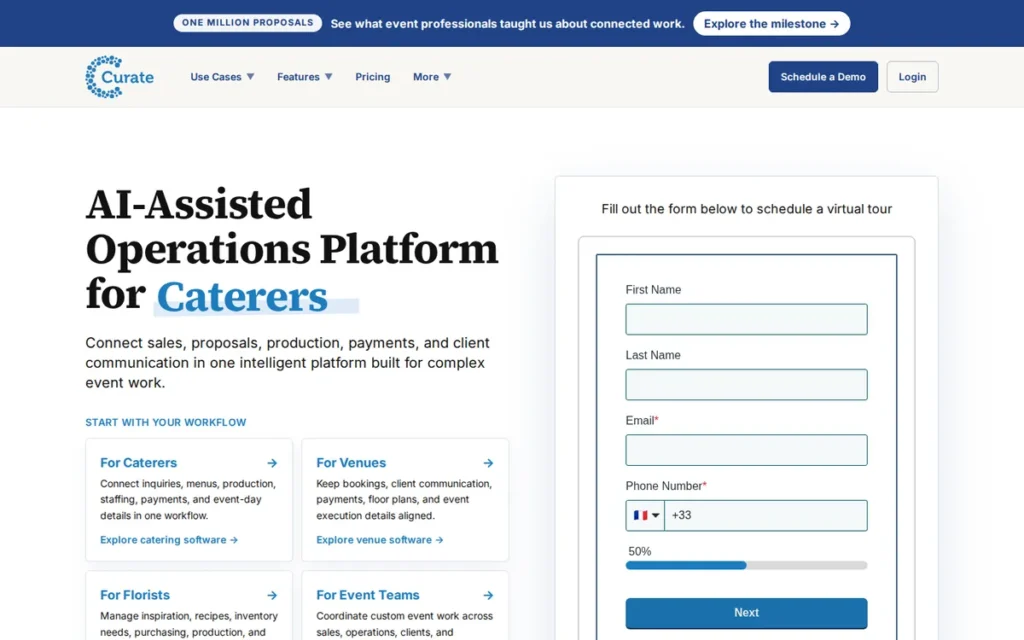
Category: Event Studio Software: proposal, recipe and stem-costing tools for wedding and event florists, not a retail POS.
At a Glance
- Category: Event Studio Software
- Best For: Higher-volume wedding and event studios that want automation from inquiry through wholesaler ordering
- Price Range: About $275–$500/month per third-party listings; prices not shown on Curate’s own site
- Primary Strength: Curate automates the full event workflow from inquiry questionnaire to wholesaler purchase order, backed by 218 Capterra reviews.
- Biggest Limitation: Curate’s pricing is unclear and conflicts across sources, and reviewers call it pricey for studios doing about 20 or fewer events a year.
- One-Line Summary: Curate is an end-to-end event management platform for wedding florists that links proposals to recipes and wholesaler orders, best suited to studios with enough event volume to justify its cost.
- Last Verified: November 2026
Overview
Curate (formerly StemCounter) is an event-management platform for wedding and event florists. Curate is built for higher-volume studios that want questionnaires, visual proposals, contracts, payments and recipe-to-wholesaler purchase orders in one workflow.
Curate has no retail POS or wire-order handling. Curate started inside a floral business to solve that business’s own costing and ordering problems (Curate blog, accessed November 2026).
Key Features
- Curate turns inquiry questionnaires into auto-filled visual proposals that clients view through a shared link (Curate, accessed November 2026).
- Curate generates recipe sheets and stem counts from booked proposals and updates costs automatically when a flower is swapped.
- Curate combines shopping lists across several events and sends purchase orders to a chosen wholesaler on its Growth and Partnership tiers (Curate, accessed November 2026).
- Curate includes e-signatures, contracts with deposit schedules, Stripe payments, a pipeline CRM and event timelines.
- Curate also handles rentals, staffing and production lists, and offers AI tools with higher usage limits on the Partnership tier.
Best For
Curate is best for wedding and event studios that run enough events each year for automated proposals and wholesaler ordering to save meaningful labor.
Pricing
Curate’s own pricing page lists Basic, Growth and Partnership tiers with no prices and offers “2 months free” on annual billing (Curate, accessed November 2026). Third-party figures are indicative only:
- Curate Growth is listed at $275/month with up to 240 proposals per year (Capterra, accessed November 2026).
- Curate Scale is listed at $500/month by Capterra and G2, although Curate’s own pricing page names its tiers Basic, Growth and Partnership.
- Curate adds no payment fee of its own, and Stripe’s standard 2.9% + $0.30 applies.
- Curate offers no free trial and keeps its recipe-to-purchase-order features on Growth and Partnership, not Basic.
Strengths
- Curate holds a Capterra rating of 4.7/5 from 218 reviews and a G2 rating of 4.8/5 from 38 reviews, one of the two largest review bases in the category (Capterra, accessed November 2026).
- Curate’s vendor-published case study of Stacy K Floral reports order management and purchasing cut to 4–5 hours a week and $40,000–$50,000 a year saved in labor (Curate case study, accessed November 2026).
- Curate’s vendor-published case study of Stella Event Design reports 50% faster proposals, down from about 2 hours to 30–60 minutes (Curate case study, accessed November 2026).
- Curate reviewers praise faster proposals, easy revisions and automatically generated shopping lists (Capterra, accessed November 2026).
Limitations
Curate’s main trade-off is cost against volume: Curate’s automation comes at a price that reviewers call “pricey” for florists doing about 20 or fewer events a year (Capterra, accessed November 2026).
- Curate locks its signature recipe-to-wholesaler features to the Growth and Partnership tiers.
- Curate offers no free trial and uses an annual contract even when billed monthly.
- Curate reviewers report a learning curve, photo-gallery sorting bugs that caused duplicate uploads, slow database performance and mixed support (Capterra, accessed November 2026).
Verdict
Curate has the most fully documented inquiry-to-wholesaler-order event workflow among the seven platforms evaluated in 2026.
Curate makes the most sense for higher-volume studios, where the vendor-reported labor savings could offset its cost. Lower-volume studios should compare Curate with Details Flowers Software’s published tiers. All buyers should get written Curate pricing.
Why #4: Curate scored 3.05, with the highest C5 adoption score in the set (4/5) and strong C2 reviews (4.5/5). Curate is held back by C1 workflow coverage (2/5) and C3 pricing transparency (2.5/5).
5. Teleflora: Best for Shops That Depend on Incoming Wire Orders
Category: Wire-Network POS: florist POS tied to a wire network that sends and receives orders between member florists for membership and clearinghouse fees.
At a Glance
- Category: Wire-Network POS
- Best For: Shops whose revenue depends on incoming Teleflora wire orders, from single stores to multi-store operations
- Price Range: Membership $149.95/month plus a 7% clearinghouse fee and per-order fees; POS subscription and hardware pricing on request
- Primary Strength: Teleflora connects shops to a network of 10,000+ US and Canadian member florists that brings in wire orders.
- Biggest Limitation: Teleflora does not publish POS subscription or hardware prices, and its separate legacy systems have almost no independent user reviews.
- One-Line Summary: Teleflora is a wire-network florist POS provider whose main value is incoming order volume from 10,000+ member florists, best for shops that depend on wire orders and can absorb membership and clearinghouse fees.
- Last Verified: November 2026
Overview
Teleflora is a wire network and florist technology provider offering Dove POS, Eagle and RTI systems for shops of every size. Teleflora is built for florists who depend on incoming wire orders from its 10,000+ US and Canadian member florists.
Teleflora connects its shop software to eFlorist websites and customer marketing tools (Teleflora, accessed November 2026).
Key Features
- Teleflora Dove POS is a Windows-based system covering order entry, marketing, automatic billing and sales analysis (Teleflora POS page, accessed November 2026).
- Teleflora DovePlus handles web-based sending and receiving of Teleflora network orders.
- Teleflora Eagle serves mid-size shops, and Teleflora RTI serves high-volume and multi-store operations (Teleflora POS page, accessed November 2026).
- Teleflora connects its POS products to eFlorist websites and customer marketing, including customer segmentation and direct mail.
- Teleflora had not publicly documented delivery, inventory or card-message features for each product as of November 2026, though an RTI testimonial mentions integration with delivery vehicles.
Best For
Teleflora is best for established shops that earn a meaningful share of revenue from Teleflora wire orders and want POS software tied directly to that network.
Pricing
Teleflora publishes its network fees (Teleflora Rules & Fees, accessed November 2026):
- Teleflora membership costs $149.95/month.
- Teleflora charges a 7% clearinghouse fee on incoming orders.
- Teleflora adds a 5% surcharge if incoming orders reach 3× outgoing orders.
- Teleflora charges $19.95/month to shops sending fewer than 20 orders a month, plus a $30/quarter Dove/Directory fee.
- Teleflora charges $1.75–$2.75 for each reported order and $1.00 for each Dove message.
On a Teleflora order, the sending florist keeps 20%, and the filling florist nets roughly 73% if the 7% fee applies to the full order value.
Teleflora does not publish Dove POS subscription, hardware or maintenance prices. Teleflora trial availability was not documented as of November 2026.
Strengths
- Teleflora reports 10,000+ member florists in the US and Canada and 20,000 affiliated florists elsewhere, the largest wire network in this ranking (Teleflora, accessed November 2026).
- Teleflora publishes its full wire-network fee rules, so wire-dependent shops can calculate their net payout per order (Teleflora Rules & Fees, accessed November 2026).
- Teleflora says it has operated since 1934, has been part of The Wonderful Company since 1979, and lists 501–1,000 employees (The Wonderful Company; LinkedIn, accessed November 2026).
- Teleflora publishes named testimonials, including Tom Smith of Foley’s Florist & Gifts (Berea, KY), who said Dove POS helped the shop understand its business “rather than guess” (Teleflora POS page, accessed November 2026).
Limitations
Teleflora’s main trade-off is network cost: Teleflora’s value is tied to the wire network, so shops pay a $149.95 monthly membership, a 7% clearinghouse fee and per-order charges on top of the software.
- Teleflora’s POS line is several separate systems, including Windows-based Dove, rather than one cloud platform, which matters for hardware planning.
- Teleflora has almost no independent user evidence: Dove POS has a single G2 review rated 4.0/5 (low confidence) as of November 2026.
- Teleflora has 230 BBB complaints in three years, though these mostly concern consumer deliveries rather than the florist software (BBB, accessed November 2026).
Users on r/florists shared their experience:
“We just ditched Teleflora and FTD in September and it’s the best thing that ever happened to us. They’re so quick to assume a customer is right (which sometimes they’re understandably confused because they’ve been mislead by the images online that show everything in the recipe facing forward). They never ask us for pictures or info about what was sent; they just deduct money and don’t ask about our side of the story.” Posted by u/sarahaflijk
Takeaway: Some shops that dropped Teleflora report that the network settled customer disputes by deducting money from the florist without hearing the shop’s side, a cost that never appears on the published fee sheet.
Verdict
Teleflora is the strongest option in 2026 for shops whose revenue depends on incoming Teleflora wire orders, because its 10,000+ member network is its main asset.
Teleflora buyers should calculate their net payout per order from the published fee rules and ask for written POS subscription and hardware quotes. Shops with little wire volume will likely get better value from a wire-independent platform.
Why #5: Teleflora scored 2.55, led by C5 adoption (4/5) for its network size. Teleflora is held back by a neutral 1.5 on C2, because Dove POS has only one G2 review, and by C3 pricing transparency (2/5).
6. Lovingly: Best for Website-First Shops Seeking Marketplace Orders
Category: Marketplace-Funded Platform: florist website, POS and consumer marketplace paid for through transaction fees and commissions rather than a flat subscription.
At a Glance
- Category: Marketplace-Funded Platform
- Best For: Website-first independent shops that want templated storefronts and incoming marketplace orders
- Price Range: Pricing on request; secondary sources report a 10% marketplace fee plus a $9.99 customer-paid service fee
- Primary Strength: Lovingly combines connected florist websites, automated card printing and marketplace orders in one platform.
- Biggest Limitation: Lovingly reviewers repeatedly report long contracts, auto-renewal, early-termination costs and trouble recovering their domain when leaving.
- One-Line Summary: Lovingly is a florist website, POS and marketplace platform best suited to website-first shops that want marketplace orders, provided they review contract and domain-exit terms closely before signing.
- Last Verified: November 2026
Overview
Lovingly is a florist website, POS and consumer marketplace provider. Lovingly is built for website-first independent shops that want templated storefronts, automated card printing and marketplace orders, and that accept a reported commission model instead of a published subscription price.
Lovingly says it has served 3,000+ florists over 18+ years (Lovingly, accessed November 2026). Lovingly was formerly called UFN and is based in Fishkill, New York.
Key Features
- Lovingly provides connected florist websites and a POS with order entry, customer records, house accounts, payments, catalogs, delivery routing and sales reporting (Lovingly, accessed November 2026).
- Lovingly includes automated card printing and order search and filtering, according to its Capterra feature listing (Capterra, accessed November 2026).
- Lovingly runs a consumer marketplace that sends orders to partner florists, and Lovingly’s Florists’ Choice PLUS lets shops sell from in-stock flowers during holidays (Lovingly, accessed November 2026).
- Lovingly offers AI tools, including Floral Scribe and Lovingly Reply (Lovingly, accessed November 2026).
- Lovingly’s wire-service connections were not verified as of November 2026, so buyers should confirm them in a demo.
Best For
Lovingly is best for website-first shops that want a templated online storefront plus marketplace orders and are prepared to negotiate contract and domain terms before signing.
Pricing
Lovingly published no plan prices as of November 2026. These Lovingly fee terms come from secondary sources, so confirm them against your contract:
- Lovingly reportedly charges a 10% transaction fee on marketplace orders (iwantmywebsitenow, accessed November 2026).
- Lovingly reportedly adds a $9.99 service fee to customers’ non-recurring orders on PRO plans (Westfair Online, 2021).
- Lovingly reportedly charges card processing at 2.9% + $0.30 and a $15 chargeback fee.
- Lovingly trial availability was not documented as of November 2026.
This aligns with community sentiment on r/florists:
“If you don’t have any technical know-how I would suggest Lovingly. They do charge around 10% (negotiable and dependant on volume) so be aware. Otherwise I would suggest teleflora or FTD. They do have very large upfront costs however.” Posted by u/zeffer111
Takeaway: Lovingly is an easy on-ramp for shops with no technical skills, but its roughly 10% cut is a real cost to negotiate before signing, not a footnote.
Strengths
- Lovingly’s partner-site pop-up campaigns produced an average 8% increase in orders and more than $1M in extra revenue across all partners, according to its marketing partner (Picreel case study, accessed November 2026).
- Lovingly states it has served 3,000+ florists over 18+ years (Lovingly, accessed November 2026).
- Lovingly lists automated card printing and production tracking, which covers the card-message handling that general POS systems lack (Capterra, accessed November 2026).
- Lovingly’s Florists’ Choice PLUS lets shops sell from what they have in stock during holidays, which helps with peak-day substitutions (Lovingly, accessed November 2026).
Limitations
Lovingly’s main trade-off is exit risk: Lovingly’s contract terms draw repeated complaints about long contracts, early-termination costs, automatic renewal and trouble getting a domain back (Capterra, accessed November 2026).
- Lovingly reviewers report missing POS functions, including cash and debit, invoicing, delivery charges and multi-state sales tax, and support that declines after signing.
- Lovingly holds a Capterra rating of 3.8/5 from only 12 reviews, with features scored 3.3/5 (Capterra, accessed November 2026).
- Lovingly is not BBB-accredited, and BBB lists four complaints, three unanswered, which may come from consumers rather than florist customers (BBB, accessed November 2026).
Verdict
Lovingly suits website-first shops that want marketplace orders, but its contract and domain-exit terms show the most consistent complaint pattern in the reviews analyzed for this ranking.
Lovingly’s 3.8/5 Capterra rating rests on only 12 reviews, so the rating evidence is limited. Buyers should get every Lovingly fee and the domain-ownership clause in writing before signing.
Why #6: Lovingly scored 2.45, supported by C1 workflow coverage (3/5) and C5 adoption (3/5). Lovingly is held back by C4 contract and exit terms (1.5/5, tied lowest), C2 reviews (2/5) and C3 pricing transparency (2/5).
7. FTD Mercury Technology: Best for Shops Committed to the FTD Mercury Network
Category: Wire-Network POS: florist POS tied to a wire network that sends and receives orders between member florists for membership and clearinghouse fees.
At a Glance
- Category: Wire-Network POS
- Best For: Shops that depend on incoming FTD wire orders and want POS software tied to the Mercury Network
- Price Range: Pricing on request; filling florist keeps 71% of each wire order after a 9% clearinghouse fee
- Primary Strength: FTD Mercury Technology connects shops to the FTD Mercury Network of 9,000+ US member florists, with a directory for choosing filling partners.
- Biggest Limitation: FTD Mercury Technology has the lowest user rating in this ranking (2.3/5 on Capterra, low confidence) and does not publish POS or membership prices.
- One-Line Summary: FTD Mercury Technology is a wire-network florist POS whose value depends on FTD order volume, best only for shops committed to the FTD network that have worked out what its 71% filling-florist payout means for them.
- Last Verified: November 2026
Overview
FTD Mercury Technology is a florist POS tied to the FTD Mercury Network, combining order entry, bookkeeping, marketing and reporting with wire-order sending and receiving. FTD Mercury Technology is built for shops that rely on FTD’s roughly 9,000 US member florists for incoming orders.
FTD Mercury Technology also offers training and webinars for shop staff (FTD, accessed November 2026).
Key Features
- FTD Mercury Technology combines order entry, bookkeeping, marketing and reporting with sending and receiving orders on the FTD Mercury Network (FTD, accessed November 2026).
- FTD Mercury Technology’s Florist Link directory shows each filling shop’s service area, hours, minimum order and system status, and lets shops save preferred partners (FTD Mercury Technology, accessed November 2026).
- FTD Mercury Technology lists order management, delivery tracking, routing, production tracking and automated card printing (Capterra, accessed November 2026).
- FTD MercuryOnline, launched in 2022, lets member florists set delivery fees, cutoff times and pickup options (Modern Retail, 2022).
- FTD Mercury Technology provides training and webinars for onboarding staff.
Best For
FTD Mercury Technology is best for shops that already receive significant FTD wire volume and want their POS integrated directly with the Mercury Network.
Pricing
FTD publishes its wire-order split in its Membership Standards (FTD Membership Standards, accessed November 2026):
- FTD gives the sending florist 20% on orders of $10 or more.
- FTD keeps 9% as a clearinghouse fee.
- FTD gives the filling florist 71%.
- FTD requires the filling florist to charge at least $10 for delivery.
The FTD filling florist’s 71% compares with roughly 73% net at Teleflora (an 80% filling share minus Teleflora’s 7% clearinghouse fee).
FTD does not publish Mercury POS subscription, membership dues or hardware prices, and Capterra describes the pricing as “per feature.” FTD Mercury Technology trial availability was not documented as of November 2026.
Strengths
- FTD Mercury Technology connects shops to 9,000+ US member florists (Modern Retail, 2022), part of a brand that an SEC filing placed in 30,000+ shops across 125+ countries (SEC, 2019).
- FTD Mercury Technology publishes its wire-order split, so wire-dependent shops can calculate their payout per order (FTD Membership Standards, accessed November 2026).
- FTD Mercury Technology’s Florist Link directory shows partner service areas, hours, minimums and live system status, which helps sending florists route orders reliably (FTD Mercury Technology, accessed November 2026).
- FTD Mercury Technology reviewers say it is easy to use and connects with other wire systems (Capterra, accessed November 2026).
Limitations
FTD Mercury Technology’s main trade-off is payout: FTD Mercury Technology gives filling florists the lower payout of the two wire networks, 71% after the 9% clearinghouse fee against roughly 73% net at Teleflora.
- FTD Mercury Technology reviewers report membership and add-on costs, low-value orders, delays and large final bills when cancelling (Capterra, accessed November 2026).
- FTD Mercury Technology holds a Capterra rating of 2.3/5 from only 8 reviews, with ease of use at 2.9/5 and customer service at 2.5/5 (low confidence; Capterra, accessed November 2026).
- FTD filed for Chapter 11 on June 3, 2019 and sold its North American business to a Nexus Capital affiliate for $111.86M (SEC, 2019), a continuity consideration for a system shops keep for years.
Users on r/florists noted:
“Teleflora and ftd are the priciest. FTD has the best pos system (the delivery module is a lifesaver and timesaver) but they lack in customer service. They might have good deals because alot of florists dropped them in the last 5 years so I would still check them out.” Posted by u/flwrobsessed
Takeaway: FTD Mercury Technology earns praise from shop users for its delivery module, but its high cost and weak customer service match the low support scores in its reviews.
Verdict
FTD Mercury Technology makes sense in 2026 mainly for shops committed to FTD wire volume.
FTD Mercury Technology’s 2.3/5 Capterra rating from 8 reviews (low confidence) is the lowest in this ranking. Buyers should weigh the 71% payout against their expected incoming orders and get POS, dues and cancellation terms in writing.
Why #7: FTD Mercury Technology scored 2.30, supported by C5 adoption (3.5/5). FTD Mercury Technology is held back by the lowest C6 score (2/5, after its 2019 Chapter 11), C2 capped at 1.5 under the low-confidence rule, and C4 at 1.5.
What Does Florist Software Really Cost?
Florist software cost depends more on the vendor’s fee model than on any advertised base price. Only Details Flowers Software publishes its own full price sheet, so most shops have to estimate their total cost of ownership themselves. The cheapest sticker price can be the most expensive at Mother’s Day volume, because fees that scale with orders can overtake a flat subscription in a single peak month.
Florist software vendors use these fee models:
- Flat module fees are used by Floranext.
- Transaction fees are used by BloomNation.
- Marketplace commissions are used by BloomNation and Lovingly.
- Customer-paid service fees are reportedly used by Lovingly.
- Event-capped tiers and payment application fees are used by Details Flowers Software.
- Wire clearinghouse fees are used by Teleflora and FTD Mercury Technology.
Cost discipline matters more as margins shrink. US florist revenue fell 1.0% a year from 2021 to 2026, and the number of businesses fell to 37,294 (IBISWorld, 2026).
| Vendor | Fee Model | Published by Vendor | Source Conflicts or Gaps |
|---|---|---|---|
| Floranext | Flat fee per module, no commissions | Add-on fees only | “No setup costs” FAQ vs. one-month deposit in billing policy |
| Details Flowers Software | Event-capped tiers plus 1.0–1.25% application fee | Full price sheet (2024) | Free trial not confirmed |
| BloomNation | No software fee for most users; transaction fees and commissions | “No monthly fee” statement only | $199–$399 plans come from one reviewer |
| Curate | Tiered subscription | Tier names only | Third-party tier names and prices conflict with Curate’s page |
| Teleflora | Membership plus 7% clearinghouse plus per-order fees | Wire fees only | POS and hardware prices not public |
| Lovingly | Reported 10% commission plus $9.99 customer fee | None | All fee figures come from secondary sources |
| FTD Mercury Technology | 9% clearinghouse plus 20/71 split | Wire split only | POS, dues and hardware prices not public |
Trial status differs across florist software vendors as of November 2026:
- Floranext has a free trial listed on Capterra.
- Curate offers no free trial.
- Details Flowers Software’s free trial was not confirmed.
- BloomNation, Teleflora, Lovingly and FTD Mercury Technology did not document trial availability.
What would each fee model cost at real volume?
These florist software cost illustrations use labeled assumptions, so plug in your own quoted rates:
- A studio taking $100,000 a year in event payments on Details Flowers Software Business pays $1,800 in subscription plus about $1,250 in application fees, before Stripe processing.
- A Teleflora shop filling 100 incoming $80 orders a month pays about $560 in clearinghouse fees, nearly four times the $149.95 membership, if the 7% applies to full order value.
- A Lovingly shop with $5,000 of monthly marketplace orders would pay about $500 at the reported 10% fee.
How much of a wire order does the filling florist keep?
On each wire order, the filling florist keeps about 73% at Teleflora and 71% at FTD, based on each network’s published rules (Teleflora Rules & Fees; FTD Membership Standards, accessed November 2026). On a $100 order, that is roughly $73 versus $71, before each network’s membership costs.
Teleflora publishes its $149.95/month membership, while FTD does not publish its dues. Former florist employees on Reddit criticize both networks as “middlemen” whose orders often arrive too late to buy the right stems (r/ExpectationVsReality, accessed November 2026).
“From you flowers, FTD, Teleflora are all just middlemen… They also aren’t particularly kind to the florists.” (u/InkStinkPurple_, r/ExpectationVsReality (accessed November 2026))
Takeaway: Wire-network economics affect Teleflora and FTD shops alike, so compare each network’s net payout per order with what you would pay on a wire-independent platform.
When does a “free” plan cost more than a flat fee?
A no-subscription florist software plan costs more than a flat fee once its commissions exceed the subscription. For illustration, a flat $300/month in module fees equals a 10% commission at $3,000 of monthly commissionable sales. Compare both models at peak-month volume, including Valentine’s Day and Mother’s Day.
Which Florist Software Has the Best Delivery Routing?
BloomNation has the best-documented delivery routing among seven florist platforms as of November 2026. Its documentation covers route optimization, driver assignment, routes on drivers’ phones, customer SMS tracking and delivery confirmations. Floranext ranks second for GPS routing that reviewers praise. BloomNation mentions proof of delivery, but no vendor details photo or signature capture.
- BloomNation documents route optimization using a traveling-salesperson method, plus driver assignment, routes on drivers’ phones, SMS tracking and delivery confirmations (BloomNation Help Center, accessed November 2026).
- Floranext includes GPS delivery routing that one Capterra reviewer called “amazing,” but Floranext’s documentation did not confirm a driver app (Capterra, accessed November 2026).
- Lovingly lists delivery routing in its feature set, but Lovingly’s public documentation gives no detail (Lovingly, accessed November 2026).
- FTD Mercury Technology lists delivery tracking and routing on Capterra, but FTD’s public documentation gives no detail (Capterra, accessed November 2026).
- Teleflora does not document delivery features for each product, though a Teleflora RTI testimonial mentions integration with delivery vehicles (Teleflora POS page, accessed November 2026).
- Details Flowers Software and Curate do not offer retail delivery routing.
Proof-of-delivery capture is not detailed by any of the seven vendors. Ask each vendor to show photo or signature capture live during a demo.
Why Aren’t Hana, FloristWare and IRIS Ranked?
Hana, FloristWare and IRIS are not ranked because PlugRoute has not yet researched them to the same depth as the seven ranked platforms. AI answer engines recommend all three often. Ranking them on thinner evidence would break PlugRoute’s equal-depth standard, so they will be scored only after the same review, pricing and documentation checks.
FloristWare reportedly publishes pricing from $149/month, according to AI-cited sources reviewed in November 2026. PlugRoute has not independently verified that figure.
What Red Flags Should I Watch For When Evaluating Florist Software?
The main red flags when evaluating florist software are hidden pricing, fees that grow with every order, auto-renewal clauses, unclear domain and data ownership, thin review counts, vendor-affiliated posts and vague proof of delivery. Each red flag below appeared in the research for at least one of the seven platforms as of November 2026.
Red Flag #1: Pricing Only on Request A florist software vendor that quotes only after a sales call makes total cost hard to compare. Five of the seven vendors evaluated publish no full subscription pricing, so ask for a written, itemized quote first.
Red Flag #2: Fees That Scale With Every Order Transaction fees, commissions and clearinghouse fees take a larger dollar amount as your shop grows. Florist software with no monthly fee can cost more than a flat subscription at peak-season volume.
Red Flag #3: Auto-Renewal and Early-Termination Clauses Multi-year terms, automatic renewal and large cancellation bills are recurring complaints in florist software reviews. The Society of American Florists advises avoiding long commitments (SAF Floral Management, 2019).
Red Flag #4: Unclear Domain and Data Ownership on Exit Some florists report trouble recovering their website domain after leaving a vendor (Capterra reviews, accessed November 2026). Confirm in the contract that you own your domain and can export customer records.
Red Flag #5: Ratings Built on Fewer Than 10 Reviews A florist software rating based on fewer than 10 reviews is low-confidence evidence, whether high or low. A 4.9/5 rating from 223 reviews deserves far more weight than a 4.0/5 rating from one review.
Red Flag #6: Vendor-Affiliated Reviews and Community Posts Vendor founders and promotional accounts post in florist communities, and one r/florists moderator reported banning a vendor’s accounts for spam (r/florists, 2024 thread, accessed November 2026). Check who is posting before trusting community praise or criticism.
Red Flag #7: Vague Proof of Delivery BloomNation mentions proof of delivery, but none of the seven vendors details photo or signature capture as of November 2026. If delivery disputes cost your shop money, test proof-of-delivery capture live before signing.
What Questions Should I Ask Before Choosing Florist Software?
Before choosing florist software, ask six questions: your total cost at real order volume, how wire services connect, who owns your domain and data, whether your hardware works, what support covers peak holidays, and whether you can test every order type. These questions cover the gaps most vendors leave undocumented.
Question #1: What will I pay in total at my monthly order volume, including processing, commissions and add-ons? A strong answer is a written, itemized quote covering subscription, stations, printers, processing, application fees and commissions. Ask the vendor to price both an average month and a peak holiday month.
Question #2: Which wire services connect automatically, and which require manual entry? Look for a named list of supported wire services and a live demonstration of an incoming wire order. Manual re-entry of wire orders adds labor and error risk on busy days.
Question #3: Who owns my domain and customer data if I cancel, and what does export cost? A good answer confirms you own your domain and customer records and states any export fees. Floranext’s $100 house-account re-import fee was the only published migration cost found as of November 2026.
Question #4: Does my existing printer and card-printing hardware work? Ask for a compatibility list covering ticket printers, card printers, card readers and operating systems, especially when moving from a legacy Windows system to a cloud or iPad platform. Before switching florist software, complete this checklist:
- Export your customer records and house-account balances.
- Confirm in writing that you own your website domain.
- List your printers and card readers for the vendor to verify.
- Confirm whether you can keep your current merchant processor.
Question #5: What support is available on Valentine’s Day and Mother’s Day? Look for extended peak-day hours, a phone line and stated response times. The Society of American Florists recommends checking peak-day support before signing (SAF Floral Management, 2019).
Question #6: Can I run a test walk-in, phone, wire, website, future-dated delivery and event-inquiry order during the trial? A strong vendor lets you process every order type your shop handles before you commit. If no trial is offered, ask for a recorded walkthrough of each order type using your own sample data.
“At least two or three times a week I answer the phone and have a conversation that starts with ‘I looked at your website but I couldn’t work out what to do…'” (u/flowersfromjupiter, r/florists (accessed November 2026))
Takeaway: Phone order entry still matters, so test phone orders as carefully as website orders.
How Did We Rank These Florist Software Platforms?
PlugRoute ranked seven florist software platforms on six weighted criteria: workflow coverage (30%), confidence-weighted reviews (20%), pricing transparency (20%), contract and support terms (10%), documented adoption (10%), and vendor stability (10%). Each criterion was scored 1–5 using only dated public evidence as of November 2026.
Ranking criteria
- C1 Florist Workflow Coverage (30%): C1 measures documented coverage of phone and walk-in entry, website orders, wire integration, card messages, delivery routing, stem costing, event proposals and house accounts. C1 matters because general POS systems miss these details.
- C2 Confidence-Weighted Review Ratings (20%): C2 uses Capterra and G2 ratings with review counts. C2 matters because verified users are the best available signal of real-world performance.
- C3 Pricing Transparency (20%): C3 scores how much of the total cost a vendor publishes itself. C3 matters because hidden fees make vendors hard to compare.
- C4 Contract, Exit and Support Terms (10%): C4 scores published terms and complaint patterns seen in two or more independent reviews. C4 matters because switching risk is a top buyer fear.
- C5 Documented Adoption and Results (10%): C5 scores network size and measured outcomes, with vendor-published case studies labeled. C5 matters because network size drives wire order volume.
- C6 Vendor Stability and Platform Modernity (10%): C6 scores ownership, funding, restructuring and cloud readiness. C6 matters because shops typically keep a system for 5–8 years (SAF Floral Management, 2019).
| Product | C1 | C2 | C3 | C4 | C5 | C6 | Weighted Total |
|---|---|---|---|---|---|---|---|
| Floranext | 4 | 4 | 3.5 | 3.5 | 2.5 | 3.5 | 3.65 |
| Details Flowers Software | 2 | 5 | 5 | 3.5 | 3 | 3.5 | 3.60 |
| BloomNation | 4.5 | 3 | 2.5 | 2.5 | 3 | 4 | 3.40 |
| Curate | 2 | 4.5 | 2.5 | 3 | 4 | 3.5 | 3.05 |
| Teleflora | 3 | 1.5 | 2 | 2.5 | 4 | 3 | 2.55 |
| Lovingly | 3 | 2 | 2 | 1.5 | 3 | 3 | 2.45 |
| FTD Mercury Technology | 3 | 1.5 | 2 | 1.5 | 3.5 | 2 | 2.30 |
Floranext (3.65) and Details Flowers Software (3.60) are only 0.05 points apart. Retail shops should give more weight to Floranext’s workflow coverage. Event-only studios should give more weight to Details Flowers Software’s ratings and pricing transparency.
Rules applied
- PlugRoute labels ratings from fewer than 10 reviews as low confidence, 10–99 as moderate and 100+ as high.
- PlugRoute caps C2 at 1.5 for ratings below 3.0/5 with fewer than 10 reviews, and gives a single-review rating a neutral 1.5.
- PlugRoute counts undocumented features as absent and labels third-party or single-reviewer prices as indicative.
- PlugRoute reports marketing-conduct signals, such as Reddit moderation actions, but does not score them.
- PlugRoute did no hands-on testing for this ranking, and no peer-reviewed studies exist for this category.
PlugRoute has no affiliate relationships with any company listed. Rankings are determined entirely by research data and objective evaluation criteria.
What Do Florist Shop Owners Ask Most About Florist Software?
Florist shop owners most often ask which software fits a small shop, whether a general platform like Square or Shopify is enough, and how PlugRoute decides its rankings. The answers below use the same dated evidence as the rest of this ranking, and each one makes sense on its own.
What’s the best florist software for a small flower shop in 2026?
Floranext is the best florist software for most small independent retail shops in 2026. Floranext covers POS, website orders, GPS delivery routing and a wedding module with no per-order commissions, and holds a 4.6–4.7/5 rating from 74 Capterra reviews. Small shops should request a written quote, because Floranext doesn’t publish base prices.
Is Square or Shopify good enough for a flower shop?
Square or Shopify can work for simple retail, but general platforms lack built-in florist fields for recipients, card messages, delivery dates and wire orders. One r/florists owner said running Floranext alongside Shopify meant “two systems,” and another called Shopify “a money pit for local delivery” (r/florists, accessed November 2026).
How does PlugRoute determine rankings?
PlugRoute ranks florist software by scoring each product from 1 to 5 on six weighted criteria, using only dated public evidence. Workflow coverage carries 30%, and reviews and pricing transparency carry 20% each. Contract terms, adoption and vendor stability carry 10% each. Ratings from fewer than 10 reviews are labeled low confidence.
What Do Key Florist Software Terms Mean?
Florist software comparisons use pricing, wire-network and event-costing terms that vendors rarely define. This glossary explains the terms a shop owner meets when comparing platforms, so you can read fee schedules, feature lists and contract terms accurately before signing.
Wire Service: A wire service is a network that passes flower orders between member florists in different locations. A wire service brings in extra orders but usually charges membership and per-order fees.
Clearinghouse Fee: A clearinghouse fee is the percentage a wire network keeps from each order it processes between florists. A clearinghouse fee directly lowers the filling florist’s payout, so work out its cost per order.
Sending Florist and Filling Florist: The sending florist takes the customer’s order, and the filling florist makes and delivers the arrangement. The sending florist and filling florist each get a fixed share of the order value under the network’s rules.
Order Gatherer: An order gatherer is a website that takes flower orders from consumers and passes them to local florists for a cut. Florists often see order gatherers as competition for their own customers.
House Account: A house account lets a regular business or individual customer order on credit and pay on a monthly statement. Software that bills house accounts automatically reduces manual invoicing.
Stem Count: A stem count is the number of each flower variety needed for a recipe or event. Accurate stem counts prevent over-buying and help florists price event proposals profitably.
Recipe Costing: Recipe costing calculates the total cost of the stems, greenery and supplies in an arrangement. Recipe costing shows whether a bouquet or wedding package makes money at its quoted price.
Application Fee: An application fee is a percentage a software vendor charges on payments processed through its platform, on top of card processing. An application fee raises the effective cost of every client payment.
Payment Processing Fee: A payment processing fee is the charge a card processor takes from each transaction, often a percentage plus a fixed amount. Payment processing fees are often negotiable and add up quickly over a year.
Event Cap: An event cap limits how many events a software plan supports before you must upgrade. An event cap keeps the entry price low but raises costs as a studio books more weddings.
Route Optimization: Route optimization automatically orders delivery stops into the most efficient sequence for each driver. Route optimization cuts drive time and fuel costs on high-volume delivery days.
Proof of Delivery: Proof of delivery is a record, such as a photo or signature, showing that an order reached its recipient. Proof of delivery helps settle “never arrived” disputes and protects revenue.
Which Florist Software Is Right for You?
Key Insights
- Florist software rankings depend on shop type, because no platform evaluated in 2026 covers retail, wire, delivery and deep event recipe costing equally well, so hybrid shops should expect either a lighter event module or a two-tool setup.
- Floranext leads for independent retail shops on the best combination of workflow coverage, moderate-confidence ratings and flat, commission-free pricing.
- Details Flowers Software leads for budget event studios, with a 4.9/5 Capterra rating across 223 reviews and the only fully vendor-published price sheet in the category.
- BloomNation has the best-documented delivery routing, driver assignment and SMS tracking tools among the seven platforms as of November 2026.
- Wire-network fees from Teleflora and FTD come on top of software costs, and filling florists keep only about 71–73% of each wire order.
- BloomNation mentions proof of delivery, but none of the seven vendors details photo or signature capture, and five of the seven publish no full subscription pricing.
If your shop does both retail and weddings, compare Floranext’s or BloomNation’s event tools with a two-tool setup that adds Details Flowers Software or Curate. If wire orders are a shrinking share of your revenue, check whether a wire-independent platform would raise your net margin.
Florist software pricing and features change quickly. We update this guide quarterly. Last updated: November 2026. Read PlugRoute’s full scoring methodology and see our other independent SaaS reviews.