EZRentOut is the best overall equipment rental software for asset-level tracking. Current RMS leads for AV and production hire, and Quipli is best for independent equipment yards that are growing online sales. No single tool fits every fleet, so choose the software category that matches your workflow and budget from the all-in cost, not the headline price.
Rental operators who are replacing spreadsheets or older rental management software tend to hit the same four problems. Together, these problems slow down shortlisting and make budgets unreliable:
- Quote-only pricing hides the real cost until a sales call.
- Add-ons and tier locks push the price above the headline rate.
- Per-location and per-user fees grow as the business grows.
- Scripted demos make vendors hard to compare side by side.
As one user on r/SomebodyMakeThis described:
“There’s big players already in this space like Booqable, Asset Panda but what I’m seeing is a whole bunch of features and tie-in to the company through things like requesting a demo, yearly contracts, and vendor support.” Posted by u/StraightPlane
Takeaway: Demo gates, annual contracts and vendor lock-in put small rental operators off established equipment rental software before they ever see a price.
This guide gives each product’s real pricing structure, its documented capabilities and the evidence behind its rank.
PlugRoute has no affiliate relationships with any company listed, and rankings are determined entirely by research data and objective evaluation criteria.
What Are the 4 Categories of Equipment Rental Software?
Equipment rental software falls into four categories:
- Online-first booking platforms focus on customer self-service.
- Equipment and asset operations platforms run fleets, dispatch and maintenance.
- Event and production platforms handle quotes, prep and crew.
- Rental ERPs build accounting into the rental system.
Choosing the wrong category does more damage than choosing the wrong vendor within the right one.
- Online-First Booking Platform: This category lets customers check live availability, book and pay online, and it comes with lightweight back-office tools. Ranked here: Booqable.
- Equipment & Asset Operations Platform: This category runs inventory, contracts, dispatch, maintenance and billing for tool, general and equipment rental fleets. Ranked here: EZRentOut, Quipli and Point of Rental.
- Event & Production Platform: This category manages quotes, prep, check-out, crew and returns for AV, staging, lighting and event rental. Ranked here: Current RMS and Goodshuffle Pro.
- Rental ERP: This category combines rental operations with built-in accounting (accounts payable, accounts receivable and general ledger) and asset management. Ranked here: InTempo Software. Point of Rental Elite has similar depth.
Party rental and AV production fall in the same category but work differently. A tent and chair company wins jobs by quickly turning a website wishlist into a quote, and Goodshuffle Pro is designed for that. A lighting production house wins by prepping, scanning and crewing a show without missing a cable, and Current RMS is designed for that.
How Do the Top Equipment Rental Software Platforms Compare at a Glance?
EZRentOut, Current RMS and Quipli lead PlugRoute’s weighted scoring. EZRentOut and Current RMS are less than one-tenth of a point apart. The top four products are within 0.21 points of each other, so fit with your segment should matter more than rank position. The table shows each product’s score, category, best-fit buyer and main trade-off, all verified in November 2026.
| Rank | Company | Category | Best For | One-Line Summary | Key Capabilities | Primary Strength | Key Limitation |
|---|---|---|---|---|---|---|---|
| 1 (score 4.00) | EZRentOut | Equipment & Asset Operations Platform | General and equipment rental needing asset accountability | EZRentOut is the strongest all-round platform for businesses that need asset-level tracking and maintenance history, from $399/month billed annually. | Barcode, QR and RFID scanning; work orders; branded webstore; driver assignment | Most consistent cross-platform review scores | QuickBooks sync requires the Premium tier; multi-site requires the quote-only Custom tier |
| 2 (score 3.93) | Current RMS | Event & Production Platform | AV, production, lighting and DJ hire | Current RMS is the best-documented platform for AV and production companies that need scanning and crew scheduling, at $84.50/month for the first user. | Companion app scanning; crew and vehicle scheduling; QuickBooks Online, Xero and Sage sync | Event workflow depth with support and training included | Per-user cost scales with headcount; no documented RFID |
| 3 (score 3.83) | Quipli | Equipment & Asset Operations Platform | Independent yards growing online sales | Quipli is the most budget-predictable equipment yard platform, at a flat $6,000 per location per year. | Website builder; live checkout; dispatch; cycle billing; QuickBooks sync | All-inclusive published pricing with unlimited users | High fixed cost for small shops; small review base |
| 4 (score 3.79) | Booqable | Online-First Booking Platform | Small and online-first shops | Booqable is the most affordable, best-reviewed choice for self-serve online bookings, starting at $29/month. | Embeddable checkout; bundles; deliveries app; unlimited inventory | Lowest entry price and largest review volume (1,196 Capterra reviews) | No verified heavy-equipment features; QuickBooks not listed on Capterra |
| 5 (score 3.64) | Point of Rental | Equipment & Asset Operations Platform | Complex multi-location general and heavy fleets | Point of Rental is the most comprehensive, longest-established platform, but the hardest to budget for. | GPS dispatch; 400+ reports (Elite); QuickBooks, Sage, Xero and Microsoft Dynamics integrations | The field’s only 5.0 workflow-coverage score | Quote-only pricing; complaints about support access |
| 6 (score 3.55) | Goodshuffle Pro | Event & Production Platform | Party, tent and event rental | Goodshuffle Pro is the best fit for event companies that win business through fast, interactive quotes. | Interactive quotes; wishlist-to-quote websites; Stripe and ACH payments; pull sheets | Quote-to-payment workflow built for events | Scanning, QuickBooks sync and extra vehicles are paid add-ons |
| 7 (score 2.80) | InTempo Software | Rental ERP | Heavy-equipment firms wanting built-in accounting | InTempo Software is the specialist rental ERP for operators that need built-in accounting and meter-based maintenance. | Built-in accounts payable, accounts receivable and general ledger; meter-triggered maintenance; telematics | Only ranked product documented with built-in general ledger | Thinnest public evidence; dated AS/400 foundation |
Which Equipment Rental Software Should I Choose for My Use Case?
Choose by your top operational priority, not by overall rank:
- Booqable fits online-first shops on a budget.
- Goodshuffle Pro fits party rental.
- Current RMS fits AV production.
- EZRentOut fits asset tracking.
- Quipli fits yards that want predictable pricing.
- Point of Rental Elite and InTempo Software fit complex or ERP-driven heavy fleets.
The table below adds a budget guide to each recommendation.
| Your #1 Priority | Recommended Tool | Why | Acceptable Alternative |
|---|---|---|---|
| Lowest monthly cost, online self-service bookings | Booqable | Booqable starts at $29/month with unlimited inventory and no booking commission (budget: under $100/month). | Goodshuffle Pro Lite |
| Party, tent and chair rental quoting | Goodshuffle Pro | Goodshuffle Pro turns website wishlists into interactive quotes with online payment (budget: about $230–385/month with common add-ons). | Booqable |
| AV or production with crew scheduling | Current RMS | Current RMS combines Companion app scanning with crew, vehicle and room scheduling (budget: about $190–505/month for 3–9 users). | Goodshuffle Pro (only if crew scheduling is not required) |
| Asset-level tracking or RFID | EZRentOut | EZRentOut documents barcode, QR and RFID scanner support with item-level tracking (budget: $399–499/month billed annually). | Point of Rental (asset tracking; confirm RFID in a demo) |
| Predictable cost plus online sales for an equipment yard | Quipli | Quipli publishes a flat per-location fee with unlimited users and no implementation fee (budget: $6,000+ per location per year). | Point of Rental Essentials |
| Complex multi-location general or heavy fleet | Point of Rental Elite | Point of Rental Elite offers 400+ reports and four accounting integrations (budget: custom quote). | EZRentOut Custom tier |
| Heavy equipment with built-in ERP accounting | InTempo Software Enterprise | InTempo Software Enterprise includes built-in accounts payable, accounts receivable, general ledger and meter-based maintenance (budget: custom quote, listed from $200 per feature per month). | Point of Rental Elite |
What Are the 7 Best Equipment Rental Software Platforms in 2026?
The seven best equipment rental software platforms in 2026, in PlugRoute’s weighted ranking order, are:
- EZRentOut
- Current RMS
- Quipli
- Booqable
- Point of Rental
- Goodshuffle Pro
- InTempo Software
Scores run from 4.00 down to 2.80. Every entry follows the same structure, every outcome figure is labeled vendor-reported, and every unconfirmed fact is flagged as not verified.
1. EZRentOut: Best Overall for Asset-Level Tracking Across General and Equipment Rental
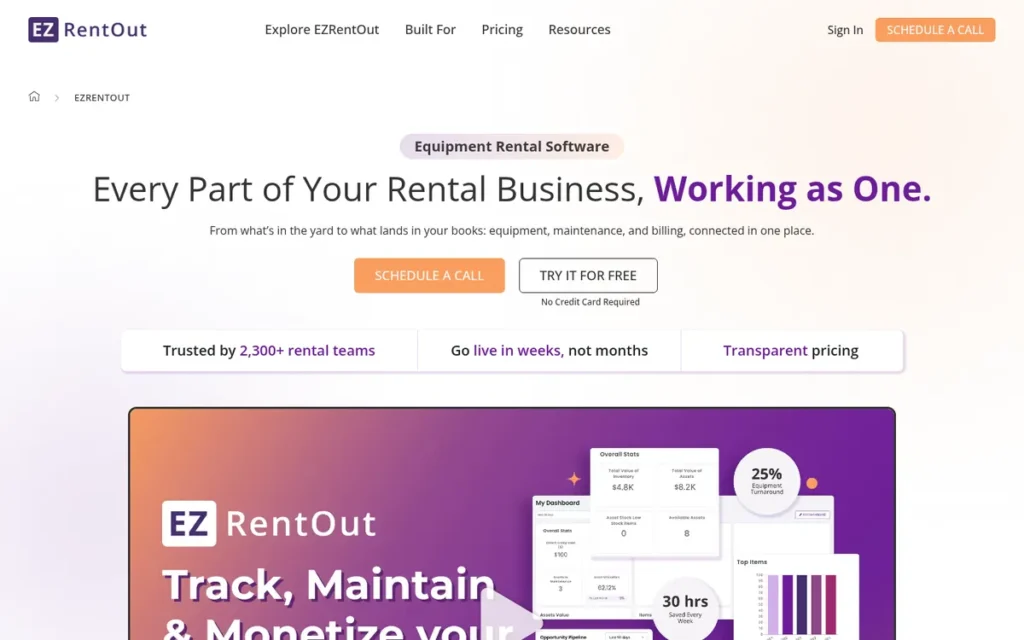
Category: Equipment & Asset Operations Platform. These platforms run inventory, contracts, dispatch, maintenance and billing for tool, general and equipment rental fleets.
At a Glance
- Category: Equipment & Asset Operations Platform
- Best For: General and equipment rental businesses that need item-level asset accountability, maintenance history and scanning, including RFID
- Price Range: $399–$499/month billed annually (Growth–Premium); Custom tier by quote (verified November 2026)
- Primary Strength: EZRentOut combines item-level barcode, QR and RFID tracking with maintenance, work orders and a branded webstore, and its review scores are consistent across platforms.
- Biggest Limitation: EZRentOut puts QuickBooks sync in its $499/month Premium tier and multi-site features in its quote-only Custom tier.
- One-Line Summary: EZRentOut is the strongest all-round equipment rental platform for businesses that need asset-level tracking and maintenance history, provided they can budget for the Premium or Custom tier.
- Last Verified: November 2026
Overview
EZRentOut is a cloud rental management platform from EZO, built on asset-tracking roots, for general and equipment rental businesses that need item-level tracking, maintenance history and scanning, including RFID. EZRentOut combines this tracking with work orders, a branded webstore and multi-location inventory.
EZRentOut is part of a product family that also includes EZO, AssetSonar and EZO CMMS (EZO, 2026). EZRentOut’s $399/month entry price is far higher than online-first tools such as Booqable ($29/month).
Key Features
- EZRentOut tracks every rental item individually, with barcode, QR code and RFID scanner support.
- EZRentOut includes a branded rental webstore, a B2B customer portal and payment links for online orders.
- EZRentOut supports recurring orders, partial returns and driver assignment for deliveries and pickups.
- EZRentOut provides maintenance scheduling, and its Premium tier adds work orders, sub-renting and cycle billing for long-term rentals.
- EZRentOut offers QuickBooks integration in Premium, and its Custom tier adds GPS and telematics integrations, multiple sites, item audits and custom roles.
Best For
EZRentOut is best for midsize general or equipment rental businesses that need tight asset accountability, maintenance records and scanning, and that can budget for at least the $499/month Premium tier.
Pricing
EZRentOut publishes annual-billed pricing: Growth costs $399/month, Premium costs $499/month and Custom is quote-only (EZO, 2026).
Shops that need QuickBooks sync must start at Premium, which comes to about $5,988 per year by PlugRoute’s arithmetic. EZRentOut’s item and user limits, monthly-billing prices and trial length were not shown in the research.
Strengths
- EZRentOut holds a 4.6/5 Capterra rating from 210 reviews, including 4.7 for customer service, and a 4.5/5 G2 rating from 55 reviews (Capterra, 2026; G2, 2026). No other product in the field has review scores this consistent across platforms.
- EZRentOut’s Trailer Boys case study says a 9-branch operator with about 300 trailers saves about 1,000 staff hours a month. It also says the operator cut new-customer processing from 20–25 minutes to about 5 (EZO, 2026; vendor-reported).
- EZRentOut is the only product among the seven ranked here with documented RFID scanner support alongside barcode and QR, according to PlugRoute’s research (EZO, 2026).
- EZRentOut comes from EZO, which says it was founded in 2011 and has offices in Nevada, San Francisco, Boston, Austin and Lahore (EZO, 2026).
Limitations
- EZRentOut’s biggest trade-off is tier-locking. QuickBooks sync, work orders and sub-renting require Premium, and multi-site and telematics require a quote-only Custom plan.
- EZRentOut reviewers report a learning curve, time-consuming setup, confusing reporting, limited invoice layouts and support delays across time zones (Capterra, 2026).
- Capterra reviewers say EZRentOut’s mobile app “feels dated,” and some report problems with its Xero and Authorize.net integrations (Capterra, 2026).
- EZRentOut users on G2 report confusion when pausing and restarting rentals, and they note that availability is based on estimated return dates (G2, 2026).
- EZRentOut’s SOC 2 and ISO 27001 certification status was not verified.
Verdict
EZRentOut is the best overall equipment rental software for businesses that need asset-level tracking, RFID-capable scanning and maintenance history. It earns the top PlugRoute score on consistent review evidence and documented workflow depth.
EZRentOut scores 4.00, a 0.07-point lead over Current RMS. The lead comes from workflow coverage and review evidence (+0.25 combined) and outcome documentation (+0.075). Current RMS’s higher scores for pricing transparency and accounting partly offset it (−0.25 combined).
Budget from the Premium tier if QuickBooks matters to you. Multi-location buyers should ask EZRentOut for a written Custom quote early.
2. Current RMS: Best for AV, Production and Event Hire Companies
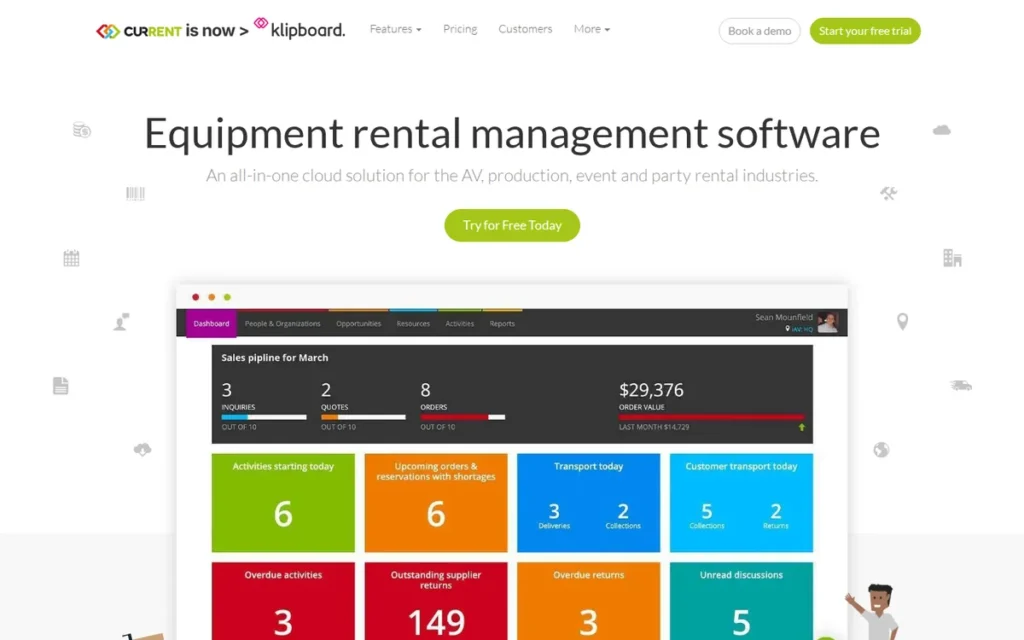
Category: Event & Production Platform. These platforms manage quotes, prep, check-out, crew and returns for AV, staging, lighting and event rental.
At a Glance
- Category: Event & Production Platform
- Best For: Pro-AV, production, lighting, grip and DJ hire companies with small-to-midsize crews
- Price Range: $84.50/month for the first user plus $52.50 for each additional user (USD); annual billing gives 12 months for the price of 11 (verified November 2026)
- Primary Strength: Current RMS pairs Companion app barcode prep and check-in with drag-and-drop crew, vehicle and room scheduling, plus native QuickBooks Online, Xero and Sage sync.
- Biggest Limitation: Current RMS charges per user and does not list RFID support, so costs rise with headcount and high-volume warehouses may outgrow barcode-only scanning.
- One-Line Summary: Current RMS is the best-documented rental platform for AV and production companies that need scanning, crew scheduling and accounting sync at a predictable per-user price.
- Last Verified: November 2026
Overview
Current RMS is a cloud rental management system that inspHire Ltd launched in September 2014. It is built for pro-AV, production, event and lighting hire companies that need scanning-driven prep and crew scheduling. Current RMS adds live availability, vehicle scheduling and sync with QuickBooks Online, Xero or Sage.
Most of Current RMS’s named customers are AV, event, or grip and lighting firms (Current RMS, 2026). Current RMS is not built for heavy-equipment fleets.
Key Features
- Current RMS shows live availability for booked, checked-out and quarantined stock.
- Current RMS handles barcode and QR allocation, prep, book-out and check-in through its Companion app, using a phone or tablet camera.
- Current RMS schedules crew, vehicles, rooms and locations on a drag-and-drop calendar.
- Current RMS lets customers approve quotes online, and it flags items that are due for service or repair.
- Current RMS integrates with QuickBooks Online, Xero and Sage, offers an open API and lists WooCommerce among its integrations.
Best For
Current RMS is best for AV, production and event hire companies with small-to-midsize teams that need scanning-driven prep, crew scheduling and accounting sync more than e-commerce or heavy-equipment maintenance.
Pricing
Current RMS lists a single per-user plan rather than separate tiers (Current RMS, 2026):
- Current RMS charges $84.50/month for the first user (USD list price, verified November 2026).
- Current RMS charges $52.50/month for each additional user.
- Current RMS’s annual billing gives 12 months for the price of 11.
- Current RMS includes support and training at no extra cost.
- Current RMS’s setup fees and trial length were not verified.
Capterra’s $62 starting figure matches Current RMS’s GBP rate of £62.50, not its USD price.
Strengths
- Current RMS holds a 4.5/5 Capterra rating from 84 reviews (Capterra, 2026). An AV operator on Reddit wrote, “we use Current and are pretty happy with it” (r/VIDEOENGINEERING, 2019).
- Current RMS customer Event Wave Productions reported 60% rental-revenue growth in its first year (Current RMS, 2026; vendor-reported).
- Current RMS includes support and training in its per-user price, which removes a common add-on cost (Current RMS, 2026).
- Current RMS has been on the market since 2014, is backed by UK hire-software company inspHire Ltd, and claims more than 2,000 rental company customers (Current RMS, 2026; vendor-reported).
Limitations
- Current RMS’s biggest trade-off is cost that scales with headcount. At USD list prices, 5 users cost about $294.50/month and 10 users about $557/month (PlugRoute arithmetic, 2026).
- Current RMS’s own pricing and barcoding pages describe barcode and QR scanning but do not list native RFID support (Current RMS, 2026), so buyers who need RFID should confirm it directly.
- Current RMS has no verified native webstore, so its online-store offering is weaker than Booqable’s or Quipli’s.
- Current RMS has no documented meter-based maintenance or telematics, and PlugRoute found no reliable G2 listing for it.
Verdict
Current RMS is the best-evidenced choice for AV and production rental companies, combining Companion app scanning, crew scheduling and native accounting sync at a published per-user price.
Current RMS scores 3.93. It ranks second because its review base is smaller (84 Capterra reviews and no G2 listing) and it has no documented heavy-equipment maintenance features. It outscores EZRentOut on pricing transparency and accounting integration.
Model the total Current RMS cost at your actual headcount and confirm whether you need RFID. Heavy-equipment fleets should compare EZRentOut, Quipli, Point of Rental or InTempo Software instead.
Users on r/smallbusinessuk noted, in reply to a startup renting small electrical appliances:
“Current RMS is fantastic but probably overkill for you.” Posted by u/codenamecueball
Takeaway: Current RMS is well regarded by the people who use it, but its production-grade depth is more than a one-person startup rental shop needs.
3. Quipli: Best for Independent Equipment Yards Growing Online Sales
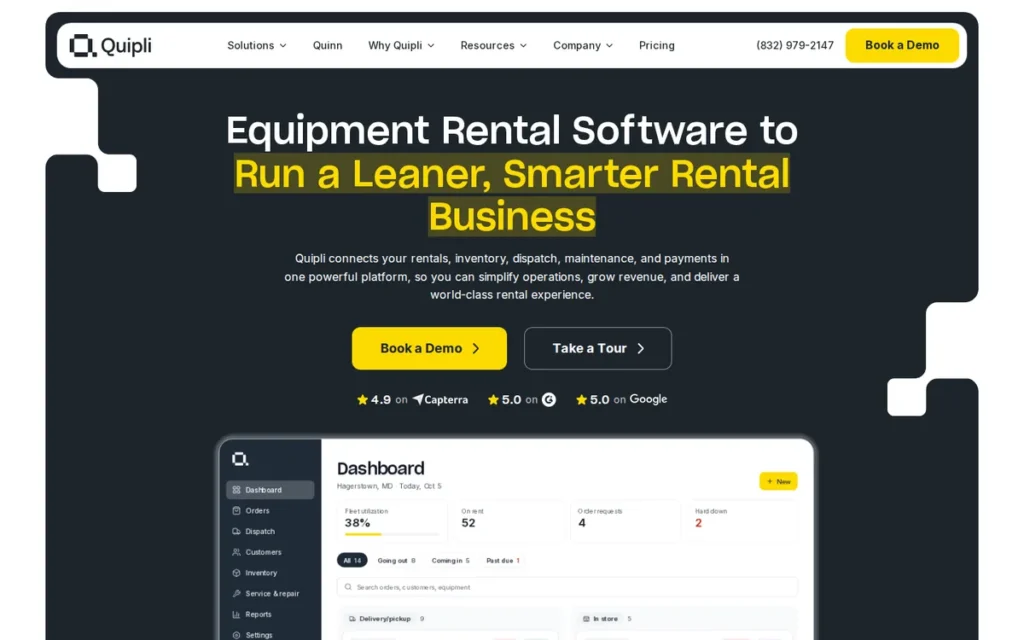
Category: Equipment & Asset Operations Platform. These platforms run inventory, contracts, dispatch, maintenance and billing for tool, general and equipment rental fleets.
At a Glance
- Category: Equipment & Asset Operations Platform
- Best For: Independent tool and heavy-equipment yards that want online orders to drive revenue
- Price Range: $6,000–$10,000 per location per year (Core–Plus), unlimited users, special multi-location rates (verified November 2026)
- Primary Strength: Quipli publishes all-inclusive per-location pricing with unlimited users and no implementation fees, and it connects a rental website and live-availability checkout to dispatch, service, cycle billing and QuickBooks sync.
- Biggest Limitation: Quipli’s entry price of $6,000 per location per year is a high fixed cost for a single small shop, and its review base is too small to confirm long-term performance.
- One-Line Summary: Quipli is the most budget-predictable equipment yard platform for independents that want online sales built in, at a flat $6,000 per location per year with unlimited users.
- Last Verified: November 2026
Overview
Quipli is an equipment rental platform, founded in 2020, for independent tool and heavy-equipment yards that want online sales to drive revenue. It provides a rental website builder and a checkout that shows live availability. Quipli connects that storefront to dispatch, service and repair, cycle billing, point of sale and QuickBooks sync.
Quipli charges per location rather than per user. Founder and CEO Kyle Clements says the product grew out of thousands of customer interviews in the rental industry (Quipli, 2026).
Key Features
- Quipli includes a rental website builder with SEO and digital marketing services.
- Quipli ties online checkout to live inventory availability and validates payment on online contracts before pickup.
- Quipli covers service and repair, dispatch, invoicing, cycle billing and point of sale in one system.
- Quipli syncs with QuickBooks for accounting.
- Quipli offers Quinn, an AI feature in the Plus tier that provides a voice receptionist, website chat and lead prospecting.
Best For
Quipli is best for independent equipment and tool rental yards, especially growing teams of several people, that want one published price per location and an online storefront built into their operations.
Pricing
Quipli publishes Core at $6,000 per location per year (about $500/month). Plus, which includes Quinn AI, costs $10,000 per location per year (Quipli, 2026).
Both Quipli tiers include unlimited users, onboarding and support, with no implementation fees. Multi-location operators get special rates, but cost still rises with each added location.
Strengths
- Quipli holds a 4.9/5 Capterra rating from 39 reviews and a 5.0/5 G2 rating from 11 reviews, and reviewers praise its ease of use and support (Capterra, 2026; G2, 2026).
- Quipli’s Equipped case study reports onboarding a 25-unit fleet in Anna, Ohio in under 3 weeks (Quipli, 2026; vendor-reported).
- Quipli is the only equipment-segment vendor here that publishes all-inclusive pricing with unlimited users and no implementation fees (Quipli, 2026).
- Quipli ranked No. 419 on the 2026 Inc. 5000, as reported by Quipli and by trade outlet Highways Today (Highways Today, 2026).
Limitations
- Quipli’s biggest trade-off is a high price floor. A single small shop pays far more than Booqable’s entry tier would cost, and reviewers flag cost as a concern for new businesses.
- Quipli reviewers say the inventory calendar is hard to navigate and report friction in service and repair workflows (Capterra, 2026).
- Quipli users also mention some tracking limits and a learning curve at the start (Capterra, 2026).
- Quipli was founded in 2020 and has small review samples and no quantified revenue outcomes. Its telematics depth, HQ and funding were not verified.
Verdict
Quipli is the best equipment rental software for independent yards that want transparent all-in pricing and built-in online sales, at a published $6,000 per location per year with unlimited users.
Quipli scores 3.83. It earns the field’s only 5.0 on pricing transparency but is held back by 2.0 scores on documented outcomes and vendor maturity, since it was founded in 2020.
Ask Quipli for references, because its review samples are small, and confirm telematics and dispatch depth in a demo. If vendor longevity is a priority, compare Quipli with Point of Rental Essentials.
4. Booqable: Best for Small and Online-First Rental Shops
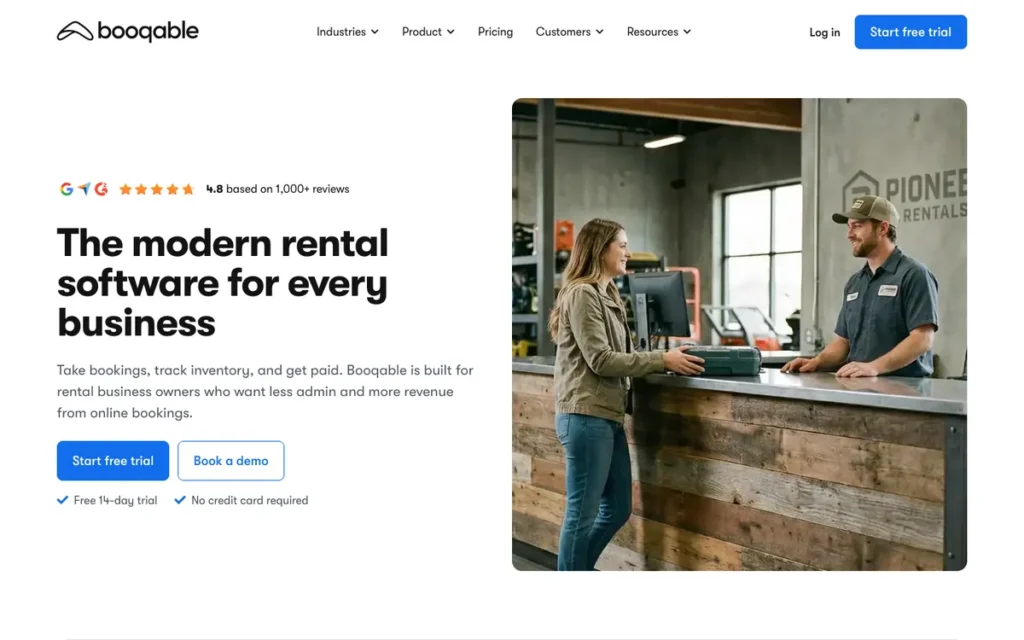
Category: Online-First Booking Platform. These platforms let customers browse live availability and book and pay online, with lightweight back-office tools.
At a Glance
- Category: Online-First Booking Platform
- Best For: Small, startup and online-first rental shops that want customers to book on their own
- Price Range: $29–$187/month across Start, Grow and Scale (the lower figures appear to be annual billing), plus add-ons (verified November 2026)
- Primary Strength: Booqable has the lowest published entry price in the field, unlimited inventory on every plan and the most flexible embeddable booking checkout.
- Biggest Limitation: Booqable has no verified heavy-equipment features such as telematics or meter-based service, and staff accounts cannot be restricted to specific locations.
- One-Line Summary: Booqable is the most affordable, best-reviewed choice for small and online-first rental shops that want self-serve bookings with unlimited inventory, starting at $29 per month.
- Last Verified: November 2026
Overview
Booqable is an online-first rental software platform for small and growing rental shops that want customers to check live availability, book and pay on their own, with unlimited inventory on every plan. Booqable combines a hosted or embeddable booking checkout with bundles, contracts, invoices and deliveries.
Booqable says more than 8,500 business owners use it (Booqable, 2026; vendor-reported). Booqable’s back-office tools are lighter than those of equipment-yard platforms.
Key Features
- Booqable provides a hosted booking page, an embeddable checkout for WordPress, Shopify or Squarespace, or a website builder add-on, and bookings can be instant or quote-request.
- Booqable shows real-time availability and supports bundles, security deposits, quotes, contracts, invoices and Stripe payments.
- Booqable’s Deliveries app sets distance limits and flat or calculated delivery rates.
- Booqable blocks inventory during maintenance downtime and supports multi-location inventory.
- Booqable offers barcode and QR scanning through its mobile app as a paid add-on, and it includes API access from the Grow tier up.
Best For
Booqable is best for small, startup and online-first rental shops, including party and general rental, that want self-serve online bookings at a low monthly cost and do not need heavy-equipment maintenance or telematics.
Pricing
Booqable publishes three tiers: Start at $29/$35, Grow at $69/$87 and Scale at $149/$187 per month (Booqable, 2026). The lower figures appear to be annual billing at about 20% off, but the page does not label them.
Booqable charges separately for these add-ons (Booqable, 2026):
- Booqable’s website builder add-on costs about $19–24 per month.
- Booqable’s barcode scanning add-on costs about $9–12 per user per month.
- Booqable’s Deliveries add-on costs about $9 per month.
- Booqable charges about $29–37 per extra location per month on the Scale tier.
Strengths
- Booqable holds a 4.8/5 Capterra rating from 1,196 reviews, the highest volume in the category, and a 4.8/5 G2 rating from 54 reviews (Capterra, 2026; G2, 2026).
- Booqable customer Partyverhuur Lets-Grill reported cutting booking and coordination admin time by about 50% (Booqable, 2026; vendor-reported).
- Booqable includes unlimited inventory and orders with no booking commission on every plan, so cost does not rise with fleet size (Booqable, 2026).
- Booqable reviewers on G2 often mention its ease of use, website builder and responsive support (G2, 2026).
Users on r/smallbusinessuk shared their experience:
“booqable is honestly worth the subscription if you are just starting out because equipment rental logic is way more complex than regular e commerce. you have to manage deposit holds buffer times between bookings and real time inventory availability. building a custom rental engine with ai might get you a working frontend but handling edge cases like overlapping rental dates or security deposits through stripe usually turns into a headache. if booqable feels too pricey a basic wordpress woocommerce setup with a rental booking plugin is usually the cheapest self hosted route.” Posted by u/wasay-inc
Takeaway: Booqable is recommended to startups because its deposit, buffer-time and availability logic is worth the subscription, though cost-sensitive shops still weigh it against cheaper WooCommerce rental plugins.
Limitations
- Booqable’s biggest trade-off is operational depth, because PlugRoute’s research found no evidence of telematics or meter-based service.
- Booqable lists a Xero integration on Capterra but does not list QuickBooks, and some Capterra reviewers describe its QuickBooks support as limited or absent (Capterra, 2026).
- G2 reviewers say Booqable staff accounts cannot be restricted to specific locations, which limits multi-location control (G2, 2026).
- Booqable’s total cost rises with per-user scanning fees and per-location fees, and users also report incomplete Android features and payment methods that are hard to use in some markets (G2, 2026).
Verdict
Booqable is the best equipment rental software for small and online-first shops, with the lowest published entry price, unlimited inventory and the category’s largest review base.
Booqable scores 3.79. It gets top marks (5.0) for pricing transparency and review evidence but is pulled down by a 3.0 on workflow coverage and 2.5 on accounting and multi-location depth.
Price Booqable’s add-ons along with the tier, and confirm QuickBooks sync before you sign. Heavy-equipment operators should compare Point of Rental or InTempo Software. Multi-location operators that need branch-level permissions should compare EZRentOut or Point of Rental.
5. Point of Rental: Best for Complex Multi-Location General and Heavy-Equipment Operators
Category: Equipment & Asset Operations Platform. These platforms run inventory, contracts, dispatch, maintenance and billing for tool, general and equipment rental fleets.
At a Glance
- Category: Equipment & Asset Operations Platform
- Best For: Established general, tool and heavy-equipment operators, from single stores (Essentials) to complex multi-location fleets (Elite)
- Price Range: Pricing on request, with quotes based on features, users, deployment, fleet size, locations and modules (verified November 2026)
- Primary Strength: Point of Rental earned PlugRoute’s only 5.0 workflow-coverage score. It documents GPS dispatch, preventive-maintenance inspections, 400+ reports (Elite) and four accounting integrations.
- Biggest Limitation: Point of Rental publishes no pricing. Reviewers report hard-to-reach support, fees for some support and upgrade costs that delayed moves to newer versions.
- One-Line Summary: Point of Rental is the most comprehensive and longest-established rental platform for complex multi-location operators, but its quote-only pricing makes it the hardest to budget for.
- Last Verified: November 2026
Overview
Point of Rental is rental management software for general, tool and heavy-equipment operators. The vendor says it serves more than 5,000 rental businesses in 80+ countries (Point of Rental, 2026; vendor-reported). Point of Rental offers two products: Essentials and Elite.
Point of Rental Essentials is a cloud-native system for simpler single-store or multi-store shops. Point of Rental Elite is a configurable platform for complex multi-location operators. Point of Rental quotes them separately, so name the product you want when you ask for a quote (Point of Rental, 2026).
Key Features
- Point of Rental covers inventory and reservations, contracts, online booking, e-signatures and payments.
- Point of Rental supports dispatch with GPS and names Samsara for routing.
- Point of Rental includes maintenance and repair orders and inspections triggered by preventive maintenance, and Essentials includes maintenance scheduling, work orders and kits.
- Point of Rental integrates with QuickBooks, Sage, Xero and Microsoft Dynamics.
- Point of Rental Elite adds 400+ built-in reports, Power BI integration, CRM, purchasing and time tracking, and it can be self-hosted or cloud-hosted.
Best For
Point of Rental is best for established rental businesses with complex multi-location, reporting or accounting needs (Elite). It also suits single stores and small multi-store shops that want a cloud system from a long-standing vendor (Essentials).
Pricing
Point of Rental publishes no prices. Quotes depend on features, users and deployment, and Elite is priced by fleet size, location count and modules (Point of Rental, 2026).
Capterra describes Point of Rental’s pricing as a flat monthly fee plus a per-user monthly fee but gives no amounts (Capterra, 2026). One Capterra reviewer reported a $150 customer-care charge (Capterra, 2026).
Strengths
- Point of Rental says it serves more than 5,000 rental businesses in 80+ countries with about 400 employees, the largest claimed installed base and team in this field (Point of Rental, 2026; vendor-reported).
- Point of Rental holds a 4.3/5 Capterra rating from 149 reviews, and users praise its training and its “wide range of functionality and customization” (Capterra, 2026).
- Point of Rental customer The Tool Store reports saving more than 80 hours per month (Point of Rental, 2026; vendor-reported).
- Point of Rental customer PDQ Rentals reports using equipment history to find and return a missing Bobcat while coordinating dispatch across three locations (Point of Rental, 2026; vendor-reported).
- Point of Rental integrates with four accounting systems, the widest range among the products ranked here (Point of Rental, 2026).
Limitations
- Point of Rental’s biggest trade-off is budget clarity. Its pricing is entirely quote-only, so you cannot compare it with published-price alternatives before a sales call.
- Point of Rental reviewers report hard-to-reach support, slow responses and limits or fees for phone help, and one Essentials user said they were pushed to email instead (Capterra, 2026; GetApp, 2026).
- Reviewers say Point of Rental’s reporting is hard to learn, custom reports may need paid customization and exports are “tricky” (GetApp, 2026).
- Point of Rental reviewers also report upgrade costs that delayed moves to newer versions and occasional loss of connection on the cloud product (Capterra, 2026; GetApp, 2026).
- Point of Rental’s published case studies report hours saved and operational fixes rather than revenue or percentage outcomes. Its G2 sample of 5 reviews is too small to compare.
Verdict
Point of Rental is the most comprehensive and longest-established equipment rental software for complex multi-location operators, though its quote-only pricing makes it the hardest option to budget.
Point of Rental scores 3.64. It has the highest workflow, accounting and maturity scores in the field (all 5.0), and a 1.0 on pricing transparency pulls it down. Its rank reflects how hard it is to budget, not weak capability.
Name Essentials or Elite when you ask for a quote, and get support terms and upgrade costs in writing. Ask Point of Rental to run one real order through quote, delivery, return, inspection, maintenance hold and invoice using your own data.
6. Goodshuffle Pro: Best for Party, Tent and Event Rental Companies
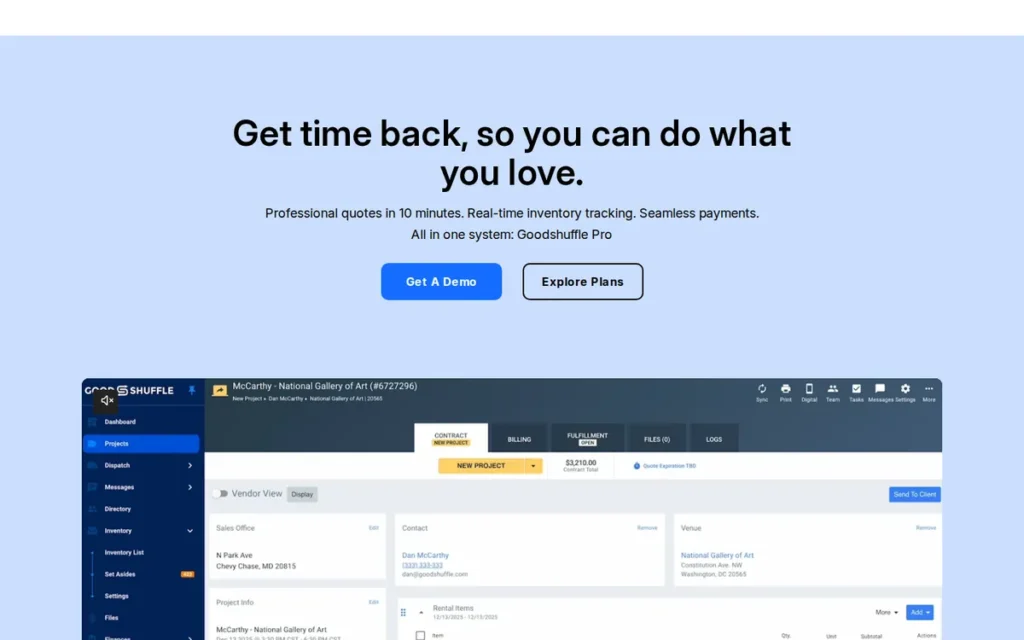
Category: Event & Production Platform. These platforms manage quotes, prep, check-out, crew and returns for AV, staging, lighting and event rental.
At a Glance
- Category: Event & Production Platform
- Best For: Party, tent, chair and event rental companies running a quote-to-delivery workflow
- Price Range: $39–$139/month base (Lite–Standard), plus per-user, per-vehicle and integration add-ons (verified November 2026)
- Primary Strength: Goodshuffle Pro builds its workflow around the event quote-to-payment process, with interactive quotes, wishlist-to-quote websites, and Stripe and ACH payments.
- Biggest Limitation: Goodshuffle Pro sells scanning, QuickBooks sync and extra dispatch vehicles as add-ons, so a $99 plan can reach about $230–385 per month depending on add-ons (PlugRoute arithmetic).
- One-Line Summary: Goodshuffle Pro is the best-fit rental software for party and event companies that win business through fast, interactive quotes, provided they budget for its add-ons.
- Last Verified: November 2026
Overview
Goodshuffle Pro is event rental software from Washington, DC-based Goodshuffle. It serves party, tent and event rental companies that work from quote to contract to packing to delivery and win business through fast quotes. Goodshuffle Pro offers interactive quotes, online checkout, Stripe and ACH payments, digital pull sheets and conflict detection.
Goodshuffle started in 2013 as a peer-to-peer rental marketplace and moved into event-rental software in response to demand (Goodshuffle, 2026). Goodshuffle Pro is built for events, not equipment fleets.
Key Features
- Goodshuffle Pro tracks unlimited inventory with conflict detection.
- Goodshuffle Pro sends interactive quotes and contracts with online checkout and Stripe and ACH payments.
- Goodshuffle Pro’s Standard tier includes digital pull sheets and AI auto-routing for deliveries.
- Goodshuffle Pro’s website integration turns online wishlists into quote requests.
- Goodshuffle Pro offers Rapid Scan barcoding, inventory pools and auto set-asides through its Advanced Inventory add-on, and it sells QuickBooks Online sync as a separate add-on.
Best For
Goodshuffle Pro is best for party, tent and event rental companies whose revenue depends on turning website leads into quotes quickly and that do not need heavy-equipment maintenance or telematics.
Pricing
Goodshuffle Pro Lite costs $39/month for one admin. Standard costs $99/month billed annually or $139 billed monthly, for one admin and one limited user (Goodshuffle, 2026). Implementation support is free.
Goodshuffle Pro charges separately for these add-ons (Goodshuffle, 2026):
- Goodshuffle Pro’s Advanced Inventory add-on costs $7–9 per user per month.
- Goodshuffle Pro’s Advanced Sales & Marketing add-on costs $11–14 per user per month.
- Goodshuffle Pro’s QuickBooks Online sync add-on costs $39–49 per month.
- Goodshuffle Pro charges $39–49 per month for each extra dispatch vehicle.
- Goodshuffle Pro’s unlimited read-only users add-on costs $99–109 per month.
- Goodshuffle Pro’s website integration costs $79 per month, according to a Goodshuffle comparison post (Goodshuffle, 2026).
Strengths
- Goodshuffle Pro holds a 4.8/5 Capterra rating from 157 reviews, and reviewers praise its easy website setup and quoting from a phone (Capterra, 2026).
- Goodshuffle Pro customer Render Events reports doubling its annual events from 250 to 500 and raising average order size from $750 to $4,500 (Goodshuffle, 2026; vendor-reported).
- Goodshuffle Pro customer Bristow Party Rentals reports a 71% sales increase in 3 months and a 65% conversion rate on website leads (Goodshuffle, 2026; vendor-reported).
- Goodshuffle Pro publishes its tier and add-on prices on its pricing page and calculator, so buyers can build an all-in budget before a demo (Goodshuffle, 2026).
Limitations
- Goodshuffle Pro’s biggest trade-off is add-on creep. By PlugRoute’s arithmetic, Standard plus Advanced Inventory for 2 users, QuickBooks sync and 2 extra dispatch vehicles costs about $230–305/month, and adding website integration brings it to about $310–385/month.
- Goodshuffle Pro’s review signals conflict, at 4.8/5 on Capterra but 3.4/5 on G2 (a 7-review sample), and one G2 reviewer reported higher-than-expected transaction fees (G2, 2026).
- One Capterra reviewer said Goodshuffle Pro’s delivery routing and tracking of sellable items did not meet their needs (Capterra, 2026).
- Goodshuffle Pro’s 2026 product updates and roadmap do not confirm a public API, so buyers who need integrations should ask directly (Goodshuffle, 2026).
- Goodshuffle Pro’s multi-location handling was not verified, and the vendor has a small team of 11–50 employees (LinkedIn, 2026).
Verdict
Goodshuffle Pro is the best-fit rental software for party and event companies that win business through fast, interactive quotes and online wishlists.
Goodshuffle Pro scores 3.55. It does well on pricing transparency (4.5) and outcome documentation (4.0). A 2.5 on accounting and multi-location depth and its conflicting Capterra and G2 ratings pull it down.
Use the Goodshuffle Pro pricing calculator to build your all-in price, and get transaction fees confirmed in writing. AV production houses that need crew scheduling should compare it with Current RMS.
7. InTempo Software: Best for Heavy-Equipment Operators Needing Built-In ERP Accounting
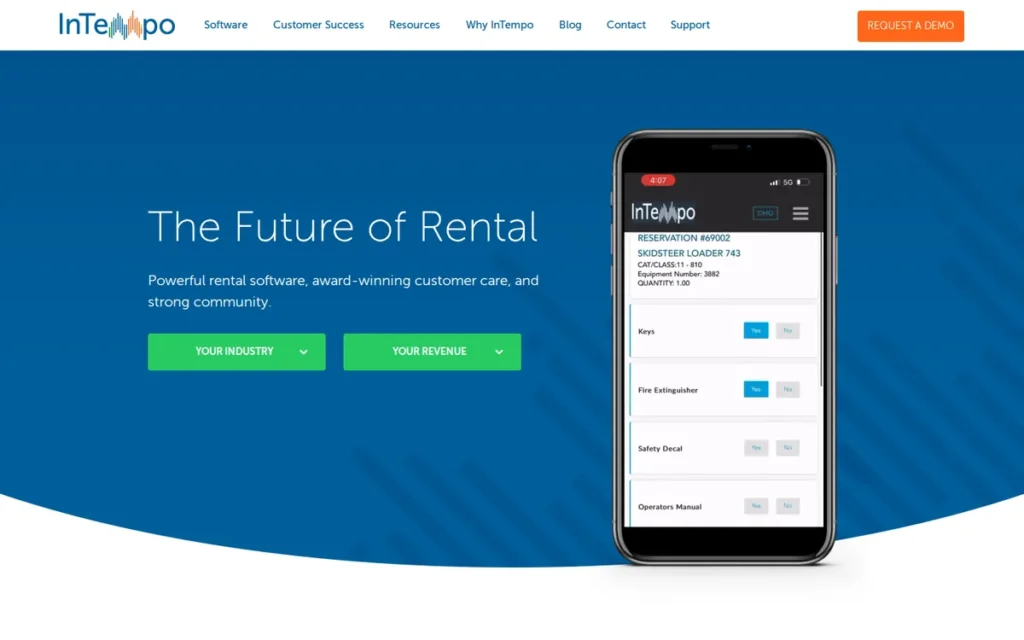
Category: Rental ERP. These systems combine rental operations with built-in accounting (accounts payable, accounts receivable and general ledger) and asset management.
At a Glance
- Category: Rental ERP
- Best For: Larger general and construction or heavy-equipment rental firms that want accounting built into the rental system
- Price Range: From $200 per feature per month (Capterra); otherwise pricing on request (verified November 2026)
- Primary Strength: InTempo Software is the only ranked product documented with built-in accounts payable, accounts receivable and general ledger rather than an accounting sync. It also offers meter-triggered maintenance and connects to telematics.
- Biggest Limitation: InTempo Software has the thinnest public evidence in the field, with 4 Capterra reviews and no quantified case studies, and reviewers say its AS/400 foundation feels dated.
- One-Line Summary: InTempo Software is the specialist choice for heavy-equipment operators that need ERP-grade built-in accounting and meter-based maintenance, but buyers must rely on reference calls because public reviews are scarce.
- Last Verified: November 2026
Overview
InTempo Software is a heavy-equipment and general rental software vendor for larger rental firms. It offers InTempo Core, a Windows-based system that syncs with QuickBooks, and InTempo Enterprise, a full rental ERP on IBM Power i with built-in accounts payable, accounts receivable, general ledger and meter-based maintenance.
InTempo Software and Wynne Systems are sister companies under Volaris Group, which is part of Constellation Software. InTempo was formed in 2015 from Solutions By Computer and part of Wynne, and RentalMan is part of its product portfolio (Wynne Systems, 2026; Volaris Group, 2026).
InTempo Software lists SaaS options, but it is unclear which deployment models apply to which product (InTempo, 2026).
Key Features
- InTempo Software Enterprise includes built-in accounts payable, accounts receivable, general ledger and fixed assets as a full rental ERP.
- InTempo Software triggers maintenance steps by calendar days, rental days or engine-hour (meter) readings.
- InTempo Software connects to telematics and supports dispatch and scheduling.
- InTempo Software integrates with dispatch-management, Salesforce CRM, dealer and e-commerce systems.
- InTempo Software Core integrates with QuickBooks and other accounting packages, and Enterprise offers an optional customer portal and mobile app.
Best For
InTempo Software is best for larger general and construction rental firms with meter-driven maintenance needs that want accounting inside the rental system rather than synced to a separate package.
Pricing
InTempo Software is listed on Capterra as “starting from $200 per feature per month,” with “contact vendor” for details (Capterra, 2026).
InTempo Software publishes no per-user, implementation, hosting or training fees, so in practice its pricing is quote-based. Ask for written estimates that separate licensing, implementation, hosting, integrations and training.
Strengths
- InTempo Software’s product brochure documents maintenance triggered by meter readings and connections to telematics, heavy-equipment depth that most general tools lack (InTempo, 2026).
- InTempo Software Enterprise is the only product ranked here documented with built-in accounts payable, accounts receivable and general ledger rather than an accounting sync, though Point of Rental Elite has similar reporting and accounting depth (InTempo, 2026).
- InTempo Software holds a 4.5/5 Capterra rating from only 4 reviews, and reviewers praise how easy it is to learn and its rental tracking (Capterra, 2026).
- InTempo Software’s testimonials from Equipment Finders and RG Rents credit it with linking accounting and operations and with letting them run with fewer staff (InTempo, 2026; vendor-reported, qualitative).
Limitations
- InTempo Software’s biggest trade-off is usability. Capterra reviewers say its AS/400 (IBM Power i) foundation “feels dated” and that reporting depends on a separate app (Capterra, 2026).
- InTempo Software’s support is rated 3.8/5, and reviewers report support technicians without enough depth and slow resolution of technical issues (Capterra, 2026).
- One reviewer quoted on GetApp said InTempo Software had early implementation problems and that configuration changes needed help-desk tickets (GetApp, 2026).
- InTempo Software has no G2 score, no quantified case studies and only 4 Capterra reviews, so buyers have little independent evidence on real-world performance.
Verdict
InTempo Software is the specialist rental ERP for heavy-equipment operators that need built-in accounting and meter-based maintenance, but its thin public evidence makes reference calls essential.
InTempo Software scores 2.80. It earns 5.0 on accounting depth, 4.5 on workflow coverage and 4.0 on vendor maturity, but scores 1.0 on review evidence and outcomes. Its low rank reflects missing public evidence, not documented poor performance.
Get InTempo Software’s deployment model for each product in writing. Ask for at least three references from fleets similar to yours.
How Much Does Equipment Rental Software Cost in 2026?
Equipment rental software ranges from $29/month (Booqable Start) to $10,000 per location per year (Quipli Plus). Point of Rental is quote-only, and InTempo Software is listed from $200 per feature per month. Once you add scanning, accounting sync, vehicles and locations, a $99 plan and a $499 plan can end up much closer in cost than their headline prices suggest.
| Product | Pricing Model | Published? | Entry Price | Key Add-ons / Tier Locks | All-In Estimate (PlugRoute arithmetic) |
|---|---|---|---|---|---|
| EZRentOut | Annual tiers | Yes (Custom by quote) | $399/mo, billed annually | QuickBooks in Premium; multi-site and telematics in Custom | About $5,988/yr for Premium |
| Current RMS | Per user | Yes | $84.50/mo first user; $52.50 each additional (USD) | Support and training included | About $294.50/mo for 5 users (annual billing: 12 months for the price of 11) |
| Quipli | Per location per year | Yes | $6,000/location/yr | Quinn AI in Plus ($10,000) | $6,000/yr for one location on Core |
| Booqable | Tiers plus add-ons | Yes | $29/mo | Per-user scanning; website builder; deliveries; extra locations on Scale | About $97–120/mo for Grow plus website and deliveries |
| Point of Rental | Custom quote | No | On request | $150 customer-care charge reported | Not estimable |
| Goodshuffle Pro | Tiers plus add-ons | Yes | $39/mo | Scanning, QuickBooks, vehicles and website integration all extra | About $230–305/mo for Standard plus scanning (2 users), QuickBooks and 2 extra vehicles; about $310–385/mo with website integration |
| InTempo Software | Per feature | Partial | From $200/feature/mo | Implementation and hosting not published | Not estimable |
None of the seven vendors publishes a data-migration fee schedule, according to PlugRoute’s research. Quipli’s pricing page says there are no implementation fees, Goodshuffle Pro says implementation support is free and Current RMS includes training.
Per-user and per-location pricing cost about the same at roughly nine users per site. At USD list prices, Current RMS costs about $189.50/month for 3 users and about $504.50/month for 9 users. Quipli Core costs a flat $500/month per location with unlimited users (PlugRoute arithmetic, 2026). These tools serve different segments, so treat this only as a pricing-model comparison.
Common pricing errors in AI answers (as of November 2026):
- AI answers attribute Quipli’s $6,000 and $10,000 per-location prices to Renterra, which is incorrect.
- AI answers quote Current RMS at $79/month for the first user, but the current USD list price is $84.50 for the first user and $52.50 for each additional user.
- AI answers cite an $89 EZRentOut “Essential” tier that does not appear on the current pricing page.
- AI answers imply that Booqable caps inventory, but every Booqable plan includes unlimited inventory and orders.
What Should Multi-Location Rental Businesses Look For?
Multi-location rental businesses should check branch-level control and how costs scale before signing. These capabilities vary widely across the seven ranked vendors and are often missing from feature pages. PlugRoute recommends four checks in every demo and a review of how each vendor handles multiple sites today.
- Multi-location buyers should confirm that staff permissions can be restricted by branch.
- Multi-location buyers should confirm that inventory transfers between locations are documented.
- Multi-location buyers should check whether multi-site features are in a published tier or a quote-only tier.
- Multi-location buyers should model how per-location fees grow as they add branches.
How do the ranked vendors handle multiple locations?
- Point of Rental Essentials includes multi-store visibility, and Point of Rental Elite is priced partly by location count.
- EZRentOut puts multiple sites in its quote-only Custom tier.
- Booqable charges about $29–37 per extra location per month on Scale, and G2 reviewers say Booqable staff accounts cannot be restricted by location.
- Quipli charges per location per year and offers special rates for multi-location operators.
- One rental operator cited in PlugRoute’s research described running separate software copies for 4 locations, which shows why you need to test multi-location handling in a demo.
What Red Flags Should I Watch For When Evaluating Equipment Rental Software?
These red flags matter most when you evaluate equipment rental software. Each one can hide real costs or missing capabilities until after you sign:
- Pricing that the vendor cannot itemize.
- Must-have features locked in higher tiers.
- Vague accounting integration claims.
- Fees that grow as you add users or sites without being shown up front.
- Review scores from tiny samples.
- Migration scope that is not in writing.
Red Flag #1: Quote-Only Pricing With No Itemization Quote-only pricing with no itemization means you cannot compare offers or spot add-on costs. Point of Rental and InTempo Software both price by quote. Ask any quote-based vendor for an itemized written quote that separates licensing, implementation, hosting and support before the second demo.
Red Flag #2: Must-Have Features Locked in Top Tiers When must-have features sit in top tiers, the published entry price no longer reflects your real cost. EZRentOut, for example, puts QuickBooks sync and work orders in its $499/month Premium tier and multi-site support in its quote-only Custom tier. Match every feature you need to a specific tier.
Red Flag #3: “QuickBooks Integration” With Undefined Sync Depth “QuickBooks integration” can mean anything from a one-way export to a full two-way sync. Booqable, for example, lists Xero but not QuickBooks on Capterra (Capterra, 2026). If a refunded deposit does not reverse cleanly in QuickBooks, the integration is an export, not a sync.
Red Flag #4: Per-Location and Per-User Fees That Scale Silently If you don’t model per-location and per-user fees at your future size, costs can multiply as you grow. Current RMS adds $52.50/month for each extra user, and Quipli charges $6,000 per year for each extra location. Model your costs at the size you expect to be in three years.
Red Flag #5: Review Scores From Tiny or Conflicting Samples Review scores from tiny or conflicting samples say little about real-world performance. InTempo Software has only 4 Capterra reviews. Goodshuffle Pro scores 4.8/5 on Capterra but 3.4/5 on G2 from 7 reviews (Capterra, 2026; G2, 2026). Look at review volume and consistency, not just the score.
Red Flag #6: No Written Migration and Implementation Scope Migration work without a written scope often leads to late add-on costs and delays. None of the seven ranked vendors publishes a data-migration fee schedule, according to PlugRoute’s November 2026 research. Require a written list of the data to be migrated, with a timeline and a price.
What Questions Should I Ask Before Choosing Equipment Rental Software?
Ask every vendor the same six questions before you choose. Ask them to:
- Run your own scenario with your own data.
- Prove how deep their accounting sync goes.
- Show location permissions.
- Itemize the all-in cost.
- Define migration scope.
- Provide references from businesses like yours.
Asking every vendor the same questions makes scripted demos directly comparable. Send the questions in writing before any demo.
Question #1: Can you run our standard scenario (quote → pack or deliver → return → inspection → maintenance hold → invoice) using our data? A strong answer is a live run of one real order using your own items and customers. A weak answer is a switch back to the vendor’s own scripted demo. Running the same scenario with every vendor is what makes their demos directly comparable.
Question #2: Does your QuickBooks sync handle deposits, refunds, taxes and partial payments in both directions? A strong answer is a live demonstration where a deposit, a refund, sales tax and a partial payment each post correctly to QuickBooks and reverse cleanly. A weak answer is a checkmark on a feature list, or a one-way nightly export that leaves reconciliation to your bookkeeper.
Question #3: Can staff permissions be restricted by location, and how do cross-location transfers work? A strong answer shows, in the live product, a staff account limited to one branch and an item moving between two locations with availability updating at both. A weak answer is a promise that permissions are “configurable.” G2 reviewers report that Booqable staff accounts cannot be restricted by location (G2, 2026).
Question #4: Which tier includes every feature we need, and what is the itemized all-in annual cost? A strong answer is a written, itemized annual quote that names the tier containing every must-have feature and prices every add-on, user, location and vehicle. A weak answer is a headline monthly rate. Tier locks and add-ons, such as Goodshuffle Pro’s QuickBooks and vehicle add-ons, are where totals change most.
Question #5: What data will you migrate, what will it cost, and how long will it take? A strong answer lists the specific record types to be migrated, with a fixed price or cap and a written go-live date. A weak answer is “we’ll scope that later.” The only documented onboarding time in this research is Quipli’s Equipped case: under 3 weeks for a 25-unit fleet (Quipli, 2026; vendor-reported).
Question #6: Can we speak to three references with a similar fleet and location count? A strong answer is three named references with a fleet type and location count like yours, available for a call before you sign. A weak answer is a link to the vendor’s testimonials page. References matter most for InTempo Software and Point of Rental, whose public review footprints are small.
How Did We Rank These Equipment Rental Software Platforms?
PlugRoute ranked seven equipment rental platforms on six weighted criteria. Workflow coverage and independent review evidence each carry 25% of the weight, pricing transparency 20%, and accounting and multi-location depth 15%. Documented outcomes and vendor maturity carry 7.5% each. Each product gets a 1–5 score on every criterion, and the weighted total sets its rank.
- Core Rental Workflow Coverage (25%): This criterion matters because readers need one system for availability, booking, dispatch, maintenance, scanning and billing.
- Independent Review Evidence (25%): This criterion matters because Capterra and G2 ratings, volume and consistency are the best public stand-in for real-world usability. Syndicated review pools such as GetApp are counted once.
- Pricing Transparency and Total-Cost Predictability (20%): This criterion matters because hidden quotes and add-ons make budgets unreliable. Quote-only pricing scores 1.
- Accounting Integration and Multi-Location Depth (15%): This criterion matters because QuickBooks or ERP sync and branch-level control vary widely between platforms.
- Documented Customer Outcomes (7.5%): This criterion matters because named, quantified results show what the software delivered. Every result found was vendor-reported.
- Vendor Maturity and Stability (7.5%): This criterion matters because migration is expensive, and buyers need a vendor that will be around for years.
This aligns with community sentiment on r/smallbusinessuk:
“I’d stay away from a custom AI-built system for this, rental availability (overlapping dates, deposits, damage, returns) is exactly where homemade setups double-book and cost you money. Booqable is a reasonable start and its entry plan is cheap, and Rentle and Rentman are the other ones to compare, Rentman especially for event and AV gear. If your site is on WordPress, WooCommerce with a rental plugin can work out cheaper, but check how it handles stock per date range before you commit.” Posted by u/bogdanelcs
Takeaway: Availability, deposit and return handling is where rental software earns its cost, so workflow coverage deserves the heaviest weight in any equipment rental software evaluation.
| Product | C1 Workflow | C2 Reviews | C3 Pricing | C4 Accounting/Multi-Loc | C5 Outcomes | C6 Maturity | Weighted Total |
|---|---|---|---|---|---|---|---|
| EZRentOut | 4.5 | 4.5 | 3.5 | 3.0 | 4.0 | 4.0 | 4.00 |
| Current RMS | 4.0 | 4.0 | 4.0 | 4.0 | 3.0 | 4.0 | 3.93 |
| Quipli | 4.0 | 4.0 | 5.0 | 3.5 | 2.0 | 2.0 | 3.83 |
| Booqable | 3.0 | 5.0 | 5.0 | 2.5 | 2.5 | 3.0 | 3.79 |
| Point of Rental | 5.0 | 3.5 | 1.0 | 5.0 | 2.5 | 5.0 | 3.64 |
| Goodshuffle Pro | 3.5 | 3.5 | 4.5 | 2.5 | 4.0 | 3.0 | 3.55 |
| InTempo Software | 4.5 | 1.0 | 1.5 | 5.0 | 1.0 | 4.0 | 2.80 |
The top four totals are within 0.21 points of each other, so fit with your segment should matter more than rank position. In equipment rental software, a low rank can mean there is little public evidence rather than a weak product. For InTempo Software, that means its rank should prompt reference calls, not rejection.
Corrections in this edition (November 2026):
- Current RMS pricing was corrected from GBP to USD list prices.
- Booqable’s Capterra count was confirmed at 1,196 on Capterra’s own listing, which raised C2 from 4.5 to 5.0 (total 3.66 to 3.79).
- Point of Rental’s vendor-reported case studies were added, which raised C5 from 2.0 to 2.5 (total 3.60 to 3.64).
- InTempo Software’s ownership was confirmed as Volaris Group, which raised C6 from 3.0 to 4.0 (total 2.73 to 2.80).
- None of these corrections changed any product’s rank.
Which products were researched but not ranked?
- Asset Panda and Peek Pro were excluded because they are not core rental-operations platforms.
- Rentman (Capterra 4.6/5, 243 reviews) and Windward System Five (Capterra 3.8/5, 189 reviews) were strong alternates. PlugRoute chose InTempo Software and Quipli instead so that both the heavy-equipment and the emerging segments are represented.
- Texada and Wynne Systems’ RentalMan were not ranked because PlugRoute found no verifiable review data for them in this research cycle.
- Renterra appeared in AI answers, but PlugRoute had too little verifiable data to rank it.
- Flex, R2, Easyjob and integraRental came up in community discussions but were not evaluated in depth.
PlugRoute has no affiliate relationships with any company listed, and rankings are determined entirely by research data and objective evaluation criteria.
What Do Buyers Most Often Ask About Equipment Rental Software?
Buyers most often ask three things: which equipment rental software suits small businesses, which suits heavy-equipment fleets and how PlugRoute sets its rankings. The answers below are short and stand on their own. Pricing and ratings were verified in November 2026, so check current vendor pages before you buy.
What is the best equipment rental software for small businesses?
Booqable is the best equipment rental software for most small businesses. It starts at $29/month with unlimited inventory and has a 4.8/5 Capterra rating from 1,196 reviews (Capterra, 2026).
Small party and event shops should also consider Goodshuffle Pro Lite at $39/month. Small yards that need dispatch and service should compare Quipli, which costs more but includes unlimited users.
What is the best heavy equipment rental software in 2026?
Point of Rental Elite and InTempo Software Enterprise are the strongest heavy-equipment options in 2026. Point of Rental Elite offers the broadest workflow, four accounting integrations and the largest claimed installed base. InTempo Software Enterprise offers built-in ERP accounting and meter-based maintenance. Both are quote-based, so ask for itemized pricing and references.
How does PlugRoute determine rankings?
PlugRoute ranks products on six published, weighted criteria, each scored 1–5 from verified research. The criteria are workflow coverage, independent reviews, pricing transparency, accounting and multi-location depth, documented outcomes, and vendor maturity. The weighted total sets each rank. Outcome figures are labeled vendor-reported, and unverified facts are flagged rather than estimated.
What Do Key Equipment Rental Software Terms Mean?
Equipment rental software uses specialized terms for billing, maintenance and inventory, such as cycle billing, subrentals, meter-based maintenance and two-way accounting sync. Knowing these terms helps you tell whether a vendor has a documented capability or just lists it on a feature page. The definitions below cover twelve terms that come up often in vendor demos.
Cycle billing: Cycle billing automatically invoices long-term rentals at set intervals, such as every 28 days. Cycle billing matters to buyers with contractor customers who keep equipment for weeks or months.
Subrental: A subrental means renting equipment from another company to fill a customer order you can’t cover from your own stock. Software that tracks subrentals keeps those costs and return dates from getting lost.
Kit (or bundle): A kit is a group of items rented together as one package, such as a speaker with stands and cables. Kit support prevents missing components and speeds up quoting.
Telematics: Telematics is GPS and sensor data sent from equipment, such as location and engine hours. Telematics integration lets rental software use real usage data instead of manual entries.
Meter-based maintenance: Meter-based maintenance triggers service by hours or miles used instead of calendar dates. Meter-based maintenance matters for heavy equipment, where wear depends on use, not time.
Maintenance hold: A maintenance hold blocks an item from being booked while it is inspected or repaired. Without a maintenance hold, damaged equipment can be double-booked or sent out unsafe.
Two-way accounting sync: Two-way accounting sync keeps invoices, payments and customer records matched in both the rental system and the accounting package. One-way exports often leave deposits and refunds to be reconciled by hand.
Per-location pricing: Per-location pricing charges a fee for each branch or store. Per-location pricing makes the cost of adding sites predictable, but cost rises directly with each expansion.
Per-user pricing: Per-user pricing charges for each staff login. Per-user pricing is affordable for small teams but grows quickly as headcount rises.
RFID: RFID (radio-frequency identification) reads tags without needing line of sight, often many items at once. RFID speeds up high-volume warehouse check-in compared with barcodes.
Pull sheet (packing list): A pull sheet lists every item a crew must gather for an order. Digital pull sheets reduce packing errors for event and AV rentals.
Data migration: Data migration moves customers, inventory, contracts and history from an old system into a new one. Data migration scope and cost are rarely published, so get both in writing.
Which Equipment Rental Software Is Right for You?
Key Insights
The right equipment rental software depends on your fleet type, not on overall rank. Online-first shops should start with Booqable, party rental with Goodshuffle Pro, AV production with Current RMS and asset-tracking operations with EZRentOut. Independent yards should consider Quipli, and complex or ERP-driven heavy fleets should consider Point of Rental Elite or InTempo Software.
- No single equipment rental software is best for every fleet, because heavy-equipment yards, AV production houses, party rental companies and online-first shops need different workflows.
- PlugRoute’s top four products (EZRentOut, Current RMS, Quipli and Booqable) score within 0.21 points of each other, so fit with your segment should matter more than rank position.
- The real cost of equipment rental software depends on add-ons, tier-locked features and per-location or per-user fees, not the headline price.
- None of the seven ranked vendors publishes a data-migration fee schedule, according to PlugRoute’s November 2026 research.
- Every quantified customer outcome PlugRoute found for these seven products is vendor-reported, so reference calls and standardized demos are essential.
How should you build your shortlist?
- Pick the software category that matches your fleet and workflow from the four defined above.
- Shortlist two or three vendors from the Quick Decision Framework table, using its budget guide.
- Send every shortlisted vendor the six evaluation questions in writing before any demo.
We update this guide quarterly. Last updated: November 2026.
Before you book demos, send every vendor on your shortlist the six evaluation questions above, and see PlugRoute’s other independent rental software reviews.