Auctria scores highest for most budget-conscious nonprofits in PlugRoute’s evidence-based ranking. Bonterra OneCause is best for large staffed galas, and AuctionFlex is best for traditional auction houses that want marketplace reach. Nonprofit fundraising tools and auction-house software do different jobs, and the real cost of either depends on fees beyond the headline price.
Most auction software lists put charity gala tools next to auction-house systems, so buyers can’t tell which category fits them. Platform percentages, card processing, marketplace fees and quote-only plans also hide the all-in cost until after you sign.
PlugRoute has no affiliate relationships with any company listed. Rankings are determined entirely by research data and objective evaluation criteria.
This guide ranks seven products in two separate tracks: four nonprofit tools and three auctioneer tools. Every entry follows the same structure, every price has a verification date, and every claim names its source and year.
Last verified: November 2026 · PlugRoute Editorial
What Are the 4 Categories of Auction Software?
Auction software falls into four categories: gala and event auction platforms, all-in-one fundraising suites, auction-house back-office systems and white-label marketplace builders. The first two serve nonprofits running charity auctions. The last two serve professional auctioneers selling consigned or liquidation goods. None of the seven products reviewed documents both jobs.
The four categories work like this:
- Gala & Event Auction Platform (short label: Gala): A gala and event auction platform runs charity auctions and the events around them, from item procurement to checkout. This category includes Auctria, Bonterra OneCause and Handbid.
- All-in-One Fundraising Suite (short label: Suite): An all-in-one fundraising suite is a broad nonprofit platform where auctions are one module next to donations, ticketing and a donor CRM. This category includes Givebutter.
- Auction-House Back Office (short label: Back-Office): An auction-house back office runs an auction business’s cataloging, consignor, clerking, cashiering and settlement workflows. This category includes AuctionFlex and Wavebid.
- White-Label Marketplace Builder (short label: White-Label): A white-label marketplace builder is licensed or custom-built auction software that an operator rebrands and runs as its own marketplace. This category includes AuctionSoftware.com.
Which track are you on?
- If you run a gala, school auction, golf tournament auction or charity silent auction, you are on the Nonprofit & Gala Track (ranks 1–4).
- If you sell consigned goods, estates, equipment, vehicles or liquidation inventory for commission, you are on the Auctioneer & Auction House Track (ranks 5–7).
- If you need both, plan on two separate tools. None of the four nonprofit tools documents consignor settlements, and none of the three auctioneer tools is designed or marketed for galas.
What does “hybrid” mean? Vendors use the word in two different ways:
- Paper-plus-mobile hybrid means guests bid on paper bid sheets while software handles tickets, payment and checkout.
- In-room-plus-remote hybrid means guests in the room and remote bidders compete for the same items at the same time.
How Do the Top Auction Software Platforms Compare at a Glance?
In PlugRoute’s November 2026 ranking, Auctria leads the nonprofit track at 8.25/10 and AuctionFlex leads the auctioneer track at 6.30/10. Scores can only be compared within a track, because each track is judged on different workflows. The table lists all seven products with their category, best use case, main strength and main limitation.
| Rank | Company | Category | Best For | One-Line Summary | Key Capabilities | Primary Strength | Key Limitation |
|---|---|---|---|---|---|---|---|
| Nonprofit & Gala Track | |||||||
| 1 | Auctria | Gala | Budget-conscious nonprofits running recurring auctions | Auctria is a flat-priced nonprofit auction platform that supports silent, live, online and paper-plus-mobile hybrid auctions. | Silent, live, online, paper and hybrid formats; text-to-bid; batch checkout | Clearest published annual pricing in the track | Admin and website editor described as hard to learn |
| 2 | Bonterra OneCause | Gala | Large galas needing on-site vendor staff | Bonterra OneCause is a full-service gala platform with certified on-site event staff. | Live and silent auctions, Fund-a-Need, Express Check-In, Auction AI | G2 support sub-score of 9.5/10 | Only some pricing is published; back end called hard to use |
| 3 | Givebutter | Suite | Modest silent auctions inside year-round fundraising | Givebutter is a tip-funded fundraising suite whose auction module costs $0 in platform fees on bidder-paid payments with tips on. | Silent and online auctions, CRM, peer-to-peer, ticketing | Largest review base (2,605 G2 reviews) | 3% fee on auto-charged payments; no documented auctioneer-led live bidding |
| 4 | Handbid | Gala | In-room galas with heavy mobile bidding | Handbid is a native-app mobile bidding platform that charges no percentage of funds raised. | iOS and Android apps, leaderboards, paddle raise, QR check-in | Live phone support included with every licence | Card rate of 3.5% + $0.30 is above the 2.9% + $0.30 common rate |
| Auctioneer & Auction House Track | |||||||
| 5 | AuctionFlex (with HiBid) | Back-Office | Traditional auction houses wanting shared bidder traffic | AuctionFlex is an auction-house back office bundled with the HiBid bidder marketplace. | Cataloging, consignor settlements, clerking, cashiering, HiBid bidding | Fully published software and marketplace fees | Capterra 2.8/5 (19 reviews), the lowest in this ranking |
| 6 | AuctionSoftware.com | White-Label | Enterprise and liquidation sellers building their own marketplace | AuctionSoftware.com is a white-label auction platform with possible source-code control. | Forward, reverse, penny, timed and hybrid auctions; 10+ payment gateways | Capterra 4.8/5 from 144 reviews | Published prices conflict; reports of custom-build delays |
| 7 | Wavebid | Back-Office | Teams that catalog in the field and sell on several marketplaces | Wavebid is a cloud and mobile auction-management tool that exports catalogs to multiple marketplaces. | Phone cataloging, barcode inventory, tablet clerking, marketplace export | Not locked into a single marketplace | One independent review (Capterra, 2015); pricing not published |
Which Auction Software Should I Choose for My Use Case?
Choose auction software by your top priority. Nonprofits that want low published prices should start with Auctria. Large staffed galas should start with Bonterra OneCause, year-round fundraisers with Givebutter and app-based galas with Handbid. Auctioneers should choose AuctionFlex for settlements and marketplace reach, AuctionSoftware.com for a branded marketplace and Wavebid for field cataloging.
| Your #1 Priority | Recommended Tool | Why | Acceptable Alternative |
|---|---|---|---|
| Event under $10,000 with tech-light volunteers | Auctria Explorer | Free tier with published caps and fees (Auctria, 2026) | Givebutter (bidder-paid, tips on) |
| Recurring auctions raising $10,000–$50,000 | Auctria Emerald | $375/year with a 0.5% Auctria fee (Auctria, 2026) | Bonterra OneCause pay-as-you-go |
| Event over $50,000 with a live auctioneer | Bonterra OneCause Professional | $2,995/year with certified event staff (OneCause, 2026) | Auctria Diamond |
| Lowest predictable cost for a recurring charity auction | Auctria | Published tiers from free to $750/year (Auctria, 2026) | Givebutter (bidder-paid, tips on) |
| Certified staff on site for a large gala | Bonterra OneCause | Certified event staff and a 9.5/10 G2 support sub-score (G2, 2026) | Handbid |
| Auctions inside a year-round donor CRM | Givebutter | Auctions, donations, ticketing and CRM in one system | Auctria |
| Native bidding app with live phone help on event night | Handbid | Native iOS and Android apps and live phone support with every licence (Handbid, 2026) | Bonterra OneCause |
| Paper-plus-mobile hybrid auction | Auctria | Documented paper bid-sheet and hybrid support | Bonterra OneCause |
| Consignor settlements plus marketplace bidder traffic | AuctionFlex (with HiBid) | Full back office bundled with the HiBid marketplace | Wavebid |
| Your own branded marketplace with data control | AuctionSoftware.com | White-label build with possible source-code access | Wavebid (marketplace export) |
| Field cataloging and selling on several marketplaces | Wavebid | Phone cataloging and export to Proxibid, BidSpotter and LiveAuctioneers | AuctionFlex |
Which Auction Software Is Best for Nonprofit Galas and Charity Auctions?
In PlugRoute’s November 2026 evidence review of nonprofit galas and charity auctions:
- Auctria ranks first (8.25/10) on published pricing and review ratings.
- Bonterra OneCause ranks second (7.70) for large staffed galas.
- Givebutter ranks third (7.45) as a tip-funded all-in-one suite.
- Handbid ranks fourth (7.15) for native-app bidding with live event-night phone support.
Auction software matters more as donor bases shrink. Industry and vendor research shows:
- Donor counts fell 3.6% in 2025, the fifth straight annual decline, even as dollars rose (Fundraising Effectiveness Project, 2025).
- Total U.S. giving reached $617.2 billion in 2025 (Giving USA, 2025).
- Auction donors gave $529 on average, compared with $191 for social donors, according to vendor-run research (OneCause, 2025).
1. Auctria: Best Overall for Nonprofit Auctions
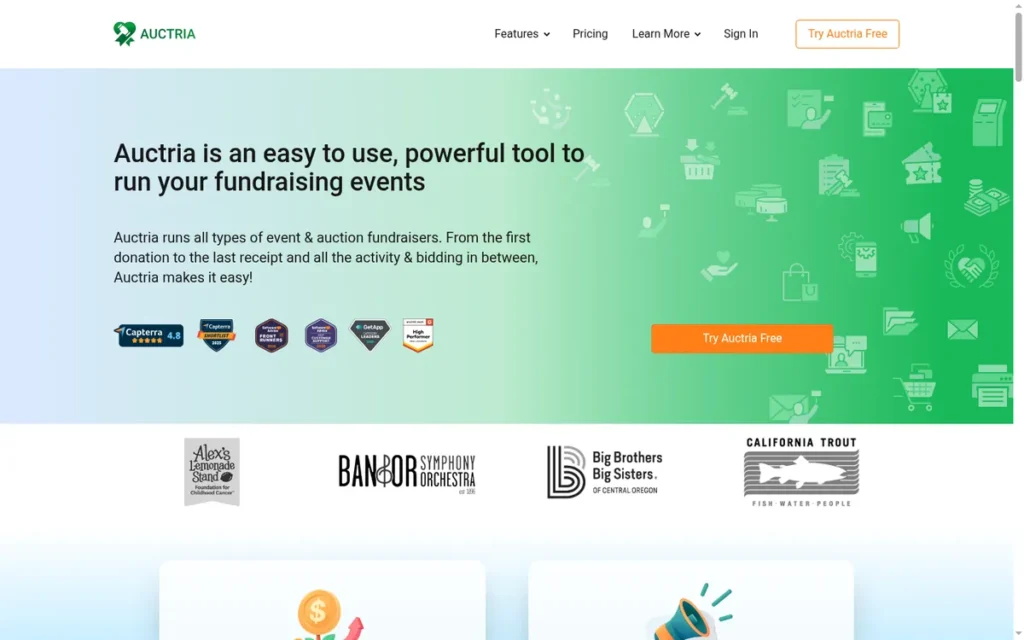
Category: Gala & Event Auction Platform, software built to run charity auctions and the events around them, from item procurement to checkout.
Nonprofit & Gala Track · Track rank 1 · Weighted score 8.25/10
At a Glance
- Category: Gala & Event Auction Platform
- Best For: Small and midsize nonprofits, schools and volunteer committees running recurring silent, live or hybrid auctions on a fixed budget
- Price Range: Free (under $10,000 annual tracked income) to $750/year, plus a 0.25%–1% Auctria fee on top of processor fees (verified November 2026)
- Primary Strength: Auctria publishes the clearest annual pricing in the nonprofit auction category and includes the core auction features on every plan.
- Biggest Limitation: Reviewers repeatedly describe Auctria’s admin and website editor as hard to learn and overwhelming to customize.
- One-Line Summary: Auctria is a flat-priced nonprofit auction platform that supports silent, live, online and paper-plus-mobile hybrid auctions, which makes it the best-value choice for budget-conscious organizations that run auctions every year.
- Last Verified: November 2026
Overview
Auctria is a nonprofit auction and event platform, founded in 2011, for schools, charities and volunteer committees. It suits organizations that need silent, live, online or hybrid auctions with ticketing, donations and checkout at a published annual price.
Auctria reports that its customers have raised more than $1.75 billion since 2011 (Auctria, 2026). Auctria’s figure is self-reported. Auctria’s free Explorer tier has a $10,000 annual income cap that growing events should plan around.
Key Features
- Auctria supports silent, live, online, paper bid-sheet and hybrid auctions from a single event setup.
- Auctria includes item procurement forms, printable catalogs and bid sheets, and an event website with ticket, table and sponsorship sales.
- Auctria offers text-to-bid, text-to-donate and text-to-pay on its paid Emerald and Diamond plans.
- Auctria runs raffles and paddle raises alongside the auction and allows unlimited events per year on every plan.
- Auctria offers guest self-checkout with Apple Pay and Google Pay, as well as batch card processing after the event.
Best For
Auctria is best for small to midsize nonprofits and school auction committees that run one or more auctions a year. Auctria also suits groups that want to budget software costs in advance and need a paper-plus-mobile option for donors who are less comfortable with technology.
Pricing
Auctria lists three tiers on its pricing page (verified November 2026):
- Auctria Explorer is free up to $10,000 in tracked annual income and 250 bidders per event, with a 1% Auctria fee.
- Auctria Emerald costs $375/year for up to $50,000 in income and 750 bidders per event, with a 0.5% Auctria fee.
- Auctria Diamond costs $750/year with no income cap, 1,000 bidders per event and a 0.25% Auctria fee.
Auctria charges these fees on top of the processor’s fee (Stripe or Authorize.Net). Older Auctria prices of $300 and $600 per year still appear on its plan-update blog, and listings show Launch bundles at $874 and $1,249 (Auctria, 2026).
Once recorded income passes $10,000 on Auctria Explorer, Auctria blocks new bids, donations and purchases until the organization upgrades or removes the excess bids (Auctria, 2026). Explorer also leaves out texting, custom emails and Excel import.
Illustrative example: a $20,000 Auctria auction needs Emerald, which costs $375 plus a 0.5% fee ($100), or $475 before processor fees.
Strengths
- Auctria holds a 4.8/5 rating on Capterra from 527–542 reviews and 4.8/5 on G2 from 117 reviews (Capterra, 2026; G2, 2026), the highest combined rating in the nonprofit track.
- Auctria was the top-voted answer in an r/nonprofit thread on low-cost silent auction software, where a user with 20+ years in nonprofit events praised its cost-effectiveness and support (Reddit r/nonprofit, 2024).
- Auctria’s Emerald plan cost one user “about $400 for our auction all told” (Reddit r/nonprofit, 2022). That is a rare dated, user-reported all-in total.
- Auctria publishes its plan prices, income caps, bidder limits and fees, so organizations can calculate costs before talking to sales (Auctria, 2026).
- Auctria supports paper-plus-mobile hybrid auctions. One user who returned to paper bid sheets said, “We still use Auctria to handle ticket sales and payment… Hybrid is best” (Reddit r/nonprofit, 2025).
Users on r/nonprofit shared their experience:
“I second the suggestion for Auctria. Honestly it’s more customizable and has better support than some much more expensive options.” Posted by u/shefallsup
Takeaway: Auctria users on r/nonprofit credit it with stronger support and more flexibility than pricier auction platforms, which supports its value lead in the nonprofit track.
Limitations
- Auctria’s main trade-off is an admin learning curve. Capterra reviewers call the website editor “fairly difficult to learn” and back-end customization “almost overwhelming” (Capterra, 2026).
- Auctria reviewers name ticket types, catalog pages, display order and receipts as trouble spots, and a G2 reviewer describes “clunky auction editing tools” (G2, 2026).
- Auctria’s layered fees, charged on top of processor fees, are called confusing in Capterra reviews, and some reviewers mention price increases (Capterra, 2026).
- Auctria’s free Explorer tier blocks new bids and payments once income passes $10,000, which can interrupt a growing event (Auctria, 2026).
- Auctria provides event-day staffing through a third-party partner, LIFE Event Staffing, and does not document in-house on-site staff (Auctria, 2026).
Verdict
Auctria is the best-value nonprofit auction software in 2026 for organizations that want published pricing and full support for silent, live and hybrid formats. Auctria’s review ratings are the strongest in the track, and its fee schedule is the easiest to model. Give volunteers extra time to learn the admin, and choose a paid tier if the event could pass $10,000.
2. Bonterra OneCause: Best for Large Galas Needing On-Site Staff
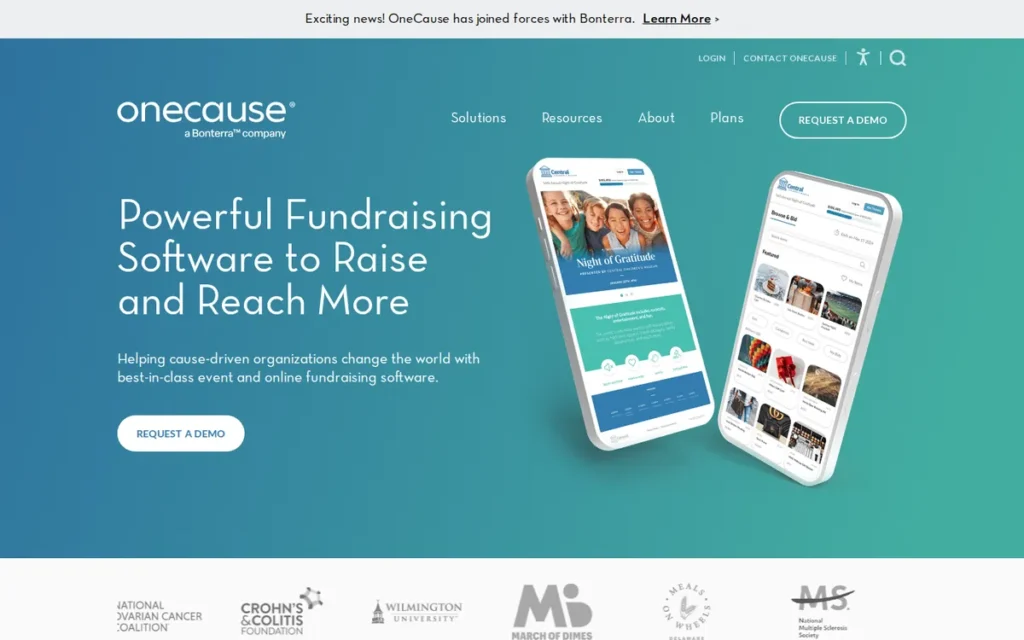
Category: Gala & Event Auction Platform, software built to run charity auctions and the events around them, from item procurement to checkout.
Nonprofit & Gala Track · Track rank 2 · Weighted score 7.70/10
At a Glance
- Category: Gala & Event Auction Platform
- Best For: Mid-size to large nonprofits running high-revenue galas or hybrid events that want vendor staff on site
- Price Range: $200 (or $500 down, per a separate page) + 5% of funds raised up to an undisclosed cap (pay-as-you-go), $2,995/year (Professional) or Enterprise by quote; processing rates not published (verified November 2026)
- Primary Strength: Bonterra OneCause offers the most complete gala feature set and the most hands-on event staffing of the nonprofit platforms reviewed.
- Biggest Limitation: Bonterra OneCause publishes only part of its pricing, and users repeatedly describe its admin back end as hard to use.
- One-Line Summary: Bonterra OneCause is a full-service gala and mobile bidding platform with certified on-site event staff, best suited to large nonprofit events where support and feature depth justify a higher, partly quote-based cost.
- Last Verified: November 2026
Overview
Bonterra OneCause, formerly BidPal, is a gala-focused fundraising platform for mid-size to large nonprofits. It covers mobile bidding, live and silent auctions, Fund-a-Need appeals, ticketing and check-in, with optional certified staff to help run the event.
Bonterra OneCause has operated since 2009, and Bonterra announced its acquisition of OneCause on October 15, 2025 (Bonterra, 2025). OneCause reports more than $6.5 billion raised and more than 90,000 events and campaigns (OneCause, 2026).
OneCause’s figures are self-reported, and the two nonprofit customer counts it has published, 11,000 and 14,000, conflict.
Key Features
- Bonterra OneCause supports silent and live auctions with paddles, spotter tools, fixed-price items, raffles and item procurement.
- Bonterra OneCause runs Fund-a-Need appeals with live scoreboards for giving moments in the room.
- Bonterra OneCause includes Express Check-In, Text2Give and peer-to-peer fundraising alongside its auction tools.
- Bonterra OneCause offers Auction AI to help draft item descriptions.
- Bonterra OneCause provides certified event staff for planning, volunteer training and event-day troubleshooting.
Best For
Bonterra OneCause is best for nonprofits running high-stakes galas or hybrid events that value on-site vendor support more than the lowest software price. These events often have hundreds of guests and live auction segments.
Pricing
Bonterra OneCause publishes part of its pricing (verified November 2026):
- Bonterra OneCause’s pay-as-you-go plan starts at $200 plus a 5% fee on funds raised. OneCause says the fee is capped but does not publish the cap (OneCause, 2026).
- Bonterra OneCause’s pay-as-you-go page also says “as little as $500 down” and positions the plan for organizations raising $50,000 or less a year, so confirm the upfront amount in your quote.
- Bonterra OneCause’s Professional Auction & Event package costs $2,995/year.
- Bonterra OneCause’s Enterprise and Nationals plans are quote-only, and card-processing rates are not published.
One Reddit user negotiated a OneCause price of about $2,200/year (Reddit r/nonprofit, 2021). Another reviewer reported cost changes from year to year without clear explanation (Software Advice, 2026).
Bonterra OneCause’s pay-as-you-go plan costs more than its $2,995 Professional plan once an organization raises about $55,900 in a year, unless OneCause’s undisclosed fee cap applies first.
Illustrative example: a $50,000 OneCause event on pay-as-you-go costs $200 + $2,500 = $2,700 before processing.
Strengths
- Bonterra OneCause holds a 9.5/10 support-quality sub-score on G2, based on 518 reviews with a 4.7/5 rating (G2, 2026). This is the strongest documented support signal in the nonprofit track.
- Bonterra OneCause’s other G2 sub-scores are 9.3 for bid confirmation, 9.2 for auction listings, 8.9 for ease of use and 8.6 for ease of setup (G2, 2026).
- Bonterra OneCause’s vendor-run research found 5.36 bids per item and items raising 134.5% of their stated value (OneCause, 2025).
- In PlugRoute’s feature review, Bonterra OneCause covers the widest documented gala workflow in the track, from procurement through Fund-a-Need, check-in and checkout.
- Bonterra OneCause reviewers on G2 praise event staff who “know the event” (G2, 2026).
Limitations
- Bonterra OneCause’s main trade-off is less pricing transparency in return for more depth and service, because Enterprise pricing and processing rates are quote-only (OneCause, 2026).
- Bonterra OneCause’s back end was called “not very user-friendly” (Reddit r/nonprofit, 2021). A May 2026 user said even finding where to add item images was very difficult and questioned whether the admin had been UX-tested (Reddit r/nonprofit, 2026).
- Bonterra OneCause reviewers report help-desk replies taking more than 24 hours with no live chat (Software Advice, 2026), and changing points of contact (Capterra, 2026).
- Bonterra OneCause reviewers say item detail views cannot be changed on mobile (Capterra, 2026).
- Bonterra OneCause reviewers say an item’s value cannot be split between several donors (Capterra, 2026).
- One G2 reviewer reported that Bonterra OneCause did not integrate with their CRM (G2, 2026), and a small-school reviewer said the cost was hard to afford (Capterra, 2026).
Users on r/nonprofit noted:
“Onecause fees can be high when credit card fees are combined with their fees. A patron paid the covered costs fees and with that added to the fees that onecase charged us, it totaled over 9% of the original charge. Ask about these fees first.” Posted by u/Physical-Row-1270
Takeaway: Bonterra OneCause’s platform fees combined with card fees can push the real cost well above the headline rate, so buyers should get every fee in writing before signing.
Verdict
Bonterra OneCause is the strongest choice in 2026 for large nonprofit galas that need certified event staff and a complete live, silent and Fund-a-Need toolkit. Bonterra OneCause’s support ratings are the best in the track. Smaller organizations running one modest event a year are likely to pay for capacity they won’t use. Get a negotiated written quote and compare it with Auctria’s published tiers of free to $750/year (Auctria, 2026).
3. Givebutter: Best Tip-Funded All-in-One Fundraising Suite with Auctions
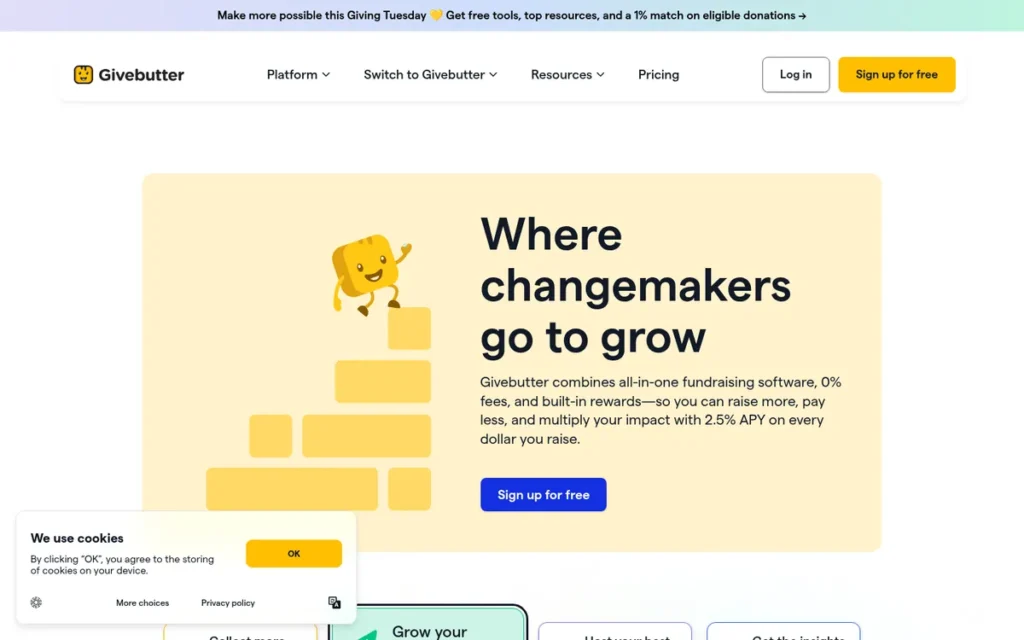
Category: All-in-One Fundraising Suite, a broad nonprofit fundraising platform where auctions are one module alongside donations, ticketing and a donor CRM.
Nonprofit & Gala Track · Track rank 3 · Weighted score 7.20/10
At a Glance
- Category: All-in-One Fundraising Suite
- Best For: Small to midsize nonprofits running modest silent or online auctions alongside year-round donation and peer-to-peer campaigns
- Price Range: $0 platform fee on bidder-paid payments with tips on; 3% on auto-charged payments or with tips off, plus 2.9% + $0.30 processing when tips are off; Plus listed from $29/month (verified November 2026)
- Primary Strength: Givebutter lets nonprofits run online and in-person silent auctions inside a full fundraising CRM, with a $0 platform fee on bidder-paid payments when donor tips are on.
- Biggest Limitation: Givebutter’s auction module is built mainly for silent and mobile bidding and does not document tools for auctioneer-led live auctions.
- One-Line Summary: Givebutter is a tip-funded, all-in-one nonprofit fundraising platform whose auction module is the lowest-cost way to run a modest silent or online auction, as long as tips stay on and bidders pay through payment requests.
- Last Verified: November 2026
Overview
Givebutter is an all-in-one nonprofit fundraising platform, founded in 2016, for small and midsize organizations. It runs silent and online auctions alongside donations, peer-to-peer campaigns, ticketing and a donor CRM, with no platform fee on bidder-paid payments when donor tips are on.
Givebutter reports more than $9 billion in donations processed for thousands of nonprofits (Givebutter, 2026). Givebutter’s figure is self-reported, and PlugRoute found no named auction case studies. Givebutter’s auction module is one part of a broader suite.
Key Features
- Givebutter supports online and in-person silent auctions with outbid alerts, proxy (maximum) bidding, Buy Now and auto-charge.
- Givebutter combines auctions with donations, peer-to-peer fundraising, ticketing, email, texting and a built-in donor CRM.
- Givebutter accepts Cash App, Venmo and Apple Pay at checkout, as well as cards.
- Givebutter lets organizations absorb processing fees, pass them to donors or make coverage optional.
- Givebutter Plus, listed from $29/month, adds automation and donor insights. Confirm the price on Givebutter’s pricing page.
Best For
Givebutter is best for small and midsize nonprofits whose auction is one part of a year-round fundraising program. It suits teams that are comfortable keeping the optional donor tip prompt turned on and collecting payment through bidder payment requests.
Pricing
Givebutter’s fee depends on the tip setting and on how payment is collected (verified November 2026):
- Givebutter charges a $0 platform fee on auction payments when optional donor tips are on and the bidder pays a payment request.
- Givebutter charges a 3% platform fee on auto-charged or manually charged auction payments, even with tips on, and on any payment with tips off (Givebutter Help Center, 2026).
- Givebutter card processing is 2.9% + $0.30 (ACH 1.9% + $0.30) when tips are off.
- Givebutter accounts on legacy pricing pay 5% instead of 3%.
Givebutter’s $0 platform fee does not apply to auto-charged auction payments. Charging a bidder’s saved card triggers the 3% fee even when donor tips are on (Givebutter Help Center, 2026).
Illustrative example: a $10,000 Givebutter auction collected through bidder-paid payment requests with tips on costs $0 in platform fees. The same auction auto-charged at the end of the night costs $300.
Strengths
- Givebutter holds a 4.7/5 rating on G2 from 2,605 reviews (G2, 2026), the largest review base in this ranking. An older snapshot cited by a competitor shows 2,123.
- Givebutter also holds 4.7/5 from 904 reviews on Capterra via Software Advice (Software Advice, 2026). A G2 reviewer said it allowed “ticketing and auctions without substantial technical expertise” (G2, 2026).
- Givebutter is the zero-cost benchmark in Reddit discussions. One user contrasted “free” Givebutter with about $1,300/year for MaestroSoft (Reddit r/nonprofit, 2024).
- Givebutter’s checkout accepts Cash App, Venmo and Apple Pay, which gives donors more payment options than card-only platforms (Givebutter, 2026).
- Givebutter stores auction data in the same CRM as donations and peer-to-peer campaigns, which means one fewer system to integrate (Givebutter, 2026).
Users on r/nonprofit shared their experience:
“I just ran an auction using give butter. It went great. I had it end before everyone left the event during lunch. Everyone paid the site directly. GiveButter sends money to our bank. It was a breeze and we made decent money as all the items were donated.” Posted by u/Hazelstone37
Takeaway: Givebutter gives small events a low-effort silent auction, especially when bidders pay the platform directly before they leave.
Limitations
- Givebutter’s main trade-off is a tip-funded headline price in exchange for less auction depth. A competitor’s comparison reports that it has no auctioneer-led live bidding (RallyUp, 2026).
- Givebutter does not document paper-plus-mobile hybrid support. One user who runs mobile bidding on Givebutter said they were not aware of any hybrid platforms (Reddit r/nonprofit, 2025).
- Givebutter reviewers criticize mandatory bidder accounts, limited payment flexibility and weak detection of duplicate donors (Capterra, 2026).
- Givebutter’s auction management interface “needs improvement,” according to one Trustpilot reviewer, and other reviewers say the tip prompt is not disclosed clearly enough (Trustpilot, 2026).
- Givebutter applies a 3% platform fee to auto-charged and manually charged auction payments even when tips are on, so the real cost depends on how you collect payment (Givebutter Help Center, 2026).
Verdict
Givebutter is the lowest-cost way to run a modest nonprofit silent or online auction in 2026, as long as donor tips stay on and bidders pay through payment requests rather than auto-charge. Givebutter has the largest review base in the category, and keeping auctions in one CRM helps small teams. Galas with a live auctioneer or a paper-plus-mobile format should look at Auctria or Bonterra OneCause instead.
4. Handbid: Best for Native-App Mobile Bidding with Live Phone Support
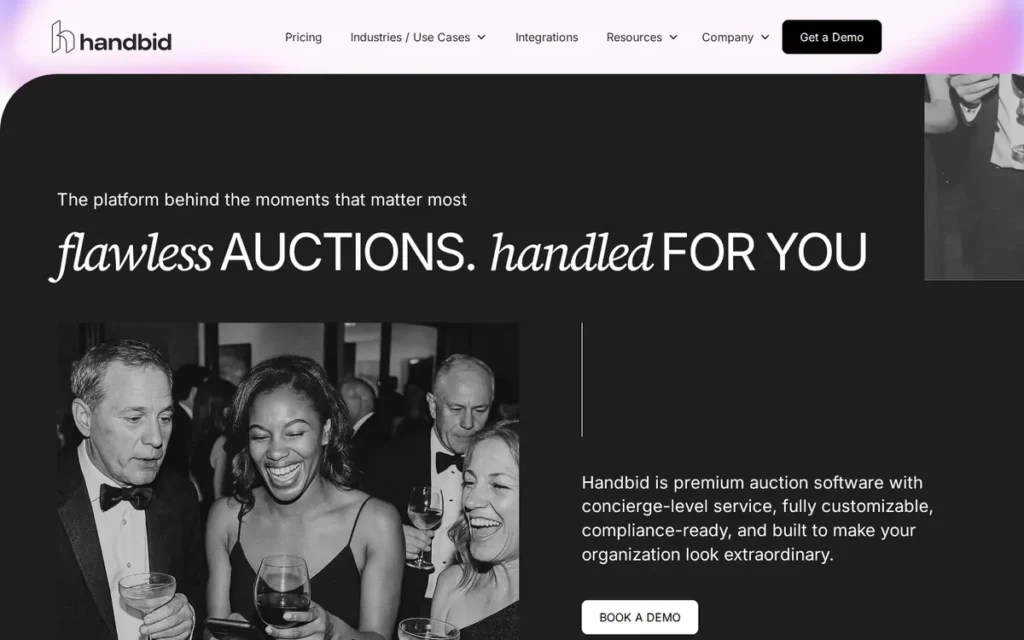
Category: Gala & Event Auction Platform, software built to run charity auctions and the events around them, from item procurement to checkout.
Nonprofit & Gala Track · Track rank 4 · Weighted score 7.15/10
At a Glance
- Category: Gala & Event Auction Platform
- Best For: Nonprofits running in-room galas with heavy mobile bidding that want a branded app experience and live phone help on event night
- Price Range: Quote-based annual licence, about $1,396–$1,999/year per third-party listings; processing 3.5% + $0.30 for cards and 1.5% for ACH (verified November 2026)
- Primary Strength: Handbid includes a live person on the phone during events with every current licence and charges no percentage of funds raised.
- Biggest Limitation: Handbid’s published card-processing rate of 3.5% + $0.30 is higher than the 2.9% + $0.30 online card rate common elsewhere, which adds cost to every transaction.
- One-Line Summary: Handbid is a native-app mobile bidding platform for nonprofit galas that charges no percentage of funds raised and includes live event-night phone support, but its card processing rates are above the common rate.
- Last Verified: November 2026
Overview
Handbid is a family-owned mobile bidding and event platform that has run events since 2011. It serves nonprofits that want native-app and browser bidding, silent and live auctions, paddle raises, ticketing and QR check-in, with a live person on the phone during the event.
Handbid was founded by Jeff and Kari Porter, and its first event was for the Prader-Willi Syndrome Association of Colorado on May 7, 2011 (Handbid, 2026). Handbid charges no percentage platform fee on funds raised, and a Handbid licence usually covers a one-year term.
Key Features
- Handbid offers native iOS and Android bidding apps as well as browser-based bidding.
- Handbid supports silent auctions, live auctions and paddle raises with unlimited items, guests and bidders.
- Handbid includes ticketing and registration, QR code check-in and tap-to-pay checkout.
- Handbid shows projection screens and leaderboards to encourage bidding in the room.
- Handbid includes a live person on the phone during the event with every current licence (Handbid, 2026).
Best For
Handbid is best for nonprofits running in-person galas with competitive mobile bidding. It fits events where branding, real-time leaderboards and a live support line on event night matter more than the lowest processing rate.
Pricing
Handbid’s published fees are as follows (verified November 2026):
- Handbid charges no percentage platform fee on funds raised.
- Handbid processing costs 3.5% + $0.30 for Visa, Mastercard and Discover, 3.95% + $0.30 for American Express and 1.5% for ACH.
- Handbid licences are quote-based. Third-party comparisons, including one from GalaBid (a competitor), report about $1,396 to $1,999 per year (GalaBid and others, 2026).
Illustrative example: processing on a $100 Handbid bid costs $3.80. At the 2.9% + $0.30 rate Givebutter publishes for tips-off payments, the same bid would cost $3.20 (Givebutter Help Center, 2026).
PlugRoute could not fully verify Handbid’s official pricing page, so check it again before signing.
Strengths
- Handbid holds a 4.7/5 rating on G2 from 218 reviews (G2, 2026), and Capterra reviewers call it “convenient for organizers,” with an attractive, simple interface (Capterra, 2026).
- Handbid states that live phone support during the event comes with every current licence (Handbid, 2026). With Bonterra OneCause, it is one of two nonprofit-track products that document in-house event-night help rather than a partner add-on.
- Handbid publishes its card rates and a 1.5% ACH rate and charges no percentage of funds raised, so processing costs are predictable even though licences are quoted (Handbid, 2026).
- Handbid reports a 4.8-star bidder app rating from about 23,000–27,000 app store reviews (Handbid, 2026). This figure is self-reported and covers the bidder app, not the admin software.
- Handbid reports that auction revenue at its founders’ own Derby Day event grew from $14,000 to $28,000 (Handbid, 2026). Because the founders ran the event, it is not an independent case study.
Limitations
- Handbid’s main trade-off is higher card processing costs in return for a native-app bidding experience that reviewers describe as attractive and simple (Capterra, 2026).
- Handbid’s reported criticisms include the push to download an app, a learning curve during setup and reporting that is less flexible for complex reconciliation (Capterra, 2026). These come mostly from review summaries.
- Handbid’s app-based bidding shares a risk common to the whole category. In a general r/nonprofit thread on mobile bidding, one attendee said guests “spend all night staring at our phones” (Reddit r/nonprofit, 2025).
- Handbid’s app bidding depends on reliable venue Wi-Fi or cell coverage. Another user in the same general thread called handing out a Wi-Fi password mid-gala “a total nightmare” (Reddit r/nonprofit, 2025).
- Handbid’s Capterra review count of 44 is thin (Capterra, 2026), and PlugRoute found no Reddit discussion specifically about Handbid.
Verdict
Handbid is the best fit in 2026 for nonprofit galas that want native-app mobile bidding, live phone support on event night and no percentage-of-funds fee. Model Handbid’s processing costs at 3.5% + $0.30 before you compare quotes. Confirm the venue’s connectivity, and decide whether you want guests pushed to download an app.
Which Auction Software Is Best for Auction Houses and Auctioneers?
In the auctioneer track, AuctionFlex ranks first (6.30/10) on back-office depth and fully published fees. AuctionSoftware.com ranks second (6.25) for branded enterprise marketplaces, and Wavebid ranks third (6.00) for field cataloging. The top two are separated by 0.05 points, and Wavebid’s score rests on four neutral scores given where data was missing.
Auction-house buyers weigh different factors than nonprofit buyers:
- Auction-house buyers decide between the reach of a shared marketplace and running their own branded site.
- Auction-house buyers need consignor settlement, clerking and cashiering workflows that fundraising tools don’t document.
- Auction-house buyers should confirm who owns bidder data and whether it can be exported (Reddit r/SaaS, 2025).
5. AuctionFlex (with HiBid): Best Back Office for Auction Houses Wanting Marketplace Reach
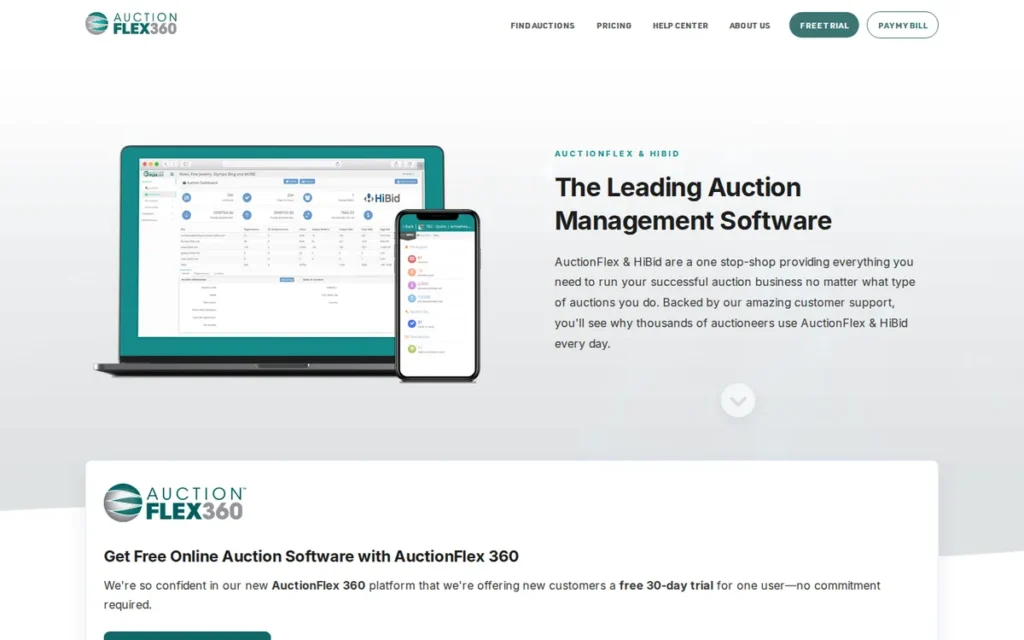
Category: Auction-House Back Office, software that runs an auction business’s cataloging, consignor, clerking, cashiering and settlement workflows.
Auctioneer & Auction House Track · Track rank 1 · Weighted score 6.30/10
At a Glance
- Category: Auction-House Back Office
- Best For: Traditional auction houses and solo to mid-size auctioneers who want full back-office workflows plus shared bidder traffic from the HiBid marketplace
- Price Range: $85–$550/month (desktop) or $95–$295/month (AuctionFlex 360), plus HiBid fees including 2% of gross online sales (verified November 2026)
- Primary Strength: AuctionFlex covers the complete auction-house back office and connects directly to the HiBid marketplace for online, webcast and absentee bidding.
- Biggest Limitation: AuctionFlex has the lowest independent review rating in this ranking, and Capterra users report a huge learning curve and slow support.
- One-Line Summary: AuctionFlex is an auction-house back-office system bundled with the HiBid bidder marketplace that offers the most complete cataloging, settlement and clerking workflow reviewed, but a 2% HiBid fee on gross online sales offsets its low subscription price.
- Last Verified: November 2026
Overview
AuctionFlex is auction-house management software, founded in 2000, for professional auctioneers and auction houses. It handles cataloging, consignor settlements, clerking, cashiering and inventory, with online, webcast and absentee bidding through the bundled HiBid marketplace.
AuctionFlex was founded in Ocala, Florida, by Brandon Harker and Curt Davis (AuctionFlex, 2026). AuctionFlex comes as desktop software or as the browser-based AuctionFlex 360.
Key Features
- AuctionFlex handles cataloging, consignor records and settlements, clerking, cashiering, inventory and reporting in one system.
- AuctionFlex connects to the HiBid marketplace for absentee, online-only, webcast, live and mobile bidding.
- AuctionFlex is available as desktop software priced per workstation or as the browser-based AuctionFlex 360 with per-user plans.
- AuctionFlex includes 25GB of free storage, with additional storage at $0.25/GB.
- AuctionFlex lists sales on HiBid’s shared marketplace, where bidders browse many auctioneers’ sales.
Best For
AuctionFlex is best for traditional auction houses and auctioneers running regular consignment, estate or equipment sales. AuctionFlex fits sellers who need settlement-grade back-office workflows and want bidder traffic from a shared marketplace instead of building their own audience.
Pricing
AuctionFlex publishes its fee schedule (verified November 2026):
- AuctionFlex desktop costs $85/month for 1 workstation, $120 for 2, $155 for 3 and $190 for 4. Each additional workstation is $30, or unlimited workstations cost $550.
- AuctionFlex 360 costs $95, $145 (2–5 users), $195 (6–9 users) or $295/month. One AuctionFlex page names these plans Individual, Team, Business and Unlimited, and another names them Solo, Team, Business and Enterprise.
- AuctionFlex’s HiBid auction fee is 2% of gross sales to online bidders, plus $0.25 per unique bid capped at $150 per auction, or a flat $25, $75 or $125 per auction (AuctionFlex, 2026).
- AuctionFlex’s other HiBid fees include $1 per card authentication, $195 per listing-only auction, and a webcast setup fee listed as $25 on one page and $75 on another.
Legacy AuctionFlex pricing ($60/month, or $1,100 to buy outright) still appears online. AuctionFlex also lists its trial length inconsistently, as 30 days on one page and 3 days on another (AuctionFlex, 2026).
At $200,000 in annual online sales, HiBid’s 2% auction fee ($4,000) is nearly four times the $1,020 annual cost of a single AuctionFlex desktop workstation (AuctionFlex, 2026).
Illustrative example: HiBid’s per-bid fee is capped at $150 per auction, but the 2% gross fee has no cap, so the gross fee is the cost that grows with volume.
Strengths
- AuctionFlex publishes its full software and HiBid fee schedule, so auctioneers can calculate an all-in cost without a sales call (AuctionFlex, 2026). Neither of the other two auctioneer tools reviewed publishes a complete, consistent fee schedule.
- AuctionFlex covers the complete auction-house workflow, including cataloging, consignor settlements, clerking, cashiering and inventory. The fundraising platforms in this ranking do not document these workflows.
- AuctionFlex reports 4,000 to 6,000+ auctioneer customers in the U.S. and Canada (AuctionFlex, 2026). The two figures are self-reported and conflict with each other.
- AuctionFlex publishes a customer testimonial reporting more than 1,200 auctions run on the software since 2010 (AuctionFlex, 2026).
- AuctionFlex’s HiBid bundle gives sellers shared bidder traffic, so they don’t have to build an audience for a standalone branded site.
Limitations
- AuctionFlex’s main trade-off is a low subscription and marketplace reach at the expense of usability. Its 2.8/5 Capterra rating comes from a small sample of 19 reviews and is the lowest in this ranking (Capterra, 2026).
- AuctionFlex reviewers report a “huge learning curve,” difficulty correcting text or swapping photos, and support replies that take hours to days (Capterra, 2026).
- AuctionFlex has one Capterra report of lots disappearing just before close (Capterra, 2026).
- AuctionFlex’s 2% HiBid fee on gross online sales grows with volume and can exceed the subscription several times over (AuctionFlex, 2026).
- AuctionFlex sellers share HiBid’s reputation with bidders, who already pay a buyer’s premium and react badly to extra handling fees (Reddit r/hibid, 2026). A competitor cites a 3.9/5 Trustpilot rating for HiBid (AuctionMethod, 2026).
This aligns with community sentiment on r/hibid:
“You are correct to say HiBid is shooting themselves in the foot with this. They do zero verification whatsoever to confirm if you are an auctioneer. My state requires licensure, but I’ve bid on stuff in TN where they do not require a license and have been a victim of fraud through HiBid. They give these fake auctions an air of legitimacy by platforming them.” Posted by u/CommercialCap2689
Takeaway: AuctionFlex sellers on HiBid share a marketplace that even licensed auctioneers say gives unverified sellers false legitimacy, and that hurts bidder trust in every listing.
Verdict
AuctionFlex is the most complete back-office system of the three auctioneer tools reviewed here in 2026, and it is the only one with a fully published fee schedule. AuctionFlex’s narrow first place rests on workflow depth and pricing transparency, not on user satisfaction, which is the weakest in this ranking. Model the 2% HiBid fee at your real sales volume and budget time for training before you commit.
6. AuctionSoftware.com: Best for Enterprise Sellers Building a Branded Marketplace

Category: White-Label Marketplace Builder, licensed or custom-built auction software that an operator rebrands and runs as its own marketplace.
Auctioneer & Auction House Track · Track rank 2 · Weighted score 6.25/10
At a Glance
- Category: White-Label Marketplace Builder
- Best For: Liquidation, retail-returns, automotive, government and enterprise sellers that want their own branded auction marketplace and control of their data
- Price Range: From a $2,750 one-time licence plus $75/month hosting up to $1,500+/month; a high-volume plan costs about $4,999; published figures conflict (verified November 2026)
- Primary Strength: AuctionSoftware.com documents the widest range of auction types and the most platform control of any product reviewed, including possible source-code access.
- Biggest Limitation: AuctionSoftware.com has the least transparent pricing of the seven products reviewed, and reviewers report missed deadlines and low cost estimates on custom builds.
- One-Line Summary: AuctionSoftware.com is a white-label auction marketplace platform for enterprise and liquidation sellers that offers forward, reverse, timed and hybrid auctions with possible source-code control, but buyers should define scope, ownership and deadlines in the contract.
- Last Verified: November 2026
Overview
AuctionSoftware.com is a white-label auction platform based in Richardson, Texas. It serves liquidation, retail-returns, automotive, collectibles, real estate and government sellers that want to launch and control their own branded online auction marketplace.
Liquidity Services announced its acquisition of AuctionSoftware.com on February 3, 2025, and runs it as Liquidity Services Software Solutions (Liquidity Services, 2025). Capterra lists a 2009 founding date, while Liquidity Services’ release gives 2015. AuctionSoftware.com is not designed for charity galas.
Key Features
- AuctionSoftware.com supports forward, reverse, penny, silent, live, timed and hybrid auctions.
- AuctionSoftware.com is fully white-label and customizable, and depending on the contract it may include source code access, MySQL access and self-hosting.
- AuctionSoftware.com includes barcode cataloging, inventory management, invoicing and pickup scheduling.
- AuctionSoftware.com integrates with PayPal and more than 10 payment gateways, and with Salesforce through its API.
- AuctionSoftware.com offers iOS and Android bidder apps as paid add-ons.
Best For
AuctionSoftware.com is best for enterprise, liquidation and high-volume online sellers that want to own a branded marketplace and their bidder data. Buyers also need the project-management capacity to oversee a custom build.
Pricing
AuctionSoftware.com’s published prices conflict across sources (verified November 2026):
| Source | Published Price |
|---|---|
| Capterra starting price | $1,500/month |
| Vendor site: software licence | $2,750 one-time |
| Vendor site: hosting | $75/month |
| Vendor site: small hosted plans | Free to $249/month |
| G2: high-volume plan | $4,999 (100,000 transactions/year) |
AuctionSoftware.com packages bundle 10–50 hours of development and 10–25 hours of support. The vendor site publishes no closing-fee schedule (AuctionSoftware.com, 2026).
Illustrative example: the first-year AuctionSoftware.com cost ranges from $3,650 (licence plus 12 months of hosting) to $18,000 (Capterra’s starting monthly price over 12 months).
Strengths
- AuctionSoftware.com holds a 4.8/5 rating on Capterra from 144 reviews, with 4.7 for ease of use (Capterra, 2026), the strongest independent review evidence in the auctioneer track. AuctionSoftware.com also holds 4.7/5 from 9 reviews on G2 (G2, 2026).
- AuctionSoftware.com reports more than 500 auction sites built and named 2018 clients including GM and Ingram Micro (AuctionSoftware.com, 2026). These figures are self-reported.
- A G2 reviewer reports that AuctionSoftware.com reduced their cataloging time from days to hours (G2, 2026).
- AuctionSoftware.com documents seven auction types (forward, reverse, penny, silent, live, timed and hybrid), the widest documented range among the seven products reviewed.
- AuctionSoftware.com can include source-code access, database access and self-hosting by contract, which addresses the data-ownership risk practitioners raise about white-label platforms (Reddit r/SaaS, 2025).
Limitations
- AuctionSoftware.com’s main trade-off is more control and flexibility in exchange for less pricing clarity, because its published prices conflict across its own site, Capterra and G2 (2026).
- AuctionSoftware.com reviewers report missed deadlines, cost estimates that turned out too low and unclear lines between base features and paid custom work (Capterra, 2026).
- AuctionSoftware.com reviewers also describe disputes over licensing or conversion fees and “an old Ruby version that could not be updated” (Capterra, 2026).
- AuctionSoftware.com was accused by one reviewer of denying access to hosting the reviewer had paid for, which contradicts the promise of data control (Capterra, 2026).
- AuctionSoftware.com does not document a consignor-settlement workflow, so traditional consignment auction houses should confirm fit in a demo.
Verdict
AuctionSoftware.com is the best-reviewed option in 2026 for enterprise and liquidation sellers that want to own a branded, white-label auction marketplace. AuctionSoftware.com documents the widest range of auction types in this ranking. Before paying, write scope, code ownership, data export and delivery deadlines into the contract.
7. Wavebid: Best for Field Cataloging and Multi-Marketplace Auctioneers
Category: Auction-House Back Office, software that runs an auction business’s cataloging, consignor, clerking, cashiering and settlement workflows.
Auctioneer & Auction House Track · Track rank 3 · Weighted score 6.00/10
At a Glance
- Category: Auction-House Back Office
- Best For: Multi-staff auction teams that catalog on site at estates or equipment yards and sell through several online marketplaces
- Price Range: Not published; about $99/user/month per Capterra (indicative), no free trial (verified November 2026)
- Primary Strength: Wavebid lets auction teams build catalogs from a phone in the field and export them to several online marketplaces.
- Biggest Limitation: Wavebid has almost no independent review evidence: a single Capterra review from 2015 and no G2 or Reddit presence.
- One-Line Summary: Wavebid is a cloud and mobile auction-management tool for auctioneers who catalog in the field and sell across several marketplaces, but almost no independent reviews exist to verify its performance.
- Last Verified: November 2026
Overview
Wavebid is a cloud and mobile auction-management platform for professional auctioneers and multi-staff auction teams. It offers field cataloging from a phone, barcode inventory, consignor settlements, tablet clerking and catalog export to marketplaces such as Proxibid, BidSpotter and LiveAuctioneers.
Wavebid describes its team as having “generations” of auction-industry experience and lists its current address in Omaha, Nebraska (Wavebid, 2026). PlugRoute could not verify Wavebid’s founding date or team size.
Key Features
- Wavebid lets staff build a full auction catalog from a phone, and the vendor says its mobile app can catalog offline and sync later.
- Wavebid tracks inventory by barcode and manages consignor records and seller settlements.
- Wavebid supports clerking from an iPhone or iPad, along with invoicing and online payments.
- Wavebid runs live, online and simulcast auctions.
- Wavebid exports catalogs to Proxibid, BidSpotter and LiveAuctioneers and integrates with MarkNet Alliance’s SAM system.
Best For
Wavebid is best for auction companies with several staff who catalog estates, farms or equipment on site. Wavebid suits teams that want to spread sales across several marketplaces instead of committing to one.
Pricing
Wavebid’s pricing is available only from directories (verified November 2026):
- Wavebid does not publish pricing. Capterra and Software Advice list a Basic plan at about $99 per user per month, which should be treated as an estimate (Capterra, 2026).
- Wavebid does not offer a free trial.
- Wavebid does not document a marketplace percentage fee or per-lot fee, but the fees of the marketplaces it exports to still apply.
PlugRoute could not verify an official Wavebid pricing page, so ask for a written quote.
Illustrative example: a four-person Wavebid team pays about $396/month, or $4,752/year, before marketplace, processing or shipping fees.
Strengths
- Wavebid’s vendor case study reports that I-15 Auctions went from zero online auctions to 70 in its first year and then ran 8–10 a month (Wavebid, 2026). The study is vendor-published and was not independently verified.
- Wavebid exports catalogs to several third-party marketplaces, so auctioneers are not tied to one marketplace’s fees or reputation.
- Wavebid covers consignor settlements, barcode inventory and tablet clerking, the core auction-house workflows that fundraising tools do not document.
- Based on directory-reported per-user pricing, Wavebid has no documented percentage of gross sales, so its software costs would stay flat as sales volume grows (Capterra, 2026).
- Wavebid’s customer HyperAMS automated cataloging and invoicing that it used to do by hand, according to a vendor case study (Wavebid, 2026).
Limitations
- Wavebid’s main trade-off is marketplace independence and field mobility in exchange for verifiability. Its only independent review is a single Capterra entry from 2015 (Capterra, 2015).
- PlugRoute found no Wavebid discussion on G2, Trustpilot or Reddit, so its usability, reliability and support speed cannot be judged from independent evidence.
- Wavebid does not publish official pricing, its directory-reported per-user cost rises quickly with team size, and there is no free trial (Capterra, 2026).
- Wavebid’s offline cataloging claim was questioned by one secondary source, so buyers should test it in a demo.
- Wavebid received neutral scores of 5 on cost transparency, review evidence, support and usability because too little independent data exists. Its rank therefore reflects missing evidence, not a negative finding.
Verdict
On paper, Wavebid is a strong fit in 2026 for auction teams that catalog in the field and sell across several marketplaces, but it is the least independently verified product in this ranking. Wavebid’s documented workflows match auction-house needs closely. Insist on a live demo that includes an offline cataloging test, and ask for customer references and a written quote before signing.
What Does Auction Software Really Cost?
The real cost of auction software is the subscription plus platform percentages, card processing and marketplace fees. For a $10,000 charity auction, software and platform fees range from $0 (Givebutter, tips on, bidder-paid) to about $1,396–$1,999 (Handbid’s reported annual licence). For $200,000 in online auction-house sales, estimated annual costs range from about $3,650 to $18,000.
All figures below are illustrative. They are calculated from fees verified in November 2026 and assume all payments are made by card.
Nonprofit scenarios (software and platform fees only; card processing shown separately):
| Platform | $10,000 Auction | $50,000 Auction | Published Card Processing |
|---|---|---|---|
| Auctria | $100 (Explorer, 1%; at the cap, which blocks further income) or $425 (Emerald) | $875 (Diamond: $750 + 0.25%); Emerald is at its $50,000 cap | Stripe or Authorize.Net rate, plus the Auctria fee above |
| Givebutter, tips on, bidder-paid | $0 | $0 | Covered by Givebutter on tip-enabled, bidder-paid payments |
| Givebutter, auto-charge | $300 | $1,500 | Confirm with Givebutter in writing |
| Givebutter, tips off | $300 | $1,500 | 2.9% + $0.30 (ACH 1.9% + $0.30) |
| Handbid | About $1,396–$1,999 licence | About $1,396–$1,999 licence | 3.5% + $0.30 (AmEx 3.95% + $0.30; ACH 1.5%) |
| Bonterra OneCause (pay-as-you-go) | $700 ($200 + 5%) | $2,700 ($200 + 5%), compared with $2,995 for Professional | Not published |
Auctioneer scenario ($200,000 in annual online sales):
| Platform | Estimated Annual Cost | Marketplace Fees Included? | Not Included |
|---|---|---|---|
| AuctionFlex desktop (1 workstation) + HiBid | $1,020 software + $4,000 HiBid fee = $5,020 | Yes (HiBid 2%) | Bid fees (max $150 per auction), card authentication |
| AuctionFlex 360 ($95/month plan) + HiBid | $1,140 software + $4,000 HiBid fee = $5,140 | Yes (HiBid 2%) | Bid fees (max $150 per auction), card authentication |
| Wavebid (4 users, indicative) | $4,752 | No (Proxibid, BidSpotter and LiveAuctioneers fees extra) | Marketplace, processing and shipping fees |
| AuctionSoftware.com | $3,650 to $18,000 (range of conflicting published prices) | Not applicable (own marketplace) | Custom development beyond bundled hours |
User-reported totals for comparison:
- Auctria’s Emerald plan cost one user about $400 all-in for one auction (Reddit r/nonprofit, 2022).
- Bonterra OneCause cost one user about $2,200/year after negotiation (Reddit r/nonprofit, 2021).
- MaestroSoft cost one user about $1,300/year (Reddit r/nonprofit, 2024).
Fees and Formats at a Glance:
| Product | Pricing Model | Pricing Published? | Main Cost Driver | Fee Triggers to Watch | Formats Supported | Bidding Method | Support Model | Evidence Strength |
|---|---|---|---|---|---|---|---|---|
| Auctria | Flat annual tiers | Yes | Tier price + 0.25%–1% Auctria fee | $10K and $50K income caps; bidder limits | Silent, live, online, paper, hybrid | Online, text-to-bid (paid plans), paper | Help desk + LIFE Event Staffing partner | Capterra 527–542 + G2 117 (Nov 2026) |
| Bonterra OneCause | Pay-as-you-go or annual; Enterprise by quote | Partial | 5% capped fee or annual licence | Undisclosed fee cap; unpublished processing | Silent, live, Fund-a-Need, raffles | Mobile bidding (BidPal), Text2Give | Certified event staff | G2 518 + Capterra 379–388 (Nov 2026) |
| Givebutter | Tip-funded | Yes | 3% on auto-charge or tips off | Tip setting; auto-charge; legacy 5% | Silent (online and in-person) | Online; bidder account required | Mixed, mostly positive reviews | G2 2,605 + Capterra 904 (Nov 2026) |
| Handbid | Quoted licence; no % of funds | Processing yes, licence quoted | 3.5% + $0.30 card processing | Card rate above common 2.9% + $0.30 | Silent, live, paddle raise | Native app + browser | Live phone support with every licence | G2 218 + Capterra 44 (Nov 2026) |
| AuctionFlex | Monthly per workstation or per user | Yes | 2% of gross HiBid online sales | Bid fees, card authentication, listing fees | Live, timed, webcast, absentee | HiBid marketplace | Help desk; reported delays | Capterra 19 (Nov 2026) |
| AuctionSoftware.com | Licence + hosting, or monthly | Conflicting | Custom build scope | Out-of-scope development; licensing fees | Forward, reverse, penny, silent, live, timed, hybrid | Branded web + paid apps | Bundled support hours | Capterra 144 + G2 9 (Nov 2026) |
| Wavebid | Per user per month | No (directory estimate only) | Headcount | Fees from export marketplaces | Live, online, simulcast | Own platform + marketplace export | Not independently documented | Capterra 1 (2015) |
What Red Flags Should I Watch For When Evaluating Auction Software?
The biggest auction software red flags are hidden cost triggers and gaps in event-night support. Watch for:
- free-tier income caps
- fees that change with tip or auto-charge settings
- percentages of gross sales
- unpublished processing rates
- forced app downloads
- help-desk-only support
- white-label contracts without data ownership terms
Red Flag #1: Free Tiers With Income or Bidder Caps Free auction plans often cap tracked income or bidders per event, and passing the cap can halt an event at its peak. Auctria Explorer caps income at $10,000 and bidders at 250 per event, and blocks new bids, donations and purchases once the income cap is passed (Auctria, 2026).
Red Flag #2: Fees That Change With Tip or Auto-Charge Settings Tip-funded platforms can charge a platform percentage depending on how payment is collected, which turns a free tool into a paid one. Givebutter charges 3% when tips are off and on every auto-charged auction payment, even with tips on (Givebutter Help Center, 2026).
Red Flag #3: Marketplace Fees Charged on Gross Sales Auctioneer marketplaces can charge a percentage of gross sales on top of the software subscription, and that fee grows with every sale. HiBid’s 2% auction fee adds $4,000 on $200,000 in online sales, while its per-bid fee is capped at $150 per auction (AuctionFlex, 2026).
Red Flag #4: Quote-Only Pricing With Undisclosed Processing Rates Quote-only plans and unpublished card rates make total cost impossible to compare before a sales call. Bonterra OneCause’s Enterprise and Nationals plans, Handbid’s licences and Wavebid’s plans are quote-based, and OneCause does not publish card-processing rates (OneCause, Handbid and Wavebid, 2026). Ask for every rate in writing.
Red Flag #5: Mandatory App Downloads or Bidder Accounts Bidding that requires an app download or account creation adds friction, especially for older donors and at venues with weak Wi-Fi. In a general r/nonprofit thread on mobile bidding, one attendee said guests spend the night “staring at our phones” (Reddit r/nonprofit, 2025). Text-link bidding reduces this friction.
Red Flag #6: No Guaranteed Event-Night Support Support limited to a help desk can leave organizers on their own when bidding or checkout breaks mid-event. Reviewers report help-desk replies taking more than 24 hours on at least one platform (Software Advice, 2026), so ask for event-night response terms, channels and hours in writing.
Red Flag #7: White-Label Contracts Without Data or Code Ownership Terms White-label contracts without written ownership terms can leave operators unable to export bidder data or move hosting. “White-label doesn’t necessarily mean ownership,” one practitioner warns (Reddit r/SaaS, 2025). Put scope, code, domain and data rights in the contract before paying.
What Questions Should I Ask Before Choosing Auction Software?
Before choosing auction software, ask every vendor the same seven questions in writing. The answers cover plan caps, exact processing rates, app-free bidding, event-night support, included formats, data export and a hands-on checkout test. Together they decide your real cost and your risk on event night or at auction close.
Question #1: What happens if our event exceeds the plan’s income or bidder cap? A good answer names the exact income and bidder cap, explains whether bidding, donations or payments stop when the cap is reached, and gives the upgrade price. Auctria, for example, documents that its free plan blocks new bids once income passes $10,000 (Auctria, 2026). A vague answer suggests the event could be interrupted at its peak.
Question #2: What is the exact card-processing rate, in writing? A good answer gives a percentage plus a per-transaction fee for each card type and for ACH. Compare it with the 2.9% + $0.30 online card rate Givebutter publishes for tips-off payments (Givebutter Help Center, 2026). Then add any platform surcharge on top, such as Auctria’s 0.25%–1% fee.
Question #3: Can bidders bid by text link without downloading an app or creating an account? A good answer confirms browser or text-link bidding and explains how guests register a card. Text-link bidding matters most for older donors and for venues with unreliable Wi-Fi or cell coverage, where app downloads and account creation slow down registration.
Question #4: Who answers the phone on event night or at auction close? A good answer names a live channel, such as phone, on-site staff or a staffing partner, plus its hours and response time. Help-desk email alone is a weak answer for a one-night gala or a timed auction that closes on a weekend evening.
Question #5: Which auction formats does the package I’m quoted actually include? A good answer lists support on your specific tier for silent, live, online, paper-plus-mobile hybrid and in-room-plus-remote hybrid formats. Features such as texting are sometimes limited to paid plans, as with Auctria’s text-to-bid on Emerald and Diamond (Auctria, 2026).
Question #6: Can I export all bidder, item and donor data if I leave? A good answer confirms complete export of bidder, item and donor data in a standard format. For white-label builds, it also confirms code, database and domain ownership. Full data export protects your donor or bidder relationships if you switch vendors.
Question #7: Can I test the full bidder and checkout flow on a real phone before buying? A good answer offers a sandbox event or demo covering registration, bidding, outbid alerts and checkout. PlugRoute found no neutral hands-on test of the bidder experience for any platform reviewed, so run the five-step test below yourself before signing or renewing.
How Do I Test Auction Software Before Event Night? Before signing, run a 15-minute test auction on two phones, one iPhone and one Android, on venue Wi-Fi and on cellular data. Time how long checkout takes for one winning bidder.
- Register as a test bidder on a real phone and note every step the platform asks a guest to complete.
- Place a bid from one phone and outbid it from the second phone to confirm that outbid alerts arrive.
- Set a maximum (proxy) bid and confirm the software bids automatically up to that limit.
- Complete checkout with a real card and record how many minutes it takes.
- Confirm that the receipt reaches the bidder and that the record appears in your CRM or reports.
As one user on r/nonprofit described:
“I can tell you, even to this day, they cause me stress and are so time consuming. Getting the items to the winners is honestly the worst part for me, specifically checkouts. They always feel so chaotic no matter how much preparing I do, especially when our gala has close to 300 items.” Posted by u/PresentCucumber9000
Takeaway: Checkout is the most stressful part of a large silent auction, so testing the full checkout flow before event night matters more than any auction software feature list.
How Did We Rank These Auction Software Platforms?
PlugRoute scored each platform from 1 to 10 on five weighted criteria: cost transparency (25%), format and workflow coverage (25%), independent review evidence (20%), event-day support (15%) and reported usability (15%). Products were ranked only within their track, using dated public evidence gathered in November 2026, with no hands-on testing.
PlugRoute has no affiliate relationships with any company listed. Rankings are determined entirely by research data and objective evaluation criteria.
Ranking criteria and why they matter:
- Total Cost Transparency and Value (25%) scores whether fees, caps and fee triggers are published, because hidden costs are buyers’ biggest frustration.
- Format and Workflow Coverage (25%) scores documented support for each track’s formats and workflows, because a tool without live, hybrid or settlement support is the wrong product.
- Independent Review Evidence (20%) scores G2 and Capterra ratings weighted by volume, because aggregated reviews are the best available independent signal of reliability.
- Event-Day and Operational Support (15%) scores the documented support model and G2 support sub-scores, because support speed at the event or at close affects revenue.
- Reported Bidder Experience and Admin Usability (15%) scores named, dated user reports, because admin usability is the most common criticism in the category.
Score matrix (weighted score = C1×0.25 + C2×0.25 + C3×0.20 + C4×0.15 + C5×0.15):
| Product | Track | C1 Cost | C2 Coverage | C3 Reviews | C4 Support | C5 Usability | Weighted |
|---|---|---|---|---|---|---|---|
| Auctria | Nonprofit | 9 | 9 | 9 | 7 | 6 | 8.25 |
| Bonterra OneCause | Nonprofit | 5 | 10 | 8.5 | 9 | 6 | 7.70 |
| Givebutter | Nonprofit | 7 | 6 | 10 | 6 | 7 | 7.20 |
| Handbid | Nonprofit | 6 | 8 | 7 | 8 | 7 | 7.15 |
| AuctionFlex (with HiBid) | Auctioneer | 8 | 10 | 3 | 4 | 4 | 6.30 |
| AuctionSoftware.com | Auctioneer | 4 | 7 | 8.5 | 6 | 6 | 6.25 |
| Wavebid | Auctioneer | 5* | 9 | 5* | 5* | 5* | 6.00 |
*Neutral score of 5 because of insufficient data.
Scoring disclosures:
- PlugRoute did no hands-on testing for this edition, so the C5 scores summarize attributed user reports.
- Products with too little evidence on a criterion received a neutral 5. Wavebid received it on C1, C3, C4 and C5. Its C1 score was lowered from 6, because Wavebid publishes no official pricing.
- C3 is scored relative to the largest review base within each track. AuctionSoftware.com (153 reviews, the largest in its track) scores 8.5, while Handbid (262 reviews, against Givebutter’s 3,509) scores 7.
- On a single cross-track C3 scale, AuctionSoftware.com would score about 7 and fall to 5.95, below Wavebid. The auctioneer order is sensitive to this choice.
- Givebutter’s C1 score is 7, not 8, because auto-charged auction payments always carry a 3% fee. Givebutter’s clear documentation of the fee keeps it above Bonterra OneCause (5).
- Auctria leads Bonterra OneCause by 0.55 points, mainly on C1 (9 vs 5). OneCause scores higher on C2 (10 vs 9) and C4 (9 vs 7).
- Auctria’s C4 score of 7 reflects reviewer praise for responsive support plus its optional LIFE Event Staffing partner, not in-house on-site staff.
- AuctionFlex scores 10 on C2 and Wavebid scores 9. AuctionFlex documents cashiering and a bundled bidder marketplace, while Wavebid does not document cashiering separately.
- No weighted scores are tied. A tie would go to the product with more independent reviews.
- Sources written by competitors (RallyUp, GalaBid, AuctionMethod) are labeled wherever they are used.
Which Other Auction Software Platforms Did We Consider? PlugRoute did not research the platforms below to the same depth for this edition, so they are not ranked or judged:
- Silent Auction Pro (Capterra 4.8/5 from 402 reviews, 2026) is the strongest candidate for a future edition.
- SchoolAuction.net (Capterra 4.7/5 from 236 reviews, 2026) was considered but not researched in depth.
- Greater Giving was considered but not researched in depth.
- MaestroSoft was considered but not researched in depth.
- RallyUp was considered but not researched in depth.
- GiveSmart was considered but not researched in depth.
- 32auctions was considered but not researched in depth.
- AuctionMethod was considered but not researched in depth.
- Bidpath was considered but not researched in depth.
What Do Buyers Most Often Ask About Auction Software?
Is free auction software really free?
Free auction software is rarely free in practice. Auctria’s free Explorer plan blocks new bids once recorded income passes $10,000 and adds a 1% fee (Auctria, 2026). Givebutter’s $0 platform fee applies only to bidder-paid payments with tips on, and auto-charged auction payments carry a 3% fee (Givebutter Help Center, 2026). Card processing applies on nearly every platform reviewed.
What is the best online auction software with mobile bidding?
Handbid is the strongest documented option for native-app mobile bidding. It offers iOS and Android apps, browser bidding and live phone support with every licence (Handbid, 2026). Bonterra OneCause pairs mobile bidding with certified event staff, and Auctria offers text-to-bid on paid plans. Choose text-link bidding if guests are older or venue Wi-Fi is weak.
How does PlugRoute determine its auction software rankings?
PlugRoute scores each product from 1 to 10 on five weighted criteria: cost transparency, format coverage, independent review evidence, event-day support and reported usability. Products are ranked only within their track, using dated public evidence. Products with too little data receive a disclosed neutral score of 5, and the full score matrix is published above.
What Do Key Auction Software Terms Mean?
Silent auction: A silent auction is a format where guests bid on items without an auctioneer, using paper bid sheets or phones, until a set closing time. Most nonprofit auction tools are built around this format.
Hybrid auction: “Hybrid auction” has two meanings: paper bid sheets combined with mobile checkout, or in-room bidders competing with remote bidders. Ask vendors which meaning they support.
Maximum (proxy) bid: A maximum bid is a bidder’s highest price, which the software bids on automatically in increments until that limit is reached. Proxy bidding keeps bidding competitive when guests aren’t watching their phones.
Platform fee: A platform fee is a percentage of funds raised that the software vendor charges on top of subscription and processing costs. A platform fee can change with plan or payment settings, so model it at your expected revenue.
Card-processing fee: A card-processing fee is the percentage plus per-transaction charge applied to each card payment, often compared against a 2.9% + $0.30 online rate. Small rate differences add up across hundreds of transactions.
Donor tip model: A donor tip model asks donors to add an optional tip that funds the platform, so the nonprofit doesn’t pay a platform fee. Disabling the tip prompt, or charging saved cards automatically, can trigger a platform fee.
Income cap: An income cap is a limit on how much revenue a plan can process in a year. Going over the cap can block new bids or payments, so pick a tier above your realistic total.
Fund-a-Need (paddle raise): Fund-a-Need is a live appeal where guests pledge fixed amounts by raising a paddle or tapping a phone, with no item given in exchange. Fund-a-Need is a common gala revenue moment that software tracks in real time.
Buyer’s premium: A buyer’s premium is a percentage added to the hammer price that winning bidders pay to the auction house. Bidders who already pay a buyer’s premium often react badly to extra handling or shipping charges.
Consignor settlement: Consignor settlement is the process of calculating and paying sellers their share of sale proceeds after commissions and fees. Auction houses need consignor settlement, and nonprofit fundraising tools generally don’t document it.
Clerking: Clerking means recording each lot’s winning bidder and price as the sale happens, often on a tablet. Accurate clerking feeds invoicing, cashiering and settlements.
White-label: White-label software is software that an operator rebrands and runs as its own marketplace. Buyers of white-label software should confirm in writing who owns the code, domain and bidder data.
Which Auction Software Is Right for You?
Key Insights
The right auction software depends first on your track. Nonprofits should start with Auctria for value, Bonterra OneCause for staffed large galas, Givebutter for low-cost modest auctions or Handbid for app bidding with live support. Auction houses should compare AuctionFlex, AuctionSoftware.com and Wavebid, whose scores fall within 0.30 points of each other.
- Choosing your track first is the most important decision, because none of the nonprofit tools documents consignor settlements and none of the auctioneer tools is designed for galas.
- Auctria leads the nonprofit track (8.25/10) because it combines the clearest published pricing with broad format support and 4.8/5 ratings on G2 and Capterra (G2, 2026; Capterra, 2026).
- Bonterra OneCause is the strongest fit for large galas that need certified on-site staff, and its pay-as-you-go plan costs more than its Professional plan above about $55,900 raised.
- Givebutter is the lowest-cost option for modest silent auctions only when tips stay on and bidders pay through payment requests, because auto-charge triggers a 3% fee (Givebutter Help Center, 2026).
- Handbid suits app-based gala bidding with live event-night phone support, but its 3.5% + $0.30 card rate should be modeled before you compare quotes.
- AuctionFlex leads the auctioneer track on back-office depth and published fees, but its 2% HiBid fee on gross online sales and its 2.8/5 Capterra rating are real trade-offs (AuctionFlex, 2026; Capterra, 2026).
- AuctionSoftware.com edges Wavebid on review evidence, and Wavebid’s score rests on four neutral scores, so verify Wavebid through a live demo.
Situational guidance:
- If you run one modest silent auction a year, consider Givebutter with tips on and bidder-paid checkout, or Auctria Explorer under the $10,000 cap.
- If your gala grosses more than $50,000 and has a live auctioneer, consider Bonterra OneCause Professional or Auctria Diamond.
- If you sell consigned goods and want marketplace traffic, consider AuctionFlex.
- If you want your own brand and control of your data, consider AuctionSoftware.com with ownership terms in the contract.
Auction software pricing changes often, so PlugRoute will re-check these fees and scores before the spring gala season. Read PlugRoute’s full methodology or browse our other independent software reviews before you request your first quote.
We update this guide quarterly. Last updated: November 2026.