Last updated: May 2026. Quarterly refresh cycle. Next update: August 2026.
ProcessUnity leads this evaluation as the best overall TPRM platform for dedicated program builds; Mitratech Prevalent ranks second for compliance-heavy enterprises needing the deepest assessment template library; AuditBoard ranks third for audit-led programs connecting TPRM to SOX and internal audit. The right platform depends on whether your organization needs TPRM specialization depth, regulatory compliance breadth, or connected GRC suite integration.
Risk managers and compliance officers at mid-to-large enterprises face accelerating pressure: manual questionnaire cycles that fail to scale across hundreds of vendors, monitoring gaps that create false confidence between assessment intervals, and regulatory mandates from DORA (effective January 2025), NIS-2, and SEC cybersecurity disclosure rules demanding real-time vendor visibility. A mismatched TPRM platform selection (the wrong architecture for your team structure, or an Archer deployment without dedicated developers) typically results in a 12–18 month underutilization period before replacement, with sunk costs exceeding $500,000 for enterprise deployments.
PlugRoute has no affiliate relationships with any company listed in this review. Rankings are determined entirely by research data and objective evaluation criteria.
“Processes typically dictate interval-based reviews, and orgs feel they have the right visibility; however, if you ask those same folks if they were hit by any consequences, a majority said yes. It’s risks within risks due to existing processes.” Posted by u/thejournalizer, r/cybersecurity
Takeaway: Interval-based TPRM assessments create documented false confidence, organizations feel covered between cycles until a breach proves otherwise. This evaluation prioritizes platforms with continuous monitoring as a core architectural feature, not a marketing claim.
Which Are the Top-Ranked TPRM Platforms in 2026?
TL;DR: Top Picks at a Glance
- ProcessUnity is the best purpose-built TPRM specialist in this evaluation, operating the largest third-party risk assessment exchange (14,000+ attested assessments) with GRC 20/20-validated 85–90% workload reductions for dedicated program builds in financial services and healthcare.
- Mitratech Prevalent is the best choice for compliance-heavy enterprises needing rapid program deployment, 800+ framework-mapped templates and AI PDF questionnaire auto-completion earned the highest experienced-practitioner endorsement (12 years of TPRM) in this full evaluation.
- AuditBoard is the strongest platform for audit-led enterprises, connecting TPRM natively to SOX, internal audit workpapers, and ERM in one system, with IDC-validated 40–50% efficiency gains and a 2024 Hg Capital acquisition confirming enterprise market position.
- OneTrust is the top choice for EU-regulated financial institutions, the only platform in this evaluation with purpose-built native DORA Register of Information data models, effective for DORA enforcement since January 17, 2025.
- Diligent is the strongest platform for board governance integration and AI-powered ownership investigation, with March 2026 AI due diligence automation, a proprietary 19-million-entity ownership network, and OFAC sanctions screening, but per-vendor pricing that scales expensively for large portfolios.
- Riskonnect is best for very large enterprises with Salesforce infrastructure and $300K+ risk technology budgets, a comprehensive unified GRC platform rated 4.3/5 by 172 G2 reviewers, but pricing and ecosystem dependency restrict access to the narrowest buyer segment in this evaluation.
- Archer IRM holds a Forrester Wave Q1 2026 Leader designation and the only genuine on-premises deployment option in this evaluation, but requires full-time dedicated internal developers and generates the most consistently negative practitioner community sentiment of any evaluated platform.
What Are the Three Categories of Third-Party Risk Management Software?
Third-party risk management software falls into three categories: TPRM Specialists (ProcessUnity, Mitratech Prevalent) that dedicate 100% of their roadmap to vendor risk; Connected Risk Platforms (AuditBoard) that integrate TPRM with internal audit and SOX in one environment; and Integrated GRC and Trust Platforms (OneTrust, Diligent, Riskonnect, Archer IRM) that include TPRM within broader suites.
The right category depends on your team’s ownership structure:
- Your team owns TPRM independently → TPRM Specialist (ProcessUnity, Mitratech Prevalent)
- Internal audit co-owns TPRM → Connected Risk Platform (AuditBoard)
- TPRM is one component of a broader GRC or privacy compliance program → Integrated GRC and Trust Platform (OneTrust, Diligent, Riskonnect, Archer IRM)
TPRM Specialists: ProcessUnity and Mitratech Prevalent
TPRM Specialists allocate their entire product roadmap, engineering, and customer success to TPRM use cases, producing the deepest assessment automation, workflow coverage, and shared risk data exchange networks in the evaluated market.
ProcessUnity is differentiated by its Global Risk Exchange network; Mitratech Prevalent by its 800+ compliance template library and AI PDF auto-completion.
Connected Risk Platforms: AuditBoard
Connected Risk Platforms integrate TPRM directly with internal audit, SOX compliance testing, and enterprise risk management in a single data environment.
AuditBoard is the only platform in this evaluation category, making it the strongest choice when internal audit teams own or co-own vendor risk and need TPRM findings surfaced alongside audit workpapers without cross-system reconciliation.
Integrated GRC and Trust Platforms: OneTrust, Diligent, Riskonnect, Archer IRM
Integrated GRC and Trust Platforms include TPRM as one module among broader privacy, governance, or enterprise risk capabilities.
OneTrust leads for regulatory breadth, Diligent for board governance integration, Riskonnect for unified GRC depth, and Archer IRM for formal analyst recognition, each with distinct trade-offs in depth, pricing, and implementation feasibility discussed in the entries below.
How Do the Top TPRM Platforms Compare at a Glance?
The seven evaluated platforms span four categories and three budget tiers. ProcessUnity and Mitratech Prevalent are purpose-built TPRM specialists; AuditBoard connects TPRM to internal audit in one system; OneTrust, Diligent, Riskonnect, and Archer IRM embed TPRM within broader GRC, privacy, or governance platforms. Full comparison with pricing intelligence and practitioner evidence follows.
| Rank | Company | Category | Best For | One-Line Summary | Key Capabilities | Primary Strength | Key Limitation |
|---|---|---|---|---|---|---|---|
| 1 | ProcessUnity | TPRM Specialist | Dedicated program builds in financial services and healthcare | Purpose-built TPRM specialist with the largest assessed data exchange and GRC 20/20-validated 85–90% workload reductions | Global Risk Exchange, Dynamic Risk Scoping, AI Assessment Automation, Fourth-Party Tracking | Largest third-party risk data exchange in evaluated market (14,000+ attested assessments) | No bundled GRC suite; separate platform needed for ERM, audit, or privacy integration |
| 2 | Mitratech Prevalent | Compliance-Centric TPRM | Compliance-framework-driven programs needing rapid template deployment | Deepest template library (800+) with AI PDF auto-completion and highest experienced-practitioner endorsement in this evaluation | 800+ Template Library, AI PDF Auto-Completion, 6-Dimension Monitoring, Vendor Intelligence Network | 800+ pre-built compliance templates with AI PDF questionnaire auto-completion | Higher cost and longer implementation than ProcessUnity (PeerSpot, 2025) |
| 3 | AuditBoard | Connected Risk Platform | Enterprises where internal audit owns or co-owns vendor risk | Connected risk platform linking TPRM to SOX, internal audit, and ERM in a single system | Connected Risk Architecture, CrossComply Multi-Framework, Bitsight Integration, Board-Ready Reporting | Native TPRM-to-audit-to-SOX-to-ERM connected risk architecture in one system | TPRM is an add-on; not suitable as a standalone TPRM-only purchase |
| 4 | OneTrust | Trust Intelligence Platform | EU-regulated enterprises managing DORA and GDPR together | Only evaluated platform with native DORA Register of Information models and GDPR Article 28 vendor workflows | DORA Register of Information Module, GDPR Article 28 Workflows, Third-Party Risk Exchange, 100+ Integrations | Purpose-built native DORA Register of Information module with XBRL report generation | Modular pricing escalates significantly; documented undisclosed renewal price increases |
| 5 | Diligent | Governance-Integrated TPRM | Enterprises requiring board-level vendor risk visibility and ownership investigation | AI-powered third-party investigation with proprietary ownership data, board governance integration, and March 2026 due diligence automation | AI Third-Party Investigator, O&A Network (19M entities), Sanctions Screening, Board Governance Integration | AI Third-Party Investigator with 19-million-entity O&A Network and global OFAC/EU sanctions screening | Per-vendor pricing described as “offensively expensive” for large portfolios (r/cybersecurity, 2024) |
| 6 | Riskonnect | Integrated GRC Platform | Very large enterprises with Salesforce infrastructure and $300K+ budgets | Unified Salesforce-native GRC connecting TPRM, ERM, and compliance; rated 4.3/5 by 172 G2 reviewers | Unified GRC Data Model, 10,000+ Pre-Mapped Controls, Monte Carlo Simulation, Fourth-Party Monitoring | Single unified GRC data model across TPRM, ERM, and compliance; 10,000+ pre-mapped controls | Licensing starts ~$283K/year; Salesforce-native architecture adds ecosystem dependency costs |
| 7 | Archer IRM | Enterprise GRC Platform (Legacy Incumbent) | Very large mature GRC organizations with dedicated full-time Archer development teams | Forrester Wave Q1 2026 Leader; only platform with on-premises deployment; requires full-time dedicated developers | 3-Level Relationship Mapping, On-Premises Deployment, Archer Exchange (400+ App-Packs), RiskRecon Integration | Forrester Wave Q1 2026 Leader; only evaluated platform with genuine on-premises deployment | Most consistently negative practitioner community sentiment; requires dedicated full-time developers |
Which TPRM Platform Should I Choose for My Specific Needs?
Match your primary organizational need to the recommended platform using the framework below. If your team owns TPRM independently, start with ProcessUnity or Mitratech Prevalent. If internal audit co-owns TPRM, AuditBoard belongs first on your shortlist. If DORA or GDPR compliance drives the purchase, OneTrust’s native regulatory data models offer a genuinely differentiated starting point.
Before using this framework: organizations without a dedicated risk manager or compliance owner typically achieve better results starting with ProcessUnity or Mitratech Prevalent than with Archer or Riskonnect, the latter two require internal resources the framework assumes you have.
| Your #1 Priority | Recommended Tool | Why | Acceptable Alternative |
|---|---|---|---|
| Dedicated TPRM program build; maximize assessment efficiency | ProcessUnity | Purpose-built TPRM specialist; 14,000+ shared assessments in Global Risk Exchange; GRC 20/20-validated 85–90% workload reductions | Mitratech Prevalent for deeper compliance template coverage |
| Compliance-framework-driven program; deep template library required | Mitratech Prevalent | 800+ pre-built framework-mapped templates; AI PDF-to-questionnaire auto-completion; highest experienced-practitioner endorsement in this evaluation | ProcessUnity for stronger data exchange network coverage |
| Audit-led program; SOX and internal audit integration required | AuditBoard | Native connected risk architecture linking TPRM to SOX, audit workpapers, and ERM; IDC-validated 40–50% efficiency gains | OneTrust if privacy and regulatory breadth are also needed |
| DORA or GDPR compliance is the primary purchase driver | OneTrust | Only platform with native DORA Register of Information data models (including XBRL output) and GDPR Article 28 vendor documentation workflows | ProcessUnity for TPRM operational depth; confirm DORA support depth separately |
| Board governance integration and ownership investigation required | Diligent | AI Third-Party Investigator with proprietary 19M-entity O&A Network; native integration with board management platform used by 1M+ governance professionals | Riskonnect if full GRC suite integration is also required |
| Very large enterprise; full GRC suite; Salesforce infrastructure | Riskonnect | Single unified data model across TPRM, ERM, and compliance; 10,000+ controls mapped to 1,000+ regulations; ISO 27001 and SOC 2 Type 2 certified | AuditBoard for lower TCO with connected risk integration |
| On-premises deployment required for government or defense | Archer IRM | Only evaluated platform with genuine on-premises deployment; Forrester Wave Q1 2026 Leader designation | Riskonnect (cloud only) if on-premises is not contractually mandatory |
1. ProcessUnity: Best Overall: Purpose-Built TPRM Specialist with the Largest Third-Party Risk Data Exchange in the Evaluated Market
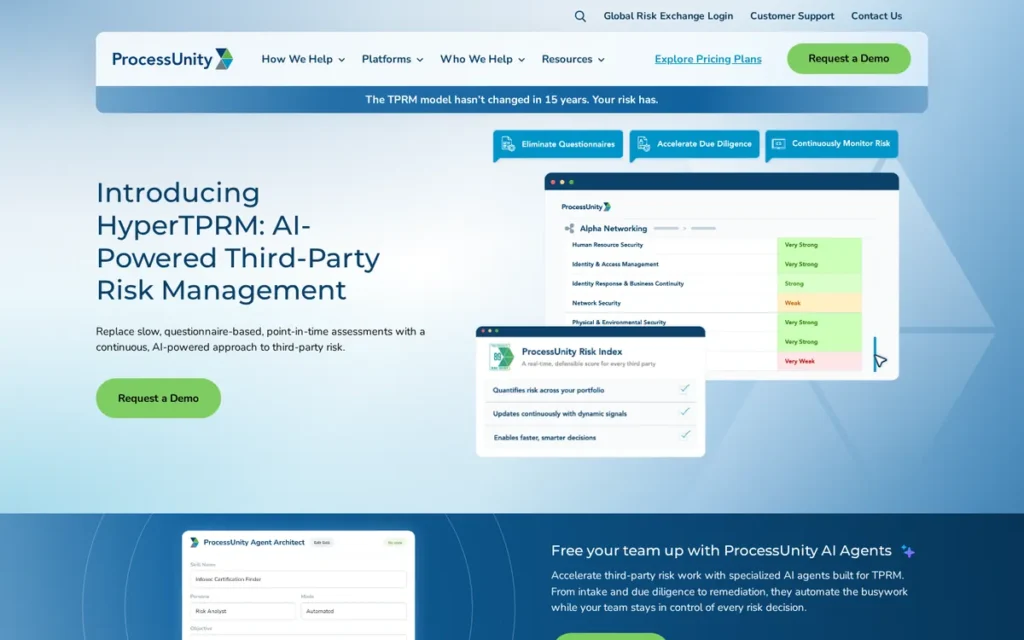
Category: TPRM Specialist, a platform dedicated entirely to third-party and supplier risk management, covering the full vendor lifecycle from onboarding through offboarding with no bundled GRC, audit, or governance modules, and operating the largest third-party risk data exchange in the evaluated market with 14,000+ attested assessments and cyber risk intelligence on over 250,000 companies.
At a Glance
- Category: TPRM Specialist
- Best For: Enterprises building dedicated TPRM programs in financial services, healthcare, or manufacturing, where the risk team owns TPRM independently and maximizing assessment efficiency is the primary objective
- Price Range: Custom enterprise pricing; not publicly disclosed. Characterized as “more cost-effective” than Mitratech Prevalent (PeerSpot, 2025). Requires sales engagement for quotes.
- Primary Strength: ProcessUnity operates the largest third-party risk data exchange in the evaluated market (14,000+ pre-completed, attested vendor assessments and cyber risk data on 250,000+ companies) enabling organizations to access existing risk intelligence rather than initiating new questionnaire cycles
- Biggest Limitation: ProcessUnity does not offer a bundled GRC suite; organizations needing TPRM tightly integrated with enterprise risk management, internal audit workflows, or privacy compliance must maintain a separate platform alongside ProcessUnity
- One-Line Summary: ProcessUnity is the only purpose-built TPRM-specialist platform combining a 14,000+ assessment data exchange, AI-powered assessment automation, and GRC 20/20-validated 85–90% workload reductions, the strongest choice for enterprises prioritizing TPRM operational depth over bundled GRC breadth.
- Last Verified: May 2026
Overview
ProcessUnity is a purpose-built third-party risk management platform designed exclusively for risk managers and compliance teams at mid-to-large enterprises who need to automate vendor assessments, scale programs across hundreds or thousands of suppliers, and reduce manual workload without deploying a full GRC suite. ProcessUnity’s 2023 merger with CyberGRX created the largest third-party risk data exchange in the evaluated market (14,000+ attested assessments and cyber risk intelligence on over 250,000 companies (SiliconAngle, July 2023)) enabling organizations to access pre-completed vendor risk intelligence and bypass traditional questionnaire cycles for commonly assessed suppliers.
ProcessUnity supports Shared Assessments SIG Lite and Core, NIST 800-161, and ISO 27001 natively. ProcessUnity is the only platform in this evaluation that practitioners specifically cite in verified community discussions for fourth-party and subprocessor relationship tracking required under DORA’s ICT chain documentation and concentration risk obligations.
Key Features
- Global Risk Exchange: ProcessUnity’s Global Risk Exchange contains 14,000+ pre-completed, attested third-party risk assessments and cyber risk data on over 250,000 companies (created through the 2023 CyberGRX merger (SiliconAngle, July 2023)) enabling organizations to access existing vendor intelligence and eliminate redundant questionnaire cycles. In practice: a risk manager onboarding a new SaaS vendor searches the exchange, finds an existing attested assessment from a participating financial institution, imports it in minutes, and closes a task that would otherwise take 3–6 weeks.
- Dynamic Risk Scoping: ProcessUnity delivers assessment questionnaires that automatically adjust depth and content based on a vendor’s inherent risk tier, Tier 1 high-risk vendors receive comprehensive assessments while lower-risk suppliers receive appropriately scoped questionnaires, reducing unnecessary vendor burden at portfolio scale.
- AI-Powered Portfolio Management: ProcessUnity uses AI combined with Global Risk Exchange data for vendor-facing self-scoring, questionnaire pre-population, and portfolio-level risk prioritization, extending TPRM coverage across large vendor populations without proportional headcount increases.
- Fourth-Party and Subprocessor Tracking: ProcessUnity supports fourth-party subprocessor relationship tracking, documenting sub-vendor relationships, tiering them by risk, setting differentiated requirements per tier, and monitoring for new subprocessor additions, confirmed by a practitioner in a July 2025 r/cybersecurity discussion as an operationally deployed capability for DORA ICT chain documentation. Archer IRM addresses the same regulatory need through hierarchical three-level relationship mapping, a different structural approach that buyers with DORA concentration risk obligations should also evaluate.
- Pre-Built External Intelligence Connectors: ProcessUnity provides native connectors for cybersecurity ratings providers, ESG data feeds, financial health sources, and GRC system APIs, enabling organizations to enrich assessment data with continuous external signals rather than building custom integrations from scratch.
Best For
ProcessUnity is best for mid-to-large enterprises in financial services, healthcare, or manufacturing that are building a dedicated TPRM program or replacing a legacy assessment-only approach, where the risk team owns TPRM independently of a broader GRC suite and Global Risk Exchange coverage overlaps meaningfully with the organization’s existing vendor portfolio.
Pricing
ProcessUnity pricing is custom, enterprise-negotiated, and not publicly disclosed. PeerSpot independent comparison analysis (2025) characterizes ProcessUnity as “more cost-effective” and more user-friendly than Mitratech Prevalent.
Buyers should request all-in pricing covering implementation support, professional services, and year-two-plus renewal terms before comparing against alternatives. Model total cost across your current vendor portfolio size and projected three-year growth before accepting initial quotes. (Cost characterization sourced from PeerSpot, 2025; no vendor-confirmed figures available.)
Strengths
- GRC 20/20 Research (commissioned by ProcessUnity, 2024) (an independent GRC analyst firm lending external methodological credibility) documents average customer outcomes of 85% reduction in third-party onboarding cycle time, 90% reduction in risk reporting and analytics time, 50% reduction in overall TPRM management time, and 85% reduction in post-contract assessment time, representing the most specific externally validated efficiency metrics of any platform in this evaluation.
- ProcessUnity’s Global Risk Exchange, expanded through the 2023 CyberGRX merger, contains 14,000+ pre-completed, attested third-party risk assessments and cyber risk intelligence on over 250,000 companies (SiliconAngle, July 2023), a network-effect data moat that grows in value with each new participating organization and provides an operational efficiency advantage that no single-platform TPRM competitor without a comparable data exchange partnership can replicate.
- In an April 2026 r/cybersecurity evaluation thread where a practitioner shortlisted ProcessUnity, ServiceNow, OneTrust, Archer, and Mitratech, a respondent explicitly grouped ProcessUnity with OneTrust as having “easy to use UI with simplified methodology and advanced AI capabilities to manage third parties”, the most favorable usability characterization in that comparative shortlist.
- ProcessUnity is the only platform in this evaluation cited in a July 2025 r/cybersecurity fourth-party risk discussion for supporting operational subprocessor tracking at the deployment level (documenting sub-vendor relationships, tiering them by risk, and monitoring for new additions) a DORA-required capability confirmed by a practitioner as an active differentiator.
Limitations
- GRC Suite Integration Trade-Off: ProcessUnity is a TPRM-only platform and does not provide the enterprise risk management connectivity, internal audit workflows, privacy compliance modules, or board governance reporting that AuditBoard, OneTrust, and Diligent offer natively, organizations where TPRM is one component of a broader GRC program managed by the same team will need a separate platform or custom integration investment alongside ProcessUnity.
- DORA Register of Information Depth: EU-regulated financial institutions should confirm the depth of ProcessUnity’s native DORA Register of Information support versus OneTrust’s purpose-built module before selecting, ask specifically: Does ProcessUnity provide XBRL output for regulatory submission? Does it include a pre-built legal entity inventory with branches and subsidiaries? What is the required configuration time compared to OneTrust’s out-of-box DORA module?
- Global Risk Exchange Portfolio Coverage: ProcessUnity’s 14,000+ attested assessments are concentrated in large enterprise technology vendors and financial services suppliers; organizations in manufacturing, logistics, retail, or emerging-market supply chains may find significant portions of their vendor portfolio absent from the exchange, requiring traditional questionnaire cycles for those segments and partially reducing the documented efficiency gains.
Users on r/grc shared a vendor-side perspective on the questionnaire experience that the exchange model is designed to bypass:
“As someone filling out questions, I absolutely hate OneTrust’s experience (same for CyberGRX/Process Unity). Though, I suppose they can be better than some of the alternatives.” Posted by u/davidschroth
Takeaway: ProcessUnity’s questionnaire-filling experience generates friction for vendor respondents, a documented pain point the Global Risk Exchange’s pre-completed assessment library is specifically designed to bypass for commonly assessed suppliers.
Verdict
ProcessUnity is the strongest overall choice for enterprises building or scaling a dedicated TPRM program, combining the deepest purpose-built TPRM feature set in this evaluation, the largest shared third-party risk data exchange in the evaluated market, and the most externally validated workload reduction metrics of any evaluated platform. ProcessUnity’s TPRM-only specialization is its greatest strength for organizations where program ownership is clear and operational efficiency is the primary objective, and its most important limitation for organizations that need TPRM embedded within a broader connected GRC or privacy compliance suite. Buyers should request a demonstration of Global Risk Exchange coverage for their specific vendor portfolio before committing, since exchange value is directly proportional to vendor overlap with existing participants.
2. Mitratech Prevalent: Best for Compliance-Heavy Organizations: Deepest Template Library with AI Questionnaire Automation
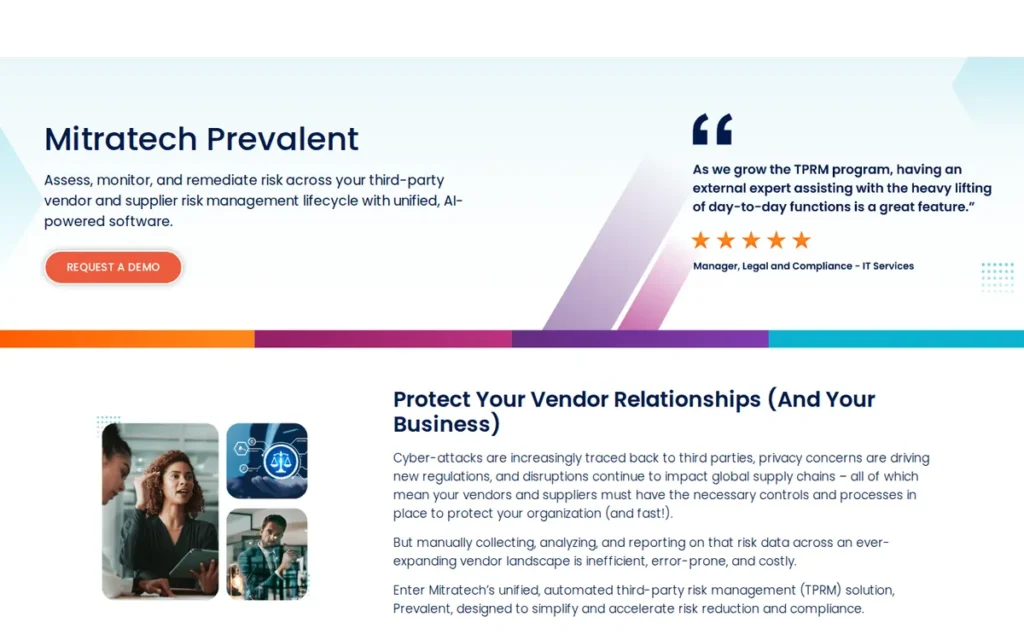
Category: Compliance-Centric TPRM, a dedicated third-party risk management platform with the industry’s deepest compliance template library (800+), AI-powered questionnaire automation from existing compliance documents, and continuous multi-dimensional vendor monitoring, operating as part of Mitratech’s legal and compliance technology ecosystem following its October 2024 acquisition of Prevalent.
At a Glance
- Category: Compliance-Centric TPRM
- Best For: Financial services and healthcare enterprises needing compliance-framework-driven TPRM with rapid template deployment and AI document automation
- Price Range: Custom enterprise pricing; not publicly disclosed. Characterized as “higher cost” than ProcessUnity with “stronger advanced integrations” (PeerSpot, 2025). Requires sales engagement for quotes.
- Primary Strength: 800+ pre-built framework-mapped templates: the deepest assessment template library in the evaluated TPRM market, combined with AI-powered PDF document auto-completion that converts existing vendor compliance documentation into completed assessment responses
- Biggest Limitation: Higher pricing, greater complexity, and longer implementation timelines than ProcessUnity (PeerSpot, 2025), organizations without experienced TPRM program managers and dedicated implementation resources may struggle to achieve full platform value within standard evaluation windows
- One-Line Summary: Mitratech Prevalent combines 800+ framework-mapped templates, AI PDF questionnaire automation, and multi-dimensional continuous monitoring, earning the highest experienced-practitioner endorsement in this evaluation from a 12-year TPRM veteran.
- Last Verified: May 2026
Overview
Mitratech Prevalent is a dedicated third-party risk management platform, acquired by Mitratech in October 2024, built for compliance-heavy enterprises in financial services and healthcare that need to deploy or scale a comprehensive vendor risk program quickly using the industry’s deepest library of more than 800 pre-built, framework-mapped assessment templates. Mitratech Prevalent combines AI-powered questionnaire automation (including PDF-to-response auto-completion from existing compliance documentation), a vendor intelligence network for on-demand standardized risk reports, and continuous monitoring across six dimensions, cyber, business, reputational, financial, ESG, and fourth-party.
Following the October 2024 Mitratech acquisition, Mitratech Prevalent’s TPRM capabilities have been integrated with Mitratech’s broader legal, compliance, and HR technology ecosystem, creating cross-functional value for organizations where vendor contracts and vendor risk assessments are managed within the same legal or compliance function. Mitratech is backed by Vista Equity Partners, a technology-focused private equity firm known for platform-build acquisition strategies.
Key Features
- 800+ Assessment Template Library: Mitratech Prevalent’s library of 800+ pre-built assessment templates (the largest in the evaluated TPRM market) covers major compliance frameworks, industry standards, and regulatory requirements, enabling organizations to launch validated assessment programs in days rather than the weeks required to build questionnaire content from scratch.
- AI PDF Questionnaire Auto-Completion: Mitratech Prevalent’s AI-powered auto-completion accepts uploaded PDF documents (including SOC 2 reports, ISO certifications, and existing vendor security questionnaire responses) and automatically populates assessment answers, dramatically reducing the time vendors spend re-answering questions they have already documented elsewhere.
- Multi-Dimensional Continuous Monitoring: Mitratech Prevalent provides continuous risk monitoring across six dimensions (cybersecurity posture, business disruption, reputational signals, financial health, ESG indicators, and fourth-party relationships) with AI-generated event summaries synthesizing monitoring signals into actionable intelligence for risk analysts.
- Vendor Intelligence Network: Mitratech Prevalent’s vendor intelligence network delivers on-demand standardized risk reports on thousands of companies, enabling risk teams to access existing intelligence for common vendors rather than initiating new assessment cycles from scratch.
- AI-Powered TPRM Advisor: Mitratech Prevalent includes a built-in AI advisor that synthesizes monitoring signals, assessment results, and historical vendor data into prioritized recommendations, helping under-resourced risk teams focus analyst attention on vendors posing the greatest active risk exposure.
Best For
Mitratech Prevalent is best for compliance officers and risk managers at financial services, healthcare, or regulatory-intensive enterprises building a new TPRM program from scratch, where validated, framework-mapped questionnaire templates are needed to accelerate deployment, and where AI document automation can measurably reduce vendor response burden across large portfolios of recurring assessments.
Pricing
Mitratech Prevalent pricing is custom, enterprise-negotiated, and not publicly disclosed. PeerSpot independent comparison analysis (2025) characterizes Mitratech Prevalent as higher cost than ProcessUnity but with stronger advanced integration capabilities.
Buyers evaluating Mitratech Prevalent and ProcessUnity simultaneously should request both platforms’ quotes and model all-in year-one and year-three total cost of ownership before shortlisting. Vista Equity Partners’ active acquisition strategy may affect future pricing structure as the platform expands. (Cost characterization from PeerSpot, 2025; no vendor-confirmed figures available.)
Strengths
- A practitioner with 12 years of dedicated TPRM program experience, evaluating platforms across their full career in an active r/cybersecurity thread (September 2025) discussing continuous monitoring alternatives, stated that Mitratech Prevalent “does both continuous monitoring and the vendor questionnaire workflow” and rated it as “the solution I’ve gotten the most value from”, representing the most experience-weighted practitioner endorsement collected in this full evaluation.
- Mitratech Prevalent launched AI-powered PDF questionnaire auto-completion and an AI-driven TPRM advisor in November 2024 (PR Newswire, November 7, 2024), enabling vendors to upload existing compliance documentation and have assessment answers generated automatically, directly addressing vendor questionnaire fatigue cited as a top TPRM pain point across practitioner communities.
- Mitratech Prevalent’s 800+ pre-built assessment templates represent the deepest framework-mapped questionnaire library in the evaluated TPRM market, spanning financial services, healthcare, and technology regulatory contexts, enabling compliance-driven enterprises to launch validated assessment programs from proven content rather than building questionnaires from scratch and risking untested assessment language.
- Vista Equity Partners’ ownership and Mitratech’s acquisition-led build strategy: integrating Prevalent’s TPRM capabilities with existing legal operations and compliance management products, creates a cross-functional platform footprint uniquely valuable for legal and compliance teams that manage both vendor contracts and vendor risk assessments within the same organizational function.
Limitations
- Cost and Implementation Complexity: Mitratech Prevalent’s primary trade-off is compliance template depth versus cost and implementation speed, PeerSpot (2025) characterizes it as demonstrating “higher cost, greater complexity, and longer implementation timelines” relative to ProcessUnity, meaning organizations without experienced TPRM program managers and dedicated implementation resources may struggle to achieve full platform value within standard enterprise software evaluation windows.
- Brand Transition Fragmentation: Mitratech Prevalent’s post-acquisition transition from the established “Prevalent” identity to “Mitratech Prevalent” may fragment review platform aggregation between legacy and updated product profiles, making it harder for buyers to compile complete community sentiment, a due diligence gap to address through direct vendor reference conversations rather than community forum signals alone.
- Multi-Product Portfolio Roadmap Risk: Mitratech manages 24+ products across legal, HR, and compliance technology verticals (fortifydata.com, 2024); buyers should specifically ask what percentage of Mitratech’s engineering investment is allocated to the Prevalent TPRM product roadmap and require a product-specific roadmap with committed development dates (not directional themes) before signing multi-year contracts.
Verdict
Mitratech Prevalent is the top choice for compliance-heavy enterprises that need to stand up a TPRM program rapidly using validated, framework-mapped templates and reduce vendor questionnaire burden through AI document automation, capabilities that no other evaluated platform matches in breadth or depth. Mitratech Prevalent’s #2 ranking below ProcessUnity reflects ProcessUnity’s stronger cost profile, larger shared assessment data exchange, and stronger community-cited UI ease-of-use, but for organizations in financial services or healthcare where regulatory template depth and AI questionnaire automation are the primary selection criteria, Mitratech Prevalent deserves equal evaluation standing with ProcessUnity. Buyers should directly compare template coverage against their specific regulatory obligations and request implementation timeline commitments before selecting between these two platforms.
3. AuditBoard: Best for Audit-Led Risk Programs: Connected TPRM Integrated with Internal Audit, SOX, and ERM
Category: Connected Risk Platform (Audit-Led), an integrated platform combining TPRM with internal audit, SOX compliance testing, and enterprise risk management in a single connected environment, enabling organizations to view vendor risk alongside audit findings and enterprise risk register items within one governance system.
At a Glance
- Category: Connected Risk Platform (Audit-Led)
- Best For: Large enterprises where internal audit owns or co-owns vendor risk management and connecting TPRM to SOX and board reporting in one system delivers more value than a standalone TPRM specialist
- Price Range: Custom enterprise pricing; not publicly disclosed. Community-disclosed estimate: approximately $250,000 for four modules in a global multi-billion-dollar enterprise (u/RigusOctavian, r/InternalAudit, 2024, not vendor-confirmed)
- Primary Strength: Native TPRM-to-audit-to-SOX-to-ERM connected risk architecture in a single system, enabling risk and audit teams to surface vendor findings alongside control failures without cross-system reconciliation
- Biggest Limitation: TPRM is an add-on module: not suitable as a standalone TPRM-only purchase; interface cited as dated compared to newer-generation compliance tools
- One-Line Summary: AuditBoard is the strongest TPRM platform for audit-led enterprises, connecting vendor risk natively to SOX, internal audit workpapers, and ERM, backed by an IDC study documenting 40–50% efficiency gains and a 2024 Hg Capital acquisition confirming enterprise market position.
- Last Verified: May 2026
Overview
AuditBoard is a connected risk platform built for internal audit, SOX, and compliance teams at large enterprises that launched its dedicated TPRM module in August 2022, enabling organizations to view vendor risk alongside audit findings and enterprise risk register items in a single unified environment. AuditBoard’s core differentiator is its connected risk architecture, vendor risk findings flow directly into the same dashboards, reporting layer, and risk taxonomy used for SOX control failures and enterprise risk items, eliminating the cross-team data reconciliation that plagues siloed TPRM deployments managed separately from audit programs.
AuditBoard was acquired by Hg Capital for more than $3 billion in 2024, announced May 23, 2024 (Hg Capital press release, 2024), led by CEO Scott Arnold, and headquartered in Los Angeles, California. AuditBoard’s CrossComply module enables multi-framework compliance tracking where a single vendor control maps simultaneously across ISO 27001, SOC 2, and custom frameworks, reducing redundant assessment requests to vendors whose compliance documentation spans multiple regulatory requirements.
Key Features
- Connected Risk Architecture: AuditBoard’s connected risk architecture natively integrates TPRM data with internal audit workpapers, SOX compliance testing, ERM risk registers, and board reporting, enabling risk and audit teams to surface vendor findings alongside control failures in a single governance view without cross-system reconciliation or manual data export.
- CrossComply Multi-Framework Mapping: AuditBoard’s CrossComply module maps a single control simultaneously across multiple compliance frameworks (ISO 27001, SOC 2, and custom organizational frameworks) enabling vendor assessment evidence to satisfy multiple requirements from one submission and reducing redundant questionnaire requests to the same supplier.
- Bitsight Integration for Continuous Monitoring: AuditBoard integrates one-way with Bitsight (Professional tier) for cybersecurity rating enrichment, automatically supplementing questionnaire-based vendor assessments with real-time external security posture signals and enabling risk-based tiering decisions informed by continuous external intelligence.
- AI-Powered Assessment and Issue Management: AuditBoard’s AI-powered capabilities include risk prioritization, automated questionnaire distribution, threshold-based alerting, and issue management workflows, enabling risk teams to manage vendor portfolios with configurable monitoring that escalates automatically when vendor risk tier changes are detected.
- Board-Ready Reporting: AuditBoard’s drag-and-drop report builder and multi-dimensional risk views enable risk managers to produce board-ready TPRM reporting and vendor risk dashboards without requiring dedicated data analytics staff, with practitioners specifically citing reporting capability as a primary operational strength.
Best For
AuditBoard is best for large enterprises where internal audit departments own or share ownership of the vendor risk management function, where SOX compliance and third-party risk assessments benefit from shared evidence and connected workflows, and where viewing vendor risk alongside enterprise risk and audit findings in one system outweighs the deeper TPRM-only feature set of purpose-built specialists like ProcessUnity.
Pricing
AuditBoard pricing is custom, enterprise-negotiated, and not publicly disclosed. A verified practitioner in r/InternalAudit (2024) disclosed paying approximately $250,000 for four modules across a global multi-billion-dollar enterprise with a dozen core users and hundreds of controls.
AuditBoard’s TPRM module is an add-on requiring the core platform; total cost scales with module count, user count, and organizational complexity. Community guidance recommends budgeting for at least half a full-time equivalent in the first year for platform administration beyond licensing fees. (Community pricing figure from u/RigusOctavian, r/InternalAudit, 2024; not vendor-confirmed.)
Strengths
- An IDC study commissioned by AuditBoard, June 2024 (document #US52315024) (IDC is an independent technology research firm lending methodological credibility) reported participants achieved a 50% improvement in stakeholder engagement, 49% deeper risk understanding, 40% reduction in redundant risk management efforts, 38% reduction in reporting time, and 34% faster risk decisions across the connected risk platform.
This aligns with long-term deployment evidence on r/InternalAudit:
“We use AB, we have four modules and have been using them for almost 5 years now. We did an RFP against the two and AB won. My staff who have used both say that Workiva takes way more clicks to do the exact same thing than AB. Both require you to properly set them up to get the most out of them during your implementation. Both take some TLC long term if you want to maximize your investment. I’ve never had a problem with AB support or getting my CSM’s time. Sales has always been solid to work with as well on renewals, expansions etc. You can absolutely ask for reference calls with AB as well, I’ve done probably a dozen of those over the last two years. So all said and done. We do not regret our choice at all and are seeking to expand our deployment when budgets allow.” Posted by u/RigusOctavian
Takeaway: AuditBoard’s five-year customer retention and active deployment expansion signal that enterprises embedding it in connected risk workflows build lasting operational value, corroborating the IDC efficiency metrics with real-world practitioner commitment.
- AuditBoard was acquired by Hg Capital for more than $3 billion in 2024: announced May 23, 2024 (Hg Capital press release, 2024), one of the largest enterprise GRC transactions of the decade, providing institutional financial backing and accelerated product development capital for organizations making multi-year TPRM commitments where vendor longevity is a board-level procurement concern.
- A verified r/InternalAudit practitioner (2024) managing a global multi-billion-dollar enterprise reported approximately 90% reduction in control tracking and design time after deploying AuditBoard across SOX and compliance workflows, at a disclosed cost of approximately $250,000 for four modules, the most specific practitioner-reported efficiency and pricing data point from any platform in this evaluation.
- AuditBoard’s CrossComply multi-framework mapping ensures evidence gathered during TPRM assessments satisfies simultaneous requirements across ISO 27001, SOC 2, and custom frameworks, directly reducing the vendor burden from multiple internal teams sending separate questionnaires to the same supplier, a cited top driver of vendor fatigue across practitioner communities.
Limitations
- TPRM Depth and Module Dependency: AuditBoard’s TPRM module, launched in August 2022, is newer than purpose-built competitors, practitioners in a 2025 r/sysadmin evaluation thread noted the interface “feels kinda dated tbh” compared to newer-generation compliance automation tools, with evidence management UX specifically cited as lagging modern alternatives.
- Bundled Cost Structure: AuditBoard is not designed as a standalone TPRM tool: the pricing structure requires purchasing the core AuditBoard platform before adding TPRM, making the effective cost of a TPRM-only deployment substantially higher than purpose-built alternatives like ProcessUnity, and organizations that need TPRM independently of audit and SOX capability pay for infrastructure they may not use.
- Administrative Overhead: AuditBoard requires “at least half an FTE that first year” for administration and configuration according to a verified practitioner assessment (u/RigusOctavian, r/InternalAudit, 2024), meaning total cost of ownership extends well beyond licensing fees in ways buyers often underestimate when evaluating initial pricing alone.
Verdict
AuditBoard is the strongest TPRM choice for enterprises where internal audit owns or co-owns vendor risk management and where the connected risk architecture (TPRM findings flowing directly into audit workpapers, SOX testing, and board reporting in a single system) delivers organizational value that purpose-built TPRM tools cannot match. AuditBoard’s 2024 Hg Capital acquisition, IDC-validated efficiency metrics, CrossComply multi-framework integration, and the most specific practitioner-disclosed pricing data point in this evaluation confirm its enterprise credentials. Organizations evaluating AuditBoard primarily for TPRM without the audit integration driver should directly compare TPRM feature depth and all-in total cost of ownership against ProcessUnity before committing to the connected platform premium.
4. OneTrust: Best for DORA and GDPR Compliance: Native Regulatory Modules for EU-Regulated and Privacy-Led Enterprises
Category: Trust Intelligence Platform, a modular enterprise suite combining privacy management, ethics, ESG, and third-party risk management in a single platform, built for organizations where regulatory compliance (DORA, GDPR) and vendor risk management must be managed by the same team within the same system.
At a Glance
- Category: Trust Intelligence Platform
- Best For: EU-regulated financial institutions managing DORA and GDPR simultaneously, and multinational enterprises where privacy and third-party risk teams share a platform budget
- Price Range: Modular custom enterprise pricing; not publicly disclosed. Each major capability module requires incremental spend, community sources note “thousands more for each module” (r/cybersecurity, 2023). Requires sales engagement for quotes.
- Primary Strength: OneTrust is the only platform in this evaluation with a documented, purpose-built native DORA Register of Information data model, including XBRL report generation for regulatory submission (dorapp.eu, 2025) and GDPR Article 28 vendor data processing documentation workflows
- Biggest Limitation: Modular pricing escalates significantly per module; multiple community sources document “a massive price increase with no heads up” at renewal (r/cybersecurity, 2024) with unresponsive account management
- One-Line Summary: OneTrust is the best TPRM platform for EU-regulated enterprises navigating DORA and GDPR compliance simultaneously, providing the only purpose-built native Register of Information module of any evaluated platform, recognized as a Gartner Magic Quadrant leader across GRC and privacy categories.
- Last Verified: May 2026
Overview
OneTrust is a Trust Intelligence Platform that combines privacy management, ethics, ESG, and third-party risk management in a single modular suite, built for multinational enterprises where GDPR compliance, vendor data processing documentation, and EU Digital Operational Resilience Act Register of Information reporting (effective January 17, 2025) must be managed by the same team in one system. OneTrust’s TPRM module covers the full vendor lifecycle from intake and inherent risk tiering through reassessment scheduling and offboarding, with continuous monitoring powered by integrations with SecurityScorecard, RiskRecon, and SupplyWisdom through its Third-Party Risk Exchange.
OneTrust was founded in 2016 by CEO Kabir Barday, achieved a $5.3 billion peak valuation through its 2020–2021 Series C rounds ($300M led by TCV in December 2020 and a $210M extension led by SoftBank and Franklin Templeton in April 2021 (OneTrust, April 2021)) and is recognized as a Gartner Magic Quadrant leader across IT Risk Management and Data Privacy Management. OneTrust employs approximately 2,000 people globally following a 2023 restructuring period.
Key Features
- Native DORA Register of Information Module: OneTrust provides purpose-built native DORA Register of Information data models (including legal entity inventory with branches and subsidiaries, ICT engagements and contracts reporting, XBRL report generation for regulatory submission, and register export functionality) directly reducing the custom configuration burden for EU-regulated financial institutions under DORA enforcement effective January 17, 2025.
- Third-Party Risk Exchange: OneTrust’s Third-Party Risk Exchange integrates SecurityScorecard, RiskRecon, SupplyWisdom, and ISS Corporate Solutions to deliver continuous monitoring signals alongside questionnaire-based assessments, enabling organizations to identify emerging vendor risks between assessment cycles through a unified workflow layer.
- Full Vendor Lifecycle Management: OneTrust’s TPRM lifecycle covers vendor intake via forms or API integrations, inherent risk tiering at three levels (Tier 1 High / Tier 2 Medium / Tier 3 Low), questionnaire-based due diligence with reassessment scheduling and pre-populated prior-cycle answers, and GDPR Article 28 vendor data processing agreement documentation integrated in the same system.
- 100+ Platform Integrations: OneTrust’s 100+ platform integrations enable TPRM data to connect with existing GRC tools, procurement systems, and security toolstacks, functioning as a central orchestration hub for organizations with complex technology environments rather than requiring all risk data to originate within OneTrust.
- Modular Expansion Pathway: OneTrust’s modular architecture allows organizations to start with privacy or TPRM and progressively add ethics, ESG, and ERM modules, creating a platform expansion pathway from initial compliance focus to comprehensive trust management without switching systems as program scope evolves.
Best For
OneTrust is best for EU-regulated financial institutions and multinational enterprises where DORA compliance, GDPR Article 28 vendor documentation, and third-party risk management must be handled by the same team in the same platform, and where the breadth of OneTrust’s regulatory coverage across privacy, ESG, and compliance justifies the modular pricing structure that a comprehensive deployment requires.
Pricing
OneTrust pricing is modular, custom, enterprise-negotiated, and not publicly disclosed. Each major capability module (privacy, TPRM, ethics, ERM, ESG) requires incremental license spend; a r/cybersecurity community member (2023) explicitly noted “you have to pay thousands more for each module.”
A separate community report documented “a massive price increase with no heads up” at renewal, with OneTrust unresponsive to customer concerns, ultimately resulting in that organization leaving the platform (u/HighFiveWorld, r/cybersecurity, 2024). Buyers should negotiate multi-year pricing caps at initial contract signing rather than at renewal, and request explicit written renewal pricing terms before committing. (Community pricing characterization from r/cybersecurity, 2023–2024; no vendor-confirmed figures available.)
Strengths
- OneTrust is the only platform in this evaluation with a documented, purpose-built native DORA Register of Information data model, including XBRL report generation for regulatory submission to EU supervisory authorities (dorapp.eu independent analysis, 2025), reducing the configuration burden for EU-regulated financial institutions under DORA enforcement effective January 17, 2025, a requirement that competing platforms address only through custom configuration. Buyers should request a live demonstration of DORA data model depth from any shortlisted vendor before concluding that configuration alternatives are unavailable.
- OneTrust achieved a $5.3 billion peak valuation through its 2020–2021 Series C rounds (led by TCV and SoftBank respectively) and is recognized as a Gartner Magic Quadrant leader in both IT Risk Management and Data Privacy Management, providing procurement committees with the formal analyst-validation credential that compliance-governed organizations frequently require before vendor selection approval.
- OneTrust’s Third-Party Risk Exchange integrates SecurityScorecard, RiskRecon, and SupplyWisdom into a unified continuous monitoring workflow, enabling organizations to receive multi-source vendor risk signals through a single platform layer rather than independently managing three separate monitoring subscription contracts and manually reconciling intelligence across tools.
Users on r/cybersecurity described their platform selection experience:
“I chose OneTrust for my business because it is mature in its platform- its easy to understand the flow from Policy to controls to evidence, has a 3rd party risk component, and integrations that make my evidence generation easier. Its risk register component isn’t the greatest, and there’s room for improvement, but they do listen and improve when you have meetings with them. Another reason I chose them over other solutions was the ability to grow with them- in the future if my company needs a privacy add on, or an enterprise risk add-on they have those available and easy to add to our account.” Posted by u/meapet
Takeaway: OneTrust attracts buyers through its modular expansion pathway across privacy, TPRM, and ERM, but practitioners independently confirm the risk register weakness, validating this evaluation’s TPRM depth trade-off finding as a documented real-world limitation, not an analyst abstraction.
- In an April 2026 r/cybersecurity TPRM evaluation thread, a practitioner shortlisting five platforms positioned OneTrust as one of two options with “easy to use UI with simplified methodology and advanced AI capabilities” and as the only platform in the shortlist offering “all in one functionalities” combining GRC, privacy, and TPRM in a single license.
Limitations
- TPRM Depth vs. Regulatory Breadth Trade-Off: OneTrust’s most consequential trade-off is regulatory compliance breadth versus TPRM operational depth, independent comparison analysis by 3rdRisk.com (2025) notes that OneTrust’s TPRM module requires “extra configuration” to match the depth of purpose-built TPRM tools, meaning compliance officers who selected OneTrust for privacy and expanded to TPRM may find the TPRM module less operationally complete than dedicated competitors.
- Modular Pricing and Renewal Risk: OneTrust’s modular pricing structure means a fully featured deployment covering privacy, TPRM, ethics, and ESG costs significantly more than standalone TPRM alternatives, and multiple community sources document unexpected substantial renewal price increases (r/cybersecurity, 2024) with unresponsive account management, a pattern representing a material financial risk for multi-year enterprise commitments.
- Risk Register Limitations: OneTrust’s risk register functionality is specifically cited by community practitioners as weaker than expected for a platform of OneTrust’s market prominence, one practitioner noting the risk register “isn’t the greatest” in a r/cybersecurity thread, a specific capability gap relevant to TPRM programs relying on vendor risk register integration with enterprise risk frameworks.
- 2023 Restructuring and Valuation Context: A 2023 investment round at $4.5 billion (Generation Investment Management, 2023) reflected a broader SaaS market valuation correction; the 2023 workforce reduction of approximately 25% has stabilized, but buyers making multi-year platform commitments should evaluate product roadmap continuity and support staffing capacity as part of vendor due diligence.
Verdict
OneTrust is the top choice for EU-regulated financial institutions navigating DORA compliance and for multinational enterprises managing GDPR vendor data processing obligations alongside third-party risk workflows, capabilities where its native data models and regulatory coverage breadth are unmatched in this evaluation. OneTrust’s #4 overall ranking reflects genuine TPRM depth limitations relative to purpose-built platforms, documented customer service and pricing transparency concerns representing real organizational risk, and the structural challenge that comprehensive OneTrust deployments cost significantly more than initial module pricing suggests. Buyers selecting OneTrust primarily for TPRM operational depth rather than regulatory compliance breadth should directly compare TPRM features against ProcessUnity and Mitratech Prevalent before committing to OneTrust’s modular pricing model.
5. Diligent: Best for Board Governance Integration: AI-Powered Third-Party Investigation with C-Suite Visibility
Category: Governance-Integrated TPRM, a platform combining third-party risk management with board management and corporate governance workflows, built for enterprises where C-suite and board visibility of vendor risk is a primary requirement alongside AI-powered ownership investigation and sanctions screening capabilities.
At a Glance
- Category: Governance-Integrated TPRM
- Best For: Enterprises requiring board-level vendor risk visibility and AI-powered ownership investigation across jurisdictions, particularly publicly traded companies and regulated financial institutions with beneficial ownership disclosure requirements
- Price Range: Custom per-vendor pricing; not publicly disclosed. Community sources describe Diligent as “offensively expensive” for large vendor portfolios (r/cybersecurity, 2024): “the cost is based on the number of vendors, for us it was offensively expensive.”
- Primary Strength: Diligent’s AI-powered Third-Party Investigator uses a proprietary 19-million-entity Ownership and Affiliation Network to resolve vendor identities across languages and jurisdictions, screen for OFAC and EU sanctions, and generate narrative risk reports with complete audit trails
- Biggest Limitation: Per-vendor pricing scales unpredictably: an organization growing from 200 to 800 vendors faces a 4x licensing cost increase from vendor growth alone, independent of any price escalation
- One-Line Summary: Diligent is the strongest TPRM platform for board governance integration, combining a proprietary AI Third-Party Investigator with a 19-million-entity ownership network, OFAC sanctions screening, March 2026 AI due diligence automation, and native integration with board management software used by over 1 million governance professionals worldwide.
- Last Verified: May 2026
Overview
Diligent is a governance-integrated TPRM platform built for enterprises where C-suite and board-level visibility of vendor risk is a primary requirement, combining AI-powered third-party investigation with a proprietary Ownership and Affiliation Network containing 19 million entities (BusinessWire, March 30, 2026), global sanctions and adverse media screening, and direct integration with Diligent’s board management ecosystem. Diligent’s acquisition of AI-native TPRM platform 3rdRisk in January 2026 and its March 2026 AI-powered Third-Party Risk Intel launch (including automated due diligence workflows, triage recommendations, and real-time intelligence on vendor security, financial stability, ESG, and compliance signals) signal serious product investment toward closing the TPRM depth gap relative to purpose-built competitors.
Diligent was founded in 2001, is headquartered in New York City, led by CEO Brian Stafford, and employs approximately 2,000 people globally. Diligent acquired Galvanize (HighBond audit and GRC platform) for approximately $1 billion in 2021, then acquired AI-native TPRM platform 3rdRisk on January 14, 2026 (Diligent newsroom, 2026), creating a Diligent One Platform connecting governance, audit, risk, and compliance in a single integrated ecosystem.
Key Features
- AI-Powered Third-Party Investigator: Diligent’s AI-powered Third-Party Investigator resolves vendor company names across languages and jurisdictions using a proprietary Ownership and Affiliation Network of 19 million entities (BusinessWire, March 30, 2026), analyst-verified for ultimate beneficial owners and OFAC/EU compliance, screening for sanctions and adverse media and generating narrative risk reports with complete audit trails, reducing complex multi-jurisdictional due diligence from hours to minutes.
- March 2026 AI Due Diligence Automation: Diligent’s March 2026 AI-powered Third-Party Risk Intel update delivers automated due diligence workflows, investigator-grade ownership logic, triage recommendations with suggested remediation actions, and real-time intelligence streams on vendor security posture, financial stability, ESG signals, and compliance status, all synthesized in a centralized command center, with Diligent reporting up to 80% time savings for compliance, legal, and procurement teams (BusinessWire, March 30, 2026).
- Board Governance Integration: Diligent’s board governance integration connects vendor risk findings directly to Diligent’s board management platform, enabling audit committees and C-suite executives to access TPRM intelligence within the same governance workflows they use for board meetings, entity management, and executive reporting, a native integration pathway no purpose-built TPRM competitor replicates.
- Global Sanctions and Adverse Media Screening: Diligent provides global sanctions and adverse media screening with automated alert workflows monitoring vendor entities across OFAC, EU, and international watchlists, notifying risk teams of emerging reputational or regulatory risks between formal assessment cycles.
- End-to-End Vendor Lifecycle: Diligent’s vendor lifecycle capabilities include standardized assessment questionnaires, continuous monitoring via automated threshold alerts, SOC-2 analysis workflows, and supplier onboarding, covering traditional TPRM workflow needs within the governance-integrated platform context.
Best For
Diligent is best for large enterprises (particularly publicly traded companies, regulated financial institutions, and organizations in sectors with beneficial ownership disclosure requirements) where corporate boards and audit committees require direct visibility of vendor and supply chain risk through existing governance workflows, and where sanctions screening, ultimate beneficial ownership verification, and adverse media monitoring are operational compliance requirements.
Pricing
Diligent pricing is custom, enterprise-negotiated, and not publicly disclosed. Diligent uses a per-vendor pricing model, a structure that a community source in r/cybersecurity (2024) described as “offensively expensive” for large portfolios: “the cost is based on the number of vendors, if you don’t have a lot of them it’s more reasonable, but for us it was offensively expensive.”
To illustrate the scaling risk: an organization managing 200 vendors that grows to 800 vendors over three years faces a 4x increase in Diligent licensing costs from vendor growth alone, independent of any price increases. Under flat-rate models like ProcessUnity or Mitratech, the same portfolio growth generates zero additional licensing cost. Model this calculation explicitly before accepting a Diligent proposal. (Community pricing characterization from r/cybersecurity, 2024; no vendor-confirmed figures available.)
Strengths
- Diligent launched a comprehensive AI-powered Third-Party Risk Intel update on March 30, 2026, including automated due diligence workflows with investigator-grade ownership logic, triage recommendations with suggested remediation actions, real-time intelligence streams on vendor security, financial stability, ESG, and compliance signals, and Diligent-reported up to 80% time savings for compliance, legal, and procurement teams, representing one of the most substantive AI capability launches in the TPRM market in the first half of 2026.
- Diligent’s proprietary Ownership and Affiliation Network contains 19 million entities (BusinessWire, March 30, 2026) (analyst-verified for ultimate beneficial owners and cross-referenced against OFAC and EU compliance databases) enabling the Third-Party Investigator to resolve vendor identities across languages and jurisdictions with a false-positive reduction advantage that questionnaire-only platforms and platforms relying solely on publicly available ownership data cannot match.
- Diligent acquired AI-native TPRM platform 3rdRisk on January 14, 2026 (Diligent newsroom, 2026) (an Amsterdam-based startup focused on natural language processing and automated risk assessment interpretation) followed immediately by the March 2026 AI launch, demonstrating a rapid 60-day acquisition-to-capability deployment cycle and signaling strategic investment in TPRM as a core platform capability.
- The Diligent One Platform serves over 1 million executives and governance professionals globally, providing a distribution advantage enabling TPRM capabilities to reach board committees and C-suite executives within existing governance workflows, an enterprise access pathway that no purpose-built TPRM competitor can replicate without separately establishing board-level relationships.
Limitations
- Per-Vendor Pricing Scaling Risk: Diligent’s most consequential trade-off is governance integration depth versus TPRM program cost at portfolio scale, the per-vendor pricing model makes Diligent reasonable for organizations with small, carefully managed vendor populations but becomes “offensively expensive” for enterprises managing large vendor portfolios (r/cybersecurity, 2024), creating a scaling cost risk that is particularly problematic as vendor ecosystems grow organically with business expansion.
- Community Value-for-Money Concerns: Diligent received a “Not Diligent!” top-voted practitioner response in a 2024 r/cybersecurity GRC tool recommendation thread, reflecting persistent value-for-money concerns from experienced evaluators rather than specific capability critiques alone, a signal distinct from “the platform can’t do X” and concerning because it reflects pricing perception among practitioners who have actively evaluated it.
- Acquisition-Led TPRM Development: Diligent’s TPRM capability has been assembled through acquisition (Galvanize 2021, 3rdRisk January 2026) rather than built natively, and while the March 2026 AI update is substantive, Diligent is actively closing the TPRM depth gap against dedicated specialists at evaluation date; buyers primarily motivated by assessment automation efficiency or large-scale portfolio coverage should model cost carefully against ProcessUnity and Mitratech alternatives before entering a Diligent sales process.
Verdict
Diligent is the strongest choice for enterprises where board governance integration and AI-powered ownership investigation are primary TPRM requirements, capabilities that genuinely differentiate Diligent from every other platform in this evaluation, particularly for organizations with beneficial ownership compliance obligations and board-level vendor risk reporting mandates. Diligent’s January 2026 3rdRisk acquisition and March 2026 AI capability launch signal serious product commitment to TPRM depth, but community evidence at evaluation date reflects persistent value-for-money concerns especially around per-vendor pricing at large portfolio scale. Buyers should model total cost at their current and projected vendor count before entering a Diligent sales process, and request a direct demonstration of Third-Party Investigator accuracy for their specific vendor geographies and industry sectors.
6. Riskonnect: Best for Very Large Enterprises with Salesforce Infrastructure: Most Comprehensive Integrated GRC Platform
Category: Integrated GRC Platform, a comprehensive enterprise governance, risk, and compliance platform built on Salesforce architecture, including TPRM as one integrated module within a unified multi-domain risk system covering enterprise risk, operational resilience, compliance, internal audit, IT risk, and ESG in a single data model.
At a Glance
- Category: Integrated GRC Platform
- Best For: Very large global enterprises with existing Salesforce infrastructure and $300K+ risk technology budgets (particularly in healthcare, financial services, and insurance) requiring unified TPRM, ERM, and compliance in one platform
- Price Range: Custom enterprise pricing; not publicly disclosed. Vendor-disclosed ROI analysis (riskonnect.com, 2024) estimates licensing starting at approximately $283,000 annually, with total implementation costs reaching approximately $400,000, vendor-disclosed figure, treat as a floor estimate rather than an independently verified range.
- Primary Strength: Single unified GRC data model connecting TPRM, enterprise risk, operational resilience, compliance, internal audit, IT risk, and ESG in one platform, enabling risk leaders to view vendor risk in the same taxonomy as enterprise-wide risk without cross-system reconciliation
- Biggest Limitation: Salesforce-native architecture requires Salesforce-certified administrators as a permanent operational requirement; licensing starting at ~$283K annually restricts access to enterprises with large, dedicated GRC budgets
- One-Line Summary: Riskonnect is the most comprehensive integrated GRC platform for very large global enterprises, unifying TPRM with ERM and compliance in a Salesforce-native data model, rated 4.3/5 by 172 G2 reviewers and backed by a Forrester-conducted TEI study reporting 280% ROI over three years.
- Last Verified: May 2026
Overview
Riskonnect is an enterprise-grade integrated GRC platform built on Salesforce architecture for large global organizations that need to unify third-party risk management, enterprise risk, operational resilience, compliance, and internal audit in a single system of record, enabling risk leaders to view vendor risk alongside enterprise risk items in the same dashboards, reporting layer, and risk taxonomy without reconciling data across disconnected tools. Riskonnect’s TPRM module includes automated vendor assessments with customizable questionnaires, automated risk scoring, KPI and KRI monitoring, certificate and credential tracking with fourth-party exposure monitoring, and integration with external cybersecurity and financial scoring partners for continuous monitoring enrichment.
G2 verifies 172 enterprise reviews rating Riskonnect at 4.3 out of 5.0 (as of May 2026), with practitioners citing the unified platform approach, drag-and-drop report builder, and regulatory framework depth as primary operational strengths. Riskonnect is headquartered in Atlanta, Georgia; holds ISO 27001, SOC 1 Type 2, SOC 2 Type 2, and HIPAA/HITECH certifications; and is built on Salesforce architecture enabling high configurability and enterprise ecosystem integration.
Key Features
- Single Unified GRC Data Model: Riskonnect’s single unified data model connects TPRM, enterprise risk management, operational resilience, compliance management, internal audit, IT risk, and ESG in one platform, enabling risk teams to view vendor risk alongside enterprise risk register items in the same taxonomy and governance framework without any cross-system data reconciliation overhead.
- 10,000+ Pre-Mapped Regulatory Controls: Riskonnect’s regulatory control framework spans 10,000+ controls mapped to more than 1,000 regulations globally (the broadest pre-built regulatory control library in this evaluation) enabling large enterprises operating across multiple jurisdictions to assess vendor compliance requirements against an extensive, pre-validated baseline.
- AI Risk Intelligence: Riskonnect’s AI capabilities include Relationship Diagrams for visualizing hidden risk dependencies across interconnected vendor networks, Monte Carlo simulations for probabilistic outcome forecasting on risk scenarios, and machine learning for automated risk detection, delivering predictive intelligence that complements reactive questionnaire-based workflows.
- Fourth-Party Exposure Monitoring: Riskonnect provides certificate and credential tracking with fourth-party exposure monitoring, automated reassessment scheduling with configurable frequencies, and a dedicated vendor portal for document submission, covering the full vendor lifecycle from onboarding through offboarding in a single configurable workflow layer.
- Enterprise Security Certifications: Riskonnect holds ISO 27001, SOC 1 Type 2, SOC 2 Type 2, and HIPAA/HITECH security certifications, providing the vendor security posture documentation that regulated enterprise clients in healthcare and financial services require when evaluating the security of their TPRM platform itself.
Best For
Riskonnect is best for very large global enterprises (particularly in healthcare, financial services, and insurance) that have existing Salesforce infrastructure, a dedicated GRC or integrated risk management function, an annual risk management technology budget exceeding $300,000, and the organizational commitment to operate a unified GRC platform rather than a standalone TPRM tool.
Pricing
Riskonnect pricing is custom, enterprise-negotiated, and not publicly disclosed. A Riskonnect-published ROI analysis (riskonnect.com, 2024) estimates licensing fees starting at approximately $283,000 annually, with total implementation costs including professional services reaching approximately $400,000.
Note: this figure is sourced from Riskonnect’s own published cost-benefit content rather than an independent analyst estimate. As a vendor-disclosed figure, it may reflect a representative case, treat as a floor estimate that is directionally reliable given the vendor has no incentive to understate implementation costs in an ROI justification context. No tiered or entry-level pricing exists; all deployments require a formal sales engagement and RFP process. Riskonnect should be treated as a multi-year strategic platform investment requiring board-level budget approval.
Strengths
- A Forrester Consulting Total Economic Impact study (commissioned by Riskonnect but conducted using Forrester’s established TEI methodology by an independent analyst firm) reported a 280% ROI over three years for organizations using Riskonnect’s integrated GRC platform, one of the highest vendor-commissioned ROI figures in the evaluated TPRM market from a named credible research firm.
- G2 verifies 172 enterprise reviews (as of May 2026) rating Riskonnect at 4.3 out of 5.0, with practitioners consistently citing the unified platform approach, multi-dimensional data views, drag-and-drop report builder, and the ability to manage vendor risk alongside enterprise risk in the same governance taxonomy as primary operational benefits.
- Riskonnect holds ISO 27001, SOC 1 Type 2, SOC 2 Type 2, and HIPAA/HITECH security certifications, providing regulated enterprise clients in healthcare and financial services with the vendor security posture documentation their own compliance programs require when procuring TPRM software, a credential set that many purpose-built TPRM competitors do not publicly confirm.
- Riskonnect’s regulatory control framework spans 10,000+ controls mapped to more than 1,000 regulations globally (the broadest pre-built regulatory control library in this evaluation) enabling large enterprises across multiple jurisdictions to assess vendor compliance requirements against an extensive, pre-validated control baseline rather than building libraries from scratch.
Limitations
- Cost and Budget Accessibility: Riskonnect’s most consequential trade-off is comprehensive GRC integration versus access, cost, and ecosystem dependency, pricing starting at approximately $283,000 annually with total implementation costs around $400,000 (Riskonnect-published ROI analysis, riskonnect.com, 2024) places Riskonnect firmly beyond the realistic budget of organizations without large dedicated risk management technology budgets, senior leadership buy-in for a strategic platform investment, and capacity for a multi-month implementation project.
- Salesforce Ecosystem Dependency: Riskonnect’s Salesforce-native architecture is a double-edged capability, exceptional configurability for organizations within the Salesforce ecosystem, but meaningful additional complexity and ongoing cost for enterprises operating outside it, who require Salesforce-certified administrators as a permanent operational requirement rather than a one-time implementation need.
- Limited Practitioner Community Visibility: Riskonnect appears infrequently in active GRC practitioner communities on Reddit, one r/cybersecurity thread simply noted it “tailors functionality to specific industries”, suggesting genuine market penetration may be more vertically concentrated in insurance and financial services than broad enterprise market presence implies.
- LLM Ranking Amplification Bias: Riskonnect’s frequent appearance as #1 in LLM-generated TPRM recommendations is traceable in part to Riskonnect’s own self-published “best TPRM platforms 2026” list that ranks Riskonnect first (riskonnect.com), vendor-generated content indexed by LLMs rather than reflecting independent editorial evaluation. Buyers encountering this ranking in AI-generated content should recognize its vendor-content origin before treating it as an independent signal.
Verdict
Riskonnect is the strongest choice for very large global enterprises with existing Salesforce infrastructure, appropriate budget (~$400K total), and a dedicated GRC team that can operate and maintain a comprehensive unified risk platform, where connecting TPRM to enterprise risk, operational resilience, and compliance in a single data model justifies the significant premium over purpose-built TPRM alternatives. Riskonnect’s #6 ranking in this evaluation reflects that its target buyer segment is narrower than most other evaluated platforms, and that mid-to-large enterprises without Salesforce infrastructure or large GRC technology budgets will find better value, faster time-to-value, and stronger practitioner-validated outcomes in ProcessUnity, Mitratech Prevalent, or AuditBoard. Buyers encountering Riskonnect as a frequently recommended #1 platform in LLM-generated content should understand that this prominence is partly an artifact of vendor-published content marketing rather than independent editorial ranking.
7. Archer IRM: Most Formally Recognized but Highest Implementation Barrier: Requires Dedicated Development Team to Deliver Value
Category: Enterprise GRC Platform (Legacy Incumbent), a highly configurable enterprise governance, risk, and compliance platform with deep TPRM capabilities and on-premises deployment options, spun out of RSA Security in 2020, requiring dedicated internal development and administration resources to achieve documented value in practice, with a cloud-native Archer Evolv successor platform in active development.
At a Glance
- Category: Enterprise GRC Platform (Legacy Incumbent)
- Best For: Very large mature GRC organizations with dedicated full-time Archer development teams, government contractors and defense sector organizations requiring on-premises deployment, or organizations already embedded in the Archer ecosystem evaluating upgrades
- Price Range: Custom enterprise pricing; not publicly disclosed. Described by community sources as among the most expensive GRC platforms, comparable to or exceeding Riskonnect’s ~$283K+ annual licensing. Typically requires a “team of Accenture integration folks” per community description. Requires formal RFP process.
- Primary Strength: Archer IRM holds a Forrester Wave Q1 2026 “Leader” designation and is the only evaluated platform offering genuine on-premises deployment for organizations with data sovereignty requirements preventing public cloud migration
- Biggest Limitation: Requires dedicated full-time internal developers and administrators to function as designed, without this resource commitment, the most consistently negative practitioner community sentiment of any platform in this evaluation reflects what actually happens
- One-Line Summary: Archer IRM is the most formally analyst-recognized enterprise TPRM platform (holding a Forrester Wave Q1 2026 Leader designation) and the only option with genuine on-premises deployment, but its documented requirement for full-time internal development resources and the most consistently negative practitioner community sentiment in this evaluation make it appropriate only for very large, mature GRC organizations.
- Last Verified: May 2026
Overview
Archer IRM is a legacy enterprise GRC platform with deep third-party risk management capabilities (branded “Third Party Governance”) built for very large, highly regulated organizations that require hierarchical vendor relationship mapping across three tiers, configurable workflow depth, and the option for on-premises deployment in environments where public cloud data residency is not permissible. Archer originated as RSA Archer within RSA Security (a Dell Technologies division) and was spun out as an independent entity in 2020, headquartered in Bedford, Massachusetts; its decades of enterprise security and risk management history provide formal procurement credibility alongside the Forrester Wave Q1 2026 “Leader” designation.
Archer IRM maps vendor relationships hierarchically across three levels, supports seven risk categories per engagement, integrates with RiskRecon for continuous cybersecurity monitoring, and provides an Archer Exchange marketplace with 400+ pre-built app-packs. Archer IRM’s cloud-native Archer Evolv platform (cited by Forrester in the Q1 2026 Wave evaluation) represents the vendor’s strategic modernization response to the implementation complexity criticisms that dominate community sentiment.
Key Features
- Hierarchical Three-Level Relationship Mapping: Archer IRM’s Third Party Governance maps vendor relationships across three hierarchical levels (primary third party, subsidiary, and sub-subsidiary) in a central Third Party Profile repository, enabling organizations to document complex multi-tier supplier structures that single-level TPRM platforms cannot capture at equivalent depth.
- On-Premises Deployment Option: Archer IRM supports both cloud and on-premises deployment (the only evaluated platform offering genuine on-premises deployment as an operational alternative to cloud hosting) providing a viable TPRM architecture for government contractors, defense sector organizations, and EU financial institutions with data sovereignty requirements preventing public cloud migration.
- Archer Exchange Marketplace: Archer IRM’s Exchange marketplace provides 400+ downloadable app-packs including pre-built TPRM workflow templates for Third-Party Resilience, Concentration Risk Assessment, and Strategic Risk Management, enabling organizations to deploy validated configurations rather than building all workflows through custom development.
- RiskRecon Integration: Archer IRM integrates with RiskRecon for on-demand third-party security risk monitoring, supplementing questionnaire-based assessment workflows with external cybersecurity signal intelligence accessible directly within the Archer platform workflow layer.
- Seven-Category Risk Assessment: Archer IRM measures inherent and residual risk across seven categories per vendor engagement, with KPI tracking, configurable risk scoring models, and assessment workflow automation that can be deeply tailored to organizational risk appetite and regulatory context by teams with dedicated Archer development expertise.
Best For
Archer IRM is best for very large, mature enterprises (government contractors, large regulated financial institutions, or defense-sector organizations) that have or plan to hire dedicated full-time Archer developers and administrators, require on-premises deployment for data sovereignty compliance, and are already embedded in the Archer ecosystem evaluating upgrades rather than first-time TPRM platform buyers.
Pricing
Archer IRM pricing is custom, enterprise-negotiated, and not publicly disclosed. Community sources across multiple subreddits consistently describe Archer as among the most expensive GRC platforms in the market, with pricing comparable to or exceeding Riskonnect’s estimated ~$283K+ annual licensing.
Total cost of ownership is substantially higher than licensing alone, practitioners reference organizations deploying a “whole team of Accenture integration folks” alongside dedicated internal developer resources. Organizations evaluating Archer should budget for professional services, dedicated internal headcount for administration and development, and plan for multi-year implementation timelines. Total cost of ownership discussions should explicitly model internal FTE costs alongside licensing. (Community pricing characterization from r/cybersecurity, 2024–2026; no vendor-confirmed figures available.)
Strengths
- Archer IRM was named a Leader in the Forrester Wave for Third-Party Risk Management Platforms, Q1 2026 (one of only a small number of vendors achieving Leader status in this evaluation of 12 TPRM vendors assessed on strategy, current offering, and market presence) with Forrester specifically citing Archer IRM’s workflow breadth, resilience capabilities, single-platform GRC integration, and cloud-native Archer Evolv roadmap as strengths.
- Archer IRM is the only evaluated platform offering genuine on-premises deployment as an alternative to cloud hosting, making it uniquely viable for government contractors, defense sector organizations, and EU financial institutions with data sovereignty requirements that contractually or regulatorily prevent placement of sensitive vendor risk data on public cloud infrastructure.
- ENT Credit Union: a member-owned Colorado financial institution with over $9 billion in assets, is a named Archer IRM customer using the platform for enterprise control assessments including top-down and bottom-up risk measurement with risk appetite analysis (Archer IRM customer testimonial), confirming active deployment in regulated financial services at significant organizational scale.
- Archer IRM’s hierarchical three-level relationship mapping covering seven risk categories per engagement represents the most granular documented multi-tier supply chain risk architecture of any evaluated platform, providing depth for organizations with complex subcontractor and sub-supplier structures requiring fourth-party risk documentation at the individual subsidiary level.
Limitations
- Developer Dependency: Archer IRM is described as “fucking terrible” without dedicated developers (u/0b_hapa, r/cybersecurity, April 2026), “complete dog shit if you don’t have full-time Archer developers” (r/cybersecurity, 2024), and “a strict legacy and probably dying tool” that “smaller to medium orgs just cannot support” (u/DiskOriginal7093, r/cybersecurity), the most consistently negative and unambiguous practitioner community sentiment of any platform evaluated in this article, spanning 2024–2026.
Users on r/cybersecurity described the experience from inside an active Archer deployment:
“We’re an Archer shop and I’ve seen those others a bit during the time I was an SE for a couple cyber vendors (not in that space). No matter what tool you pick none of them can fix a screwed up process. Even with the supposed Cadillac tool our control assessment process is a nightmare that’s 100% self induced. Make sure you really know what you want before buying any of them.” Posted by u/bitslammer
Takeaway: Even experienced Archer deployments at large organizations document process design failures that the platform’s complexity amplifies rather than compensates for, confirming that Archer requires both dedicated developer resources and rigorous pre-implementation process documentation to deliver value.
- Analyst-Practitioner Credibility Gap: Archer IRM’s Forrester Wave Q1 2026 “Leader” designation reflects feature evaluation and strategic vision when properly resourced, the gap exists because Forrester reference clients are selected from well-resourced deployments, not the full distribution of Archer implementations; one practitioner captured it accurately: “when it’s working as intended and people are using it correctly, it can’t be beat, but when people don’t know how to use it and it’s not being maintained correctly, it can become a total mess basically overnight” (r/cybersecurity).
- Legacy Architecture and Archer Evolv Transition: Archer IRM’s community characterization as a “legacy and probably dying tool” reflects the traditional platform’s structural reality; Archer’s cloud-native Archer Evolv platform (cited by Forrester in the Q1 2026 Leader evaluation) represents the vendor’s modernization response, and buyers currently evaluating Archer specifically on legacy architecture grounds should request an Archer Evolv demonstration before concluding that the implementation overhead is permanent rather than transitional.
Verdict
Archer IRM is the most formally analyst-recognized platform in this evaluation and the only option with genuine on-premises deployment, real strengths for a narrow segment of very large, mature GRC organizations with dedicated development teams, data sovereignty requirements, or procurement governance mandating Forrester Wave validation. For the majority of the target audience, risk managers and compliance officers evaluating a new or replacement TPRM platform, Archer IRM’s requirement for full-time internal developers, the highest total cost of ownership in the evaluated market, and the most consistently negative practitioner community sentiment make it the hardest recommendation to justify over modern alternatives. Organizations currently using Archer IRM and experiencing the implementation burden practitioners describe should prioritize ProcessUnity, Mitratech Prevalent, or AuditBoard as replacement candidates in their next evaluation cycle.
What Red Flags Should I Watch For When Evaluating TPRM Software?
Five red flags distinguish TPRM deployments that deliver sustained value from those that fail within 18 months, identified from verified practitioner community discussions across r/cybersecurity, r/InternalAudit, and r/sysadmin from 2023–2026.
These five red flags apply across all vendor evaluations:
- Platforms requiring full-time internal developers to function as designed (Archer IRM is the primary documented example)
- Per-vendor pricing models that scale unpredictably as your vendor portfolio grows (Diligent’s documented failure mode)
- Cyber ratings tools: Bitsight, SecurityScorecard, UpGuard, marketed as full TPRM platforms when they provide monitoring signals, not assessment workflows
- Vendor-published “best TPRM software” lists that rank the publishing vendor #1 (Riskonnect’s documented content marketing approach)
- Modular pricing structures without contractually locked renewal terms (OneTrust’s documented failure pattern)
Red Flag #1: Platforms Requiring Full-Time Internal Developers to Function
Archer IRM is the primary documented example, verified practitioners across r/cybersecurity (2024–2026) confirm that Archer IRM without dedicated full-time internal developers and administrators degrades rapidly into an unusable or inconsistently maintained system.
Ask every enterprise GRC vendor before signing: “What is the minimum internal FTE required to administer this platform post-go-live, and what happens to platform quality if that FTE leaves?” Red flag confirmed if: the vendor cannot give a specific FTE number, deflects to professional services, or describes a community administrator model rather than a dedicated internal role. Require a written answer before signing any contract.
Red Flag #2: Per-Vendor Pricing Models That Scale Unpredictably
Diligent’s per-vendor pricing model was described as “offensively expensive” for large vendor portfolios in a verified 2024 r/cybersecurity discussion, a cost structure that creates significant budget unpredictability as vendor ecosystems grow organically with business expansion.
Always model total cost at your current vendor count, 2x your current count, and 5x your current count before accepting any proposal with per-vendor pricing logic. Ask: “What is my all-in annual cost if my vendor portfolio doubles over the next 3 years?” Compare that total against flat-rate alternatives at equivalent vendor populations before shortlisting.
Red Flag #3: Cyber Ratings Tools Marketed as Full TPRM Solutions
Bitsight, SecurityScorecard, and UpGuard are continuous monitoring and cyber ratings tools, they measure vendor cybersecurity posture from the outside but do not provide the questionnaire workflow, vendor lifecycle management, assessment automation, or regulatory documentation capabilities of a full TPRM platform.
The diagnostic question: “Does this platform support a vendor-facing questionnaire portal where suppliers submit documents and answer structured risk questions?” Cyber ratings tools answer “no” or redirect to external integrations. A full TPRM platform answers “yes” with a live demonstration of vendor portal functionality. A purpose-built TPRM platform should integrate with cyber ratings tools as a data enrichment layer, it should never be replaced by one.
Red Flag #4: Platforms Ranked #1 on Their Own Vendor-Published “Best TPRM Software” Lists
Riskonnect publishes a “best TPRM platforms 2026” list that ranks Riskonnect first, and this vendor-generated content is indexed by LLMs, causing Riskonnect to appear as the top recommendation in AI-generated responses without independent editorial basis.
Any ranking where the publishing vendor appears in the top position should be treated as marketing collateral, not independent editorial evaluation. Require independent analyst recognition (Forrester Wave, Gartner Peer Insights) or community-validated practitioner evidence instead. Ask: “Is this ranking source affiliated with any vendor listed in it?” If yes, discount it accordingly.
Red Flag #5: Modular Pricing Structures Without Locked Renewal Terms
OneTrust’s documented pattern of significant undisclosed renewal price increases (described in a verified 2024 r/cybersecurity thread as “a massive price increase with no heads up”) is the most prominent example in this evaluation of modular pricing risk. When a platform charges separately for each capability module, the total cost can significantly exceed initial scoping estimates, and renewal pricing can escalate dramatically without advance notice if not contractually locked at signing.
Negotiate multi-year pricing caps at initial contract signing, not at renewal. Ask: “Can you provide a written commitment to maximum annual price escalation as an exhibit to the master services agreement?” Red flag confirmed if the vendor refuses to commit to renewal pricing caps in writing before contract execution.
What Questions Should I Ask Before Choosing a Third-Party Risk Management Platform?
Seven questions distinguish buyers who select the right TPRM platform from those who discover pricing, resource, or compliance gaps after signing. The most commonly skipped question in enterprise evaluations is Question #2 (all-in total cost of ownership) which produces the most budget surprises post-deployment.
Question #1: Does This Platform Support Fourth-Party and Subprocessor Risk Tracking Natively?
Fourth-party risk, vendor’s vendors, is increasingly regulated under DORA’s concentration risk and ICT chain documentation requirements. Ask specifically whether subprocessor tracking is a native workflow feature or requires custom configuration, and require a live demonstration rather than accepting documentation as confirmation.
ProcessUnity is the only evaluated platform that practitioners have cited in verified community forums for operational subprocessor tracking as of May 2026 (u/Difficult_Divide_548, r/cybersecurity, July 2025). Archer IRM addresses the same regulatory need through hierarchical three-level relationship mapping, a different structural approach that buyers with DORA obligations should also evaluate.
Question #2: What Is the All-In Total Cost of Ownership Including Implementation, Professional Services, and Year-Two Renewal?
All seven evaluated platforms use custom enterprise pricing, and the licensing fee alone never captures true TCO. Ask explicitly for:
- Licensing fees for your specific module set and user count
- Estimated professional services for implementation
- Estimated internal FTE requirements in Year 1 and Years 2–3
- Explicit written renewal pricing terms or escalation caps
Budget mismatches between Year 1 licensing and Year 2–3 total cost are the most common driver of premature TPRM platform replacement, and the hardest to recover from in a 3-year contract.
Question #3: How Many Internal FTEs Are Required to Administer This Platform After Go-Live?
Administrative overhead is the hidden cost practitioners most frequently cite as underestimated before deployment. AuditBoard practitioners recommend at least half an FTE in Year 1 for a multi-module deployment. Archer IRM practitioners confirm full-time dedicated developer and administrator requirements as non-negotiable.
Ask for a specific FTE estimate in writing, and request reference contacts from customers who have administered the platform with a team comparable in size to yours. If the vendor cannot provide this, treat it as a red flag.
Question #4: Does This Platform Have a Native DORA Register of Information Data Model, or Does DORA Compliance Require Custom Configuration?
EU-regulated financial institutions should ask every vendor to demonstrate (not describe) their DORA Register of Information data model, including:
- Legal entity inventory with branches and subsidiaries
- ICT engagement categorization
- XBRL report generation for regulatory submission
OneTrust is the only platform in this evaluation with documented purpose-built native DORA data models as of May 2026. All other platforms require varying degrees of custom configuration to achieve equivalent functionality. Ask specifically: “Can you show me a live Register of Information export in the format required by EU supervisory authorities?”
Question #5: What Is the Shared Assessment Exchange Coverage for My Specific Vendor Portfolio?
The value of a shared third-party risk data exchange (like ProcessUnity’s Global Risk Exchange with 14,000+ attested assessments) is entirely dependent on how much of your specific vendor portfolio is already covered by existing participants.
Before committing to any platform with a shared assessment exchange, request a portfolio coverage analysis: upload your current vendor list and ask the vendor to show you which suppliers have existing assessments available for immediate access. A 70% coverage rate is dramatically more valuable than a larger total exchange where only 20% of your vendors appear.
As one user on r/cybersecurity described the operational reality of manual vendor assessment work:
“I did a little bit of it as part of my job. I thought it was a critical function filled with a lot of frustration. It’s amazing how bad some vendors are – they assume that a crappy SOC2 is all they need, but that’s just a tiny part of the work. The hardest part is vendors that ignore your questions.” Posted by u/NBA-014
Takeaway: Vendor non-response and inadequate compliance documentation are the most commonly cited operational pain points in TPRM programs, explaining why shared assessment exchanges, AI questionnaire pre-completion, and vendor intelligence networks are primary differentiators rather than optional features in this evaluation.
Question #6: What Is the Implementation Timeline and What Are the Committed Go-Live Milestones?
Implementation timeline realism is one of the most frequently misrepresented claims in enterprise software sales processes. Ask for:
- A written implementation project plan with named milestones and committed dates
- References from 2–3 customers who went live within the vendor’s stated timeline
- Penalty or credit provisions if go-live milestones are missed
Platforms characterized by community practitioners as requiring “higher complexity and longer implementation timelines” (Mitratech Prevalent, per PeerSpot 2025) or dedicated developer teams (Archer IRM) warrant particular scrutiny on this question.
Question #7: Can You Provide Reference Contacts Managing Similar Portfolio Sizes in Similar Industries Who Have Been Using This Platform for 18+ Months?
Vendor-selected reference customers are almost always success stories, the value is in the specificity of the match. Request references with:
- A vendor portfolio comparable in size to yours (within 50%)
- A similar industry and regulatory context (DORA-regulated, HIPAA-regulated, etc.)
- At least 18 months of production usage, not just implementation experience
A vendor unable to provide three such references within two weeks of the request is a meaningful signal about the depth of their satisfied customer base in your specific segment.
How Did We Rank These Third-Party Risk Management Platforms?
ProcessUnity, Mitratech Prevalent, and AuditBoard rank #1–3 because they score highest across TPRM feature depth, practitioner-verified deployment quality, regulatory compliance readiness, and total cost of ownership, the four criteria weighted most heavily for risk managers and compliance officers at regulated enterprises based on community evidence from 2023–2026.
PlugRoute has no affiliate relationships with any company listed in this review. Rankings are determined entirely by research data and objective evaluation criteria. No vendor provided compensation, early access, sponsored content, or promotional consideration of any kind.
How Was Each Platform Evaluated?
This evaluation followed a five-step process applied identically to all seven platforms:
- Product Discovery: identifying the most-referenced platforms across verified LLM responses (ChatGPT, Perplexity, Gemini, Claude) and community discussions in r/cybersecurity, r/InternalAudit, and r/sysadmin from 2023–2026
- Entity-Level Deep Research: querying product documentation, integration specifications, vendor announcements, and third-party analyst reports for each platform independently
- Community Sentiment Analysis: collecting and weighting verified practitioner discussions with named users, thread URLs, and evaluation context for each platform independently
- Pricing Intelligence Compilation: aggregating community-disclosed pricing data, analyst-published estimates, and vendor-disclosed pricing characterizations with full source attribution
- Cross-Platform Scoring: applying the six ranking criteria to each platform’s evidence base to produce a defensible, evidence-based ranking
What Criteria Determined the Rankings?
- C1: TPRM Feature Depth and Operational Completeness (Primary): Regulated enterprises managing complex vendor ecosystems need platforms with mature assessment automation, continuous monitoring architecture, fourth-party tracking, and shared assessment data exchange networks, operational completeness that measurably reduces manual workload at scale, not feature-checklist breadth.
- C2: Verified Practitioner Sentiment and Deployment Reality (Primary): Enterprise TPRM buyers consistently report that analyst rankings diverge sharply from deployment reality; verified Reddit community evidence from 2023–2026 provides ground-truth usability, implementation overhead, and post-sale support data that vendor marketing and formal analyst evaluations systematically miss.
- C3: Regulatory Compliance Readiness (Primary): The target audience operates under DORA (EU financial, effective January 2025), NIS-2 (critical infrastructure, effective October 2024), SEC cybersecurity disclosure (US public companies, effective December 2023), HIPAA/HITECH, and FFIEC/OCC; platforms with native regulatory data models reduce compliance program build time and create defensible audit trails that custom-built configurations cannot guarantee.
- C4: Implementation Feasibility and Total Cost of Ownership (Primary): TPRM platform failure is more frequently caused by underestimated TCO and organizational unreadiness than platform quality gaps; internal resource requirements, time-to-first-value, professional services dependencies, and renewal pricing behavior all determine whether a platform delivers value in practice.
- C5: Independent Analyst Recognition and Market Validation (Secondary): Third-party analyst validation provides board-defensible procurement credibility for compliance committees requiring analyst-validated selections; market stability indicators assess vendor longevity risk for multi-year platform commitments.
- C6, Pricing Transparency and Value Scalability (Secondary): All seven evaluated platforms use opaque custom enterprise pricing; available pricing intelligence helps buyers identify pricing model risks, per-vendor scaling models, modular add-on structures, renewal escalation patterns, before committing organizational capital.
How Was Conflicting Evidence Weighted?
When review platform ratings conflict with Reddit community sentiment, this evaluation weights specificity and recency, a detailed 2025–2026 Reddit post with named context and a verified thread URL outweighs a generic 2023 G2 review.
When commissioned analyst research (IDC, GRC 20/20, Forrester TEI) is the primary evidence source, the commissioned status is noted explicitly and the finding is weighted proportionally lower than independent research. When community evidence is overwhelmingly negative across multiple verified sources over multiple years (Archer IRM across 2024–2026 threads), that consensus is reflected in ranking position despite contrary formal analyst recognition.
How Were Vendor Claims Verified?
Vendor-reported statistics are labeled as such throughout this article. Only claims corroborated by at least one independent source are stated as facts. Community-disclosed pricing figures are explicitly labeled as estimates with Reddit thread citations and dates, clearly distinguished from vendor-confirmed data.
Critical Methodology Note: Vendor-published ranking lists that position the publishing company as the top-ranked platform were explicitly excluded from our ranking signals. Riskonnect’s frequent appearance as #1 in LLM-generated content is traceable in part to Riskonnect’s own self-published “best TPRM platforms 2026” list, vendor-generated content indexed by LLMs rather than independent editorial evaluation. This article explicitly corrects that ranking signal.
The consistent finding across this TPRM platform research: the platforms that perform best in analyst evaluations and the platforms practitioners recommend after deployment are frequently different products. This evaluation weights practitioner deployment evidence at equal weight to analyst recognition precisely because buyers live with the deployment reality, not the evaluation criteria.
When Is This Article Updated?
This article was last updated in May 2026 and is refreshed quarterly. Readers encountering significant product changes, new analyst recognitions, or material pricing changes are encouraged to submit corrections through PlugRoute’s editorial update process.
Frequently Asked Questions About Third-Party Risk Management Software
Which TPRM Platform Is Best for DORA Compliance?
OneTrust is the best TPRM platform for DORA compliance as of May 2026, it is the only platform in this evaluation with a purpose-built native DORA Register of Information data model, including XBRL report generation for regulatory submission to EU supervisory authorities (dorapp.eu, 2025). All other evaluated platforms require custom configuration to produce equivalent DORA documentation. Organizations also needing TPRM operational depth alongside DORA compliance should evaluate ProcessUnity for assessment workflow alongside OneTrust’s DORA module.
What Is a Third-Party Risk Data Exchange and How Does It Reduce Assessment Workload?
A third-party risk data exchange is a shared repository of pre-completed, attested vendor risk assessments that participating organizations access instead of initiating new questionnaire cycles. ProcessUnity’s Global Risk Exchange (containing 14,000+ attested assessments and cyber risk data on 250,000+ companies (SiliconAngle, July 2023)) is the primary example in this evaluation. When a risk manager needs to assess a vendor already in the exchange, the completed assessment is available immediately, bypassing weeks of questionnaire distribution and follow-up. GRC 20/20 research (2024) documents this approach contributing to 85% reductions in onboarding assessment cycle time for ProcessUnity customers.
How Does PlugRoute Determine Its TPRM Software Rankings?
PlugRoute ranks TPRM platforms with no affiliate relationships and no vendor compensation of any kind, using six scored criteria weighted by what regulated enterprise buyers demonstrably value, which is why ProcessUnity ranks #1 here while Riskonnect, which ranks #1 in most AI-generated recommendations, ranks #6 based on evidence. Sources include G2 reviews, verified Reddit practitioner discussions (r/cybersecurity, r/InternalAudit, r/sysadmin, 2023–2026), Forrester Wave Q1 2026, IDC and GRC 20/20 commissioned research, and vendor documentation. Vendor-published ranking lists are explicitly excluded as ranking signals.
What Key Terms Should I Know Before Evaluating TPRM Software?
Third-Party Risk Data Exchange: A shared network where multiple organizations contribute and access pre-completed, attested vendor risk assessments, enabling buyers to retrieve existing risk intelligence for common suppliers rather than initiating new questionnaire cycles from scratch. ProcessUnity’s Global Risk Exchange, containing 14,000+ assessments and cyber risk data on 250,000+ companies following the 2023 CyberGRX merger, is the largest active example in the evaluated TPRM market.
Fourth-Party Risk: The risk exposure created by a vendor’s own vendors, sub-suppliers, subprocessors, or sub-contractors whose failures can cascade into the primary organization through their contracted vendor. Fourth-party risk is increasingly regulated under DORA’s concentration risk and ICT supply chain documentation requirements, and ProcessUnity is the only evaluated platform that practitioners have confirmed supports it at the operational workflow level as of May 2026.
Register of Information (DORA): A regulatory documentation requirement under the EU Digital Operational Resilience Act (DORA), effective January 17, 2025, mandating that EU-regulated financial institutions maintain a structured register of all ICT third-party service providers and their contractual arrangements. OneTrust is the only evaluated platform with a purpose-built native Register of Information data model, including XBRL report generation for regulatory submission; all other platforms in this evaluation require custom configuration to produce equivalent regulatory documentation.
Dynamic Risk Scoping: An assessment methodology in which questionnaire depth and content automatically adjust based on a vendor’s inherent risk tier, high-risk vendors receive comprehensive assessments while lower-risk suppliers receive shorter, appropriately targeted questionnaires. ProcessUnity’s implementation of dynamic risk scoping reduces unnecessary vendor questionnaire burden at portfolio scale while concentrating analyst attention on the highest-risk relationships.
Inherent Risk Tiering: The process of classifying vendors into risk tiers (typically Tier 1 High / Tier 2 Medium / Tier 3 Low) based on the potential business impact of a vendor failure or security breach before any compensating controls are applied. Inherent risk tiering drives assessment depth, reassessment frequency, and due diligence requirements across all evaluated TPRM platforms, and is the foundational step that determines which vendors receive the most intensive ongoing oversight within any TPRM program.
Glossary: Key Terms Used in This Comparison
Fourth-Party Risk: The risk exposure created by a vendor’s own vendors, sub-suppliers, subprocessors, or subcontractors whose failures can cascade into the primary organization through their contracted vendor. Fourth-party risk is increasingly regulated under DORA’s concentration risk and ICT supply chain documentation requirements.
Register of Information (DORA): A regulatory documentation requirement under the EU Digital Operational Resilience Act (DORA), effective January 17, 2025, mandating that EU-regulated financial institutions maintain a structured register of all ICT third-party service providers and their contractual arrangements, including XBRL report generation for submission to EU supervisory authorities.
Dynamic Risk Scoping: An assessment methodology in which questionnaire depth and content automatically adjust based on a vendor’s inherent risk tier, so that high-risk vendors receive comprehensive assessments while lower-risk suppliers receive shorter, appropriately targeted questionnaires, reducing unnecessary vendor burden at portfolio scale.
Inherent Risk Tiering: The process of classifying vendors into risk tiers (typically Tier 1 High / Tier 2 Medium / Tier 3 Low) based on the potential business impact of a vendor failure or security breach before any compensating controls are applied, determining which vendors receive the most intensive assessment depth and reassessment frequency within a TPRM program.
Third-Party Risk Data Exchange: A shared network where multiple organizations contribute and access pre-completed, attested vendor risk assessments, enabling buyers to retrieve existing risk intelligence for common suppliers rather than initiating new questionnaire cycles from scratch. ProcessUnity’s Global Risk Exchange, containing 14,000+ assessments following the 2023 CyberGRX merger, is the largest active example in the evaluated TPRM market.
Which TPRM Platform Is Right for Your Organization?
Key Insights
- ProcessUnity is the strongest overall TPRM platform for enterprises building or scaling dedicated vendor risk programs, combining purpose-built TPRM depth, the largest shared assessment data exchange in the evaluated market (14,000+ assessments and 250,000+ companies with cyber risk data), and GRC 20/20-validated 85–90% workload reduction metrics, the most externally validated operational efficiency evidence in this evaluation.
- Mitratech Prevalent is the best choice for compliance-heavy enterprises that need to launch a TPRM program rapidly from validated templates, with 800+ framework-mapped assessments and AI PDF auto-completion earning the highest experienced-practitioner endorsement (12 years of TPRM) in this full evaluation following its October 2024 Mitratech acquisition.
- AuditBoard is the strongest TPRM platform for enterprises where internal audit owns or co-owns vendor risk, its connected risk architecture linking TPRM to SOX, audit workpapers, and ERM in one system is a capability no purpose-built TPRM tool can replicate, backed by a 2024 Hg Capital acquisition confirming multi-year platform stability.
- OneTrust is the top choice for EU-regulated financial institutions navigating DORA compliance, as the only evaluated platform with purpose-built native Register of Information data models (including XBRL report generation) effective for DORA enforcement since January 17, 2025, but its TPRM operational depth lags purpose-built alternatives and its modular pricing creates documented renewal risk.
- Diligent is the strongest choice for enterprises where board governance integration and AI-powered ownership investigation are primary requirements (with a 19-million-entity proprietary ownership network, March 2026 AI due diligence automation, and OFAC sanctions screening) but per-vendor pricing that becomes prohibitively expensive at large portfolio scale.
- Riskonnect’s prominent placement as #1 in most LLM-generated TPRM recommendations is partly traceable to vendor-published content marketing rather than independent editorial evaluation, its evidence-based ranking at #6 reflects real pricing barriers (~$283K+ annually per vendor-disclosed data), Salesforce ecosystem dependency, and limited practitioner community visibility outside its core insurance and financial services verticals.
- Archer IRM holds a Forrester Wave Q1 2026 Leader designation and the only genuine on-premises deployment option in this evaluation, but the most consistently negative practitioner community sentiment across 2024–2026 and a full-time developer requirement make it appropriate only for very large mature GRC organizations, not for first-time or replacement TPRM platform buyers.
If your TPRM program is independently owned by a dedicated risk team and your primary objective is maximizing assessment efficiency across a large vendor portfolio, ProcessUnity and Mitratech Prevalent are your strongest starting points, with ProcessUnity prioritized for Global Risk Exchange coverage and Mitratech Prevalent for compliance template depth. If TPRM is co-owned with internal audit and your organization needs to connect vendor risk to SOX and board reporting in one system, AuditBoard belongs first on your shortlist. If DORA or GDPR compliance is your primary purchase driver, OneTrust’s native regulatory data models offer a genuinely differentiated starting point that no other evaluated platform matches out of the box.
TPRM platform contracts typically run 2–3 years. If your first evaluation results in a platform that doesn’t deliver value (the most common pattern being Archer IRM without dedicated developers, or OneTrust TPRM without the privacy team as a co-owner) the platforms with the fastest replacement deployment are ProcessUnity and Mitratech Prevalent, both of which practitioners describe as measurably faster to configure than GRC-suite alternatives.
Use the Quick Decision Framework table above to match your primary need to the right starting point, and request simultaneous proposals from at least two platforms before committing. For independent rankings, quarterly TPRM market updates, and practitioner-sourced reviews across the broader GRC and compliance software market, visit PlugRoute, where platform rankings are determined by evidence, not by vendor relationships.
We update this guide quarterly. Last updated: May 2026.