Secureframe ranks #1 for AI-powered compliance, CMMC certification, and ex-auditor support; Sprinto ranks #2 for the broadest multi-framework coverage at a lower price than Vanta and Drata; Scytale ranks #3 as the top startup option with the highest G2 rating in this comparison (4.9/5). Every major AI tool ranks Vanta #1, this independent research ranks it #5 because a practicing SOC 2 auditor publicly stated Vanta’s evidence is “not comprehensive enough to accept.”
This guide ranks security compliance software for earning certifications such as SOC 2 and CMMC, weighing framework coverage, auditor support and price for startups and growing teams. If you need broader compliance operations or enterprise GRC, see our Best Compliance Management guide.
Evidence collection consumes engineering bandwidth without end. Pricing is opaque across every major platform, with documented renewal increases of 40–167% representing a category-wide pattern. Selecting among seven similarly marketed platforms without independent practitioner intelligence (including assessments from practicing auditors) creates real risk for compliance officers and CTOs who cannot afford to discover a platform mismatch mid-audit.
As one user on r/sysadmin described:
“We just wrapped up our SOC 2 audit, and now we’re looking into automated compliance tools to help manage things going forward. Manual tracking has already become a huge time suck, and we know it’s not going to scale as we grow. That said, I’m curious has anyone here has actually had a good experience with one of these tools? Like, did it genuinely make your life easier, or did it just move the headache to a different spot?” Posted by u/Sharp_Beat6461
Takeaway: Manual evidence collection is a recognized operational bottleneck that scales poorly as organizations grow, validating the core case for automated compliance platforms.
PlugRoute has no affiliate relationships with any company listed; rankings are determined entirely by research data and objective evaluation criteria.
TL;DR: Top Picks at a Glance
- Secureframe (#1) is the top-ranked platform for AI-powered SOC 2 and ISO 27001, and is the only platform in this comparison with a dedicated end-to-end CMMC Defense product (launched March 2026).
- Sprinto (#2) supports 200+ compliance frameworks: the broadest of any evaluated platform, and documented an 80% evidence automation rate during a real SOC 2 Type II audit, saving a three-person team approximately 150 hours.
- Scytale (#3) offers the best startup value in this comparison: a 4.9/5 G2 rating, 24/7 GRC advisory included in all plans, and user access reviews included at no additional charge, a required SOC 2 control that Vanta charges as a separate add-on.
- Drata (#4) is the auditor-preferred platform in this comparison: a practicing SOC 2 auditor publicly rated Drata’s evidence quality and auditor portal as superior to Vanta, but documented 100–167% year-two renewal price increases require locking in multi-year rates at initial contract signing.
What Are the Main Categories of Security Compliance Software?
Security compliance software falls into three categories: Full-Stack Automation (Secureframe, Drata, Vanta) for teams with compliance expertise; Advisory-Led platforms (Sprinto, Scytale) for teams without a compliance hire; and Enterprise GRC (Hyperproof) for organizations managing NIST 800-53, SOX, or FedRAMP alongside standard certifications.
The distinction is decisive for buyers. Full-Stack Automation platforms suit teams with existing GRC knowledge who primarily need evidence collection efficiency.
Advisory-Led platforms serve organizations without a dedicated compliance hire. Sprinto and Scytale provide human GRC expertise alongside automation, effectively a fractional compliance officer embedded in the subscription.
Enterprise GRC platforms target organizations managing complex multi-framework regulatory environments that startup-focused tools cannot adequately support.
Full-Stack Automation with Expert Support: Secureframe (#1), Drata (#4), Vanta (#5)
AI-Native and Advisory-Led: Sprinto (#2), Scytale (#3)
Enterprise GRC Platform: Hyperproof (#6)
SMB Compliance Suite: SecureSlate (#7)
How Do the Top Security Compliance Platforms Compare at a Glance?
| Rank | Company | Category | Best For | One-Line Summary | Key Capabilities | Primary Strength | Key Limitation |
|---|---|---|---|---|---|---|---|
| #1 | Secureframe | Full-Stack + Expert Support | Series B+ SaaS; CMMC; engineering teams | Secureframe is a 4.7/5-rated compliance automation platform that embeds ex-auditors in its customer success team and launched the only dedicated CMMC certification product in the compliance automation category (Secureframe Defense, March 2026). | 30+ frameworks, 300+ integrations, AI Comply, Secureframe Defense, common controls mapping | Ex-auditor CS team; first dedicated end-to-end CMMC product in category | Lower total funding (~$74–79M) vs. Vanta (~$505M) or Drata (~$328M) |
| #2 | Sprinto | AI-Native Multi-Framework | Series A–C SaaS; multi-framework; lean teams | Sprinto is a 4.8/5-rated AI-native GRC platform supporting 200+ frameworks with a documented 80% evidence automation rate, saving a three-person team approximately 150 hours in a real SOC 2 Type II audit. | 200+ frameworks, 300+ integrations, Infinite Frameworks engine, AI Playground, no-code agents | Broadest framework library (200+); independently documented 80% evidence automation rate | UX complexity for non-specialists (documented August 2025) |
| #3 | Scytale | Advisory-Led Automation | Seed/Series A; no compliance hire; budget-sensitive | Scytale is the highest-rated platform in this comparison at 4.9/5 on G2, delivers documented sub-$10,000 all-in SOC 2 certifications, and includes access reviews and 24/7 GRC expert advisory in all base plans. | 30+ frameworks, Scy AI agent, access reviews included in all plans, 24/7 GRC advisory, cross-framework mapping | Access reviews and 24/7 advisory included in all base plans; sub-$10K all-in SOC 2 documented | Fewer frameworks than Sprinto (200+) and Hyperproof (100+) for enterprise regulatory environments |
| #4 | Drata | Auditor-Integrated Automation | Mid-market; active audit underway; MSP buyers | Drata is rated approximately 4.4/5 on G2 with a dedicated auditor portal rated superior to Vanta by a practicing SOC 2 auditor, but documented 100–167% year-two renewal increases require multi-year negotiation before signing. | 20+ frameworks, 75+ integrations, dedicated auditor portal, Drata IQ, sub-2-min compliance advisory chat | Auditor portal confirmed superior to Vanta by practicing SOC 2 auditor (January 2023) | Documented 100–167% year-two renewal pricing escalations; integration failures documented mid-audit (January 2025) |
| #5 | Vanta | Enterprise Compliance Automation | Mid-market to enterprise; heterogeneous tech stacks | Vanta serves a vendor-reported 16,000+ customers with 400+ integrations, but a practicing SOC 2 auditor publicly stated Vanta’s evidence is “not comprehensive enough to accept”; ranking it #5 in this evidence-based evaluation despite its #1 LLM consensus. | 35+ frameworks, 400+ integrations, 1,400+ hourly control tests, Trust Center, Vanta AI Agent | Broadest integration library (400+); largest vendor-reported customer base | Practicing SOC 2 auditor publicly rejected evidence quality as insufficient for acceptance (January 2023) |
| #6 | Hyperproof | Enterprise GRC Platform | Enterprise; NIST 800-53; SOX; CIS Controls; multi-unit GRC | Hyperproof is an enterprise GRC platform rated 4.7/5 on G2 supporting 100+ frameworks that delivered a 66% reduction in duplicative controls at Appian (vendor-attributed), but its Jira integration was confirmed “commercial not enterprise grade” by the CEO in February 2026. | 100+ frameworks, 70+ integrations, Hyperproof AI, hierarchical org scopes, Expent-powered TPRM | 100+ framework library; Appian result: 66% control reduction, 350 hrs/yr saved (vendor-attributed) | Jira integration confirmed “commercial not enterprise grade” by CEO (February 2026); audit logging insufficient for SIEM |
| #7 | SecureSlate | SMB Compliance Suite | Bootstrapped startups; extreme budget; GDPR focus | SecureSlate is an SMB-focused compliance and security operations suite supporting 8+ frameworks that bundles compliance management with vulnerability assessment, but has no verified third-party review ratings and no disclosed company background as of May 2026. | 8+ frameworks, vulnerability assessment, GDPR tooling (DSAR portals, consent management), security operations monitoring, employee training | Bundled compliance + vulnerability assessment + security ops; developed GDPR-specific tooling | No verified third-party reviews; no disclosed founding date, funding, or executives as of May 2026 |
G2 ratings marked with ~ are estimates from review aggregation sources as of May 2026; verify current ratings at g2.com before purchasing.
Platform Stability Snapshot
| Company | Disclosed Funding | G2 Rating (est.) | Approx. Customer Base | Founded |
|---|---|---|---|---|
| Secureframe | ~$74–79M (Series B: $56M, Feb 2022) | 4.7/5 | Not publicly disclosed | ~2020 |
| Sprinto | ~$31.5–31.8M (confirmed April 2026) | 4.8/5 | Not publicly disclosed | ~2020 |
| Scytale | Not disclosed | 4.9/5 | Vendor-reported ~2,000 (unverified) | ~2021 |
| Drata | ~$328M | ~4.4/5 | Not publicly disclosed | 2020 |
| Vanta | ~$505M | ~4.5/5 | 16,000+ (vendor-reported) | 2018 |
| Hyperproof | ~$77M (incl. $40M growth round, Aug 2023) | 4.7/5 | Not publicly disclosed | Not disclosed |
| SecureSlate | Not disclosed | Not verified | Not disclosed | Not disclosed |
Which Security Compliance Platform Should I Choose for My Use Case?
| Primary Buyer Need | Recommended Tool | Why | Alternative Platform (with condition) |
|---|---|---|---|
| First SOC 2, no compliance hire, budget-constrained (Seed/Series A) | Scytale (#3) | Sub-$10K all-in SOC 2 documented; 24/7 GRC advisory and access reviews included in all plans; 4.9/5 G2 | Sprinto (#2) if multi-framework roadmap planned within 12 months |
| Multi-framework compliance (SOC 2 + ISO 27001 + GDPR); lean team; price-sensitive | Sprinto (#2) | 200+ frameworks; 80% evidence automation documented; community-confirmed cheaper than Vanta and Drata | Secureframe (#1) if ex-auditor support is the primary need |
| AI-powered policies; CMMC certification; ex-auditor support; Series B+ SaaS | Secureframe (#1) | Only dedicated CMMC Defense product in compliance automation category; ex-auditor CS team; 4.7/5 G2; top r/grc endorsement (score 19, May 2025) | Drata (#4) if auditor portal familiarity is the primary factor |
| Active audit underway; auditor portal matters; MSP channel procurement | Drata (#4) | Auditor-preferred evidence quality (practicing SOC 2 auditor, January 2023); sub-2-min in-app support; MSP channel ~$1,000/month | Secureframe (#1) for ex-auditor guidance model instead |
| Heterogeneous enterprise tech stack; maximum integration coverage needed | Vanta (#5) | 400+ integrations; 1,400+ hourly control tests; vendor-reported 16,000+ customer network | Drata (#4) for auditor quality emphasis |
| NIST 800-53 / SOX / CIS Controls / multi-business-unit GRC program | Hyperproof (#6) | Only platform with 100+ frameworks plus hierarchical org scopes for complex enterprise GRC | No equivalent alternative in this seven-platform comparison |
| Bootstrapped startup; extreme budget; willing to conduct substantial additional due diligence | SecureSlate (#7, with caveats) | Positioned as most affordable; bundled security ops; developed GDPR tooling | Scytale (#3) if any community validation is required before committing |
What Does the Full Independent Analysis of Each Platform Reveal?
1. Secureframe: Best for AI-Powered Compliance, CMMC Certification, and Engineering-Driven Teams
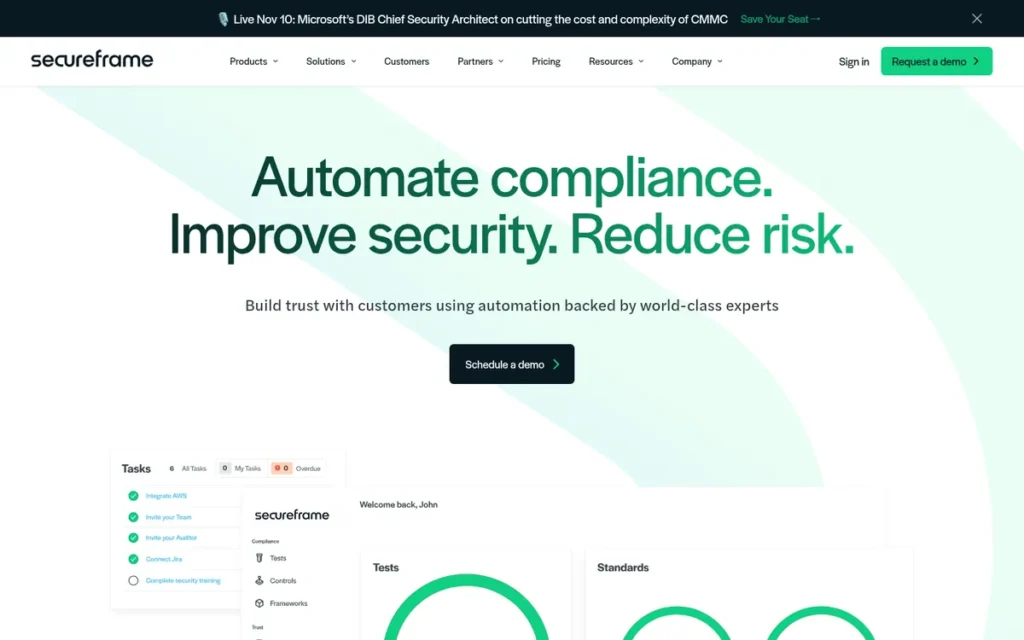
Category: Full-Stack Automation with Expert Support, automates evidence collection and continuous monitoring across 30+ frameworks while providing ex-auditor guidance embedded directly in the customer support model.
At a Glance
- Category: Full-Stack Automation with Expert Support
- Best For: Series B+ SaaS companies, defense contractors pursuing CMMC, and engineering-heavy teams needing AI-generated policies and ex-auditor guidance
- Price Range: Custom pricing; three named tiers: Essentials (1 framework), Complete (all frameworks + vendor risk management), and CMMC (Secureframe Defense). No public dollar amounts. Contact vendor for current rates (last researched: May 2026).
- Primary Strength: Secureframe is the only platform in this comparison to embed ex-auditors in its customer success team, directly aligning platform evidence outputs with what practicing auditors accept during fieldwork.
- Biggest Limitation: Secureframe’s approximately $74–79M in total disclosed funding is substantially lower than Vanta (~$505M) or Drata (~$328M), which may constrain long-term integration library expansion and enterprise support staffing velocity.
- One-Line Summary: Secureframe is a security compliance automation platform rated 4.7/5 on G2 that stands apart from category peers by embedding ex-auditors in its support team, earning the top independent community recommendation in a May 2025 r/grc practitioner comparison (score: 19), and offering the only dedicated end-to-end CMMC certification product (Secureframe Defense, launched March 2026) in the compliance automation category.
- Last Verified: May 2026
Overview
Secureframe is an all-in-one security compliance automation platform designed for SaaS companies and regulated enterprises, supporting 30+ frameworks including SOC 2, ISO 27001, HIPAA, PCI DSS, GDPR, and CMMC through 300+ native integrations. Secureframe was founded by CEO Shrav Mehta, has raised approximately $74–79M in total disclosed funding (including a $56M Series B in February 2022), and holds its own SOC 2 and ISO 27001 certifications (planetcompliance.com).
Secureframe’s most structurally distinctive attribute is a customer success team staffed with former auditors who translate platform evidence into formats practicing auditors will actually accept.
Secureframe launched Secureframe Defense in March 2026, the first dedicated end-to-end CMMC certification product in the compliance automation category, including managed CUI enclaves and virtual desktops.
Key Features
- AI Comply: Secureframe’s AI Comply feature uses large language models to auto-complete security questionnaires, generate policy drafts, validate evidence against framework requirements, and produce CMMC-specific SSP and POA&M documentation, capabilities the r/grc practitioner community identified as the most AI-advanced in the compliance automation category as of May 2025.
- Secureframe Defense (CMMC): Secureframe Defense, launched March 2026, is the first dedicated end-to-end CMMC certification product in the compliance automation category, including a managed CUI enclave and virtual desktops that reduce traditional deployment timelines to CMMC assessment-ready status in under 8 weeks (SiliconAngle, March 2026).
- Common Controls: Secureframe’s common controls feature maps evidence simultaneously across multiple frameworks, so organizations pursuing SOC 2 + HIPAA or SOC 2 + ISO 27001 concurrently avoid redundant evidence collection across shared control requirements.
- Ex-Auditor Customer Success: Secureframe’s customer success team includes former auditors who provide guidance on what evidence auditors actually accept, designed to reduce the risk that platform-generated evidence fails to meet the standard a practicing auditor requires, a gap documented in community accounts of Vanta’s evidence quality.
- 300+ Native Integrations: Secureframe connects natively to AWS, Azure, Google Cloud, GitHub, Okta, Slack, Gusto, JAMF, Asana, Vercel, Supabase, and 290+ additional systems, enabling automated evidence collection across complex SaaS tech stacks (AWS Marketplace).
Best For
Secureframe is best for Series B+ SaaS companies pursuing SOC 2 + ISO 27001 simultaneously, engineering-driven organizations that want AI-generated policy drafts and automated questionnaire responses, and defense contractors requiring CMMC Level 2 or Level 3 certification, a segment where Secureframe Defense has no direct equivalent among the seven evaluated platforms.
Pricing
Secureframe’s pricing is structured across three named tiers (Essentials, Complete, and CMMC) but no dollar amounts are published as of May 2026 (secureframe.com/pricing).
Community data suggests Secureframe has historically offered startup rates competitive with or below Vanta and Drata. Organizations pursuing CMMC should note that traditional total CMMC preparation costs range from $100,000 to $300,000+. Negotiate multi-year rates at initial signing to protect against renewal increases, which are documented as a category-wide pattern.
Strengths
- In a May 2025 r/grc practitioner thread, the highest-voted response (score: 19) explicitly recommended Secureframe over Vanta and Drata for a non-specialist engineer handling SOC 2 for the first time, stating Secureframe is “probably the furthest ahead in AI,” has “UX and customer support both really good for the space,” and provides “a really thorough test library so you can sew things up for SOC 2 pretty quickly”, the strongest independent community endorsement of any platform in this research corpus (u/secretAZNman15, r/grc, May 2025).
- Secureframe’s embedded ex-auditor support model is unique in the compliance automation category: while Vanta relies on a partner network and Drata provides in-app chat, Secureframe’s customer success team includes former auditors who translate platform evidence outputs into formats practicing auditors will accept.
- Secureframe Defense, launched March 2026, is the only dedicated end-to-end CMMC product in the compliance automation market, enabling defense contractors to reach CMMC assessment-ready status in under 8 weeks, in a market where total preparation traditionally costs $100,000–$300,000+ (SiliconAngle, March 2026).
- Secureframe holds a 4.7/5 G2 rating: above Drata (~4.4/5) and Vanta (~4.5/5), with 300+ native integrations and 30+ supported frameworks including CMMC 2.0, ISO 42001, and GDPR, providing enterprise-grade breadth alongside the ex-auditor support layer that higher-funded competitors lack (workflowautomation.net).
Users on r/sysadmin shared their experience:
“We’re at a pretty happy ‘set it and forget it’ phase with Secureframe. Off the top of my head we set up: Test cadences with expiring evidence reminders, Notifications of non-compliance from integrated systems (e.g. AWS configs), Required personnel activities (readings and things people complain about)” Posted by u/TTVjason77
Takeaway: Secureframe users in post-certification maintenance describe a “set it and forget it” reliability that is rare in a category where ongoing manual effort is the norm.
Limitations
- Funding Scale: Secureframe’s approximately $74–79M in total disclosed funding versus Vanta’s ~$505M and Drata’s ~$328M means fewer capital resources to expand its integration library, scale its support team, and sustain product development at the same velocity as the category’s best-funded competitors, a legitimate multi-year stability consideration for enterprises making long-term compliance program commitments.
- Maturity at Complex Enterprise Scale: A 2023 community practitioner characterized Secureframe as feeling like “a new or immature product” compared to OneTrust for complex multi-standard audits; while 2024–2026 updates have substantially addressed this concern, the criticism remains relevant for buyers pursuing highly complex, multi-entity GRC programs spanning NIST 800-53 or SOX, where Hyperproof’s 100+ framework library may be more appropriate (u/junkaccount1999, r/cybersecurity, 2023).
- Pricing Opacity: Secureframe does not publicly list dollar amounts for any of its three pricing tiers, meaning buyers must enter a sales conversation before evaluating per-framework cost against alternatives, an information barrier that makes self-directed budgeting difficult in early evaluation stages.
Verdict
Secureframe is the highest-ranked security compliance platform in this evaluation, earning that position through the strongest independent community endorsement in the research corpus (r/grc, score 19, May 2025), a 4.7/5 G2 rating, an ex-auditor support model unique in the category, and the only dedicated end-to-end CMMC certification product among evaluated platforms (Secureframe Defense, March 2026). Secureframe is the recommended starting point for Series B+ SaaS organizations pursuing SOC 2 + ISO 27001 simultaneously and for any organization with a CMMC certification requirement. The primary risk is funding scale relative to Vanta and Drata, enterprise buyers should negotiate multi-year contracts and assess long-term roadmap commitments directly during the evaluation process.
2. Sprinto: Best for Multi-Framework Coverage and AI-Native Automation
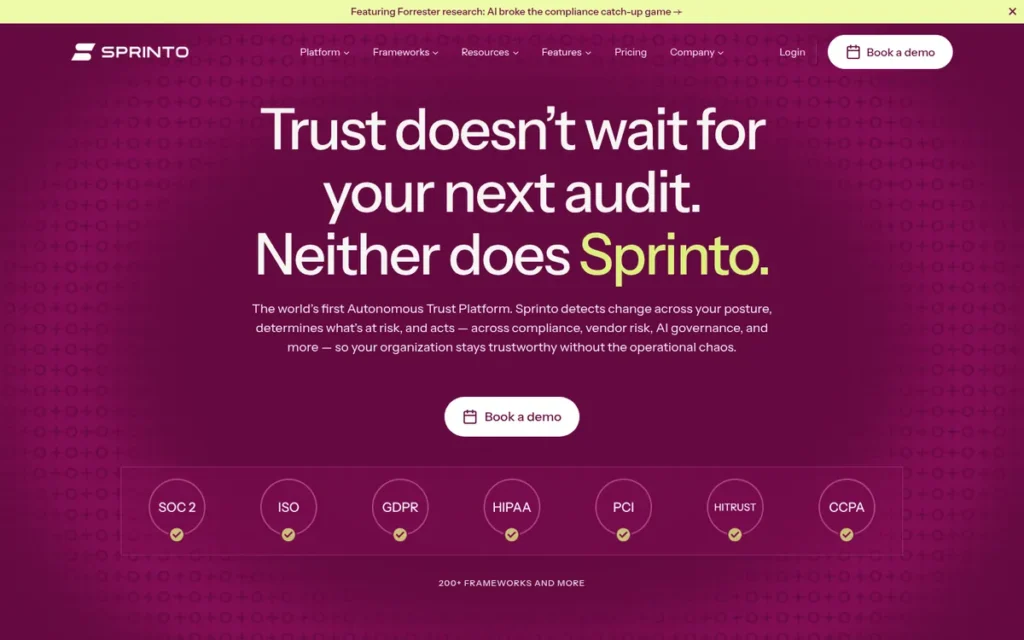
Category: AI-Native Multi-Framework Automation, uses AI agents, no-code workflow builders, and an “Infinite Frameworks” engine to automate compliance across 200+ standards with embedded advisory support designed for Series A–C SaaS companies.
At a Glance
- Category: AI-Native Multi-Framework Automation
- Best For: Series A–C SaaS companies pursuing multi-framework compliance (SOC 2 + ISO 27001 + GDPR) with a lean team that needs automation depth and embedded advisory guidance at a price below Vanta and Drata
- Price Range: Custom pricing, not publicly listed. Community data (2025) indicates Sprinto is cheaper than both Vanta and Drata for comparable configurations. No confirmed dollar figures available. Contact vendor for current rates.
- Primary Strength: Sprinto supports 200+ compliance frameworks: more than any other platform in this comparison, and auto-maps regulatory updates to existing controls via its “Infinite Frameworks” engine, eliminating ongoing manual gap-assessment work when regulations change.
- Biggest Limitation: Sprinto’s UX was described as an “ADHD nightmare” by a non-specialist target user in August 2025, citing the inability to assign tasks to individual team members, missing dependency visualization, and navigation bugs that undermine its “guided compliance for non-specialists” positioning.
- One-Line Summary: Sprinto is an AI-native GRC automation platform rated 4.8/5 on G2 that supports more compliance frameworks (200+) than any competitor in this comparison and delivered a documented 80% evidence automation rate during a real SOC 2 Type II audit, saving a three-person compliance team approximately 150 hours of manual work.
- Last Verified: May 2026
Overview
Sprinto is an AI-native GRC automation platform headquartered in San Francisco and targeting Series A–C SaaS companies seeking their first or second compliance certifications with embedded advisory support. Sprinto supports 200+ compliance frameworks (the most extensive library of any platform evaluated) alongside 300+ integrations covering cloud providers, identity systems, HR tools, and MDM solutions.
Sprinto’s “Infinite Frameworks” engine automatically monitors regulatory changes across supported standards and maps updates to existing controls, providing continuous gap assessments without manual intervention, particularly valuable for organizations operating across multiple regulatory jurisdictions.
Founded approximately 2020 by Girish Redekar and Raghu Nair and backed by approximately $31.5–31.8M in total funding (confirmed April 2026), Sprinto holds its own SOC 2 certification and is listed on the AWS Marketplace (sprinto.com).
Key Features
- Infinite Frameworks Engine: Sprinto’s “Infinite Frameworks” engine monitors regulatory changes across 200+ compliance standards and automatically maps updates to an organization’s existing control library, eliminating the manual gap-assessment work typically required each time a framework is revised or a new regulation is added (sprinto.com/features, accessed May 2026).
- AI Playground: Sprinto’s AI Playground enables organizations to build no-code custom compliance workflow agents without engineering involvement, Sprinto reports that early adopters saved 5,000+ hours through these AI-powered automations across complex multi-framework programs (vendor-reported figure, Sprinto 2025; not independently verified).
- Documented 80% Evidence Automation: During a real SOC 2 Type II audit evaluated by an independent reviewer, Sprinto automatically collected evidence for approximately 80% of required controls, saving a three-person compliance team an estimated 150 hours compared to manual evidence collection methods (workflowautomation.net, 2025).
- Embedded Advisory Model: Sprinto’s advisory approach embeds compliance team members as an extension of the customer’s team (described by community users as “their team basically becomes part of yours instead of just giving you software”) providing expert guidance throughout the certification journey rather than delivering software alone (u/ComparisonNo2361, r/SaaS, 2025).
- Consolidated Compliance Features: Sprinto includes employee security awareness training, automated vendor risk management with due diligence workflows, and unified cross-framework control management, consolidating capabilities that several other platforms charge for separately into a single subscription.
Best For
Sprinto is best for Series A–C SaaS companies pursuing multi-framework compliance simultaneously, such as SOC 2 + ISO 27001 + GDPR or SOC 2 + CMMC 2.0, with a lean team that needs comprehensive automation depth and embedded advisory guidance. Sprinto is particularly well-suited to organizations operating across multiple regulatory jurisdictions where the 200+ framework “Infinite Frameworks” engine eliminates ongoing manual gap-assessment work as regulations evolve.
Pricing
Sprinto’s pricing is custom-quoted and not publicly listed as of May 2026. Community data from 2025 consistently indicates Sprinto is cheaper than both Vanta and Drata for comparable configurations, with one buyer confirming “Sprinto is cheaper than both Vanta and Drata. Their team basically becomes part of yours instead of just giving you software” (u/ComparisonNo2361, r/SaaS, 2025).
Always request multi-year pricing at initial contract signing to protect against the renewal escalation pattern documented as a category-wide issue.
Strengths
- An independent SOC 2 Type II evaluation documented that Sprinto automatically collected evidence for 80% of required controls during a live audit, saving a three-person compliance team approximately 150 hours compared to manual evidence collection, the most specific independently documented evidence automation rate available for any platform in this comparison (workflowautomation.net, 2025).
- Community users who evaluated Sprinto against Vanta and Drata confirm it is “cheaper than both Vanta and Drata” with a support model where “evidence collection was way more thorough out of the box”, validating both cost advantage and advisory quality from a buyer who completed a formal competitive evaluation (u/ComparisonNo2361, r/SaaS, 2025).
- Sprinto holds a 4.8/5 G2 rating: second only to Scytale’s 4.9/5 among all evaluated platforms, reflecting strong overall customer satisfaction consistent with its guided advisory model and hands-on account management approach (workflowautomation.net).
- Sprinto’s 200+ framework library is the broadest of any platform in this comparison, and the “Infinite Frameworks” engine’s automated regulatory update mapping eliminates an ongoing operational burden that teams using Vanta or Drata must address manually each time a supported framework is revised.
Limitations
- UX Complexity vs. Marketing Positioning: Sprinto’s most consequential trade-off is a documented tension between its “guided compliance for non-specialists” marketing and its actual user experience. In August 2025, a non-specialist user managing Sprinto without a dedicated CISO described the interface as an “ADHD nightmare,” citing an inability to assign tasks to individual team members, missing dependency visualization, navigation bugs, and integration setup complexity requiring CTO intervention (u/PaleoSpeedwagon, r/cybersecurity, August 2025).
Users on r/soc2 noted:
“Sprinto’s fine if you’re a small, pretty standard SaaS and want guardrails on the cheap. You’ll get to ‘green checks’ quickly, but the controls can feel rigid and some stacks end up with more manual evidence work, and a bit of cleanup before the auditor is happy. If you want stronger integrations and fewer manual uploads, Drata usually wins. If you want good value without top-shelf pricing, Secureframe is a safer middle ground. Vanta’s great for content and flexibility.” Posted by u/persys_spectre
Takeaway: Sprinto is well-suited for lean, standard SaaS stacks but requires meaningful manual evidence supplementation for non-standard environments, a limitation buyers should test against their specific stack before committing.
- Unverified Bad-Faith Allegation (Requires Due Diligence): A December 2025 r/cybersecurity post raised unverified concerns about contractual bad faith by Sprinto’s finance and customer success teams and flagged a security concern about Sprinto staff having access to customer cloud and SaaS credentials. Sprinto’s December 2025 allegation is explicitly unverified in this research and requires independent investigation through direct customer references, it is flagged here as a due-diligence requirement, not an established fact (u/scalable5432, r/cybersecurity, December 2025).
- Funding Scale: Sprinto’s approximately $31.5–31.8M in disclosed funding (confirmed April 2026) is substantially below Vanta’s (~$505M) and Drata’s (~$328M), which may affect long-term platform development velocity and organizational staying power for enterprises making multi-year compliance program commitments.
Verdict
Sprinto is the second-ranked security compliance platform in this evaluation, earning that position through the broadest framework coverage in the category (200+), a documented 80% evidence automation rate saving 150 hours in real audit conditions, a 4.8/5 G2 rating, and community-confirmed pricing below Vanta and Drata. Sprinto is particularly well-suited to Series A–C SaaS companies managing multi-framework compliance across overlapping jurisdictions, where the “Infinite Frameworks” engine delivers ongoing value beyond initial certification. The primary risks are UX complexity for non-specialist users (documented August 2025) and an unverified bad-faith allegation from December 2025, both require direct due diligence through reference checks before signing.
3. Scytale: Best for Startups and Small Teams Without a Dedicated Compliance Hire
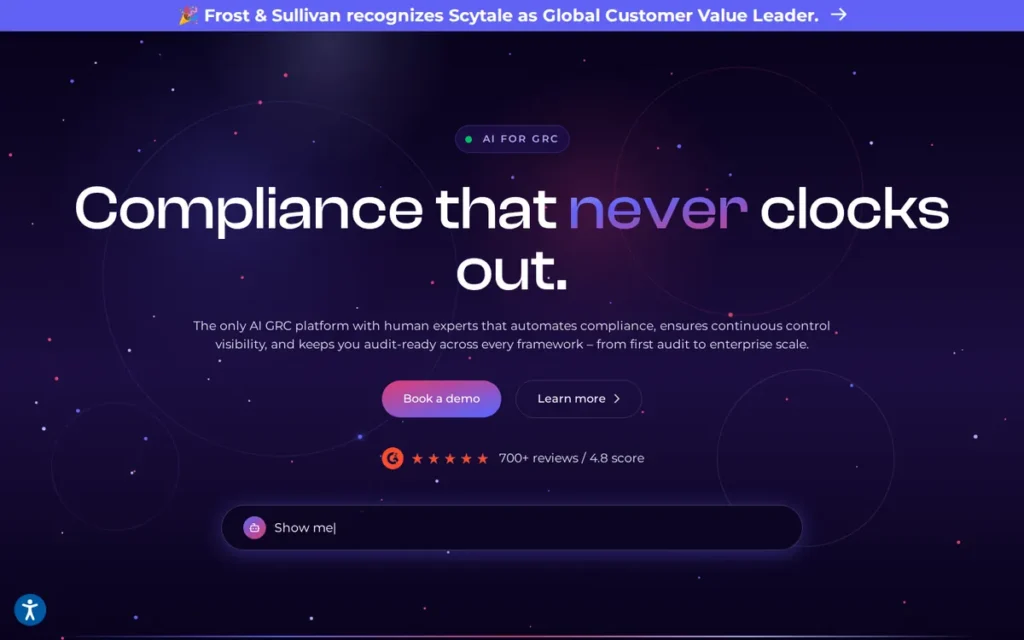
Category: Advisory-Led Compliance Automation, combines automated evidence collection and continuous monitoring with 24/7 GRC expert guidance and weekly check-ins embedded in all plans, designed specifically for organizations without dedicated compliance staff.
At a Glance
- Category: Advisory-Led Compliance Automation
- Best For: Seed and Series A startups without a compliance hire pursuing first SOC 2, ISO 27001, or GDPR certification, and small SaaS teams that need human expert guidance alongside automation
- Price Range: Custom pricing, not publicly listed. Community data (September 2025) documents one organization completing SOC 2 including auditor engagement for “well under $10K all-in.” Access reviews are included in all plans, not a separately priced add-on (confirmed r/SaaS, February 2026).
- Primary Strength: Scytale includes 24/7 GRC expert advisory, weekly compliance check-ins, and access reviews in all plans, providing fractional CISO-equivalent guidance that teams without a dedicated compliance hire would otherwise need to hire externally.
- Biggest Limitation: Scytale’s approximately 30+ framework library (while adequate for standard SaaS certifications) is narrower than Sprinto’s 200+ and Hyperproof’s 100+, limiting suitability for organizations managing government-specific frameworks like NIST 800-53, SOX, or FedRAMP simultaneously.
- One-Line Summary: Scytale is a security compliance automation platform rated 4.9/5 on G2 (the highest of all seven evaluated platforms) that distinguishes itself by including 24/7 GRC expert advisory and access reviews in all plans, enabling a documented sub-$10,000 all-in SOC 2 certification cost that is 60–80% below the category average for total platform-plus-audit spend.
- Last Verified: May 2026
Overview
Scytale is an AI-integrated GRC compliance platform founded approximately 2021 and headquartered in Israel, designed primarily for SaaS organizations pursuing their first SOC 2, ISO 27001, GDPR, or HIPAA certification without a dedicated compliance hire. Scytale supports 30+ compliance frameworks, confirmed via scytale.ai/all-frameworks and a December 2025 press release, through standard cloud integrations including AWS, GCP, Okta, GitHub, Jira, and Slack, with continuous monitoring and 24/7 GRC expert advisory embedded in all plans.
Scytale’s most distinctive commercial attribute is the inclusion of user access reviews and expert guidance in all pricing tiers. Vanta and some Drata tiers charge these features as add-ons, meaning buyers must compare true all-in costs, not just base licensing fees.
Scytale’s Scy AI GRC agent performs automated gap scanning, generates remediation recommendations, and auto-fills security questionnaires, with cross-framework control mapping enabling efficient SOC 2 to ISO 27001 expansion.
Key Features
- Access Reviews Included in All Plans: Scytale includes user access reviews in all pricing plans (a required SOC 2 Type II control and HIPAA safeguard that Vanta and some Drata tiers charge as a separate add-on) confirmed by a February 2026 r/SaaS practitioner (score: 9) who selected Scytale specifically because “a lot of the other options had that as an add-on” (u/Just_Awareness2733, r/SaaS, February 2026).
- 24/7 GRC Expert Advisory: Scytale’s advisory model provides on-demand compliance expert calls and weekly check-ins as part of the platform subscription, functioning as embedded fractional compliance support for teams without a dedicated CISO or GRC hire, enabling certification without specialist headcount.
- Scy AI GRC Agent: Scytale’s Scy AI agent performs automated gap scanning against target frameworks, generates specific remediation recommendations, and auto-fills security questionnaires, enabling lean teams to maintain audit readiness without ongoing manual review cycles between audit engagements.
- Cross-Framework Control Mapping: Scytale’s shared control library enables organizations that complete SOC 2 to expand to ISO 27001 with minimal rework, confirmed by a February 2026 r/SaaS practitioner (u/Just_Awareness2733, score: 9) as requiring “less rework” when adding ISO 27001 as a second certification.
- Vendor Risk Management with Automated Risk Scores: Scytale’s vendor risk management module generates automated risk scores for third-party vendors without requiring manual questionnaire distribution, consolidating vendor due diligence into the same compliance platform as control monitoring.
Best For
Scytale is best for seed-stage and Series A startups without a dedicated compliance hire pursuing their first SOC 2 or ISO 27001 certification, particularly those with budget constraints that make Vanta’s or Drata’s pricing prohibitive. Scytale is also well-suited for any team that needs weekly expert GRC guidance alongside automation, which Scytale includes in all plans rather than pricing as a premium add-on.
Pricing
Scytale’s pricing is not publicly listed and requires a sales conversation as of May 2026. Community data from September 2025 documents one organization completing SOC 2 including the ConstellationGRC auditor engagement for “well under $10K all-in”, representing 60–80% cost savings relative to Vanta or Drata platform fees alone (u/TraditionalEye5573, r/SaaS, September 2025).
Community pricing for Scytale includes:
- All-in SOC 2 cost (platform + ConstellationGRC auditor): under $10,000 (r/SaaS, September 2025)
- Access reviews included in all plans: not a separately priced add-on (confirmed r/SaaS, February 2026)
- Community descriptions: pricing competitive with or below Vanta
Critically, access reviews are included in Scytale’s base plans, meaning buyers should not treat Vanta or Drata base plan prices as equivalent without confirming add-on inclusion. Request multi-year pricing at initial signing, and request the vendor’s own SOC 2 or ISO 27001 certificate during due diligence.
Strengths
- A February 2026 r/SaaS post (score: 9) from a practitioner who selected Scytale after evaluating Vanta and Drata documented three specific advantages: on-demand expert calls and weekly check-ins without requiring a dedicated security hire, AI-accelerated policy building and evidence review, and access reviews included in all base plans (noting “a lot of the other options had that as an add-on”) the strongest recent independent community endorsement specific to the startup segment in this research (u/Just_Awareness2733, r/SaaS, February 2026).
- Scytale holds a 4.9/5 G2 rating: the highest of all seven platforms in this evaluation, reflecting strong customer satisfaction consistent with its advisory-led model, where embedded expert guidance and proactive account management generate positive outcomes across the SaaS startup buyer profile.
- A September 2025 r/SaaS community account documented completing SOC 2 with Scytale and ConstellationGRC auditor for “well under $10K all-in”, the most cost-efficient full certification outcome documented in this research, substantially below the $20,000–$46,000+ total cost typical for Vanta or Drata customers (u/TraditionalEye5573, r/SaaS, September 2025).
- Cross-framework expansion from SOC 2 to ISO 27001 is documented by a February 2026 r/SaaS practitioner (u/Just_Awareness2733, score: 9) as requiring less rework due to Scytale’s shared control library, a key ROI advantage for growth-stage startups that need SOC 2 today and ISO 27001 within 12 months.
Limitations
- Framework Library Depth for Enterprise Use Cases: Scytale’s approximately 30+ framework library is adequate for standard SaaS certification journeys (SOC 2, ISO 27001, GDPR, HIPAA, PCI DSS) but substantially narrower than Sprinto’s 200+ and Hyperproof’s 100+ for organizations managing government-specific frameworks like NIST 800-53, SOX, CIS Controls, or FedRAMP simultaneously, making Scytale unsuitable for complex multi-entity GRC programs spanning government or financial regulatory requirements.
- Newer Market Tenure and Undisclosed Funding: Scytale was founded approximately 2021, making it among the newest entrants in this comparison, and its funding level is undisclosed. One community user questioned its customer base size, with unresolved estimates ranging from “about 30 customers” to a vendor-reported 2,000, warranting direct customer reference verification before committing (u/Strange_Pudding4007, r/SaaS).
- Integration Ecosystem Documentation: Scytale’s integration library covers standard cloud and SaaS tools but is not as extensively quantified as Vanta (400+), Secureframe (300+), or Sprinto (300+), buyers with unusual or highly specialized tech stacks should verify native integration coverage during the demo process before assuming automated evidence collection for all controls.
Verdict
Scytale is the third-ranked security compliance platform in this evaluation and the top recommendation for seed-stage and Series A startups pursuing their first SOC 2 or ISO 27001 certification without a dedicated compliance hire. Scytale earned this ranking through the highest G2 score in the comparison (4.9/5), a documented sub-$10,000 all-in SOC 2 certification cost, inclusion of access reviews and 24/7 GRC advisory in all plans, and cross-framework control mapping that reduces rework when expanding from SOC 2 to ISO 27001. Buyers should conduct additional due diligence on verified customer references and request transparent all-in pricing before signing, given Scytale’s newer market tenure and undisclosed funding position.
4. Drata: Best for Audit Quality, Customer Support, and MSP-Channel Procurement
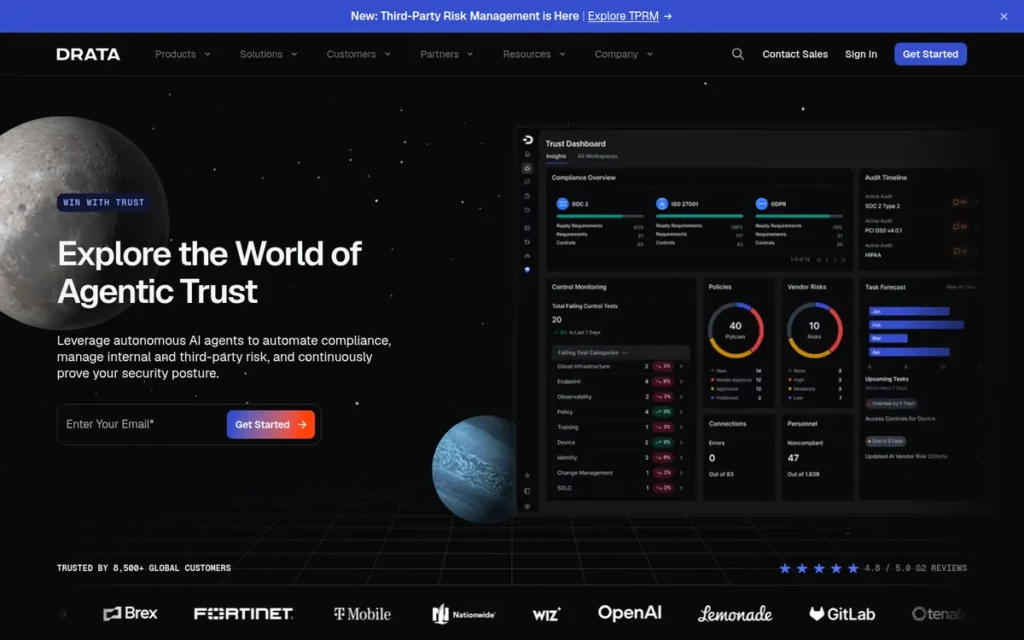
Category: Auditor-Integrated Compliance Automation, features a dedicated auditor portal, 24/7 in-app compliance advisory chat with sub-2-minute response times, and continuous evidence monitoring optimized for producing audit-quality evidence that a practicing SOC 2 auditor has publicly rated superior to Vanta.
At a Glance
- Category: Auditor-Integrated Compliance Automation
- Best For: Mid-market SaaS companies with active or upcoming audit engagements where auditor familiarity with the platform matters, teams that prioritize in-app compliance advisory over integration breadth, and buyers using the MSP channel for cost reduction
- Price Range: Custom pricing, not publicly listed. Community-documented data (r/cybersecurity, 2023–2025): year-one approximately $7,500 for SOC 2 only; renewal quotes of $15,000 (SOC 2 + ISO 27001) and $20,000 (adding GDPR), a 100–167% increase. One user documented $26,000/year for up to 300 employees. MSP channel: compliance MSPs offer platform + consulting starting at approximately $1,000/month (BrightDefense, r/cybersecurity, 2023).
- Primary Strength: Drata is the only platform in this seven-platform comparison confirmed to have a dedicated auditor portal where external auditors log in directly to access and request evidence, confirmed as “much nicer and more comprehensive” than Vanta by a practicing SOC 2 auditor in January 2023.
- Biggest Limitation: Drata’s renewal pricing practices are the most thoroughly documented bait-and-switch pattern in the compliance automation category, with multiple independent community accounts documenting 100–167% year-two pricing increases from year-one introductory rates.
- One-Line Summary: Drata is a security compliance automation platform rated approximately 4.4/5 on G2 and is the auditor-preferred option among evaluated platforms (a practicing SOC 2 auditor publicly rated its evidence quality and dedicated auditor portal as superior to Vanta in January 2023) though its documented 100–167% year-two renewal pricing escalations require multi-year rate negotiation before signing.
- Last Verified: May 2026
Overview
Drata is a cloud-based security compliance automation platform founded in 2020 by CEO Adam Markowitz and CTO Daniel Marashlian, backed by approximately $328M in funding, the largest capital base of any platform in this evaluation. Drata supports 20+ compliance frameworks including SOC 2, ISO 27001, HIPAA, PCI DSS, and GDPR through 75+ integrations with 24/7 continuous control monitoring (drata.com).
Drata’s core differentiator is its dedicated auditor portal, which enables external auditors to log into the platform and access evidence directly without email-based evidence packages. A practicing SOC 2 auditor publicly identified this capability as making Drata “much nicer and more comprehensive” than Vanta for active audit engagements (u/OldschoolGGthelegend, r/cybersecurity, January 2023).
Drata has built an active MSP partner ecosystem that can reduce all-in costs to approximately $1,000/month through channel partners, a meaningful alternative procurement path for organizations combining platform and implementation support.
Key Features
- Dedicated Auditor Portal: Drata’s auditor portal enables external auditors to log into the platform and access evidence directly, a feature a practicing SOC 2 auditor publicly identified in January 2023 as making Drata “much nicer and more comprehensive” than Vanta, keeping all additional evidence requests within the platform rather than reverting to email chains (u/OldschoolGGthelegend, r/cybersecurity, January 2023).
- 24/7 Continuous Control Monitoring: Drata provides continuous 24/7 compliance monitoring through 75+ integrations that verify controls daily, generating real-time compliance status and flagging control failures immediately rather than at scheduled review intervals (AWS Partner Blog).
- Drata IQ (Generative AI): Drata IQ automates GRC task management, security questionnaire responses, and compliance workflow guidance, reducing time compliance teams spend on repeatable documentation tasks across SOC 2 and ISO 27001 control requirements.
- Sub-2-Minute In-App Compliance Advisory Chat: Drata provides in-app compliance advisory chat with sub-2-minute response times documented by multiple independent community users, delivering compliance expertise access during active audit preparation without scheduling delays.
- Custom Frameworks Module: Drata’s custom frameworks module enables enterprises to upload internal control sets and map them across Drata’s standard framework library, extending the platform’s value to organizations with proprietary compliance requirements or industry-specific control overlays.
Best For
Drata is best for mid-market SaaS companies with an active or upcoming SOC 2 or ISO 27001 audit engagement where auditor-quality evidence production is the primary criterion, particularly organizations whose auditors are already familiar with the Drata auditor portal. Drata is also well-suited for teams using a compliance MSP channel (where pricing starts at approximately $1,000/month through partners) and for organizations that require responsive in-app compliance advisory during audit preparation.
Pricing
Drata’s pricing is custom-quoted and not publicly listed as of May 2026. Community-documented data from verified practitioner accounts (r/cybersecurity, 2023–2025):
- Year-one rate: approximately $7,500 for SOC 2 only (multiple community accounts)
- Year-two renewal quotes: $15,000 for SOC 2 + ISO 27001; $20,000 adding GDPR: a 100–167% increase (u/Beneficial-Dust4434, r/cybersecurity, 2023–2025)
- Alternative: $26,000/year for up to 300 employees (separate community account)
- MSP channel: approximately $1,000/month including consulting hours (BrightDefense, r/cybersecurity, 2023)
Critical guidance: lock in multi-year pricing at initial contract signing. Multiple community users who did not do this experienced 100–167% price increases at year two. Always request add-on features (vendor risk management, access reviews, custom frameworks) itemized separately before signing.
Strengths
- A practicing SOC 2 auditor publicly stated in a January 2023 r/cybersecurity thread that “Drata is much nicer, more comprehensive with their monitoring of controls” than Vanta, and that the Drata auditor portal represents a meaningful audit quality advantage, the most credible third-party quality signal available for any platform in this research (u/OldschoolGGthelegend, r/cybersecurity, January 2023).
- Nylas, a B2B SaaS company, deployed Drata to achieve “real-time visibility into compliance status, continuous risk assessment, and automated remediation”, enabling proactive gap closure that “enhanced customer trust and relationships.” No specific time-savings percentage is publicly documented for the Nylas implementation, making this a qualitative outcome reference (Nylas, 2024).
- Drata’s approximately $328M in total funding is the largest capital base of any platform in this comparison, providing the most resources for integration development, enterprise support staffing, and long-term platform stability.
- Community users managing 270+ employee organizations describe Drata’s support quality as “top notch” with “wide variety of integrations, policy templates, control guidance” and in-app response times under 2 minutes, cited as a decisive advantage over Vanta’s support model at comparable company size (u/cyberwiseguy, r/cybersecurity, 2024).
Limitations
- Bait-and-Switch Renewal Pricing: Drata’s most consequential trade-off is its documented renewal pricing model, multiple independent community accounts confirm year-one pricing of approximately $7,500 for SOC 2 alone, followed by renewal quotes of $15,000–$20,000 (a 100–167% increase), once the organization has built its compliance program on the platform and migration costs are high. One buyer who experienced this described Drata as “maybe the worst company we ever partnered with” and migrated mid-program to Vanta (u/Beneficial-Dust4434, r/cybersecurity, 2023–2025).
- Integration Failure Risk: Integration reliability is a secondary documented risk: one team in January 2025 reported integration failures forcing them to abandon Drata mid-SOC 2 audit and switch to Vanta to complete the engagement, the only documented mid-audit platform switch in this research (u/security_intern, r/cybersecurity, January 2025).
- Narrower Integration and Framework Coverage: Drata’s 75+ integrations are substantially fewer than Vanta (400+), Secureframe (300+), and Sprinto (300+), and its 20+ frameworks trail Secureframe (30+), Vanta (35+), Hyperproof (100+), and Sprinto (200+), limiting suitability for organizations with complex multi-framework regulatory environments or government-specific certification requirements.
Verdict
Drata is the fourth-ranked security compliance platform in this evaluation, earning that position through the strongest auditor-facing evidence quality in the comparison (per a practicing SOC 2 auditor’s January 2023 public assessment), a dedicated auditor portal unique in its class, sub-2-minute in-app support response times documented by multiple community users, and the largest funding base of all evaluated platforms (~$328M). Drata is the recommended platform for mid-market organizations with active audit engagements where auditor portal familiarity is a material factor. The non-negotiable condition for any Drata purchase is locking in multi-year pricing at contract signing, the documented 100–167% renewal escalation pattern makes year-one pricing a poor indicator of true multi-year cost.
5. Vanta: Best for Integration Breadth and Enterprise-Scale Market Presence
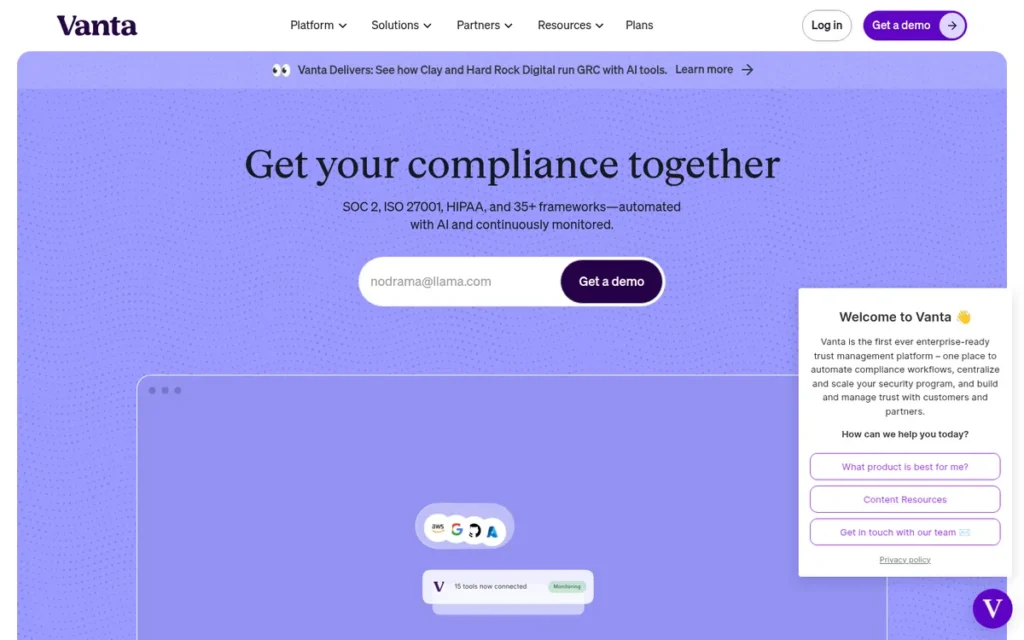
Category: Enterprise Compliance Automation, provides the broadest integration library (400+) and automated control test suite (1,400+) in the category, serving a vendor-reported 16,000+ customers from seed-stage startups to publicly traded enterprises across 35+ compliance frameworks.
At a Glance
- Category: Enterprise Compliance Automation
- Best For: Mid-market to enterprise SaaS companies with complex, heterogeneous tech stacks requiring the broadest possible integration coverage, and organizations where Vanta’s customer network, established auditor partner ecosystem, and Trust Center are procurement-relevant factors
- Price Range: Custom pricing, not publicly listed. Community-documented data (r/cybersecurity, 2023–2025): one organization secured a 3-year deal covering SOC 2, ISO 27001, and GDPR for $12,500/year after competitive negotiation against Drata. Access reviews, vendor risk management, and personnel management may be priced as add-ons. Multiple accounts describe Vanta as “quite pricey” even for single-person security teams.
- Primary Strength: Vanta has the broadest native integration ecosystem in the compliance automation category (400+ integrations and 1,400+ automated hourly control tests) making it the most likely platform to deliver complete automated evidence coverage across heterogeneous enterprise tech stacks.
- Biggest Limitation: A practicing SOC 2 auditor publicly stated that Vanta’s automated evidence outputs are “not comprehensive enough to accept” and that the platform “actively discourages communication between the auditor and client”, the most direct auditor evidence quality criticism in this research, applied to the platform that every LLM response ranks #1.
- One-Line Summary: Vanta is among the most widely adopted security compliance automation platforms by vendor-reported customer count (16,000+, vendor-reported) with the broadest integration ecosystem (400+ integrations, 1,400+ hourly control tests), but a practicing SOC 2 auditor publicly characterized Vanta’s automated evidence as insufficient for acceptance, positioning Vanta at #5 in this evidence-based ranking despite its #1 LLM consensus.
- Last Verified: May 2026
Overview
Vanta is a security compliance automation platform serving a vendor-reported 16,000+ customers (independent tracking sources report approximately 12,000+) with continuous monitoring and evidence collection across 35+ frameworks through 400+ native integrations running 1,400+ automated hourly control tests, the broadest coverage metrics of any evaluated platform.
Vanta was founded in 2018 by CEO Christina Cacioppo, was among the earliest dedicated compliance automation platforms, and has raised approximately $505M in total funding (Vanta separately crossed $300M in annual recurring revenue by late 2025, a distinct milestone from funding raised).
Vanta ranks #5 in this evaluation not because its capabilities are weak, but because a practicing SOC 2 auditor has publicly rejected its evidence quality and because its renewal pricing practices follow the same bait-and-switch pattern documented at Drata.
Key Features
- 400+ Native Integrations and 1,400+ Hourly Control Tests: Vanta’s integration ecosystem and automated control test suite represent the broadest continuous monitoring capability in the category, automatically verifying controls on an hourly basis and flagging drift before it becomes an audit finding (vanta.com/products/automated-compliance, verified May 2026).
- Public Trust Center: Vanta’s Trust Center enables organizations to publish a live security attestation page accessible to enterprise prospects on-demand, allowing sales teams to share compliance status during B2B procurement cycles without scheduling dedicated security reviews.
- Vanta AI Agent: Vanta AI Agent automates security questionnaire responses and policy generation, reducing engineering and compliance team hours consumed by responding to enterprise vendor security questionnaires, a significant operational burden for Series B+ companies in active enterprise sales cycles.
- Cross-Framework Control Mapping (35+ Frameworks): Vanta’s cross-framework mapping enables organizations to perform compliance work once and apply evidence across multiple frameworks simultaneously, covering SOC 2, ISO 27001, HIPAA, PCI DSS, GDPR, HITRUST, NIST CSF, and additional standards.
- Read-Only API Integration Architecture: Vanta’s integrations operate on a read-only API basis, confirmed on vanta.com as of May 2026, limiting the blast radius if the compliance platform itself were compromised, and addressing the community concern that compliance platforms create “juicy targets” by aggregating access to HR, identity, and cloud systems (vanta.com/resources/vantas-security-and-compliance-overview, verified May 2026).
Best For
Vanta is best for mid-market to enterprise SaaS companies with complex, heterogeneous tech stacks requiring the broadest integration coverage (AWS, GCP, Azure, GitHub, Okta, Slack, JAMF, Gusto, and 390+ more). Vanta is also well-suited for organizations where the auditor partner network, vendor-reported 16,000+ customer community, and Trust Center are active procurement considerations and for companies that use the Trust Center as an enterprise sales tool.
Pricing
Vanta’s pricing is custom-quoted and not publicly listed as of May 2026. Community-documented data includes:
- One organization secured a 3-year deal covering SOC 2, ISO 27001, and GDPR for $12,500/year after competitive negotiation against Drata (u/Beneficial-Dust4434, r/cybersecurity, 2023)
- Vanta described as “quite pricey” even for single-person security teams (u/Om-Nomenclature, r/cybersecurity)
- Reports that Vanta offers steep discounts when competing against Drata
- Add-on pricing for vendor risk management, access reviews, and personnel management flagged as “major surprises along the way” by multiple community users
The most effective documented pricing tactic: obtain competing quotes from Vanta and Drata simultaneously, allow both sales teams to see the competing quote, and request a multi-year lock-in at year-one pricing.
Strengths
- Vanta’s 400+ native integrations and 1,400+ automated hourly control tests are the broadest in the compliance automation category, making Vanta statistically most likely to cover every system in a given enterprise tech stack, a meaningful advantage where integration gaps force manual evidence uploads and create audit risk (vanta.com, verified May 2026).
This aligns with community sentiment on r/sysadmin:
“This time with Vanta we’re doing a Type 2 (and SOC 3), from scratch again, we were audit ready in just 1 month, and our observation window ends in a few weeks time. Overall it has been WAY better than doing it the old school way, especially since everything from Azure, our HRIS, Background Check software, etc. all got imported on it’s own along with our Code and Issue management stuff. In total less than 1/3 of all the checks they cover we had to upload some evidence for, everything else was automated for us.” Posted by u/tankerkiller125real
Takeaway: Vanta’s integration depth delivers on its core value proposition for organizations with standard enterprise tech stacks, cutting audit preparation from months to weeks through broad automated evidence coverage.
- Vanta’s vendor-reported 16,000+ customer base: the largest self-reported figure in the category, represents the most extensive community knowledge base, partner ecosystem, and auditor familiarity of any platform, providing a large pool of peer references for prospective buyers (vanta.com/customers, vendor-reported, 2025).
- Community data from r/cybersecurity documents one organization locking in a 3-year deal covering SOC 2, ISO 27001, and GDPR for $12,500/year after competitive negotiation, demonstrating that Vanta’s pricing is meaningfully negotiable when buyers leverage simultaneous competitive evaluation against Drata (u/Beneficial-Dust4434, r/cybersecurity, 2023).
- Vanta’s read-only API integration architecture limits the blast radius of a potential platform compromise, addressing a community-raised concern that compliance platforms aggregate sensitive system access and represent high-value targets (vanta.com, verified May 2026).
Limitations
- Auditor Evidence Quality Rejection: Vanta’s most consequential trade-off is auditor evidence quality, a practicing SOC 2 auditor publicly stated in a January 2023 r/cybersecurity thread that “Vanta is awful, their tests for the controls are often not comprehensive for us to accept as evidence and actively discourage communication between the auditor and client.” This is the most direct auditor quality criticism in this research, applied to the market-leader platform that every LLM ranks #1 (u/OldschoolGGthelegend, r/cybersecurity, January 2023).
- One-Size-Fits-All Control Frameworks: Vanta applies a generic SOC 2 program without tailoring its control set to company size, industry, or risk profile, generating compliance checklists that multiple community accounts report don’t match auditor expectations for smaller organizations, such as requiring board meeting policies for two-developer startups. This concern is independently corroborated by the practicing auditor’s evidence quality rejection cited above.
- Add-On Pricing Surprises: Vanta’s add-on pricing model for features including vendor risk management, access reviews, and personnel management (identified by community users as “major surprises along the way”) makes true all-in cost difficult to predict from base plan pricing, compounding renewal escalation risk documented across multiple community accounts.
Users on r/soc2 noted:
“Too expensive considering you still have to do work yourself. You better find somebody that can give you a software tool + implementation service in one. Then you’re hands off and it’s soo much better. I used vanta but the cost/benefit ratio didn’t make sense. Canceled it” Posted by u/Content-Fishing735
Takeaway: Vanta’s pricing fails the cost-benefit test for organizations that still face significant manual compliance work after paying platform fees, particularly smaller teams without dedicated compliance staff.
Key Finding: Vanta is ranked #5 in this independent evaluation despite being ranked #1 by major AI tools, because a practicing SOC 2 auditor publicly stated Vanta’s evidence is “not comprehensive enough to accept.” Integration breadth does not substitute for auditor evidence quality.
Verdict
Vanta is the fifth-ranked security compliance platform in this evaluation, a position that will surprise readers accustomed to seeing Vanta ranked #1 by LLMs and affiliate-driven review sites, and that represents the most significant editorial finding this article delivers over AI-generated content. Vanta earns the broadest integration coverage in the category (400+ integrations, 1,400+ hourly control tests) and has the largest vendor-reported customer base, but a practicing SOC 2 auditor has publicly characterized Vanta’s evidence outputs as “not comprehensive enough to accept”, a finding absent from all LLM responses reviewed for this article. Vanta is the right choice for organizations where integration breadth across a heterogeneous tech stack is the primary criterion, provided buyers negotiate aggressively on price and lock in multi-year rates at signing.
6. Hyperproof: Best for Enterprise Multi-Framework GRC Beyond SOC 2 and ISO 27001
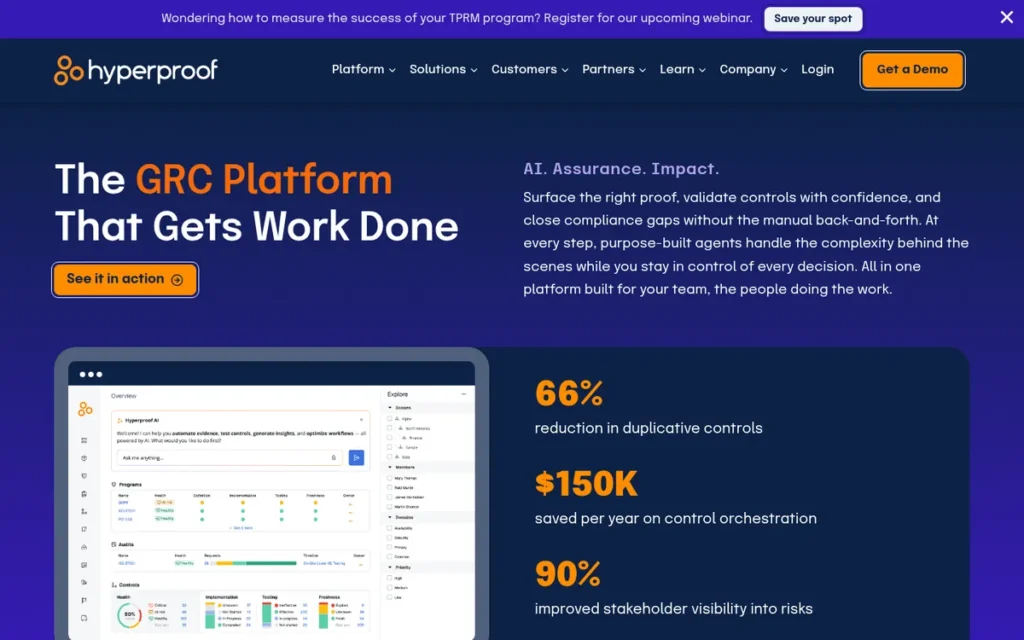
Category: Enterprise GRC Platform, manages governance, risk, and compliance across 100+ frameworks for mid-market to enterprise organizations with complex regulatory environments, multiple business units, and hierarchical compliance reporting requirements.
At a Glance
- Category: Enterprise GRC Platform
- Best For: Mid-market to enterprise organizations managing compliance across NIST 800-53, SOX, CIS Controls, FedRAMP, and other complex frameworks alongside SOC 2 and ISO 27001, particularly those with multiple business units requiring hierarchical compliance visibility
- Price Range: Custom enterprise pricing; no public tier names or dollar amounts available as of May 2026. No community-sourced pricing data available. Budget substantially above startup-focused alternatives in this comparison.
- Primary Strength: Hyperproof’s 100+ compliance framework library is the second-broadest in this evaluation and the most enterprise-deep, including NIST SP 800-53, NIST CSF, CIS Critical Security Controls, SOX, and FedRAMP, enabling organizations to manage cross-functional GRC programs from a single platform.
- Biggest Limitation: As of January–February 2026, Hyperproof’s Jira integration is confirmed by the company’s CEO as currently “commercial rather than enterprise grade,” and the platform’s audit logging has been described by enterprise users as insufficient to feed a SIEM, both material concerns for enterprise security teams.
- One-Line Summary: Hyperproof is an enterprise GRC platform rated 4.7/5 on G2 that supports 100+ compliance frameworks and delivered documented outcomes at Appian including a 66% reduction in duplicative controls and 350 hours per year in audit preparation savings (vendor-attributed figures), but as of early 2026 its Jira integration is confirmed as “commercial rather than enterprise grade” by the company CEO and its audit logging has been described as insufficient for SIEM integration by enterprise users.
- Last Verified: May 2026
Overview
Hyperproof is an AI-powered enterprise GRC platform headquartered in Bellevue, Washington, designed for mid-market and enterprise organizations managing compliance across 100+ frameworks, including NIST SP 800-53, NIST CSF, CIS Critical Security Controls, SOX, FedRAMP, PCI DSS, SOC 2, ISO 27001, and GDPR. Hyperproof has raised approximately $77M in disclosed funding, including a $40M growth investment in August 2023 led by Riverwood Capital (TechCrunch, August 2023).
Hyperproof launched Hyperproof AI in September 2025 and acquired Expent (AI-native vendor risk management) to integrate third-party risk capabilities directly into the GRC platform.
Hyperproof serves enterprise customers including Reddit, Fortinet, Appian, Outreach, and Thales, with hierarchical organizational scopes providing compliance visibility across multiple business units from a single platform (hyperproof.io).
Key Features
- 100+ Framework Library: Hyperproof’s 100+ framework library: including NIST SP 800-53, NIST CSF, CIS Critical Security Controls, SOX, FedRAMP, and CMMC alongside SOC 2 and ISO 27001, is the second-most extensive in this comparison and the most enterprise-deep, supporting complex multi-framework regulatory environments that startup-focused platforms cannot adequately cover.
- Hierarchical Organizational Scopes: Hyperproof’s hierarchical scopes enable enterprise-wide compliance visibility across multiple business units, subsidiaries, or product lines, a capability built specifically for large organizations where GRC programs span multiple independent compliance domains that must be reported at both unit and organizational levels.
- Hyperproof AI: Hyperproof AI, launched September 2025, deploys adaptive AI agents for continuous controls monitoring, automated evidence collection, policy gap analysis, vendor risk management, and board-level reporting automation, what Hyperproof describes as the “first end-to-end AI GRC engine” (vendor claim, September 2025; not independently verifiable given concurrent AI GRC product launches by other platforms in the same period) (PR Newswire, September 2025).
- Expent-Powered Vendor Risk Management: Hyperproof’s acquisition of Expent integrates AI-native vendor risk scoring and due diligence directly into the GRC platform, enabling enterprises to manage third-party risk assessments in the same environment as compliance controls without a separate TPRM tool subscription.
- Continuous Controls Monitoring (CCM): Hyperproof’s CCM provides real-time control validation through 70+ Hypersyncs (native integrations), surfacing control drift immediately rather than at scheduled evidence collection intervals.
Best For
Hyperproof is best for mid-market to enterprise organizations managing compliance programs spanning NIST 800-53, SOX, CIS Controls, FedRAMP, or other complex government or financial regulatory frameworks alongside SOC 2 and ISO 27001. Hyperproof is specifically recommended for organizations with multiple business units requiring unified compliance visibility and active third-party risk programs that can leverage the Expent-powered vendor risk module.
Pricing
Hyperproof’s pricing is completely opaque, no public tier names, no dollar amounts, and no community-sourced pricing data are available as of May 2026. Hyperproof is the most pricing-opaque platform in this evaluation.
Prospective buyers should budget for enterprise-level pricing substantially above startup-focused platforms in this comparison, and request an itemized all-in quote covering all frameworks and organizational scopes required. The CEO’s February 2026 public commitment to improving Jira integration toward “enterprise ready” status confirms active investment but provides no committed timeline, assess current Jira integration capability directly during demos before signing.
Strengths
- Hyperproof’s GRC platform feature overview attributes a 66% reduction in duplicative controls and 350 hours per year saved in audit preparation to the Appian implementation; the primary Appian case study page additionally documents $100,000 saved per audit and 100+ hours saved through Hypersyncs automation, both are vendor-published figures demonstrating substantial cross-framework control mapping ROI (Hyperproof, 2025).
- Hyperproof AI, launched September 2025, deploys adaptive AI agents for continuous controls monitoring, policy gap analysis, automated evidence collection, and board-level reporting automation, with differentiated board reporting features not prominently available in Secureframe’s or Sprinto’s AI offerings (PR Newswire, September 2025).
- Hyperproof’s enterprise customer base: including Reddit, Fortinet, Appian, Outreach, and Thales, provides validated evidence of performance at enterprise scale across security-mature organizations with complex tech stacks and multi-framework regulatory environments (hyperproof.io).
- Hyperproof’s acquisition of Expent integrates AI-native vendor risk management directly into the GRC platform, enabling enterprises to manage vendor due diligence, risk scoring, and evidence requests in the same environment as compliance controls without maintaining a separate TPRM tool subscription.
Limitations
- Confirmed Integration and Logging Gaps (Early 2026): Hyperproof’s most consequential trade-off involves two capability gaps confirmed in January–February 2026. First, the Jira integration was confirmed by Hyperproof’s CEO as currently “commercial” rather than “enterprise grade,” with active investment underway but no committed timeline for enterprise readiness. Second, Hyperproof’s audit logging was described by an enterprise user as “next to nothing of both a proper audit trail or built out well supported methods you can use to feed to a security monitoring tool”, with that user reverting to a spreadsheet because “it actually worked” (u/TrickyCupcake3444, r/cybersecurity, January 2026; u/Brooklyn-Plague (CEO), r/cybersecurity, February 2026).
- Fewer Integrations Than Top Platforms: Hyperproof’s 70+ Hypersyncs are substantially fewer than Vanta (400+), Secureframe (300+), and Sprinto (300+), which may force manual evidence uploads for tech stack components not covered by native integrations, partially offsetting the framework breadth advantage for organizations with diverse cloud environments.
- Complete Pricing Opacity: Hyperproof provides no public pricing information of any kind (not even tier names) making it the most difficult platform to self-qualify for budget assessment before engaging a sales team, a practical friction point for organizations evaluating multiple platforms simultaneously.
Verdict
Hyperproof is the sixth-ranked security compliance platform in this evaluation and the recommended option for enterprises managing compliance programs spanning NIST 800-53, SOX, CIS Controls, FedRAMP, or other complex government and financial frameworks that no other evaluated platform covers with equivalent depth. Hyperproof’s Appian results (vendor-attributed), enterprise customer roster (Reddit, Fortinet, Thales), approximately $77M in disclosed funding, and Hyperproof AI launch are genuine capability signals for enterprise buyers. The January–February 2026 community-reported and CEO-confirmed limitations (a Jira integration at only “commercial” grade and audit logging insufficient for SIEM feeding) are material concerns for enterprise security teams and should be evaluated directly during demos with current capability timelines requested before signing.
7. SecureSlate: Lowest Confidence Ranking: Budget-Oriented SMB Compliance Suite Requiring Substantial Additional Due Diligence
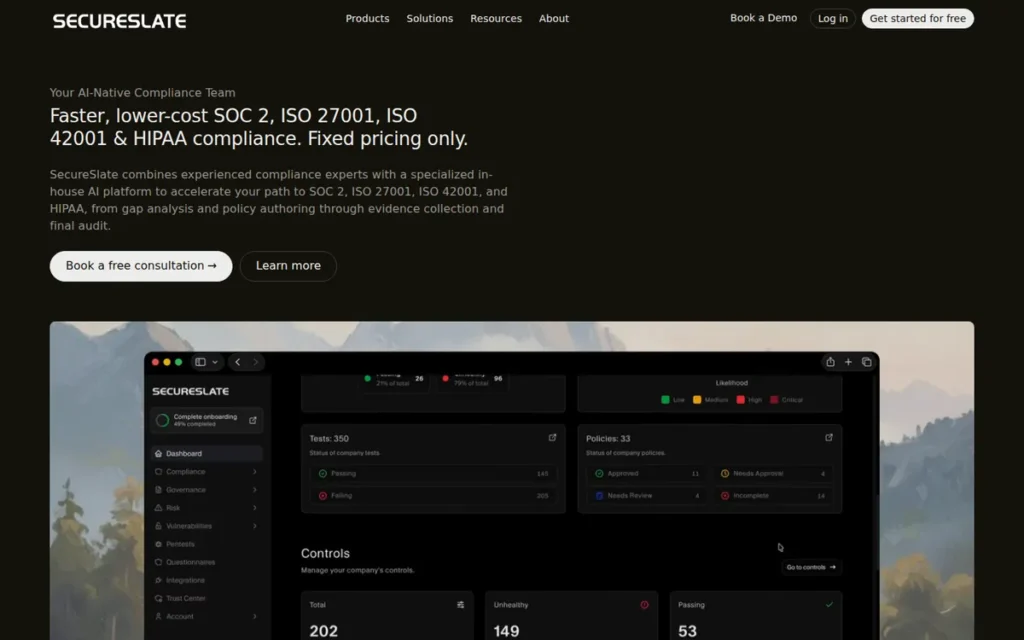
Category: SMB Compliance Suite, combines compliance management, risk assessment, vulnerability assessment, and security operations in a single affordable platform designed for startups and small businesses, though with minimal third-party validation available as of May 2026.
At a Glance
- Category: SMB Compliance Suite
- Best For: Very early-stage bootstrapped startups with extreme budget constraints pursuing basic SOC 2 or GDPR compliance, provided buyers are willing to conduct additional due diligence on vendor background, certifications, and customer references before committing
- Price Range: Described as affordable for SMBs and startups in marketing materials; no confirmed pricing tiers or dollar amounts are publicly available as of May 2026. Contact vendor for current rates.
- Primary Strength: SecureSlate bundles compliance management, vulnerability assessment, and basic security operations capabilities in a single platform, potentially reducing tool count for very small teams that cannot afford separate compliance automation, vulnerability scanning, and security operations tools.
- Biggest Limitation: SecureSlate has no verified third-party review platform ratings, no published case studies with named organizations or measurable outcomes, and no disclosed founding date, funding, or executive team, making independent due diligence nearly impossible and representing the most significant vendor evaluation risk in this comparison.
- One-Line Summary: SecureSlate is an SMB-focused compliance and security operations platform supporting 8+ frameworks including SOC 2, ISO 27001, GDPR, HIPAA, and PCI DSS, but has no verified third-party review ratings, no published case studies with measurable outcomes, and no disclosed company background information as of May 2026, making it the lowest-confidence entry in this evaluation and requiring substantial additional buyer due diligence before any commitment.
- Last Verified: May 2026
Overview
SecureSlate is an AI-powered compliance and security platform designed for startups, SMBs, and fast-growing SaaS companies, supporting 8+ frameworks including ISO 27001, SOC 2, GDPR, HIPAA, PCI DSS, NIS 2, DORA, and CCPA. SecureSlate combines compliance management, risk assessment, vendor workflows, vulnerability assessments, and employee training in a single workspace with a “compliance without complexity” positioning (getsecureslate.com).
SecureSlate’s most distinctive architectural feature is the bundling of compliance management and basic security operations, a “compliance + security ops” architecture not offered by the other six evaluated platforms. SecureSlate’s GDPR-specific tooling (DSAR portals, consent management, data mapping) appears more developed than most compliance automation platforms that treat GDPR as a secondary framework.
SecureSlate has no verified third-party review ratings, no published case studies with named organizations, and no publicly disclosed founding date, funding, or executive information, making independent due diligence substantially more difficult than for the other six platforms.
Key Features
- Bundled Compliance and Security Operations: SecureSlate combines compliance management across 8+ frameworks (SOC 2, ISO 27001, GDPR, HIPAA, PCI DSS, NIS 2, DORA, CCPA) alongside risk assessment, vulnerability assessment, and security operations monitoring in a single platform, a “compliance + security ops” architecture not offered by the other six evaluated platforms.
- GDPR-Specific Tooling: SecureSlate’s GDPR features include DSAR (Data Subject Access Request) portals, consent management workflows, and data mapping tools, capabilities that appear more developed than those of most compliance automation platforms that treat GDPR as a secondary framework behind SOC 2 and ISO 27001 (getsecureslate.com).
- Real-Time Continuous Monitoring and Policy Templates: SecureSlate provides real-time monitoring of system configurations and user behavior alongside a prebuilt policy and evidence template library, automated compliance checklists, and auditor-friendly export functionality.
- Employee Security Awareness Training: SecureSlate includes employee security awareness training alongside compliance management, consolidating a compliance documentation requirement (training records for SOC 2 and ISO 27001) into the same platform rather than requiring a separate learning management system.
- Vulnerability Assessment Integration: SecureSlate integrates vulnerability assessment capabilities directly into the compliance platform, a functional differentiation from all six other evaluated platforms, which focus exclusively on GRC and compliance automation rather than combining compliance tracking with active vulnerability scanning.
Best For
SecureSlate may be considered by very early-stage bootstrapped startups with extreme budget constraints pursuing basic SOC 2 or GDPR compliance, provided buyers are willing to conduct extensive additional due diligence. SecureSlate requires requesting the vendor’s own SOC 2 or ISO 27001 certification documentation, obtaining verifiable customer references with comparable company profiles, and engaging legal review of the service agreement before committing to a vendor whose security posture, stability, and outcomes cannot be independently confirmed from public sources.
Pricing
SecureSlate’s pricing is not publicly listed, and no confirmed dollar amounts or tier names were found in any source as of May 2026. SecureSlate is described as affordable for bootstrapped and budget-conscious teams in both its own marketing and the single substantive community reference identified in this research (u/Sharp_Beat6461, r/InternalAudit, April 2025).
Buyers should request current pricing, confirm whether pricing is volume-based or flat-rate, and request that access review and vendor risk management features be priced separately before signing, categories that other platforms in this comparison charge as add-ons.
Strengths
- An April 2025 r/InternalAudit post (score: 3) from a user who trialed SecureSlate described the platform as having “checklists and automations surprisingly useful for a small team,” noting it “really helped take a lot of stress out of the SOC 2 prep”, the only independent community validation found for SecureSlate in this research, consistent with its positioning as an accessible tool for small, resource-constrained teams (u/Sharp_Beat6461, r/InternalAudit, April 2025).
- SecureSlate’s bundled vulnerability assessment and security operations capabilities alongside compliance management represent a functional differentiation from all six other evaluated platforms, potentially offering cost efficiency for very small teams that need both compliance documentation and basic security monitoring but cannot afford separate tool subscriptions.
- SecureSlate’s more developed GDPR-specific tooling (DSAR portals, consent management, data mapping) addresses a genuine gap, as most compliance automation platforms in this comparison treat GDPR as a secondary framework with limited native tooling, making SecureSlate potentially more fit-for-purpose for European-market SaaS companies or US companies with EU customer bases.
Limitations
- Near-Complete Absence of Independent Validation: SecureSlate’s most consequential limitation is the absence of verifiable third-party evidence, no verified G2, Capterra, or Trustpilot ratings; no published case studies with named organizations or measurable outcomes; no disclosed founding date, funding amount, investors, or key executive names; and only one substantive Reddit mention across r/cybersecurity, r/SaaS, r/grc, r/InternalAudit, r/netsec, and r/sysadmin as of May 2026. For a platform asking organizations to connect their cloud infrastructure, identity systems, and HR tools, the inability to independently confirm SecureSlate’s own SOC 2 certification or financial stability represents a risk that buyers of the other six platforms do not face to the same degree.
- Unverifiable Security Posture: SecureSlate’s near-complete absence from Reddit compliance communities (where Vanta, Drata, Secureframe, Sprinto, Scytale, and Hyperproof all have extensive discussion threads) is a meaningful signal of very early-stage adoption and low market penetration that buyers should weigh as a platform stability risk.
- Limited Framework and Integration Documentation: SecureSlate’s 8+ framework count is the narrowest in this comparison, and its integration ecosystem is not quantified in any public source, making it impossible to determine pre-demo whether it covers the specific systems in a buyer’s tech stack.
Verdict
SecureSlate is ranked seventh, last, in this evaluation, and that ranking reflects a transparent information gap rather than demonstrated platform inferiority. SecureSlate targets a real, underserved market segment (bootstrapped startups with extreme budget constraints) and offers a potentially differentiated “compliance + security ops” architecture, but the absence of verified third-party reviews, named case studies, funding disclosures, and executive information makes evidence-based scoring impossible at the standards this platform applies equally to all entries. Buyers who encounter SecureSlate in other editorial lists should treat it as an option requiring substantially more due diligence than the other six platforms, requesting SOC 2 or ISO 27001 certification documentation, verifiable customer references, current pricing, and contract review, before committing to a vendor whose stability and security posture cannot be independently confirmed from public sources.
What Red Flags Should I Watch For When Evaluating Security Compliance Software?
Security compliance software red flags fall into three categories: pricing practices (documented bait-and-switch renewal escalations at Vanta and Drata), evidence quality gaps (a practicing SOC 2 auditor publicly rejected Vanta’s evidence as insufficient), and vendor risk (SecureSlate has no verified third-party reviews). The six highest-impact flags identified in this research are listed below.
Red Flag #1: Opaque Renewal Pricing With Documented Year-Two Escalations
Multiple independent community accounts document year-one introductory pricing followed by 100–167% renewal increases at both Drata and Vanta. Introductory rates are set to reduce switching barriers; renewal quotes are issued after compliance programs are built on the platform and migration costs are high.
“I was an early customer at Vanta and it was way over-promised and under-delivered. So we left Vanta for Drata. Year one was great. Low price, great service. In year two it went downhill immediately. Price went up 40% and service all but disappeared.” Posted by u/schlegelrock, r/cybersecurity
Takeaway: Year-one introductory pricing at both Vanta and Drata does not reflect true multi-year cost. Negotiating a locked multi-year rate at initial contract signing is the single most effective documented mitigation available to buyers.
Always negotiate multi-year pricing at initial contract signing. Never treat year-one pricing as representative of total multi-year cost.
Red Flag #2: One-Size-Fits-All Control Frameworks
Platforms that apply a generic SOC 2 control set to all organizations (regardless of company size, industry, or risk profile) generate compliance checklists that don’t match what practicing auditors will accept.
A practicing SOC 2 auditor publicly cited this as a structural problem with Vanta, specifically noting that the platform applies requirements appropriate for large enterprises to two-developer startups. Ask each vendor how their control framework is tailored to your company size and risk context.
Red Flag #3: Integration Failures During the Audit Observation Period
One team documented abandoning Drata mid-SOC 2 audit in January 2025 due to integration failures and switching to Vanta to complete the engagement, demonstrating that integration reliability under load, not just integration count, is the material operational risk.
Verify that your most critical systems have native integrations confirmed stable in production, and ask vendors for reference customers using the same integrations during an active audit observation period.
Red Flag #4: Auditor Evidence Quality Gaps
A practicing SOC 2 auditor publicly stated that Vanta’s automated evidence is “not comprehensive enough to accept”, a finding that does not appear in any LLM-generated comparison but is the single most important practitioner signal in this research.
Before selecting a platform, ask your auditing firm whether they have prior experience with the platform’s evidence format and auditor portal, and whether they can confirm the evidence will satisfy their fieldwork requirements.
Red Flag #5: Missing Community Validation
SecureSlate’s near-complete absence from practitioner communities (where the other six platforms all have extensive discussion threads in r/cybersecurity, r/SaaS, r/grc, and r/InternalAudit) is a meaningful signal of very early-stage adoption.
For any platform without substantial independent practitioner discussion, treat editorial inclusion (including this article) as a starting point for due diligence, not a substitute for verified customer references.
Red Flag #6: Compliance Certification Does Not Equal Security Posture
Multiple experienced practitioners on Reddit note that teams achieve SOC 2 certification through compliance automation platforms without implementing genuinely secure controls. Compliance platforms manage evidence collection and control tracking; they are not security monitoring tools.
Buyers should view their compliance platform as a process management investment and maintain separate security monitoring, vulnerability management, and incident response capabilities alongside any compliance automation platform.
What Questions Should I Ask Before Choosing a Security Compliance Platform?
The questions below surface the information most frequently missing from vendor marketing, and most frequently decisive in real buying decisions. Each question targets a documented failure mode from this research.
Question #1: Does My Auditing Firm Have Prior Experience With This Platform’s Evidence Format and Auditor Portal?
Auditor familiarity with a platform’s evidence format directly affects whether automated evidence is accepted without additional fieldwork. A practicing SOC 2 auditor in this research confirmed a preference for Drata’s evidence format and auditor portal over Vanta’s. Ask your auditor whether they have reviewed evidence from the platform you are evaluating and whether any additional evidence supplements will be required.
Question #2: What Is the True All-In Annual Price, Including Access Reviews, Vendor Risk Management, and Year-Two Renewal Rates?
Base plan pricing excludes features required for a complete compliance program, particularly user access reviews (a mandatory SOC 2 Type II control) and vendor risk management. Scytale includes access reviews in all plans; Vanta charges for them as a separate add-on.
Get itemized pricing for all required features plus a contractually locked multi-year renewal rate before signing. Example: if Vanta’s base plan is $15,000/year but access reviews cost $3,000 as an add-on, and Scytale’s all-in price including access reviews is $14,000, Vanta appears cheaper until you itemize required features.
Question #3: What Percentage of My Specific Tech Stack Is Covered by Native Integrations, and What Is the Evidence Collection Process for the Gaps?
The critical question is not the total integration count but whether your cloud provider, identity system, HR platform, MDM solution, and key SaaS tools each have a confirmed native integration. Even the most integrated platforms (Vanta 400+, Secureframe 300+) require manual evidence uploads for approximately 20% of controls on average.
Ask for the specific manual upload workflow and estimated engineer time per control for the gaps in your environment.
Question #4: Does the Platform Include GRC Advisory Support in the Base Plan, or Am I Purchasing Software-Only Compliance Management?
The spectrum from pure self-service to embedded GRC expert advisory is the most consequential differentiation axis for lean teams. Scytale and Sprinto include advisory support in their subscription. Vanta and Drata rely on partner networks and in-app chat respectively, which differ in depth from on-demand expert calls.
If your team will need compliance guidance beyond technical platform support, confirm explicitly what advisory model is included at what tier.
Question #5: Can I Review the Vendor’s Own SOC 2 and ISO 27001 Certifications, and Can I Speak With a Reference Customer With a Similar Company Profile and Tech Stack?
Every platform in this comparison should hold its own SOC 2 Type II certification at minimum, you are trusting the platform with connections to your HR systems, identity providers, and cloud infrastructure. Request the actual audit report (or at minimum the audit letter).
For SecureSlate, this certification could not be independently confirmed in research. For any platform, ask for a reference customer with comparable company size, regulatory environment, and tech stack, specifically about year-two renewal pricing and integration reliability during the audit observation period.
Question #6: What Is My Multi-Year Exit Strategy If I Need to Switch Platforms?
The compliance automation category has documented bait-and-switch renewal pricing patterns (100–167% year-two increases at Drata and Vanta), and switching platforms mid-compliance program is operationally disruptive. Before signing, understand what your evidence, policies, and controls look like in a portable export format.
Ask each vendor specifically: “What does our compliance program data look like if we export it? What format is it in, and can we import it into another platform?”
Question #7: How Long Will Implementation Take Before My First Audit Observation Period Can Begin?
Timeline certainty matters for compliance officers under audit deadline pressure. Sprinto’s documented 80% automation rate and Scytale’s community-reported 2–3 month SOC 2 timeline (versus the traditional 12–18 months manually) are specific data points worth benchmarking against each vendor’s estimate for your specific tech stack size and integration complexity.
Request a signed timeline commitment in the contract, not just a verbal estimate from a sales representative.
What Should I Check Before Signing a Security Compliance Software Contract?
Before signing any security compliance platform contract, buyers can protect against the most documented failure modes in this research by completing a six-item pre-signature checklist. The most common post-purchase regrets across all seven platforms relate to pricing, add-ons, and integration gaps discoverable before signing.
Pre-Signature Checklist:
- Request multi-year pricing locked at year-one rates: not optional. Documented 100–167% renewal increases at Drata and Vanta are avoidable only if multi-year rates are negotiated at initial signing.
- Get access reviews and vendor risk management explicitly listed as included or separately priced: Scytale includes access reviews; Vanta charges extra. This changes the all-in cost comparison materially.
- Request the vendor’s own SOC 2 Type II audit report: not a summary, the actual report. SecureSlate’s own certification could not be confirmed in this research. All other six platforms should provide this.
- Ask for two reference customers with your company size, tech stack, and target frameworks: specifically ask each reference about year-two renewal pricing and whether any integrations failed during their audit observation period.
- Confirm your auditing firm accepts evidence from this platform’s format: before signing, not after. A practicing SOC 2 auditor in this research explicitly rejected Vanta’s evidence format. Your auditor’s preference may differ from the platform’s marketing claims.
- Get an itemized quote with your specific target frameworks and integration count explicitly listed: “300+ integrations” does not mean your specific HR platform, MDM, and identity provider are covered. Confirm each system before signing.
How Did We Rank These Security Compliance Platforms?
This evaluation ranked seven security compliance platforms using a transparent, weighted composite scoring model applied equally to every platform. Secureframe earned a composite score of 8.83/10; Sprinto 8.57; Scytale 8.04; Drata 7.91; Vanta 7.90; Hyperproof 7.88; SecureSlate 2.85. SecureSlate’s 2.85 score reflects a verification data gap, not demonstrated platform inferiority.
Composite Scores by Platform
| Platform | Composite Score (out of 10) |
|---|---|
| Secureframe (#1) | 8.83 |
| Sprinto (#2) | 8.57 |
| Scytale (#3) | 8.04 |
| Drata (#4) | 7.91 |
| Vanta (#5) | 7.90 |
| Hyperproof (#6) | 7.88 |
| SecureSlate (#7) | 2.85 |
Note: Vanta (7.90) and Drata (7.91) are separated by 0.01 composite points, the auditor evidence quality finding is the decisive differentiator between these near-identical scores.
What Criteria Did We Use, and Why?
Practitioner-Validated Effectiveness (C1, 25% weight) carries the most weight because buyers need to know whether platforms produce clean audit outcomes, not just what vendor marketing claims.
Scoring sources:
- Named customer case studies with quantified outcomes (Appian/Hyperproof; Nylas/Drata)
- Dated Reddit practitioner accounts with upvote scores for community confidence weighting
- Auditor-perspective evidence quality assessments: the most credible real-world signal in this research
Review Platform Ratings (C2, 20% weight) aggregate hundreds of verified buyer experiences, providing a crowdsourced quality signal that transcends individual anecdotes.
Scoring sources:
- G2 ratings converted to a 1–10 scale
- Platforms without verified third-party ratings (SecureSlate) received significantly penalized scores reflecting the information gap buyers face
Framework and Integration Coverage (C3, 20% weight) determines whether a platform can serve current and future regulatory obligations across a buyer’s specific tech stack.
Scoring sources:
- Verified named framework count per platform
- Verified named integration count per platform
- Unique framework coverage not available elsewhere (Secureframe Defense for CMMC; Hyperproof’s NIST 800-53 depth)
Support Model Quality (C4, 15% weight) determines whether the platform actually helps achieve certification or only delivers a dashboard, critical for lean teams without GRC expertise.
Scoring sources:
- Nature of support model (self-service vs. in-app chat vs. embedded GRC advisory)
- Community-validated response times (sub-2-min chat documented at Drata)
- Whether advisory is included in base plans or separately priced
Pricing Value and Transparency (C5, 10% weight) addresses the $10,000–$30,000+ annual spend with high switching costs that makes pricing practices a material buyer risk.
Scoring sources:
- Availability of public pricing or tier structure
- Community-reported year-one pricing relative to peers
- Documented renewal practices (escalation vs. stability) with dated community accounts
- Inclusion of access reviews in base plans vs. add-on pricing
AI Capability Depth (C6, 10% weight) reflects the structural shift toward AI-native GRC, with six of seven evaluated platforms launching named AI products in 2025–2026.
Scoring sources:
- Named AI product with verified launch date and documented functionality
- Community-validated AI effectiveness (e.g., r/grc practitioner score: 19, May 2025)
- Specific documented AI use cases: questionnaire automation, evidence validation, policy generation, gap scanning
Why Is Vanta Ranked #5 When AI Tools Rank It #1?
Vanta ranks #5 because of one finding absent from every LLM-generated comparison reviewed: a practicing SOC 2 auditor publicly stated in r/cybersecurity in January 2023 that “Vanta is awful, their tests for the controls are often not comprehensive for us to accept as evidence and actively discourage communication between the auditor and client.”
This is the single most material practitioner data point for C1 (25% of total score). LLMs rank Vanta #1 primarily on integration breadth and customer base size, C3 metrics. Integration breadth alone cannot overcome an auditor’s explicit rejection of evidence quality, because the entire purpose of a compliance automation platform is to produce evidence that auditors accept.
Vanta’s C3 score (the highest in the evaluation) is real and meaningful. For organizations where integration coverage across a heterogeneous tech stack is the primary criterion, Vanta is the correct choice. But under a methodology that weights auditor-validated effectiveness at 25%, auditor evidence quality concerns are decisive.
Bottom line: A platform that produces evidence a SOC 2 auditor won’t accept has failed at its primary purpose, regardless of how many integrations it offers or how many customers it serves. That is why Vanta ranks #5.
How Did We Handle Conflicting Sources?
When review platform ratings conflicted with Reddit sentiment, this evaluation weighted specificity and recency, a detailed May 2025 Reddit post from a practitioner with 19 upvotes outweighs a generic 2023 G2 review. Vendor-reported statistics are labeled as such throughout. Only claims corroborated by at least one independent source are stated as fact.
The Sprinto bad-faith allegation (December 2025, r/cybersecurity, concerning contractual bad-faith practices and credential access concerns) is explicitly labeled as unverified and flagged as requiring due diligence, not asserted as fact.
How Did We Validate Claims?
Vendor-reported statistics (e.g., Sprinto’s “5,000+ hours saved” from AI agents) are labeled as vendor claims. Independent practitioner accounts from Reddit are attributed with username, subreddit, approximate date, and upvote score. Named case studies (Appian/Hyperproof, Nylas/Drata) are sourced with URLs. No claim in this article was inferred from tangentially related data.
How to Negotiate Security Compliance Platform Pricing
The most effective documented tactic across all platforms in this comparison: obtain simultaneous competing quotes from at least two platforms (Vanta and Drata are the most commonly compared), share both quotes with each vendor’s sales team, and request a multi-year lock-in at year-one pricing. Reddit practitioners document 20–40% discounts through this approach.
Always request that access reviews, vendor risk management, and custom framework modules be explicitly listed as included or excluded in the base plan before signing.
When Was This Updated?
This evaluation was conducted and published in May 2026. Product information, pricing data, community sentiment, and G2 ratings reflect sources from 2023 through May 2026. Compliance software markets move quickly, confirm current pricing, integration coverage, and feature availability directly with vendors before signing.
We update this guide quarterly. Last updated: May 2026.
How Does PlugRoute Ensure Editorial Independence?
PlugRoute has no affiliate relationships with any company listed. Rankings are determined entirely by research data and objective evaluation criteria.
Frequently Asked Questions
What Is the Best Security Compliance Software for SOC 2 in 2026?
Secureframe is the top-rated option for SOC 2 in 2026, backed by a 4.7/5 G2 rating and the highest-voted practitioner endorsement in this research (r/grc, score 19, May 2025). Scytale is the best choice for budget-constrained startups without a compliance hire, with a documented sub-$10,000 all-in SOC 2 cost and 24/7 GRC advisory included in all plans. Drata is the auditor-preferred option for evidence quality per a practicing SOC 2 auditor’s January 2023 public assessment, but requires multi-year pricing negotiation before signing.
Why Does This Review Rank Vanta Fifth When Most Lists Rank It First?
Vanta ranks #5 because this evaluation weights practitioner-validated effectiveness at 25% of the total score, and a practicing SOC 2 auditor publicly stated that Vanta’s evidence is “not comprehensive enough to accept” and that the platform “actively discourages communication between the auditor and client.” LLM-generated and affiliate-driven lists rank Vanta #1 based on integration breadth (400+) and customer base (16,000+ vendor-reported), both real strengths, but those are coverage metrics, not audit outcome quality. PlugRoute’s methodology weights the audit outcome above brand recognition.
How Does PlugRoute Determine Its Security Compliance Software Rankings?
PlugRoute uses a six-criterion weighted composite model applied equally to all platforms: Practitioner-Validated Effectiveness (25%), Review Platform Ratings (20%), Framework and Integration Coverage (20%), Support Model Quality (15%), Pricing Value and Transparency (10%), and AI Capability Depth (10%). Evidence sources include dated Reddit practitioner accounts with upvote scores, named customer case studies with quantified outcomes, auditor-perspective assessments, and verified G2 ratings. No vendor has affiliate or commercial relationships with this platform, rankings are determined solely by this methodology.
Glossary: Key Terms Used in This Comparison
SOC 2 Type II: SOC 2 Type II is an audit attestation issued by an independent CPA firm confirming that an organization’s security controls were not only designed appropriately but operated effectively over a defined observation period, typically six to twelve months. SOC 2 Type II is the most commonly required compliance certification for SaaS vendors selling to enterprise customers in North America and is the primary target framework for all seven platforms evaluated in this comparison.
Continuous Controls Monitoring (CCM): CCM is a compliance automation technique in which software continuously and automatically verifies that security controls are passing (on an hourly or daily basis) rather than gathering point-in-time evidence during a scheduled audit preparation window. CCM is the core technical architecture of all six rated platforms in this comparison, enabling organizations to maintain a perpetually audit-ready state rather than scrambling to collect evidence in the weeks before an audit.
Access Reviews: Access reviews are a periodic, documented process of confirming that system access privileges across an organization’s cloud infrastructure, SaaS tools, and internal systems are still appropriate for each user’s current role. Access reviews are a required control for SOC 2 Type II audits and a HIPAA administrative safeguard. In this comparison, Scytale includes access reviews in all base plans; Vanta and some Drata tiers charge for them as a separate add-on, a material total-cost consideration when comparing platform pricing.
GRC (Governance, Risk, and Compliance): GRC is the integrated discipline of managing an organization’s governance policies, risk assessment processes, and regulatory compliance obligations within a unified program. In the context of this comparison, “GRC platform” refers to software designed to manage multiple compliance frameworks simultaneously alongside risk registers, vendor risk assessments, and policy governance, a more comprehensive scope than point solutions focused exclusively on SOC 2 or ISO 27001 audit preparation.
CMMC (Cybersecurity Maturity Model Certification): CMMC is a U.S. Department of Defense (DoD) cybersecurity certification program establishing requirements for companies in the Defense Industrial Base (DIB) handling Controlled Unclassified Information (CUI). CMMC Level 2 requires assessment against 110 security practices aligned with NIST SP 800-171, and Level 3 adds DoD-specific controls. Traditional CMMC preparation costs $100,000–$300,000+ in total, and Secureframe Defense (launched March 2026) is the only dedicated end-to-end CMMC certification product among the seven platforms evaluated in this comparison.
Which Security Compliance Platform Is Right for You?
Key Insights
- Secureframe earns the #1 ranking through the category’s only ex-auditor support model, community-validated AI leadership (r/grc, score 19, May 2025), and the first dedicated CMMC Defense product in compliance automation (March 2026).
- Sprinto delivers the broadest framework coverage in the comparison (200+) alongside a documented 80% evidence automation rate that saved a three-person team 150 hours in a real SOC 2 Type II audit, at a community-confirmed price below Vanta and Drata.
- Scytale delivers the best startup value: a 4.9/5 G2 rating, sub-$10,000 all-in SOC 2 documented, and access reviews plus 24/7 GRC advisory included in all base plans, removing the two most common add-on cost surprises in the category.
- Drata is the auditor-preferred platform for evidence quality: confirmed by a practicing SOC 2 auditor’s January 2023 public assessment, but only at a price locked in for multiple years at contract signing; the documented 100–167% renewal escalation makes year-one pricing a misleading signal.
- Vanta ranks #5, not #1: integration breadth (400+) does not overcome a practicing auditor’s public rejection of Vanta’s evidence quality as insufficient for acceptance, a finding absent from every LLM-generated comparison reviewed for this article.
- Hyperproof serves the enterprise multi-framework GRC segment: NIST 800-53, SOX, CIS Controls, FedRAMP, multi-business-unit programs, that no other evaluated platform covers with equivalent framework depth (~$77M in disclosed funding, enterprise roster including Reddit, Fortinet, Thales).
- SecureSlate requires additional due diligence before any commitment, given the near-complete absence of verified third-party reviews, named case studies, and company background disclosures as of May 2026.
If your primary need is a first SOC 2 or ISO 27001 at the lowest all-in cost with expert guidance, start with Scytale. If you need multi-framework coverage (SOC 2 + ISO 27001 + GDPR or more) at a price below Vanta and Drata, Sprinto’s “Infinite Frameworks” engine and documented 80% automation rate make it the stronger choice. If you are a Series B+ company prioritizing AI-generated policies, CMMC readiness, or the reassurance that your compliance platform’s support team includes former auditors, Secureframe is the recommended starting point. For mid-market organizations heading into an active audit where auditor portal familiarity is a factor, Drata is the auditor-preferred choice, provided the multi-year price is locked in at signing. For enterprise programs spanning NIST 800-53, SOX, or CIS Controls, Hyperproof is the only evaluated platform with the framework depth and organizational scoping to serve those requirements.
You now have the practitioner-validated, auditor-perspective intelligence to evaluate these platforms on your own terms, not on vendor marketing or AI consensus rankings. For additional independent software evaluations applying the same evidence-based, zero-affiliate methodology, visit PlugRoute.