AuditBoard (now Optro) is the best overall enterprise GRC platform for 2026, adopted by over 50% of the Fortune 500 and named Gartner Magic Quadrant GRC Leader (2025). LogicGate Risk Cloud leads for no-code GRC modernization with FAIR financial quantification. ServiceNow GRC is strongest for enterprises already standardized on ServiceNow. The right choice depends on existing infrastructure, regulatory domain, and implementation capacity, not feature count.
Enterprise buyers searching for risk intelligence software frequently receive AI-generated recommendations for threat intelligence platforms or financial analytics tools, categories that serve security analysts and credit teams, not GRC programs. This comparison covers GRC and IRM platforms exclusively: systems that unify risk registers, compliance frameworks, audit management, TPRM, and ERM in a connected data model. If you have encountered Recorded Future, Flare, or Moody’s in AI-generated risk software lists, this article is specifically designed to correct that category confusion.
PlugRoute has no affiliate relationships with any company listed in this article. Rankings are determined entirely by research data and objective evaluation criteria, no company pays for placement or receives preferential treatment.
TL;DR: Top Picks at a Glance
- AuditBoard (now Optro) is the most widely deployed enterprise GRC platform, adopted by over 50% of the Fortune 500 and named Gartner Magic Quadrant Leader for GRC Tools (2025) and TPRM Tools (2026), best for Fortune 500 connected risk, audit, and SOX compliance programs.
- LogicGate Risk Cloud is a G2 Leader Grid-rated no-code enterprise GRC platform offering FAIR-methodology Monte Carlo financial risk quantification and real-time Black Kite third-party monitoring, best for mid-market to enterprise teams modernizing from legacy GRC tools.
- ServiceNow GRC is the leading platform-embedded IRM solution, rated 4.5/5 across 2,500+ G2 reviews, offering CMDB-linked real-time risk and asset management, best for large enterprises already standardized on ServiceNow with dedicated platform administrators.
- MetricStream ConnectedGRC is the AI-first enterprise GRC platform founded in 1999, with 9,300+ pre-mapped control statements across 1,200+ global regulations and a governed LLM integration gateway, best for highly regulated global enterprises managing 10 or more simultaneous regulatory frameworks.
- OneTrust GRC is a privacy-first Trust Intelligence Platform recognized as an IDC MarketScape GRC Leader in 2025, integrating GDPR, CCPA, and EU AI Act governance alongside traditional GRC, best for organizations where data privacy obligations are the primary risk driver.
- Riskonnect is the only enterprise risk platform converging insurance risk financing with GRC and ERM, delivering GRC 20/20 Research-verified 200%+ five-year ROI for business continuity programs, best for insurance, healthcare, and manufacturing enterprises.
- Archer IRM is the only enterprise GRC platform in this comparison with full on-premises deployment capability, acquired by Cinven in 2024 and supporting 150+ pre-built use cases, best for government agencies and defense contractors with data residency mandates.
What Types of Risk Intelligence Software Exist, and Which One Do I Actually Need?
Risk intelligence software falls into three distinct categories: GRC/IRM platforms (audit, compliance, risk registers, and TPRM in a unified data model), threat intelligence platforms (adversarial indicators and cyber signals for security operations), and financial risk analytics tools (credit, actuarial, and market risk modeling). These categories serve different buyer functions and are not interchangeable. This comparison covers GRC/IRM platforms exclusively.
Enterprises may encounter this product category under several labels:
- GRC software: governance, risk, and compliance management
- IRM software: integrated risk management
- Risk and compliance platform: unified policy, control, and risk programs
- Compliance management software: regulatory obligation and framework management
- Enterprise risk management software: ERM with risk registers, KRIs, and heat maps
All refer to the same product category evaluated here.
Before you evaluate any platform: Document your GRC program processes first. The highest-upvoted practitioner advice across r/cybersecurity, r/InternalAudit, and r/grc is consistent, the tool is secondary to having good processes defined. Organizations that select platforms without documented process requirements are the most likely to be dissatisfied post-deployment, regardless of platform selected.
As one practitioner on r/cybersecurity observed (36 upvotes):
“After having worked with many organizations on their GRC platforms, it becomes evident to me that no single solution perfectly fits for any given company. Each organization has unique needs, structures, and regulatory requirements that make it challenging to find an actual good GRC solution. Common pitfalls: Poor RACI model for initial configuration, lack of ownership, and failure to consider cross-application access. Even when working with subject matter experts on the GRC platform are not going to solve the organization’s needs. It may help to a certain degree, but the organization’s people, processes, and technologies are ultimately the issue…” Posted by u/SportsTalk000012
Takeaway: Across enterprise GRC deployments, platform failures trace consistently to organizational maturity gaps (poor ownership models, undefined processes, and access governance issues) not to platform capability shortfalls, reinforcing the process-first selection principle at the foundation of this comparison.
The seven platforms evaluated belong to three subcategories:
Enterprise GRC Suites: broad multi-domain coverage across audit, compliance, ERM, TPRM, and policy management:
- AuditBoard (Optro): Connected GRC Platform
- ServiceNow GRC: Platform-Embedded IRM
- MetricStream ConnectedGRC: AI-First Enterprise GRC
No-Code and Configurable GRC Platforms: workflow flexibility without developer dependency:
- LogicGate Risk Cloud: No-Code GRC Platform
Domain-Specialized GRC Platforms: purpose-built for specific regulatory, industry, or deployment requirements:
- OneTrust GRC: Privacy-First GRC
- Riskonnect: Insurable-Risk IRM
- Archer IRM: Configurable Enterprise IRM
How to select your subcategory:
- If your primary driver is audit traceability and multi-domain risk in a unified data model, evaluate Enterprise GRC Suites.
- If implementation speed and no-code configurability without developer staffing are priorities, evaluate No-Code platforms.
- If your program is primarily driven by privacy law obligations, insurable risk financing, or government data residency mandates, evaluate Domain-Specialized platforms.
How Do the Top Risk Intelligence Platforms Compare at a Glance?
The seven platforms below cover the full spectrum of enterprise GRC buying scenarios, from Fortune 500 connected risk programs to government on-premises mandates. Use this table to identify your shortlist before reading individual entries.
| Rank | Company | Category | Best For | One-Line Summary | Key Capabilities | Primary Strength | Key Limitation |
|---|---|---|---|---|---|---|---|
| 1 | AuditBoard (Optro) | Connected GRC | Fortune 500 audit, SOX, multi-domain risk | AuditBoard (now Optro) is the most widely deployed enterprise GRC platform; 50%+ Fortune 500 adoption, Gartner MQ GRC 2025 Leader, and rated 4.6/5 across 1,500+ G2 reviews. | Connected risk traceability across 8 domains; 200+ integrations; Gartner MQ GRC 2025 + TPRM 2026 Leader | Gartner Magic Quadrant Leader (GRC 2025, TPRM 2026) combined with independently verified 50%+ Fortune 500 adoption (BusinessWire, October 2024) | Optro AI rebrand is aspirational; AI maturity not independently validated at scale as of May 2026 |
| 2 | LogicGate Risk Cloud | No-Code GRC | Mid-market to enterprise modernizing from Archer | LogicGate Risk Cloud is a G2 Leader Grid-rated no-code enterprise GRC platform offering FAIR Monte Carlo financial quantification and real-time Black Kite TPRM; G2 4.6/5 with 98% quality of support. | No-code drag-and-drop workflows; FAIR Monte Carlo simulation; Black Kite continuous TPRM | G2 Leader Grid status with 98% quality of support scores; only FAIR Monte Carlo quantification in a no-code GRC environment | ~150-employee team; no confirmed Gartner/Forrester placement; G2 base of 184 reviews limits statistical confidence |
| 3 | ServiceNow GRC | Platform-Embedded IRM | Large enterprises already on ServiceNow ITSM/SecOps | ServiceNow GRC is the leading platform-embedded IRM solution, rated 4.5/5 across 2,500+ G2 reviews, offering CMDB-linked real-time risk and asset management for enterprises on the ServiceNow ecosystem. | CMDB-linked risk and asset alignment; multi-framework compliance; ITSM/SecOps native integration | Highest review volume in category (2,500+ G2); $10.98B parent company revenue (FY2024) | Requires dedicated ServiceNow developers and CMDB admins; bimodal outcomes between well-resourced and under-resourced organizations |
| 4 | MetricStream ConnectedGRC | AI-First Enterprise GRC | Highly regulated global enterprises: FSI, pharma, energy | MetricStream ConnectedGRC is the AI-first enterprise GRC platform founded in 1999, offering a governed LLM gateway, 9,300+ controls mapped to 1,200+ regulations, and Chartis RiskTech100 2025 recognition. | AI LLM Model Gateway; 9,300+ controls × 1,200+ regulations; SOC2/SOC3 anomaly detection | Deepest compliance content library plus governed AI LLM gateway; Chartis RiskTech100 2025 Category Winner in Enterprise GRC | Only 14 G2 reviews at 3.8/5; critically low peer validation for enterprise procurement |
| 5 | OneTrust GRC | Privacy-First GRC | Privacy-intensive orgs under GDPR, CCPA, EU AI Act | OneTrust GRC is a privacy-first Trust Intelligence Platform; IDC MarketScape GRC Leader in 2025; integrating GDPR, CCPA, EU AI Act governance, and ESG risk in a single cloud-native suite. | EU AI Act governance module; GDPR/CCPA native integration; ESG risk and ethics reporting | Only GRC platform with a dedicated EU AI Act compliance module; IDC MarketScape GRC Leader 2025 (Doc #US53615325, June 2025) | Core GRC implementation described as “nightmare” by practitioners; post-funding development pace called “basically abandonware” |
| 6 | Riskonnect | Insurable-Risk IRM | Insurance, healthcare, manufacturing with insurable risk | Riskonnect is the only enterprise risk platform unifying insurance risk financing with GRC and ERM; GRC 20/20 Research-verified 200%+ five-year ROI for business continuity programs. | Insurance risk financing + GRC convergence; Monte Carlo simulation; BCM module (Castellan) | Only platform converging insurance risk financing with GRC/ERM; GRC 20/20 Research-verified 200%+ ROI (December 2023) | ~100 G2 reviews; low statistical confidence; TPRM shallower than specialists; acquisition-driven module coherence risk |
| 7 | Archer IRM | Configurable Enterprise IRM | Government, defense, enterprises with on-premises data residency mandate | Archer IRM is the only enterprise GRC platform with full on-premises deployment, acquired by Cinven in 2024, supporting 150+ pre-built use cases; rated 4.2/5 across 250+ G2 reviews. | Full on-premises/cloud/hybrid deployment; 150+ pre-built use cases; complex multi-entity modeling | Only platform with full on-premises GRC deployment; required for government and defense buyers with data residency mandates | Requires full-time dedicated Archer developers; dominant migration-from platform in practitioner communities; highest TCO in comparison; Cinven 2024 acquisition adds ownership uncertainty |
Which Risk Intelligence Platform Should I Choose for My Situation?
The table below maps eight high-frequency enterprise buying scenarios to the strongest platform match and an acceptable alternative. Place yourself in the row that most closely reflects your primary organizational constraint.
| Your Primary Need | Recommended Platform | Why | Acceptable Alternative |
|---|---|---|---|
| Already operating ServiceNow enterprise-wide | ServiceNow GRC | Marginal add-on cost; CMDB-linked risk; no new vendor relationship required | AuditBoard (Optro); if a dedicated implementation team is available |
| Fortune 500 with complex audit and SOX programs | AuditBoard (Optro) | 50%+ Fortune 500 adoption; Gartner MQ GRC 2025 Leader; connected audit-to-risk traceability | LogicGate Risk Cloud; for lower implementation complexity |
| Mid-market migrating from RSA Archer | LogicGate Risk Cloud | Primary Archer migration destination; no-code; FAIR quantification; fastest deployment | AuditBoard (Optro); if enterprise audit program is the core need |
| GDPR, CCPA, EU AI Act as primary risk driver | OneTrust GRC | Only platform with EU AI Act module natively integrated; IDC MarketScape GRC Leader 2025 | AuditBoard (Optro); for broader GRC implementation depth |
| Government or defense with on-premises mandate | Archer IRM | Only platform with full on-premises GRC deployment in this comparison | None; no cloud-only platform in this comparison meets on-premises requirements |
| Insurance/healthcare with insurable risk financing | Riskonnect | Only platform converging insurance risk financing with enterprise GRC/ERM | MetricStream ConnectedGRC; for regulatory depth without an insurance module requirement |
| Highly regulated global enterprise (10+ regulatory frameworks) | MetricStream ConnectedGRC | 9,300+ controls × 1,200+ regulations; AI Model Gateway; 26+ years of GRC institutional knowledge | AuditBoard (Optro); for higher peer-validated confidence and Gartner recognition |
| Mid-market first GRC platform deployment | LogicGate Risk Cloud | No-code; fastest time to value; G2 Leader Grid status; FAIR financial quantification | ServiceNow GRC; if the organization already operates the ServiceNow platform |
1. AuditBoard (Optro): Best Overall: Fortune 500 Connected Risk and Audit
Category: Connected GRC Platform, a cloud-native governance, risk, and compliance suite that links risks to controls, controls to audits, and audits to remediation in a single traceable data model across eight interconnected risk domains, eliminating manual cross-referencing between separate audit, compliance, and risk systems.
At a Glance
- Category: Connected GRC Platform
- Best For: Fortune 500 and large enterprise organizations with complex audit, SOX compliance, and multi-domain risk programs requiring end-to-end traceability in a unified connected data model
- Price Range: $30,000–$100,000+/year (community-sourced estimates; not vendor-confirmed; multi-module enterprise deployments typically exceed $100,000/year)
- Primary Strength: AuditBoard (Optro) holds the 2025 Gartner Magic Quadrant Leader designation for GRC Tools and the 2026 Gartner Magic Quadrant Leader designation for Third-Party Risk Management Tools (the only GRC platform in this comparison to lead both reports) combined with independently verified 50%+ Fortune 500 adoption (BusinessWire, October 2024).
- Biggest Limitation: AuditBoard (Optro)’s March 2026 Optro rebrand makes bold AI-first positioning claims, but community reviews from late 2024 described AuditBoard’s AI features as “underdeveloped”, making the AI-first positioning aspirational rather than independently validated at scale as of May 2026.
- One-Line Summary: AuditBoard (now Optro) is the most widely deployed enterprise GRC platform, adopted by over 50% of the Fortune 500, named Gartner Magic Quadrant Leader for GRC Tools (2025) and for TPRM Tools (2026), and rated 4.6/5 across 1,500+ G2 reviews.
- Last Verified: May 2026
Overview
AuditBoard (now Optro) is a cloud-native Connected Risk Platform used by over 50% of the Fortune 500, including 7 of the Fortune 10, best suited for large enterprises managing complex audit, SOX compliance, TPRM, and ERM programs that need risks, controls, and audits linked in a single traceable data model.
AuditBoard rebranded as Optro in March 2026, signaling a strategic pivot toward AI-powered enterprise risk intelligence and direct competition with ServiceNow GRC and MetricStream for CRO and CISO technology budgets.
AuditBoard (Optro)’s eight interconnected modules (OpsAudit, SOXHUB, RiskOversight, CrossComply, TPRM, ITRM, ESG, and RegComply) replace the fragmented stack of standalone audit and compliance tools that most Fortune 500 organizations inherit over time.
Key Features
- Connected Risk Architecture: AuditBoard (Optro) links risks to controls, controls to audits, and audits to remediation actions in a unified data model, eliminating the manual cross-linking that consumes hours per week in spreadsheet-era GRC programs and providing end-to-end traceability for board and audit committee reporting.
- Eight Modular Risk Domains: AuditBoard (Optro) delivers OpsAudit for operational audit management, SOXHUB for SOX compliance, RiskOversight for ERM with risk registers and heat maps, CrossComply for SOC 2/ISO/NIST/HIPAA, TPRM for vendor assessments, ITRM for IT risk and cyber incident tracking, ESG for sustainability reporting, and RegComply for regulatory tracking, all operating on a shared connected data model.
- 200+ Third-Party Integrations: AuditBoard (Optro) connects natively with 200+ applications (including Jira, Snowflake, and ServiceNow) enabling GRC data to flow between project management, data warehousing, and ITSM platforms without requiring custom API development by the organization.
- Automated Audit Tracking: AuditBoard (Optro) replaces email chains and spreadsheet trackers with structured workflow automation, with stakeholder-accessible dashboards enabling direct board and audit committee transparency, community practitioners report this reduces audit follow-up from dozens of hours per month to 1–2 hours.
- ESG and Regulatory Intelligence: AuditBoard (Optro)’s ESG module addresses mandatory sustainability reporting under EU CSRD and SEC climate disclosure rules, while the RegComply module tracks regulatory changes across jurisdictions, extending risk coverage into domains increasingly required by enterprise compliance programs in 2026.
Best For
AuditBoard (Optro) is best for Fortune 500 and large enterprise organizations with mature internal audit functions, active SOX compliance programs, and multi-domain risk management needs that have outgrown spreadsheet-based GRC, particularly organizations that benefit from EY or Protiviti advisory relationships that recommend AuditBoard in their technology stack.
AuditBoard (Optro) is not the strongest first choice for organizations evaluating on pure AI automation capability alone, where MetricStream’s governed LLM gateway and LogicGate’s FAIR quantification offer more independently validated technical depth as of May 2026.
Strengths
- Gartner Magic Quadrant Leader, GRC and TPRM: AuditBoard (Optro) was named a Leader in the 2025 Gartner Magic Quadrant for Governance, Risk and Compliance Tools and a Leader in the 2026 Gartner Magic Quadrant for Third-Party Risk Management Tools, positioned furthest right on the Completeness of Vision axis, one of only two vendors to lead both the GRC and TPRM Gartner reports simultaneously (PRNewswire, 2025–2026).
- Independently Verified Fortune 500 Penetration: AuditBoard (Optro) is adopted by over 50% of the Fortune 500, including 7 of the Fortune 10, independently verified via BusinessWire press release, October 2024, a scale backed by named third-party publication confirmation that distinguishes it from self-reported Fortune 500 figures published by other vendors.
- Big Four Consulting Alliances: AuditBoard (Optro) and EY US extended a strategic alliance in October 2025 to integrate the platform with EY.ai for Risk capabilities, while a concurrent Protiviti partnership introduced AI-driven risk management distribution, creating consulting-firm validation and enterprise sales channels that no pure-play GRC competitor in this comparison has replicated at comparable scale (PRNewswire, October 2025).
- High-Volume Peer Validation: AuditBoard (Optro) earned G2 4.6/5 across 1,500+ reviews and Capterra 4.7/5 across 300+ reviews, reflecting broad enterprise confidence across diverse deployment configurations rather than a narrow reference account base (G2 and Capterra, May 2026).
“We went from spending dozens of hours every month to track and report audit follow-up to maybe 1–2 hours/month now… Stakeholders also have access to their dashboard and can see the status that we’re reporting to the board.” Posted by u/GenerallySufficient, r/InternalAudit, 2024
Takeaway: AuditBoard (Optro) reduces audit follow-up overhead to approximately 1–2 hours per month while enabling direct board-level stakeholder transparency, a specific efficiency outcome independently reported by a practitioner at a multi-billion-dollar organization, not sourced from vendor-supplied metrics.
Limitations
- Implementation Partner Dependency: AuditBoard (Optro)’s most operationally consequential trade-off is implementation partner quality, community reviewers have attributed complete deployment failures entirely to low-quality implementation consultants rather than the product itself, making partner selection as critical as platform selection in determining post-deployment outcomes (u/Aggressive-Ad-522, r/InternalAudit, 2024).
- AI Maturity Gap: AuditBoard (Optro)’s March 2026 Optro rebrand positions the platform as AI-first, but community reviews from late 2024 described AuditBoard’s AI features as “underdeveloped.” Buyers evaluating specifically for AI-driven automation should distinguish between proven connected-risk capabilities (extensively documented across 1,500+ G2 reviews) and the AI roadmap, which is validated directionally by the EY alliance but not yet independently confirmed at scale as of May 2026.
- Module Cost Escalation: AuditBoard (Optro)’s per-module pricing model means costs scale significantly when combining OpsAudit, SOXHUB, RiskOversight, CrossComply, and TPRM, with community practitioners noting the ROI expands capability coverage rather than reducing headcount directly. Business cases framed around FTE reduction rather than risk exposure reduction are difficult to justify at multi-module pricing (u/RigusOctavian, r/InternalAudit, 2024).
This cost-versus-capability distinction is detailed by a multi-module AuditBoard administrator on r/InternalAudit:
“I inherited our AB instance, but I’ve seen other tools and I love our tool. We currently have SoxHub, CrossComply, OpsAudit, and Risk Oversight. My advice, make sure you take the time to do the set up right and be ready to adjust your internal workflow to fit the tool. Most people who have implemented AB and haven’t been happy are usually people with no dedicated system admin, had zero requirements before their environment was stood up, and didn’t do any improvements or enhancements after go live. It’s a living tool that requires investment, but it will absolutely give you ROI. I have a benchmarking thread out on their forums asking about industry, IA work, etc. Hands down everyone has said that they haven’t really ‘saved’ money or time; they have however been able to do way more, faster, or easier with the same.” Posted by u/RigusOctavian
Takeaway: AuditBoard (Optro) ROI is consistently measured in operational capacity expansion (doing more, faster) rather than in headcount reduction or hour savings, which shapes how enterprise budget cases for multi-module deployments must be framed for CFO and board approval.
Verdict
AuditBoard (Optro) is the most widely adopted enterprise GRC platform in this comparison, independently verified by 50%+ Fortune 500 penetration (BusinessWire, October 2024), Gartner Magic Quadrant GRC 2025 Leader and TPRM 2026 Leader designations (PRNewswire), and G2 4.6/5 across 1,500+ peer reviews. AuditBoard (Optro) earns the #1 ranking because its combination of dual Gartner leadership, adoption scale, peer review strength, and consulting-firm distribution represents the broadest independently validated evidence base for enterprise GRC reliability available in 2026. Organizations should explicitly evaluate implementation partner quality before contracting and treat AI capability claims under the Optro brand as aspirational rather than fully validated at scale.
2. LogicGate Risk Cloud: Best for No-Code GRC Modernization and Financial Risk Quantification
Category: No-Code GRC Platform, a configurable governance, risk, and compliance platform built on a drag-and-drop workflow engine and graph database that requires no dedicated developers or coding expertise to build, modify, or maintain risk programs, with native FAIR-methodology financial risk quantification using Monte Carlo simulation.
At a Glance
- Category: No-Code GRC Platform
- Best For: Mid-market to enterprise organizations modernizing from Archer or other legacy GRC tools, needing rapid deployment of flexible risk programs without developer dependency
- Price Range: Not publicly disclosed; enterprise sales engagement required; positioned in the mid-to-upper enterprise tier based on feature scope and target buyer profile
- Primary Strength: LogicGate Risk Cloud holds G2 Leader Grid status with 98% quality of support scores and is the only GRC platform in this comparison with FAIR-methodology Monte Carlo financial risk quantification natively integrated into a no-code workflow environment.
- Biggest Limitation: LogicGate Risk Cloud’s approximately 150-employee team size and absence of confirmed Gartner/Forrester placement are meaningful vendor scale limitations; the G2 base of 184 verified reviews limits statistical confidence relative to AuditBoard (1,500+) and ServiceNow GRC (2,500+).
- One-Line Summary: LogicGate Risk Cloud is a G2 Leader Grid-rated no-code enterprise GRC platform offering FAIR-based Monte Carlo financial risk quantification, real-time third-party monitoring via Black Kite integration, and G2 4.6/5 with 98% quality of support scores.
- Last Verified: May 2026
Overview
LogicGate Risk Cloud is a no-code cloud-native GRC platform built on a drag-and-drop workflow engine and graph database, best suited for mid-market to large enterprise teams that need flexible risk programs (including GRC, cyber risk, TPRM, and data privacy compliance) without developer dependency or the implementation complexity that characterizes legacy platforms like RSA Archer.
LogicGate Risk Cloud’s FAIR-based financial quantification module (Risk Cloud Quantify) uses Monte Carlo simulations to translate risk exposure into annual dollar loss figures for board-level communication. Its Black Kite integration provides continuous real-time third-party vendor monitoring, two technically differentiated capabilities that distinguish LogicGate Risk Cloud from standard no-code GRC platforms.
LogicGate Risk Cloud earned G2 4.6/5 with 98% quality of support scores and Leader Grid status as of May 2026, reflecting strong satisfaction among its verified reviewer base across diverse GRC deployment configurations.
Key Features
- No-Code Workflow Builder: LogicGate Risk Cloud enables risk and compliance teams to build, modify, and maintain GRC programs through drag-and-drop configuration, eliminating the dedicated developer staffing requirement that makes RSA Archer and ServiceNow GRC implementations structurally expensive and slow to adapt when regulatory requirements change.
- FAIR Monte Carlo Financial Quantification: LogicGate Risk Cloud Quantify implements the FAIR (Factor Analysis of Information Risk) methodology using Monte Carlo simulations to calculate annual loss expectancy, enabling CISOs to communicate risk exposure in board-level financial language, using the only peer-reviewed financial risk quantification framework natively integrated into a no-code GRC platform.
- Black Kite Continuous TPRM Integration: LogicGate Risk Cloud’s Black Kite integration provides continuous real-time third-party vendor cyber posture monitoring using external scan data (including Ransomware Susceptibility Index, Data Breach Index, and compliance mapping to NIST, GDPR, and ISO 27001) shifting TPRM from annual questionnaire review to always-on risk intelligence (LogicGate press release, 2024).
- Graph Database and Cross-Framework Control Mapping: LogicGate Risk Cloud supports relationship mapping between controls, risks, and assets in a graph database, cross-framework control crosswalks for multi-regulatory environments, RESTful API for custom integrations, e-signatures, and external user collaboration, enabling a single platform deployment for organizations managing GRC, TPRM, cyber risk, and data privacy simultaneously.
- Data Privacy Module: LogicGate Risk Cloud’s Data Privacy module automates data mapping, Privacy Impact Assessments, Subject Access Requests, and breach prevention workflows, extending the platform’s scope into privacy compliance alongside core GRC and cyber risk capabilities for organizations with GDPR and CCPA obligations.
Best For
LogicGate Risk Cloud is best for mid-market to large enterprise organizations that have outgrown spreadsheets or are migrating from a legacy platform like RSA Archer, and need a configurable no-code GRC environment that deploys faster, costs less to administer, and delivers financial-language risk quantification for board communication.
LogicGate Risk Cloud is particularly well-suited for organizations where dedicated developers or CMDB administrators are not available, and is the documented primary migration destination for Archer customers seeking a lower-complexity alternative.
Strengths
- G2 Leader Grid with High Satisfaction Scores: LogicGate Risk Cloud holds G2 Leader Grid status with a 4.6/5 rating and 98% quality of support scores, reflecting strong practitioner satisfaction with its no-code flexibility, automated evidence workflows, and cross-framework control mapping capabilities (G2, May 2026).
- Primary Archer Migration Destination: LogicGate Risk Cloud is the documented primary migration destination for organizations leaving RSA Archer, reflecting practitioner consensus across r/cybersecurity discussions from 2023 to 2024 that LogicGate Risk Cloud delivers equivalent configurability with dramatically lower implementation complexity and without the dedicated developer dependency that makes Archer implementations expensive and slow to adapt when regulatory requirements change (u/Abject-Emphasis937, r/cybersecurity, 2024).
Users on r/cybersecurity shared their Archer-to-LogicGate transition experience:
“My team supports our GRC team (among others), and we’ve recently transitioned from archer to LogicGate risk cloud. What I’ve learned is this : the tool is secondary to having good processes defined. Tools are just a means to an end. No software can fix an overly complex process.” Posted by u/Abject-Emphasis937
Takeaway: Practitioners who migrate from Archer to LogicGate Risk Cloud confirm the migration works, but consistently report that process documentation maturity, not the platform itself, determines whether the lower-complexity tool delivers on its promise.
- Continuous TPRM Intelligence via Black Kite: LogicGate Risk Cloud’s Black Kite integration delivers continuous third-party cyber risk monitoring with Ransomware Susceptibility Index and Data Breach Index signals, directly addressing the supply chain risk surveillance mandate created by DORA, NIS2, and post-SolarWinds board expectations by shifting from annual questionnaire-based TPRM to always-on external scanning (LogicGate press release, 2024).
- FAIR-Methodology Financial Quantification: LogicGate Risk Cloud Quantify implements FAIR-methodology Monte Carlo simulations to translate risk exposure into annual loss expectancy figures, the only no-code GRC platform in this comparison with a peer-reviewed financial risk quantification method natively integrated into its workflow environment, enabling CISOs to communicate cyber risk in the financial terms boards and CFOs require (LogicGate platform documentation, 2026).
Limitations
- Vendor Scale Risk: LogicGate Risk Cloud’s most consequential trade-off is organizational scale, with approximately 150 employees, LogicGate is the smallest company in this comparison, creating meaningful vendor stability risk for enterprises making multi-year platform commitments relative to AuditBoard (Optro) (EY/Protiviti alliances, 50%+ Fortune 500 adoption), ServiceNow ($10.98 billion FY2024 revenue), or MetricStream (26+ years in enterprise GRC).
- Limited Statistical Peer Validation: LogicGate Risk Cloud’s G2 base of 184 verified reviews (while reflecting high satisfaction scores) provides significantly lower statistical confidence than AuditBoard (1,500+ reviews) or ServiceNow GRC (2,500+ reviews), limiting the breadth of independently validated deployment scenario evidence available for enterprise procurement due diligence.
- No Confirmed Analyst Positioning: LogicGate Risk Cloud has not confirmed Gartner Magic Quadrant or Forrester Wave placements in the 2024–2026 cycle, which limits the analyst-sourced due diligence available to procurement teams that weight formal analyst positioning alongside peer review data, an important distinction when competing internally for budget approval against vendors with current Gartner recognition.
Verdict
LogicGate Risk Cloud is the highest-rated no-code enterprise GRC platform in this comparison, holding G2 Leader Grid status with 98% quality of support scores and the only FAIR-methodology Monte Carlo financial risk quantification natively integrated into a no-code workflow environment. LogicGate Risk Cloud earns #2 in this ranking because it combines strong satisfaction scores with technically differentiated capabilities that directly address the implementation complexity and financial quantification pain points documented most frequently in practitioner communities, but enterprise buyers must explicitly model vendor stability risk given LogicGate Risk Cloud’s approximately 150-employee scale relative to AuditBoard (Optro), ServiceNow, and MetricStream.
3. ServiceNow GRC: Best for Platform-Embedded Risk Management on Existing ServiceNow Infrastructure
Category: Platform-Embedded IRM, governance, risk, and compliance management built natively on the ServiceNow enterprise platform, sharing data models and workflows with ITSM, SecOps, and the Configuration Management Database rather than operating as a standalone application.
At a Glance
- Category: Platform-Embedded IRM
- Best For: Large enterprises already standardized on ServiceNow ITSM and SecOps with dedicated ServiceNow administrators and mature CMDB hygiene on staff
- Price Range: Not publicly disclosed; structured as enterprise add-on to existing ServiceNow agreements; practitioners describe a “crack dealer” bundled add-on model that is initially attractive but escalates over multi-year agreements
- Primary Strength: ServiceNow GRC is the only platform in this comparison that natively integrates risk management with ITSM, SecOps, and the CMDB on one data model, backed by a $10.98 billion parent company (FY2024) with 2,500+ G2 reviews providing the highest statistical peer confidence in the category.
- Biggest Limitation: ServiceNow GRC requires dedicated ServiceNow developers and CMDB administrators to function effectively, organizations without these resources consistently experience disproportionately poor outcomes relative to cost, documented across 2,500+ peer reviews as a bimodal satisfaction distribution.
- One-Line Summary: ServiceNow GRC is the leading platform-embedded IRM solution, rated 4.5/5 across 2,500+ G2 reviews, offering CMDB-linked real-time risk and asset management for large enterprises already operating on the ServiceNow ecosystem with dedicated admin capacity.
- Last Verified: May 2026
Overview
ServiceNow GRC is an enterprise risk and compliance suite built natively on the ServiceNow platform, sharing data models with ITSM, SecOps, and the Configuration Management Database, best suited for large enterprises already standardized on ServiceNow that want to extend risk management into the same ecosystem without maintaining separate point-to-point integrations.
ServiceNow GRC covers Integrated Risk Management, Third-Party Risk Management, Policy and Compliance Management, Business Continuity Management, and Operational Resilience, using AI-driven risk scoring, 360-degree relationship visualization, and automated evidence collection to connect risks to IT assets in real time.
ServiceNow’s parent company reported FY2024 revenue of approximately $10.98 billion with approximately 22,500 employees globally (ServiceNow corporate disclosures, 2024), providing enterprise-grade SLA stability and a global certified partner ecosystem that smaller GRC vendors cannot match in scale.
Key Features
- CMDB-Linked Risk and Asset Alignment: ServiceNow GRC’s native CMDB integration enables real-time impact assessment when zero-day vulnerabilities or security incidents occur, automatically connecting affected assets to associated risks, controls, and compliance obligations without requiring manual data aggregation across separate vulnerability management and GRC tools.
- Test Once, Satisfy Many Compliance Architecture: ServiceNow GRC’s multi-framework compliance capability allows a single control test to satisfy requirements across multiple regulatory mandates simultaneously, reducing compliance effort for enterprises managing state, federal, and global regulatory obligations in parallel, with content accelerators for GDPR, HIPAA, and other frameworks enabling faster regulatory posture deployment (ServiceNow GRC documentation, 2026).
- Content Accelerators for Rapid Framework Onboarding: ServiceNow GRC includes pre-built packs of policies, controls, risks, and dashboards for specific regulatory frameworks, reducing time-to-compliance posture for new regulatory mandates and enabling faster deployment of framework coverage for multi-regulatory enterprises managing simultaneous obligation sets.
- AI-Driven Risk Scoring and Evidence Automation: ServiceNow GRC delivers AI-driven risk scoring, automated evidence collection via risk indicators, mobile task and approval workflows, and 360-degree relationship visualization, enabling risk program management across geographically distributed organizations without paper-based or email-based tracking processes.
- Cross-Platform Native Integration: ServiceNow GRC integrates natively across Change Management, SecOps, and ITSM, allowing GRC to share asset data, incident records, and change events with IT and security teams, eliminating the integration maintenance cost of connecting separate GRC, ITSM, and vulnerability management tools via custom APIs.
Best For
ServiceNow GRC is best for large enterprises that have already standardized on ServiceNow for IT service management and security operations, have dedicated ServiceNow developers and CMDB administrators on staff, and want to extend risk intelligence into the same platform ecosystem, not as a standalone first GRC platform selection, but as an incremental risk intelligence layer on a platform already embedded across the business.
ServiceNow GRC is not the optimal choice for organizations without dedicated ServiceNow developer and CMDB administrator capacity, where community research consistently documents outcomes that do not justify the cost.
Strengths
- Highest Review Volume in Category: ServiceNow GRC earned G2 4.5/5 across 2,500+ reviews (the highest review volume in this comparison) providing the strongest statistical confidence of any platform rating and reflecting broad enterprise deployment across diverse configurations rather than a narrow reference customer base (G2, May 2026).
- CMDB-Linked Risk-Asset Integration: ServiceNow GRC’s native CMDB integration enables real-time risk-to-asset alignment that practitioners describe as “extremely strong for aligning assets with risks and control testing”, a technical capability that standalone GRC platforms require extensive API stitching to approximate, as documented by a GRC solutions architect for Fortune 1000 companies who self-identified their role in the post context (u/Pearl_krabs, r/cybersecurity, 2023).
- Enterprise-Grade Parent Company Scale: ServiceNow’s parent company reported FY2024 revenue of approximately $10.98 billion with approximately 22,500 employees globally, providing enterprise-grade SLA stability, a global certified implementation partner ecosystem, and security certifications that smaller GRC vendors structurally cannot replicate in enterprise support scale (ServiceNow corporate disclosures, 2024).
- Documented Audit Efficiency Gains: ServiceNow GRC implementations report up to an 85% reduction in audit tracking time through real-time dashboards and automated reporting workflows (per a ServiceNow implementation partner analysis (AelumConsulting, 2024; implementation partner source, not independent audit)) reflecting documented platform potential when deployed with adequate administrative resources and CMDB hygiene discipline.
Limitations
- Implementation Dependency Creates Bimodal Outcomes: ServiceNow GRC’s most consequential trade-off is the bimodal outcome distribution its implementation dependency creates, the platform requires dedicated ServiceNow developers and CMDB administrators, and organizations without these resources consistently experience dysfunctional deployments regardless of which features they license.
“ServiceNow done well is a beautiful thing. Unfortunately most orgs you will be walking into don’t have internal SNow administrators, nor CMDB administrators… it will be a dumpster fire because no one owns or supports or maintains it.” Posted by u/m00kysec, r/cybersecurity, 2023
Takeaway: ServiceNow GRC’s quality is not intrinsic to the product, it is determined by the organization’s ongoing investment in ServiceNow developer capacity and CMDB hygiene. The same software produces opposite outcomes depending entirely on staffing.
- Vendor Lock-In Intensity: ServiceNow GRC’s platform embedding creates the highest lock-in in this comparison, described by a Fortune 1000 GRC architect as making ServiceNow “really hard to displace” once integrated across ITSM and security operations (u/Pearl_krabs, r/cybersecurity, 2023). Switching costs increase substantially over time, making the pre-contract period the only practical window to negotiate data portability and migration path terms.
- Pricing Opacity and Bundled Cost Model: ServiceNow GRC’s bundled enterprise pricing model obscures true GRC-specific cost, making apples-to-apples comparison with standalone GRC vendors structurally difficult. The “crack dealer pricing” add-on model described by practitioners creates cost escalation risk over multi-year agreements that procurement teams should model before committing (community data, r/cybersecurity, 2023–2024).
Verdict
ServiceNow GRC is the most powerful enterprise risk platform for organizations already operating on the ServiceNow ecosystem, rated 4.5/5 across 2,500+ G2 reviews and backed by a $10.98 billion parent company with unmatched enterprise SLA stability. ServiceNow GRC earns #3 in this ranking (behind AuditBoard (Optro) and LogicGate Risk Cloud) because its value is conditional on organizational infrastructure: enterprises with dedicated ServiceNow developers and CMDB administrators extract transformative risk intelligence capabilities, while those without consistently report outcomes that do not justify the cost. Enterprise buyers should treat ServiceNow GRC as an extension of an existing platform investment rather than a standalone GRC selection, and should budget explicitly for the developer and administrator staffing the research identifies as the primary determinant of deployment success.
4. MetricStream ConnectedGRC: Best for Highly Regulated Global Enterprises with Multi-Jurisdictional Compliance
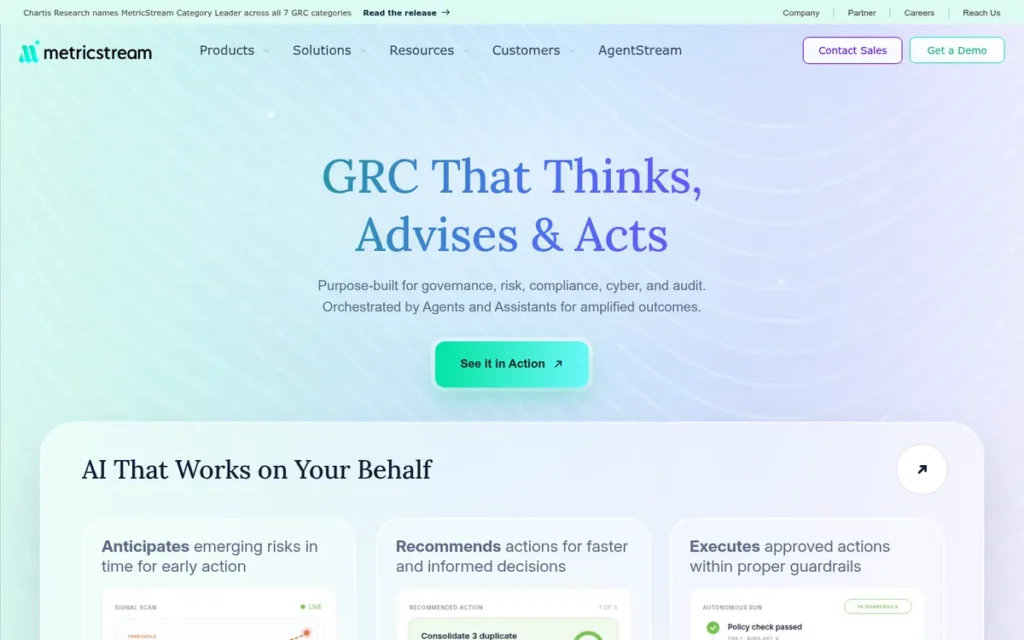
Category: AI-First Enterprise GRC, an enterprise governance, risk, and compliance platform that differentiates through a governed LLM integration gateway, NLP-driven regulatory intelligence, and a compliance content library of 9,300+ pre-mapped control statements across 1,200+ global regulations, founded in 1999 with 26+ years of pure-play enterprise GRC institutional experience.
At a Glance
- Category: AI-First Enterprise GRC
- Best For: Highly regulated global enterprises in financial services, pharmaceuticals, energy, and healthcare managing simultaneous multi-jurisdictional compliance obligations across 10 or more regulatory frameworks
- Price Range: Not publicly disclosed; described by independent reviewers as “premium enterprise” with high implementation costs; direct sales engagement required
- Primary Strength: MetricStream ConnectedGRC provides the deepest compliance content library in this comparison (9,300+ controls mapped to 1,200+ global regulations via the Unified Compliance Framework) plus the only governed AI LLM integration gateway among the seven platforms evaluated, and Chartis RiskTech100 2025 Category Winner recognition in Enterprise GRC and Audit.
- Biggest Limitation: MetricStream ConnectedGRC has only 14 G2 reviews at 3.8/5 (the lowest-confidence peer validation in this comparison) making statistical triangulation of vendor capability claims against independent user experiences unreliable without direct reference conversations with named organizations in comparable regulatory environments.
- One-Line Summary: MetricStream ConnectedGRC is the AI-first enterprise GRC platform founded in 1999, offering a governed LLM integration gateway, 9,300+ controls mapped to 1,200+ global regulations, and Chartis RiskTech100 2025 Category Winner recognition, purpose-built for highly regulated global enterprises with complex multi-jurisdictional compliance programs.
- Last Verified: May 2026
Overview
MetricStream ConnectedGRC is an AI-first enterprise GRC platform founded in 1999 (the longest pure-play GRC track record in this comparison) best suited for large organizations in financial services, energy, pharmaceuticals, and healthcare managing simultaneous multi-jurisdictional compliance obligations across 10 or more regulatory frameworks.
MetricStream ConnectedGRC distinguishes itself through three technically specific AI capabilities: an AI Model Gateway for governed LLM integration into GRC workflows, NLP-based regulatory alert classification across 1,200+ global regulations for automated change monitoring, and SOC2/SOC3 anomaly detection for third-party risk scoring from vendor audit documentation.
MetricStream ConnectedGRC reports serving over one million GRC professionals across 35+ countries (MetricStream platform, 2026), a directionally significant scale claim that is not independently corroborated in publicly available sources as of May 2026.
Key Features
- AI Model Gateway for Governed LLM Integration: MetricStream ConnectedGRC includes an AI Model Gateway enabling governed integration of custom large language models into GRC workflows, allowing organizations to automate risk assessments, control testing, and policy review using enterprise-approved LLMs while maintaining governance controls required for EU AI Act compliance programs that entered enforcement in 2026 (MetricStream AI platform documentation, 2026).
- 9,300+ Pre-Mapped Control Statements: MetricStream ConnectedGRC’s compliance content library contains 9,300+ pre-mapped control statements aligned to 1,200+ global regulatory frameworks via the Unified Compliance Framework (a third-party regulatory taxonomy that MetricStream has integrated) enabling cross-framework control mapping across SOX, GDPR, HIPAA, Basel III, DORA, and NIS2 without building control mappings from scratch (MetricStream platform documentation, 2026).
- NLP-Based Regulatory Alert Classification: MetricStream ConnectedGRC’s NLP capability automatically monitors and categorizes changes across 1,200+ global regulatory frameworks (including DORA, Basel III, Dodd-Frank, NIS2, and CSRD) alerting compliance teams to relevant regulatory developments without requiring manual surveillance of global regulatory publications across multiple jurisdictions.
- SOC2/SOC3 Anomaly Detection for TPRM: MetricStream ConnectedGRC’s third-party risk module uses anomaly detection on SOC2 and SOC3 audit reports to automatically score vendor risk, enabling AI-driven TPRM intelligence from vendor-provided compliance documentation rather than relying solely on self-reported questionnaire responses.
- Multi-User Collaborative Control Testing: MetricStream ConnectedGRC supports real-time multi-user collaborative control testing, automated red flag detection in risk assessments, AppStudio for low-code customization, offline assessments, and bulk reassignments, providing enterprise workflow flexibility across global multi-entity organizational structures.
Best For
MetricStream ConnectedGRC is best for large enterprises in highly regulated global industries managing 10 or more simultaneous regulatory frameworks, organizations needing governed AI integration for EU AI Act compliance programs, or enterprises requiring the deepest available pre-mapped regulatory content library to reduce multi-jurisdictional compliance mapping costs.
MetricStream ConnectedGRC is not the strongest fit for mid-market organizations or those without dedicated GRC teams, implementation resources, and ongoing platform administration capacity to leverage the platform’s configurability depth.
Strengths
- Chartis RiskTech100 2025 Category Winner: MetricStream ConnectedGRC was named a Category Winner in Enterprise GRC and Audit in the Chartis RiskTech100 2025 (an independent annual ranking of the world’s top 100 risk technology companies) providing current analyst recognition for its enterprise GRC capability depth independent of historical Gartner and Forrester coverage (Chartis Research, 2025).
- Largest Compliance Content Library in Category: MetricStream ConnectedGRC’s compliance content library of 9,300+ control statements pre-mapped to 1,200+ global regulations via the Unified Compliance Framework is the most extensive in this comparison, enabling enterprises to deploy cross-framework compliance programs across dozens of simultaneous regulatory mandates without building control mappings from scratch (MetricStream platform documentation, 2026).
- First-Mover AI Model Gateway for GRC: MetricStream ConnectedGRC’s AI Model Gateway enables governed integration of custom LLMs into GRC workflows, a forward-looking technical capability that positions MetricStream for organizations building EU AI Act compliance programs, where no other traditional enterprise GRC vendor in this comparison has yet delivered an equivalent documented governed LLM integration capability (MetricStream AI platform, 2026).
- 26+ Years of Enterprise GRC Institutional Knowledge: MetricStream was founded in 1999 as SystemI, making it the only platform in this comparison with 26+ years of pure-play enterprise GRC experience spanning SOX compliance cycles (2002), Dodd-Frank implementation (2010), GDPR enforcement (2018), and the current DORA and EU AI Act regulatory wave, providing institutional knowledge of multi-generational regulatory change that all newer platforms structurally lack (per MetricStream co-founder account, 2014).
Limitations
- Critically Low Peer Review Evidence: MetricStream ConnectedGRC’s most consequential trade-off is the gap between capability claims and peer review evidence, with only 14 G2 reviews at 3.8/5, statistical triangulation of vendor capability claims against independent user experiences is unreliable without direct reference conversations, making MetricStream the lowest peer-validated platform in this comparison for procurement due diligence purposes.
- Limited Public Case Study ROI Data: MetricStream ConnectedGRC lacks publicly named Fortune 500 client references in available sources, and public case studies do not specify percentage efficiency improvements or cost savings with the specificity that AuditBoard (Optro)’s community-documented outcomes or Riskonnect’s analyst-verified ROI data provide, requiring procurement teams to rely more heavily on vendor-arranged reference calls than is typical for a 26-year-old enterprise platform (independent reviewers, Sprinto, 2024).
- Premium Pricing and High Implementation Complexity: MetricStream ConnectedGRC’s premium enterprise pricing combined with high implementation complexity limits its accessible market to large enterprises with dedicated GRC teams and substantial budget authority, mid-market buyers are better served by LogicGate Risk Cloud or AuditBoard (Optro) at lower total cost of ownership with more accessible no-code configuration (independent reviewers, Sprinto, 2024).
Verdict
MetricStream ConnectedGRC is the AI-first enterprise GRC platform with the deepest compliance content library in this comparison, 9,300+ control statements mapped to 1,200+ global regulations, and the only governed LLM integration gateway among the seven platforms evaluated, founded in 1999 with 26+ years of pure-play enterprise GRC institutional experience. MetricStream ConnectedGRC earns #4 in this ranking because its compelling technical capability profile is undermined by critically low peer review evidence, 14 G2 reviews at 3.8/5, preventing enterprise buyers from drawing statistically reliable conclusions about deployment satisfaction without conducting direct reference validation with named organizations in comparable regulatory environments.
5. OneTrust GRC: Best for Privacy-First Organizations and EU AI Act Governance Integration
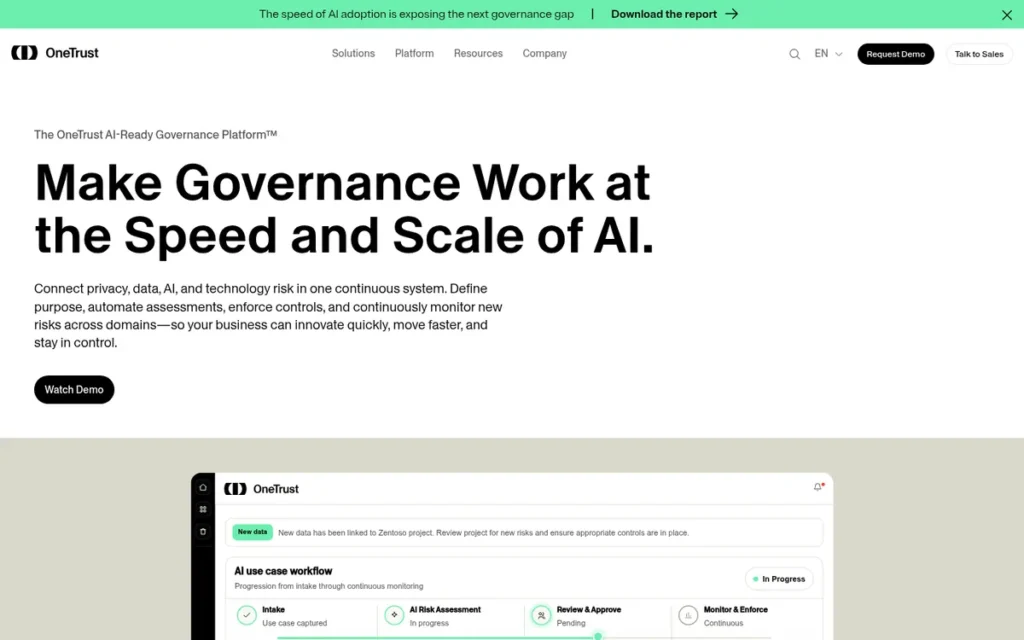
Category: Privacy-First GRC Platform, a cloud-native governance, risk, and compliance suite that integrates data privacy management, AI governance, ESG risk, and traditional GRC in a unified Trust Intelligence Platform designed for organizations where data sovereignty, privacy-by-design, and AI governance are primary compliance obligations.
At a Glance
- Category: Privacy-First GRC Platform
- Best For: Privacy-intensive organizations in financial services, healthcare, and technology operating under GDPR, CCPA, and EU AI Act obligations where data privacy and AI governance are primary risk drivers
- Price Range: Not publicly disclosed; modular per-capability pricing; community reports significant cost escalation when multiple modules are combined; direct sales engagement required
- Primary Strength: OneTrust GRC is the only GRC platform in this comparison with a dedicated EU AI Act compliance module, recognized as IDC MarketScape GRC Leader in 2025 (IDC MarketScape: Worldwide GRC Software 2025, Doc #US53615325, June 2025) and cited for data governance excellence by KuppingerCole in 2024 (per OneTrust press release, 2024).
- Biggest Limitation: OneTrust GRC’s core GRC module has been described by multiple independent community practitioners as a “nightmare” implementation experience, with post-VC-investment product development pace characterized as “basically abandonware”, while cost rather than satisfaction is cited as the primary reason many organizations remain on the platform.
- One-Line Summary: OneTrust GRC is a privacy-first Trust Intelligence Platform, recognized as IDC MarketScape GRC Leader in 2025 (Doc #US53615325), integrating GDPR, CCPA, EU AI Act governance, and ESG risk in a single cloud-native suite for organizations where data privacy obligations are the primary risk driver.
- Last Verified: May 2026
Overview
OneTrust GRC is a cloud-native Trust Intelligence Platform combining data privacy, GRC, responsible AI governance, ESG risk, and ethics programs in a unified system, best suited for organizations where GDPR, CCPA, and EU AI Act obligations are primary risk drivers requiring integration between privacy operations and traditional GRC.
OneTrust earned IDC MarketScape Leader recognition in 2025 for GRC software that unifies data, privacy, and risk teams (IDC MarketScape: Worldwide GRC Software 2025, Doc #US53615325, June 2025) and recognition for data governance capabilities in the KuppingerCole 2024 Leadership Compass (per OneTrust press release citing KuppingerCole, 2024).
OneTrust GRC’s community reception is more divided than its analyst recognitions indicate, its privacy and cookie management modules are consistently praised while its core GRC implementation experience has attracted consistent criticism from enterprise practitioners.
Key Features
- Dedicated EU AI Act Compliance Module: OneTrust GRC’s EU AI Act module provides integrated AI risk management governance, enabling organizations to document, assess, and monitor AI system risks under EU AI Act obligations that entered enforcement in 2026, using the same platform managing GDPR, CCPA, and traditional GRC programs without deploying a separate AI governance tool.
- Native Privacy-GRC Integration: OneTrust GRC integrates data mapping, Privacy Impact Assessments, Subject Access Request management, breach notification workflows, and cookie consent management natively alongside GRC modules, treating privacy compliance as a GRC control domain rather than a separate program and reducing the operational overhead of managing parallel privacy and risk teams.
- Risk Hierarchy and Conditional Scoring: OneTrust GRC’s risk mapping module supports risk hierarchy visualization, conditional scoring, and a risk explorer tool providing granular visibility into how risks relate across technology, compliance, vendor relationships, and internal policy domains, spanning the full organizational risk landscape.
- Third-Party Risk Management with Continuous Monitoring: OneTrust GRC supports TPRM through vendor risk assessments, continuous monitoring, and risk-based vendor scoring, enabling organizations to extend privacy and data governance requirements into third-party supplier relationships through the same platform managing internal compliance obligations.
- ESG Risk and Sustainability Disclosure: OneTrust GRC’s ESG module addresses mandatory sustainability disclosure requirements including EU CSRD, connecting environmental and social risk reporting to the same GRC framework managing cyber, operational, and compliance risk for the full spectrum of enterprise risk disclosure obligations required in European regulatory contexts.
Best For
OneTrust GRC is best for organizations where data privacy and AI governance are primary risk management obligations (particularly those operating under GDPR, CCPA, and EU AI Act requirements in financial services, healthcare, and technology) and where connecting data privacy operations, AI risk governance, ESG disclosure, and traditional GRC in a single platform matters more than deepest standalone GRC capability or lowest implementation friction.
Organizations whose primary driver is GRC implementation depth, ease of deployment, or active product development velocity should evaluate AuditBoard (Optro) or LogicGate Risk Cloud before OneTrust GRC.
Strengths
- IDC MarketScape GRC Leader 2025: OneTrust GRC earned IDC MarketScape Leader recognition in 2025 for GRC software that unifies data, privacy, and risk teams, providing analyst-sourced validation of its privacy-GRC convergence in a domain where no traditional enterprise GRC platform in this comparison has earned equivalent analyst recognition (IDC MarketScape: Worldwide GRC Software 2025, Doc #US53615325, June 2025).
- Only EU AI Act Compliance Module in Category: OneTrust GRC’s dedicated EU AI Act compliance module makes it the only platform in this comparison with integrated AI governance capabilities as 2026 enforcement activates, enabling organizations to manage AI system risk documentation, assessment, and monitoring using the same platform managing GDPR, CCPA, and traditional GRC programs without a separate AI governance investment.
- Data Governance Recognition: OneTrust earned recognition in the KuppingerCole Leadership Compass 2024 for data governance handling billions of data transfers, the strongest data governance analyst validation in this comparison for enterprises managing large-scale personal data processing under GDPR and CCPA (per OneTrust press release citing KuppingerCole Leadership Compass, 2024).
- Meaningful Adoption at Scale with Privacy-Domain Praise: OneTrust GRC received G2 4.5/5 across 800+ reviews and Capterra 4.6/5 across 200+ reviews, with community praise specifically directed at automation for privacy tasks, AI assessments, and GDPR/CCPA compliance coverage, reflecting genuine satisfaction in the privacy domain even among practitioners who are critical of the platform’s broader GRC implementation quality (G2 and Capterra, May 2026).
Limitations
- Documented GRC Implementation Quality Gap: OneTrust GRC’s most consequential trade-off is the quality gap between its privacy module and its core GRC implementation, practitioners consistently report that while privacy-side features work well, the GRC module is a documented problem that multiple independent voices have called a “nightmare.”
“OneTrust does some things right. Cookie consent and their privacy side pieces are nice. Their GRC implementation is a nightmare. I wish we could get away from them, but they’re cheaper than anything else we’ve looked at.” Posted by u/noajayne, r/cybersecurity, 2023
Takeaway: OneTrust GRC is retained by some organizations due to switching cost rather than platform satisfaction, a signal that platform stickiness is driven by lock-in economics rather than active user preference, relevant for organizations modeling long-term platform health.
- Post-Funding Development Velocity Concerns: OneTrust GRC’s post-VC-investment product development pace has been specifically cited as declining, one community reviewer described the GRC product as “basically abandonware” since funding intensified, while another noted “service and product improvement is non-existent and the product keeps getting more expensive” (u/MindlessRip5915, r/cybersecurity, 2023). These are risk factors enterprise buyers must weigh explicitly when evaluating a multi-year platform commitment.
- Modular Pricing Escalation: OneTrust GRC’s per-module pricing structure means costs escalate significantly when combining privacy, GRC, TPRM, ESG, and AI governance capabilities, with practitioners reporting “thousands more for each module,” creating a total cost of ownership gap between initial licensing discussions and full multi-module deployment costs (community data, r/cybersecurity, 2023–2024).
Verdict
OneTrust GRC is the strongest platform in this comparison for organizations where data privacy, AI governance, and sustainability disclosure are primary risk management obligations, recognized as IDC MarketScape GRC Leader in 2025 and providing the only EU AI Act compliance module natively integrated into a GRC platform. OneTrust GRC earns #5 because its analyst recognition and privacy-domain strengths are genuine, but its core GRC implementation quality, post-funding development velocity, and cost-as-retention-driver dynamic have drawn consistent independent community criticism that enterprise buyers must explicitly weigh, particularly if GRC implementation depth, ease of deployment, or active product development pace are primary evaluation criteria.
6. Riskonnect: Best for Insurance and GRC Convergence
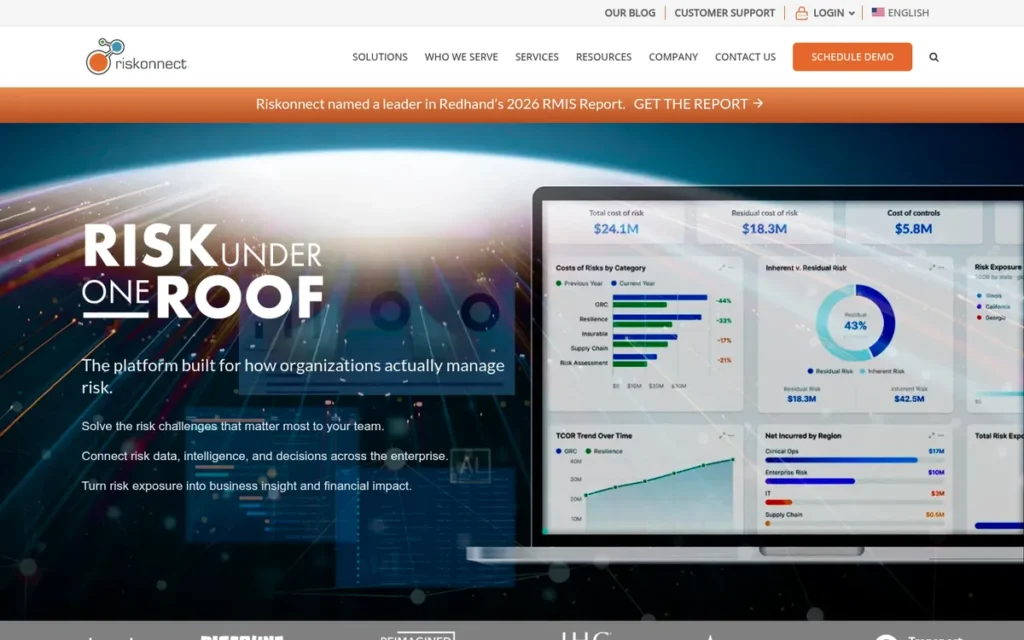
Category: Insurable-Risk IRM, an integrated risk management platform that uniquely converges insurance risk financing, claims management, and actuarial analysis with enterprise GRC, ERM, business continuity, and third-party risk management in a single cloud-based system, the only platform in this comparison with this insurance-GRC convergence capability.
At a Glance
- Category: Insurable-Risk IRM
- Best For: Enterprises in insurance, healthcare, manufacturing, and retail/logistics with significant insurable risk programs that require insurance risk financing and GRC managed in the same system
- Price Range: Not publicly disclosed; PE-backed enterprise vendor (specific PE firm not confirmed in available research as of May 2026); free demo available at riskonnect.com; direct sales engagement required
- Primary Strength: Riskonnect is the only enterprise risk platform in this comparison converging insurance risk financing with GRC and ERM in a single system, validated by GRC 20/20 Research-verified 200%+ five-year ROI for the Business Continuity module (GRC 20/20 Research, December 2023).
- Biggest Limitation: Riskonnect’s approximately 100 G2 reviews: the second-lowest review volume in this comparison, provide limited statistical confidence for enterprise procurement due diligence, and its acquisition-driven growth model introduces module coherence risk for buyers evaluating how tightly Castellan, Sword GRC, and ICIX capabilities integrate into a unified data model.
- One-Line Summary: Riskonnect is the only enterprise risk management platform that unifies insurance risk financing, claims management, and GRC in a single system, delivering GRC 20/20 Research-verified 200%+ five-year ROI for business continuity programs and Monte Carlo simulation for quantitative risk modeling.
- Last Verified: May 2026
Overview
Riskonnect is a cloud-based Integrated Risk Management platform founded in 2007, best suited for enterprises in insurance, healthcare, and manufacturing that need to manage insurable risk financing, claims, and actuarial data in the same platform as their GRC, ERM, and business continuity programs.
Riskonnect is the only platform in this comparison converging insurance risk financing with enterprise GRC and ERM, a convergence that eliminates the operational overhead of running separate insurance program management and enterprise risk systems in parallel.
Riskonnect’s platform grew through strategic acquisitions (Castellan for business continuity (2022), Sword GRC for enterprise GRC and ESG, and ICIX for supply chain risk) creating broad domain coverage for enterprises consolidating insurance and GRC programs. The specific PE firm backing Riskonnect has not been independently confirmed in available research as of May 2026.
Key Features
- Insurance Risk Financing Integration: Riskonnect’s insurance risk financing capability enables enterprises to manage risk financing programs, claims management, actuarial data, and insurable risk exposure within the same platform as GRC, ERM, and compliance programs, the only such convergence available among the seven platforms evaluated in this comparison.
- GRC 20/20 Research-Verified Business Continuity Module: Riskonnect’s Business Continuity module (acquired via Castellan) delivers GRC 20/20 Research-verified 203% five-year ROI for large organizations, 233% for mid-size, and 247% for smaller organizations, with 75% reduction in BCM planning time and 100% elimination of plan distribution time, independently validated in December 2023.
- Monte Carlo Simulation for Quantitative Risk Modeling: Riskonnect’s IRM platform includes Monte Carlo simulation for quantitative risk modeling, enabling actuarial-style probabilistic risk analysis that translates enterprise risk exposure into financial loss estimates for board communication beyond traditional heat map representations.
- ERM with KRIs and Supply Chain Risk: Riskonnect’s ERM module provides risk registers, heat maps, Key Risk Indicators, and risk appetite frameworks alongside supply chain risk capability from the ICIX acquisition, covering end-to-end third-party risk visibility for enterprises managing DORA, NIS2, and post-SolarWinds supply chain risk surveillance mandates.
- Industry-Specific Configurations: Riskonnect supports industry-specific configurations for financial services, healthcare, energy, and manufacturing, reflecting its insurance risk management origins and enabling faster time-to-value through pre-configured risk taxonomies and regulatory content aligned to each industry vertical.
Best For
Riskonnect is best for enterprises in industries where insurable risk management and enterprise GRC must be managed in an integrated system, including insurance companies managing their own enterprise risk, healthcare systems with malpractice and operational liability exposure, manufacturing companies with product liability and property risk programs, and retail/logistics organizations with complex supply chain and fleet risk.
Organizations whose primary driver is GRC breadth, TPRM depth, pricing transparency, or peer-review-validated satisfaction should evaluate AuditBoard (Optro) or LogicGate Risk Cloud before Riskonnect.
Strengths
- GRC 20/20 Research-Verified 200%+ Five-Year ROI: Riskonnect’s Business Continuity module earned independent analyst validation from GRC 20/20 Research of 200%+ five-year ROI across all organization sizes (203% for large organizations, 233% for mid-size, and 247% for smaller organizations) with 75% less time on BCM planning and 100% reduction in plan distribution time, verified by analyst Michael Rasmussen in December 2023 (GRC 20/20 Research, December 2023).
- Unique Insurance-GRC Convergence: Riskonnect is the only platform in this comparison that converges insurance risk financing with enterprise GRC and ERM in a single system, eliminating the integration overhead and data reconciliation cost of maintaining parallel insurance program management and enterprise risk platforms, which most insurance-intensive enterprises currently absorb as significant ongoing operational expense.
- Monte Carlo Quantitative Risk Modeling: Riskonnect’s Monte Carlo simulation enables actuarial-style probabilistic financial risk analysis within an enterprise GRC platform, providing the financial-language risk quantification that insurance-sector enterprises and capital-allocation decision-makers require for board-level communication beyond color-coded heat maps (Riskonnect IRM documentation, 2026).
- Documented SOX Compliance Efficiency: Riskonnect’s SOX compliance case study documents 30%+ compliance cost reduction and 200+ hours saved per year, directionally consistent with workflow automation efficiencies the platform delivers for enterprises migrating from manual SOX tracking processes (Riskonnect case study reference, 2024; anonymized, no independent third-party verification available).
Limitations
- Low Peer Review Volume Limits Confidence: Riskonnect’s most consequential trade-off is between its unique insurable-risk IRM positioning and limited peer review evidence, with approximately 100 G2 reviews and 50 Capterra reviews (the second-lowest volumes in this comparison), enterprise buyers cannot draw statistically reliable conclusions about user satisfaction across diverse deployment configurations, creating meaningful due diligence gaps for procurement teams requiring reference validation before committing.
- Acquisition-Driven Module Coherence Risk: Riskonnect’s growth through acquiring Castellan, Sword GRC, and ICIX introduces module coherence risk, buyers should explicitly assess whether acquired capabilities are genuinely unified in a single data model or operating as separately licensed additions, as acquisition-driven platforms frequently require additional integration work to achieve the seamless cross-module experience that natively-built platforms deliver.
- TPRM Depth Shallower than Specialists: Riskonnect’s TPRM capability is shallower than dedicated TPRM specialists, LogicGate Risk Cloud’s Black Kite integration or ServiceNow GRC’s CMDB-linked TPRM provide more purpose-built third-party risk intelligence at comparable enterprise scale for organizations where TPRM is a primary rather than supplementary requirement (community discussions, r/cybersecurity, 2024).
- PE Ownership Transparency Gap: The specific PE firm backing Riskonnect has not been independently confirmed in available research, a transparency gap enterprise buyers should address directly with the vendor during financial due diligence for multi-year contract commitments when evaluating long-term pricing trajectory and ownership stability (May 2026).
Verdict
Riskonnect is the only enterprise risk platform in this comparison to converge insurance risk financing with GRC and ERM, earning GRC 20/20 Research-verified 200%+ five-year ROI for its Business Continuity module and providing the quantitative risk modeling depth that insurance-intensive enterprises require from an integrated risk intelligence system. Riskonnect earns #6 not due to quality deficiency but because its insurance-plus-GRC convergence positioning serves a narrower buyer segment than the broader platforms ranked above it, organizations outside the insurance, healthcare, and manufacturing industries with significant insurable risk programs are better served by AuditBoard (Optro), LogicGate Risk Cloud, or ServiceNow GRC. For its specific target segment, Riskonnect is the most purpose-fit platform in this comparison.
7. Archer IRM: Best for Government and Defense with On-Premises Requirements
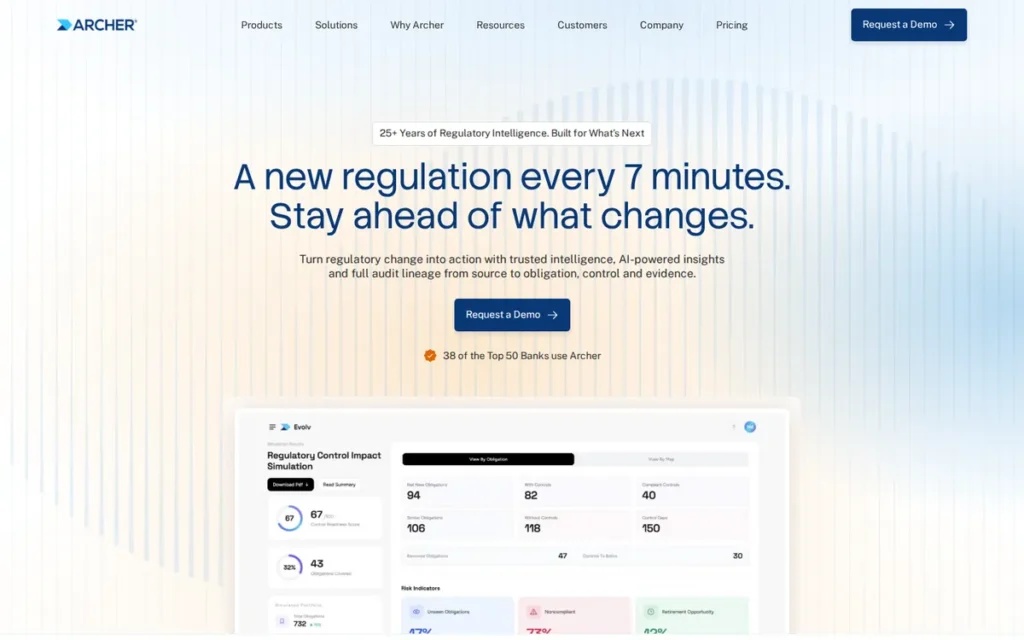
Category: Configurable Enterprise IRM, a highly customizable integrated risk management platform that models complex multi-entity organizational structures across multiple regulatory regimes, deployable on-premises, in cloud, or in hybrid environments, the only platform in this comparison with full on-premises capability for government, defense, and data-residency-constrained enterprises.
At a Glance
- Category: Configurable Enterprise IRM
- Best For: Government agencies, defense contractors, and enterprises with data residency mandates prohibiting cloud-based GRC, or large global enterprises with 40+ legal entities requiring complex multi-entity organizational modeling
- Price Range: Not publicly disclosed; described by community as “expensive” with elevated TCO from required dedicated Archer developer staffing; acquired by Cinven (international PE firm) in 2024; direct sales engagement required
- Primary Strength: Archer IRM is the only enterprise GRC platform in this comparison to offer full on-premises, cloud, and hybrid deployment options, the non-negotiable selection for government and defense buyers with data residency mandates that prohibit cloud-based risk management tools.
- Biggest Limitation: Archer IRM requires dedicated full-time Archer developers to configure, maintain, and evolve the platform, creating the highest implementation complexity and ongoing staffing cost in this comparison, documented by community practitioners with 69-upvote consensus as resulting in perpetual implementation projects.
- One-Line Summary: Archer IRM is the only enterprise GRC platform in this comparison with full on-premises deployment, acquired by Cinven in 2024, supporting 150+ pre-built use cases for multi-entity global enterprises in government, defense, and financial services, rated 4.2/5 across 250+ G2 reviews.
- Last Verified: May 2026
Overview
Archer IRM is a highly configurable enterprise IRM platform best suited for government agencies, defense contractors, and large global enterprises with data residency mandates requiring full on-premises GRC deployment, the only platform in this comparison delivering complete GRC functionality without cloud dependency.
Archer IRM was spun out from RSA Security (Dell Technologies) in 2020 as an independent company and was subsequently acquired by Cinven, an international private equity firm, in 2024, a material ownership change enterprise buyers should assess for product roadmap continuity and support quality commitments under the new ownership structure (Clearlake Capital press release, 2024).
Archer IRM supports five core risk domains (IT Risk, Operational Risk, Third-Party Risk Management, Compliance Management, and Business Continuity) with 150+ pre-built use cases and architecture capable of modeling complex multi-entity organizational structures that flat-hierarchy GRC platforms cannot replicate.
Key Features
- Full On-Premises, Cloud, and Hybrid Deployment: Archer IRM is the only platform in this comparison to offer full on-premises deployment alongside cloud and hybrid options, enabling government agencies, defense contractors, and enterprises with data residency or sovereignty requirements to deploy complete GRC capabilities within their own infrastructure without any cloud dependency (Archer IRM deployment documentation, 2026).
- IT Risk with SIEM Integration: Archer IRM’s IT Risk management module provides centralized control of IT risks, vulnerabilities, and SIEM integration for real-time cyber threat intelligence, connecting security operations data to GRC risk records without requiring separately managed API integrations between tools.
- 150+ Pre-Built Use Cases: Archer IRM’s Compliance Management module enables automated policy alignment and regulatory tracking across 150+ pre-built use cases (including frameworks for financial services, healthcare, and critical infrastructure) reducing the configuration time required to establish initial compliance posture for standard regulatory mandates.
- Third-Party Risk Management with Vendor Governance: Archer IRM’s TPRM module provides vendor inventory management, security monitoring, and performance tracking, enabling enterprises to assess and continuously monitor third-party exposure within the same configurable database managing internal controls and compliance obligations across all business units.
- Business Continuity and Crisis Management: Archer IRM’s Business Continuity module supports BCP testing, IT disaster recovery planning, and crisis management workflows, connecting resilience planning to the same risk and compliance data model governing the GRC program for integrated impact assessment when incidents require coordinated organizational response.
Best For
Archer IRM is best for government agencies, defense contractors, and heavily regulated enterprises with data residency mandates prohibiting cloud-based GRC deployment, and for large global organizations with 40+ legal entities requiring complex multi-entity organizational modeling with granular audit traceability.
Organizations without full-time dedicated Archer developers on staff should evaluate LogicGate Risk Cloud or AuditBoard (Optro) before committing to Archer IRM’s implementation model and its associated ongoing developer staffing dependency.
Strengths
- Only On-Premises GRC Deployment in Comparison: Archer IRM is the only platform in this comparison to offer full on-premises deployment alongside cloud and hybrid options, a non-negotiable requirement for government agencies, defense contractors, and enterprises with data residency mandates, representing a genuine competitive differentiator that cloud-only GRC platforms structurally cannot replicate (Archer IRM deployment documentation, 2026).
- Multi-Entity Complex Organizational Modeling: Archer IRM’s configurable architecture supports complex corporate structures with 40+ legal entities, multiple overlapping regulatory regimes, and granular audit traceability, the most extensive structural configurability in this comparison for global enterprises that cannot impose flat hierarchy constraints on their risk management data model.
- Strong Functional Depth in Independent Evaluations: Multiple independent product evaluations note Archer IRM’s strong functional depth in risk management and compliance configuration, confirming the platform’s capability depth when implemented with adequate dedicated developer resources, despite community satisfaction ratings that consistently reflect implementation-dependency challenges (multiple independent review sources, 2024).
- Government Sector Adoption Documentation: Archer IRM is documented in Texas Department of Information Resources policy and security plan training materials, representing one of the few publicly confirmed government sector client references available and validating its established position in state government GRC program management (Texas DIR documentation, 2024).
Limitations
- Dedicated Developer Dependency Creates Perpetual Complexity: Archer IRM’s most consequential trade-off is implementation complexity, the platform requires full-time Archer developers to configure, maintain, and evolve, creating the highest ongoing staffing cost in this comparison and a developer dependency documented by community practitioners with 69-upvote consensus as producing perpetual implementation projects with no defined completion.
“The best GRC jobs are working with Archer. You don’t know how it works. Management doesn’t know how it works. The project has been halfway finished for 7 years with no end in sight.” Posted by u/savvyspoon2, r/cybersecurity, 2023 (69 upvotes)
Takeaway: Archer IRM implementations frequently become open-ended projects without defined completion criteria, a documented pattern driven by developer-dependency complexity that benefits implementation consultants while creating long-term organizational uncertainty for the enterprise deploying the platform.
- Community’s Dominant Migration-From Platform: Archer IRM is actively cited as a platform organizations are replacing rather than adopting, community procurement threads recommend “avoiding companies like Archer due to the complexity and cost,” with LogicGate Risk Cloud established as the primary modernization destination (r/cybersecurity, September 2024). Customization lock-in makes switching prohibitively expensive after deep configuration investment.
- Second-Lowest G2 Rating in Comparison: Archer IRM’s G2 4.2/5 across 250+ reviews is the second-lowest satisfaction rating in this comparison, reflecting the consistent tension between deep functional capabilities and poor user experience and implementation accessibility, reinforced by community descriptions requiring “full time Archer developers” as a baseline operational necessity, not an optional enhancement (u/Create_Your_User, r/cybersecurity, 2024).
- Cinven 2024 Acquisition Creates Ownership Uncertainty: Archer IRM was acquired by Cinven, an international private equity firm, in 2024 (following a period under Symphony Technology Group and Clearlake Capital after the RSA Security spin-off) a material ownership change enterprise buyers should assess for product roadmap continuity, pricing trajectory, and long-term support quality commitments (Clearlake Capital press release, 2024).
Verdict
Archer IRM is the only enterprise GRC platform in this comparison with full on-premises deployment capability, making it the default selection for government agencies, defense contractors, and enterprises with data residency mandates that prohibit cloud-based risk management tools, a requirement that cloud-only GRC platforms structurally cannot address. Archer IRM earns #7 in this ranking because its on-premises differentiator, while genuinely unique, is relevant only to a specific buyer segment, while its G2 4.2/5 rating across 250+ reviews, highest implementation complexity in the category, required dedicated developer staffing, 2024 Cinven acquisition, and documented dominant position as the most frequently migrated-away-from platform represent objective scoring disadvantages across the criteria that matter most to enterprise buyers in 2026. Buyers outside the government, defense, and data-residency segment should evaluate LogicGate Risk Cloud and AuditBoard (Optro) before committing to Archer IRM’s total cost of ownership model.
What Red Flags Should I Watch For When Evaluating Risk Intelligence Software?
The six most consequential red flags in enterprise GRC/IRM procurement are the warning signs that vendor-biased comparison lists consistently suppress. Each red flag below is a named, independently citable warning for enterprise risk managers and CISOs in active procurement.
Red Flag #1: Implementation Complexity Without a Staffing Plan
A platform requiring dedicated developers or CMDB administrators (such as Archer IRM or ServiceNow GRC) will consistently deliver poor outcomes for organizations that have not explicitly budgeted for those permanent staffing roles before contract signature.
The same ServiceNow GRC installation produces a 4.5/5 G2 review for organizations with dedicated CMDB administrators and a “dumpster fire” for those without. This bimodal distribution pattern is the most consequential hidden variable in enterprise GRC procurement. If a vendor cannot quantify how many full-time administrators your deployment requires on an ongoing basis after go-live, treat this as a primary procurement risk.
Red Flag #2: AI Feature Claims Without Named Techniques
Every GRC platform in 2026 markets itself as “AI-powered.” Genuine AI differentiation requires named, documented techniques:
- FAIR Monte Carlo simulation (LogicGate Risk Cloud)
- Governed LLM Model Gateway (MetricStream ConnectedGRC)
- NLP-based regulatory classification (MetricStream ConnectedGRC)
- SOC2/SOC3 anomaly detection (MetricStream ConnectedGRC)
If a vendor cannot name the specific AI method underlying a demonstrated capability, the feature is almost certainly rule-based workflow automation relabeled as AI, a distinction that determines actual automation depth and long-term scalability.
Red Flag #3: Pricing Opacity That Prevents TCO Modeling Before Contract
Every platform in this comparison requires direct vendor engagement for pricing, but opacity becomes a red flag when vendors refuse to provide directional total cost of ownership ranges. That range must include:
- Implementation partner fees
- Ongoing admin staffing costs
- Module add-on costs for the full intended configuration
Buyers who discover true TCO post-contract face a switching cost trap that every platform in this comparison creates through different mechanisms.
Red Flag #4: Vendor Lock-In Mechanisms Not Disclosed During Sales Process
ServiceNow GRC’s platform embedding, Archer IRM’s customization lock-in, and OneTrust GRC’s cost-as-retention-driver pattern all represent lock-in mechanisms rarely disclosed during the sales process.
Ask every vendor directly: “What does data export and migration look like in three to five years if we move off this platform?” Vendors with specific, confident answers about data portability and migration paths present lower long-term lock-in risk than those who redirect this question.
Red Flag #5: Module Pricing Escalation in Modular Pricing Platforms
Platforms using modular pricing (including OneTrust GRC and AuditBoard (Optro)) may appear affordable for a single capability but escalate significantly when privacy, GRC, TPRM, ESG, and AI governance modules are combined.
Multiple enterprise practitioners have reported discovering full multi-module costs that significantly exceed initial single-module pricing discussions. Require explicit per-module pricing for the full intended configuration before contract execution, not just the modules needed at launch.
Red Flag #6: Acquisition-Driven Module Coherence Not Disclosed
Platforms grown through acquisitions (Riskonnect (Castellan, Sword GRC, ICIX) and Archer IRM (multiple ownership changes including Cinven in 2024)) may present acquired capabilities as natively integrated when they remain loosely coupled.
Ask vendors to demonstrate data flowing between modules from different acquisition origins in a single workflow before contract execution. If that demonstration requires preparation or cannot be done live, the coherence may be aspirational rather than operational.
What Questions Should I Ask Before Choosing Risk Intelligence Software?
Enterprise buyers should ask these questions directly during vendor evaluation. Incomplete or evasive answers to any of them are material procurement risk signals.
Question #1: What dedicated administrator and developer resources does this platform require on an ongoing basis after go-live?
Listen for specificity: “no dedicated resources needed” reflects LogicGate Risk Cloud’s no-code model, while “you’ll need at least one dedicated Archer developer” or “a CMDB admin” is the honest answer for Archer IRM and ServiceNow GRC respectively. Vague answers that defer to implementation partners without quantifying ongoing staffing requirements indicate the vendor understands its resource dependencies and prefers not to highlight them during sales.
Question #2: Can you provide three reference customers in my specific industry with comparable organizational complexity and regulatory stack?
This is particularly critical for MetricStream ConnectedGRC (14 G2 reviews), Riskonnect (100 G2 reviews), and Archer IRM (250 G2 reviews), where peer review volume is too low to statistically validate vendor claims. Named reference conversations with customers in comparable industries and organizational sizes are the primary due diligence mechanism when published peer review data is statistically insufficient.
Question #3: What is the full total cost of ownership including implementation partner fees, ongoing admin staffing, and all module add-ons for my intended configuration?
Model this number explicitly before evaluating any platform. Implementation partner fees for ServiceNow GRC and Archer IRM can exceed annual license fees. Ongoing admin staffing for developer-dependent platforms creates permanent operational costs that no-code platforms like LogicGate Risk Cloud do not require. Module add-on costs in modular pricing models can double or triple initial single-module license discussions.
Question #4: What does data export and migration look like if we choose to move off this platform in three to five years?
Every platform in this comparison creates switching costs through different mechanisms:
- CMDB dependency (ServiceNow GRC)
- Developer-dependent customization lock-in (Archer IRM)
- Connected data model investment (AuditBoard/Optro)
- Cost-as-retention-driver (OneTrust GRC)
Vendors with specific, confident answers about data portability and migration paths present lower long-term lock-in risk than those who describe migration as “a project we’d work on together” without specifics.
Question #5: How are your AI capabilities specifically implemented, what named methods and models underlie the automation you are demonstrating?
Press for specific technique names: FAIR Monte Carlo simulation, LLM Model Gateway with specific governance controls, NLP regulatory classification across named regulation sets, SOC2/SOC3 anomaly detection. If the answer is “proprietary AI algorithms” or “machine learning-based automation” without specifics, the capability is almost certainly rule-based workflow automation relabeled as AI.
Question #6: What ownership changes has your company undergone in the past three years, and who is the current PE or equity sponsor?
This is directly relevant for Archer IRM (Cinven acquisition, 2024), Riskonnect (PE-backed, specific firm not publicly confirmed), and any vendor with acquisition-driven capability growth. PE ownership changes affect product roadmap continuity, pricing trajectory, and support quality commitments over multi-year contracts.
Question #7: Which Gartner, Forrester, or IDC reports currently include your platform, and in what category and position?
AuditBoard (Optro) leads both the 2025 Gartner MQ for GRC Tools and the 2026 Gartner MQ for TPRM Tools. OneTrust GRC leads the IDC MarketScape GRC 2025. LogicGate Risk Cloud holds G2 Leader Grid status but has no confirmed 2024–2026 Gartner or Forrester placement. MetricStream ConnectedGRC holds Chartis RiskTech100 2025 recognition. Vendors unable to name a specific current analyst report should be asked to explain why.
Question #8: How do you handle implementation if our internal team has limited GRC platform administration experience?
No-code platforms like LogicGate Risk Cloud require minimal internal admin. Platform-dependent tools like ServiceNow GRC and Archer IRM require permanent developer staffing or ongoing consulting fees. Knowing the honest answer before contract execution prevents the bimodal outcome failure pattern documented across thousands of GRC practitioner peer reviews.
How Did We Rank These Risk Intelligence Platforms?
These seven enterprise GRC and IRM platforms were ranked using a six-criterion evidence-based methodology developed to surface the intelligence that vendor-biased comparison lists suppress, specifically implementation reality, pricing context, lock-in risk, and AI capability specificity that enterprise buyers cannot obtain from vendor materials alone.
PlugRoute distinguishes between independently verified facts (corroborated by at least one non-vendor source), vendor-reported claims (labeled as such), and community-sourced estimates (labeled with source type and date), treating these three evidence tiers differently rather than presenting them with equivalent authority.
Evaluation Process
The research process followed four phases:
Phase 1: Product Discovery: The PlugRoute research team identified the universe of enterprise GRC/IRM platforms through AI search engine queries, community forum analysis, and vendor category mapping, deliberately separating GRC/IRM platforms from threat intelligence platforms and financial risk analytics tools that are frequently conflated in AI-generated recommendations.
Phase 2: Independent Platform Research: Each platform received dedicated web research across two query dimensions: product capabilities and user outcomes. Official platform documentation, G2 and Capterra review platforms, independent analyst reports (IDC, KuppingerCole, GRC 20/20 Research, Chartis Research), and practitioner community discussions were each consulted separately.
Phase 3: Community Sentiment Analysis: Reddit communities r/cybersecurity, r/InternalAudit, and r/grc were searched for practitioner discussions. Verbatim quotes are attributed to usernames, subreddits, and year of publication. Upvote counts are noted where available as a proxy for community consensus strength. A practitioner who self-identifies their professional role with 69 upvotes from the r/cybersecurity community provides stronger evidence than a generic 2022 G2 review without professional context.
This community-first approach is validated by consistent patterns observed across thousands of practitioner posts, as summarized by one experienced GRC implementor on r/cybersecurity:
“We’re an Archer shop and I’ve seen those others a bit during the time I was an SE for a couple cyber vendors (not in that space). No matter what tool you pick none of them can fix a screwed up process. Even with the supposed Cadillac tool our control assessment process is a nightmare that’s 100% self induced. Make sure you really know what you want before buying any of them.” Posted by u/bitslammer
Takeaway: Practitioner communities across GRC subreddits converge on a single procurement principle regardless of platform evaluated, process documentation must precede platform selection, because even the most capable tool amplifies broken processes rather than fixing them.
- Phase 4: Gap Analysis vs. LLM Recommendations: PlugRoute queried Perplexity and ChatGPT for risk intelligence software recommendations and compared findings, identifying which platforms were absent from or misrepresented in AI responses, and documenting the specific intelligence gaps that create procurement risk for enterprise buyers relying on AI-assisted research.
Ranking Criteria
Platforms were scored against six criteria. The first three are primary criteria (highest weight); the final three are secondary criteria:
C1, Documented Enterprise Adoption and Validated Scale (primary weight) Why it matters: Enterprise buyers committing to multi-year platforms need independently verified evidence that peers have successfully deployed at comparable scale. Gartner, Forrester, and IDC recognitions combined with Fortune 500 penetration figures backed by named third-party press releases reduce selection risk and confirm platform maturity. Self-reported adoption claims without independent corroboration are treated with lower confidence.
C2, Peer Review Platform Ratings and Statistical Volume (primary weight) Why it matters: G2 and Capterra ratings represent unfiltered practitioner sentiment across hundreds to thousands of verified deployments. Volume provides statistical confidence, a 4.6/5 rating from 14 reviews is not comparable to the same rating from 1,500 reviews. Bimodal distributions are documented explicitly rather than averaged, as they reveal implementation-dependency risk that a single average score conceals.
C3, Implementation Accessibility and Total Cost of Ownership (primary weight) Why it matters: Enterprise GRC platforms typically take 6–18 months to deploy and require significant ongoing staffing investment not reflected in license pricing. Implementation complexity and TCO are the primary predictors of post-deployment satisfaction (ahead of feature depth) across every practitioner community analyzed. Platforms with permanent developer staffing dependencies carry structural TCO penalties that no-code platforms do not.
C4, AI and Automation Capability Specificity (secondary weight) Why it matters: Every platform markets itself as “AI-powered.” Genuine differentiation requires named, documented techniques (FAIR Monte Carlo simulation, governed LLM gateways, NLP regulatory classification, SOC2/SOC3 anomaly detection) rather than marketing language. Platforms with specific, independently documented AI methods deliver measurably different automation depth than those applying the AI label to rule-based workflows.
C5, TPRM and Multi-Domain Risk Coverage (secondary weight) Why it matters: Third-party and supply chain risk is a board-level mandate following DORA, NIS2, and high-profile supply chain incidents. Continuous real-time TPRM monitoring provides categorically different risk intelligence from periodic questionnaire-based assessments. Multi-domain coverage in a unified data model reduces the integration overhead that siloed point tools create.
C6, Regulatory Framework Coverage Depth (secondary weight) Why it matters: Multi-regulatory compliance (covering GDPR, HIPAA, SOX, Basel III, DORA, NIS2, EU AI Act, and regional frameworks simultaneously) is the defining GRC challenge for global enterprises. Platforms with extensive pre-built control libraries and cross-framework mapping reduce time-to-compliance and cost. Emerging framework coverage (EU AI Act, DORA, CSRD) is an increasing differentiator as 2026 enforcement timelines activate.
Evidence Weighting
When evidence sources conflict, PlugRoute applies three resolution principles:
- When review platform ratings conflict with community sentiment, specificity and recency are weighted over volume alone, a detailed 2024 practitioner post with 69 community upvotes outweighs a generic 2022 G2 review without professional context.
- When vendor claims conflict with community experience, vendor claims are labeled as such and community experience is presented as independent evidence.
- When analyst recognitions are specific to a product sub-domain: such as OneTrust GRC’s IDC recognition for “GRC that unifies data, privacy, and risk” rather than traditional enterprise GRC, that distinction is preserved rather than generalized across the full platform category.
Data Validation
Vendor-reported statistics are labeled as vendor-reported. Only claims corroborated by at least one independent source, a named third-party analyst firm, a peer review platform, a community practitioner account, or a press release from an independent counterparty, are stated as independently verified facts. Pricing figures are labeled as community-sourced or vendor-confirmed, with neither treated as authoritative without explicit source disclosure. Implementation partner analyses, such as the AelumConsulting 85% audit tracking efficiency figure for ServiceNow GRC, are labeled as partner-sourced rather than independently audited.
Update Cadence
We update this guide quarterly. Last updated: May 2026.
Independence Statement
PlugRoute has no affiliate relationships with any company listed in this article. Rankings are determined entirely by research data and objective evaluation criteria, no company pays for placement or receives preferential treatment.
What Do Enterprise Buyers Most Often Ask About Risk Intelligence Software?
What is the best risk intelligence software for enterprise in 2026?
AuditBoard (now Optro) is the best overall enterprise risk intelligence platform for 2026, adopted by over 50% of the Fortune 500 (BusinessWire, October 2024) and named a Leader in the 2025 Gartner Magic Quadrant for GRC Tools. LogicGate Risk Cloud is best for no-code GRC modernization with FAIR financial quantification. ServiceNow GRC is strongest for enterprises already standardized on ServiceNow. The right choice depends on existing infrastructure, regulatory domain, and implementation capacity.
What is the difference between a GRC platform and a threat intelligence platform?
A GRC platform manages risk registers, compliance frameworks, audit workflows, and TPRM in a unified enterprise data model, designed for risk managers, compliance officers, and internal audit teams. A threat intelligence platform (Recorded Future, Flare, CloudSEK) tracks adversarial indicators and cyber signals for security operations teams. These serve distinct buyer functions, and AI search engines frequently conflate them when enterprise buyers search for “risk intelligence software.”
How does PlugRoute determine its risk intelligence software rankings?
PlugRoute ranks platforms using six independently researched criteria: documented enterprise adoption and validated scale, peer review ratings and statistical volume, implementation accessibility and TCO, AI capability specificity, TPRM and multi-domain coverage, and regulatory framework coverage depth. The first three criteria carry primary weight. No platform pays for placement or ranking position. All data sources are cited with year and URL throughout the article.
What Key Terms Should I Know Before Evaluating Risk Intelligence Software?
FAIR (Factor Analysis of Information Risk): FAIR is a peer-reviewed quantitative risk analysis framework that uses probabilistic modeling (including Monte Carlo simulation) to express cyber and operational risk exposure in financial terms such as annual loss expectancy, enabling CISOs to communicate risk to boards and CFOs in dollar figures rather than color-coded heat maps. LogicGate Risk Cloud’s Risk Cloud Quantify module is the only no-code GRC platform in this comparison with native FAIR-methodology implementation.
Integrated Risk Management (IRM): IRM is an enterprise discipline and associated software category that unifies previously siloed risk programs (including cyber risk, operational risk, third-party risk, compliance management, and ERM) in a single connected data model, enabling organizations to assess and report on risk holistically rather than through separate point tools. IRM platforms are the primary product category reviewed in this article and should be distinguished from threat intelligence platforms, which serve different buyer functions entirely.
Configuration Management Database (CMDB): A CMDB is a centralized repository that tracks IT assets, their attributes, and their relationships to other assets and business services within an organization. ServiceNow GRC’s primary technical differentiator in this comparison is its native CMDB integration, which enables real-time connection between IT asset changes, vulnerabilities, and associated GRC risk records, a capability standalone GRC platforms can only approximate through API stitching that requires ongoing maintenance.
Third-Party Risk Management (TPRM): TPRM is the process of identifying, assessing, and monitoring risks introduced by external vendors, suppliers, and partners, including cyber risks, compliance obligations, operational dependencies, and financial exposure. Modern TPRM platforms have shifted from periodic questionnaire-based assessments to continuous external monitoring. LogicGate Risk Cloud’s Black Kite integration is the clearest example of this shift in this comparison, providing real-time vendor cyber posture intelligence rather than annual questionnaire snapshots.
Connected GRC: Connected GRC refers to a GRC platform architecture in which risks, controls, audits, and remediation actions are linked in a unified data model, enabling end-to-end traceability from risk identification through control testing, audit finding, and remediation closure without manual cross-referencing between separate systems. AuditBoard (Optro)’s Connected Risk Platform is the leading commercial implementation of this architecture, adopted by over 50% of the Fortune 500 as of October 2024.
Glossary: Key Terms Used in This Comparison
Connected GRC: Connected GRC is a platform architecture in which risks, controls, audits, and remediation actions are linked in a single unified data model, enabling end-to-end traceability from risk identification through control testing, audit findings, and remediation closure without manual cross-referencing between separate systems.
FAIR (Factor Analysis of Information Risk): FAIR is a peer-reviewed quantitative risk analysis framework that uses probabilistic modeling (including Monte Carlo simulation) to express cyber and operational risk exposure in financial terms such as annual loss expectancy, enabling risk teams to communicate risk to boards and CFOs in dollar figures rather than color-coded heat maps.
Integrated Risk Management (IRM): IRM is an enterprise discipline and software category that unifies previously siloed risk programs (including cyber risk, operational risk, third-party risk, compliance management, and ERM) in a single connected data model, allowing organizations to assess and report on risk holistically rather than through separate point tools.
Third-Party Risk Management (TPRM): TPRM is the process of identifying, assessing, and continuously monitoring risks introduced by external vendors, suppliers, and partners (including cyber risks, compliance obligations, and operational dependencies) with modern platforms shifting from periodic questionnaire-based assessments to always-on external scanning and real-time vendor intelligence.
Configuration Management Database (CMDB): A CMDB is a centralized repository that tracks IT assets, their attributes, and their relationships to other assets and business services within an organization, enabling platforms like ServiceNow GRC to link real-time asset changes and vulnerabilities directly to associated risk records and compliance obligations.
Which Risk Intelligence Platform Is Right for You?
Key Insights
- AI search engines currently recommend threat intelligence platforms (Recorded Future, Flare) and financial analytics tools (Moody’s) when enterprise buyers search for “risk intelligence software”, buyers must self-identify as GRC/IRM platform evaluators before beginning research to avoid evaluating the wrong product category entirely.
- GRC program process definition must precede platform selection: the highest-upvoted practitioner advice across r/cybersecurity, r/InternalAudit, and r/grc is that “the tool is secondary to having good processes defined,” and organizations that select platforms without documented process requirements are the most likely to be dissatisfied post-deployment regardless of which platform they choose.
- Implementation team quality outweighs feature count in determining GRC deployment outcomes, ServiceNow GRC and Archer IRM deliver transformative results for well-resourced organizations and costly failures for under-resourced ones, a pattern documented across thousands of peer reviews that platform marketing never acknowledges.
- Every platform in this comparison requires direct vendor engagement for pricing, and every platform creates lock-in through different mechanisms, enterprise buyers must model both full TCO and switching costs before contract signature, because post-commitment lock-in dynamics are documented for ServiceNow GRC (platform embedding), Archer IRM (customization depth), and OneTrust GRC (cost-as-retention).
- AI capability claims from every platform should be interrogated for named techniques, FAIR Monte Carlo simulation (LogicGate Risk Cloud), governed LLM Model Gateway (MetricStream ConnectedGRC), and NLP regulatory classification (MetricStream ConnectedGRC) represent genuine technical differentiation, while generic “AI-powered” marketing language from other vendors requires verification against specific named methods before treating those claims as differentiators.
- The single most predictive factor in enterprise GRC platform success is not which platform you select, it is whether your organization has documented its risk program processes before selecting software and budgeted for the dedicated administrative resources the chosen platform requires to function as designed. Every platform in this comparison fails organizations that skip these prerequisites.
- Best-fit summary: AuditBoard (Optro) is best for Fortune 500 connected risk and audit programs; LogicGate Risk Cloud is best for no-code GRC modernization and FAIR financial quantification; ServiceNow GRC is best for organizations already operating the ServiceNow ecosystem; MetricStream ConnectedGRC is best for multi-jurisdictional compliance programs requiring 9,300+ pre-mapped controls; OneTrust GRC is best for GDPR and EU AI Act-first programs; Riskonnect is best for enterprises converging insurance risk financing with GRC; and Archer IRM is best for government and defense organizations with on-premises data residency mandates.
For buyers still undecided after reading this full comparison, apply this constraint-first decision framework:
- Does your organization already operate ServiceNow? → If yes, ServiceNow GRC is the path of least resistance.
- Do you have dedicated developers available for ongoing GRC platform administration? → If no, eliminate Archer IRM and ServiceNow GRC as primary candidates.
- Is data privacy or EU AI Act compliance your primary regulatory driver? → If yes, OneTrust GRC is the starting point.
- Is your organization in insurance, healthcare, or manufacturing with significant insurable risk exposure? → If yes, evaluate Riskonnect first.
- Does none of the above apply? → AuditBoard (Optro) and LogicGate Risk Cloud represent the strongest combination of adoption evidence and implementation accessibility for 2026 enterprise GRC buyers.
Choosing the wrong GRC platform is a recoverable mistake, every platform in this comparison has an active user migration community. Choosing without modeling implementation capacity and total cost of ownership is the mistake that costs organizations the most time and budget to reverse.
For independent evaluations of related enterprise software categories (including cyber risk quantification tools, compliance automation platforms, and TPRM specialists) visit PlugRoute for research conducted under the same evidence-based, affiliate-free methodology. We update this guide quarterly. Last updated: May 2026.