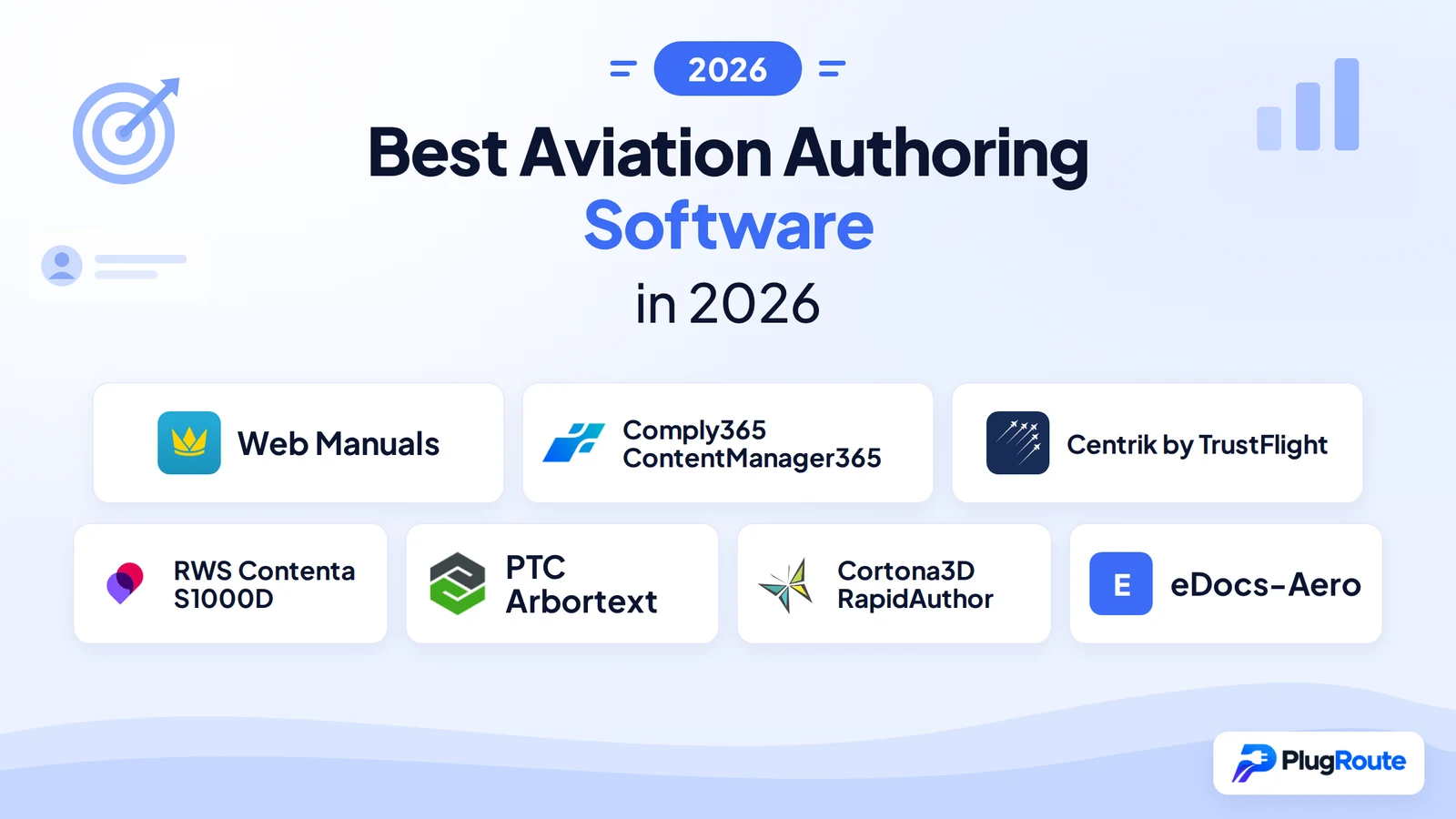
The best aviation authoring software depends on the job. In PlugRoute’s 2026 evidence scoring, Web Manuals scores highest for operator manual authoring, Comply365 ContentManager365 for large airlines, Centrik by TrustFlight for manuals tied to a safety management system, and RWS Contenta S1000D for S1000D technical publications. Choose the category first (operator manuals or technical publications), then the product.
Teams moving off Word and PDF tend to hit the same four problems:
- Revisions are hard to version-control when every manual lives in separate Word and PDF files.
- FAA and EASA rules have to be traced to manual sections by hand.
- Approvals lack clean audit trails, so auditors cannot see who changed what.
- Vendor pages are hard to compare fairly, because PlugRoute found no neutral, hands-on, side-by-side test in the public record as of November 2026.
PlugRoute has no affiliate relationships with any company listed, and rankings are determined entirely by research data and objective evaluation criteria.
What Are the 6 Categories of Aviation Authoring Tools?
Aviation authoring tools fall into six categories across two tracks. Operator manual tools control an operator’s own manuals. They are manual platforms, safety-integrated platforms and distribution portals. Technical publications tools produce standards-based OEM data. They are S1000D CSDBs, XML authoring suites and 3D visual tools. E-learning courseware is a separate category and is not ranked here.
Track 1: Operator Manuals. Operator manual tools provide controlled document management and manual revision control for an operator’s own documents. Examples include flight operations manuals, repair station manuals and CAMO (Continuing Airworthiness Management Organisation) expositions.
- Operator Manual Platform: An Operator Manual Platform writes, revises, approves and distributes controlled manuals, and Web Manuals and Comply365 ContentManager365 belong here.
- Safety-Integrated Document Platform: A Safety-Integrated Document Platform is a safety and quality management system that also controls and authors manuals, and Centrik by TrustFlight belongs here.
- Document Distribution Portal: A Document Distribution Portal registers, tracks and distributes controlled documents but offers little native authoring, and eDocs-Aero belongs here.
Track 2: Technical Publications. Technical publications tools produce S1000D or ATA iSpec 2200 technical documentation, mostly for OEMs, defense programs and large MROs.
- S1000D CSDB: A Common Source Database (CSDB) stores, validates, assembles and publishes S1000D data modules, and RWS Contenta S1000D belongs here.
- Structured XML Authoring Suite: A Structured XML Authoring Suite creates, styles and publishes standards-based content, usually alongside a separate repository, and PTC Arbortext belongs here.
- 3D Visual Technical Authoring: A 3D Visual Technical Authoring tool converts CAD data into interactive illustrated content, and Cortona3D RapidAuthor belongs here.
Track 2 tools work as layers in one production chain rather than as rivals. For example, Pilatus authored PC-24 illustrated parts data in Cortona3D RapidAuthor on Teamcenter. A program like that would still need a CSDB such as RWS Contenta S1000D to store, validate and assemble the data modules.
A practitioner on r/technicalwriting described what happens when the production chain is never truly adopted:
“Because the amount of time wasted on useless frickin’ XML coming both ways – from OEMs and suppliers – is adding up to centuries. A lot of the time it results in an untouched and unchanging “S1000D Potemkin Village”, with working day-to-day docs getting done in Word and thrown over the fence to who knows where.” Posted by u/thumplabs
Takeaway: S1000D programs without real validation and adoption across OEMs and suppliers end up as unused XML repositories while the actual work stays in Word, so buying technical publications tooling does not guarantee a working S1000D process.
Who owns what (as of November 2026). Ownership in aviation authoring software has changed since 2021, and third-party listicles often get it wrong. Buyers should check ownership before signing, because controlled manuals are long-term records. Two of the seven ranked products have had ownership events since 2021:
- Comply365 and DocuNet: Comply365 and Vistair announced their merger in January 2024 and unified under the Comply365 brand in June 2024, so DocuNet is not a separate vendor (Source: Comply365, 2024; vendor-published).
- Centrik: TrustFlight announced its acquisition of Centrik and Total AOC on 24 September 2021. Centrik is not an Ideagen product (Source: TrustFlight, 2021; vendor-published).
- COSIMA: COSIMA is a DOCUFY XML editor, so third-party claims that eDocs-Aero includes COSIMA are unsupported.
- Inmedius: Boeing announced in 2012 that it would acquire Inmedius, and PlugRoute could not verify a current standalone Inmedius product (Source: PR Newswire, 2012; third-party editorial).
- PTC: Schneider Electric announced on 5 October 2026 that it will acquire PTC, Arbortext’s parent, for about $22.6 billion. Closing is expected by Q3 2027, subject to approvals (Source: PTC SEC filing and Reuters, 2026; regulatory filing).
Callout: buying OEM data is not authoring. Small maintenance shops often confuse subscribing to manufacturer manuals with authoring their own controlled manuals. In an r/AircraftMechanics thread (accessed November 2026), a new GA shop owner asked which document software to use. The replies pointed to OEM data services, not authoring platforms:
“For regulatory stuff..the FAA is free but sucks the big one. Not a tdata fan either. I use ATP, reglatory stuff reasonable. They get you on the manuals tho, most of the mfg’s have gone to them. Pricey” (u/BreakfastPretend2263, Reddit r/AircraftMechanics, accessed November 2026)
Takeaway: OEM data subscriptions such as ATP cover manufacturer manuals, not the operator’s own controlled manuals, so a shop still needs a separate way to author and revise its own documents.
For example, a Part 145 shop paying for ATP still has to author and control its own repair station manual under 14 CFR 145.209.
How Do the Top Aviation Authoring Software Platforms Compare at a Glance?
Web Manuals has the deepest documented manual authoring and is the only ranked vendor that publishes aviation pricing. Comply365 ContentManager365 has the largest reported airline deployment, and Centrik by TrustFlight the largest reported adoption base. RWS Contenta S1000D has the most complete S1000D chain. PTC Arbortext and Cortona3D RapidAuthor serve narrower technical roles, and eDocs-Aero covers low-cost distribution.
| Rank | Company | Category | Best For | One-Line Summary | Key Capabilities | Primary Strength | Key Limitation |
|---|---|---|---|---|---|---|---|
| Operator Manual Track | |||||||
| 1 (4.25/5; Operator #1) | Web Manuals | Operator Manual Platform | Part 135/91/145 operators and mid-size airlines | Web Manuals is the most fully documented aviation-specific manual authoring platform for operators in this ranking. | Revision control, automatic LEP/TOC, approval workflow, Compliance Libraries, read-and-sign | Links manual sections to FAA, EASA, CASA and IOSA requirements | Editor less flexible than Word; legacy imports may need clean-up |
| 2 (3.55/5; Operator #2) | Comply365 ContentManager365 | Operator Manual Platform (enterprise suite) | Part 121 airlines and multi-AOC groups | Comply365 ContentManager365 is the enterprise platform with the largest reported airline deployment in this ranking, covering operations content, training and safety. | ProAuthor authoring, DocuNet distribution, training, safety and AI modules | DocuNet reported at 40+ airlines with 2,000+ manuals (G2 listing, 2026) | No public pricing; 2 G2 reviews (2026) |
| 3 (3.45/5; Operator #3) | Centrik by TrustFlight | Safety-Integrated Document Platform | Operators tying manuals to SMS ahead of FAA Part 5 | Centrik by TrustFlight is a safety-first platform that adds document control and SmartDocs authoring. | SMS/QMS modules, document control, SmartDocs, tech log integration | 1,600+ organizations (TrustFlight, 2026); most extensive stated security certifications | SmartDocs authoring is newer and unproven |
| 7 (1.95/5; Operator #4) | eDocs-Aero | Document Distribution Portal | Small operators that author manuals elsewhere | eDocs-Aero is a low-cost portal for controlled document distribution and acknowledgement. | Branded portal, library-wide revision status, read-and-acknowledge | Lowest apparent entry price (Capterra, 2026) | Not an authoring tool; very small vendor |
| Technical Publications Track | |||||||
| 4 (3.40/5; Tech Pubs #1) | RWS Contenta S1000D | S1000D CSDB | OEMs, defense programs, large MROs | RWS Contenta S1000D is the most complete specialist S1000D content database in this ranking. | CSDB, BREX-validated web authoring, publication modules, IETP, Supplier Hub | Full S1000D chain; documented schema support for Issues 1.6–5.0 (RWS, 2026) | Heavy dependence on professional services |
| 5 (3.00/5; Tech Pubs #2) | PTC Arbortext | Structured XML Authoring Suite | OEMs already on Windchill and Creo | PTC Arbortext is a structured XML suite that ties service publications to Windchill PLM and Creo CAD. | Editor, Styler, Publishing Engine, IsoDraw, Content Delivery | Documented traceability from engineering change to service publications | Not a ready-made CSDB; ownership change pending (2026) |
| 6 (2.70/5; Tech Pubs #3) | Cortona3D RapidAuthor | 3D Visual Technical Authoring | Illustrated parts data and visual procedures from CAD | Cortona3D RapidAuthor is the only CAD-to-3D visual authoring tool in this ranking, built to work alongside an S1000D CSDB. | 3D/2D manuals, RapidCatalog, S1000D/iSpec 2200/DITA templates, SCORM | Estimated 40% time cut on Pilatus PC-24 content (Cortona3D case study, 2026) | Windows-only; not a CSDB |
Which Aviation Authoring Software Should I Choose for My Use Case?
Choose by your top priority. Small operators that need real authoring should start with Web Manuals Essentials. Operators driven by Part 5 SMS should start with Centrik by TrustFlight, multi-AOC airlines with Comply365 ContentManager365, and S1000D programs with RWS Contenta S1000D. Organizations already running Windchill and Creo should look at PTC Arbortext, and distribution-only budgets at eDocs-Aero.
| Your #1 Priority | Recommended Tool | Why | Acceptable Alternative |
|---|---|---|---|
| Small Part 135/145 operator or training organization that needs real authoring | Web Manuals Essentials | Published entry price and regulation-linked Compliance Libraries | Centrik by TrustFlight |
| Distribution only, on a tight budget | eDocs-Aero | Lowest apparent entry price, with read-and-acknowledge | Centrik by TrustFlight document control (if an SMS is also needed) |
| FAA Part 5 SMS is the priority | Centrik by TrustFlight | Manuals sit next to safety, risk and compliance modules | Comply365 ContentManager365 with SafetyManager365 (enterprise operators) |
| Mid-size operator or CAMO | Web Manuals Professional | Unlimited editors and readers in one tier | Centrik by TrustFlight |
| Part 121 airline or multi-AOC group | Comply365 ContentManager365 | Airline-scale DocuNet distribution plus training and safety modules | Web Manuals Enterprise |
| Need a price before talking to sales | Web Manuals (published tiers) | Only published aviation pricing in this ranking | eDocs-Aero (Capterra listing) |
| Full S1000D CSDB | RWS Contenta S1000D | CSDB, validation, publication modules and IETP output | PTC Arbortext paired with a repository |
| Already running PTC Windchill and Creo | PTC Arbortext | Engineering-to-service traceability | RWS Contenta S1000D |
| 3D illustrated parts data from CAD | Cortona3D RapidAuthor paired with a CSDB | Pilatus PC-24 outcome evidence | PTC Arbortext IsoDraw |
| E-learning courseware | Outside this ranking | Courseware is a separate category | N/A |
What Are the 7 Best Aviation Authoring Software Platforms in 2026?
PlugRoute’s 2026 ranking puts Web Manuals first overall at 4.25/5. Comply365 ContentManager365, Centrik by TrustFlight and RWS Contenta S1000D follow, all within 0.15 points of each other. The overall rank measures how strong the evidence is across both tracks, so buyers should compare products only within their own track.
- Web Manuals scores 4.25/5 and ranks first in the operator track.
- Comply365 ContentManager365 scores 3.55/5 and ranks second in the operator track.
- Centrik by TrustFlight scores 3.45/5 and ranks third in the operator track.
- RWS Contenta S1000D scores 3.40/5 and ranks first in the technical publications track.
- PTC Arbortext scores 3.00/5 and ranks second in the technical publications track.
- Cortona3D RapidAuthor scores 2.70/5 and ranks third in the technical publications track.
- eDocs-Aero scores 1.95/5 and ranks fourth in the operator track.
Cross-track rank is not a substitute test. For example, RWS Contenta S1000D (#4) does not replace Comply365 ContentManager365 (#2), because the two solve different problems.
1. Web Manuals: Best Overall Operator Manual Platform
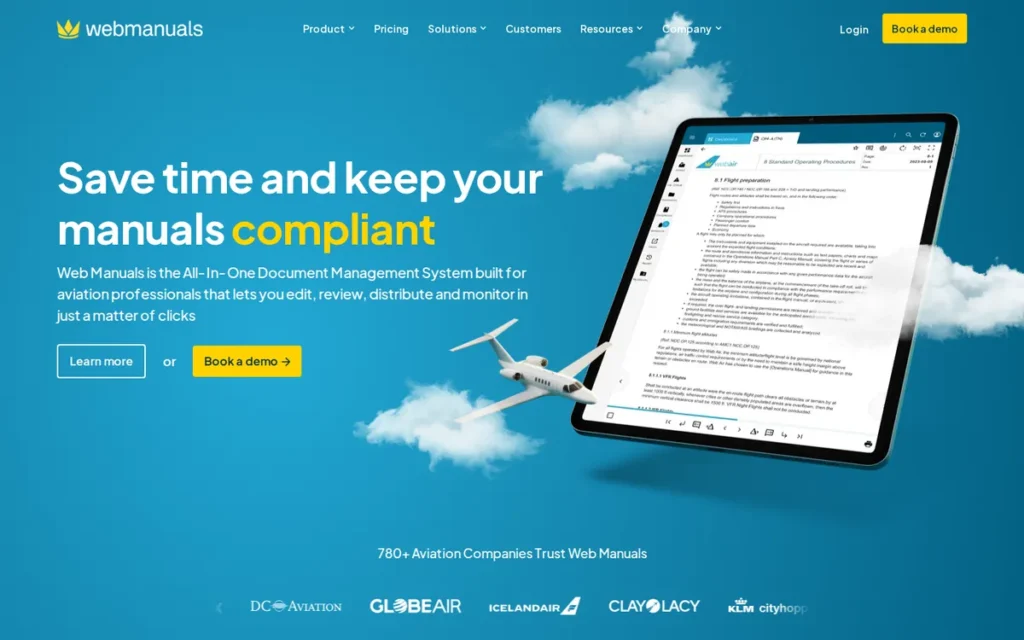
Category: Operator Manual Platform. It writes, revises, approves and distributes an operator’s own controlled manuals.
At a Glance
- Category: Operator Manual Platform
- Best For: Part 135/91 charter operators, Part 145 repair stations and mid-size airlines replacing Word-and-PDF manuals
- Price Range: From €4,000/year (Essentials); €170 per editor per month billed annually (Professional); Enterprise on quote (Source: Web Manuals, 2026; vendor-published)
- Primary Strength: Web Manuals links manual sections directly to FAA, EASA, CASA and IOSA requirements through its Compliance Libraries.
- Biggest Limitation: The Web Manuals structured editor is less flexible than Word for unusual layouts, and heavily formatted legacy manuals may need clean-up.
- One-Line Summary: Web Manuals is the most fully documented aviation-specific manual authoring platform for operators in this ranking, combining revision control, approval workflows, regulation-linked libraries and controlled distribution.
- Last Verified: November 2026
PlugRoute Score: 4.25/5 (C1 5, C2 5, C3 4, C4 4, C5 3, C6 3), Operator track #1. The C2 score of 5 reflects documented Compliance Library features, not independently verified library scope.
Overview
Web Manuals is a web-based aviation manual authoring and distribution platform. Charter operators, airlines and repair stations use it to write, revise, approve and publish controlled manuals linked to FAA, EASA, CASA and IOSA requirements.
Web Manuals customers range from Part 135 operators such as ACI Jet and Clay Lacy Aviation to airlines such as Copa Airlines and Neos (Source: Web Manuals customer index, 2026; vendor-published).
Key Features
- Web Manuals tracks revisions at page or revision level, compares versions, supports partial revisions, and generates tables of contents and lists of effective pages (LEPs) automatically.
- Web Manuals moves changes through draft, review and final states, with comments, approve/reject actions and traceability.
- Web Manuals Compliance Libraries map manual sections to FAA, EASA, CASA and IOSA requirements and send notifications when regulations change.
- Web Manuals’ mirror function pushes one change across linked manuals, which reduces duplicate or conflicting procedures.
- Web Manuals distributes manuals through a web portal and tablet app with read-and-sign and an AI search assistant called Amelia. Buyers should confirm offline and EFB behavior in a demo.
Best For
Web Manuals is best for Part 135, Part 91 and Part 145 organizations and mid-size airlines that want aviation-specific authoring with regulation traceability and published pricing.
Strengths
- Web Manuals helped ACI Jet cut one revision from 24 person-hours to about 3 hours, roughly 87.5% less labor, and ACI Jet went live in about 4 weeks (Source: Web Manuals ACI Jet case study, 2026; vendor-published).
- Web Manuals reports that roughly 60–70% of Neos’s IOSA renewal preparation work was completed automatically, and that Neos’s compliance-report preparation time fell 90% (Source: Web Manuals Neos case studies, 2026; vendor-published).
- Web Manuals holds 4.4/5 from 17 reviews on G2, the largest public review base in this category (Source: G2, 2026; review platform, 17 reviews).
- Web Manuals is the only ranked product with published tiered pricing, so smaller operators can estimate cost before speaking to sales.
Limitations
Web Manuals trades layout freedom for structured control, so heavily formatted Word manuals may need clean-up during migration. This is a PlugRoute assessment, not a complaint documented in user reviews.
- Web Manuals Professional is billed annually, and total cost rises with the Compliance Library add-on, extra editor seats and the delivery project.
- Web Manuals Compliance Library scope and update timing, and its offline and EFB behavior, could not be independently verified.
- Web Manuals security certifications (ISO 27001, SOC 2), founding year and ownership could not be verified.
A Part 135 operator working toward a Part 121 supplemental certificate described on r/technicalwriting:
“What is your process for temporary revisions? We are using Web Manuals as our publishing tool, but having a frame of reference for the process might help me think through it.” Posted by u/send_lit_jokes
Takeaway: Web Manuals gives operators the publishing tooling, but teams still have to design their own temporary-revision and forms-control processes, often with outside help.
Verdict
Web Manuals is the best fit in 2026 for operators that need regulation-linked manual authoring at a published price, based on PlugRoute’s weighted evidence score. All of its quantified outcomes are vendor-published. Buyers should test one real revision in a demo, from import through to crew acknowledgement.
2. Comply365 ContentManager365: Best for Large Airlines and Multi-AOC Groups
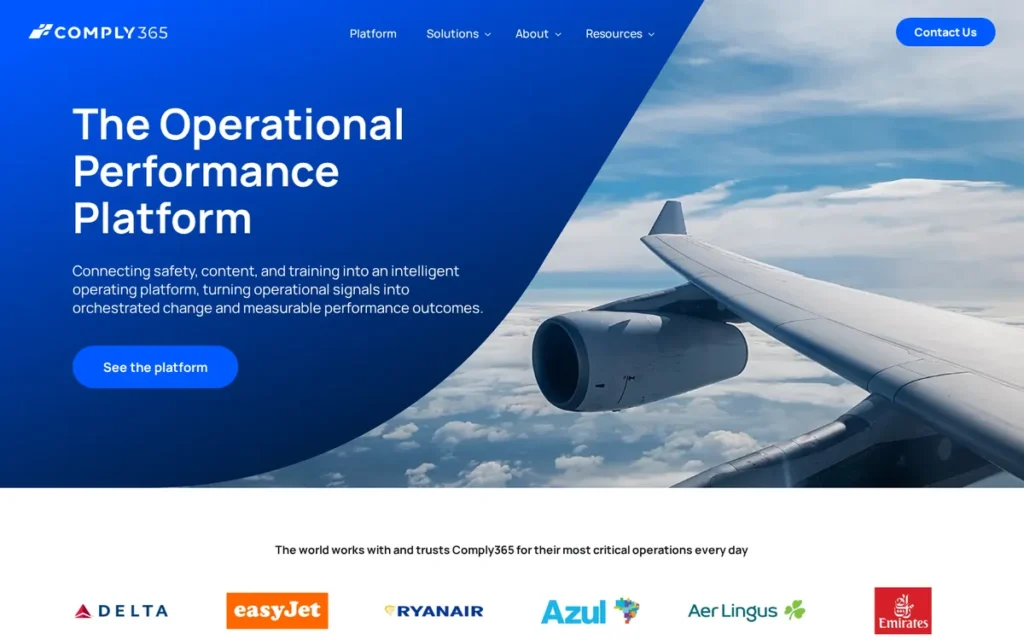
Category: Operator Manual Platform. It writes, revises, approves and distributes an operator’s own controlled manuals.
At a Glance
- Category: Operator Manual Platform (enterprise airline suite)
- Best For: Part 121 airlines and multi-AOC groups managing flight and technical operations content at scale
- Price Range: Pricing on request (enterprise quote, 2026)
- Primary Strength: Comply365 ContentManager365 delivers content at airline scale, with DocuNet reported at more than 40 airlines managing over 2,000 manuals (Source: G2, 2026; vendor description on G2).
- Biggest Limitation: Comply365 publishes no pricing and has very few public reviews, so small operators cannot easily judge fit or total cost.
- One-Line Summary: Comply365 ContentManager365 is the enterprise platform with the largest reported airline deployment in this ranking, covering authoring, distribution, training and safety content.
- Last Verified: November 2026
PlugRoute Score: 3.55/5 (C1 4, C2 3, C3 4, C4 5, C5 2, C6 2), Operator track #2.
Overview
Comply365 ContentManager365 is an enterprise platform for operational content. It combines ProAuthor authoring with DocuNet mobile distribution, so airlines and multi-AOC groups can author, publish, distribute and view flight and technical operations content from one control point.
Comply365 ContentManager365 includes DocuNet, which came from Vistair. Comply365 and Vistair announced their merger in January 2024 and unified under the Comply365 brand in June 2024 (Source: Comply365, 2024; vendor-published).
Key Features
- Comply365 ContentManager365 handles authoring, publishing, distribution and viewing of airline technical and operational content in one system.
- Comply365 ContentManager365 includes structured authoring from the legacy ProAuthor product line.
- Comply365 DocuNet delivers manuals to crews on mobile devices, with search and update distribution.
- Comply365 extends the platform with TrainingManager365 and SafetyManager365 for training and safety workflows.
- Comply365 offers three AI modules (CoAuthor, CoAnalyst and CoTrainer), and buyers should govern their outputs like any other manual change.
Best For
Comply365 ContentManager365 is best for Part 121 airlines and multi-AOC groups whose content spans flight operations, technical operations, training and safety, and that can support an enterprise implementation.
Strengths
- DocuNet’s G2 listing, where the seller is still shown as Vistair Systems, reports use at 40+ airlines managing 2,000+ manuals (Source: G2, 2026; vendor description on G2).
- Comply365 supported Air Astana’s DocuNet rollout across flight operations and all of its AOCs, and Comply365 also features Frontier Airlines in a case study, though neither published metrics (Source: Comply365, 2026; vendor-published).
- Comply365 offers the broadest content, training and safety suite in this ranking. In PlugRoute’s assessment, that may reduce the number of separate systems an airline must integrate.
- Comply365 holds 4.5/5 on G2 from 2 reviews, with praise for search and reliable updates (Source: G2, 2026; review platform, 2 reviews). Comply365 also received an editorial award from Aerospace & Defense Review (Source: Aerospace & Defense Review, 2026; third-party editorial).
Limitations
Comply365 ContentManager365 trades accessibility for enterprise breadth. With no public pricing and an airline-oriented scope, small Part 135 operators find it hard to judge fit or total cost before engaging sales.
- One of two G2 reviewers of Comply365 reports that “other app functions [are] unavailable while a manual is syncing” (Source: G2, 2026; review platform, 2 reviews), which matters on tight turnarounds.
- Comply365’s public evidence is thin. A third-party 4.7/5 rating conflicts with G2’s visible count, and the 30% incident-reduction and “up to 90% faster” CoAnalyst claims come from unnamed customers (Source: Guideflow and Aerospace & Defense Review, 2026; third-party editorial).
- Comply365’s SOC 2 or ISO 27001 status and its current investor ownership could not be verified.
Verdict
Comply365 ContentManager365 is the best fit in 2026 for Part 121 airlines and multi-AOC groups that want authoring, crew distribution, training and safety in one enterprise suite, based on PlugRoute’s weighted evidence score. Its independent review base is only 2 G2 reviews. Buyers should request a written first-year cost model and test DocuNet sync on crew devices.
3. Centrik by TrustFlight: Best for Linking Manuals to SMS Workflows
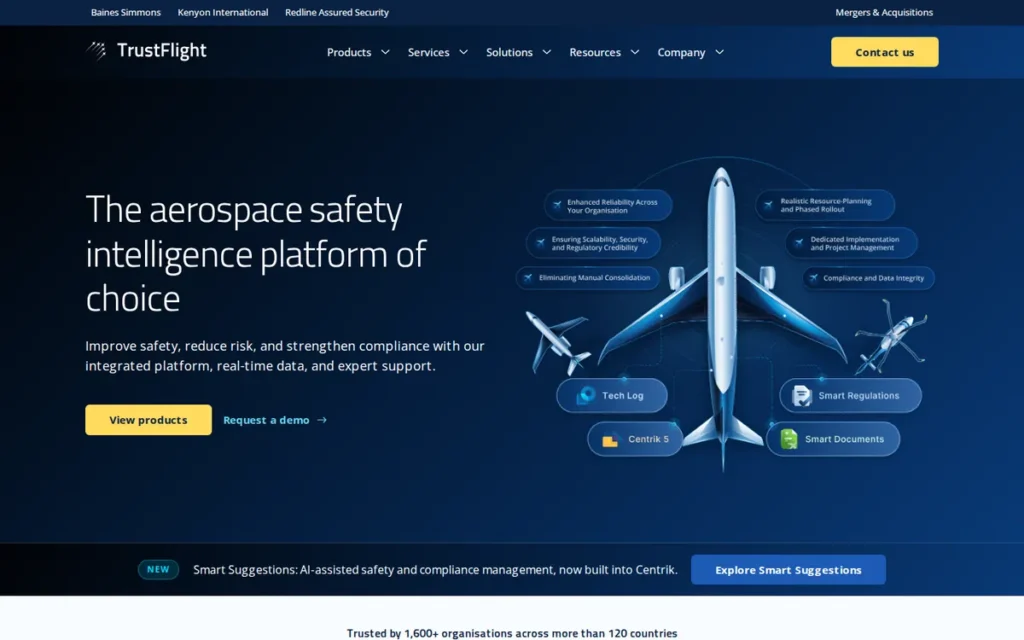
Category: Safety-Integrated Document Platform. It is an SMS/QMS platform that also controls and authors manuals.
At a Glance
- Category: Safety-Integrated Document Platform
- Best For: Part 135/91.147 operators, business aviation groups and MROs that need manuals tied to SMS, audits and compliance monitoring
- Price Range: Pricing on request (modular quote, 2026)
- Primary Strength: Centrik by TrustFlight connects document control with safety reporting, risk, audits, compliance monitoring and regulatory change notices.
- Biggest Limitation: Centrik’s native SmartDocs authoring is newer and less proven than specialist manual editors.
- One-Line Summary: Centrik by TrustFlight is a widely adopted safety-first aviation platform that adds controlled document management and AI-supported SmartDocs authoring to SMS and quality workflows.
- Last Verified: November 2026
PlugRoute Score: 3.45/5 (C1 3, C2 4, C3 4, C4 4, C5 1, C6 4), Operator track #3.
Overview
Centrik by TrustFlight is a modular platform for aviation safety and quality management. It adds document control and SmartDocs manual authoring to its safety, risk, audit and compliance modules, for operators and MROs that want manuals tied to SMS workflows.
Centrik by TrustFlight began as a Total AOC product. TrustFlight announced its acquisition of Centrik and Total AOC on 24 September 2021 and now markets Centrik 5 (Source: TrustFlight, 2021; vendor-published).
Key Features
- Centrik 5 provides modules for safety reporting, risk management, and audits and findings.
- Centrik 5 adds modules for compliance monitoring, regulatory change notices, training records, workflows and meetings.
- Centrik by TrustFlight includes document and manual control plus an EFB module (Source: TrustFlight, 2026; vendor-published).
- Centrik SmartDocs is an AI-supported authoring tool that publishes into Centrik, and TrustFlight says the AI is grounded in the customer’s own regulations and manuals.
- Centrik integrates with TrustFlight’s electronic tech log, which links aircraft defects to safety and quality workflows.
Best For
Centrik by TrustFlight is best for existing Part 135 and 91.147 operators that must declare Part 5 SMS compliance by May 28, 2027, and that want manuals, hazards, corrective actions and acknowledgement records in one system.
Strengths
- TrustFlight reports that 1,600+ organizations in 120 countries use Centrik, and that 80,000+ users use the wider suite (Source: TrustFlight and Business Air News, 2026; vendor figures).
- Centrik’s vendor TrustFlight states ISO/IEC 27001:2022 certification with independent annual audits, plus ISO 9001:2015, Cyber Essentials Plus and JOSCAR registration. These are the most extensive certifications stated by any vendor here (Source: TrustFlight, 2026; vendor-published).
- Centrik by TrustFlight names Gestair (more than 35 aircraft), Dassault Aviation Business Services and Luxaviation among its customers (Source: Wings Magazine, 2026; third-party editorial).
- Centrik is credited by Luxaviation’s Suzy Gautrey with “harmonizing our safety and compliance processes” (Source: TrustFlight, 2026; vendor-published testimonial).
Limitations
Centrik by TrustFlight trades manual authoring depth for safety-system breadth. The maturity of its newer SmartDocs authoring is unproven against specialist editors.
- Centrik’s module breadth may mean a steep learning curve, longer setup and a dense interface for occasional crew users. This is a PlugRoute assessment based on module breadth, and no user complaints were found.
- Centrik by TrustFlight has no verifiable G2 or Capterra rating or review count.
- Centrik case studies are qualitative and publish no quantified savings.
Verdict
Centrik by TrustFlight is the best fit in 2026 for operators that want manual control built into their safety and quality system, based on PlugRoute’s weighted evidence score. Its SmartDocs authoring is newer than specialist editors, and no review-platform rating could be verified. Buyers who mainly need authoring should demo Centrik and Web Manuals side by side.
4. RWS Contenta S1000D: Best Full S1000D CSDB for OEMs and Defense
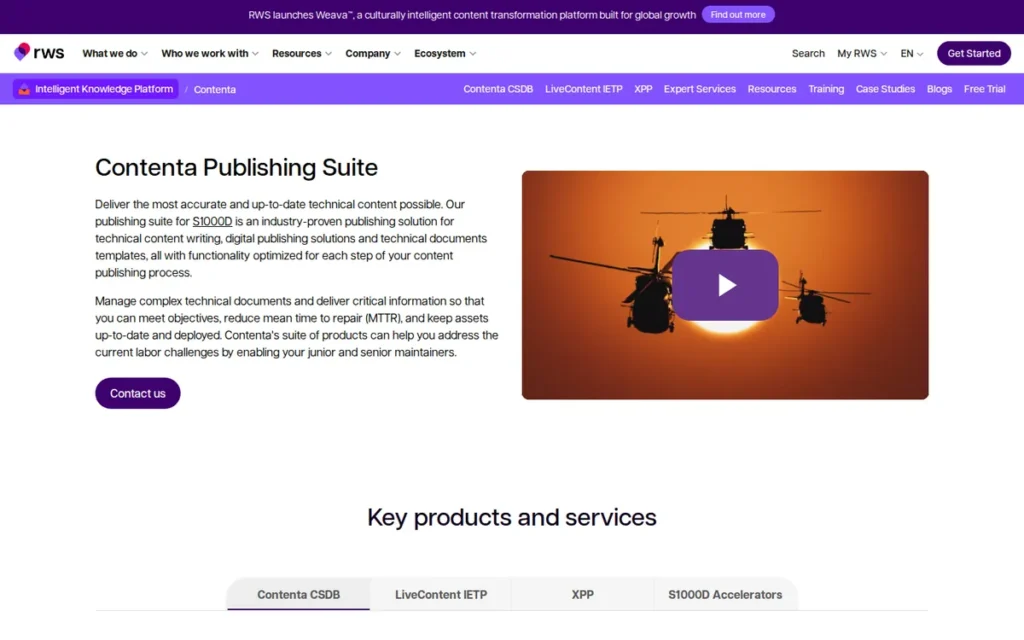
Category: S1000D CSDB. It is a common source database that stores, validates, assembles and publishes S1000D technical data.
At a Glance
- Category: S1000D CSDB
- Best For: OEMs, defense programs and large MROs producing S1000D publications with suppliers and multilingual output
- Price Range: Pricing on request (quote by deployment model, seats, IETP hosting and services, 2026)
- Primary Strength: RWS Contenta S1000D offers the most complete S1000D production chain in this ranking, from CSDB and validated authoring through to IETP output.
- Biggest Limitation: RWS Contenta S1000D depends on professional services for sizing, migration and configuration, which lengthens time to value.
- One-Line Summary: RWS Contenta S1000D is the most complete specialist S1000D content database in this ranking, combining validated authoring, publication building, supplier collaboration and interactive output.
- Last Verified: November 2026
PlugRoute Score: 3.40/5 (C1 4, C2 4, C3 3, C4 4, C5 1, C6 3), Technical publications track #1.
Overview
RWS Contenta S1000D is a specialist S1000D Common Source Database for OEMs, defense programs and large MROs. It combines web-based authoring, schema and BREX validation, publication-module building and interactive electronic technical publication (IETP) output.
RWS Contenta S1000D runs in public cloud, private cloud or on-premises. Its developer, RWS Group, reported about 7,649 employees and £690.1M revenue (Source: Wikipedia, 2025; third-party, not cross-checked against the annual report).
Key Features
- RWS Contenta S1000D includes Xeditor, a Word-like web editor that checks content continuously against S1000D schemas and business rules (BREX).
- RWS Contenta S1000D provides a drag-and-drop builder for assembling data modules into publication modules.
- RWS Contenta S1000D publishes to PDF and to the RWS LiveContent IETP viewer.
- RWS Contenta Supplier Hub, hosted on Azure, lets external suppliers author S1000D data. RWS launched Contenta Cloud S1000D with partner GPSL in October 2024 (Source: RWS, 2024; vendor-published).
- RWS Contenta Multi-Spec manages S1000D, DITA, ATA and Mil-Spec content and links to RWS translation and Tridion products.
Best For
RWS Contenta S1000D is best for OEM, defense and large MRO technical publications teams that need a full CSDB with supplier collaboration and IETP delivery, rather than an editor alone.
Strengths
- KAI selected the RWS interactive technical manual (IETM) platform for the KF-21 fighter program under a November 2024 letter of intent, signed at the S1000D & IPS User Forum in Brussels (Source: RWS product news, 2024; vendor-published).
- RWS Contenta S1000D is referenced for a US Navy S1000D adoption and for Patriot maintenance instructions (Source: RWS, 2026; vendor-published, no metrics).
- RWS documentation lists Contenta S1000D schema support for Issues 1.6 through 5.0, which makes its standards coverage the most transparent among the technical publications tools here (Source: RWS Contenta S1000D 5.12 documentation, 2026; vendor-published).
- RWS Contenta S1000D validates against schemas and BREX during authoring. In PlugRoute’s assessment, that should reduce the amount of invalid data that reaches publication.
Limitations
RWS Contenta S1000D puts completeness ahead of fast deployment. Implementations depend on professional services for sizing, migration and configuration.
- RWS Contenta S1000D buyers may have to coordinate several RWS products: Contenta, LiveContent, XPP and Tridion.
- RWS Contenta S1000D’s support for Issue 6.0 and for specific ATA iSpec 2200 versions was not listed in the documentation PlugRoute reviewed (Source: RWS, 2026; vendor-published).
- RWS’s “60% program savings” claim names no customer or baseline. Its FedRAMP, ISO 27001 and ITAR status could not be verified. Experienced XML-native authors may find Xeditor slower (PlugRoute assessment).
Verdict
RWS Contenta S1000D is the best fit in 2026 for organizations that need a full S1000D CSDB rather than a standalone editor, based on PlugRoute’s weighted evidence score. Its defense references carry no published metrics or independent reviews. Buyers should get Issue 6.0 plans and the professional-services scope in writing.
5. PTC Arbortext: Best for OEMs Already Running Windchill and Creo
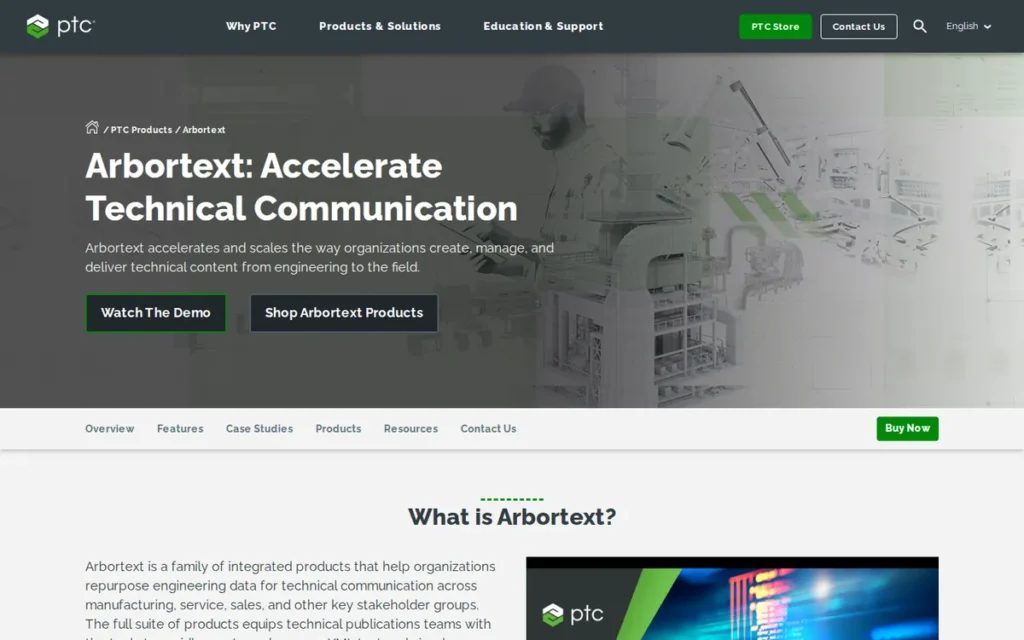
Category: Structured XML Authoring Suite. It creates, styles and publishes standards-based technical content, usually alongside a separate repository.
At a Glance
- Category: Structured XML Authoring Suite
- Best For: Aerospace OEMs and suppliers already standardized on PTC Windchill PLM and Creo CAD
- Price Range: Pricing on request (enterprise quote by seats and modules, 2026)
- Primary Strength: PTC Arbortext links engineering data in Windchill and Creo to service publications, so product changes can be traced into documentation.
- Biggest Limitation: PTC Arbortext is not a ready-made S1000D CSDB, implementations typically need complex stylesheet work, and the ownership of its parent company is changing (expected close Q3 2027).
- One-Line Summary: PTC Arbortext is a structured XML authoring and publishing suite for aerospace organizations that want service publications traceable to Windchill PLM and Creo CAD data.
- Last Verified: November 2026
PlugRoute Score: 3.00/5 (C1 4, C2 3, C3 2, C4 4, C5 1, C6 3), Technical publications track #2. The C6 score of 3, despite PTC’s financial scale, reflects the ownership change announced in October 2026.
Overview
PTC Arbortext is an enterprise suite for structured XML authoring and publishing. Aerospace OEMs use it to produce DITA and S1000D service information that can be traced back to Windchill PLM and Creo CAD data.
PTC Arbortext has been part of PTC since 2005. PTC was founded in 1985, is headquartered in Boston and has more than 7,000 employees (Source: PTC, 2026; vendor-published).
Key Features
- PTC Arbortext Editor provides structured XML authoring for DITA and S-Series standards, including S1000D.
- PTC Arbortext Styler defines formatting rules, and Arbortext Publishing Engine produces output on the server.
- PTC Arbortext IsoDraw creates technical illustrations for service and maintenance content.
- PTC Arbortext Content Delivery shows technicians service information in context.
- PTC Arbortext integrates with Windchill Service Information Manager so engineering changes can be traced into service publications.
Best For
PTC Arbortext is best for aerospace OEMs and tier suppliers already running PTC Windchill and Creo that want service documentation tied to engineering change.
Strengths
- PTC Arbortext is backed by PTC, which reported fiscal Q3 2025 revenue of $643.9M and $1.85B for the first nine months of FY2025 (Source: PTC investor relations, 2025; vendor financial filing).
- PTC Arbortext is the only ranked product with a documented native Windchill and Creo connection. Cortona3D’s Windchill integration could not be verified.
- PTC Arbortext covers the whole path from authoring to publishing, including IsoDraw illustration and Content Delivery.
- PTC markets Arbortext for DITA and S-Series standards, including S1000D, and describes its use on “federal, aerospace and defense projects” (Source: PTC, 2026; vendor-published).
Limitations
PTC Arbortext offers configurability rather than out-of-the-box readiness. It is not a ready-made S1000D CSDB (Source: PlugRoute assessment based on PTC’s published product scope, 2026).
- PTC Arbortext implementations involve complex stylesheet work, Windows-centered desktop authoring and complex licensing, and they often depend on consultants.
- PTC Arbortext has no named aerospace case study with metrics and no verified Arbortext-specific rating. Windchill scores higher than Arbortext Editor for version control and workflow on G2’s comparison page (Source: G2, 2026; review platform).
- Schneider Electric announced a roughly $22.6 billion acquisition of PTC on 5 October 2026, expected to close by Q3 2027 (Source: PTC SEC filing and Reuters, 2026; regulatory filing). Multi-year Arbortext buyers should ask about roadmap and licensing continuity.
In an r/technicalwriting thread on variant-heavy documentation, a team already running Windchill responded to a suggestion to adopt Arbortext:
“That’s an interesting way to do it. We also use Windchill but with their licensing we are a bit wary to fall even deeper into the subscription trap. That’s why we use pure DITA so we can easily transfer if we want.” Posted by u/Party-Lab-8245
Takeaway: Fear of PTC subscription lock-in makes some Windchill teams hesitate to adopt PTC Arbortext and keep their content in portable DITA instead.
Verdict
PTC Arbortext is the best fit in 2026 for aerospace organizations already standardized on Windchill and Creo, based on PlugRoute’s weighted evidence score. It is not a turnkey CSDB, and the ownership of its parent company is changing. Buyers should confirm S1000D Issue support, iSpec 2200 coverage and licensing continuity in the contract before committing.
6. Cortona3D RapidAuthor: Best for 3D Illustrated Parts Data From CAD
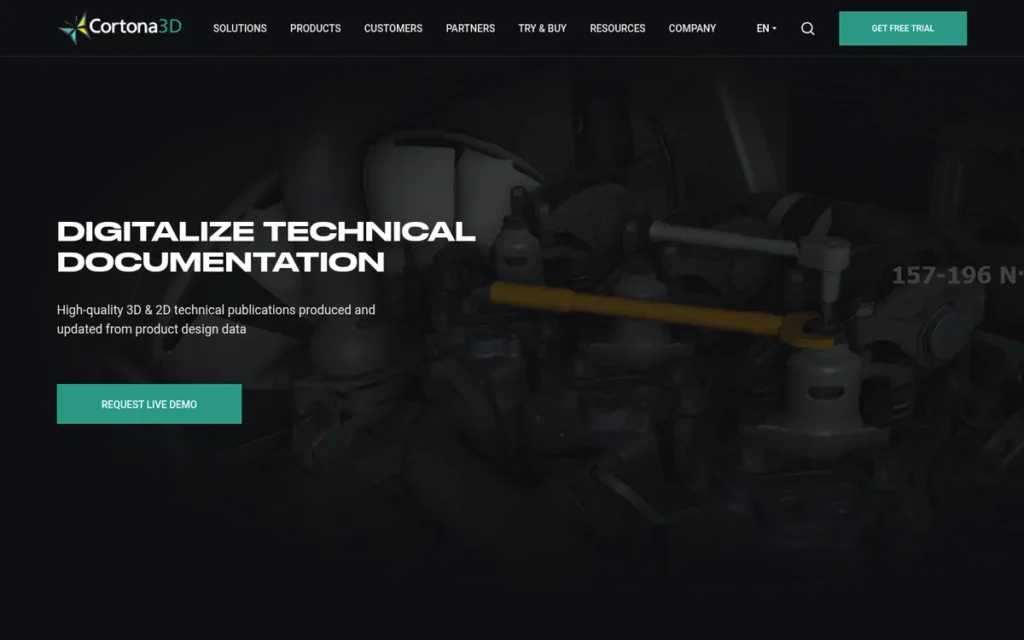
Category: 3D Visual Technical Authoring. It converts CAD data into interactive illustrated technical content, usually alongside a CSDB.
At a Glance
- Category: 3D Visual Technical Authoring
- Best For: OEM and MRO teams producing illustrated parts data, structural repair content and visual procedures from CAD
- Price Range: Pricing on request (quote for author seats, CAD translators and runtime viewers, 2026)
- Primary Strength: Cortona3D RapidAuthor turns CAD data into interactive 3D illustrated parts data and procedures using S1000D, ATA iSpec 2200 and DITA templates.
- Biggest Limitation: Cortona3D RapidAuthor is not a CSDB and runs only on Windows, so it usually has to be paired with a separate content database.
- One-Line Summary: Cortona3D RapidAuthor is the only CAD-to-3D visual authoring tool in this ranking, built for aerospace illustrated parts data and procedures alongside an S1000D content database.
- Last Verified: November 2026
PlugRoute Score: 2.70/5 (C1 3, C2 3, C3 3, C4 3, C5 1, C6 2), Technical publications track #3.
Overview
Cortona3D RapidAuthor is a Windows-based visual authoring suite for OEM technical publications teams. It converts CAD and product data into interactive 3D technical content using S1000D, ATA iSpec 2200 and DITA templates.
Cortona3D RapidAuthor is developed by Parallel Graphics Ltd, founded in 2000, and Cortona3D has been a Siemens technology partner since 2011 (Source: Cortona3D, 2026; vendor-published).
Key Features
- Cortona3D RapidAuthor converts CAD and product data into interactive 3D and 2D manuals and work instructions.
- Cortona3D RapidAuthor produces illustrated parts data and structural repair manual content from the same CAD source.
- Cortona3D RapidAuthor provides templates for S1000D, ATA iSpec 2200 and DITA output.
- Cortona3D RapidCatalog builds 3D illustrated parts catalogs, and both RapidAuthor and RapidCatalog integrate with Siemens Teamcenter.
- Cortona3D RapidAuthor exports SCORM training content from the same visual source.
Best For
Cortona3D RapidAuthor is best for aerospace technical publications teams that need 3D parts data and repair visuals from CAD and already run, or plan to buy, an S1000D CSDB.
Strengths
- Pilatus used Cortona3D RapidAuthor for Teamcenter on the PC-24. Pilatus reported an estimated 40% cut in 3D illustrated parts data and SRM development time, and about 30% higher tech-pubs team efficiency (Source: Cortona3D Pilatus case study, 2026; vendor-published).
- Cortona3D RapidAuthor helped Winnebago, a non-aerospace customer, finish a parts catalog 33% faster with 40% less manpower (Source: Cortona3D, 2026; vendor-published).
- Cortona3D RapidAuthor templates cover S1000D, ATA iSpec 2200 and DITA, so one tool can serve both civil and defense standards.
- Cortona3D RapidCatalog can be licensed on its own, so teams that only need parts catalogs do not have to buy the full suite.
Limitations
Cortona3D RapidAuthor offers visual depth but a narrow scope. It is not a full S1000D CSDB, so most programs have to pair it with one.
- Cortona3D RapidAuthor’s authoring tools and desktop viewers run only on Windows (Source: Cortona3D licensing, 2026; vendor-published). Its Windchill integration, headquarters, headcount and review ratings could not be verified.
- Cortona3D RapidAuthor output depends on how clean the source CAD models are.
- Cortona3D RapidAuthor needed significant vendor help with customization, according to one customer (Source: Cortona3D testimonials, 2026; vendor-selected).
Verdict
Cortona3D RapidAuthor is the best fit in 2026 for teams turning aerospace CAD data into 3D illustrated parts data, based on PlugRoute’s weighted evidence score, and it is the only CAD-to-3D tool in this ranking. Its strongest metric is vendor-published, and it complements a CSDB rather than replacing one. Buyers should test it on their own CAD models.
7. eDocs-Aero: Best Low-Cost Distribution Portal for Small Operators
Category: Document Distribution Portal. It registers, tracks and distributes controlled documents, with limited native authoring.
At a Glance
- Category: Document Distribution Portal
- Best For: Small Part 135 operators, flight schools and repair stations that author manuals elsewhere
- Price Range: From $10.00 flat rate (general eDocs product per Capterra; aviation edition pricing unconfirmed, 2026)
- Primary Strength: eDocs-Aero gives small operators a low-cost branded portal that tracks library-wide revision status and records read-and-acknowledge.
- Biggest Limitation: eDocs-Aero is a distribution portal rather than an authoring tool, and its very small vendor footprint creates dependency risk.
- One-Line Summary: eDocs-Aero is a lightweight, low-cost aviation document distribution portal for small operators that need controlled access and acknowledgement rather than structured authoring.
- Last Verified: November 2026
PlugRoute Score: 1.95/5 (C1 2, C2 2, C3 1, C4 3, C5 2, C6 2), Operator track #4.
Overview
eDocs-Aero by Global eDocs is a lightweight document distribution and control portal, branded for each operator. It holds manuals, forms, licenses and videos in a revision-tracked library with read-and-acknowledge, for small operators that don’t need deep authoring.
eDocs-Aero appears in G2’s aviation document distribution category, but PlugRoute found no named aviation customer for eDocs-Aero in public sources (Source: G2, 2026; review platform).
Key Features
- eDocs-Aero gives each operator a branded portal that organizes manuals, forms, licenses, presentations and videos as a “digital tree.”
- eDocs-Aero registers every file and shows the revision status of the whole library on a master page.
- eDocs-Aero includes read-and-acknowledge so operators can record that crews have reviewed updates.
- eDocs-Aero’s parent eDocs product offers online, offline and iPhone access, though these features may apply only to the general product (Source: Capterra, 2026; review platform listing).
- eDocs-Aero’s parent eDocs product supports sharing with download and time limits (Source: Capterra, 2026; review platform listing).
Best For
eDocs-Aero is best for small operators and training organizations that already write manuals in Word and mainly need low-cost controlled distribution with acknowledgement tracking.
Strengths
- eDocs-Aero’s parent product holds 4.6/5 on Capterra, including a 5.0 value score, from just 5 reviews of the general eDocs product (Source: Capterra, 2026; review platform, 5 reviews).
- eDocs-Aero holds 4.5/5 on G2, a sample too small for conclusions (Source: G2, 2026; review platform, 2 reviews).
- eDocs-Aero appears to have the lowest entry price in the category, which suits cost-sensitive operators.
- eDocs-Aero’s parent product is praised on Capterra for offline access, backups and sharing (Source: Capterra, 2026; review platform).
Limitations
eDocs-Aero offers simplicity rather than capability. It is a distribution portal, not a structured authoring tool, and its low C1 score reflects that scope, not poor execution.
- eDocs-Aero has no documented regulation library or approval workflow comparable to dedicated manual platforms.
- eDocs-Aero’s parent product draws Capterra complaints about a steep learning curve, crashes, unreliable version storage and a dated interface (ease of use 3.6/5; 70% would recommend) (Source: Capterra, 2026; review platform, 5 reviews).
- eDocs-Aero’s vendor, Global eDocs, is listed on G2 as having 1 employee on LinkedIn, and no certifications could be verified (Source: G2, 2026; review platform).
Verdict
eDocs-Aero is the best fit in 2026 for small operators that need low-cost controlled distribution and acknowledgement, based on PlugRoute’s weighted evidence score. It is not a manual authoring platform, though, and its 7 total reviews mostly cover the parent product. Buyers should confirm the aviation edition’s features, pricing, data export and business continuity before committing.
What Do FAA and EASA Require From Electronic Manual Systems?
FAA AC 120-78B, issued 11 December 2024, expects electronic manual systems to show revision content, effective dates and change comparison, and to let users confirm they hold the current revision. EASA sets its own operations manual rules under ORO.MLR.100. Software helps operators meet these expectations, but a vendor’s “compliance” feature is not regulatory acceptance.
These are the requirements that matter most when choosing software, and the capability each one calls for:
- FAA AC 120-78B (electronic signatures, recordkeeping and manuals): AC 120-78B superseded AC 120-78A and describes an acceptable means of compliance, not a mandatory rule (Source: FAA, 2024; regulatory primary source). Look for revision stamping, effective dates, version comparison and audit trails.
- OpSpec A025: Operators using electronic manual systems generally document them through OpSpec, MSpec or LOA A025. Buyers should confirm with their FAA principal inspector how the chosen system will be documented.
- FAA AC 120-76 (EFBs): AC 120-76 governs electronic flight bag (EFB) use, which matters for offline tablet access to manuals.
- 14 CFR manual rules: Sections 121.133/121.135, 135.21/135.23 and 145.209 set requirements for airline, charter and repair station manuals. Regulation-linked libraries can show traceability to them.
- EASA ORO.MLR.100: ORO.MLR.100 governs the operations manual for EASA operators.
- EASA Part-IS: Part-IS brings manual and EFB systems into information-security risk scope for 2025–26, so vendor security certifications become relevant to buyers.
- FAA Part 5 SMS: Existing Part 135 certificate holders and 91.147 LOA holders must implement an SMS and submit a Declaration of Compliance by May 28, 2027. New applicants since May 28, 2024 must comply at certification (Source: FAA, 2024; regulatory primary source).
As of November 2026, existing Part 135 and 91.147 operators have about six and a half months until the Part 5 deadline. PlugRoute’s indicative implementation window for small operators is 1–3 months, and vendor selection adds time on top of that.
Operators should also confirm separately whether electronic MEL access needs its own approval.
Document control is also a safety issue. Documentation-related errors appeared in about 83% of NASA ASRS maintenance reports from 2010–2013, and technicians spend 25–45% of their time working with documentation (Source: FAA maintenance human factors research, 2014; regulatory primary source).
The NASA ASRS figures come from a voluntary reporting system and are subject to selection bias. They are not accident rates.
How Much Does Aviation Authoring Software Cost in 2026?
Web Manuals is the only ranked vendor that publishes aviation pricing. Essentials starts at €4,000/year, and Professional costs €170 per editor per month, billed annually (Source: Web Manuals, 2026; vendor-published). The other six vendors quote individually, so buyers need a written first-year cost model based on their own editor, reader and manual counts.
| Product | Published Price (2026) | Main Pricing Drivers |
|---|---|---|
| Web Manuals | Essentials from €4,000/year (2 editors, 5 readers; extra readers €4/month; extra editors €140–€160/month, two figures captured); Professional €170/editor/month billed annually; Compliance Library from €50/month; Enterprise on quote | Editor and reader licenses, add-ons, delivery project |
| Comply365 ContentManager365 | None | Crew counts, fleets and AOCs, modules, implementation and EFB scope (PlugRoute inference) |
| Centrik by TrustFlight | None | Modules selected |
| eDocs-Aero | From $10.00 flat rate (general eDocs); 30-day trial reported by a third party | Users, document scope or tail count (Guideflow, 2026) |
| RWS Contenta S1000D | None | Deployment model, author/reader/supplier seats, IETP hosting, professional services |
| PTC Arbortext | None | Author seats, Publishing Engine, Windchill, IsoDraw, Content Delivery, services |
| Cortona3D RapidAuthor | None | Author seats, CAD translators, runtime viewer licenses |
Web Manuals prices differ by listing. Capterra shows “$3,000/year per feature” and about “$180/user/month,” and G2 lists localized prices of $3,000/year for Essentials and $150 per editor per month for Professional (Source: Capterra and G2, 2026; review platform listings).
Check for these hidden costs in every quote:
- Paid add-ons such as regulation libraries usually sit outside the base subscription.
- Delivery and migration projects add cost when Word manuals are moved onto the platform.
- Professional services for sizing, configuration and stylesheets can dominate technical publications budgets, as RWS’s own services datasheet suggests (Source: RWS, 2026; vendor-published).
- CAD translators and runtime viewer licenses add to 3D visual authoring costs, and the free Cortona3D viewer is licensed only for personal, non-commercial or academic use (Source: Cortona3D, 2026; vendor-published).
- OEM data subscriptions, such as manufacturer manuals, are a separate cost from authoring.
Implementation time also affects total cost. These are PlugRoute’s indicative planning ranges, not vendor quotes:
- Small Part 135 operators, repair stations and training organizations should plan for about 1–3 months, and ACI Jet went live on Web Manuals in about 4 weeks (Source: Web Manuals, 2026; vendor-published).
- Mid-size operators should plan for about 3–6 months.
- Part 121 and multi-jurisdiction operators should plan for 6–12 months or more.
Do Small Part 135 Operators Need an Enterprise Platform?
Most small Part 135 operators do not need an enterprise airline suite. A lighter aviation-specific platform with published pricing usually covers authoring, revision control and distribution. Enterprise platforms become worth the effort when an operator holds several AOCs, distributes to thousands of crew members, or wants training and safety in the same system.
The research supports this guidance by segment:
- Small Part 135 operators, repair stations and training organizations that need real authoring should start with Web Manuals Essentials.
- Small operators that only need distribution can consider eDocs-Aero, accepting the risk of a very small vendor.
- Small operators whose bigger priority is the Part 5 SMS deadline should consider Centrik by TrustFlight.
- Mid-size operators and CAMOs should compare Web Manuals Professional with Centrik by TrustFlight and SmartDocs.
- Part 121 airlines and multi-AOC groups should compare Comply365 ContentManager365 with Web Manuals Enterprise.
Which Products Were Considered but Not Ranked?
PlugRoute considered nine more products but did not rank them. Most lacked enough verified data for a profile of equal depth, and two fell outside the scope of this ranking. Leaving a product out does not mean PlugRoute considers it worse. It means the public evidence could not support a fair, equal-depth comparison as of November 2026.
| Product | Reason Not Ranked |
|---|---|
| Flatirons Solutions | Not enough verified data for an equal-depth profile |
| MadCap Flare | Not enough verified data for an equal-depth profile |
| IXIA CCMS | Not enough verified data for an equal-depth profile |
| IDMR InForm | Not enough verified data for an equal-depth profile |
| Corena/Pinnacle | Not enough verified data for an equal-depth profile |
| AMOS-related documentation tools | Not enough verified data for an equal-depth profile |
| Flyingdog | Not enough verified data for an equal-depth profile |
| Panomio/V360E | E-learning courseware, outside this ranking |
| Inmedius | Boeing announced its acquisition in 2012 (PR Newswire, 2012); no current standalone product verified |
What Red Flags Should I Watch For When Evaluating Aviation Authoring Software?
The six biggest red flags in aviation authoring software are compliance claims without regulation traceability, no export path, quote-only pricing with no written cost model, unverified security certifications, testimonials offered instead of independent reviews, and a technical publications editor sold as a CSDB. Each one points to a risk that vendor marketing pages won’t show.
Red Flag #1: Compliance Claims Without Regulation Traceability A vendor that calls its product “compliant” without mapping manual sections to specific FAA, EASA or IOSA requirements is not giving you audit-ready traceability. Compliance managers need that mapping to show inspectors how each procedure meets a named rule.
Ask the vendor to show the link from a named regulation to a named manual section, and how the system alerts you when that regulation changes.
Red Flag #2: No Exit or Export Path A platform that cannot export your manuals in a usable, structured format locks your controlled records into proprietary storage. The risk grows when a vendor’s ownership changes, as PTC’s did in October 2026.
Run an export test during the demo, and ask for data-export rights and price protection in writing before you sign a multi-year contract.
Red Flag #3: Quote-Only Pricing With No Cost Model Quote-only pricing is common in this category, because six of the seven ranked vendors publish no aviation pricing. A vendor that won’t put first-year costs in writing hides the real total of seats, add-ons, implementation and services.
Insist on a written, itemized first-year breakdown before you shortlist the vendor.
Red Flag #4: Unverified Security Certifications Only one ranked vendor, TrustFlight, publicly stated security certifications on the pages PlugRoute reviewed in November 2026. EASA Part-IS puts manual and EFB systems within information-security scope, so unverified security claims are now a compliance risk as well as an IT risk.
Ask for certificates and audit reports, not marketing claims.
Red Flag #5: Testimonials Instead of Reviews Customer quotes chosen by the vendor are not independent reviews. The largest public review base in this category is 17 reviews (Source: G2, 2026; review platform, 17 reviews), so any vendor claiming broad user validation deserves scrutiny.
Ask for reference calls with operators of your size and regulatory type.
Red Flag #6: A Tech Pubs Editor Sold as a CSDB An S1000D editor or 3D visual tool is not a Common Source Database. Buying one alone can leave a technical publications team without data module storage, assembly or validation, and the program would then need a second purchase.
Ask exactly which CSDB functions the product covers and which need another product.
What Questions Should I Ask Before Choosing Aviation Authoring Software?
Ask every aviation authoring vendor the same seven written questions. They cover live import of your own manual, revision identification online and offline, regulation and S1000D coverage, first-year cost, governance of AI changes, and Part 5 SMS and Part-IS support. Written answers let you compare vendors on your own data, not their slides.
Question #1: Can you import our actual manual and run a controlled revision live? A credible vendor will import one of your real manuals and run a change through draft, review, approval and publication during the demo. Watch how much formatting clean-up the import needs, and check whether the audit record captures who changed what and when.
Question #2: How is every displayed section’s revision identified, online and offline? FAA AC 120-78B expects users to have a readily accessible way to confirm they hold the current revision, including revision content and effective dates (Source: FAA, 2024; regulatory primary source). Confirm that crews see the current revision on tablets while offline, and that LEPs update automatically.
Question #3: Which FAA, EASA or IOSA requirements are mapped, and how fast are updates? A regulation library is only as useful as its scope and update speed, and PlugRoute could not independently verify library scope for any vendor. Ask for the list of regulations covered, how quickly changes are published, and how users are notified when a mapped rule changes.
Question #4: Which S1000D Issues and ATA iSpec 2200 versions do you support? Technical publications buyers should get written confirmation of supported S1000D Issues and iSpec 2200 versions. RWS publishes Contenta’s supported S1000D schemas (Issues 1.6–5.0). PTC and Cortona3D did not publish an Issue-level matrix that PlugRoute could find (Source: vendor documentation, 2026; vendor-published).
Practitioners on r/technicalwriting stress how much the Issue version matters:
“S1000D cannot be learned quickly, IMO. It’s a dense spec.
Do you know what version the prospective employer uses? The differences between them can be significant.” Posted by u/Blair_Beethoven
Takeaway: Differences between S1000D Issues are big enough that buyers of technical publications tools should treat version support as a deciding factor, not a detail to check after purchase.
Question #5: What is the full first-year cost by editors, readers and manuals? Six of the seven vendors here publish no aviation pricing, so a written first-year model is the only fair basis for comparison. Ask for that model to be broken down as follows:
- The quote should itemize editor and reader licenses separately.
- The quote should state how the number of manuals affects price.
- The quote should list every paid add-on, such as regulation libraries.
- The quote should price the migration project.
- The quote should include professional services and support.
Question #6: How are AI-generated changes reviewed, approved and audited? AI features such as authoring assistants and AI search need governance before they touch a regulated manual. Confirm that every AI-suggested change is grounded in your own sources, approved by a named person, and recorded in the audit trail like any other revision.
Question #7: How does the system support our Part 5 SMS and EASA Part-IS obligations? Existing Part 135 and 91.147 operators face a May 28, 2027 Part 5 SMS compliance date (Source: FAA, 2024; regulatory primary source). Ask how manuals link to hazards and corrective actions, and which certified security controls cover Part-IS.
How Should I Run a Demo of Aviation Authoring Software?
Run every vendor demo on the same seven steps, using one of your own controlled manuals rather than vendor sample content. This protocol tests migration, revision control, distribution and exit risk in about two hours. Score each step pass or fail so the results can be compared across your shortlist.
- Import one of your real manuals, and note how much formatting clean-up the import needs (Question #1).
- Make a controlled change to one procedure in that manual (Question #1).
- Approve the change, and confirm that the audit record names who approved it and when (Question #6).
- Generate the revision pages and the LEP, and check the effective dates (Question #2).
- Distribute the revision to a targeted crew group, and collect acknowledgements (Question #3).
- Take a tablet offline, and confirm that it shows the current revision (Question #2).
- Export the full manual in a structured format to test your exit path (Question #5).
How Did We Rank These Aviation Authoring Software Platforms?
PlugRoute scored seven aviation authoring platforms from 1 to 5 on six weighted criteria:
- Authoring depth (25%)
- Regulatory support (20%)
- Documented outcomes (20%)
- Distribution and integration (15%)
- Independent reviews (10%)
- Vendor viability (10%)
Scores come from public evidence captured in November 2026. PlugRoute did no hands-on testing and does not score pricing transparency.
The six criteria, why each matters, and how each is scored:
- C1, Authoring and Revision Control Depth (25%): C1 checks structured editing, revision tracking, automatic LEP/TOC or publication modules, BREX validation and approval workflows. These capabilities make a manual system defensible to regulators.
- C2, Regulatory and Standards Compliance Support (20%): C2 checks regulation libraries, change alerts and S1000D/iSpec 2200 support. A capability that is not published is recorded as a gap, not scored as absent.
- C3, Documented Outcomes and Aviation Adoption (20%): C3 scores 5 for independently verified metrics and 4 for named customers with vendor metrics, or verified adoption at 40+ airlines or 1,000+ organizations. It scores 3 for named programs plus one quantified case, 2 for unnamed usage and 1 for none.
- C4, Distribution, Integration and Delivery (15%): C4 checks portals, offline and EFB access, acknowledgements, and SMS, PLM or IETP integrations. These features determine whether manuals actually reach crews.
- C5, Independent User Review Evidence (10%): C5 scores 3 for 10–25 reviews on one platform and 2 for fewer than 10 reviews or parent-product reviews only. It scores 1 when no verified presence exists. No product qualified for 4 or 5.
- C6, Vendor Viability and Security Credentials (10%): C6 weighs certifications, financial scale and ownership stability, because controlled manuals are long-term records.
| Product | C1 | C2 | C3 | C4 | C5 | C6 | Weighted Score |
|---|---|---|---|---|---|---|---|
| Web Manuals | 5 | 5 | 4 | 4 | 3 | 3 | 4.25 |
| Comply365 ContentManager365 | 4 | 3 | 4 | 5 | 2 | 2 | 3.55 |
| Centrik by TrustFlight | 3 | 4 | 4 | 4 | 1 | 4 | 3.45 |
| RWS Contenta S1000D | 4 | 4 | 3 | 4 | 1 | 3 | 3.40 |
| PTC Arbortext | 4 | 3 | 2 | 4 | 1 | 3 | 3.00 |
| Cortona3D RapidAuthor | 3 | 3 | 3 | 3 | 1 | 2 | 2.70 |
| eDocs-Aero | 2 | 2 | 1 | 3 | 2 | 2 | 1.95 |
Ranks 2–4 sit within 0.15 points of each other, so readers should treat them as near-equal on evidence and choose by track and use case:
- Comply365 ContentManager365 leads Centrik by TrustFlight on authoring depth (C1 4 vs 3) and distribution (C4 5 vs 4).
- Centrik by TrustFlight leads Comply365 ContentManager365 on regulatory support and vendor viability.
- Raising RWS Contenta S1000D’s C2 from 4 to 5 would move it to 3.60, above Comply365. PlugRoute kept C2 at 4 because support for Issue 6.0 and for ATA iSpec 2200 versions was not documented.
Every claim in this article carries one of five evidence labels:
- Vendor-published evidence comes from the company’s own case studies, pages or testimonials.
- Third-party editorial evidence comes from trade press and comparison articles.
- Review platform evidence comes from G2 or Capterra and always states the sample size.
- Regulatory primary source evidence comes from FAA or EASA texts.
- Unverified claims are flagged as unverified wherever they appear.
In aviation authoring software, publishing more data is not the same as being a better product:
- Web Manuals publishes the most public data of any vendor in this ranking.
- PlugRoute weights vendor-published outcomes below independent evidence.
- PlugRoute does not score pricing transparency.
- PlugRoute did no hands-on testing, so every score reflects documented public evidence.
PlugRoute has no affiliate relationships with any company listed, and rankings are determined entirely by research data and objective evaluation criteria.
What Else Do Buyers Ask About Aviation Authoring Software?
Beyond the rankings, buyers most often ask three things: which platform suits a Part 135 operator, which tool suits S1000D technical publications, and how PlugRoute scores products. Each answer below stands on its own and points back to the detailed sections above for the full evidence and dated sources.
What is the best aviation authoring software for Part 135 operators?
Web Manuals scores highest for Part 135 operators that need real manual authoring. It has published pricing from €4,000/year and regulation-linked Compliance Libraries (Source: Web Manuals, 2026; vendor-published). Centrik by TrustFlight fits operators for whom the May 28, 2027 Part 5 SMS deadline is the priority, and eDocs-Aero fits distribution-only budgets.
What is the best S1000D authoring software for aviation technical publications?
RWS Contenta S1000D scores highest for S1000D technical publications. It combines a full CSDB, BREX-validated authoring, IETP output and documented schema support for Issues 1.6–5.0 (Source: RWS, 2026; vendor-published). PTC Arbortext fits OEMs already running Windchill and Creo, and Cortona3D RapidAuthor adds 3D illustrated parts data alongside a CSDB.
How does PlugRoute determine rankings?
PlugRoute scores each product from 1 to 5 on six weighted criteria, with authoring depth weighted highest at 25%. Every claim is labeled by evidence type and dated. Pricing transparency is disclosed but not scored, and no hands-on testing was performed. Ranks 2–4 sit within 0.15 points, so readers should choose within their own track.
What Do Key Aviation Authoring Software Terms Mean?
Aviation authoring software uses terms from two worlds, operator regulation and S1000D technical publishing. The twelve definitions below cover the pricing, technical and compliance terms buyers meet most often when comparing vendors. Each one is in plain language and says why the term matters to a buyer.
S1000D: S1000D is an international specification for producing technical publications as modular, reusable XML data. Defense and OEM programs often write it into their contracts.
ATA iSpec 2200: ATA iSpec 2200 is an industry specification for the content and structure of civil aircraft maintenance data. Buyers should confirm which version a tool supports, because support varies.
CSDB (Common Source Database): A CSDB stores, manages and assembles S1000D data modules into publications. Without one, S1000D content is hard to control at scale.
Data Module: A data module is the smallest self-contained unit of S1000D content, such as a single procedure or description. Reusing data modules cuts duplication across publications.
BREX (Business Rules Exchange): BREX is a data module that records a program’s own S1000D rules so content can be checked automatically. Checking against BREX during authoring stops invalid data before it reaches publication.
IETP / IETM (Interactive Electronic Technical Publication or Manual): An IETP, also called an IETM, is a searchable, interactive version of technical publications that opens in a viewer. Hosting and viewer licenses often appear as separate cost items.
LEP (List of Effective Pages): An LEP lists every page of a manual with its current revision status. Generating it automatically removes a common source of revision errors.
Read-and-Sign: Read-and-sign is a workflow that records when each crew member or technician has reviewed a manual revision. It provides evidence of acknowledgement for audits.
EFB (Electronic Flight Bag): An EFB is an electronic device or application that gives flight crews manuals and data in place of paper. Offline access on an EFB is a key requirement when buying manual software.
AOC (Air Operator Certificate): An AOC is the certificate that authorizes an organization to conduct commercial air operations. Groups with several AOCs need software that can manage content separately for each certificate.
CAMO (Continuing Airworthiness Management Organisation): A CAMO is an EASA-approved organization responsible for keeping aircraft airworthy. Its controlled expositions need managed revision and approval.
SMS (Safety Management System): An SMS is a formal system for identifying hazards, managing risk and tracking corrective actions. Linking manuals to an SMS helps operators show that procedures change in response to safety findings.
Which Aviation Authoring Software Is Right for You?
Key Insights
The right aviation authoring software depends first on the category, operator manual platform or S1000D/iSpec 2200 technical publications tool, and only then on the specific product. Public evidence in this category is thin, so every buyer should run a demo with one of their own real manuals before committing.
- Choosing the category first matters, because operator manual platforms and S1000D tools solve different problems and are not substitutes.
- Web Manuals has the highest operator-side evidence score in 2026, though all of its quantified outcomes are vendor-published.
- Comply365 ContentManager365 fits airline-scale programs, with DocuNet reported at 40+ airlines (Source: G2, 2026; vendor description on G2).
- Centrik by TrustFlight fits operators that want manuals tied to an SMS before the May 28, 2027 Part 5 deadline.
- RWS Contenta S1000D is the most complete full S1000D CSDB here, and PTC Arbortext makes most sense for organizations already running Windchill and Creo.
- Public review samples are tiny, at 17 reviews at most (Source: G2, 2026; review platform), so demos with your own manuals carry more weight than ratings.
Use these segment-first shortlists to start:
- Operators that need regulation-linked authoring at a published price should shortlist Web Manuals.
- Multi-AOC airlines should shortlist Comply365 ContentManager365 alongside Web Manuals Enterprise.
- SMS-first operators should shortlist Centrik by TrustFlight.
- S1000D programs should shortlist RWS Contenta S1000D, adding Cortona3D RapidAuthor where 3D content is needed.
Read PlugRoute’s full methodology above, or browse PlugRoute’s other aviation software reviews before you build your shortlist. We update this guide quarterly. Last updated: November 12, 2026.