The best aviation software in 2026 depends on your operation. ForeFlight fits iOS pilots. CAMP Systems and Veryon fit maintenance tracking. Leon Software and FL3XX fit charter operations. Pilotbase FlightOps (formerly Flight Schedule Pro) fits flight schools, and FBO Director fits small FBOs. Pick your category first, then compare on evidence, fleet size and total cost.
“Aviation software” covers jobs that have little in common, from flight planning and maintenance records to charter dispatch and FBO fuel sales. Generic “best of” lists rank these jobs together and ignore fleet size. That is how operators end up demoing the wrong category.
PlugRoute has no affiliate relationships with any company listed, and rankings are determined entirely by research data and objective evaluation criteria.
The numbered rank shows how strong and verifiable the public evidence is for each product. It does not show which category is better. ForeFlight at #1 is not “better” than FBO Director at #7, because the two solve different problems.
What Are the 6 Categories of Aviation Software?
Aviation software falls into six categories. The seven products ranked here cover five of them. Most of these products can’t be swapped for one another, so a charter operator and a flight school will rarely benefit from comparing the same shortlist. Find your category below before you compare any vendors.
- EFB & Flight Planning: EFB and flight planning software gives pilots planning, weather, charts, filing and in-flight situational awareness. ForeFlight is ranked in this category.
- Maintenance Tracking: Maintenance tracking software is the system of record for due items, work orders, compliance and audit-ready aircraft history. CAMP Systems and Veryon are ranked in this category.
- Charter & Flight Operations: Charter and flight operations software runs quoting, scheduling, dispatch, crew legality and owner reporting for Part 91 and Part 135 operators. Leon Software and FL3XX are ranked in this category.
- Flight Training Management: Flight training management software ties school scheduling, training records, billing and aircraft squawks together. Pilotbase FlightOps is ranked in this category.
- FBO Management: FBO management software handles point of sale, fuel tickets, ramp ticketing and hangar billing for fixed-base operators. FBO Director is ranked in this category.
- Airline & Enterprise MRO: Airline and enterprise MRO systems such as AMOS and TRAX serve airlines and large maintenance organizations. PlugRoute did not rank them because too little public review data was available, and they need a separate evaluation.
Analysts define the 2025 aviation software market differently, so their estimates vary:
- MarketsandMarkets: MarketsandMarkets puts the market at $9.8B in 2025 and forecasts $16.4B by 2031 (MarketsandMarkets, 2025).
- Grand View Research: Grand View Research puts the market at $11.8B in 2025 and forecasts $22.5B by 2033 (Grand View Research, 2025).
- Fortune Business Insights: Fortune Business Insights puts the market at $11.96B in 2025 and forecasts $25.85B by 2034 (Fortune Business Insights, 2025).
- Mordor Intelligence: Mordor Intelligence puts the market at $13.13B in 2025 and forecasts $18.12B by 2030 (Mordor Intelligence, 2025).
Analyst firms don’t measure the charter, FBO and flight school niches consistently. That is one reason generic rankings blur the categories together.
What Other Aviation Software Should I Consider in Each Category?
PlugRoute’s research found other products in each category that weren’t ranked here. Usually the public evidence was thin, or the product overlapped one already covered.
- EFB alternatives: Garmin Pilot, SkyDemon, Avare, FltPlan Go and Jeppesen FliteDeck are alternatives for pilots with Garmin avionics, European VFR pilots, Android or free-app users, and airline operations (Rotate Pilot, 2026).
- Maintenance alternatives: Traxxall is a maintenance tracker where customers enter their own records with e-signatures (Radar, 2026).
- Charter alternatives: Portside, which now owns Avianis, and myairops are charter and operations alternatives (PlugRoute research, 2026).
- Training alternatives: FlightLogger, Flight Circle, Aircraft Clubs and Schedule Master are alternatives for flight training and club scheduling (FlightSuiteHQ, 2026).
- FBO alternatives: Total FBO, owned by CAMP since 2024, and FBO One are FBO management alternatives (World Kinect, 2024).
How Many Aviation Software Systems Will I Actually Run?
Many operators run more than one aviation system, because operations platforms such as FL3XX and Leon Software sync with maintenance trackers instead of replacing them. Check where each product’s scope ends before you compare prices.
- FL3XX: FL3XX’s maintenance module syncs with CAMP, Traxxall and Veryon rather than replacing them (FL3XX, 2026).
- Leon Software: Leon Software states that it is not a full maintenance management or accounting system (Leon Software, 2026).
- Pilotbase FlightOps: Pilotbase FlightOps sells scheduling, training, billing and maintenance squawks together as one Suite, which can cut the number of systems a school runs (Pilotbase, 2026).
- FBO Director: FBO Director includes a flight-school and rental module, but it hands accounting off to QuickBooks, Sage, MAS90 or Great Plains (FBO Director, 2026).
- ForeFlight: ForeFlight Dispatch adds planning for operators on top of individual EFB licenses, but it is not a charter scheduling system (ForeFlight, 2026).
Users on r/flying described the connected workflow they wish existed:
“Here is a feature that is a lot of work. Essentially, integrate the entire operation.
- While taxiing back, I enter the times.
- My logbook is updated.
- The maintenance tracking is updated.” Posted by u/swaggler
Takeaway: Pilots want flight times, logbooks and maintenance tracking to update from a single entry, but in most aviation software stacks that still means several systems syncing with each other rather than one platform doing everything.
How Does Fleet Size Change the Choice?
Fleet size changes which pricing model you can live with. The same product can be good value for a 20-aircraft operator and too expensive for an owner with one aircraft.
- Owners and 1–3 aircraft: Owners and very small fleets complain that per-seat and per-tail pricing is built for larger operators (r/TheHangar, 2026). They should price per-aircraft schedulers and confirm that squawk tracking is included.
- Small charter fleets: Small charter fleets get the most predictable cost from Leon Software’s published per-aircraft pricing, which doesn’t bill inactive aircraft (Leon Software, 2026).
- Growing Part 135 fleets: Growing Part 135 fleets that want to consolidate scattered tools should compare FL3XX with Leon Software plus a separate maintenance tracker.
- Turbine fleets in OEM or engine programs: Turbine fleets with lean maintenance staff should demo CAMP Systems’ analyst model against Veryon, where their own staff enter the records.
- Airlines and large MROs: Airlines and large MRO organizations should evaluate AMOS or TRAX separately, because PlugRoute did not rank the enterprise tier.
How Should Flight Schools and FBOs Choose Aviation Software?
Flight schools should choose by training structure first. Part 141 and structured Part 61 schools need training records, billing and squawk grounding tied to scheduling, and Pilotbase FlightOps covers all of these in modular Hubs. Clubs that only need booking can compare cheaper per-aircraft schedulers instead (FlightSuiteHQ, 2026).
As one user on r/flying described:
“Essentially all the scheduling systems I’ve used so far are 100% terrible. Only the ones integrated with payment / account handling systems are feasible for anything but a very small school/club, in the long run. My current school changed to an arguably worse system because of this.” Posted by u/mage_tyball
Takeaway: In flight training software, billing integration decides whether a scheduler can grow with a school, and schools will even accept a worse booking experience to get it.
Small and mid-size independent FBOs can start with FBO Director, the published-price option PlugRoute ranked. It costs $149 per month plus $0.20 per transaction (FBO Director, 2026). Larger or multi-location FBOs should also evaluate Total FBO, owned by CAMP since 2024, and FBO One.
How Do the Top Aviation Software Tools Compare at a Glance?
ForeFlight has the strongest public evidence of the seven ranked aviation software products, at 3.95/5. CAMP Systems (3.38) and Veryon (3.28) follow. FBO Director scores lowest, at 2.35, because it has the least independent data. The products sit in five different categories, so compare rows within your own category first.
| Rank | Company | Category | Best For | One-Line Summary | Key Capabilities | Primary Strength | Key Limitation |
|---|---|---|---|---|---|---|---|
| 1 (3.95/5) | ForeFlight (Jeppesen ForeFlight) | EFB & Flight Planning | iOS pilots and flight departments | ForeFlight has the strongest public evidence in PlugRoute’s 2026 evaluation: an iOS-only EFB whose $130-per-year Starter tier fits most private pilots. | Planning, filing, weather, charts, Hazard Advisor, Logbook, Dispatch | Published tier pricing, with parent-company scale confirmed by a $10.55B acquisition (2025) | iOS only, with features split across tiers |
| 2 (3.38/5) | CAMP Systems International | Maintenance Tracking | Turbine fleets in OEM and engine programs | CAMP Systems is an analyst-managed maintenance tracking service reporting nearly 20,000 aircraft (CAMP, 2024), best for turbine operators who want to hand records work to a vendor and can pay for it. | MTX, engine health monitoring, inventory, scheduling, CORRIDOR | Nearly 20,000 aircraft and exclusive engine programs (CAMP, 2024) | Depends on analysts, and the only price estimate comes from a competitor |
| 3 (3.28/5) | Veryon (Veryon Tracking, formerly Flightdocs) | Maintenance Tracking | Maintenance teams that want to control their own records | Veryon is a maintenance suite where your own staff enter the records, rated 4.6/5 from 19 G2 reviews (2026), best for teams that want record control and diagnostics from one vendor. | Tracking, Diagnostics, Publications, Inventory, AIRE AI | Broadest maintenance scope evaluated | Quote-only pricing and complaints about onboarding communication |
| 4 (3.25/5) | Leon Software | Charter & Flight Operations | Budget charter and trip-support operators | Leon Software is the most price-transparent charter operations system in PlugRoute’s 2026 evaluation, best for operators who will pair it with a separate maintenance tracker. | Scheduling, flight-time limits, crew app, quotes, GraphQL API | Published per-aircraft pricing and unlimited users | Not a maintenance or accounting system |
| 5 (3.20/5) | FL3XX | Charter & Flight Operations | Growing Part 135 operators | FL3XX has the broader scope of the two all-in-one charter platforms in PlugRoute’s 2026 evaluation, best for growing Part 135 operators that can budget for a quote-based contract. | Quoting, legality checks, dispatch, crew, owner reporting, API | Broader native charter scope of the two charter platforms evaluated | Quote-only pricing and 2 G2 reviews |
| 6 (3.10/5) | Pilotbase FlightOps (formerly Flight Schedule Pro) | Flight Training Management | Part 61 and Part 141 flight schools | Pilotbase FlightOps is a modular flight school platform used by 1,100–1,300 schools, universities and clubs (vendor-reported, 2026), best for Part 141 schools that need training records and billing tied to scheduling. | Scheduling, Training, Billing and Maintenance Hubs | Largest public review sample evaluated (551 App Store ratings, 2026) | 3.6/5 average App Store rating |
| 7 (2.35/5) | FBO Director (Essinta Labs) | FBO Management | Small independent FBOs | FBO Director is a published-price FBO point-of-sale and fuel system that isn’t tied to one fuel brand, best for small independent FBOs willing to check a small vendor through reference calls. | Fuel-meter automation, ramp ticketing, hangar billing, accounting exports | Public pricing and support for several fuel card processors | No verified review-platform presence |
Which Aviation Software Should I Choose for My Use Case?
Start from your top priority, not from the overall rank. Individual iOS pilots should start with ForeFlight. Turbine fleets that want analysts to keep their records should look at CAMP Systems. Teams that want to control their own records should look at Veryon. The table below matches ten common priorities to a first demo and a fallback.
| Your #1 Priority | Recommended Tool | Why | Acceptable Alternative |
|---|---|---|---|
| Individual VFR/IFR pilot on iOS | ForeFlight Starter ($130/yr) or Essential ($260/yr) | r/flying users (2024) say most GA pilots don’t need Premium | Garmin Pilot (Garmin avionics) or FltPlan Go/Avare (free or Android) |
| Standard EFB across a flight department | ForeFlight Business Pro or Business Performance | Published per-license pricing, two-license minimum | ForeFlight Dispatch (per tail, quote) for shared planning |
| Turbine fleet wanting vendor analysts to maintain records | CAMP Systems | Analyst-managed records and exclusive engine programs | Veryon |
| Maintenance team wanting direct record control plus diagnostics | Veryon | Your own staff enter records, plus Diagnostics and Publications | Traxxall (direct entry with e-signatures) |
| Budget charter operator with its own maintenance tracker | Leon Software (Basic €99/aircraft/month) | Published pricing; inactive aircraft not billed | FL3XX |
| Growing Part 135 operator wanting one connected system | FL3XX | Legality checks before quoting, dispatch, crew, owner reporting | Leon Software plus a separate tracker |
| Part 141 or structured Part 61 school | Pilotbase FlightOps Suite | Training records, billing and squawks tied to scheduling | FlightLogger (not evaluated here) |
| Small club that only needs scheduling | Pilotbase FlightOps Scheduling Hub (~$60/month) | Unlimited users and self-dispatch | Flight Circle (~$10/aircraft/month) or Aircraft Clubs ($12–$18/aircraft/month) |
| Small or mid-size independent FBO | FBO Director ($149–$689/month) | Published tiers; works with several fuel brands | Total FBO (CAMP-owned) or FBO One |
| Airline or large MRO | Evaluate AMOS or TRAX separately | Enterprise tier, not ranked here | Veryon (vendor claims 25% of the worldwide commercial fleet) |
What Are the Best Aviation Software Tools in 2026?
The seven ranked aviation software tools run from ForeFlight at #1 (3.95/5) to FBO Director at #7 (2.35/5). They are ordered by weighted evidence score across five categories. Every entry has the same structure and was last verified in November 2026, so you can compare evidence quality directly within your category.
1. ForeFlight (Jeppesen ForeFlight): Best EFB for iOS Pilots and Flight Departments
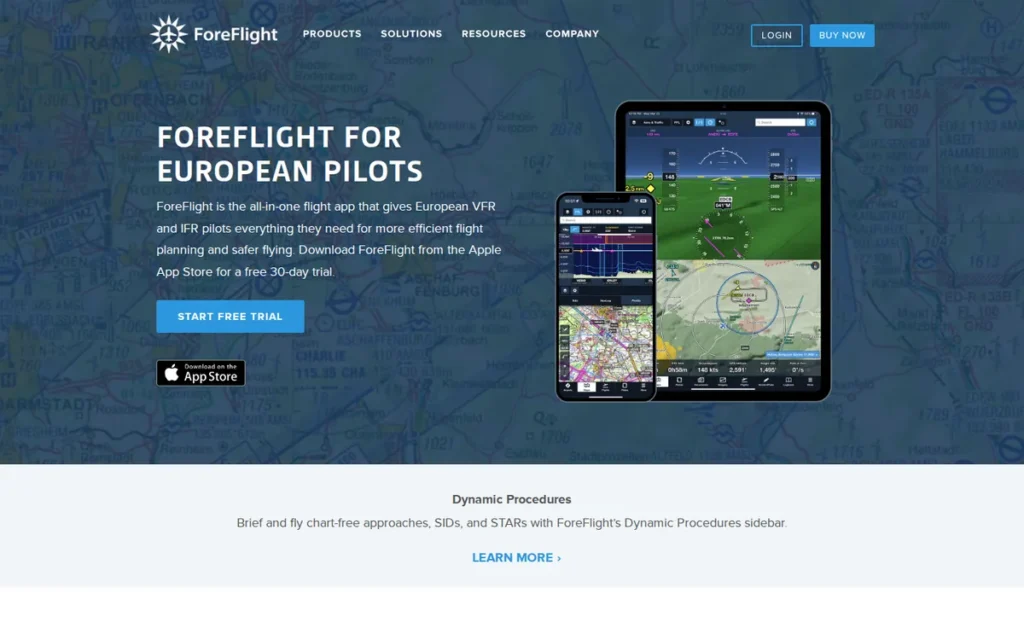
Category: EFB & Flight Planning, pilot-facing apps for planning, weather, charts, filing and in-flight situational awareness.
At a Glance
- Category: EFB & Flight Planning
- Best For: Individual VFR/IFR pilots on iOS, and Part 91/135 flight departments that want standard EFB licenses
- Price Range: $130–$390/yr for individuals; $280–$400 per license/yr for business plans (two-license minimum); Dispatch by quote
- Primary Strength: ForeFlight combines planning, weather, charts, logbook and track-log debriefing in one EFB, with published tier pricing.
- Biggest Limitation: ForeFlight runs only on iOS and splits its features across tiers.
- One-Line Summary: ForeFlight has the strongest public evidence in PlugRoute’s 2026 evaluation (3.95/5): an iOS-only EFB whose $130-per-year Starter tier fits most private pilots.
- Last Verified: November 2026
Overview
ForeFlight (Jeppesen ForeFlight) is an iOS electronic flight bag and flight planning app for individual pilots, flight departments and operators that need dispatch-level planning, with published plans starting at $130 per year in 2026. ForeFlight combines weather, charts, planning, filing, logbook and debriefing tools in one app.
ForeFlight now belongs to Jeppesen ForeFlight, which relaunched as a standalone company on November 3, 2025 (Thoma Bravo, 2025). Thoma Bravo’s $10.55B purchase from Boeing closed on October 31, 2025. It covered Jeppesen, AerData and OzRunways as well as ForeFlight (Baker McKenzie, 2025).
Key Features
- ForeFlight provides flight planning and filing with aircraft performance profiles, so pilots can build and file routes in one app.
- ForeFlight’s Hazard Advisor overlays terrain and obstacle data on charts, and Synthetic Vision adds a 3D view.
- ForeFlight’s Track Log and built-in Logbook let pilots debrief flights and log time without a separate logbook app.
- ForeFlight Dispatch gives operators shared planning tools, including ETP/ETOPS calculations and custom navlogs.
- ForeFlight offers Jeppesen navigation data and charts as an option on all Mobile plans, plus ForeFlight Web and Sentry ADS-B hardware.
Best For
ForeFlight suits GA pilots flying on iPads and flight departments that want standard EFB licenses with an upgrade path to Dispatch. Pilots flying behind Garmin avionics, European VFR pilots and Android users should compare alternatives (Rotate Pilot, 2026).
Strengths
- ForeFlight’s parent company has a scale confirmed by a disclosed transaction: Thoma Bravo paid $10.55B in cash for Boeing’s Jeppesen, ForeFlight, AerData and OzRunways businesses (Boeing SEC filing, 2025).
- ForeFlight publishes full list pricing for its individual and business tiers, with only Dispatch sold by quote (ForeFlight, 2026). Buyers can work out most costs before a sales call.
- ForeFlight reviewers praise its polished interface, its weather visuals and how well planning, logbook and track logs work together (G2, 2026, 4.4/5 from 9 reviews; Rotate Pilot, 2026).
- ForeFlight’s user community gives practical buying advice: start on the lowest tier and upgrade only for IFR or jet flying (r/flying, 2024).
Users on r/flying noted:
“For me it took way more time and instruction to learn foreflight than paper. There is nothing on paper that isn’t on foreflight. I would have benefited a lot from a couple lectures just walking me through all the foreflight features and best practices than learning how to dog ear pages in my approach plates book.” Posted by u/harambe_did911
Takeaway: ForeFlight’s feature breadth fully replaces paper, but it comes with a real learning curve that new pilots should plan dedicated training time for.
Limitations
- ForeFlight’s most consequential trade-off is platform reach, because it has no Android version.
- ForeFlight splits features across tiers, and its business plans require at least two licenses, so a solo corporate pilot can’t buy a single Business license (ForeFlight, 2026).
- ForeFlight reviewers report bugs after updates and worry about lock-in (Rotate Pilot, 2026; Checkthat.ai, 2026).
- ForeFlight users worry that private-equity ownership since 2025 will push prices up. That is a perceived risk, and PlugRoute found no evidence that service has got worse.
- ForeFlight’s App Store rating was not retrieved as of November 2026, so its review-platform evidence rests on 9 G2 reviews.
“It’s debatable if the top tier is ever needed… the mid tier works fine for me.” (u/EliteEthos, r/flying (2024))
Takeaway: Most GA pilots can skip ForeFlight Premium and upgrade only when they need a specific feature.
Verdict
ForeFlight is the best-documented EFB choice for iOS pilots in 2026, with published tier pricing and a parent company whose scale is confirmed by a disclosed acquisition.
Most private VFR pilots can start on the $130/yr Starter tier. IFR pilots and flight departments should compare Essential with the business licenses. Android users and pilots flying behind Garmin avionics should demo alternatives before committing.
2. CAMP Systems International: Best Analyst-Managed Tracking for Turbine Fleets

Category: Maintenance Tracking, systems of record for aircraft due items, work orders, compliance and audit-ready maintenance history.
At a Glance
- Category: Maintenance Tracking
- Best For: Turbine business aircraft operators with lean maintenance staff, especially fleets in OEM or engine programs
- Price Range: Pricing on request; competitor estimate of about $2,400–$13,500 per aircraft per year (Radar, 2026)
- Primary Strength: CAMP Systems’ analysts maintain aircraft records for the operator, backed by exclusive engine programs and nearly 20,000 aircraft (CAMP, 2024).
- Biggest Limitation: CAMP Systems makes record accuracy and speed depend on its analysts, and reviewers report painful enrollment and premium pricing.
- One-Line Summary: CAMP Systems is an analyst-managed maintenance tracking service reporting nearly 20,000 aircraft (CAMP, 2024), best for turbine operators who want to hand records work to a vendor and can pay for it.
- Last Verified: November 2026
Overview
CAMP Systems is a business aviation maintenance tracking and aircraft health management service for turbine operators and flight departments in OEM and engine programs that want vendor analysts, not in-house staff, to keep their records. Operators send in compliance paperwork, and CAMP’s analysts apply it to each aircraft record.
CAMP Systems was founded in 1968, and Hearst agreed to buy it from GTCR in 2016 (Radar, 2026). CAMP Systems also owns Avinode and Total FBO. It bought Avinode Group and World Kinect’s FBO software portfolio for about $200M in a deal completed May 1, 2024 (World Kinect, 2024).
Key Features
- CAMP MTX tracks maintenance due items, and CAMP analysts apply submitted compliance documents to the aircraft record.
- CAMP Engine Health Monitoring is the exclusive EHM program for Pratt & Whitney Canada and Honeywell TFE, HTF and TPE engines, according to CAMP.
- CAMP’s Aircraft Health Management dashboard combines maintenance tracking, engine health, inventory and flight scheduling.
- CAMP CORRIDOR provides MRO and service-center software within the same portfolio.
- CAMP Systems integrates with operations platforms including FL3XX and Leon Software, so dispatch can see maintenance status.
Best For
CAMP Systems suits turbine operators that want vendor analysts to keep their records instead of hiring more in-house staff, especially for aircraft in CAMP’s OEM and engine programs. CAMP Systems is a weaker fit for owners and small piston fleets, where users describe incumbent pricing as built for larger operators (r/TheHangar, 2026).
Strengths
- CAMP Systems reports nearly 20,000 aircraft, more than 30,000 engines and 230+ aircraft models on its platform, the largest installed base among the trackers evaluated. These figures are a vendor claim (CAMP, 2024).
- CAMP Systems runs exclusive engine health monitoring programs for Pratt & Whitney Canada and Honeywell engine families, and Honeywell extended a predictive engine-health partnership with it (CAMP, 2026).
- CAMP Systems’ analyst-managed model takes records work off in-house staff, and aggregated reviews credit its dedicated aviation analysts and OEM relationships (rfp.wiki, 2026).
- CAMP Systems’ G2 reviewers praise detailed, customizable tracking and responsive support during trials (G2, 2026, 4.4/5 from 6 reviews).
Limitations
- CAMP Systems’ most consequential trade-off is dependence: record accuracy and turnaround depend on how quickly and correctly CAMP’s analysts work.
- CAMP Systems’ aggregated reviews cite “painful enrollment,” incorrect task setup and analyst communication failures (rfp.wiki, 2026).
- CAMP Systems’ G2 reviewers describe the CORRIDOR and inventory workflows as complex (G2, 2026).
- CAMP Systems prices by quote only, and the only public estimate comes from a competitor (Radar, 2026). CAMP’s 5% resale-premium figure is a vendor claim, not an independent study.
- CAMP Systems has little independent evidence: 6 G2 reviews, no confirmed Capterra score, and no significant CAMP-specific Reddit discussion found as of November 2026.
Verdict
CAMP Systems is the best-fit choice in 2026 for turbine operators who want vendor analysts to maintain records under OEM and engine programs, backed by the largest installed base among the trackers evaluated.
CAMP Systems ranks #2 for adoption and workflow scope, not review volume, because it has the smaller review sample of the two maintenance vendors. Test enrollment with a messy set of historical records, and ask references about analyst response times before signing.
3. Veryon (Veryon Tracking, formerly Flightdocs): Best for Direct Record Control Plus Diagnostics
Category: Maintenance Tracking, systems of record for aircraft due items, work orders, compliance and audit-ready maintenance history.
At a Glance
- Category: Maintenance Tracking
- Best For: Business, commercial and MRO maintenance departments that want their own staff to control records
- Price Range: Pricing on request (annual subscription per aircraft, varying by make and model)
- Primary Strength: Veryon covers tracking, diagnostics, publications and inventory from one vendor, with your own staff controlling the records.
- Biggest Limitation: Veryon’s quote-only pricing and reported onboarding communication problems make cost and go-live timing hard to predict.
- One-Line Summary: Veryon is a maintenance suite where your own staff enter the records, rated 4.6/5 from 19 G2 reviews (2026), best for teams that want record control and diagnostics from one vendor.
- Last Verified: November 2026
Overview
Veryon Tracking is a cloud maintenance tracking system for business, commercial and MRO maintenance departments whose own staff track due items by date, hours and cycles, along with work orders, electronic sign-offs and MEL workflows. Veryon Tracking is part of Veryon’s wider maintenance suite.
Veryon grew out of Aircraft Technical Publishers, founded in 1973, through at least six acquisitions, including Flightdocs, CaseBank and Rusada (Veryon, 2026). Buyers searching for Flightdocs should know that the product is now Veryon Tracking.
Key Features
- Veryon Tracking and Tracking+ track due items by date, hours and cycles, with work orders, e-signatures and MEL/defect workflows.
- Veryon Diagnostics supports fault isolation and repeat-defect analysis, at a fixed cost per aircraft with unlimited users.
- Veryon Publications links technical manuals directly into Veryon Tracking tasks.
- Veryon Inventory manages parts alongside maintenance records in the same suite.
- Veryon AIRE, announced in October 2025, lets users query maintenance data in plain language and adds predictive reliability. Veryon says it was trained on more than 15 years of de-identified corrective-action data.
Best For
Veryon fits maintenance departments that want to enter and control their own records with e-signatures, and that want diagnostics and publications from the same vendor. Veryon is a weaker fit for small fleets that need a published price or a hands-off analyst service.
Strengths
- Veryon Tracking is rated 4.6/5 from 19 reviews on G2, and 4.6/5 across 39 reviews on the Veryon seller profile (G2, 2026). That is the largest review-platform sample among the maintenance vendors evaluated.
- Veryon Tracking is “extremely intuitive and easy to use,” according to one Capterra reviewer, and another said their department moved from CAMP “fairly smoothly” (Capterra, 2026).
- Veryon offers the broadest maintenance scope in this evaluation, so a department has fewer maintenance vendors to manage (Veryon, 2026).
- Veryon reports results from American Airlines and Wing Aviation, including paperwork cut from about 30 to about 15 minutes. Both are vendor-curated case studies without audited figures (Veryon, 2026).
Limitations
- Veryon’s most consequential trade-off is workload: your own staff, not vendor analysts, are responsible for keeping records accurate.
- Veryon’s onboarding is the most-cited complaint in the Capterra reviews PlugRoute read. One reviewer reported more than three months to onboard a smaller aircraft, with “little to no communication” (Capterra, 2026).
- Veryon’s Capterra reviews also show friction between the Flightdocs-era and current versions of the product (Capterra, 2026).
- Veryon’s fleet-share figures and all AIRE performance claims are vendor claims, and PlugRoute did not find published SOC 2 or ISO reports for Veryon as of November 2026.
- Veryon was not covered by a review of Reddit discussion for this edition as of November 2026.
Verdict
Veryon is the better-reviewed of the two maintenance trackers evaluated in 2026 for teams that want to control their own records (G2, 2026, 4.6/5 from 19 reviews).
Veryon moved from #2 to #3 after PlugRoute corrected its G2 sample size in November 2026. Write onboarding SLAs and named implementation contacts into the contract. Test the AI features on your own defect history before you count them as value.
4. Leon Software: Best Charter Ops System With Published Per-Aircraft Pricing

Category: Charter & Flight Operations, platforms that run quoting, scheduling, dispatch, crew and owner reporting for Part 91/135 operators.
At a Glance
- Category: Charter & Flight Operations
- Best For: Small and mid-size charter and trip-support operators that run a separate maintenance tracker
- Price Range: €99–€929 per active aircraft per month; €2,299/month for trip support; €99 per user per month for brokers
- Primary Strength: Leon Software publishes per-aircraft pricing banded by maximum takeoff weight, bills only active aircraft and includes unlimited users.
- Biggest Limitation: Leon Software is not a maintenance or accounting system, so operators must budget for separate tools.
- One-Line Summary: Leon Software is the most price-transparent charter operations system in PlugRoute’s 2026 evaluation, best for budget-conscious operators who will pair it with a separate maintenance tracker.
- Last Verified: November 2026
Overview
Leon Software is a Warsaw-based flight operations and scheduling system for small and mid-size charter, business aviation and trip-support companies, with published pricing from €99 per active aircraft per month in 2026. Leon Software covers scheduling, crew rosters, flight-time limits, quoting and Flight Watch.
Leon Software was incorporated in September 2007 and has expanded from Poland into Europe, Asia and the Middle East (Leon Software, 2026). US buyers should confirm how well Leon Software handles Part 135 workflows and whether its support hours cover their time zone.
Key Features
- Leon Software offers table, calendar and timeline scheduling, with Flight Watch for monitoring trips in progress.
- Leon Software includes a configurable flight-time-limits engine and crew currency tracking.
- Leon Software provides quotes, operations and sales checklists, handling requests, and fuel and per-diem management.
- Leon Software includes an iOS and Android crew app and Report Wizard for custom reports.
- Leon Software offers a GraphQL API with webhooks, Zapier and Power Automate connectors, and integrations with CAMP and Traxxall.
Best For
Leon Software suits small and mid-size charter operators and trip-support companies that want predictable pricing and unlimited users, and that run a dedicated maintenance tracker and accounting system. Leon Software is a weaker fit for operators that want one system to cover everything.
Strengths
- Leon Software publishes the most transparent pricing in the charter segment, banded by maximum takeoff weight, and doesn’t bill inactive aircraft (Leon Software, 2026).
- Leon Software was ranked second among ten charter management platforms in ACMI World’s 2026 editorial list, behind FL3XX. That listing is editorial coverage, not an award (ACMI World, 2026).
- Leon Software reports 3,024 aircraft on its platform, a vendor claim. Its own pages also cite 500 customers and 120+ air operators, using different definitions and dates (Leon Software, 2026).
- Leon Software states openly that it is not a full maintenance or accounting system, and it includes unlimited users, a cross-platform crew app and a documented API (Leon Software, 2026).
Limitations
- Leon Software’s most consequential trade-off is scope: paying for a separate tracker and accounting system narrows the price gap with all-in-one platforms, as the five-aircraft example in PlugRoute’s cost section shows.
- Leon Software’s independent evidence is a single Capterra review (Capterra, 2026, 5.0/5 from 1 review).
- Leon Software’s Capterra reviewer asked for a safety risk log, safety MOR submission and a better crew-expiration area (Capterra, 2026).
- Leon Software’s ISO 27001 status, US Part 135 depth and US time-zone support were not confirmed as of November 2026.
- Leon Software had no significant Reddit discussion found as of November 2026.
Verdict
Leon Software is the most price-transparent charter operations system evaluated in 2026, best for operators that want published per-aircraft costs and will pair it with a dedicated maintenance tracker.
Leon Software ranks 0.05 points above FL3XX, mainly because of its pricing transparency, so the two are close on evidence. Add tracker and accounting costs before comparing them. US operators should use the one-month free trial to confirm Part 135 workflows, safety reporting and support hours.
5. FL3XX: Best All-in-One Platform for Growing Part 135 Operators
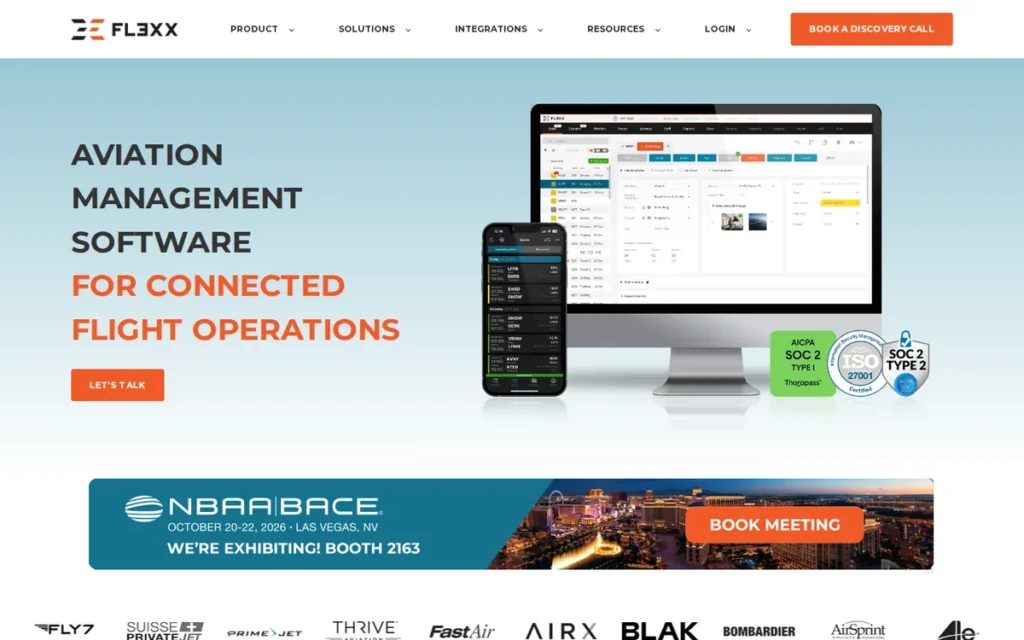
Category: Charter & Flight Operations, platforms that run quoting, scheduling, dispatch, crew and owner reporting for Part 91/135 operators.
At a Glance
- Category: Charter & Flight Operations
- Best For: Growing Part 135, Part 91, cargo and medevac operators that want one connected operations system
- Price Range: Pricing on request (based on fleet size and configuration)
- Primary Strength: FL3XX connects charter sales, dispatch, crew legality, post-flight work and owner reporting in one platform, with 130–200+ integrations depending on how they are counted (G2, 2026; FL3XX, 2026).
- Biggest Limitation: FL3XX publishes no pricing and has only 2 G2 reviews.
- One-Line Summary: FL3XX has the broader scope of the two all-in-one charter platforms in PlugRoute’s 2026 evaluation, best for growing Part 135 operators that can budget for a quote-based contract and an implementation lasting several weeks.
- Last Verified: November 2026
Overview
FL3XX is a cloud operations platform for Part 135, Part 91, cargo and medevac operators. It connects quoting, scheduling, dispatch, crew legality checks and owner reporting, and it syncs with specialist maintenance trackers rather than replacing them.
FL3XX is based in Vienna and serves operators on seven continents, in about 60 countries (FL3XX, 2026). FL3XX says it has 200+ integrated services, while G2’s description says 130+ native integrations, so the count depends on the definition used (G2, 2026).
Key Features
- FL3XX checks crew flight-time limits and legality before a charter quote goes out.
- FL3XX’s quoting and CRM module uses AI to turn quote-request emails into trip requests.
- FL3XX includes scheduling, dispatch, flight following, post-flight processing and a Crew App.
- FL3XX provides owner reporting, 30+ default reports and the FL3XX BRIGHT BI add-on.
- FL3XX offers an API and maintenance sync with CAMP, Traxxall and Veryon.
Best For
FL3XX fits growing Part 135 charter and aircraft management operators that want to replace several disconnected operations tools while keeping a specialist maintenance tracker. Smaller operators that need published pricing should compare FL3XX with Leon Software in a scripted demo.
Strengths
- FL3XX was ranked first among ten charter management platforms in ACMI World’s 2026 editorial list. That listing is editorial coverage, not an award (ACMI World, 2026).
- FL3XX reports more than 250,000 flights dispatched each year across about 60 countries, a vendor figure also cited by The Flying Engineer (FL3XX, 2026).
- FL3XX has the broader native scope of the two charter platforms evaluated, including legality checks before quoting and owner reporting (FL3XX, 2026).
- FL3XX customer Pentastar Aviation reports connecting about 20 platforms and going live “in days,” in a testimonial hosted by the vendor (FL3XX, 2026).
Limitations
- FL3XX’s most consequential trade-off is cost visibility: quote-only pricing keeps total cost hidden until late in the sales cycle.
- FL3XX’s own blog says transitions take “several weeks to a few months,” including a period of running old and new systems side by side. That timeline comes from the vendor (FL3XX, 2026).
- FL3XX has little independent evidence: 2 G2 reviews (G2, 2026), no confirmed Capterra score, and no significant FL3XX-specific Reddit discussion found as of November 2026.
- FL3XX’s named customers, including Flexjet, Jet Linx and Clay Lacy, come from vendor-hosted testimonials without audited figures.
- FL3XX does not replace a maintenance system of record, so operators still need to license a separate tracker.
Verdict
FL3XX has the broader native scope of the two charter platforms evaluated in 2026, covering sales, dispatch, crew legality and owner reporting in one system.
FL3XX fits best for growing Part 135 operators that can budget for a quote-based contract and an implementation lasting several weeks. Run a full scripted charter demo and call references with similar fleet sizes before signing.
6. Pilotbase FlightOps (formerly Flight Schedule Pro): Best Modular Platform for Part 61 and Part 141 Schools

Category: Flight Training Management, platforms that tie flight school scheduling, training records, billing and aircraft squawks together.
At a Glance
- Category: Flight Training Management
- Best For: Part 141 and structured Part 61 schools, universities and larger flying clubs
- Price Range: From about $60/month for the Scheduling Hub; other Hubs and the Suite by quote; payment processing extra
- Primary Strength: Pilotbase FlightOps links scheduling, training records, student billing and maintenance squawks in modular Hubs used by 1,100–1,300 operators (vendor-reported, 2026).
- Biggest Limitation: Pilotbase FlightOps’ mobile app averages 3.6/5 across 551 App Store ratings.
- One-Line Summary: Pilotbase FlightOps is a modular flight school platform used by 1,100–1,300 schools, universities and clubs (vendor-reported, 2026), best for Part 141 schools that need training records and billing tied to scheduling.
- Last Verified: November 2026
Overview
Pilotbase FlightOps (formerly Flight Schedule Pro) is a modular platform for flight schools and flying clubs. It sells scheduling, Part 61 and Part 141 training records, student billing and squawk tracking as separate Hubs or together as one Suite.
The company behind Flight Schedule Pro adopted the Pilotbase name on February 25, 2026. The vendor says contracts, pricing and data are unchanged (Pilotbase, 2026). The company also owns Coradine, maker of the LogTen logbook, which it acquired on May 4, 2022 (Flight Schedule Pro, 2022).
Key Features
- Pilotbase FlightOps’ Scheduling Hub offers drag-and-drop booking, unlimited users and self-dispatch, with Intelligent Scheduling in beta.
- Pilotbase FlightOps’ Training Hub supports custom syllabi, Part 141 and Part 61 records, and offline lesson grading on iOS.
- Pilotbase FlightOps’ Billing Hub includes a merchant account, automatic invoicing at check-in and QuickBooks Online sync.
- Pilotbase FlightOps’ Maintenance Hub provides reminders, squawk tracking and digital work orders.
- Pilotbase FlightOps bundles its Scheduling, Training, Billing and Maintenance Hubs into one Suite for schools that want a single system.
Best For
Pilotbase FlightOps suits Part 141 schools, universities and structured Part 61 schools that need records, billing and squawks connected to scheduling. Clubs that only need booking should also price Flight Circle (about $10 per aircraft per month) and Aircraft Clubs ($12–$18 per aircraft per month) (FlightSuiteHQ, 2026).
Strengths
- Pilotbase FlightOps has the largest public review sample in this evaluation, 551 App Store ratings, and users praise round-the-clock real-time booking and rescheduling (Apple App Store, 2026).
- Pilotbase FlightOps reports more than 10,000 daily flights, a vendor claim repeated by Capterra (Capterra, 2026), in a market of 370,286 US student pilots (FAA, 2025).
- Pilotbase FlightOps supports Part 141 and Part 61 records with custom syllabi, as training demand grows: US flight training logged more than 8.2 million instructional hours in 2023, up nearly 30% (AOPA, 2025).
- Pilotbase FlightOps invoices automatically at check-in and syncs with QuickBooks Online, which cuts manual reconciliation (Pilotbase, 2026).
Limitations
- Pilotbase FlightOps’ most consequential trade-off is mobile quality: the app averages 3.6/5, and users say grounded aircraft aren’t visible until they try to book (Apple App Store, 2026).
- Pilotbase FlightOps limits aircraft and instructor filtering and has historically lacked Android support. A Capterra reviewer called CFI scheduling “awkward” (Apple App Store, 2026; Capterra, 2026).
- Pilotbase FlightOps has no confirmed SMS or safety module, and most of its Hubs are quote-only.
- Pilotbase FlightOps’ 2026 rebrand means documentation, app listings and search results may appear under two names during the transition.
- Pilotbase FlightOps had no significant product-specific Reddit discussion found as of November 2026.
Users on r/flying shared their experience:
“If you work for FSP PLEASE make it so I don’t have to hit “add to calendar” on every lesson. Most scheduling softwares sync to calendar automatically” Posted by u/I_liek_BBW
Takeaway: Students using Pilotbase FlightOps (then Flight Schedule Pro) have run into everyday friction like manual calendar syncing, so schools should test routine student tasks during the demo rather than just the admin features.
Verdict
Pilotbase FlightOps is a well-documented choice in 2026 for Part 141 and structured Part 61 schools that need records, billing and squawks tied to scheduling, backed by the largest public review sample in this evaluation.
Pilotbase FlightOps’ mobile experience is its weakest documented area. During the demo, test grounded-aircraft visibility and instructor scheduling on students’ own phones.
7. FBO Director (Essinta Labs): Best Published-Price POS for Independent FBOs
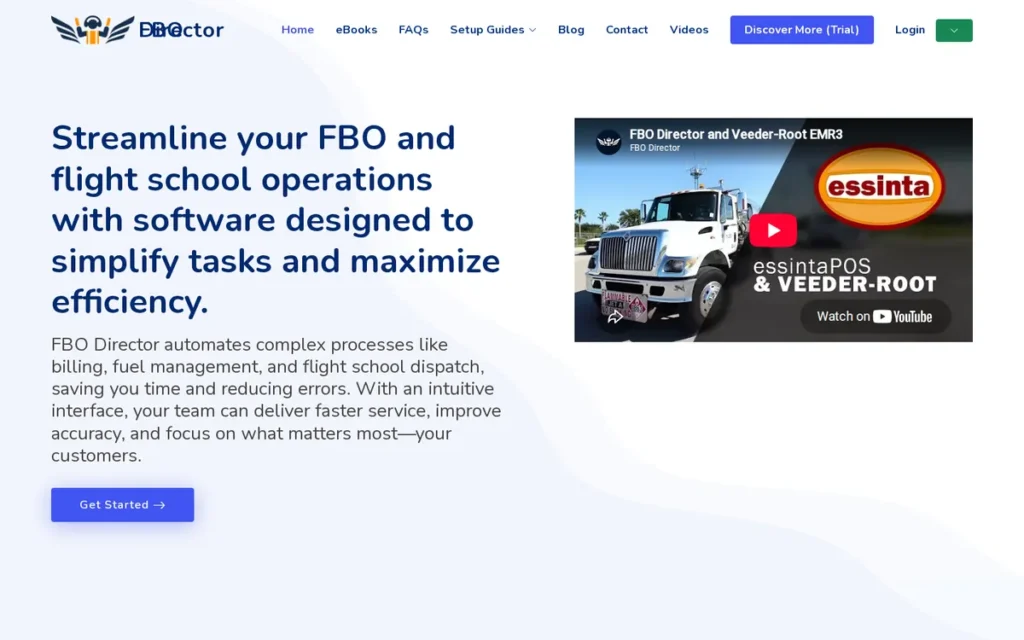
Category: FBO Management, point-of-sale, fuel, ramp ticketing and billing systems built for fixed-base operators.
At a Glance
- Category: FBO Management
- Best For: Small and mid-size independent FBOs that want fuel-meter automation without being tied to one fuel brand
- Price Range: $149/month + $0.20 per transaction (Lite) to $689/month (Ultimate)
- Primary Strength: FBO Director automates fuel tickets from several meter brands and works with several fuel card processors, at published prices.
- Biggest Limitation: FBO Director has no verified review-platform presence, so all its quality evidence comes from testimonials on its own site and data from 2019.
- One-Line Summary: FBO Director is a published-price FBO point-of-sale and fuel system that isn’t tied to one fuel brand, best for small independent FBOs willing to check a small vendor through reference calls.
- Last Verified: November 2026
Overview
FBO Director is a cloud point-of-sale, fuel and invoicing system from Essinta Labs for small and mid-size independent FBOs that want fuel automation without depending on a single fuel brand. Published plans start at $149 per month in 2026. FBO Director covers fuel-meter automation, mobile ramp ticketing, hangar billing and accounting exports.
FBO Director launched as EssintaWINGS in February 2017 and took its current name in April 2019 (FBO Director, 2019). FBO Director’s founder, John Nelson, previously built FBO Manager software and has been making aviation products since 1996 (FBO Director, 2019).
Key Features
- FBO Director’s fuel module pulls readings from Veeder-Root EMR3, Liquid Controls, TCS, QT Pod and Fuel Meter Cloud meters.
- FBO Director’s Capture mobile app lets line staff create tickets on the ramp.
- FBO Director provides recurring billing for hangars and tie-downs, plus work orders.
- FBO Director includes a flight-school and rental module that tracks renters’ currency, medicals and flight reviews.
- FBO Director exports to QuickBooks, Sage, MAS90 and Great Plains, and integrates with FlightBridge.
Best For
FBO Director suits small and mid-size independent FBOs, including those that run rentals or training, that buy fuel from more than one supplier and want published pricing. Multi-location or high-volume FBOs should model per-transaction fees and user limits, and compare Total FBO and FBO One.
Strengths
- FBO Director is one of three products in this evaluation with full public list pricing, alongside ForeFlight and Leon Software (FBO Director, 2026).
- FBO Director works with Avfuel, Titan, World Fuel and ConocoPhillips card processors, plus the Bravo, Avtrip and Aeroclass contract programs (FBO Director, 2026).
- FBO Director reports more than 60,000 transactions worth over $35M between 2017 and 2019. This is vendor data more than seven years old (FBO Director, 2019).
- FBO Director’s testimonial customer Rabbit Aviation Services is confirmed as an operating FBO by an independent r/flying comment (r/flying, 2015).
Limitations
- FBO Director’s most consequential trade-off is evidence: it had no verified presence on G2, Capterra, Software Advice or Trustpilot as of November 2026.
- FBO Director’s Lite tier charges $0.20 per transaction and allows only 1 location, 1 card terminal and 3 concurrent users, so busy FBOs can pay more than the headline price (FBO Director, 2026).
- FBO Director charges an extra $50/month for FlightBridge and Scheduling Concierge on its Starter, Basic and Business tiers (FBO Director, 2026).
- FBO Director is a small vendor that doesn’t disclose its headquarters or team size, so check support coverage and data-export terms with references.
- FBO Director had no significant Reddit discussion found as of November 2026.
Verdict
FBO Director is a transparently priced FBO point-of-sale and fuel system for small independent FBOs in 2026, with fuel-meter automation that isn’t tied to one fuel brand.
FBO Director ranks last because there is little public evidence about it, not because of a demonstrated weakness. Model the per-transaction fee at your volume, test a fuel-truck-meter-to-accounting export, and call at least two references of a similar size.
What’s the Difference Between CAMP and Veryon for Maintenance Tracking?
CAMP Systems uses analysts: your staff send in paperwork, and CAMP’s analysts apply it to the aircraft record. Veryon uses direct entry: your own staff record compliance with e-signatures. CAMP Systems takes work off your staff, while Veryon gives you more direct control. Choose based on how many records staff you have.
Here is how that plays out. When a mechanic signs off a recurring inspection, a Veryon user’s own staff close the task with an e-signature. A CAMP user sends in the signed paperwork, and a CAMP analyst updates the record. The record is then only as fast and accurate as the analyst’s processing.
| Factor | CAMP Systems | Veryon |
|---|---|---|
| Who updates the record | CAMP analysts | Your own staff, with e-signatures |
| In-house workload | Lower | Higher |
| Accuracy and speed depend on | How fast and accurately the analysts work | How disciplined your own team is |
| Extras | Engine health monitoring, OEM programs, CORRIDOR | Diagnostics, Publications, AIRE AI |
| Pricing | Quote-only; competitor estimate $2,400–$13,500/aircraft/yr | Quote-only, per aircraft by make/model |
| Review evidence | G2 4.4/5 (6 reviews, 2026) | G2 4.6/5 (19 product reviews; 39 seller-wide, 2026) |
| Most documented complaint | Painful enrollment, analyst communication | Onboarding delays, little communication |
AI use in MRO rose from 58% of surveyed organizations in 2024 to 64% in 2025, and 58% said AI met or beat expectations (Oliver Wyman MRO Survey, 2025). Buyers should still test Veryon AIRE on their own defect history.
CAMP and Veryon buyers should ask for a sample audit export during the demo, whichever model they choose. Both vendors integrate with FL3XX, so your choice of operations platform rarely forces your choice of tracker.
How Much Does Aviation Software Really Cost?
The total cost of owning aviation software depends on at least five pricing models, and several of them hide part of the bill. Of the seven products ranked, ForeFlight (except Dispatch), Leon Software and FBO Director publish full list pricing. CAMP Systems, Veryon and FL3XX are quote-only, so total cost stays hidden until late in the sales cycle.
- Per tail by make and model: CAMP Systems and Veryon price maintenance tracking per aircraft, and the price varies by aircraft type.
- Per active aircraft by maximum takeoff weight: Leon Software bills each active aircraft at a rate set by its weight band and doesn’t bill inactive aircraft.
- Per license: ForeFlight’s business plans charge per pilot license, with a two-license minimum.
- Flat monthly plus per transaction: FBO Director’s Lite tier adds $0.20 per transaction to a $149 base.
- Modular quote: Pilotbase FlightOps and FL3XX quote by module, fleet size or configuration.
| Transparency Tier | Products |
|---|---|
| Fully public | ForeFlight (individual and business plans), Leon Software, FBO Director |
| Partly public | Pilotbase FlightOps (Scheduling Hub only) |
| Quote-only | CAMP Systems, Veryon, FL3XX, ForeFlight Dispatch |
What Do the Published Price Lists Show?
The published price lists below were verified in November 2026. Quote-only vendors are listed with the best available guidance.
- ForeFlight: ForeFlight Starter costs $130/yr, Essential $260/yr and Premium $390/yr. Business Pro costs $280 and Business Performance $400 per license per year, and each extra region adds $110 per license per year (ForeFlight, 2026).
- ForeFlight price history: ForeFlight users on Pilots of America report earlier prices of about $125, $250 and $370. ForeFlight says the plans were renamed without any change to prices or features (Pilots of America, 2026).
- Leon Software: Leon Software Basic costs €99 per active aircraft per month, and Pro costs €350, €535 or €929 depending on weight band. Trip-support companies pay €2,299/month, and brokers pay €99 per user per month (Leon Software, 2026).
- Leon Software price conflict: Leon Software’s Capterra listing shows a conflicting “PLN 200/user/month,” so treat the official pricing page as authoritative (Capterra, 2026).
- FBO Director: FBO Director Lite costs $149/month plus $0.20 per transaction. Starter costs $349, Basic $489, Business $589 and Ultimate $689 per month (FBO Director, 2026).
- Pilotbase FlightOps: Pilotbase FlightOps’ Scheduling Hub starts at about $60/month, other Hubs are quote-only, and payment processing costs extra (Capterra, 2026).
- CAMP Systems: CAMP Systems publishes no rate card. A competitor estimates about $6,000–$13,500 per aircraft per year for records plus tracking, and from about $2,400 for records only, so treat these figures as directional (Radar, 2026).
- Veryon: Veryon prices Tracking per aircraft by make and model, and Diagnostics at a fixed cost per aircraft. Buyers should ask for AIRE, Publications, API access and implementation as separate line items (Veryon, 2026).
- FL3XX: FL3XX prices by fleet size and configuration, so buyers should budget separately for migration, integrations and training (FL3XX, 2026).
What Do Worked Cost Examples Show?
Three worked examples show how pricing structure changes the real bill. All of them use only published or estimated figures.
- FBO Director break-even: At 1,000 transactions a month, FBO Director Lite costs $149 + $200 = $349, the same as the Starter tier. Above that volume, Lite costs more than Starter, even before you count its user and location limits (FBO Director, 2026).
- Five-aircraft charter fleet: Five aircraft on Leon Software Basic cost €5,940 a year. CAMP Systems tracking for the same fleet adds $12,000–$67,500 at the competitor’s estimate, so the tracker can cost more than the operations platform (Leon Software, 2026; Radar, 2026).
- ForeFlight two-license minimum: A two-pilot flight department pays at least $560 a year on ForeFlight Business Pro, against $520 for two individual Essential plans. Buyers pick the business tier for standardization and management features, not to save money (ForeFlight, 2026).
Small fleets and aircraft owners feel these pricing structures most.
“Every site/app I looked at was either per-seat priced, capped at one aircraft on the free tier, or charged extra for stuff like scheduling and squawk tracking.” (u/chocksoffdotcom, r/TheHangar (2026))
Takeaway: Small fleets and owners should compare per-aircraft and per-user pricing side by side, and confirm that scheduling and squawk tracking are included rather than sold as add-ons.
Hidden aviation software costs usually come from these five areas:
- Migration: Aviation software migration costs rise when legacy records don’t map cleanly into the new system.
- Parallel running: Running old and new aviation systems side by side lengthens implementation, and FL3XX says transitions take “several weeks to a few months” (FL3XX, 2026).
- Integrations: Aviation software integrations can be one-way or cost extra, so ask vendors which named integrations are two-way and included.
- Add-ons: Aviation software vendors often price AI, BI and API modules separately, such as the FL3XX BRIGHT BI add-on, so ask for each one as its own line item.
- Payment processing: Card processing fees for flight schools and FBOs are often charged on top of the aviation software subscription.
Which Aviation Software Brands Have Changed Names or Owners?
Aviation software has consolidated quickly, so the product you remember may now have a different name or owner. Renewal pricing and roadmaps can change after an acquisition. That is why renewal caps and data-export terms belong in every contract.
| Former Name or Owner | Current Name or Owner |
|---|---|
| Flightdocs | Veryon Tracking (Veryon, after at least 6 acquisitions) |
| Jeppesen, ForeFlight, AerData and OzRunways (Boeing) | Jeppesen ForeFlight (Thoma Bravo, $10.55B, closed October 31, 2025) |
| Total FBO and Avinode Group (World Kinect) | CAMP Systems (about $200M, completed May 1, 2024) |
| CAMP Systems (GTCR) | Hearst (agreed 2016) |
| Avianis | Portside |
| EssintaWINGS | FBO Director (2019) |
| Flight Schedule Pro | Pilotbase FlightOps (February 25, 2026) |
What Red Flags Should I Watch For When Evaluating Aviation Software?
The biggest aviation software red flags are signs that the evidence, pricing or contract terms are weaker than the sales pitch suggests. PlugRoute found six recurring patterns in its November 2026 research, from star ratings built on two reviews to “compliance” labels presented as if they were regulatory approval. Each red flag below includes a check to run before signing.
Red Flag #1: Star Ratings With Tiny Samples A 4.5-star rating from 2 reviews tells you almost nothing, and 6 of the 7 products evaluated have 9 or fewer G2 or Capterra reviews (PlugRoute research, 2026). Always ask how many reviews a rating is based on.
Red Flag #2: Quote-Only Pricing Without Itemized Add-Ons or Renewal Caps A single bundled quote hides the total cost of ownership across implementation, AI, API access and renewals, and acquisitions such as Thoma Bravo’s $10.55B ForeFlight deal can change pricing later (Thoma Bravo, 2025). Ask for each item as a separate line, and negotiate renewal caps up front.
Red Flag #3: Vague Integration Counts A headline integration count depends on what is being counted: FL3XX claims 200+ while G2 lists 130+ (G2, 2026). Ask for a list of named, two-way integrations with the systems you already use.
Red Flag #4: No Onboarding SLA One Capterra reviewer of Veryon Tracking reported more than three months to onboard a smaller aircraft with “little to no communication,” and aggregated CAMP reviews cite “painful enrollment” (Capterra, 2026; rfp.wiki, 2026). Treat a contract without onboarding milestones and a named contact as a risk.
Red Flag #5: Missing SMS/Safety Module A Leon Software reviewer asked for a safety risk log and MOR submission (Capterra, 2026), and Pilotbase FlightOps has no confirmed SMS module. Confirm how safety reporting will be handled before you sign.
Red Flag #6: “Compliance” Claims Presented as Regulatory Approval In PlugRoute’s editorial view, aviation software can support Part 91, 135, 61 or 141 recordkeeping, but owning a product doesn’t make an operation compliant. Ask vendors to show the exact regulatory workflows instead of relying on a compliance label.
What Questions Should I Ask Before Choosing Aviation Software?
Before choosing aviation software, ask every vendor the same eight questions and score the answers side by side. The answers show the total cost of ownership and contract risk that marketing claims leave out. Each question below includes what a strong answer looks like, so you can tell a specific commitment from a vague promise.
Question #1: What does your platform replace, and what does it only sync with? A strong answer names exact scope boundaries, the way Leon Software states that it is not a maintenance or accounting system. A vague “we do it all” should prompt a follow-up demo.
Question #2: Can you price implementation, migration, add-ons and renewal caps as separate line items? A good aviation software vendor will put these costs in writing, line by line. Compare quotes item by item, not by the headline subscription price.
Question #3: Can we run our own scripted workflow in the demo? A confident aviation software vendor will let you run your real workflow with your own data. Use one script per category:
- Charter script: Ask FL3XX, Leon Software or any charter vendor to build a multi-leg quote, run the crew legality check, dispatch the trip, close it out, invoice it and show the audit trail.
- Maintenance script: Ask CAMP Systems, Veryon or any tracker to load a messy sample of your maintenance history and produce an audit-ready due list by date, hours and cycles.
- Flight school script: Ask Pilotbase FlightOps or any school platform to book a lesson, log a squawk that grounds the aircraft, and show what the student sees on a phone.
- FBO script: Ask FBO Director or any FBO vendor to take a fuel-truck meter reading through to a ticket, an invoice and an accounting export.
Question #4: Can we speak to two references with our fleet size and certificate type? Reference calls matter more than usual for aviation software, because operator-side products get almost no Reddit discussion (PlugRoute research, 2026). Insist on references that match your size.
Question #5: Can you share SOC 2 or ISO 27001 reports? PlugRoute did not find published SOC 2 or ISO 27001 reports for the ranked vendors in its November 2026 research. Ask each vendor for the reports themselves, not marketing statements about them.
Question #6: What support hours do you cover in our time zone? Aviation software vendors based outside your region, such as Vienna-based FL3XX and Warsaw-based Leon Software, should confirm their support coverage in writing. Ask what happens with an AOG (aircraft on ground) issue at 2 a.m. your time.
Question #7: What data export do we get if we leave? A clear answer names the export formats, how complete the export is, and any fees. Weak export terms increase lock-in, which users complain about across the whole category.
Question #8: Which mobile platforms do your apps support? ForeFlight runs only on iOS, and Pilotbase FlightOps has historically lacked Android support (Rotate Pilot, 2026; Apple App Store, 2026). If your pilots, students or line staff use a mix of devices, this question can rule products out.
How Did We Rank These Aviation Software Tools?
PlugRoute scored each product from 0 to 5 on six weighted criteria and combined them into a weighted score out of 5.0. Independent evidence counted most, at 25%. The rank reflects how strong and verifiable each product’s evidence is, not which category is better, so choose your category before comparing ranks.
- C1, Independent Evidence Strength and Sample Size (25%): This criterion matters because buyers need verified proof, not “industry leading” claims, before signing multi-year contracts.
- C2, Documented Adoption and Scale (20%): This criterion matters because dated installed-base evidence shows a product has held up under real fleets and real audits.
- C3, Workflow Depth and Scope Candor (20%): This criterion matters because buyers need to know what a system replaces and what it only syncs with.
- C4, Pricing Transparency and Cost Predictability (15%): This criterion matters because hidden total cost is one of buyers’ most common complaints.
- C5, Integrations, API and Mobile Support (10%): This criterion matters because disconnected tools and weak mobile apps often kill a deal.
- C6, Implementation and Vendor-Risk Signals (10%): This criterion matters because onboarding delays and ownership changes usually surface only after signing.
| Product | C1 | C2 | C3 | C4 | C5 | C6 | Weighted Score |
|---|---|---|---|---|---|---|---|
| ForeFlight | 3.5 | 4.5 | 4.5 | 4.5 | 3.0 | 3.0 | 3.95 |
| CAMP Systems | 2.5 | 4.5 | 4.5 | 2.0 | 3.5 | 3.0 | 3.38 |
| Veryon | 3.0 | 4.0 | 4.5 | 1.5 | 3.5 | 2.5 | 3.28 |
| Leon Software | 2.0 | 3.0 | 3.5 | 5.0 | 4.0 | 3.0 | 3.25 |
| FL3XX | 2.5 | 3.5 | 4.5 | 1.5 | 4.5 | 3.0 | 3.20 |
| Pilotbase FlightOps | 3.0 | 3.5 | 3.5 | 3.0 | 2.5 | 2.5 | 3.10 |
| FBO Director | 0.5 | 1.5 | 3.5 | 4.5 | 3.5 | 2.0 | 2.35 |
PlugRoute changed three scores after live checks in November 2026, applying each rule to every product:
- Veryon correction: Veryon’s G2 sample was revised from a category-page figure of 194 to 19 product reviews (39 seller-wide). That lowered its C1 score from 3.5 to 3.0 and moved Veryon from #2 to #3.
- Editorial lists: Editorial lists such as ACMI World’s 2026 ranking earn the same partial C1 credit for every product they list. That raised Leon Software’s C1 from 1.5 to 2.0 for its #2 listing.
- Priced add-ons: Separately priced add-ons reduce the C4 score under PlugRoute’s rubric. That lowered ForeFlight’s C4 from 5.0 to 4.5, because Dispatch is quote-only and extra regions cost extra.
Public review samples in this category are very small, so PlugRoute gave star ratings less weight and always shows their sample sizes. PlugRoute labeled evidence the same way for every product:
- Vendor claim: A vendor claim is a figure the company reports about itself.
- Competitor estimate: A competitor estimate is a figure from a rival with an interest in the comparison.
- Vendor-hosted testimonial: A vendor-hosted testimonial is a customer quote the vendor selected and published.
- Not found as of November 2026: This label marks evidence that PlugRoute looked for and could not find or retrieve.
Where a source shows no publication date, the year given is when PlugRoute accessed it. PlugRoute found no peer-reviewed studies covering this category.
PlugRoute has no affiliate relationships with any company listed, and rankings are determined entirely by research data and objective evaluation criteria.
What Do Buyers Most Often Ask About Aviation Software?
What’s the best aviation software for charter operators in 2026?
FL3XX and Leon Software are the two charter platforms PlugRoute ranked in 2026. Leon Software suits budget-conscious operators that want published pricing from €99 per active aircraft per month. FL3XX suits growing Part 135 operators that want charter sales and operations connected in one quote-priced system. Both sync with a separate maintenance tracker rather than replacing one.
What’s the best aviation maintenance tracking software for small fleets?
For small fleets, the choice depends on staffing. Veryon fits small teams that want to enter and control their own records, while CAMP Systems fits small turbine fleets that want vendor analysts to keep their records. Neither vendor publishes prices, and the only CAMP estimate ($2,400–$13,500 per aircraft per year) comes from a competitor (Radar, 2026).
How does PlugRoute determine rankings?
PlugRoute ranks aviation software on six weighted criteria, led by independent evidence strength at 25%. Each criterion is scored from 0 to 5 and combined into a weighted score out of 5.0. The rank shows how strong and verifiable each product’s evidence is, not superiority across categories. The per-criterion scores appear in PlugRoute’s methodology section.
What Do Key Aviation Software Terms Mean?
These are the terms buyers meet most often when comparing aviation software vendors on compliance, pricing and integrations. Knowing them makes demos and quotes easier to compare, because vendors use them to describe scope and to set prices.
Part 91: Part 91 is the FAA rule set for general operating and flight rules, and it covers most private and corporate flying. Software built for Part 91 flight departments may lack the commercial controls that Part 135 operators need.
Part 135: Part 135 is the FAA rule set for commuter and on-demand charter operations. Buyers need software that enforces flight duty periods and rest requirements, and that keeps the operational records these operations require.
Part 61 and Part 141: Part 61 and Part 141 are the FAA rules for pilot training. Part 141 schools follow an approved, structured syllabus with stricter recordkeeping, so training-records software matters more to them.
Electronic Flight Bag (EFB): An electronic flight bag is a tablet app that replaces paper charts, manuals and planning tools in the cockpit. Buyers should check which devices it runs on and which features come with each subscription tier.
Minimum Equipment List (MEL): A minimum equipment list sets out which equipment can be inoperative while the aircraft still flies legally. Maintenance software with MEL workflows helps track deferred defects and their deadlines.
Due Items (Hours, Cycles, Calendar): Due items are inspections and component limits triggered by flight hours, takeoff-and-landing cycles or calendar dates. Accurate due-item tracking is the core job of any maintenance system of record.
Engine Health Monitoring (EHM): Engine health monitoring analyzes engine trend data to catch wear and deterioration early. Some engine maintenance programs require a specific monitoring provider, which can decide which tracker an operator chooses.
Maximum Takeoff Weight (MTOW): Maximum takeoff weight is the heaviest certified weight at which an aircraft may take off. Some vendors set per-aircraft software prices by weight band, so larger aircraft cost more to license.
Per-Tail Pricing: Per-tail pricing charges a subscription fee for each aircraft registration. Cost rises with fleet size, so buyers should ask whether parked or inactive aircraft are billed.
Safety Management System (SMS): A safety management system is a formal process for finding hazards, assessing risk and reporting safety events. Buyers should confirm whether a platform includes safety reporting or needs a separate tool.
Maintenance, Repair and Overhaul (MRO): MRO refers to the organizations and processes that maintain, repair and overhaul aircraft and components. Enterprise MRO systems serve airlines and large repair stations rather than small operators.
SOC 2 and ISO 27001: SOC 2 and ISO 27001 are independent standards for auditing information security controls. Asking for these reports helps buyers check how a cloud vendor protects the records their compliance depends on.
Which Aviation Software Tool Is Right for You?
Key Insights
- Aviation software buyers should pick their category before comparing vendors, because the seven ranked products mostly can’t be swapped for one another.
- In aviation software, a 4.5-star rating from 2 reviews is an anecdote, not evidence, and 6 of the 7 products PlugRoute ranked have 9 or fewer G2 or Capterra reviews (PlugRoute research, 2026).
- Of the seven products ranked, ForeFlight (except Dispatch), Leon Software and FBO Director publish full list pricing, while CAMP Systems, Veryon and FL3XX are quote-only.
- Maintenance buyers must choose between CAMP Systems’ analyst-managed records and Veryon’s model, where their own staff enter the records.
- Charter platforms such as Leon Software and FL3XX usually sync with maintenance trackers rather than replacing them, so price the tracker before comparing platforms.
- Aviation software supports compliance work but doesn’t establish compliance, so test the exact regulatory workflows in every demo.
Use these starting points:
- iOS pilot: An iOS pilot should start with ForeFlight Starter or Essential.
- Turbine maintenance: A turbine operator with lean maintenance staff should demo CAMP Systems and Veryon side by side.
- Charter operator: A growing Part 135 operator should compare FL3XX with Leon Software plus a separate tracker.
- Schools and FBOs: A flight school or FBO should test Pilotbase FlightOps or FBO Director against the lower-cost alternatives named in this guide.
Scroll up to the methodology section for full scores, or read PlugRoute’s companion guides to maintenance trackers, charter platforms, flight school software and FBO systems. We update this guide quarterly. Last updated: November 2026.