The best aviation document distribution software in 2026 is Web Manuals for controlled operator manuals, Comply365 for enterprise airline content distribution, and DocuNet for aircraft-specific EFB delivery in mixed fleets. The right choice depends on whether you distribute operator manuals, OEM maintenance publications or safety documents, and whether crews need offline access.
Buyers face a category with almost no independent reviews, so vendor marketing fills the gap. Regulators expect proof that every crew member received, read and acknowledged each revision. Pilots and technicians, however, often work with poor or no connectivity. Many tools handle one of these demands but not both.
PlugRoute has no affiliate relationships with any company listed. Rankings are determined entirely by research data and objective evaluation criteria.
This guide scores seven platforms on one published six-criterion rubric and shows a Last Verified date on every entry. Ratings, prices and ownership details reflect a November 2026 evidence snapshot. Each claim is labelled as vendor-stated, independently reported or unverified.
What Are the 5 Categories of Aviation Document Distribution Tools?
Aviation document distribution tools fall into five categories: manual authoring and distribution platforms, enterprise operational content platforms, OEM technical publications libraries, safety and quality suites with document control, and flight operations suites with a document module. Each one does a different job, so a lower overall rank does not make a product wrong for its own segment.
- Manual Authoring & Distribution Platform: This category writes, approves and distributes manuals the operator owns, and tracks acknowledgements. Web Manuals (#1) is in this category.
- Enterprise Operational Content Platform: This category authors, controls and distributes manuals at scale to EFBs and mobile devices across airline departments. Comply365 (#2) and DocuNet (#3) are in this category.
- OEM Technical Publications Library: This category collects manufacturer and regulator maintenance publications under one subscription. Veryon Publications (#4) is in this category.
- Safety & Quality Suite with Document Control: This category manages controlled documents alongside SMS, QMS, audit and compliance records. TrustFlight Centrik (#5) and Ideagen Q-Pulse (#6) are in this category.
- Flight Operations Suite with Document Module: This category runs scheduling, crew and operations, and includes basic document storage. Leon Software (#7) is in this category.
“Aviation document distribution” covers at least five different jobs. Most operators with both flight and maintenance departments will need tools from two of these categories.
As of November 2026, PlugRoute found no reliable market-size estimate for aviation document distribution on its own. Market research firms count it within EFB software, at about $1.13B in 2026 (Global Growth Insights, 2026), and within broader aviation software markets. That is one reason vendors are hard to compare.
How Do the Top Aviation Document Distribution Platforms Compare at a Glance?
Web Manuals ranks first on review-corroborated revision control and pricing transparency. Comply365 and DocuNet, both owned by Comply365, lead on enterprise airline scale. Veryon Publications leads on OEM maintenance content, TrustFlight Centrik and Ideagen Q-Pulse on governance tied to safety records, and Leon Software on low single-aircraft cost for charter operators.
| Rank | Company | Category | Best For | One-Line Summary | Key Capabilities | Primary Strength | Key Limitation |
|---|---|---|---|---|---|---|---|
| 1 | Web Manuals | Manual Authoring & Distribution Platform | Small-to-mid operators and airlines that author their own manuals | Web Manuals is an aviation-native manual platform combining authoring, approval, role-based distribution, read tracking and regulatory mapping. | Smart modules, page-level approval, reader reports, Compliance Library (add-on), offline reading | Revision controls corroborated by reviewers, plus published pricing | Learning curve; Essentials capped at 5 readers; one reviewer cites internet dependence |
| 2 | Comply365 | Enterprise Operational Content Platform | Large airlines with big EFB fleets | Comply365 is an enterprise operational content platform combining structured authoring, targeted EFB distribution and acknowledgement tracking. | ProAuthor, ContentManager365, DocuNet, targeting by role, fleet and base, delta sync | Broadest single-vendor lifecycle scope for airline content | No verified review ratings or licence pricing |
| 3 | DocuNet | Enterprise Operational Content Platform | Mixed-fleet airlines needing manuals filtered by aircraft | DocuNet is an established airline DMS that delivers OEM and operator manuals filtered by aircraft and audience to offline EFBs. | MSN and audience filtering, Layers, read-and-sign by crew group, device-level revision status | Most detailed documented effectivity routing | App reported inaccessible during updates |
| 4 | Veryon Publications | OEM Technical Publications Library | MROs and maintenance teams with multi-OEM fleets | Veryon Publications is a multi-OEM technical publications library with offline access for AMMs, IPCs, SBs and ADs. | 100+ OEM and regulator sources, offline app, AD/SB tracking, AIRE AI assistant | Largest verified aviation-specific review sample | Does not control operator manuals or crew read-and-sign |
| 5 | TrustFlight Centrik | Safety & Quality Suite with Document Control | Operators wanting manuals inside SMS/QMS | TrustFlight Centrik is a safety and quality platform combining manual authoring, read-and-sign and SMS/QMS evidence, priced per tail. | SmartDocs, Centrik Documents, SMS, QMS, audits, Tech Log | Broadest documented ecosystem; no per-reader fees | Offline sync undocumented; SmartDocs launched October 2025 |
| 6 | Ideagen Q-Pulse | Safety & Quality Suite with Document Control | MRO, CAMO and quality teams | Ideagen Q-Pulse is an enterprise QMS whose awareness acknowledgements give audit-grade revision evidence. | Document lifecycle control, awareness records, links to audits and corrective actions, Coruson SMS | Audit-linked proof of document awareness | Not built for EFB distribution; reported performance issues |
| 7 | Leon Software | Flight Operations Suite with Document Module | Small charter and business aviation operators | Leon Software is a cloud flight operations suite with basic document management from €99 per active aircraft per month. | Scheduling, crew, FTL, OPS, maintenance, crew app, API | Fully published per-active-aircraft pricing with unlimited users | Manuals and attachments do not work offline |
Quick Decision Framework
| Your #1 Priority | Recommended Tool | Why | Acceptable Alternative |
|---|---|---|---|
| Large airline with a big EFB fleet | Comply365 | Broadest documented lifecycle scope and strongest named-airline evidence | DocuNet (owned by Comply365 since January 2024) |
| Small-to-mid operator needing regulator-grade manuals | Web Manuals | Reviewer-corroborated revision control and an entry tier from €4,000/year (2 editors, 5 readers) | TrustFlight Centrik |
| Manuals inside SMS/QMS with unlimited readers | TrustFlight Centrik | Priced per tail or bay, with no per-reader fees | Ideagen Q-Pulse |
| MRO or CAMO audit evidence | Ideagen Q-Pulse | Awareness records linked to audits and corrective actions | TrustFlight Centrik |
| Multi-OEM maintenance publications | Veryon Publications | One search across 100+ OEM and regulator sources | Pair with an operator-manual platform (Web Manuals, Comply365 or TrustFlight Centrik) |
| Both operator manuals and OEM maintenance publications | One operator-manual platform plus Veryon Publications | No single product in this evaluation covers both jobs with documented evidence | DocuNet, which the vendor says ingests OEM manuals alongside operator manuals |
| Small charter already buying flight ops software | Leon Software | Documents bundled from €99 per active aircraft/month, without offline manuals | Web Manuals Essentials or TrustFlight Centrik (test offline behaviour in either) |
Which Aviation Document Distribution Software Works Offline on EFBs?
Four of the seven platforms document offline manual viewing, two do not document it, and Leon Software documents that it is absent. As of November 2026, PlugRoute found no public documentation from any vendor on how offline read-and-sign acknowledgements are queued and synced. Buyers should test that behaviour directly.
- Web Manuals, Comply365, DocuNet and Veryon Publications document offline manual viewing.
- TrustFlight Centrik and Ideagen Q-Pulse do not document offline manual viewing.
- Leon Software documents that manuals and attachments are not available offline in its crew app.
- No vendor in this evaluation publicly documents offline acknowledgement queuing (PlugRoute research, November 2026).
Offline access matters at the point of work. The European ADAMS research project (1996–1999) surveyed 286 maintenance staff. It found that 34% had completed a task differently from the method in the maintenance manual, and documentation being unavailable at the work site was among the causes (Van Avermaete & Hakkeling-Mesland, ADAMS, 2001).
The ADAMS data is more than two decades old. Treat it as long-standing context about the problem, not as a current measurement.
FAA Advisory Circular 120-76E (June 2024) expects EFBs to protect data integrity and to match paper for accessibility and reliability. Before departure, an EFB administrator needs to confirm that each device holds the current revision, so sync-status reporting matters.
“It loves to work fine until you really need to reference something important.” (u/eyeinthesky45, r/flying, 2016, describing an airline EFB setup not reviewed here)
Takeaway: Pilots judge any manual distribution system by whether it works at the critical moment, so test reliability under poor connectivity, not just in a demo.
| Company | Published Pricing | Verified Rating (count, snapshot) | Offline Manual Access | Read-and-Sign Documented | Ownership |
|---|---|---|---|---|---|
| Web Manuals | Yes: from €4,000/year | G2 4.4/5 (17), Nov 2026 | Documented (one reviewer cites internet dependence) | Yes (vendor-documented; approval workflow corroborated by G2) | Privately held, Sweden (owners not verified) |
| Comply365 | No (training course only) | None verified (third-party G2 4.7/5 claim untraceable) | Documented (vendor only) | Yes (vendor only) | Backed by Insight Partners and Liberty Hall Capital Partners |
| DocuNet | Capterra entry figure only | Capterra UK 4.3/5 (7), US 3.3/5 (4), Nov 2026 | Documented (reported downtime during updates) | Yes (read-and-sign by crew group; vendor case study, 2026) | Comply365 (since January 2024) |
| Veryon Publications | No | Capterra 4.5/5 (22), Nov 2026 | Documented, corroborated by reviews | Not documented | Veryon |
| TrustFlight Centrik | Model only (per tail or bay) | Low-confidence G2 4.4/5 (17), secondary page | Undocumented | Yes (vendor only) | TrustFlight |
| Ideagen Q-Pulse | No | Capterra 4.5/5 (178, all industries), Nov 2026 | Undocumented | Awareness records documented | Hg (since 2022) |
| Leon Software | Yes: from €99/active aircraft/month | Capterra (1 review, rating not shown) | Documented absent | Not documented | Not verified |
What Are the Best Aviation Document Distribution Platforms, Ranked?
The seven platforms below were scored on six weighted criteria, and revision control and offline delivery count most. Web Manuals ranks first at 4.25/5 and Leon Software ranks seventh at 2.13/5. Every entry follows the same structure and shows a Last Verified date, so readers can compare products directly and check how current the evidence is.
1. Web Manuals: Best Overall for Operator Manual Authoring and Distribution
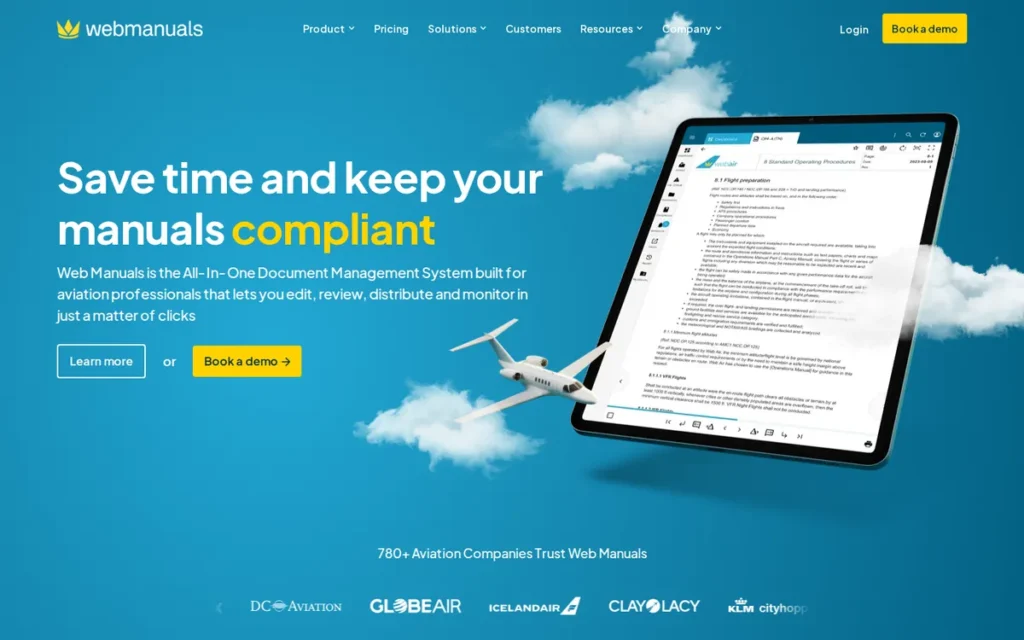
Category: Manual Authoring & Distribution Platform, writes, approves and distributes operator-owned manuals with acknowledgement tracking.
At a Glance
- Category: Manual Authoring & Distribution Platform
- Best For: Airlines, charter operators and small-to-mid operators that need regulator-grade authoring, approval and read-tracked distribution
- Price Range: From €4,000/year (Essentials: 2 editors, 5 readers) to €170/editor/month (Professional, billed annually); Compliance Library add-on from €60/month; Enterprise on request
- Primary Strength: Web Manuals pairs controlled authoring and read-tracked distribution with a Compliance Library (a paid add-on at entry level) that maps manual content to EASA, FAA, CASA and IOSA requirements.
- Biggest Limitation: Web Manuals has a learning curve for structured authoring, and individual reviewers report slow uploads and dependence on internet connectivity for updates.
- One-Line Summary: Web Manuals is an aviation-native manual platform that combines authoring, approval, role-based distribution, read tracking and regulatory mapping, with published tiered pricing.
- Last Verified: November 2026
Overview
Web Manuals is an aviation-specific platform that lets airlines, charter operators and small-to-mid operators write, approve, revise and distribute controlled manuals, with read tracking and offline reading.
Operators choose Web Manuals when they need regulator-grade manual control and audit-ready acknowledgement records. Web Manuals is a Swedish company based in Malmö, with five other international offices (Business Air News, 2026).
Key Features
- Web Manuals provides structured authoring with reusable “smart modules”, page-level approval and rejection, version control and change tracking.
- Web Manuals distributes approved revisions through role-based permissions, with reminders, reader reports and read-and-sign confirmation for each crew member and revision, according to the vendor (Web Manuals, 2026).
- Web Manuals’ Compliance Library maps manual content to individual EASA requirements and links to FAA, CASA and IOSA libraries, so editors can trace a rule change to the manual sections it affects.
- Web Manuals supports online and offline reading of distributed manuals, including offline EFB access, according to the vendor.
- Web Manuals’ airline offering describes importing OEM XML content into the review and approval workflow, according to the vendor.
Best For
Web Manuals is best for airlines, charter operators and growing small-to-mid operators that author their own operations and maintenance manuals and need audit-ready approval and acknowledgement records.
Strengths
- Web Manuals’ page-level approval workflow is corroborated by G2 reviewers, one of whom describes “full control of all documents and revisions”, and the product holds a G2 rating of 4.4/5 from 17 reviews (G2, 2026).
- Web Manuals reports more than 780 aviation customer companies (Web Manuals, 2026), and Business Air News separately reported more than 760 customers and partners (Business Air News, 2026). Vendors count customers differently, so these figures are not directly comparable.
- Web Manuals’ Icelandair deployment serves more than 1,600 users, and Icelandair has been a customer since 2014 (Web Manuals, 2026).
- Web Manuals is one of two vendors in this evaluation, with Leon Software, that publish list prices (Web Manuals, 2026).
- Web Manuals states that it holds ISO/IEC 27001:2022 certification following an A-LIGN audit in February 2024 (Web Manuals Trust Center, 2024). Buyers should request the certificate and its scope.
Limitations
Web Manuals trades onboarding speed for authoring depth. Reviewers note a learning curve for its structured, module-based authoring, and its entry tier limits how many people can read manuals.
- Web Manuals Essentials includes only 5 reader licences, and the Compliance Library is a paid add-on on that tier (Web Manuals, 2026).
- One Capterra reviewer of Web Manuals cites “constant reliance on the internet for updates” (Capterra, 2026), which buyers who need offline EFBs should test.
- G2 reviewers of Web Manuals report that comments attach to whole pages rather than selected text, that tracking whether change requests were resolved is weak, and that uploads and PDF publishing are slow (G2, 2026).
- G2 reviewers also report that Web Manuals lacks generic SAML single sign-on (G2, 2026).
- Web Manuals does not publish Enterprise pricing, no AMOS, TRAX or crew-system integration was independently verified, and its review samples are small (17 on G2, 1 on Capterra).
Verdict
Web Manuals is the strongest all-round choice in 2026 for operators that need to author, approve, distribute and prove acknowledgement of their own aviation manuals. Web Manuals leads because reviewers corroborate its revision controls and it publishes tiered pricing.
Buyers with poor connectivity should test offline update behaviour in a proof of concept. Enterprise airlines should request Enterprise pricing and integration references before committing.
2. Comply365: Best for Large Airlines Needing Enterprise-Wide Content Distribution
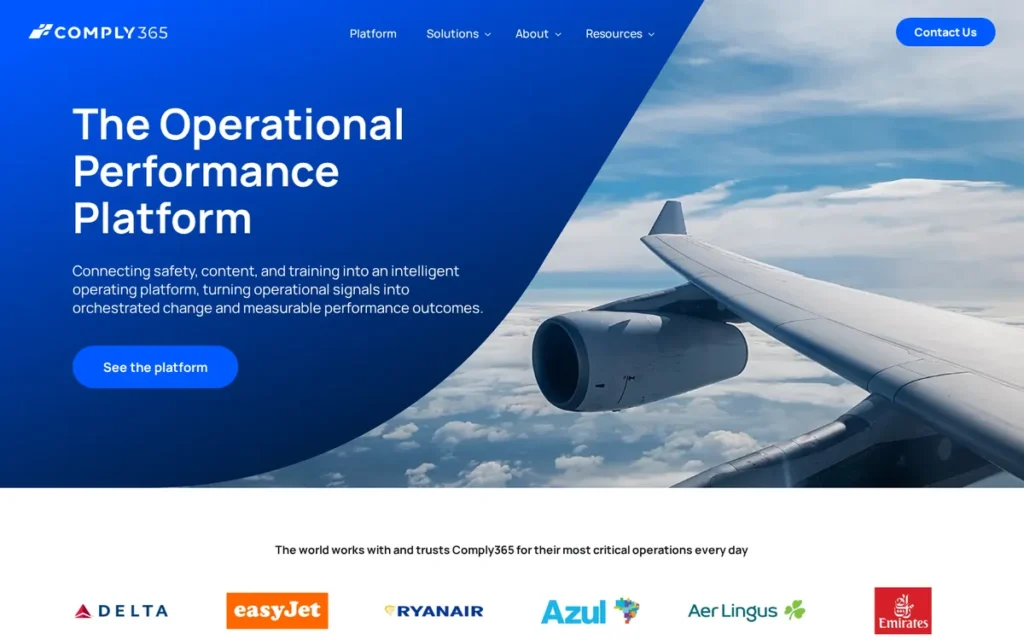
Category: Enterprise Operational Content Platform, authors, controls and distributes manuals at scale to EFBs and mobile devices across airline departments.
At a Glance
- Category: Enterprise Operational Content Platform
- Best For: Large airlines with big EFB populations that need one platform across flight operations and technical operations
- Price Range: Pricing on request; the only public figure is $325 for a ContentManager365 training course (Comply365, 2026)
- Primary Strength: Comply365 covers the full operational content lifecycle, from structured authoring, through distribution targeted by role, fleet and base, to read-and-acknowledge tracking.
- Biggest Limitation: Comply365 has no verified independent review ratings and no public licence pricing, so buyers must rely on references and quotes.
- One-Line Summary: Comply365 is an enterprise operational content platform for large airlines that combines structured authoring, targeted EFB distribution and acknowledgement tracking, and it now owns Vistair’s DocuNet.
- Last Verified: November 2026
Overview
Comply365 is an enterprise operational content platform that lets large airlines and multi-department operators author, control and distribute manuals to crews and staff, with targeted delivery and acknowledgement tracking. Comply365 combines ContentManager365, ProAuthor and DocuNet in one content lifecycle.
Ownership note: Comply365 and Vistair completed their merger on January 8, 2024 and unified under the Comply365 brand on June 4, 2024. Comply365 (#2) and DocuNet (#3) are therefore sold by the same company (Comply365, 2024).
Key Features
- Comply365 ContentManager365 controls and distributes operational content, targeted by role, fleet and base, according to the vendor.
- Comply365 ProAuthor provides structured authoring for operator manuals and feeds controlled publishing workflows.
- Comply365 says it tracks read-and-acknowledge status, so operators can record which staff received each revision.
- Comply365 says it supports offline mobile and EFB access with delta synchronization, so devices download only the content that changed.
- Comply365 includes DocuNet, which it gained through the 2024 Vistair merger, for airlines that already run or prefer the DocuNet viewer.
Best For
Comply365 is best for large airlines that want one vendor across flight operations and technical operations and can fund an enterprise implementation and structured-content migration.
Strengths
- Comply365 reported more than 140 airline, defense and rail customers in 2024, up from more than 120 at the January 2024 Vistair merger (Comply365, 2024). This count covers several sectors, not only airlines.
- Comply365 was selected by Qatar Airways for its combined ProAuthor and DocuNet next-generation solution (Comply365, date not stated), and it publishes a Frontier Airlines case study (Comply365, 2026).
- Comply365’s merger with Vistair was backed by growth investment from Insight Partners and Liberty Hall Capital Partners (Insight Partners, 2024).
- Comply365’s acquisitions of Qualtero (training, 2024) and Rolls-Royce’s SMS business (announced April 2025) extend the platform into training and safety management, a combination it is still integrating (Comply365, 2025).
Limitations
Comply365 trades breadth for transparency. PlugRoute could not verify a product rating on G2 or Capterra, and the company publishes no licence pricing.
- Comply365’s claims on targeting, offline use and integrations, including crew systems and AMOS/TRAX, come only from the vendor.
- Comply365 licence costs are likely to scale with users, fleets, modules, integrations and implementation scope, so buyers need an itemized quote.
- Comply365 enterprise implementations and structured-content migration are likely to take months.
- Comply365 buyers should get written commitments on the post-merger roadmap for DocuNet and ProAuthor.
- Comply365 SOC 2 or ISO 27001 evidence did not turn up in this research, so buyers should ask for it.
Verdict
Comply365 is the strongest fit in 2026 for large airlines that need one operational content platform across flight and technical operations. Comply365’s strongest evidence is its scale and named airline customers, but almost none of its capability claims are independently verified.
Buyers should ask for reference airlines with a matching fleet and EFB setup, written roadmap commitments and a full quote before committing.
3. DocuNet: Best for Mixed-Fleet Airlines Needing Aircraft-Specific EFB Delivery
Category: Enterprise Operational Content Platform, authors, controls and distributes manuals at scale to EFBs and mobile devices across airline departments.
At a Glance
- Category: Enterprise Operational Content Platform
- Best For: Mixed-fleet airlines that need OEM and operator manuals filtered by aircraft and audience on offline EFBs
- Price Range: From about £20,000 entry contract (Capterra listing, 2026); full pricing on request
- Primary Strength: DocuNet routes manuals by aircraft serial number and audience and shows revision status down to individual devices.
- Biggest Limitation: DocuNet has small, conflicting review samples, and one reviewer reports the app is inaccessible while updates download.
- One-Line Summary: DocuNet is an established airline document management system, owned by Comply365 since 2024, that delivers OEM and operator manuals filtered by aircraft and audience to offline EFBs on iOS, Windows and Android.
- Last Verified: November 2026
Overview
DocuNet is an airline document management system from Vistair, now owned by Comply365. It delivers OEM and operator manuals to offline EFBs, filtered by aircraft and audience, for mixed-fleet airlines with large crew populations. DocuNet runs on iOS, Windows and Android devices.
Ownership note: Comply365 and Vistair completed their merger on January 8, 2024 and unified under the Comply365 brand on June 4, 2024. Comply365 (#2) and DocuNet (#3) are therefore sold by the same company (Comply365, 2024).
Key Features
- DocuNet ingests OEM and structured content in many formats, including Boeing and Airbus manuals. The vendor claims ATA iSpec 2200 and S1000D support, which buyers should confirm.
- DocuNet distributes content to iOS, Windows, Android and integrated EFBs, and it supports offline viewing.
- DocuNet Viewer filters content by aircraft serial number (MSN) and audience, and it uses “Layers” to show only the manuals that apply (Apple App Store, 2026).
- DocuNet, used with CrewNet, assigns read-and-sign notices to custom crew groups and shows each user’s acknowledgement status, with a compliance prompt when the app opens (AircraftIT, 2026).
- DocuNet shows revision and update status down to individual devices, and it keeps users’ personal annotations when manuals are updated (Apple App Store, 2026).
Best For
DocuNet is best for established mixed-fleet airlines that need manuals delivered per aircraft (effectivity-specific) to offline EFBs on several device platforms. DocuNet also suits existing customers deciding whether to stay as the product moves under the Comply365 brand.
Strengths
- DocuNet was certified by Inmarsat in January 2019 as the first documentation-management application in its SB-S Certified Application Provider programme, when it served more than 30 airlines (Inmarsat, 2019).
- DocuNet’s Vueling deployment has run for more than five years and includes read-and-sign distribution to crew groups (AircraftIT, 2026).
- Vistair lists more than 40 airlines and more than 2,000 manuals under management. Its named customers include DHL, easyJet, British Airways, Aer Lingus, AirAsia, Delta and Qantas (Vistair, 2026).
- DocuNet holds a Capterra UK rating of 4.3/5 from 7 reviews, and reviewers call revision “easy and very efficient” and search “a dream” (Capterra UK, 2026).
Limitations
DocuNet trades a mature installed base for uncertain evidence on availability. One Capterra UK reviewer reports the app is inaccessible while updates download and calls that unacceptable in operations (Capterra UK, 2026).
- DocuNet scores 3.3/5 from 4 reviews on Capterra US but 4.3/5 on Capterra UK (Capterra, 2026), so the regional samples disagree.
- DocuNet Viewer’s App Store snapshots for the same 54 ratings conflict: one shows 4.8/5, and another shows 1.0/5 with a “Very buggy” review (Apple App Store, 2026).
- DocuNet’s Capterra reviewers also criticize slow support responses (Capterra, 2026).
- DocuNet implementations depend on the vendor, so buyers have few self-service configuration options.
- DocuNet’s £20,000 Capterra starting price is labelled “per user/year”, which is very likely a listing error. Content conversion, integrations and support cost extra.
- DocuNet buyers need written commitments on how long the product will be supported and how it fits with ProAuthor and ContentManager365.
Verdict
DocuNet is the strongest fit in 2026 for mixed-fleet airlines that need manuals routed by aircraft and audience to offline EFBs. It has the most detailed documented effectivity routing in this evaluation.
DocuNet’s airline installed base is strong, but its review evidence is thin and contradictory, so buyers should test whether the app stays available during updates. Because Comply365 owns DocuNet, buyers should treat the two as one vendor relationship, not as competing bids.
4. Veryon Publications: Best for MROs Needing Multi-OEM Technical Publications

Category: OEM Technical Publications Library, collects manufacturer and regulator maintenance publications under one subscription.
At a Glance
- Category: OEM Technical Publications Library
- Best For: MROs, CAMOs and maintenance departments with multi-OEM fleets that need one searchable source of current maintenance publications
- Price Range: Pricing on request (annual subscription priced by libraries and users)
- Primary Strength: Veryon Publications gives one subscription and one search across content from more than 100 OEMs and regulators, with offline mobile access.
- Biggest Limitation: Veryon Publications does not manage operator-authored manuals or crew read-and-sign, so most operators will also need a separate manual control tool.
- One-Line Summary: Veryon Publications is a multi-OEM technical publications library that gives maintenance teams one searchable, offline-capable source for AMMs, IPCs, service bulletins and airworthiness directives.
- Last Verified: November 2026
Overview
Veryon Publications is a subscription library for MROs, CAMOs and maintenance departments. It gives them one searchable, offline-capable source of maintenance manuals, parts catalogs, service bulletins and airworthiness directives from more than 100 OEMs and regulators.
Veryon Publications does not replace an operator-manual control system. Veryon was founded in 1973 as Aircraft Technical Publishers and has since acquired Flightdocs (2020) and Rusada (2023), which now operate as Veryon Tracking and Veryon Tracking+ (Veryon, 2026).
Key Features
- Veryon Publications provides one subscription and one search across content from more than 100 OEMs and regulators, covering airframes, engines, propellers and components.
- Veryon Publications includes an offline mobile app, so technicians can use publications without connectivity.
- Veryon Publications tracks airworthiness directives and service bulletins and produces compliance reports.
- Veryon Publications includes the AIRE AI assistant, which answers questions with links back to the source documents.
- Veryon Publications embeds manuals inside Veryon Tracking for maintenance teams that use Veryon’s tracking software.
Best For
Veryon Publications is best for MROs and maintenance departments with multi-OEM fleets that currently search several OEM portals. Veryon Publications works best alongside a separate tool for operator manuals and crew acknowledgement.
Users on r/aviationmaintenance shared their experience:
“As an inspector at a repair station and a part time 135 fleet DOM backup this type of thing would save me a lot of time. Logbook research is extremely tedious and mind numbing, it would be nice if I could use a simple search field to find something I am looking for. It would make those dreaded conformity checks much more manageable.” Posted by u/lynchs0323
Takeaway: Maintenance inspectors find manual research through aviation records tedious enough to slow conformity checks, which is the problem a single-search library like Veryon Publications is meant to solve.
Strengths
- Veryon Publications holds a Capterra rating of 4.5/5 from 22 reviews, the largest verified aviation-specific sample in this evaluation (Capterra, 2026).
- Veryon Publications’ Capterra sub-scores are 4.5 for ease of use, 4.4 for support, 4.4 for features and 4.3 for value (Capterra, 2026).
- Veryon Publications covers content from more than 100 OEMs and regulators, and Veryon reports that its customers represent 25% of the worldwide commercial fleet, a figure for the whole company (Veryon, 2026).
- Veryon Publications reviewers praise coverage of “almost all” of their fleet, automatic updates, and use online or offline (Capterra, 2026).
Limitations
Veryon Publications trades operator-manual control for OEM breadth, because it does not manage operator-authored manuals such as the OM or MOE.
- Veryon Publications does not document crew read-and-sign workflows, so most operators will need a second platform.
- Veryon Publications reviewers report gaps in OEM coverage, such as the De Havilland DHC-6 (Capterra, 2026), and no one has measured how quickly it reflects OEM revisions.
- Veryon Publications publishes no prices. Veryon acknowledges that the subscription may look pricier than individual OEM plans and argues that labour savings offset the difference (Veryon, 2026).
- Veryon Publications is called relatively costly for small operators by one Capterra reviewer (Capterra, 2026).
- Veryon Publications’ claim that documents are found “20× faster” than through multiple OEM portals comes from Veryon’s own white paper and is unverified (Veryon, 2026).
Verdict
Veryon Publications is the strongest fit in 2026 for maintenance teams that need one offline-capable source of multi-OEM technical publications, and it has the largest verified aviation-specific review sample (Capterra 4.5/5, 22 reviews).
Veryon Publications does not control operator manuals or crew acknowledgements. Buyers should confirm library coverage for every aircraft type in their fleet and budget for a separate operator-manual tool.
5. TrustFlight Centrik: Best for Document Control Inside an Aviation SMS/QMS Platform
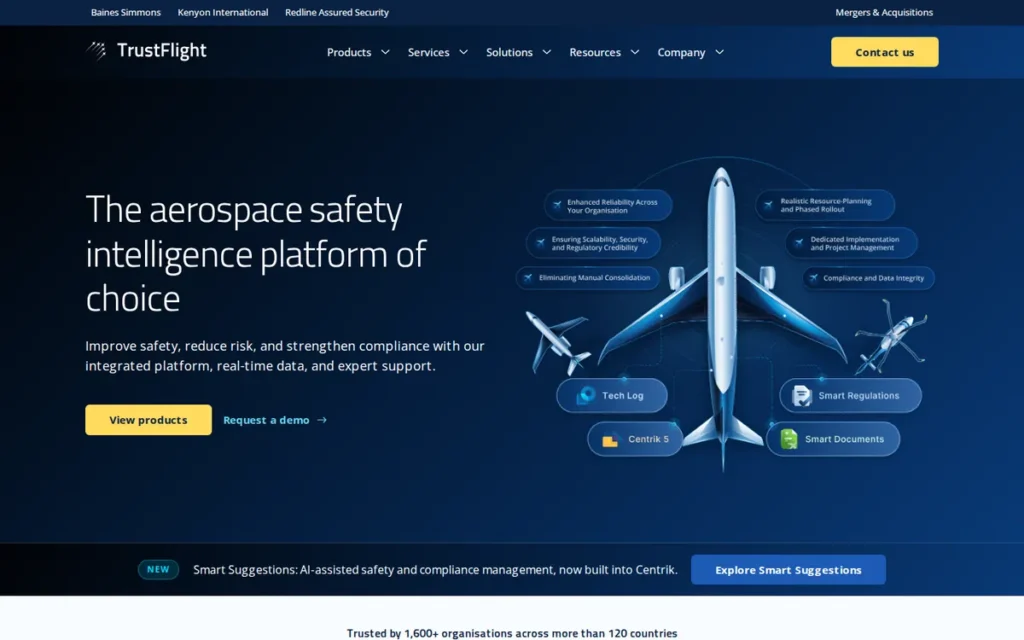
Category: Safety & Quality Suite with Document Control, manages controlled documents alongside SMS, QMS, audit and compliance records.
At a Glance
- Category: Safety & Quality Suite with Document Control
- Best For: Charter, business aviation and mid-size operators and MROs that want manuals, read-and-sign and SMS/QMS evidence in one platform
- Price Range: Annual fee by aircraft tails or MRO bays; unlimited users with no per-author or per-reader fees; amounts on request (TrustFlight, 2026)
- Primary Strength: TrustFlight Centrik connects controlled documents and read-and-sign records directly to SMS, QMS, audit and compliance monitoring workflows.
- Biggest Limitation: TrustFlight Centrik does not document offline sync behaviour or whether its mobile apps match the desktop, and its SmartDocs authoring module only launched in October 2025.
- One-Line Summary: TrustFlight Centrik is an aviation safety and quality platform that puts regulation-grounded manual authoring, read-and-sign distribution and SMS/QMS evidence in one system, priced per tail with unlimited users.
- Last Verified: November 2026
Overview
TrustFlight Centrik is an aviation safety and quality management platform for operators and MROs that want manual authoring, read-and-sign distribution and SMS/QMS evidence in one system.
TrustFlight Centrik pairs the SMS, QMS, audit and compliance tools in Centrik 5 with SmartDocs for authoring and Centrik Documents for distribution. TrustFlight was founded in 2017 and is led by CEO Karl Steeves (TrustFlight, 2026).
Key Features
- TrustFlight Centrik SmartDocs, launched October 14, 2025, provides AI-assisted authoring, review and approval of technical manuals, which TrustFlight describes as “grounded in regulations”.
- TrustFlight Centrik publishes approved manuals into Centrik Documents for controlled distribution and read-and-sign tracking.
- TrustFlight Centrik 5 combines SMS, QMS, compliance monitoring, risk, audits and training, mapped to ICAO, EASA, UK CAA, FAA Part 5 and Transport Canada frameworks.
- TrustFlight Centrik works alongside TrustFlight Tech Log for electronic technical records.
- TrustFlight Centrik includes SSO, AI and advanced features in its licence, which is priced by tail or bay.
Best For
TrustFlight Centrik is best for charter, business aviation and mid-size operators or MROs whose quality and safety teams want manual revisions linked to audits and SMS records. TrustFlight Centrik’s pricing particularly suits operators with many read-only crew users.
Strengths
- TrustFlight Centrik’s parent company reported more than 200,000 active users across 450+ customers at the SmartDocs launch (TrustFlight, 2025). A separate figure of more than 1,600 organizations in 120 countries uses a different scope.
- TrustFlight Centrik 5 maps its SMS and QMS modules to five regulatory frameworks, the broadest regulatory mapping in this evaluation (TrustFlight, 2026). Mapping is not the same as regulator approval.
- TrustFlight Centrik charges no per-author or per-reader fees, so licence costs do not grow with crew size the way per-user pricing does (TrustFlight, 2026). Buyers should still check contracts for limits on modules, storage or external users.
- TrustFlight Centrik lists customers including Luxaviation, Dassault Falcon Service, Airshare and London’s Air Ambulance Charity (Aero-NextGen, 2026). Which modules each customer uses is unconfirmed.
Limitations
TrustFlight Centrik trades a broad ecosystem for unproven offline delivery. It does not document offline sync behaviour or whether its mobile apps match the desktop, which matters for crews on EFBs with poor connectivity.
- TrustFlight Centrik SmartDocs launched on October 14, 2025 and has a limited track record (TrustFlight, 2025).
- TrustFlight Centrik’s AI-drafted controlled content needs strict human approval governance before publication.
- TrustFlight Centrik’s G2 figure of 4.4/5 from 17 reviews comes from a secondary alternatives page, and PlugRoute could not confirm it on the product page (G2, 2026).
- TrustFlight Centrik’s broad platform scope may lengthen implementation.
Verdict
TrustFlight Centrik is the strongest fit in 2026 for operators that want controlled manuals and read-and-sign records in the same system as their SMS and QMS evidence. TrustFlight Centrik’s per-tail pricing with unlimited users is a real advantage for large crews.
Buyers should ask for a live demonstration of offline EFB behaviour and SmartDocs approval governance before signing.
6. Ideagen Q-Pulse: Best for Quality Teams Needing Audit-Grade Document Governance

Category: Safety & Quality Suite with Document Control, manages controlled documents alongside SMS, QMS, audit and compliance records.
At a Glance
- Category: Safety & Quality Suite with Document Control
- Best For: MROs, CAMOs and quality departments that need audit-grade proof of document awareness linked to corrective actions and training
- Price Range: Pricing on request
- Primary Strength: Ideagen Q-Pulse records who was made aware of which document revision and links that record to audits, corrective actions and training.
- Biggest Limitation: Ideagen Q-Pulse is not an aviation-native manual authoring or EFB distribution tool, and there is no evidence it works well offline on mobile devices.
- One-Line Summary: Ideagen Q-Pulse is an enterprise quality management system whose document control and awareness acknowledgements give aviation MROs and quality teams audit-grade revision evidence, paired with the Coruson aviation SMS.
- Last Verified: November 2026
Overview
Ideagen Q-Pulse is an enterprise quality management system that lets MROs, CAMOs and aviation quality teams control documents from creation to withdrawal and record staff awareness acknowledgements linked to audits.
Ideagen Q-Pulse is often paired with Ideagen Coruson, the company’s aviation safety management system. Ideagen was founded in 1993, and Hg took it private in July 2022 (TheBusinessDesk, 2022).
Key Features
- Ideagen Q-Pulse controls the document lifecycle, from creation and approval through revision, distribution and withdrawal of superseded versions.
- Ideagen Q-Pulse records “awareness” acknowledgements that show which staff were told about which revision, and when.
- Ideagen Q-Pulse links controlled documents to audits, corrective actions, training records and asset records.
- Ideagen Coruson adds aviation occurrence reporting, investigations, risk and safety assurance alongside Ideagen Q-Pulse.
- Ideagen PleaseReview supports collaborative review of documents before they go through approval in Ideagen Q-Pulse.
Best For
Ideagen Q-Pulse is best for MROs, CAMOs and quality departments whose main need is proving document awareness to auditors. Ideagen Q-Pulse fits buyers who already run Ideagen software and do not need manual delivery optimized for EFBs.
Strengths
- Ideagen Quality Management holds a Capterra rating of 4.5/5 from 178 reviews, the largest sample in this evaluation, although it covers all industries (Capterra, 2026).
- Ideagen Q-Pulse’s Capterra rating applies to the Ideagen Quality Management listing, which PlugRoute treats as covering Q-Pulse. Buyers should confirm the product mapping.
- Ideagen Coruson was deployed across HAECO Group’s global subsidiaries to standardize safety reporting (Ideagen, 2026).
- Ideagen Q-Pulse reviewers praise its document control, its approval workflows and how it keeps current revisions available (Capterra, 2026).
- Ideagen’s take-private by Hg completed in July 2022 in a deal reported at about £1.1bn, which indicates the company’s financial scale (TheBusinessDesk, 2022).
This aligns with community sentiment on r/sysadmin:
“Gael (now IdeaGen apparently) QPulse. It’s what we use for document control since it incorporates auditing and version controls. It also integrates with Active Directory (if you have it) and has some other cool features (mobile apps and such).” Posted by u/_nobodyspecial_
Takeaway: Ideagen Q-Pulse users choose it for document control because auditing and version control live in the same system, which is the audit-evidence strength this ranking credits it with.
Limitations
Ideagen Q-Pulse trades aviation-specific delivery for generic QMS governance. It is not designed for manual authoring or EFB distribution, and its offline mobile use is unproven.
- Ideagen Q-Pulse G2 reviewers report lag, audit data lost after long sessions, slow support and infrequent updates (G2, 2026).
- Ideagen Coruson reviewers report page loads of up to two minutes after user numbers grew, labour-intensive setup, and weak user sync and API (G2, 2026).
- Ideagen Q-Pulse Capterra reviewers say support and communication have declined and that customers have less control under the SaaS model (Capterra, 2026).
- Ideagen Q-Pulse publishes no pricing, and reviewers call it “not budget friendly”, citing costly renewals, high hosting and support costs, and price increases (Capterra, 2026; G2, 2026).
- Ideagen Q-Pulse drew a comment from one aviation reviewer that it has no proper place for safety-impact risk assessments that meet aviation regulations.
Users on r/sysadmin noted:
“Been using Q-Pulse as QMS for a long time, but now they are forcing our hand with a yearly price 5x what we have been paying to switch from our on-prem solution to their SaaS solution or be unsupported.
Being in the cloud isn’t the deal breaker just slightly annoying as where we are located internet is fast but unreliable at times.” Posted by u/Causlaux
Takeaway: Long-time Ideagen Q-Pulse customers report that the forced move from on-premise to SaaS multiplied renewal costs and made access depend on internet connections that are not always reliable.
Verdict
Ideagen Q-Pulse is the strongest fit in 2026 for MRO and quality teams whose priority is audit-grade proof of document awareness linked to corrective actions and training.
Ideagen Q-Pulse is not a frontline tool for distributing manuals to pilots on EFBs. Buyers should test performance at their real user counts and negotiate renewal terms up front.
7. Leon Software: Best for Small Charter Operators Wanting an All-in-One Ops Suite

Category: Flight Operations Suite with Document Module, runs scheduling, crew and operations, with basic aircraft and flight document storage included.
At a Glance
- Category: Flight Operations Suite with Document Module
- Best For: Small charter, Part 135 and business aviation operators that need flight operations software first and basic document storage second
- Price Range: €99 (Basic) to €929 (Pro, by MTOW) per active aircraft/month, with unlimited users and stations (published)
- Primary Strength: Leon Software bundles document storage into a flight operations suite with fully published pricing, covering scheduling, crew, FTL, OPS and maintenance.
- Biggest Limitation: Leon Software’s own documentation states that manuals and attachments do not work offline in the crew app.
- One-Line Summary: Leon Software is a cloud flight operations suite for charter and business aviation that includes basic document management from €99 per active aircraft per month, but it offers no offline manuals and no documented sign-off on each revision.
- Last Verified: November 2026
Overview
Leon Software is a cloud flight operations suite for small charter, Part 135 and business aviation operators. It covers scheduling, sales, crew, OPS, maintenance and a crew mobile app, and it has basic document management built in.
Leon Software is not a dedicated controlled-manual system, which is the main reason it ranks last here. Leon Software was founded in Warsaw in 2006 by pilots and dispatchers (Leon Software, 2026).
Key Features
- Leon Software stores aircraft and flight documents in the same platform used for scheduling, sales, crew and operations.
- Leon Software’s Basic tier includes a crew mobile app, a flight time limitations (FTL) engine, checklists and API access.
- Leon Software’s crew app works offline for duties, FTL and checklists, and it uploads Journey Log data after the flight (Leon Software, 2026).
- Leon Software includes maintenance and reporting modules alongside its operations tools.
- Leon Software publishes per-active-aircraft pricing that rises with maximum take-off weight.
Best For
Leon Software is best for small charter and business aviation operators that already buy flight operations software and want basic document storage without a second vendor. Leon Software is not suitable as the system of record for regulator-grade controlled manuals.
Strengths
- Leon Software has the lowest published entry price for a single aircraft, at €99 per active aircraft/month, although total cost rises with fleet size (Leon Software, 2026).
- Leon Software includes unlimited users and stations and bills only for aircraft marked active in a given month (Leon Software, 2026).
- Leon Software publishes Pro tiers of €350 (under 50,000 lb MTOW), €535 (50,000–110,000 lb) and €929 (over 110,000 lb) per active aircraft/month (Leon Software, 2026).
- Leon Software reports use by “hundreds of aviation companies”, and its About page shows a counter of 3,024 aircraft that is not labelled as active (Leon Software, 2026).
- Leon Software combines documents with crew, FTL, OPS and maintenance workflows, which means fewer vendors for small operators (Leon Software, 2026).
Limitations
Leon Software trades dedicated manual control for all-in-one convenience. Its own wiki says attachments and manuals are not available offline in the crew app (Leon Software wiki, 2026).
- Leon Software’s documentation describes no formal revision approval workflow and no read-and-understood sign-off for each revision.
- Leon Software has a single Capterra review and no verified G2 presence, so there is almost no independent evidence of how its document module performs.
- Leon Software’s per-active-aircraft pricing means document storage costs grow with fleet size, even for operators that only need manuals.
- Leon Software’s Capterra price of “PLN 200/user/month” does not match the official pricing model (Capterra, 2026).
Verdict
Leon Software is the strongest fit in 2026 for small charter operators that need flight operations software with basic document storage, but it is not a regulator-grade manual distribution system.
Leon Software lacks offline manuals and documented sign-off on each revision, and it ranks last for this category, not for flight operations software in general. Operators with audit or offline EFB requirements should pair Leon Software with a dedicated manual platform.
What About Jeppesen, NAVBLUE, Boeing Toolbox, and Other Tools?
PlugRoute left out several tools that AI answer engines mention. Some serve adjacent categories, such as navigation data, OEM-specific libraries or aircraft records. Others could not be verified to this article’s evidence standard during the November 2026 research cycle. PlugRoute makes no claims about their capabilities here.
- Jeppesen Distribution Manager Pro and NAVBLUE Mission+ DOC Manager: PlugRoute treats these tools as EFB navigation-data distribution tools, an adjacent category.
- Flydocs: PlugRoute treats Flydocs as an aircraft records tool, an adjacent category.
- Boeing Toolbox Library: PlugRoute treats Boeing Toolbox Library as an OEM-specific maintenance library and could not verify it to this standard.
- LHIND Volabase, eDocs-Aero, Awery Documents Library and Flatirons Solutions: PlugRoute could not verify these tools to the same standard, and they are candidates for the next refresh.
What Red Flags Should I Watch For When Evaluating Aviation Document Distribution Software?
The biggest red flags in aviation document distribution software are offline modes that cannot record acknowledgements, apps that lock users out during updates, regulatory mapping marketed as approval, and unverified AMOS or TRAX integration claims. Per-reader pricing and unclear roadmaps after a merger also need scrutiny. Each red flag below is a test you can run in vendor demos.
Red Flag #1: Offline Means Read-Only, Not Sign-Offline
Offline reading is not offline compliance. A manual a pilot can open at 35,000 feet is not audit evidence until the acknowledgement reaches the server. As of November 2026, PlugRoute found no public documentation from any of the seven vendors on how offline acknowledgements are queued and synced.
Users on r/flying shared their experience:
“I’ll admit to sometimes flying cross-country without paper charts to cover the entire route, but when I do that, I carry two iPads (with pre-fetched data for the entire route on each) and have my eye on a road or something else to follow. I still like to carry a paper TAC as a backup whenever I’m near a congested area, and I keep an A/FD in the airplane too.” Posted by u/warpflyght
Takeaway: Pilots already treat pre-loaded data and backup devices as standard practice, so an EFB document platform has to have every needed manual on the device before connectivity drops.
Consider a first officer at an outstation with no Wi-Fi who opens revision 14 of the Operations Manual and taps “acknowledge”. If the app does not queue and timestamp that tap, the audit record still shows the first officer as outstanding, even though they flew with the current revision.
Red Flag #2: App Unavailable During Updates
An app that cannot be used while revisions download is an operational risk, because crews may need a manual at exactly that moment. One DocuNet reviewer reported this problem (Capterra UK, 2026). Buyers should test update behaviour on their own devices, with large revisions and weak connections.
Red Flag #3: Regulatory Mapping Sold as Approval
A vendor that maps content to regulations has not had its tool approved by the FAA or EASA, and operators remain responsible for their own manuals. Buyers should treat mapping to ICAO, EASA, FAA Part 5 or IOSA as a helpful drafting aid, not as proof of compliance.
Red Flag #4: Unverified AMOS/TRAX Integration Claims
PlugRoute found no independent verification of any vendor’s AMOS or TRAX integration in November 2026. A slide of integration logos is not evidence. Buyers should ask for a live demonstration against their own maintenance or crew system, or against a reference customer’s system running the same version.
Red Flag #5: Per-Reader Pricing That Scales With Crew Size
In aviation document distribution, the pricing model usually matters more than the list price. Per-editor, per-tail and per-reader pricing can produce very different bills for the same operator. Per-reader licensing multiplies costs for operators with hundreds of read-only pilots and technicians.
Consider a 10-aircraft charter operator with 3 manual editors and 60 pilots:
- Under per-tail pricing (TrustFlight Centrik), hiring a 61st pilot adds no licence cost.
- Under per-reader licensing, every new hire adds licence cost.
- Under per-active-aircraft pricing (Leon Software), cost tracks the fleet, not the crew.
Model each structure against your real headcount and fleet plan before you compare list prices.
Red Flag #6: Post-Merger Roadmap Ambiguity
A product owned by a company that sells overlapping products may be merged, frozen or retired. The January 2024 Comply365–Vistair merger, which put DocuNet and ProAuthor under one owner, is the clearest example in this category. Buyers should get written commitments on how long the product will be supported and how it fits with the rest of the range.
As one user on r/aviationmaintenance described:
“Logbooks are critically important legal documents and having an untested new company manage them is a big risk, especially if the goal is to eliminate paper documents. What if your business fails? Then I’m in limbo trying to get hard copies of all entries after X date, and make sure my logbooks are correct.” Posted by u/DT62
Takeaway: Aviation maintenance professionals see vendor continuity as a compliance risk, so buyers of any document distribution platform should secure data-export and long-term support commitments before moving controlled records onto it.
What Questions Should I Ask Before Choosing Aviation Document Distribution Software?
Before choosing aviation document distribution software, ask each vendor to demonstrate five things live: routing by fleet, role and MSN; capture of offline acknowledgements; blocking of superseded revisions; an audit-trail export a regulator would accept; and integration with your own systems. Also ask for itemized first-year and renewal costs, matching reference operators and current security certification evidence.
Question #1: Can you route a revision only to the affected fleet, role, and MSN?
A strong answer is a live demo in which one revision reaches only the targeted users and aircraft. If administrators have to build distribution lists by hand, expect routing errors across mixed fleets, especially where modified aircraft need different pages from unmodified aircraft of the same type.
“The manual supplements associated with these mods would replace the OEM manual sections in effectivity but in many cases the OEM manual will retain the pre-mod information which can be a major headache for 3rd party heavy maintenance.” (u/wraithbf109, r/aviationmaintenance, 2023)
Takeaway: Effectivity routing matters because modified aircraft need different pages from unmodified aircraft of the same type, so ask vendors how they handle STC supplements.
Question #2: What happens when a crew member acknowledges a revision offline?
Look for a documented process in which the acknowledgement is stored on the device, timestamped and synced when the device reconnects. A vague answer means the audit record may have gaps. PlugRoute found no public documentation of this behaviour from any vendor in this evaluation (November 2026).
Question #3: How do you block a superseded revision on a device that hasn’t synced?
A strong answer explains how the system flags or restricts outdated content and how administrators can see which devices are out of date. Ask for evidence like the device-level revision status DocuNet documents, because operators must be able to show that no one is working from superseded content.
Question #4: Can you export a complete acknowledgement audit trail for a regulator?
Ask for a sample export that shows each person, revision, timestamp and approval chain in a format a regulator would accept. If the vendor can only show the trail inside its own interface, preparing for an IOSA audit or a regulator inspection takes more manual work and leaves more room for error.
Question #5: Can you demonstrate a live integration with our AMOS, TRAX, or crew system?
Ask for a working connection to your own AMOS, TRAX or crew system, or to a reference customer’s system running the same version. Brochure claims are not enough, because PlugRoute could not independently verify any integration in this category in November 2026, and integration gaps are expensive to fix after go-live.
Question #6: What are the total first-year and renewal costs, including migration and training?
Ask for an itemized quote that covers licences, content conversion, integrations, training and renewal increases. Plan for a project that takes months, not weeks. Condor’s document digitization ran from November 2023 to a target go-live in October 2024 (AircraftIT, 2024).
Question #7: Which reference operators run a fleet and EFB setup like ours?
Ask for at least two references with a similar fleet mix, EFB hardware and regulator. One operator that has already solved your specific problem matters more than a total customer count, because vendors count customers differently and totals that mix sectors can overstate aviation experience.
Question #8: Can you provide current ISO 27001 or SOC 2 evidence and its scope?
Ask for the certificate, the issuing body and which products and hosting environments it covers. PlugRoute found one vendor-stated ISO/IEC 27001:2022 certification, from Web Manuals after an A-LIGN audit in February 2024 (Web Manuals Trust Center, 2024). It found no verified SOC 2 evidence for any of the seven vendors.
Six-step proof-of-concept test:
- Publish a test revision in the vendor’s system.
- Route the revision only to the affected fleet and role.
- Sync the revision to an EFB that is offline.
- Capture an acknowledgement, including one made offline.
- Confirm that the superseded version is blocked or flagged.
- Export the audit evidence in a format a regulator would accept.
How Did We Rank These Aviation Document Distribution Platforms?
PlugRoute scored every platform on six criteria using one 1–5 rubric. Revision control and acknowledgement proof counts for 25%, and offline EFB delivery with routing by role and effectivity counts for 25%. Review evidence, deployment scale, pricing transparency and ecosystem breadth count for 12.5% each. Ties go to the higher average on the two primary criteria.
Ranking criteria:
- C1 Revision Control & Acknowledgement Proof (25%): This criterion matters because auditors expect master revision status, approval chains and proof that each person read each revision.
- C2 Offline EFB Delivery & Role/Effectivity Routing (25%): This criterion matters because crews often lack connectivity and each role and aircraft needs the correct manuals.
- C3 Independent Review Evidence (12.5%): This criterion matters because third-party ratings with sample sizes are the only outside check on vendor claims.
- C4 Documented Deployment Scale & Named Customers (12.5%): This criterion matters because buyers need reference operators at a similar scale.
- C5 Pricing Transparency & Cost-Model Fit (12.5%): This criterion matters because the pricing model changes total cost a great deal for large read-only crews.
- C6 Ecosystem & Integration Breadth (12.5%): This criterion matters because document control must connect to SMS, QMS, training and maintenance systems.
General scoring rubric:
- A score of 5 means the vendor documents the capability and independent reviews or third-party sources back it up.
- A score of 4 means only the vendor documents the capability.
- A score of 3 means the capability is partly documented or limited in scope.
- A score of 2 means the capability is not documented or cannot be verified.
- A score of 1 means the capability is documented as absent, or public evidence contradicts the claim.
C3 review-evidence bands:
- A C3 score of 5 means 20 or more verified aviation-specific reviews.
- A C3 score of 4 means 10 to 19 verified reviews.
- A C3 score of 3 means a large sample that is not aviation-specific, or mixed aviation reviews.
- A C3 score of 2 means small or conflicting samples, or a figure PlugRoute could not trace.
- A C3 score of 1 means no verified rating.
C5 pricing-transparency bands:
- A C5 score of 5 means full tiered prices are published.
- A C5 score of 3 means a complete pricing model with inclusion terms is published, without amounts.
- A C5 score of 2 means only the pricing basis or a third-party listing figure is available.
- A C5 score of 1 means nothing is published.
Missing-evidence rule: For C3 and C5, “no public evidence” scores 1, because those criteria measure the public evidence itself. PlugRoute applied this rule the same way to every vendor. Untraceable ratings, such as a G2 4.7/5 cited for Comply365 and a G2 4.4/5 cited for TrustFlight Centrik, were treated as unverified.
| Rank | Product | C1 | C2 | C3 | C4 | C5 | C6 | Final Score |
|---|---|---|---|---|---|---|---|---|
| 1 | Web Manuals | 5 | 4 | 4 | 4 | 5 | 3 | 4.25 |
| 2 | Comply365 | 4 | 4 | 1 | 5 | 1 | 4 | 3.38 |
| 3 | DocuNet | 4 | 4 | 2 | 4 | 2 | 2 | 3.25 |
| 4 | Veryon Publications | 2 | 4 | 5 | 4 | 2 | 3 | 3.25 |
| 5 | TrustFlight Centrik | 4 | 2 | 2 | 3 | 3 | 5 | 3.13 |
| 6 | Ideagen Q-Pulse | 4 | 2 | 3 | 3 | 1 | 4 | 2.88 |
| 7 | Leon Software | 2 | 1 | 1 | 2 | 5 | 3 | 2.13 |
DocuNet and Veryon Publications tie at 3.25. DocuNet ranks higher because its average across C1 and C2 is 4.0, against 3.0 for Veryon Publications.
Score rationales and sensitivity checks:
- If Web Manuals’ C1 were scored 4 (vendor-only evidence), its total would be 4.00, still 0.62 ahead of Comply365.
- If DocuNet’s C1 fell to 3, DocuNet would drop from #3 to #5, which is why its AircraftIT read-and-sign evidence is cited in full.
- Veryon Publications scores 4 rather than 5 on C2 because reviews corroborate its offline access but it does not document routing by role or MSN.
- Veryon Publications scores 2 on C5 because Veryon publishes only its pricing basis, while TrustFlight Centrik scores 3 because it also publishes inclusion terms.
- Comply365 scores 5 on C4 because third-party coverage corroborates its named-airline selections (Insight Partners, 2024). Web Manuals scores 4 because its named deployments are vendor-published, although Business Air News corroborates its customer count.
- Ideagen Q-Pulse scores 3 on C3 because its large sample spans all industries and its six aviation-specific G2 reviews are mixed.
Regulatory basis for the criteria:
- FAA Advisory Circular 120-76E (June 2024), which replaced AC 120-76D, sets guidance the FAA accepts for EFB authorization under Parts 91K, 121, 125 and 135, including data integrity, accessibility and reliability.
- EASA AMC 20-25 covers EFB use in EASA jurisdictions.
- FAA Part 5 and ICAO Annex 19 set expectations for safety management systems.
- IATA IOSA and ISSA include document control requirements.
PlugRoute has no affiliate relationships with any company listed. Rankings are determined entirely by research data and objective evaluation criteria.
Where a source did not state a publication date, the year shown is the year PlugRoute accessed it. PlugRoute re-checked all pricing pages, review counts and the status of FAA AC 120-76E in November 2026 before publication. The data snapshot is dated November 2026.
What Are the Most Common Questions About Aviation Document Distribution Software?
Small operators that need regulator-grade manual control should start with Web Manuals, which starts at €4,000/year. Charter operators already buying flight operations software can consider Leon Software, from €99 per active aircraft/month. Most implementations take months, and PlugRoute ranks products on a published, weighted six-criterion rubric.
What is the best aviation document distribution software for small operators?
Web Manuals is the strongest option for small operators that need regulator-grade manual control. Its Essentials tier starts at €4,000/year with 2 editors and 5 readers (verified November 2026). Leon Software suits charter operators already buying flight operations software, from €99 per active aircraft/month, but its manuals do not work offline.
How long does it take to implement aviation document distribution software?
Most aviation document distribution projects take months, not weeks. Condor’s document digitization ran from November 2023 to a target go-live in October 2024 (AircraftIT, 2024). Content conversion, mixed fleets and integrations all lengthen timelines, so ask each vendor for a dated implementation plan and a reference operator with similar scope.
How does PlugRoute determine its rankings?
PlugRoute scores every product on six criteria with one published 1–5 rubric. Revision control and offline delivery carry 25% each. Review evidence, deployment scale, pricing transparency and ecosystem breadth carry 12.5% each. Missing public evidence is scored by a published rule, and every entry shows its Last Verified date.
What Do Key Aviation Document Distribution Terms Mean?
Buyers of aviation document distribution software meet the same terms again and again. They cover devices, revision control, content standards, regulatory frameworks and pricing models. The definitions below explain each term in plain language and why it matters, so buyers can ask sharper questions in vendor demos and read proposals accurately.
Electronic Flight Bag (EFB): An electronic flight bag is a tablet or installed device that replaces paper manuals, charts and documents in the cockpit. EFBs matter because regulators expect EFB content to be as accessible and reliable as paper.
Delta Update: A delta update downloads only the content that changed in a revision, not the whole manual. Delta updates matter because crews with limited connectivity need fast, small updates.
Read-and-Sign (Acknowledgement): Read-and-sign is a recorded confirmation that a person received and read a specific revision. Read-and-sign records matter because auditors ask operators to prove that each crew member acknowledged each change.
Master Revision Status: Master revision status is the authoritative record of which revision of each manual is currently in effect. Master revision status matters because operators must be able to show that devices and users are not working from superseded content.
Effectivity: Effectivity is the set of aircraft, configurations or serial numbers that a piece of manual content applies to. Effectivity matters because each aircraft’s crew in a mixed fleet should see only the content that applies to that aircraft.
MSN (Manufacturer Serial Number): The manufacturer serial number uniquely identifies an individual aircraft. MSN routing matters because routing content by serial number is the most precise way to match content to effectivity.
ATA iSpec 2200: ATA iSpec 2200 is an industry standard for structuring and exchanging aircraft maintenance and technical data. ATA iSpec 2200 support matters because a platform that supports it can take in OEM content without manual conversion.
S1000D: S1000D is an international specification for producing and managing modular technical publications. S1000D support matters to operators and OEMs that exchange structured, reusable content.
SMS (Safety Management System): A safety management system is a formal framework for identifying hazards, managing risk and assuring safety, required under ICAO Annex 19 and FAA Part 5. SMS links matter because document revisions often result from safety findings.
QMS (Quality Management System): A quality management system governs audits, corrective actions and controlled records. QMS links matter because tying document control to quality records makes audit evidence easier to produce.
CAMO (Continuing Airworthiness Management Organisation): A CAMO is an approved organisation responsible for keeping aircraft airworthy. CAMO needs matter because CAMOs rely heavily on current maintenance publications and airworthiness directives.
Per-Tail Pricing: Per-tail pricing charges by the number of aircraft, not by the number of users. Per-tail pricing matters because operators with large read-only crews can avoid costs that grow with every reader.
Which Aviation Document Distribution Tool Is Right for You?
Key Insights
The right aviation document distribution tool depends on the job. Web Manuals leads for operator manuals, Comply365 and DocuNet (one owner) suit large airlines, and Veryon Publications covers OEM maintenance publications. TrustFlight Centrik or Ideagen Q-Pulse fit governance led by safety and quality teams. Every buyer should test offline acknowledgement and integrations live.
- Web Manuals leads the 2026 ranking at 4.25/5 because reviewers corroborate its revision control and it publishes tiered pricing.
- Comply365 and DocuNet have had one owner since January 2024, so buyers should evaluate them as one vendor relationship.
- Veryon Publications handles OEM maintenance publications but not operator manuals or crew read-and-sign.
- Offline acknowledgement queuing should be tested in every proof of concept, because PlugRoute found no public documentation or independent proof of it for any vendor in November 2026.
- Integration claims for AMOS, TRAX and crew systems need a live demonstration, because none was independently verified in November 2026.
- The pricing model, whether per editor, per tail, per active aircraft or per library, often changes total cost more than list prices do.
If you author your own manuals and need audit-ready acknowledgement records, start with Web Manuals. If you run a large airline with a big EFB fleet, shortlist Comply365 and DocuNet together. If safety and quality evidence drives your decision, compare TrustFlight Centrik and Ideagen Q-Pulse.
Consolidation is reshaping this category as document distribution merges into wider safety, compliance and maintenance platforms. Read PlugRoute’s full scoring methodology and download PlugRoute’s proof-of-concept test checklist before your next vendor demo.
We update this guide quarterly and after any acquisition announcement. Last updated: November 12, 2026.