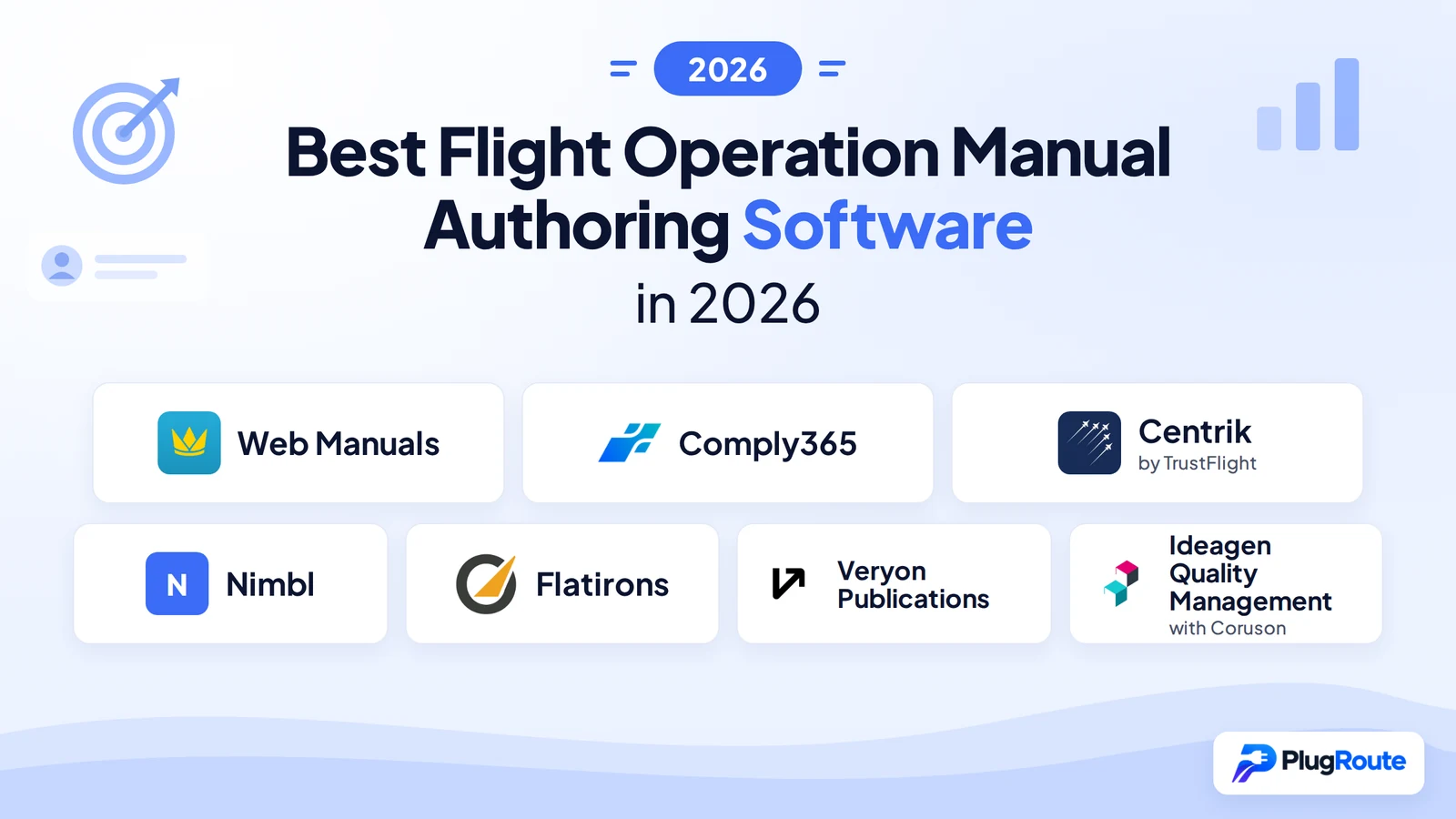
Web Manuals scored highest (42/45) in PlugRoute’s 2026 evaluation for operators that write flight operations manuals in-house. Comply365 leads for large multi-AOC airlines with mixed OEM fleets, and Centrik leads for tying manuals to SMS and audits. Small Part 135 operators without writers should weigh Nimbl’s managed service, and independent evidence is thin category-wide.
Revising manuals in Word or PDF is slow and error-prone, and it leaves no clear audit trail from draft to approval. Operators must also keep content mapped to changing FAA or EASA rules. They also have to prove that each crew member received a specific revision, including on offline EFBs.
As one user on r/aviationmaintenance described:
“Where I work we use both, so we get to make double mistakes. You made a mistake on paper? Well congratulations, you get to make it again.” Posted by u/Goodiegoodie15
Takeaway: Aviation teams running paper and electronic documentation side by side get the errors of both, which is the strongest argument for one controlled digital system of record.
PlugRoute has no affiliate relationships with any company listed. Rankings are determined entirely by research data and objective evaluation criteria.
This guide compares all seven platforms against the same six criteria. It shows each vendor’s documented gaps and ends with a single-revision proof-of-concept test you can run with every finalist.
What Are the 5 Categories of Flight Operations Manual Software?
Flight operations manual software falls into five categories, and each category handles the manual lifecycle differently. The categories describe trade-offs, not a hierarchy. The right one depends on staffing, fleet complexity and how closely manuals must connect to a safety management system (SMS).
- Authoring Platform: An Authoring Platform is self-service software in which the operator’s own staff write, revise, approve and publish controlled manuals, and Web Manuals is the Authoring Platform in this ranking.
- Structured Content Platform: A Structured Content Platform, also called a component content management system (CCMS), manages structured (XML) manual and OEM content across fleets, departments and AOCs. Comply365 and Flatirons are the two in this ranking.
- Safety-and-Quality Suite: A Safety-and-Quality Suite is an SMS, compliance or quality management system (QMS) platform in which document control is one module among several. Centrik and Ideagen are the two in this ranking.
- Managed Service: A Managed Service uses subject-matter experts to write and maintain the operator’s manuals, with supporting software for viewing and acknowledgement, and Nimbl is the Managed Service in this ranking.
- Distribution Layer: A Distribution Layer is a library and distribution platform that delivers documents but does not author controlled manuals, and Veryon Publications is the Distribution Layer in this ranking.
How Do the Top Flight Operations Manual Software Platforms Compare?
Web Manuals leads the comparison because it scored highest on the three double-weighted criteria: authoring, regulatory mapping and crew distribution. Comply365 and Centrik follow, with strengths in OEM content and SMS integration. Veryon Publications and Ideagen are adjacent tools. Buyers often shortlist both, but neither is purpose-built for authoring flight operations manuals.
| Rank | Company | Category | Best For | One-Line Summary | Key Capabilities | Primary Strength | Key Limitation |
|---|---|---|---|---|---|---|---|
| 1 | Web Manuals | Authoring Platform | Part 135 to midsize airlines with in-house editors | Web Manuals is an aviation-native authoring platform that links manual content to FAA, EASA and other regulations. | Word-like editor, auto LEP/TOC, compliance library, offline read-and-sign | Most complete documented authoring workflow | Page-level comments only; slow PDF publishing (G2 reviewers) |
| 2 | Comply365 | Structured Content Platform | Large and multi-AOC airlines | Comply365 is an enterprise content platform that consolidates structured and OEM content across fleets and AOCs. | ProAuthor XML, targeted distribution, ProTrack, eTraining | Named OEM consolidation evidence (Air Astana, 2025) | No current product rating; quote-only |
| 3 | Centrik | Safety-and-Quality Suite | Operators linking manuals to SMS and CAPA | Centrik is TrustFlight’s operations system that ties controlled manuals to SMS, audit and risk workflows. | Document control, read-and-sign, SMS, audits, training, EFB module | Manuals and SMS in one system | Native authoring and offline depth not documented |
| 4 | Nimbl | Managed Service | Small Part 91/135 operators without writers | Nimbl is a managed service in which aviation experts write and maintain operators’ manuals and SMS documents. | Expert-written manuals, FAA acceptance support, acknowledgement tracking | No in-house tech pubs team needed | Less authoring control; no independent reviews |
| 5 | Flatirons | Structured Content Platform | Airlines and MROs with S1000D/iSpec 2200 content | Flatirons is a structured technical content platform for customizing OEM data. | S1000D, iSpec 2200, inline OEM edits, Pinpoint offline viewer | OEM content customization | No documented flight-ops workflow |
| 6 | Veryon Publications | Distribution Layer | Business aviation needing OEM/regulatory libraries | Veryon Publications is a reference library with controlled distribution that delivers manuals rather than authoring them. | OEM library, FARs/ADs, distribution, read acknowledgement | OEM and regulatory reference library with controlled distribution | Not shown to author manuals |
| 7 | Ideagen | Safety-and-Quality Suite | Operators already on Ideagen QMS/SMS | Ideagen Quality Management is an enterprise QMS whose document control connects to CAPA and the Coruson SMS. | Document control, PleaseReview, CAPA, audits, Coruson | One of two most complete quality-to-SMS chains | No aviation manual authoring features verified |
Which Flight Operations Manual Software Should I Choose for My Use Case?
Choose by staffing and fleet complexity first. Operators without in-house writers should start with Nimbl, operators with an editor should start with Web Manuals, and large multi-AOC airlines should start with Comply365. This framework is directional only, because most vendor pricing is not public.
| Your #1 Priority | Recommended Tool | Why | Acceptable Alternative |
|---|---|---|---|
| Getting manuals written without in-house technical writers (small Part 91/135) | Nimbl | Experts write and maintain the manuals and SMS documents | Web Manuals, if an editor can be hired |
| Self-service authoring for a small Part 135 operator or flight department with an editor | Web Manuals | Self-service authoring with a regulatory library and published entry pricing | Nimbl |
| Authoring and distribution depth for a midsize operator | Web Manuals | Strongest documented authoring and distribution workflow | Centrik, if SMS linkage matters most |
| Meeting the May 28, 2027 Part 5 SMS deadline as an existing Part 135 operator | Centrik or Nimbl | Manuals linked or bundled with SMS | Web Manuals plus a separate SMS |
| Consolidating OEM content across a large or multi-AOC airline | Comply365 | Documented Airbus and Boeing content consolidation across AOCs | Flatirons |
| Managing S1000D or ATA iSpec 2200 technical publications | Flatirons | Structured standards support and inline OEM customization | Comply365 |
| Keeping documents inside an existing Ideagen QMS or SMS | Ideagen | Keeps document control in the existing quality ecosystem | Ideagen plus a dedicated authoring tool |
| Distribution and OEM library access only | Veryon Publications | Reference library plus controlled distribution | Comply365 (targeted distribution with ProTrack acknowledgement) |
What Are the 7 Best Flight Operations Manual Authoring Software Platforms in 2026?
The seven best flight operations manual authoring platforms in 2026 are ranked below by weighted scores out of 45. Every entry follows the same structure and was last verified in November 2026. Vendor-supplied figures are labelled “vendor-claimed.” Capabilities with no public evidence are labelled “not documented” rather than “missing.”
1. Web Manuals: Best Overall for Self-Service Flight Operations Manual Authoring
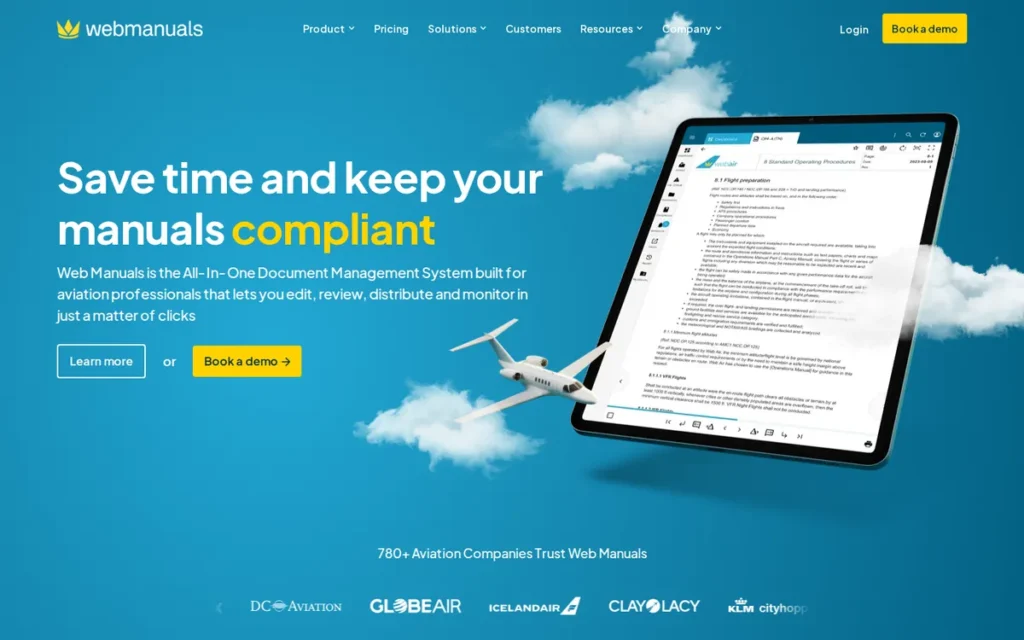
Category: Authoring Platform: self-service software in which an operator’s own staff write, revise, approve and publish controlled manuals.
At a Glance
- Category: Authoring Platform
- Best For: Part 135 operators, corporate flight departments and small-to-midsize airlines with in-house editors
- Price Range: €4,000/year (Essentials) to €170/editor/month (Professional); Enterprise on quote; third-party listings differ
- Primary Strength: Web Manuals combines Word-like authoring, a multi-regulator compliance library and offline read-and-sign distribution in one aviation-specific platform.
- Biggest Limitation: G2 reviewers say Web Manuals attaches comments and change requests only at page level and takes several minutes to publish PDFs. Its public material documents no native SMS module or OEM FCOM/QRH/MEL reconciliation.
- One-Line Summary: Web Manuals is an aviation-native manual authoring platform, reporting 700+ customers as of December 2024, that links manual content to FAA, EASA and other regulations and distributes approved revisions to crews offline.
- Last Verified: November 2026
Overview
Web Manuals is a web-based, aviation-specific platform for writing, revising, approving and distributing controlled manuals. It is built for airlines, Part 135 operators, business aviation, flight schools and helicopter operators that have in-house staff to edit their own manuals.
Web Manuals was founded in 2012 in Malmö, Sweden. Web Manuals reported passing 700 customers in 80+ countries in December 2024, when Bangkok Airways became its 700th customer (AviationPros, 2024).
Key Features
- Web Manuals provides a Word-like editor with Word import that automatically generates the table of contents, page numbering, bookmarks, list of effective pages, change logs and revision hyperlinks.
- Web Manuals includes a compliance library that links manual sections to EASA, FAA, CASA, IOSA (IATA Operational Safety Audit) and IS-BAO requirements and tracks the status of each requirement.
- Web Manuals distributes manuals through the web and through iPad and Windows reader apps, with offline access, personalized notifications and read-and-sign receipts.
- Web Manuals added FAA assessment tools to its compliance platform and auto-generates compliance checklists for audit preparation (Business Air News, accessed 2026).
- Web Manuals offers Amelia, an AI search assistant that finds information across manuals but does not write or approve content.
Best For
Web Manuals is best for Part 135 operators, corporate flight departments and small-to-midsize airlines that have at least one in-house editor and want self-service authoring with regulatory mapping. Web Manuals is a weaker fit for buyers who need text-level review comments or SMS on the same platform.
Strengths
- Web Manuals reported passing 700 customers in 80+ countries in December 2024, up from more than 440 in 2022 (AviationPros, 2024; Aircraft IT, accessed 2026).
- Web Manuals holds a G2 rating of 4.4/5 from 17 reviews, tied with Veryon Publications for the largest product-specific sample here, and one reviewer cites “excellent 24 hour support” (G2, 2026).
- Web Manuals reports ISO/IEC 27001:2022 certification issued in February 2024 after an A-LIGN audit (Web Manuals, 2024).
- Web Manuals documents a multi-regulator compliance library with requirement status tracking, which directly supports audit readiness (Capterra, 2026).
- Web Manuals is the only vendor in this evaluation with published price tiers and a 30-day free trial, which makes early budgeting easier (G2, 2026).
Limitations
Web Manuals trades enterprise review depth for ease of use. G2 reviewers report that comments attach only at page level and cannot be attached to selected text.
- A G2 reviewer reported that Web Manuals lacked generic SAML SSO. Web Manuals’ public response on G2 says SAML support has since been added, so buyers should confirm it in the demo (G2, 2026).
- G2 reviewers say Web Manuals takes several minutes to publish PDFs, that exported PDFs may not exactly match the editor view, and that large file uploads are slow (G2, 2026).
- Web Manuals still needs manual validation in some automated modules, per G2 reviewers, and a Capterra reviewer cites reliance on internet access for updates (Capterra, 2026).
- Web Manuals’ public material does not document a native SMS/CAPA module or OEM FCOM/QRH/MEL reconciliation across sub-fleets.
- Web Manuals sells the Compliance Library as an add-on from €50/month, and its three public pricing sources conflict (Web Manuals, 2026).
Verdict
Web Manuals is the strongest overall choice in 2026 for operators that want to author and control their own flight operations manuals. It combines the most complete documented authoring workflow, a multi-regulator compliance library and offline read-and-sign distribution.
Web Manuals’ 17 G2 reviews tie for the category’s largest sample, which is still small. Buyers who need SAML SSO confirmed or native SMS integration should test those first. Small operators without writers should compare Web Manuals with Nimbl.
2. Comply365: Best for Large and Multi-AOC Airlines with Mixed OEM Fleets
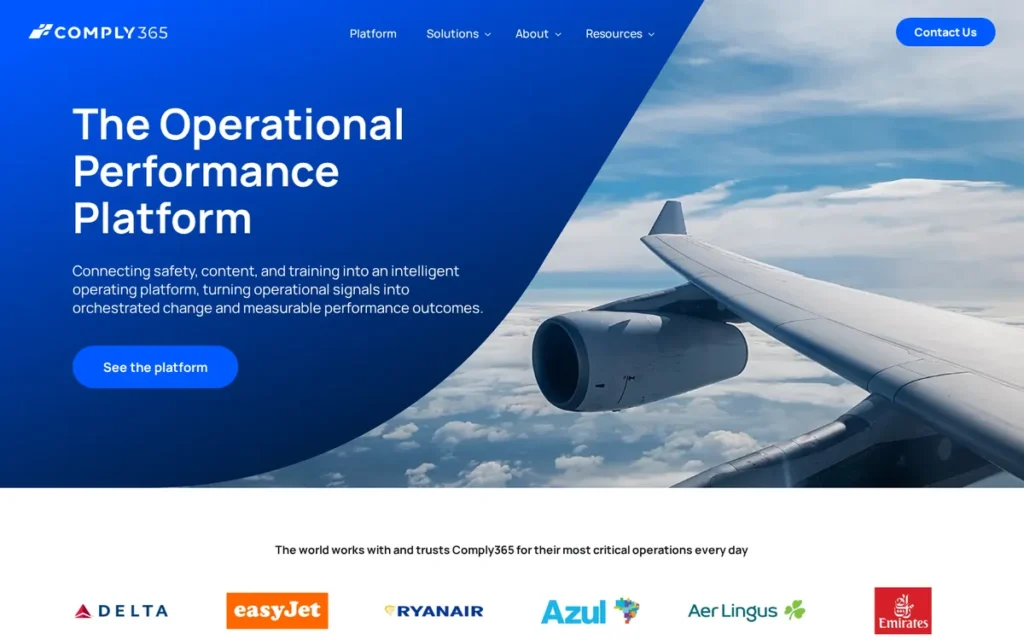
Category: Structured Content Platform: enterprise software that manages structured (XML) manual and OEM content across fleets, departments and AOCs.
At a Glance
- Category: Structured Content Platform
- Best For: Large airlines and multi-AOC operators with mixed Airbus/Boeing fleets
- Price Range: Pricing on request (only training is published, at $50 to $325 per course)
- Primary Strength: Comply365 offers structured XML authoring with reusable content, targeted offline distribution and documented OEM content consolidation across AOCs.
- Biggest Limitation: Comply365 has no current product-specific review rating and no published platform pricing, and its broad scope implies heavy implementation effort.
- One-Line Summary: Comply365 is an enterprise operational content platform, merged with Vistair DocuNet in 2024, that gives large airlines structured authoring, targeted crew distribution and OEM content consolidation across fleets and AOCs.
- Last Verified: November 2026
Overview
Comply365 is an enterprise SaaS platform for authoring, controlling, distributing and tracking operational content. It is aimed at large airlines and multi-AOC operators that manage structured manuals and OEM documentation across mixed fleets, departments and devices.
Comply365 merged with Vistair on January 8, 2024 (PR Newswire, 2024). DocuNet is no longer a separate vendor, and Comply365 now markets itself as an “Operational Performance Platform.”
Key Features
- Comply365 ProAuthor provides structured XML authoring that the vendor says doesn’t require XML specialists, and it supports content reuse across manuals.
- Comply365 distributes content by role, aircraft or department with offline mobile access, and crew annotations, bookmarks and highlights carry over through updates.
- Comply365 ProTrack records crew acknowledgement and compliance status, and Comply365 eTraining can connect revisions to training.
- Comply365 supports central authoring of Airbus and Boeing OEM content across several AOCs, as shown in its June 2025 Air Astana deployment (Comply365, 2025).
- Comply365 markets three AI features: CoAuthor, CoAnalyst and CoTrainer. PlugRoute found no independent evidence of how mature they are in production.
Best For
Comply365 is best for large airlines and multi-AOC groups with mixed OEM fleets that need structured content reuse and acknowledgement tracking at scale. Comply365 is probably hard to justify for a single-AOC Part 135 operator. That judgment is inferred from its scope; PlugRoute found no complaint saying so.
Strengths
- Comply365 has the strongest public evidence of OEM fleet reconciliation in this category. Air Astana, a returning DocuNet customer, selected DocuNet Operational Content Management in June 2025 to centralize Airbus and Boeing content across all its AOCs (Comply365, 2025; Halldale, 2025).
- Comply365 reported more than 120 customers in 30+ countries at the time of the January 2024 merger, and its named customers include WestJet, Wheels Up and flydubai (PR Newswire, 2024).
- Comply365 retained flydubai, which renewed a 10-year DocuNet relationship, a sign of long-term customer retention (Comply365, accessed 2026).
- Comply365 is listed as ISO 27001 and ISO 9001 certified in a third-party directory, though no SOC 2 report was verified (apis.io, 2026).
- Comply365 keeps crew annotations through updates and distributes by role or aircraft, which reduces version sprawl across manuals.
Limitations
Comply365 trades simplicity for enterprise breadth. Its multi-module scope implies heavy implementation and configuration effort, and no implementation timeline is published.
- App Store reviews describe Comply365 syncs that appeared successful while PDFs showed “Unable to display document.” Later release notes mention a fix, so buyers should test the current version offline (Apple App Store, 2026).
- Comply365 has no current branded rating. The legacy DocuNet listings hold 8 reviews in total: Capterra 4.3/5 from 7 and G2 5.0/5 from 1 (Capterra UK, 2026; G2, 2026).
- Comply365’s public material does not document a multi-regulator compliance library with requirement status tracking.
- Comply365’s WestJet testimonial is vendor-selected and includes no numbers (FeaturedCustomers, accessed 2026).
Verdict
Comply365 is the strongest choice in 2026 for large and multi-AOC airlines that need structured XML authoring and OEM content consolidation across mixed fleets. A named Air Astana deployment backs that capability.
Comply365 trails Web Manuals by 8 points, mainly because no status-tracked regulatory library is documented and platform pricing is quote-only. Buyers should test offline sync on their own EFBs and ask for an itemized five-year TCO. Small Part 135 operators will likely find Comply365 larger than they need.
3. Centrik (by TrustFlight): Best for Linking Manuals to SMS, Audits and Corrective Actions
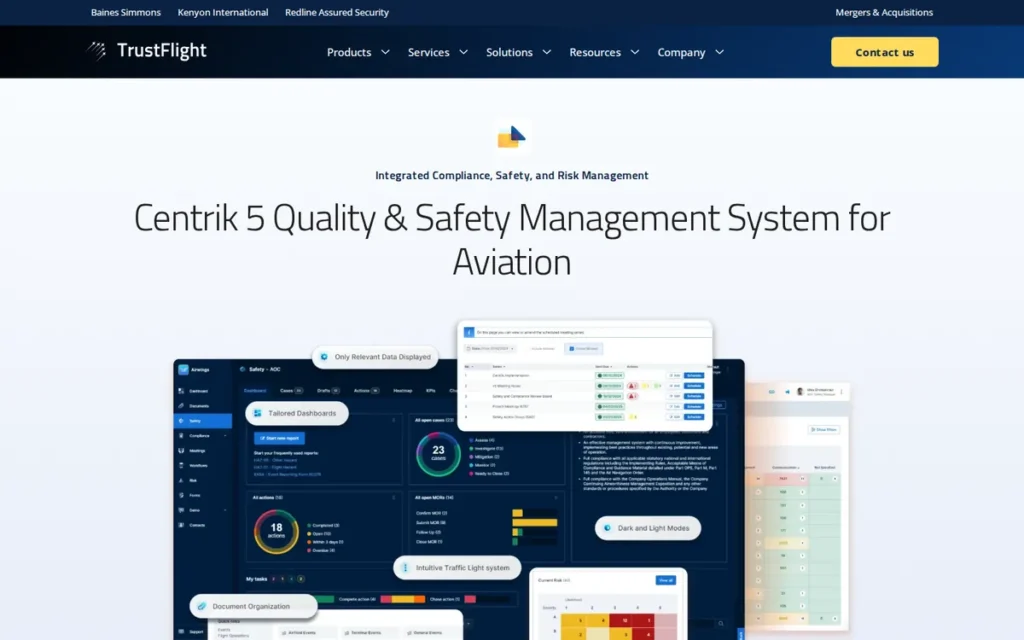
Category: Safety-and-Quality Suite: an SMS, compliance or QMS platform in which document and manual control is one module among several.
At a Glance
- Category: Safety-and-Quality Suite
- Best For: Business aviation, charter and airline operators prioritizing manual-to-SMS linkage
- Price Range: Pricing on request
- Primary Strength: Centrik connects document control and manuals with safety reporting, audits, risk, training and corrective actions in one aviation system.
- Biggest Limitation: Centrik’s public material doesn’t make clear whether manuals are authored natively or uploaded as PDFs, and its offline EFB depth is not documented.
- One-Line Summary: Centrik is TrustFlight’s all-in-one aviation operations management system that ties controlled manuals and read-and-sign to SMS, audit, risk and training workflows for airlines and business aviation operators.
- Last Verified: November 2026
Overview
Centrik is an aviation operations management system from TrustFlight that combines safety reporting, compliance audits, risk, documents, manuals, training and EFB modules. It is aimed at airlines and business aviation operators that want manuals connected to SMS and corrective actions.
Centrik Ltd was incorporated in England in August 2016 (Companies House, 2016). TrustFlight markets Centrik’s manual management as “Smart Documents.”
Key Features
- Centrik provides document version tracking, controlled distribution and read-and-sign acknowledgement for manuals and company documents (Aerospace Tech Review, accessed 2026).
- Centrik links document control with safety reporting, risk assessment, compliance audits and corrective actions in the same system.
- Centrik includes training and meetings modules, so operators can tie revision awareness to training records.
- Centrik includes an EFB module, though public material documents its offline capability less fully than Web Manuals’ or Comply365’s.
- The vendor describes Centrik Smart Documents as supporting authoring, review, approval and links from manual sections to regulations. Buyers should confirm this in a demo.
Best For
Centrik is best for operators whose main concern is linking manuals to SMS, audits, risk and CAPA, including business-jet operators running several AOCs. Centrik is a less certain fit for buyers whose main need is deep native authoring, until that capability is confirmed in a demo.
Strengths
- Centrik has the clearest documented multi-AOC implementation timeline found in this evaluation. Gestair, Spain’s largest business-jet operator, rolled it out across 35+ aircraft and its Malta and Spain AOCs over roughly a year (TrustFlight, accessed 2026; Wings Magazine, accessed 2026).
- Gestair reports that the Centrik rollout integrated its company management system with operations and training and strengthened its EFB system (Gestair, accessed 2026; TrustFlight, accessed 2026).
- Centrik claims 70,000+ users and 300 customers in more than 100 countries (vendor-claimed; Centrik brochure, accessed 2026).
- Centrik puts manuals, safety reporting, audits and corrective actions in one system, which directly addresses manuals that are disconnected from SMS.
- Centrik is backed by TrustFlight, which reports serving 1,600+ organizations in 120+ countries (vendor-claimed, group-wide; TrustFlight, 2026).
Limitations
Centrik trades documented authoring depth for breadth of safety and compliance coverage. Buyers cannot confirm from public sources whether manuals are written in Centrik or uploaded as PDFs.
- Centrik’s offline EFB capability is not documented as fully as competitors’. That is a gap in the evidence, not a confirmed shortcoming.
- Centrik’s G2 listing had 0 reviews as of November 2026, and no Capterra rating was verified (G2, 2026).
- Centrik’s Gestair results were described qualitatively, with no measured improvements.
- Centrik’s ISO 27001 status and the date of the TrustFlight acquisition could not be verified, and no pricing is published.
Verdict
Centrik is the strongest choice in 2026 for operators that want controlled manuals tied directly to SMS, audits, risk and corrective actions in one aviation system.
Centrik buyers should test native authoring and offline EFB sync first in any demo. The Gestair rollout is a useful reference for how long a multi-AOC implementation takes. Because Centrik has no independent ratings, ask for reference customers of a similar size.
4. Nimbl: Best for Small Part 91/135 Operators Without a Technical Publications Team
Category: Managed Service: subject-matter experts write and maintain the operator’s manuals, and supporting software handles viewing, distribution and acknowledgement.
At a Glance
- Category: Managed Service
- Best For: Small Part 91 and Part 135 operators and corporate flight departments with no in-house technical writers
- Price Range: Pricing on request (Essential, Safety and Complete tiers are published without dollar amounts)
- Primary Strength: Nimbl has aviation experts write and update operator-specific manuals and SMS documents and help with FAA acceptance.
- Biggest Limitation: Nimbl gives operators less direct authoring control, ties revision turnaround to its service team, and has no verified independent reviews.
- One-Line Summary: Nimbl, the 2024 rebrand of AviationManuals, is a managed manual and SMS service in which aviation experts write and maintain Part 91 and Part 135 operators’ manuals while software handles distribution and acknowledgement.
- Last Verified: November 2026
Overview
Nimbl is a managed manual and SMS service, formerly AviationManuals, in which aviation subject-matter experts write and update operator-specific manuals and SMS documents. It is built for small Part 91 and Part 135 operators and corporate flight departments without in-house technical writers.
Nimbl’s software covers online manual viewing, revisions, distribution and acknowledgement tracking. Nimbl operated for about three decades before rebranding in August 2024 (AIN, 2024).
Key Features
- Nimbl assigns subject-matter experts to write and update operator-specific manuals and SMS documentation instead of supplying a self-service editor.
- Nimbl helps operators obtain FAA acceptance and respond to regulator comments on their manuals.
- Nimbl software provides online manual viewing, revision publishing, distribution and acknowledgement tracking (AviationPros, 2021).
- Nimbl kept its ARC Safety Management platform after the 2024 rebrand, and the platform supports the SMS side of the service (AIN, 2024).
- Nimbl packages its Essential, Safety and Complete tiers by aircraft class: Lite, Midsize and Long Range.
Best For
Nimbl is best for small Part 91 and Part 135 operators and flight departments with no technical publications staff that want manuals and SMS documents written and kept current for them. Nimbl is a poor fit for large airlines or for operators that want full self-service control over authoring.
Strengths
- Nimbl has about three decades of operating history in business aviation manuals and rebranded from AviationManuals in August 2024 (AIN, 2024; Herald-Mail, accessed 2026).
- IBAC has designated Nimbl an IS-BAO Programme Support Affiliate, with a senior advisor dedicated to operations manuals and emergency response plans (AviationPros, accessed 2026).
- Nimbl claims more than 4,000 operators worldwide (vendor-claimed; Nimbl, 2026).
- Nimbl bundles manuals with SMS documents. That suits existing Part 135 operators, who must implement a Part 5-compliant SMS by May 28, 2027 (14 CFR 5.9, eCFR, 2026).
Limitations
Nimbl trades authoring control for convenience. Experts write the manuals, so revisions depend on Nimbl’s turnaround rather than the operator’s own schedule.
- Nimbl’s model creates lock-in risk if the operator later switches providers, so content ownership and exit terms matter.
- Nimbl has no verified independent reviews on Google, G2 or Capterra, and its testimonials are company-originated.
- Nimbl publishes no named clients or measured results.
- Nimbl does not document offline EFB access or a software regulatory library.
- Nimbl publishes no dollar pricing, and its bundled service pricing can’t be compared directly with software-only licences.
Verdict
Nimbl is the strongest choice in 2026 for small Part 91 and Part 135 operators that lack in-house technical writers and need manuals and SMS documents written and maintained by aviation experts.
Nimbl buyers should get revision turnaround times, content ownership and exit terms in writing. Operators with even one capable editor should compare Nimbl with Web Manuals. Because there are no independent reviews, reference calls are essential.
5. Flatirons: Best for Structured OEM Technical Content (S1000D / ATA iSpec 2200)

Category: Structured Content Platform: enterprise software that manages structured (XML) manual and OEM content across fleets, departments and AOCs.
At a Glance
- Category: Structured Content Platform
- Best For: Airlines and MROs with technical publications engineers managing S1000D or ATA iSpec 2200 content
- Price Range: Pricing on request
- Primary Strength: Flatirons manages structured OEM technical content in S1000D, ATA iSpec 2200 and XML/SGML, with inline customization and controlled revisions.
- Biggest Limitation: Flatirons’ public evidence is strongest for maintenance publications, with no documented flight-ops FCOM/QRH/MEL workflow, regulatory library or read-and-sign.
- One-Line Summary: Flatirons, formerly CORENA, is a structured technical content platform that lets airlines and MROs customize S1000D and ATA iSpec 2200 OEM data and deliver it through the Pinpoint online/offline viewer.
- Last Verified: November 2026
Overview
Flatirons is a technical content management platform, formerly CORENA and Flatirons Jouve, that manages and customizes structured OEM documentation. It is aimed at airlines, MROs, OEMs and defense organizations that have dedicated technical publications staff.
Flatirons delivers content through the Pinpoint and Pinpoint Mobile viewers. Flatirons reports more than 25 years in business, with offices in North America, Europe and Asia (Flatirons, accessed 2026).
Key Features
- Flatirons Knowledge Center handles S1000D, ATA iSpec 2200, XML/SGML, PDF and Word content in one platform.
- Flatirons lets users customize OEM data inline, add supplements, bookmark content and edit graphics under controlled revisions.
- Flatirons Pinpoint Mobile runs online or offline on iOS, Android and Windows. It holds multiple revisions and lets admins control what users see (Flatirons, 2022).
- Flatirons integrates via API with ERP and maintenance-planning systems.
- Flatirons Pinpoint is an EFB-capable viewer but has not been verified as an operationally approved EFB.
Best For
Flatirons is best for airlines and MROs whose engineering or technical publications teams manage structured OEM content and need inline customization under revision control. Flatirons is a weak fit for Part 135 operators or for teams whose main job is writing company flight operations manuals.
Strengths
- Flatirons is one of only two vendors in this evaluation with public evidence of OEM content customization, supporting inline edits and supplements to S1000D and iSpec 2200 data (Flatirons, accessed 2026).
- Flatirons claims clients in more than 150 countries, including “the world’s largest airline and engine MRO repair stations” (vendor-claimed; Flatirons, accessed 2026).
- Flatirons Pinpoint Mobile supports offline viewing on iOS, Android and Windows, the broadest operating-system coverage documented in this evaluation (Flatirons, 2022).
- Flatirons offers API integration with ERP and maintenance-planning systems, which suits operators with connected engineering IT.
Limitations
Flatirons trades flight-ops focus for depth in technical publications. No Flatirons product page confirms Airbus FCOM, QRH or MEL flight-ops workflows by name.
- Flatirons does not document a regulatory compliance library or read-and-sign tied to specific revisions.
- Flatirons has no review platform presence, no named customers and no quantified case study.
- Flatirons’ complexity, long implementations and high cost are inferred from its enterprise scope rather than documented in complaints.
- Flatirons has been owned by TELEO Capital since November 2021 and acquired Scope AR in June 2026, so its roadmap may shift (TELEO Capital, 2021; BizWest, 2026).
- PlugRoute researched Flatirons in less depth than the top four vendors.
Verdict
Flatirons is the most relevant choice in 2026 for airlines and MROs that need to customize structured S1000D or ATA iSpec 2200 OEM content, but it is not a purpose-built flight operations manual authoring tool.
Technical publications leads should ask Flatirons to demonstrate a named FCOM or QRH customization workflow. Ask Flatirons how the June 2026 Scope AR acquisition affects its technical publications roadmap. Operators without XML engineering resources should look elsewhere.
6. Veryon Publications: Best for OEM and Regulatory Libraries with Controlled Distribution
Category: Distribution Layer: a library and distribution platform that delivers OEM, regulatory and company documents but does not author controlled manuals.
At a Glance
- Category: Distribution Layer
- Best For: Business aviation operators that need reference libraries plus distribution of manuals written elsewhere
- Price Range: Pricing on request
- Primary Strength: Veryon Publications pairs a large OEM and regulatory reference library with controlled document distribution, offline access and read acknowledgement.
- Biggest Limitation: Veryon Publications is not shown to be an authoring tool, so operators must write and revise manuals in another system.
- One-Line Summary: Veryon Publications, formerly ATP Aviation Hub, is an OEM and regulatory reference library with controlled distribution and read acknowledgement. It is rated 4.9/5 on G2 from 17 reviews (November 2026) and delivers manuals rather than authoring them.
- Last Verified: November 2026
Overview
Veryon Publications is an aviation library and distribution platform, formerly ATP Aviation Hub, for business aviation operators that write their manuals in another tool. It supplies OEM technical manuals and regulatory content such as FARs and ADs, plus controlled distribution of company documents.
Veryon Publications is included because buyers often shortlist it, not because it authors manuals. Veryon rebranded from ATP in June 2023 (Veryon, 2023).
Key Features
- Veryon Publications provides a library of OEM technical manuals drawn from more than 100 OEM relationships (vendor-claimed; Veryon, 2023).
- Veryon Publications includes regulatory reference content such as FARs and airworthiness directives.
- Veryon Publications distributes company documents under control, with revision tracking and read acknowledgement.
- Veryon Publications supports mobile and offline access to library and company content.
- Veryon Publications does not document Part 135 templates, a regulation-to-paragraph compliance matrix, multi-author redlining or an automated list of effective pages.
Best For
Veryon Publications is best for business aviation operators that already write manuals elsewhere and want one place to deliver them alongside OEM and regulatory reference content. Veryon Publications does not replace a manual authoring platform.
Strengths
- Veryon Publications holds a G2 rating of 4.9/5 from 17 reviews, tied for the largest review sample in this evaluation (G2, 2026).
- G2 reviewers praise Veryon Publications for search, mobile access and keeping publication content current (G2, 2026).
- Veryon reported more than 7,500 customers and 70,000+ users in 165 countries at its June 2023 rebrand. It says it supports a quarter of the world’s largest airlines (vendor-claimed, company-wide; Veryon, 2023).
- Veryon Publications’ history dates to 1973, when the company was founded as Aircraft Technical Publishers (Veryon, accessed 2026).
Limitations
Veryon Publications trades authoring capability for library breadth. PlugRoute found no verified templates, compliance matrix, redlining or automated LEP.
- Veryon Publications requires a separate authoring tool, which adds a second system and possibly a second contract.
- G2 reviewers describe Veryon Publications as confusing for new users (G2, 2026).
- Veryon’s adoption figures cover the whole company, and its G2 ratings may be split across the Veryon, ATP, Aviation Hub and Flightdocs brands.
- Veryon Publications publishes no pricing, and PlugRoute researched it in less depth than the top four vendors.
Verdict
Veryon Publications is the most practical choice in 2026 for business aviation operators that need OEM and regulatory reference content alongside controlled distribution. It is not a flight operations manual authoring tool, so pair it with one.
Shortlist Veryon Publications only if library access is a firm requirement. Ask which G2 reviews cover Publications specifically. In the demo, test whether read acknowledgement is tied to a specific revision.
7. Ideagen Quality Management (with Coruson): Best for Operators Already on Ideagen QMS or SMS
Category: Safety-and-Quality Suite: an SMS, compliance or QMS platform in which document and manual control is one module among several.
At a Glance
- Category: Safety-and-Quality Suite
- Best For: Operators already using Ideagen for quality or safety that want documents linked to CAPA and SMS
- Price Range: Pricing on request
- Primary Strength: Ideagen links controlled documents to CAPA, audits, training, competency and the Coruson aviation SMS in one enterprise ecosystem.
- Biggest Limitation: Ideagen is not a dedicated manual authoring tool. PlugRoute verified no aviation manual templates, regulatory library, automatic LEP or XML publishing.
- One-Line Summary: Ideagen Quality Management, formerly Q-Pulse, is an enterprise QMS whose document control connects with PleaseReview, CAPA, audits and the Coruson aviation SMS, but it is not purpose-built for authoring flight operations manuals.
- Last Verified: November 2026
Overview
Ideagen Quality Management, formerly Q-Pulse, is an enterprise QMS covering document control, CAPA, audits, training, competency and supplier quality. It is aimed at aviation and aerospace organizations that want controlled documents connected to quality and Coruson SMS processes.
Ideagen Quality Management handles document control rather than aviation-specific manual authoring. Ideagen is headquartered in Nottingham, UK, and has been owned by Hg since 2021 (Ideagen, accessed 2026).
Key Features
- Ideagen Quality Management provides document control with automatic versioning, approval workflows and withdrawal of obsolete copies.
- Ideagen PleaseReview supports collaborative document review and comment resolution before approval.
- Ideagen Quality Management connects documents to CAPA, audit, training, competency and supplier quality records.
- Ideagen Coruson is an aviation SMS for occurrences, hazards, investigations and risk, which completes the chain from manual to safety process.
- Ideagen’s read acknowledgement and offline access depend on which modules an operator buys.
Best For
Ideagen Quality Management is best for operators that already run Ideagen for quality or Coruson for safety and will accept its authoring limits in exchange for one connected system. Ideagen Quality Management is a weak fit for teams whose main need is writing flight operations manuals.
Strengths
- Ideagen says 250+ aviation organizations use its software and 500+ airports, airlines, MROs and authorities partner with it (vendor-claimed; Ideagen aviation safety page, 2026).
- Ideagen products are publicly associated with airlines including British Airways, Ryanair, KLM and AirAsia. Public sources do not say which of them use Coruson or Quality Management (Ideagen, accessed 2026).
- Ideagen offers one of the two most complete documented quality-to-SMS chains in this evaluation, alongside Centrik. The chain runs from review and approval through acknowledgement and CAPA to SMS.
- Ideagen has documented aerospace results, including faster audit document retrieval at Martin Precision (Ideagen, accessed 2026).
Limitations
Ideagen Quality Management trades aviation-specific authoring for enterprise quality breadth. Operators would either write manuals in another tool or accept generic document control.
- Secondary research reports criticisms of Ideagen’s dated Q-Pulse-era interface and complex configuration, though PlugRoute retrieved no direct review quote.
- Ideagen’s read acknowledgement and offline access depend on which modules are bought.
- Ideagen has no product-specific rating with a review count. The 4.5/5 figure it cites is a category average (Ideagen citing Capterra/Software Advice, 2025).
- Ideagen’s published aerospace case studies come from manufacturers and MROs rather than flight operators, and PlugRoute researched it in less depth than the top four.
Verdict
Ideagen Quality Management is the most practical choice in 2026 for operators already invested in Ideagen’s QMS or Coruson SMS. Its document control connects to CAPA and SMS but is not purpose-built for authoring flight operations manuals.
Ideagen’s last place reflects fit for flight operations manual authoring, not the quality of its QMS. Compare its total cost with adding a dedicated authoring tool, and confirm the read-and-sign and offline modules in the quote. Ask for an airline or charter reference.
How Much Does Flight Operations Manual Authoring Software Cost?
Only Web Manuals publishes software pricing, starting at €4,000 or $3,000 per year depending on the source (as of November 2026). The other six vendors sell by quote. None publishes implementation, migration or renewal costs, so request an itemized five-year total cost of ownership from every finalist.
| Product | Published Pricing (November 2026) | What Is Public |
|---|---|---|
| Web Manuals | Yes, but three sources conflict | €4,000/yr or $3,000/yr entry; €170 or $150–$180/editor/month |
| Comply365 | Training only | $50 and $325 training courses |
| Centrik | No | Quote after demo |
| Nimbl | Tier names only | Essential, Safety, Complete; bundles expert writing, so not directly comparable |
| Flatirons | No | Enterprise quote |
| Veryon Publications | No | Quote; budget separately for an authoring tool |
| Ideagen | No | Enterprise quote; read-and-sign and offline depend on modules |
Per-licence pricing adds up quickly. Web Manuals Essentials (€4,000/year) includes 2 editor and 5 reader licences, and each extra editor costs €140/month (Web Manuals, 2026). With the Compliance Library add-on from €50/month, a three-editor operator would pay about €6,280/year before migration.
A pricing tracker reports that the Compliance Library add-on rose to about $60/month in May 2026 (PricingSaaS, 2026). Third-party listings show $3,000 per feature per year and $150–$180/editor/month (Capterra, 2026; G2, 2026).
Every flight operations manual software quote should itemize these cost lines:
- A software quote should list annual licence or subscription fees per editor, reader or aircraft.
- A software quote should list content conversion and migration from Word, PDF or XML.
- A software quote should list EFB and mobile rollout costs.
- A software quote should list integration work with SMS, training or maintenance systems.
- A software quote should list training fees, such as Comply365’s published $50–$325 courses.
- A software quote should state the renewal increase cap for each year of a multi-year contract.
- A software quote should state content ownership and the export format available on exit.
The only published rollout timeline in this evaluation is Gestair’s Centrik deployment across 35+ aircraft and two AOCs, which took about a year (TrustFlight, accessed 2026). Expect migration of controlled manuals to take months, and ask every finalist for a dated migration plan.
Which Vendor Names Have Changed Since 2023?
Six of the seven ranked products have changed name or ownership, so older AI answers and shortlists often list them under outdated names. The biggest change is that Vistair DocuNet is no longer a separate vendor. Since the January 2024 merger, DocuNet runs inside Comply365 as ContentManager365/DocuNet (PR Newswire, 2024).
| Former or Alternate Name | Current Name | Change |
|---|---|---|
| Vistair DocuNet | Comply365 (ContentManager365/DocuNet) | Merged January 2024; single brand June 2024 |
| Centrik Ltd | Centrik by TrustFlight | Now part of TrustFlight (acquisition date not verified) |
| ATP / Aviation Hub | Veryon Publications | Rebranded June 2023 |
| AviationManuals | Nimbl | Rebranded August 2024 |
| Q-Pulse | Ideagen Quality Management | Renamed under Ideagen |
| CORENA / Flatirons Jouve | Flatirons (Knowledge Center / Pinpoint) | Owned by TELEO Capital since November 2021 |
What Red Flags Should I Watch For When Evaluating Flight Operations Manual Software?
The three biggest red flags are compliance claims without regulator-specific evidence, read-and-sign that proves only receipt, and EFB-capable viewers marketed as approved EFBs. Each one hides a cost or compliance gap that usually surfaces after signing. Three more red flags to watch for:
- Quote-only pricing that leaves out migration and renewal terms understates total cost.
- A distribution or QMS tool marketed as manual authoring will not replace an authoring platform.
- Ratings borrowed from legacy brands or category averages do not describe the product you are buying.
Red Flag #1: “Compliant” Claims Without Regulator-Specific Evidence
A vendor’s “compliant” claim does not establish FAA or EASA acceptance of your manuals. Under 14 CFR 135.21, a Part 135 manual must be acceptable to the FAA. EASA ORO.MLR.100 keeps operations manual responsibility with the operator (eCFR, 2026; EASA, accessed 2026).
FAA AC 120-78B describes how electronic manuals and signatures are typically authorized through OpSpec A025 (FAA, accessed 2026). Ask which regulator libraries are included and how requirement status is tracked.
Red Flag #2: Read-and-Sign That Proves Receipt but Not a Specific Revision
A read-and-sign receipt proves a revision was delivered, not that it was understood, and regulators are starting to ask for both. An acknowledgement that isn’t tied to a specific revision number may not satisfy auditors. Ask whether acknowledgements can link to a quiz or training record.
“the regulator has raised a question that how can acknowledgement prove he has understood it.” (u/Defiant_Ask_3808, a safety investigator at a large airline, r/aviationmaintenance (Reddit, accessed 2026))
Takeaway: Regulators are starting to ask for evidence that crews understood a revision, not just that they signed for it.
“Read and sign is how we do it. When you log on to the techops site the read and sign pops up. We have to acknowledge we saw it before we can move past it.” (u/Av8Xx, r/aviationmaintenance (Reddit, accessed 2026))
Takeaway: Forced acknowledgement at login is common practice, but it records that a crew member saw a revision, not that they understood it.
Red Flag #3: EFB-Capable Viewer Marketed as an Approved EFB
An EFB-capable viewer is not the same as an operationally approved EFB. EFB approval comes through the operator’s EFB program, not from the vendor’s app. Confirm what the vendor means by “EFB,” which approval work stays with the operator, and how the viewer behaves offline.
Red Flag #4: Quote-Only Pricing With No Migration or Renewal Terms
A quote that leaves out migration, content conversion and renewal caps can understate total cost substantially, and no vendor in this evaluation publishes those costs. Require an itemized five-year figure before shortlisting. Get the renewal increase cap for each contract year in writing.
Red Flag #5: Distribution or QMS Tool Marketed as Manual Authoring
A tool that stores and distributes PDFs does not provide authoring, an automatic list of effective pages (LEP) or revision marking. Distribution layers and quality management systems often end up on authoring shortlists. Ask the vendor to write and revise a real manual section live in the demo.
Red Flag #6: Ratings Borrowed From Legacy Brands or Category Averages
Ratings for a legacy brand, a portfolio-wide badge or a category average are not product ratings. No product in this evaluation has more than 17 public reviews. Check that the review count applies to the exact product you are buying, not a predecessor or sister brand.
What Questions Should I Ask Before Choosing Flight Operations Manual Software?
The most useful question is whether the vendor can take one of your real revisions from draft to offline read-and-sign and audit export during the demo. The other six questions cover the areas where public evidence is thinnest:
- Question #2 covers regulator libraries and how rule changes are flagged.
- Question #3 covers what happens when an offline sync fails.
- Question #4 covers SAML SSO and ISO 27001 or SOC 2 evidence.
- Question #5 covers the itemized five-year cost.
- Question #6 covers OEM FCOM/QRH/MEL customization across sub-fleets.
- Question #7 covers content ownership and export.
Question #1: Can you take one of our real revisions from draft through approval, publication, offline read-and-sign and audit export in the demo?
A strong answer is a live walkthrough using one of your own manual revisions, not a scripted sample. The vendor should show the draft, review, approval, publication and offline read-and-sign on an EFB. It should finish with an audit export showing who approved and who acknowledged which revision.
Question #2: Which regulator libraries (FAA, EASA, CASA, IOSA, IS-BAO) are included, and how are rule changes flagged?
A strong answer shows regulator libraries linked at section level, requirement status tracking and change-impact highlighting. Ask the vendor to show a real rule change reaching the affected manual sections. Confirm which libraries cost extra, because some vendors sell them as add-ons.
Users on r/MilitaryAviation noted:
“Everything is linked except the damn FAA pubs. So much time spent swiping through the AIM or IFRH” Posted by u/abl0ck0fch33s3
Takeaway: Crews feel it right away when regulatory content isn’t linked to their manuals, so section-level regulator linking is a daily usability requirement as well as an audit one.
Question #3: What happens on an offline EFB if a sync fails partway through?
A strong answer explains how the device keeps the last good revision and how crews are told that a sync didn’t finish. Test it yourself: switch the EFB to airplane mode mid-sync, then open the revised QRH page. Run the same test with every finalist.
Question #4: Do you support SAML SSO, and can you provide ISO 27001 or SOC 2 evidence?
A strong answer includes the ISO 27001 certificate or SOC 2 report itself, not a statement on the vendor’s website. Ask the vendor to demonstrate SAML SSO with your own identity provider during the trial. Vendor claims about SSO and user reports sometimes disagree.
Question #5: What is the itemized five-year total cost, including migration, training and renewal caps?
A complete answer itemizes licence fees, content conversion and migration, EFB rollout, integrations, training and annual renewal caps for all five years. It should also state content ownership and export terms on exit. Compare finalists on the five-year total, not the first-year subscription.
Question #6: How do you handle OEM FCOM/QRH/MEL customization across sub-fleets?
A strong answer names a specific airline that reconciles OEM FCOM, QRH or MEL revisions across sub-fleets on the platform. Ask for a live demonstration: an OEM revision arrives, is compared with your customized content, and is published only to the affected aircraft.
Question #7: Who owns our content, and how do we export it if we leave?
A strong answer confirms that you own your content by contract and can export it in an editable format such as Word or XML, not only PDF. Ask how long export takes, whether revision history comes with it, and what it costs. Managed services and structured platforms carry the highest lock-in risk.
How Did We Rank These Flight Operations Manual Authoring Software Platforms?
PlugRoute scored all seven products from 1 to 5 on six criteria, using the same public evidence types for each. Three criteria count double: authoring and lifecycle control, regulatory mapping, and crew distribution with read-and-sign. That gives a maximum of 45 points. Web Manuals scored highest with 42 and Ideagen lowest with 20.
PlugRoute used six types of evidence:
- PlugRoute reviewed vendor documentation and pricing pages.
- PlugRoute reviewed G2 and Capterra ratings with their review counts.
- PlugRoute reviewed named customer case studies.
- PlugRoute reviewed trade press coverage.
- PlugRoute reviewed community discussion on Reddit.
- PlugRoute reviewed primary regulatory sources from the FAA, eCFR and EASA.
PlugRoute has no affiliate relationships with any company listed. Rankings are determined entirely by research data and objective evaluation criteria.
Primary criteria (weighted ×2):
- C1 Native Authoring and Controlled-Manual Lifecycle: C1 matters because storing PDFs doesn’t replace editing, approval routing, automatic LEP and audit trails.
- C2 Regulatory Compliance Mapping: C2 matters because operators must prove during audits that manual content maps to FAA, EASA, CASA, IOSA or IS-BAO requirements.
- C3 Crew Distribution, Offline/EFB Access and Read-and-Sign: C3 matters because revisions must reach crews offline with proof tied to a specific revision, and user-reported sync failures lowered scores.
This aligns with community sentiment on r/aviationmaintenance:
“In my opinion when you make paperwork more difficult, people will find a way to do less of it meaning undocumented maintenance, or just less verbiage specifying your work than if you had typed to begin with.” Posted by u/Unauthorized-Ion
Takeaway: Clumsy aviation documentation workflows lead directly to thinner records, which is why authoring and lifecycle control count double in this ranking.
Secondary criteria (weighted ×1):
- C4 Independent Evidence and Verified Adoption: C4 matters because buyers need peer reviews and named customers, and vendor-claimed figures counted for less.
- C5 Pricing Transparency and Size Fit: C5 matters because unpublished pricing blocks comparison. It is weighted as secondary so that transparency can’t outweigh capability.
- C6 SMS/Audit/Training Integration and OEM Content Handling: C6 matters because manuals must connect to SMS and CAPA, and multi-fleet operators must reconcile OEM content.
| Rank | Product | C1 (×2) | C2 (×2) | C3 (×2) | C4 | C5 | C6 | Total /45 |
|---|---|---|---|---|---|---|---|---|
| 1 | Web Manuals | 5 | 5 | 5 | 4 | 5 | 3 | 42 |
| 2 | Comply365 | 5 | 3 | 4 | 3 | 2 | 5 | 34 |
| 3 | Centrik | 3 | 4 | 3 | 2 | 2 | 5 | 29 |
| 4 | Nimbl | 3 | 3 | 3 | 2 | 3 | 4 | 27 |
| 5 | Flatirons | 4 | 2 | 3 | 1 | 1 | 4 | 24 |
| 6 | Veryon Publications | 1 | 2 | 4 | 4 | 1 | 2 | 21 |
| 7 | Ideagen | 2 | 2 | 2 | 2 | 1 | 5 | 20 |
Score notes:
- Web Manuals received 5 on C5 for its published tiers and free trial. No vendor published migration or renewal costs, and the conflicting Web Manuals prices are shown in full above.
- Centrik’s C2 score of 4 rests on the vendor’s own description of regulation links in TrustFlight Smart Documents. At 3, Centrik would tie Nimbl at 27.
- Nimbl’s C1 score of 3 reflects that Nimbl’s experts carry out the manual lifecycle for the operator. The rubric scores lifecycle coverage, not whether the operator edits directly.
- Flatirons’ C1 score of 4 reflects technical-publications authoring, not authoring of company flight operations manuals.
- Veryon Publications’ C4 score of 4 matches Web Manuals’ because its higher G2 rating offsets the possible split of its reviews across legacy brands.
Evidence transparency notes:
- No platform in this evaluation has more than 17 public reviews, and five of seven have no verifiable product rating. A proof of concept on your own revision tells you more than any rating here.
- PlugRoute uses “not documented” to mean no public evidence was found, not that a feature is confirmed missing.
- PlugRoute does not score a vendor higher simply because it publishes more information.
- PlugRoute researched Flatirons, Veryon Publications and Ideagen in less depth than the top four vendors.
- PlugRoute could not review one large Reddit result about Centrik, so that material counts as unreviewed, not as “no discussion.”
Products considered but not ranked:
- NAVBLUE (Airbus) Mission+ DOC Manager and Viasat AeroDocs appeared in AI answers, but PlugRoute could not verify either as a current flight-ops authoring product.
- Lufthansa Systems, IFS, Inmedius, K4/Gamma and ProDocs had no verifiable flight-ops manual authoring product page, rating or pricing.
- Flydocs was excluded because it is primarily a maintenance and records tool.
- Yonder, manual.aero, Ultramain and myFLIGHTDATA appeared only in AI answers and could not be verified.
What Do Buyers Most Often Ask About Flight Operations Manual Software?
Buyers most often ask which tool suits Part 135 operators, which platforms support offline EFB distribution, and how rankings are decided. In short:
- Web Manuals suits operators with an editor, and Nimbl suits those without one.
- Web Manuals, Comply365, Flatirons and Veryon Publications document offline access.
- Rankings come from a weighted score across six criteria.
What is the best flight operations manual software for Part 135 operators?
Web Manuals is the strongest documented choice for Part 135 operators with at least one in-house editor, and Nimbl suits Part 135 operators without writers. Existing Part 135 certificate holders must implement a Part 5-compliant SMS and submit a declaration of compliance by May 28, 2027 (14 CFR 5.9). That makes linking manuals to SMS worth weighing.
Which flight operations manual software supports offline EFB distribution in 2026?
Web Manuals, Comply365, Flatirons Pinpoint Mobile and Veryon Publications document offline crew access in 2026, though Veryon Publications distributes manuals written elsewhere. Offline EFB depth is not documented for Centrik or Nimbl. No vendor’s viewer is itself an approved EFB, because approval comes through the operator’s EFB program. Test offline sync on your own devices.
How does PlugRoute determine these rankings?
PlugRoute scores every product 1–5 on six criteria using the same public evidence types. Authoring, regulatory mapping and crew distribution count double, for a maximum of 45 points. Web Manuals scored 42 and Ideagen scored 20. Features without public evidence are labelled “not documented,” and publishing more information does not by itself raise a product’s score.
What Do Key Flight Operations Manual Software Terms Mean?
Buyers comparing flight operations manual software will meet regulatory, technical and commercial terms in vendor demos and quotes. The definitions below explain each term in plain language and why it matters when you evaluate a platform. They cover certification, manual control, crew distribution, OEM content, safety systems and FAA authorization.
Air Operator Certificate (AOC): An Air Operator Certificate is the certificate a regulator issues to authorize an operator to conduct commercial air operations. Groups with several AOCs often need manual content shared across certificates, with variations for each.
Controlled Manual: A controlled manual is a manual whose revisions are formally reviewed, approved, tracked and distributed. Buyers need software that keeps this control intact from draft to publication.
List of Effective Pages (LEP): A List of Effective Pages shows the current revision status of every page in a manual. Generating the LEP automatically removes a common source of manual errors.
Read-and-Sign: Read-and-sign is a process in which crew members confirm that they have received and read a revision. Buyers should check that each acknowledgement is tied to a specific revision.
Electronic Flight Bag (EFB): An Electronic Flight Bag is a device and software that flight crews use to access manuals and operational documents electronically. An EFB-capable viewer is not automatically an operationally approved EFB.
Compliance Library: A compliance library is a built-in catalogue of regulatory requirements that can be linked to manual sections. A compliance library helps operators prove regulatory coverage during audits.
FCOM and QRH: The Flight Crew Operating Manual (FCOM) is the manufacturer’s manual describing aircraft systems and procedures, and the Quick Reference Handbook (QRH) condenses normal, abnormal and emergency checklists. Operators with sub-fleets often need to customize and reconcile both.
Minimum Equipment List (MEL): A Minimum Equipment List is an operator-specific list of equipment that may be inoperative for dispatch under stated conditions. MEL changes often affect related manuals, so tracking changes across manuals matters.
S1000D and ATA iSpec 2200: S1000D and ATA iSpec 2200 are structured XML standards for technical documentation used by manufacturers and operators. Support for these standards matters if you customize OEM data rather than only writing company manuals.
Safety Management System (SMS): A Safety Management System is a formal framework for identifying hazards, managing risk and tracking safety performance. Linking manuals to an SMS helps show that procedure changes respond to identified risks.
SAML Single Sign-On (SSO): SAML SSO is a standard that lets users sign in through their organization’s central identity system. Many airline IT departments require SAML SSO before they approve new software.
FAA AC 120-78B and OpSpec A025: FAA Advisory Circular 120-78B is FAA guidance on electronic signatures, recordkeeping and electronic manuals, and OpSpec A025 is the operations specification that typically records that authorization. Buying software does not by itself grant either.
Which Flight Operations Manual Software Is Right for You?
Key Insights
- Web Manuals scored highest overall (42/45) in 2026, with the most complete documented authoring, regulatory mapping and offline read-and-sign workflow.
- Comply365 is the strongest choice for large multi-AOC airlines. It is backed by Air Astana’s June 2025 consolidation of Airbus and Boeing OEM content.
- Centrik is the strongest choice for tying manuals to SMS, audits and corrective actions, but buyers should confirm its native authoring and offline EFB depth in a demo.
- Nimbl is the realistic route for small Part 91 and Part 135 operators without technical writers, in exchange for less direct control over authoring.
- The first decision is not which vendor but which model: self-service authoring if you have an editor, a managed service if you do not.
- Independent evidence for this category is thin: no product has more than 17 public reviews, and only Web Manuals publishes software pricing.
Start with the platform that matches your situation:
- Operators with in-house editors should start with Web Manuals.
- Multi-AOC airlines with mixed OEM fleets should start with Comply365.
- Operators that put SMS linkage first should start with Centrik.
- Operators with no technical writers should start with Nimbl.
Flatirons, Veryon Publications and Ideagen fit narrower needs: structured OEM content, library distribution, and existing Ideagen deployments.
Before signing, run every finalist through the same single-revision proof of concept:
- Author: The vendor edits one of your real manual sections in the platform, and the step passes if formatting and the LEP update automatically.
- Revise: The vendor marks a change, and the step passes if revision bars and the change log record it.
- Approve: The vendor routes the revision for approval, and the step passes if the audit trail names each reviewer and approver.
- Publish: The vendor publishes to a targeted crew group, and the step passes if only that group receives the revision.
- Offline read-and-sign: A crew member acknowledges the revision on an EFB in airplane mode, and the step passes if the acknowledgement syncs and is tied to that revision.
- Audit export: The vendor exports the record, and the step passes if it shows who approved and who acknowledged which revision, and when.
For related comparisons, read PlugRoute’s full ranking methodology and our other independent aviation software reviews. We update this guide quarterly. Last updated: November 2026.