The best marketing resource management (MRM) software in 2026 is monday.com, for its peer-review evidence and published pricing. Smartsheet, Aprimo and Wrike are near-tied: Smartsheet suits spreadsheet-native teams, Aprimo is the most complete enterprise suite, and Wrike suits creative work shared across teams. No single platform does budgeting, work management and DAM equally well.
Marketing resource management is defined inconsistently. Buyers struggle to tell whether they need work management, budget planning, content operations or a digital asset management (DAM) system. Requests arrive by email and chat, team capacity is hard to see, and enterprise vendors hide pricing behind custom quotes.
PlugRoute has no affiliate relationships with any company listed, and rankings are determined entirely by research data and objective evaluation criteria.
“I find when companies try to ‘do it all’ the tool ends up a bit clunky all around and not really best at the secondary use cases.” (u/avomir, r/CRM [Source: Reddit, 2022; practitioner report])
Takeaway: Pick the MRM problem you most need solved first, then add specialist tools for the rest.
What Are the 4 Categories of Marketing Resource Management Tools?
Marketing resource management tools fall into four categories. Work management platforms handle intake and capacity. Content operations suites combine budget, workflow and DAM. Marketing finance platforms reconcile budgets. DAM and brand governance platforms manage approved assets. Most buyers need one primary category plus integrations to the others.
- Work management platforms coordinate intake, capacity and approvals. monday.com, Smartsheet, Wrike and Adobe Workfront are in this category.
- Content operations suites combine budget, workflow and DAM in one system. Aprimo is the evaluated example.
- Marketing finance platforms reconcile budgets with plans and actual spend. Uptempo is the evaluated example.
- DAM and brand governance platforms centralise approved assets and enforce brand and compliance rules. IntelligenceBank is the evaluated example.
Gartner retired its MRM Magic Quadrant in 2017, as reported by vendors in the category [Source: Smartsheet, 2026; Uptempo, 2026; vendor-published]. Gartner now publishes a Magic Quadrant for Marketing Work Management Platforms, which is the closest successor label [Source: monday.com investor release, 2025; vendor-reported].
Three data points show why choosing well matters in 2026:
- Marketing budgets stayed flat at 7.7% of company revenue in 2025, according to Gartner’s survey of 402 marketing leaders [Source: Gartner, 2025; analyst research].
- Organisations used only 49% of their martech stack’s capabilities in 2025, up from 33% in 2023 [Source: Gartner, 2025; analyst research].
- Grand View Research estimates the MRM market at $6.2B in 2026, growing about 12.4% a year. Estimates vary because firms define MRM differently [Source: Grand View Research, 2025; third-party estimate].
How Do the Top MRM Platforms Compare at a Glance?
monday.com leads the seven MRM platforms on peer-review evidence and published pricing. Smartsheet, Aprimo and Wrike form a near-tied cluster within 0.10 points of each other. Adobe Workfront leads on Adobe integration, Uptempo on marketing-finance depth, and IntelligenceBank on asset governance at a published price. The table summarises each platform’s position, strength and main trade-off.
| Rank | Company | Category | Best For | One-Line Summary | Key Capabilities | Primary Strength | Key Limitation |
|---|---|---|---|---|---|---|---|
| 1 | monday.com | Work Management | Mid-size teams that want published pricing and a large peer-review base | monday.com is a no-code work management platform with configurable intake, approvals and workload views at published per-seat prices. | WorkForms intake, approval workflows, workload views, dashboards | Largest peer-review base (G2 4.7/5, 17,940 reviews) plus published per-seat pricing | No native finance model and no full DAM |
| 2 | Smartsheet | Work Management | Organisations that already work in spreadsheets | Smartsheet is a spreadsheet-style work management platform that teams can extend with its separately licensed Resource Management and Brandfolder products. | Grid and Gantt views, Control Center, Resource Management, Brandfolder | Familiar grid, published core prices, and its own capacity and DAM products | Add-ons are quote-only, so the cost of the full stack is hard to predict |
| 3 | Aprimo | Content Operations | Enterprise and regulated organisations | Aprimo is an enterprise content operations platform that natively unifies budget planning, workflow, regulated approvals and DAM. | Plan & Spend, intake, MLR review, enterprise DAM | The only evaluated platform that spans budget, work and DAM natively | Quote-only pricing and about a 5-month average implementation |
| 4 | Wrike | Work Management | Creative and marketing teams working across departments | Wrike is a marketing and creative work management platform that combines dynamic request forms, job-role capacity planning and built-in proofing. | Request forms, Blueprints, workload charts, proofing, cross-tagging | Intake, capacity and proofing in one tool, with published Team and Business prices | No verified named-customer outcomes; busy UI |
| 5 | Adobe Workfront | Work Management | Enterprises on Adobe Experience Cloud | Adobe Workfront is an enterprise work management platform that natively connects intake, capacity, proofing and project financials to Adobe Experience Cloud. | Intake routing, Workload Balancer, Workfront Proof, Fusion | Deepest native Adobe integration | Quote-only, complex and dependent on admins; G2 4.1/5 |
| 6 | Uptempo | Marketing Finance | Organisations reconciling CMO and CFO budgets | Uptempo is an enterprise marketing finance platform that reconciles top-down budgets with bottom-up plans and tracks spend from commitment to payment. | Spend lifecycle tracking, PO reconciliation, ERP links, ROI | Deepest native marketing-finance capability | Quote-only pricing; smaller review base (G2 4.1/5, 147 reviews) |
| 7 | IntelligenceBank | DAM & Governance | Brand and compliance teams on a mid-market budget | IntelligenceBank is a DAM and brand governance platform that combines asset management, proofing and AI compliance checks at a published starting price. | DAM, brand portals, proofing, AI compliance checks | Published entry price of US$567/month | Little depth in capacity or budget planning |
Which MRM Platform Should I Choose for My Use Case?
Choose MRM software by your main problem, not by overall rank. Mid-size teams that want published pricing should start with monday.com or Wrike, spreadsheet-native teams with Smartsheet, and Adobe-centred enterprises with Adobe Workfront. Content operations needs point to Aprimo, budget reconciliation to Uptempo, and brand governance to IntelligenceBank.
| Your #1 Priority | Recommended Tool | Why | Acceptable Alternative |
|---|---|---|---|
| Mid-size team that needs published pricing and peer-review evidence | monday.com | Published per-seat pricing and the largest peer-review base | Wrike |
| Spreadsheet-native organisation | Smartsheet + Resource Management + Brandfolder | Familiar grid with published core prices that extends into capacity planning and DAM | monday.com |
| Enterprise content operations (budget + work + DAM) | Aprimo | Native Plan & Spend, workflow and enterprise DAM | Smartsheet + Brandfolder |
| Creative and marketing work shared across departments | Wrike | Cross-tagging, dynamic request forms and built-in proofing | Adobe Workfront |
| Enterprise on the Adobe stack | Adobe Workfront | Native AEM Assets, Creative Cloud and Marketo Engage integration | Wrike (Creative Cloud extension) |
| CMO–CFO budget reconciliation | Uptempo, paired with a work management tool | Tracks spend from commitment to payment and reconciles POs | Aprimo Plan & Spend |
| Regulated content review | Aprimo (MLR review) | Medical, legal and regulatory workflows with audit trails | IntelligenceBank (AI compliance checks); Workfront Prime (HIPAA-Ready package) |
| Scattered assets and brand governance on a budget | IntelligenceBank | DAM, brand portals and proofing from US$567/month | Smartsheet Brandfolder |
| Agency-style utilisation and profitability | Adobe Workfront (cost rates by role) | Planned vs. actual cost and budget-vs-actual reporting | Smartsheet Resource Management (dedicated PSA tools were not evaluated) |
What Are the Best Marketing Resource Management Software Platforms in 2026?
monday.com ranks first among the seven marketing resource management platforms evaluated for 2026. Smartsheet, Aprimo and Wrike follow as a near-tied cluster, and Adobe Workfront, Uptempo and IntelligenceBank complete the list. Every entry uses the same structure, and each ranking rationale shows the criterion scores behind the position.
1. monday.com: Best Overall for Peer-Review Evidence and Published Pricing
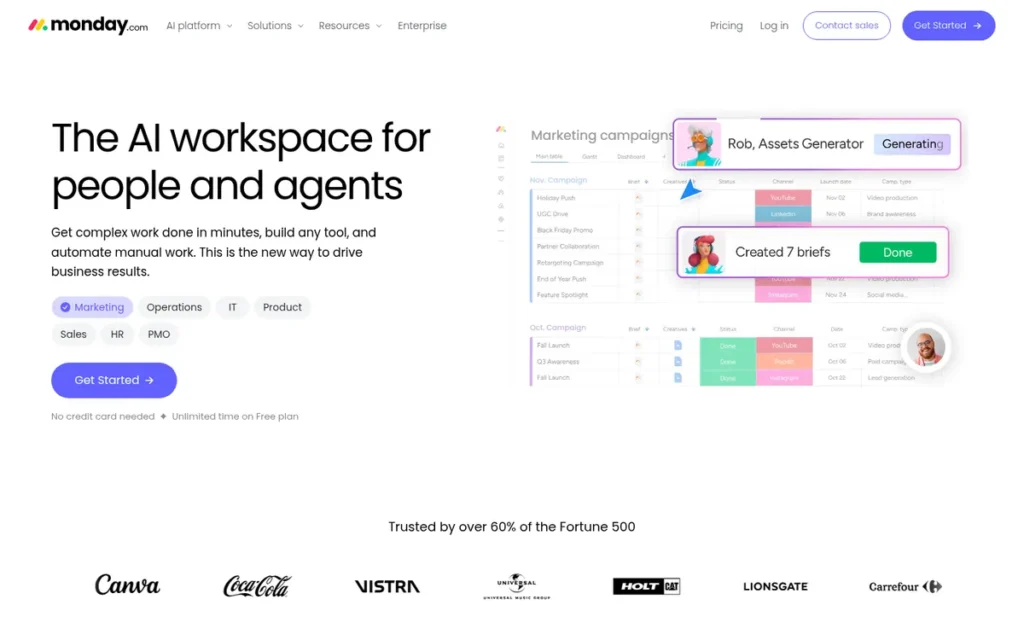
Category: Work Management Platform, coordinates intake, tasks, capacity and approvals for marketing work.
At a Glance
- Category: Work Management Platform
- Best For: Mid-size marketing teams that want configurable workflows, published per-seat pricing and a large peer-review base
- Price Range: Free plan; paid plans $9–$19/seat/month billed annually (3-seat minimum); Enterprise custom (verified November 2026)
- Primary Strength: monday.com combines the largest peer-review base in the MRM category with published per-seat pricing and no-code configuration.
- Biggest Limitation: monday.com has no native marketing-finance model or full DAM, so budget reconciliation and brand governance need formulas, workarounds or separate tools.
- One-Line Summary: monday.com is a no-code work management platform that gives mid-size marketing teams configurable intake, approvals and workload views at published per-seat prices, but it does not natively handle marketing finance or digital asset management.
- Last Verified: November 2026
Ranking Rationale
- monday.com scored 3.95/5 and ranks #1. It leads all seven platforms on peer reviews (C2 5.0) and pricing transparency (C4 4.5).
- monday.com is held back by the lowest native capability coverage among the work management platforms (C1 3.0), because it has no native finance model and no full DAM.
Overview
monday.com work management, including the marketing-specific monday marketer product, is a no-code work platform. Mid-size and enterprise marketing teams use its configurable boards to build request intake, approval workflows, campaign calendars, workload views and dashboards.
monday.com was founded in 2012, listed on NASDAQ in 2021, and reports about 250,000 customers [Source: monday.com, 2026; vendor-reported]. With monday.com, the buyer designs and governs the operating model. Advanced resource features are limited to the Pro and Enterprise tiers.
Key Features
- monday.com WorkForms turn incoming marketing requests into structured board items that can be routed and prioritised.
- monday.com workload, capacity and skills views show how work is allocated across the team, with advanced resource features on Pro and Enterprise plans.
- monday.com supports approval workflows, proofing and campaign calendars built from configurable boards and automations.
- monday.com Enterprise adds portfolio management and resource directories for marketing organisations with several teams.
- monday.com is moving toward an “AI Workspace” where AI agents act on board data, and each plan includes a set number of AI credits.
Best For
monday.com is best for mid-size marketing teams that want to compare costs before talking to sales. It also suits teams willing to pair the platform with a dedicated budget or DAM tool.
Strengths
- monday.com holds a 4.7/5 G2 rating from 17,940 reviews and a 4.6/5 Capterra rating from 6,131 reviews. That is the largest peer-review base in the MRM category, and G2 now lists the product as “monday AI Work Platform” [Source: G2, 2026; Capterra, 2026; peer-review aggregate].
- monday.com publishes that FARFETCH’s marketing teams saved 3,500 hours per month by centralising campaign tracking [Source: monday.com, 2026; vendor-published].
- monday.com is one of three evaluated vendors that publish tier pricing. It lists monthly and annual rates for every plan except Enterprise, and its $9/seat/month entry price ties with Smartsheet Pro as the lowest published [Source: monday.com, 2026; vendor-published].
- monday.com reports SOC 2 Type II and ISO 27001 certification, HIPAA support on qualifying plans, and a Leader placement in Gartner’s 2025 Magic Quadrant for Marketing Work Management Platforms [Source: monday.com investor release, 2025; vendor-reported].
Limitations
monday.com trades depth for flexibility. Its configurable boards approximate finance and asset functions that specialist platforms handle natively.
- monday.com tracks budgets with columns and formulas, with no versioning, accruals or commitments. That limits budget-versus-actual governance.
- monday.com has no full DAM with rights, expiry or renditions management.
- monday.com sells paid plans in seat buckets with a three-seat minimum and limits advanced resource management, automations and integrations to higher tiers. Capterra reviewers say this raises costs as teams grow [Source: Capterra, 2026; reviewer report].
- monday.com reviewers report “board sprawl” when no one governs how boards are created [Source: Capterra, 2026; reviewer report].
Users on r/projectmanagement shared their experience:
“I’m a marketing programs manager, so I led the transition of our team from Wrike to Monday. We got much better adoption than we ever got from Wrike, and the platform itself is very intuitive and easy to use. We had some challenges with on boarding, and actually ended up onboarding twice. We didn’t really get what we needed out of either session.” Posted by u/Nearby-Confection
Takeaway: monday.com wins marketing-team adoption through ease of use, but its vendor onboarding may not deliver a working setup on the first attempt.
Verdict
monday.com is the top-ranked choice for mid-size marketing teams that want the largest base of positive peer reviews in the MRM category (G2 4.7/5, 17,940 reviews, 2026) and published pricing. However, it is a work management platform, not a complete MRM suite.
Teams whose main problem is budget reconciliation or brand governance should plan to pair monday.com with a marketing-finance or DAM platform. Buyers should ask for a quote that includes Pro or Enterprise, because that is where the capacity and governance features are.
2. Smartsheet: Best for Spreadsheet-Native Organisations Assembling a Modular MRM Stack
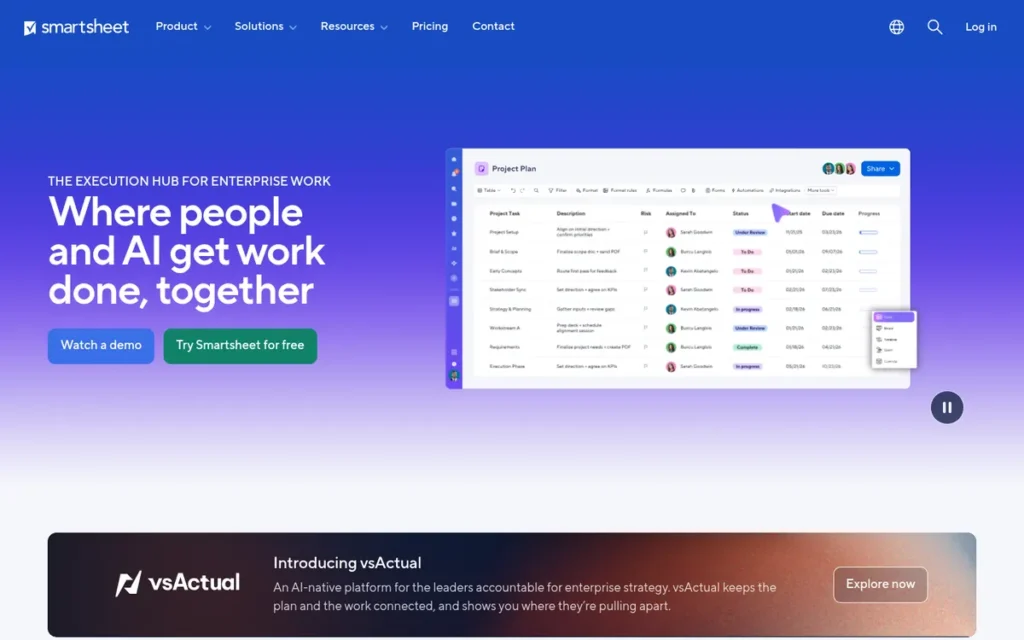
Category: Work Management Platform, coordinates intake, tasks, capacity and approvals for marketing work, with separately licensed add-ons.
At a Glance
- Category: Work Management Platform
- Best For: Spreadsheet-native marketing organisations that want work management, capacity planning and DAM from one vendor
- Price Range: Pro $9 and Business $19 per member/month billed annually ($12 and $24 monthly); Enterprise, Advanced Work Management, Resource Management and Brandfolder quote-only (verified November 2026)
- Primary Strength: Smartsheet offers a familiar spreadsheet interface, published core prices, and its own products for capacity planning and DAM.
- Biggest Limitation: Smartsheet requires buyers to license Resource Management and Brandfolder separately, which makes total cost hard to predict.
- One-Line Summary: Smartsheet is a spreadsheet-style work management platform that marketing teams can extend into a full MRM stack with its separately licensed Resource Management and Brandfolder products, at the cost of add-on pricing that is harder to predict.
- Last Verified: November 2026
Ranking Rationale
- Smartsheet scored 3.63/5 and ranks #2, with strong peer reviews (C2 4.0), documented outcomes (C3 4.0) and published core pricing (C4 3.5).
- Smartsheet, Aprimo and Wrike are within 0.10 points of each other (3.63, 3.55 and 3.53). Their order reflects pricing transparency versus native breadth, not a clear quality gap.
Overview
Smartsheet is a spreadsheet-style work management platform. It gives marketing teams forms, automation, Gantt, card and calendar views, proofing, and Control Center portfolio governance. Capacity planning and DAM come from separately licensed products.
Smartsheet Resource Management (formerly 10,000ft) handles utilisation and forecasting, and Brandfolder is Smartsheet’s DAM. Funds managed by Blackstone and Vista Equity Partners have owned Smartsheet since 22 January 2025, after a deal valued at about $8.4B [Source: SEC filing, 2025; regulatory filing].
Key Features
- Smartsheet provides grid, Gantt, card and calendar views, with forms and automation for tracking campaigns.
- Smartsheet Control Center standardises project setup and portfolio governance across marketing programmes.
- Smartsheet Dynamic View lets teams share work with agencies and vendors without giving them full access.
- Smartsheet Resource Management handles capacity, utilisation and forecasting as a separately licensed product.
- Smartsheet Brandfolder provides digital asset management as a separately licensed product.
Best For
Smartsheet is best for marketing organisations that already work in spreadsheets and want to add capacity planning and DAM over time from a single vendor.
Strengths
- Smartsheet holds a 4.5/5 Capterra rating from 3,577 reviews, and reviewers value its familiar spreadsheet structure [Source: Capterra, 2026; peer-review aggregate].
- Smartsheet publishes customer results that include PTC cutting campaign planning and execution time by 30% and McLaren Racing distributing race-day assets 7× faster [Source: Smartsheet, 2026; vendor-published].
- Smartsheet’s Brandfolder was the subject of a Forrester Consulting Total Economic Impact study. Brandfolder commissioned it and published it in August 2022, and it modelled 273% ROI over three years with payback in under six months [Source: Forrester Consulting for Brandfolder, 2022; commissioned].
- Smartsheet supports HIPAA-eligible setups with a business associate agreement. It has historically appeared in Gartner and Forrester collaborative work management research, but current placements were not confirmed [Source: Enterprise Software Review, 2026; independent review].
Limitations
Smartsheet trades an integrated suite for modularity. Buyers assemble the full MRM stack from separately licensed products rather than buying one system.
- Smartsheet requires separate licences for advanced capacity planning, time tracking and DAM. One independent reviewer reports total cost of about $300 per user per month once required components were added, which is a single reviewer’s figure [Source: Workflow Automation, 2026; independent review].
- Smartsheet’s editor-based licensing is hard to manage, according to G2 reviewers, who also report a steep learning curve for advanced formulas and automation [Source: G2, 2026; reviewer report].
- Smartsheet is described by PCMag as having a dated UI, lag on sheets with thousands of rows, row and cell limits, and proofing that is “useful but not especially deep” [Source: PCMag, 2026; independent review].
- Smartsheet buyers should check SOC 2, ISO and FedRAMP scope for each add-on, because Brandfolder may not be covered.
This aligns with community sentiment on r/smartsheet:
“Depends on large part on what Smartsheet licenses you get. A lot of what looks like it’s really useful is optional modules at additional cost. I’ve been doing some freelance work for a company that’s only using base Smartsheet and it’s like somebody repackaged a basic spreadsheet and tried to palm it off as Airtable.” Posted by u/Chiashurb
Takeaway: Smartsheet’s most valuable capabilities often sit in paid add-on modules, so teams on the base licence can end up with little more than a shared spreadsheet.
Verdict
Smartsheet is the best fit in this evaluation for spreadsheet-native marketing organisations that want to assemble work management, capacity planning and DAM from one vendor.
Buyers should ask for pricing that includes Resource Management and Brandfolder, not just the published core licence. Teams that need native marketing-finance planning will still need a dedicated budget tool alongside Smartsheet.
3. Aprimo: Best for Enterprise Content Operations (Budget + Work + DAM)
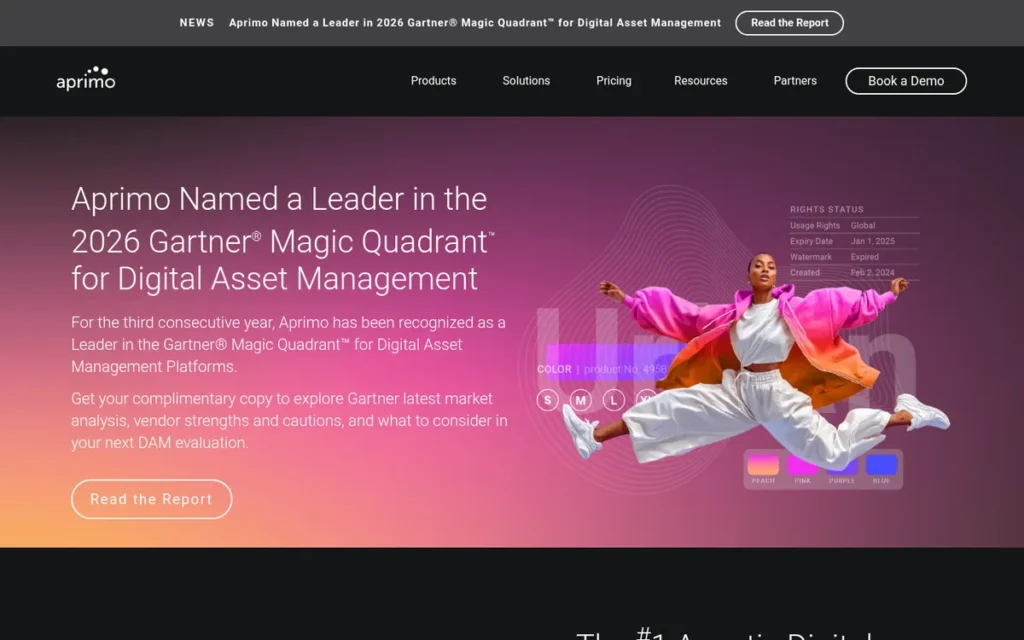
Category: Content Operations Suite, combines planning, spend, workflow and digital asset management in one platform.
At a Glance
- Category: Content Operations Suite
- Best For: Enterprise and regulated marketing organisations that need budget, workflow, approvals and DAM governed in one system
- Price Range: Quote-only; third-party estimates of about $20K–$172K/year, plus 15–50% for implementation (estimates as of 2026)
- Primary Strength: Aprimo is the only evaluated platform that natively connects marketing plans and spend with workflow, approvals and enterprise DAM.
- Biggest Limitation: Aprimo has high implementation and admin overhead, and reviewers report a clunky UI and an average rollout of about five months.
- One-Line Summary: Aprimo is an enterprise content operations platform that natively unifies marketing budget planning, workflow, regulated approvals and digital asset management, at the cost of quote-only pricing and a multi-month implementation.
- Last Verified: November 2026
Ranking Rationale
- Aprimo scored 3.55/5 and ranks #3. It leads all seven platforms on native capability coverage (C1 5.0) and has strong named outcomes (C3 4.0).
- Aprimo is held back by quote-only pricing (C4 2.0) and implementation burden (C6 2.0). It is within 0.10 points of Smartsheet and Wrike.
Overview
Aprimo is an enterprise content operations platform for large and regulated marketing organisations. It combines Plan & Spend budgeting, workflow and project management, structured intake and campaign briefs, multi-step reviews including medical, legal and regulatory (MLR) review, and enterprise DAM.
Aprimo was founded in 1998, acquired by Teradata in 2011 and spun out in 2016, and is associated with Marlin Equity [Source: Wikipedia, 2026; secondary source]. Aprimo is sold in modular editions, and reviewers say required capabilities are split across add-on modules [Source: G2, 2026; reviewer report].
Key Features
- Aprimo Plan & Spend supports budget allocation, plan-versus-actual tracking, forecasting, and integration with ERP and finance systems.
- Aprimo provides structured intake and briefs that feed directly into workflow and project management.
- Aprimo supports multi-step reviews, including MLR review with audit trails.
- Aprimo includes an enterprise DAM with metadata, renditions, rights and expiry management, portals, and support for 3D and 360° files.
- Aprimo offers AI auto-tagging, semantic search and AI agents, and its premium AI modules are priced separately.
Best For
Aprimo is best for enterprise marketing organisations, especially in pharma, healthcare and financial services, that need budgets, approvals and reuse of approved assets governed in one system.
Strengths
- Aprimo publishes Kimberly-Clark results of 480% more asset reuse, 56% faster time to market within six months, and 80% shorter approval times [Source: Aprimo, 2026; vendor-published].
- Aprimo also reports that Kimberly-Clark saved more than 700 hours a year through automated cropping and produced 40% more content without adding headcount [Source: Aprimo, 2026; vendor-published].
- Aprimo natively spans budget planning, workflow and enterprise DAM. No other evaluated platform does this without separate licences or integrations [Source: PlugRoute product documentation review, 2026; PlugRoute analysis].
- Aprimo holds a 4.3/5 G2 rating from about 340 reviews. Reviewers praise its approvals, its budget tracking and the way it prevents use of outdated files [Source: G2, 2026; peer-review aggregate].
- Aprimo reports leader placements in Gartner DAM and Marketing Work Management research and in Forrester DAM research [Source: Aprimo, 2026; vendor-reported].
Limitations
Aprimo trades usability and speed to value for breadth. Buyers get native budget, work and DAM coverage, but at the cost of a long rollout and heavy administration.
- Aprimo implementations average about five months, according to a summary of G2, TrustRadius and Capterra reviews [Source: Picajet, 2026; third-party estimate].
- Aprimo is called “clunky,” “outdated” and “bloated” in critical G2 reviews, which also say it needs a dedicated admin or consultants [Source: G2, 2026; reviewer report].
- Aprimo reviewers report that search gets harder as libraries grow, that some support requests are slow, and that they rely on the paid Concierge service [Source: Picajet, 2026; third-party estimate].
- Aprimo’s quote-only, modular pricing makes like-for-like cost comparison difficult. Implementation and training add an estimated 15–50% of first-year licence cost [Source: Picajet, 2026; third-party estimate].
Verdict
Aprimo is the most complete native MRM suite in this evaluation for enterprises that need budget, workflow and governed assets in one system, especially in regulated industries.
Buyers should budget for a multi-month implementation, admin staff, and implementation costs of up to half of first-year licence spend. Teams whose main problem is coordinating tasks and capacity will likely find a work management platform faster to adopt than Aprimo.
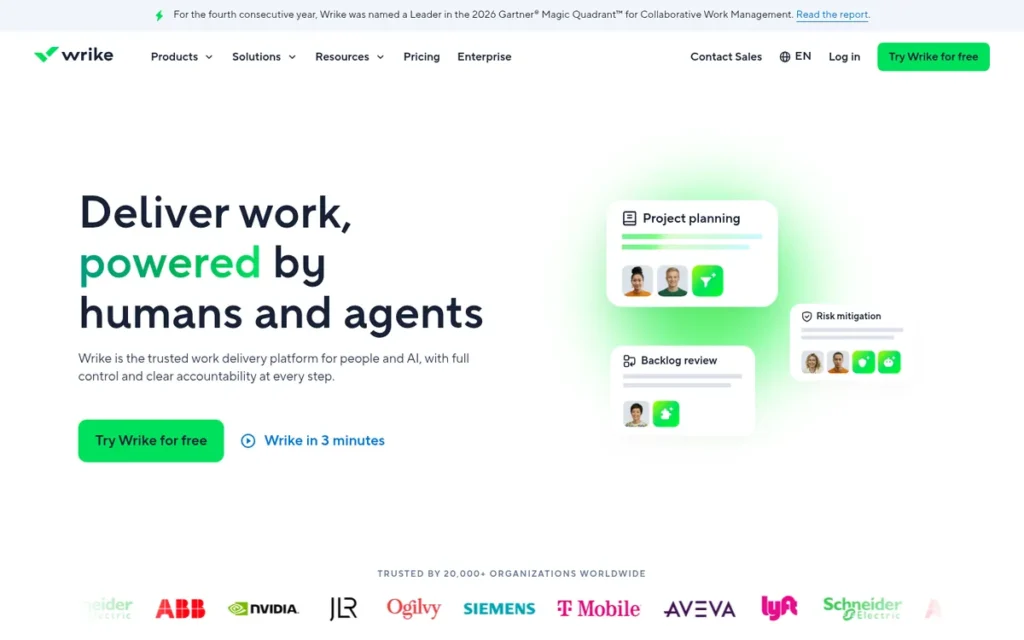
4. Wrike: Best for Marketing and Creative Work Management Across Teams
Category: Work Management Platform.
At a Glance
- Category: Work Management Platform
- Best For: Marketing and creative teams that share work across departments and need intake, capacity and proofing in one tool
- Price Range: Free plan; Team $10/user/month (2–15 users); Business $25/user/month (5–200 users), billed annually; Pinnacle custom (verified November 2026)
- Primary Strength: Wrike combines dynamic request intake, workload charts and built-in proofing designed for marketing and creative teams.
- Biggest Limitation: Wrike has no verified named-customer outcome data, and reviewers report a busy UI and key features limited to higher tiers.
- One-Line Summary: Wrike is a marketing and creative work management platform that combines dynamic request forms, job-role capacity planning and built-in proofing, with workload features starting on its Business tier.
- Last Verified: November 2026
Ranking Rationale
- Wrike scored 3.53/5 and ranks #4, with strong native work management coverage (C1 4.0), peer reviews (C2 4.0) and published pricing (C4 4.0).
- Wrike is held back by documented outcomes (C3 2.0, platform-level statistics only). That score alone separates Wrike from Aprimo within the near-tie with Smartsheet and Aprimo.
Overview
Wrike is a work management platform built for marketing and creative teams at mid-size and enterprise organisations. It combines dynamic request forms, reusable campaign Blueprints, workload charts with job-role capacity planning, and built-in proofing and approvals.
Wrike was founded in 2006 by Andrew Filev and has been independent since 2022, backed by Vista Equity Partners and Evergreen Coast Capital [Source: Wrike, 2022; vendor-published]. Wrike adds budgets and time tracking on higher tiers.
Key Features
- Wrike dynamic request forms turn incoming requests into projects with routing and templates.
- Wrike Blueprints provide reusable campaign templates for repeatable marketing programmes.
- Wrike workload charts and job-role capacity planning are available from the Business tier upward.
- Wrike includes built-in proofing and approvals, an Adobe Creative Cloud extension, and DAM integrations.
- Wrike cross-tagging lets a single task appear in several folders or team spaces without being duplicated.
Best For
Wrike is best for marketing and creative teams whose work crosses departments and who need intake, capacity visibility and proofing in one work management tool.
Strengths
- Wrike holds a 4.2/5 G2 rating from 4,563 reviews, a 4.4/5 Capterra rating from 3,046 reviews, and a 4.4/5 Gartner Peer Insights rating [Source: G2, 2026; Capterra, 2026; Gartner Peer Insights, 2026; peer-review aggregate].
- Wrike publishes its Team and Business prices on its own pricing page for purchases from 21 January 2026, so buyers can compare its core tiers without a sales call [Source: Wrike, 2026; vendor-published].
- Wrike cross-tagging is called “the first real game-changer” for marketing and operations work shared across teams by a Capterra reviewer [Source: Capterra, 2026; reviewer report].
- Wrike reports ISO 27001, ISO 27018 and PCI compliance and names Sony Pictures, L’Oréal and Intuit as customers. It appears in Gartner and Forrester collaborative work management research, but exact placements were not confirmed [Source: Wrike, 2026; vendor-reported].
Users on r/projectmanagement noted:
“My team receives a lot of requests to update our website from outside (of my department) teams. We have a form that we built with Wrike that they fill out and submit. Based on their selections of what kind of request it is, it is assigned as a task to the specific team member. The management team can look at a dashboard to see the incoming requests and see the progress status of the task. Tasks among individual teams can also be shuffled around by management based on workload. For this, it has saved a huge amount of headaches – as most of this was being done via random email requests in the past.” Posted by u/gorcbor19
Takeaway: Wrike’s dynamic request forms turn scattered email requests from other departments into routed, workload-balanced tasks that managers can track from one dashboard.
Limitations
Wrike trades approachability for depth. Teams get intake, capacity and proofing in one tool but face heavier onboarding.
- Wrike’s interface is described as “busy” or “heavy” by G2 reviewers, who also find onboarding overwhelming because of complex automations and custom fields [Source: G2, 2026; reviewer report].
- Wrike is criticised by Gartner Peer Insights reviewers for limited custom reporting and lag on very large plans [Source: Gartner Peer Insights, 2026; reviewer report].
- Wrike requesters reportedly “don’t understand where their requests go,” which can undermine adoption of intake [Source: Capterra, 2026; reviewer report].
- Wrike’s Business tier, where workload charts start, requires at least five users, which affects small marketing teams [Source: Wrike, 2026; vendor-published].
- Wrike has no verified customer-specific outcomes. Its only quantified results are 2022 platform-wide statistics, such as a 67% increase in automated items, and its SOC 2 and HIPAA scope was not confirmed [Source: Enterprise Times, 2022; vendor-reported].
Verdict
Wrike is a marketing-specific work management platform for teams that need intake, capacity planning and proofing in one place, and it is near-tied with Smartsheet and Aprimo in this evaluation.
Buyers should confirm that capacity features are included in the quoted Wrike tier. Teams that need budget-versus-actuals governance should not assume Wrike’s project budgets replace a marketing-finance system.
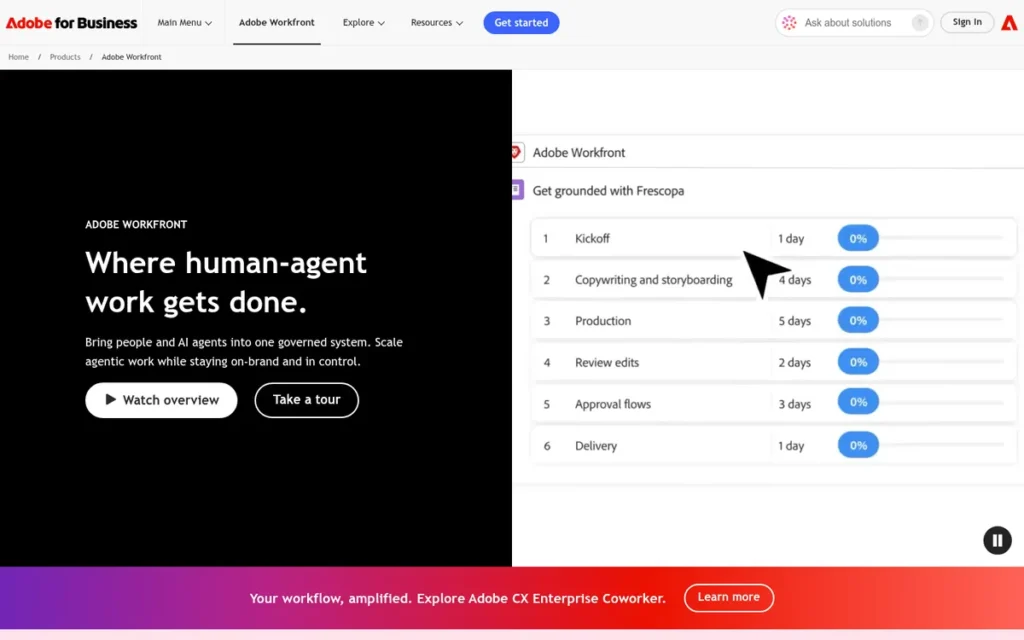
5. Adobe Workfront: Best for Enterprises Standardised on Adobe Experience Cloud
Category: Work Management Platform, coordinates intake, tasks, capacity and approvals for marketing work, at enterprise scale.
At a Glance
- Category: Work Management Platform
- Best For: Enterprise marketing organisations already invested in Adobe Experience Cloud
- Price Range: Quote-only, priced per user per month (Select, Prime, Ultimate); implementation and partner services extra (verified November 2026)
- Primary Strength: Adobe Workfront has the deepest native integration with Adobe Experience Cloud of any evaluated platform, alongside enterprise intake, capacity and proofing.
- Biggest Limitation: Adobe Workfront is quote-only, complex and dependent on admins, and paid training and partner services add to total cost.
- One-Line Summary: Adobe Workfront is an enterprise marketing work management platform that natively connects intake, capacity planning, proofing and project financials to Adobe Experience Cloud, and it is best suited to organisations already standardised on Adobe.
- Last Verified: November 2026
Ranking Rationale
- Adobe Workfront scored 3.30/5 and ranks #5, with the top score on enterprise readiness (C5 5.0) and near-top capability coverage (C1 4.5).
- Adobe Workfront is held back by quote-only pricing with no estimates (C4 1.5), no verified named-customer outcomes (C3 2.0) and dependence on admins (C6 2.0).
Overview
Adobe Workfront is an enterprise marketing work management platform for large organisations already invested in Adobe Experience Cloud. It covers request intake, resource and capacity planning, Workfront Proof approvals, campaign planning and Fusion automation.
Adobe Workfront was founded as AtTask in 2001 and acquired by Adobe in 2020 for about $1.5B [Source: Adobe, 2020; vendor-published]. Adobe Workfront is sold only through quote-based packages priced per user per month.
Key Features
- Adobe Workfront intake supports custom request forms, queues, auto-routing and smart approvals.
- Adobe Workfront resource management includes resource pools, role-based planning, planned versus actual hours, and a drag-and-drop Workload Balancer.
- Adobe Workfront Proof provides annotations, version comparison and audit trails for creative review.
- Adobe Workfront includes project and portfolio budgets, cost rates by role, and budget-versus-actual reporting.
- Adobe Workfront packages scale from Select to Prime, which adds strategic portfolio planning and an optional HIPAA-Ready package, and then to Ultimate, which adds Fusion, Data Connect, Scenario Planner and Goals [Source: Adobe, 2026; vendor-published].
Best For
Adobe Workfront is best for enterprise marketing organisations running Adobe Experience Cloud that need governed intake, capacity planning and creative review connected to their Adobe content supply chain.
Strengths
- Adobe Workfront holds a 4.4/5 Capterra rating from 1,501 reviews. Reviewers praise workflow customisation, resource allocation, approvals and audit trails [Source: Capterra, 2026; peer-review aggregate].
- Adobe Workfront integrates natively with AEM Assets, Creative Cloud, Marketo Engage, Adobe Analytics and GenStudio. G2 reviewers also cite Salesforce, Teams, Slack and Power BI connections [Source: Adobe, 2026; G2, 2026; vendor-reported].
- Adobe Workfront received TrustRadius scores of 92% likely to buy again and 91% saying it delivers good value [Source: Adobe/TrustRadius market report, 2026; vendor-published].
- Adobe Workfront is named a Leader in The Forrester Wave: Collaborative Work Management Tools on Adobe’s product page. SOC 2 and FedRAMP scope were not confirmed [Source: Adobe, 2026; vendor-reported; Wave edition year not stated].
Limitations
Adobe Workfront trades accessibility for enterprise depth. Organisations get Adobe-native governance but need admin staff and partner services and must accept a heavier interface.
- Adobe Workfront’s interface is described as heavy and cluttered, with lag in large deployments and weak mobile features [Source: Capterra, G2 and Gartner Peer Insights, 2026; reviewer report].
- Adobe Workfront implementations are customised and often need professional services, according to Software Advice reviewers [Source: Software Advice, 2026; reviewer report].
- Adobe Workfront’s 4.1/5 G2 rating from about 1,200 reviews is the lowest among the work management platforms with a verified G2 rating [Source: G2, 2026; peer-review aggregate].
- Adobe Workfront has no verified named-customer percentage outcomes. Its financial features cover project costs rather than full marketing-finance planning.
Verdict
Adobe Workfront is the best-integrated choice in this evaluation for enterprises standardised on Adobe Experience Cloud, but its quote-only pricing and dependence on admins make it a weaker fit outside that ecosystem.
Buyers should budget for implementation partners, admin staff and automation training. Buyers should also confirm which Adobe Workfront integrations are included in the quoted package.
6. Uptempo: Best for Marketing Budget Planning and CMO–CFO Spend Reconciliation
Category: Marketing Finance Platform, plans, allocates and reconciles marketing budgets against actual spend.
At a Glance
- Category: Marketing Finance Platform
- Best For: Enterprise marketing organisations whose main problem is reconciling top-down budgets with bottom-up plans and actual spend
- Price Range: Quote-only and modular; no reliable third-party estimates found (verified November 2026)
- Primary Strength: Uptempo has the deepest native marketing-finance capability in this evaluation, including spend lifecycle tracking and PO reconciliation.
- Biggest Limitation: Uptempo publishes no pricing and has a smaller review base than the other evaluated platforms (G2 4.1/5, 147 reviews, 2026), with support and admin sub-scores below the category average.
- One-Line Summary: Uptempo is an enterprise marketing finance platform that reconciles top-down budgets with bottom-up campaign plans and tracks spend from commitment to payment, and it is typically paired with a separate work management tool.
- Last Verified: November 2026
Ranking Rationale
- Uptempo scored 3.20/5 and ranks #6, with the strongest documented customer outcomes in this evaluation (C3 5.0).
- Uptempo is held back by quote-only pricing with no estimates (C4 1.0) and a smaller review base (147 G2 reviews), not by weak finance capability.
Overview
Uptempo is an enterprise marketing finance and planning platform for large marketing organisations. It reconciles top-down budget allocations with bottom-up campaign plans, tracks spend from commitment to payment, and links marketing investment to performance.
Uptempo was formed from BrandMaker, Allocadia and Hive9 and rebranded in July 2022, backed by Bregal Sagemount [Source: Uptempo, 2022; vendor-published]. Uptempo reports serving 250+ global enterprises and 625,000+ marketers [Source: Uptempo, 2026; vendor-reported].
Key Features
- Uptempo Spend combines top-down allocation with bottom-up planning and plan-versus-actual tracking.
- Uptempo tracks committed, encumbered, invoiced and paid spend, and reconciles purchase orders and invoices.
- Uptempo connects to ERP systems such as SAP, Oracle and NetSuite, though buyers should confirm the connector scope with the vendor.
- Uptempo Performance links marketing investment to ROI using data from Salesforce, Marketo, Adobe, Tableau and Snowflake.
- Uptempo integrates with Workfront, Asana, Airtable and monday.com, so those tools can handle day-to-day execution.
Best For
Uptempo is best for enterprise marketing organisations whose main problem is reconciling budgets between the CMO and CFO. Uptempo is typically paired with a separate work management platform.
Strengths
- Uptempo publishes a Cisco case study reporting that budget accuracy improved from about ±2% to 99.5%. Cisco also identified 25% savings on agency and contracted services and cut budget approvals from weeks to under 48 hours [Source: Uptempo, 2026; vendor-published].
- Uptempo reports that Juniper Networks stays within 1% of budget every quarter across 200+ marketers and that Palo Alto Networks spends 66% less time managing budgets [Source: Uptempo, 2026; vendor-published].
- Uptempo tracks the full spend lifecycle from commitment to payment, which no work management tool in this evaluation does natively [Source: PlugRoute product documentation review, 2026; PlugRoute analysis].
- Uptempo holds a 4.1/5 G2 rating from 147 reviews, with 84% of reviews at 4 or 5 stars, and reports SOC 2 Type 2 certification. No current Gartner or Forrester placement was confirmed [Source: G2, 2026; FeaturedCustomers, 2026; peer-review aggregate].
Limitations
Uptempo trades general-purpose usability for finance depth. It handles budget reconciliation but relies on a separate tool for day-to-day execution.
- Uptempo’s G2 sub-scores for quality of support and ease of administration are below the MRM category average, based on 147 reviews [Source: G2, 2026; peer-review aggregate].
- Uptempo analytics “could be improved,” according to a TrustRadius reviewer who said the product suits data control more than analysis [Source: TrustRadius, 2026; reviewer report].
- Uptempo’s quote-only, enterprise-only pricing may be more than mid-size teams need.
- Uptempo’s ERP connector scope and ISO 27001 status were not verified, and Uptempo is not positioned as a primary tool for capacity or creative work management.
Verdict
Uptempo is the most purpose-built option in this evaluation for enterprises that need marketing budgets to reconcile with campaign plans and actual spend.
Uptempo’s #6 rank reflects quote-only pricing and a smaller review base, not a documented weakness in its finance capability. Budget-led buyers should shortlist Uptempo first and pair it with a work management platform.
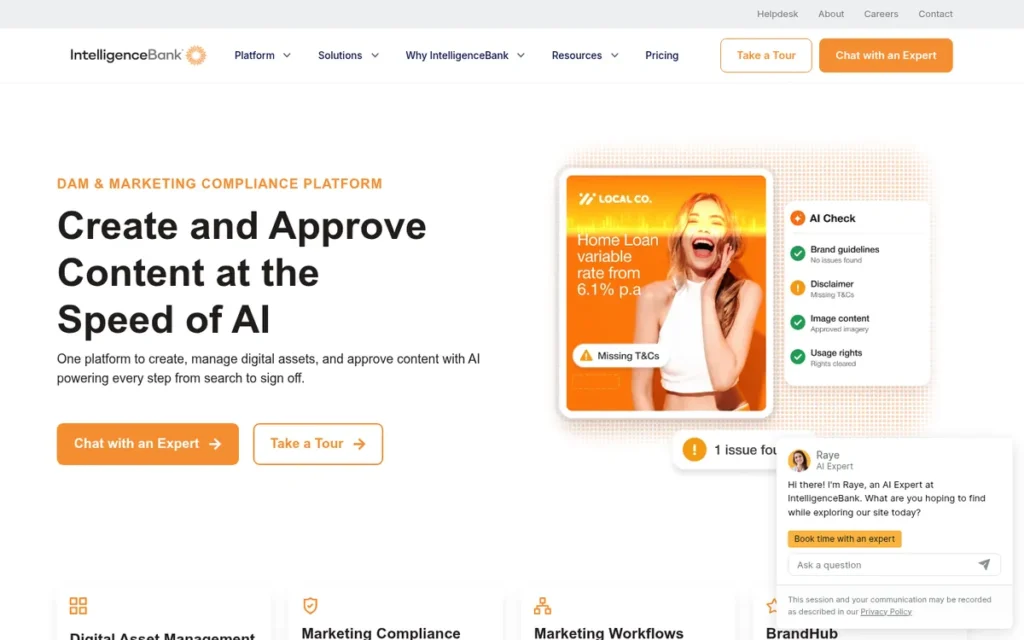
7. IntelligenceBank: Best for Brand Governance and Compliance-Led DAM on a Mid-Market Budget
Category: DAM and Brand Governance Platform, centralises approved assets and enforces brand and compliance rules.
At a Glance
- Category: DAM and Brand Governance Platform
- Best For: Brand teams and compliance-sensitive or regulated marketing teams that need governed assets and approvals without an enterprise-suite budget
- Price Range: From US$567/month billed annually (base DAM); DAM Pro from $1,225/month; other packages quote-based (verified November 2026)
- Primary Strength: IntelligenceBank combines DAM, brand portals, proofing and AI compliance checks at a published entry price.
- Biggest Limitation: IntelligenceBank has limited resource planning, budgeting and portfolio management compared with full MRM suites.
- One-Line Summary: IntelligenceBank is a DAM and brand governance platform that combines digital asset management, online proofing and AI compliance checks at a published starting price, but it has little depth in capacity and budget planning.
- Last Verified: November 2026
Ranking Rationale
- IntelligenceBank scored 3.08/5 and ranks #7. It has a published entry price (C4 4.0) but limited capacity, budget and portfolio depth (C1 3.0).
- IntelligenceBank’s outcomes are mostly not tied to named customers (C3 2.5). A low overall rank does not mean a poor fit for buyers whose main need is asset governance.
Overview
IntelligenceBank is a DAM and brand governance platform for marketing teams in brand-sensitive and regulated industries. It combines AI-tagged digital asset management, brand portals, intake forms, online proofing and AI compliance checks.
IntelligenceBank was founded in Melbourne, Australia, in 2009, according to one secondary source; other sources say 2008 [Source: MarTech Stack Builder, 2026; secondary source]. IntelligenceBank has offices in Australia, the US, Canada and the UK.
Key Features
- IntelligenceBank DAM uses AI tagging and facial recognition to search and organise assets.
- IntelligenceBank provides brand portals, brand guidelines and creative templates with locked brand elements.
- IntelligenceBank includes intake forms and briefs, Kanban boards, marketing inboxes, and online proofing and approvals.
- IntelligenceBank runs AI compliance checks on content, web pages, ads, social and video, and includes a disclaimer engine.
- IntelligenceBank integrates with Canva, Photoshop, InDesign, Illustrator, Figma, WordPress and Drupal, mostly at no extra cost.
Best For
IntelligenceBank is best for brand and compliance teams in regulated or brand-sensitive industries that need governed assets and approvals rather than deep capacity or budget planning.
Strengths
- IntelligenceBank holds a 4.5/5 G2 rating from 331 reviews and a 9.4/10 G2 support-quality score, and G2 named it the MRM category’s top-trending product [Source: G2, 2026; peer-review aggregate].
- IntelligenceBank is the only governance-focused platform in this evaluation with a published entry price. Base DAM costs US$567/month billed annually, and DAM Pro starts at $1,225/month [Source: IntelligenceBank, 2026; vendor-published].
- IntelligenceBank reports that Movember centralised more than 29,000 assets on the platform. Customers report that compliance review fell to 2 minutes per document [Source: IntelligenceBank, 2026; vendor-published].
- IntelligenceBank reports SOC 2 Type II certification, ISO 27001:2022 hosting, GDPR compliance and HIPAA support. No Gartner or Forrester placement was verified [Source: IntelligenceBank, 2026; vendor-reported].
Limitations
IntelligenceBank trades MRM breadth for governance depth. It handles assets and compliance but offers little capacity, budget or portfolio planning.
- IntelligenceBank has limited resource and capacity planning, budgeting and portfolio management, and its connectors for Salesforce, Microsoft, Workfront and monday.com were not verified.
- IntelligenceBank’s UI is called dated and confusing by Software Advice reviewers, who also mention slow uploads and the time it takes to train colleagues [Source: Software Advice, 2026; reviewer report].
- IntelligenceBank search and filtering are criticised by G2 reviewers, including archived files appearing in results [Source: G2, 2026; reviewer report].
- IntelligenceBank exit terms drew Capterra complaints, including a reported $2,000 FTP-access fee, no S3 access when leaving, and a 150-file bulk-download limit [Source: Capterra, 2026; reviewer report].
- IntelligenceBank SSO initially supported only basic data exchange, according to a Capterra reviewer [Source: Capterra, 2026; reviewer report].
Verdict
IntelligenceBank is the only governance-focused platform in this evaluation with a published entry price (US$567/month billed annually, 2026). That makes it a practical shortlist pick for teams whose main MRM problems are scattered assets and compliance review.
IntelligenceBank is not a capacity or budget planning tool, so most buyers will pair it with a work management platform. Buyers should ask about data export and exit terms before signing.
Can One Platform Handle All of Marketing Resource Management?
No evaluated platform handles deep budgeting, work management and DAM equally well. Aprimo comes closest because it natively combines Plan & Spend, workflow and enterprise DAM, but it requires a multi-month implementation. In 2026, MRM is usually a two-tool decision: one platform for the work, and one for either the money or the assets.
The research supports four common pairings:
- Uptempo pairs with Adobe Workfront or monday.com because Uptempo documents integrations with both. Uptempo handles the budget and spend lifecycle, and the work management tool handles execution.
- IntelligenceBank pairs with a work management platform such as monday.com or Wrike. IntelligenceBank handles governed assets and compliance review, but buyers should confirm connectors, which were not verified.
- Smartsheet combines with Smartsheet Resource Management and Brandfolder so that one vendor provides work, capacity and DAM as separately licensed products.
- Adobe Workfront pairs with AEM Assets for Adobe-centred enterprises, and the Adobe DAM is licensed separately.
How Deep Is Budget Planning in Each MRM Platform?
Uptempo has the deepest budget planning among the seven MRM platforms evaluated. It tracks committed, encumbered, invoiced and paid spend and reconciles purchase orders. Aprimo offers a native Plan & Spend module, Adobe Workfront offers project financials, and monday.com and Smartsheet rely mainly on formulas.
| Platform | Budget Depth | What It Covers |
|---|---|---|
| Uptempo | Marketing finance | Top-down and bottom-up planning; committed, encumbered, invoiced and paid spend; PO and invoice reconciliation; ERP links |
| Aprimo | Suite budget module | Budget allocation, plan vs. actual, forecasts, ERP and finance integration |
| Adobe Workfront | Project financials | Project and portfolio budgets, cost rates by role, planned vs. actual cost |
| Wrike | Project budgets (higher tiers) | Budgets and time tracking on higher tiers |
| monday.com | Formula-based | Columns and formulas, with no versioning, accruals or commitments |
| Smartsheet | Formula-based core | Grid formulas; Resource Management adds utilisation and forecasting |
| IntelligenceBank | Limited | Not positioned for budgeting or forecasting |
A budget column records what you planned. A spend lifecycle records what you have committed. Finance needs the second.
Illustrative example: an agency signs a $50,000 purchase order in March and invoices it in May. In April, a formula-based budget column shows the $50,000 as unspent. A spend-lifecycle tool such as Uptempo shows it as committed, so the CMO does not reallocate money that is already owed.
How Much Does Marketing Resource Management Software Cost?
Published MRM software prices in 2026 range from $9 per seat per month (monday.com Basic, Smartsheet Pro) to about $172,000 per year for Aprimo with AI modules (third-party estimate). Adobe Workfront and Uptempo publish no prices, and implementation can add 15–50% of first-year licence cost.
| Platform | Pricing Transparency (Nov 2026) | Published or Estimated Entry Cost | Stated Security (vendor-reported unless noted) |
|---|---|---|---|
| monday.com | Published (Enterprise custom) | $9/seat/month annually (Basic); Pro $19; 3-seat minimum | SOC 2 Type II, ISO 27001; HIPAA on qualifying plans |
| Smartsheet | Published core tiers; add-ons quote-only | $9/member/month annually (Pro); Business $19 | HIPAA-eligible with BAA; SOC 2, ISO and FedRAMP scope to check per add-on |
| Aprimo | Quote-only | About $20,000/year entry; about $50,000/year median (third-party estimate) | Not confirmed in this research |
| Wrike | Published (Pinnacle custom) | $10/user/month annually (Team); Business $25 | ISO 27001, ISO 27018, PCI; SOC 2 and HIPAA not confirmed |
| Adobe Workfront | Quote-only | No verifiable estimate | Optional HIPAA-Ready package on Prime; SOC 2 and FedRAMP scope not confirmed |
| Uptempo | Quote-only | No reliable estimate | SOC 2 Type 2 (reported); ISO 27001 not verified |
| IntelligenceBank | Starting price | US$567/month annually (base DAM); DAM Pro $1,225/month | SOC 2 Type II, ISO 27001:2022 hosting, GDPR, HIPAA support |
Licence price is only part of MRM cost. Implementation and training add an estimated 15–50% of first-year licence cost for Aprimo [Source: Picajet, 2026; third-party estimate]. Adobe Workfront’s total cost also includes partner services and admin staff [Source: Adobe, 2026; vendor-published].
Which Platforms Were Considered but Not Ranked?
PlugRoute considered several other platforms but did not rank them. Some, such as Asana and Ansira, fall outside the MRM definition used here. Others, such as Screendragon and Kantata, were not covered by this research. Each one is listed below with the reason it was left out.
Leaving a platform out is not a judgment of its quality. Buyers with specialised needs, such as agency utilisation tracking or partner marketing, should evaluate these platforms separately.
- Asana was excluded because it is a general work management tool, despite a 4.4/5 G2 rating from 14,099 reviews [Source: G2, 2026; peer-review aggregate].
- Ansira was excluded because it is a distributed and partner-marketing platform.
- Optimizely CMP and Opal were excluded because they are content-marketing platforms.
- Scoro, Productive and Kantata are professional services automation (PSA) and agency tools that this evaluation did not research.
- Screendragon and Marmind are enterprise MRM vendors that this research did not cover.
- Planful for Marketing and Vya were considered at the discovery stage but not researched in depth.
What Red Flags Should I Watch For When Evaluating Marketing Resource Management Software?
The biggest red flags when evaluating marketing resource management software are hidden costs and false precision. Watch for capacity views built on unvalidated time estimates, budget tracking that is really spreadsheet formulas, quotes that exclude add-ons, seat licences that charge occasional reviewers, analyst badges you cannot check, and missing exit terms.
Red Flag #1: Capacity Views Built on Unvalidated Time Estimates
Capacity and workload views in the MRM tools evaluated here are only as accurate as the time estimates in their templates. A workload chart is a forecast built from those estimates, not a measurement. If the estimates are wrong, any tool will confidently show the wrong people as overbooked.
An Adobe Workfront admin reported a Workload Balancer where “everyone is over booked for 5-6 hours in one day” [Source: Reddit r/workfront_help, 2025; practitioner report]. Inaccurate estimates distort capacity data across the whole category, not just in Adobe Workfront.
Takeaway: Check template estimates against logged hours before trusting any MRM capacity view.
Illustrative example: if a template estimates 8 hours for a banner set that really takes 3, the workload view flags the designer as overbooked by 5 hours a day.
Red Flag #2: Budget Tracking That Is Really Spreadsheet Formulas
Budget tracking built from columns and formulas, as in monday.com and core Smartsheet, cannot record accruals, commitments or purchase-order reconciliation. Before accepting a budget-planning claim, ask each vendor to show committed, invoiced and paid spend states on a real campaign, not just a planned-versus-actual column.
Red Flag #3: Quotes That Exclude Add-On Modules and Implementation
A licence quote that leaves out add-on modules, implementation, admin staff and paid training understates the true cost of marketing resource management software. Suites have the largest gaps: third-party estimates put Aprimo implementation and training at 15–50% of first-year licence cost [Source: Picajet, 2026; third-party estimate].
One Adobe Workfront admin reported that instructor-led Fusion bootcamps cost “a couple grand USD apiece” [Source: Reddit r/workfront_help, 2025; practitioner report].
Takeaway: Automation layers can carry paid training costs that are not in the licence quote.
Red Flag #4: Seat Licensing That Charges for Occasional Reviewers
Seat-bucket or editor-based licensing can charge full price for stakeholders who only review work or submit requests. monday.com sells seat buckets with a three-seat minimum, Smartsheet licenses by editor, and Wrike’s Business tier requires five users. How reviewers are licensed can therefore change total cost sharply.
Illustrative example: at monday.com Pro’s published rate of $19/seat/month billed annually, 50 paid seats cost about $11,400 a year, compared with $2,280 for 10 core users. Confirm whether approvers can use free guest or viewer access.
Practitioners also report agencies with about 100 seats looking for paid implementation partners, even on monday.com, which reviewers rate highly for ease of use [Source: Reddit r/mondaydotcom, 2025; practitioner report].
Red Flag #5: Analyst Badges Without the Underlying Report
Analyst badges on vendor websites are vendor-reported unless you have read the underlying report. Gartner retired its MRM Magic Quadrant in 2017. Several placements cited by vendors in this evaluation, including Adobe Workfront’s Forrester Wave claim, do not state the edition year. Ask for the report and check which market it covers.
Red Flag #6: No Data Export or Exit Terms
Contracts without clear data-export and exit terms can lock in your assets and raise switching costs. Capterra reviewers report a $2,000 FTP-access fee and no S3 access when leaving IntelligenceBank, plus a 150-file bulk-download limit [Source: Capterra, 2026; reviewer report]. Ask every vendor for export terms in writing.
What Questions Should I Ask Before Choosing Marketing Resource Management Software?
Before choosing marketing resource management software, ask seven questions. Which MRM problem is primary? Which features are native and which are add-ons? Can the vendor demo your end-to-end process? What will year one really cost? Do certifications cover every module? How do you export data if you leave? Can you run a pilot first?
Question #1: Which of the four MRM problem types is our primary pain?
Name your main marketing resource management problem before you look at vendors, because the answer decides which of the four categories you shortlist. A team overwhelmed by scattered requests needs a different tool from a team whose CFO cannot reconcile marketing spend.
As one user on r/projectmanagement described:
“These questions frequently pop up, its 100% impossible to give any meaningful answer without any details of your type of projects.
It’s like asking “what’s the best car for work purpose” without saying what kind of work you do. Long distance haulage? Visiting customers as a consultant?” Posted by u/Chicken_Savings
Takeaway: Generic “best tool” recommendations mean little until buyers define their own requirements, so the primary MRM problem has to be named before any shortlist.
- Work management covers intake, capacity and approvals, and points to monday.com, Smartsheet, Wrike or Adobe Workfront.
- Budget and spend management covers allocation, actuals and PO reconciliation, and points to Uptempo.
- Content operations combines budget, work and DAM, and points to Aprimo.
- DAM and brand governance covers approved assets and compliance, and points to IntelligenceBank.
Question #2: Which features are native, which are add-ons, and which require an integration?
Ask each vendor to label every capability you need as native, separately licensed or integration-only, and to give the answer as a written matrix. Demo claims blur these categories. The difference decides whether a tool solves a problem or just moves it into another licence or a custom integration.
Question #3: Can you run our end-to-end scenario in the demo?
Ask the vendor to run your own end-to-end scenario in the demo, using your data: intake, plan, allocation, approval, purchase order and actuals, then reporting. Gaps in that flow usually signal workarounds your team will have to build and maintain after purchase, and scripted demos rarely show them.
Question #4: What will implementation, admin staffing and training cost in year one?
Ask for a year-one total cost that includes partner services, admin headcount, paid training and how occasional reviewers are licensed. Licence price alone is not a budget. Third-party estimates put Aprimo implementation at 15–50% of first-year licence cost [Source: Picajet, 2026; third-party estimate].
Question #5: Which security certifications cover every module we are buying?
Ask for trust documentation that covers each module you are buying, not just the core platform. Certifications such as SOC 2 Type II, ISO 27001 or HIPAA support may not extend to acquired add-ons. Smartsheet buyers, for example, should confirm whether Brandfolder falls within Smartsheet’s certification scope.
Question #6: How do we export our data and assets if we leave?
Get export formats, bulk-download limits and exit fees in writing before you sign. Asset-heavy platforms raise the stakes: Capterra reviewers report a 150-file bulk-download limit and a $2,000 FTP-access fee at exit from IntelligenceBank. Check the equivalent terms with every vendor on your shortlist.
Question #7: Can we pilot the platform on one campaign stream before signing?
Ask to run a 30-day pilot on one campaign stream with real requesters before signing a multi-year contract. During the pilot, check whether capacity views match the hours people actually log and whether requesters can see where their requests go. Reviewers report both problems across MRM tools.
How Do I Justify an MRM Purchase to Finance and IT?
Justify an MRM purchase with four things: a year-one total cost, one baseline metric you will improve, security documentation for every module, and written exit terms. Finance approves numbers it can check later, and IT approves connectors and certifications it can verify. Build the case around evidence both teams can audit.
- A year-one total cost should include the licence, implementation (an estimated 15–50% of first-year licence cost for suites), admin headcount and paid training.
- A seat plan should state whether occasional reviewers and requesters need paid seats.
- One baseline metric, such as approval cycle time, hours spent triaging intake, or budget variance, should be measured before rollout so you can compare results afterwards.
- Security documentation should cover every module, including acquired add-ons.
- Exit terms, export formats and bulk-download limits should be confirmed in writing.
MRM implementation usually takes months, not weeks. Industry estimates put MRM rollouts at 3–16 months, averaging about 8 months [Source: Axis Intelligence, 2026; secondary source, lower credibility]. Review summaries put Aprimo at about five months [Source: Picajet, 2026; third-party estimate].
Uptempo cites a best-case deployment of about 200 budgets and 230 users in under five weeks [Source: Uptempo, 2026; vendor-published]. Base the business case on the longer estimates unless a vendor’s references confirm a faster timeline.
How Did We Rank These Marketing Resource Management Platforms?
PlugRoute scored each of the seven marketing resource management platforms from 1 to 5 on six published, weighted criteria and ranked them by weighted total. The rank measures the overall strength of public evidence, not fit for every scenario. The scenario table near the top of this article pairs nine common MRM problems with a recommended tool.
Ranking criteria, weights and scoring thresholds:
- C1, Native MRM Capability Coverage (25%), measures whether a tool solves intake, capacity, approvals, budget and DAM natively or pushes the problem onto add-ons. Native coverage of all five areas scores 5.
- C2, Peer Review Ratings and Volume (20%), is the main large-scale satisfaction signal that does not come from vendors. A rating above 4.5 with more than 5,000 reviews scores 5, fewer than 500 reviews scores 3, and no verified rating scores 1.
- C3, Documented Customer Outcomes (15%), matters because a finance business case needs quantified results from named organisations. Several specific named outcomes score 5, and platform-level statistics alone score 2.
- C4, Pricing Transparency and Cost Predictability (15%), matters because quote-only pricing blocks comparison. Fully published pricing scores 5, a starting price 4, quote-only with estimates 2, and quote-only without estimates 1. Documented hidden costs reduce the score.
- C5, Integration Ecosystem and Enterprise Readiness (15%), reflects what IT review needs: named connectors, stated certifications, regulated-industry features and analyst placements. Placements count as vendor-reported unless confirmed.
- C6, Implementation and Adoption Risk (10%, inverse), reflects rollout and admin burden. A reported rollout of about five months, or a need for dedicated admins, scores 2 or lower, and a higher score means lower risk.
| Rank | Company | C1 | C2 | C3 | C4 | C5 | C6 | Weighted Total | Gap to Next |
|---|---|---|---|---|---|---|---|---|---|
| 1 | monday.com | 3.0 | 5.0 | 3.5 | 4.5 | 4.0 | 4.0 | 3.95 | +0.32 |
| 2 | Smartsheet | 3.5 | 4.0 | 4.0 | 3.5 | 3.5 | 3.0 | 3.63 | +0.08 |
| 3 | Aprimo | 5.0 | 3.0 | 4.0 | 2.0 | 4.0 | 2.0 | 3.55 | +0.02 |
| 4 | Wrike | 4.0 | 4.0 | 2.0 | 4.0 | 3.5 | 3.0 | 3.53 | +0.23 |
| 5 | Adobe Workfront | 4.5 | 3.5 | 2.0 | 1.5 | 5.0 | 2.0 | 3.30 | +0.10 |
| 6 | Uptempo | 3.5 | 3.0 | 5.0 | 1.0 | 3.5 | 3.0 | 3.20 | +0.12 |
| 7 | IntelligenceBank | 3.0 | 3.0 | 2.5 | 4.0 | 3.0 | 3.0 | 3.08 | N/A |
Smartsheet, Aprimo and Wrike form a near-tie cluster between 3.53 and 3.63, so treat their 2-3-4 order as approximate.
Sensitivity and caveats:
- monday.com stays #1 whether its C4 score is 4.5 or 5.0 (a weighted total of 3.95 or 4.03).
- Smartsheet would tie Aprimo at 3.55 if its C4 were scored 3.0 instead of 3.5.
- Uptempo would still lead IntelligenceBank, 3.10 to 3.08, if its C2 were scored 2.5 to reflect its 4.1 rating. That margin is an effective tie.
- Review volume ranges from 17,940 G2 reviews (monday.com) to 147 (Uptempo), and nearly all outcome data in this evaluation is vendor-published.
Evidence labels used in this article:
- Vendor-published figures are case studies and results released by the vendor itself and not verified independently.
- Vendor-reported claims are certifications, reach figures and analyst placements that vendors state without supplying the underlying report.
- Commissioned studies, such as the Forrester Consulting TEI of Brandfolder, are paid for by a vendor and model results rather than measure them.
- Third-party estimates are unofficial pricing, market or implementation figures from analysts and review aggregators.
- Peer-review aggregates are G2, Capterra and Gartner Peer Insights ratings with review counts. Reviewer reports are individual reviews on those sites.
- Practitioner reports are individual accounts from Reddit communities.
- Independent reviews, secondary sources, analyst research, regulatory filings and PlugRoute analysis are each labelled by name wherever they are cited.
Years shown for vendor pages and review sites are the year the data was accessed.
PlugRoute has no affiliate relationships with any company listed, and rankings are determined entirely by research data and objective evaluation criteria.
Frequently Asked Questions
What is the best marketing resource management software for enterprise in 2026?
Aprimo is the most complete enterprise MRM suite in this evaluation, natively combining budget planning, workflow, regulated approvals and DAM. Adobe Workfront is the stronger fit for enterprises standardised on Adobe Experience Cloud. Uptempo is the purpose-built choice when reconciling budgets between the CMO and CFO is the main problem. All three have quote-only pricing.
What is the best marketing resource management software for mid-size teams?
monday.com, Wrike and Smartsheet are the strongest fits for mid-size marketing teams, because all three publish tier pricing and offer intake, approvals and workload views. monday.com has the largest peer-review base, Wrike adds built-in proofing and cross-tagging, and Smartsheet suits spreadsheet-native teams. Workload features need monday.com Pro or Wrike Business.
How does PlugRoute determine rankings?
PlugRoute scores each platform from 1 to 5 on six published, weighted criteria: native capability coverage, peer reviews, documented outcomes, pricing transparency, enterprise readiness and adoption risk. monday.com scored highest (3.95/5). Smartsheet, Aprimo and Wrike were within 0.10 points of each other. Every statistic carries a dated provenance label.
What Do Key Marketing Resource Management Software Terms Mean?
Marketing Resource Management (MRM): Software that helps marketing teams manage their work, budgets and assets, though vendors define the category in different ways. That is why buyers should first decide whether their main problem is work management, budget planning, content operations or asset governance.
Work Management Platform: A tool that handles request intake, tasks, team capacity and approvals for marketing work. It suits teams whose main problem is coordinating work, but it usually lacks deep budget planning and a full asset library.
Content Operations Suite: A single system that combines budget planning, workflow, approvals and digital asset management. It covers the most ground natively, but it usually means quote-only pricing, a rollout lasting several months and heavier administration.
Digital Asset Management (DAM): A central library for approved brand files, with metadata, renditions, usage rights and expiry dates. Buyers with scattered assets or brand compliance needs should check whether a platform includes real DAM or only basic file storage.
Request Intake: The forms and routing that turn incoming marketing requests into structured, assigned tasks. Good intake replaces scattered email and chat requests, but adoption can suffer if requesters cannot see where their requests go.
Capacity or Workload View: A chart showing how work is spread across team members and who is overbooked. It is a forecast built from template time estimates, not a measurement, so buyers should check those estimates against logged hours before trusting it.
Plan Versus Actual: A comparison of planned budget against what was actually spent. A simple budget column with formulas can show this, but it cannot track accruals or commitments, which finance teams need for real budget governance.
Spend Lifecycle: Tracking marketing spend through its stages: committed, encumbered, invoiced and paid. It stops money that is already owed under a signed purchase order from looking unspent and being reallocated by mistake.
Purchase Order (PO) Reconciliation: Matching purchase orders and invoices against marketing budgets and plans. It matters to organisations where marketing and finance leaders need the same numbers, and formula-based budget tools cannot do it.
MLR Review: Medical, legal and regulatory review, a multi-step approval process with audit trails that regulated industries such as pharma and healthcare use. Buyers in these sectors should confirm that a platform supports it natively.
Seat-Bucket or Editor-Based Licensing: Pricing that sells seats in fixed blocks or charges by editor, often with minimum seat counts. It can mean paying full price for people who only review work or submit requests, so buyers should check whether those people can use free guest or viewer access.
Quote-Only Pricing: Pricing you only get from a sales conversation, often split across add-on modules, with implementation and training costing extra. It makes like-for-like comparison hard, so buyers should ask for a full year-one quote that includes every module and service.
Which Marketing Resource Management Tool Is Right for You?
Key Insights
monday.com ranks #1 among marketing resource management platforms in 2026 (3.95/5) because it combines the largest peer-review base in the MRM category with published per-seat pricing.
Smartsheet, Aprimo and Wrike are near-tied (3.53–3.63), so buyers should choose among them by problem: a spreadsheet-native stack, native budget-work-DAM breadth, or creative work shared across teams.
No evaluated platform handles deep budgeting, work management and DAM equally well, so MRM in 2026 is usually a two-tool decision.
Uptempo has the deepest marketing-finance capability, and its #6 rank reflects quote-only pricing and a smaller review base (G2 4.1/5, 147 reviews, 2026), not weak finance features.
A workload chart in any MRM tool is a forecast built from template estimates, not a measurement, so buyers should validate estimates before trusting capacity views.
Fully configured quotes that include add-ons, implementation and training are the most reliable way to compare MRM vendors like for like.
Teams whose main problem is coordinating intake and capacity should start with monday.com, Wrike or Smartsheet.
Organisations that run on Adobe Experience Cloud should start with Adobe Workfront.
Teams whose main problem is budget reconciliation should shortlist Uptempo and pair it with a work management tool.
Teams whose bottleneck is assets and compliance should consider Aprimo or IntelligenceBank.
The MRM category keeps changing names, and more vendors are adding AI agents that blur these boundaries. For more evidence-based comparisons, read PlugRoute’s full MRM evaluation methodology and our independent reviews of work management and DAM tools. We update this guide quarterly. Last updated: 5 November 2026.