The best Semrush alternatives in 2026 are SE Ranking for agencies needing rank tracking and white-label reports, Ahrefs for backlink research, and Serpstat for the lowest-cost full suite. No alternative replaces every Semrush job, so choose by the job you use most and compare against your current Semrush tier.
Semrush bills add up quickly for solo operators and small teams. Headline prices also hide tracked-keyword caps, usage credits, seat fees and add-ons. Many teams worry that switching means losing backlink depth, PPC ad history or the client reporting they rely on.
PlugRoute has no affiliate relationships with any company listed. Rankings are determined entirely by research data and objective evaluation criteria.
This guide scores seven alternatives on six published criteria and sorts them into three categories. For each one, it shows what you keep, gain and lose compared with Semrush. Every price was checked in November 2026 and is labelled by source.
What Are the 3 Categories of Semrush Alternatives?
Semrush alternatives fall into three categories. All-in-One SEO Suites cover most of Semrush’s workflow. Specialist Research Tools replace one part of it, such as paid-search research. Lightweight SEO Toolkits cover common tasks at a low price. Many teams also use two cheaper tools instead of one suite.
- All-in-One SEO Suite: SE Ranking, Ahrefs, Serpstat and Moz Pro each cover keyword research, competitor research, backlinks, audits and rank tracking in one platform.
- Specialist Research Tool: SpyFu replaces Semrush’s Google Ads competitor research and paid-search research, but SpyFu does not cover the full SEO workflow.
- Lightweight SEO Toolkit: Mangools and Ubersuggest cover keyword research, basic rank tracking and backlink lookups at a lower price. Each has clear gaps in audits, PPC data or reporting.
- Two-tool stack: Reddit practitioners often pair Ahrefs for backlinks with a cheaper suite for everything else. One user wrote, “We use both – AHREFS for backlink insights, SEM Rush for other features” (r/digital_marketing, 2021).
Why Are Teams Looking for Semrush Alternatives?
Teams leave Semrush mainly because of cost, not data quality. Semrush’s two most-cited G2 complaints are Expensive Base Subscription (450 reviews) and Costly Add-Ons (238), and both are about price (G2, November 2026). Semrush still holds 4.4/5 from 4,311 G2 reviews, with 95.3% at 4 or 5 stars.
Semrush’s most-cited G2 cons (G2, November 2026):
- Semrush’s top G2 con is Expensive Base Subscription, cited in 450 reviews.
- Semrush’s second G2 con is Costly Add-Ons, cited in 238 reviews.
- Semrush’s Steep Learning Curve is cited in 210 reviews.
- Semrush’s Hard-To-Find Tools are cited in 206 reviews.
- Semrush’s Overwhelming Toolset is cited in 192 reviews.
“Nearly every useful feature is locked behind additional paywalls… Want traffic data? That’s $279 extra.” (u/OfficialSuperDTF, r/SEO, November 2025)
Takeaway: For many people leaving Semrush, the problem is features locked behind add-ons more than the base price. Price every add-on you use today before you compare alternatives.
Semrush’s strengths are just as well documented. Semrush’s top G2 pros are Easy-to-Use Interface (565 reviews), Unified SEO Marketing Tools (527) and Keyword Research Insights (309) (G2, November 2026).
Semrush users on G2 also ask for these improvements (G2, November 2026):
- Semrush users want more flexible pricing, bundling, seats and usage limits.
- Semrush users want clearer AI-visibility reporting with specific next steps.
- Semrush users want simpler navigation and more in-product onboarding.
- Semrush users want clearer, more consistent estimates and ranking data.
A long-time user on r/PPC explained why they left in 2022:
“I dropped semrush after using it for 7 years, they just haven’t innovated that product and seemed to focused on building the all-in-one agency tool with mediocre features and expensive 3rd party add-ons. SpyFu for the cost is far less expensive but I wouldn’t use either tool really to build out ppc campaigns.” Posted by u/sumogringo
Takeaway: Long-time Semrush subscribers leave when add-on pricing and slow product improvement make the all-in-one plan feel like poor value.
Semrush’s current plan lineup (Semrush pricing page, November 2026):
- Semrush’s SEO plan costs $139/month.
- Semrush One Starter costs $199/month and adds AI visibility.
- Semrush One Pro+ costs $299/month.
- Semrush’s older Pro, Guru and Business plans are now legacy “SEO Classic” pricing.
Adobe completed its acquisition of Semrush on 28 April 2026. The deal, announced in November 2025, valued Semrush’s equity at about $1.9B (Adobe, April 2026). G2 now lists the product as “Semrush, an Adobe Company” (G2, November 2026).
PlugRoute found no evidence linking the acquisition to specific product or pricing changes. Semrush’s vendor description on G2 says its headquarters are in Boston (G2, November 2026).
How Do the Top Semrush Alternatives Compare at a Glance?
SE Ranking, Ahrefs and Serpstat are the three strongest all-round Semrush alternatives in 2026, and each gives something up. SE Ranking has smaller databases, Ahrefs costs about the same as Semrush, and Serpstat refreshes its data more slowly. SpyFu, Moz Pro, Mangools and Ubersuggest suit narrower jobs or smaller budgets.
| Rank | Company | Category | Best For | One-Line Summary | Key Capabilities | Primary Strength | Key Limitation |
|---|---|---|---|---|---|---|---|
| 1 | SE Ranking | All-in-One SEO Suite | Agencies and small teams | SE Ranking is the closest all-in-one Semrush replacement for agencies and small teams. It gives up database depth in exchange for higher tracking limits and cheaper white-label reporting. | Rank tracking, audits, keywords, backlinks, local SEO, AI tracking | 2,000 daily-tracked keywords on the $129 Core plan | Keyword and backlink databases much smaller than Semrush’s |
| 2 | Ahrefs | All-in-One SEO Suite | Backlink-led SEO teams | Ahrefs is the strongest Semrush alternative for backlink and organic competitor research, but for most teams it does not cost less. | Site Explorer, Keywords Explorer, Site Audit, Rank Tracker, Brand Radar | Vendor-reported 35T external backlink index | Credits, seat fees and add-ons bring the cost close to Semrush’s |
| 3 | Serpstat | All-in-One SEO Suite | Budget teams that need an API | Serpstat is the lowest-cost full-suite Semrush alternative in 2026, best for teams that value breadth, seats and API access over data freshness. | Keywords, PPC research, backlinks, audit, daily rank tracking, API, AI Visibility | SEO and PPC research from $69/month (G2 list price) | Search database takes about 3 months to refresh |
| 4 | SpyFu | Specialist Research Tool | PPC-led teams | SpyFu is the best Semrush alternative for Google Ads competitor research, but it replaces only Semrush’s paid-search and competitor workflow. | Ad History, PPC Kombat, competitor keywords | 10+ years of ad and keyword history on all plans | Google-only coverage; shallow backlink and audit tools |
| 5 | Moz Pro | All-in-One SEO Suite | Small businesses and beginners | Moz Pro is the most beginner-friendly Semrush alternative for small businesses focused on organic SEO, but it has less data depth and little PPC research. | Keyword Explorer, Link Explorer, Site Crawl, rank tracking | Easy to learn; includes Domain Authority | Weekly rank updates and a smaller keyword database |
| 6 | Mangools | Lightweight SEO Toolkit | Keyword-focused freelancers | Mangools is a simple, keyword-first Semrush alternative for freelancers. It tracks AI visibility across eight AI engines and surfaces (vendor-reported, 2026) but has no dedicated technical audit or PPC research. | KWFinder, SERPWatcher, LinkMiner, AI Search Watcher | AI-visibility tracking across eight AI engines and surfaces | No dedicated technical site-audit crawler; no PPC data |
| 7 | Ubersuggest | Lightweight SEO Toolkit | Single-site beginners | Ubersuggest is the cheapest Semrush alternative for single-site beginners, but its limited data and weekly updates make it only a lightweight substitute. | Keywords, audit, rank tracking, backlinks, AI Writer | $29/month or a $290 lifetime licence | Shallowest data; no branded reports |
| N/A | Semrush (baseline) | All-in-One SEO Suite | Teams that need SEO and PPC in one tool | Semrush is the reference suite for SEO, PPC and content work. Legacy SEO Classic plans cost $139.95–$499.95/month (G2, November 2026), and the current lineup starts at $139/month (Semrush pricing page, November 2026). | SEO, PPC, content, social, reporting | Broadest toolset; 4.4/5 from 4,311 G2 reviews | Expensive base subscription and paid add-ons |
Which Semrush Alternative Should I Choose for My Use Case?
Start with the job you use Semrush for most. Agencies should start with SE Ranking, backlink-led teams with Ahrefs, budget teams with Serpstat and PPC-led teams with SpyFu. Small businesses with one site should look at Moz Pro or Ubersuggest. The table below gives a recommended tool and a fallback for each priority.
| Your #1 Priority | Recommended Tool | Why | Acceptable Alternative |
|---|---|---|---|
| Agency client reporting | SE Ranking + Agency Pack | White-label platform from $69/month (billed annually) | Serpstat Team or Agency |
| Backlink analysis | Ahrefs | Deepest vendor-reported backlink index on this list | Two-tool stack: Ahrefs plus a cheaper suite |
| Lowest-cost full suite | Serpstat | SEO and PPC research from $69/month (G2 list price) | SE Ranking Core |
| Google Ads competitor research | SpyFu (plus an SEO tool) | 10+ years of ad history on all plans | Keep Semrush for PPC |
| Small business with one site | Moz Pro | Easiest full suite to learn | Ubersuggest |
| Freelancer on a budget | Serpstat Individual | Broadest suite at its price | Mangools |
| AI-visibility tracking included in a suite plan | Serpstat Team | AI Visibility with 1,500 checks/month included | Ahrefs plus Brand Radar (from $50/month) |
| Widest AI-engine coverage | Mangools AI Search Watcher | Tracks eight AI engines and surfaces | Ahrefs Brand Radar (six AI assistants) |
| Spend nothing yet | Google Search Console + Bing Webmaster Tools + Screaming Frog | Free own-site data and crawling | Ubersuggest free tier |
Budget filters (list prices checked November 2026):
- Under $50/month, the options are Ubersuggest, Ahrefs Starter, SpyFu Basic (vendor price) and Mangools Basic (billed annually).
- Between $50 and $150/month, the options are Serpstat Individual or Team, Moz Pro Standard, SE Ranking Core and Ahrefs Lite.
What Will Each Alternative Really Cost Compared with Semrush?
What you really pay for a Semrush alternative depends on tracked keywords, seats, white-label reporting and add-ons, not on the headline price. The table below shows entry-level costs checked in November 2026. It uses G2 list prices where G2 has them and vendor prices otherwise, and all prices may change.
| Tool | Entry Price | Tracked Keywords at Entry | Extra Seat Cost | White-Label | AI-Visibility Tracking |
|---|---|---|---|---|---|
| Semrush (legacy SEO Classic) | $139.95/mo Pro (G2) | 500 | Not in research data | Paid add-on | Yes; G2 users ask for clearer reporting |
| Semrush (current lineup) | $139/mo SEO; $199/mo One Starter (vendor) | 500 on SEO | Not in research data | Not in research data | Added in One Starter |
| SE Ranking | $129/mo Core (vendor) | 2,000 (daily) | Not verified | Agency Pack from $69/mo, annual only | AI Search add-on $89/mo ($71 annual) |
| Ahrefs | $129/mo Lite (G2) | 750 | $40/mo (Lite) to $80/mo (Advanced) | Report Builder is a paid add-on | Brand Radar from $50/mo |
| Serpstat | $69/mo Individual (G2) | Not stated as keywords; 10K rank checks/mo | Team plan includes 3 users | Included on Agency ($499) | AI Visibility included on Team and above (1,500 checks/mo); launched October 2026 |
| SpyFu | $59/mo Basic (G2); $39 on vendor site | Not stated as keywords; 1 tracking project | $30/mo per user | Not documented | None found |
| Moz Pro | $99/mo Standard (G2) | 300 (weekly) | $49/mo | Not documented | Brand Authority metric; listed in G2’s AI Search Visibility category |
| Mangools | $61/mo Basic ($37.70 annual; vendor and third-party trackers; varies by country) | 200 (weekly) | 0 sub-users on Basic | Advertised; depth not verified | AI Search Watcher (8 engines and surfaces) |
| Ubersuggest | $29/mo or $290 lifetime (vendor) | 125 per project (weekly) | Not in research data | No branded reports | None |
Rank checks and tracking projects cannot be compared directly with tracked keywords.
The gap is clearest for an agency with about 1,500 tracked keywords, three users and white-label reports. Monthly totals at list prices checked in November 2026:
- Semrush Guru costs $249.95/month for 1,500 tracked keywords, before Semrush’s paid white-label add-on.
- SE Ranking Core plus the Agency Pack costs about $198/month for 2,000 tracked keywords, with white-label included.
- Ahrefs Lite plus two extra users costs $209/month, but Ahrefs Lite tracks only 750 keywords.
- Moz Pro Medium plus one extra seat costs $228/month for 1,500 tracked keywords, with no documented white-label.
- Serpstat Team costs $129/month with 3 users included, but Serpstat’s white-label reporting requires the $499 Agency plan.
How Can I Test These Tools Before I Pay?
You can test most of these alternatives cheaply before cancelling Semrush. Free tiers, trials and discounted first months cover five of the seven tools. SE Ranking’s and Moz Pro’s current trial terms were not verified in November 2026, so check their sites before you sign up.
- Ahrefs has a free tier and a $29 usage-based Starter plan (G2, November 2026).
- Ubersuggest has a permanent free tier with 3 searches a day (Ubersuggest, 2026).
- Serpstat offers a 7-day trial on its Team x2 plan (Serpstat, 2026).
- SpyFu Pro + AI costs $59 for the first month (SpyFu pricing page, November 2026).
- Mangools offers a free AI Search Grader, and Mangools’ monthly plans have the same limits as its annual plans (Mangools, 2026).
How the rankings below were scored: PlugRoute scored each tool from 1 to 5 on six criteria, with workflow coverage, data depth and true cost counting double, for a maximum of 45 points. SE Ranking and Ahrefs are one point apart. The full score table and the sensitivity analysis are under “How Did We Rank These Semrush Alternatives?”
1. SE Ranking: Best Overall Semrush Replacement for Agencies and Small Teams
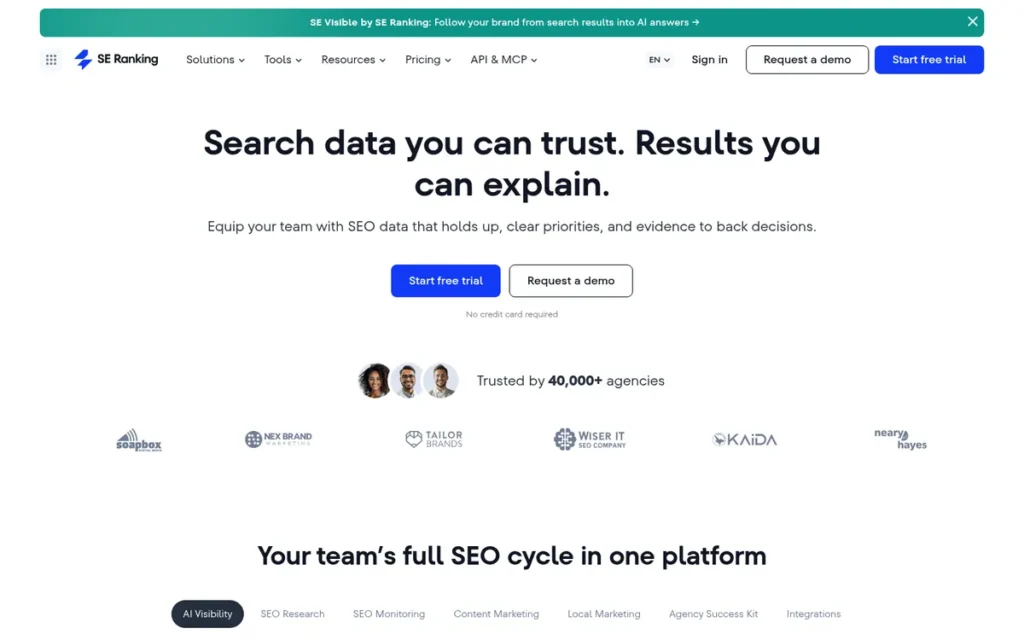
Category: All-in-One SEO Suite: one platform that covers most of Semrush’s SEO workflow.
At a Glance
- Category: All-in-One SEO Suite
- Best For: Agencies and small in-house teams that need high rank-tracking volume and affordable white-label reporting
- Price Range: $129–$279/month list (Core to Growth); $103.20/month on annual Core; Agency Pack from $69/month, billed annually
- Primary Strength: SE Ranking gives 2,000 daily-tracked keywords on its $129 Core plan, four times Semrush Pro’s 500.
- Biggest Limitation: SE Ranking’s keyword and backlink databases are roughly 5× and 16× smaller than Semrush’s, based on vendor-reported figures.
- One-Line Summary: SE Ranking is the closest all-in-one Semrush replacement for agencies and small teams. It gives up database depth in exchange for higher tracking limits and cheaper white-label reporting.
- Last Verified: November 2026
Overview
SE Ranking is an all-in-one SEO platform for agencies and small teams that want Semrush-style breadth, from rank tracking to AI search tracking, with higher tracked-keyword limits and cheaper white-label reporting.
SE Ranking’s 2026 plans are called Core and Growth, replacing the older Essential, Pro and Business tiers. SE Ranking reports 1.5M+ registered users (SE Ranking, 2026; vendor-reported).
Key Features
- SE Ranking’s rank tracker updates daily and includes 2,000 tracked keywords on the Core plan.
- SE Ranking combines keyword research, competitor research, backlink analysis and site audits in one interface.
- SE Ranking’s Agency Pack adds white-label reports, a custom domain, client seats and reports sent from the agency’s own email.
- SE Ranking includes local SEO tools and an editorial assistant that produces writing briefs.
- SE Ranking sells an AI Search add-on for brand visibility in AI answer engines at $89/month, or $71/month billed annually (third-party price trackers citing SE Ranking, November 2026).
Best For
SE Ranking is best for agencies and small teams that mostly use Semrush for rank tracking, audits and client reporting rather than deep backlink or PPC research.
Pricing
SE Ranking is not in PlugRoute’s verified G2 price dataset, so these are vendor prices (SE Ranking pricing page, November 2026):
- SE Ranking Core costs $129/month, or $103.20/month billed annually.
- SE Ranking Growth costs $279/month, or $223.20/month billed annually.
- SE Ranking’s Agency Pack starts at $69/month and is billed annually only, so Core plus white-label comes to about $198/month.
- SE Ranking’s AI Search add-on costs $89/month, or $71/month billed annually (third-party price trackers, November 2026).
SE Ranking’s Content and Local add-on prices were not verified in November 2026.
Strengths
- SE Ranking Core includes 2,000 daily-tracked keywords for $129/month (SE Ranking pricing page, November 2026), compared with 500 on Semrush Pro at $139.95 (G2, November 2026).
- At list prices checked in November 2026, SE Ranking Core costs about 6.5 cents per tracked keyword per month ($129 ÷ 2,000), compared with about 28 cents on Semrush Pro ($139.95 ÷ 500).
- SE Ranking’s Agency Pack starts at $69/month (SE Ranking pricing page, November 2026). That makes white-label cheaper with SE Ranking than with Semrush Guru plus Semrush’s paid white-label add-on.
- SE Ranking is rated 4.8/5 from 1,491 reviews on G2’s product page (G2, November 2026). r/localseo users praise SE Ranking’s 30-day single-keyword rank views and its writing briefs (r/localseo, 2026).
Limitations
SE Ranking has much less data than Semrush. A third-party comparison lists 5.4B keywords and 2.7T backlinks for SE Ranking, against 28.8B and 43T for Semrush (Shila.so, 2026; vendor-reported figures). Teams that need to find every backlink may notice gaps.
- SE Ranking asks for keywords, prompts, search engines and competitors at setup, and three users called this “tedious” or “a chore” (r/localseo, 2026).
- SE Ranking’s PPC research is weaker than Semrush’s. SE Ranking’s own review summary admits that users often complain about paying extra for white-label (SE Ranking, 2026).
- SE Ranking’s AI Search add-on adds $89/month (third-party price trackers, November 2026), so a Semrush-like feature set costs more than Core alone.
An agency user on r/marketing described the switch in 2024:
“New agency I work at uses SEranking mostly. Was quite confusing at first because I was always used to SEMrush. But now that I’ve been using it for a while it’s pretty okay.
It has less functionality content wise in comparison to SEMrush but it’s easier to use, especially for beginners.” Posted by u/New_Commission4189
Takeaway: SE Ranking has fewer content features than Semrush, but agency users who get past the initial adjustment find it easier to use day to day.
How It Compares with Semrush
- Keep: Switching to SE Ranking keeps your rank tracking, audits, keyword and competitor research, backlinks, local SEO and AI tracking.
- Gain: Switching to SE Ranking gives you four times the tracked keywords at entry level and cheaper white-label reporting.
- Lose: Switching to SE Ranking costs you database depth, PPC research depth and Semrush’s quick setup.
- Cost: SE Ranking Core costs $129 against Semrush Pro’s $139.95. Core plus the Agency Pack costs about $198, against $249.95 for Semrush Guru plus Semrush’s white-label add-on.
Verdict
SE Ranking scored highest overall and is the strongest all-round Semrush replacement in 2026 for agencies and small teams that care more about rank-tracking volume and affordable client reporting than database depth. PlugRoute Score: 33/45. Workflow 4, Data 3 and Cost 4 (each ×2); Evidence 3, Agency 5 and AI 3.
SE Ranking won #1 on cost and agency fit, not data depth, and Ahrefs finished one point behind. Teams whose main job is backlink research should compare SE Ranking with Ahrefs. Test SE Ranking with your real keyword set before you cancel Semrush.
2. Ahrefs: Best for Backlink Analysis and Organic Competitor Research
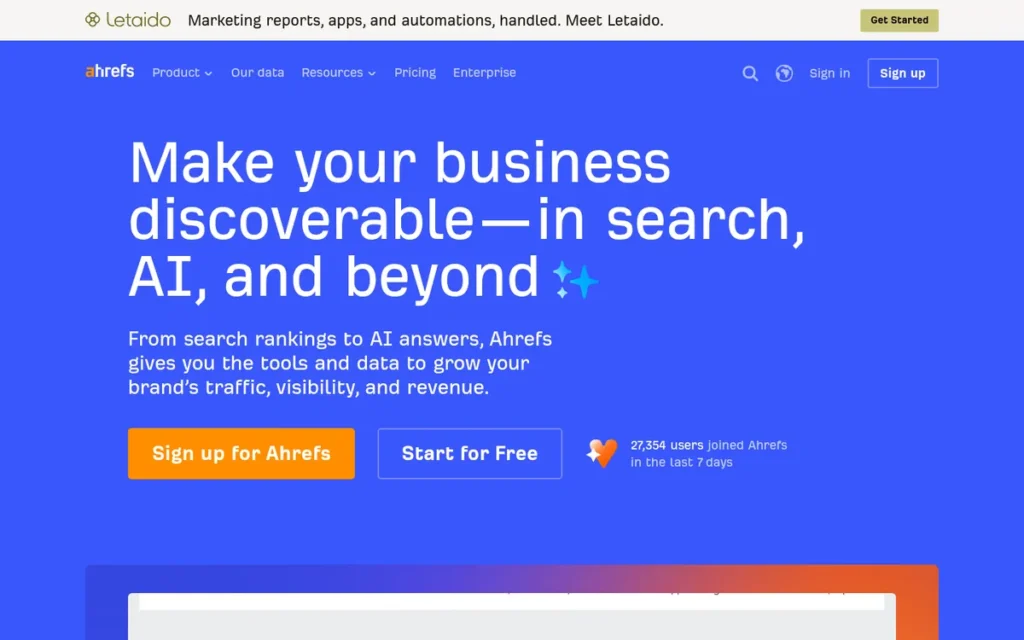
Category: All-in-One SEO Suite: one platform that covers most of Semrush’s SEO workflow.
At a Glance
- Category: All-in-One SEO Suite
- Best For: In-house SEO teams and consultants whose main job is backlink analysis and organic competitor research
- Price Range: Free tier; Starter $29 (usage-based); Lite $129/month (G2 list prices, November 2026); Standard $249 and Advanced $449 on the vendor page
- Primary Strength: Ahrefs has the deepest backlink data among the alternatives: a vendor-reported 35T external links, updated every 15–30 minutes.
- Biggest Limitation: Once credit caps, seat fees and add-ons are counted, Ahrefs costs about as much as Semrush at entry level.
- One-Line Summary: Ahrefs is the strongest Semrush alternative for backlink and organic competitor research, but for most teams it does not cost less.
- Last Verified: November 2026
Overview
Ahrefs is an SEO research platform built on its own web crawler and a vendor-reported 35-trillion-link external backlink index. It is aimed at in-house SEO teams and consultants who mainly use Semrush for backlink analysis and organic competitor research.
Ahrefs was founded in 2010 and is headquartered in Singapore (G2, November 2026). Ahrefs reports that AhrefsBot ranks #1 among SEO crawlers on Cloudflare Radar (Ahrefs, 2026).
Key Features
- Ahrefs Site Explorer shows a domain’s backlinks, referring domains and organic keywords.
- Ahrefs Keywords Explorer uses a vendor-reported index of 12B keywords across 216 locations, while Ahrefs’ own comparison page cites about 28.7B (Ahrefs, 2026).
- Ahrefs Rank Tracker covers 190 locations on desktop and mobile, with 750 tracked keywords on Lite.
- Ahrefs Site Audit and Ahrefs Content Explorer (17.9B pages, vendor-reported) cover technical checks and content research.
- Ahrefs Brand Radar tracks AI visibility across six AI assistants and is sold separately from $50/month (Ahrefs, 2026).
Best For
Ahrefs is best for teams that mostly use Semrush for backlink research, link prospecting and organic competitor analysis, and that can afford Semrush-level pricing.
Pricing
Ahrefs’ G2 list prices are Free ($0), Starter ($29, usage-based) and Lite ($129/month) (G2, November 2026).
Ahrefs’ pricing page also lists Standard at $249/month and Advanced at $449/month, and annual billing saves about 17% (Ahrefs pricing page, November 2026). Ahrefs’ hidden costs include:
- Ahrefs Lite includes 1,000 credits per user per month and 5 projects, and allows up to 2 extra users at $40/month each.
- Ahrefs Standard charges $60/month per extra user, and Ahrefs Advanced charges $80/month.
- Ahrefs Starter includes 200 credits, and Starter users cannot add users or credits.
- Ahrefs sells 500 extra credits for $50/month and Brand Radar from $50/month, and Report Builder is a paid add-on.
Strengths
- Ahrefs holds 4.5/5 from 725 G2 reviews, with 96.0% at 4–5 stars (G2, November 2026). Info-Tech named Ahrefs a 2026 Data Quadrant Champion in SEO (Info-Tech, 2026).
- Ahrefs reports backlink-index updates every 15–30 minutes (Ahrefs, 2026), and 53 G2 reviews cite Backlink Analysis as a pro (G2, November 2026).
- Ahrefs Brand Radar tracks ChatGPT, Gemini, Perplexity, Copilot, Grok and Claude (Ahrefs, 2026).
- Ahrefs is often recommended in Reddit SEO threads. Replying to complaints about Semrush upsells, one user wrote, “Try Ahrefs instead; it’s a much better tool” (r/SEO, November 2025).
Limitations
Ahrefs gives better data depth but not lower cost. Ahrefs Lite’s $129 list price is close to Semrush Pro’s $139.95, but credit caps, $40–$80 seat fees and paid add-ons can close or reverse that gap. Expensive (45) and High Costs (39) are Ahrefs’ top G2 cons (G2, November 2026).
- Ahrefs is weaker than Semrush for PPC research and has no built-in white-label reporting. G2 users ask for branded, client-ready reports (G2, November 2026).
- Ahrefs’ own FAQ warns that its traffic estimates “can diverge substantially” from Search Console (Ahrefs, 2026). G2 lists Inaccuracy (27) and Inaccurate Data (21) among Ahrefs’ cons (G2, November 2026).
An in-house SEO manager on r/SEO said in 2026:
“Ahrefs works great for me. I manage the SEO program for a company and always find the data is presenting to be reliable and informative. Obviously, their modeling is different from tools like SEMrush ( which I also find pretty reliable) but for what my team needs we find enough value in it. Don’t use them as hard and fast models but more like guide indicators.” Posted by u/AdMobile3416
Takeaway: In-house SEO teams find Ahrefs’ data reliable, but even satisfied users treat it as a directional guide rather than an exact measurement.
How It Compares with Semrush
- Keep: Switching to Ahrefs keeps your keyword research, competitor research, audits, rank tracking and AI tracking (as an add-on).
- Gain: Switching to Ahrefs gives you deeper, faster-updating backlink data, according to Ahrefs’ own figures.
- Lose: Switching to Ahrefs costs you PPC research depth and Semrush’s built-in Looker Studio and white-label reporting.
- Cost: Ahrefs costs roughly the same as Semrush at entry level, so switching is about data quality, not saving money.
Verdict
Ahrefs is the best Semrush alternative for backlink analysis and organic competitor research in 2026, but it rarely lowers the monthly bill. PlugRoute Score: 32/45. Workflow 4, Data 5 and Cost 2 (each ×2); Evidence 4, Agency 2 and AI 4.
Ahrefs finished one point behind SE Ranking, so readers who value data depth above cost should treat Ahrefs as their #1. Teams switching to save money should work out their credit and seat costs first. Many practitioners pair Ahrefs with a cheaper second tool.
3. Serpstat: Best Low-Cost Full-Suite Alternative with API Access
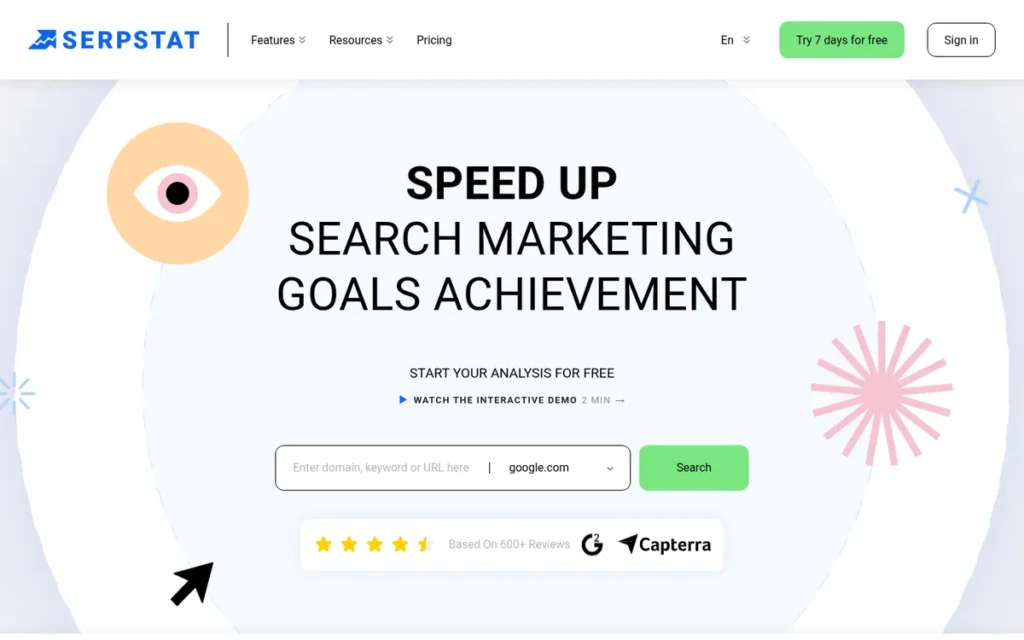
Category: All-in-One SEO Suite: one platform that covers most of Semrush’s SEO workflow.
At a Glance
- Category: All-in-One SEO Suite
- Best For: Freelancers, small teams and API-driven agencies on tight budgets that need a full suite, including PPC research
- Price Range: $69–$499/month (G2 list prices, November 2026); the vendor site shows lower annual-billing prices
- Primary Strength: Serpstat covers keyword, competitor, PPC, backlink, audit and rank-tracking work from $69/month at G2 list price.
- Biggest Limitation: Serpstat’s own help pages say a full search-database refresh takes about 3 months and a backlink-index refresh about 70 days.
- One-Line Summary: Serpstat is the lowest-cost full-suite Semrush alternative in 2026, best for teams that value breadth, seats and API access over data freshness.
- Last Verified: November 2026
Overview
Serpstat is a low-cost all-in-one SEO platform that combines SEO and PPC research with audits, daily rank tracking and an API. It is aimed at freelancers, small teams and agencies on tight budgets.
Serpstat was founded in 2013 and is headquartered in Odesa, Ukraine (G2, November 2026). Serpstat reports 2.2B keywords across 230 regional Google databases (Serpstat, 2026; vendor-reported).
Key Features
- Serpstat provides keyword and competitor research across 230 regional Google databases (Serpstat, 2026; vendor-reported).
- Serpstat includes PPC research alongside organic research, which most budget alternatives on this list lack.
- Serpstat’s rank tracker updates daily on desktop and mobile, with 10K rank checks per month on Individual, and Serpstat clusters up to 50K keywords per project.
- Serpstat Team includes 200K API credits per month, and Serpstat Agency adds white-label reporting.
- Serpstat AI Visibility launched in October 2026 and tracks brand mentions, sentiment and share of voice in AI models. It includes 1,500 checks/month on Team and Team x2 and 3,000 on Agency (Serpstat, November 2026).
Best For
Serpstat is best for freelancers and small agencies that want one inexpensive suite for SEO and PPC research, with extra seats and API access, and that can accept slower data refreshes.
Pricing
Serpstat’s G2 list prices are Individual at $69/month, Team at $129/month and Agency at $499/month (G2, November 2026).
Serpstat’s vendor site shows lower annual-billing prices: Individual $50, Team $100, Team x2 $169 and Agency $410. Serpstat’s own pricing pages contradict each other, so confirm the price at checkout (Serpstat, November 2026).
- Serpstat Individual allows 100 searches per day and 5 projects.
- Serpstat Team includes 3 users, 500 searches per day and unlimited projects.
- Serpstat Agency allows 5,000 searches per day and up to 30 users. At $499, it costs almost the same as Semrush Business ($499.95).
- Serpstat charges $20 per 1,000 extra AI Visibility checks, with a $40 minimum top-up (Serpstat, November 2026).
Strengths
- Serpstat has the highest share of 4–5 star G2 reviews among the verified candidates: 97.0% of 466 reviews, with an overall 4.6/5 (G2, November 2026).
- Serpstat Team costs $129/month for 3 users and 200K API credits (G2, November 2026), against $249.95 for Semrush Guru.
- Serpstat includes PPC research and keyword clustering, plus AI Visibility from the Team plan up, so it covers more of the Semrush workflow than other budget suites on this list.
- Serpstat users report switching to save money. One said Serpstat was “significantly less expensive than Semrush and does everything I need it to” (r/SEO, November 2025).
Limitations
Serpstat is cheaper partly because its data is less fresh. Serpstat’s help pages describe a refresh cycle of about 3 months for search data and about 70 days for backlinks (Serpstat help centre, 2026). G2 reviewers also mention gaps in Serpstat’s backlink data (G2, November 2026).
- Serpstat’s pricing pages contradict each other. A third-party review summary reports complaints about cancellation, trial charges and account bans (Professionals Toolkit, 2026).
- Serpstat’s AI Visibility is not included on the Individual plan. G2 users ask for simpler navigation and more client-ready reports (Serpstat, G2, November 2026).
- PlugRoute found no named, quantified Serpstat customer case studies (November 2026).
A Serpstat user of more than a year on r/SEO noted (2019, older evidence):
“Serpstat is a great tool, been using it for more than a year now. It’s pretty keyword research/competitor research based, so don’t expect much on the on-page department. But, it’s great for the money. One downside is the very poor UX, and it sometimes is very slow.” Posted by u/Papa_Nurle
Takeaway: Serpstat gives strong keyword and competitor research for the money, but long-term users accept a weak interface and slow performance in exchange.
How It Compares with Semrush
- Keep: Switching to Serpstat keeps your keyword, competitor, PPC, backlink, audit and rank-tracking work, with white-label on Agency.
- Gain: Switching to Serpstat gives you API credits, multiple seats and AI Visibility at lower entry and mid-tier prices.
- Lose: Switching to Serpstat costs you data freshness, backlink completeness and AI tracking on the Individual plan.
- Cost: Serpstat costs about half as much as Semrush Pro and Guru, and about the same at the top tier.
Verdict
Serpstat is the best-value full-suite Semrush alternative in 2026 for teams that need SEO and PPC research, several seats and API access on a tight budget. PlugRoute Score: 31/45. Workflow 4, Data 2 and Cost 4 (each ×2); Evidence 4, Agency 4 and AI 3.
Serpstat’s 97.0% share of 4–5 star G2 reviews is the strongest satisfaction signal on this list. Serpstat documents its own slow refresh cycle, which makes it a weaker fit for fast-moving niches. Check the checkout price and cancellation terms before you commit.
4. SpyFu: Best for Google Ads Competitor and PPC History Research
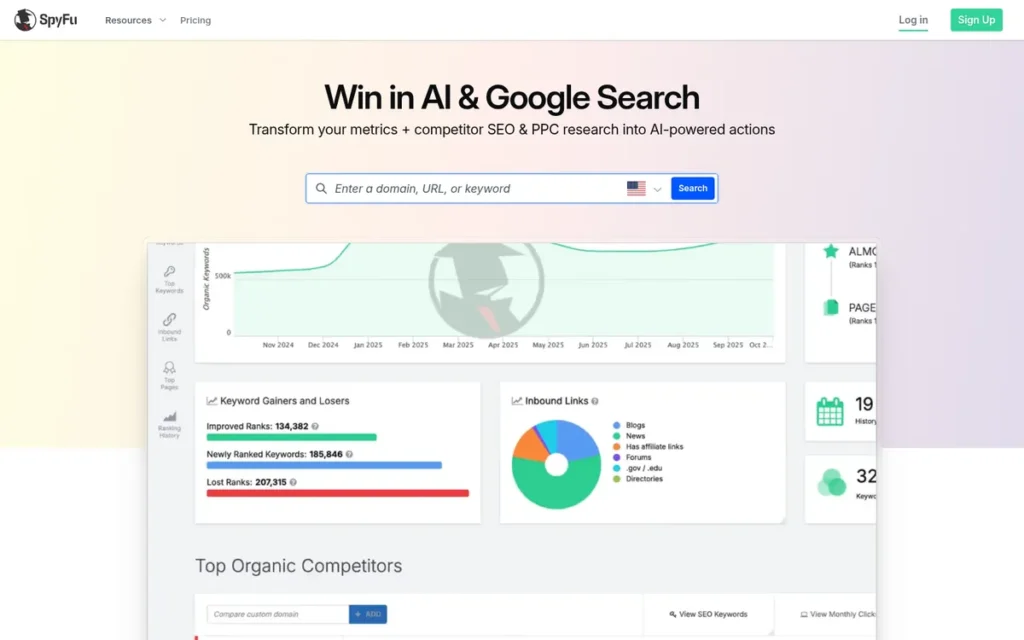
Category: Specialist Research Tool: a focused tool that replaces one part of Semrush’s workflow, competitor and paid-search research.
At a Glance
- Category: Specialist Research Tool
- Best For: PPC managers, agencies and small businesses whose main Semrush job is Google Ads competitor research
- Price Range: $59–$299/month (G2 list prices, November 2026); the vendor site shows $39–$249 monthly and $29–$187 billed annually
- Primary Strength: SpyFu offers 10+ years of Google ad and keyword history on every plan, with unlimited searches on Pro + AI.
- Biggest Limitation: SpyFu covers Google only, is strongest in the US and UK, and has shallow backlink and audit tools.
- One-Line Summary: SpyFu is the best Semrush alternative for Google Ads competitor research, but it replaces only Semrush’s paid-search and competitor workflow.
- Last Verified: November 2026
Overview
SpyFu is a Google-focused competitor-research tool that shows rivals’ organic and paid keywords, past ad copy and estimated ad spend. It is built for PPC managers and agencies that mainly use Semrush for paid-search research rather than full SEO management.
SpyFu is headquartered in Scottsdale, Arizona, and was founded by Mike Roberts (SpyFu company page; LinkedIn; G2, November 2026). G2 and LinkedIn give 2005 as SpyFu’s founding year, while SpyFu’s own site says 2006.
Key Features
- SpyFu Ad History shows competitors’ past ad copy, keywords and landing pages, with 10+ years of data on all plans.
- SpyFu PPC Kombat compares paid-keyword overlap across up to three competing domains.
- SpyFu shows competitors’ organic and paid keywords, ranking history and estimated ad spend.
- SpyFu Pro + AI includes unlimited searches and exports, plus 10 tracking projects.
- SpyFu has added an AI site audit that suggests fixes (SpyFu, February 2026).
Best For
SpyFu is best for PPC-led teams and agencies that mostly use Semrush for Google Ads competitor research and use another tool for SEO.
Pricing
SpyFu’s G2 list prices are Basic at $59/month, Pro + AI at $159/month and Team/Agency at $299/month (G2, November 2026). SpyFu’s own pricing page shows lower prices, and annual billing saves 25% (SpyFu pricing page, November 2026):
- SpyFu Basic costs $39/month ($29 billed annually), with 10K result and export rows and 1 tracking project.
- SpyFu Pro + AI costs $119/month ($89 billed annually; $59 for the first month), and extra users cost $30/month.
- SpyFu Team/Agency costs $249/month ($187 billed annually), with unlimited projects.
Strengths
- SpyFu holds 4.6/5 from 519 G2 reviews, with 96.7% at 4–5 stars (G2, November 2026). Info-Tech rated SpyFu “Top Rated” for capabilities and features (Info-Tech, 2026).
- SpyFu provides 10+ years of ad and keyword history on every plan (SpyFu pricing page, November 2026). None of the other six tools on this list documents paid-search history this deep.
- SpyFu Pro + AI allows unlimited searches and exports (SpyFu pricing page, November 2026), so you avoid Semrush-style report caps.
- SpyFu helps agencies build competitor presentations. One practitioner called it “a nice complement to auction insights” (r/PPC, 2018, older evidence).
Limitations
SpyFu goes deep on paid search but covers little else. SpyFu covers Google only, with no Bing or social ads, is strongest in the US and UK, and has shallow backlink and audit tools (Software Advice, 2026).
- SpyFu’s ad-spend estimates are only a rough guide. Capterra and Software Advice reviewers report that predicted PPC spend can be inaccurate (Capterra, Software Advice, 2026). One user reported a $200k/month estimate for a much smaller account (r/PPC, 2018, older evidence).
- SpyFu has no AI-visibility tracking that PlugRoute could find, and comparison pages report complaints about refunds and cancellation (Capterra, 2026).
- PlugRoute found no named, quantified SpyFu customer case studies (November 2026).
An agency practitioner on r/PPC compared the two tools in 2022:
“I haven’t looked at SpyFu in a long time but one of the major reasons we went with SEMrush was it supports all markets.
If you mainly work in the US and don’t need SEO functionality you can probably save a bunch by going with SpyFu. Neither tool provides very accurate estimates, for us it’s about identifying a few keyword themes we might otherwise miss with a new client.” Posted by u/TTFV
Takeaway: SpyFu can save money for US-focused PPC teams that don’t need SEO, but its estimates are useful only for finding keyword ideas, not for precise competitor numbers.
How It Compares with Semrush
- Keep: Switching to SpyFu keeps your competitor organic and paid keywords, ad history and rank tracking.
- Gain: Switching to SpyFu gives you longer ad history and unlimited searches at a lower price.
- Lose: Switching to SpyFu costs you backlink depth, full audits, non-Google ad coverage and AI tracking.
- Cost: SpyFu Basic costs well below Semrush Pro, but most teams use SpyFu alongside another tool rather than as a full replacement.
Verdict
SpyFu is the best Semrush alternative for Google Ads competitor research in 2026, but it is a specialist tool, not a full Semrush replacement. PlugRoute Score: 26/45. Workflow 2, Data 3 and Cost 4 (each ×2); Evidence 4, Agency 3 and AI 1.
SpyFu ranks above Moz Pro even though it covers fewer jobs. Its 10+ years of ad history lift its data score, and it scores higher on cost and verified evidence. PPC-led teams should cancel Semrush only if another tool covers their SEO needs.
5. Moz Pro: Best Beginner-Friendly SEO Suite for Small Businesses
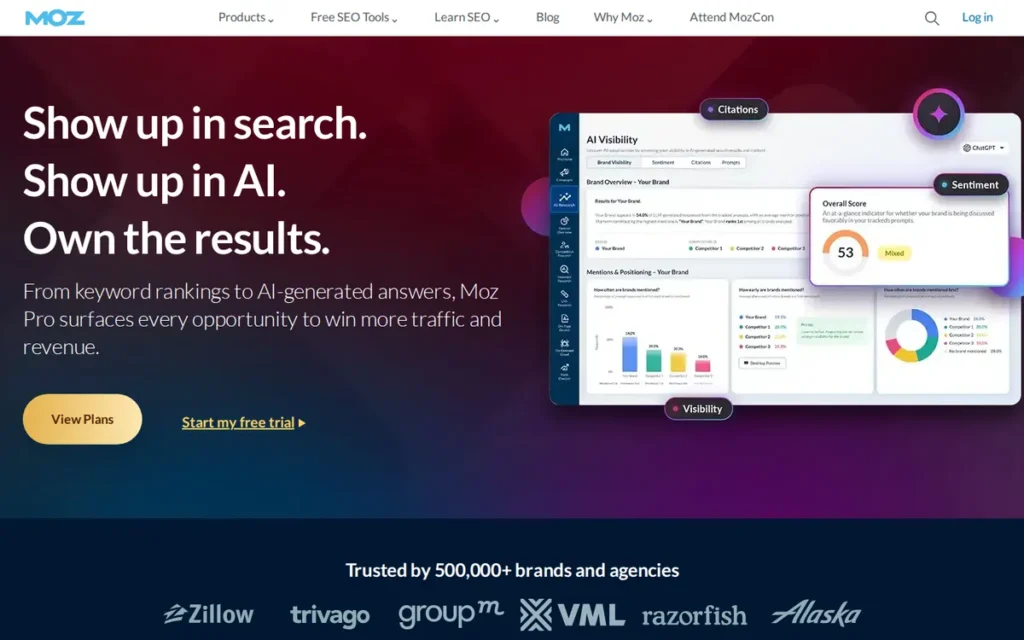
Category: All-in-One SEO Suite: one platform that covers most of Semrush’s SEO workflow.
At a Glance
- Category: All-in-One SEO Suite
- Best For: Small businesses, in-house generalists and SEO newcomers who want a simpler, cheaper organic-SEO suite
- Price Range: $49–$179/month (G2 list prices, November 2026); Large at $299/month and annual discounts on the vendor site
- Primary Strength: Moz Pro is the easiest full SEO suite on this list to learn and includes the industry-standard Domain Authority metric.
- Biggest Limitation: Moz Pro has far less keyword data than Semrush, updates rankings weekly and offers little PPC data.
- One-Line Summary: Moz Pro is the most beginner-friendly Semrush alternative for small businesses focused on organic SEO, but it has less data depth and little PPC research.
- Last Verified: November 2026
Overview
Moz Pro is a beginner-friendly SEO suite from Seattle-based Moz that pairs core organic SEO tools with the Domain Authority metric. It is aimed at small businesses and SEO newcomers who want a simpler, cheaper toolset than Semrush.
Moz was founded in 2004 as SEOmoz and launched Moz Pro in 2007 (Moz, 2026). Moz says its Beginner’s Guide to SEO has 10M+ readers (Moz, 2026; vendor-reported).
Key Features
- Moz Pro Keyword Explorer scores keywords by volume, difficulty, intent and a Priority metric, and suggests keywords using AI.
- Moz Pro Link Explorer reports backlinks alongside Moz’s Domain Authority and Brand Authority metrics.
- Moz Pro Site Crawl audits up to 400K pages per month on the Standard plan.
- Moz Pro tracks 300 keywords across 3 campaigns on Standard, with weekly updates.
- Moz Pro is listed in G2’s AI Search Visibility Optimization category (G2, November 2026).
Best For
Moz Pro is best for small businesses and SEO beginners who need dependable core organic SEO tools and do not rely on PPC research or daily rank data.
Pricing
Moz Pro’s G2 list prices are Starter at $49/user/month, Standard at $99/month and Medium at $179/month (G2, November 2026). Moz’s pricing page also lists Large at $299/month. Annual prices are $79 for Standard, $143 for Medium and $239 for Large (Moz pricing page, November 2026).
- Moz Pro Standard includes 1 user, 3 campaigns, 300 tracked keywords and 150 keyword queries per month.
- Moz Pro Medium includes 2 users, 10 campaigns and 1,500 tracked keywords.
- Moz Pro add-ons cost $49/month per seat, $10/month per campaign and $20 per 200 extra keywords.
Strengths
- Moz Pro is rated 4.3/5 from 608 G2 reviews, with User-Friendly (14) and Data Accuracy (9) among its top pros (G2, November 2026). Moz Pro is rated 4.5/5 from about 350 reviews on Capterra (Capterra, November 2026).
- Moz Pro Standard costs $99/month (G2, November 2026), or $79/month billed annually, which is below Semrush Pro’s $139.95.
- Moz Pro’s Domain Authority is widely used as shorthand across the SEO industry (Moz, 2026), though Domain Authority is not a Google ranking factor.
- Moz has published named case studies, such as TopSpot’s 29% organic-traffic gain within 90 days of a migration (Moz, vendor-published case study, 2026).
Limitations
Moz Pro is simpler but has less data. A Semrush-published comparison lists about 1.25B Moz keyword suggestions against Semrush’s 29.2B (Semrush, 2026). Moz Pro Standard also includes only 150 keyword queries per month (Moz pricing page, November 2026).
- Moz Pro updates rankings weekly rather than daily and has little PPC data, and “Limited Features” is Moz Pro’s top G2 con (G2, November 2026).
- Moz Pro has the lowest share of 4–5 star G2 reviews among the verified candidates (92.1%), and Moz Pro’s per-seat and per-campaign add-ons push up costs for teams (G2, Moz pricing page, November 2026).
How It Compares with Semrush
- Keep: Switching to Moz Pro keeps your keyword research, link analysis, site crawling and rank tracking.
- Gain: Switching to Moz Pro gives you an easier interface, the Domain Authority metric and a lower Standard price.
- Lose: Switching to Moz Pro costs you keyword-database depth, daily ranks, PPC research and broader marketing toolkits.
- Cost: Moz Pro costs $99 against Semrush’s $139.95 at entry level, but seats and campaigns add up quickly.
Verdict
Moz Pro is the best Semrush alternative for small businesses and SEO beginners who want an easy, lower-cost organic SEO suite in 2026. PlugRoute Score: 24/45. Workflow 3, Data 2 and Cost 3 (each ×2); Evidence 3, Agency 2 and AI 3.
Moz Pro covers more SEO jobs than SpyFu but scored lower on data depth and verified user evidence. Moz Pro suits single-site owners better than agencies. Heavy keyword researchers should check whether 150 queries a month on Standard is enough.
6. Mangools: Best for Freelancers Who Mainly Need Keyword Research and AI-Visibility Checks
Category: Lightweight SEO Toolkit: a simpler, lower-cost set of tools for common SEO tasks, not a full Semrush replacement.
At a Glance
- Category: Lightweight SEO Toolkit
- Best For: Freelancers, bloggers and small businesses whose Semrush use is mainly keyword research, SERP analysis and basic rank tracking
- Price Range: $61–$141/month; $37.70–$97.70/month billed annually (US prices, November 2026; prices vary by country)
- Primary Strength: Mangools combines simple keyword research with AI-visibility tracking across eight AI engines and surfaces.
- Biggest Limitation: Mangools has no dedicated technical site-audit crawler, no PPC data, and only weekly rank updates below its Agency plan.
- One-Line Summary: Mangools is a simple, keyword-first Semrush alternative for freelancers. It tracks AI visibility across eight AI engines and surfaces (vendor-reported, 2026) but has no dedicated technical audit or PPC research.
- Last Verified: November 2026
Overview
Mangools is a lightweight SEO suite of five tools plus AI Search Watcher. It is built for freelancers, bloggers and small businesses that mostly use Semrush for keyword research and basic rank tracking.
Mangools’ five tools are KWFinder, SERPChecker, SERPWatcher, LinkMiner and SiteProfiler. Mangools launched KWFinder in August 2014, is led by founder and CEO Peter Hrbáčik from Bratislava, and reports 1.1M+ users (Mangools, 2026; vendor-reported).
Key Features
- Mangools KWFinder provides keyword volume, difficulty and SERP data, with 100 lookups per 24 hours on Basic.
- Mangools SERPWatcher updates rankings weekly on Basic and Premium and daily on Agency.
- Mangools LinkMiner and SiteProfiler analyse backlinks and domains using a 9.5T-link index (vendor-reported).
- Mangools AI Search Watcher tracks brand mentions across eight AI engines and surfaces, including ChatGPT Search and Google AI Overviews (Mangools, 2026).
- Mangools offers a free AI Search Grader that scores AI visibility from 0 to 100.
Best For
Mangools is best for freelancers and small businesses that mainly need keyword discovery, SERP checks and AI-visibility monitoring. They should add Google Search Console or Screaming Frog for technical audits.
Pricing
Mangools lists Basic at $61/month, Premium at $81/month and Agency at $141/month, or $37.70, $52.70 and $97.70/month billed annually (US prices; mangools.com and third-party price trackers, November 2026).
Mangools’ prices vary by country, so confirm them at checkout. Plan limits are the same on monthly and annual billing (Mangools, 2026):
- Mangools Basic allows 100 lookups per 24 hours and 200 tracked keywords, with weekly updates and no sub-users.
- Mangools Premium allows 500 lookups and 700 tracked keywords, with weekly updates and 3 sub-users.
- Mangools Agency allows 1,200 lookups and 1,500 tracked keywords, with daily updates and 5 sub-users.
Strengths
- Mangools AI Search Watcher tracks brand mentions in eight AI engines and surfaces: ChatGPT Search, Google AI Overviews, Google AI Mode, Gemini, Grok, Claude, Llama and Mistral (Mangools, 2026). That is the widest AI coverage documented on this list.
- Mangools is rated 4.7/5 from 97 reviews on G2’s product page (G2, November 2026).
- Mangools was named in the top answer of an r/SEO_Digital_Marketing thread asking for cheaper alternatives to $150/month Semrush and Ahrefs plans (r/SEO_Digital_Marketing, January 2025).
- Mangools’ plan limits are the same on monthly and annual billing, so freelancers can test Mangools month to month without losing capacity (Mangools, 2026).
Limitations
Mangools is simple partly because it covers less. Mangools has no dedicated technical site-audit crawler, and reviewers say it lacks full crawl, site-speed and technical audits (01net, 2026; G2, November 2026). That is the biggest gap for anyone replacing Semrush’s audits.
- Mangools has no PPC data and updates rankings weekly below the Agency plan. Mangools’ own FAQ says its data can lag by about a month (Mangools, 2026).
- Mangools has the smallest G2 review base of the seven (97 reviews), and an independent review notes that KWFinder may understate keyword difficulty (01net, 2026).
- PlugRoute found no named Mangools customer case studies (November 2026).
How It Compares with Semrush
- Keep: Switching to Mangools keeps your keyword research, SERP analysis, basic rank tracking, backlink lookups and AI-visibility tracking.
- Gain: Switching to Mangools gives you a simpler interface and AI-engine coverage across eight engines and surfaces.
- Lose: Switching to Mangools costs you dedicated technical audits, PPC data, daily ranks below Agency, data freshness and dataset depth.
- Cost: Mangools Basic costs $61/month against Semrush Pro’s $139.95, or $37.70/month billed annually.
Verdict
Mangools is a strong Semrush alternative for freelancers who mainly need keyword research and AI-visibility tracking. It is not a full replacement, because it lacks a dedicated site-audit crawler and PPC data. PlugRoute Score: 22/45. Workflow 2, Data 2 and Cost 3 (each ×2); Evidence 2, Agency 2 and AI 4.
Mangools keeps a cost score of 3 because its prices vary by country and some come from third-party trackers. Pair Mangools with Google Search Console and Screaming Frog’s free tier for technical checks. Upgrade to Agency only if you need daily ranks.
7. Ubersuggest: Best Budget and Free-Tier Option for Single-Site Beginners
Category: Lightweight SEO Toolkit: a simpler, lower-cost set of tools for common SEO tasks, not a full Semrush replacement.
At a Glance
- Category: Lightweight SEO Toolkit
- Best For: Beginners and DIY small-business owners managing one site on a minimal budget
- Price Range: Free tier; $29–$99/month; $290–$990 one-time lifetime licence (Ubersuggest pricing page, November 2026)
- Primary Strength: Ubersuggest has the lowest cost on this list, with a $290 lifetime option and a permanent free tier.
- Biggest Limitation: Ubersuggest has the shallowest data of the seven, updates rankings weekly, and has no branded client reporting.
- One-Line Summary: Ubersuggest is the cheapest Semrush alternative for single-site beginners, but its limited data and weekly updates make it only a lightweight substitute.
- Last Verified: November 2026
Overview
Ubersuggest is a budget SEO tool owned by Neil Patel’s NP Digital. It bundles keyword research, audits and rank tracking with an AI writer, and it is aimed at beginners and DIY small businesses managing one or a few sites.
Neil Patel acquired Ubersuggest in 2017 (TechCognate, 2026). Ubersuggest publishes its plan prices and limits on ubersuggest.com.
Key Features
- Ubersuggest provides keyword and domain research, with 150 searches per day on the Individual plan.
- Ubersuggest includes a site audit, and Ubersuggest’s free tier audits 150 pages a week.
- Ubersuggest tracks 125 keywords per project on Individual, updated weekly.
- Ubersuggest includes backlink reports, content ideas and an AI Writer.
- Ubersuggest’s Chrome extension provides 40 free searches per day.
Best For
Ubersuggest is best for small-business owners with one website who want low-cost keyword research and basic audits, and who do not need competitor depth, PPC data or client reports.
Pricing
Ubersuggest is not in PlugRoute’s verified G2 price dataset, so these are vendor prices (Ubersuggest pricing page, November 2026):
- Ubersuggest Individual costs $29/month, $192/year or $290 lifetime, with 1 project and 125 keywords per project.
- Ubersuggest Business costs $49/month, $326/year or $490 lifetime, with 7 projects and 150 keywords per project.
- Ubersuggest Enterprise costs $99/month, $657/year or $990 lifetime, with 15 projects and 300 keywords per project.
Read Ubersuggest’s lifetime licence terms before you buy, because reviewers report disputes over them (Trustpilot, 2026).
Strengths
- Ubersuggest Individual costs $29/month or $290 once (Ubersuggest pricing page, November 2026). That is the lowest cost on this list and a fraction of Semrush Pro’s $139.95.
- Ubersuggest’s free tier never expires and includes 3 searches a day, 1 project, 25 tracked keywords and a 150-page weekly audit (Ubersuggest, 2026).
- Ubersuggest covers keyword research, audits, rank tracking, backlinks and AI writing in one interface, which is broad for its price.
- Ubersuggest comes up repeatedly in Reddit threads about cheaper tools. One user wrote, “Ubersuggest is not bad” (r/SEO, February 2025).
Limitations
Ubersuggest is cheap partly because its data is weaker. Independent comparisons describe much smaller keyword and backlink databases and less precise data in niche topics (Style Factory, 2026), so Ubersuggest suits basic research rather than competitive analysis.
- Ubersuggest updates rankings weekly, offers only basic paid-keyword data and has no customisable branded reports.
- Ubersuggest is rated 4.2/5 from 160 reviews on G2’s product page (G2, November 2026), the lowest of the seven. Capterra reviewers call it “slow, clunky” (Capterra, 2026).
- Ubersuggest’s Trustpilot reviews report disputes over lifetime licences and refunds (Trustpilot, 2026). PlugRoute found no named awards or case studies for Ubersuggest (November 2026).
How It Compares with Semrush
- Keep: Switching to Ubersuggest keeps your basic keyword research, audits, rank tracking and backlink lookups for a few sites.
- Gain: Switching to Ubersuggest gives you a very low price and a lifetime option.
- Lose: Switching to Ubersuggest costs you data depth, daily ranks, PPC research, agency reporting and AI tracking.
- Cost: Ubersuggest costs roughly one-fifth of Semrush Pro per month.
Verdict
Ubersuggest is the cheapest Semrush alternative for single-site beginners in 2026, but it is a lightweight substitute, not a professional replacement. PlugRoute Score: 19/45. Workflow 3, Data 1 and Cost 4 (each ×2); Evidence 1, Agency 1 and AI 1.
Ubersuggest scores higher than Mangools on workflow coverage because it includes a site audit and basic paid-keyword data. Start with Ubersuggest’s free tier plus Google Search Console before you pay. Teams managing clients should look at Serpstat or SE Ranking instead.
Can Free Tools Replace Semrush?
Free tools can cover your own site’s performance data and basic technical checks, but they cannot replace Semrush’s competitor research. PlugRoute found no free tool that offers competitor keyword and backlink research at paid-suite depth, dedicated daily rank tracking, PPC ad history or white-label reporting (November 2026).
What a free stack covers:
- Google Search Console shows your own site’s queries, clicks and indexing. One practitioner warned it is “going to be pretty useless for launching a new site” (r/SEO, February 2025).
- Bing Webmaster Tools offers keyword research, an audit and backlink data “for EVERY other domain,” according to one Reddit practitioner (r/SEO, February 2025). PlugRoute has not verified this independently.
- Ahrefs Webmaster Tools provides backlink and audit data for sites whose ownership you have verified (Ahrefs, 2026).
- Google Keyword Planner is built for advertisers, so treat Keyword Planner’s volumes as rough planning figures.
- Screaming Frog SEO Spider crawls up to 500 URLs for free, and a paid Screaming Frog licence costs £199/€245 per year (Screaming Frog, 2026).
- Google Analytics measures traffic and conversions, not SEO competition, and is rated 4.5/5 from 6,893 G2 reviews (G2, November 2026).
- Ubersuggest’s free tier adds 3 searches a day and a 150-page weekly audit (Ubersuggest, 2026).
For free keyword research, combine Google Keyword Planner for volume ranges with Google Search Console for queries you already rank for. Ubersuggest’s free tier or Ahrefs’ free tier can add a few extra lookups.
What no free tool covers:
- Free tools do not provide competitor keyword and backlink research at the depth of a paid suite, or dedicated daily rank tracking.
- Free tools do not provide PPC ad history or white-label client reporting.
When Should You Stay with Semrush?
Stay with Semrush if you need four things in one tool: PPC and SEO research, the largest keyword database on this list (about 29B keywords, vendor-reported), history back to 2012 and built-in Looker Studio reporting. In November 2026, PlugRoute found no single alternative that matched all four.
- Semrush is the better choice if you rely on PPC research and SEO research in one subscription.
- Semrush is the better choice if you need its keyword database, about 29.2B keywords (Semrush, 2026; vendor-reported).
- Semrush is the better choice if you use historical data. One Reddit user notes that Semrush’s “data goes back to 2012” (r/SEO; thread date not recorded in PlugRoute’s research).
- Semrush is the better choice if you need Looker Studio integration (from Guru) plus white-label reporting (a paid add-on) in one place (Semrush, 2026).
- Semrush is the better choice if you also use its social and content toolkits.
A long-time user on r/PPC explained in 2024 why they stayed:
“I’ve been using Semrush for around a decade now. I’ve used pretty much everything else out there at some point or another. I’ve found Semrush to be the most accurate the most often. All of them can certainly get things wrong, but Semrush gets the closest.” Posted by u/UpvoteBeast
Takeaway: Experienced users who have tried other tools still choose Semrush because, in their experience, its data is the most often accurate, even though no tool in this category is error-free.
Semrush’s legacy SEO Classic plans (G2 list prices and Semrush knowledge base, November 2026):
| Semrush Plan | Price | Projects | Tracked Keywords |
|---|---|---|---|
| Pro | $139.95/month | 5 | 500 |
| Guru | $249.95/month | 15 | 1,500 |
| Business | $499.95/month | 40 | 5,000 |
Semrush’s current lineup (Semrush pricing page, November 2026):
| Semrush Plan | Price | Sites | Tracked Keywords |
|---|---|---|---|
| SEO | $139/month | 5 | 500 |
| Semrush One Starter | $199/month (adds AI visibility) | Not in research data | Not in research data |
| Semrush One Pro+ | $299/month | 15 | 1,500 |
One Reddit user says Semrush “is build for agencies, not individual users,” and another says the Guru tier is where Semrush “becomes usable” (r/SEO; thread dates not recorded in PlugRoute’s research). Compare each alternative with the Semrush plan you pay for today.
How Do I Switch from Semrush Without Losing Data?
To switch from Semrush without losing data, export everything before your subscription ends and run the new tool alongside Semrush for a few weeks. Semrush’s terms allow customer data to be erased after termination, with at least 30 days’ notice before erasure (Semrush Terms of Service, 2026). Once history is erased, no other tool can import it.
- Export Semrush Position Tracking reports from each tab (Overview, Competitors, Devices/Locations) as CSV or XLSX files.
- Export your Semrush keyword lists, saved reports and any audit results you still reference.
- Set up rank tracking in the new tool at least two weeks before your Semrush renewal date so the two histories overlap.
- During the overlap, compare both tools’ rankings and backlink counts on domains you know well.
- Cancel Semrush only after the new tool has collected enough history to cover your reporting needs.
Reddit users also report that Semrush tracking history may not transfer to a new account after an account is closed (r/SEMrush; thread date not recorded in PlugRoute’s research).
Which Other Tools Came Up but Weren’t Ranked?
Similarweb, Sistrix, SEO PowerSuite and Zutrix came up during PlugRoute’s research but were not ranked. Each either belongs to a different product category or lacked enough comparable, verifiable data. G2 also lists several products near Semrush that do not replace Semrush’s SEO research.
- Similarweb: Similarweb is a traffic and market-intelligence platform, mostly sold to enterprises through a sales team. Similarweb is reported at about 4.4/5 from about 1,322 G2 reviews (via Perplexity, 2026; unverified).
- Sistrix and SEO PowerSuite: Sistrix and SEO PowerSuite came up in Reddit threads, but PlugRoute did not collect enough data to score them.
- Zutrix: Zutrix was suggested as a cheaper tool in an r/SEO_Digital_Marketing thread (January 2025), with too little data to score.
- Different category: Birdeye, HubSpot Marketing Hub, Grammarly, Zoho Social and Meltwater appear near Semrush on G2. They cover reviews, CRM, writing, social media or media monitoring rather than SEO research.
What Red Flags Should I Watch For When Evaluating Semrush Alternatives?
The biggest red flags are pricing and data claims that a vendor’s headline page does not let you check. PlugRoute found at least one of the five red flags below in almost every tool reviewed, including Semrush itself, so check each one before you sign an annual contract.
- Headline prices can hide credits and seat fees.
- Index sizes are usually quoted without an independent source.
- Data refresh delays are often buried in help docs.
- White-label reporting is often sold as an annual-only add-on.
- Refund, cancellation and lifetime-licence terms are often unclear.
Red Flag #1: Headline Prices That Hide Credits and Seat Fees
A headline price rarely matches what you will actually pay, because credits, seat fees and add-ons are charged on top. Ahrefs Lite charges $40/month per extra user and caps usage credits, and Moz Pro charges $49/month per extra seat (vendor pricing pages, November 2026). Price each tool using your real keyword, project and user counts.
For example, Ahrefs Lite looks $11 cheaper than Semrush Pro. Two extra users ($80) and a 500-credit top-up ($50) bring Ahrefs Lite to $259/month, more than Semrush Guru’s $249.95 (prices checked November 2026).
Red Flag #2: Index Sizes Quoted Without a Source
Every backlink and keyword index size on this list comes from the vendor itself, so raw totals cannot show which tool finds useful links in your niche. Ahrefs, Semrush, SE Ranking and Mangools all publish their own counts (vendor pages, 2026). Test each tool on domains whose backlink profiles you already know.
Red Flag #3: Refresh Lags Buried in Help Docs
Vendors often document data freshness only in help centres, not on pricing pages. Serpstat describes a refresh cycle of about 3 months for search data and about 70 days for backlinks. Mangools says its data can lag by about a month (vendor help pages, 2026). Check refresh cycles before you rely on trend data.
With a refresh cycle of about 70 days, a link a competitor gains in early September might not appear in Serpstat’s index until mid-November. Ahrefs reports index updates every 15–30 minutes (Ahrefs, 2026).
Red Flag #4: White-Label Sold as an Annual-Only Add-On
Vendors often sell white-label reporting separately from the base plan, so agency costs look lower than they are. SE Ranking’s Agency Pack is billed annually only, and Semrush and Ahrefs both sell client reporting as paid add-ons (vendor pages, 2026). Agencies should add white-label costs to every base price before comparing.
Red Flag #5: Unclear Refund, Cancellation or Lifetime-Licence Terms
Reviews of several vendors mention billing disputes, so read the refund and cancellation terms before you buy an annual plan. PlugRoute found documented refund or cancellation complaints for SpyFu, Serpstat and Ubersuggest (Capterra, Trustpilot and third-party summaries, 2026). Finding none for the other tools does not mean they have none.
What Questions Should I Ask Before Choosing a Semrush Alternative?
Before choosing a Semrush alternative, ask questions that reveal real cost, data freshness and switching risk rather than headline features. The six questions below usually narrow seven options down to two you should trial. You can check each answer against a vendor’s pricing page, help centre or free trial.
Question #1: Which Semrush jobs do I actually use every week?
Start by listing the Semrush jobs you use every week, because that list shows which category of alternative fits. A team that only tracks rankings and audits a site can switch to a lightweight toolkit. A team that relies on PPC history needs SpyFu or Serpstat, the strongest paid-search substitutes on this list.
Question #2: What will this cost at my real keyword, project and seat count?
The real cost of a Semrush alternative is its price at your actual tracked-keyword, project and seat count, plus add-ons. For example, Ahrefs Lite’s $129 rises to $209/month with two extra users. Compare totals with the Semrush plan you pay for today, not with Semrush Pro’s entry price.
Question #3: How often does the data refresh, and how often do rankings update?
Ask how often the vendor refreshes its full keyword and backlink databases, and how often rankings update on your plan. Refresh cycles on this list range from minutes to months. Weekly rank updates can hide short-term drops that daily tracking would catch.
- Moz Pro, Ubersuggest and Mangools (below Agency) update rankings weekly (vendor pages, 2026).
- SE Ranking and Serpstat update rankings daily (vendor pages, 2026).
Question #4: Can I export my Semrush rank history before cancelling?
Yes, you can export Semrush rank history, and you should do it before cancelling. Semrush’s terms allow customer data to be erased after termination, with at least 30 days’ notice before erasure (Semrush Terms of Service, 2026). No alternative can import history it never collected. The export steps are under “How Do I Switch from Semrush Without Losing Data?”
Question #5: Do I need white-label reporting or AI-visibility tracking?
Agencies need white-label reporting, which can be included (Serpstat Agency), sold as a $69/month annual add-on (SE Ranking) or not offered at all (Ubersuggest). For AI-visibility tracking, check which engines are covered and what it costs. Serpstat Team and Mangools include it, while Ahrefs Brand Radar starts at $50/month and SE Ranking’s add-on costs $89/month.
Question #6: How does the tool perform on domains I already know?
The best accuracy test is to run each shortlisted tool on your own site and on two or three competitors whose traffic and backlinks you already understand. Compare the results with Google Search Console. Ahrefs itself warns that its traffic estimates “can diverge substantially” from Search Console data (Ahrefs, 2026).
How Did We Rank These Semrush Alternatives?
PlugRoute scored each of the seven alternatives from 1 to 5 on six published criteria. The three primary criteria (workflow coverage, data depth and true cost) count double, and the three secondary criteria count once, for a maximum of 45 points. Every figure is labelled as G2-verified, vendor-reported, third-party or unverified.
Primary criteria (weighted ×2):
- C1 Semrush Workflow Coverage: C1 counts how many of Semrush’s seven core jobs each tool covers, because switching to a narrow tool can mean losing features you depend on.
- C2 Data Depth and Freshness: C2 scores index sizes, refresh cycles and rank-update frequency, because losing backlink and keyword depth is the biggest worry when switching.
- C3 True Cost and Pricing Transparency: C3 compares real costs, including caps, credits, seats and add-ons, with Semrush Pro and Guru, because cost is the most common reason for leaving.
Secondary criteria (weighted ×1):
- C4 Verified User Evidence: C4 scores G2 ratings, review volume and the share of 4–5 star reviews, because readers need evidence beyond vendor claims.
- C5 Agency and Client Reporting Fit: C5 scores white-label options, seat costs and project limits, because agencies need to manage many clients.
- C6 AI-Visibility Tracking: C6 scores AI-engine coverage and cost. Semrush data reported by PPC Land shows Google AI Overviews on 88% of 400 tracked US commercial keywords (PPC Land, 2026).
| Rank | Tool | C1 | C2 | C3 | C4 | C5 | C6 | Total /45 |
|---|---|---|---|---|---|---|---|---|
| 1 | SE Ranking | 4 | 3 | 4 | 3 | 5 | 3 | 33 |
| 2 | Ahrefs | 4 | 5 | 2 | 4 | 2 | 4 | 32 |
| 3 | Serpstat | 4 | 2 | 4 | 4 | 4 | 3 | 31 |
| 4 | SpyFu | 2 | 3 | 4 | 4 | 3 | 1 | 26 |
| 5 | Moz Pro | 3 | 2 | 3 | 3 | 2 | 3 | 24 |
| 6 | Mangools | 2 | 2 | 3 | 2 | 2 | 4 | 22 |
| 7 | Ubersuggest | 3 | 1 | 4 | 1 | 1 | 1 | 19 |
How the ranking changes with different priorities:
- PlugRoute’s #1 and #2 Semrush alternatives are separated by one point out of 45 (SE Ranking 33, Ahrefs 32). Readers who care most about data depth should treat Ahrefs as their #1.
- If data depth (C2) were the only primary criterion, Ahrefs (26) would rank first, ahead of SE Ranking (25).
- If cost (C3) were weighted triple, Serpstat (35) would move ahead of Ahrefs (34), and SE Ranking (37) would stay first.
Disclosures:
- The G2 ratings for SE Ranking, Mangools and Ubersuggest were not in PlugRoute’s verified G2 dataset when the tools were scored, so each lost one point on C4. All three ratings have since been confirmed on G2’s product pages (G2, November 2026). The deduction stays for consistency, and SE Ranking remains #1 even with it.
- Serpstat’s C6 score reflects its AI Visibility feature, launched in October 2026 (Serpstat, November 2026).
- The vendors themselves report or publish all index sizes and case-study results cited here.
- Reddit evidence from 2017–2018 carries less weight than recent discussion and is labelled with its year.
- Billing complaints are mentioned only where PlugRoute found them documented.
PlugRoute has no affiliate relationships with any company listed. Rankings are determined entirely by research data and objective evaluation criteria.
What Do Readers Most Often Ask About Semrush Alternatives?
The cheapest Semrush alternative is Ubersuggest at $29/month, and the cheapest white-label option is SE Ranking’s Agency Pack from $69/month. Ahrefs is the strongest pick for backlinks but rarely costs less than Semrush. PlugRoute scores every tool on six published criteria, with a maximum of 45 points (November 2026).
What is the best Semrush alternative for small businesses and freelancers in 2026?
Moz Pro is the easiest full suite for a small business with one site, at $99/month for Standard (G2, November 2026). Freelancers on tight budgets should compare Serpstat Individual at $69/month (G2, November 2026), which adds PPC research, with Ubersuggest at $29/month or $290 lifetime (Ubersuggest pricing page, November 2026).
Which Semrush alternatives offer white-label client reporting for agencies?
SE Ranking offers the lowest-cost white-label option: its Agency Pack starts at $69/month, billed annually (SE Ranking pricing page, November 2026). Serpstat includes white-label reporting on its $499 Agency plan (G2, November 2026). Ahrefs sells Report Builder as a paid add-on and Ubersuggest has no branded reports, so agencies should price white-label before comparing base plans.
How does PlugRoute determine these rankings?
PlugRoute scores every product from 1 to 5 on six published criteria, with workflow coverage, data depth and true cost counting double, for a maximum of 45 points. Scores draw on verified G2 data, vendor documentation, third-party comparisons and dated Reddit discussion. The full score table and sensitivity note are in the methodology section, “How Did We Rank These Semrush Alternatives?”
What Do Key Semrush Alternative Terms Mean?
Buyers comparing Semrush alternatives meet terms about pricing units, data quality and agency features, and vendors define them differently. The twelve definitions below explain each term in plain language and why it matters when you compare SEO tools on price, data depth and reporting.
Tracked keywords: Tracked keywords are the search terms a tool checks your rankings for on a schedule. Plans cap the number of tracked keywords, so this cap often sets an agency’s real cost.
Usage credits: Usage credits are units used up by reports, searches or exports. Credit caps can make a cheap plan run out mid-month or push you into paid top-ups.
Seat fee: A seat fee is the extra monthly charge for each additional user. Seat fees can double the real cost of a tool for teams.
Backlink index: A backlink index is a vendor’s database of links between web pages. Vendors report their own index sizes, so compare tools by testing them on domains you know.
Referring domains: Referring domains are the unique websites that link to a page or site. Referring domains are usually a better quality signal than the raw number of backlinks.
Data refresh cycle: A data refresh cycle is how long a vendor takes to update its whole database. Long refresh cycles make trend data and competitor snapshots less current.
Rank update frequency: Rank update frequency is how often a tool rechecks tracked positions, usually daily or weekly. Weekly rank updates can miss short-term ranking drops.
Keyword difficulty: Keyword difficulty is a tool’s estimate of how hard it will be to rank for a term. Each vendor calculates keyword difficulty differently, so scores cannot be compared across tools.
Authority score: An authority score is a vendor’s own metric for predicting a site’s ranking strength, sold under names such as Domain Authority, Authority Score or Domain Rating. An authority score is not a Google ranking factor, but it is useful for comparing sites quickly.
White-label reporting: White-label reporting lets agencies send reports under their own brand and domain. White-label reporting is often a paid or annual-only add-on, which affects agency budgets.
AI-visibility tracking: AI-visibility tracking checks whether AI answer engines mention your brand. AI-visibility tracking matters more as AI-generated answers appear on more search results pages.
Lifetime licence: A lifetime licence is a one-time payment for ongoing access instead of a subscription. Read lifetime licence terms carefully, because coverage and support can be limited.
Which Semrush Alternative Is Right for You?
Key Insights
- SE Ranking is the strongest all-round Semrush replacement in 2026 for agencies and small teams, scoring 33/45, mainly on cost and agency fit.
- Ahrefs is the best choice for backlink analysis, scoring 32/45, but Ahrefs rarely costs less than Semrush once credits and seats are counted.
- Serpstat is the lowest-cost full suite with PPC research and, from the Team plan up, AI-visibility tracking. Serpstat’s own documentation describes a refresh cycle of about 3 months for search data.
- SpyFu replaces Semrush’s Google Ads competitor research, not Semrush’s full SEO workflow.
- Moz Pro and Ubersuggest suit single-site owners and beginners better than agencies, and Mangools suits freelancers who mainly need keyword research.
- PlugRoute found no free stack that replaces Semrush’s competitor research, rank tracking or white-label reporting (November 2026).
If you need agency reporting, trial SE Ranking and Serpstat side by side. If backlinks drive your work, test Ahrefs or a two-tool stack. Whichever you choose, export your Semrush history before you cancel, and test your top two picks with your real keyword set.
Read PlugRoute’s full scoring methodology, or browse more independent SEO tool reviews on PlugRoute. We update this guide quarterly. Last updated: November 2026.
Changelog: First published November 2026 with seven ranked tools, verified G2 data (November 2026) and vendor prices checked in November 2026.