BrightLocal is the best overall local SEO software in 2026 for agencies and businesses with up to 50 locations. Whitespark is best for citation research and cleanup, and Local Falcon is best for geo-grid Maps tracking. The right pick depends on the job you need done and how many locations you manage.
This guide ranks local SEO software for improving local search rankings, covering citation research, cleanup and geo-grid Maps tracking for up to 50 locations. If you mainly need listings synced across directories, see Best Local Listing Management Software; for broader local marketing automation, see Best Local Marketing Software.
Local SEO pricing is hard to compare because vendors use four different pricing models, from flat location bands to private quotes. Many buyers also pay twice for features that overlap across subscriptions. And no vendor can guarantee rankings, whatever its sales page suggests.
This guide scores seven tools on a published 45-point scale and works out real totals at 1, 10, and 50 locations. A single storefront may need only a free Google Business Profile plus one low-cost tool. Every price and rating is dated to a November 2026 snapshot.
PlugRoute has no affiliate relationships with any company listed. Rankings are determined entirely by research data and objective evaluation criteria.
Do You Need Paid Local SEO Software Yet?
Many single-location businesses don’t need paid local SEO software yet. The free groundwork listed below matters more than any tool. Paid software starts to pay off when you need to see rankings across a service area, or when you have more listings than you can keep up to date by hand.
Start with these free basics:
- Claim and complete your free Google Business Profile (GBP).
- Choose the correct primary GBP category. Whitespark’s 2026 study ranks it as the #1 local ranking factor.
- Collect reviews steadily, because review velocity is a visible prominence signal.
- Check about 10 core citations by hand for NAP consistency, meaning your name, address, and phone number match everywhere.
Google ranks local results mainly by relevance, distance, and prominence (Google Business Profile Help, November 2026; vendor-documented), so no software can guarantee a ranking. Whitespark’s Local Search Ranking Factors study ranks the primary GBP category first (Whitespark, November 2026; vendor-produced research).
These signs suggest you’re ready for paid software:
- You need to see how your local pack rankings change from one neighborhood to the next.
- You have more locations than you can keep up to date by hand.
- Your listings are inconsistent across directories and data aggregators, and you can’t fix them manually.
- Clients or stakeholders expect regular visibility reports.
- You want to track whether AI assistants recommend your business. 45% of US consumers have used AI tools for local recommendations (BrightLocal, November 2026; vendor-produced research).
As one user on r/SEO described:
“Just concerned that the tools don’t recognize this. If I am being told we are ranked 15… but all the locals see us as #3… and multiply this by 100’s of keywords… it’s difficult to strategize using the tools data.” Posted by u/KermieKona
Takeaway: Single-point rank checks often don’t match what local searchers actually see, which is why location-level tracking becomes the deciding reason to pay for local SEO software.
What Are the 7 Categories of Local SEO Software?
Local SEO software falls into seven categories, and each one does a different core job. Knowing which category you need is the quickest way to avoid paying twice for overlapping tools. The categories below are listed in ranked order, each with the tool from this evaluation that represents it.
- All-in-One Local Platform (BrightLocal): An all-in-one local platform covers rank tracking, geo-grids, citations, listings, and reviews in one subscription.
- Modular Specialist Toolkit (Whitespark): A modular specialist toolkit sells and prices each local SEO tool separately.
- Geo-Grid Tracker (Local Falcon): A geo-grid tracker measures local pack and Maps rankings point by point across a service area.
- SEO Suite Add-On (Semrush Local): An SEO suite add-on sells local tools per location inside a broader SEO platform.
- Listings Sync Platform (Moz Local): A listings sync platform pushes one set of business data to many directories and keeps it consistent.
- Reputation Platform (Birdeye): A reputation platform automates review requests and replies, with listings and customer messaging alongside.
- Enterprise Listings Platform (Yext): An enterprise listings platform governs location data centrally and sends it to publishers at scale.
How Do the Top Local SEO Software Tools Compare at a Glance?
BrightLocal leads on breadth and published pricing at 40/45. Whitespark and Local Falcon tie at 31/45, Whitespark for citation work and Local Falcon for geo-grid tracking. Semrush Local suits existing Semrush customers, and Moz Local is the budget listings option. Birdeye leads on reviews, and Yext suits enterprise brands. All figures are November 2026 snapshots.
| Rank | Company | Category | Best For | One-Line Summary | Key Capabilities | Primary Strength | Key Limitation |
|---|---|---|---|---|---|---|---|
| 1 (40/45) | BrightLocal | All-in-One Local Platform | Agencies and SMBs with 1–50 locations | BrightLocal is the most complete published-price local SEO platform for agencies and businesses with up to 50 locations. | Rank tracking, 15×15 grid, citations, listings, reviews; priced per location band | Documented coverage of all six core jobs on one price list | Interface called “clunky”; citations cost extra |
| 2 (31/45) | Whitespark | Modular Specialist Toolkit | Citation research and cleanup | Whitespark is a modular local SEO toolkit best suited to citation research and cleanup. | Citation Finder, human-built citations, rank tracker, grids, reviews; priced per module | One-time citation fees and individually priced modules | Totals must be assembled; only 22 G2 reviews |
| 3 (31/45) | Local Falcon | Geo-Grid Tracker | Neighborhood-level Maps visibility | Local Falcon is the best dedicated geo-grid rank tracker for Google Maps and Apple Maps. | 3×3 to 21×21 grids, SoLV, ARP, ATRP, AI visibility; priced per credit | Largest grid evaluated; 4.7 G2 and 4.8 Trustpilot | No citations, listings, or reviews |
| 4 (30/45) | Semrush Local | SEO Suite Add-On | Existing Semrush users | Semrush Local is the strongest local SEO choice for teams already inside the Semrush ecosystem. | GBP AI Agent, map heat maps, listings, reviews; priced per location | GBP automation inside a full SEO suite | Per-location pricing scales steeply |
| 5 (30/45) | Moz Local | Listings Sync Platform | Budget listings consistency | Moz Local is a budget option for keeping business listings consistent across 90+ directories. | Listings sync, duplicate suppression, review monitoring; priced per location per year | From $199 per location per year | Weeks of processing; no confirmed geo-grid |
| 6 (25/45) | Birdeye | Reputation Platform | Review-led multi-location businesses | Birdeye is a reputation-first platform for multi-location businesses rated 4.7/5 on G2 and Capterra. | Review requests, monitoring, listings, messaging; quote-only | Highest-volume product-specific G2 and Capterra ratings | Quote-only pricing; renewal complaints |
| 7 (21/45) | Yext | Enterprise Listings Platform | Brands with dozens to hundreds of locations | Yext is an enterprise listings platform that pushes governed location data to 200+ publishers. | Knowledge Graph, 200+ publishers, Scout AI visibility; quote-only | Widest documented publisher network | Listings revert after cancellation; quote-only |
Quick Decision Framework: Which Local SEO Software Should I Choose for My Use Case?
Find your most important job in the table below to get a shortlist. Each row names one recommended tool, the evidence behind the pick, and a different alternative, so you can shortlist without reading all seven entries. All prices are November 2026 snapshots taken from vendor pricing pages.
| Your #1 Priority | Recommended Tool | Why | Acceptable Alternative |
|---|---|---|---|
| Single location on a tight budget | Free Google Business Profile + Local Falcon Starter | $24.99/month covers grid tracking | BrightLocal Track ($39/month), plus Moz Local Lite ($199/year) if listings are inconsistent |
| Agency client reporting | BrightLocal | White-label reports on all plans; band pricing lowers the cost per client (custom-domain support unclear) | Local Falcon (white-label grid reports) or Whitespark modules |
| Citation cleanup | Whitespark | Human-built citations at one-time prices | BrightLocal Citation Builder |
| Neighborhood Maps visibility only | Local Falcon | Grids up to 21×21 on Google and Apple Maps | Whitespark Local Ranking Grids or Semrush Local Map Rank Tracker |
| Already paying for Semrush | Semrush Local | Local tools in the same workflow | Local Falcon for deeper grids |
| Budget listings sync | Moz Local | Lowest published single-location price among dedicated listings-sync tools in this evaluation ($199/year) | BrightLocal Manage |
| Multi-location brand, 10–50 locations, published pricing | BrightLocal Grow | $119/month at 10 locations; $449/month at 41–50 | Moz Local Preferred plus a grid tracker |
| Review-led multi-location growth | Birdeye | Review automation with central brand control | Moz Local Elite (review monitoring) or BrightLocal Grow |
| Enterprise with 100+ locations | Yext | 200+ publisher integrations from one Knowledge Graph | Birdeye |
What Are the Best Local SEO Software Tools in 2026?
By PlugRoute’s weighted score out of 45, the best local SEO software in 2026 is BrightLocal (40) for all-in-one coverage. Whitespark (31) follows for citation work, and Local Falcon (31) for geo-grid tracking. Semrush Local and Moz Local score 30 each. Birdeye (25) and Yext (21) cover review-led and enterprise needs.
The six scoring criteria and the tiebreaker rules are explained in “How Did We Rank These Local SEO Software Tools?” below. Every entry uses the same structure, and each includes its own score breakdown.
1. BrightLocal: Best Overall for Agencies and Small-to-Mid Businesses
Category: All-in-One Local Platform, one subscription covering rank tracking, geo-grids, citations, listings, and reviews.
At a Glance
- Category: All-in-One Local Platform
- Best For: Agencies and small-to-mid businesses managing 1–50 locations
- Price Range: $39–$449/month on monthly billing, depending on location band and tier; citations $2–$3.20 each
- Primary Strength: BrightLocal covers every core local SEO job in one platform with published location-band pricing.
- Biggest Limitation: BrightLocal’s interface draws repeated “clunky” complaints, and citation building and GBP monitoring cost extra.
- One-Line Summary: BrightLocal is the most complete published-price local SEO platform for agencies and businesses with up to 50 locations. One subscription combines rank tracking, a 15×15 geo-grid, citation tools, listings sync, and review management.
- Last Verified: November 2026
PlugRoute Score: 40/45 (C1 5, C2 5, C3 4, C4 5, C5 4, C6 3). BrightLocal lost points for its falling Trustpilot score and UI complaints (C3), and because it has no named case studies with numbers (C6).
Overview
BrightLocal is an all-in-one local SEO platform for agencies and small-to-mid businesses managing between one and fifty locations. It is the only tool in this evaluation with vendor-documented coverage of all six core local SEO jobs in a single subscription.
BrightLocal’s three tiers (Track, Manage, and Grow) add features in layers, so buyers pay only for the jobs they need.
Key Features
- BrightLocal’s Track tier includes a rank tracker covering up to 100 keywords and 4 competitors per location, plus a Citation Tracker and local SEO audits.
- BrightLocal’s Local Search Grid shows Google Maps rankings across a service area in grids of up to 15×15 points.
- BrightLocal’s Citation Builder is pay-as-you-go, works with a free account, and lets users choose which directories to build.
- BrightLocal’s Manage tier adds listings management and scheduled Google Business Profile posts.
- BrightLocal’s Grow tier adds Reputation Manager, which monitors 80+ review sites, supports review generation for 190+ sites, and drafts AI review replies.
Best For
BrightLocal is best for agencies that need one reporting dashboard across many clients, and for businesses with up to 50 locations. Single-location owners who only need grid tracking may find BrightLocal more than they need.
Pricing
BrightLocal’s help center lists these monthly prices per active-location band (BrightLocal, November 2026; vendor-documented):
- With 1 location, BrightLocal costs $39 (Track), $49 (Manage), or $59 (Grow) per month.
- With 6–10 locations, BrightLocal costs $79, $99, or $119 per month.
- With 41–50 locations, BrightLocal costs $249, $349, or $449 per month.
- BrightLocal citations cost $3.20 each, or as little as $2 with bulk credits.
- BrightLocal’s GBP monitoring add-on costs about $5/location/month (r/localseo, November 2026; user-reported).
BrightLocal’s pricing page shows “from $31/mo.” That is probably the annual-billing price, and it matches the $31/$40/$49 annual figures AI assistants quote (unverified). For example, an agency with 10 client locations on Grow pays $119/month before citations.
Strengths
- BrightLocal holds 4.6/5 on G2 (230 reviews), 4.8–4.9/5 on Capterra (282–283 reviews; snapshots differ), and 4.0/5 on Trustpilot (771 reviews) (G2, Capterra, and Trustpilot, November 2026; independent review platform).
- BrightLocal’s band pricing puts 10 locations on Grow at $119/month. Ten locations on Semrush Local Pro cost about $600/month (PlugRoute calculation, November 2026).
- BrightLocal keeps the citations it builds live after a customer stops paying. A BrightLocal representative on r/localseo confirmed it: “We don’t remove your citations” (BrightLocal, November 2026; vendor-documented).
- BrightLocal publishes the annual Local Consumer Review Survey, and this article cites the 2026 edition (1,002 US adults) (BrightLocal, November 2026; vendor-produced research).
Limitations
BrightLocal trades polish for breadth. It covers every core job, but practitioners and reviewers repeatedly criticize its interface and the gaps between its modules.
- BrightLocal’s interface “looks like a 3rd grader made it,” and its scans are “not the best,” according to one practitioner. G2 reviewers also call it cluttered (r/localseo and G2, November 2026; user-reported).
- BrightLocal’s Citation Tracker does not connect to its Citation Builder. Some listed “key citations,” such as Yellowbook, can no longer be obtained (r/localseo, November 2026; user-reported).
- BrightLocal’s roughly $5/location GBP monitoring add-on alerts you to edits but does not block them (r/localseo, November 2026; user-reported).
- BrightLocal’s own documentation contradicts itself on whether white-label reports can be hosted on an agency’s own domain (BrightLocal Help Center, November 2026; vendor-documented).
- BrightLocal’s Trustpilot score fell from 4.4/5 (736 reviews) to 4.0/5 (771 reviews) between research snapshots (Trustpilot, November 2026; independent review platform).
Verdict
BrightLocal is the strongest overall local SEO software in PlugRoute’s 2026 evaluation, and the only tool here with vendor-documented coverage of all six core jobs under a single published price list.
BrightLocal fits agencies and businesses with up to 50 locations best, and you keep its citations after cancelling. Buyers who only need grid tracking can pay less with a specialist. Budget separately for citations, and confirm whether “from” prices are annual.
Users on r/localseo answering a question about BrightLocal’s Citation Builder noted:
“Jumping from 15 to 50 is fine too, but put the sites that matter for your industry and area ahead of generic directories, because the long tail adds very little. The bigger win is checking that the first 15 actually went live and match your Google profile, then cleaning up any old listings with a wrong phone or address. Citations are mostly about consistency and trust, so don’t expect rankings to jump from volume alone.” Posted by u/AlexSTL1
Takeaway: BrightLocal’s pay-as-you-go citations pay off through accurate, audited listings rather than volume, so extra citation spend won’t raise rankings on its own.
2. Whitespark: Best for Citation Research, Cleanup, and Modular Buying
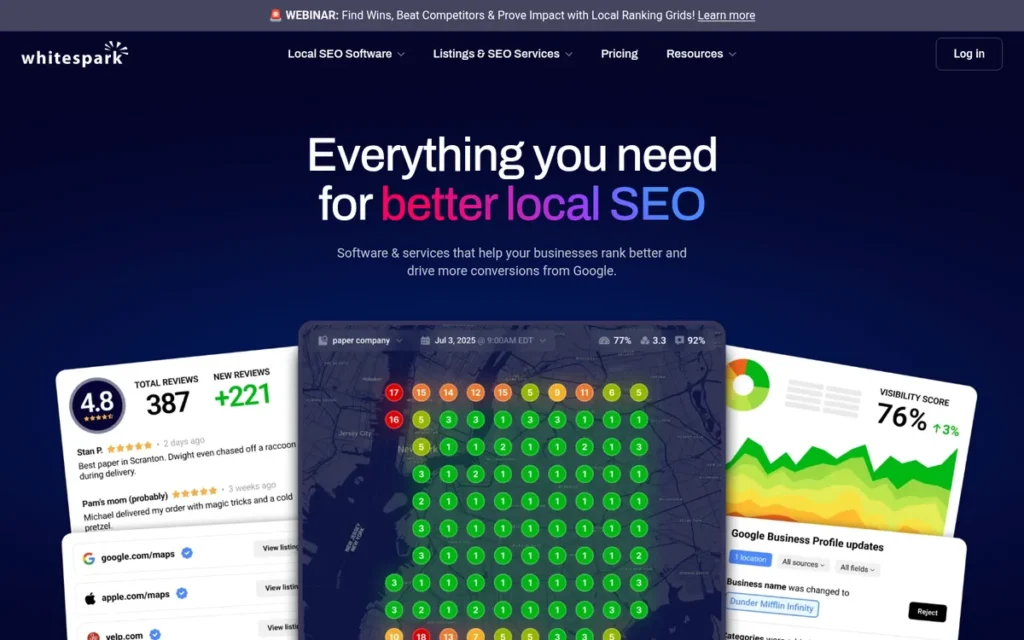
Category: Modular Specialist Toolkit, separate, individually priced tools for citations, rank tracking, grids, and reviews.
At a Glance
- Category: Modular Specialist Toolkit
- Best For: Agencies, consultants, and businesses fixing inconsistent citations
- Price Range: Rank Tracker $14–$200/month; Local Citation Finder $33–$149/month; citation building $20–$999 one-time; Reputation Builder Pro $79/location/month
- Primary Strength: Whitespark’s Local Citation Finder and human-built citation service make it the specialist choice for citation research and cleanup.
- Biggest Limitation: Whitespark requires combining several separate subscriptions, and its user-rating evidence is thin.
- One-Line Summary: Whitespark is a modular local SEO toolkit best suited to citation research and cleanup. Buyers purchase only the rank tracking, grid, citation, or review module they need, at published prices.
- Last Verified: November 2026
PlugRoute Score: 31/45 (C1 4, C2 4, C3 2, C4 4, C5 3, C6 4). Whitespark lost points for thin review-platform evidence (C3) and because totals must be assembled across modules (C2). Whitespark ties Local Falcon at 31/45 and ranks higher on the C1 tiebreaker (4 vs 2).
Overview
Whitespark is a modular local SEO toolkit from Edmonton, Canada. It is aimed at agencies and consultants who want specialist tools rather than one bundle, and it sells a separate, individually priced product for each local SEO job.
Whitespark is led by founder Darren Shaw, who also runs the Local Search Summit and a podcast.
Key Features
- Whitespark’s Local Citation Finder shows where a business and its competitors are listed, which guides citation building and cleanup.
- Whitespark’s done-for-you Citation Building service is a one-time purchase from $20 to $999, and people do the listing work.
- Whitespark’s Local Rank Tracker and Local Ranking Grids track positions, with grids configurable from 4 to 225 points.
- Whitespark’s Reputation Builder handles review generation and monitoring, with a 14-day trial on Reputation Builder Pro.
- Whitespark’s Local Platform manages Google Business Profiles in bulk. A user reports it costs about $1 per profile and includes bulk revert and spam monitoring (r/localseo, November 2026; unverified).
Best For
Whitespark is best for agencies and businesses whose main problem is inconsistent or missing citations, and for buyers adding one specialist module to an existing stack. Whitespark is a weaker fit for buyers who want one dashboard and one bill.
Pricing
Whitespark’s Local Citation Finder pricing (Whitespark, November 2026; vendor-documented):
- Whitespark Small Business costs $39/month, or $33/month billed annually ($396/year).
- Whitespark Specialist costs $49/month, or $41/month billed annually ($492/year).
- Whitespark Agency costs $49/month billed annually ($588/year); the monthly price is unclear.
- Whitespark Enterprise costs $149/month, or $124/month billed annually ($1,488/year).
Whitespark’s Local Rank Tracker costs $14–$200/month, and Reputation Builder Pro costs $79/location/month. For example, Citation Finder Small Business ($39) plus the entry Rank Tracker ($14) comes to $53/month. Each citation build adds at least $20, paid once.
Strengths
- Whitespark publishes the Local Search Ranking Factors study, which ranks primary GBP category first, ahead of proximity and review signals (Whitespark, November 2026; vendor-produced research).
- Whitespark sells citation building as a one-time fee ($20–$999), not a recurring subscription, so the citations it builds are not tied to an ongoing payment (Whitespark, November 2026; vendor-documented).
- Whitespark holds 4.6/5 on G2 from 22 reviews across its products, including Local Citation Finder at 4.6 (19 reviews) and Local Rank Tracker at 4.5 (3 reviews) (G2, November 2026; independent review platform).
- Whitespark founder Darren Shaw publishes local SEO guidance on r/whitespark. In one post he says GBP service-area fields “don’t do anything to help you rank” (r/whitespark, November 2026; user-reported).
Limitations
Whitespark trades convenience for specialization. Each module is strong on its own, but buyers carry the work of assembling and forecasting a multi-subscription stack.
- Whitespark buyers must combine several separate subscriptions, so total cost is harder to forecast (HackerNoon, November 2026; third-party source).
- Whitespark’s interface is described as “functional rather than modern” (HackerNoon, November 2026; third-party source).
- Whitespark doesn’t let users pick the specific citations to build, according to one practitioner (r/localseo, November 2026; user-reported).
- Whitespark’s user-satisfaction evidence is thin: it has 22 G2 reviews and no verified Capterra or Trustpilot presence. PlugRoute marks this as insufficient evidence.
- Whitespark’s policy for Local Platform data after cancellation is also insufficient evidence in our research.
Verdict
Whitespark is the best local SEO software for citation research and cleanup in PlugRoute’s 2026 evaluation, with human-built citations at one-time prices and individually priced specialist modules.
Whitespark fits buyers who want one strong module rather than a bundle. Agencies should add up module costs before committing. Whitespark’s thin review-platform record is its main evidence gap.
3. Local Falcon: Best Dedicated Geo-Grid Map Rank Tracker
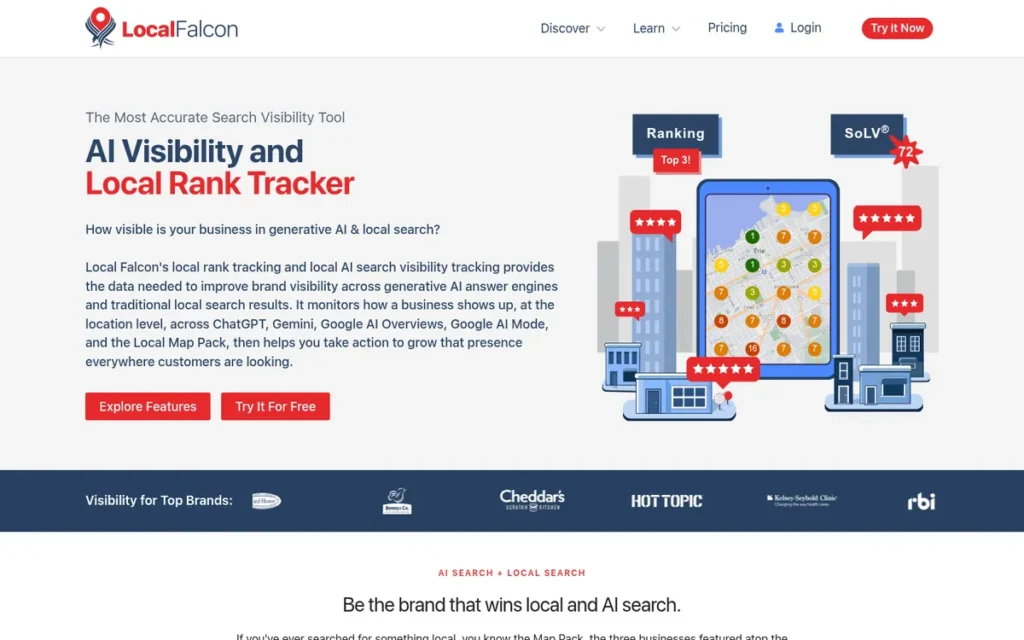
Category: Geo-Grid Tracker, measures Maps rankings point by point across a service area.
At a Glance
- Category: Geo-Grid Tracker
- Best For: Agencies and businesses needing Maps visibility data neighborhood by neighborhood without a full suite
- Price Range: $24.99–$199.99/month for standard plans; enterprise $499–$4,999/month; 100 free trial credits
- Primary Strength: Local Falcon offers the largest geo-grid scans evaluated (up to 21×21) at a low, credit-based entry price.
- Biggest Limitation: Local Falcon does not build citations, sync listings, or manage reviews, so most buyers will need a second tool.
- One-Line Summary: Local Falcon is the best dedicated geo-grid rank tracker for seeing how Google Maps and Apple Maps rankings change from one neighborhood to the next. Plans start at $24.99 per month for 7,500 scan credits (November 2026).
- Last Verified: November 2026
PlugRoute Score: 31/45 (C1 2, C2 5, C3 4, C4 4, C5 3, C6 2). Local Falcon lost points because it covers a single job (C1) and because its case studies don’t publish numbers (C6). Local Falcon ranks below Whitespark on the C1 tiebreaker.
Overview
Local Falcon is a credit-based geo-grid rank tracker for agencies and businesses that need Maps data for each neighborhood without paying for a full suite. It scans Google Maps and Apple Maps rankings on grids from 3×3 up to 21×21 points.
Local Falcon also measures AI visibility. One Local Falcon credit equals one map point, so a 7×7 scan uses 49 credits.
Key Features
- Local Falcon runs geo-grid scans on Google Maps and Apple Maps from 3×3 up to 21×21 points, with unlimited locations and keywords.
- Local Falcon reports Share of Local Voice (SoLV, a registered trademark of Local Falcon LLC): the share of grid points where a business ranks in the top 3. A business that averages position 4 but ranks top 3 at only 10 of 49 points has a SoLV of about 20%.
- Local Falcon reports Average Rank Position (ARP) and Average Total Rank Position (ATRP). ATRP also counts the points where the business doesn’t appear at all.
- Local Falcon tracks Share of AI Voice (SAIV) across ChatGPT, Gemini, Google AI Overviews, and AI Mode.
- Local Falcon offers Falcon Guard for enterprise-scale monitoring, with a published case study of a self-storage brand tracking about 100 facilities.
Best For
Local Falcon is best for agencies proving Maps visibility to clients and for businesses asking, “Where do I rank across my service area?” Local Falcon is not a fit for buyers who need citation, listings, or review management.
Pricing
Local Falcon’s standard plans (Local Falcon, November 2026; vendor-documented):
- Local Falcon Starter costs $24.99/month for 7,500 credits, or $299.88/year.
- Local Falcon Basic costs $49.99/month for 15,000 credits.
- Local Falcon Pro costs $99.99/month for 31,000 credits.
- Local Falcon Premium costs $199.99/month for 63,000 credits, or $2,399.88/year.
Local Falcon’s monthly credits expire at the end of each month, but credits bought separately don’t expire. For example, 10 locations × 3 keywords × weekly 7×7 scans use about 6,400 credits/month, which fits within Starter.
Strengths
- Local Falcon holds 4.7/5 on G2 (163 reviews) and 4.8/5 on Trustpilot (76 reviews). It is one of only two tools in this evaluation with a G2–Trustpilot gap of 0.6 points or less (G2 and Trustpilot, November 2026; independent review platform).
- Local Falcon supports grids up to 21×21 points, compared with BrightLocal’s 15×15 maximum (BrightLocal, November 2026; vendor-produced research, competitor-published).
- Local Falcon’s Starter plan includes 7,500 credits, or about 153 7×7 scans per month. One practitioner called BrightLocal “pricey vs local falcon” (r/localseo, November 2026; user-reported).
- Local Falcon tracks AI visibility (SAIV) across several AI answer engines, which most tools in this evaluation don’t document (Local Falcon, November 2026; vendor-documented).
Limitations
Local Falcon trades breadth for depth. It measures Maps visibility in detail but covers none of the other core jobs, so its real cost includes a second tool.
- Local Falcon does no citation building, listings sync, or review management, so most buyers will pay for another tool alongside it.
- Local Falcon credits run out quickly with frequent scans on many keywords, and unused monthly credits don’t roll over (G2, November 2026; user-reported).
- Local Falcon’s add-ons cost extra, and reviewers describe a learning curve for advanced reports (G2, November 2026; user-reported).
- Local Falcon’s costs rise with scan frequency. At 50 locations × 3 keywords × weekly 7×7 scans, you need about 31,800 credits per month, just above the Pro plan’s 31,000 (PlugRoute calculation, November 2026).
- Local Falcon has no Capterra presence that we found. Local Falcon builds no listings, so none revert when you cancel.
Users on r/localseo shared their experience:
“Has anyone else had issues with Local Falcon’s CSS not loading? It literally takes me 4x the amount of time it should to get one search through. And sometimes after refreshing a bunch of times I just give up.” Posted by u/Curious-Ad-3801
Takeaway: Some Local Falcon users report slow-loading pages that stretch the time each scan takes, adding friction to a tool whose value depends on frequent scans.
Verdict
Local Falcon is the best dedicated geo-grid tracker in PlugRoute’s 2026 evaluation, with the largest grid scans evaluated (21×21) across Google and Apple Maps from $24.99 per month.
Work out your credit budget before choosing a Local Falcon plan. Pair Local Falcon with a listings or citation tool, and treat it as a way to measure rankings, not a way to raise them.
4. Semrush Local: Best for Existing Semrush Users and Google Business Profile Automation
Category: SEO Suite Add-On, local SEO tools sold per location inside a broader SEO platform.
At a Glance
- Category: SEO Suite Add-On
- Best For: Marketers and agencies already using Semrush
- Price Range: $30–$60/location/month; custom pricing for 20+ locations; 7-day free trial
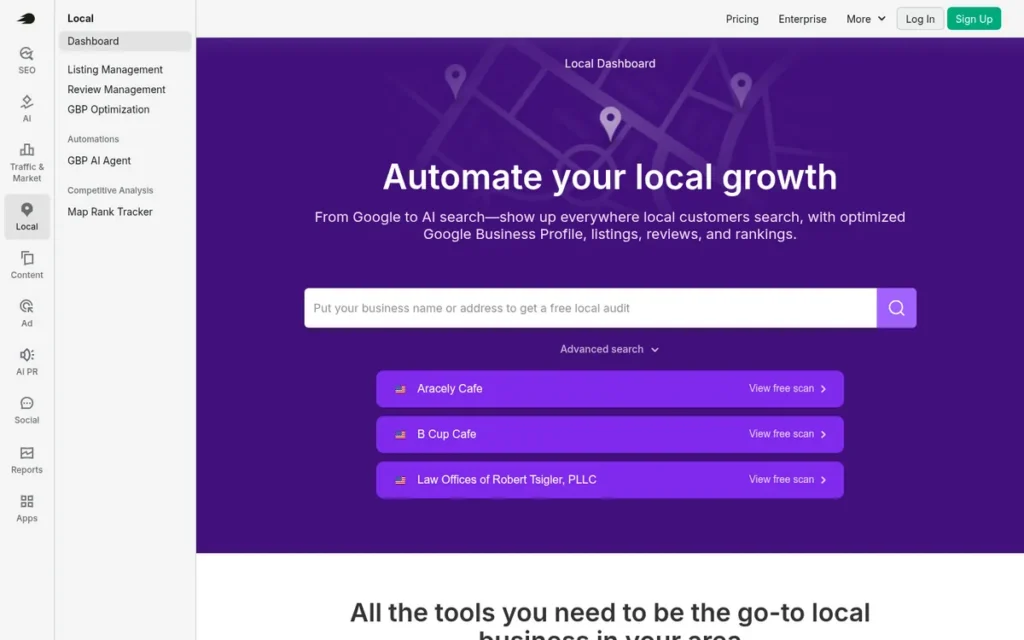
- Primary Strength: Semrush Local adds GBP automation and map-rank heat maps to the platform many marketers already use for broader SEO.
- Biggest Limitation: Semrush Local’s per-location pricing scales steeply, and users report billing friction and listing sync gaps.
- One-Line Summary: Semrush Local is the strongest local SEO choice for teams already inside the Semrush ecosystem. It adds Google Business Profile automation, map-rank heat maps, listings, and reviews at a published per-location price.
- Last Verified: November 2026
PlugRoute Score: 30/45 (C1 4, C2 4, C3 3, C4 2, C5 4, C6 2). Semrush Local lost points for billing complaints and an undocumented post-cancellation policy (C4). It also lost points because our research found no Local-specific research, case studies, or awards (C6). Semrush Local ties Moz Local and ranks higher on the C1 tiebreaker.
Overview
Semrush Local is the local SEO toolkit inside the Semrush platform, aimed at marketers and agencies who use or want a broader SEO suite. Semrush Local adds Google Business Profile automation, map-rank heat maps, listings distribution, and review management.
Semrush Local can be bought standalone or added to a Semrush plan; confirm which option you’re getting at checkout. Semrush has been an Adobe subsidiary since April 2026.
Key Features
- Semrush Local’s Base plan includes a GBP AI Agent for automated Google Business Profile management.
- Semrush Local’s Map Rank Tracker shows geo-grid heat maps of Google Maps visibility across a service area.
- Semrush Local’s Pro plan adds Listing Management, which sends business data to about 70 US and 40 international directories through a partner network.
- Semrush Local’s Pro plan adds Review Management and Advanced GBP Optimization.
- Semrush Local connects with the wider Semrush suite for keyword research, backlinks, site audits, and AI visibility tracking.
Best For
Semrush Local is best for in-house teams and agencies already paying for Semrush who want local tools in the same workflow. Semrush Local is a weaker fit for agencies with many low-budget local clients, because cost rises with every location.
Users on r/SEO noted:
“Semrush has a “local” section in it’s dashboard, but I’ve never really used it enough to know if it’s any good (we target a national audience). Based on what’s available it doesn’t look enormously like what you’re looking for (it has map rank tracker, GBP optimisation, directory listing and review management).” Posted by u/netnerd_uk
Takeaway: Semrush Local sits within reach of existing Semrush subscribers, but even suite users are unsure whether its local toolset fits specialized, hyper-local tracking needs.
Pricing
Semrush Local’s published pricing (G2 product page, November 2026; independent review platform):
- Semrush Local Base costs $30/location/month.
- Semrush Local Pro costs $60/location/month.
- Semrush Local Business is custom-priced for 20+ locations.
- Semrush Local offers a 7-day free trial.
Some comparisons quote $30/$60 as annual-billing prices, and third-party pages listing $20/$40 appear out of date. For example, 10 locations on Pro cost about $600/month for Local alone, and a core Semrush subscription adds to that.
Strengths
- Semrush Local is backed by Adobe, which completed its acquisition of Semrush on April 28, 2026 (Adobe and SEC filing, November 2026; vendor-documented).
- Semrush Local shows 4.4/5 on G2 from about 4,302 reviews, though that count probably covers the whole Semrush platform (G2, November 2026; independent review platform).
- Semrush Local publishes per-location pricing with a clear custom threshold at 20+ locations, so you can calculate multi-location costs before talking to sales.
- Semrush Local includes the GBP AI Agent and Map Rank Tracker on its entry Base plan rather than reserving them for Pro.
Limitations
Semrush Local trades local specialization for suite breadth. Its local tools fit neatly into Semrush, but per-location costs and billing friction weigh on larger rosters.
- Semrush Local Pro costs about $600/month at 10 locations, compared with $119/month on BrightLocal Grow (PlugRoute calculation, November 2026).
- Semrush’s Trustpilot page (331 reviews) is mostly negative, with recurring allegations about auto-renewal, cancellation, and refunds (Trustpilot, November 2026; user-reported). A third-party summary puts the score at about 2.8/5 (GMB API, November 2026; third-party source).
- Semrush Local’s listing sync did not correct Yelp or Apple Maps data for one practitioner, and another says Semrush “is not built specifically for local SEO” (r/localseo, November 2026; user-reported).
- Semrush Local’s listing policy after cancellation is insufficient evidence in our research.
Verdict
Semrush Local is the best local SEO add-on for teams already using Semrush. It combines Google Business Profile automation and map-rank heat maps with the wider SEO suite at $30–$60 per location per month (November 2026).
Semrush Local’s per-location pricing makes it expensive for large agency client lists. Get renewal terms and the listing policy after cancellation in writing before signing.
5. Moz Local: Best Budget Listings Sync
Category: Listings Sync Platform, pushes one set of business data to many directories and keeps it consistent.
At a Glance
- Category: Listings Sync Platform
- Best For: Budget-conscious businesses whose main problem is inconsistent listings
- Price Range: $199–$399/location/year (annual) or $20–$40/location/month; enterprise (about 50+ locations) custom
- Primary Strength: Moz Local has the lowest published single-location price among dedicated listings-sync tools in this evaluation ($199/year).
- Biggest Limitation: Moz Local’s own documentation shows weeks of processing time, and it has no confirmed geo-grid tracking.
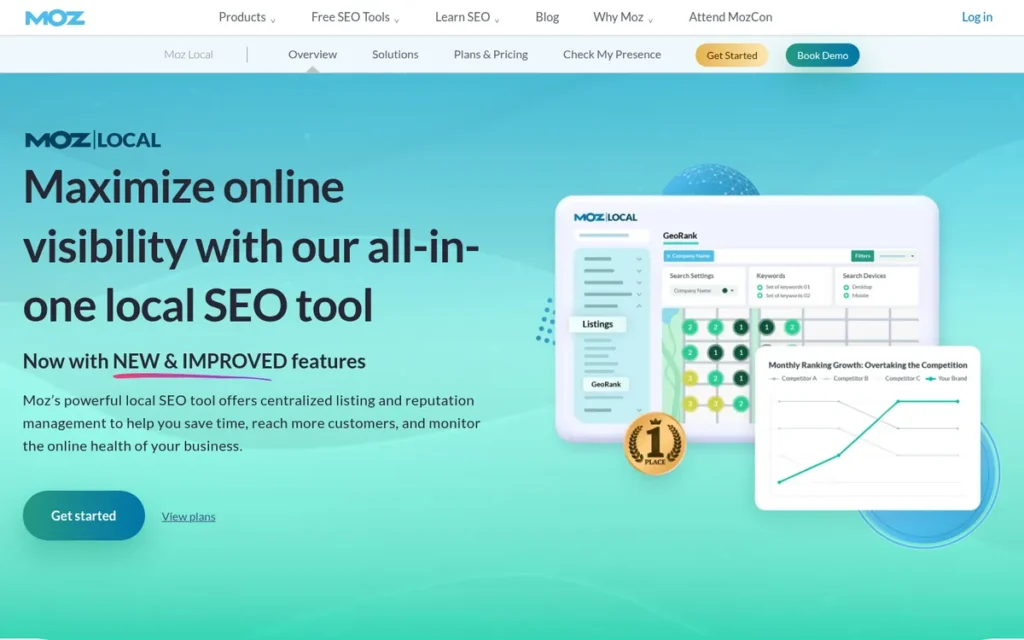
- One-Line Summary: Moz Local is a budget option for keeping business listings consistent, syncing one set of details to 90+ directories from $199 per location per year (November 2026).
- Last Verified: November 2026
PlugRoute Score: 30/45 (C1 3, C2 5, C3 3, C4 3, C5 3, C6 2). Moz Local lost points because it has no confirmed geo-grid tracking (C1) and no named case studies with numbers (C6). Moz Local ranks below Semrush Local on the C1 tiebreaker.
Overview
Moz Local is a budget listings-sync tool from Ziff Davis-owned Moz for small businesses and multi-location brands that mainly need consistent listings. Moz Local pushes one set of business details to 90+ directories through data aggregators.
Moz Local adds duplicate suppression and review monitoring. It is a focused tool, though, and it doesn’t replace a geo-grid tracker.
Key Features
- Moz Local sends business details you enter once to 90+ directories through data aggregators, including Google Business Profile, Apple Maps, Bing, and Facebook.
- Moz Local suppresses duplicate listings and shows a listing-health dashboard.
- Moz Local monitors reviews across 22–26 networks, and its Preferred plan and above support replies on Google and Facebook.
- Moz Local supports Google Business Profile posts and social scheduling to Facebook, Instagram, and TikTok.
- Moz Local sells optional Listings AI ($14/month, included in Elite) and Reviews AI ($10/month) add-ons.
Best For
Moz Local is best for owners and brands that need consistent listings at a predictable annual price per location. Moz Local is a poor fit for anyone whose main need is seeing Maps rankings neighborhood by neighborhood.
Pricing
Moz Local’s per-location pricing (Moz, November 2026; vendor-documented):
- Moz Local Lite costs $20/month or $199/year.
- Moz Local Preferred costs $30/month or $299/year.
- Moz Local Elite costs $40/month or $399/year.
- Moz Local’s annual billing saves about 20%, and enterprise pricing (about 50+ locations) is custom.
For example, 10 locations on Preferred cost $2,990/year, or about $249/month.
Strengths
- Moz Local publishes full per-location pricing from $199/year for one location, which makes it the most budget-predictable listings sync in this evaluation (Moz, November 2026; vendor-documented).
- Moz Local holds 4.2/5 on G2 (about 475 reviews) and 4.4–4.5/5 on Capterra (33 reviews), and reviewers praise its “enter once, push everywhere” workflow (G2 and Capterra, November 2026; independent review platform).
- Moz Local includes review monitoring across 22–26 networks and direct replies on Google and Facebook from the Preferred tier.
- Moz Local is operated by SEOMoz, Inc., a Ziff Davis company (Moz, November 2026; vendor-documented).
Limitations
Moz Local trades speed for price. Its sync is affordable and predictable, but processing is slow and its coverage stops at listings and reviews.
- Moz Local takes about 4 weeks to process new locations and 2–3 weeks for updates, according to Moz’s own help documentation (Moz, November 2026; vendor-documented).
- Moz Local setups still showed “setting up” six months later for one practitioner, who stopped using the service (r/localseo, November 2026; user-reported).
- Moz Local offers “hyper-local” rank insights but no confirmed geo-grid depth, and reviewers report waiting about 2 weeks for a support reply (G2, November 2026; user-reported).
- Moz’s Trustpilot score of 3.0–3.3/5 covers all of Moz, not Moz Local alone (Trustpilot, November 2026; independent review platform).
- Moz Local’s listing policy after cancellation and its white-label reporting depth are insufficient evidence in our research.
Verdict
Moz Local is the best budget listings-sync software in PlugRoute’s 2026 evaluation, keeping business data consistent across 90+ directories from $199 per location per year.
Pair Moz Local with a grid tracker if Maps visibility matters to you. Plan for several weeks of processing, and confirm what happens to listings after cancellation before committing.
6. Birdeye: Best for Review-Led Multi-Location Businesses
Category: Reputation Platform, automates review generation and response, with listings and customer messaging alongside.
At a Glance
- Category: Reputation Platform
- Best For: Multi-location businesses that treat reviews as their main local visibility lever
- Price Range: Pricing on request (third-party estimate: about $299–$349/location/month, unverified)
- Primary Strength: Birdeye combines review generation, review response, listings, and messaging, backed by the highest-volume product-specific G2 and Capterra ratings in this evaluation.
- Biggest Limitation: Birdeye’s quote-only pricing and reported renewal terms make its true cost hard to compare.
- One-Line Summary: Birdeye is a reputation-first platform for multi-location businesses, rated 4.7/5 on both G2 and Capterra (November 2026). It automates review requests and responses alongside listings and customer messaging.
- Last Verified: November 2026
PlugRoute Score: 25/45 (C1 3, C2 1, C3 4, C4 2, C5 4, C6 3). Birdeye lost points for quote-only pricing (C2), for Trustpilot renewal allegations (C4), and because our research found no documented rank tracking (C1).
Overview
Birdeye is a reputation and customer-experience platform for multi-location businesses that treat review generation as their main local visibility lever. Birdeye automates review requests, monitors reviews, and manages listings from one dashboard.
Birdeye also adds messaging, surveys, and social publishing. Much of Birdeye’s “agentic marketing” description is the vendor’s own framing.
Key Features
- Birdeye automates review requests by SMS and email and monitors reviews across 200+ sites (Pabau, November 2026; unverified).
- Birdeye’s AI agents draft and post review replies, publish content, build reports, and flag anomalies, according to Birdeye’s own marketing.
- Birdeye manages business listings alongside messaging, webchat, surveys, social, referrals, and payments.
- Birdeye gives a central team control over the brand while still giving each location its own access.
- Birdeye lists 3,000+ integrations with other business systems.
Best For
Birdeye is best for multi-location businesses whose main local need is review volume and response, such as a G2 reviewer managing 7 dental offices. Birdeye is a poor fit for budget-conscious single locations or buyers who mainly need rank tracking.
Pricing
Birdeye publishes no pricing as of November 2026 and requires a sales quote.
- Birdeye costs about $299–$349/location/month (Pabau, November 2026; third-party source).
- Birdeye at 10 locations would cost roughly $3,000–$3,500/month based on that estimate (PlugRoute calculation, November 2026).
- Birdeye’s reported 90-day cancellation notice and 8% renewal increase are unverified claims.
Strengths
- Birdeye holds 4.7/5 on G2 (about 4,300 reviews) and 4.7/5 on Capterra (about 707 reviews), the highest-volume product-specific ratings in this evaluation (G2 and Capterra, November 2026; independent review platform).
- Birdeye was ranked #1 in the enterprise segment in 14 G2 Summer 2026 categories, including Local SEO and Multi-Location Marketing (Birdeye, November 2026; vendor-documented; verify on G2).
- Birdeye raised a $60M Series C led by Accel-KKR and reports serving 80,000+ local businesses. Another source says 200,000+, so the figure is disputed (Birdeye, November 2026; vendor-documented).
- Birdeye reviewers praise its automated review generation, ease of use, and support (G2, November 2026; user-reported).
Limitations
Birdeye trades price transparency for platform breadth. Its review tools are well rated, but buyers can’t see the real cost until a sales call, and its renewal terms are disputed.
- Birdeye’s estimated per-location cost can be several times that of tools with published prices.
- Birdeye’s Trustpilot score is 3.1/5 from 684 reviews, split between about 71% 5-star and 23% 1-star. That is far below its 4.7 G2 rating (Trustpilot, November 2026; independent review platform).
- Birdeye customers allege auto-renewal charges, including one of $9,240.18, and missed 90-day cancellation windows (Trustpilot, November 2026; user-reported).
- Birdeye’s rank tracking and geo-grid capability is not documented in our research, and its listing policy after cancellation is insufficient evidence.
Verdict
Birdeye is the best local SEO software for review-led multi-location businesses in PlugRoute’s 2026 evaluation. It is backed by 4.7/5 ratings on G2 and Capterra but held back by quote-only pricing and reported renewal friction.
Shortlist Birdeye if reviews drive your local growth. Get pricing, renewal increases, and notice windows in writing, and pair Birdeye with a rank tracker if you need visibility data.
7. Yext: Best for Enterprise Multi-Location Brand Data Control
Category: Enterprise Listings Platform, centrally governs location data and distributes it to publishers at scale.
At a Glance
- Category: Enterprise Listings Platform
- Best For: Brands with dozens to hundreds of locations needing governed, bulk listing updates
- Price Range: Pricing on request; annual contracts (old SMB prices of $199–$999/location/year not confirmed current)
- Primary Strength: Yext distributes location data to 200+ publishers through direct integrations from a single Knowledge Graph.
- Biggest Limitation: Yext listings revert when you stop paying, and quote-only annual contracts make the true cost hard to compare.
- One-Line Summary: Yext is an enterprise listings platform that pushes governed location data to 200+ publishers from one Knowledge Graph. It suits large multi-location brands that accept quote-only annual contracts.
- Last Verified: November 2026
PlugRoute Score: 21/45 (C1 3, C2 1, C3 2, C4 1, C5 5, C6 3). Yext lost points for quote-only pricing (C2) and listings that revert after cancellation (C4). Yext’s C3 stays at 2 even after its Trustpilot figure was corrected, because a 2.4-point gap between G2 and Trustpilot remains.
Overview
Yext is an enterprise listings and brand-data platform for multi-location brands that need governed, bulk updates across hundreds of locations. Yext distributes location data from a central Knowledge Graph to 200+ publishers and tracks AI search visibility through Scout.
In 2026, Yext acquired GoShine and agreed to buy Flamel.ai, which deepens its focus on AI search.
Key Features
- Yext distributes listings to 200+ publishers, including Google, Apple, Facebook, Bing, and Yelp, through direct integrations with duplicate suppression.
- Yext’s Knowledge Graph acts as a single source of truth feeding listings, location Pages, Reviews, Search, and Social.
- Yext Scout tracks visibility across Google Search, Maps, AI Overviews, ChatGPT, Gemini, Claude, and Perplexity.
- Yext Scout benchmarks a brand against up to 20 local competitors.
- Yext includes review monitoring and response as part of its platform modules.
Best For
Yext is best for enterprise brands with many locations that need central control of location data and AI-search visibility reporting. Yext is a poor fit for single-location businesses and cost-sensitive agencies.
Pricing
Yext pricing is quote-only as of November 2026. The price depends on location count, modules, and contract length, and annual billing is standard (Yext, November 2026; vendor-documented).
- Yext’s old SMB PowerListings prices were $199, $449, $499, and $999 per location per year, but these are historical and not confirmed as current.
- Yext’s lowest old tier ($199) excluded Google, Facebook, Apple, and Yelp.
- Yext raised prices about 7% at renewal and required 30 days’ notice before renewal, according to one reviewer (G2 reviewer, November 2026; user-reported).
Strengths
- Yext distributes location data to 200+ publishers through direct integrations, the widest documented publisher network in this evaluation (Yext, November 2026; vendor-documented).
- Yext holds 4.4/5 on G2 from about 1,124 reviews, and one reviewer praised its “absolute control” through direct APIs (G2, November 2026; independent review platform).
- Yext Scout raised Playdigo’s visibility from 0% to 30% (Yext, November 2026; vendor-documented case study).
- Yext is publicly listed (NYSE: YEXT) and reported $111.1M in revenue for the quarter ended July 31, 2026 (Yext investor relations, November 2026; vendor-documented).
Limitations
Yext trades listing ownership for enterprise control. Its central governance is unmatched in this evaluation, but you keep those listings only for as long as you keep paying.
- Yext listings revert once syndication stops, according to users, so businesses effectively “rent” their listings (Reddit, G2, and Capterra, November 2026; user-reported).
- Yext’s Trustpilot score is 2.0/5 from 348 reviews, far below its 4.4 G2 rating. Trustpilot notes that Yext has not recently invited reviews, so the sample may not be representative (Trustpilot, November 2026; independent review platform).
- Yext reviewers describe contracts that are hard to end and charges that continued after customers believed the contract had ended (Capterra, November 2026; user-reported).
- Yext has a steep learning curve and high cost, according to reviewers (G2, November 2026; user-reported).
Verdict
Yext is the strongest enterprise option for governing location data across 200+ publishers in PlugRoute’s 2026 evaluation, but its listings revert when you stop paying and its pricing is quote-only.
Shortlist Yext only at enterprise scale, and get exit terms and renewal increases in writing. Small businesses and agencies will find better value in the higher-ranked tools on this list.
What Will Local SEO Software Actually Cost?
Your real cost depends more on pricing model and location count than on sticker price. At one location, every published-price tool costs under $60/month. At 10 locations, monthly totals range from $119 (BrightLocal Grow) to an estimated $3,000 or more (Birdeye), as of November 2026.
At one location, Semrush Local Base ($30/month) costs less than BrightLocal Track ($39/month). At 10 locations, Semrush Local Pro costs about five times as much as BrightLocal Grow ($600 vs $119/month). Pricing model matters more than sticker price (PlugRoute calculation, November 2026).
| Scenario | BrightLocal | Whitespark | Local Falcon | Semrush Local | Moz Local | Birdeye | Yext |
|---|---|---|---|---|---|---|---|
| 1 location | Track $39/mo | About $53/mo (Citation Finder $39 + Rank Tracker $14; PlugRoute assembly) | Starter $24.99/mo | Base $30/mo | Lite $199/yr (about $16.58/mo) | Quote only | Quote only |
| 10 locations | Grow $119/mo | Modules priced separately; Reputation Builder Pro adds $79/location/mo | $24.99–$49.99/mo (grids only) | Pro about $600/mo | Preferred $2,990/yr (about $249/mo) | About $3,000–$3,500/mo (third-party estimate) | Quote only |
| 41–50 locations | Grow $449/mo | Up to about $349/mo (Citation Finder Enterprise $149 + Rank Tracker up to $200; PlugRoute assembly) | About $99.99–$199.99/mo (about 31,800 credits; PlugRoute calculation) | Custom; list rate would be about $3,000/mo at $60/location | $14,950/yr on Preferred (about $1,246/mo) or custom | Quote only | Quote only |
One-time citation costs come on top of subscriptions:
- BrightLocal Citation Builder charges $3.20 per citation, or as little as $2 with bulk credits.
- Whitespark Citation Building costs $20–$999 as a one-time fee.
Cost per location by business size (November 2026):
- A single-location small business can start with a free Google Business Profile plus Local Falcon Starter ($24.99/month).
- A single-location business that wants rank tracking, citation tracking, and audits in one place can choose BrightLocal Track ($39/month) and add Moz Local Lite ($199/year) only if listings are inconsistent.
- Published per-location prices range from about $16.58/month (Moz Local Lite, billed annually) to $60/month (Semrush Local Pro).
- BrightLocal’s band pricing falls to about $11.90 per location at 10 locations on Grow and about $8.98 per location at 50 locations.
- Brands with 100+ locations needing governed bulk updates will receive custom quotes from Yext and Birdeye. A third party estimates Birdeye at $299–$349 per location per month.
The cheapest sticker price is not always the cheapest total. For 10 locations, Local Falcon Starter plus Moz Local Preferred costs about $274/month, which covers grids up to 21×21 and aggregator sync to 90+ directories.
At the same 10 locations, BrightLocal Grow costs $119/month for grids up to 15×15, listings management, and reviews, with citations billed separately at $2–$3.20 each (PlugRoute calculation, November 2026). The two stacks don’t cover the same jobs, so compare only the jobs you actually need.
This aligns with community sentiment on r/localseo:
“For a small local SEO agency, I would not overbuy software at the start. The most important thing is having clean reporting across rankings, GBP actions, calls, forms, reviews, citations, and AI visibility tests.” Posted by u/Wild_Ad_8382
Takeaway: Local SEO software buyers get more from a lean stack matched to the jobs they actually do than from overlapping subscriptions bought up front.
How to test before you buy (November 2026):
- Local Falcon offers 100 free trial credits with no card required.
- Semrush Local offers a 7-day free trial.
- Whitespark offers a 14-day trial on Reputation Builder Pro.
- BrightLocal’s Citation Builder works with a free account.
What Red Flags Should I Watch For When Evaluating Local SEO Software?
Six red flags come up most often when buying local SEO software, and each one can raise your real cost or reduce what you get. They are numbered below so you can check any vendor against them. The evidence behind each flag comes from vendor documentation, review platforms, and practitioner reports dated November 2026.
Red Flag #1: Rented Listings That Revert After Cancellation Rented listings are listings that a vendor stops maintaining, or that revert to old data, when your subscription ends. Users report this with Yext (r/localseo and Capterra, November 2026; user-reported). Semrush Local’s and Moz Local’s policies were insufficient evidence in our research. Ask for a written post-cancellation policy before signing.
If your listings disappear when your subscription ends, you were renting visibility, not building it.
Red Flag #2: Quote-Only Pricing With Auto-Renewal Increases Quote-only pricing makes cost comparison difficult, and auto-renewal clauses can lock in price increases before you notice them. Trustpilot complaints about Birdeye and Yext center on renewals, long notice windows, and contracts that are hard to end (Trustpilot, November 2026; user-reported). Get the renewal percentage and notice period written into the contract.
Red Flag #3: Ranking Guarantees A vendor that guarantees rankings is overpromising, because Google ranks local results by relevance, distance, and prominence (Google Business Profile Help, November 2026; vendor-documented). Local SEO software measures visibility and keeps your data consistent, but it does not control where Google places you. Treat any guarantee as a reason to read the contract closely.
Red Flag #4: A Large Gap Between G2 and Trustpilot Ratings A wide gap between a vendor’s G2 and Trustpilot scores often points to billing or contract friction that G2 reviewers rarely mention. Yext scores 4.4 on G2 but 2.0 on Trustpilot, and Birdeye scores 4.7 on G2 but 3.1 on Trustpilot (G2 and Trustpilot, November 2026; independent review platform). Read the low-star reviews before signing.
Red Flag #5: Listing Sync That Skips Yelp or Apple Maps Listing sync that misses high-value directories leaves inconsistencies you still have to fix by hand, which defeats the point of paying for sync. One practitioner had to correct Yelp and Apple Maps data directly after Semrush Local’s sync failed to fix it (r/localseo, November 2026; user-reported). Ask which directories each plan actually updates.
Red Flag #6: Scan Credits That Expire Monthly Scan credits that expire monthly can waste budget if your scanning is uneven from month to month. Local Falcon’s monthly plan credits expire at the end of each month, while credits bought separately do not (Local Falcon, November 2026; vendor-documented). Estimate your monthly scan volume first, then choose a plan with some headroom.
What Questions Should I Ask Before Choosing Local SEO Software?
Ask the six questions below before you buy any local SEO software, and get the answers in writing. They cover listing ownership, renewals, billing units, and directory coverage. They also cover white-label scope and features you may already pay for, which are the hidden costs behind most buyer complaints in this evaluation’s research.
Question #1: What happens to my listings and citations if I cancel? Look for a written policy, because outcomes after cancellation differ sharply across the seven vendors in this evaluation. A good answer names exactly which listings and citations stay live, for how long, and who maintains them after you stop paying. The documented outcomes from this edition’s research are listed below.
- BrightLocal documents that citations it builds stay live after you stop paying.
- Whitespark sells citation building as one-time builds that are not tied to a subscription.
- Local Falcon builds no listings, so nothing reverts when you cancel.
- Yext users report that listings revert once syndication stops (user-reported).
- Semrush Local, Moz Local, and Birdeye post-cancellation policies were insufficient evidence in our research.
Question #2: What is the renewal increase and notice window, in writing? A good answer gives the exact renewal percentage and the cancellation notice period inside the contract, not in a sales email. One reviewer reports Yext’s 30-day notice requirement and a roughly 7% increase (G2 reviewer, November 2026; user-reported). Birdeye’s reported 90-day notice and 8% increase are unverified, so ask directly.
Question #3: Is the advertised price monthly or annual, and per location or per band? Check the billing unit before comparing prices, because the same sticker price can mean very different totals. BrightLocal’s “from $31/mo” is probably an annual-billing price (unverified). Semrush Local charges per location, while BrightLocal charges per location band. Convert every quote to a monthly total at your own location count.
Question #4: Which directories does sync actually update, and how long does processing take? Ask for the full directory list and expected processing times for each plan before you buy. Moz documents about 4 weeks for new locations and 2–3 weeks for updates (Moz, November 2026; vendor-documented), and practitioners report sync gaps on Yelp and Apple Maps. A good answer names the directories and gives a timeline in days.
Question #5: What exactly does white-label reporting include? Ask exactly which white-label components each plan includes, because vendors use the term to mean different things. A good answer confirms branded reports, custom-domain hosting, and client logins in writing. The white-label status documented in this edition’s research is listed below for all seven vendors.
- BrightLocal includes white-label reports on Track, Manage, and Grow, but its documentation contradicts itself on custom-domain hosting (BrightLocal Help Center, November 2026; vendor-documented).
- Local Falcon offers white-label PDF and CSV reports on paid plans (ReportsMate, November 2026; third-party source).
- Whitespark offers branded, password-protected share links for its rank tracker and grids, plus white-label exports on Citation Finder Agency plans (ReportsMate, November 2026; third-party source).
- Semrush Local supports white-label reporting through Semrush’s My Reports, depending on tier (ReportsMate, November 2026; third-party source).
- Moz Local, Birdeye, and Yext white-label depth was insufficient evidence in our research.
Question #6: Which features do I already pay for in another tool? List every feature you already pay for before buying another subscription, because overlapping tools are a common hidden cost. For example, Semrush customers already have map-rank heat maps through Semrush Local. A separate grid tracker may duplicate that spend unless you need Local Falcon’s 21×21 grids or Apple Maps scanning.
What Other Local SEO Tools Are Worth Considering?
Several other local SEO tools come up in practitioner discussions and AI assistant answers. They were not researched to the same depth or scored in this edition. They may still suit specific needs, so treat the tools below as starting points for your own research, not ranked recommendations.
- Local Dominator, Local Viking, and Leadsnap are low-cost grid trackers that practitioners mention on r/localseo.
- Synup was named by Perplexity as a good fit for agency white-label economics.
- GatherUp, Podium, ReviewTrackers, and Uberall are review and listings platforms that come up in community discussions and AI answers.
- SOCi is an enterprise multi-location marketing suite that was left out of this evaluation because it has no public pricing.
How Did We Rank These Local SEO Software Tools?
PlugRoute scored all seven tools from 1 to 5 on six criteria. The three primary criteria count double and the three secondary criteria count once, for a maximum of 45 points. Every data point carries an evidence label and a November 2026 snapshot date. No hands-on accuracy testing was done for this edition.
The primary criteria (×2) are:
- C1 Coverage of Core Local SEO Jobs: C1 counts vendor-documented coverage of six jobs (rank tracking, geo-grid, citations, listings sync, reviews, and reporting), because coverage tells you whether you need one subscription or several.
- C2 Pricing Transparency and Total Cost: C2 rewards price lists that let you calculate totals at 1, 10, and 50 locations, because budget is a core buying constraint.
- C3 Verified User Sentiment: C3 combines G2, Capterra, and Trustpilot ratings with Reddit sentiment, because readers rightly doubt vendor claims.
The secondary criteria (×1) are:
- C4 Contract Terms and Listing Ownership: C4 scores renewal terms and listing persistence after cancellation, because vendors rarely disclose these risks up front.
- C5 Segment Fit and Scalability: C5 checks fit for single locations, agencies, and brands with 10, 50, or 100+ locations, because value changes as location counts grow.
- C6 Evidence Credibility and Track Record: C6 scores research, case studies, awards, and company stability, because no tool can guarantee rankings.
| Tool | C1 | C2 | C3 | C4 | C5 | C6 | Total |
|---|---|---|---|---|---|---|---|
| BrightLocal | 5 | 5 | 4 | 5 | 4 | 3 | 40/45 |
| Whitespark | 4 | 4 | 2 | 4 | 3 | 4 | 31/45 |
| Local Falcon | 2 | 5 | 4 | 4 | 3 | 2 | 31/45 |
| Semrush Local | 4 | 4 | 3 | 2 | 4 | 2 | 30/45 |
| Moz Local | 3 | 5 | 3 | 3 | 3 | 2 | 30/45 |
| Birdeye | 3 | 1 | 4 | 2 | 4 | 3 | 25/45 |
| Yext | 3 | 1 | 2 | 1 | 5 | 3 | 21/45 |
C6 anchors:
- A C6 score of 5 requires independently verified numeric results plus industry research, and no tool reached it.
- A C6 score of 4 means the vendor publishes recurring research on local ranking factors, the evidence most relevant to whether software can affect rankings (Whitespark).
- A C6 score of 3 means the vendor publishes recurring local consumer research (BrightLocal). A vendor can also earn 3 by combining a local-specific case study or award with verified corporate stability (Birdeye, Yext).
- A C6 score of 2 means the vendor has verified corporate stability, or has case studies without local-specific numbers, but no local research or award (Semrush Local, Moz Local, Local Falcon).
Ties are broken by C1 (Coverage of Core Local SEO Jobs), then C2, then C3. Whitespark and Local Falcon tied at 31/45, as did Semrush Local and Moz Local at 30/45. Whitespark and Semrush Local placed higher on C1. All ratings were rechecked on November 5, 2026.
Evidence labels:
- Vendor-documented means the claim comes from the vendor’s or platform owner’s own pricing page, help center, filing, or official FAQ.
- Vendor-produced research means the claim comes from a study the vendor publishes about its own market.
- Independent review platform means the figure comes from G2, Capterra, or Trustpilot.
- Third-party source means the claim comes from an independent publisher’s comparison or estimate, not from the vendor.
- User-reported means the claim comes from a named review or Reddit post, not an official source.
- Unverified means no official or independent source confirmed the claim.
BrightLocal-published comparison guides and the BrightLocal Local Consumer Review Survey were used and labeled as vendor-produced, even though BrightLocal ranks #1. Missing evidence is marked “insufficient evidence” rather than filled in with assumptions.
PlugRoute has no affiliate relationships with any company listed. Rankings are determined entirely by research data and objective evaluation criteria.
What Do Buyers Commonly Ask About Local SEO Software?
Buyers most often ask three questions: which tool suits agency white-label reporting, whether software can guarantee Maps rankings, and how PlugRoute decides its rankings. Each answer below opens with a direct response and uses the same November 2026 evidence snapshot as the rest of this guide.
What is the best local SEO software for agencies that need white-label reporting?
BrightLocal is the strongest starting point for agency reporting, because it includes white-label reports on all three plans and its band pricing lowers cost per client (BrightLocal Help Center, November 2026; vendor-documented). Local Falcon, Whitespark, and Semrush Local also document white-label options. Confirm custom domains, client logins, and report limits with each vendor before buying.
Can local SEO software guarantee higher Google Maps rankings?
No local SEO software can reliably guarantee higher Google Maps rankings, because Google ranks local results by relevance, distance, and prominence (Google Business Profile Help, November 2026; vendor-documented). Local SEO software measures visibility, keeps listings consistent, and helps you collect reviews. Practitioners on r/localseo describe these tools mainly as reporting tools, not ranking levers.
“Nobody is using it to increase rankings. People are using the tools to show their performance.” (u/ChuckFindleyAxe, r/localseo (r/localseo, November 2026; user-reported))
Takeaway: Treat local SEO software as a measurement and maintenance tool. Rankings still depend on Google’s relevance, distance, and prominence signals.
How does PlugRoute determine rankings?
PlugRoute scores each tool from 1 to 5 on six published criteria. Coverage, pricing transparency, and user sentiment count double, for a maximum of 45 points. Ties are broken by C1, then C2, then C3. Every data point is labeled by evidence type and dated to November 2026. Gaps are marked “insufficient evidence” in the same way for every vendor.
What Do Key Local SEO Software Terms Mean?
Google Business Profile (GBP): The free listing a business claims and completes so it can show up in Google’s local results and on Google Maps. Choosing the correct primary GBP category is the most important step, because a widely cited ranking-factors study ranks it as the top local ranking factor. Do this before paying for any software.
NAP Consistency: Your business name, address and phone number match on every directory and listing. Mismatched details weaken trust signals, which is why buyers pay for citation and listings tools once they can’t keep many listings accurate by hand.
Citation: A mention of your business details on a directory or website, built either by you or by a vendor’s service. Check whether citations are sold one at a time or as a one-time build. Also check whether they stay live after you cancel, because accurate and audited citations matter more than how many you have.
Geo-Grid Tracking: A way of checking local pack and Maps rankings at many points across a service area (for example, a 7×7 or 21×21 grid) instead of from one location. Single-point rank checks often don’t match what local searchers actually see, so location-level tracking is often the main reason to pay for software.
Scan Credits: A pricing unit used by credit-based grid trackers, where one credit covers one map point, so a 7×7 scan uses 49 credits. Monthly plan credits may expire at the end of each month, so estimate how much you will scan before you pick a plan.
Share of Local Voice (SoLV): A grid-tracking metric showing the share of grid points where a business ranks in the top 3. It can show weak visibility that an average position hides. For example, a business can average position 4 but rank top 3 at only a small share of points.
Average Rank Position (ARP) and Average Total Rank Position (ATRP): Two averages of where a business ranks across a grid. ATRP also counts the points where the business doesn’t appear at all, so it gives a stricter picture of real coverage.
Listings Sync: Pushing one set of business data to many directories through data aggregators or direct publisher integrations so it stays consistent. Ask which directories each plan actually updates and how long processing takes, because some syncs skip key sites or take weeks.
Rented Listings: Listings that a vendor stops maintaining, or that revert to old data, when your subscription ends. Get a written post-cancellation policy before you sign, so you know whether you are building visibility or only renting it.
Location Band Pricing: A pricing model where one monthly price covers a range of locations (such as 6 to 10), instead of a fee for each location. As location counts grow, the cost per location can fall sharply compared with per-location pricing, so convert every quote to a monthly total at your own location count.
Quote-Only Pricing: The vendor publishes no prices, and you get a cost only from a sales quote. This makes comparison hard and often comes with annual contracts, so get the renewal increase and notice window written into the contract.
White-Label Reporting: Reports that an agency can brand as its own and share with clients. Vendors mean different things by the term, so confirm in writing whether it includes branded reports, custom-domain hosting and client logins.
Which Local SEO Software Is Right for You?
Key Insights
The right local SEO software depends on the job you need done, how many locations you manage, and whether you can predict the pricing. BrightLocal is the best all-round pick at 40/45. Whitespark leads on citations, and Local Falcon leads on geo-grid tracking. Per-location and quote-only pricing change totals sharply once you pass 10 locations.
- BrightLocal leads PlugRoute’s 2026 rankings (40/45) on breadth of features and published location-band pricing.
- Whitespark and Local Falcon tie at 31/45 and win on specialist jobs: Whitespark on citation research and cleanup, and Local Falcon on geo-grid tracking up to 21×21.
- Semrush Local’s per-location pricing and the quote-only pricing of Birdeye and Yext raise totals sharply at 10+ locations.
- Whether you keep your listings after cancelling varies by vendor. BrightLocal documents that built citations stay live, Whitespark sells citations as one-time builds, and users report that Yext listings revert.
- No local SEO tool can reliably guarantee rankings, because Google ranks local results by relevance, distance, and prominence.
If you run one location on a tight budget, start with your free Google Business Profile and add Local Falcon Starter or BrightLocal Track. If you already pay for Semrush, try Semrush Local first. If you manage hundreds of locations, shortlist Yext or Birdeye, and get exit terms in writing.
Local SEO software measures and maintains visibility; Google’s relevance, distance, and prominence signals decide rankings. For the full scoring rules, see the methodology section above, or browse PlugRoute’s other independent SaaS reviews.
We update this guide quarterly. Last updated: November 5, 2026.