BrightLocal is the best local listing management software for most small businesses and agencies. Synup is the best value for agencies that resell listings under their own brand, and Yext is the strongest choice for data governance at enterprise scale. The main trade-off is cost against control: cheaper tools publish their prices, while enterprise platforms usually require a quote.
This guide ranks tools for publishing and syncing business listings across directories, weighing cost against control for small businesses, agencies and enterprises. For a wider local marketing toolkit, see Best Local Marketing Software; for rankings and citation work, see Best Local SEO Software; for brands with many locations, see Best Multi-Location Marketing Platforms.
Updating business names, addresses, phone numbers and hours by hand across dozens of directories is slow and causes mistakes. Comparing vendors is just as hard. Some charge per location, some sell plans, some put listing sync on a higher tier, and some share prices only after a sales call.
PlugRoute has no affiliate relationships with any company listed, and rankings are determined entirely by research data and objective evaluation criteria.
This guide scores seven tools on six weighted criteria, using research verified in November 2026. For each tool, it shows what it costs, which plan includes sync, and what happens to your listings if you cancel.
What Are the 4 Categories of Local Listing Management Tools?
Local listing management tools fall into four categories, based on how they distribute NAP (name, address, phone) data. How a tool distributes data affects how fast updates spread, how reliable they are, and how hard it is to switch. For most buyers, the distribution model matters more than the feature list. The four categories are:
- Local SEO Suite: A local SEO suite bundles listing sync with citation building, rank tracking and audit tools. BrightLocal and Semrush Local fall in this category.
- Direct-Sync Listings Platform: A direct-sync platform sends location data straight to publishers through direct connections, without going through aggregators. Yext and Synup fall in this category.
- Aggregator-Based Distributor: An aggregator-based distributor sends location data to data aggregators and major publishers, which then pass it to smaller directories. Moz Local falls in this category.
- Customer Experience Platform: A customer experience platform sells listings management as one module inside a larger reviews, messaging or marketing platform. Birdeye and SOCi fall in this category.
One wrong phone number at a single data aggregator can spread to dozens of downstream directories. That is why the distribution model matters more than a vendor’s headline directory count. In the U.S., the three main data aggregators are:
- Data Axle, formerly Infogroup, is one of the three main U.S. data aggregators that feed downstream directories.
- Foursquare, which absorbed Factual in 2020, is the second main U.S. data aggregator.
- TransUnion Digital Business Profile, formerly Neustar Localeze, is the third main U.S. data aggregator. TransUnion acquired Neustar in 2021.
This aligns with community sentiment on r/localseo:
“The top ones only do – Yelp (which auto-syncs to many others like Apple and Mapquest), BBB, Bing local, Yahoo local, Facebook page, LinkedIn. But buying “50, 100, 200+ citation packages” is pointless, as most, if not all, won’t index.” Posted by u/localseors
Takeaway: Local SEO practitioners judge listing tools by which key sources actually get indexed, not by how big the directory count is.
Accurate listings matter to consumers. 80% of consumers lose trust in a business when they see wrong or inconsistent contact details (BrightLocal research via Rank.ai, November 2026).
Listing data also feeds AI answers. 45% of U.S. consumers used ChatGPT or another generative AI tool for local business recommendations (BrightLocal Local Consumer Review Survey, 2026; 1,002 U.S. adults).
How Do the Top Local Listing Management Tools Compare at a Glance?
BrightLocal leads this evaluation with 37.0 of 45 points, on the strength of its user ratings and published pricing. Synup has the lowest published per-location cost among the direct-sync tools, and Yext leads on distribution breadth and governance. The table below compares all seven tools on fit, capabilities, strength and limitation, as verified in November 2026.
| Rank | Company | Category | Best For | One-Line Summary | Key Capabilities | Primary Strength | Key Limitation |
|---|---|---|---|---|---|---|---|
| 1 (37.0/45) | BrightLocal | Local SEO Suite | Small businesses and local SEO agencies | BrightLocal is the best-rated local SEO suite for small businesses and agencies that want listing sync, citation building and rank tracking at published prices. | Active Sync, Citation Builder, Citation Tracker, Local Search Grid, white-label reports | Capterra 4.9/5 from 282 reviews; 14-day trial with no card | Track plan monitors without syncing; citations billed separately |
| 2 (33.0/45) | Synup | Direct-Sync Listings Platform | Agencies reselling listings; businesses with 2–50 locations | Synup is a low-cost direct-sync listings platform built for agencies, and it says it checks whether updates are indexed on publishers. | 100+ publishers and 50+ countries (vendor claim), white-label portal, API and MCP | About $14–$39 per location on published tiers | Small, mixed review base; Scale plan caps at 50 locations |
| 3 (30.0/45) | Yext | Direct-Sync Listings Platform | Enterprises with large location networks | Yext is an enterprise listings platform that syncs a central Knowledge Graph to 200+ publishers, with governance controls built for large location networks. | Knowledge Graph, Listings Verifier, approval workflows, API and MCP | Broadest publisher network claimed (200+) | Self-service pricing reportedly covers only up to 10 locations; reviewers report rigid renewal terms |
| 4 (29.5/45) | Semrush Local | Local SEO Suite | Existing Semrush users | Semrush Local is the listing management toolkit inside Semrush, best for existing Semrush users, with listing sync available only on its $60-per-location Pro tier. | 70+ U.S. and 40+ international directories, GBP AI Agent, Map Rank Tracker | Published prices and regional coverage counts | Listing sync limited to the $60 Pro tier |
| 5 (29.0/45) | Moz Local | Aggregator-Based Distributor | Single-location businesses in the U.S., UK and Canada | Moz Local is the lowest-cost, most transparently priced listing distribution tool in this evaluation for small businesses in the U.S., UK and Canada. | 90+ directories and aggregators, duplicate detection, Data Health | From $199 per location per year, with sync on every tier | Updates reportedly take 2–4 weeks; three countries only |
| 6 (27.5/45) | Birdeye | Customer Experience Platform | Multi-location businesses that prioritize reviews and messaging | Birdeye is a highly rated reputation and messaging platform with listings included, best for multi-location businesses that want reviews and customer messaging in one contract. | Listings, 200+ review sites, unified inbox, AI agents | G2 4.7/5 from about 4,320 reviews | No public pricing; highest estimated cost |
| 7 (26.5/45) | SOCi | Customer Experience Platform | Franchises that need corporate-to-local control | SOCi is a franchise-focused local marketing platform that bundles listings with social, reviews and AI agents for brands managing hundreds of locations. | Listings and GBP, Genius AI agents, local pages, social | Most quantified vendor case studies; G2 4.5/5 from 5,059 reviews | Quote-only; reviewers report updates that failed to go live |
Which Local Listing Management Tool Should I Choose for My Use Case?
The right tool depends on how many locations you have, your budget and the tools you already use. Single-location businesses on a tight budget should start with Moz Local. Agencies that resell listings should start with Synup. Enterprises that need governed data should evaluate Yext, and franchises should evaluate SOCi.
| Your #1 Priority | Recommended Tool | Why | Acceptable Alternative |
|---|---|---|---|
| Single location, tight budget | Moz Local | Lowest published entry price ($199/location/year), with sync on every tier | Synup Solo |
| Single location that also wants rank tracking | BrightLocal | Listing sync, citations and Local Search Grid in one dashboard | Semrush Local Pro |
| Agency reselling under its own brand | Synup | White-label client portal and reseller model | BrightLocal |
| Agency needing reporting and citations | BrightLocal | White-label reports plus pay-as-you-go citations | Synup |
| Agency with more than 50 client locations | Synup (custom quote) | Synup Scale caps at 50 locations, so larger client lists need a custom plan | BrightLocal (confirm tier limits) |
| Already paying for Semrush | Semrush Local Pro | Listings inside your existing Semrush workflow | BrightLocal |
| Reviews and messaging matter as much as listings | Birdeye | Unified inbox and review-generation agents | SOCi |
| Franchise needing corporate-to-local control | SOCi | Corporate controls with local posting | Yext |
| Enterprise needing governed data across 200+ publishers | Yext | Knowledge Graph, approval workflows, audit trails | SOCi |
You may not need paid software at all. A single-location business that only needs Google, Apple Maps and Bing can update those profiles by hand for free through Google Business Profile, Apple Business Connect and Bing Places.
Paid tools are worth the cost when you need to reach aggregators and smaller directories or remove duplicate listings.
As one user on r/SEO described:
“I would not pay an annual fee for citations unless you actually get a ton of traffic from them or you have things about your business that change so often that this actually saves you money/time. For almost every small business I’ve spoken to, neither of those are true.” Posted by u/joyhawkins
Takeaway: Most single-location small businesses don’t get enough value from a recurring listing management subscription to justify it over free manual updates.
How Much Does Local Listing Management Software Cost per Year?
As of November 2026, the cheapest plan that includes listing sync costs between $199 per location per year (Moz Local Lite) and $720 per location per year (Semrush Local Pro). Birdeye and SOCi publish no prices. Yext reportedly publishes self-service rates only for networks of up to 10 locations, so larger deployments require a quote.
Estimated Annual Cost (as of November 2026)
| Tool and Plan | 1 Location | 10 Locations | 50 Locations | Price Source |
|---|---|---|---|---|
| Moz Local Lite | $199 | $1,990 | $9,950 | Moz pricing page |
| Yext Listings (Emerging / Essential) | $199–$449 (reported) | $1,990–$4,490 (reported) | Quote only | Yext FAQ (reported; Emerging excludes Google) |
| Synup (Solo / Premium / Scale) | $468 | $2,868 | $8,628 | Synup pricing page |
| BrightLocal Manage | $485 | Not verified | Not verified | BrightLocal pricing page |
| Semrush Local Pro | $720 | $7,200 | Custom (Business tier for 20+) | Semrush pricing page |
| Birdeye | Quote only | Quote only | Quote only | Third-party estimate of about $299–$349/location/month (unverified) |
| SOCi | Quote only | Quote only | Quote only | Cannot be calculated |
For a 10-location business, the cheapest plan with listing sync costs $1,990 a year on Moz Local Lite and $7,200 a year on Semrush Local Pro (vendor pricing pages, November 2026). That is a 3.6× difference for the same basic job. Synup Premium falls in between at $2,868.
How to read the table:
- PlugRoute’s table uses annual billing for the cheapest plan that includes listing sync, not the cheapest plan that only monitors listings.
- PlugRoute’s table leaves out add-ons, onboarding fees and BrightLocal Citation Builder credits.
- Annual billing costs roughly 17–20% less than monthly billing on Moz Local and Synup (vendor pricing pages, November 2026).
- Synup’s Scale plan covers up to 50 locations for $8,628 a year on annual billing, and Synup prices accounts above 50 locations by custom quote (Synup, November 2026).
- BrightLocal Manage costs $76/month for 2–5 locations, and BrightLocal pricing for 10 or 50 locations was not verified (BrightLocal, November 2026).
- Yext’s figures come from Yext’s FAQ and should be confirmed on Yext’s pricing page before you buy.
What Are the 7 Best Local Listing Management Tools in 2026?
Ranked by PlugRoute’s weighted score, the seven best local listing management tools in 2026 are BrightLocal, Synup, Yext, Semrush Local, Moz Local, Birdeye and SOCi. BrightLocal leads with 37.0 of 45 points. Ranks #3 through #5 are within 1.0 point of each other, so those positions reflect differences in fit more than clear gaps in quality.
1. BrightLocal: Best Overall for Small Businesses and Local SEO Agencies
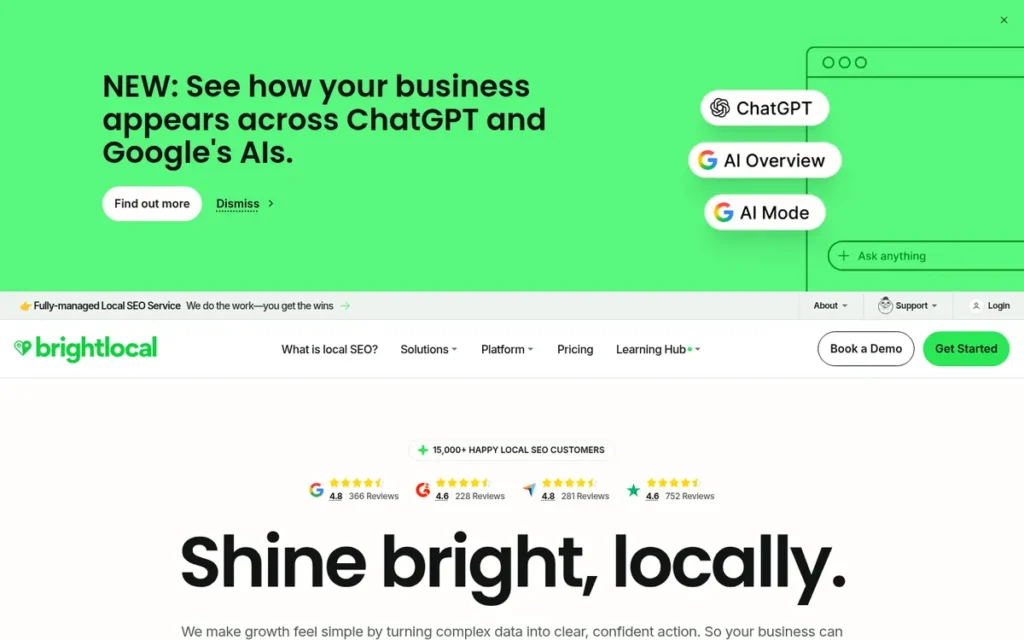
Category: Local SEO Suite. Listing sync is bundled with citation building, rank tracking and audit tools in one platform.
At a Glance
- Category: Local SEO Suite
- Best For: Single-location small businesses and local SEO agencies that want listing sync plus rank tracking and reporting
- Price Range: $41–$65/month for one location, with sync on Manage ($54) and Grow ($65) (BrightLocal, November 2026). Citations are pay-as-you-go from about $2 each.
- Primary Strength: BrightLocal has the highest Capterra rating in this evaluation (4.9/5 from 282 reviews) and offers a 14-day trial with no card required.
- Biggest Limitation: BrightLocal’s entry Track plan monitors citations without syncing listings, and citation credits are charged separately.
- One-Line Summary: BrightLocal is the best-rated local SEO suite for small businesses and agencies that want listing sync, citation building and rank tracking at published prices.
- Last Verified: November 2026
Overview
BrightLocal is a local SEO suite that combines ongoing listing sync, pay-as-you-go citation building, citation tracking, local rank tracking and white-label reporting. It is built for small-to-mid-sized businesses and agencies that want accurate listings and visibility tracking in one dashboard.
BrightLocal uses a hybrid model that separates one-time citation submissions from its ongoing Active Sync subscription. BrightLocal buyers need the Manage or Grow plan for sync, because Track only monitors.
Key Features
- BrightLocal Listings Management with Active Sync pushes changes to business details to connected directories on the Manage and Grow plans.
- BrightLocal Citation Builder submits manual citations for you on a pay-as-you-go basis, from about $2 per citation depending on volume.
- BrightLocal Citation Tracker checks existing citations for wrong or inconsistent business names, addresses and phone numbers, and finds new citation opportunities.
- BrightLocal Local Rank Tracker and Local Search Grid show map-pack visibility across a geographic grid.
- BrightLocal provides white-label reports, Google Business Profile audits and API access for agencies.
Best For
BrightLocal is best for single-location businesses and local SEO agencies that want listing sync, one-time citations and rank tracking in one tool at a published price. BrightLocal is a weaker fit for franchises that need corporate approval workflows across hundreds of locations.
Pricing
As of November 2026, BrightLocal’s pricing page lists three plans for one location:
- BrightLocal Track costs $41/month ($369/year) and monitors citations without syncing listings.
- BrightLocal Manage costs $54/month ($485/year) and includes Active Sync. Manage for 2–5 locations costs $76/month.
- BrightLocal Grow costs $65/month ($584/year) and adds review monitoring and review requests.
- BrightLocal Citation Builder is billed separately on a pay-as-you-go basis.
Strengths
- BrightLocal holds a 4.9/5 Capterra rating from 282 reviews, a 4.6/5 G2 rating from 230 reviews and a 4.0/5 Trustpilot rating from 771 reviews (Capterra; G2; Trustpilot, November 2026). That is the strongest combined standing across review platforms in this evaluation.
- BrightLocal published a case study in which LassoMD reported 60% lower monthly citation costs after switching from Yext (BrightLocal, November 2026). BrightLocal published the study itself, and it has not been independently verified.
- BrightLocal offers a 14-day free trial with no credit card required (Capterra, November 2026), so buyers can test sync before committing.
- BrightLocal publishes the annual Local Consumer Review Survey (1,002 U.S. adults in 2026) and the Local Search Industry Survey (BrightLocal, 2026).
Users on r/SEO noted:
“LocalFalcon is definitely the go-to for the GBP ranking grid view across a service area. BrightLocal is strong on the citation side, both finding them and offering building services. Many people use a combination of tools, or use BrightLocal for citations and LocalFalcon just for the grid tracking. Consider your budget and which feature is most critical for you right now.” Posted by u/Gallantfarhan8
Takeaway: Practitioners rate BrightLocal highly for finding and building citations, but many pair it with a dedicated grid tracker instead of relying on it for everything.
Limitations
BrightLocal’s modular pricing is its most important trade-off. Track does not sync listings, review features require Grow, and Citation Builder credits cost extra on top of any subscription (BrightLocal, November 2026).
- BrightLocal Capterra reviewers say credits “run out quickly” (Capterra, November 2026).
- BrightLocal Trustpilot reviewers report an outdated interface, rank-tracking screenshots showing the wrong locations, and support tickets left unanswered for days (Trustpilot, November 2026).
- BrightLocal does not publish a total directory count comparable to those of direct-sync rivals, and its approval workflows are lighter than those of enterprise platforms.
- BrightLocal’s Active Sync behavior after cancellation was not verified in this research.
Verdict
BrightLocal is the best overall local listing management software for small businesses and agencies in 2026, based on the highest review ratings and the most transparent sync pricing in this evaluation. BrightLocal scored 37.0 of 45 on PlugRoute’s six-criterion weighted scorecard.
BrightLocal is the only vendor that scored 4 or higher on both user ratings and pricing transparency. Buyers should confirm they are on Manage or Grow rather than Track, and should budget separately for citations.
Score breakdown (of 5): Distribution 3.5, User Ratings 4.5, Pricing Transparency 4.0, Buyer Fit 4.0, Contract Flexibility 4.5, Documented Results 4.5. Weighted total: 37.0 of 45.
2. Synup: Best for Agencies Needing White-Label Resale and Best Value for Multi-Location Businesses
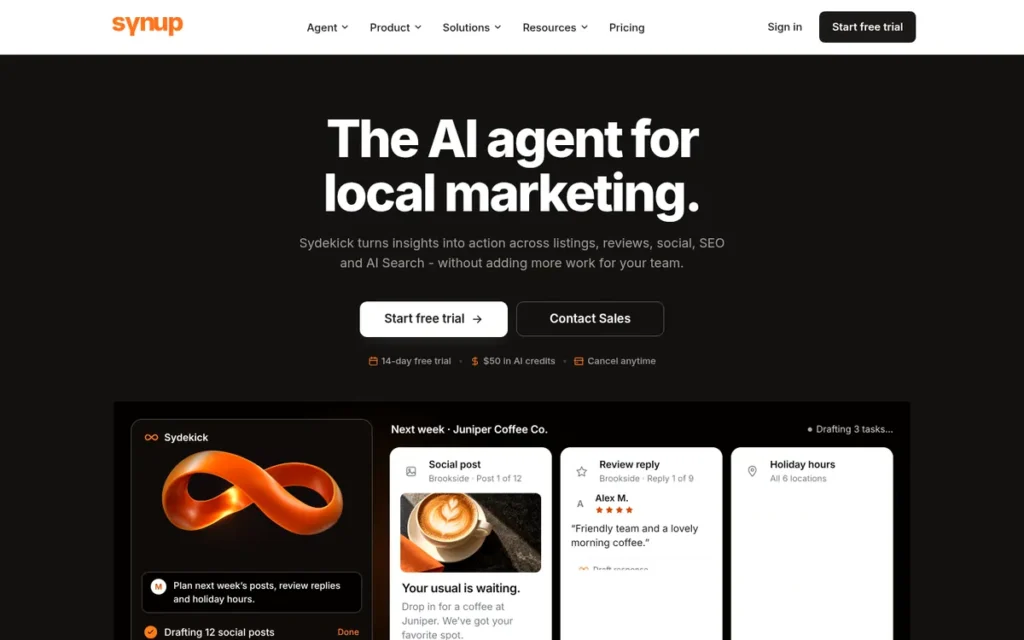
Category: Direct-Sync Listings Platform. Location data goes straight to publishers through direct connections instead of through aggregators.
At a Glance
- Category: Direct-Sync Listings Platform
- Best For: Agencies reselling listings under their own brand and budget-conscious businesses with 2–50 locations
- Price Range: $39–$719/month on annual billing, about $14–$39 per location when each plan is used at its location cap. Scale covers up to 50 locations (Synup, November 2026).
- Primary Strength: Synup combines claimed direct sync to 100+ publishers in 50+ countries with the lowest published per-location cost among the direct-sync tools evaluated.
- Biggest Limitation: Synup has a small, mixed review base and is the smallest, least-funded vendor in this evaluation.
- One-Line Summary: Synup is a low-cost direct-sync listings platform built for agencies, and it says it checks whether updates are indexed on publishers.
- Last Verified: November 2026
Overview
Synup is a listing management platform built for agencies. According to Synup, it syncs business data directly to 100+ publishers across 50+ countries. It suits agencies and budget-conscious multi-location businesses that want white-label portals, reviews and social posting in one tool.
Synup launched Synup OS in 2025, adding CRM and invoicing for agencies. Synup’s own pages give different coverage figures: some say 100+ publishers and others say 70+ directories.
Key Features
- Synup syncs listings to Google, Apple Maps, Bing, Waze and other publishers, and says it confirms that updates are indexed and visible rather than just submitted.
- Synup includes duplicate listing suppression and rank-tracking heatmaps.
- Synup provides a white-label client portal and a reseller model so agencies can sell listings under their own brand.
- Synup offers an API and an MCP server, and its Sydekick AI agent can apply changes across hundreds of locations from plain-language instructions.
- Synup includes review requests by SMS, email and QR code, plus social posting.
Best For
Synup is best for local SEO agencies that want to resell listing management under their own brand, and for businesses with up to 50 locations that want direct sync at a published price. Synup is a weaker fit for enterprises that require a long vendor track record and extensive compliance documentation.
Pricing
As of November 2026, Synup’s pricing page lists four plans. Annual billing is about 20% cheaper than monthly billing.
- Synup Solo costs $39/month on annual billing ($49 monthly) for one location.
- Synup Premium costs $239/month on annual billing ($299 monthly) for up to 10 locations.
- Synup Pro costs $399/month on annual billing ($499 monthly) for up to 25 locations.
- Synup Scale costs $719/month on annual billing ($899 monthly) for up to 50 locations.
Synup prices accounts above 50 locations by custom quote and offers a 14-day trial.
Strengths
- Synup holds a 4.5/5 G2 rating from about 320 reviews (G2, November 2026), and one reviewer says business information “stays in sync across Google, Apple, Bing, Facebook.”
- Synup’s published tiers work out to about $14–$39 per location (Synup, November 2026), the lowest among the direct-sync tools evaluated.
- Synup is one of only two vendors in this evaluation to publish country-level coverage, which it puts at 50+ countries (Synup, vendor claim, November 2026).
- Synup’s 14-day trial lets buyers test direct sync with their own locations before committing (Synup, November 2026).
Users on r/SEO shared their experience:
“It’s very pricey and there are many other alternatives out there where you can spend that money and get more worth for your bucks. Synup is one. Their reputation management offering is part of listings, which is very streamlined and cost-effective for us.” Posted by u/Yesmir1
Takeaway: Synup users who switched from pricier platforms say they get better value from having reputation management bundled with listings.
Limitations
Synup’s thin evidence base is its most important trade-off. Capterra has only 17 reviews (4.1/5), and Trustpilot has only 12 (2.6/5, mostly one-star) (Capterra; Trustpilot, November 2026).
- Synup G2 reviewers report sync delays and a sync status that doesn’t update in real time (G2, November 2026).
- Synup’s Scale plan tops out at 50 locations, so agencies with more client locations need custom pricing (Synup, November 2026).
- Synup is the smallest company evaluated, having raised $6.5M, with its latest round in 2017 (Inc42, November 2026).
- Synup’s Sydekick AI agent has little independent performance history (Reputation Insider, November 2026), and Synup’s post-cancellation listing behavior was not verified.
Verdict
Synup is the best-value direct-sync listings platform for agencies and small multi-location businesses in 2026, combining white-label resale with the lowest published per-location cost among the direct-sync tools evaluated. Synup scored 33.0 of 45 on PlugRoute’s six-criterion weighted scorecard.
Synup’s #2 position depends on its 4.5 pricing score and on distribution claims that Synup reports itself. PlugRoute cut Synup’s Buyer Fit score from 4.0 to 3.5 after confirming that Scale covers 50 locations. Buyers should use the 14-day trial to confirm that updates reach their priority directories.
Score breakdown (of 5): Distribution 4.0, User Ratings 3.5, Pricing Transparency 4.5, Buyer Fit 3.5, Contract Flexibility 3.5, Documented Results 2.0. Weighted total: 33.0 of 45.
3. Yext: Best for Enterprise Data Governance Across Large Location Networks
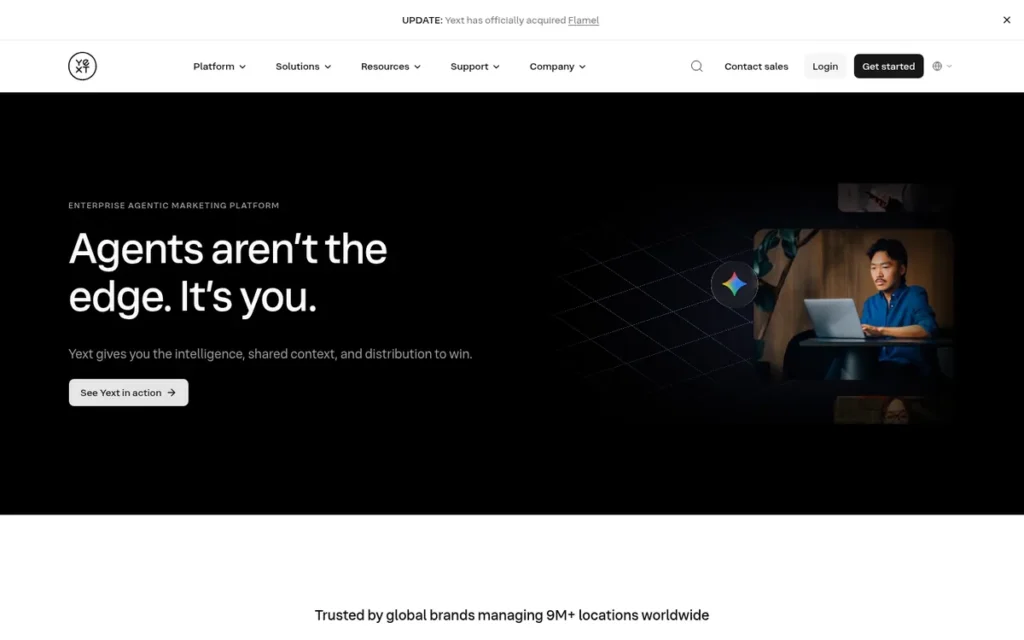
Category: Direct-Sync Listings Platform.
At a Glance
- Category: Direct-Sync Listings Platform
- Best For: Large multi-location brands and enterprises that need centralized data governance across many publishers
- Price Range: Reportedly $199–$999 per location per year for up to 10 locations, with a quote required above 10 (Yext FAQ, November 2026). The Emerging package excludes Google.
- Primary Strength: Yext claims the broadest direct publisher network in this evaluation (200+) and has the strongest enterprise governance controls.
- Biggest Limitation: Yext’s self-service pricing reportedly covers only networks of up to 10 locations, and G2 users report rigid contract and renewal terms.
- One-Line Summary: Yext is an enterprise listings platform that syncs a central Knowledge Graph to 200+ publishers, with governance controls built for large location networks.
- Last Verified: November 2026
Overview
Yext is an enterprise listings and data-distribution platform. It pushes a central Knowledge Graph of location data to 200+ publishers through direct integrations. It is built for large multi-location brands that need governance, approval workflows and audit trails.
Yext sells Listings, Pages, Reviews and Answers as separate packages or add-ons. Yext buyers should confirm which licenses a quote actually includes.
Key Features
- Yext Listings syncs data to 200+ publishers, including Google, Apple Maps, Bing, Yelp, Facebook, Alexa, ChatGPT and Gemini, through direct integrations with no aggregator in between (Yext, November 2026).
- Yext Knowledge Graph stores the master record for locations, people, products, FAQs and menus.
- Yext Listings Verifier compares live publisher data with the Knowledge Graph and flags errors, duplicates and overwrites.
- Yext provides permissions, approval workflows and audit trails for enterprise governance.
- Yext makes its data available through an API and MCP.
Best For
Yext is best for enterprises and large franchises that need one governed source of truth for location data across many publishers and teams. Yext is a poor fit for single-location businesses that want month-to-month flexibility.
Pricing
As of November 2026, Yext’s FAQ reportedly lists self-service Listings packages for networks of up to 10 locations, priced per location per year:
- Yext Emerging reportedly costs $199 per location per year and excludes Google.
- Yext Essential reportedly costs $449 per location per year and is the cheapest package that includes Google.
- Yext Complete reportedly costs $499 per location per year.
- Yext Premium reportedly costs $999 per location per year.
PlugRoute has not yet confirmed these packages on Yext’s pricing page, and networks above 10 locations require a quote. Yext buyers should request a written, itemized quote that covers locations, licenses and renewal terms.
Strengths
- Yext claims direct integrations with 200+ publishers, including AI assistants such as ChatGPT and Gemini, the broadest network claim in this evaluation (Yext, November 2026).
- Yext holds a 4.4/5 G2 rating from 1,127 reviews (G2, November 2026), and SocialPilot reports that Yext is a G2 Grid Leader (SocialPilot, November 2026).
- Yext Listings Verifier has built-in detection of duplicates and publisher overwrites, though Yext publishes no success rate (Yext, November 2026).
- Yext holds SOC 2 compliance and has been evaluated by Gartner and Forrester, according to third-party sources (SocialPilot; Search Atlas, November 2026).
Limitations
Yext’s most important trade-off is how far its published pricing reaches. The cheapest reported package (Emerging, $199/year) excludes Google, and networks above 10 locations can’t estimate cost before a sales call (Yext FAQ, November 2026).
- Yext G2 reviewers report a 30-day notice requirement before renewal, contract details that were hard to find, and a price increase of about 7% (G2, November 2026).
- Yext G2 reviewers also describe a support chat that felt automated, and one long-time customer said they were redirected to a reseller (G2, November 2026).
- Yext’s listings can revert or be overwritten after cancellation, according to competitor BrightLocal and third-party SaaSSwitcher (November 2026). PlugRoute could not retrieve Yext’s own terms.
- PlugRoute found no independent outcome data for Yext in this research.
This aligns with community sentiment on r/SEO:
“Last I recall, yext acts as a layer and once your subscription ends or cancels, it reverts back to the original. Pay to keep it updated. Not sure if it has changed since then which was several years ago” Posted by u/Mucus_Plug08
Takeaway: Practitioners have long seen Yext as a paid layer whose listing corrections can disappear when the subscription ends, so written cancellation terms are essential before signing.
Verdict
Yext is the strongest enterprise option in 2026 for governed listing distribution that goes directly to publishers across large location networks. Yext scored 30.0 of 45 on PlugRoute’s six-criterion weighted scorecard, with the highest distribution and buyer-fit scores in this evaluation.
Yext’s pricing score stays at 1.5 until the reported packages are confirmed on Yext’s pricing page. Confirmation would lift Yext to about 33.0. Enterprise buyers should get an itemized quote and written cancellation terms before signing.
Score breakdown (of 5): Distribution 5.0, User Ratings 3.5, Pricing Transparency 1.5, Buyer Fit 5.0, Contract Flexibility 2.0, Documented Results 3.0. Weighted total: 30.0 of 45.
4. Semrush Local: Best for Businesses Already Using the Semrush SEO Suite
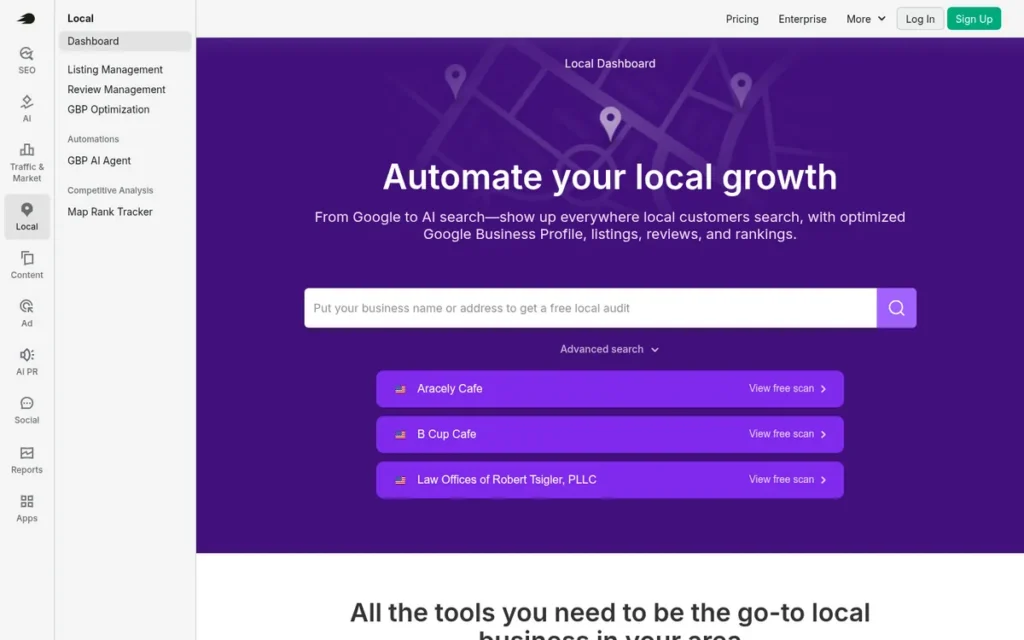
Category: Local SEO Suite.
At a Glance
- Category: Local SEO Suite
- Best For: Marketing teams and agencies already paying for Semrush who want listings in the same workflow
- Price Range: $30–$60/location/month. Listing sync requires Pro at $60, billed annually, and 20+ locations need custom pricing (Semrush, November 2026).
- Primary Strength: Semrush Local brings listing management, review management and map rank tracking into the Semrush SEO suite at published per-location prices.
- Biggest Limitation: Semrush Local’s Base tier does not include listing distribution, so listing sync costs $60 per location per month on Pro.
- One-Line Summary: Semrush Local is the listing management toolkit inside Semrush, best for existing Semrush users, with listing sync available only on its $60-per-location Pro tier.
- Last Verified: November 2026
Overview
Semrush Local is the local SEO toolkit inside the Semrush suite. It offers Google Business Profile management and map rank tracking. On the Pro tier only, it also distributes listings to 70+ U.S. and 40+ international directories. It is built for teams that already use Semrush.
Semrush Local can be bought on its own or added to a Semrush subscription. Semrush became an Adobe subsidiary when Adobe completed its acquisition on April 28, 2026 (Adobe, April 2026).
Key Features
- Semrush Local Pro distributes listings to 70+ U.S. and 40+ international directories, including Google, Bing, Apple and Alexa. Semrush notes that directory availability varies by country (Semrush, November 2026).
- Semrush Local includes a GBP AI Agent that writes Google Business Profile posts and review replies.
- Semrush Local Map Rank Tracker shows grid heatmaps from 5×5 up to 15×15 points, with 375 credits on Base and 1,225 on Pro (Semrush, November 2026).
- Semrush Local Review Management includes competitor review heatmaps and an API.
- Semrush Local connects to Semrush’s broader keyword research and reporting tools.
Best For
Semrush Local is best for businesses and agencies that already use Semrush for SEO research and want listings, reviews and map rankings in one subscription. Semrush Local is poor value for buyers who only need listing updates.
Pricing
As of November 2026, Semrush’s pricing page lists three tiers:
- Semrush Local Base costs $30 per location per month and does not include listing distribution.
- Semrush Local Pro costs $60 per location per month, billed annually, and adds Listing Management, Review Management and advanced Google Business Profile optimization.
- Semrush Local Business uses custom pricing for 20+ locations.
Articles quoting $20 or $50 per location are out of date. In the sources reviewed, Semrush did not say whether its distribution goes directly to publishers or through aggregators.
Strengths
- Semrush Local publishes coverage by region, 70+ U.S. and 40+ international directories (Semrush, November 2026). It is one of only two vendors in this evaluation that break out international coverage.
- Semrush reported 2025 revenue of $443.6M, up 18% year over year (Semrush, 2026), and is now owned by Adobe.
- Semrush published a study of 5,624 local keywords that examines how reviews relate to Local Pack rankings (Semrush, November 2026).
- Semrush’s knowledge base explains that updates and review monitoring stop after cancellation, and that existing listings may stay up but can be overwritten (Semrush knowledge base, November 2026).
Limitations
Semrush Local’s tier gating is its most important trade-off. A 10-location business pays $7,200 a year for sync on Pro, bundled with review and Google Business Profile tools it may not need (Semrush, November 2026).
- Semrush Local’s G2 rating (4.4/5 from 4,302 reviews) likely reflects all of Semrush rather than the Local product (G2, November 2026).
- Semrush’s company-wide Trustpilot rating is 2.8/5, with complaints about free trials that converted to paid plans without clear warning and about refund disputes (Trustpilot, November 2026).
- Semrush Local listing management rose to about $65 per location from about $20, according to one G2 reviewer (G2, November 2026).
- Semrush Local’s roadmap and pricing could change following the Adobe acquisition.
Users on r/SEMrush noted:
“The price isn’t as much of a concern to me, it’s more so all the gotcha moments you run into where now you’re running into an additional cost.
To me it just needs to be more clear, and maybe certain features should be reworked into different packages.
I ran into an issue with position tracking first, had to upgrade to next package.
Later I wanted to do local stuff with gmb and listing management and had to increase my subscription cost again.” Posted by u/akaAllTheHats
Takeaway: Semrush users say tier gating, not the base price, is the real cost problem, because listing management means yet another subscription upgrade.
Verdict
Semrush Local is the most practical listing management choice for teams already invested in the Semrush SEO suite, provided they budget for the $60-per-location Pro tier that includes listing sync. Semrush Local scored 29.5 of 45 on PlugRoute’s six-criterion weighted scorecard.
Semrush Local’s User Ratings score is held at 3.0 because PlugRoute could not separate a Local-specific rating from the rating for the whole suite. Buyers who need only listings will usually find better value elsewhere.
Score breakdown (of 5): Distribution 3.5, User Ratings 3.0, Pricing Transparency 3.5, Buyer Fit 3.5, Contract Flexibility 2.5, Documented Results 3.5. Weighted total: 29.5 of 45.
5. Moz Local: Best Budget Pick for Single-Location Businesses in the U.S., UK and Canada
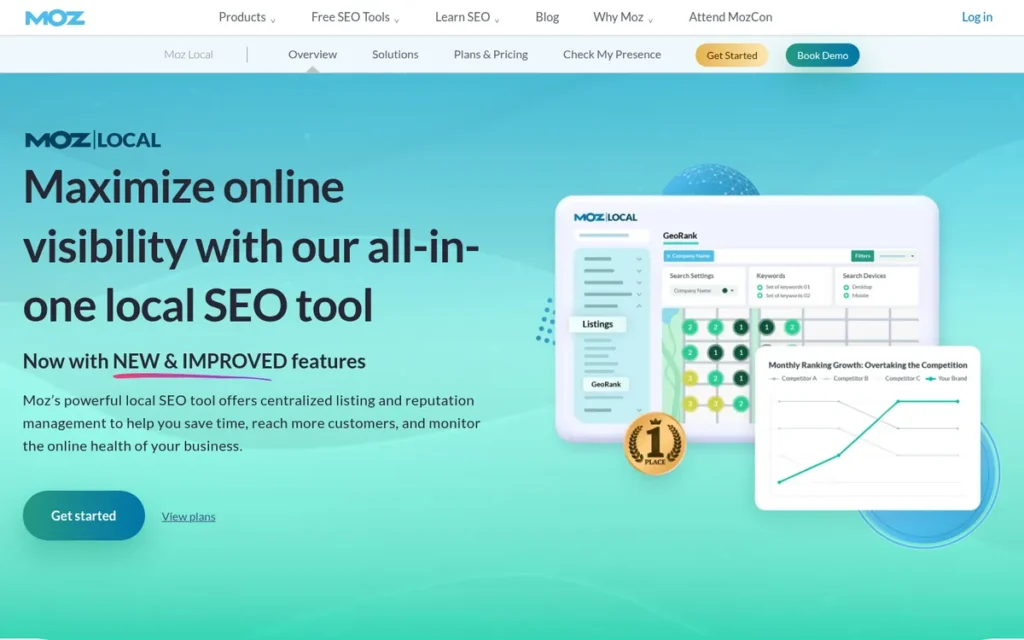
Category: Aggregator-Based Distributor. Location data goes to data aggregators and major publishers, which then pass it to downstream directories.
At a Glance
- Category: Aggregator-Based Distributor
- Best For: Single-location and small multi-location businesses in the U.S., UK or Canada that want low-cost, simple listing upkeep
- Price Range: $20–$40/location/month or $199–$399/location/year (Moz, November 2026)
- Primary Strength: Moz Local has the most transparent and lowest published per-location pricing in this evaluation, with sync included on every tier.
- Biggest Limitation: Moz Local relies mainly on aggregators, so updates reportedly take 2–4 weeks to spread, and coverage is limited to three countries.
- One-Line Summary: Moz Local is the lowest-cost, most transparently priced listing distribution tool in this evaluation for small businesses in the U.S., UK and Canada.
- Last Verified: November 2026
Overview
Moz Local is a low-cost listing distribution tool that sends business data through aggregators to 90+ directories, aggregators and publishers in the U.S., UK and Canada. It is built for single-location and small multi-location businesses that want simple listing upkeep at clearly published prices.
Moz Local is slower than direct-sync tools because updates spread on each directory’s own schedule. In exchange, Moz Local costs less and is simpler to run.
Key Features
- Moz Local distributes business data to 90+ directories, aggregators and publishers, including Google Business Profile, Facebook, Apple Maps, Bing, Data Axle and Foursquare.
- Moz Local includes duplicate listing detection and Data Health analytics.
- Moz Local lets users monitor and respond to reviews from one dashboard.
- Moz Local supports Google Business Profile posts.
- Moz Local offers local-grid ranking views.
Best For
Moz Local is best for single-location businesses and small chains in the U.S., UK or Canada that want listing distribution at the lowest published price. Moz Local is a poor fit for agencies managing many clients and for businesses outside those three countries.
Pricing
As of November 2026, Moz Local’s pricing page lists three per-location tiers:
- Moz Local Lite costs $20 per location per month or $199 per location per year.
- Moz Local Preferred costs $30 per location per month or $299 per location per year.
- Moz Local Elite costs $40 per location per month or $399 per location per year.
Third-party pages citing starting prices of $14–$16 are out of date. Counter & Crew advises cancelling at least 72 hours before renewal (Counter & Crew, November 2026).
Strengths
- Moz Local publishes complete per-location pricing starting at $199 per year (Moz, November 2026), the lowest and most transparent entry price in this evaluation.
- Moz Local includes listing sync on every tier, so buyers don’t have to upgrade to get distribution (Moz, November 2026).
- Moz Local holds a 4.2/5 G2 rating from about 475 reviews, and users praise its ease of use and the time it saves (G2, November 2026).
- Moz Local reaches the major data aggregators in one step, and practitioners have described pairing it with manual citation tools (r/bigseo, 2016; historical).
Limitations
Moz Local’s speed is its most important trade-off. Third-party reviewers report about 2–3 weeks for updates and about 4 weeks for new locations (Counter & Crew; Rank Local Today, November 2026). In 2016, one practitioner also said Moz Local delivered only about 60% of the citations it promised (r/bigseo, 2016; historical).
- Reviewers say Moz Local’s duplicate suppression is “not instant or guaranteed,” and that the tool lacks true keyword-level local rank tracking (Hollymack; GBP Promote, November 2026).
- Moz Local covers only the U.S., UK and Canada, and G2 users repeatedly complain about support (G2, November 2026).
- Moz Local listings reportedly stay up after cancellation but are no longer managed, so aggregators may overwrite data and duplicates may return (Counter & Crew, November 2026).
Verdict
Moz Local is the most affordable and transparently priced listing management tool for single-location businesses in the U.S., UK and Canada in 2026. Moz Local scored 29.0 of 45 on PlugRoute’s six-criterion weighted scorecard.
Moz Local has the highest Pricing Transparency score in this evaluation (5.0) but the lowest Buyer Fit score (2.0). Buyers should allow 2–4 weeks before treating a Moz Local update as failed.
Score breakdown (of 5): Distribution 2.5, User Ratings 3.0, Pricing Transparency 5.0, Buyer Fit 2.0, Contract Flexibility 3.0, Documented Results 3.0. Weighted total: 29.0 of 45.
6. Birdeye: Best for Multi-Location Firms Wanting Listings, Reviews and Messaging
Category: Customer Experience Platform. Listings management is one module inside a larger reviews, messaging or marketing platform.
At a Glance
- Category: Customer Experience Platform
- Best For: Multi-location businesses where review generation and customer messaging matter as much as listing accuracy
- Price Range: Pricing on request. Third-party estimates put it at about $299–$349/location/month (unverified).
- Primary Strength: Birdeye has the highest G2 rating among the high-volume products in this evaluation (4.7/5 from about 4,320 reviews).
- Biggest Limitation: Birdeye has no public pricing, the highest estimated per-location cost found, and Trustpilot complaints about auto-renewal and notice periods.
- One-Line Summary: Birdeye is a highly rated reputation and messaging platform with listings included, best for multi-location businesses that want reviews and customer messaging in one contract.
- Last Verified: November 2026
Overview
Birdeye is an all-in-one customer-experience platform in which listings management is one module. It is built for multi-location businesses that want reputation management, review generation and customer messaging under one contract.
Birdeye’s other modules include review monitoring across 200+ sites, a unified messaging inbox and AI agents. Birdeye does not publish a listings directory count, and its distribution model was not documented in this research.
Key Features
- Birdeye Listings manages business information across directories and includes a Listings AI agent.
- Birdeye Reviews monitors 200+ review sites, and its review-generation agent uses A/B testing to choose timing and channel.
- Birdeye’s unified Inbox brings SMS, Google Messages, webchat and social DMs into one view.
- Birdeye includes surveys, referrals, social publishing and payments in the same platform.
- Birdeye lists SOC 2, HIPAA and GDPR compliance, SSO and audit logs.
Best For
Birdeye is best for multi-location businesses, such as dental, healthcare and automotive groups, that want review generation, customer messaging and listings under one contract. Birdeye is a poor fit for buyers who only need listing updates.
Pricing
As of November 2026, Birdeye publishes no rate card and sells custom per-location pricing under a “one platform, one contract” model. Third-party estimates put Birdeye at about $299–$349 per location per month, and older references go up to about $449 (Pabau, November 2026). These estimates are unverified.
PlugRoute found no Birdeye free plan or trial. Birdeye’s post-cancellation listing behavior was not verified.
Strengths
- Birdeye holds a 4.7/5 G2 rating from about 4,320 reviews and a 4.7/5 Capterra rating from about 708 reviews (G2; Capterra, November 2026). These are the strongest high-volume ratings in this evaluation.
- Birdeye names enterprise customers including Aspen Dental, Sun Auto and Caesars Entertainment, and reports customers ranging from about 10 to 10,000+ locations (Birdeye, company-reported via G2 and Capterra, November 2026).
- Birdeye’s listed SOC 2, HIPAA and GDPR compliance, SSO and audit logs support regulated multi-location businesses (Birdeye and G2 listings, November 2026).
- Birdeye combines a unified inbox (SMS, Google Messages, webchat and social DMs) with AI review-generation agents, the broadest set of messaging features among the vendors evaluated (Birdeye, November 2026).
Limitations
Birdeye’s cost is its most important trade-off. The estimated $299–$349 per location per month is the highest found, which makes Birdeye hard to justify for listings alone (Pabau, November 2026).
- Birdeye’s Trustpilot rating of about 3.1–3.4/5 from about 681 reviews, with about 23% one-star, is far below its G2 score (Trustpilot, November 2026; pending re-check).
- Birdeye Trustpilot reviewers allege auto-renewal, a 90-day notice window and cancellation requests that weren’t recorded. These are user allegations, not proven findings.
- Birdeye Capterra reviewers mention occasional bugs, support delays, and pricing that small teams find hard to justify (Capterra, November 2026).
- Birdeye publishes no listings directory count, and its distribution model was not documented in this research.
Verdict
Birdeye is the highest-rated choice in 2026 for multi-location businesses that want listings, review generation and customer messaging in a single platform. Birdeye scored 27.5 of 45 on PlugRoute’s six-criterion weighted scorecard.
PlugRoute lowered Birdeye’s Distribution score from 3.5 to 3.0 because its distribution model is undocumented. For buyers focused on listings, quote-only premium pricing and reported contract friction outweigh Birdeye’s excellent G2 and Capterra ratings. Buyers should get notice-period and auto-renewal terms in writing.
Score breakdown (of 5): Distribution 3.0, User Ratings 4.5, Pricing Transparency 1.5, Buyer Fit 4.5, Contract Flexibility 1.5, Documented Results 3.5. Weighted total: 27.5 of 45.
7. SOCi: Best for Franchises Needing Corporate-to-Local Marketing Control

Category: Customer Experience Platform.
At a Glance
- Category: Customer Experience Platform
- Best For: Franchises and multi-location brands that need corporate control over local marketing across hundreds of locations
- Price Range: Pricing on request (custom quote; no free trial)
- Primary Strength: SOCi has the most case studies with measured results in this evaluation, including deployments across 1,000+ locations. SOCi published these studies itself.
- Biggest Limitation: SOCi has no public pricing or trial, and G2 reviewers report listing changes that failed to go live.
- One-Line Summary: SOCi is a franchise-focused local marketing platform that bundles listings with social, reviews and AI agents for brands managing hundreds of locations.
- Last Verified: November 2026
Overview
SOCi is a local marketing platform for franchises and multi-location brands. It bundles listings and Google Business Profile management with social publishing, reviews, local pages and AI agents, so corporate teams keep control while local operators can still post.
SOCi is a full marketing platform rather than a listings-only tool, so buyers should treat it as a franchise marketing purchase. SOCi does not publish a directory count.
Key Features
- SOCi manages listings and Google Business Profiles across many locations from one corporate view.
- SOCi Genius AI agents handle listings optimization, Google Posts, review replies, survey analysis and social posting at each location.
- SOCi lets corporate teams set controls while local operators post to their own location channels.
- SOCi Pages creates a local landing page for each location.
- SOCi publishes a Local Visibility Index and a Consumer Behavior Index based on 1,000+ U.S. consumers.
Best For
SOCi is best for franchise brands and multi-location marketers that need to coordinate social, reviews, listings and local pages across hundreds of locations under corporate oversight. SOCi is a poor fit for small businesses and for buyers who only want listing updates.
Pricing
As of November 2026, SOCi publishes no pricing. G2 lists four SOCi editions, all sold by custom quote with no free trial. Users report per-location pricing and extra charges for added modules or locations (G2, November 2026).
PlugRoute found no verified SOCi per-location figure. Buyers should ask SOCi for a five-year cost model covering locations, modules and onboarding. SOCi’s post-cancellation listing behavior was not verified.
Strengths
- SOCi published a case study in which Affordable Care reported 20% more leads after replacing Yext with SOCi Genius Agents (SOCi, November 2026). SOCi published the study itself and did not disclose baselines.
- SOCi case studies document deployments at Smoothie King (1,000+ locations) and Scooter’s Coffee (900+ locations), the clearest proof of franchise scale in this evaluation (SOCi case studies, November 2026).
- SOCi holds a 4.5/5 G2 rating from 5,059 reviews (G2, November 2026), the largest G2 review base in this evaluation.
- SOCi holds a 4.5/5 Capterra rating from 251 reviews, and users praise easy account connection and scheduling across multiple platforms (Capterra, November 2026).
Limitations
SOCi’s listings reliability is its most important concern. G2 reviewers report listing changes that “failed to go live” and needed support tickets (G2, November 2026).
- SOCi G2 reviewers describe a clunky interface that makes it hard to spot wrong listings, plus a steep learning curve (G2, November 2026).
- SOCi G2 reviewers report review data lagging by a day or more and repetitive AI-generated posts (G2, November 2026).
- SOCi publishes no pricing, no trial and no directory count, so buyers can’t estimate cost or coverage before a sales call.
Verdict
SOCi is the strongest choice in 2026 for franchises that need corporate-controlled local marketing, including listings, across hundreds of locations. SOCi scored 26.5 of 45 on PlugRoute’s six-criterion weighted scorecard, which focuses on listings.
SOCi’s Pricing Transparency score of 1.0 is the lowest single score in this evaluation, and that criterion counts double. Buyers whose main need is listing accuracy should compare Yext or Synup first.
Score breakdown (of 5): Distribution 3.0, User Ratings 4.0, Pricing Transparency 1.0, Buyer Fit 4.5, Contract Flexibility 2.0, Documented Results 4.0. Weighted total: 26.5 of 45.
What Happens to My Listings If I Cancel?
With most local listing tools, your listings stop being managed when the subscription ends. Publishers and aggregators can then overwrite your data, and duplicates can return. As of November 2026, only Semrush documents this in its own knowledge base. BrightLocal says its built citations stay live, and the other vendors’ terms are unverified.
- BrightLocal: BrightLocal says its manually built citations stay live after cancellation (BrightLocal comparison page, November 2026; vendor claim, repeated by FirstSiteGuide). BrightLocal’s Active Sync behavior after cancellation was not verified.
- Semrush Local: Semrush Local stops distributing updates and monitoring reviews after cancellation, and existing listings may stay up but can be overwritten (Semrush knowledge base, November 2026).
- Moz Local: Moz Local listings reportedly stay up but are no longer managed, so aggregators may overwrite data and duplicates may return (Counter & Crew, November 2026).
- Yext: Yext listings can revert or be overwritten after cancellation, according to competitor BrightLocal and third-party SaaSSwitcher (November 2026). Yext’s own terms were not retrieved.
- Synup, Birdeye and SOCi: This research did not verify what happens to Synup, Birdeye or SOCi listings after cancellation.
What Red Flags Should I Watch For When Evaluating Local Listing Management Software?
The most expensive mistake in listing management is buying a plan that monitors listings but never syncs them. PlugRoute’s research found six red flags that raise costs or lock buyers in. Each one is listed below with the vendors where PlugRoute saw it as of November 2026, and each one is worth checking before you sign a contract.
Red Flag #1: Plans That Monitor but Don’t Sync Some entry plans report listing errors but don’t send corrections to directories. As of November 2026, Semrush Local Base includes no listing distribution, and BrightLocal Track monitors citations without Active Sync, according to each vendor’s pricing page. Confirm the plan name before buying.
Red Flag #2: Quote-Only Pricing With No Itemized Breakdown Quote-only pricing with no itemized breakdown means buyers can’t estimate total cost before a sales call. As of November 2026, Birdeye and SOCi publish no rate card, and Yext reportedly publishes self-service rates only for up to 10 locations. Require a written quote that itemizes locations, modules, onboarding and renewal terms.
Red Flag #3: Auto-Renewal and Long Notice Windows Auto-renewal with a long notice window can lock you into another contract year before you notice. G2 reviewers report that Yext requires 30 days’ notice before renewal, and Birdeye Trustpilot reviewers allege a 90-day window (user reports, November 2026). Put the notice deadline in your calendar the day you sign.
Red Flag #4: No Country-Specific Directory List Without a country-specific directory list, a vendor’s headline count may not reflect coverage where you operate. Among the vendors reviewed in November 2026, only Semrush Local (70+ U.S., 40+ international) and Synup (50+ countries) published regional figures. Moz Local covers only the U.S., UK and Canada.
Red Flag #5: Listings That Revert After Cancellation Synced listing data can be overwritten once a subscription ends. Semrush documents that updates stop after cancellation, and Counter & Crew reports that Moz Local listings stop being managed. Competitor BrightLocal says Yext listings can revert (November 2026). Ask every vendor for its written post-cancellation policy.
Red Flag #6: Ratings Built on Tiny or Company-Wide Review Samples Ratings based on very few reviews, or on reviews of the whole company, can misrepresent how reliable a listings product is. As of November 2026, Synup’s Trustpilot score rests on 12 reviews, while Semrush’s and Moz’s Trustpilot scores cover the whole company. Give more weight to G2 and Capterra ratings based on 200+ reviews of the product itself.
What Questions Should I Ask Before Choosing Local Listing Management Software?
Before buying local listing management software, ask the seven questions below about sync, coverage, exit terms, trials, integrations and total cost. Vendors that answer in writing are easier to compare. Vague answers about sync or cancellation are a warning sign in themselves, based on PlugRoute’s November 2026 research.
Question #1: Which plan includes listing sync, not just monitoring? Ask each vendor to name the cheapest plan that sends updates to directories rather than just reporting errors. As of November 2026, listing sync requires Semrush Local Pro ($60 per location per month) or BrightLocal Manage ($54 per month for one location). Moz Local includes sync on every tier.
Question #2: Which directories do you publish to in my country, and directly or through aggregators? Ask for the vendor’s actual directory list for your country, and whether each listing is published directly or through aggregators. Direct-sync tools such as Yext and Synup send data to publishers themselves. Moz Local relies mainly on aggregators such as Data Axle and Foursquare, which typically spread updates more slowly.
Question #3: What happens to my listings and duplicates if I cancel? Ask in writing what happens to your listings and suppressed duplicates when you cancel. Among the sources reviewed, Semrush documents its own policy. Claims about Moz Local, BrightLocal and Yext come from a third party, the vendor itself or a competitor. The Synup, Birdeye and SOCi policies were unverified as of November 2026.
Question #4: What is the notice period, and does the contract auto-renew? Ask for the exact notice period and auto-renewal terms in the signed agreement. As of November 2026, reported windows range from 72 hours before renewal for Moz Local (Counter & Crew advice) to an alleged 90 days for Birdeye (Trustpilot reviewers). Yext G2 reviewers cite 30 days.
Question #5: Can I run a trial with my own locations and check that updates went live? A pilot on your own locations is the most reliable way to confirm that updates arrive. As of November 2026, BrightLocal offers a 14-day trial with no card required, and Synup offers a 14-day trial, so buyers can test both before committing. Use this procedure:
- Start a trial with a vendor that offers one, such as BrightLocal or Synup.
- Choose five to ten priority directories to track, such as Google, Apple Maps, Bing and Yelp.
- Record each listing’s current details before you push an update.
- Re-check each directory on fixed dates. For aggregator-based tools such as Moz Local, allow 2–4 weeks before treating an update as failed.
Question #6: Do you support bulk Google Business Profile updates and an API? Ask whether the tool supports bulk Google Business Profile edits and API access, because agencies and multi-location brands can’t update hundreds of profiles by hand. As of November 2026, Yext, Synup and BrightLocal document API access, Synup and Yext also document MCP access, and Semrush Local documents a review-management API.
Question #7: What is my total annual cost at my location count, including add-ons and onboarding? Ask for the total annual cost at your exact location count, including modules, citation credits, onboarding and price increases. As of November 2026, the cheapest plan with sync for 10 locations ranges from $1,990 (Moz Local Lite) to $7,200 (Semrush Local Pro). Birdeye and SOCi require quotes.
How Did We Rank These Local Listing Management Tools?
PlugRoute scored seven local listing management vendors from 1 to 5 on six criteria, using research verified in November 2026. The three primary criteria count double and the three secondary criteria count once, for a maximum weighted score of 45. BrightLocal scored highest at 37.0, and SOCi scored lowest at 26.5.
PlugRoute has no affiliate relationships with any company listed, and rankings are determined entirely by research data and objective evaluation criteria.
Primary criteria (counted double):
- C1, Listing Distribution Capability and Coverage: This criterion matters because a listing tool’s main job is keeping business details accurate everywhere customers look.
- C2, Verified User Ratings and Sentiment: This criterion matters because independent user ratings are the best available proxy for reliability and support quality.
- C3, Pricing Transparency and Listings-Specific Value: This criterion matters because buyers name unclear pricing and tier gating as their top pain points.
Secondary criteria (counted once):
- C4, Fit Across Buyer Types and Scalability: This criterion matters because single-location owners, agencies and franchises need different features.
- C5, Contract Flexibility and Exit Risk: This criterion matters because buyers need to test before committing and want to avoid lock-in.
- C6, Documented Results and Credentials: This criterion matters because buyers want proof of results and confidence that the vendor is stable.
| Rank | Tool | C1 | C2 | C3 | C4 | C5 | C6 | Weighted Score (of 45) |
|---|---|---|---|---|---|---|---|---|
| 1 | BrightLocal | 3.5 | 4.5 | 4.0 | 4.0 | 4.5 | 4.5 | 37.0 |
| 2 | Synup | 4.0 | 3.5 | 4.5 | 3.5 | 3.5 | 2.0 | 33.0 |
| 3 | Yext | 5.0 | 3.5 | 1.5 | 5.0 | 2.0 | 3.0 | 30.0 |
| 4 | Semrush Local | 3.5 | 3.0 | 3.5 | 3.5 | 2.5 | 3.5 | 29.5 |
| 5 | Moz Local | 2.5 | 3.0 | 5.0 | 2.0 | 3.0 | 3.0 | 29.0 |
| 6 | Birdeye | 3.0 | 4.5 | 1.5 | 4.5 | 1.5 | 3.5 | 27.5 |
| 7 | SOCi | 3.0 | 4.0 | 1.0 | 4.5 | 2.0 | 4.0 | 26.5 |
PlugRoute revised two scores during final checks on November 5, 2026. Synup’s C4 fell from 4.0 to 3.5 because its Scale plan covers 50 locations, not 500. Birdeye’s C1 fell from 3.5 to 3.0 because its distribution model is undocumented.
Ranks #3 through #5 are within 1.0 point of each other, so those positions reflect differences in fit more than clear gaps in quality.
Missing evidence, such as an absent case study, was scored as unverifiable rather than as proof of weakness. Pricing transparency is the exception, because publishing prices is itself what C3 measures.
What would change these rankings:
- If Yext’s pricing page confirms its reported Listings packages, Yext’s C3 would rise to about 3.0. That would lift Yext to about 33.0, level with Synup.
- Verified post-cancellation terms for Synup, Birdeye or SOCi could change their C5 scores.
How we chose the seven vendors:
- PlugRoute dropped Uberall because its rating could not be verified and it overlaps with Yext and SOCi.
- PlugRoute left out Whitespark and Rio SEO because neither had comparable G2 or Capterra review volume, although practitioners mention Whitespark for citation building.
What we could not verify:
- PlugRoute could not confirm Yext’s reported packages on its pricing page or retrieve Yext’s own cancellation terms.
- PlugRoute could not verify Birdeye or SOCi pricing beyond third-party estimates, and Birdeye’s Trustpilot rating needs re-checking.
- PlugRoute found no recent practitioner discussion on Reddit. The usable Reddit evidence dates from 2016 and did not drive the rankings.
PlugRoute attributes every case study to the vendor that published it, and labels competitor claims, third-party reviews and user reviews separately.
What Do Buyers Most Often Ask About Local Listing Management Software?
Buyers most often ask which tool suits a single location, which tool suits an agency, and how PlugRoute sets its rankings. The short answers: Moz Local or BrightLocal for one location, BrightLocal or Synup for agencies, and a weighted score across six criteria based on research verified in November 2026.
What is the best local listing management software for a small business with one location?
Moz Local is the cheapest option for a single location, at $199 per year on Lite with sync included (Moz, November 2026). BrightLocal is the better choice if you also want rank tracking and citation building, with Manage at $485 per year (BrightLocal, November 2026). Moz Local covers only the U.S., UK and Canada.
What is the best local listing management software for agencies in 2026?
BrightLocal is the best choice for agencies that need white-label reporting, pay-as-you-go citations and rank tracking, and it has a 4.9/5 Capterra rating (Capterra, November 2026). Synup is the best choice for agencies that resell listings under their own brand. Its Scale plan covers up to 50 locations for $719 per month on annual billing (Synup, November 2026).
How does PlugRoute determine rankings?
PlugRoute scores each vendor from 1 to 5 on six criteria: distribution, user ratings, pricing transparency, buyer fit, contract flexibility and documented results. Primary criteria count double, for a maximum of 45 points. Every price and rating has a verification date, and vendor, competitor and user claims are labeled separately.
What Do Key Local Listing Management Software Terms Mean?
NAP Data: NAP stands for name, address and phone, the core business details a listing tool keeps consistent across directories. It matters because wrong or inconsistent contact details cost a business consumer trust.
Listing Sync: Listing sync means the tool actually sends corrections and updates to directories, not just reports errors. Buyers should check that the plan they are buying includes sync, because some entry plans only monitor listings.
Monitoring-Only Plan: A monitoring-only plan checks listings for errors and inconsistencies but never pushes corrections to directories. It can look like a cheaper way to manage listings, but it leaves the actual fixes to you.
Direct Sync: Direct sync sends location data straight to publishers through direct connections, without going through aggregators. Buyers usually choose it for faster, more controlled updates, and it often costs more than aggregator-based distribution.
Data Aggregator: A data aggregator is a company that collects business data and passes it to many smaller downstream directories. One wrong phone number at an aggregator can spread to dozens of directories, so how a tool works with aggregators matters more than its headline directory count.
Aggregator-Based Distribution: Aggregator-based distribution sends business data to data aggregators and major publishers, which then pass it to other directories on their own schedules. It tends to be cheaper and simpler, but updates can reportedly take 2 to 4 weeks to spread.
Citation: A citation is a mention of a business’s details on a directory or website. Some tools charge for building citations separately from the subscription, so buyers should budget for citation credits on top of the plan price.
Per-Location Pricing: Per-location pricing charges a set fee for each business location, billed monthly or annually. Multiply it by your exact location count to compare total annual cost, because the gap between vendors can grow large as the number of locations rises.
Tier Gating: Tier gating means a feature such as listing sync is only available on a higher-priced plan. Buyers often name it as a top pain point, because the advertised entry price may not cover the job they actually need done.
Quote-Only Pricing: Quote-only pricing means the vendor publishes no rate card and shares costs only after a sales call. Buyers should ask for a written, itemized quote that covers locations, modules, onboarding and renewal terms.
Duplicate Suppression: Duplicate suppression finds and removes extra copies of a business’s listing that can confuse customers. It is one of the main reasons to pay for a tool over manual updates, and suppressed duplicates may come back after you cancel.
Post-Cancellation Policy: A post-cancellation policy explains what happens to your listings when the subscription ends. With most tools, listings stop being managed, so publishers and aggregators can overwrite your data, and buyers should get this policy in writing before signing.
Which Local Listing Management Tool Is Right for You?
Key Insights
Most buyers should choose by number of locations and distribution model, not by feature lists. As of November 2026, BrightLocal leads PlugRoute’s scoring for small businesses and agencies. Synup has the cheapest published direct sync, Moz Local is cheapest for one location, and Yext leads on enterprise governance.
- BrightLocal leads this evaluation with 37.0 of 45 points, based on the strongest combined user ratings and transparent pricing as of November 2026.
- A tool’s distribution model (direct sync, aggregator or hybrid) determines how fast updates spread and how much risk a buyer carries after cancelling.
- Entry plans don’t always include sync: Semrush Local Base has no listing distribution, and BrightLocal Track monitors without syncing (vendor pricing pages, November 2026).
- Before you sign, quote-based vendors should give you itemized pricing, notice periods and cancellation terms in writing. That includes Birdeye, SOCi, and Yext for networks above 10 locations.
- A 14-day pilot on your own locations, available from BrightLocal and Synup, is the most reliable way to check that updates reach the directories you care about.
If you run one location, start with Moz Local for the lowest cost or BrightLocal for added rank tracking. If you run an agency, compare BrightLocal’s reporting with Synup’s white-label resale, and check Synup’s 50-location Scale limit.
If you manage a franchise or enterprise network, compare Yext’s governance controls with SOCi’s franchise marketing tools. Whichever tool you choose, run a trial or pilot on your own locations first.
For more detail, read PlugRoute’s full scoring methodology or browse PlugRoute’s other independent local SEO reviews.
We update this guide quarterly. Last updated: November 5, 2026.