The best local marketing software in 2026 is BrightLocal for small businesses and agencies, Semrush Local for Google Business Profile automation and current Semrush users, and Local Falcon for tracking map and AI-search visibility. The right choice depends on how many locations you have and whether you need diagnosis, automation or a full multi-location suite.
This guide ranks local marketing software by location count and whether you need diagnosis, automation or a full suite, including map and AI-search visibility. If you mainly need to keep listings accurate everywhere, see Best Local Listing Management Software; for rank tracking and citation cleanup, see Best Local SEO Software.
Choosing is hard because “local marketing software” can mean a rank tracker, a listings network or a full suite. Vendors quote monthly, annual, per-location or sales-only prices. Some listings stop being maintained once you cancel. Many buyers also don’t know whether to pay before finishing their free Google Business Profile.
As one user on r/localseo described:
“As someone wondering the same thing, the responses so far are wonderfully unhelpful, ha! Need a bigger sample size--so many choices!” Posted by u/umeboshiplumpaste
Takeaway: Buyers comparing local SEO tools face a crowded field with little community consensus, which is why a category-first, evidence-based comparison matters.
PlugRoute has no affiliate relationships with any company listed. Rankings are determined entirely by research data and objective evaluation criteria.
This guide sorts seven tools into five categories and compares the true cost per location and the lock-in risk for each. Every price, rating and result shows its source and year.
What Are the 5 Categories of Local Marketing Software Tools?
Local marketing software falls into five categories: Local SEO Toolkits, SEO-Suite Local Modules, Visibility Trackers, Multi-Location Marketing Suites, and Listings and Data Platforms. Toolkits and trackers mostly find problems. Sync platforms and AI agents fix problems or automate the fixes. Your category decides how much of the work stays with you.
The five categories, and the tools in each:
- Local SEO Toolkit: This category measures, audits and improves local search visibility, listings and reviews in one product. It includes BrightLocal.
- SEO-Suite Local Module: This category adds listings, Google Business Profile and map-rank tools inside a broader SEO platform. It includes Semrush Local.
- Visibility Tracker: This category measures map and AI-search visibility but does not change listings or reviews. It includes Local Falcon.
- Multi-Location Marketing Suite: This category combines reviews, listings, messaging and social across many locations in one dashboard. It includes Birdeye and SOCi.
- Listings and Data Platform: This category sends business information to directories and publishers from a single source and keeps it in sync. It includes Moz Local and Yext.
How much of the work each category leaves with you:
- Visibility Trackers only diagnose. Local Falcon shows where a business ranks but changes nothing.
- Local SEO Toolkits mostly diagnose. BrightLocal finds issues, and people still have to fix most of them (Distribb, 2026).
- Listings and Data Platforms fix one problem automatically. Moz Local and Yext push consistent data to directories while a subscription is active.
- AI-agent tools automate routine tasks. Semrush Local, Birdeye and SOCi offer agents that publish posts or reply to reviews.
This aligns with community sentiment on r/localseo:
“Most SEOs mix and match. Local Falcon and Whitespark are popular because they give you a map view of where you show up. But honestly, even GSC and manual searches in incognito (with a VPN) can give you useful insights. Tools are just the magnifying glass; the real work is in the strategy.” Posted by u/Digicobweb
Takeaway: Diagnostic local SEO tools show where a business stands, but practitioners agree that ranking gains come from the work done on that data, not from the software itself.
How Do the Top Local Marketing Software Tools Compare at a Glance?
BrightLocal ranks first with a weighted score of 4.60 out of 5. Semrush Local follows at 3.55 and Local Falcon at 3.43. Birdeye and Moz Local tie at 3.35, SOCi scores 3.28 and Yext scores 2.95. The table summarizes each tool’s category, best fit, core capabilities and main limitation, as verified in November 2026.
| Rank | Company | Category | Best For | One-Line Summary | Key Capabilities | Primary Strength | Key Limitation |
|---|---|---|---|---|---|---|---|
| 1 | BrightLocal | Local SEO Toolkit | SMBs and agencies | BrightLocal is the highest-scoring local SEO toolkit in this evaluation (4.60/5), with published prices from $31/month billed annually for one location. | Geo-grid tracking, audits, citations, reviews, white-label reports | Citations it says you keep, at published prices | Mostly diagnoses. You still do the fixing. |
| 2 | Semrush Local | SEO-Suite Local Module | Teams already using Semrush | Semrush Local is the native local SEO module for Semrush users, automating Google Business Profile posts and replies from $30 per location per month billed annually. | GBP AI agent, map rank tracker, 70+ directories (Pro), reviews (Pro) | AI agent posts and replies on the Base tier | Listings and reviews need Pro, and the listings are rented |
| 3 | Local Falcon | Visibility Tracker | Agencies needing visibility proof | Local Falcon is the geo-grid visibility tracker in this evaluation, with the highest average rating across G2, Capterra and Trustpilot and plans from $24.99/month. | Geo-grid scans, Share of Local Voice, Share of AI Voice, client reports | Highest average three-site rating (smaller samples) | Doesn’t manage listings or reviews |
| 4 | Birdeye | Multi-Location Marketing Suite | Multi-location service businesses | Birdeye has the broadest feature scope in this evaluation, rated 4.7/5 on G2 from 4,322 reviews, but it requires a sales quote. | Reviews on 200+ sites, messaging, listings, social, payments, AI agents | Broadest feature scope | Prices not published, and customers report contract complaints |
| 5 | Moz Local | Listings and Data Platform | 1–3 locations on a budget | Moz Local is the lowest-cost listings tool in this evaluation, from $199 per location per year. | 90+ directories, duplicate suppression, review monitoring | Lowest published price | Limited rank tracking and reporting |
| 6 | SOCi | Multi-Location Marketing Suite | Franchise networks | SOCi is the franchise-focused platform in this evaluation with the most specific named (vendor-reported) results, across networks of 550 to 2,200+ locations. | Corporate-to-local permissions, AI agents, listings, reviews, local social | Most specific named results | Prices not published. Not built for single locations. |
| 7 | Yext | Listings and Data Platform | Enterprise location data | Yext offers the widest enterprise location-data scope in this evaluation, with a high-commitment rental model. | Knowledge Graph, direct publisher APIs, Pages, Scout AI tracking | Enterprise depth and verifiable public financials | Rented listings and a 2.0/5 Trustpilot score |
Which Local Marketing Software Should I Choose for My Use Case?
Single-location owners on a tight budget should start with Moz Local Lite. Single-location owners who want rank tracking, reviews and audits should choose BrightLocal Grow. Agencies and brands with 2–50 locations fit BrightLocal plus Local Falcon. Multi-location brands fit Birdeye, franchises fit SOCi and enterprise data teams fit Yext. Every buyer should complete a free Google Business Profile first.
| Your #1 Priority | Recommended Tool | Why | Acceptable Alternative |
|---|---|---|---|
| Any location count: you haven’t claimed or completed your Google Business Profile | Do that first (free) | Paid tools help most once the free profile is complete | None needed |
| 1 location on a tight budget | Moz Local Lite | Lowest published price ($199/year per location) | Semrush Local Base |
| 1 location wanting automated Google Business Profile upkeep | Semrush Local Base | AI agent publishes posts and replies to reviews for $30/location/month, billed annually | BrightLocal Grow |
| 1 location wanting rank tracking, reviews and audits | BrightLocal Grow | All three in one plan at $584/year | Semrush Local Pro |
| 2–50 locations or agency client reporting | BrightLocal plus Local Falcon | Location-band pricing and white-label reports, plus geo-grid visibility proof | Semrush Local Pro |
| 2–50 locations, agency already paying for Semrush | Semrush Local Pro | Local work sits in the same platform | BrightLocal |
| Dozens of locations needing reviews and customer messaging | Birdeye | Reviews, messaging and listings from one vendor | SOCi |
| Franchise network (hundreds of locations) needing brand governance | SOCi | Headquarters sets brand rules and locations post within them | Yext |
| 500+ locations needing enterprise location data and AI-search tracking | Yext | Knowledge Graph, location pages and Scout | SOCi |
1. BrightLocal: Best Overall for Small Businesses and Agencies
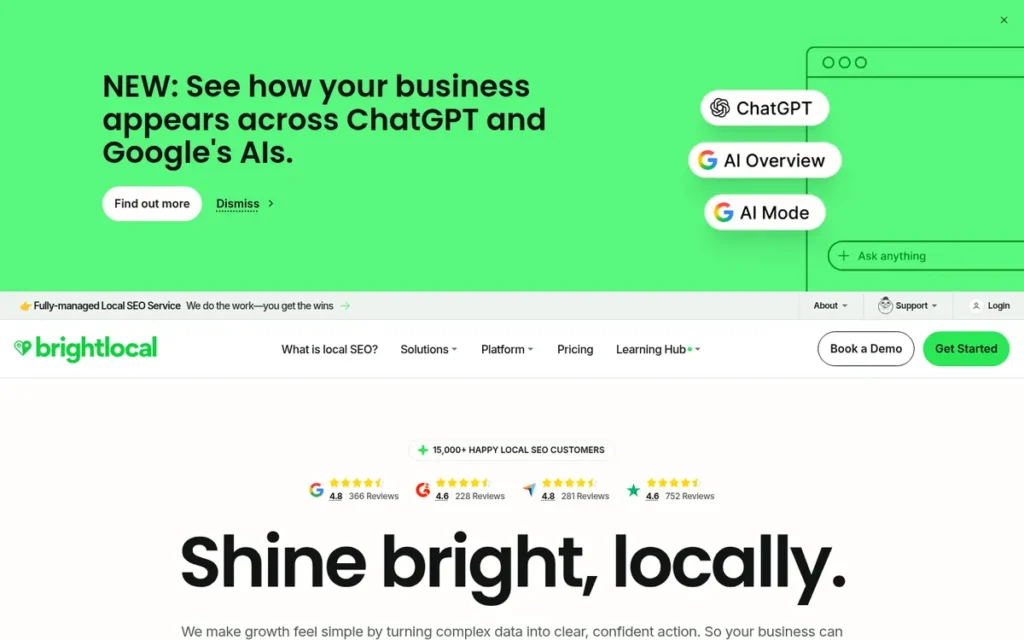
Category: Local SEO Toolkit, measures, audits and improves local search visibility, listings and reviews in one product.
At a Glance
- Category: Local SEO Toolkit
- Best For: Single-location businesses, small multi-location brands and agencies that need rank tracking, citations, reviews and client reports
- Price Range: $41–$65/month for one location month-to-month, or $369–$584/year (about $31–$49/month) billed annually. Accounts with 2–5 locations start at $62/month total. Citation Builder costs $2–$3.20 per site extra.
- Primary Strength: BrightLocal combines geo-grid rank tracking, audits, owned citations, review management and white-label reporting in one product at published prices.
- Biggest Limitation: BrightLocal mostly diagnoses problems, so someone still has to write posts, answer reviews and fix the issues it finds.
- One-Line Summary: BrightLocal is the highest-scoring local SEO toolkit in this evaluation (4.60/5), with published prices from $31 per month billed annually for one location and citations BrightLocal says you keep after cancelling.
- Last Verified: November 2026
Overview
BrightLocal is a UK-based local SEO toolkit, founded in 2009, that combines geo-grid Google Maps rank tracking, local search audits, listings management, review management and white-label reporting for single-location businesses, small multi-location brands and the agencies that serve them.
BrightLocal sells three tiers (Track, Manage and Grow), and the review tools come only with Grow. BrightLocal claims 15,000 small-business and agency customers (G2 seller page, 2026).
Key Features
- BrightLocal’s Local Search Grid shows Google Maps and local 3-pack rankings across a geographic grid, and the Track plan includes geo-grid tracking for 5 keywords.
- BrightLocal’s Track plan covers up to 100 rank-tracking keywords and 4 competitors per location.
- BrightLocal’s Citation Builder builds citations, cleans up existing ones and removes duplicates by hand for $3.20 per site, or $2 per site with bulk credits.
- BrightLocal’s Reputation Manager, on the Grow plan, monitors reviews, supports replies, sends review requests by email, SMS or in person, and provides website review widgets.
- BrightLocal provides Local Search Audit and Google Business Profile audit tools, plus white-label reports that agencies can send to clients.
Best For
BrightLocal is best for single-location service businesses and agencies that want rank tracking, map visibility data, citation work and review management in one tool with published prices.
Pricing
BrightLocal’s prices for one location (BrightLocal, 2026):
- BrightLocal Track costs $41/month, or $369/year (about $31/month).
- BrightLocal Manage costs $54/month, or $485/year (about $40/month).
- BrightLocal Grow costs $65/month, or $584/year (about $49/month).
BrightLocal charges multi-location accounts by location band, and annual billing is about 25% cheaper (BrightLocal, 2026):
- BrightLocal’s 2–5 location band costs $62, $76 or $87 per month for Track, Manage or Grow.
- BrightLocal’s 6–10 location band costs $83, $109 or $131 per month.
- BrightLocal’s 41–50 location band costs $261, $384 or $494 per month.
- BrightLocal offers a 14-day free trial with no credit card required.
AI answers that quote both “$31–$39/month” and “$65/month” for BrightLocal are describing different tiers and billing periods.
Strengths
- BrightLocal holds 4.8/5 on Capterra (283 reviews), 4.6/5 on G2 (230 reviews) and 4.3/5 on Trustpilot (734 reviews) (Capterra, G2, Trustpilot, 2026). That makes BrightLocal one of only two tools in this evaluation rated 4.3 or higher on all three sites.
- BrightLocal states that citations built through its paid Citation Builder stay in place after cancellation (BrightLocal, 2026). One r/SEO poster who was fixing citations concluded, “next time I’ll probably use BrightLocal!” (r/SEO, 2025).
- BrightLocal publishes monthly and annual prices for every tier and location band, and it offers a 14-day free trial (BrightLocal, 2026), so an owner can compare costs without a sales call.
Limitations
BrightLocal gives up automation in favor of diagnosis. It shows what is wrong with rankings, listings and reviews, but “someone still has to write posts, answer reviews, and fix the issues” (Distribb, 2026).
- BrightLocal’s ActiveSync flags changes to listings but cannot reject them automatically. That limit led one r/localseo agency to move clients to a tool that can lock a Google Business Profile (r/localseo, 2025).
- BrightLocal limits review tools to the most expensive Grow tier, and citation work costs extra on every plan.
- BrightLocal prices by location band, so a business with 2–5 locations pays $87/month on Grow. Per-location comparisons with Semrush Local or Moz Local need recalculating.
- BrightLocal’s only way to own your listings is the separately paid Citation Builder, and the ownership claim comes from the vendor. BrightLocal’s case studies, including Sterling Sky and a 1,600-location agency, were chosen by the vendor and are mostly qualitative.
Users on r/SEO noted:
“BrightLocal is a solid choice if you want to focus on local SEO. It can help track local rankings, manage citations, and monitor reviews, which are all crucial for local businesses. Pros include better visibility for local searches and insights into competitor performance. However, it’s only as good as your strategy, if you’re not actively optimizing based on the data, results may be limited. It’s worth a try, especially if you’re experiencing a dip in leads!” Posted by u/Ill-Stop-367
Takeaway: BrightLocal earns credit for covering rankings, citations and reviews in one tool, but its results depend on owners acting on the data it surfaces.
Verdict
BrightLocal is the best overall local marketing software for small businesses and agencies in 2026 because it combines geo-grid rank tracking, audits, owned citations and review management at published prices from $31 per month billed annually.
BrightLocal suits buyers who are willing to act on its findings themselves. Buyers who want AI to post and reply for them should compare Semrush Local or Birdeye. Agencies should choose Grow and budget separately for citations.
2. Semrush Local: Best for Google Business Profile Automation and Teams Already Using Semrush
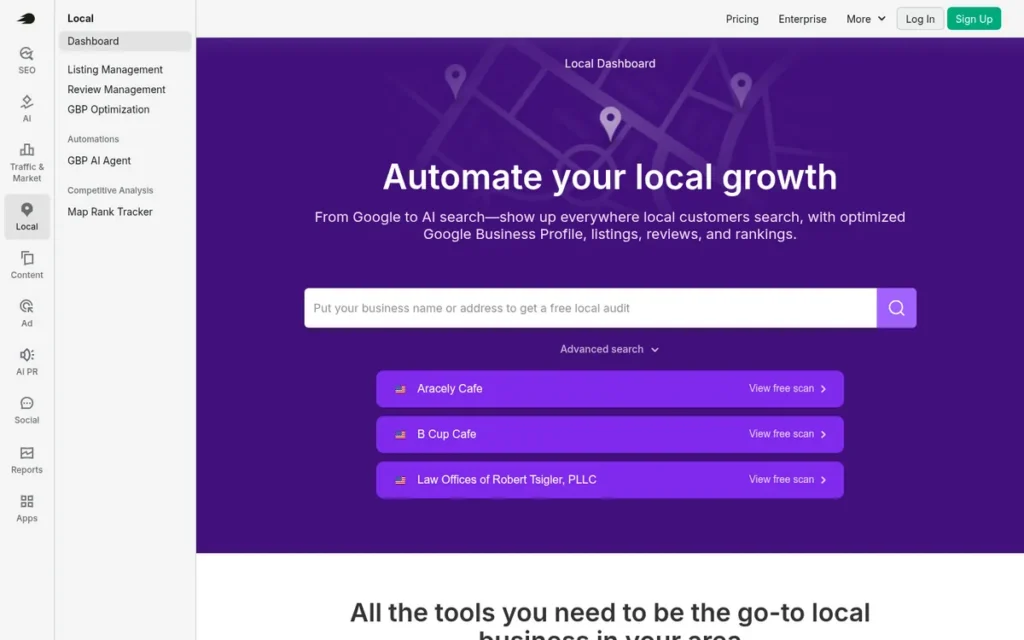
Category: SEO-Suite Local Module, adds local listings, Google Business Profile and map-rank tools inside a broader SEO platform.
At a Glance
- Category: SEO-Suite Local Module
- Best For: Single-location owners who want automated Google Business Profile upkeep, and agencies or in-house teams already paying for Semrush
- Price Range: $30/location/month (Base) or $60/location/month (Pro), billed annually. The Business tier is custom-priced. Semrush Local is sold standalone, so no core plan is required.
- Primary Strength: Semrush Local automates Google Business Profile posts, photos and review replies with an AI agent, starting on its $30 Base tier.
- Biggest Limitation: Semrush Local offers listing distribution and review generation only on the $60 Pro tier, and those listings stop being maintained after cancellation.
- One-Line Summary: Semrush Local is the native local SEO module for Semrush users, automating Google Business Profile posts and replies from $30 per location per month billed annually.
- Last Verified: November 2026
Overview
Semrush Local is the local SEO module of the Semrush platform. It offers an AI agent for Google Business Profile, map rank tracking with heatmaps and, on its Pro tier, listing distribution and review management for single locations, multi-location businesses and agencies.
Semrush Local’s main appeal is that it puts local work next to Semrush’s keyword, backlink and AI-search tools. Adobe completed its acquisition of Semrush on April 28, 2026, and Semrush now operates as a wholly owned Adobe subsidiary (Adobe, 2026).
Key Features
- Semrush Local’s GBP AI Agent writes and publishes Google Business Profile posts, replies to reviews, schedules photos and improves the business description on the Base tier.
- Semrush Local’s Map Rank Tracker includes 375 credits and local heatmaps on Base, and 1,225 credits on Pro.
- Semrush Local Pro distributes listings to 70+ directories for NAP consistency, with coverage varying by country.
- Semrush Local Pro adds review generation, review management and competitor review analysis.
- Semrush Local Pro includes advanced and bulk Google Business Profile management plus API access.
Best For
Semrush Local is best for agencies and in-house marketers already paying for Semrush who want local work in the same platform. It also suits single-location owners who mainly need an active Google Business Profile.
Pricing
Semrush Local’s prices (Semrush, 2026):
- Semrush Local Base costs $30 per location per month, billed annually.
- Semrush Local Pro costs $60 per location per month, billed annually.
- Semrush Local Business is custom-priced.
Semrush Local can be bought as a standalone toolkit without a core Semrush SEO plan (Semrush KB, 2026). A core plan is an optional extra, and additional users cost more.
Strengths
- Semrush Local’s parent product holds 4.5/5 on G2 from 3,434+ reviews and 4.6/5 on Capterra from 2,292+ reviews (Docket, 2026). No separate Semrush Local rating was found.
- Semrush Local’s Base tier includes an AI agent that publishes Google Business Profile posts and replies to reviews for $30 per location per month (Semrush, 2026).
- Semrush Local’s parent company reported $443.6M in full-year 2025 revenue before the acquisition, up 18% year over year (Semrush investor relations, 2026), and became an Adobe subsidiary in April 2026 (Adobe, 2026).
Limitations
Semrush Local gives up depth and ownership in exchange for convenience inside a larger suite. Listing distribution and review generation sit only on the $60 Pro tier, which doubles the per-location cost for those features.
- Semrush Local stops distributing listings and monitoring reviews after cancellation, and publishers may then change the data. Cancelling requires a formal request (Semrush KB, 2026).
- Semrush Local has less depth than specialist tools for geo-grids and citations, according to comparisons (Aboah Reviews, 2026; Hackernoon, 2026).
- Semrush Local adds a per-location fee in a product family whose core pricing r/SEOorganic users called “hard to justify” (r/SEOorganic, 2026). Those comments are about core Semrush, not Semrush Local.
- Semrush Local has no product-specific rating or named case study available as of November 2026. Its parent company’s Trustpilot score is 2.8/5 from 939+ reviews (Docket, 2026).
Users on r/localseo shared their experience:
“Do you guys think AI content in GBP posts hurt rankings? A couple of my companies dropped in rankings all around the same day I hooked up SEMRushs AI gbp posting tool.” Posted by u/Crazy_Reporter_7516
Takeaway: Semrush Local’s automated GBP posting worries some users who saw ranking drops around the day they switched it on, so buyers should review AI posts and watch rankings after enabling the agent.
Verdict
Semrush Local is the best local marketing software for teams already using Semrush, because its $30-per-location Base tier automates Google Business Profile posts and review replies in the same platform as keyword and backlink research.
Buyers who need listing distribution and review generation must budget for Pro and accept that those listings are rented. Single-location owners who don’t need broader SEO tools may get more local depth per dollar from BrightLocal.
3. Local Falcon: Best for Geo-Grid Map Visibility and AI-Search Tracking
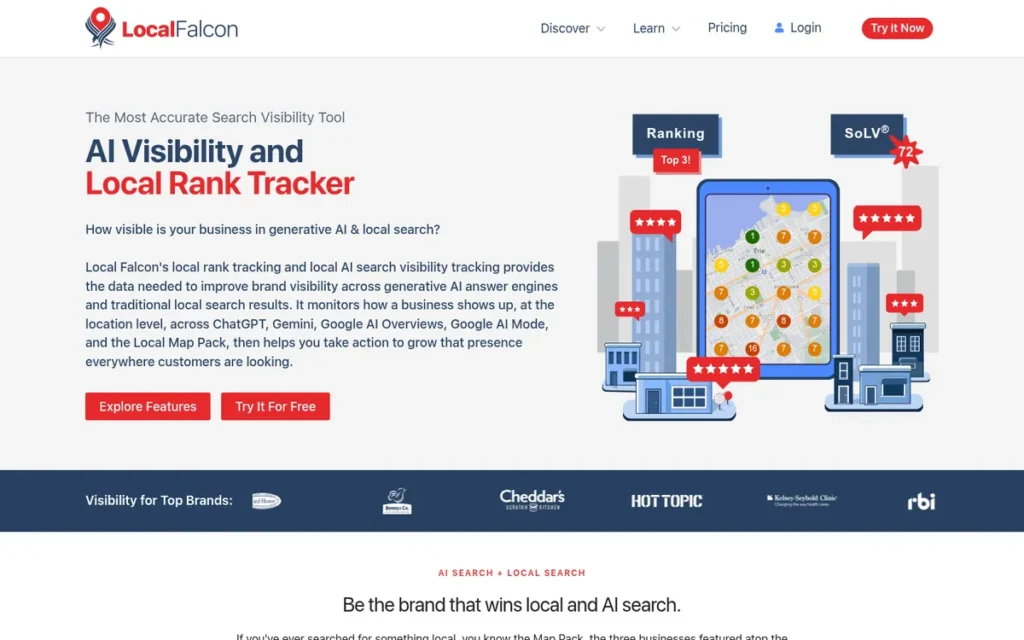
Category: Visibility Tracker, measures map and AI-search visibility but does not change listings or reviews.
At a Glance
- Category: Visibility Tracker
- Best For: Agencies and local SEO practitioners who need geo-grid and AI-visibility proof for clients, usually alongside a listings or review tool
- Price Range: Plans are Starter at $24.99/month (7,500 credits), Basic at $49.99, Pro at $99.99 and Premium at $199.99 (63,000 credits). Annual plans start at $299.88. Pay-as-you-go credits cost $0.05 each.
- Primary Strength: Local Falcon produces detailed geo-grid maps of Google Maps rankings and tracks Share of AI Voice across ChatGPT, Gemini and Google AI Overviews.
- Biggest Limitation: Local Falcon does not build citations, sync listings, run review campaigns or publish content, so it cannot fix the visibility problems it measures.
- One-Line Summary: Local Falcon is the geo-grid visibility tracker in this evaluation, with the highest average rating across G2, Capterra and Trustpilot and plans from $24.99 per month.
- Last Verified: November 2026
Overview
Local Falcon is a specialist geo-grid rank tracker. It measures how often a business appears in Google Maps’ local 3-pack at points across a map grid, and how visible it is in AI assistants. It serves agencies, local SEO practitioners and multi-location brands.
Local Falcon measures visibility but doesn’t manage listings or reviews. Local Falcon users on r/localseo describe pairing it with a listings tool and checking scans against Google Business Profile Insights (r/localseo, 2025).
Key Features
- Local Falcon scans a grid of points around a business to show its Google Maps ranking at each point, and r/localseo users report grids as large as 20×20 over a wide radius.
- Local Falcon reports Share of Local Voice, which measures how often a business appears in the local 3-pack across the grid, plus Average Total Rank.
- Local Falcon’s Share of AI Voice metric tracks visibility in ChatGPT, Gemini, Google AI Overviews and AI Mode.
- Local Falcon supports scheduled scan campaigns, trend reports and reports that agencies can send to clients.
Best For
Local Falcon is best for agencies and local SEO specialists who need visual, repeatable proof of Google Maps and AI-search visibility for clients.
Pricing
Local Falcon charges by credit. One credit equals one grid point, so a 5×5 scan uses 25 credits (Local Falcon, 2026). The monthly plans are:
- Local Falcon Starter costs $24.99/month for 7,500 credits.
- Local Falcon Basic costs $49.99/month for 15,000 credits.
- Local Falcon Pro costs $99.99/month for 31,000 credits.
- Local Falcon Premium costs $199.99/month for 63,000 credits.
Local Falcon’s annual plans start at $299.88 for 90,000 credits. Pay-as-you-go credits cost $0.05 each and don’t expire.
Strengths
- Local Falcon holds 4.7/5 on G2 (159–161 reviews), 5.0/5 on Capterra (14 reviews) and 4.7/5 on Trustpilot (70 reviews) (G2, Capterra, Trustpilot, 2026), the highest average three-site rating in this evaluation. Local Falcon’s Capterra and Trustpilot samples are smaller than most competitors’.
- Local Falcon has published case studies with multi-location operators, including SecureSpace Self Storage (about 100 facilities) and a franchised dumpster-rental brand (260+ locations) (Local Falcon, 2026). Before-and-after figures were not retrieved.
- Local Falcon was praised by Sterling Sky’s Dave DiGregorio for “great visual insight” (Local Falcon testimonial page, 2026), and one r/localseo user cited “far better pricing and features” (r/localseo, 2025).
Limitations
Local Falcon gives up breadth in favor of measurement depth. It does not build citations, sync listings, run review campaigns or publish social content, so buyers need a second tool to act on what it finds.
- Local Falcon lost at least one potential switcher. An r/localseo user said they stayed with a competitor only because it includes GBP scheduling and review replies (r/localseo, 2025).
- Local Falcon draws G2 complaints that credits run out quickly and that extra credits are costly (G2, 2026).
- Local Falcon’s accuracy is disputed. One r/localseo user said results didn’t match manual checks, and another replied that “no tool is 100% accurate” (r/localseo, 2025).
- Local Falcon’s monthly-plan credits expire at the end of each billing month, and only pay-as-you-go credits carry over (Local Falcon, 2026).
Users on r/localseo noted:
“I use Brightlocal for weekly reports and LocalFalcon for Ad-hoc, like if I’m doing an audit or something. LF’s credit system makes it easier to run whatever you want ad-hoc, and some of their information is better (categories listed in results, etc).
LF’s AI assistance is absolute garbage though, and they’ve actually dumbed it down over time.” Posted by u/scrappy_marketer
Takeaway: Local Falcon’s credit system makes it a strong ad-hoc audit tool alongside a reporting platform, but its AI assistant draws sharp criticism from practitioners.
Verdict
Local Falcon is the best tool in this evaluation for measuring Google Maps and AI-search visibility, with the highest average user rating across G2, Capterra and Trustpilot and plans from $24.99 per month.
Local Falcon ranks third because it measures visibility instead of managing listings or reviews. Agencies get the most value by pairing Local Falcon with a listings and review tool and cross-checking its scans against Google Business Profile Insights and Google Search Console.
4. Birdeye: Best for Multi-Location Businesses Wanting Reviews and Customer Messaging in One Platform
Category: Multi-Location Marketing Suite, combines reviews, listings, messaging and social across many locations from one dashboard.
At a Glance
- Category: Multi-Location Marketing Suite
- Best For: Multi-location service businesses (dental, healthcare, auto, retail, property management) that want reviews, messaging and listings in one platform
- Price Range: Pricing is on request. A third-party estimate puts it at about $299–$349/location/month depending on modules. This is an estimate, not an official quote.
- Primary Strength: Birdeye combines review generation and monitoring across 200+ sites with messaging, webchat, listings, social and payments in one customer-experience platform.
- Biggest Limitation: Birdeye publishes no prices, and customers on Trustpilot and BBB report 90-day cancellation notice periods and auto-renewal problems.
- One-Line Summary: Birdeye has the broadest feature scope in this evaluation, rated 4.7/5 on G2 from 4,322 reviews, but it requires a sales quote and careful contract review.
- Last Verified: November 2026
Overview
Birdeye is an all-in-one customer-experience platform covering reviews, messaging, listings and social for multi-location businesses in healthcare, dental, auto, retail and similar service industries. Its BirdAI agents automate routine replies and posts.
Birdeye goes well beyond local SEO into customer communication. Birdeye claims 200,000+ business customers and 3,000+ integrations, though those numbers are self-reported (Birdeye, 2026).
Key Features
- Birdeye monitors reviews across 200+ sites and sends review requests by SMS and email.
- Birdeye’s Interactions inbox and webchat bring customer messages from several channels into one place.
- Birdeye includes listings management and social publishing, and third-party reports place both on the Growth tier (Pabau, 2026).
- Birdeye adds surveys and payments to the same platform.
- Birdeye’s BirdAI agents are marketed as replying to reviews, writing social posts, building reports and spotting anomalies.
Best For
Birdeye is best for multi-location service businesses that want reviews, customer messaging and listings from one vendor and can afford per-location enterprise pricing.
Pricing
Birdeye has no official public pricing available as of November 2026. A third-party benchmark estimates about $299–$349 per location per month, depending on modules and location count (Pabau, 2026).
Birdeye buyers should get written renewal terms, the notice period and any additional fees in the order form before signing.
Strengths
- Birdeye holds 4.7/5 on G2 from 4,322 reviews and 4.7/5 on Capterra from 708 reviews (G2, Capterra, 2026), the largest volume of strong business-software ratings in this evaluation.
- Birdeye was named a Software Advice FrontRunner for reputation management (Birdeye, 2024) and counts Aspen Dental, Sun Auto and Caesars Entertainment as customers (G2, 2026).
- Birdeye is praised by G2 and Capterra reviewers for an easy interface, responsive support, messaging, automation and reporting (G2, Capterra, 2026).
Limitations
Birdeye gives up cost transparency in exchange for breadth. Birdeye publishes no prices, and Capterra reviewers call the cost a drawback for small teams (Capterra, 2026).
- Birdeye’s consumer-site ratings, 3.1/5 on Trustpilot (about 684 reviews) and 2.71/5 on BBB, sit far below its G2 and Capterra scores (Trustpilot, BBB, 2026).
- Birdeye customers and third-party guidance report that non-renewal may require written notice 90 days before the renewal date. Customers also allege auto-renewal, retention calls and an “Innovation Fee,” but the signed order form controls (SaaSSwitcher, Trustpilot, 2026).
- Birdeye draws G2 complaints about clunky navigation, limited integrations, bugs and sometimes slow support (G2, 2026).
- Birdeye has no named case-study figures or Reddit discussion available as of November 2026.
Verdict
Birdeye is the best choice in this evaluation for multi-location businesses that want review generation, customer messaging and listings from one vendor, backed by 4.7/5 G2 ratings from 4,322 reviews.
Birdeye ranks fourth because it publishes no prices and faces a recurring pattern of customer-reported contract complaints on Trustpilot and BBB. Buyers should negotiate notice periods in writing and compare Birdeye’s estimated cost against a BrightLocal or Semrush Local setup.
5. Moz Local: Best Budget Listings Tool for 1–3 Locations
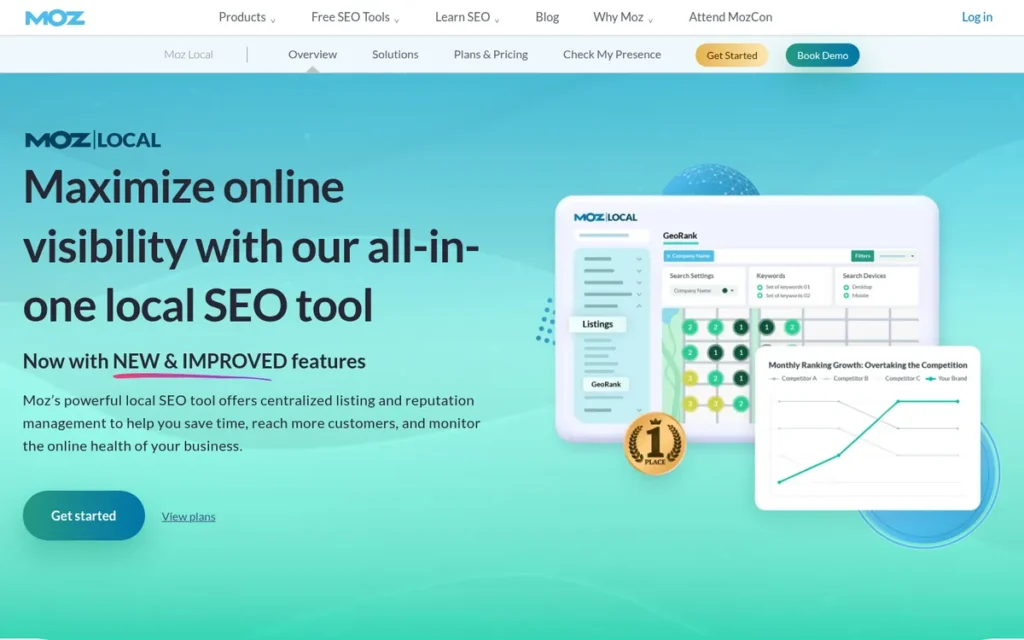
Category: Listings and Data Platform, distributes and syncs business information to directories and publishers from a single source.
At a Glance
- Category: Listings and Data Platform
- Best For: Businesses with 1–3 locations that mainly need consistent name, address and phone (NAP) details across directories on a tight budget
- Price Range: $20–$40/month per location month-to-month, or $199–$399/year per location. Enterprise (50+ locations) is custom-priced.
- Primary Strength: Moz Local distributes consistent business details to 90+ directories, with duplicate suppression, from $199 per location per year.
- Biggest Limitation: Moz Local offers limited rank tracking, audits and white-label reporting, and its synced listings stop being maintained after cancellation.
- One-Line Summary: Moz Local is the lowest-cost listings management tool in this evaluation, keeping business details consistent across 90+ directories from $199 per location per year.
- Last Verified: November 2026
Overview
Moz Local is a low-cost listings management tool from Moz. It sends a business’s name, address and phone (NAP) details to 90+ directories and aggregators, suppresses duplicates and monitors reviews. It’s best suited to businesses with one to three locations.
Moz Local follows an “enter once, distribute everywhere” model for NAP consistency. Moz Local’s distribution network is reportedly powered by Uberall (Search Atlas, 2026).
Key Features
- Moz Local distributes business details to 90+ directories and aggregators, including Google Business Profile, Apple Maps, Bing and Facebook.
- Moz Local suppresses duplicate listings while a subscription is active.
- Moz Local monitors reviews across about 22–26 networks, with AI response suggestions on higher tiers.
- Moz Local includes Google Business Profile and Facebook management, Local Market Analytics and a Local Grid rank view.
Best For
Moz Local is best for owners with up to about three locations whose main problem is inconsistent business information across directories.
Pricing
Moz Local’s per-location prices (Moz, 2026; official price):
- Moz Local Lite costs $20/month, or $199/year (about $16.58/month).
- Moz Local Preferred costs $30/month, or $299/year (about $24.92/month).
- Moz Local Elite costs $40/month, or $399/year (about $33.25/month).
Moz Local Enterprise (50+ locations) is custom-priced. Older coverage reported AI review replies as a $69-per-year add-on, so confirm the current price.
Strengths
- Moz Local has the lowest published per-location price in this evaluation, at $199 per year for Lite (Moz, 2026).
- Moz Local holds 4.2/5 on G2 from about 475 reviews, and one reviewer said its main value was entering a client’s details once so NAP “remained identical” (G2, 2026).
- Moz Local comes from Moz, which was founded in 2004, has been part of Ziff Davis since 2021 and publishes the Local Search Ranking Factors survey (Moz, 2026).
Limitations
Moz Local gives up depth in exchange for low cost. Moz Local is weaker than toolkit competitors at advanced rank tracking, audits and white-label reporting, which limits its usefulness for agencies (Holly Mack, 2026).
- Moz Local uses a sync model, so ongoing management and duplicate suppression end after cancellation. Moz does not publish its post-cancellation listing behavior as of November 2026, and this conclusion follows from the sync model.
- Moz Local drew a G2 report of live listings dropping from 115+ to 32, and of support being hard to reach (G2, 2026). That’s one reviewer’s experience.
- Moz Local monitors reviews on about 22–26 networks, far fewer than Birdeye’s 200+, and AI review replies were reported as a paid add-on in older coverage.
- Moz Local’s coverage reportedly focuses on the U.S., UK and Canada. Its Capterra sample is small (33 reviews), and it has no named case studies available as of November 2026.
Verdict
Moz Local is the best budget listings tool for businesses with one to three locations, distributing consistent business details to 90+ directories from $199 per location per year.
Moz Local fits owners whose main problem is inconsistent business information, not rank tracking or reporting. Buyers should check which directories actually go live and accept that sync stops when they cancel.
6. SOCi: Best for Franchise Networks Needing Corporate-to-Local Governance
Category: Multi-Location Marketing Suite.
At a Glance
- Category: Multi-Location Marketing Suite
- Best For: Franchise networks and multi-location brands with hundreds of locations that need brand governance across listings, reviews and local social
- Price Range: Pricing is on request and based on location count and the AI agents used. Capterra lists an enterprise plan starting at $30,000, period unspecified.
- Primary Strength: SOCi combines listings, reviews, local social, local pages and local ads under a corporate-to-local permission hierarchy built for franchises.
- Biggest Limitation: SOCi publishes no prices, is not designed for single-location businesses, and every documented result is vendor-reported or vendor-commissioned.
- One-Line Summary: SOCi is the franchise-focused platform in this evaluation with the most specific named (vendor-reported) results, across networks of 550 to 2,200+ locations.
- Last Verified: November 2026
Overview
SOCi is a localized marketing platform for franchises and multi-location brands. Its AI Genius Agents manage listings, reviews, local social, local pages and local ads. A corporate-to-local permission hierarchy lets headquarters set brand rules that every location follows.
SOCi is built for networks where governance is the deciding factor. SOCi also publishes the Local Visibility Index, a benchmark of brands across Google Maps, Yelp, Facebook and AI search (SOCi, 2026).
Key Features
- SOCi’s corporate-to-local permission hierarchy lets headquarters set brand rules while franchisees and location managers post within them.
- SOCi’s Genius Agents for local search, social and reputation publish Google Posts, reply to reviews and fill content calendars.
- SOCi manages listings, reviews, local social, local pages, local ads and Co-Marketing from one platform.
- SOCi’s Local Visibility Index benchmarks brand visibility across Google Maps, Yelp, Facebook and AI search.
Best For
SOCi is best for franchise networks and multi-location brands with hundreds of locations that need consistent branding across local search, reviews and social.
Pricing
SOCi uses custom pricing based on location count and the Genius Agents and skills a customer uses (SOCi, 2026). G2 lists SOCi as “Contact Us,” and Capterra lists an enterprise plan starting at $30,000 without a billing period.
SOCi has the least transparent pricing in this evaluation, so ask SOCi for a per-location breakdown, the contract length and the renewal terms.
Strengths
- SOCi has the most specific named results in this evaluation, all vendor-reported (SOCi, 2026):
- SOCi reports that Liberty Tax’s share of locations in Google’s local 3-pack rose from 60% to 90% across 2,200+ locations.
- SOCi reports that DICK’S Sporting Goods reached 97% local 3-pack inclusion across 700+ stores.
- SOCi reports that Rita’s Italian Ice reached a 100% review-response rate across 550+ locations.
- SOCi holds 4.5/5 on G2 from 5,059 reviews and 4.5/5 on Capterra from 251 reviews (G2, Capterra, 2026), and it won three spots in G2’s 2026 Best Software Awards (SOCi, 2026).
- SOCi commissioned a Forrester Total Economic Impact study that modeled a 192% three-year ROI for a composite 1,000-location company. SOCi paid for the study, and it models a hypothetical company rather than a real customer (SOCi, 2026).
Limitations
SOCi gives up accessibility in exchange for franchise-grade governance. SOCi publishes no prices and is not designed for single-location businesses.
- SOCi’s documented results are all vendor-reported or vendor-commissioned, and no independent confirmation was found as of November 2026.
- SOCi draws G2 complaints about clunky navigation, review data that lags by about a day and AI replies that feel “bland or impersonal” (G2, 2026). That last concern applies to AI-drafted replies across this category (see Red Flag #5).
- SOCi has no Trustpilot profile or Reddit discussion available as of November 2026, so customers’ contract experiences could not be cross-checked.
Verdict
SOCi is the best local marketing platform in this evaluation for franchise networks, because it combines listings, reviews and local social under a corporate-to-local permission hierarchy, with named results across 550 to 2,200+ locations.
SOCi’s sixth-place rank reflects this article’s weighting toward small and mid-sized buyers, not a judgment of SOCi’s franchise capability. Franchise buyers should ask SOCi for references with a similar number of locations.
7. Yext: Best for Enterprise Location Data and AI-Search Infrastructure
Category: Listings and Data Platform.
At a Glance
- Category: Listings and Data Platform
- Best For: Enterprise and franchise brands with hundreds or thousands of locations that need centralized location data, location pages and AI-search visibility tracking
- Price Range: The full platform is custom-quoted on annual or multi-year contracts. Residual self-serve plans list at $199–$999/location/year, for up to 10 locations.
- Primary Strength: Yext stores location data centrally in a Knowledge Graph and sends it to publishers through direct API integrations, while Scout tracks AI-search visibility.
- Biggest Limitation: Yext listings are rented, so syncing and duplicate suppression end when a customer cancels, and Yext has the lowest Trustpilot rating in this evaluation.
- One-Line Summary: Yext offers the widest enterprise location-data scope in this evaluation, but its rental listings model, custom contracts and 2.0/5 Trustpilot rating make it a high-commitment choice.
- Last Verified: November 2026
Overview
Yext is a publicly traded enterprise platform that uses a central Knowledge Graph to send location data to publishers through direct API integrations. Yext adds review management, location pages, site search and Scout AI-search tracking for large multi-location and franchise brands.
Yext reported $446.6M in fiscal 2026 revenue, up 6% year over year (Yext 10-K, 2026). Yext sells its full platform through custom annual or multi-year contracts.
Key Features
- Yext’s Knowledge Graph stores location data centrally and feeds Yext Listings, Reviews, Pages and Search.
- Yext Listings sends data to publishers through direct API integrations for NAP consistency.
- Yext Reviews monitors 80+ review sites and drafts replies with AI.
- Yext Pages builds location landing pages at franchise scale.
- Yext Scout, launched in 2025, tracks visibility across Google, Maps, AI Overviews, ChatGPT, Gemini, Claude and Perplexity.
Best For
Yext is best for enterprise and franchise brands with large location counts that need one master record of every location’s data, location pages at scale and AI-search monitoring.
Pricing
Yext’s main pricing page was unavailable during research, so the self-serve tiers below come from third-party listings. These per-location annual prices are prepaid and auto-renew on a card (Counter & Crew, 2026):
- Yext Emerging costs $199/year.
- Yext Essential costs $449/year.
- Yext Complete costs $499/year.
- Yext Premium costs $999/year.
Yext’s self-serve plans are limited to 10 locations, and larger accounts are custom-quoted (GetApp, 2026). Lower tiers may exclude Google, Facebook, Apple or Yelp.
Strengths
- Yext is a public company (NYSE: YEXT) with $446.6M in fiscal 2026 revenue and about 1,120 employees (Yext 10-K, 2026), the most verifiable financial profile in this evaluation.
- Yext reports that Fazoli’s achieved 3.6× growth in online sales and that Cox Communications saw 51% higher site-search conversion (Yext, 2026). Both are vendor case studies, and Cox’s result came from Search, not listings.
- Yext holds 4.4/5 on G2 from about 1,124 reviews, and users praise its ability to manage listings across many locations (G2, 2026).
Limitations
Yext gives up independence after purchase in exchange for enterprise breadth. After cancellation, syncing and duplicate suppression end, and publishers may revert listings (TotosLocal, 2026).
- Yext has the lowest consumer-site rating in this evaluation, 2.0/5 on Trustpilot from 348 reviews, with customers alleging auto-renewal problems, non-refundable fees and sales pressure (Trustpilot, 2026).
- Yext’s network, like other sync networks, may not reach industry directories such as Avvo and Justia, according to r/localseo users (r/localseo, 2025).
- Yext draws recurring G2 complaints about price and complexity (G2, 2026).
- Yext limits self-serve plans to 10 locations, so growing businesses must move to a custom sales contract (GetApp, 2026).
Verdict
Yext offers the widest enterprise location-data scope in this evaluation, combining a central Knowledge Graph, direct publisher integrations, location pages and AI-search tracking for brands with hundreds of locations.
Yext ranks seventh because its rental model, custom pricing and weak consumer-site ratings make it a high-commitment purchase. Enterprise buyers should negotiate renewal terms and confirm which publishers are included before signing.
How Much Does Local Marketing Software Cost per Location?
Local marketing software with published prices costs about $199 to $780 per location per year in 2026, from Moz Local Lite to BrightLocal Grow billed monthly for a single location. BrightLocal prices by location band, so its cost per site falls as you add locations. Birdeye, SOCi and Yext’s full platform require a sales quote.
Cost and Commitment at a Glance
| Company | Pricing Model | Published Price per Location (Monthly / Annual) | Tier Needed for Reviews and Listings | Listings Model | Weighted Score |
|---|---|---|---|---|---|
| BrightLocal | Published tiers, priced by location band | 1 location: $41–$65/mo or $369–$584/yr. 2–5 locations: $62–$87/mo total. | Grow for review tools. Citation Builder is extra. | Keep (Citation Builder, vendor-stated) | 4.60 |
| Semrush Local | Published tiers, sold standalone | $30 (Base) / $60 (Pro) per month, billed annually | Pro | Rent | 3.55 |
| Local Falcon | Credits per account | Starter $24.99, Basic $49.99, Pro $99.99, Premium $199.99 per month (account-level). Annual from $299.88. | Not offered | None | 3.43 |
| Birdeye | Quote only | Not published. About $299–$349/mo (third-party estimate). | Growth tier reportedly adds listings | No published post-cancellation policy (Nov 2026) | 3.35 |
| Moz Local | Published tiers | $20–$40/mo / $199–$399/yr | Listings on every tier. AI review responses on higher tiers. | Rent (sync model) | 3.35 |
| SOCi | Quote only | Not published. Capterra lists an enterprise plan from $30,000, period unspecified. | Custom | No published post-cancellation policy (Nov 2026) | 3.28 |
| Yext | Quote only above 10 locations | Legacy self-serve $199–$999/yr per location, up to 10 locations. Custom above 10. | Lower self-serve tiers may exclude Google, Facebook, Apple or Yelp | Rent | 2.95 |
For a 10-location business, published annual costs range from about $1,178 to $7,200, and estimated suite pricing can exceed $35,000. These plans don’t include the same features:
- BrightLocal Grow costs about $1,178 per year in the 6–10 location band, billed annually ($131/month less about 25%) (BrightLocal, 2026).
- Moz Local Lite costs $1,990 per year for 10 locations at $199 each (Moz, 2026).
- Semrush Local Pro costs $7,200 per year for 10 locations at $60 per location per month (Semrush, 2026).
- Birdeye costs an estimated $35,880 or more per year for 10 locations at $299 per location per month. This is a third-party estimate (Pabau, 2026).
Costs that don’t show up in headline prices:
- BrightLocal’s Citation Builder costs $3.20 per site, or $2 per site with bulk credits, on top of any plan (BrightLocal, 2026).
- Semrush Local charges extra for additional users, and a core Semrush SEO plan is an optional added cost (Semrush KB, 2026).
- Local Falcon’s monthly-plan credits expire at the end of each billing month, and AI reports use extra credits (Local Falcon, 2026).
- Moz Local’s AI review replies were reported as a $69-per-year add-on in older coverage (reported in a BrightLocal comparison, 2026; BrightLocal is a ranked competitor).
- Birdeye’s $299–$349 figure is a third-party benchmark, not a quote (Pabau, 2026).
Low-commitment ways to start:
- BrightLocal offers a 14-day free trial with no credit card, plus month-to-month billing (BrightLocal, 2026).
- Moz Local offers month-to-month billing on every tier (Moz, 2026).
- Local Falcon sells pay-as-you-go credits at $0.05 each that don’t expire (Local Falcon, 2026).
- Semrush Local publishes annual billing for its listed prices, and it has no published trial for Local as of November 2026.
- Birdeye, SOCi and Yext’s full platform have no published trial or month-to-month option as of November 2026.
What Happens to Your Listings If You Stop Paying?
What happens depends on whether a tool rents you a sync or builds citations you keep. Yext, Semrush Local and Moz Local stop maintaining listings and suppressing duplicates after cancellation, so publishers may revert your data. BrightLocal states that citations built through its Citation Builder stay in place. Local Falcon holds no listings data.
With sync-based listings tools, you rent accuracy. With citation building, you own the result. Cancelling a sync tool stops ongoing updates, while citations built by hand stay where they were published.
What each tool does after you cancel, as verified November 2026:
- Yext stops syncing. Listings aren’t necessarily deleted, but publishers may revert them and duplicate suppression ends (TotosLocal, 2026).
- Semrush Local stops distributing listings and monitoring reviews, and Semrush says directories “resume their normal data-collection process” (Semrush KB, 2026).
- Moz Local stops ongoing sync management under its sync model, and Moz publishes no post-cancellation policy as of November 2026.
- BrightLocal states that its Citation Builder citations stay in place and that customers keep their listing data (BrightLocal, 2026).
- Local Falcon manages no listings, so nothing lapses.
- Birdeye and SOCi have no published post-cancellation listings policy as of November 2026.
Consider a plumber who moves premises and updates the address through a sync tool. If the plumber cancels a year later, directories may slowly drift back to the old address. Citations corrected by hand stay as written.
“Until you drop their service then your citations disappear.” (u/BusyBusinessPromos (r/SEO, 2025))
Takeaway: Before buying a sync-based listings tool, ask what happens to your data on the day you cancel.
Sync networks also have reach limits. One r/localseo user said that for law-firm directories, “platforms such as Justia or Avvo just aren’t going to budge” (r/localseo, 2025).
Should You Set Up Your Free Google Business Profile Before Buying Software?
Yes. Every buyer should claim and complete a free Google Business Profile before paying for local marketing software. Vendor research found that 85% of small businesses have a Google Business Profile but only 35% actively manage it (BrightLocal SMB Marketing Report, 2026; vendor research). Paid tools add the most value once that free foundation is complete.
What a complete free profile includes:
- A complete Google Business Profile is verified, which confirms to Google that the business owns the listing.
- A complete Google Business Profile has an accurate primary category that matches the main service.
- A complete Google Business Profile lists current business hours, including holiday hours.
- A complete Google Business Profile includes recent photos of the location, team and work.
- A complete Google Business Profile publishes Google Posts regularly to show the business is active.
Signs that paid software is worth it:
- Businesses with multiple locations find that keeping several Google Business Profiles and directory listings accurate by hand is hard to sustain.
- Businesses with mismatched details across many directories need a listings or citation tool to restore NAP consistency.
- Businesses with fewer than 20 reviews need review-request tools, because 47% of consumers won’t use a business below that threshold (BrightLocal Local Consumer Review Survey, 2026; vendor research).
- Businesses that can’t reply to every review benefit from review tools, because 80% of consumers are more likely to use a business that responds to every review (BrightLocal Local Consumer Review Survey, 2026; vendor research).
- Agencies that need client-ready rank and visibility reports need tools such as BrightLocal or Local Falcon.
BrightLocal, one of the vendors ranked in this article, publishes the Local Consumer Review Survey cited throughout. The 2026 edition polled 1,002 U.S. adults.
Can Local Marketing Software Track Whether AI Assistants Recommend Your Business?
Yes. Three tools in this evaluation track AI-search visibility: Yext Scout, Local Falcon’s Share of AI Voice and SOCi’s Local Visibility Index. This matters because 45% of U.S. adults have used generative AI for a local recommendation, up from 6% the year before (BrightLocal Local Consumer Review Survey, 2026; vendor research).
AI-search tracking options in this evaluation:
- Yext Scout tracks visibility across Google, Maps, AI Overviews, ChatGPT, Gemini, Claude and Perplexity.
- Local Falcon’s Share of AI Voice tracks ChatGPT, Gemini, AI Overviews and AI Mode.
- SOCi’s Local Visibility Index benchmarks brands across Google Maps, Yelp, Facebook and AI search.
AI answers often get business facts wrong. Business profile facts were accurate in about 68% of ChatGPT and Perplexity answers (SOCi Local Visibility Index, 2026; vendor-published, and SOCi is ranked in this article).
A separate Insites audit of 10,000 U.S. businesses found full-match rates of 56% for ChatGPT and 48% for Perplexity (Insites, 2026). Gemini, which draws on Google Maps data, scored near 100% profile accuracy in SOCi’s index. That makes a complete Google Business Profile the main input for Google’s AI surfaces.
What Red Flags Should I Watch For When Evaluating Local Marketing Software?
The three most costly red flags in local marketing software are listings that stop being maintained when you cancel, long notice periods with auto-renewal, and quote-only pricing with no written per-location breakdown. Three more, covering directory counts, templated AI replies and unlabeled results claims, are listed below. You can check each one before you sign.
Red Flag #1: Listings That Disappear When You Cancel A sync-based listings tool stops maintaining your data and suppressing duplicates once you stop paying, so publishers may revert your business details. Ask whether citations are built and kept or only rented.
Red Flag #2: Long Notice Periods and Auto-Renewal Trustpilot and BBB complaints, mainly from Birdeye and Yext customers and also in Semrush’s parent-level Trustpilot profile, allege 90-day notice periods, auto-renewal and unexpected fees (Trustpilot, BBB, 2026). Read every order form’s renewal and notice clauses before signing.
Red Flag #3: Quote-Only Pricing With No Written Per-Location Breakdown Quote-only pricing makes it hard to compare vendors or predict costs as you add locations. Birdeye, SOCi and Yext’s full platform publish no prices, so request a written per-location breakdown covering every module.
Red Flag #4: Headline Directory Counts You Can’t Verify A “90+ directories” or “70+ directories” claim doesn’t guarantee that your listings go live everywhere. One G2 reviewer reported Moz Local listings dropping from 115+ to 32 (G2, 2026), so ask for a live-listings report after onboarding.
Red Flag #5: Templated AI Review Replies AI-drafted replies from Semrush Local, Birdeye, SOCi, Yext and Moz Local save time, but 50% of consumers say templated responses put them off (BrightLocal Local Consumer Review Survey, 2026; vendor research). Confirm that you can edit and approve drafts before they publish.
Red Flag #6: Results Claims With No Evidence Label Results claims in this category are mostly vendor-reported (from the vendor’s own case studies) or vendor-commissioned (paid for by the vendor), not independent. Ask which type a figure is before using it to justify the purchase.
What Questions Should I Ask Before Choosing Local Marketing Software?
The most important question before buying local marketing software is how many locations you’ll manage in the next 12 months, because location count decides which category fits. Next, ask what happens to your listings if you cancel and which tier unlocks reviews and listings. Each of the seven questions below describes what a good answer looks like.
Question #1: How many locations will I manage in the next 12 months? Location count decides the category. Single locations fit Moz Local or Semrush Local Base, 2–50 locations fit BrightLocal, and franchises fit SOCi or Yext. Pick a tool that serves your expected count without a forced plan change.
Question #2: What happens to my listings and data if I cancel? A good answer states plainly whether your listings stay in place, revert or stop being maintained. BrightLocal states that its Citation Builder citations stay, while Yext, Semrush Local and Moz Local stop syncing on cancellation.
Question #3: Which tier unlocks review generation and listing distribution? A good answer names the exact tier and its per-location price. BrightLocal’s review tools raise one location from $41 to $65 per month. Semrush Local’s listings and reviews raise the cost from $30 to $60 per location per month.
Question #4: What is the notice period and renewal term? A good answer gives the notice period in days, states whether the contract auto-renews and lists any cancellation or renewal fees, all in writing. Vague verbal assurances are a warning sign, given the complaints on Trustpilot and BBB.
Question #5: Does the sync network cover my industry’s directories? A good answer lists the industry directories the vendor reaches, not just general ones. r/localseo users report that sync networks may not reach directories such as Avvo and Justia, which law firms rely on (r/localseo, 2025).
Question #6: Can I approve AI-drafted replies before they publish? A good answer confirms that a person can edit and approve every AI-drafted reply and post before it goes live. Approval protects you from generic-sounding replies, which G2 reviewers have criticized (G2, 2026).
Question #7: Can the tool’s reports tie visibility to calls, leads or revenue? A good answer shows a sample report connecting rankings or reviews to calls, leads or sales. Few vendors in this category show this independently, so ask for a demo using your own data.
Trial checklist (for any tool with a trial or month-to-month billing):
- Run a scan for your top 3 keywords and compare it with a manual search from two locations.
- Check which directories actually go live after you submit your business details.
- Test one AI-drafted review reply and confirm that you can edit it before it publishes.
- Export one report and confirm that a client or manager could read it without explanation.
How Did We Rank These Local Marketing Software Tools?
PlugRoute scored seven local marketing tools from 1 to 5 on six weighted criteria, using dated evidence retrieved in November 2026. Core local coverage carried the most weight at 25%, followed by user ratings and pricing transparency at 20% each. The overall rank equals the total weighted score.
The six ranking criteria:
- Core Local Coverage (25%): This criterion measures how many core jobs a tool covers: rank tracking, listings, reviews, Google Business Profile management and agency reporting. It matters because one tool covering more jobs reduces cost and complexity.
- Cross-Platform User Ratings (20%): This criterion weighs G2 and Capterra ratings by review volume and adjusts them for Trustpilot and BBB scores. It matters because consumer sites capture billing and cancellation experiences.
- Pricing Transparency and Value (20%): This criterion scores published prices, add-on fees and annual cost per location. It matters because prices differ by billing period and location count.
- Commitment and Lock-In Risk (15%): This criterion scores what happens to listings after cancellation, monthly billing options and contract complaints. It matters because the cost of leaving is part of the total cost.
- Location-Count Fit and Scalability (10%): This criterion scores how wide a range of location counts a tool serves. It matters because single locations and franchises have different needs.
- Evidence Quality of Results (10%): This criterion scores whether results name customers, give specific numbers and come from independent sources. It matters because readers need proof that a tool improves results.
How Did Each Tool Score on Each Criterion?
| Company | Coverage (25%) | Ratings (20%) | Pricing (20%) | Lock-In (15%) | Location Fit (10%) | Evidence (10%) | Weighted Total | Rank |
|---|---|---|---|---|---|---|---|---|
| BrightLocal | 5.0 | 4.5 | 5.0 | 5.0 | 4.0 | 3.0 | 4.60 | 1 |
| Semrush Local | 4.0 | 3.5 | 4.0 | 3.0 | 4.0 | 2.0 | 3.55 | 2 |
| Local Falcon | 1.5 | 5.0 | 4.0 | 4.0 | 4.0 | 2.5 | 3.43 | 3 |
| Birdeye | 5.0 | 4.0 | 1.5 | 2.0 | 4.0 | 3.0 | 3.35 | 4 |
| Moz Local | 3.0 | 3.5 | 5.0 | 3.0 | 3.0 | 1.5 | 3.35 | 5 |
| SOCi | 4.5 | 4.0 | 1.0 | 3.0 | 3.0 | 4.0 | 3.28 | 6 |
| Yext | 4.5 | 2.5 | 2.0 | 1.5 | 3.5 | 3.5 | 2.95 | 7 |
Scoring notes:
- Ratings rule: A 5.0 ratings score requires an average of 4.5 or higher on every platform where the product has a profile, plus at least 150 G2 reviews. Smaller secondary samples aren’t penalized once G2 passes 150 reviews.
- Local Falcon meets the 5.0 ratings rule. Local Falcon’s third-place rank depends on it: at 4.5, Local Falcon would total 3.33 and rank fifth.
- BrightLocal scores 4.5 on ratings because its Trustpilot rating (4.3) falls below the threshold. BrightLocal’s 5.0 lock-in score relies on vendor-stated citation ownership, which r/SEO sentiment supports.
- Semrush Local scores 4.0 on pricing because listings and reviews require Pro and extra users cost more. Semrush Local can be bought standalone.
- Birdeye and Moz Local both total 3.35. Birdeye ranks fourth because it wins the tie-breaker, Core Local Coverage, the highest-weighted criterion (5.0 against 3.0).
- Moz Local would outrank Birdeye for a reader who moves 5 points of weight from Core Local Coverage to Pricing.
- Local Falcon, Birdeye and Moz Local fall within 0.10 points of each other, so your own priorities should decide among them.
- Local Falcon scores 4.0 rather than 5.0 on lock-in. Local Falcon holds no listings data that could lapse, but its monthly credits expire.
- SOCi’s sixth-place rank reflects the audience weighting toward small and mid-sized buyers, not its franchise capability.
How Are Evidence Types Labeled in This Review?
- An official price comes from the vendor’s own pricing page or documentation.
- A third-party estimate comes from an outside source and is not a vendor quote.
- A vendor-reported result comes from the vendor’s own case studies.
- A vendor-commissioned study was paid for by the vendor, such as the Forrester study commissioned by SOCi.
- Vendor research is a survey or index published by a ranked vendor. In this article, BrightLocal and SOCi both publish research we cite, and each instance is labeled.
- Community sentiment comes from Reddit threads and reflects individual experiences. Reddit criticism of Moz Pro was not applied to Moz Local’s score.
Which Local Marketing Tools Were Not Included, and Why?
- Reputation was excluded because it is enterprise-only and has no public pricing, a poor fit for small and mid-sized buyers.
- GMBapi was excluded because its review volume (31 Capterra reviews) was too small to compare.
- Uberall, Podium, Thryv, Synup, LocaliQ, Pluspoint, Whitespark and SE Ranking were not researched in depth for this edition because of scope. Leaving a tool out is not a negative verdict on it.
What Data Was Unavailable for Each Vendor?
- BrightLocal has no independent confirmation of its citation-ownership claim available as of November 2026.
- Semrush Local has no product-specific rating or named case study available as of November 2026.
- Local Falcon has no consistent founding information available as of November 2026, because sources conflict.
- Birdeye has no official pricing, named case-study figures or Reddit discussion available as of November 2026.
- Moz Local has no named case studies or published post-cancellation policy available as of November 2026.
- SOCi has no official pricing, Trustpilot profile or Reddit discussion available as of November 2026.
- Yext has no confirmed current enterprise pricing available as of November 2026.
PlugRoute has no affiliate relationships with any company listed. Rankings are determined entirely by research data and objective evaluation criteria.
What Do Buyers Most Often Ask About Local Marketing Software?
Buyers most often ask which tool fits multiple locations, which tool handles reviews and listings together, and how PlugRoute ranks tools. In short: BrightLocal or Semrush Local Pro for 2–50 locations, BrightLocal Grow or Semrush Local Pro for reviews plus listings, and a published six-criterion weighted score for the rankings.
What is the best local marketing software for multi-location businesses?
For 2–50 locations, the options with published prices are BrightLocal’s location-band pricing (for example, $131 per month on Grow for 6–10 locations) and Semrush Local Pro ($60 per location per month). For dozens of locations needing reviews and messaging, consider Birdeye. Franchises should evaluate SOCi, and enterprise data teams should evaluate Yext.
What is the best local marketing software for reviews and listings?
BrightLocal Grow is the highest-scoring published-price option for reviews and listings together, at $584 per location per year plus Citation Builder fees of $2–$3.20 per site. Semrush Local Pro pairs review generation with distribution to 70+ directories for $60 per location per month. Multi-location brands wanting both from one vendor should request a Birdeye quote.
How does PlugRoute determine rankings?
PlugRoute ranks tools by a weighted score across six criteria: core local coverage, cross-platform user ratings, pricing transparency, lock-in risk, location-count fit and evidence quality. Every data point carries a source and a year. Vendor-reported results and third-party estimates are labeled, and the full score table is published so readers can re-weight it.
What Do Key Local Marketing Software Terms Mean?
Google Business Profile (GBP): The free Google listing that shows a business’s category, hours, photos and posts in Google Search and Maps. Claim and complete it before you pay for any software, because paid tools add the most value once this free profile is in place.
Geo-Grid Rank Tracking: A scan that checks a business’s Google Maps ranking at many points across a map grid instead of from one location. It shows buyers and agencies where a business appears across its service area, not just at its own address.
Local 3-Pack: The group of top local business results Google shows in Maps and Search for a local query. Getting into it is a common goal for local marketing, and many tools measure how often a business shows up there.
Share of Local Voice: A visibility metric that measures how often a business appears in the local 3-pack across a geo-grid scan. It gives agencies one repeatable number to report to clients and track over time.
Share of AI Voice: A metric that tracks how visible a business is in AI assistants and AI search features such as ChatGPT, Gemini and Google AI Overviews. More people now ask AI for local recommendations, and AI answers often get business facts wrong, so this tracking is becoming more useful.
NAP Consistency: Keeping a business’s name, address and phone number identical across every directory and publisher. Mismatched details across many directories are a main reason to buy a listings or citation tool.
Citation: A mention of a business’s details on a directory or other website. Tools that build citations by hand can leave you with listings that stay in place after you cancel. That lowers lock-in compared with rented listings.
Sync-Based (Rented) Listings: A model where the tool pushes your business data to directories and keeps it updated, but only while your subscription is active. When you cancel, syncing and duplicate suppression stop and publishers may change your data back, so ask what happens to your listings before you sign.
Duplicate Suppression: Finding and hiding duplicate listings for the same business so that only accurate information shows. On sync platforms this usually ends when the subscription ends.
Per-Location and Location-Band Pricing: Per-location pricing charges a set fee for each location. Location-band pricing charges one total price for a range of locations, such as 2 to 5, so the cost per site falls as you add locations. Recalculate prices to the same basis before comparing vendors.
Credits: A usage unit that some visibility trackers charge for, where one credit equals one grid point in a scan. Monthly-plan credits can expire at the end of each billing month, and heavy scanning can use them up quickly. Estimate your scan volume before choosing a plan.
Notice Period and Auto-Renewal: Contract terms that set how far ahead you must cancel (sometimes reported as 90 days) and whether the contract renews on its own. Get both in writing on the order form, because customer complaints in this category often involve unexpected renewals and fees.
Which Local Marketing Software Is Right for You?
Key Insights
- BrightLocal is the best overall local marketing software in 2026, scoring 4.60 out of 5 for broad coverage, published pricing and citations BrightLocal says you keep after cancelling.
- The right local marketing tool depends on location count, because single-location owners, agencies, multi-location brands and franchises each fit a different category.
- Listings rented from Yext, Semrush Local and Moz Local stop being maintained when you cancel, while BrightLocal states that its Citation Builder citations stay in place.
- Birdeye, SOCi and Yext require sales quotes, so buyers should get written per-location pricing, notice periods and renewal terms before signing.
- Most results claims in local marketing software are vendor-reported or vendor-commissioned, so independent proof of revenue impact is still rare.
- A free, complete Google Business Profile should come before any paid local marketing software.
Where to start, by situation:
- Single-location owners on a budget should start with Moz Local Lite ($199 per year), or Semrush Local Base ($30 per location per month) for automated profile upkeep.
- Single-location owners who want rank tracking and review management should choose BrightLocal Grow ($584 per year billed annually).
- Agencies should pair BrightLocal’s white-label reports with Local Falcon’s geo-grid scans for client-ready visibility reports.
- Multi-location and franchise brands should shortlist Birdeye, SOCi or Yext and negotiate notice and renewal terms in writing.
In 2026, the cheapest way to influence AI answers about a local business is still a complete, accurate Google Business Profile. Paid software makes that accuracy easier to scale, but it doesn’t replace it.
For detailed scoring, read PlugRoute’s full methodology and our other independent reviews of local SEO and reputation tools. We update this guide quarterly. Last updated: November 2026.