The best precision agriculture software in 2026 depends on your equipment fleet. Climate FieldView is best overall for mixed-brand row-crop data and prescriptions, John Deere Operations Center is best for Deere-heavy fleets, and PTx Trimble is best for retrofitting mixed or older machines. No single platform fits every farm.
Most growers have the same worries before they switch. Will the software read files from every tractor, combine and planter on the farm? Does “free” hide hardware and subscription costs? Will the platform lock the farm into one brand, and can the farm get its data out if it leaves?
As one user on r/Agriculture described:
“Data is the currency of the future, and ideally we would be able to control and have access to our own data. Companies on the other hand are working their hardest to sequester our data into their proprietary silos.” Posted by u/Hrmbee
Takeaway: Growers shopping for precision agriculture software see data control and portability as a main buying criterion, not a fine-print detail.
PlugRoute has no affiliate relationships with any company listed. Rankings are determined entirely by research data and objective evaluation criteria.
This guide scores seven platforms on six weighted criteria. Every entry uses the same structure, with dated evidence and a “Why It Ranks” line. If you already know your main priority, start with the Quick Decision Framework.
What Are the 5 Categories of Precision Agriculture Software?
Precision agriculture software falls into five categories. Each category is defined by how the platform gets machine data and which job it does best. Picking the right category first narrows a shortlist faster than comparing features, because a records hub and a retrofit guidance system solve different problems on the same farm.
The seven ranked platforms fall into these categories:
- Brand-Agnostic Analytics Layer (table label: Analytics): Climate FieldView and Granular Insights collect and analyze field data from several equipment brands.
- Machine-Native Hub (table label: Machine-Native): John Deere Operations Center is built by an equipment maker and wired directly into its own machines and displays.
- Guidance & Retrofit Platform (table label: Retrofit): PTx Trimble pairs hardware and software to add guidance, steering and data capture to machines of many brands and ages.
- Farm Records & Collaboration Hub (table label: Records): Bushel Farm and Agworld focus on field records, planning, sharing and business data rather than machine control.
- Sensor-Based Specialist (table label: Sensor): CropX is built around its own in-field soil sensors for irrigation decisions.
How Do the Top Precision Agriculture Software Platforms Compare at a Glance?
Climate FieldView leads the 2026 PlugRoute ranking with a weighted score of 4.08/5. John Deere Operations Center follows at 3.63 and PTx Trimble at 3.35. Bushel Farm, Agworld, Granular Insights and CropX fill ranks four through seven. Each of those four is stronger at a narrower job than at general row-crop precision work.
| Rank | Company | Category | Best For | One-Line Summary | Key Capabilities | Primary Strength | Key Limitation |
|---|---|---|---|---|---|---|---|
| 1 | Climate FieldView | Analytics | Mixed-brand row-crop data and prescriptions | Climate FieldView is a Bayer-owned precision agriculture platform that collects and analyzes data across equipment brands, with a free tier and a published $649/year Plus plan. | Drive 2.0 data capture, yield analysis, imagery, seed scripts, VR prescriptions | Cross-brand data with published pricing | iPad-only cab app; Drive needed on many machines; Bayer ownership |
| 2 | John Deere Operations Center | Machine-Native | Mostly-Deere fleets | John Deere Operations Center is Deere’s free cloud hub linking Deere machines to work planning, prescriptions and automatic field records. | Work Planner, wireless prescriptions, JDLink records, DataConnect telemetry sharing with CNH/CLAAS/365FarmNet | Automatic office-to-cab data flow | Non-Deere field data needs Deere hardware, ISOXML import or API |
| 3 | PTx Trimble | Retrofit | Mixed or older fleets needing guidance | PTx Trimble is an AGCO-majority-owned precision business whose guidance and software support nearly 40 machinery brands (vendor-stated), with all pricing quoted by dealers. | Retrofit guidance, GFX displays, CenterPoint RTX, desktop and cloud software | Broadest documented equipment coverage | No public pricing |
| 4 | Bushel Farm | Records | Budget records plus grain marketing | Bushel Farm is a low-cost farm-records platform that links field data, crop-health imagery and grain contracts, with published plans from $75/year. | Grain-contract import, imagery, rainfall alerts, field profitability, API export | Lowest published paid price ($75/year) | Shallow on VR prescriptions |
| 5 | Agworld | Records | Advisor-led planning and compliance | Agworld is an independently owned collaborative farm-planning platform where growers and agronomists share plans, work orders and compliance records. | Shared plans, work orders, budgets, audit-ready records, Work Planner link | Recommendation-to-record workflow | Grower prescriptions Enterprise-tier only; U.S. pricing not published |
| 6 | Granular Insights | Analytics | Pioneer/Corteva seed economics | Granular Insights is Corteva’s seed-performance and VR seeding analytics tool that builds input cost and grain price into prescriptions. | Profit-based VR seeding, hybrid analysis, yield maps, imagery | Economics built into prescriptions | Restructured product line; no official pricing |
| 7 | CropX | Sensor | Irrigated pivots | CropX is an independent soil-sensor and irrigation platform that turns multi-depth soil readings into irrigation recommendations. | Multi-depth soil sensors, ET data, irrigation recommendations, nitrogen tracking | Direct irrigate-or-not guidance | No public pricing; weaker payback on dryland |
Which Precision Agriculture Software Should I Choose for My Priority?
Choose by your top priority, not by overall rank. Deere-heavy fleets should start with John Deere Operations Center. Mixed fleets that need prescriptions should start with Climate FieldView, and older mixed machines that need guidance should look at PTx Trimble. Bushel Farm, Agworld, Granular Insights and CropX each fit a narrower need.
| Your #1 Priority | Recommended Tool | Why | Acceptable Alternative |
|---|---|---|---|
| Mostly Deere fleet | John Deere Operations Center | Free core account; plans and records move wirelessly | Climate FieldView (two-way link) |
| Mixed fleet, need data and prescriptions | Climate FieldView | Cross-brand data capture with published tiers | John Deere Operations Center via ISOXML/file import and API connections (DataConnect shares telemetry only) |
| Mixed or older machines, need guidance and retrofit | PTx Trimble | Nearly 40 brands and 10,000+ models (vendor-stated) | John Deere Operations Center with Precision Essentials hardware |
| Tight budget plus grain marketing | Bushel Farm | Published plans from $75/year; grain contracts import automatically | Climate FieldView Prime (free) |
| Advisor-led planning and compliance | Agworld | Shared recommendation-to-record workflow | Climate FieldView (advisor sharing) |
| Advisor or agronomist building prescriptions for clients | Agworld (Agronomist Professional) | Prescription tools included for agronomists | Climate FieldView |
| Pioneer/Corteva seed economics | Granular Insights | Seed cost and grain price built into VR seeding | Climate FieldView seed scripts |
| Irrigated pivots | CropX | Sensor-based irrigation recommendations | No other sensor-based irrigation platform ranked; growers mentioned Netafim and Ranch Systems, which were not evaluated |
Most farms end up with one main platform and at most one specialist. Because of these documented two-way links, pairing tools rarely means re-entering data:
- Climate FieldView and John Deere Operations Center exchange boundaries, prescriptions and machine records in both directions.
- CropX has a two-way integration with John Deere Operations Center.
- Agworld sends planned applications to John Deere Work Planner and receives as-applied data back.
What Are the 7 Best Precision Agriculture Software Platforms in 2026?
In weighted-score order, the seven best precision agriculture platforms for U.S. row-crop farms in 2026 are Climate FieldView, John Deere Operations Center, PTx Trimble, Bushel Farm, Agworld, Granular Insights and CropX. Each entry below uses the same structure. Missing evidence is labeled “not found as of November 2026.”
1. Climate FieldView: Best Overall for Mixed-Brand Row-Crop Data and Prescriptions
Category: Brand-Agnostic Analytics Layer. Climate FieldView gathers and analyzes field data from several equipment brands rather than from one manufacturer’s machines.
At a Glance
- Category: Brand-Agnostic Analytics Layer
- Best For: Mixed-brand corn, soybean and other row-crop operations that want yield analysis, imagery and VR prescriptions in one place
- Price Range: Prime is free. Plus is $649/year on Climate’s U.S. pricing page, but another official page lists $749/year. FieldView Drive 2.0 is $499 (Climate FieldView, checked November 2026).
- Primary Strength: Climate FieldView brings yield, imagery and prescription data from mixed equipment brands into a single platform.
- Biggest Limitation: Climate FieldView needs an iPad for its cab app and an add-on Drive for many machines, and it is owned by Bayer, an input company.
- One-Line Summary: Climate FieldView is a Bayer-owned precision agriculture platform that collects and analyzes data across equipment brands, with a free tier and a published $649/year Plus plan for prescriptions and yield analysis.
- Last Verified: November 2026
Why It Ranks #1
Climate FieldView scored 4.08/5, ahead of John Deere Operations Center (3.63). The lead comes mainly from Total Cost Transparency (4.5 vs 3.5) and Equipment Compatibility (4.5 vs 3.5), because it collects cross-brand data without one maker’s hardware. Climate FieldView’s lowest scores were Data Control (3.0) and Independent Evidence (3.0).
Overview
Climate FieldView is Bayer’s precision agriculture platform for row-crop growers running mixed fleets. Climate FieldView turns planting, application and harvest data from many equipment brands into yield analysis, satellite imagery and variable-rate prescriptions. It works as a data layer on top of the equipment and does not depend on one manufacturer’s displays.
Key Features
- Climate FieldView Drive 2.0 plugs into the machine and streams data over Bluetooth to the FieldView Cab app on an iPad.
- Climate FieldView builds seed scripts and variable-rate prescriptions and sends them to compatible displays.
- Climate FieldView’s field region report compares yield, population, soil type and test strips for any area within a field, which helps with hybrid placement.
- Climate FieldView provides satellite imagery for checking field health and directing scouting.
- Climate FieldView connects in both directions with John Deere Operations Center and lists 60+ connected partners (Climate FieldView, checked November 2026).
Best For
Climate FieldView is best for row-crop operations with machines from more than one brand that want one analytics and prescription platform. The free Prime tier lets growers test data flow on every machine before paying for Plus, which holds the prescription, imagery and yield-analysis features.
Strengths
- Climate FieldView publishes a free tier and a $649/year Plus tier on its U.S. pricing page (Climate FieldView, checked November 2026). That makes its cost the easiest to compare among the precision-first tools in this list.
- Climate FieldView has a confirmed two-way link with John Deere Operations Center for boundaries, prescriptions, seeding, application and harvest data (Climate FieldView, checked November 2026).
- Climate FieldView is listed as certified (CLIMATE LLC: FieldView) in the Ag Data Transparent directory (Ag Data Transparent, checked November 2026).
- Climate FieldView users praise its field maps and having all their data in one place. Ratings are 4.3/5 on Capterra and 4.5/5 on G2 from 3 reviews each, and 3.3/5 from 413 Google Play reviews (Capterra, G2 and Google Play, checked November 2026).
Limitations
Climate FieldView gives you independence from any one equipment brand but makes you depend on Apple hardware and an add-on device. The FieldView Cab app runs only on iPad, and many machines need the $499 Drive (Climate FieldView, checked November 2026).
- Climate FieldView app-store reviewers report a Drive that “sometimes failed to connect” while Bluetooth showed it as paired, and partial-field uploads that later displayed incorrectly (Apple App Store, checked November 2026).
- Climate FieldView is owned by Bayer, an input supplier. An r/farming commenter who works in precision farming wrote that “bayer gets to see your data” (Reddit, 2024).
- Climate FieldView states that farmers own their data and that it does not sell customer farm data. Its privacy statement does allow aggregated or anonymized data to be used for product development (Climate FieldView privacy FAQ, checked November 2026).
- Climate FieldView’s two official pricing pages list Plus at $649/year and $749/year, so buyers should confirm the price at checkout.
- Climate FieldView advertises PDF and CSV export, but no documented complete raw-data export on cancellation was found as of November 2026.
Verdict
Climate FieldView is the highest-scoring starting point in this ranking for mixed-brand U.S. row-crop farms in 2026 (4.08/5), because it pairs cross-brand data collection with published pricing and a free tier.
Test the Climate FieldView Drive on every machine during the free tier before upgrading. If you’re uneasy about an input company holding your data, read Climate’s privacy FAQ first.
2. John Deere Operations Center: Best for Deere-Heavy Operations
Category: Machine-Native Hub. John Deere Operations Center is built by an equipment manufacturer and connected directly to that manufacturer’s machines and displays.
At a Glance
- Category: Machine-Native Hub
- Best For: Row-crop operations whose fleet is mostly John Deere and that want automatic machine-to-cloud data flow
- Price Range: Free core account. Precision Essentials hardware starts at $2,650, and PRO Service at $195/machine/year (John Deere, checked November 2026).
- Primary Strength: John Deere Operations Center sends plans and prescriptions to Deere displays wirelessly and brings field records back automatically.
- Biggest Limitation: John Deere Operations Center often needs Deere hardware, ISOXML file import or API connections to bring in non-Deere field data, because DataConnect shares telemetry only.
- One-Line Summary: John Deere Operations Center is Deere’s free cloud farm-management hub that links Deere machines to work planning, prescriptions and automatic field records. Non-Deere machines usually need extra hardware or file import.
- Last Verified: November 2026
Why It Ranks #2
John Deere Operations Center scored 3.63/5 and tied Climate FieldView on Precision Depth (4.5) and Collaboration (4.0). It trailed on three criteria:
- Equipment Compatibility (3.5), because DataConnect shares telemetry only
- Cost Transparency (3.5), because StarFire correction prices are not published
- Independent Evidence (2.5), because no verified G2 or Capterra rating was found
Overview
John Deere Operations Center is Deere’s free cloud platform for row-crop farms whose equipment is mostly Deere. It handles field boundaries, guidance lines, machine data, prescriptions, work planning and reports in one account. John Deere Operations Center also accepts mixed-fleet field data through JDLink Connect, ISOXML file import and third-party API connections.
Key Features
- John Deere Operations Center’s Work Planner sends jobs and prescriptions wirelessly to Deere displays.
- John Deere Operations Center collects as-applied and harvest records automatically through JDLink.
- John Deere Operations Center shares machine telemetry (location, fuel level, status and speed) with CNH, CLAAS and 365FarmNet platforms through DataConnect (CLAAS, checked November 2026).
- John Deere Operations Center accepts ISOXML and other file imports plus third-party connections, including a two-way link with Climate FieldView.
- John Deere Operations Center sends machine location and diagnostics to the cloud so managers can see the whole fleet.
Best For
John Deere Operations Center is best for farms running mostly Deere tractors, combines and sprayers that want plans, prescriptions and records to move automatically between the office and the cab.
Strengths
- John Deere Operations Center offers a $0 core account with free JDLink activation. Precision Essentials hardware starts at $2,650 with a one-year license (John Deere, checked November 2026).
- An r/farming user wrote that John Deere Operations Center “reads data from almost any display made in the last decade” (Reddit, 2024), which supports its file-import compatibility.
- John Deere Operations Center has documented two-way connections with Climate FieldView, CropX and Agworld, the last through Work Planner (vendor partner pages, checked November 2026).
- John Deere Operations Center is listed as certified in the Ag Data Transparent directory (Ag Data Transparent, checked November 2026).
Users on r/Agriculture shared their experience:
“Enable data sync in ops center once you know your account is clean. Then go to the tractor and turn it on and any changes will automatically flow into the display. In the help files there are instructions for it. I use it all the time with my customers and for our machines at an ag retail it is fantastic.” Posted by u/coryweber1988
Takeaway: John Deere Operations Center’s office-to-cab sync works well once the account is set up correctly, but growers have to get that setup right first.
Limitations
John Deere Operations Center gives up independence from other brands in exchange for tight integration with Deere machines. Non-Deere machines usually need Deere displays and receivers or manual file import. Data moved between brands can also lose machine-specific detail (farmtechreview.com, 2026).
- John Deere Operations Center’s DataConnect link shares telemetry such as location and fuel level, not field records or prescriptions. Agronomic data from other brands still needs ISOXML or API transfer (CLAAS, checked November 2026).
- John Deere Operations Center users report complicated permission settings and sync delays (b2bsalestools.com, 2026).
- John Deere Operations Center support for older machines is uneven, and support quality depends on the local dealer (b2bsalestools.com, 2026).
- John Deere Operations Center’s JDLink service requires compatible hardware and cellular coverage.
- The FTC’s January 2025 lawsuit over Deere repair restrictions concerns repair software, not John Deere Operations Center. It still adds to growers’ worries about depending on one brand (FTC, 2025).
- No verified G2 or Capterra rating and no documented complete raw-data export on cancellation were found for John Deere Operations Center as of November 2026.
Verdict
John Deere Operations Center is the most practical precision agriculture hub in this ranking for farms whose fleet is mostly Deere, because its core software is free and plans and records move automatically between office and cab.
Mixed-fleet farms using John Deere Operations Center should budget for Deere hardware or ISOXML import work on other brands. Ask the dealer for the total yearly cost of PRO Service and corrections in writing.
3. PTx Trimble: Best for Mixed and Older Fleets Needing Guidance and Retrofit
Category: Guidance & Retrofit Platform. PTx Trimble combines hardware and software to add guidance, steering and data capture to machines of many brands and model years.
At a Glance
- Category: Guidance & Retrofit Platform
- Best For: Farms with mixed-brand or older machines that need guidance, autosteer and VRA across the whole fleet
- Price Range: Pricing on request through dealers. No public prices found (checked November 2026).
- Primary Strength: PTx Trimble has the broadest documented equipment coverage in this list, at nearly 40 brands and 10,000+ models (vendor-stated).
- Biggest Limitation: PTx Trimble publishes no software, hardware or correction prices, so buyers learn the total cost only from a dealer quote.
- One-Line Summary: PTx Trimble is an AGCO-majority-owned precision agriculture business whose guidance, retrofit and Trimble Ag Software products support nearly 40 machinery brands (vendor-stated), with all pricing quoted through dealers.
- Last Verified: November 2026
Why It Ranks #3
PTx Trimble earned the only 5.0 for Equipment Compatibility in this ranking. Quote-only pricing (Cost Transparency 1.5) and no verified user ratings (Independent Evidence 2.0) held PTx Trimble’s total to 3.35/5, 0.28 points behind John Deere Operations Center.
Overview
PTx Trimble is the AGCO–Trimble joint venture for farms that need guidance and data capture across mixed-brand or older machines. It sells GFX displays, NAV receivers, Precision-IQ, CenterPoint RTX corrections and Trimble Ag Software. PTx Trimble offers both desktop and cloud data management.
Key Features
- PTx Trimble retrofit kits add guidance and steering to machines from nearly 40 brands and more than 10,000 models, according to PTx Trimble.
- PTx Trimble’s CenterPoint RTX delivers high-accuracy corrections by satellite, with no local RTK base station needed.
- PTx Trimble’s Trimble Ag Software (Farmer Core and Farmer Pro) manages display data, field resources, work orders and as-applied records.
- PTx Trimble’s GFX displays and NAV receivers run Precision-IQ guidance on both factory-fit and retrofit installations.
- PTx Trimble offers both desktop and cloud software, a legacy of Farm Works.
Best For
PTx Trimble is best for operations running several equipment brands or older machines that need one guidance, steering and variable-rate system across the whole fleet.
Strengths
- PTx Trimble states that its guidance supports nearly 40 machinery brands and more than 10,000 equipment models (PTx, vendor-stated, checked November 2026). That is the broadest coverage documented in this list.
- PTx Trimble was formed on April 1, 2024, when AGCO paid $1.954 billion in cash (subject to adjustments) for an 85% stake (SEC, 2024). It is factory-fit through AGCO and 100+ other equipment makers.
- PTx Trimble’s CenterPoint RTX corrections arrive by satellite, which helps operations whose fields are too far apart to rely on a base station.
- PTx Trimble gives buyers a real choice between desktop and cloud data management.
Limitations
PTx Trimble pairs the widest hardware coverage in this list with the least transparent pricing. No public software, hardware or CenterPoint RTX prices were found as of November 2026. RTX is also a recurring subscription that may be hard to justify on small farms.
- PTx Trimble buyers faced confusion after the 2024 rebrand over who sells and supports what, and support quality varies by dealer (PTx dealer-network article, 2024; secondary comparisons, 2026).
- Secondary comparisons also report a steep learning curve and desktop-to-cloud sync problems for PTx Trimble’s software (secondary comparisons, 2026).
- PTx Trimble can deliver full control on some machines but only partial control on others, so buyers should check coverage machine by machine.
- PTx Trimble is 85% owned by AGCO, so some buyers may question whether it will stay brand-neutral. Desktop users should get end-of-support dates in writing.
- No verified G2, Capterra or app-store rating was found for PTx Trimble’s software. PTx Trimble (Trimble Ag) was also not found in the current Ag Data Transparent directory as of November 2026.
Verdict
PTx Trimble earned this ranking’s only 5.0 for Equipment Compatibility, which makes it the best-documented choice for bringing guidance and data capture to mixed-brand and older fleets.
Because PTx Trimble’s pricing is quote-only, get a written total cost before comparing it with other options. Also confirm, for each machine, whether PTx Trimble delivers full or partial control.
4. Bushel Farm: Best Low-Cost Option for Records and Grain Marketing
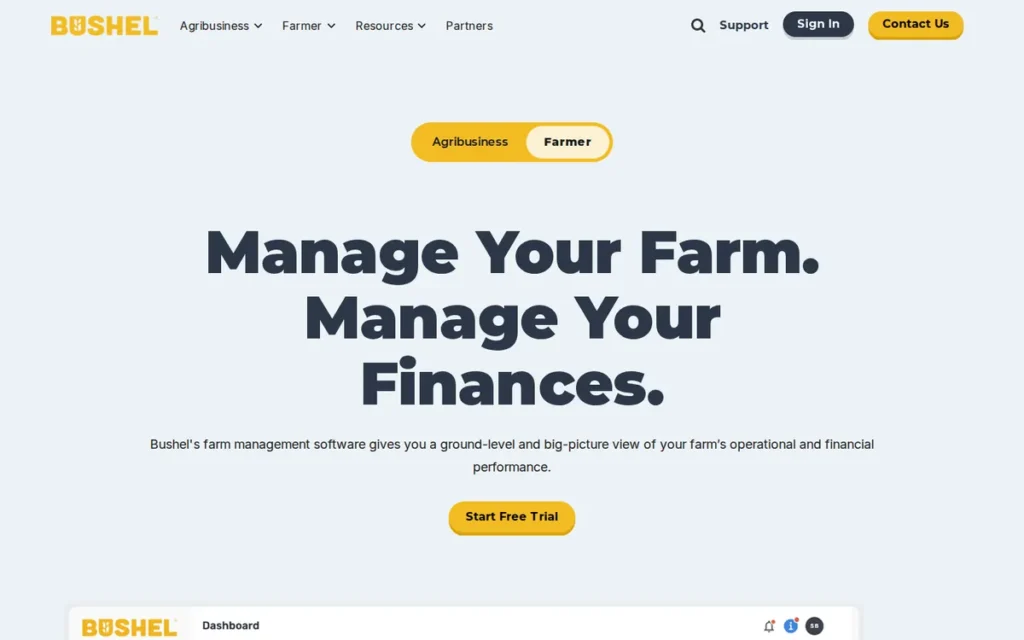
Category: Farm Records & Collaboration Hub. Bushel Farm focuses on field records, planning, sharing and business data rather than machine control.
At a Glance
- Category: Farm Records & Collaboration Hub
- Best For: Small and midsize row-crop farms that want field records, crop-health imagery and grain-contract tracking on a tight budget
- Price Range: For farms of 20,000 acres or fewer: Rainfall $75/year, Lite $199/year, Essentials $599/year. Larger farms get custom pricing (Bushel, checked November 2026).
- Primary Strength: Bushel Farm links field records to grain contracts at the lowest published paid price in this list.
- Biggest Limitation: Bushel Farm is shallow on variable-rate prescriptions and cannot serve as a farm’s main precision tool.
- One-Line Summary: Bushel Farm, formerly FarmLogs, is a low-cost farm-records platform that links field data, crop-health imagery and grain contracts, with published annual plans from $75/year.
- Last Verified: November 2026
Why It Ranks #4
Bushel Farm scored 3.23/5. It earned the top Cost Transparency score (5.0) because it publishes every plan price on its official page. Limited prescription depth (Precision Depth 2.0) keeps Bushel Farm below the three precision-first platforms and only 0.13 points ahead of Agworld.
Overview
Bushel Farm, formerly FarmLogs, is a farm-records platform for small and midsize row-crop farms on a budget. It combines field maps, rainfall alerts, crop-health imagery, inventory, field-level profitability and grain contracts. Bushel Farm gets machine data by syncing with John Deere Operations Center and Climate FieldView rather than collecting it directly.
Key Features
- Bushel Farm imports grain contracts automatically from buyers on the Bushel network.
- Bushel Farm syncs field data with John Deere Operations Center and Climate FieldView.
- Bushel Farm provides satellite crop-health imagery and rainfall alerts.
- Bushel Farm calculates field-level profitability and tracks inventory.
- Bushel Farm exports records by email or API to advisors and ERP systems.
Best For
Bushel Farm is best for cost-conscious row-crop farms that sell grain through Bushel-network elevators and want records and marketing in one place.
Strengths
- Bushel Farm publishes three annual plans for farms of 20,000 acres or fewer: Rainfall at $75/year, Lite at $199/year and Essentials at $599/year (Bushel, checked November 2026). That is the lowest published paid entry price of the seven products.
- Bushel Farm holds a 4.8/5 rating from 20 Capterra reviews (Capterra, checked November 2026), the highest rating in this list.
- Bushel Farm connects to a network that served 100,000+ farmers and 2,600 grain and ag-retail locations (CropLife, 2023). That figure covers the whole Bushel network, not just Bushel Farm users.
- Bushel Farm documents email and API export to advisors and ERP systems, which helps both sharing and portability.
Limitations
Bushel Farm offers low cost and grain-marketing integration but little precision depth. Bushel Farm is shallow on variable-rate prescriptions and depends on John Deere Operations Center or Climate FieldView for machine data.
- No CNH integration was found for Bushel Farm as of November 2026.
- A Capterra reviewer said Bushel Farm makes it “too hard to apply a sale to a product” and to keep remaining bin inventory accurate (Capterra, checked November 2026).
- One Capterra reviewer described about $30/month as too expensive for Bushel Farm (Capterra, checked November 2026).
- Bushel Farm’s published plans cover farms of 20,000 acres or fewer, so larger operations need custom pricing. The official pricing page did not show a free tier as of November 2026.
- Bushel Farm’s investors include grain buyers such as Cargill and Scoular (CropLife, 2023), which some growers may see as a conflict of interest. Bushel’s data-use terms were not reviewed for this guide, so ask Bushel in writing.
- Bushel Farm was not found in the current Ag Data Transparent directory as of November 2026.
Verdict
Bushel Farm is the lowest-cost credible option in this ranking for linking row-crop field records to grain contracts, with published annual plans from $75/year.
Use Bushel Farm alongside a precision platform such as John Deere Operations Center or Climate FieldView, not in place of one. If you write your own VR prescriptions, you’ll need a second tool.
5. Agworld: Best for Grower–Agronomist Collaboration and Compliance Records
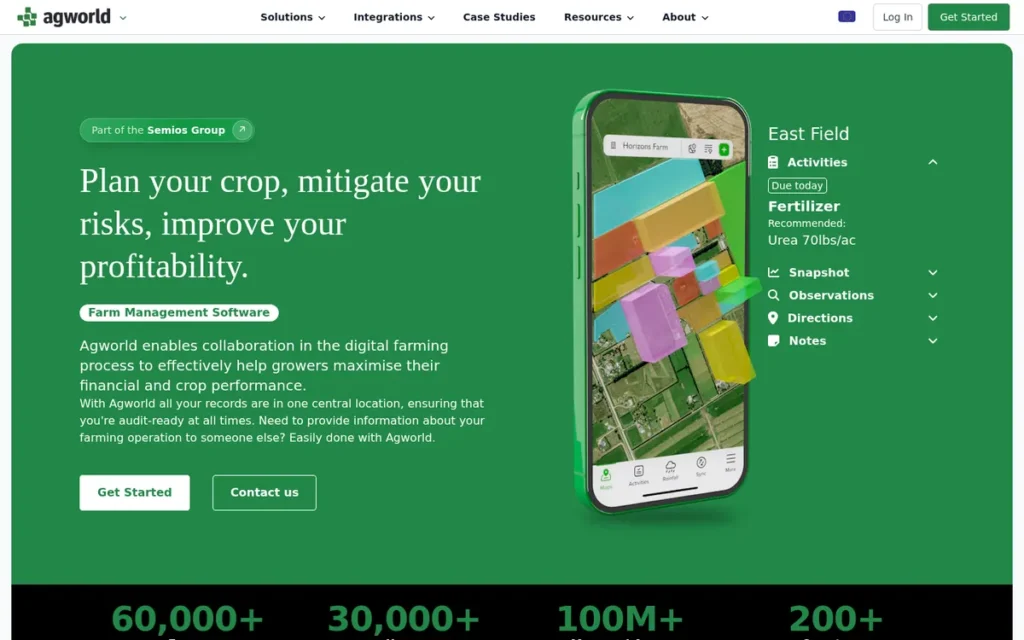
Category: Farm Records & Collaboration Hub. Agworld focuses on field records, planning, sharing and business data rather than machine control.
At a Glance
- Category: Farm Records & Collaboration Hub
- Best For: Advisor-led operations and ag retailers that need shared crop plans, work orders and audit-ready application records
- Price Range: U.S. pricing on request. A third party reports Australian plans at A$1,795–A$3,995/year (rfp.wiki, 2026).
- Primary Strength: Agworld gives growers and advisors one shared workflow from recommendation to completed compliance record.
- Biggest Limitation: Agworld limits grower prescription generation and precision-layer analysis to its Enterprise tier.
- One-Line Summary: Agworld is an independently owned collaborative farm-planning platform where growers and agronomists share crop plans, work orders and compliance records, with grower prescription tools limited to its Enterprise tier.
- Last Verified: November 2026
Why It Ranks #5
Agworld earned the only 5.0 for Advisor and Team Collaboration and has the strongest review base (Independent Evidence 4.0). Enterprise-gated prescriptions (Precision Depth 2.5) and unpublished U.S. pricing (Cost Transparency 2.0) put Agworld at 3.10/5, 0.13 points behind Bushel Farm.
Overview
Agworld is a shared farm-planning platform for advisor-led operations. Growers, agronomists, retailers and contractors all work from the same crop plans, budgets, work orders and application records. Agworld connects to machine data through integrations such as John Deere Work Planner rather than collecting it directly.
Key Features
- Agworld follows a planning-first workflow that moves from recommendation to work order to completed record to financial or compliance report.
- Agworld sends planned applications to John Deere Work Planner and receives as-applied data back automatically.
- Agworld tracks crop plans, budgets and gross margins at the field level.
- Agworld keeps chemical and fertilizer records ready for audits.
- Agworld lets growers, agronomists, retailers and contractors work on the same records.
Best For
Agworld is best for farms that work closely with an independent agronomist or retailer and need shared plans and audit-ready records more than in-depth GIS analysis. Agronomists can build prescriptions for clients with Agworld’s Agronomist Professional subscription (Agworld, checked November 2026).
Strengths
- Agworld holds a 4.5/5 rating from 44 Capterra reviews (Capterra, checked November 2026), the most Capterra reviews among the seven products.
- Agworld reports more than 100M acres and 30,000+ users across five countries (Agworld, company-reported, 2022). A separate company release cites 200M+ acres, so the lower figure is used here.
- Agworld is owned by Semios, an independent company that is neither an equipment maker nor an input supplier, which counts in its favor on neutrality.
- Agworld reviewers praise its audit-ready spray records and its ability to turn recommendations into records without re-entering data (Capterra, checked November 2026).
Limitations
Agworld gives up precision depth in exchange for collaboration strength. For growers, prescription generation and precision-layer analysis are limited to the Enterprise tier (Agworld pricing page, checked November 2026). Agworld’s GIS depth is also shallower than that of John Deere Operations Center or Climate FieldView.
- Agworld reviewers report that large syncs need an unbroken connection and can time out, and that yield and GIS uploads are slow (Capterra, checked November 2026).
- Agworld reviewers also mention clashes over map editing and a learning curve (Capterra, checked November 2026).
- Agworld charges extra for some integrations (rfp.wiki, 2026).
- Agworld’s U.S. dollar pricing could not be verified as of November 2026.
- Agworld was not found in the current Ag Data Transparent directory as of November 2026.
Verdict
Agworld earned this ranking’s only 5.0 for Advisor and Team Collaboration, which makes it the best-documented platform here for advisor-led row-crop operations. It is backed by a 4.5/5 Capterra rating from 44 reviews.
Choose Agworld for shared planning and compliance records, not as your main prescription engine. Confirm in writing that your Agworld tier includes the precision features you need.
6. Granular Insights: Best for Profit-Driven VR Seeding With a Corteva/Pioneer Relationship
Category: Brand-Agnostic Analytics Layer. Granular Insights gathers and analyzes field data from several equipment brands rather than from one manufacturer’s machines.
At a Glance
- Category: Brand-Agnostic Analytics Layer
- Best For: Corn and soybean growers working with Pioneer or Corteva reps who want profit-based seed analysis and VR seeding
- Price Range: No official public price. Third-party estimates conflict, so ask a Corteva rep (checked November 2026).
- Primary Strength: Granular Insights builds seed cost and grain price directly into its variable-rate seeding prescriptions.
- Biggest Limitation: Granular Insights is what remains of a product line that has been split up, and it has no official public pricing.
- One-Line Summary: Granular Insights is Corteva’s seed-performance and variable-rate seeding analytics tool that builds input cost and grain price into prescriptions. As of November 2026, it is the main part of the original Granular product line that Corteva still offers.
- Last Verified: November 2026
Why It Ranks #6
Granular Insights scored 2.73/5. Its profit-based seeding prescriptions earned a 3.5 for Precision Depth. But Granular Insights received the lowest Cost Transparency score in this ranking (1.0) because no official price exists, and it sits only 0.03 points ahead of CropX.
Overview
Granular Insights is Corteva’s analytics tool for corn and soybean growers who work with Pioneer or Corteva reps. It covers seed-performance analysis, yield maps, imagery and variable-rate seeding prescriptions. Granular Insights is not the all-in-one Granular platform that older reviews describe.
Key Features
- Granular Insights builds VR seeding prescriptions from seed cost, grain price, stand loss, yield targets and seed rates.
- Granular Insights analyzes hybrid and seed performance across fields to guide hybrid placement.
- Granular Insights provides yield maps and imagery.
- Granular Insights reportedly imports data from John Deere Operations Center, Case IH AFS Connect, Ag Leader AgFiniti and Precision Planting Panorama (IntelligentAcre, 2026).
- Granular Insights is designed to be used with Corteva and Pioneer agronomy reps.
Best For
Granular Insights is best for growers with an active Pioneer or Corteva relationship who want seeding prescriptions built on profitability rather than yield alone.
Strengths
- Granular Insights builds seed cost and grain price into its VR seeding prescriptions (Corteva, checked November 2026), something few competitors document.
- Granular Insights is used by Anson Family Farms, which a Corteva case-study directory lists as managing 20,000 acres with Granular. The directory gives no method or baseline (FeaturedCustomers, 2026).
- Granular Insights pairs its analysis with Corteva and Pioneer agronomy reps, so growers get help interpreting field-level results (Corteva, checked November 2026).
- Granular Insights reportedly imports data from four major equipment and data platforms (IntelligentAcre, 2026).
Limitations
Granular Insights gives up breadth and stability for a narrow focus on seed economics. Granular Business was sold to Traction Ag in 2022, and Granular Agronomy was reportedly discontinued on August 31, 2022 (WiseYield, 2026; Corteva, checked November 2026). Older “Granular” reviews therefore describe a product that no longer exists in that form.
- No official price, no verified G2 or Capterra rating and no documented complete export were found for Granular Insights as of November 2026.
- Granular was among the early companies certified by Ag Data Transparent in 2018, but Granular Insights does not appear in the current directory (Ag Data Transparent, checked November 2026).
- Granular Insights’ current data-use terms were not reviewed for this guide, so ask Corteva in writing.
- Granular Insights is owned by Corteva, which sells seed, so some growers question whether its seed advice is neutral.
- Granular Insights support depends on the local rep, so quality can vary by region.
Verdict
Granular Insights is the most economics-focused VR seeding tool in this ranking, but it is now a narrow product rather than the all-in-one platform older reviews describe.
Granular Insights suits growers who already work with Pioneer or Corteva. Confirm its current features and price with a rep before committing.
7. CropX: Best for Irrigation and Soil-Moisture Management on Irrigated Acres
Category: Sensor-Based Specialist. CropX is built around its own in-field soil sensors for one specific job: irrigation management.
At a Glance
- Category: Sensor-Based Specialist
- Best For: Irrigated row-crop and center-pivot operations that want sensor-based irrigation scheduling
- Price Range: Pricing on request. Sold as an annual subscription that includes sensors (CropX, checked November 2026).
- Primary Strength: CropX turns multi-depth soil sensor readings into direct “irrigate or not” recommendations.
- Biggest Limitation: CropX publishes no pricing, and its payback case is weaker on dryland acres.
- One-Line Summary: CropX is an independent soil-sensor and irrigation-management platform that turns multi-depth moisture, temperature and salinity readings into irrigation recommendations, with pricing available only through a demo.
- Last Verified: November 2026
Why It Ranks #7
CropX scored 2.70/5 as a general row-crop platform, 0.03 points behind Granular Insights. CropX ranks last because it is not a general prescription or yield-analysis tool, not because it is weak at irrigation. For irrigated pivots, CropX is this evaluation’s first choice.
Overview
CropX is a soil-sensing and irrigation platform for irrigated row-crop operations. It combines in-ground moisture, temperature and salinity sensors with evapotranspiration data, irrigation recommendations, nitrogen tracking and satellite imagery. CropX connects with John Deere Operations Center and selected pivot systems.
Key Features
- CropX sensors measure soil moisture, temperature and salinity (EC) at several depths.
- CropX converts sensor data into direct irrigation recommendations rather than raw numbers.
- CropX has a two-way integration with John Deere Operations Center (CropX, checked November 2026).
- CropX connects with Reinke and Talgil irrigation systems.
- CropX adds nitrogen tracking, disease models and satellite imagery to the same platform.
Best For
CropX is best for center-pivot growers of alfalfa, corn and other irrigated row crops who schedule irrigation to cut water and pumping energy. CropX is an especially good fit where water allocations are limited.
Strengths
- CropX reports 40% less water with no yield loss on a 125-acre Arizona alfalfa pivot. The pivot was split into 20 sections and compared side by side with farmer-managed irrigation (CropX, vendor-reported, checked November 2026).
- CropX reports that Hoffman Irrigation growers who followed its recommendations across 200 V4 sensors saw yields 20–30 bu/acre higher (CropX, vendor-reported, checked November 2026).
- CropX described its September 2025 acquisition of Acclym (formerly Agritask) as its seventh strategic acquisition. The series began with CropMetrics, a Nebraska pivot-irrigation company, in 2019 (CropX, 2025).
- CropX is independently owned, so its recommendations are not tied to selling equipment or inputs.
Limitations
CropX offers deep irrigation tools but not broad precision coverage. CropX is not a general VR prescription or yield-analysis platform, and its payback is weaker on dryland row crops, where irrigation decisions don’t apply.
- CropX’s sensor warranty lasts 24 months or until the subscription ends, whichever comes first, so cancelling also ends sensor coverage (CropX terms and conditions, checked November 2026).
- CropX needs cellular coverage and battery maintenance, and growers must manage the sensors around harvest.
- A single CropX sensor point may not represent a variable field, so growers may need more sensors than they expect.
- All quantified CropX results are vendor-reported. No public pricing, user ratings or confirmed Valley or Lindsay integrations were found as of November 2026.
- CropX was not found in the current Ag Data Transparent directory as of November 2026.
Verdict
CropX is the only sensor-based irrigation platform in this evaluation and the recommended choice for irrigated row-crop acres, though its documented water savings are vendor-reported.
Add CropX to a main precision platform rather than using it instead of one. Dryland growers are unlikely to see the same payback from CropX.
Which Precision Agriculture Software Works Best With Mixed Equipment Fleets?
Mixed-fleet compatibility is two questions: can the system steer every machine, and can one platform store every machine’s records? PTx Trimble leads the first with nearly 40 supported brands (vendor-stated). Climate FieldView leads the second through its add-on Drive. John Deere Operations Center is an alternative through ISOXML file import and API connections.
The hardware question asks whether the software can steer and log data on every machine you own:
- PTx Trimble states that its guidance supports nearly 40 machinery brands and 10,000+ models (PTx, vendor-stated, checked November 2026).
- John Deere Operations Center reaches non-Deere machines mainly by fitting Deere displays and receivers through Precision Essentials.
The data question asks whether one platform can store and analyze records from every brand:
- Climate FieldView collects data across brands through FieldView Drive 2.0 and lists 60+ partners (Climate FieldView, checked November 2026).
- John Deere Operations Center accepts other brands’ field records through ISOXML file import and API connections.
- Granular Insights, Agworld and Bushel Farm import data from other platforms rather than collecting it from machines.
Telemetry and field data travel by different routes. If a CNH combine and a Deere planter both report through DataConnect, John Deere Operations Center can show where the combine is and how much fuel it has. The combine’s yield map still arrives by ISOXML file or API (CLAAS, checked November 2026).
Field and task data move between brands through standards such as ISOXML, ISOBUS-compatible displays and AgGateway’s ADAPT framework. Data moved between equipment brands can lose machine-specific detail, according to independent comparisons (farmtechreview.com, 2026). Test a full season’s files, not a single field.
This aligns with community sentiment on r/Agriculture:
“This will be John Deere’s way of owning farmers. The farmers data on which farmers will use for improving their soil and better crop management will surely be locked down into John Deere’s ecosystem, without the ability to use the same information on any other brand of equipment that the farmer might own. John Deere, CNH, Agco, and all of them will definitely lock down their equipment to only be used with their software in the very near future.” Posted by u/challenger76589
Takeaway: Mixed-fleet growers fear that John Deere Operations Center and other machine-native hubs will trap their agronomic data inside one brand’s ecosystem, so documented cross-brand data paths are a must-have.
What Does Precision Agriculture Software Really Cost in 2026?
Precision agriculture software rarely costs only its subscription price. Free core accounts often need paid hardware, correction subscriptions or an iPad. As of November 2026, three of the seven products publish prices on official pages: Climate FieldView, John Deere Operations Center and Bushel Farm. PTx Trimble, CropX and Granular Insights are quote-only.
The software is often the cheapest part of precision agriculture. John Deere Operations Center’s core account is $0, but the hardware to connect a non-Deere tractor starts at $2,650 (John Deere, checked November 2026).
A two-tractor mixed fleet that starts on “free” software might pay $499 per FieldView Drive plus an iPad. The alternative is $2,650+ per Deere Precision Essentials kit plus $195 per machine per year for PRO Service. Both figures come before any correction subscription (Climate FieldView and John Deere, checked November 2026).
| Product | Software Cost | Hardware / Add-On Cost | Cost Caveats (checked November 2026) |
|---|---|---|---|
| Climate FieldView | Free Prime; Plus $649/year (U.S. pricing page) | Drive 2.0 $499 ($598 with mount); iPad required | Another official Climate page lists Plus at $749/year, a $299 Drive starter kit and $249 per additional Drive |
| John Deere Operations Center | $0 core; JDLink activation free | Precision Essentials from $2,650 with one-year license | PRO Service from $195/machine/year; StarFire/SF-RTK price not published; dealer installation extra |
| PTx Trimble | Quote only | Quote only | CenterPoint RTX subscription price not published |
| Bushel Farm | Rainfall $75/year; Lite $199/year; Essentials $599/year (≤20,000 acres) | None documented | Custom pricing above 20,000 acres; free tier not shown on official page |
| Agworld | U.S. price not published; A$1,795–A$3,995/year (third-party) | None documented | Some integrations cost extra |
| Granular Insights | No official price | None documented | Third-party figures conflict ($649/year, $2,400/year, or free through Corteva) |
| CropX | Quote only | Sensors included in subscription | Annual subscription price not published; sensor warranty ends with subscription |
Peer adoption shows where the money usually goes:
- Large U.S. crop farms use autosteer or guidance at a rate of 70%, versus 52% on midsize farms and 9% on small farms (USDA ERS, 2023).
- Variable-rate technology adoption is 45% on large farms, 32% on midsize farms and 5% on small farms (USDA ERS, 2023).
- Purdue estimates that combining precision tools could save up to $78/acre, which is a potential opportunity rather than an average result (Purdue University, 2025).
- Purdue also found that 69% of data-oriented farms share data with service providers (Purdue University, 2025).
What Is the Best Precision Agriculture Software for Irrigation and Soil Moisture?
CropX is the best precision agriculture software in this evaluation for irrigation and soil moisture. CropX turns multi-depth soil sensor readings into direct irrigation recommendations and connects with John Deere Operations Center. CropX is the only ranked platform built around its own soil-moisture sensors for irrigation scheduling.
CropX’s irrigation case rests on these documented points:
- CropX reports 40% less water with no yield loss on a 125-acre Arizona alfalfa pivot compared side by side with farmer-managed irrigation (CropX, vendor-reported, checked November 2026).
- CropX reports a 68% reduction in water use in a citrus case (CropX, vendor-reported, checked November 2026).
- CropX reports that a Colorado family farm working with the Colorado Ag Water Alliance cut irrigation by about a third (CropX, vendor-reported, checked November 2026).
- CropX connects with Reinke and Talgil irrigation systems, but Valley and Lindsay integrations were not confirmed as of November 2026.
Community discussion of soil sensors is mixed. In an r/farming soil-sensor thread, other growers suggested competitors such as Netafim and Ranch Systems, which PlugRoute did not evaluate.
“I’d always trust consistency of lab results over a kit.” (u/Imfarmer, r/farming, 2024)
Takeaway: Some growers trust lab soil tests more than in-field kits, so plan to check sensor readings against lab results in the first season.
What Red Flags Should I Watch For When Evaluating Precision Agriculture Software?
Six red flags suggest that precision agriculture software may cost more, or lock you in further, than its product page implies. Each one below is numbered and named. Each can raise costs or limit your options after you’ve signed, so check all six before you commit to any platform.
Red Flag #1: Free Software That Needs Paid Hardware A “free” precision agriculture platform can still require displays, receivers, add-on devices or tablets. John Deere Operations Center’s core account costs $0, but Precision Essentials hardware starts at $2,650 (John Deere, checked November 2026). CropX’s sensor warranty also ends when the subscription ends (CropX terms and conditions, checked November 2026).
Red Flag #2: Quote-Only Pricing With No Written Total Cost Quote-only pricing makes side-by-side comparison impossible until a dealer or rep responds. PTx Trimble, CropX and Granular Insights published no prices as of November 2026. Insist on a written yearly total covering software, hardware, correction subscriptions and per-machine fees before you compare quotes.
Red Flag #3: No Documented Raw-Data Export None of the seven ranked platforms publicly documents a complete raw-data export on cancellation as of November 2026. PDF and CSV reports are not the same as your original machine files. Ask each vendor in writing which raw formats, such as ISOXML or shapefiles, you can take with you.
“Have you asked any farmers if their real problems would be solved by another proprietary silo to store their disparate data sources in?” (u/Sabrees, r/AgriTech, 2026)
Takeaway: Growers are wary of another proprietary data silo, so documented export formats and two-way integrations matter as much as features.
Red Flag #4: Prescriptions Locked Behind a Higher Tier Variable-rate prescriptions and precision layers often sit in paid or enterprise tiers. Climate FieldView puts prescriptions in its $649/year Plus tier, and Agworld limits grower prescription tools to Enterprise (Climate FieldView and Agworld, checked November 2026). Confirm which tier includes the exact features you plan to use before you subscribe.
Red Flag #5: Unlabeled Vendor Yield or Savings Claims Every quantified product result PlugRoute found for these seven platforms, including yield gains, water savings and chemical reductions, was reported by the vendor. PlugRoute found no independent trials as of November 2026. Treat any figure that lacks a vendor-reported label, a method and a baseline as unproven.
Red Flag #6: Older Reviews of Products That Have Since Been Restructured Product lines change through sales and shutdowns, so older reviews can describe software that no longer exists. Granular Business was sold to Traction Ag in 2022, and Granular Agronomy was reportedly discontinued on August 31, 2022 (WiseYield, 2026). Check each review’s date against the current product page.
What Questions Should I Ask Before Choosing Precision Agriculture Software?
Ask seven questions in writing before you sign. The answers reveal compatibility gaps and hidden costs that product pages rarely disclose. Put the same questions to every vendor or dealer on your shortlist, compare the answers side by side, and finish with a trial run on your own equipment before you pay.
Question #1: Which of my machines get full control and which get only partial control? Ask the dealer or vendor for a machine-by-machine list covering guidance, rate control and data logging for every machine you own. Uneven feature support is a documented complaint in mixed fleets. PTx Trimble, for example, can deliver full control on some machines but only partial control on others.
Question #2: What is my total yearly cost, including hardware, corrections and per-machine fees? A good answer lists every recurring charge in writing, from the software tier to dealer installation. John Deere Operations Center’s PRO Service, for example, starts at $195 per machine per year, and StarFire correction pricing is not published (John Deere, checked November 2026). Watch for any charge left off the quote.
Question #3: What file formats can I export when I cancel? A good answer names raw machine files and standard formats such as shapefiles and ISOXML, not just PDF or CSV reports. None of the seven ranked platforms publicly documents a complete raw-data export on cancellation as of November 2026, so get the vendor’s answer in writing before signing.
Question #4: What cellular coverage does syncing require? Ask how the software stores data offline and syncs it later, because farm internet access does not guarantee coverage in the field. USDA NASS reports that 85% of U.S. farms have internet access and 75% of those use a cellular data plan (USDA NASS, 2023). Both JDLink and CropX sensors depend on cellular coverage.
Users on r/AgriTech noted:
“That said, when growers do invest in precision tools, those tools need to work when and where the farm does. A drone that can’t upload, a sensor that can’t report, or a monitor that drops connection in the back forty is just another expensive headache with a blinking light.” Posted by u/SIMplyConnected-
Takeaway: Precision agriculture tools lose their value when field connectivity fails, so offline storage and reliable sync matter as much as the feature list.
Question #5: Who provides support, the vendor or my dealer? Support for John Deere Operations Center, PTx Trimble and Granular Insights depends largely on the local dealer or rep, according to user reports and secondary comparisons. Ask who answers support calls during planting and harvest, what response time is promised, and whether support costs extra.
Question #6: Who can see my data, and how can the vendor use it? Ask for the data-use terms in writing, including whether aggregated data is used for product development. Climate FieldView, for example, does not sell customer farm data but may use aggregated data for product development (Climate FieldView privacy FAQ, checked November 2026). Also check the vendor’s status in the live Ag Data Transparent directory.
Question #7: Can I test the full workflow on my own equipment before paying? Run a one-season round-trip test on your own machines during a free tier or trial before committing. A platform that passes all six steps below has shown that it works on your farm, not just in a vendor demo.
- Step 1: Load a field boundary or work plan from the software onto the in-cab display.
- Step 2: Upload field data from the display to the software after a pass.
- Step 3: Build a map or prescription in the software from that uploaded data.
- Step 4: Send the prescription back to the display and let the machine apply it.
- Step 5: Export the results in a format the farm controls, such as ISOXML or shapefile.
- Step 6: Confirm that the exported files open in a second platform.
How Did We Rank These Precision Agriculture Software Platforms?
PlugRoute scored each of the seven platforms from 1 to 5 on six weighted criteria, using the same research queries for every product. Equipment compatibility and precision depth carry the most weight. The overall rank measures general fit for row-crop precision work, so an entry’s “Best For” label may matter more for your farm than its rank.
The six criteria and their weights are:
- C1 Equipment and Data Compatibility (25%): This criterion matters because growers need software that works with the machines, displays and file formats they already own.
- C2 Precision Capability Depth (25%): This criterion matters because yield analysis, VR prescriptions, imagery and display round-trips are the core precision jobs.
- C3 Total Cost Transparency (15%): This criterion matters because “free” software can carry hidden hardware and per-machine costs. Only official published prices count toward it.
- C4 Data Control, Portability and Reliability (15%): This criterion matters because growers want to know who sees their data, whether they can export it and whether syncing holds up.
- C5 Independent Evidence and User Ratings (10%): This criterion matters because vendor descriptions don’t prove field results. It carries a lower weight because public reviews are scarce across the category.
- C6 Advisor and Team Collaboration (10%): This criterion matters because growers must share data with agronomists, retailers and team members.
PlugRoute scored every criterion against the same five anchors:
- A score of 5 means the capability is documented on official sources with no material gaps.
- A score of 4 means it is documented with minor gaps or one conflicting source.
- A score of 3 means it is partly documented or relies on third-party sources.
- A score of 2 means it is mostly undocumented or vendor-stated only.
- A score of 1 means no verifiable public information was found.
| Rank | Product | C1 | C2 | C3 | C4 | C5 | C6 | Weighted Total | Primary Score Driver |
|---|---|---|---|---|---|---|---|---|---|
| 1 | Climate FieldView | 4.5 | 4.5 | 4.5 | 3.0 | 3.0 | 4.0 | 4.08 | Highest cost transparency among precision-first tools |
| 2 | John Deere Operations Center | 3.5 | 4.5 | 3.5 | 3.0 | 2.5 | 4.0 | 3.63 | Deep Deere-native precision; telemetry-only cross-brand link |
| 3 | PTx Trimble | 5.0 | 4.0 | 1.5 | 2.5 | 2.0 | 3.0 | 3.35 | Only 5.0 on compatibility; 1.5 on cost |
| 4 | Bushel Farm | 3.0 | 2.0 | 5.0 | 3.5 | 3.5 | 3.5 | 3.23 | Every plan price published; shallow prescriptions |
| 5 | Agworld | 3.0 | 2.5 | 2.0 | 3.5 | 4.0 | 5.0 | 3.10 | Only 5.0 on collaboration; Enterprise-gated Rx |
| 6 | Granular Insights | 3.0 | 3.5 | 1.0 | 3.0 | 2.0 | 3.0 | 2.73 | Profit-based seeding; no official price |
| 7 | CropX | 2.5 | 3.0 | 1.5 | 3.0 | 3.5 | 3.0 | 2.70 | Irrigation specialist; not general VR |
PlugRoute tested how sensitive the order is to disputed scores:
- Climate FieldView would remain #1 even if its cost score fell to 3.5 because of its conflicting official Plus prices, giving a total of 3.93.
- John Deere Operations Center’s C1 score was revised from 4.0 to 3.5 in November 2026 after verification showed that DataConnect shares telemetry only, and the platform stays #2.
- Bushel Farm and Agworld are 0.13 points apart, and Granular Insights and CropX are 0.03 points apart, so treat each pair as a tie on general fit and choose by job.
- CropX’s C5 score of 3.5 credits named-farm, side-by-side trial designs with stated acreage, but all CropX results remain vendor-reported.
PlugRoute applied the same evidence rules to every product:
- Missing evidence was scored as missing and labeled “not found as of November 2026,” never estimated.
- Vendor results were labeled vendor-reported and earned only partial credit.
- A small number of public reviews was not treated as a sign of little use, since Climate FieldView has only 3 Capterra reviews but 413 Google Play reviews.
PlugRoute left out Farmbrite, a crop-and-livestock record tool for small, diversified farms, even though it ranked high in discovery.
PlugRoute included CropX instead to answer the irrigation and soil-moisture query. This was an editorial choice based on fit, not review volume.
PlugRoute has no affiliate relationships with any company listed. Rankings are determined entirely by research data and objective evaluation criteria.
What Do Growers Most Often Ask About Precision Agriculture Software?
Growers most often ask which platform handles mixed fleets, who owns their data, and how PlugRoute ranks software. The short answers: Climate FieldView and PTx Trimble lead on mixed fleets, none of the seven documents a complete raw-data export, and PlugRoute’s rankings follow a published weighted score.
What is the best precision agriculture software for mixed equipment fleets?
Climate FieldView is the best precision agriculture software for mixed-fleet data and prescriptions, and PTx Trimble is best for mixed-fleet guidance hardware. Climate FieldView collects cross-brand data through its $499 Drive (Climate FieldView, checked November 2026). PTx Trimble states that its guidance supports nearly 40 machinery brands. John Deere Operations Center accepts other brands’ field data through ISOXML import and APIs.
Who owns my farm data, and can I export it if I switch platforms?
Most platforms state that farmers own their data, but none of the seven ranked here publicly documents a complete raw-data export on cancellation as of November 2026. Climate FieldView offers PDF and CSV export, and Bushel Farm documents API export. John Deere Operations Center and Climate FieldView are Ag Data Transparent certified (checked November 2026).
How does PlugRoute determine rankings?
PlugRoute ranks software by a weighted score across six criteria, led by equipment compatibility and precision depth at 25% each. Every product received the same research queries. Missing evidence is labeled rather than estimated, and vendor results are marked. Climate FieldView scored highest (4.08/5), followed by John Deere Operations Center (3.63) and PTx Trimble (3.35).
What Do Key Precision Agriculture Software Terms Mean?
Buyers comparing precision agriculture software see the same technical terms on almost every product page and dealer quote. Knowing what each term means helps you judge which features you actually need and which costs to expect. It also tells you which questions to ask before you sign a contract with any vendor.
Variable-Rate Technology (VRT): Equipment and software that apply seed, fertilizer or chemicals at different rates across a field. Variable-rate technology matters because it is often the main reason growers pay for a higher software tier.
Prescription (Rx): A digital map that tells a planter or applicator what rate to apply in each zone. A prescription is only useful if the software can send it directly to your display.
As-Applied Data: Records of what a machine actually put down and where. As-applied data supports compliance, input accounting and yield comparisons.
Yield Map: A map built from combine yield-monitor data that shows harvest results across a field. Yield maps are the starting point for most seed and fertility decisions.
RTK (Real-Time Kinematic): A GPS correction method that gives guidance accuracy within about an inch. RTK corrections come from a local base station or a paid satellite correction subscription, which is a recurring cost to include in total-cost comparisons.
Retrofit: Adding displays, receivers or steering kits to machines that didn’t come with them from the factory. Retrofit kits are how many mixed or older fleets get precision features.
ISOXML: A standard file format for exchanging task and field data between different equipment brands. Support for ISOXML makes switching platforms and running mixed fleets easier.
Shapefile: A common GIS file format for boundaries, maps and prescriptions. Shapefile export lets you move field data into other software.
API (Application Programming Interface): A connection that lets two software systems exchange data automatically. API access affects how easily you can share data with advisors or accounting systems.
Machine Telemetry: Operating data such as a machine’s location, fuel level, status and speed. Machine telemetry shows where equipment is and how it’s running, but it does not include yield maps or prescriptions.
Evapotranspiration (ET): The amount of water a crop loses through soil evaporation and plant use. ET data helps irrigation software decide when and how much to water.
Electrical Conductivity (EC): A soil measurement linked to salinity and soil texture. EC readings help explain why parts of a field behave differently.
Which Precision Agriculture Software Is Right for You?
Key Insights
- Equipment fit should decide your shortlist, because no platform in this evaluation fits every farm.
- “Free” precision agriculture software rarely means free, because hardware, correction, per-machine and tablet costs often apply.
- None of the seven platforms PlugRoute evaluated publicly documents a complete raw-data export on cancellation, so the time to negotiate your exit is before you sign.
- Every quantified product result PlugRoute found for these seven platforms was vendor-reported, and no independent trials were found as of November 2026.
- Adding a specialist tool to a main platform makes sense only when it fills a real gap, such as irrigation or grain marketing.
If you need cross-brand prescriptions, start with Climate FieldView’s free tier. If your fleet is mostly green, start with John Deere Operations Center. If you have irrigated pivots, add CropX. If you sell through Bushel-network elevators, add Bushel Farm.
To dig deeper, read PlugRoute’s full methodology and its independent guides on mixed-fleet compatibility, total cost of ownership and farm data ownership. We update this guide quarterly. Last updated: November 2026.