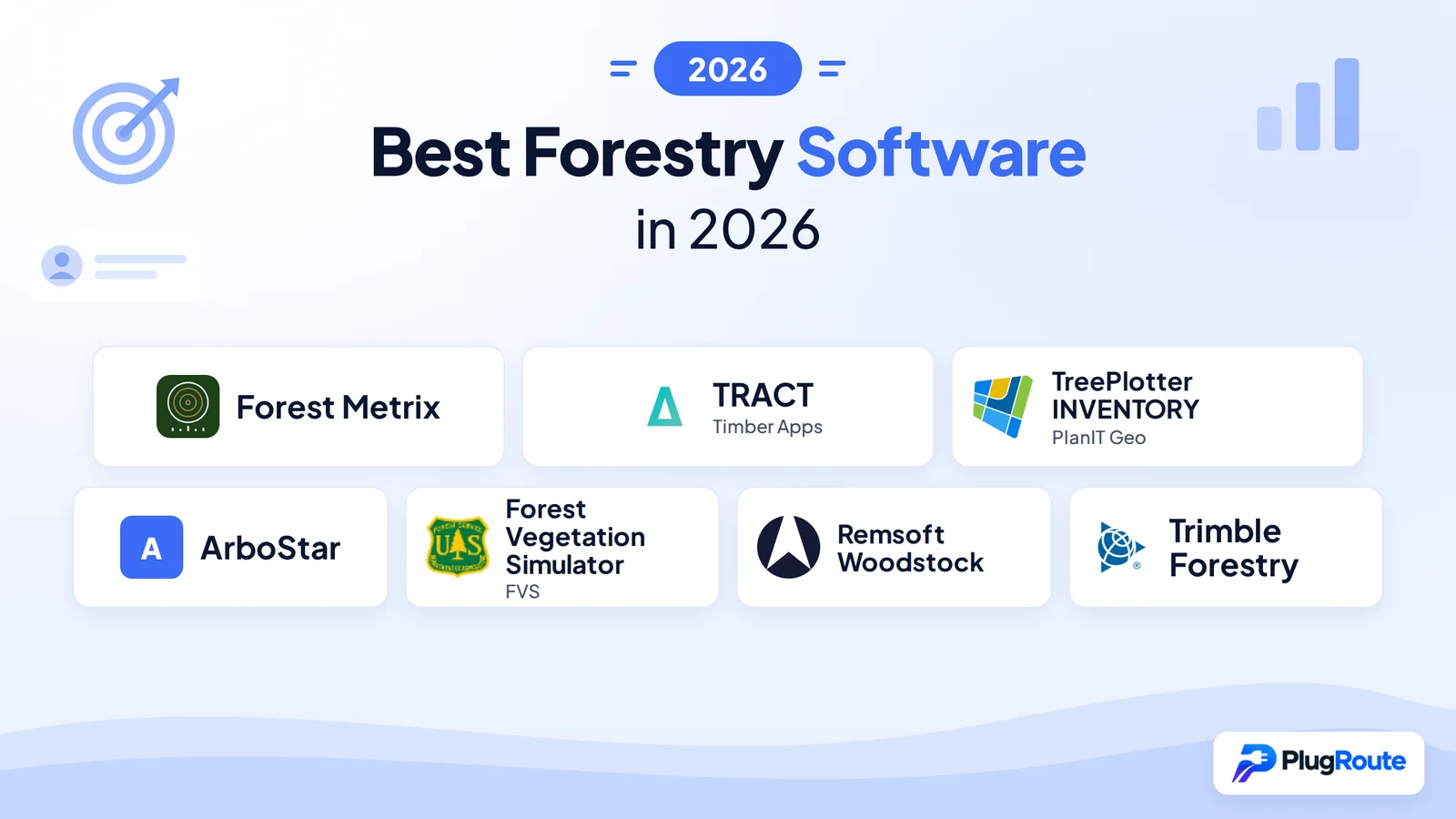
The best forestry software in 2026 is Forest Metrix for timber cruising and field inventory, TRACT for load tracking and settlements, and TreePlotter INVENTORY for urban tree inventory, according to PlugRoute’s evidence-based ranking. The right choice depends on your main job. Enterprise vendors deserve extra scrutiny because they publish the least pricing and the fewest independent reviews.
Forestry software covers very different jobs. Review sites often list a tool built for one job as if it could do another. Many enterprise vendors give prices only on request, and independent reviews of timber-focused tools are thin. This guide sorts products by job first and then ranks them by evidence.
As one user on r/forestry warned a new cruiser weighing the Plot Hound app:
“I’m not sure how much longer plot hound is going to be around with NCX going all in on their carbon market platform. I wouldn’t put all your eggs in that basket unless you are okay with it being a short term solution.” Posted by u/Fedzzy
Takeaway: Foresters choosing a cruising app have to judge whether the vendor will keep supporting it, because a tool tied to a shifting business strategy can turn into a short-term solution.
PlugRoute has no affiliate relationships with any company listed. Rankings are determined entirely by research data and objective evaluation criteria.
Each of the seven products below represents a different job category. Every entry follows the same structure, so you can compare the evidence fairly and book only the demos that fit your work. Last updated: November 2026. Prices and ratings verified November 2026.
What Are the 7 Categories of Forestry Software?
Forestry software falls into seven categories, sorted by job, and each product in this ranking represents one of them. Pick the category that matches your main job before you compare products. A top-rated tool in one category usually can’t do the work of another, even when review sites list both under “forestry.”
- Field Inventory & Cruising software, such as Forest Metrix, serves consulting foresters and timber cruisers who collect cruise data offline.
- Timber Business & Settlements software, such as TRACT, serves timber dealers, procurement managers and TIMOs that track loads through to settlement.
- Urban Tree Inventory software, such as TreePlotter INVENTORY, serves municipal and campus arborists who manage individual mapped trees.
- Tree-Care Business Management software, such as ArboStar, serves arborist service companies that run estimates, crews and invoicing.
- Growth & Yield Modeling software, such as the Forest Vegetation Simulator (FVS), serves analysts who project how stands will develop over decades.
- Strategic Planning & Optimization software, such as Remsoft Woodstock, serves planners at large landowners who need optimized long-range plans.
- Forest-to-Mill Supply Chain software, such as Trimble Forestry, serves integrated operations that link harvester fleets, logistics and mill log yards.
Capterra’s forestry category, sorted by review count, is mostly tree-service business software. That is why urban and arborist tools look more popular there than timber tools.
How Do the Top Forestry Software Tools Compare at a Glance?
Forest Metrix (4.20/5.00) and TRACT (4.15) lead PlugRoute’s 2026 ranking on evidence strength. TreePlotter INVENTORY (4.00) and ArboStar (3.75) follow. FVS, Remsoft Woodstock and Trimble Forestry rank lower mainly because of thin independent review evidence or limited pricing transparency. Each product serves a different job, so compare products within your category.
| Rank | Company | Category | Best For | One-Line Summary | Key Capabilities | Primary Strength | Key Limitation |
|---|---|---|---|---|---|---|---|
| 1 (4.20) | Forest Metrix | Field Inventory & Cruising | Consulting foresters and timber cruisers | Forest Metrix is an offline timber cruising app with published pricing from $649/year (Nov 2026). | Prism, fixed-area, big BAF and 100% tally cruises; FVS, SILVAH and NED-3 exports | Only paid timber-focused product with full published pricing | Can’t save report templates |
| 2 (4.15) | TRACT | Timber Business & Settlements | Timber dealers, procurement teams, TIMOs | TRACT takes timber loads from driver phone entry to landowner, logger and hauler settlements, with quote-only pricing (Nov 2026). | Offline load entry, AI scale-ticket reading, QuickBooks/NetSuite sync | Covers load capture through settlement in one system | Quote-only pricing; savings figures from a 12-user study |
| 3 (4.00) | TreePlotter INVENTORY | Urban Tree Inventory | Municipal and campus arborists | TreePlotter INVENTORY is a map-based urban tree inventory platform from $3,500/year, rated 4.5/5 across 111 Capterra reviews (Nov 2026). | Inspections, risk assessment, offline mobile, Esri APIs | Largest independent review base | Reviewers cite high price and slow iOS performance |
| 4 (3.75) | ArboStar | Tree-Care Business Management | Arborist service companies | ArboStar is a tree-care business platform from $149/month billed annually, rated 4.8/5 across 47 Capterra reviews (Nov 2026). | Map-based estimates, dispatch, invoicing, QuickBooks/Xero | Highest Capterra rating in the set | Mobile app lacks desktop features |
| 5 (3.25) | FVS | Growth & Yield Modeling | Skilled analysts and agencies | The Forest Vegetation Simulator is the USDA Forest Service’s free growth-and-yield model (Nov 2026). | 20 regional variants, Fire and Fuels Extension | Free; National Forest System standard since the early 1980s | Strict input format; data must be converted |
| 6 (2.80) | Remsoft Woodstock | Strategic Planning & Optimization | Large-landowner planners | Remsoft Woodstock is an optimization-based forest planning environment with quote-only pricing (Nov 2026). | Multi-period optimization with carbon and wildlife constraints | Recommends actions, not just projections | No public pricing or verified reviews |
| 7 (2.70) | Trimble Forestry | Forest-to-Mill Supply Chain | Integrated operations with harvester fleets | Trimble Forestry is a modular forest-to-mill suite with quote-only pricing and an onboard StanForD 2010 app (Nov 2026). | CF Harvest, Connected Forest, LIMS, logistics | Only documented onboard StanForD 2010 harvester app | Four independent reviews in total |
Which Forestry Software Should I Choose for My Job?
Start with the tool built for your main job. The table below matches seven common priorities to one recommended tool and gives the reason, the November 2026 price position and an acceptable alternative. If you do more than one job, the tool-stack examples after the table show which products work together.
| Your #1 Priority | Recommended Tool | Why | Acceptable Alternative |
|---|---|---|---|
| Offline timber cruising for a consulting practice | Forest Metrix | Prism, fixed-area, big BAF and 100% tally cruises plus FVS and GIS exports; $649–$1,299/year | None profiled in equal depth (FScruiser, TCruise and MobileMap Cruise considered but not profiled); small consultancies also report using QGIS/ArcGIS plus Avenza for mapping (r/forestry, accessed November 2026) |
| Load tracking and settlements | TRACT | Load-to-settlement workflow with QuickBooks or NetSuite sync; quote only | Trimble LIMS for mill-side load tickets and settlements |
| Municipal or campus tree inventory | TreePlotter INVENTORY | Largest independent review sample (111 Capterra reviews); from $3,500/year (third-party figure) | None profiled in equal depth (ArborNote considered but not profiled) |
| Running a tree-care company | ArboStar | Map-based estimates flow into work orders and invoices; $149–$249/month billed annually | None profiled in equal depth (SingleOps and Arborgold considered but not profiled) |
| Free growth-and-yield modeling | FVS | National Forest System standard model; free | Planscape for landscape-level planning |
| Long-range planning optimization | Remsoft Woodstock | Optimization under carbon, wildlife and policy constraints; quote only | FVS plus Planscape for simulation (not optimization) at no license cost |
| Harvester data and forest-to-mill | Trimble Forestry | Only documented onboard StanForD 2010 harvester app; quote only ($150/user/month listed for Connected Forest only, unverified) | TRACT for load-to-settlement without machine data |
Can I combine forestry software tools? Yes. Buyers who do more than one job can pair products whose documented integrations or companion products fit together:
- A consulting forester can pair Forest Metrix ($649–$1,299/year; confirm which plan includes FVS export) with the free Forest Vegetation Simulator for growth projections.
- A timber dealer can pair TRACT with QuickBooks or NetSuite, because TRACT pushes settlements to both with general-ledger coding.
- A municipality can pair TreePlotter INVENTORY with its companion product, TreePlotter CANOPY, for canopy analysis.
- An integrated operation can pair Trimble CF Harvest for harvester data with Trimble LIMS for mill-side tickets and settlements.
What Are the Best Forestry Software Tools in 2026?
The seven tools below are ranked by weighted evidence score out of 5.00, from Forest Metrix (4.20) down to Trimble Forestry (2.70). A lower rank means thinner public evidence or less pricing transparency. It does not mean a worse product. If TRACT published plan pricing, TRACT would score 4.60 and rank first.
Every entry uses the same structure and the same scoring line, so the products can be compared fairly.
1. Forest Metrix: Best for Timber Cruising and Field Inventory
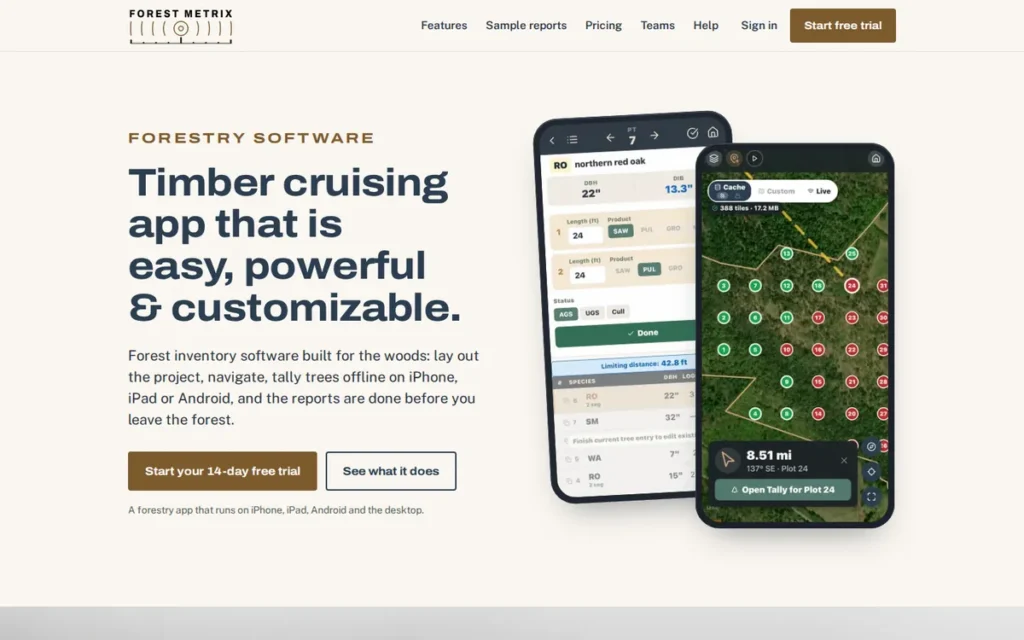
Category: Field Inventory & Cruising, mobile apps that collect timber cruise data offline and turn it into volume and stand reports.
At a Glance
- Category: Field Inventory & Cruising
- Best For: Consulting foresters, timber cruisers and small forestry teams going from offline cruising to client-ready reports
- Price Range: $59–$119/month or $649–$1,299/year, with a 14-day free trial (forestmetrix.com, accessed November 2026)
- Primary Strength: Forest Metrix combines offline cruise collection, in-field cruise statistics and exports to FVS, SILVAH, NED-3 and GIS formats in one app with published pricing.
- Biggest Limitation: Forest Metrix can’t save report templates, so Capterra reviewers re-paste data into Excel, and Forest Metrix is not a full GIS platform.
- One-Line Summary: Forest Metrix is an offline timber cruising app with fully published plan pricing from $649 per year that supports prism, fixed-area, big BAF and 100% tally cruises (verified November 2026).
- Last Verified: November 2026
Score: 4.20/5.00 (Workflow 5, Evidence 3, Pricing 5, Data Flow 5, Outcomes 2, Accessibility 4)
Overview
Forest Metrix is a mobile and web timber cruising app from Field Truth Inc. of Thetford, Vermont. It is built for consulting foresters, timber cruisers and small forestry teams who collect inventory offline and need volume and stand reports without buying a separate handheld data collector.
Field Truth has developed Forest Metrix since 2012. Forest Metrix runs on iPhone, iPad, Android and the web, with one active device per license.
Key Features
- Forest Metrix supports prism plots at any basal area factor (BAF), fixed-area plots, double sampling (“big BAF”) and 100% tally cruise designs.
- Forest Metrix shows cruise statistics in the field, including how many more plots are needed to reach a target sampling accuracy.
- Forest Metrix saves data on the device and syncs it later, but offline satellite maps, topo maps and georeferenced PDFs must be downloaded before crews head into the woods.
- Forest Metrix produces PDF, Excel and HTML reports, exports to SILVAH, NED-3 and FVS, and outputs KML, Shapefile and GeoJSON depending on the plan.
- Forest Metrix uses Mesavage & Girard volume tables by default, with Clark & Souter and Behre as options. The Forest Metrix Max plan adds custom volume rules, a soils layer and Voice Tally.
Best For
Forest Metrix is best for solo consulting foresters and small cruising crews who want an affordable, offline-first workflow from cruise to report on phones or tablets they already own. Cruising alternatives to Forest Metrix that PlugRoute did not profile in equal depth include USFS FScruiser, TCruise/TCruiseX, MobileMap Cruise, Arboreal Forest and TwoDog.
Strengths
- Forest Metrix holds a 4.4/5 rating from 14 Capterra reviews (Capterra, accessed November 2026), and reviewers say its intuitive iPhone app meant they didn’t need a separate handheld data collector.
- Forest Metrix is the only paid timber-focused product in this evaluation that publishes full plan pricing (forestmetrix.com, accessed November 2026), so buyers can budget without a sales call.
- Forest Metrix exports directly to the USDA Forest Service’s free FVS growth model and to SILVAH and NED-3, according to its feature documentation (Forest Metrix, accessed November 2026).
- Forest Metrix let at least one Capterra reviewer bring timber cruising in-house (Capterra, accessed November 2026). That is a single report, but it matters for small firms that currently pay someone else to cruise.
Limitations
Forest Metrix trades enterprise depth for ease of use. Forest Metrix is a cruising app, not a GIS or crew-tracking platform. It also can’t save report templates, so Capterra reviewers describe pasting data into Excel for each report (Capterra, accessed November 2026).
- Forest Metrix draws Capterra comments that its cost is “steep” and that it is “suited to technically savvy users” (Capterra, accessed November 2026).
- Forest Metrix allows only one active device per license, so crews with several cruisers need to budget for several licenses.
- Forest Metrix requires offline maps and georeferenced PDFs to be downloaded before fieldwork, and the Forest Metrix web app needs a connection.
Users on r/forestry pointing a cruiser to Forest Metrix’s free QGIS plugin for laying out plot grids noted:
“You can specify grid layout intervals in both x and y directions, change the azimuth to better fit property boundaries or topography, and adjust your buffer from the boundaries. Of course this means learning QGIS, but there are good resources and it’s not hard.” Posted by u/StillWearsCrocs
Takeaway: Forest Metrix’s free QGIS tools make cruise-grid layout flexible, but cruise mapping in the Forest Metrix workflow still means learning a separate GIS platform.
Verdict
Forest Metrix is the best-documented timber cruising tool among the products PlugRoute profiled in 2026, combining offline cruise collection with fully published pricing and direct FVS export.
Forest Metrix earned the top score (4.20/5.00) but leads TRACT by only 0.05 points, and its 14-review sample is small. Forest Metrix scored 5 on data flow because its report-template friction affects formatting, not data movement to FVS, GIS or Excel.
Demo checkpoint: Run a test cruise in Forest Metrix with your own species, log rules and volume tables, and confirm your plan tier includes the exports you need.
2. TRACT (Timber Apps): Best for Timber Procurement, Load Tracking and Settlements

Category: Timber Business & Settlements, software that captures loads, checks them against mill data, and calculates stumpage and contractor pay.
At a Glance
- Category: Timber Business & Settlements
- Best For: Timber dealers, wood buyers, procurement managers, logging contractors, and TIMOs or REITs that track loads through to settlement
- Price Range: Pricing on request; per unit per month with unlimited users (G2, accessed November 2026); no upfront license fee (TRACT, accessed November 2026)
- Primary Strength: TRACT connects driver load entry, AI scale-ticket reading, mill reconciliation and settlements that push to QuickBooks or NetSuite with general-ledger coding.
- Biggest Limitation: TRACT publishes no dollar pricing, and its headline savings figures come from a 2024 University of Georgia study comparing 12 TRACT users with 9 non-users.
- One-Line Summary: TRACT is a timber business platform that takes loads from driver phone entry through mill reconciliation to landowner, logger and hauler settlements, rated 4.7/5 across 12 Software Advice/Capterra reviews as of November 2026.
- Last Verified: November 2026
Score: 4.15/5.00 (Workflow 5, Evidence 4, Pricing 2, Data Flow 5, Outcomes 4, Accessibility 4)
Overview
TRACT, from Timber Apps, is forestry business software for timber dealers, wood buyers, logging contractors and timberland investment organizations. TRACT tracks loads from the woods to the mill and turns that data into landowner, logger and hauler settlements, payables and accounting entries in QuickBooks or NetSuite.
TRACT customers named by the vendor include INGKA Investments (IKEA), BTG Pactual, Superior Pine and Independent Stave Company (TRACT, accessed November 2026). Independent Stave Company buys stave logs across 20 states and says TRACT gives it better visibility into incoming and outgoing wood.
Key Features
- TRACT lets drivers enter loads by phone with GPS capture and offline sync, so load records get created even without cell coverage.
- TRACT uses AI to read scale-ticket photos for weight, species, grade and mill, then checks mill data against recorded loads and flags discrepancies.
- TRACT calculates landowner stumpage, logger pay and hauler pay from contract terms, and pushes settlements to QuickBooks or NetSuite with general-ledger coding.
- TRACT tracks procurement contracts, tract and quota data, accounts payable and receivable, and profitability by tract or logger.
- TRACT offers multi-property reporting and depletion tracking for timberland investment organizations (TIMOs) and REITs.
Best For
TRACT is best for wood dealers, procurement teams and growing logging operations that want to stop reconciling load tickets and calculating landowner payments by hand, and for TIMOs and REITs that need depletion reporting. Alternatives to TRACT that PlugRoute did not profile in equal depth include Logger’s Edge.
Strengths
- TRACT users in a 2024 University of Georgia study spent about 43 fewer administrative hours per week than non-users, with estimated labor savings of about $62,268 per year (Journal of Forest Business Research, 2024).
- TRACT’s study evidence is sample-limited. The University of Georgia researchers compared 12 TRACT users with 9 non-users, mostly in Georgia and South Carolina, and cautioned that the results may not generalize (Journal of Forest Business Research, 2024).
- TRACT holds a 4.7/5 rating from 12 Software Advice/Capterra reviews (Software Advice, accessed November 2026), and users say its apps and website were easier to use than their previous system.
- TRACT helped Barnette Consulting & Logging grow from 4 to 7 crews without hiring admin staff, according to a vendor-published testimonial from Keith Barnette (TRACT, accessed November 2026).
- TRACT reports a 2–4 week implementation timeline and says 67% of users found that the benefits exceeded the costs. Both figures are vendor-reported (TRACT, accessed November 2026).
Limitations
TRACT trades pricing transparency for custom, volume-based quotes, so buyers can’t screen TRACT on budget without a sales call. TRACT’s own pricing guide and G2 also describe the pricing model slightly differently.
- TRACT’s headline savings come from a one-time comparison between users and non-users in one region, not a before-and-after measurement.
- TRACT’s “view only” app shows loads but not load details, according to one verified G2 reviewer (G2, accessed November 2026).
- TRACT collects GPS and camera data, so employers should review their employee-location policies before rollout (TRACT, accessed November 2026).
Verdict
TRACT documents the full chain from driver load entry to accounting-system settlement, and TRACT is the only quote-only product in this 2026 evaluation backed by an independent university study.
TRACT ranks second (4.15/5.00) because its quote-only pricing scored below Forest Metrix’s published plans, not because its workflow is weaker. If TRACT published plan pricing, TRACT would score 4.60 and rank first.
Demo checkpoint: Run one real transaction in TRACT from load capture through mill reconciliation and settlement into your accounting system, and check what the view-only app shows field users.
3. TreePlotter INVENTORY (PlanIT Geo): Best for Municipal and Campus Tree Inventory
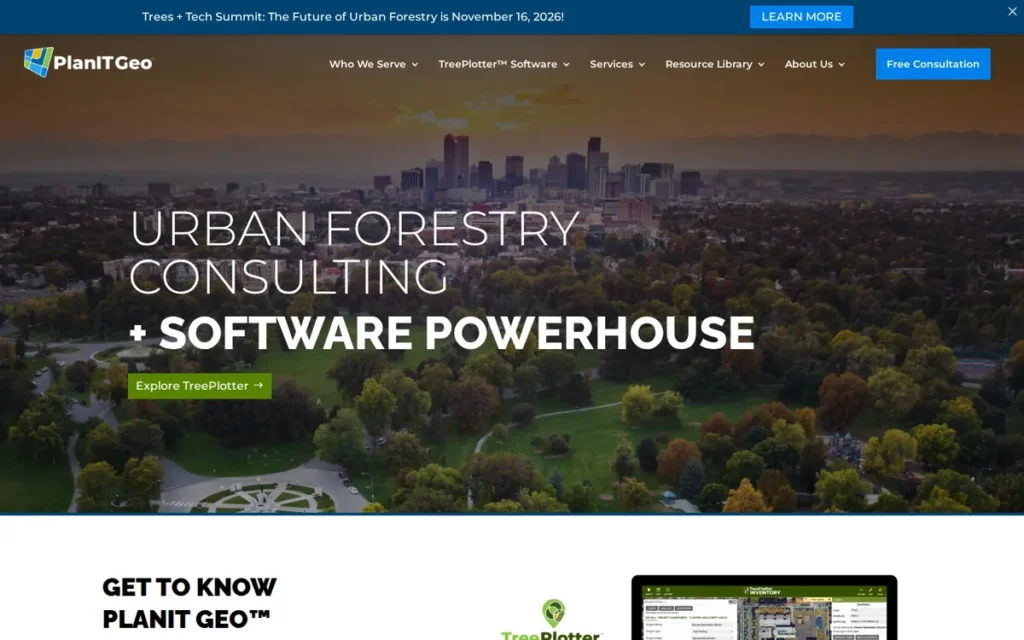
Category: Urban Tree Inventory, map-based software for municipalities, campuses and nonprofits that manage individual trees, inspections and work history.
At a Glance
- Category: Urban Tree Inventory
- Best For: Municipal urban foresters, campus arborists and tree nonprofits managing mapped tree inventories
- Price Range: From $3,500/year with flat-rate annual billing and a free trial (Capterra, accessed November 2026); PlanIT Geo shows package limits but no dollar amounts
- Primary Strength: TreePlotter INVENTORY has the largest independent review base in this evaluation, rated 4.5/5 across 111 Capterra reviews.
- Biggest Limitation: TreePlotter INVENTORY draws reviewer complaints that its price is high compared with similar tools and that it is slow on iOS, and TreePlotter INVENTORY is not built for timberland management.
- One-Line Summary: TreePlotter INVENTORY by PlanIT Geo is a web and mobile urban tree inventory platform with unlimited-user packages, offline field collection and Esri connectivity, rated 4.5/5 across 111 Capterra reviews as of November 2026.
- Last Verified: November 2026
Score: 4.00/5.00 (Workflow 4, Evidence 5, Pricing 4, Data Flow 4, Outcomes 3, Accessibility 3)
Overview
TreePlotter INVENTORY, from PlanIT Geo of Arvada, Colorado, is map-based tree management software for municipal urban foresters, campus arborists and tree nonprofits. Teams use it to inventory individual trees, schedule inspections and work, assess risk and report on their urban forest, with offline mobile collection and Esri connectivity.
PlanIT Geo launched TreePlotter INVENTORY in 2013. TreePlotter INVENTORY supports street tree inventories and urban forest management plan work for clients such as the City of London Corporation, Davis CA, Saskatoon and Princeton University (PlanIT Geo, accessed November 2026).
Key Features
- TreePlotter INVENTORY provides configurable data fields, map editing, dashboards, reports, mass updates, work history, inspections, risk assessment and appraisals.
- TreePlotter INVENTORY lets field crews collect and update tree data on mobile devices offline, and the changes go live once the device reconnects.
- TreePlotter INVENTORY offers unlimited-user packages and APIs for Esri and other enterprise systems.
- TreePlotter CANOPY, a companion product, uses AI and machine-learning canopy data from partner EarthDefine, and PlanIT Geo says TreePlotter CANOPY supports i-Tree ecosystem-benefit estimates and tree-equity scores.
- TreePlotter supports CAVAT appraisal and UK BS5837 workflows, according to PlanIT Geo (PlanIT Geo, 2025).
Best For
TreePlotter INVENTORY is best for cities, campuses and tree nonprofits that need a configurable, GIS-connected street tree inventory with inspections and work history shared across many users. Alternatives to TreePlotter INVENTORY that PlugRoute did not profile in equal depth include ArborNote.
Strengths
- TreePlotter INVENTORY holds a 4.5/5 rating from 111 Capterra reviews (Capterra, accessed November 2026), the largest independent sample of any product in this evaluation.
- TreePlotter INVENTORY reviewers on Capterra praise its customization, fast support response and small learning curve (Capterra, accessed November 2026).
- TreePlotter INVENTORY lists public clients including the City of London Corporation, Idaho Department of Lands, Vancouver WA and Princeton University. That list comes from PlanIT Geo’s client page, and current contract status was not independently verified (PlanIT Geo, accessed November 2026).
- TreePlotter’s developer, PlanIT Geo, also wins full-service city inventory contracts, according to an r/arboriculture thread that names Charlotte, Knoxville and Wilmington (r/arboriculture, 2026).
This aligns with community sentiment on r/gis, where a self-described arborist weighed PlanIT Geo against a DIY GIS build for a city tree inventory:
“PlanItGeo has a nice niche in markets like this. Real arborists doing a real inventory including condition class, good software, good graphics. They have canopy cover % too.” Posted by u/DanoPinyon
Takeaway: Practitioners see TreePlotter’s developer PlanIT Geo as a credible alternative to building a city tree inventory in generic GIS, because it pairs arborist-collected condition data with purpose-built software and canopy analysis.
Limitations
TreePlotter INVENTORY trades timber functionality for urban depth, because TreePlotter INVENTORY manages individual trees rather than stands, cruises or timber sales.
- TreePlotter INVENTORY’s price is “high compared with similar tools,” according to Capterra reviewers, and one reviewer called it “SO SLOW” and poor on iOS (Capterra, accessed November 2026).
- TreePlotter INVENTORY packages cap users and tree counts, from 2 users and 5,000 trees up to unlimited users and 40,000 trees, so growing inventories can be pushed into higher tiers. Billing and invoicing are not included (PlanIT Geo, accessed November 2026).
- TreePlotter INVENTORY’s color-coding and service-request features confused members of the public, according to one Capterra reviewer (Capterra, accessed November 2026).
Verdict
TreePlotter INVENTORY has the largest independent review base of all seven products in this 2026 evaluation, with 111 Capterra reviews at 4.5/5.
TreePlotter INVENTORY ranks third (4.00/5.00) because its i-Tree integration remains unverified and reviewers document performance complaints, which held down its capability and accessibility scores.
Demo checkpoint: Test TreePlotter INVENTORY’s mobile performance on your own iOS and Android devices, and ask PlanIT Geo to show exactly how i-Tree estimates are integrated.
4. ArboStar: Best for Tree-Care and Arborist Business Management
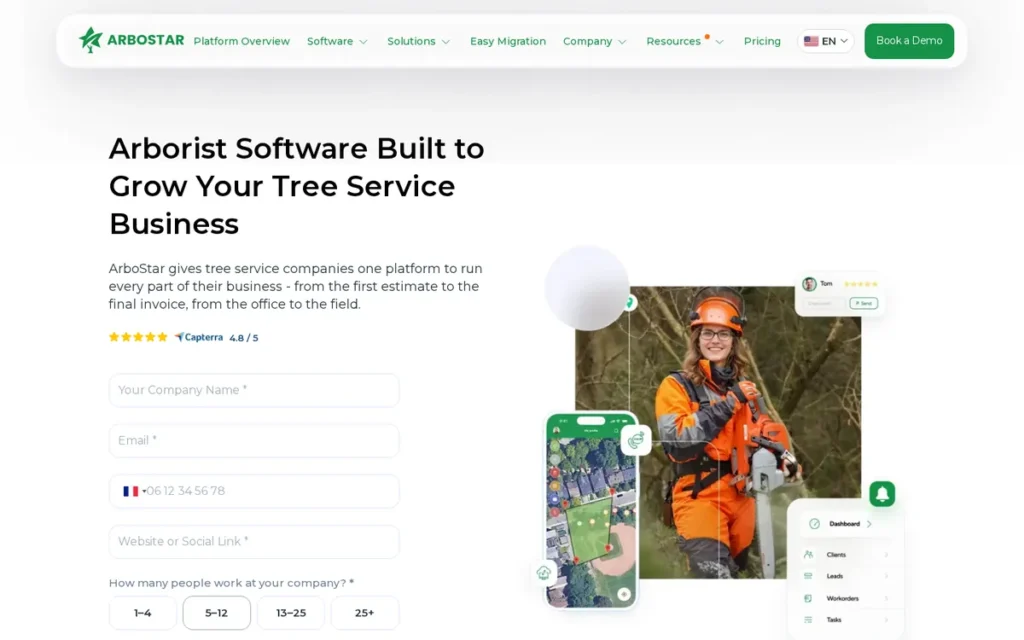
Category: Tree-Care Business Management, all-in-one CRM, estimating, scheduling and invoicing software for commercial arborist companies.
At a Glance
- Category: Tree-Care Business Management
- Best For: Tree-care and arborist service companies that manage estimates, crews, scheduling and invoicing
- Price Range: $149–$249/month billed annually or $199–$332/month billed monthly; Starter includes setup, data migration and training; larger setups by quote (arbostar.com, accessed November 2026)
- Primary Strength: ArboStar holds the highest Capterra rating in this evaluation, 4.8/5 from 47 reviews on the listing, and builds estimates directly on the property map.
- Biggest Limitation: ArboStar’s mobile app lacks the desktop finance, scheduling and mass-email features, and reviewers report frequent minor bugs.
- One-Line Summary: ArboStar is an all-in-one business platform for tree-care companies that builds estimates on the property map, dispatches crews and invoices clients, rated 4.8/5 across 47 Capterra reviews as of November 2026.
- Last Verified: November 2026
Score: 3.75/5.00 (Workflow 4, Evidence 4, Pricing 5, Data Flow 4, Outcomes 1, Accessibility 3)
Overview
ArboStar is all-in-one business management software for tree-care and arborist service companies. It takes work from map-based estimates through scheduled crew jobs to invoices and payments without re-entering data. ArboStar is not designed for timberland cruising or municipal street-tree programs.
PlugRoute included ArboStar because Capterra’s forestry category is dominated by tree-service software, which leads many buyers to confuse arborist business tools with forestry management software.
Key Features
- ArboStar lets estimators build quotes on the property map using preset labor, vehicle and equipment rates, then turns estimates into work orders without re-entry.
- ArboStar records GPS-pinned tree inventory on client property maps, alongside photo-based estimates with e-signature.
- ArboStar provides scheduling and dispatch with live crew GPS, plus a crew app that works offline and syncs later.
- ArboStar includes invoicing, payments, safety forms, time tracking and payroll, and integrates with QuickBooks and Xero.
- ArboStar includes an AI assistant called “RAI,” according to one Reddit commenter, but that post reads as promotional and is unverified (r/arborists, accessed November 2026).
Best For
ArboStar is best for tree-care company owners who want one system for estimating, dispatch, crew management and invoicing, and who can give staff time to learn it. Alternatives to ArboStar that PlugRoute did not profile in equal depth include SingleOps and Arborgold.
Strengths
- ArboStar holds a 4.8/5 rating on Capterra, the highest of any product in this evaluation. The listing shows 47 reviews, and the review page separately reports 45 verified reviews (Capterra, accessed November 2026).
- ArboStar reviewers on Capterra praise scheduling confirmed jobs on a map by location and crew needs, and value that ArboStar is built specifically for tree care (Capterra, accessed November 2026).
- ArboStar reviewers cite responsive support and quick bug fixes (Capterra, accessed November 2026).
- ArboStar publishes plan pricing with license counts and includes setup, data migration and training in Starter (arbostar.com, accessed November 2026), so small companies can budget before a demo.
Limitations
ArboStar trades simplicity for breadth. ArboStar’s large feature set brings a steep learning curve, and one Capterra reviewer quit after a couple of months (Capterra, accessed November 2026).
- ArboStar’s mobile app lacks the desktop finance, scheduling and mass-email features, and reviewers describe bugs that caused “frequent minor disruptions” (Capterra, accessed November 2026).
- ArboStar has no named case studies with quantified outcomes, so PlugRoute found no data on revenue or time savings.
- ArboStar reviewers on Capterra say changing pricing takes too many clicks, which slows estimate updates (Capterra, accessed November 2026).
Verdict
ArboStar holds the highest Capterra rating of all seven products in this 2026 evaluation, 4.8/5 from 47 reviews.
ArboStar ranks fourth (3.75/5.00) because it has no quantified outcome data and documented usability friction. Its outcomes score of 1 is the only score of 1 among the top four products.
Demo checkpoint: Pilot the ArboStar crew app with real field staff, count the clicks needed to change pricing, and ask for references from companies your size before you commit to annual billing.
5. Forest Vegetation Simulator (FVS): Best Free Software for Growth-and-Yield Modeling
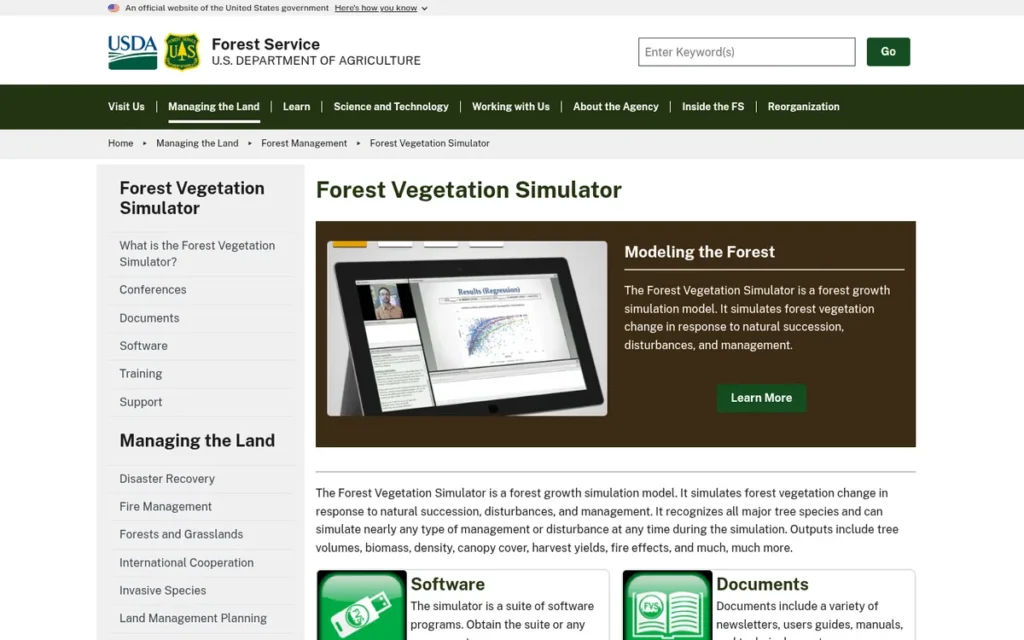
Category: Growth & Yield Modeling, simulators that project stand growth, mortality, treatments and disturbance over time.
At a Glance
- Category: Growth & Yield Modeling
- Best For: Foresters, agencies, researchers and carbon-project developers with analyst skills who need free growth-and-yield projections
- Price Range: Free ($0 software cost; staff time and data preparation are the real costs; USDA Forest Service, accessed November 2026)
- Primary Strength: The Forest Vegetation Simulator has been the National Forest System’s standard growth-and-yield model since the early 1980s and is free, with public source code.
- Biggest Limitation: The Forest Vegetation Simulator requires inventory data converted to FVS-ready format, uses strict fixed-column keyword input, and is not spatially explicit.
- One-Line Summary: The Forest Vegetation Simulator (FVS) is the USDA Forest Service’s free individual-tree growth-and-yield model, with 20 regional variants and a September 30, 2026 release notice confirming active maintenance.
- Last Verified: November 2026
Score: 3.25/5.00 (Workflow 4, Evidence 2, Pricing 5, Data Flow 3, Outcomes 4, Accessibility 1)
Overview
The Forest Vegetation Simulator (FVS) is a free USDA Forest Service growth-and-yield model that projects how forest stands respond to growth, mortality, regeneration, treatments and disturbance over decades. It is built for foresters, agencies, researchers and carbon-project developers who have the analyst skills to prepare FVS-ready inventory data.
The Forest Vegetation Simulator grew out of the Prognosis model, first developed in 1973 for northern Idaho and western Montana. The Forest Vegetation Simulator is moving from quarterly to as-needed releases (USDA Forest Service, 2026).
Key Features
- The Forest Vegetation Simulator is an individual-tree, distance-independent model that projects volume, biomass, density and canopy.
- The Forest Vegetation Simulator offers 20 regional variants, each calibrated for a specific region’s species and growing conditions.
- The Forest Vegetation Simulator includes the Fire and Fuels Extension (fuels, fire behavior, snags, carbon pools), an Economic Extension, and insect and disease models.
- The Forest Vegetation Simulator’s current package has a graphical interface with maps, graphs and tables, plus a browser version built on Shiny, and its source code is public on GitHub.
- The Forest Vegetation Simulator powers Planscape, a free, open-source landscape-planning app that has been used on more than 300 California projects (USDA Forest Service, 2026).
Best For
The Forest Vegetation Simulator is best for skilled analysts, agencies and consultants who need widely accepted stand projections, silvicultural prescription testing or improved forest management (IFM) carbon-project modeling at no license cost. PlugRoute profiled no direct alternative to the Forest Vegetation Simulator in equal depth, and Planscape, which runs on FVS, is a complement rather than an alternative.
Strengths
- The Forest Vegetation Simulator was adopted as the National Forest System’s standard growth-and-yield model in the early 1980s and is used by the Forest Service, BLM, BIA, Washington DNR, industry and universities (USDA Forest Service, Essential FVS, accessed November 2026).
- The Forest Vegetation Simulator is used in carbon project methods under the CARB Compliance Offset Protocol and the Climate Action Reserve. Neither program endorses FVS in general, and acceptance is decided project by project (USDA Forest Service Northern Research Station, GTR-NRS-77, accessed November 2026).
- The Forest Vegetation Simulator has a release notice dated September 30, 2026 that confirms active maintenance (USDA Forest Service, 2026).
- The Forest Vegetation Simulator accepts data exported from Forest Metrix, so a paid cruising app and a free growth model can work together (Forest Metrix, accessed November 2026).
Users on r/forestry recommending a tool to visualize future stand conditions noted:
“Forest Vegetation Simulator (FVS) is an oldie but a good program by the forest service. It has 3D modeling with lots of customizable options for different forest types and management decisions. Best of luck!” Posted by u/OakWoodlandDreams
Takeaway: Foresters still treat FVS as a dependable go-to despite its age, valuing how flexibly it models different forest types and management scenarios.
Limitations
The Forest Vegetation Simulator trades license cost for skill. FVS is free, but inventory has to be converted to FVS-ready format, keyword input uses strict fixed columns, and accuracy depends on validating the right regional variant.
- The Forest Vegetation Simulator is not spatially explicit, and FVS is not a cruising, mapping, accounting or crew tool.
- The Forest Vegetation Simulator has no review-platform presence, and its legacy Suppose interface stopped being maintained in April 2020.
- The Forest Vegetation Simulator’s Canadian variants are built outside the Forest Service and are not supported by it.
Verdict
The Forest Vegetation Simulator is a free growth-and-yield model that has served as the National Forest System standard since the early 1980s.
The Forest Vegetation Simulator ranks fifth (3.25/5.00) because it has the lowest accessibility score in this evaluation and covers only modeling.
Demo checkpoint: Run the Forest Vegetation Simulator’s sample data first, then convert one of your own stand inventories and confirm the regional variant fits your forest before relying on its projections.
6. Remsoft Woodstock: Best for Long-Range Forest Planning and Optimization
Category: Strategic Planning & Optimization, software that recommends multi-period harvest, financial and sustainability plans under constraints.
At a Glance
- Category: Strategic Planning & Optimization
- Best For: Forest planners at large landowners, timber firms and agencies with modeling staff and clean inventory data
- Price Range: Pricing on request; per user (Capterra, accessed November 2026); no public figures
- Primary Strength: Remsoft Woodstock is an optimization environment that recommends actions across timber supply, finance and sustainability, with carbon, biodiversity and wildlife constraints built in.
- Biggest Limitation: Remsoft has no public pricing and no verified independent review rating, and Remsoft Woodstock’s value depends on modeling skills and clean inventory data.
- One-Line Summary: Remsoft Woodstock is an optimization-based forest planning environment that J.D. Irving has used for more than 20 years, with quote-only pricing and no verified independent review rating as of November 2026.
- Last Verified: November 2026
Score: 2.80/5.00 (Workflow 5, Evidence 1, Pricing 1, Data Flow 3, Outcomes 4, Accessibility 2)
Overview
Remsoft Woodstock is an optimization-based forest planning and modeling environment that recommends multi-period harvest plans. Those plans balance timber supply, finances, carbon and sustainability constraints. Remsoft Woodstock is built for planners at large landowners, timber firms and agencies that have in-house modeling staff and clean inventory data.
Remsoft was founded in 1992 in Fredericton, New Brunswick. In 2025, Remsoft received a strategic investment from Banneker Partners, acquired Lim Geomatics and appointed Lim Geomatics founder Kevin Lim as CEO, succeeding co-founder Andrea Feunekes (Remsoft, 2025).
Key Features
- Remsoft Woodstock recommends management actions through optimization, including harvest scheduling and wood supply analysis, rather than only simulating the outcomes of scenarios you choose.
- Remsoft Woodstock builds carbon, biodiversity, wildlife and policy constraints into multi-period plans across timber supply, sustainability and finance.
- Remsoft’s tactical planning product links harvest, road and wood-flow planning, and Remsoft Operations provides a cloud planning platform.
- Remsoft’s carbon management offering claims American Carbon Registry approval, Verra compliance and simulation of new land bases in days instead of months. All three are vendor claims (Remsoft, accessed November 2026).
- Remsoft’s 2025 acquisition of Lim Geomatics added geospatial intelligence, LiDAR and forest-machine telematics to the Remsoft platform, and Remsoft acquired Australian forestry-technology firm Logr in October 2025 (Remsoft, 2025).
Best For
Remsoft Woodstock is best for large landowners and timber firms with in-house planning analysts who need optimized long-range harvest, financial and carbon plans across large land bases. Alternatives to Remsoft Woodstock that PlugRoute did not profile in equal depth include Patchworks, which markets itself as a more visual, spatially explicit planning tool.
Strengths
- Remsoft customer Forico reports 50% faster harvest scheduling and the ability to forecast planning pressures 6–12 months ahead, according to a vendor-published customer story (Remsoft, accessed November 2026).
- Remsoft customer Millar Western reports analysis time cut from weeks to days and “millions in savings,” with no exact figure given (Remsoft, accessed November 2026).
- Remsoft has served J.D. Irving for more than 20 years, and its named customers include Hampton Lumber, American Forest Management and Forestry Tasmania (Remsoft, accessed November 2026).
- Remsoft grew from 54 staff in 2019 to 201–500 employees (LinkedIn, accessed November 2026), partly through its 2025 acquisitions of Lim Geomatics and Logr.
Limitations
Remsoft Woodstock trades accessibility for optimization power, so Remsoft Woodstock’s value depends on in-house modeling skills and clean inventory data.
- Remsoft has no verified independent review rating, so every Remsoft outcome figure is vendor-published, and some archive figures name no client.
- Remsoft doesn’t publish implementation costs, and PlugRoute could not verify Remsoft’s solver licensing or analyst staffing needs.
- Remsoft’s carbon claims, including American Carbon Registry approval and Verra compliance, are vendor statements PlugRoute could not independently verify. Buyers should ask how the 2025 acquisitions affect the Remsoft product roadmap.
Verdict
Remsoft Woodstock is an optimization-based planning platform with the longest documented customer relationship of any product in this 2026 evaluation: more than 20 years with J.D. Irving.
Remsoft Woodstock scored 5 of 5 on workflow depth, tied with the top two products, yet ranks sixth (2.80/5.00) because no independent reviews or prices are public. Publishing pricing alone would lift Remsoft to 3.40, above FVS.
Demo checkpoint: Ask Remsoft for reference calls with customers your size and an itemized quote that separates solver licensing, implementation and training.
7. Trimble Forestry: Best for Enterprise Forest-to-Mill Operations and Harvester Data
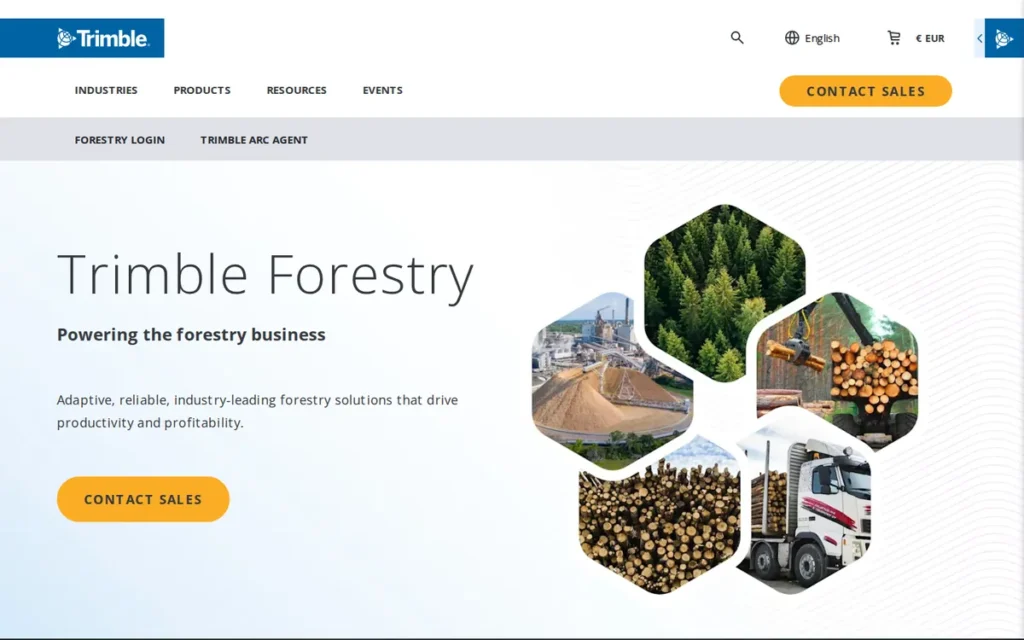
Category: Forest-to-Mill Supply Chain, enterprise suites that link land management, harvesting, logistics and mill log yards.
At a Glance
- Category: Forest-to-Mill Supply Chain
- Best For: Large integrated forest-products companies that run harvester and forwarder fleets and mill log yards
- Price Range: Pricing on request; Software Advice lists Trimble Connected Forest at $150/user/month, an unverified figure that applies to Connected Forest only, not CF Harvest or LIMS (Software Advice, accessed November 2026)
- Primary Strength: Trimble CF Harvest is the only product in this evaluation that documents an onboard harvester and forwarder app supporting StanForD 2010, and Trimble CF Harvest connects to existing machine computers without special hardware.
- Biggest Limitation: Trimble Forestry has the thinnest review evidence in this evaluation, four reviews across two modules, and a third party rates its implementation as moderately to highly complex.
- One-Line Summary: Trimble Forestry is a modular forest-to-mill suite, including CF Harvest, Connected Forest and LIMS, and is the only product in this evaluation documenting an onboard StanForD 2010 harvester app as of November 2026.
- Last Verified: November 2026
Score: 2.70/5.00 (Workflow 4, Evidence 1, Pricing 2, Data Flow 4, Outcomes 2, Accessibility 2)
Overview
Trimble Forestry is a modular enterprise suite, including CF Harvest, Connected Forest and LIMS, for large forest-products companies. Trimble Forestry connects land management, harvest planning, harvester and forwarder data, log transport, and mill log-yard inventory and settlements.
Buyers evaluate specific Trimble Forestry modules, such as CF Harvest or LIMS, rather than a single app. Trimble CF Harvest was formerly sold as WoodForce.
Key Features
- Trimble CF Harvest is web-based harvest management for mixed equipment fleets, with a planning app, an onboard harvester and forwarder app supporting StanForD 2010, and a field app.
- Trimble CF Harvest connects to existing machine computers without special hardware, according to Trimble (Trimble, accessed November 2026).
- Trimble LIMS digitizes load tickets, automates invoicing and settlements, and tracks log-yard inventory by species, sort and form.
- Trimble LIMS supports source-map workflows for the EU Deforestation Regulation (EUDR).
- Trimble Forestry’s logistics products, including LogForce and Logistics Operations, coordinate transport between forest and mill.
Best For
Trimble Forestry is best for large integrated operations that want one vendor across harvesting, machine data, logistics and mill supply, and that have the budget and staff for an enterprise rollout. Alternatives to Trimble Forestry that PlugRoute did not profile in equal depth include John Deere TimberMatic Maps and TimberManager.
Strengths
- Trimble CF Harvest is the only product in this evaluation that documents an onboard StanForD 2010 app. Skogforsk found that support for the standard varies by machine manufacturer and generation (Skogforsk, 2025).
- Trimble Forestry’s Connected Forest helped Binderholz’s Florida mill digitize everything from log intake to production planning, according to Trimble, though no metrics were published (Trimble, 2026).
- Trimble CF Harvest holds 4.3/5 on G2 from 2 reviews (G2, accessed November 2026), and a Capterra reviewer praised Trimble Connected Forest’s flexible reporting, ad hoc queries and documentation (Capterra, review undated, accessed November 2026).
- Trimble Forestry is the only suite in this evaluation that spans harvest management, logistics, mill log-yard inventory, settlements and EUDR traceability.
Limitations
Trimble Forestry trades simplicity for breadth, so buyers must scope and price several Trimble Forestry modules rather than one app.
- Trimble Forestry’s independent feedback totals only four reviews across two modules. Trimble Connected Forest holds 3.0/5 on Capterra from 2 reviews, and its negative review dates from about 2017 (Capterra, accessed November 2026).
- Trimble Forestry’s implementation is rated moderately to highly complex by a third party, and consulting and training cost extra (9cv9, 2026).
- Trimble Forestry publishes no compatibility list by machine model, so buyers have to confirm compatibility themselves.
Verdict
Trimble Forestry spans more jobs than any other product in this 2026 evaluation and is the only one documenting an onboard StanForD 2010 harvester app.
Trimble Forestry ranks seventh (2.70/5.00) because it has the fewest independent reviews and the least pricing transparency measured, not because of weak integration. Its data-flow score of 4 is tied for third-highest.
Demo checkpoint: Ask Trimble for a demo on your own machines, by manufacturer and generation, and for module-level pricing that separates consulting and training.
How Much Does Forestry Software Cost in 2026?
Forestry software in 2026 costs nothing for FVS and $649–$1,299 per year for the Forest Metrix cruising app. Tree-care business software runs $149–$249 per month billed annually, and urban inventory starts at $3,500 per year. Enterprise planning and forest-to-mill suites are quote-only. Only two of the six paid vendors evaluated publish full plan pricing.
| Product | Pricing Status | Documented Price (Verified Nov 2026) | Caveat |
|---|---|---|---|
| Forest Metrix | Published | $59–$119/month; $649–$1,299/year; 14-day free trial | Older Software Advice figures ($800/year Pro, $1,200/year Pro Plus) appear out of date |
| ArboStar | Published | $149–$249/month billed annually; $199–$332/month billed monthly | Larger setups by quote; not every tier visible |
| TreePlotter INVENTORY | Third-party starting price | From $3,500/year (Capterra) | Vendor shows package limits, not dollars |
| Trimble Forestry | Unverified third-party figure | $150/user/month for Connected Forest only (Software Advice) | Not CF Harvest or LIMS pricing; consulting and training extra |
| TRACT | Quote only, model described | Per unit per month, unlimited users (G2) | No dollar figures published |
| Remsoft | Quote only | Per user (Capterra) | Solver and implementation costs unverified |
| FVS | Free | $0 | Costs analyst time and data preparation |
Directory listings show cheaper tools outside this evaluation, which PlugRoute did not profile:
- TwoDog cruising software is listed at $195 one-time (SourceForge, accessed November 2026).
- Logger’s Edge is listed from $135/month (Guideflow, accessed November 2026).
- Arboreal Forest, a LiDAR phone app, costs about $28/month, according to one Reddit user (r/LiDAR, accessed November 2026).
Can Free Tools Like FVS or Planscape Replace Paid Forestry Software?
FVS and Planscape are free. For skilled users, they can replace paid growth-and-yield and landscape-planning software. FVS and Planscape can’t replace field cruising, load accounting or municipal tree inventory software. Free forestry software replaces license fees, not work: you pay in analyst time and data conversion instead.
Free tools cover these jobs:
- The Forest Vegetation Simulator can replace paid growth-and-yield modeling for skilled users who can prepare FVS-ready data, with 20 regional variants and fire, economic and insect extensions.
- Planscape, a free and open-source USDA tool, supports landscape planning using FVS, ForSys and PROMOTe, and Planscape expanded nationwide in 2025 (USDA Forest Service, 2026).
Free tools leave these jobs uncovered:
- FVS does not collect field cruise data, so cruisers still need an app such as Forest Metrix.
- FVS does not track loads or calculate settlements, which TRACT and Trimble LIMS handle.
- FVS does not manage individual urban trees, which TreePlotter INVENTORY handles.
Forest Metrix documents a direct export to FVS, so a Forest Metrix cruise can serve as input to a free FVS projection. Confirm in a test run how much data conversion the export removes for your regional variant.
Will Forestry Software Work With the Machines I Already Run?
Whether forestry software works with your harvesters and forwarders depends on the StanForD 2010 machine-data standard. Support for that standard varies by manufacturer and machine generation (Skogforsk, 2025). Trimble CF Harvest is the only product evaluated that documents an onboard StanForD 2010 app, and no vendor here publishes a compatibility list by machine model.
Remsoft’s 2025 Lim Geomatics acquisition added forest-machine telematics, but PlugRoute did not verify StanForD support for Remsoft. Software from the machine makers themselves (OEM software), such as John Deere TimberMatic Maps and TimberManager, was considered but not profiled.
Skogforsk’s 2025 wood value trial found several compatibility gaps:
- StanForD 2010 support differs across manufacturers, including John Deere and Ponsse, and across machine generations.
- Some manufacturers plan StanForD 2010 v4.1 support in 2026, while others plan it for 2027.
- A machine that supports StanForD 2010 does not necessarily connect directly to any particular business software.
Before buying, ask the vendor for three things:
- Ask the vendor for a live demo on your own machines, identified by manufacturer and generation.
- Ask the vendor for reference customers who run the same equipment mix.
- Ask the vendor to put in writing which StanForD 2010 version and production files the software reads.
What Red Flags Should I Watch For When Evaluating Forestry Software?
PlugRoute’s November 2026 evaluation found six red flags in forestry software, each numbered and tied to evidence below. Each one is a sign that your buying decision may rest on vendor marketing rather than evidence. Check every vendor on your shortlist against all six during demos and reference calls.
Red Flag #1: Pricing Hidden Without a Pricing Model A forestry vendor that publishes no prices makes it hard to rule its product in or out before a sales call. In this evaluation, Remsoft and Trimble publish no figures themselves, and their per-user pricing models come only from third-party listings. TRACT describes its own model but publishes no dollar figures.
Red Flag #2: Ratings Built on Fewer Than 15 Reviews A forestry software rating based on fewer than 15 reviews can shift noticeably with one new review. One new 1-star review would cut Trimble Connected Forest’s Capterra score from 3.0 to about 2.3 and Forest Metrix’s from 4.4 to about 4.2. TreePlotter INVENTORY’s would drop only from 4.5 to about 4.47.
Every timber-focused product evaluated has 14 or fewer reviews, while the urban and arborist tools have 47–111 (Capterra, accessed November 2026).
Red Flag #3: ROI Claims Without a Named Sample Size You can’t judge a forestry software savings claim without a named study and sample size. TRACT’s figures trace to a 2024 University of Georgia comparison of 12 users and 9 non-users (Journal of Forest Business Research, 2024). Some Remsoft archive figures name no client.
Red Flag #4: Claimed Machine Compatibility Without a Model List A forestry vendor that claims to work with your machines but publishes no list of compatible models is asking you to take it on trust. Skogforsk found StanForD 2010 support varies by manufacturer and generation (Skogforsk, 2025), so confirm compatibility on your own equipment.
Red Flag #5: A Mobile App That Lags Behind Desktop A field app that is missing core desktop features or runs slowly will slow crews down in the woods. Reviewers report missing mobile features in ArboStar and in TRACT’s view-only app, and slow iOS performance in TreePlotter INVENTORY (Capterra and G2, accessed November 2026).
Red Flag #6: Urban or Arborist Software Sold as Forestry Management Urban inventory and tree-care business software appear under “forestry” on review sites, but neither manages stands, cruises or timber sales. Capterra’s forestry category is mostly tree-service software, which skews any ranking based on review counts.
“Yes, municipal is tough to get into if you don’t know software. Fix that now.” (u/DanoPinyon, r/arboriculture (Reddit, 2026))
Takeaway: Municipal forestry teams screen hires for software skills, so ease of use and training time are real buying criteria for urban inventory tools.
What Questions Should I Ask Before Choosing Forestry Software?
Ask the seven numbered questions below before you choose forestry software. They test the field, data, cost and reference claims that vendor marketing often skips over. Vendors that answer specifically and in writing usually give you enough to compare products fairly across categories, and vague answers point to gaps you’ll meet later.
Question #1: Does the field app work fully offline, and what must be downloaded beforehand? A good answer names exactly what works offline. Forest Metrix, TRACT, TreePlotter INVENTORY and the ArboStar crew app all document offline collection with later sync (vendor documentation, accessed November 2026). Forest Metrix also requires maps and georeferenced PDFs to be downloaded before fieldwork.
Question #2: Which export formats and accounting or GIS connectors are included in my plan tier? A good answer lists the exact formats and connectors in your tier, such as FVS, Shapefile, GeoJSON, QuickBooks, NetSuite, Xero or Esri. Forest Metrix, for example, limits some exports to higher plans, so confirm tier contents before you sign.
Question #3: Can you demo the software on my own machines and data? A good answer is yes, using your species, log rules, stand data or harvester models. Trimble CF Harvest’s onboard StanForD 2010 app makes an on-machine demo a realistic request. A demo that uses only sample data hides the integration and conversion work you’ll face later.
As one user on r/arborists advised a city choosing street tree management software:
“I’d sit down with the maintenance foreperson and poke around with different second-tier packages and see what the team is comfortable with: do they all look good in the field, do they drop or fail to load, can everyone read the screen, etc.
AFAICT, the 3-5 companies not in the big three are all pretty much the same back end with different work flows, and the team should decide which one is the most tolerable, especially notes and their retrieval.” Posted by u/DanoPinyon
Takeaway: Urban tree inventory platforms differ more in field workflow than in back-end capability, so hands-on trials with the actual field crew should decide the choice.
Question #4: What does implementation cost, and are consulting and training extra? A good answer is an itemized quote with a timeline. TRACT reports 2–4 weeks with no upfront license fee (TRACT, accessed November 2026). Trimble sells consulting and training separately, according to a third-party overview (9cv9, 2026).
Question #5: Which volume equations, log rules and cruise designs are supported? A good answer names specific methods, such as prism plots at any BAF, big BAF, Mesavage & Girard or Clark & Souter. Also confirm which log rules your plan supports, such as Doyle, Scribner or International 1/4-inch, because missing regional methods can make cruise reports useless to your clients.
Question #6: Can I speak with a reference customer of my size? A good answer is a phone call with a customer of similar size and job type. Reference calls matter most for Remsoft Woodstock and Trimble Forestry, because independent reviews of both barely exist, even though both score 4 or higher on workflow depth.
Question #7: How many devices or users does one license cover? A good answer states device and user limits in writing. Forest Metrix allows one active device per license, ArboStar plans include set office and crew logins, TreePlotter INVENTORY packages cap users and trees, and G2 describes TRACT as offering unlimited users.
How Did We Rank These Forestry Software Tools?
PlugRoute ranked these seven forestry software tools on six weighted criteria, using dated public evidence verified in November 2026, and ordered them by total weighted score out of 5.00. The overall rank measures how strong and transparent each product’s evidence is. It does not measure which job category matters most or which product does its own job best.
PlugRoute has no affiliate relationships with any company listed. Rankings are determined entirely by research data and objective evaluation criteria.
Ranking criteria and weights:
- Core Workflow Depth (25%): This criterion measures documented capability for the product’s own job, because buyers need to know a tool covers their main work before booking a demo.
- Independent User Evidence (20%): This criterion combines review ratings with sample size, because forestry reviews are thin. A score of 2 for “institutional adoption” applies only to models adopted as a government standard.
- Pricing Transparency and Accessibility (15%): This criterion rewards published or free pricing, because hidden quotes make budgeting hard.
- Field-to-Office Data Flow (20%): This criterion scores offline capability, export formats, accounting and GIS connectors, machine-data standards and documented friction points.
- Documented Outcomes and Adoption (10%): This criterion scores quantified outcomes and named customers, and gives independent outcomes more weight than vendor-reported ones.
- Implementation Accessibility (10%): This criterion scores rollout timelines, required expertise and learning-curve complaints, because small teams can’t absorb long rollouts.
Full score table (scores 1–5, verified November 2026):
| Rank | Product | C1 Workflow | C2 Evidence | C3 Pricing | C4 Data Flow | C5 Outcomes | C6 Accessibility | Weighted Total |
|---|---|---|---|---|---|---|---|---|
| 1 | Forest Metrix | 5 | 3 | 5 | 5 | 2 | 4 | 4.20 |
| 2 | TRACT | 5 | 4 | 2 | 5 | 4 | 4 | 4.15 |
| 3 | TreePlotter INVENTORY | 4 | 5 | 4 | 4 | 3 | 3 | 4.00 |
| 4 | ArboStar | 4 | 4 | 5 | 4 | 1 | 3 | 3.75 |
| 5 | FVS | 4 | 2 | 5 | 3 | 4 | 1 | 3.25 |
| 6 | Remsoft Woodstock | 5 | 1 | 1 | 3 | 4 | 2 | 2.80 |
| 7 | Trimble Forestry | 4 | 1 | 2 | 4 | 2 | 2 | 2.70 |
Forest Metrix leads TRACT by 0.05 points, and pricing transparency decides the order. A one-point change in TRACT’s pricing score or Forest Metrix’s data-flow score would reverse it, so choose by job, not by rank.
Score rationale for close calls:
- PlugRoute scored TRACT 2 rather than 3 on pricing because TRACT’s own pricing guide and G2 describe its pricing model differently.
- PlugRoute scored Forest Metrix 5 on data flow because its report-template friction affects formatting, not data movement to FVS, GIS or Excel.
- PlugRoute scored Remsoft 1 on independent evidence, below FVS’s 2, because the rubric’s institutional-adoption level applies only to government standard models.
Disclosures:
- PlugRoute chose one product per job category rather than by review volume, because Capterra’s forestry category, sorted by review count, is mostly tree-service software.
- PlugRoute ranks Remsoft and Trimble lower mainly because neither has public pricing and both have almost no independent reviews, not because their capability is weak.
- PlugRoute found almost no product-specific discussion on Reddit. PlugRoute did not quote an r/forestry Forest Metrix thread because only a paraphrased summary was available.
- PlugRoute resolved conflicting sources by giving official vendor pages priority over older directory listings.
Considered but not profiled (not researched in equal depth; flagged for future updates):
- PlugRoute considered the cruising tools USFS FScruiser and the National Cruise System, TCruise/TCruiseX, MobileMap Cruise, Arboreal Forest and TwoDog.
- PlugRoute considered the tree-care and urban tools SingleOps, Arborgold and ArborNote.
- PlugRoute considered Logger’s Edge, Forestree, Patchworks, and John Deere TimberMatic Maps and TimberManager.
What Do Forestry Software Buyers Ask Most Often?
The questions forestry software buyers ask most often are which tool suits consulting foresters, how to choose software for a timber business, and how independent rankings are decided. The short answers below each work on their own and are based on PlugRoute’s November 2026 evaluation of seven forestry software products.
What is the best forestry management software for consulting foresters in 2026?
For consulting foresters in 2026, PlugRoute’s evaluation points to Forest Metrix for offline cruising ($649–$1,299 per year, verified November 2026), paired with the free Forest Vegetation Simulator for growth projections. Consultants who also buy or sell timber should evaluate a settlement tool such as TRACT. Cruising alternatives such as FScruiser and TCruise were not profiled in equal depth.
How do I choose forestry software for a timber business?
Choose timber business software by tracing one real load from woods to settlement. The tool should capture loads offline, reconcile them against mill scale tickets, calculate stumpage and contractor pay, and post to your accounting system. In PlugRoute’s 2026 evaluation, TRACT documents that full chain, and Trimble LIMS covers mill-side tickets and settlements for larger integrated operations.
How does PlugRoute determine its forestry software rankings?
PlugRoute scores each forestry software product from 1 to 5 on six weighted criteria using dated public evidence verified in November 2026. PlugRoute weights workflow depth at 25%, independent user evidence and field-to-office data flow at 20% each, pricing transparency at 15%, and outcomes and implementation accessibility at 10% each, then ranks products by weighted total.
What Do Key Forestry Software Terms Mean?
Forestry software buyers need about a dozen terms to compare products, from field cruising through to mill-side compliance. Each definition below explains one term in plain language and why it matters when you evaluate vendors, so you can follow demos, read pricing pages and ask sharper questions without relying on vendor explanations.
Timber cruise: A timber cruise is a field survey that samples trees to estimate the volume and value of timber on a property. Cruise software determines how quickly that data becomes a report a client or buyer can use.
Basal area factor (BAF): A basal area factor is the multiplier that turns the trees counted with a prism into basal area per acre. Cruising tools that support any BAF let foresters match their usual field methods.
Big BAF (double sampling): Big BAF is a cruise design that counts trees with one prism but measures only a subset with a larger factor, which saves field time. Buyers who use this method should confirm their software supports it.
Stumpage: Stumpage is the price paid to a landowner for standing timber. Settlement software calculates stumpage from contract terms, so accurate contract setup directly affects landowner payments.
Settlement: A settlement is the calculation and payment of what each party (landowner, logger, hauler) is owed for delivered loads. Automated settlements reduce manual reconciliation and payment errors.
Scale ticket: A scale ticket is the mill’s record of a delivered load, including weight, species and grade. Software that reads scale tickets and checks them against recorded loads helps catch discrepancies.
Growth-and-yield model: A growth-and-yield model projects how a forest stand will grow, die back and respond to treatments over time. Buyers use these projections for harvest timing, valuation and carbon work.
Regional variant: A regional variant is a version of a growth model calibrated for a specific region’s species and conditions. Choosing the wrong variant can make projections inaccurate.
StanForD 2010: StanForD 2010 is the standard data format that harvesters and forwarders use to record and share production data. Support differs by manufacturer and machine generation, so buyers should confirm it on their own equipment.
Offline sync: Offline sync means a field app stores data on the device without a connection and uploads it once back in coverage. Field crews in remote woods depend on offline sync to avoid losing data.
TIMO: A TIMO (timberland investment management organization) manages timberland on behalf of investors. TIMOs typically need multi-property reporting and depletion tracking from their software.
EUDR: The EUDR (EU Deforestation Regulation) requires companies to trace certain wood products back to where they were sourced. Exporters selling into the EU may need software that supports source-mapping workflows.
Which Forestry Software Is Right for You?
Key Insights
- The right forestry software is the one built for your main job, because cruising, settlements, urban inventory, tree-care, modeling, planning and forest-to-mill tools are not interchangeable. In this guide, a lower overall rank reflects thinner public evidence, not weaker capability at that job.
- Forest Metrix and ArboStar are the only paid vendors in this evaluation that publish full plan pricing, verified November 2026, and FVS is free.
- TreePlotter INVENTORY has the deepest independent review base in this evaluation, with 111 Capterra reviews at 4.5/5.
- TRACT’s headline savings rest on a 2024 University of Georgia comparison of 12 users and 9 non-users, so treat them as a guide rather than a guarantee.
- The Forest Vegetation Simulator works alongside paid tools rather than replacing them, because FVS models growth but doesn’t collect, map or account for data.
- Remsoft Woodstock and Trimble Forestry buyers should insist on reference calls, because independent reviews of these enterprise suites barely exist despite strong workflow-depth scores.
Use this job list to pick your first demo:
- Consulting foresters and cruisers should start with Forest Metrix and test their own volume rules.
- Timber dealers and procurement teams should demo TRACT with one real load-to-settlement transaction.
- Municipal and campus teams should test TreePlotter INVENTORY on their own iOS and Android devices.
- Tree-care companies should pilot ArboStar’s crew app with field staff.
- Analysts with no license budget should start with FVS sample data, then one of their own stands.
- Large-landowner planners should request an itemized Remsoft Woodstock quote and reference calls.
- Integrated operations with harvester fleets should demo Trimble Forestry on their own machines.
PlugRoute will update these rankings as more reviews and pricing become public. We update this guide quarterly. Last updated: November 2026. Read PlugRoute’s full scoring methodology and other independent software reviews on PlugRoute.