Farmbrite is the best farm management software for small diversified crop-and-livestock farms in 2026, AgriWebb is best for commercial cattle and sheep grazing, and Bushel Farm is best for grain farms tracking field-level profit. No single tool fits every operation, so match software to your farm type, equipment and full annual cost.
Generic rankings mix tools that solve very different problems, so this guide routes you by farm type. Climate FieldView fits mixed-brand row-crop fleets, and John Deere Operations Center fits Deere fleets. Conservis serves multi-entity enterprises. For small farms on tight budgets, farmOS is free and open-source.
PlugRoute has no affiliate relationships with any company listed, and rankings are determined entirely by research data and objective evaluation criteria.
Pricing is the second trap. Each vendor picks its own billing unit, and hardware, add-ons and setup fees often sit outside the headline price, so this guide shows a realistic first-year total for every tool.
Last updated: November 12, 2026. Prices and ratings verified November 2026.
What Are the 6 Categories of Farm Management Software?
Farm management software falls into six categories in 2026: all-in-one farm managers, livestock and grazing specialists, grain profitability tools, precision row-crop platforms, open-source records systems and enterprise farm ERPs. Each category solves a different core problem, so a tool that scores well in one can still be a poor fit for your farm.
The seven ranked products fall into these categories:
- All-in-One Farm Manager: Farmbrite covers crops, multi-species livestock, inventory and bookkeeping in one subscription.
- Livestock and Grazing Specialist: AgriWebb is built around animal records, paddock management and livestock compliance.
- Grain Profitability Tool: Bushel Farm focuses on field-level profit and loss, grain inventory and contract tracking.
- Precision Row-Crop Platform: Climate FieldView and John Deere Operations Center capture and analyze machine, planting, application and yield data.
- Open-Source Records System: farmOS is free, self-hostable record-keeping software that the farm configures and controls.
- Enterprise Farm ERP: Conservis handles budgeting, cost of production and multi-entity reporting for large operations.
Adoption data shows why fit by category matters more than overall popularity:
- About 27% of US farms used at least one precision-ag practice in 2023 (GAO, 2024).
- About 68% of large crop farms use information-generating precision-ag tools such as yield monitors and soil maps, compared with about 13% of small farms (USDA ERS EIB-283, 2023).
- US farmers report 61% adoption of digital agronomy tools and 51% adoption of precision-ag hardware (McKinsey, 2024).
- Analyst estimates of the 2025 farm management software market range from $2.91 billion (Mordor Intelligence, 2025) to $4.8 billion (Grand View Research, 2025), with forecast growth of about 11–20% a year.
Users on r/FarmingUK described the same scale gap:
“I’m sure there are folk who farm 20,000 acres of Lincolnshire and have every possible piece of infrastructure and machinery and software; but there’s still a lot of smaller farms, especially upland, where it’s one 70-year-old and a landrover and a few acres strewn with empty Crystalyx buckets, he struggles to fill in the RPA forms (which went online about 20 years after every other industry), the sheep figure out the important things for themselves anyway…” Posted by u/Useless_or_inept
Takeaway: Farm management software use is concentrated on large, heavily mechanized operations, while many small farms still struggle with basic digital record-keeping.
How Do the Top Farm Management Software Tools Compare at a Glance?
Farmbrite leads this ranking with a weighted score of 3.93/5, followed by AgriWebb (3.70) and Bushel Farm (3.48). The table below gives each product’s category, best-fit audience, core capabilities, main strength and key limitation, so you can shortlist tools by farm type before you read the full entries.
| Rank | Company | Category | Best For | One-Line Summary | Key Capabilities | Primary Strength | Key Limitation |
|---|---|---|---|---|---|---|---|
| 1 | Farmbrite | All-in-One | Small diversified crop + livestock farms | Farmbrite is the most complete single system in this ranking for small diversified farms that manage both crops and livestock, with vendor pricing from $29/month in 2026. | Crop plans, multi-species livestock, bookkeeping, inventory, 100+ reports | Covers crops, livestock and finances in one product | No machine-data connection; plan names vary across sources |
| 2 | AgriWebb | Livestock | Commercial cattle and sheep grazing | AgriWebb is a livestock-first platform for commercial cattle and sheep grazing operations in 2026, with offline paddock records and scale and EID integrations. | EID and mob records, paddock maps, grazing planner, compliance | Offline capture documented by the vendor and a case study | Weak on crops; accounting integration limited to AU/NZ |
| 3 | Bushel Farm | Grain | Grain farms tracking profit and contracts | Bushel Farm is the most price-transparent farm management tool for grain operations in this ranking (2026). | Field P&L, grain inventory, auto-entered contracts, imagery | Fully published pricing, including add-ons | No livestock; machine data costs $999/yr extra |
| 4 | Climate FieldView | Precision | Mixed-brand row-crop fleets | Climate FieldView is a brand-neutral precision agronomy platform with the broadest documented cross-brand data import in this ranking, a free tier and Plus plans from $649/year (2026). | Cross-brand data capture, yield maps, imagery, Seed Scripts | Broadest documented cross-brand data import | Bayer ownership raises data-use questions; Google Play 3.3/5 |
| 5 | farmOS | Open-Source | Budget, organic, data-control-first farms | farmOS is a free, open-source (GPL) farm records platform in active development since 2014, for farms that put data ownership and low cost first. | Logs and assets, maps, JSON:API, Field Kit offline app | GPL license and full data control | No accounting; setup takes technical effort |
| 6 | John Deere Operations Center | Precision | Deere-equipped row-crop farms | John Deere Operations Center is a free data platform built for Deere-equipped row-crop farms (2026) that works best on Deere machines. | Work Planner, JDLink telematics, Field Analyzer, APIs | Closed loop from job plan to machine to field record | Google Play 2.8/5; fewer functions on non-Deere machines |
| 7 | Conservis | ERP | Multi-entity enterprises of 5,000+ acres | Conservis is an enterprise farm ERP with the deepest cost-per-acre and cost-per-bushel reporting in this ranking, at quote-only prices (2026). | Budgeting, work orders, bin-level grain, multi-entity reports | Deepest cost-of-production reporting | Quote-only pricing; owners changed in 2021 and 2023 |
Which Farm Management Software Should I Choose for My Farm Type?
Choose farm management software by your most important need in 2026: Farmbrite for mixed crop-and-livestock farms, AgriWebb for grazing, Bushel Farm for grain profit, Climate FieldView for mixed fleets, John Deere Operations Center for Deere fleets, farmOS for low budgets and data control, and Conservis for multi-entity enterprises.
Find your top priority in the left column. The alternative column gives the next-best fit.
| Your #1 Priority | Recommended Tool | Why | Acceptable Alternative |
|---|---|---|---|
| I raise crops and livestock | Farmbrite | The only commercial tool ranked here that natively covers both | farmOS |
| I run a commercial cattle or sheep grazing operation | AgriWebb | Offline paddock records, grazing planner, scale and EID integrations | Farmbrite (smaller herds) or CattleMax/HerdBoss (not fully evaluated) |
| I grow grain and want field-level profit and contracts | Bushel Farm | Field P&L plus contracts auto-entered from Bushel Network buyers | Conservis (large farms) |
| I run mixed equipment brands | Climate FieldView | FieldView Drive captures data across most major equipment brands | John Deere Operations Center |
| My fleet is mostly Deere | John Deere Operations Center | Jobs and records move between Deere displays and the cloud automatically | Climate FieldView |
| I run a small farm on a tight budget | farmOS | $0 license; hosting from $75/year | Farmbrite Essentials |
| I farm organically or want full data control | farmOS | GPL code and an open JSON:API | Farmbrite |
| I run 5,000+ acres across several entities | Conservis | Multi-entity and cost-per-bushel reporting | Bushel Farm |
As one user on r/farming described:
“Pen and paper always works.
It depends on how much you’re farming. I’m at 1000 acres and can manage by just using memory. How much storage and what stages my fields are in. Maintenance on equipment. So on so forth.
But anything you need to remember from year to year ex. Seeding dates/rates, chem apps. Stuff like that. Write it down. I have a book in each piece of equipment for this.
If your at 3000+ ac you might want to look at some sort of program. Unless you can’t remember anything lol.” Posted by u/xxrenslipxx
Takeaway: Farm size and record complexity decide whether farm management software pays off, and some 1,000-acre operators still run on memory and logbooks in each machine.
What Are the 7 Best Farm Management Software Tools in 2026?
By weighted PlugRoute score, the seven best farm management software tools in 2026 are Farmbrite (3.93), AgriWebb (3.70), Bushel Farm (3.48), Climate FieldView (3.15), farmOS (3.13), John Deere Operations Center (2.90) and Conservis (2.83). A lower-ranked tool can still be the best fit for its own segment.
Every entry below uses the same structure, so you can compare entries directly.
1. Farmbrite: Best Overall for Small and Diversified Crop-and-Livestock Farms
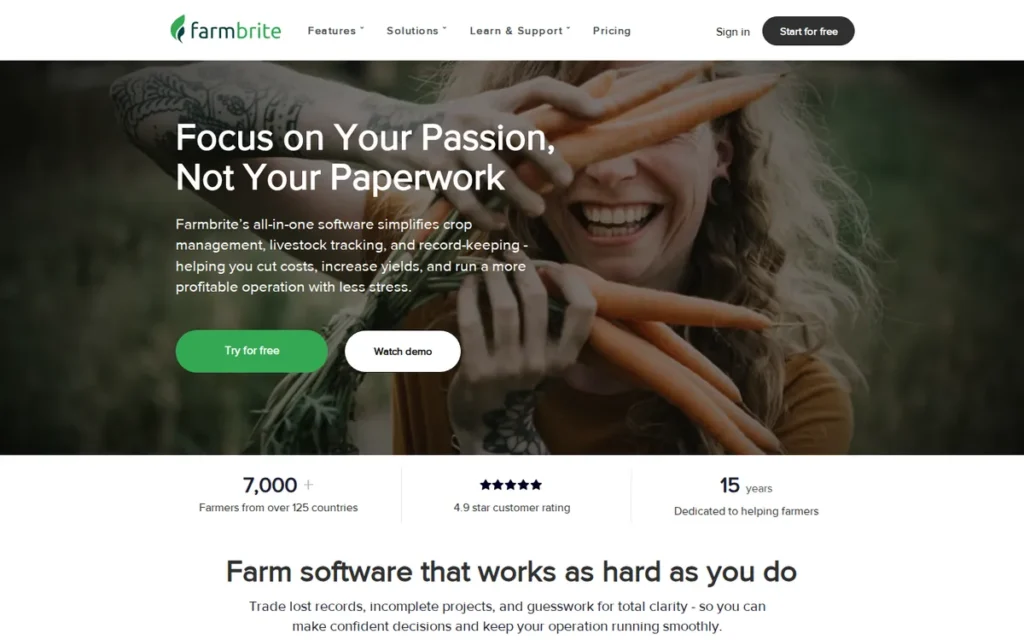
Category: All-in-One Farm Manager. One subscription covers crops, livestock, inventory and farm finances for diversified operations.
PlugRoute score: 3.93/5. Farmbrite leads on C1 whole-farm scope (4.5) and ties AgriWebb on C3 verified reputation (4.5). Farmbrite trails on C4 interoperability (3.0) and C6 vendor stability (3.0).
At a Glance
- Category: All-in-One Farm Manager
- Best For: Small and midsize diversified farms that raise livestock and grow crops and want one system instead of spreadsheets
- Price Range: $29–$79/month on vendor livestock tiers ($290–$790/year); third-party listings show combined plans up to about $109/month; 14-day free trial (2026)
- Primary Strength: Farmbrite combines crop records, multi-species livestock management and built-in bookkeeping in one platform.
- Biggest Limitation: Farmbrite has no native precision-ag or machine-data connection, and its plan names and prices differ across sources.
- One-Line Summary: Farmbrite is the most complete single system in this ranking for small diversified farms that manage both crops and livestock, with vendor pricing from $29 per month in 2026.
- Last Verified: November 2026
Overview
Farmbrite is an all-in-one farm management platform that combines crop planning, multi-species livestock records, inventory, bookkeeping and direct sales in one subscription. It is built for small and midsize diversified farms that want to replace spreadsheets and paper records with a single system.
Farmbrite says it serves 7,000+ farmers in 125+ countries (Farmbrite, 2026, vendor claim). Farmbrite is the only commercial tool in this ranking that natively covers both crops and livestock.
Farmbrite does not connect to tractor, GPS or yield-monitor machine data.
Key Features
- Farmbrite tracks multi-species livestock, including breeding, lineage, weights, treatments, grazing and profit per animal.
- Farmbrite keeps crop planning and harvest records in the same account as livestock data, along with inventory across multiple locations and equipment records.
- Farmbrite provides income and expense bookkeeping with a chart of accounts, plus customer orders, invoices, direct-sales tracking and more than 100 built-in reports.
- Farmbrite’s own documentation describes offline mobile capture of scouting notes, tasks, activity logs and treatments, which sync when signal returns (Farmbrite, 2026).
- Farmbrite supports data export and integrations through an open API and Zapier (5,000+ apps), but a native QuickBooks integration and a full-account export format were not verified as of November 2026.
Best For
Farmbrite is best for small and midsize diversified farms and direct-to-consumer producers, from homestead to commercial scale, that raise animals, grow crops and want records, inventory and basic finances in one place.
Pricing
Farmbrite’s livestock tiers cost $29, $49 and $79 per month ($290, $490 and $790 per year) on its pricing page (Farmbrite, 2026). Tier names and limits vary across listings:
- Farmbrite’s earlier pricing snapshot named the tiers Livestock Essentials (300 active animals, 5 users), Livestock Plus (500 animals, unlimited users) and Livestock Premium, while the current page reportedly uses Essentials, Performance and Advanced (Farmbrite, 2026).
- Third-party listings show Farmbrite crop plans from $29/month, Crop + Livestock Complete from $59 to about $109/month, and Accounting Only at $119/year (Capterra, 2026).
- Farmbrite is running a 25% sign-up discount through November 30, 2026, so renewal prices may be higher than first-year prices (Farmbrite, 2026).
Farmbrite’s 14-day free trial doesn’t require a credit card. Confirm current tiers on the vendor page.
Strengths
- Farmbrite holds 4.8/5 from 63 reviews on Capterra Australia (Capterra, 2026) and 4.7/5 from 15 reviews on G2, a small sample (G2, 2026), which gives it the best-sampled B2B ratings in this ranking.
- Farmbrite is the only commercial product in this evaluation that natively covers both crop planning and multi-species livestock, which fills the gap that row-crop and grazing specialists leave.
- Farmbrite publishes monthly and annual prices for each tier (Farmbrite, 2026), so small farms can estimate annual cost before they sign up.
- Farmbrite reviewers on Capterra say the software keeps land, equipment, accounting, animals and costs in one place and cuts record-keeping errors (Capterra, 2026).
Limitations
Farmbrite gives up depth for breadth. Farmbrite has no native connection to John Deere, Trimble or other precision-ag machine data, so GPS-dependent row-crop farms will need a second platform such as Climate FieldView or John Deere Operations Center.
- Farmbrite’s plan names and prices differ across sources, and the current sign-up discount means first-year cost may understate renewal cost (Farmbrite, 2026).
- Farmbrite is cloud-based, not a standalone desktop install, so test which features work offline in your weakest-signal field during the trial.
- Farmbrite reviewers on G2 call navigation “cumbersome” and ask for stronger accounting and operational reports (G2, 2026).
- Farmbrite reviewers on GetApp want deeper features for specific crops or species (GetApp, 2026), and we found no Reddit discussion of Farmbrite, so there is little peer feedback outside review platforms.
Verdict
Farmbrite is the best single system in 2026 for small and diversified farms that need crop records, livestock management and bookkeeping in one subscription. Farmbrite ranks first because of its scope and verified ratings, not because it wins every criterion. Grazing operations should also look at AgriWebb, and machine-data farms should look at Climate FieldView or John Deere Operations Center. Confirm current plan names during the free trial.
2. AgriWebb: Best for Commercial Cattle and Sheep Grazing Operations
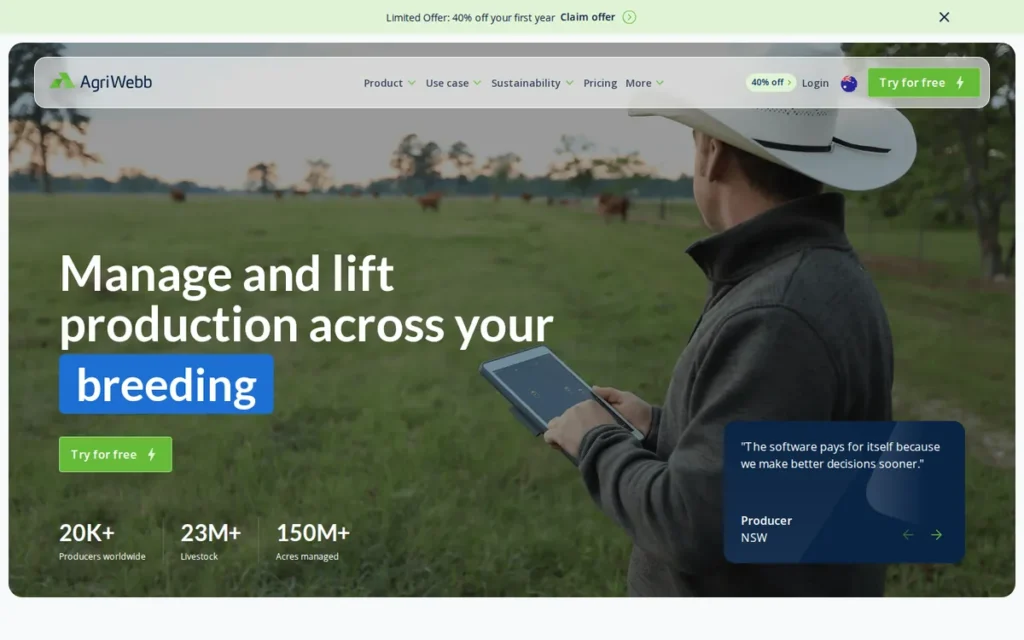
Category: Livestock and Grazing Specialist. The software is built around animal records, pasture management and livestock compliance.
PlugRoute score: 3.70/5. AgriWebb leads on C5 field usability (4.5) and ties for the top C6 vendor stability score (4.0). AgriWebb trails Farmbrite by 0.23 points, mainly on C1 scope (3.0 vs 4.5) and C2 pricing transparency (3.0 vs 4.0).
At a Glance
- Category: Livestock and Grazing Specialist
- Best For: Commercial cattle and sheep ranches that run rotational grazing with staff in the field
- Price Range: A$34–A$61.20/month in Australia (up to 400 DSE); US priced by herd-size calculator (2026)
- Primary Strength: AgriWebb has the deepest grazing, paddock and livestock-compliance tools in this ranking, with offline capture documented in both vendor material and a published case study.
- Biggest Limitation: AgriWebb is weak on crops, and its only accounting integration (Figured) is one-way and limited to Australia and New Zealand.
- One-Line Summary: AgriWebb is a livestock-first platform for commercial cattle and sheep grazing operations in 2026, with offline paddock records and integrations with scales and EID readers.
- Last Verified: November 2026
Overview
AgriWebb is livestock-first farm management software for commercial cattle and sheep operations. It combines individual and mob animal records, paddock mapping, rotational grazing planning, compliance tracking and gross-margin analysis in an offline-first mobile app built for use in the paddock.
AgriWebb was founded in Sydney in 2014 and prices its plans by livestock numbers. AgriWebb says it serves 20,000+ producers managing 23 million+ livestock across 150 million+ acres (AgriWebb, 2026, vendor claim).
AgriWebb is not designed for crop-heavy farms.
Key Features
- AgriWebb records livestock individually by EID and by mob, including treatments and withholding periods, for herd management and traceability.
- AgriWebb provides drag-and-drop paddock maps, a rotational grazing planner, and calculators for feed on offer and stocking rate.
- AgriWebb integrates with livestock hardware from Gallagher, Tru-Test, Allflex, Shearwell, Farmbot and CiboLabs (PIRSA, 2026).
- AgriWebb includes staff task assignment, gross-margin analysis and NLIS and LPA compliance tools for Australian producers, so US buyers should confirm which traceability features apply in their region.
- AgriWebb’s data export format was not verified as of November 2026, so ask for the export file types before you sign.
Best For
AgriWebb is best for commercial cattle and sheep ranches with several hundred to several thousand head that run rotational grazing across many paddocks and need staff to capture records offline.
Pricing
AgriWebb’s price rises with herd size. Australian pricing covers up to 400 DSE, about 50 cattle or 267 sheep, and excludes GST (SoftwareHQ, 2026):
- AgriWebb Essentials costs A$34/month or A$340/year.
- AgriWebb Compliance costs A$47.60/month or A$476/year.
- AgriWebb Performance costs A$61.20/month or A$612/year.
AgriWebb’s US plans (Essentials, Essentials+ and Performance) are priced by a calculator from your 12-month average livestock numbers (AgriWebb, 2026). AgriWebb’s help center lists the Grazing Planning add-on at $150 per year or $15 per month per organization (AgriWebb, 2026).
AgriWebb counts a cow as 8 DSE and a sheep as 1.5 DSE, so a 200-cow herd equals about 1,600 DSE, four times the 400-DSE level in Australian list prices (AgriWebb, 2026). A third-party listing reports US plans from about $79 per month (Softwr, 2026), which we could not verify.
Strengths
- AgriWebb holds 4.5/5 from 598 Apple App Store ratings in Australia (Apple App Store, 2026), the largest positive app-store sample in this ranking.
- AgriWebb is the only product in this ranking with offline capture documented in both vendor material and a published case study (CaseStudies.com, 2026).
- AgriWebb has named customers in vendor-published case studies, including Wray Cattle Co. in Colorado (nearly 1,000 cattle on 10,000 acres) and Burrawang West Station (4,000 sheep across 81 paddocks) (AgriWebb, 2026).
- AgriWebb has a documented funding history: an A$14M Series A in 2018 and a 2021 Series B led by TELUS Ventures, later extended to A$40M (SmartCompany, 2021).
Limitations
AgriWebb gives up crop and accounting depth to specialize in livestock. AgriWebb’s only accounting integration, Figured, is one-way and limited to Australia and New Zealand, so US ranches will need separate bookkeeping software (AgriERP, 2026).
- AgriWebb’s iOS app must stay open with the screen on while it syncs (AgriWebb, 2026), and reports aren’t available in the mobile app (AgriERP, 2026).
- AgriWebb doesn’t publish a US per-head rate, so the annual cost depends on the calculator, your average herd size and any paid add-ons.
- AgriWebb’s US App Store sample is small (4.3/5 from 15 ratings) and G2 shows conflicting figures (Apple App Store, 2026), so most of the review evidence comes from Australian users.
Verdict
AgriWebb is the best farm management software in 2026 for commercial cattle and sheep operations that run rotational grazing and need reliable offline records in the paddock. AgriWebb leads this ranking on field usability and livestock hardware integration. Mixed crop farms and US ranches that need integrated accounting should pair AgriWebb with bookkeeping software or consider Farmbrite. Run your herd through the US calculator before committing.
3. Bushel Farm: Best for Grain Farms Tracking Field-Level Profit and Contracts
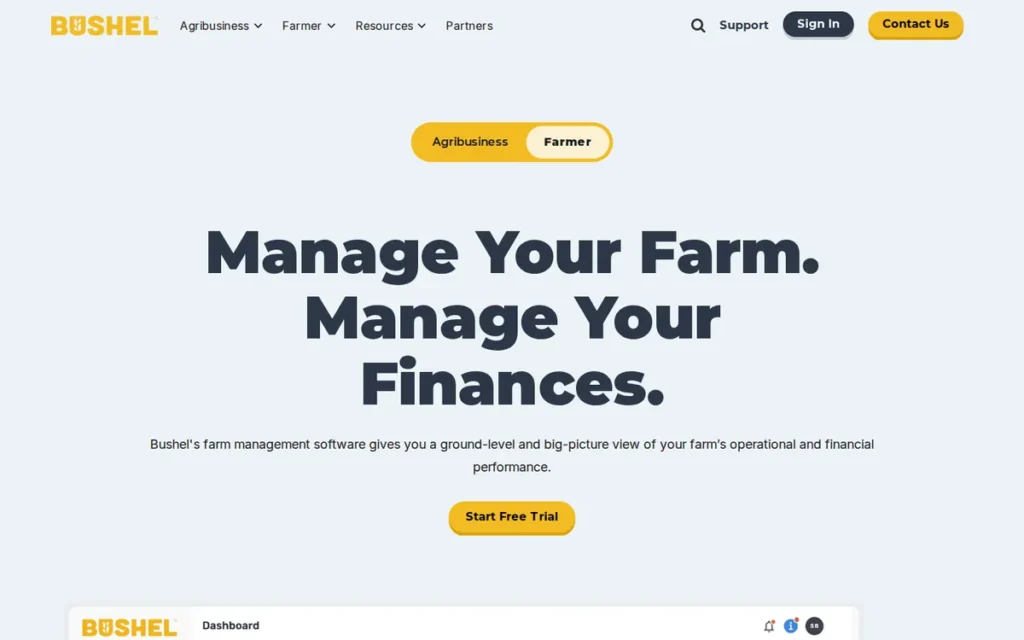
Category: Grain Profitability Tool. This row-crop records software focuses on field-level profit, grain inventory and marketing.
PlugRoute score: 3.48/5. Bushel Farm earned the only perfect C2 pricing transparency score (5.0) in this ranking, and that score puts it above the precision platforms. Bushel Farm trails on C5 offline access (2.5) and C1 scope (3.0).
At a Glance
- Category: Grain Profitability Tool
- Best For: Corn, soybean and wheat farms that want field-level profit and loss and automated grain contract tracking
- Price Range: $75–$599/year; about $1,598/year with the $999 Machine Data Connections add-on (2026)
- Primary Strength: Bushel Farm publishes the most transparent pricing of any row-crop tool in this ranking and enters grain contracts automatically from Bushel Network buyers.
- Biggest Limitation: Bushel Farm has no livestock support, and connecting Deere or FieldView machine data costs an extra $999/year.
- One-Line Summary: Bushel Farm is the most price-transparent farm management tool for grain operations in 2026, combining field-level profit and loss with automated contract tracking from a reported 3,500+ grain facilities.
- Last Verified: November 2026
Overview
Bushel Farm, formerly FarmLogs, is row-crop farm management software for grain operations. It combines field records, satellite imagery, field-level profit and loss, grain inventory and contract tracking, and it enters contracts automatically from grain buyers on the Bushel Network.
Bushel acquired FarmLogs in June 2021 and renamed the product Bushel Farm in March 2023 (Bushel, 2023). Bushel Farm specializes in row crops and isn’t built for livestock or diversified farms.
Key Features
- Bushel Farm calculates profit and loss for each field, including land costs, cost per acre, grain inventory and marketing position.
- Bushel Farm enters grain contracts automatically from Bushel Network buyers and shows local cash and futures prices.
- Bushel Farm keeps field records and maps with rainfall and heat history, satellite imagery and scouting notes, and its Essentials plan adds work orders and farm reports.
- Bushel Farm’s Machine Data Connections add-on imports field data from John Deere Operations Center and Climate FieldView (AgWeb, 2026).
- Bushel Farm’s data export format was not verified as of November 2026, so ask how field history and contracts can be exported.
Best For
Bushel Farm is best for corn, soybean and wheat growers who sell to Bushel Network grain buyers and want affordable profit and marketing tracking by field without buying enterprise software.
Pricing
Bushel Farm publishes official annual pricing (Bushel, 2026):
- Bushel Farm Rainfall costs $75/year.
- Bushel Farm Lite costs $199/year for up to 20,000 acres and includes rain and heat history, automated contracts and a digital wallet.
- Bushel Farm Essentials costs $599/year and includes profit and loss, work orders, marketing, imagery and reports.
- Bushel Farm’s Machine Data Connections add-on costs $999/year.
With machine data, Bushel Farm Essentials comes to about $1,598/year (2026). In-app prices on the App Store ($19.99 Lite, $59.99 Essentials) don’t state a billing period, and a third-party report of a 30-day trial is unverified.
Strengths
- Bushel Farm publishes every tier, acreage cap and add-on price on its official pricing page (Bushel, 2026), the most transparent pricing among the row-crop tools in this ranking.
- Bushel Farm enters grain contracts automatically from Bushel Network buyers, which are reported at more than 3,500 facilities (Intelligent Acre, 2026), so farmers don’t have to track contracts by hand.
- Bushel Farm imports machine data from both John Deere Operations Center and Climate FieldView through its add-on (AgWeb, 2026), so it works alongside either precision platform.
- Bushel Farm averages about 4.2/5 across 21 combined G2 and Capterra reviews, a small sample (rfp.wiki, 2026), and App Store reviewers praise its simplicity and rainfall history.
Limitations
Bushel Farm gives up breadth to focus on grain marketing. Bushel Farm has no livestock support, and its accounting is lighter than tools that handle Schedule F, 1099s and multiple entities (Oaken, 2026).
- Bushel Farm costs about $1,598/year, not the $599 headline price, for farms that want Deere or FieldView data, because that connection is a separate $999 add-on (Bushel, 2026).
- Bushel Farm App Store reviewers report that rainfall graphs and soil maps work only on the website and that rain alerts need GPS (Apple App Store, 2026), and we couldn’t verify how the app behaves offline.
- Bushel Farm’s review sample comes from a secondary aggregator, and the Reddit data we collected couldn’t be read, so we couldn’t check community feedback.
Verdict
Bushel Farm is the most price-transparent farm management tool in this ranking for grain farms that want field-level profit tracking and automated contract entry (2026). Bushel Farm ranks third because of its transparency and focus, not breadth. Budget for the $999 add-on if you need Deere or FieldView data. Livestock and diversified farms should consider Farmbrite or AgriWebb instead.
4. Climate FieldView: Best for Mixed-Brand Row-Crop Fleets
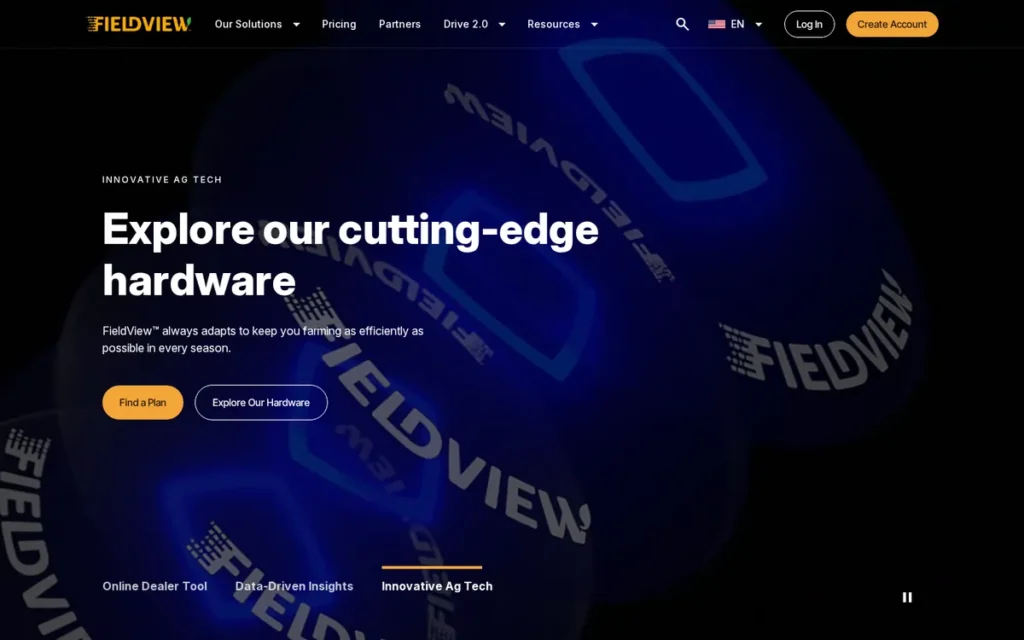
Category: Precision Row-Crop Platform. The software captures and analyzes machine, planting, application and yield data for field crops.
PlugRoute score: 3.15/5. Climate FieldView scores 4.0 on C4 interoperability, the highest of the two precision platforms, and 3.5 on C2 pricing transparency. Climate FieldView trails on C3 reputation (2.5) and C5 field usability (2.5).
At a Glance
- Category: Precision Row-Crop Platform
- Best For: Row-crop farms with mixed equipment brands that want planting, application and yield data in one place
- Price Range: Free basic tier; FieldView Plus $649–$749/year; FieldView Drive hardware from $299 (2026)
- Primary Strength: Climate FieldView captures and combines field data across equipment brands, making it the most brand-neutral precision platform in this ranking.
- Biggest Limitation: Climate FieldView is owned by Bayer, which sells seed and crop inputs, and it has weak app ratings and reports of features moving behind paywalls.
- One-Line Summary: Climate FieldView is a brand-neutral precision agronomy platform with the broadest documented cross-brand data import in this ranking, a free tier and paid Plus plans from $649 per year (2026).
- Last Verified: November 2026
Overview
Climate FieldView is Bayer Crop Science’s row-crop agronomy platform for farms that run mixed equipment brands. The FieldView Drive cab device captures planting, application and harvest data, and the software adds yield analysis, satellite crop-health imagery, scouting and variable-rate seeding prescriptions.
Climate FieldView reports more than 250 million subscribed acres across 23 countries (WhatIsBest, 2026, secondary source). Subscribed acres are not the same as actively mapped acres.
Climate FieldView is a crop-only agronomy tool with no livestock support and no real accounting.
Key Features
- Climate FieldView captures planting, application and harvest data across most major equipment brands through the FieldView Drive cab device.
- Climate FieldView imports data from John Deere Operations Center, Case IH AFS Connect, Ag Leader AgFiniti and Precision Planting 20|20 (Climate, 2026).
- Climate FieldView provides yield maps, yield analysis and Field Health satellite imagery for watching crops through the season.
- Climate FieldView supports scouting and variable-rate prescriptions, including Seed Scripts built from field history and Bayer trial data “for nearly any seed brand” (Climate, 2026).
- Climate FieldView’s full-account export format was not verified as of November 2026, although its partner connections move data to and from other platforms.
Best For
Climate FieldView is best for corn, soybean and other row-crop farms that run a mix of Deere, Case IH and other equipment and want planting maps, yield data and field imagery in one place.
Pricing
Climate FieldView publishes its pricing (Climate, 2026):
- Climate FieldView’s basic tier costs $0.
- Climate FieldView Plus starts at $649/year on the pricing page but is listed at $749 for 365 days on a promotional page.
- Climate FieldView’s Drive starter kit costs $299, and each additional Drive costs $249.
- Climate FieldView Drive 2.0 is listed at $499 on a secondary site, and Premium pricing isn’t published.
Climate FieldView’s first-year cost for one planter comes to about $948–$1,048 (Plus plus one starter Drive). The two Plus prices probably reflect regional or promotional differences. A secondary estimate of $3–$6 per acre per year for dealer arrangements is unverified.
Strengths
- Climate FieldView imports data from four named partner platforms (Climate, 2026), the broadest documented cross-brand data import in this ranking.
- Climate FieldView offers a $0 basic tier and publishes its paid-tier and hardware prices (Climate, 2026), so mixed-fleet farms can try it before they spend.
- Climate FieldView reviewers on Capterra (4.3/5 from 3 reviews, a small sample) praise how it records planter passes, produces instant planting maps and handles several planters at once (Capterra, 2026).
- Climate FieldView has been part of Bayer Crop Science since Bayer acquired Monsanto in 2018 (Bayer, 2026).
Limitations
Climate FieldView is cheap and brand-neutral, but its owner, Bayer, sells farm inputs. A precision-farming practitioner on Reddit wrote that “climate fieldview is brand agnostic and cheap, but bayer gets to see your data” (Reddit r/farming, 2026).
Takeaway: Free, brand-neutral data capture comes with data exposure to an input supplier, so read the data terms.
- Climate FieldView’s terms on aggregated and derived data deserve a close read, although we found no evidence that identifiable data has been misused (Climate, 2026).
- Climate FieldView’s Google Play app is rated 3.3/5 from 413 reviews, with complaints about crashes, connection problems and “promised functionality not delivered” (Google Play, 2026).
- Climate FieldView App Store users report yield data moving behind a paid tier of about $750 and rainfall map access being cut (Apple App Store, 2026).
- Climate FieldView has no livestock support and no real accounting, so most farms will need a second tool.
Verdict
Climate FieldView is the best precision agronomy platform in 2026 for row-crop farms that run mixed equipment brands and want a free-to-start view of planting and yield data. Climate FieldView ranks fourth because of weak app ratings, conflicting price pages and the data trade-off of having an input supplier as owner. Pair it with an accounting or profit tool, and read the data-use terms before connecting your fleet.
5. farmOS: Best Free Open-Source Option for Budget and Data-Control Farms
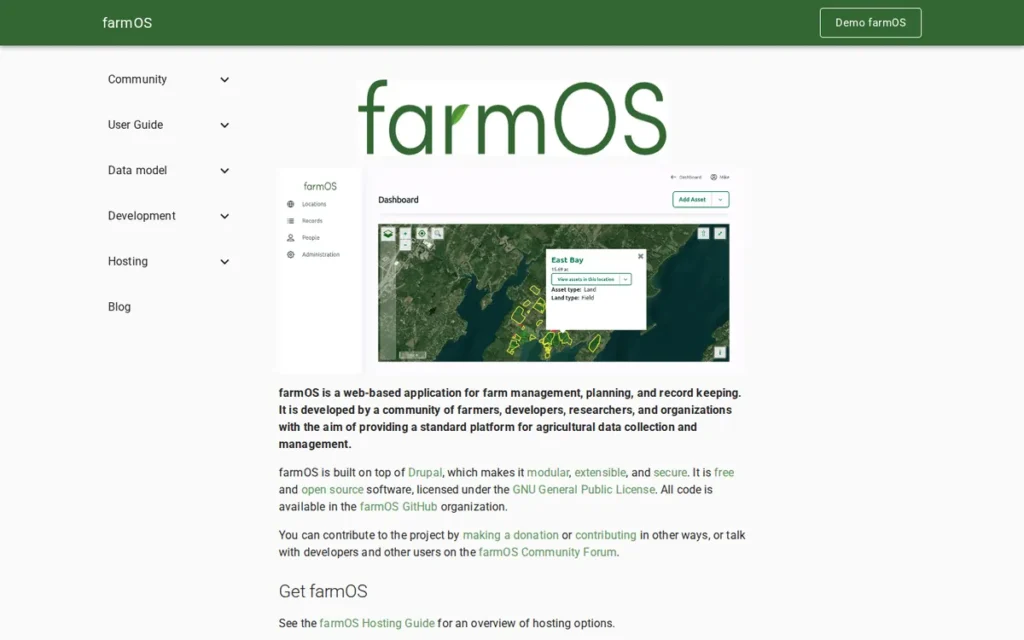
Category: Open-Source Records System. This free, self-hostable farm record-keeping software is configured and controlled by the farm.
PlugRoute score: 3.13/5. farmOS earned the only perfect C4 data control score (5.0) and scored 4.5 on C2 pricing. farmOS received the floor score of 1.0 on C3 because it has no review-platform presence. Excluding C3 would raise farmOS to about 3.66, second place (see methodology).
At a Glance
- Category: Open-Source Records System
- Best For: Low-budget, organic, research and data-ownership-focused farms that have access to technical help
- Price Range: $0 to self-host; managed hosting about $75–$300/year (2026)
- Primary Strength: farmOS gives farms full ownership and control of their data through a free open-source license, an open API and self-hosting.
- Biggest Limitation: farmOS is a records system with no accounting or payroll, and setup, including the offline Field Kit app, takes technical effort.
- One-Line Summary: farmOS is a free, open-source (GPL) farm records platform in active development since 2014, suited to farms that put data ownership and low cost first and can handle setup themselves.
- Last Verified: November 2026
Overview
farmOS is a free, open-source farm records system built on Drupal for low-budget, organic, research and data-ownership-focused farms. It records plantings, harvests, inputs, animal movements and equipment as logs and assets, with maps, a JSON:API and an offline-capable Field Kit app.
farmOS has been in development since 2014. farmOS released version 4.0 in March 2026 and shipped version 4.0.9 on October 21, 2026 (Drupal.org, 2026).
farmOS is not plug-and-play.
Key Features
- farmOS stores plantings, harvests, inputs, animal movements and sales as logs linked to assets such as land, plants, animals and equipment.
- farmOS includes farm maps, plans and quick forms for structured record entry.
- farmOS supports offline entry with sync through its Field Kit app and progressive web app, as long as the host enables the required OAuth and API setup.
- farmOS connects to the OpenTEAM ecosystem for sharing sustainability and research data (farmOS, 2023).
- farmOS has the most fully documented data export in this ranking, through a JSON:API plus Python and JavaScript libraries (farmOS, 2026).
Best For
farmOS is best for organic, small, research and low-budget farms, and for any operation that wants full control of its data, has someone technical to help and will use separate accounting software.
Pricing
farmOS has no license fee (farmOS, 2026). Self-hosting means paying for your own server and doing the technical work. These managed hosting options were verified in 2026:
- Farmier Standard hosting for farmOS costs $75/year with 1 GB storage, unlimited acres and users, and a 30-day trial. Extra storage is listed at $1/GB/year, though the same page also says $5 per 5 GB (Farmier, 2026).
- Elestio managed hosting for farmOS starts at $16/month, about $192/year (Elestio, 2026).
- xCloud hosting for farmOS starts at $24.99/month, about $300/year, but its template may not set up the OAuth and API that Field Kit needs (xCloud, 2026).
farmOS users should also budget for separate accounting software.
Strengths
- farmOS is released under the GPL open-source license with a JSON:API (farmOS, 2026), which gives farms the strongest data ownership and export control in this ranking.
- farmOS has no license fee, and Farmier hosting starts at $75 per year with unlimited acres and users (Farmier, 2026), tied for the lowest paid entry price in this ranking.
- farmOS shows active maintenance, with more than 3,000 commits by its 1.0 release in March 2019 (farmOS, 2019), version 4.0 in March 2026 and release 4.0.9 on October 21, 2026 (Drupal.org, 2026).
- farmOS can be set up to record both crops and livestock, which makes it one of only two options in this evaluation that can run a mixed farm in one system.
Limitations
farmOS gives up convenience in return for low cost and control. A user guide calls farmOS “a records system, not accounting or payroll” (OpenOrchstr, 2026), so farms that track profit need a second tool.
- farmOS 4.x requires Drupal 11 and PHP 8.4 or newer (Drupal.org, 2026), so self-hosters on older servers must upgrade or stay on the 3.5.x maintenance line.
- farmOS has a learning curve when you set up land, plant types and log categories (OpenOrchstr, 2026).
- farmOS Field Kit works offline only if the host configures OAuth and the API, and at least one hosting template doesn’t.
- farmOS has no verifiable presence on G2, Capterra or GetApp, so peer evidence is insufficient rather than negative, and commercial farmers on Reddit doubt that free tools can match “the big ag players” (Reddit r/Homesteading, 2026).
Verdict
farmOS is the best free farm management option in 2026 for farms that want full ownership of their records and can handle open-source setup. farmOS leads this ranking on data control and ties for the lowest cost. Plan for setup time and a separate accounting tool. Farms without technical help should start with a hosted provider such as Farmier.
6. John Deere Operations Center: Best for Deere-Equipped Row-Crop Operations
Category: Precision Row-Crop Platform. The software captures and analyzes machine, planting, application and yield data for field crops.
PlugRoute score: 2.90/5. John Deere Operations Center ties for the top C6 vendor stability score (4.0). Its C3 score of 2.0, the lowest among products with review data, is the main reason it ranks sixth.
At a Glance
- Category: Precision Row-Crop Platform
- Best For: Row-crop farms whose fleet is mostly John Deere equipment
- Price Range: Free base account; Precision Essentials hardware from $2,650; PRO Service from $195 per machine per year (2026)
- Primary Strength: John Deere Operations Center sends jobs to Deere machines and turns completed work into field records automatically.
- Biggest Limitation: John Deere Operations Center has the weakest app rating in this ranking and does less on non-Deere machines.
- One-Line Summary: John Deere Operations Center is a free data platform built for Deere-equipped row-crop farms (2026), and it needs separate accounting software and works best on Deere machines.
- Last Verified: November 2026
Overview
John Deere Operations Center is a free cloud and mobile platform for row-crop farms that run Deere equipment. It links job planning, machine telematics and field analysis, so work sent to compatible in-cab displays comes back automatically as field records.
John Deere Operations Center is not a whole-farm system. John Deere Operations Center has little native accounting and no livestock tools, so most farms pair it with other software.
For market context, GPS applications were used on about 40% of US farm and ranch acreage in 2019 (USDA ERS EIB-248, 2023). Deere set a target of 500 million engaged acres by 2026, and as of November 2026 we found no reported 2026 figure (John Deere, 2026, company target).
Key Features
- John Deere Operations Center’s Work Planner sends jobs, including field, products, rates and guidance lines, to compatible in-cab displays.
- John Deere Operations Center turns completed machine work into field records automatically, with little or no manual entry on compatible displays.
- John Deere Operations Center includes Field Analyzer for reviewing planting, application, harvest and yield map data.
- John Deere Operations Center connects to JDLink telematics for machine location and status, and basic connected service is free (John Deere, 2026).
- John Deere Operations Center shares data with third-party platforms, including Bushel Farm and Climate FieldView, through documented APIs (John Deere, 2026).
Best For
John Deere Operations Center is best for row-crop farms whose tractors, combines and sprayers are mostly Deere and that want a free data hub to pair with a separate accounting or profit tool.
Pricing
John Deere Operations Center pricing depends on hardware and machine count (John Deere, 2026):
- John Deere Operations Center’s basic account costs $0, and basic JDLink connected service can be turned on free, depending on hardware, cellular coverage and machine eligibility.
- John Deere Precision Essentials (G5 display, StarFire receiver, JDLink modem) starts at $2,650 and needs a one-year software license that must be renewed.
- John Deere Operations Center PRO Service (diagnostics, calibration, reprogramming, AI-searchable manuals) launched on July 31, 2025 and starts at $195 per machine per year.
Deere sells premium JDLink tiers through dealers and doesn’t publish their prices. There is no per-acre pricing.
Strengths
- John Deere Operations Center reports thousands of PRO Service customers, including nearly 1,000 daily active users, one year after launch (John Deere, 2026).
- John Deere Operations Center offers a $0 base account and free basic JDLink service (John Deere, 2026), the lowest software cost for farms that already own compatible Deere equipment.
- John Deere Operations Center sends jobs to the display and returns completed work as records, so Deere fleets largely skip manual data entry.
- John Deere Operations Center may support more displays than buyers expect, since a Reddit user wrote that “Ops center reads data from almost any display made in the last decade” (Reddit r/farming, 2026).
Limitations
John Deere Operations Center gives up openness in return for deep Deere integration. Non-Deere machines connected through Precision Essentials get less telemetry, fewer remote commands and none of the Deere-specific automation (John Deere, 2026).
- John Deere Operations Center has the weakest app rating in this ranking, 2.8/5 from 675 Google Play reviews, with complaints about crashes, freezing and updates breaking the app (Google Play, 2026).
- John Deere Operations Center is owned by an equipment maker that also sells connected-service upgrades through dealers, so read Deere’s data-use terms on aggregated machine data before you connect non-Deere equipment. We found no evidence that identifiable data has been misused.
- John Deere Operations Center has no livestock tools and little native accounting, so it can’t replace whole-farm software.
- John Deere Operations Center was part of a right-to-repair dispute that has now been settled. The FTC sued Deere on January 15, 2025, and a July 8, 2026 settlement requires Deere, for 10 years, to offer dealer-equivalent diagnostic and reprogramming tools to farmers and independent repairers on fair and reasonable terms (FTC, 2026). The settlement does not make repairs free.
Verdict
John Deere Operations Center is the most practical free data hub in 2026 for row-crop farms that run mostly Deere equipment, but it is not a whole-farm management system. John Deere Operations Center ranks sixth because of weak app ratings, reduced function on mixed fleets and costs tied to hardware. Pair it with a profit tool such as Bushel Farm or, for large multi-entity operations, Conservis. Mixed fleets should compare it with Climate FieldView.
7. Conservis: Best for Large Multi-Entity Row-Crop and Permanent-Crop Enterprises
Category: Enterprise Farm ERP. This resource-planning software serves large operations with several business entities that need financial controls and traceability.
PlugRoute score: 2.83/5. Conservis scored 3.5 on C1 scope, second only to Farmbrite. Its rank comes from C2 pricing transparency (1.5) and C6 vendor stability (2.0), not from its capabilities.
At a Glance
- Category: Enterprise Farm ERP
- Best For: Large row-crop and permanent-crop operations (roughly 5,000+ acres) with several business entities, landlords or investors
- Price Range: Pricing on request; third-party estimate of about $8,000–$30,000/year plus $5,000–$30,000 for implementation (2026)
- Primary Strength: Conservis has the deepest cost-of-production and multi-entity financial reporting in this ranking.
- Biggest Limitation: Conservis publishes no pricing and has changed owners twice since 2021, so its product roadmap is uncertain.
- One-Line Summary: Conservis is an enterprise farm ERP for large multi-entity crop operations in 2026, with the deepest cost-per-acre and cost-per-bushel reporting in this ranking at quote-only prices.
- Last Verified: November 2026
Overview
Conservis is enterprise resource-planning software for large row-crop and permanent-crop operations. It covers budgeting, work orders, input and grain inventory, contracts, and cost-per-acre and cost-per-bushel reporting across multiple business entities, landlords and investors.
Conservis has been owned by Traction Ag since December 2023 (Traction Ag, 2026). Traction Ag also owns the former Granular Business, which it bought from Corteva in November 2022.
For Conservis buyers, this means one company now controls two enterprise farm-finance products. Ask which product your contract covers.
Key Features
- Conservis supports planning, budgeting and tracking of plan against actual results across the operation.
- Conservis manages work orders and field records, with mobile capture on iPhone, iPad and Android.
- Conservis tracks input and grain inventory, including grain storage by bin, contracts and grain marketing.
- Conservis reports cost of production per acre and per bushel across multiple entities, landlords and investors.
- Conservis lists an integration with Climate FieldView (SourceForge, 2026), but its data export format and full integration list were not verified as of November 2026.
Best For
Conservis is best for large row-crop and permanent-crop businesses with several entities, reporting duties to landlords or investors, and the budget and staff for a formal rollout.
Pricing
Conservis doesn’t publish pricing and sells by quote (Conservis, 2026). A third-party source gives these estimates, which are not official pricing:
- Conservis costs an estimated $8,000–$30,000 per year for a 5,000–15,000-acre operation (b2bsalestools.com, 2026).
- Conservis implementation costs an estimated $5,000–$30,000 (b2bsalestools.com, 2026).
One software listing calls Conservis overbuilt for hobby or very small farms (Softwares.com, 2026). Get implementation, migration and data-export terms in writing.
Strengths
- Conservis is rated 4.5–4.8/5 across 15 G2 reviews, a small sample (G2, 2026), and reviewers praise its centralized data and cost-per-acre and per-bushel reporting.
- Conservis provides multi-entity reporting for landlords and investors at a depth no other product in this ranking matches.
- A G2 reviewer says Conservis helped them “create field plans and work orders,” track inventory, simplify accounts payable and receivable, and build an accrual budget (G2, 2026).
- Conservis has served customers in the US, Canada, Argentina and Australia since it was founded in Minneapolis in 2009 (FeaturedCustomers, 2026).
Limitations
Conservis gives up price transparency and continuity in return for enterprise depth. Conservis publishes no pricing, so buyers can’t compare total cost without going through a sales process.
- Conservis changed owners in July 2021 (TELUS Agriculture and Rabobank) and again in December 2023 (Traction Ag), and one source says Traction plans to merge it with the former Granular Business (AgriERP, 2026), which makes the roadmap and any data migration uncertain for multi-year contracts.
- Conservis has no livestock support, and we couldn’t verify how Conservis behaves offline.
- Conservis is priced too high for some farmers, according to a Capterra reviewer (Capterra, 2026).
Verdict
Conservis is the most financially detailed farm management platform in 2026 for large multi-entity crop businesses, but its quote-only pricing and recent ownership changes call for careful contract terms. Conservis ranks seventh because of weak pricing transparency and vendor stability, not because of its capabilities. For operations of 5,000+ acres it may be the right fit. Get commitments on roadmap, migration and data export in writing.
How Much Does Farm Management Software Cost in 2026?
Farm management software costs anywhere from $0 to more than $30,000 a year in 2026. Free tiers from John Deere Operations Center, Climate FieldView and farmOS sit at the low end, and Conservis’s quote-only enterprise pricing sits at the high end. Your real annual cost depends on the pricing unit, hardware, add-ons and implementation fees.
| Product | Pricing Unit | Entry Price (2026) | Realistic Annual Example (2026) | Costs Often Missed |
|---|---|---|---|---|
| Farmbrite | Per tier, with animal and user limits | $29/month | $290–$790/year (vendor livestock tiers) | Tier names vary by source; 25% sign-up discount ends November 30, 2026 |
| AgriWebb | Herd-size calculator (DSE) | A$34/month (AU) | US calculator based on 12-month average herd | Grazing Planning add-on $150/year; one cow counts as 8 DSE |
| Bushel Farm | Flat annual plan | $75/year | About $1,598/year with machine data | $999/year Machine Data Connections |
| Climate FieldView | Free tier, then annual plan plus hardware | $0 | About $948–$1,048 first year (one planter) | $249 for each additional Drive |
| farmOS | Self-hosted or paid hosting | $0 | $75–$300/year hosting | Technical labor; separate accounting |
| John Deere Operations Center | Free, plus hardware and per-machine fees | $0 | $2,650+ hardware plus license | $195/machine/year PRO; dealer-priced JDLink tiers |
| Conservis | Quote only | On request | About $8,000–$30,000/year (estimate) | About $5,000–$30,000 implementation (estimate) |
In 2026, the headline price of farm management software can badly understate first-year cost. Bushel Farm’s $599 plan becomes about $1,598 with machine data, and Climate FieldView’s $649 plan becomes about $948 with one Drive.
Conservis figures and the reported $79/month AgriWebb US price are unverified third-party estimates. Ask for a written quote that covers the full first-year cost.
Users on r/SaaS shared their experience:
“I pay 400 euros a month for a farm management SaaS (Cropwise Operations) I work around 2000 hectares so the prices justifies itself. However, in the last couple of months I started using claude and cursor to code the exact same app. Development cost was around 2000 euros.” Posted by u/Relevant_Ad_491
Takeaway: Farm management software subscriptions for large farms can run to thousands of euros a year, and even farmers who think that price is justified at 2,000 hectares still look for cheaper alternatives.
Do I Need More Than One Farm Software Tool?
Many row-crop and livestock operations need more than one farm software tool in 2026, because no product in this ranking covers machine data, livestock and full accounting together. For most row-crop farms, the realistic question is which two tools to combine, not which one to buy. Farmbrite comes closest to a single system for diversified farms.
This coverage table shows which needs each product handles:
| Product | PlugRoute Score | Crops | Livestock | Accounting | Offline (verified?) |
|---|---|---|---|---|---|
| Farmbrite | 3.93 | Good | Good, multi-species | Built-in bookkeeping | Yes, vendor documented |
| AgriWebb | 3.70 | Weak | Strong | Gross margin; Figured (AU/NZ only) | Yes, vendor documented and case study |
| Bushel Farm | 3.48 | Good (grain) | None | Field P&L and contracts | Unverified |
| Climate FieldView | 3.15 | Strong | None | Minimal | Unverified; app issues reported |
| farmOS | 3.13 | Configurable | Configurable | None | Yes, vendor documented (needs host setup) |
| John Deere Operations Center | 2.90 | Strong | None | Minimal | Partial; cab works offline, sync needs cellular |
| Conservis | 2.83 | Strong | None | Deepest (cost of production, multi-entity) | Unverified |
Common software combinations based on documented integrations:
- John Deere Operations Center + Bushel Farm: This combination costs about $1,598/year in software ($0 + $599 Essentials + $999 add-on, 2026), plus any Deere hardware.
- Climate FieldView + Bushel Farm: The Bushel Farm add-on also imports FieldView data, which suits mixed-fleet grain farms.
- Climate FieldView + Conservis: Conservis lists a FieldView integration for enterprises that need cost-of-production reporting on top of agronomy data.
- AgriWebb + US bookkeeping software: AgriWebb’s Figured integration is AU/NZ-only, so US ranches need separate accounting.
- farmOS + separate accounting software: farmOS is a records system and doesn’t handle accounting or payroll.
This aligns with community sentiment on r/farming:
“That is the thing, my boss wants to see everything as he is based in another city and wont visit daily or weekly. So far I tried few apps, but most of them miss some functions, either budgeting or planning. As we are growing industrial hemp for fiber production the problem we face is mostly lack of information in databases or lack of specialist for consulting..” Posted by u/Gurvuolis
Takeaway: Farmers who test several farm management apps find that most are missing either budgeting or planning, so no single tool covers every need.
What Happened to Granular?
We left Granular out of this ranking because its whole-farm product no longer exists in the form most reviews describe. Corteva sold Granular Business to Traction Ag on November 10, 2022, and shut down Granular Agronomy that year. Corteva kept only Granular Insights, a free analytics tool tied to its seed and crop-protection products (AgWeb, 2022).
- Granular’s G2 reviews (4.5/5 from 44 reviews, G2, 2026) mostly describe a product now sold under a different name, so ranking Granular as a whole-farm platform would mislead buyers.
- Traction Ag, which bought Granular Business from Corteva in 2022, also acquired Conservis in December 2023 (Traction Ag, 2026).
- Buyers evaluating Traction Ag products should ask which codebase they are buying and how their records will migrate.
Which Other Farm Tools Did We Consider?
PlugRoute considered several other farm tools but didn’t fully evaluate them for this ranking. Some came up in farmer discussions on Reddit. AI answer engines named others that we couldn’t verify.
These tools are listed for transparency, not as recommendations. Future updates may score them once there is enough verified evidence.
Farmers mentioned these tools on Reddit, but we haven’t fully evaluated them:
- HerdBoss came up in a discussion about a 45–100 head sheep flock: “For what it does it’s easy and tracks what we want” (Reddit r/sheep, 2026).
- CattleMax came up for tracking birth, weaning and finishing weights (Reddit r/farming, 2026).
- Ag Leader SMS came up as a desktop product with a free basic version that “isn’t super user friendly” (Reddit r/farming, 2026).
These tools were considered and are pending verification:
- AGRIVI, Croptracker, GeoPard, Trimble Ag Software, Harvest Profit and Tend were considered during research but not scored.
- Agworld, LiteFarm, FarmKeep, PTx Trimble, FarmERP and Traction Ag (as a standalone accounting product) were named by AI answer engines but not verified for this ranking.
What Red Flags Should I Watch For When Evaluating Farm Management Software?
The biggest red flags in farm management software are hidden costs, thin review evidence, unproven offline claims, unstable ownership, input-supplier data exposure, shrinking free tiers and unclear data export. Each one can raise your costs or put your farm records at risk, so check every vendor against the seven flags below.
Red Flag #1: Headline Price Hides Hardware and Add-Ons A low advertised price often leaves out required hardware, per-machine fees or paid modules. Examples from 2026 include Deere’s $2,650 Precision Essentials kit, the $299 FieldView Drive and Bushel Farm’s $999 machine-data add-on.
Red Flag #2: Review Score Based on a Tiny Sample A 4.5-star score from three reviews says little about how reliable a product is. B2B review counts in this category ranged from 3 to 63 per product in 2026, and the larger app-store samples were often more negative.
Red Flag #3: Offline Claims Without Vendor Documentation Offline access only matters if it works in your fields. In 2026, AgriWebb was the only product with offline capture documented in both vendor material and a published case study, while Farmbrite and farmOS document it in vendor material only. Test sync in your lowest-signal areas.
Red Flag #4: Recent Ownership Changes Without Written Roadmap Commitments A vendor that has recently changed hands may merge, rename or retire its product. Granular was broken up in 2022 and Conservis changed owners twice in about 2.5 years, so get roadmap and migration commitments in writing.
Red Flag #5: Parent Company Sells Your Farm Inputs or Equipment Software owned by an equipment maker or input supplier may use aggregated or derived farm data in ways that benefit the parent company. Read the data-use terms before you connect your fleet or field history.
Red Flag #6: Features Moving From Free to Paid Tiers A free tier can shrink after you’ve built years of records in it. Climate FieldView App Store users report yield data moving behind a paid tier and rainfall map access being cut (Apple App Store, 2026).
Red Flag #7: No Clear Data Export Format If a vendor can’t tell you how to export all your records, switching later may mean losing your history. Ask for the specific file formats and API access in writing before you sign.
What Questions Should I Ask Before Choosing Farm Management Software?
Before you choose farm management software, ask each vendor five things: the full annual cost, which equipment it supports, how offline capture works, who owns the company and how you’d export your data. The seven questions below turn those five areas into specific checks you can run during a demo or trial.
Question #1: What is the pricing unit, and what is the full annual cost including setup? Ask whether the vendor prices by user, acre, head, machine or year, and request a written first-year total. That total should include hardware, add-ons and implementation, not just the subscription.
Question #2: Which equipment brands and livestock hardware does it support natively? Ask for a list of native integrations, not just “compatible” brands. Native support for your tractors, displays, scales or EID readers decides how much data you’ll still enter by hand.
Question #3: Can I test offline capture and sync in my own fields during the trial? Ask the vendor to show offline mode where your signal is weakest. Find out whether the app must stay open to sync and whether every feature works on mobile.
Question #4: Who owns the vendor, and what do the terms allow with aggregated data? Ask who the parent company is and whether it sells seed, chemicals or equipment. Also check whether the vendor is listed in the Ag Data Transparent directory, because certification status changes.
Question #5: In what format can I export all my records if I leave? Ask for the specific export file types, whether exports include field history and animal records, and whether an API is available. Get the answer written into your contract.
Question #6: Does it handle both crops and livestock, or will I need a second tool? Ask the vendor to demonstrate both workflows for a mixed farm. Most products ranked here cover only one side, which means extra software and duplicate data entry.
Question #7: Does the accounting integration work in my country? Ask which accounting packages connect and in which regions. AgriWebb’s only accounting integration, for example, is limited to Australia and New Zealand (AgriERP, 2026).
Before any trial ends, run three tests:
- Test offline capture in your weakest-signal field and confirm the records sync without loss.
- Test a full export of your trial records to confirm you can take your data with you.
- Test the vendor’s quote by adding up the first-year total, including hardware and add-ons.
Users on r/SaaS noted:
“the gap between “this sounds cool” and actually switching tools is huge in farming – people are creatures of habit and changing software feels risky when your livelihood depends on it. maybe try offering free trials or even just screen recordings showing how it works with real data, farmers want to see proof before they jump ship from something that already works” Posted by u/Cold_Pepper7095
Takeaway: Switching farm management software is a real operational risk, so farmers should require proof with their own data during the trial before they commit.
How Did We Rank These Farm Management Software Tools?
PlugRoute scored seven farm management software products from 1 to 5 on six weighted criteria: whole-farm scope (25%), pricing transparency (20%), verified user reputation (20%), interoperability and data control (15%), field usability and offline access (10%) and vendor stability (10%). Every score is tied to a named, dated source, and the weighted total sets the rank order.
The six criteria and why each matters:
- C1 Whole-Farm Scope and Operational Fit (25%): Whole-farm scope measures coverage of crop records, livestock records, accounting and profit tracking, and machine data, because readers want one system in place of scattered tools.
- C2 Pricing Transparency and Total Cost of Ownership (20%): Pricing transparency scores published prices, clear pricing units and disclosed hardware, add-on and implementation costs, because hidden costs are a major buyer complaint.
- C3 Verified User Reputation and App Reliability (20%): Verified reputation combines rating and review volume across G2, Capterra, GetApp, Apple App Store and Google Play, because app-store crash reports show reliability in the field.
- C4 Interoperability and Data Control (15%): Interoperability scores equipment integrations, APIs and export options, with deductions for documented lock-in or data exposure to a parent company that sells inputs or equipment.
- C5 Field Usability and Offline Access (10%): Field usability scores offline capability verified by vendor documentation or a case study. Unverified claims score no higher than 3.
- C6 Vendor Stability and Adoption Evidence (10%): Vendor stability scores ownership continuity, funding history, named customers and adoption scale, because multi-year contracts depend on the product continuing.
| Product | C1 | C2 | C3 | C4 | C5 | C6 | Weighted Total |
|---|---|---|---|---|---|---|---|
| Farmbrite | 4.5 | 4.0 | 4.5 | 3.0 | 3.5 | 3.0 | 3.93 |
| AgriWebb | 3.0 | 3.0 | 4.5 | 4.0 | 4.5 | 4.0 | 3.70 |
| Bushel Farm | 3.0 | 5.0 | 3.0 | 3.5 | 2.5 | 3.5 | 3.48 |
| Climate FieldView | 3.0 | 3.5 | 2.5 | 4.0 | 2.5 | 3.5 | 3.15 |
| farmOS | 2.5 | 4.5 | 1.0 | 5.0 | 3.0 | 3.5 | 3.13 |
| John Deere Operations Center | 3.0 | 3.0 | 2.0 | 3.0 | 3.0 | 4.0 | 2.90 |
| Conservis | 3.5 | 1.5 | 3.5 | 3.0 | 3.0 | 2.0 | 2.83 |
How to read these scores:
- A lower overall rank doesn’t mean a product is a poor fit for its own segment. Conservis may be the right choice for a 10,000-acre multi-entity operation.
- Products with no review-platform presence get a C3 floor score of 1 for calculation and the label “insufficient data.” Excluding C3 and reweighting would raise farmOS to about 3.66, which would rank second.
- Three scores changed after November 2026 verification. Farmbrite’s C5 rose to 3.5 once vendor offline documentation was found. Bushel Farm’s C6 rose to 3.5 once its acquisition date was confirmed. farmOS’s C6 rose to 3.5 after its 4.x releases. The rank order did not change.
- Granular was excluded because its whole-farm product was broken up in 2022.
- Vendor-reported figures, such as Farmbrite’s 7,000+ farmers, AgriWebb’s 150M+ acres and Deere’s 500M-acre target, are treated as claims, not audited facts.
PlugRoute has no affiliate relationships with any company listed, and rankings are determined entirely by research data and objective evaluation criteria.
What Do Farmers Ask Most About Farm Management Software?
What is the best farm management software for small farms?
Farmbrite is the best farm management software in 2026 for small farms that raise both crops and livestock, with vendor livestock tiers starting at $29 per month. farmOS is the best free option for small farms that want full control of their data. farmOS needs technical setup and separate accounting software, and hosted plans start at $75 per year.
What is the best farm management software for both livestock and crops?
Farmbrite is the best farm management software in 2026 for farms that manage both livestock and crops. Farmbrite is the only commercial tool in this ranking that natively covers crop planning, multi-species livestock and bookkeeping. farmOS can also handle both for free once configured, but farmOS needs technical setup and a separate accounting tool.
How does PlugRoute determine rankings?
PlugRoute ranks farm management software by a weighted score across six criteria, led by whole-farm scope (25%), pricing transparency (20%) and verified reputation (20%). Each score comes from a named, dated source. Products without review data receive the floor score for calculation and the label “insufficient data,” not a quality judgment. The methodology section shows every score.
What Do Key Farm Management Software Terms Mean?
DSE (Dry Sheep Equivalent): DSE is an Australian unit that standardizes how much feed different livestock need, and one cow is commonly counted as about 8 DSE. Some livestock software prices by DSE, so a larger herd means a higher subscription.
EID (Electronic Identification): EID refers to electronic ear tags or boluses that give each animal a unique, scannable ID. Software that reads EID records weights and treatments for individual animals without hand-written notes.
Telematics: Telematics is the wireless link that sends machine location, status and work data from equipment to the cloud. Telematics cuts manual record-keeping but usually needs a modem, eligible machines and cellular coverage.
Mixed Fleet: A mixed fleet is farm equipment made by more than one manufacturer. Buyers with mixed fleets should check that software captures full data from every brand, not just one.
Variable-Rate Prescription: A variable-rate prescription is a map that tells equipment to apply different rates of seed, fertilizer or chemicals in different parts of a field. A variable-rate prescription can lower input costs, but it needs compatible displays and good field data.
Cost of Production: Cost of production is the total cost to grow a crop, usually expressed per acre or per bushel. Software that tracks cost of production helps you set marketing targets and spot fields that lose money.
Offline-First Sync: Offline-first sync means an app records data without a signal and uploads it when a connection returns. Rural buyers should check whether the app has to stay open to sync and whether data can be lost.
Open-Source License (GPL): A GPL open-source license lets anyone use, change and host the software for free. For buyers, a GPL license means more control over data and no license fee, but more setup work.
API (Application Programming Interface): An API lets different software systems exchange data automatically. A documented API makes it easier to connect tools and to export your records if you switch vendors.
Multi-Entity Reporting: Multi-entity reporting combines and separates financial results across several legal businesses, landlords or investors. Large operations need multi-entity reporting to keep each entity’s books accurate without duplicate entry.
Ag Data Transparent Certification: Ag Data Transparent is an industry certification that reviews how agricultural technology providers explain data ownership and use in their contracts. Buyers should check the current directory, because certification status can change.
Which Farm Management Software Is Right for You?
Key Insights
- The right farm management software depends on your farm type: Farmbrite for diversified crop-and-livestock farms, AgriWebb for commercial grazing, Bushel Farm for grain profit tracking, Climate FieldView or John Deere Operations Center for precision row crops, farmOS for free data-controlled records and Conservis for multi-entity enterprises.
- Farmbrite is the only commercial tool ranked here that natively covers both crops and livestock, and it earned the top PlugRoute score of 3.93/5 (2026).
- AgriWebb is the only product with offline capture documented in both vendor material and a published case study, and it holds 4.5/5 from 598 Australian App Store ratings (2026).
- Bushel Farm publishes every price including add-ons, but grain farms that want Deere or FieldView data should budget about $1,598 a year (2026).
- John Deere Operations Center and Climate FieldView offer free tiers, but their Google Play ratings of 2.8/5 and 3.3/5 point to reliability risks (2026).
- Conservis offers the deepest enterprise financial reporting, but buyers should weigh its quote-only pricing and its ownership changes in 2021 and 2023.
Diversified farms should start with Farmbrite, and commercial cattle or sheep operations should consider AgriWebb. Grain farms that want profit tracking by field will find the clearest costs at Bushel Farm. If budget or data ownership comes first, farmOS is the strongest free option.
Row-crop operations should plan for two tools, usually a precision platform for machine data plus a profit or accounting tool. As vendors consolidate, contract terms on data export and roadmap will matter as much as features.
We update this guide quarterly. Last updated: November 12, 2026. Read PlugRoute’s full scoring methodology or browse more independent PlugRoute SaaS reviews before you choose.