The best crop management software depends on your main workflow. Climate FieldView is best for row-crop farms running mixed equipment brands. Traction Ag is best for field-level profitability, and Agworld is best for planning with an agronomist. No single platform covers every workflow from machine data to specialty-crop compliance, so many farms run two tools.
Crop management vendors publish feature lists that look alike. Many prices are quote-based or tied to acres, seats, machines or sensors, and you often can’t tell whether your machinery is compatible until after you sign up. This guide ranks seven platforms on dated, documented evidence and matches each one to the workflow it fits best.
PlugRoute has no affiliate relationships with any company listed. Rankings are determined entirely by research data and objective evaluation criteria.
“We tend to buy older equipment that has good life left and has zero restrictions.” (u/Charming-Border7429, r/righttorepair)
Takeaway: Some farmers avoid connected equipment entirely, so machine compatibility and data control belong on every crop management shortlist.
What Are the 6 Categories of Crop Management Software?
Crop management software is a subset of farm management software, and it falls into six categories. Each category is defined by the main workflow it serves. Choose the category first. That narrows a shortlist faster than comparing feature lists, because vendors in different categories often publish features that look alike.
The six categories and the ranked platforms in each:
- Equipment Data Hub platforms collect machine, planting, application and harvest data into one field record. Climate FieldView and John Deere Operations Center are in this category.
- Agronomy Planning & Collaboration platforms share crop plans, budgets and records between growers and advisors. Agworld is in this category.
- Farm Financial & Profitability platforms combine accounting with field records to show breakeven and profit by field. Traction Ag is in this category.
- All-in-One Small Farm Manager platforms keep crop, livestock, sales and records in one affordable system. Farmbrite is in this category.
- Specialty Crop Operations & Traceability platforms track harvest, labor and compliance records from field to shipment. Croptracker is in this category.
- Sensor-Driven Irrigation & Nutrient platforms turn soil-sensor data into irrigation and fertilizer recommendations. CropX is in this category.
How Do the Top Crop Management Software Platforms Compare at a Glance?
Climate FieldView ranks first among the crop management platforms PlugRoute evaluated, with a weighted score of 3.95/5. Traction Ag follows at 3.88, then Agworld (3.85), Farmbrite (3.80), Croptracker (3.48), John Deere Operations Center (3.45) and CropX (2.25). Scores reflect evidence verified November 2026.
The table below lists each platform’s score, starting price, category, best-fit user, main strength and key limitation.
| Rank | Company | Category | Best For | One-Line Summary | Key Capabilities | Primary Strength | Key Limitation |
|---|---|---|---|---|---|---|---|
| 1 (3.95/5) | Climate FieldView (Bayer) | Equipment Data Hub | Mixed-brand row-crop fleets | Climate FieldView documents the broadest mixed-fleet compatibility of any crop data platform in this evaluation. | From free; Plus from $649/yr. Cab-to-cloud data, satellite imagery, yield analysis, VR seed scripts, advisor sharing | Works with about 80% of equipment types (Climate, 2026) | Bayer data-use terms allow internal R&D use and sharing with affiliates |
| 2 (3.88/5) | Traction Ag | Farm Financial & Profitability | Mid-size row-crop farms needing profitability | Traction Ag is the only accounting-first crop management platform in this evaluation. | From $950/yr. Double-entry farm accounting, field records, equipment cost allocation | Profit by farm, field, acre and bushel (Traction Ag, 2022) | No imagery or scouting; Field Ops usability complaints |
| 3 (3.85/5) | Agworld (Semios) | Agronomy Planning & Collaboration | Growers who plan with an agronomist or retailer | Agworld is the highest-scoring planning and collaboration platform in this evaluation. | Free tier; paid from $1,495/yr. Shared plans, budgets, work orders, scouting, Deere integration | About 4.6/5 from 91 reviews (rfp.wiki, 2026) | Weaker mapping and yield-comparison tools |
| 4 (3.80/5) | Farmbrite | All-in-One Small Farm Manager | Small and diversified farms | Farmbrite is the most transparently priced all-in-one platform for small U.S. farms. | From $29/mo. Crop planning, livestock, direct sales, inventory, accounting | 4.8/5 from 63 Capterra reviews (Capterra, 2026) | No documented machinery or precision-ag connection |
| 5 (3.48/5) | Croptracker | Specialty Crop Operations & Traceability | Fruit and vegetable growers with seasonal crews | Croptracker has the deepest documented specialty-crop workflow coverage in this evaluation. | From US$3,300/yr. Bins, piece rates, kiosk clock, packhouse traceability, GAP reports | Field-to-shipment traceability in one modular system | 10-user minimum raises cost for very small farms |
| 6 (3.45/5) | John Deere Operations Center | Equipment Data Hub | Mostly Deere fleets | John Deere Operations Center is the most deeply integrated free farm-data platform for Deere-equipped operations. | Free account plus hardware. JDLink machine data, work planning, prescriptions to cab, API hub | Deepest machine-to-cloud integration for Deere fleets | 2.8/5 from 675 Google Play reviews (Google Play, 2026) |
| 7 (2.25/5) | CropX | Sensor-Driven Irrigation & Nutrient | Irrigated farms with high water costs | CropX is a soil-sensor platform for irrigation and nutrient decisions on irrigated farms. | Quote only. Multi-depth soil sensors, irrigation scheduling, nitrogen insights | Only sensor-grounded irrigation platform evaluated | No public price and no review-platform presence |
Which Crop Management Software Should I Choose for My Use Case?
Match your top workflow to one platform:
- Climate FieldView for mixed-brand row-crop fleets.
- John Deere Operations Center for mostly Deere fleets.
- Agworld for advisor-led planning.
- Traction Ag for field profitability.
- Farmbrite for small diversified farms.
- Croptracker for specialty-crop traceability.
- CropX for sensor-based irrigation.
After workflow, use the size of your operation to choose between the primary pick and the alternative.
| Your #1 Priority | Recommended Tool | Why | Acceptable Alternative |
|---|---|---|---|
| Mixed-brand row-crop fleet | Climate FieldView | Broadest documented mixed-fleet compatibility (Climate, 2026) | John Deere Operations Center |
| Mostly Deere equipment | John Deere Operations Center | Deepest Deere machine integration, free account | Climate FieldView |
| Planning and budgeting with an advisor | Agworld | Shared plans, budgets and work orders across organizations | Climate FieldView Advisor |
| Field-level profitability and accounting | Traction Ag | Only accounting-first platform evaluated | Agworld Plus (financial insights) |
| Small or diversified farm | Farmbrite | Published pricing from $29/month, crops plus livestock | Spreadsheets or LiteFarm (open source, not ranked) |
| Specialty harvest, labor and traceability | Croptracker | Piece rates, bins, packhouse traceability, GAP reports | Farmbrite (harvest traceability listed in Essentials tier, Capterra 2026) |
| Sensor-based irrigation | CropX | Multi-depth soil-moisture recommendations | Climate FieldView imagery (not sensor-based) |
| Free irrigation scheduling | University extension schedulers (not ranked) | No subscription cost | FieldView Prime or a free Deere account for records |
Which Crop Management Software Ranks Highest for Row Crops and Other Farms in 2026?
Climate FieldView ranks highest in 2026 and is the strongest starting point for row-crop farms with mixed equipment fleets. Traction Ag ranks second for field-level profitability, and Agworld ranks third for advisor-led planning. Deere-heavy row-crop farms should also compare John Deere Operations Center. Every entry below uses the same structure.
1. Climate FieldView (Bayer): Highest-Scoring Overall; Best for Row Crops and Mixed-Brand Fleets
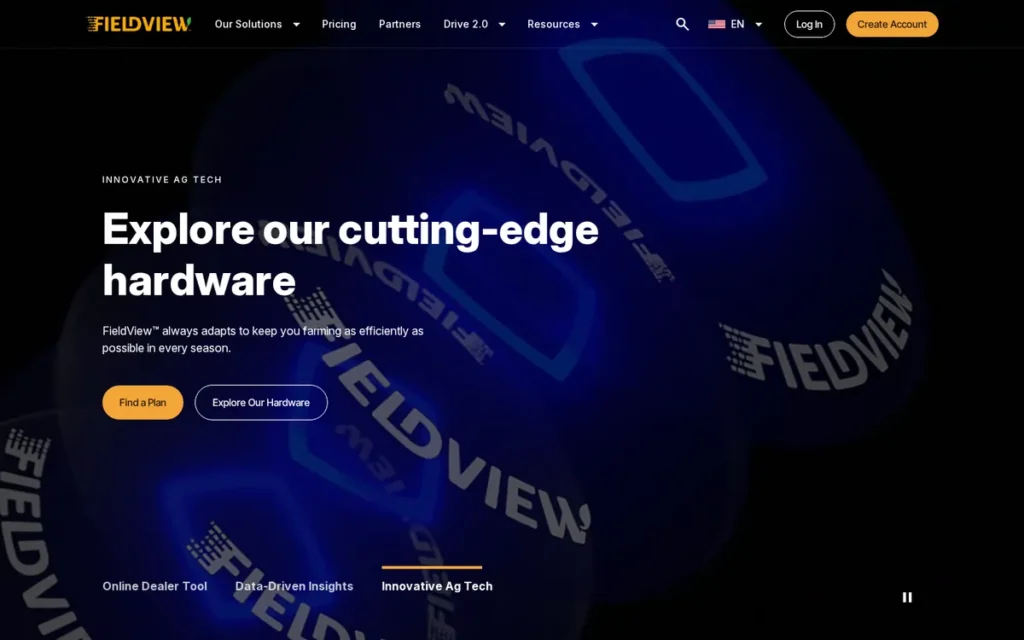
Category: Equipment Data Hub, collects machine, planting, application and harvest data into one field record.
At a Glance
- Category: Equipment Data Hub
- Best For: Row-crop growers running mixed-brand equipment fleets who want imagery, yield analysis and seed scripting in one platform
- Price Range: Free (Prime) + Plus from $649/year + Drive hardware from $299
- Primary Strength: Climate FieldView documents the broadest mixed-fleet compatibility in this evaluation, with Bayer reporting that FieldView Drive works with about 80% of equipment types.
- Biggest Limitation: Climate FieldView’s data-use terms allow Bayer to use grower data internally for seed and crop-protection R&D and to share it with Bayer affiliates.
- One-Line Summary: Climate FieldView is the most brand-neutral crop data platform for row-crop farms with mixed equipment fleets, pairing cab-to-cloud data capture with satellite imagery and variable-rate seed scripting.
- Last Verified: November 2026
PlugRoute Score: 3.95/5, Workflow 4 · Interoperability 5 · Pricing 4.5 · Sentiment 3 · Reliability 3 · Stability/Data 3. Climate FieldView’s interoperability raised the score most. Its thin review base lowered it most.
Overview
Climate FieldView is Bayer’s cloud-based digital agronomy platform for row-crop growers running mixed-brand fleets. Climate FieldView combines cab-to-cloud planting, application and harvest data with satellite field-health imagery and yield analysis in one field record.
Climate FieldView offers a free Prime tier, and its imagery and seed-scripting tools require the paid Plus tier (Climate, 2026). PlugRoute found no Climate FieldView customer case study with measured outcomes.
Key Features
- Climate FieldView Drive streams planting, application and harvest data from the cab to the cloud, and Bayer says it works with about 80% of equipment types (Climate, 2026).
- Climate FieldView accepts data from Precision Planting monitors, a John Deere Operations Center connection, AGCO connectivity or manual upload (Climate, 2026).
- Climate FieldView Plus provides Field Health satellite imagery to help growers decide which fields to scout first (Climate, 2026).
- Climate FieldView Plus supports yield analysis, manual scripting and variable-rate seed scripts “for nearly any seed brand” (Climate, 2026).
- Climate FieldView Advisor lets dealers and agronomists view a grower’s live data with the grower’s permission (Climate, 2026).
Best For
Climate FieldView is best for row-crop farms running more than one equipment brand that want imagery-led scouting, yield analysis and seed prescriptions in one data layer. Climate FieldView is not ideal for farms that need field-level accounting, specialty-crop labor tracking or traceability.
Pricing
- Climate FieldView Prime is free as of November 2026 (Climate, 2026).
- Climate FieldView Plus starts at $649/year on Climate’s U.S. pricing page (Climate, 2026). An earlier Bayer product page listed $749, so buyers should confirm regional pricing.
- Climate FieldView Drive costs $299 for a starter kit and $249 for each additional Drive (Climate, 2026).
- Climate FieldView’s $99/year or $1/acre Plus price in a 2021–22 brochure is outdated and should not be used for budgeting (Bayer, 2021).
Strengths
- Climate FieldView documents the broadest mixed-fleet compatibility in this evaluation, with Bayer reporting that Drive works with about 80% of equipment types and more than 65% of U.S. combines (Climate, 2026).
- Climate FieldView’s free Prime tier makes it one of the lowest-cost ways for a row-crop farm to centralize field records (Climate, 2026).
- Climate FieldView users on Capterra praise its detailed planter-pass recording, automatic uploads and access to historical data, though the rating is 4.3/5 from only 3 reviews (Capterra, 2026).
- Climate FieldView Advisor gives agronomists and dealers permissioned live access to grower data, which makes it easier to work with advisors (Climate, 2026).
Limitations
Climate FieldView’s brand-neutral data capture comes with a data-use trade-off. Bayer also sells seed and crop-protection products, and its terms let it use grower data for internal R&D and share that data with affiliates (Climate, 2026).
- Climate FieldView has thin business-software review evidence: 3 Capterra reviews and 3 G2 reviews (Capterra, 2026; G2, 2026).
- Climate FieldView reviewers mention bugs, crashes, connectivity problems and partial or delayed uploads when parts of a field sync at different times (G2, 2026; Apple App Store, 2026).
- Climate FieldView Drive has more limited functionality on machines without CAN bus or ISOBUS (Climate, 2026).
- Climate FieldView offers no native accounting or breakeven tools, so tracking profitability requires a second platform.
Users on r/farming noted:
“Guys I work with use a few different options, each one has strengths and weaknesses. -Climate/FieldView (keeps gaining more capability and popularity around us. Doesn’t have the accounting or food safety side behind it that some other options do.)” Posted by u/GTVC
Takeaway: Climate FieldView keeps gaining capability and popularity among growers, but its missing accounting and food-safety tools force most farms to add a second platform.
Verdict
Climate FieldView is the strongest starting point for U.S. row-crop farms running mixed equipment brands, because no other platform in this evaluation documents compatibility with as large a share of equipment types. Climate FieldView’s free Prime tier makes it cheap to try, but imagery and seed scripting require Plus. Buyers should review Bayer’s data-use terms first.
2. Traction Ag: Best for Field-Level Profitability and Farm Accounting
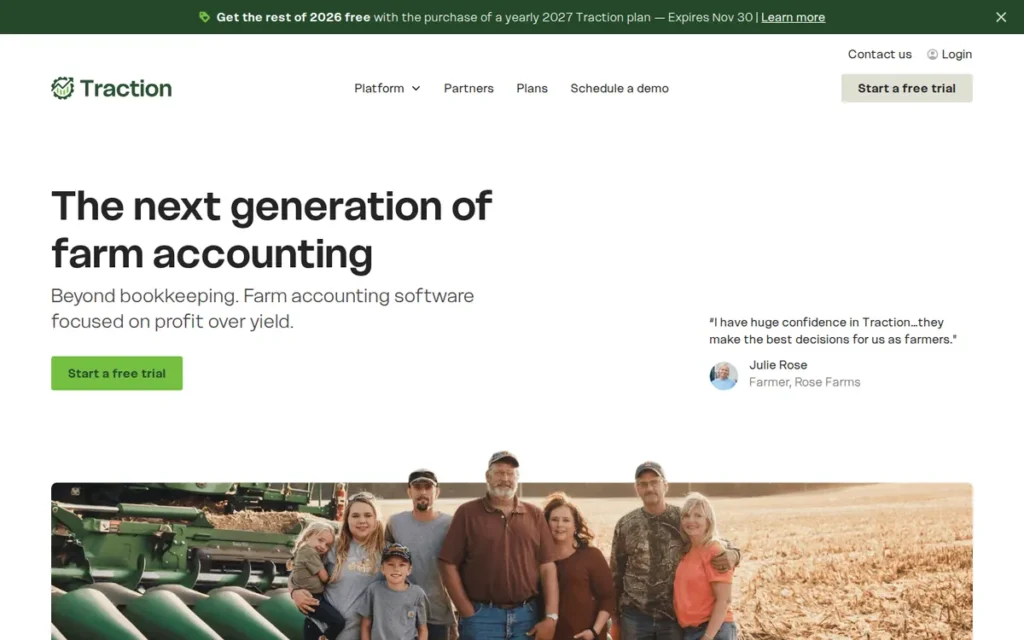
Category: Farm Financial & Profitability, accounting plus field records to show breakeven and profit by field.
At a Glance
- Category: Farm Financial & Profitability
- Best For: Mid-size row-crop farms that want field-level breakeven and profitability tied to their accounting
- Price Range: $950–$3,950/year (Basic, Plus, Pro); free trial
- Primary Strength: Traction Ag shows profitability by farm, field, acre and bushel and assigns actual equipment costs to fields, all inside a farm-specific accounting ledger.
- Biggest Limitation: Traction Ag has no imagery or scouting tools, so most farms will pair it with an equipment-data platform.
- One-Line Summary: Traction Ag is the only accounting-first crop management platform in this evaluation, combining double-entry farm accounting with field records and equipment cost allocation for U.S. row-crop farms.
- Last Verified: November 2026
PlugRoute Score: 3.88/5, Workflow 4 · Interoperability 4 · Pricing 4 · Sentiment 4.5 · Reliability 3 · Stability/Data 3. Traction Ag’s verified 59-review rating raised the score most. Its reliability and stability scores lowered it most.
Overview
Traction Ag is an Indianapolis-based farm accounting and field-records platform for mid-size row-crop farms. Traction Ag combines double-entry farm accounting with field operations and inventory, and it reports breakeven and profit by field, acre and bushel.
Traction Ag acquired Granular Business from Corteva in November 2022 and later acquired Conservis (Traction Ag, 2022; Traction Ag, 2024).
Key Features
- Traction Ag provides farm-specific double-entry accounting, including a general ledger, bills, invoices, prepays, 1099s, market-value balance sheets and cash-flow budgets (Traction Ag, 2026).
- Traction Ag reports profitability by farm, field, acre and bushel and assigns actual equipment costs such as fuel, depreciation and maintenance to fields (Traction Ag, 2022).
- Traction Ag records tillage, planting, application and harvest operations alongside scale tickets and load tracking (Traction Ag, 2026).
- Traction Ag tracks inventory of seed, chemical, fertilizer and grain (Traction Ag, 2026).
- Traction Ag integrates with John Deere Operations Center, Climate FieldView, Paylocity payroll and FS bill import (Traction Ag, 2026).
Best For
Traction Ag is best for mid-size row-crop farms that want to replace general accounting software and spreadsheets with one system that shows field-level breakeven. Traction Ag is not ideal for farms that need imagery, scouting or specialty-crop labor and traceability tools.
Pricing
- Traction Ag lists flat-rate plans of $950/year (Basic), $1,950/year (Plus) and $3,950/year (Pro) (Traction Ag, 2026).
- Traction Ag offers a free trial and does not charge per acre (Traction Ag, 2026).
- Traction Ag Plus at $1,950/year works out to about $162.50 per month.
- PlugRoute could not verify whether Traction Ag offers a free Traction Field tier (PlugRoute research, 2026).
Strengths
- Traction Ag holds 4.9/5 from 59 Capterra reviews, plus 4.9/5 overall and for customer support on Software Advice (Capterra, 2026; Software Advice, 2026).
- Traction Ag inherited the field-profitability and equipment cost-allocation features of Granular Business after the November 2022 acquisition (Traction Ag, 2022).
- Traction Ag grew its customer count by more than 300% in 2022 and raised a $10M Series A led by Cooperative Ventures in May 2024 (Traction Ag, 2022; Traction Ag, 2024).
- Traction Ag customer Sam Kuntz values seeing “field by field profit” and writing checks from the same system (Traction Ag vendor-hosted testimonial, undated).
Limitations
Traction Ag’s accounting depth comes with a scope trade-off. Traction Ag has no imagery or scouting tools, so most farms will pair it with Climate FieldView or John Deere Operations Center.
- Traction Ag vendor-hosted testimonials say accrual statements, a market-value balance sheet and payables and receivables were missing at one time, so buyers should confirm these now exist (Traction Ag, undated).
- Traction Ag reviewers say the Field Ops area could be easier to use and that importing historical records is slow (Capterra, 2026).
- Traction Ag cannot split one record across several partly covered fields with different acreages, according to reviewers (Software Advice, 2026).
- Traction Ag has no verified independent security certification such as SOC 2 (PlugRoute research, 2026).
Verdict
Traction Ag is the strongest documented option for U.S. row-crop farms whose main gap is field-level profitability, because it is the only platform in this evaluation built around farm accounting. Traction Ag’s integrations with John Deere Operations Center and Climate FieldView make it a natural second tool. Buyers should use the free trial to confirm the accounting features they need.
3. Agworld (Semios): Best for Crop Planning, Budgeting and Agronomist Collaboration
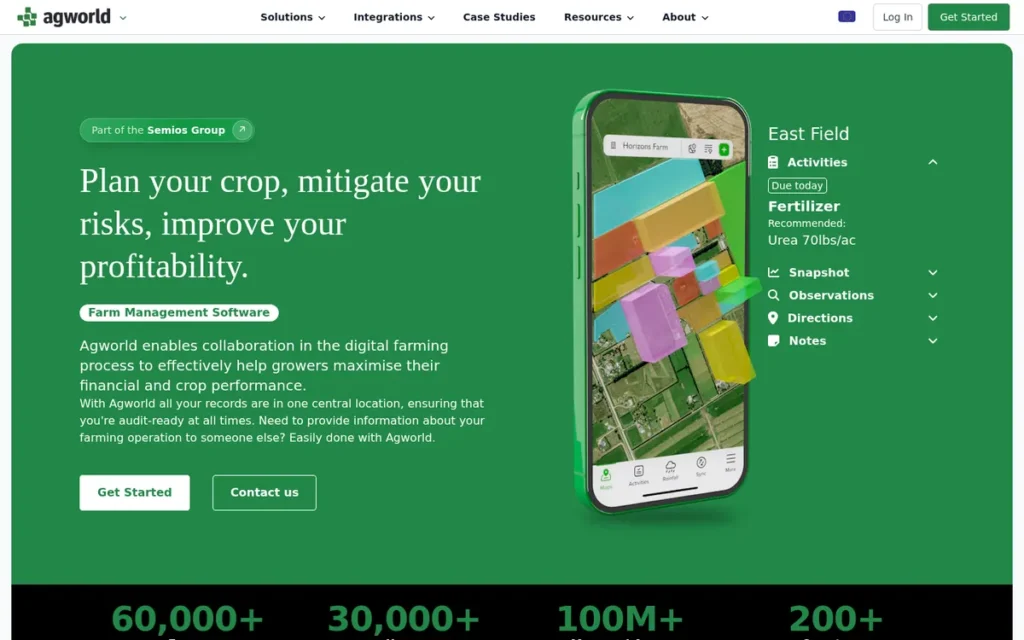
Category: Agronomy Planning & Collaboration, shared crop plans, budgets and records between growers and advisors.
At a Glance
- Category: Agronomy Planning & Collaboration
- Best For: Growers who build crop plans and input budgets with an agronomist, retailer or contract applicator
- Price Range: Free tier (limits not detailed) + $1,495–$3,995/year (Capterra-listed) + Enterprise quote
- Primary Strength: Agworld lets growers, agronomists, retailers and applicators work from one shared set of plans, budgets, scouting notes and work orders.
- Biggest Limitation: Agworld’s mapping and yield-comparison tools are weaker than its planning tools, and reviewers report no smooth automatic import of yield data.
- One-Line Summary: Agworld is the highest-scoring planning and collaboration platform in this evaluation for farms that budget alongside outside agronomists, turning shared recommendations into work orders and completed field records.
- Last Verified: November 2026
PlugRoute Score: 3.85/5, Workflow 4 · Interoperability 4 · Pricing 4 · Sentiment 4 · Reliability 3.5 · Stability/Data 3. Agworld’s documented Deere integration raised the score most. Its stability and data-control score lowered it most.
Overview
Agworld is a collaborative farm planning and agronomy platform for operations that make crop decisions alongside outside advisors. Growers, agronomists, retailers and applicators use Agworld to share field plans, budgets, scouting notes and work orders.
Agworld has been part of the Semios group since August 2021 (Semios, 2021). Agworld integrates with John Deere Operations Center for prescriptions and imagery layers (Agworld, 2026).
Key Features
- Agworld gives growers, agronomists, retailers, contract applicators and office staff one shared set of plans, budgets, scouting notes, work orders and records (Agworld, 2026).
- Agworld turns agronomic recommendations into work orders and then into records of the work actually completed (Agworld, 2026).
- Agworld integrates with John Deere Operations Center for prescriptions, NDVI satellite imagery and historical layers (Agworld, 2026).
- Agworld’s mobile app records field data offline and syncs it when a connection returns (rfp.wiki, 2026).
- Agworld’s Pro tier adds a custom report builder, and its Enterprise tier includes Power BI integration (Capterra, 2026).
Best For
Agworld is best for farms whose agronomist or retailer also uses the platform, so plans, budgets and recommendations sit in one shared system. Agworld is not ideal for growers who mainly need advanced yield mapping or who work without outside advisors.
Pricing
- Agworld Free costs $0, with limits not detailed (Capterra, 2026).
- Agworld Basic costs $1,495/year, Plus costs $2,495/year and Pro costs $3,995/year, with Enterprise by custom quote (Capterra, 2026).
- Agworld pricing is flat and annual rather than per acre, and a 7-day trial is available (Capterra, 2026).
- Agworld buyers should confirm these Capterra-listed prices with the vendor, because a secondary source estimates US$450–$3,995/year (SoftwareHQ, 2026).
Strengths
- Agworld holds about 4.6/5 across 91 reviews on G2, Capterra and Software Advice combined, one of the larger review bases in this category (rfp.wiki, 2026).
- Agworld users on Capterra praise its templates, planning and collaboration tools, giving it 4.5/5 from 44 reviews (Capterra, 2026).
- Agworld customer Picabo Livestock tracks fertilizer, seed, fuel and labor costs by field and crop through the Agworld–Deere connection, though the case study reports no measured outcomes (Agworld vendor case study, accessed 2026).
- Agworld customer Roper & Son built a 10-year digital history of inputs, rotations and weather and reported less stress around compliance (Agworld vendor case study, accessed 2026).
Limitations
Agworld’s collaboration model creates a dependence trade-off. Agworld works best when the advisor also uses it, so a grower without a participating agronomist pays $1,495 or more per year for a platform built around shared work.
- Agworld reviewers report weaker mapping and yield-comparison tools and no smooth automatic import of yield data (Capterra, 2026).
- Agworld reviewers describe slow syncing and occasional timeouts on large accounts (rfp.wiki, 2026).
- Agworld reviewers describe fragile ISOXML, Shapefile and GeoJSON mappings, which affects data portability (rfp.wiki, 2026).
- Agworld’s companion Sampling app has a strongly negative App Store review calling for an overhaul (Apple App Store, 2026).
Verdict
Agworld is the best-documented crop management platform for growers who plan and budget alongside an agronomist or retailer, with about 4.6/5 across 91 reviews (rfp.wiki, 2026). Agworld’s flat annual pricing does not grow with acreage. Buyers should confirm that their advisor will use Agworld and test yield imports and exports during the 7-day trial.
4. Farmbrite: Best for Small and Diversified Crop-and-Livestock Farms
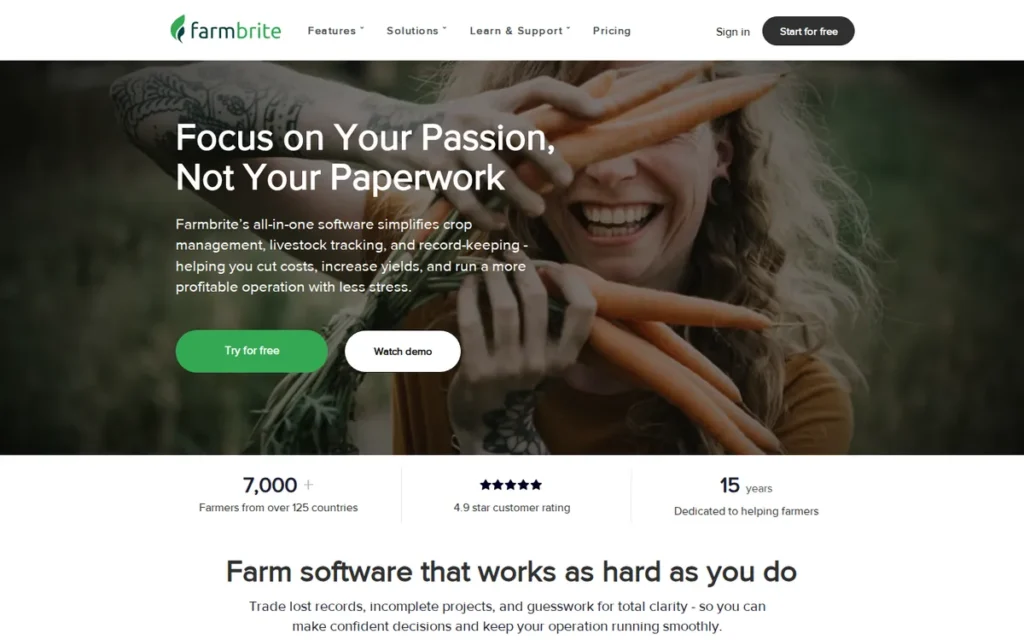
Category: All-in-One Small Farm Manager, crop, livestock, sales and records in one affordable system.
At a Glance
- Category: All-in-One Small Farm Manager
- Best For: Small and diversified farms running crops, livestock and direct sales together
- Price Range: $29–$79/month ($290–$790/year); Accounting Only $119/year; Enterprise custom
- Primary Strength: Farmbrite combines crop planning, livestock, sales, inventory and accounting in one system with published pricing and no per-acre fees.
- Biggest Limitation: Farmbrite has no documented connection to farm machinery or precision-ag equipment, which makes it a poor fit for large equipment-connected row-crop operations.
- One-Line Summary: Farmbrite is the most transparently priced all-in-one platform for small and diversified U.S. farms, combining crops, livestock, direct sales and accounting from $29 per month.
- Last Verified: November 2026
PlugRoute Score: 3.80/5, Workflow 4 · Interoperability 2 · Pricing 5 · Sentiment 5 · Reliability 3 · Stability/Data 3.5. Farmbrite’s pricing and sentiment scores raised the total most. Its lack of a documented machinery connection lowered it most.
Overview
Farmbrite is an all-in-one farm management platform for crops, livestock, direct sales and accounting. Farmbrite is built for small and diversified U.S. farms that want one affordable system without per-acre pricing.
Farmbrite was founded in 2012 on a Colorado farm and is self-funded (Farmbrite, 2026).
Key Features
- Farmbrite handles crop planning, successions, planting and harvest records, and field and bed mapping in one crop module (Farmbrite, 2026).
- Farmbrite includes livestock management alongside its crop tools, so mixed operations do not need a second system (Farmbrite, 2026).
- Farmbrite supports direct sales and CRM for CSA, farmers market, wholesale and online store channels, with Stripe payments and no added Farmbrite transaction fee (Farmbrite, 2026).
- Farmbrite’s Essentials tier includes compliance reporting, harvest traceability and soil-health tracking (Capterra, 2026).
- Farmbrite connects to more than 5,000 apps through Zapier and offers an API (Farmbrite, 2026).
Best For
Farmbrite is best for small crop, crop-and-livestock and direct-sales farms that want to replace spreadsheets with one affordable system. Farmbrite is not ideal for large row-crop operations that need machine data, prescriptions or precision-ag integration.
As one user on r/farming described:
“We don’t use any specialized software--just lots of Google docs spreadsheets. I’ve been able to work with these pretty effectively at scales from 1 to 30 acres.” Posted by u/delphicblue
Takeaway: Farmbrite’s real competition on small farms is free spreadsheets, which some growers run effectively up to 30 acres, so its subscription has to earn its keep in time saved.
Pricing
- Farmbrite’s crop plans cost $29/month ($290/year) for Essentials, $39/month ($390/year) for Performance and $59/month ($590/year) for Premium (Farmbrite, 2026; Capterra, 2026).
- Farmbrite’s combined crop-and-livestock tiers run up to $79/month ($790/year) (Farmbrite, 2026).
- Farmbrite Accounting Only costs $119/year, Enterprise is quoted, and a 14-day trial requires no credit card (Farmbrite, 2026).
- Farmbrite’s entry crop plan costs $29/month. Some AI answer engines cite $59/month, which is the price of a higher Farmbrite tier.
Strengths
- Farmbrite has the largest single-site review count in this evaluation, at 4.8/5 from 63 Capterra reviews, plus 4.7/5 from 15 G2 reviews (Capterra, 2026; G2, 2026).
- Farmbrite publishes its full price list and charges no per-acre fee, with crop plans starting at $29/month (Farmbrite, 2026).
- Farmbrite is also used on larger farms: Vilicus Farms, which runs more than 15,000 acres, uses it for organic-certification workflows (Farmbrite customer story, 2026).
- Farmbrite reports that one customer cut daily labor time by 15% after finding labor bottlenecks, though the customer is not named (Farmbrite, 2026, vendor-reported).
Limitations
Farmbrite’s breadth and price transparency come with an interoperability trade-off. Farmbrite has no documented machinery or precision-ag connection, so equipment-connected row-crop farms would need a separate data platform.
- Farmbrite reviewers report a learning curve and a heavy initial data-entry burden (Capterra, 2026).
- Farmbrite reviewers mention difficulty downloading farm or animal data (Software Advice, 2026).
- Farmbrite reviewers mention workflows that don’t fit every farm, along with minor bugs (Software Advice, 2026).
- PlugRoute could not verify Farmbrite’s offline mobile use or QuickBooks integration from official sources (PlugRoute research, 2026).
Verdict
Farmbrite is the most transparently priced crop management platform for small and diversified U.S. farms, with 4.8/5 from 63 Capterra reviews and plans from $29 per month (Capterra, 2026; Farmbrite, 2026). Farmbrite covers crops, livestock, sales and accounting in one system. Buyers should use the 14-day trial to test data exports and offline behavior.
5. Croptracker: Best for Specialty Crop Harvest, Labor and Traceability
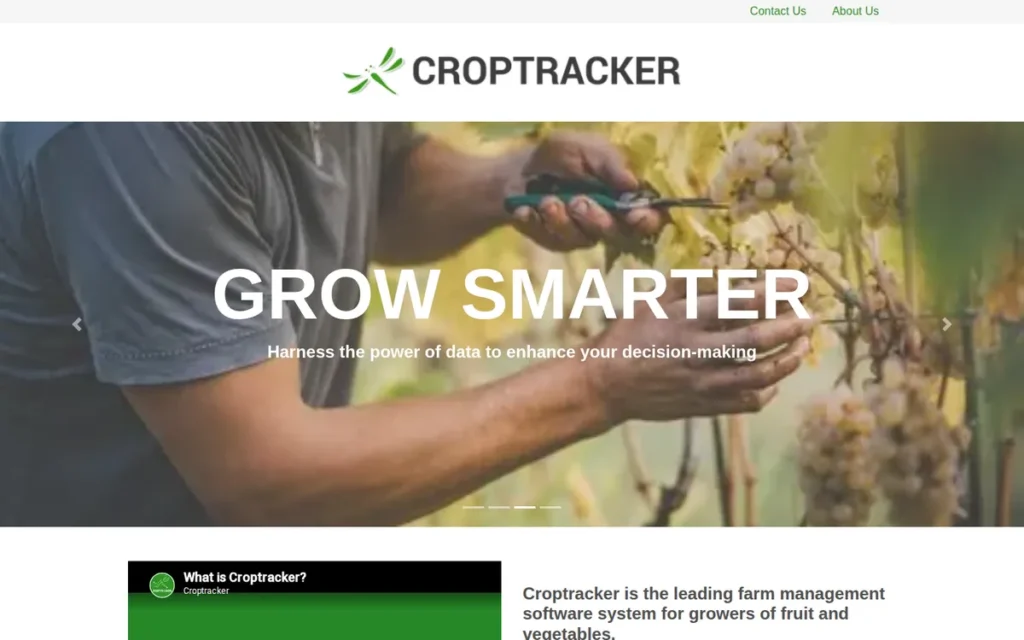
Category: Specialty Crop Operations & Traceability, harvest, labor and compliance records from field to shipment.
At a Glance
- Category: Specialty Crop Operations & Traceability
- Best For: Fruit, vegetable and perennial growers with seasonal crews and packhouse or shipping workflows
- Price Range: From US$3,300/year (10 users included); module and extra-user pricing on request
- Primary Strength: Croptracker tracks harvest, piece-rate labor and traceability from field to bin to packhouse to shipment in one modular system.
- Biggest Limitation: Croptracker starts at US$3,300 per year with a 10-user minimum, which is expensive for very small farms.
- One-Line Summary: Croptracker is the most specialized crop management platform for U.S. fruit and vegetable growers who need harvest tracking, piece-rate labor management and field-to-shipment traceability.
- Last Verified: November 2026
PlugRoute Score: 3.48/5, Workflow 4.5 · Interoperability 2 · Pricing 3 · Sentiment 4 · Reliability 3.5 · Stability/Data 4. Croptracker’s workflow depth raised the score most. Its lack of documented machinery integration lowered it most.
Overview
Croptracker is a modular specialty-crop management platform from Dragonfly IT that handles harvest, labor and traceability records. Croptracker is built for fruit, vegetable and perennial growers managing seasonal crews and packhouse workflows.
Croptracker grew out of the Ontario Apple Growers’ need for better spray records (Croptracker, 2026).
Key Features
- Croptracker traces product from field to bin to packhouse to shipment and produces GAP audit reports (Croptracker, 2026).
- Croptracker manages labor with piece rates and a kiosk punch clock for seasonal harvest crews (Croptracker, 2026).
- Croptracker supports pre-printed harvest tags that can be scanned offline and synced later (Croptracker, 2026).
- Croptracker’s Harvest Quality Vision measures fruit color and size with a phone, and Crop Load Vision counts and sizes fruit before harvest (Croptracker, 2026).
- Croptracker generates more than 50 reports and lets customers buy only the modules they need (Croptracker, 2026).
Best For
Croptracker is best for specialty fruit and vegetable growers whose labor, harvest and traceability workload justifies a multi-user subscription. FDA will not enforce the FSMA Food Traceability Rule before July 20, 2028, which gives Croptracker buyers time to build lot-level records (FDA, 2026).
Pricing
- Croptracker starts at US$3,300/year with 10 users included (Croptracker, 2026).
- Croptracker’s starting price works out to about US$330 per user per year, or US$27.50 per user per month, at the 10-user minimum.
- Croptracker’s minimum hits small teams hard: a three-person orchard crew pays the full US$3,300, about US$1,100 per actual user.
- Croptracker does not publish per-module or additional-user pricing, so buyers need a quote for their exact configuration.
Strengths
- Croptracker reports that Mr Apple’s harvest teams saved 600–800 hours per week during harvest season (Croptracker, 2026, vendor-reported, not independently audited).
- Croptracker customer Taggares Fruit Company scanned tags offline, stopped end-of-day ticket reconciliation and handled 2,000 bins in one day (Croptracker vendor case study, 2026).
- Croptracker has operated since 2006 and reports customers in 41 countries and more than 60,000 mapped fields (Croptracker, 2026).
- Croptracker users on Capterra praise responsive support, mapping, spray costing, harvest-by-block reports and employee-hour tracking, giving it 4.5/5 from 28 reviews (Capterra, 2026).
Limitations
Croptracker’s specialty depth comes with a cost trade-off. Croptracker’s US$3,300/year entry price, 10-user minimum and unpublished module pricing make it a poor fit for micro farms and solo growers.
- Croptracker reviewers report a chemical database that cannot be edited, rigid data entry and time-consuming mapping setup (Capterra, 2026).
- Croptracker reviewers describe slow performance on weak internet connections (G2, 2026).
- Croptracker’s offline support is confirmed only for harvest scanning, not for every module (Croptracker, 2026).
- Croptracker has no documented machinery or precision-ag integration, so it is not suited to row-crop machine data.
Verdict
Croptracker has the deepest documented specialty-crop workflow coverage in this evaluation (Workflow score 4.5/5), covering harvest, piece-rate labor and field-to-shipment traceability in one system. Croptracker’s value grows with crew size and traceability workload. Buyers should confirm module pricing and test the modules they need offline.
6. John Deere Operations Center: Best for Deere-Equipped Row-Crop Operations
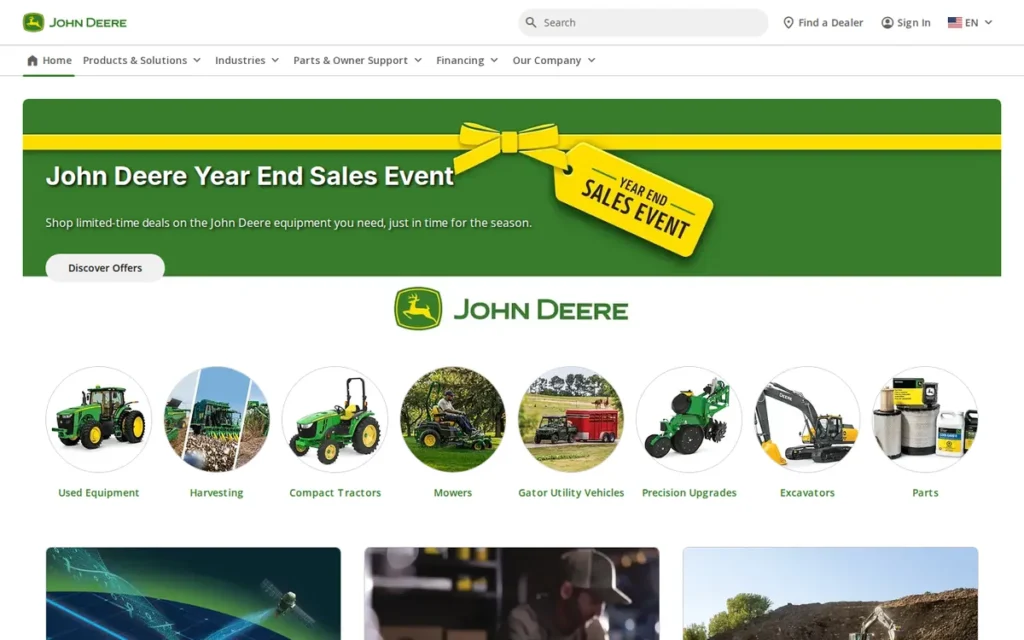
Category: Equipment Data Hub, collects machine, planting, application and harvest data into one field record.
At a Glance
- Category: Equipment Data Hub
- Best For: Row-crop operations running mostly John Deere tractors, displays, receivers and modems
- Price Range: Free software account + hardware, retrofit (from $2,650) and dealer-quoted add-ons
- Primary Strength: John Deere Operations Center has the deepest machine-to-cloud integration in this evaluation for Deere-equipped fleets.
- Biggest Limitation: John Deere Operations Center’s mobile app is rated 2.8/5 from 675 Google Play reviews, with reported crash and sync problems.
- One-Line Summary: John Deere Operations Center is the most deeply integrated free farm-data platform for Deere-equipped row-crop operations, though its real cost lies in hardware, retrofits and dealer-quoted add-ons.
- Last Verified: November 2026
PlugRoute Score: 3.45/5, Workflow 5 · Interoperability 4 · Pricing 3 · Sentiment 2 · Reliability 2 · Stability/Data 3. John Deere Operations Center’s workflow depth raised the score most. Reliability lowered it most, based on 2.8/5 from 675 Google Play reviews and a documented crash-after-update complaint.
Overview
John Deere Operations Center is a free cloud farm-management platform for row-crop operations running mostly Deere equipment. John Deere Operations Center collects machine data, field records and work plans through JDLink and sends prescriptions to the cab.
John Deere Operations Center also acts as a hub that third-party farm apps connect to through Deere’s APIs (John Deere, 2026).
Key Features
- John Deere Operations Center collects machine location, hours, fuel, diagnostics and field records through JDLink (John Deere, 2026).
- John Deere Operations Center supports work planning and sends prescriptions directly to the cab (John Deere, 2026).
- John Deere Operations Center’s mobile app provides equipment monitoring, alerts and remote display access (Google Play, 2026).
- John Deere Operations Center connects older or non-Deere machines through the Precision Essentials bundle of a G5 display, StarFire receiver and JDLink modem (John Deere, 2026).
- John Deere Operations Center shares data with apps such as Climate FieldView, Agworld and Traction Ag, though what each connection can share varies by partner (Agworld, 2026; Traction Ag, 2026).
Best For
John Deere Operations Center is best for row-crop farms with mostly Deere fleets that want machine data, planning and prescriptions in one free account. John Deere Operations Center is not ideal for mixed fleets, for buyers avoiding manufacturer lock-in, or for farms needing native profitability tools.
Pricing
- John Deere Operations Center accounts and JDLink activation are free (John Deere, 2026).
- John Deere Operations Center PRO Service is a repair and diagnostics tool, not a farm-records tier, and starts at $195 per machine per year (John Deere, 2026).
- John Deere Operations Center retrofits through the Precision Essentials kit start at $2,650 (John Deere, 2026).
- John Deere Operations Center hardware, connectivity subscriptions and See & Spray per-acre fees are quoted by dealers, so total cost depends on hardware and add-on licenses.
Strengths
- John Deere Operations Center reported more than 520 million engaged acres, nearly 1.2 million connected machines and more than 450,000 unique monthly active digital users in Q3 2026 (John Deere, 2026).
- John Deere Operations Center’s engaged acres are not subscribed acres, because one acre that is planted, sprayed and harvested with connected machines can count more than once (John Deere, 2026).
- John Deere Operations Center’s free account and free JDLink activation let Deere-equipped farms centralize machine data without a software subscription (John Deere, 2026).
- John Deere Operations Center connects to Climate FieldView, Agworld and Traction Ag, which makes it a common hub for two-tool farms (Agworld, 2026; Traction Ag, 2026).
This aligns with community sentiment on r/farming:
“Deere operations center. It works well and links to about everything.” Posted by u/An_elusive_potato
Takeaway: John Deere Operations Center’s broad third-party connectivity is its most valued trait among users who already run it day to day.
Limitations
John Deere Operations Center’s deep integration creates a hardware-dependence trade-off. Non-Deere machines need a retrofit starting at $2,650 and may still send less data, and key costs are quoted by dealers rather than published (John Deere, 2026).
- John Deere Operations Center’s app is rated 2.8/5 from 675 Google Play reviews, including a complaint that it closes right after opening following an update (Google Play, 2026).
- John Deere Operations Center reportedly has a steep setup learning curve for organizations and permissions (unverified analyst synthesis, 2026).
- John Deere Operations Center offers few native budgeting or profitability tools.
- John Deere Operations Center users reportedly see sync problems in busy seasons. PlugRoute could not tie this to counted reviews, so it did not affect the C5 score.
- John Deere Operations Center sits in a disputed hardware ecosystem: the FTC and five states sued Deere on January 15, 2025, over repair software, settling July 8, 2026, under a 10-year order (FTC, 2026).
- John Deere Operations Center faces lock-in concerns from some farmers, who say they buy older, unrestricted equipment instead (r/righttorepair, 2026).
Verdict
John Deere Operations Center is the most deeply integrated farm-data platform for row-crop operations running mostly Deere equipment, and its software account costs nothing. John Deere Operations Center’s sixth-place rank reflects weak app ratings and hardware-driven costs, not a lack of capability. Mixed fleets should compare Climate FieldView first.
7. CropX: Best for Sensor-Driven Irrigation and Nutrient Decisions
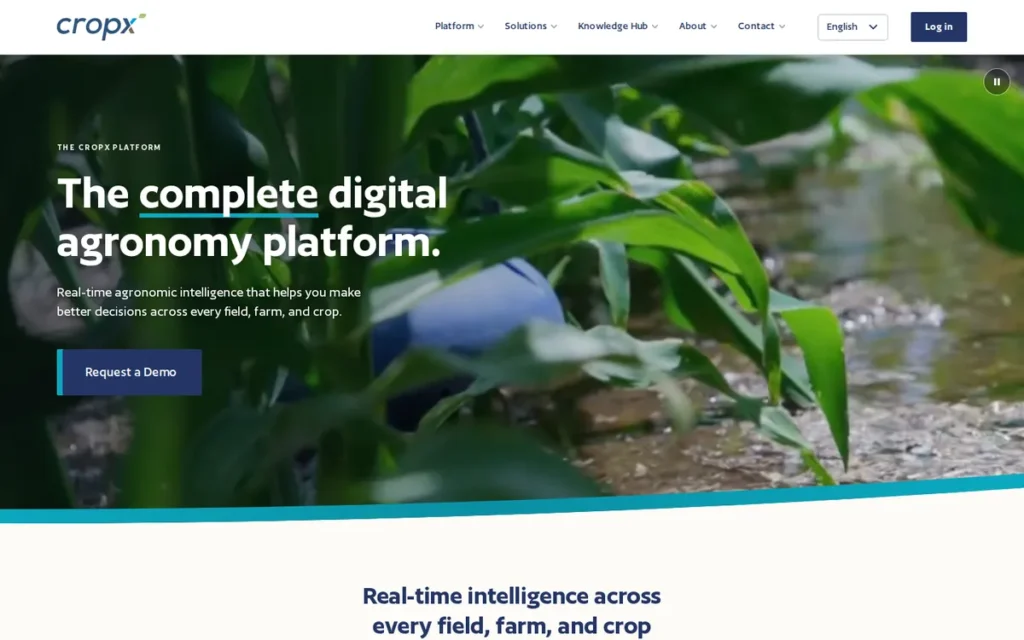
Category: Sensor-Driven Irrigation & Nutrient, soil-sensor data turned into irrigation and fertilizer recommendations.
At a Glance
- Category: Sensor-Driven Irrigation & Nutrient
- Best For: Irrigated operations with high water or fertilizer costs and reliable cellular coverage
- Price Range: Pricing on request (dealer-quoted annual subscription; historically $380–$899 per sensor + $220–$275/year per sensor)
- Primary Strength: CropX recommends irrigation timing and amounts from multi-depth soil moisture readings combined with weather and satellite data.
- Biggest Limitation: CropX publishes no current price and has no verified presence on any review platform, so buyers cannot independently check cost or user satisfaction.
- One-Line Summary: CropX is a soil-sensor irrigation and nutrient platform for irrigated farms with high water costs, but its outcome data is vendor-published and its pricing is dealer-quoted.
- Last Verified: November 2026
PlugRoute Score: 2.25/5, Workflow 3 · Interoperability 3 · Pricing 1 · Sentiment 1 · Reliability 2 · Stability/Data 3.5. CropX scores 3 on interoperability, above Farmbrite and Croptracker, because it documents compatibility with Sentek, EnviroPro and AquaCheck sensors. Its lack of a public price and reviews lowered it most.
Overview
CropX is a soil-sensor and agronomic analytics platform for irrigated operations where water and fertilizer costs justify sensor hardware. CropX combines multi-depth soil moisture readings with weather, satellite and crop data to recommend irrigation timing, amounts and nitrogen decisions.
CropX was founded in 2013 and had raised about $22.9M as of 2019. PlugRoute could not verify any later funding rounds (The Spoon, 2019).
Key Features
- CropX soil sensors measure moisture at several root-zone depths, and the original sensor screws into the soil in about 4 minutes (TechCrunch, 2016).
- CropX combines sensor readings with weather, satellite, crop and equipment data to recommend when and how much to irrigate (CropX, 2025).
- CropX provides nitrogen intelligence, leaching detection and fertilizer optimization (CropX, 2025).
- CropX issues disease-risk alerts and supports activity tracking (CropX, 2025).
- CropX works with third-party sensors from Sentek, EnviroPro and AquaCheck (CropX, 2025).
Best For
CropX is best for irrigated row-crop and forage operations where water prices and field variability make sensor-guided scheduling likely to pay off. CropX is not ideal for growers seeking a free irrigation tool or for remote fields without cellular coverage.
Pricing
- CropX publishes no current price and sells an “all-inclusive” annual subscription, often through dealers (CropX, 2026).
- CropX historically cost about $380 per sensor plus $220/year (Vegetable Growers News, 2016) and later $600–$899 per sensor plus $275/year (The Spoon, 2019).
- CropX fields usually need 2–3 sensors, so buyers should get a current written dealer quote.
- PlugRoute could not verify whether CropX offers a free app tier (PlugRoute research, 2026).
Strengths
- At LoPresti Farms, CropX-managed corn yielded 4 bu/ac less (317 vs. 321) but earned about $43/acre more net profit after pumping, labor and sensor costs, because it used 3.2 rather than 5.0 acre-feet of water (CropX case study, 2026, vendor-published).
- CropX’s LoPresti trial with the Colorado Ag Water Alliance skipped one irrigation after a 2-inch rain and shortened irrigation sets from 24 to 16 hours (CropX case study, 2026, vendor-published).
- CropX reports that an Arizona alfalfa operation used 40% less water with the same yield on a 125-acre pivot (CropX, 2026, vendor-published).
- CropX was chosen by Syngenta for its seed-corn supplier farms after a 2023 trial, and Hoffman Irrigation has deployed 200 V4 sensors (CropX, 2026).
Limitations
CropX’s sensor-grounded recommendations come with an evidence trade-off. CropX has no public price and no verified reviews on G2, Capterra, the Apple App Store or Google Play, so buyers cannot check cost or satisfaction in advance.
- CropX’s company-wide claims of 25–50% water savings, 10–20% higher yields and 10–20% less fertilizer are marketing ranges, not audited results (CropX, 2026).
- CropX’s per-sensor subscriptions add up across many fields.
- CropX sensors each measure one spot, which may not represent a variable field.
- CropX sensors in annual crops may need to be removed and reinstalled each season.
- CropX depends on cellular coverage, so remote fields may not report reliably.
Verdict
CropX is the only platform in this evaluation that bases irrigation and nitrogen recommendations on in-field soil sensors, which makes it a specialized choice for irrigated farms with high water costs. Every quantified CropX outcome is vendor-published. Buyers should request a written quote and a trial on representative fields.
Do I Need One Crop Management Tool or Two?
Many U.S. farms with equipment-connected operations will need two crop management tools. No platform in this evaluation covers machine data, agronomy, accounting and specialty-crop compliance together. The most common pairing is an equipment data hub such as Climate FieldView or John Deere Operations Center plus Traction Ag for accounting.
Users on r/farming shared their experience:
“We use DairyComp for herd management. DairyComp interfaces with DairyPlan for our GEA milk parlours to gather production data. DairyComp also provides group animal counts to TMR Tracker to automatically resize loads for our TMR truck. Lots of excel sheets. accounting software, time tracking software. John Deere Operations center for cropping.” Posted by u/ClaasChopper
Takeaway: Real-world farm operations run a stack of specialized tools, with crop management platforms like John Deere Operations Center covering one layer alongside separate accounting and spreadsheets.
These integrations between the ranked platforms are documented:
- Climate FieldView accepts data through a John Deere Operations Center connection (Climate, 2026).
- Traction Ag integrates with both John Deere Operations Center and Climate FieldView (Traction Ag, 2026).
- Agworld integrates with John Deere Operations Center for prescriptions, NDVI imagery and historical layers (Agworld, 2026).
Common two-tool combinations by farm type:
- A mixed-fleet row-crop farm can pair Climate FieldView for machine data and imagery with Traction Ag for field-level profitability.
- A Deere-heavy row-crop farm can pair John Deere Operations Center with Traction Ag or Agworld.
- An advisor-led operation can pair Agworld with John Deere Operations Center so prescriptions reach the cab.
- A small diversified farm or specialty grower can often run one platform, Farmbrite or Croptracker, because machine data matters less on those operations.
The most common crop management stack pairs one equipment data hub that records what the machines did with one accounting platform that records what it cost.
What Does Crop Management Software Really Cost?
Crop management software in this evaluation costs from $0 to $3,995 per year before hardware. The software fee is often not the largest cost. Retrofits, per-machine add-ons, per-sensor subscriptions and user minimums can exceed the subscription price, so buyers should work out total first-year cost before comparing headline prices.
The ranked platforms use six pricing models:
- Free account with paid hardware: John Deere Operations Center is free, but retrofits start at $2,650 and add-ons are dealer-quoted (John Deere, 2026).
- Freemium with hardware: Climate FieldView Prime is free, and Plus starts at $649/year plus Drive hardware from $299 (Climate, 2026).
- Flat annual tiers: Agworld lists $1,495–$3,995/year, and Traction Ag lists $950, $1,950 and $3,950/year, regardless of acreage (Capterra, 2026; Traction Ag, 2026).
- Flat monthly subscription: Farmbrite costs $29–$79/month with no per-acre fee (Farmbrite, 2026).
- Per-user with a minimum: Croptracker starts at US$3,300/year for 10 users (Croptracker, 2026).
- Per-sensor and quote-only: CropX has no public price and historically charged per sensor plus a yearly per-sensor fee (The Spoon, 2019).
Here is a sample first-year cost for a mixed-fleet row-crop farm. Climate FieldView Plus ($649), one Drive starter kit ($299) and Traction Ag Plus ($1,950) total $2,898, before any additional Drives or seats (Climate, 2026; Traction Ag, 2026).
Cost relative to expected benefit is the barrier to adoption farmers cite most often, named by 31% of them (Agronomy Journal, 2025). A $0 crop management subscription can still cost $2,650 before the first acre is logged, because the retrofit kit, not the account, is the real price.
What Red Flags Should I Watch For When Evaluating Crop Management Software?
There are six red flags to watch for in crop management software:
- Hidden hardware and seat costs
- Ratings without review counts
- Unaudited ROI claims
- Partial offline modes
- No documented full data export
- Unclear vendor ownership
Each one can raise your total cost or lock in your data after the trial ends.
Red Flag #1: Headline Prices That Hide Hardware and Seat Costs “Free” or low-priced crop management software can still require retrofits, sensors or paid seats. John Deere Operations Center’s account is free, but its retrofit kit starts at $2,650 (John Deere, 2026). Croptracker’s 10-user minimum charges for seats a small crew never fills (Croptracker, 2026).
Red Flag #2: Ratings Without Review Counts A crop management rating without a review count is weak evidence. In this evaluation, Climate FieldView’s 4.3/5 rests on 3 Capterra reviews, while Farmbrite’s 4.8/5 rests on 63 (Capterra, 2026). No product exceeds about 63 reviews on any single site (Capterra, G2, Software Advice and GetApp, 2026).
Red Flag #3: Unaudited ROI Claims Every quantified water, labor or yield outcome PlugRoute found for these seven platforms is vendor-published, and none has been independently audited (PlugRoute research review, 2026). Treat percentage savings as a reason to run a trial on your own fields, not as a guaranteed result.
Red Flag #4: Offline Mode That Covers Only Some Modules Crop management apps often advertise an offline mode that covers only some tasks, such as harvest scanning. Only 55% of U.S. farms used broadband in 2025 (USDA NASS, 2025), so ask exactly which modules record data without signal before scouting remote fields.
Red Flag #5: No Documented Full Data Export Crop management vendors commonly say farmers own their data, but none in this evaluation clearly documents a complete export of boundaries, application records, prescriptions and history (PlugRoute review of vendor documentation, 2026). Test an export in ISOXML, Shapefile or GeoJSON during the trial.
Red Flag #6: Unclear Vendor Ownership or Product Roadmap Crop management vendors have consolidated quickly. Corteva sold Granular Business to Traction Ag in 2022, and Semios acquired Agworld in 2021 (Traction Ag, 2022; Semios, 2021). Ask every vendor who owns the product, how long it will be supported and what happens to your data after an acquisition.
What Questions Should I Ask Before Choosing Crop Management Software?
Ask each crop management vendor seven questions before you choose. They cover machine compatibility, offline scope, total cost, data export, advisor participation, specialty-crop records and data-use terms. Send every vendor the same questions in writing so you can compare the answers side by side before starting a trial.
Question #1: Which of my machines will connect, and what data will they send? A good answer names your equipment brands and models and states which data types will flow, such as planting, application, harvest or diagnostics. Equipment incompatibility is cited by 14% of farmers as an adoption barrier (Agronomy Journal, 2025).
Question #2: Which modules work offline in my fields? A good answer lists the specific modules that record data without signal and sync later, such as scouting, harvest scanning or work orders. Be cautious of vendors that only say “offline mode is available” without naming the modules it covers.
Question #3: What is my total annual cost including hardware, seats and add-ons? A good answer is a written, itemized quote covering subscription, hardware, installation, extra users and per-machine or per-sensor fees. Compare first-year cost and ongoing annual cost separately, because hardware is usually a first-year expense.
Question #4: Can I export boundaries, application records, prescriptions and history in ISOXML, Shapefile or GeoJSON? A good answer confirms each data type and file format and lets you test an export during the trial. Agworld reviewers have specifically flagged fragile format mappings (rfp.wiki, 2026), so test exports with every vendor.
Question #5: Will my agronomist or retailer use the same platform? A good answer confirms that your advisor already works in the platform or will join it, and states whether advisor access costs extra. Collaboration platforms lose much of their value when the advisor works in a different system.
Question #6: Does it handle harvest, labor and traceability records for my specialty crops? A good answer shows bin or lot tracking, piece-rate labor, GAP audit reports and field-to-shipment traceability. The FSMA Food Traceability Rule requires lot codes and Key Data Elements for listed foods, and FDA will not enforce it before July 20, 2028 (FDA, 2026).
Question #7: How will this vendor’s data-use terms apply to my data? A good answer points you to written terms covering internal use, research use, affiliate sharing and deletion rights. PlugRoute reviewed Bayer’s FieldView privacy FAQ, which allows internal R&D use and affiliate sharing (Climate, 2026). Comparable documents were not reviewed for the other six platforms, so request them from every vendor.
How Did We Rank These Crop Management Software Platforms?
PlugRoute scored each of the seven platforms from 1 to 5 on six weighted criteria, and the weighted total out of 5.00 sets the rank. The weights are 25% for workflow depth, 20% each for interoperability and pricing, 15% for user sentiment, and 10% each for reliability and vendor stability. Scores use evidence verified November 12, 2026.
The six criteria, why each matters and its scoring anchors:
- C1 Workflow Depth and Fit (25%) matters because vendor feature lists look alike. 5 means the core workflow is fully covered with verified capabilities, 3 means partial coverage, and 1 means mostly unverified claims.
- C2 Equipment and Data Interoperability (20%) matters because scattered data is a top reader complaint. 5 means documented mixed-fleet and API connections, 3 means some documented integrations, and 1 means none.
- C3 Pricing Transparency and Total Cost (20%) rewards public, dated prices. 5 means a fully published price with no hardware, 3 means partial or starting-price-only publication, and 1 means quote-only.
- C4 Volume-Adjusted User Sentiment (15%) discounts small review bases. 5 means strong ratings from 50+ single-site reviews, 3 means mixed or thin evidence, and 1 means no reviews.
- C5 Field Reliability and Offline Scope (10%) matters because rural connectivity is weak. 5 means offline mode is verified across core modules with no sync complaints, 3 means partial or unverified offline scope, and 1 means no offline mode plus recurring complaints.
- C6 Vendor Stability and Data Control (10%) uses sourced facts only. 5 means long history plus documented export and data terms, 3 means mixed evidence, and 1 means unstable ownership or restrictive terms.
| Rank | Product | C1 | C2 | C3 | C4 | C5 | C6 | Weighted Total |
|---|---|---|---|---|---|---|---|---|
| 1 | Climate FieldView | 4 | 5 | 4.5 | 3 | 3 | 3 | 3.95 |
| 2 | Traction Ag | 4 | 4 | 4 | 4.5 | 3 | 3 | 3.88 |
| 3 | Agworld | 4 | 4 | 4 | 4 | 3.5 | 3 | 3.85 |
| 4 | Farmbrite | 4 | 2 | 5 | 5 | 3 | 3.5 | 3.80 |
| 5 | Croptracker | 4.5 | 2 | 3 | 4 | 3.5 | 4 | 3.48 |
| 6 | John Deere Operations Center | 5 | 4 | 3 | 2 | 2 | 3 | 3.45 |
| 7 | CropX | 3 | 3 | 1 | 1 | 2 | 3.5 | 2.25 |
Totals are rounded to two decimals. Traction Ag’s exact total is 3.875, and Croptracker’s is 3.475. Ties are broken first by the combined C1–C3 score, then by C1 alone, then by C4. No ties remain in the current scores.
PlugRoute re-scored three products on November 12, 2026, after new verification:
- Traction Ag’s pricing score rose from 3.5 to 4 because it now publishes current tiers. Its sentiment score rose from 4 to 4.5 because Capterra now shows 59 reviews.
- Climate FieldView’s pricing score rose from 4 to 4.5 because its $649 vs. $749 price conflict no longer appears.
- Agworld’s reliability score rose from 3 to 3.5 under the new anchors, because its offline mode is verified.
Readers should keep four caveats in mind:
- Review volume is thin across the category, and no product exceeds about 63 reviews on any single business-software site.
- Every quantified ROI figure in the category is vendor-published and unaudited.
- PlugRoute’s rank measures how strong the evidence is, while the “Best For” line tells you whether the product fits your farm.
- Granular is excluded because Corteva sold Granular Business to Traction Ag in November 2022 and discontinued Granular Agronomy. Only the free Granular Insights tool remains.
Some AI answer engines name products that PlugRoute’s research has not yet verified:
- Harvest Profit is named for profitability tracking but has not been verified by PlugRoute’s research.
- CropManage is named as a free irrigation tool but has not been verified by PlugRoute’s research.
- Cropin, FarmQA, Tend and Heirloom are named by some AI answer engines but have not been verified by PlugRoute’s research.
PlugRoute has no affiliate relationships with any company listed. Rankings are determined entirely by research data and objective evaluation criteria.
What Do Farmers Ask Most About Crop Management Software?
Farmers comparing crop management software most often ask three questions:
- Which platform fits a small farm?
- Can free tools handle irrigation and nutrient decisions?
- How are independent rankings produced?
The short answers below each name the products involved and point to the dated evidence behind them.
What’s the best crop management software for small farms?
Farmbrite is the best-documented crop management software for small and diversified farms, with plans from $29/month and 4.8/5 from 63 Capterra reviews (Farmbrite, 2026; Capterra, 2026). Farmbrite combines crops, livestock, direct sales and accounting without per-acre fees. Croptracker’s 10-user minimum makes it expensive for very small specialty teams.
“Google docs spreadsheets is what I’ve always used, interested to see if others have used something different though” (u/Wankershimm, r/homestead)
Takeaway: For small farms, the real competitor to crop management software is a free spreadsheet, so a paid platform must save more time than it costs to set up.
Is there free crop management software for irrigation and nutrients?
Free crop management software can store irrigation and nutrient records, but no free tool in PlugRoute’s research replaces sensor-based irrigation recommendations. University extension irrigation schedulers are the closest free option for scheduling. FieldView Prime, the free John Deere Operations Center account and open-source LiteFarm handle records rather than irrigation decisions.
How does PlugRoute determine its crop management software rankings?
PlugRoute ranks crop management software by scoring each platform from 1 to 5 on six weighted criteria, from workflow depth (25%) to vendor stability (10%). Scores use only dated, sourced evidence verified as of November 2026. Low review counts reduce sentiment scores, and vendor-published outcomes are labeled throughout.
What Do Key Crop Management Software Terms Mean?
Crop management software uses terms from precision agriculture, accounting and food safety. The twelve definitions below cover the terms used in this ranking, grouped into three areas, so buyers can compare vendor claims on the same footing.
Equipment & Data
Engaged acres: An activity measure some vendors use to count acres where their platform recorded work. One acre can be counted more than once and does not equal a paid subscription.
Mixed fleet: An equipment lineup that includes more than one manufacturer’s tractors, displays or implements. Mixed-fleet buyers should confirm that a platform documents compatibility with each brand they run.
CAN bus and ISOBUS: Communication standards that let tractors, implements and displays exchange data. Machines without them often send less data to crop management platforms.
Retrofit kit: A bundle of display, receiver and modem hardware that lets older or other-brand machines send data to a platform. Retrofit costs can exceed the software subscription.
Variable-rate prescription: A map-based instruction that changes seed, fertilizer or chemical rates across zones within a field. Sending prescriptions straight to the cab saves time and reduces mistakes.
NDVI: A satellite or drone imagery index that shows differences in crop vigor across a field. NDVI helps growers decide where to scout first, but it does not diagnose the cause of a problem.
ISOXML, Shapefile and GeoJSON: Common file formats for field boundaries, prescriptions and application records. Support for these formats determines whether you can move your data to another platform later.
Finance
Double-entry accounting: A bookkeeping method that records every transaction as matching debits and credits. Farm-specific double-entry accounting makes field-level breakeven figures easier to trust.
Breakeven: The price or yield at which revenue covers all costs for a field or crop. Field-level breakeven shows which fields make money and which need different inputs or contracts.
Specialty Crops & Compliance
Piece rate: A labor payment based on units harvested, such as bins or boxes, rather than hours worked. Piece-rate crews need software that records units by worker for accurate payroll.
Traceability: The ability to follow a product lot from field to bin to packhouse to shipment. Traceability records support food-safety audits and recalls, and many specialty-crop buyers require them.
GAP audit: An inspection of Good Agricultural Practices covering on-farm food-safety procedures. Software that produces GAP reports cuts the paperwork growers gather before an audit.
Which Crop Management Software Is Right for You?
Key Insights
- No single crop management platform in this evaluation covers machine data, agronomy, accounting and specialty-crop compliance, so many farms will run two tools.
- Climate FieldView ranks first at 3.95/5 and leads for mixed-brand fleets, with Bayer reporting compatibility with about 80% of equipment types (Climate, 2026).
- Traction Ag ranks second at 3.88/5 after November 2026 verification. It fills the field-profitability gap that equipment platforms leave.
- John Deere Operations Center’s software is free, but its total cost depends on hardware, retrofits from $2,650 and dealer-quoted add-ons (John Deere, 2026).
- Farmbrite is the most transparently priced all-in-one option for small farms, and Croptracker leads specialty-crop harvest, labor and traceability.
- CropX is the only sensor-driven irrigation platform evaluated, but every quantified CropX outcome is vendor-published.
- Every quantified ROI figure PlugRoute found in this category is vendor-reported, and no product has more than about 63 reviews on any single business-software site.
If you run row crops with mixed equipment, start with Climate FieldView and add Traction Ag for profitability. If your fleet is mostly Deere, pair John Deere Operations Center with Traction Ag or Agworld. Small diversified farms and specialty growers may need only Farmbrite or Croptracker.
Users on r/SaaS noted:
“the gap between “this sounds cool” and actually switching tools is huge in farming – people are creatures of habit and changing software feels risky when your livelihood depends on it. maybe try offering free trials or even just screen recordings showing how it works with real data, farmers want to see proof before they jump ship from something that already works” Posted by u/Cold_Pepper7095
Takeaway: Switching crop management software is a high-risk decision for farmers, so a hands-on trial with real farm data matters more than any vendor’s feature list.
Run every crop management trial the same way:
- Import your real field boundaries.
- Log one operation offline in your worst-signal field.
- Export that record in ISOXML, Shapefile or GeoJSON.
- Get a written, itemized first-year quote.
To compare more farm tools, read PlugRoute’s full ranking methodology and our other independent farm software reviews. We update this guide quarterly. Last updated: November 12, 2026.