Verint Workforce Management is the best overall contact center workforce software for enterprises requiring proven scheduling depth and documented AI-driven outcomes. NICE CXone WFM leads for Fortune 100-scale operations on the CXone platform. Calabrio ONE is the top mid-market choice for usability and integrated WFM+QM. The central trade-off is dedicated WFM depth versus CCaaS-bundled integration convenience.
Most contact centers fail not at the CCaaS layer but at workforce planning. Common failure modes include:
- Inaccurate forecasts producing chronic overstaffing or missed SLAs
- Rigid scheduling that drives agent attrition
- Real-time adherence tools that lag intraday volatility, pushing supervisors back to spreadsheets
- WFM bundled into CCaaS platforms as an afterthought, absorbing the full operational cost
If your contact center is fighting intraday fires manually or has been burned by a platform that looked better in the demo than in production, this comparison is written for you.
PlugRoute has no affiliate relationships with any vendor in this comparison, all rankings are determined solely by documented research, practitioner community sentiment, and independently verified outcomes.
“As someone with intimate knowledge and experience with all things Genesys, Genesys does not have a WFM product. There are ‘some’ WFM features embedded inside their Genesys Cloud Solution…They don’t care. To paraphrase one of the senior level VPs over WFM development: ‘WEM is included with the GC3 license…if they want to use something else, fine let them. We already have their money.'” (u/GodPole, r/workforcemanagement)
Takeaway: An insider with direct Genesys platform knowledge characterizes Genesys Cloud WFM as a checkbox feature bundled into the GC3 license (not a strategic product investment) with documented senior-level indifference to WFM capability development.
Which Contact Center Workforce Platforms Are the Top Picks for 2026?
- Verint WFM delivers enterprise scheduling depth with a modular AI bot ecosystem and documented client outcomes including a 50% forecasting accuracy improvement, the top-ranked platform in this comparison for complex multi-site operations.
- NICE CXone WFM combines 40+ AI forecasting algorithms and native CXone integration to serve 85+ Fortune 100 clients, the top choice for very large enterprises already operating on the CXone platform.
- Calabrio ONE is the G2 Summer 2025 Contact Center Workforce Leader with a 91% ease-of-use rating, integrating WFM, quality management, and analytics in a single cloud-native platform built for mid-market contact centers.
- Five9 WFM provides a hybrid CCaaS-WFM approach: native WFM plus structured Verint and Assembled integration pathways, uniquely suited for organizations scaling from mid-market to enterprise WFM depth within a single CCaaS relationship.
- Talkdesk WFM delivers cloud-native AI forecasting accuracy: a customer reported forecast accuracy within three calls of actual volume on day one, with modern UX and simpler bundled pricing for mid-market contact centers.
- Playvox by NICE is the only platform in this comparison specifically designed from inception for CRM-native deployment, integrating directly with Salesforce, Zendesk, and ServiceNow for AI-powered forecasting on digital support workloads.
What Are the Three Categories of Contact Center Workforce Software?
Contact center workforce software in this comparison falls into three architectural categories. Enterprise WFM Specialists deliver the deepest dedicated scheduling depth for complex multi-site operations. Integrated CCaaS-WFM Suites bundle WFM within a CCaaS platform for operational convenience. Specialized Deployments serve specific operational contexts, CRM-native teams or Genesys-standardized organizations where WFM depth is secondary.
Enterprise WFM Specialists are purpose-built for workforce management complexity, capable of managing 1,000+ agents across multi-site, multi-rule environments. These tools win on three dimensions:
- Forecasting sophistication: multi-model AI selection and scenario simulation
- Intraday management depth: real-time reforecasting and automated staffing recommendations
- Labor rule complexity: multi-site, multi-union, and compliance-heavy scheduling environments
Includes: Verint WFM (#1) and NICE CXone WFM (#2).
Integrated CCaaS-WFM Suites embed WFM natively within a CCaaS architecture, winning on platform consolidation and data integration. Consider the tradeoff this way: a best-in-class airline can have a mediocre in-flight meal service, the CCaaS platform is the airline, the WFM module is the meal. Genesys and Five9 are excellent airlines; whether their WFM is sufficient depends on how much the meal matters.
Practitioners frequently find CCaaS-embedded WFM shallower than dedicated tools in complex scheduling environments. Includes: Calabrio ONE (#3), Five9 WFM (#4), and Talkdesk WFM (#5).
Specialized Deployments are designed for specific operational contexts. Includes: Playvox by NICE (#6) (the only platform in this comparison designed from inception for CRM-native deployment) and Genesys Cloud WEM (#7), recommended only where WFM is a secondary operational priority.
For organizations evaluating both Five9 and Talkdesk: the primary differentiator is outbound dialer depth (Five9 leads) versus UI/UX modernity and pricing simplicity (Talkdesk leads). Neither platform offers the WFM depth of Verint or NICE IEX for complex multi-site environments, but both provide a Verint integration option if native WFM proves insufficient.
Enterprise WFM platforms apply Erlang C and multi-skill blending models to translate forecast volumes into required headcount, accounting for shrinkage (planned and unplanned time away from phones) and target occupancy rates to produce schedules that meet SLA thresholds. These foundational methods remain the basis of WFM scheduling across all seven platforms evaluated.
How Do the Top 7 Contact Center Workforce Platforms Compare at a Glance?
The seven contact center workforce platforms in this comparison span three architectural categories and two market tiers. Verint WFM and NICE CXone WFM are enterprise specialists delivering the deepest dedicated scheduling depth. Calabrio ONE, Five9, and Talkdesk are integrated CCaaS-WFM suites for mid-to-enterprise operations. Playvox by NICE and Genesys Cloud WEM serve specialized operational contexts.
| Rank | Company | Category | Best For | One-Line Summary | Key Capabilities | Primary Strength | Key Limitation |
|---|---|---|---|---|---|---|---|
| 1 | Verint WFM | Enterprise Specialist | Complex multi-site enterprise operations | Verint Workforce Management delivers modular AI-powered scheduling, published outcome metrics, and the deepest enterprise WFM feature set in this comparison. | Multi-channel forecasting | Intraday Spike Bot | TimeFlex self-service | Salesforce integration | Four vendor-published case studies with named percentage outcomes; more than any other platform evaluated | High TCO; implementation complexity; dated UI |
| 2 | NICE CXone WFM | Enterprise Specialist | Fortune 100-scale contact centers on CXone | NICE CXone Workforce Management combines 40+ AI forecasting algorithms, a Manager Copilot, and deep native CXone integration for the largest global operations. | AI Forecasting (40+ algorithms) | Manager Copilot | DCM with TTI | Discrete Event Simulation | Largest documented enterprise deployment base in this comparison (85+ Fortune 100 clients) | Support inconsistency below enterprise tier; platform lock-in risk; no public WFM outcome case studies |
| 3 | Calabrio ONE | Integrated Suite | Mid-market, usability-first WFM+QM buyers | Calabrio ONE is the G2 Summer 2025 Contact Center Workforce Leader, integrating WFM, quality management, and analytics in a single cloud-native platform. | AI forecasting | Workforce Copilot | Enhanced Desktop Analytics | self-service scheduling | G2 Summer 2025 Leader; 91% ease-of-use rating; 50+ WFM enhancements in 2024 | Scalability and automation gaps for very large multi-site BPO environments |
| 4 | Five9 WFM | Integrated Suite | CCaaS buyers wanting WFM depth flexibility | Five9 Workforce Management offers a hybrid model; native WFM for mid-range needs plus Verint or Assembled integration for deeper enterprise requirements. | Native WFM | Verint partnership | Assembled integration | Genius AI | multi-skill forecasting | Only CCaaS platform with a structured native-to-Verint WFM upgrade path; 8th consecutive Gartner CCaaS Leader | Add-on pricing complexity; legacy Java admin tooling; WFM tier gating |
| 5 | Talkdesk WFM | Integrated Suite | Modern cloud-first mid-market contact centers | Talkdesk Workforce Management is a fully cloud-native WFM module within Talkdesk CX Cloud, delivering documented AI forecasting accuracy and modern UX with simpler bundled pricing. | AI omnichannel forecasting | chatbot self-service | mobile access | Verint integration option | 2025 Gartner CCaaS Leader (5th consecutive year); day-one forecast accuracy documented by customer | Audio reliability issues; WFM depth limited vs. dedicated tools |
| 6 | Playvox by NICE | Specialized | CRM-native digital support teams | Playvox by NICE is the only platform in this comparison designed from inception for CRM-native deployment, integrating with Salesforce, Zendesk, and ServiceNow for AI-driven forecasting. | CRM-native forecasting | real-time adherence | shift self-service | open API | Slack integration | Unique CRM-native architecture; estimated $15–$60/agent/month range (see pricing section) | Scalability limits for large multi-region contact centers; fewer enterprise intraday controls |
| 7 | Genesys Cloud WEM | Specialized | Genesys-standardized orgs where WFM is secondary | Genesys Cloud Workforce Engagement Management is a bundled WFM module best suited for organizations on Genesys Cloud CX for whom scheduling depth is not a primary operational priority. | 104-week forecasting | omnichannel scheduling | unified CX data layer | quality management | Native Genesys data integration; active 2026 development velocity | Consistently characterized as insufficient by experienced WFM practitioners for serious scheduling operations |
Which Contact Center Workforce Software Should I Choose for My Use Case?
| Your #1 Priority | Recommended Tool | Why | Acceptable Alternative |
|---|---|---|---|
| Enterprise WFM depth, multi-site complexity | Verint WFM | Four published outcome case studies; modular AI bot ecosystem; CCaaS-agnostic deployment | NICE CXone WFM; if already on CXone ecosystem |
| Fortune 100 scale on CXone ecosystem | NICE CXone WFM | 40+ AI algorithms; Copilot; deepest CXone-native WFM integration available | Verint WFM; for vendor-neutral deployment |
| Mid-market usability, WFM+QM integration | Calabrio ONE | G2 Summer 2025 Leader; 91% ease-of-use rating; integrated analytics; cloud-native | Talkdesk WFM; if already on Talkdesk CCaaS |
| CCaaS-embedded WFM with upgrade flexibility | Five9 WFM | Structured native-to-Verint upgrade path preserves CCaaS continuity | Talkdesk WFM |
| Modern cloud UX, simpler bundled pricing | Talkdesk WFM | Cloud-native; AI forecasting accuracy documented; Verint integration option available | Calabrio ONE |
| CRM-native digital support operations | Playvox by NICE | Only CRM-designed WFM in this comparison; Salesforce/Zendesk/ServiceNow native integration | Calabrio ONE; for traditional contact center structure |
| Already on Genesys; WFM is secondary | Genesys Cloud WEM | Avoid decoupling cost if WFM is not the primary operational priority | Supplement with a dedicated WFM tool via Genesys adapter |
1. Verint Workforce Management: Best Overall for Enterprise WFM Depth
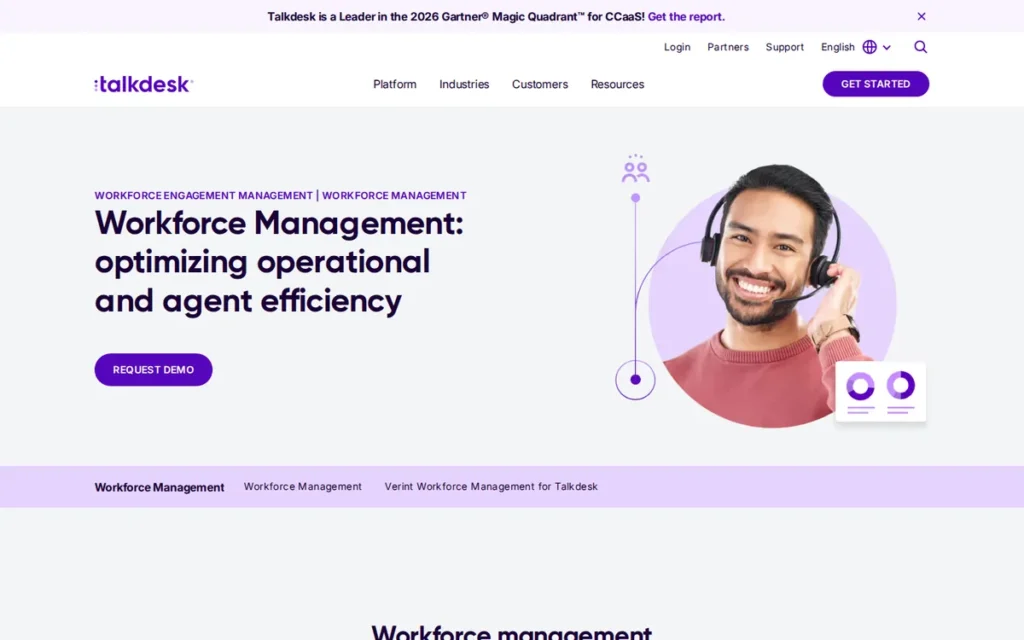
Category: Enterprise WFM Specialist, purpose-built WFM and WEM platform with a modular AI bot ecosystem, deployable independently of any single CCaaS vendor.
At a Glance
- Category: Enterprise WFM Specialist
- Best For: Complex multi-site enterprises requiring deep scheduling, AI intraday management, and CCaaS-agnostic deployment
- Price Range: Contact sales: no public pricing; enterprise-negotiated contract
- Primary Strength: Four vendor-published case studies with named percentage outcomes (50% forecasting accuracy improvement, 24% attrition reduction, 20% productivity increase, 30% overtime reduction), more than any other platform in this comparison
- Biggest Limitation: High total cost of ownership; significant implementation complexity and administrative overhead
- One-Line Summary: Verint Workforce Management delivers modular AI-powered scheduling, the deepest enterprise WFM feature set in this comparison, and the strongest published client outcome documentation record among all seven platforms evaluated.
- Last Verified: May 2026
Overview
Verint Workforce Management is an enterprise-grade WFM and Workforce Engagement Management (WEM) suite powered by Verint’s Da Vinci AI. Verint Workforce Management is purpose-built for large, complex, multi-site contact center environments requiring sophisticated forecasting, scheduling, and real-time intraday management without dependency on any specific CCaaS vendor.
Verint Workforce Management’s core architectural differentiator is its modular AI bot ecosystem: rather than a single monolithic AI layer, Verint deploys specialized, purpose-built bots that organizations can adopt incrementally. Verint was founded in 1994 (NASDAQ: VRNT) and brings more than 30 years of enterprise WFM institutional depth to scheduling complexity, labor rule management, and multi-site coordination.
Key Features
- Exact Forecasting Bot: Verint Workforce Management’s Exact Forecasting Bot continuously analyzes forecast accuracy and automatically recommends adjustments, enabling ongoing self-calibration rather than static monthly forecast cycles.
- Intraday Spike Bot: Verint Workforce Management’s Intraday Spike Bot detects real-time demand spikes and triggers proactive staffing recommendations, directly addressing the most cited WFM pain point: reactive rather than proactive intraday management.
- TimeFlex Bot: Verint Workforce Management’s TimeFlex Bot enables agent-initiated schedule changes at scale within defined business rules, using a game mechanic linked to CX performance data to align agent flexibility with operational outcomes.
- Multi-Channel Forecasting: Verint WFM supports simultaneous forecasting across voice, chat, email, SMS, and asynchronous work, enabling unified workforce planning across all contact channel types.
- Salesforce CRM Integration: Verint WFM Professional integrates natively with Salesforce Service Cloud and Sales Cloud, enabling CRM-driven demand signals to inform workforce planning directly.
- Simulation-Based Scheduling: Verint Workforce Management’s scheduling engine uses simulation modeling to test schedule scenarios before deployment, reducing operational risk from major schedule changes before they affect live staffing.
Best For
Verint Workforce Management is best for large enterprise contact centers (typically 500+ agents across multiple sites) that require deep intraday management, complex labor rule handling, and cross-vendor CCaaS deployment flexibility. Verint WFM is particularly well-suited for financial services, insurance, telecommunications, and BPO environments with complex scheduling requirements.
Pricing
Verint Workforce Management pricing is contact-sales only. No public tier structure, per-seat rates, or annual costs are published on Verint’s official product pages. Enterprise contracts are negotiated based on module selection, seat count, and deployment complexity. (Verint WFM Solutions Page, verified May 2026).
Strengths
- Four Published Outcome Case Studies with Named Metrics: Verint Workforce Management case studies document four distinct enterprise deployments: a global sports betting/iGaming firm improving forecasting accuracy by 50% and reducing attrition to 4% (deployed with partner Sabio); a telecommunications company reducing attrition and unplanned absences by 24% and improving scheduling efficiency by 4.5%, subsequently projecting $5.2M in annual savings and a 10.8X ROI (Verint TimeFlex case study, 2025); a life insurer achieving a 20% increase in productivity and 30% reduction in overtime; and a Serco outsourcing provider reporting a 40% reduction in WFM operations time (Verint WFM Case Studies, 2025). These four named, percentage-specific case studies represent a stronger public outcome documentation record than any other platform in this comparison.
- Practitioner Credibility: Verint WFM is consistently recommended in the r/workforcemanagement community as the destination platform when enterprise contact centers outgrow CCaaS-embedded WFM tools, with practitioners actively migrating from Genesys and NICE to Verint for WFM depth (r/workforcemanagement, 2024–2025).
Users on r/workforcemanagement confirmed this large-scale deployment credibility:
“I am a Workforce Manager with 9 analysts under me in a 1200 seat BPO. We use Verint as our forecasting and scheduling tool and we use Genesys, Mitel and Amazon Connect for RTA, depending on the client. All have their pros and cons, Verint has been very good as a forecasting tool. As long as it is setup correctly.” Posted by u/therecannotbe2
Takeaway: Practitioners managing Verint across 1,200-seat BPO environments validate its forecasting reliability at enterprise scale, with the consistent caveat that correct initial configuration is a prerequisite for performance.
- Credible Agentic AI Roadmap: Verint’s 2025 launch of the Exact Forecasting Bot, Intraday Spike Bot, and TimeFlex Bot represents one of the most operationally specific AI-era WFM roadmaps in this comparison, each bot targeting a discrete pain point rather than broad “AI” positioning (CX Today, 2025; Omdia, 2025).
- CCaaS Vendor Neutrality: Verint WFM deploys across CCaaS environments and is not tied to a single platform, giving organizations the freedom to change routing vendors without replacing their WFM investment. Verint is also available through 8×8 and as an embedded option within Five9 and Talkdesk.
Limitations
- High Total Cost of Ownership: Verint WFM’s enterprise pricing model typically involves significant multi-year contract commitments plus professional services costs for implementation, custom rule configuration, and integration development, making total cost of ownership a consistent barrier for mid-sized organizations evaluating the platform.
- Implementation Complexity: Verint Workforce Management’s depth comes with substantial administrative overhead. Organizations commonly require dedicated WFM administrators and implementation consultants for initial deployment and ongoing configuration, raising the internal resource requirement above CCaaS-embedded alternatives.
This implementation reality is reflected in practitioner experience on r/workforcemanagement:
“I know you want advice for tips or tricks. Respectfully, what you think and want out of a WFM tool, Verint doesn’t have it/doesn’t do it correctly. I’ve used it in two organizations now and unfortunately it’s not a good tool. I feel like I even have a good bit of knowledge on it. My advice is breath and know you’re not the only one struggling. Unfortunately I think a lot of organizations listen to the sales people and not the reviews/people with prior experience. You’ll find the quirks and learn how to work with them and it’ll get your semi faster.” Posted by u/earle1tj
Takeaway: Multi-organization Verint deployments have produced practitioners who report a consistent gap between sales-stage promises and live-deployment reality, a pattern that directly mirrors the implementation complexity limitation documented across this comparison.
- Dated UI: Verint’s scheduling and administration interfaces have been criticized as dated compared to cloud-native tools like Talkdesk or Calabrio, creating UX friction for teams accustomed to modern SaaS product design (Assembled WFM Review of Verint, 2025).
- Pricing Opacity: Verint publishes no public pricing: all cost discovery requires a full sales engagement, making pre-sales TCO comparison structurally impossible without investing in multiple parallel vendor conversations simultaneously.
Verdict
Verint Workforce Management is the top-ranked contact center workforce platform in this comparison because it is the only evaluated tool combining four vendor-published case studies with named percentage outcomes, practitioner-validated enterprise depth, and a credible 2025 agentic AI bot ecosystem. Verint’s four case studies (naming specific clients, deployment contexts, and percentage outcomes) contrast directly with NICE CXone WFM’s absence of equivalent public outcome documentation: this evidence gap is the primary factor separating the #1 and #2 rankings. Verint Workforce Management is the right choice for organizations where workforce management is a strategic operational priority, and the wrong choice for organizations prioritizing deployment speed, UI simplicity, or transparent upfront pricing.
2. NICE CXone Workforce Management: Best for Fortune 100-Scale Operations
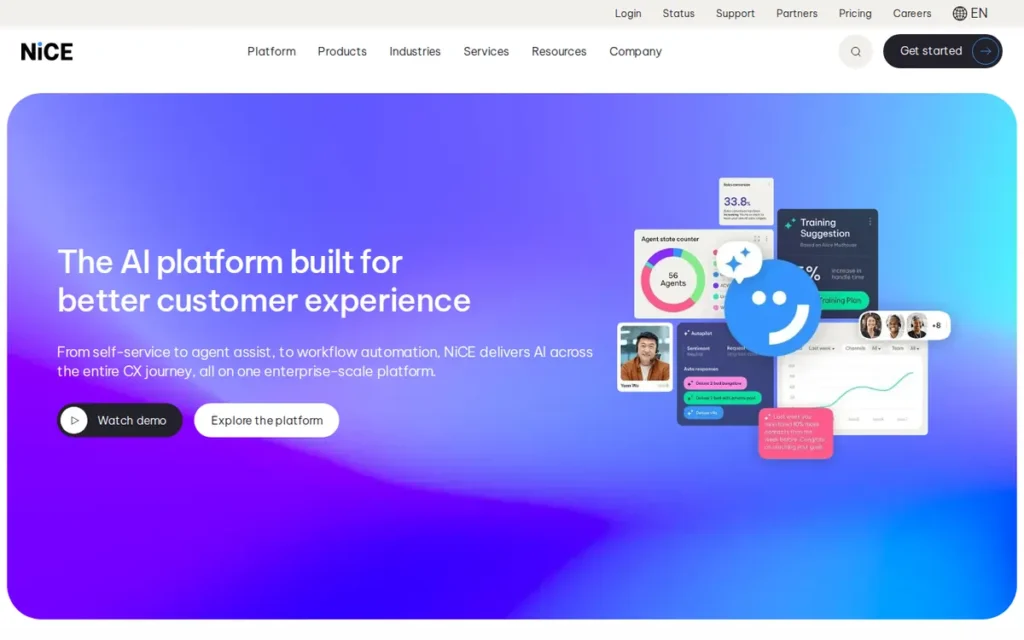
Category: Enterprise WFM Specialist, AI-first WFM suite natively integrated within the NICE CXone cloud contact center platform.
At a Glance
- Category: Enterprise WFM Specialist
- Best For: Very large enterprises (1,000+ agents) already operating on the NICE CXone platform
- Price Range: Contact sales: no public pricing; enterprise-negotiated contract
- Primary Strength: 40+ patented AI forecasting algorithms with native CXone data integration, Workforce Manager Copilot, and the largest documented enterprise deployment base in this comparison (85+ Fortune 100 clients)
- Biggest Limitation: Support inconsistency below Fortune 100 tier; platform lock-in risk; no public named WFM outcome case studies with specific percentage improvements
- One-Line Summary: NICE CXone Workforce Management combines 40+ AI forecasting algorithms, a Workforce Manager Copilot, and Digital Channel Management with True-to-Interval modeling, serving the largest documented enterprise deployment base of any platform in this comparison.
- Last Verified: May 2026
Overview
NICE CXone Workforce Management is an enterprise-grade, AI-powered WFM suite natively embedded within the NICE CXone platform. NICE CXone WFM serves over 25,000 organizations across 150+ countries, including 85+ Fortune 100 companies, the largest documented enterprise deployment base of any vendor in this comparison.
NICE CXone WFM is purpose-built for organizations already standardized on CXone, where native data sharing between routing, WFM, quality management, and analytics creates operational advantages not replicable by third-party integrations.
Buyers should note: NICE offers two distinct WFM products (CXone WFM and the legacy NICE IEX WFM) with meaningfully different capabilities. Always clarify which product is included in any NICE quote.
Key Features
- 40+ Patented AI Forecasting Algorithms: NICE CXone WFM’s “best pick” algorithm automatically selects the optimal forecasting model for each data set and time period from 40+ patented options, enabling adaptive precision without manual model selection (NICE WFM Datasheet, August 2025).
- Copilot for Workforce Managers: NICE CXone WFM includes a conversational AI assistant enabling natural-language schedule inspection, real-time plan vs. actual analysis, and intraday decision support without requiring deep technical WFM expertise.
- Digital Channel Management (DCM) with True-to-Interval (TTI): NICE CXone WFM’s DCM with TTI addresses the forecasting complexity of digital-first channels (chat, email, SMS, back-office tasks) that behave fundamentally differently from traditional voice call volumes.
- Discrete Event Simulation: NICE CXone WFM includes scenario-level simulation, allowing workforce managers to test the impact of schedule changes before committing, reducing operational risk from large-scale staffing decisions.
- Intraday Reforecasting with Automated Actions: NICE CXone WFM generates automated intraday recommendations including overtime solicitation, VTO (voluntary time off), and cross-skill activity reassignment, enabling proactive rather than reactive staffing adjustments.
- Long-Term Strategic Planning: NICE CXone WFM supports long-range workforce planning horizons, enabling capacity and headcount decisions beyond the standard scheduling window for organizations with annual hiring and training cycles.
Best For
NICE CXone Workforce Management is best for very large enterprise contact centers (typically 1,000+ concurrent agents) already operating on the NICE CXone ecosystem. NICE CXone WFM is particularly suited to financial services, telecommunications, healthcare, and retail verticals where the full CXone suite can be leveraged as an integrated operational platform.
Pricing
NICE CXone Workforce Management pricing is contact-sales only. No public tier pricing, per-agent costs, or annual rates are published on NICE’s official product or pricing pages. Pricing is enterprise-negotiated based on seat count, feature modules selected, and deployment complexity. (NICE WFM Product Page, verified May 2026).
Strengths
- Largest Documented Enterprise Deployment Base: NICE CXone WFM serves 25,000+ organizations across 150+ countries with 85+ Fortune 100 clients, the largest confirmed enterprise deployment count of any vendor in this comparison, validated by both G2 and WFM Labs independently (NICE Corporate, 2025).
- Wide Native WFM Feature Set: NICE CXone WFM spans 40+ AI forecasting algorithms, Discrete Event Simulation, Digital Channel Management with True-to-Interval modeling, a Copilot for Workforce Managers, and long-range strategic planning, among the widest documented native WFM feature sets in a commercial CCaaS suite based on official product materials (NICE WFM Datasheet, August 2025). No independent third-party feature audit comparing all seven platforms was conducted.
- Native CXone Ecosystem Integration: NICE CXone WFM shares data natively with routing, quality management, AI coaching, and analytics modules, eliminating the middleware overhead and skill-definition mismatches that occur when integrating standalone WFM tools with third-party CCaaS platforms.
- Omnichannel Forecasting Maturity: NICE CXone WFM’s DCM with True-to-Interval modeling addresses a genuine gap in voice-centric WFM tools, providing accurate forecasting for non-voice channels that behave fundamentally differently from traditional call queues (NICE WFM Datasheet, August 2025).
Limitations
- Support Quality Below Enterprise Threshold: NICE CXone consistently receives community criticism for support inconsistency below Fortune 100 account tiers, with practitioners reporting repeated assignment of cases to “known issues” and poor first-line responsiveness (r/workforcemanagement, 2023–2025).
- Digital Omnichannel Migration Gap: Users who transitioned from NICE’s legacy digital architecture to the newer Digital First Omnichannel (DFO) platform reported that CXone WFM could not yet support interval-level historical data or email/chat forecasting for DFO contacts, a critical gap for omnichannel-first operations at time of upgrade (r/workforcemanagement, 2023).
- Platform Lock-In Risk: NICE CXone WFM’s deep integration with the CXone ecosystem (while a strength for current CXone customers) creates significant switching costs. Organizations that change CCaaS platforms must rebuild their WFM configuration and integrations entirely.
- Implementation Gap vs. Sales Promises: Multiple practitioners report that NICE’s sales process emphasizes roadmap capabilities over current-state limitations.
“They bamboozled our exec team with a ton of promises around churn reduction, customer LTV, yada yada and haven’t delivered on anything with lots of downtime in between.” (u/Master-Status2338, r/workforcemanagement (2024))
Takeaway: This implementation failure narrative recurs across multiple r/workforcemanagement threads, with practitioners explicitly citing the gap between NICE sales demonstrations and live production product capability.
- Service Reliability Incidents: Practitioners in the r/workforcemanagement community report NICE CXone has experienced recurring service outages with approximately monthly frequency since late 2023, a documented reliability risk for operations that depend on real-time intraday management continuity (r/workforcemanagement, 2023–2025).
An insider with direct platform knowledge, posting on r/workforcemanagement, quantified both the outage pattern and the scale threshold explicitly:
“they have frequent outages (like once a month since Sept 2023)…getting support can be frustrating for smaller orgs who don’t have a dedicated support engineer. If you’re a Walmart, a United health care, or major airline – then this is the place for you. However, if your CC is less than 1000 concurrent agents, you’d probably be better at 8×8 or Five9.” Posted by u/s733vo
Takeaway: A self-identified NICE CXone insider confirms both the monthly outage pattern since late 2023 and the platform’s structural unsuitability for contact centers below 1,000 concurrent agents, validating the scale threshold that drives this comparison’s enterprise-only recommendation.
- No Published WFM Outcome Case Studies: NICE does not publish named client case studies with specific WFM performance percentage improvements in public-facing materials, a transparency gap relative to Verint’s outcome library. Organizations should request documented reference outcomes with methodology during the sales process before contract signature.
Verdict
NICE CXone Workforce Management is the most feature-complete native WFM suite for organizations already committed to the NICE CXone ecosystem at enterprise scale. NICE ranks second (not first) because Verint’s four published case studies with named percentage outcomes contrast directly with NICE CXone WFM’s absence of equivalent public outcome documentation: Verint’s evidence record is independently verifiable, while NICE’s claims rest primarily on deployment scale and vendor-asserted feature lists. For contact centers under 1,000 agents or operating outside the CXone ecosystem, NICE’s enterprise architecture introduces complexity and cost that typically exceed practical needs.
3. Calabrio ONE: Best for Mid-Market Usability and Integrated WFM+QM
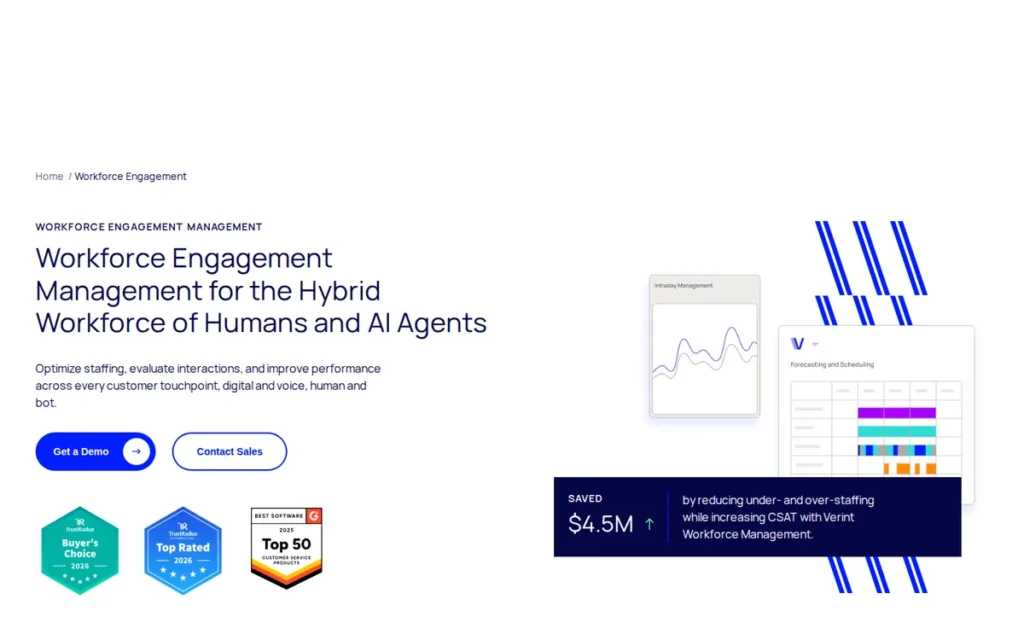
Category: Integrated WEM Suite, cloud-native, AI-first platform combining WFM, quality management, and analytics in a single product.
At a Glance
- Category: Integrated WEM Suite
- Best For: Mid-market contact centers (100–999 agents) prioritizing usability, WFM+QM integration, and agent engagement
- Price Range: Contact sales: no public pricing; enterprise-negotiated contract
- Primary Strength: G2 Summer 2025 Contact Center Workforce Leader with a 91% ease-of-use rating and 88% ease-of-setup score; integrated WFM+QM+Analytics in a single cloud-native platform
- Biggest Limitation: Scalability and automation gaps for very large or complex multi-site BPO environments above approximately 1,000 agents
- One-Line Summary: Calabrio ONE is the G2 Summer 2025 Contact Center Workforce Leader, delivering AI-driven WFM integrated with quality management and analytics in a cloud-native platform purpose-built for mid-market operational depth.
- Last Verified: May 2026
Overview
Calabrio ONE is a cloud-native, AI-first Workforce Engagement Management (WEM) suite that integrates workforce management, quality management, conversation intelligence, and analytics in a single platform. Calabrio ONE is purpose-built for contact centers that need operational depth without enterprise implementation complexity.
Founded in 2007 and incorporating the former Teleopti WFM heritage, Calabrio ONE is recognized as a G2 Summer 2025 Contact Center Workforce Leader, with a 91% ease-of-use rating and 88% ease-of-setup score across verified user reviews (G2 Summer 2025 Grid Report, 2025).
Calabrio ONE’s 2025 AI launch (“Omni Agent Intelligence”) extended its WFM approach to support both human and AI agents across any CCaaS or CRM stack in a vendor-agnostic framework, addressing the emerging human+AI workforce planning challenge.
Key Features
- Agentic AI Workforce Copilot: Calabrio ONE’s AI-powered Workforce Copilot assists managers with scheduling decisions, intraday adjustments, and operational recommendations, launched as part of Calabrio’s 2025 “Omni Agent Intelligence” initiative (Business Wire, September 2025).
- Enhanced Desktop Analytics: Calabrio ONE’s real-time adherence module includes Enhanced Desktop Analytics, providing supervisor visibility into agent desktop activity alongside schedule adherence data for a fuller intraday performance picture.
- Customizable Interval-Level Forecasting: Calabrio ONE introduced customizable interval-level forecasting in 2024, enabling precision planning at sub-15-minute granularity for operations with high intraday volume volatility.
- Integrated WFM+QM+Analytics Data Model: Calabrio ONE combines scheduling data, quality evaluation scores, and conversation analytics in a unified data layer, enabling correlations between schedule adherence and quality outcomes without manual data exports.
- Self-Service Shift Management: Calabrio ONE provides agent self-service for shift bidding, swaps, and time-off requests with a strong mobile UX, one of the most consistently praised features in community discussions for improving agent engagement and work-life balance.
- Omni Agent Intelligence: Calabrio ONE’s 2025 AI framework extended WFM planning to cover both human and AI agents across any CCaaS or CRM stack, enabling unified workforce planning in a blended human+AI operating model (Business Wire, September 2025).
Best For
Calabrio ONE is best for mid-market contact centers (typically 100 to 999 agents across single or small multi-site environments) in retail, healthcare, financial services, and technology. Calabrio ONE is the right choice for teams that prioritize integrated WFM and quality management in a usable, cloud-native platform without the administrative overhead of enterprise-tier alternatives.
Pricing
Calabrio ONE pricing is contact-sales only. No public tier structure or per-agent costs are published. Industry commentary suggests Calabrio ONE is generally more affordable than NICE CXone WFM or Verint for equivalent seat counts, though direct comparison requires vendor engagement. (Calabrio Product Page, verified May 2026).
Strengths
- G2 Summer 2025 Contact Center Workforce Leader: Calabrio ONE earned the G2 Summer 2025 Contact Center Workforce Leader designation, with a 91% ease-of-use rating and 88% ease-of-setup score across verified user reviews, among the highest usability scores of any platform in this comparison. In a WFM category where implementation complexity is the primary buyer pain point, these scores represent a meaningful differentiator (G2 Summer 2025 Grid Report, 2025).
- Real-Time Monitoring UX Speed: A practitioner who uses both platforms reported: “What takes me 30 seconds in Calabrio is going to take me ~3-5 minutes in NICE” for real-time analyst workflows, reflecting Calabrio ONE’s genuine UX superiority for intraday monitoring speed (u/thelastcorgi, r/workforcemanagement, 2024).
- Rapid Feature Velocity: Calabrio ONE introduced 50+ WFM enhancements in 2024 alone (including dynamic resource allocation, scenario planning, and customizable interval-level forecasting) directly addressing the automation gap historically cited vs. NICE IEX (Calabrio WFM Product Page, 2024).
- Operational Scalability Within Mid-Market: A practitioner who implemented Calabrio ONE confirmed: “Expanding back out to 16 hours was not a problem”, indicating solid scalability for growing operations within its supported complexity tier (u/CopplerDoppler, r/workforcemanagement, 2024).
Limitations
- Enterprise Ceiling for Complex Environments: WFM Labs independently identifies Calabrio ONE as “less sophisticated than enterprise WFM platforms” for organizations with complex multi-site BPO environments, multi-vendor operations, or advanced strategic planning requirements, a substantive limitation for contact centers above approximately 1,000 agents (WFM Labs, 2025).
- Automation Gap vs. NICE IEX: An experienced WFM analyst who implemented Calabrio ONE confirmed: “Having implemented, configured and used Calabrio/Teleopti you’re giving up quite a bit of automation and functionality compared with Nice/IEX…the lack of automation resulting in more manual work and headcount needs led us to move away after 18 months” (u/Stats411, r/workforcemanagement, 2024).
- Integration Gaps with Certain Telephony Platforms: Calabrio ONE users have reported data sync issues with specific platforms (notably RingCentral) requiring workarounds that add administrative overhead for teams not on Calabrio’s primary supported CCaaS stack.
- Pricing Opacity: Calabrio ONE requires full sales engagement for pricing discovery, providing no transparency benchmark for pre-sales TCO comparison, a disadvantage for buyers evaluating total cost before committing to a vendor process.
Verdict
Calabrio ONE is the right choice for mid-market contact centers that need a genuinely usable, integrated WFM+QM+Analytics platform without the administrative complexity of enterprise-tier tools. Calabrio ONE ranks third because its G2 Summer 2025 Leader recognition with a 91% ease-of-use rating, practitioner-validated real-time monitoring speed, and 50+ 2024 feature additions represent credible mid-market differentiation, but the automation depth ceiling and enterprise scalability limitation are real constraints that buyers above 1,000 agents must evaluate carefully before signing.
4. Five9 Workforce Management: Best for CCaaS-Embedded WFM Flexibility
Category: Integrated CCaaS-WFM Suite, CCaaS platform with a hybrid native WFM module plus structured Verint and Assembled integration pathways.
At a Glance
- Category: Integrated CCaaS-WFM Suite
- Best For: Mid-to-enterprise CCaaS buyers wanting WFM depth flexibility without abandoning their CCaaS platform
- Price Range: Digital $119/user/month; Core $159/user/month (published); WFM-inclusive tiers (Optimum/Ultimate) contact sales only; 50-seat minimum
- Primary Strength: Unique hybrid WFM model: native WFM plus structured Verint or Assembled integration options within a single CCaaS relationship; 8th consecutive Gartner CCaaS Leader designation
- Biggest Limitation: Add-on pricing complexity; legacy Java-based admin tooling; WFM tier gating creates cost discovery friction
- One-Line Summary: Five9 Workforce Management offers a unique hybrid approach combining native WFM capability with optional Verint and Assembled integrations, giving contact centers WFM depth flexibility without switching CCaaS platforms.
- Last Verified: May 2026
Overview
Five9 Workforce Management offers a hybrid WFM architecture: a native WFM module for standard enterprise needs, with structured upgrade paths to Verint WFM for deeper enterprise requirements and Assembled for modern multi-agent planning, all within a single CCaaS relationship. Five9 (NASDAQ: FIVN, founded 2001) holds Gartner CCaaS Magic Quadrant Leader status for the eighth consecutive year in 2025.
Assembled is a modern workforce management platform designed for multi-agent operations (including AI agents) that integrates with Five9 to provide a contemporary alternative to legacy WFM tools for organizations that do not require the full depth of Verint.
Five9’s “multi-agent orchestration” strategy positions WFM as managing both human agents and AI agents together, not just scheduling humans. This forward-looking framework differentiates Five9’s WFM narrative in a market shifting toward blended human+AI operations.
Key Features
- Hybrid WFM Architecture: Five9 WFM supports three deployment paths: native Five9 WFM, Verint WFM-through-Five9 for enterprise depth, and Assembled integration for modern multi-agent planning, preserving CCaaS continuity while enabling WFM capability upgrades as operational needs evolve.
- Genius AI Suite: Five9’s Genius AI includes agent assist, trend detection, automated quality scoring, AI-assisted transcription, and automated interaction summaries, AI capabilities that inform both WFM and quality management workflows.
- Multi-Skill Omnichannel Forecasting: Five9 WFM supports multi-skill, multi-channel forecasting across voice, chat, email, and digital channels within the Five9 CCaaS routing environment.
- Agent Self-Service Shift Management: Five9 WFM includes shift bidding, time-off requests, and schedule viewing for agents, standard self-service capabilities aligned with agent engagement and attrition-reduction best practices.
- Real-Time Adherence and Intraday Management: Five9 WFM provides supervisor-facing real-time adherence dashboards and intraday management tools for on-the-floor staffing adjustments.
- Quality Management Integration: Five9’s WEM suite integrates native quality management (via Virtual Observer acquisition) with WFM workflows, enabling schedule-to-quality correlation within the platform.
Best For
Five9 Workforce Management is best for mid-to-enterprise contact centers (50+ agents) in financial services, healthcare, retail, and technology. Five9 WFM is the right choice for organizations already on or evaluating Five9 CCaaS that want WFM capability without a separate vendor relationship, particularly those that may grow into Verint-level WFM depth over time without changing CCaaS platforms.
Pricing
Five9 publishes base platform pricing at $119/user/month (Digital plan, digital channels only) and $159/user/month (Core plan, voice-focused) via third-party sources. WFM capability is included only at the Optimum tier and above: both contact-sales only. A 50-seat minimum applies. (Platform28 Five9 Pricing Breakdown, verified May 2026). WFM-specific pricing requires direct Five9 sales engagement.
Strengths
- Unique Hybrid WFM Strategy: Five9 is the only CCaaS vendor in this comparison that explicitly acknowledges native WFM may not meet all enterprise needs and provides structured pathways to Verint WFM or Assembled within the existing CCaaS relationship, a pragmatic, customer-outcome-first position (CX Today, 2025).
- Eighth Consecutive Gartner CCaaS Leader: Five9 holds Gartner Magic Quadrant Leader status for Contact Center as a Service for the eighth consecutive year in 2025, the longest CCaaS Leader streak of any vendor in this comparison (Five9 press release, September 2025).
- AI-Era WFM Positioning: Five9’s VP of Strategic Alliances publicly framed WFM strategy as enabling customers to “orchestrate people, AI, and workflows”, positioning Five9’s WFM within a multi-agent orchestration framework rather than a traditional human-only scheduling tool (CX Today, 2025).
- Partial Pricing Transparency: Five9 is among the minority of vendors in this comparison that publishes some tier pricing publicly (Digital at $119/user/month and Core at $159/user/month) even though WFM-inclusive tiers remain contact-sales only (Platform28, 2026).
Limitations
- Add-On Pricing Complexity: Five9’s multi-tier structure means WFM is accessible only at the Optimum tier or above (both contact-sales only) making true WFM cost discovery impossible without entering a full vendor sales cycle. Community feedback confirms: “Everything is an add-on or a customization and it’s expensive” (u/asian_nachos, r/ITManagers, 2024).
- Legacy Admin Tooling: Five9’s administration interface is partially based on legacy Java technology (only recently being modernized) creating UX friction for IT administrators and WFM configurers who expect contemporary cloud-native admin tooling (Business.com Five9 Review, 2025).
- WFM Depth Ambiguity: Five9’s hybrid model creates buyer confusion about which WFM product is being delivered. Practitioners note: “They use Verint for their more mature customers”, making it critical to confirm in writing which WFM module is included in any proposal (u/zonearc, r/workforcemanagement, 2024).
Users on r/workforcemanagement described discovering this WFM ambiguity after committing to Five9:
“Verint does suck. I’ve been using it for a few years and it took a lot of time and effort. For reference, we used it alongside Talkdesk and Intercom. Our VP decided to go with Five9. I was heartbroken to discover Verint is the WFM platform embedded. Looks like we’ll be rebuilding. Their support sucks. Once you open a ticket with details, they’ll want meetings, examples, logs, etc. They also tend to reassign your ticket to someone else after investing time with the initial analyst. God help us.” Posted by u/SadLeek9950
Takeaway: Practitioners who commit to Five9 without confirming WFM module details in writing regularly discover post-signature that Verint is the embedded WFM component, triggering unexpected rebuilding costs and support friction that the article’s Red Flag framework is specifically designed to prevent.
- Premium Support Access: Five9’s support model tiers useful responses behind premium account levels (“The responses are devoid of useful information unless you pay extra for a dedicated rep”) disadvantaging mid-tier customers who need the most WFM implementation guidance (u/LostFenix, r/ITManagers, 2024).
Verdict
Five9 Workforce Management earns its fourth-place ranking through a pragmatic hybrid WFM strategy that no other CCaaS platform in this comparison replicates. Five9 WFM is the right choice for organizations already on Five9 CCaaS that need WFM flexibility as they scale from mid-market to enterprise-grade requirements. Five9 WFM is not the right choice for organizations prioritizing WFM-first evaluation, modern admin UX, or transparent upfront pricing before entering a sales cycle.
5. Talkdesk Workforce Management: Best for Cloud-Native Modern Contact Centers
Category: Integrated CCaaS-WFM Suite, AI-native WFM module natively embedded in Talkdesk CX Cloud with modern UX and bundled pricing.
At a Glance
- Category: Integrated CCaaS-WFM Suite
- Best For: Mid-market cloud-first contact centers prioritizing modern UX, AI forecasting accuracy, and simpler bundled pricing
- Price Range: ~$85–$225/user/month (third-party estimates); WFM included in higher-tier packages; contact sales for enterprise
- Primary Strength: Fully cloud-native architecture; documented AI forecasting accuracy (within three calls of actual volume on day one); simpler pricing structure than Five9
- Biggest Limitation: Audio reliability issues reported by users; WFM depth insufficient for the most complex enterprise environments
- One-Line Summary: Talkdesk Workforce Management is a fully cloud-native, AI-powered WFM module within Talkdesk CX Cloud (a 2025 Gartner CCaaS Leader for the fifth consecutive year) delivering documented AI forecasting accuracy and modern UX for mid-market contact center operations.
- Last Verified: May 2026
Overview
Talkdesk Workforce Management is a fully cloud-native WFM module within Talkdesk CX Cloud, differentiating from CCaaS-embedded competitors on three dimensions: no legacy PBX architecture, modern UX that practitioners describe as noticeably cleaner than alternatives built on legacy infrastructure, and simpler bundled pricing compared to Five9’s add-on model. Talkdesk has held Gartner CCaaS Magic Quadrant Leader status for five consecutive years as of 2025 (Talkdesk press release, 2025).
Talkdesk CX Cloud was founded in 2011 with a last known valuation of approximately $10B. Talkdesk WFM is built entirely on cloud-native infrastructure with no inherited PBX codebase, which directly informs both its UX quality and its integration architecture.
Talkdesk also offers enterprise customers a direct integration with Verint Workforce Management as an alternative to native WFM, providing enterprise-grade scheduling depth within the Talkdesk CCaaS ecosystem for buyers who outgrow the native module.
Key Features
- AI-Powered Omnichannel Forecasting: Talkdesk WFM uses AI trained on historical and real-time data to forecast across voice, chat, email, and digital channels, with a customer testimonial reporting forecast accuracy within three calls of actual volume on day one of deployment (Talkdesk WFM Product Page, 2025).
- Chatbot-Driven Schedule Self-Service: Talkdesk WFM enables agents to submit shift swap requests, time-off requests, and schedule queries through a chatbot interface, reducing supervisor administrative load while improving agent engagement with scheduling flexibility.
- Intraday Reforecasting with Schedule Adjustments: Talkdesk WFM performs automated intraday reforecasting and triggers schedule adjustment recommendations, enabling proactive rather than reactive staffing responses to real-time demand changes.
- Mobile Schedule Access: Talkdesk WFM provides mobile access for agents to view schedules, receive alerts, and manage shift preferences, meeting modern workforce expectations for anytime schedule transparency.
- Verint WFM Integration Option: Talkdesk offers enterprise customers a direct integration with Verint Workforce Management as an alternative to its native WFM, providing enterprise-grade scheduling depth within the Talkdesk CCaaS ecosystem (Talkdesk WFM General Page, 2025).
- Talkdesk Copilot Integration: Talkdesk WFM shares real-time data with Talkdesk Copilot (AI agent assist), routing, and analytics, providing unified context across workforce planning and real-time agent performance within the same platform.
Best For
Talkdesk Workforce Management is best for mid-market contact centers (50–500 agents) in retail, technology, and financial services. Talkdesk WFM is the right choice for teams evaluating or already on Talkdesk CX Cloud that prioritize modern cloud-native UX, documented AI forecasting accuracy, and simplified pricing over the administrative depth of enterprise-tier WFM tools.
Pricing
Third-party sources estimate Talkdesk CX Cloud pricing from approximately $85/user/month (Digital Essentials) to $225/user/month (Industry Experience Clouds), with WFM included in higher-tier packages. These are third-party estimates not confirmed by Talkdesk’s official pricing page, contact Talkdesk sales for verified current enterprise pricing. (eesel.ai, Nextiva, verified 2025).
Strengths
- Documented AI Forecasting Accuracy: A Talkdesk customer reported that Talkdesk WFM “came within three calls of accurately predicting our total call volume” on its first deployment day and “has only gotten better”, one of the most specific AI forecasting accuracy claims among all seven platforms evaluated (Talkdesk WFM Product Page, 2025).
- Modern Cloud-Native Architecture: A practitioner migrating from Five9 to Talkdesk confirmed: “Talkdesk is fully cloud native and all features are built natively into the product, so UI/UX is much nicer and the price model is simpler and a little less expensive”, reflecting a genuine UX advantage over competitors built on legacy infrastructure (u/trynsik, r/ITManagers, 2024).
- Fifth Consecutive Gartner CCaaS Leader: Talkdesk achieved Leader status in the 2025 Gartner Magic Quadrant for Contact Center as a Service for the fifth consecutive year, confirming sustained enterprise platform credibility (Talkdesk press release, 2025).
- Simpler Bundled Pricing Model: Talkdesk’s bundled approach reduces the add-on complexity that Five9 is criticized for, offering WFM as part of higher-tier packages rather than a proliferating separate line-item. This pricing advantage is practitioner-observed rather than independently verified from official pricing documentation.
Limitations
- Audio Reliability Issues: Users who switched from Talkdesk reported recurring audio quality problems: “Had a lot of audio issues with Talkdesk that occurred frequently (can’t hear caller or caller can’t hear agent)”, a significant limitation for voice-primary contact centers where call quality is non-negotiable (u/rawrlaud, r/ITManagers, 2024).
- WFM Depth Limited vs. Dedicated Tools: Talkdesk WFM does not match the scheduling rule complexity, intraday management depth, or multi-site coordination capability of dedicated enterprise WFM platforms like Verint or NICE IEX, the Verint integration option exists precisely because native WFM has functional ceiling limitations.
- Pricing Estimate Uncertainty: Talkdesk’s packaging has shifted through multiple rebranding cycles, and current pricing is not reliably confirmed by official sources. Third-party estimates may not reflect actual enterprise contract pricing, requiring full sales engagement for accurate TCO discovery.
- Outbound Operations Trade-Off: Users who migrated from Talkdesk to Five9 cited “better dialer functionalities” as the primary driver, indicating Talkdesk’s architecture prioritizes inbound and digital channels over the outbound dialer depth needed for high-volume outbound contact center operations.
Verdict
Talkdesk Workforce Management is the right choice for modern, cloud-first mid-market contact centers that value UX quality, documented AI forecasting accuracy, and pricing simplicity within an integrated CCaaS-WFM environment. Talkdesk ranks fifth because audio reliability issues and WFM depth limitations are substantive concerns preventing recommendation for larger or more complex operations, but for its target mid-market buyer on Talkdesk CX Cloud, Talkdesk WFM delivers genuine, documented value.
6. Playvox by NICE: Best for CRM-Native Digital Support Teams
Category: Specialized Deployment, CRM-native WFM platform purpose-built for Salesforce, Zendesk, ServiceNow, and Freshdesk-connected contact center teams.
At a Glance
- Category: Specialized: CRM-Native WFM
- Best For: Digital-first support teams operating inside Salesforce, Zendesk, or ServiceNow as their primary operational platform
- Price Range: Public marketplace listings show $15–$40/user/month (G2, Capterra); Vendr procurement intelligence separately estimates $30–60/agent/month for WFM-specific contracts, discrepancy requires direct verification with NICE sales
- Primary Strength: The only platform in this seven-platform comparison specifically designed from inception for CRM-native deployment; native integration with Salesforce, Zendesk, ServiceNow, and Freshdesk
- Biggest Limitation: Scalability gaps for large multi-region contact centers; fewer enterprise-grade intraday controls
- One-Line Summary: Playvox by NICE is the only platform in this comparison specifically designed from inception for CRM-native deployment, integrating directly with Salesforce, Zendesk, ServiceNow, and Freshdesk for AI-powered forecasting and scheduling on digital support workloads.
- Last Verified: May 2026
Overview
Playvox by NICE is a CRM-native, cloud-native Workforce Management platform, purpose-built for contact center and support teams that operate primarily within CRM or ticketing platforms, rather than traditional CCaaS environments.
Traditional WFM tools forecast from telephony data, call arrival rates, average handle times, and channel volumes pulled from the ACD. Playvox by NICE inverts this model: Playvox by NICE forecasts from CRM data, ticket creation rates, case volumes, and workload signals from Salesforce or Zendesk. For a team that primarily handles email and tickets rather than inbound voice calls, this CRM-native forecasting model is structurally more accurate than an ACD-first WFM approach.
Playvox was founded in 2013 and acquired by NICE in January 2021. Playvox by NICE continues to operate as a distinct product within the NICE portfolio, NICE specifically positions Playvox as its CRM-centric WFM complement to NICE CXone WFM for traditional contact centers.
Key Features
- CRM-Native Forecasting: Playvox by NICE WFM pulls real-time work activity and ticket volume data directly from Salesforce, Zendesk, ServiceNow, and Freshdesk, enabling workforce forecasts based on actual CRM demand signals rather than siloed telephony CDR data (NICE Playvox WEM Resources, 2025).
- AI-Optimized Scheduling with Self-Adjusting Algorithms: Playvox by NICE WFM uses AI-driven scheduling that self-adjusts as demand patterns evolve, reducing the manual recalibration overhead that static forecasting models require in dynamic support environments.
- Real-Time Adherence Across Async Channels: Playvox by NICE provides real-time adherence monitoring across all CRM-connected channels (including synchronous (voice, chat) and asynchronous (email, social, tickets)) delivering supervisor visibility across the full digital support workload.
- Self-Service Shift Swaps with Open API: Playvox by NICE WFM includes agent self-service for shift swaps alongside an open API and calendar/Slack integrations, enabling schedule management within the collaboration tools digital support teams already use daily.
- Omnichannel Async Channel Visibility: Playvox by NICE WFM’s omnichannel visibility specifically includes asynchronous channels (email, social media, ticket queues) that voice-centric WFM tools frequently handle poorly or exclude from interval-level reporting.
- Lightweight Self-Administration: Playvox by NICE is designed for self-administration, eliminating the dedicated WFM admin overhead that enterprise-tier platforms require, making it accessible for teams without specialist WFM staffing.
Best For
Playvox by NICE is best for digital-first support operations (20–500 agents) at technology, SaaS, e-commerce, and media companies. Playvox by NICE is the right choice for teams that operate primarily within Salesforce Service Cloud, Zendesk, or ServiceNow, where CRM-native forecasting and self-administered WFM replace the need for a traditional contact-center WFM deployment.
Pricing
Pricing intelligence sources are inconsistent for Playvox by NICE. Public marketplace listings on G2 and Capterra show Playvox product tiers from $15 (Starter) to $40 (Enterprise) per user/month. Vendr procurement intelligence separately estimates WFM-specific pricing at $30–60/agent/month: a figure that may reflect enterprise WFM module contracts rather than base product tiers.
All pricing requires direct verification with NICE sales before using any estimate for budget planning. (Vendr; G2 Playvox WFM Pricing, verified 2025).
Strengths
- Unique CRM-Native Architecture: Playvox by NICE is the only platform in this seven-platform comparison specifically designed from inception for CRM/ticketing-connected teams, enabling a fundamentally different demand forecasting approach that uses CRM data as the primary input, not telephony CDR data (NICE Playvox WEM Resources, 2025).
- Competitive Estimated Pricing Range: At the G2/Capterra published range of $15–$40/user/month, Playvox by NICE is positioned as substantially more affordable than enterprise-tier alternatives like NICE CXone WFM or Verint, appropriate for its lighter-weight, CRM-first deployment model. Actual WFM module pricing requires direct vendor confirmation before budget planning (Vendr, 2025).
- G2 Verified Customer Validation: Playvox by NICE WFM has 38+ G2 verified reviews with users citing strengths in forecasting, shift scheduling, skills management, and centralized performance records, with a customer testimonial confirming “the powerful capabilities with a simple interface and self-administration that we were after” (G2 Playvox WFM, 2026; Business Wire, 2021).
- NICE Ecosystem Backing: Post-acquisition by NICE, Playvox by NICE benefits from NICE’s R&D investment, enterprise security infrastructure, and compliance capabilities, reducing the platform risk associated with smaller independent WFM vendors.
Limitations
- Enterprise Scalability Ceiling: Playvox by NICE has documented scalability limitations for very large (500+ agent) multi-region contact centers, particularly in compliance-heavy scheduling environments (healthcare, financial services) that require complex labor rule management (Calabrio Playvox Alternatives, 2025).
- Limited Practitioner Community Presence: Playvox by NICE has no significant presence in the r/workforcemanagement practitioner community. Playvox by NICE’s review presence is concentrated on Salesforce AppExchange and Zendesk Marketplace rather than general WFM practitioner forums, making cross-platform peer validation structurally harder than for platforms with large r/workforcemanagement communities.
- Pricing Inconsistency Across Sources: G2 and Capterra list $15–$40/user/month while Vendr estimates $30–60/agent/month for WFM-specific contracts, a meaningful discrepancy that prevents reliable pre-sales budgeting. Actual costs for enterprise deployments require full sales engagement with NICE.
- Fewer Advanced Intraday Controls: Playvox by NICE provides fewer enterprise-grade intraday management controls than dedicated WFM specialists like Verint or NICE CXone WFM, a meaningful limitation for operations with high intraday volatility requiring frequent real-time staffing interventions.
Verdict
Playvox by NICE occupies a specialized market position that is clearly differentiated from traditional CCaaS-embedded WFM tools, making it the clear top choice for digital-first support teams that live inside Salesforce, Zendesk, or ServiceNow. Playvox by NICE ranks sixth not because of weakness, but because its specialized positioning serves a specific buyer profile precisely, and serves traditional voice-first contact centers poorly. Organizations operating CRM-native support teams should evaluate Playvox by NICE before any other platform in this comparison.
7. Genesys Cloud Workforce Engagement Management: Best for Genesys-Standardized Organizations Where WFM Is a Secondary Priority

Category: Specialized Deployment, native WEM module bundled within Genesys Cloud CX; suitable only where WFM is not a primary operational priority.
At a Glance
- Category: Specialized: CCaaS-Bundled WEM
- Best For: Organizations fully standardized on Genesys Cloud CX for whom WFM is a secondary operational capability, not a strategic investment
- Price Range: Included with Genesys Cloud CX 3; add-on available for CX 1/CX 2; exact per-agent cost unpublished
- Primary Strength: Native Genesys data integration; 104-week forecasting horizon; active 2026 development velocity
- Biggest Limitation: Consistently characterized as insufficient by experienced WFM practitioners for serious scheduling operations; multiple core functional gaps documented across independent community threads
- One-Line Summary: Genesys Cloud Workforce Engagement Management is a bundled WFM module within Genesys Cloud CX, a platform that excels as a CCaaS solution but whose WFM module receives consistent, severe practitioner criticism as insufficient for contact centers where scheduling depth is operationally critical.
- Last Verified: May 2026
Overview
Genesys Cloud Workforce Engagement Management (WEM) is a native suite within Genesys Cloud CX, combining WFM, quality management, recording, compliance, coaching, and analytics in a unified data model. Genesys was founded in 1990 and is consistently recognized as a Gartner Magic Quadrant Leader for Contact Center as a Service, making it a strong contact routing and CX platform.
Genesys Cloud WEM ranks seventh in this comparison not because of Genesys’s CCaaS quality, but because its WFM module receives consistent and severe criticism from experienced WFM practitioners as insufficient for serious contact center workforce planning.
Buyers should evaluate Genesys Cloud WEM based on its current state, not its development roadmap.
Key Features
- 104-Week Forecasting Horizon: Genesys Cloud WEM extended its forecasting horizon to 104 weeks in early 2026, enabling long-range headcount and hiring planning for large contact center operations (Genesys Cloud Release Notes, April 2026).
- Unified Genesys CX Data Layer: Genesys Cloud WEM shares the same data model as Genesys Cloud CX routing, meaning workforce plans draw directly on real omnichannel interaction data without middleware or manual exports.
- Real-Time Workitem Supervisor Monitoring: Genesys Cloud WEM added real-time workitem supervisor monitoring across queues in 2026, improving supervisor visibility for digital channel staffing (Genesys Cloud Release Notes, March 2026).
- Agent-Specified Unavailability: Genesys Cloud WEM enables agents to specify unavailability periods and shift preferences directly within the system, a self-service scheduling feature aligned with modern agent engagement expectations.
- Low-Code Task Automation: Genesys Cloud WEM includes low-code task automation with intelligent task routing, enabling workflow automation within WEM operations without custom development.
- Quality Management and Recording Integration: Genesys Cloud WEM integrates WFM scheduling data with quality management and recording in the same platform, enabling schedule-to-quality correlation without separate tool integration.
Best For
Genesys Cloud WEM is best suited for organizations already fully standardized on Genesys Cloud CX (particularly those for whom contact routing, digital CX, and AI capabilities are the primary platform driver) and where WFM is treated as a secondary operational function managed within the existing Genesys subscription.
Pricing
Genesys Cloud WEM is included with Genesys Cloud CX 3 licenses and available as a per-agent add-on for CX 1 and CX 2 licenses. Exact per-agent pricing is not publicly listed, contact Genesys sales for current pricing. (Genesys Help Documentation, verified May 2026). Buyers on CX 1 or CX 2 who assumed WFM was “included” frequently encounter add-on cost surprises during implementation.
Strengths
- Native Genesys Ecosystem Integration: Genesys Cloud WEM shares the same data model as Genesys Cloud CX routing, enabling WFM plans to draw on real omnichannel interaction data, customer context, and routing intelligence without middleware or manual data pipelines (Genesys WEM Capabilities Page, 2025).
- 104-Week Long-Range Forecasting: Genesys Cloud WEM’s 104-week forecasting horizon, added in early 2026, represents a meaningful long-range planning capability for large contact centers with annual headcount and hiring cycle requirements (Genesys Cloud Release Notes, April 2026).
- Active 2026 Development Investment: Genesys is shipping multiple WEM functional additions per quarter in 2026, suggesting the WFM capability gap documented in this comparison may narrow over the medium term for organizations willing to commit to the Genesys long-term roadmap.
- Enterprise-Scale CX Track Record: The Genesys/Virgin Atlantic case study documents a 15% reduction in handle times via Genesys Predictive Routing, a 25-point increase in CSAT, and $28M in three-year business value from Genesys Cloud AI, enterprise-scale platform outcomes reflecting CX capabilities broadly, not WFM-specific results (Genesys/Virgin Atlantic customer story, 2025).
Limitations
- Core WFM Functional Gaps Documented by Practitioners: A practitioner with multi-platform WFM configuration experience documented the following current gaps in Genesys Cloud WFM, corroborated across at least three independent r/workforcemanagement threads spanning 2023–2024: no outbound forecasting, no ability to plan team changes or new hires in advance, inflexible shrinkage handling, basic Activities and Adherence mapping, no recurring or floating meeting/training planning, and lunch scheduling inconsistencies requiring manual review. These are core WFM requirements, not edge-case limitations (u/terrystupple, r/workforcemanagement, 2024).
- Near-Unanimous Practitioner Consensus Against: Across at least five independent r/workforcemanagement threads spanning 2023–2024, experienced WFM practitioners consistently characterize Genesys Cloud WFM as insufficient for serious contact center scheduling operations, with no documented counter-examples from practitioners advocating for Genesys WFM in complex environments. Community characterizations include “Run. Don’t walk,” “I would rather do everything manually in Excel before dealing with Gen Cloud ever again,” and the insider quote from the introduction characterizing WFM as a checkbox feature with executive indifference to WFM investment (r/workforcemanagement, 2024).
This consensus has continued into 2025, with practitioners on r/workforcemanagement drawing the same sharp distinction between Genesys’s telephony strength and its WFM inadequacy:
“We use Genesys for call handling. I LOVE it for call handling. It’s extremely customizable and you can look up oodles of very specific data. We do NOT use it for its workforce product. That’s crap. Its canned reports aren’t great either, but you can make them work for you. Don’t get Genesys for scheduling. Do get it for call handling.” Posted by u/Non-specificExcuse
Takeaway: As recently as May 2025, practitioners who actively advocate for Genesys as a call-handling platform simultaneously characterize its workforce product as inadequate, a distinction that validates this comparison’s recommendation to use Genesys for routing and a dedicated WFM tool for scheduling.
- Add-On Pricing Surprise Risk: Genesys Cloud WEM is fully included only at CX 3, buyers on CX 1 or CX 2 who assume WFM is included in their subscription frequently encounter unexpected add-on costs when attempting to activate WEM functionality (Genesys Help Documentation, 2026).
- Legacy IEX Regression Documented: Practitioners migrating from NICE IEX to Genesys Cloud WFM report severe productivity regression: “Every task takes 3, 4, 5 times longer. They don’t even have future dated activities”, with the IEX-to-Genesys transition repeatedly characterized as a significant backward step in WFM capability (u/elahenara, r/workforcemanagement, 2024).
Verdict
Genesys Cloud Workforce Engagement Management ranks seventh because the practitioner evidence, drawn from at least five independent r/workforcemanagement community threads spanning 2023–2024, including contributors with senior WFM practitioner credentials, is consistent in characterizing Genesys Cloud WFM as insufficient for serious scheduling operations. Genesys Cloud CX is a strong CCaaS platform, its WFM module is not a functional peer of the dedicated tools in this comparison. Organizations fully committed to Genesys Cloud for routing may find WEM adequate for basic scheduling, but any contact center where workforce management is a strategic operational priority should supplement with a dedicated WFM tool. Given Genesys’s accelerating 2026 WFM development velocity, buyers should verify current-state WFM capabilities directly, this assessment reflects the platform as researched in May 2026 and may not capture features shipped after that date.
What Red Flags Should I Watch For When Evaluating Contact Center Workforce Software?
Before evaluating any WFM platform, recognize these six warning signals, each indicates a potential gap between what is demonstrated in the sales process and what is delivered in the live product:
- Demo features not available in the live production environment
- No WFM-specific reference customers at your agent count and channel complexity
- Vague or generic answers about digital and asynchronous omnichannel forecasting capability
- WFM functionality gated behind higher license tiers not included in the initial proposal
- No published case study metrics for WFM outcomes (forecasting accuracy, adherence, attrition)
- Implementation timelines without named milestones, staffing requirements, or a draft SOW
In contact center WFM procurement, the gap between the sales demo and the live product is not an edge case, it is the norm. These six signals help identify that gap before contract signature.
Red Flag #1: Demo Features That Aren’t in the Live Product
Multiple practitioners report WFM sales demonstrations showcasing AI capabilities and automation workflows not available in the current production release. If a vendor cannot demonstrate a specific capability live in a production tenant (not a staged demo environment) treat it as a roadmap item, not a current-state feature you are purchasing.
Red Flag #2: No WFM-Specific Reference Customers at Your Scale
Enterprise WFM complexity at 500+ agents behaves fundamentally differently from mid-market environments. If a vendor cannot provide reference customers at your agent count, channel mix, and scheduling complexity (not just enterprise customers in general) the platform may not have proven deployment at your operational scale.
Red Flag #3: Vague Answers About Digital Omnichannel Forecasting
Voice-centric WFM tools frequently struggle with email, chat, and asynchronous channel forecasting. If a vendor uses “we support omnichannel” without explaining how async work items are forecast and measured at the interval level, the platform likely lacks genuine non-voice forecasting depth.
Red Flag #4: WFM Capability Gated Behind Higher License Tiers
Several platforms in this comparison require higher-tier CCaaS licenses or add-on purchases to access WFM functionality. If WFM capability is not explicitly named and priced in the initial proposal, request written confirmation of exactly which WFM features are included in the quoted license, and which require future upgrades.
Red Flag #5: No Published Case Study Metrics for WFM Outcomes
WFM platforms unable to publish at least one named case study with a specific percentage improvement in forecasting accuracy, schedule adherence, or staffing efficiency are asking buyers to purchase on vendor assertions alone. Request documented customer outcomes with methodology, the absence of public case study metrics is a meaningful transparency signal.
Red Flag #6: Implementation Timeline Without Named Milestones or SOW
Implementation complexity consistently exceeds sales-stage expectations for enterprise WFM tools. If a vendor provides an implementation timeline without named milestones, staffing requirements, and deliverables, build a contingency buffer. Request access to the Statement of Work (SOW) template before signing any contract.
If you encounter any of these red flags, request the following before proceeding: a live demo on a production tenant with your channel mix, a written feature inclusion matrix for the specific tier quoted, and a reference call with a customer at your agent count and channel complexity who went live within the past 18 months.
What Questions Should I Ask Before Choosing a Contact Center Workforce Software?
Before committing to any contact center workforce software, six questions reveal the most consequential platform differences: which channels support interval-level forecasting, how WFM connects to your ACD, what license tier includes WFM, whether reference customers match your operational scale, what implementation costs fall outside the license quote, and how intraday reforecasting handles manual schedule adjustments.
The best vendors answer these questions specifically, in writing, referencing current production capability, not roadmap items.
Question #1: Does your WFM module support interval-level forecasting and reporting for all channels, including asynchronous channels like email and tickets?
Look for a specific answer naming which channels produce interval-level historical data and how async work items are modeled. “We support omnichannel” without this specificity is insufficient, it is the most common functional gap in voice-centric WFM tools operating in multi-channel environments.
Question #2: What is the architectural relationship between your WFM module and your CCaaS routing layer, are they the same product, or an integration?
The answer determines data latency, skill definition alignment, and middleware risk. A native shared data model eliminates middleware but creates platform lock-in. A best-of-breed integration requires ACD configuration that can create WFM-ACD skill mapping mismatches (where routing logic and workforce plans use different skill labels) if not managed carefully.
Question #3: Which specific WFM features are included in the tier you are quoting, and which require an add-on or upgrade?
Request a written feature inclusion matrix for the specific tier being proposed. Several platforms in this comparison include WFM only at higher tiers (Genesys CX 3, Five9 Optimum+), discovering this post-contract is a frequent and costly source of buyer frustration.
Question #4: Can you provide a reference customer at my scale (agent count, channel mix, and scheduling complexity) who went live within the past 24 months?
Recency matters, WFM platforms that updated their architecture in the past 2–3 years may have references reflecting older versions. A recent go-live reference in a comparable operating environment is the strongest pre-sales validation available.
Question #5: What is included in the implementation scope, and what requires separately billable professional services?
WFM implementation costs (including integration development, custom rule configuration, user training, and change management) frequently exceed the license cost in year one. A vendor that cannot provide a detailed SOW with itemized professional services scope before contract signature represents a meaningful cost uncertainty risk.
Question #6: How does your intraday reforecasting work, does it require a full schedule re-run that overwrites manual adjustments, or does it support incremental updates?
This practitioner-level question surfaces genuine architectural differences. Full-schedule re-runs that overwrite manual adjustments are a specific documented criticism of several platforms and create significant intraday management friction for WFM teams handling volatile staffing situations.
How Did We Rank These Contact Center Workforce Platforms?
Contact center workforce software platforms in this comparison were ranked using a structured, evidence-first methodology applied equally across all seven products. Rankings reflect documented evidence, not vendor claims, affiliate relationships, or recency bias. No vendor paid for inclusion, placement, or editorial treatment of any kind.
Evaluation Process
The research process included the following steps, applied uniformly to all seven platforms:
- Queried multiple AI search engines for current WFM platform recommendations and coverage patterns to understand how AI answer engines perceive each vendor
- Gathered independent web research on features, pricing, architecture, and customer case studies from vendor pages, analyst content, and third-party review aggregators
- Analyzed practitioner community sentiment across r/workforcemanagement, r/callcentres, and r/ITManagers, weighting posts from users with documented hands-on WFM experience
- Cross-referenced vendor claims against G2, Capterra, WFM Labs, Assembled WFM review series, and CX Today analyst coverage
- Reviewed product-specific documentation including datasheets, release notes, and integration guides where publicly available
Ranking Criteria
WFM Feature Depth and Completeness: whether a platform covers the full WFM workflow (forecasting → scheduling → intraday management → real-time adherence → reporting) and at what complexity level. Missing functional layers reduce ranking regardless of marketing positioning. Why it matters: Incomplete WFM coverage forces operational workarounds that eliminate the efficiency gains WFM is purchased to deliver. One finding consistent across all practitioner sources: AI forecasting improves planning efficiency but does not replace it, Contact Center Pipeline (December 2025) noted WFM still focuses too heavily on time as the only input variable, not effort complexity.
Documented Client Outcomes: named case studies with specific percentage improvements in WFM metrics outweigh vendor-asserted capabilities. Why it matters: Documented outcomes reduce purchase risk by providing evidence the platform delivers measurable results in comparable live environments.
Practitioner Community Sentiment: r/workforcemanagement and related communities represent experienced WFM professionals in live deployments with no financial incentive to promote vendor narratives. Why it matters: Practitioner community consensus is the closest available proxy for unbiased live deployment experience, though community forums represent a self-selected practitioner population, not a statistically representative sample.
Third-Party Review Platform Ratings and Volume: G2 and Capterra ratings are included with review count context. Why it matters: Review volume indicates deployment breadth; ratings indicate satisfaction consistency.
Pricing Transparency and Total Cost of Ownership: platforms with partial public pricing receive credit for transparency. Fully opaque pricing is noted as buyer friction but does not alone disqualify a platform. Why it matters: Pricing opacity forces buyers into full sales cycles before informed shortlist decisions are possible.
CCaaS Integration Quality, the architectural relationship between WFM and routing/ACD determines data integrity, skill alignment, and integration maintenance. WFM-ACD skill definition mismatches, where routing logic and workforce plans use different skill labels, are one of the most documented causes of forecast-to-actual divergence in live deployments. Why it matters: Skill definition mismatches eliminate the forecasting precision gains that WFM was purchased to deliver.
Agent Experience and Self-Service: platforms with strong self-service scheduling UX reduce attrition risk and improve WFM adoption rates. Why it matters: Agent scheduling friction is a documented driver of voluntary attrition, a direct operational cost.
Evidence Weighting
When review platform ratings conflict with Reddit practitioner sentiment, this comparison weights specificity and recency. A detailed 2024 or 2025 Reddit post from a practitioner describing a specific functional gap with 10+ upvotes outweighs a generic 2022 G2 review.
A vendor’s marketing page describes what a product is designed to do. A practitioner’s 2024 Reddit post with ten upvotes from peers describes what it actually does, this comparison weights the latter.
Vendor-published case studies are labeled as such and weighted lower than independently corroborated outcomes. When practitioner consensus is consistent across multiple independent threads from contributors with documented hands-on WFM experience, it is weighted as high-confidence evidence.
Data Validation
Vendor-reported statistics are labeled as vendor-reported throughout this article. Only claims corroborated by at least one independent source are stated as confirmed fact. Pricing estimates from procurement intelligence platforms are explicitly labeled as estimates. The Genesys/Virgin Atlantic case study was independently verified, this article uses the confirmed figure of 15% handle time reduction, not the 50% figure that circulates in secondary sources.
Update Cadence
This article was researched and written in May 2026. PlugRoute reviews contact center workforce software rankings on a semi-annual basis, with material updates triggered by significant product releases, pricing changes, or shifts in practitioner community consensus.
Independence Disclosure
PlugRoute has no affiliate relationships with any vendor listed in this comparison. No vendor paid for inclusion, placement, or favorable editorial treatment. Rankings are determined solely by documented evidence, practitioner sentiment, and editorial methodology.
What Do Buyers Most Commonly Ask About Contact Center Workforce Software?
What is the difference between a dedicated WFM platform and a CCaaS-embedded WFM module?
A dedicated WFM platform like Verint is purpose-built for workforce management (delivering deeper forecasting complexity and scheduling rule depth) but requires integration with your CCaaS. A CCaaS-embedded module like Genesys Cloud WEM is built into the routing platform, offering native data integration but typically shallower scheduling capability. Most WFM practitioners recommend dedicated tools above 500 agents.
Which contact center workforce software is best for mid-sized contact centers with 100–500 agents?
Calabrio ONE is the top recommendation for mid-sized contact centers of 100–500 agents, offering integrated WFM+QM in a cloud-native platform with a G2 Summer 2025 Leader designation. Talkdesk WFM is the right alternative if the organization is already on Talkdesk CCaaS. For teams operating primarily in Salesforce or Zendesk, Playvox by NICE is the purpose-built CRM-native recommendation.
How does PlugRoute determine its rankings?
PlugRoute rankings are determined by a structured evidence-first methodology: documented client outcomes, practitioner community sentiment from r/workforcemanagement and related forums, third-party review ratings and volume, feature depth assessment against consistent criteria, and pricing transparency evaluation. No vendor pays for inclusion, placement, or favorable treatment. The full methodology appears in the “How Did We Rank These Contact Center Workforce Platforms?” section above.
What Do Key Contact Center Workforce Management Terms Mean?
Intraday Management: The process of monitoring and adjusting workforce staffing in real time during an active operational day, responding to demand spikes, agent absences, or forecast-to-actual deviations without requiring a full schedule re-run. Intraday management capability is one of the primary differentiators between basic and enterprise-grade WFM tools.
Real-Time Adherence (RTA): A WFM capability that compares an agent’s scheduled activity to their actual activity in real time, identifying deviations (such as an agent scheduled for calls who is on break) so supervisors can intervene before staffing impacts service levels. Real-Time Adherence is distinct from historical adherence reporting, which measures the same comparison after the fact.
True-to-Interval (TTI) Modeling: A forecasting methodology specifically designed for digital and asynchronous contact channels, modeling work volume in discrete time intervals appropriate to each channel’s behavior, rather than applying voice-call arrival rate assumptions to email, chat, or ticket queues that behave differently. TTI modeling is a differentiator of NICE CXone WFM’s Digital Channel Management capability.
Workforce Engagement Management (WEM): The expanded category encompassing not just scheduling and forecasting (traditional WFM) but also quality management, coaching, agent performance analytics, speech and text analytics, and employee engagement features, increasingly sold as an integrated suite rather than individual modules. All seven platforms in this comparison are WEM-capable to varying degrees.
Agentic AI / AI Bot Ecosystem: A WFM AI architecture in which purpose-built, specialized AI agents (bots) each handle a discrete operational function, such as detecting intraday demand spikes, recommending forecast adjustments, or enabling permissionless schedule changes, rather than a single monolithic AI layer attempting all tasks simultaneously. Verint’s Da Vinci AI bot ecosystem, including the Exact Forecasting Bot, Intraday Spike Bot, and TimeFlex Bot, is the primary example of this approach in this comparison.
Glossary: Key Terms Used in This Comparison
Intraday Management: The process of monitoring and adjusting workforce staffing in real time during an active operational day, responding to demand spikes, agent absences, or forecast-to-actual deviations. Intraday management capability is one of the primary differentiators between basic and enterprise-grade WFM tools.
Real-Time Adherence (RTA): A WFM capability that compares an agent’s scheduled activity to their actual activity in real time, identifying deviations so supervisors can intervene before staffing impacts service levels. RTA is distinct from historical adherence reporting, which measures the same comparison after the fact.
True-to-Interval (TTI) Modeling: A forecasting methodology designed for digital and asynchronous contact channels that models work volume in discrete time intervals appropriate to each channel’s behavior, rather than applying voice-call arrival rate assumptions to email, chat, or ticket queues. TTI modeling is a core component of NICE CXone WFM’s Digital Channel Management capability.
Workforce Engagement Management (WEM): The expanded platform category encompassing not just scheduling and forecasting (traditional WFM) but also quality management, coaching, agent performance analytics, and employee engagement features, increasingly sold as an integrated suite rather than individual modules.
Agentic AI / AI Bot Ecosystem: A WFM AI architecture in which purpose-built, specialized AI agents each handle a discrete operational function (such as detecting intraday demand spikes or recommending forecast adjustments) rather than a single monolithic AI layer attempting all tasks simultaneously. Verint’s Da Vinci AI ecosystem, including the Exact Forecasting Bot, Intraday Spike Bot, and TimeFlex Bot, is the primary example of this approach in this comparison.
Which Contact Center Workforce Software Is Right for You?
Key Insights
- Verint Workforce Management is the best overall contact center workforce platform in this comparison, backed by four vendor-published case studies documenting up to 50% forecasting accuracy improvement, 24% attrition reduction, $5.2M in projected annual savings, and 30% overtime reduction, the strongest public outcome documentation record among all seven platforms evaluated.
- NICE CXone Workforce Management is the strongest native WFM suite for very large enterprises already on CXone, backed by 85+ Fortune 100 client deployments, but the absence of public WFM outcome case studies, support inconsistency below Fortune 100 tier, and platform lock-in risk require careful pre-contract evaluation.
- Calabrio ONE is the best mid-market contact center workforce platform for organizations of 100–999 agents, combining a G2 Summer 2025 Leader designation with a 91% ease-of-use rating, 50+ 2024 WFM enhancements, and integrated WFM+QM+Analytics that delivers real-time monitoring speed no enterprise-tier tool matches in practitioner comparisons.
- Genesys Cloud Workforce Engagement Management should not be selected as a primary WFM platform for organizations where scheduling depth is a strategic operational priority, practitioner consensus across at least five independent r/workforcemanagement threads is consistent and severe in characterizing its functional sufficiency for serious WFM operations.
When NOT to Choose These Platforms
| Platform | Primary Disqualifier |
|---|---|
| Genesys Cloud WEM | When WFM depth is a strategic operational priority |
| NICE CXone WFM | When your contact center has fewer than 1,000 agents or operates outside the CXone ecosystem |
| Playvox by NICE | When you operate a traditional voice-first contact center without a CRM as the operational hub |
| Verint WFM | When deployment speed, UI simplicity, or pricing transparency before a sales cycle are primary requirements |
| Five9 WFM | When WFM evaluation must be independent of CCaaS platform selection |
Choose Verint WFM if your contact center exceeds 500 agents across multiple sites and workforce management is your highest operational priority. Choose NICE CXone WFM if you are already fully invested in the CXone platform at Fortune 100 scale.
Choose Calabrio ONE if you are a mid-market buyer who needs integrated WFM+QM with strong usability and faster time-to-value than enterprise-tier alternatives. Choose Five9 WFM if you are on or evaluating Five9 CCaaS and want WFM flexibility that can scale from native to Verint-level depth within a single vendor relationship.
Choose Talkdesk WFM if you are a cloud-first mid-market buyer who values modern UX, documented AI forecasting accuracy, and simpler bundled pricing. Choose Playvox by NICE if your team operates primarily inside Salesforce, Zendesk, or ServiceNow, it is the only platform in this comparison designed from inception for that operational model.
Revisit this comparison at PlugRoute every six months as practitioner consensus and product capabilities evolve, WFM platforms are shipping meaningful updates quarterly. We update this guide semi-annually. Last updated: May 2026.