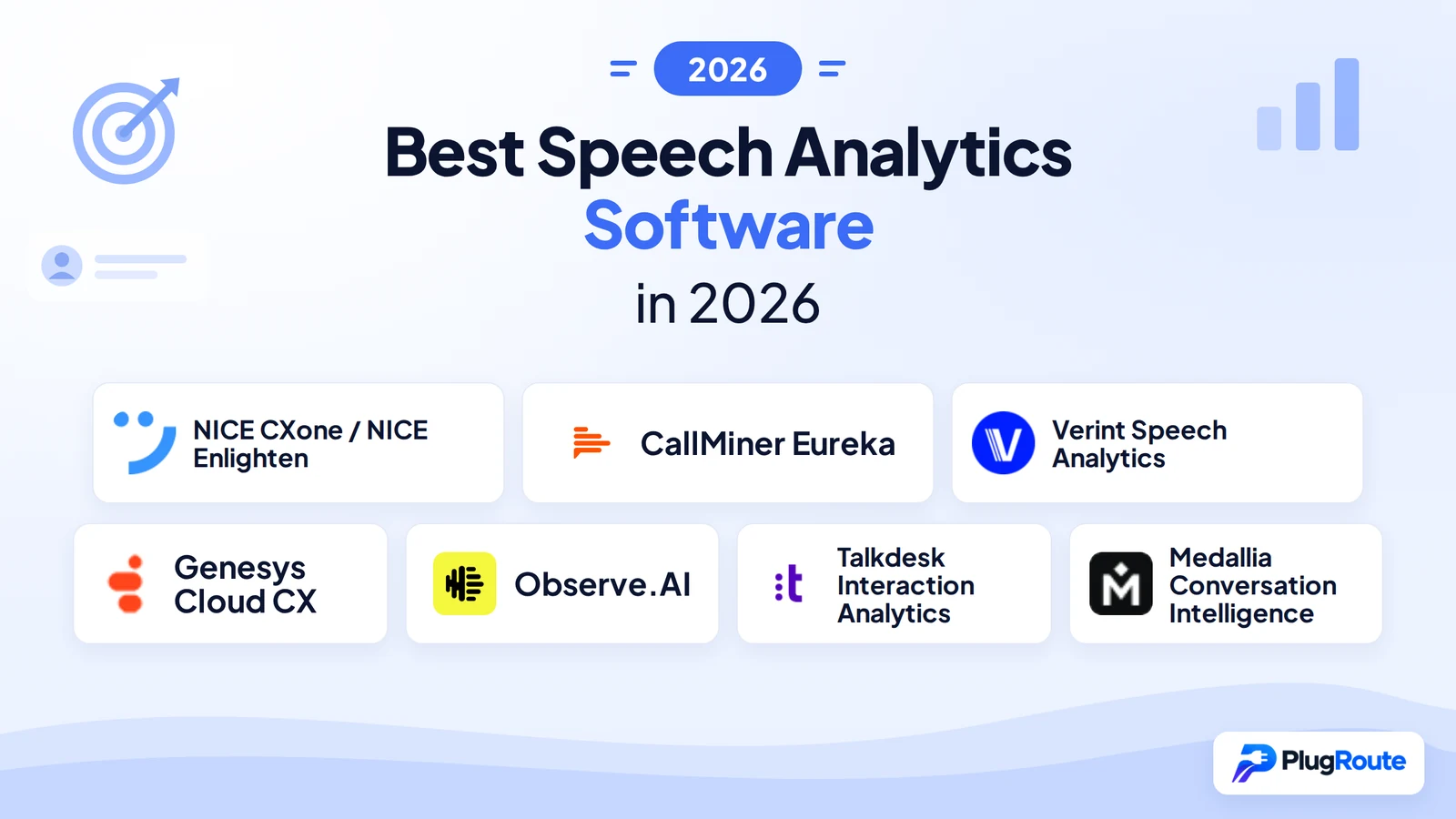
The best speech analytics software in 2026 is NICE CXone for large enterprises requiring a comprehensive AI-powered CX platform, CallMiner Eureka for compliance-intensive contact centers needing maximum pure-play analytics depth, and Genesys Cloud CX for organizations seeking transparent published pricing with native CCaaS analytics. The central trade-off is analytics specialization versus platform-embedded convenience.
Contact center managers, QA supervisors, and CX directors face a market where every vendor claims “AI-powered” intelligence, yet differences in transcription accuracy, real-time coaching capability, compliance framework maturity, and total cost of ownership are enormous.
A contact center using 2% manual QA sampling misses 98% of agent interactions. Choosing the wrong platform means a 3–9 month implementation that never delivers ROI, or a compliance gap that surfaces during a regulatory audit.
PlugRoute has no affiliate relationships with any vendor listed in this comparison; rankings are determined solely by documented evidence, transparent methodology, and editorial rigor.
“Compliance phrase detection, script adherence, and category tagging in CallMiner/Nexidia are often more ‘well-curated keyword logic’ than ‘neural magic’, decades of accumulated category libraries make them defensible in audits.”, u/robertovertical, r/speechtech
Takeaway: Speech analytics specialists hold compliance credibility in regulated industries partly because of accumulated keyword library depth built over years, not because their AI is inherently superior to newer entrants. Compliance defensibility depends as much on configuration history as algorithmic sophistication.
What Are the Top Speech Analytics Picks for 2026?
- NICE CXone delivers the broadest enterprise AI CX platform in this comparison, with speech analytics trained on over 8 billion customer interactions per year per Aragon Research.
- CallMiner Eureka offers the most modularly comprehensive pure-play speech analytics in this comparison, with a compliance-first architecture deployable across six independently selectable modules.
- Verint Speech Analytics is the strongest regulated-industry specialist in this comparison, with vendor-reported greater than 90% comprehension accuracy and 100% call coverage via the Da Vinci AI engine.
- Genesys Cloud CX is one of only two Gartner CCaaS Leaders in this comparison to publish transparent list pricing, starting at $75 per user per month for the voice-only CX 1 tier.
- Observe.AI provides the most purpose-built contact center LLM in this comparison, a 30-billion-parameter model trained specifically on agent-customer interactions for automated QA and real-time coaching.
- Talkdesk Interaction Analytics is the most accessible Gartner CCaaS Leader for mid-market buyers, combining integrated QA automation and analytics at published pricing starting at $85 per user per month.
- Medallia Conversation Intelligence is the only platform in this comparison connecting speech analytics to enterprise-wide Voice of the Customer programs, verify current vendor financial stability independently before committing to multi-year contracts.
For organizations under 200 agents: Enterprise platforms from NICE, Verint, CallMiner, and Medallia typically require minimum commitments of $3,000–$10,000+ per month. Genesys Cloud CX ($75–$155/user/month) and Talkdesk ($85–$145/user/month) deliver the primary ROI driver (100% automated QA coverage) at predictable per-user pricing with significantly lower implementation complexity.
What Are the Three Categories of Speech Analytics Software?
Speech analytics platforms fall into three distinct categories, each optimized for a different buyer profile and use case. Enterprise specialists rely on acoustic signal processing combined with automatic speech recognition (ASR) and natural language processing (NLP) for transcription, then apply machine learning classification for topic, sentiment, and compliance detection.
Category 1, Enterprise Speech Analytics Specialists
- NICE CXone / Enlighten: Broadest platform scope; largest AI training dataset (8B+ interactions/year per Aragon Research); full CX AI operating layer spanning analytics, routing, coaching, and self-service.
- Verint Speech Analytics: Regulated-industry specialist; open Da Vinci AI model architecture; vendor-reported >90% transcription accuracy with full speaker separation.
- CallMiner Eureka: Modular pure-play specialist; acoustic and semantic hybrid analysis; compliance-first architecture with six independently deployable modules.
These platforms are the right choice when analytics quality and compliance defensibility are non-negotiable and budget is not the primary constraint.
Category 2, CCaaS-Native Analytics Platforms
Genesys Cloud CX and Talkdesk Interaction Analytics embed speech analytics natively within full contact center platforms. They offer transparent pricing, simpler single-vendor procurement, and sufficient analytics depth for most mid-market and enterprise buyers. The trade-off is less configurable analytics than specialists provide.
Category 3, AI-Native and CX-Integrated Platforms
Observe.AI and Medallia Conversation Intelligence represent two distinct directions. Observe.AI is an AI-native platform built around a proprietary contact center LLM. Medallia uniquely connects speech analytics to enterprise Voice of the Customer programs. Both serve buyer profiles not well-served by either category above.
What this means for your decision: A CCaaS-native platform like Genesys Cloud CX delivers 100% call coverage and sentiment detection out of the box. When a compliance team needs to build a custom detection category, correlate it with silence duration and agent tone, and monitor it concurrently across 200,000 live calls, specialist platforms like CallMiner Eureka configure that query natively. Genesys would require exporting data to an external BI tool. Neither is wrong; the question is which analytics depth your compliance team actually needs.
How Do the Top Speech Analytics Platforms Compare at a Glance?
The seven best speech analytics platforms in 2026 divide into three clear tiers: enterprise specialists with the deepest analytics depth (NICE CXone, CallMiner Eureka, Verint Speech Analytics), CCaaS-native platforms with transparent per-user pricing (Genesys Cloud CX, Talkdesk), and specialized AI or CX intelligence platforms (Observe.AI, Medallia Conversation Intelligence). The table below compares key differentiators across all seven.
| Rank | Company | Category | Best For | One-Line Summary | Key Capabilities | Primary Strength | Key Limitation |
|---|---|---|---|---|---|---|---|
| 1 | NICE CXone / Enlighten | Enterprise AI Platform | Large enterprise (1,000+ agents) needing full CX AI suite | NICE CXone delivers the market’s most comprehensively scoped AI CX analytics platform, trained on over 8 billion interactions per year. | Interaction analytics | Enlighten AI | Journey memory (XM) | Real-time coaching | PCI redaction | Full WEM integration | Industry-largest CX training dataset (8B+ interactions/year per Aragon Research) and broadest platform scope | Monthly outage history since late 2023; post-sale support gaps for smaller organizations |
| 2 | CallMiner Eureka | Pure-Play Specialist | Compliance-heavy contact centers needing analytics depth and modularity | CallMiner Eureka is a modular pure-play conversation intelligence platform combining acoustic signal analysis with AI-powered categorization for 100% interaction coverage. | Analyze | Coach | Alert | Redact | RealTime modules | Concurrent real-time monitoring | GenAI category creation | Acoustic + semantic hybrid analysis | Deepest compliance frameworks; acoustic-plus-semantic hybrid analysis with decades of category library development | Admin-heavy configuration; 2018-era primary recognition artifacts; no public pricing |
| 3 | Verint Speech Analytics | Enterprise Specialist | Regulated enterprises (financial services, healthcare) | Verint Speech Analytics delivers vendor-reported >90% comprehension accuracy with 100% call coverage and speaker-separated transcription via the Da Vinci AI engine. | Speaker-separated transcription | Genie Bot NL queries | Real-time alerting | GenAI summaries | Open Da Vinci AI framework | Root cause analysis | Open AI model flexibility; semantic contextual grouping beyond keyword matching | Complex UI; difficult support escalation; cloud migration cost premium |
| 4 | Genesys Cloud CX | CCaaS-Native Analytics | Organizations buying full CCaaS with embedded analytics at transparent pricing | Genesys Cloud CX provides natively embedded speech and text analytics across 100% of omnichannel interactions with published list pricing from $75 to $240 per user per month. | Native omnichannel analytics | Sentiment triggers | Process Automation Triggers | 100% interaction coverage | Historical reprocessing | Published pricing | One of two Gartner CCaaS Leaders in this comparison with fully transparent published pricing | AI token cost unpredictability at scale; analytics depth below standalone specialists |
| 5 | Observe.AI | AI-Native Conversation Intelligence | AI-first enterprises prioritizing automated QA and real-time agent coaching | Observe.AI’s proprietary 30-billion-parameter contact center LLM delivers automated 100% QA coverage, real-time agent copilots, and AI agent oversight. | Contact center LLM (30B params) | AI Copilots | AI Agents | Automated QA scoring | Hallucination/drift detection | Real-time agent guidance | Most purpose-built AI architecture; domain-specific LLM trained on contact center interactions | Shorter compliance track record; no published pricing; vendor-reported accuracy benchmarks from June 2023 using superseded models |
| 6 | Talkdesk Interaction Analytics | CCaaS Analytics Platform | Mid-market buyers wanting integrated analytics without specialist complexity | Talkdesk Interaction Analytics combines AI-powered QA automation and sentiment analysis within a Gartner CCaaS Leader platform at published pricing starting at $85 per user per month. | 100% interaction analysis | Utterance-level sentiment | QA automation | Topic/intent detection | Slack/Teams alerts | Published pricing | Transparent pricing; integrated QA automation; lower implementation friction versus specialists | Shallower analytics depth than specialists; advanced features may require Elite tier or above |
| 7 | Medallia Conversation Intelligence | Enterprise CX Intelligence | Fortune 500 organizations integrating speech analytics with enterprise VoC programs | Medallia Conversation Intelligence uniquely connects call transcript analysis to enterprise NPS, CSAT, and VoC programs; independent vendor financial due diligence required before multi-year commitment. | VoC + speech integration | Athena AI | Smart Topic Builder (85% precision, vendor-reported) | Churn prediction | Multi-channel CX correlation | Only platform natively connecting speech analytics to enterprise-wide CX measurement without custom integration | Six-figure cost; 3–6 month implementation; April 2026 lender control development |
Which Speech Analytics Tool Should I Choose for My Use Case?
Your optimal speech analytics platform depends primarily on one constraint: analytics specialization versus deployment convenience. Compliance-heavy regulated industries should evaluate CallMiner Eureka or Verint Speech Analytics first. Organizations purchasing a full CCaaS platform should evaluate Genesys Cloud CX or Talkdesk. AI-forward operations prioritizing automated QA and real-time agent coaching should evaluate Observe.AI.
| Your #1 Priority | Recommended Tool | Why | Acceptable Alternative |
|---|---|---|---|
| Deepest compliance framework + regulated industry | CallMiner Eureka | CallMiner Eureka delivers modular architecture, acoustic and semantic compliance detection, concurrent real-time monitoring for hundreds of thousands of calls, and decades of accumulated regulatory workflow maturity; the most configurable compliance analytics foundation in this comparison. | Verint Speech Analytics |
| Largest enterprise AI platform scope | NICE CXone / Enlighten | NICE CXone processes 8B+ interactions per year (per Aragon Research), delivers cross-session journey memory via Enlighten XM, and covers the full CX AI suite; routing, QA, coaching, and self-service; in a single platform. | Genesys Cloud CX |
| Transparent pricing + CCaaS integration | Genesys Cloud CX | Genesys Cloud CX publishes transparent per-user list pricing from $75 to $240 per user per month and embeds omnichannel analytics natively without requiring third-party middleware or a separate analytics vendor. | Talkdesk Interaction Analytics |
| Modern AI architecture + automated QA | Observe.AI | Observe.AI’s proprietary 30B-parameter contact center LLM delivers the most purpose-built AI architecture in this comparison; strongest automated QA coverage and real-time agent copilot capability for AI-forward operations. | NICE CXone |
| Enterprise VoC + speech integration | Medallia Conversation Intelligence | Among the platforms in this comparison, Medallia Conversation Intelligence is the only one natively correlating call transcripts to NPS, CSAT, and downstream churn data; verify current financial stability independently before multi-year commitment. | No direct alternative in this comparison |
| Mid-market budget + CCaaS convenience | Talkdesk Interaction Analytics | Talkdesk Interaction Analytics offers published pricing starting at $85 per user per month, Gartner CCaaS Leader recognition, and integrated QA automation within a single platform, reducing vendor management complexity for mid-market buyers. | Genesys Cloud CX |
| Regulated enterprise: financial services or healthcare | Verint Speech Analytics | Verint Speech Analytics delivers an open Da Vinci AI model approach, vendor-reported >90% comprehension accuracy, and deep financial services compliance history; best where transcription accuracy and AI model flexibility are primary requirements. | CallMiner Eureka |
What Are the 7 Best Speech Analytics Platforms in 2026?
1. NICE CXone / NICE Enlighten: Best Overall for Large Enterprise
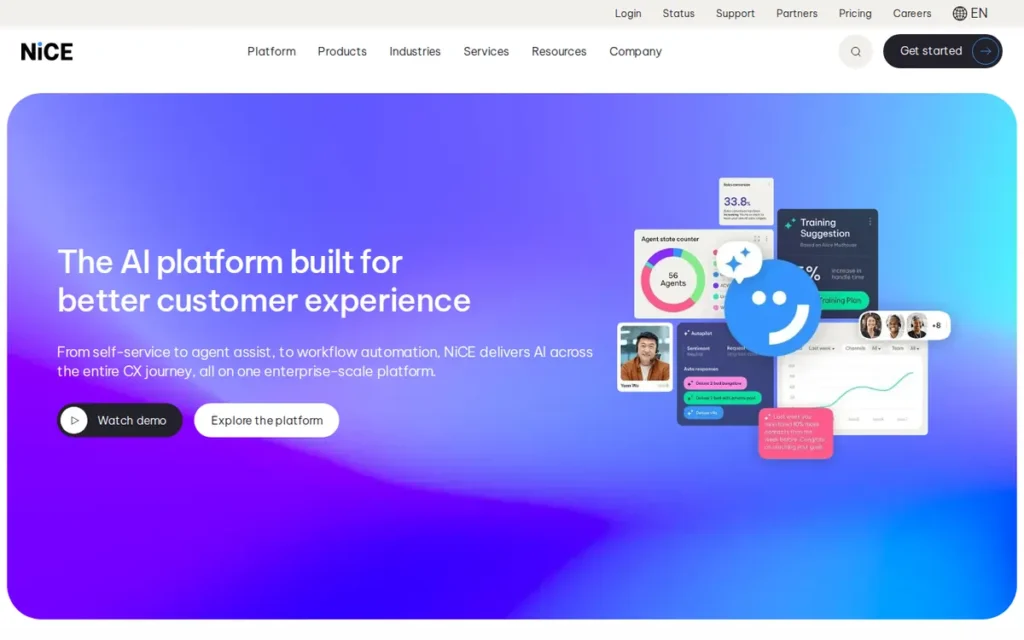
Category: Enterprise AI Platform, combines full CCaaS, speech analytics, QA, workforce management, and CX AI into one operating layer.
At a Glance
- Category: Enterprise CX AI Platform
- Best For: Large enterprise contact centers (1,000+ agents) needing a full-suite CX AI platform
- Price Range: ~$71–$209/user/month (third-party reported); enterprise contracts vary, contact directly
- Primary Strength: NICE CXone’s Enlighten AI, trained on 8B+ interactions/year (per Aragon Research), offers the market’s broadest CX-specific AI dataset and most comprehensive platform scope
- Biggest Limitation: Monthly outage history since late 2023; post-sale support gaps for organizations without dedicated NICE support engineers
- One-Line Summary: NICE CXone delivers the market’s most comprehensively scoped CX AI analytics platform, built on over 8 billion interactions per year of contact-center-specific training data.
- Last Verified: May 2026
Overview
NICE CXone is a full-scale enterprise CX AI operating layer, not a standalone speech analytics tool, that processes voice, chat, email, and digital interactions through its Enlighten AI framework, providing speech analytics, QA automation, workforce management, and agent coaching under one vendor roof. NICE CXone’s Enlighten AI is trained on CX-specific interaction patterns rather than general-purpose text, a scale advantage confirmed by Aragon Research as processing over 8 billion interactions per year.
NICE CXone’s Interaction Analytics enables supervisors to search 100% of voice interactions by keyword, sentiment, topic, or compliance signal, including analytics-based routing triggered by detected customer frustration. The platform supports automatic redaction of number sequences longer than two digits for PCI compliance. In March 2024, NICE unveiled Enlighten XM, a cross-session memory graph for persistent customer context across interactions, per a BusinessWire announcement, a differentiator for omnichannel enterprises seeking journey analytics beyond per-call data.
Key Features
- Enlighten AI Framework: NICE CXone uses CX-specific AI models: including Enlighten Actions, Copilot, Autopilot, and XM, trained on contact-center interaction patterns rather than general-purpose internet text, supporting analytics, routing, self-service, and journey memory across all channels.
- Interaction Analytics Pro: NICE CXone enables supervisors to search, filter, and group 100% of voice interactions by keyword, topic, sentiment, or compliance signal, including analytics-based routing triggered by detected customer frustration signals before the call ends.
- Enlighten XM (Experience Memory): NICE CXone’s cross-session memory graph compiles metadata, conversation data, and analytics into a unified customer profile that persists across sessions, enabling personalized real-time interactions, as documented in the March 2024 BusinessWire announcement.
- Automated PCI Redaction: NICE CXone automatically redacts number sequences longer than two digits from transcripts (including credit card and account numbers) supporting PCI compliance without manual transcript review for financial services and healthcare contact centers.
- Full-Suite WEM Integration: NICE CXone integrates speech analytics with workforce management, QA automation, scheduling, and agent coaching into a single administrative environment, eliminating the middleware complexity of multi-vendor analytics stacks.
Best For
NICE CXone is best suited for large enterprise contact centers with 1,000+ concurrent agents in industries such as financial services, insurance, telecommunications, and healthcare. NICE CXone serves organizations that need speech analytics as one component of a comprehensive CX AI program, not as a standalone point solution.
Pricing
NICE CXone pricing (third-party reported, as NICE does not publish a self-serve pricing page) runs approximately $71 per user per month (Digital), $99 (Essential), $135 (Core), $169 (Complete), and $209 (Optimum), per Ringover’s speech analytics comparison. Advanced Enlighten AI modules, QA automation, and WEM features are sold as add-ons. Enterprise contracts frequently deviate from these third-party-reported figures; total cost requires direct engagement. Pricing current as of May 2026.
Strengths
- NICE CXone processes over 8 billion interactions per year, giving its Enlighten AI models a training dataset built entirely on contact-center-specific language patterns, a scale advantage confirmed by Aragon Research as among the largest in the CX industry.
- NICE CXone holds a G2 rating of 4.3/5 from 1,851 verified reviews and a Capterra rating of 4.0/5 from 581 reviews as of May 2026, the highest review volume of any platform in this comparison, indicating broad enterprise adoption.
- NICE CXone’s Enlighten XM (Experience Memory) enables persistent cross-session context compilation (allowing the system to resume interactions with full customer history across sessions, as documented in the March 2024 BusinessWire announcement) a differentiator no other platform in this comparison currently replicates at equivalent depth.
- NICE CXone’s analytics-based routing converts detected sentiment or frustration signals into operational routing decisions during live calls, extending speech analytics from post-call reporting into real-time operational decision-making, per NICE CXone’s Interaction Analytics documentation.
Limitations
- Outage History: NICE CXone has experienced recurring outages approximately monthly since September 2023, per community observation at r/workforcemanagement, a reliability concern for contact centers with high-volume, business-critical operations that cannot tolerate platform unavailability during peak periods.
- Post-Sale Support Gaps: Reddit reviewers with seven-plus years of NICE CXone tenure describe a pattern of post-contract support degradation (one user reports that NICE “routinely gives busy work while assigning cases to ‘known issues'” and that support “vanishes once you sign”) a critical concern for organizations without negotiated dedicated support engineers.
“I’ve been at one of NICE inContact’s largest customers for 7 years. It’s the worst telephony platform out there… once you have signed on the dotted line their support vanishes.”, Deleted user, r/workforcemanagement
- Platform Fragmentation: NICE CXone was assembled through multiple acquisitions, and users report experiencing missing features and product instability on the newer Digital First Omnichannel platform, describing the experience as feeling like “a guinea pig for their incomplete tool,” per r/workforcemanagement.
- Complexity Overhead for Smaller Organizations: Community consensus in r/workforcemanagement suggests NICE CXone is optimally sized for organizations with 1,000+ concurrent agents, smaller contact centers face disproportionate administrative overhead and licensing costs that diminish ROI relative to CCaaS-native alternatives.
Verdict
NICE CXone holds the strongest evidence base in this comparison by review volume (1,851 G2 reviews as of May 2026), AI training data scale (8B+ interactions/year per Aragon Research), and platform breadth, making it the top-ranked option for enterprises where speech analytics is one component of a larger CX AI strategy. NICE CXone ranks above CallMiner Eureka (#2) on overall platform scope and independently confirmed training scale; CallMiner Eureka offers deeper pure-play analytics specialization. Buyers must negotiate explicit support SLAs and escalation path commitments before signing, post-sale support degradation is the most consistently documented risk across community sources.
2. CallMiner Eureka: Best Pure-Play Speech Analytics Specialist
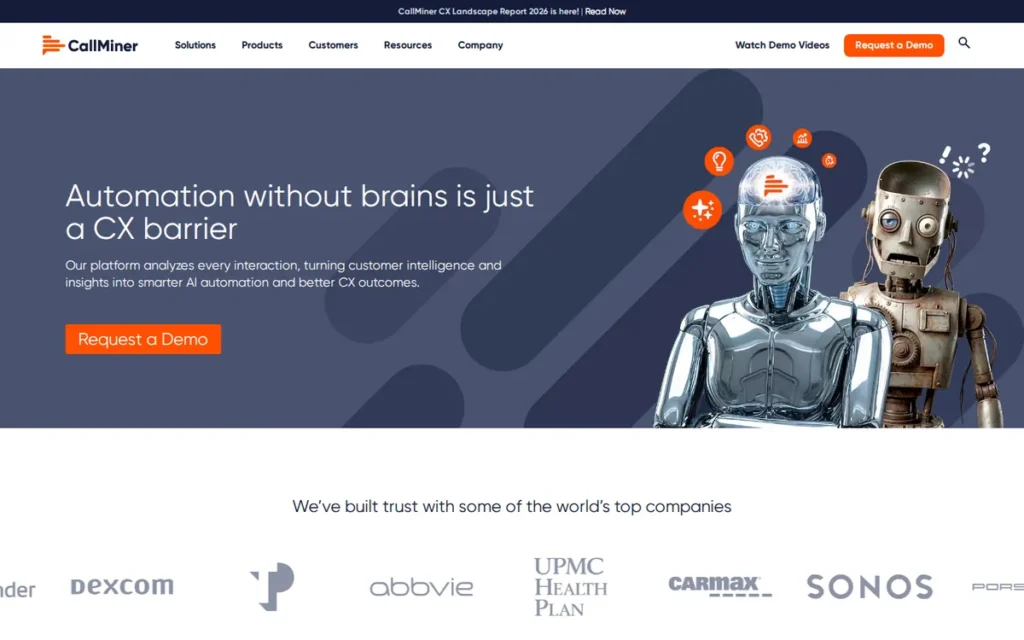
Category: Pure-Play Specialist, a modular, dedicated conversation intelligence platform where speech analytics is the entire product, not a feature within a larger suite.
At a Glance
- Category: Pure-Play Speech Analytics
- Best For: Compliance-heavy contact centers and QA-focused organizations needing maximum analytics depth and compliance configurability
- Price Range: Custom quote only: industry estimates start at $3,000–$10,000+ per month depending on seat count and module selection
- Primary Strength: CallMiner Eureka’s modular architecture combines acoustic signal analysis (word tempo, silence, agitation) with AI-powered semantic categorization, the deepest compliance detection framework in this comparison
- Biggest Limitation: Admin-heavy configuration; 2018-era primary recognition artifacts with no equivalent designation from 2024–2025 identified; no published pricing
- One-Line Summary: CallMiner Eureka is a modular, pure-play conversation intelligence platform delivering acoustic-plus-semantic analytics, concurrent real-time monitoring, and compliance-grade categorization across 100% of interactions.
- Last Verified: May 2026
Overview
CallMiner Eureka is a dedicated conversation intelligence platform where speech analytics is the entire product, not a CCaaS feature. Its architecture combines keyword and phrase identification with word tempo, silence patterns, and agitation signals, enabling emotional escalation detection that pure text analytics systems cannot match. Six independently deployable modules (Analyze, Coach, Alert, Redact, RealTime, Record) allow organizations to begin with post-call analytics and expand capabilities incrementally without replacing their CCaaS platform.
CallMiner Eureka’s Alert module monitors hundreds of thousands of calls concurrently in real time, with streaming transcription, speaker separation, and no-data-at-rest automated redaction, critical for PCI DSS compliance in large-scale contact center environments. CallMiner Eureka’s modular deployment path enables phased implementation, allowing organizations to start with post-call analytics and layer in real-time monitoring, compliance redaction, and coaching workflows over time.
Key Features
- Acoustic and Semantic Hybrid Analysis: CallMiner Eureka merges keyword and phrase identification with word tempo, silence detection, and agitation signals to detect emotional escalation patterns that text-only analytics platforms cannot identify, a critical differentiator for compliance monitoring in collections, debt collection, and financial services contact centers.
- Concurrent Real-Time Monitoring at Scale: CallMiner Eureka’s Alert module monitors hundreds of thousands of calls concurrently in real time, with streaming transcription, speaker separation, and no-data-at-rest automated redaction, critical for PCI DSS compliance in large-scale environments, per CallMiner’s Eureka Alert blog.
- 10x Capacity Analytics Engine: CallMiner Eureka introduced a 10x capacity analytics engine in 2018, a foundational architecture since expanded with GenAI and agentic AI additions in 2024–2025, providing unified real-time and post-call processing on a single architecture, per CallMiner’s press release (March 2018).
- GenAI-Powered Category Creation: CallMiner Eureka incorporates generative AI for instant category creation, semantic search beyond keyword matching, and hierarchical agentic AI, reducing the weeks-long manual taxonomy configuration that historically delayed new deployment timelines.
- Modular Deployment Architecture: CallMiner Eureka’s six-module structure (Analyze, Coach, Alert, Redact, RealTime, Record) enables phased implementation, organizations can activate only the modules needed at launch and expand capabilities incrementally without replacing their CCaaS platform.
Best For
CallMiner Eureka is best suited for compliance-intensive contact centers in financial services, debt collection, insurance, and healthcare. CallMiner Eureka also serves QA-focused operations that need the deepest possible analytics configuration flexibility, real-time compliance monitoring at scale, and an analytics platform customizable independently of their CCaaS vendor.
Pricing
CallMiner Eureka pricing is custom quote-only with no published tier pricing. Industry estimates for enterprise speech analytics platforms at this tier typically start at $3,000–$10,000+ per month, depending on seat count, module selection, and usage volume, per Ringover’s comparison and Ringly’s speech analytics guide. Pricing current as of May 2026.
Strengths
- CallMiner Eureka’s acoustic signal integration: combining word tempo, silence detection, and agitation analysis with semantic topic mapping, delivers detection capabilities for emotional escalation and compliance violations that text-only platforms cannot replicate, per CallMiner’s conversation intelligence documentation.
- CallMiner Eureka received Best Speech Analytics Solution recognition (2018) in the Top 10 Contact Centre Technologies awards, cited for user-friendliness and in-depth analysis capabilities, per CallMiner’s press release (May 2018). No equivalent third-party designation from 2024–2025 was identified during this research period.
- CallMiner Eureka introduced a 10x capacity analytics engine in 2018, with unified real-time and post-call processing on a single architecture, a foundational capability expanded with GenAI additions in 2024–2025, per CallMiner’s press release (March 2018).
- Speech analytics practitioners on r/speechtech specifically cite CallMiner’s decades of accumulated compliance category libraries as making the platform “more defensible in audits” than newer AI-native competitors, a practical differentiator for regulated-industry buyers facing regulatory examination.
Limitations
- Admin Configuration Burden: CallMiner Eureka’s depth of analytics customization requires significant upfront taxonomy configuration, category library building, and threshold tuning before meaningful insights emerge, organizations without dedicated speech analytics administrators may struggle to realize value without a professional services investment.
- Evidence Currency: CallMiner Eureka’s two most-cited independent recognition artifacts (the Best Speech Analytics Solution award and the 10x capacity analytics engine) are both from 2018 press releases. No equivalent third-party award or analyst designation from 2024–2025 was identified during this research, limiting independent validation of the platform’s current competitive standing relative to more recently evaluated competitors.
- Pricing Opacity: CallMiner Eureka’s custom quote-only pricing model creates friction for organizations conducting initial budget planning, the absence of published pricing makes vendor comparison analysis more time-consuming than with transparent-pricing competitors like Genesys or Talkdesk.
- Implementation Timeline: Enterprise speech analytics implementations for CallMiner Eureka typically require multi-month deployment cycles and internal change management, buyers should plan for a significant configuration investment before the platform delivers full production value.
Verdict
CallMiner Eureka is the most modularly comprehensive pure-play speech analytics specialist in this comparison, combining acoustic signal analysis, concurrent real-time monitoring at scale, and GenAI-powered categorization in a single incrementally deployable platform. CallMiner Eureka ranks above Verint Speech Analytics (#3) because its six-module architecture enables more configurable compliance deployment and its concurrent real-time monitoring covers hundreds of thousands of simultaneous calls. Buyers should plan for a significant configuration investment before the platform delivers full value, request a proof-of-concept on your own call data before committing to a multi-year contract.
3. Verint Speech Analytics: Best for Regulated Industries
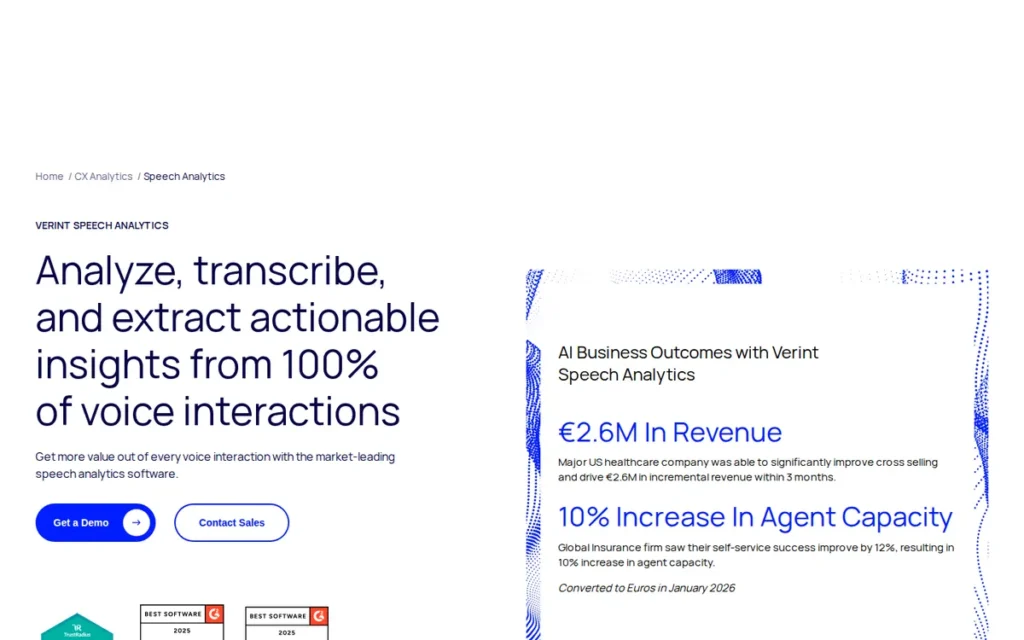
Category: Enterprise Speech Analytics Specialist, a deep-analytics platform with particular strength in regulated industry compliance, open AI model architecture, and speaker-separated transcription accuracy.
At a Glance
- Category: Enterprise Speech Analytics
- Best For: Regulated enterprises in financial services and healthcare needing vendor-reported >90% transcription accuracy and compliance depth
- Price Range: Custom quote only: cloud deployment carries a cost premium over on-premises; contact directly for pricing
- Primary Strength: Verint Speech Analytics’ Da Vinci AI engine delivers vendor-reported >90% comprehension accuracy with 100% call coverage, full speaker separation, and open AI model flexibility, the strongest transcript accuracy claim in this comparison
- Biggest Limitation: Complex UI; difficult support escalation for P1 issues; cloud migration carries a significant cost premium over on-premises
- One-Line Summary: Verint Speech Analytics delivers vendor-reported >90% comprehension accuracy with 100% call coverage, speaker-separated transcription, and an open AI model architecture via the Da Vinci AI engine for regulated enterprise contact centers.
- Last Verified: May 2026
Overview
Verint Speech Analytics is a dedicated enterprise analytics platform built around the Da Vinci AI engine, processing 100% of calls with speaker-separated transcription and vendor-reported greater than 90% comprehension accuracy, supporting accents, dialects, slang, and specialized industry terminology for financial services, healthcare, insurance, and government contact centers, per Verint’s 2024–2025 product documentation. No independent third-party benchmark validation of this accuracy claim was identified during this research.
Unlike closed-stack competitors, Verint Speech Analytics uses an open Da Vinci framework spanning both proprietary and commercially available AI models, a strategic differentiator for enterprises that want AI flexibility without full platform replacement. Verint Speech Analytics also includes the Genie Bot, enabling non-technical analysts to query unstructured call data using natural language without configuring complex reports.
Key Features
- Da Vinci AI Transcription Engine: Verint Speech Analytics delivers vendor-reported greater than 90% comprehension accuracy with complete speaker-separated transcription, supporting accents, dialects, slang, and specialized industry terminology, enabling precise attribution of agent versus customer sentiment across 100% of calls, per Verint’s 2024–2025 product documentation. (No independent third-party benchmark validation was identified in this research.)
- Genie Bot (Natural Language Analytics Queries): Verint Speech Analytics includes a Genie Bot that enables analysts to ask questions about unstructured interaction data in natural language, eliminating complex report configuration and lowering the analytics access barrier for non-technical QA teams.
- Open Da Vinci AI Framework: Verint Speech Analytics uses an open AI model approach spanning both proprietary and commercially available models, providing AI flexibility for enterprises that want multi-model strategies rather than being locked into a single vendor’s AI stack, per Verint’s Open Da Vinci AI page.
- Contextual Semantic Grouping: Verint Speech Analytics groups semantically related terms (connecting “overage,” “late charges,” and “minutes of usage” to the single theme of “fees”) enabling theme-level root cause analysis without manually configuring every possible phrase variant across large interaction volumes.
- Real-Time Monitoring and Intervention: Verint Speech Analytics’ real-time analytics engine monitors live calls and can trigger emails, pop-up messages, notifications, coaching prompts, and process guidance when predefined compliance or quality rules are matched, per Verint’s real-time speech analytics datasheet.
Best For
Verint Speech Analytics is best suited for large enterprises in financial services, healthcare, insurance, and government, particularly organizations where transcription accuracy for accents and specialized terminology is critical, where open AI model flexibility is a strategic requirement, or where an existing Verint WFM relationship makes platform expansion preferable to wholesale replacement.
Pricing
Verint Speech Analytics pricing is custom quote-only with no published pricing on product pages or third-party comparison sites. Organizations should expect multi-month sales cycles and professional services costs in addition to licensing. Cloud deployment carries a noted cost premium over on-premises Verint deployments, per community reporting at r/workforcemanagement. Pricing current as of May 2026.
Strengths
- Verint Speech Analytics’ Da Vinci AI engine delivers vendor-reported greater than 90% comprehension accuracy with full speaker separation, a key differentiator for regulated industries where misattributed statements in transcripts create compliance and legal exposure, per Verint’s 2024–2025 product documentation.
- Verint Speech Analytics’ open AI model architecture: spanning both proprietary and commercial models, provides future-proofing for enterprises that want flexibility to incorporate best-available AI models without full platform replacement, per Verint’s Open Da Vinci AI page.
- Verint Speech Analytics’ contextual semantic grouping connects related phrases across thousands of interactions without manual configuration of every phrase variant, enabling theme-level root cause analysis and significantly reducing analyst time for trend identification.
- Reddit practitioners at r/workforcemanagement describe Verint Speech Analytics as “by far the most adaptable between the three [Genesys, Verint, Calabrio] as far as expanded functions” including speech analytics add-ons, confirming adaptability as a community-validated strength.
Users on r/workforcemanagement shared their platform experience:
“As a user who migrated from Genesys to Verint, and currently implementing Calabrio in a different center, maybe look at expanding Verint functionality for DPA or Speech Analytics in negotiations with the vendor if your use case isn’t aligned with your licensing. Verint is by far the most adaptable between the three as far as expanded functions. It really depends on what the business is looking to gain by switching.” Posted by u/Kevmandigo
Takeaway: Contact center practitioners with cross-platform migration experience consistently rate Verint Speech Analytics as the most functionally expandable option among its enterprise WFM competitors, validating its open-architecture positioning.
Limitations
- Support Escalation Difficulty: Community reports at r/workforcemanagement describe Verint support as “always difficult,” with P1 issues requiring buyers to “fight an uphill battle just to have the ticket acknowledged as critical”, organizations should negotiate dedicated support SLAs and escalation path commitments before signing contracts.
- Cloud Migration Cost Premium: Verint Speech Analytics’ cloud deployment carries a noted cost premium over on-premises deployments, and the cloud platform has historically lagged on-premises feature parity, though community sources note Verint has been actively closing these gaps, per r/workforcemanagement.
- UI Complexity: Verint Speech Analytics is consistently described as complex to administer, with a steeper learning curve than CCaaS-native competitors, organizations without dedicated speech analytics administrators may underutilize platform capabilities relative to the implementation investment.
- Employee Monitoring Backlash Risk: Verint’s workforce monitoring features, including desktop analytics and idle time tracking, generate documented employee experience concerns when deployed without transparent change management, per r/workfromhome, a real adoption risk for organizations with distributed or remote workforces.
Verdict
Verint Speech Analytics is the strongest choice for regulated-industry contact centers that prioritize transcription accuracy, open AI model flexibility, and contextual semantic analysis, particularly where an existing Verint WFM or CX platform relationship already exists. Verint Speech Analytics’ support track record requires active management through contract-level SLA negotiation before signing, and cloud migration costs should be modeled explicitly before procurement decisions are finalized. Organizations in financial services or healthcare with strict transcription-accuracy requirements should evaluate Verint Speech Analytics alongside CallMiner Eureka before committing to either platform.
4. Genesys Cloud CX: Best for CCaaS Buyers with Transparent Pricing
Category: CCaaS-Native Analytics, speech and text analytics natively embedded within a full Gartner Magic Quadrant CCaaS Leader platform, with fully transparent published pricing.
At a Glance
- Category: CCaaS-Native Analytics Platform
- Best For: Organizations purchasing full CCaaS with native analytics at transparent, predictable per-user pricing
- Price Range: $75–$240/user/month (published list pricing, billed annually); AI Experience token costs are additive at scale
- Primary Strength: Genesys Cloud CX offers fully published per-user list pricing (one of only two Gartner CCaaS Leaders in this comparison to do so) with native omnichannel analytics and workflow automation requiring no third-party middleware
- Biggest Limitation: AI token cost unpredictability at scale; analytics depth below standalone specialists; advanced features gated behind higher tiers up to $240/user/month
- One-Line Summary: Genesys Cloud CX provides natively embedded speech and text analytics across 100% of omnichannel interactions with published list pricing from $75 to $240 per user per month and Gartner CCaaS Leader recognition in 2024–2025.
- Last Verified: May 2026
Overview
Genesys Cloud CX is a Gartner CCaaS Magic Quadrant Leader platform embedding speech and text analytics natively across voice, digital, IVR, voice bots, and voicemail, providing 100% interaction coverage without a separate analytics vendor, at published list pricing starting at $75 per user per month, billed annually. Genesys Cloud CX is one of only two enterprise CCaaS platforms in this comparison to publish transparent per-user pricing.
Genesys Cloud CX analytics capabilities include:
- Voice transcription with 100% interaction coverage across voice, digital, IVR, voice bots, ACD, conferences, and voicemail
- Content search by keyword, phrase, sentiment signal, topic category, and empathy indicator
- Interaction categories and sentiment trend detection, including historical interaction reprocessing for retroactive analysis
- Process Automation Triggers that convert detected analytics conditions into automated workflow actions, supervisor alerts, escalation initiation, and customer recovery responses
This trigger-based automation extends Genesys Cloud CX analytics beyond dashboards, insights can automatically launch escalation workflows, supervisor alerts, or customer recovery processes when defined conditions are met.
Key Features
- Native 100% Omnichannel Coverage: Genesys Cloud CX analytics covers voice, digital, IVR, voice bots, ACD, conferences, and voicemail natively (no API connectors required) ensuring analytics data shares full context with routing, recording, QA, and WEM systems in a single platform environment.
- Process Automation Triggers: Genesys Cloud CX enables analytics-triggered workflow automation, when defined sentiment, topic, or phrase conditions are detected, the platform automatically initiates supervisor alerts, escalation workflows, or customer recovery actions without manual dashboard review.
- Utterance-Level Sentiment and Topic Detection: Genesys Cloud CX provides utterance-level sentiment analysis, topic detection and trending, phrase discovery, empathy signal detection, and historical interaction reprocessing, enabling retroactive analysis of past calls when new categories are configured.
- Transparent Published Pricing: Genesys Cloud CX publishes list pricing of $75 (CX 1), $115 (CX 2), $155 (CX 3), and $240 (CX 4, enterprise AI bundle) per user per month, billed annually, one of only two Gartner CCaaS Leaders in this comparison to publish pricing, alongside Talkdesk Interaction Analytics.
- Gartner CCaaS Leader Recognition: Genesys was named a Gartner Magic Quadrant Leader for Contact Center as a Service in 2024–2025, per the Genesys competitive positioning page, confirming enterprise-grade platform maturity validated by independent analyst research.
Best For
Genesys Cloud CX is best suited for enterprise and mid-market organizations purchasing a full CCaaS platform, particularly those transitioning from legacy on-premises systems (Genesys PureConnect, Avaya, Cisco) who want native analytics without a separate vendor procurement process. Genesys Cloud CX also serves organizations in regulated industries benefiting from Genesys’s 35+ years of compliance certification history.
Pricing
Genesys Cloud CX publishes list pricing of $75 per user per month (CX 1, Voice), $115 (CX 2, Digital + Voice), $155 (CX 3, Full Omnichannel), and $240 (CX 4, Enterprise AI Bundle), all billed annually, per the Genesys pricing page. Advanced AI analytics features are subject to AI Experience token consumption costs, adding usage-based variability beyond the base tier price. Organizations processing high AI analytics volumes should request consumption projections before committing to a tier. Pricing current as of May 2026.
Strengths
- Genesys Cloud CX and Talkdesk Interaction Analytics are the only two Gartner CCaaS Leaders in this comparison to publish fully transparent per-user list pricing (Genesys at $75–$240 per user per month and Talkdesk at $85–$225) enabling faster procurement planning than the five other platforms requiring custom quote engagement.
- Genesys Cloud CX’s native analytics integration eliminates the API middleware complexity and data synchronization latency of deploying a separate third-party speech analytics layer, a tangible reduction in integration risk and ongoing administration overhead.
- Genesys was named a Gartner CCaaS Magic Quadrant Leader in 2024–2025, per the Genesys competitive positioning page, confirming enterprise-grade platform maturity validated by independent analyst research and reducing vendor-stability risk for long-term procurement decisions.
- Genesys Cloud CX’s Process Automation Triggers convert detected speech analytics signals directly into operational actions (escalation, recovery, or supervisor alerts) without requiring manual dashboard review before any operational response is initiated.
Limitations
- AI Token Cost Unpredictability: Genesys Cloud CX’s AI Experience token consumption model creates cost forecasting challenges at scale, advanced analytics usage can consume token budgets rapidly, potentially generating significant cost overruns for organizations with high AI feature utilization alongside base tier licensing.
- Analytics Depth Below Standalone Specialists: Reviewers and third-party sources consistently note that Genesys analytics is “hard to customize,” requires “exports to Excel or external BI” for advanced analysis, and that organizations needing deep bespoke analytics workflows often pair Genesys with a dedicated speech analytics layer, per GetVoIP and Sprinklr.
Users on r/sysadmin noted:
“Genesys was great, but it felt like every feature we wanted to use required us to buy a plug in from some third party and that just felt unnecessarily complicated.” Posted by u/GgSgt
Takeaway: Genesys Cloud CX buyers routinely encounter third-party add-on requirements for advanced feature sets, validating analyst and community concerns that the platform’s single-vendor simplicity promise breaks down at scale.
- Premium Tier Gating: Advanced analytics, AI features, and enterprise AI capabilities are gated behind higher tiers (published pricing ranges from $75 (CX 1) to $240 per user per month (CX 4 enterprise AI bundle, billed annually)) meaning organizations scaling AI analytics may pay 220% more than entry-level tier pricing, with AI Experience token costs additive on top.
- Analytics-First Perception Gap: Community sources at r/AI_Agents describe Genesys as “a comprehensive CX system rather than a dedicated AI or analytics tool”, a perception reflecting the reality that buyers select Genesys for the full contact center platform, not specifically for analytics depth or compliance configurability.
Verdict
Genesys Cloud CX is the strongest choice for organizations purchasing a full CCaaS platform who want native speech analytics without a separate vendor, transparent pricing enabling faster budget planning, and Gartner-validated enterprise credibility. Genesys Cloud CX’s published pricing from $75 to $240 per user per month is the most accessible documented cost entry point among enterprise CCaaS Leaders in this comparison. For organizations whose primary requirement is analytics depth over platform breadth, Genesys Cloud CX should be evaluated alongside CallMiner Eureka or Verint Speech Analytics as a complementary layer rather than a direct specialist replacement.
5. Observe.AI: Best AI-Native Platform for Automated QA
Category: AI-Native Conversation Intelligence, a platform built ground-up around a proprietary contact center LLM, with automated QA, real-time agent copilots, and AI agent oversight as its core differentiators.
At a Glance
- Category: AI-Native Conversation Intelligence
- Best For: AI-first enterprises prioritizing automated 100% QA coverage, real-time agent coaching, and modern GenAI summarization
- Price Range: Custom quote only: industry estimates suggest $10,000+ per month at meaningful enterprise scale
- Primary Strength: Observe.AI’s proprietary 30-billion-parameter contact center LLM is purpose-built for agent-customer interaction language, trained ground-up on contact center data rather than adapted from a general-purpose AI model
- Biggest Limitation: Shorter compliance audit track record than legacy specialists; vendor-reported accuracy benchmarks from June 2023 using models that have since been superseded; significant implementation investment required
- One-Line Summary: Observe.AI’s proprietary 30-billion-parameter contact center LLM delivers automated 100% QA coverage, real-time agent copilots, and AI agent hallucination detection, the most purpose-built AI architecture in this comparison.
- Last Verified: May 2026
Overview
Observe.AI is built around a proprietary 30-billion-parameter large language model trained specifically on contact center interactions, calibrated by human annotators over five-plus years for the vocabulary, compliance language, and conversational patterns of agent-customer calls, rather than adapted from a general-purpose AI model. Observe.AI’s LLM is purpose-built for contact center tasks including summarization, sentiment detection, and compliance language recognition, per the Observe.AI Contact Center LLM page.
Observe.AI’s platform is organized around three product lines: AI Agents (autonomous workflow handling), AI Copilots (real-time agent augmentation with live guidance), and Conversation Intelligence (post-call QA, analytics, and compliance). Observe.AI’s AI Copilots capability enables real-time guidance during live calls (not just post-call coaching) addressing agent errors before they become compliance violations or customer escalations.
Key Features
- 30-Billion-Parameter Contact Center LLM: Observe.AI’s proprietary LLM was trained on hundreds of millions of contact center interactions and calibrated by human annotators over five-plus years, delivering domain-specific performance for summarization, sentiment analysis, and compliance detection in agent-customer language, per the Observe.AI Contact Center LLM page.
- Automated 100% QA Coverage: Observe.AI automatically evaluates 100% of conversations with a full audit trail, moving from the industry-standard 2–5% manual QA sampling to complete interaction coverage, enabling genuine statistical compliance monitoring rather than sampling-based estimates.
- AI Copilots (Real-Time Agent Augmentation): Observe.AI’s AI Copilots provide real-time guidance to agents during live calls, surfacing relevant knowledge, next-best-action suggestions, and compliance warnings in the moment, addressing agent mistakes before they become compliance violations or customer escalations.
- AI Agent Oversight (Hallucination and Drift Detection): Observe.AI’s AWS Marketplace listing confirms capability to detect hallucinations and behavioral drift in AI-handled contacts during live calls, among the platforms in this comparison as of May 2026, Observe.AI is the only one to explicitly document this capability; this gap may close as other platforms update their feature sets.
- Vendor-Reported LLM Accuracy Benchmarks: Observe.AI’s June 2023 LLM launch press release reported the model is 35% more accurate than GPT-3.5 for call summarization and 33% more accurate for sentiment analysis, vendor-reported benchmarks comparing against models that have since been updated by OpenAI, and not independently re-validated as of May 2026. Buyers in compliance-critical contexts should require current accuracy testing on their own call data.
Best For
Observe.AI is best suited for AI-forward enterprises that prioritize automated QA coverage, real-time agent coaching, and GenAI-powered operational efficiency over legacy compliance framework depth. Observe.AI particularly serves organizations deploying hybrid human-plus-AI contact centers where monitoring AI agent behavior is a new and growing operational requirement.
Pricing
Observe.AI pricing is custom quote-only with no published tier pricing, per Observe.AI’s product pages and Dograh’s 2025 review. Industry estimates for enterprise-grade conversation AI platforms at this tier suggest monthly costs starting in the range of $10,000+ for meaningful-scale deployments. Implementation and integration costs are additional. Pricing current as of May 2026.
Strengths
- Observe.AI’s 30-billion-parameter proprietary LLM: trained ground-up on contact center interactions rather than adapted from a general-purpose model, represents a structural architecture advantage for domain-specific task accuracy, per the Observe.AI Contact Center LLM page.
- Observe.AI enables automated evaluation of 100% of conversations with a full audit trail (addressing the fundamental QA sampling problem where traditional manual QA reviews only 2–5% of agent interactions) the primary documented ROI driver for speech analytics adoption.
- Among the platforms in this comparison as of May 2026, Observe.AI is the only one to explicitly document AI agent hallucination and drift detection capability for AI-handled contacts, making Observe.AI the strongest current choice for organizations deploying autonomous AI agents alongside human agents, per Observe.AI’s AWS Marketplace listing.
- Third-party review summaries from Dograh’s 2025 analysis cite customer praise for “easy-to-use interface,” “advanced AI for sentiment analysis and transcription,” and “100% call monitoring coverage”, suggesting Observe.AI has made deliberate UX investments to reduce the analytics complexity burden relative to legacy enterprise tools.
Limitations
- Shorter Compliance Track Record: Observe.AI was founded in 2017, compared to NICE (1986), Verint (1994), and CallMiner’s multi-decade compliance frameworks, a meaningful concern for regulated-industry buyers in HIPAA, FINRA, and FCA environments. Additionally, the accuracy benchmarks cited (35% over GPT-3.5 for summarization, 33% for sentiment) originate from Observe.AI’s June 2023 LLM launch press release and compare against models since superseded by OpenAI; these benchmarks have not been independently re-validated as of May 2026.
- Pricing Opacity: Observe.AI’s custom quote-only model creates significant access friction for organizations conducting initial budget planning, no published pricing is available through the vendor website or third-party sources, effectively limiting early-stage evaluation to organizations already prepared for enterprise-tier procurement.
- Implementation Complexity: Third-party reviews from Dograh’s 2025 analysis consistently cite implementation complexity, tuning effort, and cost as Observe.AI’s primary weaknesses, the platform’s AI capability requires significant configuration investment before delivering full production value.
- QA-First Positioning vs. Deep Acoustic Analytics: Practitioners at r/speechtech characterize Observe.AI as specializing in “QA and coaching” rather than deep speech science, organizations needing deep acoustic analysis, phonetics-based compliance detection, or legacy-industry-specific compliance category libraries should evaluate CallMiner Eureka or Verint Speech Analytics alongside Observe.AI.
Verdict
Observe.AI is the strongest choice for organizations building modern AI-forward contact centers where automated QA, real-time agent copilots, and AI agent oversight are the primary requirements. Observe.AI’s proprietary contact center LLM is a genuine architectural differentiator over platforms adapting general-purpose AI models to contact center use cases. Buyers in heavily regulated industries should supplement Observe.AI evaluation with an independent compliance framework assessment relative to legacy specialists, Observe.AI’s shorter regulatory audit track record is its most material limitation for HIPAA, FINRA, or FCA environments.
6. Talkdesk Interaction Analytics: Best for Mid-Market CCaaS Buyers
Category: CCaaS Analytics Platform, analytics capability integrated within a Gartner CCaaS Leader platform, with transparent pricing and lower implementation friction than enterprise specialists.
At a Glance
- Category: CCaaS Analytics Platform
- Best For: Mid-market to enterprise buyers wanting integrated QA automation and analytics within a transparent-pricing CCaaS platform
- Price Range: $85–$225/user/month (published list pricing)
- Primary Strength: Talkdesk Interaction Analytics offers Gartner CCaaS Leader recognition, transparent published pricing starting at $85/user/month, and integrated QA automation, the most accessible entry point in this comparison for organizations without dedicated speech analytics teams
- Biggest Limitation: Shallower analytics depth versus standalone specialists; advanced analytics features may require Elite tier or above; analytics perceived as secondary to CCaaS operations
- One-Line Summary: Talkdesk Interaction Analytics combines AI-powered QA automation and sentiment analysis within a Gartner CCaaS Leader platform at published pricing starting at $85 per user per month.
- Last Verified: May 2026
Overview
Talkdesk Interaction Analytics is embedded within Talkdesk’s Customer Experience Automation framework, using generative AI to analyze 100% of voice, chat, and digital interactions for friction, intent, and emotional signals. Talkdesk Interaction Analytics is an integrated CCaaS component (not a standalone product) best suited for organizations already procuring Talkdesk as their primary contact center system.
Talkdesk was named a Gartner CCaaS Magic Quadrant Leader in 2024 and has been cloud-native since its 2011 founding, providing modern API-based integration architecture for faster deployment timelines than legacy platforms. Talkdesk Interaction Analytics combines speech analytics with automated QA scoring in a single workflow, reducing total stack complexity for mid-market buyers who want single-vendor management.
Key Features
- Integrated QA Automation: Talkdesk Interaction Analytics analyzes 100% of interactions and automates evaluations, delivering fair, consistent QA scoring and actionable coaching insights within a single platform, eliminating the need for separate QA scoring software, per Talkdesk’s Interaction Analytics datasheet.
- Customer Experience Automation (CXA) Framework: Talkdesk positions Interaction Analytics within its CXA framework as a closed-loop system, analytics insights feed automated coaching, QA workflows, and operational triggers rather than ending at a static reporting dashboard.
- Utterance-Level Sentiment Analysis: Talkdesk Interaction Analytics provides utterance-level sentiment playback, intent detection, and topic classification, enabling QA reviewers to navigate directly to emotional or intent signals within a recording rather than reviewing full transcripts manually.
- Slack and Microsoft Teams Integration: Talkdesk Interaction Analytics sends automated alerts to Slack and Microsoft Teams when predefined topic, sentiment, or compliance conditions are triggered, integrating speech analytics insights into existing team communication workflows, per Talkdesk’s support documentation.
- Transparent Published Pricing: Talkdesk is one of two Gartner CCaaS Leaders in this comparison (alongside Genesys Cloud CX) to publish list pricing (with tiers at $85 (Digital or Voice Essentials), $145 (Elite), and up to $225 (Industry Clouds) per user per month) enabling faster budget planning without a full sales cycle.
Best For
Talkdesk Interaction Analytics is best suited for mid-market organizations with 100–500 agents that are procuring Talkdesk as their primary CCaaS platform and want integrated QA automation and speech analytics without the implementation complexity of a dedicated specialist platform. Talkdesk Interaction Analytics serves organizations that accept a trade-off of shallower analytics depth for faster deployment and simpler vendor management.
Pricing
Talkdesk publishes list pricing of $85 per user per month (Digital or Voice Essentials), $145 (Elite, full omnichannel), and up to $225 (Industry Clouds), per the Talkdesk pricing page. Analytics-specific feature inclusion at each tier requires direct confirmation from Talkdesk sales, as the public pricing page does not clearly delineate analytics feature depth by tier. Advanced analytics features may require the Elite tier or above. Pricing current as of May 2026.
Strengths
- Talkdesk was named a Gartner Magic Quadrant CCaaS Leader in 2024, confirming enterprise-grade platform maturity recognized by independent analyst research, a vendor stability signal for mid-market buyers evaluating platform longevity and support infrastructure.
- Talkdesk Interaction Analytics’ integrated QA automation eliminates the need for separate QA scoring software, delivering combined 100% interaction analysis and automated evaluation scoring in a single workflow, reducing total stack cost and administration complexity.
- Talkdesk’s published per-user pricing ($85–$225 per user per month) is one of only two published pricing models in this comparison, enabling faster procurement planning and more accurate total cost modeling for organizations with known agent headcount.
- Talkdesk was cloud-native from its 2011 founding, providing modern API-based integration architecture that supports faster deployment timelines than legacy platforms migrating from on-premises foundations.
This aligns with community sentiment on r/sysadmin:
“I love talkdesk. Coming from Cisco uccx at most places it’s simple enough to hand over to the telephone teams and let them self manage. Solid and improving.” Posted by u/bloodlorn
Takeaway: Talkdesk’s platform simplicity consistently earns validation from mid-market buyers migrating off legacy contact center systems, reinforcing its positioning as the lowest-friction CCaaS option in this comparison for organizations without dedicated speech analytics staff.
Limitations
- Shallower Analytics Depth vs. Specialists: Reviewers and industry comparison sources consistently note that Talkdesk Interaction Analytics offers fewer configurable acoustic analysis parameters and shallower compliance phrase library depth than dedicated specialists like CallMiner Eureka or Verint Speech Analytics, a trade-off documented in Talkdesk’s own positioning as an integrated CCaaS module rather than a standalone analytics platform.
- Platform-First Perception: Community sources at r/AI_Agents describe Talkdesk primarily as “a contact center platform for routing, dialing, and managing calling environments”, reinforcing that analytics is a supporting feature rather than a primary differentiator, which shapes the platform’s investment and roadmap priorities.
- Advanced Analytics Tier Uncertainty: Talkdesk’s published pricing page does not clearly specify which analytics features are included at which tier, organizations need direct Talkdesk sales confirmation that required analytics capabilities are available at their target price point before committing to a tier.
- Newer Regulated-Industry Track Record: Talkdesk was founded in 2011: significantly younger than NICE (1986), Verint (1994), and Genesys (1990), meaning fewer years of established compliance certification and regulatory audit history for financial services and healthcare contact centers with strict requirements.
Verdict
Talkdesk Interaction Analytics is the most accessible path to integrated speech analytics for mid-market organizations already procuring Talkdesk as their primary CCaaS platform, offering transparent published pricing, combined QA automation and analytics, and a cloud-native architecture from 2011. The acceptable trade-off is shallower dedicated analytics depth than best-of-breed specialists. Talkdesk Interaction Analytics is the right choice when the priority is single-vendor CCaaS simplicity and budget predictability, and analytics depth requirements are within the range of integrated platform capabilities rather than specialist-level compliance configurability.
7. Medallia Conversation Intelligence: Best for Fortune 500 CX Programs
Category: Enterprise CX Intelligence, a platform that uniquely connects speech analytics to enterprise Voice of the Customer programs, NPS, CSAT, and cross-channel CX measurement, designed exclusively for large enterprises.
At a Glance
- Category: Enterprise CX Intelligence Platform
- Best For: Fortune 500 organizations integrating speech analytics with enterprise-wide VoC, NPS, and customer lifecycle measurement programs
- Price Range: Six-figure annual contracts; multi-year commitments: contact directly for pricing
- Primary Strength: Among the seven platforms in this comparison, Medallia Conversation Intelligence is the only one natively connecting speech analytics to enterprise VoC surveys, NPS, CSAT, and downstream churn prediction without custom integration work
- Biggest Limitation: Six-figure cost; 3–6 month implementation; analytics depth below contact-center specialists; April 2026 lender control development reported by BDC Reporter, verify current financial stability independently before committing to multi-year contracts
- One-Line Summary: Medallia Conversation Intelligence uniquely connects speech analytics to enterprise-wide Voice of the Customer programs, designed for Fortune 500 organizations where CX measurement extends beyond the contact center. Independent financial due diligence is essential before multi-year commitment.
- Last Verified: May 2026
Overview
Medallia Conversation Intelligence connects speech analytics to enterprise Voice of the Customer programs, capturing and analyzing call recordings, chat logs, NPS surveys, CSAT data, and digital interaction signals in a unified CX intelligence layer. Medallia Conversation Intelligence serves Fortune 500 organizations where CX measurement extends far beyond the contact center, per Medallia’s conversation intelligence blog.
Among the seven platforms in this comparison, Medallia Conversation Intelligence is the only one natively integrating speech analytics with structured VoC survey data, enabling correlation between call transcripts, post-call survey responses (NPS, CSAT, CES), and downstream churn signals without custom integration work. Medallia has been recognized as a VoC platform leader by Gartner in multiple years, per CX Today, buyers should verify the specific 2025 designation via a primary Gartner source or Medallia press release before citing it as a current designation.
Key Features
- VoC and Speech Analytics Integration: Medallia Conversation Intelligence connects call transcript analytics to NPS, CSAT, CES surveys, social signals, and digital interactions, enabling correlation between what customers say during calls and how they respond in subsequent surveys, across channels and geographies, per Medallia’s conversation intelligence blog.
- Athena AI (NLP and ML Analytics): Medallia’s Athena AI applies natural language processing, machine learning, emotion detection, and predictive analytics (including churn risk scoring and root cause identification) to both structured and unstructured CX data from voice, survey, and digital sources.
- Smart Topic Builder: Medallia’s Smart Topic Builder achieves vendor-reported 85% precision in building topic models, per a Medallia product demonstration video (production date unspecified), with theme detection, sentiment scoring, intent analysis, and cross-channel topic trending as configurable capabilities.
- Action Orchestration Layer: Medallia Conversation Intelligence connects analytics insights to coaching workflows, QA programs, and enterprise-wide CX programs, designed for large, matrixed organizations where CX measurement extends beyond the contact center, per CX Today.
- Multi-Channel Correlation Analytics: Medallia Conversation Intelligence captures customer data across and outside the contact center, enabling CX programs that correlate call center performance with retail, digital, survey, and social channel signals simultaneously to support enterprise-wide CX measurement programs.
Best For
Medallia Conversation Intelligence is best suited for Fortune 500 CX organizations that already use or intend to purchase the broader Medallia Experience Cloud, where speech analytics is one layer of an enterprise-wide CX measurement program, not a standalone contact center analytics deployment. Organizations evaluating Medallia solely for call center speech analytics will find the cost-to-value ratio difficult to justify compared to specialist alternatives.
Pricing
Medallia Conversation Intelligence typical contracts start in the six figures and require multi-year commitments, with implementation timelines of 3–6 months requiring dedicated internal resources, per Chattermill’s competitive analysis. No published pricing tiers are available. Given the April 2026 lender control development reported by BDC Reporter, organizations should conduct independent vendor financial stability due diligence before committing to any multi-year contract. Pricing current as of May 2026.
Strengths
- Among the seven platforms in this comparison, Medallia Conversation Intelligence is the only one that natively connects speech analytics to enterprise VoC data, NPS, CSAT, and churn prediction, enabling a level of CX correlation that no other listed platform replicates without custom integration work, per Medallia’s conversation intelligence blog.
- Medallia has been recognized as a VoC platform leader by Gartner in multiple years, per CX Today coverage, buyers should verify the specific 2025 designation directly via a primary Gartner source or Medallia press release before citing it as a current designation.
- Medallia Conversation Intelligence’s Athena AI combines predictive analytics with speech analysis, identifying churn risk, root cause patterns, and operational intervention opportunities from conversation data, extending beyond analytics reporting into predictive CX management.
- Medallia was acquired by Thoma Bravo in October 2021 for approximately $6.4 billion, per Thoma Bravo’s primary press release, and serves Fortune 500 organizations across financial services, healthcare, retail, and hospitality, confirming enterprise implementation maturity and industry breadth.
Limitations
- High Cost and Commitment: Medallia Conversation Intelligence requires six-figure annual contracts with multi-year commitments, combined with 3–6 month implementation timelines, restricting access to large enterprises with dedicated CX technology procurement budgets and making pre-commitment ROI analysis critically important, per Chattermill’s competitive analysis.
As one practitioner summarized on r/customerexperience:
“Medallia: Powerful if you have a dedicated VoC team running it. Overbuilt for most CX orgs under a few thousand seats and the price reflects it.” Posted by u/petite_delmar
Takeaway: Medallia Conversation Intelligence delivers value only when a fully staffed enterprise VoC team is in place to operate it, organizations without that dedicated internal function are likely to find the six-figure investment structurally unjustifiable.
- Analytics Depth Below Contact Center Specialists: Critical review sources note “rule-based text analysis limits insight depth compared to modern AI-native platforms” and “limitations in sentiment analysis and categorization”, meaning Medallia’s speech analytics depth for contact-center-specific tasks may underperform dedicated specialists like CallMiner or Verint, per Chattermill and Capacity.com.
- Reporting Rigidity: User feedback consistently cites “rigid reporting outside predefined dashboards” and complexity for users wanting ad-hoc analysis beyond Medallia’s built-in dashboard structure, a usability constraint for organizations with diverse analytical queries requiring flexible exploration beyond pre-built reports.
- PE Ownership Consideration: Medallia’s Thoma Bravo private equity take-private structure means the company no longer files public financial disclosures, enterprise buyers signing multi-year contracts should conduct standard vendor financial health due diligence given the PE ownership and non-public financial status.
- Lender Control Development (April 2026): BDC Reporter (bdcreporter.com, April 2026) reported that Medallia’s lenders were moving to take operational control of the company, a significant financial development identified during this article’s May 2026 research that post-dates most Medallia vendor materials and is not reflected in Medallia’s own published content. Organizations evaluating Medallia for multi-year contracts must independently verify current ownership structure, management continuity, financial stability, and product roadmap commitments before signing.
Verdict
Medallia Conversation Intelligence is the right choice exclusively for Fortune 500 organizations that need to connect speech analytics to enterprise-wide CX measurement programs, and where the six-figure investment is justified by a broader Medallia Experience Cloud deployment. Medallia Conversation Intelligence is a poor fit for organizations seeking standalone contact center speech analytics, pure-play analytics depth, or accessible pricing without multi-year enterprise commitment. The April 2026 lender control development reported by BDC Reporter adds a vendor stability dimension not present for any other platform in this comparison, independent financial due diligence is essential before signing.
Recapping the Decision
For compliance-first regulated industries (financial services, healthcare, insurance, or debt collection) evaluate CallMiner Eureka and Verint Speech Analytics before any other options. Both carry decades of compliance framework maturity and documented regulatory audit histories that newer AI-native platforms have not yet had time to accumulate.
For organizations purchasing a full CCaaS platform with native analytics at transparent pricing, Genesys Cloud CX’s Gartner Leader placement and published pricing from $75 to $240 per user per month make it the lowest-friction entry point. Talkdesk Interaction Analytics is the right mid-market alternative when implementation simplicity and budget predictability outweigh the need for specialist-level analytics depth.
For Fortune 500 enterprises connecting speech analytics to NPS, churn prediction, and enterprise VoC programs, Medallia Conversation Intelligence is the only platform in this comparison purpose-built for that use case. The six-figure investment is only justified when the broader Medallia Experience Cloud is in scope. Independent vendor financial due diligence on the April 2026 lender control development is required before any multi-year Medallia commitment.
What Red Flags Should I Watch For When Evaluating Speech Analytics Software?
Speech analytics platforms share several common failure modes that cause expensive deployments to underdeliver. Six red flags consistently appear across community discussions, analyst research, and user reviews, from undisclosed post-sale support degradation to accuracy claims that have not been independently validated on buyers’ own call data.
Red Flag #1: Vendor Accuracy Claims Without Independent Validation
Verint’s vendor-reported >90% comprehension accuracy and Observe.AI’s June 2023 GPT benchmark comparisons are self-reported, not verified by independent third-party testing on standardized datasets. Organizations in high-stakes compliance contexts (HIPAA, FINRA, FCA) should require blind testing on a representative sample of their own call recordings, including their actual accent mix, industry vocabulary, and audio quality, before accepting any vendor benchmark at face value.
Red Flag #2: Post-Sale Support Degradation
Both NICE CXone and Verint Speech Analytics have documented patterns of post-contract support quality decline in practitioner Reddit communities. One user described NICE as an organization that “lies constantly, overbills constantly, and has the absolute worst tier 1 support” once contracts are signed. Buyers should negotiate explicit support SLAs, dedicated account engineering resources, and escalation path commitments before signing, these provisions are significantly harder to secure after contract execution.
Red Flag #3: Analytics Taxonomy Configuration Burden
Most enterprise speech analytics platforms require significant manual category library configuration, keyword taxonomy building, and threshold tuning before meaningful insights emerge. Practitioners at r/speechtech note that “compliance phrase detection… is often more well-curated keyword logic than neural magic”, meaning the value is in accumulated configuration, not automatic out-of-box AI capability. Ask vendors for the average time-to-first-insight for deployments similar to yours before committing.
Red Flag #4: AI Token Cost Unpredictability
Genesys Cloud CX’s AI Experience token consumption model creates cost forecasting uncertainty as AI feature usage grows. Any vendor charging per AI-processed interaction (rather than a flat seat-based model) requires careful consumption modeling before contract execution. Request historical consumption data from reference customers with similar call volumes before agreeing to token-based pricing at any tier.
Red Flag #5: CCaaS Platform Analytics vs. Specialist Depth
Organizations selecting Genesys or Talkdesk primarily for speech analytics depth risk discovering that embedded platform analytics cannot match the configurability and compliance defensibility of dedicated specialists like CallMiner or Verint. Third-party analysis from Sprinklr and GetVoIP consistently notes that advanced analytics on CCaaS-native platforms requires export to external BI tools for customization, evaluate analytics depth requirements explicitly before ruling out a dedicated analytics layer.
Red Flag #6: Implementation Timeline Underestimation
Enterprise speech analytics implementations consistently require 3–9 months from contract execution to production analytics. Community consensus at r/workforcemanagement confirms that “migrating is never as easy as the sales guy promises.” Any vendor demo promising go-live timelines under 90 days for enterprise-scale deployment should be questioned, request implementation timeline data from reference customers at similar scale, and budget for professional services costs that vendor quotes may understate.
What Questions Should I Ask Before Choosing a Speech Analytics Tool?
These seven questions help buyers move past vendor marketing language and evaluate each platform on the evidence that actually predicts implementation success, transcription accuracy in your specific environment, true total cost of ownership, compliance framework depth, and realistic deployment timelines confirmed by reference customers rather than vendor sales materials.
Question #1: What is your transcription accuracy on my specific call types?
Require vendors to demonstrate accuracy on a sample of your actual call recordings, including your industry’s specific terminology, the accent distribution of your customer base, and the audio quality of your telephony infrastructure. Do not accept general benchmarks; require evidence on data that represents your real environment.
Question #2: What is the full total cost of ownership over three years?
Request a three-year total cost of ownership (TCO) projection that includes: professional services implementation, ongoing administration support, training, integration connectors to your CRM and telephony, annual price escalation terms, and add-on module costs for features presented in the demo. For token-based pricing models, request consumption projections based on your actual call volume.
Question #3: How does the platform handle compliance monitoring for my specific regulatory framework?
Ask specifically: What compliance frameworks (PCI DSS, HIPAA, FINRA, TCPA, FCA) have you deployed for, with documented audit evidence? Can you provide reference customers in the same regulated industry? What is the false positive rate for compliance category alerts on regulated phrase detection? Platforms with decades of compliance library development have track records that newer platforms cannot yet match.
Question #4: What percentage of calls are analyzed in real time versus post-call, and what is the latency?
Real-time and post-call analytics are architecturally different, not all platforms deliver equal quality in both modes. Ask for documented real-time latency figures (time from speech to actionable alert), maximum concurrent real-time sessions, and the architecture difference between real-time and post-call models. Platforms unifying both in a single engine (like CallMiner Eureka’s updated architecture) reduce this trade-off; others require separate module deployment.
Question #5: What does the standard implementation timeline look like for organizations similar to mine?
Request the average implementation timeline for customers with similar agent headcount, telephony infrastructure, and analytics scope. Ask specifically about configuration time before first meaningful insight delivery, taxonomy building, QA scorecard setup, and category tuning are often the longest phases. Reference customer calls are the most reliable source of realistic timeline expectations.
Question #6: How is post-sale support structured, and what SLA commitments are in the contract?
Given documented support quality concerns for NICE and Verint specifically, ask to review the specific support tier language in the contract, not the sales deck. Confirm: dedicated support engineer assignment, P1 issue response and acknowledgment SLAs, escalation path to engineering, and whether support quality terms carry enforceable financial remedies.
Question #7: Can you provide a 30-day proof-of-concept evaluation on my own call recordings?
Every platform in this comparison should be evaluated on your actual call data (including your industry vocabulary, accent distribution, and audio quality conditions) before committing to a multi-year contract. No vendor benchmark substitutes for accuracy testing in your own environment. Request a proof-of-concept (POC) with a representative sample before any final commitment.
Regardless of platform, request dedicated support engineer assignment, P1 response SLA, and escalation path commitments in writing before signing, post-sale support quality is the most consistently documented risk factor across all platforms in this comparison.
How Did We Rank These Speech Analytics Platforms?
PlugRoute ranked these seven speech analytics platforms using a three-phase methodology: platform discovery via independent analyst reports and third-party review listings, standardized deep research across 25 queries per vendor executed simultaneously, and community sentiment verification from practitioner Reddit forums. No vendor paid for inclusion, placement, or favorable treatment.
How Was the Research Conducted?
1. Discovery (Phase 1): The research team queried multiple independent sources to identify the most-cited speech analytics platforms in 2026. Platforms were retained only if they appeared in independent analyst reports (Gartner, Aragon Research), maintained verifiable third-party review listings (G2, Capterra), and had documented deployments at enterprise scale. Seven platforms were selected for full evaluation.
2. Deep Research (Phase 2): Each platform was researched with equal depth using a standardized query set covering core capabilities, pricing, compliance frameworks, AI model architecture, real-time capabilities, integration depth, community sentiment, and background credentials. Twenty-five independent research queries were executed across all platforms simultaneously to ensure equal research rigor.
3. Community Sentiment (Phase 3): Reddit communities including r/workforcemanagement, r/speechtech, r/AI_Agents, and r/workfromhome were searched for authentic practitioner discussions. Only posts with verifiable author IDs and specific, contextual claims were incorporated as evidence.
What Criteria Were Used to Rank Each Platform?
- Review Platform Ratings and Volume: Why it matters: High review count at G2 and Capterra indicates broad adoption and reduces survivorship bias in feature claims. Low review counts signal limited independent validation of stated capabilities.
- Real-World User Sentiment (Reddit, forums): Why it matters: Community discussions from practitioners reveal post-sale support quality, implementation realities, and platform limitations that vendor marketing systematically omits.
- Pricing Transparency and Value: Why it matters: Pricing opacity creates procurement risk and suggests vendor willingness to exploit information asymmetry. Transparent pricing is independently verifiable and buyer-protective.
- Analytics Depth and Accuracy: Why it matters: Platforms relying on basic keyword matching deliver less ROI than platforms with acoustic signal analysis, semantic grouping, and domain-specific AI training. Accuracy claims were evaluated against independent evidence where available.
- Real-Time vs. Post-Call Architecture: Why it matters: Organizations needing live call intervention require demonstrably different platform architecture than those performing post-call analysis only. Platforms claiming both modes equally require scrutiny of the underlying architecture.
- Compliance Framework Maturity: Why it matters: Regulated industries require documented compliance certifications and audit track records. Platform age and documented regulated-industry deployments are proxies for compliance maturity where direct certification data is unavailable.
- Integration Quality: Why it matters: Disconnected analytics that do not feed into telephony, CRM, and WEM workflows create analysis-to-action gaps that reduce ROI. Native integration eliminates middleware risk and data synchronization latency.
How Were Conflicting Evidence Sources Weighted?
A detailed 2025 Reddit post describing a specific post-sale support failure with named product features outweighs a generic 2023 G2 review with one-sentence ratings. When review platform ratings conflict with Reddit community sentiment, PlugRoute weights specificity and recency.
Vendor-reported statistics are labeled throughout this article. Claims corroborated by at least one independent source are stated as fact. Where data was unavailable or unverifiable, the absence of data is noted rather than filled with inference.
How Were Vendor Claims Validated?
Vendor-reported accuracy claims, including Verint’s >90% comprehension, Observe.AI’s June 2023 GPT benchmark comparisons, and Medallia’s vendor-reported 85% topic model precision, are labeled as vendor-reported throughout this article. Only claims independently verifiable through third-party sources, analyst reports, or community corroboration are stated as facts.
The Medallia Gartner VoC MQ Leader 2025 designation was sourced through CX Today secondary editorial coverage; a primary Gartner source was not confirmed during research. Buyers should verify this designation directly via Gartner or a primary Medallia press release before citing it as a current designation.
When Will This Comparison Be Updated?
This article was researched and compiled in May 2026. PlugRoute refreshes competitive comparison articles when one or more of the following occurs: a vendor announces pricing or product changes that materially affect rankings, a new entrant achieves meaningful market adoption, or an analyst firm publishes an updated Magic Quadrant for the category.
Independence Disclosure
PlugRoute has no affiliate relationships, revenue-sharing arrangements, or commercial partnerships with any of the seven vendors evaluated in this comparison. No vendor paid for inclusion, placement, or favorable treatment. Rankings are determined entirely by the methodology described above.
What Do Buyers Most Often Ask About Speech Analytics Software?
What is the difference between speech analytics and conversation intelligence?
Speech analytics analyzes voice call recordings specifically, extracting keywords, sentiment, topics, and compliance signals from audio. Conversation intelligence is broader, covering voice, chat, email, and digital interactions with AI summaries, coaching workflows, and VoC integration. Most 2026 platforms use both terms, but “conversation intelligence” typically signals omnichannel scope beyond voice-only analytics.
How does PlugRoute determine its rankings?
PlugRoute ranks platforms using a multi-source methodology combining verified third-party review ratings (G2, Capterra), independent analyst placements (Gartner), authentic community sentiment from practitioner Reddit forums, pricing transparency assessments, and documented feature evidence from vendor product pages and press releases. No vendor pays for inclusion, placement, or favorable treatment. Every platform receives equal research depth.
Is enterprise speech analytics worth the investment for organizations under 200 agents?
Enterprise speech analytics platforms, NICE, Verint, CallMiner, and Medallia, are generally inaccessible for organizations under 100–200 agents, with minimums typically starting at $3,000–$10,000 per month. Genesys Cloud CX ($75–$155/user/month) and Talkdesk ($85–$145/user/month) deliver 100% automated QA coverage at predictable per-user pricing, the same primary ROI driver, at lower cost and complexity.
What Key Terms Do Speech Analytics Buyers Need to Know?
Speech Analytics: The automated process of transcribing voice call recordings and extracting structured intelligence (including keywords, topics, sentiment, emotion signals, and compliance indicators) from unstructured audio data. Speech analytics platforms apply AI and acoustic signal processing to convert call audio into searchable, analyzable data at scale.
Conversation Intelligence: A broader category than speech analytics that encompasses automated analysis of voice, chat, email, and digital customer interactions, typically including AI-generated summaries, real-time agent guidance, QA automation, and coaching workflows across all channels, not only voice recordings.
Real-Time Speech Analytics: A platform architecture that analyzes live calls as they occur (rather than after the call ends) enabling immediate supervisor alerts, compliance warnings, and agent coaching prompts during active customer conversations. Real-time analytics requires streaming transcription infrastructure and typically involves latency trade-offs relative to post-call analysis depth.
QA Coverage Rate: The percentage of total call interactions reviewed for quality assurance purposes. Traditional manual QA reviews 2–5% of calls; automated speech analytics platforms enable 100% QA coverage, the primary documented ROI driver for speech analytics adoption in contact centers.
Voice of the Customer (VoC): An enterprise CX measurement discipline that systematically captures customer feedback across surveys (NPS, CSAT, CES), call recordings, social listening, and digital interactions to identify experience gaps and drive organizational improvement. Medallia Conversation Intelligence is the only platform in this comparison that natively integrates speech analytics with structured VoC data without custom integration work.
Glossary: Key Terms Used in This Comparison
Acoustic Signal Processing: A method of analyzing the physical properties of audio (including word tempo, silence duration, and vocal agitation patterns) to detect emotional escalation and compliance signals that text-only transcription systems cannot identify. Speech analytics specialists like CallMiner Eureka combine acoustic signal analysis with semantic categorization to identify patterns invisible to pure-text platforms.
Automatic Speech Recognition (ASR): The technology that converts spoken audio from call recordings into machine-readable text transcripts, forming the foundational layer upon which topic detection, sentiment analysis, and compliance monitoring are built. Transcription accuracy (including support for accents, dialects, and industry-specific terminology) varies significantly across platforms and directly affects downstream analytics reliability.
Voice of the Customer (VoC): An enterprise CX measurement discipline that systematically captures customer feedback across surveys (NPS, CSAT, CES), call recordings, social listening, and digital interactions to identify experience gaps and drive organizational improvement. Medallia Conversation Intelligence is the only platform in this comparison that natively integrates speech analytics with structured VoC data without custom integration work.
QA Coverage Rate: The percentage of total call interactions reviewed for quality assurance purposes, with traditional manual QA reviewing only 2–5% of calls while automated speech analytics platforms enable 100% coverage. Achieving 100% QA coverage is the primary documented ROI driver for speech analytics adoption in contact centers.
Large Language Model (LLM): A deep learning AI model trained on large volumes of text or interaction data to perform language tasks such as summarization, sentiment detection, and compliance language recognition. Observe.AI’s proprietary 30-billion-parameter LLM is purpose-built on contact center interaction data rather than adapted from a general-purpose model, distinguishing it architecturally from competitors repurposing broadly trained AI systems.
Which Speech Analytics Tool Is Right for You?
Key Insights
- NICE CXone is the top-ranked option by review volume (1,851 G2 reviews as of May 2026) and platform breadth for enterprises of 1,000+ agents where speech analytics is one component of a larger CX AI strategy, buyers must negotiate dedicated support SLAs before signing, as post-sale support degradation is the most consistently documented risk.
- CallMiner Eureka is the most modularly comprehensive pure-play specialist in this comparison, with acoustic-plus-semantic hybrid analysis and compliance libraries validated over decades in regulated industries, the highest analytics configurability at the highest configuration investment. Note that primary recognition artifacts are from 2018; no equivalent third-party designation from 2024–2025 was identified.
- Verint Speech Analytics is the strongest choice for regulated enterprises needing vendor-reported >90% transcription accuracy and open AI model flexibility, negotiate dedicated support SLAs and model cloud migration costs explicitly before contract signing, as both are documented pain points.
- Genesys Cloud CX is the most accessible transparent-pricing option among Gartner CCaaS Leaders, published pricing from $75 to $240 per user per month makes it best suited when analytics is purchased alongside a full CCaaS platform at predictable per-user costs. The accepted trade-off is analytics depth below specialist alternatives.
- Observe.AI is the strongest AI-architecture choice in this comparison, with a proprietary contact center LLM delivering automated QA and real-time agent copilots, best for AI-forward organizations building hybrid human-plus-AI contact centers. The accepted trade-off is a shorter regulated-industry compliance audit track record relative to legacy specialists.
- Talkdesk Interaction Analytics is the most accessible Gartner CCaaS Leader for mid-market buyers at published pricing starting at $85 per user per month, the acceptable trade-off is shallower dedicated analytics depth than specialist alternatives.
- Medallia Conversation Intelligence is the only option in this comparison for connecting speech analytics to an enterprise-wide VoC program, but the six-figure cost and April 2026 lender control development reported by BDC Reporter require independent vendor financial due diligence before any multi-year commitment.
For compliance-first regulated industries (financial services, healthcare, insurance, or debt collection) evaluate CallMiner Eureka and Verint Speech Analytics before any other options. Both carry decades of compliance framework maturity and documented regulatory audit histories that newer AI-native platforms have not yet had time to accumulate. For organizations purchasing a full CCaaS platform, Genesys Cloud CX’s Gartner Leader placement and published pricing make it the lowest-friction entry point; Talkdesk is the right mid-market alternative when implementation simplicity outweighs the need for specialist-level analytics depth.
In speech analytics, the right platform fits your compliance posture and cost model, not the vendor with the longest feature list. Explore additional independent platform comparisons at PlugRoute, where every ranking is evidence-based and independently determined.
We update this guide quarterly. Last updated: May 2026.