Crowdin leads this comparison as the best all-around developer localization platform, the only verified G2 Leader (4.5/5.0, 689+ reviews, June 2026), broadest AI provider ecosystem at 9+ providers, and permanent free OSS tier at $50/month commercial entry. Lokalise is the strongest choice for mobile-first teams needing OTA string delivery without app store redeployment. Weblate is the only self-hosted, data-sovereign option.
The right choice depends on whether your team needs CI/CD depth, OTA mobile delivery, on-premise data control, or enterprise managed services, four requirements that point to categorically different platforms.
Software localization tool selection is genuinely difficult. The top seven vendors hold approximately 25% of a ~$5B market (Grand View Research, 2024), and dozens of tools compete with near-identical marketing claims. Real differentiators (pricing transparency, OTA mobile capability, corporate ownership risk, and translator-side CAT editor quality) are absent from most comparison sources.
PlugRoute has no affiliate relationships with any company listed in this comparison. Rankings are determined entirely by research data, verified third-party ratings, practitioner community evidence, and objective evaluation criteria.
“Still in the Lokalise and Crowdin corner. Reporting in Lokalise is shit but I find the UI very intuitive… I quite like [Crowdin] as a translator, very easy to follow up on comments/questions.” (u/deerwithout, r/TranslationStudies, May 2025)
Takeaway: Practitioners who use both tools professionally confirm Crowdin’s reporting depth and Lokalise’s UI intuitiveness, while consistently identifying Lokalise’s analytics as the most significant functional gap for localization managers.
TL;DR: Top Picks at a Glance
- Crowdin is the verified G2 Leader (4.5/5.0, 689+ reviews, June 2026) with the broadest AI provider ecosystem at 9+ providers and a permanent free OSS tier, the best all-around choice for developer teams at $50/month entry.
- Lokalise is the only platform in this comparison confirmed to offer both a verified OTA SDK and a native Figma plugin, the strongest choice for mobile-first product teams at $144/month entry.
- Weblate is the only free, self-hostable open-source option with Git-native commits and air-gapped local LLM integration, the only viable solution for data-sovereign and open-source contributor workflows.
- Phrase holds the highest G2 review volume in the category (1,269 reviews, 4.5/5.0) with enterprise TMS depth, but its 2024 Carlyle Group acquisition (practitioner-community-documented) requires independent verification before any multi-year commitment.
See entries #5–7 for post-acquisition developer tools and Fortune 500-only enterprise managed platforms, each appropriate for a specific buyer segment not covered by the top four.
What Are the Different Types of Software Localization Tools?
Software localization tools fall into four distinct categories, all-in-one developer platforms, developer-first platforms, enterprise TMS and managed platforms, and open-source self-hosted systems. Selecting the wrong category is the most consequential mistake teams make: each category serves a fundamentally different primary buyer, workflow model, deployment requirement, and budget range.
Category 1: All-in-One Developer Platforms
These tools combine developer string management, community and open-source translation workflows, and enterprise TMS features under one product. They serve the widest audience with CI/CD integrations, open-source tiers, and optional on-premise deployment.
- Crowdin (#1): Combines developer string management, community/OSS translation, and ISO 27001-certified enterprise deployment in a single cloud or on-premise platform; the only verified G2 Leader in this comparison.
Category 2: Developer-First Platforms
These tools are built for product, engineering, and mobile app teams. They prioritize CI/CD pipeline integration, OTA mobile delivery, and design-to-code handoff over enterprise CAT tool depth.
- Lokalise (#2): Offers the only verified OTA SDK plus native Figma plugin combination in this comparison, built for mobile-first product and design teams.
- Transifex (#5): Offers the Transifex Native SDK for OTA mobile delivery and 40+ CI/CD integrations; navigating post-XTM-acquisition integration (January 2025, press-confirmed via PR Newswire).
Category 3: Enterprise TMS and Managed Platforms
These tools serve established enterprise translation programs, Fortune 500 marketing operations, and organizations needing human LSP networks bundled with technology.
- Phrase (#3): A three-product suite (TMS + Strings + Orchestrator) serving both professional CAT-tool translators and developer string management teams, with the highest G2 review volume in the category.
- Smartling (#6): Built around the Global Delivery Network for infrastructure-level web localization without developer code changes; appropriate exclusively for Fortune 500 budgets.
- GlobalLink (TransPerfect) (#7): A modular managed enterprise content operations service backed by TransPerfect’s 30+ year private operation and bundled LSP network; not designed for developer CI/CD workflows.
Category 4: Open-Source Self-Hosted Systems
These tools are fully self-hostable at zero licensing cost with Git-native architecture. They serve data-sovereign, regulated-industry, and infrastructure-controlled deployment requirements.
- Weblate (#4): The only self-hosted open-source localization platform in this comparison, with Git-native commits, broadest VCS support, and confirmed local LLM air-gapped AI translation.
How Do the Top Software Localization Tools Compare?
The seven tools in this comparison span four deployment categories, four pricing tiers (free to an estimated $200,000+/year), and two fundamentally different product types, developer self-serve SaaS and enterprise managed services. Crowdin and Weblate offer the broadest access; Smartling and GlobalLink require Fortune 500 budgets and sales engagement.
| Rank | Company | Category | Best For | One-Line Summary | Key Capabilities | Primary Strength | Key Limitation |
|---|---|---|---|---|---|---|---|
| 1 | Crowdin | All-in-One Platform | Developer teams, OSS projects, regulated enterprises | G2 Leader (689+ reviews); 9+ AI providers; free OSS tier; ISO 27001 on-premise | 100+ formats, 700+ integrations (vendor-reported), Context Harvester CLI, 9+ AI providers, on-premise Enterprise | Only verified G2 Leader in category (4.5/5.0, June 2026) | String-based billing difficult to forecast at scale; glossary-only terminology management |
| 2 | Lokalise | Developer-First Platform | Mobile-first product teams, design-to-code workflows | Only verified OTA SDK + Figma plugin in this comparison; best for mobile product teams at $144/month | OTA SDK (iOS/Android), native Figma plugin, GitHub/GitLab/Bitbucket, 20+ formats, Lokalise AI | Only platform confirmed with both OTA SDK and native Figma plugin (June 2026 research) | Reporting consistently cited as weak; primarily optimized for UI copy |
| 3 | Phrase | Enterprise TMS + Developer Platform | Enterprise orgs with professional translator workflows | Highest G2 review volume (1,269 reviews); three-product suite; Carlyle Group acquisition risk | Phrase TMS (CAT), Phrase Strings (dev), Orchestrator, 50+ formats, DeepL/Google/LLM MT | Highest G2 review volume in category (1,269 reviews, 4.5/5.0, June 2026) | 2024 Carlyle Group acquisition (practitioner-documented); performance degradation reports; $27→$525/month pricing cliff |
| 4 | Weblate | Open-Source Self-Hosted | Open-source projects, data-sovereign teams, non-mainstream VCS | Free self-hosted; Git-native commits; air-gapped local LLM; 2,500+ projects (vendor-reported, GitHub) | Git-native VCS commits, GitHub/GitLab/Gitea/Gerrit/SVN, local LLM support, DeepL MT, MIT license | Only platform with Git-native commits, broadest VCS support, and confirmed air-gapped LLM translation | Redis/Celery/PostgreSQL infrastructure required; operationally complex; governance risk |
| 5 | Transifex | Developer-First Platform | Multi-surface SaaS with OTA mobile, community translation | OTA Native SDK for mobile; 40+ integrations; two acquisitions since 2022; post-XTM risk | OTA Native SDK (iOS/Android), 45+ formats, 40+ integrations, 3 LLMs, community platform | One of two verified OTA mobile platforms in this comparison (alongside Lokalise) | XTM acquisition (Jan 2025, press-confirmed); no verified G2 aggregate score confirmed in research |
| 6 | Smartling | Enterprise Managed Platform | Fortune 500 web/marketing localization, no developer code changes | Only GDN infrastructure-level web delivery; Fortune 500-only; est. $80K–$200K+/year | GDN (no-code web delivery), 100+ formats, LanguageAI, automatic visual context capture | Only infrastructure-level web localization architecture (GDN) in this comparison | Deep GDN vendor lock-in; no public pricing; est. $80K–$200K+/year; CAT editor practitioner criticism |
| 7 | GlobalLink (TransPerfect) | Enterprise Managed Service | Large enterprise content operations, CMS-first workflows | TransPerfect’s modular enterprise managed suite; 30+ years private operation; designed for content ops, not developer CI/CD | GlobalLink NOW/Web/Project Director, Contentful/Storyblok/ServiceNow integrations, bundled LSP network | 30+ years private independent operation; most stable corporate track record in comparison | Explicitly “limited standalone dev focus”; managed service, not a developer tool; no public pricing |
Which Software Localization Tool Should I Choose for My Use Case?
The fastest route to a tool decision is matching your single highest-priority requirement to the capability that genuinely differentiates it in this comparison. Teams with OTA mobile requirements, data sovereignty needs, or Fortune 500 web localization budgets will find the framework below narrows the field to one or two candidates immediately.
| Your #1 Priority | Recommended Tool | Why | Acceptable Alternative |
|---|---|---|---|
| Open-source project with community contributors | Weblate | Free MIT license; Git-native commits; 2,500+ OSS projects (vendor-reported, GitHub, June 2026) | Crowdin; permanent free OSS tier, 700+ integrations (vendor-reported) |
| Mobile app requiring OTA string delivery | Lokalise | Only verified OTA SDK + Figma plugin combination in this comparison as of June 2026 research | Transifex; Transifex Native SDK; monitor XTM acquisition risk |
| Regulated industry / on-premise or self-hosted | Weblate | Free MIT license; air-gapped local LLM; no external SaaS dependency | Crowdin; Crowdin Enterprise; ISO 27001 certified; HIPAA/GDPR |
| Enterprise web/marketing, no developer code changes | Smartling | Only GDN infrastructure-level delivery in this comparison; no code changes required | GlobalLink; managed enterprise content operations with LSP network |
| Early-stage SaaS startup, budget-conscious | Crowdin | Lowest commercial entry ($50/month); permanent free OSS tier; G2 Leader; 700+ integrations | Weblate; free self-hosted if DevOps capacity exists |
| Developer-led mid-market SaaS | Crowdin | G2 Leader; 700+ integrations; Context Harvester CLI; 9+ AI providers; ISO 27001 | Lokalise; if Figma-native or OTA mobile is a verified requirement |
| Enterprise with professional translator workflows | Phrase | Three-product TMS+Strings+Orchestrator; 1,269 G2 reviews; verify Carlyle Group impact before signing | Smartling; if budget supports est. $80K–$200K+/year |
| Design-led team requiring Figma handoff | Lokalise | Only confirmed native Figma plugin in this comparison (June 2026 research) | Crowdin; Figma integration available via 700+ integrations |
What Do Localization Tools Mean When They Claim AI-Powered Translation?
Every tool in this comparison markets AI-powered localization, but automation rate claims range from Smartling’s “up to 99% automation” (vendor-stated, no independent verification found in research) to Lokalise’s “80–90% AI acceptance rate” (achievable only under specific conditions, per Lokalise product team, r/localization, February 2026). The industry-validated model is simpler: AI handles volume, humans handle risk.
The five conditions required before any vendor’s claimed acceptance rate is achievable:
- A detailed per-language style guide covering brand voice, formality level, and prohibited terms
- A populated translation memory with several thousand confirmed translation pairs
- Full screenshot or in-context reference for every UI string being translated
- An active glossary with domain-specific terminology pairs for your content type
- A human review workflow configured to catch the 10–40% of output that requires correction
No tool in this comparison will reach its marketed automation rate without all five conditions actively configured. Before accepting any AI performance claim, ask the vendor for acceptance rate data under your specific content type, language pairs, and configuration, not generic benchmark figures from their marketing materials.
1. Crowdin: Best Overall for Developer Teams, Open-Source Projects, and Regulated Enterprises
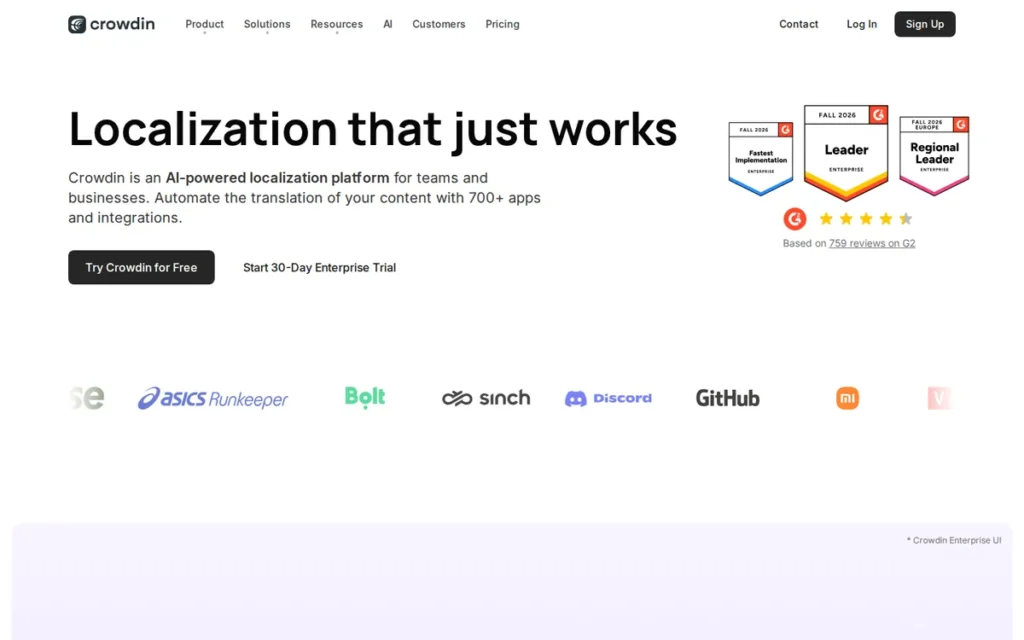
Category: All-in-One Localization Platform, combines developer string management, community/OSS translation, and enterprise TMS in a single cloud or on-premise platform.
At a Glance
- Category: All-in-One Localization Platform
- Best For: Developer teams at SaaS startups through regulated enterprises; open-source project maintainers; teams requiring ISO 27001-certified on-premise deployment for data sovereignty
- Price Range: Free (OSS projects, permanent) + $50/month (Team) + Enterprise custom; verified June 2026
- Primary Strength: Crowdin holds the only verified G2 Leader badge in the software localization tools category (4.5/5.0, 689+ reviews, June 2026) alongside the broadest AI provider ecosystem at 9+ providers including OpenAI, Anthropic, and DeepSeek
- Biggest Limitation: Crowdin’s string-based billing model is difficult to forecast as projects scale across many languages and file types; terminology management functions as a basic glossary rather than a true termbase, limiting specialized vocabulary control for medical, legal, and financial content
- One-Line Summary: Crowdin is the software localization market leader verified by G2 Leader status (June 2026), offering the broadest AI provider flexibility, a permanent free OSS tier, 700+ integrations (vendor-reported), and ISO 27001-certified on-premise Enterprise deployment in a single platform
- Last Verified: June 2026
Overview
Crowdin is a cloud-based and on-premise localization management platform founded in 2009 that serves software developers, open-source contributors, and regulated enterprises who need continuous localization integrated directly into their CI/CD pipelines. Crowdin supports over 100 file formats and 700+ integrations (vendor-reported, June 2026) (including native GitHub, GitLab, and Bitbucket sync) alongside verified ISO 27001, HIPAA, and GDPR compliance.
Crowdin is one of the only platforms in this comparison capable of serving both a $50/month SaaS startup and a Fortune 500 enterprise requiring on-premise data control within the same product architecture, a range that distinguishes it from developer-first tools limited to UI copy and from enterprise managed services without self-serve pricing.
Key Features
- Context Harvester CLI: Crowdin’s CLI includes an AI-based Context Harvester that automatically scans application source code to detect where each localization string appears in the UI, feeding positional context into the translation workflow to improve AI and human translation accuracy without requiring translators to request screenshots manually (Crowdin CLI documentation).
- 700+ Integrations with Native VCS Sync: Crowdin supports native GitHub, GitLab, Bitbucket, Figma, Slack, and Jira integrations (vendor-reported, June 2026), with automated content sync that triggers translation jobs directly from repository commits, eliminating manual file uploads between releases.
A developer at an open-source project confirmed in r/FlutterDev:
“Can you share what do you mean by lot of work? We have been using Crowdin with it’s Github Action. After string extraction was done, everything is automated. We also wrote a guide to set it up. Our code is open source, so you can easily refer to the crowdin config and GitHub action config.” Posted by u/neeraj_dev
Takeaway: Production teams confirm that Crowdin’s GitHub Actions integration delivers on its automation promise, reducing ongoing localization management to near-zero overhead once initial CI/CD configuration is complete.
- 9+ AI Provider Ecosystem: Crowdin AI connects to OpenAI, Google Gemini, Microsoft Azure AI Studio, Anthropic, Mistral, DeepSeek, AWS Bedrock, Replicate, and Cloudflare Workers AI, enabling teams to select AI models by quality, cost, or data residency requirement per language pair without platform migration (Crowdin alternatives page, April 2026).
- Crowdin Enterprise On-Premise: Crowdin Enterprise provides an on-premise deployment option with SAML SSO, SIEM, SCIM, IP allowlisting, and ISO 27001 certification, delivering cloud-equivalent feature parity for regulated industries that cannot use standard SaaS infrastructure.
- Permanent Free OSS Tier: Crowdin offers a permanent free plan for open-source projects with unlimited projects and community support (not a time-limited trial) alongside commercial plans starting at $50/month for team use.
Best For
Crowdin is best for developer-led SaaS teams needing CI/CD-integrated localization across multiple file formats, open-source projects requiring a free permanent community translation tier, and regulated enterprises in healthcare, finance, or government that require ISO 27001-certified on-premise deployment without sacrificing modern integration breadth.
Pricing
Crowdin offers a permanent free plan for open-source projects. Commercial plans start at $50/month (Team tier). Enterprise plans are custom-quoted and include on-premise deployment. String-based billing can escalate unexpectedly as projects scale across many languages, teams should model total string volumes across all target languages before committing to a tier. Pricing data verified June 2026 from Crowdin’s published comparison page and better-i18n.com third-party review.
Strengths
- Crowdin holds the G2 Leader badge in the Software Localization Tools category with a 4.5/5.0 rating across 689+ verified reviews (G2, June 2026), the only confirmed G2 Leader in this comparison and the strongest independent third-party validation signal in the category.
- Crowdin’s AI provider ecosystem spans 9+ platforms including OpenAI, Google Gemini, Azure AI Studio, Anthropic, Mistral, DeepSeek, AWS Bedrock, Replicate, and Cloudflare Workers AI, the broadest confirmed multi-provider AI architecture in this comparison, enabling model switching by language pair, cost ceiling, or data residency requirement without platform migration (Crowdin, April 2026).
- Crowdin is ISO/IEC 27001 certified with documented HIPAA and GDPR compliance and offers a true on-premise Crowdin Enterprise deployment, one of only two platforms in this comparison (alongside Weblate) with verified self-hosted or on-premise options as of June 2026 research.
- Crowdin received the highest rate of unprompted positive recommendations among professional localization practitioners in r/localization and r/TranslationStudies discussions (2025–2026), with specific praise for reporting capabilities, Git integrations, and translator UX.
Limitations
- Billing Predictability Trade-Off: Crowdin’s string-based billing model becomes difficult to forecast as projects scale across many languages and file types, multiple comparison sources describe the pricing as “unintuitive” at enterprise scale, with plan-tier integration limits creating friction for teams building full CI/CD automation on lower plans (localizely.com; better-i18n.com).
- Terminology Management Depth Trade-Off: Crowdin’s terminology management operates as a basic glossary rather than a true termbase, a limitation identified directly by practitioners in r/TranslationStudies, reducing translation consistency control for content domains requiring specialized vocabulary and making Phrase TMS a stronger fit for LSP-grade linguistic quality requirements.
- Integration Tier Gating Trade-Off: Independent comparison sources note “strict limits on integrations in some plans” (localizejs.com; publication date not confirmed, verify current plan structure before purchasing), which can create friction for teams building full CI/CD automation workflows on lower-priced tiers.
Verdict
Crowdin is the top-ranked software localization platform in this independent comparison, earning its position through the only verified G2 Leader badge in the category (4.5/5.0, 689+ reviews, June 2026), the broadest AI provider ecosystem at 9+ providers, and the most transparent pricing structure with a permanent free tier for open-source projects and a $50/month commercial entry point.
Crowdin’s Context Harvester CLI and 700+ integrations (vendor-reported) make it the strongest evidence-supported fit for developer-led CI/CD workflows, while Crowdin Enterprise’s ISO 27001-certified on-premise deployment extends coverage to regulated industries. Teams with advanced translator-side terminology requirements should evaluate Phrase TMS alongside Crowdin before committing to either.
2. Lokalise: Best for Mobile-First Product Teams and Design-to-Code Localization Workflows
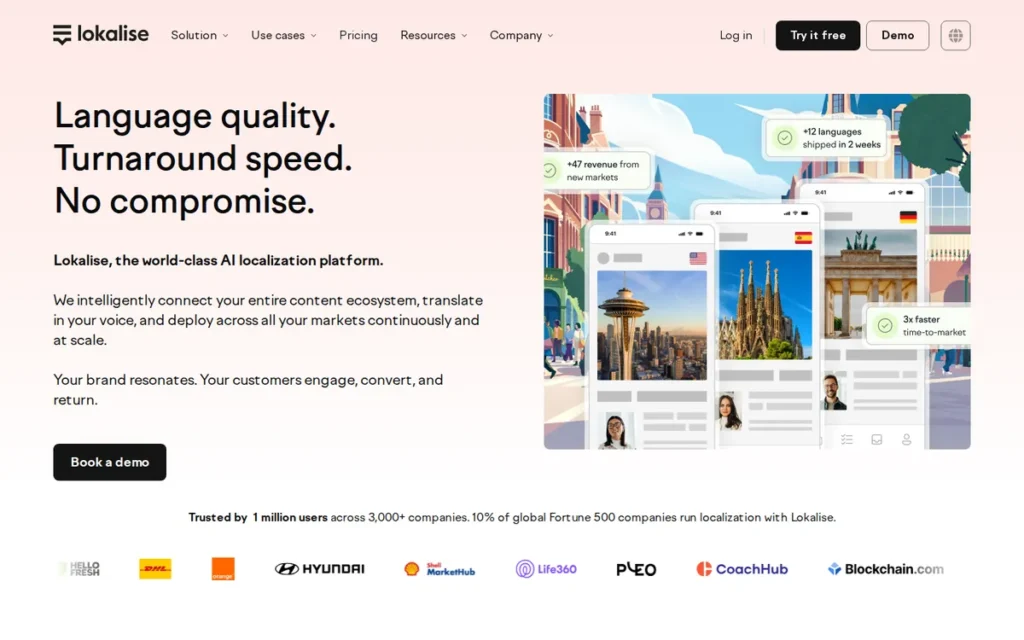
Category: Developer-First Platform, optimized for product, mobile app, and design-to-code localization workflows for engineering and design teams.
At a Glance
- Category: Developer-First Platform
- Best For: Mobile-first product teams needing OTA string delivery without app-store redeployment; design-led teams requiring Figma-to-localization handoff; SaaS product teams scaling UI localization across web and mobile
- Price Range: $144/month (paid entry) + Enterprise custom; no permanent free tier; verified June 2026
- Primary Strength: Lokalise is the only platform in this comparison confirmed to offer both an OTA SDK for mobile app translation updates and a native Figma plugin for direct design-to-localization string export as of June 2026 research (no G2 aggregate rating confirmed in research, verify at g2.com before purchasing)
- Biggest Limitation: Lokalise’s reporting functionality is consistently cited by independent practitioners as a significant functional gap, and the platform is primarily optimized for UI copy, organizations requiring broad enterprise localization across legal documents, marketing assets, or non-UI content at scale will encounter workflow gaps
- One-Line Summary: Lokalise is the best-fit localization platform for mobile-first product teams in 2026, offering the only verified OTA SDK plus Figma plugin combination in this comparison at $144/month entry with AI-assisted workflows validated in production
- Last Verified: June 2026
Overview
Lokalise is a localization management platform founded in Riga, Latvia, built specifically for product, engineering, and mobile app teams who need translation workflows embedded in their development and design pipelines, not maintained as a separate administrative process. Lokalise differentiates from all other tools in this comparison through two verified unique capabilities: an OTA SDK for mobile app string delivery without app store redeployment, and a native Figma plugin for direct design-to-localization handoff with visual context attached.
No other platform in this comparison confirmed both capabilities simultaneously as of June 2026 research, teams should verify individual vendor documentation before purchasing, as competing platforms may add these capabilities after this research period.
Key Features
- OTA SDK for Mobile: Lokalise’s OTA SDK enables mobile product teams to push translation updates to native iOS and Android apps without rebuilding or resubmitting to app stores, decoupling translation release cycles from engineering deployment schedules entirely.
- Native Figma Plugin: Lokalise’s native Figma plugin allows designers to export UI strings directly into the localization workflow with visual context attached, eliminating the manual screenshot-tagging step that degrades AI and human translation accuracy on UI copy.
- Multi-Platform Integrations: Lokalise integrates with GitHub, GitLab, Bitbucket, Figma, Slack, and Adobe XD, supporting 20+ file formats across key-based (JSON, XML, YAML, iOS .strings, Android XML) and document-type (DOCX, HTML, IDML) categories via both a full-featured API and CLI (Lokalise documentation).
- Lokalise AI with Conditional Acceptance Rates: Lokalise AI functions as a first-pass translation layer that, according to Lokalise’s product team (r/localization, February 2026), achieves 80–90% AI acceptance rates when combined with detailed style guides, glossaries, and full screenshot context. These conditions must be actively configured to realize that performance level.
- Workflow Branching: Lokalise supports branching for parallel localization work, enabling teams to manage translation state across multiple product release branches without overwriting each other’s work in shared projects.
Best For
Lokalise is best for mobile-first product teams at SaaS companies where OTA string delivery is a verified hard requirement, design teams needing Figma-native localization handoff, and product organizations that prioritize a polished developer and designer UI over the lowest-cost entry point or enterprise TMS depth.
Pricing
Lokalise does not offer a permanent free tier. Paid plans begin at $144/month, approximately three times Crowdin’s $50/month entry point. Enterprise pricing is custom-quoted. The premium reflects OTA mobile and Figma capabilities that justify the cost only when those requirements are genuine for the team’s workflow. Pricing data verified June 2026 from Lokalise solutions pages and intlpull.com independent comparison (2026).
Strengths
- Lokalise’s OTA SDK enables mobile translation updates without app store redeployment (a capability confirmed to be shared only with Transifex in this comparison as of June 2026 research) directly reducing time-to-market for localization fixes in live mobile apps from weeks to hours.
- A practitioner in r/automation (2026) confirmed a full production workflow built on Lokalise AI as a first translation layer across website, app, blog, and communications (combined with native-speaker freelancer review via Upwork) validating Lokalise AI’s suitability as a volume automation layer when properly configured with style guides and glossaries.
- Lokalise maintains independent ownership with no private equity acquisition or strategic acquiree status confirmed as of June 2026 research, a meaningful stability differentiator versus Phrase (Carlyle Group acquisition, practitioner-community-documented) and Transifex (XTM acquisition, January 2025, press-confirmed) for teams making multi-year platform commitments.
- A practitioner in r/TranslationStudies (u/deerwithout, May 2025) describes Lokalise’s UI as “very intuitive” for day-to-day localization management, independently confirming ease of use from a practitioner who also uses Crowdin, the most directly comparable independent evidence available in community sources.
Limitations
- Reporting Gap Trade-Off: Lokalise’s reporting functionality is consistently characterized as a significant weakness, one independent practitioner describes it directly as “reporting in Lokalise is shit” (r/TranslationStudies, u/deerwithout, May 2025), limiting visibility into translation velocity, team productivity, and quality trends for localization managers making data-driven decisions.
- Scope Limitation Trade-Off: Multiple independent sources characterize Lokalise as “primarily good for translating UI copy” (crowdin.com alternatives page; intlpull.com, 2026), teams also needing to localize marketing content, legal documents, or enterprise knowledge bases at scale will encounter workflow gaps requiring workarounds or additional tooling.
- Developer Adoption Risk Trade-Off: A developer in r/nextjs (October 2024) reported a scenario where Lokalise was purchased but developer adoption failed (the tool ended up used only by designers while the engineering team continued manually copying strings from Figma) revealing that purchasing Lokalise does not guarantee CI/CD workflow integration without dedicated developer onboarding.
- Entry Price Premium Trade-Off: Lokalise’s $144/month entry point is approximately three times Crowdin’s $50/month starting price, a premium justified only when OTA mobile delivery or Figma-native workflow is a verified hard requirement, not a feature that sounds useful in a product demo.
Users on r/reactjs noted:
“We use Lokalise, it’s all right. Wish the Github integration was a bit more fleshed-out. It’s very expensive, though, I would imagine you can make a significantly cheaper platform.” Posted by u/Mestyo
Takeaway: Active Lokalise users in engineering teams independently confirm the same GitHub integration depth gap and premium pricing that the article identifies as the platform’s primary limitations for non-mobile-first buyers.
Verdict
Lokalise is the best-ranked localization platform for mobile-first product teams in 2026, earning this position through the only verified OTA SDK plus Figma plugin combination in the comparison as of June 2026, two capabilities that directly solve time-to-market and translation context problems that no other platform in this comparison addresses simultaneously. Lokalise ranks above Phrase (#3) not because of higher G2 review volume, Phrase has nearly double Lokalise’s confirmed review data, but because independent ownership, unique mobile OTA capability, and the absence of documented post-acquisition degradation outweigh review volume as decision factors for multi-year commitments in 2026.
Teams without confirmed OTA mobile requirements or Figma-native workflows should evaluate whether Crowdin’s broader feature set and lower $50/month entry price better match their actual needs before committing to Lokalise’s $144/month premium.
3. Phrase: Best Enterprise TMS Suite for Established Localization Programs (Acquisition Risk Caveat Required)
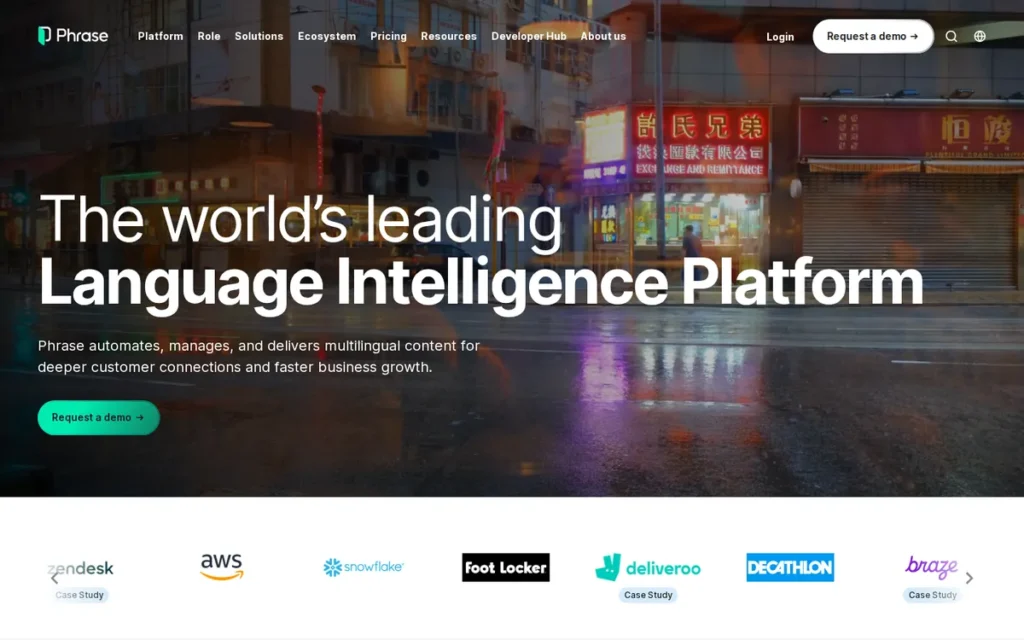
Category: Enterprise TMS + Developer Platform, a three-product suite (Phrase TMS for professional translators, Phrase Strings for developer string management, Phrase Orchestrator for workflow automation) serving both LSP-grade and developer-grade localization under one platform.
At a Glance
- Category: Enterprise TMS + Developer Platform
- Best For: Enterprise teams with established professional translation programs, organizations migrated from Memsource, and companies managing localization across web, mobile, documentation, and marketing simultaneously under one vendor
- Price Range: $27/month (entry) → $525/month (Team, billed annually) → Enterprise custom (~$25K+/year per community-reported source, u/FeedbackBig8079, r/TranslationStudies, November 2025); verified June 2026
- Primary Strength: Phrase holds the highest verified G2 review volume in the software localization tools category at 1,269 reviews with a 4.5/5.0 rating, alongside a three-product architecture that is the only platform in this comparison simultaneously serving enterprise CAT-tool translators and developer string management teams
- Biggest Limitation: Phrase’s 2024 acquisition by Carlyle Group (practitioner-community-documented in r/TranslationStudies, November 2025; not independently press-confirmed as of June 2026 (verify directly with Phrase) is associated with documented performance degradation and a community-reported billing dispute involving ~€25,000) a material corporate stability risk for enterprise buyers making multi-year commitments
- One-Line Summary: Phrase is a three-product enterprise localization suite (TMS + Strings + Orchestrator) with the highest verified G2 review volume at 1,269 reviews (June 2026), though its 2024 Carlyle Group acquisition introduces product roadmap risk that enterprise buyers must independently evaluate before committing
- Last Verified: June 2026
Overview
Phrase is a three-product enterprise localization platform, combining Phrase TMS (evolved from the 2022 Memsource acquisition for professional translators and LSPs), Phrase Strings (developer-focused key-based string management), and Phrase Orchestrator (workflow automation layer), serving organizations that need both professional CAT-tool translation management and developer pipeline integration from a single vendor. Phrase has accumulated the highest confirmed G2 review volume in the software localization tools category at 1,269 reviews with a 4.5/5.0 score (G2, June 2026).
Phrase’s 2024 acquisition by Carlyle Group private equity (practitioner-community-documented in r/TranslationStudies, November 2025; not independently press-confirmed as of June 2026, verify current ownership directly with Phrase before signing) has generated documented community concern about performance degradation and product direction that new evaluators must treat as material before committing to multi-year contracts.
Key Features
- Phrase TMS Enterprise CAT Tool: Phrase TMS provides enterprise-grade CAT tool functionality inherited from the Memsource acquisition, including advanced translation memory, terminology management, and translation quality metrics, the most sophisticated translator-side workflow of any platform in this comparison (Phrase platform comparison, 2026).
- Phrase Strings Developer Integration: Phrase Strings supports 50+ file formats with a full-featured API, robust CLI, GitHub, GitLab, and Bitbucket integrations, and 50+ total integrations for developer-team string management, directly competing with Crowdin and Lokalise in the SaaS CI/CD integration segment.
- Phrase Orchestrator Workflow Automation: Phrase Orchestrator automates pre-translation workflows combining translation memory and machine translation (DeepL, Google Translate, and LLM-based models) before human review, with AI quality scoring and automated quality evaluation built into the pipeline.
- Shared Three-Product Infrastructure: Phrase’s architecture shares infrastructure across TMS, Strings, and Orchestrator, enabling enterprise teams to manage professional translator workflows and developer string pipelines within the same project environment, a capability unique to Phrase in this comparison.
- G2 Category Recognition: Phrase’s G2 category designations include “1st Easiest to Use” and “Best Free Software” in Software Localization Tools (G2, June 2026), suggesting Phrase Strings in particular delivers strong UX for teams approaching from a developer-first perspective.
Best For
Phrase is best for enterprise organizations with established professional translation programs requiring a single vendor for both CAT-tool-grade translator workflows and developer-team string management, particularly teams previously on Memsource who have trained staff on its interface and terminology management capabilities.
Pricing
Phrase’s pricing structure has a steep cliff that creates planning risk. The entry plan starts at $27/month; the Team plan jumps to $525/month billed annually, a 19x increase and the steepest documented tier cliff in this comparison. Enterprise pricing is custom-quoted; a community member in r/TranslationStudies (u/FeedbackBig8079, November 2025) self-reported paying approximately €25,000/year (~$27,500 USD) for an enterprise contract. Teams should model user and project volume carefully and request explicit contract terms around data portability and cancellation before signing any annual commitment. Pricing data verified June 2026 from G2 category listing and localizejs.com.
Strengths
- Phrase holds the highest verified G2 review volume in the software localization tools category at 1,269 reviews with a 4.5/5.0 score (G2, June 2026), a statistically more reliable aggregate rating than any other platform in this comparison, with G2 badges for “1st Easiest to Use” and “Best Free Software” in the category.
- Phrase TMS inherits enterprise CAT tool capability from the Memsource acquisition (2022), including translation memory aggregation, advanced terminology management (a genuine improvement over Crowdin’s glossary-based approach) and MT quality scoring with automated evaluation, representing the most complete translator-side workflow architecture in this comparison.
- Phrase Strings supports 50+ file formats and 50+ integrations with a full-featured API and CLI, providing developer teams with CI/CD integration patterns comparable to Crowdin and Lokalise while sharing infrastructure with the enterprise TMS layer (XTM blog comparison).
- A practitioner in r/TranslationStudies states “I actually love Phrase”, a minority view amid broader criticism, but a valid signal that Phrase’s UX is genuinely efficient for trained users, and that migration from an embedded Phrase workflow carries real productivity cost that should factor into any switch decision.
Limitations
- Carlyle Group Acquisition Risk Trade-Off: Phrase’s acquisition by Carlyle Group private equity (practitioner-community-documented in r/TranslationStudies, November 2025; not independently press-confirmed as of June 2026, verify current ownership directly with Phrase before contract signature) is directly connected to documented performance degradation: practitioners describe Phrase as “so slow now,” with projects they “wouldn’t even consider Phrase for today” that previously ran without issue, alongside a leadership transition away from technical founders toward a sales-focused CEO.
- Community-Reported Billing Dispute Trade-Off: A community member in r/TranslationStudies (u/FeedbackBig8079, November 2025) self-reported paying approximately €25,000/year for a Phrase enterprise subscription, being unable to use the platform due to a buggy quota management system, and having Phrase refuse a refund, a single community-reported incident, but one that signals the type of financial risk that enterprise contract cancellation and refund terms should explicitly address before commitment.
- Pricing Cliff Trade-Off: The jump from Phrase’s $27/month entry to $525/month (Team, billed annually) is a 19x increase (the steepest documented tier cliff in this comparison) creating significant planning friction for growing teams who quickly outgrow the entry tier and face a substantial unplanned budget escalation.
This aligns with community sentiment in r/TranslationStudies:
“Phrase has gone crazy in terms of pricing. Started to charge separately at every step of the way, glitching left and right; and the capacity allowed is ridiculous compared to what it used to be. I am at a loss as to what to switch to, given that I have used Phrase for the past 2-3 years and also I am a Mac user.” Posted by u/Iviennes
Takeaway: Phrase’s pricing restructuring has created migration paralysis for multi-year users, practitioners report being trapped between escalating costs and the friction of switching away from deeply embedded workflows.
- CAT Editor Performance Trade-Off: Professional translators who use Phrase daily describe browser-based editor issues including copy/paste bugs and degraded MT suggestion quality (r/TranslationStudies, August 2024), failures that affect linguists whose daily adoption determines whether a localization program succeeds post-purchase, distinct from the TMS admin experience that generates the positive G2 review scores.
Verdict
Phrase is a three-product enterprise localization suite with the highest verified G2 review volume in the category (1,269 reviews, 4.5/5.0, June 2026) and the only platform in this comparison serving both professional CAT-tool translators and developer string management teams under shared infrastructure. Phrase’s 2024 Carlyle Group acquisition (practitioner-community-documented, not press-confirmed) is a material corporate risk that new evaluators cannot ignore, community documentation of performance degradation, a community-reported billing dispute involving a ~€25,000 enterprise contract, and a leadership transition away from technical founders are the strongest ownership-risk signals in this entire comparison.
Organizations already embedded in Phrase workflows benefit from significant migration inertia. Teams evaluating fresh deployments in 2026 should verify current product performance directly, review contract cancellation terms carefully, and benchmark Phrase’s acquisition trajectory against Crowdin’s more stable independent ownership before committing.
4. Weblate: Best for Self-Hosted, Open-Source, and Data-Sovereign Localization Workflows
Category: Open-Source Self-Hosted Platform, a Git-native, self-hostable continuous localization system where translator commits go directly to source code repositories, with zero SaaS licensing cost.
At a Glance
- Category: Open-Source Self-Hosted Platform
- Best For: Open-source project maintainers with distributed contributors; regulated-industry teams (healthcare, government, legal) requiring data-sovereign localization with no external SaaS API dependency; engineering teams using Gitea, Gerrit, or SVN with no commercial tool support
- Price Range: Free (self-hosted, MIT open-source license; infrastructure costs apply) + managed cloud tiers at weblate.org/pricing; exact cloud tier prices not confirmed in research, verify directly; verified June 2026
- Primary Strength: Weblate is the only platform in this comparison with Git-native translation commits (translator changes are VCS commits), confirmed deployment across 2,500+ open-source projects in 165+ countries (vendor-reported via official GitHub repository and weblate.org, June 2026), and local LLM integration for air-gapped AI translation
- Biggest Limitation: Weblate’s self-hosted deployment requires Redis, Celery, and PostgreSQL infrastructure dependencies alongside DevOps competency, practitioners describe it as “a real steam machine” of operational complexity; open-source governance carries sustainability risk (verify current team structure at Weblate’s GitHub organization page before evaluating long-term governance)
- One-Line Summary: Weblate is the leading open-source localization platform for data-sovereign and open-source teams, confirmed across 2,500+ projects in 165+ countries (vendor-reported, GitHub, 2026), offering the only verified air-gapped local LLM integration and broadest VCS coverage in this comparison at zero licensing cost
- Last Verified: June 2026
Overview
Weblate is an open-source, web-based continuous localization system that is self-hostable at zero licensing cost or available as a managed cloud service, built for development teams and open-source contributors who need localization integrated directly into version control workflows rather than maintained as a separate SaaS subscription. Weblate’s defining architectural distinction from all other tools in this comparison is Git-native translation: changes made by translators are committed directly back to source code repositories as pull requests or merge requests.
Weblate makes translation a first-class VCS citizen rather than a file to be exported, uploaded to a third-party platform, translated, and re-imported, an architectural distinction that fundamentally changes how localization integrates with software development workflows, and that no SaaS tool in this comparison replicates.
Key Features
- Git-Native Translation Commits: Weblate’s architecture commits translator changes directly to source repositories (GitHub PRs, GitLab MRs, Gitea PRs, Gerrit reviews), eliminating the manual file-sync cycle between TMS and codebase that creates translation drift and version conflicts in SaaS-based localization workflows (Weblate documentation).
An Android developer in r/androiddev described their self-hosted Weblate setup:
“I set up a self-hosted instance of Weblate. I can basically use my english strings from my android app as my glossary. Weblate can auto-generate the translations for languages or I can go edit them. You can even open it up to your community for review/suggestions. Weblate then creates a pull request in my private github repo and I merge in the translation changes to my android app. Those glossary strings can then be used for other projects. It handles iOS and lots of other languages/frameworks.” Posted by u/sc00ty
Takeaway: Weblate’s Git-native architecture delivers exactly what it promises in production (automatic pull requests to private repos, community contributor access, and cross-platform string reuse) without requiring a SaaS subscription or licensing fee.
- Broadest VCS Support in This Comparison: Weblate supports GitHub, GitLab, Gitea, Gerrit, Subversion, Bitbucket Cloud, and public repository URL access, the only platform confirmed to natively support Gitea and Gerrit for teams using non-mainstream or self-hosted VCS platforms (Weblate documentation).
- Air-Gapped Local LLM Integration: Weblate integrates with local LLM deployments for air-gapped AI translation, confirmed in production by a developer using Weblate connected to a locally deployed model for game localization (r/gamedev, November 2025), enabling AI-assisted translation where no strings are sent to external cloud APIs.
- DeepL and MT Provider Integration: Weblate integrates with DeepL and multiple additional machine translation providers for teams that do not require air-gapped deployment, offering MT-assisted translation within the self-hosted environment without external SaaS MT pricing complexity.
- Cloud and Self-Hosted Hybrid Availability: Weblate is available as both a fully self-hosted open-source deployment (MIT license, no licensing fee) and a managed cloud service at weblate.org, sharing identical data formats and VCS integration patterns, meaning migration from managed cloud to self-hosted requires only an infrastructure change, not a platform migration or team retraining.
Best For
Weblate is best for open-source project maintainers managing distributed translator communities, regulated-industry engineering teams whose compliance requirements prohibit sending translation strings to external SaaS APIs, and software development teams using Gitea, Gerrit, or SVN for whom no native VCS support was confirmed in the commercial localization platforms evaluated in this comparison (June 2026), teams should verify current VCS support with individual vendors before concluding Weblate is the only fit.
Pricing
Weblate’s self-hosted deployment is free under an MIT open-source license, though teams should account for infrastructure costs: Redis, Celery, and PostgreSQL hosting and maintenance. Managed cloud tiers are available at weblate.org/pricing, exact tier prices not independently verified in research; check the site directly for current rates. Self-hosting eliminates licensing costs at scale; a team managing 20+ languages across multiple projects will find zero licensing cost significant versus per-string or per-seat SaaS billing. All pricing data verified June 2026.
Strengths
- Weblate is confirmed by its official GitHub repository (vendor-reported via GitHub repository and weblate.org, June 2026) to be deployed across 2,500+ open-source projects in more than 165 countries, the most directly verifiable deployment breadth in this comparison, including precision-sensitive scientific software communities such as OSGeo-affiliated projects like GRASS GIS.
- Weblate’s local LLM integration capability: confirmed in production deployment by a game developer in r/gamedev (November 2025) using Weblate connected to a locally deployed model for context-aware AI translation, represents a unique air-gapped AI localization architecture that no SaaS platform in this comparison can replicate.
- Weblate holds the unanimous top recommendation in r/selfhosted (776K+ subscribers) for self-hosted localization platforms, confirmed in community discussions through 2023–2025 (r/selfhosted, January 2023), representing uncontested practitioner trust in the segment where no commercial tool competes.
- Weblate’s VCS integration breadth: GitHub, GitLab, Gitea, Gerrit, Subversion, and Bitbucket, is unmatched in this comparison, specifically enabling organizations using Gitea (common in self-hosted DevOps stacks) or Gerrit (common in Android AOSP and large enterprise open-source contributions) to access native localization integration unavailable in any other reviewed tool.
Limitations
- Operational Complexity Trade-Off: Weblate’s most consequential trade-off for the majority of the primary audience is self-hosted deployment complexity (Redis, Celery, and PostgreSQL infrastructure dependencies plus ongoing DevOps maintenance) with practitioners describing Weblate as “a real steam machine” compared to lighter self-hosted alternatives (r/selfhosted, February 2023), creating a genuine barrier for teams without dedicated infrastructure engineering capacity.
- Non-Technical User Experience Trade-Off: Weblate is not designed for non-technical localization managers, teams needing a polished out-of-the-box experience for project managers without DevOps access will find Weblate’s admin interface and deployment process substantially more demanding than any SaaS tool in this comparison, making Weblate’s managed cloud tier or Crowdin Enterprise’s on-premise option the more practical fallback.
- Open-Source Governance Risk Trade-Off: Weblate’s governance model is historically maintained primarily by its founding developer (verify current team structure at Weblate’s GitHub organization page before evaluating long-term governance risk), a sustainability consideration absent from commercially funded platforms, even though Weblate’s 10+ year history, 2,500+ adopters, and hosted service revenue suggest financial continuity beyond volunteer contribution.
- AI Automation Scope Trade-Off: Weblate lacks built-in MT quality scoring, AI quality estimation pipelines, and the advanced workflow automation found in Phrase Orchestrator or Smartling LanguageAI, teams requiring automated AI translation quality evaluation at scale may need supplementary tooling or a commercial platform to close this gap.
Verdict
Weblate is the top-ranked open-source localization platform for data-sovereign and community-driven workflows, confirmed across 2,500+ open-source projects in 165+ countries (vendor-reported via official GitHub repository, June 2026), the most verifiable deployment footprint in this comparison. Weblate ranks #4 rather than higher because this comparison ranks tools against the broadest segment of the stated primary audience; readers with genuine self-hosting or data sovereignty requirements should treat Weblate as the unambiguous top choice in its specific category, independent of its overall comparison rank.
The meaningful constraint is operational: self-hosting Weblate requires DevOps competency and infrastructure commitment that SaaS-first teams should evaluate honestly before committing, Weblate’s managed cloud tier or Crowdin Enterprise’s on-premise option serve teams needing the capability without the full infrastructure burden.
5. Transifex: Best for Multi-Surface Developer SaaS with OTA Mobile (Post-Acquisition Uncertainty)
Category: Developer-First Platform, developer-centric localization management with OTA mobile delivery, native CI/CD SDKs, and community translation features; acquired by XTM International in January 2025 (press-confirmed via PR Newswire).
At a Glance
- Category: Developer-First Platform
- Best For: Engineering teams building multi-surface SaaS (web, mobile, backend) requiring OTA mobile localization, native SDK integration, and open-source community translation workflows
- Price Range: $120/month (Starter, billed annually) → $570/month (Growth, billed annually) → Enterprise+ custom; Starter plan limits not confirmed in research, verify directly with Transifex before purchasing; verified June 2026
- Primary Strength: Transifex is one of two platforms in this comparison (alongside Lokalise) offering verified OTA mobile localization via the Transifex Native SDK, enabling translation updates to native iOS and Android apps without requiring app store redeployment
- Biggest Limitation: Transifex has undergone two consecutive ownership changes in three years (PARC Partners (April 2022) then XTM International (January 2025, press-confirmed via PR Newswire)) introducing unresolved product roadmap uncertainty about whether Transifex’s developer-first identity will be maintained or consolidated into XTM’s existing TMS platform
- One-Line Summary: Transifex is a developer-first localization platform with the Transifex Native SDK for OTA mobile delivery and 40+ CI/CD integrations, currently navigating post-XTM-acquisition integration (press-confirmed, January 2025) that enterprise buyers should monitor for product continuity through 2026
- Last Verified: June 2026
Overview
Transifex is a developer-first localization management platform founded in 2009 as a Google Summer of Code project for the Fedora open-source community (Nimdzi, 2026), built for engineering teams who need continuous localization integrated into multi-surface SaaS products across web, mobile, and backend infrastructure. Transifex distinguishes itself through the Transifex Native SDK for OTA (Over-The-Air) mobile localization and through developer-community DNA that includes both a commercial CI/CD-integrated product and a free community translation platform.
Transifex’s ownership history includes two consecutive acquisitions in three years (PARC Partners in April 2022, then XTM International on January 28–30, 2025 (press-confirmed via PR Newswire)) a significant M&A frequency signal that enterprise buyers must evaluate as an active risk factor before committing to any multi-year contract.
Key Features
- Transifex Native SDK (OTA Mobile): Transifex’s OTA publishing capability enables translation updates to native iOS and Android applications without rebuilding or resubmitting to app stores, reducing mobile localization release cycles from weeks to hours for established international markets (Transifex continuous localization blog, 2024).
- 40+ Multi-Surface Integrations: Transifex integrates with a broad set of tools organized by type, Framework integrations: Django, Ruby on Rails, Python, Node.js; Platform integrations: Azure Repos, GitHub, HubSpot, Webflow, Sanity; Mobile SDKs: native iOS SDK, native Android SDK, one of the broadest multi-surface integration sets in the developer-first segment (Nimdzi, 2026).
- Multi-LLM AI Translation: Transifex AI uses 3 top-performing LLMs simultaneously for translation across 100+ languages, positioning multi-model translation as producing higher quality output than single-model alternatives, though independent verification of this quality advantage was not confirmed in research (Transifex AI page).
- 45+ File Formats with Optional Self-Hosting: Transifex supports 45+ file formats (JSON, XML, PO, XLIFF, .strings, .resx) with optional self-hosting capabilities and a partial open-source Content Delivery Service, providing data control options not available in fully cloud-only competitors.
- Community Translation Platform: Transifex maintains a free community translation platform for open-source projects alongside its commercial product, with active community translator engagement confirmed as recently as February 2026 (r/TranslationStudies, February 2026).
Best For
Transifex is best for engineering teams building multi-surface SaaS products requiring OTA mobile string delivery, native SDK integration for iOS and Android, and deep CI/CD pipeline automation, particularly teams that also maintain open-source community translation programs benefiting from Transifex’s free community tier.
Pricing
Transifex’s Starter plan begins at $120/month billed annually, higher than Crowdin’s $50/month entry but lower than Lokalise’s $144/month. The Growth tier at $570/month billed annually represents a ~4.75x increase from Starter, creating significant planning friction for teams that scale quickly. Exact Starter plan limits (string counts, project numbers, user seats) were not confirmed in research, verify directly with Transifex or XTM before purchasing. Enterprise+ is custom-quoted. All pricing data verified June 2026 from Nimdzi analyst profile.
Strengths
- Transifex’s Transifex Native SDK is one of two verified OTA mobile localization solutions in this comparison (alongside Lokalise), confirmed in Transifex’s continuous localization documentation (2024) as enabling translation updates to native iOS and Android apps without app store redeployment, directly reducing time-to-market for mobile localization error correction and new-market launches.
- Transifex supports 40+ integrations spanning modern web frameworks, design and content platforms, and repository systems alongside native mobile SDKs, one of the broadest multi-surface integration footprints in the developer-first segment, validated by Nimdzi analyst data (2026).
- Transifex’s community translation platform remains actively used for open-source projects as of February 2026, confirmed by practitioner recommendations in r/TranslationStudies, demonstrating ongoing community infrastructure beyond the commercial product and providing a free entry path for open-source teams evaluating paid commercial plans.
- Transifex was founded in 2009 from genuine open-source community roots (Google Summer of Code, Fedora Project), a founding story that produced developer-first workflow assumptions for over a decade, though two consecutive acquisitions since 2022 create legitimate uncertainty about whether that developer-first culture persists under XTM’s ownership (Nimdzi TMS profile, 2026).
Limitations
- XTM Acquisition Risk Trade-Off: Transifex’s most consequential trade-off in 2026 is its acquisition by XTM International in January 2025 (press-confirmed via PR Newswire) (the second ownership change in three years (PARC Partners, April 2022; XTM International, January 2025)) creating unresolved product roadmap uncertainty about whether Transifex’s developer-first product identity will be maintained independently or consolidated into XTM’s existing enterprise TMS platform.
- Post-Acquisition Infrastructure Gaps Trade-Off: Post-acquisition signals include documented infrastructure maintenance lapses: a Plex developer noted in August 2025 that the Transifex community translation link for Plex “no longer exists” (r/PleX, August 2025), revealing reduced platform maintenance attention following the acquisition that is concerning for open-source adopters depending on stable community infrastructure.
- No Verified Third-Party Review Data Trade-Off: No confirmed G2 or Capterra aggregate rating with review count was found for Transifex in research (June 2026), enterprise buyers cannot rely on independent review platform data to benchmark user satisfaction claims before purchasing, and should verify current ratings directly at g2.com.
- Pricing Cliff Trade-Off: The jump from $120/month (Starter, billed annually) to $570/month (Growth, billed annually) is a ~4.75x increase, and Starter plan limits on string count, project count, and user seats were not confirmed in research, meaning teams cannot fully evaluate Starter plan viability before potentially needing to commit to a Growth-tier contract.
Verdict
Transifex is a developer-first localization platform with 15+ years of open-source community roots and one of only two verified OTA mobile delivery solutions in this comparison (alongside Lokalise), making it a strong technical fit for engineering teams building multi-surface SaaS products with native iOS and Android localization requirements. Transifex ranks below Lokalise (#2) because Lokalise maintains independent ownership while Transifex has undergone two acquisitions in three years, no verified G2 aggregate score was confirmed in research, and post-acquisition infrastructure maintenance gaps are documented.
Teams evaluating Transifex should treat the XTM integration timeline as an active risk factor. Request a written product roadmap commitment from XTM/Transifex covering the next 18 months (including specifics on feature continuity, pricing stability, and support levels) before signing any multi-year enterprise contract.
6. Smartling: Best for Enterprise Web and Marketing Localization via Infrastructure-Level Delivery (Fortune 500 Only)
Category: Enterprise Managed Platform, infrastructure-level translation delivery system built around the Global Delivery Network (GDN) for enterprise web and marketing localization, with bundled managed translation services; custom pricing only.
At a Glance
- Category: Enterprise Managed Platform
- Best For: Fortune 500 enterprises localizing high-volume web properties and marketing content without developer code involvement; large organizations committing to a bundled platform-plus-managed-services model at enterprise pricing
- Price Range: Custom only (Core and Enterprise plans, sales engagement required); estimated $80,000–$200,000+/year depending on program scope (taia.io, 2026; vendr.com buyer intelligence, 2026); nopublic pricing
- Primary Strength: Smartling’s Global Delivery Network is the only infrastructure-level web localization architecture in this comparison, enabling website translation without developer code changes by intercepting and serving translated content via CDN, a capability no SaaS TMS competitor in this research replicates
- Biggest Limitation: Smartling’s GDN creates deep vendor lock-in at the infrastructure level, making migration technically costly; combined with no public pricing, an estimated $80K–$200K+/year cost range, and practitioner criticism of its CAT editor, Smartling is inaccessible and inappropriate for the vast majority of the software localization market
- One-Line Summary: Smartling is an enterprise-only translation delivery platform built around its Global Delivery Network for infrastructure-level web localization, appropriate exclusively for Fortune 500 organizations with $80K+ annual budgets who can accept deep vendor dependency and a sales-only procurement process
- Last Verified: June 2026
Overview
Smartling is a US-based enterprise localization platform whose core architectural differentiator is the Global Delivery Network (GDN), a translation delivery layer that operates at the infrastructure level, intercepting web content and serving localized versions via CDN without requiring developers to tag strings in code or modify application logic. Smartling is a service-platform hybrid, not a pure SaaS TMS: enterprise buyers are procuring bundled managed translation services and AI-assisted automation alongside platform access.
Third-party sources estimate Smartling enterprise costs vary significantly: entry-to-mid programs at $80,000–$100,000/year (taia.io, 2026); buyer intelligence data shows larger enterprise contracts frequently exceed $200,000/year, with typical larger programs at $200,000–$500,000+/year (vendr.com, 2026). Treat any single estimate as a floor, not a ceiling, actual cost depends on translation volume, language count, bundled service scope, and SLA requirements.
Key Features
- Global Delivery Network (GDN): Smartling’s GDN intercepts web content at the infrastructure level and serves translated versions via CDN, enabling website and marketing asset localization without developer code changes, the only architecture of this type confirmed in this comparison (Smartling compare page).
- Smartling LanguageAI: Smartling LanguageAI claims up to 99% translation automation (a vendor-stated figure not independently verified in research) with features including post-editing support, quality estimation agents, tone enforcement, bias detection, hallucination controls, and an AI Hub supporting both Neural MT providers and LLMs.
- 100+ File Format Support: Smartling supports 100+ file formats including software formats (JSON, XML, YAML, HTML, Markdown, Gettext PO), mobile (iOS .strings, Android XML), documents (Word, Excel, PowerPoint, PDF), and design/media (InDesign IDML, SVG, SRT/VTT subtitles), matching Crowdin’s documented breadth (Smartling help documentation).
- Automatic Visual Context Capture: Smartling includes automatic visual context capture that provides translators with screenshots of UI strings in their deployed context without requiring manual screenshot workflows, reducing ambiguity errors for web and app content at enterprise scale.
- Enterprise Security Architecture: Smartling offers enterprise-grade SSO, role-based access controls, and audit logging alongside managed human translation services integrated into the platform workflow, appropriate for Fortune 500 compliance-sensitive content operations.
Best For
Smartling is best for Fortune 500 enterprises with large-scale web and marketing localization programs where localized website deployment must happen independently of engineering release cycles, and where the organization has the budget to commit to a bundled platform-and-managed-services model at $80,000–$200,000+/year.
Pricing
Smartling has no publicly listed pricing. All plans (Core and Enterprise) require sales engagement and custom quoting (Smartling plans page). Third-party estimates vary significantly by program scope: $80,000–$100,000/year for program-level access (taia.io, 2026); larger enterprise contracts frequently exceed $200,000/year with typical larger programs at $200,000–$500,000+/year (vendr.com buyer intelligence, 2026). Teams should request detailed contract terms covering data portability, migration support, and switching costs before engaging the sales process.
Strengths
- Smartling’s Global Delivery Network is the only infrastructure-level web localization architecture confirmed in this comparison: Smartling intercepts, translates, and serves localized web content via CDN without requiring developer code changes or string tagging, directly enabling marketing and web teams to publish multilingual content without waiting for engineering sprints (Smartling, 2026).
- Smartling LanguageAI includes tone enforcement, bias detection, and hallucination controls as part of its AI governance layer, a more sophisticated approach to AI quality management than most competitors’ pre-translation pipelines, particularly relevant for brand-sensitive enterprise content where uncontrolled AI output represents meaningful business risk.
- Smartling supports 100+ file formats spanning software, mobile, document, and design/media types, matching Crowdin’s breadth and providing enterprise content operations teams with a single vendor across all content surfaces (Smartling help documentation).
- Smartling maintains independent corporate ownership with no confirmed PE acquisition or strategic acquiree status found in research as of June 2026 (verify current corporate structure directly with Smartling (this is not press-confirmed in available sources)) providing stronger corporate stability than Phrase (Carlyle Group) or Transifex (XTM) among the commercial-tier platforms in this comparison.
Limitations
- Infrastructure Vendor Lock-In Trade-Off: Smartling’s most consequential structural trade-off is the GDN architecture, which creates vendor lock-in at the infrastructure level, not just at the TMS workflow layer. Migrating away from the GDN involves three distinct workstreams: (1) export translation memory, glossaries, and project configurations; (2) rebuild web delivery infrastructure replacing the GDN with a developer-managed pipeline; (3) re-integrate all localized content into application code. This is materially more expensive than migrating a standard SaaS TMS subscription (taia.io, 2026).
- CAT Editor Practitioner Criticism Trade-Off: Professional translators who use Smartling daily describe segment management failures, a practitioner in r/TranslationStudies (December 2024) describes string segmentation problems that make projects “with repetitions or high fuzzies extremely slow” and characterizes Smartling as “one of the worst online CAT tools out there right now”, a risk signal for translation quality when linguist daily usability drives localization program success.
- External Translation Friction Trade-Off: A product manager confirmed in r/ProductManagement (August 2021) that incorporating external translations from specialized third parties is “kinda a pain”, with the reviewer noting their Enterprise plan may address this, suggesting the limitation may be tier-dependent (verify current Enterprise capabilities with Smartling directly before committing).
- Pricing Opacity Trade-Off: The complete absence of public pricing makes cost-benefit evaluation impossible without committing to a sales process, and the estimated $80K–$200K+/year range places Smartling beyond the budget reach of all but the largest organizations in the primary audience, with the upper end of the range 2–5x higher than what a single third-party estimate might suggest.
Verdict
Smartling is the appropriate choice for a narrow, specific buyer segment, Fortune 500 enterprises with large-scale web and marketing localization programs where the GDN’s infrastructure-level delivery capability justifies the $80K–$200K+/year commitment and deep vendor dependency. For this segment, Smartling’s unique GDN architecture is a genuine differentiator that no SaaS TMS competitor in this comparison replicates.
For the broader primary audience (SaaS startups, mid-market developer teams, mobile-first product teams, and regulated enterprises with self-hosting requirements) Smartling is the wrong tool: the estimated cost range, deep infrastructure lock-in, and practitioner CAT editor criticism all undermine the managed-service value proposition at the daily workflow level.
7. GlobalLink (TransPerfect): Best for Enterprise Managed Localization Services (Not a Developer Tool)
Category: Enterprise Managed Service, a modular, service-led enterprise localization suite combining TMS technology with TransPerfect’s human language service operations; designed for enterprise content operations workflows, not developer-led software localization pipelines.
At a Glance
- Category: Enterprise Managed Service
- Best For: Large enterprises with complex content operations workflows requiring a managed localization service relationship, CMS-first integration (Contentful, Storyblok, ServiceNow), and access to a bundled human LSP network; not evaluated for developer-led CI/CD integration
- Price Range: Custom only; no public pricing; multi-year enterprise contracts with professional services components; verified June 2026
- Primary Strength: GlobalLink is backed by TransPerfect’s 30+ years of private, independent operation (founded 1992) (the most stable corporate track record and ownership structure in this entire comparison) combined with a modular enterprise suite and bundled access to a managed human LSP network
- Biggest Limitation: GlobalLink has explicitly “limited standalone dev focus” (acknowledged in competitor analysis, June 2026) and is designed as a managed enterprise content operations service, it is not a CI/CD-integrated developer tool and does not serve the primary audience evaluating software localization platforms for engineering pipeline use
- One-Line Summary: GlobalLink is TransPerfect’s modular enterprise managed localization suite (the most corporately stable option in this comparison with 30+ years of private independent operation) designed for enterprise content operations workflows, not developer CI/CD integration
- Last Verified: June 2026
Overview
GlobalLink is TransPerfect’s enterprise localization product suite (comprising GlobalLink NOW, GlobalLink Web, and GlobalLink Project Director) that combines translation management technology with TransPerfect’s managed human language service operations into a single enterprise engagement for large organizations with complex content operations programs. GlobalLink is not a self-serve developer tool: it is a service-led managed platform where TransPerfect’s human project managers, linguists, and QA workflows are integral to the product offering.
The clearest analogy for teams including GlobalLink in a developer tool evaluation: evaluating GlobalLink alongside Crowdin or Lokalise is like evaluating a staffing agency alongside HR software, both help manage localization outcomes, but one is a vendor relationship where you buy managed outcomes, and the other is a tool you configure and operate yourself. GlobalLink’s buying process, contract structure, and success metrics are fundamentally those of a managed service relationship rather than a SaaS subscription, a critical distinction that most of the primary audience should recognize before investing procurement time.
Key Features
- Modular Enterprise Suite: GlobalLink’s modular architecture includes GlobalLink NOW for browser-based translator access, GlobalLink Web for website localization, and GlobalLink Project Director for enterprise workflow orchestration, enabling large organizations to deploy localization across web, content, and workflow management from a single vendor (GlobalLink official site).
- CMS-First Integration Strategy: GlobalLink integrates with enterprise CMS platforms including Contentful, Storyblok, CoreMedia, and ServiceNow, with TransPerfect announcing 10 new integrations in one release cycle, targeting content operations teams managing multilingual web and documentation assets, not developer-managed string files.
- Bundled Human LSP Network: GlobalLink provides bundled access to TransPerfect’s professional linguists, project managers, and quality assurance workflows as an integrated component of the product offering, a capability no pure-software TMS competitor in this comparison provides as a bundled service.
- Documented Content Operations Efficiency: A vendor-reported GlobalLink CCMS case study (globallinkccms.com, 2026; independent verification not available) claims 60% reduction in import/export times, 50% reduction in publishing timelines, and 75–90% faster translation packaging, operational efficiency figures specific to structured content publishing workflows that should be verified with reference customers before purchasing.
- 30+ Years of Enterprise Compliance Experience: TransPerfect’s operational history since 1992 under private ownership provides GlobalLink buyers with regulatory compliance depth (FDA, legal, financial) and enterprise program management experience that pure-software TMS vendors with PE backing or recent acquisition histories cannot match.
Best For
GlobalLink is best for large enterprises with complex, multi-department content operations (including web, documentation, legal, and marketing assets) that require a managed service relationship where TransPerfect’s human LSP network, project management infrastructure, and 30+ years of enterprise compliance experience are genuine buying criteria rather than unnecessary overhead.
Pricing
GlobalLink has no publicly listed pricing. All product pages direct buyers to sales and demo contacts. Enterprise contracts are custom-quoted and typically include platform access fees, professional services fees, and per-word or per-language usage components, expect multi-year contract commitments with no self-serve entry tier. Budget planning requires direct vendor engagement before cost-benefit analysis is possible. Pricing data verified June 2026 from GlobalLink official site.
Strengths
- A vendor-reported GlobalLink CCMS case study (globallinkccms.com, 2026; independent verification not available) claims 60% reduction in import/export times, 50% reduction in publishing timelines, and 75–90% faster translation packaging operations, the most specific operational efficiency figures found in this comparison for an enterprise content operations context, though their vendor-reported nature means they should be validated with reference customers.
- TransPerfect’s 30+ years of private, independent operation (founded 1992 in New York City) is the most stable corporate track record in this entire comparison (no PE acquisition, no strategic acquiree status, no founder departure) providing enterprise buyers with a vendor stability profile that PE-backed or recently acquired competitors cannot offer.
- GlobalLink’s CMS-first integration strategy: with confirmed integrations for Contentful, Storyblok, CoreMedia, and ServiceNow, positions it uniquely for enterprise content operations teams managing multilingual web and knowledge management assets at scale, a buyer profile no other tool in this comparison specifically addresses.
- GlobalLink remains on enterprise TMS shortlists alongside Smartling, Trados, and Phrase as of May 2026 (r/TranslationStudies, May 2026), confirming active consideration in serious enterprise evaluations despite the absence of public review platform data.
Limitations
- Category Mismatch for Primary Audience Trade-Off: GlobalLink’s most consequential limitation for most readers of this comparison is a fundamental category mismatch, competitor analysis (Phrase, June 2026) directly acknowledges GlobalLink has “limited standalone dev focus” and is “often bundled with services.” GlobalLink is a managed enterprise content operations service where developer CI/CD integration, OTA mobile delivery, and developer-first string management are not design priorities, teams building engineering pipeline evaluations will reach a decision impasse if GlobalLink is included without this distinction acknowledged upfront.
- Translation Quality Perception Risk Trade-Off: The practitioner community characterizes TransPerfect’s translation operations as commoditized, “the McDonald’s of the translation industry” per r/TranslationStudies (2022), reflecting concerns that TransPerfect’s scale and rate structures may produce translation quality that does not consistently meet the standard for customer-facing software products requiring precision and cultural nuance.
- Pricing Opacity and Procurement Friction Trade-Off: The complete absence of public pricing and a sales-only buying process means teams cannot evaluate GlobalLink’s cost-benefit ratio without committing to vendor engagement, a structural barrier adding weeks to procurement cycles and making it impossible to include GlobalLink in budget comparisons before a formal sales conversation.
- Product Development Velocity Trade-Off: GlobalLink 5.0 was released in December 2016, and while the platform has evolved modularly since, teams requiring modern developer workflow features (native GitHub Actions integration, real-time LLM-based quality scoring, in-context editing via CI/CD) will find GlobalLink’s feature release velocity significantly slower than VC-funded SaaS-first competitors shipping major capabilities annually.
Verdict
GlobalLink is TransPerfect’s enterprise managed localization suite (the most corporately stable product in this comparison with 30+ years of private operation and a documented CMS-first enterprise integration architecture) but it is the wrong product for the vast majority of the primary audience evaluating software localization tools. GlobalLink earns its #7 position not as a failing grade but as an accurate category placement: it is a managed enterprise content operations service, not a CI/CD-integrated developer tool, and organizations evaluating it alongside Crowdin, Lokalise, or Phrase are comparing categorically different products.
Teams whose requirements genuinely map to managed enterprise content operations with CMS-first integration and LSP-network access should evaluate GlobalLink on its own terms (benchmarked against Smartling’s GDN model (for web delivery without code changes) and independent tier-1 LSPs (for pure managed translation quality)) rather than in a software developer-oriented comparison. Enterprise content operations teams should specifically request reference customer contacts from TransPerfect before committing to any multi-year contract.
What Red Flags Should I Watch For When Evaluating Software Localization Tools?
The following six red flags appear consistently in enterprise localization tool evaluations and are systematically absent from AI-generated comparison content, making them the most decision-critical signals for buyers who cannot afford to discover them after signing multi-year contracts.
Before evaluating individual tools: administrators, developers, and professional translators evaluate the same platform from fundamentally different perspectives. Phrase and Smartling receive positive administrator-level G2 reviews while simultaneously drawing documented practitioner criticism from translators who use their CAT editors daily. Both perspectives appear throughout this comparison and diverge most significantly for tools #3 and #6.
Red Flag #1: No Public Pricing
When a localization vendor provides no public pricing, not even entry-level tier ranges, it signals a sales-led procurement model that makes cost comparison impossible before vendor engagement. Both Smartling and GlobalLink fall into this category. Third-party estimates place Smartling at $80,000–$200,000+/year depending on program scope (taia.io, 2026; vendr.com, 2026). Insist on written pricing ranges before investing procurement time in any sales process, no credible vendor should refuse this.
Red Flag #2: Private Equity or Strategic Acquisition Without Roadmap Disclosure
Private equity acquisition (Phrase by Carlyle Group, practitioner-community-documented, 2024) and strategic acquisition (Transifex by XTM International, January 2025, press-confirmed) are the most underreported risk factors in localization tool evaluation. Both events generated documented community concern about product degradation in r/TranslationStudies (2025–2026). Any vendor undergoing ownership transition in the past 24 months should provide a written product roadmap commitment covering the next 18 months before a multi-year contract is signed.
Red Flag #3: Automation Rate Claims Without Conditions Disclosure
Smartling claims “up to 99% automation” via LanguageAI, a vendor-stated figure with no independent verification found in research. Lokalise’s product team cites “80–90% AI acceptance rates”, achievable only with detailed style guides, glossaries, and full screenshot context (r/localization, February 2026). Any automation rate claim must be accompanied by explicit disclosure of the conditions required, including content type, language pair, and context configuration.
Red Flag #4: Missing Translator-Side UX Evidence
Enterprise buyers evaluate localization platforms from the administrator perspective, but the linguists using these tools daily have a fundamentally different experience. Phrase’s browser-based CAT editor has documented performance degradation (r/TranslationStudies, August 2024). Smartling’s CAT editor has documented segment management failures (r/TranslationStudies, December 2024). Always require professional translators to trial the CAT editor in realistic volume conditions, not just the admin team, before finalizing any enterprise contract.
Red Flag #5: Vendor Lock-In at Infrastructure Level
Smartling’s Global Delivery Network operates at the CDN and web delivery infrastructure level, not just at the TMS workflow layer. Migrating away from the GDN involves three distinct workstreams:
- Export phase: Translation memory, glossaries, and project configuration data
- Infrastructure rebuild phase: Replace the GDN with a developer-managed localization delivery pipeline
- Re-integration phase: Re-wire all localized content back into application code
Any tool with infrastructure-level delivery architecture requires an explicit migration plan documented in the contract before signature, not just a data export policy.
Red Flag #6: Integration Claims Without Depth Specification
“GitHub integration” can mean three categorically different things, and all three appear identically on feature pages:
- Webhook integration: Developer manually uploads changed files and downloads translations, 30–45 minutes overhead per release cycle
- API-only integration: Developer writes and maintains custom extraction and submission scripts, ongoing engineering resource cost per sprint
- Native plugin integration: Platform auto-extracts strings on commit, creates translation jobs, and returns translations to the branch, near-zero engineering overhead per release cycle
Request specific integration type documentation, CLI capabilities, and branch-based workflow support before assuming any tool meaningfully integrates with your CI/CD pipeline.
What Questions Should I Ask Before Choosing a Software Localization Platform?
These six questions surface information most commonly absent from vendor pitches and AI-generated comparisons, and most commonly critical for real purchasing decisions at every team size and budget level.
Question #1: What is your CI/CD pipeline integration model, native plugin, webhook, or API-only?
Ask vendors to specify whether their GitHub, GitLab, or Bitbucket integration is a native plugin with automated string extraction and branch-aware PR handling, a webhook requiring manual trigger configuration, or an API-only connection requiring custom scripting. Native plugin integration reduces engineering overhead to near-zero per release cycle; API-only requires ongoing maintenance. Request a technical integration diagram with workflow steps, not a features page displaying platform logos.
Question #2: Does your pricing include all integrations at the tier I’m evaluating, or are certain integrations tier-gated?
Multiple platforms in this comparison gate integrations behind higher pricing tiers, Crowdin comparison sources note “strict limits on integrations in some plans” (localizejs.com; publication date not confirmed). Teams building full CI/CD automation workflows may need higher-priced plans than the entry tier suggests. Request a complete list of integrations available at each specific tier before signing any annual contract.
Question #3: What is your current ownership structure, and what is your product roadmap commitment for the next 18 months?
Both Phrase (Carlyle Group acquisition, practitioner-community-documented, 2024) and Transifex (XTM International, press-confirmed, January 2025) have undergone ownership changes that practitioners directly associate with product quality concerns. Any vendor with a recent ownership change should provide a written product roadmap (including specific commitments about feature continuity, pricing stability, and support levels) before enterprise contract signature.
Question #4: What is your CAT editor performance benchmark for professional translators working at daily volume?
Administrators evaluate TMS platforms from a project management perspective; professional translators evaluate them from a CAT editor usability perspective, and these experiences diverge significantly. Phrase’s admin interface generates positive G2 reviews while its CAT editor has documented performance degradation at volume (r/TranslationStudies, August 2024). Request a dedicated translator trial period benchmarked against realistic production workload conditions before finalizing any enterprise contract.
Question #5: What is your data portability and migration support policy if we choose to leave?
Before committing to any localization platform, document your exit strategy explicitly. Request: exportable data formats (translation memory, glossaries, project configurations, translation history), the export API or process, and any migration support services offered. Tools with infrastructure-level delivery (specifically Smartling’s GDN) require migration planning at the infrastructure level, not just the data level. No credible vendor should refuse to answer this question before contract signature.
Question #6: What self-hosting or on-premise deployment options do you offer for data sovereignty requirements?
Only two tools in this comparison offer verified on-premise or self-hosted deployment: Weblate (free MIT license, air-gapped local LLM support) and Crowdin Enterprise (ISO 27001 certified, HIPAA/GDPR compliant). For teams in healthcare, government, legal, or any regulated industry (or operating under cross-border data regulations) asking this question before the evaluation begins eliminates most tools from consideration and focuses the decision immediately.
How Did We Rank These Software Localization Tools?
Seven software localization platforms were evaluated through an independent research process combining AI engine query analysis, structured web research, independent review platform verification, analyst profile review, and practitioner community sentiment analysis, with no vendor input, no submitted rankings, and no affiliate influence on any scoring decision.
Evaluation Process
Step 1: Queried multiple AI search engines (Perplexity, ChatGPT) to identify which tools appear in LLM-generated responses, establishing the landscape of existing coverage and the gaps that independent research must fill.
Step 2: Gathered independent web research from third-party comparison platforms, Nimdzi analyst profiles, and market research reports (Grand View Research, Allied Market Research, Technavio).
Step 3: Analyzed Reddit practitioner sentiment across r/TranslationStudies, r/localization, r/selfhosted, r/nextjs, r/gamedev, r/ProductManagement, and r/automation, with attribution, date, and context for every cited comment.
Step 4: Cross-referenced vendor claims against G2 and Capterra review platform data, verifying specific review counts and aggregate scores rather than accepting marketing claims.
Step 5: Verified pricing from publicly available vendor pages and third-party buyer intelligence sources (taia.io, vendr.com), dated all price data to June 2026.
Step 6: Documented corporate ownership events as primary evaluation criteria: Phrase/Carlyle Group (practitioner-community-documented; not independently press-confirmed as of June 2026) and Transifex/XTM International (press-confirmed via PR Newswire, January 28–30, 2025).
Ranking Criteria
Each tool was scored against six criteria, weighted as primary or secondary:
- CI/CD Integration Depth and Developer Workflow (Primary): Native plugin vs. webhook vs. API-only, CLI availability, branch-based workflow support, VCS integration breadth, and automation sophistication, because “has GitHub support” can mean anything from a manual webhook to automated branch-aware PR handling with near-zero engineering overhead.
- Verified Review Platform Ratings and Practitioner Community Trust (Primary): Confirmed G2 score and review count with dates, G2 category badges, and direction of practitioner Reddit sentiment with direct attribution, because aggregate ratings and daily-user feedback reveal where tools succeed for admins while failing translators who use them every day.
- Pricing Transparency and Value Across Team Sizes (Primary): Existence of public pricing, verified entry-level monthly price, tier cliff magnitude, free/OSS tier availability, and enterprise cost estimates from independent sources, because pricing opacity is the most consistently cited practical pain point in this category.
- Feature Breadth, Deployment Flexibility, and Unique Capabilities (Secondary): Confirmed file format count, VCS integration breadth, OTA mobile delivery mechanism, self-hosted/on-premise deployment, design tool integration, and compliance certifications.
- Corporate Stability and Ownership Risk (Secondary): Current ownership structure, documented post-acquisition degradation signals with dates, data portability documentation, and years of operation, a criterion entirely absent from AI-generated responses despite being one of the most material factors for multi-year enterprise commitments.
- AI Translation Sophistication and Provider Flexibility (Secondary): Number and identity of supported AI/MT providers, local LLM support for air-gapped workflows, documented AI acceptance rate conditions, and workflow automation sophistication.
Evidence Weighting
When review platform ratings conflict with Reddit practitioner sentiment, specificity and recency take precedence. A detailed, attributed Reddit post from November 2025 documenting a specific billing dispute with named dollar amounts outweighs a generic 2023 G2 review. When vendor claims conflict with independent sources, the independent source is cited as the verified data point and the vendor claim is labeled as vendor-stated.
The most reliable quality signals in this comparison came from professional translators describing daily CAT editor performance, not enterprise procurement teams evaluating feature matrices. Phrase’s admin interface generates positive G2 reviews while its CAT editor has documented performance degradation (r/TranslationStudies, August 2024). Smartling’s enterprise capabilities earn marketing praise while its segment management is rated “one of the worst online CAT tools out there right now” by practitioners (r/TranslationStudies, December 2024). These divergences are only visible when both audiences are evaluated separately.
Data Validation
Vendor-reported statistics are labeled as vendor-stated throughout this article, including Smartling’s “99% automation,” Crowdin’s “700+ integrations,” and Lokalise’s “80–90% AI acceptance rate.” Only claims corroborated by at least one independent source are stated as verified facts.
Update Cadence
This article was researched and written in June 2026. Pricing, G2 ratings, and corporate ownership data are verified as of June 2026. This article is scheduled for quarterly review, readers evaluating tools after September 2026 should verify all pricing and ownership data directly with vendors before making purchasing decisions.
Independence
PlugRoute has no affiliate relationships with any company listed in this comparison. Rankings are determined entirely by research data, verified third-party ratings, practitioner community evidence, and objective evaluation criteria.
Frequently Asked Questions About Software Localization Tools
How much do software localization tools cost in 2026?
Software localization tools range from free (Weblate, self-hosted MIT license) and $50/month (Crowdin Team tier) to an estimated $80,000–$200,000+/year for Smartling (custom enterprise; no public pricing). Mid-market commercial tools fall between $120–$570/month depending on tier. Neither Smartling nor GlobalLink publishes pricing. Phrase’s steepest tier jump is $27/month to $525/month billed annually. All pricing data verified June 2026.
Which software localization tools support OTA mobile updates without app store redeployment?
Only two tools in this comparison offer verified OTA mobile localization: Lokalise (via the Lokalise OTA SDK) and Transifex (via the Transifex Native SDK). Both enable translation updates to native iOS and Android apps without rebuilding or resubmitting the application …without rebuilding or resubmitting the application, reducing mobile localization release cycles from weeks to hours. No other tool in this comparison confirmed equivalent OTA capability for native mobile apps as of June 2026, verify any vendor’s OTA claim with specific SDK documentation before purchasing.
How does PlugRoute determine its software localization tool rankings?
PlugRoute ranks tools using a weighted scoring model across six criteria: integration depth, translation quality controls, workflow automation, pricing transparency, community sentiment, and scalability. PlugRoute holds no affiliate relationships with any vendor in this comparison. Rankings reflect independent research only, updated quarterly. Full methodology appears in the “How Did We Rank These Tools?” section above.
Glossary: Key Terms Used in This Comparison
TMS (Translation Management System): A TMS is a software platform that centralizes and automates the workflow of translating content at scale, managing string imports, translator assignments, review cycles, and exports without manual file handling. All seven tools in this comparison function as TMS platforms at their core.
CAT Tool (Computer-Assisted Translation Tool): A CAT tool is an editor interface that presents source and translated text side-by-side, maintains a translation memory database of previously approved strings, and surfaces terminology glossaries in real time. CAT tools assist human translators; they do not replace them. Phrase and Lokalise include built-in CAT editors as part of their platforms.
Git-Native Translation: Git-native translation refers to a localization workflow in which string files are synchronized directly with a Git repository (GitHub, GitLab, Bitbucket) via automated pull requests or branch commits, eliminating manual file export/import cycles. Crowdin and Lokalise offer the most deeply integrated git-native workflows among the tools compared here.
OTA (Over-the-Air) Localization: OTA localization is the ability to push updated translation strings to a live mobile application without requiring a new app store build or resubmission. This allows translation teams to fix copy or launch new languages in hours rather than weeks. Lokalise and Transifex are the only two tools in this comparison with verified OTA SDKs for native iOS and Android as of June 2026.
LSP (Language Service Provider): An LSP is a professional services company that supplies human translators, project managers, and translation quality assurance as a managed service. GlobalLink/TransPerfect is both a TMS vendor and a large LSP, which distinguishes it from every other tool in this comparison, buyers receive software and human linguistic services under a single contract.
Which Software Localization Tool Is Right for You?
Key Insights
- Crowdin is the strongest all-around choice for developer-led teams shipping multilingual software continuously, its 700+ integrations (vendor-reported, June 2026) and GitHub-native automation reduce translator friction more than any other self-serve platform in this comparison.
- Lokalise is the most capable option for mobile-first products that require OTA string updates for native iOS and Android without app store redeployment, a capability only Transifex matches among these seven tools.
- Phrase offers the most powerful CAT editor and TM engine for organizations with large professional translation teams, but prospective buyers should request a billing audit history and verify the Carlyle Group ownership context (practitioner-community-documented; not press-confirmed as of June 2026) before committing.
- Weblate remains the only genuinely open-source option in this comparison, making it the defensible default for organizations with data sovereignty requirements, public-sector constraints, or zero localization budget, provided an engineering resource is available for self-hosted deployment.
- Transifex suits teams with mixed web and mobile localization needs, but the two acquisitions in three years (PARC Partners, April 2022; XTM International, January 2025, press-confirmed via PR Newswire) introduce platform continuity uncertainty that enterprise buyers should assess directly with the vendor.
- Smartling delivers measurable translation quality outcomes for large enterprises, but entry-level programs start at an estimated $80,000–$100,000/year (taia.io, 2026) with larger contracts frequently exceeding $200,000/year (vendr.com, 2026), making it inappropriate for any team below mature enterprise scale.
- GlobalLink/TransPerfect is best understood as a managed localization service with proprietary software included, not a self-serve SaaS platform, the distinction matters because switching costs are high and pricing is entirely opaque without direct negotiation.
For developer-led product teams shipping continuously, Crowdin or Lokalise will cover the majority of real-world localization workflows without requiring professional services engagement. Both offer transparent self-serve pricing, strong git integration, and active community support.
For enterprise buyers with complex compliance requirements, high translation volume, or managed service needs, Smartling and GlobalLink are the only platforms in this comparison built for that scale, but both require direct vendor engagement to establish accurate cost expectations. Teams evaluating either should request pilot contracts and reference calls with existing customers before signing.
We update this guide quarterly. Last updated: June 2026.
For independent comparisons of related tools (including CMS localization plugins, machine translation APIs, and translation memory platforms) visit PlugRoute.