Node.js leads for JavaScript web APIs and ecosystem breadth; OpenJDK is the safest choice for enterprise long-running services; and .NET CLR delivers the highest independently verified raw performance among managed runtimes. The right runtime depends on deployment context, language ecosystem, and organizational budget, not benchmark claims alone.
Choosing a runtime is a multi-year architectural commitment where the wrong decision carries real, measurable cost:
- Oracle’s 2023 per-employee JDK pricing can expose a 10,000-employee enterprise to approximately $1.2 million annually, even for employees who never use Java
- Bun’s headline ~68,000 req/s benchmark advantage largely disappears in database-connected API workloads, where Node.js and Bun perform comparably (evertheylen.eu independent benchmark, 2024)
- Serverless cold-start penalties accumulate silently: a runtime with 200ms+ startup billed per invocation can inflate cloud costs before the root cause is identified
PlugRoute has no affiliate relationships with any company listed. Rankings are determined entirely by research data and objective evaluation criteria.
The runtime landscape changed more in 2022–2026 than in the prior decade, new entrants with compelling benchmarks, a major vendor licensing restructuring, and a new WebAssembly execution paradigm all require active evaluation rather than default assumptions.
TL;DR: Top Picks at a Glance
- Node.js is the lowest-risk default runtime for JavaScript and TypeScript web APIs, full-stack teams, and microservice architectures, backed by 3M+ npm packages and OpenJS Foundation vendor-neutral governance.
- OpenJDK (Eclipse Temurin or Amazon Corretto) is the definitive enterprise choice for regulated-industry long-running server applications, providing 30 years of production hardening at zero licensing cost.
- .NET CLR delivers TechEmpower Round 21 top-10 web framework performance at zero runtime licensing cost, the highest-independently-benchmarked free managed runtime for C# enterprise teams.
- Wasmtime is the only runtime in this evaluation with a formal memory-safe sandbox guarantee for executing untrusted or user-submitted code in production, validated at trillion-request scale by Fastly.
- For Deno (security-first TypeScript), Bun (CI/CD speed optimization), and GraalVM (cloud-native Java), see entries #4–6 below.
What Are the Three Main Runtime Environment Categories?
Runtime environments in 2026 fall into three categories based on primary design goals and deployment contexts. Identifying your category first prevents evaluating runtimes architected for the wrong problem, the most common source of mismatched adoption decisions.
Category 1: Enterprise Managed Runtimes
Battle-tested, multi-language runtimes designed for regulated-industry and high-throughput production workloads:
- JVM/OpenJDK (#2): Java, Kotlin, Scala, Groovy; 30-year production track record
- .NET CLR (#3): C#, F#, VB.NET; TechEmpower Round 21 top-10 web framework performance
- GraalVM (#6): Polyglot/AOT specialist extending the JVM for cloud-native Java
Category 2: JavaScript Ecosystem Runtimes
Server-side execution engines for JavaScript and TypeScript workloads across APIs, real-time apps, and edge deployments:
- Node.js (#1): Dominant production JS runtime with the world’s largest package registry
- Deno (#4): Security-first modern JS runtime with deny-by-default permissions
- Bun (#5): Speed-first all-in-one toolkit with the fastest cold start in this evaluation
Category 3: Specialist Sandbox Runtimes
Language-agnostic execution engines for architectural problems that general-purpose runtimes cannot safely address:
- Wasmtime (#7): WebAssembly Component Model; memory-safe untrusted code execution
How Do the Top 7 Runtime Environments Compare at a Glance?
The seven runtime environments below differ most on three dimensions: production maturity (30-year JVM vs. 3-year Bun), ecosystem depth (3M+ npm packages vs. nascent WebAssembly tooling), and deployment context fit (long-running enterprise servers vs. serverless functions vs. sandboxed untrusted code). All seven are free at their base tier, the decision is architectural, not financial.
| Rank | Runtime | Category | Best For | One-Line Summary | Key Capabilities | Primary Strength | Key Limitation |
|---|---|---|---|---|---|---|---|
| 1 | Node.js | Event-Driven JS Runtime | Web APIs, real-time apps, full-stack JS/TS teams | Battle-tested JS runtime; 3M+ npm packages; OpenJS Foundation governed; Netflix/LinkedIn/Uber validated. | Non-blocking I/O; native TypeScript (v26+); npm ecosystem | 12 consecutive years as Stack Overflow’s most-used technology (2013–2024) | npm supply-chain attack surface (event-stream 2018); single-threaded CPU-bound ceiling |
| 2 | OpenJDK | Enterprise JVM Runtime | Enterprise long-running services, regulated industries | 30-year enterprise JVM; zero Oracle cost via Temurin/Corretto; sub-millisecond ZGC on any heap. | ZGC/Shenandoah GC; Project Loom virtual threads; multi-language (Java, Kotlin, Scala) | 30-year regulated-industry production track record; ~30% developer usage (SO 2024) | Oracle JDK: ~$1.2M/yr for 10k employees; 200–500ms+ cold start for Spring Boot |
| 3 | .NET CLR | Enterprise CLR Runtime | High-throughput APIs, cross-platform C# teams | TechEmpower Round 21 top-10 performance; NativeAOT; MIT License; genuine cross-platform execution. | JIT + NativeAOT; MAUI/Blazor; BenchmarkDotNet; OpenTelemetry | TechEmpower Round 21 top-10 global web framework ranking; zero runtime licensing cost | Windows-first procurement perception; NativeAOT closed-world assumption |
| 4 | Deno | Security-First JS Runtime | Security-sensitive APIs, TypeScript-first greenfield | Deny-by-default security; zero-config TypeScript; full npm compatibility via Deno 2.0. | Deny-by-default permissions; built-in toolchain; Web Standards APIs; npm: specifiers | Strongest supply-chain attack mitigation of any JS runtime evaluated here | 24x smaller community than Node.js (r/Deno: 14k vs. r/node: 342k); venture-backed governance risk |
| 5 | Bun | Speed-First JS Runtime | CI/CD optimization, greenfield TypeScript, serverless cold start | Fastest JS toolchain; 7–20x npm install speed; benchmark speed disappears under database I/O. | All-in-one toolkit; JavaScriptCore engine; zero-config TypeScript; 75k+ GitHub stars | ~68k req/s benchmark; 7–20x faster npm installs; ~5ms startup time | Speed advantage disappears under database I/O; Bun 1.0 under 3 years old |
| 6 | GraalVM | Polyglot/AOT Runtime | Cloud-native Java microservices, serverless Java, polyglot enterprise | Native Image: 10x–100x faster startup; Truffle polyglot; free CE edition; closed-world limitation. | Native Image AOT; Truffle polyglot; Graal JIT; Quarkus/Micronaut integration | Native Image: 10x–100x faster startup vs. standard JVM; 50%–80% less memory | Closed-world assumption breaks Spring Framework reflection; AOT throughput regression for dynamic workloads |
| 7 | Wasmtime | WebAssembly/Sandbox Runtime | Plugin systems, untrusted code execution, language-agnostic edge | Memory-safe WebAssembly sandbox; Fastly trillion-request validated; language-agnostic; Apache 2.0. | Memory-safe sandbox; WASI 0.2 Component Model; Cranelift codegen; Bytecode Alliance governed | Fastly: 50% execution improvement and 72–163% RPS increase; 4+ years sustained production use | WIT Component Model learning curve steeper than all other runtimes; not a general-purpose runtime |
Which Runtime Should I Choose for My Use Case?
The right runtime depends on your deployment target, team language expertise, and security requirements, not benchmark headlines. Use the table below to identify your primary architectural constraint and its recommended runtime match. If multiple scenarios apply, choose the one representing your most constrained requirement and read only that entry’s full deep-dive.
One scenario has a uniquely binary answer: if you need to execute code you do not fully trust (user-submitted code, third-party plugin code, or external vendor integrations) Wasmtime is the only runtime in this evaluation with a formal memory-safety guarantee for that scenario. All other runtime decisions involve trade-offs. This one does not.
| Your #1 Priority | Recommended Tool | Why | Acceptable Alternative |
|---|---|---|---|
| Web API in JavaScript or TypeScript | Node.js | 3M+ npm packages; 12 years Stack Overflow dominance; OpenJS Foundation governance | Deno 2.0 (for security-first requirements) |
| Enterprise Java long-running server | OpenJDK (Eclipse Temurin) | 30-year track record; zero Oracle licensing cost via free distributions | .NET CLR (if C# is viable for the team) |
| Maximum managed-runtime performance | .NET CLR | TechEmpower Round 21 top-10 global ranking; NativeAOT; MIT License | OpenJDK with GraalVM Native Image |
| Security-sensitive JavaScript workloads | Deno | Deny-by-default permission model; architectural supply-chain protection | Node.js + Snyk/Socket.dev security scanning |
| CI/CD pipeline cost optimization | Bun (as package manager only) | 7–20x faster installs; measurable CI billing reduction independent of runtime switch | pnpm |
| Java microservices with serverless cold start | GraalVM CE + Quarkus | Native Image: 10x–100x faster startup vs. standard JVM; 50%–80% less memory | .NET NativeAOT |
| Executing untrusted third-party or user-submitted code | Wasmtime | Only formal memory-safe sandbox in this evaluation; trillion-request Fastly validation | Deno (for JS/TS untrusted code with permission flags) |
| Currently on Oracle JDK, evaluating cost reduction | OpenJDK (Eclipse Temurin) | Identical JVM runtime capabilities at zero licensing cost; minimal technical migration risk | Amazon Corretto or Azul Zulu |
| Currently on Node.js, evaluating Bun for speed | Bun as package manager only | 7–20x CI/CD install speed without production runtime risk | pnpm as lightweight npm alternative |
If you have 10 minutes rather than 60: Node.js for JavaScript, OpenJDK (Eclipse Temurin) for Java.NET CLR for C#. The remaining four entries address specialized requirements, read them only when your constraints make the top-three choices insufficient.
1. Node.js: Best Overall: World’s Largest Package Ecosystem, Proven Enterprise Production Scale, Lowest Adoption Barrier for JavaScript Teams
Category: Event-Driven JS Runtime, a non-blocking, asynchronous JavaScript/TypeScript server-side runtime built on Google’s V8 engine and the libuv event loop, designed for high-concurrency I/O-bound applications.
At a Glance
- Category: Event-Driven JS Runtime
- Best For: Web APIs, real-time apps, microservices, full-stack JS/TS teams
- Price Range: Free (MIT License); enterprise support via NodeSource, pricing on request
- Primary Strength: Node.js provides access to the world’s largest package ecosystem (3M+ npm packages and 12 consecutive years as Stack Overflow’s most-used technology (2013–2024)) giving teams near-universal library coverage for any server-side use case
- Biggest Limitation: Node.js’s npm ecosystem creates significant supply-chain attack surface (the event-stream incident (2018) and node-ipc incident (2022) demonstrated that transitive dependencies with full ambient system access can execute malicious code without permission restrictions) and Node.js’s single-threaded event loop is architecturally unsuited for CPU-intensive computation on the main thread
- One-Line Summary: Node.js is the most battle-tested JavaScript runtime for production web APIs, backed by the OpenJS Foundation, used by Netflix, LinkedIn, and Uber at documented enterprise scale, and supported by the world’s largest package ecosystem with over 3 million npm packages.
- Last Verified: June 2026
Overview
Node.js is a free, open-source, event-driven JavaScript and TypeScript runtime built on Google’s V8 engine and the libuv I/O library, designed for development teams building high-concurrency web APIs, real-time applications, and full-stack services where sharing a single language across frontend and backend is an architectural priority. Node.js v26.3.0 (stable, released June 1, 2026) introduces the Temporal API, an updated V8 engine, and native TypeScript execution, reflecting an ecosystem where TypeScript adoption exceeds 75% in professional Node.js environments across multiple 2025–2026 industry analyses.
Node.js’s non-blocking I/O architecture has powered JavaScript’s 12 consecutive years of Stack Overflow survey dominance (2013–2024) and documented enterprise deployments at Netflix, LinkedIn, and Uber, making Node.js the most commonly evaluated starting point for new server-side JavaScript projects in 2026, reflected by r/node’s 342,169 subscribers, the largest runtime-specific community in this evaluation.
Key Features
- Non-Blocking Event Loop: Node.js operates on a single-threaded, non-blocking event loop powered by Google’s V8 engine, enabling thousands of concurrent connections with minimal per-connection memory overhead, a design that makes Node.js highly efficient for I/O-bound API workloads, real-time chat, streaming pipelines, and collaborative applications.
- 3M+ npm Package Registry: Node.js provides access to the npm registry containing over 3 million packages (npm registry, 3.1M+ as of 2026) (the world’s largest software package registry) giving teams pre-built solutions for authentication, database access, file processing, and virtually every other server-side requirement (NodeSource, 2024).
- Native TypeScript Execution (v26+): Node.js v26.3.0 ships with native TypeScript execution support, allowing developers to run
.tsfiles directly without a separate compilation step, while Worker Threads provide escape-hatch parallelism for CPU-intensive tasks that would otherwise block the event loop. - OpenJS Foundation Vendor-Neutral Governance: Node.js is governed by the OpenJS Foundation, a vendor-neutral body formed in 2019 via merger of the Node.js Foundation and JS Foundation, with corporate backing from Google, Microsoft, IBM, and Red Hat, providing long-term runtime stability without single-company control risk (OpenJS Foundation, 2019).
- Validated Real-World I/O Performance: An independent benchmark found no statistically significant throughput difference between Node.js and Bun in a PostgreSQL-connected API workload, confirming that database latency, not JavaScript execution speed, dominates request time in typical production scenarios (evertheylen.eu, 2024).
Best For
Node.js is best for web development teams building HTTP APIs, real-time communication features, streaming applications, or microservices who want to share a single language (JavaScript or TypeScript) across frontend and backend in enterprise, SaaS, and consumer web contexts.
Pricing
Node.js runtime is free under the MIT License with no commercial tiers or licensing fees (verified June 2026). Enterprise commercial support is available from NodeSource, but pricing is not publicly listed and requires direct contact. The primary organizational cost of Node.js is operational: npm security scanning tooling (Snyk, Socket.dev), DevOps configuration, and developer time managing dependency versions and security advisories.
Strengths
- Documented LinkedIn Production Migration (2011): Node.js’s LinkedIn production migration reduced backend infrastructure from 30 servers to 3 servers while handling double the traffic, a named, concrete result demonstrating I/O concurrency efficiency that no synthetic benchmark replicates (LinkedIn Engineering Blog, 2011; corroborated by ACM Queue case study, queue.acm.org/detail.cfm?id=2567673, 2011).
- 12 Consecutive Years as Stack Overflow’s Most-Used Technology (2013–2024): Node.js has ranked as the most-used technology in the Stack Overflow Developer Survey for 12 consecutive years from 2013 through 2024, reflecting enterprise embedding depth that makes Node.js skills universally portable and hiring pipelines consistently well-supplied.
- No Performance Gap Under Database I/O: An independent benchmark found “no backend performance difference” between Node.js and Bun when a PostgreSQL database layer was introduced, confirming that database I/O latency dominates request time in typical API workloads, validating Node.js’s performance profile for the overwhelming majority of production scenarios (evertheylen.eu, 2024).
- Multi-Stakeholder Open Governance: Node.js’s OpenJS Foundation provides vendor-neutral oversight backed by Google, Microsoft, IBM, and Red Hat, reducing single-company control risk for enterprise teams making multi-year runtime commitments (OpenJS Foundation).
Limitations
- CPU-Bound Architecture Trade-Off: Node.js’s event-driven, single-threaded design (a strength for I/O-bound concurrency) becomes a liability for CPU-intensive computation, where blocking the main thread degrades all concurrent connections simultaneously; Worker Threads provide an escape hatch but add architectural complexity that I/O-only workloads do not require.
- Supply-Chain Attack Surface: Node.js’s npm ecosystem creates an unavoidable supply-chain attack surface, the event-stream incident (2018) and node-ipc incident (2022) demonstrated that transitive dependencies with full ambient system access can execute malicious code without permission restrictions, a structural security gap that Deno’s deny-by-default model addresses architecturally.
Users on r/node offered a candid practitioner assessment:
“Node has sucky parts, like every tech. But it’s simply the fastest to write and most convenient backend tech for developing the typical web application in. You bootstrap a project very fast, you get a massive ecosystem, the language is quite simple, you can choose between JavaScript or TypeScript, etc. Node is not my go-to with projects where there are particularly high concerns regarding safety, security and reliability. Node is my go-to with web projects where those things aren’t the concern and that is the majority of time.” (u/tzaeru, r/node, March 2022 (20 upvotes))
Takeaway: Node.js practitioners openly acknowledge the runtime’s security model as a structural trade-off, validating the article’s positioning of Deno as the architecturally correct alternative specifically for workloads where safety and reliability are primary constraints, not secondary considerations.
- CommonJS-to-ESM Migration Friction: Node.js’s incomplete CommonJS-to-ESM migration remains unresolved in 2026, creating ongoing module resolution friction for teams mixing legacy CJS packages with modern ESM packages in the same dependency tree.
Verdict
Node.js is the lowest-risk default runtime choice for teams starting new web API or full-stack JavaScript projects in 2026, backed by the world’s largest package ecosystem, 12 consecutive years of Stack Overflow survey dominance (2013–2024), and production validation at Netflix, LinkedIn, and Uber scale. Node.js ranks #1 ahead of JVM/OpenJDK, which has a deeper regulated-industry track record, because npm’s 3M+ packages give new projects faster time-to-first-working-application than Maven Central, Node.js’s MIT License requires zero licensing decisions at project start, and Oracle’s 2023 per-employee pricing change introduced a licensing-distribution decision for JVM adopters that Node.js teams never face. Node.js’s primary limitations, npm supply-chain risk and CPU-bound performance ceiling, are mitigated by security scanning tooling and Worker Threads, making them manageable rather than disqualifying for most teams.
2. JVM / OpenJDK: Best for Enterprise Long-Running Services: 30-Year Production Track Record, Free Distributions, Sub-Millisecond Garbage Collection
Category: Enterprise JVM Runtime, a managed, bytecode-executing runtime for Java, Kotlin, Scala, and other JVM languages, providing JIT compilation, garbage collection, and platform-agnostic execution across Windows, Linux, and macOS.
At a Glance
- Category: Enterprise JVM Runtime
- Best For: Enterprise long-running services, regulated industries (finance, healthcare, insurance)
- Price Range: Free (Eclipse Temurin / Corretto / Azul Zulu); Oracle JDK $15/employee/month (1–999 employees), verified June 2026
- Primary Strength: OpenJDK delivers 30 years of enterprise production hardening, sub-millisecond ZGC and Shenandoah garbage collection, and multi-language support (Java, Kotlin, Scala, Groovy) at zero licensing cost via free distributions
- Biggest Limitation: Oracle JDK’s 2023 per-employee headcount pricing model can expose a 10,000-employee enterprise to approximately $1.2M/year regardless of actual Java deployment scope, charges apply even to employees who never use Java
- One-Line Summary: OpenJDK is the definitive enterprise runtime for long-running server applications, offering 30 years of production hardening, sub-millisecond ZGC garbage collection, and complete freedom from Oracle licensing costs via Eclipse Temurin, Amazon Corretto, or Azul Zulu distributions.
- Last Verified: June 2026
Overview
OpenJDK is a free, open-source Java Virtual Machine implementation that executes Java, Kotlin, Scala, Groovy, and Clojure bytecode across Windows, Linux, and macOS, designed for enterprise software teams and regulated-industry developers who require the deepest production track record and broadest server-side library ecosystem. OpenJDK, available as Eclipse Temurin, Amazon Corretto, Azul Zulu, or Microsoft Build of OpenJDK, is functionally identical to Oracle JDK for standard workloads but carries zero licensing cost.
OpenJDK underpins global banking systems, stock exchanges, healthcare platforms, and enterprise e-commerce at a scale and regulatory scrutiny level that no other runtime in this evaluation approaches, with Java used by approximately 30% of professional developers (Stack Overflow Developer Survey, 2024).
Key Features
- Multi-Language JVM Ecosystem: OpenJDK provides a multi-language execution environment where Java, Kotlin, Scala, Groovy, and Clojure all compile to the same JVM bytecode, allowing enterprise teams to mix languages within a single codebase, share libraries across language boundaries, and modernize from Java to Kotlin without switching runtimes (Baeldung, 2024).
- ZGC and Shenandoah Sub-Millisecond GC: OpenJDK’s Z Garbage Collector and Shenandoah GC deliver sub-millisecond garbage collection pause times even on heap sizes measured in terabytes, neutralizing the historic JVM criticism of GC pauses and making OpenJDK competitive with Go and Rust for latency-sensitive production services, including high-frequency trading and real-time systems (Oracle JVM documentation, 2024).
- Project Loom Virtual Threads (Java 21 LTS): OpenJDK’s Java 21 LTS (September 2023) introduced Project Loom virtual threads, lightweight, JVM-managed threads enabling high-concurrency programming without the callback and async patterns required in Node.js, making concurrent code structurally simpler while maintaining I/O throughput competitive with event-loop runtimes.
- Production-Grade Built-In Observability: OpenJDK ships with Java Flight Recorder (JFR) and Java Mission Control (JMC) (production-grade profiling tools built into the runtime) enabling low-overhead continuous profiling of CPU, memory, I/O, and threading without external agents, a built-in observability depth no JavaScript runtime in this evaluation provides.
- AppCDS for Startup Optimization: OpenJDK’s Application Class Data Sharing (AppCDS) enables JVM startup time reduction for long-running services by caching class metadata across restarts, a GraalVM-free cold-start mitigation relevant to teams not ready for Native Image adoption.
- Predictable LTS Release Cadence: OpenJDK’s 6-month release cadence with 2-year LTS intervals (Java 17 LTS: September 2021; Java 21 LTS: September 2023; Java 25 LTS: expected September 2025) provides a predictable stability contract for enterprise teams who cannot absorb continuous runtime changes (Spinnaker Support, 2024).
Best For
OpenJDK is best for enterprise software teams building long-running server applications (particularly in regulated industries such as financial services, healthcare, and insurance) where 30 years of documented production hardening, deep library ecosystems (Maven Central), and multi-language flexibility (Java, Kotlin, Scala) outweigh the advantages of newer runtimes’ faster startup times or more modern toolchains.
Pricing
OpenJDK distributions are completely free: Eclipse Temurin (Adoptium), Amazon Corretto, Azul Zulu, and Microsoft Build of OpenJDK all provide production-grade JVM runtimes at zero cost (verified June 2026).
Oracle JDK under the Java SE Universal Subscription (2023 model) costs $15.00/employee/month for 1–999 employees ($180/employee/year), with charges applying to total organizational headcount regardless of Java deployment scope. A 10,000-employee enterprise at mid-tier pricing faces approximately $1.2M/year (Redress Compliance, 2026; Azul Oracle Pricing FAQ, 2023). Enterprise support for OpenJDK distributions is available from Azul, Red Hat, and IBM at substantially lower cost than Oracle’s headcount pricing model.
Strengths
- Trillion-Event JVM Ecosystem Production Deployments: Apache Kafka: written in Java and Scala, used by LinkedIn, Netflix, and Uber to process trillions of events per day, is among the most documented large-scale JVM ecosystem deployments, with Java used by approximately 30% of professional developers globally (Stack Overflow Developer Survey, 2024).
- Sub-Millisecond Garbage Collection on Terabyte Heaps: OpenJDK’s ZGC and Shenandoah collectors achieve sub-millisecond GC pause times even on terabyte-scale heaps, directly eliminating the historic JVM weakness of application pauses under memory pressure and making OpenJDK competitive for high-frequency trading and real-time services (Oracle JVM documentation, 2024).
- Java 21 LTS Virtual Threads (Project Loom): OpenJDK’s Java 21 LTS virtual threads enable millions of concurrent lightweight threads with the structural simplicity of synchronous code, addressing the ergonomic complexity of callback-based or reactive programming while maintaining I/O throughput competitive with event-loop architectures (Java 21 LTS release, September 2023).
- Free OpenJDK Distributions Eliminate Oracle Licensing Risk: Eclipse Temurin, Amazon Corretto, and Azul Zulu provide production-grade OpenJDK with commercial support options at zero base licensing cost, directly resolving Oracle’s controversial 2023 per-employee pricing change for teams willing to switch distributions with minimal technical risk (Azul Oracle Pricing FAQ, 2023).
This aligns with what the r/java community documented when examining JDK distributions:
“Corretto is almost identical to upstream. They only current difference between Coretto 21 and OpenJDK 21 is the metadata identifying the vendor as Amazon and the bug reporting URL. They also tend to backport fixes that either improve performance on their ARM chips, or fixes build issues for their Linux distribution. So far they haven’t made any changes to 21 or 17, very minimal changes to 11, and JDK 8 is their most heavily customized version.” (u/papercrane, r/java, March 2024 (14 upvotes))
Takeaway: Free OpenJDK distributions like Amazon Corretto and Eclipse Temurin are technically near-identical to Oracle’s builds, confirming that enterprises can eliminate Oracle JDK licensing costs with minimal technical migration risk.
Limitations
- Oracle JDK Licensing Exposure: OpenJDK’s most consequential trade-off in 2026 is Oracle JDK’s per-employee pricing model, approximately $1.2M annually for 10,000-employee organizations under the 2023 headcount model that charges regardless of actual Java deployment scope, requiring teams to audit which JDK distribution they are running to avoid paying for runtime capabilities available entirely free via Eclipse Temurin or Amazon Corretto (Redress Compliance, 2026).
- Cold-Start Performance Penalty: OpenJDK’s startup time (typically 200–500ms+ for a Spring Boot application) is a structural disadvantage for serverless and container-dense deployments where startup latency affects cost and responsiveness, partially mitigated by GraalVM Native Image and AppCDS, but requiring build-time investment and closed-world compatibility verification.
- Container Memory Overhead: OpenJDK’s default container memory footprint (200MB+ heap for a simple Spring Boot service) creates higher per-container cloud infrastructure costs than .NET NativeAOT or Wasmtime alternatives in container-dense Kubernetes deployments, requiring deliberate JVM tuning for optimal container efficiency.
Verdict
OpenJDK is the most production-proven runtime environment in this evaluation, with 30 years of deployment across regulated industries and enterprise-scale systems that no competing runtime can match on track record alone. OpenJDK ranks #2 rather than #1 because Node.js’s npm ecosystem provides a lower new-project onboarding barrier than Maven Central, and because Oracle’s 2023 per-employee pricing change introduced a required licensing-distribution decision, Oracle JDK vs. free OpenJDK alternatives, that teams starting fresh with Node.js under the MIT License never encounter. Enterprise teams should immediately audit which JDK distribution they are running: organizations currently on Oracle JDK face approximately $180/employee/year in costs that can be eliminated by migrating to Eclipse Temurin or Amazon Corretto with minimal technical risk.
3. .NET Runtime / CLR: Best Performance Among Managed Runtimes: Top-10 TechEmpower Ranking, NativeAOT, Free MIT License, Genuine Cross-Platform Execution
Category: Enterprise CLR Runtime, Microsoft’s free, open-source managed execution engine for C#, F#, and VB.NET, providing JIT and NativeAOT compilation, garbage collection, and cross-platform execution on Windows, Linux, and macOS.
At a Glance
- Category: Enterprise CLR Runtime
- Best For: Performance-sensitive APIs, cross-platform C# teams, Microsoft-ecosystem enterprise
- Price Range: Free (MIT License runtime + Visual Studio Community); VS Professional ~$45/month; Enterprise ~$250/month, verified June 2026
- Primary Strength: .NET CLR’s ASP.NET Core ranked approximately 9th globally in TechEmpower Framework Benchmarks Round 21 (Fortunes test), delivers NativeAOT compilation for serverless-grade startup times, and runs cross-platform on Windows, Linux, and macOS at zero runtime licensing cost
- Biggest Limitation: .NET CLR carries a persistent Windows-first perception among non-Microsoft-ecosystem teams, a reputational lag that understates modern .NET’s genuine cross-platform capabilities and reduces evaluation consideration rate outside enterprise Microsoft shops
- One-Line Summary: The .NET Common Language Runtime ranks in the top-10 fastest web frameworks globally via TechEmpower benchmarks, is completely free under the MIT License, and delivers genuine cross-platform execution on Windows, Linux, and macOS with both JIT and NativeAOT compilation modes.
- Last Verified: June 2026
Overview
The .NET Runtime, the Common Language Runtime (CLR), is Microsoft’s free, open-source managed execution engine for C#, F#, and VB.NET applications, designed for enterprise software teams and performance-sensitive development teams who require TechEmpower-tier web framework throughput, cross-platform deployment, and support for both JIT-compiled and AOT-compiled native executables from a single C# codebase. The .NET CLR’s evolution from Windows-only .NET Framework (2002) to the unified, cross-platform .NET 5+ runtime (2020–present) represents one of the most significant platform transformations in enterprise software, open-sourced under the MIT License with 15,000+ stars and 1,000+ contributors on GitHub (dotnet/runtime, GitHub).
.NET 9 was released November 2024; .NET 10 LTS is planned for November 2025, with C# used by approximately 27% of professional developers (Stack Overflow Developer Survey, 2024).
Key Features
- JIT and NativeAOT Dual Compilation Modes: .NET CLR supports both JIT compilation (using profile-guided optimization during runtime) and NativeAOT (compiles the entire application to a self-contained native executable, eliminating the JIT entirely), giving teams direct control over the startup-time vs. steady-state-throughput trade-off for each deployment target (Microsoft Learn, CLR overview).
- TechEmpower Round 21 Top-10 ASP.NET Core Throughput: ASP.NET Core ranked approximately 9th globally in TechEmpower Framework Benchmarks Round 21 (Fortunes test, independent open-source methodology across 430+ tested frameworks), with .NET 6 delivering a 70% improvement in EF Core scenarios per Microsoft devblogs (vendor-reported, 2021; corroborated by TechEmpower Round 21 published results) (TechEmpower Framework Benchmarks).
- Cross-Platform MAUI and Blazor: .NET CLR provides MAUI (Multi-platform App UI) for cross-platform GUI applications targeting Windows, macOS, iOS, and Android from a single C# codebase, and Blazor for WebAssembly-compiled C# running in the browser, extending .NET CLR’s execution reach beyond server-side into desktop, mobile, and client-side web contexts.
- Community-Driven Open-Source Performance: .NET CLR’s open-source development on GitHub (dotnet/runtime: 15,000+ stars, 1,000+ contributors) enables community-contributed performance improvements that closed-source runtimes cannot match, with developers directly contributing specific optimization needs to the runtime codebase (dotnet/runtime, GitHub).
- Enterprise Observability via OpenTelemetry and BenchmarkDotNet: .NET CLR ships with BenchmarkDotNet, the gold-standard .NET performance measurement library, and natively supports OpenTelemetry and System.Diagnostics.DiagnosticSource, providing enterprise-grade observability without external runtime agents.
Best For
.NET CLR is best for Microsoft-ecosystem enterprise teams building high-throughput web APIs, cross-platform desktop applications via MAUI, or microservices where maximum managed-runtime performance (TechEmpower top-10) is a priority, and where C# (consistently rated among the most-loved languages in developer surveys) is either already in use or actively preferred over Java.
Pricing
.NET Runtime is free under the MIT License with no per-employee or per-processor licensing fees (verified June 2026). Visual Studio Community edition is free for individual developers, open-source projects, and non-enterprise organizations. Visual Studio Professional costs approximately $45/month (~$540/year); Visual Studio Enterprise costs approximately $250/month (~$3,000/year). Unlike Oracle JDK.NET has no organizational headcount-based licensing model, organizations pay only for IDE tooling upgrades and cloud hosting, not the runtime itself (Microsoft Visual Studio pricing).
Strengths
- TechEmpower Round 21 Top-10 Global Performance Ranking: ASP.NET Core ranked approximately 9th globally in TechEmpower Framework Benchmarks Round 21 (Fortunes test, independent open-source methodology), the highest-independently-verified-performance position of any managed runtime in this evaluation; teams should verify which benchmark type (JSON serialization, Fortunes, Plaintext) best matches their specific workload, as rankings vary by test (TechEmpower Framework Benchmarks).
Users on r/dotnet validated this performance differential independently:
“when you expect heavy load on the db your choice of db server and schema design seams to be more relevant than your choice of app framework. however asp core is much faster than node https://www.techempower.com/benchmarks/#section=data-r20&hw=ph&test=query” (u/asdfse, r/dotnet, September 2021 (86 upvotes))
Takeaway: r/dotnet practitioners independently confirmed ASP.NET Core’s TechEmpower benchmark advantage over Node.js, and simultaneously validated the article’s finding that database schema and server design are the dominant performance variables in I/O-bound workloads, not framework choice alone.
- NativeAOT Eliminates Serverless Cold-Start JIT Overhead: .NET CLR’s NativeAOT compilation produces self-contained native executables that eliminate JIT startup overhead, directly addressing the cold-start cost disadvantage of managed runtimes in serverless and container-dense Kubernetes deployments using the same C# codebase without language switching or runtime replacement.
- Community-Driven Open-Source GitHub Performance: .NET CLR’s open-source development (dotnet/runtime: 15,000+ stars, 1,000+ contributors, MIT License) delivers community-contributed performance improvements that closed-source runtimes cannot match, with C# consistently rated among the most-loved programming languages (Stack Overflow Developer Survey, 2024).
- Zero Runtime Licensing Cost vs. Oracle JDK: .NET Runtime is free under the MIT License, with Visual Studio Community at zero cost for qualifying developers, a direct total-cost advantage over Oracle JDK’s $15/employee/month pricing for organizations where both runtimes are viable technical choices (verified June 2026).
Limitations
- Windows-First Perception Bias: .NET CLR’s most consequential trade-off is reputational, not technical, despite genuine cross-platform parity in modern .NET 5+, organizations building on Linux-first infrastructure frequently exclude .NET from evaluation before comparing technical merits, a bias that the TechEmpower benchmark data does not support but reflects real procurement patterns that reduce .NET’s evaluation consideration rate.
- Azure Ecosystem Friction on Non-Microsoft Clouds: .NET CLR’s Visual Studio and Azure tooling defaults create an Azure ecosystem tendency that teams deploying to AWS or GCP must deliberately work against, not a technical barrier, but a friction cost in non-Microsoft cloud environments that JVM and Node.js teams do not face at the same tooling level.
- .NET Framework Migration Debt: For teams with existing .NET Framework codebases, migration to modern .NET involves addressing breaking API changes, project file format differences, and deployment model updates, requiring dedicated engineering time and compatibility testing rather than a simple version upgrade.
- NativeAOT Closed-World Limitation: .NET CLR’s NativeAOT compilation loses compatibility with reflection-heavy code, runtime code generation, and NuGet packages relying on dynamic features, creating the same closed-world assumption challenge as GraalVM Native Image, requiring compatibility auditing before NativeAOT adoption.
Verdict
.NET CLR delivers the strongest raw performance evidence of any managed runtime in this evaluation, with ASP.NET Core’s TechEmpower Round 21 top-10 global ranking representing a genuinely significant finding that LLM responses and competitor comparisons consistently understate. .NET CLR earns #3 behind Node.js (ecosystem breadth and adoption rate) and JVM/OpenJDK (enterprise deployment depth and multi-language reach), but ranks ahead of all other entries on performance evidence, NativeAOT serverless capability, and zero-cost developer tooling quality. Enterprise teams evaluating JVM vs. .NET CLR for a new project should explicitly benchmark both against their specific workload.NET CLR’s performance data in many TechEmpower scenarios outperforms OpenJDK’s standard HotSpot JIT compilation path.
4. Deno: Best for Security-Sensitive Workloads: Deny-by-Default Architecture, Zero-Config TypeScript, Post-2.0 npm Compatibility
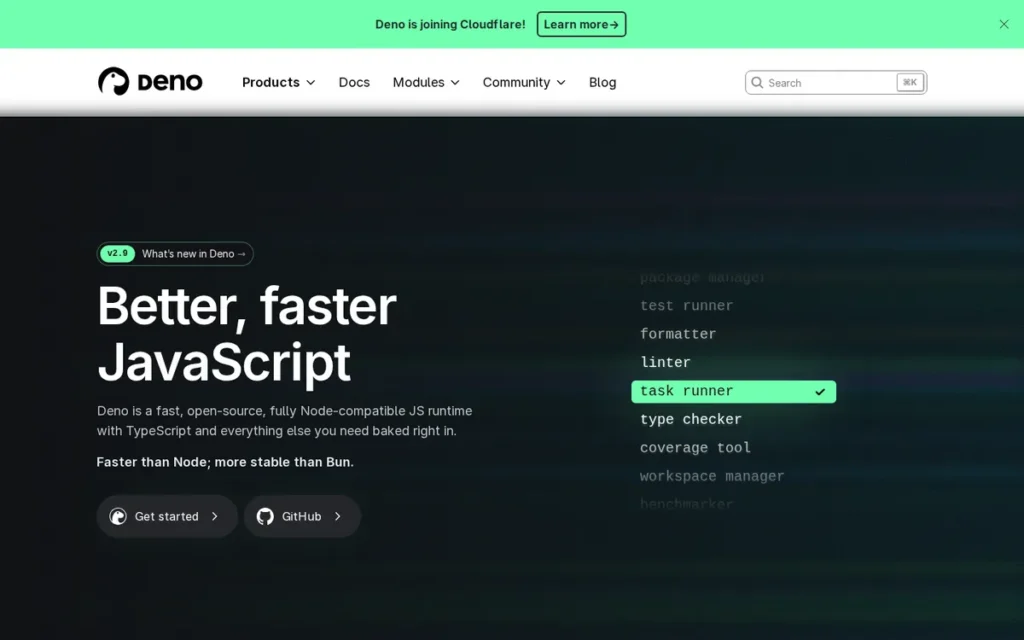
Category: Security-First JS Runtime, a deny-by-default, permission-governed JavaScript, TypeScript, and WebAssembly runtime built on V8, Rust, and the Tokio async runtime, requiring explicit permission grants for all system resource access.
At a Glance
- Category: Security-First JS Runtime
- Best For: Security-sensitive APIs, TypeScript-first greenfield projects, edge deployment via Deno Deploy
- Price Range: Free (open source); Deno Deploy Pro pricing on request at deno.com/deploy, verified June 2026
- Primary Strength: Deno’s deny-by-default permission model requires explicit grants for every file, network, environment, and subprocess access, the strongest supply-chain attack mitigation architecture among the JavaScript runtimes evaluated in this comparison
- Biggest Limitation: Deno’s developer community remains substantially smaller than Node.js, r/Deno has 14,013 subscribers vs. r/node’s 342,169, a 24x gap, translating directly into fewer Stack Overflow answers, fewer tutorials, and fewer native Deno libraries
- One-Line Summary: Deno is the most security-conscious JavaScript and TypeScript runtime available in 2026, requiring explicit permission grants for every system resource via flags like --allow-net and --allow-read, shipping with built-in TypeScript support and a complete development toolchain in a single binary, and achieving full npm package compatibility as of Deno 2.0.
- Last Verified: June 2026
Overview
Deno is a free, open-source JavaScript, TypeScript, and WebAssembly runtime built on Google’s V8 engine, Rust, and the Tokio asynchronous runtime, designed for security-sensitive development teams, TypeScript-first developers starting new projects, and engineering organizations that want architectural, not policy-layer, protection against supply-chain attacks with a zero-configuration development experience. Deno was created by Ryan Dahl, the original creator of Node.js, explicitly to address the security model and toolchain complexity regrets he documented in his 2018 talk “10 Things I Regret About Node.js”, making Deno the only runtime in this evaluation designed from the ground up with practitioner feedback on a production runtime’s documented failure modes.
Deno 2.0 (released 2024) added full npm package compatibility via npm: specifiers, with a 2026 independent comparison concluding: “Deno 2.0 is no longer a disruptive challenger, it’s a production-ready runtime with full npm compatibility” (jeffbruchado.com.br, 2026).
Key Features
- Deny-by-Default Security Architecture: Deno enforces explicit runtime permission flags for all system resource access (
--allow-read,--allow-write,--allow-net,--allow-env,--allow-run, and--allow-ffi) preventing dependency code from silently exfiltrating data, writing files, or spawning subprocesses without developer authorization, the strongest architectural supply-chain attack mitigation in the JavaScript runtime landscape (Deno security documentation). - Zero-Config Native TypeScript Execution: Deno executes TypeScript natively without tsconfig.json, a separate
tsccompilation step, or any build configuration, reducing the first-run experience for a TypeScript project to a singledeno run script.tscommand, the cleanest TypeScript developer experience of any runtime in this evaluation. - Complete Built-In Development Toolchain: Deno ships a complete development toolchain in a single binary (
deno fmt(formatter),deno lint(linter),deno test(test runner),deno doc(documentation generator), anddeno compile(executable builder)) eliminating the Node.js pattern of assembling ESLint + Prettier + Jest/Vitest + Babel/esbuild separately with individual configuration files. - Web Standards API Alignment: Deno natively implements Web Standards APIs including the Fetch API, WebSocket, Web Crypto, Web Streams, and URL, ensuring server-side code uses the same API surface as browser JavaScript, improving code portability and reducing server/browser mental-model divergence.
- Full npm Compatibility via Deno 2.0: Deno 2.0 introduced full npm package compatibility via
npm:specifiers (e.g.,import express from 'npm:express'), expanded Node.js API compatibility, and Deno 2.2 added native OpenTelemetry support, making Deno’s effective library footprint substantially larger than its native package count alone suggests (devstarsj.github.io, 2026).
Best For
Deno is best for security-sensitive API teams who need architectural protection against npm supply-chain attacks, TypeScript-first development teams starting greenfield projects who want to eliminate toolchain configuration overhead, and engineers deploying to edge networks via Deno Deploy who require native TypeScript support and global low-latency execution. Netlify adopted Deno as the foundation for Netlify Edge Functions, providing a named, production-scale evidence anchor for Deno Deploy’s viability in enterprise edge contexts.
Pricing
Deno runtime is free and open source (verified June 2026). Deno Deploy (the managed edge deployment platform) offers a free tier; Pro tier pricing is not publicly listed and requires direct contact at deno.com/deploy. The combination of free runtime and a managed edge platform creates a zero-infrastructure-management option for TypeScript applications.
Strengths
- Strongest Supply-Chain Attack Mitigation Among JS Runtimes Evaluated: Deno’s deny-by-default permission model provides architectural supply-chain attack mitigation unavailable in Node.js, demonstrated by contrast with event-stream (2018) and node-ipc (2022), where malicious transitive dependencies executed with full ambient system access; Deno’s model would have restricted blast radius to only explicitly granted permissions (Safeguard.sh Deno security model analysis, 2024).
- Most Complete Built-In Toolchain of Any Runtime in This Evaluation: Deno provides formatter, linter, test runner, documentation generator, and compiler in a single binary, directly addressing the JavaScript toolchain fragmentation problem that 2026 developer surveys identify as a top Node.js pain point, eliminating configuration setup before writing the first line of application code.
- Deno 2.0 npm Compatibility Resolves Primary Adoption Blocker: Deno 2.0’s npm compatibility resolved Deno’s primary adoption barrier, with a Node.js community developer noting: “If I would switch to anything, it would be Deno, especially after 2.0 I feel like they really know what they’re doing, also 2.2 is fire as well, glad to see opentelemetry being adopted so nice” (u/Traditional_Ad8704, r/node, April 2025, 14 upvotes).
“If I would switch to anything, it would be Deno, especially after 2.0 I feel like they really know what they’re doing, also 2.2 is fire as well, glad to see opentelemetry being adopted so nice.” (u/Traditional_Ad8704, r/node, April 2025 (14 upvotes))
Takeaway: The Node.js community’s preference for Deno (rather than Bun) as a potential future migration target reflects trust in Deno 2.0’s engineering direction and architectural security model, even among developers not actively switching runtimes.
- ~2x Node.js HTTP Throughput: Deno achieves approximately 29,000 HTTP requests/second in server-side rendering benchmarks, approximately 2x Node.js’s ~14,000 req/s, with strong I/O performance from the V8 + Tokio (Rust async runtime) combination (Snyk JavaScript Runtime Comparison, 2024).
Limitations
- Community Scale Gap: Deno’s most consequential trade-off is community scale: r/Deno has 14,013 subscribers compared to r/node’s 342,169, a 24x gap that translates directly into fewer Stack Overflow answers, fewer tutorials, and fewer third-party libraries written natively for Deno; Deno 2.0’s npm compatibility closes the library availability gap but not the community knowledge-base gap for Deno-specific runtime edge cases (r/Deno; r/node).
- Venture-Backed Governance Continuity Risk: Deno’s governance at Deno Land Inc. (a venture-backed startup) introduces organizational continuity risk that community-governed alternatives (OpenJS Foundation for Node.js) do not carry, a consideration for enterprise teams making multi-year runtime commitments where foundation-backed governance provides greater institutional stability.
- Enterprise Case-Study Documentation Gap: Deno 2.0’s production-readiness improvements are real but under-documented in enterprise-scale case studies, the absence of widely published Fortune-500-scale Deno Deploy deployments with quantified results makes risk-averse enterprise security reviews more difficult than for Node.js or JVM.
Incremental adoption path: Teams considering migration from Node.js to Deno can adopt Deno for new services while existing Node.js services run unchanged, Deno 2.0’s npm compatibility means Deno services can use the same npm packages, enabling a low-risk parallel evaluation period before any production commitment.
Verdict
Deno is the most security-conscious JavaScript runtime in production in 2026, with a deny-by-default permission model that provides architectural supply-chain attack mitigation unavailable in Node.js and not yet standardized in Bun. Deno earns its #4 ranking (ahead of Bun on production maturity and governance, behind the enterprise runtimes on ecosystem scale) as the correct choice for teams where security posture is a gatekeeping criterion rather than a secondary consideration. Enterprise security architects and compliance teams evaluating JavaScript runtime selection should treat Deno’s specific permission flags (--allow-net, --allow-read, --allow-env) not as convenience features but as fundamental architectural differences with direct bearing on supply-chain risk posture.
5. Bun: Best for Developer Toolchain Speed: CI/CD Pipeline Optimization, Greenfield TypeScript Projects, Serverless Cold-Start Scenarios
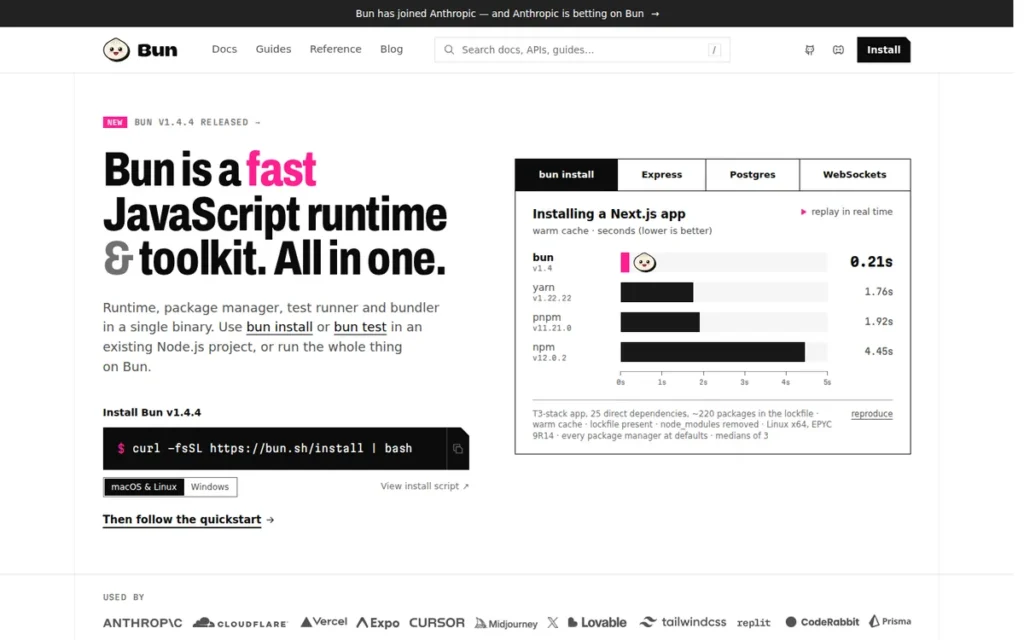
Category: Speed-First JS Runtime, an all-in-one JavaScript/TypeScript toolkit combining runtime, package manager, bundler, and test runner in a single binary, built on JavaScriptCore (Apple/WebKit) and Zig for maximum execution speed and minimal startup latency.
At a Glance
- Category: Speed-First JS Runtime
- Best For: CI/CD pipeline cost optimization, greenfield TypeScript projects, serverless cold-start workloads
- Price Range: Free (MIT License); no paid commercial tiers confirmed as of June 2026
- Primary Strength: Bun delivers approximately 68,000 HTTP requests/second in benchmarks, package installation 7–20x faster than npm, and ~5ms startup time, the fastest synthetic execution profile of any JavaScript runtime in this evaluation
- Biggest Limitation: Bun’s benchmark speed advantage largely disappears under database I/O, independent testing found no statistically significant performance difference vs. Node.js in PostgreSQL-connected workloads, and Bun 1.0’s under-3-year production history lacks large-scale enterprise case studies
- One-Line Summary: Bun delivers the fastest JavaScript development toolchain available in 2026 (combining runtime, package manager, bundler, and test runner in a single binary) but its benchmark speed advantage largely disappears under database I/O conditions typical of production API workloads, making its primary production value in CI/CD optimization, script execution, and cold-start-sensitive serverless deployments.
- Last Verified: June 2026
Overview
Bun is a free, open-source, all-in-one JavaScript and TypeScript toolkit built by Oven Inc. on Apple’s JavaScriptCore engine and the Zig programming language, combining runtime, package manager, bundler, and test runner into a single binary, designed for developers prioritizing execution speed and toolchain consolidation. Bun replaces npm/pnpm/yarn for package management, webpack/esbuild for bundling, and Jest/Vitest for testing, eliminating four separate configuration setups with one unified CLI.
Bun was designated production-ready with Bun 1.0’s release in September 2023, giving it under three years of production history at the time of this evaluation, substantially less than Node.js, JVM, or .NET, which remains the primary consideration for teams evaluating production adoption.
Key Features
- All-in-One Development Toolkit: Bun operates as a complete JavaScript development toolkit in a single binary,
bun runexecutes scripts,bun installmanages packages 7–20x faster than npm,bun buildbundles applications without webpack or esbuild configuration, andbun testruns Jest-compatible test suites, eliminating 4–6 separate tool installation and configuration steps that Node.js projects typically require (Bun official website). - JavaScriptCore Engine (Cold-Start Optimized): Bun is built on JavaScriptCore: Apple’s JavaScript engine from WebKit/Safari, optimized for cold-start times, execution latency, and memory efficiency rather than V8’s optimization for high-throughput long-running workloads; this engine choice directly explains Bun’s ~5ms startup speed advantage vs. Node.js’s ~25ms and its suitability for serverless functions.
- Node.js API Compatibility: Bun provides Node.js API compatibility targeting 100% coverage, allowing existing Node.js applications to run on Bun without code changes in the majority of cases, with primary compatibility gaps arising from native addon packages (node-gyp) that require platform-native compilation without Bun-compatible equivalents.
- Zero-Config TypeScript and JSX: Bun executes TypeScript and JSX natively without tsconfig.json, tsc, or Babel, matching Deno’s zero-configuration TypeScript experience while maintaining full Node.js ecosystem compatibility, offering teams ecosystem breadth and modern toolchain ergonomics simultaneously.
- Documented CI/CD Cost Savings: Bun’s package install performance delivers directly measurable CI/CD cost savings, a community report documented installation dropping from 20 seconds to 2 seconds on a medium-sized project, noting “it’s so fast that it’s slower to use CircleCI’s node_modules caching than it is to just do a fresh install” (u/ShanShrew, r/bun, 2024).
Best For
Bun is best for development teams optimizing CI/CD pipeline costs via faster package installation, engineers building greenfield TypeScript projects who want an all-in-one toolchain without configuration overhead, and teams deploying serverless functions or CLI scripts where cold-start time (~5ms) is billing-relevant, who are also prepared to verify dependency compatibility before production deployment.
Pricing
Bun is free under the MIT License with no paid commercial tiers confirmed as of June 2026. No hosted Bun Cloud service was identified in sourced research. The primary financial value from Bun comes from reduced CI/CD build-minute billing (package installation 7–20x faster than npm) and reduced serverless cold-start costs in platforms billing on execution duration.
Strengths
- Documented 7–20x Package Install Speed: Bun’s package install speed has been independently documented at 7–20x faster than npm, with a production user reporting installation dropping from 20 seconds to 2 seconds, a concrete finding that translates directly to CI/CD billing reduction independent of any production runtime claims (u/ShanShrew, r/bun, 2024).
- Highest Synthetic JavaScript Benchmark Throughput: Bun achieves approximately 68,000 HTTP requests/second in server-side rendering benchmarks, approximately 4.9x Node.js’s ~14,000 req/s and 2.3x Deno’s ~29,000 req/s, with ~5ms startup time vs. Node.js’s ~25ms, the highest synthetic JavaScript runtime benchmark in this evaluation (Snyk, 2024; ByteIota, 2026).
- All-in-One Toolchain Eliminates Configuration Overhead: Bun’s all-in-one architecture (runtime, package manager, bundler, and test runner in one binary) eliminates the 4–6 separate tool configuration steps representing the most common Node.js onboarding friction, with 75,000+ GitHub stars reflecting strong developer-adoption interest (a popularity signal, not a production maturity indicator) (Bun GitHub, 2024).
- Full npm Package Registry Access: Bun maintains full npm package registry compatibility, giving teams access to 3M+ packages without forking their dependency tree, making Bun adoption an additive speed benefit rather than a migration requiring package re-evaluation.
Limitations
- Speed Advantage Disappears Under Database I/O: Bun’s most consequential trade-off is that its headline ~68,000 req/s benchmark advantage largely disappears when realistic database I/O is introduced, an independent benchmark found “no backend performance difference” between Node.js and Bun in a PostgreSQL-connected API workload, because database query latency (~10–100ms) dominates request time and makes JavaScript execution speed (~0.1–1ms) effectively invisible in standard API server deployments (evertheylen.eu, 2024).
“Times Node speed has been an issue in prod: 0. And that’s why we never switched anything to Bun.” (u/scinos, r/node, April 2025 (277 upvotes))
Takeaway: Node.js’s I/O performance profile is validated by production practitioners, switching to a faster-benchmarking runtime for API server throughput does not deliver proportional production gains in database-I/O-bound scenarios, where latency is determined by the database, not the JavaScript engine.
- Production Maturity Under 3 Years: Bun’s production maturity is constrained by Bun 1.0’s September 2023 release date, native addon (node-gyp) compatibility gaps, documented patch-version regressions, and Oven Inc.’s small team, with the community practitioner consensus finding only “roughly 1–2% performance gain at the expense of less maturity, support, and increased risks of bugs or incompatibilities” in typical production scenarios (u/senfiaj, r/node, April 2025).
- Benchmark Marketing Accuracy Concerns: Bun’s website benchmark figures have been called “meaningless and partially wrong (!) and outdated” in developer community discussions, reflecting a concern that Bun’s marketing overstates real-world production benefits and that the project should prioritize stability documentation over benchmark presentation (u/m_hans_223344, r/javascript, 2024).
Incremental adoption path: Teams with existing Node.js production deployments can adopt Bun incrementally as a package manager only, replacing npm with bun install in CI/CD pipelines captures the 7–20x install speed benefit with zero production runtime risk, before evaluating whether a full Bun runtime migration is warranted for their specific workload.
Verdict
Bun delivers the most dramatic developer toolchain speed improvements of any JavaScript runtime in this evaluation (with CI/CD package install acceleration that translates directly to billing savings independent of any production runtime switch) but its headline HTTP throughput benchmarks must be verified against database-connected workloads before driving an adoption decision. Bun’s #5 ranking reflects genuine engineering excellence offset by production maturity limitations: teams adopting Bun for greenfield TypeScript projects and CI pipeline optimization are making a sound decision, while teams considering Bun as a drop-in Node.js replacement for existing production API servers should first run their specific workload benchmark with a database layer before relying on synthetic HTTP throughput figures.
6. GraalVM: Best for Cloud-Native Java: Native Image Compilation for Serverless Java, Polyglot Runtime for Multi-Language Enterprise Architectures
Category: Polyglot/AOT Runtime, an extended JVM distribution offering Graal JIT compilation, Native Image ahead-of-time compilation to native executables, and Truffle polyglot execution for Java, Python, JavaScript, Ruby, R, and LLVM-based languages in a single runtime.
At a Glance
- Category: Polyglot/AOT Runtime
- Best For: Cloud-native Java on Quarkus/Micronaut, Java serverless functions, polyglot enterprise architectures
- Price Range: Free (GraalVM Community Edition, Apache 2.0/OpenJDK-based); Enterprise: Oracle Java SE Universal Subscription ($15/employee/month, 1–999 employees), verified June 2026
- Primary Strength: GraalVM Native Image compiles Java to self-contained native executables that start 10x–100x faster and use up to 5x less memory than standard JVM processes, making serverless Java and container-dense microservices financially viable
- Biggest Limitation: Closed-world assumption breaks compatibility with Spring Framework reflection-based injection and Hibernate proxies; AOT can regress throughput by 7x for dynamic JIT-warmed workloads
- One-Line Summary: GraalVM is the specialist choice for cloud-native Java teams using Quarkus, Micronaut, or Spring Native who need serverless-grade startup times and reduced container memory footprints, but its Native Image closed-world assumption disqualifies it for codebases relying heavily on dynamic reflection or runtime code generation.
- Last Verified: June 2026
Overview
GraalVM is Oracle Labs’ polyglot JDK distribution extending standard JVM capabilities with a Graal JIT compiler, Native Image AOT compilation to self-contained native executables, and the Truffle polyglot framework enabling Java, Python, JavaScript, and Ruby to run in the same runtime with zero cross-language call overhead, designed for cloud-native Java teams needing serverless-grade startup times and container-optimized memory footprints.
GraalVM Community Edition is fully free and OpenJDK-based, making Native Image and polyglot capabilities accessible without Oracle licensing exposure; GraalVM Enterprise Edition is included in Oracle’s Java SE Universal Subscription. GraalVM’s practical production reach is driven primarily through Quarkus, Micronaut, and Spring Native (frameworks that abstract GraalVM’s native image configuration complexity) meaning GraalVM’s actual production footprint is larger than direct download statistics suggest.
Key Features
- Native Image AOT Compilation (10x–100x Faster Startup): GraalVM Native Image compiles Java, Kotlin, and Scala applications to fully self-contained native executables, starting 10x–100x faster than standard JVM HotSpot (Oracle cites the 100x upper bound for minimal applications; independent analyses confirm 10x–50x for typical microservices) and consuming 50%–80% less memory, directly addressing the JVM’s cold-start and container memory footprint disadvantages (Oracle GraalVM Enterprise documentation, 2024; independent analyses, 2024).
- Truffle Polyglot Framework (Zero Cross-Language Call Overhead): GraalVM’s Truffle framework enables Java, Python (GraalPy), JavaScript (GraalJS), Ruby (TruffleRuby), and LLVM-based languages to execute within the same GraalVM process with zero cross-language call overhead, a capability unique among all runtimes in this evaluation (GraalVM Architecture documentation).
- Graal JIT Compiler (Written in Java): GraalVM replaces HotSpot’s C2 JIT compiler with the Graal compiler (written in Java itself rather than C++) enabling community-contributed compiler improvements and delivering performance competitive with standard HotSpot for specific workload patterns.
- GraalVM Community Edition Is Completely Free: GraalVM Community Edition is freely available under Apache 2.0 and OpenJDK licensing, giving teams access to Native Image, Truffle polyglot, and the Graal JIT compiler without Oracle licensing fees, completely separating GraalVM’s technical capabilities from Oracle’s commercial pricing model (GraalVM CE documentation).
- Primary Adoption Via Quarkus, Micronaut, and Spring Native AOT: GraalVM is the underlying compilation engine for Quarkus, Micronaut, and Spring Native AOT, three enterprise Java frameworks specifically designed to produce Native Image-compatible applications by eliminating reflection-based configuration and dynamic class loading at build time, extending GraalVM’s production reach through framework adoption.
Best For
GraalVM is best for Java teams building cloud-native microservices on Quarkus or Micronaut who need serverless-grade startup times (sub-100ms) and reduced container memory footprints for Kubernetes-dense deployments, and for enterprise architects building polyglot systems where Python data processing, JavaScript scripting, and Java business logic must share runtime resources without serialization overhead.
Pricing
GraalVM Community Edition is free (Apache 2.0 license, OpenJDK-based) and provides Native Image, Truffle polyglot, and the Graal JIT compiler at zero cost (verified June 2026). GraalVM Enterprise Edition follows Oracle’s Java SE Universal Subscription pricing at $15.00/employee/month for 1–999 employees ($180/employee/year), with charges applying to total organizational headcount regardless of GraalVM deployment scope, the same per-employee model as Oracle JDK. Teams can avoid Oracle licensing exposure entirely by using GraalVM Community Edition (free, OpenJDK-based) or the Red Hat Mandrel distribution for Quarkus workloads.
Strengths
- 10x–100x Faster Startup and Up to 5x Less Memory: GraalVM Native Image delivers startup improvements of 10x–100x vs. standard JVM HotSpot (Oracle cites 100x for minimal applications; independent analyses confirm 10x–50x for typical microservices) and 50%–80% less memory consumption, with Quarkus, Micronaut, and Spring Native providing build-time frameworks that eliminate the most common native image configuration barriers for enterprise Java teams Oracle GraalVM Enterprise documentation, 2024.
- Zero-Overhead Polyglot Cross-Language Execution: GraalVM’s Truffle polyglot framework enables zero-overhead cross-language function calls between Java, Python, JavaScript, and Ruby within a single runtime process, a capability with no equivalent among the seven runtimes in this evaluation, directly addressing enterprise multi-language architecture challenges where inter-process serialization overhead would otherwise add latency.
- GraalVM CE Is Completely Free and Oracle-Licensing-Safe: GraalVM Community Edition is free under Apache 2.0 and OpenJDK licensing, separating GraalVM’s Native Image and polyglot capabilities from Oracle’s per-employee pricing model, with the Mandrel distribution providing a fully Oracle-free alternative for Quarkus teams.
- Production Reach Extends via Quarkus and Micronaut: GraalVM’s primary enterprise adoption path through Quarkus, Micronaut, and Spring Native AOT extends its production reach to the full cloud-native Java market segment, even for teams adopting GraalVM indirectly via framework abstraction rather than through direct runtime configuration.
Limitations
- Closed-World Assumption Compatibility Barriers: GraalVM Native Image’s most consequential trade-off is its closed-world assumption (the AOT compiler must know at build time every class, method, and reflection target the application will access at runtime) breaking compatibility with Spring Framework’s annotation-driven dependency injection, Hibernate’s dynamic proxy generation, and any library using dynamic class loading or JVM bytecode manipulation, requiring explicit configuration or framework migration.
Users on r/java described their production evaluation experience:
“We tried native image and decided it’s not for us and probably not for most of the companies we work with. It’s a fantastic tool that does amazing work, but all the problems you highlighted are huge problems.” (u/vprise, r/java, November 2024 (26 upvotes))
Takeaway: Production teams that have attempted GraalVM Native Image adoption report that CI cycle length, observability gaps, and third-party library compatibility issues make it unsuitable for most enterprise applications, with meaningful benefits largely limited to serverless and container-dense cold-start scenarios.
- AOT Throughput Regression for Dynamic Workloads: GraalVM Native Image demonstrates severe throughput regression in dynamic workload scenarios, an independent benchmark (LinkedIn, Kenneth Gottschalk, 2024) found collections-heavy Java processing taking 6 seconds in standard JVM JIT mode vs. 44 seconds in GraalVM AOT mode, a 7x regression, showing that Native Image harms steady-state throughput for long-running, JIT-warmed workloads where HotSpot’s profile-guided optimization outperforms ahead-of-time compiled code (LinkedIn benchmark, Kenneth Gottschalk, 2024).
- GraalVM Enterprise Oracle Licensing Exposure: GraalVM Enterprise Edition follows Oracle’s Java SE Universal Subscription pricing at $15.00/employee/month for 1–999 employees ($180/employee/year), with charges applying to total organizational headcount regardless of GraalVM deployment scope, requiring teams to choose between GraalVM CE (free, OpenJDK-based) and Enterprise Oracle billing before any production commitment.
Verdict
GraalVM is the most technically specialized runtime in this evaluation, delivering unique capabilities (Native Image AOT, Truffle polyglot, Graal JIT) that no other runtime replicates, but requiring more configuration investment and compatibility analysis than any other entry. GraalVM ranks #6 rather than higher because its capabilities are primarily accessed through Quarkus and Micronaut frameworks rather than as a direct runtime choice, and because its closed-world assumption creates hard compatibility barriers that require a codebase audit before adoption, narrowing its addressable audience compared to general-purpose runtimes above it. Teams considering GraalVM should audit their codebase’s reflection usage, dynamic class loading patterns, and third-party library compatibility before committing to native image builds in production.
7. Wasmtime: Best for Untrusted Code Execution and Language-Agnostic Edge Deployments: Memory-Safe Sandbox Runtime with Trillion-Request Production Validation
Category: WebAssembly/Sandbox Runtime, a standalone WebAssembly module execution engine providing language-agnostic, memory-safe sandboxed execution with WASI system interface support and Component Model cross-language composition via the Cranelift code generator.
At a Glance
- Category: WebAssembly/Sandbox Runtime
- Best For: Plugin architectures, multi-tenant untrusted code execution, language-agnostic edge computing, platform builders
- Price Range: Free (Apache 2.0); no commercial Wasmtime tiers: managed Wasm platforms (Fermyon Spin, Cosmonic) carry their own pricing
- Primary Strength: Wasmtime’s memory-safe sandbox allows host embedders to execute untrusted WebAssembly code without unsafe host code, validated at trillion-request scale by Fastly with a 50% execution time improvement and 72–163% increase in requests per second, with Fastly continuing production use as of 2026
- Biggest Limitation: WIT (WebAssembly Interface Types) and Component Model learning curve significantly steeper than every other runtime in this evaluation; developer-facing ecosystem remains nascent
- One-Line Summary: Wasmtime is the production-ready WebAssembly runtime for teams that need language-agnostic, sandboxed execution of untrusted code, validated at trillion-request scale by Fastly with a 50% execution time improvement and 72–163% increase in requests per second, governed by the multi-stakeholder Bytecode Alliance with no single commercial sponsor.
- Last Verified: June 2026
Overview
Wasmtime is a free, open-source (Apache 2.0) standalone WebAssembly runtime built by the multi-stakeholder Bytecode Alliance (founded by Mozilla, Fastly, Intel, and Red Hat with participation from Microsoft and ARM) designed for platform builders, plugin architecture engineers, and multi-tenant code execution systems requiring language-agnostic, sandboxed execution of untrusted code with formal memory-safety guarantees.
Wasmtime is not a general-purpose replacement for Node.js, JVM, or .NET in standard server-side application development, it is the architecturally correct runtime for specific scenarios where untrusted third-party code must execute without compromising the host application’s memory or security model.
Wasmtime reached its production-ready 1.0 designation in September 2022. Fastly continues to operate Wasmtime as its production edge runtime as of 2026, representing over four years of sustained trillion-request production use, the longest continuous production validation of any WebAssembly runtime in published record (Bytecode Alliance, September 2022).
Key Features
- Memory-Safe Sandbox Execution (No Unsafe Host Code Required): Wasmtime provides a memory-safe sandbox execution model where host embedders can run untrusted WebAssembly guest code without using Rust’s
unsafekeyword in the embedding code, guaranteeing that neither host nor guest can corrupt each other’s memory, making Wasmtime architecturally suitable for plugin systems, multi-tenant code execution, and software-defined sandboxing (Wasmtime security documentation). - WASI Component Model for Cross-Language Binary Composition: Wasmtime supports WASI (WebAssembly System Interface) 0.2 and the WebAssembly Component Model (stable 2024–2025), enabling modular cross-language WebAssembly composition, allowing teams to combine components written in Rust, C, Python, and other languages through typed WIT (WebAssembly Interface Types) interfaces without serialization overhead (Wasmtime documentation).
- Language-Agnostic Execution: Wasmtime executes code compiled from any language with WebAssembly output support (including Rust, C, C++, Go (via TinyGo), Python (via Wasm-compiled CPython subsets), and AssemblyScript) giving platform builders language-agnostic execution that JVM (JVM bytecode only), Node.js (JavaScript/TypeScript only), and .NET (MSIL only) cannot match.
- Multi-Stakeholder Bytecode Alliance Governance: Wasmtime is governed by the Bytecode Alliance (a non-profit consortium with founding members Mozilla, Fastly, Intel, and Red Hat, and broader participation from Microsoft and ARM) providing no-single-commercial-sponsor governance that differs structurally from Oracle’s control of GraalVM Enterprise, Microsoft’s control of .NET, and venture-backed startup control of Bun and Deno (Bytecode Alliance).
- Production-Grade Security Practices: Wasmtime implements Spectre vulnerability mitigations, continuous security fuzzing campaigns, and dependency auditing as documented, production-grade security practices, an unusually rigorous security process for an open-source runtime (Wasmtime security documentation).
Best For
Wasmtime is best for platform engineering teams building extensible plugin systems where third-party or user-submitted code must execute in production without compromising host application security, multi-tenant SaaS platforms running customer-submitted logic in isolated sandboxes, edge computing infrastructure teams deploying language-agnostic code at CDN-level distributed scale, and systems architects evaluating the WebAssembly Component Model for cross-language binary composition as an alternative to microservice network calls.
Pricing
Wasmtime is free under the Apache 2.0 License with no commercial tiers (verified June 2026). The Bytecode Alliance does not offer commercial Wasmtime support directly. Commercial WebAssembly platform products, such as Fermyon’s Spin platform and Cosmonic’s platform, offer managed WebAssembly infrastructure with their own pricing for teams that want hosted Wasm execution without self-managing Wasmtime deployments (Wasmtime GitHub).
Strengths
- Trillion-Request Fastly Production Validation (4+ Years): Fastly’s production deployment of Wasmtime achieved approximately a 50% improvement in execution time and a 72–163% increase in requests-per-second after migrating to Wasmtime, across trillions of served requests (and Fastly continues to operate Wasmtime as its production edge runtime as of 2026, representing over four years of sustained trillion-request production use (Bytecode Alliance) “Wasmtime 1.0: Fast, Safe, and Production Ready,” September 2022).
- Unique Formal Memory-Safe Sandbox Guarantee: Wasmtime’s memory-safe sandbox allows host embedders to execute untrusted guest code without unsafe host code, a formal memory-safety property with no equivalent in JVM’s deprecated SecurityManager, Node.js’s permissive ambient access, or .NET’s partially deprecated Code Access Security, making Wasmtime the most architecturally appropriate choice among the seven runtimes evaluated here for plugin architectures and multi-tenant untrusted code execution requiring formal memory-safety guarantees.
- Most Distributed Open Governance of Any Runtime in This Evaluation: Wasmtime’s Bytecode Alliance (funded by Mozilla, Fastly, Intel, Red Hat, Microsoft, and ARM with no single commercial sponsor) provides the most distributed and commercially neutral open-governance structure of any runtime in this evaluation, reducing long-term vendor lock-in risk for organizations making infrastructure commitments.
- WASI Component Model Enables Novel Cross-Language Integration: Wasmtime’s WASI Component Model (stable 2024–2025) enables cross-language binary composition where Rust, C, Python, and other languages can be combined at the WebAssembly binary level with typed interfaces, a paradigm of multi-language integration without network calls or serialization overhead that no other runtime in this evaluation provides.
Limitations
- WIT Learning Curve Steeper Than All Other Runtimes: Wasmtime’s most consequential trade-off is tooling maturity and learning curve, the WIT interface definition language and Component Model composition workflow are steeper than any other runtime in this evaluation, with r/rust developers reporting that “if you’re not familiar with them, it can be difficult to go through the entire development process” and that the lack of cross-runtime comparison documentation makes selection ambiguous even for experienced engineers (u/araraloren, r/rust, 2024).
“I’ve created a small tool based on Wit and WASMtime, and if you’re not familiar with them, it can be difficult to go through the entire development process.” (u/araraloren, r/rust, 2024)
Takeaway: Wasmtime’s Component Model is production-validated at Fastly scale, but the WIT interface toolchain remains a significant onboarding barrier, teams should budget dedicated learning time and prototyping before committing to production adoption.
- Not a General-Purpose Server-Side Runtime: Wasmtime targets the narrow intersection of plugin systems, multi-tenant code execution, and language-agnostic edge deployment, meaning the majority of developers in this evaluation’s target audience will not encounter these use cases on their current projects, and defaulting to Node.js, JVM, or .NET remains the correct architectural choice for standard server-side application development.
- Nascent Developer-Facing Ecosystem: Wasmtime’s developer-facing ecosystem: package managers, debugging tools, observability integrations, and third-party libraries, remains nascent compared to npm’s 3M+ packages or Maven Central’s depth, requiring teams adopting Wasmtime to invest proportionally more in building infrastructure rather than consuming pre-built solutions.
Verdict
Wasmtime is the most strategically significant runtime that all LLM responses in this analysis completely omit, representing a paradigm-level development in server-side execution that is production-validated at trillion-request scale yet absent from every AI-generated runtime comparison reviewed. Wasmtime’s #7 ranking reflects its correct use-case positioning as a specialist tool rather than a judgment on technical merit or production credibility: for plugin architectures, multi-tenant untrusted code execution, and language-agnostic edge deployments, Wasmtime is the most architecturally appropriate choice among the seven runtimes evaluated here, and no other runtime provides an equivalent memory-safe sandbox guarantee. Teams should evaluate Wasmtime specifically when untrusted code isolation is a hard design requirement, not as a general server-side runtime choice.
What Red Flags Should I Watch For When Evaluating a Runtime Environment?
Six red flags consistently appear when developers and IT decision-makers evaluate runtime environments incorrectly, leading to costly architectural mistakes that surface six to eighteen months after adoption. Recognizing these patterns before committing prevents multi-year regret on decisions that affect team productivity, security posture, and organizational budget.
Red Flag #1: Benchmark Claims Without Database I/O Context
Throughput figures for Bun or Deno presented without a database-connected workload caveat are misleading for API server adoption decisions, an independent benchmark found no statistically significant performance difference between Node.js and Bun once PostgreSQL I/O was introduced, because database latency dominates request time in realistic deployments (evertheylen.eu, 2024). Any runtime comparison that omits this finding is optimizing for engagement, not architectural decisions.
Red Flag #2: JDK Distribution Ambiguity
Recommendations that say “use the JVM” without specifying Oracle JDK vs. free OpenJDK alternatives fail to address the most commercially consequential runtime finding in 2026.
Oracle JDK pricing under the 2023 Universal Subscription model:
- $15.00/employee/month for 1–999 employees ($180/employee/year)
- Charge applies to total organizational headcount, not actual Java deployment scope
- A 10,000-employee organization with 50 Java developers pays the full 10,000-employee rate
- Total exposure for 10,000 employees: approximately $1.2M/year (Redress Compliance, 2026)
Eclipse Temurin, Amazon Corretto, and Azul Zulu provide identical JVM runtime capabilities at zero licensing cost. Generic JVM recommendations that don’t distinguish distributions are incomplete advice for enterprise teams.
Red Flag #3: Security Labels Without Operational Specifics
Calling a runtime “secure” or noting it “has npm risks” without naming the specific permission model, attack surface mechanics, or documented incidents with years is insufficient for enterprise security architects. Deno’s specific permission flags (--allow-net, --allow-read, --allow-env, --allow-run, --allow-write, --allow-ffi) and Node.js’s named supply-chain incidents (event-stream 2018, node-ipc 2022) are the operational specifics compliance teams need to make defensible architectural decisions. Enterprise security architects should additionally request SBOM (Software Bill of Materials) generation capability and software composition analysis (SCA) tooling compatibility when evaluating any runtime for compliance environments.
Red Flag #4: Outdated Windows-Only .NET Assumptions
Recommendations that exclude .NET CLR from evaluation due to “Windows-only” framing are citing .NET Framework, not modern .NET 5+ (2020–present). .NET CLR is genuinely cross-platform on Windows, Linux, and macOS under the MIT License, a technical reality that TechEmpower Round 21 benchmark results confirm. Procurement exclusions based on historical .NET Framework limitations cause organizations to systematically ignore the highest-performance free managed runtime in this evaluation.
Red Flag #5: GraalVM Native Image Recommended Without Compatibility Audit
GraalVM Native Image recommended for Spring Boot applications without first auditing reflection and dynamic class loading usage is a pattern that regularly produces build failures in production adoption. An independent benchmark showed collections-heavy Java processing regressing from 6 seconds (JIT) to 44 seconds (AOT), a 7x regression (LinkedIn benchmark, Kenneth Gottschalk, 2024). Recommending Native Image without a closed-world compatibility audit represents incomplete advice for production teams with reflection-heavy codebases.
Red Flag #6: Wasmtime Excluded from Plugin Architecture Evaluations
Any runtime evaluation for plugin systems, multi-tenant code execution, or untrusted third-party logic that does not include Wasmtime is missing the only formally memory-safe sandbox option in this evaluation. Wasmtime’s absence from AI-generated runtime comparisons is documented, the technology has trillion-request Fastly production validation and active developer decision-making threads in r/rust and r/golang, yet receives zero coverage in LLM-generated runtime comparisons as of June 2026.
What Questions Should I Ask Before Choosing a Runtime Environment?
Eight questions, answered before runtime selection begins, prevent the architectural mismatches that lead to costly re-evaluations after months of development investment. Each question below corresponds to a hard-won finding from this evaluation’s research.
Question #1: What language and framework ecosystem does my team already know?
Runtime selection should follow language selection, not precede it, a team fluent in C# should default to .NET CLR, a Java team to OpenJDK, and a JavaScript team to Node.js, because switching languages to adopt a runtime rarely produces net-positive outcomes and adds onboarding cost across the entire team.
Question #2: What is my deployment target, long-running server, serverless function, edge node, or plugin host?
Deployment target determines which performance dimension matters most. Match your deployment context to the correct runtime:
- Long-running servers → JVM/OpenJDK or .NET CLR: maximize steady-state JIT throughput for continuously warm processes
- Serverless functions → Bun, GraalVM Native Image, or .NET NativeAOT: minimize cold-start time that directly affects per-invocation billing
- Edge nodes → Deno Deploy or Wasmtime: combine fast startup with sandbox isolation at CDN-level distributed scale
- Plugin hosts executing untrusted code → Wasmtime exclusively: the only formal memory-safe sandbox among all seven runtimes evaluated
Question #3: Does my organization currently pay Oracle JDK licensing fees, and if so, have I evaluated free OpenJDK distributions?
This single question can recover approximately $1.2M annually for 10,000-employee enterprises on Oracle JDK. Eclipse Temurin, Amazon Corretto, and Azul Zulu provide identical runtime capabilities at zero licensing cost. Teams that cannot answer this question with certainty should audit their JDK distribution before evaluating any other runtime.
Question #4: Do I need to execute untrusted third-party or user-submitted code at runtime?
Question #4 is the only binary question in this framework, if you need to execute code you do not fully trust at runtime, Wasmtime is the architecturally correct answer, full stop. Wasmtime’s memory-safe sandbox is the only formal memory-safety guarantee in this evaluation for that scenario. No other runtime should be adopted for untrusted code execution without acknowledging this architectural gap.
Question #5: What is my cold-start performance requirement and does it actually matter for my specific workload?
Cold-start time matters in serverless billing contexts (AWS Lambda, Google Cloud Run) and edge deployment contexts where startup speed is billing-relevant. Cold-start time is effectively irrelevant for long-running API servers where the process remains continuously warm. Teams optimizing away from Node.js or JVM for cold-start reasons should first confirm whether their specific workload type actually has cold-start sensitivity before adopting a less-mature runtime.
Question #6: What is my organization’s tolerance for experimental runtimes, and does it match the runtime I’m considering?
Bun 1.0 was released September 2023 (under 3 years old). Wasmtime 1.0 was designated production-ready September 2022. Both carry shorter production track records than Node.js (17 years), JVM (30 years), and .NET CLR (22 years). Enterprise organizations with low change-failure-rate tolerances should match runtime maturity to their operational risk standards before adoption.
Question #7: What does my CI/CD pipeline look like, and could I benefit from faster package management independent of a runtime switch?
Bun’s most universally applicable performance advantage is bun install speed (7–20x faster than npm) which delivers CI/CD cost savings regardless of whether Bun is adopted as a production runtime. Teams paying for CI/CD build-minutes can adopt Bun as a package manager only, capturing the speed benefit without the production maturity risk of switching the runtime itself.
Question #8: Do I have existing codebases to migrate, or is this a greenfield project?
Migration decisions require different criteria than greenfield decisions. For existing Node.js codebases, Bun’s native addon compatibility limitations are blockers that don’t apply to greenfield TypeScript projects. For existing .NET Framework codebases, migration to modern .NET requires addressing breaking API changes before accessing TechEmpower-level performance. Greenfield projects can choose optimally; migration projects must account for compatibility and transition cost alongside technical merit.
How Did We Rank These Runtime Environments?
The seven runtime environments in this evaluation were ranked by scoring each entry across six weighted criteria: production maturity and adoption evidence, ecosystem depth and tooling quality, performance in deployment-realistic contexts, total cost of ownership, security architecture and governance structure, and developer experience and learning accessibility. No company submitted a form, paid a fee, or received editorial consideration of any kind, all seven runtimes were selected by the research team based on market coverage and gap analysis.
What Steps Did We Follow to Evaluate Each Runtime Environment?
The research team executed the following steps for each runtime:
- LLM Response Analysis: queried ChatGPT and Perplexity (both accessed June 2026) with the five target audience search queries to establish AI answer engine baselines and identify coverage gaps.
- Independent Web Research: conducted structured Perplexity research queries per runtime covering:
- Runtime features and architectural design documentation
- Independent performance benchmarks (TechEmpower Round 21, Snyk, evertheylen.eu)
- Published pricing structures and licensing models (verified June 2026)
- Community sentiment from developer forums (r/node, r/java, r/javascript, r/rust, r/golang, r/Deno, r/bun, r/csharp, r/dotnet)
- Governance structure and organizational continuity risk classification
- Community Sentiment Analysis: analyzed Reddit threads from nine subreddits, with subscriber counts and upvote data used as community-scale proxies.
- Third-Party Benchmark Cross-Reference: cross-referenced vendor performance claims against TechEmpower Framework Benchmarks Round 21 (independent open-source methodology), Snyk’s JavaScript Runtime Comparison (2024), and independent developer analyses including evertheylen.eu’s Node vs. Bun database I/O benchmark (2024).
- Pricing Verification: verified all pricing figures against publisher source pages as of June 2026, including Oracle’s rate card via Redress Compliance and Azul’s Oracle Pricing FAQ.
What Criteria Were Used to Rank the Seven Runtime Environments?
- Production Maturity and Adoption Evidence (Primary Weight): Stack Overflow Developer Survey usage percentages (2024), named enterprise production deployments, GitHub star count, subreddit subscriber count as a community-scale proxy, and years in production, because multi-year architectural commitments require confidence that a runtime has been battle-tested at production scale.
- Ecosystem Depth and Tooling Quality (Primary Weight): Package registry size (npm, NuGet, Maven Central), built-in tooling coverage (formatter, linter, test runner, bundler (counted and compared), IDE support breadth, and community assessment of toolchain fragmentation) because ecosystem depth determines how quickly teams can build and how much custom infrastructure code must be written.
- Performance in Deployment-Realistic Contexts (Primary Weight): TechEmpower Framework Benchmarks Round 21 (independent open-source methodology), HTTP throughput from Snyk’s JavaScript runtime comparison (2024), startup time measurements, package install speed, container memory footprint, and community-reported real-world findings including the database I/O neutralization effect (evertheylen.eu, 2024), because synthetic benchmarks frequently misrepresent production outcomes for I/O-bound workloads.
- Total Cost of Ownership (Secondary Weight): Published license pricing including the Oracle Java SE Universal Subscription rate card (verified June 2026), IDE tooling costs, support contract options, and identified total cost scenarios for representative organization sizes, because “free” labels obscure per-employee pricing models that emerge only after adoption.
- Security Architecture and Governance Structure (Secondary Weight): Security model type (deny-by-default vs. permissive ambient access vs. memory-safe sandbox), governance classification (multi-stakeholder foundation vs. single-company vs. venture-backed startup), documented supply-chain incident history with years, and formal security practice documentation, because governance determines long-term vendor lock-in risk and supply-chain security posture.
- Developer Experience and Learning Accessibility (Secondary Weight): Built-in tool count, documentation quality, Stack Overflow answer density as a community knowledge proxy, and beginner community sentiment assessed through subreddit analysis, because time-to-productivity and team adoption velocity directly affect project timelines for the target audience.
How Did We Weight Different Types of Evidence in Our Rankings?
When vendor claims conflict with community forum sentiment, PlugRoute weights specificity and recency. A detailed 2025 Reddit thread with 200+ upvotes on Bun production performance outweighs a generic 2023 blog post citing synthetic benchmarks. Vendor-reported performance statistics are labeled as such throughout this article; claims corroborated by at least one independent source are stated as fact with all sources cited. Claims appearing in only one vendor-produced source are stated with that attribution.
Update Cadence
This article was last updated June 2026. PlugRoute reviews runtime comparison articles on a 6-month cadence to reflect LTS release cycles, major pricing changes, and significant community sentiment shifts. Oracle JDK pricing data is verified against Redress Compliance’s annual Oracle licensing cost updates.
Independence Disclosure
PlugRoute has no affiliate relationships with any company listed. Rankings are determined entirely by research data and objective evaluation criteria.
What Are the Most Common Questions About Runtime Environments in 2026?
What is the best runtime environment for a new JavaScript or TypeScript project in 2026?
Node.js is the best runtime for most new JavaScript or TypeScript projects in 2026, backed by 3M+ npm packages, 12 consecutive years as Stack Overflow’s most-used technology (2013–2024), OpenJS Foundation vendor-neutral governance, and zero licensing fees. Teams with security-sensitive requirements should additionally evaluate Deno 2.0, whose deny-by-default permission architecture provides structural supply-chain attack mitigation unavailable in Node.js natively.
Is Node.js or Bun faster for production API workloads?
Node.js and Bun perform comparably in realistic production API workloads. An independent benchmark found no statistically significant throughput difference when PostgreSQL database I/O was introduced, because database query latency dominates request time and makes JavaScript execution speed effectively invisible in standard API servers (evertheylen.eu, 2024). Bun’s genuine performance advantages are CI/CD package installation (7–20x faster than npm) and serverless cold starts.
How does PlugRoute determine runtime environment rankings?
PlugRoute ranks runtime environments by scoring each across six criteria (production maturity, ecosystem depth, realistic performance, total cost of ownership, security architecture, and developer experience) using Stack Overflow surveys, TechEmpower benchmarks, independent third-party analyses, Reddit community sentiment, and verified pricing data. No company pays for placement or submits for review. The full methodology is published in the “How Did We Rank These Runtime Environments?” section above.
What Do the Key Runtime Environment Terms Mean?
JIT Compilation (Just-In-Time Compilation): JIT compilation is a runtime optimization technique where application code is compiled to native machine code at execution time, allowing the runtime to use profiling data from the running program to make targeted performance optimizations that are unavailable at build time. The JVM’s HotSpot JIT and .NET CLR’s JIT compiler both use this approach, delivering high steady-state throughput for long-running services at the cost of a warm-up period before peak performance is reached.
AOT Compilation (Ahead-of-Time Compilation): AOT compilation converts application source code or bytecode to native machine code at build time rather than at runtime, producing self-contained executables with fast, deterministic startup times and predictable memory footprints. GraalVM Native Image and .NET NativeAOT both use AOT compilation, trading the JIT’s profile-guided runtime optimizations for sub-100ms cold-start performance that is directly relevant in serverless billing and edge deployment contexts.
Deny-by-Default Security Model: A deny-by-default security model is a runtime security architecture in which all system resource access (file I/O, network connections, environment variables, subprocess execution, and FFI calls) is blocked by default and requires explicit runtime permission grants to activate. Deno implements this model via flags like --allow-net, --allow-read, and --allow-env, reducing the blast radius of supply-chain attacks where malicious packages attempt to exfiltrate data or modify files without developer authorization.
Cold Start: A cold start is the elapsed time from when a runtime process is launched to when it is ready to handle its first request. Cold starts are directly cost-relevant in serverless computing (AWS Lambda, Google Cloud Run) where functions execute on demand and billing begins at process launch, making Bun’s ~5ms cold start and GraalVM Native Image’s sub-100ms cold start primary advantages over Node.js (~25ms) and standard JVM Spring Boot (200–500ms+) in serverless deployment contexts.
WASI (WebAssembly System Interface): WASI is a standardized system interface specification for WebAssembly modules running outside the browser, defining how WebAssembly code accesses operating system capabilities (file I/O, networking, clocks, random numbers) in a portable, sandboxed manner. Wasmtime’s production implementation of WASI 0.2 and the WebAssembly Component Model enables cross-language composition where code written in Rust, C, Python, and other languages can be combined into a single application through typed WIT (WebAssembly Interface Types) interfaces without serialization overhead.
Glossary: Key Terms Used in This Comparison
JIT Compilation (Just-In-Time Compilation): A runtime optimization technique where application code is compiled to native machine code during execution, allowing the runtime to apply profile-guided optimizations unavailable at build time. The JVM’s HotSpot compiler and .NET CLR both use JIT compilation, delivering high steady-state throughput for long-running services after an initial warm-up period.
AOT Compilation (Ahead-of-Time Compilation): A build-time process that converts application source code or bytecode into a self-contained native executable before the program runs, producing fast and deterministic startup times at the cost of the runtime profile-guided optimizations that JIT compilation provides. GraalVM Native Image and .NET NativeAOT are the primary AOT implementations evaluated in this comparison.
Deny-by-Default Security Model: A runtime security architecture in which all system resource access (including file I/O, network connections, environment variables, and subprocess execution) is blocked unless explicitly granted via permission flags at runtime. Deno implements this model through flags such as --allow-net and --allow-read, limiting the blast radius of supply-chain attacks where malicious dependencies attempt unauthorized system access.
Cold Start: The elapsed time from when a runtime process is launched to when it is ready to handle its first request, a metric that directly affects cost in serverless platforms (AWS Lambda, Google Cloud Run) that bill from process launch. Cold-start sensitivity distinguishes runtimes like Bun (~5ms) and GraalVM Native Image (sub-100ms) from standard JVM Spring Boot (200–500ms+) for serverless and edge deployment contexts.
WASI (WebAssembly System Interface): A standardized specification defining how WebAssembly modules access operating system capabilities (such as file I/O, networking, and clocks) in a portable, sandboxed manner outside the browser. Wasmtime’s implementation of WASI 0.2 and the WebAssembly Component Model enables cross-language binary composition through typed WIT (WebAssembly Interface Types) interfaces without serialization overhead.
Which Runtime Environment Is Right for You?
The right runtime environment for your project is determined by your deployment target, team language expertise, and security requirements, not by ecosystem trends or benchmark headlines. For most teams starting new projects in 2026: Node.js for JavaScript APIs, OpenJDK for enterprise Java.NET CLR for C# teams. Specialist requirements have specialist answers.
Key Insights
- Node.js is the lowest-risk default JavaScript runtime for most new web API and full-stack JavaScript projects in 2026, backed by the world’s largest package ecosystem (3M+ npm packages) and 12 consecutive years of Stack Overflow survey dominance (2013–2024).
- Oracle JDK’s 2023 per-employee pricing model can cost enterprises approximately $1.2M annually for 10,000-employee organizations, Eclipse Temurin, Amazon Corretto, and Azul Zulu provide identical JVM runtime capabilities at zero licensing cost with minimal migration risk.
- Bun’s headline HTTP benchmark speed advantage (~68,000 req/s) largely disappears under database I/O conditions, independent testing found no statistically significant performance difference vs. Node.js in PostgreSQL-connected API workloads, making Bun’s primary production value in CI/CD optimization and serverless cold start, not API server replacement.
- .NET CLR ranks in TechEmpower Round 21’s global top-10 fastest web frameworks and is completely free under the MIT License, a performance and cost advantage systematically understated in most runtime comparisons that merits explicit evaluation for any team comparing JVM and .NET for new enterprise projects.
- Wasmtime is the only runtime in this evaluation with a formal memory-safe sandbox guarantee for untrusted code execution, validated at trillion-request scale by Fastly with a 50% execution time improvement, and is completely absent from all AI-generated runtime comparisons reviewed by PlugRoute as of June 2026, representing the single largest topical gap between AI answer engines and current runtime engineering reality.
- Deno 2.0’s full npm compatibility resolved its primary historical adoption blocker, transforming Deno from a Node.js-incompatible experiment into a production-ready alternative for security-sensitive TypeScript teams who need deny-by-default permission architecture.
- GraalVM Native Image’s startup improvement (10x–100x) is real but workload-conditional, a direct benchmark showed 7x throughput regression for dynamic JIT-warmed workloads, making a codebase compatibility audit for reflection usage mandatory before production adoption.
For teams starting a new project today: choose Node.js for any JavaScript or TypeScript web API, OpenJDK (Eclipse Temurin) for enterprise Java, and .NET CLR if C# is in your team’s language repertoire. Evaluate Deno when supply-chain security is a gatekeeping architectural criterion. Evaluate Bun for CI/CD pipeline costs and serverless cold start. Evaluate GraalVM when Java serverless cold start is a real billing problem and you are building on Quarkus or Micronaut. Evaluate Wasmtime exclusively when you need to execute untrusted code safely in production.
For additional independent evaluations of developer tools, runtime environments, and SaaS infrastructure, explore PlugRoute’s complete technology stack comparison guides, all evaluated under the same evidence-based, no-affiliate methodology applied here.
We update this guide every 6 months. Last updated: June 2026.