Sprout Social leads this evaluation for social-native teams needing native LinkedIn coverage and documented response-time reductions. Freshdesk delivers the strongest SMB value with the only free unlimited-agent tier in this category. Zendesk is the enterprise standard for full omnichannel helpdesk operations with social embedded. The choice depends on team size, primary support channel, and whether LinkedIn native support is required.
Customer service managers are losing track of complaints scattered across X/Twitter, Facebook, Instagram, and LinkedIn with no unified inbox, missing DMs, duplicating agent responses, and unable to show leadership meaningful ROI data from social support investment. AI is now table-stakes across every evaluated platform, but misconfigured AI, per-resolution billing surprises, and hidden auto-renewal contract terms are the three post-purchase risks this evaluation documents in detail.
PlugRoute has no affiliate relationships with any company listed, rankings are determined entirely by research data and objective evaluation criteria.
“Only drawback is the cost compared to others, but it’s a very powerful tool.” (u/soothsayer3, r/socialmedia (2023))
Takeaway: Cost is the most consistent community criticism of Sprout Social across 2022–2026 Reddit discussions, a trade-off this evaluation documents with specific pricing data, seat-escalation calculations, and contract term disclosures that community posts alone do not provide.
TL;DR: Top Picks at a Glance
- Sprout Social is a social-native inbox platform with the only native LinkedIn care channel among the seven evaluated platforms, and the strongest documented enterprise ROI outcomes, including Papa Johns’ 50% response time reduction (Sprout Social case study, verified May 2026).
- Freshdesk offers the only free unlimited-agent tier among the seven evaluated platforms, with entry-level paid plans from $12/agent/month annually, the most accessible SMB price entry point for omnichannel social customer service in this evaluation.
- Zendesk is the enterprise omnichannel standard, offering social-to-ticket conversion for Facebook, X/Twitter, Instagram, and WhatsApp backed by 1,000+ Marketplace integrations and SLA governance across all support channels.
- Kustomer is the only platform in this evaluation that natively unifies social media messages with e-commerce order data (Shopify, Magento, WooCommerce) in a single Customer Timeline agent view, making it the dominant community recommendation for DTC e-commerce social customer service.
How to Use This Article: If you are evaluating social customer service platforms for the first time, start with the Quick Decision Framework table below. If you are switching from an existing platform, jump to the Red Flags section first, the six documented red flags address the most common sources of post-switch regret before you invest time in platform-specific entries.
What Are the Types of Social Customer Service Software?
Social customer service platforms divide into three distinct architectural categories, social-native inboxes, omnichannel helpdesks, and specialized platforms. Choosing the wrong architecture creates workflow friction that no amount of configuration resolves.
Architecture fit matters more than feature count: a team using a ticketing system for social-first service will struggle just as much as a social-native team trying to enforce SLA governance.
Social-Native Inboxes treat messages as social conversations, not tickets:
- Sprout Social: purpose-built social inbox with enterprise care routing and workflows; native LinkedIn coverage; Trellis AI (Q4 2025) trained on social conversation patterns
- Sprinklr: Unified-CXM platform managing 30+ channels including regional non-Western platforms under a single enterprise architecture; Spring 2026 AI governance layer
Omnichannel Helpdesks convert social messages into structured, SLA-governed tickets:
- Zendesk: the enterprise market standard with social-to-ticket conversion and 1,000+ Marketplace integrations
- Freshdesk: the budget-accessible alternative with native social ticketing and Freddy AI across tiers
Specialized Platforms excel within specific buyer profiles and underperform outside them:
- Intercom: AI-first messenger optimized for SaaS in-app and web chat; not a native social inbox for public channels
- Kustomer: CRM-timeline platform purpose-built for DTC e-commerce; natively unifies social and order data
- HubSpot Service Hub: CRM-native helpdesk designed for organizations already on HubSpot CRM
Social-native inboxes also integrate social listening signals (sentiment trends, volume spikes, brand mentions) into the care workflow, enabling proactive service responses before complaints escalate. Omnichannel helpdesks treat social listening as a separate function typically requiring third-party tools.
How Do the Top Social Customer Service Platforms Compare?
| Rank | Platform | Category | Best For | One-Line Summary | Native Social Channels | Pricing From | LinkedIn Native? | AI Architecture |
|---|---|---|---|---|---|---|---|---|
| #1 | Sprout Social | Social-Native Inbox | Social-first mid-market to enterprise teams | Sprout Social is a social-native customer care platform with the broadest accessible native social channel coverage; including LinkedIn; and documented 50% response time reductions for enterprise clients. | X/Twitter, Facebook, Instagram, LinkedIn, WhatsApp + more | $249/seat/month | Yes; native | Trellis AI (Q4 2025); built on social conversation patterns |
| #2 | Freshdesk | Omnichannel Helpdesk | SMBs and budget-conscious mid-market teams | Freshdesk is the most price-accessible omnichannel helpdesk in this evaluation; the only platform with a free unlimited-agent tier; offering native social ticketing for Facebook, X/Twitter, and Instagram backed by Freddy AI. | Facebook, X/Twitter, Instagram | Free; $12/agent/month (annual) | No; third-party required | Freddy AI embedded across tiers; documented misconfiguration risk in production (r/sysadmin, September 2025) |
| #3 | Zendesk | Omnichannel Helpdesk | Enterprise and mid-market multi-channel service teams | Zendesk is the market-standard omnichannel helpdesk, converting Facebook, X/Twitter, Instagram, and WhatsApp interactions into SLA-governed tickets within a unified Agent Workspace backed by 1,000+ Marketplace integrations. | Facebook, X/Twitter, Instagram, WhatsApp | $19/agent/month (annual) | No; Marketplace app required | AI Copilot plus AI agents; described by community practitioners as added onto legacy architecture rather than native (r/OnlineMarketing, February 2026; r/sysadmin, December 2025) |
| #4 | Sprinklr | Unified CXM Platform | Fortune 500 global enterprise brands | Sprinklr is an AI-native Unified-CXM platform used by approximately 59% of the Fortune 100 (vendor-reported), offering 30+ social and messaging channels with enterprise-grade AI governance and Spring 2026 compliance controls. | 30+ channels including LinkedIn, regional platforms | Custom (contact sales) | Yes; native (within 30+ channel suite) | AI-native architecture; vendor-reported 1.4x agent productivity (Sprinklr, verified May 2026; no independent third-party corroboration found) |
| #5 | Intercom | AI-First Messenger | SaaS and digital-native tech companies | Intercom is an AI-first customer service platform with the highest G2 and Capterra scores in this evaluation (both 4.5/5.0), built around Fin AI with a reported 67% average resolution rate, designed for in-app and web messaging rather than native public social channel management. | WhatsApp, Facebook Messenger, Instagram (via partners) | Subscription tiers plus per-AI-resolution charges; see intercom.com/pricing. Community reports confirm significant bill escalation at scale. | No; third-party required | Fin AI purpose-built for autonomous resolution; Intercom reports 67% average resolution rate (fin.ai/glossary/resolution-rate, verified May 2026) |
| #6 | Kustomer | CRM-Native Timeline | DTC e-commerce brands (Shopify/Magento/WooCommerce) | Kustomer is a CRM-native platform owned by Meta, used by DTC brands including Everlane (documented 4X increase in live service deflection), built around a Customer Timeline unifying social messages and e-commerce order data in a single agent view. | Facebook, Instagram, WhatsApp, social messaging | Custom (est. $89–$129/user/month; contact sales) | No; third-party required | KustomerIQ with Signals; AI deflection-focused |
| #7 | HubSpot Service Hub | CRM-Native Helpdesk | Organizations already operating on HubSpot CRM | HubSpot Service Hub is a CRM-native helpdesk best suited for organizations already using HubSpot CRM, offering native sales-and-service data unification with Breeze AI, but with limited social channel management that excludes Twitter/X and LinkedIn. | Facebook Messenger, Instagram (via HubSpot Social tools) | Free; see hubspot.com/pricing/service | No; third-party required | Breeze AI; Customer Health Score for proactive retention |
Which Social Customer Service Tool Should I Choose for My Use Case?
| Your #1 Priority | Recommended Platform | Why | Acceptable Alternative |
|---|---|---|---|
| SMB / Budget-Constrained | Freshdesk | Only free unlimited-agent tier; $12/agent/month annual entry | Zendesk Suite Team ($19/agent/month annual) |
| Social-First Mid-Market Team | Sprout Social | Native LinkedIn; Papa Johns 50% response time reduction documented | Zendesk + Sprout Social integration |
| DTC / E-Commerce Brand | Kustomer | Only platform natively unifying social messages with Shopify/Magento/WooCommerce order data | Zendesk + Shopify integration |
| Already on HubSpot CRM | HubSpot Service Hub | CRM-native; every ticket linked to marketing and sales history without integration setup | Freshdesk + HubSpot CRM integration |
| Enterprise Global Brand with Compliance Needs | Sprinklr | 30+ channels; Fortune 100 validated; Spring 2026 AI governance controls unique in category | Zendesk Enterprise |
| SaaS / Tech AI-First Company | Intercom | Fin AI purpose-built for autonomous resolution; highest G2/Capterra scores in evaluation | Zendesk with Intercom integration |
| Full Multi-Channel Helpdesk, Enterprise | Zendesk | 1,000+ Marketplace integrations; SLA governance; Sunshine extensibility | Freshdesk Enterprise |
1. Sprout Social: Best Overall for Social-Native Customer Service Teams
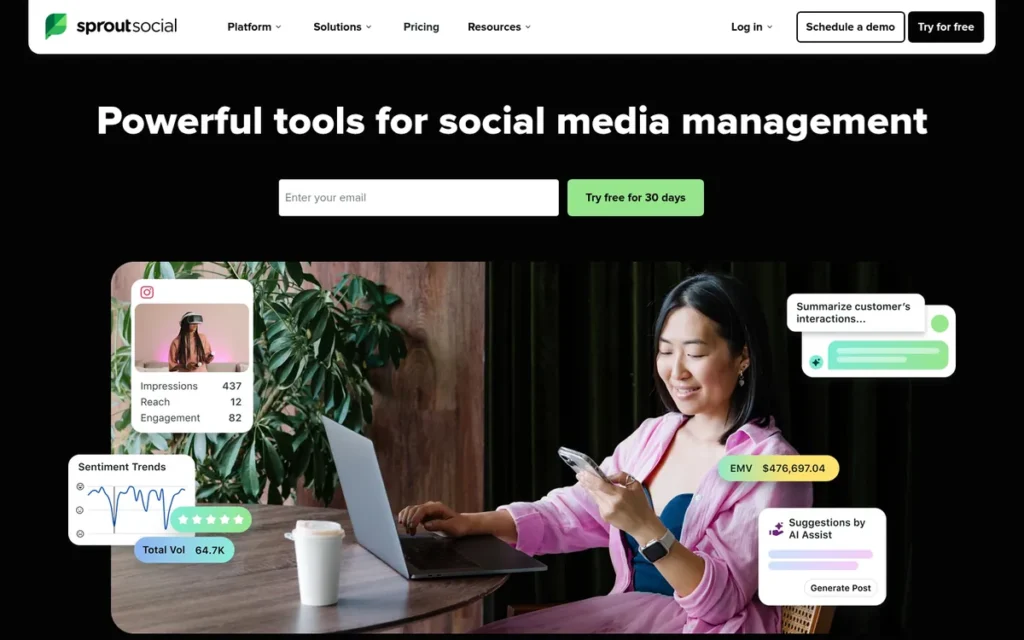
Category: Social-Native Inbox, a platform designed from the ground up as a social media management system with enterprise customer care workflows, rather than a helpdesk adapted to handle social channels as additional ticket sources.
At a Glance
- Category: Social-Native Inbox
- Best For: Social-first customer service teams where social media is the primary support channel, mid-market to enterprise brands managing high inbound message volumes across multiple social profiles with dedicated social care staff and SLA requirements
- Price Range: $249–$499/seat/month (monthly billing); Enterprise at custom pricing; annual discounts available, verify current rates directly. No free tier.
- Primary Strength: Sprout Social is the only platform in this evaluation that handles X/Twitter, Facebook, Instagram, AND LinkedIn natively in a unified care inbox without requiring third-party connectors, the broadest accessible native social channel coverage in this category.
- Biggest Limitation: Sprout Social is the most expensive platform in this evaluation at $249/seat/month minimum, and annual contracts require cancellation in writing by mail at least 30 days before renewal, creating automatic lock-in for teams that miss the cancellation window.
- One-Line Summary: Sprout Social is a social-native customer care platform with the broadest native social channel coverage in its category (including LinkedIn, which no other evaluated platform handles natively at accessible pricing) and documented 50% response time reductions for enterprise clients including Papa Johns.
- Last Verified: May 2026
Overview
Sprout Social is a social-native customer care and social media management platform built for teams where social media is the primary support channel, handling unified message triage, case routing, and SLA tracking across X/Twitter, Facebook, Instagram, LinkedIn, and other social profiles without third-party integrations for any of those channels.
Sprout Social was founded in 2010, went public on NASDAQ (ticker: SPT) in December 2019, and reported approximately 900+ employees globally as of recent company filings (verified May 2026). Sprout Social’s Smart Inbox consolidates all incoming social messages, DMs, mentions, and comments into a single prioritized triage stream, while its Case Management system automatically routes cases using configurable rules based on topic, follower count, VIP status, sentiment, and keyword, a workflow architecture purpose-built for dedicated social care teams.
Key Features
- Smart Inbox: Sprout Social’s Smart Inbox unifies incoming messages, DMs, mentions, and comments from X/Twitter, Facebook, Instagram, LinkedIn, and other connected profiles into a single prioritized triage stream, eliminating agent context-switching between platforms during high-volume service shifts.
- Rules-Based Case Management: Sprout Social’s Case Management system automatically creates and routes cases using configurable rules including topic, profile type, message type, follower count, VIP customer status, language, sentiment, and keyword, reducing manual triage overhead for teams managing multiple brands or profiles.
- Trellis AI: Sprout Social’s Trellis AI (launched Q4 2025) provides Suggested Replies, tone-adjusted response drafting via Enhance by AI Assist, and an upcoming autonomous AI agent designed to resolve routine social inquiries without agent intervention, built on social conversation patterns rather than generic knowledge bases.
- Salesforce Service Cloud Integration: Sprout Social’s Salesforce integration connects social care activity directly to CRM records, enabling agents to see full customer sales history and feeding social interactions into Salesforce cases, positioning Sprout Social as complementary to enterprise service stacks rather than competing with them.
- SLA and Performance Reporting: Sprout Social’s reporting suite tracks SLA compliance, first response time, agent performance, and case resolution metrics across social channels, giving CX managers the data required to justify platform ROI to leadership and identify response-time bottlenecks before they affect published benchmarks.
Best For
Sprout Social is best for mid-market to enterprise social care teams where the majority of customer service interactions arrive via social channels, particularly brands with dedicated social care staff, multiple social profiles to manage, and a leadership requirement to demonstrate measurable response time and SLA improvements.
Sprout Social is less suitable for teams where social is a secondary support channel alongside email and phone, or for SMBs where per-seat pricing creates prohibitive monthly costs relative to ticket volume.
Pricing
Sprout Social pricing (verified May 2026): Standard at $249/seat/month; Professional at $399/seat/month; Advanced at $499/seat/month; Enterprise at custom pricing. A 2-seat Standard team costs approximately $498/month minimum ($5,976/year). A 5-seat team reaches approximately $1,245/month ($14,940/year).
Community reports document contracts averaging $25,000+ annually at mid-sized team scales (r/socialmedia, 2023–2024). Annual billing provides discounts, verify current annual rates directly with Sprout Social. Bot Builder and advanced social listening features are add-ons or higher-tier gated.
CRITICAL CONTRACT DISCLOSURE: Sprout Social annual contracts require cancellation in writing by mail a minimum of 30 days before the renewal date, teams that miss this window are automatically renewed for another full year. Verify contract termination terms before signing.
Strengths
- Papa Johns, using Sprout Social’s Care solution, documented a 50% reduction in customer service response times and saves more than 830 hours annually through automated case routing and centralized social inbox management (Sprout Social case study: Papa Johns, sproutsocial.com/insights/case-studies/papa-johns/, verified May 2026), the most specific and independently documented ROI outcome in this evaluation category.
- Sprout Social is the only platform in this evaluation that includes LinkedIn DM and comment management as a native first-class care channel, directly addressing the B2B social customer service gap that forces every other evaluated platform to rely on third-party integrations for LinkedIn coverage (Sprout Social Smart Inbox feature page).
- Sprout Social’s Spring 2025 enterprise Care solution launch introduced Instagram and WhatsApp bot channels, compliance and governance features, and improved reporting, signaling continued product investment in enterprise social care validated by official investor relations announcement (Sprout Social investor relations, 2025).
- Sprout Social’s Salesforce Service Cloud integration enables enterprise teams to feed social care data directly into Salesforce cases and contact records without custom development, a documented differentiator for organizations already operating the Salesforce enterprise service stack (Sprout Social, verified May 2026).
Limitations
- Cost and Seat Escalation: Sprout Social’s seat-based pricing model means every added team member raises the monthly bill by the full per-seat rate, a scaling pattern community users describe as “so not worth it” for small operations, with Reddit-documented contracts reaching $25,000+ annually at mid-sized team scales (u/doesscoobydoo, r/socialmedia, 2023).
- Annual Contract Auto-Renewal: Sprout Social’s cancellation policy requires written notice by mail at least 30 days before renewal, teams that miss the window are locked in for another full year. This auto-renewal clause may not be prominently disclosed during the standard sales process, community members across multiple r/socialmedia threads (2023–2024) independently report discovering it only after signing (u/Morgan4441, r/socialmedia, April 2024).
- Not a Full Helpdesk: Sprout Social does not natively replicate Zendesk-style SLA ticket workflows with equivalent depth, does not include native phone support operations, and teams needing social integrated into a broader multi-channel helpdesk must pair Sprout Social with a secondary platform, adding cost and integration overhead that reduces the per-seat premium justification.
- Post-Sale Support Quality: Community members across multiple r/socialmedia threads (2023–2024) independently report that Sprout Social’s responsiveness declines after contract signing, a pattern recurring across different users and time periods, consistent with post-sale attention declines that accompany high-pressure enterprise sales motions (u/Morgan4441, r/socialmedia, April 2024).
Verdict
Sprout Social is the highest-rated social-native customer care platform in this evaluation, earning its #1 ranking through the broadest accessible native social channel coverage (including LinkedIn, which no other evaluated platform handles natively), the most specific documented client outcomes (Papa Johns: 50% response time reduction, 830+ hours annual savings), and the most purpose-built social workflow architecture among the seven platforms evaluated. Sprout Social is the correct choice for social-first teams where social media is the primary support channel and measurable SLA performance data is a leadership requirement. Teams on limited budgets or with fewer than five dedicated social care agents should evaluate Freshdesk (#2) first for budget-accessible omnichannel support, or Zendesk (#3) if structured multi-channel SLA governance across email, phone, and social is required.
2. Freshdesk: Best Value for SMBs and Budget-Conscious Mid-Market Teams
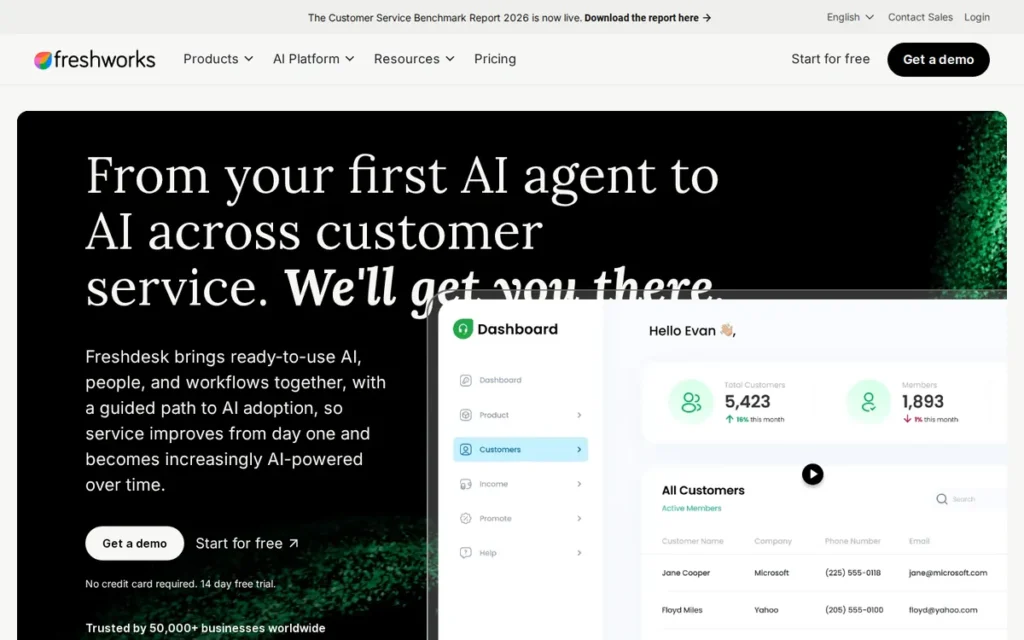
Category: Omnichannel Helpdesk, a ticket-based customer service platform where social media messages are converted into structured support tickets and managed alongside email, phone, and chat in a unified queue with SLA governance.
At a Glance
- Category: Omnichannel Helpdesk
- Best For: SMBs and budget-conscious mid-market teams that need reliable omnichannel social customer service including Facebook, X/Twitter, and Instagram at the most accessible price point in this evaluation, and teams seeking a Zendesk alternative at lower cost
- Price Range: Free (unlimited agents, $0/month); Growth $15/month or $12/month annual; Pro $49/month or $35/month annual; Enterprise $79/month or $59/month annual, per agent
- Primary Strength: Freshdesk is the only platform in this evaluation offering a genuine unlimited-agent free tier at $0/month, with entry-level paid plans from $12/agent/month annually, the most accessible price entry point for omnichannel social customer service in this category.
- Biggest Limitation: Freshdesk’s bot builder, AI Agent Studio, and advanced automation (the features most needed for serious social support automation) are gated behind the Pro tier ($35/agent/month annual), requiring a nearly 3x per-seat price jump from the Growth plan ($12/agent/month annual).
- One-Line Summary: Freshdesk is the most price-accessible omnichannel helpdesk in this evaluation (the only platform with an unlimited-agent free tier and entry-level paid plans from $12/agent/month annually) offering native social support for Facebook, X/Twitter, and Instagram within a ticket-based workflow backed by Freddy AI across all tiers.
- Last Verified: May 2026
Overview
Freshdesk is a cloud-based omnichannel helpdesk platform from Freshworks (NASDAQ: FRSH) that converts customer interactions from Facebook, X/Twitter, Instagram, email, phone, and live chat into unified support tickets, with Freddy AI embedded across pricing tiers for automated triage, response drafting, sentiment analysis, and agent assistance.
Freshdesk was founded in 2010 in Chennai, India, went public on NASDAQ in September 2021, and serves a primarily SMB and mid-market audience as one of the most widely deployed helpdesk platforms globally. Freshdesk’s defining structural advantage over every other evaluated platform is its pricing architecture: the Free plan supports unlimited agents at $0/month, making it the lowest-risk evaluation starting point in this category.
Key Features
- Omnichannel Social Ticketing: Freshdesk converts incoming Facebook posts and DMs, X/Twitter mentions and DMs, and Instagram messages into structured support tickets in real time, routing them through the same assignment, escalation, SLA, and collaboration workflows used for email, no separate social queue management required.
- Freddy AI Suite: Freshdesk’s Freddy AI layer spans auto-triage and ticket prioritization, sentiment analysis, AI reply suggestions, conversation summarization, a Thank You detector to prevent unnecessary ticket reopenings, and an AI Agent Studio for custom automation flows, embedded across pricing tiers rather than available only as premium add-ons.
- Rich Messaging in Social Channels: Freshdesk supports file sharing, GIFs, images, emojis, carousels, calendars, canned responses, bulk chat assignment, and priority inbox in social and chat channels, giving agents the media-rich response toolkit that social customers expect on Instagram and Facebook (GetVoIP, 2025).
- Free Unlimited-Agent Tier: Freshdesk’s Free plan supports unlimited agents with basic ticketing and limited social integrations at $0/month, the only platform in this evaluation offering a genuinely functional unlimited-agent tier that allows teams to evaluate in production before committing any budget.
- Freshworks Ecosystem Growth Path: Freshdesk connects to Freshchat (live messaging), Freshsales (CRM), and FreshService (IT service management) within a single vendor ecosystem, enabling SMBs to expand to additional products as operations scale without migrating to a new platform.
Best For
Freshdesk is best for SMBs and mid-market teams that need reliable omnichannel social customer service (including Facebook, X/Twitter, and Instagram) at the most accessible price point in this evaluation, and for teams currently on Zendesk seeking comparable core functionality at lower total cost.
Freshdesk is also the default starting recommendation for teams new to structured customer service tooling who want to evaluate a platform in production before committing budget.
Pricing
Freshdesk pricing (verified May 2026, per agent/month): Free at $0 (unlimited agents); Growth at $15/month or $12/month annual; Pro at $49/month or $35/month annual; Enterprise at $79/month or $59/month annual (Freshworks pricing page).
At 10 agents on Growth annual: $1,440/year, versus $2,280/year for Zendesk Suite Team at 10 agents annually. The Growth-to-Pro jump is nearly 3x per seat, the most cited friction point in Freshdesk reviews. Teams requiring bot builder, advanced automation, and AI Agent Studio need Pro or Enterprise.
No documented mandatory onboarding fees or mail-only cancellation policies appear in community research, a meaningful contrast to several competitors in this evaluation.
Strengths
- Freshdesk and HubSpot Service Hub both earn 4.5/5.0 on Capterra: tied for the highest Capterra score in this evaluation (verified May 2026), with Freshdesk’s score supported by substantially higher review volume, reflecting broader SMB market penetration and consistent satisfaction with core ticket and social channel functionality (Capterra, verified May 2026).
- Freshdesk’s Free plan with unlimited agents is unique in this evaluation: no other evaluated platform offers a functional unlimited-agent tier at $0/month, making Freshdesk the lowest-risk evaluation starting point for teams uncertain about budget commitment or activation timeline.
- Reddit communities across r/smallbusinessUS and r/SaaS consistently recommend Freshdesk as the primary Zendesk alternative for small teams, with recurring descriptions including “sane pricing, easy for small teams” and “solid features for way less”, organic community endorsement reflecting genuine practitioner consensus (r/smallbusinessUS, January 2026).
- Freshworks has appeared in Gartner-related customer service software market evaluations, recognized on the company’s awards page (Freshworks awards, verified May 2026), providing analyst-adjacent validation relevant for mid-market procurement teams who use Gartner recognition as a shortlist qualifier.
Limitations
- Growth-to-Pro Pricing Jump: Freshdesk’s Growth plan ($12/agent/month annual) includes Freddy AI basics and social channel ticket conversion, but the bot builder, full AI Agent Studio, and advanced automation require the Pro plan ($35/agent/month annual), a nearly 3x per-seat jump that surprises teams who benchmark entry costs and assume Pro features are incremental rather than foundational.
Users on r/SaaS shared their experience:
“Freshdesk is lighter but starts to feel cramped once you try to do anything more advanced. Zendesk has all the knobs and levers, but the learning curve and clutter can be a real drag, especially if you don’t have a big team.” Posted by u/blasian_jedi
Takeaway: Freshdesk’s accessibility ceiling is a documented growth constraint, teams scaling beyond basic ticket operations consistently find the platform’s entry tiers fall short of production support requirements.
- Freddy AI Misconfiguration Risk: In at least one documented production incident, Freddy AI silently routed customers to the wrong support channel for weeks before the team discovered the misconfiguration, confirming that Freshdesk’s AI requires deliberate setup, testing, and monitoring before customer-facing deployment (u/ilovejayme, r/sysadmin, September 2025).
- No LinkedIn Native Support: Freshdesk’s social channel coverage is functional for Facebook, X/Twitter, and Instagram but excludes LinkedIn natively (matching the gap across all evaluated platforms except Sprout Social) and its social-to-ticket architecture is structurally less natural for social-first teams than Sprout Social’s purpose-built inbox.
- Freshworks Ecosystem Vendor Lock-In: Teams that expand from Freshdesk into Freshchat and Freshsales accumulate switching costs that effectively anchor them to the Freshworks platform over time, a vendor dependency risk that grows with each additional product adopted from the ecosystem.
Verdict
Freshdesk is the strongest value-for-money social customer service platform in this evaluation, earning its #2 ranking through the most accessible pricing structure in the category (the only platform with a free unlimited-agent tier and $12/agent/month annual entry), a 4.5/5.0 Capterra rating tied for highest in this evaluation, and consistent community endorsement as the top Zendesk alternative for SMBs. Freshdesk delivers reliable omnichannel social support for Facebook, X/Twitter, and Instagram within a familiar ticket-based workflow at a price point enabling positive ROI within the first month of deployment. Teams selecting Freshdesk should budget for the Pro tier if automation and AI capabilities are deployment requirements, configure and test Freddy AI before customer-facing activation, and should not expect LinkedIn native support or the social-first workflow depth of Sprout Social (#1).
3. Zendesk: Best for Full Omnichannel Helpdesk Operations with Social Channels Embedded
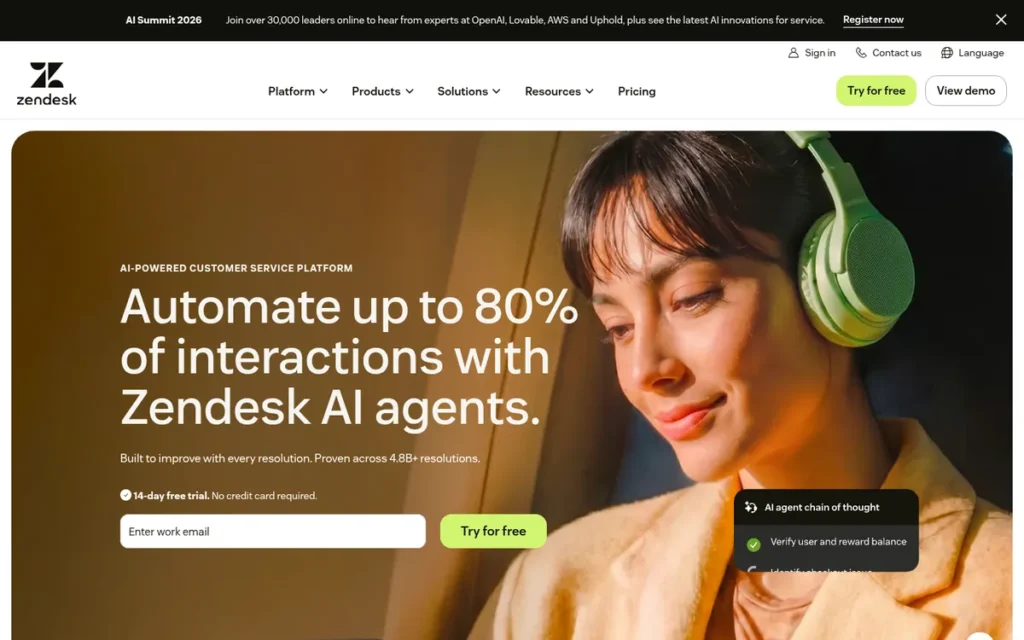
Category: Omnichannel Helpdesk, a ticket-based service platform where every social media interaction is converted into a structured support ticket governed by SLAs, routing rules, and reporting workflows, managed alongside all other support channels in a unified Agent Workspace.
At a Glance
- Category: Omnichannel Helpdesk
- Best For: Enterprise and mid-market customer service teams where social is one of several support channels alongside email, phone, and chat requiring unified SLA management, structured agent workflows, and API-level extensibility to connect social service data to custom enterprise systems
- Price Range: Suite Team $55/month or $19/month annual; Suite Growth $89/month or $55/month annual; Suite Professional $115/month or $89/month annual; Suite Enterprise: contact sales, per agent
- Primary Strength: Zendesk’s omnichannel Agent Workspace converts social interactions from Facebook, X/Twitter, Instagram, and WhatsApp into SLA-governed tickets managed alongside email, phone, and chat in a single unified interface, backed by 1,000+ Marketplace integrations and the Sunshine extensibility platform.
- Biggest Limitation: Zendesk does not support LinkedIn as a native first-class customer service channel (requiring third-party Marketplace apps) and its AI capabilities are characterized by community practitioners in 2025–2026 as retrofitted onto legacy architecture rather than architecturally native, reducing AI performance relative to purpose-built competitors.
- One-Line Summary: Zendesk is the market-standard omnichannel helpdesk for enterprise and mid-market teams, converting social media interactions from Facebook, X/Twitter, Instagram, and WhatsApp into SLA-governed support tickets within a unified Agent Workspace backed by 1,000+ Marketplace integrations and the Sunshine extensibility platform.
- Last Verified: May 2026
Overview
Zendesk is a full omnichannel customer service platform where social media interactions (including Facebook posts and DMs, X/Twitter mentions and DMs, Instagram DMs and story replies, and WhatsApp messages) are converted into structured support tickets and managed alongside email, phone, and chat in a single Agent Workspace with enterprise-grade SLA governance, routing automation, and analytics.
Zendesk was founded in 2007 in Copenhagen, went public on NYSE in 2014, and was taken private by a consortium led by Permira and Hellman & Friedman in November 2022 at approximately $10.2 billion. Zendesk’s defining architectural characteristic is social-as-tickets: every social interaction becomes a trackable, assignable, SLA-governed ticket, making it the default choice for teams that need social support embedded within a structured, measurable, multi-channel service operation.
Key Features
- Unified Agent Workspace: Zendesk’s Agent Workspace consolidates social media messages from Facebook, X/Twitter, Instagram, and WhatsApp alongside email, phone, and live chat into a single unified interface, enabling agents to manage all channels from one screen without context-switching between platforms during a shift.
- Social-to-Ticket Conversion: Zendesk transforms every Facebook post and DM, X/Twitter mention and DM, and Instagram DM and story reply into a trackable support ticket with assignable ownership, SLA countdown timers, escalation rules, collaboration notes, and audit trail, embedding social support within the same governance framework as all other service channels.
- 1,000+ Marketplace Integrations: Zendesk’s Marketplace ecosystem exceeds 1,000 integrations covering LinkedIn (via third-party apps), YouTube, Google My Business, Sprout Social, Brandwatch, and Sprinklr, enabling teams to extend channel coverage and CRM connectivity through pre-built connectors (Zendesk social customer service page).
- Sunshine Extensibility Platform: Zendesk’s Sunshine platform enables API-level custom data objects and integrations, allowing enterprise development teams to connect social service data to billing systems, CRM records, e-commerce platforms, and identity systems in ways most social tools or lighter helpdesks cannot support.
- AI Agent and Copilot: Zendesk AI capabilities include AI agents for automated query resolution, AI Copilot for real-time agent response assistance, and intelligent ticket routing, available across Suite plans with the broadest AI functionality on higher-tier Professional and Enterprise plans.
Best For
Zendesk is best for enterprise and mid-market customer service teams where social is one of several support channels alongside email, phone, and chat, and where the operational requirement is structured SLA governance, team accountability, and unified reporting across all channels in a single platform.
Zendesk is also the strongest choice for teams requiring API-level extensibility to connect social service data to custom enterprise systems through the Sunshine platform.
Pricing
Zendesk Suite pricing (verified May 2026): Suite Team at $55/agent/month (monthly) or $19/agent/month (annual); Suite Growth at $89/month or $55/month annual; Suite Professional at $115/month or $89/month annual; Suite Enterprise at custom pricing (Zendesk pricing page).
Annual billing is significantly more competitive, Suite Team drops 65% from monthly to annual rate. At 10 agents on Suite Team annual: $2,280/year. Community reports document a 20-person team receiving a $3,000/month quote (r/smallbusinessUS, January 2026).
LinkedIn support requires Marketplace add-on apps at additional cost. Zendesk has been private since November 2022, so quarterly financial reporting is no longer publicly available.
Strengths
- BlendJet, a consumer products brand, uses Zendesk’s centralized Agent Workspace for social media ticket management, citing faster access to customer history and quicker social response times as primary operational benefits (Zendesk blog, 2025), a qualitative reference consistent with Zendesk’s social-to-ticket architecture promise, noted as qualitative in the absence of a published quantitative metric.
- Zendesk’s Marketplace ecosystem exceeds 1,000 integrations as of May 2026: the largest third-party integration network among all evaluated platforms, enabling LinkedIn coverage, social listening, CRM connectivity, and custom data workflows that extend beyond native capabilities without custom engineering (Zendesk Marketplace, verified May 2026).
- G2 rates Zendesk Suite at 4.3/5.0 and Capterra at 4.4/5.0 with very high review volume, reflecting deep enterprise and mid-market deployment history that enables buyers to find peer companies in similar industries and at similar team scales for reference validation (G2, verified May 2026).
- Zendesk’s Sunshine extensibility platform enables API-level custom data object creation and integration, providing enterprise development teams a documented pathway to connect social service data to any business system, a capability depth that most social-native tools and lighter helpdesks do not offer.
Limitations
- No Native LinkedIn Coverage: Zendesk does not support LinkedIn as a native first-class channel, managing LinkedIn DMs and public comments requires third-party Marketplace apps, adding cost, configuration complexity, and additional vendor dependencies for B2B organizations where customer complaints frequently escalate on LinkedIn (eesel AI, 2025).
- AI Architecture Criticism: Multiple Reddit practitioners in 2025–2026 describe Zendesk’s AI as “bolted on rather than native” and “essentially trying to add AI functionality onto legacy architecture”, characterizations consistent with Zendesk’s AI being catch-up innovation rather than foundational design (u/Signal-Extreme-6615, r/OnlineMarketing, February 2026; u/Ok-Path-8964, r/sysadmin, December 2025).
Users on r/Zendesk noted:
“Zendesk’s got a ton of features, and with some setup (and may be a tech-savvy teammate), it can do a lot. But the bots get annoying quick, and canned replies feel super robotic unless you tweak ’em. Also, the pricing stacks up fast-definitely not plug and play.” Posted by u/jessicalacy10
Takeaway: Zendesk’s AI automation and pricing are friction points even among practitioners who ultimately adopt the platform, confirming that its power requires deliberate technical configuration before delivering on the omnichannel helpdesk promise.
- SMB Pricing Friction: Community reports of a 20-person team handling approximately 100 tickets per week being quoted $3,000/month ($36,000/year) confirm Zendesk’s calibration for enterprise rather than small businesses, teams below 15–20 agents with moderate ticket volumes will find Freshdesk (#2) delivers comparable core social functionality at substantially lower total cost.
- Post-Privatization Transparency Gap: Zendesk went private in November 2022, meaning quarterly financial transparency that publicly traded alternatives (Freshworks, Sprout Social, HubSpot, Sprinklr) provide is no longer available, a due diligence consideration for organizations with vendor financial stability requirements in their procurement process.
Verdict
Zendesk is the market-standard omnichannel helpdesk for enterprise and mid-market teams, ranking #3 in this evaluation on the strength of its structured social-to-ticket architecture, 1,000+ Marketplace integrations, and deep deployment history reflected in strong G2 and Capterra review volumes. Zendesk is the correct choice when social support must be governed within a multi-channel service operation with SLA accountability, structured reporting, and enterprise-level integration extensibility. Teams choosing Zendesk over Sprout Social (#1) trade social-native workflow depth and native LinkedIn coverage for deeper ticket-based helpdesk structure; teams choosing Zendesk over Freshdesk (#2) pay a premium for the Sunshine extensibility platform and the larger Marketplace ecosystem.
4. Sprinklr: Best for Enterprise Global Brands Requiring Unified CXM with Governance Controls
Category: Unified CXM Platform, an enterprise-grade system that unifies social management, customer service operations, market intelligence and listening, and marketing campaigns under a single platform architecture and shared data model, with social customer service as one pillar of a broader customer experience stack.
At a Glance
- Category: Unified CXM Platform
- Best For: Fortune 500 and large enterprise brands requiring a single platform to unify social customer care, social listening, contact center operations, and marketing, particularly global organizations managing 10+ channels including regional non-Western social networks, or regulated industries requiring AI governance and compliance audit trails
- Price Range: Custom enterprise pricing only: contact sales required. Six-figure annual commitments typical for enterprise deployments. No publicly listed tiers. No free tier.
- Primary Strength: Sprinklr supports 30+ social and messaging channels in a single Unified-CXM platform (the broadest native channel coverage in this evaluation) and is used by approximately 59% of the Fortune 100, including Microsoft, Samsung, and P&G, as reported in company investor materials (Sprinklr investor relations, verified May 2026).
- Biggest Limitation: Sprinklr’s pricing is entirely opaque with no publicly listed tiers and no self-serve evaluation path, its G2 score of 4.2/5.0 is the lowest among all seven evaluated platforms, and its steep learning curve and long implementation timelines are documented primary criticisms, restricting its realistic audience to large enterprises with dedicated platform administrators and six-figure software budgets.
- One-Line Summary: Sprinklr is an AI-native Unified Customer Experience Management platform used by approximately 59% of the Fortune 100 (vendor-reported), offering the broadest social channel coverage in this evaluation at 30+ channels with enterprise-grade AI governance, compliance controls, and unified management of social care, listening, and marketing under a single architecture.
- Last Verified: May 2026
Overview
Sprinklr is an AI-native Unified Customer Experience Management (Unified-CXM) platform organized into four product suites (Sprinklr Social, Sprinklr Service, Sprinklr Insights, and Sprinklr Marketing) that collectively unify social customer care, contact center operations, market research, and campaign management for enterprise organizations under a single data model.
Sprinklr was founded in 2010 by Ragy Thomas, went public on NYSE (ticker: CXM) in June 2021, and reported annual revenues in the $600–700M+ range based on recent NYSE: CXM public filings (verified May 2026). Sprinklr’s defining architectural position is that it does not compete as a social customer service tool (it positions as the enterprise platform that replaces separate social management, listening, service, and marketing systems) making it the only platform in this evaluation competing in the Unified-CXM category.
Key Features
- 30+ Channel Unified Social Care Inbox: Sprinklr’s unified inbox supports 30+ social and messaging channels (including Facebook, X/Twitter, Instagram, LinkedIn, WhatsApp, YouTube, TikTok, and regional platforms across Asia-Pacific and the Middle East) the broadest native channel coverage of any evaluated platform, essential for global brands requiring consistent social care across all international markets.
- Spring 2026 AI Governance Layer: Sprinklr’s Spring 2026 release introduced next-generation compliance controls, governed automation, AI telemetry features, and bulk testing in AI+ Studio, providing the auditability of AI-powered social care actions that regulated industries require before deploying automation at scale, functionality not matched by any other evaluated platform (Sprinklr investor press release, Spring 2026).
- AI-Powered Routing and Agent Copilot: Sprinklr’s AI layer includes AI-powered case routing, Agent Copilot for response drafting, automated sentiment analysis across social conversations, and a vendor-reported 1.4x agent productivity improvement (Sprinklr customer service software page, verified May 2026; no independent third-party corroboration found as of May 2026), built on an AI-native architecture that predates social care AI as a feature category.
- Unified-CXM Data Architecture: Sprinklr natively shares social care data with social listening (Sprinklr Insights), marketing campaigns (Sprinklr Marketing), and contact center operations (Sprinklr Service), eliminating data silos between marketing, service, and customer intelligence that require custom integrations in every other evaluated platform.
- Fortune 100 Enterprise Customer Base: Sprinklr reports serving approximately 59% of the Fortune 100, including 9 of the top 10 global technology companies worldwide (Sprinklr investor relations, verified May 2026; figure is vendor-reported and has not been independently audited), providing procurement teams with peer-level enterprise reference customers for RFP justification.
Best For
Sprinklr is best for Fortune 500 and large enterprise brands that need a single platform to unify social customer care with social listening, contact center, and marketing, particularly global organizations managing social presences across 10+ channels including regional non-Western platforms.
Sprinklr is also suited for organizations in regulated industries (financial services, healthcare, telecom) that require AI governance, compliance audit trails, and brand safety controls before deploying social automation at scale. Sprinklr is not appropriate for SMBs, most mid-market teams, or any organization without a dedicated platform administrator team and six-figure software budget.
Pricing
Sprinklr does not publicly disclose pricing (verified May 2026 at sprinklr.com/pricing). All pricing is custom-quote based, structured around product modules purchased, user count, channel volume, deployment scope, and professional services requirements.
Market intelligence from third-party analysts indicates Sprinklr contracts typically involve six-figure annual commitments for enterprise deployments. No free tier is available, and no self-serve trial exists. Mid-market teams self-qualifying on budget should assume Sprinklr pricing exceeds typical mid-market software budgets until a discovery call confirms otherwise.
Strengths
- Sprinklr reports serving approximately 59% of the Fortune 100, including Microsoft, Samsung, and P&G, and 9 of the top 10 global technology companies, as stated in company investor materials (Sprinklr investor relations, verified May 2026; vendor-reported, not independently audited), the highest peer-level enterprise validation claim of any platform in this evaluation.
- Sprinklr’s Spring 2026 product release introduced next-generation AI governance features including compliance controls, governed automation, AI telemetry, and bulk testing in AI+ Studio, purpose-built regulatory compliance functionality that no other evaluated platform offers for regulated industry deployments requiring documented AI auditability (Sprinklr investor press release, Spring 2026).
- Technology analyst firm Omdia (an Informa Tech subsidiary) published analysis describing Sprinklr’s AI platform as “redefining unified CX” in 2026, providing third-party analyst validation that enterprise procurement teams commonly require before committing to six-figure annual contracts (Omdia analyst report, 2026).
- Among the seven platforms evaluated in this article, Sprinklr is the only one with documented native coverage of regional social platforms across Asia-Pacific and the Middle East, making it the strongest evaluated option for global brands requiring consistent international social care from a single platform.
Limitations
- Pricing Opacity and No Self-Serve Evaluation Path: Sprinklr’s contact-sales-only model (with no free tier and no self-serve evaluation option) requires mid-market teams to invest significant discovery time before learning whether the platform is within budget range. Every other evaluated platform except Kustomer offers either a free tier (Freshdesk, HubSpot) or pricing transparency (Zendesk, Sprout Social) that allows self-qualification before sales engagement.
- Lowest G2 Rating in Evaluation: Sprinklr scores 4.2/5.0 on G2: the lowest rating among all seven evaluated platforms, with consistent documentation of steep learning curves, admin complexity, high total cost, and long implementation timelines as primary operational risks (G2, verified May 2026).
- Overkill Below Enterprise Scale: Community characterizations of Sprinklr as “overkill for SMBs,” “complex to deploy,” and “harder to learn” are consistent across G2, Capterra, and community aggregations, for organizations at or below mid-market scale, Sprout Social (#1), Zendesk (#3), or Freshdesk (#2) provide better operational value at lower implementation risk.
- Limited Organic Community Validation: Reddit community discussions show Sprinklr appearing primarily as a name-drop reference rather than a product practitioners have direct experience evaluating (“I’ve heard of Sprinklr on other threads” being representative) confirming limited organic community presence below the enterprise tier (u/elrosegod, r/SocialMediaManagers, May 2026).
Verdict
Sprinklr is the most capable enterprise social customer service platform in this evaluation, ranking #4 overall based on the highest social channel coverage (30+ channels), the strongest Fortune 100 peer validation claim, and the only AI governance feature set designed for regulated industry deployments, but scoring lower on the criteria most decisive for the full audience range: pricing transparency (contact-sales only), review ratings (4.2/5.0, the lowest in this evaluation), and implementation accessibility. Sprinklr is the correct choice for global Fortune 500 brands with dedicated CXM platform administrators, six-figure software budgets, and compliance audit requirements; Sprinklr is not the correct choice for SMBs, mid-market teams under approximately 500 employees, or organizations that cannot sustain a multi-month implementation project with professional services support.
5. Intercom: Best for SaaS and Digital-Native Tech Companies Prioritizing AI-Native Automation
Category: AI-First Messenger, a business messaging platform built around AI-powered automated resolution (Fin AI agent) and human agent collaboration (Copilot), designed primarily for in-app chat, web messaging, and email rather than native social media channel management across public platforms.
At a Glance
- Category: AI-First Messenger
- Best For: SaaS companies, digital-native tech businesses, and product-led growth organizations where customer service interactions occur primarily in-app or via web chat, and where AI autonomous resolution of structured, well-documented product support queries is the primary ROI driver
- Price Range: Subscription tiers (Starter, Pro, Premium) plus per-AI-resolution charges, exact rates require a sales conversation; see intercom.com/pricing. Community reports confirm significant bill escalation at scale. Total cost is volume-dependent and requires careful modeling before commitment.
- Primary Strength: Intercom’s Fin AI agent is architecturally purpose-built for autonomous resolution (not retrofitted onto a legacy helpdesk) and Intercom reports an average 67% resolution rate across Fin deployments, with top implementations reaching 75–80%+ (Intercom, fin.ai/glossary/resolution-rate, verified May 2026).
- Biggest Limitation: Intercom does not natively support Twitter/X DMs, LinkedIn, or public social media comment management (making it typically unsuitable as a primary social customer service platform for teams where public social channels are the dominant support touchpoint) and its per-resolution AI pricing model creates unpredictable bill escalation risk that community users have documented in detail.
- One-Line Summary: Intercom is an AI-first customer service platform with the highest G2 and Capterra scores in this evaluation (both 4.5/5.0), built around Fin AI with a reported 67% average resolution rate, but designed for in-app chat and web messaging rather than native social media channel management, with per-resolution pricing that requires careful cost modeling before deployment.
- Last Verified: May 2026
Overview
Intercom is an AI-first customer service platform founded in 2011 in San Francisco, privately held with approximately $240M+ in venture funding from investors including Index Ventures and Bessemer Venture Partners (Crunchbase, last updated 2022), built around Fin (its autonomous AI agent) and a shared human/AI workspace where agents collaborate with AI to resolve customer queries across in-app messaging, web chat, email, and select social messaging channels.
Intercom describes itself as “the only helpdesk built for the AI Agent era”, its interfaces feel like modern messaging applications rather than ticket-queue helpdesks. Intercom serves primarily SaaS companies, tech businesses, and digital-native organizations where customer service is deeply integrated with the product experience and where well-documented knowledge bases enable high Fin autonomous resolution rates.
Key Features
- Fin AI Agent: Intercom’s Fin AI agent is architecturally purpose-built for autonomous customer query resolution, Intercom reports an average 67% resolution rate across Fin deployments, with top implementations reaching 75–80%+ (Intercom, fin.ai/glossary/resolution-rate, verified May 2026), reducing both labor cost and response time in well-configured SaaS deployments.
- Copilot AI for Human Agents: Intercom’s Copilot AI assists human agents handling escalated queries by drafting responses, summarizing conversation context, surfacing relevant knowledge base articles in real time, and providing step-by-step resolution guidance, reducing average handle time for complex queries that Fin’s autonomous resolution does not cover.
- Shared Human/AI Workspace: Intercom’s shared inbox provides a unified workspace where human agents and AI collaborate on conversations from in-app messaging, web chat, email, WhatsApp, and Facebook Messenger, with documented handoff protocols between Fin’s automated responses and human agent takeover for escalated cases.
- Enterprise Security Trust Center: Intercom’s Trust Center (intercom.com/trust) documents SOC 2 compliance and enterprise-grade security certifications, addressing the security review requirement for enterprise buyers before committing customer data to the platform.
- Conversational Messaging Architecture: Intercom’s thread-based interface is designed for modern messaging interactions rather than traditional ticket queues, providing a more natural interaction model for digital-native customers while its API enables deep product data integration for context-aware automated responses in SaaS deployments.
Best For
Intercom is best for SaaS companies, product-led growth businesses, and digital-native technology organizations where customer service interactions occur primarily in-app or via web chat, and where the primary ROI driver is Fin AI’s autonomous resolution applied to structured, well-documented product support queries with predictable volume.
Intercom is not suitable for teams where social channels (Twitter/X, Instagram public comments, LinkedIn) are primary customer touchpoints, or for teams that cannot accurately model per-resolution AI costs before signing.
Pricing
Intercom pricing is available at intercom.com/pricing (verified May 2026). Intercom’s model includes platform subscription tiers (Starter, Pro, Premium) PLUS additional per-AI-resolution charges for Fin’s autonomous responses, meaning total monthly cost is a function of subscription plus AI resolution volume.
As of May 2026, Intercom does not publicly list exact monthly subscription rates, a sales conversation is required for a firm quote. Community reports document bills climbing substantially at a 12-person team within six months due to seat additions, AI resolution charges, and add-ons not clearly communicated at contract signing (u/TigerAnxious9161, r/SaaS, March 2026).
Model costs at 2x and 3x expected query volume before signing any Intercom contract.
Strengths
- Intercom earns G2 and Capterra scores of 4.5/5.0: the joint-highest ratings of any platform in this evaluation, with high review volume across both platforms, reflecting consistent user satisfaction among its core SaaS and digital-native customer base (G2 Intercom reviews, verified May 2026; Capterra, verified May 2026).
- Intercom’s Fin AI is architecturally purpose-built for autonomous resolution rather than retrofitted onto a legacy helpdesk, a structural distinction that community practitioners in 2025–2026 identify as the key differentiator between genuine AI-native platforms and legacy platforms adding AI as a feature layer, with Intercom reporting 67% average resolution rates across deployments (fin.ai/glossary/resolution-rate, verified May 2026).
- Named Fin AI customers including Anthropic, Linear, and Clay: digital-native, documentation-rich SaaS organizations, represent Fin’s optimal performance context and provide deployment reference data for similar technology companies evaluating whether Fin’s resolution rates are achievable in their specific environment (Intercom Fin customer stories).
- Intercom’s layered AI architecture (Fin for automation, Copilot for agent assist) drives efficiency improvements even in deployments where Fin’s autonomous resolution rate falls below the 67% average, the human agent acceleration layer has documented design value independent of Fin’s resolution percentage (Intercom Copilot product page).
Limitations
- Fundamental Social Channel Gap: Intercom does not natively support Twitter/X DMs, LinkedIn DMs or comments, or public social media comment management, social coverage is limited to WhatsApp, Instagram (via partners like Octopods), and Facebook Messenger. Intercom is typically unsuitable as the primary platform for teams where public social channels are the dominant customer support touchpoint; teams whose social exposure is limited to WhatsApp and Facebook Messenger may find Intercom’s channel coverage sufficient for their specific mix (Octopods Intercom guide).
- Per-Resolution Pricing Bill Shock: Intercom’s per-AI-resolution charge model creates bill escalation risk that community members have documented with specificity, one r/SaaS user reported bills climbing substantially at a 12-person team within six months (u/TigerAnxious9161, March 2026), and an r/customerexperience user documented migrating from Fin to a less expensive alternative after costs became unsustainable (u/Dull-Acanthaceae4601, r/customerexperience, July 2025).
This aligns with community sentiment on r/SaaS:
“I have done this migration twice at different companies, so let me give you the honest version. The first time we moved to Intercom, we were a 12-person team with about 8 support agents. The initial sticker price looked reasonable. Six months later the bill had climbed because of seat additions the AI resolution charges, and a couple of add-ons we didn’t realize were optional at signing. Finance was not pleased.” Posted by u/TigerAnxious9161
Takeaway: Intercom’s compound billing model (seats plus per-resolution AI charges plus unlabeled add-ons) reliably produces bill shock within six months at teams above eight agents, regardless of initial cost modeling.
- Fin AI Context Dependency: Intercom’s reported 67% average resolution rate (verified May 2026) reflects deployments with well-structured, comprehensive knowledge bases. Retail, e-commerce, or service businesses with contextual or order-specific queries consistently underperform this average, requiring more human agent intervention than the headline figure suggests. Budget for dedicated knowledge base development as a prerequisite for Fin deployment, not an optional enhancement.
- Pricing Complexity at Scale: Intercom’s combination of subscription tiers, per-resolution charges, seat costs, and add-ons creates a pricing model that community users describe as “spaghetti pricing”, making total cost of ownership difficult to model accurately before contract signing, particularly for teams experiencing rapid growth in support volume.
Verdict
Intercom is the strongest AI-native customer service platform in this evaluation, ranking #5 overall due to a fundamental structural limitation as a social customer service platform (no native Twitter/X, LinkedIn, or public social comment management) despite earning the highest review scores in the category (G2 and Capterra both 4.5/5.0) and the most purpose-built AI architecture evaluated. Intercom is the correct choice for SaaS companies and digital-native businesses where customer service lives primarily in-app and via web chat, knowledge bases are well-structured, and AI autonomous resolution ROI can be accurately modeled before signing. Intercom is the wrong choice for any team that relies on Twitter/X, Instagram public comments, or LinkedIn as primary support channels, those teams should evaluate Sprout Social (#1), Zendesk (#3), or Freshdesk (#2).
6. Kustomer: Best for DTC and E-Commerce Brands Needing Social Plus Order Data in One Agent View
Category: CRM-Native Timeline, a customer service platform that replaces the traditional ticket model with a unified Customer Timeline presenting every interaction across all channels alongside purchase history, loyalty data, and behavioral signals in a single chronological agent view.
At a Glance
- Category: CRM-Native Timeline
- Best For: DTC e-commerce brands, Shopify/Magento/WooCommerce sellers, and high-volume consumer brands where agents need immediate access to customer order history, loyalty status, and purchase patterns when responding to social media messages, particularly brands where Facebook, Instagram, and WhatsApp are primary social support channels
- Price Range: Custom enterprise pricing: contact sales required. Third-party estimates suggest starting from approximately $89–$129/user/month depending on configuration (pagergpt.ai and comparable sources, 2025–2026). Treat estimates as directional only; verify via Kustomer sales conversation. No free tier.
- Primary Strength: Kustomer’s Customer Timeline is the only architecture in this evaluation that natively combines social media messages, e-commerce order data (Shopify, Magento, WooCommerce), purchase history, and loyalty status in a single unified agent view, eliminating the context-switching that e-commerce social support teams experience between helpdesk, order management, and social platforms.
- Biggest Limitation: Kustomer has no publicly listed pricing, a steep implementation learning curve that community users describe as “overkill for our needs” at non-enterprise scale, and Meta’s 2022 acquisition introduces enterprise procurement data governance concerns that large organizations cite as a due diligence flag before committing customer data to a Meta-owned platform.
- One-Line Summary: Kustomer is a CRM-native customer service platform owned by Meta, used by DTC brands including Everlane (documented 4X increase in live service deflection) and Ring, built around a Customer Timeline that unifies social messages, e-commerce order history, and customer data in a single agent view, making it the strongest platform in this evaluation for social customer service at high-volume DTC and e-commerce brands.
- Last Verified: May 2026
Overview
Kustomer is a CRM-native customer service platform that replaces the ticket model with a Customer Timeline (a chronological, unified view of every customer interaction across social media, email, chat, SMS, and voice alongside purchase history, loyalty data, churn risk signals, and behavioral attributes) giving agents complete customer context without switching between helpdesk, order management, and social platforms.
Kustomer was founded in 2015 in New York City by Brad Birnbaum and Jeremy Suriel, both former Salesforce and DESK.com executives, and was acquired by Meta (Facebook) in February 2022 for approximately $1 billion. A note for DTC e-commerce buyers: Kustomer is entirely absent from all major AI search engine responses to social customer service queries surveyed for this article in May 2026, teams building shortlists using Perplexity, ChatGPT, or similar AI search tools will systematically miss this platform, which most directly addresses the social-plus-order-data integration requirement.
Key Features
- Customer Timeline Architecture: Kustomer’s Customer Timeline presents every social message, email, chat interaction, and purchase event in a single chronological customer record, replacing the ticket model with a view where agents see the complete customer story before typing a response, including order status, past complaints, loyalty tier, and behavioral signals from all prior interactions (Kustomer Help Center, Customer Timeline).
- E-Commerce Platform Integrations: Kustomer integrates natively with Shopify, Magento, and WooCommerce, pulling order data directly into the Customer Timeline so agents instantly see order history, tracking status, and purchase details when a customer contacts via Instagram DM or Facebook message, without manual lookup or platform switching during the service interaction.
- KustomerIQ with Signals: Kustomer’s KustomerIQ AI layer includes Customer Assist chatbot, intelligent routing based on customer profile data, sentiment analysis, and the Signals feature that proactively surfaces contextual customer insights (repeat issue patterns, churn risk, purchase behaviors) when a conversation opens, providing agents with contextual intelligence before they respond (No Jitter, 2025).
- Meta-Native Facebook and Instagram Integration: Kustomer’s Meta ownership provides unique integration depth with Facebook Messenger and Instagram DMs through direct access to Meta’s messaging infrastructure rather than third-party API connectors, a structural platform advantage for brands where Meta-owned channels are the primary social support touchpoint.
- CRM and Collaboration Connectivity: Kustomer connects natively to Salesforce, HubSpot, Slack, Microsoft Teams, and Zapier, enabling enterprise teams to route Customer Timeline data into existing CRM and collaboration infrastructure without custom development work.
Best For
Kustomer is best for DTC e-commerce brands, high-volume consumer labels, and Shopify/Magento/WooCommerce sellers where social media support is inseparable from order management, teams where an Instagram DM about a delayed shipment requires immediate access to order data, and where the volume of social interactions justifies a dedicated CRM-native platform with a sales-assisted procurement process.
Kustomer is not appropriate for SMBs with limited implementation resources, B2B organizations with low social support volume, or teams that require Twitter/X or LinkedIn as primary native care channels.
Pricing
Kustomer does not publicly disclose pricing (verified May 2026 at kustomer.com/pricing). All pricing requires direct engagement with Kustomer’s enterprise sales team.
Third-party pricing aggregators estimated starting costs at approximately $89–$129/user/month as of 2025–2026 (pagergpt.ai and comparable sources), treat these as directional estimates and verify via sales conversation before including in any budget model. No free tier is available.
Teams evaluating Kustomer should request a fully itemized total cost of ownership projection including implementation and professional services before comparing against Freshdesk’s published $12/agent/month or Zendesk’s published $19/agent/month pricing.
Strengths
- Everlane, a DTC apparel brand, documented a 4X increase in live service deflection, four times more customer inquiries resolved without live agent involvement, after implementing Kustomer AI (Kustomer case study: Everlane, kustomer.com/customers/everlane/, verified May 2026), the strongest AI deflection outcome data point in this evaluation.
- Kustomer’s Customer Timeline architecture is validated by a direct production customer testimonial describing “one simple place where we can view data across email, live chat, telephone, SMS, Facebook and sales data”, direct confirmation that the social-plus-order-data unification delivers on its architectural promise (Kustomer customer service CRM page).
- Kustomer is owned by Meta (acquisition February 2022, approximately $1 billion), providing unique Facebook Messenger and Instagram DM integration depth through direct access to Meta’s messaging infrastructure rather than third-party API connectors, a structural advantage for brands where Meta-owned channels are the primary social support touchpoint.
- Named enterprise DTC customers including Ring, Glovo, and ThirdLove provide social proof specific to the DTC and consumer brand vertical (alongside community-cited references to Spanx as a Kustomer user (community-cited, r/shopify, September 2023; not a confirmed Kustomer-published case study customer)) with no other evaluated platform matching this level of DTC e-commerce buyer specificity.
Limitations
- Pricing Opacity and Evaluation Friction: Kustomer’s contact-sales-only pricing model makes competitive budget comparison against Freshdesk’s published $12/agent/month or Zendesk’s $19/agent/month impossible until late in the procurement cycle, creating sunk evaluation cost risk for teams that invest significant discovery time before receiving a number that exceeds their budget.
- Implementation Complexity and Learning Curve: Kustomer’s Customer Timeline architecture carries a steeper learning curve than ticket-based systems, multiple community users describe Kustomer as “overkill for our needs” at sub-enterprise scale and “feels more like a CRM than a support tool sometimes,” suggesting meaningful onboarding investment before agents become productive (u/jstnthrfndr, r/ProductManagement, December 2022; u/Signal-Extreme-6615, r/OnlineMarketing, February 2026).
- Meta Ownership Procurement Risk: Large organizations conducting data governance reviews flag Meta’s corporate reputation and data practices as due diligence items before committing customer data to a Meta-owned platform, a procurement risk factor that does not exist for the publicly traded alternatives (Freshworks, Sprout Social, HubSpot, Sprinklr) in this evaluation.
- Limited Twitter/X and LinkedIn Coverage: Kustomer’s social channel strength is concentrated in Meta-owned channels (Facebook, Instagram, WhatsApp), Twitter/X public mentions and LinkedIn are not prominently featured as native Kustomer care channels, limiting coverage for brands requiring broader social channel management beyond Meta’s ecosystem.
Users on r/CustomerSuccess noted:
“If comment management on social media is a big part of your social teams workflow, Kustomer might not be the right platform. To my knowledge, comments don’t pull in from social platforms and teams aren’t able to respond to comments via Kustomer. Additionally in my experience, the voice channel is incredibly buggy. My phone team is continually troubleshooting repeated issues like calls dropping, audio issues, calls not being routed.” Posted by u/_ok_anyway
Takeaway: Kustomer’s social coverage is confirmed by practitioners to exclude public comment management across social platforms, teams whose social support workflow extends beyond Meta-owned DMs will encounter a structural channel gap the platform does not resolve.
Verdict
Kustomer is the strongest platform in this evaluation for DTC e-commerce social customer service, ranking #6 overall but effectively #1 for its specific use case, high-volume consumer brands where social support is inseparable from order history and where Shopify, Magento, or WooCommerce integration is a non-negotiable workflow requirement. Kustomer’s 4X live service deflection outcome from Everlane, Customer Timeline architecture, and Meta-backed Facebook/Instagram integration depth represent capabilities no other evaluated platform matches for DTC e-commerce buyers. Teams outside this specific profile, SMBs, B2B organizations, or teams requiring Twitter/X or LinkedIn as primary native care channels, will find Freshdesk (#2), Zendesk (#3), or Sprout Social (#1) better fits at lower implementation cost and risk.
7. HubSpot Service Hub: Best for Organizations Already Operating in the HubSpot Ecosystem
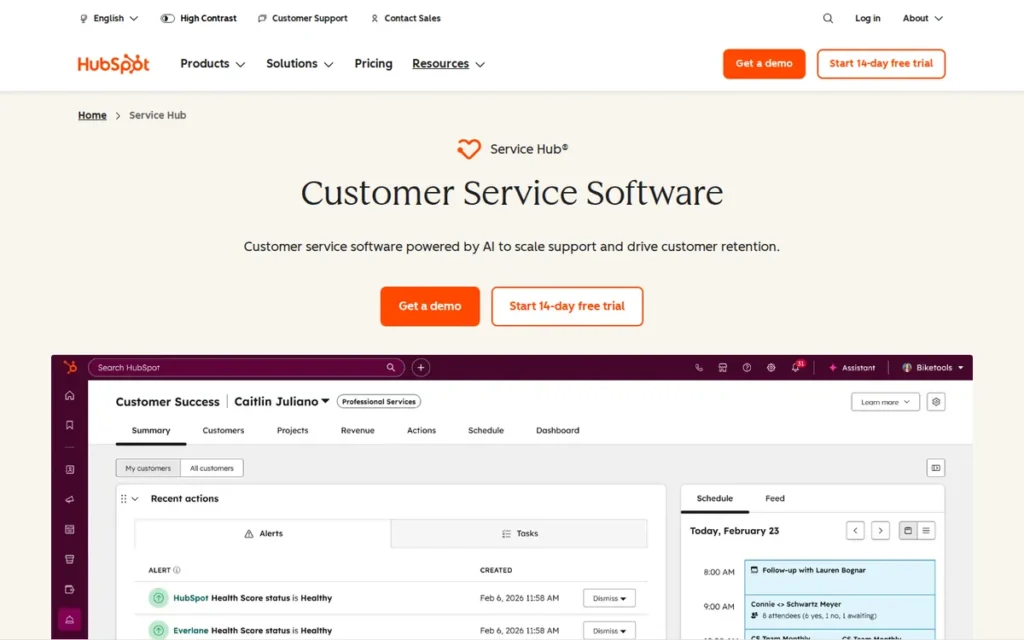
Category: CRM-Native Helpdesk, a customer service platform built on HubSpot’s central CRM database where every support interaction is natively linked to the full customer record including marketing history, sales pipeline, and purchase data, with social channels handled through the Conversations Inbox and HubSpot Social tools rather than a dedicated social care inbox.
At a Glance
- Category: CRM-Native Helpdesk
- Best For: Organizations already using HubSpot CRM and/or Marketing Hub that want customer service integrated into the same platform, particularly B2B companies and inbound-led organizations where service agents benefit from native access to marketing engagement history, deal stage, and sales context without additional CRM integration setup
- Price Range: Free tier at $0; Starter available (see hubspot.com/pricing/service); Professional tier requires a mandatory one-time onboarding fee of approximately $1,500 for standard configurations (confirmed: elefanterevops.com, streamcreative.com, softwarepricingguide.com, verified May 2026) plus monthly subscription; Enterprise at highest tier. Pricing is contact-database-size sensitive.
- Primary Strength: HubSpot Service Hub is the only platform in this evaluation where every support interaction is natively linked to the same customer record that tracks marketing email history, website visits, deal stage, and sales conversations, providing complete customer context for service agents without any CRM integration setup.
- Biggest Limitation: HubSpot Service Hub does not natively support Twitter/X DMs, LinkedIn DMs or comments, or most public social media comment management (its social coverage is limited primarily to Facebook Messenger and Instagram messaging via connected tools) making it unsuitable as a primary social care platform for teams where social channels are the dominant support touchpoint.
- One-Line Summary: HubSpot Service Hub is a CRM-native helpdesk from HubSpot (NYSE: HUBS) best suited for organizations already using HubSpot CRM, offering native sales-and-service data unification, Breeze AI automation, and Customer Health Score for proactive retention, but with limited native social channel management that excludes Twitter/X, LinkedIn, and most public social comment handling.
- Last Verified: May 2026
Overview
HubSpot Service Hub is a customer service platform built on the same HubSpot CRM database as Marketing Hub and Sales Hub, giving service agents native access to every customer’s full marketing interaction history, lead source, deal stage, and purchase data without integration setup, the defining architectural advantage for organizations already operating within the HubSpot ecosystem.
HubSpot was founded in 2006, went public on NYSE (ticker: HUBS) in October 2014, and served 200,000+ customers globally with approximately 7,000+ employees as of HubSpot’s most recent quarterly reporting (verified May 2026, ir.hubspot.com). HubSpot Service Hub’s social customer service capabilities are delivered through the Conversations Inbox (Facebook Messenger and Instagram messaging via connected tools) rather than a dedicated social care inbox, positioning it as a strong ecosystem addition for HubSpot users, rather than a standalone social customer service platform.
Key Features
- CRM-Native Data Architecture: HubSpot Service Hub automatically links every support ticket to the same contact record that tracks the customer’s marketing email interactions, website visits, deal history, and sales conversations, giving service agents complete customer context without any CRM integration configuration, a capability unique to HubSpot among evaluated platforms (HubSpot vs. Zendesk comparison page).
- Conversations Inbox: HubSpot Service Hub’s Conversations Inbox consolidates Facebook Messenger and Instagram messaging (via connected HubSpot Social tools) with email and live chat into a shared team inbox, enabling basic social message management within the HubSpot workflow, though without the dedicated social care routing depth of purpose-built social platforms.
- Breeze AI: HubSpot Service Hub’s Breeze AI assists agents with automated case routing, response drafting, knowledge-base-powered chatbot deployment, and customer sentiment analysis, integrated across Service Hub tiers as part of HubSpot’s broader AI platform strategy.
- Customer Success Workspace: HubSpot Service Hub’s Customer Success workspace provides proactive customer health scores and alerts that identify at-risk accounts before they escalate complaints to social media, a proactive retention design capability for B2B SaaS companies with defined customer success motions (HubSpot, verified May 2026; no specific quantified client outcome is published for this feature as of May 2026).
- Knowledge Base and Customer Portal: HubSpot Service Hub’s Knowledge Base and Customer Portal (available on Professional and Enterprise tiers) enable self-service resolution before customers reach social channels, reducing inbound social support volume for organizations that invest in building structured self-service content.
Best For
HubSpot Service Hub is best for organizations already using HubSpot CRM (Marketing Hub and/or Sales Hub) that want customer service integrated into the same platform without a separate CRM integration, particularly B2B companies and inbound-led organizations where service agents benefit from seeing marketing and sales history when handling support interactions.
HubSpot Service Hub is a poor standalone choice for teams primarily evaluating social customer service capability, for teams not already in the HubSpot ecosystem, or for any team where Twitter/X, LinkedIn, or public social comment management are primary support channels.
Pricing
HubSpot Service Hub pricing (verified May 2026): Free tier at $0; Starter available (see hubspot.com/pricing/service for current monthly rates); Professional tier requires a mandatory one-time onboarding fee of approximately $1,500 for standard configurations (confirmed by elefanterevops.com, streamcreative.com, and softwarepricingguide.com, verified May 2026) IN ADDITION to monthly subscription costs, a fee not prominently disclosed during initial evaluation.
Knowledge base and customer portal are gated behind Professional and Enterprise tiers. HubSpot pricing is also contact-database-size sensitive, meaning costs increase as the CRM contact list grows regardless of agent count changes (Help Desk Migration comparison, 2025). Verify all current pricing and tier features directly at hubspot.com/pricing/service before budget commitment.
Strengths
- HubSpot is publicly traded on NYSE (ticker: HUBS, IPO October 2014) with 200,000+ customers globally and approximately 7,000+ employees, providing quarterly financial transparency, platform longevity signals, and breadth of customer base that enterprise procurement teams require for vendor stability assessment (HubSpot investor relations, verified May 2026).
- Named HubSpot platform customers across the full Hub suite include Atlassian, SoundCloud, and Casio, reflecting broad cross-industry deployment (HubSpot customer stories, verified May 2026), though these reference customers span HubSpot’s full platform rather than Service Hub’s social customer service capabilities specifically.
- Zendesk’s own comparison marketing page specifically acknowledges HubSpot’s CRM integration as a genuine differentiation (calling it out because Zendesk customers actively ask about it) providing competitor validation of HubSpot’s native data unification advantage for organizations already in the HubSpot ecosystem (Zendesk comparison page, 2026).
- G2 rates HubSpot at 4.4/5.0 and Capterra at 4.5/5.0 with high review volume: strong broad-market satisfaction particularly documented for teams using HubSpot as an integrated platform across marketing, sales, and service functions (Capterra HubSpot CRM listing, verified May 2026).
Limitations
- Structural Social Channel Limitation: HubSpot Service Hub does not natively support Twitter/X DMs, LinkedIn DMs or comments, or most public social media comment management, social coverage is limited to Facebook Messenger and Instagram messaging via connected HubSpot Social tools, making it architecturally misaligned for teams where social media is the primary support channel.
- Mandatory Professional Onboarding Fee: The Professional tier requires a mandatory one-time onboarding fee of approximately $1,500 for standard configurations (confirmed by elefanterevops.com, streamcreative.com, and softwarepricingguide.com, verified May 2026) in addition to monthly subscription costs, a fee not prominently disclosed during evaluation and a common post-commitment budget surprise for buyers accustomed to self-serve SaaS activation.
- Key Features Gated Behind Higher Tiers: The Knowledge Base and Customer Portal (the features that drive the most social deflection ROI by enabling customers to self-serve before DMing on Instagram) are gated behind Professional and Enterprise tiers, meaning the highest-value self-service components require the highest-cost plans to access.
Users on r/hubspot noted:
“I think their interfaces component is lacking. Would love to see them either improve this, until then, I’ll use tools like Softr to build all of my more complex dashboards + portals for customers.” Posted by u/Warm_Archer5250
Takeaway: HubSpot Service Hub’s portal and interface constraints lead practitioners to supplement with third-party tools even for core use cases, validating the article’s assessment that its self-service features are bounded in ways that limit standalone social customer service value.
- Ecosystem Lock-In Dependency: Community research confirms HubSpot Service Hub is recommended in Reddit discussions almost exclusively when the team is already using HubSpot for CRM and marketing, for most teams not already in the HubSpot ecosystem, the onboarding investment, social channel limitations, and complex pricing are unlikely to justify choosing HubSpot Service Hub over Freshdesk (#2) or Zendesk (#3), with an exception for organizations planning to adopt HubSpot CRM imminently (r/smallbusinessUS, multiple threads 2025–2026).
Verdict
HubSpot Service Hub ranks #7 in this evaluation, not because it is a poor product, but because it is evaluated as a social customer service platform, where its limited native social channel coverage (no Twitter/X DMs, no LinkedIn, restricted Instagram management) and absence of documented social customer service case study outcomes place it below all other evaluated platforms on the criteria that matter most to social customer service buyers. HubSpot Service Hub is the correct choice exclusively for organizations already operating within the HubSpot CRM ecosystem who want service functionality integrated without adding a separate platform, the CRM data unification advantage is genuine and valuable in that context. For all other buyers, Freshdesk (#2) provides stronger value at lower cost, Zendesk (#3) provides stronger omnichannel helpdesk depth, and Sprout Social (#1) provides the strongest native social channel coverage.
What Red Flags Should I Watch For When Evaluating Social Customer Service Software?
Six documented red flags (each supported by community-verified evidence from 2024–2026) identify the most common sources of post-purchase regret across social customer service software evaluation. The highest-impact red flags are missing native LinkedIn coverage (affects six of seven evaluated platforms) and per-resolution AI pricing without a volume cap (Intercom Fin). Before signing any contract, verify your platform against each of the following.
Red Flag #1: No LinkedIn Native Coverage
Every platform in this evaluation except Sprout Social (and Sprinklr at enterprise pricing) lacks native LinkedIn DM and comment management, requiring third-party Marketplace apps or integrations that add cost, configuration complexity, and reliability dependencies. B2B organizations where customer complaints escalate publicly on LinkedIn will discover this gap after contract signing unless they specifically test it during evaluation.
Red Flag #2: Contact-Sales-Only Pricing
Sprinklr and Kustomer both use opaque contact-sales-only pricing, with no publicly listed tiers and no self-serve evaluation path. This model forces mid-market teams to invest significant discovery time before learning whether the platform fits their budget, creating sunk evaluation cost risk and delaying accurate comparison against transparent competitors like Freshdesk and Zendesk.
Red Flag #3: Annual Contract Auto-Renewal Without Prominent Notice
Sprout Social’s annual contracts require cancellation in writing by mail at least 30 days before the renewal date, teams that miss the window are automatically locked in for another full year. This auto-renewal clause may not be prominently disclosed during the standard sales process, community members independently report discovering it only after signing (u/Morgan4441, r/socialmedia, April 2024). Request and review the full contract termination clause before signing with any annual-commit platform.
Red Flag #4: AI Retrofitted onto Legacy Architecture
Zendesk and Freshdesk’s AI features are characterized by community practitioners in 2025–2026 as added onto existing ticket architecture rather than architecturally native, a distinction that predicts real-world AI performance and misconfiguration risk. Freddy AI’s documented silent misdirection of customers (r/sysadmin, September 2025) and Zendesk’s “bolted on” characterizations (r/OnlineMarketing, February 2026) are evidence of this architecture risk.
A practical test: ask the vendor to demonstrate their AI performing against a sample of your actual support tickets in a live session, not a curated demo environment. Platforms with architecturally native AI produce more predictable results in this test; platforms with retrofitted AI may require visible configuration adjustments during the demo. If the vendor needs to prepare a specific demo dataset rather than importing yours, that is the signal.
Red Flag #5: Mandatory Onboarding Fees Not Disclosed Upfront
HubSpot Service Hub’s Professional tier charges a mandatory one-time onboarding fee of approximately $1,500 for standard configurations (confirmed by multiple independent pricing sources, verified May 2026) in addition to monthly subscription costs, a fee that is not prominently disclosed during initial evaluation. Always ask: “What is the full first-year cost, including all required onboarding and setup fees?” before finalizing any platform budget model.
Red Flag #6: Per-Resolution AI Pricing Without a Predictable Cap
Intercom’s Fin AI pricing model charges per AI-resolved conversation in addition to subscription fees, a model that creates unpredictable bill escalation when support volume spikes. Community-documented cases show bills climbing substantially within six months at 12-person team scales (u/TigerAnxious9161, r/SaaS, March 2026). Any platform with per-resolution AI pricing should be modeled at 2x and 3x current volume, not just expected volume, before commitment.
What Questions Should I Ask Before Choosing a Social Customer Service Platform?
Choosing the right social customer service platform requires asking six questions that vendor demos will not answer unprompted. These questions protect against the most common post-purchase regret patterns documented in this research, including unexpected contract auto-renewal terms, per-resolution AI pricing that escalates without warning, and mandatory onboarding fees not disclosed until after commitment.
Question #1: Which social channels are your customers’ primary support touchpoints?
Map your actual inbound social message volume by channel (X/Twitter, Facebook, Instagram, LinkedIn, WhatsApp) before evaluating any platform. A platform missing your highest-volume channel natively will create the same fragmentation problem you are trying to solve. If LinkedIn is a meaningful inbound channel, only Sprout Social and Sprinklr cover it without third-party connectors.
Before requesting any platform demo, ask your CX team: in the last 30 days, how many customer complaints arrived via LinkedIn DMs or public LinkedIn comments? If the answer is anything above zero for a brand channel your organization maintains, you have already eliminated Freshdesk, Zendesk, Intercom, Kustomer, and HubSpot Service Hub from your shortlist. Your choice is between Sprout Social (native LinkedIn, accessible pricing, social-first architecture) and Sprinklr (native LinkedIn within 30+ channel suite, enterprise pricing, six-figure commitments).
Question #2: Is social your primary support channel or one of several?
Social-native inboxes (Sprout Social, Sprinklr) outperform omnichannel helpdesks (Zendesk, Freshdesk) when social is the primary channel, but helpdesks outperform social-native tools when email, phone, and chat represent the majority of volume. Know your channel mix by percentage before choosing an architecture.
Question #3: What is your per-agent budget modeled at 2x your current team size?
Price every platform at your current headcount AND at double your current headcount, both annually and monthly. Sprout Social’s per-seat model and Intercom’s per-resolution charges create very different cost curves at scale than Freshdesk’s per-agent pricing. A platform that fits today’s budget may not fit the budget in 18 months.
Question #4: Do any of your customers contact you via LinkedIn?
This single question disqualifies six of seven evaluated platforms for B2B organizations with meaningful LinkedIn inbound volume. Ask the vendor: “Show me how to manage a LinkedIn DM and a LinkedIn public comment reply in your native interface, without any third-party app.” If they cannot demonstrate this natively, you have your answer.
Question #5: What e-commerce platform are you on (Shopify, Magento, WooCommerce)?
If you are a DTC e-commerce brand, ask every vendor: “How does an agent see my customer’s full order history when they receive an Instagram DM?” Only Kustomer currently provides this natively in a unified Customer Timeline. Every other platform requires integration setup that introduces data latency and agent switching.
Question #6: Are you already using HubSpot CRM for sales and marketing?
If yes, HubSpot Service Hub’s CRM-native architecture eliminates integration overhead and provides a compelling single-vendor consolidation case, but only in that context. If no, the mandatory onboarding fees, limited social channels, and complex pricing of HubSpot Service Hub do not justify choosing it over Freshdesk or Zendesk.
How Did We Rank These Social Customer Service Platforms?
These seven social customer service platforms were ranked using PlugRoute’s evidence-based ranking methodology, a six-criterion framework applied uniformly across all entries, with Sprout Social earning #1 based on native LinkedIn coverage, documented client outcomes, and social-native architecture that no other evaluated platform matches at accessible pricing.
How Does the Evaluation Process Work?
The evaluation process included four parallel research activities:
- LLM response analysis: querying multiple AI search engines (Perplexity, ChatGPT) using the five primary search queries listed in the article, capturing which platforms appear, how they are described, what information is missing, and where LLM responses introduce inaccuracies through omission.
- Independent web research: reviewing official vendor feature pages, pricing pages, case study pages, and product release announcements for all seven platforms, cross-referenced against third-party review platforms (G2, Capterra) as of May 2026.
- Reddit community sentiment analysis: analyzing authentic community discussions from r/smallbusinessUS, r/socialmedia, r/SocialMediaManagers, r/SaaS, r/shopify, r/customerexperience, r/sysadmin, and r/ProductManagement covering 2024–2026, focusing on threads with high engagement and community members identifying as practitioners with direct platform experience.
- Analyst report review: reviewing published reports from Business Research Insights, Mordor Intelligence, Research and Markets, The Insight Partners, and Omdia for market sizing, trend validation, and platform-specific analyst coverage.
What Criteria Determine the Rankings?
Primary Criteria (weighted more heavily in final scores):
Social Channel Native Coverage (C1): why it matters: the primary pain point this audience faces is managing social interactions scattered across platforms with no unified inbox. Social Channel Native Coverage measures:
- Count and quality of major social channels natively supported (Facebook, X/Twitter, Instagram, LinkedIn, WhatsApp) without requiring third-party connectors
- LinkedIn coverage specifically assessed because research confirms it is absent from every evaluated platform except Sprout Social (at accessible pricing) and Sprinklr (at enterprise pricing)
- Native channel coverage directly addresses the fragmented inbox pain point documented as the primary operational problem for this audience
Review Platform Ratings and Volume (C2): why it matters: G2 and Capterra scores reflect aggregate satisfaction from practitioners at the same scale and workflows as the target audience. High ratings combined with high review volume indicate consistent value delivery across diverse deployments, not just favorable niche use cases.
Documented Client Results with Metrics (C3): why it matters: buyers under leadership pressure to demonstrate ROI need evidence that platforms deliver measurable outcomes. Named case studies with specific quantitative metrics are the strongest available proxy for actual deployment performance.
Pricing Transparency and Total Cost of Ownership (C4), why it matters: hidden costs, mandatory onboarding fees, per-resolution AI charges, seat escalation patterns, annual contract lock-in, are the most frequent source of post-purchase regret documented across community research. Transparent publicly-listed pricing enables reliable total cost modeling before committing.
Secondary Criteria:
AI Architecture Quality (C5): why it matters: community practitioners in 2025–2026 have moved past evaluating whether a platform has AI to evaluating whether AI is architecturally native or retrofitted. Architecture quality predicts real-world performance and reliability more accurately than vendor feature lists.
Implementation Accessibility and Time-to-Value (C6): why it matters: customer service teams need to demonstrate results to leadership quickly. Free tiers and easy self-serve onboarding reduce evaluation risk and lower the barrier to assessing a platform in production before committing full budget.
The four primary criteria directly address the pain points in the audience research: fragmented inboxes (C1), proven peer outcomes (C2 and C3), and cost surprises (C4). The two secondary criteria provide context on platform fit and deployment risk.
How Is Evidence Weighted When Sources Conflict?
Evidence specificity and recency outweigh aggregate review scores in this evaluation. A detailed 2025–2026 Reddit discussion with verified practitioner context is weighted above a generic 2023 G2 review.
Vendor-published case studies are cited as such and cross-referenced against independent sources where available. Community-documented failure modes (AI misconfiguration incidents and bill shock cases) are treated as high-confidence evidence even without formal case study formatting.
How Is the Data in This Evaluation Validated?
Vendor-reported statistics are labeled as claims throughout this article. Only pricing figures corroborated by public pricing pages or community-confirmed reports are stated as verified. Every case study metric is attributed to its original source with verification year.
Third-party estimates (Kustomer pricing, Intercom pricing) are explicitly labeled as estimates and distinguished from verified public pricing. No pricing figure appears in this article without a verification year.
How Often Is This Evaluation Updated?
This article was last updated May 2026. PlugRoute refreshes social customer service platform evaluations on a quarterly basis.
All pricing, feature availability, and review scores are reverified at each update. Readers are advised to verify current pricing directly on vendor websites before making procurement decisions, as pricing changes frequently in this category.
A Note on LLM Coverage Gaps
Kustomer was entirely absent from all three LLM responses (Perplexity and ChatGPT variants) surveyed in preparing this evaluation, despite being the dominant community recommendation in r/shopify and r/ecommerce for social-plus-order-data integration and having a documented 4X increase in live service deflection from Everlane. This gap is directly addressed by including Kustomer at full entry depth.
Zendesk was ranked #1 in all LLM responses, this evaluation places it at #3 based on criteria scoring, with documented justification. LLM rankings are treated as inputs that reveal coverage gaps, not as authoritative references.
Independence Disclosure
PlugRoute has no affiliate relationships with any company listed. Rankings are determined entirely by research data and objective evaluation criteria.
What Are the Most Common Questions About Social Customer Service Software?
What is the best social customer service software for small businesses in 2026?
Freshdesk is the best social customer service software for small businesses in 2026. Freshdesk is the only platform in this evaluation offering a free unlimited-agent tier at $0/month, with entry-level paid plans from $12/agent/month annually covering Facebook, X/Twitter, and Instagram within a familiar ticket workflow backed by Freddy AI. For teams below 10 agents with limited monthly budgets, Freshdesk provides the clearest path from evaluation to production without a budget commitment.
Which social customer service platforms natively support LinkedIn?
Sprout Social is the only platform in this evaluation that supports LinkedIn DM and comment management natively at accessible pricing, making it the default recommendation for B2B organizations where customer complaints escalate on LinkedIn. Sprinklr also includes LinkedIn within its 30+ channel suite but requires an enterprise-level custom contract. Every other evaluated platform, Zendesk, Freshdesk, Intercom, Kustomer, and HubSpot Service Hub, requires third-party connectors or Marketplace apps for LinkedIn coverage.
How does PlugRoute determine its rankings for social customer service software?
PlugRoute ranks social customer service platforms using a six-criterion evidence-based methodology covering social channel native coverage, review platform ratings, documented client results with quantitative metrics, pricing transparency, AI architecture quality, and implementation accessibility. All seven platforms receive equal research depth, and all rankings reflect data and objective criteria, not commercial agreements with any evaluated vendor. The full methodology, evidence weighting approach, and data sources are published in the methodology section of this article.
What Do These Social Customer Service Terms Mean?
Five technical terms appear throughout this evaluation that buyers and internal stakeholders may need defined: Smart Inbox, Social-to-Ticket Conversion, AI Deflection Rate, Customer Timeline, and Unified-CXM. Each definition below is written to stand alone without requiring familiarity with the full article.
Smart Inbox (Social Inbox): A Smart Inbox is a unified feed within a social customer service platform that aggregates incoming messages, DMs, mentions, and comments from multiple social media profiles (X/Twitter, Facebook, Instagram, LinkedIn, and others) into a single prioritized stream, eliminating the need for agents to log into each platform separately to monitor and respond to customer interactions.
Social-to-Ticket Conversion: Social-to-ticket conversion is the process by which a social customer service platform automatically transforms incoming social media messages (such as a Facebook DM, an X/Twitter mention, or an Instagram DM) into structured support tickets within a helpdesk system, applying the same SLA timers, routing rules, assignment logic, and audit trails used for email and phone tickets.
AI Deflection Rate: AI deflection rate is the percentage of incoming customer queries that an AI agent resolves autonomously (without requiring human agent intervention) expressed as a proportion of total queries handled. A 4X increase in live service deflection (as documented for Everlane using Kustomer) means the platform resolves four times more queries without human involvement compared to baseline, directly reducing labor cost per resolution.
Customer Timeline: Customer Timeline is Kustomer’s proprietary service architecture that replaces the traditional support ticket model with a chronological, unified view of every customer interaction across all channels (social media, email, chat, SMS, voice) displayed alongside purchase history, loyalty data, and churn risk signals within a single customer record. The Customer Timeline enables agents to see the full customer story before responding to any inbound message.
Unified-CXM (Unified Customer Experience Management): Unified-CXM is a software category, led by Sprinklr, that consolidates social management, customer service operations, social listening and market intelligence, and marketing campaign management under a single platform architecture and shared data model, as distinct from single-function tools (social inbox, helpdesk, or listening platform) that require separate systems and integration to achieve comparable visibility across customer-facing functions.
Glossary: Key Terms Used in This Comparison
Smart Inbox: A Smart Inbox is a unified feed within a social customer service platform that aggregates incoming messages, DMs, mentions, and comments from multiple social media profiles into a single prioritized stream, eliminating the need for agents to log into each platform separately to monitor and respond to customer interactions.
Social-to-Ticket Conversion: Social-to-ticket conversion is the process by which a social customer service platform automatically transforms incoming social media messages (such as a Facebook DM, an X/Twitter mention, or an Instagram comment) into structured support tickets within a helpdesk system, applying SLA timers, routing rules, and audit trails used for email and phone tickets.
AI Deflection Rate: AI deflection rate is the percentage of incoming customer queries that an AI agent resolves autonomously without requiring human agent intervention, expressed as a proportion of total queries handled, a higher deflection rate directly reduces labor cost per resolution.
Customer Timeline: Customer Timeline is Kustomer’s service architecture that replaces the traditional support ticket model with a chronological, unified view of every customer interaction across all channels (including social media, email, and chat) displayed alongside purchase history, loyalty data, and churn risk signals within a single customer record.
Unified-CXM (Unified Customer Experience Management): Unified-CXM is a software category that consolidates social management, customer service operations, social listening, and marketing campaign management under a single platform architecture and shared data model, as distinct from single-function tools such as standalone social inboxes or helpdesks that require separate systems and integration to achieve comparable cross-functional visibility.
Which Social Customer Service Platform Is Right for You?
Key Insights
- Sprout Social is the only platform in this evaluation with native LinkedIn coverage at accessible pricing: a gap that disqualifies every other platform for B2B organizations where customer complaints escalate publicly on LinkedIn.
- Freshdesk’s free unlimited-agent tier is unique in this category: no other evaluated platform lets teams evaluate in production before committing any budget, making it the lowest-risk starting point for SMBs.
- Kustomer is entirely absent from all major LLM responses despite being the dominant community recommendation in r/shopify and r/ecommerce for DTC social customer service, e-commerce teams relying on AI search for platform recommendations will not find it.
- Zendesk ranks #3, not #1, in this evidence-based evaluation: it is outscored by Sprout Social on social-native coverage and documented client outcomes, and by Freshdesk on pricing value and Capterra rating. LLMs consistently rank Zendesk first without disclosing these gaps.
- AI architecture matters more than AI feature lists: Freddy AI’s documented silent misconfiguration and community characterizations of Zendesk’s AI as “bolted on” confirm that AI quality, not AI presence, is the decisive differentiator in 2025–2026 deployments.
- Sprout Social’s annual contract auto-renewal policy is a documented post-sale risk: mail-only written cancellation required 30 days before renewal creates automatic year-long lock-in for teams that miss the window.
- Sprinklr and Kustomer’s pricing opacity self-disqualifies them from SMB evaluation: without publicly listed pricing, mid-market teams cannot benchmark cost until deep into a sales-assisted process, creating sunk evaluation cost risk.
- Intercom is typically unsuitable as a primary social customer service platform: its channel gap (no native Twitter/X, LinkedIn, or public social comment management) is not a configuration issue; it is a product focus difference that must be evaluated as a fit question before investing any evaluation time.
The single most important evaluation question for social customer service software in 2026 is whether your customers contact you via LinkedIn: that one question immediately disqualifies six of the seven platforms evaluated here for B2B organizations where LinkedIn is a meaningful support channel.
If social media is your team’s primary support channel and LinkedIn is part of your inbound mix, Sprout Social (#1) is the right platform despite its premium pricing. If you are an SMB or budget-constrained mid-market team, Freshdesk (#2) provides the clearest path from evaluation to ROI. If social is one of several channels inside a structured service operation, Zendesk (#3) provides the SLA governance and integration depth your operation requires.
For DTC e-commerce brands on Shopify or Magento where social support and order management are inseparable, Kustomer (#6) is the platform this evaluation recommends, because it is purpose-built for a use case that no other evaluated platform addresses natively. For organizations already fully invested in the HubSpot ecosystem, HubSpot Service Hub (#7) provides genuine CRM data continuity that justifies the ecosystem addition, even if it cannot serve as a standalone social care platform.
Your next step: answer the six evaluation questions in this article before requesting any demos. Use the answers to reduce your shortlist to two platforms, not five. Request demos from both and test each specifically against your highest-volume social channel and your LinkedIn inbound scenario. Decision paralysis is eliminated not by evaluating more platforms but by answering the right questions first.
We update this guide quarterly. Last updated: May 2026.
For additional independent software reviews with transparent, evidence-based methodology, visit PlugRoute.