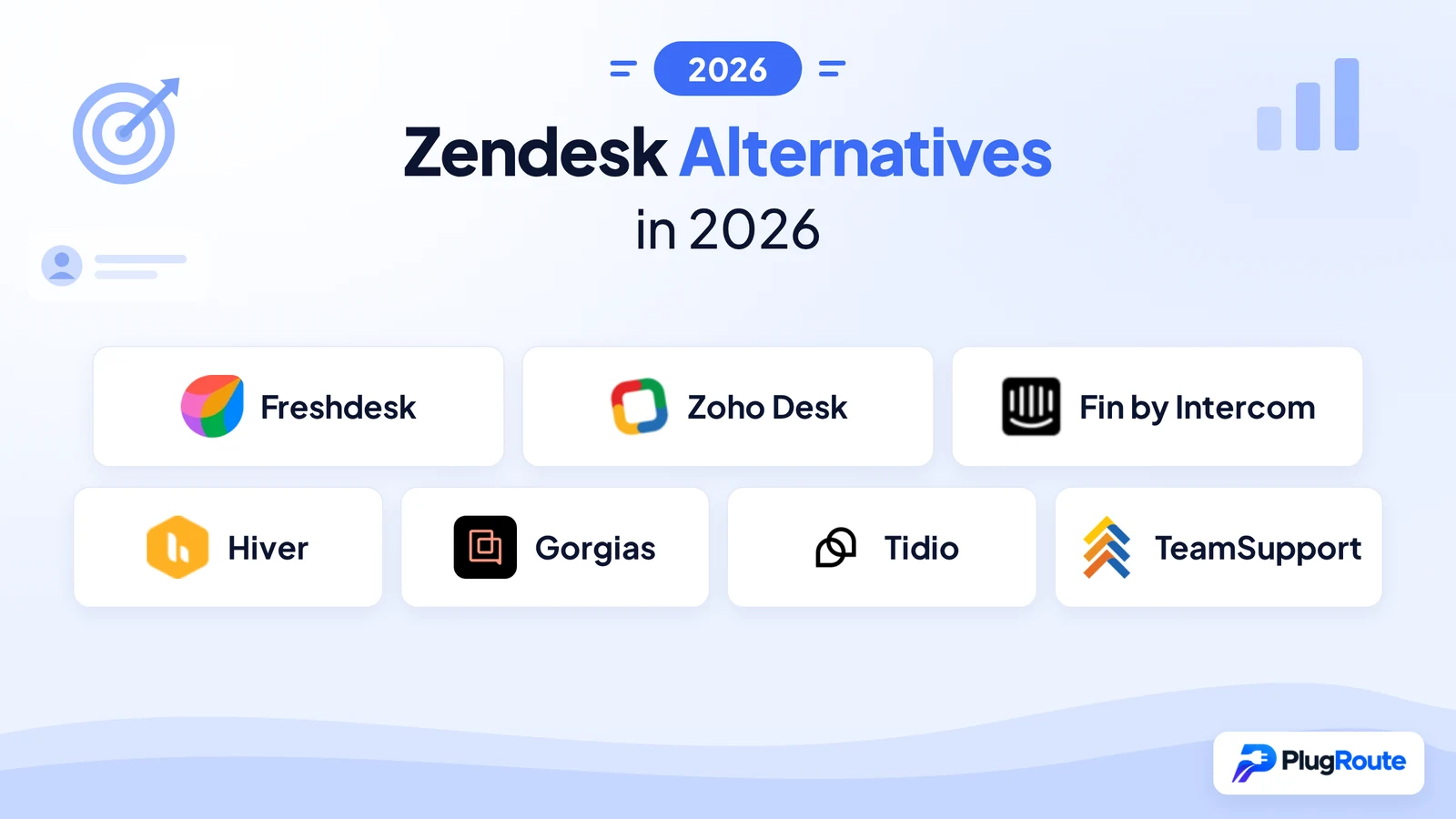
Freshdesk is the best overall Zendesk alternative for most small and mid-sized teams. Zoho Desk is the lowest-cost full help desk, and Fin by Intercom is the strongest AI-first option. The right choice depends on how your team supports customers, and on whether seat, ticket and AI charges actually keep your bill below Zendesk’s.
Zendesk’s own G2 reviewers name cost and complexity first. “Expensive As Teams Grow” (128 mentions) and “Steep Learning Curve” (109) are its top cons (G2, November 2026). AI adds a second budget line: Copilot costs $50 per agent per month, and automated resolutions cost $1.50–$2 each.
PlugRoute has no affiliate relationships with any company listed. Rankings are determined entirely by research data and objective evaluation criteria.
“Zendesk’s AI … resolutions at $1.50-2 each add up fast.”, Reddit user, r/AiAssistance (r/AiAssistance, November 2026; the commenter works for a competing AI vendor)
Takeaway: Zendesk’s per-resolution AI fees become a real second budget line once a plan’s included resolutions run out.
What Are the 5 Categories of Zendesk Alternative Tools?
Zendesk alternatives fall into five categories: full-suite help desks (Freshdesk, Zoho Desk), AI-first platforms (Fin by Intercom), inbox-native help desks (Hiver), chat-first messaging tools (Tidio) and vertical specialists for ecommerce or B2B accounts (Gorgias, TeamSupport). Pick the category that matches your support model before you compare vendor prices.
- Full-Suite Help Desk: A full-suite help desk is a general-purpose, per-agent ticketing platform, and Freshdesk (#1) and Zoho Desk (#2) belong to this category.
- AI-First Support Platform: An AI-first support platform is an AI agent that resolves conversations on its own help desk or on top of an existing one, and Fin by Intercom (#3) belongs to this category.
- Inbox-Native Help Desk: An inbox-native help desk is a shared inbox with help desk features inside Gmail or Outlook, and Hiver (#4) belongs to this category.
- Chat-First Messaging Tool: A chat-first messaging tool is live chat and chatbot software with light ticketing, and Tidio (#6) belongs to this category.
- Vertical Specialist Help Desk: A vertical specialist help desk is built for one industry or support model, and Gorgias (#5, ecommerce) and TeamSupport (#7, B2B accounts) belong to this category.
This ranking covers customer-support help desks only. IT service management (ITSM) tools such as Jira Service Management are out of scope.
Why Are Teams Looking for Zendesk Alternatives in 2026?
Teams mainly leave Zendesk because costs grow with headcount and AI usage, and because setup and reporting are hard. Zendesk holds 4.3/5 from 7,126 G2 reviews, with 92.6% at 4–5 stars (G2, November 2026). Its most-cited cons are cost growth, a steep learning curve and inflexible reporting.
Zendesk’s top cons are (G2, November 2026):
- Zendesk is called “Expensive As Teams Grow” in 128 reviews.
- Zendesk has a “Steep Learning Curve” according to 109 reviews.
- Zendesk has “Inflexible Custom Reporting” according to 103 reviews.
- Zendesk has a “Difficult Initial Setup” according to 90 reviews.
- Zendesk has “Hard-To-Find Settings” according to 89 reviews.
Zendesk also has real strengths that a replacement needs to match (G2, November 2026):
- Zendesk is praised for an “Intuitive Interface” in 356 reviews.
- Zendesk is praised for “Efficient Ticket Management” in 217 reviews.
- Zendesk is praised as an omnichannel help desk, with “Unified Omnichannel Support” cited in 214 reviews.
Zendesk’s current pricing is (Zendesk pricing page, November 2026):
- Zendesk Support Team costs $19 per agent per month on annual billing, or $25 monthly.
- Zendesk Suite Team costs $55 per agent per month on annual billing, or $69 monthly, and includes 5 automated resolutions per agent per month.
- Zendesk Suite Professional costs $115 per agent per month on annual billing, or $149 monthly, and includes 10 automated resolutions per agent per month.
- Zendesk Suite Enterprise is quoted by sales; $169 was the older public price.
- Zendesk Copilot (formerly Advanced AI) costs $50 per agent per month (G2, November 2026).
- Zendesk charges $1.50 per automated resolution on committed volume, or $2 pay-as-you-go, once the included allowance runs out.
Zendesk’s prices have changed several times (LiveAgent, November 2026):
- Zendesk raised Suite Team from $49 to $55, Suite Professional from $99 to $115 and Enterprise from $150 to $169 in July 2023.
- Zendesk renamed Advanced AI to Copilot in April 2025.
- Zendesk removed Suite Growth from its public price list in August 2025.
Zendesk users ask for these improvements (G2, November 2026):
- Zendesk users want simpler setup and onboarding.
- Zendesk users want more intuitive reporting.
- Zendesk users want more flexible automation.
- Zendesk users want clearer AI setup and guidance.
Compare each alternative against the total cost of ownership of the Zendesk tier and add-ons you actually use, not against Zendesk’s entry price.
How Do the Top Zendesk Alternatives Compare at a Glance?
Freshdesk leads as the closest like-for-like replacement, Zoho Desk is the low-cost option and Fin by Intercom is the AI-first choice. The three are separated by one weighted point (35, 34 and 34 out of 45). All seven have G2 ratings between 4.4 and 4.6 (G2, November 2026), so fit and cost predictability decided the order.
Hiver, Gorgias, Tidio and TeamSupport each fit a narrower support model and lead their own use cases.
| Rank | Company | Category | Best For | One-Line Summary | Key Capabilities | Primary Strength | Key Limitation |
|---|---|---|---|---|---|---|---|
| 1 | Freshdesk | Full-Suite | Growing SMB support teams | Freshdesk is the strongest general-purpose Zendesk alternative, matching Zendesk’s per-agent model with faster setup. | Ticketing, omnichannel, knowledge base, routing, Freddy AI | Closest feature match; 345 G2 “Intuitive to Navigate” mentions | Reports lack detail (70 G2 mentions); AI sessions metered separately |
| 2 | Zoho Desk | Full-Suite | Tight budgets and Zoho CRM users | Zoho Desk is the lowest-cost full help desk among Zendesk alternatives, with a free plan and 108 G2-listed integrations. | Ticketing, Zia AI, WhatsApp/Instagram messaging, knowledge base | Lowest per-agent tiers ($7–$40 annual) | Users report clunkiness at scale and weak IM analytics |
| 3 | Fin by Intercom | AI-First | AI-led support; piloting AI on Zendesk | Fin by Intercom is the highest-scoring AI-first Zendesk alternative in this ranking and is documented to run on top of Zendesk. | AI Agent, inbox, Messenger, Copilot, in-app messaging | Runs on existing Zendesk; $0.99 per outcome | Unpredictable usage costs (52 G2 mentions) |
| 4 | Hiver | Inbox-Native | Email-first teams in Gmail or Outlook | Hiver is the fastest Zendesk alternative to adopt for email-first teams, adding help desk features inside Gmail. | Assignment, SLAs, collision detection, AI Copilot and Agents | Same-day go-live most common on G2 | 5 G2 integrations; English only |
| 5 | Gorgias | Vertical | Shopify and ecommerce brands | Gorgias is the ecommerce-specialist Zendesk alternative in this ranking, pricing by ticket volume and acting on Shopify orders. | Order actions, AI Agent, Shopify/BigCommerce/Magento | Up to 500 seats on most plans | Ticket and AI fees can stack in peak season |
| 6 | Tidio | Chat-First | Very small chat-first businesses | Tidio is the best free-to-start, chat-first Zendesk alternative for small businesses and Shopify stores. | Live chat, Lyro AI, Flows builder, basic ticketing | Free plan for up to 10 operators | Not a full help desk; caps drive upgrades |
| 7 | TeamSupport | Vertical | B2B software with key accounts | TeamSupport is the most specialized Zendesk alternative for account-based B2B support. | Account-linked tickets, Customer Distress Index, portal | Only product here with account-risk scoring | 3 G2 integrations; dated interface |
Which Zendesk Alternative Should I Choose for My Use Case?
Choose by support model, not overall rank. Freshdesk fits teams that want a Zendesk-style help desk, Zoho Desk fits tight budgets and Fin by Intercom fits AI-led support. Four specialists cover email-first, Shopify, chat-first and B2B teams. The table below matches each priority to a tool and a backup option.
| Your #1 Priority | Recommended Tool | Why | Acceptable Alternative |
|---|---|---|---|
| Like-for-like Zendesk replacement | Freshdesk | Same per-agent model, $19 entry (G2, November 2026) | Zoho Desk: lower per-agent cost if you accept a less polished admin |
| Lowest cost or already on Zoho CRM | Zoho Desk | Free for 3 users; $7–$40 per agent (Zoho Desk pricing page, November 2026) | Freshdesk Growth: smoother setup at $19 per agent |
| AI-led support, or pilot AI on Zendesk first | Fin by Intercom | Documented to run on Zendesk without Intercom seats | Zendesk Copilot plus automated resolutions: no new vendor, $50 per agent |
| Email-first team inside Gmail or Outlook | Hiver | Same-day go-live most common (G2, November 2026) | Zoho Desk: lower per-agent cost and 21 languages |
| Shopify brand with many or seasonal agents | Gorgias | Ticket-based pricing; up to 500 seats on most plans | Tidio: flat pricing for smaller, chat-led stores |
| Very small chat-first business or store | Tidio | Free plan, flat paid tiers | Zoho Desk Free: structured ticketing for up to 3 users |
| B2B software with key accounts | TeamSupport | Account-linked tickets and risk scoring | Freshdesk: 65 integrations; or Zoho Desk if already on Zoho CRM |
| 41 languages, WFM, voice, or migration costs outweigh savings | Stay on Zendesk | Broadest coverage (74 integrations, 41 languages) | Fin by Intercom on top of Zendesk: adds AI without migrating |
A three-step shortlist process keeps the comparison fair:
- The first step is to pick the category that matches your support model.
- The second step is to price the Zendesk tier and add-ons you actually use today.
- The third step is to run a double-volume monthly bill test on two or three finalists.
How Do the Alternatives Compare With Zendesk on Price, AI and Coverage?
Four of the seven alternatives list a paid entry price at or below Zendesk Support Team’s $19 per agent: Zoho Desk ($7), Gorgias ($10 flat), Freshdesk ($19) and Fin by Intercom ($19 seat). Tidio, Hiver and TeamSupport start higher on paid plans (G2, November 2026). AI and volume meters can erase any headline saving.
Zendesk still leads on languages (41), and only Zoho Desk lists more G2 integrations (108 vs 74). “N/A” marks data that was not available, and we did not estimate it.
| Product | Pricing Basis | Entry Price | How AI Is Metered | G2 Rating (Reviews) | G2 Integrations | Languages | Typical Go-Live |
|---|---|---|---|---|---|---|---|
| Zendesk (baseline, not ranked) | Per agent | $19 Support Team; $55 Suite Team (annual, official) | Copilot $50/agent; 5 (Suite Team) or 10 (Suite Professional) resolutions per agent/month included, then $1.50–$2 each | 4.3 (7,126) | 74 | 41 | Under 1 month; 1–3 months common |
| Freshdesk | Per agent | $19 (G2) | 500 one-time sessions, then $49 per 100; Copilot $29/agent | 4.4 (4,003) | 65 | 37 | Under 1 month |
| Zoho Desk | Per agent | Free (3 users); $7 annual / $9 monthly (official) | Not documented in our research | 4.4 (8,105) | 108 | 21 | Under 1 month; under 1 day common |
| Fin by Intercom | Per outcome + optional seats | $0.99/outcome on existing help desk (monthly minimum applies) or $19+/seat on Intercom help desk | $0.99 per outcome; max one per conversation | 4.5 (3,970) | 43 | 36 | Under 1 month |
| Hiver | Per user | $25 (G2) | Included in paid plans per current pricing; older listings show $20/user add-on | 4.6 (1,303) | 5 | 1 (English) | Under 1 day |
| Gorgias | Per ticket volume | $10 flat (G2) | 30–530 included; $0.85–$1.00 per interaction by plan; $1.50 beyond allowance | 4.6 (582) | N/A (150+ per vendor page) | N/A | N/A |
| Tidio | Flat rate | Free; $24.17 (G2) | Lyro capped by plan; 50 one-time on Free; paid packages from $32.50/month | 4.6 (2,159) | N/A | N/A | N/A |
| TeamSupport | Per agent (G2); flat per plan with user limits (official, apparent) | $29 (G2) | Not documented in our research | 4.4 (893) | 3 | N/A | Within 3 months |
1. Freshdesk: Best Overall Like-for-Like Zendesk Replacement
Category: Full-Suite Help Desk: a general-purpose, per-agent ticketing platform that can replace Zendesk feature for feature.
At a Glance
- Category: Full-Suite Help Desk
- Best For: Growing SMB support teams that want a Zendesk-style help desk with easier setup
- Price Range: $19–$89 per user/month (G2, November 2026), plus metered Freddy AI sessions
- Primary Strength: Freshdesk is the closest feature-for-feature Zendesk replacement in this ranking, and 345 G2 reviews say it is intuitive to navigate.
- Biggest Limitation: Freshdesk’s reporting is its most-cited weakness, with 70 G2 reviews saying reports lack detail.
- One-Line Summary: Freshdesk is the strongest general-purpose Zendesk alternative for small and mid-sized teams, matching Zendesk’s per-agent model with faster setup but offering shallower reporting and a separate AI session meter.
- Last Verified: November 2026
Overview
Freshdesk is a per-agent customer support help desk from Freshworks that combines ticketing, a shared inbox, omnichannel support, a knowledge base and Freddy AI. Freshdesk is built for small and mid-sized teams that want the closest like-for-like Zendesk replacement at a comparable entry price.
Freshdesk sits in the Freshworks family alongside Freshsales CRM and Freshchat, which are sold separately. Freshworks also sells Freshdesk Omni as a separate product, and this review covers Freshdesk only.
Key Features
- Freshdesk provides ticketing with a shared inbox, omnichannel support, a customer portal and a knowledge base on its paid plans.
- Freshdesk includes the customer-facing Freddy AI Agent, with 500 sessions granted once per account.
- Freshdesk offers Freddy AI Copilot for human agents as a separate add-on on Pro and Enterprise.
- Freshdesk adds intelligent routing on Pro and skill-based routing on Enterprise.
- Freshdesk lists 65 integrations on G2 and supports 37 languages (G2, November 2026).
Best For
Freshdesk is best for growing SMB support teams that want conventional ticketing, automation and a knowledge base without Zendesk’s setup complexity. Freshdesk is a weaker fit for very high-volume teams that depend on detailed custom reporting.
Pricing
Freshdesk’s G2 list prices are Growth $19, Pro $55 and Enterprise $89 per user per month (G2, November 2026). Freshdesk’s official page shows the same amounts on annual billing (Freshworks pricing page, November 2026).
Freshdesk adds several usage meters (Freshworks pricing page, November 2026):
- Freshdesk grants 500 Freddy AI Agent sessions once per account, not every month.
- Freshdesk charges $49 per 100 extra Freddy AI Agent sessions, about $490 per 1,000.
- Freshdesk charges $29 per agent per month for Freddy Copilot on Pro and Enterprise, billed annually.
- Freshdesk sells day passes at $2, $7 or $12 depending on plan.
- Freshdesk charges $80 per 5,000 connector-app tasks and $15 per 1,000 MCP actions.
Freshdesk prices may change.
Strengths
- Freshdesk holds 4.4/5 from 4,003 G2 reviews, with 94.5% at 4–5 stars (G2, November 2026), and 4.5/5 from 3,494 Capterra reviews (Capterra, November 2026).
- Freshdesk’s top G2 pros are “Intuitive to Navigate” (345), “Organized Ticket Management” (144), “Automates Repetitive Tasks” (120) and “Quick Setup” (118), and G2’s head-to-head comparison scores it above Zendesk for ease of setup (G2, November 2026).
- Freshdesk most often goes live in under one month, according to G2 implementation data (G2, November 2026).
- Freshdesk draws teams from Zendesk, Zoho Desk, Salesforce-based systems and Jira, who cite easier day-to-day use and lower costs (G2, November 2026).
- Freshdesk matches Zendesk’s $19 entry price, and its $55 Pro plan equals Zendesk Suite Team on annual billing, which suggests teams can keep a similar budgeting model.
Limitations
Freshdesk’s most consequential trade-off is reporting depth for ease of use, with “Reports Lack Detail” (70) and “Limited Customization Options” (49) among its top G2 cons (G2, November 2026). Freshdesk’s AI also becomes a second, usage-based meter after the one-time 500 sessions.
- Freshdesk is reported as “Slow Under Heavy Workloads” in 54 G2 reviews and as having a “Cluttered Interface” in 44 (G2, November 2026).
- Freshdesk is still described as “Expensive For Small Teams” in 47 G2 reviews (G2, November 2026).
- Freshdesk lost Thinkific and Wyze Labs to Zendesk over reporting, stability and functionality, according to Zendesk-published, vendor-chosen stories (Zendesk customer stories, November 2026).
- Freshdesk’s Freddy was called “a more basic chatbot, not a true AI agent” by a Reddit commenter who works for a competitor (r/AiAssistance, November 2026).
- Freshdesk had no verified, named Freshworks case-study metrics in our research.
Users on r/smallbusiness shared their experience:
“We use Freshdesk but man their native bots drove us nuts during holiday season. So keyword driven!! We kept the desk and just layered Helply on top for the insane volume of tracking questions.” Posted by u/signalpath_mapper
Takeaway: Freshdesk’s core ticketing is good enough for teams to keep, but its native keyword-driven bots fall short in peak season, which can push teams to pay for a separate AI tool.
How It Compares With Zendesk
Freshdesk uses the same per-agent model as Zendesk with an identical $19 entry price, and reviewers find Freshdesk easier to set up.
Freshdesk’s reporting is weaker, Freshdesk slows under heavy load, and Freshdesk meters AI per session where Zendesk meters per resolution. Freshdesk’s coverage is slightly smaller, with 65 integrations vs 74 and 37 languages vs 41.
Verdict
Freshdesk is the best general-purpose Zendesk alternative for small and mid-sized support teams in 2026, matching Zendesk’s per-agent pricing and core help desk features with faster setup.
Freshdesk suits teams leaving Zendesk because of its complexity. Teams that rely on detailed custom reporting or very high ticket volumes should test reporting and performance under load first. Budget for Freddy AI separately, because Freshdesk grants the 500 sessions only once.
2. Zoho Desk: Best for Tight Budgets and Zoho CRM Users
Category: Full-Suite Help Desk: a general-purpose, per-agent ticketing platform that can replace Zendesk feature for feature.
At a Glance
- Category: Full-Suite Help Desk
- Best For: Budget-conscious small teams and businesses already running Zoho CRM or Zoho One
- Price Range: Free (3 users); $7–$40 per agent/month annual (Zoho Desk pricing page, November 2026)
- Primary Strength: Zoho Desk offers the lowest per-agent paid tiers and the most G2-listed integrations (108) of any product in this ranking.
- Biggest Limitation: Zoho Desk is reported by users to feel clunky at scale, with weak messaging analytics and limited confidence in its AI.
- One-Line Summary: Zoho Desk is the lowest-cost full help desk among Zendesk alternatives in 2026, with a free plan, a $7 tier and 108 integrations, but users report a clunky admin experience and weaker AI and messaging analytics.
- Last Verified: November 2026
Overview
Zoho Desk is a low-cost, multichannel customer support help desk from Zoho that includes ticketing, Zia AI, instant messaging channels and a knowledge base. Zoho Desk is built for budget-conscious small and mid-sized teams, especially those already running Zoho CRM or Zoho One.
Zoho Desk has the largest G2 review base of any product in this ranking. Zoho Desk’s main differentiator is its connection to the wider Zoho ecosystem.
Key Features
- Zoho Desk provides multichannel ticketing with a knowledge base and self-service portal.
- Zoho Desk includes Zia AI for ticket classification, suggested replies and summaries.
- Zoho Desk offers an Instant Messaging module covering WhatsApp, Instagram DMs, LINE and WeChat, plus a Social module.
- Zoho Desk added the Agent Studio AI agent builder, which a Zoho representative said went live in July 2026 (Zoho representative on r/ZohoDesk, July 2026).
- Zoho Desk lists 108 integrations on G2 and supports 21 languages (G2, November 2026).
Best For
Zoho Desk is best for very small teams that need a free or very low-cost help desk, and for businesses whose customer data already lives in Zoho CRM. Zoho Desk is a weaker fit for teams that depend on AI automation or detailed WhatsApp analytics.
Pricing
Zoho Desk’s official pricing is per agent per month (Zoho Desk pricing page, November 2026):
- Zoho Desk Free costs $0 for up to 3 users.
- Zoho Desk Express costs $7 on annual billing or $9 monthly, for up to 5 users.
- Zoho Desk Standard costs $14 on annual billing or $20 monthly.
- Zoho Desk Professional costs $23 on annual billing or $35 monthly.
- Zoho Desk Enterprise costs $40 on annual billing or $50 monthly.
Zoho Desk’s G2 list prices match for Free, Express and Standard (G2, November 2026). AI usage metering for Zia and Agent Studio was not documented in our research. Zoho Desk prices may vary by country and may change.
Strengths
- Zoho Desk has the largest independent review base in this ranking, with 4.4/5 from 8,105 G2 reviews (G2, November 2026) and 4.5/5 from 2,216 Capterra reviews (Capterra, November 2026).
- Zoho Desk has the lowest per-agent price range in this ranking, from $7 to $40 per agent on annual billing (Zoho Desk pricing page, November 2026).
- Zoho Desk lists 108 integrations on G2, more than Zendesk’s 74 (G2, November 2026).
- Zoho Desk most commonly goes live in under a month, and going live in under a day is also common (G2, November 2026).
- Zoho Desk publishes stories of teams leaving Zendesk: NOOA Brasil reported a 35% licence saving and Russell Hendrix reported 95% NPS (Zoho customer stories, November 2026; vendor-published).
Limitations
Zoho Desk’s most consequential trade-off is polish for price. G2 review themes cite a clunky interface, hard-to-find settings, a steep admin learning curve and rigid reporting (G2, November 2026).
- Zoho Desk was described by one Reddit user as “solid for basics, but it can feel clunky at scale” (r/ZohoDesk, November 2026).
- Zoho Desk’s instant-messaging conversations lack filters, custom views and per-agent metrics, according to a Reddit user whose post Zoho acknowledged in a reply (r/ZohoDesk, December 2025).
- Zoho Desk’s AI was dismissed by a Reddit user before Zoho launched Agent Studio (r/ZohoDesk, August 2025).
- Zoho Desk caps Free at 3 users and Express at 5, and monthly billing costs more ($9 vs $7; $20 vs $14).
- Zoho Desk had no counted G2 pros and cons in our dataset, so this evidence relies on review themes rather than counts.
A support lead on r/ZohoDesk noted:
“This is the biggest problem. Zoho Desk doesn’t offer real analytical tools for anything that happens through IM. There is a dashboard, but the data is fixed. You can’t apply filters, create custom views, or generate performance metrics per agent (e.g., response times). For teams that rely heavily on WhatsApp, this is a major limitation.” Posted by u/GonzoFurb
Takeaway: Zoho Desk’s low price comes with fixed, unfilterable instant-messaging analytics, so WhatsApp-heavy teams cannot measure agent performance on their main channel.
How It Compares With Zendesk
Zoho Desk costs far less per agent ($7–$40 vs Zendesk’s $19–$115 on annual billing) and lists more integrations (108 vs 74).
Zoho Desk supports fewer languages (21 vs 41), Zoho Desk’s admin interface is less polished, and Zoho Desk’s AI and messaging analytics are weaker.
Verdict
Zoho Desk is the best Zendesk alternative for budget-constrained teams and Zoho CRM users in 2026, offering a free plan, a $7 paid tier and 108 integrations.
Zoho Desk’s savings are real for straightforward ticketing. Teams that expect strong AI or WhatsApp analytics should test those features first and ask Zoho how Zia and Agent Studio usage is billed.
3. Fin by Intercom: Best for AI-Led Support and Piloting AI on Zendesk
Category: AI-First Support Platform: an AI agent that resolves conversations on its own help desk or on top of an existing one.
At a Glance
- Category: AI-First Support Platform
- Best For: Chat-led SaaS teams with repetitive questions, and Zendesk users who want to pilot AI before migrating
- Price Range: $0.99 per outcome, plus $19–$132 per seat on the Intercom help desk (Intercom pricing page, November 2026)
- Primary Strength: Fin by Intercom is the only alternative in this ranking documented to run on top of Zendesk without its own seats.
- Biggest Limitation: Fin by Intercom’s usage-based billing is hard to predict, with 52 G2 reviews citing unpredictable usage costs.
- One-Line Summary: Fin by Intercom is the highest-scoring AI-first Zendesk alternative in this ranking (34/45), resolving conversations at $0.99 per outcome on its own help desk or on top of Zendesk, but its bill is hard to predict and its answers need human oversight.
- Last Verified: November 2026
Overview
Fin by Intercom is an AI customer support agent that resolves conversations on Intercom’s own help desk or on top of an existing help desk such as Zendesk. Fin by Intercom is built for chat-led SaaS and subscription teams whose main goal is automating repetitive questions.
Fin by Intercom’s vendor appears first on Capterra’s 2026 help desk shortlist, though Capterra’s rating for it was not returned in our research (Capterra, November 2026).
Key Features
- Fin by Intercom’s AI Agent can be deployed on Zendesk, Salesforce or Freshdesk without buying Intercom seats.
- Fin by Intercom’s help desk includes a shared inbox, Messenger, live chat, email and in-app messaging.
- Fin by Intercom offers Copilot for human agents at $29 per agent per month on annual billing ($35 monthly).
- Fin by Intercom provides pay-as-you-go SMS, WhatsApp and phone channels.
- Fin by Intercom lists 43 integrations on G2 and supports 36 languages (G2, November 2026).
Best For
Fin by Intercom is best for SaaS and subscription businesses where in-app chat and AI resolution are central to support. Fin by Intercom also lets Zendesk users test AI on live traffic without migrating tickets, but it is a weaker fit for teams that need a fixed monthly bill.
Users on r/SaaS weighed in on whether Fin’s per-resolution price pays off:
“Are a significant majority of your tickets one touch close or otherwise ones that people could easily resolve if they read your existing documentation? Does your current customer success team find themselves responding to the same types of inquiries regularly, with the only variation and challenge being in decoding the way people ask the question? If so, then Fin might be a good help and worth the cost.
On the other hand, if your CS team regularly encounters issues that are unique to your customers distinct use case, or if your customers run into one-off problems that are fixed as bugs, then implementing Fin (at the cost of building out a more robust support team) will be costly and could piss people off.” Posted by u/equalattractant
Takeaway: Fin by Intercom pays for itself on repetitive, documentation-answerable tickets, but becomes expensive and frustrating for customers when support issues are unique or bug-driven.
Pricing
Fin by Intercom’s G2 list prices are $0.99 per resolution on your current help desk, or $0.99 plus $19 per seat on the Intercom help desk (G2, November 2026).
Fin by Intercom’s official page lists these charges (Intercom pricing page, November 2026):
- Fin by Intercom seats cost $19 for Essential on annual billing ($29 monthly), $85 for Advanced and $132 for Expert; confirm whether the $19 rate is promotional before budgeting renewals.
- Fin by Intercom add-ons include Pro from $100 per month and Proactive Support Plus from $99 per month.
- Fin by Intercom as a standalone agent carries a monthly minimum, for example 50 outcomes, though the public page does not always state the amount.
Fin by Intercom bills an outcome in three cases (Intercom help center, November 2026):
- A Fin by Intercom outcome is billed when the customer confirms the issue is resolved.
- A Fin by Intercom outcome is billed when the customer does not ask for more help after Fin replies.
- A Fin by Intercom outcome is billed when Fin completes a configured Procedure, including one built to hand off to a team.
Fin by Intercom does not bill general escalations, such as a customer asking for a human or Fin being unable to resolve the issue, and charges at most one outcome per conversation. Fin by Intercom prices may change.
Strengths
- Fin by Intercom holds 4.5/5 from 3,970 G2 reviews, with 94.3% at 4–5 stars, the highest rating among products here with more than 2,500 reviews (G2, November 2026).
- Fin by Intercom’s top G2 pros are “Easy Setup” (169), “Reduces Agent Workload” (168) and “Accurate Customer Answers” (134) (G2, November 2026).
- Fin by Intercom charges $0.99 per outcome, below Zendesk’s $1.50–$2 per automated resolution (Intercom and Zendesk pricing pages, November 2026).
- Fin by Intercom reports a 96% cut in resolution time at Synthesia, and Underdog leaving Zendesk over automation limits (Intercom customers page, November 2026; vendor-published).
Vendor claim (unverified): Intercom says Fin “resolves 76% of cases” (Intercom vendor description on G2, November 2026).
Limitations
Fin by Intercom’s most consequential trade-off is automation strength vs cost predictability. “Unpredictable Usage Costs” appears in 52 G2 reviews (G2, November 2026), and seats, Copilot and add-ons add further meters.
- Fin by Intercom bills a Procedure that deliberately hands off to a human as an outcome, so teams should design Procedures with billing in mind (Intercom help center, November 2026).
- Fin by Intercom’s top G2 cons are about accuracy: “Incorrect Answers” (86) and “Misunderstands Complex Questions” (65) (G2, November 2026).
- Fin by Intercom also draws “Hard To Navigate” (47) and “Complex Initial Setup” (44) in G2 reviews (G2, November 2026).
- Fin by Intercom’s Advanced ($85) and Expert ($132) seats cost about as much as Zendesk’s plans.
- Fin by Intercom “starts reasonable and then balloons fast when you add agents,” according to one Reddit user (r/AiAssistance, November 2026).
How It Compares With Zendesk
Fin by Intercom has the most G2 mentions of AI workload reduction in this group (“Reduces Agent Workload”, 168; G2, November 2026). Fin by Intercom’s $0.99 outcome is below Zendesk’s $1.50–$2 per resolution, and Fin can be added to Zendesk without migrating.
Fin by Intercom’s total cost is less predictable, and Fin by Intercom covers fewer integrations (43 vs 74) and languages (36 vs 41).
Verdict
Fin by Intercom is the strongest AI-first Zendesk alternative in 2026, and it is the only product in this ranking documented to run on top of Zendesk before a team decides whether to migrate.
Model a peak month at double your usual volume against Fin by Intercom’s outcome definition, and pilot Fin on existing Zendesk traffic first. Teams that want the lowest fixed monthly cost should look at Zoho Desk or Freshdesk instead.
4. Hiver: Best for Email-First Teams in Gmail or Outlook
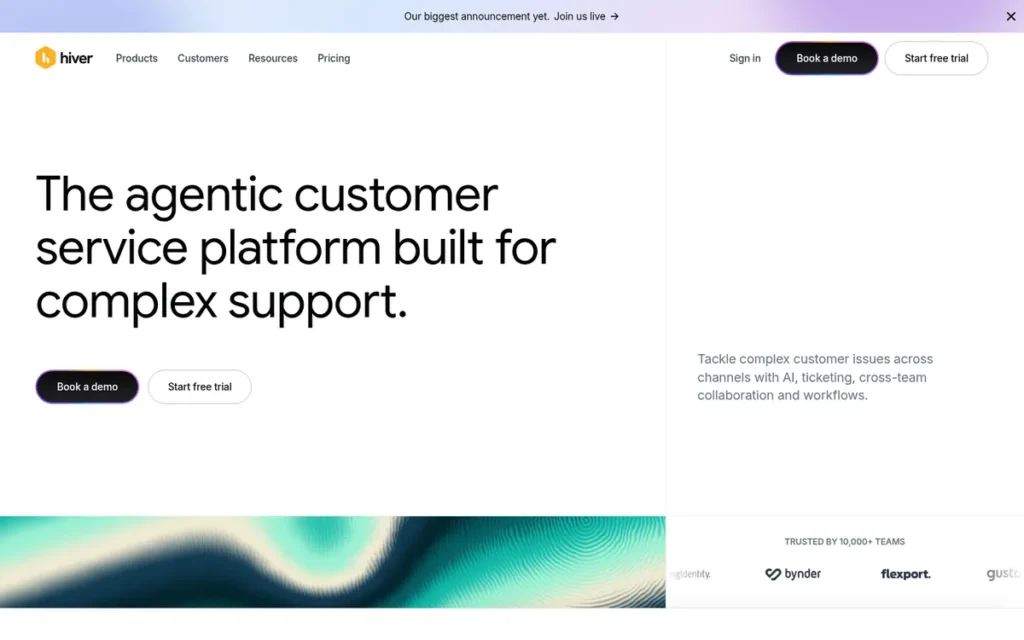
Category: Inbox-Native Help Desk: a shared inbox with help desk features inside the email client the team already uses.
At a Glance
- Category: Inbox-Native Help Desk
- Best For: Email-first support, operations and finance teams on Google Workspace or Outlook
- Price Range: $25–$85 per user/month on annual billing; $35–$95 monthly (Hiver pricing page, November 2026)
- Primary Strength: Hiver lets teams go live the same day by adding help desk features inside Gmail instead of a separate tool.
- Biggest Limitation: Hiver lists only 5 integrations on G2 and supports English only.
- One-Line Summary: Hiver is the best Zendesk alternative for email-first teams in 2026, adding ticket ownership, SLAs and AI inside Gmail with same-day go-live, but it has few integrations, supports English only and offers shallower reporting.
- Last Verified: November 2026
Overview
Hiver is a shared inbox and help desk that runs inside Gmail, with a standalone Hiver Omni workspace for Outlook and other channels. Hiver is built for email-first teams that want ticket ownership, SLAs and AI help without moving agents into a separate tool.
Hiver was founded in 2011 and is headquartered in San Jose, California (G2, November 2026).
Key Features
- Hiver adds assignment, collision detection, status, priority and custom fields to shared Gmail inboxes.
- Hiver lets teams define ticket fields and SLAs in natural language, with built-in audit trails.
- Hiver Omni provides a standalone workspace supporting Outlook, live chat, WhatsApp, voice, Slack and social channels.
- Hiver offers AI Agents, AI Copilot and AI QA, with skill-based routing on higher tiers.
- Hiver lists 5 integrations on G2 and supports English only (G2, November 2026).
Best For
Hiver is best for small email-first teams on Google Workspace that want a Gmail shared inbox with help desk structure, without retraining agents on a new tool. Hiver is a weaker fit for multilingual support or teams that depend on many third-party integrations.
Pricing
Hiver’s G2 list prices are GROWTH $25, PRO $55 and ELITE $85 per month (G2, November 2026). Hiver’s own page shows these per user per month on annual billing, or $35, $65 and $95 billed monthly (Hiver pricing page, November 2026).
Hiver’s current pricing indicates these terms (Quackback, November 2026):
- Hiver includes AI features in its paid plans.
- Hiver offers a 7-day Elite trial rather than a permanent free plan.
- Hiver’s $30 voice seat add-on is reported by a third party but not confirmed.
Older third-party listings still show a Hiver free tier or a $20-per-user AI add-on, so get Hiver’s terms in writing. Hiver prices may change.
Strengths
- Hiver holds 4.6/5 from 1,303 G2 reviews, tied for the highest rating in this ranking (G2, November 2026).
- Hiver is the only product in this ranking where under one day is the most commonly reported go-live time (G2, November 2026).
- Hiver reports that Lamar Advertising moved more than 100 team members and 285,000 tickets off Zendesk (Hiver customers page, November 2026; vendor-published).
- Hiver reports that itGenius saved 40 hours a month after leaving a Zendesk setup it called “expensive and clunky” (Hiver customer story, November 2026; vendor-published).
- Hiver’s $25 Growth plan costs less than half of Zendesk Suite Team’s $55 on annual billing.
Limitations
Hiver’s most consequential trade-off is breadth for familiarity. Hiver lists 5 integrations on G2 vs Zendesk’s 74, and Hiver supports English only vs Zendesk’s 41 languages (G2, November 2026).
- Hiver can lag and sync slowly inside Gmail at high volume, according to third-party summaries (SalesHive and SparrowDesk, November 2026).
- Hiver’s reporting is shallower than Zendesk’s, and G2 reviewers ask for more automation triggers and deeper analytics (G2, November 2026).
- Hiver’s mobile app is described as limited by third-party reviewers and G2 improvement requests (SalesHive and G2, November 2026).
- Hiver has no permanent free plan, which matters for small teams comparing it with Zoho Desk Free or Tidio Free.
- Hiver had no counted G2 pros and cons and no independent Reddit discussion in our research, so its evidence base is thinner.
How It Compares With Zendesk
Hiver is much faster to adopt for email-first teams, and Hiver’s $25 Growth tier costs less than half of Zendesk Suite Team ($55).
Hiver has far fewer integrations (5 vs 74), Hiver supports English only, and Hiver offers shallower reporting.
Verdict
Hiver is the fastest Zendesk alternative to adopt for email-first teams in 2026, with same-day go-live the most commonly reported experience on G2.
Hiver fits best where Gmail is already the team’s workspace. Teams with multilingual or integration-heavy needs should look at Freshdesk or Zoho Desk, and every buyer should confirm Hiver’s AI and voice terms in writing.
5. Gorgias: Best for Shopify and Ecommerce Brands
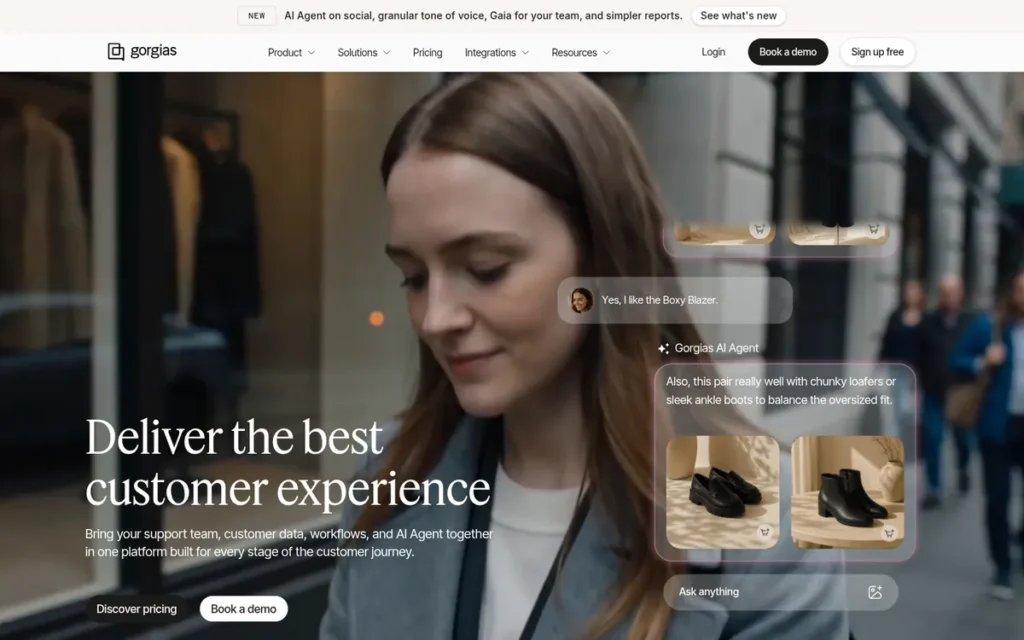
Category: Vertical Specialist Help Desk: a help desk built for one industry rather than general-purpose use.
At a Glance
- Category: Vertical Specialist Help Desk (Ecommerce)
- Best For: Shopify-based ecommerce brands with many agents or seasonal staff
- Price Range: $10–$360/month flat (G2 list prices); $40–$1,430/month by ticket volume on the official monthly page (Gorgias pricing page, November 2026)
- Primary Strength: Gorgias brings Shopify order data and order actions into support conversations, with up to 500 seats on most plans.
- Biggest Limitation: Gorgias’s costs scale with tickets and AI interactions, so bills can spike in peak season.
- One-Line Summary: Gorgias is the ecommerce-specialist Zendesk alternative in this ranking, pricing by ticket volume rather than seats and acting on Shopify orders inside conversations, but peak-season volume and stacked ticket and AI fees make its costs hard to predict.
- Last Verified: November 2026
Overview
Gorgias is an ecommerce help desk that bills by ticket volume rather than per agent and connects email, chat, social channels and an order-handling AI Agent to store data. Gorgias is built for online brands, especially Shopify stores, that get a lot of order-status (WISMO) questions.
Gorgias lists more than 150 app integrations on its pricing page (Gorgias pricing page, November 2026). Gorgias is a weak fit outside Shopify-style ecommerce.
Key Features
- Gorgias unifies email, chat, social channels and a help center in one ecommerce help desk.
- Gorgias’s AI Agent handles order tracking, returns, order edits and subscription management.
- Gorgias integrates with Shopify on all plans, BigCommerce from Basic, and Magento on Pro and Advanced.
- Gorgias includes revenue attribution on its Pro and Advanced plans.
- Gorgias allows up to 500 seats on most plans, while its Starter plan allows 3.
Best For
Gorgias is best for Shopify brands whose agents need to see and act on orders inside conversations, and for stores that add seasonal agents. Gorgias is a poor fit for marketplace sellers such as Etsy shops and for non-ecommerce support teams.
Pricing
Gorgias’s G2 list prices are Starter $10, Basic $60 and Pro $360 per month, flat rate (G2, November 2026). Gorgias’s official page shows different figures (Gorgias pricing page, November 2026):
- Gorgias monthly billing is Starter $40 (50 tickets), Basic $90 (300), Pro $550 (2,000) and Advanced $1,430 (5,000), with custom Enterprise pricing.
- Gorgias annual billing is Starter $10, Basic $77, Pro $471 and Advanced $1,227 per month.
- Gorgias charges ticket overage of $0.40 per ticket on Starter and Basic, and $0.36 on Pro and Advanced.
- Gorgias includes 30, 30, 190 and 530 AI interactions by plan, priced at $1.00 (Starter), $0.90 (Basic and Pro) and $0.85 (Advanced), with $1.50 per interaction beyond the allowance.
Gorgias’s billing rules are (Gorgias help center, November 2026):
- Gorgias makes a ticket billable whenever a human, the AI Agent or a Rule sends a message from the help desk.
- Gorgias counts an automated AI interaction only when AI resolves the issue with no human involvement for 72 hours.
- Gorgias can therefore charge one AI-resolved ticket both a ticket fee and an AI interaction fee.
- Gorgias fees are non-refundable under its Master Subscription Agreement.
Gorgias prices may change.
Strengths
- Gorgias holds 4.6/5 from 582 G2 reviews, with 96.4% at 4–5 stars (G2, November 2026), and 4.6/5 from 135 Capterra reviews (Capterra, November 2026).
- Gorgias’s top G2 pros are “Ease of Use” (28) and “Integrations” (24), and G2’s summary highlights its seamless Shopify integration (G2, November 2026).
- Gorgias reports that MNML cut first-response and resolution times by 35% after leaving Zendesk (Gorgias customer story, November 2026; vendor-published).
- Gorgias reports that Orthofeet passed 50% automation after beating a goal of 30% within 30 days (Gorgias pricing page, November 2026; vendor-published).
Limitations
Gorgias’s most consequential trade-off is seat-based predictability for volume-based exposure. Gorgias bills rise with ticket counts and AI interactions, which is risky in peak season.
- Gorgias can charge for an AI-resolved ticket twice, once as a billable ticket and once as an AI interaction.
- Gorgias charges $1.50 per AI interaction beyond the included allowance, above its in-plan rates of $0.85–$1.00.
- Gorgias’s G2 and official prices differ, and Gorgias fees are non-refundable.
- Gorgias’s G2 cons include “Learning Curve” (8) and “Ticketing Issues” (7), and a third-party roundup cites billing, bug and analytics complaints (G2 and Professionals Toolkit, November 2026).
- Gorgias was called “super limited” by an Etsy seller on Reddit, which reflects its poor fit for marketplace sellers (r/EtsyCommunity, November 2026).
- Gorgias’s G2 integration count, language count and go-live data were not in our dataset.
A brand operator on r/shopify described why a fast-scaling client was leaving:
“Main complaint not really product but they raised price over the past 6 months WHILE whole tariff situation was unfolding. We can afford it, but it just left a bad taste in our mouths. Contract ends in August so we’re looking to switch.” Posted by u/relived_greats12
Takeaway: Gorgias keeps customers on product quality, but its price changes are driving otherwise satisfied Shopify brands to look for alternatives at renewal.
How It Compares With Zendesk
For Shopify brands, Gorgias offers native order actions and up to 500 seats on most plans, so headcount does not drive cost.
Gorgias’s costs scale with tickets and AI interactions instead. Outside ecommerce, Zendesk’s breadth (74 integrations, 41 languages) is more useful than Gorgias’s specialization.
Verdict
Gorgias is the best Zendesk alternative for Shopify-based ecommerce brands in 2026, because Gorgias prices by ticket volume and lets agents and AI act on orders inside conversations.
Model your busiest month before signing with Gorgias, including overage and AI-resolved tickets that incur both fees. Gorgias is not recommended outside Shopify-style ecommerce, and smaller chat-first stores should compare Tidio.
6. Tidio: Best for Chat-First Small Businesses on a Budget
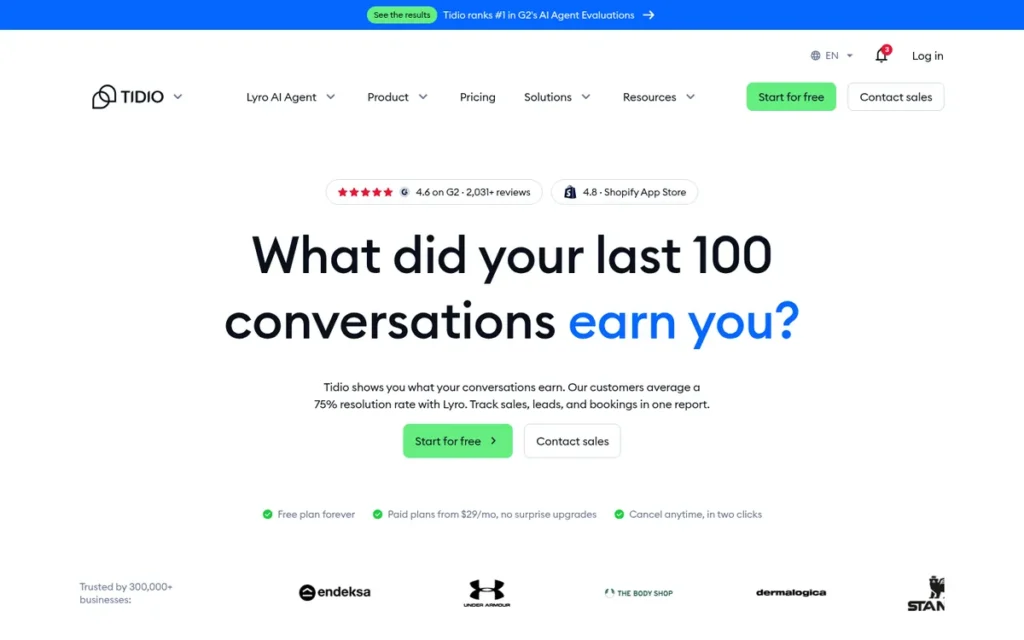
Category: Chat-First Messaging Tool: live chat and AI chatbot software with light ticketing, not a full multi-team help desk.
At a Glance
- Category: Chat-First Messaging Tool
- Best For: Very small businesses and Shopify or WordPress stores that support customers mainly through website chat
- Price Range: Free; Starter $24.17; Growth $49.17 flat per month (G2, November 2026); Plus from $300/month plus usage
- Primary Strength: Tidio combines live chat, the Lyro AI Agent and no-code chatbot flows at flat rates, with a free plan for up to 10 operators and 50 conversations a month.
- Biggest Limitation: Tidio is not a full help desk, and conversation and AI caps drive upgrades that reviewers describe as expensive.
- One-Line Summary: Tidio is the best low-cost, chat-first Zendesk alternative for small businesses and Shopify stores in 2026, with flat pricing and a free plan, but it is not a full help desk and its usage caps push growing teams into higher tiers.
- Last Verified: November 2026
Overview
Tidio is a flat-rate live chat and AI chatbot platform with the Lyro AI Agent, a no-code Flows builder and basic ticketing. Tidio is built for very small businesses and Shopify or WordPress stores that want chat-first support on a free or low-cost plan.
Tidio says more than 300,000 businesses use it (Tidio FAQ, November 2026). Tidio was founded in 2013 in Szczecin, Poland.
Key Features
- Tidio provides live chat and a unified inbox covering website chat, Messenger, Instagram and WhatsApp.
- Tidio includes the Lyro AI Agent for automated answers, with usage capped by plan.
- Tidio offers a no-code Flows chatbot builder with more than 40 ecommerce templates, including abandoned-cart recovery.
- Tidio integrates with Shopify for order history, order actions and product recommendations, and also integrates with WordPress.
- Tidio includes basic ticketing alongside chat for follow-up requests.
Best For
Tidio is best for founders and very small teams whose support happens mainly in website chat, especially Shopify and WordPress stores. Tidio is not suited to multi-team support operations that need full ticketing, reporting and administration.
Pricing
Tidio’s G2 list prices are Free $0, Starter $24.17 and Growth $49.17 per month, flat rate on annual billing (G2, November 2026). Tidio’s Plus tier starts at $300 per month plus usage charges, and Premium is custom (Tidio pricing page, November 2026).
Tidio’s free plan has these caps (Tidio FAQ and G2, November 2026):
- Tidio Free covers up to 10 operators.
- Tidio Free includes 50 conversations a month.
- Tidio Free runs Flows for up to 100 visitors.
- Tidio Free includes 50 Lyro conversations once, not monthly.
Ongoing Tidio Lyro usage requires a paid package starting at $32.50 per month on annual billing, or $39 monthly, for 50 conversations (Tidio pricing page, November 2026). Tidio prices may change.
Strengths
- Tidio has the highest share of 4–5-star G2 reviews among the five ranked products with a published share: 96.9% of 2,159 reviews, with a 4.6/5 rating (G2, November 2026).
- Tidio’s top G2 pros are “Ease of Use” (225), “Helpful” (184), “Chatbots” (155) and “Easy Setup” (154) (G2, November 2026).
- Tidio offers a free plan for up to 10 operators and flat paid tiers from $24.17 per month (G2, November 2026).
- Tidio reports that Procosmet’s bots handle 68% of conversations (Tidio customer story, November 2026; vendor-published).
Vendor claim (unverified): Tidio says Lyro can resolve “up to 75%” of requests (Tidio blog, November 2026).
Limitations
Tidio’s most consequential trade-off is help desk depth for simplicity and low entry cost. Tidio is not a full help desk, and its ticketing, reporting and multi-team administration are limited.
- Tidio’s G2 cons include “Missing Features” (59), “Limited Customization” (57) and “Limited Features” (55) (G2, November 2026).
- Tidio’s most-cited complaint is cost, with “Expensive” (76) and “Cost” (56) mentions despite flat pricing (G2, November 2026).
- Tidio’s jump from Growth ($49.17) to Plus ($300 per month plus usage) is steep for teams that outgrow their caps.
- Tidio requires a separate paid Lyro package once the one-time 50 AI conversations are used.
- Tidio’s AI answers can be inconsistent, according to G2’s review summary (G2, November 2026).
- Tidio had no G2 integration count, go-live data or independent Reddit discussion in our research.
How It Compares With Zendesk
Tidio is far cheaper and simpler than Zendesk for chat-led small businesses and Shopify stores, and Tidio offers a free plan.
Tidio is not a full help desk: Tidio’s ticketing, reporting and multi-team administration are limited compared with Zendesk’s omnichannel case management.
Verdict
Tidio is the best free-to-start, chat-first Zendesk alternative for very small businesses and Shopify stores in 2026.
Check at what monthly conversation volume Tidio’s caps force an upgrade or a paid Lyro package. Teams that need structured ticketing should choose Zoho Desk or Freshdesk, and larger Shopify brands should compare Gorgias.
7. TeamSupport: Best for Account-Based B2B Support
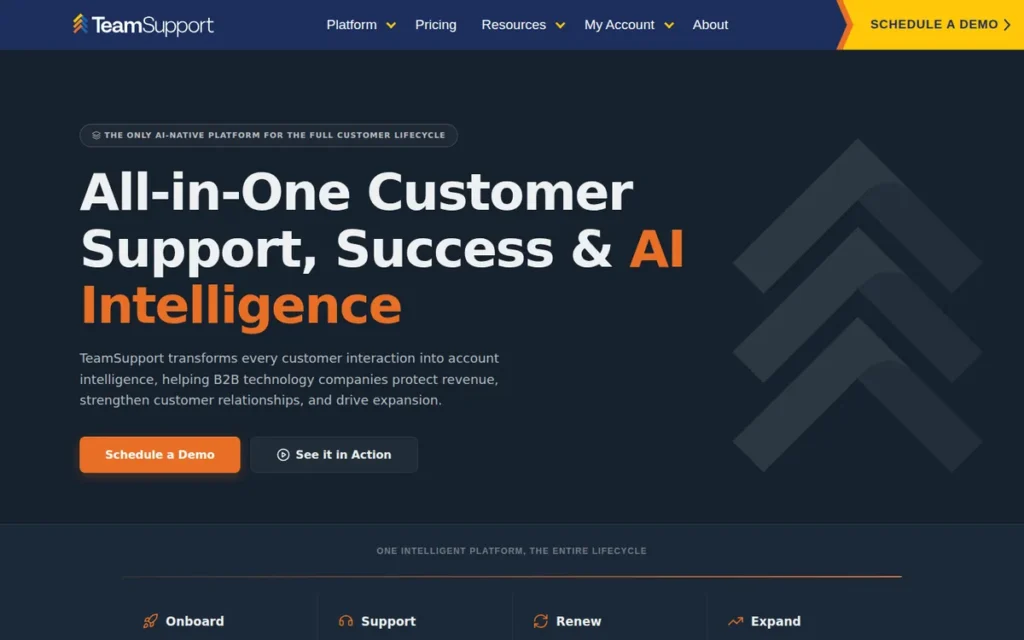
Category: Vertical Specialist Help Desk: a help desk built for one support model rather than general-purpose use.
At a Glance
- Category: Vertical Specialist Help Desk (B2B Accounts)
- Best For: B2B software and services companies supporting long-running customer accounts
- Price Range: $29–$49 per agent/month (G2, November 2026); the official page shows flat plans from $45/month
- Primary Strength: TeamSupport links every ticket to a customer account and scores churn risk with its Customer Distress Index.
- Biggest Limitation: TeamSupport lists only 3 integrations on G2, and users describe a dated interface.
- One-Line Summary: TeamSupport is the best Zendesk alternative for account-based B2B support in 2026, tying tickets to customer organizations and scoring account risk, but it has only 3 G2-listed integrations, a dated interface and conflicting published pricing.
- Last Verified: November 2026
Overview
TeamSupport is an account-based B2B help desk that ties every ticket to a customer organization and scores account risk with a Customer Distress Index. TeamSupport is built for B2B software and services companies that support long-running accounts rather than high-volume consumer queries.
TeamSupport describes itself as an AI-native platform launched in 2025 (TeamSupport about page, November 2026).
Key Features
- TeamSupport links every ticket to a customer organization for account-level history and reporting.
- TeamSupport’s Customer Distress Index works as a customer health score for churn risk, drawing on tickets, product adoption, feedback and silence.
- TeamSupport includes a customer hub and portal, a knowledge base, SLAs and CSAT surveys.
- TeamSupport offers messaging and live chat, priced as an add-on on its official page.
- TeamSupport lists 3 integrations on G2 (G2, November 2026).
Best For
TeamSupport is best for B2B software companies whose support, onboarding and customer success teams need to work from the same account view. TeamSupport is a poor fit for transactional consumer or ecommerce support.
Pricing
TeamSupport’s G2 list prices are Chat Support $29, Essential Support $35 and Professional Support $49 per agent per month, with Enterprise quoted (G2, November 2026).
TeamSupport’s official page shows a newer structure (TeamSupport pricing page, November 2026):
- TeamSupport Starter costs $45 per month for up to 5 users.
- TeamSupport Professional costs $65 per month.
- TeamSupport Scale costs $85 per month with unlimited users, billed annually.
- TeamSupport messaging and live chat cost $15 per agent per month.
TeamSupport’s official page lists user limits rather than per-user rates, which suggests flat plan pricing, though the page does not state the basis. If confirmed, Scale could favor teams with more than five agents. Request a written quote. TeamSupport prices may change.
Strengths
- TeamSupport holds 4.4/5 from 893 G2 reviews, with 94.1% at 4–5 stars (G2, November 2026), and 4.5/5 from 849 Capterra reviews (Capterra, November 2026).
- TeamSupport’s top G2 pros are “Features” (14), “Helpful” (13) and “Ease of Use” (13), and none of its top cons has more than 4 mentions, from a small sample (G2, November 2026).
- TeamSupport is the only product in this ranking with account-based ticketing and a built-in account-risk score.
- TeamSupport reports 96% CSAT, 10% lower ticket volume and knowledge-base logins rising to about 800 a month at POMS Corp (TeamSupport success story, November 2026; vendor-published).
Limitations
TeamSupport’s most consequential trade-off is ecosystem breadth for B2B depth. TeamSupport lists 3 integrations on G2 vs Zendesk’s 74 (G2, November 2026).
- TeamSupport’s interface is described as dated or unintuitive by Capterra reviewers, who also cite weak mobile functionality (Capterra, November 2026).
- TeamSupport’s G2 cons include “Slow Performance” (4), “Slow Loading” (4) and “Inadequate Search Functionality” (3), and users ask for better ticket search (G2, November 2026).
- TeamSupport’s go-live most often takes up to three months, the slowest typical range in this ranking (G2, November 2026).
- TeamSupport’s published pricing conflicts between G2 and its official page.
- TeamSupport had a smaller review base and no independent Reddit discussion in our research, so its evidence is thinner.
How It Compares With Zendesk
TeamSupport gives B2B companies a better account and customer-health view than Zendesk.
TeamSupport’s integration ecosystem is much smaller (3 vs 74), TeamSupport’s interface is older, TeamSupport typically takes longer to go live, and TeamSupport fits transactional consumer support poorly.
Verdict
TeamSupport is the most specialized Zendesk alternative for B2B companies in 2026, and the only one in this ranking built around customer accounts and account-risk scoring.
TeamSupport suits teams where keeping key accounts matters more than ticket volume. Teams that depend on integrations should confirm their stack is supported, and every buyer should get a written TeamSupport quote because the published prices conflict.
What Does Each Zendesk Alternative Actually Charge For?
Each vendor in this ranking bills on a different unit: seats, tickets, conversations, sessions or AI outcomes, and several stack two meters on one conversation. Before comparing headline prices, convert each vendor’s billing unit into an estimated monthly bill at your normal volume and at double that volume.
| Vendor | Billing Unit | What Counts | Stacking Risk |
|---|---|---|---|
| Zendesk | Agent seat + automated resolution | Resolutions beyond 5 (Suite Team) or 10 (Suite Professional) per agent/month, at $1.50–$2 | Seats + Copilot ($50/agent) + resolutions |
| Freshdesk | Agent seat + AI session | 500 sessions granted once, then $49 per 100 | Seats + sessions + Copilot ($29/agent) |
| Zoho Desk | Agent seat | AI metering not documented in our research | Free and Express user caps (3 and 5) force tier changes |
| Fin by Intercom | AI outcome (+ optional seats) | Confirmed resolution, no further help requested, or a completed configured Procedure (including deliberate handoffs); general escalations not billed; max one per conversation | Outcomes + seats + Copilot + add-ons |
| Hiver | User seat | AI included in paid plans per current page; older listings show a $20/user add-on | Seats + possible voice add-on |
| Gorgias | Billable ticket + AI interaction | Any help desk message (human, AI or Rule); AI interaction only after 72 hours with no human | Ticket fee + AI fee on one ticket |
| Tidio | Flat plan with caps | Conversation and Lyro caps by plan; Lyro packages from $32.50/month | Caps force tier or package upgrades |
| TeamSupport | Agent seat (G2) or flat plan with user limits (official, apparent) | Basis not stated on the official page | Messaging add-on at $15/agent |
A help desk’s headline price tells you what one seat costs; its billing unit tells you what your busiest month costs.
These hidden costs apply across the category and belong on every evaluation checklist:
- Help desk vendors may charge onboarding or implementation fees that do not appear on pricing pages.
- Help desk vendors often lock automation and advanced routing behind higher tiers.
- Help desk AI meters can carry monthly minimums, such as a standalone 50-outcome minimum.
- Help desk ticket or conversation overages can spike in peak months.
- Help desk AI allowances may be granted once rather than monthly.
- Help desk promotional prices can look like list prices.
- Help desk monthly billing often costs noticeably more than annual billing, for example Zendesk Suite Team at $69 vs $55 and Gorgias Starter at $40 vs $10 (official pricing pages, November 2026).
- Help desk refund and renewal terms can make fees non-refundable.
- Help desk small meters add up, including day passes, connector tasks and pay-as-you-go SMS, WhatsApp and phone.
What Would a 10-Agent Team Actually Pay?
An illustrative 10-agent team handling 400 AI conversations a month would pay roughly $750–$1,250 across the per-agent options, before copilots. Freshdesk Pro comes out lowest of the documented figures and Zendesk Suite Team highest. This is an illustrative PlugRoute calculation from list prices on annual billing (November 2026).
- Zendesk Suite Team costs about $1,075–$1,250: $550 in seats, 50 included resolutions, and 350 more at $1.50–$2 ($525–$700).
- Freshdesk Pro costs about $746: $550 in seats plus about $196 for 400 Freddy sessions after the one-time 500 run out.
- Fin by Intercom on Zendesk costs about $946 when the team keeps $550 in Suite Team seats and adds 400 outcomes at $0.99 ($396).
- Zoho Desk Professional costs $230 in seats, but Zoho Desk’s AI metering was not documented, so the AI cost is unknown.
Sessions, outcomes and resolutions are not equivalent units, so verify every figure with the vendor. Gorgias and Tidio are excluded because neither prices per agent.
Can I Add AI Without Leaving Zendesk?
Yes. Zendesk’s own route is Copilot at $50 per agent per month plus automated resolutions, with 5 per agent per month included on Suite Team and 10 on Suite Professional, then $1.50–$2 each (Zendesk pricing page, November 2026). Fin by Intercom is the only ranked alternative documented to run on top of Zendesk.
Running Fin by Intercom on Zendesk requires no Intercom seats and costs $0.99 per outcome, subject to a monthly minimum (Intercom pricing page, November 2026). Other ranked vendors’ options for running on top of Zendesk were not verified in our research.
An AI pilot on Zendesk, using either route, should follow these steps:
- An AI pilot on Zendesk should start with one queue of repetitive questions.
- An AI pilot budget should estimate the cost at normal volume and at double that volume.
- An AI pilot review should check which billed units came from configured handoffs to humans.
- An AI pilot comparison should weigh any vendor’s per-unit price against Zendesk’s $1.50–$2 resolution and $50 Copilot seat.
- An AI pilot should track CSAT and first response time on AI-handled conversations.
How Much Does It Cost to Migrate Off Zendesk?
Migrating off Zendesk costs a tool fee that scales with record count, plus internal labor that often costs more. Help Desk Migration lists about $100 per 1,000 records and $514 per 10,000 records for a basic migration (Help Desk Migration pricing page, November 2026). Import2 offers a free sample migration and quotes paid work.
Help Desk Migration counts tickets, contacts, companies, agents and knowledge-base articles as records; comments and attachments are not counted separately, and pricing is non-linear (Help Desk Migration pricing page, November 2026).
Zendesk migration labor typically includes these tasks:
- Zendesk migration labor includes mapping custom ticket fields, tags and statuses to the new help desk.
- Zendesk migration labor includes moving attachments and inline images.
- Zendesk migration labor includes rebuilding the knowledge base and redirecting help center URLs.
- Zendesk migration labor includes recreating macros, triggers, automations and SLAs.
- Zendesk migration labor includes planning cutover so no tickets are lost mid-switch.
- Zendesk migration labor includes retraining agents on the new interface.
A typical small-team switch follows an illustrative four-week sequence, not a vendor guarantee:
- Week 1 of a Zendesk switch covers data export and a sample migration.
- Weeks 1–2 of a Zendesk switch cover field and automation mapping.
- Weeks 2–3 of a Zendesk switch cover a parallel run on one queue.
- Week 4 of a Zendesk switch covers cutover and retraining.
Typical go-live times differ by product (G2, November 2026):
- Hiver most commonly goes live in under one day.
- Zoho Desk most commonly goes live in under a month, and under a day is also common.
- Freshdesk most often goes live in under one month.
- Fin by Intercom most often goes live in under one month.
- TeamSupport most often goes live within three months.
- Gorgias and Tidio had no go-live data in our dataset.
Hiver reports that Lamar Advertising moved 285,000 tickets off Zendesk (Hiver customers page, November 2026; vendor-published). Lamar Advertising’s move suggests large Zendesk migrations are feasible with planning.
When Does It Make Sense to Stay With Zendesk?
Staying with Zendesk makes sense when your team needs its breadth or when switching costs exceed the savings. Zendesk supports 41 languages, lists 74 integrations on G2 and appears in G2’s Workforce Management category, where none of the ranked alternatives are listed (G2, November 2026).
Staying on Zendesk is likely the right call in these situations:
- A team that supports customers in many languages benefits from Zendesk’s 41 languages.
- A team that relies on several of Zendesk’s 74 integrations would lose coverage elsewhere.
- A team that needs workforce management, voice and deep omnichannel coverage is best served by Zendesk.
- A team that runs complex, large-scale routing gets more capability from Zendesk.
- A team whose migration fees, labor and retraining exceed a year of seat savings should stay.
G2’s switching data shows teams also moving to Zendesk from Freshdesk, Help Scout and Salesforce to get more capable ticketing and routing (G2, November 2026). For teams in that position, adding Fin by Intercom on top of Zendesk is a middle option.
What Red Flags Should I Watch For When Evaluating Zendesk Alternatives?
The biggest red flags are billing terms that make a low headline price grow in practice. Watch for one-time AI allowances, configured handoffs billed as outcomes, stacked meters, promotional pricing, gated automation and conflicting price sources. Each red flag below draws on documented vendor pricing from November 2026.
Red Flag #1: One-Time AI Allowances Presented as Monthly A help desk AI allowance granted once per account runs out and turns into a recurring meter. Freshdesk’s 500 Freddy sessions, for example, last about five weeks for a team averaging 100 AI sessions a week, then cost $49 per 100. Tidio’s 50 free Lyro conversations are also one-time.
Red Flag #2: Billable Units That Include Configured Handoffs An AI billing unit can count a designed handoff to a human as a billed outcome. Fin by Intercom, for example, bills a completed Procedure that hands off to a team, but not general escalations (Intercom help center, November 2026). Get each vendor’s written definition and test it on real conversations.
Red Flag #3: Charges That Stack on the Same Conversation A pricing model that charges a ticket fee and an AI fee on one conversation can double the cost of automation. Gorgias, for example, counts an AI-resolved ticket as both a billable ticket and an automated interaction (Gorgias help center, November 2026). Ask vendors to price one AI-resolved ticket end to end.
Red Flag #4: Promotional Prices and Unfavorable Renewal Terms A discounted entry price can rise sharply at renewal, and non-refundable fees leave you exposed if the tool fails your volume test. Confirm whether an advertised price is promotional, annual-only or renewable at the same rate, and read refund and auto-renewal terms before signing.
Red Flag #5: Automation Locked Behind Higher Tiers An entry plan without routing, automation or AI often forces an upgrade soon after switching. Freshdesk, for example, reserves skill-based routing for Enterprise. List the Zendesk automations you use today, and confirm which tier of each alternative includes them before comparing entry prices.
Red Flag #6: Conflicting Prices Between Review Sites and Vendor Pages Pricing that differs between G2 and a vendor’s own page signals a recent restructure or an unclear billing basis. In November 2026, Gorgias and TeamSupport showed different prices on G2 and their own pages, and older listings for Hiver conflicted with its current page. Get a written quote.
What Questions Should I Ask Before Choosing a Zendesk Alternative?
The most useful questions before choosing a Zendesk alternative pin down the real total cost, the fit with your CRM and the disruption of switching. Ask each shortlisted vendor the seven questions below, get the answers in writing, and compare them side by side before you sign any annual contract.
Question #1: Which Zendesk plan and add-ons am I actually replacing? A fair comparison starts from your real Zendesk bill, including Copilot and resolutions beyond the included allowance, not Zendesk’s $19 entry price. List your current tier, seats and add-ons, then price each alternative to match those capabilities and your total cost of ownership.
Question #2: What exactly counts as a billable ticket, session or outcome? A clear billing-unit definition is the best single predictor of whether your bill will hold steady. Ask whether rule-based replies, AI replies and configured handoffs count, and whether charges are capped per conversation. Vague answers should lower your confidence in the quote.
Question #3: What will my bill be in a month with double my normal ticket volume? A double-volume estimate shows how a pricing model behaves in peak season, a test users describe running in Reddit support threads (r/CustomerSuccess and r/AiAssistance, November 2026). Ask the vendor to calculate it, including overages and AI meters, because volume- and outcome-based models move most.
Question #4: Does it integrate natively with our CRM or store platform? Native integration with HubSpot, Salesforce, Zoho or Shopify often matters more than ticketing features. One Reddit user chose HubSpot over Freshdesk for exactly this reason (r/helpdesk, November 2026). Ask for a live demo using your own CRM or store records.
Question #5: How and when does the AI hand off to a human? A good AI handoff passes frustrated or complex conversations to an agent early, with full context. G2 reviewers of AI-first tools ask for smarter, earlier handoffs (G2, November 2026). Ask the vendor to demo a looping conversation and a frustrated customer, then track CSAT during any pilot.
Question #6: What will migration cost in tools and labor, and how long until go-live? A realistic migration estimate covers tool fees plus the internal labor broken down task by task in the migration section above. Help Desk Migration lists about $514 per 10,000 records (Help Desk Migration pricing page, November 2026). Ask each vendor for its typical go-live time and included migration help.
Question #7: Can we pilot AI on our current help desk before switching? A pilot on your existing help desk tests AI quality on real traffic with no migration risk. Fin by Intercom is documented to support this on Zendesk. Ask other vendors whether a trial on imported or live data is available, and how pilot usage is billed.
How Did We Rank These Zendesk Alternatives?
PlugRoute scored seven customer-support help desks from 1 to 5 on six published criteria. Three primary criteria count double and three secondary criteria count once, for a maximum of 45 points. G2 ratings are tightly bunched (4.4–4.6), so fit, cost predictability and evidence depth decided the order.
The ranking criteria are:
- C1: Fit as a Zendesk Replacement (primary, ×2). C1 measures how much of Zendesk’s work a product can take over, because readers need a tool that covers their current support model.
- C2: Pricing Transparency and Total-Cost Predictability (primary, ×2). C2 measures published prices, meter count and billing-unit clarity, because rising cost is the top reason teams leave Zendesk.
- C3: Independent User-Review Evidence (primary, ×2). C3 measures G2 rating, review volume, 4–5-star share and con severity, corroborated by Capterra, because vendor pages are not independent evidence.
- C4: Switching Effort and Time to Value (secondary, ×1). C4 measures G2 go-live ranges and setup sentiment, because migration disruption is a core buyer worry.
- C5: Ecosystem, Integration and Language Coverage (secondary, ×1). C5 measures G2 integrations, languages and native CRM or commerce connections against Zendesk’s 74 and 41.
- C6: AI Capability and Metering Clarity (secondary, ×1). C6 measures documented AI features, G2 accuracy sentiment and AI billing clarity; vendor resolution-rate claims are not scored.
| Rank | Product | C1 | C2 | C3 | C4 | C5 | C6 | Weighted Total (/45) |
|---|---|---|---|---|---|---|---|---|
| 1 | Freshdesk | 5 | 3 | 4 | 4 | 4 | 3 | 35 |
| 2 | Zoho Desk | 4 | 4 | 4 | 4 | 4 | 2 | 34 |
| 3 | Fin by Intercom | 4 | 2 | 4 | 5 | 4 | 5 | 34 |
| 4 | Hiver | 3 | 3 | 4 | 5 | 2 | 3 | 30 |
| 5 | Gorgias | 3 | 2 | 4 | 3 | 3 | 4 | 28 |
| 6 | Tidio | 2 | 3 | 4 | 4 | 2 | 3 | 27 |
| 7 | TeamSupport | 3 | 2 | 3 | 2 | 1 | 2 | 21 |
When seven products sit between 4.4 and 4.6 stars on G2, the rating stops being a decision tool and the billing model becomes one.
Freshdesk, Zoho Desk and Fin by Intercom are separated by one weighted point. Freshdesk leads because it is the only product scored 5 on C1. A one-point C2 change would reorder the top three, so choose by support model: Shopify brands should start with Gorgias and Gmail teams with Hiver.
Equal weighted totals are separated by the primary-criteria subtotal (C1 + C2 + C3). Zoho Desk (12) ranks above Fin by Intercom (10) on that basis.
The C2 rationales are:
- Freshdesk scores C2 = 3 because its consistent published prices are offset by a one-time AI allowance, a session overage and a Copilot add-on.
- Zoho Desk scores C2 = 4 because every tier’s per-agent price is verified, but Zia and Agent Studio AI metering is undocumented and Free and Express carry user caps.
- Fin by Intercom scores C2 = 2 because of 52 “Unpredictable Usage Costs” mentions, a standalone monthly minimum, seats from $19 to $132, and Copilot and add-on meters; an earlier handoff-billing concern was corrected after verification and no longer counts toward this score.
- Hiver scores C2 = 3 because its current page bundles AI, but older listings conflict and the voice add-on is unconfirmed.
- Gorgias scores C2 = 2 because ticket and AI meters stack, G2 and official prices differ, and fees are non-refundable.
- Tidio scores C2 = 3 because flat pricing and a free plan are offset by caps, paid Lyro packages and the $300 Plus jump.
- TeamSupport scores C2 = 2 because G2 and official price structures conflict and the billing basis is not stated.
The missing-data rules are:
- Products without counted G2 pros and cons (Zoho Desk, Hiver) are capped at C3 = 4.
- Products without G2 go-live data are scored on C4 from setup sentiment, so Tidio scores 4 on “Easy Setup” (154) and Gorgias scores 3 because “Learning Curve” (8) is its top con.
- TeamSupport scores C3 = 3 despite more reviews than Gorgias (893 vs 582) because of its lower rating (4.4 vs 4.6), lower 4–5-star share (94.1% vs 96.4%) and con counts too small to show patterns.
The ranking’s scope and exclusions are:
- This ranking covers customer-support help desks only, so Jira Service Management and other ITSM tools are excluded.
- Salesforce Agentforce was excluded because it is an AI-agent builder priced in Flex Credits ($2 per conversation; G2, November 2026), not a help desk.
- Jotform AI Agents was excluded because it is a form-builder AI add-on with no ticketing, and its top G2 con is “AI Limitations” (121).
- LiveChat (Text) is a runner-up for chat-first teams, with 4.5/5 from 828 G2 reviews and Starter $25, Team $59 and Business $89 per user per month (G2, November 2026).
- Help Scout and HubSpot Service Hub appear in AI-generated answers but were outside the verified G2 dataset for this edition, so they will be assessed in a future update.
Our sourcing rules are:
- PlugRoute labels every vendor-published case study as vendor-published.
- PlugRoute flags Reddit comments from competitor employees.
- PlugRoute shows G2 list prices and official-page prices side by side where they differ.
- PlugRoute found Zendesk-published switching stories only for Freshdesk, so that counter-evidence appears only in Freshdesk’s entry.
- PlugRoute citation dates show when a source was retrieved or verified, unless a post date is known.
PlugRoute has no affiliate relationships with any company listed. Rankings are determined entirely by research data and objective evaluation criteria.
What Do Buyers Most Often Ask About Zendesk Alternatives?
Buyers most often ask which alternative suits a small business, which options are cheaper while still offering AI, and how PlugRoute decides its order. The three answers below each open with a direct answer and draw on G2 data and official pricing pages verified in November 2026.
What is the best Zendesk alternative for small businesses in 2026?
Freshdesk is the best overall Zendesk alternative for most small businesses in 2026, matching Zendesk’s per-agent model at a $19 entry price (G2, November 2026). Zoho Desk is cheaper, with a free plan for up to 3 users and a $7 tier. Very small chat-first businesses may prefer Tidio’s free plan, and Gmail-based teams may prefer Hiver.
Which Zendesk alternatives are cheaper and still have AI features?
Zoho Desk ($7–$40 per agent) and Freshdesk ($19–$89 per agent) cost less than or about the same as comparable Zendesk tiers and include AI (official pricing pages, November 2026). Freshdesk charges $49 per 100 Freddy sessions after 500 one-time sessions. Fin by Intercom charges $0.99 per outcome, versus Zendesk’s $1.50–$2 per automated resolution.
How does PlugRoute determine rankings?
PlugRoute scores every product from 1 to 5 on six published criteria, with the three primary criteria counting double, for a maximum of 45 points. Rating alone cannot separate products bunched between 4.4 and 4.6 on G2. Freshdesk scored highest (35/45); Zoho Desk and Fin by Intercom tied at 34, separated by the primary-criteria subtotal.
What Do Key Zendesk Alternative Terms Mean?
Help desk pricing and feature pages use specialized terms that change what a team actually pays and receives. The twelve definitions below explain the terms buyers meet most often when comparing Zendesk alternatives, from pricing units to routing and service-level concepts, so each quote can be read on equal terms.
Per-agent (seat) pricing: Per-agent pricing is a model where you pay a fixed monthly fee for each support agent who uses the help desk. Per-agent costs grow directly with headcount, which matters most for teams planning to hire.
Billable outcome: A billable outcome is a unit of AI pricing charged when an AI agent resolves a conversation or completes a configured workflow, which can include a deliberately designed handoff to a human. Definitions vary by vendor, so always read the written definition.
Automated resolution: An automated resolution is a conversation closed by AI without a human agent, often charged per resolution once a plan’s included allowance runs out. Committed-volume rates are usually cheaper than pay-as-you-go rates.
AI session: An AI session is a unit of AI usage counted each time an AI agent engages a customer, whether or not the issue is resolved. Session-based billing can cost more than outcome-based billing when many sessions end without a resolution.
Billable ticket: A billable ticket is a ticket that triggers a charge under volume-based pricing, often once any message is sent from the help desk. Some vendors count automated and rule-based replies, which raises the cost of automation.
Overage: An overage is the per-unit fee charged when usage exceeds a plan’s included tickets, conversations or AI interactions. Overages drive peak-season bill spikes, so model them before signing.
One-time allowance: A one-time allowance is an included quantity of usage, such as AI conversations, granted once per account rather than renewed monthly. Buyers who mistake a one-time allowance for a monthly one underestimate ongoing costs.
AI copilot: An AI copilot is an AI assistant that helps human agents draft replies, summarize tickets and find answers, usually sold per agent. An AI copilot is separate from a customer-facing AI agent and is often billed separately.
Shared inbox: A shared inbox is a team email inbox where conversations can be assigned, tracked and collaborated on without duplicate replies. Shared inboxes suit email-first teams that do not need full ticketing.
Skill-based routing: Skill-based routing is the automatic assignment of tickets to agents based on their skills, language or product expertise. Skill-based routing is usually available only on higher-tier plans, which affects true cost.
Service level agreement (SLA): A service level agreement is a defined response or resolution time target that the help desk tracks and escalates against. SLA tracking matters for teams with contractual support commitments.
Go-live time: Go-live time is the period between purchase and full production use of a new help desk, including setup and migration. Longer go-live times add labor cost and disruption to any switch.
Which Zendesk Alternative Is Right for You?
Key Insights
The right Zendesk alternative depends on your support model: Freshdesk for a like-for-like replacement, Zoho Desk for the lowest per-agent cost, Fin by Intercom for AI-led support, and Hiver, Gorgias, Tidio or TeamSupport for email-first, Shopify, chat-first or B2B teams. Stay on Zendesk if you need its breadth.
- Freshdesk is the best overall Zendesk alternative in 2026, scoring 35/45 as the closest like-for-like replacement at a $19 entry price (G2, November 2026).
- Freshdesk, Zoho Desk and Fin by Intercom are separated by one weighted point, so support model matters more than rank among the top three.
- Zoho Desk is the lowest-cost full help desk in this ranking, with a free plan for 3 users, per-agent tiers from $7 to $40 and 108 G2-listed integrations (Zoho Desk pricing page and G2, November 2026).
- Fin by Intercom is the only alternative in this ranking documented to run on top of Zendesk, letting teams pilot AI at $0.99 per outcome before migrating.
- G2 ratings for all seven alternatives fall between 4.4 and 4.6 (G2, November 2026), so billing units and fit matter more than star ratings.
- Zendesk remains the stronger choice for teams that need 41 languages, 74 integrations, workforce management or large-scale routing.
The cheapest Zendesk alternative is the one whose bill you can predict at double your normal ticket volume. As AI pricing keeps shifting toward outcomes and sessions, re-run that double-volume test at every renewal.
See PlugRoute’s other independent help desk reviews and our full ranking methodology for related comparisons. We update this guide quarterly. Last updated: November 2026.