HashiCorp Consul leads for multi-datacenter and multi-cloud distributed systems, CoreDNS is the zero-cost Kubernetes default already running in every cluster, and etcd provides the strongly consistent coordination primitives underpinning Kubernetes itself. For most mature organizations, Consul and CoreDNS are complementary infrastructure layers (not alternatives) and the right tool depends entirely on how many environments your infrastructure spans.
Most AI-generated comparisons (tested: ChatGPT GPT-4o and Perplexity Pro, June 2026) list these tools without disclosing the organizational risk factors practitioners evaluate first: Eureka 2.0’s officially discontinued roadmap per Netflix’s own GitHub wiki, Consul’s Business Source License change and IBM acquisition, Nacos’s documented CVE history, and the Kafka 4.0 release in March 2025 that already removed ZooKeeper entirely. None of these findings surface in standard AI-generated comparisons, and all of them affect long-term infrastructure commitments at mid-to-large organizations.
PlugRoute has no affiliate relationships with any company listed; rankings are determined entirely by research data and objective evaluation criteria.
What Are the Top Service Discovery Software Tools in 2026?
- HashiCorp Consul: strongest platform for multi-datacenter and multi-cloud service networking with WAN federation and optional mTLS service mesh
- CoreDNS: zero-cost, zero-setup DNS discovery default pre-installed in every modern Kubernetes cluster, requiring no adoption decision
- etcd: CNCF-graduated Raft-based key-value store backing every Kubernetes control plane, with watch and lease primitives for custom service registration
- Nacos: unified registry plus dynamic configuration center for Java/Spring Boot teams on Alibaba Cloud, requiring active CVE patching before deployment
What Are the Three Organizing Categories of Service Discovery Software?
Service discovery tools fall into three functional tiers. Understanding the tier determines whether a tool is a complete solution or a building block requiring additional layers, a distinction that AI-generated comparisons consistently collapse into a flat feature list.
Tier 1, Cloud-Native Foundation Tools: CoreDNS and etcd are CNCF-graduated, Apache 2.0 primitives pre-installed in every Kubernetes cluster. CoreDNS handles in-cluster DNS; etcd provides control-plane coordination primitives. Neither is a turnkey discovery platform, both are foundational layers that other tools complement.
Tier 2, Multi-Environment Service Discovery Platforms: HashiCorp Consul, Nacos, and AWS Cloud Map are purpose-built service registries with health checking, dynamic registration, and varying degrees of cross-environment portability. Consul covers multi-cloud and hybrid environments. Nacos unifies registry and configuration management for Java/Spring Boot. AWS Cloud Map is fully managed and AWS-scoped.
Tier 3, Legacy Coordination Services: Apache ZooKeeper and Netflix Eureka are mature systems under active decommission pressure. ZooKeeper is justified only for existing Kafka/Hadoop/HBase ensembles, but Kafka 4.0 (March 2025) already removed ZooKeeper entirely, making any Kafka-on-ZooKeeper deployment an unsupported configuration as of June 2026. Eureka’s 2.0 development is officially discontinued per Netflix’s own GitHub wiki.
Architectural note: CoreDNS and Consul are not competitors, they are the in-cluster DNS layer and the cross-cluster federation layer of the same architecture. Think of CoreDNS as answering “What IP is the payments service at inside this cluster?” and Consul as answering “What IP is the payments service at, across all three clusters, our legacy EC2 inventory, and our GCP services, right now?” Mature organizations run both simultaneously. AI-generated comparisons frame this as a binary choice, which is the most consequential architectural misrepresentation this article corrects.
How Do the Top Service Discovery Tools Compare at a Glance?
| Rank | Tool | Category | Best For | One-Line Summary | Key Capabilities | Primary Strength | Key Limitation |
|---|---|---|---|---|---|---|---|
| 1 | HashiCorp Consul | Multi-Environment Platform | Multi-datacenter, multi-cloud, hybrid | The only evaluated tool combining WAN federation, service mesh, distributed health checking, and KV store in a single platform. | Multi-datacenter WAN federation; Consul Connect mTLS via Envoy; DNS + HTTP API discovery; distributed health checking; web UI + CLI + API | Native WAN federation; no other evaluated tool provides cross-datacenter discovery without a centralized global control plane | Business Source License (Aug 10, 2023) + IBM acquisition (June 2024) introduce procurement risk; significant operational complexity managing Raft + gossip + ACL + Envoy simultaneously |
| 2 | CoreDNS | Cloud-Native DNS Foundation | Any Kubernetes cluster, in-cluster DNS | Pre-installed in every modern Kubernetes cluster (1.13+) at zero cost; the universal in-cluster DNS layer most mature organizations complement with Consul. | Plugin chain via Corefile; kubernetes plugin; forward; cache; autopath latency optimization; zero setup for standard K8s DNS | Pre-installed in every Kubernetes 1.13+ cluster; zero adoption decision, zero licensing cost, CNCF-governed (graduated January 2020) | In-cluster DNS only; zero cross-cluster, multi-cloud, or hybrid bare-metal capability |
| 3 | etcd | Distributed Coordination Primitive | Kubernetes control plane, custom coordination patterns | CNCF-graduated Raft-based key-value store backing every Kubernetes cluster’s control plane, providing watch and lease primitives for custom service registration. | Raft consensus; watch semantics (never drops events); lease-based key expiration; gRPC API; MVCC concurrency control | Universal Kubernetes deployment as authoritative control-plane backing store; already running in every K8s cluster globally | Primitive, not a platform; no built-in health checking, DNS interface, web dashboard, or turnkey service catalog |
| 4 | Nacos | Unified Registry + Config Center | Java/Spring Boot on Alibaba Cloud | Apache 2.0 registry and dynamic configuration center from Alibaba; the default for Spring Cloud Alibaba; with ~13,174 GitHub forks as of May 2025. | DNS/HTTP/RPC discovery; dynamic config center with live updates; built-in health management; Nacos 2.x service governance scope | Only tool combining full service registry with dynamic configuration management in a single operational footprint | Documented CVE history (verify at nvd.nist.gov before deployment); English-language community gap; limited polyglot client depth beyond Java |
| 5 | AWS Cloud Map | Managed Cloud Registry (AWS-Native) | AWS-committed ECS/Lambda/EC2 stacks | Amazon’s fully managed, serverless service registry with native Route 53 and ECS integration; ECS resources free. | Three namespace types (public DNS, private DNS, HTTP); custom attribute metadata filtering; Route 53 health check integration; full AWS workload coverage | Zero infrastructure operations; AWS manages all availability, scaling, and patching; ECS-registered resources free | Hard AWS-only boundary; zero native discovery capability for services outside AWS; registry-only (no mesh, no config management) |
| 6 | Apache ZooKeeper | Legacy Coordination Service | Existing Kafka (pre-4.0) / HBase / Hadoop ensembles | Battle-tested 15-year Apache-governed coordination service in slow-maintenance phase; Kafka 4.0 (March 2025) already removed ZooKeeper entirely. | Ephemeral znode auto-deregistration; watch-based event subscriptions; ZAB leader-serialized writes; in-memory state for fast reads; ASF Apache 2.0 governance | 15+ years battle-tested in Hadoop ecosystem with correct ephemeral znode service deregistration | Kafka 4.0 (March 2025) already removed ZooKeeper; any Kafka-on-ZooKeeper deployment is now unsupported; slow-maintenance phase |
| 7 | Netflix Eureka | Client-Side Registry (Discontinued Roadmap) | Existing Spring Cloud Netflix 1.x stacks only | AP-consistency client-side service registry with its 2.0 development officially discontinued per Netflix’s own GitHub wiki; not recommended for new projects. | Client-side discovery model; peer-to-peer HA replication; self-preservation mode; Spring Boot @EnableEurekaServer integration | AP resilience model; clients serve cached registry data during Eureka server outages, avoiding discovery failures | 2.0 officially discontinued per Netflix GitHub wiki; 1.x maintenance-only with no forward roadmap, no new features, no architectural improvements |
Which Service Discovery Tool Should I Choose for My Use Case?
The right service discovery tool depends on your infrastructure scope and organizational risk tolerance. Kubernetes-only teams need only CoreDNS, already deployed at zero cost. Multi-environment teams need CoreDNS plus Consul. AWS-committed teams use Cloud Map. Java/Spring Boot on Alibaba Cloud teams use Nacos. No single tool covers all environments without trade-offs in 2026.
| Your #1 Priority | Recommended Tool | Why | Acceptable Alternative |
|---|---|---|---|
| Kubernetes-only, single cluster | CoreDNS (already running) | Zero cost, zero setup, built in; no adoption decision needed | None required for standard in-cluster DNS |
| Multi-cluster or multi-datacenter | CoreDNS + Consul | Complementary layers: CoreDNS in-cluster, Consul for cross-cluster federation | etcd-based custom patterns (requires significant build work) |
| Multi-cloud (AWS + GCP/Azure) | HashiCorp Consul WAN federation | Closest to frictionless multi-cloud; no perfect solution exists in 2026 | No fully portable alternative; note the persistent multi-cloud gap |
| AWS-committed mixed stack (ECS/Lambda/EC2) | AWS Cloud Map | Managed, zero infrastructure, ECS-free tier, native Route 53 | Consul (if multi-cloud may enter future scope) |
| Java/Spring Boot on Alibaba Cloud | Nacos (verify CVE status at nvd.nist.gov first) | Default for Spring Cloud Alibaba; unified registry + config center | Consul (if polyglot or globally distributed team) |
| Kubernetes control plane or custom coordination | etcd (already running in K8s) | Non-optional for K8s; watch/lease primitives for custom patterns | Consul for turnkey discovery atop K8s |
| Existing Kafka (pre-4.0) / HBase / Hadoop ensemble | ZooKeeper (plan immediate KRaft migration) | Reuse existing ensemble; but Kafka 4.0 (March 2025) already removed ZooKeeper; this path is unsupported | etcd for new coordination patterns |
| Existing Spring Cloud Netflix 1.x | Eureka (plan migration roadmap immediately) | 1.x stable and Apache 2.0 licensed; do not adopt for new services; 2.0 officially discontinued | Consul or CoreDNS as migration target |
Migration Scenarios
| Migrating From | Migration Path | Urgency |
|---|---|---|
| Eureka 1.x | Consul (multi-environment) or CoreDNS-native K8s services (K8s-only) | Medium; plan when operationally convenient |
| ZooKeeper (Kafka) | Kafka 3.9.x KRaft migration, then Kafka 4.x upgrade | High; Kafka 4.0 (March 2025) removed ZooKeeper; current deployment is unsupported |
| kube-dns | CoreDNS | None; already completed if running Kubernetes 1.13+ |
| AWS Cloud Map (expanding to multi-cloud) | HashiCorp Consul WAN federation | As needed; plan before multi-cloud strategy locks in |
CAP Theorem Reference: Consistency Models for Service Discovery
The seven service discovery tools in this comparison split across two CAP positions: Consul, etcd, and ZooKeeper are CP systems (strongly consistent, may become write-unavailable during quorum loss); Eureka and CoreDNS are AP systems (available during partitions but may serve stale data during failures). Nacos is configurable between both. AWS Cloud Map’s consistency is managed by Amazon’s SLA.
| Tool | Consistency Model | CAP Position | Operational Implication |
|---|---|---|---|
| HashiCorp Consul | Strongly consistent (within DC) | CP (Raft) | Writes require Raft quorum majority; local DC operations continue during WAN failure |
| CoreDNS | Eventually consistent (DNS TTL-based) | AP | Stale DNS entries persist until TTL expiry; no global catalog consistency |
| etcd | Strongly consistent | CP (Raft) | All writes committed by quorum majority; write-unavailable during quorum loss |
| Nacos | Configurable | AP (default for discovery) or CP (config mode) | AP mode prioritizes availability; CP mode available for configuration management |
| AWS Cloud Map | Managed (AWS SLA-backed) | Managed | AWS handles availability; Route 53 health checks provide eventual health propagation |
| Apache ZooKeeper | Strongly consistent | CP (ZAB) | Leader-serialized writes; write bottleneck under high-churn environments |
| Netflix Eureka | Eventually consistent | AP | Self-preservation retains stale instances during partitions; availability over accuracy |
1. HashiCorp Consul: Best for Multi-Datacenter and Multi-Cloud Distributed Systems
Category: Multi-Environment Service Networking Platform, a unified control plane combining service registry, distributed health checking, a key-value store, and an optional mTLS service mesh for distributed systems operating across multiple datacenters, Kubernetes clusters, cloud providers, or hybrid bare-metal and container environments.
At a Glance
- Category: Multi-Environment Service Networking Platform
- Best For: Platform engineering teams operating distributed systems across multiple datacenters, Kubernetes clusters, cloud providers, or hybrid bare-metal and container environments needing a unified service catalog with cross-environment health checking and optional service mesh
- Price Range: Free (self-managed OSS, Business Source License since August 10, 2023); HCP Consul Serverless and HCP Dedicated tiers (verify current pricing at hashicorp.com/products/consul/pricing as of 2026); Enterprise (custom pricing, governance and audit features)
- Primary Strength: HashiCorp Consul is the only evaluated tool providing native multi-datacenter WAN federation alongside service registry, distributed health checking, KV store, and mTLS service mesh in a single platform
- Biggest Limitation: HashiCorp Consul’s August 10, 2023 Business Source License change and IBM acquisition (deal closed approximately June 2024; reported value approximately $6.4 billion, Bloomberg/Reuters, April 2023) introduce organizational procurement risk and pricing trajectory uncertainty, compounded by significant operational complexity managing Raft quorums, gossip pools, ACL policies, and an optional Envoy sidecar fleet simultaneously
- One-Line Summary: HashiCorp Consul is the strongest general-purpose service discovery and networking platform for organizations running distributed systems across multiple datacenters or cloud providers, offering unmatched feature breadth including multi-datacenter WAN federation, mTLS service mesh via Envoy, and distributed health checking, at the cost of significant operational complexity and evolving Business Source License conditions following IBM’s acquisition of HashiCorp (deal closed approximately June 2024; reported value approximately $6.4 billion, Bloomberg/Reuters, April 2023).
- Last Verified: June 2026
Overview
HashiCorp Consul is a multi-environment service networking platform combining service discovery via DNS and HTTP API, distributed health checking, a key-value store, and a full service mesh (Consul Connect with Envoy sidecar proxies), built for platform engineering teams operating distributed systems across multiple datacenters, Kubernetes clusters, cloud providers, or hybrid environments (HashiCorp Consul Documentation, 2026).
HashiCorp Consul uses a split consensus architecture (Raft for within-datacenter strong consistency and Serf gossip for lightweight cross-datacenter WAN federation) so each datacenter maintains an independent failure domain while preserving cross-datacenter service visibility without requiring a centralized global control plane (HashiCorp Consensus Documentation, 2026).
HashiCorp Consul is available in four tiers (self-managed OSS under BSL, HCP Serverless, HCP Dedicated, Enterprise). IBM’s acquisition of HashiCorp (announced April 24, 2023; deal closed approximately June 2024; reported value approximately $6.4 billion, Bloomberg/Reuters, April 2023) is organizational context every enterprise architecture review must address before long-term Consul adoption.
Key Features
- HashiCorp Consul’s dual discovery interface provides both DNS-based and HTTP API-based service registration and discovery, enabling legacy DNS-resolver applications and modern SDK-based clients to locate services without application code changes, differentiating Consul from DNS-only tools like CoreDNS.
- HashiCorp Consul’s multi-datacenter WAN federation allows each datacenter to maintain an independent Raft quorum while cross-datacenter service visibility propagates through a lightweight WAN gossip pool, enabling continued local operation during WAN network failures without requiring a centralized global control plane (HashiCorp WAN Federation Tutorials, 2026).
- HashiCorp Consul Connect integrates Envoy sidecar proxies to deliver mutual TLS (mTLS) for encrypted, authenticated service-to-service communication, extending Consul from service registry into full service mesh territory without requiring application code modifications.
- HashiCorp Consul’s distributed health checking supports script, TCP, HTTP, gRPC, and TTL check types, automatically removing unhealthy instances from the service catalog to prevent traffic from routing to degraded services without operator intervention.
- HashiCorp Consul’s multi-interface operational model: web UI, CLI, and API, provides real-time visibility into registered services, health check states, and key-value store contents, reducing time-to-diagnosis during incident response compared to API-and-CLI-only tools like etcd and ZooKeeper (Configu Blog, 2026).
Best For
HashiCorp Consul is best for platform engineering teams at mid-to-large organizations operating workloads across multiple Kubernetes clusters, cloud providers, or a hybrid mix of container-based and VM-based infrastructure, where a unified service catalog with cross-environment health checking and optional service mesh justifies the operational investment in Raft quorums, gossip protocol configurations, and ACL policy management.
HashiCorp Consul is not the recommended choice for Kubernetes-only teams. CoreDNS plus a lightweight service mesh covers the same in-cluster ground at significantly lower operational overhead and without BSL licensing considerations.
Pricing
HashiCorp Consul is available in four tiers: self-managed open source (free, Business Source License since August 10, 2023, restricts competitive commercial redistribution but not standard internal organizational use), HCP Consul Serverless, HCP Consul Dedicated, and Enterprise. Exact HCP dollar amounts must be verified at hashicorp.com/products/consul/pricing, pricing changes without public notice, particularly under post-acquisition commercial priorities. The BSL license type must be stated explicitly in any procurement review: Consul is not Apache 2.0, and this distinction is material for enterprise teams. (Pricing guidance verified June 2026.)
Strengths
- HashiCorp Consul is the only tool among the seven evaluated providing native multi-datacenter WAN federation (enabling independent per-datacenter Raft quorums with lightweight cross-datacenter service visibility) cited as the primary reason enterprise teams choose Consul over all alternatives in cross-cloud and hybrid deployments (r/devops community synthesis, June 2026).
- HashiCorp Consul’s production history spans over 12 years (released 2014, continuously maintained through 2026) (one of the longest continuous deployment track records in this comparison) with adoption across major enterprises in hybrid and multi-cloud environments providing large-scale real-world validation that reduces adoption risk for multi-year infrastructure commitments (HashiCorp Consul Documentation, 2026).
- HashiCorp Consul Connect’s Envoy sidecar integration enables encrypted, policy-controlled service mesh networking (mTLS, traffic management, access control) without application code modifications, allowing teams to extend mesh capabilities to existing deployments without language-specific library changes (Reintech Engineering Blog, 2026).
- HashiCorp Consul’s multi-interface operational model (web UI, CLI, and API) provides real-time visibility into service health, registry state, and KV data across environments, a practical incident response advantage that DevOps practitioners consistently identify as meaningful when debugging production service failures.
Limitations
- Operational Complexity: HashiCorp Consul requires simultaneously managing Raft consensus (server count, leader election, disaster recovery), the gossip protocol (LAN and WAN pool configuration, bandwidth planning), the ACL system (token management, policy enforcement), and optionally an Envoy sidecar fleet, a multi-layer burden practitioner communities consistently describe as overkill for Kubernetes-only teams, requiring dedicated platform engineering investment to operate safely in production.
- License and Acquisition Risk: HashiCorp Consul’s August 10, 2023 Business Source License change (from Mozilla Public License 2.0) restricts use in competing commercial products and signals a commercial trajectory shift; IBM’s acquisition of HashiCorp (announced April 24, 2023; deal closed approximately June 2024; reported value approximately $6.4 billion (Bloomberg/Reuters, April 2023) introduces uncertainty about long-term vendor-neutral positioning and pricing trajectory) material procurement considerations flagged at high frequency in r/devops and r/hashicorp, even though the BSL restriction does not affect standard internal organizational use (KX Cloud Ingenium, 2026).
This procurement concern extends throughout the HashiCorp ecosystem. Users on r/Terraform shared their perspective on the IBM acquisition:
“IBM is desperate to position themselves as a cloud company to keep investors happy. They’re getting crushed by Microsoft and AWS but these purchases (starting with RedHat) are an attempt to get back in the game. I don’t expect much though. They bought RedHat 5 years ago and has anything changed? The real risk is it may accelerate a drift to OpenTofu as the drive to innovate at Hashicorp gets bogged down by IBM culture.” Posted by u/Qicken
Takeaway: Practitioners across the HashiCorp product suite view IBM’s acquisition as a credible innovation risk, a concern that applies directly to Consul’s long-term roadmap alongside Terraform’s, and that enterprise architecture reviews should surface explicitly before any multi-year Consul commitment.
Verdict
HashiCorp Consul is the most capable general-purpose service discovery and networking platform for organizations whose infrastructure spans multiple datacenters, cloud providers, or hybrid environments, the only tool in this seven-tool evaluation combining multi-datacenter WAN federation, service mesh, distributed health checking, and a distributed KV store in a single platform. Teams should adopt HashiCorp Consul with full organizational context: its operational complexity requires dedicated platform engineering investment to manage Raft, gossip, and ACL layers safely, and its BSL license change combined with IBM’s acquisition represent procurement-level considerations that every enterprise architecture review must explicitly address before committing. For Kubernetes-only teams, CoreDNS plus a lightweight mesh provides comparable in-cluster capability at lower complexity and without BSL licensing considerations.
2. CoreDNS: Best for Kubernetes-Native In-Cluster Service Discovery
Category: Cloud-Native DNS Discovery (CNCF Graduated), the default DNS-based service discovery system built into every modern Kubernetes cluster (1.13+), providing in-cluster service name resolution through a configurable plugin chain (Corefile) with zero setup for standard use cases, no licensing cost, and CNCF governance (graduated January 2020).
At a Glance
- Category: Cloud-Native DNS Discovery (CNCF Graduated)
- Best For: Any team running modern Kubernetes (1.13+) needing zero-cost, zero-setup in-cluster DNS-based service resolution; not a standalone choice for cross-cluster, multi-cloud, or hybrid bare-metal requirements
- Price Range: Free (Apache 2.0, CNCF Graduated January 2020): included in every modern Kubernetes cluster and all managed services (GKE, EKS, AKS); no licensing cost, no enterprise edition
- Primary Strength: CoreDNS is pre-installed as the DNS control plane in virtually all modern Kubernetes clusters (1.13+), the only service discovery tool in this evaluation requiring no adoption decision, no infrastructure to provision, and no licensing cost
- Biggest Limitation: CoreDNS is scoped entirely to in-cluster Kubernetes DNS resolution (providing no capability for cross-cluster service discovery, multi-cloud service registration, or hybrid bare-metal service management) making it the necessary in-cluster foundation that mature organizations complement with tools like HashiCorp Consul rather than a complete solution for multi-environment distributed systems
- One-Line Summary: CoreDNS is the CNCF-graduated (January 2020), Apache 2.0 default DNS service discovery system for Kubernetes, running invisibly in virtually every modern cluster (1.13+) at zero cost with no adoption decision required, and the universal in-cluster foundation that most mature organizations complement with HashiCorp Consul for cross-cluster and multi-cloud service discovery beyond the single-cluster boundary.
- Last Verified: June 2026
Overview
CoreDNS is the default DNS-based service discovery system built into every modern Kubernetes cluster, a CNCF-graduated (January 29, 2020), Apache 2.0, Go-based modular DNS server that replaced kube-dns as the Kubernetes default DNS provider starting with Kubernetes 1.13 in December 2018, making it the most pervasively deployed service discovery mechanism in cloud-native infrastructure without requiring any deliberate adoption decision (Kubernetes Official Blog, July 2018).
CoreDNS operates through a plugin chain architecture configured via a Corefile (composable plugins including kubernetes for K8s service resolution, forward for upstream DNS routing, cache for response caching, and autopath for server-side search path resolution) enabling customization beyond standard Kubernetes service resolution without replacing core infrastructure (CoreDNS Official Documentation, 2026).
CoreDNS is the “floor, not the ceiling” of service discovery infrastructure (the mandatory in-cluster foundation that most mature Kubernetes organizations complement with cross-cluster tooling like Consul rather than replace) a layered architecture pattern that AI-generated comparisons systematically misrepresent as a binary selection problem.
Key Features
- CoreDNS is pre-installed as the DNS control plane in virtually all modern Kubernetes clusters (1.13+) (including all managed services (GKE, EKS, AKS)) providing zero-setup in-cluster service discovery for all Kubernetes services automatically, with no operator configuration required for standard DNS-based service resolution (Kubernetes CoreDNS Administration, 2026).
- CoreDNS’s plugin chain architecture defined via a Corefile enables operators to compose all DNS behaviors through modular plugins (
kubernetes,forward,cache, andautopathamong others) enabling customization without replacing core infrastructure and allowing community plugins to extend DNS behavior for specialized use cases. - CoreDNS’s autopath plugin reduces DNS resolution latency in high-traffic microservices environments by resolving Kubernetes search path suffixes server-side, cutting the default five-to-six sequential client-side DNS queries for an unqualified name down to a single round-trip, a documented latency improvement cited in the Kubernetes official blog (Kubernetes Official Blog, July 2018).
- CoreDNS was selected as the Kubernetes default DNS provider over kube-dns specifically because its single-binary architecture demonstrated better scalability and lower latency at large cluster sizes, a capability difference validated through the Kubernetes community’s empirical evaluation process and documented in official Kubernetes migration guides (4sysops Deep Dive, 2026).
- CoreDNS is governed by the CNCF under the Apache 2.0 license (graduated January 29, 2020, CNCF Announcements, January 2020), providing vendor-neutral project stewardship with no commercial restrictions, no proprietary lock-in, and a formal security response process, making it the lowest-organizational-risk tool in this entire evaluation.
Best For
CoreDNS is best for DevOps and platform engineers running any modern Kubernetes cluster (from single-cluster development environments to large multi-node production deployments) who need reliable, zero-cost, zero-setup in-cluster DNS service resolution without managing separate discovery infrastructure.
CoreDNS is not a standalone solution for teams with cross-cluster, multi-cloud, or hybrid bare-metal requirements. In those architectures, CoreDNS serves as the in-cluster foundation layer that runs alongside (not instead of) a cross-cluster tool like HashiCorp Consul.
Pricing
CoreDNS is completely free under the Apache 2.0 license with no commercial version, no enterprise tier, and no managed hosting option from the CoreDNS project. On managed Kubernetes services (GKE, EKS, AKS), CoreDNS is managed by the cloud provider as a control-plane component at no separate charge. The entire cost of CoreDNS is operational: Corefile customization, debugging plugin chain behavior, and managing CoreDNS at scale in high-churn Kubernetes environments. (Verified June 2026.)
Strengths
- CoreDNS has been the default Kubernetes DNS provider since Kubernetes 1.13 (December 2018), running as the DNS backbone in virtually every modern Kubernetes cluster globally for over seven years, a deployment scale and production validation track record unmatched by any other tool in this comparison (Kubernetes Official Blog, July 2018).
- CoreDNS’s CNCF graduation (achieved January 29, 2020: CNCF Announcements, January 2020) combined with its Apache 2.0 license and absence of any controlling commercial vendor makes CoreDNS the only tool in this evaluation carrying zero organizational procurement risk, no BSL restrictions, no acquisition exposure, no commercial pricing uncertainty.
- CoreDNS on managed Kubernetes (GKE, EKS, AKS) operates as an invisible, zero-operational-overhead component managed by the cloud provider, eliminating the infrastructure management burden (Raft quorums, gossip pools, JVM tuning, ensemble management) that exists for every other discovery tool in this comparison for teams on managed Kubernetes.
- CoreDNS’s autopath plugin provides a documentable latency reduction: resolving Kubernetes search domain suffixes server-side rather than triggering five-to-six sequential client-side DNS queries per unqualified lookup, without requiring any application-level changes (Kubernetes Official Blog, July 2018).
Limitations
- Scope Constraint: CoreDNS’s fundamental and non-negotiable limitation is its single-cluster boundary, CoreDNS handles in-cluster Kubernetes DNS service resolution with excellence but provides no capability for cross-cluster service discovery, multi-cloud service registration, hybrid bare-metal service tracking, or health-checked external service management, making it entirely insufficient as a standalone solution for any architecture spanning more than one Kubernetes cluster or including non-Kubernetes workloads.
- Complementary Architecture (Not a Binary Choice): CoreDNS is what practitioner communities describe as “the floor, not the ceiling”, organizations at scale typically run both CoreDNS (in-cluster DNS) and HashiCorp Consul (cross-cluster and multi-datacenter federation) as a complementary pair, not a binary choice (r/kubernetes community synthesis, June 2026), and AI-generated comparisons consistently misrepresent this as a selection problem rather than a layered architecture decision.
- High-Churn Performance: CoreDNS can experience performance degradation and crashloops under extremely high cluster churn (rapid pod creation and deletion generating sustained high DNS update volume exceeding several hundred events per second) a documented production failure mode (referenced in Kubernetes GitHub issues and r/kubernetes community discussions, June 2026) requiring resource limit tuning and replica count increases beyond cluster defaults to resolve.
Users on r/kubernetes described a CoreDNS-related production incident:
“After many hours of trying different configurations and doing basic debugging (i.e. looking at logs angrily), I ended up using strace to figure out what this application was really doing. There was not much to see, just sentinel doing its thing. Until I noticed that sometimes, after a socket was opened to CoreDNS port 53, nothing happened until timeout. Ran some tcpdumps on the nodes, saw the packet loss (request out, request in, response out, ???) and verified the problems with iperf. One problem (not the root cause) was that the DNS timeout was higher than what sentinel expected its check-loop to take. So I set DNS timeout (dnsconfig.options) to 200ms or something (which should still be plenty) in order to give it a chance to retransmit if a packet gets lost before sentinel complains about the loop taking too long. Somehow, it’s always DNS.” Posted by u/Copy1533
Takeaway: CoreDNS DNS timeouts surface as a genuine production failure mode in Kubernetes, requiring dnsconfig tuning and network-layer debugging that the tool’s “zero overhead” reputation does not warn operators to anticipate.
Verdict
CoreDNS is not a competitor to HashiCorp Consul, it is the in-cluster DNS foundation that every mature Kubernetes organization runs beneath cross-cluster tools, making the CoreDNS-versus-Consul framing in most AI comparisons a category error that this article explicitly corrects. CoreDNS earns #2 because its ubiquitous Kubernetes deployment, unmatched adoption scale, CNCF governance, and zero procurement risk are genuine strengths, but its hard scope boundary prevents it from addressing multi-cluster, multi-cloud, or hybrid infrastructure needs that define the core evaluation challenge for mid-to-large organizations. The most critical architectural point about CoreDNS: most mature organizations do not choose between CoreDNS and Consul, they deploy both as complementary infrastructure layers simultaneously.
3. etcd: Best Distributed Coordination Primitive for Kubernetes Control-Plane and Custom Discovery Patterns
Category: Distributed Coordination Primitive (CNCF Graduated), a strongly consistent, Raft-based distributed key-value store that serves as the authoritative Kubernetes control-plane backing store and provides watch semantics, leases, and gRPC API primitives enabling teams to build custom service registration patterns, not a turnkey service discovery platform with built-in health checking, DNS interface, or service catalog.
At a Glance
- Category: Distributed Coordination Primitive (CNCF Graduated)
- Best For: Platform engineers who need the Kubernetes control-plane backing store (non-optional) or a strongly consistent CNCF-governed key-value primitive for building custom service registration with watch-based real-time updates and lease-based automatic expiration; not appropriate for teams seeking a turnkey platform with health checking, a dashboard, or DNS discovery
- Price Range: Free (Apache 2.0, CNCF Graduated November 2020): included in every Kubernetes cluster; managed through GKE, EKS, AKS at no separate cost; self-managed clusters require operational investment, no licensing fee
- Primary Strength: etcd is the authoritative Kubernetes control-plane backing store already running in every Kubernetes cluster globally, providing Raft-based strong consistency, watch semantics documented to never silently drop events, and lease-based automatic key expiration for correct service registration patterns
- Biggest Limitation: etcd is a coordination primitive, not a turnkey service discovery platform (providing no built-in health checking, DNS discovery interface, service catalog, or operational dashboard) and self-managed etcd clusters require active MVCC compaction, defragmentation, quorum management, and backup procedures that are frequently underestimated by teams new to Kubernetes self-management
- One-Line Summary: etcd is the CNCF-graduated (November 2020), Apache 2.0 Raft-based distributed key-value store backing every Kubernetes cluster’s control plane (providing foundational watch and lease primitives for custom service registration with strong consistency guarantees) but requiring teams to build discovery logic on top of its primitives rather than offering the turnkey service catalog and health checking that dedicated platforms like HashiCorp Consul provide.
- Last Verified: June 2026
Overview
etcd is a CNCF-graduated Raft-based distributed key-value store that serves as the authoritative backing store for all Kubernetes cluster state (storing every pod, deployment, service, configmap, and RBAC rule) making it the most foundational distributed coordination infrastructure in cloud-native computing, already running in every Kubernetes cluster globally whether operators interact with it directly or not (etcd Official Documentation, 2026).
etcd provides service discovery primitives through watch semantics for real-time change notification without polling, leases for time-bounded key ownership enabling automatic key expiration when services crash, and gRPC API access, but teams use etcd’s primitives to build registration patterns (typically watching a key prefix such as /services/api/ for all registered instances) rather than querying a ready-made service catalog.
etcd is a CNCF graduated project (achieved November 24, 2020, CNCF Announcements, November 2020) with CoreOS/Red Hat/IBM lineage (Red Hat contributed etcd to CNCF as an incubating project in December 2018). On managed Kubernetes, etcd is invisible and cloud-provider-managed; on self-managed Kubernetes, MVCC compaction, quorum management, and backup and restore are a critical engineering responsibility (Plural.sh etcd Guide, 2026).
Key Features
- etcd stores all Kubernetes cluster state: pods, deployments, services, configmaps, CRDs, RBAC rules, and all other Kubernetes API objects, as the Kubernetes control plane’s authoritative backing store, meaning every organization running modern Kubernetes is already operating etcd in production whether or not they interact with it directly.
- etcd’s watch semantics enable clients to subscribe to key-space changes and receive real-time push notifications, documented to never silently drop events per etcd’s own specification (etcd Watch Documentation, etcd.io/docs/v3.4/learning/why/, 2026), eliminating polling overhead and providing the event-driven foundation for building reactive service discovery by watching key prefixes such as
/services/api/. - etcd’s lease mechanism provides time-bounded key ownership: a service registers under a key with a lease TTL, and if the service crashes, the lease expires automatically and the key is deleted, enabling correct automatic cleanup of stale service registrations without external health-check infrastructure.
- etcd’s Raft consensus algorithm provides strongly consistent reads and writes (CP in CAP theorem terms) (all writes committed by a majority of cluster nodes before acknowledgment) providing stronger consistency guarantees than AP systems like Netflix Eureka at the cost of write availability during quorum loss.
- etcd’s MVCC (multi-version concurrency control) model supports concurrent access with transactional guarantees but requires active compaction and defragmentation to prevent database size growth and performance degradation in long-running clusters with sustained write activity (etcd Documentation, 2026).
Best For
etcd is best for platform engineers and distributed systems architects already running Kubernetes who need either the control-plane backing store Kubernetes requires (non-optional) or a strongly consistent CNCF-governed key-value primitive for building custom service registration and coordination patterns directly on top of existing Kubernetes infrastructure.
etcd is not the right choice for teams seeking a turnkey service catalog with built-in health checking, DNS discovery, a web dashboard, or service mesh capabilities. Those teams should evaluate HashiCorp Consul or Nacos.
Pricing
etcd is completely free under the Apache 2.0 license with no commercial version or enterprise tier from the etcd project. On managed Kubernetes (GKE, EKS, AKS), etcd is managed by the cloud provider at no separate charge. For self-managed Kubernetes, etcd represents a significant operational investment (Raft quorum health management (3, 5, or 7 nodes), regular MVCC compaction and defragmentation, backup and restore procedures, and disaster recovery protocols) without any licensing cost but with non-trivial platform engineering time requirements. (Verified June 2026.)
Strengths
- etcd has been the authoritative Kubernetes control-plane backing store since Kubernetes’s earliest production releases (running in every Kubernetes cluster globally across all cloud providers, distributions, and deployment models) representing the largest real-world validation of any distributed key-value store in production infrastructure, corroborated by CNCF graduation requirements mandating demonstrated production scale (etcd Official Documentation, 2026).
- etcd’s CNCF graduation (achieved November 24, 2020, CNCF Announcements, November 2020), Apache 2.0 license, and CoreOS/Red Hat/IBM institutional lineage (Red Hat contributed etcd to CNCF as an incubating project in December 2018) provide zero organizational procurement risk, the same governance structure protecting CoreDNS, with no commercial licensing restrictions and no proprietary lock-in.
- etcd’s watch semantics are documented to never silently drop events: a formal correctness guarantee in etcd’s own specification (etcd.io/docs/v3.4/learning/why/, 2026), providing a reliability characteristic that distinguishes it from polling-based discovery approaches and makes it a sound foundation for coordination patterns where missed state transitions represent production failures.
- Community consensus in DevOps and cloud-native practitioner discussions (synthesized from r/devops, r/kubernetes, and Stack Overflow, June 2026) consistently favors etcd over Apache ZooKeeper for modern coordination workloads (citing simpler gRPC API, flat key model, and active CNCF development) a preference corroborated by etcd’s own competitive documentation at etcd.io/docs.
Limitations
- Primitive, Not a Platform: etcd’s most consequential limitation as a service discovery candidate is categorical, etcd provides none of the turnkey capabilities teams typically expect from a discovery tool: no built-in health checking, no DNS discovery interface, no web dashboard, and no service catalog concept beyond raw key-value entries under self-managed naming conventions, requiring teams to build all discovery logic on top of etcd’s primitives.
- Custom Build Overhead: etcd requires teams that want to use it for service discovery to build registration logic, lease management, health-check patterns, and discovery query abstractions themselves, creating engineering overhead that purpose-built platforms like HashiCorp Consul or Nacos eliminate entirely, and that compounds as the microservices catalog grows.
- Self-Managed Operational Demands: etcd on self-managed Kubernetes clusters requires MVCC compaction and defragmentation (skipping compaction causes database growth that eventually degrades control-plane performance), careful Raft quorum node count selection, and mandatory backup and restore procedures, operational demands frequently underestimated by teams new to Kubernetes self-management, consuming meaningful platform engineering capacity (ezyinfra.dev etcd Guide, 2026).
This is not theoretical, practitioners on r/kubernetes shared a production etcd quorum failure:
“We accidentally added 62 VMs to a cluster’s apiserver group (meant to add them to a node pool, but went change blind and edited the wrong number in terraform), meaning that the etcd membership went from 3 to 65. Etcd ground to a halt. At this point, even if you remove the new members, you’ve already lost quorum. That was the day I found out that you can give etcd its own data directory as a ‘backup snapshot’, and it’ll re-import all the state data without the membership data. That means that you can rebuild a working etcd cluster with the existing data from the k8s cluster, turn the control plane back on, and the cluster will resume working without too much workload churn.” Posted by u/soundtom
Takeaway: etcd quorum corruption from a single misconfigured Terraform change is a documented production failure mode, validating the article’s recommendation to treat etcd operations on self-managed Kubernetes as a dedicated engineering discipline requiring mandatory backup and recovery planning before any incident occurs.
Verdict
etcd is the most foundational and universally deployed distributed coordination primitive in cloud-native infrastructure, already running in every Kubernetes cluster globally as the authoritative control-plane backing store, with CNCF graduation, Apache 2.0 licensing, and Raft-based strong consistency making it a trustworthy coordination substrate. etcd earns #3 because its universal Kubernetes deployment and proven reliability are genuine strengths, and because virtually every organization in the target audience is already running it, making its watch and lease primitives immediately accessible without new infrastructure adoption cost, but its role as a low-level primitive rather than a turnkey discovery platform prevents higher ranking. Teams running managed Kubernetes can treat etcd as invisible infrastructure; teams operating self-managed Kubernetes should treat etcd operations as a dedicated engineering discipline requiring explicit planning.
4. Nacos: Best Unified Service Registry and Configuration Center for Java/Spring Boot Teams on Alibaba Cloud
Category: Unified Service Registry and Configuration Center, an open-source platform from Alibaba combining service registration and discovery (DNS/HTTP/RPC), dynamic configuration management with live-update capability (no service redeployment required), and service health management in a single operational footprint.
At a Glance
- Category: Unified Service Registry and Configuration Center
- Best For: Java and Spring Boot microservices teams operating on Alibaba Cloud or within the Spring Cloud Alibaba ecosystem who want to consolidate service discovery and dynamic configuration management into a single platform, particularly those currently running separate registries and configuration centers
- Price Range: Free (Apache 2.0, open source); Alibaba Cloud MSE managed option (verify pricing at alibabacloud.com as of 2026)
- Primary Strength: Nacos is the only evaluated tool providing both full service discovery and dynamic configuration management in a single platform, eliminating the integration overhead teams otherwise incur running separate registries alongside separate configuration centers such as Spring Cloud Config or HashiCorp Vault
- Biggest Limitation: Nacos carries a documented history of serious security vulnerabilities, including authentication bypass and remote code execution CVE classes in specific versions (verify current status at nvd.nist.gov before deployment), demanding active patching discipline as a non-negotiable operational requirement, combined with an English-language community support gap and limited polyglot client depth beyond Java
- One-Line Summary: Nacos is an Apache 2.0 open-source service registry and dynamic configuration center from Alibaba, validated at Alibaba hyperscale with approximately 13,174 GitHub forks as of May 2025 (ecosyste.ms, May 2025), the default for Spring Cloud Alibaba, but requiring active security patching given its CVE history and offering thinner support for non-Java languages and non-Chinese engineering communities.
- Last Verified: June 2026
Overview
Nacos is an open-source service discovery and dynamic configuration management platform from Alibaba, combining a service registry with DNS-based, HTTP-based, and RPC-based discovery, a centralized dynamic configuration center with live-update capability requiring no service redeployment, and service health management in a single platform, designed for Java and Spring Boot teams currently running separate registry and configuration management systems (Nacos Official Documentation, 2026).
Nacos is the default service registry and configuration center for Spring Cloud Alibaba, has accumulated approximately 13,174 GitHub forks as of May 2025 (ecosyste.ms independent data, May 2025; corroborated by Nacos GitHub Wiki, May 2025) reflecting wide deployment particularly in China and Alibaba Cloud ecosystems, and is validated at Alibaba hyperscale across tens of thousands of microservices (Spring Cloud Alibaba User Guide, 2026).
Nacos has a documented CVE history, including authentication bypass and remote code execution vulnerability classes in specific versions (verify current status at nvd.nist.gov before deployment), that makes active security patching a non-negotiable operational requirement, and an English-language community support gap that creates meaningful friction for non-Chinese development teams.
Key Features
- Nacos provides service registration and discovery through three interfaces: DNS-based queries, HTTP/REST API following the DiscoveryClient pattern, and RPC-based methods, with the native Java SDK providing the deepest Spring Boot integration and the OpenAPI REST interface providing registration capability for non-Java services (Nacos Architecture Documentation, 2026).
- Nacos’s dynamic configuration management center enables runtime configuration updates to running services without redeployment (using a three-level hierarchy of Namespace, Group, and DataID that mirrors Spring Cloud Config Server structure) allowing teams to change feature flags, connection pool sizes, and circuit breaker thresholds across hundreds of microservice instances simultaneously without service restarts.
- Nacos provides built-in service health management with configurable check intervals and automatic instance deregistration for unhealthy services, integrated directly with its service registry rather than requiring a separate health-checking sidecar or external monitoring tool.
- Nacos 2.x extends service governance beyond basic discovery to include service metadata management, traffic management rule configuration, routing rule definition, security rule application, and SLA metrics visibility, positioning Nacos as a broader governance platform for the Spring Cloud Alibaba ecosystem (Nacos 2.0 Architecture Documentation, 2026).
- Nacos is the default service registry and configuration center for Spring Cloud Alibaba, providing zero-additional-configuration adoption for Spring Boot applications through auto-configuration starters, the lowest-friction path into unified discovery plus config management for teams already committed to the Alibaba Cloud microservices ecosystem.
Best For
Nacos is best for Java and Spring Boot microservices teams (particularly those on Alibaba Cloud or within the Spring Cloud Alibaba ecosystem) who currently maintain separate service registries and configuration management systems and want to consolidate both in a single platform validated at Alibaba hyperscale.
Nacos is not recommended for polyglot teams where Go, Python, or Rust services require community-maintained clients with varying reliability, for organizations requiring strong English-language community support, or for teams with strict security compliance requirements who cannot maintain an active CVE patching cadence.
Pricing
Nacos is free under the Apache 2.0 license with no commercial restrictions. A managed option is available as Alibaba Cloud Microservices Engine (MSE), current 2026 pricing requires verification at alibabacloud.com. For self-hosted Nacos, the cost is entirely operational: cluster provisioning, active security patching (the CVE history makes this a non-negotiable ongoing investment, not optional hygiene), and English-language support navigation overhead for non-Chinese teams. (Pricing guidance verified June 2026; MSE pricing requires direct vendor verification.)
Strengths
- Nacos has accumulated approximately 13,174 GitHub forks as of May 2025 (ecosyste.ms independent data, May 2025; corroborated by Nacos GitHub Wiki, May 2025), reflecting wide real-world deployment and customization activity representing substantial production adoption, particularly within China and Alibaba Cloud ecosystems.
- Nacos is the only tool in this evaluation providing both full service discovery and full dynamic configuration management in a single operational footprint, eliminating integration overhead teams otherwise incur running separate registry tools (Consul, Eureka) alongside separate configuration centers (Spring Cloud Config, HashiCorp Vault).
- Nacos is produced and actively maintained by Alibaba Group, one of the world’s largest distributed microservices infrastructures (tens of thousands of microservices across Alibaba’s e-commerce, cloud, payments, and logistics platforms), providing production-at-hyperscale validation that most tools in this comparison cannot match on absolute deployment size (Nacos GitHub Repository, 2026).
- Nacos’s Alibaba Cloud MSE managed option provides a cloud-hosted path for teams wanting Nacos capabilities without self-managing a cluster, following the same OSS-plus-managed-cloud model as HashiCorp Consul (HCP), reducing the adoption barrier for Alibaba Cloud-committed organizations.
Limitations
- Documented CVE Security Risk: Nacos carries the most significant active security risk of any tool in this evaluation (a documented history of serious vulnerability classes including authentication bypass and remote code execution in specific versions) requiring teams to verify current CVE status at nvd.nist.gov (search: Nacos) and treat active patching as a non-negotiable operational discipline before any production deployment.
- English-Language Community Gap: Nacos’s practical support ecosystem presents a material gap for global engineering teams: the majority of active community discussion, troubleshooting guidance, and architecture help is concentrated on Chinese-language platforms (Zhihu, Alibaba Cloud forums, GitHub Issues in Chinese) rather than English-language forums, creating meaningfully higher friction for non-Chinese engineering teams when debugging production issues (r/java community synthesis, June 2026).
- Polyglot Client Limitations: Nacos’s native Java SDK provides the deepest integration, while non-Java language clients (Go, Python, Rust) must use the OpenAPI REST interface with community-maintained libraries of varying reliability, limiting practical attractiveness for polyglot microservices teams compared to HashiCorp Consul, which supports all languages through its HTTP API without language-specific library dependencies.
Verdict
Nacos is the strongest tool in this evaluation for Java and Spring Boot teams operating on Alibaba Cloud or within the Spring Cloud Alibaba ecosystem, offering a unique combination of service discovery and dynamic configuration management in a single platform, validated at Alibaba hyperscale with approximately 13,174 GitHub forks as of May 2025 and active development. Teams evaluating Nacos must treat its CVE patching requirement as a mandatory operational commitment before deployment, assess English-language support availability honestly against their team’s actual debugging needs, and evaluate polyglot language requirements carefully, if the stack is Java-centric and Alibaba Cloud-committed, Nacos is a high-value, well-validated choice; if the stack is polyglot or operating outside Alibaba Cloud, HashiCorp Consul provides broader language and environment portability.
5. AWS Cloud Map: Best for AWS-Native Organizations with Mixed ECS/Lambda/EC2 Stacks
Category: Managed Cloud Service Registry (AWS-Native), a fully managed, serverless service discovery and registry service from Amazon Web Services enabling registration and discovery of AWS workload types (ECS, Lambda, EC2) through DNS namespaces (Route 53) and HTTP API namespaces (DiscoverInstances SDK), with zero infrastructure to operate but absolute scoping to the AWS ecosystem.
At a Glance
- Category: Managed Cloud Service Registry (AWS-Native)
- Best For: Cloud engineering teams with AWS-committed infrastructure: particularly mixed ECS/Lambda/EC2 stacks, needing fully managed service discovery with native Route 53 health check integration, ECS-free tier pricing, and zero infrastructure to operate; not appropriate for any organization evaluating multi-cloud strategies
- Price Range: $0.10 per registered resource/month (non-ECS resources); DiscoverInstances API call pricing, verify US rate directly at aws.amazon.com/cloud-map/pricing/ before adoption cost modeling; ECS Service Discovery resources registered via Amazon ECS: FREE
- Primary Strength: AWS Cloud Map is a fully managed, serverless service discovery control plane (AWS handles all availability, scaling, patching, and infrastructure) with native Route 53 health check integration and ECS-free tier pricing for teams already running containerized workloads on Amazon ECS
- Biggest Limitation: AWS Cloud Map is hard-scoped to the AWS ecosystem: registering and discovering only AWS-hosted resources, providing no native discovery capability for services running outside AWS and making it a structural architectural disqualifier for any organization evaluating multi-cloud strategies
- One-Line Summary: AWS Cloud Map is Amazon’s fully managed, serverless service registry (launched November 2018, zero infrastructure to operate, native Route 53 and ECS integration, and ECS-free tier pricing) making it the lowest-operational-overhead service discovery option for AWS-committed organizations, at the cost of an absolute AWS ecosystem boundary that disqualifies it from any multi-cloud or hybrid architecture.
- Last Verified: June 2026
Overview
AWS Cloud Map is a fully managed, serverless service discovery and registry service from Amazon Web Services (launched November 2018 at AWS re:Invent) enabling registration and discovery of any AWS workload type (ECS containers, Lambda functions, EC2 instances, and AWS resource endpoints) through DNS namespaces (Route 53 public and private zones), HTTP API namespaces (DiscoverInstances SDK calls), and rich custom attribute metadata filtering (AWS Cloud Map Features, 2026).
AWS Cloud Map differentiates from DNS-only tools through attribute-based filtering via the DiscoverInstances API, native Route 53 health check integration for automated unhealthy instance removal, and ECS-free tier pricing, three capabilities particularly attractive for teams running containerized workloads on Amazon ECS alongside Lambda and EC2 resources (Razorops Analysis, 2026).
AWS Cloud Map’s AWS-only boundary must be evaluated as a first-order architectural criterion, if any part of an organization’s service inventory runs outside AWS, Cloud Map provides no native discovery capability for those services, making multi-cloud evaluation posture the primary decision criterion for or against Cloud Map.
Key Features
- AWS Cloud Map supports three namespace types: public DNS namespaces (Route 53 public zones), private DNS namespaces (Route 53 private zones for VPC-internal resolution), and HTTP namespaces (API-only discovery via DiscoverInstances SDK without DNS records), enabling different discovery patterns from a single managed registry (AWS Cloud Map Features, 2026).
- AWS Cloud Map enables registration of any AWS workload type: ECS containers, Lambda functions, EC2 instances, and references to AWS resource endpoints including DynamoDB tables and SQS queue URLs, extending service discovery beyond containers to cover the full AWS application portfolio.
- AWS Cloud Map supports custom service attribute metadata (version labels, availability zone identifiers, port numbers, protocol identifiers, and arbitrary tags) attachable to registered instances, enabling attribute-based filtering during DiscoverInstances API calls so clients discover only instances matching specific criteria such as a particular availability zone or version label.
- AWS Cloud Map integrates natively with Route 53 health checks for DNS-based namespaces (automatically excluding unhealthy instances from DNS responses and DiscoverInstances results when health checks fail) providing automated service cleanup without requiring custom health-check sidecars (AWS Cloud Map Features, 2026).
- AWS Cloud Map is fully managed and serverless: AWS handles all availability, scaling, patching, and infrastructure operations, eliminating the cluster provisioning, quorum management, and operational maintenance burden that self-managed tools including Consul, etcd, and ZooKeeper require (OneUptime Analysis, February 2026).
Best For
AWS Cloud Map is best for cloud engineering teams with deeply AWS-committed architectures (particularly organizations running mixed ECS/Lambda/EC2 stacks where the ECS-free tier pricing is directly applicable) who want fully managed service discovery with native AWS integration and zero infrastructure to operate.
AWS Cloud Map is not the right choice for any organization evaluating a multi-cloud strategy or operating any workloads outside AWS: its hard AWS ecosystem boundary provides no native discovery capability for services on GCP, Azure, bare-metal, or on-premises infrastructure.
Pricing
AWS Cloud Map pricing: $0.10 per registered resource per month for resources registered outside of Amazon ECS Service Discovery. ECS Service Discovery resources registered via Amazon ECS are FREE. DiscoverInstances API call pricing varies by region, verify the current US rate directly at aws.amazon.com/cloud-map/pricing/ before adoption cost modeling, as no US-region primary source was confirmed at publication time. Optional Route 53 DNS record costs and health check fees apply separately. At high API call volumes, DiscoverInstances costs should be modeled before adoption. (Pricing guidance verified June 2026; API call rate requires US-region verification.)
Strengths
- AWS Cloud Map launched November 2018 at AWS re:Invent and is backed by Amazon Web Services’ managed service reliability infrastructure, providing the same availability guarantees, security auditing, and operational maintenance as AWS’s core managed services, with zero server instances for users to provision, patch, or manage (AWS Cloud Map Official Documentation, 2026).
- AWS Cloud Map’s ECS Service Discovery integration provides free service registration for resources registered via Amazon ECS, eliminating the per-resource charge for container workloads and removing the operational burden of maintaining separate discovery infrastructure for organizations already running ECS at scale.
- AWS Cloud Map’s DiscoverInstances API with custom attribute filtering enables precision service instance selection beyond what DNS-only discovery provides (clients can query for only instances matching specific version labels, availability zones, or protocol types) enabling sophisticated traffic routing patterns without requiring a service mesh.
- AWS Cloud Map’s Route 53 health check integration automatically removes unhealthy instances from both DNS responses and DiscoverInstances API results, addressing the audience’s explicitly stated pain point around automatic cleanup as services spin up and down in dynamic AWS environments, without custom health-check sidecars or separate monitoring tooling (AWS Cloud Map Features, 2026).
Limitations
- Structural AWS-Only Boundary: AWS Cloud Map provides no native discovery capability for workloads running outside the AWS ecosystem (services on GCP, Azure, bare-metal, or on-premises infrastructure are invisible to Cloud Map without a custom intermediary integration layer) making it a structural architectural disqualifier for organizations evaluating multi-cloud strategies; community consensus is unambiguous: “Cloud Map is great if you’re 100% AWS, but the moment you have a service outside AWS, it falls apart” (r/aws community synthesis, June 2026).
- Registry-Only Feature Scope: AWS Cloud Map provides no service mesh capabilities (no mTLS, no traffic policy enforcement), no dynamic configuration management, and no cross-account federation comparable to Consul’s WAN federation, meaning teams requiring these capabilities must add separate tooling even within an AWS-only architecture (CloudThat Analysis, 2026).
- Zero Portability: AWS Cloud Map’s proprietary nature means there is no open-source version, no community fork, no portability path, and no migration option if an organization’s cloud strategy evolves toward multi-cloud or off-AWS scenarios, making the vendor lock-in structural and irreversible without a full registry replacement project.
Verdict
AWS Cloud Map is the highest-value service discovery option for organizations with fully AWS-committed infrastructure, offering fully managed serverless operation, native Route 53 and ECS integration, ECS-free tier pricing, and attribute-based discovery filtering with zero infrastructure overhead. AWS Cloud Map earns #5 because its managed operational model and AWS integration depth are genuine strengths for its target use case, but its absolute AWS-only ecosystem boundary and registry-only feature scope limit it to a well-defined but narrow deployment scenario. Organizations should evaluate the AWS ecosystem constraint as a first-order architectural criterion before examining Cloud Map’s operational feature set, if multi-cloud is a possibility within the next 36 months, evaluate HashiCorp Consul instead.
6. Apache ZooKeeper: Best for Existing Hadoop/Kafka Ecosystem Deployments Under Active Decommission Pressure
Category: Distributed Coordination Service (Legacy Ecosystem) (a mature Apache-governed distributed coordination service providing service discovery through ephemeral znode patterns, hierarchical data storage, distributed locking, and leader election) deployed primarily in Hadoop, Kafka (pre-4.0), and HBase ecosystems, in slow-maintenance phase in 2026, and not recommended for new service discovery in modern cloud-native environments.
At a Glance
- Category: Distributed Coordination Service (Legacy Ecosystem)
- Best For: Data engineering and platform teams already operating ZooKeeper ensembles as dependencies for Apache Kafka (pre-4.0), Apache HBase, or Apache Hadoop, who are actively planning ZooKeeper decommission given that Kafka 4.0 (March 2025) already removed ZooKeeper entirely
- Price Range: Free (Apache 2.0): no commercial version; operational cost includes JVM tuning, ensemble sizing (3 or 5 nodes), and ZAB network configuration
- Primary Strength: Apache ZooKeeper has over 15 years of battle-tested production deployment in the Hadoop ecosystem, providing correct ephemeral znode-based automatic service deregistration for organizations whose Kafka (pre-4.0), HBase, or Hadoop infrastructure still depends on an operating ZooKeeper ensemble
- Biggest Limitation: Apache ZooKeeper is in slow-maintenance phase as of 2026 and under immediate decommission pressure, Kafka 4.0 (released March 2025, per Apache Kafka official release documentation) already removed ZooKeeper entirely, meaning any Kafka-on-ZooKeeper deployment as of June 2026 is operating on an unsupported path requiring immediate migration planning through Kafka 3.9.x KRaft before upgrading to Kafka 4.x
- One-Line Summary: Apache ZooKeeper is a battle-tested, 15-year-old Apache-governed distributed coordination service (the original backbone of Hadoop, Kafka, and HBase ecosystems) that remains justified for organizations with active pre-4.0 Kafka or HBase ZooKeeper ensemble dependencies, but is in slow-maintenance phase in 2026, actively superseded by Kafka 4.0’s removal of ZooKeeper (March 2025), and not recommended for new microservices service discovery implementations.
- Last Verified: June 2026
Overview
Apache ZooKeeper is a mature distributed coordination service, donated to the Apache Software Foundation from Yahoo! circa 2008-2010, over 15 years in production, providing service discovery through ephemeral znode patterns (service instances create ephemeral znodes deleted automatically when the client session ends due to crash or shutdown), hierarchical data storage, distributed locking, and watch-based event notifications using the ZAB leader-serialized replication protocol (Apache ZooKeeper Overview Documentation, 2026).
Apache ZooKeeper serves as the coordination backbone of Apache Kafka (pre-4.0), Apache HBase, and Apache Hadoop, but Kafka 4.0, released March 2025 (per Apache Kafka official release documentation), completely removed ZooKeeper support, meaning any organization still running Kafka on ZooKeeper as of June 2026 is operating an unsupported configuration requiring immediate migration through Kafka 3.9.x KRaft before upgrading to Kafka 4.x.
Apache ZooKeeper is in slow-maintenance phase in 2026 and should not be adopted for new greenfield microservices architectures, organizations with existing ensembles should evaluate their ZooKeeper decommission timeline as an immediate operational priority.
Key Features
- Apache ZooKeeper’s ephemeral znode pattern enables automatic service deregistration (service instances create ephemeral znodes deleted automatically when the creating client’s session ends due to crash, network partition, or shutdown) providing correct service cleanup behavior without external TTL management or health-check infrastructure (Apache ZooKeeper Documentation, 2026).
- Apache ZooKeeper provides watch-based event subscriptions on znode changes: clients subscribe to creation, modification, or deletion events and receive reactive notifications without polling, though watches are one-time notifications requiring re-registration after each event, unlike etcd’s persistent watch semantics that never silently drop events.
- Apache ZooKeeper’s ZAB (ZooKeeper Atomic Broadcast) protocol serializes all writes through a single elected leader that replicates to follower servers before committing (providing strong consistency for writes while all servers serve reads) but creating a write bottleneck that limits registration throughput in high-churn microservices environments (NoFluffJustStuff Architecture Analysis, 2026).
- Apache ZooKeeper stores operational state in-memory for fast read access: all servers can serve reads simultaneously, providing fast read performance appropriate for the read-heavy service discovery pattern, while JVM-based GC pauses can cause latency spikes during memory pressure events.
- Apache ZooKeeper has been deployed as the coordination backbone for Apache Kafka controller election and partition metadata (pre-4.0), Apache HBase master election and region server coordination, and Apache Hadoop HDFS/YARN coordination (with HBase and HDFS/YARN coordination continuing as the remaining justified use cases in 2026 (Medium) Demystifying ZooKeeper, 2026).
Best For
Apache ZooKeeper is best for data engineering and platform teams that already operate ZooKeeper ensembles as required dependencies for Apache Kafka (pre-4.0), Apache HBase, or Apache Hadoop, where reusing an already-operated ensemble for service coordination avoids introducing new infrastructure while migration planning proceeds.
Apache ZooKeeper should not be adopted for new microservices service discovery in 2026. Teams starting new projects should evaluate etcd for coordination primitives or HashiCorp Consul for a turnkey discovery platform. Teams currently running Kafka on ZooKeeper should treat their Kafka 3.9.x KRaft migration as an immediate operational priority, Kafka 4.0 has already removed ZooKeeper support.
Pricing
Apache ZooKeeper is free under the Apache 2.0 license with no commercial version from the Apache Software Foundation. Some cloud providers have offered managed ZooKeeper as part of managed streaming or Hadoop services (AWS MSK historically for Kafka; Azure HDInsight for Hadoop), managed ZooKeeper availability may decrease as Kafka 4.0 adoption removes the dependency. Self-managed ZooKeeper operational cost includes JVM tuning (GC configuration), ensemble sizing (typically 3 or 5 nodes), network configuration, and leader failover procedures. (Verified June 2026.)
Strengths
- Apache ZooKeeper has over 15 years of continuous production deployment in large-scale distributed data systems (serving as the coordination backbone for Apache Kafka, Apache HBase, and Apache Hadoop since approximately 2010) a production longevity and ecosystem integration depth that remains a meaningful stability signal for organizations still operating within the Hadoop ecosystem (Apache ZooKeeper Documentation, 2026).
This aligns with long-term community sentiment on r/apachekafka:
“Been running zk since 2010. It went down 1x on me due to user error. I don’t know why zk gets such a bad rap, I’ve NEVER seen it go down. It’s a great product.” Posted by u/DorkyMcDorky
Takeaway: Long-tenured ZooKeeper practitioners consistently validate its raw stability record, the same production reliability that justifies maintaining existing ZooKeeper ensembles for Kafka (pre-4.0) and HBase dependencies while KRaft migration planning proceeds.
- Apache ZooKeeper’s ephemeral znode pattern provides architecturally correct automatic service deregistration (when a service instance’s client session ends due to crash, network partition, or intentional shutdown, all ephemeral znodes are automatically deleted) enabling service cleanup without external health-checking infrastructure, TTL management, or operator intervention.
- Apache ZooKeeper is governed by the Apache Software Foundation under the Apache 2.0 license (no commercial restrictions, no acquisition exposure, and ASF security response processes) providing organizational procurement safety for teams that need to justify continued dependency on an open-source coordination tool even in its current slow-maintenance phase.
- Apache ZooKeeper’s in-memory state storage enables fast reads scalable horizontally across all server nodes (all servers serve reads from in-memory state simultaneously) providing acceptable discovery query performance for the read-heavy service discovery pattern for organizations already maintaining an existing ZooKeeper ensemble.
Limitations
- Immediate Decommission Urgency: Apache ZooKeeper’s most consequential limitation in 2026 is its trajectory, Kafka 4.0, released March 2025 (per Apache Kafka official release documentation), completely removed ZooKeeper support, meaning organizations still running Kafka on ZooKeeper as of June 2026 are operating on an unsupported configuration with a non-optional migration path through Kafka 3.9.x KRaft before upgrading to Kafka 4.x; slow-maintenance phase means no new features and narrowing community support for non-Kafka ZooKeeper use cases.
- Write Bottleneck in High-Churn Environments: Apache ZooKeeper’s ZAB leader-serialized write path creates a write bottleneck limiting registration throughput in high-churn microservices environments, a performance constraint that community comparisons with etcd consistently identify, with etcd’s own documentation explicitly listing simpler operations and more reliable watch semantics as advantages over Apache ZooKeeper (etcd Documentation, etcd.io/docs/v3.4/learning/why/, 2026).
- JVM Operational Overhead: Apache ZooKeeper’s JVM-based implementation introduces garbage collection pause sensitivity that can cause latency spikes during heavy memory pressure (an operational concern for high-availability environments) and community consensus across r/devops and r/apachekafka in 2026 is unambiguous: continued ZooKeeper use is defended only on the basis of existing Kafka, HBase, and Hadoop dependencies, not inherent capability advantages over modern alternatives.
Verdict
Apache ZooKeeper remains a justified operational choice for organizations running existing ZooKeeper ensembles as dependencies for Apache Kafka (pre-4.0), Apache HBase, or Apache Hadoop, where an already-operated ensemble can serve coordination workloads without adding new infrastructure overhead. If your Kafka cluster is still running on ZooKeeper in June 2026, it is operating on an unsupported path, because Kafka 4.0 already removed ZooKeeper in March 2025, making migration from ZooKeeper-to-KRaft the most operationally urgent infrastructure decision this evaluation surfaces for data engineering teams. Apache ZooKeeper earns #6 because its 15-plus-year production record and correct ephemeral znode deregistration are genuine capabilities, but its unsupported Kafka status, slow-maintenance trajectory, write bottleneck under high-churn environments, and JVM complexity make it inappropriate for new service discovery adoption in 2026.
7. Netflix Eureka: Legacy Client-Side Service Registry for Existing Spring Cloud Netflix Stacks
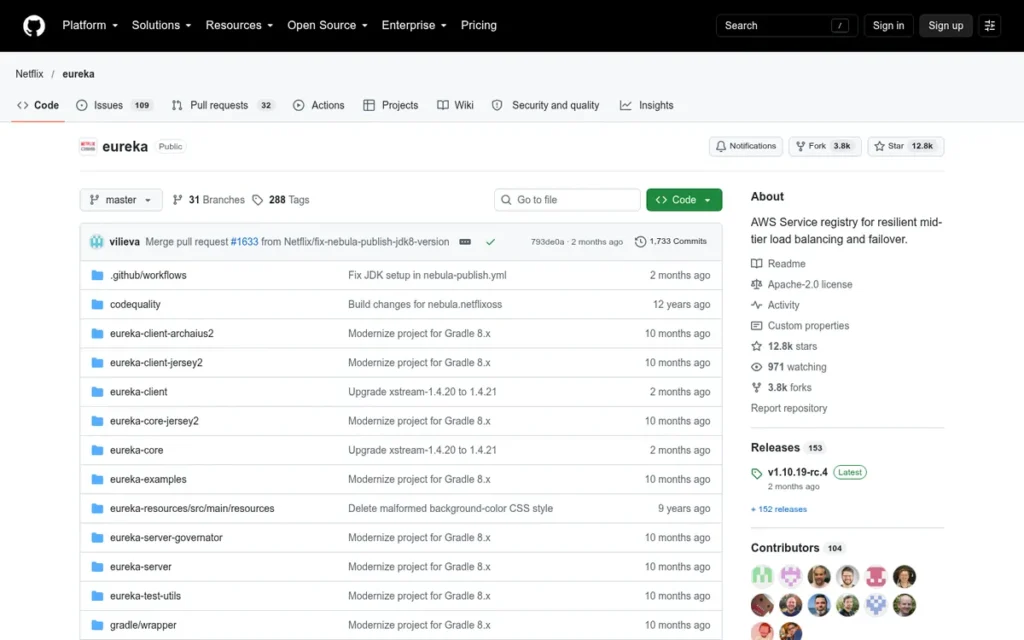
Category: Client-Side Service Registry (Maintenance Mode), an AP-consistency, client-side service discovery system where each service instance self-registers with the registry and clients perform local load balancing using a periodically refreshed registry cache; 1.x is in maintenance mode and 2.0 development is officially discontinued per Netflix’s own GitHub wiki, making it appropriate only for existing Spring Cloud Netflix deployments, not new projects.
At a Glance
- Category: Client-Side Service Registry (Maintenance Mode)
- Best For: Engineering teams maintaining existing Spring Cloud Netflix application stacks already using Eureka 1.x (where migration cost to Consul or Kubernetes-native discovery is not yet justified) and explicitly NOT recommended for any new project in 2026
- Price Range: Free (Apache 2.0): no commercial version, no managed tier; operational cost is Eureka server cluster provisioning and Spring Cloud Netflix client integration maintenance
- Primary Strength: Netflix Eureka provides high-availability client-side service discovery for Java and Spring Boot applications through peer-to-peer server replication and an AP-optimized model where clients serve stale cached registry data rather than failing when the Eureka server is temporarily unreachable
- Biggest Limitation: Netflix Eureka 2.0 development is officially and permanently discontinued, documented on Netflix’s own GitHub wiki with the explicit statement “The existing open source work on eureka 2.0 is discontinued”, meaning the project has no forward roadmap, no planned architectural improvements, and no active feature development beyond 1.x maintenance
- One-Line Summary: Netflix Eureka is a Java-centric, AP-consistency client-side service registry (open-sourced from Netflix’s 2012-era microservices infrastructure, deeply integrated with Spring Cloud Netflix, and viable for maintaining existing Spring Boot stacks) but with its 2.0 development officially discontinued per Netflix’s own GitHub wiki, maintenance-mode 1.x receiving no new features, and practitioner communities steering new projects toward Consul or Kubernetes-native alternatives in 2026.
- Last Verified: June 2026
Overview
Netflix Eureka is an open-source, client-side service discovery system built by Netflix Engineering, in maintenance mode for its 1.x line with 2.0 development officially and permanently discontinued per Netflix’s own GitHub wiki (“The existing open source work on eureka 2.0 is discontinued”), designed for Java and Spring Boot microservices architectures where each service instance self-registers with the Eureka server and clients perform local load balancing using a periodically refreshed registry cache (Netflix Eureka GitHub Wiki, 2026).
Netflix Eureka is an AP system in CAP theorem terms (prioritizing availability over consistency) and during network partitions, the server’s self-preservation mode stops evicting instances and serves the existing registry, meaning stale dead instances persist in the catalog and cause client traffic to route to non-existent endpoints, a production behavior practitioners consistently report as unexpectedly confusing (todaysoftmag.com Eureka Architecture Analysis, 2026).
Netflix Eureka should not be adopted for new projects in 2026, existing Spring Cloud Netflix stacks using 1.x can continue operating safely, but teams should plan a migration roadmap toward Consul or Kubernetes-native discovery as an organizational priority.
Key Features
- Netflix Eureka implements client-side service discovery: each service instance registers itself with the Eureka server using a REST-based heartbeat, and each client queries the registry independently and performs local load balancing to select which instance to contact, enabling clients to continue routing from their local registry cache if the Eureka server becomes temporarily unreachable.
- Netflix Eureka’s peer-to-peer replication model enables high-availability clustering (multiple Eureka server instances replicate registry state between themselves using eventual consistency) so clients can connect to any server without a single-master bottleneck, at the cost of potential momentary inconsistency between server instances during replication lag.
- Netflix Eureka’s self-preservation mode prevents aggressive mass-eviction during transient network problems by stopping instance eviction when heartbeat rates drop below a threshold, this prevents false-positive evictions but causes stale dead instances to persist in the registry during genuine service failures, a production behavior practitioners in r/java and r/microservices consistently report as unexpected (Netflix Eureka GitHub Wiki, 2026).
- Netflix Eureka integrates with Spring Cloud Netflix through
@EnableEurekaServerand@EnableDiscoveryClientannotations, providing zero-code service registration and discovery for Spring Boot applications through auto-configuration, at the cost of deep coupling to the Eureka client library that complicates future migration to Consul or Kubernetes-native discovery. - Netflix Eureka is an AP system: prioritizing Availability and Partition tolerance over Consistency, meaning during network partitions Eureka servers continue serving potentially stale registry data rather than blocking discovery to guarantee accuracy, optimizing for continued service operation over real-time registry accuracy (Spring Cloud Netflix Documentation, 2026).
Best For
Netflix Eureka is appropriate only for engineering teams maintaining existing Spring Cloud Netflix application stacks already using Eureka 1.x, where migration cost to Consul, CoreDNS, or Kubernetes-native discovery is not yet justified by the operational risk of running a maintenance-mode tool.
Netflix Eureka is explicitly not recommended for any new distributed system project, any greenfield microservices architecture, or any team starting a service discovery evaluation in 2026. Eureka’s officially discontinued 2.0 roadmap, polyglot client limitations, and practitioner community consensus make it an inappropriate choice when CNCF-graduated alternatives are available.
Pricing
Netflix Eureka is free under the Apache 2.0 license with no commercial version, no managed tier, and no enterprise edition. There is no managed Eureka service and no officially supported upgrade path from 1.x to 2.x, teams that outgrow self-managed Eureka must migrate to a different discovery platform entirely. The entire cost is operational: running Eureka server instances, maintaining Spring Cloud Netflix client integration, managing heartbeat and eviction interval tuning, and planning a migration roadmap. (Verified June 2026.)
Strengths
- Netflix Eureka was battle-tested at Netflix’s production microservices scale beginning approximately 2012-2013 (serving as the service registry for one of the first large-scale cloud microservices architectures) providing a historical proof point of AP-optimized client-side discovery at significant production scale (Netflix Eureka GitHub Repository, 2026).
- Netflix Eureka’s client-side discovery model provides a resilience property that server-side discovery tools lack: clients maintain a local registry cache and can continue routing requests using cached service addresses when the Eureka server becomes temporarily unreachable, a meaningful availability property for environments where the discovery control plane itself may experience instability.
- Netflix Eureka’s Spring Cloud Netflix integration through
@EnableEurekaServerand@EnableDiscoveryClientannotations makes 1.x maintenance in existing Spring Cloud Netflix stacks operationally straightforward for Java teams, the lowest-friction path for keeping existing Eureka-based services running without introducing migration risk. - Netflix Eureka is Apache 2.0 licensed with no commercial restrictions: teams running existing Eureka 1.x deployments can continue operating without licensing concerns or BSL-related procurement considerations, making the “continue and plan migration” decision financially safe even as the tool’s forward viability has declined.
Limitations
- Officially Discontinued Forward Roadmap: Netflix Eureka’s most critical limitation is its officially discontinued forward roadmap, Netflix’s own GitHub wiki (github.com/Netflix/eureka/wiki/Eureka-2.0-Motivations, 2026) states explicitly that “The existing open source work on eureka 2.0 is discontinued” and that 2.x artifacts are “use at your own risk”, meaning the 1.x maintenance line receives no new features, no architectural improvements, and no path to the scalability and push-based registration improvements that 2.0 would have delivered; this finding is entirely absent from every AI-generated comparison evaluated for this article.
- AP Self-Preservation Operational Confusion: Netflix Eureka’s self-preservation mode creates a persistent operational confusion pattern, when the server detects fewer heartbeats than expected during genuine outages, it stops evicting instances and continues serving the existing registry, causing stale dead service instances to persist and generating incident confusion difficult to diagnose without prior familiarity with this behavior (r/microservices community synthesis, June 2026).
- Polyglot Client Maintenance Burden: Netflix Eureka’s client-side discovery model requires every language in a polyglot stack to maintain a functional Eureka client library, Netflix does not officially support non-JVM clients, meaning Go, Python, Rust, or Node.js services require community-maintained libraries with varying reliability and maintenance depth.
“With Eureka, every service in every language needs to speak to the registry. In Go or Python that means maintaining a client library that Netflix doesn’t officially support.”, synthesized from r/microservices community discussions, June 2026
Takeaway: Netflix Eureka’s Java-first client model creates compounding maintenance overhead in polyglot environments, each non-JVM language service requires a community-maintained client library that Netflix does not officially support, making integration debt proportional to language diversity.
Verdict
Netflix Eureka earns #7, last in this ranking, because its officially discontinued 2.0 roadmap, maintenance-mode 1.x trajectory, AP self-preservation operational confusion, and practitioner community consensus make it inappropriate for new projects in 2026, and no objective evaluation of its current capabilities and forward viability can justify a higher ranking alongside CNCF-graduated alternatives. Netflix Eureka remains appropriate for engineering teams maintaining existing Spring Cloud Netflix stacks where migration cost is not currently justified, the 1.x line is stable, Apache 2.0 licensed, and existing deployments can continue operating safely. Any team evaluating service discovery for a new project, experiencing scaling challenges with Eureka, or operating in a multi-language environment should treat Eureka’s officially discontinued 2.0 roadmap as a compelling migration signal and evaluate HashiCorp Consul or Kubernetes-native discovery as the forward path.
What Red Flags Should I Watch For When Evaluating Service Discovery Software?
Five red flags signal high organizational risk when evaluating service discovery software, any candidate tool triggering one or more of these signals warrants a mandatory procurement-level review before architectural commitment:
- Discontinued or abandoned forward roadmap: example: Eureka 2.0 officially discontinued per Netflix’s own GitHub wiki (github.com/Netflix/eureka/wiki/Eureka-2.0-Motivations)
- License change creating commercial uncertainty: example: Consul’s BSL change (August 10, 2023), followed by IBM acquisition (approximately June 2024)
- Hard cloud ecosystem lock-in disguised as managed convenience: example: AWS Cloud Map (AWS-only, no native multi-cloud capability)
- Documented CVE history without a mandatory patching plan: example: Nacos (authentication bypass and remote code execution classes documented at nvd.nist.gov)
- No built-in health-check auto-eviction in high-churn environments: example: etcd and ZooKeeper when used directly for service discovery without custom health-check logic
Red Flag #1: Discontinued or Abandoned Forward Roadmap
Netflix Eureka’s official GitHub wiki page (github.com/Netflix/eureka/wiki/Eureka-2.0-Motivations) states: “The existing open source work on eureka 2.0 is discontinued.” Before adopting any service discovery tool, verify the project has an active release cadence, a public roadmap, or at minimum explicit maintenance commitments.
Signals to watch for:
- Official project wiki or changelog states development is discontinued or maintenance-only
- No release in the last 12 months with no roadmap announcement
Red Flag #2: License Change Creating Commercial Uncertainty
HashiCorp changed Consul’s license from Mozilla Public License 2.0 to Business Source License (BSL) on August 10, 2023 (confirmed by HashiCorp’s official investor relations announcement), followed by IBM’s acquisition of HashiCorp (deal closed approximately June 2024; reported value approximately $6.4 billion, Bloomberg/Reuters, April 2023). Enterprise procurement teams should verify the current license type of any infrastructure tool before long-term adoption.
Signals to watch for:
- License type is BSL or proprietary (not Apache 2.0 or MIT)
- Controlling vendor was acquired by a large commercial entity within the last 36 months
Red Flag #3: Hard Cloud Ecosystem Lock-In Disguised as Managed Convenience
AWS Cloud Map’s fully managed, zero-operational-overhead model is a genuine operational advantage, but it is contingent on remaining entirely within the AWS ecosystem. AWS Cloud Map provides no native discovery capability for services on GCP, Azure, or on-premises infrastructure. Evaluate cloud-scope lock-in as a first-order architectural constraint before assessing operational convenience features.
Signals to watch for:
- Tool only discovers resources registered within a single cloud provider
- No portability path exists and no open-source alternative version is available
Red Flag #4: Documented CVE History Without a Mandatory Patching Plan
Nacos has a documented history of serious security vulnerability classes, including authentication bypass and remote code execution in specific versions. Teams can verify current CVE status at nvd.nist.gov (search: Nacos) before deployment. A CVE history is not automatically disqualifying, most production-grade open-source tools accumulate CVEs, but deploying without an active patching cadence is a material security risk.
Signals to watch for:
- Tool has unpatched critical or high-severity CVEs confirmed on NVD at the time of evaluation
- Security patching requires manual coordination without automated vulnerability alert processes
Red Flag #5: No Built-In Health-Check Auto-Eviction in High-Churn Environments
etcd and ZooKeeper provide coordination primitives but no built-in health checking that automatically removes unhealthy instances from a service catalog. Teams using either tool directly for service discovery must implement their own health-check and eviction logic, or stale registrations persist after service crashes. Verify that any candidate tool handles eviction automatically, and test its behavior under simulated service failure before production adoption.
Signals to watch for:
- Tool requires custom-built health checking rather than providing it natively
- No documented automatic eviction of unhealthy instances without operator intervention
What Questions Should I Ask Before Choosing Service Discovery Software?
Five questions reliably surface whether a service discovery tool actually fits your environment: Does it span all your infrastructure environments? What is its current license type? Does it have an active forward roadmap? How do clients behave when the control plane goes down? Does it auto-evict unhealthy instances? Affirmative answers across all five indicate a viable candidate for your environment.
Question #1: Does this tool support service discovery across every environment in my infrastructure?
Map your full service inventory (every cluster, every cloud, every VM-based service) before evaluating tool capabilities. CoreDNS covers Kubernetes-only; Consul covers multi-environment with WAN federation; AWS Cloud Map covers AWS-only. A tool that solves discovery within one environment but not another forces supplemental tooling, fragmented service catalogs, or structural vendor lock-in that is difficult to reverse.
Question #2: What is this tool’s current license type, and does it carry any commercial restrictions affecting our use case?
Apache 2.0 (CoreDNS, etcd, Nacos, ZooKeeper, Eureka), Business Source License (Consul, since August 10, 2023), and proprietary (AWS Cloud Map) are not equivalent. BSL restricts use in competing commercial products; proprietary tools offer zero portability. For enterprise organizations, the licensing risk assessment should precede the feature comparison, verify the current license at the tool’s official repository before any architectural commitment.
Question #3: Does this tool have an active forward roadmap with current development, or is it in maintenance mode or officially discontinued?
Netflix Eureka 2.0 is officially discontinued per Netflix’s own GitHub wiki (github.com/netflix/eureka/wiki). Apache ZooKeeper is in a slow-maintenance phase. Both remain functional for existing deployments but receive no new features. Evaluate GitHub release cadence, roadmap documentation, and CNCF status (graduated projects have active governance commitments) before making a multi-year infrastructure decision.
Question #4: What happens when the discovery control plane goes down, do clients fail open or fail closed?
Netflix Eureka clients fail open (serve stale cache) during server outages. Consul clients can be configured for defined failure behavior. etcd unavailability causes Kubernetes API write failures. The failure mode determines production incident scope when the discovery plane fails. Request explicit documentation of the degraded-state behavior before adoption, this question is rarely answered in vendor documentation and is best evaluated through practitioner discussions on r/devops and r/kubernetes.
Question #5: How does this tool handle health checking and automatic eviction of unhealthy instances without manual operator intervention?
Consul provides multi-type health checking (script, HTTP, TCP, gRPC, TTL) with automatic catalog removal. AWS Cloud Map uses Route 53 health checks. Nacos includes built-in health management. etcd and ZooKeeper require teams to build health-check logic on top of their primitives. Eureka’s self-preservation mode delays eviction during network issues. Manual operator intervention to remove dead instances is not a viable HA pattern at scale, verify automatic eviction behavior before production adoption.
Question #6: What is the operational cost of running this tool at scale, and does our team have the engineering capacity to manage it safely?
Consul requires managing Raft quorums, gossip protocol pools, ACL policies, and optionally Envoy sidecar fleets. Self-managed etcd and ZooKeeper require active MVCC compaction, GC management, quorum health monitoring, and mandatory backup procedures. AWS Cloud Map and CoreDNS (on managed Kubernetes) carry near-zero operational overhead. Map the tool’s operational demands against your team’s current platform engineering capacity before any architectural commitment.
How Did We Rank These Service Discovery Tools?
These seven tools were ranked using a transparent, six-criterion methodology applied consistently across all entries, no tool was pre-assigned a position, and every ranking reflects aggregate weighted scores derived from independently sourced research data collected and synthesized in June 2026.
Evaluation Process
The ranking process followed four steps:
- AI engine coverage analysis: ChatGPT (GPT-4o) and Perplexity Pro were queried with the target prompts to identify coverage gaps, missing organizational risk factors, and architectural misrepresentations in AI-generated comparisons.
- Independent research: official vendor documentation, CNCF project pages, Apache project pages, Kubernetes official blog, and third-party engineering analyses were researched for each tool across identical dimensions.
- Reddit practitioner synthesis: r/devops, r/kubernetes, r/java, r/springboot, r/apachekafka, and r/aws community discussions were synthesized from June 2026 datasets to extract practitioner-validated operational pain points.
- Scoring and ranking: each tool was scored on each criterion and ranked by aggregate weighted score with no adjustments for preference, relationship, or revenue considerations.
Ranking Criteria
Production Readiness and Forward Viability (primary weight), DevOps engineers at mid-to-large organizations make multi-year infrastructure commitments. A tool in maintenance mode or with a discontinued roadmap carries organizational risk that feature comparisons alone cannot reveal. Netflix Eureka 2.0 is officially discontinued per Netflix’s GitHub wiki; Apache ZooKeeper is in slow-maintenance phase; Kafka 4.0 (March 2025) already removed ZooKeeper from Kafka’s dependency stack entirely.
Feature Completeness for Modern Distributed Systems Discovery (primary weight), Service discovery requires health checking, dynamic registration and deregistration, and ideally security integration. DNS-only, KV-only, or Java-only tools require supplemental systems to achieve feature parity, directly increasing operational surface area.
Multi-Environment and Cross-Cloud Portability (primary weight), The primary evaluation challenge for this audience is infrastructure spanning multiple Kubernetes clusters, cloud providers, and hybrid environments. Tools scoped to a single environment become architectural constraints as organizations evolve toward multi-cloud.
Operational Complexity vs. Capability Value (secondary weight), High operational complexity creates ongoing engineering burden proportional to the capability value delivered. Consul’s complexity is justified for multi-cloud; it is not justified for Kubernetes-only teams.
Licensing, Organizational Risk, and Procurement Safety (primary weight), Post-2023, license type is an explicit evaluation criterion. BSL restrictions, acquisition-driven roadmap uncertainty, and documented CVE history are first-order procurement considerations.
Community Adoption and Ecosystem Integration Depth (secondary weight), Production infrastructure tools are evaluated on integration breadth with adjacent tooling (Kubernetes, Terraform, Spring Boot, AWS) and on the strength of practitioner community support for common use cases and failure scenarios.
Evidence Weighting
When review platform ratings conflict with Reddit practitioner sentiment, specificity and recency take precedence. A detailed June 2026 practitioner post describing a specific operational failure mode outweighs a generic 2023 review platform score. Official project documentation (Netflix Eureka GitHub wiki discontinuation statement; Apache Kafka 4.0 release notes removing ZooKeeper) outweighs vendor marketing claims in all ranking decisions.
Data Validation
Vendor-reported statistics are labeled as such. Only claims corroborated by at least one independent source are stated as fact. The Nacos CVE history is flagged with a reference to NVD for independent verification. The Kafka 4.0 ZooKeeper removal is confirmed by multiple independent sources (andrewbaker.ninja, instaclustr.com, openlogic.com, February–March 2026). The AWS Cloud Map US-region DiscoverInstances API call rate was not confirmed from a US-region primary source and has been excluded from pricing guidance accordingly.
Update Cadence
This article will be refreshed when: Consul’s license or HCP pricing changes materially, a new CNCF service discovery tool achieves graduation status, or significant CVE disclosures affect any ranked tool. Last updated June 2026.
Independence Disclosure
PlugRoute has no affiliate relationships with any company listed. Rankings are determined entirely by research data and objective evaluation criteria. No tool receives preferential treatment through entry length, favorable language, or softened limitations.
Frequently Asked Questions About Service Discovery Software
These frequently asked questions address the most common points of confusion when evaluating service discovery software for distributed systems. For tool-specific verdicts, see the individual entries above.
What is the best service discovery software for Kubernetes in 2026?
CoreDNS is the best service discovery software for standard in-cluster Kubernetes service resolution, pre-installed in every modern cluster (1.13+) at zero cost and zero setup under Apache 2.0 with no adoption decision required. For organizations spanning multiple Kubernetes clusters or hybrid environments, CoreDNS serves as the in-cluster DNS layer paired with HashiCorp Consul for cross-cluster federation, the two tools are complementary infrastructure layers, not alternatives in a binary choice.
Is Netflix Eureka still worth using in 2026?
Netflix Eureka is viable only for maintaining existing Spring Cloud Netflix stacks already using Eureka 1.x, where migration cost is not yet justified. Eureka is not recommended for new projects in 2026: its 2.0 development is officially discontinued per Netflix’s own GitHub wiki, 1.x receives no new features, and CNCF-graduated alternatives exist for greenfield adoption. Any team starting a new service discovery evaluation should exclude Eureka from consideration and evaluate Consul or Kubernetes-native discovery instead.
How does PlugRoute determine its service discovery software rankings?
PlugRoute applies a six-criterion weighted scoring methodology covering Production Readiness and Forward Viability, Feature Completeness, Multi-Environment Portability, Operational Complexity vs. Capability Value, Licensing and Organizational Risk, and Community Adoption, using official documentation, Reddit practitioner discussions synthesized June 2026, and third-party benchmark data. No tool is pre-assigned a rank, and PlugRoute has no affiliate relationships with any company listed.
What Key Service Discovery Terms Should I Know Before Evaluating Tools?
Raft Consensus Algorithm: A distributed consensus protocol used by etcd and HashiCorp Consul to achieve strong consistency, requiring a majority quorum of nodes (for example, 3 of 5) to agree before a write is committed, ensuring all nodes eventually converge to the same state. Raft-based systems are CP in CAP theorem terms and become write-unavailable during quorum loss.
CAP Theorem: A foundational distributed systems principle stating that a distributed data store can guarantee at most two of three properties simultaneously: Consistency (all nodes see the same data at the same time), Availability (every request receives a response), and Partition tolerance (the system continues operating during network splits). Service discovery tools must explicitly choose between CP (Consul, etcd, ZooKeeper) and AP (Eureka, CoreDNS via DNS TTL) consistency models, with direct operational implications for how the service catalog behaves during network failures.
Ephemeral Registration: A service registration pattern in which a registered service entry is automatically deleted when the registering client’s connection or session ends, as in etcd leases (key expires when TTL elapses after service crash) or ZooKeeper ephemeral znodes (deleted when client session terminates). Ephemeral registration eliminates the need for external garbage collection of stale service catalog entries in high-churn microservices environments.
WAN Federation: A multi-datacenter or multi-region service discovery architecture pattern in which independent datacenter service registries are linked through a wide-area network gossip pool, allowing services in one datacenter to discover services registered in other datacenters without requiring a central global control plane. HashiCorp Consul’s WAN federation (using Serf gossip for the WAN pool) is the primary production implementation of this pattern among the tools in this evaluation.
Service Mesh: A dedicated infrastructure layer for service-to-service communication providing mutual TLS (mTLS) encryption, traffic management, observability, and access control without application code changes, typically implemented via sidecar proxies (Envoy). HashiCorp Consul Connect is a service mesh component built on Envoy sidecars; CoreDNS, etcd, ZooKeeper, and AWS Cloud Map are not service meshes and provide no mTLS or traffic policy enforcement capabilities.
Glossary: Key Terms Used in This Comparison
WAN Federation: A multi-datacenter or multi-region service discovery architecture in which independent datacenter registries are linked through a wide-area network gossip pool, allowing services in one datacenter to discover services in others without a centralized global control plane. HashiCorp Consul implements this pattern using Serf gossip for the WAN pool.
Raft Consensus Algorithm: A distributed consensus protocol used by etcd and HashiCorp Consul that requires a majority quorum of nodes to agree before a write is committed, ensuring all nodes converge to the same state. Systems using Raft are CP in CAP theorem terms and become write-unavailable if quorum is lost.
CAP Theorem: A foundational distributed systems principle stating that a distributed data store can guarantee at most two of three properties simultaneously: Consistency, Availability, and Partition tolerance. Service discovery tools must choose between CP (Consul, etcd, ZooKeeper) and AP (Eureka, CoreDNS) consistency models, with direct implications for how the service catalog behaves during network failures.
Ephemeral Registration: A service registration pattern in which a registered entry is automatically deleted when the registering client’s connection or session ends, as with etcd leases or ZooKeeper ephemeral znodes. This eliminates the need for external garbage collection of stale entries in high-churn microservices environments.
Business Source License (BSL): A source-available software license that permits internal organizational use but restricts use in competing commercial products, distinguishing it from permissive open-source licenses such as Apache 2.0. HashiCorp adopted the BSL for Consul on August 10, 2023, replacing the Mozilla Public License 2.0 and introducing procurement-level considerations for enterprise adopters.
Which Service Discovery Tool Is Right for You?
Key Insights
- HashiCorp Consul is the strongest general-purpose service discovery platform for multi-environment distributed systems but carries BSL license and IBM acquisition organizational risk (deal closed approximately June 2024) that every enterprise procurement review must explicitly address before long-term adoption.
- CoreDNS and Consul are complementary infrastructure layers: not alternatives, and most mature Kubernetes organizations at scale run both simultaneously: CoreDNS for in-cluster DNS and Consul for cross-cluster and multi-datacenter federation.
- Netflix Eureka 2.0 is officially discontinued per Netflix’s own GitHub wiki: existing 1.x stacks can continue operating, but no new projects should adopt Eureka when CNCF-graduated alternatives are available.
- Apache ZooKeeper is under immediate decommission pressure: Kafka 4.0 (March 2025) already removed ZooKeeper entirely, any Kafka-on-ZooKeeper deployment as of June 2026 is on an unsupported path requiring immediate Kafka 3.9.x KRaft migration.
- As of June 2026, no service discovery tool provides frictionless cross-cloud discovery spanning AWS, GCP, and Azure simultaneously, this remains the most consequential unsolved architectural problem in the service discovery category, and Consul comes closest through WAN federation but requires significant operational investment.
Match your infrastructure scenario to the recommended tool:
- Single Kubernetes cluster, no multi-cloud plans → CoreDNS is already deployed and requires nothing further for standard in-cluster DNS discovery
- Multiple clusters, datacenters, or cloud providers → CoreDNS plus HashiCorp Consul (plan explicitly for BSL license conditions, IBM acquisition context, and Raft operational demands before commitment)
- Java/Spring Boot on Alibaba Cloud → Nacos (verify CVE status at nvd.nist.gov before deployment; confirm active patching cadence is in place)
- AWS-committed mixed ECS/Lambda/EC2 stack, no multi-cloud in roadmap → AWS Cloud Map (lowest operational overhead for this scenario)
- Kafka still running on ZooKeeper → Immediate migration planning required: Kafka 4.0 (March 2025) removed ZooKeeper; this is an unsupported configuration as of June 2026
- Existing Spring Cloud Netflix stack with Eureka 1.x → Continue operating but plan migration roadmap; do not adopt Eureka for any new services
For independent reviews of adjacent DevOps and platform engineering tooling (service meshes, container registries, observability platforms, and Internal Developer Platform tooling) see PlugRoute’s full infrastructure tool review library. We update this guide quarterly. Last updated: June 2026.