Land Gorilla is the top-scoring construction loan software in PlugRoute’s 2026 ranking and suits residential, mortgage and Jack Henry community bank lenders; Built suits high-volume banks on nCino or FIS/Fiserv; Rabbet suits CRE and HUD/FHA lenders wanting per-draw pricing. Fit depends on lender type and core system, and private lenders may need a construction-enabled servicing platform instead.
Many construction loan administrators still check draws by hand against spreadsheets and chase inspection results by email. Most published comparisons in this category come from vendors that compete with the products they rank.
PlugRoute has no affiliate relationships with any company listed, and rankings are determined entirely by research data and objective evaluation criteria.
“Everything I find seems built for banks or mortgage lenders. I just need something… flexible, affordable, and not overly complex.” (u/OverallLimit8812, r/FinanceAutomation, 2025)
Takeaway: Small non-bank lenders care most about low cost and simplicity, so this ranking separates bank-grade platforms from lighter private-lender tools.
What Are the 3 Categories of Construction Loan Management Software?
Construction loan management software falls into three categories, which differ in how much weight they give to draws versus servicing. Dedicated platforms go deepest on draws, inspections and lien waivers. Private-lender servicing platforms lead on trust and investor accounting. Stand-alone trackers cover only basic draw tracking.
- Dedicated construction loan administration platforms, such as Built, Land Gorilla and Rabbet, manage draws, budgets, inspections, lien waivers, disbursements and portfolio risk after closing.
- Private-lender servicing platforms with construction modules, such as The Mortgage Office, Mortgage Automator and Baseline, add draw features to loan origination, servicing and fund administration for non-bank lenders.
- Stand-alone draw trackers, such as DrawTrak, track construction draws without inspection, lien waiver or servicing workflows.
Is Construction Loan Management Software Different From Contractor Project Management Software?
Yes. Construction loan management software is lender-side software that controls how loan funds are paid out. Contractor project management software helps builders run jobs, schedules and payables. Search results often mix the two, and PlugRoute’s Reddit research found that lender-software searches mostly returned contractor threads (Verified; Reddit r/ConstructionManagers thread, 2020).
The following products are out of scope for this ranking:
- Contractor project management tools such as Procore, JobTread, Adaptive and QuickBooks are builder-side products, not lender loan administration platforms.
- Developer-side tools such as Northspyre and Rabbet’s separate developer product serve project owners, not lenders.
- Broad lending suites such as nCino and LoanPro were not confirmed to include construction draw functionality, and nCino appears in this article only as an integration partner.
How Do the Top Construction Loan Management Platforms Compare at a Glance?
Land Gorilla and Built lead PlugRoute’s November 2026 ranking, 0.10 points apart. Rabbet ranks third, with the most granular budget controls and published per-draw pricing. Ranks four to six are private-lender servicing platforms. DrawTrak has the thinnest evidence base of the seven vendors evaluated.
| Rank | Company | Category | Best For | One-Line Summary | Key Capabilities | Primary Strength | Key Limitation |
|---|---|---|---|---|---|---|---|
| 1 | Land Gorilla | Dedicated construction loan administration platform | Residential, mortgage and Jack Henry community bank lenders | Land Gorilla is a full-lifecycle construction loan platform with pre-close builder review, state-specific lien waivers and named Encompass, Fiserv and Jack Henry integrations. | X-RAY pre-close review, OneSite portal, DocTracker, flexible inspections | G2 4.8/5 (31 reviews); Capterra 4.8/5 (33 reviews) | Learning curve and inflexible reporting views |
| 2 | Built | Dedicated construction loan administration platform | High-volume banks and credit unions on nCino or FIS/Fiserv | Built is a dedicated construction loan platform that combines AI-assisted draw review, inspections and payments in one workflow. | AI Draw Agent, 300+ inspector marketplace, in-workflow payments, stale-project alerts | AI-assisted draw review with in-workflow payments and named nCino, FIS/Fiserv, Encompass and Jack Henry SilverLake integrations | G2 4.4/5 (15–18 reviews) and Capterra 4.3/5 (35 reviews) trail Land Gorilla’s 4.8 |
| 3 | Rabbet | Dedicated construction loan administration platform | CRE, HUD/FHA and homebuilder lenders | Rabbet is a construction lending platform with granular budget and interest reserve controls and published per-draw pricing. | Budget reconciliation, retainage, interest reserve sufficiency, exam-ready reports | Published pricing of $120–$215 per draw | Only 4 G2 reviews (lender product); 0 Capterra ratings |
| 4 | The Mortgage Office | Private-lender servicing platform with construction module | Fund-backed private lenders | The Mortgage Office is a servicing platform with construction trust accounting and non-Dutch interest. | Trust accounting, varying balances, investor portals | Capterra 4.8/5 (288–290 reviews), mostly about servicing | The vendor’s own 2025 review says its draw manager is still being refined |
| 5 | Mortgage Automator | Private-lender servicing platform with construction module | Private lenders and MICs in the US, Canada and Australia | Mortgage Automator is an all-in-one private lending platform covering origination through fund management. | Origination, servicing, fund management, borrower portal, APIs | Capterra 4.9/5 (116 reviews); G2 4.9/5 (74 reviews) | Construction draw depth is thinly documented |
| 6 | Baseline | Private-lender servicing platform with construction module | Small hard-money and fix-and-flip lenders | Baseline is a private lending platform with a borrower draw portal at published flat monthly prices. | Borrower draw portal, ACH collection, investor dashboards | Published $995–$1,995/month for up to 50 or 150 active loans | Capterra 4.9/5 from only 10–11 reviews; limited integrations |
| 7 | DrawTrak | Stand-alone draw tracker | Very small lenders, after reference checks | DrawTrak is a basic stand-alone draw tracker with minimal public evidence. | Cost-estimate-to-final-draw tracking, stage reports | Simple scope | One G2 review (December 2017); one LinkedIn-listed employee |
Quick Decision Framework: Which Platform Fits Your Priority?
Pick by lender type and core system, not by overall rank. Community banks should match their core first: Land Gorilla names three Jack Henry cores, and Built names nCino and FIS/Fiserv. Private lenders should compare the servicing platforms on accounting needs and budget rather than on draw-workflow depth.
| Your #1 Priority | Recommended Tool | Why | Acceptable Alternative |
|---|---|---|---|
| Community bank on Jack Henry SilverLake, CIF 20/20 or Core Director | Land Gorilla | Land Gorilla names all three Jack Henry cores through jXchange (vendor-reported) | Built (SilverLake only) |
| Community bank or credit union on nCino or FIS/Fiserv | Built | Built names nCino and FIS/Fiserv integrations (vendor-reported) | Land Gorilla (Fiserv, no nCino) |
| Residential or mortgage lender on Encompass | Land Gorilla | Land Gorilla lists an Encompass integration and state-specific lien waivers | Built |
| CRE, multifamily, HUD/FHA or homebuilder lines | Rabbet | Rabbet documents retainage, contingency and interest reserve controls plus HUD forms | Built |
| Fund-backed private lender needing trust accounting | The Mortgage Office | The Mortgage Office documents non-Dutch interest and construction trust accounting | Mortgage Automator |
| Private lender or MIC needing origination-to-funds | Mortgage Automator | Mortgage Automator covers origination, servicing and fund management | The Mortgage Office |
| Small hard-money lender wanting flat pricing | Baseline | Baseline publishes $995–$1,995/month for up to 50 or 150 active loans | Rabbet (Lite tier, $120/draw) |
What Are the Best Construction Loan Management Platforms in 2026?
In PlugRoute’s November 2026 evaluation, Land Gorilla (4.35) and Built (4.25) are the top two construction loan management platforms. Rabbet (3.75), The Mortgage Office (2.95), Mortgage Automator (2.75), Baseline (2.45) and DrawTrak (1.00) follow. Each vendor is scored on six weighted criteria, and draw-workflow depth carries the most weight at 30%.
Every entry below uses the same structure. Every claim carries one of the four evidence labels defined in the methodology section.
1. Land Gorilla: Best Overall for Residential, Mortgage, and Jack Henry Community Bank Lenders
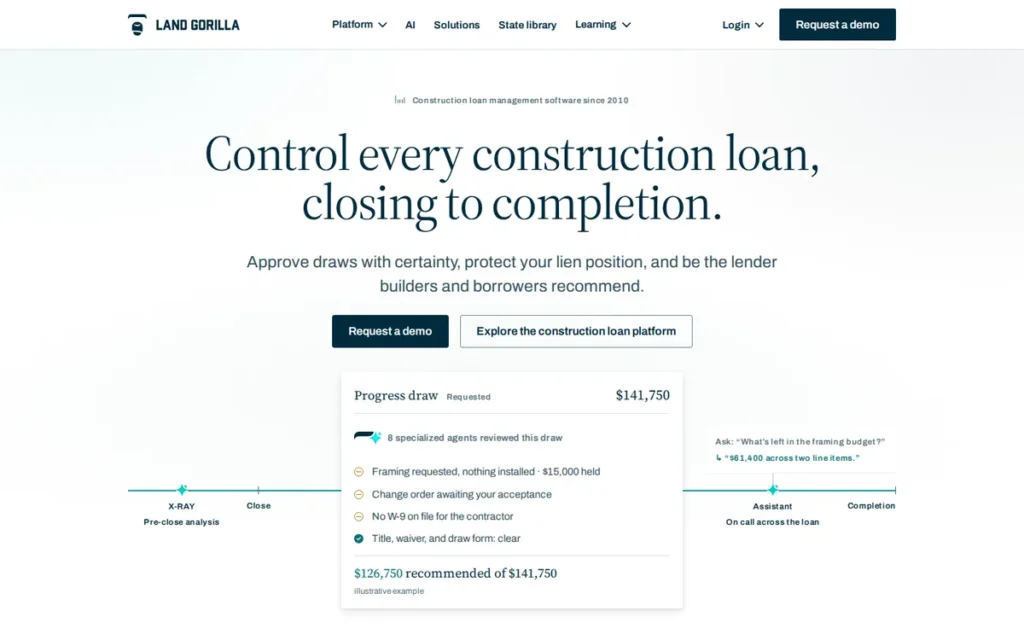
Category: Dedicated Construction Loan Administration Platform. Purpose-built software for managing draws, inspections, lien waivers and disbursements after a construction loan closes.
At a Glance
- Category: Dedicated Construction Loan Administration Platform
- Best For: Residential, consumer, renovation and mortgage construction lenders, especially those on Encompass or Jack Henry cores
- Price Range: Pricing on request (custom proposal by team and program)
- Primary Strength: Land Gorilla covers the full construction loan lifecycle, from X-RAY pre-close review to state-specific lien waivers, and holds 4.8/5 ratings on G2 (31 reviews) and Capterra (33 reviews).
- Biggest Limitation: Land Gorilla reviewers report a learning curve, a hard-to-navigate lender interface, inflexible reporting views and slowness on large projects.
- One-Line Summary: Land Gorilla is a full-lifecycle construction loan management platform for residential and mortgage lenders and Jack Henry community banks that need pre-close builder review, state-specific lien waivers and flexible inspections.
- Last Verified: November 2026
Evidence strength: Moderate to strong. Land Gorilla has the strongest user validation among the dedicated platforms (64 combined reviews), and its company background is verified, but its integration and performance claims are vendor-reported.
Overview
Land Gorilla is a construction loan management platform for residential, consumer, mortgage and commercial construction lenders. It covers pre-close builder review, draw administration, inspections, state-specific lien waivers, servicing and risk monitoring, and it names Encompass, Fiserv and Jack Henry integrations.
Land Gorilla was founded in 2010 and is headquartered in San Luis Obispo, California, under founder and CEO Sean Faries (Verified; LinkedIn and The Mortgage Note, accessed November 2026). Land Gorilla and Built are separate companies, and PlugRoute found nothing to support a reported acquisition.
Key Features
- Land Gorilla’s X-RAY product reviews builders and projects before closing, so lenders can spot risk before they commit funds (Vendor-reported; Land Gorilla, accessed November 2026).
- Land Gorilla provides state-specific lien waivers and a DocTracker tool that reconciles invoices against collected waivers (Vendor-reported; Land Gorilla, accessed November 2026).
- Land Gorilla lets lenders order inspections from its vetted network, through self-inspections, by remote video or from their own providers (Vendor-reported; Land Gorilla, accessed November 2026).
- Land Gorilla is a member of Jack Henry’s Banking Vendor Integration Program and lists SilverLake, CIF 20/20 and Core Director integrations through jXchange (Vendor-reported; Land Gorilla, accessed November 2026).
- Land Gorilla’s OneSite portal gives borrowers and builders a shared place to submit draws and documents (Vendor-reported; Land Gorilla, accessed November 2026).
Best For
Land Gorilla is best for residential, consumer, renovation and mortgage construction lenders that need to comply with state-specific lien waiver rules. Land Gorilla also fits credit unions and community banks on Encompass or Jack Henry cores, and it names Tennessee Valley FCU as a customer (Vendor-reported; Land Gorilla, accessed November 2026).
Strengths
- Land Gorilla holds 4.8/5 on G2 from 31 reviews (93% five-star) and 4.8/5 on Capterra from 33 reviews, the highest combined rating among the dedicated platforms (Verified; G2 and Capterra, accessed November 2026).
- Land Gorilla’s CrossCountry Mortgage case study says average draw time fell by 24–48 hours once inspection and title-update ordering were automated (Vendor-reported; Land Gorilla, accessed November 2026; publication date not disclosed).
- Land Gorilla’s case study of The Mortgage Firm reports a 308% rise in construction loan volume and builders paid in as little as 3 days, but it gives no baseline period (Vendor-reported; Land Gorilla, accessed November 2026).
- One G2 reviewer estimates that Land Gorilla’s Encompass integration saves 15–20 minutes compared with manual entry (Verified review; G2, accessed November 2026).
Limitations
Land Gorilla offers lifecycle breadth and lien waiver compliance, but reviewers say its lender interface is hard to learn and its reporting is rigid. G2 reviewers report a learning curve, a lender side that is hard to navigate and inflexible reporting views (Verified; G2, accessed November 2026).
- Land Gorilla reviewers also report slowness on large projects, borrower and lender screens that differ, and a document builder that needs updating (Verified; G2, accessed November 2026).
- Land Gorilla’s public integration materials name no nCino or FIS integration, while Built’s do (Verified; Land Gorilla and Built, accessed November 2026).
- Land Gorilla’s SOC 2 status and total client count could not be verified (Unverified), and its pricing is available only by proposal.
Verdict
Land Gorilla is the top-scoring construction loan management platform in PlugRoute’s November 2026 evaluation and the strongest fit for residential and mortgage construction lenders that need state-specific lien waivers and Encompass or Jack Henry connectivity.
Land Gorilla leads Built by only 0.10 points, a margin readers could reverse by weighting integrations and adoption above user ratings. Buyers should test Land Gorilla’s custom reporting and its performance on large projects during the demo, because those are the most frequent reviewer complaints.
PlugRoute Scores: C1 5 | C2 5 | C3 5 | C4 4 | C5 1 | C6 3 | Weighted: 4.35/5.00
2. Built: Best for High-Volume Banks and Credit Unions on nCino or FIS/Fiserv
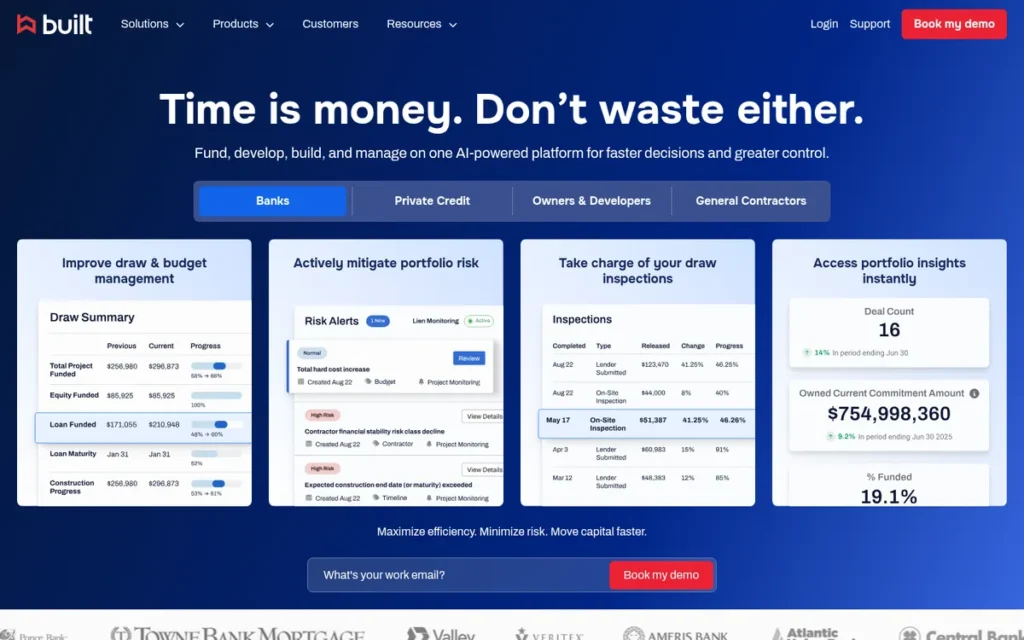
Category: Dedicated Construction Loan Administration Platform. Purpose-built software for managing draws, inspections, lien waivers and disbursements after a construction loan closes.
At a Glance
- Category: Dedicated Construction Loan Administration Platform
- Best For: Banks, credit unions and enterprise lenders with high draw volume across consumer, commercial and homebuilder programs
- Price Range: Pricing on request (per-feature model and free trial listed on Capterra)
- Primary Strength: Built combines AI-assisted draw review, an inspector marketplace and in-workflow payments with named nCino, FIS/Fiserv, Encompass and Jack Henry SilverLake integrations.
- Biggest Limitation: Built’s user ratings (4.3–4.4) trail Land Gorilla’s 4.8, and reviewers report support delays, a draw-balance error and unannounced updates.
- One-Line Summary: Built is a dedicated construction loan administration platform for high-volume banks and credit unions that want AI-assisted draw review, inspections and payments in one workflow connected to nCino, FIS/Fiserv, Encompass or Jack Henry SilverLake.
- Last Verified: November 2026
Evidence strength: Moderate. Built’s capabilities are well documented, but its performance and scale figures are vendor-reported, and it has about 50 reviews in total.
Overview
Built is a dedicated construction loan administration platform that helps banks, credit unions and enterprise real estate lenders manage draws, inspections, payments and portfolio exposure after closing. It offers AI-assisted draw review and names nCino, FIS/Fiserv, Encompass and Jack Henry SilverLake integrations.
Built supports commercial real estate, consumer and homebuilder programs on one platform (Vendor-reported; Built, accessed November 2026). Built was founded in 2014 and is headquartered in Nashville, Tennessee (Verified; ZoomInfo, accessed November 2026).
Key Features
- Built’s AI Draw Agent reviews draw packages against lender policy, loan documents, budgets, inspection reports and prior draws, in Audit (human-led), Assist or Automate mode (Vendor-reported; AI Fintech Index, accessed November 2026).
- Built routes draw submissions through configurable approval rules and automatically follows up with borrowers on missing items (Vendor-reported; Built, accessed November 2026).
- Built gives lenders an inspection marketplace that the vendor says includes 300+ providers, with 7 in 10 inspections finished within 3 days (Vendor-reported; Built, accessed November 2026).
- Built executes draw payments inside the review workflow, and it has announced a Jack Henry SilverLake integration covering loan onboarding and draw disbursement (Vendor-reported; Built, accessed November 2026).
- Built reports portfolio exposure by borrower, geography and property type, and it sends stale-project alerts on at-risk loans (Vendor-reported; Built, accessed November 2026).
Best For
Built is best for banks, credit unions and high-volume lenders that run several construction loan programs on nCino, FIS/Fiserv or Encompass. Built also suits acquisitive institutions that are consolidating construction portfolios onto one system.
Strengths
- Built’s Burke & Herbert Bank case study says AI budget upload cut loan setup from 30+ minutes to about 3, and that the bank used Built through 4 acquisitions (Vendor-reported; Built, 2026).
- Built reports 300+ lender clients, 14 of the 25 largest US lenders and more than $400B in active real estate finance. These figures replace Built’s earlier $317B figure, which some AI answers still cite (Vendor-reported; Built, accessed November 2026).
- Built’s United Federal Credit Union case study says draw turnaround was cut in half and that 80% of draws now arrive through the platform (Vendor-reported; Built, accessed November 2026; publication date not disclosed).
- Built earns 4.3/5 on Capterra from 35 reviews, with support rated 4.5, and reviewers say it keeps all parties “on the same page” (Verified; Capterra, accessed November 2026).
Limitations
Built offers breadth and automation, but its verified-user ratings trail Land Gorilla’s. Built scores 4.4/5 on G2 from 15–18 reviews and 4.3/5 on Capterra from 35 reviews, against Land Gorilla’s 4.8 on both (Verified; G2 and Capterra, accessed November 2026).
- Built’s Capterra reviewers describe an incorrect draw balance that blocked a contractor payment, a payment setup error that delayed a transfer by 5 days, and updates released without notice (Verified; Capterra, accessed November 2026).
- Built’s support drew criticism from one G2 reviewer, who waited about a week for meaningful replies (Verified; G2, accessed November 2026).
- Built’s public Jack Henry documentation covers SilverLake only, so banks on CIF 20/20 or Core Director should get confirmation of support in writing.
Verdict
Built is one of the top two construction loan management platforms in PlugRoute’s 2026 evaluation and a strong fit for banks and credit unions with high draw volume. It has the highest documented customer-adoption score of all seven vendors.
Built ranks #2 because its user ratings (4.3–4.4 from about 50 reviews) trail Land Gorilla’s (4.8 from 64), and both platforms document Fiserv, Encompass and Jack Henry connectivity. Buyers should test Built’s draw-balance accuracy and payment setup during a demo.
PlugRoute Scores: C1 5 | C2 5 | C3 3 | C4 5 | C5 2 | C6 4 | Weighted: 4.25/5.00
3. Rabbet: Best for CRE, HUD/FHA, and Homebuilder Lenders Wanting Published Pricing
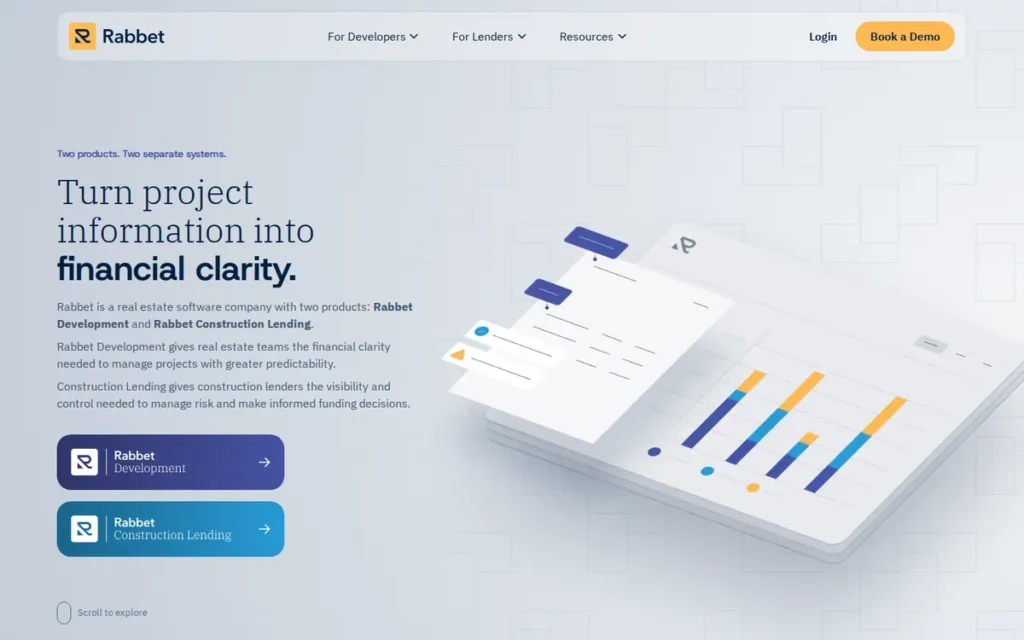
Category: Dedicated Construction Loan Administration Platform. Purpose-built software for managing draws, inspections, lien waivers and disbursements after a construction loan closes.
At a Glance
- Category: Dedicated Construction Loan Administration Platform
- Best For: Commercial real estate, multifamily, HUD/FHA and homebuilder credit-line lenders who put budget and reserve controls first
- Price Range: $120–$215 per draw (published; contract minimums may apply), plus a Custom tier for revolving facilities
- Primary Strength: Rabbet checks every draw against the approved budget and tracks retainage, contingency, cost to complete and whether the interest reserve is sufficient.
- Biggest Limitation: Rabbet’s lender product has only 4 G2 reviews and no Capterra ratings, and Rabbet does not name the core or LOS systems it integrates with.
- One-Line Summary: Rabbet is a construction lending platform for commercial, HUD/FHA and homebuilder lenders that want granular budget and interest reserve controls, exam-ready reporting and the category’s only published per-draw pricing.
- Last Verified: November 2026
Evidence strength: Strong on documented capabilities and pricing. Weak on independent user validation, with 4 lender-product reviews. Reviews of Rabbet’s developer product are excluded.
Overview
Rabbet is a construction lending platform for commercial real estate, HUD/FHA, consumer and homebuilder lenders. It reconciles every draw against the approved budget, tracks interest reserves and retainage, reads draw documents with machine learning and produces board and exam-ready reports.
Rabbet also sells a separate developer-side product, which buyers should not confuse with Rabbet Construction Lending. Rabbet was founded in 2015 (Verified; Capterra, accessed November 2026).
Key Features
- Rabbet checks each draw against the approved budget and flags over-draws and out-of-balance loans (Vendor-reported; Rabbet, accessed November 2026).
- Rabbet tracks retainage, cost to complete, contingency and interest reserve sufficiency, and it includes cash-flow forecasting (Vendor-reported; Rabbet, accessed November 2026).
- Rabbet uses machine learning to classify draw documents, and it checks lien waivers for completeness at the general contractor and subcontractor levels (Vendor-reported; Rabbet, accessed November 2026).
- Rabbet lets inspectors submit percent-complete figures and photos through a secure link, and lenders can require an inspection before a draw is approved (Vendor-reported; Rabbet, accessed November 2026).
- Rabbet produces board, participant/syndicate and exam-ready reports, and it offers an Open API and SSO (Vendor-reported; Rabbet, accessed November 2026).
Best For
Rabbet is best for CRE, multifamily, HUD/FHA and homebuilder credit-line lenders whose main pain is reconciling draws against budgets and keeping interest reserves adequate. Rabbet also suits lower-volume lenders who want to model software cost per draw.
Strengths
- Rabbet’s Greystone case study says loans managed per team member doubled and processing time fell 50%, with help from a two-way API integration with Greystone’s servicing system (Vendor-reported; Rabbet, accessed November 2026).
- Rabbet is the only dedicated construction loan administration platform that publishes dollar pricing, at $120–$215 per draw (Verified; Rabbet, accessed November 2026).
- Rabbet’s Berkadia case study says FHA servicing capacity doubled, and its Windsor Advantage case study reports 25% more project management capacity per team member (Vendor-reported; Rabbet, accessed November 2026).
- Rabbet is the only vendor whose public documentation, as found by PlugRoute, names interest reserve sufficiency tracking and participant/syndicate reporting (Verified; Rabbet, accessed November 2026).
Limitations
Rabbet offers transparent pricing and granular budget controls, but its lender product has almost no independent user validation. It has 4 G2 reviews at 4.5/5 and no Capterra ratings (Verified; G2 and Capterra, accessed November 2026).
- Rabbet can be slow to recognize some document types, so documents sometimes need reclassifying, according to a G2 reviewer (Verified; G2, accessed November 2026).
- Rabbet describes core and LOS integrations but names no specific systems beyond the Greystone servicing API (Vendor-reported; Rabbet, accessed November 2026).
- Rabbet has no inspector marketplace like Built’s or Land Gorilla’s. It offers an inspector portal for the lender’s own providers instead.
Verdict
Rabbet is PlugRoute’s top-scoring option for commercial real estate and HUD/FHA lenders that put budget and interest reserve controls first, and it is the only dedicated platform in the 2026 evaluation that publishes per-draw pricing.
Rabbet ranks #3 mainly because too few independent reviews of its lender product exist to confirm vendor claims. Buyers should ask Rabbet for peer references and a written list of prebuilt integrations for their core and LOS.
PlugRoute Scores: C1 5 | C2 3 | C3 2 | C4 4 | C5 5 | C6 3 | Weighted: 3.75/5.00
4. The Mortgage Office: Best for Fund-Backed Private Lenders Needing Trust Accounting
Category: Private-Lender Servicing Platform with Construction Module. Loan servicing and fund administration software that adds construction draw and accounting features.
At a Glance
- Category: Private-Lender Servicing Platform with Construction Module
- Best For: Fund-backed private and hard-money lenders who need construction trust accounting, non-Dutch interest and investor administration more than inspection coordination
- Price Range: Pricing on request (contact vendor; no free trial)
- Primary Strength: The Mortgage Office combines loan servicing, construction trust accounting and investor fund administration with the largest verified review base in this evaluation.
- Biggest Limitation: The Mortgage Office’s own 2025 year-in-review says a refined Construction Draw Manager is still coming, and reviewers note a lack of specialized draw and reserve tracking.
- One-Line Summary: The Mortgage Office is a private-lender servicing platform for fund-backed lenders that need non-Dutch interest, construction trust accounting and investor administration in the same system as their construction loans.
- Last Verified: November 2026
Evidence strength: Strong on overall user validation and vendor maturity. Most reviews describe general servicing rather than construction work, and the construction accounting claims come from the vendor’s own comparison page.
Overview
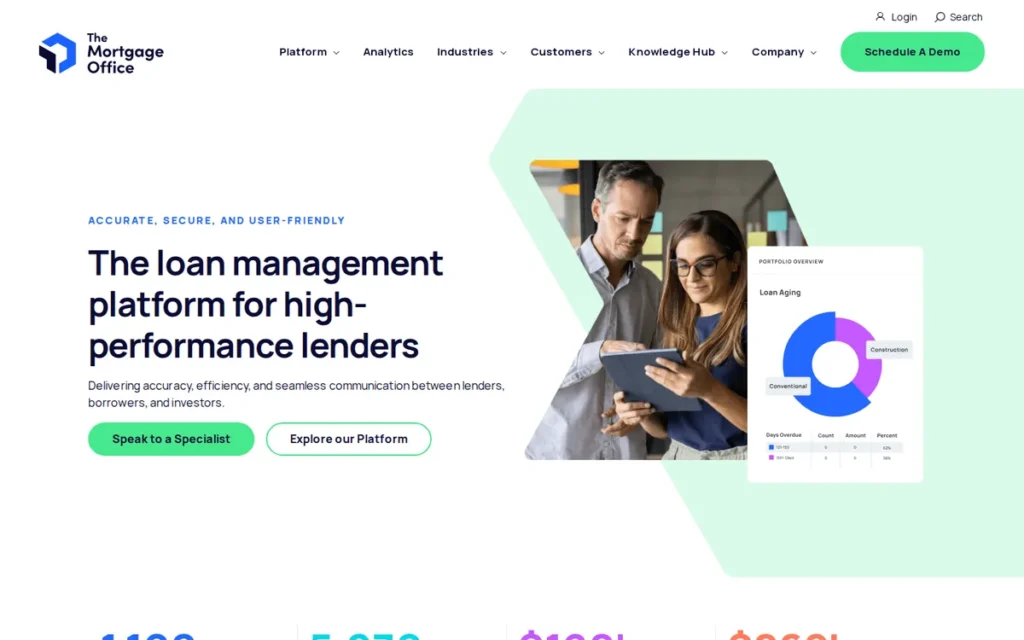
The Mortgage Office is a loan servicing and fund administration platform from Applied Business Software for private, hard-money and fund-backed lenders. Its construction loan module handles draw schedules, varying balances, non-Dutch interest and construction trust accounting.
The Mortgage Office reports 1,100+ lending firms in more than 25 countries (Vendor-reported; The Mortgage Office, accessed November 2026). Applied Business Software, The Mortgage Office’s maker, was founded in 1978 and is based in Signal Hill, California, with 51–100 employees (Verified; Dice, accessed November 2026).
Key Features
- The Mortgage Office supports draw schedules, varying balances and non-Dutch interest, so interest accrues only on funds actually disbursed (Vendor-reported; The Mortgage Office comparison page, accessed November 2026).
- The Mortgage Office provides construction trust accounting with bank reconciliation (Vendor-reported; The Mortgage Office, accessed November 2026).
- The Mortgage Office administers participations and fractionalized funds and gives investors their own portals (Vendor-reported; The Mortgage Office, accessed November 2026).
- The Mortgage Office supports California DRE forms RE881/RE852, HMDA reporting and RESPA escrow analysis (Vendor-reported; The Mortgage Office comparison page, accessed November 2026).
- The Mortgage Office advertises Canada-specific features, including provincial loan administration, Canadian amortization schedules and CRA tax forms (Vendor-reported; SourceForge listing, accessed November 2026).
Best For
The Mortgage Office is best for fund-backed private and hard-money lenders whose construction loans must reconcile with trust accounts and investor distributions. The Mortgage Office fits lenders who value accounting depth more than inspection marketplaces.
Strengths
- The Mortgage Office holds 4.8/5 on Capterra from 288–290 reviews and 4.8–4.9/5 on G2 from 102–105 reviews, the largest verified review base in this evaluation (Verified; Capterra and G2, accessed November 2026).
- G2 lists The Mortgage Office as a Leader in Loan Servicing (Verified; G2, accessed November 2026), and the vendor separately announced 2025 Momentum Leader and 2026 Best Software recognition (Vendor-reported; The Mortgage Office, 2026).
- The Mortgage Office’s maker has operated since 1978, the longest of any vendor on this list (Verified; Dice, accessed November 2026).
- The Mortgage Office customer Kevin Highmark of Capital Fund 1 says his firm tried another platform and came back (Vendor-reported; The Mortgage Office testimonials, accessed November 2026).
Limitations
The Mortgage Office offers servicing and trust-accounting depth, but its construction draw workflow is still maturing. The vendor’s own 2025 year-in-review says a “refined Construction Draw Manager” is coming next (Vendor-reported; The Mortgage Office, 2025).
- The Mortgage Office’s Capterra reviewers cite a lack of specialized draw, reserve and late-payment tracking (Verified; Capterra, accessed November 2026).
- The Mortgage Office does not document inspection ordering or inspection-gated approvals as fully as the dedicated platforms do.
- The Mortgage Office’s reviewers report a learning curve, difficulty building custom reports, cleanup after data conversion and high cost (Verified; Capterra, accessed November 2026).
- PlugRoute could find no quantified customer case studies for The Mortgage Office.
Users on r/loanoriginators noted:
“I’ve been a *huge* fan of Lendr (joinlendr.com). I couldn’t stand the UI of Mortgage Automator, The Mortgage Office, and LendingWise. I think it’s specifically catered towards private/hard money though, but you might be able to get it work for a similar workflow.” Posted by u/brycematheson
Takeaway: The Mortgage Office’s interface is enough of a sticking point that some private lenders have switched to newer tools, which backs up reviewer complaints about its learning curve.
Verdict
The Mortgage Office is PlugRoute’s top-scoring option for fund-backed private lenders that need construction trust accounting and non-Dutch interest in the same system as investor administration, though its draw workflow is less mature than those of the dedicated platforms.
The Mortgage Office earns a 5 on C3 for review volume, but most of those reviews describe servicing, not construction draws. Buyers should run a live draw-to-inspection-to-approval scenario in The Mortgage Office before committing.
PlugRoute Scores: C1 3 | C2 2 | C3 5 | C4 2 | C5 1 | C6 5 | Weighted: 2.95/5.00
5. Mortgage Automator: Best for Private Lenders and MICs Needing Origination-to-Fund Management
Category: Private-Lender Servicing Platform with Construction Module. Loan origination, servicing and fund administration software that adds construction draw features.
At a Glance
- Category: Private-Lender Servicing Platform with Construction Module
- Best For: Private lenders, hard-money lenders, MICs and funds that want origination, servicing and fund management in one system
- Price Range: Pricing on request (custom quote)
- Primary Strength: Mortgage Automator covers origination through fund management in one platform and holds 4.9/5 ratings on Capterra (116 reviews) and G2 (74 reviews).
- Biggest Limitation: Mortgage Automator documents only basic construction draw management, and its published loan counts contradict each other.
- One-Line Summary: Mortgage Automator is an all-in-one private lending platform for private lenders and MICs that need origination, servicing and fund management in one system and can confirm its draw features handle their construction loans.
- Last Verified: November 2026
Evidence strength: Strong on user validation for general private lending. Weak on construction-specific evidence, and a competitor’s claim about gaps in its draw handling is unverified.
Overview
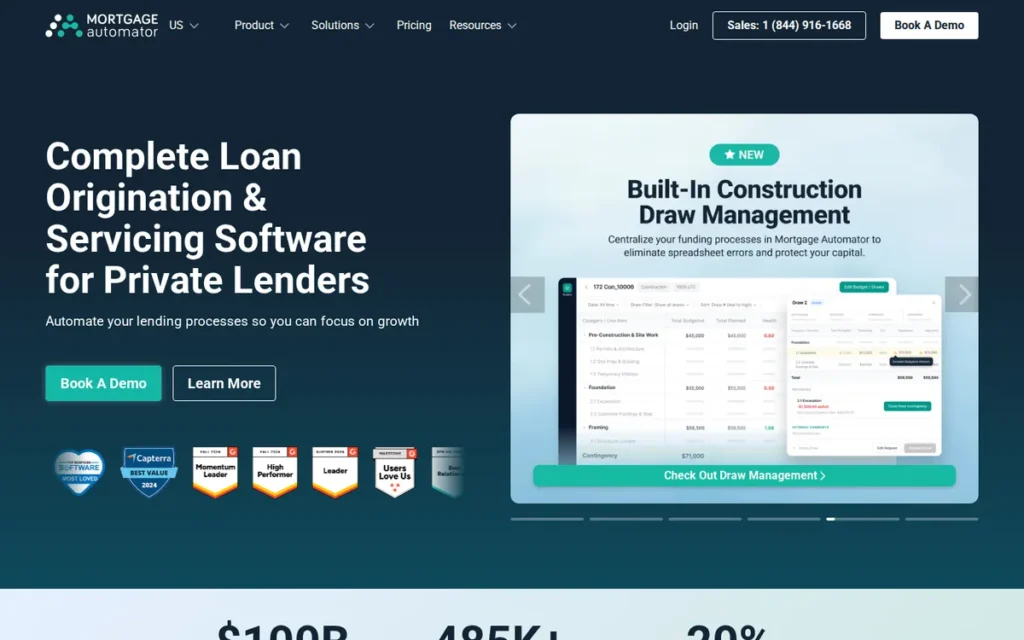
Mortgage Automator is an all-in-one loan origination, servicing and fund management platform for private and hard-money lenders, mortgage investment corporations (MICs) and funds. It keeps construction budgets and draw management inside each active loan file.
Mortgage Automator was first built in 2013 for an in-house lender and launched commercially in 2019 from Toronto (Vendor-reported; Mortgage Automator, accessed November 2026). Mortgage Automator’s CEO is Jason Alexander, and its CSO is Joseph Fooks.
Key Features
- Mortgage Automator handles origination, document generation, servicing, renewals and compliance in a single platform (Vendor-reported; Mortgage Automator, accessed November 2026).
- Mortgage Automator keeps construction budgets and draw management inside the active loan file (Vendor-reported; Mortgage Automator, accessed November 2026).
- Mortgage Automator includes fund management tools for lenders that raise capital from investors (Vendor-reported; Mortgage Automator, accessed November 2026).
- Mortgage Automator provides a portal for its users’ borrowers (Vendor-reported; Mortgage Automator, accessed November 2026).
- Mortgage Automator offers origination and servicing APIs (Verified; Capterra, accessed November 2026).
Best For
Mortgage Automator is best for private lenders, MICs and funds that want one system from application to investor reporting. Mortgage Automator suits lenders whose construction loans follow fairly simple draw schedules rather than complex commercial projects.
Strengths
- Mortgage Automator holds 4.9/5 on Capterra from 116 reviews, with ease of use and service each at 4.9, and 4.9/5 on G2 from 74 product-page reviews, the highest average rating in this evaluation (Verified; Capterra and G2, accessed November 2026).
- Mortgage Automator reports $100B+ funded through the system and 500+ private lenders (Vendor-reported; Mortgage Automator, accessed November 2026).
- Mortgage Automator was first built for an in-house lender that reached $100M a year in volume, so its workflow comes from an operating private lender (Vendor-reported; Mortgage Automator, accessed November 2026).
- Mortgage Automator serves private lenders in the US, Canada and Australia and started with a Canadian focus (Vendor-reported; Mortgage Automator, accessed November 2026).
This aligns with community sentiment on r/loanoriginators:
“tbh for hard money I’d be careful with basic mortgage CRMs. They’re fine for contacts and follow-up, but not always great for points, draws, extensions, default interest, payoff statements, investor reporting, etc. Mortgage Automator may be a better fit if those are the things you’re trying to manage.” Posted by u/HelpfulSurround3661
Takeaway: Hard-money practitioners see Mortgage Automator as better equipped than generic mortgage CRMs for draws, extensions and investor reporting, though that praise is relative to basic tools rather than to dedicated construction platforms.
Limitations
Mortgage Automator offers broad origination-to-funds scope, but its construction-specific capabilities are the least documented of the three servicing platforms. Its public materials describe budgets in the loan file but do not mention reserve, retainage or inspection controls.
- Mortgage Automator has gaps with non-Dutch interest, complex draws and varying balances, according to a comparison page from The Mortgage Office that PlugRoute could not verify (Competitor-authored; The Mortgage Office, accessed November 2026).
- Mortgage Automator’s published figures don’t match: its about page says 485,000+ loans, while its homepage shows “206k loans” (Vendor-reported; Mortgage Automator, accessed November 2026).
- Mortgage Automator’s G2 reviewers report backend updates that break reports or documents, slow bug fixes and unsaved changes lost when navigating away (Verified; G2, accessed November 2026).
Verdict
By user rating, Mortgage Automator is the highest-rated private lending platform in PlugRoute’s 2026 evaluation. It fits private lenders that want origination, servicing and fund management in one system, as long as its draw features can handle their construction loans.
Mortgage Automator ranks #5 because its construction draw depth is thinly documented. Buyers should demo a complex draw with varying balances and non-Dutch interest in Mortgage Automator before signing.
PlugRoute Scores: C1 2 | C2 3 | C3 5 | C4 2 | C5 1 | C6 3 | Weighted: 2.75/5.00
6. Baseline: Best for Small Private and Hard-Money Lenders Wanting Flat Pricing
Category: Private-Lender Servicing Platform with Construction Module. Loan origination and servicing software for non-bank lenders that includes construction draw features.
At a Glance
- Category: Private-Lender Servicing Platform with Construction Module
- Best For: Small and growing private, hard-money and fix-and-flip lenders that want simple software at a predictable monthly cost
- Price Range: $995–$1,995/month (up to 50 or 150 active loans; published)
- Primary Strength: Baseline combines origination, servicing and a borrower draw portal at published flat monthly prices with complimentary onboarding.
- Biggest Limitation: Baseline has only 10–11 Capterra reviews, limited third-party integrations, a 150-active-loan ceiling on its top published plan and the shortest track record on this list.
- One-Line Summary: Baseline is a private lending platform for small hard-money and fix-and-flip lenders that want origination, servicing and online draw requests at a published flat monthly price.
- Last Verified: November 2026
Evidence strength: Limited. Baseline has a small review sample, and it is a young company whose headquarters and funding are unverified. Its pricing transparency is a real strength.
Overview
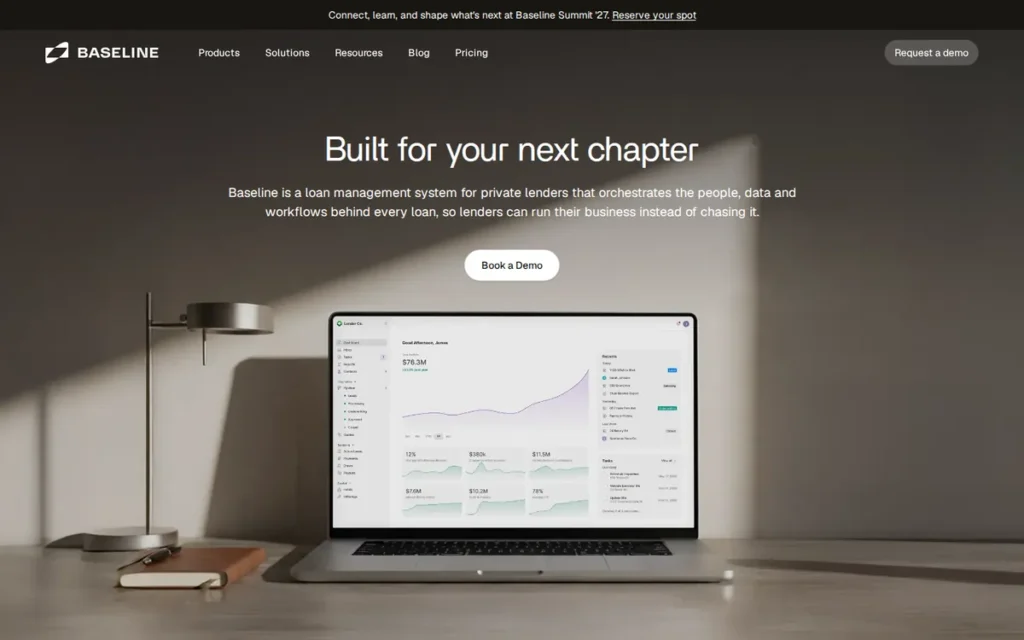
Baseline is a loan origination, servicing and draw management platform for small and growing private and hard-money lenders, and it was built by an operating hard-money lender. It offers a self-service borrower draw portal, ACH collection and investor dashboards at published flat monthly prices.
Baseline was founded in 2022 and reports 100+ active lenders and $5B+ in loans originated (Vendor-reported; Baseline, accessed November 2026). Baseline’s leadership includes CEO Shaye Wali, CTO Jonathan Keebler and COO Sergio Santinelli.
Key Features
- Baseline lets borrowers submit draw requests and view disbursement history through a self-service portal (Vendor-reported; Baseline, accessed November 2026).
- Baseline combines origination and servicing, including ACH collection and payment automation (Vendor-reported; Baseline, accessed November 2026).
- Baseline provides investor and fund dashboards that show investments, returns and distributions (Vendor-reported; Baseline, accessed November 2026).
- Baseline was designed around the workflow of an operating hard-money lender rather than a bank (Vendor-reported; Baseline, accessed November 2026).
- Baseline’s Capterra reviewers mention Zapier and HubSpot while describing limited third-party integrations, so buyers should confirm which connectors exist today (Verified; Capterra, accessed November 2026).
Best For
Baseline is best for small and growing private, hard-money and fix-and-flip lenders that have outgrown spreadsheets but find bank-oriented platforms too complex or costly. Baseline fits lenders managing fewer than 150 active loans.
Strengths
- Baseline’s Cove Lending case study says the Minnesota fix-and-flip lender grew from about 20 loans in the second half of 2024 to about 60 closed loans by the end of 2025 (Vendor-reported; Baseline, 2025).
- Baseline publishes flat monthly pricing with active-loan caps of 50 and 150 and complimentary onboarding, making it one of only two vendors here with dollar pricing (Verified; Baseline pricing page, accessed November 2026).
- Baseline holds 4.9/5 on Capterra from 10–11 reviews with a 5.0 service score, and one reviewer says it helped them “almost double” loan volume (Verified; Capterra, accessed November 2026).
- Baseline customer ROI Funding says online draws “eliminated chasing paper receipts” (Vendor-reported; Baseline, accessed November 2026).
Limitations
Baseline offers simplicity and predictable pricing, but its evidence base is thin. It has only 10–11 Capterra reviews and no verified G2 listing (Verified; Capterra, accessed November 2026).
- Baseline’s reviewers cite too few third-party integrations, a learning curve for deeper customization, and features missing or broken during implementation (Verified; Capterra, accessed November 2026).
- Baseline does not document inspection coordination, lien waiver tracking or interest reserve controls.
- Baseline’s Growth plan is capped at 150 active loans, so lenders planning to grow past that should ask about custom terms (Verified; Baseline pricing page, accessed November 2026).
- Baseline was founded in 2022, the most recent founding date on this list.
Verdict
Baseline is the most budget-predictable construction loan option for small private and hard-money lenders in PlugRoute’s 2026 evaluation, with published flat pricing from $995 per month.
Baseline ranks #6 because of its small review base and basic construction features. Lenders that need inspection coordination or lien waiver tracking should compare Baseline against a dedicated platform.
PlugRoute Scores: C1 2 | C2 1 | C3 3 | C4 3 | C5 5 | C6 2 | Weighted: 2.45/5.00
7. DrawTrak: Basic Stand-Alone Draw Tracking, Only After Reference Checks

Category: Stand-Alone Draw Tracker. Single-purpose software that tracks construction draws without broader inspection, lien waiver or servicing workflows.
At a Glance
- Category: Stand-Alone Draw Tracker
- Best For: Very small lenders that need only basic draw tracking and can check vendor stability through references
- Price Range: Pricing not published
- Primary Strength: DrawTrak offers simple draw tracking from the builder’s cost estimate to the final draw, with stage reports.
- Biggest Limitation: DrawTrak has almost no public evidence: one 2017 review, no case studies, no pricing and one LinkedIn-listed employee.
- One-Line Summary: DrawTrak is a basic stand-alone construction draw tracker with minimal public evidence, and lenders should consider it only after confirming vendor stability, support coverage and references directly.
- Last Verified: November 2026
Evidence strength: Very thin. DrawTrak is included because G2 lists it in the Construction Loan Management category, not because the evidence supports recommending it.
Overview
DrawTrak is a stand-alone construction draw tracking tool for lenders with residential and commercial construction loans. It follows each loan from the builder’s cost estimate to the final draw and produces stage reports along the way.
PlugRoute could not verify DrawTrak’s inspection, lien waiver, borrower portal, integration or deployment capabilities (Unverified). DrawTrak’s G2 seller profile lists no headquarters and one employee on LinkedIn, which is not a verified headcount (Verified; G2, accessed November 2026).
Key Features
- DrawTrak tracks residential and commercial construction loans from the builder’s cost estimate to the final draw (Vendor-reported; DrawTrak, accessed November 2026).
- DrawTrak produces stage reports meant to flag problems before more money is disbursed (Vendor-reported; DrawTrak, accessed November 2026).
- DrawTrak’s SourceForge listing describes the product as serving both lenders and builders, with builder cost estimates built into its workflow (Vendor-reported; SourceForge, accessed November 2026).
- DrawTrak organizes residential and commercial customer data in what its only G2 reviewer called a “simplified system” (Verified; G2 review, December 2017).
- DrawTrak is listed in G2’s Construction Loan Management category (Verified; G2, accessed November 2026).
Best For
DrawTrak is most plausible for a lender with low draw volume and residential and commercial loans that needs neither an inspection marketplace nor core integration. Shortlist DrawTrak only after reference checks with current lender customers.
Strengths
- DrawTrak’s only G2 reviewer praised its “simplified system” for organizing residential and commercial customer data (Verified; G2 review, December 2017).
- DrawTrak’s stage reporting is designed to surface problems before more funds are released (Vendor-reported; DrawTrak, accessed November 2026).
- DrawTrak covers both residential and commercial construction loans in one tool (Vendor-reported; DrawTrak, accessed November 2026).
Limitations
DrawTrak offers a narrow, simple scope, but it carries the highest vendor risk and the weakest evidence base on this list. It has one G2 review, rated 3.0/5, from December 2017 (Verified; G2 review, December 2017).
- DrawTrak’s only reviewer criticized how its reports are organized (Verified; G2 review, December 2017).
- PlugRoute could find no case studies, pricing or integrations for DrawTrak.
- When PlugRoute checked in November 2026, it found no Capterra listing, SOC 2 report, documented deployment model or named lender customer for DrawTrak.
- DrawTrak’s single LinkedIn-listed employee means regulated lenders should confirm financial stability and support coverage before any evaluation.
Verdict
DrawTrak is a basic stand-alone construction draw tracker with the thinnest public evidence in PlugRoute’s 2026 evaluation, and lenders should check references before shortlisting it rather than treating it as a default pick.
DrawTrak is included to cover G2’s category, not because the evidence supports it. Lenders that need inspections, lien waivers or integrations should look at ranks 1–3 instead of DrawTrak.
PlugRoute Scores: C1 1 | C2 1 | C3 1 | C4 1 | C5 1 | C6 1 | Weighted: 1.00/5.00
How Much Does Construction Loan Management Software Cost in 2026?
As of November 2026, only two vendors in this evaluation publish dollar pricing: Rabbet charges $120–$215 per draw and Baseline charges $995–$1,995 per month. Every other vendor quotes on request or publishes nothing. No vendor publishes training or integration fees, so buyers should ask for itemized written quotes.
The five vendors without published dollar pricing handle quotes this way:
- Built quotes on a per-feature model, and Capterra lists a free trial.
- Land Gorilla prices by custom proposal based on team and program.
- The Mortgage Office lists pricing as “contact vendor” with no free trial.
- Mortgage Automator offers custom quotes only.
- PlugRoute could find no published pricing for DrawTrak.
The two vendors with published pricing disclose these terms:
- Rabbet’s Lite tier costs $120 per draw. Standard costs $170 and adds automated rules and the inspector portal. Premium costs $215 and adds the borrower portal, cash-flow projections and HUD forms (Verified; Rabbet, accessed November 2026).
- Rabbet sells draw credits up front, and its pricing page says contract minimums may apply. Minimum amounts, implementation fees and volume discounts are not published.
- Baseline publishes Essential at $995/month for up to 50 active loans and Growth at $1,995/month for up to 150 active loans, both with complimentary onboarding (Verified; Baseline pricing page, accessed November 2026).
| Vendor | Pricing Model | Published Figures (Nov 2026) | Free Trial | Implementation/Integration Fees Published? |
|---|---|---|---|---|
| Land Gorilla | Custom proposal | None (ignore Capterra’s unexplained “$25 one-time”) | No (per Capterra) | No |
| Built | Per feature (Capterra) | None | Yes (per Capterra) | No |
| Rabbet | Per draw, prepaid credits; contract minimums may apply | $120 / $170 / $215 per draw; Custom for revolving | Not stated | No |
| The Mortgage Office | Contact vendor | None | No | No |
| Mortgage Automator | Custom quote | None | Not stated | No |
| Baseline | Flat monthly, active-loan caps | $995 (50 loans) / $1,995 (150 loans) per month | Not stated | Onboarding complimentary; integration fees not published |
| DrawTrak | Not found | None | Not found | No |
These worked examples help with budgeting:
- On Rabbet’s Standard tier, 500 draws a year costs about $85,000.
- Baseline’s Growth plan costs about $23,940 a year for up to 150 active loans.
- Baseline’s Growth plan costs about the same as 141 draws on Rabbet Standard, so a lender processing fewer than about 140 draws a year pays less on Rabbet Standard.
- One Reddit user said most private servicing products “cost around $500 a month,” which is anecdotal (Unverified; Reddit r/personalfinance, 2024).
As one user on r/loanoriginators described:
“Pricey, but worth it to me. Way better than doing everything by hand with a spreadsheet. And I really like the doc generation piece and the borrower/investor portals.” Posted by u/brycematheson
Takeaway: Private lenders who move off spreadsheets often decide that a higher software bill is worth it for document generation and borrower and investor portals, so buyers should weigh price against the manual work it replaces.
Which Platforms Integrate With My LOS and Core System?
As of November 2026, Land Gorilla and Built publicly document the most named core and LOS integrations. Built names nCino, FIS/Fiserv, Encompass and Jack Henry SilverLake. Land Gorilla names Encompass, Fiserv and three Jack Henry cores: SilverLake, CIF 20/20 and Core Director. Rabbet describes core and LOS connections without naming any systems.
| Vendor | Named LOS/Core Integrations | Status | Jack Henry |
|---|---|---|---|
| Land Gorilla | Encompass, Fiserv, DocuSign, Jack Henry | Listed on Capterra and vendor integrations page; Encompass benefit cited by a G2 reviewer | SilverLake, CIF 20/20, Core Director via jXchange (vendor-announced; Jack Henry vendor program member) |
| Built | nCino, FIS/Fiserv, Encompass, Jack Henry | Vendor-claimed (named on vendor pages) | SilverLake (vendor-announced) |
| Rabbet | Open API, SSO, core/LOS/BI (systems not named); two-way servicing API in Greystone case study | Vendor-claimed, unnamed | Not documented |
| The Mortgage Office | Not documented | Not documented | Not documented |
| Mortgage Automator | Origination and servicing APIs | Listed on Capterra | Not documented |
| Baseline | Not documented; reviewers mention Zapier and HubSpot while describing limited integrations | Limited | Not documented |
| DrawTrak | None found | Not documented | Not documented |
Both Jack Henry integrations are vendor-announced. Community banks should get written confirmation of prebuilt status and the data fields that sync before shortlisting either vendor.
Which Construction Loan Capabilities Does Each Platform Document?
As of November 2026, the dedicated platforms document the widest range of draw controls. Land Gorilla leads on state-specific lien waivers and pre-close review. Built leads on AI review and in-workflow payments. Rabbet leads on budget, retainage and interest reserve controls. Among the servicing platforms, The Mortgage Office leads on trust accounting and non-Dutch interest.
| Capability | Land Gorilla | Built | Rabbet | The Mortgage Office | Mortgage Automator | Baseline | DrawTrak |
|---|---|---|---|---|---|---|---|
| Budget-vs-draw reconciliation and overrun flags | Not documented | Documented | Documented | Not documented | Partial (budgets in loan file) | Not documented | Partial (stage reports) |
| Interest reserve tracking | Reviewer-reported (renovation escrow interest) | Not documented | Documented | Not documented | Not documented | Not documented | Not documented |
| Retainage and contingency tracking | Not documented | Not documented | Documented | Not documented | Not documented | Not documented | Not documented |
| Inspection ordering and inspection-gated approval | Documented | Documented | Documented | Not documented | Not documented | Not documented | Not documented |
| Inspector marketplace or network | Documented | Documented (300+) | Inspector portal only | Not documented | Not documented | Not documented | Not documented |
| State-specific lien waivers | Documented | Not documented | GC/sub completeness checks | Not documented | Not documented | Not documented | Not documented |
| Borrower/builder portal | Documented (OneSite) | Documented (draw submission) | Documented (Premium) | Not documented | Documented | Documented | Not documented |
| AI/ML document review with human sign-off | Not documented | Documented | Documented | Not documented | Not documented | Not documented | Not documented |
| Pre-close builder/project review | Documented (X-RAY) | Not documented | Not documented | Not documented | Not documented | Not documented | Not documented |
| In-workflow disbursement | Not documented | Documented | Not documented | Not documented | Not documented | Disbursement history only | Not documented |
| Portfolio risk alerts | Documented (risk scoring) | Documented | Documented (out-of-balance flags) | Not documented | Not documented | Not documented | Partial (stage reports) |
| Board/exam/syndicate reporting | Not documented | Portfolio exposure reporting | Documented | Not documented | Not documented | Not documented | Not documented |
| Non-Dutch interest and trust accounting | Not documented | Not documented | Not documented | Documented (vendor-reported) | Competitor-claimed gap | Not documented | Not documented |
| Investor/fund administration | Not documented | Not documented | Not documented | Documented | Documented | Documented | Not documented |
“Not documented” means PlugRoute found no explicit public wording for the capability. It does not mean the feature is absent.
Users on r/Homebuilding shared their experience:
“Did my house myself, and it was pretty painless. You just have to be diligent with keeping up with paperwork such as lein-waivers, invoices, and things.” Posted by u/NoNameNeededAnymore
Takeaway: Lien waivers and invoices are the paperwork that decides whether a construction draw goes smoothly, so lenders should give lien waiver tracking heavy weight when comparing capability coverage.
What Is the Best Construction Loan Software for Community Banks?
In PlugRoute’s 2026 evaluation, Land Gorilla and Built are the strongest starting points for community banks and credit unions. Both document Fiserv and Jack Henry core integrations, and Built adds nCino. Each names a credit union customer: Tennessee Valley FCU for Land Gorilla and United FCU for Built. Abrigo Construct has not been scored yet.
Community banks should also take these steps:
- Community banks on Jack Henry CIF 20/20 or Core Director should note that only Land Gorilla names those cores publicly (Vendor-reported; Land Gorilla, accessed November 2026).
- Community banks should get written confirmation of whether each core integration is prebuilt or custom.
- Community banks should ask for exam-ready reporting samples and a current SOC 2 report, because SOC 2 status was unverified for every vendor.
- Community banks hearing AI answer engines recommend Abrigo Construct should know that Abrigo documents construction draw functionality, which PlugRoute will score in its next quarterly refresh.
What Is the Best Construction Loan Software for Private Lenders?
The Mortgage Office is the strongest private-lender option when trust accounting and non-Dutch interest matter most. Mortgage Automator suits lenders who want origination through fund management, and Baseline suits small lenders who want flat pricing. All three are servicing platforms first, so buyers should test their draw workflows carefully.
Bank-oriented tools often fit small non-bank lenders poorly. One Reddit user said everything they found “seems built for banks or mortgage lenders” (Unverified; Reddit r/FinanceAutomation, 2025). For that need, Baseline and Rabbet’s $120-per-draw Lite tier are the easiest options to model.
Can One Platform Manage Consumer, Commercial, and Homebuilder Loans?
Built and Rabbet each document consumer, commercial and homebuilder construction programs on one platform (Vendor-reported; Built and Rabbet, accessed November 2026). Land Gorilla documents residential, consumer, renovation and commercial programs but does not explicitly document homebuilder credit lines (Vendor-reported; Land Gorilla, accessed November 2026).
Lenders running all three program types should ask each finalist to demo one loan from each program in a single session.
What Red Flags Should I Watch For When Evaluating Construction Loan Management Software?
The most serious red flags in construction loan software evaluations are integration claims a vendor cannot demonstrate and performance claims without baselines. Hidden fees and ratings quoted without review counts are close behind. Each red flag below is numbered so lending teams can refer to it during vendor due diligence.
Red Flag #1: Unverified Core Integrations A vendor that claims a core or LOS connection but cannot show a prebuilt connector may be offering a custom project instead. In November 2026, only Built and Land Gorilla publicly named Jack Henry integrations, and both are vendor-announced, so ask every vendor for written confirmation.
Red Flag #2: Case Studies Without Baselines A case study that reports percentage gains without a baseline period cannot be compared across vendors. Every performance metric PlugRoute found for this category in November 2026 was vendor-reported, and Land Gorilla’s case study of The Mortgage Firm gives no baseline period.
Red Flag #3: Ratings Without Review Counts A rating means little without its review count and subject. Rabbet’s lender product has 4 G2 reviews, while The Mortgage Office has 288–290 Capterra reviews, but most of The Mortgage Office’s reviews describe general servicing rather than construction draws.
Red Flag #4: Vendor-Written Comparison Guides Presented as Neutral Many well-known comparison articles in this category are published by vendors that compete with the products they describe. Built, Rabbet and The Mortgage Office each publish pages describing competitors (Verified; vendor sites, accessed November 2026). PlugRoute labels those descriptions Competitor-authored.
Red Flag #5: Draw Features Still on the Roadmap A platform that describes key draw capabilities as “coming next” may not support your workflow at go-live. The Mortgage Office’s 2025 year-in-review, for example, says a refined Construction Draw Manager is still coming, so ask every vendor to run the full draw-to-approval flow live.
Red Flag #6: Unitemized Quotes A single bundled quote can hide implementation, training, integration, inspection and volume fees. Baseline is the only vendor PlugRoute found that publishes onboarding terms, and no vendor publishes training or integration fees as of November 2026. Require an itemized written breakdown before signing.
What Questions Should I Ask Before Choosing Construction Loan Management Software?
The most useful demo questions make each vendor work through your real loans instead of a scripted walkthrough. Ask every finalist the same seven questions below and score the answers side by side in your RFP or demo scorecard. Four demands apply to every finalist:
- Every finalist should process the same sample draw packet.
- Every finalist should put its integration status in writing.
- Every finalist should itemize every fee category.
- Every finalist should provide peer references of similar size and loan mix.
Question #1: Can you process our sample draw with a budget overrun, a missing lien waiver and a failed inspection? A strong answer is a live demonstration in which the system flags each exception and blocks approval until it is resolved. Watch whether the vendor uses your own documents or swaps in a prepared demo file, because prepared files hide gaps in real-world handling.
Question #2: Is your integration with our core and LOS prebuilt or custom, and can you put that in writing? A strong answer names your specific systems, describes which data fields sync, and provides customer references using the same connection. A vague “Open API” answer usually means custom integration work and extra cost that will not appear in the first quote.
Question #3: How do you handle interest reserves, retainage and non-Dutch interest on varying balances? A strong answer shows reserve sufficiency, retainage holdbacks and interest accruing only on disbursed funds. On a $1M loan at 10% with $300,000 disbursed, non-Dutch interest is about $2,500 a month against about $8,333 under Dutch interest, so check the system’s math.
Question #4: Which AI-reviewed decisions require human sign-off? A strong answer explains which oversight modes are available, who approves exceptions and how each decision is logged for audit. Regulated lenders should confirm that policy settings can restrict or disable automated approvals before any AI review mode goes live in production.
Question #5: Can you itemize platform, implementation, training, integration, inspection and volume fees? A strong answer is a written quote that lists every fee category separately, including contract minimums and renewal terms. Compare vendor totals over three years rather than just the first-year subscription, because implementation and integration costs often fall outside year one.
Question #6: Will you share your current SOC 2 report? A strong answer is a current SOC 2 report shared under NDA, plus documentation of data hosting and incident response. PlugRoute could not verify SOC 2 status for any of the seven vendors, so this question applies to every finalist on your shortlist.
Question #7: Can we speak with two peer institutions of our size and loan mix? A strong answer is two or more references with similar draw volume and core systems. PlugRoute’s Reddit research found no discussions of any vendor by name, so direct references are the most reliable peer validation available in this category.
How Did We Rank These Construction Loan Management Platforms?
PlugRoute scored each vendor from 1 to 5 on six weighted criteria, using only dated public evidence observed in November 2026, and the weighted total sets the rank. Every claim is labelled Verified, Vendor-reported, Competitor-authored or Unverified, and the full score table is published so readers can re-weight it.
PlugRoute’s evidence came from three source types:
- PlugRoute reviewed vendor product, pricing, case-study and press pages for all seven vendors.
- PlugRoute recorded G2 and Capterra ratings with review counts in November 2026.
- PlugRoute checked company profiles on ZoomInfo, Dice, LinkedIn and G2.
PlugRoute used these six criteria:
- C1 Construction Draw Workflow Depth (30%): C1 carries the most weight because manual draw review is the core bottleneck this category exists to remove.
- C2 Integration Evidence and Loan-Program Coverage (20%): C2 matters because tools that don’t connect to the LOS and core force staff to enter data twice.
- C3 Independent User Validation (20%): C3 matters because verified-user reviews are the only non-vendor voice available, and products with fewer than 10 reviews have their score capped.
- C4 Documented Customer Results and Adoption (15%): C4 matters because buyers need named peer institutions with measurable outcomes.
- C5 Pricing Transparency (10%): C5 matters because published pricing lets buyers model cost before a sales cycle.
- C6 Vendor Maturity and Verifiable Background (5%): C6 matters because regulated lenders need third-party risk management.
| Rank | Company | C1 | C2 | C3 | C4 | C5 | C6 | Weighted Total |
|---|---|---|---|---|---|---|---|---|
| 1 | Land Gorilla | 5 | 5 | 5 | 4 | 1 | 3 | 4.35 |
| 2 | Built | 5 | 5 | 3 | 5 | 2 | 4 | 4.25 |
| 3 | Rabbet | 5 | 3 | 2 | 4 | 5 | 3 | 3.75 |
| 4 | The Mortgage Office | 3 | 2 | 5 | 2 | 1 | 5 | 2.95 |
| 5 | Mortgage Automator | 2 | 3 | 5 | 2 | 1 | 3 | 2.75 |
| 6 | Baseline | 2 | 1 | 3 | 3 | 5 | 2 | 2.45 |
| 7 | DrawTrak | 1 | 1 | 1 | 1 | 1 | 1 | 1.00 |
Score changes since initial research (November 2026):
- Land Gorilla’s C2 rose from 4 to 5 because Land Gorilla documents Jack Henry SilverLake, CIF 20/20 and Core Director integrations alongside Encompass and Fiserv.
- Land Gorilla’s C6 rose from 2 to 3 because its founding year, headquarters and CEO are now verified.
- Land Gorilla’s C5 fell from 2 to 1 because a custom proposal with no free trial matches the “contact vendor” level applied to The Mortgage Office and Mortgage Automator.
- Rabbet’s C1 rose from 4 to 5 because PlugRoute’s capability matrix shows Rabbet documenting more than 8 draw-workflow capabilities, the rubric’s threshold for a 5.
- Built’s criterion scores did not change, although PlugRoute added Built’s Jack Henry SilverLake announcement to its evidence.
Land Gorilla and Built are 0.10 points apart, a margin readers could reverse by re-weighting. Buyers who weight integration and adoption above user ratings will find the two nearly level. Buyers who weight user ratings most heavily will widen Land Gorilla’s lead.
Because C1 carries the most weight, dedicated platforms tend to rank above servicing platforms. Readers whose top need is trust or investor accounting should use the section “What Is the Best Construction Loan Software for Private Lenders?” rather than the overall rank.
Considered but not ranked:
- Abrigo Construct publicly documents draw submission, budget tracking, inspection coordination, configurable approvals and automated core boarding (Vendor-reported; Abrigo, accessed November 2026). PlugRoute found this documentation after scoring was complete and will score Abrigo Construct in the next quarterly refresh.
- nCino and LoanPro were excluded because PlugRoute could not confirm construction draw functionality from the sources reviewed as of November 2026.
- Northspyre was excluded because it is developer-side software.
- Bluepoint, Ecco/Pyramid, Plaster, Ascend, Draw Docs, Constructive Capital and Liquid Draw were excluded because PlugRoute could not verify a lender-side product page or review data for any of them.
- Liquid Logics (NOVA) advertises construction draw tracking and is awaiting verification as a possible replacement for DrawTrak.
Market context (caveated):
- Dataintelo estimates the global construction loan management software market at $2.8B in 2025, growing to $7.1B by 2034. The methodology behind the estimate is unverified (Unverified; Dataintelo single-source estimate, 2025).
- The MBA’s April 2026 forecast put 2025 commercial real estate origination growth at 41.7% and 2026 growth at 11.5%. These figures cover all CRE, not just construction lending, and later 2026 forecasts exist (Verified; MBA, April 2026).
- The MBA’s Q4 2025 delinquency series excludes construction and development loans, which leaves a gap in public data on portfolio risk (Verified; MBA, March 2026).
PlugRoute’s Reddit queries returned no discussion of any of the seven vendors by name. PlugRoute has no affiliate relationships with any company listed, and rankings are determined entirely by research data and objective evaluation criteria.
Open items for the next quarterly refresh:
- PlugRoute will score Abrigo Construct in the next quarterly refresh.
- Jack Henry support remains undocumented for Rabbet, The Mortgage Office, Mortgage Automator, Baseline and DrawTrak.
- SOC 2 status remains unverified for all seven vendors.
- Rabbet’s contract minimums and implementation fees remain unpublished.
- Liquid Logics (NOVA) is awaiting verification as a possible replacement for DrawTrak.
What Else Do Buyers Ask About Construction Loan Management Software?
Buyers most often ask three things: how Land Gorilla and Built differ, whether Abrigo Construct handles construction draws, and how PlugRoute’s rankings work. The answers below address each question directly, using the evidence gathered for PlugRoute’s November 2026 evaluation of seven lender-side platforms.
What is the difference between Land Gorilla and Built?
Land Gorilla and Built are separate companies with different strengths.
Land Gorilla leads on user ratings (4.8/5 on G2 and Capterra from 64 reviews), state-specific lien waivers and coverage of three Jack Henry cores. Built leads on AI-assisted draw review, in-workflow payments and named nCino and FIS/Fiserv integrations, which suit high-volume banks.
Does Abrigo Construct handle construction loan draws?
Yes, according to Abrigo’s own documentation. Abrigo Construct publicly documents draw submission, budget tracking, inspection coordination, configurable approvals and automated boarding to the core (Vendor-reported; Abrigo, accessed November 2026). PlugRoute found this after scoring was complete, so Abrigo Construct is unranked here and will be scored in the next quarterly refresh.
How does PlugRoute determine rankings?
PlugRoute ranks vendors on six weighted criteria, and draw-workflow depth carries the most weight at 30%. Each vendor is scored from 1 to 5 on dated public evidence, and every claim is labelled by source type. The full score table and score-change log are published so readers can re-weight the criteria for their own priorities.
What Do Key Construction Loan Management Terms Mean?
These are the terms buyers meet most often when comparing construction loan administration vendors. Each definition explains what the term means and why it matters when you judge demos, quotes and integration claims, so lending teams can compare vendors on the same vocabulary.
Draw: A draw is a payment of construction loan funds released as work progresses, usually after documents and an inspection are reviewed. Draw volume often drives software cost and staffing needs.
Interest Reserve: An interest reserve is a portion of the loan set aside to pay interest during construction. Buyers need software that shows whether the reserve will last until the project is finished.
Retainage: Retainage is a percentage of each payment held back until work is finished satisfactorily. Tracking retainage prevents overpayment and makes final reconciliation simpler.
Contingency: Contingency is a budget line reserved for unexpected costs. Comparing contingency use with the remaining cost to complete shows whether a loan is still in balance or heading toward an overrun.
Non-Dutch Interest: Non-Dutch interest charges interest only on disbursed funds, while Dutch interest charges it on the full loan commitment. On a $1M loan at 10% with $300,000 disbursed, non-Dutch interest is about $2,500 a month and Dutch interest about $8,333.
Lien Waiver: A lien waiver is a document in which a contractor or supplier gives up its right to file a lien once it has been paid. State-specific waiver forms matter because requirements differ by jurisdiction.
Inspection-Gated Approval: Inspection-gated approval is a rule that blocks a draw until a third-party inspection confirms the work is complete. It ties disbursements to verified progress and strengthens the audit trail.
Title Update (Date-Down): A title update, or date-down, is a check before each draw that confirms no new liens have been recorded against the property. Automating title-update ordering can shorten draw turnaround.
Trust Accounting: Trust accounting tracks funds held on behalf of others, such as investors or borrowers, separately from the lender’s own funds. Fund-backed private lenders often need it for reconciliation and regulatory compliance.
Loan Origination System (LOS): A loan origination system manages applications, underwriting and closing. Connecting construction software to the LOS means loan data doesn’t have to be entered twice after closing.
Core Banking System: A core banking system is the central system of record for a bank’s accounts and transactions. Prebuilt core integrations reduce manual posting and integration costs.
SOC 2 Report: A SOC 2 report is an independent audit of a vendor’s security and data-handling controls. Regulated lenders typically need one for third-party risk management.
Which Construction Loan Management Software Is Right for You?
Key Insights
The right construction loan management software depends more on lender type and core system than on overall rank. In PlugRoute’s November 2026 evaluation, Land Gorilla and Built are 0.10 points apart, Rabbet leads for CRE and HUD/FHA lenders, and private lenders should compare the servicing platforms as a separate class.
- Land Gorilla (4.35) and Built (4.25) lead PlugRoute’s November 2026 ranking by 0.10 points, so the choice between them depends on core system, loan mix and how much weight a buyer gives to user ratings.
- Rabbet and Baseline are the only vendors in this evaluation that publish dollar pricing, at $120–$215 per draw and $995–$1,995 per month respectively.
- Only Built and Land Gorilla publicly name Jack Henry core integrations as of November 2026, and only Land Gorilla names Jack Henry cores beyond SilverLake.
- Every performance metric PlugRoute found for this category in November 2026 was vendor-reported, so peer references matter more than case-study percentages.
- Private lenders should evaluate The Mortgage Office, Mortgage Automator and Baseline as a separate class, weighing trust and investor accounting against draw-workflow depth.
Community banks should match their core system first, and CRE and HUD/FHA lenders should start with Rabbet. Before you sign, run one identical sample loan and draw packet through every finalist, as described in Question #1.
Read our full scoring methodology, download the PlugRoute demo checklist or see our other independent lending software reviews. We update this guide quarterly. Last updated: November 2026.