Interactive Brokers, Fidelity Investments and Charles Schwab are effectively tied as the best brokerage trading platforms of 2026. Interactive Brokers is best for international traders and margin borrowers, Fidelity for beginners and buy-and-hold investors, and Schwab for combining investing and active trading. Because $0 commission rarely means $0 cost, margin, options, sweep and exit fees decide your winner.
Every broker on this list advertises $0 stock trades, and every one claims to be the best. The costs that actually separate them sit lower in the fee schedule:
- Per-contract options fees range from $0 to $1 per contract across the seven brokers reviewed (2026).
- Margin rates under $25,000 run from 5.25% to 12.70% across the seven brokers reviewed (2026).
- Idle-cash yields run from 0.01% APY to 3.6% across the brokers with confirmed rates (2026).
- Transfer-out charges run from $0 to $100 across the brokers with confirmed fees (2026).
PlugRoute has no affiliate relationships with any company listed. Rankings are determined entirely by research data and objective evaluation criteria.
What Are the 4 Categories of Brokerage Trading Platforms?
Brokerage trading platforms fall into four categories, based on who each broker is built for rather than on its rank. The category matters more than the overall score, because a first-time IRA investor and a daily options trader should rarely end up at the same broker.
- Full-Service All-in-One Broker: Fidelity Investments and Charles Schwab offer one account for long-term investing, retirement saving and active trading, with research and phone support.
- Professional and Global Access Broker: Interactive Brokers is built for experienced traders who need international markets, low financing costs and institutional-grade tools.
- Active and Options Trading Platform: E*TRADE from Morgan Stanley and tastytrade are built mainly around advanced trading software for frequent stock, options and futures traders.
- Mobile-First Investing App: Webull and Robinhood are built around the smartphone, with a simple interface and $0 trading, but they offer a narrower product lineup.
How Do the Top Brokerage Trading Platforms Compare at a Glance?
Interactive Brokers, Fidelity Investments and Charles Schwab lead this ranking and sit within 0.25 points of each other. That gap is small enough that your use case should decide among them. E*TRADE from Morgan Stanley and tastytrade serve active and options traders. Webull and Robinhood score well on mobile ease of use but lowest on trust.
| Rank | Company | Category | Best For | One-Line Summary | Key Capabilities | Primary Strength | Key Limitation |
|---|---|---|---|---|---|---|---|
| 1 | Interactive Brokers | Professional and Global Access | International traders and margin borrowers | Interactive Brokers offers 175+ markets and low margin rates to experienced traders, not beginners. | 175+ markets, 29 currencies, IBKR Lite/Pro, SmartRouting | Lowest margin reviewed without a subscription (Pro 5.38% under $100K, 2026) | Steep learning curve; reported support and verification friction |
| 2 | Fidelity Investments | Full-Service All-in-One | Beginners and buy-and-hold investors | Fidelity Investments pairs low-cost automated investing with well-handled idle cash for beginners. | $1 fractional shares, automatic ETF investing, money-market sweep, ZERO funds | No PFOF on stocks/ETFs (per Fidelity) and $0 transfer-out fee | No paper trading; trading tools trail thinkorswim |
| 3 | Charles Schwab | Full-Service All-in-One | Investing plus active trading in one account | Charles Schwab combines full-service investing with the thinkorswim trading platform in one account. | thinkorswim, paperMoney, branches, 24/5 overnight trading | StockBrokers.com 2025 #1 Overall Broker | 0.01% APY default sweep; 12.075% margin under $25K; $187M SEC settlement (2022) |
| 4 | E*TRADE from Morgan Stanley | Active and Options Trading | Web-based options traders and stock-plan employees | E*TRADE from Morgan Stanley offers a top-rated web platform, but small-balance margin is expensive. | Power E*TRADE, Morgan Stanley research, stock plans | StockBrokers.com 2025 #1 Web Trading Platform | Highest small-balance margin rate (12.70% under $10K) |
| 5 | tastytrade | Active and Options Trading | Heavy options and futures traders | tastytrade caps options commissions for active traders but offers limited research and products. | $10 options cap per leg, $0 to close, futures, tastylive | Investopedia Jan 2026 Best Overall Options Trading Platform | No mutual funds; not built for beginners |
| 6 | Webull | Mobile-First Investing App | Mobile charting and paper trading | Webull offers strong mobile charting and paper trading, tempered by FINRA fines in 2025 and 2026. | Mobile charting, free paper trading, $0 options, 8.74% margin | NerdWallet 2026 Best for Paper Trading | $4.2M FINRA fine (Nov 2026); no mutual funds |
| 7 | Robinhood | Mobile-First Investing App | Simple mobile investing on small accounts | Robinhood offers a well-reviewed app and Gold perks, offset by regulatory and product gaps. | Gold perks, crypto, futures, prediction markets, Legend desktop | 3% IRA match, 3.6% cash and 5.25% margin with Gold (2026) | Most extensive recent regulatory record; $100 exit fee |
Which Brokerage Trading Platform Should I Choose for My Use Case?
The right broker depends on your top priority. Beginner investors should start with Fidelity Investments. International traders and margin borrowers should choose Interactive Brokers. Investors who want to combine investing and active trading should choose Charles Schwab. Heavy options traders should consider tastytrade, and small mobile options orders cost the least in commissions at Webull.
| Your #1 Priority | Recommended Tool | Why | Acceptable Alternative |
|---|---|---|---|
| Beginner buy-and-hold investing | Fidelity Investments | $1 fractional shares, automatic ETF investing, $0 transfer-out fee | Charles Schwab |
| Beginner trader who wants a simulator | Charles Schwab (paperMoney) | Paper trading inside thinkorswim | Webull (free mobile paper trading) |
| Investing and active trading in one account | Charles Schwab | thinkorswim plus a full-service lineup and branches | Fidelity Investments |
| Web-based options trading or an employer stock plan | E*TRADE from Morgan Stanley | Power E*TRADE and Morgan Stanley at Work | Charles Schwab |
| Heavy options or futures trading | tastytrade | $1 to open, $10 cap per leg, $0 to close; micro futures $0.75 per side | E*TRADE from Morgan Stanley |
| Lowest commissions on small options orders | Webull | $0 commission on equity options (2026) | Robinhood |
| International markets | Interactive Brokers | 175+ markets and 29 currencies | No close equivalent in this review |
| Margin borrowing without a subscription | Interactive Brokers | IBKR Pro margin 5.38% under $100K (2026) | Robinhood Gold (5.25% up to $50K; $50/year subscription) |
| Simple mobile app for a small account | Robinhood | Well-reviewed app plus Gold IRA match | Webull |
| Day trading on margin with no experience | Pause first | Read FINRA’s day-trading guidance before borrowing | Practice with paper trading |
What Are the Best Brokerage Trading Platforms in 2026?
PlugRoute ranks seven brokerage trading platforms for 2026. Each was scored on six weighted criteria after the same regulatory review. Interactive Brokers scored highest at 4.15, followed closely by Fidelity Investments at 4.00 and Charles Schwab at 3.90. Every entry below follows the same structure, so you can compare them directly.
1. Interactive Brokers: Highest Weighted Score; Best for International Traders and Margin Borrowers
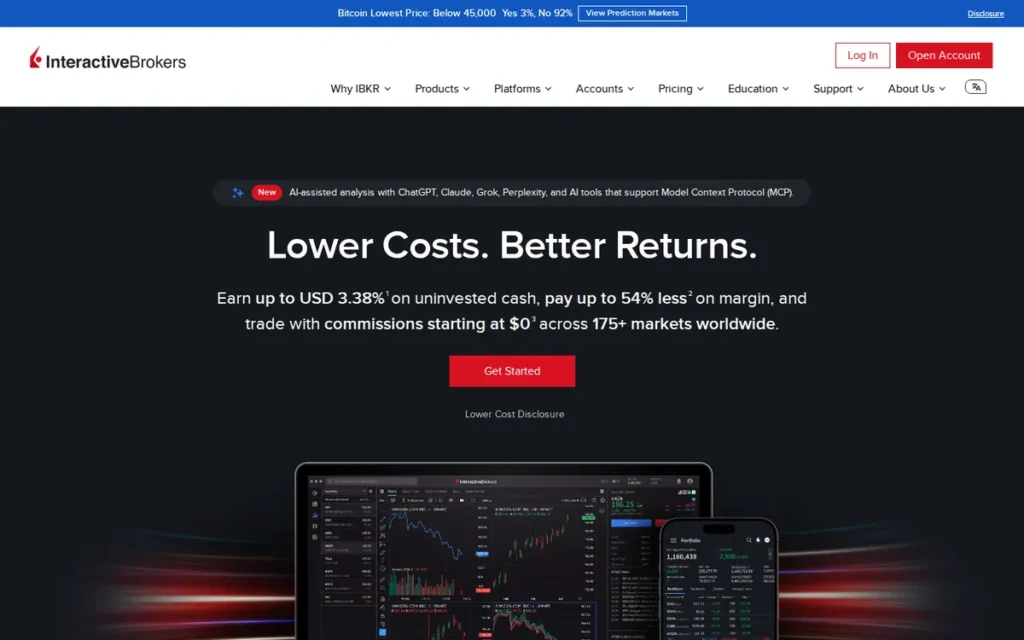
Category: Professional and Global Access Broker, a broker built for experienced traders who need international markets, low financing costs and institutional-grade tools.
At a Glance
- Category: Professional and Global Access Broker
- Best For: International traders, margin borrowers and experienced high-volume traders
- Price Range: IBKR Lite $0 U.S. stocks/ETFs; IBKR Pro $0.0005–$0.005 per share; options $0.25–$0.85 per contract; margin 4.38%–6.38% (2026)
- Primary Strength: Interactive Brokers offers access to 175+ global markets and some of the lowest margin rates reviewed. Its rates are the lowest available without a subscription.
- Biggest Limitation: Interactive Brokers has a steep learning curve, and users report slow support and verification friction.
- One-Line Summary: Interactive Brokers is the highest-scoring brokerage in this review, built for international market access and low-cost margin borrowing rather than for beginners.
- Last Verified: November 2026
Overview
Interactive Brokers is a global brokerage for international, high-volume and margin-using traders. It gives U.S. traders access to 175+ markets and 29 currencies from one account, with commission-free or per-share plans and low margin rates.
Interactive Brokers reported 5.678 million client accounts and $928.6 billion in client equity in October 2026 (IBKR Monthly Metrics, 2026).
Interactive Brokers’ IBKR Lite plan suits traders who want $0 U.S. stock commissions. IBKR Pro suits high-volume traders and borrowers who want SmartRouting and lower margin rates.
Key Features
- Interactive Brokers provides access to 175+ markets and 29 currencies from a single account (IBKR Fact Sheet, 2026).
- Interactive Brokers offers IBKR Lite, with $0 commissions on U.S. stocks and ETFs, and IBKR Pro, with per-share pricing and SmartRouting across exchanges and dark pools.
- Interactive Brokers runs Trader Workstation (TWS) and mobile apps aimed at professional and advanced traders.
- Interactive Brokers pays interest on cash at the benchmark rate minus 0.5% on Pro and minus 1.5% on Lite, advertised as “up to 3.38%” (IBKR, 2026).
- Interactive Brokers offers free education through IBKR Campus and Traders’ Academy, plus ForecastTrader prediction markets.
Best For
Interactive Brokers is best for traders who need direct access to foreign exchanges, borrow on margin or trade in high volume. Interactive Brokers is a poor first broker for most beginners unless international access is essential.
Users on r/ibkr shared their experience:
“I like IBKR for low fee and good fill rate. I don’t like IBKR TWS or mobile app which seems to be developed by different product teams with one feet in 1980s and other in 2015. IBKR doesn’t feel like it’s serving retail customers but only institutions who know exactly what they want.” Posted by u/EarthyFlavor
Takeaway: Interactive Brokers keeps users with low fees and good execution, but its dated software leaves many retail users feeling the platform was built for institutions, not for them.
Pricing
- Interactive Brokers charges $0 for U.S. stocks and ETFs on IBKR Lite (IBKR, 2026).
- Interactive Brokers’ IBKR Pro Fixed plan charges $0.005 per share ($1.00 minimum, 1% maximum), and its Tiered plan charges $0.0035 down to $0.0005 per share plus pass-through fees (IBKR, 2026).
- Interactive Brokers charges $0.85 per options contract on Pro Fixed and $0.25–$0.85 on Tiered (IBKR, 2026).
- Interactive Brokers charges IBKR Pro margin of 5.38% on the first $100,000, falling in tiers to 4.38% above $50 million, and 6.38% on IBKR Lite (IBKR, 2026).
- Interactive Brokers receives payment for order flow on IBKR Lite orders (IBKR, 2026).
- Interactive Brokers has a $0 minimum and charges $4.50 per month for the non-professional U.S. streaming data bundle (IBKR, 2026). Its transfer-out fee was not confirmed in this research.
Strengths
- Interactive Brokers charges IBKR Pro margin of 5.38% on the first $100,000 (IBKR, 2026). That is less than half the 12.075%–12.70% small-balance rates at Fidelity, Schwab and E*TRADE.
- Interactive Brokers was named Investopedia’s 2026 Best for International Trading, Risk Management and Advanced Traders, and NerdWallet’s 2026 Best Online Broker for Advanced Traders (Investopedia, 2026; NerdWallet, 2026).
- Interactive Brokers grew client accounts about 7%, from 5.317 million in July to 5.678 million in October 2026 (IBKR Monthly Metrics, 2026).
- Interactive Brokers lists StockBrokers.com 2025 wins for Active Traders, International Trading and Margin Trading on its own awards page (IBKR, 2025). PlugRoute did not confirm these with StockBrokers.com and did not count them in scoring.
Limitations
- Interactive Brokers gives up ease of use in exchange for professional depth and low costs. Trustpilot reviewers describe Trader Workstation as “old-fashioned” and hard for beginners (Trustpilot, 2026).
- Interactive Brokers users on Trustpilot report slow or unhelpful support and verification steps that delayed account access (Trustpilot, 2026). These are user reports, not measured rates.
- Interactive Brokers paid a $35 million SEC penalty in 2023 over recordkeeping failures (SEC, 2023).
- Interactive Brokers also paid FINRA fines in 2024 and 2025 (FINRA, 2024–2025). These were $475,000 in 2024 and four fines in 2025 totaling $1.325 million.
- Interactive Brokers’ IBKR Pro per-share pricing plus pass-through fees is harder to estimate than flat $0 commissions, and real-time market data costs extra.
- Interactive Brokers’ automatic-liquidation policy was not verified in this research, and no Reddit sentiment was captured. Margin users should read the liquidation policy before borrowing.
Verdict
Interactive Brokers earned the highest weighted score in this review (4.15 of 5) and is the strongest choice for international traders and margin borrowers in 2026. Interactive Brokers pairs 175+ markets with margin rates less than half those of traditional brokers.
Interactive Brokers’ lead over Fidelity Investments and Charles Schwab is narrow, and its beginner score of 2 is the lowest of the top three. Beginners should start with Fidelity Investments or Charles Schwab.
2. Fidelity Investments: Best for Beginners and Buy-and-Hold Investors
Category: Full-Service All-in-One Broker, a single account for long-term investing, retirement saving and active trading, with research and phone support.
At a Glance
- Category: Full-Service All-in-One Broker
- Best For: First-time investors and buy-and-hold or retirement investors who want to start small and automate
- Price Range: $0 online U.S. stocks/ETFs; $0.65 per options contract; margin 12.075% under $25K (effective Sept 18, 2026); $0 transfer-out fee
- Primary Strength: Fidelity Investments combines fractional investing from $1, automatic ETF investing, a money-market cash sweep and no payment for order flow on stocks and ETFs.
- Biggest Limitation: Fidelity Investments has no paper trading simulator, and active options traders report that its platforms are harder to use than thinkorswim.
- One-Line Summary: Fidelity Investments is the top-scoring brokerage in this review for beginners and buy-and-hold investors who want low costs, automated investing and well-handled idle cash.
- Last Verified: November 2026
Overview
Fidelity Investments is a full-service U.S. brokerage for first-time and long-term investors who want low costs and broad investment choice. It offers $0 online stock and ETF trades, fractional shares from $1, automatic recurring investing and a money-market cash sweep.
Fidelity Investments reported $19.9 trillion in assets under administration and 5.7 million daily average trades in Q2 2026 (Fidelity Q2 2026 Business Update, 2026). Fidelity Investments is headquartered in Boston.
Key Features
- Fidelity Investments offers fractional shares starting at $1 and recurring automatic investments in stocks and ETFs.
- Fidelity Investments sweeps uninvested cash into a core position that can be a money market fund, so idle cash can earn money-market yields without manual steps.
- Fidelity Investments says it takes no payment for order flow on stock and ETF trades, and it publishes execution-quality statistics.
- Fidelity Investments offers ZERO index mutual funds with 0.00% expense ratios.
- Fidelity Investments provides Active Trader Pro for desktop trading alongside its web and mobile apps.
Best For
Fidelity Investments is best for beginners and buy-and-hold investors who want to start with small amounts, automate ETF purchases and have uninvested cash handled automatically. Fidelity Investments is less suited to daily options traders and to beginner traders who want a simulator.
This aligns with community sentiment on r/interactivebrokers:
“If you only want to dollar cost average into an ETF then I would recommend Fidelity. Just pick something simple like VUG. You can probably set it up with HR or payroll at your job so some of the money that would normally go to your checking account goes directly to your brokerage account.” Posted by u/Downtown-Text6587
Takeaway: Fidelity Investments is the community’s default pick for set-and-forget ETF investors who want to automate contributions rather than trade actively.
Pricing
- Fidelity Investments charges $0 for online U.S. stocks and ETFs and $0.65 per options contract. Professional options traders may pay an extra $0.50 per contract (Fidelity, 2026).
- Fidelity Investments uses a margin base rate of 10.825%, effective Sept 18, 2026 (Fidelity, 2026). That gives 12.075% under $25,000 and 10.325% from $250,000 to $499,999.
- Fidelity Investments sweeps uninvested cash into a core position that can be a money market fund (Stockember, 2026).
- Fidelity Investments charges $0 to transfer an account out, the lowest exit cost in this review (Fidelity, 2026).
Strengths
- Fidelity Investments was named Investopedia’s 2026 Best Online Broker Overall, Best for Beginners and Best for Low Costs. Fidelity Investments also holds a 5.0/5 rating (Investopedia, 2026; NerdWallet, 2026).
- Fidelity Investments was the overall winner among full-service brokers in Kiplinger’s 2025 Readers’ Choice awards, which score customer service, willingness to recommend and satisfaction (Kiplinger, 2025).
- Fidelity Investments says it takes no payment for order flow on stocks and ETFs. Stockember reports average price improvement of about $15–$20 per 1,000 shares on market orders, a figure Fidelity reports and does not guarantee (Stockember, 2026).
- Fidelity Investments is Reddit’s default beginner recommendation. One user advised, “Just open a Fidelity account and make it your forever home for investments” (r/investingforbeginners, 2026).
Limitations
- Fidelity Investments gives up trading-platform depth in exchange for simplicity and cost. It has no paper trading simulator, and some reviewers describe Active Trader Pro as dated.
- Fidelity Investments’ options chain crashes on some indexes that load fine on Schwab, according to one daily options trader. The same user also reported a long hold on incoming funds (r/SCHD, 2025).
- Fidelity Investments charges 12.075% margin under $25,000 (effective Sept 18, 2026), more than double IBKR Pro’s 5.38%.
- Fidelity Investments’ ZERO funds generally can’t be transferred to another broker as shares, which makes leaving harder later (TheBrokerChoice, 2026).
- Fidelity Investments was fined $900,000 by FINRA in 2023 over options-approval controls (FINRA, 2023). FINRA also fined it $600,000 in 2025 after an employee diverted about $750,000 from 37 stock-plan participants, and restitution was made (FINRA, 2025).
- Fidelity Investments paid $1.25 million to Massachusetts in 2026 over an August 2024 data breach that affected about 77,000 people (Massachusetts Securities Division, 2026).
Verdict
Fidelity Investments is the best-fit brokerage in this review for beginners and buy-and-hold investors in 2026, scoring 4.00 and leading the field on beginner accessibility. Fidelity Investments combines $1 fractional investing, automatic ETF purchases, a $0 exit fee and no payment for order flow on stocks.
Fidelity Investments finishes a close #2 because its trading tools trail thinkorswim and it has no simulator. Active options traders should compare Charles Schwab, and margin borrowers should compare Interactive Brokers.
3. Charles Schwab: Best for Investing and Active Trading in One Account
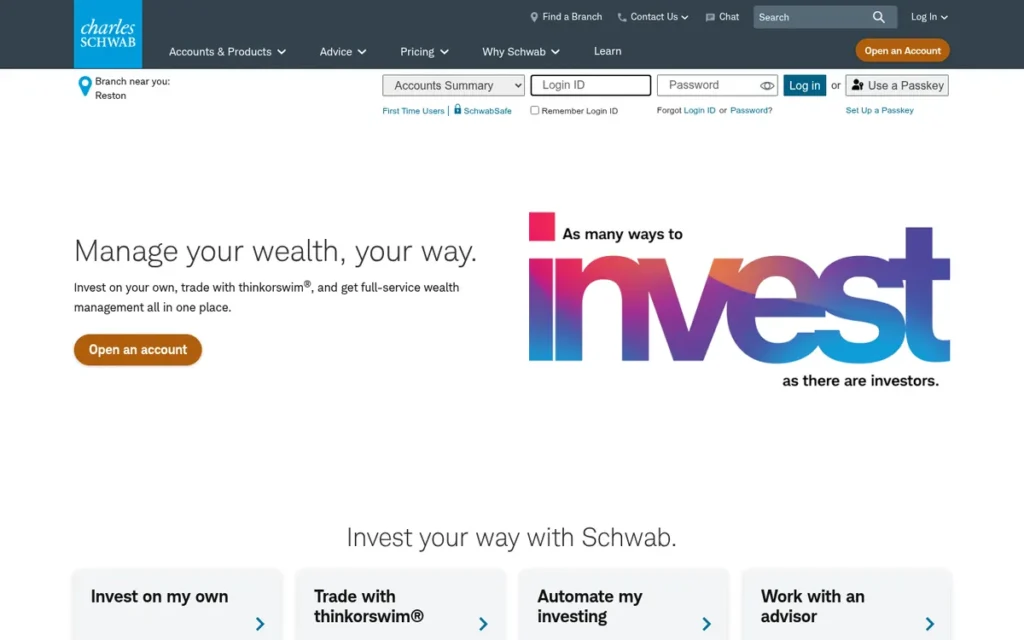
Category: Full-Service All-in-One Broker, a single account for long-term investing, retirement saving and active trading, with research and phone support.
At a Glance
- Category: Full-Service All-in-One Broker
- Best For: Investors who want buy-and-hold investing and advanced active or options trading under one roof, with branch access
- Price Range: $0 listed stocks/ETFs; $0.65 per options contract; $2.25 per futures contract; margin 12.075% under $25K; $50 full transfer-out (2026)
- Primary Strength: Charles Schwab pairs a full-service brokerage with thinkorswim, a desktop, web and mobile trading platform with paper trading.
- Biggest Limitation: Charles Schwab pays 0.01% APY on uninvested cash in a standard brokerage account and charges 12.075% margin under $25,000. Charles Schwab also takes payment for order flow on some orders.
- One-Line Summary: Charles Schwab is an all-in-one brokerage that pairs full-service investing with the professional-grade thinkorswim trading platform in the same account.
- Last Verified: November 2026
Overview
Charles Schwab is a full-service U.S. brokerage for investors who want long-term investing and active trading under one roof. It offers $0 online listed stock and ETF trades, the thinkorswim platforms on desktop, web and mobile, physical branches and a broad range of account types.
Charles Schwab reported 39.1 million active brokerage accounts and 9.9 million daily average trades in Q1 2026 (Schwab Q1 2026 Earnings Release, 2026). Charles Schwab gained thinkorswim through its acquisition of TD Ameritrade.
Key Features
- Charles Schwab offers thinkorswim on desktop, web and mobile, with advanced charting, technical studies and options analytics.
- Charles Schwab includes paperMoney, a simulated trading mode inside thinkorswim for practicing without real money.
- Charles Schwab provides 24/5 overnight trading in selected securities.
- Charles Schwab supports in-person service through physical branches. Charles Schwab also offers the Schwab Satisfaction Guarantee, which refunds fees or commissions after an unsatisfactory experience, subject to terms.
- Charles Schwab publishes research and education through the Schwab Center for Financial Research and Schwab Network.
Best For
Charles Schwab is best for investors who want one broker for retirement and taxable investing plus serious active or options trading, and who value branch support. Charles Schwab is less suited to buy-and-hold investors who want fractional or automatic ETF purchases.
Pricing
- Charles Schwab charges $0 for online listed stocks and ETFs and $0.65 per options contract (Schwab, 2026).
- Charles Schwab charges $2.25 per futures contract plus exchange and regulatory fees (Schwab, 2026).
- Charles Schwab charges 12.075% margin on balances under $25,000, which is its base rate plus 1.825% (Schwab, 2026).
- Charles Schwab pays 0.01% APY on uninvested cash in a standard brokerage account (Schwab, 2026).
- Charles Schwab charges $50 for a full account transfer out (Schwab, 2026).
Strengths
- Charles Schwab was named #1 Overall Broker in the StockBrokers.com 2025 Annual Awards. The same awards ranked it #1 for platforms & tools, research, mobile, education and ease of use (StockBrokers.com, 2025).
- Charles Schwab holds a 4.9/5 rating (NerdWallet, 2026). Schwab’s 2026 proxy statement reports a #1 Kiplinger 2025 ranking for education and service, which PlugRoute did not count in scoring.
- Charles Schwab’s thinkorswim platform includes paperMoney simulated trading, so beginner traders can practice and active traders can test strategies.
- Charles Schwab drew praise from one Reddit user, who wrote, “For larger accounts or if you want a more responsible trading platform, Schwab is pretty good” (r/investingforbeginners, 2026).
Limitations
- Charles Schwab gives up cost competitiveness in exchange for platform depth and service. Its 0.01% APY standard sweep earns about $1 a year on $10,000 (Schwab, 2026).
- Charles Schwab’s advisory subsidiaries paid $187 million in a 2022 SEC settlement over cash-allocation disclosures in Schwab Intelligent Portfolios (SEC, 2022).
- Charles Schwab & Co. paid a $10 million SEC penalty in 2025 over off-channel communications recordkeeping, and a $350,000 FINRA fine in 2023 over ETN confirmation disclosures (SEC, 2025; FINRA, 2023).
- Charles Schwab takes payment for order flow on some equity and options orders, unlike Fidelity’s stated stock and ETF policy.
- Charles Schwab’s Stock Slices fractional program covers S&P 500 stocks rather than ETFs, a gap Reddit users cite when choosing a broker for automated ETF investing (r/SCHD, 2025).
Verdict
Charles Schwab is the strongest choice in this review for investors who want full-service investing and professional-grade active trading in one account, scoring 3.90 in 2026. Charles Schwab is the only broker reviewed that scored 5 on independent ratings, platform depth and product breadth together.
Charles Schwab ranks #3 because its verified 0.01% sweep, 12.075% margin and 2022 SEC settlement lowered its cost and trust scores. Margin borrowers should compare Interactive Brokers.
4. E*TRADE from Morgan Stanley: Best for Web-Based Active Trading and Stock Plans
Category: Active and Options Trading Platform, a broker whose core strength is advanced trading software for frequent stock, options and futures traders.
At a Glance
- Category: Active and Options Trading Platform
- Best For: Active stock and options traders who prefer a polished web platform, and employees with Morgan Stanley at Work stock plans
- Price Range: $0 U.S.-listed stocks/ETFs; $0.50–$0.65 per options contract; $1.50 per futures contract per side; margin 10.70%–12.70% (effective Sept 21, 2026); $75 full transfer-out
- Primary Strength: ETRADE from Morgan Stanley offers Power ETRADE, a highly ranked web trading platform with advanced options analytics and built-in Morgan Stanley research.
- Biggest Limitation: E*TRADE from Morgan Stanley charges the highest small-balance margin rates in this review and ranked #8 for customer service and security in Kiplinger’s 2025 survey.
- One-Line Summary: E*TRADE from Morgan Stanley is a strong choice for active options traders who want a top-rated web platform and Morgan Stanley research, though margin borrowing there is expensive.
- Last Verified: November 2026
Overview
E*TRADE from Morgan Stanley is a U.S. brokerage built for active traders and for employees whose company equity runs through Morgan Stanley at Work. It offers $0 stock and ETF trades, the Power E*TRADE platform for options and active trading, and built-in Morgan Stanley research.
ETRADE from Morgan Stanley also offers Core Portfolios, a robo-advisor charging 0.30% per year with a $500 minimum. Morgan Stanley reports wealth-management results as a whole, so no ETRADE-specific 2026 account figures were available.
Key Features
- ETRADE from Morgan Stanley offers Power ETRADE on web, desktop and app, with advanced charts, technical studies and customizable options chains.
- E*TRADE from Morgan Stanley includes multi-leg options strategies, risk/reward visualization and Snapshot Analysis for options probabilities.
- E*TRADE from Morgan Stanley gives clients built-in Morgan Stanley equity research.
- E*TRADE from Morgan Stanley administers employee equity through Morgan Stanley at Work stock plans.
- ETRADE from Morgan Stanley offers fractional shares in eligible listed securities from $5 (ETRADE, 2026).
Best For
ETRADE from Morgan Stanley is best for active stock and options traders who prefer web-based tools, and for employees who already receive company stock through Morgan Stanley at Work. ETRADE from Morgan Stanley is a costly choice for small-balance margin borrowers.
Pricing
- ETRADE from Morgan Stanley charges $0 for online U.S.-listed stocks and ETFs, excluding OTC trades, and adds $25 for broker-assisted trades (ETRADE, 2026).
- ETRADE from Morgan Stanley charges $0.65 per options contract, or $0.50 for clients making 30+ trades per quarter (ETRADE, 2026).
- ETRADE from Morgan Stanley charges $1.50 per futures contract per side and $0.75 per E-nano contract (ETRADE, 2026).
- ETRADE from Morgan Stanley uses a margin base rate of 10.20%, effective Sept 21, 2026, with these tiers (ETRADE, 2026):
- E*TRADE from Morgan Stanley charges 12.70% under $10,000.
- E*TRADE from Morgan Stanley charges 12.45% from $10,000 to $25,000.
- E*TRADE from Morgan Stanley charges 11.20% from $100,000 to $250,000.
- E*TRADE from Morgan Stanley charges 10.70% from $250,000 to $500,000.
- ETRADE from Morgan Stanley charges $75 for a full transfer out and $25 for a partial transfer, and it receives payment for order flow on certain orders (ETRADE, 2026). Its cash-sweep yield was not confirmed.
Strengths
- E*TRADE from Morgan Stanley was named #1 Web Trading Platform in the StockBrokers.com 2025 Annual Awards. It also received 15 Best in Class awards, including for options, research, tools and mobile (Morgan Stanley, 2025).
- E*TRADE from Morgan Stanley holds a 4.6/5 rating (NerdWallet, 2026). Its awards page reports a #1 Kiplinger 2025 research ranking, which PlugRoute did not count in scoring.
- ETRADE from Morgan Stanley charges $1.50 per futures contract per side, less than Schwab’s $2.25, and drops options to $0.50 per contract for clients making 30+ trades per quarter (ETRADE, 2026).
- E*TRADE from Morgan Stanley administers Morgan Stanley at Work stock plans, so employees on that platform can manage vested shares and a brokerage account in one place.
Limitations
- ETRADE from Morgan Stanley gives up cost competitiveness in exchange for platform polish. Its 12.70% margin under $10,000 is the highest small-balance rate reviewed, and its rates stay above 10.7% through $500,000 (ETRADE, 2026).
- ETRADE from Morgan Stanley ranked #8 for customer service and security in Kiplinger’s 2025 survey, as reported on ETRADE’s awards page. This is its clearest weakness in a third-party ranking.
- ETRADE from Morgan Stanley liquidates fractional shares before an ACAT transfer. Its crypto is offered only as indirect exposure or through a separate Zero Hash account that SIPC does not protect (ETRADE, 2026).
- ETRADE from Morgan Stanley was fined $350,000 by FINRA in 2022 over surveillance of potentially manipulative trading (FINRA, 2022). A separate $15 million SEC action in 2024 involved its parent, Morgan Stanley, and is not scored as an ETRADE action.
- E*TRADE from Morgan Stanley’s claimed 2026 StockBrokers.com wins appear only on its own site, and no Reddit sentiment was captured in this research.
Users on r/etrade noted:
“I don’t like power Etrade Pro as much as the previous platform. But it’s not bad enough for me to leave over it. I’m primarily a swing trader with the odd day trades here and there. I can live with it.” Posted by u/ruserious2day
Takeaway: ETRADE’s switch from its legacy desktop platform to Power ETRADE Pro has let down long-time active traders, even the ones who decide to stay.
Verdict
ETRADE from Morgan Stanley is the strongest web-based trading platform in this review for active stock and options traders in 2026, backed by StockBrokers.com’s 2025 #1 Web Trading Platform ranking. ETRADE from Morgan Stanley scored 3.50.
E*TRADE from Morgan Stanley is the natural pick for employees already on Morgan Stanley at Work stock plans. Margin borrowers should compare Interactive Brokers first, and service-focused investors should compare Fidelity Investments.
5. tastytrade: Best for Heavy Options and Futures Traders
Category: Active and Options Trading Platform, a broker whose core strength is advanced trading software for frequent stock, options and futures traders.
At a Glance
- Category: Active and Options Trading Platform
- Best For: Experienced, high-volume options and futures traders
- Price Range: $0 stocks/ETFs; options $1 per contract to open (max $10 per leg), $0 to close; E-mini futures $1 per side; margin 8.00%–11.00% standard (2026)
- Primary Strength: tastytrade caps options commissions at $10 per leg and charges nothing to close, which makes large multi-contract trades cheaper than $0.65-per-contract pricing.
- Biggest Limitation: tastytrade offers no mutual funds and limited fundamental research, and it is not built for beginners or retirement-focused investors.
- One-Line Summary: tastytrade is the specialist brokerage for active options and futures traders, offering capped options commissions in exchange for limited research and a narrow product lineup.
- Last Verified: November 2026
Overview
tastytrade is a U.S. brokerage for experienced traders who place frequent, multi-contract options trades. It focuses on options and futures, offering $0 stock trades, capped options commissions with $0 to close, and futures and crypto on desktop, web and mobile.
tastytrade is an IG Group affiliate. tastytrade is paired with tastylive, a media network that teaches a probability-based approach to options, such as choosing trades by probability of profit and managing winners early.
Key Features
- tastytrade charges $1 per options contract to open, capped at $10 per leg, and $0 to close, plus clearing and regulatory fees.
- tastytrade supports stocks, ETFs, options, futures, futures options and crypto (custodied by Zero Hash) on desktop, web and mobile.
- tastytrade offers individual, IRA, business and trust accounts, with a $0 minimum and $2,000 required for margin.
- tastytrade offers fractional shares with $0 commission, a $0.10 clearing fee, a $5 minimum and market orders only (tastytrade, 2026).
- tastytrade may reimburse up to $75 of an outgoing broker’s transfer fee on transfers of $2,000 or more.
Best For
tastytrade is best for experienced traders who place large multi-contract options orders or trade futures. tastytrade is a poor fit for beginners and for retirement savers who want mutual funds.
Pricing
- tastytrade charges $0 for stocks and ETFs. tastytrade charges 0.75% for BTC and ETH and 1% for other coins, with a $1 minimum (tastytrade, 2026).
- tastytrade charges $1 per options contract to open, capped at $10 per leg, and $0 to close. A 20-contract round trip costs $10 at tastytrade, versus $26 at $0.65 per contract on both sides (before fees).
- tastytrade charges $1 per E-mini futures contract to open and $1 to close, and $0.75 per micro contract each way, plus exchange fees (tastytrade, 2026).
- tastytrade’s standard margin runs from 11.00% under $25,000 down to 8.00% at $1 million or more. A 6.75% promotional rate is available, subject to eligibility rules (tastytrade, 2026).
- tastytrade receives payment for order flow of up to $0.0015 per share on listed equities (tastytrade Rule 606 report, 2026). Its cash-sweep handling was not confirmed.
Strengths
- tastytrade was named Investopedia’s Best Overall Options Trading Platform in January 2026 and won the Options Trading category in the StockBrokers.com 2025 Annual Awards (Investopedia, 2026; StockBrokers.com, 2025).
- tastytrade’s open-only, capped options pricing costs less than $0.65 per contract on every round trip closed with a trade, and the savings grow with order size.
- tastytrade won Benzinga’s 2025 award for Best for Low-Cost Micro Futures and supports futures and futures options in the same account (Benzinga, 2025).
- tastytrade’s 6.75% promotional margin rate (2026, eligibility rules apply) is below the 12.075%–12.70% small-balance rates at Fidelity, Schwab and E*TRADE.
Limitations
- tastytrade gives up breadth in exchange for options specialization. NerdWallet notes limited outside research and no mutual funds, which make it less appealing for retirement investors (NerdWallet, 2026).
- tastytrade is not designed for beginners, and its interface and education assume options knowledge.
- tastytrade’s $1 opening fee costs more than $0.65-per-contract pricing on positions of 15 contracts or fewer that expire without a closing trade. Webull and Robinhood charge $0 commission on equity options, so on commissions alone they cost less (2026).
- tastytrade users on Trustpilot report a slow or glitchy app and hard-to-reach support (Trustpilot, 2026).
- tastytrade was fined $200,000 by FINRA in May 2026 over complaint reporting and $850,000 in July 2026 over best-execution reviews (FINRA, 2026).
- tastytrade had no Reddit sentiment captured in this research.
Users on r/tastytrade noted:
“TDA -is- Schwab. Schwab owns TDA. Yes, I get better fills on TDA. They use multiple clearing houses. I still prefer to trade options on TT.” Posted by u/starbolin
Takeaway: tastytrade’s options-first platform keeps options traders loyal even when some of them report better fills at Charles Schwab.
Verdict
tastytrade is the strongest brokerage in this review for heavy options and futures traders in 2026, with capped, open-only options commissions that undercut flat per-contract pricing on larger orders. tastytrade scored 3.20.
tastytrade ties Webull at 3.20 and ranks #5 on the published trust tie-breaker. Investors who need mutual funds, research or beginner support should use a full-service broker instead of, or alongside, tastytrade.
6. Webull: Best Mobile App for Charting and Paper Trading
Category: Mobile-First Investing App, a smartphone-centered broker focused on a simple interface, $0 trading and app-based tools, with a narrower product lineup.
At a Glance
- Category: Mobile-First Investing App
- Best For: Mobile-first beginner traders who want charting and free paper trading on their phone
- Price Range: $0 stocks/ETFs/options; certain index options $0.50 per contract; margin 8.74% (as of Oct 16, 2026); $75 transfer-out fee
- Primary Strength: Webull offers more technical charting and paper trading on mobile than the other app-first broker reviewed.
- Biggest Limitation: Webull was fined $4.2 million by FINRA in November 2026 over anti-money-laundering and best-execution failures, and it offers no mutual funds.
- One-Line Summary: Webull is a mobile app built for charting and free paper trading, but its 2025 and 2026 FINRA fines and thin product lineup call for caution.
- Last Verified: November 2026
Overview
Webull is a mobile-first U.S. brokerage for app-focused traders who want more analysis tools than a basic investing app provides. It offers $0 stock, ETF and options trades, extensive technical charting and free paper trading for stocks and options.
Webull Corp. is listed on Nasdaq as BULL. Webull is not a full-service broker and does not offer mutual funds.
Key Features
- Webull offers mobile charting with many technical indicators and drawing tools.
- Webull provides free paper trading for both stocks and options.
- Webull charges $0 commissions on U.S. stocks, ETFs and options in eligible cash, margin and IRA accounts.
- Webull includes a built-in community feed and options-chain tools in its app.
- Webull discloses that its revenue comes from payment for order flow, stock lending, margin interest and interest on free credit balances.
Best For
Webull is best for beginner and intermediate traders who want to learn charting and practice with paper trading entirely on mobile. Webull also worked for one Reddit user living abroad when another broker required mailed checks (r/investing, 2024).
Pricing
- Webull charges $0 for U.S. stocks, ETFs and options in eligible accounts. Webull charges $0.50 per contract on certain index options and $0.10 per contract on oversized orders (Webull, 2026).
- Webull charges 8.74% margin at all balance tiers as of October 16, 2026 (Webull, 2026). That is below the 12.075%–12.70% small-balance rates at Fidelity, Schwab and E*TRADE.
- Webull charges a $75 outgoing ACATS transfer fee and $0 for incoming transfers (Webull, 2026).
- Webull takes payment for order flow, according to its own disclosures (Webull, 2026). Its cash APY was not confirmed.
Strengths
- Webull holds a 4.8/5 rating and NerdWallet’s Best for Paper Trading designation (NerdWallet, 2026). Webull also won Best Brokerage App in Benzinga’s 2025 Fintech Awards (Benzinga, 2025).
- Webull charges $0 on equity options in eligible accounts, compared with $0.65 per contract at Fidelity, Schwab and E*TRADE (Webull, 2026).
- Webull provides free stock and options paper trading on mobile, so beginner traders can practice before risking money.
- Webull drew reports of reliable long-term use on Reddit. One user wrote, “I’ve used Webull for years, moving money in and out many times. No problems” (r/Webull, 2024).
Limitations
- Webull’s trust record is its weakest area. FINRA fined it $4.2 million in November 2026 over failures that included 473 unauthorized ACH transfers totaling more than $1.5 million that it did not investigate (FINRA, 2026).
- Webull settled the 2026 FINRA matter without admitting or denying the findings and agreed to hire an independent consultant, which is standard FINRA practice (FINRA, 2026).
- Webull was also fined $1.6 million by FINRA in 2025 over its supervision of influencer social-media promotions (FINRA, 2025).
- Webull offers no mutual funds, and its research is thinner than at full-service brokers (CryptoSlate, 2026).
- Webull users on Google Play and Reddit report frozen withdrawals and extra identity checks, which Webull attributes to settlement timing (CryptoSlate, 2026). These are user reports, not measured rates.
- Webull has faced congressional scrutiny over its China ties, though no enforcement finding of data misuse has been made (Crowdfund Insider, 2026).
Verdict
Webull is the strongest mobile app in this review for charting and free paper trading in 2026, and it holds NerdWallet’s Best for Paper Trading designation. Webull’s verified 8.74% margin and $0 options raised its cost score.
Webull ties tastytrade at 3.20 but ranks #6 on the trust tie-breaker after its November 2026 FINRA fine. Check Webull on FINRA BrokerCheck and weigh its $75 exit fee before funding a large account.
7. Robinhood: Best for Mobile Investing and Subscription Perks on Small Accounts
Category: Mobile-First Investing App, a smartphone-centered broker focused on a simple interface, $0 trading and app-based tools, with a narrower product lineup.
At a Glance
- Category: Mobile-First Investing App
- Best For: Small-account and mobile-first investors who will use Gold perks such as the IRA match and cash yield
- Price Range: $0 stocks/ETFs/equity options; Gold $5/month or $50/year; Gold margin from 5.25%; $100 transfer-out fee (2026)
- Primary Strength: Robinhood offers a mobile app that reviewers consistently praise for clean design and easy setup, plus a 3% IRA match and 3.6% cash yield for Gold subscribers.
- Biggest Limitation: Robinhood has the most extensive recent regulatory record in this review and lacks mutual funds, individual bonds, and custodial or trust accounts.
- One-Line Summary: Robinhood is a mobile investing app with valuable Gold perks for small accounts, offset by the most extensive recent regulatory record, product gaps and the highest transfer-out fee reviewed.
- Last Verified: November 2026
Overview
Robinhood is a mobile-first U.S. brokerage for investors who want a simple app for small or starter accounts. It offers $0 stock, ETF and equity options trades, plus crypto, futures and prediction markets.
Robinhood Gold adds an IRA match, a cash yield and lower margin rates for $5 a month. Robinhood reported a record 5.2 million Gold subscribers in Q3 2026 (Robinhood Q3 2026 SEC Filing, 2026).
Key Features
- Robinhood offers $0 commission trading in stocks, ETFs and equity options in a streamlined mobile app.
- Robinhood Gold costs $5 per month or $50 per year. It includes 3.6% on cash, a 3% IRA match (1% without Gold) and the first $1,000 of margin interest-free.
- Robinhood supports crypto, futures, prediction markets and event contracts alongside stocks.
- Robinhood provides the Legend desktop platform with advanced charts, and Cortex, an AI assistant for Gold subscribers.
- Robinhood offers Robinhood Strategies, a managed-investing service with fees capped at $250 per year.
Best For
Robinhood is best for mobile-first investors with smaller accounts who will actually use Gold’s IRA match, cash yield and margin rates. Robinhood is a poor fit for investors who need mutual funds, bonds, or custodial or trust accounts.
Pricing
- Robinhood charges $0 for stocks, ETFs and equity options. Index options carry fees, and crypto is commission-free but subject to spreads (NerdWallet, 2026).
- Robinhood Gold margin runs 5.25% up to $50,000, 5.05% from $50,000 to $100,000 and 4.75% from $100,000 to $1 million, with the first $1,000 interest-free (Robinhood, 2026).
- Robinhood pays 3.6% on cash for Gold subscribers after a September 2026 increase (NerdWallet, 2026).
- Robinhood charges a $100 ACATS transfer-out fee, the highest in this review (NerdWallet, 2026).
Strengths
- Robinhood reported a record 5.2 million Gold subscribers, about 18% of funded customers, and $15.7 billion in net deposits in Q3 2026 (Robinhood SEC Filing, 2026).
- Robinhood Gold’s 5.25% margin up to $50,000 is the lowest small-balance rate reviewed, though it requires the $50-a-year subscription (Robinhood, 2026).
- Robinhood holds a 4.5/5 NerdWallet rating and a 4.3/5 Apple App Store rating from 4.8 million ratings (NerdWallet, 2026; Apple App Store, 2026).
- Robinhood Gold’s 3% IRA match and 3.6% cash yield are perks not offered by the full-service brokers in this review (2026).
- Robinhood’s interface was called “very polished and user friendly” by one Reddit user, who also called its instant deposits with Gold “legitimately excellent” (r/investingforbeginners, 2026).
Limitations
- Robinhood’s regulatory record includes about $70 million in FINRA penalties and restitution in 2021 and $45 million in SEC penalties in January 2025 (FINRA, 2021; SEC, 2025).
- Robinhood also paid a $26 million FINRA fine plus about $3.75 million in restitution in March 2025 (FINRA, 2025).
- Robinhood also restricted GameStop buying in January 2021 and suffered a data breach in November 2021.
- Robinhood offers no mutual funds, no individual bonds, and no custodial or trust accounts (Financer, 2026).
- Robinhood’s design was described by one Reddit user as “a game disguised as a investment platform,” and others cite weak customer support (r/investingforbeginners, 2026).
- Robinhood reviewers report outages during volatile markets and slow withdrawals (Financer, 2026). These are user reports, not measured rates.
Verdict
Robinhood is a mobile investing app that suits small accounts in 2026, and Gold’s 3% IRA match, 3.6% cash yield and 5.25% margin add real value for subscribers who use them.
Robinhood’s 2021–2025 regulatory penalties, product gaps and $100 exit fee place it last at 2.65, even after its verified Gold margin raised its cost score. Reddit users often describe moving from Robinhood to a full-service broker as their accounts grow (r/investingforbeginners, 2026).
What Does a $0-Commission Broker Really Cost?
A $0-commission broker can still cost hundreds of dollars a year. Under $25,000, margin runs from 5.25% at Robinhood Gold to 12.70% at E*TRADE. Cash yields run from 0.01% APY at Schwab to 3.6% with Robinhood Gold. Transfer-out fees range from $0 at Fidelity to $100 at Robinhood (2026).
| Broker | Stock/ETF Commission | Options Pricing | Margin Under $25K (Effective Date) | Cash-Sweep Handling | Transfer-Out Fee | PFOF on Stocks |
|---|---|---|---|---|---|---|
| Interactive Brokers | Lite $0; Pro $0.0005–$0.005/share | $0.25–$0.85/contract | Pro 5.38%; Lite 6.38% (2026) | Benchmark minus 0.5% (Pro) / minus 1.5% (Lite); up to 3.38% | Not confirmed | Yes on Lite; verify Pro |
| Fidelity Investments | $0 online U.S. | $0.65/contract | 12.075% (Sept 18, 2026) | Core position can be a money market fund | $0 | No, per Fidelity |
| Charles Schwab | $0 listed | $0.65/contract | 12.075% (2026) | 0.01% APY standard brokerage sweep | $50 full transfer | Yes, on some orders |
| E*TRADE from Morgan Stanley | $0 U.S.-listed | $0.65, or $0.50 at 30+ trades/quarter | 12.70% under $10K; 12.45% $10K–$25K (Sept 21, 2026) | Not confirmed | $75 full / $25 partial | Yes, on certain orders |
| tastytrade | $0 | $1 to open, $10 cap/leg, $0 to close | 11.00% standard; 6.75% promo (2026) | Not confirmed | Not confirmed; reimburses up to $75 on incoming transfers of $2,000+ | Yes, up to $0.0015/share |
| Webull | $0 | $0 equity; $0.50 certain index | 8.74% all tiers (Oct 16, 2026) | Not confirmed | $75 | Yes, disclosed |
| Robinhood | $0 | $0 equity; index options carry fees | Gold 5.25% up to $50K (2026) | 3.6% with Gold (Sept 2026) | $100 | Not confirmed; check its Rule 606 report |
These worked examples show how large the gaps can be:
- Margin example: A $20,000 margin balance held for one year costs about $1,050 at Robinhood Gold’s 5.25% plus the $50 subscription, about $1,076 at IBKR Pro’s 5.38%, and about $2,415 at 12.075% at Fidelity or Schwab.
- Idle-cash example: $10,000 left idle for a year earns about $1 at Schwab’s 0.01% standard sweep, versus about $360 at Robinhood Gold’s 3.6%, before the subscription fee and tax.
- Single-trade options example: A 20-contract options round trip costs $10 in commissions at tastytrade and $26 at $0.65 per contract on both sides. The same trade costs $0 in commissions at Webull or Robinhood, though regulatory fees still apply.
- Annual options example: An options trader placing 10 five-contract round trips a month pays about $780 a year at $0.65 per contract, $600 at tastytrade and $0 at Webull or Robinhood, before regulatory fees.
In this review, commissions barely differ between brokers, and margin, cash sweeps and exit fees are where the costs diverge. “Not confirmed” means the figure did not appear in this research cycle, so check the broker’s live fee schedule before you trade.
Which Brokers Lack Key Products or Account Types?
The mobile-first and specialist brokers in this review have the biggest product gaps. Robinhood, Webull and tastytrade do not offer mutual funds, and Robinhood also lacks custodial and trust accounts. Charles Schwab’s fractional program excludes ETFs. Check these gaps before you open an account, because a missing account type rules a broker out.
- Robinhood offers no mutual funds, no individual bonds, and no custodial or trust accounts (Financer, 2026).
- Webull offers no mutual funds, and its research is thinner than at full-service brokers (CryptoSlate, 2026).
- tastytrade offers no mutual funds and limited outside research, although tastytrade does offer Treasuries and trust accounts (NerdWallet, 2026).
- Charles Schwab’s Stock Slices program covers S&P 500 stocks rather than ETFs, according to Reddit users (r/SCHD, 2025).
- ETRADE from Morgan Stanley offers crypto only indirectly or through a separate Zero Hash account outside SIPC protection (ETRADE, 2026).
- Interactive Brokers is the only broker reviewed with access to 175+ international markets and 29 currencies (IBKR Fact Sheet, 2026).
Is My Money Safe at an Online Broker?
Your money is protected against broker failure, not against market losses. SIPC covers up to $500,000 per customer, including $250,000 in cash, if a member firm fails and customer assets are missing. SIPC does not cover investment losses or crypto. Confirm current limits at sipc.org, and check every broker on FINRA BrokerCheck.
- FINRA BrokerCheck: FINRA BrokerCheck (brokercheck.finra.org) shows a firm’s registration and disciplinary disclosures, so look up both the firm and any individual broker.
- SEC IAPD: The SEC’s Investment Adviser Public Disclosure database lets you check registered investment advisers.
- SIPC coverage: SIPC protects up to $500,000 per customer, including $250,000 in cash, when a member firm fails. SIPC coverage does not extend to market losses or crypto.
- Excess coverage: Some brokers buy extra insurance beyond SIPC limits, so ask each broker what coverage it carries.
Every broker in this review has faced at least one FINRA, SEC or state action since 2021. What matters is what each broker was fined for, how much it paid and how recently.
| Broker | Firm-Level Actions, 2021–2026 | Trust Score (C5) |
|---|---|---|
| Interactive Brokers | SEC $35M (2023, recordkeeping); FINRA $475K (2024); four FINRA fines totaling $1.325M (2025) | 3 |
| Fidelity Investments | FINRA $900K (2023); FINRA $600K (2025); Massachusetts $1.25M (2026, data breach) | 3 |
| Charles Schwab | SEC $187M (2022, robo-advisor disclosures); FINRA $350K (2023); SEC $10M (2025, recordkeeping) | 3 |
| E*TRADE from Morgan Stanley | FINRA $350K (2022); Kiplinger 2025 #8 service ranking | 3 |
| tastytrade | FINRA $200K and $850K (2026) | 3 |
| Webull | FINRA $1.6M (2025); FINRA $4.2M (2026, AML and best execution) | 2 |
| Robinhood | FINRA about $70M (2021); SEC $45M (2025); FINRA $26M plus about $3.75M restitution (2025) | 1 |
Trust matters to investors. J.D. Power’s 2025 U.S. Investor Satisfaction Study found that trust, products and services, and people were the top drivers of satisfaction (J.D. Power, 2025). The study surveyed 3,723 DIY investors and 7,876 advised investors.
Should I Use More Than One Brokerage?
Using two brokerages can make sense when no single broker covers all of your needs. A common split pairs a full-service broker for retirement and buy-and-hold investing with a specialist for options or international trading. The trade-off is more accounts to track, possible transfer-out fees and more tax forms each year.
- Fidelity Investments for buy-and-hold investing plus tastytrade for heavy options trading pairs Fidelity’s automated investing with capped options commissions.
- Charles Schwab plus Interactive Brokers combines branch service and thinkorswim with global market access and lower margin rates.
- E*TRADE from Morgan Stanley often already holds employees’ stock-plan shares, so some investors keep a second broker for everything else.
- Fidelity Investments charges $0 to transfer out (Fidelity, 2026), which lowers the cost of consolidating later.
“Diversity is an added layer of security.” (u/TheLongInvestor (r/SCHD, 2025))
Takeaway: Splitting assets between two brokers spreads operational risks such as outages or account holds, but it does not raise SIPC protection limits at either broker.
What Red Flags Should I Watch For When Evaluating Brokerage Trading Platforms?
The biggest red flag when evaluating a brokerage is a gap between its “$0 commission” headline and its full fee schedule. A troubling FINRA BrokerCheck record comes a close second. Every broker reviewed here has at least one regulatory action since 2021, so judge each action by its size and its impact on customers.
Red Flag #1: “$0 Commission” With Undisclosed Margin or Options Fees A broker advertising $0 commissions can still charge more than 12% margin or $0.65 or more per options contract (2026). Read the full fee schedule, including margin tiers and options pricing, before trusting the headline price.
Red Flag #2: A Missing or Troubling FINRA BrokerCheck Record A legitimate U.S. broker-dealer should appear on FINRA BrokerCheck, and a missing record means you should not open an account. At least five brokers in this review were fined by FINRA in 2025 or 2026, so give customer-harm actions more weight than recordkeeping fines.
Red Flag #3: High Transfer-Out Fees That Lock You In Transfer-out fees in this review run from $0 at Fidelity to $100 at Robinhood (2026), which makes some brokers costly to leave. Non-transferable proprietary funds and fractional shares that are liquidated before a transfer add further lock-in.
Red Flag #4: Low-Yield Default Cash Sweep A low-yield default sweep quietly costs you interest on idle cash. At 0.01% APY, $10,000 earns about $1 a year, compared with about $360 at 3.6% (2026), so ask where uninvested cash goes by default.
As one former broker on r/investing described:
“Remember, the broker is always using your assets even when you think it’s just sitting there in your account. Nope, they take any unused cash and lend that out on which they charge interest or purchase money market instruments with it. Furthermore, they take your assets and lend them out to short sellers for a fee.” Posted by u/Theta_is_my_friend
Takeaway: Idle brokerage cash earns money for the broker by default, so investors need to check how much of that yield their sweep actually passes on to them.
Red Flag #5: Design That Pushes Frequent or Risky Trading Apps built to encourage constant trading can push users into risky behavior that earns the broker revenue. Reddit users have described Robinhood’s design as encouraging risky trading (r/investingforbeginners, 2026).
Red Flag #6: Award Claims Only on the Broker’s Own Site An award that appears only on a broker’s own page or proxy statement may be outdated or overstated. Confirm every award on the award body’s website, as PlugRoute did before counting any award in its scoring.
What Questions Should I Ask Before Choosing a Brokerage Trading Platform?
Before choosing a brokerage trading platform, ask questions that show what you will actually pay and whether the broker fits how you invest. The seven numbered questions below turn a marketing comparison into an evidence-based one. They cover five areas:
- Your total cost includes options fees, margin interest and idle-cash yield, not just commissions.
- Your broker must offer the account types and investments you need.
- Your broker’s handling of uninvested cash decides what idle money earns.
- Your exit cost includes transfer-out fees and assets that cannot move.
- Your broker’s regulatory record is public on FINRA BrokerCheck.
Question #1: What will I pay in options fees, margin and lost interest on idle cash, not just commissions? Estimate your yearly cost from your actual trading volume and borrowing, not from the headline commission. Margin under $25,000 alone ranges from 5.25% to 12.70% across this review (2026), which is a gap of about $1,400 a year on a $20,000 balance.
Question #2: Does this broker offer the account types and investments I need? Confirm that the broker supports every account and investment you plan to use, including IRAs, custodial or trust accounts, mutual funds and international markets. A single missing product rules a broker out, however well it scores elsewhere.
Question #3: Is there paper trading and education for my level? Beginner traders benefit most from a simulator, such as Charles Schwab’s paperMoney or Webull’s free paper trading. Beginner investors benefit more from automation, fractional shares and an education library than from advanced charting tools.
Question #4: Where does my uninvested cash go, and what does it earn? Ask whether idle cash is swept into a money market fund or a low-yield default account. In this review, cash yields range from 0.01% APY to 3.6% (2026), and that difference compounds over years.
Question #5: What does it cost to leave? Check the transfer-out fee, which runs from $0 to $100 in this review (2026), and whether any proprietary funds can’t be moved as shares. Some receiving brokers, including tastytrade, may reimburse the fee your old broker charges.
Question #6: What does BrokerCheck show, and what does SIPC actually cover? Review the broker’s disclosures on FINRA BrokerCheck and note the size, date and subject of each action. Remember that SIPC covers missing assets when a broker fails, not losses from falling markets or crypto.
Question #7: Does the broker take payment for order flow? Payment for order flow affects how your orders are routed and can affect the price you receive. Check the broker’s Rule 606 order-routing report and any published execution-quality data before you trade often.
How Did We Rank These Brokerage Trading Platforms?
PlugRoute scored each brokerage from 1 to 5 on six weighted criteria, using dated, sourced evidence verified in November 2026. The weighted total sets the rank. The full scoring matrix below lets you re-weight the criteria for your own priorities.
- Total Cost of Ownership (20%): This criterion measures options pricing, margin rates, cash-sweep handling, transfer-out fees and payment for order flow, because every broker here advertises $0 stock trades.
- Platform and Tool Depth (20%): This criterion measures desktop platforms, charting, options analytics, paper trading and reported reliability, because active traders find platform depth hard to compare.
- Trust, Regulatory Record and Service (20%): This criterion measures dated FINRA, SEC and state actions plus service evidence, because J.D. Power (2025) found trust to be a top driver of satisfaction.
- Independent Ratings and Awards (15%): This criterion counts only awards confirmed by the award body and excludes self-reported claims and banking awards, such as Schwab Bank’s J.D. Power award.
- Product, Account and Market Breadth (15%): This criterion measures account types, mutual funds, bonds, futures, crypto, fractional shares and international markets, because a missing product rules a broker out.
- Beginner Accessibility and Education (10%): This criterion measures minimums, fractional shares, automation, education and simulators, because beginner investors and beginner traders need different things.
How the trust score (C5) works: PlugRoute reviewed FINRA, SEC and state actions from 2021 to 2026 for all seven brokers (November 2026) and applied one rubric:
- A score of 5 means no firm-level actions from 2021 to 2026 and strong third-party service rankings.
- A score of 4 means only minor actions, under about $2 million combined.
- A score of 3 means one material action (about $10 million or more), several minor actions, or a documented service weakness.
- A score of 2 means a customer-harm action above about $2 million plus recurring reported service complaints.
- A score of 1 means repeated material customer-harm actions.
| Broker | Cost (20%) | Ratings (15%) | Platform (20%) | Breadth (15%) | Trust (20%) | Beginner (10%) | Weighted Total |
|---|---|---|---|---|---|---|---|
| Interactive Brokers | 5 | 4 | 5 | 5 | 3 | 2 | 4.15 |
| Fidelity Investments | 4 | 5 | 3 | 5 | 3 | 5 | 4.00 |
| Charles Schwab | 2 | 5 | 5 | 5 | 3 | 4 | 3.90 |
| E*TRADE from Morgan Stanley | 2 | 4 | 5 | 4 | 3 | 3 | 3.50 |
| tastytrade | 4 | 4 | 4 | 2 | 3 | 1 | 3.20 |
| Webull | 4 | 4 | 4 | 2 | 2 | 3 | 3.20 |
| Robinhood | 4 | 3 | 3 | 2 | 1 | 3 | 2.65 |
The top three finish within 0.25 points of each other. tastytrade and Webull tie at 3.20, and tastytrade ranks ahead on the published tie-breaker, which is the higher trust score.
The equal enforcement review changed the top of the ranking. Before it, Charles Schwab led at 4.30, Fidelity Investments scored 4.20 and Interactive Brokers 4.15. Verified data lowered Schwab’s cost score from 3 to 2 and its trust score from 4 to 3. Fidelity’s trust score also fell from 4 to 3.
Verified margin rates raised the cost scores of Webull and Robinhood from 3 to 4, and the rubric raised Webull’s trust score from 1 to 2. Neither broker’s rank changed.
| Weighting Scenario | Interactive Brokers | Fidelity Investments | Charles Schwab | Leader |
|---|---|---|---|---|
| Published weights | 4.15 | 4.00 | 3.90 | Interactive Brokers |
| Cost-heavy (cost 35%) | 4.30 | 4.05 | 3.55 | Interactive Brokers |
| Beginner-heavy (beginner 30%, cost 20%) | 3.70 | 4.30 | 3.80 | Fidelity Investments |
| All-in-one (ratings 30%, breadth 30%) | 4.35 | 4.35 | 4.60 | Charles Schwab |
Review sites disagree on #1 because they weight criteria differently. StockBrokers.com puts heavy weight on platforms and tools and named Schwab #1 Overall in 2025. Investopedia and NerdWallet weight all-around investing and favored Fidelity in 2026.
PlugRoute has no affiliate relationships with any company listed. Rankings are determined entirely by research data and objective evaluation criteria.
Frequently Asked Questions
What is the best brokerage trading platform for beginners in 2026?
Fidelity Investments is the best brokerage trading platform for beginners in this review, scoring 5 of 5 on beginner accessibility in 2026. Fidelity offers fractional shares from $1, automatic ETF investing, a money-market cash sweep and a $0 transfer-out fee. Beginners who want to practice trading first should consider Charles Schwab’s paperMoney simulator.
Which brokerage trading platform has the lowest fees?
No single broker has the lowest fees for every investor, because your costs depend on what you trade. Interactive Brokers charges the lowest margin without a subscription, at 5.38% under $100,000. Webull and Robinhood charge $0 on equity options, and Fidelity charges $0 to transfer out (2026). Compare the fees you will actually pay.
How does PlugRoute determine rankings?
PlugRoute scores every brokerage from 1 to 5 on six weighted criteria using dated, sourced evidence. Cost, platform depth, and trust and service carry the most weight. PlugRoute ran the same 2021–2026 FINRA, SEC and state enforcement review for all seven brokers and publishes the full scoring matrix so readers can re-weight it.
What Do Key Brokerage Trading Platform Terms Mean?
The brokerage terms that matter most are the ones that decide what you pay and how safe your account is. Knowing them lets you compare brokers on cost and safety rather than on their identical $0 stock commissions, and lets you read a fee schedule with confidence.
Payment for Order Flow (PFOF): Payment for order flow is money a broker receives from market makers for routing customer orders to them. Payment for order flow matters because it can affect the price you get when your order is filled.
Margin Rate: A margin rate is the annual interest a broker charges when you borrow money against your investments. Margin rates vary widely by broker and balance size, so they can be the largest cost for anyone who borrows.
Cash Sweep: A cash sweep is where a broker automatically places your uninvested cash, such as a money market fund or a bank deposit program. The sweep vehicle decides how much interest your idle cash earns.
ACATS Transfer: ACATS is the system U.S. brokers use to move accounts and holdings between firms. A broker can charge a transfer-out fee when you leave, which raises the cost of switching.
Per-Contract Options Fee: A per-contract options fee is the commission charged for each options contract you trade. Whether the fee applies when you open a position, close it or both changes your total cost.
Paper Trading: Paper trading is simulated trading with virtual money inside a real platform. Paper trading lets beginners practice and lets experienced traders test strategies without risking capital.
SIPC Protection: SIPC protection restores customer assets up to set limits if a member brokerage fails. SIPC protection does not cover losses from market declines.
FINRA BrokerCheck: FINRA BrokerCheck is a free public database of registered brokerage firms and brokers, including disciplinary disclosures. BrokerCheck is the quickest way to check whether a broker is legitimate.
Fractional Shares: Fractional shares let you buy part of a share for a set dollar amount. Fractional shares make it possible to invest small amounts and automate recurring purchases.
Price Improvement: Price improvement happens when your order fills at a better price than the best quoted price when you placed it. Brokers that publish execution-quality data let you compare how often price improvement occurs.
Rule 606 Report: A Rule 606 report is a public disclosure that shows where a broker routes customer orders and what payments it receives for them. Reading a broker’s Rule 606 report is the clearest way to confirm whether it takes payment for order flow.
Pattern Day Trader Rule: The pattern day trader rule is a FINRA rule for margin accounts that make four or more day trades within five business days. The rule has generally required at least $25,000 in account equity, and FINRA has proposed changes, so confirm the current requirement before day trading.
Which Brokerage Trading Platform Is Right for You?
Key Insights
The right brokerage depends on how you invest. Fidelity Investments suits beginners and buy-and-hold investors, Charles Schwab suits investors who also trade actively, and Interactive Brokers suits international traders and margin borrowers. Check margin, sweep and exit fees plus each broker’s BrokerCheck record before funding an account, because these costs vary far more than commissions.
- Interactive Brokers, Fidelity Investments and Charles Schwab finish within 0.25 points of each other, so the right choice among them depends on your use case.
- Margin under $25,000 runs from 5.25% at Robinhood Gold and 5.38% at IBKR Pro to 12.45%–12.70% at E*TRADE from Morgan Stanley (2026), which makes margin the biggest hidden cost for borrowers.
- Options pricing models change which broker is cheapest: Webull and Robinhood charge $0 commission on equity options, while tastytrade’s capped, open-only fees beat $0.65-per-contract pricing on round trips closed with a trade.
- Transfer-out fees run from $0 at Fidelity Investments to $100 at Robinhood (2026), so check exit costs before you fund an account.
- Every broker in this review has faced at least one FINRA, SEC or state action since 2021, and the size, recency and customer impact of each action matter more than its existence.
- SIPC covers broker failure up to $500,000 per customer and does not cover market losses or crypto.
If you are starting out with buy-and-hold investing, consider Fidelity Investments. If you want to invest and trade actively in one account, consider Charles Schwab. If you need global markets or low-cost margin without a subscription, consider Interactive Brokers.
Pairing two brokers, such as Fidelity Investments for long-term holdings and tastytrade for options, can cover both needs. Read our full methodology above and see PlugRoute’s other independent reviews before you decide. PlugRoute rechecks margin rates, sweep yields and enforcement actions after each Federal Reserve rate change. We update this guide quarterly. Last updated: November 2026.