SAFTE-FAST has the strongest evidence for aviation and rail rostering, FAID Quantum suits roster screening without sleep data, and Seeing Machines Guardian is the most widely deployed in-cab detector for trucking fleets. Fatigue software comes in four types that do different jobs, so pick the type first and the product second.
We found no independent head-to-head tests of these products, and five of the seven vendors publish no pricing. Regulators such as CASA and the ATSB also warn that a fatigue score on its own is not a fatigue risk management system (FRMS).
PlugRoute has no affiliate relationships with any company listed, and rankings are determined entirely by research data and objective evaluation criteria.
“I know legality (rest rules) drives a lot of decisions, but are there situations where you’ve felt too fatigued even though you were technically legal?” [Source: u/bosslaydeewhit, r/flying, accessed October 2026; general pilot discussion, not about any listed product]
Takeaway: Duty-time rules define what is legal, not what is rested, and roster modelers exist to measure that gap.
What Are the 4 Categories of Fatigue Risk Management Software?
Fatigue risk management software splits into four categories that do different jobs. Two of them work before the shift by predicting fatigue from schedules, and two work during the shift or across the worker’s day. No product in this evaluation does all four jobs, so buyers should choose a category first and a product second.
- Roster Modelers, such as SAFTE-FAST and FAID Quantum, predict fatigue from planned, actual and historical work schedules.
- Rostering Platforms, such as Fatigue360, build workforce rosters and recalculate a fatigue index every time a shift changes.
- Wearable + Model tools, such as Fatigue Science Readi, feed sleep measured by a wrist wearable into the SAFTE prediction model.
- Real-Time Detectors, such as Seeing Machines Guardian (in-cab camera), SmartCap (brainwave headband) and Optalert (eyelid-tracking glasses), detect drowsiness while people work.
Roster modelers use biomathematical models of circadian rhythm and sleep debt. Real-time detectors check fitness for duty during the shift. Both kinds of tool should feed a wider safety management system (SMS).
Roster modelers prevent fatigue before the shift, and real-time detectors catch it during the shift. Most mature fatigue programs need both.
A mine worker on r/mining described the limits of detection on its own:
“Whilst all of those systems are in place and work well, quite a few of them are reactionary, like the system to monitor fatigue in LV’S, it only kicks in after the micro sleep has occurred.
Fatigue is an issue that needs people to speak up about and discuss, without fear of repercussions.” Posted by u/Hornet-Fixer
Takeaway: Real-time fatigue detectors only act after a microsleep has already happened, so sites that rely on them alone still need roster controls and a reporting culture.
Our research found four gaps across the seven products we reviewed:
- We found no independent head-to-head accuracy tests of any fatigue risk management product in this evaluation as of October 2026.
- No vendor in this evaluation publishes a false-alarm rate as of October 2026.
- We found only six Capterra reviews across all seven products: four for Fatigue Science Readi and two for Fatigue360 [Source: Capterra, accessed October 2026].
- No product in this evaluation combines roster modeling, real-time detection, fatigue reporting and corrective-action tracking in one place.
Three regulatory dates shape fatigue software decisions in 2026:
- HSE withdrew its Fatigue and Risk Index from its website in June 2021 [Source: ORR, accessed October 2026].
- Safe Work Australia published its model Code of Practice on fatigue in September 2025 [Source: Safe Work Australia, 2025].
- The EU General Safety Regulation starts phasing in advanced driver distraction warnings in July 2026.
Fatigue Risk Management Software Comparison Table
SAFTE-FAST ranks first on strength of public evidence (73/100), followed by FAID Quantum (66) and Fatigue Science Readi (62). The table compares all seven products as of October 2026. The Rank column shows each product’s evidence score, and the Key Capabilities column ends with its pricing status.
| Rank | Company | Category | Best For | One-Line Summary | Key Capabilities | Primary Strength | Key Limitation |
|---|---|---|---|---|---|---|---|
| 1 (73/100) | SAFTE-FAST | Roster Modeler | Airlines and railroads that need evidence for regulators | SAFTE-FAST is a roster-modeling tool whose predictions were validated against railroad accident risk and flight-attendant reaction times in US government-sponsored studies. | Imports planned, actual and historical schedules as CSV or XML; Real Time API; Insights pattern finder. Pricing: quote only | Strongest independent validation (FRA, 2006: r = −0.93) | Predicts group rather than individual fatigue and needs a trained analyst |
| 2 (66/100) | FAID Quantum | Roster Modeler | Roster screening in rail, mining, aviation and emergency services without sleep data | FAID Quantum is an InterDynamics roster-modeling tool that scores hourly fatigue from the previous 7 days of work and rest, with no wearables. | Hourly 0–140+ score; Appleton Institute alertness model. Pricing: free evaluation license, production by quote | Validated against US railroad accident data (2010) | Can underestimate risk after periods of very little duty, according to ONRSR |
| 3 (62/100) | Fatigue Science Readi | Wearable + Model | Mines that want sleep data for each worker plus roster forecasts | Fatigue Science Readi is a wearable-plus-model platform that feeds wrist-measured sleep data into the SAFTE model to forecast fatigue for workers, teams and shifts. | Wrist sleep tracking; predictive scheduling; worker app and supervisor dashboard. Pricing: quote only | Combines measured sleep with an independently validated model | Depends on workers wearing the device, and reviewers report fragile hardware |
| 4 (59/100) | Seeing Machines Guardian | Real-Time Detector | Long-haul trucking and commercial fleets | Seeing Machines Guardian is an in-cab camera system that detects fatigue and microsleeps in real time and sends events to a 24/7 human review center. | Camera and computer vision; audio and vibration alerts; Guardian Centre review; Guardian Live analytics. Pricing: quote only | Largest audited installed base (56,896 vehicles, December 2023) | Has no published independent accuracy or false-alarm data |
| 5 (58/100) | SmartCap | Real-Time Detector | Mines on Wenco or Hitachi fleet systems | SmartCap is a brainwave (EEG) headband system, sold by Hitachi group company Wenco, that alerts haul-truck operators before microsleeps. | EEG LifeBand; score on the Wencomine in-truck screen; LifeHub cloud; Data API. Pricing: quote only, per site | Used at 100+ mine sites, with customer-owned data | Depends on correct headband wear and has no published false-alarm rate |
| 6 (54/100) | Optalert | Real-Time Detector | Mining and rail operations that can require workers to wear glasses | Optalert is an eyelid-tracking glasses system that scores drowsiness every minute on the Johns Drowsiness Scale. | Infrared glasses at up to 500 frames per second; 0–10 drowsiness score; rugged tablet; fleet dashboard. Pricing: one public car rate, fleet by quote | Drowsiness scale backed by a large peer-reviewed literature | Glasses can be uncomfortable or fog up, and all outcome figures come from the vendor |
| 7 (41/100) | Fatigue360 | Rostering Platform | UK rail contractors working under NR/L2/OHS/003 | Fatigue360 is a UK rostering platform that recalculates the HSE Fatigue and Risk Index whenever a shift is created or changed. | Live scoring on planned and actual shifts; configurable rules; competency and contract tracking. Pricing: full public price list | Most transparent pricing in the category | Relies on an HSE index withdrawn in June 2021 and has no independent validation |
Quick Decision Framework
Start from your top priority, not from the overall rank. The table below maps eight common buying priorities to the product with the best evidence for that job, plus an acceptable alternative. Roster evidence points to SAFTE-FAST, in-cab intervention points to Seeing Machines Guardian, and published pricing points to Fatigue360.
| Your #1 Priority | Recommended Tool | Why | Acceptable Alternative |
|---|---|---|---|
| Roster evidence for an airline or railway regulator | SAFTE-FAST | Validated against railroad accident risk and flight-attendant reaction times in government-sponsored studies | FAID Quantum |
| Roster screening without wearables, or a free evaluation | FAID Quantum | Needs no sleep data and has a public evaluation license | SAFTE-FAST |
| Individual sleep data plus roster prediction in mining | Fatigue Science Readi | Combines wrist-measured sleep data with SAFTE forecasts | SAFTE-FAST, which can import sleep data from IBR’s Zulu Watch |
| In-cab intervention for a long-haul trucking fleet | Seeing Machines Guardian | Camera detection plus 24/7 human review | SAFTE-FAST for pre-trip schedule analysis (no second dedicated in-cab system was ranked, because camera telematics platforms were out of scope) |
| A mine already running Wenco or Hitachi systems | SmartCap | Fatigue score appears on the existing Wencomine in-truck screen | Optalert |
| Direct physical drowsiness measurement | Optalert | Measures eyelid movement at up to 500 frames per second | SmartCap, which measures brainwaves |
| Rostering plus fatigue scoring for a small UK rail contractor | Fatigue360 | Rostering and live fatigue scoring in one platform | FAID Quantum (scoring only, so a separate rostering tool is needed) |
| Budgeting before talking to sales | Fatigue360 | Publishes a full price list | FAID Quantum’s evaluation license |
Many organizations combine a roster modeler with a real-time detector, because no single product does both jobs. These combinations are common:
- Mines often pair FAID Quantum or SAFTE-FAST for roster design with SmartCap or Optalert for in-shift detection.
- Long-haul fleets can pair SAFTE-FAST schedule analysis with Seeing Machines Guardian in the cab.
- Airlines can embed SAFTE-FAST Real Time in crew scheduling and add a structured fatigue reporting process.
What Are the Best Fatigue Risk Management Software Tools in 2026?
Ranked by public evidence, the best fatigue risk management software tools in 2026 are SAFTE-FAST (73/100), FAID Quantum (66), Fatigue Science Readi (62), Seeing Machines Guardian (59), SmartCap (58), Optalert (54) and Fatigue360 (41). The rank measures how well each product’s claims are proven, not which product fits every operation.
Every entry below uses the same structure, the same evidence labels and the same wording for data that is not public.
1. SAFTE-FAST (Institutes for Behavior Resources): Strongest Evidence Overall; Best for Regulator-Grade Roster Validation in Aviation and Rail
Category: Roster Modeler, predicts fatigue from planned and actual work schedules, before and after shifts.
At a Glance
- Category: Roster Modeler
- Best For: Airlines, railroads and defense or transport organizations that must justify roster fatigue risk to regulators
- Price Range: Not publicly disclosed as of October 2026 (quote only)
- Primary Strength: SAFTE-FAST has the strongest independent validation in this evaluation, including an FRA-sponsored study that linked its predictions to railroad human-factors accident risk at r = −0.93.
- Biggest Limitation: SAFTE-FAST predicts average fatigue for a group rather than for an individual, and its desktop console needs a scientifically trained analyst.
- One-Line Summary: SAFTE-FAST is a roster-modeling tool from the Institutes for Behavior Resources whose predictions were validated against railroad accident risk and flight-attendant reaction-time data in US government-sponsored studies.
- Last Verified: October 2026
Overview
SAFTE-FAST is biomathematical fatigue-modeling software from the Institutes for Behavior Resources (IBR) that predicts crew effectiveness from planned, actual and historical schedules. It is built for airlines and railroads that must justify roster fatigue risk to regulators.
SAFTE-FAST runs the SAFTE (Sleep, Activity, Fatigue, and Task Effectiveness) model, created by Dr Steven Hursh after 23 years as a US Army scientist. SAFTE-FAST comes as a Windows desktop console and a Real Time API. IBR’s headcount and finances are not publicly disclosed as of October 2026.
Key Features
- SAFTE-FAST Console analyzes thousands of schedules in one batch and imports planned, actual and historical schedules as CSV or XML files.
- SAFTE-FAST gives a minute-by-minute Effectiveness score, along with sleep reservoir, a lapse index and circadian phase.
- SAFTE-FAST Insights finds the recurring schedule patterns that drive fatigue across a roster.
- SAFTE-FAST Real Time is an API that puts fatigue scores inside an airline’s own scheduling system for pairings, rosters and day-of-operations.
- SAFTE-FAST can import measured sleep data from IBR’s Zulu Watch wearable.
Best For
SAFTE-FAST is best for airlines and railroads that need roster fatigue analysis backed by published, government-sponsored validation, and that either have an analyst who can interpret the model or can train one.
Strengths
- SAFTE-FAST met both predefined validation criteria in a Federal Railroad Administration study, where predicted effectiveness tracked railroad human-factors accident risk at r = −0.93 [Source: Federal Railroad Administration, DOT/FRA/ORD-06/21, 2006; final report DOT/FRA/ORD-08/01, 2008] (Independent).
- SAFTE-FAST explained most of the variation in measured performance (R² = 0.884) across 178 flight attendants (of 202 enrolled) and 10,659 five-minute PVT reaction-time sessions, using measured sleep [Source: FAA CAMI, DOT/FAA/AM-12/12, 2012] (Independent).
- SAFTE-FAST’s underlying model is the US Department of Defense’s standard warfighter fatigue model, and the FRA, FAA and FMCSA have evaluated or used it. An FAA-sponsored evaluation is not formal FAA approval [Source: IBR, accessed October 2026] (Vendor-reported).
- SAFTE-FAST supports “more than 100 companies and institutions” according to IBR, or “80+ organisations across five continents” according to the SAFTE-FAST blog, and the two figures probably come from different dates [Source: IBR and SAFTE-FAST, accessed October 2026] (Vendor-reported).
Limitations
SAFTE-FAST trades individual precision for population-level rigor. SAFTE-FAST predicts the average fatigue of a group working a given schedule, not the fatigue of a specific worker, so its scores should not decide whether an individual works.
- SAFTE-FAST relies on AutoSleep to estimate when people sleep if no sleep is recorded, and AutoSleep was not tested in the FAA study [Source: FAA CAMI, 2012] (Independent).
- SAFTE-FAST’s desktop workflow has a steep learning curve and needs a scientifically trained analyst to interpret results well.
- SAFTE-FAST does not model illness, medication or stress, and organizations often misuse its effectiveness thresholds as pass/fail cut-offs.
- SAFTE-FAST has no user reviews on G2 or Capterra, and we could not read our Reddit search results in full, so community sentiment is missing rather than neutral.
Verdict
SAFTE-FAST has the strongest independent validation in this evaluation for organizations that must prove their rosters are safe to aviation or rail regulators. SAFTE-FAST scored 73/100 and was the only product to score 5/5 on independent validation. The accident-correlation and PVT studies give auditors concrete evidence to examine. Buyers should budget for analyst expertise and a quote-only price.
2. FAID Quantum (InterDynamics): Best for Cross-Industry Roster Screening Without Sleep Data
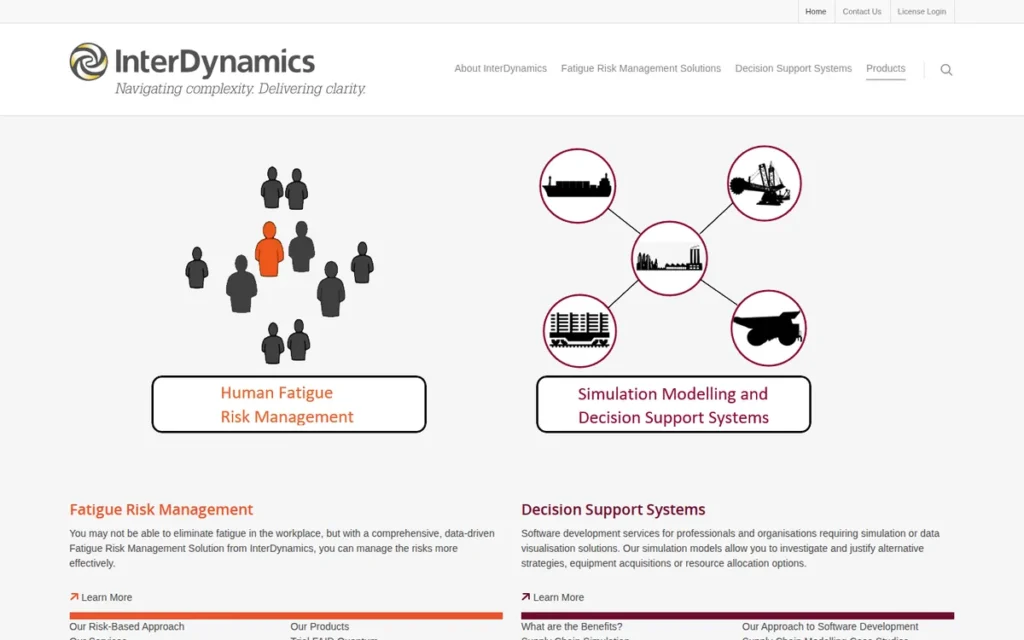
Category: Roster Modeler, predicts fatigue from planned and actual work schedules, before and after shifts.
At a Glance
- Category: Roster Modeler
- Best For: Rail, mining, aviation, policing and emergency-services operators that need simple roster screening without collecting sleep data
- Price Range: Free evaluation license; production pricing not publicly disclosed as of October 2026
- Primary Strength: FAID Quantum has been validated against US railroad accident data and can be rolled out without wearables or measured sleep.
- Biggest Limitation: FAID Quantum can underestimate fatigue risk after periods of very little duty, according to Australia’s rail safety regulator, ONRSR.
- One-Line Summary: FAID Quantum is an InterDynamics roster-modeling tool that scores hourly fatigue from the previous 7 days of work and rest, used across rail, mining, aviation and emergency services since its predecessor launched in 1999.
- Last Verified: October 2026
Overview
FAID Quantum is a biomathematical roster-modeling tool from Australian vendor InterDynamics that scores hourly fatigue exposure from the previous seven days of work and rest. It is built for transport, mining and emergency-services operators that need roster screening without collecting sleep data.
FAID Quantum combines the original FAID scoring method, licensed from the University of South Australia’s Centre for Sleep Research, with an alertness model from CQUniversity’s Appleton Institute. InterDynamics has operated since August 1992. InterDynamics’ headcount and finances are not publicly disclosed as of October 2026.
Key Features
- FAID Quantum gives an hourly fatigue score from 0 to 140+ based on the previous 7 days of work and rest [Source: InterDynamics, accessed October 2026].
- FAID Quantum’s score accounts for time of day, shift length, recent work history, time-zone travel and the biological limits on how much rest can restore.
- FAID Quantum includes a second alertness model from the Appleton Institute, built on about 15,000 days and nights of real-world sleep–wake data, including long-haul aviation.
- FAID Quantum’s standard model needs no measured sleep data, so FAID Quantum is simpler to roll out than wearable-based systems.
- FAID Quantum offers a public evaluation user license, and SourceForge lists a free trial [Source: SourceForge, accessed October 2026].
Best For
FAID Quantum is best for operators in several industries, particularly in Australia, that want a simple, well-established roster screening score and do not want to give workers wearables.
Strengths
- FAID Quantum was validated in a US railroad study covering work periods linked to 732 human-factors accidents and 1,944 other accidents, although calibration required comparison with an already-validated model [Source: Tabak & Raslear, US DOT/FRA, 2010] (Independent).
- FAID Quantum’s historical customers include Aurizon, BHP Billiton, Alcoa, easyJet, Union Pacific and Hitachi [Source: InterDynamics, accessed October 2026] (Vendor-reported).
- FAID Quantum comes from a vendor operating since August 1992, with FAID 1.0 released in 1999, FAID Quantum 1.0 in 2016 and version 1.1 in 2020 [Source: InterDynamics, 2013 and 2020] (Vendor-reported).
- FAID Quantum needs no wearables, which avoids the device-compliance and biometric-privacy problems of sensor-based systems (Editorial analysis).
Limitations
FAID Quantum trades simplicity for blind spots. FAID Quantum models work hours rather than measured sleep, so its scores can miss fatigue that builds up outside the roster.
- ONRSR warns that FAID Quantum scores can start artificially low after seven or more days without duty and rise only over the first few shifts. ONRSR also says models should never be the only way fatigue risk is identified [Source: ONRSR, accessed October 2026] (Independent).
- FAID Quantum can therefore show a low score for a train driver’s first shift back from a week’s leave, even if that driver slept badly all week.
- FAID Quantum does not account for sleep disorders, health or chronotype, and may overestimate how much people actually sleep [Source: CASA, 2024] (Independent).
- FAID Quantum’s common “80 = acceptable” rule is a screening convention, and FRA research suggested risk may become unacceptable at scores as low as 60 [Source: FAA CAMI, 2011] (Independent).
- FAID Quantum has little public validation since 2020, its integration documentation is thin, and it has no G2 or Capterra reviews.
Users on r/mining described sleep loss that no roster records:
“Camps have no insulation between rooms. Doesn’t matter if you do all the things they say you should – good diet, exercise, limit caffeine and alcohol etc. if you have a neighbour that barrels in after the wet mess shuts and/or gets up at 3am to get to the gym say good bye to sleep.” Posted by u/Bamwise
Takeaway: Mine workers lose sleep to camp conditions that never show up in a roster, which is exactly the blind spot of a work-hours-only model like FAID Quantum.
Verdict
FAID Quantum is the only validated roster modeler in this evaluation that needs neither sleep data nor wearables and offers a public evaluation license. FAID Quantum scored 66/100, with 4/5 on validation, customers and vendor stability. As ONRSR advises, buyers should pair FAID Quantum with fatigue reporting and other controls and should not treat its score thresholds as compliance limits.
3. Fatigue Science Readi: Best for Individual Sleep Data Plus Predictive Scheduling in Mining and Heavy Industry
Category: Wearable + Model, feeds sleep measured by a worn device into a predictive fatigue model.
At a Glance
- Category: Wearable + Model
- Best For: Mining and heavy-industry operators that want measured sleep data for each worker combined with roster-based fatigue forecasts
- Price Range: Not publicly disclosed as of October 2026 (quote only)
- Primary Strength: Fatigue Science Readi combines sleep measured by its wrist device (originally Readiband, now marketed as ReadiWatch) with the independently validated SAFTE model to forecast fatigue for individuals, teams and shifts.
- Biggest Limitation: Fatigue Science Readi only works if workers wear and charge the device, and Capterra reviewers report that the hardware is fragile.
- One-Line Summary: Fatigue Science Readi is a wearable-plus-model fatigue platform that feeds wrist-measured sleep data into the SAFTE model to forecast fatigue for workers, teams and shifts, with named deployments at major mining companies.
- Last Verified: October 2026
Overview
Fatigue Science Readi is a fatigue risk management platform from Vancouver-based Fatigue Science that feeds sleep data from its wrist wearable into the SAFTE model. It is built for mining and heavy-industry operators that want fatigue forecasts for each worker, not just roster averages.
Fatigue Science Readi also offers predictive scheduling, which applies SAFTE to planned rosters before work starts. Fatigue Science was founded in 2006 and has about 30 staff in Vancouver. Fatigue Science’s finances are not publicly disclosed as of October 2026, and third-party funding figures conflict.
Key Features
- Fatigue Science Readi measures sleep from wrist movement (actigraphy) using the Readiband device, now marketed as ReadiWatch.
- Fatigue Science Readi uses the SAFTE model to give past, current and forecast fatigue scores for individuals, teams and shifts.
- Fatigue Science Readi offers predictive scheduling that models fatigue on planned rosters before shifts begin.
- Fatigue Science Readi gives workers a mobile app and supervisors a web dashboard.
- Fatigue Science Readi’s SAFTE model came out of US Army and Walter Reed research, which the vendor says represents 25+ years and about US$37M of work [Source: Fatigue Science, accessed October 2026].
Best For
Fatigue Science Readi is best for mines and heavy-industry sites that want measured sleep data for each worker alongside roster forecasts, and that can manage device compliance and employee consent.
Strengths
- Fatigue Science Readi runs the SAFTE model, which was independently validated against railroad accident risk [Source: Federal Railroad Administration, 2006] and flight-attendant PVT performance [Source: FAA CAMI, 2012] (Independent, at the model level).
- Fatigue Science Readi won the National Safety Council Safety Innovation Award [Source: NSC, 2022], and a Morgan Sindall fatigue program using it received an IOSH High Commendation [Source: ORR, 2017] (Independent recognition).
- Fatigue Science Readi has reported deployments at Newmont, Glencore, Fresnillo, Minsur, Barrick and BHP, with Rio Tinto and Queensland Rail also reported as users [Source: Mining & Energy, accessed October 2026; ContactOut, accessed October 2026] (Third-party reported).
- Fatigue Science reports 93% agreement (92% in older materials) between its wrist device and polysomnography at telling sleep from wake, which is not a measure of fatigue-prediction accuracy [Source: Fatigue Science, accessed October 2026] (Vendor-reported).
A mine worker on r/mining described how their site checks sleep today:
“Then, there are fatigue assessments that are triggered to be completed at the start of a shift on certain days of the swing. Currently, it’s questions about how much sleep you’ve had in the last 24 hours, 48 hours, and how long you have been awake before starting your shift. In the future, it may move to cognitive ability fatigue assessments, which would prevent a person from lying to pass their assessment.” Posted by u/Icy_Excitement_4100
Takeaway: Mine sites that rely on self-reported sleep questionnaires admit workers can lie to pass them, and that is the gap measured-sleep platforms like Fatigue Science Readi are built to close.
Limitations
Fatigue Science Readi gains worker-level data at the cost of workforce compliance and privacy. Fatigue Science Readi only works when workers wear and charge the device, and employer access to individual sleep data raises privacy concerns.
- Capterra Australia reviewers of Fatigue Science Readi report four recurring problems [Source: Capterra Australia, accessed October 2026]:
- Reviewers say the watches and accessories are fragile.
- Reviewers say the alertness checks feel repetitive.
- Reviewers say the app offers little interaction.
- Reviewers say scores sometimes don’t match how tired they feel.
- Fatigue Science Readi’s main outcome claim, fewer lost-time incidents across about 2.1 million worker-hours, could not be confirmed from primary sources [Source: NSC, accessed October 2026].
- Fatigue Science Readi holds a 4.8/5 Capterra rating from 4 reviews, which is too few to show a consensus, and G2 shows 0 reviews.
- Fatigue Science Readi faces general skepticism about wrist wearables. In a Reddit thread not about Readi, one user wrote that “any wearable device that claims to measure your brain via your wrist is lying” [Source: u/andero, r/QuantifiedSelf, accessed October 2026; general discussion]. That critique concerns brain measurement, while Readi estimates sleep from movement.
Verdict
Fatigue Science Readi is the only product in this evaluation that combines measured individual sleep with an independently validated roster model (SAFTE) on one platform. Fatigue Science Readi scored 62/100, with 4/5 on deployment scale and operational fit. Before a site-wide rollout, buyers should pilot device durability, worker acceptance and data-access policies.
4. Seeing Machines Guardian: Best for Real-Time In-Cab Fatigue Detection in Long-Haul Trucking and Commercial Fleets

Category: Real-Time Detector, detects signs of drowsiness during the shift and alerts the worker.
At a Glance
- Category: Real-Time Detector (in-cab camera)
- Best For: Long-haul trucking, fuel transport, passenger transport, oil and gas, and mining fleets that need immediate in-cab intervention
- Price Range: Not publicly disclosed as of October 2026 (quote only)
- Primary Strength: Seeing Machines Guardian combines in-cab camera detection with 24/7 human review and has the largest audited installed base in this evaluation, at 56,896 vehicles (December 2023).
- Biggest Limitation: Seeing Machines Guardian has no published independent accuracy or false-alarm data, and its live human review depends on mobile signal.
- One-Line Summary: Seeing Machines Guardian is an in-cab camera system that detects fatigue, microsleeps and distraction in real time, alerts drivers with sound and vibration, and sends events to a 24/7 human review center.
- Last Verified: October 2026
Overview
Seeing Machines Guardian is an in-cab driver monitoring system that uses a driver-facing camera and computer vision to detect fatigue, microsleeps, distraction and phone use as they happen. It is built for trucking, passenger transport, mining and other commercial fleets that need immediate intervention.
Seeing Machines Guardian sends suspected events to a 24/7 human review center that can contact drivers or fleet managers. Seeing Machines was founded in 2000 as a spin-out from the Australian National University. Seeing Machines is listed on London’s AIM market, so its finances are public.
Key Features
- Seeing Machines Guardian uses an in-cab camera and computer vision to detect fatigue, microsleeps, distraction and phone use.
- Seeing Machines Guardian alerts the driver immediately with a sound and seat or haptic vibration.
- Seeing Machines Guardian sends suspected events to trained staff at its 24/7 Guardian Centre, who can contact the driver or fleet and advise a break.
- Seeing Machines Guardian Live adds analytics and driver risk profiles and works with fleet telematics, although available sources don’t list every supported telematics platform.
- Seeing Machines Guardian records events rather than continuous video, which partly addresses driver privacy concerns.
Best For
Seeing Machines Guardian is best for trucking and commercial fleets whose priority is stopping a fatigue event as it happens, and that can handle hardware installation and a defined procedure for responding to alerts.
Strengths
- Seeing Machines Guardian monitored 56,896 vehicles at 31 December 2023, up 24% from 46,018, after about 30% compound annual growth over three years. That is the most recent Guardian count we verified [Source: Seeing Machines H1 FY2024 Results, 2024] (Company filing).
- Seeing Machines Guardian-equipped vehicles had driven more than 10 billion km by June 2022, a large real-world dataset for detection models [Source: Seeing Machines FY2022 Results, 2022] (Company filing).
- Seeing Machines Guardian’s Gen 3 hardware was approved by two UK bus manufacturers for factory or dealer fitting. Separately, Seeing Machines’ car driver-monitoring technology, not Guardian, runs in 3.7M+ vehicles [Source: Seeing Machines FY26 Trading Update, 2026] (Company filing).
- Seeing Machines Guardian’s 24/7 human review sets it apart from camera telematics platforms, which mostly upload clips for the fleet to review later (Vendor-reported; editorial comparison).
A mine worker on r/mining described the remote-review workflow of the Caterpillar-owned system they use. As noted in our exclusions, Caterpillar’s system is built on Seeing Machines technology:
“The microsleep system we use I’ve used at several companies I’ve worked for. It’s technology owned by Caterpillar, and they are also the service partner for it. The encrypted video footage is sent to USA when the system detects a microsleep. They review the footage to confirm if it was one, or if it was something like the sun was in the drivers eyes etc. If confirmed, they call the on-duty Supervisor in Australia. And the Supervisor can also view the footage.” Posted by u/Icy_Excitement_4100
Takeaway: Workers using Seeing Machines-based in-cab systems say human review screens out glare-triggered false detections before a supervisor is called, which is the same model Guardian’s 24/7 review center is built on.
Limitations
Seeing Machines Guardian trades immediacy for hardware, connectivity and surveillance trade-offs. Seeing Machines Guardian only detects fatigue once a driver is already drowsy at the wheel, so it does nothing to improve roster design.
- Seeing Machines Guardian has no published independent accuracy or false-positive (false-alarm) rates. Its published case studies report fewer fatigue events but no percentage outcomes. A “90%+ reduction” figure circulates online, but we found no verified source for it, including from Seeing Machines.
- Seeing Machines Guardian can raise false alerts when drivers wear sunglasses, face glare or look down, and drivers may cover or move the camera.
- Seeing Machines Guardian needs mobile signal for live human review, which matters on remote routes.
- Seeing Machines reported FY2025 revenue of US$62.3M and an adjusted EBITDA loss of US$30.1M, down from a US$38.9M loss in FY2024 [Source: Seeing Machines FY2025 Results, 2025] (Company filing). These losses are visible because the company is listed, while the other six vendors’ finances are not publicly disclosed.
- Seeing Machines Guardian faces union objections to cab cameras in general, and we could not read our Reddit search results in full, so driver sentiment is missing rather than neutral.
Verdict
Seeing Machines Guardian is the most widely deployed dedicated real-time fatigue detection system in this evaluation, with 56,896 monitored vehicles at December 2023, and the only one reviewed that pairs in-cab alerts with 24/7 human review. Seeing Machines Guardian scored 59/100, with 5/5 on deployment scale but 2/5 on independent validation. Before signing, buyers should ask for false-alarm data, test connectivity on their routes and agree driver privacy terms.
5. SmartCap / Wenco LifeBand: Best for Mines Running Wenco or Hitachi Fleet Management Systems

Category: Real-Time Detector, detects signs of drowsiness during the shift and alerts the worker.
At a Glance
- Category: Real-Time Detector (EEG headband)
- Best For: Open-pit mines and haul-truck operations already running Wenco or Hitachi Construction Machinery fleet systems
- Price Range: Not publicly disclosed as of October 2026 (quote only, set per site)
- Primary Strength: SmartCap shows its brainwave-based fatigue score on the same in-truck screen as Wenco dispatch data and has been used at 100+ mine sites.
- Biggest Limitation: SmartCap only works if workers wear the headband correctly, and SmartCap has no published false-alarm rates.
- One-Line Summary: SmartCap is a brainwave (EEG) headband fatigue-monitoring system, now sold by Hitachi group company Wenco, that alerts haul-truck operators before microsleeps and has been used at more than 100 mine sites.
- Last Verified: October 2026
Overview
SmartCap is a real-time fatigue-monitoring system that uses the LifeBand headband to measure brainwaves (EEG) and warn operators before microsleeps. It is built for mining and heavy-equipment operations, especially sites running Wenco or Hitachi Construction Machinery fleet systems.
SmartCap is now sold by Wenco, part of the Hitachi Construction Machinery group, and escalates alerts to supervisors through the LifeHub cloud platform. SmartCap grew out of Australia’s CRC Mining. SmartCap’s founding year, headcount and finances are not publicly disclosed as of October 2026.
Key Features
- SmartCap’s LifeBand measures brainwaves (EEG), can be worn with a cap, beanie or hard hat or on its own, and needs no calibration.
- SmartCap shows a speedometer-style alertness score in the Life app and gives sound and visual alerts before a microsleep.
- SmartCap escalates alerts to supervisors and stores data in the LifeHub cloud platform.
- SmartCap shows the fatigue score next to dispatch and load/haul status on the Wencomine in-truck screen, using a Bluetooth dongle.
- SmartCap offers a Data API for combining fatigue data with roster, road-design and task-rotation data.
Best For
SmartCap is best for mines already running Wenco or Hitachi equipment that want early-warning fatigue detection on the in-cab screen operators already use.
Strengths
- SmartCap has been used at 100+ mine sites across 130+ deployments, according to Wenco EMEA Regional Manager Helgardt van Heerden [Source: GBR, accessed October 2026] (Vendor-reported).
- SmartCap was deployed across the entire open-pit fleet, including ancillary vehicles, at Torex Gold’s ELG Mine Complex in Mexico [Source: Wenco, accessed October 2026] (Vendor-reported).
- SmartCap cites validation by the Monash University Accident Research Centre and the Austin Health Institute of Breathing and Sleep, and a partner reports 94.7% accuracy [Source: Thoughtworks, accessed October 2026] (Vendor- and partner-reported).
- SmartCap is owned by Wenco, part of the Hitachi Construction Machinery group, and Wenco states that customers own LifeHub data [Source: Wenco and Hitachi Construction Machinery, accessed October 2026] (Vendor-reported).
Limitations
SmartCap trades early warning for wearable compliance and data sensitivity. SmartCap only works when operators wear the headband correctly, and batteries and Bluetooth connections have to be managed on shift.
- SmartCap has published no false-positive (false-alarm) rates. The zero-incident result reported at AngloGold Ashanti’s Iduapriem mine comes from a distributor case study with no control group [Source: Ramjack, accessed October 2026] (Distributor case study).
- SmartCap’s 94.7% partner accuracy figure uses an undisclosed method and can’t be compared with other products’ figures.
- SmartCap collects brain-activity data, which raises stronger privacy concerns than other fatigue signals.
- SmartCap’s dedicated hard-hat version was described as a prototype in early coverage, and we could not confirm its current status [Source: New Atlas, accessed October 2026].
- SmartCap has no G2 or Capterra reviews, its App Store rating could not be retrieved, and its biggest integration benefits depend on Wenco systems.
Verdict
SmartCap is the best-integrated real-time fatigue detection option in this evaluation for mines running Wenco or Hitachi fleet systems, because it puts a brainwave-based alertness score on the operator’s existing in-truck screen. SmartCap scored 58/100, with 4/5 on deployment, fit and vendor stability. Before rollout, buyers should ask for false-alarm data and set clear consent rules for brainwave data.
6. Optalert: Best for Direct Eyelid-Based Drowsiness Measurement Where Wearing Glasses Can Be Enforced
Category: Real-Time Detector, detects signs of drowsiness during the shift and alerts the worker.
At a Glance
- Category: Real-Time Detector (eyelid-tracking glasses)
- Best For: Mining, rail and transport operations, mainly in Australia and Latin America, that can make sure workers wear the glasses
- Price Range: Eagle hardware and fleet subscriptions not publicly disclosed as of October 2026; car data assessment costs US$10 per minute after a free allowance
- Primary Strength: Optalert measures eyelid movement directly at up to 500 frames per second and converts it to the Johns Drowsiness Scale, which is backed by a large body of peer-reviewed research.
- Biggest Limitation: Optalert requires workers to keep the glasses on, and the glasses can be uncomfortable, fog up or not work with prescription lenses.
- One-Line Summary: Optalert is an eyelid-tracking glasses system that scores drowsiness every minute on the Johns Drowsiness Scale, used in mining, rail and transport operations mainly in Australia and Latin America.
- Last Verified: October 2026
Overview
Optalert is a real-time drowsiness-detection system that uses infrared Eagle glasses to measure eyelid movement and score drowsiness on the Johns Drowsiness Scale. It is built for mining, rail and transport operators that want direct physical measurement and can make sure workers wear glasses.
Optalert was founded in Melbourne in 2002 by sleep physician Dr Murray Johns AM, who also created the Epworth Sleepiness Scale. Optalert also licenses its algorithms to carmakers. Optalert’s ownership, headcount and finances are not publicly disclosed as of October 2026.
Key Features
- Optalert’s Eagle glasses use an infrared sensor running at up to 500 frames per second to measure eyelid movement.
- Optalert calculates the Johns Drowsiness Scale from 0 (alert) to 10 (very drowsy), updated every minute from 64 eyelid measurements.
- Optalert Eagle Industrial pairs the glasses with a rugged in-cab tablet that gives operators feedback.
- Optalert provides a fleet dashboard for monitoring drowsiness across operators.
- Optalert licenses its detection algorithms to European carmakers for mass-production vehicles.
Best For
Optalert is best for mining and rail operations that want a direct physical measure of drowsiness and have the supervision in place to make sure glasses are worn.
Strengths
- Optalert says its Johns Drowsiness Scale is backed by 120–140+ peer-reviewed publications and that a Harvard Medical School study found it “commensurate with gold-standard” lab measures. One key study disclosed an author’s Optalert shareholding and board role and tested only healthy young adults [Source: Optalert, accessed October 2026] (Vendor-reported).
- Optalert reports a 74% reduction in time spent in the fatigue-risk zone and 54% fewer monthly medium- and high-risk alerts at Chilean freight railway FCAB, which began trialling the system with five locomotive drivers in 2022 [Source: Optalert, accessed October 2026; FCAB, 2022] (Vendor-reported).
- Optalert was founded in 2002 by Dr Murray Johns AM, creator of the Epworth Sleepiness Scale [Source: Optalert, accessed October 2026] (Vendor-reported).
- Optalert lists BHP, Vale, Qantas, GE and FCAB as customers, although the nature of each relationship is not verified [Source: Optalert, accessed October 2026] (Vendor-reported).
Limitations
Optalert trades direct measurement for wearer compliance and comfort. Optalert requires workers to keep the glasses on, the glasses can be uncomfortable, fog up or not work with prescription lenses, and the batteries need charging.
- Optalert’s outcome figures for an unnamed Brazilian iron-ore mine disagree. One page reports drowsiness down 40% over 284 days after a shift-rotation change, while another claims more than 95% fewer fatigue incidents [Source: Optalert, accessed October 2026] (Vendor-reported).
- Optalert’s claim of 15–30 minutes’ advance warning also comes from the vendor, and Optalert publishes no false-positive (false-alarm) rate.
- Optalert may cost more per operator than camera systems, since each operator needs their own glasses, although no public fleet pricing confirms this.
- Optalert’s customers are concentrated in Australia and Latin America, it has 0 reviews on G2, and our Reddit search returned only off-topic threads.
Verdict
Optalert is the only eyelid-measurement system in this evaluation, and its Johns Drowsiness Scale has the largest peer-reviewed literature of the three real-time detectors reviewed, though a key study disclosed an author conflict of interest. Optalert scored 54/100, with 3/5 on validation, deployment, fit and vendor stability. Optalert’s performance figures come from the vendor and partly contradict each other, so buyers should run a controlled pilot.
7. Fatigue360 (Weston Analytics): Best for UK Rail Contractors Needing Rostering With Built-In Fatigue Scoring
Category: Rostering Platform, builds workforce schedules with live, built-in fatigue scoring.
At a Glance
- Category: Rostering Platform
- Best For: UK rail contractors and infrastructure suppliers working under Network Rail standard NR/L2/OHS/003
- Price Range: From £180 per user per month (Basic), plus a £150 administrator license, £1 per worker scheduled each month, 20% support and about £1,500 onboarding [Source: Capterra UK, accessed October 2026]
- Primary Strength: Fatigue360 recalculates fatigue scores live on planned and actual shifts inside a full rostering platform, and publishes the most transparent pricing in this category.
- Biggest Limitation: Fatigue360 is built on the HSE Fatigue and Risk Index, which HSE withdrew from its website in June 2021, and has no published independent validation.
- One-Line Summary: Fatigue360 is a UK rostering platform from Weston Analytics that recalculates the HSE Fatigue and Risk Index whenever a shift is created or changed, and follows Network Rail fatigue standard NR/L2/OHS/003.
- Last Verified: October 2026
Overview
Fatigue360 is a workforce rostering platform from UK firm Weston Analytics that recalculates the HSE Fatigue and Risk Index every time a shift is created or changed. It is built for UK rail contractors that must schedule staff under Network Rail fatigue standard NR/L2/OHS/003.
Fatigue360 was developed within the Munnelly Group (MacRail), but the exact legal relationship is unclear. Weston Analytics was founded in 2020 in Kings Langley, UK. Weston Analytics’ headcount and finances are not publicly disclosed as of October 2026.
Key Features
- Fatigue360 recalculates the HSE Fatigue and Risk Index every time a shift is created or changed, using both planned and actual shift times.
- Fatigue360 lets organizations configure rules for working hours and rest, including client-defined fatigue rules that were reportedly added after users asked for them.
- Fatigue360 tracks workers’ qualifications, competencies, contracts, and travel and rest periods alongside the roster.
- Fatigue360 supports real-time workforce planning in line with Network Rail standard NR/L2/OHS/003.
- Fatigue360 offers administrator, additional (£75) and view-only (£10) license tiers, and Capterra mentions a free trial and a free version.
Best For
Fatigue360 is best for small and mid-sized UK rail contractors that want scheduling and fatigue scoring in one tool, and that have the in-house expertise Network Rail requires for continued use of the withdrawn index.
Strengths
- Fatigue360 publishes the most complete pricing in this evaluation, so buyers can budget before talking to sales, although the structure is unclear and a written quote is advisable [Source: Capterra UK, accessed October 2026] (Vendor-reported).
- Fatigue360 scores fatigue on both planned and actual shifts inside the roster itself, so rostered and worked shifts can be compared in one tool [Source: Capterra and Weston Analytics, accessed October 2026] (Vendor-reported).
- Fatigue360 holds a 5.0/5 Capterra rating from 2 reviews, with Features rated 4.0/5, and a MacRail reviewer said “most teams adopted it easily” [Source: Capterra UK, accessed October 2026] (Independent user review).
- Fatigue360 follows Network Rail standard NR/L2/OHS/003 and tracks competencies and contracts alongside fatigue scores [Source: Weston Analytics, accessed October 2026] (Vendor-reported alignment).
Limitations
Fatigue360 trades scientific standing for operational convenience. Fatigue360’s scoring engine is the HSE Fatigue and Risk Index, which HSE withdrew in June 2021, citing an unsupported Excel platform and misuse of outputs.
- Fatigue360 users may continue with the index only if they have the competence to understand its limitations and use it within a wider fatigue process. Network Rail still distributes the index with guidance [Source: ORR, accessed October 2026; Network Rail, accessed October 2026] (Independent).
- Fatigue360 has no published independent validation and no case studies showing outcomes.
- Fatigue360’s 5.0 Capterra score rests on just 2 reviews, which isn’t enough to draw conclusions, and G2 lists no reviews.
- Fatigue360 is strongly focused on the UK, and we could not verify ISO 27001, Cyber Essentials or RISQS certifications.
- Fatigue360 sells an all-in-one approach, and some safety managers prefer specialist tools. One wrote that “no one system does what I want, the way I want it” [Source: u/safetyhawk810, r/WorkplaceSafety, accessed October 2026; general discussion, not about Fatigue360].
Verdict
Fatigue360 is the only product in this evaluation that combines full workforce rostering with live fatigue scoring, and it has the most transparent pricing in the category. Fatigue360 scored 41/100, with 5/5 on pricing transparency but 1/5 on validation and deployment evidence. That rank reflects thin public evidence, not poor functionality. Before committing, buyers should confirm with their Network Rail sponsor that continued use of the index is acceptable.
Which Fatigue Risk Management Software Is Best for Trucking, Aviation, Rail and Mining?
Seeing Machines Guardian is the best-evidenced fatigue software for trucking fleets, and SAFTE-FAST is the best-evidenced for aviation rostering. SAFTE-FAST or FAID Quantum suits rail. For mining, choose Fatigue Science Readi, SmartCap or Optalert, depending on whether the mine wants sleep data, Wenco integration or eyelid measurement.
- Trucking fleets: Seeing Machines Guardian is the best-evidenced choice for trucking fleets that need in-cab fatigue intervention.
- Airlines: SAFTE-FAST is the best-evidenced choice for airlines that need roster validation inside their crew scheduling systems.
- Rail operators: SAFTE-FAST or FAID Quantum suit most rail operators, and Fatigue360 suits UK contractors working under NR/L2/OHS/003.
- Mines: Mines should choose Fatigue Science Readi for sleep data, SmartCap for Wenco integration or Optalert for eyelid measurement.
What is the best fatigue risk management software for trucking fleets?
- Seeing Machines Guardian is the best-evidenced in-cab option for trucking, with 56,896 monitored vehicles at December 2023 [Source: Seeing Machines H1 FY2024 Results, 2024] (Company filing).
- SAFTE-FAST can be added for pre-trip schedule analysis, because the FMCSA has evaluated or used the SAFTE model [Source: IBR, accessed October 2026] (Vendor-reported).
- NHTSA estimates that drowsy driving is the primary cause of about 100,000 police-reported US crashes a year and says the true figure is likely higher [Source: NHTSA, accessed October 2026] (Independent).
- Hours-of-service limits recorded by electronic logging devices (ELDs) show legal compliance, not actual fatigue.
- Trucking buyers should check how a product fits two regulatory frameworks:
- The EU General Safety Regulation phases in advanced distraction warnings from July 2026.
- Australia’s NHVR Chain of Responsibility rules set fatigue duties across the supply chain.
What is the best fatigue risk management software for aviation rostering?
- SAFTE-FAST is the strongest choice for aviation rostering, because its Real Time API covers airline pairings, rosters and day-of-operations [Source: SAFTE-FAST, accessed October 2026] (Vendor-reported), and its model was validated on flight attendants [Source: FAA CAMI, 2012] (Independent).
- FAID Quantum is an alternative for aviation, because its Appleton Institute model includes long-haul aviation sleep–wake data and easyJet is a historical customer.
- Aviation buyers should map software outputs to the frameworks their regulator applies:
- FAA Part 117 sets flight and duty limits in the US.
- FAA AC 120-103A gives FRMS guidance in the US.
- ICAO/IATA guidance sets out FRMS practice internationally.
- CASA CAO 48.1 applies in Australia.
- Under ICAO/IATA FRMS guidance, model outputs typically support a fatigue safety action group’s review rather than replace it.
- We did not rank crew-scheduling suites with built-in fatigue modules, such as Jeppesen/Boeing CrewAlert, because they are modules inside larger scheduling systems rather than standalone fatigue software.
What is the best fatigue risk management software for rail?
- SAFTE-FAST has the strongest rail evidence, with an accident correlation of r = −0.93 [Source: Federal Railroad Administration, 2006] (Independent).
- FAID Quantum is widely used in Australian rail, but ONRSR warns it can underestimate risk after periods of little duty [Source: ONRSR, accessed October 2026] (Independent).
- Fatigue360 suits UK contractors working under NR/L2/OHS/003, although its HSE index was withdrawn in June 2021 and is allowed only for competent existing users.
- Optalert reports results from a 2022 trial with locomotive drivers at FCAB Railway in Chile [Source: Optalert, accessed October 2026] (Vendor-reported).
What is the best fatigue risk management software for mining in 2026?
- Fatigue Science Readi suits mines that want sleep data for each worker plus roster forecasts, with reported users including Newmont, Glencore and BHP.
- SmartCap suits mines running Wenco or Hitachi fleet systems, with use at 100+ mine sites, including Torex Gold’s ELG complex [Source: GBR, accessed October 2026; Wenco, accessed October 2026] (Vendor-reported).
- Optalert suits mines that can make sure operators wear glasses and want eyelid-based measurement.
- FAID Quantum suits mines that want roster screening without wearables, with BHP Billiton and Alcoa among its historical customers.
What Red Flags Should I Watch For When Evaluating Fatigue Risk Management Software?
The most important red flags in fatigue risk management software are claims you cannot check and alerts nobody owns. Each red flag below is a pattern we found in at least one product’s public evidence. Any one of them should prompt a written question to the vendor before a contract is signed.
Red Flag #1: Outcome Percentages Without a Control Group Outcome percentages without a control group cannot show that a fatigue product caused the improvement. SmartCap’s zero-incident result at AngloGold Ashanti’s Iduapriem mine comes from a distributor case study with no control group [Source: Ramjack, accessed October 2026], and most detection outcomes in this category are vendor-reported.
Red Flag #2: Accuracy Figures That Measure Something Else Some accuracy figures measure something other than fatigue prediction, which makes a product look more precise than it is. A wearable that is 93% accurate at detecting sleep is not 93% accurate at predicting fatigue. Three headline figures in this category answer three different questions:
- Fatigue Science Readi’s 93% figure measures sleep-versus-wake classification against polysomnography [Source: Fatigue Science, accessed October 2026].
- SmartCap’s 94.7% figure is a partner-reported accuracy number with an undisclosed method [Source: Thoughtworks, accessed October 2026].
- SAFTE-FAST’s R² = 0.884 measures how well predicted effectiveness matched measured reaction-time performance [Source: FAA CAMI, 2012].
Red Flag #3: Fatigue Scores Sold as Go/No-Go Cut-Offs Using fatigue scores as go/no-go cut-offs for individual workers misuses what biomathematical models were built to do. CASA and the ATSB say model scores should not decide whether an individual works. FRA research suggested FAID risk may start near a score of 60, well below the common “80 = acceptable” convention [Source: FAA CAMI, 2011].
Red Flag #4: No Published False-Alarm Rate Without a published false-positive (false-alarm) rate, a buyer cannot predict how often alerts will interrupt operators or how much pushback to expect. None of the three real-time detectors in this evaluation publishes one as of October 2026, even though each has documented failure conditions such as glare or fogged glasses.
A mine worker on r/mining listed their site’s fatigue controls:
“Unlimited free coffee, Can’t work more than 14 consecutive days without a day off, fatigue cameras that detect if you are tired (can detect yawning but sometimes goes off unintentionally), can’t fly in and go onto nights, self fatigue forms. But best of all, everyday the boss everyday says “if you’re fatigued speak to me prior to starting work”” Posted by u/overyonder88
Takeaway: Operators already notice in-cab fatigue cameras firing by mistake, so buyers should get a measured false-alarm rate before rollout rather than find out on shift.
Red Flag #5: A Scoring Engine Your Regulator Has Withdrawn or Cautioned Against A scoring engine that your regulator has withdrawn or cautioned against creates audit risk, even where continued use is permitted. HSE withdrew the Fatigue and Risk Index behind Fatigue360 in June 2021 [Source: ORR, accessed October 2026], and ONRSR warns that FAID Quantum can underestimate risk after low-duty periods [Source: ONRSR, accessed October 2026].
Red Flag #6: Detection Without a Named Alert Responder A detection system with nobody named to respond can leave an operator with a record of ignored warnings. Industry research notes that alerts often fire when nobody is empowered to act, and some buyers worry that receiving an alert creates a legal duty to respond. Seeing Machines Guardian’s 24/7 review center is one documented answer.
What Questions Should I Ask Before Choosing Fatigue Risk Management Software?
Before choosing fatigue risk management software, ask every shortlisted vendor the six questions below and require written answers. The questions turn the buyer pain points in this category into checkable commitments. If a vendor can’t answer in writing, your safety team carries the burden of proof.
Question #1: Which independent study validated this model, in which industry, and with how many people? Look for studies sponsored by a government body or published in peer-reviewed journals, with sample sizes reported, such as the FAA’s 2012 study of 178 flight attendants for SAFTE. Check for disclosed conflicts of interest and narrow test groups, such as an Optalert-cited study whose author held shares and which tested only healthy young adults.
Question #2: Can it compare planned and actual shifts using data from our scheduling, payroll or ELD systems? Ask for the import formats and APIs the vendor actually supports, then test them in a demo with your own data. SAFTE-FAST documents CSV and XML imports of planned, actual and historical schedules. Fatigue360 scores planned and actual shifts inside the roster. For other products, ask to see specific connectors working.
Question #3: What are the false-alarm rate and the failure conditions? Ask detection vendors for written false-alarm rates and known failure conditions, such as glare, sunglasses, lost connectivity and flat batteries. We found no vendor in this evaluation that publishes a false-alarm rate as of October 2026, so any figure you get should come with an explanation of how it was measured.
Question #4: Who owns and can see individual workers’ sleep, biometric or video data, and which security certifications do you hold? Ask for data-ownership terms in writing and proof of any certification, such as ISO 27001. SmartCap’s owner Wenco states that customers own LifeHub data, and Seeing Machines Guardian records events rather than continuous video. We couldn’t verify security certifications for most vendors in this evaluation.
Question #5: What is the full first-year cost, including hardware, installation, monitoring, onboarding and analyst training? Ask for an itemized first-year quote, because only Fatigue360 publishes a full price list. Include spare and replacement devices for wearables, installation and monitoring fees for cameras, and analyst training for roster modelers such as SAFTE-FAST. Generic per-vehicle or per-worker estimates found online are not vendor prices.
Question #6: Can rules be configured for our local regulations and collective agreements, and what audit trail can we export? Check that your team can configure hours, rest and fatigue thresholds without vendor engineering work. Ask for a sample audit report of the kind your regulator reviews, such as FAA, CASA, ONRSR or Network Rail evidence packs, and confirm that every rule change is logged.
How Did We Rank These Fatigue Risk Management Software Tools?
We scored seven fatigue risk management products from 1 to 5 on six weighted criteria, using public evidence up to October 2026, and converted the weighted totals to a score out of 100. Independent validation carried the most weight at 25%, because buyers and regulators find vendor claims hardest to check.
Our rank tells you whose claims are best proven, and the category tells you which product fits your job. Use the “Best For” verdicts and the Quick Decision Framework to choose.
These are the ranking criteria and why each one matters:
- C1 Independent Validation Evidence (25%) matters because regulators such as CASA, the ATSB and ONRSR examine how a model’s outputs are justified.
- C2 Deployment Scale and Named Customers (20%) matters because this category has almost no user reviews, so installed base and named customers are the best sign of real-world use.
- C3 Operational Fit and Integration Documentation (20%) matters because buyers must compare planned with actual shifts and connect to scheduling, payroll, ELD, telematics or wearable systems.
- C4 Vendor Stability and Data Governance (15%) matters because FRMS contracts run for years and sleep, biometric and video data raise privacy concerns.
- C5 Pricing Transparency (10%) matters because public prices are rare and budgeting is difficult.
- C6 Third-Party User Reviews (10%) matters because independent feedback reveals adoption problems, and products with fewer than 5 reviews were capped at 2/5.
| Product | C1 | C2 | C3 | C4 | C5 | C6 | Score /100 |
|---|---|---|---|---|---|---|---|
| SAFTE-FAST | 5 | 4 | 4 | 4 | 1 | 1 | 73 |
| FAID Quantum | 4 | 4 | 3 | 4 | 2 | 1 | 66 |
| Fatigue Science Readi | 3 | 4 | 4 | 3 | 1 | 2 | 62 |
| Seeing Machines Guardian | 2 | 5 | 4 | 3 | 1 | 1 | 59 |
| SmartCap / Wenco LifeBand | 2 | 4 | 4 | 4 | 1 | 1 | 58 |
| Optalert | 3 | 3 | 3 | 3 | 2 | 1 | 54 |
| Fatigue360 | 1 | 1 | 3 | 2 | 5 | 2 | 41 |
Score = (C1×0.25 + C2×0.20 + C3×0.20 + C4×0.15 + C5×0.10 + C6×0.10) ÷ 5 × 100. For example, SAFTE-FAST = (1.25 + 0.80 + 0.80 + 0.60 + 0.10 + 0.10) ÷ 5 × 100 = 73.
Seeing Machines Guardian (59) and SmartCap (58) are separated by one point. Treat positions 4 and 5 as effectively tied on evidence, and choose between them by vehicle type and fleet system.
These are the closest scoring judgments:
- FAID Quantum C2 = 4: FAID Quantum has named enterprise customers across rail, mining and aviation, but no published deployment count. This is the closest call in the table, and at 3/5 FAID Quantum would score 62 and tie Fatigue Science Readi.
- Fatigue Science Readi C1 = 3, C4 = 3: Independent validation applies to the SAFTE model, not to Readi’s own outcome claims. Fatigue Science Readi lost C4 points for conflicting funding figures and employer access to sleep data, and its data-ownership terms are not public.
- Seeing Machines Guardian C4 = 3: Public filings and event-based recording count in its favor, and reported losses count against it. Those losses are visible only because Seeing Machines is listed, so this comparison is not like-for-like.
- SmartCap C4 = 4: SmartCap lost points for the sensitivity of EEG data, offset by Hitachi group ownership and published customer data ownership.
- Optalert C1 = 3: Optalert’s peer-reviewed literature puts it above the 2/5 scores for the other two detectors, but a disclosed author conflict and a narrow test group keep it below 4.
Every claim in this article carries one of these evidence labels:
- Independent means the evidence comes from a government-sponsored or peer-reviewed study, a regulator, or an independent user review.
- Independent recognition means the evidence is an award or commendation from an independent body.
- Third-party reported means a trade publication or data aggregator reported the evidence.
- Vendor-reported means the evidence comes from the company’s own pages or materials.
- Company filing means the evidence comes from a listed company’s public financial filings.
- Distributor case study means a reseller or partner published the evidence.
- Editorial analysis means the point is our inference from documented product design.
- Unverified means we found no source for a circulating claim, so we don’t repeat it as fact.
Dated documents are cited as [Source: Publisher, Year], and undated pages as [Source: Publisher, accessed October 2026]. Missing data is described with the same wording for every vendor and scored neutrally under C4.
We left these products out of the ranking:
- Airline crew-scheduling suites with built-in fatigue models, such as Jeppesen/Boeing CrewAlert, were excluded because they are modules inside larger scheduling systems.
- Caterpillar DSS was excluded because it is built on Seeing Machines technology.
- Samsara, Lytx and Netradyne were excluded because they are broad fleet-safety camera platforms, not dedicated fatigue systems.
- SmartSafety was excluded because it has 0 Capterra reviews.
- Products named by AI assistants that our research could not verify were excluded, which says nothing about their merit. These include FRMSc FRMS, SmartQHSE, FATIGUEmanager, FRMSuite, Pulsar Fatigue Meter, SafetyIQ, Hexagon OAS, Gauss Control and Nauto.
PlugRoute has no affiliate relationships with any company listed, and rankings are determined entirely by research data and objective evaluation criteria.
What Else Do Buyers Ask About Fatigue Risk Management Software?
Buyers most often ask three follow-up questions about fatigue risk management software. In short, software alone never makes an operation FRMS-compliant, most products are quote-only, and PlugRoute ranks products by weighted public evidence rather than vendor relationships. The answers below give the detail behind each point.
Does buying fatigue risk management software make my operation FRMS-compliant?
No. Fatigue risk management software is an input to a fatigue risk management system (FRMS), not an FRMS itself. CASA and the ATSB describe biomathematical models as optional tools, and ONRSR says models should never be the only way fatigue risk is identified.
Safe Work Australia’s September 2025 Code of Practice also makes fatigue the employer’s responsibility.
How much does fatigue risk management software cost?
Most fatigue risk management software is quote-only: five of the seven products we reviewed publish no pricing as of October 2026. Fatigue360 is the exception, listing £180 per user per month plus license, per-worker and onboarding fees [Source: Capterra UK, accessed October 2026]. FAID Quantum offers a free evaluation license.
How does PlugRoute determine rankings?
PlugRoute scores public evidence from 1 to 5 on six weighted criteria, with independent validation carrying the most weight at 25%. Weighted totals are converted to a score out of 100, every claim is labeled by source type, and missing data is described identically for every vendor. The rank shows strength of evidence, not universal fit.
Which Fatigue Risk Management Software Is Right for You?
Key Insights
The right fatigue risk management software depends on the job you need done. Roster modelers such as SAFTE-FAST prove schedules are safe, and real-time detectors such as Seeing Machines Guardian catch drowsiness on shift. No single product covers both, and regulators treat every tool as an input to an FRMS, not a replacement for one.
- SAFTE-FAST has the strongest independent validation in this evaluation, including a railroad accident correlation of r = −0.93 [Source: Federal Railroad Administration, 2006].
- Seeing Machines Guardian has the largest audited deployment of any dedicated fatigue system reviewed, at 56,896 vehicles on 31 December 2023 [Source: Seeing Machines H1 FY2024 Results, 2024].
- No fatigue risk management product in this evaluation covers roster modeling, real-time detection, fatigue reporting and corrective-action tracking together.
- We found no independent head-to-head accuracy tests and no published false-alarm rate for any product reviewed as of October 2026.
- Fatigue360 is the only product reviewed that publishes full pricing, and five of the seven publish no pricing at all.
- CASA, the ATSB and ONRSR treat fatigue models as optional tools rather than a complete FRMS.
Airlines and railroads that must defend their rosters should start with SAFTE-FAST or FAID Quantum. Long-haul fleets should start with Seeing Machines Guardian. Mines should choose between Fatigue Science Readi, SmartCap and Optalert based on the data they want and the fleet systems they already run.
Pilot any shortlisted fatigue risk management software for 60–90 days on real rosters, with success measures agreed before go-live:
- Your pilot should track fatigue reports filed and near-misses, compared with a pre-pilot baseline.
- Your pilot should measure alert-to-response time and the false-alarm count per 1,000 operating hours.
- Your pilot should record the worker opt-out rate, and data-access rules should be agreed with workers and unions before go-live.
PlugRoute will update these rankings as vendors publish validation, false-alarm data and pricing. Read our full methodology or browse our other independent safety software reviews at PlugRoute.
We update this guide quarterly. Last updated: October 2026.