Smartly.io leads for enterprise brands managing $100,000+ monthly across multiple paid channels; Agorapulse is the top value pick for agencies needing GA4 revenue attribution and social management; and Bïrch (formerly Revealbot) is the best choice for auditable, rules-based multi-platform ad automation. The right platform depends on whether you need campaign creation, analytics reporting, or creative production at scale, and whether your ad spend justifies a dedicated platform over native tools.
Managing paid social campaigns across Meta, TikTok, LinkedIn, and Google from separate native dashboards destroys budget visibility and costs teams hours per week. Global social media ad spend is projected at $338.75 billion in 2026 (Statista, 2025), yet the software enabling its management is growing at 30.8% annually (The Business Research Company, 2025), nearly three times faster. The market spans four distinct tool categories, and choosing the wrong one is the costliest evaluation mistake buyers make.
PlugRoute has no affiliate relationships with any company listed. Rankings are determined entirely by research data and objective evaluation criteria.
“Unless some edge cases or special cases where the tool can do something you cannot do native in the ad manager, it is a waste of money for a lot of ad accounts. When you add in the fees the tools charge, it becomes a lot harder to become profitable with it.” (u/fathom53, r/PPC)
Takeaway: For accounts below approximately $100,000/month in managed spend, native Meta Ads Manager automation handles most campaign optimization needs at no added cost, third-party tools justify their fees only when they address specific workflow gaps that native tools genuinely cannot replicate cross-platform.
Which Platforms Made Our Top Picks? (TL;DR)
The four highest-value platforms in this evaluation serve distinct buyer needs: Smartly.io for enterprise brands, Agorapulse for agencies needing revenue attribution, Bïrch for rules-based cross-platform automation, and Hootsuite for in-house B2B teams managing LinkedIn content and ads from one certified platform.
- Smartly.io is the top pick for enterprise brands managing $100,000+ per month across multiple paid channels who need unified creative automation and media buying across seven verified advertising platforms.
- Agorapulse is the best choice for agencies managing 5–30 client accounts who need social publishing, community engagement, and native Google Analytics 4 revenue attribution starting at $69/month.
- Bïrch (formerly Revealbot, rebranded 2023) is the top rules-based automation platform for performance teams requiring auditable, cross-platform campaign control across Meta, Google, TikTok, and Snapchat.
- Hootsuite is the best fit for in-house B2B teams managing both LinkedIn organic content and LinkedIn ad campaigns from a single certified platform.
What Are the 4 Categories of Social Media Advertising Software?
Social media advertising software falls into four distinct categories: Enterprise Ad Orchestrators for unified creative and media buying, Social Management Suites for publishing plus ad creation or reporting, Dedicated Ad Automation Engines for campaign optimization, and AI Creative Generators for conversion-scored creative production. Sprout Social represents a fifth type, an analytics-only reporting layer that cannot execute campaigns.
Selecting the wrong category is the most expensive mistake in this evaluation. A team that purchases Sprout Social expecting Meta Ads Manager-equivalent campaign controls will not find them. A team that purchases Bïrch expecting content scheduling will be equally disappointed.
Category 1: Enterprise Ad Orchestrator
Unified creative production, dynamic creative optimization (DCO), media buying, and cross-channel analytics in a single enterprise workflow.
Smartly.io is the Enterprise Ad Orchestrator in this evaluation, with verified advertising integrations across Meta, TikTok, Google, Amazon, Pinterest, Reddit, and Snapchat, designed for brands managing $100,000 or more per month in paid social spend.
Category 2: Social Management with Ad Workflows
Organic content scheduling, community management, and paid ad creation or attribution reporting in a unified platform.
Hootsuite offers unified social publishing and ad creation for Facebook, Instagram, LinkedIn, and X, the Social Management with Ad Workflows option for in-house teams managing both content calendars and paid campaigns.
Agorapulse combines publishing, community inbox management, and native Google Analytics 4 revenue attribution, designed for agencies and brand teams that need to connect social activity to measurable revenue outcomes without enterprise-tier pricing.
Category 3: Dedicated Ad Automation Engine
Optimization-only tools that automate bid management, budget pacing, and campaign scaling, these do not manage organic content.
Bïrch (formerly Revealbot) is a Dedicated Ad Automation Engine providing rules-based automation across Meta, Google, TikTok, and Snapchat, designed for performance teams needing deterministic, auditable campaign control.
Madgicx is an AI-Driven Meta Ad Optimizer leveraging an exclusive Meta partnership for AI Bidding capabilities, designed for performance teams focused on Meta/Facebook/Instagram campaigns who want autonomous AI-driven optimization.
Category 4: AI Ad Creative Generator
Generative AI platforms producing conversion-scored ad creative, no campaign management or bidding included.
AdCreative.ai is the AI Ad Creative Generator in this evaluation, producing static and video ad creative with predictive 1–100 conversion scoring based on a large historical ad training dataset, for teams bottlenecked by creative production volume.
Analytics-Only Layer (Not a Campaign Manager)
Sprout Social reports on paid social performance but cannot create, buy, or optimize campaigns. Think of Sprout Social like Google Analytics for your paid social campaigns, it shows what happened and how campaigns performed against KPIs, but it does not run the ads that generate the traffic. Campaign creation and optimization still happen in Meta Ads Manager, LinkedIn Campaign Manager, or a dedicated ad automation platform.
Before diving into the ranked entries: Two platforms in this evaluation carry documented billing or contract risks. Review the Red Flags section before subscribing to any platform listed here.
How Do the Top Social Media Advertising Software Platforms Compare at a Glance?
The seven platforms in this 2026 evaluation span four distinct advertising software categories, five price tiers from free to $5,000+/month, and capability sets ranging from AI creative generation (AdCreative.ai) to full enterprise ad orchestration (Smartly.io). No single platform leads on all five evaluation criteria, the right choice depends on ad spend volume, campaign management need, and whether AI-autonomous or auditable rules-based automation fits your workflow.
| Rank | Company | Category | Best For | One-Line Summary | Key Capabilities | Primary Strength | Key Limitation |
|---|---|---|---|---|---|---|---|
| #1 | Smartly.io | Enterprise Ad Orchestrator | Enterprise brands, $100K+/month, multi-channel | Smartly.io is the leading enterprise social advertising platform for brands managing $100K+/month, delivering a 5.5x average ROAS per Smartly.io press materials citing PwC validation (2024), with unified creative DCO and media buying across seven verified advertising platforms | Creative DCO, media buying, cross-channel analytics, 7-platform coverage | 5.5x average ROAS (Smartly.io press materials citing PwC, 2024); $6B+ managed spend (BusinessWire, April 2020); 800+ enterprise clients | $4,000–$5,000+/month minimum; fees charged on total managed ad spend, not only platform spend |
| #2 | Agorapulse | Social Management + ROI Attribution | Agencies managing 5–30 accounts needing revenue attribution | Agorapulse is a social media management and ROI attribution platform rated 4.5/5.0 on G2 (~971 reviews, June 2026) and Capterra with triple-platform recognition from G2, Capterra, and TrustRadius, and the only native GA4 revenue attribution in this evaluation starting at $69/month | Publishing, inbox zero, GA4 attribution, Power Reports, team workflows | Only native GA4 revenue attribution in evaluation; 4.5/5.0 on G2 and Capterra; triple-platform award recognition | Cannot create or optimize ad campaigns; custom reporting less configurable than Sprout Social |
| #3 | Bïrch | Rules-Based Ad Automation | Performance teams needing auditable cross-platform automation | Bïrch (formerly Revealbot, rebranded 2023) is a multi-platform ad automation engine rated 4.6/5.0 on G2, executing 2.3M daily rule executions across Meta, Google, TikTok, and Snapchat for performance marketers requiring transparent campaign control | 47 condition types, 12 action types, nested logic, 4-platform coverage | Most granular and transparent automation engine at its price point; 4.6/5.0 G2; 10-year track record since 2016 | No creative production; no audience discovery; component tool, not all-in-one |
| #4 | Hootsuite | Unified Social Management with Ad Workflows | In-house B2B teams managing LinkedIn organic + LinkedIn ads | Hootsuite is one of the most widely deployed social media management platforms; with a claimed 25 million total users (Hootsuite 2026 marketing materials; one independent source cites ~18 million active users) and G2’s #1 Best Software 2026; with certified LinkedIn Marketing Partner integration | Organic publishing, ad creation (Facebook/Instagram/LinkedIn/X), unified reporting | LinkedIn Marketing Partner certification; G2 #1 Best Software 2026; ~18-year track record | No campaign optimization or AI bidding; per-seat pricing escalates steeply for teams |
| #5 | Madgicx | AI-Driven Meta Ad Optimizer | Meta-focused ecommerce advertisers; verify billing practices independently before subscribing | Madgicx is a Meta-partnered AI ad optimization platform rated 4.6/5.0 on G2 with exclusive AI Bidding; and carries a Trustpilot TrustScore of 2/5 (June 2026) with corroborated unauthorized billing complaints requiring independent verification before subscribing | AI Bidding, Audience Studio, Creative Intelligence, Ads Manager 2.0, Tracking Pro | Exclusive Meta partnership; AI Bidding unavailable to non-partnered platforms; 4.6/5.0 G2 | Trustpilot TrustScore 2/5 (June 2026); corroborated unauthorized billing complaints across Trustpilot, Capterra, and Reddit; Meta-first only |
| #6 | Sprout Social | Paid Social Analytics and Reporting Layer | Enterprise teams needing advanced analytics and Salesforce integration | Sprout Social has won G2’s Best Software award for nine consecutive years and offers advanced analytics and Salesforce integration; but does not create, buy, or optimize ad campaigns as of June 2026 | Custom dashboards, social listening, Salesforce CRM integration, dark post monitoring | 9 consecutive G2 Best Software awards; NASDAQ-listed; strongest analytics depth in evaluation | Does not create or optimize campaigns as of June 2026; annual contracts require written cancellation notice 30 days before renewal |
| #7 | AdCreative.ai | AI Ad Creative Generator | Performance teams bottlenecked by creative production volume | AdCreative.ai is an AI ad creative generator trained on 100M+ historical ads (per independent sources; adcreative.ai documentation cites 450M; unverified by independent reviews) that produces conversion-scored creatives; the only tool of its kind in this evaluation | Conversion scoring (1–100), Saliency AI heatmaps, 6-platform integration, enterprise API | 100M+ ad training dataset (independent sources, 2025); pre-launch conversion prediction; unique category in evaluation | Creative quality “hit or miss” per community feedback; no campaign management; limited corporate transparency |
Which Social Media Advertising Software Should I Choose for My Use Case?
The right social media advertising software depends primarily on whether you need campaign creation and execution, analytics and reporting, or creative production at scale, and whether your monthly ad spend justifies a dedicated platform over native ad manager automation. Teams spending under $100,000 per month should evaluate Agorapulse, Bïrch, or Madgicx before considering enterprise platforms.
After selecting your recommended platform from the table below, cross-check your team against the “Best For” field in that platform’s full entry. If your team does not match the described audience precisely, the next row in the table may be the better fit.
| Your #1 Priority | Recommended Tool | Why | Acceptable Alternative |
|---|---|---|---|
| Enterprise brand managing $100K+/month across multiple channels | Smartly.io | 5.5x average ROAS (Smartly.io press materials citing PwC, 2024); unified creative DCO + media buying; broadest verified channel coverage (7 platforms) | Madgicx (Meta-only, lower cost; verify billing first) |
| Agency managing 5–30 client accounts needing ROI and revenue reporting | Agorapulse | Only native GA4 revenue attribution in evaluation; 4.5/5.0 on G2 and Capterra; most accessible pricing | Hootsuite (if LinkedIn ad creation is the priority) |
| Performance team needing auditable multi-platform automation rules | Bïrch | 47 condition types, 12 action types, 2.3M daily executions; Meta + Google + TikTok + Snapchat | Madgicx (if Meta-only and prefer AI over rules; verify billing first) |
| In-house team managing both LinkedIn organic content and LinkedIn ads | Hootsuite | LinkedIn Marketing Partner certified; unified organic + paid workflow; ~18-year track record | Sprout Social (if analytics depth matters more than ad creation) |
| Meta-focused ecommerce wanting AI optimization; verify billing independently first | Madgicx | Exclusive Meta partnership; AI Bidding unavailable to non-partnered tools; 4.6/5.0 G2 | Bïrch (rules-based alternative with cleaner billing track record) |
| Enterprise team needing paid social analytics, social listening, and Salesforce integration | Sprout Social | 9 consecutive G2 Best Software awards; only Salesforce-verified option in evaluation | Agorapulse (lower cost, GA4 attribution instead of Salesforce) |
| Creative production bottleneck, need AI creative generation with pre-launch scoring | AdCreative.ai | Only platform in evaluation for AI creative generation with conversion scoring | Smartly.io DCO (enterprise-scale feed-based creative, significantly higher cost) |
1. Smartly.io: Best Overall for Enterprise Social Advertising
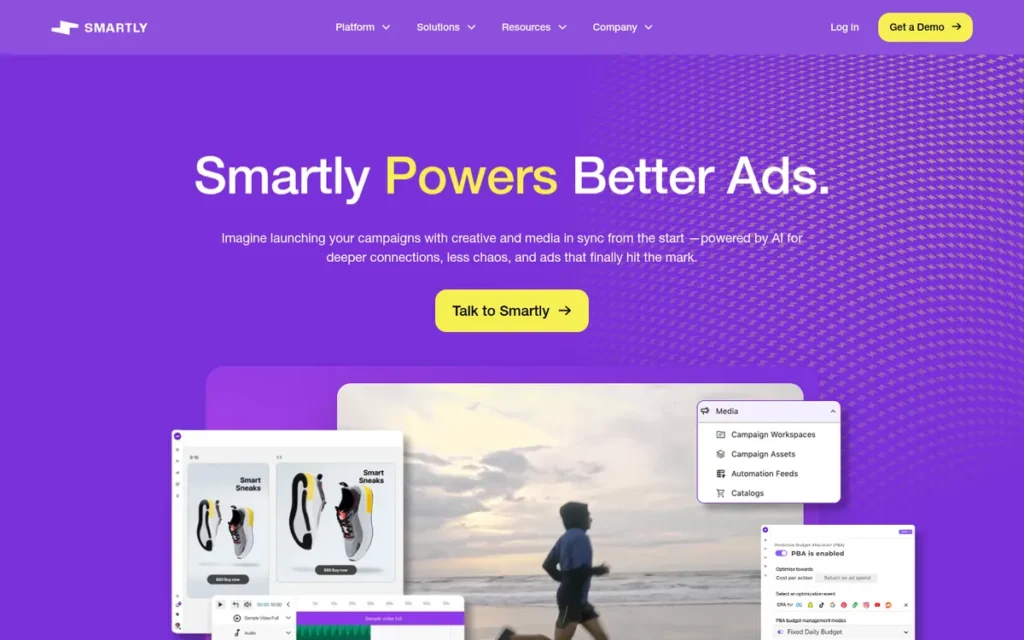
Category: Enterprise Ad Orchestrator, a unified platform combining AI-driven creative production, dynamic creative optimization (DCO), media buying, and cross-channel campaign analytics in a single enterprise-grade workflow across seven major advertising platforms.
At a Glance
- Category: Enterprise Ad Orchestrator
- Best For: Enterprise brands and large performance marketing teams managing $100,000+ per month in paid social spend across multiple channels who need unified creative automation and media buying without separate tools for each function
- Price Range: $4,000–$5,000/month minimum (approximately 2–4% of total managed ad spend per independent community and review sources, 2024–2025); custom enterprise pricing, verify exact rate and billing basis in writing before signing
- Primary Strength: Smartly.io is the only platform in this evaluation combining creative production, dynamic creative optimization, media buying, and cross-channel analytics, per Smartly.io press materials citing PwC validation (2024), platform users reported a 5.5x average ROAS and 42 minutes of operational time saved per hour
- Biggest Limitation: Smartly.io’s billing model charges a percentage fee on total managed ad spend, not only spend running through the Smartly.io platform, meaning a brand spending $500,000/month total may pay fees on the full amount even if only a portion runs through Smartly.io
- One-Line Summary: Smartly.io is the leading enterprise social advertising platform for brands managing $100,000+ per month, with a 5.5x average ROAS per Smartly.io press materials citing PwC validation (2024) and unified creative DCO and media buying across Meta, TikTok, Google, Amazon, Pinterest, Reddit, and Snapchat
- Last Verified: June 2026
Overview
Smartly.io is an enterprise social advertising platform that unifies creative production, dynamic creative optimization, media buying, and cross-channel analytics in a single workflow for large performance marketing teams managing $100,000 or more in monthly paid social spend, and is the only tool in this evaluation with a third-party-cited performance benchmark from a named global consulting firm.
Smartly.io serves 800+ enterprise clients and manages over $6 billion in annual ad spend globally (BusinessWire, April 2020, the most recently publicly documented figures; current figures not independently re-confirmed as of June 2026). Smartly.io maintains verified advertising integrations across Meta, TikTok, Google, Amazon, Pinterest, Reddit, and Snapchat, the broadest verified multi-channel coverage of any platform in this study.
Key Features
- Dynamic Creative Optimization (DCO) Engine: Smartly.io’s DCO engine generates thousands of feed-driven ad variations automatically (updating prices, product images, and localized copy in real time) enabling a national franchise to run 1,000+ city-level ad variants simultaneously without manual creative production effort, as documented in community research (r/advertising, 2025).
- Cross-Channel Media Buying Across Seven Platforms: Smartly.io’s media buying spans Meta, TikTok, Google, Amazon, Pinterest, Reddit, and Snapchat (the broadest verified platform coverage in this evaluation) consolidating campaign activation and budget management across all major paid social channels in one unified interface.
- AI Creative Automation at Scale: Smartly.io’s AI-powered creative automation produced 1.9 million creative assets for 260+ enterprise clients (per Smartly.io press materials, 2024), with Smartly.io claiming 30x faster creative production and a 27% performance lift versus static creatives across its enterprise base.
- Unified Cross-Channel Analytics Dashboard: Smartly.io’s analytics dashboard combines paid performance data from all connected platforms into one reporting view, eliminating the need to toggle between Meta Ads Manager, Google Ads, and TikTok Ads Manager to compile cross-channel performance reports.
- Enterprise API and Governance Architecture: Smartly.io’s enterprise API connections support programmatic campaign management, multi-market brand governance workflows, and custom approval chain architecture, making Smartly.io compatible with the complex operational structures of global enterprise marketing organizations.
Best For
Smartly.io is best for enterprise brands, national franchises, and large ecommerce advertisers running $100,000 or more per month in paid social spend, particularly teams managing hyperlocal ad localization, feed-driven product advertising across thousands of SKUs, or multi-channel campaigns where manual creative production at the required variation volume is cost-prohibitive.
Pricing
Smartly.io offers no public pricing page and requires a sales conversation for all quotes. Based on verified third-party community and review sources as of June 2026, monthly minimums start at approximately $4,000–$5,000/month. Fees are structured as approximately 2–4% of total managed ad spend (lower percentages for larger accounts) per multiple independent sources (get-ryze.ai, r/PPC, 2024–2025).
This billing distinction is material. Smartly.io’s fees may apply to total client ad spend across all tools, not only spend activated through the Smartly.io platform. Concrete example: a brand spending $500,000/month total, with only $200,000 running through Smartly.io, may pay a fee on the full $500,000. At 3%, that is $15,000/month versus $6,000/month if the fee applied only to platform-managed spend. Confirm the exact rate and billing basis in writing before signing. Verify current pricing at smartly.io.
Strengths
- Per Smartly.io press materials citing PwC validation (2024), platform users reported an average 5.5x ROAS and 42 minutes of operational time saved per hour (Smartly.io press release, 2024), the strongest third-party-cited performance claim in this evaluation, even accounting for the fact that the primary source is Smartly.io’s press release rather than a PwC-published report.
- Smartly.io managed over $6 billion in annual global ad spend across 800+ enterprise clients as of April 2020 (BusinessWire, April 2020), representing operational scale that validates enterprise-grade infrastructure and API stability, the most recently publicly documented figure, with current managed spend not independently re-confirmed as of June 2026.
- Smartly.io supports paid advertising on Meta, TikTok, Google, Amazon, Pinterest, Reddit, and Snapchat (the broadest verified multi-platform advertising coverage in this evaluation) with API-level integrations confirmed through platform partner directories rather than self-reported claims.
- Smartly.io was founded in 2013, maintained 16 global offices as of 2020 (BusinessWire, 2020), and was acquired for approximately $400 million per industry community sources (r/PPC, 2025; not confirmed in an official press release), organizational stability signals important for enterprise teams considering multi-year commitments.
Limitations
- Cost Exclusivity: Smartly.io’s $4,000–$5,000/month minimum makes it economically indefensible for every advertiser except large enterprise brands, it is the wrong platform for small businesses, solo practitioners, growth-stage startups, and agencies with primarily mid-market client portfolios, where Agorapulse, Bïrch, or Madgicx deliver better value at a fraction of the cost.
- Total-Spend Billing Risk: Smartly.io’s fees are charged on total managed ad spend, including spend not running through the Smartly.io platform, as documented in independent community discussions (r/PPC, 2025). Buyers must request explicit written confirmation of the billing basis before signing any contract.
- Reporting Overhead: Smartly.io’s reporting layer may require supplementary BI tools such as Tableau or Looker for custom executive reporting configurations, adding tooling overhead for organizations without existing data infrastructure.
- Social-First Architecture Gaps: Smartly.io was built primarily for paid social and has expanded cross-channel, but omnichannel advertisers running significant display or CTV budgets may find gaps compared to truly omnichannel DSPs, per third-party capability reviews (cape.io, 2025).
“Usually platforms like these are worth it if you are spending $100K/month or more and/or there is a feature they have that you need badly.” (u/fathom53, r/PPC)
Takeaway: The $100K+/month practitioner threshold aligns with Smartly.io’s enterprise minimum, at this spend level, the productivity and performance multipliers of enterprise ad orchestration typically outweigh the $4,000–$5,000/month platform overhead for brands managing complex multi-channel creative workflows.
Verdict
Smartly.io is the most fully featured and independently validated social advertising platform in this evaluation, combining creative automation, media buying, and cross-channel analytics in a single workflow with the strongest third-party-cited performance claim of any platform in this study. For advertisers spending $100,000 or more per month across multiple paid social channels, Smartly.io’s 13-year track record, enterprise scale, and third-party-cited performance benchmarks justify serious evaluation despite the minimum fee. Buyers below the enterprise spend threshold should evaluate Bïrch, Madgicx, or Agorapulse instead, Smartly.io’s cost floor makes it economically unjustifiable at lower ad volumes.
2. Agorapulse: Best for Agencies and Teams Needing ROI Attribution
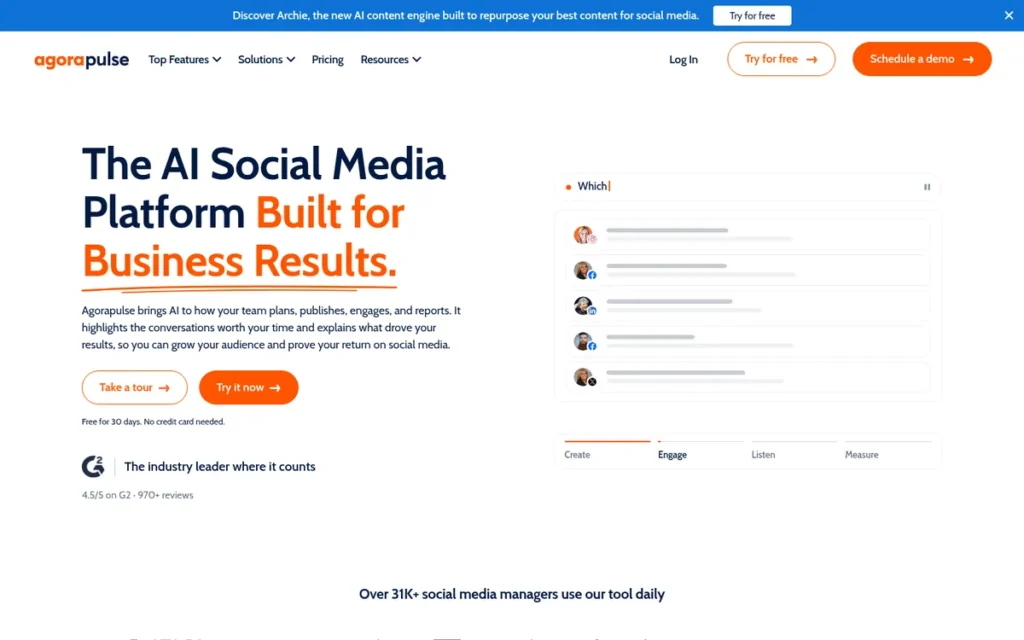
Category: Social Management + ROI Attribution Suite, a platform combining social publishing, community management, inbox-zero engagement workflows, and direct Google Analytics 4 revenue attribution for teams needing to connect paid and organic social activity to measurable business outcomes without enterprise-tier pricing.
At a Glance
- Category: Social Management + ROI Attribution Suite
- Best For: Digital marketing agencies managing 5–30 client accounts and in-house brand teams of 2–10 social media professionals who need social publishing, community engagement management, and revenue-attributed ROI reporting without enterprise-tier prices
- Price Range: Free (1 user, 3 social profiles); $69/month Standard; $99/month Professional (10 profiles); $149/month Advanced (Power Reports + automation); custom Enterprise
- Primary Strength: Agorapulse is the only tool in this evaluation with a native Google Analytics 4 integration that attributes revenue from specific social posts, campaigns, and conversations, connecting paid and organic social activity directly to business outcomes without a separate analytics platform
- Biggest Limitation: Agorapulse does not provide native ad campaign creation, bidding controls, or campaign optimization, it reports on and attributes paid social performance via GA4 but does not replace Meta Ads Manager, TikTok Ads Manager, or other native ad platforms for campaign execution
- One-Line Summary: Agorapulse is a social media management and ROI attribution platform rated 4.5/5.0 on G2 (approximately 971 verified reviews as of June 2026, per G2.com) and Capterra, with triple-platform recognition from G2, Capterra, and TrustRadius, and the only native GA4 revenue attribution in this evaluation starting at $69/month
- Last Verified: June 2026
Overview
Agorapulse is a social media management and paid-social ROI attribution platform that combines content scheduling, community inbox management, and direct Google Analytics 4 revenue attribution in a single tool designed for digital marketing agencies and brand-side social managers who need to connect social activity to measurable business results, without paying enterprise-tier prices.
Agorapulse holds a 4.5/5.0 rating on both G2 (approximately 971 verified reviews as of June 2026, per G2.com, verify current count at g2.com/products/agorapulse/reviews) and Capterra. Agorapulse has received award recognition from G2, Capterra, and TrustRadius simultaneously, and offers a free entry tier that no other comparably featured platform in this evaluation provides.
Key Features
- Native GA4 Revenue Attribution: Agorapulse’s Social Media ROI dashboard integrates directly with Google Analytics 4, automatically attributing website traffic, conversions, and revenue to specific social profiles, posts, campaigns, and conversations, the only native capability of this kind in this evaluation, documented in Agorapulse’s 2023 GA4 integration press release.
- Inbox Zero Engagement Workflow: Agorapulse’s unified Social Inbox applies an inbox-zero methodology that consolidates DMs, comments, and mentions from all connected profiles into a single actionable queue, earning a G2 inbox engagement score of 8.9 (per Agorapulse comparison content citing G2 data, June 2026), outperforming both Sprout Social (8.3) and Buffer (8.3) on this specific community management workflow.
- Multi-Platform Publishing with Auto UTM: Agorapulse supports scheduling and publishing across Facebook, Instagram, X (Twitter), LinkedIn, TikTok, Pinterest, YouTube, and Google Business Profile, with AI-assisted caption writing and automatic UTM parameter generation on all published and promoted content.
- Power Reports for Agency Clients: Agorapulse’s Power Reports (Advanced plan) enable white-label PDF reporting for branded client deliverables, allowing agencies to produce stakeholder-ready performance reports without additional third-party reporting tool subscriptions.
- Team Workflow and Approval Routing: Agorapulse’s team workflow suite includes post approval routing, role-based permissions, and multi-user inbox assignment, enabling agencies to operate structured content governance and community management across multiple client accounts from one dashboard.
Best For
Agorapulse is best for digital marketing agencies managing between 5 and 30 client social accounts (and for in-house brand teams of 2 to 10 social media professionals) who need to publish content, manage community engagement, and produce revenue-attributed ROI reports without paying the per-seat premiums of Hootsuite or the per-seat escalation of Sprout Social.
Pricing
Agorapulse offers a Free plan (1 user, 3 social profiles, limited features) and paid plans at approximately $69/month (Standard, 3 profiles, 2 users), $99/month (Professional, 10 profiles, 2 users), and $149/month (Advanced, Power Reports, automation, and bulk publishing tools). Custom Enterprise pricing is available for unlimited profiles.
Additional social profiles beyond plan limits incur per-profile fees that can add cost unpredictability as client portfolios grow. Verify current pricing at agorapulse.com/pricing; pricing as of June 2026.
Strengths
- Agorapulse has received award recognition from G2, Capterra, and TrustRadius: the three major B2B software review platforms, simultaneously as of June 2026, holding a 4.5/5.0 G2 rating (approximately 971 verified reviews per G2.com, June 2026) and a matching 4.5/5.0 on Capterra, indicating broad multi-platform review presence across all major independent software review sites.
- Agorapulse’s Social Media ROI feature provides native Google Analytics 4 revenue attribution by individual post, campaign, profile, and conversation, documented in Agorapulse’s 2023 GA4 integration press release, making Agorapulse the only platform in this evaluation enabling social managers to report specific revenue outcomes from social activity without a supplementary BI platform.
- Agorapulse’s community inbox earned a G2 inbox engagement score of 8.9 (per Agorapulse comparison content citing G2 data, June 2026), outperforming Sprout Social (8.3) and Buffer (8.3), a comparative advantage relevant for agencies managing high-volume community engagement across multiple client accounts simultaneously.
- Agorapulse’s pricing structure: free tier through $149/month Advanced plan without per-seat penalties on base plans, provides meaningful capability at each tier at a significantly lower total cost than Hootsuite ($99+/month with per-seat escalation) and Sprout Social ($79–$249/seat/month annually).
Limitations
- No Campaign Execution Capability: Agorapulse’s primary trade-off is social management depth versus advertising execution, the platform reports on and attributes paid social performance through GA4 integration but cannot create, buy, or optimize ad campaigns, making it a publishing and analytics companion to native ad platforms rather than a replacement for Meta Ads Manager or other campaign execution tools.
- Dual-Tool Requirement: Agencies needing both social management and direct campaign optimization must plan for Agorapulse alongside a dedicated ad platform such as Bïrch or Madgicx, adding tooling cost and workflow complexity that partially erodes Agorapulse’s pricing advantage at the full-stack level.
- Custom Reporting Ceiling: Agorapulse’s custom report-building is less configurable than Sprout Social for enterprise teams requiring highly tailored dashboard structures, a gap documented in third-party comparison reviews (Zernio.com, 2026) and corroborated by community feedback.
- Scale Ceiling for Large Agencies: Agorapulse is not optimized for agencies managing more than 30–50 client accounts simultaneously (per Zernio.com, 2026), and additional social profiles beyond plan limits incur per-profile fees that reduce pricing predictability as client portfolios expand.
“Agorapulse, Planable, and Statusbrew cover most of your requirements. Although they may cost more than Buffer, they are very cheap compared to Sprout Social and Hootsuite.” (u/Friendly_Round_9156, r/b2bmarketing)
Takeaway: B2B marketing community consensus positions Agorapulse as the most accessible option delivering comparable social management capability to Sprout Social and Hootsuite at significantly lower cost, the recommended evaluation starting point for cost-constrained agencies managing 5–30 client accounts.
Verdict
Agorapulse is the highest-rated platform by verified review scores across three independent review platforms in this evaluation and the only tool with native Google Analytics 4 revenue attribution, earning its #2 ranking through best-in-class review scores, the most accessible pricing structure in the study, and a paid-social ROI reporting capability that directly addresses the stakeholder reporting pain point. For agencies managing 5–30 client accounts and brand teams that need revenue-attributed social reporting without enterprise pricing, Agorapulse delivers the strongest value-to-cost ratio in this evaluation. Its core limitation (no native ad campaign creation or optimization) is structural and should guide buyers toward pairing Agorapulse with a dedicated ad automation tool rather than expecting standalone campaign management functionality.
3. Bïrch (Formerly Revealbot): Best for Rules-Based Multi-Platform Ad Automation
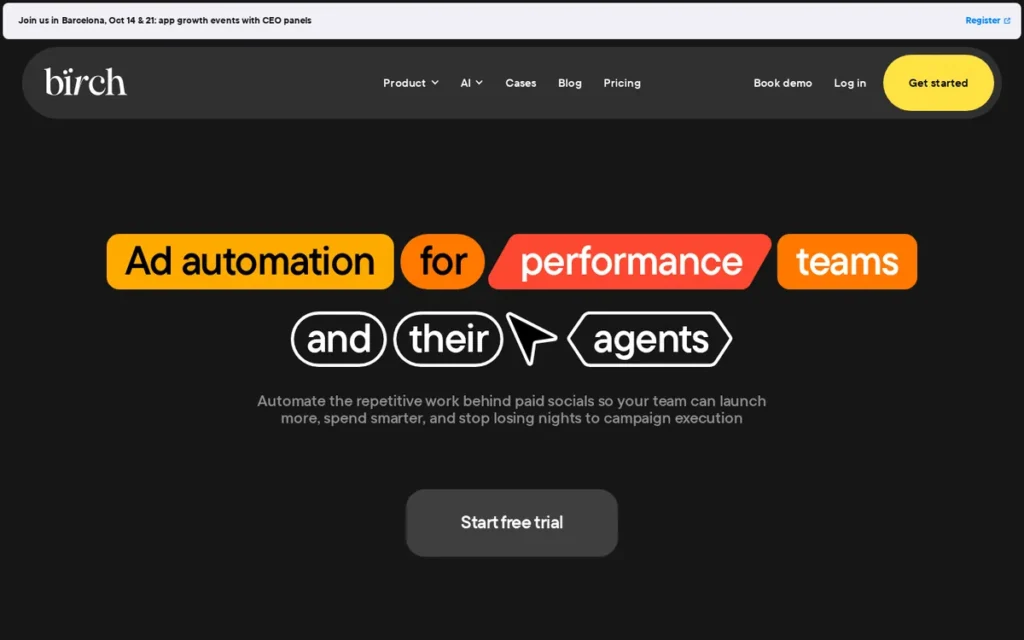
Category: Rules-Based Ad Automation Engine, a platform that executes deterministic, auditable automation rules across Meta, Google, TikTok, and Snapchat ad accounts, enabling performance marketers to automate campaign scaling, budget pacing, and bid adjustments without manual daily review, rebranded from Revealbot in 2023 (confirmed at bir.ch), now operating at bir.ch.
At a Glance
- Category: Rules-Based Ad Automation Engine
- Best For: Performance marketers, paid social specialists, and boutique agencies managing $10,000–$500,000+ per month in combined Meta, Google, TikTok, and/or Snapchat ad spend who need transparent, auditable automation rules rather than black-box AI decisions they cannot explain to clients
- Price Range: $49–$69/month (Starter, up to $10K spend); ~$99/month (Pro, unlimited rules); ~$179/month (Growth, $10K–$100K spend, hourly execution); $299/month ($100K–$500K spend); custom Enterprise above $500K; 14-day free trial, no credit card required
- Primary Strength: Bïrch offers the most granular and transparent rule-based automation engine in this evaluation, 47 condition types, 12 action types, and nested logic processing 2.3 million daily rule executions, enabling performance marketers to automate decisions that native Meta Ads Manager cannot replicate across four platforms simultaneously
- Biggest Limitation: Bïrch provides no ad creative production, competitor creative intelligence, or audience discovery capabilities, it is a specialized automation execution layer that requires separate tools for creative design, testing, and strategy, making it a component of an advertising stack rather than an all-in-one solution
- One-Line Summary: Bïrch (formerly Revealbot, rebranded 2023) is a multi-platform ad automation engine rated 4.6/5.0 on G2, executing 2.3 million rule-based optimization actions daily across Meta, Google, TikTok, and Snapchat for performance marketers requiring transparent and auditable campaign control
- Last Verified: June 2026
Overview
Bïrch, formerly known as Revealbot and rebranded in 2023, now operating at bir.ch, is a rules-based social advertising automation platform founded in 2016 that enables performance marketers to build and execute deterministic automation rules across Meta Ads, Google Ads, TikTok Ads, and Snapchat Ads from a unified interface.
Bïrch processes approximately 2.3 million rule executions daily across its user base, supports 47 condition types and 12 action types with nested AND/OR logic, and checks rules every 30 minutes during business hours, providing the most granular and transparent ad automation architecture in this evaluation, rated 4.6/5.0 on G2 with a 10-year operational track record since 2016 (get-ryze.ai, 2026).
Key Features
- 47-Condition Rule Engine with Nested Logic: Bïrch’s automation rule engine supports 47 condition types and 12 action types with nested AND/OR logic, enabling precise, deterministic automation such as “if ROAS drops below 2.0 AND spend exceeds $500 in the last 24 hours, then pause the ad set and send a Slack notification.” Bïrch’s rule engine also natively supports dayparting automation, bid cap and cost cap enforcement, and CBO scaling rules across all four platforms simultaneously.
- Native Four-Platform Coverage: Bïrch integrates natively with Meta Ads, Google Ads, TikTok Ads, and Snapchat Ads from a single dashboard, enabling performance teams and agencies to apply unified automation rule logic across all four platforms without switching between individual native ad managers.
- Post-iOS14 Third-Party Attribution Integrations: Bïrch integrates with third-party attribution platforms including AppsFlyer, Hyros, and Wicked Reports (themarketingagency.ca, 2025), enabling post-iOS14 advertisers to base automation rule conditions on privacy-compliant attribution signals rather than relying solely on platform-reported conversion data degraded by Apple’s ATT framework.
- Slack Anomaly Alerts: Bïrch’s Slack integration routes campaign anomaly alerts (CPA spikes, budget pacing deviations, and rule-triggered ad set pauses) directly to designated Slack channels (themarketingagency.ca, 2025), enabling team response to campaign changes without requiring continuous platform login.
- Google Sheets Custom Metric Integration: Bïrch’s Google Sheets integration allows custom performance metric definitions and external data to be incorporated into automation rule conditions, extending rule logic beyond the standard platform metrics available in native ad managers.
Best For
Bïrch is best for performance marketing agencies and in-house paid social teams managing complex, multi-campaign ad accounts across Meta, Google, TikTok, and Snapchat where the daily volume of optimization decisions (bid adjustments, budget pacing, ad set scaling, and anomaly responses) exceeds what can be manually reviewed without delayed response or human error in high-spend environments.
Pricing
Bïrch uses spend-based tiered pricing as of June 2026: approximately $49–$69/month for Starter (up to $10K monthly managed ad spend, approximately 10 active rules); approximately $99/month for Pro (up to $10K spend, unlimited rules); approximately $179/month for Growth ($10K–$100K spend, hourly rule execution, 5 integration connections); and $299/month for the $100K–$500K spend tier. Enterprise pricing is custom above $500K managed spend.
A 14-day free trial is available with no credit card required. Note that Bïrch’s spend-based pricing can become expensive for agencies managing multiple clients with high combined ad spend, calculate total platform cost against your portfolio’s aggregate spend across all clients before committing. Verify current pricing at bir.ch; pricing as of June 2026 sourced from secondary sources (Linktly.com, 2026).
Strengths
- Bïrch earned a 4.6/5.0 rating on G2: tied for the highest score in this evaluation alongside Madgicx, and has maintained its market position through 10 years of continuous operation since 2016 (get-ryze.ai, 2026), a longevity record that validates category staying power in a technically demanding market segment.
- Bïrch’s automation rule engine: 47 condition types, 12 action types, and 30-minute execution intervals during business hours, processes 2.3 million rule executions daily across its user base (per platform-published statistics, cited in get-ryze.ai, 2026), providing the most granular and fully auditable automation architecture in this evaluation.
- Bïrch’s native integration with AppsFlyer, Hyros, and Wicked Reports (themarketingagency.ca, 2025) enables performance marketers to incorporate post-iOS14 third-party attribution signals into automation rule conditions, directly addressing the tracking accuracy challenge that diminished the effectiveness of many rule-based platforms following Apple’s ATT framework rollout in 2021.
- Bïrch’s 14-day free trial requiring no credit card reduces evaluation risk: enabling performance teams to build, test, and validate automation rules against live ad accounts before committing to a paid spend tier.
Limitations
- Specialization vs. Comprehensiveness: Bïrch’s most consequential trade-off is specialization versus comprehensiveness, the platform provides no ad creative production capabilities, no competitor creative intelligence, no audience discovery tools, and no standalone performance analytics dashboards, making it exclusively an automation execution layer that requires separate tools for creative ideation, competitor research, and deep performance reporting.
- Rule-Building Complexity: Bïrch’s rule-building process is time-intensive at initial setup and requires ongoing maintenance as campaign structures, audience segments, and performance thresholds evolve, the platform rewards sustained investment in rule library development rather than delivering plug-and-play results, consistent with the documented 14-active-rules-per-user average (get-ryze.ai, 2026).
- Support and Bug Concerns: Community feedback across review platforms documents slow customer support response times and occasional rule execution bugs during platform updates (per independent review summaries at get-ryze.ai, 2026 and gethookd.ai, 2026), both carry real consequences in live campaign environments where automation delays can result in overspend or missed optimization windows.
- Agency Cost Escalation at Scale: Bïrch’s spend-based pricing can become expensive for agencies managing multiple clients with high combined ad spend, the fee structure means costs scale with client portfolio growth, creating budget unpredictability at high-volume agency operations beyond what the base tier pricing suggests.
“Because people are lazy and sold. All these tools use FB’s API so whatever they do, you can do it yourself inside the ads manager.” (u/Serafinium, r/FacebookAds)
Takeaway: Expert Meta advertisers who have mastered native Ads Manager automation may not need Bïrch, the platform’s value is highest for teams managing campaigns across Meta, Google, TikTok, and Snapchat simultaneously, where native per-platform automation cannot apply unified rule logic across all four accounts in one interface.
Verdict
Bïrch is the best-in-class rules-based ad automation platform in this evaluation, earning its #3 ranking through the most granular and auditable automation engine available at its price point, 47 condition types, 12 action types, 2.3 million daily rule executions, combined with the broadest verified multi-platform coverage among the dedicated ad automation tools in this study. For performance marketers and agencies who prioritize explainable, transparent, and client-defensible campaign control over autonomous AI decisions, Bïrch fills a genuine capability gap that native Meta and Google automation cannot replicate across four platforms simultaneously. Buyers should approach Bïrch as a specialized addition to an existing advertising toolkit and invest in structured rule-building to realize the platform’s full optimization potential.
4. Hootsuite: Best for Unified Organic Plus Paid Social Management
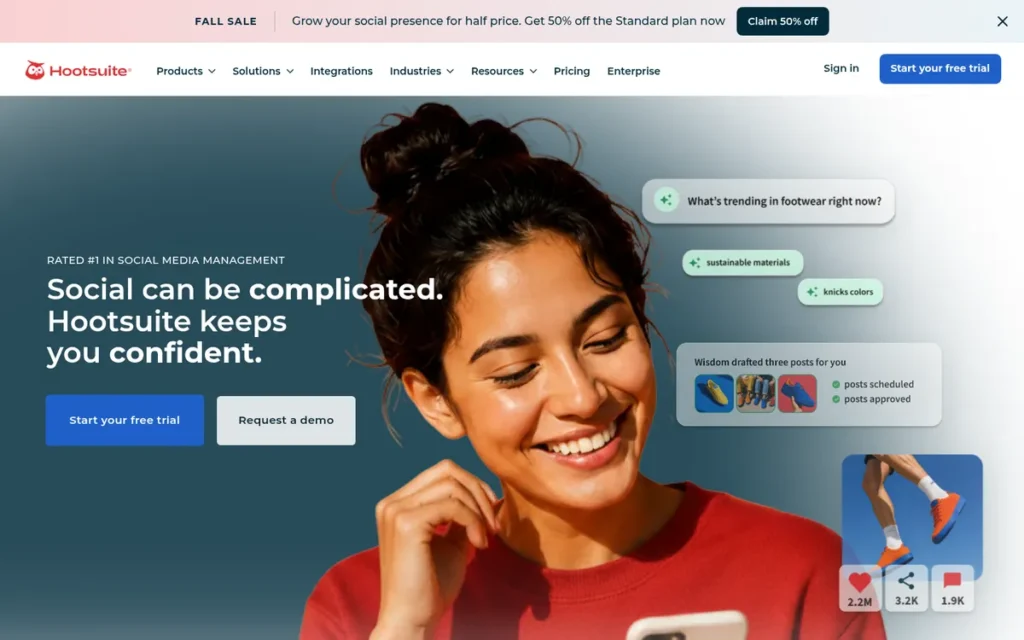
Category: Unified Social Management with Ad Workflows, a platform that handles organic content scheduling, community management, and paid ad creation and basic reporting for Facebook, Instagram, LinkedIn, and X from a single dashboard, with verified LinkedIn Marketing Partner certification for in-house teams managing both content and paid campaigns.
At a Glance
- Category: Unified Social Management with Ad Workflows
- Best For: Mid-size in-house marketing teams and small agencies that manage both organic social content calendars and paid social campaigns, particularly B2B organizations with significant LinkedIn advertising activity who need one platform for both LinkedIn organic publishing and LinkedIn ad management
- Price Range: $99/month (Professional, 1 user, 10 social accounts); $249/month (Team, 3 users, 20 accounts; additional users at $49/person/month); Enterprise custom (estimated ~$739+/month for 5+ users per searchlab.nl, 2025)
- Primary Strength: Hootsuite is the only general social management platform in this evaluation with a certified LinkedIn Marketing Partner integration (verified through LinkedIn’s official Business Partner Directory) enabling LinkedIn ad campaign creation and post-boosting directly within the Hootsuite dashboard
- Biggest Limitation: Hootsuite’s per-seat pricing escalates steeply for multi-user teams, and its paid advertising capabilities are limited to campaign creation and basic unified reporting, no campaign optimization, AI bidding, creative intelligence, or audience analytics are included at any plan tier
- One-Line Summary: Hootsuite is one of the most widely deployed social media management platforms (with a claimed 25 million total users (Hootsuite 2026 marketing materials; one independent source cites approximately 18 million active users) and G2’s #1 Best Software 2026) offering certified LinkedIn Marketing Partner integration and unified organic-plus-paid social workflows at $99–$249/month
- Last Verified: June 2026
Overview
Hootsuite is a unified social media management platform with embedded paid social ad workflows, enabling in-house marketing teams and agencies to schedule organic content, boost posts, create ad campaigns, and review consolidated paid-plus-organic performance reports for Facebook, Instagram, LinkedIn, and X from a single dashboard.
Hootsuite was founded approximately 2008, holds G2’s #1 Best Software Product designation for 2026, and is the only platform in this evaluation with a verified LinkedIn Marketing Partner certification, confirming API-level access to LinkedIn ad campaign creation and performance reporting within the Hootsuite interface.
Key Features
- Social Advertising Composer Workflow: Hootsuite’s Social Advertising workflow enables users to create Facebook, Instagram, LinkedIn, and X ad campaigns directly within Hootsuite Composer (setting objectives, audiences, budgets, and timing from one interface) providing a single entry point for both organic publishing and paid campaign activation without switching to native ad managers.
- Verified LinkedIn Marketing Partner Certification: Hootsuite holds a certified LinkedIn Marketing Partner status verified through LinkedIn’s official Business Partner Directory as of June 2026, confirming API-level access that enables LinkedIn ad campaign creation, post sponsoring, and paid performance reporting from within the Hootsuite dashboard.
- Unified Paid and Organic Reporting: Hootsuite’s unified performance dashboard consolidates paid and organic performance data (campaign status, impressions, spend, and engagement) across all connected ad accounts into one reporting view, reducing the need to toggle between Meta Ads Manager and LinkedIn Campaign Manager for basic cross-channel reporting.
- AI Content Suite (OwlyGPT): Hootsuite’s AI content suite includes OwlyGPT (AI-powered caption writing and ideation), social listening, and a built-in content calendar, providing organic content workflow tools that integrate with paid social publishing in the same platform environment.
- Broad Platform Publishing Support: Hootsuite supports social media management across Facebook, Instagram, LinkedIn, X (Twitter), YouTube, Pinterest, and TikTok for organic content scheduling, though TikTok ad campaign creation (as distinct from TikTok content scheduling) is not clearly documented in Hootsuite’s native advertising management feature set.
Best For
Hootsuite is best for mid-size in-house marketing teams (particularly in B2B organizations with significant LinkedIn advertising activity) where a single team manages both organic social content strategy and paid social ad activation and needs one platform to consolidate publishing, approvals, and reporting without integrating separate specialized tools for each function.
Pricing
Hootsuite pricing as of June 2026: Professional at $99/month (1 user, up to 10 social accounts); Team at $249/month (3 users, up to 20 social accounts; additional users at $49/person/month). Enterprise pricing is custom and estimated by third-party sources at approximately $739+/month for 5+ users and 50+ accounts (searchlab.nl, 2025).
Hootsuite’s per-seat pricing means team cost scales directly with headcount, a 5-person team on the Team plan costs a minimum of $347/month ($249 base plus $49 × 2 additional users); a 10-person team pays a minimum of $595/month. Verify current pricing at hootsuite.com/plans.
Strengths
- Hootsuite received G2’s #1 Best Software Product designation for 2026 (awarded based on verified user review volume and satisfaction across all software categories on G2’s platform) representing recognition from the most widely used B2B software review source, supported by a claimed 2,000+ five-star reviews.
- Hootsuite’s LinkedIn Marketing Partner certification: verified through LinkedIn’s official Business Partner Directory as of June 2026, is a third-party platform validation confirming API-level LinkedIn ad campaign creation, post-boosting, and performance reporting capabilities, making Hootsuite the most credentialed option in this evaluation for LinkedIn-focused paid social programs.
- Hootsuite has operated continuously since approximately 2008: the longest organizational track record in this evaluation, providing API integration stability across multiple generations of social platform changes, including repeated Meta API policy updates that have disrupted newer entrants to the category.
- Hootsuite’s claimed 25 million total users (per 2026 Hootsuite marketing materials; one independent source cites approximately 18 million active users; Hootsuite’s 2025 social trends report separately cites 200,000+ paid accounts) supports the largest third-party training resource ecosystem and integration marketplace of any platform in this evaluation, reducing new-user onboarding time.
Limitations
- Limited Advertising Depth: Hootsuite’s most significant trade-off is the gap between its market visibility and its actual advertising depth, Hootsuite creates and reports on ad campaigns but does not optimize them, apply AI bidding, provide creative performance intelligence, or offer audience analytics beyond what native platform dashboards already provide, limiting its utility for dedicated performance marketing teams.
- Trailing Competitive Ratings: Independent comparative analysis from IAG.me documents Hootsuite as “consistently rating last among the three” (versus Sprout Social and Agorapulse) for publishing, monitoring, and reporting functionality, a finding that contradicts the G2 #1 designation, which reflects broad review volume across all categories rather than category-specific performance depth.
- Per-Seat Cost Escalation: Community feedback consistently cites Hootsuite’s per-seat pricing as a significant cost barrier for multi-person teams, a 10-person agency team pays a minimum of $595/month, significantly more than Agorapulse for comparable or stronger social management capability at equivalent team sizes.
- Meta API Dependency Risk: A 2025 Reddit community report documented “Meta just keeps clawing back permissions and features rendering HS a useless product”, an ongoing structural risk where Meta API policy changes progressively limit what Hootsuite can do on the platform (u/Backy22, r/SocialMediaMarketing, 2025).
“Hootsuite is a good social media management tool, but unfortunately, it’s quite heavy on the pocket. There are literally tools out there that offer the same and, in fact, better features… for struggling agencies, startups, and new entrepreneurs, it gets a bit pricey.” (u/kulsoomawan, r/SocialMediaMarketing)
Takeaway: Price-to-value concerns dominate Hootsuite’s community discussion, the platform is functional but perceived as expensive relative to alternatives, particularly for agencies and startups where Agorapulse provides comparable social management capability at meaningfully lower per-seat cost.
Verdict
Hootsuite earns its #4 ranking through its LinkedIn Marketing Partner certification, approximately 18-year track record, and unified organic-plus-paid social workflow that serves in-house teams managing both content calendars and ad campaigns from one platform. For performance marketers and agencies needing deep ad optimization, AI-driven campaign intelligence, or better per-seat value for growing teams, Agorapulse (stronger review ratings, lower cost, unique GA4 attribution), Bïrch (deeper multi-platform automation), or Madgicx (deeper Meta AI optimization, verify billing first) represent more purpose-fit alternatives. Hootsuite’s clearest competitive case is the B2B organization with meaningful LinkedIn ad spend seeking a single, certified platform for both LinkedIn organic content management and LinkedIn paid campaign management.
5. Madgicx: Best for Meta AI Campaign Optimization, Verify Billing Practices Before Subscribing
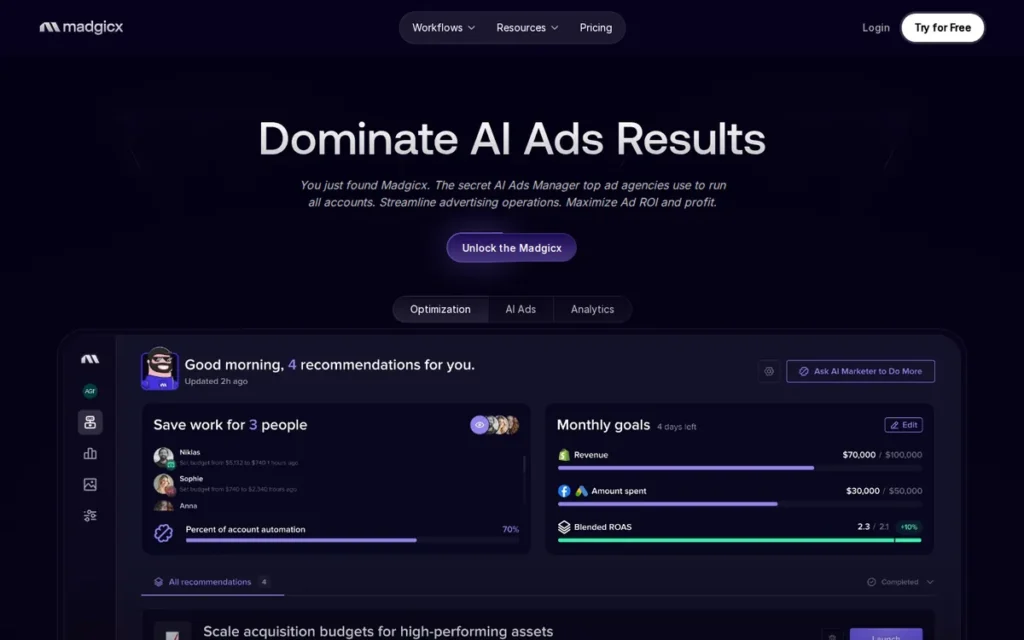
Category: AI-Driven Meta Ad Optimizer (a platform built to autonomously optimize Meta (Facebook and Instagram) ad campaigns through AI bidding, audience intelligence, creative analysis, and an Ads Manager overlay) with exclusive Meta partnership status unlocking capabilities not available to non-partnered advertisers.
At a Glance
- Category: AI-Driven Meta Ad Optimizer
- Best For: Ecommerce advertisers and performance marketing agencies managing $10,000–$500,000+ per month primarily on Meta/Facebook/Instagram who want AI-driven autonomous campaign optimization, after independently verifying current billing practices, Trustpilot reviews, and auto-renewal terms before subscribing
- Price Range: $99/month base + optional $49/month Tracking Pro add-on; spend-based tiers scale above; 7-day free trial available
- Primary Strength: Madgicx holds an exclusive Meta partnership providing access to AI Bidding features and audience intelligence capabilities not available to advertisers using non-partnered third-party tools, a verifiable structural advantage for Meta-focused performance marketers confirmed in third-party sources (get-ryze.ai, 2026)
- Biggest Limitation: Madgicx carries a Trustpilot TrustScore of 2/5 (verified June 2026 at trustpilot.com/review/madgicx.com) (the lowest score among all platforms in this evaluation) with documented unauthorized billing complaints corroborated across Trustpilot, Capterra, and Reddit from multiple independent sources
- One-Line Summary: Madgicx is a Meta-partnered AI ad optimization platform rated 4.6/5.0 on G2 with exclusive AI Bidding access, and carries a Trustpilot TrustScore of 2/5 (June 2026) with documented unauthorized billing complaints corroborated across Trustpilot, Capterra, and Reddit that prospective buyers must independently investigate before subscribing
- Last Verified: June 2026
Overview
Madgicx is an AI-driven Meta advertising optimization platform that positions itself as an “agentic” system, using AI agents to autonomously optimize Meta campaign budgets, audiences, and creative performance rather than only surfacing recommendations for human review.
Madgicx holds an exclusive Meta partnership that unlocks AI Bidding features and audience intelligence signals not available to non-partnered platforms, is rated 4.6/5.0 on G2, and offers a proprietary Tracking Pro add-on addressing post-iOS14 attribution accuracy. Madgicx also carries a Trustpilot TrustScore of 2/5 (verified June 2026), with unauthorized billing complaints documented across Trustpilot, Capterra (2025: “Unauthorized Payment Taken – Refund Requested”), and Reddit, a buyer risk requiring independent investigation before subscribing.
Key Features
- Exclusive Meta AI Bidding: Madgicx’s AI Bidding feature: available exclusively through the platform’s formal Meta partnership, not accessible to non-partnered advertisers, autonomously reallocates ad budgets toward winning audience segments, reducing the manual daily bid management that Meta-focused advertisers would otherwise perform in native Meta Ads Manager (get-ryze.ai, 2026).
- Audience Studio for Interest Discovery: Madgicx’s Audience Studio enables interest-based audience discovery across both prospecting (top-of-funnel interest-based and lookalike audiences) and retargeting (bottom-of-funnel warm audiences who have engaged with the brand), drawing on exclusive Meta partnership data access to surface audience segments that may not appear in standard Meta Ads Manager audience search.
- Creative Intelligence (Ad Copy + Creative Insights): Madgicx’s Creative Intelligence analyzes ad copy performance through Ad Copy Insights and visual creative performance through Creative Insights, providing performance marketers with a data-driven feedback loop on which creative elements drive the strongest results across active Meta campaigns.
- Ads Manager 2.0 Overlay: Madgicx’s Ads Manager 2.0 is an overlay interface built on top of native Meta Ads Manager that enables bulk editing, AI-powered change suggestions, and multi-account management, providing operational efficiency improvements for high-volume Meta campaign teams over native Meta Ads Manager workflows.
- Tracking Pro for Post-iOS14 Attribution: Madgicx’s Tracking Pro add-on ($49/month additional) provides a proprietary first-party data tracking layer designed to recover conversion signals lost to Apple’s App Tracking Transparency framework, addressing post-iOS14 attribution accuracy challenges for Meta advertisers dependent on conversion data quality for optimization decisions.
Best For
Madgicx is best for ecommerce brands and performance marketing agencies running $10,000 or more per month primarily on Meta/Facebook/Instagram who want AI-driven optimization that reduces daily manual campaign management, and who have independently verified current billing practices, confirmed auto-renewal terms in writing, and reviewed current Trustpilot reviews at trustpilot.com/review/madgicx.com before subscribing.
Pricing
Madgicx base platform pricing starts at approximately $99/month as of June 2026, with the optional Tracking Pro add-on at $49/month additional. Pricing scales with managed ad spend through spend-based tiers. A 7-day free trial is available.
IMPORTANT BUYER NOTICE: Madgicx carries a Trustpilot TrustScore of 2/5 (verified June 2026 at trustpilot.com/review/madgicx.com), the lowest score among all platforms in this evaluation. Unauthorized billing complaints are documented on Trustpilot across multiple regional pages, Capterra (2025 review: “Unauthorized Payment Taken – Refund Requested”), and Reddit’s r/PPC community (2025 thread documenting a $750 charge after free trial with no prior notice).
Request written confirmation of billing terms, cancellation procedures, and auto-renewal policies before providing payment information. Verify current pricing at madgicx.com/pricing and check current Trustpilot reviews before committing.
Strengths
- Madgicx’s exclusive Meta partnership: confirmed in third-party comparison reviews as of 2026 (get-ryze.ai, 2026), provides access to AI Bidding capabilities and audience data signals not available to non-partnered platforms, representing a structural and verifiable competitive advantage for Meta-focused advertisers that goes beyond standard API integration.
- Madgicx earned a 4.6/5.0 rating on G2: tied for the highest score in this evaluation alongside Bïrch, indicating strong satisfaction among the platform’s verified G2 reviewer base; this rating contrasts sharply with the Trustpilot TrustScore of 2/5 (June 2026) and must be weighed alongside the billing concerns documented across community platforms.
- Madgicx’s Tracking Pro add-on directly addresses the post-iOS14 attribution accuracy problem identified as the category’s most significant performance degradation trigger after Apple’s ATT framework rollout in 2021, providing a proprietary first-party tracking alternative for Meta advertisers who need reliable conversion signals for automated optimization.
- Madgicx’s Creative Intelligence tools: Ad Copy Insights and Creative Insights, provide an integrated performance analysis layer for ad creative that native Meta Ads Manager does not present in the same unified view, supporting data-driven creative decisions and budget allocation toward proven creative formats.
Limitations
- Billing Risk: Highest Concern in This Evaluation: Madgicx carries a Trustpilot TrustScore of 2/5 (verified June 2026 at trustpilot.com/review/madgicx.com), the lowest score across all platforms in this evaluation. Unauthorized billing complaints are documented across Trustpilot, Capterra (2025: “Unauthorized Payment Taken – Refund Requested”), and a 2025 Reddit r/PPC thread documenting a $750 charge after free trial with no prior notice. This billing complaint pattern is not resolved by Madgicx’s 4.6/5.0 G2 rating or exclusive Meta partnership status.
- Meta-Only Platform Coverage: Madgicx is a Meta-first platform: TikTok Ads support was not confirmed in verified third-party sources during this research cycle, limiting its utility for multi-platform advertisers running campaigns beyond Facebook and Instagram, unlike Bïrch which natively covers Meta, Google, TikTok, and Snapchat.
- Learning Curve and Tier-Jump Costs: Madgicx carries a documented 2–3 week learning curve before users can effectively leverage its full feature set (get-ryze.ai, 2026), and tiered pricing jumps between spend levels can force unexpected upgrade costs as client portfolios scale.
- Post-iOS14 Historical Disruption: A 2022 Reddit user documented that Madgicx’s automated rules became unreliable due to Facebook conversion reporting changes after Apple’s ATT rollout (u/Chasmchas, r/PPC, 2022), a historical limitation that the Tracking Pro add-on is intended to address but which requires an additional $49/month investment beyond the base platform fee.
“Stay Away from these people. It’s more like a trap to charge you without your authorization.” (u/Master_Fox_5324, r/PPC, 2025)
Takeaway: This billing complaint is one of many corroborated across Trustpilot (2/5 TrustScore, June 2026), Capterra (2025), and Reddit r/PPC, verify current Trustpilot reviews at trustpilot.com/review/madgicx.com and obtain written billing and cancellation terms before providing any payment information to Madgicx.
Verdict
Madgicx ranks #5 in this evaluation, below Bïrch, primarily because a Trustpilot TrustScore of 2/5 (June 2026) and corroborated unauthorized billing complaints across Trustpilot, Capterra, and Reddit represent a buyer risk that no G2 score or Meta partnership credential can offset, and because platform support for channels beyond Meta is unconfirmed in verified third-party sources. For performance marketers who have verified current billing practices independently, confirmed auto-renewal terms in writing, and are primarily Meta-focused, Madgicx’s exclusive Meta partnership, 4.6/5.0 G2 rating, and agentic AI optimization capabilities represent category-leading features worth serious evaluation. Proceed only with explicit written confirmation of billing and cancellation terms, and review current Trustpilot feedback directly, before subscribing.
6. Sprout Social: Best for Advanced Paid Social Analytics, Not a Campaign Management Tool
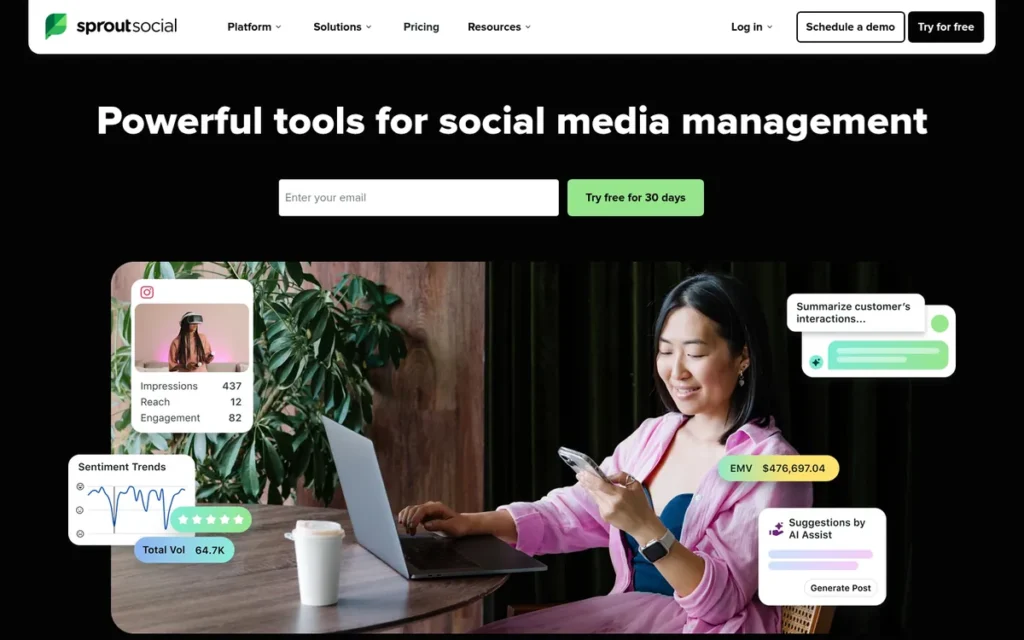
Category: Paid Social Analytics and Reporting Layer, a platform that provides advanced analytics, social listening, and paid performance reporting for social advertising campaigns but does not create, buy, or optimize ad campaigns. Sprout Social operates as an intelligence and reporting layer above native ad platforms, not as a replacement for Meta Ads Manager, LinkedIn Campaign Manager, or other campaign execution tools.
At a Glance
- Category: Paid Social Analytics and Reporting Layer
- Best For: Enterprise marketing operations teams, analytics-focused agencies, and B2B organizations that need advanced paid social performance reporting, social listening for campaign intelligence, and Salesforce CRM integration, and already manage campaign execution in native ad platforms or dedicated optimization tools
- Price Range: $99/seat/month (Standard, monthly) or $79/seat/month (annual); $149–$249/seat/month (Professional–Advanced); Enterprise custom; social listening is a paid add-on above standard plans
- Primary Strength: Sprout Social has won G2’s Best Software award for nine consecutive years as of 2026 (the longest streak in the social media management category) and provides the most advanced custom analytics dashboards, social listening coverage, and verified Salesforce CRM integration of any tool in this evaluation
- Biggest Limitation: Sprout Social’s annual contracts require written cancellation notice at least 30 days before renewal, current published terms accept email cancellation (successteam@sproutsocial.com); missing the 30-day deadline triggers automatic renewal for another full year at $99–$249/seat/month
- One-Line Summary: Sprout Social has won G2’s Best Software award for nine consecutive years and offers advanced analytics with Salesforce CRM integration, but does not create, buy, or optimize ad campaigns as of June 2026
- Last Verified: June 2026
Overview
Sprout Social is a premium social media analytics and reporting platform (publicly traded on NASDAQ (SPT), founded 2010, headquartered in Chicago) that provides advanced paid performance reporting, social listening, custom dashboards, and Salesforce CRM integration for enterprise marketing teams managing large-scale social programs.
As of June 2026, Sprout Social does not create, buy, or optimize ad campaigns; Sprout Social functions as an analytics and intelligence layer above Meta Ads Manager, LinkedIn Campaign Manager, and other native ad platforms. Sprout Social has received the G2 Best Software award for nine consecutive years as of 2026, the longest sustained G2 recognition streak in the social media management category.
Key Features
- Facebook and Instagram Paid Performance Report: Sprout Social’s Paid Performance Report automatically pulls up to 180 days of historical ad campaign data from connected Meta ad accounts (Sprout Social Help Center), presenting unified campaign-level metrics (spend, impressions, CPM, CTR, and conversions) for trend analysis and budget efficiency review without manual export from Meta Ads Manager.
- Cross-Channel Social Listening: Sprout Social’s social listening tool spans X, Reddit, YouTube, blogs, and forums, enabling marketing teams to research audience themes and trending topics before launching paid campaigns, then monitor audience sentiment and reactions across channels where native ad platform dashboards provide no visibility.
- Salesforce CRM Integration: Sprout Social’s Salesforce CRM integration: verified through Salesforce AppExchange as of June 2026, connects social media engagement activity to CRM pipeline records, enabling B2B marketing teams to attribute social campaign influence to pipeline stages and connect paid social investment to revenue outcomes.
- Smart Inbox for Dark Post Moderation: Sprout Social’s Smart Inbox monitors and enables responses to comments on both organic posts and paid dark posts, providing community management coverage for sponsored content that many teams miss when managing comments only within Meta Ads Manager’s native interface.
- Custom Dashboard Builder: Sprout Social’s custom dashboard builder (Advanced plan and above) enables enterprise marketing teams to create configurable analytics views combining metrics from multiple social platforms and reporting periods, producing executive-presentation-ready reports without manual data compilation from individual native dashboards.
Best For
Sprout Social is best for enterprise marketing operations teams, social media analytics leads, and analytics-focused agencies that produce formal quarterly paid social performance reports for C-suite stakeholders, particularly B2B organizations where Salesforce CRM integration and social listening for pre-campaign audience intelligence justify the $99–$249/seat/month premium as part of a broader enterprise analytics stack.
Pricing
Sprout Social pricing as of June 2026 (sproutsocial.com/pricing): Standard at $99/seat/month (monthly) or $79/seat/month (annual); Professional at $149/seat/month (monthly) or $124/seat/month (annual); Advanced at $249/seat/month (monthly) or $199/seat/month (annual); Enterprise at custom pricing. Social listening is a paid add-on on standard plans. Scheduled PDF report delivery is locked to the Advanced plan.
CRITICAL CONTRACT TERM: Sprout Social’s annual contracts require written cancellation notice at least 30 days before the contract renewal date. Current Sprout Social published terms (sproutsocial.com/legal/terms/) accept email cancellation to successteam@sproutsocial.com; some older enterprise contract variants documented in 2022 community accounts required certified mail. Regardless of format, missing the 30-day deadline triggers automatic renewal for another full year. Confirm your specific cancellation format, required deadline, and renewal date in writing with your Sprout Social account representative before signing.
Strengths
- Sprout Social has received the G2 Best Software award for nine consecutive years as of 2026 (the longest sustained G2 recognition streak in the social media management category) indicating consistent verified user satisfaction across nearly a decade rather than a single-year review volume spike.
- Sprout Social’s approximately 4.4/5.0 G2 rating is particularly meaningful in context: Sprout Social sustains this score at $99–$249/seat/month pricing where user expectations are highest, making a strong sustained rating at this price point a more demanding achievement than comparable ratings at lower-cost tiers.
- Sprout Social’s Salesforce CRM integration: verified through Salesforce AppExchange as of June 2026, enables enterprise B2B organizations to connect paid social campaign activity to pipeline attribution and revenue records, a cross-system connection that no other tool in this evaluation provides natively.
- Sprout Social’s social listening capability spanning X, Reddit, YouTube, and blogs provides pre-campaign audience intelligence gathering and in-flight campaign sentiment monitoring across channels where native Meta and LinkedIn analytics dashboards provide no insight into audience discussion or organic brand perception.
Limitations
- Critical Capability Gap: As of June 2026, Sprout Social does not create, buy, or optimize ad campaigns at any available plan tier, Sprout Social is an analytics and reporting layer, not an ad management platform. Buyers who purchase Sprout Social expecting Meta Ads Manager-equivalent campaign controls will not find those controls in the product, making this distinction critical at $99–$249/seat/month.
- Annual Contract Lock-In with Required Written Notice: Sprout Social’s annual contracts require written cancellation notice at least 30 days before the renewal date. Per current published terms (sproutsocial.com/legal/terms/), email notice to successteam@sproutsocial.com is the standard cancellation method; some older enterprise contract variants have historically required certified mail per 2022 community accounts. Missing the 30-day deadline results in automatic renewal for a full additional year, one user described being “stuck with them for another year” after missing the deadline (u/Morgan4441, r/socialmedia, 2022).
- Per-Seat Cost Escalation and Add-On Structure: Sprout Social’s per-seat cost model means every additional team member adds material monthly expense (a team of five on Annual Standard pays $3,948 annually for an analytics tool that still requires supplementary campaign execution platforms) and social listening is a paid add-on rather than an included feature on base plans.
- Post-Sale Support Deterioration: Multiple independent Reddit accounts document Sprout Social post-sale support declining significantly after contract signing, with reported communication gaps and difficulty with issue resolution, suggesting the platform’s enterprise sales motion prioritizes acquisition over retention for smaller enterprise accounts (u/Morgan4441, r/socialmedia, 2022).
“We used Sprout Social and had nothing but bad experiences after bad… Once you sign on the dotted line they disappear… You can only cancel in writing by mail a month before your signed contract date. Otherwise, you’re stuck with them for another year.” (u/Morgan4441, r/socialmedia)
Takeaway: The annual contract written notice requirement is the most consequential contractual risk in the Sprout Social evaluation, confirm your specific cancellation format (email per current published terms; some older contracts required certified mail), the required deadline, and the renewal date in writing before signing.
Verdict
Sprout Social earns its #6 ranking not because it is a poor product, nine consecutive G2 awards confirm genuine analytical quality, but because Sprout Social is fundamentally a paid social analytics platform rather than an advertising management platform, and this evaluation scores advertising capability depth as the primary criterion. For enterprise teams that understand Sprout Social’s role as an intelligence and reporting layer above native ad platforms, and specifically need its advanced custom reporting, Salesforce integration, and social listening capabilities, Sprout Social is the most credentialed analytics choice in this evaluation. Buyers who need actual campaign creation and optimization should pair Sprout Social with a dedicated ad tool such as Madgicx or Bïrch, or redirect budget to Agorapulse or Hootsuite, which provide ad creation and management alongside reporting.
7. AdCreative.ai: Best for AI-Powered Ad Creative Generation at Scale
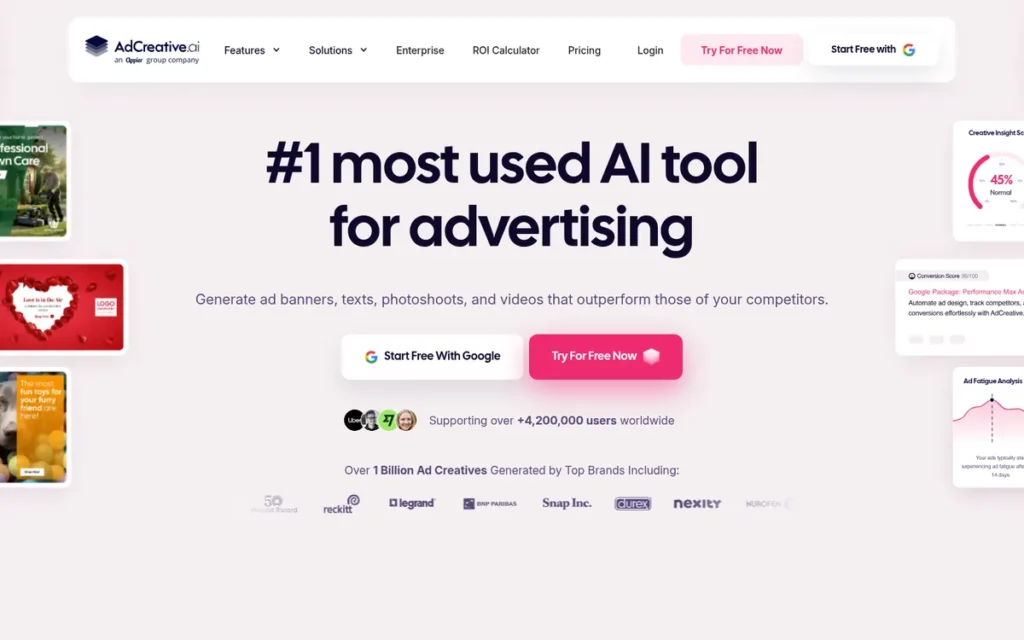
Category: AI Ad Creative Generator, a platform that uses generative AI trained on a large historical ad dataset (100M+ ads per independent sources; adcreative.ai documentation cites 450M, unverified by independent reviews) to produce conversion-scored ad images, videos, and copy for deployment across Meta, Google, LinkedIn, Instagram, Pinterest, and Microsoft Ads, without managing campaign execution or bidding.
At a Glance
- Category: AI Ad Creative Generator
- Best For: Performance marketers, ecommerce brands, and growth teams that need to rapidly generate large volumes of conversion-tested ad creative variations for systematic A/B testing, where manually designing 10, 20, or 50+ creative variants per campaign cycle would be cost or time prohibitive
- Price Range: Approximately $29/month entry-level (secondary sources only: not confirmed in verified third-party sources); credit-based tiers; verify current pricing and credit limits directly at adcreative.ai before subscribing
- Primary Strength: AdCreative.ai’s predictive conversion scoring model: trained on a large historical ad dataset, assigns each generated creative a 1–100 conversion likelihood score before launch, enabling performance marketers to prioritize likely-winning creatives without spending ad budget on initial test rounds
- Biggest Limitation: AdCreative.ai’s generated creative quality is characterized by community users as “hit or miss,” with outputs sometimes appearing template-generic across different brands; the credit-based pricing model on lower tiers can exhaust faster than anticipated for high-volume creative testing programs
- One-Line Summary: AdCreative.ai is an AI ad creative generation platform trained on 100M+ historical ads (per independent sources; adcreative.ai documentation cites 450M (not independently corroborated) that produces conversion-scored creatives for multi-platform paid social campaigns) the only tool of its kind in this evaluation and absent from all LLM responses reviewed for this evaluation (Perplexity and ChatGPT GPT-4o, June 2026)
- Last Verified: June 2026
Overview
AdCreative.ai is an AI-powered ad creative generation platform that uses a generative model trained on a large historical ad dataset to produce static image ads, video ads, and ad copy (each accompanied by a predicted conversion score (1–100)) enabling performance marketers to prioritize likely-winning creatives before committing ad budget to A/B testing rounds.
AdCreative.ai is a design production tool with performance scoring, not an ad manager: AdCreative.ai answers the question “which creative should I test first?”, not “how should I bid on it?” Teams should plan for AdCreative.ai as a creative production layer alongside an existing campaign management platform such as Bïrch, Madgicx, or Smartly.io, not as a standalone advertising solution. AdCreative.ai is entirely absent from all LLM responses reviewed for this evaluation (Perplexity and ChatGPT GPT-4o, June 2026) despite representing a distinct advertising software category.
Key Features
- Predictive Conversion Scoring (1–100): AdCreative.ai’s predictive conversion scoring assigns each AI-generated creative a 1–100 conversion likelihood score derived from patterns in a large historical ad dataset (api-docs.adcreative.ai), enabling performance marketers to rank creative outputs by predicted outcome before committing any paid media budget to testing, a pre-launch intelligence capability not offered by any other tool in this evaluation.
- Saliency AI Visual Attention Heatmaps: AdCreative.ai’s Saliency AI heatmap uses computational models to predict where a viewer’s eye will focus within a generated creative, enabling marketers to verify that the primary call-to-action, product image, or promotional offer is positioned in a high visual-attention area before the asset enters production.
- Six-Platform Creative Integration: AdCreative.ai integrates with Meta Ads, Google Ads, LinkedIn Ads, Instagram, Pinterest Ads, and Microsoft Ads for direct creative delivery (as well as with iStock, Google Drive, and OneDrive for brand asset sourcing) enabling multi-channel creative deployment without manual format adaptation across each platform’s native ad uploader (ai-cmo.net, 2025).
- CNN-Based Design Architecture: AdCreative.ai uses convolutional neural networks that apply rule-of-thirds composition principles, high-contrast color usage, and conversion-oriented visual hierarchy to AI-generated layouts, providing a documented technical basis for design choices in generated output rather than purely aesthetic or random generation (ai-cmo.net, 2025).
- Enterprise API for Programmatic Generation: AdCreative.ai offers enterprise API access for programmatic creative generation at scale, enabling large ecommerce brands to generate product-specific ad creative variants automatically from catalog data, relevant for high-SKU advertisers without the full enterprise platform cost of Smartly.io (api-docs.adcreative.ai).
Best For
AdCreative.ai is best for performance marketers, ecommerce growth teams, and digital advertising agencies that need to generate large volumes of static ad creative variations rapidly and systematically, particularly teams running structured A/B creative testing programs where manually designing 10, 20, or 50 creative variants per campaign cycle is cost-prohibitive or too slow to maintain a competitive creative refresh cadence.
Pricing
AdCreative.ai pricing was not fully confirmed in verified third-party sources during this research cycle. An entry-level price point of approximately $29/month is cited in secondary sources (Semrush documentation, 2025), but current pricing structure and credit limits must be verified directly at adcreative.ai before subscribing.
AdCreative.ai uses a credit-based download model, watermarked creative previews are available at most tiers, but downloading final production-ready assets requires credits. Users on lower-tier plans report faster-than-expected credit depletion for high-volume creative testing programs. Verify current pricing, credit limits per tier, and download terms directly at adcreative.ai; pricing as of June 2026 not confirmed in verified third-party sources.
Strengths
- AdCreative.ai’s generative model is trained on a large historical ad dataset: independent review sources (superprompt.com, walturn.com, 2025) cite 100M+ historical ads as the training basis, while AdCreative.ai’s own documentation cites 450 million; this empirical foundation for conversion scoring distinguishes AdCreative.ai from creative tools that generate assets without any performance prediction capability (ai-cmo.net, 2025).
- AdCreative.ai’s multi-platform creative integration spans Meta Ads, Google Ads, LinkedIn Ads, Instagram, Pinterest Ads, and Microsoft Ads, enabling direct creative delivery across six major advertising platforms from a single generation workflow, supporting multi-channel campaign teams without requiring manual format adaptation.
- AdCreative.ai fills a genuine category gap in this evaluation: no other platform in this study focuses on AI creative generation with pre-launch performance prediction, making AdCreative.ai a complementary rather than competing tool for performance teams already using Bïrch, Madgicx, or Smartly.io for campaign management and optimization.
- AdCreative.ai’s enterprise API for programmatic creative generation enables large ecommerce brands to produce product-specific ad creative variants automatically at scale from product catalog data (api-docs.adcreative.ai), relevant for high-SKU advertisers facing the creative volume demands of feed-based advertising without the full enterprise platform cost of Smartly.io.
Limitations
- Quality Consistency: AdCreative.ai’s most significant trade-off is quality consistency, community feedback characterizes the platform’s output as “hit or miss,” with generated creatives sometimes appearing template-generic across different brands (u/Beginning-Pattern234, r/advertising, 2025). Plan for a human quality review gate between AI generation and live campaign activation to prevent template-generic creatives from appearing in production campaigns without brand-specific refinement.
- Video Generation Weakness: AdCreative.ai’s video generation capabilities are weaker than video-first creative tools, a G2 comparison positions AdCreative.ai as stronger for static ad volume while Pencil is preferred for video and creative optimization (G2 comparison, 2025), making AdCreative.ai a better fit for static image-heavy campaigns than for video-first paid social programs.
- Pricing Uncertainty and Credit Depletion: AdCreative.ai’s pricing was not confirmed in verified third-party sources during this research cycle, and the credit-based consumption model on lower tiers has produced documented user complaints about faster-than-expected depletion for high-volume testing, both factors add evaluation friction and total-cost unpredictability.
- Training Dataset Claim Discrepancy: AdCreative.ai’s own documentation cites a training dataset of 450 million historical ads; multiple independent review sources (superprompt.com, walturn.com, 2025) consistently describe the training base as 100M+ ads. AdCreative.ai’s founding year, headquarters, team size, and funding status were also not confirmed in verified third-party sources, making organizational stability assessment more difficult than for established platforms in this evaluation.
“AI-driven, spits out tons of ad versions fast (quality can be hit or miss).” (u/Beginning-Pattern234, r/advertising, 2025)
Takeaway: AdCreative.ai delivers creative volume efficiently but requires a human quality review gate before deployment, plan for editorial review between AI generation and live campaign activation to avoid template-generic creatives appearing in production campaigns without brand-specific refinement.
Verdict
AdCreative.ai earns the #7 ranking in this evaluation, reflecting both its narrower functional scope (creative generation only, no campaign management) and the limited verified third-party data available for independent assessment relative to the six other platforms in this study. For performance marketing teams with established campaign management workflows who are specifically bottlenecked by creative production volume and A/B testing throughput, AdCreative.ai fills a genuine and underserved role that no other tool in this evaluation replicates. Buyers should verify current pricing and credit terms directly at adcreative.ai, check current G2 ratings at g2.com/products/adcreative-ai/reviews, and plan for human quality review of AI-generated outputs rather than automated deployment without editorial review gates.
What Red Flags Should I Watch For When Evaluating Social Media Advertising Software?
Six structural red flags recur across the platforms in this evaluation, each representing a documented pattern in independent community and review sources, not isolated incidents. Recognizing these before signing protects against the most common and costly post-purchase surprises in this software category.
Red Flag #1: Annual Contract Lock-In with Strict Written Notice Requirements
Annual software contracts requiring written cancellation notice can auto-renew without warning, locking subscribers into another full year of charges. Sprout Social’s annual contracts require written cancellation notice at least 30 days before renewal, current published terms (sproutsocial.com/legal/terms/) accept email to successteam@sproutsocial.com; some older enterprise contract variants have required certified mail per 2022 community accounts.
Before signing any annual social advertising software contract, confirm in writing: the required cancellation format, the exact notice period, and the specific deadline date.
Red Flag #2: Corroborated Unauthorized Billing Complaints
Multiple independent sources across Trustpilot, Capterra, and Reddit reporting unauthorized charges represents a documented pattern, not an isolated incident that one positive G2 rating can neutralize. Madgicx carries a Trustpilot TrustScore of 2/5 (verified June 2026) with billing complaints documented on Trustpilot, Capterra (2025: “Unauthorized Payment Taken – Refund Requested”), and Reddit r/PPC from multiple independent sources.
Verify current Trustpilot reviews for any platform before providing payment information, and request written billing terms before subscribing.
Red Flag #3: Total-Spend vs. Platform-Spend Billing
Some enterprise platforms charge fees on your entire ad spend across all tools, not only the portion managed through their platform. Smartly.io’s billing model includes this distinction, confirmed in independent community discussions at approximately 2–4% of total managed ad spend, meaning a brand spending $500,000/month total may pay $15,000/month at 3%, even if only $200,000 runs through Smartly.io.
Confirm in writing before signing: whether the platform fee applies to total managed ad spend or only to spend activated through this specific platform.
Red Flag #4: Core Features Locked Behind Tier Upgrades or Paid Add-Ons
If the capability that defined your purchase decision is gated behind a higher spend tier or paid add-on, your effective total cost is higher than the advertised entry price. Madgicx’s Tracking Pro (post-iOS14 attribution recovery) costs $49/month in addition to the $99/month base fee. Sprout Social’s social listening is a paid add-on above standard plans, and scheduled PDF reporting delivery is locked to the Advanced tier.
Recalculate total cost for all capabilities you actually need before committing to a base plan entry price.
Red Flag #5: Unconfirmed Multi-Platform Channel Support
Vendor claims about TikTok or cross-channel support should be verified through official partner directories or documented API integrations (not sales representative statements) before assuming coverage. Madgicx’s TikTok Ads support was not confirmed in verified third-party sources during this research cycle. Smartly.io’s TikTok integration is confirmed via platform partner documentation.
Require documented API partner confirmation before committing to a platform based on channel coverage claims.
Red Flag #6: Platform API Dependency Risk
Third-party platforms depend entirely on platform API access that can be restricted without notice. A 2025 Reddit report documented “Meta just keeps clawing back permissions and features rendering HS a useless product”, an ongoing structural risk for Hootsuite and all third-party social management tools (u/Backy22, r/SocialMediaMarketing, 2025).
For each tool you evaluate, identify which features are API-dependent, what the platform’s contractual commitment is if API access is reduced, and what your contingency workflow would be.
Pre-Sign Checklist
Before signing with any social advertising software platform, confirm these four items in writing:
- The exact cancellation method (online, email, or postal format) and notice period required under your specific contract
- Whether fees apply to total managed ad spend across all tools or only to spend activated through this platform
- What happens to active campaigns, automation rules, and historical reporting data if you cancel
- Whether pricing tier upgrades are automatic when you exceed a spend threshold or require your explicit approval
What Questions Should I Ask Before Choosing a Social Media Advertising Software Platform?
The questions below address the most consequential buyer mistakes documented in this evaluation, each derived from patterns in community and research data, not theoretical concerns. Use these questions in vendor sales conversations and verify answers in writing before signing.
Question #1: Does this tool do something native Meta Ads Manager or LinkedIn Campaign Manager genuinely cannot do for my account?
Native ad platform automation handles most use cases for accounts under approximately $100,000/month in managed spend, as documented by experienced practitioners in r/PPC and r/FacebookAds. Identify the specific workflow the third-party tool addresses that native automation genuinely cannot replicate.
Action: List the specific automation types or reporting capabilities you need. Verify that native Ads Manager cannot replicate them before paying a platform fee.
Question #2: At my current ad spend volume, does this platform’s monthly fee generate net-positive ROI, or does native automation cover my needs?
Platform fees ranging from $49/month (Bïrch Starter) to $4,000–$5,000/month (Smartly.io minimum) represent meaningful overhead that must generate equivalent or greater value in time savings or performance lift.
Experienced practitioners cite approximately $100,000+/month as the spending threshold where dedicated platforms consistently justify their overhead cost (u/fathom53, r/PPC).
Action: Calculate the platform fee as a percentage of your total managed ad spend. If it exceeds 3–5% of spend at your current volume, verify the specific workflow justification before committing.
Question #3: How transparent and auditable is the automation, can I explain every automated action to a client or compliance stakeholder?
Rules-based platforms like Bïrch produce an auditable trail, every action traceable to a specific configured rule with explicit conditions. AI-driven platforms like Madgicx make autonomous decisions that may not be fully explainable to clients or internal compliance teams.
Action: Determine which approach aligns with your client communication requirements and risk tolerance before selecting between AI-autonomous and rules-based automation architectures.
Question #4: What are the cancellation terms, and what happens to my campaigns and data if I miss the cancellation window?
Sprout Social requires written cancellation notice 30 days before annual contract renewal, confirm whether email or certified mail is required under your specific contract. Other platforms may have similar terms buried in contract language.
Action: Request explicit written answers before signing: What is the cancellation process? What format is required? What happens to live campaigns and historical data if you miss the deadline?
Question #5: Does this platform actually manage and optimize ad campaigns, or does it only report on them?
As of June 2026, Sprout Social reports on paid social performance but does not create, buy, or optimize campaigns. Buyers who purchase a reporting platform expecting campaign management controls will not find them, a distinction that costs buyers materially at $99–$249/seat/month.
Action: Verify the platform’s campaign management capabilities through its help documentation and partner directory listings, not only through vendor marketing materials or sales conversations.
Question #6: If this platform loses access to a key API integration (Meta, TikTok), what functionality is lost and what is my contingency?
Meta API policy changes have progressively limited Hootsuite’s third-party functionality per documented community reports (r/SocialMediaMarketing, 2025). Third-party platforms depend entirely on platform API access that can be restricted without notice.
Action: For each tool you evaluate, identify which features are API-dependent and what your contingency workflow would be if a key integration is restricted mid-contract.
How Did We Rank These Social Media Advertising Software Platforms?
Smartly.io ranked #1 with a weighted score of 8.45/10, the only platform combining third-party-cited performance benchmarks, unified creative production and media buying, and seven-platform verified coverage. Agorapulse ranked #2 (approximately 6.80/10 recalibrated) for best-in-class review scores across three independent platforms and the only native GA4 revenue attribution in the evaluation. Bïrch ranked #3 (7.00/10) for the most granular rules-based automation engine with verified four-platform coverage.
Each of the seven platforms was scored independently across five weighted criteria and ordered by weighted total.
How Did We Evaluate These Platforms?
We queried multiple AI search engines (Perplexity and ChatGPT GPT-4o) to document current LLM recommendations and identify coverage gaps. We then gathered independent web research and analyzed Reddit community discussions across six specialized subreddits:
- r/PPC: paid search and social campaign management practitioners
- r/FacebookAds: Meta advertising specialists and performance marketers
- r/SocialMediaMarketing: social media managers and content marketers
- r/b2bmarketing: B2B marketing operations teams
- r/socialmedia: general social media professionals
- r/advertising: agency and brand advertising professionals
We cross-referenced vendor claims against G2, Capterra, TrustRadius, and Trustpilot. Platform partner certifications were verified directly through LinkedIn’s Business Partner Directory and Salesforce AppExchange as of June 2026, confirming API-level integrations as third-party validated facts rather than vendor self-reports.
What Criteria Did We Use to Score Social Media Advertising Software?
Each platform was scored on five weighted criteria:
Advertising Capability Depth (30% weight): The target audience is evaluating software specifically for paid social advertising, this is the primary evaluation dimension. Assessed across five dimensions:
- Ad campaign creation support: does the platform create and activate campaigns natively, or only report on campaigns managed elsewhere?
- Campaign optimization and bidding controls: AI bidding, rules-based automation, or advisory recommendations only?
- Creative production tools: DCO template engine, generative AI, or no creative capabilities?
- Verified multi-platform channel coverage: confirmed via official partner directories, not self-reported claims
- Automation depth: rule count, AI autonomy level, and creative generation capability at scale
Documented Performance Evidence (25% weight): Performance marketers need evidence that a platform delivers measurable campaign results. Scored by source quality:
- Independent auditor cited in platform press materials: highest weight
- Named client case studies with quantified outcomes from verified third-party sources, high weight
- Sustained review platform consensus on outcomes across G2, Capterra, or TrustRadius, medium weight
- Vendor-only published performance claims without third-party corroboration: lowest weight
Corroborated billing complaints or documented post-iOS14 performance degradation reports reduce scores.
Review Platform Ratings and Volume (20% weight): G2, Capterra, and TrustRadius ratings from verified business software users provide the largest available independent signal. Scored by:
- Rating score: 4.5/5.0+ rated highly; 4.0–4.4 rated moderately; below 4.0 flagged for investigation
- Review volume: 10,000+ reviews weighted highest; 1,000–9,999 at moderate weight; under 100 at minimal weight
- Multi-platform consistency: same strong rating on G2 AND Capterra weighted above single-platform presence
- Trustpilot billing complaints corroborated by community sources reduce the score regardless of G2 rating
Pricing Transparency and Value-to-Cost Ratio (15% weight): Spend-based tiers, per-seat costs, credit-consumption models, and percentage-of-spend fees each create different risk profiles that buyers frequently misunderstand at time of purchase. Published pricing tiers scored higher than custom-only pricing. Flat monthly fees scored higher than spend-based or credit-consumption structures that can escalate unpredictably.
Operational Reliability and Contractual Safety (10% weight): Scored by years in continuous operation, documented billing complaint patterns across independent sources, contract exit terms, customer support quality from review evidence, and platform API dependency risks.
Do You Even Need a Third-Party Tool? Native Ads Manager vs. Paid Platforms
Experienced PPC practitioners in r/PPC and r/FacebookAds consistently document that native Meta Ads Manager automation handles most use cases below approximately $100,000/month in managed spend, without the platform overhead fee.
The community-documented argument is direct: “All these tools use FB’s API so whatever they do, you can do it yourself inside the ads manager” (u/Serafinium, r/FacebookAds, 2023). Third-party tools justify their cost when they do something native automation genuinely cannot:
- Cross-platform rule unification: Bïrch: Meta + Google + TikTok + Snapchat in one rule engine
- Exclusive API capabilities: Madgicx: AI Bidding available only through Meta partnership (verify billing first)
- Enterprise DCO and localization: Smartly.io: feed-driven 1,000+ variant creation for franchises
- Creative performance prediction: AdCreative.ai: 1–100 pre-launch conversion scoring
- GA4 revenue attribution: Agorapulse: native Google Analytics 4 social-to-revenue connection
Rough spend thresholds where dedicated platforms typically justify their cost: under $10K/month, evaluate native platform automation only; $10K–$100K/month, evaluate Bïrch or Madgicx if specific workflow gaps exist; $100K+/month, evaluate Smartly.io for enterprise multi-channel orchestration.
These are practitioner heuristics, not guaranteed ROI thresholds. Teams with complex multi-platform campaigns may find third-party tools valuable at lower spend. Assess specific workflow gaps before committing to platform cost.
How Did We Handle Conflicting Evidence and Community Sentiment?
When review platform ratings conflict with Reddit sentiment, this evaluation weights specificity and recency, a detailed 2025 Reddit post with documented evidence outweighs a generic 2023 G2 review. Billing complaints appearing in multiple independent sources (Trustpilot plus Reddit plus Capterra corroboration) are treated as documented patterns rather than isolated incidents, regardless of the platform’s G2 rating.
How Did We Validate Vendor Claims?
Vendor-reported statistics are labeled as such throughout this article. Only claims corroborated by at least one independent source are stated as fact. Key corrections from live verification include:
- Agorapulse’s G2 review count is approximately 971 (not 10,000+ as vendor marketing claims, verified at G2.com, June 2026)
- AdCreative.ai’s training dataset is cited as 100M+ by independent sources (not the vendor-claimed 450M, unverified by independent reviews)
- Sprout Social’s current published terms accept email cancellation, not postal-mail-only as some 2022 community accounts suggested
- Madgicx’s Trustpilot TrustScore is 2/5 as of June 2026: the lowest score among all platforms in this evaluation
When Was This Article Last Updated?
This article was last updated June 2026. Social media advertising software pricing, features, and platform partnerships change frequently, all pricing and rating data should be independently verified before purchase decisions. We update this guide quarterly.
Independence Statement
PlugRoute has no affiliate relationships with any company listed. Rankings are determined entirely by research data and objective evaluation criteria.
Frequently Asked Questions
What is the best social media advertising software for small businesses in 2026?
Agorapulse is the best choice for small businesses in 2026, it offers a free plan, paid plans starting at $69/month, a 4.5/5.0 rating on G2 and Capterra, and the only native GA4 revenue attribution in this evaluation. For pure ad automation at lower spend levels, Bïrch starts at $49–$69/month with a 14-day free trial requiring no credit card and covers Meta, Google, TikTok, and Snapchat.
Can Sprout Social manage my Facebook and Instagram ad campaigns?
No, as of June 2026, Sprout Social cannot create, buy, or optimize Facebook or Instagram ad campaigns at any plan tier. Sprout Social is an analytics platform that reports on paid performance but does not replace Meta Ads Manager for campaign execution. Teams needing both analytics and campaign management should consider Hootsuite, Agorapulse, or pairing Sprout Social with a dedicated ad platform such as Madgicx or Bïrch.
Glossary: Key Terms Used in This Comparison
Dynamic Creative Optimization (DCO): A technology that automatically generates and tests large numbers of ad creative variations by combining elements such as product images, prices, copy, and localized content in real time. DCO engines, like the one used by Smartly.io, enable brands to serve thousands of tailored ad variants simultaneously without manual production of each individual asset.
Rules-Based Automation: A campaign optimization approach in which advertisers define explicit, auditable if/then logic, such as “if ROAS drops below 2.0 AND spend exceeds $500 in 24 hours, pause the ad set”, that the platform executes automatically. Unlike AI-autonomous optimization, rules-based automation produces a transparent action log where every campaign change is traceable to a specific configured condition.
App Tracking Transparency (ATT): Apple’s iOS 14+ privacy framework that requires apps to obtain explicit user permission before tracking activity across third-party apps and websites. ATT significantly reduced the volume and accuracy of conversion signals available to Meta advertisers, prompting the development of post-iOS14 attribution workarounds such as third-party attribution integrations and first-party tracking add-ons.
GA4 Revenue Attribution: The practice of connecting specific social media posts, campaigns, or conversations to measurable website revenue outcomes using Google Analytics 4 as the data layer. Native GA4 attribution (as offered by Agorapulse) automatically tags social content with UTM parameters and maps resulting traffic and conversions back to the originating social activity.
Conversion Scoring: A predictive capability, used by platforms such as AdCreative.ai, that assigns each piece of ad creative a numerical likelihood score (typically on a 1–100 scale) estimating its probability of driving conversions before the creative is deployed in a live campaign. Scores are derived from patterns identified in large historical ad performance datasets.