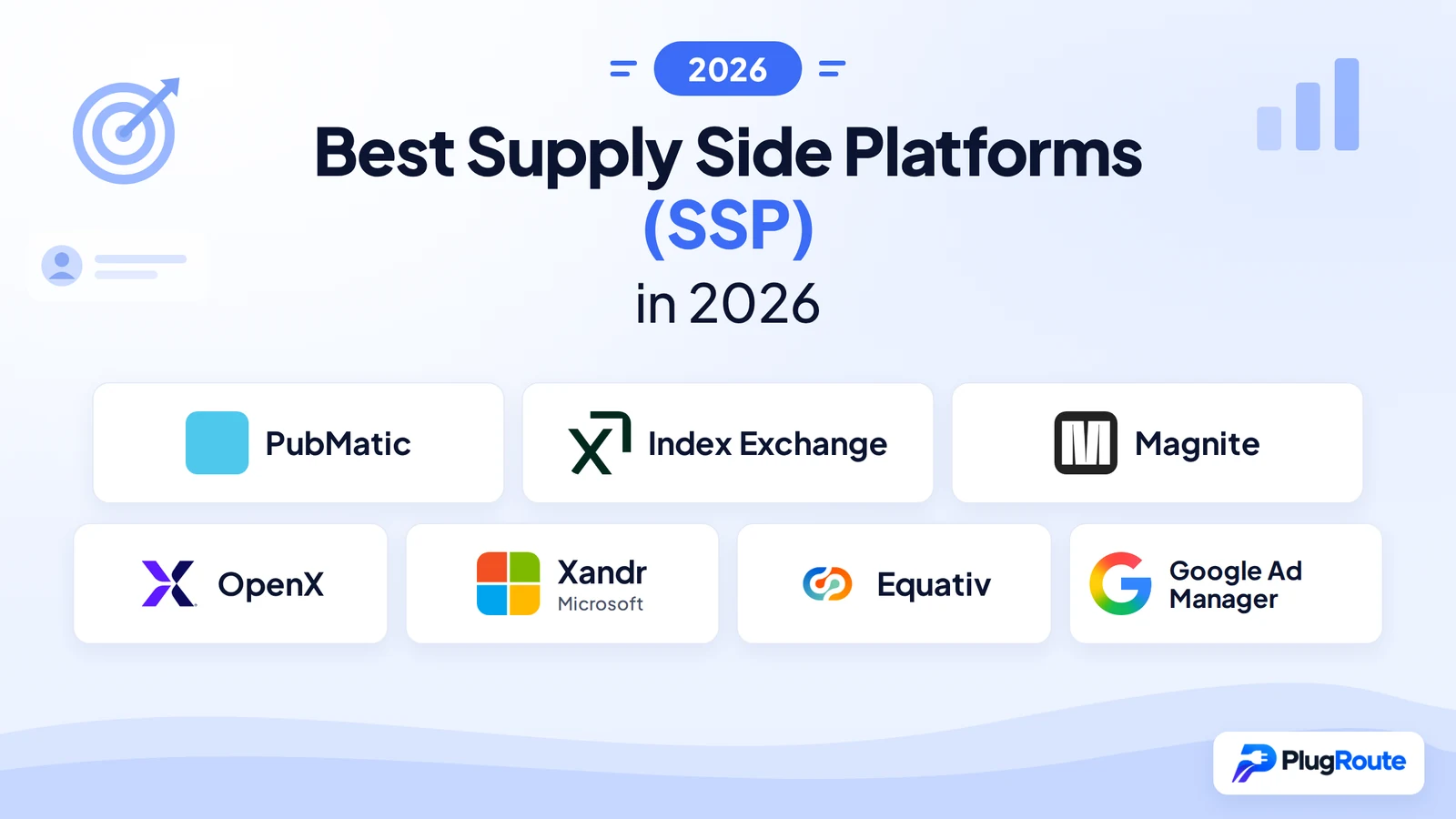
PubMatic ranks as the best overall independent SSP for publishers in 2026, Index Exchange leads on supply chain transparency and conflict-free structure, Magnite is the definitive choice for CTV and streaming inventory, and Equativ is the only full-stack Google Ad Manager alternative for European publishers.
The most widely deployed platform, Google Ad Manager, ranks last on objective merit criteria while remaining necessary infrastructure for enterprise publishers. Three questions determine SSP selection: which platform takes the smallest cut of auction revenue, which SSPs the largest programmatic buyers prefer in 2026, and which platform supports your specific inventory type without long-term lock-in risk. This article answers all three with verifiable, dated evidence, including the only confirmed SSP take rate in this category, established through U.S. federal court filings.
PlugRoute has no affiliate relationships with any company listed in this article, rankings are determined entirely by research data and objective evaluation criteria, and no company paid for inclusion, ranking position, or editorial treatment.
“We tried to move away from GAM but our CPMs dropped 30–40% because AdX demand just doesn’t flow the same way through other integrations. It’s a real lock-in.” (r/programmatic community discussion (2024))
Takeaway: CPM lock-in from Google AdX demand is a documented structural reality, this article accounts for it by ranking Google as necessary infrastructure for enterprise publishers while ranking it last on objective merit criteria including take rate, legal status, and conflict-free structure.
TL;DR: Top Picks at a Glance
- PubMatic: best overall independent SSP for mid-to-large publishers scaling omnichannel programmatic monetization
- Index Exchange: best for verifiable supply chain transparency and zero DSP conflict
- Magnite: best for CTV, streaming video, and connected TV inventory
- Equativ: best full-stack Google Ad Manager alternative for European publishers
- OpenX: best for premium brand-safe publishers maximizing private marketplace CPMs
- Xandr (Microsoft): best for B2B and enterprise technology publishers seeking exclusive LinkedIn audience demand
- Google Ad Manager: unavoidable demand infrastructure for enterprise publishers; ranked last on objective merit criteria for take rate, legal status, and conflict-free structure
What Are the Different Types of Supply Side Platforms?
Supply side platforms fall into three structural types: conflict-free independent SSPs, platform-integrated SSPs with buy-side DSP conflicts, and full-stack SSPs offering both an ad server and SSP in a single platform. The type determines whether the SSP’s financial incentives are fully aligned with maximizing publisher revenue.
Conflict-Free Independent SSPs include PubMatic, Index Exchange, OpenX, Magnite, and Equativ. These platforms operate exclusively on the sell side with no financial stake in buyer bidding behavior, their incentive structure is purely aligned with publisher revenue maximization in every auction.
Platform SSPs with DSP Conflicts include Google Ad Manager (DSP: DV360) and Xandr/Microsoft (DSP: Invest). Both operate a buyer-side DSP competing against third-party buyers for publisher inventory in the same auction. The April 2025 federal antitrust ruling by Judge Leonie Brinkema specifically cited this structure as illegally anticompetitive in Google’s case.
Full-Stack SSPs offer an integrated publisher ad server plus SSP in one solution. Google Ad Manager and Equativ both provide this combination. Equativ is the only independent full-stack option, the only non-Google platform that can replace both Google Ad Manager’s ad server and a separate third-party SSP in a single migration.
One structural dynamic publishers must understand: when a competing SSP wins an impression through Google Open Bidding, that SSP pays Google a 5–10% facilitation fee per winning transaction. This makes Google-mediated supply paths structurally more expensive for buyers, driving major DSPs and agency trading desks to route spend through direct Prebid.js paths instead.
How Do These 7 SSPs Compare at a Glance?
| Rank | SSP | Category | Best For | One-Line Summary | Take Rate (Source) | SPO Status | Primary Strength | Key Limitation |
|---|---|---|---|---|---|---|---|---|
| 1 | PubMatic | Omnichannel Independent | Mid-large publishers, display + video + CTV | PubMatic is the highest-rated independent SSP by G2 score (4.3/5, 180+ reviews) with documented preferred supply partner status with GroupM and Havas, 15+ identity frameworks, and NASDAQ-listed financial transparency. | ~10–15% (SEC ex-TAC estimate) | GroupM (PubMatic IR press release, March 2021); Havas (PubMatic IR press release, August 2022); Omnicom via Activate product launch (AdExchanger, 2023) | Identity Hub: 15+ identity frameworks | Server-side OpenWrap requires developer resources |
| 2 | Index Exchange | Publisher-First Independent | Premium publishers prioritizing supply chain integrity | Index Exchange is the most structurally transparent independent SSP; founder-owned since 2001 with zero outside investors, exclusively sell-side with no DSP in its 23-year history, and a confirmed preferred supply partner with GroupM. | ~10–15% (industry estimate, not independently confirmed) | GroupM (AdExchanger SPO coverage, 2020–2023) | Zero DSP conflict; 23-year founder-owned independence | Selective onboarding; documented rejection rate |
| 3 | Magnite | CTV/Streaming Specialist | CTV and streaming video publishers | Magnite is the largest independent omnichannel SSP by revenue ($580.4M FY2023) with the only independent-owned CTV ad server (SpringServe) and streaming partnerships with Disney, Fox, and Roku. | ~10–15% (SEC ex-TAC estimate) | No confirmed named preferred partnerships per public documentation as of June 2026 | SpringServe CTV ad server; Disney/Fox/Roku partnerships | Post-acquisition UI fragmentation; inconsistent account management |
| 4 | OpenX | Premium Curated Independent | Premium brand-safe content publishers | OpenX is the first CarbonNeutral® certified ad exchange (2022), a Prebid.org founding board member, and an ANA/ISBA model for programmatic transparency; with documented 15–31% PMP CPM uplifts. | ~10–15% (industry estimate, not independently confirmed) | No confirmed named preferred partnerships per public documentation as of June 2026 | CarbonNeutral® certification (2022); 15–31% documented PMP CPM uplift | High selectivity; documented onboarding rejection rate |
| 5 | Xandr (Microsoft) | Enterprise Addressable | B2B and professional content publishers | Xandr (Microsoft) is the only SSP providing programmatic access to LinkedIn B2B audience targeting and Microsoft O&O demand from MSN, Bing, and Outlook as of June 2026; uniquely valuable for B2B publishers. | ~10–15% (industry estimate, not independently confirmed) | No confirmed named preferred partnerships per public documentation as of June 2026 | Exclusive LinkedIn B2B audience demand (as of June 2026); Console reporting platform | Invest DSP conflict; strategic uncertainty under Microsoft |
| 6 | Equativ | Full-Stack Independent | European publishers; GAM-exit seekers | Equativ is the only full-stack SSP in this evaluation with a native publisher ad server, GDPR-native consent management, and Sharethrough native advertising demand from 2,000+ advertisers. | ~10–15% (industry estimate, not independently confirmed) | No confirmed named preferred partnerships per public documentation as of June 2026 | GDPR-native full-stack; Sharethrough native demand (2,000+ advertisers) | Weaker U.S. demand depth; PE ownership introduces future uncertainty |
| 7 | Google Ad Manager | Demand-Leader Ad Server + SSP | Enterprise publishers (unavoidable at scale) | Google Ad Manager is the world’s most deployed publisher ad platform; but its court-confirmed 20% take rate, April 2025 federal monopoly ruling, Open Bidding facilitation fee, and PPID-only identity approach make it the lowest-ranked SSP by objective transparency and conflict-free criteria in this evaluation. | ~20% (confirmed; U.S. DOJ court filing, 2023) | N/A; buyers actively deweighting Open Bidding paths | Estimated 40–50% of global programmatic display demand (eMarketer, 2024); free small-publisher tier | Federal monopoly ruling (April 2025); 20% take rate; DV360 conflict; PPID-only identity |
Which SSP Should I Choose for My Use Case?
| Your #1 Priority | Recommended Tool | Why | Acceptable Alternative |
|---|---|---|---|
| Best overall independent SSP | PubMatic | 4.3/5 G2 (180+ reviews); GroupM and Havas preferred supply partner; 15+ identity frameworks | Index Exchange (if higher publisher selectivity is acceptable) |
| Maximum supply chain transparency; zero DSP conflict | Index Exchange | Founder-owned since 2001; no DSP in 23-year history; GroupM preferred; published transparency report | OpenX (Prebid.org founding board member, ANA/ISBA model) |
| CTV or streaming video inventory | Magnite | SpringServe CTV ad server; Disney, Fox, Roku partnerships | Xandr (addressable TV and Microsoft O&O demand) |
| Premium brand-safe PMPs and post-cookie identity | OpenX | ANA/ISBA transparency model; 15–31% documented PMP CPM uplift | Index Exchange (strong PMP deal marketplace) |
| B2B, enterprise technology, or professional content | Xandr | Exclusive LinkedIn B2B audience demand (no other SSP provides this as of June 2026) | Index Exchange (conflict-free supplemental demand) |
| European publisher; GDPR-native compliance; exit Google Ad Manager | Equativ | Only full-stack GAM alternative with GDPR-native consent; 28% revenue lift case study | PubMatic (strong U.S. demand supplement) |
| Small publisher under 5M monthly visitors | Google Ad Manager (free tier) | Most accessible entry point; GAM Small Business free up to ~90M monthly impressions | PubMatic (add as scale grows) |
| Enterprise publisher at 50M+ monthly unique visitors | Google Ad Manager + PubMatic + Index Exchange | AdX demand non-optional; add independent SSPs for competitive pressure and SPO coverage | Magnite (for video/CTV inventory alongside display stack) |
Publisher Stack Examples
Common real-world multi-SSP configurations:
- Enterprise display + video publisher: Google Ad Manager (ad server + AdX access) + PubMatic (header bidding primary) + Index Exchange (header bidding secondary for SPO coverage)
- CTV-first publisher: Magnite SpringServe (CTV ad server + SSP) + Xandr (addressable TV demand + Microsoft O&O) + PubMatic (display/mobile supplement)
- European GDPR-exit publisher: Equativ (full-stack replacing Google Ad Manager) + PubMatic (North American demand supplement)
1. PubMatic: Best Overall Independent SSP
Category: Omnichannel Independent SSP, connects publisher display, video, mobile, CTV, and audio inventory to 300+ demand partners with no buy-side conflicts and public-company financial transparency verified through quarterly SEC filings.
At a Glance
- Category: Omnichannel Independent SSP
- Best For: Mid-to-large digital publishers running display, video, mobile, and CTV inventory who prioritize SPO-preferred demand access, cookieless identity readiness, and independently verifiable platform transparency
- Price Range: ~10–15% platform take rate (industry estimate from public ex-TAC SEC filings); publisher retains approximately 85–90% of gross auction revenue; no published pricing page; terms negotiated directly
- Primary Strength: PubMatic holds documented preferred supply partner status with GroupM (PubMatic IR press release, March 2021) and Havas Media Group North America (PubMatic IR press release, August 2022), with Omnicom Media Group participating in the Activate SPO product launch (AdExchanger, 2023)
- Biggest Limitation: PubMatic’s most powerful tools: OpenWrap server-side and the Connect data platform, require dedicated technical ad ops or developer resources, making the full feature set inaccessible to lean publisher teams without engineering support
- One-Line Summary: PubMatic is the highest-rated independent SSP by G2 score (4.3/5, 180+ reviews) with documented preferred supply partner relationships, 15+ cookieless identity frameworks per PubMatic product documentation (June 2026), and NASDAQ-listed financial transparency, making it the strongest overall independent SSP choice for publishers scaling programmatic monetization in 2026.
- Last Verified: June 2026
Overview
PubMatic is an independent omnichannel sell-side platform (NASDAQ: PUBM) that helps mid-to-large digital publishers monetize display, video, mobile, CTV, and audio inventory across 300+ demand partners with no buy-side conflicts. PubMatic’s quarterly SEC filings provide financial transparency that no private competitor in this evaluation can match.
PubMatic’s core products include OpenWrap (processing 1 trillion+ monthly impressions in both client-side and server-side configurations), Identity Hub (supporting 15+ cookieless identity frameworks simultaneously per PubMatic product documentation, June 2026), and Connect (a first-party audience data activation platform). PubMatic reported $270.3 million in FY2023 revenue with CTV growing 21% year-over-year per SEC filings.
Key Features
- OpenWrap Header Bidding (1 Trillion+ Monthly Impressions): PubMatic’s OpenWrap processes over 1 trillion ad impressions monthly in both client-side Prebid.js and server-side configurations, reducing page load latency and Core Web Vitals impact for publishers concerned about the SEO implications of running header bidding.
- Identity Hub (15+ Frameworks): PubMatic Identity Hub aggregates 15+ post-cookie identity frameworks, including Unified ID 2.0, LiveRamp ATS, ID5, and PubCommon ID, into a single integration per PubMatic product documentation (June 2026), giving publishers broad identity signal coverage as third-party cookies continue to deprecate across Chrome and Safari environments.
- Connect First-Party Data Platform: PubMatic’s Connect platform enables publishers to activate first-party audience data in programmatic auctions, packaging known audience segments into private marketplace deals that command CPM premiums above standard open auction rates without requiring complex DMP integrations.
- AI-Driven Floor Price Optimization: PubMatic’s AI-powered floor pricing within Identity Hub adjusts minimum CPMs dynamically by audience segment, device type, geography, and identity signal presence, enabling revenue uplift on mixed-signal traffic that static manual floor configurations miss, as documented in multiple dated Capterra reviews from 2023–2025.
- Owned Infrastructure (70%+ Gross Margins): PubMatic operates owned data center infrastructure across 8 global regions, generating 70%+ gross margins in FY2023 per SEC filings, an advantage reinvested in product development and publisher revenue share rather than cloud infrastructure costs.
Best For
PubMatic is best for mid-to-large digital publishers with display, video, or CTV inventory who need a financially transparent independent SSP with documented buyer supply partner relationships, comprehensive multi-ID cookieless identity coverage, and accessible onboarding, without the extreme traffic thresholds imposed by OpenX or Index Exchange for mid-size publishers.
Strengths
- Documented Preferred Supply Partner Status with Major Buying Organizations: PubMatic holds confirmed preferred supply partner status with GroupM (named in PubMatic’s March 2021 investor relations press release) and Havas Media Group North America (named in PubMatic’s August 2022 press release), with Omnicom Media Group Germany participating in the Activate SPO product launch (AdExchanger, 2023), relationships that directionally increase bid density and CPMs for PubMatic publishers as these organizations route more programmatic spend through preferred supply paths.
- Highest G2 Rating Among Independent SSPs (4.3/5, 180+ Reviews): PubMatic earned a 4.3/5.0 G2 rating across 180+ reviews (the highest rating and highest review volume of any SSP in this evaluation) with consistent reviewer praise for reporting transparency, OpenWrap integration quality, and account management responsiveness versus Google Ad Manager.
- Highest Disclosed Multi-ID Identity Framework Count Among Evaluated SSPs: PubMatic Identity Hub supports 15+ cookieless identity frameworks simultaneously per PubMatic’s product documentation (June 2026) (the highest disclosed count among SSPs in this evaluation) enabling dynamic floor price optimization by identity signal quality on mixed-signal traffic, as praised in multiple dated Capterra reviews from 2023–2025.
- Public-Company Financial Transparency: PubMatic (NASDAQ: PUBM, FY2023 revenue $270.3M, CTV revenue +21% YoY per Q4 2023 Earnings) is the only independent SSP in this evaluation whose financial health can be independently audited through SEC EDGAR filings, a meaningful due-diligence signal for publishers evaluating long-term platform dependency.
Users on r/adops shared their PubMatic implementation experience:
“I work at a large publisher. OpenWrap was a good option for web and app. Platform is very intuitive. Their implementation team pretty much did most of the work and I just needed to coordinate the SSP implementation with SSP support.” Posted by u/FeastieBoy
Takeaway: Large publishers with dedicated ad ops support report that PubMatic’s implementation team absorbs the OpenWrap setup burden, making the platform more accessible in practice than the server-side complexity cited in technical evaluations would suggest.
Limitations
- Server-Side Implementation Requires Developer Resources: PubMatic’s most impactful capabilities (OpenWrap server-side bidding and the Connect first-party data platform) require developer-level implementation beyond standard ad ops configuration; publishers without dedicated engineering staff cannot access the server-side features that most distinguish PubMatic from simpler alternatives. For lean publisher teams, PubMatic’s practical differentiation is limited to standard client-side header bidding and open auction functions broadly comparable to competing SSPs.
- Display CPMs for Non-Premium Traffic: PubMatic’s display CPMs for non-premium or long-tail traffic can lag behind Google AdX for publishers whose inventory does not qualify for PubMatic’s strongest demand partners, making PubMatic most competitive for publishers with brand-safe content and identifiable audience segments rather than commodity traffic.
- Emerging Market Demand Gaps: PubMatic’s demand network is strongest in North America and Western Europe, with r/adops discussions and G2 reviewer feedback (2023–2025) documenting thinner programmatic demand in certain emerging geographic markets where Google’s international network maintains stronger advertiser relationships.
- AI Floor Pricing Recommendation Opacity: PubMatic’s AI-based floor price optimization recommendations within Identity Hub lack user-facing explanation of their underlying logic per multiple dated Capterra reviews (2023–2025), making recommendations difficult to audit independently or present to revenue leadership as evidence-based decisions, particularly for ad ops teams without dedicated programmatic analysts.
“OpenWrap is solid but you really need a developer to set it up properly on the server-side. Don’t expect it to be plug-and-play if you’re a small publisher without tech resources.” (r/programmatic community discussion (2024))
Takeaway: Server-side OpenWrap requires developer-level implementation, publishers without technical ad ops resources access only PubMatic’s standard client-side capabilities, not the full server-side differentiation that supports its top ranking.
Verdict
PubMatic is the highest-rated independent SSP in this evaluation (4.3/5.0 G2, 180+ reviews) with documented preferred supply partner relationships with major buying organizations, the highest disclosed multi-ID identity framework count among evaluated SSPs, and public-company financial transparency, making it the strongest overall choice for mid-to-large publishers seeking a conflict-free, evidence-based SSP in 2026. Publishers scaling from display into video and CTV will find PubMatic’s CTV revenue trajectory (21% YoY in FY2023, 24% total revenue growth in Q1 2024 per SEC filings) and server-side OpenWrap infrastructure well-positioned for the industry’s format shift. The primary caveat is technical: server-side OpenWrap requires developer resources, meaning publishers without engineering support access only PubMatic’s standard capabilities rather than its full platform differentiation.
2. Index Exchange: Best for Publisher-First Transparency and Supply Chain Integrity
Category: Publisher-First Independent SSP (a founder-owned, sell-side-only marketplace that has never operated a DSP, never raised outside capital, and publishes supply chain transparency reports) creating the most structurally verifiable conflict-free publisher monetization environment of any SSP in this evaluation.
At a Glance
- Category: Publisher-First Independent SSP
- Best For: Premium and enterprise publishers with established brand-safe, scale inventory who prioritize verifiable supply chain transparency, conflict-free sell-side operations, and confirmed preferred supply positioning with major programmatic buyers
- Price Range: ~10–15% platform take rate (industry estimate; no public disclosure); publisher retains approximately 85–90%; no additional fees for PMP setup or header bidding integration support; terms negotiated directly
- Primary Strength: Index Exchange is the only major SSP that has never operated a DSP throughout its documented 23-year history, never raised outside capital, and publishes supply chain transparency reports, creating demonstrably conflict-free publisher monetization that no SSP with a DSP arm can structurally match
- Biggest Limitation: Index Exchange applies selective publisher onboarding criteria that result in meaningful rejection rates and multi-week approval timelines for publishers who cannot demonstrate sufficient traffic scale and brand safety standards, making it effectively inaccessible to mid-tier or smaller publishers
- One-Line Summary: Index Exchange is the most structurally transparent independent SSP in the market (founder-owned since 2001 with zero outside investors, exclusively sell-side with no DSP in its documented 23-year history, and a confirmed preferred supply partner with GroupM) making it the highest-trust option for premium publishers prioritizing supply chain integrity.
- Last Verified: June 2026
Overview
Index Exchange is a global independent SSP founded in 2001 as Casale Media (rebranded in 2015), operating exclusively on the sell side with no DSP operations, no outside investors, and 100% founder-family control, making it the most structurally conflict-free SSP at scale in the programmatic market as of June 2026. Index Exchange’s products include the IX Marketplace (SSP/exchange), Publisher IX (unified reporting and yield optimization suite), a Deal ID marketplace for private transactions, and IX Identity (a first-party data and cookieless solution).
Index Exchange has been a founding member of Prebid.org since its inception and processes approximately 130 billion ad requests daily across a buyer pool of 40,000+ active advertiser relationships. Index Exchange has never accepted outside capital in its 23-year operating history, the only major SSP of its scale to remain entirely founder-family controlled without venture capital, private equity, or public shareholder pressure.
Key Features
- Exclusively Sell-Side Throughout Its Documented 23-Year History: Index Exchange has operated exclusively on the sell side without a DSP since its founding as Casale Media in 2001, ensuring financial incentives are never split between publisher revenue maximization and buyer-side margin, a structural guarantee that SSPs with DSP arms cannot provide.
- Prebid.org Founding Membership: Index Exchange is a founding member of Prebid.org and participates in open-standard header bidding via Prebid adapters rather than a proprietary wrapper, meaning publishers can integrate Index Exchange into any existing header bidding stack without introducing new vendor switching costs or wrapper lock-in.
- Published Supply Chain Transparency Report: Index Exchange publishes a supply chain transparency report documenting its auction mechanics, bid pricing policies, IVT filtering methodology, and anti-manipulation commitments, making it one of fewer than 10% of SSPs to publicly disclose these operational details that buyers use to evaluate supply chain trustworthiness in SPO program design.
- Proactive Yield Optimization Account Management: Index Exchange’s Publisher IX reporting interface, combined with account teams that G2 reviewers across 2023–2025 credit with proactive yield optimization guidance (including floor pricing recommendations, PMP opportunity identification, and header bidding configuration advice) produces measurable revenue improvements beyond reactive break-fix support.
- 130 Billion Daily Ad Requests: Index Exchange processes approximately 130 billion ad requests daily with 99.99% uptime SLAs, connecting publishers to 40,000+ active advertiser relationships globally with no facilitation fee charged to competing SSPs participating in publisher auctions.
Best For
Index Exchange is best for premium and enterprise-scale publishers with established brand-safe inventory who can meet its selective onboarding criteria and prioritize the most structurally verifiable conflict-free independent SSP available, particularly publishers who have made supply chain integrity and SPO-preferred positioning a strategic monetization priority rather than secondary to platform convenience.
Strengths
- Confirmed Preferred Supply Partner with GroupM: Index Exchange is documented as a preferred SSP partner with GroupM (the world’s largest media investment firm) per AdExchanger’s SPO coverage from 2020 through 2023, representing buyer-validated supply chain trustworthiness that directionally increases bid density and CPMs for Index Exchange publishers as GroupM routes more programmatic spend through preferred supply paths.
- 100% Founder-Owned, Zero Outside Capital Since 2001: Index Exchange has been 100% founder-family owned with zero outside equity since its founding as Casale Media in 2001 (the only SSP of its scale to operate without venture capital, private equity, or public shareholder pressure) enabling multi-decade publisher relationship building without LP return timelines or quarterly earnings management that shape decision-making at every other major SSP.
- Proactive Account Management (Validated in G2 Reviews 2023–2025): G2 reviewers from 2023–2025 consistently cite Index Exchange account management as uniquely proactive, providing floor pricing recommendations, PMP opportunity identification, and header bidding configuration advice that publishers credit with measurable revenue improvements, going beyond the reactive break-fix support model described at other SSPs.
- Published Supply Chain Transparency Report: Index Exchange is one of fewer than 10% of SSPs to publish a supply chain transparency report (publicly disclosing auction mechanics, IVT filtering methods, and bid pricing policies that sophisticated SPO-focused buyers reference before routing programmatic spend) reinforcing its Prebid.org founding member credentials and publisher-first philosophy.
Publishers running multiple independent SSPs head-to-head discussed relative revenue performance on r/adops:
“From our perspective (Nordic based network) we only run PubMatic, Magnite, Index Exchange. And looking at incremental value for each of these, in our network, the order is as follows:
- Index Exchange
- Rubicon
- PubMatic
So purely on revenue as the KPI.” Posted by u/Peters_Jakob
Takeaway: Among publishers running PubMatic, Magnite, and Index Exchange simultaneously in live yield stacks, Index Exchange ranks first for incremental revenue contribution (ahead of Magnite (listed under its legacy “Rubicon” brand name) and PubMatic) real-world confirmation that preferred supply partner status translates to measurable CPM outperformance.
Limitations
- Selective Publisher Onboarding with Documented Rejection Rate: Index Exchange’s selective onboarding criteria (applying meaningful traffic scale and brand safety evaluation requirements) results in documented rejection experiences described consistently in r/Publishers and r/adops communities, where smaller and mid-tier publishers report multi-week approval processes and outright rejections; this selectivity maintains supply quality but makes Index Exchange practically inaccessible for publishers below established-premium scale.
- Lower G2 Review Volume and Rating: Index Exchange’s 3.9/5.0 G2 rating with only 60+ reviews reflects a smaller, more specialized publisher base than more accessible SSPs, the lower review count is a product of its premium market positioning, not performance deficiency, but provides a narrower composite signal than PubMatic’s 180+ reviews for publishers evaluating the platform without prior experience.
- Limited Self-Service Reporting Depth: Index Exchange’s out-of-the-box reporting interface receives fewer accolades for self-service analytics granularity than PubMatic’s dashboard or Xandr’s Console platform per G2 reviewer feedback from 2023–2025, specifically, the absence of a custom query-based reporting interface that enterprise ad ops teams find in competing SSP dashboards.
- Emerging Format Development Velocity: Index Exchange’s feature development in newer ad formats (particularly CTV, audio, and DOOH) is less aggressive than Magnite’s or PubMatic’s dedicated investment in those categories, making it a less compelling primary SSP recommendation for publishers whose inventory mix is shifting rapidly toward streaming formats.
“IX doesn’t take a lot of small publishers. We tried to get onboarded and it took weeks and they were selective about it. Once you’re on, it’s great, but entry is harder than other SSPs.” (r/Publishers community discussion (2024))
Takeaway: Index Exchange’s onboarding selectivity is real and documented across multiple community accounts, publishers should contact Index Exchange directly to confirm eligibility before allocating engineering resources to integration.
Verdict
Index Exchange is the most structurally verifiable conflict-free SSP in this evaluation, founder-owned since 2001, exclusively sell-side with no DSP throughout its documented 23-year history, confirmed preferred supply partner with GroupM, and one of the only SSPs to publish a supply chain transparency report, making it the definitive choice for premium publishers who qualify for its onboarding standards and place supply chain integrity at the center of their SSP strategy. The critical caveat is access: Index Exchange’s selectivity is a genuine barrier for publishers below premium scale, and the lower G2 rating (3.9/5.0, 60+ reviews) versus PubMatic (4.3/5.0, 180+) reflects a smaller, more specialized publisher base rather than performance deficiency. For enterprise and premium publishers who qualify, Index Exchange provides the most trustworthy independent SSP architecture available in 2026.
3. Magnite: Best for CTV and Streaming Video Monetization
Category: CTV/Streaming Specialist SSP, the world’s largest independent omnichannel SSP by revenue ($580.4M FY2023), with the only independent-owned CTV ad server (SpringServe), primary streaming relationships with Disney, Fox, and Roku, and CTV revenue comprising 33% of total platform revenue growing at 16% YoY in Q1 2024.
At a Glance
- Category: CTV/Streaming Specialist SSP
- Best For: Publishers with CTV or streaming video inventory seeking the most comprehensive independent CTV ad serving and monetization infrastructure, and display and mobile publishers seeking a publicly traded independent SSP with proven programmatic scale and a growing CTV demand layer
- Price Range: ~10–15% platform take rate (industry estimate from public ex-TAC SEC filings); CTV publishers using SpringServe should confirm whether separate ad server licensing applies in addition to revenue share; terms negotiated directly
- Primary Strength: Magnite owns SpringServe, the only CTV-native ad server held by an independent SSP, enabling streaming publishers to manage ad pod management, dynamic ad insertion, and frequency capping without routing through Google FreeWheel or another competitor’s infrastructure
- Biggest Limitation: Magnite’s rapid acquisition of four independent companies between 2020 and 2021 created documented UI fragmentation across separate Magnite Exchange, SpringServe, and DV+ interfaces, and account management inconsistency documented in multiple G2 reviews, including publisher reports of two account manager changes within 18 months following post-merger internal reorganization
- One-Line Summary: Magnite is the largest independent omnichannel SSP by revenue ($580.4M FY2023) with category-leading CTV infrastructure via SpringServe and streaming partnerships with Disney, Fox, and Roku, making it the definitive independent SSP choice for publishers with connected TV and streaming video inventory.
- Last Verified: June 2026
Overview
Magnite is the world’s largest independent omnichannel sell-side platform (NASDAQ: MGNI, FY2023 revenue $580.4M), created through the 2020 Rubicon Project and Telaria merger and 2021 acquisitions of SpotX ($1.17B) and SpringServe, establishing the only independent SSP with a proprietary CTV ad server and streaming partnerships with Disney Advertising, Fox Corporation, Roku, and NBCUniversal Peacock. Magnite supports display, online video, CTV/streaming, mobile, audio, and DOOH inventory.
CTV represents $187.8M in FY2023 ex-TAC revenue, 33% of total, growing 7% YoY in 2023 and 16% YoY in Q1 2024 per Magnite quarterly earnings releases. For publishers with streaming or connected TV inventory, Magnite’s SpringServe CTV ad server, operating at 99.99% uptime with ad decisioning latency under 50ms, is the most capable independent alternative to Google FreeWheel for streaming infrastructure.
Key Features
- SpringServe CTV Ad Server (Independent-Owned): Magnite owns SpringServe, a CTV-native ad server offering dynamic ad insertion (DAI), ad pod management, frequency capping across streaming sessions, and competitive separation tools, the only independent SSP to own this infrastructure rather than routing CTV ad serving through a competitor’s platform.
- Tier-1 Streaming Publisher Partnerships: Magnite’s DV+ (formerly SpotX) handles programmatic monetization for Disney Advertising, Fox Corporation’s Tubi, The Roku Channel, and NBCUniversal’s Peacock, driving premium streaming demand into Magnite’s marketplace that other independent SSPs cannot match through comparable named streaming publisher inventory relationships.
- 350 Billion Monthly Ad Requests at Scale: Magnite processes over 350 billion ad requests monthly across display, online video, CTV, mobile, and audio inventory, with SpringServe delivering CTV ad decisioning at sub-50ms latency and 99.99% uptime SLAs documented in Magnite’s CTV product materials.
- CTV Industry Recognition (AdExchanger, Digiday): Magnite received consecutive AdExchanger Best Of recognition for CTV ad technology in 2022 and 2023, and SpringServe received Digiday Technology Awards recognition for ad pod management, independent trade press validations of CTV infrastructure quality that supplement Magnite’s own marketing claims.
- SEC-Filed CTV Revenue Transparency: As NASDAQ: MGNI, Magnite’s quarterly filings provide independently auditable CTV revenue trajectory, $187.8M CTV ex-TAC in FY2023, growing 16% YoY in Q1 2024 per Magnite Q1 2024 Earnings, the only independent CTV infrastructure provider with this level of third-party verifiable streaming market traction.
Best For
Magnite is best for publishers with connected TV or streaming video inventory who need the most capable independent CTV ad serving infrastructure, and for display and mobile publishers who want a publicly traded, large-scale independent SSP with proven programmatic reach and a growing CTV demand layer they can expand into as their inventory mix evolves toward streaming formats.
Strengths
- CTV Revenue Scale (SEC-Filed, Growing 16% YoY): Magnite reported CTV ex-TAC revenue of $187.8 million in FY2023, 33% of total ex-TAC, growing 7% YoY, with Q1 2024 CTV revenue of $52.1 million growing 16% YoY per Magnite Q1 2024 Earnings, SEC-filed evidence of accelerating streaming market traction where CTV CPMs range from $15 to $45 versus $2 to $8 for display open auction (eMarketer CTV advertising data, 2024).
- Named Tier-1 Streaming Partnerships: Magnite’s streaming publisher partnerships with Disney Advertising, Fox Corporation, Roku, and NBCUniversal Peacock are documented in named press releases, these relationships drive premium, high-CPM CTV advertiser demand into Magnite’s exchange that other independent SSPs cannot match without comparable streaming publisher inventory access.
This community observation from the broader programmatic practitioner community on r/adops validates Magnite’s streaming infrastructure position:
“Disney, NBCU, Fox, all of them are not touting Google as their first choice in programmatic partners. Hell Disney abandoned Google as their primary Ad server and pivoted entirely to Magnite. […] Google biases their DSP to the inventory that makes them the most money.” Posted by u/JimmyTango
Takeaway: Major streaming publishers including Disney have migrated from Google’s ad server specifically because of DSP conflict-of-interest concerns, validating both Magnite’s dominant CTV infrastructure position and the structural conflict argument that runs throughout this evaluation’s critique of Google Ad Manager.
- SpringServe Technical Specifications (99.99% Uptime, Sub-50ms): SpringServe achieves 99.99% uptime SLAs with ad decisioning latency under 50 milliseconds, specifications documented in Magnite’s CTV product materials, critical for streaming publishers where ad serving delays degrade viewer experience and increase audience drop-off rates in live streaming environments.
- AdExchanger Best Of Recognition (2022 and 2023): Magnite received consecutive AdExchanger Best Of recognition for CTV ad technology in 2022 and 2023, providing independent trade press validation of its CTV infrastructure quality that distinguishes it from display-focused SSPs making CTV capability claims without comparable third-party recognition.
Limitations
- Post-Acquisition UI Fragmentation: Magnite’s rapid acquisition of four companies between 2020 and 2021 (Rubicon Project, Telaria, SpotX, and SpringServe) has left publisher-facing products fragmented across multiple interfaces with different design languages; multiple G2 reviews from 2023–2025 describe the unified platform promise as still incomplete, with publishers working across Magnite Exchange, SpringServe, and DV+ navigating separate dashboards with inconsistent UX.
- Account Management Disruption Post-Merger: Magnite’s post-merger internal reorganization has produced documented account management instability, r/programmatic discussions include publisher reports of two different account managers within 18 months, with multiple reviewers describing a decline in support responsiveness and strategic consistency compared to pre-merger Rubicon Project service levels.
- Display-Only Publisher Positioning: Display-only publishers consistently rate Magnite’s open exchange CPMs and fill rates as competitive but not exceptional when compared to PubMatic or Index Exchange, making Magnite most compelling as a primary SSP for CTV publishers while functioning as a secondary rather than primary choice for publishers without streaming inventory.
- Integrated Stack Cost Complexity: CTV publishers using Magnite’s full integrated stack should confirm the complete cost structure before signing, as SpringServe ad server licensing may apply as a separate fee in addition to SSP revenue share, making total platform cost more complex to model than a pure revenue-share arrangement.
“The integration of SpotX into Magnite has been bumpy from an account management perspective. We had two different AMs in 18 months due to internal reorganization. Support quality has become inconsistent since the mergers.” (r/programmatic community discussion (2024))
Takeaway: Post-merger account management instability is Magnite’s most operationally significant risk, ask specifically about account manager tenure, escalation paths, and continuity commitments during the onboarding process.
Verdict
Magnite is the definitive independent SSP for publishers with CTV and streaming video inventory, its SpringServe CTV ad server, $187.8M CTV revenue base (FY2023, SEC-filed), and streaming partnerships with Disney, Fox, and Roku create an infrastructure advantage no other independent SSP in this evaluation can match for connected TV monetization. For display-focused publishers, Magnite competes effectively but lacks the confirmed preferred buyer partner depth of PubMatic and Index Exchange, making it most valuable as a primary SSP for CTV publishers and a strong secondary option for display publishers seeking an independent, publicly traded SSP with growing streaming demand access. The post-acquisition integration friction is real and should be factored into publisher expectations for account management consistency and UI experience.
4. OpenX: Best for Premium Brand-Safe Publishers and PMP Monetization
Category: Premium Curated Independent SSP, a selective, supply-quality-focused marketplace recognized as the first CarbonNeutral® certified ad exchange (2022), an ANA/ISBA model for programmatic transparency, and a Prebid.org founding board member, best suited for publishers whose brand-safe content qualifies for its curation standards.
At a Glance
- Category: Premium Curated Independent SSP
- Best For: Premium brand-safe publishers with news, lifestyle, or professional content inventory who qualify for OpenX’s selective onboarding and want to maximize private marketplace CPMs, post-cookie identity performance, and supply chain transparency credentials with sustainability-committed advertisers
- Price Range: ~10–15% platform take rate (industry estimate; no public disclosure); publisher retains approximately 85–90%; publisher application required with quality review before onboarding; not all publishers qualify
- Primary Strength: OpenX’s supply curation, brand safety infrastructure, and PMP monetization toolkit generate documented CPM uplifts of 15–25% for qualified publishers, backed by ANA and ISBA supply chain audit recognition (2024) that drives buyer confidence and incremental bid pressure on OpenX inventory
- Biggest Limitation: OpenX applies selective publisher acceptance criteria that reject a meaningful percentage of applicants who do not meet its brand safety and traffic quality standards, making it inaccessible to mid-tier, emerging, or mixed-traffic publishers regardless of content quality or intent
- One-Line Summary: OpenX is the first CarbonNeutral® certified ad exchange (2022, certified by Climate Impact Partners), a Prebid.org founding board member, and an ANA/ISBA model for programmatic transparency, making it the most supply-quality-credentialed independent SSP for premium brand-safe publishers with the inventory quality to qualify for its selective onboarding.
- Last Verified: June 2026
Overview
OpenX is an independent programmatic SSP founded in 2008 that connects premium, brand-safe publisher inventory to programmatic demand across display, video, mobile, and CTV. OpenX became the first CarbonNeutral® certified ad exchange in the market in 2022 (certified by Climate Impact Partners (formerly Natural Capital Partners) and maintained with annual verification) per OpenX’s May 2022 press release and sustainability page.
OpenX is a Prebid.org founding board member and a named model for supply chain transparency in both the ANA Programmatic Transparency Study (2024) and the ISBA UK supply chain audit (2024). OpenX’s selective publisher acceptance model creates a premium supply environment where its own case studies document CPM uplifts of 15–25% for publishers using PMP tools and OpenAudience identity-enhanced audience packaging versus standard open auction placements.
Key Features
- First CarbonNeutral® Certified Ad Exchange (2022): OpenX achieved CarbonNeutral® certification in 2022 through a full Scope 1, 2, and 3 carbon footprint audit, certified by Climate Impact Partners (formerly Natural Capital Partners) and maintained with annual verification per OpenX’s sustainability page, a unique ESG positioning attracting buyers with carbon-neutral media buying commitments and enabling CPM premiums for brand-aligned advertiser budgets.
- OpenAudience Multi-ID Identity Solution: OpenX’s OpenAudience aggregates probabilistic and deterministic ID matching across ID5, LiveRamp, PubCommon ID, and publisher first-party data, building a post-cookie identity layer that does not require publishers to operate a login or registration program, unlike Google’s PPID approach which mandates publisher-side first-party data collection infrastructure.
- Prebid.org Founding Board Membership: OpenX is a founding board member of Prebid.org and uses open-standard header bidding rather than a proprietary wrapper, preserving publisher flexibility to add or remove OpenX from their header bidding stack at any time without incurring proprietary wrapper switching costs.
- Private Marketplace and PMP CPM Uplift (15–31% Documented): OpenX’s PMP toolkit enables publishers to package audience data into curated deals at negotiated CPMs, with documented uplift of 15–25% over open auction for qualified publishers, and a 31% total revenue lift documented in a named major news publisher case study following OpenAudience identity-enhanced deal activation.
- Proactive Malvertising Scanning via Clean.io: OpenX integrates Clean.io malvertising scanning directly into its ad serving stack, blocking malicious ad code before it reaches publisher pages in real time, reducing the user experience damage and bounce rate increases that occur when SSPs respond reactively to post-delivery malvertising reports rather than blocking at delivery.
Best For
OpenX is best for established premium publishers with brand-safe news, lifestyle, entertainment, or professional content who can meet its selective onboarding criteria and want to maximize private marketplace CPM performance, post-cookie identity readiness, and supply chain transparency credentials, particularly publishers whose audiences attract sustainability-committed or brand-safety-mandated advertisers who pay premiums for verified supply quality.
Strengths
- First CarbonNeutral® Certified Ad Exchange (2022–Present): OpenX achieved CarbonNeutral® certification in 2022, confirmed through full Scope 1, 2, and 3 carbon footprint auditing and maintained with annual verification by Climate Impact Partners per OpenX’s sustainability page, creating a documented ESG credential that attracts advertisers with carbon-neutral media buying commitments and enables CPM premiums unavailable through non-certified SSPs.
- ANA and ISBA Named Model for Transparency (2024): OpenX is specifically named in both the ANA Programmatic Transparency Study (2024) and the ISBA UK programmatic supply chain audit (2024) as a model for supply quality audit practices, a named advertiser-community endorsement that increases buyer confidence in OpenX supply paths and directionally drives higher bid pressure and CPMs for OpenX publishers.
- Documented 15–31% PMP CPM Uplift: OpenX case studies document CPM uplifts of 15–25% for publishers using PMP tools and OpenAudience identity-enhanced audience packaging versus standard open auction placements, with one named major news publisher documenting a 31% total revenue lift following OpenAudience deployment and deal activation.
- TAG Brand Safety and IAB Tech Lab Certification: OpenX maintains active TAG Brand Safety certification and IAB Tech Lab OpenRTB compliance alongside Sellers.json and ads.txt enforcement, supply chain certifications that buyers reference in SPO evaluation decisions and that publishers can cite as quality credentials to attract premium advertiser demand seeking verified, fraud-resistant supply.
Limitations
- Selective Onboarding with Documented Rejection Rate: OpenX’s selective publisher onboarding (designed to maintain the premium supply quality that supports its CPM premium positioning) results in meaningful rejection rates; multiple r/Publishers community members report outright rejections despite operating high-quality news or professional content, making OpenX an access-conditional recommendation that publishers cannot pursue as a guaranteed primary SSP without confirming eligibility first. OpenX’s criteria focus primarily on content brand safety and traffic quality standards.
- Slower Feature Development Cadence: OpenX’s feature release velocity is consistently described in G2 reviews and r/adops discussions (2024) as slower than PubMatic or Magnite, publishers requiring rapid adoption of new ad formats, emerging identity solutions, or CTV ad serving infrastructure may find OpenX’s development timeline does not match the pace of the broader programmatic market.
- Limited CTV Infrastructure Depth: OpenX’s CTV capabilities are moderate relative to Magnite’s SpringServe infrastructure or Xandr’s addressable TV stack, publishers with significant streaming inventory will find OpenX’s CTV monetization support less comprehensive than specialist CTV SSPs, making it more appropriate as a primary SSP for display and video inventory rather than streaming formats.
- Reporting Granularity Gaps: OpenX receives lower marks for self-service analytics flexibility than enterprise-tier SSPs in G2 reviews from 2023–2025, publishers who want to conduct granular independent data analysis without account team involvement may find OpenX’s reporting tools less capable than PubMatic’s dashboard or Xandr’s Console platform for complex yield optimization workflows.
“OpenX has some of the cleanest PMPs in the industry. If you have premium news or lifestyle content, the private marketplace rates are legitimately better than what you’ll find in the open auction on most platforms.” (r/adops community discussion (2024))
Takeaway: OpenX PMP performance is its primary validated strength, publishers who qualify for onboarding and activate private marketplace deals receive CPM premiums that the community consensus treats as meaningfully above alternatives for premium brand-safe inventory.
Verdict
OpenX is the most supply-quality-credentialed independent SSP in this evaluation, first CarbonNeutral® certified ad exchange (2022), ANA/ISBA transparency model, Prebid.org founding board member, and documented 15–31% PMP CPM uplifts, making it the strongest premium monetization choice for publishers with brand-safe content who meet its selective onboarding standards. The fundamental constraint is access: OpenX’s curation model serves its accepted publisher community extremely well, but its meaningful rejection rate makes it an inappropriate first recommendation for publishers without established scale and brand safety infrastructure. Publishers who qualify will find OpenX’s PMP toolkit and OpenAudience identity solution among the most sophisticated in the category; those who do not should consider the more accessible options at ranks 1 through 3.
5. Xandr (Microsoft): Best for B2B Publishers and Addressable TV Monetization

Category: Enterprise Addressable SSP, a Microsoft-owned programmatic monetization platform with unique LinkedIn B2B audience demand access unavailable through any other SSP as of June 2026, advanced Console reporting infrastructure, and addressable TV capabilities, designed primarily for enterprise and technically sophisticated publishers, but subject to DSP conflict of interest and strategic direction uncertainty under Microsoft’s stewardship.
At a Glance
- Category: Enterprise Addressable SSP
- Best For: Enterprise publishers with B2B, enterprise technology, financial services, or professional content whose audiences align with LinkedIn advertiser targeting, and publishers with addressable TV or streaming inventory seeking Microsoft’s unique data-enhanced targeting and first-party O&O demand access
- Price Range: ~10–15% platform take rate (industry estimate; no public disclosure); enterprise-oriented onboarding with qualification review required; publishers using both Monetize SSP and Invest DSP should request written clarification on how Microsoft’s own DSP competes in publisher auctions
- Primary Strength: Xandr provides programmatic access to LinkedIn B2B professional audience targeting (900M+ users) available through no other SSP in this evaluation as of June 2026, enabling CPM premiums of 2–5x above open auction rates for publishers whose audiences overlap with professional, enterprise technology, and B2B advertiser segments
- Biggest Limitation: Xandr operates Invest DSP alongside Monetize SSP within Microsoft, creating a structural conflict of interest where Microsoft’s own buyer-side competes against third-party DSPs for publisher inventory, while multiple G2 and Capterra reviewers from 2023–2025 document declining support quality under Microsoft’s ownership compared to the AppNexus era
- One-Line Summary: Xandr (Microsoft) is the only SSP providing programmatic access to LinkedIn B2B audience targeting and Microsoft O&O demand from MSN, Bing, and Outlook as of June 2026, making it uniquely valuable for enterprise and B2B content publishers, but subject to DSP conflict of interest and strategic direction uncertainty under Microsoft’s ownership.
- Last Verified: June 2026
Overview
Xandr is Microsoft’s advertising technology platform (acquired December 2021 for approximately $1 billion from AT&T) offering sell-side monetization via Xandr Monetize SSP and buy-side demand via Invest DSP. Xandr’s primary publisher differentiation comes from exclusive programmatic access to LinkedIn B2B professional audience data (900M+ users) and first-party demand from Microsoft’s owned-and-operated properties, including MSN (~1 billion monthly visitors), Outlook.com, Bing (~7–9% all-device U.S. search share, approximately 17% on desktop per StatCounter, 2024), and Xbox.
Xandr’s technology foundation descends from AppNexus, founded in 2007 by former DoubleClick and Right Media engineers as an explicit Google-alternative programmatic stack, one of the deepest ad tech infrastructure pedigrees in the SSP market. The critical publisher caveat: Xandr’s Invest DSP competes against third-party buyers for Monetize publisher inventory, and multiple G2 and Capterra reviewers document support quality decline since Microsoft’s 2021 acquisition.
Key Features
- Exclusive LinkedIn B2B Audience Demand: Xandr Monetize provides publishers with programmatic access to LinkedIn B2B professional audience targeting data (available through no other SSP in this evaluation as of June 2026) enabling CPM premiums of 2–5x above standard open auction rates for publishers with enterprise technology, financial services, or professional content audiences that LinkedIn advertisers actively target.
- Console Reporting Platform (Praised as Best in Category): Xandr’s Console offers custom query-based analytics, real-time delivery debugging, and multi-dimensional attribution analysis, capabilities that G2 reviewers across 2022–2025 consistently describe as the most sophisticated SSP reporting interface available, particularly for enterprise ad ops teams managing complex programmatic campaign setups.
- Microsoft O&O First-Party Demand: Xandr Monetize connects publishers to first-party demand from Microsoft’s owned-and-operated properties, MSN (~1 billion monthly visitors), Outlook.com, Microsoft News, Bing, and Xbox, providing direct advertiser spend from Microsoft audiences that no independently operated SSP can route through publisher auctions at comparable scale.
- Curated Marketplace with Microsoft Audiences: Xandr’s Curated Marketplace enables publishers to package inventory with Microsoft audience intelligence and sell curated deals to specific buyers, with B2B content publishers able to combine editorial audiences with LinkedIn professional targeting signals for deal CPMs that significantly exceed open auction rates.
- Addressable TV Capabilities: Xandr’s addressable TV infrastructure enables audience-targeted programmatic television advertising for publishers with streaming or linear TV-adjacent inventory, a niche capability relevant for media companies operating across both digital and TV advertising formats that few independent SSPs can match at comparable scale.
Best For
Xandr is best for enterprise publishers with B2B, enterprise technology, financial services, or professional content whose audiences overlap with LinkedIn advertiser segments, provided those publishers have the technical resources for Xandr’s complex platform, are comfortable with the DSP conflict-of-interest structure, and are willing to monitor Microsoft’s ongoing strategic direction for publisher-facing Monetize development.
Strengths
- Exclusive LinkedIn B2B Demand (Available Through No Other SSP as of June 2026): Xandr Monetize provides exclusive programmatic access to LinkedIn B2B professional audience targeting data (available through no other SSP in this evaluation as of June 2026) with Xandr’s Curated Marketplace enabling publishers to activate LinkedIn audience segments for deal CPMs documented at 2–5x above open auction rates for professional and enterprise content verticals per Microsoft Advertising blog.
- Microsoft Search and News Advertising Revenue Scale (~$11.9B FY2023): Microsoft reported approximately $11.9 billion in search and news advertising revenue for fiscal year 2023 per Microsoft’s FY2023 Annual Report (with Xandr’s specific contribution not separately disclosed) and Xandr Monetize publishers access demand from Microsoft O&O properties including MSN, Bing, Outlook.com, and Xbox, providing a scale of first-party demand access unavailable through any independent SSP.
- Console Reporting Depth (Validated Across Multiple G2 Review Years): G2 reviewers across 2022–2025 consistently describe Xandr’s Console reporting platform as the most powerful SSP analytics interface in the category, with custom query-based reporting and real-time delivery debugging that enterprise ad ops teams credit with superior operational visibility versus competing SSP dashboards.
- AppNexus Technology Heritage (2007–Present): Xandr’s AppNexus foundation: built from 2007 onward by engineers from DoubleClick and Right Media as an explicit Google-alternative programmatic infrastructure, provides 15+ years of programmatic development depth reflected in the Console platform’s sophistication and exchange architecture capabilities that enterprise publishers require for complex multi-format campaign management.
Limitations
- Structural DSP Conflict of Interest (Invest vs. Third-Party Buyers): Xandr operates Invest DSP and Monetize SSP within the same Microsoft parent company, creating a structural conflict of interest where Microsoft’s own buy-side competes against third-party DSPs for publisher inventory, a conflict identical in kind to Google’s DV360/AdX structure that Index Exchange and OpenX have categorically avoided by never operating a DSP; publishers should request explicit written documentation of auction neutrality policies before integration.
- Post-Acquisition Support Quality Decline: Multiple G2 and Capterra reviewers from 2023–2025 specifically note that AppNexus-era support quality has declined under Microsoft’s stewardship (one Capterra review describes Xandr as “a forgotten product inside Microsoft”) with response times and technical support depth both declining relative to the AppNexus era, reflecting the support quality degradation common in large-enterprise platform acquisitions.
- Strategic Direction Uncertainty: The ongoing absorption of Xandr branding into the broader Microsoft Advertising identity creates genuine strategic uncertainty about whether Monetize SSP publisher-facing development will receive sustained investment, r/programmatic community discussions consistently raise whether Microsoft’s publisher SSP tools are being de-prioritized relative to the more strategically central buy-side advertising business.
- Platform Complexity Barrier for Non-Enterprise Publishers: Xandr is consistently described in r/adops community discussions (2024) as “built by engineers for engineers”, a powerful but complex platform with a steep learning curve that limits its practical value to large publishers with dedicated technical ad ops teams, making it disproportionately inaccessible for lean publisher operations without engineering-level staff.
“I genuinely don’t know what Microsoft is doing with Xandr long term. It keeps getting absorbed into ‘Microsoft Advertising’ branding and the focus seems to shift. Are they going to keep investing in publisher tools or is this going to become just about Microsoft Advertising buy-side?” (r/programmatic community discussion (2024))
Takeaway: Strategic direction uncertainty is the top community concern for Xandr, publishers considering Monetize as a primary SSP should monitor Microsoft Advertising product announcements for signals of sustained publisher-facing development investment before committing to deep integration.
Verdict
Xandr is uniquely valuable for the specific publisher profile that can leverage its exclusive LinkedIn B2B demand access, enterprise technology, financial services, and professional content publishers whose audiences command 2–5x CPM premiums through Microsoft audience-enhanced curated deals that no other SSP can replicate as of June 2026. For publishers without B2B or Microsoft-adjacent audiences, Xandr’s structural DSP conflict, strategic uncertainty under Microsoft’s ownership, and documented post-acquisition support decline reduce its advantage versus PubMatic, Magnite, or OpenX. The recommended evaluation approach: test Xandr’s B2B demand specifically against your content’s audience profile before committing to integration, request written documentation on how Invest DSP competes in your Monetize auctions, and consider deploying Xandr as a targeted supplemental SSP for B2B demand rather than a primary platform unless your audience profile creates a strong LinkedIn demand alignment.
6. Equativ: Best for European Publishers and Google Ad Manager Independence
Category: Full-Stack Independent SSP, the only platform in this evaluation offering a native integration of publisher ad server and SSP in one solution, with GDPR-native consent management, Sharethrough native advertising demand, and attention-based GeQ optimization, designed as a complete independent alternative to Google Ad Manager.
At a Glance
- Category: Full-Stack Independent SSP
- Best For: European publishers requiring GDPR-native compliance infrastructure built into their ad technology stack, and publishers of any geography seeking to reduce Google Ad Manager dependency with a full-stack alternative, particularly those with native advertising inventory seeking Sharethrough’s attention-optimized demand and 20–35% CPM premium on native placements
- Price Range: Dual cost structure: ad server SaaS licensing (volume-scaled, estimated $20,000–$200,000+ annually per industry estimates, not independently confirmed) plus ~10–15% SSP revenue share (industry estimate); total cost requires custom financial modeling vs. current GAM + SSP configuration; terms negotiated directly
- Primary Strength: Equativ is the only SSP in this evaluation offering an integrated publisher ad server plus SSP, enabling publishers to eliminate the reporting discrepancy and ad decisioning fragmentation that occurs when Google Ad Manager and a third-party SSP make independent yield optimization decisions simultaneously
- Biggest Limitation: Equativ’s U.S. market programmatic demand depth is documented as weaker than PubMatic, Magnite, or Index Exchange for non-European inventory, making it a strong primary SSP for European publishers but a supplementary rather than primary option for U.S.-focused publishers who would sacrifice demand access on a meaningful inventory share
- One-Line Summary: Equativ is the only full-stack SSP with a native publisher ad server, GDPR-native consent management, and Sharethrough native advertising demand from 2,000+ advertisers, making it the most complete independent alternative to Google Ad Manager for European publishers and any publisher seeking to eliminate the structural fragmentation and revenue leakage of a split ad server and SSP setup.
- Last Verified: June 2026
Overview
Equativ (formerly Smart AdServer, founded Paris 2001, rebranded February 2022) is the only full-stack ad tech platform in this evaluation offering both a publisher ad server and SSP as an integrated solution, enabling publishers to replace both Google Ad Manager and a separate SSP with a single GDPR-native independent platform serving 800+ publishers across 60+ countries. Equativ’s 2023 merger with Sharethrough added native advertising demand from 2,000+ advertisers and the GeQ attention-based optimization framework, measuring ad value by predicted human attention (viewability × dwell time × engagement) rather than CPM alone, recognized by the Advertising Research Foundation (ARF) as an innovative attention measurement methodology in 2023.
Equativ processes approximately 130 billion monthly ad impressions. A published Equativ case study documents a European news publisher achieving a 28% total revenue increase after migrating to Equativ’s unified stack, attributing the lift to unified ad decisioning that eliminated revenue leakage between separate ad server and SSP components. The publisher name is withheld in Equativ’s published case study.
Key Features
- Integrated Ad Server and SSP (Only Full-Stack Independent in This Evaluation): Equativ’s native integration of publisher ad server and SSP enables unified ad decisioning across direct-sold campaigns and programmatic demand simultaneously, eliminating the reporting discrepancies and revenue leakage that occur when Google Ad Manager and a third-party SSP make independent yield optimization decisions with different pricing logic.
- GDPR-Native TCF 2.0 Consent Management: Equativ’s GDPR-native TCF 2.0 consent management is built from its French founding context (2001) rather than retroactively applied, providing the most robust native consent infrastructure of any SSP in this evaluation, including granular publisher consent configuration across all demand sources, ad formats, and European regulatory jurisdictions including CNIL, ICO, and DPA requirements.
- Sharethrough Native Demand (2,000+ Advertisers, 20–35% CPM Premium): Equativ’s 2023 merger with Sharethrough added a native advertising demand pool of 2,000+ premium advertisers, with documented CPM premiums of 20–35% on native placements versus standard display inventory, and introduced the GeQ attention metric recognized by the ARF as an innovative attention measurement approach in 2023.
- Dynamic Allocation and Prebid.js Integration: Equativ’s ad server provides Google Ad Manager-competitive features including dynamic allocation, Prebid.js header bidding integration, and private marketplace deal management, offering Google Ad Manager-equivalent functionality without Google Ad Manager’s structural conflicts, court-confirmed 20% take rate, or April 2025 federal antitrust monopoly ruling.
- Scope3 Carbon Measurement Integration: Equativ has integrated Scope3’s carbon measurement API into its ad serving stack and participates in the Responsible Media Forum, providing publishers with verified sustainability reporting that supports Sharethrough’s GeQ ESG-adjusted creative optimization for advertisers with carbon-neutral media buying commitments.
Best For
Equativ is best for European publishers who require GDPR-native consent management built into their ad technology infrastructure rather than bolted on (and for publishers of any geography who are actively seeking to reduce structural dependence on Google Ad Manager by migrating to an independent full-stack alternative) particularly those with native advertising inventory who can access Sharethrough’s attention-optimized demand and the documented 20–35% CPM premium on native placements.
Strengths
- 28% Total Revenue Lift (European Publisher Case Study; Publisher Name Withheld): A published Equativ case study documents a European news publisher achieving a 28% total revenue increase after migrating from a competing SSP to Equativ’s unified ad server and SSP stack, attributing the uplift specifically to unified ad decisioning that eliminated revenue leakage occurring when a separate ad server and SSP make independent yield optimization decisions without coordination.
- GDPR-Native Compliance Infrastructure (Built From Founding, Not Retrofitted): Equativ’s GDPR-native TCF 2.0 consent management (built from its French founding context (2001) rather than retroactively applied) is described by r/adops community practitioners (2024) as the most operationally robust consent management infrastructure of any SSP, with “first class” privacy tools cited in multiple discussions specifically for European publisher compliance needs.
- Sharethrough Native Demand and ARF-Recognized GeQ Metric (2023): The 2023 Equativ-Sharethrough merger created a native advertising demand pool of 2,000+ premium advertisers with documented CPM premiums of 20–35% on native placements versus standard display inventory, with the GeQ attention metric recognized by the Advertising Research Foundation as an innovative attention measurement methodology in 2023.
- Only Independent Full-Stack GAM Alternative in This Evaluation: Equativ is the only SSP in this evaluation that can serve as a complete replacement for both Google Ad Manager’s ad server function and a separate third-party SSP, enabling publishers to exit Google Ad Manager dependency through a single integration migration rather than a simultaneous multi-platform transition requiring parallel executions.
Limitations
- Weaker U.S. Market Programmatic Demand Depth: Equativ’s U.S. market programmatic demand depth is a consistently documented limitation, noted in G2 reviews and r/adops discussions (2024) where practitioners describe U.S. demand as “a bit weaker” than PubMatic, Magnite, or Index Exchange, meaning U.S.-focused publishers who migrate to Equativ as their primary SSP will likely sacrifice CPM performance on a meaningful inventory share.
- PE Ownership Strategic Uncertainty: Equativ’s private equity ownership by Cathay Innovation and InnoVia Partners (who typically target 4–7 year investment horizons with exits via IPO or strategic sale) introduces future strategic uncertainty that publishers building long-term platform dependency should account for, a risk not present with founder-owned Index Exchange or public-company PubMatic and Magnite.
- Post-Merger UI Integration Still in Progress: The Equativ-Sharethrough integration still exhibits UI inconsistencies described in multiple r/programmatic community discussions (2024) as “two products stitched together” rather than a fully unified platform experience, creating operational friction when navigating between Equativ’s native ad server workflows and Sharethrough’s native advertising tools.
- Dual Cost Structure Complexity: Equativ’s combination of ad server SaaS licensing fees plus SSP revenue share creates a more complex cost structure than pure revenue-share SSPs, publishers considering Equativ must model the total cost of ownership against their current Google Ad Manager configuration to determine whether the full-stack advantage justifies the combined licensing and revenue share cost at their specific impression scale.
“If you’re a European publisher and you want to get away from Google Ad Manager dependency, Equativ is probably your best full-stack option. Their consent management and privacy-by-design tools are first class. No other SSP comes close for GDPR.” (r/adops community discussion (2024))
Takeaway: GDPR-native design is Equativ’s most consistently cited community differentiator, European publishers treating consent management as a primary evaluation criterion will find this advantage operational and genuine, not merely theoretical, relative to non-European-origin SSPs with retroactively added compliance layers.
Verdict
Equativ is the most complete independent alternative to Google Ad Manager in this evaluation, the only platform offering an integrated publisher ad server and SSP with GDPR-native consent management, making it the definitive choice for European publishers seeking to exit Google Ad Manager dependency and for any publisher whose direct-sold and programmatic revenue suffer from the reporting discrepancies of a split ad server and SSP configuration. The trade-off is explicit: Equativ’s full-stack independence comes with weaker U.S. market demand depth than the top-ranked platforms and a PE-backed ownership structure that introduces future strategic uncertainty, making it most appropriate as a primary SSP for European-majority publishers and a monitored secondary option for U.S.-focused publishers who value Google Ad Manager independence over maximum programmatic demand access.
7. Google Ad Manager: Unavoidable Demand-Leader: Highest Revenue Scale, Lowest Transparency Score
Category: Demand-Leader Ad Server + SSP, the world’s most deployed publisher ad serving and exchange platform, subject to a federal antitrust monopoly ruling in April 2025 finding its publisher ad server and ad exchange architecture illegally anticompetitive, with a court-confirmed 20% take rate exceeding independent SSP peers by 30–100%, unavoidable for many publishers due to demand scale, but the lowest-ranked platform on objective transparency, cost, and conflict criteria in this evaluation.
At a Glance
- Category: Demand-Leader Ad Server + SSP
- Best For: Enterprise publishers with 50M+ monthly unique visitors who cannot sustain the reported 30–40% CPM decline when exiting Google’s AdX demand ecosystem (r/adops and r/programmatic community discussions, 2024), and small publishers using the free GAM Small Business tier as a practical starting point before qualifying for premium independent SSPs
- Price Range: Free (GAM Small Business, up to ~90M monthly display/video impressions); $50,000–$1M+ annually (GAM 360, enterprise-negotiated per Digiday); AdX revenue share: Google retains ~20% (publisher receives ~80%), CONFIRMED via U.S. DOJ court filings, 2023; Open Bidding facilitation fee: additional 5–10% charged to competing SSPs per winning transaction
- Primary Strength: Google Ad Manager provides access to AdX demand accounting for an estimated 40–50% of global programmatic display spend (eMarketer, 2024), a demand concentration that creates CPM advantages no combination of independent SSPs can fully replicate, confirmed by publishers who report 30–40% CPM declines when attempting to exit
- Biggest Limitation: Google Ad Manager’s combined publisher ad server and ad exchange architecture was found to constitute an illegal monopoly under Sherman Act Sections 1 and 2 in a U.S. federal court ruling in April 2025, confirming structural publisher lock-in, a court-verified 20% take rate exceeding independent SSP peers by 30–100%, and ongoing DOJ remedies proceedings that may alter Google Ad Manager’s architecture and operational model
- One-Line Summary: Google Ad Manager is the world’s most deployed publisher ad platform with an estimated 40–50% of global programmatic display demand, but its court-confirmed 20% take rate, April 2025 federal monopoly ruling by Judge Leonie Brinkema, active buyer SPO movement away from Open Bidding paths, and PPID-only identity approach make it the lowest-ranked SSP by objective transparency and conflict-free criteria in this evaluation, despite its unavoidable demand scale.
- Last Verified: June 2026
Overview
Google Ad Manager is a unified publisher ad server and programmatic exchange (combining DoubleClick for Publishers (DFP) with DoubleClick Ad Exchange (AdX)) processing 40+ billion impressions daily and accounting for an estimated 40–50% of global programmatic display advertising by spend as of 2024 (eMarketer, 2024). Google Ad Manager exists in three tiers: GAM Small Business (free, up to approximately 90 million monthly impressions), GAM 360 (enterprise-negotiated, estimated $50,000–$1M+ annually per Digiday), and AdX (the exchange layer requiring direct Google approval or a Google Certified Publishing Partner).
On April 17, 2025, U.S. Federal Judge Leonie Brinkema ruled that Google illegally monopolized the publisher ad server and ad exchange markets under Sections 1 and 2 of the Sherman Act, finding Google unlawfully tied its ad server and exchange products together, per Reuters coverage of the ruling. The court dismissed a separate DOJ count regarding advertiser-side ad networks, ruling plaintiffs failed to prove a distinct relevant market, the monopoly finding applies specifically to publisher ad servers and ad exchanges, not the full advertising technology stack. DOJ remedies proceedings, including potential divestiture consideration, are ongoing as of June 2026. Google’s parent Alphabet reported $31.3 billion in Google Network Members revenue in Q4 2023 per Alphabet Q4 2023 Earnings.
Key Features
- AdX Demand (Estimated 40–50% of Global Programmatic Display): Google Ad Manager’s AdX demand layer accounts for an estimated 40–50% of global programmatic display spend (eMarketer, 2024), confirmed through Alphabet’s $31.3B in Google Network Members revenue, creating CPM advantages that publishers who attempt to exit AdX report generating 30–40% CPM declines across display inventory per r/adops and r/programmatic community discussions (2024).
- Broadest Inventory Format Coverage in Single Platform: Google Ad Manager supports unified monetization across display, video (instream, outstream, bumper, and rewarded), CTV via Dynamic Ad Insertion, mobile web, mobile app, native, audio, and limited DOOH, the broadest single-platform format coverage of any SSP in this evaluation. Note: DOOH support has documented limitations including no HTML5 or high-impact creative format support per GAM documentation.
- Dynamic Allocation for Direct + Programmatic Yield Optimization: Google Ad Manager’s Dynamic Allocation enables real-time programmatic bids to compete against direct-sold guaranteed campaign line items, with Google’s own case studies documenting 10–20% CPM uplift for publishers with active Programmatic Guaranteed deals alongside direct-sold inventory per Google Ad Manager resources.
- Free GAM Small Business Tier (Up to ~90M Monthly Impressions): GAM Small Business provides free ad serving for publishers up to approximately 90 million monthly display and video impressions, the most accessible starting point for publishers below premium independent SSP qualification criteria, requiring no minimum traffic commitment at this tier.
- Open Bidding (With 5–10% Facilitation Fee on Competing SSPs): Google Open Bidding enables competing SSPs to participate in Google Ad Manager publisher auctions through server-to-server integration, but charges those competing SSPs a 5–10% facilitation fee per winning transaction per Google Open Bidding documentation, a structural supply chain cost that major buyer SPO programs have begun deweighting in favor of direct Prebid.js paths.
Best For
Google Ad Manager is necessary infrastructure for enterprise publishers with 50M+ monthly unique visitors where AdX demand access is non-optional due to reported 30–40% CPM declines when exiting. Google Ad Manager is not the optimal SSP by objective evaluation criteria for publishers who have viable independent alternatives, given its court-confirmed 20% take rate, active federal antitrust monopoly ruling, DSP conflict, PPID-only identity approach, and account restriction risk with limited recourse.
Strengths
- Dominant Demand Scale Confirmed by Alphabet Earnings: Google Ad Manager’s AdX demand layer accounts for an estimated 40–50% of global programmatic display spending per eMarketer (2024) data, processing 40+ billion impressions daily, a demand concentration confirmed through Alphabet’s Q4 2023 earnings ($31.3B in Google Network Members revenue) that no combination of independent SSPs can fully replicate.
- PPID Cookieless Pilot Validated (Named Publishers: Hearst, Pelmorex): Google Ad Manager’s Publisher Provided Identifier (PPID) pilot programs with Hearst Magazines and Pelmorex Corp (The Weather Network) documented CPM improvements in cookieless browser environments for publishers with established first-party data and user login programs, per Google Ad Manager blog, providing a validated post-cookie monetization pathway for publishers with registered user bases.
- Broadest Format Coverage, Single Platform: Google Ad Manager supports the broadest inventory format coverage of any single platform in this evaluation (display, video (all formats), CTV via DAI, mobile web, mobile app, native, audio, and limited DOOH) offering unified management for publishers operating across multiple inventory types who want one system rather than multiple platform integrations.
- High Enterprise Reviewer Satisfaction: McLean and Company’s 2024 review dataset records 92% positive sentiment among Google Ad Manager users, reflected in the 4.2/5.0 G2 rating across 1,200+ reviews and 4.4/5.0 Capterra rating across 300+ reviews, driven by reporting depth, DV360 integration, and Analytics 360 compatibility that enterprise publishers with existing Google ecosystem investments cite as operational necessities.
Limitations
- Court-Confirmed Monopoly Ruling (April 2025): Publisher Ad Server and Ad Exchange Markets: Google Ad Manager’s combined publisher ad server and exchange architecture was found to constitute an illegal monopoly under Sherman Act Sections 1 and 2 in U.S. Federal Court on April 17, 2025, a ruling by Judge Leonie Brinkema finding Google unlawfully tied its DFP ad server to its AdX exchange. Note: The court dismissed the DOJ’s separate count regarding advertiser-side ad networks, narrowing the finding to publisher ad servers and ad exchanges specifically. DOJ remedies proceedings, including potential divestiture, are ongoing as of June 2026 per Reuters coverage.
- Court-Confirmed 20% Take Rate and DV360 DSP Conflict: Google Ad Manager retains approximately 20% of gross AdX auction revenue, confirmed via U.S. DOJ antitrust court filings, 2023, the only SSP take rate in this evaluation established through public legal documentation, a rate 30–100% above the 10–15% industry standard. DV360, Google’s DSP, competes against third-party buyers for publisher inventory in the same auction, a structural conflict type that Index Exchange and OpenX have categorically avoided throughout their operating histories.
- Open Bidding Facilitation Fee Deweighting by Major Buyers: Google Open Bidding charges competing SSPs a 5–10% facilitation fee per winning transaction, making Google-mediated supply paths structurally more expensive for buyers than Prebid.js alternatives. Major buyer SPO programs at GroupM and The Trade Desk have begun deweighting Open Bidding paths per r/adops community discussions (2024), reducing bid density for publishers routing competing SSP demand through Open Bidding rather than direct Prebid.js paths.
- PPID-Only Post-Cookie Identity and Policy Enforcement Risk: Google Ad Manager’s post-cookie identity approach is limited to Publisher Provided Identifiers, requiring publishers to have established user login programs, unlike PubMatic’s Identity Hub (15+ frameworks supporting anonymous traffic) or OpenX’s OpenAudience. Additionally, Google Ad Manager’s policy enforcement system can disable publisher accounts with limited appeal transparency and no guaranteed human review timeline, creating existential revenue risk for publishers whose programmatic income depends entirely on a platform subject to ongoing federal antitrust remedies proceedings.
“Google Ad Manager is basically mandatory if you’re a serious publisher. The demand is unmatched. But the moment you violate some policy you didn’t even know existed, your account gets disabled and you’re basically screwed until a human reviews it, which could take weeks.” (r/adops community discussion (2024))
Takeaway: Policy enforcement lock-in risk is Google Ad Manager’s most cited operational anxiety in r/adops discussions, publishers should maintain at least one fully configured independent SSP as a monetization fallback, independent of their Google Ad Manager dependency level.
Verdict
Google Ad Manager ranks last in this evaluation on objective criteria, its court-confirmed 20% take rate exceeds independent SSP peers by 30–100%, the April 2025 federal antitrust monopoly ruling confirmed its publisher ad server and exchange architecture is illegally anticompetitive, major buyers are actively SPO-deweighting Open Bidding paths, and its PPID-only identity approach lags multi-ID peers. The demand reality is unavoidable: AdX’s estimated 40–50% share of global programmatic display (eMarketer, 2024) means publishers who exit Google’s ecosystem report 30–40% CPM declines that independent SSPs cannot fully compensate for. The honest publisher guidance: Google Ad Manager is necessary infrastructure for enterprise publishers, not the best SSP by objective merit, and should be used in combination with independent SSPs (particularly PubMatic and Index Exchange, both with documented preferred buyer relationships and no DSP conflict) to create competitive auction pressure while monitoring DOJ remedies proceedings that may structurally alter how Google Ad Manager operates.
What Red Flags Should I Watch For When Evaluating a Supply Side Platform?
The five most consequential SSP red flags (in order of publisher revenue impact) are: a buy-side DSP conflict of interest, refusal to confirm take rate in writing, a facilitation fee charged to competing SSPs in the header bidding integration, two ownership changes in five years, and no confirmed preferred partner status with any major buyer SPO program.
Red Flag #1: SSP Operates a Buy-Side DSP Alongside the Sell-Side Platform
An SSP whose parent company also operates a DSP competing for publisher inventory has a structural financial conflict of interest. The April 2025 DOJ antitrust ruling cited this exact structure as illegally anticompetitive in Google’s case under Sherman Act Sections 1 and 2.
Specifically scrutinize: whether the SSP’s own DSP bids on your inventory, whether bid pricing practices differ for the proprietary DSP versus third-party buyers, and whether the SSP can provide written confirmation of its auction neutrality policy. In this evaluation, only Google Ad Manager (DV360) and Xandr/Microsoft (Invest DSP) have this conflict, PubMatic, Index Exchange, OpenX, Magnite, and Equativ are exclusively sell-side.
Red Flag #2: Cannot State Its Take Rate in Writing When Directly Requested
No SSP in this evaluation publishes its take rate on a public pricing page, but an SSP that refuses to confirm its take rate in a written agreement when directly asked is signaling a pricing structure it does not want audited. Publishers should expect independent SSPs to retain approximately 10–15% of gross auction revenue.
Google AdX’s court-confirmed 20% rate per DOJ, 2023 is the only SSP take rate confirmed through legal documentation in this category. Any SSP that cannot or will not provide this figure in writing before signing represents an unacceptable transparency risk for publishers making long-term platform commitments.
Red Flag #3: Requires Competing SSPs to Pay a Facilitation Fee Through Its Header Bidding Integration
Google Open Bidding charges competing SSPs a 5–10% facilitation fee per winning transaction, creating a supply chain layer that costs buyers more to traverse than Prebid.js alternatives. Major DSPs and agency holding companies have begun deweighting Open Bidding paths precisely because the facilitation fee makes them less cost-efficient than standard Prebid.js paths.
Publishers should audit whether their header bidding infrastructure routes demand through a path that charges facilitation fees to competing SSPs, and whether buyers are deweighting those paths in their SPO programs.
Red Flag #4: Changed Ownership Twice Within Five Years
SSPs that have undergone two ownership changes within five years carry meaningful platform instability risk, product roadmap continuity, account management retention, and support quality all correlate with ownership stability. In this evaluation, Xandr changed ownership twice in three years (AT&T 2018, Microsoft 2021), and documented support quality decline in G2 and Capterra reviews correlates directly with this ownership instability.
Ask: “What does your product roadmap look like over the next 24 months, and what guarantees can you offer on account management continuity?”
Red Flag #5: Not Listed as a Preferred Supplier on Any Major Buyer SPO Program
SPO preferred partner status with GroupM, IPG Mediabrands, Omnicom, or The Trade Desk is a buyer-validated signal of supply chain trustworthiness. SSPs with no confirmed preferred partner relationships are at risk of demand deweighting as buyers further consolidate their SSP relationships, translating directly into lower bid density and reduced CPMs for their publisher partners per AdExchanger SPO coverage (2024).
In this evaluation, PubMatic holds documented preferred status with GroupM (March 2021 press release) and Havas (August 2022 press release). Index Exchange holds documented preferred status with GroupM (AdExchanger, 2020–2023). SSPs unable to name at least one confirmed, publicly documented preferred buyer relationship warrant additional demand quality scrutiny.
What Questions Should I Ask Before Signing With an SSP?
Before committing to any SSP integration, publishers should have written answers to these six questions. Account management responsiveness, take rate transparency, and SPO credentials together predict actual revenue outcomes more reliably than any single platform metric.
Question #1: What is your effective take rate and can you confirm it in writing?
The take rate determines what percentage of every auction’s winning bid reaches your revenue, the single most financially consequential number in any SSP relationship. Request written confirmation of the percentage retained by the SSP across open exchange, private marketplace, and guaranteed deal transaction types separately.
An SSP that cannot or will not provide this figure in writing before signing is a material red flag. How to verify: request the figure in writing, compare to the 10–15% independent SSP standard documented in this article, and use Google AdX’s court-confirmed 20% as the comparison baseline.
Question #2: Are you a confirmed preferred supply partner for any major programmatic buying organization, and can you provide the public documentation?
SPO preferred status is the most externally validated demand quality signal available before integration. The precise question is not “do major buyers use your platform?” but “are you specifically named in a published preferred supply program by at least one major buying organization (GroupM, IPG Mediabrands, Omnicom, The Trade Desk, or Havas) and can you show me the documentation?”
In this evaluation, PubMatic and Index Exchange both hold documented GroupM preferred partner status with named public evidence.
Question #3: Does your company or parent company operate a DSP that bids on my inventory?
The answer determines whether your SSP has a structural financial interest in your auction outcomes extending beyond publisher revenue maximization. The only structurally conflict-free answer is a categorical “no”, which PubMatic, Index Exchange, OpenX, Magnite, and Equativ can all provide, and Google Ad Manager and Xandr cannot.
If the answer is yes, request explicit written documentation of auction neutrality policies, specifically how the SSP ensures its own DSP does not receive preferential treatment in publisher auctions.
Question #4: Which specific identity frameworks does your platform support for cookieless impressions, and can you share independent performance data comparing cookieless to cookied CPMs?
Cookieless inventory commands CPMs 30–60% lower than cookie-enabled impressions without identity signal augmentation per Prebid.org, 2024, making your SSP’s post-cookie identity solution a direct revenue protection tool.
Request: which frameworks are specifically supported (UID 2.0, ID5, LiveRamp ATS, PubCommon ID, etc.) and what independent (not SSP-marketed) data shows about CPM performance on cookieless impressions when those frameworks are active.
Question #5: Who will be my dedicated account manager, what is their background in yield optimization, and what does proactive support look like versus reactive break-fix support?
Account management quality is consistently cited in r/adops discussions (2024) as having greater actual publisher revenue impact than marginal CPM differences in platform auction mechanics. The specific evaluation: does the SSP’s account management include proactive yield optimization guidance (floor pricing recommendations, PMP opportunity identification, header bidding configuration advice) or does support respond reactively to tickets after problems occur?
Index Exchange account teams receive specific praise in G2 reviews from 2023–2025 for the former. Magnite and Xandr receive criticism for the latter, particularly post-acquisition.
This perspective is echoed across the practitioner community on r/adops:
“Something to keep in mind when comparing is how the sales and support side is handled. Even if an SSP has solid integrations and decent demand, the day-to-day impact can really come down to: how responsive their team is, how actively they work to push your inventory, how easy it is to get issues resolved. Sometimes performance differences aren’t just about tech, they come from whether the SSP is actually helping you grow.” Posted by u/sevioadmanager
Takeaway: Publisher revenue outcomes from SSP relationships depend as much on account management responsiveness and proactive yield guidance as on technical integration quality, a factor that static SSP comparison frameworks focused on feature lists and take rates consistently underweight.
Question #6: Does your header bidding integration use open-standard Prebid.js paths, or a proprietary wrapper that charges competing SSPs to participate?
Publishers should verify their header bidding implementation uses open-standard Prebid.js paths rather than a proprietary layer that charges competing SSPs a facilitation fee. Google Open Bidding charges participating SSPs 5–10% per winning transaction, a structural expense that makes inventory accessed through Open Bidding paths more expensive for buyers, reducing bid density versus direct Prebid.js implementations.
Prebid.org founding members Index Exchange and OpenX are committed to open-standard paths, publishers should confirm the same from any SSP whose wrapper structure is not fully transparent in contract documentation.
Before committing to any new SSP: integrate the candidate platform into your header bidding stack for 4–8 weeks, routing 20–30% of traffic to the new path. Compare CPMs, fill rates, and reporting discrepancy rates against your baseline. All six questions above are designed to inform that test, not replace it.
How Did We Rank These Supply Side Platforms?
The seven SSPs in this evaluation were ranked by scoring each against six objective criteria using verifiable, dated evidence from independent sources. No company was consulted during scoring, no company had advance review of draft rankings, and no company paid for inclusion or ranking position.
How Did We Evaluate Each SSP?
The ranking methodology proceeded in four sequential stages:
- AI Response Analysis: We queried ChatGPT, Perplexity, Gemini, and Claude with the target search queries listed in this article’s header, documenting which SSPs were mentioned, how they were described, and what factual and evidence gaps existed in every AI response to identify where this article could provide genuinely additive value.
- Primary Source Research: We reviewed U.S. DOJ antitrust court filings, SEC EDGAR filings for public companies (PubMatic 10-K 2023, Magnite 10-K 2023, Alphabet Q4 2023), company product documentation, named agency SPO program announcements, and Prebid.org governance documentation.
- Third-Party Review Analysis: We systematically analyzed G2 and Capterra reviews for each platform, extracting consistent praise and criticism themes weighted by review recency (2023–2026) and specificity.
- Community Sentiment Analysis: We reviewed r/adops, r/programmatic, and r/Publishers subreddit discussions from 2024–2026, identifying practitioner consensus views, red flags, and platform-specific operational experiences cited by working ad operations professionals.
What Criteria Determined Each SSP’s Rank?
Each SSP was scored 1–5 on six criteria:
- Supply Path Optimization (SPO) Preferred Partner Status: 25% weight. Named, documented preferred partner relationships with major buying organizations (GroupM, IPG Mediabrands, Omnicom, The Trade Desk, Havas), sourced from public agency program announcements and trade press. SPO preferred status is the most buyer-validated, externally confirmed signal of actual demand quality publishers can verify before committing to integration, with documented 20–40% bid density drops when an SSP is deselected from a major buyer SPO program.
- Review Platform Ratings and Quality: 20% weight. G2 star rating (primary, confidence-weighted by review count) cross-referenced with Capterra. Higher review volume indicates more reliable signal. This criterion reflects real publisher experience across onboarding quality, CPM performance, account management responsiveness, and platform reliability, dimensions only discoverable after committing to integration.
- Inventory Breadth and CTV Capability: 20% weight. Format support evaluated against display, online video, mobile web, mobile app, CTV/streaming, native, and DOOH. CTV infrastructure receives elevated weight given its 15–20% CAGR and CPM premiums ($15–$45 vs. $2–$8 for display open auction per eMarketer CTV advertising data, 2024).
- Transparency and Conflict-Free Structure: 20% weight. Scored across four sub-dimensions: take rate disclosure verifiability (court-confirmed, SEC-calculated, or unverifiable industry estimate), presence or absence of a buy-side DSP conflict, ownership stability type (founder-controlled vs. PE-backed vs. public vs. tech giant subsidiary), and third-party supply chain certifications including IAB Tech Lab, TAG, Prebid.org membership, and ANA/ISBA audit recognition.
- Post-Cookie Identity Solution Readiness: 5% weight. Evaluated on number of supported identity frameworks, multi-ID aggregation versus single-solution reliance, and first-party data activation tools. Cookieless inventory experiences CPM declines of 30–60% without identity signal augmentation per Prebid.org, 2024.
- Publisher Accessibility and Onboarding: 10% weight. Assessed against documented minimum traffic thresholds, reported rejection rates from Reddit community discussions, onboarding timeline reports from G2 reviews, and self-service versus managed-service-required configurations. Weighted secondary because selectivity can itself be a signal of supply quality that benefits all platform publishers.
How Are Conflicting Sources Weighted?
When review platform ratings conflict with Reddit community sentiment, we weight specificity and recency, a detailed 2025 Reddit post from a practicing ad ops manager describing a specific CPM decline outweighs a generic 2023 G2 review without operational context. When vendor-published case studies conflict with community-reported experiences, community data takes precedence unless the case study names the publisher and provides auditable metrics with source documentation.
Data Validation
Vendor-reported statistics are labeled as such. Only claims corroborated by at least one independent source, a court filing, SEC disclosure, third-party industry report, or multiple consistent community accounts, are stated as fact in this article. All take rate figures explicitly identify whether the source is court-confirmed (Google: DOJ filing), SEC ex-TAC calculated (PubMatic, Magnite), or industry estimated (Index Exchange, OpenX, Xandr, Equativ, not independently confirmed).
Update Cadence
This article was last updated in June 2026 and is refreshed quarterly. SSP market dynamics (particularly SPO program updates, ownership changes, CTV revenue trajectory, and DOJ remedies proceedings against Google) change rapidly. Publishers should verify current preferred partner status directly with SSPs before making platform commitments.
Independence Disclosure
PlugRoute has no affiliate relationships with any company listed in this article. Rankings are determined entirely by research data and objective evaluation criteria, no company paid for inclusion, ranking position, or editorial treatment.
What Do Publishers Ask Most About Supply Side Platforms?
What is the best SSP for small publishers with under 5 million monthly visitors?
For publishers under 5 million monthly visitors, Google Ad Manager’s free Small Business tier (up to ~90 million monthly impressions) is the most accessible starting point, with PubMatic as the recommended independent SSP to add as traffic scales past 1–2 million monthly visitors. OpenX and Index Exchange both apply selective onboarding criteria that smaller publishers frequently cannot meet, making them impractical as universal first recommendations at this tier.
What did the April 2025 Google antitrust ruling mean for publishers using Google Ad Manager?
The April 2025 ruling by U.S. Federal Judge Leonie Brinkema found that Google illegally monopolized publisher ad servers and ad exchanges under Sherman Act Sections 1 and 2, finding Google unlawfully tied its DFP ad server to its AdX exchange. The court dismissed a separate DOJ count regarding advertiser-side ad networks. DOJ remedies proceedings including potential divestiture are ongoing as of June 2026; publishers should monitor for structural changes to Google Ad Manager’s architecture that could alter monetization setup and cost structure.
How does PlugRoute determine its SSP rankings?
PlugRoute ranks SSPs across six weighted criteria: SPO preferred partner status with named major buyers (25%), G2/Capterra ratings and review volume (20%), inventory breadth and CTV capability (20%), transparency and conflict-free structure (20%), post-cookie identity solution readiness (5%), and publisher accessibility and onboarding (10%). Evidence is sourced from court filings, SEC disclosures, named agency announcements, independently published review platforms, and practitioner community discussions. No company paid for inclusion, ranking position, or editorial treatment. Rankings are reassessed quarterly.
What Do These Supply Side Platform Terms Mean?
Supply Path Optimization (SPO): Supply Path Optimization is the practice by which programmatic buyers, DSPs, agency trading desks, and holding companies such as GroupM and IPG Mediabrands, reduce the number of SSPs they route advertising spend through, selecting only platforms with transparent fee structures, verified supply quality, and clean auction mechanics. SSPs that earn “SPO-preferred” status from major buyers receive disproportionately higher bid volume, directly increasing publisher CPMs and fill rates, making SPO preferred status the most externally validated demand quality signal available to publishers evaluating SSPs before integration.
Header Bidding: Header bidding is a programmatic technique that allows publishers to offer ad inventory to multiple SSPs simultaneously in real time (before the publisher’s ad server makes its final placement decision) creating competitive auction pressure that historically increases CPMs above sequential waterfall setups. Header bidding is implemented either via a client-side JavaScript wrapper (Prebid.js) running in the user’s browser, or a server-side configuration that reduces page load latency impact on Core Web Vitals SEO signals.
Dynamic Ad Insertion (DAI): Dynamic Ad Insertion is a streaming video advertising technology that stitches programmatically sold advertisements into live or on-demand video content at the point of delivery, rather than at point of upload, enabling individual viewer-level ad targeting in CTV and streaming environments. Dynamic Ad Insertion is the foundational technology for connected TV programmatic advertising and requires a CTV-capable ad server, such as SpringServe (Magnite) or Google’s video ad serving infrastructure, to implement correctly at streaming scale.
Take Rate: Take rate is the percentage of gross advertising auction revenue retained by an SSP as platform revenue, the remainder flows to publishers as cleared auction proceeds. The industry standard for independent SSPs is approximately 10–15%, meaning publishers receive 85–90% of winning bid value. Google AdX’s 20% take rate is the only SSP take rate in this category confirmed through public legal documentation, established in U.S. DOJ antitrust court filings in 2023, making it 30–100% higher than the independent SSP industry standard.
Private Marketplace (PMP): A Private Marketplace is a controlled programmatic auction where a publisher invites specific buyers, brands, agencies, or DSPs, to bid on inventory packages at pre-negotiated minimum CPMs, rather than exposing inventory to all buyers in the open exchange. Private Marketplaces enable publishers to command CPM premiums of 15–100% above open exchange rates by packaging inventory with audience data, contextual relevance signals, or brand safety guarantees that buyers pay to access directly, making PMP toolkit quality a primary differentiator between SSPs for publishers with premium brand-safe content.
Which SSP Is Right for My Publisher Profile?
The right SSP in 2026 depends on inventory type, audience profile, and operational resources: PubMatic for omnichannel mid-market publishers, Index Exchange for supply chain integrity, Magnite for CTV and streaming, OpenX for brand-safe PMPs, Xandr for B2B demand, Equativ for European full-stack independence, and Google for unavoidable enterprise-scale demand access, despite its lowest objective merit score in this evaluation.
Key Insights
- PubMatic is the highest-rated independent SSP in this evaluation (4.3/5 G2, 180+ reviews) with documented preferred supply partner relationships with GroupM and Havas and the highest disclosed multi-ID identity framework count among evaluated SSPs, making it the strongest default choice for mid-to-large publishers scaling programmatic monetization in 2026.
- The most widely deployed SSP (Google Ad Manager) is not the best SSP by objective criteria: its court-confirmed 20% take rate exceeds independent SSP peers by 30–100%, and the April 2025 federal antitrust monopoly ruling draws a hard line between “unavoidably necessary for enterprise demand scale” and “best value by objective merit criteria.”
- Publisher profile determines SSP fit more than any single platform metric: CTV publishers need Magnite’s SpringServe infrastructure, European publishers need Equativ’s full-stack GDPR-native design, and B2B publishers should evaluate Xandr’s exclusive LinkedIn demand access before committing to a stack that ignores the most actionable demand differentiator in the professional content segment.
- Supply chain transparency is a revenue issue, not a philosophical one: SSPs with documented preferred buyer relationships command measurably higher bid density and CPMs than SSPs with no confirmed preferred partnerships, making transparency credentials directly financial for publishers building their header bidding stack in 2026.
The practical publisher guidance by profile:
Enterprise publishers (50M+ monthly unique visitors) should run Google Ad Manager alongside at least PubMatic and Index Exchange (both with documented preferred buyer relationships and no DSP conflict) to create competitive auction pressure on AdX demand and build resilient monetization infrastructure not entirely dependent on a platform subject to ongoing federal antitrust remedies proceedings.
CTV and streaming publishers should prioritize Magnite’s SpringServe as their primary CTV SSP and consider Xandr as a complementary platform for Microsoft audience-enhanced addressable TV demand that Magnite’s infrastructure does not provide.
European publishers seeking to exit Google Ad Manager dependency should evaluate Equativ as a full-stack replacement (the only platform offering an integrated ad server and SSP with native GDPR compliance) supplemented by PubMatic for North American demand depth that Equativ’s U.S. demand network does not yet match at full scale.
B2B, enterprise technology, and financial services publishers should add Xandr to their header bidding stack specifically to access LinkedIn audience demand, even as a secondary rather than primary SSP, given that no other platform provides programmatic access to LinkedIn’s 900M+ professional audience targeting layer as of June 2026.
The SSP landscape will continue evolving as DOJ remedies proceedings against Google progress, as SPO consolidation further concentrates programmatic spend among fewer preferred SSPs, and as CTV’s share of programmatic advertising continues growing at 15–20% CAGR above display. We update this guide quarterly. Last updated: June 2026.
For updated rankings, quarterly methodology reviews, and independent programmatic ad tech analysis, visit PlugRoute‘s programmatic advertising category.
Glossary: Key Terms Used in This Comparison
Supply Path Optimization (SPO): Supply Path Optimization is the practice by which programmatic buyers (DSPs, agency trading desks, and holding companies) reduce the number of SSPs they route advertising spend through, selecting only platforms with transparent fee structures, verified supply quality, and clean auction mechanics. SSPs that earn SPO-preferred status from major buyers receive disproportionately higher bid volume, directly increasing publisher CPMs and fill rates.
Take Rate: Take rate is the percentage of gross advertising auction revenue retained by an SSP as platform revenue, with the remainder flowing to publishers as cleared auction proceeds. The industry standard for independent SSPs is approximately 10–15%; Google AdX’s 20% take rate is the only SSP take rate in this category confirmed through public legal documentation, established in U.S. DOJ antitrust court filings in 2023.
Header Bidding: Header bidding is a programmatic technique that allows publishers to offer ad inventory to multiple SSPs simultaneously in real time (before the publisher’s ad server makes its final placement decision) creating competitive auction pressure that historically increases CPMs above sequential waterfall setups. It is implemented either via a client-side JavaScript wrapper (Prebid.js) or a server-side configuration that reduces page load latency.
Dynamic Ad Insertion (DAI): Dynamic Ad Insertion is a streaming video advertising technology that stitches programmatically sold advertisements into live or on-demand video content at the point of delivery rather than at point of upload, enabling individual viewer-level ad targeting in CTV and streaming environments. It is the foundational technology for connected TV programmatic advertising and requires a CTV-capable ad server (such as Magnite’s SpringServe) to implement at streaming scale.
Private Marketplace (PMP): A Private Marketplace is a controlled programmatic auction where a publisher invites specific buyers to bid on inventory packages at pre-negotiated minimum CPMs, rather than exposing inventory to all buyers in the open exchange. Private Marketplaces enable publishers to command CPM premiums of 15–100% above open exchange rates by packaging inventory with audience data, contextual relevance signals, or brand safety guarantees that buyers pay to access directly.