Last updated: November 2026
StackAdapt is the best demand side platform for small and mid-sized teams that want self-serve access with no required minimum spend. The Trade Desk is best for enterprise omnichannel and CTV scale, and Amazon DSP is best for commerce and retail brands. No single DSP fits everyone: budget, channel mix, data strategy and team capacity decide.
Most DSP rankings skip the problems that actually stop buyers:
- Most DSPs publish no take rate, so all-in cost is hard to compare.
- Many DSPs set minimum spends or approval gates before a buyer can launch.
- Some DSPs lock retargeting and data features behind spend thresholds.
- Reseller access adds a second fee layer on top of DSP fees.
- Most DSP results are graded by the same vendor that sells the media.
As one user on r/programmatic described:
“Some DSPs like TTD will be transparent about the margins, but they have minimums as well as other fees which can add up easily. Some others will include a lot of features but have an undisclosed variable-margin bid mechanism.” Posted by u/Ok-External3080
Takeaway: DSP buyers have to choose between disclosed margins that come with minimums and add-on fees, and low-barrier platforms with undisclosed margins, which is why an itemized fee comparison matters.
This guide scores seven platforms on dated, labeled evidence, so you can defend your shortlist to stakeholders before you sign.
PlugRoute has no affiliate relationships with any company listed. Rankings are determined entirely by research data and objective evaluation criteria.
What Are the 4 Categories of Demand Side Platforms?
There are four categories of demand side platform. Each one is defined by who owns the inventory and what the platform is built around. Knowing a platform’s category tells you most of its trade-offs before you read a single review. Each of the seven ranked platforms belongs to exactly one category below.
- Independent Omnichannel DSP: An independent omnichannel DSP buys across many channels and exchanges without owning any media. StackAdapt and The Trade Desk are in this category.
- Walled-Garden DSP: A walled-garden DSP pairs owned-and-operated inventory with its parent company’s first-party signals. Amazon DSP and Google Display & Video 360 are in this category.
- CTV and Household Specialist: A CTV and household specialist is built CTV-first, around household identity or performance-TV workflows. Viant DSP and MNTN Performance TV are in this category.
- Local and Multi-Location DSP: A local and multi-location DSP organizes campaigns, budgets and reporting around geographic locations. Simpli.fi is in this category.
How Do the Top Demand Side Platforms Compare at a Glance?
The seven ranked DSPs differ most in how buyers get access and how much of the fee buyers can see. StackAdapt leads on accessibility and verified user satisfaction. The Trade Desk and Google Display & Video 360 lead on inventory breadth. The number in brackets in the Rank column is each platform’s PlugRoute weighted score as of November 2026.
| Rank | Company | Category | Best For | One-Line Summary | Key Capabilities | Primary Strength | Key Limitation |
|---|---|---|---|---|---|---|---|
| 1 (4.05) | StackAdapt | Independent Omnichannel DSP | Small and mid-sized teams, B2B | StackAdapt combines a 4.7/5 G2 rating across 924 reviews (G2, 2026) with self-serve access and no required minimum spend. | Native, display, video, CTV, audio, DOOH, B2B targeting, Data Hub | Largest G2 review base; no required minimum | Bundled CPM hides margin; shallow conversion reporting |
| 2 (3.70) | The Trade Desk | Independent Omnichannel DSP | Enterprise brands and agencies | The Trade Desk is the largest independent DSP, reporting $13.4B of FY2025 gross spend (The Trade Desk, 2026). | Kokai AI, UID2, OpenPath, Deal Desk, premium CTV | Broadest independent inventory and identity toolkit | High cost of entry; 2026 fee dispute (resolved June 2026) |
| 3 (3.60) | Amazon DSP | Walled-Garden DSP | Commerce and retail brands | Amazon DSP pairs shopping signals with the lowest reported self-service fees among large DSPs (Digiday, 2026). | ASIN signals, AMC clean room, Prime Video, Twitch | Closed-loop shopping measurement | Amazon grades its own results; managed service ~25% |
| 4 (3.50) | Viant DSP | CTV and Household Specialist | Household-level CTV and offline outcomes | Viant DSP is a CTV-first DSP whose Household ID matches 95% of U.S. adults (Viant, 2025; vendor-reported). | Household ID, ViantAI, Direct Access, IRIS.TV | Household identity and offline outcomes | Reporting limits; no published fee levels |
| 5 (3.35) | Google Display & Video 360 | Walled-Garden DSP | Google Marketing Platform users | Google Display & Video 360 is the primary programmatic route to YouTube among the seven DSPs reviewed. | YouTube, GA4/CM360/SA360, PG deals, Gemini agents | Programmatic YouTube plus Google-stack integration | Spend-gated features; reseller access |
| 6 (3.00) | Simpli.fi | Local and Multi-Location DSP | Multi-location advertisers | Simpli.fi is a localized programmatic platform built around per-location campaigns, rated 4.5/5 on G2 across 154 reviews (G2, 2026). | Geofencing, conversion zones, per-location reporting | Location-based campaign structure | Opaque quote-based pricing |
| 7 (2.90) | MNTN Performance TV | CTV and Household Specialist | DTC and SMB CTV tests | MNTN Performance TV is a self-serve CTV platform with built-in creative, rated 4.8/5 on G2 across 61 reviews (G2, 2026). | Self-serve CTV, QuickFrame, Verified Visits | Removes the creative barrier to CTV | Measures itself; no placement control |
Which DSP Should I Choose for My Use Case?
Pick a DSP by your top priority, not by overall rank. A first-time buyer spending under $10,000/month usually starts with StackAdapt. A commerce brand selling on Amazon usually starts with Amazon DSP. The table below maps eleven buyer priorities to a recommended tool and an acceptable alternative.
| Your #1 Priority | Recommended Tool | Why | Acceptable Alternative |
|---|---|---|---|
| Budget under $5,000/month | StackAdapt self-serve or an MNTN Performance TV test | Both state no required minimum; small tests have limited statistical power | Search or social ads |
| Budget $5,000–25,000/month | StackAdapt | Vendor guidance says >$5,000/month typically sees best results | Amazon DSP self-service (Amazon sellers) |
| Budget $25,000+/month | The Trade Desk | Broadest independent inventory at enterprise scale | Google Display & Video 360 via reseller |
| First-time or small budget (<$10k/month) | StackAdapt | No required minimum; self-serve, managed or hybrid | Amazon DSP self-service (if you sell on Amazon) |
| B2B and account-based marketing | StackAdapt | Built-in B2B and account-based targeting | The Trade Desk |
| Enterprise omnichannel | The Trade Desk | Broadest independent inventory plus UID2 and OpenPath | Google Display & Video 360 |
| Commerce and retail sellers | Amazon DSP | Shopping signals and AMC clean room | The Trade Desk (retail-media data) |
| Household-level CTV and offline outcomes | Viant DSP | Household ID and offline outcome measurement | The Trade Desk |
| Google stack and YouTube | Google Display & Video 360 | Programmatic YouTube plus GA4/CM360 integration | The Trade Desk |
| Local and multi-location | Simpli.fi | Per-location budgets, geofencing and reporting | StackAdapt |
| Fast self-serve CTV test without creative | MNTN Performance TV | Built-in QuickFrame creative production | StackAdapt CTV |
| Holding-company agency | The Trade Desk and/or Google Display & Video 360 | Scale and roster coverage; many agencies run both | Amazon DSP for commerce clients |
This aligns with community sentiment on r/programmatic:
“You can give rough recommendations, ex. Use the Google ecosystem for ad serving and need YouTube; DV360 is a good fit. Or have a lot of retail data and want to leverage exclusive data segments, Amazon might be best. But neither of these offer great support and troubleshooting, if you need best in class support, TTD is probably best.” Posted by u/nooneknowitme
Takeaway: Practitioners match Google Display & Video 360 to YouTube needs and Amazon DSP to retail data, but they rate both walled gardens below The Trade Desk on support.
What Are the 7 Best Demand Side Platforms in 2026?
The seven best demand side platforms in 2026 appear below in rank order, from StackAdapt (4.05) to MNTN Performance TV (2.90). The order comes from PlugRoute’s weighted score on six evidence-based criteria. Ranks 2 through 5 sit within 0.35 points of each other, so segment fit matters more than ordinal position.
eMarketer now tracks agentic display advertising, in which AI agents plan, book and launch campaigns (eMarketer, 2026). These are the vendor versions reviewed here:
- The Trade Desk’s agentic layer is Kokai.
- Google Display & Video 360’s agentic layer is the Gemini-powered Ads Advisor.
- Amazon DSP’s agentic layer is Amazon Ads Agent.
- Viant DSP’s agentic layer is ViantAI.
1. StackAdapt: Best Overall for Small and Mid-Sized Teams
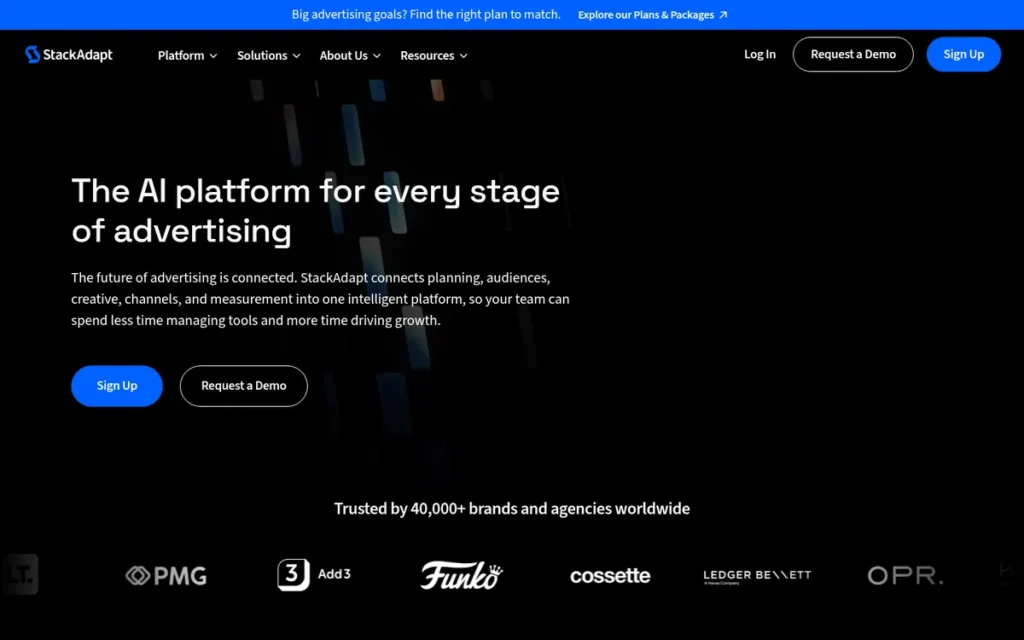
Category: Independent Omnichannel DSP, buys across many channels and exchanges without owning media.
At a Glance
- Category: Independent Omnichannel DSP
- Best For: Small and mid-sized brands, B2B marketers and smaller agencies running their first multi-channel programmatic program
- Price Range: Custom CPM/CPC/CPE; no required minimum (StackAdapt, 2026); ~$300/month per self-serve campaign (G2, 2026); vendor guidance says >$5,000/month typically sees the best results
- Primary Strength: StackAdapt combines a 4.7/5 G2 rating across 924 reviews, the largest sample in the DSP category, with self-serve access and no required minimum spend (G2, 2026).
- Biggest Limitation: StackAdapt’s flat CPM bundles its margin into the price, and reviewers say StackAdapt’s reporting is too shallow to prove ROI on conversion campaigns.
- One-Line Summary: StackAdapt combines a 4.7/5 G2 rating across 924 reviews (G2, 2026) with self-serve access and no required minimum spend, which makes it PlugRoute’s top-ranked DSP for small and mid-sized teams.
- Last Verified: November 2026
Overview
StackAdapt is a demand side platform that can be run self-serve, managed or hybrid. It buys display, native, video, CTV, audio, DOOH, in-game and B2B account-based inventory from one interface, and it is built for small and mid-sized teams that want broad programmatic reach without a required minimum spend.
StackAdapt ranks first (4.05) because it leads on verified user satisfaction (C3 = 5) and usability (C6 = 5). StackAdapt’s 0.35-point lead over The Trade Desk rests mostly on those two criteria, not on inventory or identity.
StackAdapt self-serve access is limited to select regions and requires approval (StackAdapt, 2026).
Key Features
- StackAdapt buys display, native, video, CTV, audio, podcast, DOOH and in-game inventory, plus email and direct mail, from a single campaign interface.
- StackAdapt offers B2B and account-based targeting, which makes it one of the few mid-market DSPs designed for B2B pipeline campaigns.
- StackAdapt includes dynamic creative optimization (DCO) at no separate charge in some configurations.
- StackAdapt’s Data Hub brings in first-party data for audience building and customer-journey orchestration.
- StackAdapt offers self-serve, managed and hybrid service models, so teams can switch between running campaigns themselves and handing them off.
Best For
StackAdapt is best for small and mid-sized brands, B2B marketers and smaller agencies that want one approachable multi-channel platform with strong support. StackAdapt fits less well for app-install advertisers and for buyers who need deep custom conversion reporting.
Strengths
- StackAdapt holds a 4.7/5 G2 rating across 924 reviews (G2, 2026), the largest review sample in the DSP category, and G2 reports that 62% of those reviewers are from small businesses.
- StackAdapt was one of seven DSPs NBCUniversal used to sell 2026 Winter Olympics inventory programmatically (AdExchanger, 2026).
- StackAdapt appears in Digiday’s DSP scorecard among the platforms most often found on agency rosters (Digiday, 2026).
- StackAdapt is repeatedly called the most intuitive mainstream DSP by practitioners (r/adops, 2021; r/programmatic, 2023), which matches G2 praise for its setup and customer success teams (G2, 2026).
Limitations
StackAdapt’s biggest trade-off is pricing visibility in exchange for simple planning. Its flat CPM bundles the margin into the price, so buyers cannot see what share of spend reaches publishers (Digiday, 2026).
- StackAdapt reviewers say its reporting is too shallow for custom or multidimensional analysis, and one reviewer found CPA and CTR weaker than on Google and Meta (McLean & Co, 2026).
- StackAdapt has thinner live-broadcast CTV inventory, according to third-party commentary (getAdLib, 2026), although StackAdapt was among the 2026 Winter Olympics DSPs.
- StackAdapt users have reported trouble with AppsFlyer app-install attribution and with losing desktop targeting when geo-targeting at DMA level (r/programmatic, 2023).
- StackAdapt has no verified, quantified client results, so buyers should run a pilot with a holdout group.
Users on r/programmatic noted:
“Domain inclusion will kill of the inventory reach I had tried in past. We too manage b2b campaigns in Stackadapt. The work around is u create ur own blacklist of domains and it in there.” Posted by u/AdTechB2B
Takeaway: StackAdapt B2B campaigns lose most of their reach under tight domain inclusion lists, so experienced buyers control placement with exclusion lists instead.
Verdict
StackAdapt is the best overall DSP for small and mid-sized teams in 2026, pairing the category’s largest verified review base (G2 4.7/5, 924 reviews) with self-serve access and no required minimum spend.
StackAdapt’s lead rests on accessibility and support, not on independently proven outcomes. Buyers should ask for a written breakdown of what the bundled CPM covers and should test conversion reporting before scaling.
2. The Trade Desk: Best for Enterprise Omnichannel Scale and Open-Internet CTV
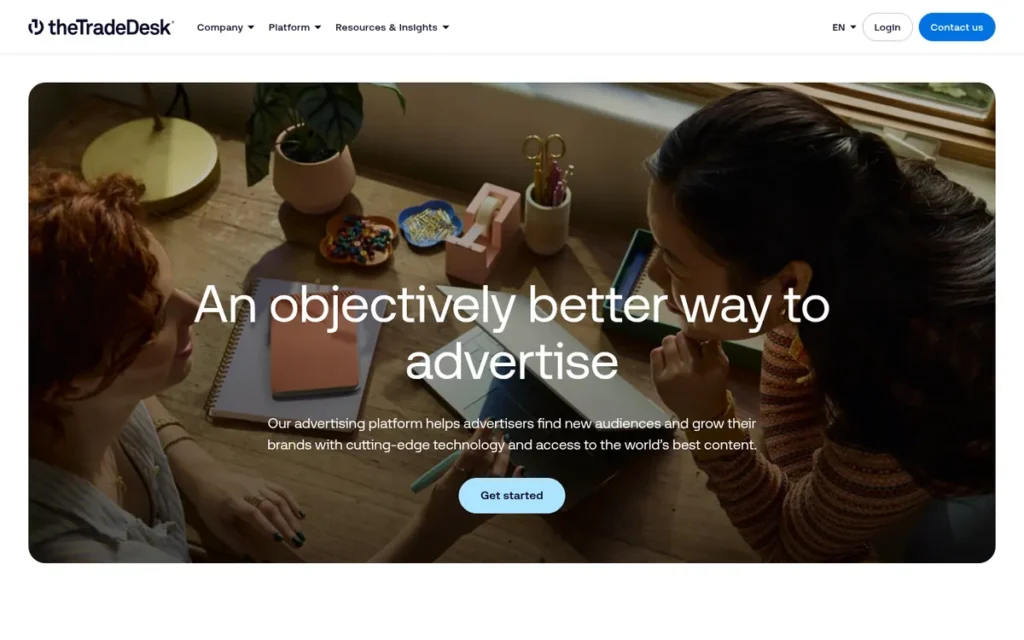
Category: Independent Omnichannel DSP.
At a Glance
- Category: Independent Omnichannel DSP
- Best For: Enterprise brands, holding-company agencies and experienced programmatic teams buying at scale
- Price Range: No public rate card; reported take rate ~12–15% of media, down from ~19–21% historically (Digiday, 2026), plus data and measurement fees; enterprise contract or reseller access
- Primary Strength: The Trade Desk offers the broadest independent omnichannel inventory and identity toolkit of the DSPs evaluated, including UID2 and OpenPath.
- Biggest Limitation: The Trade Desk has a high cost of entry, and its fee practices drew a 2026 Publicis-commissioned audit that the two companies resolved in June 2026.
- One-Line Summary: The Trade Desk is the largest independent DSP for enterprise omnichannel and CTV buying, reporting $13.4B of FY2025 gross spend (The Trade Desk, 2026), but its cost of entry makes it a poor fit for small budgets.
- Last Verified: November 2026
Overview
The Trade Desk is the largest independent demand side platform. It buys display, video, CTV, audio, mobile, DOOH and retail-media data without owning any media, and it is built for enterprise brands, holding companies and agencies that need omnichannel scale and advanced identity tools.
The Trade Desk ranks second (3.70) because it scores 5 on inventory access (C1) and identity (C4). The Trade Desk scores 2 on cost accessibility (C2) and usability (C6), which keeps it 0.35 points behind StackAdapt.
The Trade Desk’s platform centers on Kokai, an AI layer for planning, bidding and supply-path selection. The Trade Desk is normally reached through agencies, resellers or enterprise contracts rather than a credit-card sign-up.
Key Features
- The Trade Desk’s Kokai AI layer handles planning, bidding, forecasting and supply-path selection across channels.
- The Trade Desk’s Unified ID 2.0 (UID2) is a hashed-email identity framework for targeting that does not depend on cookies.
- The Trade Desk’s OpenPath connects buyers directly to publishers, and OpenSincera supplies publisher-quality signals.
- The Trade Desk’s Deal Desk manages private-marketplace (PMP) deals, and Ventura TV OS extends The Trade Desk into CTV operating systems.
- The Trade Desk provides premium CTV supply through publicly linked partnerships with Disney, Netflix, Roku and Walmart Connect (The Trade Desk, 2026).
Best For
The Trade Desk is best for enterprise advertisers and agencies with dedicated traders who need open-internet scale outside the Google and Amazon ecosystems. The Trade Desk is a poor fit for small advertisers, who often get access only through resellers that add another fee layer.
Strengths
- The Trade Desk reported FY2025 revenue of $2.896B (+18%), $13.4B in gross spend and customer retention above 95% for 12 straight years (The Trade Desk, 2026).
- The Trade Desk holds a 4.4/5 G2 rating across 194 reviews (G2, 2026), with reviewers praising targeting, real-time reporting and Deal Desk.
- The Trade Desk was one of seven DSPs NBCUniversal used to sell 2026 Winter Olympics inventory programmatically, after serving as the exclusive programmatic partner for the 2024 Paris Games (The Trade Desk, 2026).
- The Trade Desk’s case studies cite +423% showroom visits for Jaguar Land Rover and +39% programmatic revenue for VIZIO (The Trade Desk, 2026; vendor-reported), though baselines and attribution windows are not disclosed.
Limitations
The Trade Desk’s biggest trade-off is accessibility and fee clarity in exchange for breadth. Its 2026 fee dispute is the most consequential example.
- The Trade Desk was the subject of a 2026 Publicis-commissioned audit that reportedly found fees above agreed limits and paid features enabled without documented authorization (Reuters, 2026).
- The Trade Desk disputed the audit findings. The two companies announced a resolution in June 2026 without disclosing terms, and Publicis resumed recommending the platform (Digiday, 2026; MediaPost, 2026).
- The Trade Desk reportedly saw WPP and Dentsu cut back on OpenPath over fee concerns (Morningstar, 2026; Forbes, 2026).
- The Trade Desk guided Q3 2026 revenue to at least $650 million, compared with about $739 million a year earlier, an expected decline of roughly 12% (The Trade Desk, 2026; company guidance).
- The Trade Desk’s Kokai migration led traders to describe an overloaded interface, and The Trade Desk scores 3.9/5 for ease of use on Capterra (PPC Land, 2026; Capterra, 2026).
Users on r/programmatic shared their experience:
“Started using it this week. A lot of good upgrades. A few questionable ones (no campaign metrics that someone mentioned is the big one). I love the publisher level site targeting.” Posted by u/can_you_digit
Takeaway: Early Kokai users credit The Trade Desk with real targeting upgrades but flag missing campaign-level metrics as a significant usability gap.
Verdict
The Trade Desk is the strongest DSP in 2026 for enterprise teams that need independent omnichannel scale and premium CTV, but it is not the right starting point for small budgets.
The Trade Desk’s inventory breadth, UID2 framework and 95%+ retention support its enterprise standing. Buyers should negotiate log-level data, a written fee schedule and audit rights before signing.
3. Amazon DSP: Best for Commerce and Retail Brands
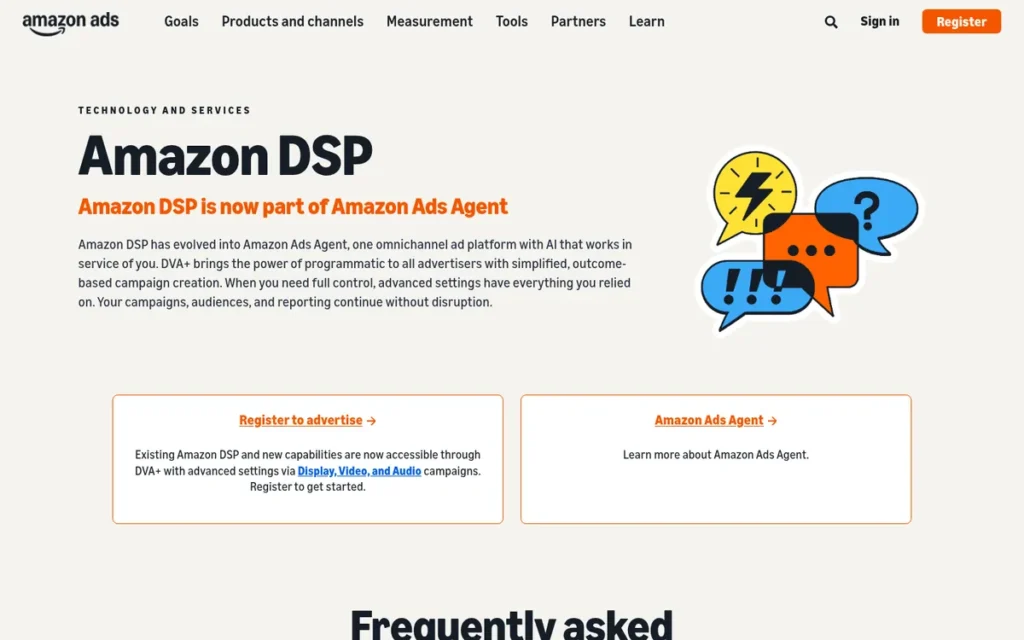
Category: Walled-Garden DSP, pairs owned-and-operated inventory with the parent company’s first-party signals.
At a Glance
- Category: Walled-Garden DSP
- Best For: Brands selling on Amazon or in retail that want shopping-signal targeting and Prime Video CTV
- Price Range: Self-service: no management fee, ~4–8% reported technology fees, no official minimum since November 2025, ~$5,000–15,000/month practical starting budget (Atom11, 2026; third-party estimate). Managed: ~$50,000 minimum, ~25% combined fees (reported)
- Primary Strength: Amazon DSP links ad exposure to Amazon shopping behavior through Amazon Marketing Cloud. Independent DSPs can only approximate this closed-loop capability through third-party retail-media data.
- Biggest Limitation: Amazon DSP measures its own results with its own attribution, and its managed service carries reported fees of about 25% of spend.
- One-Line Summary: Amazon DSP is the strongest DSP for commerce and retail brands in 2026, combining shopping signals, Prime Video inventory and the lowest reported self-service fees among large DSPs (Digiday, 2026).
- Last Verified: November 2026
Overview
Amazon DSP is Amazon Ads’ programmatic buying capability, now accessed through a unified Campaign Manager. It buys display, video, audio and streaming TV on Amazon properties and third-party sites, and it is built for brands that sell on or alongside Amazon.
Amazon DSP ranks third (3.60), 0.10 points behind The Trade Desk. Amazon DSP’s neutral user-satisfaction score (C3 = 3) reflects too few reviews, not poor reviews: G2 4.2/5 on 18 reviews and Capterra 3.7/5 on 3 reviews (G2, 2026; Capterra, 2026).
Amazon Ads Agent is the AI assistant inside the unified Campaign Manager, and it does not replace Amazon DSP. The legacy Amazon DSP name is still in use, and the pricing model has carried over into “DVA+” (Amazon Ads, 2026).
Key Features
- Amazon DSP targets audiences with Amazon shopping signals, including product-level (ASIN) interest and purchases.
- Amazon DSP connects to Amazon Marketing Cloud, a clean room that combines Amazon signals with an advertiser’s first-party data.
- Amazon DSP buys owned inventory on Prime Video, Twitch, Fire TV and IMDb, plus third-party display, video and audio supply.
- Amazon DSP runs inside Amazon Ads’ unified Campaign Manager, where Amazon Ads Agent helps with setup and optimization.
- Amazon DSP offers both self-service and managed-service models, which differ substantially in fees and minimums.
Best For
Amazon DSP is best for consumer brands that sell on Amazon or through retail and want to tie video and CTV to purchase outcomes. Amazon DSP is less suited to buyers who need independent cross-platform measurement or who sell mainly off Amazon.
Strengths
- Amazon DSP has the lowest reported self-service fees among the large DSPs, at ~4–8%, and as low as ~1% or zero on some owned inventory (Digiday, 2026).
- Amazon DSP’s unified Campaign Manager beta users saw a median 18% lower CPM and 16% lower CPA (Amazon Ads, 2026; vendor-reported).
- Amazon DSP case studies report 11.4× ROAS for HEYDUDE and +53.8% UK ad-attributed sales for e.l.f. Cosmetics on +9.5% spend (Amazon Ads, 2026; vendor-reported).
- Amazon DSP’s non-skippable Prime Video inventory is described by practitioners as an easy CTV entry point for small agencies (r/programmatic, 2025).
Limitations
Amazon DSP’s biggest trade-off is measurement independence in exchange for closed-loop commerce data. Amazon both sells the media and grades the results.
- Amazon DSP’s last-click reporting can give Amazon retail products credit for sales the DSP helped start, according to agency commentary (Olifant Digital, 2026).
- Amazon DSP’s brand-lift studies draw practitioner skepticism; one buyer said a study recorded lift “because of course it did” (r/programmatic, 2025).
- Amazon DSP’s off-Amazon inventory needs third-party verification such as IAS or DoubleVerify (Magic Logix, 2026).
- Amazon DSP’s managed service is described by reviewers as a “black box” with sales pressure (Capterra, 2026), and one reported fee structure charges 10% platform plus 15% service fees (Marketplace Ad Pros, 2026).
- Amazon DSP’s verified review base is too small to score, because both G2 (18 reviews) and Capterra (3 reviews) fall below PlugRoute’s 30-review threshold (G2, 2026; Capterra, 2026).
Verdict
Amazon DSP is the best DSP for commerce and retail brands in 2026, because no other platform reviewed here pairs a shopping-data clean room with comparably low reported self-service fees.
Amazon DSP is weakest for advertisers who need independent measurement. Buyers should validate results with holdout tests and third-party verification, and should confirm current Amazon DSP terms directly.
4. Viant DSP: Best for Household-Level CTV and Offline Outcome Measurement
Category: CTV and Household Specialist, built CTV-first around household identity or performance-TV workflows.
At a Glance
- Category: CTV and Household Specialist
- Best For: Brands and agencies planning CTV and linear TV at household level and linking exposure to offline outcomes
- Price Range: Contract-based percentage of media spend or fixed CPM (Viant 10-Q, 2026); no public take rate, minimum or self-serve fee found
- Primary Strength: Viant DSP’s Household ID matches online identifiers to 95% of U.S. adults aged 18+ using TransUnion TruAudience data (Viant, 2025; vendor-reported).
- Biggest Limitation: Viant DSP’s reporting is described by reviewers as slow and hard to customize, and Viant DSP publishes no fee levels or minimums.
- One-Line Summary: Viant DSP is an independent, CTV-first demand side platform whose Household ID matches 95% of U.S. adults aged 18+ (Viant, 2025; vendor-reported), which makes it a strong 2026 choice for household-level CTV measurement.
- Last Verified: November 2026
Overview
Viant DSP, formerly Adelphic, is an independent, CTV-first demand side platform built around a household identity graph. It ties linear TV, CTV, audio, DOOH and display exposure to offline outcomes, and it is designed for brands and agencies that need household-level planning and measurement.
Viant DSP ranks fourth (3.50). Its SEC-disclosed pricing models and easier usability put it ahead of Google Display & Video 360. Its unconfirmed G2 figure and unpublished fee levels keep it behind Amazon DSP.
Viant DSP is buy-side only and owns no media. Viant DSP has grown through acquisitions of IRIS.TV (November 2024) and Lockr (2025), and it has announced an agreement to acquire TVision.
Key Features
- Viant DSP’s Household ID identity graph matches 95% of U.S. adults aged 18+ through an expanded TransUnion partnership (Viant, 2025; vendor-reported).
- Viant DSP’s ViantAI layer increasingly automates campaign planning and buying.
- Viant DSP’s Direct Access program provides direct supply paths to publishers and CTV inventory.
- Viant DSP adds contextual and brand-suitability signals for video through IRIS.TV (IRIS_ID), and publisher first-party data through Lockr.
- Viant DSP shows offline sales outcomes during campaign setup, a feature G2 reviewers single out as a standout.
Best For
Viant DSP is best for advertisers whose main question is whether CTV and TV exposure drove real-world household outcomes, and who want an independent alternative to the walled gardens. Viant DSP fits less well for teams that need highly customizable dashboards or detailed planning tools.
Strengths
- Viant DSP’s parent company reported FY2025 revenue of $344.2M (+19.0%) and contribution ex-TAC of $208.7M (+17.6%) (Viant, 2026).
- Viant DSP’s Household ID reaches a 95% match rate for U.S. adults aged 18+ (Viant, 2025; vendor-reported).
- Viant DSP was one of seven DSPs NBCUniversal used to sell 2026 Winter Olympics inventory programmatically (AdExchanger, 2026).
- Viant DSP was credited in Digiday’s buyer scorecard with intuitive UX and service that partly make up for having no owned inventory (Digiday, 2026).
- Viant DSP is rated about 4.2/5 on G2 across about 310 reviews, with praise for easy setup and helpful support (G2, 2026; figure unconfirmed).
Limitations
Viant DSP’s biggest trade-off is reporting flexibility and ecosystem scale in exchange for household-level identity depth.
- Viant DSP reviewers on G2 cite slow or complex reporting, a dashboard with little customization, a learning curve for new users and weak planning tools (G2, 2026).
- Viant DSP faces third-party criticism for limited data transparency and missing year-over-year data (Vibe.co, 2026; competing vendor), so readers should weight that source accordingly.
- Viant DSP owns no inventory and has a smaller ecosystem than The Trade Desk.
- Viant DSP’s campaign-level results are not publicly verified, and community discussion is sparse and mostly from 2021–2023, under the old Adelphic name.
Verdict
Viant DSP is the strongest independent choice in 2026 for buyers who need to connect CTV and TV exposure to offline household outcomes.
Viant DSP’s Household ID and SEC-disclosed pricing models give it more structural transparency than most specialists. Buyers should test the reporting workflow and get a written fee list before committing.
5. Google Display & Video 360: Best for Google Marketing Platform Users and Programmatic YouTube
Category: Walled-Garden DSP, pairs owned-and-operated inventory with the parent company’s first-party signals.
At a Glance
- Category: Walled-Garden DSP
- Best For: Enterprise advertisers and agencies whose measurement runs on Google Marketing Platform and who need programmatic YouTube
- Price Range: No public rate card; percentage-of-media platform fee plus data, verification and ad-serving fees; ~$50,000+/month commitments through some resellers (reported)
- Primary Strength: Google Display & Video 360 offers programmatic YouTube inventory and native Google Marketing Platform integration (GA4, CM360, SA360) that independent DSPs do not offer in the same form.
- Biggest Limitation: Google Display & Video 360 gates key features behind spend thresholds, is usually reached through resellers, and has a steep learning curve.
- One-Line Summary: Google Display & Video 360 is the strongest DSP in 2026 for advertisers already measuring on Google Marketing Platform who need programmatic YouTube, but its spend-gated features make it a poor fit for small teams.
- Last Verified: November 2026
Overview
Google Display & Video 360 (DV360) is Google’s enterprise demand side platform inside Google Marketing Platform. It buys display, video, audio, CTV and YouTube inventory, and it is built for enterprises whose measurement runs on Campaign Manager 360, Search Ads 360 and GA4.
Google Display & Video 360 ranks fifth (3.35) even though it ties for the top inventory score. Spend-gated features, reseller-dependent access and a complex hierarchy give it the lowest scores on cost accessibility and usability. No verified review aggregate exists for it.
Google Display & Video 360 supports programmatic guaranteed (PG) deals and automated bidding. Google Display & Video 360 is adding Gemini-powered planning and optimization agents in 2026 (Adweek, 2026; Marketing Brew, 2026).
Key Features
- Google Display & Video 360 buys programmatic YouTube inventory, which independent DSPs cannot access in the same way.
- Google Display & Video 360 integrates natively with Campaign Manager 360, Search Ads 360 and GA4.
- Google Display & Video 360 supports programmatic guaranteed deals across display, video, audio and CTV.
- Google Display & Video 360’s Gemini-powered Ads Advisor flags problems and suggests budget and bid changes (Adweek, 2026; announced, confirm availability).
- Google Display & Video 360’s campaign builder turns a media plan or natural-language instructions into a proposed setup (Marketing Brew, 2026; some features may be in beta).
Best For
Google Display & Video 360 is best for enterprise brands and agencies that already run Google Marketing Platform measurement and want YouTube and open-web buying in one stack. Google Display & Video 360 is hard to justify for small teams unless they access it through a partner, as one SMB reported doing via FreeWheel (r/programmatic, 2026).
Strengths
- Google Display & Video 360 provides programmatic YouTube access and native GA4, CM360 and SA360 integration (Google, 2026).
- Google Display & Video 360 was one of seven DSPs NBCUniversal used to sell 2026 Winter Olympics inventory programmatically (AdExchanger, 2026).
- Google Display & Video 360 appears among the DSPs most often found on agency rosters (Digiday, 2026).
- Google Display & Video 360 is described by practitioners as “one of the most powerful DSPs” (r/programmatic, 2020), and one user reported it outperforming Amazon on sessions generated, though another commenter warned that sessions are a shallow metric (r/programmatic, 2025).
Limitations
Google Display & Video 360’s biggest trade-off is accessibility and independence in exchange for Google-stack integration. Spend gates are the most consequential example.
- Google Display & Video 360 reportedly engages directly only with very large spenders, enabling retargeting at ~$10,000 of spend and third-party data at ~$40,000 (r/programmatic, 2020).
- Google Display & Video 360’s five-level hierarchy (partner, advertiser, campaign, insertion order, line item) creates a steep learning curve (PlugRoute analysis, 2026), and support reportedly varies with spend (r/adops, 2021).
- Google Display & Video 360 overspent for one user, who reported about $600 spent in 10 minutes on a $300/day line item; other commenters said Google refunds overspend caused by platform errors (r/programmatic, 2024; date unconfirmed).
- Google Display & Video 360 was named by the European Commission as a buy-side tool that favored Google’s AdX exchange in a €2.95B fine issued September 5, 2025, which Google said it would appeal (European Commission, 2025).
- Google Display & Video 360 was not found liable in an April 2025 U.S. ruling, and the September 2025 remedies did not require divesting it (TechCrunch, 2025; DLA Piper, 2025).
- Google Display & Video 360 has no verified aggregate review rating as of November 2026, and its public performance evidence is selected by Google.
Users on r/programmatic noted:
“I swear by using “flight” budgets EXCEPT on YouTube line items, and that’s only because YouTube, for whatever reason, has overpaced my flighted budgets numerous times in the past year. I was told by my GMP rep that setting daily budgets on YT line items is really the only way to combat that issue.” Posted by u/Lumiafan
Takeaway: YouTube line items in Google Display & Video 360 have a track record of overpacing flight budgets, so traders have to cap them with daily budgets by hand.
Verdict
Google Display & Video 360 is the best DSP in 2026 for teams whose measurement already runs on Google Marketing Platform and who need programmatic YouTube.
Google Display & Video 360’s inventory and integration advantages are real and specific to Google. Buyers should calculate all-in reseller costs and plan independent verification before committing.
6. Simpli.fi: Best for Local and Multi-Location Advertisers
Category: Local and Multi-Location DSP, organizes campaigns, budgets and reporting around geographic locations.
At a Glance
- Category: Local and Multi-Location DSP
- Best For: Franchises, dealerships, healthcare networks, local media groups and agencies managing many locations
- Price Range: Quote-based; no verified public rates (2026); comparison sites note possible premiums for advanced targeting (Rankite, 2026)
- Primary Strength: Simpli.fi organizes budgets, creative and reporting around individual locations, with addressable geofencing and conversion zones built into that structure.
- Biggest Limitation: Simpli.fi’s quote-based pricing is opaque, and practitioners question the depth of its premium supply.
- One-Line Summary: Simpli.fi is a localized programmatic platform built around per-location campaigns, rated 4.5/5 on G2 across 154 reviews (G2, 2026), but buyers should require a written fee schedule.
- Last Verified: November 2026
Overview
Simpli.fi is a localized programmatic advertising platform that runs per-location campaigns. It uses geofencing, addressable household geofencing, search retargeting and CTV/OTT, and it is built for franchises, dealerships, healthcare networks and agencies that manage many geographic markets.
Simpli.fi ranks sixth (3.00). Quote-based pricing (C2 = 2) and questioned premium-supply depth (C1 = 3) offset its 4.5/5 G2 rating. The rank reflects general-purpose scoring, and for multi-location buyers the segment pick matters more.
Simpli.fi treats locations as the main building block of a campaign. Simpli.fi also sells workflow and order-management software to local media companies.
Key Features
- Simpli.fi offers geofencing and addressable household-level geofencing, including capturing device IDs at events.
- Simpli.fi supports conversion zones and search retargeting to connect local ad exposure to visits.
- Simpli.fi organizes budgets, creative and reporting by location, with state- and DMA-level heat maps.
- Simpli.fi buys CTV/OTT, audio, DOOH, native and political advertising inventory for local campaigns.
- Simpli.fi targets using “unstructured data” such as browsing, context, app use and GPS signals, rather than only prepackaged segments.
Best For
Simpli.fi is best for multi-location brands and local media groups that need geographic targeting, per-location budgets and location-level reporting at scale. Simpli.fi is less suited to national advertisers seeking premium publisher or premium CTV supply.
Strengths
- Simpli.fi holds a 4.5/5 G2 rating across 154 reviews (G2, 2026), with praise for geofencing, heat maps, bulk edits and responsive support.
- Simpli.fi serves 2,000+ media teams, agencies and brands, is backed by GTCR and Blackstone, and appointed Sean McCaffrey as CEO on October 20, 2026 (Simpli.fi, 2026).
- Simpli.fi reported 2,751 room bookings and nearly 200 in-person visits for a resort casino campaign run by agency Mighty Media Shop (Simpli.fi, 2026; vendor-reported).
- Simpli.fi ran a 2025 campaign for an international software company that combined geo-optimized CTV with addressable geofencing, though no lift was disclosed (Simpli.fi, 2025; vendor-reported).
- Simpli.fi is described by practitioners as “much more popular for the local markets” and “big for newspaper groups” (r/adops, 2021).
Limitations
Simpli.fi’s biggest trade-off is pricing transparency and premium-supply reach in exchange for geographic workflow depth. Quote-based pricing is the most common criticism in its reviews (G2, 2026).
- Simpli.fi was accused by one G2 reviewer of charging undisclosed fees and a markup above 42% on ad spend (G2, 2026). That is a single unverified claim, and no public Simpli.fi response was found as of November 2026.
- Simpli.fi reviewers report campaign statuses that contradict each other, slow UI moments and slow issue resolution (G2, 2026).
- Simpli.fi’s UI complexity and steep setup learning curve are recurring complaints, according to an independent analysis (Airframe, 2026).
- Simpli.fi was criticized by one practitioner for weak premium-publisher and CTV delivery and high CPMs. That commenter was accused of working for a competitor and denied it, so the claim may be biased (r/adops, 2021).
- Simpli.fi’s quantified results are vendor-reported, and recent community discussion is scarce.
Verdict
Simpli.fi is the best DSP in 2026 for advertisers who need to run and report programmatic campaigns across many locations.
Simpli.fi’s per-location budgets, creative and reporting are its core campaign structure, not an add-on to a national campaign model. Buyers should get an itemized fee schedule and verify CTV and premium supply before signing.
7. MNTN Performance TV: Best for Self-Serve Performance CTV Tests with Built-In Creative
Category: CTV and Household Specialist.
At a Glance
- Category: CTV and Household Specialist
- Best For: DTC brands and SMB performance marketers running a first CTV test without TV-ready creative
- Price Range: Dollar pricing not verified; no minimum and cancel-anytime terms reported (Velocity AI Partners, 2026); CTV media typically $15–60+ CPM (industry estimate, unverified)
- Primary Strength: MNTN Performance TV removes the creative barrier to CTV by bundling video production through QuickFrame and QuickFrame AI.
- Biggest Limitation: MNTN Performance TV relies on its own view-through attribution and offers no network- or app-level placement control.
- One-Line Summary: MNTN Performance TV is a self-serve CTV platform with built-in creative production, rated 4.8/5 on G2 across 61 reviews and reporting 4,373 active customers in Q3 2026 (G2, 2026; MNTN, 2026).
- Last Verified: November 2026
Overview
MNTN Performance TV is a self-serve connected TV platform that runs streaming TV campaigns the way search or social ads run, with built-in creative production and Verified Visits attribution. MNTN Performance TV is built for DTC and SMB marketers testing CTV without a TV buying team.
MNTN Performance TV ranks seventh (2.90) because it is CTV-only with no placement control (C1 = 2) and relies on view-through attribution (C4 = 2). It ranks there despite strong usability (C6 = 4) and strong G2 sentiment (C3 = 4).
MNTN Performance TV reaches 200+ streaming networks. MNTN Performance TV’s parent company went public on the NYSE in 2025 (MarketBeat, 2025).
Key Features
- MNTN Performance TV runs self-serve CTV campaigns across 200+ streaming networks, including CNN, Paramount+, Bravo and ESPN.
- MNTN Performance TV’s Verified Visits attribution counts site visits after a household views an ad, with default windows reportedly set at 14 days for prospecting and 7 days for retargeting.
- MNTN Performance TV includes QuickFrame, a marketplace of 5,000+ vetted video professionals, plus QuickFrame AI for generating TV spots.
- MNTN Performance TV offers intent-based and AI targeting, plus first-party audience matching through MNTN Matched.
- MNTN Performance TV supports CTV retargeting of households that have visited an advertiser’s site.
Best For
MNTN Performance TV is best for performance-focused DTC and SMB marketers who want to test CTV quickly, lack TV-ready creative, and can run their own holdout tests. MNTN Performance TV is a poor fit for buyers who need placement control, linear TV or independent measurement.
Strengths
- MNTN Performance TV holds a 4.8/5 G2 rating across 61 reviews, with praise for ease of use and strong support (G2, 2026).
- MNTN Performance TV reported 4,373 trailing-twelve-month active customers in Q3 2026 (+32% year over year) on revenue of $80.3 million (+15%) (MNTN, 2026).
- MNTN Performance TV reported 5.9× ROAS and $0.84 cost per visit for Hunt A Killer, measured with Verified Visits (MNTN, 2026; vendor-reported).
- MNTN Performance TV launched QuickFrame AI in public beta in late 2025, and its spots can be exported to Meta, TikTok and Google (AdTechRadar, 2026).
Limitations
MNTN Performance TV’s biggest trade-off is placement control and measurement independence in exchange for simplicity. Buyers cannot include or exclude specific networks or apps (Tatari, 2026; Velocity AI Partners, 2026).
- MNTN Performance TV has no linear or direct-sold inventory and publishes no inventory list (Tatari, 2026).
- MNTN Performance TV’s results rely on its own view-through attribution rather than incrementality tests.
- MNTN Performance TV was accused by one commenter of mixing unviewable display into its conversion reporting. The claim is unverified but reflects real practitioner skepticism (r/programmatic, 2023).
- MNTN Performance TV reviewers cite no date-comparison reporting, generic support advice and late creative delivery (G2, 2026).
- MNTN Performance TV publishes no verified dollar pricing, and its revenue growth slowed to 15% year over year in Q3 2026 (MNTN, 2026).
Verdict
MNTN Performance TV is a low-barrier way in 2026 for performance marketers without TV creative to launch a CTV test, rated 4.8/5 on G2 across 61 reviews (G2, 2026).
MNTN Performance TV’s bundled creative and search-like workflow make CTV much easier to start. Buyers should pair any test with a holdout group and treat Verified Visits as directional.
How Much Does a DSP Really Cost?
A DSP’s real cost is the platform fee plus every layer stacked on top of it, and most DSPs publish no rate card. Reported benchmarks run from ~4–8% technology fees on Amazon DSP self-service to ~12–15% take rates at The Trade Desk (Digiday, 2026). StackAdapt bundles its margin into a flat CPM.
| Platform | Pricing Model | Reported Fees | Reported Minimums | Access Route |
|---|---|---|---|---|
| StackAdapt | Custom CPM/CPC/CPE | Margin bundled into CPM | None required; ~$300/campaign self-serve (G2, 2026); vendor guidance: >$5k/month for best results | Self-serve (approval), managed, hybrid |
| The Trade Desk | % of media | ~12–15% recent; ~19–21% historic (Digiday, 2026) | Not published | Enterprise contract, agency, reseller |
| Amazon DSP | Tech fee or managed fee | ~4–8% self-service; ~25% managed | No official self-service minimum since November 2025; ~$5k–15k/month practical (third-party estimate); ~$50k managed | Self-service or managed |
| Viant DSP | % of media or fixed CPM (Viant 10-Q, 2026) | Not published | Not published | Contract |
| Google Display & Video 360 | % of media plus add-ons | Not published | ~$50k+/month via some resellers (reported) | Google sales, reseller, agency seat |
| Simpli.fi | Quote-based | Not verified | Not verified | Direct or local media partner |
| MNTN Performance TV | Not verified | Not verified | None reported (third-party) | Self-serve |
Pricing notes by platform:
- StackAdapt states “no required minimum advertising spend” and “no hidden technology fees,” while third-party sources cite $10,000–15,000/month managed thresholds (StackAdapt, 2026; G2, 2026; getAdLib, 2026).
- StackAdapt’s sign-up page says advertisers spending more than $5,000/month typically see the best results, which is guidance rather than a required minimum (StackAdapt, 2026).
- The Trade Desk receives a 3.8/5 value-for-money score from Capterra reviewers, who mention a “high cost of entry” and monthly commitments (Capterra, 2026).
- Amazon DSP’s reported self-service fees fall to ~1% or zero on some owned or PG inventory, and one reported managed structure charges 10% platform plus 15% service fees (Digiday, 2026; Marketplace Ad Pros, 2026).
- Amazon DSP buyers should not assume that Amazon’s “no minimum” language for sponsored ads applies to DSP buying.
- Viant DSP discloses percentage-of-media and fixed-CPM pricing models in SEC filings, but no fee levels (Viant 10-Q, 2026).
- Google Display & Video 360 adds data, verification and ad-serving fees on top of its percentage-of-media platform fee.
- Simpli.fi and MNTN Performance TV publish no verified dollar pricing as of November 2026.
Illustrative all-in fee example (arithmetic on reported estimates, not quotes), on $50,000/month of media:
- Amazon DSP managed service at ~25% combined would mean roughly $12,500 in fees.
- Amazon DSP self-service at ~4–8% would mean roughly $2,000–4,000 in fees.
- The Trade Desk at ~12–15% would mean roughly $6,000–7,500, before data fees and any reseller margin.
- StackAdapt’s fee cannot be calculated, because StackAdapt bundles its margin into the CPM.
Curated deals and principal-based trading, where an intermediary buys and resells media, can add margins that do not show up on a DSP invoice. Supply-path optimization (SPO) can reduce those layers, but it does not reveal them.
Media costs sit on top of DSP fees. eMarketer cautions that media spend, DSP fees and publisher revenue are different measures and should not be added together (eMarketer, 2026).
Typical U.S. planning CPMs before fees (industry estimate, unverified):
| Format | CPM |
|---|---|
| Open-exchange display | $1–5 |
| Premium display | $5–12+ |
| Online video | $8–25 |
| Open CTV | $15–35 |
| Premium or programmatic-guaranteed CTV | $25–60+ |
No DSP reviewed by PlugRoute in November 2026 publishes a complete fee breakdown, so the only reliable cost comparison is an itemized written quote.
Self-Serve, Managed or Reseller: Which Access Model Fits You?
Self-serve fits teams with in-house traders and small budgets. Managed service fits teams without programmatic staff that can pay higher fees. Reseller access gives smaller agencies a way into enterprise DSPs like The Trade Desk, but it adds another fee layer. Confirm which model applies before you compare quotes.
The access models compare as follows:
- Self-serve: StackAdapt (approval required), Amazon DSP self-service and MNTN Performance TV offer self-serve access with the lowest reported fee layers.
- Managed: Amazon DSP managed service reportedly costs ~25% combined, and StackAdapt managed service has reported recommended thresholds of $10,000–15,000/month.
- Reseller: The Trade Desk and Google Display & Video 360 are commonly reached through resellers, a route practitioners recommend for smaller agencies (r/programmatic, 2025).
“You need to maintain a minimum spend with DV360, TTD, etc.. You will have to try some smaller ones like stackadapt that have no minimums.” (u/D_Adman (r/programmatic, 2023))
Takeaway: Practitioners filter DSPs by minimum spend first, but buyers should check “no minimum” claims from 2023 against current per-campaign floors, such as G2’s reported $300/campaign self-serve minimum for StackAdapt (G2, 2026).
“No minimum” does not mean a small budget will produce a useful test. At open-CTV CPMs of $15–35 (industry estimate), $5,000 buys roughly 143,000–333,000 impressions. StackAdapt’s own guidance points to $5,000+/month, and agency guides estimate $5,000–15,000/month for Amazon DSP self-service (Atom11, 2026).
“Streaming packages” from traditional media companies deserve extra scrutiny. One practitioner described them as “just a managed service team sitting on someone else’s DSP behind the scenes,” with no transparency on fees (r/programmatic, 2025).
Typical minimums by tier (industry estimate, unverified):
| Tier | Typical Minimum |
|---|---|
| Enterprise self-serve | ~$25k–100k+/month |
| Mid-market | ~$5k–25k/month |
| Local/SMB managed | ~$1k–10k/month |
| CTV specialists | ~$10k–50k/campaign |
What Is the Best DSP for CTV and Programmatic Video?
The best DSP for CTV depends on what you need to measure, because premium CTV access is no longer exclusive. Viant DSP fits household-level planning and offline outcomes. MNTN Performance TV fits self-serve performance tests with built-in creative. Among the seven DSPs reviewed, Google Display & Video 360 is the primary programmatic route to YouTube.
CTV buyers can match platforms to needs as follows:
- Household identity: Viant DSP’s Household ID matches 95% of U.S. adults aged 18+ (Viant, 2025; vendor-reported).
- Premium live CTV: NBCUniversal sold 2026 Winter Olympics inventory programmatically through seven DSPs, including The Trade Desk, Amazon DSP, Google Display & Video 360, StackAdapt and Viant DSP (AdExchanger, 2026).
- Owned streaming: Amazon DSP buys non-skippable Prime Video and Fire TV inventory.
- YouTube: Google Display & Video 360 provides programmatic YouTube access.
- First CTV test: MNTN Performance TV bundles creative production through QuickFrame.
In 2024, NBCUniversal’s Paris Olympics programmatic inventory went only through The Trade Desk. In 2026 the Winter Games went through seven DSPs, so the CTV decision now turns on measurement and identity rather than access.
Every CTV platform in this review reports results using its own attribution. CTV outcome measurement remains a gap across the whole category.
How Ready Is Each DSP for Signal Loss?
Of the seven DSPs reviewed in November 2026, three have the most developed identity tooling: The Trade Desk (UID2), Amazon DSP (Amazon Marketing Cloud) and Viant DSP (Household ID). Chrome kept third-party cookies, but identity readiness still matters. Frequency management and measurement now depend on first-party data and clean rooms.
Identity approaches by platform:
- The Trade Desk uses UID2, a hashed-email identity framework.
- Amazon DSP uses the Amazon Marketing Cloud clean room plus shopping signals.
- Viant DSP uses its Household ID graph and IRIS.TV contextual signals.
- Google Display & Video 360 relies on first-party measurement across the Google stack.
- StackAdapt uses its Data Hub, contextual AI and a universal pixel.
- Simpli.fi uses geographic and “unstructured data” signals.
- MNTN Performance TV uses first-party matching through MNTN Matched.
How Should an Agency Choose a Demand Side Platform?
Agencies should usually run more than one DSP. The DSPs that show up most often on agency rosters are Google Display & Video 360, Amazon DSP, The Trade Desk, Yahoo DSP and StackAdapt (Digiday, 2026). Practitioners also note that different DSPs reach different publisher deals (r/programmatic, 2020).
An agency DSP evaluation should cover these points:
- An agency should grade every candidate DSP in a formal RFI on reporting, targeting, price, support, algorithms and brand safety (r/programmatic, 2020).
- An agency without enterprise spend can usually reach The Trade Desk or Google Display & Video 360 through a reseller, at the cost of an added fee layer.
- An agency should require written fee schedules and audit rights from every DSP on its roster, not just the largest one.
- An agency serving commerce clients should consider adding Amazon DSP alongside an independent DSP for shopping-signal campaigns.
How Do I Test a DSP Before Committing?
To test a DSP, run two platforms at the same time with matched audiences, creative and attribution windows, plus a holdout group. Compare all-in CPM, incremental conversions and labor hours rather than headline CPM. Every quantified result in this research is vendor-reported, so your own pilot is the only independent evidence you will have.
A defensible DSP pilot includes these steps:
- A DSP pilot should run two platforms at the same time on the same audiences and creative.
- A DSP pilot should set identical attribution windows on both platforms before launch.
- A DSP pilot should hold out a control group to measure incremental lift.
- A DSP pilot should calculate all-in cost, including data, verification, ad serving and reseller fees.
- A DSP pilot should track the labor hours each platform needs each week.
- A DSP pilot should require placement-level and log-level reports from both vendors so spend can be audited.
Practitioners also advise against relying on a single platform: “Different DSPs have access to different inventory or different specific deals publisher by publisher” (r/programmatic, 2020).
Which Other DSPs Did We Consider?
PlugRoute also looked at Basis, Quantcast, Yahoo DSP, AdRoll, SmartyAds and Choozle, but none of them was ranked in this edition. Basis and Quantcast have more G2 reviews than some ranked platforms. Leaving them out reflects the scope of this research, not their quality.
- Basis: Basis is a credible agency-focused alternative, rated about 4.5/5 on G2 across about 287 reviews (G2, 2026), but it was not researched in depth for this edition.
- Quantcast: Quantcast is rated 4.2/5 on G2 across about 190 reviews (G2, 2026) and offers cookieless AI audience modeling, but it was not researched in depth.
- Yahoo DSP: Yahoo DSP appears frequently on agency rosters (Digiday, 2026) but was not researched in depth for this edition.
- AdRoll: AdRoll is rated 4.1/5 on G2 across 776 reviews (G2, 2026), but it is mainly a retargeting and SMB ads tool rather than a full DSP.
- SmartyAds: SmartyAds is a self-serve DSP with a reported $1,000 prepaid minimum, and it was not independently researched.
- Choozle: Choozle is a low-minimum self-serve option, but its Capterra rating of 3.8/5 on 10 reviews (Capterra, 2026) is too small a sample to evaluate.
What Changed in This Edition?
This November 2026 edition reflects product, market and data changes that affect how DSPs compare. Each change below was checked against dated sources, and features announced in 2026 are marked for availability checks. The Trade Desk reports Q3 2026 results on November 9, 2026, and PlugRoute will update its figures after that release.
- Amazon DSP moved into Amazon Ads’ unified Campaign Manager, with Amazon Ads Agent as its AI assistant (Amazon Ads, 2026).
- The Trade Desk and Publicis resolved their 2026 fee dispute in June 2026 without disclosing terms (Digiday, 2026).
- The Trade Desk’s Kokai migration drew interface complaints from traders (PPC Land, 2026).
- Google Display & Video 360 announced Gemini-powered Ads Advisor and campaign-builder features, so buyers should confirm availability (Adweek, 2026; Marketing Brew, 2026).
- MNTN Performance TV launched QuickFrame AI in public beta in late 2025 (AdTechRadar, 2026).
- PlugRoute’s methodology now scores MNTN Performance TV’s G2 rating (4.8/5, 61 reviews), which raises its total from 2.70 to 2.90 and leaves its rank unchanged (G2, 2026).
What Red Flags Should I Watch For When Evaluating a Demand Side Platform?
The biggest DSP red flags are hidden costs, vendors measuring their own results, and limited visibility into where ads ran. The six warning signs below come from practitioner reports, review patterns and documented 2026 fee disputes. Each one names a documented example where one exists. Any of them should prompt you to ask for written terms before signing.
Red Flag #1: No Written Fee Schedule A DSP that will not itemize platform, data, verification and service fees in writing makes all-in cost comparison impossible. The 2026 Publicis-commissioned audit of The Trade Desk, resolved in June 2026, shows why contracted fee limits need to be written down and auditable.
Red Flag #2: Bundled CPM With No Margin Disclosure A flat CPM that bundles the DSP margin hides what share of spend reaches publishers. Digiday (2026) cites StackAdapt’s flat CPM as an example, which shows that “no hidden fees” claims can still rest on bundled pricing. Ask any bundled-CPM vendor for a written breakdown.
Red Flag #3: Vendor-Only Attribution With No Holdout Option A DSP that measures its own results and offers no holdout test leaves you without independent proof. Amazon DSP and MNTN Performance TV report mainly with their own attribution. A 2023 r/programmatic commenter also alleged, without verification, that MNTN mixed display impressions into CTV conversion reporting.
Red Flag #4: No Placement-Level or Log-Level Reporting A DSP that cannot show placement-level or log-level data blocks brand-safety checks, made-for-advertising (MFA) site exclusion and fee audits. Placement reports are how buyers find MFA spend, a problem the ANA’s programmatic transparency work has highlighted. Ask for log-level data in writing before scaling spend.
Red Flag #5: Spend-Gated Core Features When core features are locked behind spend levels, what a buyer actually gets depends on budget. Practitioners have reported that Google Display & Video 360 enabled retargeting at ~$10,000 of spend and third-party data at ~$40,000 (r/programmatic, 2020). Confirm current thresholds in writing before you compare platforms.
Red Flag #6: “Streaming Packages” That Hide the Underlying DSP A managed “streaming package” from a traditional media company may be a service team buying on someone else’s DSP with undisclosed fees (r/programmatic, 2025). Ask which DSP sits underneath and what margin the package adds before comparing it with direct DSP access.
What Questions Should I Ask Before Choosing a Demand Side Platform?
Before choosing a demand side platform, ask questions that make each vendor commit to specific, written terms for your budget. The seven numbered questions below are built from practitioner RFI advice. Practitioners recommend a formal RFI that grades each DSP on six areas (r/programmatic, 2020):
- An RFI should grade each DSP’s reporting depth.
- An RFI should grade each DSP’s targeting options.
- An RFI should grade each DSP’s all-in price.
- An RFI should grade each DSP’s support at your spend level.
- An RFI should grade each DSP’s bidding algorithms.
- An RFI should grade each DSP’s brand-safety controls.
Question #1: What is our all-in cost, including data, verification, ad serving and reseller fees? A complete answer itemizes every fee layer in writing. Be wary of answers that quote only a headline CPM or platform fee. Reported take rates alone range from ~4–8% on Amazon DSP self-service to ~12–15% at The Trade Desk (Digiday, 2026).
Question #2: Do we qualify for self-serve, and what support do we get at our spend level? A clear answer states the self-serve approval criteria and the support tier for your budget. Support often depends on spend. StackAdapt self-serve requires approval in select regions, Amazon DSP managed service typically starts near $50,000, and Google Display & Video 360 is commonly reached through resellers.
Question #3: Will you provide log-level data and contractual audit rights? A strong answer puts both log-level data and audit rights in the contract itself, not in a sales deck. Audit rights let you check that billed fees match contracted limits. Log-level data lets you check where each impression ran and what it cost.
Question #4: Which inventory can we include or exclude at the network, app and domain level? A good answer shows the exact network, app and domain controls available at your spend level. Controls vary widely. MNTN Performance TV offers no network- or app-level inclusion or exclusion (Tatari, 2026), and off-Amazon Amazon DSP inventory needs third-party verification (Magic Logix, 2026).
Question #5: Can we run a holdout or incrementality test on your platform? A credible vendor supports a holdout or incrementality design with a control group that you define. Every quantified result in PlugRoute’s research is vendor-reported and uses the vendor’s own attribution. A vendor that offers only its own attribution therefore leaves you without independent proof of lift.
Question #6: Which features require minimum spend to unlock? A transparent answer lists every gated feature and the spend level that unlocks it. Gated retargeting or data access can change a platform’s value at your budget, as practitioner reports of Google Display & Video 360 thresholds show (r/programmatic, 2020). Get the list in writing.
Question #7: How will our first-party data be used, and can we export it? A good answer explains clean-room rules, data ownership and whether audiences and results can be exported. Walled gardens can create lock-in around measurement. Amazon Marketing Cloud and Google Marketing Platform integrations are valuable, but ask what you can take with you if you switch DSPs.
How Did We Rank These Demand Side Platforms?
PlugRoute scored every platform from 1 to 5 on six weighted criteria, and the weighted total sets the rank. Inventory access carries the most weight (25%), followed by cost transparency and verified user satisfaction (20% each). Every claim was graded by evidence type, and evidence was verified as of November 2026.
The criteria and why each matters:
- C1 Inventory Access and Channel Breadth (25%): Inventory access matters because some inventory is exclusive, such as YouTube through Google Display & Video 360 and Prime Video through Amazon DSP.
- C2 Cost Transparency and Accessibility (20%): Cost transparency matters because practitioners filter first on minimums, take rates and reseller layers.
- C3 Verified User Satisfaction (20%): User satisfaction matters because review volume is the only large-sample signal of user experience, though it reflects support and usability more than campaign performance.
- C4 Identity, Targeting and Measurement Readiness (15%): Identity readiness matters because durable targeting relies on first-party data, clean rooms and identity graphs.
- C5 Evidence Quality and Vendor Risk (10%): Evidence quality matters because stakeholders will ask how strong the proof is and what controversies a vendor carries.
- C6 Usability and Support (10%): Usability matters because smaller teams struggle with enterprise interfaces and spend-tiered support.
| Rank | Platform | C1 | C2 | C3 | C4 | C5 | C6 | Weighted Total |
|---|---|---|---|---|---|---|---|---|
| 1 | StackAdapt | 4 | 4 | 5 | 3 | 3 | 5 | 4.05 |
| 2 | The Trade Desk | 5 | 2 | 4 | 5 | 3 | 2 | 3.70 |
| 3 | Amazon DSP | 4 | 4 | 3* | 4 | 3 | 3 | 3.60 |
| 4 | Viant DSP | 4 | 3 | 3 | 4 | 3 | 4 | 3.50 |
| 5 | Google Display & Video 360 | 5 | 2 | 3* | 4 | 3 | 2 | 3.35 |
| 6 | Simpli.fi | 3 | 2 | 4 | 3 | 3 | 3 | 3.00 |
| 7 | MNTN Performance TV | 2 | 3 | 4 | 2 | 3 | 4 | 2.90 |
*Neutral score, flagged for insufficient data.
Verified user satisfaction (C3) is scored using fixed bands:
- A G2 rating of 4.6 or higher with 300+ reviews scores 5.
- A G2 rating of 4.6 or higher with 30–299 reviews, or 4.3–4.5 with 100+ reviews, scores 4.
- A G2 rating of 4.0–4.2, or an unconfirmed figure, scores 3.
- A G2 rating under 4.0 scores 2.
- A platform with no verified aggregate, or fewer than 30 reviews, gets a neutral 3 and an insufficient-data flag.
The neutral-score rule applies to Amazon DSP (G2 n=18; Capterra n=3) and Google Display & Video 360 (no verified aggregate). Missing data therefore neither helps nor hurts their rank.
Every claim carries one of four evidence grades:
- Verified claims come from filings, official pages and regulatory documents.
- Vendor-reported claims come from case studies and vendor statements.
- Practitioner-reported claims come from Reddit and individual reviews.
- Unverified/Missing claims are labeled as missing and never estimated.
Every platform scored 3 on C5 in this edition, because none has audited incrementality evidence. C5 therefore did not change any rank, and vendor-risk events are reported in each entry’s Limitations instead.
StackAdapt’s lead depends on review volume: without user-satisfaction scores, its margin over Amazon DSP shrinks from 0.45 to 0.06 points. Two reweighting tests show how stable the ranking is:
- With C3 removed and its weight redistributed proportionally, StackAdapt scores 3.81, Amazon DSP 3.75, and The Trade Desk and Viant DSP 3.63 each, which moves Amazon DSP to second.
- With C1 raised to 35% and C3 lowered to 10%, the order is unchanged (3.95 / 3.80 / 3.70), but StackAdapt’s lead narrows to 0.15.
PlugRoute has no affiliate relationships with any company listed. Rankings are determined entirely by research data and objective evaluation criteria.
What Do Buyers Ask Most About Demand Side Platforms?
Buyers most often ask three things: which DSP works with a small budget, whether Amazon DSP still exists after Amazon’s product consolidation, and how independent rankings are produced. The answers below are short and dated, so readers can check them against current vendor terms before signing a contract.
Which DSP has the lowest minimum spend for a small business in 2026?
StackAdapt, Amazon DSP self-service and MNTN Performance TV state no official minimum spend as of November 2026. StackAdapt is PlugRoute’s top small-business pick, rated 4.7/5 on G2 across 924 reviews (G2, 2026). Practical floors still run about $5,000–15,000/month, according to StackAdapt’s own guidance and agency estimates for Amazon DSP (Atom11, 2026).
Is Amazon DSP still available after the move to Amazon Ads’ unified Campaign Manager?
Yes, Amazon DSP is still available. Its buying capability now runs inside Amazon Ads’ unified Campaign Manager, which merges the ads console and the DSP into one account (Amazon Ads, 2026). Amazon Ads Agent is the AI assistant inside that platform, not a replacement for Amazon DSP. Confirm current Amazon DSP fees and terms directly.
How does PlugRoute determine its DSP rankings?
PlugRoute ranks DSPs by a weighted 1–5 score on six criteria: inventory (25%), cost transparency (20%), user satisfaction (20%), identity and measurement (15%), evidence quality (10%) and usability (10%). Each claim is graded by evidence type. In November 2026, StackAdapt scored 4.05, The Trade Desk 3.70 and Amazon DSP 3.60.
What Do Key Demand Side Platform Terms Mean?
Take rate: The share of media spend that the DSP keeps as its fee. Most DSPs don’t publish their take rate, so you need an itemized written quote to compare real all-in costs between vendors.
CPM (cost per thousand impressions): The price paid for every 1,000 ad impressions, and the usual way programmatic media is priced. CPMs vary a lot by format (open-exchange display is much cheaper than premium CTV), so check whether a quoted CPM covers media only or also includes fees.
Bundled (flat) CPM: A pricing model where the DSP’s margin is built into one CPM price and not listed separately. Planning is simpler, but you can’t see what share of your spend actually reaches publishers, so ask for a written breakdown of what the CPM covers.
Minimum spend: The lowest budget a DSP requires before you can launch, or before it will offer a given service tier. “No minimum” claims can still come with per-campaign floors or recommended budgets, and a very small budget may not produce a test you can learn from.
Self-serve, managed and reseller access: These are the three ways to buy through a DSP. With self-serve, your own team runs campaigns, usually at the lowest fee level. With managed service, the vendor runs them for higher fees. With reseller access, an intermediary gives you a way into an enterprise DSP but adds a second fee layer. Confirm which model applies before you compare quotes.
Spend-gated features: Core features, such as retargeting or third-party data, that only unlock once you spend above a set level. They mean that what you actually get depends on your budget, so get the list of gated features and their thresholds in writing.
CTV (connected TV): Streaming TV ads served to internet-connected televisions and bought programmatically. Premium CTV inventory is now sold through several DSPs, so the choice turns more on measurement and identity than on access alone.
Walled garden: A DSP that combines its parent company’s own inventory and first-party data, for example shopping or video signals. Walled gardens offer exclusive inventory and closed-loop measurement, but the same company sells the media and grades the results, which can also tie your measurement to that platform.
Clean room: A secure environment that combines a platform’s data with your own first-party data for targeting and measurement, without exposing the raw data. Clean rooms matter more as signal loss grows, so ask how your data will be used and whether you can export audiences and results.
Log-level data: Impression-by-impression records showing where each ad ran and what it cost. It lets you check brand safety, exclude made-for-advertising (MFA) sites and audit fees, so ask for it in the contract before you scale spend.
Supply-path optimization (SPO): Choosing more direct routes from the DSP to publishers, which cuts out intermediary layers that can add hidden margins. SPO can reduce those layers, but it doesn’t reveal them on your invoice.
Holdout group (incrementality test): A control group that sees no ads, used to measure how many conversions the campaign actually caused. Most DSP results are vendor-reported and use the vendor’s own attribution, often view-through attribution, so a holdout test is the main way to get independent proof of lift.
Which Demand Side Platform Is Right for You?
The right demand side platform depends on your budget, your channel mix and how independent your measurement needs to be. StackAdapt leads PlugRoute’s November 2026 ranking at 4.05, but ranks 1 through 5 sit within 0.70 points. Match your top priority to the decision table and confirm the choice with a two-platform pilot.
Key Insights
- StackAdapt leads PlugRoute’s 2026 ranking (4.05) on a 4.7/5 G2 rating across 924 reviews (G2, 2026), but its flat CPM bundles margin and none of its outcomes are independently verified.
- The Trade Desk reported $13.4B in FY2025 gross spend (The Trade Desk, 2026), but it guided Q3 2026 revenue roughly 12% below the prior year.
- Amazon DSP has the lowest reported self-service fees among large DSPs, at ~4–8% (Digiday, 2026), but Amazon grades its own results.
- Viant DSP’s Household ID matches 95% of U.S. adults (Viant, 2025), though that figure is vendor-reported and Viant DSP’s reporting draws reviewer complaints (G2, 2026).
- Premium live CTV is no longer exclusive: NBCUniversal sold 2026 Winter Olympics inventory through seven DSPs (AdExchanger, 2026).
- Every quantified result for every DSP in this review is vendor-reported as of November 2026, so a pilot with a holdout group remains essential.
If you need YouTube and already measure in GA4, consider Google Display & Video 360 through a reseller, and get spend-gated feature terms in writing. If you run many locations, consider Simpli.fi, and require an itemized fee schedule first.
To defend a DSP choice internally, state three things. First, the segment fit, for example “commerce brand → Amazon DSP.” Second, the all-in cost from an itemized quote. Third, the pilot design that will confirm or reverse the decision within one quarter.
Whatever your shortlist, pilot two platforms on matched audiences, creative and attribution windows. Read PlugRoute’s full DSP scoring methodology before you sign.
We update this guide quarterly. Last updated: November 2026.