The best foodservice distribution software in 2026 is Aptean Food & Beverage ERP for catch-weight-heavy and Microsoft-based distributors, entrée by NECS for independent broadline and specialty distributors, and Oracle NetSuite for multi-entity growth. No single product fits every distributor, so first decide whether you need a full ERP or an ordering layer on top of your current ERP.
Distributors that outgrow QuickBooks or a legacy system usually run into the same three problems:
- Generic systems cannot carry catch weight or lot and expiry data.
- Vendor quotes often leave out implementation, hardware and renewal costs.
- Staff still key in orders that arrive by phone, text and email.
PlugRoute has no affiliate relationships with any company listed. Rankings are determined entirely by research data and objective evaluation criteria.
This guide sorts seven products into three layers: food-specific ERP, general cloud ERP and ordering layer. PlugRoute scored each product on six weighted criteria using research collected in November 2026, and labelled every data point by source type.
What Are the 3 Categories of Foodservice Distribution Software Tools?
Foodservice distribution software falls into three categories. Food-specific ERPs are built for food businesses. General cloud ERPs get food features through configuration or partner add-ons. Ordering layers sit on top of an existing ERP. Both kinds of ERP run inventory and accounting, while ordering layers only capture and digitize customer orders.
The seven products fall into the three categories like this:
- Food-Specific ERP: Aptean Food & Beverage ERP, entrée by NECS and Produce Pro Software are full ERPs with food workflows such as catch weight and lot tracking built into the product.
- General Cloud ERP: Oracle NetSuite (Food & Beverage) and Acumatica Cloud ERP (Distribution Edition) are broad business-management ERPs whose food depth depends on industry configuration or partner extensions.
- Ordering Layer: Choco and Pepper capture orders and drive digital ordering on top of an existing ERP, and they do not replace inventory, warehouse or accounting.
A standalone warehouse management system (WMS) sits between these layers. Some ERPs sell the WMS as an add-on module, such as entrée.WMS for entrée by NECS. Others build warehouse functions into the core product, as Produce Pro Software does with pallet-level WMS.
Before you replace a working system, check whether you only need a WMS or an ordering layer.
Who owns what? Several of these products share owners, which affects roadmap and support:
- Aptean has owned Produce Pro Software since July 7, 2022, and the two remain separate products [Source: Aptean press release, vendor-published, July 2022].
- TA Associates is now Aptean’s lead shareholder, Insight Partners has invested, and Vista has exited [Source: TA Associates, investor-published, November 2026].
- Vista Equity Partners signed a definitive agreement on May 29, 2025 to acquire Acumatica from EQT [Source: Acumatica press release, vendor-published, May 2025].
- Oracle owns NetSuite.
How Do the Top Foodservice Distribution Software Tools Compare at a Glance?
Aptean Food & Beverage ERP (3.68/5) and entrée by NECS (3.58/5) lead on native food workflows. Oracle NetSuite (3.50/5) leads on review volume. Acumatica Cloud ERP offers unlimited users but relies on partners for food features. Produce Pro Software leads on produce depth, and Choco and Pepper replace manual order entry without replacing the ERP.
| Rank | Company | Category | Best For | One-Line Summary | Key Capabilities | Primary Strength | Key Limitation |
|---|---|---|---|---|---|---|---|
| 1 | Aptean Food & Beverage ERP (3.68/5) | Food-Specific ERP | Catch-weight-heavy and Microsoft-based distributors | Aptean Food & Beverage ERP is a cloud-native food ERP on Microsoft Business Central with native catch weight and lot traceability. | Catch weight: native; lot traceability, hierarchical pricing, Paragon routing | Native catch weight carried through inventory and invoicing | No public pricing; support and implementation complaints |
| 2 | entrée by NECS (3.58/5) | Food-Specific ERP | Independent broadline and specialty distributors leaving QuickBooks | entrée by NECS is a foodservice-only ERP with native catch weight, order guides and routing, and more published cost detail than any other ERP evaluated. | Catch weight: native; lot tracking, order guides, processing, routing, WMS add-on | Built only for foodservice distribution | Small review base; cloud option is hosted, not cloud-native |
| 3 | Oracle NetSuite (Food & Beverage) (3.50/5) | General Cloud ERP | Multi-entity and fast-growing distributors | Oracle NetSuite is a cloud-native ERP that gives growing food distributors multi-entity finance, lot tracking and catch-weight invoicing. | Catch weight: claimed native, verify end to end; lot tracking, FEFO, multi-entity finance | Largest review base in this evaluation | Partner reliance and renewal-price risk |
| 4 | Acumatica Cloud ERP (Distribution Edition) (3.15/5) | General Cloud ERP | Distributors with many casual users | Acumatica Cloud ERP is an unlimited-user cloud ERP whose food features, including catch weight, depend on partner add-ons. | Catch weight: partner add-on; unlimited users, open API | Unlimited-user licensing | Catch weight not native for food distributors |
| 5 | Produce Pro Software (2.88/5) | Food-Specific ERP | Fresh-produce, repack and grower-accounting operations | Produce Pro Software is an Aptean-owned ERP built around fresh produce, with grower accounting, repacking and pallet-level WMS. | Catch weight: not confirmed; grower accounting, repacking, lot traceability, pallet-level WMS | Deepest produce-specific workflows | Six reviews; catch weight and FSMA 204 unconfirmed |
| 6 | Choco (2.68/5) | Ordering Layer | Distributors still hand-keying phone, text and email orders | Choco is an AI order-intake layer that turns unstructured orders into ERP-ready data without replacing the ERP. | Catch weight: not applicable (ordering layer); AI order capture, VoiceAgent, webshop, CRM | AI capture across email, text, voicemail, photo and PDF | AI misreads need human checks |
| 7 | Pepper (2.33/5) | Ordering Layer | Distributors driving restaurant digital ordering and rep sales | Pepper is a white-label B2B ecommerce and sales-rep platform that connects to a distributor’s existing ERP. | Catch weight: not applicable (ordering layer); white-label app, order guides, Order Agent, DSR Connect | Documented restaurant adoption at named distributors | No verified review-platform presence |
Which Foodservice Distribution Software Should I Choose for My Use Case?
Choose based on your biggest problem, not on rank. If your ERP works but orders are keyed by hand, add Choco or Pepper. If you are leaving QuickBooks, compare entrée by NECS and Aptean Food & Beverage ERP. For produce, look at Produce Pro Software. For multi-entity growth, compare Oracle NetSuite and Acumatica Cloud ERP.
| Your #1 Priority | Recommended Tool | Why | Acceptable Alternative |
|---|---|---|---|
| Working ERP, still keying phone/text/email orders | Choco | AI turns unstructured orders into ERP-ready data | Pepper |
| Broadline or specialty distributor leaving QuickBooks | entrée by NECS | Foodservice-only ERP with native catch weight and order guides | Aptean Food & Beverage ERP |
| Heavy catch weight or Microsoft shop | Aptean Food & Beverage ERP | Native catch weight on Microsoft Business Central | entrée by NECS |
| Fresh produce, repacking, grower accounting | Produce Pro Software | Grower accounting, repacking and pallet-level WMS | Aptean Food & Beverage ERP (same vendor as Produce Pro) |
| Multi-entity or fast growth | Oracle NetSuite | Multi-entity finance and the largest review base | Acumatica Cloud ERP |
| Many casual users (temps, suppliers, customers) | Acumatica Cloud ERP | Unlimited-user licensing | Ordering layer (Choco or Pepper) for customer-facing access |
| Budget around $200–$300/month | Ordering layer or staged rollout | Published food-ERP prices in this evaluation are well above this budget where the pricing basis is stated, and Produce Pro’s $5,000 figure has no stated scope | Check lot and expiry tracking before you buy any low-cost tool |
1. Aptean Food & Beverage ERP: Highest-Scored for Catch-Weight-Heavy and Microsoft-Based Distributors
Category: Food-Specific ERP, a full ERP built for food businesses that runs inventory, warehouse, pricing and accounting, with catch weight and lot tracking built in.
At a Glance
- Category: Food-Specific ERP
- Best For: Mid-sized and complex distributors with heavy catch weight (meat, seafood, poultry) or a Microsoft-based IT stack
- Price Range: Pricing on request (custom quote; no public pricing as of November 2026)
- Primary Strength: Aptean Food & Beverage ERP supports catch weight natively, carrying the actual weight through inventory and invoicing alongside lot traceability.
- Biggest Limitation: Aptean Food & Beverage ERP publishes no pricing, and reviewers report slow support and difficult implementations.
- One-Line Summary: Aptean Food & Beverage ERP is a cloud-native, food-specific ERP on Microsoft Business Central that combines native catch weight, lot traceability and complex customer pricing for mid-sized and complex food distributors.
- Last Verified: November 2026
Overview
Aptean Food & Beverage ERP is a cloud-native, food-specific ERP built on Microsoft Dynamics 365 Business Central for mid-sized and complex food distributors that need native catch weight, lot traceability, and customer- and ship-to-specific pricing in one system.
Aptean Food & Beverage ERP belongs to a larger Aptean portfolio that also includes JustFood, Produce Pro and Paragon routing, so buyers should confirm which edition is being quoted. This research did not confirm FSMA 204, WMS, route-accounting, substitution or credit-memo scope for each edition.
Key Features
- Aptean Food & Beverage ERP carries catch weight (the actual weight) through inventory and invoicing instead of relying on a fixed nominal weight (native).
- Aptean Food & Beverage ERP provides lot traceability for tracking product from receiving through shipment (native).
- Aptean Food & Beverage ERP supports hierarchical, customer-specific and ship-to-specific pricing for distributors with complex price lists (native).
- Aptean Food & Beverage ERP runs on Microsoft Dynamics 365 Business Central, and G2 reviewers cite the Microsoft integration as a plus.
- Aptean Food & Beverage ERP can be paired with Aptean’s separate Paragon routing product for route optimization (separate product).
Best For
Aptean Food & Beverage ERP is best for mid-sized or complex meat, seafood, poultry and broadline distributors that need native catch weight and already use, or prefer, the Microsoft ecosystem.
Pricing
Aptean Food & Beverage ERP has no public pricing and is listed as custom-priced with no free trial [Source: Capterra, directory listing, November 2026].
Aptean Food & Beverage ERP buyers should ask for a quote that separates Business Central licences from Aptean application licences and lists implementation as its own line.
Strengths
- Aptean Food & Beverage ERP customer SunWest Foods cut admin time by 80% and freed 30 staff hours a day at peak by entering orders once instead of 6–10 times [Source: Aptean customer story, vendor-published, November 2026].
- Aptean Food & Beverage ERP customer GA Foods reported 90% revenue growth after adoption [Source: Aptean food distribution page, vendor-reported, November 2026].
- Aptean Food & Beverage ERP holds 4.0/5 from 48–50 G2 reviews and 4.4/5 from 17 Capterra reviews, the largest review base among the dedicated food ERPs evaluated [Source: G2 and Capterra, user reviews, November 2026].
- Aptean Food & Beverage ERP’s Paragon routing raised one unnamed food distributor’s truck utilisation by 3% and cut driving hours by 6.2% [Source: Aptean case study, vendor-published, November 2026].
- Aptean Food & Beverage ERP received the 2024 Top Software & Technology Solutions award from Food Logistics and Supply & Demand Chain Executive [Source: Aptean press release, vendor-reported, 2024].
Limitations
- Aptean Food & Beverage ERP’s biggest trade-off is implementation and support risk, with reviewers reporting rocky implementations, slow support, staff turnover and poor training [Source: G2 and Software Advice, user reviews, November 2026].
- Aptean Food & Beverage ERP reviewers describe reports that are hard to change without vendor help, slow performance with large datasets, and gaps between the quality and warehouse modules [Source: G2 and TrustRadius, user reviews, November 2026].
- Aptean Food & Beverage ERP publishes no pricing, so buyers cannot estimate total cost before entering a sales cycle.
- PlugRoute’s November 2026 research found no verified FSMA 204 documentation for Aptean Food & Beverage ERP, so buyers should require a mock recall in the demo.
- Aptean Food & Beverage ERP’s parent company has changed investors several times since TA Associates and Vista invested in 2019, which is worth raising in roadmap talks [Source: TA Associates, investor-published, November 2026].
Verdict
Aptean Food & Beverage ERP is the highest-scored food-specific ERP in PlugRoute’s 2026 evaluation for distributors that need native catch weight and lot traceability on a Microsoft platform.
Aptean Food & Beverage ERP scored 3.68/5 and edged entrée by NECS by 0.10 points, mainly on Documented Customer Results (4 vs 2) and Deployment Fit (4 vs 3.5). entrée led on pricing transparency (4 vs 1.5). Buyers should check references for implementation quality and get an itemized quote.
2. entrée by NECS: Best for Independent Distributors Leaving QuickBooks
Category: Food-Specific ERP, a full ERP built for food businesses that runs inventory, warehouse, pricing and accounting, with catch weight and lot tracking built in.
At a Glance
- Category: Food-Specific ERP
- Best For: Independent broadline and specialty foodservice distributors moving off QuickBooks or a legacy system
- Price Range: From about $1,250 per user per month (Capterra directory figure, November 2026); custom quote with a reported 5-user minimum
- Primary Strength: entrée by NECS covers catch weight, lot tracking, order guides, customer pricing, processing and routing natively because it was built only for foodservice distribution.
- Biggest Limitation: entrée by NECS has a very small review base, and its cloud option is described as hosted client/server software rather than cloud-native.
- One-Line Summary: entrée by NECS is a foodservice-only ERP that gives independent broadline and specialty distributors native catch weight, lot tracking, order guides and routing, with more published cost detail than any other ERP evaluated.
- Last Verified: November 2026
Overview
entrée by NECS is an ERP built only for foodservice distributors. It combines order entry, catch weight, lot tracking, order guides, customer pricing and routing for independent broadline and specialty distributors leaving QuickBooks, and runs on-premise or hosted.
entrée by NECS adds capabilities through separate modules for warehouse management, web ordering, mobile ordering and QuickBooks, so distributors license only what they need. This research did not confirm documented support for substitutions, shorts or credit memos.
Key Features
- entrée by NECS V5 includes catch weight, lot tracking, order guides, and customer and special pricing as core functions (native).
- entrée by NECS supports processing and kitting for distributors that cut, portion or assemble product (native).
- entrée by NECS offers entrée.WMS for RF barcode receiving, directed picking and ship verification (add-on module).
- entrée by NECS adds customer web ordering and sales-rep tools through entrée.NET, and mobile ordering through entrée.EXPRESS (add-on modules).
- entrée by NECS connects to QuickBooks through entrée.QB and lists integrations with Choco, Cut+Dry, Pepper, QuickBooks Enterprise and VistaTrac [Source: Capterra, directory listing, November 2026].
Best For
entrée by NECS is best for independent broadline and specialty distributors that want one foodservice-specific system and are comfortable with on-premise or hosted deployment.
Pricing
entrée by NECS is listed from $1,250 per user per month with no free trial, and another directory reports custom quotes with a 5-user minimum [Source: Capterra and FoodlineAI, directory listings, November 2026].
entrée by NECS’s WMS ROI example lists monthly fees of $1,050, hardware of $11,000 and implementation of $6,600 [Source: NECS, vendor-published, November 2026].
Strengths
- entrée by NECS holds 4.5/5 from 13 reviews, with reviewers praising ease of use, training and phone support [Source: Capterra and Software Advice, user reviews, November 2026].
- entrée by NECS publishes a WMS cost example with fees, hardware and implementation broken out, the most complete cost disclosure among the ERPs evaluated [Source: NECS, vendor-published, November 2026].
- entrée by NECS is listed as integrating with the ordering layers Choco, Cut+Dry and Pepper, so distributors can add AI order capture without replacing entrée [Source: Capterra, directory listing, November 2026].
- entrée by NECS customer Merit Foods describes growing from 7 to more than 100 employees on the system, a self-described company outcome rather than a measured software result [Source: NECS testimonials, vendor-hosted, November 2026].
Limitations
- entrée by NECS’s biggest trade-off is architecture, because a third-party comparison describes it as a Windows client/server system whose “cloud” option is hosting rather than cloud-native design [Source: Voice Order Solutions, third-party analysis, November 2026].
- entrée by NECS has thin independent evidence, since its G2 presence beyond the 13 Capterra reviews is one review from 2018 [Source: G2, user reviews, November 2026].
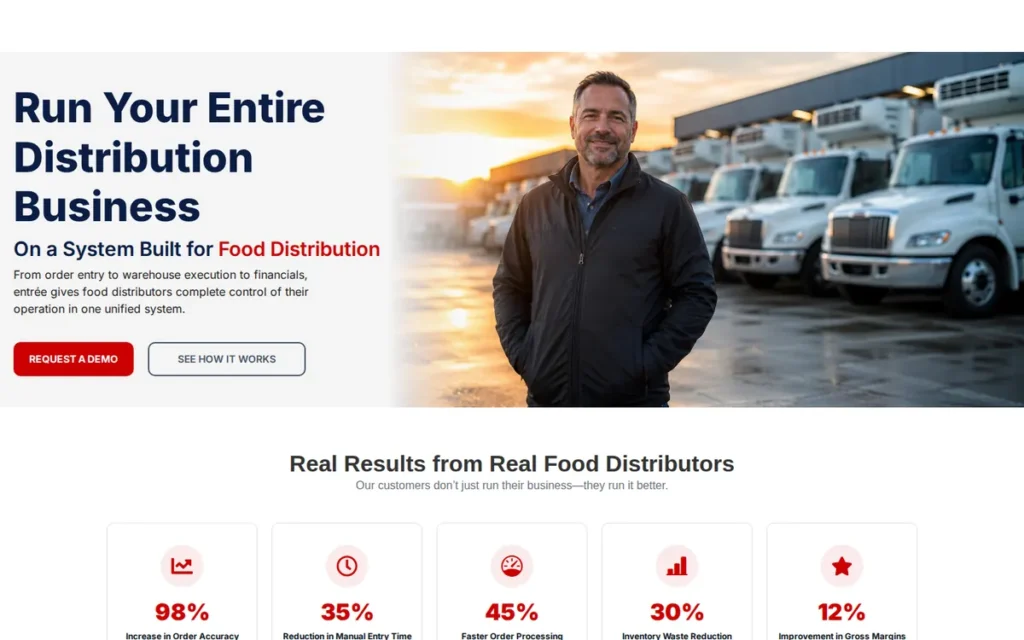
- entrée by NECS advertises a “98% increase in order accuracy” and “45% faster order processing” without naming a customer or method, so PlugRoute treats both figures as unverified marketing.
- entrée by NECS drew a reviewer complaint that sales reps on iPads were limited in running reports and changing customer accounts, and EXPRESS app reviews mention orders backing out and unannounced downtime [Source: Capterra and Google Play, user reviews, November 2026].
- PlugRoute’s November 2026 research found no verified FSMA 204 documentation for entrée by NECS, so buyers should require a mock recall in the demo.
Verdict
entrée by NECS is the most purpose-built ERP for independent foodservice distributors in PlugRoute’s 2026 evaluation, and the most open about cost.
entrée by NECS scored 3.58/5, tying Aptean on native food coverage and leading all ERPs on pricing transparency. entrée by NECS has no named, quantified software outcome in this research, which is why it scored 2 on Documented Customer Results. Buyers needing cloud-native software should ask NECS for references.
3. Oracle NetSuite (Food & Beverage): Best for Multi-Entity, Fast-Growing Distributors
Category: General Cloud ERP, a broad business-management ERP for many industries, where food-distribution features come from industry configuration or partner extensions.
At a Glance
- Category: General Cloud ERP
- Best For: Growing, multi-entity or multi-warehouse distributors that put finance and scale ahead of out-of-the-box foodservice depth
- Price Range: About $999/month base plus $99–$199 per user per month (third-party estimates, November 2026); implementation $25K to more than $250K
- Primary Strength: Oracle NetSuite combines lot tracking, FEFO and catch-weight invoicing with multi-entity finance on a cloud-native platform backed by thousands of reviews.
- Biggest Limitation: Oracle NetSuite may need partner extensions for foodservice workflows, and Reddit users report steep renewal increases.
- One-Line Summary: Oracle NetSuite (Food & Beverage) is a cloud-native ERP that gives growing food distributors multi-entity finance, lot tracking and catch-weight invoicing, at the cost of reliance on partners and renewal-price risk.
- Last Verified: November 2026
Overview
Oracle NetSuite (Food & Beverage) is a multi-tenant cloud ERP with food-industry features, including lot tracking, FEFO allocation and catch-weight invoicing, for growing distributors that need multi-entity finance, ecommerce and a large partner ecosystem more than out-of-the-box foodservice depth.
Oracle NetSuite’s results depend heavily on the implementation partner, because partners built or rescued key workflows in documented food cases. This research did not confirm documented support for substitutions, shorts or route accounting.
Key Features
- Oracle NetSuite tracks inventory and cost at lot level and allocates stock by FEFO across dry, refrigerated and frozen storage (claimed native).
- Oracle NetSuite lists catch-weight variations, catch-weight invoicing and order allocation under catch-weight rules among its food features (claimed native; verify end to end).
- Oracle NetSuite provides multi-entity financials and ecommerce on one multi-tenant cloud platform (native).
- Oracle NetSuite extends through the SuiteCloud partner ecosystem, which supplied delivery-date-based pricing for at least one documented food customer (partner extension).
- Oracle NetSuite supported mobile order entry at L&L Foods through a partner implementation (partner add-on).
Best For
Oracle NetSuite is best for food distributors with several entities, warehouses or growth plans that want one cloud system for finance and operations and can budget for a capable implementation partner.
Pricing
Oracle quotes Oracle NetSuite only on request, so the figures below are third-party estimates:
- Oracle NetSuite’s base platform costs about $999 per month [Source: ERP Research, third-party estimate, November 2026].
- Oracle NetSuite’s full users cost about $99–$199 per user per month, or about $50.7K–$71.7K a year for 25 users before add-ons [Source: Flectic and Houseblend, third-party estimates, November 2026].
- Oracle NetSuite implementation runs about $25K–$75K for small companies, $75K–$250K for mid-market, and $250K to more than $1M for enterprise [Source: AppSeConnect, third-party estimate, November 2026].
Oracle NetSuite buyers should negotiate a cap on renewal increases into the first contract.
Strengths
- Oracle NetSuite holds 4.0/5 from about 3,800 G2 reviews, 4.1/5 from about 1,720 Capterra reviews and 4.4/5 from about 596 Gartner Peer Insights reviews, though these cover all industries [Source: ERP Research, third-party compilation, November 2026].
- Oracle NetSuite customer Global Food Solutions cut time spent receiving orders, creating purchase orders and confirming with vendors by 75% [Source: NetSuite customer story, vendor-published, November 2026].
- Oracle NetSuite customer L&L Foods reduced order-processing and data-entry time by about 40–50% after adding mobile order entry [Source: Anchor Group, partner-published, November 2026].
- Oracle NetSuite let Frey Farms link sales orders, purchase orders and freight costs to measure profit per sales order [Source: NetSuite testimonial, vendor-published, November 2026].
Limitations
- Oracle NetSuite’s biggest trade-off is foodservice depth, because L&L Foods needed delivery-date-based pricing built as a partner extension during a “rescue” of an earlier implementation [Source: Anchor Group, partner-published, November 2026].
- Oracle NetSuite users describe late renewal quotes and sharp increases, with one writing, “They do the contract renewals intentionally late so you don’t have time to move!” [Source: r/Netsuite, user post, October 2026].
- Oracle NetSuite’s WMS, demand-planning and EDI scope for food was not documented, so buyers should check which modules are licensed separately.
- Oracle NetSuite’s review base is large but not food-specific.
- PlugRoute’s November 2026 research found no verified FSMA 204 documentation for Oracle NetSuite, so buyers should require a mock recall in the demo.
Users on r/Netsuite shared their experience:
“You generally get a 50% discount when you first buy it – lock in a longer contract to keep the discount for longer. They will squeeze you as the years go on, as they know it takes a long time to migrate off.” Posted by u/trollied
Takeaway: Oracle NetSuite’s first-year discounts tend to give way to steeper renewal pricing once switching costs lock customers in, so a multi-year contract with a renewal cap is essential protection.
Verdict
Oracle NetSuite is the best-evidenced general ERP for food distributors that need multi-entity scale, but it is not the deepest out-of-the-box foodservice system.
Oracle NetSuite scored 3.50/5 and has the largest review volume in this evaluation, plus two named, quantified customer results. Oracle NetSuite scored 3 on workflow coverage against 5 for Aptean and entrée, a gap worth 0.50 weighted points. Buyers should test catch weight through credits and secure a renewal cap.
4. Acumatica Cloud ERP (Distribution Edition): Best for Distributors With Many Casual Users
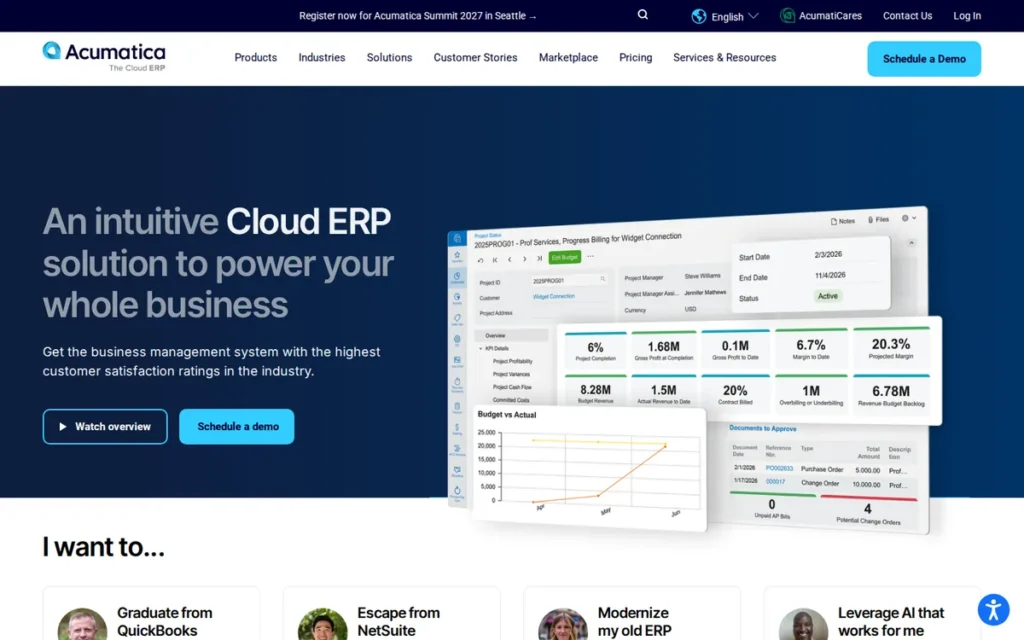
Category: General Cloud ERP, a broad business-management ERP for many industries, where food-distribution features come from industry configuration or partner extensions.
At a Glance
- Category: General Cloud ERP
- Best For: Mid-market distributors with many casual users (warehouse temps, suppliers, customers) that will choose a food add-on partner carefully
- Price Range: Pricing on request (quote-based; implementation about 1.5–2.5 times software cost by Acumatica’s estimate, November 2026)
- Primary Strength: Acumatica Cloud ERP licenses unlimited users, so distributors can give temporary staff, suppliers and customers access without buying more licences.
- Biggest Limitation: Acumatica Cloud ERP does not provide native catch weight for food distributors, so food workflows depend on a partner add-on and reseller.
- One-Line Summary: Acumatica Cloud ERP (Distribution Edition) is an unlimited-user cloud ERP whose food-distribution capabilities, including catch weight, depend on partner add-ons such as Prime Food Service.
- Last Verified: November 2026
Overview
Acumatica Cloud ERP (Distribution Edition) is a general cloud ERP with unlimited-user licensing for mid-market distributors, where food functions such as catch weight usually come from partner add-ons like Net at Work’s Prime Food Service rather than the core product.
Acumatica Cloud ERP buyers are judging the partner as much as the platform, because the reseller (VAR) and add-on vendor shape daily food workflows. This research did not confirm documented support for substitutions, shorts or route accounting.
Key Features
- Acumatica Cloud ERP licenses unlimited users and prices by applications, resource use and transaction volume (native).
- Acumatica Cloud ERP’s Distribution Edition provides distribution functions in the cloud, with food-specific workflows supplied by partners.
- Acumatica Cloud ERP gains food functions such as catch weight through partner add-ons like Net at Work’s Prime Food Service (partner add-on).
- Acumatica Cloud ERP offers an open API, which FoodMaven cited as a reason for choosing the platform.
- Acumatica Cloud ERP may need third-party extensions for specialised functions such as EDI compliance [Source: Acumatica, vendor-published, November 2026].
Best For
Acumatica Cloud ERP is best for growing distributors that need many system users, prefer cloud deployment, and have found a food-experienced partner with a proven add-on.
Pricing
Acumatica Cloud ERP is quote-based with no published dollar amounts, and Acumatica’s own estimate puts implementation at about 1.5–2.5 times software cost [Source: Acumatica, vendor-published, November 2026].
Acumatica Cloud ERP’s unlimited users do not mean unlimited usage, so busy seasons or growth can push a customer into a higher resource tier. Buyers should ask for the food add-on to be quoted separately.
Strengths
- Acumatica Cloud ERP holds 4.4/5 from 243 Capterra reviews, the second-largest review base in this evaluation, though the reviews cover all industries rather than food specifically [Source: Capterra, user reviews, November 2026].
- Acumatica Cloud ERP customer Ambassador Foods went live in about 4 months with Prime Food Service and saves nearly 2 hours a day of manual inventory adjustments [Source: Net at Work, partner-published, November 2026].
- Acumatica Cloud ERP let FoodMaven give temporary staff, suppliers and customers access without buying more licences [Source: Acumatica customer story, vendor-published, 2020].
- Acumatica Cloud ERP comes with a vendor-published implementation-cost ratio of 1.5–2.5 times software cost, a pricing-transparency signal that helps buyers budget [Source: Acumatica, vendor-published, November 2026].
Limitations
- Acumatica Cloud ERP’s biggest trade-off is native food depth, because catch weight was a gap at Ambassador Foods until the Prime Food Service add-on filled it [Source: Net at Work, partner-published, November 2026].
- Acumatica Cloud ERP’s reliance on resellers carries process risk, as one distributor wrote: “we’re feeling like we’re not getting the process-side support” [Source: r/ERP, user post, January 2026].
- Acumatica Cloud ERP may need third-party extensions for EDI compliance, which adds cost and integration points.
- Acumatica Cloud ERP is moving to Vista Equity Partners ownership under a May 29, 2025 agreement, so buyers should ask about roadmap and pricing continuity [Source: Acumatica press release, vendor-published, May 2025].
- PlugRoute’s November 2026 research found no verified FSMA 204 documentation for Acumatica Cloud ERP, and its G2 and Gartner ratings were not verified.
Verdict
Acumatica Cloud ERP is a strong cloud foundation for distributors with many users, but its food-distribution fit depends on the partner add-on rather than the core product.
Acumatica Cloud ERP scored 3.15/5. Its unlimited-user model and 243-review Capterra base are real advantages, while partner-supplied catch weight and no published dollar pricing held it back. Buyers should evaluate the food add-on partner and its references as rigorously as the platform.
5. Produce Pro Software: Best for Fresh-Produce and Repacking Distributors
Category: Food-Specific ERP, a full ERP built for food businesses that runs inventory, warehouse, pricing and accounting, with catch weight and lot tracking built in.
At a Glance
- Category: Food-Specific ERP
- Best For: Fresh-produce distributors, repackers, brokers and growers
- Price Range: From $5,000 (Capterra directory figure, scope unstated, November 2026); otherwise contact vendor
- Primary Strength: Produce Pro Software covers produce-specific workflows, including grower accounting, repacking, lot traceability and pallet-level warehouse management.
- Biggest Limitation: Produce Pro Software has only six reviews, and its catch weight, PACA and FSMA 204 support were not confirmed.
- One-Line Summary: Produce Pro Software is an Aptean-owned ERP built around fresh produce, with grower accounting, repacking, lot traceability and pallet-level warehouse management for produce distributors.
- Last Verified: November 2026
Overview
Produce Pro Software is a produce-focused ERP for fresh-produce distributors, repackers, brokers and growers that need grower accounting, lot traceability, repacking, pallet-level warehouse management and mobile quality-control tools in one system.
Produce Pro Software has been owned by Aptean since July 2022. It is a separate product from Aptean Food & Beverage ERP, but the same company sells and supports both, so buyers comparing them deal with one vendor.
Key Features
- Produce Pro Software includes grower accounting and forecasting for distributors that buy directly from growers (native).
- Produce Pro Software supports lot tracking and traceability for produce from receiving through shipment (native).
- Produce Pro Software handles picking, packing, repacking, processing and production workflows (native).
- Produce Pro Software provides warehouse management down to pallet level, plus routing (native).
- Produce Pro Software offers mobile apps for delivery, quality control and food safety, along with a customer web-ordering portal.
Best For
Produce Pro Software is best for fresh-produce and repack operations where grower accounting, pallet-level warehouse control and produce traceability matter more than broadline foodservice features.
Pricing
Produce Pro Software is listed from US$5,000, but the listing does not say whether that covers licences, a time period or implementation [Source: Capterra, directory listing, November 2026].
Produce Pro Software’s other directory listings say “contact vendor,” so buyers should request an itemized quote.
Strengths
- Produce Pro Software holds 4.5/5 from 6 reviews on both Capterra and Software Advice, with praise for customer purchase history, traceability reporting and ease of use [Source: Capterra and Software Advice, user reviews, November 2026].
- Produce Pro Software documents the widest set of produce-specific modules in this evaluation, including grower accounting, repacking and pallet-level WMS [Source: Aptean product pages, vendor-published, November 2026].
- Produce Pro Software customer completed PTI GTIN case labelling through a labelling-vendor integration, a documented traceability outcome [Source: Capterra, user review, November 2026].
- Produce Pro Software was founded in 1990 and served “hundreds” of North American distributors, brokers, processors and growers when Aptean acquired it [Source: Aptean press release, vendor-published, July 2022].
Limitations
- Produce Pro Software’s biggest trade-off is evidence, because six reviews make it the smallest verified review base of the five ERPs [Source: Capterra, user reviews, November 2026].
- Produce Pro Software reviewers complain about “endless tabbing,” hard-to-build reports and time-consuming setup [Source: Capterra, user reviews, November 2026].
- PlugRoute’s November 2026 research did not confirm Produce Pro Software’s catch weight, PACA support, FSMA 204 features or deployment architecture.
- Produce Pro Software’s widely quoted 40% sales-lift figure is credited to both Fresh Connect Central and Belair Produce, so PlugRoute does not treat it as verified [Source: Aptean case study and producepro.com, vendor-published, November 2026].
- Produce Pro Software drew one reviewer comment that support answers were hard to get after the Aptean acquisition but were improving [Source: Capterra, user review, November 2026].
Verdict
Produce Pro Software is the most produce-specialised ERP in PlugRoute’s 2026 evaluation, but it is the least independently verified of the five ERPs.
Produce Pro Software scored 2.88/5. Its grower accounting, repacking and pallet-level WMS fit fresh-produce operations closely, while its thin reviews and disputed results held it back. Buyers should ask Aptean to demonstrate catch weight, a mock recall and the post-acquisition support model.
6. Choco: Best for AI Order Capture on Top of an Existing ERP
Category: Ordering Layer, software that sits on top of an existing ERP to capture and digitize customer orders, without replacing inventory, warehouse or accounting.
At a Glance
- Category: Ordering Layer
- Best For: Distributors with a working ERP that still hand-key phone, text, voicemail and email orders
- Price Range: Pricing on request for distributors (fixed and usage-based plans); free for restaurants (November 2026)
- Primary Strength: Choco uses AI agents to convert orders arriving by email, text, WhatsApp, voicemail, photo and PDF into structured data the ERP can import.
- Biggest Limitation: Choco’s AI sometimes misreads orders and needs a person to check them, and its full list of supported ERPs was not verified.
- One-Line Summary: Choco is an AI order-intake layer that turns phone, text and email orders into ERP-ready data for foodservice distributors, without replacing their existing ERP.
- Last Verified: November 2026
Overview
Choco is an AI order-intake and B2B ordering layer for foodservice distributors that keep their existing ERP but still receive orders by email, text, voicemail, photo or PDF, which Choco converts into structured data the ERP can import.
Choco also provides a branded webshop and app for restaurant customers, plus CRM and sales tools. The distributor’s ERP remains the system of record for inventory, warehouse and accounting.
Key Features
- Choco’s OrderAgent and Autopilot turn email, text, WhatsApp, voicemail, photo and PDF orders into structured data the ERP can import.
- Choco’s VoiceAgent, built on OpenAI’s Realtime API, takes phone orders, checks stock, suggests substitutions and flags products near expiry [Source: Choco, vendor-published, November 2026].
- Choco provides a branded webshop and mobile app that restaurant customers use for free.
- Choco includes CRM and SalesHub tools for distributor sales teams.
- Choco says it syncs pricing, inventory and customer data with “leading ERPs,” and Capterra lists it as an entrée by NECS integration [Source: Choco and Capterra, vendor-published and directory listing, November 2026].
Best For
Choco is best for distributors whose ERP still works but whose order desk is overwhelmed by unstructured orders that staff key in by hand.
Pricing
Choco does not publish distributor pricing. Choco uses both fixed subscriptions and usage-based plans and is free for restaurants [Source: Stripe customer story and Google Play, third-party and app listing, November 2026].
Choco buyers should ask how usage-based charges scale with order volume during peak seasons.
Strengths
- Choco holds 4.6/5 from 12 G2 reviews, with praise for ease of use, support and time saved on order entry [Source: G2, user reviews, November 2026].
- Choco customer Krystal Produce processed a 50+ item order in 13 seconds, saving about 15 hours a week and more than $23,000 in labour over an unstated period [Source: Choco case studies, vendor-reported, November 2026].
- Choco’s restaurant app holds 4.2/5 from 397 Google Play reviews, though these come from restaurant users rather than distributors [Source: Google Play, user reviews, November 2026].
- Choco customer North West Meat Company cut nightly manual order entry “from hours to minutes,” though the result was not quantified [Source: Choco case studies, vendor-published, November 2026].
- Choco raised a $100M Series B in July 2021 at a reported $600M post-money valuation, led by Left Lane Capital [Source: TechCrunch, news report, July 2021].
Users on r/KitchenConfidential noted:
“I use it, it means I don’t have to write up 5 different order emails, or Call 5 places. It took a 1 hour chore into 15 minutes.
Your clipboard is in your hand. And directly connected via email to the sales department if you have questions.
A lot Of suppliers have their entire fresh sheet loaded up so you can browse their stuff.
That being said, a lot Of providers have made their own apps now, that do the same thing, but you still have to download the app for each.” Posted by u/skrybll
Takeaway: Restaurant buyers credit Choco with cutting multi-supplier ordering from an hour to minutes, but the rise of supplier-specific apps limits how much of that consolidation advantage Choco can keep.
Limitations
- Choco’s biggest trade-off is scope, because Choco is not an ERP and inventory, warehouse, catch weight, lot tracking and accounting stay in the distributor’s existing system.
- Choco’s AI sometimes misreads orders and needs a person to check them [Source: G2, user reviews, November 2026].
- Choco’s list of supported ERPs was not verified beyond the entrée by NECS listing, so buyers must confirm a working connector for their own ERP.
- Choco publishes no distributor pricing, and its one Capterra review notes that users cannot add a supplier themselves [Source: Capterra, user review, November 2026].
- Choco has moved from a restaurant ordering app toward AI for distributors, so buyers should ask how stable the roadmap is.
Verdict
Choco is the best-evidenced AI order-capture layer in PlugRoute’s 2026 evaluation for distributors that want to stop hand-keying orders without replacing their ERP.
Choco scored 2.68/5, the highest of the ordering layers, which score lower on workflow coverage by design because they do not run inventory or accounting. Choco’s verified G2 reviews put it ahead of Pepper on evidence. Buyers should confirm an ERP connector and track the human-review rate during a trial.
7. Pepper: Best for B2B Ecommerce Adoption and Sales-Rep Tools
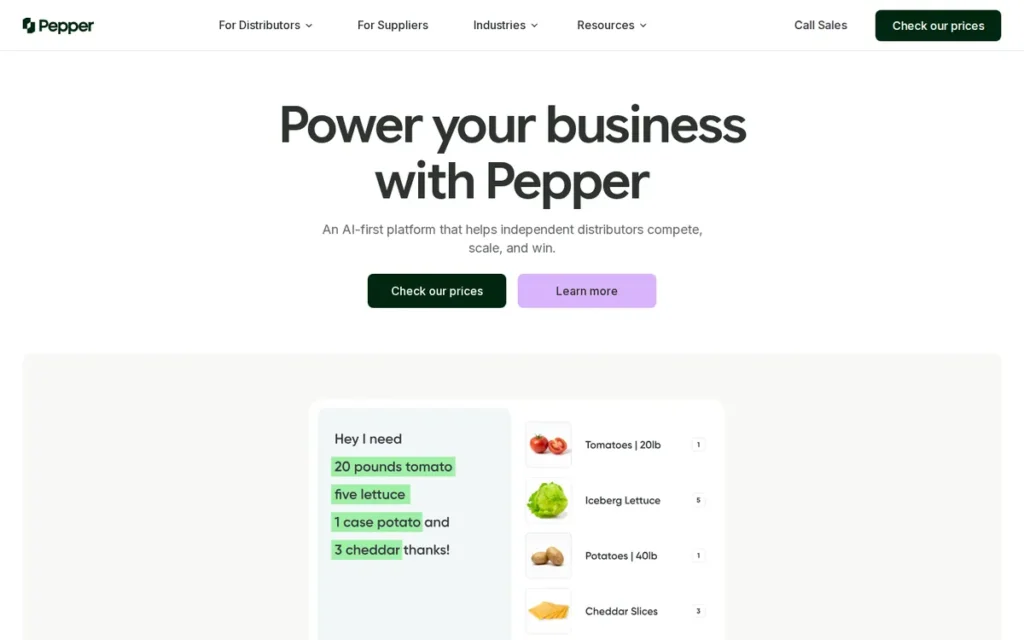
Category: Ordering Layer, software that sits on top of an existing ERP to capture and digitize customer orders, without replacing inventory, warehouse or accounting.
At a Glance
- Category: Ordering Layer
- Best For: Independent broadline and specialty distributors that want restaurant customers ordering digitally and sales reps selling more
- Price Range: Pricing on request (“tailored,” pay-for-performance; no dollar figures published as of November 2026)
- Primary Strength: Pepper has documented fast digital-ordering adoption among independent restaurant accounts at several named distributors.
- Biggest Limitation: Pepper has no verified review-platform presence, so all performance evidence about it comes from the vendor.
- One-Line Summary: Pepper is a white-label B2B ecommerce and sales-rep platform that connects to a foodservice distributor’s existing ERP and has documented fast restaurant adoption of digital ordering.
- Last Verified: November 2026
Overview
Pepper is a B2B ecommerce and sales-rep platform for independent foodservice distributors that want a white-label restaurant ordering app, order guides, AI order capture and rep prospecting tools connected to their existing ERP rather than replacing it.
Pepper sends orders into the distributor’s ERP, and in the DiLandri Provisions case study that ERP was Xtreme. The distributor’s ERP remains the system of record for inventory and accounting.
Key Features
- Pepper provides a white-label restaurant ordering app and webstore with order guides.
- Pepper’s Order Agent captures orders that arrive by email, PDF, text and voicemail.
- Pepper’s DSR Connect gives sales reps pricing and margin views, prospecting, churn and upsell alerts, and AI-built sample order guides.
- Pepper includes advertising, promotions and payments tools for distributors.
- Pepper sends orders into the distributor’s existing ERP, documented with Xtreme at DiLandri and listed as an entrée by NECS integration [Source: Pepper and Capterra, vendor-published and directory listing, November 2026].
Best For
Pepper is best for independent distributors whose priority is moving restaurant customers to digital ordering and giving sales reps data-driven selling tools on top of a working ERP.
Pricing
Pepper publishes no dollar amounts. Pepper describes pricing as “tailored” and “pay-for-performance” with “no hidden fees” [Source: Pepper pricing page, vendor-published, November 2026].
Pepper’s pricing page advertises a 23%+ sales increase, 10+ hours saved per rep per week and DSO cut by 2 days, but none of these figures is tied to a named client.
Strengths
- Pepper customer Galipo Food Company raised digital orders from 22% to 56% of transactions within 3 months [Source: Pepper case study, vendor-published, November 2026].
- Pepper customer DiLandri Provisions saw 66% of independent accounts adopt the app within weeks, with 19–22% of weekly order volume from items outside usual order guides [Source: Pepper case study, vendor-published, November 2026].
- Pepper customer Flanagan Foodservice increased online-ordering adoption among independent accounts from 29% to 62% [Source: Pepper case study, vendor-published, November 2026].
- Pepper raised a $30M Series B in May 2024 led by ICONIQ Growth and served more than 140 distributor customers that year [Source: Digital Commerce 360, news report, May 2024].
- Pepper has since described more than 200 independent distributors on its platform [Source: Pepper, vendor-reported, November 2026].
This aligns with community sentiment on r/ProduceDepartment:
“We use the Indy Fruit as well and I love the “Pepper app” as well as the website ordering. Great way to customize order guides, etc…
My main supplier is AWG and I prefer to use their website ordering over using a gun to key in item codes.” Posted by u/BobSacamano_1
Takeaway: Buyers ordering through a Pepper-powered distributor app praise its order-guide customization, which gives Pepper a rare piece of independent end-user support beyond its vendor-published case studies.
Limitations
- Pepper’s biggest trade-off is independent proof, because the G2 listing named “Pepper” belongs to a different company and no verified review presence was found [Source: PlugRoute research, G2 search, November 2026].
- Pepper’s performance figures all come from the vendor, including pricing-page claims not tied to any named client.
- Pepper is an ordering and sales layer, so inventory, warehouse, catch weight, lot tracking and accounting stay in the distributor’s existing ERP.
- Pepper’s pay-for-performance pricing has no published figures, so buyers cannot estimate cost before a sales conversation.
- Pepper’s documented ERP connections in this research are limited to Xtreme and an entrée by NECS listing, so buyers on other ERPs should confirm a live connector [Source: Pepper and Capterra, vendor-published and directory listing, November 2026].
Verdict
Pepper is the strongest documented option for driving restaurant adoption of digital ordering, but it is the least independently verified product in PlugRoute’s 2026 evaluation.
Pepper scored 2.33/5, partly because ordering layers score lower on workflow coverage by design. Pepper’s three named adoption results are specific and quantified, but all are vendor-published. Buyers should ask for customer references, confirm the ERP connector and get pay-for-performance terms in writing.
Do I Need a Foodservice Distribution ERP or Online Ordering Software?
You need a foodservice distribution ERP if your current system cannot handle catch weight, lot and expiry tracking, customer pricing or warehouse workflows. You need online ordering software, an ordering layer such as Choco or Pepper, if your ERP works but orders still arrive by phone, text and email and staff key them in.
“A lot of companies use QuickBooks mainly for accounting, but for food & beverage distribution they still struggle with things like batch-wise inventory, expiry tracking, route sales, delivery management.” (u/Working_Bend_5994 [Source: r/FieldSalesHelp, user post, January 2026])
Takeaway: QuickBooks handles accounting, but foodservice distributors usually need lot, expiry, route and delivery capabilities that only food-specific or configured ERPs provide.
Signs that a full ERP is the right move:
- Your accounting tool cannot track lots, expiry dates or FEFO picking.
- Your system bills on nominal weight instead of actual catch weight.
- Your customer-specific pricing and order guides live in spreadsheets.
- Your receiving, picking, routing and proof of delivery run on disconnected tools.
Signs that an ordering layer is the right move:
- Your ERP handles inventory and accounting reliably.
- Your order desk spends hours each night re-keying unstructured orders.
- Your restaurant customers want an app or webstore with their order guide.
An ordering layer and an ERP are not competitors. entrée by NECS lists Choco, Cut+Dry and Pepper as integrations [Source: Capterra, directory listing, November 2026]. That means a distributor can fix order intake first and replace the ERP later, if it needs to at all.
What Does Foodservice Distribution Software Really Cost?
Foodservice distribution software usually costs well beyond its subscription price, because quotes often list implementation, hardware, integrations, training and renewals separately. Acumatica’s own estimate puts implementation at 1.5–2.5 times software cost. Panorama Consulting found that 60% of ERP projects ran over budget, by an average of 33% [Source: Panorama Consulting, industry report, 2021].
Panorama Consulting’s 2021 ERP Report also found that only 54% of projects finished on schedule, and late projects ran an average of 29% over their planned timeline [Source: Panorama Consulting, industry report, 2021]. In this research, Ambassador Foods went live on Acumatica in about 4 months, while L&L Foods needed a NetSuite rescue project.
As one user on r/logistics described:
“We implemented an ERP to simplify operations, but honestly it created new problems.
• Data looks clean, but reports don’t match ground reality
• Teams use only 30–40% of features
• Too many workarounds in Excel even after ERP” Posted by u/OneLumpy3097
Takeaway: For distributors, the hidden cost of an ERP project often shows up after go-live, when underused features and Excel workarounds wipe out the efficiency the system was bought to deliver.
Costs that quotes commonly leave out:
- Implementation: Implementation runs about 1.5–2.5 times software cost by Acumatica’s estimate, and $25K–$75K for small NetSuite projects [Source: Acumatica and AppSeConnect, vendor-published and third-party estimate, November 2026].
- Hardware: Scanners, scales and label printers cost about $500–$2,000 per warehouse workstation, and NECS’s WMS example includes $11,000 in hardware [Source: Gilzor and NECS, third-party and vendor-published, November 2026].
- Integrations and EDI: EDI compliance may need third-party extensions on Acumatica Cloud ERP.
- Usage tiers: Acumatica Cloud ERP licenses unlimited users but prices by resource use and transaction volume, so a busy season can push a distributor into a higher tier.
- Food add-ons: Partner modules such as Prime Food Service for Acumatica are priced separately.
- Renewals: Reddit users report steep NetSuite renewal increases [Source: r/Netsuite, user posts, October 2026].
Published price points in this evaluation, all as of November 2026:
- Oracle NetSuite costs about $999/month base plus $99–$199 per user per month (third-party estimates).
- entrée by NECS starts from $1,250 per user per month (Capterra).
- Produce Pro Software starts from $5,000, with scope unstated (Capterra).
- Aptean Food & Beverage ERP, Acumatica Cloud ERP, Choco and Pepper provide pricing only on request.
Buyers should ask every vendor for an itemized quote, a written renewal cap and data-export terms before signing.
What Red Flags Should I Watch For When Evaluating Foodservice Distribution Software?
The biggest red flags in foodservice distribution software are features that work in a demo but break in daily operations, evidence you cannot verify, and contracts without cost protection. The seven warning signs below come from documented review complaints, case studies and Reddit discussions collected in November 2026.
Users on r/FieldSalesHelp noted:
“At that budget, I’d be careful with anything that looks cheap up front but needs a bunch of add-ons or setup work to handle the basics.
For food/bev, I’d test for three things first: can it handle fast order entry, delivery flow, and expiration / lot tracking without turning into spreadsheet cleanup later. If you’re already on QuickBooks and doing B2B route sales plus direct orders, something like SimplyDepo is worth a look too since it fits that distributor workflow a lot better than generic software. Biggest thing is making sure it actually works in day-to-day operations, not just in the demo.” Posted by u/AirlineFront9129
Takeaway: Food and beverage distributors should judge foodservice distribution software on order entry, delivery flow and lot tracking in daily use, because low sticker prices and polished demos often hide add-on and setup costs.
Red Flag #1: Catch Weight That Stops at Invoicing Catch weight that stops at invoicing is a red flag because errors then surface in credits and customer disputes. As an illustrative example, a case of beef sold as 40 lb that weighs 38.6 lb is overbilled by 1.4 lb. Ask the vendor to run one variable-weight item through receiving, inventory, invoicing and credits.
Red Flag #2: Food Features That Depend on an Unnamed Partner Food features that depend on an unnamed partner are a red flag because you are buying the partner as much as the ERP. Acumatica Cloud ERP’s catch weight came from the Prime Food Service add-on in the documented case. A vendor that cannot name the add-on and its references is hiding a key dependency.
Red Flag #3: No Renewal Cap in the Contract A first contract with no renewal cap is a red flag because it leaves you exposed to sharp price rises once switching has become costly. NetSuite users describe renewal quotes that arrive late and leave little time to migrate [Source: r/Netsuite, user posts, October 2026]. Write the cap into the first contract.
Red Flag #4: No FSMA 204 Mock Recall in the Demo A vendor that will not run an FSMA 204 mock recall is a red flag because traceability records must be produced for the FDA on request. Congress has directed the FDA not to enforce the rule before July 20, 2028 [Source: FDA, regulator, November 2026]. PlugRoute’s research found no verified FSMA 204 documentation for any of the five ERPs.
Red Flag #5: Ratings Without Review Counts A rating quoted without its review count is a red flag because the number alone hides how strong the evidence is. A 4.5 from 6 reviews is far weaker evidence than a 4.0 from about 3,800. Always ask how many reviews sit behind a score and whether they are food-specific.
Red Flag #6: Results With No Named Customer Performance claims with no named customer are a red flag because they cannot be checked. Examples include NECS’s advertised “98% increase in order accuracy” and Pepper’s “23%+ sales increase” [Source: NECS and Pepper websites, vendor-published, November 2026]. Treat such figures as marketing until a reference customer confirms them.
Red Flag #7: A Reseller That Only Does Technical Setup A reseller (VAR) that only does technical setup is a red flag because a configured system with unchanged processes still produces broken workflows. One Acumatica customer described getting technical help but not process-side support [Source: r/ERP, user post, January 2026]. Ask resellers for references on process redesign.
What Questions Should I Ask Before Choosing Foodservice Distribution Software?
The most important questions to ask before choosing foodservice distribution software test real workflows, total cost and vendor stability rather than feature lists. Ask each vendor the six questions below during a live demo that uses your own data, and get the answers on cost and roadmap in writing.
Question #1: Can you run our real order from customer pricing through catch-weight credit? A strong answer is a live demo of one of your own orders showing customer pricing, actual-weight invoicing and a short or credit. Slides and scripted demo data are weak answers, because they hide the edge cases where generic ERPs fail.
Question #2: Can you run a mock recall that traces one lot in minutes? A strong answer traces one lot from receiving to every customer shipment on screen. That test is the best available check of FSMA 204 readiness before the July 20, 2028 enforcement date, and it shows whether traceability works outside a slide deck.
Question #3: Which food features are native and which come from partners? A strong answer marks each capability as native, partner add-on or roadmap item. Partner features need their own references, pricing and support terms, because a partner outage or acquisition can break a workflow your core vendor does not support.
Question #4: What will implementation, hardware, integrations and renewals cost in writing? A strong answer is an itemized quote covering implementation, scanners and scales, EDI, training and a renewal cap. Verbal estimates do not protect you from the overruns Panorama Consulting documented in 2021, when 60% of ERP projects exceeded budget.
Question #5: Does your ordering layer have a working connector to our ERP today? A strong answer names live customers on your exact ERP and version. “We integrate with leading ERPs” is not a confirmed connector, and a missing connector turns an ordering layer into another source of manual re-keying.
Question #6: Who owns the company, and what is the roadmap commitment? A strong answer explains recent ownership changes and commits to continued support and pricing. Aptean acquired Produce Pro in July 2022, Aptean’s investors changed after 2019, and Vista agreed to acquire Acumatica in May 2025.
How Did We Rank These Foodservice Distribution Software Tools?
PlugRoute ranked these seven products by scoring each from 1 to 5 on six weighted criteria, using only research collected in November 2026. Workflow coverage and independent review evidence carry the most weight. The rank follows the weighted total, and every data point is labelled by source type.
Each criterion below lists its weight, why it matters and its scoring anchors. Half-points mark evidence that falls between two anchors.
- C1 Food-Distribution Workflow Coverage (25%): C1 matters because generic ERPs fail on catch weight, lot and expiry tracking, FEFO, pricing and repacking. A 5 means native coverage plus warehouse or routing, a 3 means claimed or partner-supplied coverage, and a 2 means ordering only.
- C2 Independent Review Evidence (20%): C2 weights ratings by volume and food relevance, because buyers cannot check vendor claims themselves. A 4 means hundreds or more reviews, a 3 means a small food-specific base, and a 1 means no verified presence.
- C3 Documented Customer Results (15%): C3 counts named, quantified outcomes. A 4 means two or more named operational results, a 3 means one, and a 2 means none undisputed. Results that measure only adoption score half a point lower.
- C4 Pricing and Total-Cost Transparency (15%): C4 rewards cost disclosure. A 4 means a directory price plus a vendor cost example, a 3 means third-party dollar estimates, a 2 means a pricing model without dollars, and a 1 means nothing.
- C5 Deployment and Integration Fit (15%): C5 assesses architecture and integrations. A 4 means cloud-native with documented integrations, and a 3 means hosted or unconfirmed architecture.
- C6 Vendor Stability and Support Track Record (10%): C6 covers ownership, funding and complaints. A 3 means stable scale offset by documented support complaints or ownership change.
Each data point carries one of these evidence labels:
- Vendor-published evidence comes from the software company’s own website, case studies or press materials.
- Partner-published evidence comes from an implementation partner or reseller.
- Third-party estimates come from independent analysts or directories.
- User-review evidence always appears with its review count.
| Rank | Product | C1 | C2 | C3 | C4 | C5 | C6 | Weighted Total |
|---|---|---|---|---|---|---|---|---|
| 1 | Aptean Food & Beverage ERP | 5 | 3.5 | 4 | 1.5 | 4 | 3 | 3.68 |
| 2 | entrée by NECS | 5 | 3 | 2 | 4 | 3.5 | 3 | 3.58 |
| 3 | Oracle NetSuite (Food & Beverage) | 3 | 4 | 4 | 3 | 4 | 3 | 3.50 |
| 4 | Acumatica Cloud ERP | 2.5 | 4 | 3 | 2.5 | 4 | 3 | 3.15 |
| 5 | Produce Pro Software | 4 | 2.5 | 2 | 2.5 | 3 | 2.5 | 2.88 |
| 6 | Choco | 2 | 3 | 3 | 2 | 3.5 | 3 | 2.68 |
| 7 | Pepper | 2 | 1 | 3.5 | 1.5 | 3.5 | 3.5 | 2.33 |
The top three products are within 0.18 points of each other (3.68, 3.58 and 3.50), so your own situation should outweigh rank position.
Choco and Pepper score lower on C1 by design because ordering layers do not run inventory or accounting. They are the strongest choices within their own layer, not weaker ERPs.
PlugRoute has no affiliate relationships with any company listed. Rankings are determined entirely by research data and objective evaluation criteria.
Which Products Did We Consider but Not Include?
PlugRoute considered several other foodservice distribution products but left them out because comparable, verifiable evidence was not available in November 2026. Leaving a product out is not a negative judgment. It means the research could not support an equal-depth entry for that product.
Products considered but not included:
- Ordermentum was excluded because it operates mostly in Australia and no review data was found.
- Silo and BlueCart were considered but not fully researched.
- Cut+Dry appears as an entrée by NECS integration but was not fully researched.
- Sage X3 and SAP Business One were excluded because they are general ERPs with even less food-specific evidence than NetSuite or Acumatica.
- Food Connex, BFC WMS, Harvest Food Solutions, Acctivate, Supligo and Fresho are named by AI answer engines but were not evaluated for lack of comparable evidence.
Known data limits in this evaluation:
- Reddit evidence was thin for every product except NetSuite.
- Founding dates and headquarters for NECS, and NetSuite’s founding and Oracle acquisition dates, were not confirmed by primary sources.
- The G2 listing named “Pepper” belongs to a different company and was not attributed to Pepper (usepepper.com).
What Do Buyers Most Often Ask About Foodservice Distribution Software?
Buyers of foodservice distribution software most often ask which product fits a small distributor, which products handle catch weight and lot tracking, and how rankings are determined. The answers below draw only on PlugRoute’s November 2026 research and label sources by type. Cost and timing are covered in the cost section above.
What is the best foodservice distribution software for small distributors?
entrée by NECS is the most purpose-built option for small independent distributors, but its $1,250 per user per month Capterra starting price exceeds very small budgets. Distributors spending $200–$300 a month should confirm lot and expiry tracking in their current tool, add an ordering layer if hand-keying is the problem, and budget for an ERP later.
Which foodservice distribution software handles catch weight and lot tracking?
Aptean Food & Beverage ERP and entrée by NECS document native catch weight and lot tracking. Oracle NetSuite lists catch-weight invoicing and lot-level tracking, which buyers should verify end to end. Acumatica Cloud ERP relied on the Prime Food Service add-on for catch weight. Produce Pro Software’s catch weight was not confirmed in November 2026.
How does PlugRoute determine rankings?
PlugRoute scores each product from 1 to 5 on six weighted criteria. Workflow coverage carries 25%, independent review evidence 20%, and customer results, cost transparency and deployment fit 15% each. Vendor stability carries 10%. Research was collected in November 2026, and every data point is labelled by source type for readers.
What Do Key Foodservice Distribution Software Terms Mean?
Foodservice distribution software uses specialised terms for weight, traceability, warehouse and contract concepts. The most important for buyers are catch weight, lot traceability, FEFO, FSMA 204 and the difference between an ERP and an ordering layer. Each definition below explains the term and why it matters when comparing vendors.
Catch Weight: Catch weight is the practice of pricing and invoicing a product by its actual weight rather than a fixed nominal weight. Catch weight matters for meat, seafood and cheese, where every case weighs a little differently, and errors show up directly in billing.
Lot Traceability: Lot traceability links each batch of product to its supplier, receiving date and every customer shipment. Buyers need lot traceability to run fast, targeted recalls instead of pulling entire product lines.
FEFO (First-Expired, First-Out): FEFO is a picking rule that ships the stock with the earliest expiry date first. FEFO reduces spoilage and write-offs for perishable inventory.
FSMA 204 (Food Traceability Rule): FSMA 204 is the FDA rule requiring covered companies to record key data elements at critical tracking events and produce those records on request. The FSMA 204 enforcement date is no earlier than July 20, 2028, so it belongs in any software decision made now.
PACA (Perishable Agricultural Commodities Act): PACA is the US law that governs fair trading and prompt payment in fresh produce. Produce distributors need software that supports PACA trust and payment records.
PTI and GTIN: The Produce Traceability Initiative (PTI) is an industry programme for case-level produce traceability using a Global Trade Item Number (GTIN) on each case label. Buyers selling to large produce customers may need PTI-compliant labelling.
Order Guide: An order guide is a customer-specific list of products, usually with that customer’s prices, that speeds up repeat ordering. Good order-guide management reduces order errors and supports upselling.
Ordering Layer: An ordering layer is software that captures and digitizes customer orders on top of an existing ERP without replacing inventory or accounting. Buyers whose ERP still works can add an ordering layer instead of replacing the whole system.
WMS (Warehouse Management System): A WMS directs receiving, put-away, picking and shipping, often with barcode scanners. Some ERPs include a WMS and others sell it as an add-on, which affects scope and cost.
EDI (Electronic Data Interchange): EDI is a standard format for exchanging orders, invoices and shipping notices electronically with trading partners. Large customers and suppliers may require EDI, and it is often licensed separately.
Cloud-Native vs. Hosted: Cloud-native software is built to run as a shared online service, while hosted software is traditional software running on someone else’s server. The difference between cloud-native and hosted affects upgrades, remote access and long-term maintenance.
DSO (Days Sales Outstanding): DSO is the average number of days a distributor takes to collect payment after a sale. A lower DSO improves cash flow, which is why ordering and payments vendors advertise DSO reductions.
Which Foodservice Distribution Software Tool Is Right for You?
Key Insights
- The right foodservice distribution software depends on which layer you need and what you sell: Aptean Food & Beverage ERP for catch-weight-heavy distributors, entrée by NECS for independents leaving QuickBooks, Oracle NetSuite for multi-entity growth, and Choco or Pepper for working ERPs with hand-keyed orders.
- Aptean Food & Beverage ERP, entrée by NECS and Oracle NetSuite are separated by only 0.18 points in PlugRoute’s 2026 scoring, so fit with your operation matters more than rank.
- Native catch weight (Aptean Food & Beverage ERP, entrée by NECS) differs from partner add-on catch weight (Acumatica Cloud ERP in the documented case), and buyers should confirm which one they are getting.
- Implementation costs about 1.5–2.5 times software cost by Acumatica’s estimate, and warehouse hardware adds about $500–$2,000 per workstation.
- PlugRoute’s November 2026 research found no verified FSMA 204 documentation for any of the five ERPs evaluated, so every buyer should require a mock recall before July 20, 2028.
- Most performance claims in foodservice distribution software are vendor-published, so reference calls are the most reliable way to check them.
In foodservice distribution software, the first decision is not which vendor to pick but which layer you need. Replacing a working ERP to fix an order-entry problem is the costliest mistake a distributor can make.
Situational guidance by buyer type:
- Distributors with a working ERP but hand-keyed phone and text orders should consider Choco or Pepper.
- Broadline or specialty distributors leaving QuickBooks should compare entrée by NECS with Aptean Food & Beverage ERP.
- Fresh-produce and repack operations should evaluate Produce Pro Software.
- Multi-entity distributors should compare Oracle NetSuite and Acumatica Cloud ERP, and distributors with many casual users should look first at Acumatica’s unlimited-user licensing.
Read PlugRoute’s full methodology and our other independent ERP and distribution software reviews before you book demos. We update this guide quarterly. Last updated: November 2026.