The best foodservice management software depends on your operation. Based on PlugRoute’s evidence scoring, Toast fits restaurants wanting one POS platform, MarginEdge fits invoice and food-cost control on an existing POS, and Restaurant365 fits multi-unit accounting. Schools should start with USDA-listed PrimeroEdge, and care facilities with EHR-integrated MealSuite.
“Foodservice management software” is used for everything from restaurants to school districts and hospitals. That makes one overall ranking misleading: a strong restaurant POS can still fail a USDA audit or a texture-diet order. Most online comparisons also repeat vendor claims without checking them, so every claim below carries a dated evidence label.
PlugRoute has no affiliate relationships with any company listed. Rankings are determined entirely by research data and objective evaluation criteria.
“Compare the three based on overall costs (processing included) and features you would actually use.” (User-reported; Reddit r/Restaurant_Managers, 2025)
Takeaway: Compare total cost, including payment processing, not the sticker price.
What Are the 5 Categories of Foodservice Management Software?
Foodservice management software falls into five categories. Each is defined by what sits at the core of the product: the POS, the general ledger, invoices and inventory, chain-wide operations, or clinical and compliance workflows. Pick the category that matches your operation first. Then use the ranking to compare products within it.
The seven ranked products fall into these categories:
- POS-Centered Platform: Toast puts front-of-house, payments and hardware first, then adds back-office tools such as xtraCHEF invoice automation.
- Accounting-Centered Back Office: Restaurant365 is built on a restaurant-specific general ledger, with inventory, labor and purchasing on top. It connects to your POS but does not sell one.
- Food-Cost and Inventory Overlay: MarginEdge and MarketMan connect to your existing POS and accounting system to capture invoices, track costs and control inventory.
- Enterprise Chain Operations: Crunchtime centralizes inventory, labor, forecasting and store-execution control for brands with dozens to thousands of units.
- Institutional Nutrition and Diet System: PrimeroEdge (K-12) and MealSuite (healthcare and senior living) handle menu planning, nutrient analysis and compliance or clinical diet workflows that restaurant tools don’t cover.
Many restaurant operators combine categories. Each combination adds cost and integration risk:
- POS plus overlay: Toast plus MarginEdge costs about $435/location/month for the overlay. That is $350 for MarginEdge, $50 for Toast’s Restaurant Management Suite and about $35 for a Toast API pass-through fee (Vendor-stated; MarginEdge pricing page, retrieved November 2026).
- POS plus accounting back office: Toast plus Restaurant365 depends on correct GL mapping. One bookkeeper reported Toast refunds landing in the wrong account (User-reported; Reddit r/ToastPOS, 2025).
- All-in-one versus best-of-breed: An all-in-one platform means fewer vendors but more dependence on one provider. Best-of-breed tools go deeper in their specialty but add vendors, fees and mapping work.
How Do the Top Foodservice Management Software Tools Compare at a Glance?
Toast ranks first at 39/45 on evidence strength. MarginEdge, Restaurant365, MarketMan, MealSuite, Crunchtime and PrimeroEdge follow. Ranks show how strong and transparent each product’s public evidence is, not which product fits your operation. PlugRoute scores appear in parentheses in the Rank column (as of November 2026).
| Rank | Company | Category | Best For | One-Line Summary | Key Capabilities | Primary Strength | Key Limitation |
|---|---|---|---|---|---|---|---|
| 1 (39/45) | Toast | POS-Centered Platform | Restaurants wanting one vendor | Toast is the best-documented restaurant POS platform in 2026, with about 164,000 locations in its FY2025 SEC filing. | POS, payments, hardware, online ordering, payroll, xtraCHEF back office | Only SEC-filed scale data in this ranking | Processing rates and add-on prices not fully published; support complaints |
| 2 (36/45) | MarginEdge | Food-Cost and Inventory Overlay | Restaurants keeping their POS and accounting | MarginEdge is the most price-transparent invoice-automation and food-cost tool in 2026. | Human-reviewed invoices, daily P&L, recipe costing, bill pay | Published $350/location/month price | Not a POS, GL or payroll system; about $435/location/month for Toast users |
| 3 (33/45) | Restaurant365 | Accounting-Centered Back Office | Multi-unit, multi-entity groups | Restaurant365 is the most-reviewed accounting-centered back office for multi-unit restaurant groups, with 324 G2 reviews. | Restaurant GL, actual-vs-theoretical (AvT) food cost, AP automation, scheduling, payroll | G2 4.6/5 across 324 reviews | Steep learning curve; conflicting published prices |
| 4 (31/45) | MarketMan | Food-Cost and Inventory Overlay | Commissaries and central kitchens | MarketMan is a well-integrated inventory and purchasing platform for commissary-based groups in 2026. | Inventory, smart ordering, vendor EDI, commissary module | Broadest documented POS and accounting integrations | Conflicting scale claims; cancellation friction |
| 5 (30/45) | MealSuite | Institutional Nutrition and Diet System | Senior living and healthcare dining | MealSuite is the most clinically integrated care dining platform reviewed in 2026. | Diet profiles, IDDSI textures, tray tickets, EHR sync | Powers PointClickCare’s Mealtime Solutions | Only four Capterra reviews |
| 6 (28/45) | Crunchtime | Enterprise Chain Operations | Chains with dozens to thousands of units | Crunchtime is the most enterprise-focused restaurant operations platform reviewed in 2026. | Actual-vs-theoretical variance, forecasting, labor, ops execution, learning | Named enterprise outcomes (Five Guys, Domino’s) | Quote-only; core-suite implementations often 6–12 months |
| 7 (25/45) | PrimeroEdge | Institutional Nutrition and Diet System | U.S. public K-12 districts | PrimeroEdge is one of the broadest USDA-listed K-12 child nutrition suites in 2026. | Eligibility, POS, menu planning, production records, claims | On USDA FNS approved software lists | No independent reviews or public pricing |
Which Foodservice Management Software Should I Choose for My Operation?
Choose by operation type:
- Toast for restaurants that want one vendor.
- MarginEdge or MarketMan for restaurants keeping their POS.
- Restaurant365 for multi-entity groups.
- Crunchtime for chains of 50+ units.
- PrimeroEdge for K-12 districts.
- MealSuite for care facilities.
Lower-ranked products often fit specialized operations better than higher-ranked ones.
| Your #1 Priority | Recommended Tool | Why | Acceptable Alternative |
|---|---|---|---|
| All-in-one for a single restaurant | Toast | Lowest published entry price, with POS, payments and back office from one vendor. Verify processing rates and renewal terms. | Lightspeed or Square (not ranked) |
| Multi-location group (2–10 units) keeping its POS | MarginEdge or MarketMan | Published per-location pricing. Multiply by unit count and add integration fees. | Restaurant365 |
| Food-cost control without replacing your POS | MarginEdge | Human-reviewed invoices and published pricing. Verify integration fees and invoice turnaround. | MarketMan |
| Purchasing and commissary control | MarketMan | Dedicated commissary module and broad documented integrations. Test scanning accuracy and cancellation terms. | MarginEdge |
| Multi-entity accounting | Restaurant365 | Restaurant GL with intercompany support. Confirm the current per-location price and GL mapping. | MarginEdge plus your existing accounting |
| Chain with 50+ units | Crunchtime | Chain-scale variance, labor and audits. Confirm the implementation timeline and peer references. | Restaurant365 |
| K-12 USDA compliance | PrimeroEdge | USDA-listed, end-to-end district suite. Check the exact module and meal type on the current USDA list. | LINQ, Health-e Pro, Mosaic (not ranked) |
| Care facility diet management | MealSuite | EHR-documented diet-order sync. Demo the EHR-to-tray-ticket workflow live. | CBORD, Computrition (not ranked) |
PrimeroEdge, MealSuite and Crunchtime rank lower mainly because they are quote-only and have few independent reviews. That is a gap in public evidence, not a product failure.
Which Foodservice Management Software Tools Rank Highest in 2026?
Toast ranks highest at 39 of 45 points. It has SEC-filed scale data, consistent review ratings and published starting prices. Every entry below uses the same structure, labels each piece of evidence by type and shows its PlugRoute score. All data is current as of November 2026.
1. Toast: Best for Restaurants Wanting One POS-Centered Platform
Category: POS-Centered Platform. Front-of-house, payments and hardware come first, with back-office tools added on.
At a Glance
- Category: POS-Centered Platform
- Best For: Independent restaurants and restaurant groups that want one vendor for POS, payments and core back-office work
- Price Range: $0–$110+/month per location for software, plus processing (about 2.49%–3.09% + 15¢ in person, per third-party 2026 reports), hardware and add-ons (as of November 2026)
- Primary Strength: Toast has the largest SEC-verified customer base in this ranking, with about 164,000 locations in its FY2025 filing.
- Biggest Limitation: Toast does not fully publish its processing rates or add-on prices, and users repeatedly report weak support and friction at contract renewal.
- One-Line Summary: Toast is the best-documented restaurant POS platform in 2026, with about 164,000 locations reported in its FY2025 SEC filing.
- Last Verified: November 2026
PlugRoute Score: 39/45 (Fit 5, Evidence 5, Pricing 4, Integrations 4, Results 5, Support 2). Toast ranks above MarginEdge on SEC-filed scale data and review volume. It ranks below MarginEdge on pricing transparency and support evidence.
Overview
Toast is a restaurant-first, POS-centered platform that combines point of sale, payments, hardware and back-office tools for independent restaurants and restaurant groups that want one vendor for front-of-house and core operations.
Toast was founded in Boston in 2011 and has been listed on the NYSE since 2021. Toast is not designed for school meal programs, hospital tray service or resident diet management.
Key Features
- Toast provides an integrated POS with Android-based restaurant hardware, kitchen display and built-in payment processing.
- Toast includes online ordering, loyalty and gift card tools that share data with the core POS.
- Toast offers payroll and scheduling, including a POS-plus-payroll bundle from $110/month (Vendor-stated; Toast pricing page, retrieved November 2026).
- Toast’s xtraCHEF back office adds invoice scanning, inventory and recipe costing inside the same ecosystem.
- Toast IQ is a built-in AI assistant that surfaces business insights. How useful it is depends on your plan and workflows.
Best For
Toast is best for full-service and quick-service restaurants, from single sites to growing groups, that want front-of-house, payments and back office under one vendor. Toast fits operators who accept depending on that vendor for hardware and payments.
Pricing
Toast publishes four tiers (Vendor-stated; Toast pricing page, retrieved November 2026):
- Toast’s Starter Kit costs $0/month for software with one terminal. Hardware and implementation terms apply.
- Toast’s Point of Sale plan starts at $69/month, including the first terminal subscription.
- Toast’s New Restaurant Basics bundle adds payroll and starts at $110/month.
- Toast’s Build Your Own plan is custom-quoted, and 0% financing is available on hardware.
Third-party reports put Toast’s in-person rates at 3.09% + 15¢ on pay-as-you-go and 2.49% + 15¢ on traditional plans with a monthly software fee. Keyed-in or online payments run about 3.50% + 15¢ (Third-party platform data; MyPayAdvisor, 2026).
Toast says rates vary by plan and volume. Toast does not publish add-on prices for payroll, online ordering, loyalty or inventory, so ask for an itemized quote modeled on your own card mix.
Strengths
- Toast reported about 164,000 locations, ARR above $2.0B and $195.1B in gross payment volume for FY2025. These are the only audited, SEC-filed figures among the seven products ranked (Public record; Toast SEC earnings exhibit, 2026).
- Toast holds 4.2/5 on G2 (367–371 reviews) and 4.2/5 on Capterra (552 reviews), the largest consistent review base in this ranking (Third-party platform data; G2 and Capterra, retrieved November 2026).
- Toast publishes the lowest entry price among the restaurant platforms reviewed: $0/month for Starter software (Vendor-stated; Toast pricing page, retrieved November 2026).
- Toast’s xtraCHEF integration with Toast POS “was great,” one user reported. The same user said xtraCHEF’s integration with Lightspeed was “non-existent” (User-reported; Reddit r/restaurateur, 2025).
Limitations
Toast’s all-in-one model ties you to one vendor for payments and hardware. Because processing rates are not fully published, you can’t estimate total cost without a custom quote.
- Toast’s support draws repeated criticism. One user called it “worst customer support in the industry” (User-reported; Reddit r/ToastPOS, 2024).
- Toast faces a BBB complaint describing a disputed termination charge of about $1,600 after a 24-month term renewed automatically (User-reported; BBB, retrieved November 2026).
- Toast’s xtraCHEF invoice scanning got about 80% of entries right for one user, who corrected the rest by hand (User-reported; Reddit r/restaurateur, 2025).
- Toast ranks below SpotOn, Lightspeed and Square on support satisfaction in a comparison citing G2 data. SpotOn, a competitor, published that comparison (Commercially interested; SpotOn, retrieved November 2026).
Users on r/restaurantowners shared their experience:
“We’ve had Toast for everything until now – POS, payroll, and XtraChef for invoicing and whatnot. I also have QuickBooks Online. Toast wouldn’t budge on our credit card processing rate so as of today we have SpotOn for our POS. So we’re losing Toast Payroll and XtraChef.” Posted by u/DoinSomeBrewin
Takeaway: Toast’s all-in-one bundle means a fight over processing rates can cost a restaurant its payroll and xtraCHEF back office along with the POS.
Verdict
Toast is the best-documented restaurant POS platform in 2026 and the top-scoring product in this ranking at 39/45. Its SEC-filed scale and consistent ratings put it ahead on evidence.
Toast buyers should get an itemized quote that includes processing and read the renewal and termination terms before signing.
2. MarginEdge: Best for Invoice Processing and Daily Food-Cost Control
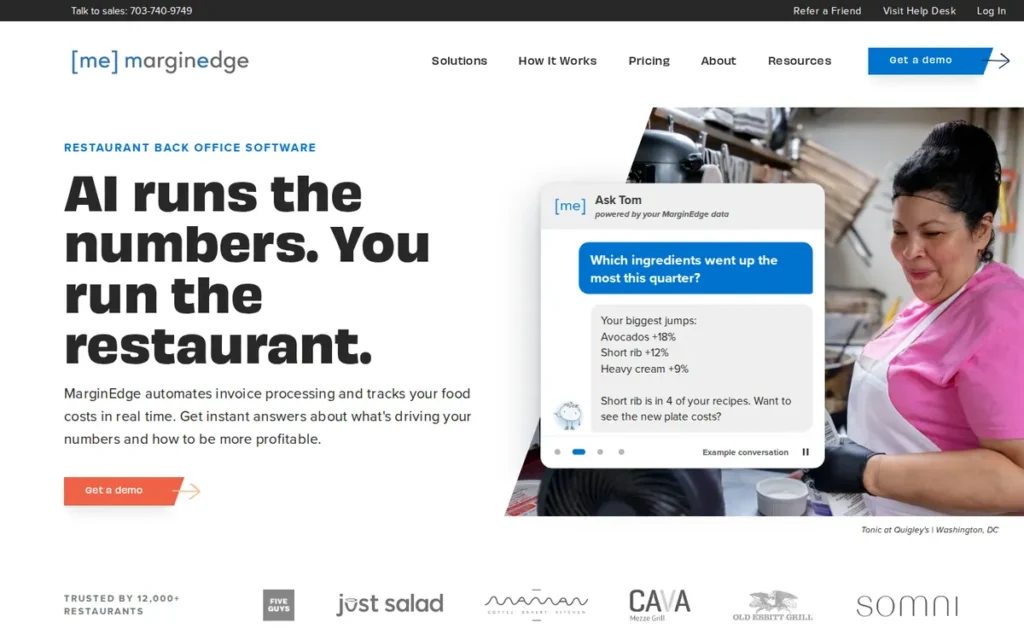
Category: Food-Cost and Inventory Overlay. It connects to your existing POS and accounting to capture invoices, track costs and control inventory.
At a Glance
- Category: Food-Cost and Inventory Overlay
- Best For: Independent restaurants and small-to-mid groups that want to keep their current POS and accounting
- Price Range: $350/location/month (10% off with annual billing); Freepour add-on $150/location/month; about $435/location/month for Toast users including Toast fees (as of November 2026)
- Primary Strength: MarginEdge publishes the clearest pricing in this ranking and has human reviewers check its invoice capture.
- Biggest Limitation: MarginEdge is not a POS, general ledger or payroll system, so it adds a vendor and a monthly fee on top of systems you already pay for.
- One-Line Summary: MarginEdge is the most price-transparent food-cost and invoice-automation tool in 2026, built for restaurants that want daily cost control without replacing their POS or accounting.
- Last Verified: November 2026
PlugRoute Score: 36/45 (Fit 4, Evidence 4, Pricing 5, Integrations 4, Results 3, Support 3). MarginEdge leads on pricing transparency. It ranks below Toast because it covers fewer jobs (no POS, GL or payroll) and has about 78 reviews against Toast’s 900+.
Overview
MarginEdge is a restaurant back-office overlay. It captures invoices, has people check them, and turns them into a daily controllable P&L with prime cost, COGS and live recipe costs. It is built for restaurants that keep their existing POS and accounting.
MarginEdge connects to those systems rather than replacing them. MarginEdge was founded in 2015 in Arlington, Virginia. It claims 12,000+ restaurants on its homepage but 11,000 clients on its Our Story page (Vendor-stated; MarginEdge, retrieved November 2026).
Key Features
- MarginEdge processes invoices from photos, email, uploads, scans and distributor EDI, with human review and a stated 24-hour turnaround.
- MarginEdge builds a daily controllable P&L from invoice data and POS sales.
- MarginEdge updates recipe costs as ingredient prices change and flags big moves through “price mover” alerts.
- MarginEdge includes inventory counts, ordering and unlimited U.S. bill pay in its base per-location price.
- MarginEdge offers a Freepour add-on for bar and beverage inventory at $150/location/month.
Best For
MarginEdge is best for independent restaurants and small-to-mid groups that like their current POS and accounting system. MarginEdge fits operators who want line-item invoice coding and daily food-cost visibility without switching platforms.
Pricing
MarginEdge publishes one per-location price (Vendor-stated; MarginEdge pricing page, retrieved November 2026):
- MarginEdge costs $350/location/month with unlimited invoice processing and unlimited U.S. bill pay. Bill pay is not available in Canada.
- MarginEdge annual billing saves 10%, or $420/location/year.
- MarginEdge’s Freepour bar add-on costs $150/location/month.
- MarginEdge customers on Toast also pay Toast’s $50/location/month Restaurant Management Suite plus a Toast API pass-through fee equal to 10% of the MarginEdge subscription (about $35).
A Toast restaurant adding MarginEdge therefore pays about $435 per location per month, 24% above the $350 sticker price. A free trial was not verified. Reddit users cite about $330/month, which may reflect an older price or annual billing.
Strengths
- MarginEdge discloses its per-location price along with add-ons and integration dependencies, the most complete pricing disclosure of the seven products (Vendor-stated; MarginEdge pricing page, retrieved November 2026).
- MarginEdge holds 4.6/5 on Capterra (47 reviews) and 4.6–4.7/5 on G2 (31 reviews), one of the most consistent cross-platform ratings here (Third-party platform data; Capterra and G2, retrieved November 2026).
- MarginEdge was preferred over xtraCHEF by users who had tried both in a single, small thread: “MarginEdge, not even close” (User-reported; Reddit r/restaurateur, 2025).
- MarginEdge case studies report that Burger 21 cut overall food cost by 2% and Chef Geoff’s saved at least $40K a year. Neither study publishes a methodology (Vendor-stated; MarginEdge case studies, retrieved November 2026).
This aligns with community sentiment on r/BarOwners:
“Marginedge is another one worth checking out. They offer a bunch of services including human validation and categorization of invoices/receipts you send them. They pull in everything from our POS and send them to QBO all well categorized. Our POS (smarttab) is pretty basic on the back office stuff so toast may make it unnecessary but marginedge has been a huge benefit for us.” Posted by u/tmillsjr
Takeaway: MarginEdge’s human-checked invoice coding helps most when your POS has weak back-office tools, and adds less for restaurants already on Toast’s suite.
Limitations
MarginEdge still requires a separate POS, accounting system, payroll and scheduling. Its $350+/location/month (about $435 for Toast shops) must pay for itself through food-cost savings alone.
- MarginEdge’s cost worries small operators. One Reddit user called nearly $4,000 a year a high bar for software that “just connects” to other systems (User-reported; Reddit r/Bookkeeping, 2025).
- MarginEdge reviewers on G2 report some invoices taking 48+ hours against the 24-hour claim. They also report missed invoices, input errors and a mobile app that can’t edit pending invoices (User-reported; G2, retrieved November 2026).
- MarginEdge’s food-cost figures can disagree with the P&L when GL mapping or staff discipline slips. One user said this creates “a lot of manual cleanup work” (User-reported; Reddit r/Bookkeeping, 2025).
Verdict
MarginEdge is the most price-transparent invoice-automation and food-cost tool in 2026. It is the most price-transparent choice for restaurants that want daily cost control without replacing their POS.
MarginEdge’s human-reviewed invoices drew strong user preference in a single 2025 Reddit thread. Check that expected savings cover the per-location fee plus any POS integration fees.
3. Restaurant365: Best for Multi-Unit Groups Needing Restaurant Accounting
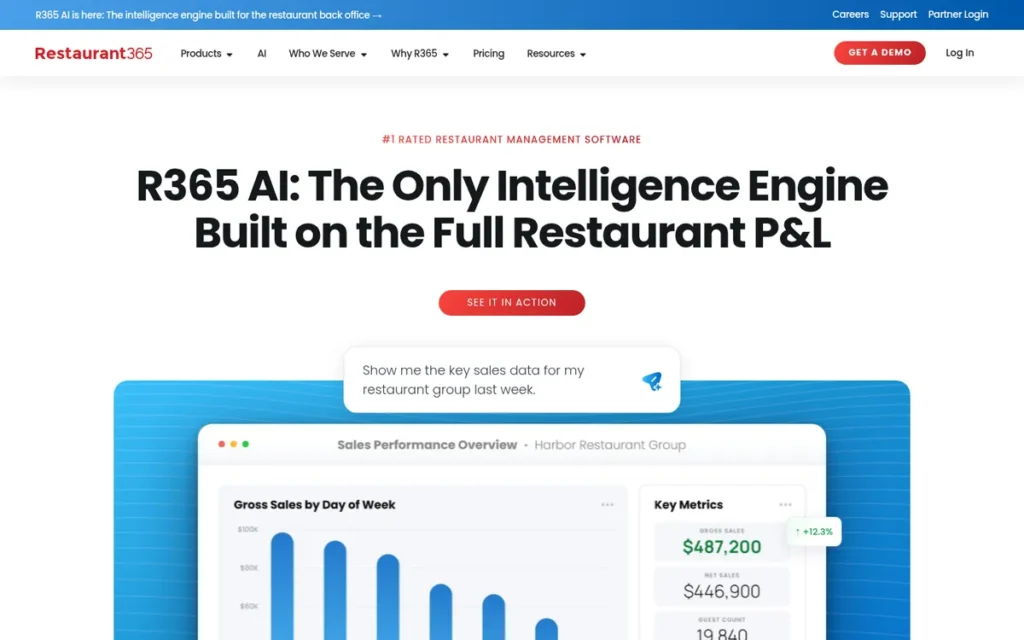
Category: Accounting-Centered Back Office. A restaurant general ledger sits at the core, with inventory, labor and purchasing built on top.
At a Glance
- Category: Accounting-Centered Back Office
- Best For: Multi-unit restaurant groups with several legal entities that need consolidated financials
- Price Range: About $499–$749/month (Capterra; billing basis unclear) or $538/location/month (Restaurant365), plus a one-time $3,000 implementation fee per database (as of November 2026)
- Primary Strength: Restaurant365 combines a restaurant-specific general ledger with inventory, recipe costing and AP automation in one system.
- Biggest Limitation: Restaurant365 has a steep learning curve and conflicting published prices, and its Capterra rating trails its G2 rating by half a point.
- One-Line Summary: Restaurant365 is the most-reviewed accounting-centered back office for multi-unit restaurant groups, with 324 G2 reviews as of November 2026.
- Last Verified: November 2026
PlugRoute Score: 33/45 (Fit 5, Evidence 4, Pricing 3, Integrations 4, Results 3, Support 2). Restaurant365 matches Toast on segment fit. It loses points for conflicting published prices and a 0.5-point gap between its G2 and Capterra ratings.
Overview
Restaurant365 is a restaurant-specific accounting and back-office suite. It combines a general ledger with inventory, recipe costing and AP automation for multi-unit groups that need consolidated financials and a faster month-end close across locations and legal entities.
Restaurant365 does not sell a POS. Restaurant365 connects to the POS you already use, and it was founded in 2011 (Vendor-stated; Restaurant365, retrieved November 2026).
Key Features
- Restaurant365 provides a restaurant-specific general ledger with multi-entity and intercompany accounting.
- Restaurant365 calculates theoretical-vs-actual food cost by tying recipe costing and inventory counts to POS sales.
- Restaurant365 automates accounts payable with EDI invoices and digital vendor payments.
- Restaurant365 includes scheduling and payroll modules, though buyers should confirm in the quote whether any workforce features are sold as add-ons.
- Restaurant365 pulls sales and refund data from third-party POS systems, including Toast, into the GL.
Best For
Restaurant365 is best for multi-unit restaurant groups with several locations and legal entities that are moving off QuickBooks. Restaurant365 fits groups that want food cost, purchasing and financials in one system.
Pricing
Restaurant365’s published prices conflict (verified November 2026):
- Capterra lists Restaurant365 Essential at $499 and Professional at $749 per month. The listing is inconsistent about whether those figures are per location (Third-party platform data; Capterra, retrieved November 2026).
- Restaurant365’s Guided Growth page lists Essentials at $538/location/month (Vendor-stated; Restaurant365, retrieved November 2026).
- Restaurant365 charges a one-time $3,000 implementation fee per database, not per location, which can be spread over 12 months (Vendor-stated; Restaurant365, retrieved November 2026).
Older third-party figures of $249–$435 could not be verified. Capterra reviewers also report yearly rate increases, so ask for renewal price caps in writing.
Strengths
- Restaurant365 holds 4.6/5 on G2 across 324 reviews, the second-largest independent review base in this ranking (Third-party platform data; G2, retrieved November 2026).
- Restaurant365 raised $135M in May 2023 in a round co-led by KKR and L Catterton at a valuation above $1B. It reported 40,000+ locations at the time (Public record; Restaurant365 press release, 2023).
- Restaurant365 case studies report BRG Hospitality cutting food cost from 30% to 25%. They also report Mitchell Management, a Jimmy John’s franchisee, saving about 96 admin hours across 800+ EDI invoices (Vendor-stated; Restaurant365 case studies, retrieved November 2026).
- Restaurant365 is “1000% better than any version of QB” for multi-unit groups with intercompany transactions, according to one bookkeeper (User-reported; Reddit r/Bookkeeping, 2025).
Limitations
Restaurant365’s accounting depth comes with a steep learning curve and heavy setup. That is more system than most single-location restaurants need.
- Restaurant365’s Capterra rating is 4.1/5 (72 reviews), with a 3.8/5 customer service sub-score. Reviewers cite slow tickets and limited phone support (Third-party platform data; Capterra, retrieved November 2026).
- Restaurant365 integrations depend on correct mapping. In one case, Toast refunds hit the wrong GL account (User-reported; Reddit r/ToastPOS, 2025).
- Restaurant365 buyers often underuse the system. One accountant said many groups “use 25% of it and never keep it updated” (User-reported; Reddit r/Bookkeeping, 2025).
Users on r/restaurantowners noted:
“As a restaurant accountant, I will not recommend toast accounting as of now. If you are operating one or two locations, then QuickBooks is fine and if more than that then I will recommend Restaurant 365 for better management. Also, I suggest hiring a bookkeeper who is specialized in restaurant industry to get better insights on your business.” Posted by u/Nirmal_RestaurantAcc
Takeaway: Restaurant accountants treat Restaurant365 as the next step once a group grows past two locations, and as overkill below that.
Verdict
Restaurant365 is the most-reviewed accounting-centered back office for multi-unit restaurant groups in 2026. It fits groups with intercompany transactions that have outgrown QuickBooks.
Restaurant365’s 0.5-point gap between G2 and Capterra means buyers should call references. Assign someone to own GL mapping and data upkeep.
4. MarketMan: Best for Inventory, Purchasing and Commissary Operations
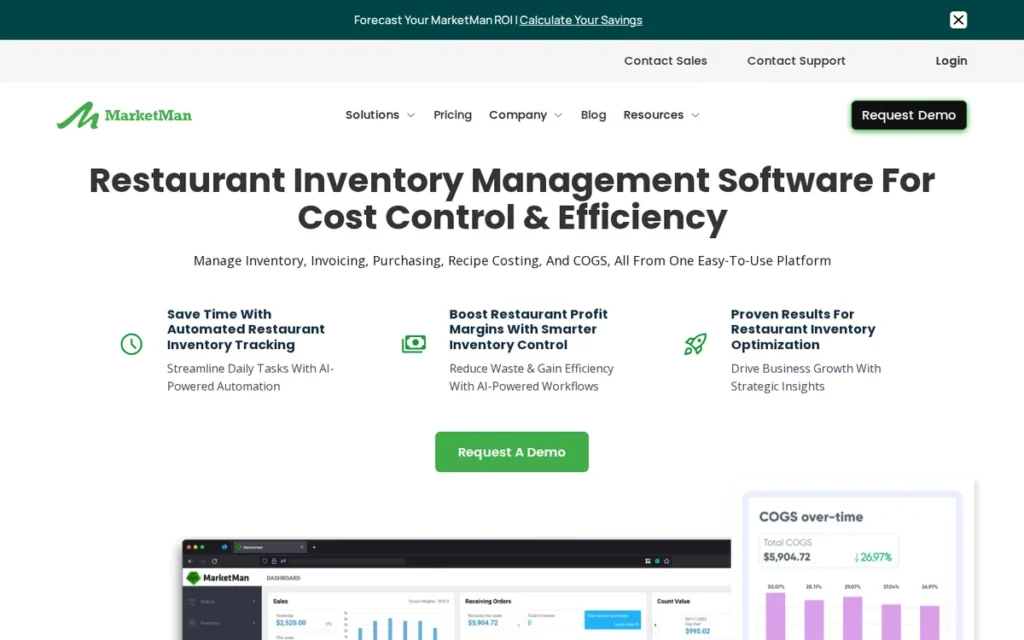
Category: Food-Cost and Inventory Overlay. It connects to your existing POS and accounting to capture invoices, track costs and control inventory.
At a Glance
- Category: Food-Cost and Inventory Overlay
- Best For: Restaurant groups with commissaries or central kitchens that focus on purchasing and inventory control
- Price Range: $249–$449+/location/month across three published tiers (as of November 2026)
- Primary Strength: MarketMan pairs inventory and purchasing with a dedicated commissary module and the broadest documented integrations in this ranking.
- Biggest Limitation: MarketMan’s own scale claims conflict, and reviewers report unreliable invoice scanning and hard cancellations.
- One-Line Summary: MarketMan is a well-integrated inventory and purchasing platform in 2026, built for restaurant groups running commissaries that need supplier ordering and recipe costing in one tool.
- Last Verified: November 2026
PlugRoute Score: 31/45 (Fit 4, Evidence 3, Pricing 4, Integrations 5, Results 2, Support 2). MarketMan’s evidence score stays at 3 because its scale claims conflict and its G2 rating sits 0.3 points below Capterra. MarketMan leads this ranking on documented integrations.
Overview
MarketMan is an inventory, purchasing and recipe-costing platform with supplier EDI, AI invoice scanning and a dedicated commissary module. It is built for restaurants and multi-unit groups that want tight control of ordering, stock and central-kitchen production.
MarketMan connects to your POS and accounting systems rather than replacing them. MarketMan was founded in Tel Aviv in 2013 (Vendor-stated; MarketMan, retrieved November 2026).
Key Features
- MarketMan tracks inventory, waste, ingredient price changes and actual-vs-theoretical usage.
- MarketMan supports smart ordering and “order by recipe,” with vendor EDI for orders and invoices in the U.S., Canada and UK.
- MarketMan’s commissary module manages central-kitchen production, transfers, deliveries and sales to outside businesses.
- MarketMan includes AI invoice scanning: 50 scans/month on Starter and unlimited on Growth and above.
- MarketMan documents these integrations (Vendor-stated; MarketMan partners page, retrieved November 2026):
- MarketMan connects to the Square, Toast, Lightspeed, Clover, Revel and TouchBistro POS systems.
- MarketMan connects to the QuickBooks, Xero, Sage and SAP accounting platforms.
Best For
MarketMan is best for restaurant groups with a commissary or central kitchen, or with stable menus and heavy purchasing volume. MarketMan fits operators who need supplier ordering, transfers and recipe costing tied to inventory.
Pricing
MarketMan publishes three tiers (Vendor-stated; MarketMan pricing page, retrieved November 2026):
- MarketMan Starter costs $249/month and includes recipe costing, actual-vs-theoretical reporting, waste tracking, 1 vendor EDI connection and 50 AI scans/month.
- MarketMan Growth costs $299/month and adds smart ordering, AI recipe suggestions, 2 EDI connections and unlimited scans.
- MarketMan Enterprise starts at $449/month and adds email invoice scanning, advanced reports, unlimited EDI and a read-only API (5,000 calls/month).
G2 lists these as per-location prices. MarketMan does not publish add-on pricing or annual-commitment terms.
Strengths
- MarketMan holds 4.6/5 on Capterra across 114 reviews, the third-largest single-platform review base here (Third-party platform data; Capterra, retrieved November 2026).
- MarketMan itemizes what each of its three per-location tiers includes, so buyers can compare tiers on paper (Vendor-stated; MarketMan pricing page, retrieved November 2026).
- MarketMan documents six POS and four accounting integrations by name, the broadest published integration list in this ranking (Vendor-stated; MarketMan partners page, retrieved November 2026).
- MarketMan case studies report Taco Del Mar cutting cost of goods by at least 3% and weekly inventory work from about 1.5 hours to 20 minutes (Vendor-stated; MarketMan case studies, retrieved November 2026).
Limitations
MarketMan’s inventory depth pays off most with stable menus. One operator called inventory modules in general a “time sink” when menus changed often (User-reported; Reddit r/restaurateur, 2025).
- MarketMan reviewers on Capterra report invoice scanning that “failed about half the time,” glitches that took days to fix, and no built-in ACH payment (User-reported; Capterra, retrieved November 2026).
- MarketMan reviewers describe hard cancellations, with notice-period disputes and retention calls (User-reported; Capterra, retrieved November 2026).
- MarketMan’s own scale claims range from 2,500 restaurants in a 2023 blog to 15,000+ today. Its 4.3/5 G2 rating (52 reviews) sits 0.3 points below its Capterra score (Vendor-stated and Third-party platform data; MarketMan and G2, retrieved November 2026).
Users on r/restaurateur noted:
“Marketman has a ton of issues, but we switched from MM to ME and it was even worse. Back on MM now and it’s gotten a little better (like not deleting your entire count when you go into wifi deadzones like the freezer) We have had a lot of trial and error with Marketman but until something better comes out it feels like we’re stuck with it.” Posted by u/happyyappynappy
Takeaway: Some MarketMan operators stay with it out of a lack of better options rather than satisfaction, and one who tried MarginEdge found it worse.
Verdict
MarketMan is a well-integrated inventory and purchasing platform for restaurant groups running commissaries or central kitchens in 2026. It has published pricing and the broadest documented integrations here.
MarketMan’s conflicting scale claims lower confidence. Test scanning accuracy on your own invoices and get cancellation terms in writing.
5. MealSuite: Best for Senior-Living and Healthcare Dining with EHR Diet Sync
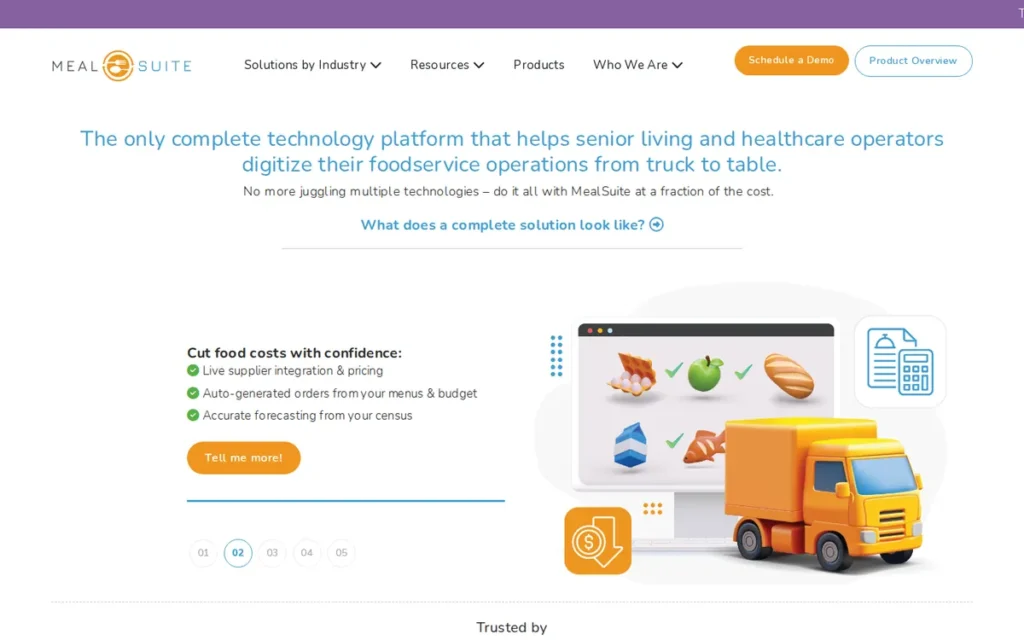
Category: Institutional Nutrition and Diet System. It covers menu planning, nutrient analysis and compliance or clinical diet workflows for schools, hospitals and care facilities.
At a Glance
- Category: Institutional Nutrition and Diet System
- Best For: Skilled nursing, senior living, CCRC and healthcare dining operations, especially those on PointClickCare
- Price Range: From about $100/month (Capterra directory figure); modules priced separately; quoted per community (as of November 2026)
- Primary Strength: MealSuite syncs resident diet orders, allergies and admissions with PointClickCare in real time, according to PointClickCare’s own documentation.
- Biggest Limitation: MealSuite has almost no independent review data (four Capterra reviews) and no published module pricing.
- One-Line Summary: MealSuite is the most clinically integrated senior-living and healthcare dining platform reviewed in 2026, built for care communities that need resident diet profiles synced with their EHR.
- Last Verified: November 2026
PlugRoute Score: 30/45 (Fit 5, Evidence 3, Pricing 2, Integrations 5, Results 3, Support 2). MealSuite ranks above Crunchtime because it has a directory price reference and Crunchtime is quote-only. It ranks below MarketMan because it has only four independent reviews.
Overview
MealSuite, formerly ThreeSquares, is a care-specific dining platform. It manages resident dietary profiles, therapeutic and dysphagia diets, tray tickets, menu planning and purchasing for skilled nursing, senior living and healthcare foodservice teams.
MealSuite covers clinical diet workflows that restaurant systems don’t support. Capterra lists two founding dates for MealSuite, 1984 and 1989 (Third-party platform data; Capterra, retrieved November 2026).
Key Features
- MealSuite stores resident dietary profiles with diet orders, allergies, preferences and IDDSI texture requirements.
- MealSuite generates automated tray tickets and paperless production from 10,000+ dietitian-approved recipes with nutrient analysis.
- MealSuite syncs ADT events, allergies, diet orders and resident photos through PointClickCare’s Mealtime Solutions. It also lists MatrixCare (via MealSuite Connect), Azalea Health and LifeLoop integrations.
- MealSuite supports resident and family ordering by tablet, touchscreen and kiosk, plus a dining POS with income analytics.
- MealSuite includes purchasing, receiving and inventory with distributor integrations.
Best For
MealSuite is best for skilled nursing facilities, senior living communities and CCRCs, especially those on PointClickCare, that need IDDSI texture diets and EHR-synced tray tickets. Acute-care hospitals with patient tray service should also look at CBORD and Computrition, which this ranking did not score.
Pricing
MealSuite’s pricing evidence is limited, as of November 2026:
- Capterra lists a MealSuite starting price of US$100/month, with modules priced separately and no free trial (Third-party platform data; Capterra, retrieved November 2026).
- MealSuite’s directory figure is not a real quote. Ask for a quote based on communities, beds, modules, EHR integrations and implementation.
- Capterra lists Dietary Manager Online, which is not ranked here, at $375/month flat, and ala Carte Menus from $80/user/month (Third-party platform data; Capterra, retrieved November 2026).
Strengths
- MealSuite powers PointClickCare’s Mealtime Solutions, which syncs ADT events, allergies, diet orders and resident photos in real time (Partner-documented; PointClickCare solution sheet, 2024).
- MealSuite reports that Amica Senior Living grew dining revenue 126.49% within five months and handles 93,000+ transactions a month across 9 sites (Vendor-stated; MealSuite case study, retrieved November 2026).
- MealSuite reports that an Oregon care community cut monthly grocery costs 5–10% and generated five days of tray tickets in 90 minutes (Vendor-stated; MealSuite case study, retrieved November 2026).
- MealSuite documents standardized IDDSI texture-diet updates in a long-term-care case study (Vendor-stated; MealSuite, retrieved November 2026).
Limitations
MealSuite’s clinical depth is backed by partner documentation rather than independent user reviews. That is the biggest trade-off for buyers.
- MealSuite has only four Capterra reviews (4.0/5), one from 2010. That is too few and too old to judge support or usability (Third-party platform data; Capterra, retrieved November 2026).
- MealSuite’s only public price is a directory starting figure, so you can’t estimate total cost without a quote.
- MealSuite’s Capterra listing does not show sales reports or purchase-order management as included, so confirm both in a demo.
- MealSuite’s MatrixCare integration transfers ADT events and allergies. Unlike the PointClickCare link, it is documented only by MealSuite (Vendor-stated; MealSuite partners page, retrieved November 2026).
Verdict
MealSuite is the most clinically integrated senior-living and healthcare dining platform reviewed in 2026, and the natural first demo for care communities on PointClickCare.
MealSuite’s PointClickCare integration is documented by the EHR vendor itself. Ask for references from similar communities and test diet-order sync live.
6. Crunchtime: Best for Enterprise Restaurant Chains
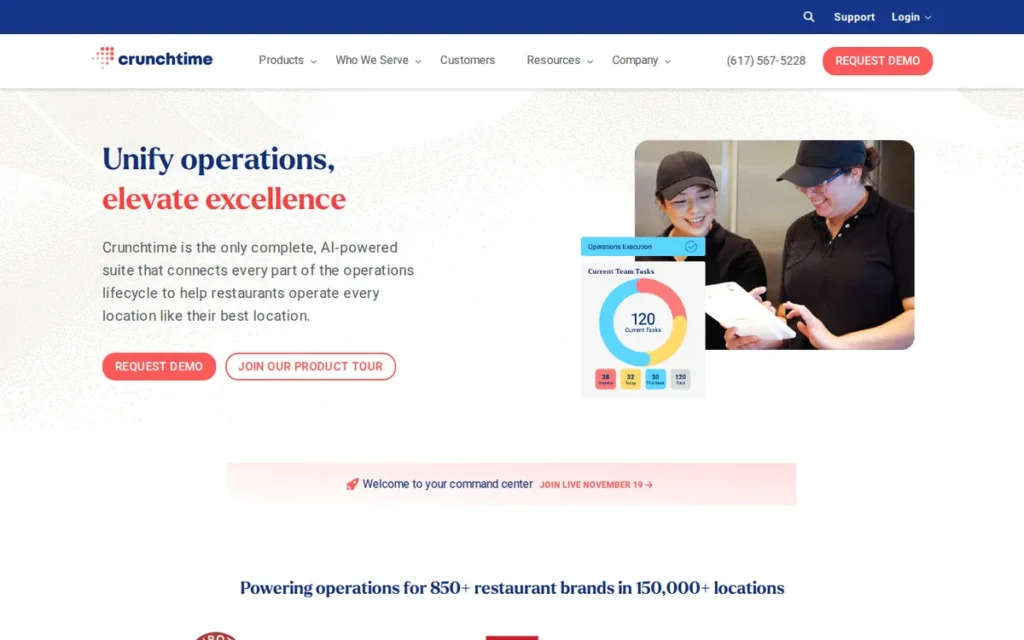
Category: Enterprise Chain Operations. It centralizes inventory, labor, forecasting and store-execution control for large multi-unit brands.
At a Glance
- Category: Enterprise Chain Operations
- Best For: Restaurant chains and franchise systems with dozens to thousands of units
- Price Range: Pricing on request (quote-only; no public reference as of November 2026)
- Primary Strength: Crunchtime covers chain-scale actual-vs-theoretical food cost, forecasting, labor and store audits, with named customers including Five Guys and Domino’s.
- Biggest Limitation: Crunchtime publishes no pricing, and users most often report 6–12 month implementations for its core suite.
- One-Line Summary: Crunchtime is the most enterprise-focused restaurant operations platform reviewed in 2026, built for chains that need consistent food-cost, labor and store-execution control across hundreds of locations.
- Last Verified: November 2026
PlugRoute Score: 28/45 (Fit 5, Evidence 3, Pricing 1, Integrations 4, Results 4, Support 2). Crunchtime has the second-strongest results evidence in this ranking, from named enterprise customers. It scores 1 on pricing transparency as a quote-only vendor.
Overview
Crunchtime is an enterprise restaurant operations suite covering inventory, actual-vs-theoretical food-cost variance, forecasting, labor and store execution. It is built for chains and franchise systems running dozens to thousands of locations.
Crunchtime is usually more system and implementation work than independent restaurants need. Former operator Bill Bellissimo founded Crunchtime in 1995, and Crunchtime reports passing $100M in annualized recurring revenue (Vendor-stated; Crunchtime, retrieved November 2026).
Key Features
- Crunchtime manages recipe costing, ordering, receiving, mobile counts, waste and actual-vs-theoretical variance across many stores.
- Crunchtime forecasts demand and builds labor schedules, with the Teamworx employee portal for hourly staff.
- Crunchtime Ops Execution, formerly Zenput, runs store tasks, audits and food-safety checklists.
- Crunchtime’s DiscoverLink delivers training content to store teams.
- Crunchtime agreed in June 2025 to merge with QSR Automations to add kitchen display and order flow. How well the products work together is not yet proven (Vendor-stated; Crunchtime press release, 2025).
Best For
Crunchtime is best for regional and national chains and franchise systems that need consistent food-cost, labor and food-safety execution across many locations. Crunchtime fits buyers with the staff for a multi-month enterprise rollout.
Pricing
Crunchtime’s pricing status, as of November 2026:
- Crunchtime publishes no pricing and quotes every deal.
- Crunchtime’s “$1.00” price on G2 is a placeholder with no meaning (Third-party platform data; G2, retrieved November 2026).
- Crunchtime buyers should ask for separate line items for per-location subscription, implementation, integrations, hardware, training and support.
Based on user reports, budget internal staff time for a multi-month core-suite rollout.
Strengths
- Crunchtime’s Five Guys case study reports actual-vs-theoretical variance under 1% across 1,900+ stores. Treat this as an upper benchmark, not a typical result (Vendor-stated; Crunchtime Five Guys case study, retrieved November 2026).
- Crunchtime reports named outcomes, including 7% lower food-cost variance at Fox Restaurant Concepts, 2% labor savings at Uno and 32% fewer repeated violations at Domino’s (Vendor-stated; Crunchtime, retrieved November 2026).
- Crunchtime holds 4.3/5 on G2 across 52 reviews. Reviewers praise its inventory and recipe functions, integrations and support (Third-party platform data; G2, retrieved November 2026).
- Crunchtime Ops Execution is rated 4.6/5 across 144 G2 reviews, and most reviewers report implementing it in under one month (Third-party platform data; G2, retrieved November 2026).
Limitations
Crunchtime is the least price-transparent restaurant tool in this ranking, and its core suite has one of the heaviest implementations.
- Crunchtime’s core suite is most often reported at 6–12 months to implement on G2, and G2 comparison pages average 6–7 months. Its self-reported “Fastest Implementation” badge may refer to the separately listed Ops Execution module (Third-party platform data; G2, retrieved November 2026).
- Crunchtime reviewers find reporting and navigation cumbersome and cross-store reporting hard. They also report problems with exports, imports, the phone app and sales tracking (User-reported; G2, retrieved November 2026).
- Crunchtime’s scale claims range from 100,000+ to 150,000+ locations. PlugRoute found no verified Capterra rating, and no Reddit discussion surfaced in its November 2026 search to check them against.
Verdict
Crunchtime is the most enterprise-focused restaurant operations platform reviewed in 2026 and a natural shortlist pick for chains with hundreds or thousands of units.
Crunchtime’s enterprise outcomes are strong but vendor-published. Ask which product earned each G2 badge, and get references from chains of similar size.
7. PrimeroEdge: Best for K-12 Districts Needing a USDA-Listed Nutrition Suite
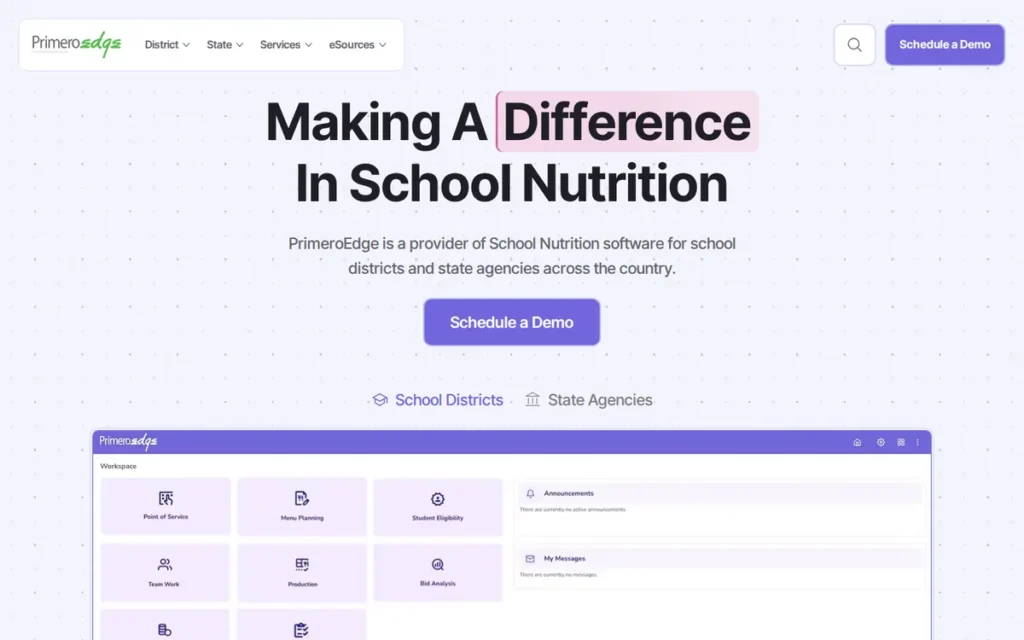
Category: Institutional Nutrition and Diet System. It covers menu planning, nutrient analysis and compliance or clinical diet workflows for schools, hospitals and care facilities.
At a Glance
- Category: Institutional Nutrition and Diet System
- Best For: U.S. public K-12 districts and state agencies that want one vendor for eligibility, POS, menu planning and claims
- Price Range: Pricing on request (quote-only; available through public purchasing cooperatives; as of November 2026)
- Primary Strength: PrimeroEdge is on USDA FNS’s approved nutrient-analysis software list, and its Menu Planning module is on the Certification of Compliance tools list for NSLP lunch.
- Biggest Limitation: PrimeroEdge has no verified independent reviews, no published pricing and no quantified district case studies.
- One-Line Summary: PrimeroEdge is one of the broadest USDA-listed K-12 child nutrition suites reviewed in 2026, built for districts that want eligibility, POS, menu planning and claims from one vendor.
- Last Verified: November 2026
PlugRoute Score: 25/45 (Fit 5, Evidence 3, Pricing 1, Integrations 3, Results 2, Support 2). PrimeroEdge’s rank reflects the absence of public pricing and independent reviews, not its fitness for K-12 programs. Its segment-fit score of 5 is tied for the highest in this ranking.
Overview
PrimeroEdge, from Cybersoft Technologies, is a K-12 child nutrition suite. It covers POS, eligibility, menu planning, USDA-listed nutrient analysis, production records and claims for U.S. districts running the National School Lunch Program (NSLP) and School Breakfast Program.
PrimeroEdge also includes the SchoolCafé family portal. PrimeroEdge’s parent company, Cybersoft, has built software since 1998 and is based in Houston (Vendor-stated; Cybersoft, retrieved November 2026).
Key Features
- PrimeroEdge provides cafeteria POS and the ExpressPoint mobile POS app for counting meals at the point of service.
- PrimeroEdge handles direct certification, free and reduced-price eligibility, and contracts and claims for federal reimbursement.
- PrimeroEdge menu planning includes nutrient analysis and allergen tracking.
- PrimeroEdge records production quantities and leftovers and reconciles inventory against invoices.
- PrimeroEdge connects to the PowerSchool and Aeries student information systems, and families apply for meals and pay through SchoolCafé.
Best For
PrimeroEdge is best for mid-size to large U.S. public districts that want eligibility, POS, menu planning, production and claims from one vendor. PrimeroEdge fits districts that buy through public purchasing cooperatives.
Pricing
PrimeroEdge’s pricing evidence, as of November 2026:
- PrimeroEdge is quote-only and publishes no prices.
- Anchorage School District’s technology project page shows a PrimeroEdge cost field of “> @100,000” from when the district compared cloud and self-hosted options. That is not a confirmed award (Public record; Anchorage School District, retrieved November 2026).
- PrimeroEdge buyers should ask for a quote that separates software, implementation, hardware, SchoolCafé payment fees, integrations, training and support.
Strengths
- PrimeroEdge appears on USDA FNS’s approved nutrient-analysis software list. Its Menu Planning module appears on the Certification of Compliance tools list for NSLP lunch (Regulatory source; USDA FNS, retrieved November 2026).
- PrimeroEdge’s named customers include Houston ISD, Buffalo Public Schools, Oklahoma City Public Schools and the West Virginia Department of Education (Vendor-stated; Cybersoft LinkedIn profile, retrieved November 2026).
- PrimeroEdge covers the whole district workflow in one suite, from eligibility and meal counting to production records and claims (Vendor-stated; Cybersoft, retrieved November 2026).
- PrimeroEdge is sold through Choice Partners, BuyBoard, TIPS, CoPro+ and EdTechJPA, which makes district procurement simpler (Vendor-stated; Cybersoft, retrieved November 2026).
Limitations
PrimeroEdge’s regulatory credentials have no independent user evidence alongside them. That is the central trade-off for district buyers.
- PrimeroEdge has no verified G2 or Capterra reviews, and no Reddit discussion surfaced in PlugRoute’s November 2026 search.
- PrimeroEdge publishes no quantified district case studies, and Cybersoft has not confirmed a secondary directory’s claim of 2,000+ districts.
- PrimeroEdge buyers, like buyers of any USDA-listed vendor, must check approval module by module and meal by meal. The Certification of Compliance listing covers NSLP lunch, not breakfast (Regulatory source; USDA FNS, retrieved November 2026).
- PrimeroEdge buyers, like buyers of any school nutrition vendor, should confirm support for the July 1, 2027 weekly added-sugar and sodium limits (Regulatory source; USDA FNS, 2024).
Verdict
PrimeroEdge is one of the broadest USDA-listed K-12 child nutrition suites reviewed in 2026 and a strong first demo for districts that want one vendor from eligibility to claims.
PrimeroEdge’s USDA listings are stronger evidence than vendor marketing. Use peer-district references, and check each module’s current list status before signing.
What Does Foodservice Management Software Really Cost in 2026?
As of November 2026, published foodservice software prices range from $0/month for Toast Starter software to about $749/location/month for Restaurant365 Professional on Capterra. Crunchtime, PrimeroEdge and MealSuite are quote-only. Processing, add-on, implementation and integration fees often exceed the headline price.
In the public pricing and product materials PlugRoute reviewed, none of the seven vendors publishes data-export or exit terms (November 2026).
| Product | Published Price (as of Nov 2026) | Known Add-ons / Integration Fees | Implementation Fee | Pricing Status | Export/Exit Terms Published |
|---|---|---|---|---|---|
| Toast | $0–$110+/month software | Processing varies; add-on prices unpublished; $50/location/month RMS needed for some third-party APIs | Terms apply; not itemized | Published base | No |
| MarginEdge | $350/location/month | Freepour $150/location/month; Toast RMS $50/location/month + Toast API pass-through (10% of subscription, ~$35) | Not published | Published | No |
| Restaurant365 | $499–$749/month (Capterra) or $538/location/month (vendor) | Workforce add-ons possible | $3,000 per database | Conflicting | No |
| MarketMan | $249–$449+/location/month | Add-ons unpublished | Not published | Published base | No |
| MealSuite | From ~$100/month (directory) | Modules priced separately | Not published | Directory only | No |
| Crunchtime | None | Not published | Not published | Quote-only | No |
| PrimeroEdge | None | Not published | Not published | Quote-only | No |
Hidden costs usually come from these sources:
- Payment processing rates can make up a large share of a POS platform’s lifetime cost, often more than the software subscription.
- Integration fees appear only when two products are connected, such as the ~$85/location/month in Toast fees for a MarginEdge connection.
- Implementation fees and internal staff time add cost, especially for multi-month enterprise rollouts.
- Yearly rate increases and auto-renewing contract terms raise cost after the first term.
Here is an illustration. A restaurant processing $50,000 a month in card sales at 2.49% + 15¢, with a $31 average ticket, pays about $1,485 a month in processing. That is more than 20 times Toast’s $69/month POS software fee (PlugRoute calculation, November 2026; actual rates vary by plan).
Which Foodservice Software Is USDA-Approved for Schools?
USDA FNS keeps two separate approved-software lists: one for nutrient analysis and one for Certification of Compliance. Ten vendors currently appear, including PrimeroEdge, Health-e Pro and LINQ School Nutrition. Approval applies to each module, task and meal, so districts must check the exact module they buy (Regulatory source; USDA FNS, retrieved November 2026).
These ten products appear on the current USDA FNS lists (retrieved November 2026):
- PrimeroEdge
- Health-e Pro
- LINQ School Nutrition
- MealTime
- NUTRIKIDS
- eTrition
- Meals Plus
- Mosaic
- WebSMARTT
- Webtrition MenuWorks
The Certification of Compliance list covers NSLP lunch. USDA does not approve software meal-pattern assessment for breakfast, though state agencies may allow it (Regulatory source; USDA FNS, retrieved November 2026). This applies to every listed vendor.
The 2024 final rule on school meals sets these deadlines (Regulatory source; USDA FNS, 2024):
- The 2024 final rule took effect on July 1, 2024.
- Product-level added-sugar limits apply from July 1, 2025: 6g per dry ounce of cereal, 12g per 6 ounces of yogurt and 10g per 8 fluid ounces of flavored milk.
- Weekly added sugars must stay below 10% of calories from July 1, 2027, and sodium drops 10% at breakfast and 15% at lunch.
Districts therefore need software that tracks added sugar at the product level and rolls up weekly sodium and sugar totals. Check listings directly at fns.usda.gov.
How Should Multi-Location Operators Choose Foodservice Software?
Multi-location operators should match software to unit count and entity structure, not brand recognition. Small groups keeping their POS usually start with an overlay. Groups with several legal entities move to an accounting back office, and standardized chains of roughly 50+ units move to enterprise operations software.
- 2–10 units keeping their POS: MarginEdge or MarketMan adds invoice, inventory and food-cost control at a published per-location price. The trigger to move up is needing intercompany accounting or consolidated financials.
- Multiple legal entities: Restaurant365 adds a restaurant general ledger with intercompany accounting. The trigger to move up is needing chain-wide store audits, forecasting and labor standards.
- 50+ standardized units: Crunchtime adds chain-scale variance, forecasting, labor and store-execution audits. Plan for a multi-month core-suite rollout.
Before comparing tiers, multiply every per-location price by your unit count, then add integration and implementation fees.
What Red Flags Should I Watch For When Evaluating Foodservice Management Software?
The three most costly red flags are unpublished processing rates, auto-renewing multi-year contracts and integration fees that appear only when products are combined. Each red flag below appeared in the research for this ranking. All seven are numbered so you can check them one by one during vendor demos.
Red Flag #1: Unpublished Processing Rates
POS-centered platforms that won’t put processing rates in writing make total cost impossible to compare. At $50,000 a month in card sales, processing can run about $1,485 a month, more than 20 times a $69 software fee (PlugRoute calculation, November 2026).
Red Flag #2: Auto-Renewing Multi-Year Contracts
Contracts that renew automatically for another multi-year term can trap operators who want to leave. One BBB complaint describes a disputed $1,600 termination charge after a 24-month Toast term auto-renewed (User-reported; BBB, retrieved November 2026).
Red Flag #3: Integration Fees That Appear Only When Products Are Combined
Integration fees often don’t appear on either vendor’s main pricing page. Toast shops adding MarginEdge pay about $85/location/month in Toast fees, raising the overlay to about $435/location/month (Vendor-stated; MarginEdge pricing page, retrieved November 2026).
Red Flag #4: Suite-Level “USDA Approved” Claims
A vendor claiming its whole suite is “USDA approved” is overstating how approval works. USDA FNS approves each module, task and meal separately, and lunch certification does not cover breakfast (Regulatory source; USDA FNS, retrieved November 2026).
Red Flag #5: Restaurant Systems Pitched to Care Facilities
A restaurant system pitched to a care facility usually lacks resident diet profiles, IDDSI textures, tray tickets and EHR diet-order sync. Aged-care cooks describe managing diced, mashed, pureed and liquid diets that restaurant POS systems don’t model (User-reported; Reddit r/KitchenConfidential, 2017).
Red Flag #6: G2 Badges That Don’t Match the Product You’re Buying
Ask which specific product or module a G2 badge was awarded to, and compare it with that product’s user-reported timeline. Crunchtime’s “Fastest Implementation” badge may reflect its Ops Execution module (under one month), while its core suite is most often reported at 6–12 months (Third-party platform data; G2, retrieved November 2026).
Red Flag #7: Conflicting Vendor Scale Claims
Vendor customer counts that contradict each other are unchecked marketing figures. MarketMan has claimed 2,500 and 15,000+ restaurants, MarginEdge 11,000 and 12,000, and Crunchtime 100,000+ and 150,000+ locations (Vendor-stated; vendor websites, retrieved November 2026).
What Questions Should I Ask Before Choosing Foodservice Management Software?
Before signing, ask every vendor for three things: an itemized written quote, written data-export terms and a live integration demo using your own data. The eight questions below cover cost, exit, integration, compliance and staffing. The answers show the real cost and fit that vendor marketing leaves out.
Question #1: Can you give me an itemized written quote separating software, implementation, hardware, processing, integrations, training and support?
A credible vendor should list every cost on its own line.
Quote-only vendors such as Crunchtime, PrimeroEdge and MealSuite should not get a pass on itemizing. Conflicting published prices, as with Restaurant365, should be settled in writing.
Question #2: What are your data export and exit terms, in writing?
None of the seven vendors publishes data-export or exit terms in the public materials PlugRoute reviewed (November 2026). Ask what format your data comes in, how much history is included, what it costs and how long it takes, and put the answers in the contract.
Question #3: Can you demo a refund flowing from our POS to the correct GL account?
A live refund demo tests the integration rather than the sales pitch. Users report POS refunds landing in the wrong GL account when mapping is set up incorrectly (User-reported; Reddit r/ToastPOS, 2025). Ask who owns the mapping and who fixes it.
Question #4: Which exact modules appear on which current USDA FNS list, and for which meals?
Districts should ask for the exact module name on each USDA FNS list and check it at fns.usda.gov. A nutrient-analysis listing does not cover Certification of Compliance, and lunch certification does not cover breakfast (Regulatory source; USDA FNS, retrieved November 2026).
Question #5: How will the system support the July 1, 2027 weekly added-sugar and sodium limits?
School software must track added sugars at the product level and roll up weekly sugar and sodium totals. Ask the vendor to show the reports that will document compliance with the July 1, 2027 limits (Regulatory source; USDA FNS, 2024).
Question #6: Can you demo a diet-order change syncing from our EHR to a tray ticket?
Care facilities should watch a diet-order change travel live from their own EHR to a printed tray ticket. Confirm that admissions, discharges, transfers, allergies and IDDSI textures sync in real time with the EHR you actually use.
Question #7: What is your invoice-scanning accuracy on our own invoices during a trial?
Invoice-scanning accuracy varies widely. One user said xtraCHEF got about 80% right, and a MarketMan reviewer said scanning “failed about half the time” (User-reported; Reddit r/restaurateur, 2025; Capterra, retrieved November 2026). Test a month of your own invoices.
Question #8: Who on our team must maintain the data, and how many hours per week?
Back-office software only works if someone keeps the data current. One accountant said many groups “use 25% of it and never keep it updated” (User-reported; Reddit r/Bookkeeping, 2025). Name an owner and budget their weekly hours before you buy.
As one user on r/BarOwners described:
“Like any software, it’s worth it if you use it. If you just need something to help you with ordering, use Provi, it’s free. Craftable allows you to the ordering and it’s clutch for doing inventory and reconciling invoices and tracking costs. It needs to be part of your weekly admin.” Posted by u/atomicspin
Takeaway: Inventory and food-cost software only pays for itself when someone builds it into a weekly admin routine.
Bring these eight questions to every demo and score each vendor’s answers side by side.
How Did We Rank These Foodservice Management Software Tools?
PlugRoute scored each product from 1 to 5 on six criteria. The three primary criteria count double, for a maximum of 45 points. The rank shows how strong and transparent the public evidence is, not which product suits every operation, so choose your category first and use the rank second.
Ranking criteria:
- Segment Fit and Functional Depth (primary): This criterion measures how fully a product covers its segment’s core jobs, because the wrong category of tool fails however good it is.
- Independent Third-Party Evidence (primary): This criterion weighs G2 and Capterra ratings and volume, or USDA and EHR-partner verification where review sites have little coverage, because vendor claims dominate this category.
- Pricing Transparency and Total-Cost Clarity (primary): This criterion rewards dated per-unit prices with add-ons disclosed, because hidden fees distort total cost.
- Documented Integrations (secondary): This criterion counts publicly named POS, accounting, EDI, student information system and EHR integrations, because connection failures are common after purchase.
- Verifiable Results and Scale (secondary): This criterion scores how verifiable outcome claims are, from audited filings down to vendor case studies.
- Implementation and Support Evidence (secondary): This criterion uses reported timelines, support sub-scores and complaints, and it defaults to a neutral 2 where no independent data exists.
Formula: Weighted total = 2 × (C1 + C2 + C3) + (C4 + C5 + C6). Ties would be broken by the higher C1 score. None occurred.
| Product | C1 Fit | C2 Evidence | C3 Pricing | C4 Integrations | C5 Results | C6 Support | Total /45 |
|---|---|---|---|---|---|---|---|
| Toast | 5 | 5 | 4 | 4 | 5 | 2 | 39 |
| MarginEdge | 4 | 4 | 5 | 4 | 3 | 3 | 36 |
| Restaurant365 | 5 | 4 | 3 | 4 | 3 | 2 | 33 |
| MarketMan | 4 | 3 | 4 | 5 | 2 | 2 | 31 |
| MealSuite | 5 | 3 | 2 | 5 | 3 | 2 | 30 |
| Crunchtime | 5 | 3 | 1 | 4 | 4 | 2 | 28 |
| PrimeroEdge | 5 | 3 | 1 | 3 | 2 | 2 | 25 |
In PlugRoute’s ranking, a low score means the public evidence is thin, not that the product is weak. PrimeroEdge, the lowest-ranked product, is tied for the highest segment-fit score in the set.
MarketMan’s G2 rating (4.3/5, 52 reviews) was confirmed on G2 itself. Its evidence score stays at 3 because its own scale claims conflict and its G2 and Capterra ratings differ by 0.3 points.
PrimeroEdge and MealSuite have few or no G2 or Capterra reviews. Their evidence scores rely on USDA FNS list status, PointClickCare’s partner documentation, named public-sector customers and procurement-cooperative listings.
Evidence labels used in this article:
- Vendor-stated evidence comes from vendor websites, case studies or press releases and is not independently verified.
- Partner-documented evidence comes from an integration partner, such as an EHR vendor, describing the product.
- User-reported evidence comes from reviews, Reddit posts and BBB complaints.
- Third-party platform data comes from G2, Capterra and independent pricing reviews.
- Commercially interested evidence comes from a competitor of the product being described.
- Public record/Regulatory source evidence comes from SEC filings, USDA FNS lists and public district records.
Considered but not ranked:
- Lightspeed Restaurant, Square and SpotOn are restaurant POS options that were not researched in enough depth to score.
- LINQ, Health-e Pro and Mosaic are USDA-listed K-12 alternatives that districts should compare alongside PrimeroEdge.
- CBORD and Computrition are care and healthcare alternatives that buyers should compare alongside MealSuite.
- Dietary Manager Online and ala Carte Menus have only Capterra directory pricing available.
- Food Service Solutions has only two G2 reviews.
- 7shifts, Caterease, FoodReady and Galley were point solutions or lacked enough research data to score.
CMS dietary F-tag compliance and acute-care patient tray service were not separately evaluated. PlugRoute found no peer-reviewed studies on foodservice software outcomes.
In November 2026 we re-checked Toast’s SEC figures, MarginEdge and Restaurant365 pricing, PrimeroEdge’s USDA listings, MealSuite’s EHR integrations, and the MarketMan and Crunchtime G2 ratings.
PlugRoute has no affiliate relationships with any company listed. Rankings are determined entirely by research data and objective evaluation criteria.
What Else Do Buyers Ask About Foodservice Management Software?
Beyond the overall ranking, buyers most often ask which tools fit inventory and food-cost control, which fit healthcare and senior living, and how PlugRoute ranks products. Each answer below opens with a direct answer and names specific products where the evidence supports it.
What is the best foodservice management software for inventory and food-cost control?
MarginEdge and MarketMan are the two food-cost and inventory overlays ranked here for operators keeping their POS. MarginEdge offers human-reviewed invoices and a daily P&L at $350/location/month. MarketMan offers commissary tools from $249/location/month. Restaurant365 fits groups that also need accounting (Vendor-stated; vendor pricing pages, retrieved November 2026).
What is the best foodservice management software for healthcare and senior living?
MealSuite is the most clinically integrated option reviewed, because PointClickCare documents that MealSuite powers its Mealtime Solutions with real-time diet-order and allergy sync (Partner-documented; PointClickCare, 2024). MealSuite has only four Capterra reviews, so ask for references. Hospitals should also compare CBORD and Computrition, which were not ranked here.
How does PlugRoute determine rankings?
PlugRoute scores each product from 1 to 5 on six criteria, with three primary criteria counting double, for a maximum of 45 points. Every claim carries a dated evidence label, and rank reflects evidence strength, not universal fit. The six criteria are:
- Segment fit (primary, double weight)
- Independent evidence (primary, double weight)
- Pricing transparency (primary, double weight)
- Integrations
- Verifiable results
- Implementation and support
What Do Key Foodservice Management Software Terms Mean?
Actual-vs-Theoretical (AvT) Food Cost: AvT is the gap between what you actually spent on food and what you should have spent based on recipes and sales. A narrow gap means less waste, theft and over-portioning, which makes AvT reporting a core food-cost control.
Electronic Data Interchange (EDI): EDI is a direct digital feed of orders and invoices between a distributor and your software. It avoids manual entry and scanning errors, so check which of your distributors are supported and how many connections your plan includes.
General Ledger (GL) Mapping: GL mapping is the set of rules that sends each POS or invoice line to the right accounting account. Wrong mapping causes errors in your financial statements, so ask who sets it up and who maintains it.
Payment Processing Rate: The payment processing rate is the percentage plus per-transaction fee charged on card payments. On POS-centered platforms, processing can cost more over the life of the contract than the software subscription.
Implementation Fee: An implementation fee is a one-time charge for setup, data migration and training. It is often missing from headline prices, so ask whether it is charged per location or per database.
Controllable P&L: A controllable P&L is a profit-and-loss view limited to costs managers can influence, such as food, beverage and labor. A daily controllable P&L lets operators fix cost problems before month-end close.
Commissary: A commissary is a central kitchen that prepares food for several locations. Commissary operations need production planning, transfer tracking and inter-location costing that standard restaurant inventory tools may not provide.
Nutrient Analysis Software: Nutrient analysis software calculates the nutritional content of menus. For K-12 programs, check that the specific product appears on USDA FNS’s approved nutrient-analysis list.
Certification of Compliance: Certification of Compliance is USDA’s process for confirming that school menus meet meal-pattern requirements. It has its own approved-tools list, separate from the nutrient-analysis list, and the software approval covers lunch.
IDDSI: IDDSI is the International Dysphagia Diet Standardisation Initiative framework for food textures and drink thickness. Care facilities need software that records IDDSI levels for each resident and prints them correctly on tray tickets.
Tray Ticket: A tray ticket is a printed or digital card listing each resident’s meal, diet order, allergies and texture. Accurate tray tickets prevent clinical errors at mealtime.
ADT Sync: ADT sync is the real-time transfer of admission, discharge and transfer events from an EHR to the dining system. It keeps resident diet profiles current without manual re-entry.
Which Foodservice Management Software Is Right for You?
Key Insights
- Toast has the strongest public evidence of any foodservice platform reviewed, including about 164,000 locations in its FY2025 SEC filing.
- MarginEdge is the most price-transparent tool reviewed at $350/location/month, but a Toast restaurant pays about $435/location/month once Toast’s integration fees are added.
- Restaurant365’s ratings of 4.6/5 on G2 and 4.1/5 on Capterra diverge enough that buyers should call references before signing.
- None of the seven foodservice software vendors publishes data-export or exit terms in the public materials PlugRoute reviewed, so buyers should get them in writing.
- USDA approval for school nutrition software applies to each module and meal, and districts must prepare for weekly added-sugar and sodium limits starting July 1, 2027.
- MealSuite, PrimeroEdge and Crunchtime rank lower mainly because public evidence is thin, not because the products fail their segments.
If you run a single restaurant, compare Toast’s full quote, including processing, against a POS you already own plus MarginEdge or MarketMan. If you run multiple entities, look at Restaurant365. If you run a chain, ask Crunchtime for references at your scale.
Districts should demo at least two USDA-listed vendors, such as PrimeroEdge, LINQ or Health-e Pro. Care facilities should demo MealSuite alongside CBORD or Computrition. Test compliance and clinical workflows live.
We update this guide quarterly. Last updated: November 2026. K-12 content will be reviewed before the 2027–28 school year. Read PlugRoute’s full scoring methodology and our independent guide to the true cost of foodservice software.