Wherefour is the best overall food traceability software for small and mid-size manufacturers. SafetyChain is best for multi-plant food safety and quality programs, and Aptean Food & Beverage ERP is best for Microsoft Business Central shops. No single product fits every business, so first choose a category: in-house lot tracking, food safety records, or a multi-company network.
The hard part is tracing one ingredient lot back to its supplier and forward to every affected batch and shipment. You then have to give FDA those records within 24 hours, even when a vendor holds the data. Retailers move first: Kroger’s item declaration is due December 18, 2026, long before FDA’s July 20, 2028 date.
PlugRoute has no affiliate relationships with any company listed. Rankings are determined entirely by research data and objective evaluation criteria.
“Basically they are increasing the reporting standard to more easily track contamination. So you have to record key events along the food processing in more details.” (u/ElNuevoMaestransa, r/manufacturing (Reddit, 2025))
Takeaway: FSMA 204 does not add a new task. It requires more detail at each supply chain event you already handle.
What Are the 3 Categories of Food Traceability Software?
Food traceability software falls into three categories. In-house ERP and lot tracking tools build lot genealogy inside your operation. Food safety and quality record systems digitize HACCP, audits, and receiving checks. Multi-company traceability networks move traceability data between trading partners.
Each category solves a different problem, and none fully replaces the other two.
In-House ERP & Lot Tracking covers Wherefour and Aptean Food & Beverage ERP.
- In-house ERP and lot tracking tools link each ingredient lot to finished batches and customer shipments, and they also handle recalls and costing.
- In-house ERP and lot tracking tools are not networks, so they cannot send data to retailer networks without an integration or a manual upload.
Food Safety & Quality Records covers SafetyChain and FoodReady.
- Food safety and quality record systems digitize HACCP monitoring, receiving inspections, audits, and corrective actions.
- SafetyChain’s tracing depends on which modules you buy (SafetyChain, 2026).
- FoodReady documents lot links and KDE capture but makes no explicit claim to export the FDA sortable spreadsheet (FoodReady, 2026).
Multi-Company Traceability Network covers ReposiTrak Traceability Network, iFoodDS Trace Exchange, and Trustwell FoodLogiQ Connect.
- Multi-company traceability networks move key data elements (KDEs) between suppliers and their retail, wholesale, and foodservice customers.
- Multi-company traceability networks do not run your production lot genealogy, so you still have to create accurate lot data in another system.
Do I need two systems? Many suppliers do. A co-packer whose grocery customer requires a network may need Wherefour or Aptean Food & Beverage ERP to create lot data, and then ReposiTrak Traceability Network to share it.
For example, suppose a salsa co-packer receives a recalled jalapeño lot. Wherefour or Aptean Food & Beverage ERP shows which 14 finished batches used that lot and which 9 customers received them. ReposiTrak Traceability Network or iFoodDS Trace Exchange then sends those KDEs to the retailers.
A traceability network can only share lot data that another system has already created. The network carries the data. It does not create it.
An EDI-focused account on r/manufacturing described where the real difficulty lies:
“The pain isn’t collecting new data. It’s that the data lives in five different places (ERP, warehouse system, shipping software, a spreadsheet, email) and FSMA 204 basically says: when we ask, you’ve got 24 hours to pull it all into one sortable file. If your systems don’t talk to each other, that 24 hours is a nightmare. If they do, it’s a non-event.” Posted by u/edisupport
Takeaway: Food traceability software earns its cost by connecting lot data that already sits in separate ERP, warehouse, and shipping systems, not by collecting new data.
How Do the Top Food Traceability Software Tools Compare at a Glance?
Wherefour leads PlugRoute’s ranking at 4.15/5, followed by SafetyChain at 3.60/5 and Aptean Food & Beverage ERP at 3.33/5. ReposiTrak Traceability Network, iFoodDS Trace Exchange, FoodReady, and Trustwell FoodLogiQ Connect complete the list. Ranks #3 to #5 are within 0.15 points of each other, so category and trading-partner fit should decide among those three.
| Rank | Company | Category | Best For | One-Line Summary | Key Capabilities | Primary Strength | Key Limitation |
|---|---|---|---|---|---|---|---|
| 1 | Wherefour | In-House ERP & Lot Tracking | Small and mid-size manufacturers and co-packers on QuickBooks, Xero, or Sage | Wherefour is the best-documented and most-reviewed in-house lot-tracking ERP for small and mid-size U.S. food manufacturers. | Forward and backward lot tracing, mock recalls, MRP, claimed sortable-spreadsheet export | Largest independent review base among in-house tools | Users report clunky reporting and lockouts while reports run |
| 2 | SafetyChain | Food Safety & Quality Records | Multi-plant processors with an existing ERP | SafetyChain is a widely reviewed food safety and quality platform that adds traceability on top of an existing ERP when the right modules are bought. | HACCP, SPC, supplier compliance, ERP/SCADA/Power BI integrations | Deep review base plus broad integrations | Full supplier-to-customer tracing requires specific modules |
| 3 | Aptean Food & Beverage ERP | In-House ERP & Lot Tracking | Mid-market processors on Microsoft Business Central | Aptean Food & Beverage ERP is a Business Central-based food ERP with lot tracing and recall management in the core ERP. | Two-way lot tracing, recalls, EDI, quality tests, allergen tracking | Built natively on Microsoft Dynamics 365 Business Central | Implementations average about 8 months; FSMA 204 output is not publicly documented |
| 4 | ReposiTrak Traceability Network | Multi-Company Traceability Network | Grocery suppliers whose retailers use the network | ReposiTrak Traceability Network is a publicly priced, retailer-driven data network that must be paired with an in-house lot system. | Connect once, share KDEs with unlimited in-network partners, accepts EDI | Only vendor on the list with published prices | No in-house lot genealogy and no independent reviews |
| 5 | iFoodDS Trace Exchange | Multi-Company Traceability Network | Produce supply chains and enterprise buyers | iFoodDS Trace Exchange is a produce-rooted FSMA 204 data exchange with well-documented KDE features but little independent evidence. | KDE capture apps, missing-KDE flags, sortable-spreadsheet access, GS1 | Most FSMA 204-specific documentation among the networks | No public pricing, no named integrations, no usable reviews |
| 6 | FoodReady | Food Safety & Quality Records | Very small teams with no food safety staff | FoodReady is a HACCP-first food safety platform with bundled consulting and documented lot links for very small teams. | HACCP plan builder, CCP logs, lot and KDE capture, mock recalls, consultants | Software bundled with certified consultants | No explicit FDA sortable-spreadsheet export claim |
| 7 | Trustwell FoodLogiQ Connect | Multi-Company Traceability Network | Foodservice and brand owners managing suppliers | Trustwell FoodLogiQ Connect is a supplier-network traceability and recall platform that also offers nutrition labeling. | Lot-level traceability, supplier compliance, incidents, recalls | Recall workflows plus nutrition labeling from one vendor | Sortable-spreadsheet export format is not publicly documented |
Pricing models at a glance:
- ReposiTrak Traceability Network publishes its prices: $499 setup plus $179/month per facility for in-network sharing (ReposiTrak, November 2026).
- SafetyChain quotes an annual subscription per facility with no per-user fees (SafetyChain, 2026).
- Wherefour quotes per operation and bills monthly, quarterly, or annually (Wherefour, 2026).
- Aptean Food & Beverage ERP, iFoodDS Trace Exchange, FoodReady, and Trustwell FoodLogiQ Connect are quote-only (vendor websites, November 2026).
Which Food Traceability Software Should I Choose for My Use Case?
The right food traceability software depends on your top priority. Small manufacturers on QuickBooks, Xero, or Sage should start with Wherefour. Microsoft shops should start with Aptean Food & Beverage ERP, and multi-plant quality programs with SafetyChain. Suppliers whose retailers require a specific network should start with that network and pair it with an in-house lot system.
| Your #1 Priority | Recommended Tool | Why | Acceptable Alternative |
|---|---|---|---|
| Small manufacturer or co-packer on QuickBooks/Xero/Sage | Wherefour | Documented forward and backward lot tracing and named accounting connectors | FoodReady (if HACCP help matters more) |
| Multi-plant processor with an existing ERP, focused on quality | SafetyChain | Plant-wide HACCP, SPC, and supplier compliance, priced per facility | Aptean Food & Beverage ERP (if you want quality inside the ERP) |
| Microsoft / Business Central shop | Aptean Food & Beverage ERP | Lot tracing and recalls built into Business Central | Wherefour (has a Microsoft Dynamics connector) |
| Grocery supplier whose retailer uses the network | ReposiTrak Traceability Network (plus an in-house system) | Published per-facility pricing and one connection to many partners | iFoodDS Trace Exchange |
| Produce grower, packer, or distributor needing FSMA 204 KDE sharing | iFoodDS Trace Exchange | Produce roots and documented missing-KDE flagging | ReposiTrak Traceability Network |
| Distributor or wholesaler recording receiving and shipping CTEs | The network your customers use (ReposiTrak Traceability Network or iFoodDS Trace Exchange) | Distributors mainly record receiving and shipping, so network compatibility comes first | A system that generates ASNs, such as Aptean Food & Beverage ERP (EDI) |
| Foodservice or brand owner managing suppliers and nutrition labels | Trustwell FoodLogiQ Connect | Supplier compliance, recalls, and nutrition labeling from one vendor | iFoodDS Trace Exchange |
| Very small team needing HACCP plus consulting | FoodReady (check the sortable-spreadsheet output) | Software bundled with certified consultants | Wherefour (for lot tracking) |
When Is FSMA 204 Compliance Actually Due, and Do Retailer Deadlines Come First?
FDA cannot enforce the FSMA 204 Food Traceability Rule before July 20, 2028, under the Continuing Appropriations Act of 2026, though the rule itself remains in force. Retailer deadlines come sooner. Kroger requires Food Traceability List item declarations by December 18, 2026 and traceability compliance by July 31, 2027.
A Kroger supplier faces three dates:
- December 18, 2026 is Kroger’s deadline to declare Food Traceability List items (Kroger, 2026).
- July 31, 2027 is Kroger’s traceability compliance deadline (Kroger, 2026).
- July 20, 2028 is the date before which FDA cannot enforce the rule (FDA, 2026).
The federal timeline as of this review is:
- FDA proposed moving the compliance date from January 20, 2026 to July 20, 2028 on August 7, 2025 (FDA, 2025).
- FDA has not finalized the new compliance date, and the Continuing Appropriations Act of 2026 bars enforcement before July 20, 2028 (FDA, 2026).
- FDA held a public meeting on November 6, 2026 on challenges and solutions in lot-level food traceability (Federal Register, 2026).
- FDA requires firms to provide records within 24 hours of a request, plus an electronic sortable spreadsheet during outbreaks or recalls (FDA, 2026).
- FDA’s FAQ states that a firm stays responsible for its records even when a third party, such as a software vendor, holds them (FDA, 2026).
Retailer requirements reported in PlugRoute’s research are:
- Walmart requires food suppliers to send shipment notices with traceability data, SSCC-18 pallet labels linked to those notices, and GS1-128 case barcodes (Walmart, 2026).
- Kroger requires suppliers to declare the Food Traceability List status of each applicable item in Salsify, Syndigo, or 1WS by December 18, 2026, and to meet Kroger’s broader traceability deadline by July 31, 2027 (Kroger, 2026).
- ReposiTrak’s pricing page notes that Walmart, Target, McLane, and Sysco have made public traceability commitments but do not require ReposiTrak (ReposiTrak, 2026).
A self-described traceability consultant on r/FoodSafetyPros said much the same:
“However many of my clients and their customers have not backed off on their plans. Sam’s Club, Walmart, Kroger, Publix, Wakefern, Dot Foods, Starbucks, Whole Foods, Trader Joe’s for example have held firm on when they expect Lot-Based traceability data from upstream suppliers.” Posted by u/astrotim67
Takeaway: FDA’s 2028 delay does not give suppliers more time, because major retailers are holding to their own lot-level traceability deadlines.
PlugRoute will update this section if FDA finalizes the July 20, 2028 date.
How Can I Test Whether I Need New Traceability Software?
The quickest test is to pick one ingredient lot from last month and time how long it takes to rebuild its full history, back to the supplier and forward to every customer shipment. If that takes a full morning, a 24-hour FDA request will be a problem. Check whether you are exempt before you buy anything.
“pick one lot from last month and time how long a full history takes. If it takes a morning, the 24 hours is going to be a problem.” (u/LabKey-Software, r/LabManagementSoftware (Reddit, 2026; a vendor account, but a useful self-test))
Takeaway: If tracing one lot by hand takes hours, your current process probably cannot meet FDA’s 24-hour record request.
Run the self-test in four steps:
- First, record the supplier, receiving date, and lot code for the chosen ingredient lot.
- Second, find every finished batch that used the ingredient lot, including rework and partial batches.
- Third, list every customer shipment of those batches.
- Fourth, put the results into a sortable spreadsheet and note the total time.
FDA offers free tools that can help before you buy software:
- FDA’s exemption tool shows whether your business is covered by the rule.
- FDA’s CTE/KDE tool shows which events and data elements apply to you.
- FDA’s example traceability plans show what a written plan should contain.
Small retail food establishments and restaurants with no more than $250,000 in average annual food sales (inflation-adjusted) are fully exempt (FDA, 2026). Some other businesses are exempt only from the spreadsheet requirement (FDA, 2026).
Some practitioners see FSMA 204 as an extension of work they already do. One manufacturing professional wrote that GFSI-certified manufacturers have “been doing all this all along” (u/1stHandEmbarrassment, r/manufacturing, Reddit, 2025).
Takeaway: GFSI-certified plants may already capture much of the required data, so they should look for gaps before buying new software.
In the same thread on r/manufacturing, a manufacturer with Food Traceability List items disagreed:
“customer requirements themselves because the FDA has left so much gray area with this one has caused us to have to make so many changes and update technology as well as ask our suppliers to do the same. Our ERP is still playing catch up to be able to maintain all of the reporting we will need to do in the future.” Posted by u/Expensive-Shallot793
Takeaway: Manufacturers that handle Food Traceability List items report that customer demands are forcing technology changes their existing ERPs have not yet caught up with.
What Are the 7 Best Food Traceability Software Tools in 2026?
PlugRoute’s seven best food traceability software tools in 2026 range from Wherefour at 4.15/5 down to Trustwell FoodLogiQ Connect at 2.83/5. Ranks #3 to #5 sit within 0.15 points of each other, and ranks #6 and #7 sit 0.05 apart. In those ranges, category fit matters more than position. The full order is:
- Wherefour scored 4.15/5.
- SafetyChain scored 3.60/5.
- Aptean Food & Beverage ERP scored 3.33/5.
- ReposiTrak Traceability Network scored 3.25/5.
- iFoodDS Trace Exchange scored 3.18/5.
- FoodReady scored 2.88/5.
- Trustwell FoodLogiQ Connect scored 2.83/5.
Each entry below uses the same structure and labels every claim by evidence type.
1. Wherefour: Best Overall for Small and Mid-Size Food Manufacturers and Co-Packers
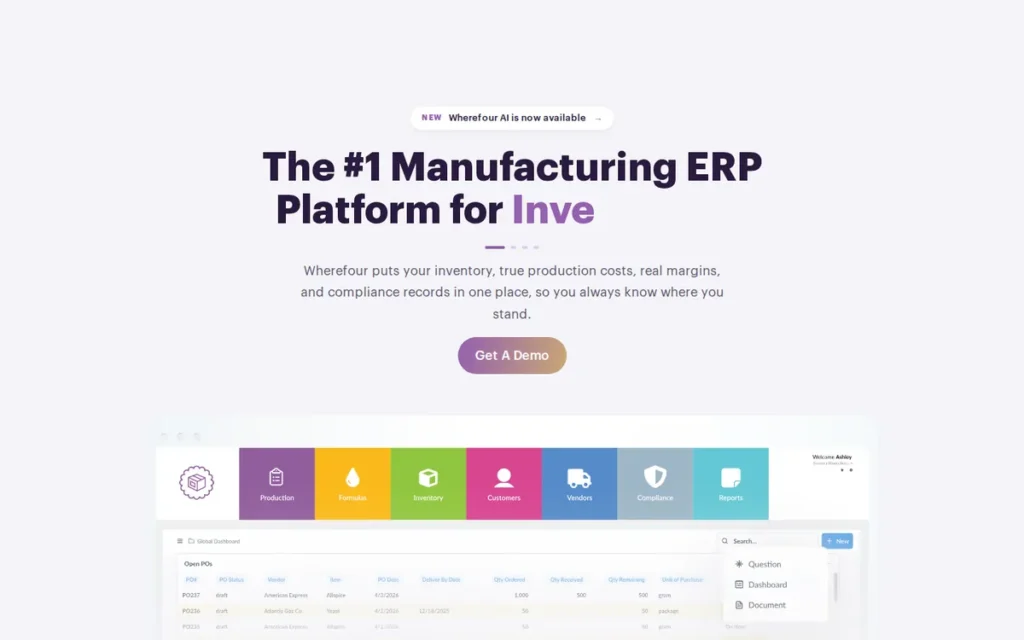
Category: In-House ERP & Lot Tracking. Builds ingredient-to-batch-to-shipment lot genealogy inside your own operation.
At a Glance
- Category: In-House ERP & Lot Tracking
- Best For: Small and mid-size food manufacturers and co-packers on QuickBooks, Xero, or Sage
- Price Range: Pricing on request (monthly, quarterly, or annual billing)
- Primary Strength: Wherefour documents forward and backward lot tracing with one-click trace reports, mock recalls, and a claimed FDA sortable-spreadsheet export.
- Biggest Limitation: Wherefour users report clunky reporting, slow periods, and report runs that lock them out of other tasks.
- One-Line Summary: Wherefour is the best-documented and most-reviewed in-house lot-tracking ERP for small and mid-size U.S. food manufacturers that need ingredient-to-customer traceability without enterprise complexity.
- Last Verified: November 2026
PlugRoute score: 4.15/5. Wherefour received the only 5.0 on documented traceability depth (C1). It publicly documents all four elements PlugRoute scored, and it scored 4.5 on reviews (C2). Wherefour scored lower on vendor background (C6, 2.5) and pricing transparency (C4, 3.0).
Overview
Wherefour is a cloud ERP for small and mid-size food and beverage manufacturers and co-packers. It links inventory, recipes, work orders, and shipping, so one ingredient lot can be traced forward to finished batches and customers and backward to its supplier.
Wherefour assigns lot codes and carries them through receiving, production, and shipping. That builds the lot genealogy that FSMA 204 traceability lot codes depend on. Wherefour is not a multi-company network.
Key Features
- Wherefour tracks lots from ingredient to batch to customer shipment and back, and it records allergens, supplier COAs, and expiration dates.
- Wherefour generates one-click trace reports and supports mock recalls.
- Wherefour says it captures FSMA 204 data at receiving, transformation, and shipping and exports an FDA sortable spreadsheet (vendor claim, Wherefour, 2026).
- Wherefour includes recipes, work orders, yield tracking, blended lot costing, FIFO/FEFO rotation, barcode labeling, and MRP.
- Wherefour connects to QuickBooks, Xero, Sage, Microsoft Dynamics, and Shopify (Wherefour, 2026).
Best For
Wherefour is best for small and mid-size food manufacturers and co-packers on QuickBooks, Xero, or Sage that want lot genealogy, recall reporting, and production planning in one system. Wherefour also fits growing multi-location manufacturers that need inventory transfers tracked by lot.
Strengths
- Wherefour holds 4.7/5 on Capterra across 63 reviews and 4.5/5 on G2 across 53 reviews (G2 and Capterra, November 2026). Its Capterra customer service sub-score of 4.9/5 is the highest support sub-score PlugRoute found among the products evaluated.
- Wherefour reports that HighTech Labs, a cannabis manufacturer, cut recall prep time by 90%. It also reports that DOU Bakehouse completed the traceability portion of a timed third-party audit in under 10 minutes (vendor-published, Wherefour, 2026).
- Wherefour is one of only two products that explicitly claim FDA sortable-spreadsheet export in the public materials PlugRoute reviewed in November 2026. The other is iFoodDS Trace Exchange.
- Wherefour publicly names five connectors (QuickBooks, Xero, Sage, Microsoft Dynamics, and Shopify), more than any other in-house tool on this list (Wherefour, 2026).
Limitations
Wherefour gives up enterprise-grade reporting in exchange for simplicity, and growing manufacturers will feel that trade-off most.
- Wherefour reviewers call reporting “clunky” and note that some reports arrive by email rather than on a dashboard (G2, 2026).
- Wherefour users report slow periods, report runs that lock them out of other tasks, and training that didn’t fully cover QuickBooks inventory mapping (Capterra, 2026).
- Wherefour is not a traceability network, so suppliers whose retailers require a network need a separate connection or a manual upload.
- Wherefour’s headline recall statistic comes from a cannabis manufacturer. Its food-specific proof rests on smaller vendor-published case studies (Wherefour, 2026).
- Wherefour’s founding date, headquarters, and team size could not be verified, and one reviewer said “the overall price seems high” (Capterra, 2026).
Verdict
Wherefour is the strongest overall choice for small and mid-size food manufacturers that need documented ingredient-to-customer lot tracing and mock recalls in a single cloud ERP.
Wherefour’s review volume and support scores lead the in-house category. Buyers should test reporting speed with one of their own lots and watch the sortable-spreadsheet export run live.
2. SafetyChain: Best for Multi-Plant Food Safety, Quality, and Supplier Compliance Programs
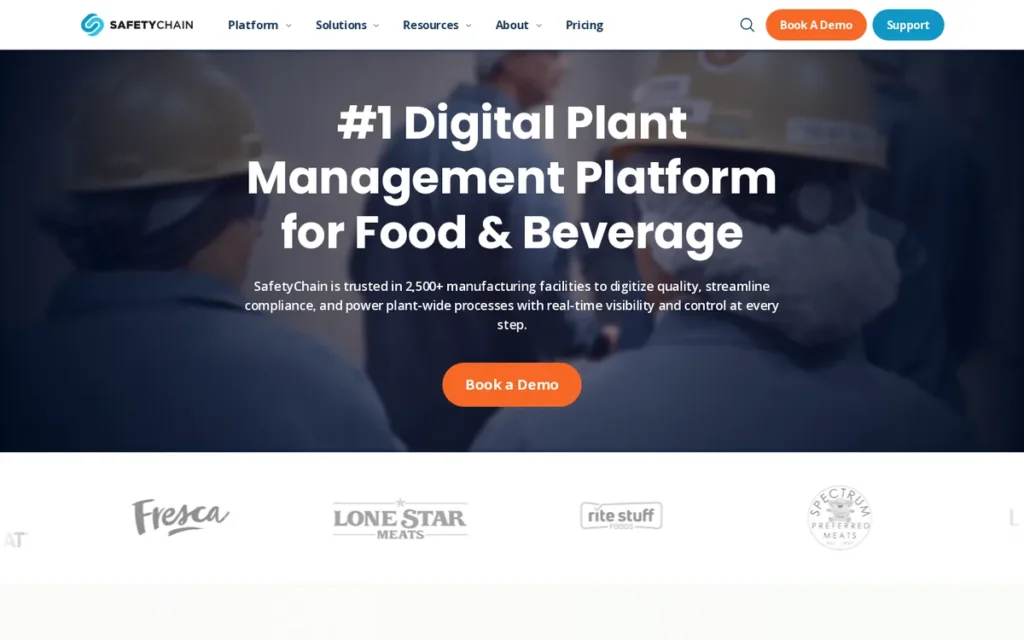
Category: Food Safety & Quality Records. Digitizes HACCP, receiving checks, audits, and corrective actions, with traceability added by module.
At a Glance
- Category: Food Safety & Quality Records
- Best For: Mid-size and multi-plant processors with an existing ERP
- Price Range: Pricing on request (annual subscription per facility; no per-user fees)
- Primary Strength: SafetyChain combines a deep independent review base with broad ERP, SCADA, and BI integrations.
- Biggest Limitation: SafetyChain’s supplier-to-customer traceability requires specific modules, and SafetyChain does not replace an ERP for inventory lot genealogy.
- One-Line Summary: SafetyChain is a widely reviewed food safety and quality platform for multi-plant processors that adds ingredient-to-finished-product traceability on top of an existing ERP when the right modules are purchased.
- Last Verified: November 2026
PlugRoute score: 3.60/5. SafetyChain leads on independent reviews (C2), integrations (C3), and vendor credentials (C6), with 4.5 on each. SafetyChain ranks below Wherefour because its traceability depends on modules (C1, 3.0) and its rollouts can take more than a year (C5, 2.5).
Overview
SafetyChain is a plant-wide food safety, quality, and operations platform for mid-size and multi-plant food and beverage processors. It digitizes HACCP monitoring, receiving inspections, SPC, and supplier compliance, and it adds trace reports once the right modules are purchased.
SafetyChain’s FAQ says full supplier-to-customer tracing requires Supplier Compliance plus the Quality and Operations modules, or LiveOps on farms (SafetyChain, 2026). SafetyChain is designed to run alongside an ERP.
Key Features
- SafetyChain provides digital forms for sanitation checks, GMPs, receiving inspections, HACCP monitoring, in-process quality checks, CAPA, and document control.
- SafetyChain produces ingredient-to-finished-product trace reports once the required modules are in place.
- SafetyChain maps records to USDA, FDA/FSMA, SQF, BRCGS, and FSSC 22000 requirements and gives auditors access.
- SafetyChain syncs with ERPs, triggers receiving inspections from warehouse events, and pulls plant-floor data through Ignition.
- SafetyChain offers a Power BI connector, a data-extract API, and an attachments API.
Best For
SafetyChain is best for multi-plant processors that already run an ERP and need consistent food safety, quality, and supplier compliance across sites. Because SafetyChain charges no per-user fees, it suits plants with large operator and QA staffs.
Strengths
- SafetyChain holds 4.5/5 on G2 across 159 reviews and 4.6/5 on Capterra across 93 reviews (G2 and Capterra, November 2026).
- SafetyChain announced on February 13, 2026 that it had completed a SOC 2 Type 2 audit by Sensiba LLP covering May to October 2025. SafetyChain says it serves 2,500+ facilities (company-reported, SafetyChain, 2026).
- SafetyChain reports that Death Wish Coffee saves $5.4M a year from digital weight checks. It also reports that Nichols Farms doubled its volume without adding to its 4-person FSQA team (vendor-published, SafetyChain, 2026).
- SafetyChain documents ERP sync, Ignition/SCADA, a Power BI connector, a data-extract API, and an attachments API (SafetyChain, 2026). That is the broadest integration list among the food safety tools here.
Limitations
SafetyChain gives up all-in-one simplicity in exchange for module-based depth, so lot genealogy depends on buying the right modules.
- SafetyChain still needs an ERP for inventory, so it cannot be a processor’s only traceability system.
- SafetyChain reviewers report slow page loads, a steep learning curve, “not plug and play” setup, and “rudimentary” report building (G2, 2026).
- SafetyChain implementations reported on G2 range from under a month to more than a year (G2, 2026).
- SafetyChain does not publicly document an FDA sortable-spreadsheet export (SafetyChain, 2026).
Verdict
SafetyChain is the best-evidenced food safety and quality platform for multi-plant processors that already run an ERP and want traceability layered onto HACCP, SPC, and supplier compliance.
SafetyChain’s review depth and February 2026 SOC 2 Type 2 announcement are strong signals. Buyers should confirm in writing which modules cover tracing and plan for a rollout that could take months.
3. Aptean Food & Beverage ERP: Best for Mid-Market Processors on Business Central
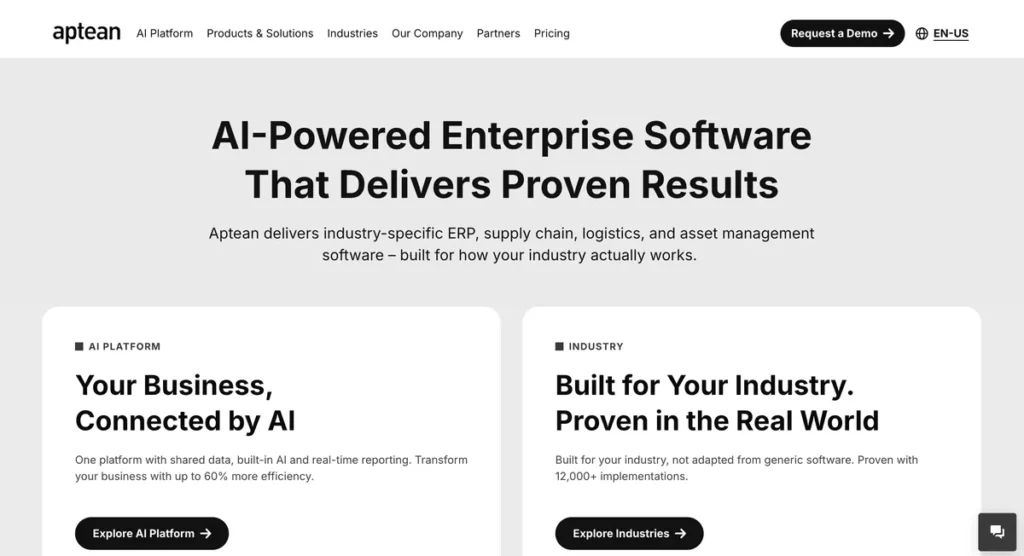
Category: In-House ERP & Lot Tracking. Builds ingredient-to-batch-to-shipment lot genealogy inside your own operation.
At a Glance
- Category: In-House ERP & Lot Tracking
- Best For: Mid-market food processors that use, or are moving to, Microsoft Dynamics 365 Business Central
- Price Range: Pricing on request (budget separately for an implementation partner)
- Primary Strength: Aptean Food & Beverage ERP puts two-way lot tracing, recall management, EDI, and quality testing inside a Business Central ERP.
- Biggest Limitation: Aptean Food & Beverage ERP does not publicly document FSMA 204 KDE/CTE capture or sortable-spreadsheet output, and its implementations average about 8 months.
- One-Line Summary: Aptean Food & Beverage ERP is a Microsoft Business Central-based food ERP for mid-market processors that want lot tracing and recall management inside their core system, at the cost of a longer, partner-dependent implementation.
- Last Verified: November 2026
PlugRoute score: 3.33/5, within 0.08 of ReposiTrak Traceability Network. Aptean Food & Beverage ERP scores high on integration fit and vendor stability (C3 and C6, both 4.5). It scores low on pricing transparency (C4, 1.5) and implementation burden (C5, 2.0).
Overview
Aptean Food & Beverage ERP is a food-specific ERP built on Microsoft Dynamics 365 Business Central. It is designed for mid-market processors that want lot tracing, recalls, and quality testing in the same system that runs finance, warehouse, and production.
Aptean also sells other food ERPs, including the JustFood line and Ross, so buyers should confirm which product they are being quoted. Aptean Food & Beverage ERP is not a network.
Key Features
- Aptean Food & Beverage ERP provides two-way lot tracing, ingredient tracking, and product-origin management.
- Aptean Food & Beverage ERP includes recall management and configurable quality tests that trigger on deviations.
- Aptean Food & Beverage ERP supports EDI, allergen and nutrition tracking, and warehouse management.
- Aptean Food & Beverage ERP adds EDI, BI, transportation, and PLM functions through AppCentral add-ons.
- Aptean Food & Beverage ERP lists AI features, including GenAI Query and AI agents that flag expiring stock and vendor risk.
Best For
Aptean Food & Beverage ERP is best for mid-market processors standardized on Microsoft, including companies moving from NAV or GP to Business Central. Aptean Food & Beverage ERP suits teams that can budget for an experienced implementation partner.
Strengths
- Aptean Food & Beverage ERP holds 4.0/5 on G2 across 50 reviews and 4.4/5 on Capterra across 17 reviews (G2 and Capterra, November 2026). Reviewers praise its usability, its visibility across the business, and its Microsoft integration.
- Aptean won a 2024 Food Logistics / Supply & Demand Chain Executive Top Software award and reported 3,000+ employees and 10,000+ customers in 2022 (company-reported, Aptean, 2024).
- Aptean Food & Beverage ERP is the only product on this list built natively on Business Central, so Microsoft shops avoid a separate integration layer.
- Aptean Food & Beverage ERP documents EDI support, which matters for suppliers that must send shipment notices to retailers (Aptean, 2026).
Limitations
Aptean Food & Beverage ERP gives up speed of deployment in exchange for ERP breadth, with an average implementation of about 8 months (G2, 2026).
- Aptean Food & Beverage ERP’s G2 support score is 7.8/10, below the G2 category average (G2, November 2026).
- Aptean Food & Beverage ERP reviewers cite costly customization, a nightly cost-adjustment run that locks users out, and cumbersome report changes (G2, 2026).
- Aptean Food & Beverage ERP does not publicly document FSMA 204 KDE/CTE capture, and lot tracing on its own does not make a system FSMA 204-ready.
- Reddit discussions of Business Central in general, not of Aptean, warn that implementation partner quality varies widely (u/Moresopheus, r/Accounting, Reddit, 2024).
Verdict
Aptean Food & Beverage ERP is the only traceability option on this list built natively on Microsoft Dynamics 365 Business Central. That gives it the shortest integration path for processors committed to Business Central.
Aptean Food & Beverage ERP keeps lot tracing, recalls, EDI, and quality inside the core ERP. Buyers should ask for a live sortable-spreadsheet demo and check the implementation partner as carefully as the software.
4. ReposiTrak Traceability Network: Best for Grocery Suppliers Whose Retailers Use the Network
Category: Multi-Company Traceability Network. Moves traceability data between suppliers and their retail and wholesale customers.
At a Glance
- Category: Multi-Company Traceability Network
- Best For: Grocery and food suppliers whose retail or wholesale customers use or request ReposiTrak
- Price Range: $499 setup + $179/month per facility (in-network); $499 setup + $49/month per out-of-network customer, per facility
- Primary Strength: ReposiTrak Traceability Network publishes its prices and lets a supplier share data with unlimited in-network partners through one connection.
- Biggest Limitation: ReposiTrak Traceability Network does not run in-house lot genealogy and publishes no detail on the CTEs it supports or its validation rules.
- One-Line Summary: ReposiTrak Traceability Network is a publicly priced, retailer-driven data network that suits suppliers whose customers use it, but it must be paired with an in-house system that creates accurate lot data.
- Last Verified: November 2026
PlugRoute score: 3.25/5. ReposiTrak Traceability Network has the only 5.0 on pricing transparency (C4). ReposiTrak Traceability Network is held back by the fixed 2/5 review-evidence score (C2) and the lack of in-house lot genealogy (C1, 3.0).
Overview
ReposiTrak Traceability Network is a shared, retailer-driven data network. Food suppliers connect once and send FSMA 204 key data elements to unlimited in-network retail and wholesale partners for a published per-facility fee.
ReposiTrak Traceability Network accepts formats suppliers already use, including EDI. It also promotes “traceability for everyone,” covering foods beyond FDA’s Food Traceability List (ReposiTrak, 2025).
Key Features
- ReposiTrak Traceability Network lets a supplier share KDEs with unlimited in-network partners, products, and shipments.
- ReposiTrak Traceability Network accepts EDI and other existing formats, then translates and organizes the data.
- ReposiTrak Traceability Network supports sharing with out-of-network customers for a per-customer, per-facility fee.
- ReposiTrak Traceability Network is positioned for retailers that want traceability data on all foods.
- ReposiTrak sells Compliance Management for supplier documents as a separate product that does not come with traceability.
Best For
ReposiTrak Traceability Network is best for grocery suppliers whose customers already use the network. ReposiTrak Traceability Network also suits single-facility suppliers that want a predictable, published cost of about $2,647 in year one ($499 setup plus $2,148/year).
Strengths
- ReposiTrak is the only one of the seven vendors with publicly verifiable dollar pricing (ReposiTrak, November 2026).
- ReposiTrak (NYSE: TRAK) reported Q2 fiscal 2026 revenue of $5.86M, up 7% year over year, and fiscal 2025 revenue of $22.6M (SEC filing, 2026).
- ReposiTrak Traceability Network accepts EDI, which cuts data entry for suppliers that already send EDI documents (ReposiTrak, 2026).
- A third-party guide says ReposiTrak Traceability Network is attractive “where retail customers already require its network” (Nulogy, 2026).
Limitations
ReposiTrak Traceability Network gives up internal traceability in exchange for network reach, so the supplier must still create accurate lot data in another system.
- ReposiTrak publishes no detail on the CTEs it supports, its validation rules, or its scanning workflows.
- ReposiTrak Traceability Network has no verified G2, Capterra, or Trustpilot presence, and PlugRoute found no reliable, dated count of network members.
- ReposiTrak fees fall on suppliers and multiply with each facility (ReposiTrak, November 2026).
- ReposiTrak charges $499 setup plus $49/month for each out-of-network customer, per facility (ReposiTrak, November 2026).
Verdict
ReposiTrak Traceability Network is the most cost-transparent option for suppliers whose retail customers use it. Its published price is $499 setup plus $179 per facility per month as of November 2026.
ReposiTrak Traceability Network’s value depends on whether your trading partners are on the network. Buyers should ask for documentation of the CTEs it supports before signing.
5. iFoodDS Trace Exchange: Best for Produce Supply Chains and FSMA 204 Data Exchange
Category: Multi-Company Traceability Network. Moves traceability data between suppliers and their retail and wholesale customers.
At a Glance
- Category: Multi-Company Traceability Network
- Best For: Produce growers, packers, distributors, and enterprise buyers that need FSMA 204 KDE capture and sharing
- Price Range: Pricing on request (priced per feature; some services priced per location)
- Primary Strength: iFoodDS Trace Exchange documents FSMA 204 KDE capture, missing-data flagging, and sortable-spreadsheet access more explicitly than any other network on this list.
- Biggest Limitation: iFoodDS Trace Exchange has no public pricing, no named ERP or WMS integrations, and no usable independent reviews.
- One-Line Summary: iFoodDS Trace Exchange is a produce-rooted FSMA 204 data exchange platform with strong regulatory expertise and well-documented KDE features, but little independent evidence of performance or cost.
- Last Verified: November 2026
PlugRoute score: 3.18/5. iFoodDS Trace Exchange has the second-highest documented traceability score (C1, 4.5). iFoodDS Trace Exchange is held back by no public pricing (C4, 2.0), no named integrations (C3, 2.5), and the fixed 2/5 review score (C2).
Overview
iFoodDS Trace Exchange is a produce-rooted FSMA 204 data capture and sharing platform for growers, packers, processors, distributors, retailers, and restaurant chains. It captures KDEs in purpose-built apps and flags missing data.
iFoodDS Trace Exchange gives access to the electronic sortable spreadsheet FDA can request. It works on a “capture once, share with many trading partners” model (iFoodDS, 2024).
Key Features
- iFoodDS Trace Exchange captures KDEs in purpose-built apps and supports GS1 standards.
- iFoodDS Trace Exchange dashboards flag missing KDEs and track supplier compliance.
- iFoodDS Trace Exchange provides access to a sortable spreadsheet and fast trace-back and trace-forward (iFoodDS brochure, 2024).
- iFoodDS Trace Exchange stores data for 2+ years and lets users control which data each partner sees.
- iFoodDS Trace Exchange includes supplier onboarding help, and iFoodDS’s New Era Partners consulting arm offers FSMA 204 audits.
Best For
iFoodDS Trace Exchange is best for produce supply chains. iFoodDS Trace Exchange also suits enterprise retailers or restaurant chains that need suppliers to submit complete FSMA 204 KDEs.
Strengths
- iFoodDS’s December 2024 enterprise brochure documents missing-KDE dashboards, GS1 support, 2+ year data storage, and sortable-spreadsheet access (iFoodDS brochure, 2024).
- iFoodDS Chief Traceability Officer Andrew Kennedy co-led FDA’s Tech-Enabled Traceability work and contributed to the final Food Traceability Rule (company-reported, iFoodDS, 2026; not an FDA endorsement).
- iFoodDS acquired HarvestMark from Trimble in 2020, which gave iFoodDS Trace Exchange its produce roots. iFoodDS sold the HarvestMark Quality Insights portion in August 2026 (iFoodDS, 2020; Foods Connected, 2026).
- iFoodDS Trace Exchange lets users control what data they share, which addresses supplier concerns about exposing their data (iFoodDS brochure, 2024).
Limitations
iFoodDS Trace Exchange gives up verifiable evidence in exchange for regulatory pedigree, and that gap is the main buying risk.
- iFoodDS Trace Exchange has only one G2 review, rated 3.0/5 (G2, November 2026).
- iFoodDS Trace Exchange’s Capterra listing appears to mix in reviews of the unrelated consumer app “iFood” (Capterra, 2026).
- iFoodDS has published no named, quantified case studies and names no ERP or WMS integrations.
- Foods Connected acquired iFoodDS’s HarvestMark Quality Insights business in August 2026, and iFoodDS says it is refocusing on Trace Exchange (Foods Connected, 2026).
Verdict
iFoodDS Trace Exchange has the most FSMA 204-specific documentation of any network on this list, which makes it a serious option for produce supply chains.
iFoodDS Trace Exchange’s independent evidence is thin, with no usable reviews and no public pricing. Buyers should ask for a live sortable-spreadsheet demo and confirm which HarvestMark capabilities remain in Trace Exchange.
6. FoodReady: Best for Very Small Teams That Need HACCP Plus Consulting
Category: Food Safety & Quality Records. Digitizes HACCP, receiving checks, audits, and corrective actions, with traceability added by module.
At a Glance
- Category: Food Safety & Quality Records
- Best For: Very small manufacturers, restaurants, and food service operators with no dedicated food safety staff
- Price Range: Pricing on request (unverified third-party report of about $99/month for a HACCP tier)
- Primary Strength: FoodReady bundles HACCP software and documented lot tracing with certified consultants, giving small teams expertise they don’t have in-house.
- Biggest Limitation: FoodReady documents lot links and KDE capture but makes no explicit FDA sortable-spreadsheet export claim, and G2 reviewers say its inventory features are less intuitive.
- One-Line Summary: FoodReady is a HACCP-first food safety platform with bundled consulting and documented lot links for very small teams, though buyers should confirm FDA sortable-spreadsheet output in a demo.
- Last Verified: November 2026
PlugRoute score: 2.88/5. PlugRoute rescored FoodReady in November 2026 after it published traceability documentation. FoodReady scores well on usability (C5, 4.0) and documented traceability (C1, 3.5). FoodReady is held back by no named integrations (C3, 1.5) and limited vendor history (C6, 2.0).
Overview
FoodReady is a HACCP and food safety compliance platform for very small restaurants, food service operators, and food manufacturers without dedicated food safety staff. It bundles plan builders, mobile CCP logs, and mock-recall tools with certified consultants.
FoodReady’s traceability page documents two-way lot links from supplier lots to manufacturing orders, finished lots, and shipments (FoodReady, November 2026).
Key Features
- FoodReady includes a HACCP/PCP plan builder, mobile CCP logs, and a checklist builder.
- FoodReady captures KDEs and traceability lot codes at receiving, transformation, and shipping (vendor-documented, FoodReady, 2026).
- FoodReady offers recall and mock-recall management, complaint management, and batch management.
- FoodReady provides 80+ plan templates, 100+ SOP templates, and an AI SOP generator.
- FoodReady bundles consulting from certified HACCP, FDA PCQI, and USDA consultants, plus audit preparation, across three packages.
Best For
FoodReady is best for very small or new food businesses with no dedicated food safety staff that need HACCP plans, logs, mock recalls, and expert help in one package. FoodReady suits teams that value guided onboarding over deep ERP features.
Strengths
- FoodReady holds 4.7/5 on G2 across 20 reviews, while a G2 category page shows 4.5 (G2, November 2026). FoodReady reviewers say “the initial setup was pretty easy.”
- FoodReady is the only product on this list that bundles software with certified HACCP, PCQI, and USDA consultants (FoodReady, 2026).
- FoodReady’s template library and AI SOP generator shorten the time it takes to build a documented food safety program.
- FoodReady keeps mock-recall management and documented lot tracing in the same system as daily HACCP logs (FoodReady, 2026).
Limitations
FoodReady’s main trade-off is that it offers compliance guidance in place of proven traceability, because its lot tracing is vendor-documented and has not been independently tested.
- FoodReady documents lot links and KDE capture (FoodReady, November 2026), but PlugRoute found no explicit FDA sortable-spreadsheet export claim.
- FoodReady’s inventory features “could be more intuitive,” according to G2 summaries (G2, 2026), and a third-party summary flags complex initial setup.
- FoodReady has no Capterra ratings, no named integrations, and no named, quantified case studies.
- FoodReady has the shortest verifiable vendor history on this list: founded in 2020, with about 39 employees (G2 and LinkedIn, 2026).
Verdict
FoodReady is the best option on this list for very small food businesses that need HACCP software, documented lot tracing, and certified consulting in one package.
FoodReady’s 4.7/5 G2 rating reflects satisfied compliance users. Businesses covered by the rule should trace one of their own lots in a live FoodReady demo and ask FoodReady to produce the FDA sortable spreadsheet.
7. Trustwell FoodLogiQ Connect: Best for Foodservice Brands Managing Supplier Networks
Category: Multi-Company Traceability Network. Moves traceability data between suppliers and their retail and wholesale customers.
At a Glance
- Category: Multi-Company Traceability Network
- Best For: Restaurant, foodservice, grocery, and brand owners coordinating suppliers, recalls, and nutrition labeling
- Price Range: Pricing on request (G2 lists a $32,000/year Basic plan)
- Primary Strength: Trustwell FoodLogiQ Connect combines supplier compliance, lot-level traceability, and recall workflows, with optional nutrition labeling from the same vendor.
- Biggest Limitation: Trustwell FoodLogiQ Connect does not publicly document its sortable-spreadsheet export format or its full KDE/CTE coverage.
- One-Line Summary: Trustwell FoodLogiQ Connect is a supplier-network traceability and recall platform for foodservice and brand owners that pairs supply-chain visibility with nutrition labeling, at what appears to be an enterprise price point.
- Last Verified: November 2026
PlugRoute score: 2.83/5, 0.05 below FoodReady. Trustwell FoodLogiQ Connect scores well on documented recall workflows (C1, 3.5) and vendor credentials (C6, 4.0). It is held back by quote-only pricing (C4, 1.5), no named integrations (C3, 2.5), and the fixed 2/5 review score (C2).
Overview
Trustwell FoodLogiQ Connect, formerly sold as FoodLogiQ, is a supplier network platform for restaurant, foodservice, grocery, and brand owners. It combines lot-level traceability, supplier documents, incident tracking, and recall workflows, with optional Genesis nutrition labeling.
FoodLogiQ merged with ESHA Research in October 2022 and rebranded as Trustwell in February 2023 (Trustwell, 2023).
Key Features
- Trustwell FoodLogiQ Connect captures lot-level events based on FSMA 204 CTEs and KDEs and traces both up and down the supply chain.
- Trustwell FoodLogiQ Connect manages supplier documents with configurable forms, approval workflows, and scorecards.
- Trustwell FoodLogiQ Connect tracks quality incidents and corrective actions.
- Trustwell FoodLogiQ Connect runs targeted recall notifications, withdrawals, response tracking, and mock recalls.
- Trustwell FoodLogiQ Connect can be paired with Genesis nutrition labeling and a restaurant menu-nutrition suite.
Best For
Trustwell FoodLogiQ Connect is best for multi-unit restaurant and brand owners that need to onboard many suppliers and coordinate recalls. Trustwell FoodLogiQ Connect also suits buyers that want nutrition labeling from the same vendor.
Strengths
- Trustwell reports that Wawa onboarded more than 90% of its suppliers in three months using FoodLogiQ Compliance plus Trustwell’s Supplier Success service (vendor-published, Trustwell, 2026).
- Trustwell FoodLogiQ took part in FDA’s first round of traceability pilots, and Trustwell won three 2025 Stevie American Business Awards (company-reported, Trustwell, 2025).
- Trustwell FoodLogiQ Connect documents four recall functions, which is more recall detail than ReposiTrak or iFoodDS publish (Trustwell, 2026).
- Trustwell is the only vendor on this list that pairs traceability with nutrition labeling, through Genesis from ESHA Research, founded in 1981 (Trustwell, 2026).
Limitations
Trustwell FoodLogiQ Connect gives up public verifiability in exchange for enterprise breadth, because its export format and full KDE/CTE coverage are not publicly documented.
- Trustwell FoodLogiQ Connect has one G2 review (5.0/5) and no Capterra presence (G2, November 2026), and Trustwell names no integrations publicly.
- A third-party guide says Trustwell FoodLogiQ “may involve more manual day-to-day work,” though the guide’s sourcing is unclear (Nulogy, 2026).
- Trustwell FoodLogiQ Connect’s G2-listed $32,000/year Basic plan would put it at the high end of entry pricing on this list (G2, November 2026).
- Trustwell’s public CEO information is inconsistent: Stephen Bruce was named at the rebrand, and Katy Jones appears in later content (Trustwell, 2023; Trustwell, 2026).
Verdict
Trustwell FoodLogiQ Connect is the strongest fit for foodservice and brand owners that need supplier compliance, traceability, recall coordination, and nutrition labeling from one vendor.
Trustwell FoodLogiQ Connect’s FSMA 204 export details are undocumented, and Trustwell does not publish its pricing. Buyers should ask for a live demo that produces the FDA sortable spreadsheet from their own supplier data.
What Red Flags Should I Watch For When Evaluating Food Traceability Software?
The biggest red flags in food traceability software are “FSMA-ready” claims with no live sortable-spreadsheet demo, traceability sold as an add-on, networks with no lot data behind them, and missing data-export rights. Heavy customization and unverified case studies also shift cost or legal risk onto your business.
Red Flag #1: “FSMA-Ready” Without a Live Sortable Spreadsheet FDA does not certify traceability software, so “FSMA-ready” is a marketing claim until the vendor produces your sortable spreadsheet from your own data. A vendor that cannot do this in a live demo has not shown it can meet a 24-hour FDA request.
Red Flag #2: Traceability Hidden in Add-On Modules or Per-Facility Fees A base quote may leave out the modules or network connections that traceability actually requires. SafetyChain’s FAQ ties full tracing to specific modules (SafetyChain, 2026). ReposiTrak adds $499 setup plus $49/month for each out-of-network customer, per facility (ReposiTrak, November 2026).
Red Flag #3: A Network With No In-House Lot Data Behind It Traceability networks move data between trading partners, but they do not create accurate ingredient-to-batch lot records. A supplier that joins a network without a system that captures lot data is sharing incomplete records, and the supplier stays legally responsible for them.
Red Flag #4: No Data Export Rights When the Vendor Holds Your Records FDA states that a firm stays responsible for traceability records even when a third party holds them (FDA, 2026). Contracts that limit bulk export, or charge for it, put that obligation at risk if the vendor goes down, changes ownership, or you switch vendors.
Red Flag #5: Heavy Customization That Breaks Upgrades ERP users on Reddit report that custom builds “broke at nearly all upgrades,” with one customization costing over $40,000 (u/Smcgie, r/Entrepreneur, Reddit, 2023). Vendors that meet traceability needs through heavy customization can lock you into expensive, fragile systems.
Takeaway: Choose software that meets your traceability needs through configuration, not custom code.
Red Flag #6: Case-Study Numbers With No Independent Verification Every quantified customer result PlugRoute found for these seven products is vendor-published. Treat these figures as claims and ask for a reference customer of your size and type who can confirm them.
- Wherefour’s recall-prep time cut and audit-time result are vendor-published (Wherefour, 2026).
- SafetyChain’s dollar-savings figures are vendor-published (SafetyChain, 2026).
- Trustwell’s supplier onboarding rate is vendor-published (Trustwell, 2026).
What Questions Should I Ask Before Choosing Food Traceability Software?
Before choosing food traceability software, ask each vendor to trace one of your own lots live, list the CTEs and KDEs it captures, and produce the FDA sortable spreadsheet. Also confirm how it handles exceptions, which networks and labels it supports, its named integrations, its year-one cost per facility, and who owns data accuracy.
Question #1: Can you trace one of my ingredient lots back to its supplier and forward to every finished batch and customer shipment, live? A credible vendor will run a live trace of one of your own ingredient lots during the demo instead of showing a prepared example. Time the trace, then compare the result with the manual self-test: tracing one lot from last month by hand.
Question #2: Which CTEs and KDEs does the system capture, and how are traceability lot codes assigned and carried through? Look for documented coverage of every critical tracking event (CTE) that applies to your business, and ask how lot codes carry through each step. FDA’s rule covers these CTEs:
- Growers and packers record harvesting, cooling, and initial packing events.
- Firms that take food off a fishing vessel record first land-based receiving events.
- Most manufacturers, distributors, and retailers record shipping and receiving events.
- Manufacturers and processors record transformation events when they change a food or its packaging.
Question #3: Can you produce the FDA electronic sortable spreadsheet within 24 hours, and can I export my data if I leave? Ask the vendor to generate the spreadsheet in the demo and to put full data-export rights in the contract. In the public materials PlugRoute reviewed in November 2026, only Wherefour and iFoodDS Trace Exchange explicitly claim sortable-spreadsheet output.
Question #4: How do you handle partial batches, rework, held or expired stock, and corrected records? Lot genealogy usually breaks down at exceptions such as rework and corrections. Ask the vendor to show how the system links rework to its source lots, flags held stock, and keeps an audit trail when someone corrects a record.
Question #5: Which of my customers’ networks do you connect to, and can you generate ASNs, SSCC-18 pallet labels, and GS1-128 case barcodes? Walmart requires shipment notices with traceability data, SSCC-18 pallet labels, and GS1-128 case barcodes (Walmart, 2026). Check that the system produces these outputs and connects to the specific networks your retail and wholesale customers use.
Question #6: Which ERP, accounting, barcode, and labeling systems do you connect to natively, by API, by EDI, or by file upload? Ask the vendor to name each connector and its connection method, rather than accepting “we integrate with everything.” For comparison, Wherefour publicly names five connectors, including QuickBooks and Microsoft Dynamics (Wherefour, 2026).
Question #7: What is the total year-one cost per facility, including implementation, onboarding, and consulting? Six of the seven vendors on this list price by quote only, and per-facility fees multiply quickly for multi-site suppliers. Get a written year-one total per facility that covers implementation partner fees, training, data migration, and any extra network connections.
On r/ERP, one commenter estimating general ERP costs (for NetSuite, not a food traceability product) warned:
“$50k for financials and order management, $75k+ if you are doing it all. Always third party. Assume 3-4x license for implementation. Everyone will tell you it can be done cheaper. Right before they hit you with a change order making it cost this much” Posted by u/GAAPguru
Takeaway: ERP buyers should expect implementation to cost several times the license fee, because partner change orders often push the year-one total well above the first quote.
Question #8: Who is responsible for data accuracy, and what does supplier onboarding involve? Your firm stays legally responsible for its records, even when a vendor holds them (FDA, 2026). Ask who checks supplier data, how the system flags missing KDEs, and how much onboarding help the vendor gives your suppliers.
How Did We Rank These Food Traceability Software Tools?
PlugRoute scored each product from 1 to 5 on six weighted criteria, using only dated, source-labeled evidence. Documented traceability depth carries the most weight at 30%, followed by independent review evidence at 20%. Products with almost no reviews received a fixed “unverified” score. PlugRoute did not run hands-on trace-speed tests.
The six ranking criteria are:
- C1: Documented Traceability Depth and FSMA 204 Output (30%): C1 measures documented lot tracing, CTE/KDE capture, sortable-spreadsheet claims, and recall workflows, because tracing is the buyer’s core job.
- C2: Independent User Review Evidence (20%): C2 uses G2 and Capterra ratings and review volume, because third-party ratings are the only outside check on vendor claims.
- C3: Integration Fit (15%): C3 counts named connectors and support for the EDI and GS1 standards, because the software must connect to existing systems.
- C4: Pricing Transparency (10%): C4 rewards published prices, because network and per-facility fees are often unclear.
- C5: Implementation Burden and Usability (15%): C5 uses reported rollout timelines and user complaints, because small teams cannot absorb long implementations.
- C6: Vendor Stability and Regulatory Expertise (10%): C6 uses verifiable vendor facts, because firms stay responsible for records the vendor holds.
As one user on r/manufacturing described the search for manufacturing software:
“I’m looking for the same thing-- the problem is:
- there are so many different ERP
- they all do the same things
- they all seemingly do everything
- the sales channels are so clogged by SEO-manicured lists, suggestion portals and consultants trying to fix this problem that you can’t find objective, reliable information about any of them.
- every single one requires an email and a sales call to get even ballpark pricing
- there’s also the cost of setup, implementation, and ongoing support, none of which you have any way of estimating.
- once you’re into one system, I’m sure it’s not easy to just jump to another.” Posted by u/blacktongue
Takeaway: Manufacturing software buyers find it hard to get objective information or even rough pricing, which is why pricing transparency and independent evidence are scored as separate criteria in this ranking.
| Rank | Product | C1 | C2 | C3 | C4 | C5 | C6 | Weighted Total |
|---|---|---|---|---|---|---|---|---|
| 1 | Wherefour | 5.0 | 4.5 | 4.0 | 3.0 | 4.0 | 2.5 | 4.15 |
| 2 | SafetyChain | 3.0 | 4.5 | 4.5 | 3.0 | 2.5 | 4.5 | 3.60 |
| 3 | Aptean Food & Beverage ERP | 3.5 | 3.5 | 4.5 | 1.5 | 2.0 | 4.5 | 3.33 |
| 4 | ReposiTrak Traceability Network | 3.0 | 2.0 | 3.5 | 5.0 | 3.5 | 4.0 | 3.25 |
| 5 | iFoodDS Trace Exchange | 4.5 | 2.0 | 2.5 | 2.0 | 3.0 | 4.0 | 3.18 |
| 6 | FoodReady | 3.5 | 3.0 | 1.5 | 2.0 | 4.0 | 2.0 | 2.88 |
| 7 | Trustwell FoodLogiQ Connect | 3.5 | 2.0 | 2.5 | 1.5 | 3.0 | 4.0 | 2.83 |
Update, November 2026: FoodReady published a traceability feature page documenting lot links and KDE capture. PlugRoute raised FoodReady’s C1 score from 2.5 to 3.5, which moved FoodReady from #7 to #6.
How to read these scores:
- PlugRoute labels every piece of evidence as vendor-published, company-reported, independent review data, public filing, or unverified.
- PlugRoute gave ReposiTrak, iFoodDS, and Trustwell a fixed C2 score of 2/5 because each has 0–1 usable reviews. That score reflects lower confidence, not negative sentiment.
- PlugRoute’s ranks #3 to #5 and ranks #6 to #7 are close enough that fit matters more than position.
- PlugRoute uses “not publicly documented” to mean a capability was not found in public materials, not that the capability is absent.
Inclusion and exclusions: PlugRoute chose the seven products to cover all three categories, focusing on the U.S. food industry and on public documentation of lot traceability. Excluded products may be covered in future updates.
- Smart Food Safe (G2 4.6/5, about 41–42 reviews, 2026) was considered and excluded.
- Minotaur ERP (G2 4.6/5, 20 reviews, 2026) and Icicle ERP (G2 4.2/5, 28 reviews, 2026) were considered and excluded.
- osapiens and TraceGains were considered and excluded.
- MRPeasy, ReciPal, Crown QMS, and Nulogy came up in AI answer engine responses and were considered and excluded.
PlugRoute has no affiliate relationships with any company listed. Rankings are determined entirely by research data and objective evaluation criteria.
What Do Buyers Most Often Ask About Food Traceability Software?
Food traceability buyers most often ask whether they need both an in-house system and a network, what the software costs, and how PlugRoute ranks products. Many suppliers need two systems. ReposiTrak is the only vendor here with published prices. PlugRoute ranks products on six weighted, evidence-based criteria.
Do I need both an in-house system and a traceability network?
Many suppliers need both an in-house system and a traceability network, because networks share lot data but do not create it. A co-packer might build lot genealogy in Wherefour or Aptean Food & Beverage ERP. It would then share KDEs through ReposiTrak Traceability Network or iFoodDS Trace Exchange with retailers that require a specific network.
How much does food traceability software cost?
ReposiTrak Traceability Network is the only vendor here with published prices: about $2,647 in year one for one facility, from $499 setup plus $2,148/year (ReposiTrak, November 2026). The other six vendors are quote-based. SafetyChain prices per facility with no per-user fees, and G2 lists a Trustwell Basic plan at $32,000/year (G2, November 2026).
How does PlugRoute determine rankings?
PlugRoute ranks food traceability software on six weighted criteria, each scored 1 to 5 using dated, source-labeled evidence. Documented traceability depth accounts for 30% of the score and independent reviews for 20%. Products with almost no reviews receive a fixed “unverified” score. PlugRoute publishes its full score table and did not run hands-on trace tests.
What Do Key Food Traceability Software Terms Mean?
Most food traceability terms come from FDA’s Food Traceability Rule and from retailer labeling standards. Knowing the twelve terms below helps buyers test vendor claims and read retailer requirements. It also helps them check whether a demo produces the records FDA can request within 24 hours.
Critical Tracking Event (CTE): A step in the supply chain where FDA requires traceability records, such as initial packing or shipping. Question #2 above lists the CTEs, and buyers should confirm the software records every one that applies to them.
Key Data Element (KDE): A specific piece of information that must be recorded at each CTE, such as the lot code or the date. Missing KDEs are a frequent gap when trading partners share data.
Traceability Lot Code (TLC): A code assigned to a lot of food at events such as initial packing or transformation. The code must carry through the supply chain so the lot can always be identified.
Food Traceability List (FTL): FDA’s list of foods subject to the extra recordkeeping requirements of FSMA 204. Some retailers ask for traceability data on foods beyond this list.
Traceability Plan: The written plan the rule requires, describing how a firm keeps records and assigns lot codes. FDA publishes example plans that buyers can use as a starting point.
Electronic Sortable Spreadsheet: A spreadsheet of traceability records that FDA can request during an outbreak or recall. Buyers should check that the software produces this spreadsheet directly instead of requiring someone to build it by hand.
Lot Genealogy: The linked record of which ingredient lots went into which finished batches and which customers received them. Lot genealogy is what makes forward and backward tracing possible.
Mock Recall: A practice exercise that traces a chosen lot to measure how quickly and completely a firm could respond to a real recall. Auditors and buyers often use mock recall time as a readiness benchmark.
Advance Ship Notice (ASN): An electronic message sent before a shipment arrives, listing what it contains. Some retailers require ASNs to carry traceability data.
SSCC-18: An 18-digit Serial Shipping Container Code that identifies a single pallet or logistics unit. Retailers may require SSCC-18 labels that link to the ASN.
GS1-128: A barcode standard used on cases to encode product and lot information. Retailer requirements often specify GS1-128 case barcodes.
HACCP: Hazard Analysis and Critical Control Points, a preventive food safety system for controlling hazards at specific production steps. Food safety record systems digitize HACCP monitoring logs.
Which Food Traceability Software Is Right for You?
Key Insights
- Food traceability buyers should choose a category first (in-house lot tracking, food safety records, or a network) and only then compare products.
- Many food suppliers need an in-house lot-tracking system and a traceability network at the same time, because networks share data but do not create it.
- Food firms stay legally responsible for producing FDA records within 24 hours, even when a software vendor holds the data (FDA, 2026).
- Kroger suppliers face a December 18, 2026 item-declaration deadline and a July 31, 2027 compliance deadline. Both come before July 20, 2028, the date before which FDA cannot enforce the rule (Kroger, 2026; FDA, 2026).
- Food traceability buyers should ask every vendor for a live trace of one of their own lots, because PlugRoute found no vendor that publishes an independent 24-hour record-production test.
The right food traceability software depends on your category, size, existing ERP, and trading partners, not on rank alone. Start with the product that matches your situation:
- Small plants on QuickBooks or Xero should test Wherefour first.
- Multi-plant processors that already run an ERP should evaluate SafetyChain and confirm which modules cover tracing.
- Microsoft Business Central shops should evaluate Aptean Food & Beverage ERP and vet the implementation partner.
- Grocery suppliers whose retailer uses ReposiTrak should budget for ReposiTrak Traceability Network plus an in-house lot system.
- Produce growers, packers, and distributors should evaluate iFoodDS Trace Exchange and confirm the current product scope.
- Very small teams without food safety staff should evaluate FoodReady and test its spreadsheet output.
- Foodservice and brand owners managing many suppliers should evaluate Trustwell FoodLogiQ Connect and request a live export demo.
Before any demo, pick one lot from last month and time its full forward and backward history. If that takes a morning, a 24-hour FDA request will be a problem.
We update this guide quarterly, and sooner if FDA finalizes its timeline. Last updated: November 12, 2026. Read PlugRoute’s full ranking methodology and see our other independent food industry software reviews.