HubSpot Marketing Hub is the best overall demand generation software in PlugRoute’s 2026 evaluation for small and mid-sized B2B teams. Apollo.io is the best-value choice for outbound prospecting. Adobe Marketo Engage fits complex nurture in Salesforce- or Dynamics-centric stacks. Most of these tools fix different funnel problems, so find your bottleneck before you buy.
“Demand generation” covers five types of tools, and each does a different job. Buying the wrong type wastes budget quickly. So does buying an enterprise platform your team can’t staff. Quote-only contracts, onboarding fees and pricing tied to contact counts also hide what you’ll really pay.
PlugRoute has no affiliate relationships with any company listed, and rankings are determined entirely by research data and objective evaluation criteria.
This guide does four things. It maps each tool to the funnel stage it fixes, compares year-one costs, and scores all seven tools on six published criteria. It also gives a dated source for every claim.
What Are the 5 Categories of Demand Generation Software Tools?
Demand generation software falls into five categories, and each one fixes a different funnel problem. Marketing automation hubs such as HubSpot Marketing Hub fix capture and nurture. ABM platforms such as 6sense and Demandbase One find accounts that are actively shopping. Matching the category to your weakest funnel stage matters more than picking the top-ranked tool.
Each category maps to a specific funnel problem:
- Marketing Automation Hub: HubSpot Marketing Hub and Adobe Marketo Engage handle lead capture, nurture, scoring and attribution.
- Outbound Prospecting Platform: Apollo.io combines a contact database with email and call sequences for teams that need more outbound conversations.
- B2B Data & Intelligence Platform: ZoomInfo MarketingOS supplies contact, company and intent data to an existing CRM and marketing automation tool. It also identifies website visitors at the company level.
- ABM & Intent Platform: Demandbase One and 6sense surface “dark-funnel” research, meaning research buyers do anonymously. They combine first-party website signals with third-party intent data to rank in-market accounts.
- ABM & Intent Platform (stack position): Demandbase One and 6sense each sit on top of a CRM and a marketing automation platform rather than replacing either one.
- Visitor Identification & Signal Platform: Warmly identifies anonymous website visitors at the company and individual level. It then routes them to AI chat, rep alerts and AI SDR agents.
HubSpot Marketing Hub includes content and SEO tools. None of the seven products is a dedicated SEO platform, though, so a content bottleneck needs separate tooling.
How do I find my funnel bottleneck?
Compare your stage-by-stage conversion rates with the directional benchmarks below. The benchmarks cover 50+ B2B SaaS companies with $10–100M in revenue (Rahul D. Sarker, independent consultant analysis, 2026). The “Category to Examine” column is PlugRoute’s editorial mapping, not part of the source data.
| Funnel Stage | Directional Benchmark | Category to Examine If You’re Below Range |
|---|---|---|
| Visitor → lead | 0.7–2.2% | Visitor Identification & Signal Platform; Marketing Automation Hub (forms, landing pages) |
| Lead → MQL | 36–44% | Marketing Automation Hub (nurture, scoring) |
| MQL → SQL | 26–51% by channel (a separate broad average is ~13%) | Marketing Automation Hub scoring, plus agreement between sales and marketing |
| SQL → opportunity | 38–49% | ABM & Intent Platform; B2B Data & Intelligence Platform |
| Opportunity → close | 32–40% | Mostly sales process; ABM buying-group mapping can help |
Take a SaaS team that converts 1.8% of visitors to leads, which is inside the benchmark range. The same team converts only 15% of MQLs to SQLs, which is below range. That team has a qualification problem, not a traffic problem.
Adding Warmly or ZoomInfo MarketingOS would push more leads into a stage that already loses them. The better fix is lead scoring in the hub, plus a sales-marketing agreement on what “qualified” means.
As one user on r/sales advised a startup weighing a major data-tool purchase:
“Ask yourself what is your sales strategy to acquire new clients. Then work backwards on process and data needed to support you.
Do you need contact data, technographic data, intent data , financial data ?
Don’t recommend buying any tool without mapping your strategy.” Posted by u/Correct_Signal_
Takeaway: Experienced demand generation buyers diagnose the funnel gap and the data it requires before choosing any vendor, which is the same bottleneck-first approach this guide uses.
Is Demand Generation Software the Same as a Marketing Automation Platform?
No. Marketing automation is one category of demand generation software, not another name for it. HubSpot Marketing Hub and Adobe Marketo Engage handle capture, nurture and attribution. ABM, intent data, data enrichment and outbound tools either feed into the automation hub or work alongside it.
Here is how the other categories relate to a marketing automation hub:
- Demandbase One and 6sense sit on top of a marketing automation platform and a CRM rather than replacing either one.
- Apollo.io is not a replacement for marketing automation, because Apollo.io has limited nurture, lifecycle scoring and attribution.
- ZoomInfo MarketingOS supplies data, intent and company-level visitor signals to your existing hub and CRM.
- Warmly turns existing website traffic into identified, routed conversations, so Warmly only pays off if you have enough traffic.
Vendor-run research shows where teams send intent data most often:
- 55% of teams send intent data to their marketing automation platform (6sense AI-Driven Go-to-Market research, vendor-run, 2025).
- 49% of teams send intent data to sales engagement tools (6sense AI-Driven Go-to-Market research, vendor-run, 2025).
- 39% of teams send intent data to their CRM (6sense AI-Driven Go-to-Market research, vendor-run, 2025).
No analyst publishes a separate market-size figure for “demand generation software.” Marketing automation is the closest stand-in, and estimates vary widely because each analyst defines the category differently:
- MarketsandMarkets puts the marketing automation market at $47.02B (MarketsandMarkets, 2025).
- Grand View Research puts the marketing automation market at $8.4B (Grand View Research, 2026).
- Mordor Intelligence puts the marketing automation market at $8.16B (Mordor Intelligence, 2026).
- Fortune Business Insights puts the marketing automation market at $8.14B (Fortune Business Insights, 2026).
How Do the Top Demand Generation Software Tools Compare at a Glance?
The seven tools span five categories, so read this comparison by category, not by rank. HubSpot Marketing Hub and Adobe Marketo Engage are automation hubs. Apollo.io handles outbound, and ZoomInfo MarketingOS supplies data. Demandbase One and 6sense run ABM, and Warmly identifies visitors. A higher PlugRoute rank means stronger evidence, not a better tool for every funnel problem.
| Rank (PlugRoute Score) | Company | Category | Best For | One-Line Summary | Key Capabilities | Primary Strength | Key Limitation |
|---|---|---|---|---|---|---|---|
| 1 (4.55) | HubSpot Marketing Hub | Marketing Automation Hub | Small and mid-sized B2B teams, especially those on HubSpot CRM | HubSpot Marketing Hub is the highest-scoring all-in-one demand generation platform in PlugRoute’s 2026 evaluation for small and mid-sized B2B teams, provided they budget for contact-based price growth and Professional-tier onboarding. | Native CRM, workflows, scoring, landing pages, ad syncing, attribution, Breeze AI | Largest verified review base, plus published pricing | Cost rises with contact count; branching workflows require Professional |
| 2 (4.08) | Apollo.io | Outbound Prospecting Platform | SDR teams, founders and small budgets | Apollo.io is the best-value demand generation tool for outbound-led B2B teams in PlugRoute’s 2026 evaluation, but it works alongside a marketing automation hub rather than replacing one. | 275M+ contacts, sequences, dialer, enrichment, visitor tracking | Highest G2 rating in this evaluation, plus a free tier | Limited nurture, lifecycle scoring and attribution |
| 3 (3.53) | Adobe Marketo Engage | Marketing Automation Hub | Salesforce- or Dynamics-centric teams with marketing ops staff | Adobe Marketo Engage is the strongest fit in PlugRoute’s 2026 evaluation for Salesforce- or Dynamics-centric teams with dedicated marketing ops staff and complex nurture needs. | Smart Campaigns, reusable templates, native Salesforce and Dynamics sync, Marketo Measure | Deepest documented program architecture for complex nurture | Quote-only pricing; needs an admin and partner implementation |
| 4 (3.30) | ZoomInfo MarketingOS | B2B Data & Intelligence Platform | Teams feeding data into an existing CRM and hub | ZoomInfo MarketingOS is a deep B2B data and intent platform for teams that already run a CRM and automation hub in 2026, but buyers should negotiate renewal terms and test data accuracy first. | Contact data, Streaming Intent, WebSights, FormComplete, ABM ads | Longest documented integration list in this evaluation | Quote-only pricing, export credits, renewal price increases |
| 5 (3.20) | Demandbase One | ABM & Intent Platform | Enterprises with a defined target account list and RevOps staff | Demandbase One is the highest-scoring enterprise ABM platform in PlugRoute’s 2026 evaluation for teams that want account-based advertising and buying-group orchestration, provided they have the RevOps capacity to set it up. | Account ID, intent, built-in ad platform (DSP), buying groups, Pipeline Predict | Own ad-buying platform, plus self-reported analyst Leader placements | No native sales execution tools; reviewers report CRM integration friction |
| 6 (3.18) | Warmly | Visitor Identification & Signal Platform | US teams with high website traffic | Warmly is the most focused tool in PlugRoute’s 2026 evaluation for turning anonymous US website traffic into identified, routed conversations, but buyers should test identification accuracy and confirm post-acquisition Salesforce support before signing. | Person-level visitor ID, AI chat, Slack alerts, AI SDR agents | Only product evaluated that markets person-level visitor ID | Users dispute its accuracy; needs enough traffic; HubSpot agreed to acquire it (2026) |
| 7 (3.13) | 6sense | ABM & Intent Platform | Enterprises targeting a large list of accounts | 6sense is the most specialized predictive buying-stage platform in PlugRoute’s 2026 evaluation for enterprise teams prioritizing in-market accounts across a large set of target accounts, but it delivers weak ROI for small teams without a dedicated admin. | Predicts buying stage, anonymous account ID, display and CTV ads | Predicts each account’s buying stage | Account-level only; 2–3 months to onboard |
Which Demand Generation Software Should I Choose for My Use Case?
Choose demand generation software by your most pressing funnel problem, not by overall rank. HubSpot Marketing Hub fits teams that want one all-in-one system, and Apollo.io fits outbound on a budget. Adobe Marketo Engage fits Salesforce-centric nurture. The table below maps six common situations to a recommended tool and an acceptable alternative.
| Your #1 Priority | Recommended Tool | Why | Acceptable Alternative |
|---|---|---|---|
| Small team, small budget | HubSpot Marketing Hub Free/Starter + Apollo.io Free/Basic | Both publish prices and offer free tiers; branching nurture requires HubSpot Professional | HubSpot Marketing Hub Starter alone |
| Growing team on HubSpot CRM | HubSpot Marketing Hub Professional | Native CRM plus branching workflows; budget for the $3,000 onboarding fee and contact growth | Add Warmly only if traffic is high (Warmly agreed to be acquired by HubSpot in June 2026) |
| Salesforce-centric team with a marketing ops lead | Adobe Marketo Engage | Native Salesforce and Dynamics sync, plus reusable program templates | Salesforce Account Engagement (not researched here) |
| Outbound-heavy, needs lots of data | Apollo.io | Lowest published cost among the outbound and data tools evaluated | ZoomInfo MarketingOS for deeper data |
| Enterprise ABM with a defined target account list and RevOps staff | 6sense (predictive buying stages) or Demandbase One (own ad platform and buying groups) | Choose by whether prediction or advertising is your gap; run a paid pilot first | ZoomInfo MarketingOS intent plus your existing hub |
| High US website traffic, anonymous visitors are the problem | Warmly (start on the free tier) | Only product evaluated that markets person-level visitor identification | ZoomInfo MarketingOS WebSights (company level only) |
What Are the Best Demand Generation Software Tools in 2026?
HubSpot Marketing Hub (4.55), Apollo.io (4.08) and Adobe Marketo Engage (3.53) are the top three demand generation tools in PlugRoute’s 2026 evaluation, based on weighted scores across six evidence criteria. ZoomInfo MarketingOS, Demandbase One, Warmly and 6sense follow within 0.17 points of each other, so bottleneck fit should decide among them.
- HubSpot Marketing Hub ranks #1 with a weighted score of 4.55.
- Apollo.io ranks #2 with a weighted score of 4.08.
- Adobe Marketo Engage ranks #3 with a weighted score of 3.53.
- ZoomInfo MarketingOS ranks #4 with a weighted score of 3.30.
- Demandbase One ranks #5 with a weighted score of 3.20.
- Warmly ranks #6 with a weighted score of 3.18.
- 6sense ranks #7 with a weighted score of 3.13.
Rank does not mean one tool can replace another. Apollo.io ranks #2 and 6sense ranks #7, but Apollo.io starts outbound conversations while 6sense predicts which accounts are likely to buy. An enterprise team with a defined target account list may need 6sense more than Apollo.io, despite the rank gap.
1. HubSpot Marketing Hub: Best Overall All-in-One Hub for Small and Mid-Sized B2B Teams
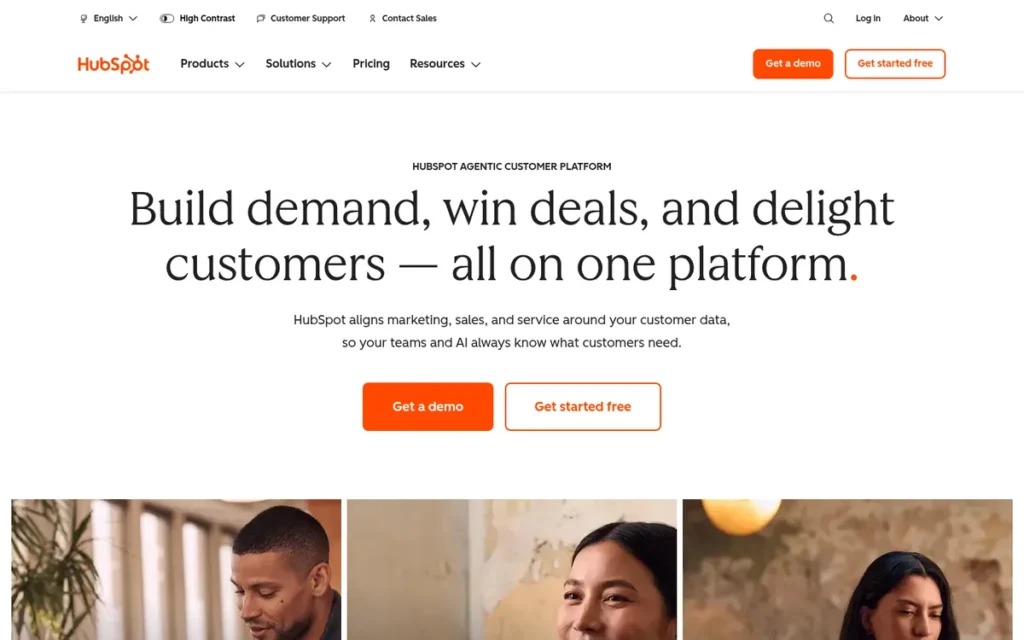
Category: Marketing Automation Hub, runs lead capture, nurture, scoring and attribution from one system of record.
PlugRoute weighted score: 4.55/5 (C1 5 · C2 4 · C3 5 · C4 4 · C5 4 · C6 5)
At a Glance
- Category: Marketing Automation Hub
- Best For: Small and mid-sized B2B teams that want one connected system for campaigns, nurture and CRM, especially teams already on HubSpot CRM
- Price Range: Free; Starter $15–$20/mo; Professional $800–$890/mo + $3,000 onboarding (2,000 marketing contacts included); Enterprise $3,600/mo + $7,000 onboarding (10,000 contacts included); all tiers rise with contact volume (HubSpot, 2026)
- Primary Strength: HubSpot Marketing Hub combines marketing automation and a built-in CRM in one platform, and it has the largest verified review base in this evaluation.
- Biggest Limitation: HubSpot Marketing Hub’s cost rises steeply with marketing contacts and tier upgrades, and key automation such as branching workflows requires the Professional tier.
- One-Line Summary: HubSpot Marketing Hub is the highest-scoring all-in-one demand generation platform in PlugRoute’s 2026 evaluation for small and mid-sized B2B teams, provided they budget for contact-based price growth and Professional-tier onboarding.
- Last Verified: November 2026
Overview
HubSpot Marketing Hub is an all-in-one marketing automation platform built on HubSpot’s own CRM. It’s designed for small and mid-sized B2B teams that want campaigns, nurture and lead management in one connected system.
HubSpot Marketing Hub stores marketing and sales data in one CRM record. For teams that use HubSpot CRM, that removes CRM sync as a failure point.
HubSpot, the parent company of HubSpot Marketing Hub, agreed in June 2026 to acquire Warmly, which ranks #6 here (Warmly, 2026). PlugRoute scored both products independently on the same six criteria.
Key Features
- HubSpot Marketing Hub runs on HubSpot’s own CRM, so marketing and sales share one contact and company record without a separate sync.
- HubSpot Marketing Hub includes branching workflows for lifecycle automation on the Professional tier and above.
- HubSpot Marketing Hub syncs ad audiences and conversions with LinkedIn and Google Ads and reports campaign attribution.
- HubSpot Marketing Hub offers lead scoring, landing pages, forms and ABM tools in the same platform.
- HubSpot Marketing Hub includes Breeze AI agents, and in HubSpot’s Sandler case study campaign build time fell from weeks to days (HubSpot, 2026).
Best For
HubSpot Marketing Hub is best for small and mid-sized B2B teams, and for HubSpot CRM users, who want lead capture, nurture and reporting in one system without hiring a dedicated marketing ops admin.
Strengths
- HubSpot Marketing Hub has the largest verified review base in this evaluation. It holds 4.4/5 on G2 from 16,049 reviews (other sources report ~13,346 to ~15,000) and 4.5/5 on Capterra from 6,258 reviews (G2 and Capterra, 2026).
- HubSpot Marketing Hub’s parent company reported 288,706 customers (up 16%) and $3.13B in revenue (up 19%) for 2025 in its audited annual filing (HubSpot FY2025 10-K, 2026).
- HubSpot Marketing Hub publishes its tier prices and offers a free tier, so small teams can estimate cost without a sales call.
- HubSpot Marketing Hub reviewers consistently praise its ease of use and having everything in one place. HubSpot’s own claim of 3x more inbound leads after six months is vendor-published and unaudited (HubSpot ROI Report, 2025).
Users on r/hubspot shared their experience:
“If you want to do a lot of automation and have a more centralized contact management platform – yes.
My company runs our site off a Wix platform. It’s basic as we just need it for exposure since our industry is pretty niche. I just implemented HubSpot for us last year and integration has been smooth with the 3rd party site. Embedding forms gets a little glitchy sometimes with how Wix operates, but I wouldn’t speak for all platforms on that front.” Posted by u/doxtorwhom
Takeaway: HubSpot Marketing Hub works well as a central automation and contact layer even when the website lives on another platform, though embedded forms can be glitchy depending on the site builder.
Limitations
- HubSpot Marketing Hub gives up cost predictability for simplicity. Professional includes 2,000 marketing contacts, and pricing rises with volume (HubSpot, 2026). One user’s bill went from about £400 to nearly £1,200 a month in eight months (Reddit r/hubspot, 2026).
- HubSpot Marketing Hub only offers branching workflows on Professional, and G2 reviewers call the cost “astronomical” and complain about constant upgrade prompts (G2, 2026).
- HubSpot Marketing Hub reviewers report weak lead-to-account matching, which makes it harder to attribute deals to whole buying groups. Gartner reviewers also report an unreliable Salesforce sync (Gartner Peer Insights, 2026).
- HubSpot Marketing Hub reserves advanced customization for higher tiers, according to Gartner reviewers (Gartner Peer Insights, 2026).
Verdict
HubSpot Marketing Hub is the highest-scoring demand generation platform in PlugRoute’s 2026 evaluation. It combines the largest verified review base, published pricing and a built-in CRM with marketing automation.
HubSpot Marketing Hub is the clearest default for small and mid-sized teams on HubSpot CRM. Buyers should clean their contact database and project how contact growth will raise their tier before signing. Salesforce-centric teams should test the sync during evaluation.
2. Apollo.io: Best for Outbound Prospecting and Small-Budget Teams
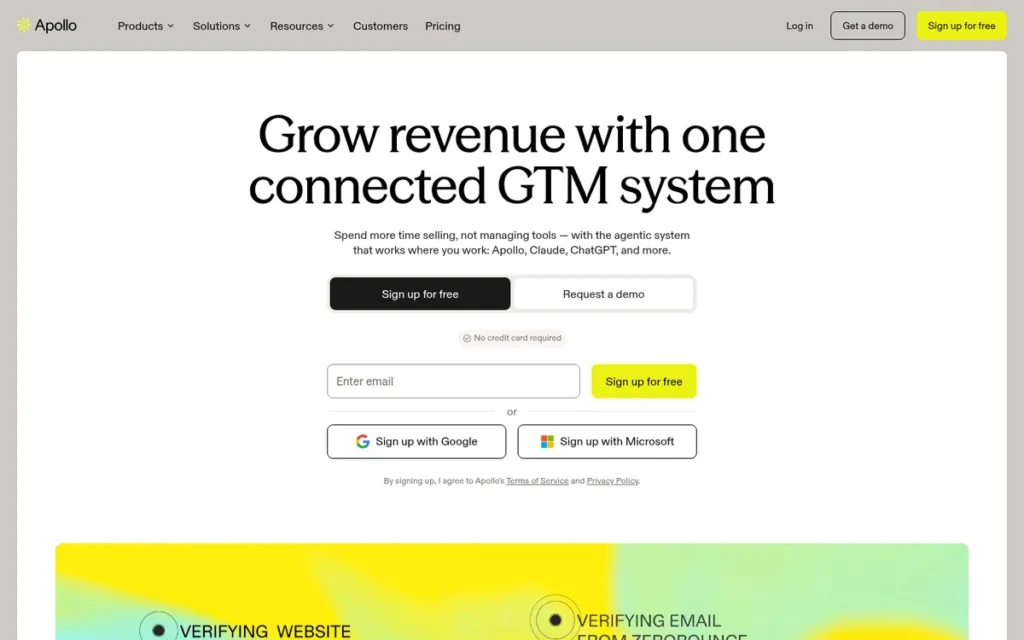
Category: Outbound Prospecting Platform, finds contacts and runs multistep sales outreach.
PlugRoute weighted score: 4.08/5 (C1 4.5 · C2 4.5 · C3 3 · C4 4 · C5 5 · C6 3.5)
At a Glance
- Category: Outbound Prospecting Platform
- Best For: SDR teams, founders and small B2B companies whose main bottleneck is starting outbound conversations
- Price Range: Free; Basic $49, Professional $79, Organization $119 per user/month billed annually (Organization requires 3 users); monthly billing costs more; credits are shared across the team and don’t roll over (Apollo.io, 2026)
- Primary Strength: Apollo.io combines contact data and outbound sequences in one low-cost platform with the highest G2 rating in this evaluation.
- Biggest Limitation: Apollo.io is not a marketing automation platform and offers limited nurture, lifecycle scoring and attribution.
- One-Line Summary: Apollo.io is the best-value demand generation tool for outbound-led B2B teams in PlugRoute’s 2026 evaluation, but it works alongside a marketing automation hub rather than replacing one.
- Last Verified: November 2026
Overview
Apollo.io is a sales intelligence and engagement platform that pairs a 275M+ contact database with outbound sequences. It’s built for SDR teams, founders and small B2B companies whose main bottleneck is starting outbound conversations.
Apollo.io replaces a separate data provider and a separate sales engagement tool, but Apollo.io doesn’t replace a marketing automation hub. Apollo.io publishes all of its per-user prices and offers a free tier (Apollo.io, 2026).
Key Features
- Apollo.io provides a 275M+ contact database, with email and phone lookups paid for by credits shared across the team.
- Apollo.io runs multistep email and call sequences, with a built-in dialer and call recording.
- Apollo.io includes email deliverability tools such as mailbox warmup to protect sender reputation.
- Apollo.io offers AI Research agents, data enrichment, intent data and website visitor tracking.
- Apollo.io routes inbound form submissions so that captured leads reach reps quickly.
Best For
Apollo.io is best for outbound-heavy teams, founders and small businesses that need prospect data and sequences on a small budget, ideally alongside a separate marketing automation hub.
Strengths
- Apollo.io holds 4.7/5 on G2 across about 9,857 reviews, the highest G2 rating in this evaluation (G2, 2026). Apollo.io also says it earned 162 #1 rankings in G2’s Spring 2025 report, a self-published claim (Apollo.io, 2025).
- Apollo.io publishes all plan prices and offers a free tier. One G2 reviewer said the free tier “builds a lot of trust.” Another valued having lead generation, a CRM and sales engagement “all under the same hood” (G2, 2026).
- Apollo.io was founded in 2015 and raised a $100M Series D led by Bain Capital Ventures at a $1.6B valuation in 2023 (G2 Research, 2023).
- Apollo.io case studies report SQLs up 70% at Customer.io and SQLs up 35% with 3 fewer SDRs at Power Digital. Both figures are vendor-published and unaudited (Apollo.io, 2026).
Limitations
- Apollo.io gives up funnel breadth for its outbound focus. Its nurture, lifecycle scoring and attribution are limited, so Apollo.io can’t serve as your main marketing automation system.
- Apollo.io data is less accurate outside North America, and its direct phone numbers are inconsistent, according to independent benchmarks. Bounced emails can also damage sender reputation (API Benchmarks, 2026).
- Apollo.io Trustpilot reviewers report unexpected or prorated charges and trouble canceling. One reviewer reports an account suspended during a billing dispute (Trustpilot, 2026).
- Apollo.io credits are shared across the team and don’t roll over. Heavy enrichment or AI research use can therefore cost more than the per-seat price suggests (Apollo.io, 2026).
Users on r/GrowthHacking described the risk of credit-based billing:
“I spent a full day pulling contacts and building lists. The data was incomplete. Emails were missing or useless. The workflows fell well short of what was advertised. Zero usable output. I paid over $600 for this. Within days, I requested a refund. Their response: “No refund due to credit usage.”” Posted by u/bno1fret
Takeaway: Apollo.io’s credit-based billing can make a disappointing trial non-refundable, so buyers should test data quality in their own segment on a small scale before committing.
Verdict
Apollo.io is the best-value outbound prospecting platform in PlugRoute’s 2026 evaluation. It combines the highest G2 rating with fully published pricing and a free tier.
Apollo.io fits teams whose bottleneck is outbound pipeline, not nurture or attribution. Buyers should pair Apollo.io with a marketing automation hub, track credit use closely and test data accuracy in their target regions before scaling up.
3. Adobe Marketo Engage: Best for Complex Enterprise Nurture in Salesforce- or Dynamics-Centric Stacks
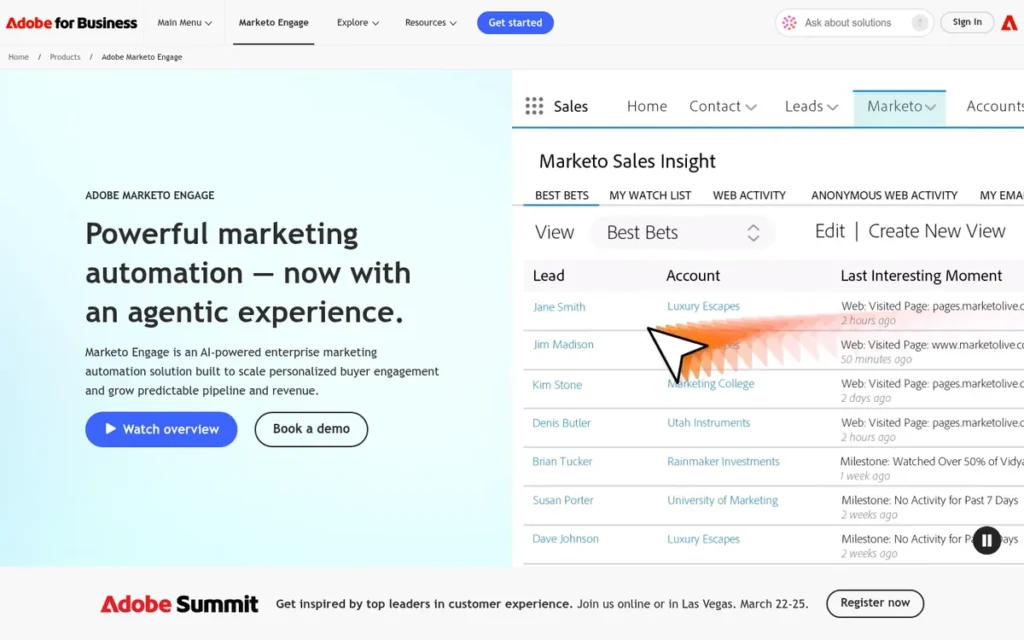
Category: Marketing Automation Hub.
PlugRoute weighted score: 3.53/5 (C1 3.5 · C2 2 · C3 4.5 · C4 5 · C5 2 · C6 4)
At a Glance
- Category: Marketing Automation Hub
- Best For: Salesforce- or Dynamics-centric mid-market and enterprise teams with dedicated marketing ops staff running complex lifecycle programs
- Price Range: Pricing on request; third-party estimates of ~$10.7K–$38K+/yr depending on database size, plus ~$15K–$50K for partner implementation (RealCostLabs and GrowthTechSpotlight, 2026)
- Primary Strength: Adobe Marketo Engage offers reusable program templates, inherited tokens and Smart Campaigns designed for complex enterprise nurture, the deepest documented program architecture among the seven tools evaluated.
- Biggest Limitation: Adobe Marketo Engage requires dedicated marketing operations staff and partner implementation, and it publishes no prices.
- One-Line Summary: Adobe Marketo Engage is the strongest fit in PlugRoute’s 2026 evaluation for Salesforce- or Dynamics-centric teams with dedicated marketing ops staff and complex nurture needs.
- Last Verified: November 2026
Overview
Adobe Marketo Engage is an enterprise B2B marketing automation platform with native Salesforce and Microsoft Dynamics sync. It’s built for teams on those CRMs with dedicated marketing operations staff running complex lifecycle programs.
Adobe Marketo Engage is sold only by quote, priced by package and database size (Adobe, 2026). Adobe Marketo Engage lets large teams reuse one campaign structure, which demands stricter governance than simpler hubs.
Key Features
- Adobe Marketo Engage uses Smart Campaigns, inherited tokens and cloneable program templates so large teams can reuse campaigns at scale.
- Adobe Marketo Engage syncs natively with Salesforce and Microsoft Dynamics CRM.
- Adobe Marketo Engage supports lead scoring, account scoring and multichannel nurture programs.
- Adobe Marketo Engage includes Dynamic Chat for AI chat and conversational forms.
- Adobe Marketo Engage offers multi-touch attribution through Marketo Measure, but only in the Ultimate package.
Best For
Adobe Marketo Engage is best for Salesforce- or Dynamics-centric organizations that have at least one dedicated marketing ops admin and lifecycle programs too complex for simpler hubs.
Strengths
- Adobe Marketo Engage holds 4.3/5 on Capterra from 719 reviews and 4.1/5 on G2 from 3,345 reviews, a large verified review base for an enterprise-only tool (Capterra and G2, 2026).
- Adobe Marketo Engage was named a Leader in the 2026 Gartner Magic Quadrant for B2B Marketing Automation Platforms, published in September 2026 (Adobe, 2026).
- Adobe Marketo Engage syncs natively with Salesforce and Dynamics, which suits Salesforce-centric teams better than a hub built on its own CRM.
- Adobe Marketo Engage dates to Marketo’s founding in 2006 and has been part of Adobe since a $4.75B acquisition in 2018 (Adobe, 2018). Its practitioner community includes Marketing Nation and Marketo Champions.
In an r/MarketingAutomation thread whose original poster called legacy platforms “horrible to use,” a self-described former Marketo employee who is building a competing tool replied:
“Hubspot is not really very different from older players. In fact, it may be worse than Marketo when it comes to MA (programs, nurture, campaigns, slice and dice lead DB, RCM, analytics – Hubspot is still way behind Marketo)” Posted by u/kloudrider
Takeaway: Adobe Marketo Engage still has an edge for practitioners who need deep programs, nurture and lead-database segmentation, even as some users call legacy platforms like it dated and hard to use.
Limitations
- Adobe Marketo Engage gives up ease of operation for power. One Capterra reviewer said getting full value “required a full-time internal resource” (Capterra, 2026).
- Adobe Marketo Engage requires partner implementation, estimated at $15,000–$50,000, on top of quote-only licensing (RealCostLabs, 2026).
- Adobe Marketo Engage G2 reviewers criticize a basic, rigid email builder and slow support. Third-party reviewers describe a dated interface and reporting (G2, 2026; BestForBusiness, 2026).
- Adobe Marketo Engage only offers multi-touch attribution through Marketo Measure in the Ultimate package. Some users feel product updates have slowed since Adobe bought Marketo, though that is a perception, not a verified fact.
Verdict
Adobe Marketo Engage is the strongest choice in PlugRoute’s 2026 evaluation for Salesforce- or Dynamics-centric teams that run complex, high-volume nurture programs with dedicated marketing ops staff.
For lean teams without an admin, Adobe Marketo Engage is likely more platform than they can use. Buyers should get quotes at their real database size and budget for partner implementation before comparing it with hubs that publish prices.
4. ZoomInfo MarketingOS: Best for Deep B2B Contact and Intent Data Feeding an Existing Stack
Category: B2B Data & Intelligence Platform, supplies contact, company and intent data to the rest of the stack.
PlugRoute weighted score: 3.30/5 (C1 3 · C2 1.5 · C3 4 · C4 5 · C5 3 · C6 4)
At a Glance
- Category: B2B Data & Intelligence Platform
- Best For: Mid-market and enterprise teams that need deep contact, company and intent data feeding Salesforce, HubSpot or Marketo
- Price Range: Pricing on request; third-party estimates of ~$15K–$36K+/yr, plus ~$8K–$25K/yr for the MarketingOS add-on; median contract ~$32K (Supered and Vendr, 2026)
- Primary Strength: ZoomInfo MarketingOS offers broad B2B data, intent and visitor identification, with the longest documented list of CRM and sales engagement integrations in this evaluation.
- Biggest Limitation: ZoomInfo MarketingOS has quote-only pricing, export credits and documented price increases at auto-renewal, which make total cost hard to predict.
- One-Line Summary: ZoomInfo MarketingOS is a deep B2B data and intent platform for teams that already run a CRM and automation hub in 2026, but buyers should negotiate renewal terms and test data accuracy first.
- Last Verified: November 2026
Overview
ZoomInfo MarketingOS is a go-to-market data platform that combines a large B2B contact database with intent data and company-level visitor identification. It’s built for mid-market and enterprise teams feeding Salesforce, HubSpot or Marketo.
ZoomInfo MarketingOS is sold only by quote. Its data comes from three sources: public and regulatory records, a contributory network of users who share their business contacts, and 300+ human researchers (ZoomInfo, 2026).
Key Features
- ZoomInfo MarketingOS provides contact and company data that a third party puts at 500M+ contacts.
- ZoomInfo MarketingOS offers Streaming Intent across 25 topics to flag accounts researching relevant subjects.
- ZoomInfo MarketingOS identifies companies visiting your website through WebSights and fills in form data through FormComplete.
- ZoomInfo MarketingOS runs ABM ads and retargeting, and the wider ZoomInfo platform adds Chorus sales-call analysis and the Copilot AI assistant.
- ZoomInfo MarketingOS integrates with Salesforce, HubSpot, Marketo, Eloqua, Dynamics, Outreach and Salesloft.
Best For
ZoomInfo MarketingOS is best for mid-market and enterprise teams that need a lot of data, already have a CRM and automation hub, and want broad contact, intent and visitor data to feed them.
Strengths
- ZoomInfo MarketingOS’s parent company reported $1.2495B in FY2025 revenue and 1,921 customers with $100K+ annual contract value (ACV), up 54 year over year. Together those customers make up more than half of total ACV (ZoomInfo FY2025 8-K, 2026).
- ZoomInfo MarketingOS holds 4.5/5 on G2 across ~9,170–9,218 reviews, and users praise the size of the database and its filters (G2 via Supered, 2026).
- ZoomInfo MarketingOS holds SOC 2 Type II, ISO 27001, ISO 27701 and TRUSTe GDPR/CCPA certifications (ZoomInfo, 2026).
- ZoomInfo MarketingOS case studies cite 192% year-over-year bookings growth at Instapage and 30% shorter sales cycles. Both figures are vendor-published, and ZoomInfo doesn’t disclose how it attributed the results (ZoomInfo, 2026).
Limitations
- ZoomInfo MarketingOS gives up cost and contract predictability for data depth. Exports use credits, and auto-renewals reportedly include 5–10% increases with 30–90-day notice windows (Supered, Cleverly and StackSwap, 2026).
- ZoomInfo MarketingOS ratings range from 4.5/5 on G2 to 4.1/5 on Capterra (~322 reviews) and ~1.6–1.8/5 on Trustpilot (~340 reviews). Trustpilot reviewers skew toward billing complaints, and this gap explains its C1 score of 3 (Capterra and Trustpilot, 2026).
- ZoomInfo MarketingOS data quality was questioned by one third-party reviewer, who reported phone numbers that rang reception desks (BrandID, 2026).
- ZoomInfo MarketingOS relies on a contributory-network data model that privacy critics question, and the parent company’s FY2025 revenue grew only ~3% (ZoomInfo FY2025 8-K, 2026).
Users on r/sales noted:
“As another poster mentioned, sometimes titles can be off, and sometimes the information is out of date (it will list someone as still being with a company, but they left for another place, or retired, etc.). I have yet to come across another platform that is better though in terms of finding emails and phone numbers for people you’re trying to contact.” Posted by u/space_ghost20
Takeaway: ZoomInfo MarketingOS users put up with outdated titles and departed contacts because they still see its email and phone coverage as the best available.
Verdict
ZoomInfo MarketingOS has the longest documented integration list in PlugRoute’s 2026 evaluation. The list covers Salesforce, HubSpot, Marketo, Eloqua, Dynamics, Outreach and Salesloft.
ZoomInfo MarketingOS adds to a marketing automation hub rather than replacing one. Buyers should pilot data accuracy on their own accounts and negotiate renewal caps and notice windows. If outbound is the main use, they should also compare total cost against Apollo.io.
5. Demandbase One: Best for Enterprise ABM With Built-In B2B Advertising and Buying-Group Mapping
Category: ABM & Intent Platform, finds and prioritizes accounts that are actively shopping and coordinates account-based campaigns.
PlugRoute weighted score: 3.20/5 (C1 4 · C2 1.5 · C3 4 · C4 3 · C5 2 · C6 4.5)
At a Glance
- Category: ABM & Intent Platform
- Best For: Enterprise B2B teams with a defined target account list, RevOps capacity and a budget for account-based advertising
- Price Range: Free account identification tier; paid plans on request (median ~$68.6K/yr; range from mid-five to mid-six figures; ad spend extra) (Vendr, 2026)
- Primary Strength: Demandbase One combines account intent, buying-group mapping and its own B2B ad-buying platform, and it reports Leader placements from Gartner and Forrester.
- Biggest Limitation: Demandbase One has no built-in sales execution tools, needs significant setup, and reviewers report difficulty integrating it with their CRM.
- One-Line Summary: Demandbase One is the highest-scoring enterprise ABM platform in PlugRoute’s 2026 evaluation for teams that want account-based advertising and buying-group orchestration, provided they have the RevOps capacity to set it up.
- Last Verified: November 2026
Overview
Demandbase One is an account-based marketing platform that combines account identification, intent data and its own B2B ad-buying platform (a DSP). It’s built for enterprise B2B teams with a defined target account list and RevOps capacity.
Demandbase One reports 1,000+ customers (Demandbase, 2026). Demandbase One paid plans are sold by quote, but Demandbase One also offers a free account identification tier.
Key Features
- Demandbase One identifies accounts visiting your website and other properties, including on a free account identification tier.
- Demandbase One combines first- and third-party intent data to rank accounts.
- Demandbase One buys B2B advertising through its own DSP, which is its clearest difference from 6sense.
- Demandbase One maps buying groups and forecasts pipeline with Pipeline Predict AI.
- Demandbase One adds sales intelligence data from its InsideView and DemandMatrix acquisitions.
Best For
Demandbase One is best for enterprise teams running coordinated account-based advertising and campaigns across a defined target account list. Those teams also need RevOps staff and a separate sales engagement tool.
Strengths
- Demandbase One holds 4.5/5 on Gartner Peer Insights from 263 reviews, the highest Gartner Peer Insights rating in this evaluation. It also holds 4.4/5 on G2 from 1,988 reviews (Gartner Peer Insights, 2026; MarketIntelligenceTools, 2026).
- Demandbase One reports being named a Leader in the 2025 Gartner Magic Quadrant for ABM Platforms for the fifth year running. It also reports placing furthest for Completeness of Vision among eight vendors (Demandbase press release, 2025).
- Demandbase One reports being named a Leader in the Forrester Wave: Revenue Marketing Platforms for B2B, Q1 2026, with the highest Strategy score (Demandbase press release, 2026).
- Demandbase One raised $175M from Vista Credit Partners in 2023, and Gabe Rogol has been CEO since 2019 (Demandbase, 2023).
Limitations
- Demandbase One gives up self-sufficiency for orchestration depth. It has no built-in sequencing, dialer or SDR queue, so it usually runs alongside Outreach or Salesloft. This point comes from a competitor’s blog (ZoomInfo, 2026).
- Demandbase One “isn’t a plug & play platform,” according to one Reddit user, though other commenters in that thread suspected pro-Demandbase posts of being astroturfed (Reddit r/b2bmarketing, 2022).
- Demandbase One Gartner reviewers report that reports aren’t self-service and that CRM integration is difficult (Gartner Peer Insights, 2026).
- Demandbase One G2 reviewers report slow dashboards and lag when filtering (G2, 2026).
- Demandbase One G2 reviewers report noisy intent signals and complex setup (G2, 2026).
- Demandbase One scores 7.7/10 on TrustRadius from 401 reviews, lower than its peers (TrustRadius via MarketIntelligenceTools, 2026). Users also report higher ad costs on its DSP than on lighter ABM tools.
Verdict
Demandbase One is the best-credentialed enterprise ABM platform in PlugRoute’s 2026 evaluation. It is also the only one with its own B2B ad-buying platform and buying-group mapping.
Demandbase One suits enterprises with a defined target account list, RevOps staff and a separate sales engagement tool. Buyers should run a paid pilot on their own target accounts and budget for ad spend on top of the license.
6. Warmly: Best for Person-Level Website Visitor Identification and AI-Assisted Inbound Conversion
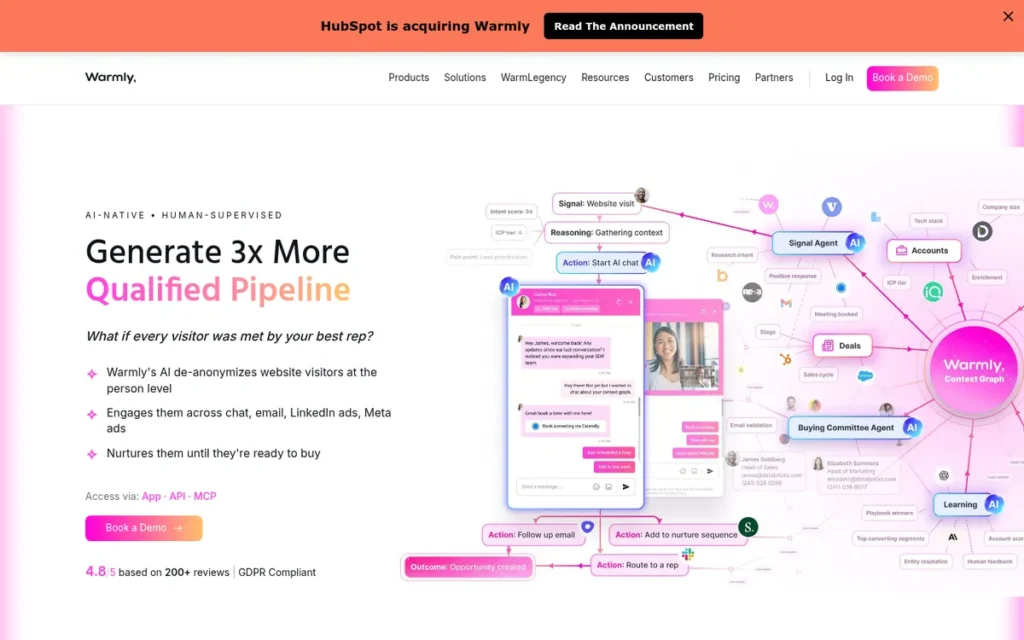
Category: Visitor Identification & Signal Platform, identifies anonymous website visitors and acts on those signals in real time.
PlugRoute weighted score: 3.18/5 (C1 3.5 · C2 3.5 · C3 2.5 · C4 3 · C5 3.5 · C6 3)
At a Glance
- Category: Visitor Identification & Signal Platform
- Best For: B2B teams with meaningful website traffic, a mostly US audience, and an inbound bottleneck of turning anonymous visitors into conversations
- Price Range: Free (500 visitors/mo, company level); ~$10K–$30K/yr for paid plans. Inbound Chat ($20K/yr) and AI Inbound Autopilot ($30K/yr) are official prices; other plans are third-party estimates (Warmly and Genesys Growth, 2026)
- Primary Strength: Warmly is the only product in this evaluation that markets individual-level visitor identification, and it routes identified visitors to AI chat, rep alerts and AI SDR agents.
- Biggest Limitation: Warmly’s identification accuracy is disputed by users, individual-level identification is limited outside the US, and Warmly only pays off with enough website traffic.
- One-Line Summary: Warmly is the most focused tool in PlugRoute’s 2026 evaluation for turning anonymous US website traffic into identified, routed conversations, but buyers should test identification accuracy and confirm post-acquisition Salesforce support before signing.
- Last Verified: November 2026
Overview
Warmly is a website de-anonymization platform that identifies anonymous visitors at the company and individual level. It’s built for B2B teams with meaningful website traffic and a US-focused inbound pipeline.
On June 30, 2026, Warmly announced that it had agreed to be acquired by HubSpot, the parent company of HubSpot Marketing Hub (ranked #1 here). Warmly said existing contracts, pricing and integrations would remain unchanged initially (Warmly, 2026).
PlugRoute scored Warmly and HubSpot Marketing Hub independently on the same six criteria. Warmly was founded in 2019 and went through Y Combinator in Summer 2020 (Y Combinator, 2026).
Key Features
- Warmly identifies website visitors at the company and individual level, using third-party intent data from 6sense/Clearbit and Bombora.
- Warmly engages identified visitors through AI chat, live video and “Warm Offers” pop-ups.
- Warmly routes visitors based on fields in your CRM and sends real-time Slack alerts to reps.
- Warmly runs AI SDR agents for outbound email and LinkedIn.
- Warmly offers a free tier that identifies up to 500 visitors per month at the company level.
Best For
Warmly is best for B2B teams with enough US website traffic to make visitor identification worthwhile. Their bottleneck should be anonymous visitors, not nurture or outbound list-building.
Strengths
- Warmly holds 4.5/5 on G2 across 242 reviews, and reviewers praise its visitor identification, easy installation and HubSpot and Slack integrations (G2, 2026).
- Warmly is the only product in this evaluation that markets individual-level visitor identification. Apollo.io and ZoomInfo MarketingOS document company-level visitor tracking. One Reddit commenter said Warmly had “way better person-level de-anonymization data compared to leadpipe and RB2B” (Reddit r/b2bmarketing, 2024).
- Warmly publishes official prices for its Inbound Chat and AI Inbound Autopilot plans and offers a free company-level tier (Warmly, 2026).
- Warmly claims AI Autopilot users convert 30% more inbound traffic and get 3x higher reply rates. Both claims are vendor-published and unaudited (Y Combinator, 2026).
Limitations
- Warmly gives up breadth for focus. Warmly mainly covers anonymous visitors and inbound conversion, and it only pays off with enough website traffic.
- Warmly’s person-level accuracy is disputed. One Reddit user tested two visitor-ID vendors’ sites and found that each identified the company but not the person. The user called the “likely” contacts in deliverables “very misleading” (Reddit r/b2bmarketing, 2024).
- Warmly G2 reviewers report occasional misidentification of visitors (G2, 2026).
- Warmly G2 reviewers report buggy filters, integrations and notifications, and a comparison page reports a support contact who “went dark” (G2, 2026).
- Warmly G2 reviewers report high cost for small businesses and limited individual-level identification outside the US (G2, 2026).
- Warmly is joining HubSpot, so Salesforce-centric buyers should ask how long Warmly will support Salesforce. EU buyers also need their own legal basis for identifying individuals.
Verdict
Warmly is the most specialized person-level visitor identification tool in PlugRoute’s 2026 evaluation. It best suits US-focused B2B teams whose bottleneck is anonymous website traffic.
Buyers should test Warmly on its free tier and check its results against visitors they already know before buying a $10K–$30K annual plan. Buyers should also confirm Warmly’s post-acquisition Salesforce roadmap and its GDPR position for any EU traffic.
7. 6sense: Best for Predicting Buying Stage Across a Large Enterprise Account List
Category: ABM & Intent Platform.
PlugRoute weighted score: 3.13/5 (C1 4 · C2 1.5 · C3 4 · C4 3.5 · C5 2 · C6 3)
At a Glance
- Category: ABM & Intent Platform
- Best For: Enterprise B2B teams with a large defined list of target accounts, RevOps or admin staff, and sales teams willing to act on account-level signals
- Price Range: Free tier (limited credits); paid tiers on request (median ~$62K/yr; range ~$11K–$177K; large enterprises $250K–$400K+; 1–2-year terms common) (Vendr and UserGems, 2026)
- Primary Strength: 6sense predicts each account’s buying stage, so teams can focus on the accounts most likely to buy soon.
- Biggest Limitation: 6sense shows intent at the account level rather than naming people, takes 2–3 months to onboard, and reviewers report predictive scores that sales reps don’t trust.
- One-Line Summary: 6sense is the most specialized predictive buying-stage platform in PlugRoute’s 2026 evaluation for enterprise teams prioritizing in-market accounts across a large set of target accounts, but it delivers weak ROI for small teams without a dedicated admin.
- Last Verified: November 2026
Overview
6sense is an AI-driven account-based marketing and intent platform that predicts each account’s buying stage. It’s built for enterprise B2B teams ranking active buyers across a large, defined list of target accounts.
6sense identifies anonymous accounts and runs display and connected-TV (CTV) advertising. 6sense offers a free tier with limited credits, and its paid tiers are quote-only (UserGems, 2026).
Key Features
- 6sense identifies anonymous accounts researching your category using data from your CRM, marketing automation, website and third-party intent sources.
- 6sense assigns each account a predicted buying stage (Target, Awareness, Consideration, Decision, Purchase) so teams know where to focus.
- 6sense runs display and CTV advertising aimed at target accounts.
- 6sense offers Conversational Email and Sales Intelligence for following up on high-priority accounts.
- 6sense provides Signalverse and a free tier with limited credits for an initial evaluation.
Best For
6sense is best for enterprise teams with a large defined list of target accounts and the budget for a six-figure contract. Those teams also need the RevOps capacity to tune predictive models and get sales to act on them.
Strengths
- 6sense holds 4.4/5 on Gartner Peer Insights from 296 reviews and 8.4/10 on TrustRadius. Its TrustRadius likelihood to recommend is 8.5/10 (279 ratings), and its support score is 10/10 (28 ratings) (Gartner Peer Insights and TrustRadius, 2026).
- 6sense lists Shell, Experian, Qualtrics, SAP, Cisco, Nasdaq, Zendesk, Okta and Autodesk among its named customers (AdamGTM, 2026).
- 6sense reviewers on G2 consistently praise the visibility it gives into account intent, rating it ~4.2/5 across 1,500+ reviews (G2 via UserGems, 2026).
- 6sense reports average deal size up 100%, conversion up 20% and deal cycles 30% faster across its customers. These figures are self-reported, and no controlled study backs them (Contrary Research, 2026).
Limitations
- 6sense gives up ease of adoption for predictive sophistication. 6sense shows account-level intent rather than the named people behind it, onboarding typically takes 2–3 months, and it needs a dedicated admin.
- 6sense G2 reviewers report noisy signals, predictive scores “sales reps don’t trust,” and weak ROI for small teams (UserGems summary of G2 reviews, 2026).
- 6sense contracts commonly run one to two years at a median of about $62K, which locks in a substantial commitment before results are proven (UserGems, 2026).
- 6sense named Chris Ball CEO in September 2025, succeeding Jason Zintak. 6sense appointed Kelly Hopping as CMO and Kimberly Bloomston as Chief Product Officer the same month. Its leadership page now lists Amir Ravandoust as CEO (6sense, 2026).
Verdict
6sense is the most specialized predictive intent platform in PlugRoute’s 2026 evaluation. It best suits enterprises ranking active buyers across a large, defined list of target accounts.
For small teams or teams without RevOps capacity, 6sense is likely more platform than they need. Buyers should start on the free tier. Before signing a multi-year contract, they should run a paid pilot that tests whether 6sense’s buying-stage predictions match their own pipeline.
What Red Flags Should I Watch For When Evaluating Demand Generation Software?
Six red flags recur in the evidence for the seven ranked tools, and most of them involve hidden cost rather than missing features. Three are the most expensive. The first is contact-based pricing on an uncleaned database (HubSpot Marketing Hub). The second is auto-renewal increases with short notice windows (ZoomInfo MarketingOS). The third is an enterprise platform bought without an admin to run it.
Red Flag #1: Pricing That Scales With Contacts You Haven’t Cleaned
Contact-based pricing turns an uncleaned database into a recurring cost. HubSpot Marketing Hub Professional includes 2,000 marketing contacts, and the price rises with volume (HubSpot, 2026). One user’s bill rose from about £400 to nearly £1,200 a month in eight months (Reddit r/hubspot, 2026).
Red Flag #2: Auto-Renewal Increases With Short Notice Windows
Auto-renewal clauses can quietly raise costs if no one tracks the notice date. ZoomInfo MarketingOS renewals reportedly include 5–10% increases with 30–90-day notice windows (Supered, Cleverly and StackSwap, 2026). 6sense contracts commonly run one to two years (UserGems, 2026). Negotiate caps before signing.
Red Flag #3: Accuracy Claims With No Independent Verification
No vendor in this evaluation publishes independently verified rates for matching visitors to people or matching intent signals to real buyers. In a 2024 test, a Reddit user found that two visitor-ID vendors identified the company but not the person (Reddit r/b2bmarketing, 2024).
Person-level identification works only partly, it is US-focused, and EU buyers need a legal basis to use it. Test any tool against visitors you already know.
Red Flag #4: An Enterprise Platform With No Admin to Run It
Enterprise platforms underdeliver when nobody owns them. One Capterra reviewer said Adobe Marketo Engage “required a full-time internal resource” (Capterra, 2026). 6sense reviewers report 2–3 months of onboarding (UserGems, 2026).
Marketers used 49% of their martech capabilities in 2025, up from 33% in 2023 (Gartner Marketing Technology Survey, 2025). An enterprise platform without an owner usually ends up in the unused half.
Red Flag #5: Credits That Expire or Are Charged Per Export
With credit-based billing, the per-seat price doesn’t show the full cost. Apollo.io credits are shared across the team and don’t roll over (Apollo.io, 2026). ZoomInfo MarketingOS charges credits for each export (Supered, 2026).
Red Flag #6: Vendor ROI Statistics Presented as Proof
Vendor-published ROI figures are marketing, not independent proof. Ask to speak with customer references instead. These figures are all self-reported:
- HubSpot reports 3x more inbound leads after six months (HubSpot ROI Report, 2025).
- 6sense reports 100% larger average deal sizes (Contrary Research, 2026).
- ZoomInfo reports 192% year-over-year bookings growth at Instapage (ZoomInfo, 2026).
What Questions Should I Ask Before Choosing Demand Generation Software?
Ask six questions before buying demand generation software, starting with which funnel stage is actually failing. The other five cover four areas: whether sales and marketing agree on “qualified,” who owns the tool, and two-year cost at real volume. They also cover CRM sync failure points and whether you can pilot on your own accounts. Each question maps to a documented risk.
Question #1: Which funnel stage is actually failing?
Your weakest funnel stage should decide which category of software you buy, not a vendor’s demo. Compare your conversion rates with B2B SaaS benchmarks, such as 0.7–2.2% for visitor to lead and 36–44% for lead to MQL (Rahul D. Sarker, 2026). Then shortlist the category that closes that gap.
Question #2: Do sales and marketing agree on what “qualified” means?
Agree on an ICP (ideal customer profile) definition before you build a lead scoring model. Also agree on a service-level agreement (SLA) for MQL-to-SQL handoff. MQL-to-SQL benchmarks range from about 13% as a broad average to 26–51% by channel. One user rebuilt a HubSpot lifecycle setup twice because the two teams disagreed (Reddit r/hubspot, user report, 2026).
Question #3: Who will own and administer this tool day to day?
Name the person who will own the tool before you sign, because enterprise platforms assume that role exists. Reviewers of Adobe Marketo Engage, 6sense and Demandbase One all describe needing an admin or heavy setup. HubSpot Marketing Hub and Apollo.io scored 4 and 5 on operational load (C5), based on G2, Capterra and Reddit sentiment (2026).
“It’s a great product, but it’s not going to build and manage itself.” (u/harroldhino, r/hubspot (Reddit, 2026))
Takeaway: Every platform on this list needs an owner, so budget for the people who run the tool, not just the license.
Question #4: What will year one and year two cost at our real contact or account volume?
Ask for a two-year cost projection that includes onboarding fees, contact or account growth and renewal terms, not just the first-year license. Here are typical year-one costs at entry scale, ranked from lowest to highest (November 2026):
- Apollo.io Professional for 5 users costs $4,740 a year with annual billing ($79 × 5 × 12; Apollo.io, 2026).
- HubSpot Marketing Hub Professional costs $12,600 in year one at 2,000 contacts with annual billing ($800 × 12 + $3,000 onboarding; HubSpot, 2026).
- Warmly paid plans run about $10,000–$30,000 a year, based on a mix of official and third-party figures (Warmly and Genesys Growth, 2026).
- Adobe Marketo Engage Growth runs about $25,700–$60,700 in year one including partner implementation, based on third-party estimates (RealCostLabs and GrowthTechSpotlight, 2026).
- ZoomInfo MarketingOS buyers pay a median of about $32,000 a year for ZoomInfo, and renewals reportedly add 5–10% (Vendr and Supered, 2026).
- 6sense buyers pay a median of about $62,000 a year, with 1–2-year terms common (Vendr and UserGems, 2026).
- Demandbase One buyers pay a median of about $68,600 a year, plus ad spend on its DSP (Vendr, 2026).
Question #5: How does it sync with our CRM, and what breaks?
Ask each vendor for its known sync failure points with your CRM, not just its list of integrations. For Salesforce users, Adobe Marketo Engage syncs natively. Gartner reviewers report HubSpot Marketing Hub’s Salesforce sync as unreliable and Demandbase One’s CRM integration as difficult (Gartner Peer Insights, 2026). G2 reviewers report buggy integrations with Warmly (G2, 2026).
Question #6: Can we pilot it against our own target accounts before signing?
Run a pilot on your own accounts, because no one has independently verified vendor accuracy claims. 6sense and Demandbase One medians run $62K–$69K a year (Vendr, 2026), so a paid pilot costs far less than a mistaken multi-year contract. Warmly, Apollo.io, 6sense and HubSpot Marketing Hub all offer free tiers for early testing.
How Did We Rank These Demand Generation Software Tools?
PlugRoute ranked the seven tools by a weighted 1–5 score across six criteria, led by verified user satisfaction (25%), pricing transparency (20%) and funnel coverage (20%). CRM fit, operational load and corporate stability make up the remaining 35%. All evidence was retrieved in November 2026, and missing evidence was scored neutrally.
Each criterion and why it matters:
- C1: Verified User Satisfaction (25%) matters because ratings across several review sites are the most independent signal of how a tool performs after purchase.
- C2: Pricing Transparency (20%) matters because buyers’ sharpest pain is hidden cost from quotes, contact-based pricing, fees, credits and renewals.
- C3: Funnel Coverage (20%) matters because buyers need to know which funnel stages a tool covers natively and how deeply.
- C4: CRM Fit (15%) matters because sync failures break lead routing, attribution and trust between sales and marketing.
- C5: Operational Load (10%) matters because buying a platform the team can’t staff is a common and costly mistake.
- C6: Corporate Stability (10%) matters because multi-year contracts carry vendor risk from leadership turnover, acquisitions or slowing growth.
| Product | C1 (25%) | C2 (20%) | C3 (20%) | C4 (15%) | C5 (10%) | C6 (10%) | Weighted Total |
|---|---|---|---|---|---|---|---|
| HubSpot Marketing Hub | 5 | 4 | 5 | 4 | 4 | 5 | 4.55 |
| Apollo.io | 4.5 | 4.5 | 3 | 4 | 5 | 3.5 | 4.08 |
| Adobe Marketo Engage | 3.5 | 2 | 4.5 | 5 | 2 | 4 | 3.53 |
| ZoomInfo MarketingOS | 3 | 1.5 | 4 | 5 | 3 | 4 | 3.30 |
| Demandbase One | 4 | 1.5 | 4 | 3 | 2 | 4.5 | 3.20 |
| Warmly | 3.5 | 3.5 | 2.5 | 3 | 3.5 | 3 | 3.18 |
| 6sense | 4 | 1.5 | 4 | 3.5 | 2 | 3 | 3.13 |
C1 rewards review volume and consistency across platforms, not a single G2 rating. Apollo.io has a 4.7 G2 rating, but Trustpilot billing complaints and limited data from other platforms offset it.
Adobe Marketo Engage trails Apollo.io by 0.55 points, mainly on pricing transparency (C2) and operational load (C5).
In November 2026, PlugRoute updated two C6 scores after previously unverified facts were confirmed:
- Apollo.io’s C6 score rose from 2.5 to 3.5 because its founding and funding were confirmed.
- Warmly’s C6 score rose from 2 to 3 because a public company agreed to acquire Warmly. Uncertainty about Warmly’s roadmap kept the score from going higher.
The Warmly update moved Warmly to #6 and 6sense to #7, and 6sense’s own scores did not change. Ranks four through seven now fall within 0.17 points of each other, so their order reflects small differences in evidence.
Every data point carries one of six source-type labels. Citation years show the publication year where known and otherwise the November 2026 retrieval date. The six labels are:
- Official vendor figures come from vendor pricing pages and documentation.
- Public filings come from SEC documents.
- Third-party estimates come from pricing analysts such as Vendr and UserGems.
- Review-platform ratings include the review count.
- User reports come from Reddit, Trustpilot and reviewer comments, and PlugRoute discloses any known bias.
- Vendor-published results are labeled unaudited.
PlugRoute excluded or did not fully research these products:
- Klaviyo was excluded because Klaviyo is built for ecommerce rather than B2B demand generation.
- Salesforce Account Engagement (Pardot) was not fully researched, so Salesforce-centric readers should evaluate it alongside Adobe Marketo Engage.
- Oracle Eloqua, Clay, Metadata.io, Leadfeeder/Dealfront, RollWorks and RB2B were not fully researched.
HubSpot agreed in June 2026 to acquire Warmly. PlugRoute scored both products independently on the same six criteria, and the relationship did not change either product’s scores.
PlugRoute has no affiliate relationships with any company listed, and rankings are determined entirely by research data and objective evaluation criteria.
What Do Buyers Most Often Ask About Demand Generation Software?
Buyers most often ask three things: which tool suits a small business, which tool suits B2B SaaS teams, and how PlugRoute decides its rankings. The answers below are short, self-contained summaries of the evidence presented throughout this guide, using the same November 2026 data and the same weighted scores.
What is the best demand generation software for small businesses?
For most small B2B businesses, the best-value combination in 2026 is HubSpot Marketing Hub Free or Starter ($15–$20/month) plus Apollo.io Free or Basic ($49/user/month). HubSpot Marketing Hub Starter handles forms, email and basic capture. Branching nurture workflows require Professional ($800/month plus a $3,000 onboarding fee). Apollo.io covers outbound prospecting without a dedicated admin.
What is the best demand generation software for B2B SaaS in 2026?
For B2B SaaS teams in 2026, HubSpot Marketing Hub (4.55) is the highest-scoring all-in-one hub in PlugRoute’s evaluation. Adobe Marketo Engage (3.53) fits Salesforce-centric teams with marketing ops staff, and Apollo.io (4.08) covers outbound. Add 6sense or Demandbase One only once your team has a defined target account list and RevOps staff.
How does PlugRoute determine rankings?
PlugRoute ranks demand generation software by a weighted 1–5 score across six published criteria. Verified user satisfaction (25%), pricing transparency (20%) and funnel coverage (20%) carry the most weight. CRM fit, operational load and corporate stability carry the remaining 35%. Every data point is labeled by source type and dated November 2026, and missing evidence is scored as neutral.
What Do Key Demand Generation Software Terms Mean?
Marketing Automation Hub: A platform that runs lead capture, nurture, scoring and attribution from one system of record. Other demand generation tools such as ABM, intent data and outbound platforms feed into it or work alongside it, so most buyers need a hub before anything else.
MQL (Marketing Qualified Lead) and SQL (Sales Qualified Lead): An MQL is a lead marketing judges ready for follow-up, and an SQL is one sales accepts as a real prospect. The conversion rate between them shows whether you have a qualification problem. If it’s low, the fix is usually better lead scoring and a sales-marketing agreement on what “qualified” means, not more traffic.
Lead Scoring: A model that ranks leads by how likely they are to buy, so sales works on the best ones first. Before building one, agree on an ICP (ideal customer profile) and a handoff SLA, or the model may need rebuilding.
Branching Workflows: Automation that sends contacts down different nurture paths depending on what they do. Some hubs offer this only on higher tiers, which can force an upgrade before you get real nurture.
Contact-Based Pricing: A pricing model where the subscription cost rises with the number of marketing contacts in your database. An uncleaned database turns into a recurring cost, so clean your contacts and estimate future growth before you sign.
Credits: Usage units for actions such as contact lookups, enrichment or data exports, charged on top of per-seat prices. Credits may be shared across a team, may not roll over, and can make unused spend non-refundable, so the seat price often hides the full cost.
Intent Data: Signals showing that an account is researching topics related to what you sell. Platforms combine first-party signals from your own website with third-party intent data to rank accounts that are actively shopping. Buyers should test how accurate these signals are, because reviewers often describe them as noisy.
Dark Funnel: Research that buyers do anonymously, before they fill in a form or talk to sales. ABM and intent platforms try to surface it, which matters if your best prospects are researching without ever identifying themselves.
ABM (Account-Based Marketing): A strategy that targets a defined list of companies instead of individual leads, often including buying-group mapping and account-based advertising. ABM platforms sit on top of a CRM and a marketing automation hub rather than replacing them. They usually need RevOps staff and a defined target account list to pay off.
Visitor Identification (De-anonymization): Technology that matches anonymous website visitors to a company or, in some tools, to an individual person. Company-level identification is more common. Person-level identification works only partly, is mostly US-focused and needs a legal basis for EU traffic, so test it against visitors you already know.
DSP (Demand-Side Platform): An ad-buying platform that lets marketers buy B2B advertising aimed at target accounts. When an ABM tool includes its own DSP, budget for ad spend on top of the license.
Auto-Renewal Notice Window: The period before a contract renews during which you must give notice to cancel or renegotiate. Renewals can include price increases with short notice windows, so track the date and negotiate caps before signing.
Which Demand Generation Software Tool Is Right for You?
Key Insights
- The right demand generation tool fixes your weakest funnel stage, works with your CRM and can be run by your current team. Diagnose your bottleneck against funnel benchmarks before comparing any vendors.
- HubSpot Marketing Hub ranked first (4.55) and is the highest-scoring default for small and mid-sized teams on HubSpot CRM or starting fresh, though its costs rise with contact volume.
- Adobe Marketo Engage (3.53) is the stronger fit for Salesforce- or Dynamics-centric teams with marketing ops staff, but it is likely more platform than lean teams can use.
- Apollo.io (4.08) is the best-value outbound tool in this evaluation, but Apollo.io works alongside a marketing automation hub rather than replacing one.
- ZoomInfo MarketingOS (3.30), Demandbase One (3.20), Warmly (3.18) and 6sense (3.13) fall within 0.17 points of each other, so fit to your bottleneck should decide among them.
- Demandbase One and 6sense suit enterprises with a defined target account list and RevOps capacity, with median contracts of about $62K–$69K a year (Vendr, 2026).
- Warmly is the only tool evaluated that markets person-level visitor identification, but users dispute its accuracy, and HubSpot agreed to acquire Warmly in June 2026.
If you need one system for capture and nurture, start with a hub. Choose HubSpot Marketing Hub for HubSpot CRM teams or new stacks, and Adobe Marketo Engage for Salesforce-centric teams. Add Apollo.io or Warmly only after a free-tier test confirms that the outbound or anonymous-traffic gap is real.
If you’re ranking enterprise accounts, pilot 6sense or Demandbase One against your own pipeline. All prices and ownership details were verified in November 2026, so check them again before signing.
We update this guide quarterly. Last updated: November 2026. For more independent analysis, read PlugRoute’s full ranking methodology and explore our other evidence-based B2B software reviews.