Tekmetric is PlugRoute’s best-evidenced pick for repair shops, and Shopmonkey is close behind. For fleets, Samsara is the pick for safety and Fleetio for maintenance. For dealerships, CDK Global is the legacy DMS and Tekion the cloud-native one. Vector CANoe anchors ECU network testing. These tools rarely compete, so pick your category first.
Generic “best automotive software” lists name one winner from tools that serve different businesses, and they mix vendor marketing with independent evidence. The real question is not “which tool is best” but “best at running what”: a repair shop, a dealership, a fleet or an ECU test bench. This guide labels every claim by source and date.
PlugRoute has no affiliate relationships with any company listed. Rankings are determined entirely by research data and objective evaluation criteria.
“We looked at AutoLeap, SMonkey & Tek and a couple others before picking one and it made a lot more sense than trying to build our own.” (u/Icy-Influence-9750, r/mechanics, 2026; user report)
Takeaway: Shop owners compare a short shortlist for their own category, not a generic list across categories.
What Are the 4 Categories of Automotive Software?
Automotive software falls into four separate buying categories, and no vendor in this research covers more than one. Repair shops, dealerships, fleets and engineering teams each buy different systems from different vendors. Identify your category before you compare vendors. Each category below lists who buys it, what it covers and which ranked tools belong to it.
Repair Shop Management
- Who buys it: Independent shop owners, service managers and multi-location shop groups buy repair shop management software.
- What it covers: Repair shop management software, also called a shop management system (SMS), handles estimates, repair orders, digital vehicle inspections, parts ordering, customer approvals and payments.
- Often confused with: Repair shop management software is different from repair-information subscriptions such as ALLDATA. Those subscriptions supply repair procedures but do not run the shop.
- Ranked entries: Tekmetric (#1) and Shopmonkey (#4) are the repair shop management tools in this ranking.
- Market context: One estimate puts cloud deployments at about 65% of the auto repair software market (FnF Research, 2026; third-party analysis).
Dealership Management System (DMS)
- Who buys it: Dealership general managers, operations leads and dealer-group executives buy DMS platforms.
- What it covers: A DMS, also called dealer management software, runs sales, F&I, service, parts and accounting for a car dealership.
- Often confused with: A DMS is often confused with a dealer CRM. A CRM manages leads, but it is not the dealership’s system of record.
- Ranked entries: CDK Global (#6, legacy) and Tekion (#7, cloud-native) are the DMS platforms in this ranking.
- Market context: About 18,000 US franchised dealerships run a DMS. This is a directional industry estimate that PlugRoute could not tie to a verified analyst source (industry reports, 2026; third-party analysis).
Fleet Telematics and Fleet Maintenance (a two-layer stack)
- Who buys it: Fleet managers responsible for vehicles, drivers, safety and maintenance buy fleet management software.
- What it covers: Fleet telematics tracks location, driver behavior, fuel and ELD-mandate compliance. Fleet maintenance software records preventive maintenance, work orders and inspections.
- Often confused with: Fleet telematics and fleet maintenance are often treated as one product, but many fleets run both layers side by side.
- Two-layer example: A 120-truck fleet might run Samsara gateways and dash cams for ELD compliance and coaching, then send engine fault codes into Fleetio, where they become work orders with parts and labor history.
- Ranked entries: Samsara (#2, telematics) and Fleetio (#3, maintenance) are the fleet tools in this ranking, and they complement each other.
- Market context: Berg Insight counted about 7.6M active video-telematics systems in North America in 2025 and forecasts more than 17.3M by 2030 (Berg Insight via GlobeNewswire, 2026; third-party analysis).
Vehicle Engineering and Testing (a toolchain map)
- Who buys it: Engineering leads at OEMs and Tier 1 suppliers buy vehicle engineering and testing tools.
- What it covers: The engineering toolchain covers model-based development, CAN and ECU network testing, hardware-in-the-loop (HIL) validation, calibration and CAD.
- Often confused with: Teams often confuse network-testing tools with full plant-model HIL platforms and calibration tools, and then pay for overlapping licenses.
- Compliance context: Teams building software-defined vehicles must also meet cybersecurity and software-update rules under ISO/SAE 21434 and UNECE R155/R156.
- Ranked entries: Vector CANoe (#5) is the network-validation anchor in this ranking.
- Market context: HIL is forecast to be the fastest-growing type of automotive simulation, at a 16.6% CAGR (Fortune Business Insights, 2026; third-party analysis).
PlugRoute did not evaluate the following products. They are listed only to show scope:
- AutoLeap, Mitchell 1 and Shop-Ware are repair shop management tools.
- Reynolds and Reynolds and Dealertrack are dealership DMS platforms.
- Geotab and Motive are fleet telematics platforms.
- dSPACE, NI VeriStand, ETAS INCA, MATLAB/Simulink, Siemens NX and CATIA are engineering toolchain products.
This list does not cover collision and body-shop estimating, heavy-duty truck repair software such as Fullbay, or powersports and RV dealer systems. Buyers in those areas can still use the evaluation questions below, but they should look beyond these seven tools.
How Do the Top Automotive Software Tools Compare at a Glance?
The seven tools span four categories, and fleet software splits into a telematics layer and a maintenance layer. Tekmetric and Shopmonkey serve repair shops, CDK Global and Tekion serve dealerships, Samsara and Fleetio serve fleets, and Vector CANoe serves engineering teams. Compare tools only within your own category.
| Rank | Company | Category | Best For | One-Line Summary | Key Capabilities | Primary Strength | Key Limitation |
|---|---|---|---|---|---|---|---|
| 1 | Tekmetric | Repair Shop Management | Independent and multi-location repair shops | Tekmetric is a cloud repair shop platform with public month-to-month pricing and vendor-published ARO gains of 75–77% at named shops. | Estimates, ROs, DVIs, PartsTech, Tekmetric Pay, ARO and margin reporting | Most named, quantified outcomes plus fully public tier pricing | Steep learning curve; two-way texting only on the top tier |
| 2 | Samsara | Fleet Telematics | Safety- and compliance-driven fleets | Samsara is a publicly traded platform that combines telematics, ELD compliance and AI dash cams. | GPS, ELD/HOS, AI dash cams, coaching, fuel, maintenance alerts | Broadest single-platform fleet coverage and largest review sample | Quote-only pricing on 36–60 month terms |
| 3 | Fleetio | Fleet Maintenance | Fleets that already have telematics | Fleetio is a hardware-neutral fleet maintenance platform with listed per-vehicle pricing and integrations to major telematics vendors. | PM schedules, work orders, offline inspections, fuel, parts, API | Highest fleet-tool rating and the only listed fleet pricing | No GPS or camera hardware; cost compounds with fleet size |
| 4 | Shopmonkey | Repair Shop Management | Shops that want a visual request-to-payment workflow | Shopmonkey is a venture-backed repair shop platform built around a drag-and-drop workflow from online request to payment. | Workflow board, Work Request Form, messaging, payments, parts integrations | Consolidated workflow and the largest repair-shop review sample | No quantified outcomes; reported per-employee charges |
| 5 | Vector CANoe | Vehicle Engineering and Testing | OEM and Tier 1 network validation | Vector CANoe is a multi-protocol ECU and vehicle-network test tool certified for ISO 26262 safety projects. | CAN/CAN FD, LIN, FlexRay, Ethernet, restbus, UDS, CAPL | TÜV SÜD certification for safety projects | Costly, dongle-licensed, Windows-only |
| 6 | CDK Global | Dealership Management System (DMS) | Dealer groups that prioritize continuity | CDK Global is the largest legacy DMS provider, serving about 15,000 dealerships. | CDK Drive DMS, Elead CRM, Roadster, Fortellis | Broadest single-vendor dealer suite | June 2024 outage of about two weeks |
| 7 | Tekion | Dealership Management System (DMS) | Dealers modernizing to cloud-native | Tekion is a cloud-native dealership platform that unifies DMS, CRM, digital retailing and payments. | ARC data layer, AI CRM, Tekion Pay, Partner Cloud APIs | Unified data layer with OEM certifications | Only 13 G2 reviews; reported module-maturity gaps |
Which Automotive Software Should I Choose for My Use Case?
Choose by your #1 operational priority, not by overall rank. Repair shops should start with Tekmetric. Safety-driven fleets should start with Samsara, and fleets that already have telematics should start with Fleetio. Dealerships choose between CDK Global for continuity and Tekion for modernization. ECU and network engineers should start with Vector CANoe.
| Your #1 Priority | Recommended Tool | Why | Acceptable Alternative |
|---|---|---|---|
| Run an independent or multi-location repair shop | Tekmetric | Public pricing, named outcomes, multi-site evidence | Shopmonkey |
| Keep a franchised dealership on a proven ecosystem | CDK Global | Largest installed base and broadest suite | Tekion, if you can absorb 6+ months of adoption |
| Modernize a franchised dealership’s DMS | Tekion | Unified cloud data layer and partner APIs | CDK Global, if continuity matters more |
| Manage fleet maintenance with telematics already in place | Fleetio | Works with any telematics hardware; listed pricing | Samsara’s fault-code maintenance alerts for lighter needs |
| Get fleet safety, ELD and video in one platform | Samsara | Broadest single-platform fleet coverage | Samsara plus Fleetio for deeper maintenance records |
| Run a fleet under about 20 vehicles that needs flexibility | Fleetio | Essential tier billed monthly, with no multi-year term | Samsara, once a multi-year commitment fits |
| Validate ECUs and vehicle networks | Vector CANoe | Multi-protocol coverage and ISO 26262 certification | CANalyzer for analysis-only work |
What Are the 7 Best Automotive Software Tools in 2026?
Ranked by weighted evidence score, the seven best automotive software tools in 2026 are Tekmetric and Samsara (tied at 4.35 of 5), then Fleetio, Shopmonkey, Vector CANoe, CDK Global and Tekion. The overall rank measures evidence strength and buyer risk across six criteria. It does not mean a tool in one category can replace a tool in another.
1. Tekmetric: Best Overall for Independent and Multi-Location Repair Shops
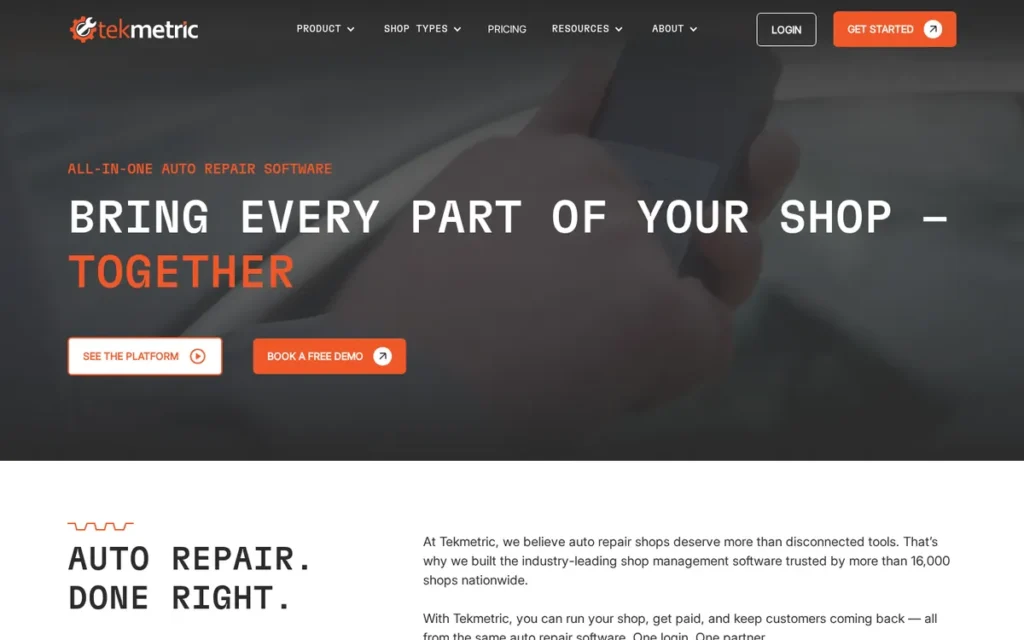
Category: Repair Shop Management, software that runs an auto repair shop’s estimates, repair orders, inspections, parts, customer communication and payments.
At a Glance
- Category: Repair Shop Management
- Best For: Independent repair shops and multi-location shop groups that want published pricing and deep operational reporting
- Price Range: $179–$439/month per shop: Start $199 ($179 annual), Grow $349 ($309 annual), Scale $439 ($409 annual) (Tekmetric pricing page, November 2026; vendor-published)
- Primary Strength: Tekmetric publishes the most named, quantified customer outcomes and the most transparent pricing in the repair-shop category.
- Biggest Limitation: Tekmetric has a reported steep learning curve, and its two-way texting is only on the top Scale tier.
- One-Line Summary: Tekmetric is a cloud repair shop management platform with public month-to-month pricing and vendor-published case studies showing ARO gains of 75–77% at named shops.
- Last Verified: November 2026
Overview
Tekmetric is a cloud-based repair shop management platform for independent auto repair shops and multi-location groups. It is built for shops that want published pricing, standardized workflows and margin-level analytics in a single connected system.
Tekmetric differs from its peers mainly in how deeply it reports on shop economics, from average repair order (ARO) to technician efficiency.
Key Features
- Tekmetric creates estimates and repair orders with digital customer approvals, so customers can authorize work without a phone call.
- Tekmetric’s digital vehicle inspections attach photos and video that customers review before they approve work.
- Tekmetric integrates with PartsTech, so service advisors can order parts directly from the repair order.
- Tekmetric Pay processes payments inside the platform and offers customer financing through Affirm.
- Tekmetric’s reporting tracks ARO, labor rate, parts markup, car count and technician efficiency across one or many locations.
Best For
Tekmetric fits best for independent shops with several staff members and for multi-location groups that want standardized workflows and margin-level reporting. Very small one- or two-bay shops may find Tekmetric more than they need.
Strengths
- Tekmetric’s case studies report that Branch Automotive’s ARO rose 77% (from $583 to more than $1,000) after it adopted digital inspections, and that The KAR Shop’s ARO rose 75% (from $399 to $699) (Tekmetric, 2026; vendor-published, not independently audited).
- Tekmetric holds a 4.7/5 rating on Capterra from 104 reviews (Capterra, November 2026; review platform), the highest average among the repair-shop tools here. A G2 figure of 4.9 is reported by a third party and was not confirmed on G2.
- Tekmetric reports that Main Street Auto grew from 6 to 115+ locations on the platform and that Auto-Lab standardized 16 shops with four-minute estimates (Tekmetric, 2026; vendor-published).
- Tekmetric publishes tier pricing with month-to-month billing, which carries less lock-in risk than quote-only competitors (Tekmetric pricing page, November 2026; vendor-published).
Limitations
- Tekmetric trades reporting depth for onboarding effort. Third-party reviews describe a steep learning curve and inconsistent support after onboarding (Kinja, 2026; third-party analysis).
- Tekmetric puts two-way texting on the Scale tier. Moving from Start to Scale on annual billing costs $230 more per month, or $2,760 a year per shop (Tekmetric pricing page, November 2026; vendor-published).
- Tekmetric’s annual prices require an annual commitment, and its payment-processing rates and add-on costs are not published (Tekmetric pricing page, November 2026; vendor-published).
- Tekmetric’s QuickBooks Online sync may depend on a third-party connector, which adds another point where syncing can fail (CSI Accounting, 2026; third-party analysis).
- Tekmetric’s founding, funding and headcount could not be verified in this research. Its Shop Excellence Award is run by the vendor, not by a third party (Tekmetric, 2026; vendor-published).
Users on r/serviceadvisors shared their experience:
“Tekmetric is great for independent shops, its integration with 3rd party parts houses is pretty good and it’s super intuitive if you have newer writers you need to train up it’s not hard to get them running quick. Only thing I don’t love in my experience is some of the back end stuff for accounting.” Posted by u/Slow-Bodybuilder-774
Takeaway: Tekmetric gets credit from service advisors for parts integration and fast onboarding of new writers, but its accounting back end is still a weak spot.
Verdict
Tekmetric is the best-evidenced repair shop management platform in this 2026 review for shops that want transparent pricing and margin-level analytics. Tekmetric ties Samsara at 4.35. It is listed first because it pairs the most named, quantified customer outcomes in this review with fully public tier pricing and month-to-month billing.
During a trial, shops should test Tekmetric against three scenarios:
- Shops should run one full Tekmetric repair order that includes a supplement.
- Shops should reopen a closed Tekmetric repair order and check how the invoice changes.
- Shops should price the Tekmetric tier that includes two-way texting before they compare quotes.
2. Samsara: Best for Safety- and Compliance-Driven Fleets
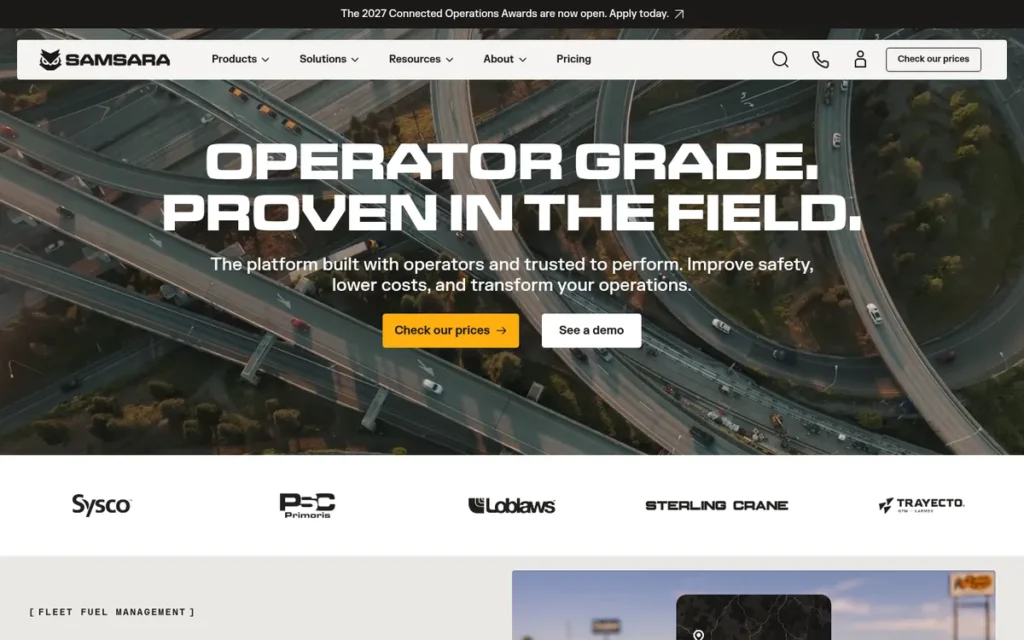
Category: Fleet Telematics, hardware-plus-software platforms that track vehicle location, driver behavior, safety, compliance and fuel in real time.
At a Glance
- Category: Fleet Telematics
- Best For: Trucking, field-service and public-sector fleets that prioritize driver safety, ELD compliance and fuel savings
- Price Range: Pricing on request: custom quote per vehicle per month, typically on 36–60 month terms (G2, 2026; review platform)
- Primary Strength: Samsara has the broadest single-platform fleet coverage and the largest named safety and fuel outcomes in this research.
- Biggest Limitation: Samsara sells through custom quotes on multi-year contracts, and users report disputes over auto-renewal and add-on costs.
- One-Line Summary: Samsara is a publicly traded connected-operations platform that combines telematics, ELD compliance and AI dash cams, rated 4.5/5 on G2 from 5,572 reviews.
- Last Verified: November 2026
Overview
Samsara is a connected operations platform for trucking, field-service and public-sector fleets. It puts GPS tracking, ELD compliance, AI dash cams and driver coaching on one proprietary hardware-and-software stack from a single vendor.
Samsara also turns engine fault codes into maintenance alerts and analyzes fuel use. Of the tools in this review, it comes closest to the “one platform” that fleets ask for.
Key Features
- Samsara provides real-time GPS tracking and ELD hours-of-service compliance through its own vehicle gateways.
- Samsara’s AI dash cams detect phone use, following distance and rolling stops for driver scoring and coaching.
- Samsara turns engine fault codes into maintenance alerts tied to each vehicle.
- Samsara analyzes fuel use and idling to find savings across the fleet.
- Samsara adds routing, asset tags and digital forms to the same Connected Operations Cloud.
Best For
Samsara fits best for mid-size and large fleets where safety incidents, insurance costs and ELD compliance drive the purchase. Small fleets that need contract flexibility or the ability to downsize will find Samsara a weaker fit.
Strengths
- Samsara reports that Gordon Food Service saved $2.5M on fuel and cut idling from as high as 17% to under 2% across 10,500 vehicles and trailers (Samsara, 2026; vendor-published, customer-reported).
- Samsara holds a 4.5/5 rating on G2 from 5,572 reviews (G2, November 2026; review platform), the largest review sample of any product in this review. Reviewers praise its real-time GPS and the ROI from its dash cams.
- Samsara reported FY2026 revenue of $1.619B, up 30% from $1.249B, for the fiscal year ended January 31, 2026 (Samsara Form 8-K, 2026; independently verifiable). Samsara is the only vendor in this review that files audited financial statements with the SEC.
- Samsara reports that R.E. Garrison Trucking had 30% fewer preventable accidents and 83% fewer workers’ comp claims (Samsara, 2026; vendor-published). Samsara also states that it undergoes regular SOC 2 audits (Samsara fleet FAQ, 2026; vendor-published).
Limitations
- Samsara trades integrated breadth for commitment. Pricing is quote-only, contracts typically run 36–60 months, and features such as AI video and commercial routing may be add-ons (G2, 2026; review platform).
- Samsara faced a reported dispute in which a three-year contract auto-renewed under a 30-day notice requirement (Capterra, 2026; user report).
- Samsara reviewers cite slow support, delays replacing defective hardware and disputed driver violations (Capterra, 2026; user report). A review aggregator also reports false-positive AI camera alerts (BestGuide, 2026; third-party analysis).
- Samsara’s proprietary hardware offers less device flexibility than more open telematics ecosystems (G2, 2026; review platform).
- PlugRoute found no verified per-vehicle Samsara price, so Samsara’s total cost cannot be compared without a written quote.
Verdict
Samsara is the most complete single-platform fleet telematics and safety system in this 2026 review, and it has the largest customer-reported fuel and safety outcomes. Samsara ties Tekmetric at 4.35 on the strength of its 5,572-review G2 sample and SEC-verified financials. Its quote-only, multi-year contracts keep its pricing score low.
Before signing, Samsara buyers should get three terms in writing:
- Samsara’s contract should state the renewal notice window and how cancellation is confirmed.
- Samsara’s quote should price every add-on, including AI video and routing.
- Samsara’s contract should define downsizing rights if the fleet shrinks.
3. Fleetio: Best for Fleet Maintenance Management
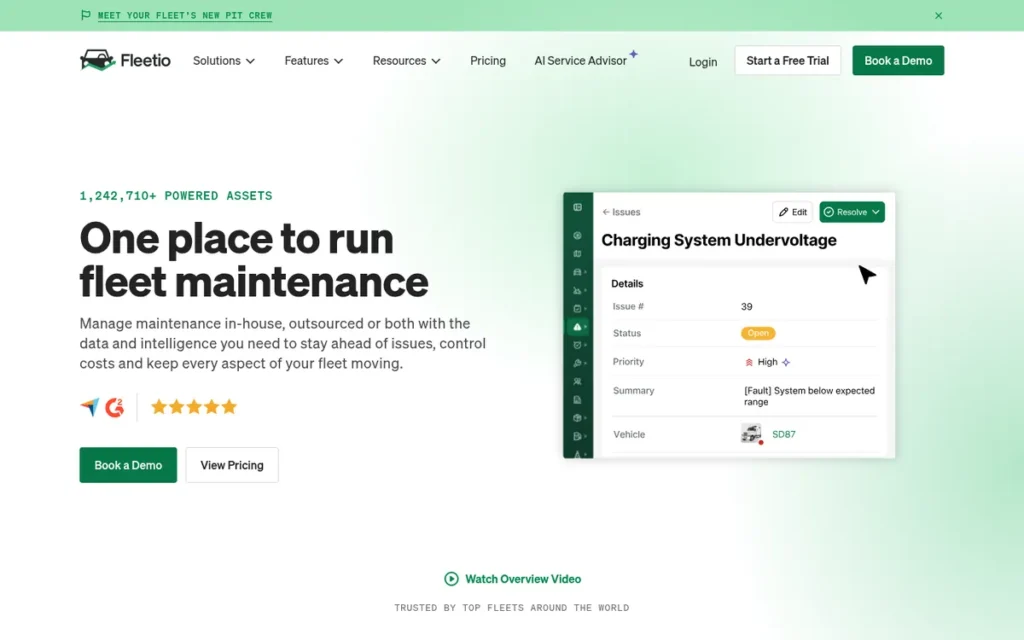
Category: Fleet Maintenance, software that records preventive maintenance, work orders, inspections, fuel and parts for vehicle and equipment fleets.
At a Glance
- Category: Fleet Maintenance
- Best For: Maintenance-heavy fleets that already have telematics, or that want a system of record not tied to one hardware vendor
- Price Range: $4–$10/vehicle/month listed. Essential is $5 billed monthly or $4 billed annually. Professional ($7) and Premium ($10) are billed annually. Prices vary by fleet size (Fleetio pricing page, November 2026; vendor-published)
- Primary Strength: Fleetio has the highest average rating among the fleet tools in this review (4.7/5 on Capterra from 247 reviews), plus listed per-vehicle pricing and integrations to major telematics platforms.
- Biggest Limitation: Fleetio provides no GPS or dash-cam hardware, and users report costs climbing noticeably past about 40 vehicles.
- One-Line Summary: Fleetio is a hardware-neutral fleet maintenance platform with listed per-vehicle pricing that connects to Samsara, Geotab, Motive and Verizon Connect telematics.
- Last Verified: November 2026
Overview
Fleetio is a cloud fleet maintenance system of record for fleet managers who need preventive maintenance, work-order, inspection and parts records that do not depend on any single telematics hardware vendor.
Fleetio complements a telematics platform rather than replacing one. It connects to the major telematics platforms through native integrations and a REST API.
Key Features
- Fleetio schedules preventive maintenance and manages work orders across vehicles and equipment.
- Fleetio’s digital inspections work offline and are GPS-verified through the Fleetio Go mobile app.
- Fleetio tracks fuel and barcoded parts inventory against each asset’s maintenance history.
- Fleetio’s AI Smart Uploads pull data from repair invoices and receipts to reduce manual entry.
- Fleetio offers a REST API and integrations with Samsara, Geotab, Motive and Verizon Connect telematics.
Best For
Fleetio fits best for fleets that already run a telematics platform and need a dedicated maintenance record, and for fleets that want to avoid hardware lock-in. Buyers who expect GPS tracking or video safety from the same product will find Fleetio a poor fit.
Strengths
- Fleetio holds a 4.7/5 rating on Capterra from 247 reviews (Capterra, November 2026; review platform), the highest average rating among the fleet tools in this review. Fleetio’s own figure of 4.8/5 on 1,000+ reviews is a vendor aggregate (Fleetio, 2026; vendor-published).
- Fleetio’s published customer results include Auto-Chlor avoiding more than $280K a year in unnecessary repairs and A&D Environmental keeping 95% compliance across 120+ vehicles (Fleetio, 2026; vendor-published).
- Fleetio is the only fleet tool in this review with listed per-vehicle pricing, including an Essential tier billed monthly at $5/vehicle (Fleetio pricing page, November 2026; vendor-published).
- Fleetio’s REST API drew praise from a G2 reviewer who said integrations took “days, not weeks” (G2, 2026; review platform).
Limitations
- Fleetio trades hardware neutrality for an incomplete stack. It has no GPS, ELD or camera hardware, so most fleets also need a telematics vendor.
- Fleetio’s cost grows with fleet size. At the listed $5/vehicle/month Essential rate, an 80-vehicle fleet pays about $4,800 a year, close to one user’s report of about $5,000 a year for 80 vehicles (r/smallbusiness, 2024; user report).
- Fleetio’s Professional and Premium tiers are billed annually only, and listed prices assume a five-asset band (Fleetio pricing page, November 2026; vendor-published).
- Fleetio’s G2 reviewers cite three functional limits (G2, 2026; review platform).
- Fleetio’s reporting is hard to customize, for example to show cost by vehicle class.
- Fleetio’s API rate limits constrain bulk syncs.
- Fleetio’s parts module has functional limits.
- Fleetio users report chat support taking more than two hours, a laggy mobile app and unintuitive setup for mixed-asset fleets (r/DieselTechs, 2025; user report). No SOC certification was independently verified.
Verdict
Fleetio is the highest-rated and most transparently priced fleet maintenance system of record in this 2026 review. Fleetio works best as the maintenance layer next to a telematics platform, not as an all-in-one replacement.
Before committing, Fleetio buyers should confirm three terms in writing:
- Fleetio’s quote should show total annual cost at the fleet’s projected size, not its current size.
- Fleetio’s quote should list which telematics integrations the chosen tier includes.
- Fleetio’s quote should state whether the chosen tier is billed monthly or annually.
4. Shopmonkey: Best for a Consolidated Customer-to-Payment Workflow
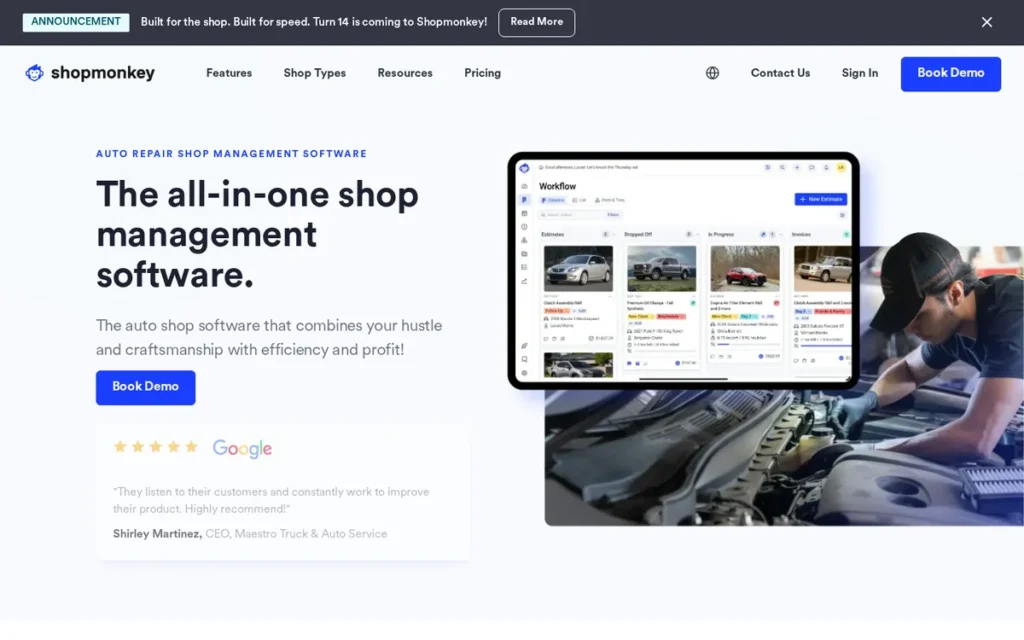
Category: Repair Shop Management, software that runs an auto repair shop’s estimates, repair orders, inspections, parts, customer communication and payments.
At a Glance
- Category: Repair Shop Management
- Best For: Independent shops that want a visual workflow board with built-in messaging and payments, from customer request to invoice
- Price Range: $239–$499/month listed on Capterra (Basic $239, Clever $399, Genius $499); Multi-Shop by quote; not confirmed on shopmonkey.io (Capterra, November 2026; review platform)
- Primary Strength: Shopmonkey has the largest Capterra review sample among the repair-shop tools reviewed, with a 4.6/5 rating from 271 reviews.
- Biggest Limitation: Shopmonkey publishes no quantified customer outcomes, and Trustpilot reviewers report unexpected per-employee charges.
- One-Line Summary: Shopmonkey is a venture-backed cloud repair shop platform rated 4.6/5 on Capterra from 271 reviews, built around a drag-and-drop workflow from online request to payment.
- Last Verified: November 2026
Overview
Shopmonkey is a cloud repair shop management platform for independent shops. It gives them one consolidated, visual workflow that carries each job from an online customer request through estimate, approval, repair and payment.
Shopmonkey reports more than 10,000 customers (Shopmonkey, 2026; vendor-published). Used-car dealer chain Byrider chose Shopmonkey as a technology partner in 2022 (Shopmonkey newsroom, 2022; vendor-published).
Key Features
- Shopmonkey’s drag-and-drop workflow board tracks every job through customizable stages.
- Shopmonkey’s Work Request Form converts online customer requests into estimates automatically.
- Shopmonkey sends two-way text and email and collects customer authorization on estimates.
- Shopmonkey processes online and in-person payments and tracks technician hours and commissions.
- Shopmonkey integrates with PartsTech, Epicor Integrated Service Estimator, QuickBooks and CARFAX.
Best For
Shopmonkey fits best for independent general repair shops that want a visual, customer-facing workflow with messaging and payments in one place. Shopmonkey is less proven for shops that need documented ROI before they buy.
Strengths
- Shopmonkey holds a 4.6/5 rating on Capterra from 271 reviews (Capterra, November 2026; review platform), the largest verified review sample among the repair-shop tools reviewed. A G2 figure of 4.6/5 from 410 reviews is reported by a third party and was not confirmed on G2.
- Shopmonkey has raised at least $110M across a $10M Series A (Index Ventures), a $25M Series B (Bessemer) and a $75M Series C (Bessemer, Index, ICONIQ Growth) (Shopmonkey, 2026; vendor-published).
- Shopmonkey’s consolidated flow from Work Request Form to payment covers most items on PlugRoute’s C3 repair-shop workflow checklist (PlugRoute, 2026; editorial judgment).
- Shopmonkey appears with Tekmetric and AutoLeap on the default shortlist that shop owners cite on r/mechanics (r/mechanics, 2026; user report).
Limitations
- Shopmonkey trades workflow polish for pricing certainty. Its tier prices appear on Capterra but could not be confirmed on shopmonkey.io, and Trustpilot reviewers report “unexpected extra costs” and per-employee charges (Trustpilot, 2026; user report).
- Shopmonkey reviewers describe labor entries “hidden during billing,” repeated data entry on long-running restoration invoices and weak reporting guides (Trustpilot, 2026; user report).
- Shopmonkey reviewers also report poor support on critical issues (Trustpilot, 2026; user report).
- This research found no quantified customer outcomes for Shopmonkey. That is a transparency gap, not evidence of weaker results.
- This research found no independently verified SOC 2 or PCI certification for Shopmonkey, so buyers should ask for documentation directly.
Verdict
Shopmonkey is a well-reviewed, well-funded repair shop platform whose main advantage is a consolidated, visual workflow from customer request to payment. Shopmonkey ranks below Tekmetric because it publishes no quantified customer outcomes and its pricing appears only as a third-party listing with hidden-cost complaints. No documented capability gap explains the difference.
During a trial, shops should test Shopmonkey against three scenarios:
- Shops should get a written all-in Shopmonkey quote that includes per-employee charges and payment processing.
- Shops should run a Shopmonkey job with a supplement and a split invoice.
- Shops should check that every labor line appears on the final Shopmonkey invoice.
5. Vector CANoe: Best for ECU and In-Vehicle Network Validation
Category: Vehicle Engineering and Testing, tools that OEM and supplier engineers use to develop, simulate and validate vehicle software, ECUs and networks.
At a Glance
- Category: Vehicle Engineering and Testing
- Best For: OEM and Tier 1 engineering teams validating multi-protocol ECU and vehicle-network communication in safety-relevant programs
- Price Range: Pricing on request. A third-party estimate puts configurations at high thousands to tens of thousands of euros (Scribd market analysis, 2026; third-party analysis, moderate credibility)
- Primary Strength: Vector CANoe covers CAN, LIN, FlexRay and Automotive Ethernet validation and holds TÜV SÜD certification for ISO 26262 safety projects at ASIL A–D.
- Biggest Limitation: Vector CANoe is costly, dongle-licensed and Windows-only, and it is not a full plant-model HIL or calibration platform.
- One-Line Summary: Vector CANoe is a multi-protocol ECU and vehicle-network test tool certified for ISO 26262 safety projects and used widely at OEMs and Tier 1 suppliers since 1996.
- Last Verified: November 2026
Overview
Vector CANoe is an ECU and in-vehicle network test tool for OEM and Tier 1 engineering teams. Teams use it to develop, simulate, analyze and validate multi-protocol vehicle communication in safety-relevant programs.
Vector CANoe covers the network-validation stage of the engineering toolchain. Teams use separate tools for HIL, calibration and model-based development.
Key Features
- Vector CANoe simulates and analyzes CAN/CAN FD, LIN, FlexRay and Automotive Ethernet traffic, including SOME/IP and DoIP.
- Vector CANoe runs restbus simulation, so teams can test an ECU before the rest of the vehicle network exists.
- Vector CANoe supports UDS diagnostics and CAPL scripting for automated test logic.
- Vector CANoe supports software-in-the-loop and hardware-in-the-loop network testing.
- Vector CANoe works with vTESTstudio for test authoring and with CANoe.DiVa for automated diagnostic validation.
Best For
Vector CANoe fits best for OEM and Tier 1 teams running multi-protocol network validation and safety-qualified test processes. Vector CANoe is more than small-scale CAN work needs. For that work, PCAN-Explorer or the open-source SavvyCAN and python-can are worth trying first (not evaluated).
Strengths
- Vector CANoe holds TÜV SÜD certification as a T2 offline support tool for ISO 26262 (ASIL A–D), IEC 61508 (SIL 1–4), EN 50716 and IEC 62304 (Vector, 2026; independently verifiable). Tool certification reduces qualification effort, but it does not make the ECU itself compliant.
- Vector Informatik reported about €1.16B in group revenue in 2023 with 4,500+ employees, and two foundations have owned it since 2011, independent of private equity (Vector, 2023 figures accessed 2026; vendor-published).
- Vector CANoe has been sold since 1996 and is widely described as a de facto standard at OEMs and Tier 1s (Sumble, 2026; third-party analysis). Vector CANoe’s de facto status is not an official standard, and no audited market share exists.
- Vector CANoe holds a 4.5/5 G2 rating from 41 reviews (G2, November 2026; review platform). That sample is below the 50-review threshold PlugRoute treats as representative.
Limitations
- Vector CANoe trades depth in network validation for cost, and reviewers describe the price as “huge for every version” (Scribd market analysis, 2026; third-party analysis).
- Vector CANoe has historically used USB dongle licensing, runs only on Windows and is closely tied to Vector’s hardware ecosystem (AxioBench, 2026; third-party analysis).
- Vector CANoe has a dense interface and a steep learning curve, according to analyst and user summaries (AxioBench, 2026; third-party analysis).
- Vector CANoe is not the strongest choice for full plant-model HIL, where dSPACE SCALEXIO and NI VeriStand lead. It is also not a calibration tool like ETAS INCA (TestFlow, 2026; third-party analysis).
- This research found no publicly verifiable quantified case studies for Vector CANoe.
Verdict
Vector CANoe is the only engineering tool evaluated in this 2026 review, and the evidence supports it for multi-protocol ECU and vehicle-network validation in safety-qualified programs. Teams should pair Vector CANoe with dedicated HIL, calibration and model-based development tools rather than stretch it to replace them.
Before buying, Vector CANoe teams should get three cost drivers quoted in writing:
- Vector CANoe’s quote should price each protocol option, such as LIN, FlexRay or Automotive Ethernet.
- Vector CANoe’s quote should price the hardware interfaces separately.
- Vector CANoe’s quote should show how cost scales with seat count and dongle licenses.
6. CDK Global: Best for Dealer Groups Prioritizing an Established Ecosystem
Category: Dealership Management System (DMS), the core system a car dealership uses to run sales, F&I, service, parts and accounting.
At a Glance
- Category: Dealership Management System (DMS)
- Best For: Franchised dealer groups that value single-vendor suite breadth, ecosystem depth and continuity over modernization
- Price Range: Pricing on request: a base package plus add-on modules, usually on long-term enterprise contracts (G2, 2026; review platform)
- Primary Strength: CDK Global offers the broadest single-vendor dealership suite and serves about 15,000 dealerships.
- Biggest Limitation: CDK Global’s June 2024 ransomware outage took about 15,000 dealerships offline for roughly two weeks.
- One-Line Summary: CDK Global is the largest legacy dealership DMS provider, serving about 15,000 dealerships with a broad sales-to-accounting suite rated 4.1/5 on both Capterra and G2.
- Last Verified: November 2026
Overview
CDK Global is an enterprise dealership management system provider for franchised dealer groups. It suits groups that prioritize single-vendor suite breadth, an established partner ecosystem and continuity over the disruption of a DMS migration.
CDK Global began as ADP’s Dealer Services unit and was spun off in 2014. Brookfield took it private in 2022 for about $8.3B (LegalClarity, 2026; independently verifiable).
Key Features
- CDK Global’s CDK Drive DMS runs sales, F&I, service, parts and accounting in one system.
- CDK Global’s Elead CRM manages leads and sales follow-up and is used by about 4,000 dealerships (VendorMotive, 2026; vendor-published).
- CDK Global’s Roadster platform supports online digital retailing.
- CDK Global’s Fortellis marketplace offers third-party apps and APIs that connect to dealer data.
- CDK Global sells a base package covering sales, service, parts and accounting, and it bills add-on modules separately.
Best For
CDK Global fits best for multi-rooftop franchised dealer groups already on CDK, or for groups that want the deepest single-vendor ecosystem and are ready to negotiate resilience and exit terms. Dealers that prioritize a modern interface or open data access will find CDK Global a weaker fit.
Strengths
- CDK Global serves about 15,000 dealerships in the US and Canada (CyberScoop, 2024; independently verifiable), the largest installed base in this review.
- CDK Global holds 4.1/5 ratings on both Capterra (212 reviews) and G2 (156 reviews). Reviewers praise how easy it is to train staff and how broad its integrated coverage is (Capterra and G2, 2026; review platform).
- CDK Global’s suite of DMS, Elead CRM, Roadster and Fortellis lets dealers run most operations through one vendor.
- CDK Global’s Elead case studies with named dealers such as West Herr and Modern Toyota claim 25–40% shorter sales cycles (VendorMotive, 2026; vendor-published, ranges not tied to individual dealerships).
Limitations
- CDK Global trades ecosystem scale for concentration risk. The June 19, 2024 ransomware attack took about 15,000 dealerships offline for roughly two weeks (CyberScoop, 2024; independently verifiable).
- CDK Global’s outage left one parts department unable to tell whether stock “was reserved for another client” (r/partscounter, 2024; user report).
- CDK Global agreed to settle data-access antitrust claims for $100M with a dealer class in August 2024 and for $630M with a software-vendor class in January 2025, the latter subject to court approval (Reuters, 2024–2025; independently verifiable). Settlements are not admissions of wrongdoing, but the claims cut against Fortellis’s “open” positioning.
- CDK Global reviewers cite high cost, slow customer service, recurring bugs and an older interface (Capterra and G2, 2026; review platform). Reddit dealers say migration difficulty, not satisfaction, keeps many dealers on CDK (r/askcarsales, 2024; user report).
A parts user on r/serviceadvisors noted:
“It’s trash for parts. CDK can’t differentiate between special order and stock quantities, can’t put parts in hold status, needs One Pay to operate the worst point of sale system ever used. It simply doesn’t work for a large parts operation the way Tekion does.” Posted by u/82Badger
Takeaway: CDK Global’s parts module struggles with basic inventory states like special-order and hold, which makes it a weak fit for high-volume parts counters.
Verdict
CDK Global is still the broadest and most widely installed legacy dealership DMS in this 2026 review, and it suits dealer groups that value ecosystem depth and continuity.
The 2024 outage turned DMS resilience from an IT detail into a contract term. CDK Global’s contract should cover four terms in writing:
- CDK Global’s contract should specify how and when dealer data can be exported.
- CDK Global’s contract should include an outage SLA.
- CDK Global’s contract should define incident-communication obligations.
- CDK Global’s contract should state exit terms and transition support.
7. Tekion: Best for Dealers Modernizing to a Cloud-Native DMS
Category: Dealership Management System (DMS), the core system a car dealership uses to run sales, F&I, service, parts and accounting.
At a Glance
- Category: Dealership Management System (DMS)
- Best For: Franchised dealers and dealer groups ready to move to a cloud-native DMS and absorb a multi-month adoption period
- Price Range: Pricing on request: no published per-rooftop, implementation or Tekion Pay processing rates (Tekion, 2026; vendor-published)
- Primary Strength: Tekion unifies DMS, CRM, digital retailing and payments on one cloud data layer and holds OEM certifications from Toyota, BMW and GM.
- Biggest Limitation: Tekion has only 13 G2 reviews, and reviewers describe immature CRM and parts modules at go-live.
- One-Line Summary: Tekion is a cloud-native dealership platform that unifies DMS, CRM, digital retailing and payments on one data layer, serving about 3,000 rooftops including Asbury Automotive and Ken Garff.
- Last Verified: November 2026
Overview
Tekion is a cloud-native dealership platform for franchised dealers and dealer groups that want to replace legacy DMS architecture with one data layer spanning DMS, CRM, digital retailing and payments.
Tekion was founded in 2016 by former Tesla CIO Jay Vijayan, and its backers include GM Ventures and BMW i Ventures (VendorMotive, 2026; third-party analysis).
Key Features
- Tekion’s Automotive Retail Cloud runs sales and desking, F&I, service, parts, accounting and payroll on one data layer.
- Tekion’s CRM routes leads with AI and connects directly to DMS records.
- Tekion supports digital retailing with remote signing and video.
- Tekion Pay processes PCI-compliant payments with automatic reconciliation.
- Tekion’s Automotive Partner Cloud offers APIs and webhooks to approved third-party partners, and Tekion controls partner approval and which endpoints are available.
Best For
Tekion fits best for dealers and dealer groups that prioritize a modern interface and unified data. They also need to staff a conversion of roughly four months, followed by six or more months of adoption. Dealers who cannot tolerate go-live disruption in accounting or parts will find Tekion a riskier fit.
Strengths
- Tekion’s published testimonial reports that Thor Motors gained about $30,000–$40,000 in additional monthly gross after switching (Tekion, 2026; vendor-published).
- Tekion reportedly won 2025 Dealers’ Choice Gold awards for DMS and reporting, and it holds OEM certifications including Toyota, BMW (Dealer Systems Program) and GM (VendorMotive, 2026; third-party analysis).
- Tekion serves about 3,000 rooftops, including Asbury Automotive (100+ stores) and Ken Garff (70+) (VendorMotive, 2026; vendor-published).
- Community summaries describe Tekion’s open API as a differentiator from legacy DMS data access. PlugRoute has not yet checked these summaries against the original threads (Reddit and DealerRefresh summaries, 2026; user report).
A dealership IT admin on r/serviceadvisors, whose store switched to Tekion about a year earlier, shared their experience:
“Accounting is great. Technician side is great. Sales side needs more paperless features and greater versatility with uploading docs on mobile app and I could go on but the overall impact has been heavily positive.” Posted by u/DNOZZ27
Takeaway: Tekion can deliver a strongly positive result once it is configured well, though its sales-side mobile and paperless tools still lag its accounting and technician workflows.
Limitations
- Tekion trades modern architecture for maturity risk. One review calls it “80% there,” citing immature CRM and parts modules, uneven multi-store performance and a dealer who could not run a stock order until five months after go-live (Ringlead, 2026; third-party analysis).
- Community summaries report understaffed migrations, accounting and tax problems at go-live, and slow support. PlugRoute has not yet checked these summaries against the original threads (Reddit and DealerRefresh summaries, 2026; user report).
- Tekion’s G2 rating of 4.4/5 rests on only 13 reviews, a sample too small to be representative (G2, November 2026; review platform).
- Tekion still decides which partners get API access.
- On November 10, 2026, a federal court granted CDK Global summary judgment on Tekion’s monopolization claims (Tekion Corp. v. CDK Global, N.D. Cal., 2026; independently verifiable). CDK has also reportedly accused Tekion of data scraping (Just Auto, 2026; independently verifiable). PlugRoute could not verify the current status of those claims.
Verdict
Tekion is the most widely cited cloud-native alternative to legacy dealership DMS platforms in this 2026 review, and dealers modernizing their stack should demo it. Tekion’s #7 rank reflects thin public review evidence and reported go-live maturity gaps, not a proven deficit against CDK Global.
Bozard Ford Lincoln’s roughly 120-day path to go-live, followed by six or more months of adoption, is a realistic planning baseline (Tekion, 2026; vendor-published). Tekion’s contract should cover four terms in writing:
- Tekion’s contract should name implementation staffing levels.
- Tekion’s contract should define go-live acceptance criteria for each module.
- Tekion’s contract should guarantee data export on demand.
- Tekion’s contract should include an outage SLA.
What Red Flags Should I Watch For When Evaluating Automotive Software?
The biggest red flags in automotive software are contract and evidence problems, not missing features. Each of the six warning signs below appeared at least once in PlugRoute’s 2026 research. Buyers can check each one before signing by asking for written terms, review counts and outage commitments.
Red Flag #1: Quote-Only Pricing With No Written Total CDK Global, Tekion, Samsara and Vector CANoe publish no pricing (vendor sites, November 2026; vendor-published), so their total cost of ownership cannot be compared up front. Treat any verbal quote as unconfirmed until you have an itemized written total.
As one fleet operator on r/askcarguys described:
“First, get the full cost breakdown, not just the monthly per-vehicle rate but every possible add-on. Ask specifically about device replacement fees, SIM costs, overage charges, early termination penalties, all of it. We got lucky with GPSWOX being straightforward on pricing but with our previous provider half the cost was buried in stuff that wasn’t in the original quote.” Posted by u/ora-et-labora-
Takeaway: In fleet telematics, the quoted per-vehicle rate can hide up to half of the real cost, so an itemized written total is the only reliable basis for comparison.
Red Flag #2: Auto-Renewal With Short Notice Windows Multi-year telematics contracts can renew automatically unless you cancel within a narrow window. One reviewer reported a 30-day notice requirement on a three-year term (Capterra, 2026; user report). Put the notice date in your calendar the day you sign.
Red Flag #3: Ratings Built on Tiny Review Samples In this review, review counts ranged from 13 to 5,572 per product (G2 and Capterra, November 2026; review platform). A 4.4/5 average from 13 reviews is weaker evidence than a 4.1/5 average from more than 200, so always read the count next to the rating.
Red Flag #4: Vendor-Run Awards Presented as Recognition Tekmetric and Samsara both run their own customer award programs (Tekmetric, 2026; Samsara, 2026; vendor-published). Vendor-run awards showcase customers. They do not independently validate the product.
Red Flag #5: No Outage or Data-Export Commitments The 2024 CDK Global ransomware attack halted dealership operations for about two weeks (CyberScoop, 2024; independently verifiable). If the system of record goes down, the workflow goes with it. Contracts without offline-operation and data-export terms leave that risk with the buyer.
Red Flag #6: Per-Asset or Per-Seat Costs That Scale Unexpectedly Users report fleet maintenance costs rising sharply past about 40 vehicles and repair-shop per-employee charges they did not expect (G2 and Trustpilot, 2026; user report). Model pricing at your projected size, not your current size.
What Questions Should I Ask Before Choosing Automotive Software?
Before signing, ask every vendor the six questions below. Together they turn a vendor’s feature list into commitments you can test in a trial and write into a contract. A vague answer to any of them is a reason to slow down, whatever category you are buying in.
Question #1: Can you show me one full repair order, including a supplement and a reopened RO, end to end? A strong answer is a live demo, not slides. It should cover supplements, split invoices, long-running invoices and labor lines on the final invoice. Repair-shop user reports in this research point to exactly these edge cases (Trustpilot, 2026; user report).
Question #2: What does the contract say about outages, offline operation and data export? A strong answer names an outage SLA, an offline fallback process and a data-export format you can run on demand. This question matters most when you choose a dealership DMS, because the DMS is the system of record.
Question #3: What is the total cost at our current and projected size, including seats, locations, add-ons and payment processing? A strong answer is an itemized written quote for both sizes. Ask specifically about per-employee charges, texting tiers, AI video add-ons and payment-processing rates.
Question #4: What is the realistic go-live and adoption timeline, and who staffs our migration? A strong answer is a dated plan with named implementation staff. Based on one reported timeline, a dealer that starts a DMS conversion in January should expect go-live around May and stable adoption no earlier than November (Tekion, 2026; vendor-published).
Question #5: Which of your customer outcomes are independently verified? PlugRoute found dozens of customer-outcome figures across seven vendors, and none had been independently audited as of November 2026. A strong answer separates audited figures from case-study claims and offers reference customers you can call.
Question #6: Which toolchain stages does this tool not cover? A strong answer clearly states where the product’s scope ends, such as telematics versus maintenance, or network testing versus HIL and calibration. Knowing those limits prevents paying for overlapping licenses.
How Did We Rank These Automotive Software Tools?
PlugRoute scored seven automotive software products from 1 to 5 on six weighted criteria and ranked them by weighted total. Every score uses dated evidence labeled by source type. Most of these products serve different categories, so the overall rank reflects evidence strength and buyer risk. It does not claim that one category’s tool can replace another’s.
The six ranking criteria and their weights are:
- C1: Documented Customer Outcomes (25%): Named, quantified before-and-after results are the closest available proxy for real-world ROI.
- C2: Review Platform Ratings and Sample Size (20%): Peer ratings show how products hold up after purchase, scored with the review-count bands below.
- C3: Workflow Coverage Within Category (20%): Each product is measured only against its own category’s checklist, which is built from buyer pain points.
- C4: Pricing Transparency and Contract Flexibility (15%): Public pricing and month-to-month terms reduce total-cost and lock-in risk.
- C5: Vendor Stability, Security and Credentials (10%): Public financials, certifications and documented incidents affect resilience.
- C6: Post-Sale Support and Implementation (10%): Support complaints appeared for all seven vendors, and learning curves drive the real cost of adoption.
This aligns with community sentiment on r/mechanics:
“Most of these shop management systems do the same core things, it really comes down to how well it fits your workflow. If it slows down estimates, invoicing, or communication with customers, it’s not worth it no matter how many features it has.” Posted by u/WiseJaguar_0
Takeaway: In repair shop management software, fit with the daily workflow counts for more than feature breadth, which is why workflow coverage within category carries a fifth of the score.
C2 uses fixed bands, and ratings reported only by third parties and not confirmed on the platform are excluded:
- 5,000+ verified reviews at 4.5+ score 5.0.
- 200–999 verified reviews at 4.5+ score 4.5.
- 100–199 verified reviews at 4.5+ score 4.0.
- 150+ verified reviews at 4.0–4.4 score 3.5.
- 50 or fewer verified reviews score 3.0 or lower.
Weighted total = C1×0.25 + C2×0.20 + C3×0.20 + C4×0.15 + C5×0.10 + C6×0.10.
| Rank | Company | C1 | C2 | C3 | C4 | C5 | C6 | Weighted Total |
|---|---|---|---|---|---|---|---|---|
| 1 | Tekmetric | 5 | 4 | 4.5 | 5 | 3 | 3.5 | 4.35 |
| 2 | Samsara | 5 | 5 | 5 | 2 | 5 | 3 | 4.35 |
| 3 | Fleetio | 4 | 4.5 | 4 | 4.5 | 4 | 3 | 4.08 |
| 4 | Shopmonkey | 2 | 4.5 | 4.5 | 3 | 4 | 3 | 3.45 |
| 5 | Vector CANoe | 2 | 3 | 4.5 | 2 | 5 | 3 | 3.10 |
| 6 | CDK Global | 2.5 | 3.5 | 5 | 1.5 | 2.5 | 2.5 | 3.05 |
| 7 | Tekion | 3 | 2.5 | 4 | 1.5 | 3.5 | 2.5 | 2.88 |
| Company | Rating (reviews), Nov 2026 | Price Range (Nov 2026) |
|---|---|---|
| Tekmetric | Capterra 4.7 (104) | $179–$439/mo per shop |
| Samsara | G2 4.5 (5,572) | Quote only; 36–60 mo terms |
| Fleetio | Capterra 4.7 (247) | $4–$10/vehicle/mo (listed) |
| Shopmonkey | Capterra 4.6 (271) | $239–$499/mo (Capterra-listed) |
| Vector CANoe | G2 4.5 (41) | Quote only |
| CDK Global | Capterra 4.1 (212); G2 4.1 (156) | Quote only |
| Tekion | G2 4.4 (13) | Quote only |
Four results need context:
- Tekmetric and Samsara tie at 4.35 in different categories. Tekmetric is listed first on the C4 pricing-transparency tiebreaker (5 vs. 2).
- Samsara’s lead over Fleetio comes mainly from its 5,572-review sample and SEC-verified financials. The two are complementary fleet layers, not substitutes.
- Vector CANoe (3.10) and CDK Global (3.05) are effectively tied. CANoe’s higher place reflects lower risk from documented incidents (C5), not a cross-category comparison. CDK’s C5 of 2.5 reflects a confirmed outage and settled antitrust claims.
- Tekion’s #7 comes from a 13-review sample and quote-only pricing. It is a finding about thin evidence, not proof of a weaker DMS.
Changing one criterion score by 0.5 moves a weighted total by 0.05–0.125, so treat gaps under 0.15 as ties.
Every evidence point carries one of five labels:
- Vendor-published: Case studies, testimonials and customer counts from the vendor’s own channels, including vendor figures repeated by third parties.
- Review platform: Capterra and G2 ratings, always shown with review counts.
- User report: Reddit, Trustpilot and individual reviewer comments.
- Third-party analysis: Independent reviews, analyst summaries and market estimates.
- Independently verifiable: SEC filings, court records, press coverage and standards certifications.
PlugRoute discloses five further points:
- PlugRoute replaced DealerSocket (Capterra 3.3/5, 64 reviews) with Tekion by editorial choice, to show the legacy-vs-cloud DMS decision.
- Products with less public evidence score lower on evidence-dependent criteria. That reflects transparency, not proven quality.
- Shopmonkey’s C4 is 3.0 because its tiers appear on Capterra, though PlugRoute could not confirm them on shopmonkey.io.
- PlugRoute could not verify Tekmetric’s company background, any per-vehicle Samsara price or the original Tekion community threads. Reddit returned no threads for Tekmetric, Samsara or Vector CANoe.
- PlugRoute re-verified pricing on November 12, 2026. Undated pages are dated by the year accessed (2026).
PlugRoute has no affiliate relationships with any company listed. Rankings are determined entirely by research data and objective evaluation criteria.
What Do Buyers Ask Most About Automotive Software?
Buyers most often ask which software fits a car dealership, which fits fleet management, and how PlugRoute decides its rankings. The answers below lead with the direct answer. They use the same dated, source-labeled evidence as the ranked entries, so each one can be checked against the scoring table and the entries above.
What is the best automotive software for car dealerships?
CDK Global fits dealer groups that prioritize continuity, and Tekion fits dealers moving to a cloud-native DMS. CDK Global serves about 15,000 dealerships but suffered a two-week outage in 2024. Tekion offers a unified data layer, but it has only 13 G2 reviews and reported go-live gaps.
What is the best automotive software for fleet management?
Samsara is the best-evidenced choice for fleet telematics, safety and ELD compliance, and Fleetio is the best-evidenced choice for maintenance records. Many fleets run both. Samsara reports location, driver behavior and fault codes, and Fleetio turns those fault codes into work orders. Fleetio lists its prices, while Samsara is quote-only.
How does PlugRoute determine rankings?
PlugRoute scores every product from 1 to 5 on six weighted criteria, from documented customer outcomes (25%) to post-sale support (10%), using dated evidence labeled by source type. The overall rank is the weighted total. Tekmetric and Samsara tied highest at 4.35 of 5, and PlugRoute’s methodology section shows the full seven-product scoring table.
What Do Key Automotive Software Terms Mean?
Automotive software buyers run into terms from four different industries. Repair shops measure ARO and use DVIs, dealerships run a DMS with F&I, fleets depend on telematics and ELD compliance, and engineering teams work with restbus simulation, HIL and ISO 26262. The definitions below explain each term and why it matters during evaluation.
Average Repair Order (ARO): Average repair order is the average dollar value of a repair shop’s completed jobs. Buyers use ARO to judge whether inspection and approval tools actually increase revenue per visit.
Digital Vehicle Inspection (DVI): A digital vehicle inspection is an inspection report with photos or video that a customer can review on a phone before approving work. DVIs matter because they make the case for recommended repairs visible to the customer.
Repair Order (RO): A repair order is the record that authorizes, tracks and bills a repair job. Testing how software handles supplements and reopened ROs shows whether its workflow has gaps.
Dealership Management System (DMS): A dealership management system is the core platform that runs a dealership’s sales, F&I, service, parts and accounting. Because a DMS is the system of record, migrating to a new one is a major, disruptive project.
F&I (Finance and Insurance): F&I is the dealership department that arranges vehicle financing, service contracts and insurance products. Buyers should confirm that F&I workflows connect cleanly to sales and accounting.
Telematics: Telematics is the combination of in-vehicle hardware and software that reports location, driver behavior and engine data in real time. Telematics usually means a hardware purchase or lease on top of software fees.
ELD and Hours of Service (HOS): An electronic logging device (ELD) records commercial drivers’ hours of service for regulatory compliance. For trucking fleets, reliable ELD compliance is usually a requirement, not an optional feature.
Restbus Simulation: Restbus simulation imitates the network traffic of ECUs that are missing from a test setup. Restbus simulation lets engineering teams test one ECU before the full vehicle network exists.
Hardware-in-the-Loop (HIL): Hardware-in-the-loop testing connects a real ECU to a simulated vehicle environment for validation. Buyers should know whether a tool offers network-level HIL or full plant-model HIL, because the two are not interchangeable.
ISO 26262 and ASIL: ISO 26262 is the functional-safety standard for road-vehicle electronics, and ASILs are its risk levels from A to D. Tool certification under ISO 26262 supports a safety case, but it does not make the ECU itself compliant.
Per-Vehicle-Per-Month Pricing: Per-vehicle-per-month pricing charges a fixed fee for each vehicle or asset in a fleet. Buyers should model it at their projected fleet size, because total cost grows with every asset added.
Auto-Renewal Notice Window: An auto-renewal notice window is the period before a contract ends in which the buyer must cancel to avoid automatic renewal. A short window on a multi-year term can lock a buyer into years of unplanned spend.
Which Automotive Software Tool Is Right for You?
Key Insights
The right automotive software depends first on your category. Repair shops should demo Tekmetric and Shopmonkey, and dealerships should weigh CDK Global’s continuity against Tekion’s modernization. Fleets should decide whether they need telematics (Samsara), maintenance (Fleetio) or both. Engineering teams should use Vector CANoe for network validation alongside HIL and calibration tools.
- Automotive software is four separate categories, so buyers should pick their category before comparing vendors.
- Tekmetric and Samsara tie for the strongest overall evidence in this 2026 review at 4.35 of 5. Each leads in its own category.
- Fleets often need two layers: Samsara covers telematics, safety and compliance, and Fleetio serves as the hardware-neutral maintenance record.
- The dealership choice is continuity with CDK Global or modernization with Tekion, and each option carries documented risks.
- Almost every customer-outcome figure in this research is vendor-published, and none had been independently audited as of November 2026.
- CDK Global, Tekion, Samsara and Vector CANoe publish no pricing, so buyers should get pricing, renewal and data-export terms in writing before signing.
If you run an independent or multi-location shop, demo Tekmetric and Shopmonkey side by side with the same supplement-and-reopened-RO script. If you lead a franchised dealership, test CDK Global and Tekion against your own resilience and migration requirements.
If you manage a fleet, decide whether you need telematics, maintenance or both before you talk to Samsara or Fleetio. If you lead an engineering team, map your toolchain stages first. For the full scoring method and upcoming deep dives on dealership DMS and fleet software stacks, read more at PlugRoute.
We update this guide quarterly. Last updated: November 12, 2026.