The best auto shop management software in 2026 is Tekmetric for growing and multi-location general repair shops, Shop-Ware for profit-focused multi-shop groups and Shop Boss for budget single-location shops. No system is best for everyone, because the right choice depends on which tier unlocks texting and inspections, how pricing is counted and the contract terms.
Published rankings disagree with each other. Entry prices also hide what a shop actually pays once texting and inspections sit in higher tiers, so this guide compares real cost and contract risk side by side. Heavy-duty, diesel and fleet shops should go straight to Fullbay, the only specialist platform in this evaluation.
PlugRoute has no affiliate relationships with any company listed, and rankings are determined entirely by research data and objective evaluation criteria.
“Pick one and commit to it early because switching later is painful.” (u/ikosuave, r/smallbusiness (Reddit, 2026))
Takeaway: Switching shop software is costly, so confirm contract, migration and data-export terms before you sign, not after.
What Are the 5 Categories of Auto Shop Management Software?
The seven platforms fall into five categories: all-in-one cloud suites, profit-analytics platforms, growth and marketing platforms, repair-information-integrated systems and heavy-duty specialists. A platform’s category shows its design priority. Shops should first pick the category that matches how they operate, then compare cost and contract terms within it.
The US has roughly 270,300 independent repair facilities, and their needs vary widely (AAPEX, 2025). These are the five categories:
- All-in-One Cloud Suite: An all-in-one cloud suite runs the full workflow from estimate to invoice, payments and reporting. Tekmetric, Shop Boss and Shopmonkey fall here.
- Profit-Analytics Platform: A profit-analytics platform is a cloud system built around job profitability, margin control and cross-shop reporting. Shop-Ware falls here.
- Growth and Marketing Platform: A growth and marketing platform is a cloud system that bundles CRM, automated marketing and AI customer-contact tools with the repair workflow. AutoLeap falls here.
- Repair-Information-Integrated System: A repair-information-integrated system is built around tight integration with an OEM repair-information database. Mitchell 1 Manager SE falls here.
- Heavy-Duty Specialist: A heavy-duty specialist is a cloud system built for commercial truck, diesel, fleet and equipment repair rather than passenger cars. Fullbay falls here.
How Do the Top Auto Shop Management Platforms Compare at a Glance?
Tekmetric (4.33/5) and Shop-Ware (4.30/5) are effectively tied at the top of PlugRoute’s weighted scoring, followed by Shop Boss (3.98). Shopmonkey (3.60) and AutoLeap (3.58) are close behind. Fullbay (3.23) and Mitchell 1 Manager SE (2.75) score lower for cloud-first passenger-car shops, but each leads its own specialist segment.
| Rank | Company | Category | Best For | One-Line Summary | Key Capabilities | Primary Strength | Key Limitation |
|---|---|---|---|---|---|---|---|
| 1 (4.33) | Tekmetric | All-in-One Cloud Suite | Growing and multi-location general repair shops | Tekmetric is a per-shop, unlimited-user cloud platform with month-to-month billing and a documented 16-shop rollout. | Cloud; DVIs, digital authorizations, PartsTech and Nexpart, dashboards, parts transfers between locations | Unlimited users and repair orders, month-to-month | Two-way texting and payments require Scale ($409–$439/mo) |
| 2 (4.30) | Shop-Ware | Profit-Analytics Platform | Profit-focused shops and multi-shop groups | Shop-Ware is a cloud-native platform with the highest verified Capterra rating in this evaluation (4.8/5) and gross-profit analytics. | Cloud; DVX customer view, ProDemand and ShopKey Pro, AI Parts Matrix, multi-shop analytics | Profit tools across unlimited locations | Highest published entry price, charged per location |
| 3 (3.98) | Shop Boss | All-in-One Cloud Suite | Budget single-location shops | Shop Boss is a flat-rate cloud platform with unlimited texting and users on every plan and no annual contract. | Cloud; two-way text and email, PartsTech, MOTOR, ProDemand, BOSS Board | Texting included in the entry tier | Full DVIs require Platinum; conflicting ratings; no multi-location evidence |
| 4 (3.60) | Shopmonkey | All-in-One Cloud Suite | Mobile-first shops prioritizing ease of use | Shopmonkey is a mobile-first cloud platform with native apps, integrated payments and a published $500 migration fee. | Cloud; iOS and Android apps, Apple Pay, Google Pay, buy-now-pay-later, DVIs, e-signatures | Full published pricing and migration fee | 3–5 licenses by tier; labor guides, inventory and QuickBooks gated |
| 5 (3.58) | AutoLeap | Growth and Marketing Platform | Marketing and customer retention | AutoLeap is a marketing-focused cloud platform with CRM, automated campaigns and an AI receptionist. | Cloud; CRM, SMS and email campaigns, AutoLeap AIR, CARFAX, ProDemand | Largest Capterra review volume (about 748) | User caps plus reviewer-reported annual auto-renewal |
| 6 (3.23) | Fullbay | Heavy-Duty Specialist | Heavy-duty, diesel and fleet repair | Fullbay is a specialist cloud platform for Class 6–8, fleet and mobile roadside repair, with a $149/month single-user Express plan. | Cloud; customer and vendor portals, QuickBooks sync, Fullbay Payments, Marketplace | Built specifically for heavy-duty workflows | Multi-user plans quote-only; renewal-charge complaint |
| 7 (2.75) | Mitchell 1 Manager SE | Repair-Information-Integrated System | Shops built around ProDemand and Snap-on | Mitchell 1 Manager SE is a Snap-on system with the deepest ProDemand integration, traditionally installed locally. | Local install; ProDemand, SureTrack, parts eCatalogs, canned jobs, fleet integration | Deepest repair-information integration | Local install, add-on modules, quote-only; lowest Capterra rating (4.1/5) |
Which Auto Shop Management Software Should I Choose for My Use Case?
Choose by your top priority, not by overall rank. Heavy-duty shops should start with Fullbay, budget single-location shops with Shop Boss, growing shops with Tekmetric, profit-focused multi-shop groups with Shop-Ware, and marketing-driven shops with AutoLeap. Shopmonkey suits mobile-first shops, and Mitchell 1 Manager SE suits shops built around ProDemand.
| Your #1 Priority | Recommended Tool | Why | Acceptable Alternative |
|---|---|---|---|
| Heavy-duty or diesel shop | Fullbay | The only platform evaluated that was built for Class 6–8 and mobile roadside work | None evaluated; Fullbay Express ($149/mo) lets one-person mobile operators try the platform at low cost |
| Small single-location shop needing texting on a budget | Shop Boss | Includes unlimited two-way texting and unlimited users in the $179–$199 Gold tier | Tekmetric (texting requires Scale) |
| Growing shop with many staff | Tekmetric | Per-shop pricing with unlimited users and month-to-month terms | Shop-Ware or Shop Boss; avoid license-capped plans (AutoLeap, Shopmonkey) |
| Multi-location group focused on profit | Shop-Ware | Gross-profit analytics across unlimited locations | Tekmetric |
| Marketing and retention focus | AutoLeap (review the contract first) | Built-in CRM, campaigns and an AI receptionist | Shop Boss Premier Plus |
| Mobile apps and integrated payments | Shopmonkey | Native iOS and Android apps plus Apple Pay, Google Pay and buy-now-pay-later | Tekmetric Scale |
| Built around ProDemand and Snap-on, comfortable with local install | Mitchell 1 Manager SE | The deepest ProDemand and SureTrack integration | Shop-Ware (cloud with ProDemand) |
What Are the Best Auto Shop Management Software Platforms in 2026?
PlugRoute ranks the seven platforms below by weighted score across six criteria: independent ratings, real cost, workflow coverage, contract flexibility, integrations and multi-location evidence. Every entry uses the same structure. Vendor-published results are labeled as vendor claims, and conflicting figures appear side by side.
1. Tekmetric: Best Overall for Growing and Multi-Location General Repair Shops
Category: All-in-One Cloud Suite. This is a cloud platform that runs the full repair workflow, from estimate to invoice, payments and reporting, in one system.
At a Glance
- Category: All-in-One Cloud Suite
- Best For: Growing single-location and multi-location general repair shops with several technicians and advisors
- Price Range: $179–$409/month billed annually ($199–$439 monthly) per shop; two-way texting requires Scale; enterprise pricing is custom
- Primary Strength: Tekmetric charges per shop with unlimited users and repair orders on month-to-month terms, so the cost doesn’t rise as a shop hires.
- Biggest Limitation: Tekmetric reserves two-way texting, integrated payments, the tech board and employee analytics for its top Scale tier.
- One-Line Summary: Tekmetric is a per-shop, unlimited-user cloud shop management platform with month-to-month billing and documented multi-location rollouts, best suited to growing general repair shops willing to pay for its top tier to get two-way texting.
- Last Verified: November 2026
Overview
Tekmetric is a cloud-based auto shop management platform, priced per shop with unlimited users and repair orders. It is built for independent general repair shops and growing multi-location groups that want estimates, inspections, parts ordering, payments and reporting in one system.
Tekmetric was founded in 2016 in Houston and claims 16,000+ shops (Tekmetric, vendor-published, 2026). Tekmetric splits its features across Start, Grow and Scale tiers, so the plan a shop needs depends on which communication and analytics tools it uses.
Key Features
- Tekmetric provides digital repair orders, digital vehicle inspections and digital authorizations so customers can review and approve work remotely.
- Tekmetric offers two-way texting and Text-to-Pay in its Scale tier, while its Start and Grow tiers include only one-way messaging.
- Tekmetric integrates parts ordering through PartsTech and Nexpart and includes labor guides for building estimates.
- Tekmetric includes real-time dashboards, and its top tier adds employee analytics and a technician board.
- Tekmetric supports parts transfers between locations and advertises data migration from more than 150 shop systems.
Best For
Tekmetric is best for general repair shops with several staff that expect to hire or add locations. Unlimited users and month-to-month billing keep Tekmetric’s costs predictable as the business grows.
Pricing
- Tekmetric charges $199, $349 and $439/month on monthly billing, or $179, $309 and $409/month billed annually, for Start, Grow and Scale (Tekmetric and G2, November 2026).
- Tekmetric requires Scale for two-way texting and integrated payments, and it sells marketing as a separate add-on.
- Tekmetric uses flat-rate, per-shop pricing with unlimited users, so each additional location needs its own subscription.
- Tekmetric is cloud-based with a monthly commitment and no long-term contract. In the sources reviewed, Tekmetric does not publish setup fees, migration fees, Tekmetric Pay rates or a written data-export guarantee.
Strengths
- Tekmetric customer Auto-Lab moved 16 shops onto the platform in 9 months, and its estimate-building time fell from about 15 minutes to about 4 (Tekmetric case study, vendor-published, 2026).
- Tekmetric outscored Shopmonkey in G2 head-to-head sub-scores for ease of setup (9.4 vs 8.9) and quality of support (9.5 vs 8.9) (G2, November 2026).
- Tekmetric holds 4.9/5 from 534 G2 reviews and 4.7/5 from 104 Capterra reviews, and reviewers commonly praise its ease of use and integrations (G2 and Capterra, November 2026).
- Tekmetric’s unlimited-user model avoids the per-user pricing that one Reddit owner, writing about shop software in general, said “quietly punishes you for hiring” (r/mechanic, 2026).
Limitations
- Tekmetric’s biggest trade-off is an entry price that leaves out two-way texting, integrated payments, the tech board and employee analytics. Scale costs $230/month more than Start on annual billing ($409 vs $179) and $240/month more on monthly billing ($439 vs $199) (Tekmetric, November 2026).
- Tekmetric reviewers report occasional lag, missing features and workflows that take more clicks than the keyboard-driven Mitchell 1 Manager SE system (AutoJoy, 2026).
- One Tekmetric reviewer reported that support got worse after signing (G2, 2026).
- Tekmetric’s Start and Grow tiers include only one-way messaging, and Tekmetric gives its integration count as both “30+” and “70+” (Tekmetric, November 2026).
Users on r/serviceadvisors shared their experience:
“The inability to email purchase orders through the system and difficulty in shipping procedures causes more headaches than it fixes in other places. This shop did 1429 po’s via email last year and shipped over 1400 packages from inventory. While tekmetric may be a great solution for some shops it isn’t a good fit with this business.” Posted by u/a2lowvw
Takeaway: Tekmetric can cause more problems than it solves for shops with heavy parts-shipping and emailed purchase-order volume, even though owners acknowledge it works well for conventional repair workflows.
Verdict
Tekmetric is the strongest all-around auto shop management platform for growing independent general repair shops in 2026, combining unlimited users, month-to-month terms and the best-documented multi-location rollout in this evaluation.
Tekmetric ranks #1 with a weighted score of 4.33/5 because no criterion scored below 3.5, and it edges Shop-Ware (4.30) on contract flexibility. Shops that need texting on a tight budget should compare Tekmetric Scale with the Shop Boss entry tier.
2. Shop-Ware: Best for Profit-Focused Shops and Multi-Shop Groups
Category: Profit-Analytics Platform. This is a cloud shop management system built around job profitability, margin control and cross-shop performance reporting.
At a Glance
- Category: Profit-Analytics Platform
- Best For: Profit-focused independent shops and multi-shop groups that want cross-location gross-profit reporting
- Price Range: About $279–$499/month per location (month-to-month; annual billing is cheaper); unlimited users on every plan
- Primary Strength: Shop-Ware combines the highest verified Capterra rating in this evaluation with gross-profit analytics across unlimited locations.
- Biggest Limitation: Shop-Ware has the highest entry price among the publicly priced platforms, and it charges that price per location.
- One-Line Summary: Shop-Ware is a cloud-native, per-location shop management platform with unlimited users, the highest verified Capterra rating in this evaluation (4.8/5), and gross-profit and multi-shop analytics built for profit-focused repair groups.
- Last Verified: November 2026
Overview
Shop-Ware is a cloud-native auto shop management platform, priced per location with unlimited users on every plan. It is built for independent shops and multi-shop groups that prioritize customer transparency, gross-profit tracking and integrated OEM repair information.
Shop-Ware was founded in 2013 by shop owner Carolyn Coquillette, who first built the software for her San Francisco shop, Luscious Garage. Vehlo acquired Shop-Ware in March 2024 (Shop-Ware, 2024).
Key Features
- Shop-Ware’s DVX customer experience combines inspection photos and videos, live chat, approvals and payments in one customer-facing view.
- Shop-Ware integrates Mitchell 1 ProDemand and ShopKey Pro for labor times, OEM procedures and wiring diagrams.
- Shop-Ware supports native parts ordering, including Parts Authority and IMC integrations.
- Shop-Ware tracks real-time job profitability and effective labor rate and uses an AI Parts Matrix to apply margin targets.
- Shop-Ware provides multi-shop analytics across unlimited locations, with unlimited users on every plan.
Best For
Shop-Ware is best for shops and multi-location groups that manage to gross profit and effective labor rate. These shops must be willing to pay a per-location premium for Shop-Ware’s reporting depth.
Pricing
- Shop-Ware month-to-month plans start at $279/month, and annual billing is cheaper (Shop-Ware, September 2026).
- Third-party comparisons list Shop-Ware at about $279, $389 and $499/month per location, with tiers running from Startup to Ultimate+ (AlieCRM, 2026).
- Shop-Ware uses flat-rate, per-location pricing with unlimited users, so a multi-shop group pays one subscription per location.
- Shop-Ware is cloud-native, with monthly or annual commitment options. In the sources reviewed, Shop-Ware does not publish setup fees, migration fees, payment processing rates or a written data-export guarantee.
Strengths
- Shop-Ware holds a 4.8/5 rating from 162 Capterra reviews, the highest verified Capterra rating among the seven platforms (Capterra, November 2026).
- Shop-Ware scores 4.8/5 for customer service and value for money and 4.7/5 for ease of use on Capterra, and about 90% of reviewers would recommend it (Capterra, November 2026).
- Shop-Ware reviewers praise its transparency, with one writing “My customers love the transparency of my auto repair business” (Software Advice, 2026).
- Shop-Ware reviewers cite easy staff training, and because users are unlimited, training a new hire adds no license cost (Software Advice, 2026).
Limitations
- Shop-Ware’s main trade-off is price, because its entry price of about $279/month per location is the highest among the publicly priced platforms. A three-shop group pays three subscriptions, and one reviewer called the entry tier expensive for a startup (Capterra, 2026).
- Shop-Ware does not publish which tier unlocks texting and DVIs in the sources reviewed, so buyers cannot price the tier they need without a sales call.
- Shop-Ware reviewers report that labor times don’t always match book times and that some repairs are missing from labor data (Software Advice, 2026).
- Shop-Ware reviewers note that parts can’t be added ad hoc without first creating an inventory entry, and that refunds need workarounds (ShopTechScore, 2026).
- Shop-Ware users also report bugs after monthly updates and incomplete communication logs (Software Advice, 2026).
- Shop-Ware’s March 2024 acquisition by Vehlo is worth asking about, because acquisitions can change pricing, support and roadmaps.
Verdict
Shop-Ware is the best auto shop management software in 2026 for profit-focused shops and multi-shop groups, pairing the highest verified Capterra rating in this evaluation with gross-profit analytics across unlimited locations.
Shop-Ware scored 4.30/5, 0.03 behind Tekmetric. The whole gap comes from contract flexibility, where the Vehlo acquisition adds pricing and roadmap uncertainty. Shop-Ware ties or leads Tekmetric on the other five criteria, so treat the top two as near-equal and decide by fit.
3. Shop Boss: Best Value for Small Single-Location Shops
Category: All-in-One Cloud Suite. This is a cloud platform that runs the full repair workflow, from estimate to invoice, payments and reporting, in one system.
At a Glance
- Category: All-in-One Cloud Suite
- Best For: Budget-conscious single-location independent shops that need two-way texting from day one
- Price Range: $199/month entry ($179 annual); higher tiers $299–$649/month depending on source; per shop with unlimited users
- Primary Strength: Shop Boss includes unlimited two-way texting, unlimited users and unlimited repair orders in its entry tier, with no annual contract.
- Biggest Limitation: Shop Boss puts full digital inspections and labor guides in Platinum and online booking and reminders in Premier Plus, and it has no documented multi-location rollouts.
- One-Line Summary: Shop Boss is a flat-rate cloud shop management platform that includes unlimited users and unlimited two-way texting on every plan with no annual contract. It earned the highest cost-transparency score (C2 = 4.5) in this evaluation.
- Last Verified: November 2026
Overview
Shop Boss is a cloud-based auto shop management platform with unlimited users, repair orders and two-way texting on every plan. It is built for budget-conscious single-location independent shops that want flat-rate pricing without annual contracts.
Shop Boss was founded in 2012 by Chris Boshaw, a former part-owner of a repair shop, and is based in Knoxville, Tennessee. Shop Boss partners include Matco Tools and Autoshop Solutions.
Key Features
- Shop Boss includes unlimited two-way text and email messaging on every plan, including the entry Gold tier.
- Shop Boss provides integrated parts ordering, VIN and license-plate decoding, a technician view and custom workflows.
- Shop Boss integrates with PartsTech, MOTOR, Mitchell 1 ProDemand and 360 Payments for Text-to-Pay and financing.
- Shop Boss’s BOSS Board dashboard includes profit-per-hour forecasting, and its Platinum tier adds full DVIs, labor guides with diagrams and AI ProNotes.
- Shop Boss offers online booking, automated reminders and declined-work tracking on its Premier Plus tier.
Best For
Shop Boss is best for small single-location shops that want customer texting and unlimited staff accounts at a low published entry price. It also suits shops that want the freedom to leave without an annual contract.
Pricing
- Shop Boss Gold costs $199/month ($179 annual) and includes unlimited two-way texting (Shop Boss, November 2026).
- Shop Boss’s higher-tier prices conflict across sources. Platinum is $349 on the vendor page or $299 on Capterra, Premier is $449 or $399, and only the vendor page lists Premier Plus, at $649 ($584 annual) (Shop Boss and Capterra, November 2026).
- Shop Boss requires Platinum for full DVIs and labor guides, and Premier Plus for online booking and reminders.
- Shop Boss uses flat-rate, per-shop pricing with unlimited users and advertises no annual contracts. In the sources reviewed, Shop Boss does not publish migration or setup fees, 360 Payments rates or a written data-export guarantee.
Strengths
- Shop Boss is the only platform evaluated whose own pricing page includes unlimited two-way texting in the entry tier (Shop Boss, November 2026).
- Shop Boss advertises no annual contracts, which removes the auto-renewal risk reported for some competitors (Shop Boss, November 2026).
- Shop Boss holds 4.4/5 to 4.7/5 on Capterra depending on the page: 89 reviews on the product page and 474 in the category listing. It also holds 4.5/5 from 88 Software Advice reviews (Capterra and Software Advice, November 2026).
- Shop Boss reviewers praise its fast parts ordering (“1 or 2 hits”), clean estimates and customization (Software Advice, 2026).
Limitations
- Shop Boss’s most consequential trade-off is that its low entry price covers texting but not full digital inspections or labor guides, which require Platinum at $299–$349/month.
- Shop Boss puts online booking, automated reminders and declined-work tracking in Premier Plus at $584–$649/month.
- Shop Boss offers no documented multi-location features or rollouts and no quantified case studies.
- Shop Boss’s Capterra rating conflicts across pages, so PlugRoute scored the more conservative 4.4/5 figure. Capterra also lists no free trial (Capterra, November 2026).
- Shop Boss Reddit discussion is minimal and dated. One 2023 owner said Shop Boss “is not working for me” but gave no details. The lack of a clear complaint pattern reflects thin evidence, not a clean record.
Verdict
Shop Boss is the best-value auto shop management software for small single-location shops in 2026. It is the only platform evaluated that includes unlimited two-way texting and unlimited users in its entry tier with no annual contract.
Shop Boss ranks #3 (3.98/5) mainly because it has no multi-location evidence (C6 = 2.5), even though it has the highest cost-transparency score in the set. Shops that need full DVIs should budget for Platinum, and multi-location groups will find stronger evidence at Tekmetric or Shop-Ware.
4. Shopmonkey: Best for Mobile-First Shops Prioritizing Ease of Use
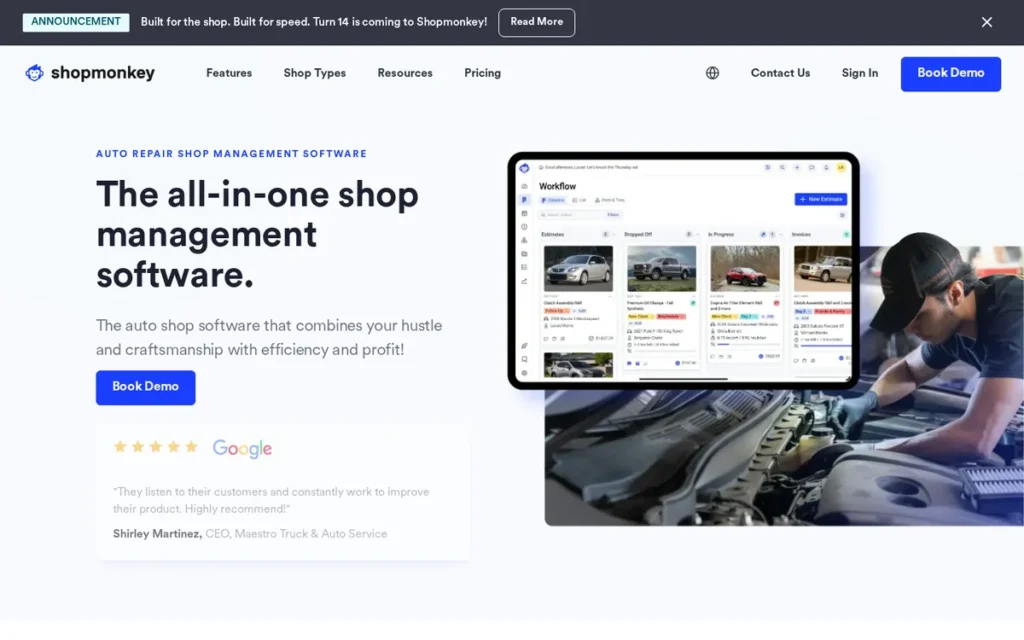
Category: All-in-One Cloud Suite. This is a cloud platform that runs the full repair workflow, from estimate to invoice, payments and reporting, in one system.
At a Glance
- Category: All-in-One Cloud Suite
- Best For: Small-to-mid general repair, specialty and tire shops that want strong mobile apps and integrated customer payments
- Price Range: $239–$499/month ($215–$449 annual), 3–5 user licenses by tier, $20/month per extra license, one-time $500 migration fee
- Primary Strength: Shopmonkey offers native iOS and Android apps and broad payment options, and it is the only vendor evaluated that publishes its migration fee.
- Biggest Limitation: Shopmonkey keeps labor guides, inventory, QuickBooks Online and ALLDATA in higher tiers and limits Basic to three user licenses.
- One-Line Summary: Shopmonkey is a mobile-first cloud shop management platform with native apps, integrated payments and a published $500 migration fee. It is best for shops that prioritize ease of use and can absorb the cost of reaching labor guides, inventory and QuickBooks in higher tiers.
- Last Verified: November 2026
Overview
Shopmonkey is a cloud-based auto shop management platform with native iOS and Android apps, two-way messaging and integrated payments. It is built for general repair, specialty, tire and multi-location shops that put ease of use and mobile access ahead of the lowest entry price.
Shopmonkey was founded in 2016 in San Jose and has raised at least $110M (Shopmonkey Series C announcement, vendor-published, 2026). Shopmonkey claims 10,000+ customers, up from 3,500 shops in 2022 (Shopmonkey, vendor-published, 2026).
Key Features
- Shopmonkey covers scheduling, estimates, repair orders, digital vehicle inspections and e-signatures in one cloud system.
- Shopmonkey provides two-way text and email messaging, though sources report its tier placement inconsistently, so buyers should verify it live.
- Shopmonkey supports integrated payments, including Apple Pay, Google Pay and buy-now-pay-later.
- Shopmonkey offers native iOS and Android apps for advisors and technicians.
- Shopmonkey’s higher tiers add labor guides, inventory, QuickBooks Online, time clocks and ALLDATA integration.
Best For
Shopmonkey is best for small-to-mid shops whose teams fit within three to five licenses. It suits shops that prioritize mobile apps, customer messaging and integrated payments and can accept a higher entry price.
Pricing
- Shopmonkey’s tiers are Basic at $239/month ($215 annual) with 3 user licenses, Clever at $399 ($359) with 4 and Genius at $499 ($449) with 5. Multi-Shop pricing is custom (Shopmonkey, November 2026).
- Shopmonkey charges $20/month for each extra license, which adds a per-seat cost on top of per-shop pricing.
- Shopmonkey publishes a one-time $500 data-migration fee, and in-person training may cost extra (Shopmonkey, November 2026).
- Shopmonkey is cloud-based. The sources reviewed did not publish Shopmonkey’s contract length, payment processing rates or data-export terms.
Strengths
- Shopmonkey publishes full tier prices, license counts, per-seat fees and its $500 migration fee, the most complete cost disclosure in this evaluation (Shopmonkey, November 2026).
- Shopmonkey holds about 4.6/5 from 411 G2 reviews. On Capterra it holds 4.6–4.7/5, and 245 of 271 reviews in one dataset were positive (G2 and Capterra, November 2026).
- Shopmonkey data shows that adoption of online booking and digital communication among its shops rose from about 33% to more than 60% (Shopmonkey data via Ratchet+Wrench, 2025; the source gives no time period).
- Shopmonkey’s pricing page lists Apple Pay, Google Pay and buy-now-pay-later alongside native iOS and Android apps (Shopmonkey, November 2026).
Limitations
- Shopmonkey’s most consequential trade-off is that its higher entry price still leaves labor guides, inventory, QuickBooks Online, time clocks and ALLDATA behind upgrades.
- Shopmonkey’s plans include 3, 4 or 5 user licenses depending on tier, so an 8-person team on Basic pays $339/month on monthly billing, not $239 (Shopmonkey, November 2026).
- Shopmonkey trails Tekmetric on G2 sub-scores for setup (8.9 vs 9.4) and support (8.9 vs 9.5) (G2, November 2026).
- Shopmonkey’s negative Capterra reviews include titles such as “Constant bugs, constant problems” and “Unprofessional, Poor Service & Hidden Cancellation Policy” (Capterra, 2026).
- Shopmonkey’s Capterra review count is reported inconsistently (271 vs 405), and Reddit searches returned no substantive owner discussion.
Verdict
Shopmonkey is a strong 2026 choice for shops that prioritize native iOS and Android apps and integrated customer payments, and it is the only vendor evaluated that publishes its migration fee ($500).
Shopmonkey ranks #4 (3.60/5), 0.02 above AutoLeap, mainly because reviewers report fewer contract lock-in problems (C4 3.0 vs 2.0). Buyers should price their real user count and get cancellation terms in writing.
5. AutoLeap: Best for Marketing and Customer Retention
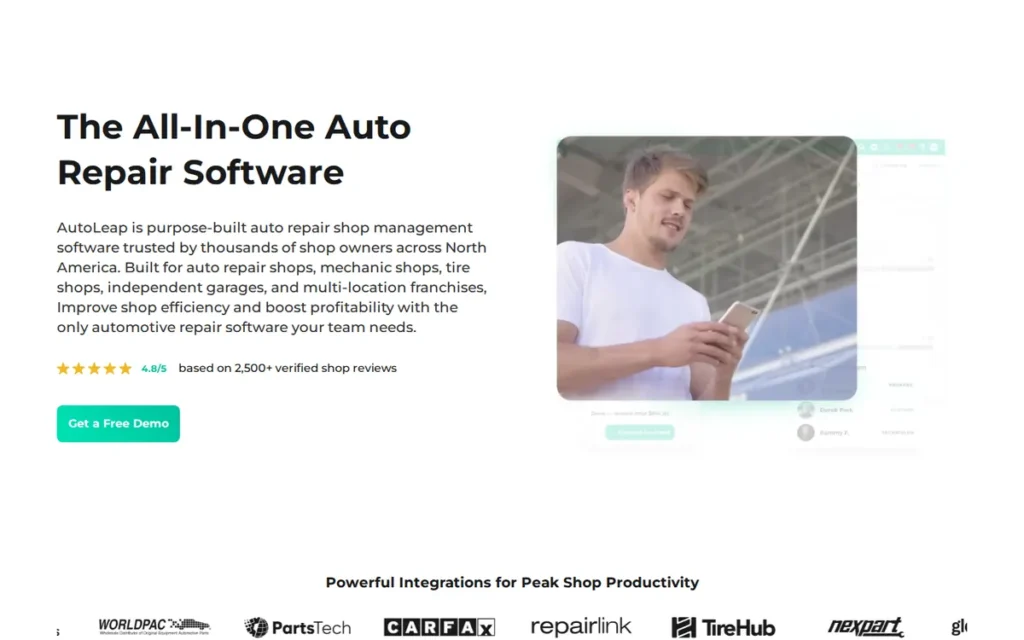
Category: Growth and Marketing Platform. This is a cloud shop management system that bundles CRM, automated marketing and AI customer-contact tools with the repair workflow.
At a Glance
- Category: Growth and Marketing Platform
- Best For: Shops and franchise groups that want marketing automation, customer retention and an AI receptionist inside their shop software
- Price Range: $199–$349/month on monthly billing ($179–$309 billed annually) for 3–5 users; Capterra lists higher and enterprise tiers; no free trial
- Primary Strength: AutoLeap pairs the largest review volume in this evaluation with built-in CRM, automated campaigns and an AI phone receptionist.
- Biggest Limitation: AutoLeap caps users per plan, and reviewers report annual agreements with 60-day cancellation notice and auto-renewal.
- One-Line Summary: AutoLeap is a marketing-focused cloud shop management platform with CRM, automated campaigns and an AI receptionist, rated 4.8/5 across about 748 Capterra reviews. Its user-capped plans and reviewer-reported annual auto-renewing contracts call for careful contract review.
- Last Verified: November 2026
Overview
AutoLeap is a cloud-based auto shop management platform that combines repair orders, digital inspections, CRM, automated marketing and an AI phone receptionist. It is built for independent shops and franchise groups that want customer retention tools inside their shop software.
AutoLeap has offices in Atlanta and Toronto and has raised $53M in total, including a $30M Series B in April 2023 (TechCrunch, 2023). AutoLeap was named to the SMBTech 50 list in 2024.
Key Features
- AutoLeap combines estimates, repair orders, digital vehicle inspections and a customizable work board in one cloud system.
- AutoLeap includes a CRM with automated SMS and email campaigns and deferred-work reminders.
- AutoLeap AIR answers shop calls as an AI receptionist, and AutoLeap’s “magic notes” help technicians write up findings.
- AutoLeap integrates CARFAX and Mitchell ProDemand and processes payments through AutoLeap Pay.
- AutoLeap supports multi-store, fleet and tire storage workflows.
Best For
AutoLeap is best for shops and franchise groups whose growth depends on marketing automation and customer retention. These shops must be able to accept AutoLeap’s user-capped plans and negotiate contract terms up front.
Pricing
- AutoLeap’s entry plan costs $199/month ($179 billed annually) for 3 users, and its next plan costs $349/month ($309 billed annually) for 5 users (AutoLeap, November 2026).
- Capterra lists AutoLeap at $179, $309 and $409, with custom enterprise pricing (Capterra, November 2026).
- AutoLeap uses user-capped plans, so a shop that outgrows 3 or 5 users must move up a tier. AutoLeap’s entry plan also excludes two-way texting and inventory.
- AutoLeap is cloud-based, and reviewers report annual commitments. In the sources reviewed, AutoLeap does not publish payment processing rates or a written data-export guarantee.
Strengths
- AutoLeap holds a 4.8/5 rating from about 748 Capterra reviews, the largest review volume found for any product in this evaluation (Capterra, November 2026).
- AutoLeap customer OK Tire operates 325+ locations, consolidated three systems onto AutoLeap and raised approval rates by 30% (AutoLeap case study, vendor-published, 2026).
- AutoLeap scores 8.8 for marketing on G2, against a category average of 8.4 (G2, November 2026).
- AutoLeap reviewers commonly praise fast onboarding (sometimes under a week), SMS reminders and support (Capterra, 2026).
Limitations
- AutoLeap’s most consequential trade-off is contract risk. Several Capterra reviewers report annual agreements with a 60-day cancellation notice and auto-renewal, though a signed agreement’s own terms govern (Capterra, November 2026).
- AutoLeap offers no free trial, and reviewers say the setup fee is refunded only if the shop attends group training (Capterra, November 2026).
- AutoLeap caps users at 3 or 5 per plan, unlike Tekmetric, Shop-Ware and Shop Boss.
- AutoLeap reviewers report bugs after updates and occasional inspection data loss (Capterra, 2026).
- AutoLeap reviewers report VIN lookup errors (Capterra, 2026).
- AutoLeap has no dedicated technician app and sparse API documentation, according to reviewers (Capterra, 2026).
- One AutoLeap reviewer said more than half of messages failed to deliver (Capterra, 2026).
Verdict
AutoLeap offers the most marketing-focused feature set in this evaluation, with built-in CRM, automated campaigns and an AI receptionist. It scores 8.8 for marketing on G2 against a category average of 8.4 (G2, November 2026).
AutoLeap ranks #5 (3.58/5). It has the largest review volume, but its contract-flexibility score (2.0) is the lowest in the set. Get cancellation, renewal and setup-fee terms in writing before signing.
6. Fullbay: Best for Heavy-Duty, Diesel and Fleet Repair
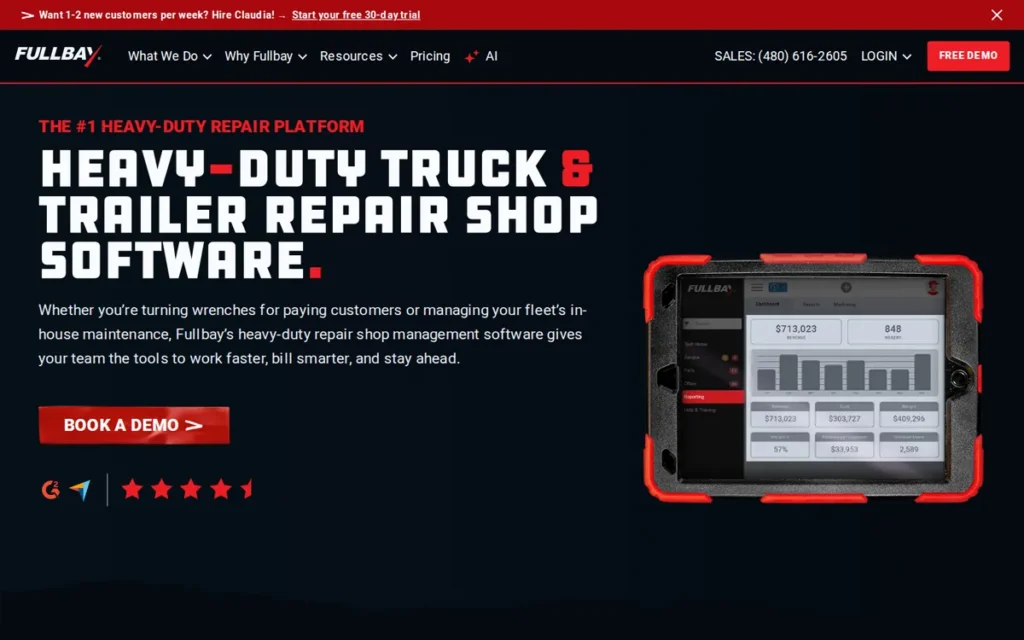
Category: Heavy-Duty Specialist. This is a cloud shop management system built for commercial truck, diesel, fleet and equipment repair rather than passenger cars.
At a Glance
- Category: Heavy-Duty Specialist
- Best For: Heavy-duty, diesel, fleet, mobile roadside and equipment repair shops
- Price Range: Express $149/month (1 user); Basic and Enterprise by quote; month-to-month or annual agreements
- Primary Strength: Fullbay is the only platform in this evaluation built specifically for Class 6–8 heavy-duty, fleet and mobile roadside repair.
- Biggest Limitation: Fullbay publishes pricing only for its single-user Express plan. Reviewers describe it as expensive for small shops and report friction over renewal charges.
- One-Line Summary: Fullbay is the only heavy-duty specialist cloud platform in this evaluation, rated 4.5–4.7/5 on Capterra (99 reviews, November 2026), with an Express plan from $149/month and custom quotes for larger shops.
- Last Verified: November 2026
Overview
Fullbay is a cloud-based shop management platform built for heavy-duty repair, covering Class 6–8 trucks, commercial fleet maintenance, agricultural and construction equipment, and mobile roadside service. It serves diesel and commercial shops that passenger-car platforms don’t serve well.
Fullbay was founded in 2014 in Phoenix and expanded to Australia in 2020, with backing from Mainsail Partners and JMI Equity (Fullbay, vendor-published, 2019 and 2024). Fullbay’s lower overall rank reflects fit for a passenger-car audience, not its quality within the heavy-duty segment.
Key Features
- Fullbay covers the heavy-duty workflow from repair request through estimate, service order, time tracking and invoicing.
- Fullbay supports mobile and roadside repair as a core workflow, with customer and vendor portals.
- Fullbay syncs with QuickBooks and includes inventory management (since 2016) and Fullbay Payments (since 2021).
- Fullbay has added two-way texting, Fullbay Marketplace for parts purchasing and Fullbay Financials.
- Fullbay serves internal fleet shops, agricultural and construction equipment repair, and emergency vehicle service.
Best For
Fullbay is best for heavy-duty, diesel and fleet repair shops that need software built around commercial vehicle workflows. It fits especially well for shops running mobile or roadside service.
Pricing
- Fullbay’s Express plan costs $149/month for a single user and is aimed at mobile and one-person operations (Fullbay, November 2026).
- Fullbay’s Basic plan (one location, up to five users) and its Enterprise plan require a quote, with billing based on users, locations and needs.
- Fullbay offers month-to-month or annual agreements. One reviewer reported a charge of more than $600 after missing a renewal or cancellation date (Software Advice, 2026).
- Fullbay is cloud-based. In the sources reviewed, Fullbay does not publish payment processing rates or a written data-export guarantee, so buyers should request an itemized written quote.
Strengths
- Fullbay’s State of Heavy-Duty Repair report, produced with ATA’s Technology & Maintenance Council, drew 900+ respondents covering 3,400+ shops and tracks mobile-repair labor rates and trip charges (Fullbay, 2025).
- Fullbay holds 4.5–4.7/5 from 99 Capterra reviews (the figure differs between Capterra pages), and reviewers praise its knowledgeable support and instant QuickBooks transfer (Capterra, November 2026).
- Fullbay customer Top Dog Repair & Towing reports that QuickBooks sync replaced manual accounting entry (Fullbay customer story, vendor-published, 2026).
- Fullbay’s $149/month Express plan is the lowest published entry price in this evaluation and gives one-person mobile operators a low-cost way to start (Fullbay, November 2026).
Limitations
- Fullbay’s most consequential trade-off is cost opacity. Fullbay publishes a price only for its single-user Express plan, multi-user plans require a quote, and reviewers call it expensive for small shops (Fullbay and Software Advice, November 2026).
- Fullbay reviewers report slow parts and inventory screens, limited native reporting and occasional accounting sync glitches (Capterra, 2026).
- Fullbay reviewers also cite slow escalation, inflexible refunds and a learning curve (Software Advice, 2026).
- Fullbay’s specialist design makes it a poor default for passenger-car general repair shops.
- Fullbay had no Reddit-specific discussion, and this evaluation covered no other heavy-duty platform for comparison.
Verdict
Fullbay is the best-fit shop management software for heavy-duty, diesel and fleet repair shops in this 2026 evaluation, because it is the only platform evaluated that is built around Class 6–8 and mobile roadside workflows.
Fullbay ranks #6 (3.23/5) because the weighted score measures fit for passenger-car shops, not quality in heavy-duty work. Multi-user shops should get an itemized quote and confirm renewal dates in writing.
7. Mitchell 1 Manager SE: Best for Shops Built Around ProDemand Repair Information
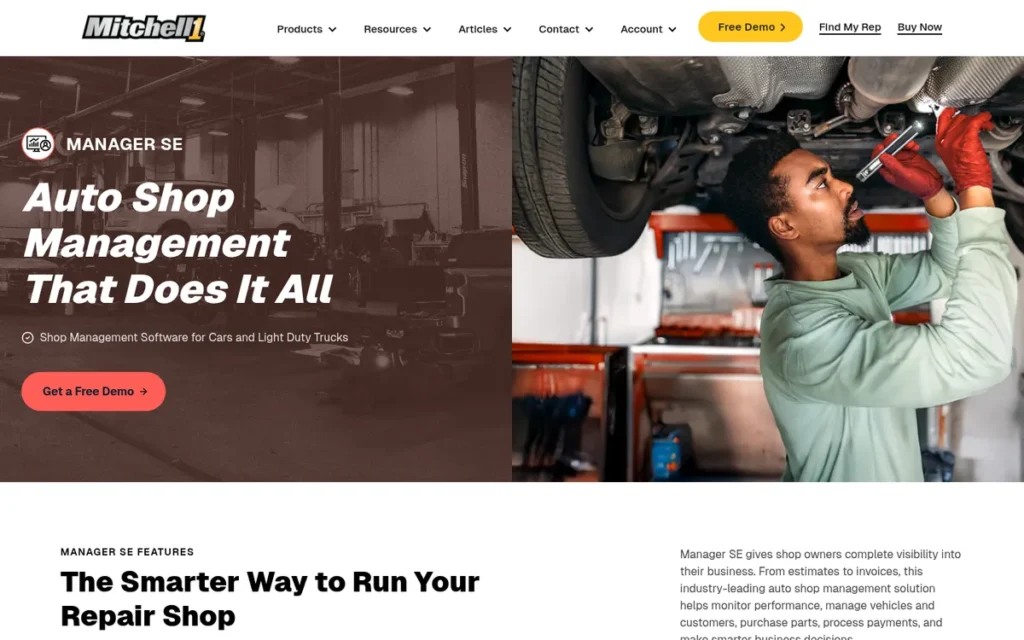
Category: Repair-Information-Integrated System. This is a shop management system built around tight integration with an OEM repair-information database.
At a Glance
- Category: Repair-Information-Integrated System
- Best For: Established shops that depend on ProDemand and the Snap-on ecosystem and can support a locally installed system
- Price Range: Pricing on request (one reviewer reported a bundle under $500/month; BOLT ON Mobile Manager Pro cited at $249/month)
- Primary Strength: Mitchell 1 Manager SE offers the deepest repair-information integration in this evaluation through ProDemand and SureTrack.
- Biggest Limitation: Mitchell 1 Manager SE is traditionally installed locally, sells texting, DVIs, QuickBooks and reminders as add-ons, and publishes no pricing.
- One-Line Summary: Mitchell 1 Manager SE is a Snap-on shop management system with the deepest ProDemand repair-information integration evaluated. Its local-install architecture, add-on modules and lack of public pricing make it a poor fit for shops that want an all-in-one cloud platform.
- Last Verified: November 2026
Overview
Mitchell 1 Manager SE is a Snap-on shop management system, traditionally installed on a local server or desktop. It is built for independent shops that depend on deep integration with ProDemand OEM procedures, labor times and wiring diagrams, plus SureTrack real-world fixes.
Mitchell 1 Manager SE has run on SQL since 2009 and is sold through Mitchell 1 sales and Snap-on reps. Mitchell 1’s lineage dates to Mitchell Manuals in 1946 (Mitchell 1, 2026).
Key Features
- Mitchell 1 Manager SE covers estimating, repair orders, inventory and purchasing, canned jobs and parts kits.
- Mitchell 1 Manager SE integrates tightly with ProDemand for OEM procedures, labor times, wiring diagrams and TSBs, and with SureTrack.
- Mitchell 1 Manager SE connects to live parts eCatalogs for parts lookup and ordering.
- Mitchell 1 Manager SE sells texting, DVIs, QuickBooks and reminders as add-ons, and tablet workflows may require BOLT ON Mobile Manager Pro.
- Mitchell 1 Manager SE integrates with fleet-management systems for estimates and service records.
Best For
Mitchell 1 Manager SE is best for established shops already invested in ProDemand and the Snap-on ecosystem. These shops value repair-information depth over cloud convenience and can manage local IT.
Pricing
- Mitchell 1 publishes no pricing for Manager SE, and quotes come through sales or Snap-on reps (Mitchell 1, November 2026).
- One Mitchell 1 Manager SE reviewer reported a full bundle under $500/month, and BOLT ON Mobile Manager Pro is cited at $249/month (Kinja, 2026).
- Mitchell 1 Manager SE uses quote-based pricing with add-on modules. Buyers should get an itemized quote covering ProDemand, each module and any server requirements.
- Mitchell 1 Manager SE is a local install, and Capterra lists no free trial. The sources reviewed did not publish its contract or data-export terms.
Strengths
- Mitchell 1 Manager SE integrates with ProDemand and SureTrack, the deepest OEM repair-information integration among the seven platforms (Mitchell 1, November 2026).
- Mitchell 1’s ProDemand data is also integrated by Shop-Ware, Shop Boss and AutoLeap (vendor integration pages, 2026).
- Mitchell 1 Manager SE is a long-established Snap-on product, and one Reddit owner called it “solid” (r/smallbusiness, 2026).
- Reviewers say Mitchell 1 Manager SE’s keyboard-driven workflow is faster than click-heavy cloud alternatives such as Tekmetric (AutoJoy, 2026).
Users on r/smallbusiness noted:
“Mitchell 1 is solid, we looked at that and Tekmetric when we were getting set up. Ended up going with Tekmetric but either works fine tbh.” Posted by u/Ambitious_Driver4556
Takeaway: New shop owners still see Mitchell 1 Manager SE as a dependable option, but it now competes directly with cloud platforms like Tekmetric and doesn’t always win the final decision.
Limitations
- Mitchell 1 Manager SE’s most consequential trade-off is architecture. It is traditionally installed on a local server or desktop, which adds hardware and IT work for buyers who want cloud software.
- One Mitchell 1 user of 25 years reported repeatedly being told they lacked RAM despite having “more than enough” (r/Justrolledintotheshop, 2026).
- A reviewer quoted by a third party said Mitchell 1 Manager SE “did not keep up with technology” (Kinja, 2026).
- Mitchell 1 Manager SE’s add-on modules raise its total cost, and one owner warned that with Mitchell repair data “you’re going to be PAYING” (r/sweatystartup, 2023).
- Mitchell 1 Manager SE’s 4.1/5 Capterra rating (79 reviews) is the lowest in this evaluation, and G2 shows only 7 responses (8.3/10) (Capterra and G2, November 2026).
Verdict
Mitchell 1 Manager SE is the best option in 2026 only for shops whose operations center on ProDemand repair information and the Snap-on ecosystem.
Mitchell 1 Manager SE ranks #7 (2.75/5) for a cloud-first audience because of its local install, add-on modules and quote-only pricing, though its repair-information integration scored the maximum 5.0. Shops that mainly want ProDemand data can get it through Shop-Ware, Shop Boss or AutoLeap.
What Does Auto Shop Management Software Really Cost in 2026?
Published entry prices for auto shop management software range from $149/month (Fullbay Express, one user) to $279/month (Shop-Ware) in November 2026. The tier that unlocks two-way texting and full digital inspections typically costs $299–$439/month. None of the seven vendors lists payment processing rates on its public pricing pages, and Mitchell 1 Manager SE is quote-only.
| Platform | Published Entry Price | Tier Needed for Two-Way Texting + Full DVIs | Pricing Unit | Published Extra Fees | Payment Processing Rate |
|---|---|---|---|---|---|
| Tekmetric | $179/mo annual ($199 monthly) | Scale: $409/mo annual ($439 monthly); Start and Grow have one-way messaging only | Per shop, flat-rate, unlimited users | Marketing add-on; setup and migration not published | Not listed publicly |
| Shop-Ware | $279/mo (month-to-month) | Tier mapping not published | Per location, flat-rate, unlimited users | Not published | Not listed publicly |
| Shop Boss | $199/mo ($179 annual) | Platinum: $349/mo per vendor page or $299/mo per Capterra (conflict); texting on all tiers | Per shop, flat-rate, unlimited users | Not published | Not listed publicly |
| Shopmonkey | $239/mo ($215 annual), 3 licenses | Texting tier: verify live; labor guides and inventory need higher tiers | Per shop; 3–5 licenses by tier, $20/mo per extra | $500 one-time migration; in-person training may cost extra | Not listed publicly |
| AutoLeap | $199/mo ($179 annual), 3 users | Second tier: $349/mo ($309 annual), 5 users | User-capped plans | Setup fee reported (refund tied to training) | Not listed publicly |
| Fullbay | Express $149/mo (1 user) | Basic and Enterprise by quote | Quote for multi-user plans, based on users, locations and needs | Not published | Not listed publicly |
| Mitchell 1 Manager SE | Quote only | Add-on modules; bundle under $500/mo reported | Quote-based | BOLT ON Mobile $249/mo cited | Not listed publicly |
All prices were verified in November 2026 and should be confirmed with each vendor before buying. Owners also report that repair-information and labor-guide subscriptions add cost outside the shop software itself (Reddit, 2023–2026).
Worked Example: A 6-Person Shop That Needs Texting and DVIs
Here is what a single shop with six staff would pay each month on monthly billing for a tier that covers texting and inspections:
- Shop Boss Platinum costs $349/month on the vendor page, or $299 per Capterra, with unlimited users.
- Tekmetric Scale costs $439/month with unlimited users.
- Shopmonkey Basic costs $239 plus three extra licenses at $20 each, or $299/month, though its texting tier still needs live verification.
- AutoLeap’s 5-user plan costs $349/month, so a sixth user requires a higher tier, which Capterra lists at $409 on annual billing.
Over a year, the gap between the cheapest and most expensive option in this example comes to about $1,700 ($439 vs $299 per month). In auto shop software, the price that matters isn’t the entry tier. It’s the cheapest tier that lets you text a customer a photo and collect their approval.
How Do Contract Terms and Lock-In Risk Compare?
Tekmetric, Shop-Ware and Shop Boss offer the lowest lock-in risk, with month-to-month billing or no annual contract. AutoLeap carries the highest reported risk because several reviewers describe annual auto-renewing agreements. None of the seven vendors publishes a written data-export guarantee in the sources PlugRoute reviewed (November 2026), so every buyer should negotiate export terms before signing.
| Platform | Published Contract Terms | Review-Reported Friction | Free Trial | Written Data-Export Guarantee |
|---|---|---|---|---|
| Tekmetric | Month-to-month, no long-term contract | One report of support getting worse after signing | Not verified | Not published |
| Shop-Ware | Month-to-month plans; annual cheaper | Vehlo acquisition (2024) adds roadmap uncertainty | Not verified | Not published |
| Shop Boss | No annual contracts advertised | No clear pattern found (thin evidence) | None listed on Capterra | Not published |
| Shopmonkey | Not published in sources reviewed | Review title citing a “Hidden Cancellation Policy” | Not verified | Not published |
| AutoLeap | Annual agreements (reviewer-reported) | 60-day notice, auto-renewal, conditional setup-fee refund | None | Not published |
| Fullbay | Month-to-month or annual agreements | Charge of more than $600 after a missed renewal date (one reviewer) | Not verified | Not published |
| Mitchell 1 Manager SE | Not published | Not verified | None listed on Capterra | Not published |
Which Auto Shop Software Is Best for Multiple Locations?
Tekmetric and Shop-Ware are the strongest multi-location choices in this evaluation. Tekmetric has the best-documented rollout: Auto-Lab moved 16 shops in 9 months. Shop-Ware offers gross-profit analytics across unlimited locations. AutoLeap has the largest named deployment, OK Tire, with 325+ locations.
Only two vendors in this evaluation, Tekmetric and AutoLeap, could point to a named multi-location rollout, and both case studies are vendor-published. The multi-location evidence breaks down as follows:
- Tekmetric: Auto-Lab moved 16 shops onto Tekmetric in 9 months, and estimate time fell from about 15 minutes to about 4 (Tekmetric case study, vendor-published, 2026). Tekmetric also supports parts transfers between locations.
- Shop-Ware: Shop-Ware provides multi-shop analytics across unlimited locations at about $279–$499/month per location (AlieCRM, 2026).
- AutoLeap: AutoLeap lists OK Tire as an enterprise customer with 325+ locations (AutoLeap, vendor-published, 2026), but AutoLeap’s user caps apply per plan.
- Shopmonkey: Shopmonkey offers a custom Multi-Shop tier, but the research found no named Shopmonkey rollout.
- Shop Boss: Shop Boss has no documented multi-location features or rollouts.
Per-location pricing adds up quickly. A three-shop group on Shop-Ware’s entry tier pays about $837/month before add-ons, based on the published $279 per-location price.
The same three-shop group pays about $537/month on Tekmetric Start or $1,227/month on Tekmetric Scale (annual billing), because Tekmetric also charges per shop.
What Red Flags Should I Watch For When Evaluating Auto Shop Management Software?
This research turned up seven red flags. The four most costly are entry tiers that exclude texting or inspections, per-user pricing or user caps, auto-renewing annual contracts and undisclosed payment rates. Each red flag can raise the true cost of auto shop software or make it harder to switch later.
Red Flag #1: Entry Price Excludes Texting or Inspections An entry price that leaves out two-way texting or full DVIs understates the real cost. Tekmetric reserves texting for Scale, Shop Boss reserves full DVIs for Platinum, and AutoLeap excludes texting from its entry plan. Texting alone costs $179/month on Shop Boss Gold versus $409 on Tekmetric Scale (annual), a gap of $2,760 a year.
Red Flag #2: Per-User Pricing or User Caps Per-user pricing or user caps raise costs every time a shop hires, at a time when the BLS projects about 68,000 automotive technician openings per year (AAPEX, 2025). AutoLeap caps its plans at 3 or 5 users. Shopmonkey includes 3–5 licenses by tier and charges $20/month for each extra seat.
Red Flag #3: Annual Auto-Renewal With Long Cancellation Notice Annual agreements that renew automatically and require long cancellation notice can lock a shop in after the software stops fitting. AutoLeap reviewers report 60-day notice periods, and one Fullbay reviewer reported a charge of more than $600 after missing a renewal date.
Red Flag #4: Undisclosed Payment Processing Rates None of the seven vendors lists payment processing rates on its public pricing pages (November 2026), yet integrated payments run on every invoice a shop collects. Ask for the card-present rate, the card-not-present rate and any per-transaction fees in writing before you compare total cost.
Red Flag #5: No Written Data-Export Terms None of the seven vendors publishes a written data-export guarantee in the sources PlugRoute reviewed (November 2026). Complaints across the category note that photos, inspection records and signatures are often left out of exports, so get the export scope in writing before migrating.
Red Flag #6: Local Install Marketed Alongside Cloud Tools Comparison lists often rank locally installed systems next to cloud platforms without saying so. Mitchell 1 Manager SE is traditionally installed on a local server or desktop, and that brings hardware, RAM and IT demands that cloud-native systems avoid.
Red Flag #7: Coordinated Promotional Forum Posts Near-identical forum posts from the same accounts across unrelated threads usually signal promotion, not independent owner experience. This research found pro-AutoLeap Reddit comments posted one minute apart, and they included a false claim. PlugRoute excluded them from scoring, and they did not affect AutoLeap’s score in either direction.
What Questions Should I Ask Before Choosing Auto Shop Management Software?
Before you sign, ask which tier covers texting and inspections, how pricing is counted, what migration includes, how accounting sync works and what payments cost. Also ask about contract terms and what a data export contains. Then have the vendor run your own sample job from check-in to invoice during the demo.
Question #1: Which tier do I need for two-way texting and full digital inspections? Ask the vendor to name the exact tier and monthly price that include both two-way texting and full digital inspections. Answers vary widely: Shop Boss includes texting in its $199 Gold tier, while Tekmetric requires Scale at $439/month. A good answer is a plan name and price, not “it depends.”
Question #2: Is pricing per shop, per location or per user? Ask how the price changes if you add two technicians or a second location. Unlimited-user plans at Tekmetric, Shop-Ware and Shop Boss behave very differently from license-capped plans at AutoLeap (3 or 5 users) and Shopmonkey (3–5 users plus $20/month per extra seat).
Question #3: What do migration and setup cost, and what exactly transfers? Ask for the migration fee, the setup fee and a written list of the data that will transfer, including customers, vehicles, history and open repair orders. Shopmonkey is the only vendor in this evaluation that publishes its migration fee ($500), so other vendors’ fees require a direct question.
Question #4: Is the QuickBooks sync live or CSV export? Ask whether invoices and payments post to QuickBooks automatically or need manual file exports. Owners on Reddit prefer live sync, and Fullbay reviewers report occasional accounting sync glitches, so ask to see the sync working during the demo before you commit.
Question #5: What is the payment processing rate? Ask for the card-present rate, the card-not-present rate and any per-transaction fees in writing. None of the seven vendors lists these rates on its public pricing pages (November 2026), so you need this answer for an accurate total-cost comparison.
Question #6: What are the cancellation notice and renewal terms? Ask whether the contract is monthly or annual, whether it renews automatically and how much notice cancellation requires. Get the answer in writing, because reviewers report surprise renewal charges and cancellation friction at several vendors in this evaluation.
Question #7: What does a full data export include? Ask whether a full export includes inspection photos, inspection records, signatures and complete repair history, and in what file format. None of the seven vendors publishes a written export guarantee in the sources reviewed, so a good answer confirms each item in writing before you migrate any data.
Question #8: Can you run my sample job from check-in to final invoice in the demo? Bring one real job and ask the vendor to run it through check-in, inspection, estimate approval, parts order, invoice and payment in the live demo. Use that job to test these failure points, which owner reviews report across auto shop software:
- Send a test text message to a real customer phone and confirm it is delivered.
- Run a VIN lookup on a vehicle from your own shop and check that the decoded data is correct.
- Compare the software’s labor times against your book times for a common job.
- Add a part to the estimate ad hoc, without creating an inventory record first.
- Process a refund on a paid invoice and check how it posts to accounting.
- Post a test invoice and payment to QuickBooks and confirm they appear without a manual export.
This aligns with community sentiment on r/serviceadvisors:
“Every demo of this stuff is the advisor screen with the pretty numbers. nobody demos the part where the tech fills in 9 fields per job so the pretty numbers exist” Posted by u/Weavermain
Takeaway: Auto shop software demos routinely hide the technician data-entry burden, so buyers must test the tech-side workflow and not just the advisor dashboard.
How Did We Rank These Auto Shop Management Software Platforms?
PlugRoute scored all seven platforms on a 1–5 scale against six weighted criteria and ranked them by weighted total. Tekmetric and Shop-Ware finished 0.03 points apart, which is a statistical tie, so decide between them by shop type. The weighted total measures fit for cloud-first independent shops, so a lower overall rank can still mean best in a segment.
PlugRoute has no affiliate relationships with any company listed, and rankings are determined entirely by research data and objective evaluation criteria.
These are the six criteria and their weights:
- C1, Independent User Ratings and Review Volume (25%): This criterion matters because owners want proof from other shops, not vendor marketing.
- C2, Real Cost Transparency and Value at the Needed Tier (20%): This criterion matters because entry prices often exclude texting, DVIs and extra users.
- C3, Full-Workflow Coverage and Cloud Fit (20%): This criterion matters because shops want one cloud system that runs check-in through payment.
- C4, Contract Flexibility and Lock-In Risk (15%): This criterion matters because owners report that switching later is painful.
- C5, Integration Ecosystem (10%): This criterion matters because shops depend on parts catalogs, QuickBooks, payments and OEM repair data.
- C6, Multi-Location Scalability Evidence (10%): This criterion matters because growing shops need cross-shop reporting and predictable per-location costs.
As one user on r/serviceadvisors described:
“last place i worked rolled out shop software and suddenly every oil change came with 10 minutes of tablet work. photos, inspection sheet, notes, all before you could close the ticket. techs just started handwriting everything and entering it at 4:55. nobody asked us if any of it helped” Posted by u/The_God_was_Here
Takeaway: Workflow coverage only helps when it fits how technicians actually work, because shop software that piles tablet work onto every ticket pushes staff into workarounds that defeat the system.
| Platform | C1 | C2 | C3 | C4 | C5 | C6 | Weighted Total |
|---|---|---|---|---|---|---|---|
| Tekmetric | 4.5 | 3.5 | 4.5 | 5.0 | 4.0 | 4.5 | 4.33 |
| Shop-Ware | 4.5 | 3.5 | 4.5 | 4.5 | 4.5 | 4.5 | 4.30 |
| Shop Boss | 3.5 | 4.5 | 4.0 | 5.0 | 4.0 | 2.5 | 3.98 |
| Shopmonkey | 4.0 | 3.5 | 4.0 | 3.0 | 3.5 | 3.0 | 3.60 |
| AutoLeap | 4.5 | 3.0 | 4.0 | 2.0 | 3.5 | 4.0 | 3.58 |
| Fullbay | 4.0 | 2.5 | 3.5 | 2.5 | 3.5 | 3.0 | 3.23 |
| Mitchell 1 Manager SE | 3.0 | 1.5 | 2.5 | 3.0 | 5.0 | 2.5 | 2.75 |
These evidence rules applied to every vendor:
- No hands-on testing: PlugRoute did not test the products hands-on, so scores reflect documented evidence only.
- Vendor claims: PlugRoute labels case studies and customer counts as vendor-published and does not count them as independent proof.
- Source conflicts: PlugRoute shows conflicting figures side by side instead of resolving them silently. Examples include Shopmonkey’s 271 vs 405 Capterra reviews and Shop Boss’s 474 vs 89.
- Conservative scoring: When conflicting ratings can’t be resolved, PlugRoute scores the lower figure, as it did for Shop Boss’s C1.
- Missing data: PlugRoute lowers a criterion score when data is missing and discloses the gap, rather than filling it with an assumption.
- Astroturfing: PlugRoute excluded suspected coordinated Reddit posts from sentiment for every vendor. The excluded pro-AutoLeap posts did not affect AutoLeap’s score in either direction, and PlugRoute found no evidence that AutoLeap was responsible for them.
- Exclusions: PlugRoute left out ARI and AutoRepair Cloud because they were not researched to the equal-evidence standard.
- Re-verification: PlugRoute re-verified pricing and ratings in November 2026. Where live data contradicted earlier research, PlugRoute updated the scores: Fullbay C2 rose from 1.5 to 2.5 (Express plan published), Mitchell 1 Manager SE C1 rose from 1.5 to 3.0 (Capterra rating found), and Shop Boss C1 fell from 4.0 to 3.5 (rating conflict).
What Do Shop Owners Ask Most About Auto Shop Management Software?
Shop owners most often ask which platform suits small shops, what the software really costs and how independent rankings are made. The short answers are Shop Boss for budget single-location shops, roughly $299–$439 per month for the tier most shops need, and weighted scoring based on dated, public evidence.
What is the best auto shop management software for small shops?
Shop Boss is the best-value auto shop management software for small single-location shops in 2026. Shop Boss includes unlimited two-way texting and unlimited users in its $199/month Gold tier ($179 annual), with no annual contract. Shops that need full digital inspections should budget for Platinum at $299–$349/month. Tekmetric Start matches the $179 annual price but offers only one-way messaging.
How much does auto shop management software cost in 2026?
Most cloud auto shop management software costs $179–$499 per month per shop in 2026 (verified November 2026). The tier with both two-way texting and full digital inspections usually costs $299–$439 per month. Fullbay’s single-user Express plan starts at $149, Mitchell 1 Manager SE is quote-only, and no vendor lists payment processing rates publicly.
How does PlugRoute determine rankings?
PlugRoute ranks platforms by a weighted score across six criteria: independent ratings (25%), real cost (20%), workflow and cloud fit (20%), contract flexibility (15%), integrations (10%) and multi-location evidence (10%).
The evidence comes from review platforms, vendor pricing pages and owner forums. Vendor claims are labeled, conflicts are shown, and missing data lowers the score.
What Do Key Auto Shop Management Software Terms Mean?
The terms that most affect what auto shop software really costs are user caps, per-shop pricing, two-way texting, digital vehicle inspections and auto-renewal clauses. Vendors often put these features in higher tiers or contract terms. Knowing each term lets buyers compare quotes on equal footing and spot costs that entry prices hide.
Repair Order (RO): A repair order is the core work document for a job, recording the customer, vehicle, approved work, parts, labor and charges. Plans that limit repair orders can cap a busy shop’s growth, so unlimited ROs matter.
Digital Vehicle Inspection (DVI): A digital vehicle inspection is a technician checklist with photos and video that is sent to the customer for review. Full DVIs matter because many vendors put them in higher tiers than the entry plan.
Two-Way Texting: Two-way texting lets advisors and customers exchange text messages inside the shop software, including approvals and updates. Vendors often place two-way texting in higher tiers, which changes the real cost.
Average Repair Order (ARO): Average repair order is total sales divided by the number of repair orders in a period. Vendors often cite ARO gains in case studies, so ask for the baseline and the time period.
Effective Labor Rate: Effective labor rate is the labor revenue a shop actually collects per hour worked, which is often below its posted rate. Software that tracks effective labor rate helps shops find underbilled jobs.
Labor Guide: A labor guide is a reference of standard time estimates for repair tasks, used to build consistent estimates. Labor guides are sometimes a separate subscription or a higher-tier feature.
OEM Repair Information: OEM repair information is manufacturer-sourced procedures, wiring diagrams, service bulletins and specifications. OEM repair information often requires a separate subscription on top of shop software.
Per-Shop Pricing: Per-shop pricing charges one subscription per location, no matter how many staff use it. Per-shop pricing keeps costs flat as a shop hires, but the cost multiplies with each new location.
User Cap: A user cap is the maximum number of staff accounts a plan allows. Exceeding a user cap forces an upgrade or per-seat fees, which raises cost as a team grows.
Cloud-Native: Cloud-native software runs in a web browser or app, with data hosted by the vendor. Cloud-native software avoids the local servers and hardware upgrades that locally installed systems need.
Auto-Renewal Clause: An auto-renewal clause extends a contract automatically unless the buyer cancels within a set notice period. Missing that window can lock a shop in for another term.
Data Export: Data export is the ability to download your customer, vehicle, repair and inspection records in a usable format. The scope of a data export decides how easily a shop can switch vendors later.
Which Auto Shop Management Software Is Right for You?
Key Insights
- Tekmetric (4.33/5) and Shop-Ware (4.30/5) are effectively tied at the top. Growing general repair shops should lean toward Tekmetric, and profit-focused multi-shop groups toward Shop-Ware.
- Shop Boss offers the best value for small single-location shops because it includes unlimited two-way texting and unlimited users in its $199/month entry tier.
- Fullbay is the only heavy-duty specialist in this evaluation, and its $149/month Express plan is the lowest published entry price, though multi-user shops need a quote.
- The real cost of auto shop software is set by the cheapest tier that unlocks two-way texting and full digital inspections, which typically costs $299–$439/month.
- License-capped plans at AutoLeap and Shopmonkey raise costs as a team grows, while Tekmetric, Shop-Ware and Shop Boss include unlimited users.
- None of the seven vendors lists payment processing rates publicly or publishes a written data-export guarantee in the sources reviewed, so buyers should get both in writing.
Marketing-driven shops can consider AutoLeap but should review its contract carefully. Shops that care most about mobile apps can consider Shopmonkey. Mitchell 1 Manager SE remains an option for shops that run on ProDemand and are comfortable with a local install.
Demo two or three finalists with the same sample job, and get contract, migration and export terms in writing before you sign. Read our full methodology or see PlugRoute’s other independent shop software reviews. We update this guide quarterly. Last updated: November 2026.