The best automotive digital retailing software in 2026 is Upstart Auto Retail for online-to-showroom continuity, Cox Automotive Digital Retailing for Cox-stack dealers, and Gubagoo for chat-led franchise retailing. The right tool carries the same deal and payment to your desk inside your existing stack, and because most published results are vendor-reported, test it yourself.
Dealers know the problem well. A shopper builds a deal online, and then the desk rebuilds it, re-enters it or quotes a different payment. Choosing a replacement is harder still, because demos are polished, pricing is rarely published and nearly every performance figure in this category comes from the vendors.
PlugRoute has no affiliate relationships with any company listed. Rankings are determined entirely by research data and objective evaluation criteria.
“Get a free customer, make noticeable improvements, so you can present a clear case study.” (u/Micosilver, r/askcarsales)
Takeaway: Dealers trust results they can check for themselves, not vendor claims.
What Are the 4 Categories of Automotive Digital Retailing Tools?
Automotive digital retailing tools fall into four categories: Ecosystem Suite, Chat-Led, Finance-First and F&I-First. Each category reflects where a tool starts the deal. That starting point predicts which DMS, CRM, lender and staff workflows the tool will fit with the fewest handoffs.
- Ecosystem Suite: Ecosystem Suites bundle digital retailing with the vendor’s own website, credit, CRM and DMS. Cox Automotive Digital Retailing (Dealer.com Accelerate My Deal plus Dealertrack) and Roadster (CDK Digital Retail) are the Ecosystem Suites in this ranking.
- Chat-Led: Chat-Led tools use live or AI-assisted conversation to guide shoppers into the deal builder. Gubagoo and CarNow are the Chat-Led platforms in this ranking.
- Finance-First: Finance-First tools are built around credit decisions, lender connectivity and payment accuracy. Upstart Auto Retail and AutoFi are the Finance-First platforms in this ranking.
- F&I-First: F&I-First tools center on finance and insurance product menus and compliance. Darwin Automotive is the only F&I-First platform in this ranking.
The category matters because most car buyers want a mix of online and in-store steps. Cox Automotive reports that 63% of buyers prefer a hybrid purchase and only 7% actually bought fully online (Cox Automotive Car Buyer Journey Study, 2025; vendor-reported).
A digital retailing tool should therefore be judged on how well it hands the deal to the showroom, not on how many sales it closes entirely online. Buyers who did most steps online saved about 41 minutes in the dealership, and most of that saving came at final paperwork (Cox Automotive, 2025; vendor-reported).
As one buyer on r/carbuying described:
“I never negotiate a deal at the dealership. Everything is done over email, phone and doc-u-sign. And, since Covid, I have the dealer deliver, as most will.” Posted by u/AVIZN4U
Takeaway: Some car buyers now refuse to negotiate in the showroom at all, which raises the bar for automotive digital retailing tools to carry the deal all the way to signature.
How Do the Top Automotive Digital Retailing Platforms Compare at a Glance?
Upstart Auto Retail ranks first in PlugRoute’s 2026 comparison with a weighted score of 4.45, narrowly ahead of Cox Automotive Digital Retailing at 4.35. Upstart’s lead on pricing transparency outweighs Cox’s lead on OEM presence. The middle tier is tight: Gubagoo and Darwin Automotive tie at 3.45, and AutoFi trails at 3.40.
Roadster (CDK Digital Retail) scores 3.10 and CarNow scores 2.90. Both rank lower mainly because they have little independent evidence and no published pricing.
| Rank | Company | Category | Best For | One-Line Summary | Key Capabilities | Primary Strength | Key Limitation |
|---|---|---|---|---|---|---|---|
| 1 | Upstart Auto Retail | Finance-First | Mixed-stack stores wanting one deal record and a predictable price | Upstart Auto Retail is the highest-scoring platform in PlugRoute’s 2026 ranking, combining deal continuity, embedded lending and the only per-rooftop price listed publicly (on G2) among the seven. | Tablets, manager portal, credit-first and pencil-first selling, approval rehash, F&I menu, reservations | One deal record from online to the desk | No named OEM certifications verified; part of the finance workflow depends on the parent company’s lender |
| 2 | Cox Automotive Digital Retailing | Ecosystem Suite | Stores on Dealertrack, VinSolutions or Dealer.com | Cox Automotive Digital Retailing is the most complete ecosystem option for Cox-stack dealers, with the largest vendor-reported adoption base. | Payment shopping, KBB trade-in, Dealertrack credit and F&I, VinSolutions CRM | Full journey inside one ecosystem | Quote-based pricing; continuity weakens outside Cox |
| 3 | Gubagoo | Chat-Led | Franchise stores wanting human-assisted buying | Gubagoo is the chat-led platform in this ranking with the most third-party awards and OEM program placements, paired with a full Virtual Retailing deal builder. | ChatSmart, AI, text, video, Virtual Retailing, Curator | Broad OEM chat program presence | Results depend on agent quality; no public pricing |
| 4 | Darwin Automotive | F&I-First | Stores focused on PVR and menu compliance | Darwin Automotive is the only F&I-first platform in this ranking, owned by J.D. Power and used by 7,700+ dealers in 2021. | Prescriptive menus, service menu, Virtual Deal Maker, eContracting | Personalized, compliant F&I menus | No native credit decisioning; no verified reviews |
| 5 | AutoFi | Finance-First | Stores whose online deals stall at financing | AutoFi is the platform in this ranking with the largest documented national lender network (40+ lenders, vendor-reported). | Soft-pull payments, Intelligent Lender Routing, desking, F&I menus | Real credit decisions online | 0 G2 reviews; no verified integration list |
| 6 | Roadster (CDK Digital Retail) | Ecosystem Suite | CDK stores and multi-rooftop groups | Roadster (CDK Digital Retail) is an ecosystem option for CDK dealers that shares one deal workflow across online shopping and showroom tablets. | Express Storefront, Express Trade, Express Marketplace, Express Response | Same workflow online and in-store | No verified reviews; CDK concentration risk |
| 7 | CarNow | Chat-Led | Independent and value-focused stores on any stack | CarNow is the chat-led platform in this ranking with the clearest independent-dealer package, combining 24/7 staffed chat with payment shopping. | AI and live chat, Search by Payment, pre-qualification, BuyNow | Cross-stack chat plus retailing | Only 4 G2 reviews; users report integration gaps |
Which Automotive Digital Retailing Platform Should I Choose for My Use Case?
Your existing stack and your main bottleneck should decide the choice. Stores already on one vendor’s stack should start with that vendor’s suite, such as Cox Automotive Digital Retailing for Cox stores, and accept the lock-in risk. Mixed-stack and budget-conscious independents should start with Upstart Auto Retail, then shortlist by bottleneck.
| Your #1 Priority | Recommended Tool | Why | Acceptable Alternative |
|---|---|---|---|
| You already run Dealertrack, VinSolutions or Dealer.com | Cox Automotive Digital Retailing | Fewest handoffs inside the Cox stack. Risk: lock-in and bundle pricing. | Upstart Auto Retail (lists Dealertrack and VinSolutions integrations) |
| You already run CDK | Roadster (CDK Digital Retail) | One deal workflow online and on tablets. Risk: CDK concentration, highlighted by the June 2024 CDK cyberattack. | Darwin Automotive (documented CDK integration, F&I focus) |
| You already run Reynolds ERA | Gubagoo | Gubagoo and Reynolds describe a shared calculation engine (vendor-reported). Risk: results depend on agent quality. | CarNow (cross-stack chat; confirm a live Reynolds connection) |
| You run a mixed DMS/CRM stack | Upstart Auto Retail | Lists integrations across several stacks. Risk: partly depends on the parent company’s lender. | CarNow (lists connectors across many stacks) |
| You are an independent on a budget | Upstart Auto Retail | Only per-rooftop price listed publicly (G2). Risk: a $599 one-time setup fee is added. | CarNow (Conversion+ package for independents) |
| F&I penetration and PVR | Darwin Automotive | Prescriptive menus and compliance checks. Risk: no native credit decisioning. | AutoFi (showroom F&I menus) |
| Approvals and lender reach | AutoFi | Routes to 40+ national lenders for real decisions. Risk: no independent reviews. | Upstart Auto Retail (embedded lending plus multi-lender rehash) |
| Chat-driven engagement | Gubagoo | Broadest documented OEM chat program presence. Risk: results depend on agent quality. | CarNow |
PlugRoute picked each alternative for documented fit, meaning either a listed integration with that stack or the same category strength, not for overall rank. There is little evidence specific to independent dealers anywhere in this category. Independents should treat both of their routes as starting points for a demo, not settled answers.
What Are the 7 Best Automotive Digital Retailing Software Platforms in 2026?
PlugRoute’s ranking of the seven best automotive digital retailing platforms for 2026 starts with Upstart Auto Retail and Cox Automotive Digital Retailing, followed by five category specialists. Every entry below uses the same structure, scores and evidence labels. That lets dealers compare the platforms on documented performance rather than on how polished the demo is.
1. Upstart Auto Retail: Best Overall for Online-to-Showroom Continuity
Category: Finance-First, digital retailing built around credit decisioning, lender connectivity and payment accuracy.
At a Glance
- Category: Finance-First
- Best For: Franchise and independent stores wanting one deal record, flexible selling styles and predictable per-rooftop pricing
- Price Range: $599 per rooftop per month plus a one-time $599 setup, integration and training fee (G2 listing; final pricing negotiated; November 2026)
- Primary Strength: Upstart Auto Retail carries a single deal from online shopping to salesperson tablets and a manager portal, with embedded AI lending and multi-lender approval rehash.
- Biggest Limitation: Upstart Auto Retail ties part of the finance workflow to its parent company’s own lending model and has no named OEM certifications verified.
- One-Line Summary: Upstart Auto Retail is the highest-scoring automotive digital retailing platform in PlugRoute’s 2026 ranking, combining online-to-showroom deal continuity, embedded lending and the only per-rooftop price listed publicly (on G2) among the seven ranked platforms.
- Last Verified: November 2026
Scores: C1 5 · C2 4 · C3 5 · C4 4 · C5 5 · C6 3 · Weighted: 4.45
Overview
Upstart Auto Retail is a finance-first digital retailing platform that carries one deal from a dealer’s website to showroom tablets and a manager portal. It is built for franchise and independent stores that want the payment to stay the same from first click to signed contract.
Upstart acquired the platform, then called Prodigy, in April 2021 (Upstart investor relations, 2021; vendor-reported). Upstart Auto Retail is the only product in this ranking whose parent company also lends.
Key Features
- Upstart Auto Retail keeps one deal record that moves from online shopping to salesperson tablets and a manager portal without re-entry (Upstart product announcement, accessed November 2026; vendor-reported).
- Upstart Auto Retail supports both credit-first and pencil-first selling, so stores can keep their existing desking style.
- Upstart Auto Retail places Upstart AI lending alongside offers from other lenders and rehashes approvals to highlight better APR or term options.
- Upstart Auto Retail includes trade-in valuation through integrations such as KBB Instant Cash Offer, vAuto, TradePending and Accutrade. It also has an integrated F&I menu and online reservations with deposits (Upstart product updates, 2022; vendor-reported).
- Upstart Auto Retail lists integrations with ELEAD, VinSolutions, DealerSocket, CDK, Dealertrack, RouteOne and CUDL, and it runs fraud and compliance checks inside the finance workflow (VendorMotive, 2026; third-party).
Best For
Upstart Auto Retail is best for dealers on mixed DMS and CRM stacks who want a hybrid online-to-showroom deal flow, strong finance tooling and a listed price to budget against.
Strengths
- Upstart Auto Retail holds a 4.8 out of 5 rating from 34 reviews on its G2 product page. That is the largest review base in this ranking that covers the digital retailing product specifically (G2, accessed November 2026; third-party).
- Upstart Auto Retail had more than $1 billion in vehicles sold through the platform in Q2 2021, and its rooftop count nearly tripled during 2021 (Upstart investor relations, 2021; vendor-reported).
- Upstart Auto Retail customer Ron Bouchard Honda/Kia reported “as many as five more cars per salesperson per month,” according to GM Chad Bouchard (Upstart, accessed November 2026; vendor-reported).
- Upstart Auto Retail reviewers praise its ease of use, deal customization and transparency, and they like that online progress is saved for the in-store team (G2, accessed November 2026; user-reported).
Limitations
Upstart Auto Retail’s most consequential trade-off is lender dependence. Upstart Auto Retail’s embedded AI lending can widen approvals, but it ties part of the finance workflow to the parent company’s model, which draws fair-lending and explainability scrutiny (VendorMotive, 2026; third-party).
- Upstart Auto Retail has no named OEM certifications verified, although dealers of 33 brands used it in 2021, so franchise stores must confirm program eligibility (Upstart investor relations, 2021; vendor-reported).
- Upstart Auto Retail’s G2 listing adds a one-time $599 setup, integration and training fee and notes that final costs are negotiated, so the monthly price is not the full cost (G2, accessed November 2026; third-party).
- Upstart Auto Retail sits inside a lending-focused public fintech, so its long-term product strategy is a vendor-stability question to raise in contract talks.
- Upstart Auto Retail’s headline gross gains come from financing rather than from the software alone. One example is TLC Motors’ $1,164 more per deal than with its next-best lender (Upstart case studies, accessed November 2026; vendor-reported).
This aligns with community sentiment on r/askcarsales:
“Dealerships have many different lines of revenue and for you to finance through them makes them more money. For example, financing X deals in a month with a certain bank may grant them access to better financing rates, earn them more favors from that bank rep, unlock a cash payment, so on and so forth.” Posted by u/hypnofedX
Takeaway: Dealer financing is a profit center in its own right, so Upstart Auto Retail’s lender-driven gross gains should not be credited to the software alone.
Verdict
Upstart Auto Retail is the strongest all-around automotive digital retailing platform in PlugRoute’s 2026 ranking for dealers who want one deal record from online to the showroom.
Upstart Auto Retail’s 0.10-point lead over Cox Automotive Digital Retailing comes from pricing transparency (C5: 5 vs. 2), which outweighs Cox’s lead on OEM presence (C6: 5 vs. 3). Franchise stores should confirm OEM eligibility first. Every buyer should decide whether relying on an in-house lender fits their strategy.
2. Cox Automotive Digital Retailing: Best for Dealers Already on the Cox Stack
Category: Ecosystem Suite, digital retailing bundled with the vendor’s own website, credit, CRM and DMS products.
At a Glance
- Category: Ecosystem Suite
- Best For: Stores already running Dealertrack, VinSolutions or Dealer.com that want the fewest handoffs between the online deal and the desk
- Price Range: Pricing on request (quote-based, tiered, often bundled with Dealer.com websites; November 2026)
- Primary Strength: Cox Automotive Digital Retailing covers the full deal journey inside one connected ecosystem: payments, KBB trade-in, Dealertrack credit, F&I and showroom continuation.
- Biggest Limitation: Cox Automotive Digital Retailing delivers its deepest continuity only for stores already on the Cox stack, and its pricing and exit terms are not published.
- One-Line Summary: Cox Automotive Digital Retailing, which combines Dealer.com Accelerate My Deal with Dealertrack, is the most complete ecosystem option for Cox-stack dealers, with the largest vendor-reported adoption base in the category.
- Last Verified: November 2026
Scores: C1 5 · C2 4 · C3 5 · C4 4 · C5 2 · C6 5 · Weighted: 4.35
Overview
Cox Automotive Digital Retailing combines Dealer.com Accelerate My Deal with Dealertrack’s credit, F&I and DMS back end. Shoppers can build payment, trade, credit and protection products online and then finish in the showroom, which suits dealers already running Cox products.
Cox Automotive Digital Retailing appears here as one entry because Cox sells both components as one retailing stack.
Key Features
- Cox Automotive Digital Retailing lets shoppers shop by payment, with taxes, fees and OEM incentives included, starting from Dealer.com, Autotrader or Kelley Blue Book (Dealer.com, 2022; vendor-reported).
- Cox Automotive Digital Retailing values trade-ins through KBB Instant Cash Offer inside the deal flow.
- Cox Automotive Digital Retailing sends credit applications through Dealertrack’s lender routing and presents Dealertrack F&I and protection products.
- Cox Automotive Digital Retailing connects to Dealertrack DMS and in-store desking and integrates natively with VinSolutions Connect CRM.
- Cox Automotive Digital Retailing supports reservations, test-drive scheduling and continuing the deal in the showroom (Dealer.com, 2022; vendor-reported).
Best For
Cox Automotive Digital Retailing is best for dealers on Dealertrack DMS, VinSolutions CRM or Dealer.com websites who want the online deal to reach the desk with the fewest system handoffs.
Strengths
- Cox Automotive Digital Retailing’s Cox-run 2020 beta covered 120 dealers over four 90-day periods. It showed 26% higher conversion than the legacy tool and 88% more deals submitted, about 15 more per dealer per month (Dealer.com, 2022; vendor-reported).
- Cox Automotive Digital Retailing’s Dealer.com listing has 35 Capterra reviews at 4.2 out of 5, the largest review count in this ranking, but those reviews cover the whole Dealer.com platform (Capterra, accessed November 2026; third-party).
- Cox Automotive Digital Retailing is used by 5,000+ franchise and independent dealers and endorsed by 30+ OEMs (Dealer.com, accessed November 2026; vendor-reported).
- Cox Automotive Digital Retailing user O’Neill Honda reported a 60% close rate with Dealertrack digital retailing (Cox Automotive, accessed November 2026; vendor-reported).
Limitations
Cox Automotive Digital Retailing’s most consequential trade-off is ecosystem dependence. Cox Automotive Digital Retailing gives its best continuity to stores already on Dealertrack and VinSolutions. Stores on another DMS or CRM lose much of the advantage that justifies the bundle.
- Cox Automotive Digital Retailing raises switching costs and outage exposure because the website, credit, CRM and DMS all sit with one vendor.
- Cox Automotive Digital Retailing pricing is quote-based and tiered. A Dealer.com GM program document shows a “Core” tier plus extra in-store support but gives no dollar amounts (Dealer.com, 2023; vendor-reported).
- Cox Automotive’s own research acknowledges that data errors and repeated steps still break deal continuity (Cox Automotive, 2023; vendor-reported).
- Cox Automotive Digital Retailing’s Dealertrack layer drew Reddit complaints about slow, hard-to-navigate interfaces, although another user in Ontario reported no slowness. Those comments concern Dealertrack’s F&I and DMS layer, not Accelerate My Deal (r/askcarsales, 2021; user-reported).
Verdict
Cox Automotive Digital Retailing is the most complete automotive digital retailing option for dealers already committed to the Cox stack, backed by the category’s largest vendor-reported adoption base.
Cox Automotive Digital Retailing ranks #2 because its pricing is quote-based (C5: 2 vs. 5). It ties Upstart Auto Retail on every other criterion except OEM presence, where Cox leads. Dealers outside the Cox ecosystem should weigh bundle and lock-in costs carefully.
3. Gubagoo: Best for Chat-Led, Human-Assisted Retailing at Franchise Scale
Category: Chat-Led, digital retailing where live or AI-assisted conversation guides the shopper into the deal builder.
At a Glance
- Category: Chat-Led
- Best For: Franchise stores and dealer groups whose shoppers want guided, human-assisted buying, including Reynolds ERA stores
- Price Range: Pricing on request (quote-based; no public figures as of November 2026)
- Primary Strength: Gubagoo combines managed live chat with Virtual Retailing, which covers trade, payments, real-time lender approvals, desking and F&I.
- Biggest Limitation: Gubagoo’s results depend on live-agent quality, and its pricing, setup fees and contract terms are not published.
- One-Line Summary: Gubagoo is the chat-led automotive digital retailing platform in PlugRoute’s 2026 ranking with the most third-party awards and OEM program placements, pairing managed conversation with a full Virtual Retailing deal builder.
- Last Verified: November 2026
Scores: C1 4 · C2 4 · C3 3 · C4 3 · C5 1 · C6 5 · Weighted: 3.45
Overview
Gubagoo is a conversational-commerce platform that uses managed live chat, AI, text and video to guide shoppers into Virtual Retailing for trades, payments, real-time lender approvals and F&I. Gubagoo suits franchise stores whose buyers prefer human-assisted buying.
Gubagoo was founded in 2012 and is headquartered in Houston (Gubagoo, accessed November 2026; vendor-reported).
Key Features
- Gubagoo provides managed live chat (ChatSmart), AI chat, text, Facebook Messenger and video as entry points into the deal.
- Gubagoo Virtual Retailing covers trade valuation, payments, desking and F&I in one guided flow, and it sends credit applications to lenders for real-time approvals.
- Gubagoo and Reynolds and Reynolds say Gubagoo Virtual Retailing shares the Reynolds ERA calculation engine, so online and in-store payments use the same tax, fee and payment logic (Gubagoo/Reynolds NADA announcement, accessed November 2026; vendor-reported).
- Gubagoo Curator adds identity resolution, audience activation and attribution reporting, along with DMS integrations and OEM data certifications.
Best For
Gubagoo is best for franchise dealers and large groups whose shoppers want a person to guide them through payments and credit. Gubagoo also suits Reynolds ERA stores that want to test shared payment calculations.
Strengths
- Gubagoo won the 2021 DrivingSales Dealer Satisfaction Award for top managed chat and 2022 AWA Awards for Conversational Commerce and Digital Retailing (DrivingSales, 2021; AWA, 2022; third-party).
- Gubagoo reports 8,500+ dealer partners, up from 7,000+ in 2022, and says it serves 90% of the top 150 U.S. dealer groups (Gubagoo, accessed November 2026; vendor-reported).
- Gubagoo’s chat is part of about two dozen OEM programs, including GM and JLR, the broadest documented OEM chat presence in this ranking (Gubagoo, accessed November 2026; vendor-reported).
- Gubagoo’s Temecula Valley Buick GMC case study reports that about 15% of roughly 1,300 monthly internet leads started in Virtual Retailing, alongside a 5–6% rise in qualified leads (Gubagoo, accessed November 2026; vendor-reported).
Limitations
Gubagoo’s most consequential trade-off is agent dependence. Gubagoo’s human-assisted model adds guidance, but more chats do not automatically mean more sold units. Agents must also avoid implying firm payments the desk cannot honor.
- Gubagoo holds 4.3 out of 5 from 13 G2 reviews, a small independent sample for a vendor reporting 8,500+ dealers (G2, accessed November 2026; third-party).
- Gubagoo has a G2 review titled “Exceptional User-Friendly Chat Solution with Room for AI Improvement,” which praises usability but flags limits in its AI chat (G2, accessed November 2026; user-reported).
- Gubagoo publishes no pricing. A “$349/month basic” figure seen online belongs to Lead Friendly, a different vendor, and is not Gubagoo’s price (Lead Friendly, accessed November 2026; third-party).
- Gubagoo’s shared-calculation-engine claim is documented only for Reynolds ERA, and only by the two vendors, so stores on other DMS platforms should test payment consistency separately.
Verdict
Gubagoo is the chat-led automotive digital retailing platform in PlugRoute’s 2026 ranking with the most third-party awards and OEM program placements, which makes it the best fit for franchise dealers who want conversation to drive the deal.
Gubagoo ties Darwin Automotive at 3.45 and ranks #3 because it scores higher on deal continuity (C1: 4 vs. 3). Dealers should test payment consistency with their own deals and judge Gubagoo on sold units rather than chat volume.
4. Darwin Automotive: Best for F&I Penetration, PVR and Menu Compliance
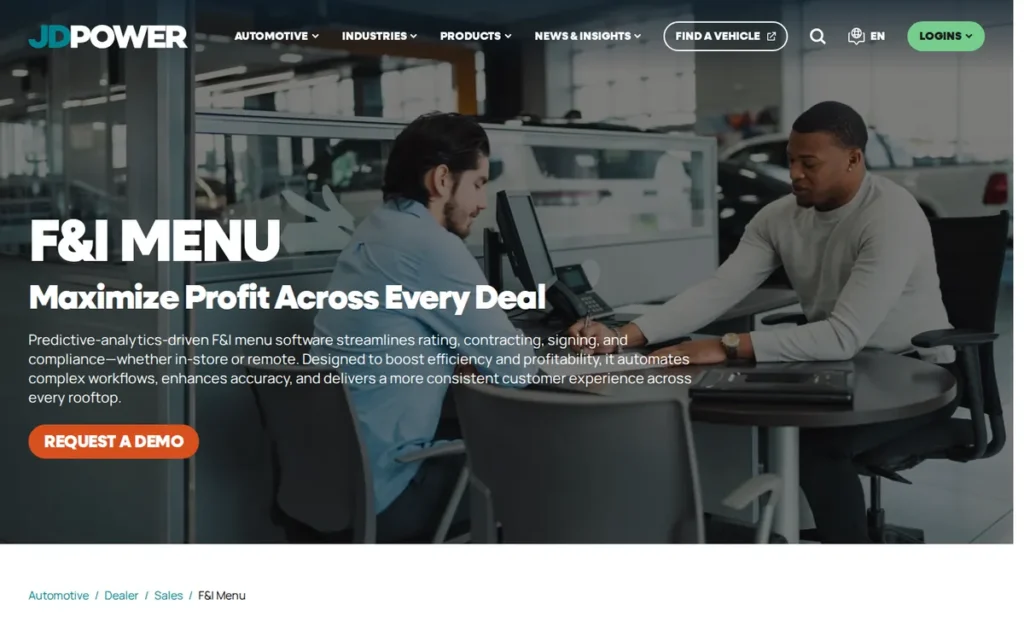
Category: F&I-First, digital retailing built around F&I product presentation, menu selling and compliance.
At a Glance
- Category: F&I-First
- Best For: Franchise stores and groups focused on back-end PVR, F&I penetration, menu compliance and service-lane F&I
- Price Range: $995 package plus $495 one-time setup through the Kia Digital Program (billing period unstated; otherwise quote-based; November 2026)
- Primary Strength: Darwin Automotive’s prescriptive engine uses 100+ data points to personalize F&I menus online and in-store.
- Biggest Limitation: Darwin Automotive routes credit through Dealertrack and RouteOne rather than its own decisioning, and it has no verified independent reviews.
- One-Line Summary: Darwin Automotive, owned by J.D. Power since 2021, is the only F&I-first digital retailing platform in PlugRoute’s 2026 ranking, used by 7,700+ dealers in 2021 for prescriptive menu selling and compliance.
- Last Verified: November 2026
Scores: C1 3 · C2 4 · C3 4 · C4 2 · C5 4 · C6 4 · Weighted: 3.45
Overview
Darwin Automotive is an F&I-first digital retailing platform owned by J.D. Power. Its patented prescriptive engine personalizes F&I menus online, at the desk and in the service lane, and it is built for franchise dealers who prioritize back-end PVR and compliance.
Darwin Automotive also offers remote desking through Virtual Deal Maker. J.D. Power acquired Darwin Automotive on July 7, 2021 (Auto Remarketing, 2021; third-party).
Key Features
- Darwin Automotive’s prescriptive-selling engine uses 100+ data points, including vehicle, deal structure, credit, driving patterns and geography, to choose which F&I products to show and in what order (VendorMotive, 2026; third-party).
- Darwin Automotive includes Darwin Select for online F&I, a Finance Menu, a Service Menu for service-lane F&I and Virtual Deal Maker for remote desking.
- Darwin Automotive includes eContracting and compliance checks such as OFAC screening, Form 8300 and recall checks.
- Darwin Automotive integrates with CDK and provides the menu functionality inside Dealertrack, with credit routed through Dealertrack and RouteOne (VendorMotive, 2026; third-party).
- Darwin Automotive’s Kia program package lists desking, incentives, DMS integration, e-contracting, trade evaluation, payment shopping and F&I prescriptive selling (Kia Digital Program, accessed November 2026; third-party).
Best For
Darwin Automotive is best for franchise dealers and groups whose main goal is raising F&I penetration and per-vehicle back-end profit while keeping menu presentation consistent and compliant.
Strengths
- Darwin Automotive served 7,700+ dealers in 2021 and was involved in about one-third of U.S. new-vehicle transactions when J.D. Power acquired it (Auto Remarketing, 2021; third-party).
- Darwin Automotive’s digital retail package is listed at $995 plus a one-time $495 setup fee in the Kia Digital Program. That is the most specific public price for an F&I-led platform in this group (Kia Digital Program, accessed November 2026; third-party).
- Darwin Automotive was rolled out group-wide at Sonic Automotive and Group 1 Automotive (Digital Dealer, 2017; third-party).
- Darwin Automotive was named a 2019 Automotive News All-Star for F&I and reports OEM certifications with Ford, Audi, Kia, Subaru and Volvo (Darwin Automotive, accessed November 2026; vendor-reported).
Limitations
Darwin Automotive’s most consequential trade-off is credit depth. Darwin Automotive is a weaker full consumer deal builder than the finance-first tools, because credit runs through Dealertrack and RouteOne rather than through its own decisioning.
- Darwin Automotive’s prescriptive recommendations depend on clean deal data, and configuration and staff training can take significant effort.
- Darwin Automotive has no verified independent reviews as of November 2026, and the DealerRefresh forum has no firsthand dealer accounts of its F&I results (DealerRefresh, accessed November 2026; user-reported).
- Darwin Automotive’s Kia program price has no stated billing period and may be subsidized, so stores outside the Kia program need their own quote.
- Darwin Automotive’s adoption figures date from 2017–2021, and a 9,000+ dealer claim in one vendor profile is uncorroborated (VendorMotive, 2026; unverified).
Users on r/CarSalesTraining noted:
“Practice. Practice. Know your DMS and menu software. Know how to change the pricing quicka and show customers the menu.” Posted by u/q_ali_seattle
Takeaway: Darwin Automotive’s prescriptive menus only pay off when F&I managers are fluent enough in their DMS and menu software to adjust pricing in front of the customer, which makes staff training part of the purchase.
Verdict
Darwin Automotive is the only F&I-first platform in this ranking and the best fit for dealers whose priority is back-end PVR and compliant menu selling.
Darwin Automotive ties Gubagoo at 3.45 but ranks #4 because it scores lower on end-to-end deal continuity (C1: 3 vs. 4). Stores that need native credit decisioning should pair Darwin Automotive with a finance-first tool, or confirm how it works with their Dealertrack or RouteOne setup.
5. AutoFi: Best for Lender Routing and Real Credit Decisions Online

Category: Finance-First, digital retailing built around credit decisioning, lender connectivity and payment accuracy.
At a Glance
- Category: Finance-First
- Best For: Stores whose biggest bottleneck is online financing: approvals, lender routing and payments based on real credit decisions
- Price Range: Pricing on request (per-rooftop SaaS subscription; no public figures as of November 2026)
- Primary Strength: AutoFi routes soft-pull credit applications to 40+ national lenders and returns real decisions in about 90 seconds, according to vendor case studies.
- Biggest Limitation: AutoFi has no verified independent reviews and no published pricing, so dealers must rely on vendor-reported results.
- One-Line Summary: AutoFi is the platform in PlugRoute’s 2026 ranking with the largest documented national lender network (40+ lenders, vendor-reported), returning real credit decisions inside an online-to-showroom deal flow.
- Last Verified: November 2026
Scores: C1 4 · C2 3 · C3 5 · C4 2 · C5 2 · C6 3 · Weighted: 3.40
Overview
AutoFi is a finance-first digital retailing platform. Shoppers shop by payment after a soft credit pull, and AutoFi routes their applications to 40+ national lenders. It is built for dealers whose online deals stall on financing, approvals or lender coverage.
AutoFi also offers white-label commerce for OEMs and lenders. AutoFi has raised $137 million across seven rounds, most recently a Series B in March 2022 (VendorMotive, 2026; third-party).
Key Features
- AutoFi lets shoppers shop by payment after a soft credit pull, so quotes reflect their actual credit rather than generic tiers.
- AutoFi’s Intelligent Lender Routing sends applications to 40+ national lenders and returns real decisions, which case studies describe as taking about 90 seconds (AutoFi, accessed November 2026; vendor-reported).
- AutoFi’s showroom tools cover deal estimation, desking, lender routing and F&I menus, and they sit between the dealer’s CRM and DMS.
- AutoFi values trade-ins using Kelley Blue Book data inside the deal flow.
- AutoFi offers white-label commerce for OEMs, captives, lenders and marketplaces.
Best For
AutoFi is best for franchise and larger independent dealers whose online deals break down at financing and who want real lender decisions and accurate payments before the customer arrives.
Strengths
- AutoFi’s early showroom users cut deal time from about 90 minutes to under 30, reached approval rates near 80% and added more than $400 in back-end PVR (Digital Dealer, accessed November 2026; vendor-reported). VendorMotive puts manual-submission approval rates at about 49% for comparison (VendorMotive, 2026; third-party).
- AutoFi’s self-service finance solution was rolled out with Santander Consumer USA to more than 13,000 dealers (Auto Dealer Today, accessed November 2026; third-party).
- AutoFi case studies report $911 more profit per deal and 48% more sales per salesperson at a California dealer. They also report $741 more PVR and 31% more sales per salesperson at a Hyundai dealer (AutoFi, accessed November 2026; vendor-reported).
- AutoFi handled more than 75% of sales at Matt Blatt, whose Matt Greenblatt called it a “win-win” (Digital Dealer, accessed November 2026; vendor-reported).
Limitations
AutoFi’s most consequential trade-off is evidence quality. Almost all of AutoFi’s performance evidence is vendor-reported: G2 shows 0 reviews, and there is no verified Capterra or DrivingSales presence (G2, accessed November 2026; third-party).
- AutoFi has no named DMS or CRM integration list that PlugRoute could verify, which matters for stores trying to eliminate re-keying.
- AutoFi publishes no pricing. It sells a per-rooftop SaaS subscription with no public dollar figures (VendorMotive, 2026; third-party).
- An anonymous Indeed employee review of AutoFi alleges high turnover and layoffs, a vendor-stability question worth raising (Indeed, accessed November 2026; unverified).
- AutoFi’s OEM and captive partner list is only partly confirmed by sources.
Verdict
AutoFi is the best fit in PlugRoute’s 2026 ranking for dealers whose online deals fail at financing, because it pairs soft-pull payments with routing to 40+ lenders for real decisions.
AutoFi ranks #5, just 0.05 points behind the #3/#4 tie, because its integration list, independent reviews and pricing are unverified or unpublished. Dealers should ask AutoFi for named references and test the deal handoff into their own DMS.
6. Roadster (CDK Digital Retail): Best for CDK Stores Needing Shared Workflows
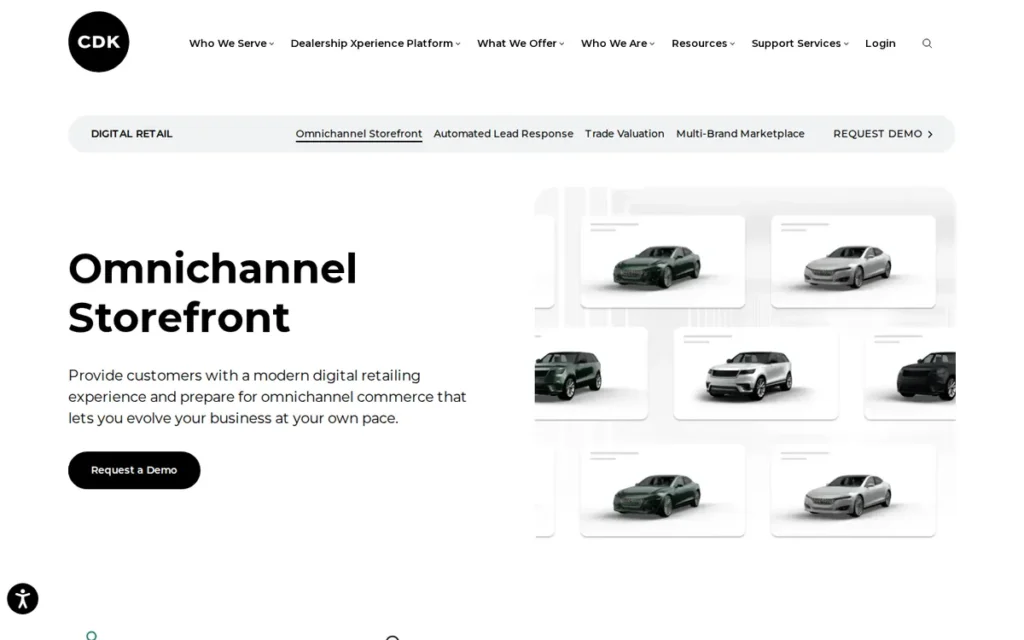
Category: Ecosystem Suite, digital retailing bundled with the vendor’s own website, credit, CRM and DMS products.
At a Glance
- Category: Ecosystem Suite
- Best For: Franchise stores and multi-rooftop groups on CDK that want one deal workflow shared by online shoppers and showroom tablets
- Price Range: Pricing on request (quote-based through CDK; not published as of November 2026)
- Primary Strength: Roadster Express Storefront uses one deal workflow online and on showroom tablets, so deals continue in either direction without re-entry.
- Biggest Limitation: Roadster has no verified independent reviews and fits best inside CDK, which raises ecosystem-concentration risk.
- One-Line Summary: Roadster, now sold as CDK Global’s Digital Retail and Express Storefront, is an ecosystem option for CDK dealers that shares one deal workflow across online shopping and showroom tablets.
- Last Verified: November 2026
Scores: C1 5 · C2 3 · C3 3 · C4 1 · C5 1 · C6 4 · Weighted: 3.10
Overview
Roadster (CDK Digital Retail) is an omnichannel platform, now sold as CDK Global Digital Retail and Express Storefront. Shoppers build deals online while showroom staff use the same workflow on tablets, and it is built for CDK franchise stores and dealer groups.
CDK completed its acquisition of Roadster on June 2, 2021 (CDK Global, 2021; vendor-reported). Roadster was founded in 2013 in Palo Alto (Auto Remarketing, 2018; third-party).
Key Features
- Roadster Express Storefront lets shoppers browse new, CPO and used inventory and build a deal online with payments and finance options.
- Roadster Express Storefront lets shoppers select F&I and protection products, submit a soft-pull credit application and place a reservation deposit through EasyLink (CDK Global, accessed November 2026; vendor-reported).
- Roadster runs the same deal workflow on showroom tablets, so a deal started online continues in-store, and the reverse.
- Roadster Express Trade centralizes trade-in valuations across stores, and Roadster Express Marketplace creates regional inventory microsites for dealer groups.
- Roadster routes financing through RouteOne or Dealertrack rather than a built-in lender network (VendorMotive, 2026; third-party).
Best For
Roadster (CDK Digital Retail) is best for CDK-stack franchise dealers and multi-brand dealer groups that want a shared online-and-showroom deal workflow and regional marketplace inventory.
Strengths
- Roadster ran OEM digital retail programs covering all 386 U.S. Mercedes-Benz, Sprinter and smart stores, plus programs covering 1,243 Toyota and 240 Lexus stores (Auto Remarketing, 2018–2019; third-party).
- Roadster was one of four certified Lexus digital retail partners (Auto Remarketing, 2018; third-party).
- Roadster’s named customers include Longo Toyota (Penske), Lithia Motors and Paragon Honda/Acura (CDK Global, accessed November 2026; vendor-reported).
- Roadster reports about 70% better deal efficiency, twice the online engagement and an NPS of +85. These are marketing claims that have not been independently verified (VendorMotive, 2026; vendor-reported).
Limitations
Roadster’s most consequential trade-off is CDK concentration. Roadster’s continuity is strongest inside CDK, so dealers on a non-CDK DMS or CRM face harder integration, and CDK-native buyers take on single-vendor risk.
- Roadster buyers share CDK’s vendor-concentration risk. CDK took systems offline during its June 2024 cyberattack and later reported restoring Digital Retail relatively quickly, but no public report details Roadster’s specific impact (The Register, 2024; third-party).
- Roadster has no verified independent reviews as of November 2026, and PlugRoute found no dealer-named case study with verifiable percentages.
- Roadster publishes no pricing; CDK quotes it individually, and VendorMotive lists it as “not published” (VendorMotive, 2026; third-party).
- Roadster’s financing depends on RouteOne or Dealertrack, and its OEM program figures date from 2018–2019.
A dealership employee on r/BRZ_ZD8 shared their experience during the June 2024 outage:
“My dealership is affected, and I want to die. Its been 3 days and everything I’ve done in that time will have to be re–done when its back up.” Posted by u/Caseylikesit
Takeaway: The 2024 CDK outage showed that Roadster (CDK Digital Retail) buyers inherit CDK’s single-vendor risk, where one incident can freeze a store and force days of work to be redone.
Verdict
Roadster (CDK Digital Retail) gives CDK dealers and multi-rooftop groups one deal workflow shared across online shopping and showroom tablets.
Roadster ties for the top continuity score (C1: 5). It falls to #6 mainly because of missing evidence, with low scores for independent reviews (C4: 1) and pricing transparency (C5: 1). CDK stores should weigh the handoff benefits against vendor-concentration risk and get exit terms in writing.
7. CarNow: Best for Value-Focused Dealers Wanting Chat Plus Retailing on Any Stack
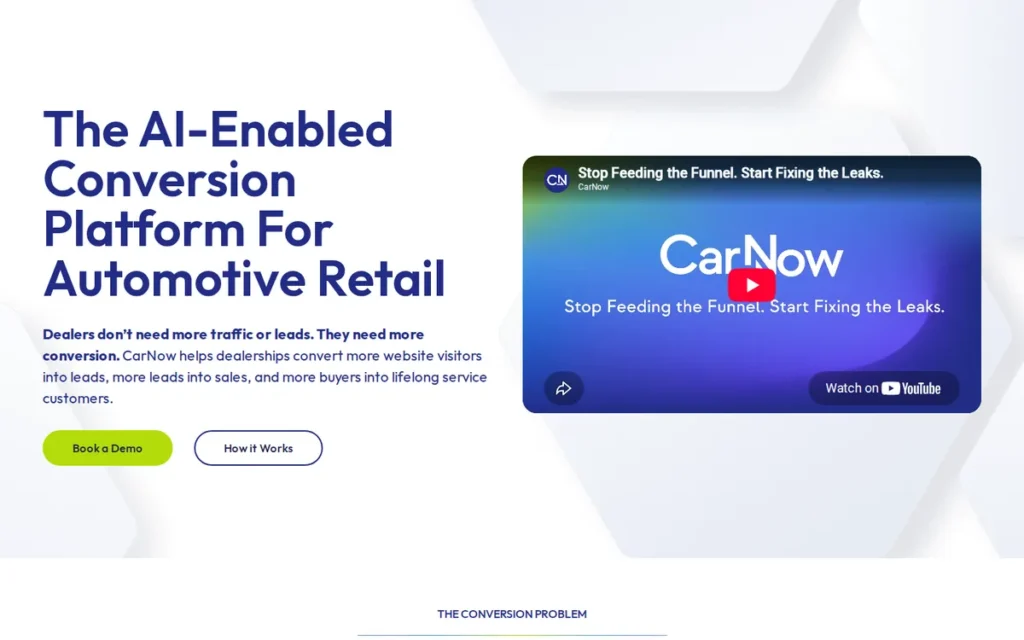
Category: Chat-Led, digital retailing where live or AI-assisted conversation guides the shopper into the deal builder.
At a Glance
- Category: Chat-Led
- Best For: Independent and value-focused franchise dealers who want chat, payment shopping and pre-qualification without being tied to one ecosystem
- Price Range: Pricing on request (quote-based; no public figures as of November 2026)
- Primary Strength: CarNow pairs AI and 24/7 staffed live chat with Search by Payment, trade-in, soft-credit pre-qualification and a BuyNow deal flow across many dealer stacks.
- Biggest Limitation: CarNow’s independent review base is only four G2 reviews, and users report incomplete integrations and complex daily navigation.
- One-Line Summary: CarNow is the chat-led digital retailing platform in PlugRoute’s 2026 ranking with the clearest independent-dealer package, combining 24/7 staffed chat with payment shopping and pre-qualification across many dealer stacks.
- Last Verified: November 2026
Scores: C1 4 · C2 3 · C3 3 · C4 2 · C5 1 · C6 3 · Weighted: 2.90
Overview
CarNow is a chat-led digital retailing platform. It pairs AI chat and a 24/7 staffed automotive BDC with Search by Payment, trade-in forms, soft-credit pre-qualification and a BuyNow flow, and it is aimed at independent and value-focused dealers who want to avoid ecosystem lock-in.
CarNow also markets Conversion+, a simplified package for independent dealers that AutoSuccess trade press has covered (CarNow, accessed November 2026; vendor-reported). PlugRoute could not verify CarNow’s founding date, headquarters or funding.
Key Features
- CarNow combines AI chat with live chat staffed by a 24/7 automotive BDC team, plus text and video conversations.
- CarNow’s Search by Payment lets shoppers browse inventory by monthly payment, and CarNow sells it as an add-on in some packages.
- CarNow includes trade-in forms, soft-credit pre-qualification and a BuyNow deal flow.
- CarNow lists connections to Dealertrack, RouteOne, CDK, DriveCentric, AppOne, CUDL, KBB, vAuto and Xtime (VendorMotive, 2026; third-party).
Best For
CarNow is best for independent dealers and value-focused franchise stores that want staffed chat and payment-led shopping on top of their existing DMS and CRM rather than a new ecosystem.
Strengths
- CarNow holds a 5.0 out of 5 rating on G2 from 4 reviews. Reviewers praise real-time visitor visibility, AI lead capture, 24/7 monitoring and a short learning curve (G2, accessed November 2026; user-reported).
- CarNow is eligible for the Kia EasyBuy, Nissan Digital Retailing and Stellantis co-op programs (VendorMotive, 2026; third-party).
- CarNow’s case study of an unnamed Chevrolet/GMC dealer reports results after the dealer consolidated onto CarNow. The close rate rose from 8.9% to 18.0%, and total gross rose from $16,358 to $50,296 (CarNow, accessed November 2026; vendor-reported).
- CarNow’s Conversion+ package for independent dealers bundles live chat, a payment calculator, appointment scheduling, pre-qualification and trade-in tool integrations such as TradePending and KBB (CarNow, accessed November 2026; vendor-reported).
Limitations
CarNow’s most consequential trade-off is integration completeness. A CarNow reviewer on G2 reported that “the integrations… are not all there,” which undercuts CarNow’s goal of removing re-keying (G2, accessed November 2026; user-reported).
- A CarNow reviewer on Capterra said staff found the tool too complicated for high-volume daily communication and that the store switched to a simpler tool (Capterra, accessed November 2026; user-reported).
- CarNow’s G2 feedback notes that some agents close chats too early (G2, accessed November 2026; user-reported).
- CarNow’s 5.0 rating rests on only four reviews, and its case studies name no store and use small unit counts.
- CarNow publishes no pricing, although a G2 reviewer described it as a great tool “for an even better price” (G2, accessed November 2026; user-reported).
Verdict
CarNow is the chat-led digital retailing option in PlugRoute’s 2026 ranking with the clearest independent-dealer package, combining staffed 24/7 chat with payment shopping and pre-qualification across many dealer stacks.
CarNow ranks #7 because its independent evidence is the thinnest in the group and users report integration gaps. Independents should demo CarNow alongside at least one other cross-stack option and confirm live integrations with their own DMS and lenders.
Why Don’t Online Payment Quotes Match the Desk?
Online payment quotes usually stop matching desked numbers because the website and the desk calculate the deal from different inputs. As of November 2026, PlugRoute found no vendor in this ranking that publishes how often its online payments match the desk. Dealers have to test it themselves.
The most common causes of payment drift are:
- Rate tables: A website that uses generic APR tiers will drift from a desk that uses actual lender buy rates plus dealer reserve.
- Tax and fee calculation: A website that estimates taxes, doc fees, and registration and title fees differently from the DMS will produce a different payment.
- Rebates and incentives: An OEM incentive that applies online but fails eligibility checks at the desk changes the final number.
- Trade re-appraisal: An online trade estimate that the used-car manager re-appraises in person shifts the amount financed.
- Credit-tier changes: A soft-pull or self-reported credit tier that changes after a hard pull alters the rate.
- Lease inputs: A website using generic residuals or money factors will drift from the desk’s captive lease program.
- Chat agent promises: A chat agent who implies a firm payment creates an expectation the desk may not be able to honor.
As one shopper on r/askcarsales described:
“For instance, my budget might be 27k, and those cars have an e-price on the website of 23-25k but the MSRP is 27k. I would like to avoid going to the dealership and found out that the final price for any of those cars is above 27k because the web site did not show dealer fees or because the price considered rebates or discounts I might not be eligible for.” Posted by u/Many-Trifle-9518
Takeaway: Website prices that leave out dealer fees or assume rebates the buyer may not qualify for are a core reason automotive digital retailing quotes lose shopper trust before the deal reaches the desk.
Each cause can become a demo test. Run one real deal through both the online tool and your desk, and compare the two payments line by line.
In automotive digital retailing, a payment quote is only as trustworthy as the calculation engine behind it. Cox Automotive reports that 97% of dealers say customers often have to repeat steps (Cox Automotive, 2025; vendor-reported). Continuity problems are still common across the category.
What Red Flags Should I Watch For When Evaluating Automotive Digital Retailing Software?
The biggest red flags when evaluating automotive digital retailing software are claims and contract terms that hide real performance or real cost. Six warning signs come up again and again in this category. Each one below includes the evidence PlugRoute found in the seven ranked platforms, so dealers can raise it directly in a vendor demo.
Red Flag #1: Unlabeled Vendor Metrics
A conversion or close-rate figure is a red flag when it has no stated source, sample size or time period, because nearly every performance number in this category is vendor-reported. Ask whether the figure came from a vendor-run test and whether the dealer can be named.
Cox Automotive’s analysis of more than 20 million leads found a 76% showroom-visit rate for leads with a deal built, against 52% for other leads, and Cox labels this correlation (Cox Automotive, 2026; vendor-reported). Shoppers who build deals may already be more serious buyers.
Red Flag #2: Ratings Without Review Counts
A 5.0 rating means little without the number of reviews behind it and the product those reviews cover. CarNow’s 5.0 G2 rating rests on four reviews. Cox Automotive Digital Retailing’s 35 Capterra reviews cover the whole Dealer.com platform rather than the retailing tool alone.
One new one-star review would lower CarNow’s average by about 0.8 points but would barely move a 35-review average.
Red Flag #3: Quote-Only Pricing With No Fee Breakdown
Quote-only pricing becomes a red flag when the vendor won’t itemize every fee line. Only two of the seven ranked platforms have any public price, and neither vendor publishes it: Upstart Auto Retail’s price appears on G2 and Darwin Automotive’s in a Kia program document.
Every written quote should itemize these fee lines:
- Setup and implementation fees should appear as a separate line in every written quote.
- Per-rooftop subscription fees should state exactly which modules and tablets they include.
- Integration, API and credit-application fees should be listed for each DMS, CRM and lender connection.
- Per-lead, managed-chat staffing and OEM program fees should be itemized wherever they apply.
- Contract term, auto-renewal and cancellation or exit fees should be written into the contract.
Red Flag #4: Payment Estimates Not Tied to Real Credit or Rate Tables
Online payments built on generic credit tiers are a red flag, because rate-table and credit-tier mismatches are among the most common reasons quotes break at the desk. Look for soft-pull decisions, such as AutoFi and Roadster (CDK Digital Retail) offer, or real lender rate tables, and ask to see them in a live demo.
Red Flag #5: Single-Vendor Dependence With No Exit Terms
Putting every dealership system with one vendor is a red flag if the contract has no clear exit terms or data-export process. After CDK’s June 2024 cyberattack, a dealer on Reddit predicted that many dealers “will value compartmentalization in the future” (r/askcarsales, 2024; user-reported).
Red Flag #6: Integrations Listed but Not Live for Your Rooftop
An integration logo is a red flag until the vendor shows two-way data working on your specific DMS and CRM. A CarNow reviewer on G2 reported that “the integrations… are not all there” (G2, accessed November 2026; user-reported). PlugRoute also could not verify a named integration list for AutoFi.
What Questions Should I Ask Before Choosing Automotive Digital Retailing Software?
Before choosing automotive digital retailing software, ask each vendor questions that force proof rather than promises. Each of the eight questions below includes what a strong answer looks like. Dealers can then score vendors side by side after running the same real deal through every demo.
Question #1: Can you run my real deal from website to desk with no re-entry?
A strong answer is a live demo built on your own deal scenario, with the same deal record appearing at the desk without re-entry. Sample deals prepared by the vendor do not prove continuity, so bring the demo checklist from this guide’s conclusion and insist on running it.
Question #2: What percentage of online payments match the final desked payment, and how do you measure it?
A strong answer includes a measured payment-match rate and a stated method. PlugRoute found no vendor in this ranking that publishes one as of November 2026. An honest “we don’t track it” is better than an unsupported accuracy claim.
Question #3: Which of my DMS, CRM and lender integrations are live and two-way today?
A strong answer names each DMS, CRM and lender connection, says whether data writes back, and points to a current customer on the same stack. Planned or roadmap integrations should be listed separately in the contract so the vendor cannot count them as live.
Question #4: What is the three-year total cost, including setup, integration, per-lead and cancellation fees?
A strong answer is an itemized written quote covering every fee line in Red Flag #3, plus auto-renewal terms and exit costs. Compare every vendor over the same three-year period, because one-time fees change the total, such as the $599 setup fee G2 lists for Upstart Auto Retail.
Question #5: Which OEM programs am I eligible for, and does co-op reduce my cost?
A strong answer lists each certified OEM program and shows whether co-op funds or subsidies apply. Darwin Automotive’s Kia Digital Program price of $995 plus $495 setup shows how far OEM-program pricing can differ from a direct quote (Kia Digital Program, accessed November 2026; third-party).
Question #6: Can I speak with three references on my DMS?
A strong answer is three named dealers on your DMS and CRM who will discuss staff adoption, support and payment accuracy. Vendor-selected testimonials are no substitute, because the vendors themselves published the testimonials PlugRoute reviewed for this ranking.
Question #7: How will you get my sales and F&I staff to use the tool?
A strong answer includes a written training plan, named adoption metrics and a dealer reference who can describe the rollout. Users have reported complexity problems with both CarNow and Dealertrack, so adoption risk applies to every tool in this category, including well-reviewed ones.
Question #8: Do I need a digital retailing module or a full platform replacement?
Most dealers should add a digital retailing module that integrates with their current DMS before replacing the platform. Replacing a DMS is a major, disruptive project, as r/askcarsales users noted after the 2024 CDK outage. Replace the platform only if your DMS cannot support two-way write-back.
How Did We Rank These Automotive Digital Retailing Platforms?
PlugRoute scored seven dedicated automotive digital retailing platforms from 1 to 5 on six weighted criteria, using dated, source-labeled research checked in November 2026. Deal continuity carries the most weight at 25%. Ties are broken on that same continuity score, and the volume of vendor marketing material never raises any score.
The ranking criteria and weights are:
- C1: Deal-Journey Coverage and Continuity (25%): C1 measures payments, trade-in, real credit decisions, F&I, reservations and in-store continuation, because 63% of buyers prefer hybrid buying (Cox Automotive, 2025; vendor-reported).
- C2: DMS/CRM Integration and Write-Back (20%): C2 measures named connections and write-back, because 69% of retailers call re-keying a major issue (Keyloop/OC&C, accessed November 2026; third-party). C2 caps at 4 for integration that works only inside one ecosystem.
- C3: Finance, Lender and F&I Depth (20%): C3 measures lender routing, soft-pull support, credit-first and pencil-first selling, F&I menus and compliance checks, because these drive payment accuracy at the desk.
- C4: Independent Evidence Quality (15%): C4 measures third-party review volume and scope, awards and named-dealer evidence, because dealers struggle to tell marketing from performance.
- C5: Pricing Transparency (10%): C5 scores 5 for a public per-rooftop price, 4 for a public price in an OEM context, 2 for a described pricing model and 1 for quote-only pricing, because hidden fees obscure total cost.
- C6: Adoption and OEM Presence (10%): C6 measures dated dealer counts and OEM programs, because franchise stores need program eligibility.
Only 32% of dealers say their digital retailing tools give customers a good experience, yet 77% say the tools meet their goals (Cox Automotive, 2024–2025; vendor-reported). PlugRoute weights hybrid continuity at 25% to address that gap.
| Rank | Platform | C1 | C2 | C3 | C4 | C5 | C6 | Weighted |
|---|---|---|---|---|---|---|---|---|
| 1 | Upstart Auto Retail | 5 | 4 | 5 | 4 | 5 | 3 | 4.45 |
| 2 | Cox Automotive Digital Retailing | 5 | 4 | 5 | 4 | 2 | 5 | 4.35 |
| 3 | Gubagoo | 4 | 4 | 3 | 3 | 1 | 5 | 3.45 |
| 4 | Darwin Automotive | 3 | 4 | 4 | 2 | 4 | 4 | 3.45 |
| 5 | AutoFi | 4 | 3 | 5 | 2 | 2 | 3 | 3.40 |
| 6 | Roadster (CDK Digital Retail) | 5 | 3 | 3 | 1 | 1 | 4 | 3.10 |
| 7 | CarNow | 4 | 3 | 3 | 2 | 1 | 3 | 2.90 |
Gubagoo and Darwin Automotive tied at 3.45. Gubagoo ranks #3 because its C1 score (4) is higher than Darwin Automotive’s (3). CarNow’s C5 score of 1 follows the published rubric for quote-only pricing, the same score Gubagoo and Roadster receive.
Evidence matrix (checked November 2026):
| Rank | Company | Finance Model | Public Pricing Status | Independent Review Status | Documented OEM Programs |
|---|---|---|---|---|---|
| 1 | Upstart Auto Retail | Embedded Upstart lender plus multi-lender offers | $599/rooftop/month + $599 one-time setup (G2, Nov 2026; negotiated) | G2 4.8/5, 34 reviews | No named OEM certifications verified; dealers of 33 brands (2021, vendor-reported) |
| 2 | Cox Automotive Digital Retailing | Dealertrack lender network | Quote-based, tiered | Capterra 4.2/5, 35 reviews (whole Dealer.com platform) | 30+ endorsing OEMs (vendor-reported) |
| 3 | Gubagoo | Real-time lender approvals in Virtual Retailing | Quote-only | G2 4.3/5, 13 reviews | About two dozen, incl. GM, JLR (vendor-reported) |
| 4 | Darwin Automotive | Routes via Dealertrack, RouteOne | $995 + $495 setup (Kia program) | No verified reviews | Ford, Audi, Kia, Subaru, Volvo (vendor-reported) |
| 5 | AutoFi | 40+ national lenders | Per-rooftop model, no figures | G2: 0 reviews | Partner list partly confirmed |
| 6 | Roadster (CDK Digital Retail) | Routes via RouteOne, Dealertrack | Quote-only | No verified reviews | Mercedes-Benz, Toyota, Lexus (2018–2019) |
| 7 | CarNow | Soft-credit pre-qualification; routes via Dealertrack, RouteOne, AppOne, CUDL (VendorMotive, 2026) | Quote-only | G2 5.0/5, 4 reviews | Kia EasyBuy, Nissan, Stellantis co-op |
The inclusion, lineage and disclosure rules are:
- Merged entry: PlugRoute merged Dealer.com Accelerate My Deal and Dealertrack Digital Retailing into one Cox Automotive Digital Retailing entry because Cox sells them as one stack.
- Lineage: Three products changed names or owners in 2021. Roadster became CDK Digital Retail, Darwin Automotive became part of J.D. Power, and Upstart Auto Retail was renamed from Prodigy.
- Exclusions: PlugRoute excluded DMS-first platforms such as Tekion, CDK DMS and DealerCenter because their reviews cover the DMS. Dealers replacing their whole DMS should run a separate evaluation.
- Evidence labels: Every data point in this guide carries one of four labels: vendor-reported, third-party, user-reported or unverified.
- Data-source disclosure: Several market statistics in this guide come from Cox Automotive research. Cox is also a ranked vendor, and its studies did not influence its own criterion scores.
- Peer review: PlugRoute found no peer-reviewed studies of automotive digital retailing software, so dated industry and vendor research fills that role and is labeled accordingly.
PlugRoute has no affiliate relationships with any company listed. Rankings are determined entirely by research data and objective evaluation criteria.
What Do Dealers Most Often Ask About Automotive Digital Retailing Software?
Dealers most often ask which platform suits independent stores, which platform integrates best with their DMS, and how PlugRoute decides its rankings. Each answer below gives the direct answer first and points to the evidence in this guide. Dealers can then check the claim against the ranked entries and the methodology.
What is the best automotive digital retailing software for independent dealers?
Upstart Auto Retail is the best starting point for independent dealers in PlugRoute’s 2026 ranking, because it lists cross-stack integrations, strong finance tooling and the only publicly listed per-rooftop price ($599 per month plus $599 setup on G2). CarNow is the main alternative, with its Conversion+ package for independents. Evidence specific to independents is limited, so demo both.
Which automotive digital retailing software has the best DMS integration?
The best DMS integration depends on your existing stack. Cox Automotive Digital Retailing integrates most deeply with Dealertrack DMS, Roadster (CDK Digital Retail) with CDK, and Gubagoo with Reynolds ERA through a shared calculation engine (vendor-reported). Upstart Auto Retail and CarNow list the broadest cross-stack connections. Confirm two-way write-back for your rooftop.
How does PlugRoute determine its rankings?
PlugRoute ranks automotive digital retailing platforms by scoring each from 1 to 5 on six weighted criteria, with deal continuity weighted highest at 25%. Every data point is dated and labeled vendor-reported, third-party, user-reported or unverified. Vendor marketing volume never raises a score, and the full score table appears under “How Did We Rank These Automotive Digital Retailing Platforms?”
What Do Key Automotive Digital Retailing Terms Mean?
Automotive digital retailing terms describe how a deal moves from online pricing to a signed contract. The twelve definitions below cover the vocabulary dealers meet in vendor demos and contracts. Write-back matters most when comparing tools, because a tool that only reads DMS data still forces staff to re-key deals.
Desking: Desking is the process of structuring a deal’s price, payment, trade and financing at the sales manager’s desk. Desking matters because online deals that cannot reach the desk intact usually get rebuilt from scratch.
PVR (Per-Vehicle Retail): PVR is the average gross profit per vehicle sold, often split into front-end profit and back-end (F&I) profit. Vendors frequently report PVR gains, so buyers should ask how those gains were measured.
Soft Credit Pull: A soft credit pull checks a shopper’s credit without affecting their score. A soft pull lets online payments reflect real credit, which reduces surprises at the desk.
Lender Routing: Lender routing sends one credit application to several lenders and returns their decisions. More lenders and faster decisions generally mean more approvals, especially for buyers with thin credit files.
Buy Rate and Dealer Reserve: The buy rate is the interest rate a lender offers the dealer, and dealer reserve is the markup the dealer adds on top. A website that quotes generic rates instead of real buy rates is a common source of payment drift.
Credit-First vs. Pencil-First: Credit-first selling gets the credit approval before presenting numbers, while pencil-first selling presents numbers first. A tool that supports both lets a store keep its existing sales process.
Rehash: A rehash restructures an approved deal to find a better rate, term or lender. Automated rehash can improve both buyer terms and dealer gross.
F&I Menu: An F&I menu presents finance and insurance products, such as service contracts and GAP coverage, in a consistent format. Consistent menus support compliance and product penetration.
eContracting: eContracting lets the buyer sign retail installment contracts electronically and sends them to the lender. eContracting shortens final paperwork, which is where buyers who did most steps online save the most in-store time.
DMS (Dealer Management System): A DMS is the dealership’s core system for deals, accounting, inventory and service. A digital retailing tool’s value depends heavily on how cleanly it writes deals into the DMS.
Write-Back: Write-back means the retailing tool pushes deal data into the DMS or CRM rather than only reading from it. Without write-back, staff have to re-key data by hand.
OEM Program and Co-op: An OEM program certifies vendors for a manufacturer’s dealers and often includes co-op funding that offsets cost. OEM eligibility can change both which tools a franchise store may use and what the store pays.
Which Automotive Digital Retailing Tool Is Right for You?
Key Insights
- The right automotive digital retailing tool carries the same deal and payment from your website to your desk inside your current DMS, CRM and lender setup. Upstart Auto Retail ranks #1 overall in PlugRoute’s 2026 evaluation at 4.45.
- Upstart Auto Retail’s 0.10-point lead over Cox Automotive Digital Retailing rests on its G2-listed price, which outweighs Cox’s stronger OEM presence.
- Stack fit makes Cox Automotive Digital Retailing and Roadster (CDK Digital Retail) natural choices for Cox and CDK stores, but both carry lock-in and concentration risk.
- Almost all performance data in automotive digital retailing is vendor-reported. No platform in this ranking has more than 35 independent reviews, and the largest product-specific base is Upstart Auto Retail’s 34 on G2.
- As of November 2026, PlugRoute found no vendor in this ranking that publishes how often its online payments match the final desked payment.
- Hybrid buying dominates automotive retail: 63% of buyers prefer a mix of online and in-store steps, and only 7% bought fully online (Cox Automotive, 2025; vendor-reported).
Situational starting points by priority:
- Dealers whose priority is F&I profit should start with Darwin Automotive.
- Dealers whose bottleneck is approvals should start with AutoFi.
- Dealers whose shoppers want guidance should compare Gubagoo and CarNow.
- Dealers on Reynolds ERA should test Gubagoo’s shared calculation engine first.
- Dealers on a mixed stack or a tight budget should start with Upstart Auto Retail.
Use this same-scenario demo checklist with every vendor:
- Your store’s actual tax rate and doc fee should be loaded into the demo deal.
- One live OEM incentive should be applied to test the tool’s eligibility logic.
- One trade with a known actual cash value (ACV) should be appraised online and again at the desk.
- One prime and one sub-prime credit profile should be run through the lender workflow.
- A lease version and a finance version of the same deal should be priced to compare residuals and rates.
Digital retailing is likely to keep moving toward shared calculation engines and published accuracy data. Dealers who ask for that evidence now will be in the best position to negotiate.
Read PlugRoute’s full scoring methodology above, and see PlugRoute’s other independent dealership software reviews. We update this guide quarterly. Last updated: November 2026.