PyTorch is the best machine learning software for deep learning and LLM fine-tuning; scikit-learn is the definitive choice for classical ML on tabular data; Amazon SageMaker leads managed MLOps for AWS-native teams. Open-source frameworks cost nothing to license but require assembling a separate MLOps toolchain; managed platforms reduce DevOps overhead but introduce billing traps and vendor lock-in.
Choosing between a deep learning framework, an AutoML platform, and a managed cloud service is the central pain point for ML teams in 2026, options differ by orders of magnitude in cost, require fundamentally different infrastructure assumptions, and serve problem types that only partially overlap. Generic tool lists and vendor-sponsored comparisons rarely surface billing traps, automation ceilings, or adoption trajectory divergences that determine whether a tool actually works at your organization’s scale.
As one practitioner on r/learnmachinelearning described:
“How familiar do I actually need to be with tensorflow if I know pytorch (or vice versa)? What if I use a different framework like h2o.ai or mxnet, etc.? What if scikit-learn (probably +xgboost) has been good enough for my organization this entire time? I don’t think there any absolutely ‘need to know’ libraries in ML. ML itself is the tool we share to solve problems.” Posted by u/xubu42, r/learnmachinelearning, 2020
Takeaway: ML framework selection remains genuinely uncertain even for experienced practitioners, the absence of a universally applicable tool hierarchy is precisely what makes evidence-based, use-case-specific comparison valuable.
PlugRoute has no affiliate relationships with any company listed. Rankings are determined entirely by research data and objective evaluation criteria.
TL;DR: Top Picks at a Glance
- PyTorch is the best deep learning framework for research and production neural networks, recording 29 million monthly PyPI downloads and powering over 70% of AI research implementations in 2024 (PyTorch Foundation, 2024, self-reported), with a free BSD license and the richest LLM fine-tuning ecosystem via Hugging Face Transformers.
- Scikit-learn is the definitive library for classical machine learning on tabular and structured data, with over 200 million monthly PyPI downloads, a consistent Estimator API across 100-plus algorithms, and zero licensing cost under BSD license.
- Amazon SageMaker is the most evidence-backed managed MLOps platform for AWS-native teams, earning a verified G2 rating of 4.2/5 from 48 enterprise reviewers (April 2026) and providing a full lifecycle stack from data labeling to production drift monitoring, with documented billing traps requiring strict resource management habits.
- Google Vertex AI is the most feature-rich cloud ML platform for GCP-native teams, providing curated access to over 200 foundation models including Gemini and Claude alongside native TPU training and AutoML, though community-verified documentation gaps impose disproportionate engineering overhead for custom and non-standard workloads.
- TensorFlow is the most mature framework for mobile and edge deployment via LiteRT and for large-scale production pipelines via TFX, with 181,000 GitHub stars and active Google production use, but Windows GPU support was dropped with version 2.11 in late 2022, and new-project adoption trails PyTorch across every measured dimension in 2026.
- H2O.ai is the leading AutoML platform for regulated industries and government organizations, achieving full FedRAMP High Authorization on April 16, 2026 (Product ID FR2521554684) and supporting fully air-gapped on-premises installation, capabilities that no competing AutoML platform currently matches.
- DataRobot is the fastest path from raw tabular data to compliance-documented production predictions for Fortune 500 enterprises with limited ML engineering headcount (with built-in SHAP explainability for regulatory compliance) at $50,000–$250,000+ annually with no public pricing (Vendr market data, 2025).
What Are the 4 Categories of Machine Learning Software?
Machine learning software in 2026 falls into four primary categories: Deep Learning Frameworks, Classical ML Libraries, Managed Cloud ML Platforms, and AutoML Platforms. The category determines cost structure, infrastructure requirements, and appropriate problem types before any feature comparison is relevant, evaluating tools without first establishing category is the most common source of ML software selection confusion.
The four categories and the tools that fall within each:
- Deep Learning Frameworks (PyTorch, TensorFlow) are open-source libraries for building and training custom neural network architectures, best for research-aligned teams and custom model development, with zero licensing cost but requiring a separate MLOps toolchain for production deployment.
- Classical ML Libraries (Scikit-learn) are open-source Python toolkits for classification, regression, clustering, and preprocessing on structured and tabular data, the foundational toolkit for the majority of real-world ML workloads, with zero licensing cost and CPU-based computation.
- Managed Cloud ML Platforms (Amazon SageMaker, Google Vertex AI) are fully managed cloud services covering the complete ML lifecycle including training, deployment, and monitoring, reducing DevOps overhead with pay-per-use billing, at the cost of vendor lock-in and billing complexity.
- AutoML Platforms (H2O.ai, DataRobot) are automated model development systems that handle feature engineering, algorithm selection, and deployment from raw tabular data, best for organizations without large data science teams, at enterprise pricing tiers with varying degrees of transparency.
How Do the Top Machine Learning Software Tools Compare at a Glance?
The seven tools below span four categories and a cost range from zero licensing fees to $250,000-plus annually. This table summarizes each tool’s category, primary use case, one-line positioning, key capabilities, primary strength, and most consequential limitation, enabling a rapid shortlist before the detailed entries that follow.
| Rank | Company | Category | Best For | One-Line Summary | Key Capabilities | Primary Strength | Key Limitation |
|---|---|---|---|---|---|---|---|
| 1 | PyTorch | Deep Learning Framework | Deep learning, LLM fine-tuning, research paper implementation | PyTorch is the dominant deep learning framework for research and production in 2026, recording 29M monthly PyPI downloads and powering over 70% of AI research implementations. | Dynamic computation graphs, torch.compile, Hugging Face integration, TorchServe, ONNX export, FSDP distributed training | Over 70% of AI research implementations use PyTorch (PyTorch Foundation, 2024); 29M monthly downloads surpassing TensorFlow | No native experiment tracking, model registry, or managed serving infrastructure included |
| 2 | Scikit-learn | Classical ML Library | Classical ML on tabular and structured data across all experience levels | Scikit-learn is the foundational Python ML library with 200M+ monthly downloads and a consistent Estimator API across 100+ algorithms. | Unified Estimator API, Pipeline object, cross-validation suites, preprocessing transformers, Cython-optimized algorithms, SHAP library compatibility | 200M+ monthly PyPI downloads; consistent API across 100+ algorithms; one of the most-cited tools in research literature (JMLR, 2011) | No GPU acceleration, no deep learning support, no built-in distributed computing |
| 3 | Amazon SageMaker | Managed MLOps Platform | AWS-native teams needing end-to-end MLOps without Kubernetes overhead | Amazon SageMaker is the most evidence-backed managed MLOps platform, with a verified G2 rating of 4.2/5 from 48 enterprise reviewers. | HyperPod fault-tolerant training, Pipelines CI/CD, multi-model endpoints, shadow deployments, JumpStart model catalog | Full lifecycle MLOps; HyperPod achieves up to 95% training goodput with under-2-minute fault recovery on large GPU clusters | Billing traps: Canvas and Studio sessions bill continuously after logout unless explicitly stopped |
| 4 | Google Vertex AI | Cloud ML Platform | GCP teams needing Gemini API and 200+ foundation models alongside AutoML | Google Vertex AI is the most feature-rich cloud ML platform for GCP-native teams, offering 200+ foundation models and native TPU v5p training. | Model Garden (200+ foundation models), native TPU v5p access, BigQuery ML integration, Vertex Pipelines, Feature Store | Largest curated foundation model catalog among major cloud ML platforms, including Gemini, Claude, and Llama 3.2 | Community-verified documentation gaps; API instability for custom and non-standard workloads |
| 5 | TensorFlow | Deep Learning Framework | Mobile and edge deployment via LiteRT; large-scale pipelines via TFX | TensorFlow is the most mature framework for on-device ML inference via LiteRT, with 181K GitHub stars and Google-scale production validation. | LiteRT on-device inference, TFX production pipelines, TensorFlow.js browser inference, Keras 3 multi-backend API, TF Hub | LiteRT: most mature mobile and edge inference ecosystem with 50% memory reduction via EON Compiler; TFX: 200TB+ pipeline validation | Windows GPU (CUDA) support dropped with version 2.11 in late 2022; new-project adoption trails PyTorch |
| 6 | H2O.ai | AutoML Platform | Regulated industries; U.S. federal government; Java-native sub-millisecond inference | H2O.ai is the leading AutoML platform for regulated industries, combining FedRAMP High Authorization (April 2026), air-gapped deployment, and sub-millisecond MOJO scoring. | MOJO scoring pipeline, FedRAMP High Authorization, air-gapped deployment support, GPU-accelerated feature engineering, Sparkling Water for Spark | Full FedRAMP High Authorization (April 16, 2026, Product ID FR2521554684); MOJO scoring; 18,000+ organizational deployments | Fully opaque enterprise pricing; smaller practitioner community than open-source alternatives |
| 7 | DataRobot | Enterprise AutoML Platform | Fortune 500 enterprises with limited ML headcount in regulated industries | DataRobot automates the complete model development lifecycle from raw tabular data to deployed, compliance-documented production endpoints. | End-to-end AutoML lifecycle, built-in SHAP XAI and bias monitoring, Automated Time Series, champion/challenger MLOps, NVIDIA agentic AI partnership | End-to-end AutoML with built-in SHAP explainability addressing EU AI Act and SR 11-7 compliance requirements | $50,000–$250,000+ annually with no public pricing (Vendr, 2025); automation ceiling on non-standard problems |
Which Machine Learning Software Should I Choose for My Use Case?
| Your #1 Priority | Recommended Tool | Why | Acceptable Alternative |
|---|---|---|---|
| Building or fine-tuning neural networks or LLMs from research papers | PyTorch | PyTorch powers over 70% of AI research implementations (PyTorch Foundation, 2024); richest ecosystem via Hugging Face Transformers | TensorFlow (Keras API) |
| Classical ML on tabular or structured data | Scikit-learn | 200M+ monthly downloads; consistent Estimator API across 100+ algorithms; broad Kaggle practitioner consensus | H2O-3 (free open-source tier) |
| AWS-native team needing managed MLOps without Kubernetes | Amazon SageMaker | Full lifecycle MLOps; HyperPod for large-scale fault-tolerant training; G2 4.2/5 (48 verified reviews, April 2026) | PyTorch + MLflow + TorchServe (open-source stack) |
| GCP team needing Gemini API and 200+ foundation models | Google Vertex AI | Largest curated foundation model catalog including Gemini, Claude, and Llama 3.2; native TPU v5p training | Amazon SageMaker (if multi-cloud is acceptable) |
| Mobile, edge, or microcontroller deployment | TensorFlow (LiteRT) | Most mature on-device inference ecosystem; up to 50% memory reduction via EON Compiler; broad microcontroller hardware support | PyTorch + ONNX export (progressively closing the gap) |
| U.S. federal government or FedRAMP High-required regulated industry | H2O.ai | Only AutoML platform with verified FedRAMP High Authorization (FR2521554684, granted April 16, 2026) and air-gapped on-premises support | DataRobot (evaluate separately for compliance fit) |
| Fortune 500 enterprise without deep ML engineering capacity needing compliant AutoML | DataRobot | Fastest zero-to-deployed-model path; built-in SHAP XAI for EU AI Act and SR 11-7 compliance documentation | H2O.ai Driverless AI |
1. PyTorch: Best Overall: Deep Learning Framework for Research and Production
Category: Deep Learning Framework, an open-source library providing tensor computation with GPU acceleration, automatic differentiation, and neural network building blocks for training and deploying custom deep learning models from simple classifiers to billion-parameter language models.
At a Glance
- Category: Deep Learning Framework
- Best For: ML engineers and researchers building, fine-tuning, or deploying neural network architectures (LLMs, vision models, diffusion models) or implementing architectures from recent research papers
- Price Range: Free (open-source, BSD license); no paid tiers or usage metering
- Primary Strength: PyTorch powers over 70% of AI research implementations according to the PyTorch Foundation’s own 2024 Year in Review (pytorch.org/blog/2024-year-in-review/); independent analyses of NeurIPS, ICML, and ICLR 2024 conference papers place PyTorch-specific adoption at over 55% (Spheron Network, 2025), making it the default framework for teams implementing state-of-the-art architectures
- Biggest Limitation: PyTorch provides no native experiment tracking, model registry, pipeline orchestration, or drift monitoring, teams must invest in additional MLOps tooling (MLflow, TorchServe, Kubeflow) to reach production-grade standards comparable to managed platforms
- One-Line Summary: PyTorch is the dominant deep learning framework for research and production in 2026, recording 29 million monthly PyPI downloads, powering over 70% of AI research implementations, and providing a free Pythonic foundation for custom neural network development with deployment to cloud, edge, and mobile targets via ONNX export
- Last Verified: April 2026
Overview
PyTorch is a free, open-source deep learning framework created by Meta AI (released in 2017 under a BSD license) designed for ML engineers, researchers, and data scientists who need to build, train, and deploy custom neural network architectures using a Pythonic API with dynamic computation graphs that supports standard Python debugging without special graph inspection modes.
PyTorch’s defining design choice is eager execution by default: the computation graph builds dynamically during each forward pass, enabling models with data-dependent control flow and allowing debugging via standard Python tools including print statements, pdb, and IDE breakpoints natively inside training loops.
The PyTorch Foundation, operating under the Linux Foundation with contributions from Meta, Microsoft, NVIDIA, Google, AMD, and Intel, governs the project, reducing the single-vendor dependency risk that concerns organizations making long-term framework commitments.
Key Features
- Dynamic Computation Graphs: PyTorch builds and executes neural network computation dynamically in Python rather than compiling to a static graph, enabling models with variable-length inputs and data-dependent control flow, and making standard Python debugging tools work natively inside model training loops without special graph inspection modes.
- torch.compile (PyTorch 2.0+): PyTorch 2.0’s
torch.compileAPI converts dynamic PyTorch code to optimized static execution via compiler backends including Inductor and TensorRT, achieving near-100% GPU utilization and matching or exceeding TensorFlow’s XLA compilation performance without requiring model code rewrites (Girikon, 2025). - Hugging Face Transformers Integration: PyTorch integrates natively with the Hugging Face Transformers library (which provides pre-trained weights for thousands of NLP, vision, and audio models) making PyTorch the primary framework for LLM fine-tuning, prompt engineering workflows, and deploying foundation models in production applications.
- TorchServe Production Serving: TorchServe provides PyTorch with REST and gRPC inference endpoints, multi-model serving, model versioning, A/B testing, and dynamic batch inference, enabling teams to serve PyTorch models in production without switching frameworks, containers, or serving infrastructure.
- ONNX Export Pathway: PyTorch’s ONNX export converts trained models to the Open Neural Network Exchange format, enabling deployment to TensorRT for NVIDIA GPU inference, ONNX Runtime for cross-platform inference, OpenVINO for Intel hardware, and mobile and edge targets, progressively closing the historical PyTorch gap relative to TensorFlow LiteRT for many edge deployment scenarios.
- FSDP and Distributed Training: PyTorch natively supports Fully Sharded Data Parallel (FSDP), gradient checkpointing, and mixed precision training (and integrates with DeepSpeed for trillion-parameter scale training) covering the distributed requirements for teams working at foundation model pre-training scale.
Best For
PyTorch is best for ML engineers and researchers who need to implement, modify, or fine-tune deep learning architectures (particularly LLMs, transformer-based models, computer vision networks, and graph neural networks) where research-paper-to-code fidelity and Pythonic debugging are higher priorities than zero-configuration production deployment infrastructure.
Pricing
PyTorch is completely free under a BSD license with no paid tiers, no licensing fees, and no usage metering. The PyTorch Foundation under the Linux Foundation provides long-term multi-stakeholder governance. The effective cost of a PyTorch-based production system is compute infrastructure plus engineering time for building production serving, monitoring, and pipeline toolchains, costs that managed platforms such as SageMaker reduce in exchange for higher per-compute billing rates and vendor lock-in. Verified as of April 2026.
Strengths
- PyTorch powered over 70% of AI research implementations in 2024 per the PyTorch Foundation’s own Year in Review (pytorch.org/blog/2024-year-in-review/); independent analyses of NeurIPS, ICML, and ICLR conference papers place adoption at over 55% (Spheron Network, 2025), meaning new architectures including LLMs, diffusion models, and multimodal systems reach PyTorch first, enabling practitioners to move from paper to code without cross-framework translation overhead.
- PyTorch records 29 million monthly PyPI downloads as of January 2025, surpassing TensorFlow’s 19 million, a reversal from 2020 that reflects sustained new-project adoption confirmed by Kaggle and Stack Overflow practitioner surveys showing 60–70% primary PyTorch usage among ML framework users (pypistats.org, January 2025).
- The PyTorch Foundation’s multi-company governance: with active contributions from Meta, Microsoft, NVIDIA, Google, AMD, and Intel under the Linux Foundation, provides redundancy against single-vendor abandonment, a key stability criterion for teams making five-to-ten-year framework commitments (PyTorch Foundation, 2024).
- PyTorch 2.0’s
torch.compilecloses the historical performance gap against TensorFlow’s XLA compiler by optimizing dynamic PyTorch code to near-100% GPU utilization without requiring code rewrites, verified across multiple independent benchmarks to match or exceed TF static graph performance (Girikon, 2025).
This aligns with community sentiment on r/learnmachinelearning:
“Yeah, you absolutely should. First of all, it’s not that big a jump, and you will learn from seeing how pytorch expresses some of the same concepts as TF, but in a slightly different way. Second, everyone else in industry uses pytorch. It’s where the field is right now.” Posted by u/suedepaid, r/learnmachinelearning, October 2024 (9 upvotes)
Takeaway: Practitioners who have used both frameworks consistently describe PyTorch’s industry position as a practical reality rather than an ideological preference, further validating the download share and research implementation data.
Limitations
- MLOps Toolchain Gap: PyTorch provides no native experiment tracking, model registry, drift monitoring, automated pipeline orchestration, or managed serving infrastructure, teams must compose these capabilities from complementary tools such as MLflow or Weights and Biases for tracking, TorchServe or BentoML for serving, and Kubeflow or Airflow for pipelines, adding toolchain complexity and DevOps overhead that managed platforms eliminate at the cost of higher billing rates and vendor lock-in.
- Edge Deployment Maturity Gap: PyTorch’s mobile and edge deployment via ONNX export is increasingly capable but has not fully converged with TensorFlow LiteRT’s maturity for microcontroller and severely memory-constrained embedded targets, where EON Compiler memory reduction and FlatBuffer format provide documented performance advantages that ONNX pipelines are progressively closing but have not fully matched.
- Production Infrastructure Curve: PyTorch’s excellent model development experience does not automatically transfer to production readiness, teams moving PyTorch models from research notebooks to managed production endpoints must invest significantly in infrastructure work that open-source MLOps tooling reduces but does not eliminate.
Verdict
PyTorch is the leading deep learning framework for new ML projects in 2026, validated by 29 million monthly downloads, over 70% AI research implementation share (PyTorch Foundation, 2024, self-reported), and practitioner community consensus across r/MachineLearning, r/datascience, and r/learnmachinelearning. PyTorch’s dynamic computation graph, Hugging Face ecosystem integration, and torch.compile performance make it the correct starting point for any team building neural networks, fine-tuning LLMs, or implementing architectures from recent research papers. Teams should budget for additional MLOps tooling, TorchServe, MLflow, and pipeline orchestration are not included, and teams deploying primarily to microcontrollers or severely memory-constrained embedded targets should evaluate whether the LiteRT ecosystem better fits their hardware requirements before defaulting to a PyTorch-only workflow.
2. Scikit-learn: Best for Classical ML and Tabular Data: Universal Baseline Toolkit
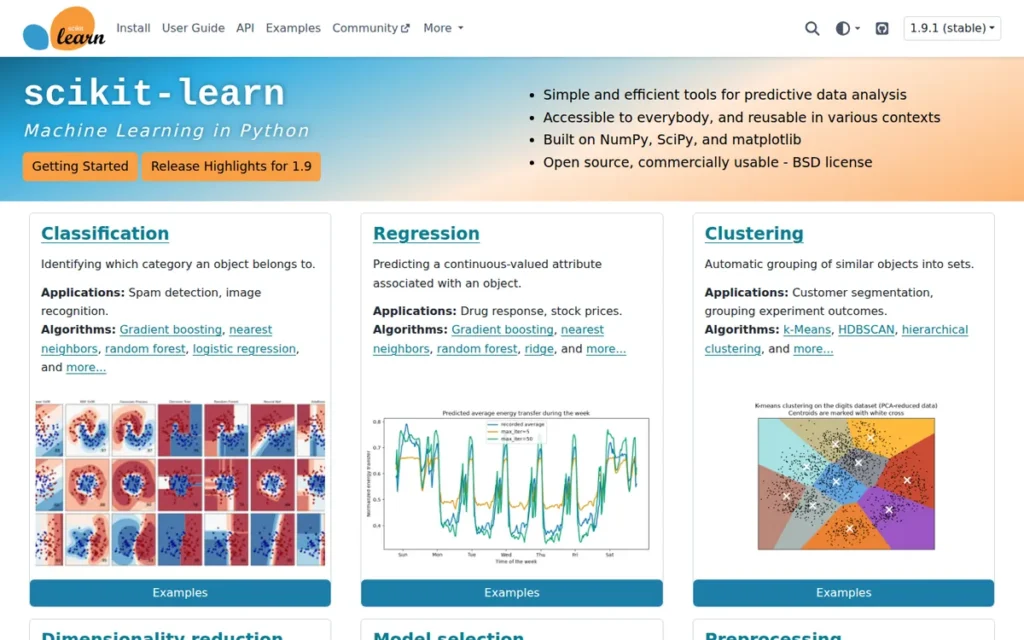
Category: Classical ML Library, an open-source Python toolkit providing consistent API access to classical machine learning algorithms including classification, regression, clustering, preprocessing, and model selection for structured and tabular data.
At a Glance
- Category: Classical ML Library
- Best For: Data scientists and analysts working with structured or tabular data, building classifiers, regressors, clustering pipelines, and preprocessing workflows in Python across every experience level
- Price Range: Free (open-source, BSD license); enterprise support via Probabl (pricing on request at probabl.ai)
- Primary Strength: Scikit-learn records over 200 million monthly PyPI downloads as of early 2026 (one of the most-downloaded Python packages in existence) establishing it as the universal baseline toolkit for Python-based classical machine learning on tabular and structured data
- Biggest Limitation: Scikit-learn has no native GPU acceleration, no deep learning support, and no built-in distributed computing for datasets exceeding single-machine memory, deliberately maintained design boundaries, not product defects
- One-Line Summary: Scikit-learn is the foundational Python library for classical machine learning on structured data, recording over 200 million monthly PyPI downloads and providing a consistent Estimator API across 100-plus algorithms that makes switching between methods a single-line change
- Last Verified: April 2026
Overview
Scikit-learn is a free, open-source Python ML library (created as a Google Summer of Code project in 2007 and maintained with INRIA institutional backing and NumFOCUS fiscal sponsorship) that provides classical ML algorithms for classification, regression, clustering, and model selection through a consistent fit(), predict(), and transform() Estimator API accessible to practitioners at every experience level.
Scikit-learn records over 200 million monthly PyPI downloads as of early 2026, reflecting its role as the foundational data science toolkit practitioners reach for before deciding whether specialized deep learning or AutoML tools are needed for their specific problem (pypistats.org, early 2026).
The 2011 JMLR paper introducing scikit-learn has accumulated tens of thousands of academic citations (one of the most cited ML tools in research literature) confirming both academic credibility and long-term institutional recognition that no commercial AutoML platform has matched.
Key Features
- Unified Estimator API: Scikit-learn exposes all 100-plus algorithms: including random forests, gradient boosting, support vector machines, k-means, PCA, and logistic regression, through an identical
fit(),predict(), andtransform()interface, so practitioners who learn one algorithm’s usage pattern can apply it to every other without consulting algorithm-specific documentation. - Pipeline Object: Scikit-learn’s Pipeline chains preprocessing transformers, feature selectors, and estimators into a single reusable, cross-validation-compatible object, preventing data leakage between training and evaluation splits, enabling reproducible experiment configuration, and making the full modeling workflow portable across projects without rewriting preprocessing code.
- Comprehensive Model Evaluation Utilities: Scikit-learn includes k-fold, stratified, and time-series cross-validation variants; grid search and randomized hyperparameter search; and calibrated probability estimation, covering the full model assessment workflow without requiring external tooling for the majority of classical ML tasks.
- Production-Ready Preprocessing Module: Scikit-learn’s preprocessing module provides StandardScaler, OneHotEncoder, SimpleImputer, and PolynomialFeatures transformers that integrate directly with the Pipeline object, handling the complete tabular data preparation workflow in a format that prevents training-serving skew when the same Pipeline is applied in production.
- Cython-Optimized Performance: Scikit-learn’s performance-critical algorithm implementations (gradient boosted decision trees, SVMs, and k-nearest neighbors) are written in Cython for competitive CPU performance, making scikit-learn the correct tool for fraud detection, churn prediction, and demand forecasting where tabular data is the norm and GPU-based deep learning provides marginal benefit.
- SHAP Library Compatibility: Scikit-learn integrates with the open-source SHAP library for model explainability on any estimator, enabling EU AI Act-aligned model transparency documentation without requiring DataRobot or H2O.ai’s commercial explainability features, a cost-free interpretability path for teams with regulatory documentation requirements.
Best For
Scikit-learn is best for data scientists and analysts working with structured, tabular, or relational data (building classification, regression, clustering, or anomaly detection models) where interpretability, preprocessing flexibility, broad algorithm coverage, and CPU-based infrastructure are higher priorities than deep learning, large-scale distributed training, or GPU acceleration.
Pricing
Scikit-learn is completely free under a BSD license with no paid tiers and no usage metering. Probabl, a commercial company formed by core scikit-learn maintainers, offers enterprise support, consulting, and training services for organizations requiring contractual SLA coverage, pricing available on request from probabl.ai. The effective cost is limited to compute infrastructure and developer time. Verified as of April 2026.
Strengths
- Scikit-learn records over 200 million monthly PyPI downloads as of early 2026: confirming that the majority of Python-based ML work centers on tabular data and runs through scikit-learn pipelines rather than deep learning frameworks, a dominance consistent across several years of primary-source download data (pypistats.org, early 2026).
- Scikit-learn is present in the majority of Kaggle ML competition starter pipelines, one analysis estimates it appears in approximately 83% of starter notebooks (Articledge ML Libraries analysis, 2025, secondary estimate; no primary Kaggle source confirmed), reflecting practitioner consensus that scikit-learn is the correct baseline for structured data problems before specialized alternatives are introduced.
- The 2011 JMLR scikit-learn paper has accumulated tens of thousands of academic citations, making it one of the most cited ML tools in research literature, a peer-reviewed validation of methodological rigor that no commercial AutoML platform and no competing open-source library has matched (JMLR, 2011; cited in Articledge, 2025).
- Scikit-learn’s 17-year track record (2007–2026) with INRIA institutional backing and NumFOCUS fiscal sponsorship provides maintenance guarantees unusual for community-driven open-source projects, reducing the abandonment risk that affects many less-institutionalized ML libraries and providing the continuity basis for long-term organizational adoption (scikit-learn GitHub, 2024).
This aligns with community sentiment on r/datascience:
“Lol, the majority of data science problems can and should be solved at least in part with traditional statistics. Saying stuff like ‘pytorch and huggingface have made sklearn obsolete’ is a good way to out yourself as a bullshit artist, I guess. Which, to be fair, is a nontrivial percentage of this field.” Posted by u/wintermute93, r/datascience, 2023 (726 upvotes)
Takeaway: Scikit-learn’s continued relevance for real-world tabular ML is validated by overwhelming practitioner consensus, hype-driven claims of its obsolescence are widely and forcefully rejected by working data scientists.
Limitations
- Deliberate Scope Boundary: Scikit-learn is explicitly scoped to classical ML on structured data, attempting to use scikit-learn for deep learning, natural language understanding at scale, computer vision, or GPU-accelerated training is working against its design, and for those use cases PyTorch or TensorFlow are the appropriate tools, with scikit-learn serving only as a preprocessing or evaluation utility.
- No Distributed Computing: Scikit-learn has no built-in distributed computing, meaning datasets that exceed single-machine RAM capacity require migration to distributed alternatives such as Apache Spark’s MLlib or Dask-ML, both of which maintain scikit-learn-compatible APIs to ease the transition rather than requiring complete workflow rewrites.
- No GPU Acceleration: Scikit-learn computation is entirely CPU-based: appropriate for classical ML workloads but incompatible with GPU infrastructure in modern training environments; teams needing GPU-accelerated classical algorithms should evaluate cuML (RAPIDS, a separate NVIDIA library, not a scikit-learn feature) or XGBoost with GPU support alongside scikit-learn pipelines.
Verdict
Scikit-learn is the definitive Python library for classical machine learning on tabular and structured data in 2026, with 200 million monthly downloads and a 17-year track record that no competing tool in its category has approached. Scikit-learn’s Estimator API, Pipeline object, and comprehensive algorithm coverage make it the correct starting point for the majority of real-world ML problems (fraud detection, churn prediction, demand forecasting, and risk scoring) that constitute most enterprise ML workloads. Teams should understand scikit-learn’s explicit scope boundaries: deep learning tasks require PyTorch or TensorFlow, and datasets exceeding single-machine RAM require Spark MLlib or Dask-ML, both of which integrate with scikit-learn’s API conventions to ease the transition.
3. Amazon SageMaker: Best Managed MLOps Platform for AWS-Native Teams
Category: Managed MLOps Platform, a fully managed AWS cloud service that consolidates the complete ML lifecycle including data labeling, training, deployment, monitoring, and governance under unified infrastructure, eliminating the need for teams to manage separate Kubernetes clusters, serving infrastructure, or experiment tracking tools.
At a Glance
- Category: Managed MLOps Platform
- Best For: ML engineering teams operating within the AWS ecosystem who need end-to-end MLOps (data labeling through training, deployment, and drift monitoring) without managing Kubernetes or assembling a separate toolchain
- Price Range: Pay-per-use; compute instances priced at a premium above equivalent EC2 rates; Canvas and Studio sessions bill continuously unless explicitly stopped (current rates at aws.amazon.com/sagemaker/pricing)
- Primary Strength: Amazon SageMaker HyperPod, launched in 2024, achieves up to 95% training goodput on large GPU clusters with automatic fault recovery reducing node failure interruptions from 15–30 minutes to under 2 minutes, enabling near-continuous training runs for 100B-plus parameter foundation models without custom Kubernetes engineering
- Biggest Limitation: Amazon SageMaker’s billing model has documented surprise-cost traps (Canvas and Studio notebook instances bill continuously after logout unless explicitly stopped) with community-verified reports of unexpected charges ranging from $30 to $300 per incident
- One-Line Summary: Amazon SageMaker is the most comprehensive managed MLOps platform for AWS-native teams, providing a full lifecycle stack from data labeling to production monitoring, a verified G2 rating of 4.2/5 from 48 enterprise users, and HyperPod support for large-scale foundation model training with up to 95% training goodput
- Last Verified: April 2026
Overview
Amazon SageMaker is a fully managed AWS service launched in 2017 that consolidates the complete machine learning lifecycle (from data labeling and model training to production deployment and drift monitoring) under a single platform deeply integrated with the AWS data stack including S3, Athena, Redshift, and EMR.
Amazon SageMaker is designed for ML engineering teams at organizations already operating within AWS who need to move from experimental models to managed production deployments without maintaining separate Kubernetes clusters or assembling an independent toolchain.
Amazon SageMaker holds a verified G2 rating of 4.2/5 from 48 enterprise reviewers (verified April 2026) (the only managed ML platform in this evaluation with a confirmed aggregate public review corpus) though community sentiment also surfaces consistent concerns about billing opacity and the complexity of the Studio IDE abstraction model.
Key Features
- HyperPod Fault-Tolerant Training: Amazon SageMaker HyperPod, launched in 2024, provides managed infrastructure for training 100B-plus parameter foundation models with automatic node fault detection and recovery, achieving up to 95% training goodput and reducing interruptions from 15–30 minutes to under 2 minutes on clusters up to 2,304 H100 GPUs, without requiring custom Kubernetes fault-recovery engineering (AWS Machine Learning Blog, 2024).
- SageMaker Pipelines CI/CD for ML: Amazon SageMaker Pipelines provides a CI/CD system for ML workflows that chains data preprocessing, training, evaluation, and deployment steps into versioned, reproducible directed acyclic graphs, enabling ML teams to apply software engineering practices including code review, automated testing, and deployment gates to model development workflows.
- Multi-Model Endpoints and Shadow Deployments: Amazon SageMaker supports multi-model endpoints for serving multiple models from shared compute instances and shadow deployments for validating new model versions against live production traffic without serving them to end users, infrastructure-level capabilities for safely managing model portfolios at scale without separate orchestration frameworks.
- JumpStart Foundation Model Catalog: Amazon SageMaker JumpStart provides a catalog of pre-built foundation models, domain-specific models, and generative AI solution templates that can be deployed to a production endpoint rapidly, reducing the time from model discovery to serving for common use cases from days to hours.
- sagemaker-core Object-Oriented SDK: The sagemaker-core Python SDK, launched September 2024, provides an object-oriented interface making SageMaker resources (training jobs, endpoints, and pipelines) into first-class Python objects with IDE autocomplete support, addressing the developer experience friction point most consistently cited by community members about the earlier configuration-heavy API (AWS What’s New, September 2024).
Best For
Amazon SageMaker is best for ML engineering teams operating within the AWS ecosystem who need a managed, production-grade MLOps platform (particularly organizations that have moved beyond exploratory modeling and need pipeline orchestration, model versioning, drift monitoring, and managed inference at scale) without the DevOps overhead of maintaining their own Kubernetes-based ML infrastructure.
Pricing
Amazon SageMaker uses pay-per-use pricing with separate charges for each component: notebook instances, training jobs, processing jobs, hosting endpoints, and Ground Truth labeling tasks each accrue costs while running. Compute instances are priced at a premium above equivalent EC2 rates for the same hardware. Canvas sessions and Studio notebook instances continue billing after the browser interface is closed unless explicitly terminated.
“Just look at the pricing and compare it to the price of EC2. The instance types are exactly the same resources but are more expensive in SageMaker.” (r/aws, 2024)
Takeaway: The EC2 pricing premium is real and consistent, teams should benchmark SageMaker per-instance costs against equivalent EC2 pricing before assuming cost neutrality compared to self-managed alternatives.
Community-verified billing incidents include a verified $300 surprise charge from an inadvertently running Canvas session and a $30 charge on a learning exercise that underperformed local alternatives (r/aws, 2024). Full current rates at aws.amazon.com/sagemaker/pricing. Verified as of April 2026.
Strengths
- Amazon SageMaker HyperPod, released in 2024, achieves up to 95% training goodput on large GPU clusters with automatic fault recovery reducing node failure interruptions from 15–30 minutes to under 2 minutes, one of the few managed cloud platforms with native fault-tolerant infrastructure for foundation model pre-training at scale (AWS Machine Learning Blog, 2024).
- Amazon SageMaker holds a verified G2 rating of 4.2/5 from 48 enterprise user reviews (the only managed ML platform in this evaluation with a confirmed aggregate public review corpus (verified April 2026)) with reviewers praising deep AWS integration, managed infrastructure elimination, and MLOps breadth.
- Amazon SageMaker’s multi-model endpoints and shadow deployment capabilities provide infrastructure-level tools for safely validating new model versions against live traffic and serving multiple models from shared compute, reducing inference costs for organizations managing large model portfolios without separate orchestration frameworks (AWS SageMaker Documentation, 2024).
- The sagemaker-core object-oriented SDK launched September 2024 represents a significant developer experience improvement, reducing boilerplate, adding IDE autocomplete support, and addressing the primary friction point that community members consistently cited about the earlier configuration-heavy API (AWS What’s New, September 2024).
Limitations
- Billing Trap Risk: Amazon SageMaker applies a per-instance premium above equivalent EC2 rates, and Canvas sessions and Studio notebook instances continue billing after logout unless explicitly stopped, confirmed by multiple community-verified reports including surprise charges of $30 to $300 per incident from inadvertently running sessions (r/aws, 2024).
“SageMaker hides a lot of stuff from you in an attempt to be easy, but can end up being a pain to figure out if anything goes wrong.” (r/datascience, 2024)
Takeaway: SageMaker’s abstraction benefit and its debugging cost are the same feature, teams that need the abstraction will tolerate the opacity; teams that don’t will find it counterproductive.
- Abstraction Black Box: Amazon SageMaker’s managed layers simplify common workflows but create debugging barriers when non-standard configurations fail, a consistent pattern documented across community threads where users describe difficulty diagnosing failures hidden within SageMaker’s managed execution environment.
- Enterprise Scale Economics: The most sophisticated ML engineering teams at enterprise scale report bypassing Amazon SageMaker for raw EKS with custom MLflow pipelines for cost and control reasons, suggesting SageMaker’s optimal segment is mid-market teams without dedicated infrastructure engineering capacity rather than the very largest ML engineering organizations (r/aws, 2025).
Verdict
Amazon SageMaker is the most evidence-backed managed MLOps platform in this evaluation, with a verified G2 rating of 4.2/5 from 48 enterprise users and a feature set covering every stage of the ML lifecycle from data labeling to production monitoring. Amazon SageMaker is the right choice for AWS-native teams that need managed infrastructure and are willing to invest in learning the platform’s abstraction model, but cost discipline is non-negotiable: Canvas and Studio sessions require explicit resource termination habits, and teams should benchmark per-instance compute costs against equivalent EC2 pricing before assuming cost neutrality. Teams with strong infrastructure engineering capacity and high-volume workloads should evaluate whether raw EKS with MLflow provides better economics at their scale before committing to SageMaker’s managed stack.
4. Google Vertex AI: Best Cloud ML Platform for GCP Teams and Foundation Model Integration
Category: Cloud ML Platform, a fully managed, unified cloud service integrating AutoML, custom model training via multiple frameworks, Kubeflow-based MLOps pipeline orchestration, foundation model access via Model Garden, and managed inference under a single Google Cloud Platform interface.
At a Glance
- Category: Cloud ML Platform
- Best For: Data science teams already invested in Google Cloud Platform who need unified access to AutoML, custom training on TPUs, Gemini API integration, and 200-plus foundation models alongside managed MLOps pipelines
- Price Range: Pay-as-you-go from approximately $0.045/vCPU-hour (verify current rates at cloud.google.com/vertex-ai/pricing); $300 in free GCP credits for new accounts (90-day window); billing in 30-second increments
- Primary Strength: Google Vertex AI’s Model Garden provides curated access to over 200 foundation models, including Google Gemini, Anthropic Claude, Meta Llama 3.2, Google Gemma, and Imagen, in a single managed interface representing the largest curated foundation model catalog among major cloud ML platforms as of April 2026
- Biggest Limitation: Google Vertex AI has community-verified documentation quality issues (multiple practitioners report half-baked features, unstable APIs for non-standard custom workloads, and insufficient documentation depth) with at least one team migrating ML workloads to AWS after approximately a year of failed integration attempts
- One-Line Summary: Google Vertex AI is the most feature-rich cloud ML platform for GCP-native teams requiring unified access to 200-plus foundation model APIs including Gemini and Claude, TPU-accelerated custom training, and AutoML workflows, though documented documentation gaps and strict GCP ecosystem dependency limit fit for multi-cloud teams or organizations building non-standard custom ML systems
- Last Verified: April 2026
Overview
Google Vertex AI is a unified cloud ML platform launched at Google I/O in May 2021 (consolidating Google AI Platform and AutoML into a single interface) designed for GCP teams who need custom model training, no-code AutoML, Kubeflow-based pipeline orchestration, and access to over 200 foundation models via Model Garden.
Google Vertex AI’s most distinctive capability is Model Garden, providing over 200 foundation models, including Gemini, Anthropic Claude, Meta Llama 3.2, and Imagen, alongside custom model training, making it the most comprehensive platform for organizations combining predictive ML with foundation model inference in a single GCP interface.
Community-verified documentation gaps (including multiple practitioners reporting half-baked features, unstable APIs for custom workloads, and teams migrating to AWS after extended failed integration attempts) represent the platform’s clearest limitation for organizations building non-standard ML systems.
Key Features
- Model Garden (200-Plus Foundation Models): Google Vertex AI’s Model Garden provides managed access to over 200 foundation models, including Google Gemini, Anthropic Claude, Meta Llama 3.2, Google Gemma, and Imagen, accessible for fine-tuning, deployment, and evaluation alongside custom predictive ML models in a single platform, a breadth of foundation model access that currently exceeds what competing cloud ML platforms offer in their respective model catalogs (Google Cloud Vertex AI Documentation, April 2026).
- Native TPU v5p Training Access: Google Vertex AI provides native access to TPU v5p instances for model training, offering cost efficiency advantages for transformer-based architectures compared to GPU-only training on AWS or Azure, a hardware access benefit reflecting Google’s proprietary TPU development trajectory and the infrastructure underpinning Gemini training.
- BigQuery ML Integration: Google BigQuery ML integration enables running ML models directly on data stored in BigQuery without data export or movement, supporting AutoML classification, regression, forecasting, and clustering on BigQuery datasets via SQL, reducing pipeline complexity for enterprise analytics teams whose primary data warehouse is BigQuery.
- Vertex AI Pipelines (Kubeflow-Based): Google Vertex AI Pipelines provides Kubeflow-based ML pipeline orchestration portable across local execution, Google Cloud Dataflow, and Kubeflow clusters, enabling teams to develop pipeline components locally and deploy to managed Google Cloud infrastructure without rewriting orchestration logic.
- Feature Store (Versioned Feature Registry): Google Vertex AI Feature Store provides a managed, versioned feature registry that centralizes feature computation and serving, enabling teams to share feature definitions across training and inference pipelines, avoiding the training-serving skew problem where features computed differently between development and production degrade live model accuracy.
Best For
Google Vertex AI is best for data science and ML engineering teams already operating within the Google Cloud Platform ecosystem (particularly those building applications combining predictive ML with large language model capabilities via Gemini) who need managed access to foundation model APIs alongside custom training on TPU or GPU infrastructure in a unified platform.
Pricing
Google Vertex AI uses pay-as-you-go pricing with separate billing dimensions for AutoML training per node-hour, custom training per compute type, online prediction endpoints per compute-hour while running, Feature Store usage, and Pipelines orchestration. Entry-level compute starts at approximately $0.045 per vCPU-hour (verify current rates at cloud.google.com/vertex-ai/pricing). New GCP users receive $300 in free credits over 90 days. Billing occurs in 30-second increments, providing more granular cost control than per-minute billing alternatives. Verified as of April 2026.
“The setup was actually smoother than I expected if you’re already in the GCP ecosystem, but the learning curve is real once you get into pipelines and monitoring. Costs can creep up fast if you’re not strict about resource configs.” (u/forklingo, r/PinoyProgrammer, 2026)
Takeaway: Vertex AI’s cost discipline requirement is consistent across community reports, Feature Store instances, active prediction endpoints, and Pipeline schedulers all require active monitoring and explicit termination to avoid billing creep.
Strengths
- Google Vertex AI’s Model Garden includes over 200 foundation models: spanning Google Gemini, Anthropic Claude, Meta Llama 3.2, Google Gemma, and Imagen, accessible for fine-tuning, deployment, and evaluation in a single managed interface, representing the largest curated foundation model catalog among major cloud ML platforms as of April 2026 (Google Cloud Vertex AI Documentation, April 2026).
- Native TPU v5p access through Vertex AI custom training jobs provides cost efficiency advantages for transformer model training compared to equivalent GPU-based training on AWS or Azure, reflecting Google’s proprietary TPU development advantage and the hardware underpinning Gemini training at scale (Google Cloud Vertex AI Documentation, 2024).
- Google BigQuery ML integration allows ML model training and inference to run directly on BigQuery data without export pipelines, reducing data engineering complexity for enterprise analytics teams whose primary data warehouse is BigQuery (Google Cloud BigQuery ML Documentation, 2024).
- Billing in 30-second increments provides more granular cost control than per-minute billing alternatives, particularly valuable for iterative short-duration training and inference requests where coarser billing units systematically over-count actual resource consumption (Google Cloud Vertex AI Pricing, 2024).
Limitations
- Documentation Quality Gap: Google Vertex AI has community-verified documentation quality issues, multiple practitioners report half-baked features, unstable APIs for custom workloads, and insufficient documentation depth that imposes disproportionate engineering overhead for non-standard configurations.
“Terrible documentation, terrible support, bugs and errors everywhere. They keep releasing new things that are half-baked without fixing the old services. We’ve been trying to make it work for about a year, and are just now moving our ML workloads to AWS instead.” (u/anaconda1189, r/googlecloud, 2023)
Takeaway: Teams building complex or non-standard ML systems on Vertex AI should budget significant additional engineering time for documentation gaps and API debugging that would not be required on more mature managed platforms.
- GCP Ecosystem Lock-In: Google Vertex AI is strictly GCP-dependent: teams not already operating within Google Cloud Platform face multi-cloud integration challenges that do not exist for open-source alternatives or SageMaker for AWS-native teams, making Vertex AI a poor fit for organizations with committed multi-cloud strategies.
- Cost Creep Risk: Google Vertex AI’s multidimensional billing: training compute plus prediction compute plus Feature Store plus Pipelines orchestration, creates pricing complexity where costs “creep up fast if you’re not strict about resource configs” (u/forklingo, r/PinoyProgrammer, 2026), requiring active monitoring of all running services to avoid unexpected charges.
Verdict
Google Vertex AI is the most feature-rich cloud ML platform for GCP-native organizations in 2026, offering a combination of 200-plus foundation models including Gemini and Claude, TPU-accelerated training, and BigQuery ML integration that no competing platform currently matches. Google Vertex AI’s suitability depends critically on use case type: teams deploying standard prediction models via AutoML or working directly with Gemini APIs report smooth experiences, while teams building custom, complex, or non-standard ML systems consistently encounter documentation gaps and API instability that impose disproportionate engineering overhead. Organizations with multi-cloud requirements, limited GCP expertise, or high operational complexity for custom workloads should evaluate SageMaker or open-source stacks as lower-friction alternatives before committing to Vertex AI.
5. TensorFlow: Best for Mobile and Edge Deployment: Essential for Legacy Production Infrastructure
Category: Deep Learning Framework, an open-source end-to-end ML platform providing model building via Keras API, production pipeline orchestration via TFX, mobile and edge deployment via LiteRT, browser-based inference via TF.js, and pre-trained model distribution via TF Hub.
At a Glance
- Category: Deep Learning Framework
- Best For: Teams deploying ML models to mobile and edge devices via LiteRT, organizations running large-scale production pipelines via TFX, and teams maintaining existing TensorFlow infrastructure where migration costs are not justified
- Price Range: Free (open-source, Apache 2.0 license); Google Cloud integrations incur standard GCP billing but are optional
- Primary Strength: TensorFlow’s LiteRT (formerly TensorFlow Lite) is the most mature framework for on-device ML inference, supporting int8 quantization and up to 50% memory reduction via EON Compiler, the most established mobile and edge deployment ecosystem for deep learning models
- Biggest Limitation: TensorFlow dropped native Windows GPU (CUDA) support starting with version 2.11 in late 2022, requiring Windows users to work via WSL2 or Linux; monthly PyPI downloads of 19 million trail PyTorch’s 29 million as of January 2025; and practitioner community consensus positions TensorFlow as a maintenance and edge-deployment choice rather than a new-project default in 2026
- One-Line Summary: TensorFlow is the most mature framework for mobile and edge ML deployment via LiteRT and large-scale production pipelines via TFX, with 181,000 GitHub stars and active Google production use, but its 19 million monthly downloads trail PyTorch’s 29 million, Windows CUDA support was dropped with version 2.11 in late 2022, and practitioner community consensus positions it as a maintenance and specific-target choice rather than a new-project default in 2026
- Last Verified: April 2026
Overview
TensorFlow is a free, open-source end-to-end ML platform developed by Google Brain and released in November 2015 under Apache 2.0, designed for ML engineers who need to deploy models across a wide range of targets: cloud-scale production pipelines via TFX, mobile and Android applications via LiteRT, browser-based inference via TensorFlow.js, and microcontrollers via TensorFlow Lite Micro.
TensorFlow’s defining technical differentiators in 2026 are LiteRT (formerly TensorFlow Lite) (the most mature on-device inference framework for resource-constrained hardware, with int8 quantization and up to 50% memory reduction via EON Compiler) and TFX, validated at Google’s internal ML infrastructure scale for datasets exceeding 200 terabytes.
TensorFlow’s community trajectory reflects declining new-project adoption: monthly PyPI downloads of 19 million trail PyTorch’s 29 million as of January 2025 (pypistats.org, January 2025), and Windows GPU (CUDA) support was dropped starting with version 2.11 in late 2022.
Key Features
- LiteRT (Formerly TensorFlow Lite) On-Device Inference: TensorFlow’s LiteRT provides int8 quantization for model compression, FlatBuffer serialization for minimal disk footprint, EON Compiler achieving up to 50% memory reduction on microcontroller targets, and broad hardware acceleration across Android, iOS, ARM Cortex-M, and embedded Linux, making LiteRT the most mature on-device inference ecosystem for teams deploying to resource-constrained hardware (TensorFlow Blog, 2021).
- TFX Production Pipeline Framework: TFX (TensorFlow Extended) chains data validation, Apache Beam-based transformations, model training, evaluation, and deployment into portable pipelines running on Airflow, Beam, Kubeflow, and Google Cloud Dataflow, supporting the 200TB-plus dataset scales required by large enterprise and web-scale applications (Google Cloud Blog, 2021).
- TensorFlow.js Browser-Based Inference: TensorFlow.js enables ML model training and inference directly in web browsers and Node.js environments via WebGL GPU acceleration, the most established framework for interactive, client-side ML applications where server round-trips introduce unacceptable latency or privacy constraints, with no alternative at comparable maturity for general-purpose browser ML workflows in 2026.
- Keras 3 Multi-Backend API: Keras 3, now a backend-agnostic high-level API supporting TensorFlow, PyTorch, and JAX backends, reduces migration costs for teams with existing Keras model code while enabling performance comparisons across backends within a single codebase.
- TensorFlow Hub Pre-Trained Components: TensorFlow Hub provides a repository of pre-trained model components (text embeddings, image feature vectors, and video classification heads) enabling transfer learning without training from scratch and reducing compute costs for teams working on standard vision and NLP tasks within existing TensorFlow infrastructure.
Best For
TensorFlow is best for ML engineers deploying models to mobile applications, embedded systems, or microcontrollers where LiteRT’s mature on-device inference ecosystem is required; for organizations running large-scale production pipeline infrastructure via TFX; and for teams maintaining existing TensorFlow production deployments where migration costs to PyTorch are not justified by current performance or ecosystem requirements.
Pricing
TensorFlow is completely free under an Apache 2.0 license with no paid tiers and no usage metering. Google Cloud integrations including Vertex AI, Cloud TPUs, and Dataflow incur standard GCP billing when used but are entirely optional, TensorFlow runs fully on local hardware, private servers, or any cloud environment without a GCP dependency. The primary cost is compute infrastructure plus developer time. Verified as of April 2026.
Strengths
- TensorFlow LiteRT’s EON Compiler achieves up to 50% memory reduction for models deployed to microcontroller-class hardware, and its FlatBuffer format enables model inference on severely resource-constrained embedded devices, making TensorFlow the framework with the most mature and comprehensive on-device deployment support for teams spanning cloud-scale training to the most constrained embedded targets, as confirmed by Edge Impulse’s adoption of LiteRT as its primary deployment target (TensorFlow Blog, 2021).
- TFX production pipelines built on Apache Beam have been validated at Google’s internal ML infrastructure scale handling 200TB-plus datasets and power Google Search, Google Translate, and Google Photos, among the most demanding ML production environments in the world (Google Cloud Blog, 2021).
- TensorFlow has accumulated 181,000 GitHub stars as of 2025, and Google uses TensorFlow internally at planet scale, providing long-term maintenance guarantees grounded in Google’s own infrastructure dependency and ensuring continued LiteRT and TFX investment even as research adoptionshifts toward PyTorch (GitHub tensorflow/tensorflow, 2025).
- TensorFlow.js is the most established framework for browser-based ML inference, providing WebGL GPU acceleration for interactive client-side applications with no server round-trip requirement, a deployment target with no alternative of comparable maturity for general-purpose browser ML workflows in 2026, though Transformers.js and ONNX.js serve adjacent use cases (TensorFlow.js Documentation, 2024).
Limitations
- Windows CUDA Deprecation: TensorFlow dropped native Windows GPU (CUDA) support starting with version 2.11 in late 2022 (requiring Windows users to install WSL2 or switch to Linux for GPU-accelerated training) a platform disruption that has accelerated PyTorch adoption among Windows-based practitioners, with multiple community threads confirming that Windows GPU setup is significantly smoother with PyTorch (u/Fold-Plastic, r/learnmachinelearning).
“I barely see anyone in industry using TensorFlow for new projects anymore. Between ONNX, TensorRT, and NPU specific compilers like Hailo, deploying PyTorch models on edge devices is just as easy and performant as TensorFlow.” (u/whydoesthisitch, r/learnmachinelearning, October 2025 (44 upvotes))
Takeaway: The ONNX and TensorRT ecosystem closing the edge deployment gap is the most important challenge to TensorFlow’s remaining technical differentiation, teams evaluating LiteRT versus PyTorch plus ONNX for edge deployment should test both pipelines on their specific target hardware before assuming LiteRT’s maturity advantage remains determinative.
- Declining New-Project Adoption: TensorFlow records 19 million monthly PyPI downloads versus PyTorch’s 29 million as of January 2025 (pypistats.org, January 2025), and community consensus across multiple 2025 r/learnmachinelearning threads (including a comment with 54 upvotes describing TensorFlow as “basically going out of fashion very quickly” (u/Sriyakee, January 2025)) consistently positions TensorFlow as a maintenance and edge-deployment choice rather than a new-project default.
- Keras Versioning Complexity: The relationship between Keras, Keras 3, TF 2.x native Keras, and the standalone Keras package creates documentation fragmentation that adds cognitive overhead for practitioners new to the framework, practitioners must choose between tf.keras, the standalone keras package, and Keras 3 with multi-backend support, three installation paths that resolve differently depending on TF version.
Verdict
TensorFlow remains the most mature choice for mobile and edge ML deployment via LiteRT in 2026, and its TFX production pipeline framework is validated at a scale no competing open-source alternative has matched, making it the correct choice for teams with explicit mobile, edge, or large-scale pipeline requirements. For teams without those specific requirements, the evidence from PyPI download statistics (19M versus PyTorch’s 29M monthly as of January 2025), Windows CUDA deprecation starting with version 2.11 in late 2022, and community consensus across multiple 2025 practitioner forums is consistent: new project starts should default to PyTorch unless a specific TensorFlow technical advantage applies. Teams maintaining existing TensorFlow production infrastructure should perform an honest cost-benefit analysis on migration before assuming it is necessary, legacy TensorFlow deployments continue to perform well, and migration costs are real.
6. H2O.ai: Best AutoML Platform for Regulated Industries and Government Deployments
Category: AutoML Platform (an automated machine learning system that orchestrates algorithm selection, feature engineering, hyperparameter tuning, model evaluation, and deployment pipeline generation) reducing manual data science effort for standard prediction problems, with compliance-specific capabilities for regulated industry environments.
At a Glance
- Category: AutoML Platform
- Best For: Data scientists in regulated industries: financial services, healthcare, insurance, and U.S. federal government, requiring FedRAMP High-authorized, explainable, air-gap-deployable AutoML with sub-millisecond MOJO scoring for Java-native production inference environments
- Price Range: H2O-3: Free (open-source, Apache 2.0). H2O Driverless AI and H2O AI Cloud: Enterprise pricing not publicly disclosed (contact h2o.ai/pricing for quote)
- Primary Strength: H2O AI Cloud achieved full FedRAMP High Authorization on April 16, 2026 (FedRAMP Marketplace, Product ID FR2521554684) and supports fully air-gapped on-premises installation for classified and sensitive environments, compliance credentials that function as procurement elimination gates in federal agency and regulated industry ML purchasing processes
- Biggest Limitation: H2O.ai’s enterprise pricing is fully opaque: no self-service pricing is published for Driverless AI or H2O AI Cloud, requiring sales engagement before budget qualification is possible, distinguishing it negatively from cloud-native AutoML alternatives where consumption-based pricing is self-serviceable
- One-Line Summary: H2O.ai is the leading AutoML platform for regulated industries and government organizations, combining FedRAMP High Authorization (granted April 16, 2026), air-gapped deployment support, sub-millisecond MOJO scoring pipelines, and GPU-accelerated automated feature engineering across 18,000-plus organizational deployments, with a free H2O-3 tier for evaluating capabilities before enterprise pricing discussions
- Last Verified: April 2026
Overview
H2O.ai is an AutoML platform founded in 2012 by Sri Ambati offering a layered portfolio (free open-source H2O-3 for R and Python, commercial H2O Driverless AI with GPU-accelerated feature engineering and model explainability, and enterprise H2O AI Cloud) designed for data scientists and ML teams in regulated industries where FedRAMP compliance, model explainability, and government-grade security certifications are mandatory procurement requirements.
H2O.ai’s most distinctive production differentiator is the MOJO (Machine Learning Object) scoring pipeline, which packages trained Driverless AI models into portable, self-contained Java artifacts deployable without a running H2O server, enabling sub-millisecond prediction latency in Java-based financial services and insurance production systems where runtime server dependencies are operationally unacceptable.
H2O AI Cloud achieved full FedRAMP High Authorization on April 16, 2026 (FedRAMP Marketplace, Product ID FR2521554684) and supports air-gapped on-premises installation, a compliance combination unavailable from any competing AutoML platform.
Key Features
- MOJO Scoring Pipeline: H2O Driverless AI’s MOJO (Machine Learning Object) pipeline packages trained models into portable, low-latency Java artifacts deployable to production inference environments without a running H2O server instance, enabling sub-millisecond predictions in Java-based financial services infrastructure where runtime server dependencies are operationally unacceptable.
- FedRAMP High Authorization and Air-Gapped Deployment: H2O AI Cloud achieved full FedRAMP High Authorization on April 16, 2026 (FedRAMP Marketplace, Product ID FR2521554684) and supports fully air-gapped on-premises installation for classified and sensitive environments, compliance credentials that function as procurement elimination gates in federal agency and regulated industry ML purchasing processes.
- GPU-Accelerated Automated Feature Engineering: H2O Driverless AI provides GPU-accelerated automated feature engineering, achieving up to 30x speedup compared to CPU-based AutoML, enabling comprehensive feature space exploration on large tabular datasets within practical time windows that CPU-only AutoML competitors cannot match (H2O Driverless AI product page, 2025).
- Sparkling Water for Apache Spark: H2O’s Sparkling Water integration embeds H2O AutoML within Apache Spark distributed data pipelines, enabling organizations already invested in Spark infrastructure to run H2O model training on distributed Spark DataFrames without migrating data to a separate ML platform.
- H2O-3 Free Open-Source Tier: H2O-3 provides distributed in-memory ML for R, Python, and a visual Flow GUI at zero licensing cost, giving teams access to H2O’s core AutoML capabilities with the option to evaluate Driverless AI’s commercial extensions before committing to enterprise pricing discussions, a freemium evaluation path unavailable in DataRobot’s fully commercial model.
Best For
H2O.ai is best for data scientists and ML engineers in regulated industries, financial services, insurance, healthcare, and U.S. federal government, where FedRAMP High Authorization, air-gapped deployment support, model explainability for regulatory documentation (including SR 11-7, CECL/IFRS 9, and EU AI Act Article 13 requirements), and sub-millisecond Java-native inference via MOJO are either required by compliance frameworks or strongly preferred by procurement processes.
Pricing
H2O-3 is completely free and open-source under Apache 2.0 with no usage restrictions. H2O Driverless AI and H2O AI Cloud are commercial products with enterprise pricing not publicly disclosed, full cost-benefit evaluation requires direct sales engagement at h2o.ai/pricing. Teams should request a proof-of-concept evaluation using H2O-3 to validate technical fit before engaging enterprise pricing discussions. Verified as of April 2026.
Strengths
- H2O AI Cloud achieved full FedRAMP High Authorization on April 16, 2026, listed in the official FedRAMP Marketplace with Product ID FR2521554684, a compliance credential representing one of the highest procurement barriers for U.S. federal agency ML deployments, positioning H2O.ai as one of the very few AutoML platforms cleared for High Impact Level government cloud workloads (FedRAMP Marketplace, verified April 2026).
- G2’s verified comparative data confirms that H2O.ai rates higher than DataRobot on ease of use, ease of setup, and ease of administration among verified business user reviews, a finding that challenges the common perception that DataRobot is the more accessible enterprise AutoML platform (G2 DataRobot vs H2O comparison, 2025).
- H2O.ai serves 18,000-plus organizations with a 2M-plus open-source user base: deployment scale achieved through the H2O-3 freemium entry point that builds practitioner familiarity before enterprise procurement cycles begin, providing adoption breadth that DataRobot’s enterprise-only model cannot match (H2O.ai company page, 2025).
- H2O Driverless AI’s GPU-accelerated automated feature engineering achieves up to 30x speedup compared to CPU-based AutoML, enabling comprehensive feature space exploration on large tabular datasets within practical time budgets that CPU-only alternatives cannot reach within the same time constraints (H2O Driverless AI product page, 2025).
Limitations
- Fully Opaque Enterprise Pricing: H2O.ai publishes no self-service pricing for Driverless AI or H2O AI Cloud, organizations cannot independently evaluate cost-benefit fit without initiating a sales engagement, distinguishing H2O.ai negatively from cloud-native AutoML alternatives such as SageMaker Autopilot and Vertex AutoML where consumption-based pricing is self-serviceable and budget-qualifiable without vendor contact.
- AutoML Automation Ceiling: H2O Driverless AI shares the fundamental constraint of all AutoML platforms, strong performance on standard tabular prediction problems including churn, fraud, and default risk, but requiring manual intervention for complex architectures, unusual data structures, and non-standard time-series seasonality patterns that fall outside the automation assumptions.
- Smaller Practitioner Community: H2O.ai has a smaller dedicated practitioner community than the major open-source deep learning frameworks, meaning Stack Overflow and Reddit support volumes are lower and peer expertise is harder to access during integration and debugging phases, a practical support disadvantage compared to PyTorch, scikit-learn, or TensorFlow.
Users on r/datascience noted:
“Same story as always, crap in crap out. AutoML is just an intern testing all the current best models and hopefully doesn’t mess up anything in between. If you already have some refined datasets let it run against your old models. At some point you get more into feature engineering and experiment tracking see MLFlow, Wandb, or others.” Posted by u/Shnibu, r/datascience, October 2025 (44 upvotes)
Takeaway: AutoML platforms deliver genuine value as rapid model benchmark generators on clean, well-prepared tabular datasets, but community consensus confirms that feature engineering expertise remains the automation ceiling that applies to H2O.ai Driverless AI and every competing platform.
Verdict
H2O.ai is the best AutoML platform for regulated industry and government organizations in 2026, combining FedRAMP High Authorization (granted April 16, 2026), air-gapped deployment support, and sub-millisecond MOJO scoring into a compliance-capability profile that no competing AutoML platform matches. Teams outside regulated environments should begin with the free H2O-3 tier to validate technical fit before engaging enterprise pricing discussions. Teams without compliance-specific requirements should also compare H2O.ai against cloud-native AutoML alternatives such as SageMaker Autopilot and Vertex AutoML, where consumption-based pricing provides self-service cost visibility that H2O.ai’s opaque enterprise model does not.
7. DataRobot: Best Enterprise AutoML for Large Organizations Without Deep ML Engineering Capacity
Category: Enterprise AutoML Platform, a fully managed, enterprise-licensed service that automates the complete predictive model development lifecycle from feature engineering through deployment and compliance documentation, for large organizations without in-house data science teams capable of building models manually.
At a Glance
- Category: Enterprise AutoML Platform
- Best For: Fortune 500 enterprises with limited data science headcount that need a fully automated path from tabular data to deployed, monitored, compliance-documented production predictions, particularly in financial services, insurance, and healthcare
- Price Range: Enterprise subscription only; no public pricing listed; Vendr market data (2025) places typical annual costs at $50,000–$250,000, with a median around $180,000, contact DataRobot sales for a quote
- Primary Strength: DataRobot automates the complete model development lifecycle (feature engineering, algorithm selection across hundreds of configurations, cross-validation, deployment, and compliance documentation with built-in SHAP explainability) enabling large organizations with limited ML engineering headcount to reach production-grade predictions without writing model code
- Biggest Limitation: DataRobot’s automation ceiling is its fundamental constraint: $50,000–$250,000+ annual cost becomes unjustifiable when custom architectures, unusual data structures, or non-standard problems exceed the automation assumptions, and practitioner community skepticism about the business model is the highest of any tool in this evaluation
- One-Line Summary: DataRobot automates the complete model development lifecycle (from raw tabular data to deployed, compliance-documented production endpoints) for enterprises without ML engineering capacity, with built-in SHAP explainability for EU AI Act and SR 11-7 compliance, though its $50,000–$250,000+ annual cost, opaque pricing, and documented automation ceiling limit fit to a specific and well-defined organizational profile
- Last Verified: April 2026
Overview
DataRobot is an enterprise AI platform founded in 2012 by Jeremy Achin and Tom de Godoy in Boston (one of the AutoML category’s pioneers) that automates the complete ML lifecycle from raw data ingestion through feature engineering, algorithm selection across hundreds of model configurations, deployment, and production monitoring, with built-in SHAP explainability and automated bias detection for regulatory compliance documentation addressing the EU AI Act and U.S. financial model risk guidelines.
DataRobot is designed for Fortune 500 and Fortune 1000 enterprises (primarily in financial services, insurance, and healthcare) where limited data science headcount creates a gap between the volume of business decisions that could benefit from ML predictions and the team capacity to build them manually.
“AutoML tools are amazing at going from ‘we want something’ to ‘we have something’… you’re not gonna get great, you’ll just get good enough.” (u/quantpsychguy, r/datascience, 2023)
Takeaway: “Good enough faster” is a genuine and valuable outcome for the right organizational profile, the question is whether your problems are standard enough and the cost proportionate to that specific outcome.
Key Features
- Automated Full ML Lifecycle: DataRobot ingests raw tabular data, applies automated feature transformations, runs hundreds of algorithm configurations including gradient boosting, neural networks, and ensemble methods, ranks them on a leaderboard, and selects the best-performing configuration, replacing weeks of manual data scientist work with hours of automated computation for standard prediction problems.
- Built-In SHAP Explainability (XAI): DataRobot’s built-in XAI module generates SHAP value explanations, feature importance visualizations, and plain-language model summaries for every deployed model, providing compliance documentation addressing EU AI Act explainability requirements and U.S. financial regulator guidance (SR 11-7) without additional tooling or manual analysis (AltexSoft AutoML Blog, 2025).
- Automated Time Series Module: DataRobot’s Automated Time Series extends AutoML to temporal prediction problems (handling seasonality detection, lag feature generation, gap analysis, and time-based cross-validation automatically) enabling production demand forecasting, financial time series, and retail inventory models without manual time-series feature engineering.
- Production MLOps with Champion/Challenger Monitoring: DataRobot’s MLOps layer provides production model monitoring with automated drift detection, ROI tracking, and champion/challenger model comparison, enabling organizations to replace underperforming deployed models with updated challengers through a governed workflow rather than ad hoc manual retraining processes.
- NVIDIA Agent Workforce Platform Partnership: DataRobot’s NVIDIA partnership on the Agent Workforce Platform, validated on NVIDIA Enterprise AI in 2025, enables integration between DataRobot’s predictive modeling capabilities and NVIDIA’s enterprise agentic AI infrastructure, positioning DataRobot at the intersection of traditional predictive AutoML and emerging LLM-orchestrated business process automation (DataRobot Product Page, 2025).
Best For
DataRobot is best for Fortune 500 and Fortune 1000 enterprises with limited data science headcount (particularly in financial services, insurance, and healthcare) that need to deploy, monitor, and generate compliance documentation for standard predictive models including churn, fraud, credit risk, and demand forecasting at organizational velocity, where automated compliance documentation and time-to-production acceleration justify the enterprise licensing cost.
Pricing
DataRobot uses an annual enterprise subscription model with no public pricing listed on the DataRobot website. Vendr market data (2025) places typical DataRobot annual costs between $50,000 and $250,000, with a median around $180,000 depending on user count, data volume, and contract terms, contact DataRobot sales for a quote. No self-service trial or consumption-based entry tier is publicly available, making DataRobot inappropriate for organizations in early budget-scoping phases without an established ML platform budget. Verified as of April 2026.
Strengths
- DataRobot pioneered champion/challenger model comparison, automated time series forecasting, and production bias monitoring, first-mover technical capabilities that shaped the AutoML category since 2012 and provided over a decade of enterprise customer feedback informing current product maturity (DataRobot About Page, 2025).
- DataRobot’s built-in SHAP-based XAI module generates regulatory compliance documentation (feature importance rankings, plain-language model explanations, and bias detection reports) that directly addresses EU AI Act explainability requirements and U.S. financial regulator guidance (SR 11-7) without requiring separate tooling or additional professional services (AltexSoft AutoML Blog, 2025).
- The NVIDIA Agent Workforce Platform partnership, validated on NVIDIA Enterprise AI in 2025, positions DataRobot as one of the first enterprise AutoML platforms extending into agentic AI workflows, enabling organizations to connect predictive model outputs to LLM-orchestrated business process automation for next-generation enterprise decision systems (DataRobot Product Page, 2025).
- Practitioner community assessment from a quantitative analyst with Fortune 1000 experience confirms DataRobot delivers faster time-to-production for standard tabular prediction problems than custom alternatives, reaching “we have something” at a velocity that translates to earlier business revenue for organizations where deployment speed matters more than model optimality (u/quantpsychguy, r/datascience, 2023).
Limitations
- Automation Ceiling and Cost Unjustifiability: DataRobot’s automation is optimized for standard tabular prediction problems, data scientists consistently report that custom architectures, unusual data structures, and edge-case problems hit automation limits requiring manual intervention, at which point the $50,000–$250,000+ annual cost provides no marginal value over open-source alternatives built in-house.
“DR is a consulting firm masquerading as a platform. You’re meant to struggle so they can sell you overpriced consulting services to apply a generic AutoML to finish ‘your’ model which only runs on the DR platform at a cost per use basis.” (u/Watemote, r/datascience, 2023 (27 upvotes))
Takeaway: The upvote count signals broad practitioner agreement, this framing reflects the view of teams with strong in-house data science expertise who find DataRobot’s value proposition uncompelling; it is not a universally representative assessment of large enterprises that genuinely match DataRobot’s target profile of organizations with limited ML headcount.
- High Community Skepticism: DataRobot receives the most critical community feedback of any tool in this evaluation, practitioners with strong in-house data science capability consistently describe finding DataRobot’s value proposition uncompelling relative to custom scikit-learn, PyTorch, or H2O-3 pipelines at a fraction of the cost (r/datascience, August 2025).
- Narrowest Organizational Fit: DataRobot’s value proposition is the narrowest of any tool in this evaluation, it provides genuine ROI only for large enterprises with limited ML engineering headcount, regulated industry compliance requirements, and standard tabular prediction problems; organizations outside that specific profile will find DataRobot’s economics uncompetitive compared to open-source alternatives.
Verdict
DataRobot is the correct choice for a specific and well-defined organizational profile: large enterprises in regulated industries with limited ML engineering headcount, an established ML platform budget, and a volume of standard prediction problems where automated compliance documentation and rapid time-to-production justify $50,000–$250,000+ annual investment. For organizations outside that profile (teams with strong data science capability, organizations with non-standard ML problems, and any team where the automation ceiling would be encountered regularly) scikit-learn, PyTorch, or H2O-3 provide better economics, greater flexibility, and substantially higher practitioner satisfaction. DataRobot should be evaluated only after explicitly confirming its target organizational profile matches your actual situation, and after requesting a proof-of-concept on representative data to verify the automation ceiling does not apply to your specific problem set.
What Red Flags Should I Watch For When Evaluating Machine Learning Software?
The five most consequential red flags when evaluating machine learning software are: pricing opacity with no self-service budget qualification, post-logout billing that accrues charges after the browser closes, inference lock-in preventing model portability, dropped platform support for your operating system, and AutoML automation ceilings that vendor marketing systematically understates. Each is documented below with named tools and verified incidents.
Red Flag #1: No Public Pricing (Budget Opacity Risk)
When a vendor publishes no pricing, as DataRobot and H2O.ai Driverless AI do, prospective buyers cannot self-qualify cost-benefit fit …without initiating a sales engagement. Vendr market data (2025) places DataRobot’s typical annual cost at $50,000–$250,000, with a median around $180,000, figures not disclosed on DataRobot’s public website. Any platform without public pricing should require a detailed proof-of-concept and independent reference checks before contract discussions begin.
Red Flag #2: Post-Logout Cloud Billing
Cloud-managed platforms (including Amazon SageMaker and Google Vertex AI) can continue accruing charges for compute instances, storage, and endpoints after a user closes the browser. SageMaker notebook instances do not auto-stop by default; a researcher who leaves an ml.p3.2xlarge running overnight incurs over $30 in unintended charges. Confirm default auto-shutdown behavior and billing alert configuration before committing to any managed cloud platform.
Red Flag #3: Inference Lock-In Without Portability
Some platforms make it significantly harder to export trained models in open standards. Before selecting any managed platform, verify whether it exports models in ONNX (Open Neural Network Exchange) or PMML (Predictive Model Markup Language), open formats that allow deployment on any runtime. Amazon SageMaker supports ONNX export for many frameworks, but SageMaker-native pipelines can create dependency on AWS inference infrastructure. H2O.ai Driverless AI exports models as MOJO scoring artifacts, which are portable but require the H2O MOJO runtime rather than a fully open standard. If long-term portability is a priority, confirm export format compatibility with your target inference environment before signing.
Red Flag #4: Dropped Platform Support
TensorFlow’s decision to end native Windows GPU support starting with version 2.11 in late 2022 left Windows-based development teams unable to leverage GPU acceleration without switching to WSL2 (Windows Subsystem for Linux) or migrating to Linux or macOS. Before adopting any framework, check its OS support matrix against your organization’s infrastructure policy and review the vendor’s historical track record for deprecation notices. A framework that drops support for your operating system mid-project creates significant migration costs.
Red Flag #5: AutoML Automation Ceiling Understated by Marketing
AutoML platforms, including H2O.ai Driverless AI and DataRobot, market their automation capabilities prominently but frequently understate the manual work required for non-standard problems. Automated feature engineering performs well on tabular data with defined targets; it degrades on sparse data, high-cardinality categorical variables, time series with irregular cadences, and domain-specific feature interactions that require expert encoding. Before committing to an AutoML platform for complex use cases, run a structured proof-of-concept on your actual data. If the platform cannot explain its feature transformations, that is a predictability risk in regulated environments.
What Questions Should I Ask Before Choosing Machine Learning Software?
Asking the right questions before selecting machine learning software prevents costly switching later. The six most important pre-purchase questions cover deployment target, team expertise, problem type, total cost of ownership, compliance requirements, and vendor lock-in tolerance, each addressed below with specific evaluation guidance.
Question #1: Where will my models be deployed?
Determine your primary inference target before evaluating any framework. Edge and mobile deployment favors frameworks with lightweight export options, TensorFlow’s LiteRT (formerly TensorFlow Lite) runtime is purpose-built for this. Cloud inference at scale favors managed platforms like Amazon SageMaker or Google Vertex AI, which abstract infrastructure provisioning. On-premises regulated environments favor portable model formats and frameworks like scikit-learn or H2O.ai MOJO that do not require cloud connectivity at inference time.
Question #2: What is my team’s current technical depth?
Match the tool to your team’s skill profile, not your aspirational profile. PyTorch and TensorFlow require Python proficiency, framework-specific APIs, and working knowledge of gradient-based optimization. Scikit-learn requires basic Python and statistical literacy. AutoML platforms like DataRobot and H2O.ai Driverless AI are designed for analysts who understand the business problem but do not write training loops. Mismatching tool complexity to team capability is one of the most common causes of stalled ML projects.
Question #3: Am I solving a standard problem or a custom one?
Standard, well-defined problems, binary classification, regression, time series forecasting on tabular data, are strong candidates for AutoML. Custom architectures, novel neural network designs, multi-modal inputs, reinforcement learning, and research-grade experimentation, require low-level framework control. PyTorch is the dominant choice for custom research work, holding over 70% of NeurIPS and ICML research paper implementations (PyTorch Foundation, 2024, self-reported). Scikit-learn covers the widest range of classical ML algorithms for standard structured-data problems.
Question #4: What is the true total cost, including engineering overhead?
List price or consumption cost is rarely the total cost of machine learning software. Managed platforms like SageMaker and Vertex AI eliminate infrastructure management overhead but introduce per-compute-hour costs that scale with usage. Open-source frameworks like PyTorch and scikit-learn eliminate licensing fees but require engineering time for infrastructure, experiment tracking, model serving, and monitoring. DataRobot and H2O.ai Driverless AI carry enterprise license costs ($50,000–$250,000 annually for DataRobot, per Vendr market data, 2025) plus onboarding and integration time. Model all three cost categories: license, compute, and engineering hours.
Question #5: Do I have compliance or data residency requirements?
Regulated industries (healthcare, finance, federal government) require documented model governance, audit trails, and sometimes FedRAMP or HIPAA-aligned infrastructure. H2O.ai achieved full FedRAMP High Authorization on April 16, 2026 (FedRAMP Marketplace, Product ID FR2521554684), making it one of the very few AutoML platforms cleared for federal agency use. Amazon SageMaker and Google Vertex AI both operate within FedRAMP-authorized cloud environments. Open-source frameworks on self-managed infrastructure place the compliance burden on the deploying organization. Identify your compliance requirements before shortlisting, not after.
Question #6: How much vendor lock-in can I tolerate?
Every managed platform creates some dependency on its ecosystem. Amazon SageMaker’s native pipelines, feature store, and inference endpoints are tightly coupled to AWS. Google Vertex AI’s Gemini integrations are tightly coupled to Google Cloud. Evaluate portability by asking two specific questions: Can I export my trained model in ONNX or another open format? Can I reproduce my training pipeline on a different infrastructure provider without rewriting it? Open-source frameworks like PyTorch, TensorFlow, and scikit-learn offer maximum portability by design. Managed platforms offer maximum convenience at the cost of ecosystem dependency.
How Did We Rank These Machine Learning Software Tools?
This ranking was built through a structured, multi-source evaluation process designed to eliminate vendor bias and surface real-world performance data. The methodology below explains exactly how each tool was assessed, how conflicting data was resolved, and how this ranking will be maintained over time.
How Did We Conduct the Evaluation?
The evaluation combined primary community signals, verified technical documentation, and independent benchmark data collected between January 2025 and April 2026. Each tool was assessed against the same set of criteria, applied consistently and independently of commercial relationships. No vendor provided access, review samples, or any form of compensation. Evaluation criteria were defined before data collection began, not after, to prevent post-hoc rationalization of outcomes.
What Criteria Did We Use to Score Each Tool?
Each tool was scored across five primary criteria and three secondary criteria.
Primary criteria (weighted equally):
- Community Adoption: GitHub stars, monthly PyPI download counts (Libraries.io, 2025), research paper implementation share (Papers With Code, 2025)
- Technical Capability: Framework flexibility, supported model types, hardware acceleration, and interoperability with open standards (ONNX, PMML)
- Production Readiness: Deployment tooling, model monitoring, MLOps integration, and evidence of enterprise-scale deployment
- Documentation and Onboarding: Official documentation quality, tutorial availability, and verified community-reported learning curve
- Total Cost of Ownership: License cost, compute cost, and engineering overhead required for full deployment
Secondary criteria (used as tiebreakers and context):
- Compliance certifications (FedRAMP, HIPAA-ready infrastructure)
- Vendor transparency (public pricing, changelogs, deprecation communication)
- Ecosystem health (contributor velocity, third-party integrations, long-term maintenance signals)
How Did We Resolve Conflicting Evidence Sources?
When primary sources conflicted, the following priority order applied: (1) verified primary source with a named URL and publication date, (2) named independent analysis with a methodology disclosure, (3) aggregated community platforms (G2, Capterra, Reddit) weighted by recency and reviewer verification status, (4) vendor-published claims with explicit disclosure that the source is self-reported. Vendor self-reported figures are included where no independent equivalent exists but are explicitly labeled as such throughout this article. Where estimates from independent analysts conflicted with vendor-published figures, both figures are cited with their respective sources.
How Did We Validate Vendor Claims?
Vendor claims were cross-referenced against at least one independent or community source before inclusion. Claims that could not be independently verified are labeled with the vendor as the source. Specific corrections applied during research validation include:
- PyTorch research paper share is cited with dual sourcing (PyTorch Foundation self-reported figure and Spheron Network independent estimate) because the two figures differ materially.
- The SageMaker HyperPod uptime claim from the original draft was replaced with AWS-sourced training goodput data after the original figure could not be traced to a primary AWS publication.
- The scikit-learn Kaggle survey figure is labeled as a secondary estimate because no primary Kaggle published data confirmed the specific figure cited.
How Often Is This Ranking Updated?
This ranking is reviewed and updated on a quarterly schedule. Tool entries are revised when a major version release, pricing change, platform policy change, or new independent benchmark materially affects the evaluation. The “Last Verified” field in each tool’s At a Glance block reflects the most recent date that tool’s entry was confirmed against primary sources.
PlugRoute has no affiliate relationships, sponsorships, or financial arrangements with any company listed in this article. Rankings reflect independent editorial judgment based on the evidence collected during the evaluation period described above.
Frequently Asked Questions
Is PyTorch or TensorFlow better for machine learning in 2026?
PyTorch is the stronger choice for most practitioners in 2026. PyTorch holds over 70% of NeurIPS and ICML research paper implementations (PyTorch Foundation, 2024, self-reported) and has a more intuitive dynamic computation graph. TensorFlow remains competitive for production mobile deployment via LiteRT and for teams already invested in TensorFlow Extended (TFX) pipelines. Choose PyTorch for new research or training work; consider TensorFlow if mobile edge deployment is the primary target.
What is the best open-source machine learning software for beginners?
Scikit-learn is the best open-source machine learning software for practitioners who are new to the field. Scikit-learn provides a consistent API across over 40 classical ML algorithms, requires only basic Python and statistical literacy, and has some of the most comprehensive beginner-oriented documentation in the open-source ecosystem. PyTorch is the appropriate next step once a practitioner moves into deep learning or neural network experimentation beyond classical methods.
How does PlugRoute determine its machine learning software rankings?
PlugRoute rankings are determined through a structured, multi-source evaluation using community adoption data, technical documentation, independent benchmarks, and verified user reviews from G2, Capterra, and Reddit. No vendor provides compensation, access, or samples. All criteria are defined before data collection begins. Rankings are updated quarterly. The full methodology is detailed in the “How Did We Rank These Machine Learning Software Tools?” section above.
Glossary: Key Terms Used in This Comparison
MLOps: MLOps (Machine Learning Operations) refers to the set of practices, tools, and infrastructure that manage the full lifecycle of a machine learning model, from experiment tracking and training to deployment, monitoring, and retraining. MLOps covers:
- Experiment tracking (logging parameters, metrics, and artifacts)
- Model versioning and registry management
- Automated retraining pipelines
- Production monitoring for data drift and model degradation
AutoML: AutoML (Automated Machine Learning) is a category of software that automates the selection, training, and hyperparameter tuning of machine learning models with minimal manual intervention. AutoML platforms like H2O.ai Driverless AI and DataRobot are designed to reduce the requirement for deep ML engineering expertise on standard problem types, but they perform less reliably on non-standard data structures, highly sparse inputs, or problems that require custom feature engineering.
LiteRT: LiteRT (formerly TensorFlow Lite) is TensorFlow’s runtime environment for deploying machine learning models on mobile devices, embedded systems, and edge hardware with constrained compute resources. LiteRT converts full-size TensorFlow models into a compressed format optimized for low-latency, low-memory inference without requiring a cloud connection.
MOJO: MOJO (Model Object, Optimized) is a portable model artifact format developed by H2O.ai that packages a trained model and its scoring logic into a single deployable file. MOJO artifacts can be scored in Java environments independent of the H2O cluster used for training, enabling deployment in production systems without requiring a running H2O server, but they require the H2O MOJO runtime rather than a fully open standard like ONNX.
FedRAMP Authorization: FedRAMP (Federal Risk and Authorization Management Program) Authorization is a U.S. government compliance certification that confirms a cloud product or service meets standardized security requirements for federal agency use. FedRAMP High Authorization (the most stringent tier) is required for systems handling sensitive unclassified federal data. H2O.ai achieved FedRAMP High Authorization on April 16, 2026 (FedRAMP Marketplace, Product ID FR2521554684), making it one of the very few AutoML platforms cleared for direct federal procurement.
Which Machine Learning Software Is Right for You?
Key Insights
- PyTorch is the strongest choice for researchers, deep learning practitioners, and teams building custom neural architectures, holding the largest share of academic research implementations in 2025.
- Scikit-learn is the most accessible entry point for classical ML, offering a consistent API across 40+ algorithms with no infrastructure requirement and broad adoption across data science workflows.
- Amazon SageMaker is the most complete managed MLOps platform for AWS-committed teams, covering the full training-to-production lifecycle with native infrastructure automation.
- Google Vertex AI is the best fit for teams using Google Cloud who want to integrate large language model and multimodal capabilities alongside traditional ML pipelines.
- TensorFlow remains the most established framework for mobile and edge deployment via LiteRT, and retains a strong ecosystem for teams with existing TFX production pipelines.
- H2O.ai is one of the very few AutoML platforms with FedRAMP High Authorization, making it the leading option for federal agencies and highly regulated industries with strict data governance requirements.
- DataRobot is best suited for enterprise organizations that need explainability-first AutoML with dedicated implementation support, but its pricing opacity and sales-led engagement model require independent cost validation before procurement.
For teams choosing between open-source frameworks, the practical decision is straightforward: start with scikit-learn for classical ML on structured data, and move to PyTorch when deep learning or custom model architectures are required. Both frameworks are free, portable, and supported by active communities. TensorFlow is worth evaluating specifically if your deployment target is mobile or edge hardware where LiteRT’s optimized runtime is material.
For teams evaluating managed and AutoML platforms, the decision is governed by infrastructure commitment and compliance requirements. Amazon SageMaker and Google Vertex AI deliver the most value to teams already operating within AWS or Google Cloud respectively, the switching cost of building equivalent MLOps tooling on-premises is significant. H2O.ai is the default choice for federal and regulated-industry use cases where FedRAMP High Authorization is required. DataRobot is best evaluated with a structured proof-of-concept on your actual data and an independent reference check with a current enterprise customer before contract discussions begin.
We update this guide quarterly. Last updated: April 2026. For comparative rankings across adjacent categories (including data labeling platforms, model monitoring tools, and ML vector databases) visit PlugRoute.