Langfuse is the top-ranked prompt management platform for engineering teams, framework-agnostic, open-source, with approximately 25,300 GitHub stars and transparent pricing from $29/month or free self-hosted under the MIT license (verified April 2026). LangSmith is the right choice for LangChain-committed teams at $39/seat/month. Agenta is the strongest open-source full-stack alternative, with confirmed SOC 2 Type I and Type II compliance.
AI teams lose hours to untraceable production regressions when prompt changes have no version history, burn engineering cycles routing every domain-expert edit through deployment pipelines, and have no unified view of prompt drift or token cost drift across model versions.
The wrong platform compounds these problems, and, as Humanloop’s permanent shutdown on September 8, 2025 demonstrated, vendor discontinuation risk is now a selection criterion as consequential as feature depth.
PlugRoute has no affiliate relationships with any company listed. Rankings are determined entirely by research data and objective evaluation criteria.
Takeaway: Developer frustration with LLM tooling gaps in 2023 drove the prompt management category into existence. By April 2026, six specialized tools address these gaps, but one (Humanloop) permanently shut down in September 2025, making vendor stability as important a criterion as feature depth.
TL;DR: Top Picks at a Glance
- Langfuse: #1 overall; ~25,300 GitHub stars; free MIT self-host or $29/month cloud; all features open-sourced June 2025
- LangSmith: ideal for LangChain/LangGraph teams; verify extended-retention trace costs ($5/1,000) before committing at scale
- Agenta: broadest open-source full-lifecycle platform; SOC 2 Type I + II, RBAC, SSO/LDAP confirmed
- Orq.ai: only platform with confirmed SOC 2 Type II + GDPR + SSO + RBAC in one stack
What Are the Main Categories of Prompt Management Tools?
Prompt management tools fall into five categories based on design philosophy and target buyer. The most important distinction is between open-source observability-first platforms, commercial developer evaluation platforms, open-source end-to-end LLMOps suites, prompt registry middleware, and enterprise LLMOps gateways.
The global MLOps market (which encompasses LLMOps tools including prompt management) was estimated at $2–3 billion in 2025 with projections exceeding $4 billion in 2026, growing at an estimated 37–46% CAGR depending on scope definition [Sources: Business Research Insights, Grand View Research, GMI MLOps Market Reports, 2025–2026].
The six tools in this evaluation span all five categories:
Category 1: Open-Source Observability-First Platforms (1 tool) Langfuse, production-grade prompt versioning and observability with a permanently free MIT self-hosted tier, SDK edge-caching for zero-latency reliability, and official AWS Bedrock AgentCore integration (GA: October 13, 2025).
Category 2: Commercial Developer Evaluation Platforms (1 tool) LangSmith, developer observability for LangChain and LangGraph teams with CI/CD evaluation integration and the most documented ecosystem lock-in risk in developer switching discussions.
Category 3: Open-Source End-to-End LLMOps Suite (1 tool) Agenta, full lifecycle coverage from versioning through evaluation with a 50+ model playground and confirmed SOC 2 Type I and Type II cloud compliance.
Category 4: Prompt Registry Middleware (1 tool) PromptLayer, provider-agnostic middleware enabling non-technical team members to iterate on production prompts via visual editor without code redeployments.
Category 5: Enterprise LLMOps Gateways (1 tool) Orq.ai, the only tool in this evaluation with confirmed SOC 2 Type II (via Vanta), GDPR, SSO, and RBAC combined with a unified gateway to 300+ LLM models.
Historical Reference, Discontinued (1 tool) Humanloop, permanently shut down September 8, 2025, following an Anthropic talent-only acqui-hire; included as a historical reference for enterprise evaluation benchmarking only.
How Do the Top 6 Prompt Management Tools Compare?
The most important comparison dimensions are pricing transparency, community validation, governance credentials, and vendor stability, not feature lists alone. Four of six tools in this evaluation require sales contact before any pricing information is available, making Langfuse and LangSmith the only tools where self-service budget comparison is possible.
| Rank | Company | Category | Best For | One-Line Summary | Key Capabilities | Primary Strength | Key Limitation |
|---|---|---|---|---|---|---|---|
| #1 | Langfuse | Open-Source LLMOps Platform | Engineering teams needing OSS prompt versioning without vendor lock-in | Langfuse is the top-ranked open-source LLMOps platform by community adoption; ~25,300 GitHub stars, #1 in a 57-response YC founder survey (2025), with transparent pricing and AWS Bedrock AgentCore integration (verified April 2026). | Prompt versioning with rollback; SDK edge-caching for zero-latency reliability; framework-agnostic SDKs (OpenAI, Anthropic, LangChain, LlamaIndex); evaluation and regression detection pipelines | Strongest independently verified community adoption signal; all features MIT-licensed since June 2025 | ClickHouse/Redis/S3 self-hosted infrastructure overhead; LLM-focused observability scope may require OpenTelemetry for non-LLM components |
| #2 | LangSmith | Developer Observability Platform | LangChain/LangGraph teams needing zero-setup tracing and CI/CD evaluation | LangSmith is the leading developer observability platform for LangChain teams at $39/seat/month Plus; with native GitHub Actions evaluation integration and the most documented ecosystem lock-in risk across developer switching discussions (April 2026). | CI/CD evaluation (GitHub Actions, pytest, Vitest); commit-based Prompt Hub with LLM-assisted iteration; granular RAG evaluation separating retrieval from generation quality; offline and online evaluation modes | Zero-setup LangChain/LangGraph integration via single environment variable; most complete automated prompt testing pipeline | Ecosystem lock-in documented as primary migration driver; extended 400-day retention traces cost $5.00/1,000; 10x the base rate |
| #3 ⚠️ | Humanloop | DISCONTINUED | Platform permanently shut down September 8, 2025; not available for production adoption | Humanloop permanently shut down September 8, 2025, following a talent-only Anthropic acqui-hire; included as a historical reference only; Duolingo and Gusto were verified enterprise deployments Source: ZenML LLMOps database, 2024. | Historical: Git-like versioning; LLM-as-judge + human review; .prompt format; fine-tuning from production logs; VPC/HIPAA | Historical: strongest third-party-verified enterprise client references (Duolingo, Gusto) and most comprehensive multi-modal evaluation framework evaluated | PLATFORM SHUT DOWN September 8, 2025; Anthropic acqui-hire was talent-only; platform, IP, and assets were not acquired |
| #4 | Agenta | Open-Source LLMOps Suite | Teams wanting full OSS lifecycle with non-technical PM access and SOC 2 Type I + II | Agenta is an open-source end-to-end LLMOps suite with the broadest OSS feature coverage and confirmed SOC 2 Type I and Type II cloud compliance, evaluated April 2026. | 50+ model side-by-side playground; Jinja templating; PM web UI; environment promotion; SOC 2 Type I + II; RBAC (viewer/contributor/approver); SSO/LDAP | Only fully open-source tool with confirmed SOC 2 Type I + II, RBAC, and SSO/LDAP | Community adoption scale unverifiable vs. Langfuse’s ~25,300 stars; cloud pricing requires sales contact |
| #5 | PromptLayer | Prompt Registry Middleware | Teams where domain experts need no-code production prompt control | PromptLayer is a provider-agnostic middleware with a confirmed fail-safe architecture and visual non-technical editor; but complete pricing opacity and absence from organic developer recommendations limit independent validation (April 2026). | Visual non-technical editor; A/B traffic splitting; backtesting and regression detection; confirmed fail-safe architecture; Python/TypeScript/LiteLLM SDKs | Most deliberately designed commercial visual editor for non-technical domain expert prompt iteration | No verified G2/Capterra ratings; absent from organic developer forum recommendations; no public pricing; no public company information |
| #6 | Orq.ai | Enterprise LLMOps Gateway | Regulated enterprises where SOC 2 Type II + GDPR + SSO + RBAC are procurement prerequisites | Orq.ai is the only tool with confirmed SOC 2 Type II (via Vanta), GDPR, SSO, and RBAC combined with a 300+ model unified gateway (April 2026); uniquely positioned for compliance-gated enterprise procurement. | SOC 2 Type II (Vanta) + GDPR + SSO + RBAC + EU AI Act; 300+ model gateway (incl. BYOM); RAG-as-a-Service; agentic orchestration | Only confirmed SOC 2 Type II + GDPR + SSO + RBAC in a single platform | Zero verified community adoption signals; complete pricing opacity; no public organizational information |
Which Tool Fits Your Primary Priority?
The right tool depends on your most critical constraint. This framework maps the seven most common buyer priorities to the best available active tools as of April 2026.
| Your #1 Priority | Recommended Tool | Why | Acceptable Alternative |
|---|---|---|---|
| LangChain/LangGraph zero-setup integration | LangSmith | Single environment variable enables full-stack tracing without instrumentation code; native CI/CD evaluation with GitHub Actions and pytest | Langfuse (framework-agnostic, more transparent pricing at scale, free self-host) |
| Transparent pricing with free self-hosting | Langfuse | Free MIT self-hosted tier with full feature parity; $29–$99/month cloud fully documented (verified April 2026) | Agenta (free OSS self-host; cloud pricing requires contact) |
| Enterprise compliance: SOC 2 Type II + GDPR + SSO + RBAC | Orq.ai | Only tool with all four confirmed in a single commercial platform (April 2026) | Agenta (SOC 2 Type I + II, RBAC, SSO/LDAP confirmed; GDPR not confirmed) |
| Non-technical domain expert prompt iteration without code | PromptLayer | Most deliberately designed commercial visual editor for non-technical access with confirmed fail-safe architecture | Agenta (explicit PM web UI; open-source; SOC 2 Type II cloud) |
| Full OSS lifecycle without vendor lock-in | Agenta | Broadest OSS coverage: versioning + 50+ model playground + evaluation + observability, with SOC 2 Type II | Langfuse (strongest community signals; all features MIT-licensed since June 2025) |
| Lowest-risk production adoption by community validation | Langfuse | ~25,300 GitHub stars; #1 in YC founder survey; AWS endorsement; four-tier transparent pricing | LangSmith ($39/seat/month; VC-backed; highest developer forum mention frequency) |
| I am not sure what my primary priority is | Langfuse | Transparent pricing, strongest community validation, and framework-agnostic design make it the lowest-risk evaluation starting point; no sales contact required | Agenta (equally low-friction free OSS entry point) |
| Cloud-managed with no DevOps overhead | LangSmith or Langfuse Developer ($29/month) | LangSmith for LangChain teams; Langfuse Developer tier for framework-agnostic teams; both fully managed, no infrastructure to operate | PromptLayer (cloud-only but all pricing requires sales contact) |
1. Langfuse: Best Overall: Best for Engineering Teams Wanting Open-Source Prompt Management with Production Observability
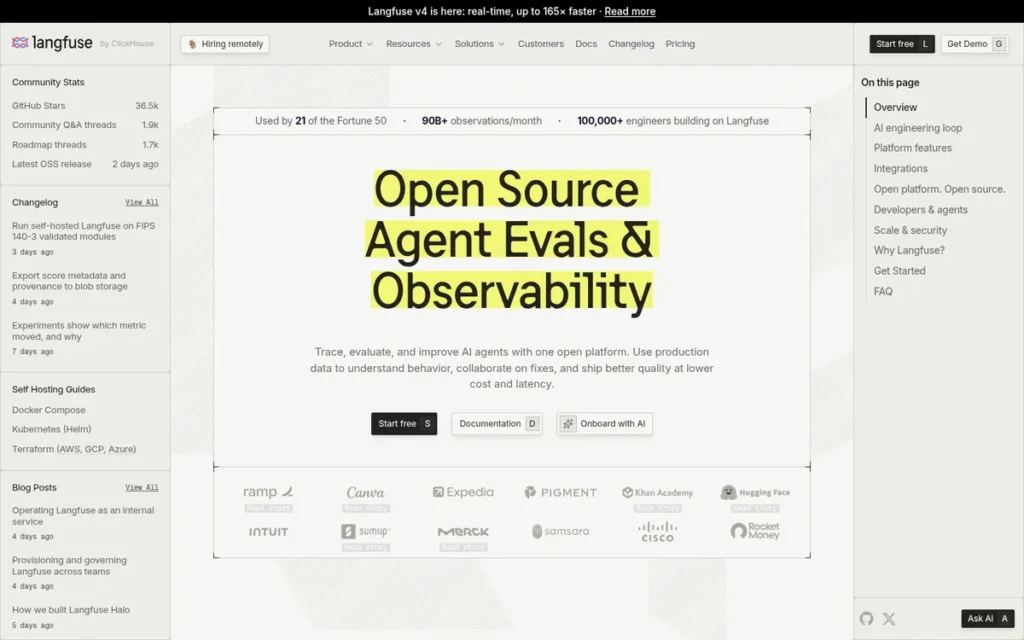
Category: Open-Source LLMOps Platform, a self-hostable observability and prompt management platform that versions, traces, and evaluates LLM prompts in production, with transparent cloud pricing and a permanently free MIT-licensed self-hosted tier in which all features were open-sourced in June 2025.
At a Glance
- Category: Open-Source LLMOps Platform
- Best For: Engineering teams needing production-grade prompt versioning and observability without vendor lock-in (with either transparent managed cloud pricing or a permanently free MIT self-hosted option) who have DevOps capacity for a ClickHouse/Redis/S3 stack, or prefer avoiding sales-contact pricing
- Price Range: Free self-hosted (MIT license, infrastructure costs only); $29/month Developer; $99/month Team; Enterprise custom (verified April 2026 at langfuse.com/pricing)
- Primary Strength: Langfuse has the most transparently verified community adoption of any tool in this evaluation (approximately 25,300 GitHub stars (late 2025), #1 in a 57-response YC founder survey (2025)) combined with official AWS Bedrock AgentCore integration (GA October 13, 2025) and all product features open-sourced under MIT in June 2025
- Biggest Limitation: Langfuse’s self-hosted deployment requires running ClickHouse, Redis, and S3 together (infrastructure multiple developers describe as “heavy for smaller projects”) and Langfuse’s LLM-focused observability scope may require supplemental OpenTelemetry instrumentation for teams with non-LLM components to instrument
- One-Line Summary: Langfuse is the top-ranked open-source LLMOps platform by community adoption, approximately 25,300 GitHub stars, #1 in a 57-response YC founder survey (2025), with transparent pricing from $29/month cloud or free MIT self-hosted, all product features open-sourced in June 2025, and official AWS Bedrock AgentCore integration (verified April 2026).
- Last Verified: April 2026
Overview
Langfuse is an open-source LLMOps platform for AI engineers and MLOps teams who need production-grade prompt versioning, observability, and evaluation without committing to a proprietary vendor, supporting any LLM framework through framework-agnostic SDKs and a permanently free MIT self-hosted tier, with SDK edge-caching that serves the last cached prompt version even during Langfuse service unavailability, enabling graceful degradation with zero-latency prompt serving.
Langfuse provides prompt version control with automatic version IDs, custom environment labels (production, staging, experimental), diff views, rollback via UI or SDK, and full audit logging, using a ClickHouse-Redis-S3 backend confirmed by the Langfuse CEO as the same architecture powering billions of events per month on Langfuse Cloud.
In June 2025, Langfuse open-sourced all previously commercial features (including LLM-as-a-Judge evaluations, annotation queues, prompt experiments, and the playground) under the MIT license [Source: Langfuse handbook, June 2025], making Langfuse the only tool in this evaluation with enterprise-grade evaluation capabilities available at zero cost under a permanent open-source license.
Key Features
- Prompt Version Control with Environment Labels: Langfuse provides automatic version IDs on every prompt change, custom environment labels (production, staging, experimental), visual diff views, and one-click rollback via both UI and SDK, enabling teams to promote or revert prompt changes without any application code redeployments.
- SDK Edge-Caching for Zero-Latency Reliability: Langfuse’s SDK edge-caches the active prompt version locally, enabling graceful degradation so that application prompt retrieval continues at zero additional latency even during Langfuse service unavailability, eliminating the single-point-of-failure risk that production teams cite as a core concern when adopting third-party prompt management middleware.
- Production-Grade ClickHouse-Redis-S3 Backend: Langfuse’s observability stack uses ClickHouse for OLAP-scale data storage, Redis as a queue layer, and S3 for trace storage, the same production-grade backend in both self-hosted and cloud versions, confirmed by the CEO as the architecture handling billions of events per month on Langfuse Cloud.
- AWS Bedrock AgentCore Integration (GA October 2025): Langfuse integrates natively with Amazon Bedrock AgentCore as an official AWS observability layer for deployed AI agents (with general availability confirmed October 13, 2025 [Source: AWS Machine Learning Blog]) supporting OpenAI SDK, Anthropic SDK, LangChain, and LlamaIndex through framework-agnostic instrumentation requiring no specific framework adoption.
- Full MIT Open-Sourcing of All Features (June 2025): In June 2025, Langfuse released all product features (including LLM-as-a-Judge, annotation queues, and prompt experiments) under the MIT license [Source: Langfuse handbook, June 2025], making Langfuse the only tool in this evaluation where enterprise-grade evaluation capabilities are available at zero cost without any commercial license requirement.
Best For
Langfuse is best for engineering-led teams at startups or mid-size companies building LLM applications outside the LangChain ecosystem who need production-grade prompt versioning, tracing, and evaluation without per-trace pricing that scales poorly at production volumes, and who have DevOps capacity for a self-hosted ClickHouse/Redis/S3 stack or prefer transparent managed cloud pricing without requiring a sales call.
Strengths
- Langfuse ranked #1 in an independent community survey of 57 YC-affiliated AI founders on r/ycombinator in 2025, asked unprompted which LLM observability tools they rely on, the strongest organically sourced community validation signal across all six tools in this April 2026 evaluation, cited by multiple respondents for its free tier, developer experience, and dashboard quality.
- Langfuse has approximately 25,300 GitHub stars as of late 2025: up from 12,700 in early 2025, representing the fastest community adoption trajectory of any LLMOps platform evaluated, placing Langfuse among the most-starred open-source LLMOps projects in the category [Source: Langfuse GitHub, verified via multiple sources April 2026].
- Langfuse is integrated as the official observability layer in Amazon Bedrock AgentCore for AWS-deployed AI agents, with general availability confirmed October 13, 2025 [Source: aws.amazon.com], the only cloud-provider-level enterprise validation endorsement found across all seven tools evaluated in April 2026.
- In June 2025, Langfuse open-sourced all previously commercial features under the MIT license, eliminating the Enterprise Edition feature gating that was a prior limitation and making Langfuse’s entire capability set (including LLM-as-a-Judge, annotation queues, and the prompt experiment playground) freely available to any team [Source: Langfuse handbook, June 2025].
Users on r/MachineLearning shared their production experience with Langfuse in 2024:
“Monitoring every LLM call is invaluable. We can see an entire chat session in the UI, deep dive into Agentic & Rag traces to see how their interim steps go. Good for debugging. See any manual human feedback or automated evaluations on each response. Great for downstream fine-tuning or even generally evaluating our systems. We can directly see the cost impacts of a new prompt, and the cost of specific APIs and sub components. We can A/B test prompts, deploy to stage/prod when ready. And generally we get through so many variations it’s great to have a git-esque permanent log.” Posted by u/ZestyData
Takeaway: Langfuse users running it in production validate that per-prompt cost visibility, session-level trace inspection, and A/B testing deliver compounding workflow value that no generic logging solution replicates.
Limitations
- Infrastructure Overhead: Langfuse’s self-hosted architecture requires running ClickHouse, Redis, and S3 together, a combination that multiple developers describe as “heavy for smaller projects” and that demands meaningful DevOps capacity not suited to every team size or budget, as documented in community discussions [r/LangChain, 2025].
- LLM-Focused Observability Scope: At least one experienced developer documented outgrowing Langfuse when needing to instrument non-LLM components of their stack, eventually switching to custom OpenTelemetry tracing [r/LocalLLaMA, 2025], a trade-off relevant to teams whose observability needs extend beyond LLM calls into broader application infrastructure.
This limitation was documented directly by a practitioner on r/LocalLLaMA:
“On the observability side: I’ve used it and it’s much better than nothing, but I found I outgrew it quickly. I needed to observe and error report on more then just LLM calls but their interactions with traditional processing parts of the system. I’ve landed on async jobs architecture with classic otel distributed tracing, the job is a transaction and I just instrument the LLM call like any other span and attach whatever metadata you think is useful (token usage is a good one). This opens up a mature existing world of observability integrations that aren’t AI specific. On prompt management: I find my prompts and my agent code around them are too coupled to benefit much from an external prompt management framework.. I like everything in git together” Posted by u/kryptkpr
Takeaway: Langfuse’s LLM-focused observability scope is a structural ceiling, not a bug, teams whose applications interleave LLM calls with traditional services routinely migrate to full OpenTelemetry instrumentation once the system grows beyond pure LLM workflows.
- Native Approval-Gate Workflow Gaps: Community discussions documented the absence of native configurable approval gates before prompt promotion to production in Langfuse [r/AI_Agents, 2025], teams requiring formal change-approval governance should implement a hybrid Git-plus-Langfuse architecture, using Git PRs for approval gates and Langfuse as the runtime distribution layer.
- Enterprise Support Capacity: Langfuse’s CEO has publicly acknowledged the potential gap between the platform’s OSS flexibility and the enterprise sales and support capacity that large organizations require [r/AI_Agents, 2025], enterprise buyers should verify current team size and dedicated SLA capacity directly before committing large production workloads.
Verdict
Langfuse is the top-ranked prompt management platform in this April 2026 evaluation, earning #1 through the strongest combination of independently verified community adoption (approximately 25,300 GitHub stars and #1 in an independent YC founder survey (2025)) transparent four-tier pricing including a permanently free MIT self-hosted option, official AWS Bedrock AgentCore integration (GA October 2025), complete MIT open-sourcing of all features in June 2025, and framework-agnostic design that eliminates the LangChain lock-in risk most cited in developer platform-switching discussions. Langfuse is most appropriate for engineering-led teams with DevOps capacity who prioritize data sovereignty, cost predictability, and independence from proprietary vendor ecosystems. Teams requiring native prompt-promotion approval gates should implement the hybrid Git-plus-Langfuse architecture; teams requiring large-enterprise dedicated support commitments should verify current SLA capacity directly.
2. LangSmith: Best for LangChain/LangGraph Teams: Best-in-Class CI/CD Evaluation Integration
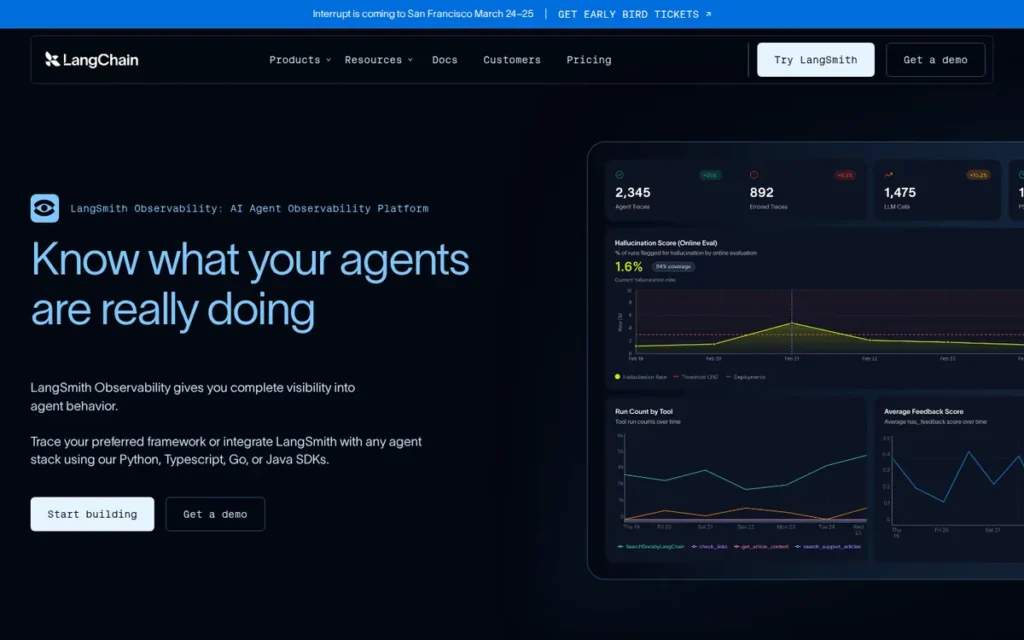
Category: Developer Observability and Evaluation Platform, a production tracing and evaluation platform with native LangChain/LangGraph integration for prompt versioning, quality management, and CI/CD pipeline automation at $39/seat/month Plus.
At a Glance
- Category: Developer Observability and Evaluation Platform
- Best For: Teams already committed to LangChain or LangGraph needing zero-setup production tracing, automated CI/CD evaluation on every pull request, and centralized prompt versioning without additional instrumentation overhead
- Price Range: Free (5,000 traces/month, 1 seat, 14-day retention); $39/seat/month Plus (10,000 base traces/month included; extended 400-day retention traces cost $5.00 per 1,000, 10x the base rate, confirmed December 2025); Enterprise custom (verified April 2026)
- Primary Strength: LangSmith provides zero-setup LangChain/LangGraph integration and the most mature CI/CD evaluation pipeline in the category, natively integrating with GitHub Actions, pytest, and Vitest for automated prompt regression testing as a pre-deployment quality gate before every production deployment
- Biggest Limitation: LangSmith’s tight LangChain coupling creates documented ecosystem lock-in risk (the most consistently cited reason teams migrate to alternatives) and extended 400-day trace retention costs $5.00 per 1,000 traces (10x the base rate), a critical scaling concern for compliance-requiring enterprise deployments requiring long-term retention
- One-Line Summary: LangSmith is the leading developer observability platform for LangChain and LangGraph teams at $39/seat/month Plus (with native GitHub Actions evaluation integration) but its ecosystem lock-in and 10x extended-retention trace cost differential at production volumes are the most documented reasons developers evaluate alternatives (April 2026).
- Last Verified: April 2026
Overview
LangSmith is LangChain’s production observability and evaluation platform for development teams building LLM-powered applications and AI agents, offering commit-based prompt versioning, full-stack tracing, automated regression evaluation, and CI/CD pipeline integration with publicly documented pricing starting at $39/seat/month for the Plus tier.
LangSmith supports both offline evaluation on curated datasets during development and online evaluation on real production traffic, with the distinctive capability to isolate retrieval quality versus generation quality failures in RAG pipelines, enabling root-cause failure diagnosis that most observability tools cannot provide at the component level.
LangSmith’s strongest value proposition is its zero-setup LangChain integration via a single environment variable, a convenience that is architecturally inseparable from the LangChain ecosystem dependency that developer communities consistently cite as the category’s most significant vendor lock-in risk.
Key Features
- Commit-Based Prompt Hub with LLM-Assisted Iteration: LangSmith provides SHA-based prompt versioning with a Prompt Canvas supporting LLM-assisted iteration, a playground for tool calling and JSON output validation, and community prompt template sharing, all within a centralized Prompt Hub accessible to both technical and non-technical team members.
- CI/CD Evaluation Pipeline as an Automated Quality Gate: LangSmith integrates natively with pytest, Vitest, and GitHub Actions for automated evaluation on every pull request or nightly build, enabling teams to run prompt regression tests as part of existing CI/CD pipelines and treat prompt quality as an automated pre-deployment quality gate, as documented in official LangSmith evaluation guides.
- Granular RAG Evaluation with Component Isolation: LangSmith separates RAG pipeline evaluation into retrieval quality metrics (context precision, faithfulness) and generation quality metrics (answer relevance, coherence), allowing teams to isolate whether a pipeline failure originated in the retrieval step or the generation step.
- Offline and Online Evaluation with Broad Framework Coverage: LangSmith supports offline evaluation on curated test datasets during development and online evaluation on real user interactions in production, with tracing covering LangChain, LangGraph, OpenAI SDK, Anthropic SDK, LlamaIndex, and custom implementations.
- Transparent Pricing with Critical Retention-Tier Differential: LangSmith’s Plus tier is publicly documented at $39/seat/month (one of only two tools in this evaluation with specific pricing available without a sales call) but extended 400-day retention traces cost $5.00 per 1,000, which is 10x the base-retention rate of $0.50 per 1,000, confirmed by a LangSmith pricing team member in December 2025 [Source: Reddit r/LangChain, December 2025].
Best For
LangSmith is best for development teams already committed to the LangChain or LangGraph framework who want zero-setup production tracing and automated prompt regression testing integrated into their existing CI/CD pipeline, and whose team size and trace volume keep Plus-tier per-seat and per-trace pricing competitive relative to Langfuse’s free self-hosted MIT tier.
Strengths
- LangSmith is the most frequently mentioned prompt management and LLMOps tool across r/LangChain, r/AI_Agents, r/ycombinator, and r/LocalLLaMA discussions as of 2025–2026 (the highest raw community mention frequency of any tool in this evaluation) reflecting dominant developer mindshare in the LangChain ecosystem.
- LangSmith’s CI/CD evaluation integration with GitHub Actions, pytest, and Vitest is the most complete automated prompt testing pipeline in the evaluated set, enabling teams to run regression tests on every prompt change before production deployment and treat prompt quality with the same rigor as application code, as documented in official LangSmith evaluation guides.
- LangSmith is backed by venture capital through LangChain’s reported Series A funding (2023), providing organizational stability and vendor longevity signals stronger than most open-source or early-stage alternatives in this category, specific investor names and funding amounts were not independently confirmed in April 2026 research.
- LangSmith’s granular RAG evaluation: separating retrieval quality from generation quality, enables teams to identify whether a pipeline failure originated in context retrieval or answer generation, a diagnostic specificity that production teams cite as a differentiating capability for debugging agentic and RAG system failures.
Limitations
- Ecosystem Lock-In: LangSmith’s zero-setup LangChain integration is architecturally inseparable from its most consistently cited risk, vendor lock-in. A structured r/AI_Agents comparison (39 upvotes, 2025) described LangSmith as “more proprietary than other solutions both in how it integrates with frameworks and instrumentation,” and multiple r/LangChain threads (2025) document framework dependency as the primary migration driver away from LangSmith.
A practitioner who had used both tools put the core trade-off plainly on r/LangChain in April 2026:
“Used both. Here’s the honest breakdown. LangSmith is the path of least resistance if you’re already on LangChain. The integration is native, setup takes minutes, and you get tracing + prompt management + evals in one place. The downside: you’re locked into the LangChain ecosystem. If you ever move to a different framework (or use multiple), you’re starting over…” Posted by u/Large_Hamster_9266
Takeaway: LangSmith’s zero-setup appeal is conditionally scoped to LangChain-committed teams, practitioners who have evaluated both tools consistently report that its convenience advantage disappears entirely the moment a team plans to use multiple frameworks or migrate away from LangChain.
- Extended-Retention Trace Cost Scaling: LangSmith’s Plus plan includes 10,000 extended 400-day retention trace upgrades per month; additional extended-retention traces cost $5.00 per 1,000 (10x the base-retention rate) confirmed by a LangSmith pricing team member in December 2025 [Source: Reddit r/LangChain, December 2025]. Teams requiring 400-day retention for compliance should calculate costs using the extended rate, not the base rate.
- Component-Level Failure Isolation in Agentic Pipelines: LangSmith can identify system-level failures but may lack the granularity to diagnose whether retrieval, tool selection, or generation failed independently in complex LangGraph agent workflows, with at least one team citing this as their specific migration reason [r/LangChain, 2025].
- Paid Enterprise Self-Hosting: LangSmith requires a paid enterprise license for self-hosting with no free self-hosted option, creating a meaningful total cost of ownership disadvantage versus Langfuse’s permanently free MIT self-hosted tier for data-sovereign enterprise deployments, as explicitly noted in r/LocalLLaMA developer discussions (2024).
Verdict
LangSmith is the most widely adopted prompt management and observability platform for LangChain-committed teams, with publicly documented pricing at $39/seat/month Plus (verified April 2026), the strongest CI/CD evaluation pipeline integration in the category, and organizational stability from reported Series A venture backing, earning the #2 ranking in this April 2026 evaluation. LangSmith is the correct choice for teams fully invested in the LangChain or LangGraph ecosystem who want zero-setup production tracing without instrumentation overhead. Teams building with mixed frameworks, planning future migrations, or operating at high trace volumes requiring 400-day retention should compare LangSmith’s full cost structure, including the 10x extended-retention rate, against Langfuse’s free self-hosted tier before committing.
3. Humanloop: [Discontinued September 2025] Historical Reference: What Enterprise Prompt Evaluation Required
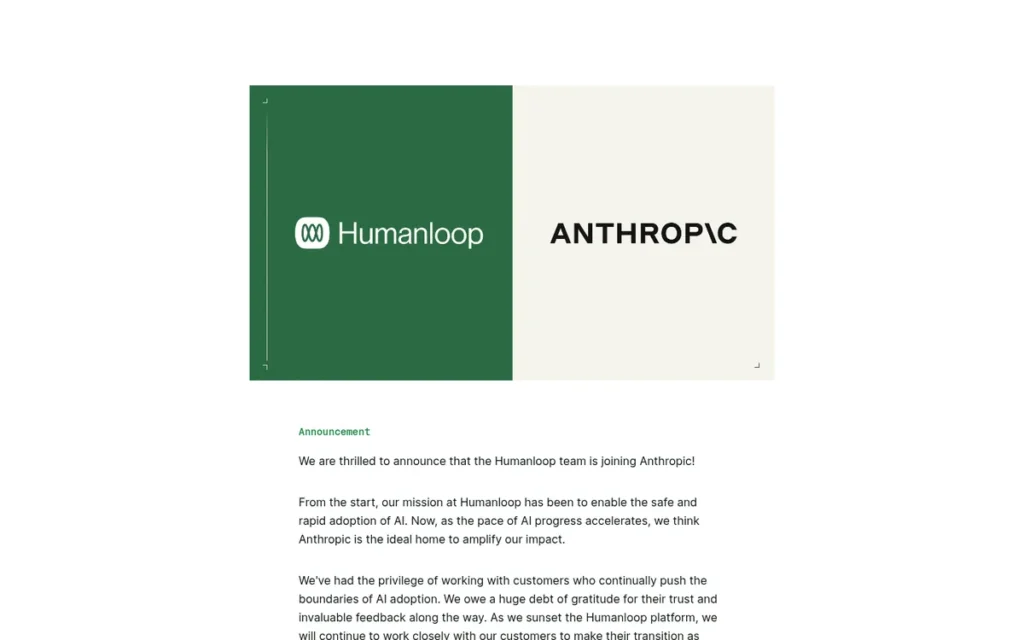
⚠️ PLATFORM SHUTDOWN NOTICE: Humanloop’s platform was permanently shut down on September 8, 2025, following a talent-only acqui-hire by Anthropic in August 2025. Anthropic acquired the founding team but not the platform, IP, or customer assets. Humanloop is NOT available for production adoption. This entry is preserved as a historical reference for enterprise evaluation benchmarking only.
Category: Enterprise Prompt Evaluation Platform [DISCONTINUED September 8, 2025, Historical Reference Only; Sources: TechCrunch, August 13, 2025; W&B blog, 2025]
At a Glance
- Category: Enterprise Prompt Evaluation Platform (Historical Reference: Discontinued)
- Best For: Not applicable: Humanloop’s platform shut down September 8, 2025 and is not available for production adoption. Active alternatives: Agenta (OSS with SOC 2 Type II), Orq.ai (SOC 2 Type II + GDPR + SSO + RBAC), LangSmith (CI/CD evaluation integration).
- Price Range: Not applicable: platform shut down September 8, 2025
- Primary Strength (Historical): Humanloop had the most comprehensive multi-modal evaluation framework and the strongest independently verified third-party enterprise client references in this evaluation, Duolingo and Gusto confirmed via the ZenML LLMOps database (2024)
- Biggest Limitation: Humanloop’s platform was permanently shut down on September 8, 2025; the Anthropic acqui-hire was talent-only, the platform, IP, and customer assets were not acquired and are no longer available
- One-Line Summary: Humanloop’s platform was permanently shut down on September 8, 2025, following a talent-only Anthropic acqui-hire in August 2025 [Sources: TechCrunch, August 13, 2025; W&B blog, 2025], this entry documents Humanloop’s historical capabilities as a benchmark for enterprise evaluation platforms and is not a current product recommendation.
- Last Verified: April 2026
What Happened to Humanloop
Humanloop’s platform was permanently shut down on September 8, 2025, following an acqui-hire by Anthropic in August 2025 [Source: TechCrunch, August 13, 2025]. Anthropic acquired only the founding team (co-founders Raza Habib, Peter Hayes, and Jordan Burgess, and approximately twelve engineers and researchers) but did not acquire the platform, IP, assets, or customer data.
Customers were given advance notice by July 2025 with data export tools provided before the shutdown date. All customer data was deleted at shutdown. No migration path to an Anthropic product was offered.
Humanloop’s shutdown illustrates a specific vendor risk: an acqui-hire by a major LLM provider can result in immediate platform discontinuation rather than product continuation. Teams adopting prompt management platforms should require written roadmap commitments and contractual continuity terms as a standard procurement step.
Historical Capabilities (For Active Alternative Benchmarking Only)
Humanloop was a developer platform for prompt management, evaluation, and LLM quality optimization (with production deployments independently verified at Duolingo and Gusto via the ZenML LLMOps database (third-party, 2024)) and a comprehensive evaluation stack combining code-based evaluators, LLM-as-judge, human review workflows, active learning, and low-confidence flagging.
Humanloop used a .prompt file format enabling non-technical stakeholders to participate in prompt iteration beyond standard Git workflows, alongside a fine-tuning pipeline building training datasets from production logs and user upvote signals, the only tool in this evaluation that explicitly closed the loop between prompt management and model fine-tuning.
Humanloop’s VPC deployment option with HIPAA compliance documentation made it one of the few tools evaluated that explicitly supported healthcare-regulated deployment environments.
Historical Key Capabilities (Benchmarking Reference Only)
- Git-Like Prompt Versioning with .prompt Format: Humanloop provided commit-history versioning using a .prompt file format designed for both technical and non-technical stakeholder participation, enabling teams to track changes, experiment with prompt variants, and revert to prior versions without requiring Git access from domain experts.
- Comprehensive Multi-Modal Evaluation Stack: Humanloop’s evaluation framework supported code-based evaluators, LLM-as-judge scoring, structured human review with labeling queues, active learning for uncertain cases, and low-confidence flagging, a combination that no single active tool in this April 2026 evaluation fully replicates.
- Fine-Tuning Pipeline from Production Logs: Humanloop’s fine-tuning pipeline built training datasets from production prompt-response pairs and user upvote signals, with validation splits and data snapshots, the only tool in this evaluation that explicitly connected prompt management to model fine-tuning.
- Third-Party-Verified Enterprise Deployments: Humanloop’s clients Duolingo and Gusto were independently documented via the ZenML LLMOps database [third-party source, 2024] (not vendor-published case studies) representing the strongest independently verifiable production references evaluated.
What Teams Should Seek in Active Alternatives
Enterprise teams using Humanloop as a benchmark should look for these capabilities in active alternatives:
- For multi-modal evaluation combining automated and human review: LangSmith (CI/CD evaluation with offline and online modes, granular RAG evaluation)
- For enterprise compliance and the most complete governance credentials: Orq.ai (SOC 2 Type II, GDPR, SSO, RBAC, requires full sales-led evaluation with reference customer interviews)
- For open-source flexibility with SOC 2 compliance and non-technical access: Agenta (SOC 2 Type I + II, RBAC, SSO/LDAP, PM web UI, free self-hosted)
Historical Strengths (Benchmarking Reference Only)
- Humanloop’s enterprise deployments at Duolingo and Gusto were independently documented via the ZenML LLMOps database (third-party source, 2024) (not vendor-published case studies) representing the strongest independently verifiable production references in this April 2026 evaluation.
- Humanloop’s multi-modal evaluation framework: combining code evaluators, LLM-as-judge, human review, active learning, and low-confidence flagging, was the most comprehensive evaluation stack of any tool in this evaluation, setting the benchmark for what enterprise evaluation platforms should offer.
- Humanloop’s fine-tuning pipeline from production prompt-response logs and upvote feedback was the only explicit closed-loop pipeline from prompt management to model fine-tuning in this evaluation, a capability active teams should assess in any replacement platform.
Verdict
Humanloop’s platform was permanently shut down on September 8, 2025, and is not available for production adoption as of April 2026. Humanloop is preserved at the #3 position in this evaluation as a historical reference only, its third-party-verified enterprise client references (Duolingo and Gusto) and comprehensive multi-modal evaluation framework represented the strongest enterprise evaluation capabilities of any tool at the time of evaluation. Teams researching enterprise prompt evaluation should use Humanloop’s documented capabilities as a feature benchmark and evaluate Agenta, Orq.ai, and LangSmith as active alternatives against this standard.
4. Agenta: Best Open-Source Full-Stack LLMOps Suite: Best for Teams That Want End-to-End Prompt Management Without Vendor Lock-In
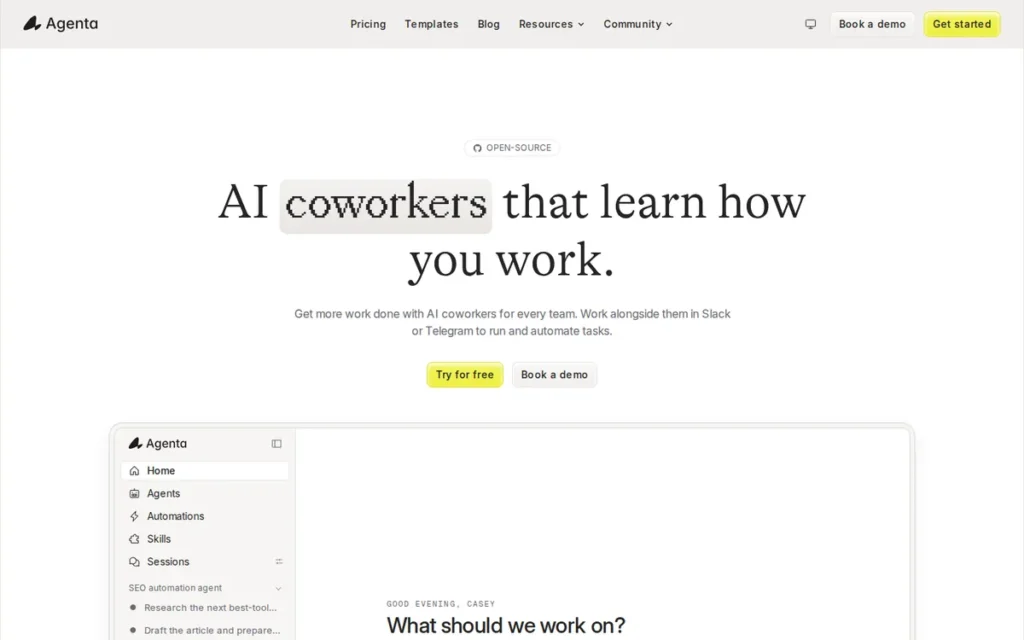
Category: Open-Source End-to-End LLMOps Suite, a self-hostable platform combining prompt versioning, a 50+ model playground, evaluation pipelines, observability, and explicit non-technical team collaboration in one framework-agnostic workflow with confirmed SOC 2 Type I and Type II cloud compliance.
At a Glance
- Category: Open-Source End-to-End LLMOps Suite
- Best For: Teams wanting the broadest open-source feature coverage across the full prompt management lifecycle, particularly where non-technical stakeholders need direct prompt iteration access, framework independence is a priority, and SOC 2 Type II cloud compliance is required without full commercial vendor commitment
- Price Range: Free (self-hosted, open-source); cloud pricing requires direct contact, no public dollar amounts as of April 2026
- Primary Strength: Agenta is the only fully open-source tool in this evaluation with confirmed SOC 2 Type I and Type II cloud compliance, RBAC (viewer/contributor/approver roles), and SSO/LDAP enterprise integration, bridging OSS flexibility with the enterprise governance credentials no other open-source alternative achieves
- Biggest Limitation: Agenta’s community adoption scale is unverifiable relative to Langfuse’s confirmed ~25,300 GitHub stars, and cloud pricing requires sales contact, limiting self-service budget comparison for teams not beginning evaluation via the free self-hosted tier
- One-Line Summary: Agenta is an open-source end-to-end LLMOps platform with the broadest OSS feature coverage in this evaluation (50+ model playground, prompt versioning, evaluation, and observability) with confirmed SOC 2 Type I and Type II cloud compliance, RBAC, and SSO/LDAP enterprise integration, evaluated and verified April 2026.
- Last Verified: April 2026
Overview
Agenta is an open-source end-to-end LLMOps platform for AI teams needing the full prompt management lifecycle (versioning, multi-model evaluation, and observability) in a single framework-agnostic, self-hostable system that explicitly enables non-technical product managers and domain experts to iterate on prompts without engineering access or code knowledge.
Agenta’s Prompt Registry supports centralized storage with branching, rollback, Jinja templating, lineage tracking, and environment promotion across development, staging, and production without code changes, while an interactive playground enables side-by-side comparison of 50+ LLM models using loaded test sets for systematic cross-provider evaluation.
Agenta offers confirmed SOC 2 Type I and Type II compliance on its cloud tier, alongside RBAC with documented viewer, contributor, and approver roles and SSO/LDAP enterprise integration [Sources: agenta.ai/blog/agenta-achieves-soc2-type-i-certification and agenta.ai/blog/soc2-type2, 2025], making Agenta the most compliance-complete open-source tool in this April 2026 evaluation.
Key Features
- Full-Lifecycle Prompt Registry with Environment Promotion: Agenta’s Prompt Registry provides centralized versioning with branching, rollback, Jinja templating, lineage tracking, and promotion from development to staging to production (all without code changes) enabling prompt iteration that is fully independent of application deployment cycles.
- 50+ Model Side-by-Side Playground: Agenta’s interactive multi-model playground supports side-by-side comparison of 50+ LLM models with test set loading, enabling teams to systematically evaluate how prompt changes perform across multiple providers in a single workflow rather than running manual sequential comparisons.
- Non-Technical Stakeholder Web UI: Agenta explicitly provides a web UI for product managers, subject matter experts, and domain specialists to iterate on prompts directly without code access, addressing the engineer bottleneck that is among the most-cited collaboration pain points in developer community discussions, documented as a stated Agenta design objective.
- SOC 2 Type I and Type II Compliance with RBAC and SSO/LDAP: Agenta’s cloud tier provides both SOC 2 Type I and Type II compliance, RBAC with documented viewer, contributor, and approver roles, and SSO/LDAP enterprise integration [Sources: Agenta blog, 2025], making Agenta the most compliance-complete open-source tool in this evaluation, with two of the four governance credentials that Orq.ai holds in combination.
- Framework-Agnostic Integration: Agenta integrates with LangChain, LlamaIndex, direct API calls, and any LLM provider, enabling adoption alongside existing orchestration infrastructure without framework prerequisites or architectural changes.
Best For
Agenta is best for teams wanting the broadest open-source feature coverage across the prompt management lifecycle (particularly where non-technical stakeholders need direct prompt iteration access, framework independence is a priority, and SOC 2 compliance is required without a full commercial vendor contract) and who are willing to engage sales for cloud pricing rather than requiring publicly available pricing to begin evaluation.
Strengths
- Agenta was organically selected as one of the top-2 picks in a r/LangChain prompt management tools thread with 60 upvotes (December 2023), demonstrating genuine developer validation from practitioners actively evaluating production tools, not curator selection by a third party.
- Agenta is the only fully open-source tool in this evaluation with confirmed SOC 2 Type I and Type II cloud compliance, RBAC, and SSO/LDAP enterprise integration, bridging the gap between OSS flexibility and enterprise security requirements that no other open-source tool in this evaluation achieves [Sources: Agenta blog, 2025].
- Agenta publishes substantive technical thought leadership including “The Definitive Guide to Prompt Management Systems” and “What We Learned Building a Prompt Management System”, content signaling genuine domain expertise and an actively maintained product development trajectory, a relevant due diligence signal in a category with documented tool abandonment risk.
- Agenta’s explicit non-technical web UI for product manager and domain expert prompt iteration is more intentionally designed than any other open-source tool evaluated, directly addressing the engineer bottleneck pain point with a stated architectural objective rather than an incidental secondary feature.
Limitations
- Adoption Scale Uncertainty: Agenta’s community validation is genuine: organically recommended in a high-engagement thread with active founder engagement, but its GitHub star count and production deployment scale could not be independently verified, leaving its user base breadth unknown relative to Langfuse’s confirmed approximately 25,300 stars. Teams prioritizing community-backed production validation above all other criteria will find Langfuse the safer choice on this specific dimension.
- Cloud Pricing Opacity: Agenta’s cloud pricing: no public tiers or dollar amounts, requires sales contact before any cost comparison is possible, disadvantaging teams with strict budget-first evaluation processes. The free self-hosted OSS tier partially mitigates this friction for teams willing to begin evaluation without cloud cost visibility.
- Commercial Sustainability Transparency: Agenta’s own blog post “Commercial open-source is hard: our journey” candidly acknowledges the ongoing challenge of sustaining OSS development commercially, relevant context for enterprise buyers assessing long-term support capacity and continued feature development likelihood.
Verdict
Agenta is the top-ranked open-source end-to-end LLMOps platform in this April 2026 evaluation, offering the broadest feature coverage in the open-source segment, confirmed SOC 2 Type I and Type II cloud compliance with RBAC and SSO/LDAP, and the most explicitly designed non-technical team interface of any open-source tool evaluated. Agenta ranks #4 overall primarily because its community adoption scale is unverifiable relative to Langfuse’s confirmed metrics and its cloud pricing requires sales contact, but for teams prioritizing open-source flexibility with enterprise compliance credentials, Agenta is the strongest option in this evaluation. Teams choosing between Langfuse and Agenta should note that Langfuse has stronger independently verified community adoption signals and fully transparent pricing, with all features MIT-licensed since June 2025, while Agenta offers broader integrated feature coverage (playground, evaluation, observability in one OSS package) and an explicit non-technical team access design.
5. PromptLayer: Best for Non-Technical Team Autonomy: Best Middleware for Enabling Domain Expert Prompt Iteration Without Engineering Involvement
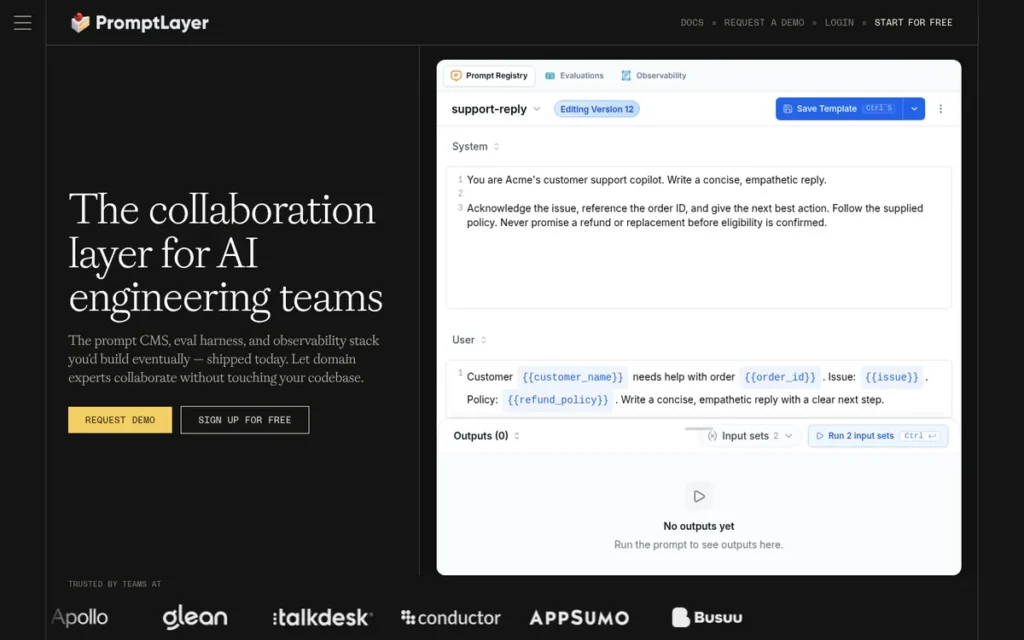
Category: Prompt Registry and Middleware, a provider-agnostic middleware layer between application code and LLM APIs, providing prompt versioning, visual editing for non-technical team members, A/B testing, and production observability without requiring framework adoption or code redeployments.
At a Glance
- Category: Prompt Registry and Middleware
- Best For: Teams where non-technical domain experts, product managers, legal reviewers, or educators need direct autonomy to update production prompts without engineering involvement, and where provider-agnostic fail-safe middleware is prioritized over comprehensive observability or enterprise governance features
- Price Range: Contact sales only: tier names (Free, Growth, Pro, Enterprise) confirmed but no dollar amounts publicly listed as of April 2026
- Primary Strength: PromptLayer provides the most accessible non-technical prompt editing workflow among commercial tools in this evaluation (enabling domain experts to update production prompts via a visual editor without code access) with a confirmed fail-safe architecture that does not interrupt LLM API calls if the service fails
- Biggest Limitation: PromptLayer has no verified G2 or Capterra ratings, no public pricing, no disclosed company information, and is absent from most organic developer forum recommendations, making objective third-party validation essentially unavailable without direct vendor sales engagement
- One-Line Summary: PromptLayer is a provider-agnostic prompt registry middleware with a confirmed fail-safe architecture and visual non-technical editor that enables domain experts to iterate on production prompts without code, but complete pricing opacity, absence from organic developer recommendations, and no public organizational transparency require direct sales due diligence before any production commitment (April 2026).
- Last Verified: April 2026
Overview
PromptLayer is a provider-agnostic prompt registry middleware that sits between application code and LLM APIs, capturing the prompt lifecycle, enabling visual non-code editing by non-technical team members, and supporting A/B testing and production regression detection without requiring any specific LLM orchestration framework.
PromptLayer’s core design philosophy prioritizes decoupling prompt ownership from engineering: product managers, domain experts, and non-technical stakeholders can publish prompt changes to production or staging environments via a visual editor without code redeployments, addressing the engineer bottleneck with a commercial tool built specifically around that use case.
PromptLayer’s fail-safe middleware architecture is confirmed in official documentation as designed so that PromptLayer service unavailability does not interrupt LLM API calls, but PromptLayer lacks published pricing, any verified review ratings, and all public company transparency, requiring direct sales engagement for evaluation that goes beyond feature documentation.
Key Features
- Provider-Agnostic Middleware with Automatic Logging: PromptLayer operates as a middleware layer between developer code and LLM APIs, automatically logging every request and response with metadata including tags, scores, latency, cost, and token usage, without requiring specific framework adoption, supporting OpenAI, Anthropic, Google, and others through Python and TypeScript SDKs.
- Visual Prompt Registry for Non-Technical Access: PromptLayer’s Prompt Registry provides Git-like versioning with visual diffs, commit messages, and side-by-side comparisons, enabling non-technical team members to review and publish prompt changes via a visual editor without Git access or code knowledge, as documented in PromptLayer’s official documentation.
- A/B Testing with Configurable Traffic Splits: PromptLayer supports A/B testing with configurable traffic splits (routing a specified percentage of production traffic to a new prompt variant) enabling controlled staged rollouts and cross-provider experiments without code changes.
- Backtesting and Regression Detection: PromptLayer provides backtesting and regression detection by linking production observability metrics (latency, token usage, cost, accuracy scores) to specific prompt version IDs, enabling teams to quantify whether a prompt change improved or degraded production performance before full rollout.
- Confirmed Fail-Safe Architecture: PromptLayer is designed with a fail-safe architecture confirmed in official documentation [docs.promptlayer.com] as not interrupting LLM API calls if the PromptLayer service itself is unavailable, eliminating the single-point-of-failure concern that teams raise about adopting third-party middleware in production environments.
Best For
PromptLayer is best for teams where non-technical stakeholders (domain experts, product managers, legal reviewers, educators, or customer success managers) need direct autonomy to iterate on prompts without routing every change through an engineering sprint, and where provider-agnostic fail-safe middleware is a higher priority than comprehensive observability depth or enterprise governance documentation.
Strengths
- PromptLayer’s fail-safe middleware design is confirmed in official documentation as architecturally preventing LLM API call interruption during service downtime, addressing the most common production reliability concern teams raise about third-party middleware, ensuring that PromptLayer service outages do not propagate into application-level LLM call failures.
- PromptLayer appears in five or more independent “top prompt management tools” comparison lists including Maxim AI, Braintrust, and cybernews.com (2025–2026), indicating consistent recognition across multiple third-party sources even in the absence of formal review platform presence.
- PromptLayer’s visual editor and zero-code production deployment workflow for domain experts directly addresses the most-cited collaboration bottleneck (engineer dependency on every prompt change) with a more deliberately designed non-technical UX than any other commercial tool in this evaluation.
- PromptLayer’s provider-agnostic design with Python and TypeScript SDKs, LiteLLM compatibility, LangChain integration, and REST API logging supports adoption across diverse technology stacks without framework prerequisites or architectural changes.
Limitations
- Community Validation Gap: PromptLayer appears consistently in curated comparison lists but is notably absent from most-upvoted organic developer recommendations in r/LangChain, r/AI_Agents, and r/LocalLLaMA threads, a divergence suggesting brand awareness driven by content marketing rather than community-validated production adoption, which represents a meaningful independent credibility gap.
- Complete Pricing and Organizational Opacity: PromptLayer has no verified G2, Capterra, or Product Hunt ratings, no published pricing requiring all prospective buyers to engage sales, and no public company information, no verified founding year, team size, or funding was found in any public source reviewed for this April 2026 evaluation, making vendor due diligence unusually difficult compared to any other evaluated tool.
- Enterprise Governance Unconfirmed: PromptLayer’s enterprise governance capabilities (RBAC granularity, SSO support, audit log specificity, and approval workflow availability) could not be independently confirmed from any public source, placing PromptLayer below tools with documented compliance credentials (Agenta’s SOC 2 Type II, Orq.ai’s SOC 2 Type II + GDPR) for regulated-industry procurement evaluation.
Verdict
PromptLayer is the most focused prompt registry middleware for enabling non-technical domain expert autonomy in this April 2026 evaluation, with a confirmed fail-safe production architecture and provider-agnostic design that make it a legitimate option for teams whose primary requirement is removing the engineer bottleneck from every prompt iteration cycle. PromptLayer ranks #5 overall due to its complete pricing opacity, absence of community-validated adoption evidence, and lack of public organizational transparency, all of which make objective comparison difficult and require direct sales engagement before any production commitment. Teams whose non-technical collaboration need is the dominant selection criterion, and who are prepared for thorough vendor due diligence, will find PromptLayer’s visual workflow design genuinely differentiated; teams that prioritize independently verifiable credibility or transparent pricing should evaluate Agenta’s open-source PM web UI as a well-validated alternative.
6. Orq.ai: Best Enterprise Compliance Stack: Best for Regulated Industries Requiring SOC 2 Type II + GDPR + SSO + RBAC with a Unified Multi-LLM Gateway
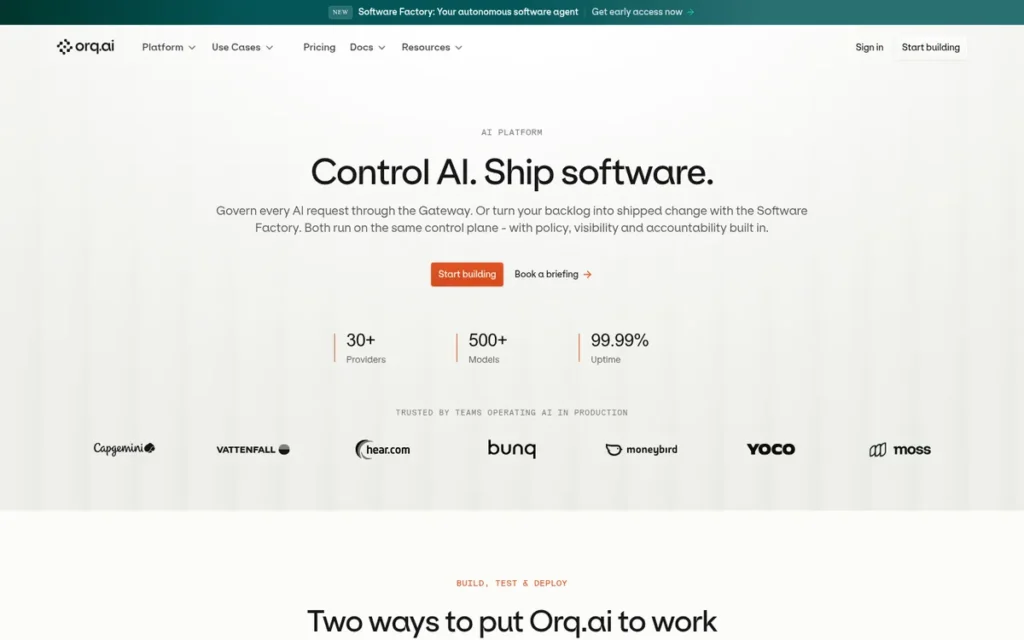
Category: Enterprise LLMOps Gateway, an enterprise generative AI collaboration platform combining prompt management, a unified multi-LLM gateway to 300+ providers, RAG-as-a-Service, agentic orchestration, and the most complete confirmed compliance stack, SOC 2 Type II (via Vanta), GDPR, SSO, and RBAC, in this April 2026 evaluation.
At a Glance
- Category: Enterprise LLMOps Gateway
- Best For: Regulated enterprise teams in BFSI, healthcare, or other compliance-intensive industries where SOC 2 Type II, GDPR, SSO, and RBAC are non-negotiable procurement requirements, and where a unified gateway to 300+ LLM providers with native RAG-as-a-Service justifies a full sales-led evaluation process
- Price Range: Contact sales only: no public pricing, no free tier, no trial pricing without sales engagement as of April 2026
- Primary Strength: Orq.ai is the only tool in this April 2026 evaluation with a confirmed combination of SOC 2 Type II (certified via Vanta), GDPR compliance, SSO, and RBAC (plus a unified gateway to 300+ LLM models) making Orq.ai uniquely positioned for compliance-gated procurement in regulated enterprise environments where all four credentials are procurement prerequisites
- Biggest Limitation: Orq.ai has zero verified community adoption signals: no G2 ratings, no Capterra reviews, near-total absence from independent developer forums, meaning every capability claim originates from vendor-produced content with no independent practitioner validation available through any self-service research channel
- One-Line Summary: Orq.ai is the only tool in this April 2026 evaluation with confirmed SOC 2 Type II (via Vanta), GDPR, SSO, and RBAC combined with a 300+ model unified gateway and native RAG-as-a-Service, but complete pricing opacity and zero independent community validation require a full sales-led evaluation with reference customer interviews before any production commitment.
- Last Verified: April 2026
Overview
Orq.ai is an enterprise LLMOps and generative AI collaboration platform providing an integrated stack covering no-code prompt design, full version history with audit logging, staging-to-production deployment with guardrails, A/B testing and golden-set evaluation, a unified LLM gateway supporting 300+ models and providers (including bring-your-own-models capability) with runtime caching, RAG-as-a-Service, fine-tuning recommendations, real-time analytics, and agentic orchestration with memory management.
Orq.ai holds confirmed SOC 2 Type II (certified via Vanta) and GDPR compliance alongside SSO and RBAC (the most complete enterprise governance credential set of any tool evaluated in April 2026) with self-hosted and hybrid deployment options for data sovereignty in regulated industries [Sources: Slashdot software comparison database; Orq.ai platform documentation, verified April 2026].
Orq.ai additionally documents EU AI Act compliance, relevant for teams in EU-regulated environments. However, Orq.ai’s complete pricing opacity, the absence of any verified community adoption signals, and no public organizational information mean this evaluation cannot independently validate claimed capabilities beyond vendor documentation.
Key Features
- Unified 300+ Model LLM Gateway with BYOM: Orq.ai provides a unified gateway to 300+ LLM models and providers (including bring-your-own-models capability) with runtime caching, enabling teams to test prompts across providers through a single API and switch underlying models without code changes [Source: Orq.ai platform documentation and Slashdot comparison database, verified April 2026].
- No-Code Prompt Design with Full Audit Logging: Orq.ai includes no-code prompt design tools, full version history with audit logging, and staging-to-production deployment with guardrails, providing a complete prompt governance workflow covering version control, access auditing, and staged rollout controls.
- SOC 2 Type II + GDPR + SSO + RBAC + EU AI Act Compliance: Orq.ai holds confirmed SOC 2 Type II (certified via Vanta), GDPR compliance, SSO, RBAC, and EU AI Act compliance documentation (the most complete enterprise governance credential set in this evaluation) with self-hosted and hybrid deployment options for regulated-industry data sovereignty requirements.
- Native RAG-as-a-Service and Agentic Orchestration: Orq.ai integrates RAG-as-a-Service as a native capability alongside agentic AI orchestration with memory management, combining retrieval, agent workflow management, and prompt versioning in a single platform rather than requiring separate tool integrations.
- Real-Time Analytics with A/B and Golden-Set Evaluation: Orq.ai provides real-time analytics across accuracy, latency, token usage, and cost metrics at the prompt version level, with A/B testing and golden-set evaluation for systematic prompt quality measurement across the deployment lifecycle.
Best For
Orq.ai is best for enterprise teams in BFSI, healthcare, or other compliance-intensive industries where SOC 2 Type II, GDPR, SSO, and RBAC are non-negotiable procurement prerequisites, and where the value of a 300+ model unified gateway with native RAG-as-a-Service and agentic orchestration justifies a full sales-led evaluation process with no self-service pricing comparison available.
Strengths
- Orq.ai is the only tool in this April 2026 evaluation with a confirmed combination of SOC 2 Type II (via Vanta), GDPR compliance, SSO, and RBAC in a single commercial platform, a governance credential set that qualifies Orq.ai for compliance-gated procurement in regulated enterprises, distinguishing it from Agenta which confirms SOC 2 Type II and RBAC/SSO but not GDPR certification.
- Orq.ai’s unified gateway to 300+ LLM models and providers with runtime caching addresses the multi-provider fragmentation pain point more comprehensively than any other tool evaluated, enabling prompt testing, comparison, and production deployment across any LLM provider through a single API without per-provider integrations.
- Orq.ai integrates RAG-as-a-Service, agentic orchestration with memory management, and fine-tuning recommendations alongside prompt versioning in a single platform, a combined agentic LLMOps capability set not replicated by any other single tool in this April 2026 evaluation.
- Orq.ai’s confirmed SOC 2 Type II certification via Vanta indicates the company has completed an independent audit of its security controls, requiring organizational maturity and investment that provides an indirect commercial viability signal even in the absence of publicly disclosed company information or community validation.
Limitations
- Complete Absence of Independent Validation: Orq.ai has no verified G2 or Capterra ratings and a near-total absence from organic developer forums (a single r/ycombinator mention with zero upvotes from an unverified account is the entirety of discoverable community presence) meaning every claimed capability originates exclusively from vendor-produced content with no independent practitioner confirmation available through any self-service research channel.
- Complete Pricing Opacity: Orq.ai has no published pricing, no free tier, and no self-service cost comparison available (the most complete pricing opacity of any evaluated tool) requiring sales engagement before any budget qualification is possible, which is the highest evaluation barrier in a category where five of seven tools already require sales contact.
- Organizational Transparency Gap: Orq.ai has no publicly disclosed founding year, team size, or funding history (the most significant vendor due diligence gap among all evaluated tools) and enterprise buyers making vendor risk assessments require this information to evaluate organizational stability and long-term support capacity before committing production workloads.
Verdict
Orq.ai is the strongest-credentialed enterprise compliance platform in this April 2026 evaluation (the only tool combining confirmed SOC 2 Type II (via Vanta), GDPR, SSO, and RBAC with a 300+ model unified gateway, native RAG-as-a-Service, and agentic orchestration in a single platform) making it uniquely positioned for compliance-led procurement in regulated industries. Orq.ai ranks #6 overall because its complete absence of community adoption signals, transparent pricing, and public organizational information makes objective independent comparison impossible, placing it below tools with independently verifiable claims regardless of governance credential strength. Regulated enterprise teams whose procurement is compliance-gate-driven and who have resources for a full sales-led evaluation with reference customer interviews should include Orq.ai as a serious candidate; teams requiring community validation, self-service pricing comparison, or open-source optionality should prioritize higher-ranked alternatives first.
What Red Flags Should I Watch For When Evaluating Prompt Management Tools?
Six red flags are most consequential in this category: pricing opacity requiring sales contact before any cost comparison, ecosystem lock-in framed as a convenience feature, product discontinuation without contractual protections (illustrated by Humanloop’s September 2025 shutdown), open-source maintenance signal absence, enterprise governance claims without independent practitioner validation, and divergence between curated-list visibility and organic developer recommendations.
Red Flag #1: Pricing Opacity Requiring Sales Contact for All Tiers
Four of six tools in this evaluation require a sales call before any pricing information is available, making cost-at-scale comparison impossible without vendor engagement. Pricing opacity delays evaluation timelines, disadvantages smaller teams, and prevents the trace-volume cost projection that is the primary documented reason teams switch platforms mid-production. Insist on a published pricing sheet with specific dollar amounts and usage limits before signing any evaluation agreement or trial commitment.
Red Flag #2: Ecosystem Lock-In Framed as a Convenience Feature
LangChain ecosystem lock-in is the most consistently cited reason developers switch from LangSmith to alternatives, the same architectural coupling that enables zero-setup integration also creates framework dependency that multiple independent r/LangChain threads (2025–2026) document as the primary migration driver. Ask explicitly whether any evaluated tool functions at full capability without your current orchestration framework before committing to it.
Community practitioners on r/LangChain captured the dual risk of the two most-adopted tools in a single comment in March 2026:
“LangSmith = vendor lock in of your data. Have fun with that. Langfuse = nightmare to self host (postgres, click house, redis, minio). If these Langfuse factors bother you, look no further than Arize AI Phoenix. It got the whole tracing, sessions and evaluation stuff too, only needing Postgres. Just my preference though, I’m sure there are other similar options just as good, just look at comparison tables around: LangSmith and Langfuse aren’t the only definitive options for it” Posted by u/Budget_Bar2294
Takeaway: The two most-adopted prompt management tools each carry a distinct production liability (LangSmith’s data lock-in and Langfuse’s infrastructure overhead) confirming that independent alternatives warrant serious evaluation alongside the category leaders before any production commitment.
Red Flag #3: Product Discontinuation Without Contractual Protections
Humanloop’s platform was permanently shut down on September 8, 2025, following an Anthropic acqui-hire that was talent-only, with no transfer of platform, IP, or assets [Source: TechCrunch, August 2025]. Customers received approximately six weeks of advance notice before data deletion. Any prompt management tool acquired by a major LLM provider should trigger written roadmap commitments, contractual continuity terms, and data export provisions before any production workload is committed. An acqui-hire is not the same as a product acquisition.
Red Flag #4: Open-Source Tools Without Verifiable Current Maintenance Activity
An open-source tool that stops receiving commits becomes a production risk even while its code remains available. Before self-hosting any open-source prompt management tool, verify:
- The date of the last GitHub commit
- Whether open issues are receiving responses within a reasonable timeframe
- Whether the founding team is publicly engaged in community channels such as Reddit, Discord, or GitHub Discussions
Red Flag #5: Enterprise Governance Claims Without Independent Practitioner Validation
Orq.ai’s SOC 2 Type II and GDPR certifications are genuine compliance credentials, but they exist alongside zero independent community practitioner confirmation, no public case studies, and no reference customers available through self-service research. Governance certifications combined with zero community presence require a full reference customer verification process before any production commitment; certifications alone cannot substitute for real-world deployment evidence at comparable scale.
Red Flag #6: Divergence Between Curated-List Visibility and Organic Developer Recommendations
A tool appearing in many curated comparison lists but generating zero organic developer recommendations in unprompted forum threads carries a fundamentally different trust signal than a tool developers recommend when asked by peers. PromptLayer appears consistently in curated lists but is absent from most-upvoted organic recommendations across r/LangChain, r/AI_Agents, and r/LocalLLaMA, a divergence that warrants deeper due diligence before treating curated-list presence as evidence of production adoption quality.
What Questions Should I Ask Before Choosing a Prompt Management Tool?
Seven questions are most consequential before committing to a prompt management platform: framework commitment, production trace volume costs at scale, compliance documentation requirements, non-technical member access needs, DevOps self-hosting capacity, maintenance verification for open-source tools, and whether the hybrid Git-plus-runtime architecture is appropriate for your governance requirements.
Question #1: Is your team fully committed to LangChain, or are you evaluating framework independence?
Your answer is the single most consequential filter in this evaluation. LangSmith’s strongest advantage, zero-setup LangChain integration, is architecturally inseparable from its most-cited risk: framework lock-in. Teams using OpenAI or Anthropic SDKs directly, LlamaIndex, or multiple frameworks simultaneously should start evaluation with Langfuse or Agenta, both provide framework-agnostic instrumentation at the same feature depth, without requiring any specific framework adoption.
Question #2: What is your production trace volume, and what does that cost per tool at 10,000, 100,000, and 1,000,000 traces per month?
Per-trace pricing at scale is the primary documented driver of platform switching in 2025–2026. LangSmith’s extended 400-day retention traces cost $5.00 per 1,000 (10x the base rate) confirmed December 2025 [Source: Reddit r/LangChain]. Open-source self-hosted tools eliminate per-trace fees entirely:
- Langfuse: free MIT self-host (ClickHouse/Redis/S3 infrastructure costs only)
- Agenta: free OSS self-host (lighter infrastructure profile)
Question #3: What governance documentation does your InfoSec team require for procurement approval?
Match your compliance requirements to confirmed tool credentials before evaluation begins. As of April 2026:
- SOC 2 Type II + GDPR + SSO + RBAC: Orq.ai only (all four confirmed in a single platform)
- SOC 2 Type I + II + RBAC + SSO/LDAP: Agenta cloud tier (confirmed; GDPR not confirmed)
- SSO + RBAC: Langfuse Enterprise tier (verify post-June 2025 MIT vs. paid feature boundary)
- SSO: LangSmith Enterprise tier
- HIPAA + VPC: Humanloop: platform permanently shut down September 2025, not available
Verify current certification scope and Type directly with each vendor at evaluation time, as compliance offerings evolve.
Question #4: Do non-technical team members (product managers, domain experts, legal reviewers) need direct prompt editing access without engineering involvement?
If yes, prioritize tools with explicit non-technical access design:
- PromptLayer: visual commercial editor (pricing requires sales contact)
- Agenta: PM web UI (open-source with SOC 2 Type II cloud)
- Langfuse/LangSmith: developer-first tools where non-technical access requires additional engineering scaffolding
Question #5: What is your self-hosting DevOps capacity, and do you need a free OSS license or a paid enterprise self-hosting model?
Langfuse’s self-hosted tier is permanently free under MIT but requires ClickHouse, Redis, and S3 together, meaningful DevOps overhead. Agenta’s self-hosted tier is free and open-source with a lighter infrastructure profile. LangSmith self-hosting requires a paid enterprise license. For teams without dedicated DevOps capacity, Langfuse’s $29/month Developer tier is the most accessible managed entry point available without a sales call.
Question #6: Have you verified that the tool is actively maintained before committing to any production dependency?
Maintenance activity is a production risk that vendor documentation cannot reveal. Humanloop’s September 2025 shutdown demonstrates that a tool can become unavailable with only weeks of notice. For any open-source tool, check GitHub commit history for activity in the past 90 days before creating any production dependency.
Question #7: Do you need the hybrid Git-plus-runtime architecture for governance-conscious prompt management?
Teams requiring formal approval before any prompt reaches production should combine Git (for PR-based approval gates) with a runtime service (Langfuse or LangSmith for distribution and edge-caching). This hybrid pattern (documented as the mature production architecture in r/AI_Agents community discussions (2025)) provides developers Git-native governance control and domain experts UI-based promotion control simultaneously, without forcing a binary choice between governance and flexibility.
How Did We Rank These Prompt Management Tools?
These six tools were ranked by scoring each against six weighted criteria using independently sourced research, with no adjustments for vendor outreach, affiliate relationships, or commercial considerations. Rankings reflect evidence scores across all criteria:
- Criterion #1: Developer Community Adoption and Validation (Primary Weight): GitHub stars, YC founder survey results, organic forum recommendation frequency, and ratio of organic mentions to curated-list appearances
- Criterion #2: Breadth and Depth of Core Prompt Management Capabilities (Primary Weight): prompt versioning with rollback, A/B testing, evaluation pipelines, production observability, non-technical editor access, multi-LLM provider support
- Criterion #3: Pricing Transparency and Value (Primary Weight): published vs. contact-sales-only pricing; cost at 10k, 100k, and 1M trace volumes; self-hosting cost structure
- Criterion #4: Enterprise Governance and Compliance (Secondary Weight): RBAC, SSO/SAML, SOC 2, GDPR, HIPAA, audit trails, and approval workflow availability
- Criterion #5: Framework Agnosticism and Integration Flexibility (Secondary Weight): independence from specific orchestration frameworks; multi-SDK support; instrumentation overhead
- Criterion #6: Vendor Stability and Long-Term Viability (Secondary Weight): funding, OSS maintenance health, acquisition status, organizational transparency
How Was the Evaluation Conducted?
This evaluation followed a four-stage structured research process:
- Discovery: Multi-engine AI search queries identifying the most-recommended prompt management tools as of April 2026
- Independent web research: Verified documentation, third-party databases (ZenML LLMOps Database, nolist.ai, Slashdot), and analyst market reports
- Community sentiment analysis: Threads across r/LangChain, r/AI_Agents, r/ycombinator, r/LocalLLaMA, and r/OpenAI reviewed April 2026
- Documentation cross-reference: All feature, pricing, and compliance claims verified against official vendor documentation and named independent sources before inclusion
What Criteria Were Used to Rank These Tools?
Criterion #1: Developer Community Adoption and Validation (Primary Weight)
In a category where no tool has an established G2 or Capterra profile with sufficient review volume, organic developer signals are the most reliable proxy for real-world quality. Community-validated tools carry lower adoption risk for teams without resources to conduct extensive independent trials. Langfuse’s #1 YC founder survey ranking and ~25,300 GitHub stars provided the strongest signal in this evaluation.
Criterion #2: Core Prompt Management Capability Breadth (Primary Weight)
Evaluation covered six documented capabilities from official product documentation:
- Prompt versioning with Git-like commit history and rollback
- A/B testing with configurable traffic splitting
- Evaluation pipelines with regression detection
- Production observability (latency, cost, token usage)
- Non-technical editor access without code requirements
- Multi-LLM provider support without framework adoption
Criterion #3: Pricing Transparency and Value (Primary Weight)
Tools with published pricing enable self-service evaluation and developer-led adoption. Per-trace cost scaling at production volumes is the documented primary driver of platform switching. Only Langfuse and LangSmith publish specific dollar amounts without sales contact in this evaluated set.
Criterion #4: Enterprise Governance and Compliance (Secondary Weight)
Verified presence of RBAC, SSO/SAML, SOC 2, GDPR, HIPAA, VPC deployment, and approval workflow availability, evaluated as binary verified-or-unconfirmed status. BFSI and regulated industries are the dominant enterprise LLMOps spending segment [Sources: TechSci Research, 2025], governance certifications are procurement gates that can disqualify tools regardless of feature quality.
Criterion #5: Framework Agnosticism (Secondary Weight)
Whether the tool requires a specific orchestration framework for full feature access, and whether instrumentation requires architectural code changes versus environment variable configuration. LangChain ecosystem lock-in is the most consistently cited risk in community platform selection discussions.
Criterion #6: Vendor Stability and Long-Term Viability (Secondary Weight)
Public funding history, organizational transparency, acquisition status with specific continuity evidence, OSS commit activity, and founder community engagement. Humanloop’s September 2025 shutdown (confirmed as a live event during this evaluation) has been incorporated as a concrete example of why vendor stability must be weighted as a primary criterion, not an afterthought.
How Was Conflicting Evidence Weighted?
When vendor documentation conflicts with Reddit community sentiment, specificity and recency determine weight. A detailed 2025 Reddit thread with 50+ upvotes from a named community member outweighs a generic vendor feature description without a date.
Vendor-reported statistics are labeled as such throughout. Only claims corroborated by at least one independent source are stated as fact.
Where data is unavailable or unverifiable, this is explicitly documented rather than assumed neutral.
How Were Claims Validated Against Independent Sources?
As of April 2026, no tool in this category was found to have an established G2 or Capterra profile with sufficient review volume for a verified aggregate score, reflecting the relative novelty of the prompt management category (most tools launched 2022–2024), though review platform presence may change as the category matures.
Community signals (GitHub stars, Reddit mention frequency, YC survey results) are used as proxy metrics and explicitly labeled as such. All pricing figures are verified directly from official sources with a month and year, or noted as “unverified estimate” where sourced from third parties.
When Will This Evaluation Be Updated?
This article was published and last updated April 2026. The two most time-sensitive items in this evaluation are Langfuse’s pricing tier structure and any new vendor stability events; these should be re-verified by any reader evaluating tools more than 30 days after the publication date.
The next scheduled pricing and status verification is July 2026.
PlugRoute has no affiliate relationships with any company listed. Rankings are determined entirely by research data and objective evaluation criteria.
What Are the Most Common Questions About Prompt Management Tools?
What is the best prompt management tool for teams not using LangChain?
Langfuse is the top recommendation for framework-agnostic teams, verified #1 in a 57-response YC founder survey (2025), fully compatible with OpenAI SDK, Anthropic SDK, and LlamaIndex without requiring LangChain, with transparent pricing from $29/month cloud or a permanently free MIT self-hosted tier with all features open-sourced in June 2025 (verified April 2026). Agenta is the strongest open-source alternative when end-to-end feature coverage with a 50+ model playground and explicit non-technical PM access are the primary requirements.
Is Humanloop still available after the Anthropic acquisition?
Humanloop’s platform was permanently shut down on September 8, 2025, following a talent-only acqui-hire by Anthropic in August 2025 [Sources: TechCrunch, August 2025; W&B blog, 2025]. Anthropic acquired only the founding team, not the platform, IP, or assets. Customers received advance notice by July 2025. Humanloop is not available for production adoption as of April 2026. Active alternatives for enterprise evaluation capabilities: Agenta (SOC 2 Type I + II, RBAC, OSS), Orq.ai (SOC 2 Type II, GDPR, SSO, RBAC), and LangSmith (CI/CD evaluation integration).
How does PlugRoute determine its prompt management tool rankings?
PlugRoute ranks tools by scoring each against six weighted criteria (developer community signals, feature breadth, pricing transparency, governance completeness, framework agnosticism, and vendor stability) using only independently sourced research. Rankings are not adjusted for vendor outreach, affiliate relationships, or sponsorships. Every claim is traced to a named source with a date; data that is unavailable is explicitly documented as absent rather than assumed neutral.
Glossary: Key Terms Used in This Comparison
LLMOps: LLMOps (Large Language Model Operations) is the set of practices, tools, and infrastructure for deploying, monitoring, versioning, and evaluating LLM-powered applications in production, analogous to DevOps but specific to the lifecycle management of prompts, model outputs, and evaluation workflows in production LLM systems.
Prompt Registry: A prompt registry is a centralized repository for storing, versioning, and deploying prompt templates with Git-like commit history, rollback capability, and environment-specific labels (development, staging, production), enabling teams to manage prompt changes independently of application code deployments, without requiring code redeployments for every prompt update.
LLM-as-Judge: LLM-as-Judge is an evaluation methodology in which a capable LLM (such as GPT-4o or Claude) is used as an automated evaluator to score the quality, accuracy, or relevance of another LLM’s output against defined criteria, enabling prompt evaluation to scale beyond what human review capacity alone can handle in high-volume production environments.
SDK Edge-Caching: SDK edge-caching in prompt management refers to the local caching of the most recently fetched active prompt version within the application’s SDK, so that if the prompt management service becomes unavailable, the application continues serving the last known good prompt version at zero additional latency, enabling graceful degradation without single-point-of-failure risk.
Acqui-Hire: An acqui-hire is a talent-first acquisition in which a company acquires another primarily to obtain its employees (particularly founders and engineers) rather than its product, IP, or customer assets. Humanloop’s 2025 Anthropic acqui-hire resulted in immediate platform shutdown because the product itself was not acquired; this outcome is distinct from a full product acquisition and represents a specific vendor stability risk for teams evaluating prompt management middleware.
Which Prompt Management Tool Is Right for You?
For April 2026: Langfuse is the top overall choice for framework-agnostic engineering teams with transparent pricing from $29/month or free self-hosted; LangSmith is correct for LangChain-committed teams willing to manage per-trace cost at scale; Agenta is the best open-source full-lifecycle alternative; and Orq.ai is the only confirmed option for SOC 2 Type II + GDPR + SSO + RBAC-gated enterprise procurement.
Key Insights
- Langfuse is the top overall choice for engineering teams outside the LangChain ecosystem, earning #1 through approximately 25,300 GitHub stars (late 2025), #1 in a 57-response YC founder survey (2025), transparent four-tier pricing with a permanently free MIT self-hosted option, complete MIT open-sourcing of all features in June 2025, and official AWS Bedrock AgentCore integration (GA October 2025).
- LangSmith’s zero-setup LangChain advantage is a framework dependency trade-off, not a pure benefit, the same architectural coupling that enables single-variable setup is the most-cited driver of platform migration documented across multiple independent r/LangChain threads (2025–2026), and extended 400-day trace retention at $5.00 per 1,000 traces (10x the base rate) compounds significantly for compliance-requiring teams.
- Humanloop permanently shut down on September 8, 2025 following a talent-only Anthropic acqui-hire, demonstrating that vendor organizational independence must be weighted as a primary selection criterion, not an afterthought. Teams with prior Humanloop interest should evaluate Agenta, Orq.ai, and LangSmith as active alternatives.
- Four of six tools require sales contact for all pricing, making Langfuse and LangSmith the only tools where self-service budget comparison is possible as of April 2026, a significant practical advantage for developer-led and startup evaluation processes that should not be underestimated.
- The hybrid Git-plus-runtime architecture is the documented mature production pattern for governance-conscious teams (Git for source-of-truth versioning and PR review gates, combined with a runtime service (Langfuse or LangSmith) for distribution and edge-caching) providing both approval governance and deployment flexibility simultaneously, per r/AI_Agents community discussions (2025).
- Orq.ai’s SOC 2 Type II + GDPR + SSO + RBAC credential set is genuinely unique in this evaluation and merits inclusion in any regulated enterprise vendor shortlist, but its complete absence of community validation requires full reference customer verification before committing, as no independent practitioner confirmation is currently available through self-service research channels.
For framework-agnostic teams: start with Langfuse’s free self-hosted tier or $29/month Developer cloud, no sales call required, and the community validation is the strongest in the category. For regulated enterprises with SOC 2 and GDPR requirements: Orq.ai is the only all-four-credentials option, but Agenta’s SOC 2 Type II, RBAC, and SSO/LDAP credentials deserve parallel evaluation before committing to a sales-only process.
PlugRoute publishes independent AI infrastructure reviews with quarterly pricing and vendor status verification. We update this guide quarterly. Last updated: April 2026. The next scheduled review of this article’s pricing and vendor status is July 2026.