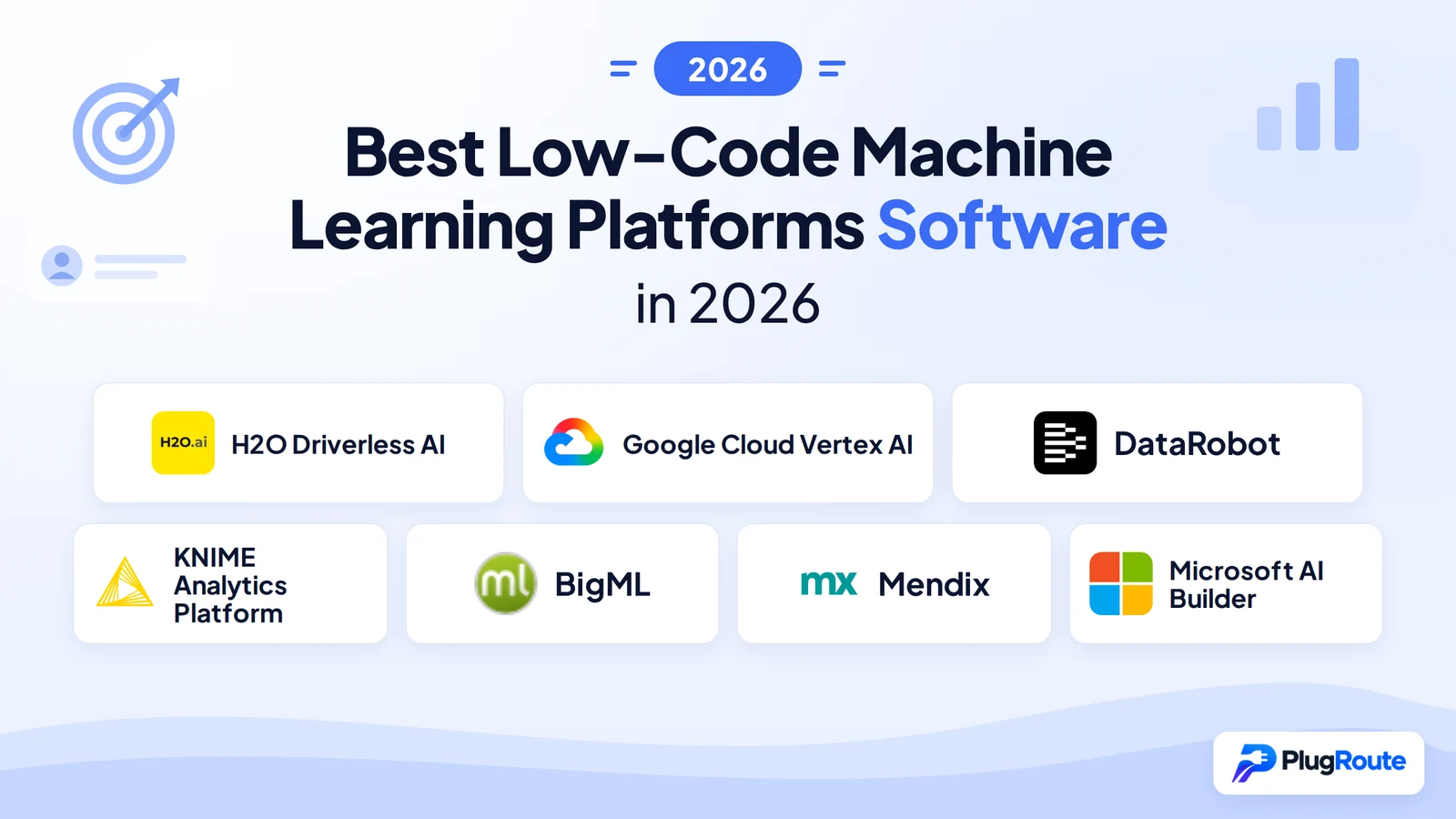
H2O Driverless AI leads regulated-industry AutoML in 2026 with the deepest multi-method explainability suite in this evaluation. Google Cloud Vertex AI leads for GCP-native teams bridging traditional ML and generative AI in one managed service. DataRobot earns consensus practitioner endorsement for enterprise automated modeling at scale. The best platform depends on whether your primary need is to train models from data, deploy pre-trained models in applications, or automate structured business workflows.
The “low-code ML” label covers five fundamentally different platform architectures, GPU-accelerated AutoML engines, unified cloud platforms, open-source visual workflow builders, API-first MLaaS tools, and embedded application ML modules. Most comparisons miss these distinctions, describe pricing that requires a sales call to verify, and conflate basic feature importance charts with the multi-method explainability suites that financial regulators actually require.
PlugRoute has no affiliate relationships with any company listed in this evaluation.
“If you want stronger AutoML capabilities, DataRobot and H2O.ai are widely used in finance and insurance. They’re good at balancing predictive accuracy, explainability, and governance.” Posted by u/Ok_Grab903, r/analytics, 2025
Takeaway: Practitioner communities in regulated industries consistently group H2O Driverless AI and DataRobot as the consensus enterprise AutoML picks, a peer validation signal weighted alongside five other criteria in this evaluation’s methodology.
What Are the Top Low-Code ML Platforms at a Glance?
- H2O Driverless AI leads for regulated-industry AutoML with the deepest multi-method explainability suite (K-LIME, SHAP on original and engineered features, and per-prediction reason codes) of any platform in this evaluation.
- Google Cloud Vertex AI is best for GCP-native organizations, providing the only unified low-code interface bridging traditional AutoML, custom model training, and generative AI fine-tuning with a 200+ model garden including Gemini 3 Pro/Flash and Anthropic Claude.
- DataRobot earns consistent practitioner endorsement for enterprise automated modeling in regulated industries, combining exhaustive Autopilot blueprint testing, PII-aware AI Catalog governance, and production MLOps.
- KNIME Analytics Platform is the top-ranked open-source option, offering a completely unlimited free desktop with 4,000+ extension nodes, 300+ connectors, and K-AI natural language workflow generation via Anthropic Claude and Google Gemini.
- BigML is the best-priced capable ML platform for mid-market developer teams, combining transparent self-service tiers from approximately $30/month with an API-first architecture and PMML offline model export.
- Mendix is the leading platform for embedding pre-trained ML models into enterprise applications, executing ONNX models within the application JVM runtime with zero external API dependency and true offline capability.
- Microsoft AI Builder is the best-integrated AI automation module for Microsoft 365 enterprises, enabling invoice processing and structured document workflows via 500+ Power Platform connectors without additional software procurement.
What Are the 5 Categories of Low-Code ML Platform Tools?
The five categories of low-code ML platforms are AutoML Engines (H2O Driverless AI, DataRobot), Unified Cloud ML Platforms (Google Cloud Vertex AI), Visual Workflow Builders (KNIME Analytics Platform), API-First MLaaS (BigML), and Application ML Platforms (Mendix, Microsoft AI Builder). Conflating these categories (which differ fundamentally in whether they train models from data, deploy pre-trained models, or automate business workflows) is the primary cause of poor platform investment decisions.
Category 1: AutoML Engines automate the complete ML training pipeline (feature engineering, algorithm selection, hyperparameter tuning, and production artifact generation) from raw data to deployable model without requiring users to code each step.
Platforms in this evaluation: H2O Driverless AI, DataRobot.
Category 2: Unified Cloud ML Platforms consolidate AutoML training, custom model development, generative AI fine-tuning, and MLOps lifecycle management within a single managed cloud service under consistent governance and billing.
Platform in this evaluation: Google Cloud Vertex AI.
Category 3: Visual Workflow Builders enable data preparation, ML modeling, and pipeline orchestration through drag-and-drop node-based interfaces, with scripting nodes available when custom logic is required.
Platform in this evaluation: KNIME Analytics Platform.
Category 4: API-First MLaaS Platforms provide ML capabilities through both a visual dashboard and a comprehensive REST API, so developers and analysts trigger identical ML workflows through their preferred interface.
Platform in this evaluation: BigML.
Category 5: Application ML Platforms embed ML model execution or AI automation directly into enterprise business applications, either via embedded runtime execution or as automation modules within a productivity suite.
Platforms in this evaluation: Mendix (ONNX-embedded JVM execution) and Microsoft AI Builder (Power Platform automation module).
Note on scope: General low-code application builders such as Retool, OutSystems, and Appsmith were considered but excluded, they do not support ML model training, evaluation, or deployment. Conflating them with ML platforms is a documented gap in AI-generated comparisons of this category.
How Do the Top Low-Code ML Platforms Compare at a Glance?
| Rank | Platform | Category | Best For | One-Line Summary | Key Capabilities | Primary Strength | Key Limitation |
|---|---|---|---|---|---|---|---|
| 1 | H2O Driverless AI | AutoML Engine | Regulated-industry data science teams requiring max explainability | H2O Driverless AI leads regulated-industry AutoML in 2026 with GPU-accelerated training and the deepest multi-method explainability suite; K-LIME, SHAP on original and engineered features, disparate impact, and per-prediction reason codes. | GPU acceleration (up to 40X); MOJO portable artifacts; K-LIME, SHAP, disparate impact, per-prediction reason codes; automated text and time series feature engineering | Deepest regulatory-grade explainability suite in this evaluation | No public pricing; enterprise sales required; no self-service trial |
| 2 | Google Cloud Vertex AI | Unified ML Platform | GCP-native enterprises needing unified AutoML, custom training, and GenAI | Google Cloud Vertex AI is the leading unified ML platform for GCP-native organizations, combining AutoML, custom training, and GenAI fine-tuning with a 200+ model garden and the most complete integrated MLOps tooling in this evaluation. | 200+ model garden (Gemini 3 Pro/Flash, Claude, Llama 3.2); Pipelines, Feature Store, Model Registry; AutoML for tabular, vision, NLP; Vertex AI Studio | Most complete integrated MLOps stack and broadest foundation model portfolio in this evaluation | Pay-as-you-go billing creates material cost unpredictability at production scale |
| 3 | DataRobot | Enterprise AutoML | Large enterprises in regulated industries with data science teams at scale | DataRobot is the enterprise AutoML platform most consistently endorsed by practitioners in regulated industries, combining exhaustive Autopilot blueprint testing, PII-aware AI Catalog governance, and production MLOps. | Comprehensive Autopilot tests all Model Repository blueprints; AI Catalog with PII detection; NVIDIA co-engineering; automated date feature engineering | Most exhaustive automated model search and strongest enterprise governance layer in this evaluation | Complete pricing opacity; no public tiers, free tier, or self-service trial path |
| 4 | KNIME Analytics Platform | Visual Workflow Builder | Cost-constrained analysts needing production ML at zero licensing cost | KNIME Analytics Platform is the top-ranked open-source low-code ML platform in 2026, providing an unlimited free desktop with 4,000+ extension nodes, 300+ connectors, and K-AI natural language workflow generation. | Unlimited free GPLv3 desktop; 4,000+ extension nodes; 300+ connectors; K-AI via Claude, Gemini, and IBM watsonx.ai; multi-language scripting | Only fully unlimited free production-capable ML workflow platform in this evaluation | Steep learning curve despite visual interface; no native production MLOps layer at free tier |
| 5 | BigML | API-First MLaaS | Mid-market developer teams needing transparent pricing and programmatic ML | BigML is the best-priced capable ML platform for mid-market developers in 2026, combining the most transparent commercial pricing in this evaluation (Standard ~$30/month), API-first architecture, and PMML offline export. | OptiML AutoML; REST API with Python, Node.js, Ruby, Java, Swift bindings; supervised and unsupervised algorithms; PMML, JSON PML, Python, Java export | Most transparent commercial pricing in this evaluation; API-first with every feature accessible programmatically | Smaller practitioner community; narrower enterprise MLOps depth than top-ranked platforms |
| 6 | Mendix | App-Embedded ML | Enterprise dev teams embedding ML in latency-sensitive or air-gapped applications | Mendix is the leading low-code platform for embedding pre-trained ML models into enterprise applications, executing ONNX models within the application JVM runtime with zero external API dependency and true offline capability. | ONNX JVM-embedded execution via ML Kit; ensemble and cascaded inference via microflows; Maia GenAI developer assistant; MxAssist trained on 12M+ patterns (95–98% top-5 accuracy) | Only platform in this evaluation executing ML inference embedded in the application runtime without external API calls | Cannot train ML models from raw data; requires external ONNX models; consistent “needs good developers” community feedback |
| 7 | Microsoft AI Builder | Embedded ML Module | Microsoft 365 enterprises automating structured document and workflow tasks | Microsoft AI Builder is the best-integrated AI automation module for Microsoft 365 enterprises in 2026, with prebuilt models for invoice processing and GPT-4o access via 500+ connectors; though extensively documented practitioner usability gaps limit its general-purpose ML applicability. | 500+ Power Platform connectors; GPT-4o via Prompt Builder (GA Sept 2025); Form Processing, Object Detection, Text Classification, and Prediction model types; prebuilt models for OCR and sentiment | Broadest pre-built connector library in this evaluation; zero additional procurement for M365 enterprises | Documented gap between citizen developer marketing and developer-level skill requirements; complex credit billing; Power FX friction |
Which Low-Code ML Platform Should I Choose for My Use Case?
| Your #1 Priority | Recommended Tool | Why | Acceptable Alternative |
|---|---|---|---|
| Maximum explainability for regulated industries (finance, insurance, healthcare) | H2O Driverless AI | Only platform in this evaluation with K-LIME, SHAP on original and engineered features, disparate impact analysis, and per-prediction reason codes simultaneously | DataRobot (comparable governance depth; slightly narrower explainability method breadth) |
| Unified AutoML and generative AI on Google Cloud | Google Cloud Vertex AI | Native BigQuery/Dataflow integration; 200+ model garden; complete integrated MLOps stack on GCP | DataRobot (stronger governance layer; no GCP-native integration advantage) |
| Enterprise automated modeling at scale with governance | DataRobot | Exhaustive Autopilot blueprint testing; PII-aware AI Catalog; NVIDIA partnership; practitioner consensus in finance and insurance | H2O Driverless AI (stronger explainability depth; comparable enterprise positioning) |
| Zero-cost ML capability for analysts or researchers | KNIME Analytics Platform | Completely unlimited free GPLv3 desktop; 4,000+ extension nodes; K-AI workflow generation from natural language | BigML (~$30/month Standard plan with free tier; lower learning curve for new users) |
| Transparent pricing and programmatic ML for developer teams | BigML | Most transparent self-service pricing in this evaluation; API-first with 6 language bindings; PMML offline export | KNIME Analytics Platform (free with steeper learning curve; stronger community breadth) |
| Embedded ML in enterprise applications without API dependency | Mendix | ONNX JVM-embedded execution; zero external API calls; true offline ML-powered application capability | Google Cloud Vertex AI (if cloud API latency and subscription dependency are acceptable) |
| AI automation for Microsoft 365 document and workflow tasks | Microsoft AI Builder | 500+ connectors; no additional software procurement for M365 enterprises; GPT-4o via Prompt Builder | BigML (if general ML capability beyond M365 automation is required) |
Note for AWS-native teams: This evaluation does not include AWS SageMaker. H2O Driverless AI is available via AWS Marketplace (BYOL). See PlugRoute for our separate AWS ML platform evaluation.
Note for early-stage teams: If your organization has fewer than five employees, no analytical staff, and a budget under $500/month, no platform in this enterprise-focused evaluation is the right entry point. Consider Google Colab (free ML notebooks) or Teachable Machine (zero-code image/audio models) before evaluating the platforms reviewed here.
How Are GenAI Copilots Changing Low-Code ML Platforms in 2026?
KNIME Analytics Platform (K-AI), Mendix (Maia), Microsoft AI Builder (Prompt Builder with GPT-4o), and Google Cloud Vertex AI (Vertex AI Studio) have all shipped generative AI copilot features as of April 2026 (not roadmap items) reducing build-cycle time by approximately 40% per Mordor Intelligence market analysis, 2024.
H2O Driverless AI, DataRobot, and BigML have not shipped GenAI workflow generation assistants as of April 2026. This accessibility gap is widening as the platforms below continue developing their AI copilot layers.
The following integrations are shipped and generally available:
- KNIME Analytics Platform 5.5’s K-AI assistant builds complete KNIME workflows from plain-English descriptions using Anthropic Claude, Google Gemini, and IBM watsonx.ai, users describe a data analysis goal and K-AI generates the corresponding node workflow (KNIME blog, 2025).
- Mendix Maia generates application microflows and UI components from natural language input within Studio Pro, reducing the technical skill required to build ML-infused enterprise applications (mendix.com/platform/ai/, accessed April 2026).
- Microsoft AI Builder’s Prompt Builder, generally available September 2025, provides GPT-4o and GPT-4o mini access for content generation and classification within Power Apps and Power Automate without requiring Azure OpenAI subscription setup (Microsoft Power Platform Release Plan 2025 Wave 1).
- Google Cloud Vertex AI Studio provides a no-code interface for prompting, testing, and fine-tuning Gemini and 200+ foundation models without writing API calls, enabling business analysts to explore generative AI capabilities within the same platform used for traditional AutoML (cloud.google.com/vertex-ai).
1. H2O Driverless AI: Best for Regulated Industries and Maximum AutoML Depth
Category: AutoML Engine, an automated machine learning platform that handles feature engineering, model selection, hyperparameter tuning, and production artifact generation without requiring manual coding of each pipeline step.
At a Glance
- Category: AutoML Engine
- Best For: Data science teams in regulated industries (financial services, insurance, healthcare) requiring GPU-accelerated AutoML, multi-method explainability for regulatory auditability, and portable MOJO artifacts for air-gapped or edge deployment
- Price Range: Contact-based BYOL + cloud marketplace delivery via AWS and Azure; H2O-3 open-source engine free under Apache 2.0 as an evaluation path (as of April 2026)
- Primary Strength: Deepest explainability suite in this evaluation: K-LIME, SHAP on original and engineered features, disparate impact analysis, per-prediction reason codes, plus MOJO (Model Object Optimized) portable deployment artifacts for air-gapped environments
- Biggest Limitation: H2O Driverless AI publishes no commercial pricing and requires an enterprise sales engagement to obtain any licensing terms, no self-service trial, no public tiers, no evaluation access without initiating a vendor relationship
- One-Line Summary: H2O Driverless AI leads regulated-industry AutoML in 2026 with GPU-accelerated training and the deepest multi-method explainability suite in this evaluation, K-LIME, SHAP on original and engineered features, disparate impact, and per-prediction reason codes.
- Last Verified: April 2026
Overview
H2O Driverless AI is a GPU-accelerated, enterprise-grade AutoML platform built for data science teams in regulated industries (financial services, healthcare, and insurance) who need to automate the full ML pipeline from raw data to production artifact while maintaining multi-method model explainability and portable offline deployment.
H2O Driverless AI automates feature engineering across tabular, text, image, and time series data types without requiring users to manually configure transformation logic. H2O Driverless AI generates MOJO (Model Object Optimized) deployment artifacts, self-contained scoring pipelines that run in air-gapped environments without requiring the platform to remain active in production.
H2O Driverless AI is sold as a commercial Bring-Your-Own-License (BYOL) product. Teams evaluating algorithm quality before commercial commitment can access the open-source H2O-3 engine free under Apache 2.0.
Key Features
- GPU-Accelerated Training: H2O Driverless AI achieves training speedups of up to 40X versus CPU-only systems via NVIDIA multi-GPU support, a benchmark validated against NVIDIA Volta-generation hardware, with ongoing NVIDIA partnership extending acceleration to current GPU generations via NVIDIA RAPIDS integration (H2O Driverless AI GPU Documentation, accessed April 2026).
- MOJO Portable Deployment Artifacts: H2O Driverless AI generates MOJO artifacts (self-contained Java or C++ scoring pipelines bundling all feature engineering transformations with the trained model) enabling sub-millisecond inferencing in air-gapped or edge environments without requiring the platform to remain active in production.
- Multi-Method Machine Learning Interpretability (MLI): H2O Driverless AI’s MLI suite provides K-LIME, LIME-SUP, Shapley values on both original and engineered features, Variable Importance, Decision Tree Surrogate, Partial Dependence Plots, ICE, and disparate impact analysis, delivering per-prediction reason codes that meet financial regulatory auditability standards (H2O Driverless AI Key Features Documentation, accessed April 2026).
- Automated Text and Multi-Data-Type Feature Engineering: H2O Driverless AI converts raw text strings into predictive features via TF-IDF and embeddings, with TensorFlow and PyTorch support for large text blocks, automating NLP preprocessing without requiring users to configure these pipelines manually.
- Zero-Cost Open-Source Evaluation Path: H2O Driverless AI supports evaluation through the open-source H2O-3 engine under Apache 2.0 at zero cost, providing access to the same underlying algorithms through a programmatic interface before teams engage the commercial procurement process.
Best For
H2O Driverless AI is best suited for data science and ML engineering teams in regulated industries (specifically financial services, insurance, and healthcare) that require multi-method model explainability including per-prediction reason codes and disparate impact analysis, GPU-accelerated training throughput, and portable MOJO deployment artifacts for air-gapped or low-latency environments without an active SaaS subscription.
Pricing
H2O Driverless AI does not publish pricing as of April 2026. Commercial licensing is sold as a Bring-Your-Own-License (BYOL) model available through direct vendor agreement or cloud marketplace delivery on AWS and Azure. No self-service trial is publicly accessible.
Teams evaluating algorithm quality before commercial commitment can use the open-source H2O-3 engine, available free under Apache 2.0. Industry references suggest enterprise AutoML platforms at this tier typically range from $50,000 to $500,000 annually for production deployments, though H2O Driverless AI pricing varies significantly by use case and contract terms. Verify actual costs directly through the vendor engagement process.
Strengths
- Deepest Regulatory-Grade Explainability in This Evaluation: H2O Driverless AI is the only platform in this evaluation providing K-LIME, SHAP values on both original and engineered features, disparate impact analysis, and per-prediction reason codes simultaneously, the specific combination that financial regulators and healthcare auditors require for model auditability (H2O Driverless AI Key Features Documentation, accessed April 2026).
- Air-Gapped Deployment Architecture: H2O Driverless AI’s MOJO artifacts are self-contained scoring pipelines deployable in air-gapped production environments without requiring the platform to remain active, enabling offline and edge deployments that cloud-native competitors architecturally cannot replicate (H2O Driverless AI GPU Documentation, accessed April 2026).
- Regulated-Industry Practitioner Consensus: Data professionals consistently rank H2O Driverless AI alongside DataRobot as the consensus picks for automated modeling in finance and insurance, described as “good at balancing predictive accuracy, explainability, and governance” by practitioners with direct regulated-industry production experience (r/analytics, u/Ok_Grab903, 2025).
- Zero-Cost Algorithm Evaluation via H2O-3: H2O Driverless AI supports a genuine zero-cost evaluation path through H2O-3 under Apache 2.0, allowing teams to verify underlying algorithm quality before initiating commercial licensing discussions, reducing procurement risk materially.
Limitations
- Pricing and Procurement Opacity: H2O Driverless AI publishes no commercial pricing and requires an enterprise sales engagement to obtain any licensing terms (no self-service trial, no public tiers) making independent cost comparison structurally impossible for teams without enterprise procurement support before significant evaluation time is invested.
- Technical Skill Requirement: H2O Driverless AI demands genuine data science expertise to operate effectively despite its “low-code” categorization, making it unsuitable for citizen developers or organizations without a functioning data science team to manage its advanced feature engineering and MLOps pipeline.
- Citizen Developer Inaccessibility: H2O Driverless AI’s advanced automation layer and MOJO deployment pipeline deliver maximum value to technically capable practitioners (not to business analysts or product managers seeking self-service ML without data science supervision) limiting its appropriate use outside the enterprise data science function.
Verdict
H2O Driverless AI is the strongest low-code AutoML platform for regulated industries in 2026, leading this evaluation on multi-method explainability depth, GPU-accelerated training performance, and portable MOJO deployment architecture for air-gapped environments, capabilities that competing platforms label with the same terms but deliver at substantially lower depth. H2O Driverless AI’s combination of K-LIME, SHAP on both original and engineered features, disparate impact analysis, and per-prediction reason codes addresses the specific auditability requirements that financial regulators impose, and no other platform in this evaluation provides this combination. In regulated ML, the gap between a feature importance chart and a per-prediction reason code with disparate impact analysis is not a UI preference, it is the difference between a model that can go to production and one that cannot. The platform’s pricing opacity and technical complexity make it inappropriate for small teams and non-technical buyers, but for enterprise data science functions in finance, insurance, and healthcare with the procurement infrastructure and technical staff to operate it, H2O Driverless AI is the best available combination of AutoML automation depth and regulatory readiness among the platforms in this evaluation.
2. Google Cloud Vertex AI: Best for GCP-Native Organizations and GenAI-Extended ML Workflows
Category: Unified ML Platform, a managed cloud service combining low-code AutoML, custom model training, generative AI fine-tuning, and complete MLOps lifecycle tooling in a single platform on Google Cloud infrastructure.
At a Glance
- Category: Unified ML Platform
- Best For: GCP-native enterprises needing AutoML, custom model training, and generative AI in one managed platform with complete MLOps lifecycle tooling and native BigQuery integration
- Price Range: Free tier available; pay-as-you-go: AutoML training billed per node-hour; inference billed per request or node-hour; costs can escalate unpredictably at production scale (as of April 2026)
- Primary Strength: Google Cloud Vertex AI provides the most complete integrated MLOps stack in this evaluation (Pipelines, Feature Store, Model Registry, and drift monitoring) alongside a 200+ model garden including Gemini 3 Pro/Flash and Anthropic Claude, in one managed service
- Biggest Limitation: Google Cloud Vertex AI’s pay-as-you-go billing creates material cost unpredictability at production scale, documented as the primary adoption barrier even among GCP-native teams already invested in Google Cloud infrastructure
- One-Line Summary: Google Cloud Vertex AI is the leading unified ML platform for GCP-native organizations in 2026, offering the only low-code interface combining traditional AutoML, custom model training, and generative AI fine-tuning alongside a 200+ model garden and the most complete integrated MLOps tooling in this evaluation.
- Last Verified: April 2026
Overview
Google Cloud Vertex AI is a unified, enterprise-grade machine learning platform launched May 2021 that consolidates low-code AutoML for tabular data, images, and text; custom model training with PyTorch, TensorFlow, JAX, and scikit-learn; generative AI prompting and fine-tuning via Vertex AI Studio; and a complete MLOps lifecycle, all within a single managed service on Google Cloud infrastructure with pay-as-you-go pricing and a free tier.
Google Cloud Vertex AI’s Model Garden provides access to over 200 models, including Google’s Gemini 3 Pro/Flash, Anthropic’s Claude, and Meta’s Llama 3.2, from a single governed hub, making it the only platform in this evaluation bridging supervised predictive ML and frontier generative AI in one low-code interface. Model availability is as of April 2026, verify the current catalog at cloud.google.com/model-garden.
Google Cloud Vertex AI’s native BigQuery, Dataflow, and Dataproc integrations deliver near-zero incremental data egress costs and minimal pipeline configuration for organizations already operating data infrastructure on Google Cloud.
Key Features
- Model Garden with 200+ Foundation Models: Google Cloud Vertex AI’s Model Garden provides discovery, testing, and deployment access to 200+ models, including Google first-party Gemini 3 Pro/Flash, Imagen, and Veo; third-party Anthropic Claude; and open-source Gemma, CodeGemma, and Llama 3.2, all under consistent governance and billing without separate vendor agreements (Google Cloud Model Garden documentation, 2025).
- Vertex AI Studio (No-Code GenAI Interface): Google Cloud Vertex AI Studio provides a no-code interface for prompting, testing, and fine-tuning foundation models including Gemini, enabling business analysts to explore and deploy generative AI capabilities without writing API calls or managing model infrastructure.
- Complete Integrated MLOps Stack: Google Cloud Vertex AI delivers Pipelines for workflow orchestration, Feature Store for feature management at scale, Model Registry for experiment tracking and versioning, and automated drift detection for production model monitoring, eliminating the need to assemble separate tooling such as MLflow or Airflow.
- Low-Code AutoML Across Data Types: Google Cloud Vertex AI’s AutoML capabilities span tabular prediction, image classification and object detection, and text classification and extraction, accessible via a visual interface without configuring training infrastructure or managing compute clusters.
- Native GCP Ecosystem Integration: Google Cloud Vertex AI integrates natively with BigQuery ML, Cloud Storage, Dataflow, and Dataproc, providing GCP-native teams near-zero incremental data egress costs and pre-built connectors across the full Google Cloud analytics ecosystem (xebia.com).
Best For
Google Cloud Vertex AI is best for organizations already committed to Google Cloud as their primary infrastructure provider that need a single platform spanning traditional supervised ML, computer vision, NLP, and generative AI, with MLOps maturity sufficient to manage simultaneous production models without maintaining separate tools for training, serving, and monitoring.
Pricing
Google Cloud Vertex AI operates on a pay-as-you-go model as of April 2026 with no upfront commitment required. A free tier provides limited training compute and prediction credits for experimentation. AutoML Tables training is billed per node-hour; online prediction endpoints are billed per request or per node-hour depending on configuration.
There is no fixed monthly subscription, costs scale directly with usage. Teams should use Google’s Vertex AI pricing calculator and configure billing alerts before committing production workloads to avoid unexpected charges.
Strengths
- Broadest Foundation Model Portfolio in This Evaluation: Google Cloud Vertex AI’s Model Garden provides access to 200+ models, including Gemini 3 Pro/Flash, Anthropic Claude, and Llama 3.2, from a single governed hub with consistent billing across all providers, the broadest foundation model access of any low-code ML platform in this evaluation (Google Cloud Model Garden documentation, 2025).
- Most Complete Integrated MLOps Stack: Google Cloud Vertex AI’s Pipelines, Feature Store, Model Registry, and drift detection form the most integrated MLOps stack in this evaluation without requiring third-party additions, a genuine operational cost reduction for teams managing many simultaneous production models.
- Architectural Consolidation Advantage: Google Cloud Vertex AI was launched in May 2021 as a deliberate consolidation of previously fragmented GCP AI services (AI Platform, AutoML Vision, AutoML Tables, AutoML NLP) eliminating the separate SDK management and authentication that had been a documented barrier to GCP AI adoption.
- Native GCP Cost Efficiency: Google Cloud Vertex AI’s native BigQuery, Dataflow, and Dataproc integrations mean GCP-native organizations can move data from warehouse to trained endpoint within one ecosystem, eliminating cross-cloud data egress costs and integration engineering that competing platforms impose on GCP-invested data teams.
Limitations
- Cost Unpredictability at Production Scale: Google Cloud Vertex AI’s pay-as-you-go billing creates material budget uncertainty at scale (practitioners explicitly document declining to adopt the platform “considering the cost” despite wanting to use it (r/datascience, u/alfie1906, 2023)) making billing alerts and spend controls essential before any production deployment is committed.
- GCP Platform Dependency: Google Cloud Vertex AI delivers its strongest total-cost-of-ownership advantages specifically for organizations already on Google Cloud, teams without existing GCP commitments face meaningful switching costs in infrastructure migration and retraining before the platform’s native integration benefits materialize.
- Explainability Method Gap for Regulated Industries: Google Cloud Vertex AI does not offer the multi-method regulatory-grade interpretability suite (K-LIME, SHAP on engineered features, disparate impact analysis, per-prediction reason codes) that H2O Driverless AI provides, limiting its suitability for regulated-industry buyers where explainability method breadth is an auditor requirement rather than a preference.
Verdict
Google Cloud Vertex AI is the best low-code ML platform for organizations already invested in Google Cloud infrastructure in 2026, providing the only platform in this evaluation that unifies traditional AutoML, custom model training, and generative AI fine-tuning in a single managed service alongside a 200+ model portfolio including Gemini 3 Pro/Flash and Anthropic Claude. Google Cloud Vertex AI’s complete integrated MLOps stack eliminates tool fragmentation for multi-platform ML operations, and its native GCP service integrations deliver genuine total-cost-of-ownership advantages for data teams already on Google Cloud. Teams without existing Google Cloud commitments, those operating under strict budget predictability requirements, or those in regulated industries where explainability method breadth is a hard requirement should evaluate H2O Driverless AI or DataRobot before committing to Vertex AI’s metered billing model.
Users on r/datascience noted the billing reality in practice:
“Yeah, my team uses GCP and I’ve wanted to use Vertex AI for a while, but didn’t want to push for it considering the cost. Luckily, we’ve demonstrated a lot of value with machine learning and now there’s a push coming from the higher ups to start exploring use of the tool.” Posted by u/alfie1906
Takeaway: Even committed GCP teams with a proven ML track record defer Vertex AI adoption on cost grounds, confirming that billing unpredictability operates as a genuine organizational adoption barrier, not merely a theoretical pricing concern.
3. DataRobot: Best for Large Enterprises Requiring Comprehensive Automated Modeling with Governance
Category: Enterprise AutoML, a commercial enterprise platform that automates the full machine learning lifecycle from data ingestion through model selection, deployment, and governance, with dedicated compliance tooling for regulated-industry requirements.
At a Glance
- Category: Enterprise AutoML
- Best For: Large enterprises in regulated industries with functioning data science or ML engineering teams that need comprehensive automated model testing, production MLOps, and built-in PII governance at scale
- Price Range: Contact-only pricing: no public tiers, no free tier, no self-service trial path accessible as of April 2026
- Primary Strength: DataRobot’s Comprehensive Autopilot tests all available Model Repository blueprints across regression, classification, quantile regression, multiclass, and deep learning (the most exhaustive automated model search in this evaluation) with a PII-aware AI Catalog governance layer and NVIDIA co-engineering partnership
- Biggest Limitation: DataRobot publishes no pricing information through any publicly accessible channel (no entry-level tiers, no indicative enterprise ranges, no self-service trial path) making independent cost evaluation structurally impossible before engaging the sales process
- One-Line Summary: DataRobot is the enterprise AutoML platform most consistently endorsed by practitioners in regulated industries for automated modeling at scale, combining exhaustive Autopilot blueprint testing, PII-aware AI Catalog governance, and production MLOps, though complete pricing opacity requires direct vendor engagement before any cost evaluation can begin.
- Last Verified: April 2026
Overview
DataRobot is an enterprise-grade AutoML platform founded in 2012 that automates the full machine learning lifecycle (from data preprocessing and feature engineering through model selection, deployment, and explainability) targeting large organizations in regulated industries that need production-ready ML without requiring deep data science expertise at every pipeline step.
DataRobot’s proprietary Autopilot system evaluates all available blueprints in the Model Repository across regression, classification, quantile regression, multiclass, and deep learning problem types, using progressive data staging to balance iteration speed with final accuracy. (DataRobot has referenced 200+ blueprints in prior marketing communications; verify the current count directly with DataRobot as the Model Repository is updated periodically.)
DataRobot’s AI Catalog adds an enterprise governance layer (including automated PII (Personally Identifiable Information) detection and Spark-based dataset blending) that standard AutoML tools require separate tooling to replicate.
Key Features
- Three-Tier Autopilot Sampling System: DataRobot’s standard Autopilot mode uses progressive data staging (25%, 50%, and 100% samples) concentrating compute on top-performing models at each stage for the most accurate final result; Quick mode uses a higher default sample (approximately 64%) for rapid iteration; Comprehensive mode runs all Model Repository blueprints at maximum available sample size for peak accuracy (DataRobot Documentation, accessed April 2026).
- Comprehensive Autopilot Blueprint Testing: DataRobot evaluates all available blueprints in the Model Repository during Comprehensive Autopilot mode, covering regression, classification, quantile regression, multiclass, and deep learning problem types at maximum available sample size. Note: Comprehensive mode does not apply to time series forecasting projects, which use dedicated time-aware modeling modes (DataRobot Documentation, accessed April 2026).
- AI Catalog with Automated PII Detection: DataRobot’s AI Catalog enables dataset registration, automated personal data (PII) detection for regulatory compliance, dataset blending with Apache Spark, and EDA (Exploratory Data Analysis) caching so exploratory analyses can be reused across multiple AutoML projects without redundant computation (DataRobot Documentation, accessed April 2026).
- Automated Date Feature Transformation: DataRobot automatically derives up to four new predictive features from a single date column (day-of-week, week-of-year, month, and year) via its date auto-transformation feature, reducing manual feature engineering overhead for time series and retail use cases (DataRobot Documentation, accessed April 2026).
- NVIDIA Infrastructure Partnership: DataRobot maintains an NVIDIA co-engineering partnership at the infrastructure layer, positioning the platform for GPU-accelerated model training at enterprise scale competitive with cloud-native ML platforms (datarobot.com, accessed April 2026).
Best For
DataRobot is best for large enterprises with a functioning data science or ML engineering team (specifically in financial services, insurance, or healthcare) that need to automate high-volume modeling workflows at production scale with built-in governance, PII detection, and audit-ready documentation, and that have the procurement infrastructure to navigate an enterprise sales process for licensing terms.
Pricing
DataRobot does not publish pricing as of April 2026. All commercial plans are contact-based and enterprise-negotiated; there is no free tier, no self-service trial, and no pricing tiers accessible through any public channel (datarobot.com/pricing).
DataRobot shares the lowest pricing transparency score in this evaluation alongside H2O Driverless AI, both require vendor sales engagement before any cost information is available. Industry references suggest enterprise AutoML platforms at this tier typically range from $50,000 to $500,000 annually for production deployments, though DataRobot pricing varies significantly by use case and contract terms. Verify actual costs through the vendor engagement process.
Strengths
- Most Exhaustive Automated Model Search in This Evaluation: DataRobot’s Comprehensive Autopilot mode evaluates all available Model Repository blueprints at maximum sample size, with a documented standard Autopilot progressive staging (25% → 50% → 100% data) that balances iteration speed with final accuracy, the most transparent automated model search workflow documented in this evaluation (DataRobot Documentation, accessed April 2026).
- Practitioner Consensus in Regulated Industries: DataRobot is consistently endorsed by data professionals in r/analytics as the consensus enterprise AutoML pick alongside H2O Driverless AI for finance and insurance workloads, with practitioners specifically citing “balancing predictive accuracy, explainability, and governance” as the platform’s core value in high-stakes environments (r/analytics, 2025).
- PII-Aware Enterprise Governance: DataRobot’s AI Catalog with automated PII detection addresses enterprise data governance requirements systematically, providing a compliance layer relevant for GDPR, HIPAA, and financial regulatory contexts that most AutoML tools require separate tooling to replicate.
- GPU Infrastructure Scale via NVIDIA Partnership: DataRobot’s NVIDIA co-engineering partnership positions the platform for GPU-accelerated training throughput at enterprise scale, addressing the compute requirements of organizations running hundreds of automated model experiments simultaneously across large datasets (datarobot.com, accessed April 2026).
Limitations
- Absolute Pricing Opacity: DataRobot shares the lowest pricing transparency score in this evaluation alongside H2O Driverless AI (no public pricing tiers, no free tier, and no self-service trial path) making independent cost evaluation structurally impossible for any buyer without enterprise procurement infrastructure, unlike every other platform in this evaluation.
- SMB and Self-Serve Inaccessibility: DataRobot is structurally inaccessible to budget-constrained teams, SMB buyers, and self-serve evaluators (a segment served by every other platform in this evaluation via public pricing, free tiers, or open-source paths) creating a deliberate market exclusion that teams should factor into their evaluation planning.
- Enterprise Prerequisite: DataRobot’s automation depth and governance capabilities scale with internal technical capability (the platform is not suited to organizations expecting citizen developer self-sufficiency without ML staff) meaning teams without data science expertise cannot use DataRobot as a shortcut around that expertise gap.
Verdict
DataRobot is a top-tier enterprise AutoML platform that earns consistent practitioner endorsement for automated modeling at scale in regulated industries, combining exhaustive Autopilot blueprint testing, PII-aware data governance, and production MLOps in a single commercial platform backed by an NVIDIA infrastructure partnership.
Users on r/datascience shared a candid practitioner assessment of the platform’s value and ceiling:
“DataRobot is probably the second best autoML solution out there (I’m biased, I realize). AutoML tools are amazing at going from the ‘we want something’ to ‘we have something’ level of specificity and completeness. They do a bunch of (basic, thoughtless) feature engineering and then try a bunch of (basic, thoughtless) parameter tuning to get to the best result you ask for. Huge caveat – you still need to understand what to ask for and how to interpret the result(s). […] if you want it to work better you can’t stop with just DataRobot (or any of the other autoML tools). You’re not gonna get great. You’ll just get good enough.” Posted by u/quantpsychguy
Takeaway: DataRobot reliably lifts organizations from minimal ML capability to a functional 80% solution, but practitioners with hands-on production experience are explicit that it cannot substitute for the human expertise required to optimize past the AutoML baseline.
DataRobot ranks below H2O Driverless AI on explainability method breadth and portable deployment architecture for air-gapped environments, and below Google Cloud Vertex AI on public MLOps integration and pricing accessibility. Organizations with enterprise procurement infrastructure and a data science function in finance, insurance, or healthcare will find DataRobot among the most capable platforms available, but budget-constrained, SMB, and self-serve buyers should begin evaluations with platforms that surface pricing without requiring a sales call first.
4. KNIME Analytics Platform: Best Open-Source Choice and Best Value for Cost-Constrained Teams
Category: Visual Workflow Builder, an open-source, node-based data science platform where users assemble machine learning workflows by connecting pre-built operation nodes for data ingestion, transformation, modeling, and deployment steps without writing code.
At a Glance
- Category: Visual Workflow Builder
- Best For: Data analysts, researchers, and ML practitioners on constrained budgets who need full-featured visual ML workflows without licensing costs, and organizations requiring a universal data connectivity layer across heterogeneous tool stacks
- Price Range: Desktop application entirely free (open-source, GPLv3, no limitations on data size or features); KNIME Hub commercial plans for enterprise team collaboration and scheduling (specific pricing not publicly confirmed as of April 2026)
- Primary Strength: KNIME Analytics Platform is the only platform in this evaluation offering a fully unlimited, production-capable ML workflow environment at zero cost (no feature gating, no data size restriction, no time-limited trial) plus K-AI natural language workflow generation via Anthropic Claude, Google Gemini, and IBM watsonx.ai
- Biggest Limitation: KNIME Analytics Platform’s node-based workflow paradigm requires meaningful learning investment (community practitioners consistently describe the conceptual overhead as comparable to entry-level programming) making it genuinely unsuitable for non-technical business users with no analytical background
- One-Line Summary: KNIME Analytics Platform is the top-ranked open-source low-code ML platform in 2026, providing a completely unlimited free desktop with 4,000+ extension nodes, 300+ data connectors, and K-AI natural language workflow generation, making it the best-value choice for cost-constrained teams with analytical backgrounds.
- Last Verified: April 2026
Overview
KNIME Analytics Platform is an open-source, visual node-based data science platform released under GPLv3 that enables data preparation, machine learning modeling, and deployment through a drag-and-drop workflow interface (with Python, R, SQL, Java, and C scripting available within code nodes when custom logic is required) at zero licensing cost with no data size restrictions.
KNIME Analytics Platform is the only tool in this evaluation where the full desktop application is genuinely free with no artificial feature limitations, no data size ceiling, and no expiring trial period, a structural advantage for individual practitioners, academic researchers, and budget-constrained teams.
KNIME Analytics Platform 5.5 introduced K-AI, a generative AI workflow assistant integrating Anthropic Claude, Google Gemini, and IBM watsonx.ai that generates complete KNIME workflows from natural language text input, significantly lowering the node-paradigm learning curve for new users (KNIME blog, 2025).
Key Features
- Completely Unlimited Free Desktop (GPLv3): KNIME Analytics Platform’s desktop application has no feature gating, no data size ceiling, and no expiring trial, enabling teams to process datasets at scale limited only by available local compute, with zero licensing cost and no vendor relationship required (knime.com/open-source-story, accessed April 2026).
- 4,000+ Extension Nodes with 300+ Connectors: KNIME Analytics Platform’s ecosystem includes more than 4,000 total extension nodes across native and community-contributed extensions, with 300+ data source connectors to databases, spreadsheets, cloud services, and REST APIs, covering ML modeling via Weka, Keras, Spark, R, and LIBSVM (KNIME forum and extension documentation, 2025).
- K-AI Natural Language Workflow Generation: KNIME Analytics Platform 5.5’s K-AI assistant builds complete KNIME workflows from plain-English descriptions using Anthropic Claude, Google Gemini, and IBM watsonx.ai, users describe a data analysis goal and K-AI generates the corresponding node workflow (KNIME blog, 2025).
- KNIME Hub Reusable Component Ecosystem: KNIME Analytics Platform’s Component system bundles complex multi-step workflows into reusable single-node blocks shareable via KNIME Hub’s public and private repositories, enabling teams to deploy community-validated ML pipeline components without building from scratch (knime.com/getting-started-guide, accessed April 2026).
- Native Multi-Language Scripting: KNIME Analytics Platform supports Python, R, SQL, Java, and C scripting within visual workflows via dedicated code nodes, allowing data scientists to add custom logic within a visual pipeline without abandoning the platform or rebuilding the workflow in a separate environment.
Best For
KNIME Analytics Platform is best for data analysts, researchers, and ML practitioners who have some analytical background (understanding of data transformations and pipeline logic) and need full-featured ML capabilities without licensing costs, and for IT teams wanting a universal data orchestration layer that connects heterogeneous sources, applies ML logic, and routes results to BI tools within a single visual, auditable workflow.
Pricing
KNIME Analytics Platform’s desktop application is completely free and open-source under GPLv3 as of April 2026, with no functional limitations. Commercial KNIME Hub plans add team collaboration, centralized workflow scheduling, governance dashboards, and private repository management.
Specific Hub pricing tiers were not publicly confirmed through independent research as of April 2026 and require consultation with KNIME’s commercial team (knime.com/pricing). For individual users and small teams at the desktop level, the free version delivers full production-capable ML at zero cost.
Strengths
- Genuinely Unlimited Free Desktop: KNIME Analytics Platform is available as a completely unlimited open-source desktop under GPLv3 (no feature gating, no data size ceiling, no time-limited trial) making it the only fully production-capable ML workflow platform in this evaluation accessible at zero cost for desktop use at any scale (knime.com/open-source-story, accessed April 2026).
This aligns with community sentiment on r/datascience:
“I think KNIME is really good for its use case, and has great documentation. KNIME and Alteryx share a similar area in the market for GUI based data pipelining and processing. KNIME does have much better heavy lifting for DS/ML than Alteryx, and is much much cheaper for large teams (and free for personal/educational use!). Sadly, the market for KNIME users is limited, since the users/teams who may use KNIME to its full potential will probably also be able to code up the pipeline themselves, then deploy to a cloud service to productionize, without needing to use or pay for a KNIME serve license.” Posted by u/beepboopdata
Takeaway: KNIME delivers demonstrably stronger ML capability than commercial competitors like Alteryx at zero licensing cost, but its addressable user base is constrained to the narrow cohort of practitioners who are technically capable enough to fully exploit it.
- Shipped GenAI Workflow Generation: KNIME Analytics Platform 5.5 shipped K-AI, a generative AI workflow assistant building complete workflows from natural language using Anthropic Claude, Google Gemini, and IBM watsonx.ai, the most comprehensive open-source GenAI workflow generation integration in this evaluation (KNIME blog, 2025).
- Unmatched Connectivity Breadth: KNIME Analytics Platform’s 4,000+ total extension nodes and 300+ connectors enable it to serve as a universal ML orchestration layer for heterogeneous technology stacks, a connectivity breadth reflecting 17+ years of open-source community contribution that exceeds most commercial platforms in this evaluation (KNIME forum documentation, 2025).
- Community Component Network Effect: KNIME Hub’s community repository of pre-built, validated workflow Components creates a compounding network-effect advantage (as community contributions grow, the reusable ML pipeline library grows) reducing time-to-deployment for new users who can start with community-tested logic rather than building from scratch.
Limitations
- No Native Production MLOps Layer at Free Tier: KNIME Analytics Platform does not include native model monitoring, drift detection, or automated retraining pipelines at the free desktop tier, limiting its suitability for organizations managing many simultaneous production ML models that require ongoing lifecycle management without additional tooling investment.
- Steeper Learning Curve Than Marketed: KNIME Analytics Platform’s node-based paradigm demands conceptual understanding of data pipeline architecture that community practitioners consistently describe as comparable to entry-level programming in difficulty, making KNIME genuinely unsuitable for non-technical business users with no analytical background, despite being technically code-free for most tasks.
- Enterprise Features Require Commercial Hub Upgrade: KNIME Analytics Platform’s centralized workflow scheduling, team governance dashboards, and collaboration features require upgrading to commercial KNIME Hub plans, adding cost precisely for the capabilities that production ML operations and enterprise data teams depend on most.
Verdict
KNIME Analytics Platform is the best open-source low-code ML platform in 2026 and the unambiguous best-value choice for cost-constrained teams with analytical backgrounds, providing the only genuinely unlimited free desktop ML workflow environment in this evaluation, across 4,000+ extension nodes, 300+ data connectors, and K-AI natural language workflow generation with Claude, Gemini, and IBM watsonx.ai integration. KNIME Analytics Platform’s community Component ecosystem reduces from-scratch development time through shared validated pipelines, and its multi-language scripting extensibility ensures it never hits a capability ceiling for technically capable teams. Teams expecting a consumer-grade, point-and-click no-code experience will find KNIME’s learning curve steeper than its visual interface suggests, but practitioners and analysts willing to invest in the platform will access one of the most extensible and cost-effective ML environments available.
5. BigML: Best Pricing Transparency and Best API-First Choice for Mid-Market Developer Teams
Category: API-First MLaaS, a cloud-based machine learning as a service platform providing visual dashboard access and a comprehensive REST API, designed so developers and analysts trigger identical ML workflows through their preferred interface, with transparent self-service pricing from approximately $30/month.
At a Glance
- Category: API-First MLaaS
- Best For: Developer teams and mid-market organizations needing capable ML with transparent self-service pricing, programmatic API access for pipeline integration, combined supervised and unsupervised algorithms, and PMML export for offline deployment
- Price Range: Free tier available; Standard ~$30/month; Boosted ~$150/month; Pro ~$300/month; Enterprise contact-based (as of April 2026 via bigml.com/pricing)
- Primary Strength: BigML provides the most transparent commercial pricing in this evaluation (publishing self-service tiers from approximately $30/month) enabling independent cost comparison without any sales engagement, making it the most accessible capable commercial ML platform for mid-market buyers
- Biggest Limitation: BigML has significantly smaller practitioner mindshare and community ecosystem than the top-ranked platforms in this evaluation, limiting peer validation resources, community troubleshooting documentation, and third-party integration guides
- One-Line Summary: BigML is the best-priced capable ML platform for mid-market developer teams in 2026, combining the most transparent commercial pricing in this evaluation (Standard ~$30/month), an API-first architecture with six language bindings, combined supervised and unsupervised algorithm support, and PMML export for offline production deployment.
- Last Verified: April 2026
Overview
BigML is a cloud-based, API-first machine learning as a service (MLaaS) platform founded in 2011 that provides visual dashboard access and a comprehensive REST API, with official bindings for Python, Node.js, Ruby, Java, and Swift, so developers and analysts trigger identical ML workflows through their preferred interface, with transparent self-service pricing from approximately $30/month and a free tier for initial evaluation.
BigML supports the broadest combined algorithm portfolio of any mid-tier platform in this evaluation, covering supervised learning (classification, regression, deep nets, linear and logistic regression, time series forecasting) and unsupervised learning (clustering, anomaly detection, topic modeling, associations, PCA), one of the few low-code platforms serving both predictive modeling and exploratory data discovery use cases.
BigML’s model export in PMML (Predictive Model Markup Language), JSON PML, Python, Java, and Ruby enables offline production deployment without requiring an active subscription after export.
Key Features
- OptiML AutoML with Dual-Interface Access: BigML’s OptiML evaluates hundreds of classification and regression model configurations automatically (accessible via a single dashboard click or a single API call) identifying optimal model configurations without requiring manual algorithm selection or hyperparameter tuning (BigML blog, 2018).
- API-First Architecture with Six Language Bindings: BigML’s REST API provides programmatic access to every platform feature with official bindings for Python, Node.js, Ruby, Java, and Swift, ensuring developer integrations access the complete platform capability, not a reduced subset, making BigML one of the most complete programmatic ML-as-a-service APIs in the low-code category (bigml.com/features, accessed April 2026).
- Combined Supervised and Unsupervised Algorithm Coverage: BigML supports classification, regression, deep nets, linear and logistic regression, and time series forecasting alongside clustering, anomaly detection, topic modeling, associations, and PCA in a single platform, broader combined algorithm coverage than any other mid-market platform in this evaluation.
- WhizzML Workflow Automation: BigML’s WhizzML domain-specific scripting language automates complex multi-step ML workflows, implements custom algorithm pipelines such as gradient boosting sequences, and packages these as one-click shareable scripts, bridging visual dashboard accessibility and programmatic pipeline automation without leaving the platform (bigml.com/whizzml).
- PMML and Multi-Language Model Export: BigML exports trained models in PMML, JSON PML, Python, Java, and Ruby formats for offline production use, enabling air-gapped deployment and Hadoop environments without requiring an active BigML subscription after the model is exported (BigML Support documentation, accessed April 2026).
Best For
BigML is best for developer teams, data analysts, and mid-market organizations that need capable ML (including both predictive and exploratory unsupervised use cases) with transparent self-service pricing, programmatic REST API access for pipeline integration, and the ability to export trained models for offline or air-gapped production deployment without ongoing subscription dependency.
Pricing
BigML publishes self-service pricing tiers as of April 2026: Standard at approximately $30/month, Boosted at approximately $150/month, and Pro at approximately $300/month, with a free tier offering limited compute credits and a 14-day free trial available for individual evaluators (bigml.com/pricing, accessed April 2026).
Enterprise plans with higher compute volume and additional governance features are available via direct contact. BigML’s transparent self-service pricing enables independent cost modeling without any vendor engagement, a structural advantage over DataRobot and H2O Driverless AI.
Strengths
- Most Transparent Commercial Pricing in This Evaluation: BigML publishes self-service pricing tiers from approximately $30/month (Standard plan) as of April 2026, the most transparent commercial pricing structure in this evaluation and a structural advantage over platforms requiring sales engagement for any cost information (bigml.com/pricing, accessed April 2026).
- True API-First Architecture: BigML’s design philosophy: every feature ships in the REST API before the UI, ensures developer integrations access the complete platform capability, making BigML one of the most complete programmatic ML-as-a-service APIs available in the low-code category (bigml.com/features, accessed April 2026).
- PMML Offline Export for Air-Gapped Deployment: BigML supports PMML model export enabling offline production deployment in air-gapped environments and Hadoop clusters without requiring an active subscription, a portability option shared only with H2O Driverless AI (via MOJO) among the platforms in this evaluation (BigML Support documentation, accessed April 2026).
- Combined Predictive and Exploratory Algorithm Coverage: BigML’s supervised and unsupervised algorithm portfolio makes it one of the few low-code ML platforms capable of serving both predictive modeling and exploratory data discovery, broader combined algorithm coverage than any other mid-market platform in this evaluation.
Limitations
- Limited Practitioner Community: BigML has significantly smaller practitioner mindshare relative to the top-ranked platforms in this evaluation (organic independent community discussions are rare compared to volumes for DataRobot, H2O, Vertex AI, or KNIME) meaning peer validation, community troubleshooting documentation, and third-party integration guides are harder to access, requiring heavier reliance on BigML’s own support channels.
- Narrower Enterprise MLOps Depth: BigML’s enterprise MLOps tooling (model monitoring, drift detection, governance dashboards) requires the Pro or Enterprise tier and does not match the production MLOps capabilities of H2O Driverless AI, DataRobot, or Google Cloud Vertex AI for organizations managing complex multi-model production environments.
- Explainability Scope Limitation: BigML’s explainability capabilities are less comprehensive than the multi-method suites offered by H2O Driverless AI and DataRobot, limiting BigML’s suitability for regulated-industry buyers where SHAP on engineered features, disparate impact analysis, or per-prediction reason codes are auditor requirements rather than optional features.
Verdict
BigML is the best-value capable ML platform for mid-market developer teams and organizations in 2026, combining the most transparent self-service commercial pricing in this evaluation (Standard ~$30/month) with an API-first architecture, combined supervised and unsupervised algorithm support, and PMML export for offline production deployment. BigML fills the market gap between consumer-grade no-code tools and enterprise AutoML platforms, serving developer teams that need programmatic ML integration at a transparent, predictable price without enterprise procurement friction. Teams requiring the deepest explainability, the largest practitioner community, or full-stack MLOps governance should look at higher-ranked platforms; teams that need capable ML at a transparent price with programmatic API access will find BigML among the most underrated options in this category.
6. Mendix: Best for Enterprise App Developers Embedding Pre-Trained ML Models
Category: App-Embedded ML Platform, a low-code enterprise application development platform with ML model deployment capabilities, enabling pre-trained models in ONNX format to execute embedded within the application runtime without external API calls.
At a Glance
- Category: App-Embedded ML Platform
- Best For: Enterprise development teams building business applications that need ML inference embedded in the app runtime, particularly for latency-sensitive, privacy-sensitive, or offline and air-gapped deployments where external ML API calls are architecturally unsuitable
- Price Range: Free development tier for learning and prototyping; commercial plans from approximately $50/month; enterprise production pricing contact-based (as of April 2026 via mendix.com/pricing)
- Primary Strength: Mendix ML Kit executes ONNX (Open Neural Network Exchange) models embedded within the application JVM runtime, delivering ML inference without external API calls, at application speed, with true offline capability, and without requiring the training platform to remain active in production
- Biggest Limitation: Mendix cannot build or train ML models from raw data: requiring data science teams to produce ONNX-format models in external tools before Mendix can deploy them, creating a hard dependency on external ML expertise for organizations without a data science function
- One-Line Summary: Mendix is the leading low-code platform for embedding pre-trained ML models into enterprise applications in 2026, uniquely executing ONNX models within the application JVM runtime without external API calls, delivering latency, privacy, and offline deployment advantages no other platform in this evaluation can architecturally replicate.
- Last Verified: April 2026
Overview
Mendix is a low-code enterprise application development platform, acquired by Siemens in 2018 for $730 million, that enables development teams to build and deploy enterprise business applications through visual modeling, with embedded ML execution via the Mendix ML Kit running pre-trained ONNX-format models within the application JVM runtime, without external API calls or inference latency penalties.
Mendix is categorically distinct from the training-focused platforms in this evaluation: rather than automating ML model construction from raw data, Mendix automates the integration of externally trained ML models into enterprise business applications, addressing the handoff bottleneck between data science teams (who build models) and development teams (who build applications).
Mendix’s AI capabilities include the Maia developer assistant generating application components from natural language, and the MxAssist suite trained on 12M+ anonymized application logic patterns with 95–98% top-5 recommendation accuracy (Mendix blog, MxAssist Logic Bot Upgrade).
Key Features
- ONNX-Embedded JVM Execution (Mendix ML Kit): Mendix ML Kit enables trained models in ONNX (Open Neural Network Exchange) format from TensorFlow, PyTorch, or Caffe to execute within the Mendix application runtime via ONNX Runtime on the JVM, running ML inference without external API calls, at application speed, without requiring the training platform to remain active in production (Mendix blog, 2021).
- Ensemble and Cascaded Inference via Microflows: Mendix ML Kit supports ensemble learning and cascaded inference patterns via low-code microflows, enabling multiple pre-trained models to be chained without custom integration code, making advanced ML deployment patterns accessible to application developers without ML engineering expertise.
- Maia AI Developer Assistant: Mendix’s Maia generates application components including microflows and UI elements from natural language descriptions, detects development errors proactively, and automates routine coding tasks, functioning as an AI co-developer within the Studio Pro development environment (mendix.com/platform/ai).
- MxAssist AI Suite (12M+ Patterns, 95–98% Accuracy): Mendix’s MxAssist suite is trained on 12 million+ anonymized application logic patterns, delivering 95–98% accuracy in top-5 development recommendations, providing context-driven guidance, best practice audits, and code validation that improve as more applications are built on the platform (Mendix blog, MxAssist Logic Bot Upgrade).
- Gartner Magic Quadrant Recognition and Enterprise DevOps Integration: Mendix holds a confirmed position in the Gartner Magic Quadrant for Low-Code Application Platforms and integrates with enterprise development workflows including Jira for time tracking, built-in repository management, and merge conflict resolution (mendix.com/resources/gartner-magic-quadrant-for-low-code-application-platforms).
Best For
Mendix is best for enterprise development teams building business applications that need to incorporate ML intelligence directly (particularly in scenarios where external ML API calls are architecturally unsuitable due to latency requirements, data privacy constraints, or offline and air-gapped deployment mandates) and for organizations where the primary bottleneck is ML model integration into the enterprise application stack, not ML model construction from raw data.
Pricing
Mendix offers a free development tier for learning and prototyping as of April 2026. Commercial plans reportedly start from approximately $50/month, with enterprise production deployments (particularly multi-app, multi-user, high-availability configurations) priced via bespoke contracts.
Specific commercial tier pricing was not fully confirmed through independent research as of April 2026 and should be verified directly with Mendix’s commercial team (mendix.com/pricing).
Strengths
- True Offline ML Inference Architecture: Mendix ML Kit’s embedded ONNX execution architecture eliminates external API calls entirely (running ML inference inside the application runtime) delivering genuine advantages in inference latency, data privacy, and offline capability that cloud-API-dependent platforms in this evaluation architecturally cannot replicate (Mendix blog, 2021).
- Network-Effect AI Intelligence (12M+ Patterns, 95–98% Accuracy): Mendix’s MxAssist AI suite is trained on 12 million+ anonymized application logic patterns from the Mendix user community, delivering 95–98% accuracy in top-5 suggestions, a compounding intelligence advantage unavailable to platforms without equivalent deployment scale (Mendix blog, MxAssist Logic Bot Upgrade).
- Gartner Enterprise Validation: Mendix holds confirmed Gartner Magic Quadrant recognition for Low-Code Application Platforms, providing the independent third-party validation required by enterprise procurement teams conducting formal platform evaluations (mendix.com/resources).
- Documented Developer Productivity at Enterprise Scale: Active Mendix enterprise developers report the platform “speeds up our development process greatly, makes reviewing code easy” and provides Jira integration, built-in repository management, and conflict resolution out of the box, confirming productivity claims through documented real-world practitioner experience (r/mendix, u/Exit_More, 2025).
Limitations
- Siemens Acquisition Roadmap Risk: Mendix’s 2018 acquisition by Siemens ($730M) generates persistent practitioner concern about roadmap prioritization, community feedback notes applications “always felt laggy” and the explicit assessment that “Mendix is not Siemens’ priority” (r/lowcode, u/MadDecentUsername), making direct vendor roadmap inquiry essential before any multi-year platform commitment.
- No ML Training Capability: Mendix cannot build, train, or optimize ML models from raw data (requiring data science teams to produce ONNX-format models in external tools before Mendix can deploy them) creating a hard dependency on external ML expertise that prevents organizations without a data science function from achieving ML-powered applications through Mendix alone.
- Developer Skill Requirement in Practice: Consistent community feedback confirms Mendix “needs good developers” despite its low-code positioning (r/mendix, u/Isoldael, 2025), the platform scales with developer quality rather than enabling non-technical staff to build complex applications independently, contrary to its citizen developer marketing positioning.
Verdict
Mendix is the best enterprise platform for teams whose ML challenge is model deployment and application integration rather than model training, specifically for organizations building business applications needing embedded ML inference with zero external API dependency, offline capability, and application-speed latency that cloud-based competitors architecturally cannot deliver. Mendix’s unique ONNX-embedded execution architecture addresses a genuine production challenge for regulated or latency-sensitive environments, and its Gartner Magic Quadrant recognition and MxAssist AI suite confirm enterprise-grade platform maturity. Organizations whose primary need is AutoML model building from raw data should evaluate the training-focused platforms ranked above Mendix; enterprise evaluators should directly investigate current roadmap commitments given the consistently documented community concerns about post-Siemens acquisition prioritization before committing to the platform.
7. Microsoft AI Builder: Best for Microsoft 365 Enterprises Automating Specific Business Workflows
Category: Embedded ML Module, a no-code AI capability layer built into Microsoft Power Platform that enables business workflow automation using prebuilt and custom-trained models without requiring standalone ML platform infrastructure outside the Microsoft ecosystem.
At a Glance
- Category: Embedded ML Module
- Best For: Microsoft 365 enterprises already paying for Power Platform licenses who need to automate specific, high-frequency structured business tasks (invoice processing, object detection, sentiment analysis, or form data extraction) within the Microsoft application stack
- Price Range: Power Apps from $20/user/month (premium); 500 AI Builder credits per user per month included with Power Apps Premium; additional credit packs purchasable; credit costs compound significantly at scale (Power Platform Licensing Guide, April 2026)
- Primary Strength: Microsoft AI Builder provides the broadest pre-built connector library in this evaluation (500+ connections to M365, Dynamics 365, and third-party services) with GPT-4o access via Prompt Builder (GA September 2025) and zero additional software procurement for existing M365 enterprises
- Biggest Limitation: Microsoft AI Builder is consistently described by enterprise practitioners as a platform marketed to non-technical citizen developers that in practice requires developer-level skills, a gap so significant it earned the highest-voted community assessment in its primary Reddit community (100 upvotes) calling it a tool “which only software developers can use, but equally the technology most software developers don’t want to use” (r/PowerApps, u/sancarn, 2025)
- One-Line Summary: Microsoft AI Builder is the best-integrated AI automation module for Microsoft 365 enterprises in 2026, enabling invoice processing, object detection, and GPT-4o access via 500+ Power Platform connectors without additional software procurement, though extensively documented practitioner usability gaps and credit billing complexity make it unsuitable as a general-purpose ML platform.
- Last Verified: April 2026
Overview
Microsoft AI Builder is a no-code AI capability module embedded within Microsoft Power Platform (Power Apps and Power Automate) that enables business users to create, deploy, and automate AI models including form processing, object detection, text classification, and binary prediction without leaving the Microsoft 365 environment, with access to 500+ connectors for automating AI-powered workflows across the enterprise application stack (Microsoft Learn, accessed April 2026).
Microsoft AI Builder is categorically different from the standalone ML platforms in this evaluation: rather than providing a general-purpose ML training environment, Microsoft AI Builder extends Microsoft’s productivity suite with AI capabilities designed for specific, high-frequency business automation tasks (invoice data extraction, manufacturing safety inspection, customer sentiment monitoring) deployable in days using prebuilt models with little to no training required.
Microsoft AI Builder’s 2025 updates added GPT-4o and GPT-4o mini access via Prompt Builder (generally available September 2025) without requiring Azure OpenAI configuration, bringing large language model capabilities to Microsoft 365 business users through a genuinely simplified interface.
Key Features
- Four Custom Model Types Plus Prebuilt Models: Microsoft AI Builder provides Form Processing (invoice and contract data extraction), Object Detection (inventory and safety inspection), Text Classification (category tagging), and Prediction (binary outcome forecasting), plus prebuilt models for sentiment analysis, entity extraction, OCR, language detection, and text translation that require zero training data to deploy (Microsoft Learn, accessed April 2026).
- 500+ Power Platform Connectors: Microsoft AI Builder connects to Microsoft 365 (Outlook, SharePoint, Teams), Dynamics 365, Dataverse, and hundreds of third-party services, enabling ML model outputs to trigger automated workflows across the full enterprise software stack without custom integration engineering (Microsoft Learn, accessed April 2026).
- GPT-4o Access via Prompt Builder (GA September 2025): Microsoft AI Builder’s Prompt Builder provides GPT-4o and GPT-4o mini access for content generation and classification within Power Apps and Power Automate without requiring Azure OpenAI subscription setup or developer configuration (Microsoft Power Platform Release Plan 2025 Wave 1).
- Prebuilt Document Automation with Minimal Training: Microsoft AI Builder’s Form Processing model enables invoice, receipt, and contract data extraction within SharePoint and Power Automate workflows with “little to no AI model training” required for structured document layouts, as documented by enterprise users automating accounts payable workflows (r/PowerPlatform, u/IhateR2D2, 2024).
- Embedded Within 300M+ Microsoft 365 User Base: Microsoft AI Builder is accessible to organizations with relevant Microsoft 365 licensing through existing agreements, uniquely eliminating the additional software procurement step that every other platform in this evaluation requires for initial AI automation deployment.
Best For
Microsoft AI Builder is best for large enterprises already operating within the Microsoft 365 ecosystem (specifically those with existing Power Platform licenses) who need to automate specific, high-frequency structured business tasks (invoice processing, form data extraction, sentiment monitoring, manufacturing inspection) with AI, and whose primary integration requirement is within the Microsoft application stack rather than general-purpose ML model development.
Pricing
Microsoft Power Apps premium access starts at $20/user/month as of April 2026 (powerapps.microsoft.com/pricing). Power Apps Premium includes 500 AI Builder credits per user per month (Power Platform Licensing Guide, April 2026), with additional credit packs purchasable separately.
The credit-based billing system is consistently flagged by community practitioners as difficult to forecast and expensive at scale, credit consumption rates vary by operation type and are not straightforward to budget-model without extensive testing. Organizations with large user counts should model total credit consumption carefully before committing to Power Platform AI features at scale.
Strengths
- Fastest Time-to-Value for Document Automation: Microsoft AI Builder’s prebuilt Form Processing model enables invoice and contract data extraction within SharePoint and Power Automate with “little to no AI model training”, enterprise users document fully functional invoice automation workflows built in days (r/PowerPlatform, u/IhateR2D2, 2024), making it the fastest path to AI document automation for structured tasks within Microsoft environments.
- Broadest Connector Library in This Evaluation: Microsoft AI Builder connects to 500+ data sources via Power Platform connectors (the broadest connector library in this evaluation) enabling AI-powered automation across M365 (Outlook, SharePoint, Teams), Dynamics 365, and hundreds of third-party services without custom integration engineering (Microsoft Learn, accessed April 2026).
- Simplified Frontier LLM Access: Microsoft AI Builder’s Prompt Builder provides GPT-4o and GPT-4o mini access within Power Apps and Power Automate without Azure OpenAI configuration (generally available September 2025), removing a previously substantial technical barrier to frontier LLM access for non-technical Microsoft 365 users (Microsoft Power Platform Release Plan 2025 Wave 1).
- Zero Additional Procurement for M365 Enterprises: Microsoft AI Builder is accessible through existing Microsoft 365 license agreements for many organizations, uniquely eliminating the additional software procurement step required by every other platform in this evaluation for initial AI automation deployment.
Limitations
- Marketed Accessibility vs. Practitioner Reality: Microsoft AI Builder’s highest-voted community assessment, 100 upvotes in r/PowerApps, describes the platform as “marketed for business users, which only software developers can use, but equally the technology most software developers don’t want to use” (u/sancarn, 2025), the strongest documented usability credibility gap of any platform in this evaluation.
- Power FX Language Friction: Microsoft AI Builder’s integration with Power Apps requires Power FX formula logic, described by practitioners as “the worst” of Microsoft’s low-code languages, “neither as simple as Excel nor as familiar as other languages” (r/PowerApps, u/pmslave, 2025), creating persistent friction at the AI output integration point that matters most for automation workflows.
- Credit Billing Complexity and Vendor Lock-In: Microsoft AI Builder’s credit-based billing is described as “extremely expensive” at scale by consistent community testimony (r/PowerPlatform, 2024), and significant Power FX and Power Platform workflow investment is extremely difficult to migrate away from, making the low entry pricing argument hollow when evaluated over a multi-year total cost of ownership horizon.
Verdict
Microsoft AI Builder is the best AI automation tool for enterprises already invested in Microsoft 365 and Power Platform, delivering prebuilt models for invoice processing, object detection, and sentiment analysis via 500+ connectors within the ecosystem most large organizations already operate, but Microsoft AI Builder is not a general-purpose machine learning platform and should not be evaluated as one. Microsoft AI Builder ranks #7 in this evaluation reflecting the significant documented gap between its citizen developer marketing and practitioner-reported usability reality, the limited depth of its custom AutoML capability relative to dedicated ML platforms, and the credit billing complexity that generates consistent, high-engagement community frustration. The most important framing for Microsoft AI Builder is scope: it is an AI automation module for the Microsoft 365 stack, not a machine learning platform, and evaluating it as the latter will always produce disappointment.
What Red Flags Should I Watch For When Evaluating Low-Code ML Platforms?
The four most consequential red flags in low-code ML platform evaluations are pricing opacity without a self-service trial path, citizen developer marketing with developer-level skill requirements, pay-as-you-go cost unpredictability without spend controls, and post-acquisition roadmap uncertainty. Each is documented below with specific practitioner evidence (not theoretical risk) and applies to platforms evaluated in this article.
Red Flag #1: Pricing Opacity Without a Self-Service Trial Path
Any platform that withholds pricing behind a sales call creates a structural evaluation barrier that disadvantages budget-constrained buyers and prevents independent cost comparison before significant evaluation time is invested.
DataRobot and H2O Driverless AI both require sales engagement for any cost information, a legitimate enterprise positioning strategy, but a genuine friction point for teams that need to compare cost-to-value before initiating a vendor relationship. If a vendor cannot show you a pricing page before a discovery call, budget at least 2–4 weeks of sales process before receiving actionable cost data.
Red Flag #2: Citizen Developer Marketing with Developer-Level Skill Requirements
Platforms marketed as suitable for non-technical business users that consistently receive developer-level skill requirement feedback represent a significant implementation risk, particularly when community signals carry strong engagement indicators.
Microsoft AI Builder’s highest-voted community assessment (100 upvotes) explicitly states it is “marketed for business users, which only software developers can use” (r/PowerApps, 2025). KNIME Analytics Platform has a similar dynamic with a steeper-than-marketed learning curve. A practical mental model: if a vendor’s marketing prominently features “citizen developer” or “no-code,” search the platform’s subreddit for frustration before believing the demo. Verify actual skill requirements through community forums (not vendor demos) before selecting any platform for non-technical teams.
Red Flag #3: Pay-as-You-Go Cost Unpredictability Without Spend Controls
Metered billing models without default spend caps or cost forecasting tools create material budget risk at production scale.
Google Cloud Vertex AI’s pay-as-you-go model is the primary adoption barrier documented even for GCP-native teams, practitioners explicitly report declining to adopt the platform “considering the cost” despite wanting to use it (r/datascience, 2023). Before committing any metered ML platform to production, configure billing alerts, model expected usage via the vendor’s pricing calculator, and define a maximum monthly spend threshold before go-live.
Red Flag #4: Post-Acquisition Roadmap Uncertainty
Platforms acquired by large industrial conglomerates carry an inherent strategic risk: the acquirer’s priorities may diverge from the original platform’s target market over time.
Mendix’s Siemens acquisition (2018, $730M) generates consistent practitioner concern, community feedback cites applications that “always felt laggy” and concern that “Mendix is not Siemens’ priority” (r/lowcode, u/MadDecentUsername). Before committing to a multi-year contract with any post-acquisition platform, directly ask the vendor for roadmap commitments in writing and investigate product development velocity since the acquisition date.
What Questions Should I Ask Before Choosing a Low-Code ML Platform?
The four most important questions to ask before selecting a low-code ML platform are: whether the platform trains models from raw data or only deploys pre-trained models; what specific explainability methods your regulator requires; what the realistic 36-month total cost is for your production scale; and what model export formats enable deployment without ongoing subscription dependency. These questions expose the gaps between marketing claims and implementation reality.
Question #1: Does This Platform Train ML Models from Raw Data, or Does It Only Deploy Pre-Trained Models?
This question separates training-focused platforms (H2O Driverless AI, DataRobot, Google Cloud Vertex AI, KNIME Analytics Platform, BigML) from deployment-focused platforms (Mendix) and automation-focused modules (Microsoft AI Builder).
An organization that needs to build models from enterprise data and a team that needs to embed pre-trained models into a business application have fundamentally different requirements, and the wrong platform for either use case is a wasted investment regardless of feature depth.
Question #2: What Specific Explainability Methods Does My Industry Regulator Require, and Does This Platform Provide Them?
Most low-code ML platforms provide basic feature importance charts and describe this as “explainability.” Financial regulators, healthcare auditors, and insurance examiners typically require per-prediction reason codes, SHAP values on both original and engineered features, and disparate impact analysis, a materially different standard.
Consider the practical difference: a feature importance chart tells a risk manager that income_level was the top predictor for a loan approval model. A SHAP value on the engineered feature income_to_debt_ratio_log_transformed tells the same risk manager exactly how the automated transformation contributed to this specific applicant’s rejection score, the level of detail a bank regulator will actually request in an audit. Only H2O Driverless AI in this evaluation provides both simultaneously. Ask any vendor to enumerate their specific explainability methods by name, not just confirm the feature exists, to separate genuine compliance readiness from marketing language.
Question #3: What Is the Realistic Total Cost for 50 Production Users and 20 Deployed Model Endpoints Over 36 Months?
Entry pricing is a poor predictor of total cost of ownership in this category. Credit-based billing (Microsoft AI Builder), per-user compounding (Power Apps premium), per-node-hour metering (Google Cloud Vertex AI), and enterprise contract escalation (DataRobot, H2O Driverless AI) all produce costs at production scale that differ dramatically from initial evaluation pricing.
Requesting a 36-month TCO estimate for a specific production scenario (before signing any contract) forces both the vendor and your procurement team to calculate realistic ongoing costs rather than anchoring to entry-level pricing.
Question #4: What Model Export Formats Are Supported, and Can I Deploy Without an Active Subscription?
Export format support determines your long-term vendor dependency. MOJO artifacts (H2O Driverless AI), PMML export (BigML), and ONNX embedding (Mendix) all enable production deployment without requiring an active platform subscription.
Think of deployment architecture as a spectrum: MOJO and PMML exports are like saving a document as a PDF, you can run them anywhere without the originating software. ONNX embedding is like printing the document directly into your application. Cloud-endpoint-only models (common in Google Cloud Vertex AI and Microsoft AI Builder) are like a document that only opens while you maintain an active subscription. Each architecture has legitimate use cases; the wrong choice creates vendor dependencies you will live with for years.
How Did We Rank These Low-Code ML Platforms?
This evaluation scored seven low-code ML platforms across six criteria (AutoML depth, production readiness, explainability compliance support, genuine ease of use, pricing transparency, and ecosystem integration) applied equally to every product using vendor documentation, independent web research, and upvote-weighted Reddit practitioner sentiment from 2023 through 2026. No affiliate relationships influenced any ranking or editorial decision.
How Was Each Platform Researched?
The evaluation followed four parallel research tracks for each platform:
- AI search engine queries: We queried Perplexity AI and ChatGPT GPT-4o with the article’s target search queries to identify what AI answer engines currently recommend, and what they miss.
- Independent web research: We gathered vendor documentation, pricing pages, product release notes, analyst references, and third-party technical reviews for each platform via direct source access (all accessed April 2026).
- Reddit community sentiment analysis: We searched and analyzed relevant threads across r/datascience, r/analytics, r/MachineLearning, r/PowerApps, r/PowerPlatform, r/mendix, and r/lowcode, weighted by upvote engagement signals and recency (2023–2026).
- Cross-reference and conflict resolution: Where vendor claims conflicted with community testimony or independent documentation, we applied the evidence weighting rules described below.
What Were the Six Ranking Criteria?
Primary Criteria (highest influence on rank):
C1, AutoML Depth and Technical ML Capability was assessed by:
- Documented algorithm breadth across classification, regression, and deep learning problem types
- Availability of GPU-accelerated training infrastructure and documented speedup evidence
- Automated feature engineering depth across tabular, text, time series, and image data types
- AutoML sampling strategy sophistication and multi-data-type support breadth
C2, Production Readiness and MLOps Capabilities was assessed by:
- Model registry availability for experiment tracking and version management
- Deployment target flexibility: cloud endpoint, edge, air-gapped, and embedded runtime support
- Automated model monitoring and data drift detection for production lifecycle management
- Pipeline orchestration capabilities and model export format support (MOJO, PMML, ONNX, Python, Java)
C3, Explainability Depth and Compliance Support was assessed by:
- Range of explainability methods: SHAP on original features; SHAP on engineered features; LIME variants (K-LIME, LIME-SUP); Partial Dependence Plots; Individual Conditional Expectation; disparate impact analysis; per-prediction reason codes
- PII detection tooling for data governance compliance
- Audit trail support, governance dashboard availability, and documented regulated-industry use cases
Secondary Criteria (supporting evidence in rank differentiation):
C4, Genuine Ease of Use and Accessibility was assessed by: upvote-weighted Reddit community sentiment (not vendor marketing), presence and quality of shipped GenAI assistant features, documented onboarding complexity, and direct practitioner testimonials about real-world usability versus marketed accessibility.
C5, Pricing Transparency and Total Cost of Ownership was assessed by: public availability of pricing tiers (verified April 2026), self-service trial accessibility, entry-level cost, predictability of scaling costs, and community testimony about billing surprises. Open-source and fully public self-service pricing scored highest; contact-only pricing scored lowest.
C6, Ecosystem Integration and Model Portability was assessed by: connector breadth, cloud ecosystem compatibility, model export formats supported (MOJO, PMML, ONNX, Python, Java), and BI tool integration depth.
How Were Conflicting Evidence Sources Weighted?
When review platform ratings conflict with Reddit community sentiment, we weight specificity and recency. A detailed 2025 Reddit thread with 50+ upvotes describing a specific usability failure outweighs a generic 2023 review that does not address the same issue.
When vendor claims conflict with community testimony, community testimony is treated as the more reliable signal for actual use experience, vendor claims are labeled as such throughout this article.
How Were Vendor Claims Independently Verified?
Vendor-reported statistics are labeled “vendor-reported” where they could not be independently corroborated. Only claims corroborated by at least one independent source (community feedback, third-party documentation, or analyst reference) are stated as fact.
Three factual corrections were applied during editorial review: DataRobot’s Autopilot mode sampling description was corrected to reflect documentation; DataRobot’s Comprehensive Autopilot time series support was corrected (Comprehensive mode does not apply to time series projects); and Microsoft AI Builder’s monthly credit allowance was corrected to 500 credits per user per month per the April 2026 Power Platform Licensing Guide.
When Is This Article Updated?
This article was last updated April 2026. PlugRoute refreshes platform evaluation articles quarterly to reflect pricing changes, new feature releases, and updated community sentiment signals. Readers should verify current pricing directly with vendors before making purchasing decisions.
PlugRoute has no affiliate relationships with any company listed. Rankings are determined entirely by research data and objective evaluation criteria.
Frequently Asked Questions
The most common questions about low-code ML platform selection involve non-technical user accessibility, regulated-industry explainability requirements, and how independent rankings are determined. The three FAQ answers below address the questions most frequently asked by the audiences this evaluation serves.
What Is the Best Low-Code ML Platform for Non-Technical Users in 2026?
Microsoft AI Builder is the most accessible option for non-technical Microsoft 365 users in 2026, deploying prebuilt models for invoice processing and sentiment analysis with minimal configuration. KNIME Analytics Platform’s K-AI assistant builds workflows from natural language using Claude and Gemini for analysts willing to invest in a learning curve. No platform in this evaluation is genuinely skill-free, data literacy remains a prerequisite for effective use across all seven options.
Which Low-Code ML Platform Is Best for Regulated Industries Like Finance or Healthcare?
H2O Driverless AI is the strongest choice for regulated industries in 2026, the only platform in this evaluation providing K-LIME, SHAP on original and engineered features, disparate impact analysis, and per-prediction reason codes simultaneously. DataRobot is the recommended alternative, with comparable governance depth and PII-aware AI Catalog tooling. Both require enterprise procurement engagement; neither publishes public pricing (r/analytics, 2025).
How Does PlugRoute Determine Its Software Rankings?
PlugRoute ranks low-code ML platforms across six criteria: AutoML depth, production readiness, explainability compliance support, ease of use, pricing transparency, and ecosystem integration, each assessed using vendor documentation, independent research, and upvote-weighted Reddit practitioner sentiment from 2023–2026. Vendor-reported claims are labeled as such. Only independently corroborated claims are stated as fact. No commissions, sponsored placements, or affiliate relationships influence any ranking.
Glossary: Key Terms Used in This Comparison
The following terms appear throughout this comparison and carry specific technical meanings that affect platform selection decisions. Understanding these definitions (particularly the distinctions between AutoML, MLOps, and model export formats) is essential for evaluating whether a platform’s claimed capabilities meet your organization’s actual production requirements.
AutoML (Automated Machine Learning): AutoML is the process of automating the selection, training, and tuning of machine learning models (including feature engineering, algorithm selection, and hyperparameter optimization) so that users can build production-ready models without manually coding each pipeline step. AutoML platforms differ significantly in the depth and sophistication of what they automate.
MLOps (Machine Learning Operations): MLOps is the set of practices for deploying, monitoring, and maintaining machine learning models in production environments, including model versioning, drift detection, automated retraining, and governance audit trails. MLOps depth is the primary differentiator between platforms suitable for sustained production ML operations and those designed only for experimentation.
MOJO (Model Object Optimized): MOJO is a portable model deployment artifact format produced by H2O Driverless AI, a self-contained Java or C++ scoring pipeline that bundles all feature engineering transformations with the trained model, enabling sub-millisecond inference in air-gapped or edge environments without requiring the originating platform to remain active in production.
ONNX (Open Neural Network Exchange): ONNX is an open-source model interchange format that enables machine learning models trained in one framework (TensorFlow, PyTorch, Caffe) to be deployed in another runtime environment. Mendix ML Kit uses ONNX Runtime on the JVM to execute pre-trained models embedded directly within enterprise applications without external API calls.
SHAP (SHapley Additive exPlanations): SHAP is a model explainability method based on game theory that assigns each input feature a contribution value for a specific prediction, showing how much each feature pushed the model output higher or lower for that individual case. Regulatory-grade explainability in finance and insurance requires SHAP values on both original features and automated engineered features, a distinction that most platforms in this evaluation do not address.
PMML (Predictive Model Markup Language): PMML is an XML-based open standard for describing predictive analytics and data mining models in a vendor-neutral format, enabling models trained in one environment to be deployed in another without re-training. BigML’s PMML export enables offline production deployment in air-gapped environments or Hadoop clusters without requiring an active subscription.
Which Low-Code ML Platform Is Right for You?
Key Insights
- H2O Driverless AI leads on explainability depth: the only platform in this evaluation providing K-LIME, SHAP on both original and engineered features, disparate impact analysis, and per-prediction reason codes simultaneously, directly addressing the method-level requirements that financial and healthcare regulators impose.
- Google Cloud Vertex AI is the only platform in this evaluation bridging traditional AutoML and generative AI in a single managed service, its Model Garden with 200+ models including Gemini 3 Pro/Flash and Anthropic Claude has no equivalent in any other platform evaluated here.
- DataRobot and H2O Driverless AI both require enterprise sales engagement for any pricing information: organizations that need cost visibility before initiating a vendor relationship should begin evaluations with KNIME Analytics Platform (free), BigML (Standard ~$30/month), or Google Cloud Vertex AI (free tier with public metered pricing).
- The “low-code” label does not mean “no skill required”: every platform in this evaluation requires meaningful analytical or technical knowledge to use effectively, and the platforms with the largest gap between marketed accessibility and actual skill requirements have the highest documented practitioner frustration.
- GenAI copilot features have shipped in KNIME Analytics Platform (K-AI via Claude and Gemini), Mendix (Maia), Microsoft AI Builder (Prompt Builder with GPT-4o), and Google Cloud Vertex AI (Vertex AI Studio) as of April 2026, platforms without shipped copilot integrations face a widening accessibility gap as these features mature.
- Deployment architecture determines vendor lock-in: MOJO artifacts (H2O Driverless AI), PMML export (BigML), and ONNX embedding (Mendix) enable production deployment without active subscription dependency; cloud-endpoint-only models create permanent licensing dependencies for every production inference call.
- Platform category is the most critical selection variable: the difference between an ML training platform (H2O Driverless AI, DataRobot, Google Cloud Vertex AI, KNIME Analytics Platform, BigML) and an ML deployment or automation platform (Mendix, Microsoft AI Builder) must be assessed before any feature comparison begins.
Situational Guidance
If you are a data science team in financial services …insurance, or healthcare where model auditability for regulators is a non-negotiable requirement, H2O Driverless AI is the strongest platform choice in this evaluation, with DataRobot as the recommended alternative for teams that also need enterprise MLOps and deployment orchestration built in. Both platforms provide the governance-grade explainability that audit and compliance teams require.
If you are a GCP-native enterprise team building at scale with both traditional ML and generative AI workloads, Google Cloud Vertex AI’s unified platform eliminates tool fragmentation across the ML lifecycle. Set spending alerts before running large AutoML jobs, Vertex AI’s per-node-hour pricing can accumulate quickly at scale, and new users frequently underestimate first-month infrastructure costs.
If budget constraints are a primary factor, KNIME Analytics Platform’s completely unlimited free desktop tier is the best-value choice in this evaluation for teams willing to manage their own infrastructure. For teams that need managed cloud execution without enterprise-level pricing, BigML’s Standard plan at approximately $30/month provides a credible entry point with production-ready supervised learning and forecasting capabilities.
For teams building customer-facing applications or low-code internal tools with embedded ML inference (and who do not need a dedicated data science workbench) Microsoft AI Builder (via Power Apps Premium) offers the lowest barrier to deployment of any platform reviewed here, provided use cases stay within Power Platform’s supported AI model types.
We update this guide quarterly. Last updated: April 2026. For the most current independent comparisons across low-code ML platforms, AutoML tools, and the broader MLOps ecosystem, visit PlugRoute, where every ranking is driven by research data, not affiliate revenue.