Databricks Mosaic AI ranks best overall for data-centric enterprises, AWS Bedrock leads for managed multi-model cloud inference, and Google Vertex AI excels for custom model training at scale. Platform selection comes down to where your data lives, which compliance certifications are non-negotiable, and whether you need managed model access or full-stack AI built on an existing governed data estate.
The generative AI infrastructure layer captured $18 billion in 2025, doubling from $9.2 billion in 2024, per Menlo VC State of Generative AI in the Enterprise, 2025, yet most enterprise teams report the same friction: billing surprises from opaque pricing models, vendor lock-in disguised as optimization, and a credibility gap between platform marketing claims and independently verified production evidence.
Enterprise adoption has reached 65% of organizations, per Deloitte State of AI in the Enterprise, 2025, but only 28% describe their deployment as mature, meaning most teams are still making infrastructure decisions that will constrain their AI programs for years.
PlugRoute has no affiliate relationships with any company listed in this article, rankings are determined entirely by research data and objective evaluation criteria, with no company paying for placement or influencing editorial decisions.
“Most executive leadership and security teams will most likely not allow data being sent to an LLM.”, u/TripleBogeyBandit, r/databricks, 2025
Takeaway: Data sovereignty constraints are a first-order enterprise reality that makes “which cloud AI platform?” the wrong first question for many organizations. Security and legal teams that prohibit external cloud inference narrow the viable platform set to NVIDIA NIM Microservices and IBM watsonx.ai before any feature comparison begins.
TL;DR: Top Picks at a Glance
- Databricks Mosaic AI: Top choice for unified data and AI on a governed lakehouse at enterprise scale
- AWS Bedrock: Top managed multi-model inference platform for AWS-native organizations
- Google Vertex AI: Top platform for custom model training and multimodal AI on Google Cloud
- Azure OpenAI Service: Only FedRAMP High–certified platform in this evaluation; required for U.S. federal deployments
What Are the Core Categories of Generative AI Infrastructure Platforms?
Generative AI infrastructure platforms divide into three functional categories. Managed cloud AI platforms (AWS Bedrock, Azure OpenAI Service, Google Vertex AI) provide API-level model access without GPU management. Databricks Mosaic AI is a Data + AI Lakehouse that eliminates the ETL silo between analytics and AI. Specialized layers, NVIDIA NIM Microservices, Hugging Face Enterprise Hub, and IBM watsonx.ai, serve distinct deployment contexts.
Understanding which category fits your architecture is the prerequisite to meaningful platform comparison.
Managed Cloud AI Platforms: AWS Bedrock, Azure OpenAI Service, Google Vertex AI
Managed cloud AI platforms provide serverless or managed access to foundation models within a hyperscaler’s cloud infrastructure. AWS Bedrock, Azure OpenAI Service, and Google Vertex AI suit enterprises that want to build generative AI applications without managing GPU hardware.
Each platform differs substantially across three dimensions:
- Model catalog breadth: from 100-plus models on AWS Bedrock to OpenAI-only on Azure OpenAI Service
- Compliance stack depth: from FedRAMP High on Azure OpenAI Service to no regulated-industry certifications on Hugging Face Enterprise Hub
- Training capability: from full TPU-based LLM training on Google Vertex AI to inference-only on Azure OpenAI Service
Data + AI Integration Platform: Databricks Mosaic AI
Databricks Mosaic AI is the only platform in this evaluation that unifies analytics and generative AI on the same governed data layer, eliminating the ETL overhead of copying data from a data warehouse to a separate AI training environment.
Databricks Mosaic AI’s Lakehouse architecture is structurally distinct from the managed cloud API model offered by AWS Bedrock, Azure OpenAI Service, and Google Vertex AI, enterprises do not need to rebuild data pipelines to add AI capabilities.
Specialized Infrastructure Layers: NVIDIA NIM Microservices, Hugging Face Enterprise Hub, IBM watsonx.ai
These three platforms serve specific deployment contexts:
- NVIDIA NIM Microservices delivers hardware-software co-optimized inference for on-premise NVIDIA GPU infrastructure, the only enterprise-grade inference solution deployable in under five minutes on existing GPU hardware
- Hugging Face Enterprise Hub provides the world’s largest open model catalog for ML engineering teams, with day-zero access to new releases before any managed cloud platform integrates them
- IBM watsonx.ai provides AI governance and hybrid deployment for regulated industries requiring on-premise data sovereignty and purpose-built model risk management
A useful mental model: managed cloud platforms bring models to your use case; Databricks Mosaic AI brings your AI workload to where your data already lives; NVIDIA NIM Microservices brings optimized inference to where your hardware already sits; Hugging Face Enterprise Hub brings model access to where your research community works; IBM watsonx.ai brings governance to where your compliance requirements apply.
How Do the Top Generative AI Infrastructure Platforms Compare at a Glance?
The table below compares all seven platforms across eight dimensions: rank, category, best-fit use case, one-line summary, key capabilities, primary strength, and key limitation. Use the Quick Decision Framework immediately following the table to identify which platform matches your primary evaluation priority in under 60 seconds.
| Rank | Company | Category | Best For | One-Line Summary | Key Capabilities | Primary Strength | Key Limitation |
|---|---|---|---|---|---|---|---|
| 1 | Databricks Mosaic AI | Data + AI Lakehouse | Data-centric enterprises running analytics and AI on the same governed data | Databricks Mosaic AI is the best generative AI infrastructure platform for data-centric enterprises that need production-proven, multi-cloud neutral AI built directly on their existing governed data estate, with 10,000-plus enterprise customers and a 3.7x average ROI per IDC research cited in Databricks AI Transformation guide, 2025 | Supported: Fine-tuning, RAG, Vector Search, Unity Catalog Governance, MLflow 3.0, Multi-cloud (AWS/Azure/GCP) | Largest independently documented production scale in this evaluation; only multi-cloud neutral Lakehouse eliminating the data silo between analytics and AI | DBU pricing is complex and difficult to forecast without hands-on piloting; enterprise finance teams consistently report budget modeling challenges |
| 2 | AWS Bedrock | Managed Multi-Model Cloud | AWS-native enterprises needing serverless multi-model inference | AWS Bedrock is the leading managed multi-model cloud platform for AWS-native enterprises, offering serverless access to 100-plus foundation models with built-in Guardrails, agentic orchestration via AgentCore, and enterprise compliance certifications including FedRAMP, HIPAA, and SOC 2 Type II as of 2025 | Supported: 100-plus models, AgentCore agentic runtime, Guardrails, Knowledge Bases, Prompt Caching, Batch Inference | Broadest managed model catalog plus most documented cost optimization stack of any managed cloud AI platform in this evaluation | Data egress fees up to $0.09/GB create switching costs not visible in per-token pricing; AgentCore agentic maturity is an active evaluation question |
| 3 | Google Vertex AI | Managed Cloud ML Platform | Enterprises training custom models or building multimodal AI on Google Cloud | Google Vertex AI is the most technically comprehensive cloud AI platform for custom model training and multimodal deployment, offering exclusive TPU infrastructure, a 200-plus model catalog including native Gemini multimodal models, and end-to-end MLOps lifecycle management as of 2026 | Supported: TPU training, 200-plus models, Gemini multimodal (text/image/code/audio), PEFT/LoRA fine-tuning, Search grounding | Exclusive TPU training access unavailable on any competing cloud platform; multimodal-native Gemini architecture | Always-on cost components create billing surprises; steeper learning curve for teams new to Google Cloud |
| 4 | Azure OpenAI Service | Managed Single-Provider Cloud | Microsoft-committed regulated enterprises requiring FedRAMP High | Azure OpenAI Service is the best generative AI infrastructure platform for Microsoft-committed and regulated enterprises, offering FedRAMP High certification (authorized August 2024), Customer Lockbox data controls, and exclusive access to OpenAI frontier models within Azure’s sovereign infrastructure as of 2026 | Supported: GPT-4o, O-series reasoning, DALL-E 3, Whisper, Embeddings, PTUs, Realtime API | Only FedRAMP High–certified platform in this evaluation (authorized August 2024); Customer Lockbox requires explicit human approval for Microsoft data access | Model catalog limited exclusively to OpenAI models; no Claude, Llama, or Mistral; multi-model needs require a separate platform |
| 5 | NVIDIA NIM Microservices | Hardware-Optimized On-Premise Inference | Enterprises with NVIDIA GPU infrastructure needing maximum on-premise throughput | NVIDIA NIM Microservices are the highest-performance on-premise generative AI inference platform available in 2026, delivering vendor-reported 2.5x throughput and 4x Time-to-First-Token improvements over open-source alternatives on NVIDIA GPUs via hardware-software co-optimization | Supported: TensorRT-LLM optimization, in-flight batching, FP8/INT8 quantization, OpenAI-compatible API, LLM and vision and speech models | Only hardware-software co-optimized inference by the GPU manufacturer; on-premise deployment with no cloud API dependency | Requires NVIDIA GPU hardware; TensorRT-LLM is architecture-specific and incompatible with AMD ROCm or Intel Gaudi accelerators |
| 6 | Hugging Face Enterprise Hub | Open Model Ecosystem Hub | ML engineering teams needing access to the full open-source AI research ecosystem | Hugging Face Enterprise Hub is the world’s largest open-source AI model repository with 2 million-plus models, 13 million registered users, and 1,500-plus enterprise customers; providing the broadest model access and most affordable enterprise pricing of any platform in this evaluation as of 2026 | Supported: 2M-plus models, Inference Endpoints, Spaces, SSO, audit logs, RBAC, cloud platform integrations | Largest open model catalog; most affordable enterprise pricing at $50-plus/user/month; day-zero access to new model releases before cloud platforms integrate them | Lacks FedRAMP and HIPAA production compliance, AI governance features, and enterprise-grade SLAs required by regulated industries |
| 7 | IBM watsonx.ai | Governance-First Hybrid AI Platform | Regulated enterprises needing on-premise AI governance and audit trails | IBM watsonx.ai is the most governance-ready generative AI infrastructure platform for regulated industries, offering purpose-built AI model risk management via watsonx.governance, on-premise deployment, and Apache 2.0-licensed Granite models; but enterprise buyers should require independent production references beyond IBM’s own deployments | Supported: Granite models (Apache 2.0), watsonx.governance, on-premise deployment, hybrid cloud, Granite Guardian safety layer | Only purpose-built AI governance module (watsonx.governance) with confirmed financial institution adoption for model risk management | Weakest independently verifiable external production evidence in this evaluation; community credibility concern about self-referential case studies is documented and widely cited |
Which Generative AI Infrastructure Platform Should I Choose for My Use Case?
| Your #1 Priority | Recommended Tool | Why | Acceptable Alternative |
|---|---|---|---|
| Data and AI unification on existing governed data estate | Databricks Mosaic AI | Only platform eliminating the ETL silo between analytics and AI; multi-cloud neutral on AWS, Azure, and GCP under a single control plane | Google Vertex AI (for GCP-native data shops with BigQuery) |
| Managed multi-model inference on AWS-native stack | AWS Bedrock | Broadest model catalog (100-plus models), most documented cost optimization stack, AgentCore agentic runtime | Google Vertex AI (200-plus model garden) |
| Custom large model training at scale | Google Vertex AI | Exclusive TPU access; most complete MLOps lifecycle; Gemini multimodal-native architecture | Databricks Mosaic AI (MosaicML training expertise for open models) |
| FedRAMP High compliance for U.S. federal deployment | Azure OpenAI Service | Only FedRAMP High–certified platform in this evaluation (authorized August 2024); Customer Lockbox; 3-plus years in production GA | AWS Bedrock (FedRAMP Moderate certified, not at High level) |
| On-premise inference with existing NVIDIA GPU infrastructure | NVIDIA NIM Microservices | Only hardware-software co-optimized inference by the GPU manufacturer; vendor-reported 2.5x throughput over vLLM baseline | IBM watsonx.ai (on-premise option without NVIDIA hardware lock-in) |
| Open model exploration and ML team research | Hugging Face Enterprise Hub | 2M-plus models, day-zero access to new releases, $50-plus/user/month; most affordable enterprise tier in this evaluation | Databricks Mosaic AI (open model support with Unity Catalog governance) |
| Governance-first regulated industry with on-premise AI audit trails | IBM watsonx.ai | Only purpose-built AI governance module with confirmed financial institution adoption; on-premise via IBM Cloud Pak and AWS Marketplace VPC | NVIDIA NIM Microservices (on-premise inference without integrated governance layer) |
| Full GenAI lifecycle; training, inference, and governance in one platform | Databricks Mosaic AI or Google Vertex AI | Only two platforms natively supporting the full lifecycle from training through production monitoring under one governed environment | AWS Bedrock combined with SageMaker (integrated but not unified) |
What Are the 7 Best Generative AI Infrastructure Platforms in 2026?
The seven platforms ranked below are ordered by their weighted score across six evidence-based criteria. Databricks Mosaic AI ranks first on the strength of the broadest independently verified production evidence and the only multi-cloud neutral Lakehouse architecture in this evaluation.
Each entry begins with a 30-second At a Glance block. Navigate directly to your shortlisted platforms using the Quick Decision Framework above.
1. Databricks Mosaic AI: Best Overall for Data-Centric Enterprise GenAI Deployment
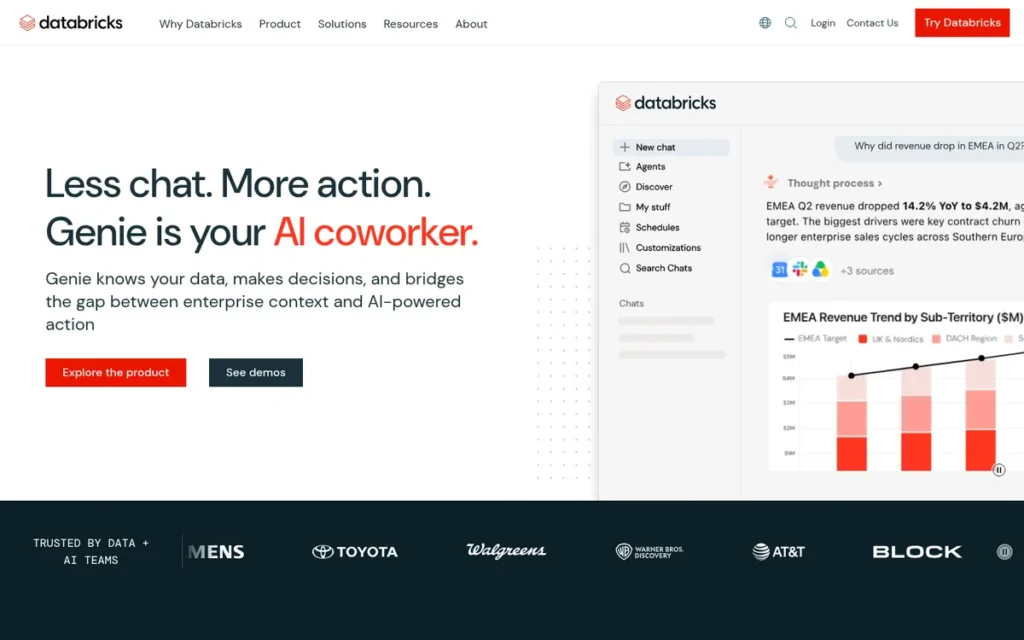
Category: Data + AI Lakehouse Platform, combines unified data engineering, data warehousing, ML training, and generative AI deployment in a single governed environment on top of Delta Lake.
At a Glance
- Category: Data + AI Lakehouse Platform
- Best For: Enterprises with large, complex data estates needing to run analytics and generative AI on the same governed data without rebuilding their data infrastructure
- Price Range: DBU (Databricks Unit) consumption-based pricing, cloud-provider-dependent; Premium and Enterprise tiers available, contact Databricks for current rates as DBU costs vary by workload type and cloud; verify at databricks.com/product/pricing, April 2026
- Primary Strength: Databricks Mosaic AI is the only platform in this evaluation that eliminates the data silo between analytics and AI, allowing enterprises to train, fine-tune, and serve generative AI models directly on the same governed Delta Lake data that powers their business intelligence
- Biggest Limitation: Databricks Mosaic AI’s DBU-based pricing model is consistently cited as complex and difficult to forecast, enterprise finance teams report challenges translating DBU consumption estimates into predictable monthly budgets without hands-on usage data
- One-Line Summary: Databricks Mosaic AI is the best generative AI infrastructure platform for data-centric enterprises that need production-proven, multi-cloud neutral AI built directly on their existing governed data estate, with 10,000-plus enterprise customers and a 3.7x average ROI per IDC research cited in Databricks AI Transformation guide, 2025
- Last Verified: April 2026
Overview
Databricks Mosaic AI is a unified Data + AI Lakehouse platform, purpose-built for mid-to-large enterprises that need to run generative AI workloads on the same governed, versioned data that powers their analytics, without copying datasets to a separate AI infrastructure layer.
Databricks Mosaic AI serves 10,000-plus enterprise customers including 300-plus Fortune 500 companies and has reached $2.4B ARR (Databricks company reporting, 2024). Databricks Mosaic AI is the only platform in this comparison that is genuinely cloud-neutral, running natively on AWS, Azure, and Google Cloud without a preferred hyperscaler. Databricks Mosaic AI’s 2023 acquisition of MosaicML for $1.3 billion added frontier LLM training expertise, including the team that developed the DBRX open-source LLM and parameter-efficient fine-tuning tooling, extending Databricks Mosaic AI from data-plus-ML into a full-stack generative AI infrastructure spanning data preparation, model training, RAG deployment, and production monitoring under one governance layer.
Key Features
- Databricks Mosaic AI’s Lakehouse Architecture provides a unified environment where Delta Lake, MLflow, and Mosaic AI model serving share the same governed data layer, eliminating the ETL overhead of copying data to a separate AI platform before training or RAG retrieval.
- Databricks Mosaic AI’s Native Vector Search in Unity Catalog enables enterprises to build RAG applications directly on their existing data governance policies, access controls, and audit trails without provisioning a separate vector database, Vector Search usage grew 377% year-over-year as RAG adoption accelerated, per Databricks State of Data + AI report, 2025.
- Databricks Mosaic AI’s End-to-End Model Customization supports supervised fine-tuning (SFT), RLHF, LoRA, and QLoRA for open-source models (DBRX, Llama 3.x, Mistral) with training tracked natively in MLflow 3.0, the open-source industry standard for ML experiment tracking.
- Databricks Mosaic AI’s Multi-Cloud Neutral Deployment runs on AWS, Azure, and Google Cloud from a single control plane, giving enterprises the ability to deploy AI workloads in any cloud environment without re-architecting pipelines or migrating governed data.
- Databricks Mosaic AI’s Unity Catalog Cross-Asset Governance provides centralized governance for both structured analytics and AI assets (including the Model Registry, Feature Store, dataset versioning, access controls, and audit trails) applied uniformly across SQL queries, ML experiments, and generative AI pipelines.
Best For
Databricks Mosaic AI is best for enterprises that already have significant data estates managed in Delta Lake or that are running analytics on Databricks and want to extend directly into generative AI.
Databricks Mosaic AI is particularly well-suited for teams in data-intensive industries (financial services, healthcare, retail, manufacturing) building enterprise RAG applications where data governance, retrieval quality, and auditability over the knowledge base layer are non-negotiable requirements.
Pricing
Databricks Mosaic AI pricing is based on Databricks Units (DBUs) consumed per workload type, SQL Warehouses, Job Compute clusters, and Model Serving Endpoints each carry distinct DBU rates that vary by cloud provider (AWS, Azure, GCP) and tier (Standard, Premium, Enterprise).
DBU-based pricing is well-suited for variable workloads but has been consistently flagged by community users and enterprise finance teams as difficult to forecast without hands-on usage data. Enterprises should request a Databricks pricing calculator session and benchmark DBU consumption in a pilot workload before committing to production scaling. Pricing verified via Databricks pricing documentation, April 2026, verify current rates at databricks.com/product/pricing as DBU rates update periodically.
Strengths
- Largest Independently Documented Production Scale in This Evaluation: Customers in Databricks Mosaic AI’s ecosystem average 3.7x ROI on GenAI investments, with AI-leading organizations reporting 10.3x returns, per IDC research cited in the Databricks AI Transformation Complete Strategy Guide, 2025, across 10,000-plus enterprise customers including 300-plus Fortune 500 companies.
- Production Deployment Velocity: Databricks Mosaic AI reported an 11x year-over-year increase in models pushed to production across its customer base, per the Databricks State of Data + AI report, 2025, a metric reflecting successful pilot-to-production conversion rather than just experimentation volume.
- Lowest Vendor Lock-In Risk in This Evaluation: Databricks Mosaic AI’s multi-cloud neutral architecture (AWS, Azure, GCP under a single control plane) gives it the lowest vendor lock-in risk of any enterprise platform in this comparison, enterprises can shift cloud spend without re-architecting AI pipelines, a structural advantage confirmed by independent infrastructure analyses.
- Governance-Correlated Production Outcomes: Enterprises using Unity Catalog governance before building GenAI applications are significantly more likely to reach production than those deploying without structured governance, per the Databricks AI Transformation Complete Strategy Guide, 2025, Unity Catalog’s Model Registry and Feature Store provide the consistent data layer that production AI deployment requires.
Limitations
- Data Estate Requirement and Pilot Mandate: Databricks Mosaic AI is purpose-built for data-centric enterprises with existing Delta Lake investments, organizations without significant data estates should pilot Databricks Mosaic AI against their specific workload before committing to enterprise contract terms, as the platform’s Lakehouse breadth can obscure fit mismatches during vendor-led evaluations. Enterprises primarily needing serverless foundation model access will pay for Lakehouse capabilities they do not use, making AWS Bedrock or Google Vertex AI a better-fit starting point.
- DBU Pricing Complexity: Databricks Mosaic AI’s DBU-based pricing is the platform’s most persistently cited operational friction, community research consistently reports challenges translating DBU consumption estimates into predictable monthly budgets, with rates varying by cloud provider and workload type in ways that require hands-on piloting to model accurately before committing to production scaling.
Users on r/databricks confirmed the spend-visibility challenge:
“It really needs guardrails. Every other compute service in the platform you can set how much it is allowed to scale so you can at least plan a maximum cost. Serverless just blows through that and you can spend a large amount of dbus before you even have visibility to it (waiting on the system table to update). We’ve currently enabled and I’m closely tracking vs our shared interactive compute. A few users that run big notebooks just cause big spikes in utilization that I was easily able to prevent before. I definitely don’t see it being more cost efficient than jobs, at least for most workloads.”, u/kmarq, r/databricks, 2024
Takeaway: Enterprise Databricks teams report that DBU spend compounds before the platform’s system tables surface visibility, guardrails that prevent runaway cost are absent by default, requiring proactive monitoring that most enterprise finance teams are not equipped to perform without specialist data engineering support.
- Genie Marketing-Reality Gap: Databricks Mosaic AI’s Genie AI/BI natural-language analytics feature has a documented gap between its “intelligent analyst” marketing positioning and observed community usage, practitioners on r/databricks, 2025 described users asking Genie for data and then “doing the analysis in Excel,” indicating the conversational analytics layer is not yet at the maturity level of Databricks Mosaic AI’s core data infrastructure.
Verdict
Databricks Mosaic AI is the best-evidenced generative AI infrastructure platform for data-centric enterprises in 2026, with 10,000-plus enterprise customers, a 3.7x documented average ROI per IDC research, and the only multi-cloud neutral Lakehouse architecture that eliminates the data silo between analytics and AI.
Databricks Mosaic AI earns the top ranking because it combines the strongest independently verifiable production evidence with a structural architectural advantage (unified data governance across analytics and AI) that no hyperscaler-managed platform currently replicates. Enterprises whose primary need is serverless API access to foundation models will find better fit in AWS Bedrock or Google Vertex AI, but for large enterprises where data gravity, compliance, and production deployment velocity are the primary evaluation criteria, Databricks Mosaic AI is the strongest choice.
2. AWS Bedrock: Best for Managed Multi-Model Cloud Inference at Enterprise Scale
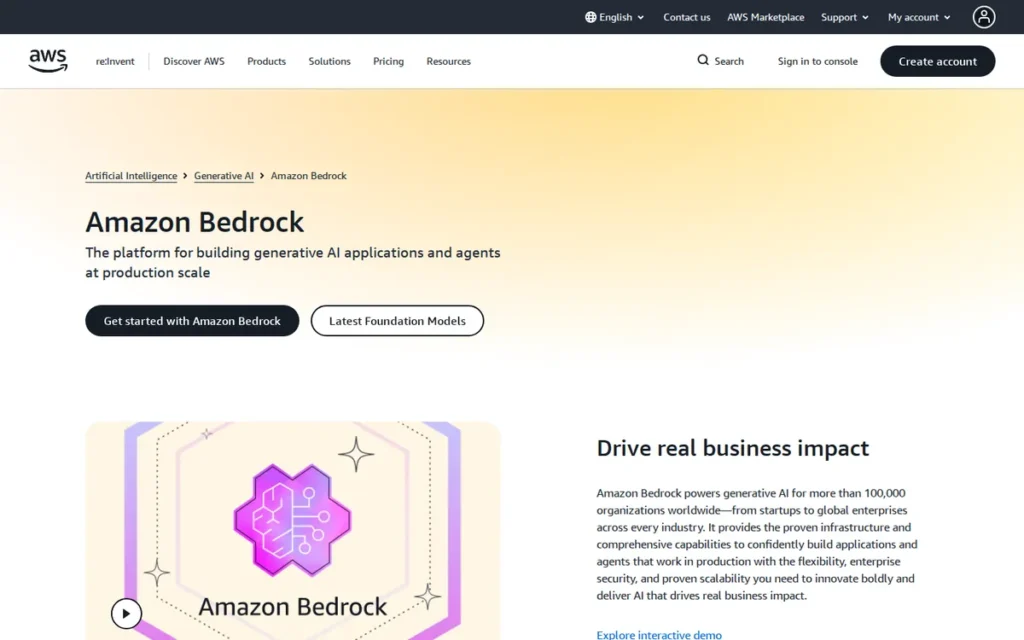
Category: Managed Multi-Model Cloud Platform, provides serverless, unified API access to 100-plus foundation models with enterprise compliance, agentic orchestration, and built-in safety controls hosted on AWS infrastructure.
At a Glance
- Category: Managed Multi-Model Cloud Platform
- Best For: AWS-native enterprises that need serverless access to a broad range of foundation models (Anthropic, Meta, Amazon, Mistral) with enterprise compliance and built-in agentic orchestration, without managing GPU infrastructure
- Price Range: Pay-per-token (on-demand; rates vary by model: verify at aws.amazon.com/bedrock/pricing); Batch Inference at approximately 50% discount; Provisioned Throughput for dedicated capacity (contact AWS); data egress fees up to $0.09/GB apply separately, model into TCO
- Primary Strength: AWS Bedrock offers the broadest managed foundation model catalog of any cloud AI platform (100-plus models from Anthropic, Meta, Amazon, Mistral, and Cohere) accessible via a single unified API with no infrastructure management required
- Biggest Limitation: AWS Bedrock’s data egress fees (up to $0.09/GB) and data gravity create documented switching costs that make multi-cloud architectures or platform migrations meaningfully more expensive than the on-demand inference pricing alone suggests
- One-Line Summary: AWS Bedrock is the leading managed multi-model cloud platform for AWS-native enterprises, offering serverless access to 100-plus foundation models with built-in Guardrails, agentic orchestration via AgentCore, and enterprise compliance certifications including FedRAMP, HIPAA, and SOC 2 Type II as of 2025
- Last Verified: April 2026
Overview
AWS Bedrock is Amazon Web Services’ fully managed, serverless generative AI infrastructure service, designed for enterprises that need unified API access to the broadest available catalog of foundation models (Anthropic Claude, Meta Llama, Amazon Nova, Mistral, Cohere, Stability AI) without provisioning or managing GPU compute infrastructure.
AWS Bedrock reached general availability in 2023 and expanded in October 2025 with Bedrock AgentCore, a complete agentic runtime with Memory, Identity, Browser, Code Interpreter, Observability, and Model Context Protocol integration, positioning AWS Bedrock as an end-to-end agentic AI infrastructure platform, not just a model inference layer, per AWS Bedrock AgentCore documentation, 2025. AWS Bedrock is best evaluated as part of a total AWS stack commitment: its deepest value, ecosystem integration, IAM RBAC, VPC networking, Knowledge Bases, and Guardrails, is realized by enterprises already operationally embedded in the AWS cloud.
Key Features
- AWS Bedrock’s Unified Multi-Model API provides a single serverless API to 100-plus foundation models including Anthropic Claude Sonnet and Opus, Meta Llama 3.x, Amazon Nova, Mistral, and Cohere, eliminating the need to manage separate API contracts, infrastructure, or authentication layers per model provider, per AWS Bedrock documentation, 2025.
- AWS Bedrock’s Enterprise-Grade Guardrails include image content filters that block up to 88% of harmful multimodal (image + text) content (per AWS blog announcement, March 28, 2025) and Automated Reasoning checks (a formal-logic hallucination verification tool) that achieve up to 99% accuracy in verifying model responses against source documents (per AWS documentation, 2025); these are two distinct, separately scoped safety mechanisms within the Guardrails suite.
- AWS Bedrock’s Multi-Layer Cost Optimization Stack includes Prompt Caching (up to 90% cost savings and 85% latency reduction), Intelligent Prompt Routing (up to 30% cost reduction), Model Distillation (up to 75% cost reduction and 500% speed improvement via student model generation), and Batch Inference (up to 50% savings for non-real-time workloads), all per AWS-published documentation, 2025; these figures are vendor-published and were not independently benchmarked at time of publication.
- AWS Bedrock’s AgentCore Agentic Runtime: launched October 2025, provides managed persistent Memory, secure Identity, Tool Gateway for enterprise system integration, Browser capability, Code Interpreter, and full Observability, enabling enterprise-grade autonomous agent deployment without custom orchestration infrastructure, per AWS Bedrock AgentCore documentation, 2025.
- AWS Bedrock’s Knowledge Bases for Managed RAG provides automated ingestion, chunking, embedding, and vector storage for enterprise document corpora, integrated with Amazon OpenSearch Serverless for retrieval and operating within AWS VPC and IAM security boundaries without additional infrastructure provisioning.
Best For
AWS Bedrock is best for enterprises that are already operationally committed to the AWS ecosystem (running workloads in EC2, S3, Lambda, or RDS) and need to add generative AI capabilities without introducing a new cloud vendor.
AWS Bedrock is particularly well-suited for teams that need the flexibility to switch between foundation model providers as the market evolves, without re-architecting underlying AWS infrastructure or managing separate model API contracts for each provider.
Pricing
AWS Bedrock uses pay-per-token on-demand pricing with rates varying by model, verify current rates at aws.amazon.com/bedrock/pricing as rates update frequently. Batch Inference delivers approximately 50% cost savings for non-real-time workloads. Provisioned Throughput is available for dedicated capacity with predictable latency, contact AWS for current rates.
Critical TCO factor: AWS data egress fees up to $0.09/GB transferred out are not reflected in per-token pricing and can meaningfully increase total costs for applications with large response payloads or multi-cloud architectures, per CloudOptimo comparative analysis, 2025. Pricing verified April 2026.
Strengths
- Verified Safety Performance: AWS Bedrock Guardrails image content filters block up to 88% of harmful multimodal content (AWS blog, March 28, 2025); separately, Automated Reasoning checks achieve up to 99% accuracy in verifying model responses against source documents (AWS documentation, 2025), two distinct safety mechanisms providing enterprise-grade protection without requiring custom content filtering infrastructure.
- Most Documented Cost Optimization Stack in This Evaluation: AWS Bedrock’s Prompt Caching (90% cost savings, 85% latency reduction), Intelligent Prompt Routing (30% cost reduction), Model Distillation (75% cost reduction, 500% speed improvement), and Batch Inference (50% savings) collectively represent the most comprehensive documented cost control tooling of any managed cloud AI platform in this evaluation, per AWS Bedrock feature documentation, 2025.
- Full Compliance Stack Across 33 Regions: AWS Bedrock’s compliance certifications (FedRAMP, HIPAA, PCI DSS, SOC 2 Type II, ISO 27001) are fully verified and operational across 33 AWS geographic regions, giving regulated-industry customers the broadest available compliance coverage in a managed multi-model platform.
- Community-Confirmed Enterprise Production Use: Enterprise practitioners on r/LLMDevs, 2025 confirmed using AWS Bedrock’s tool calling, Knowledge Bases, Guardrails, and multi-agent support for production workloads at scale.
“Yes. Use it extensively for work. It handles a large amount of undifferentiated heavy lifting. The tool calling with it is especially nice, and the results are really good with prompt orchestration, guardrails, and built in ability to attach to knowledge bases and now multi agent support as well.”, u/[deleted], r/LLMDevs, 2025
Takeaway: Enterprise teams already embedded in the AWS ecosystem find that AWS Bedrock reduces generative AI infrastructure overhead significantly, but TCO modeling must include egress fees and variable load patterns before committing to production scale.
Limitations
- Egress-Driven Lock-In: AWS Bedrock’s most consequential limitation is data gravity and egress-driven switching costs, once enterprise data (training sets, knowledge base documents, embeddings) is stored in S3 or OpenSearch Serverless within Bedrock’s managed stack, AWS data egress fees of up to $0.09/GB create a real switching cost not visible in per-token pricing, consistently flagged as a billing surprise by r/LLMDevs and r/aws community research, 2025.
- AgentCore Maturity vs. Open-Source Orchestration: AWS Bedrock Agents has not reached parity with open-source orchestration frameworks in developer preference, a recurring pattern in r/LLMDevs community research, 2025 shows engineers using AWS Bedrock as a managed inference layer while building custom agent logic on LangChain, AutoGen/AG2, or CrewAI, suggesting AgentCore’s maturity for complex agentic workflows remains an active evaluation question rather than a solved capability.
- Cost Unpredictability Under Variable Load: AWS Bedrock’s pay-as-you-go pricing, combined with egress fees and Provisioned Throughput planning complexity, makes TCO difficult to model before hands-on piloting, community users consistently cite unexpected billing in development and test environments left running as the most common AWS Bedrock frustration, per r/LLMDevs, 2025.
Verdict
AWS Bedrock is the best managed multi-model cloud AI infrastructure platform for enterprises already committed to the AWS ecosystem, combining the broadest foundation model catalog (100-plus models), the most documented cost optimization stack in this evaluation, and enterprise-grade compliance certifications across all major regulated industries.
AWS Bedrock ranks #2 overall, behind Databricks Mosaic AI in multi-cloud deployment flexibility and verified production breadth, but ahead of all remaining platforms in managed inference capability, agentic orchestration completeness, and cost control tooling. Enterprises evaluating AWS Bedrock should model data egress fees and switching costs from the start, and should independently evaluate Bedrock AgentCore against specific agent orchestration requirements before assuming full replacement of open-source frameworks.
3. Google Vertex AI: Best for Custom Model Training, Multimodal AI, and Research-Intensive Enterprise Deployments
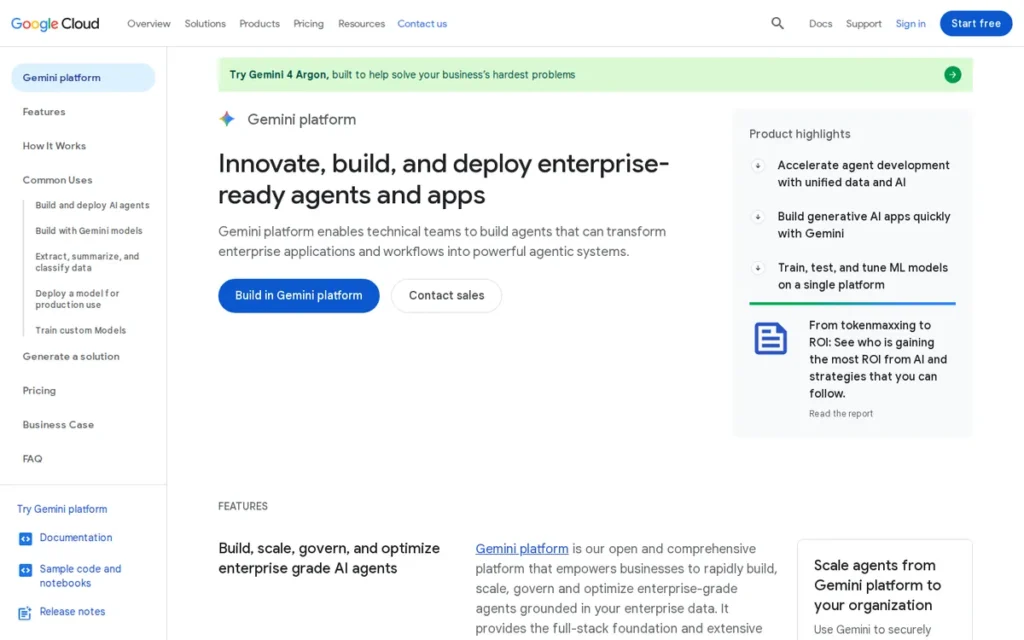
Category: Managed Cloud ML Platform, provides end-to-end machine learning infrastructure from model training (including exclusive TPU access) through inference, fine-tuning, evaluation, and production monitoring, with a 200-plus model catalog and native multimodal support via Gemini.
At a Glance
- Category: Managed Cloud ML Platform
- Best For: Enterprises building custom foundation models or multimodal AI applications at scale, ML engineering teams needing end-to-end MLOps lifecycle management, and Google Cloud-committed organizations requiring the broadest training and serving capabilities in one platform
- Price Range: Gemini 2.5 Pro approximately $1.25 per million input tokens and $10 per million output tokens (Q1 2026, standard tier); Gemini Flash at substantially lower rates for high-throughput workloads; TPU/GPU training billed per accelerator-hour; always-on components can produce unpredictable costs, verify at cloud.google.com/vertex-ai/pricing
- Primary Strength: Google Vertex AI is the only cloud platform with exclusive TPU access for foundation model training, enabling enterprises to train or fine-tune large language models at costs and speeds that GPU-only cloud infrastructure cannot match at equivalent scale, per Google Cloud documentation, 2025
- Biggest Limitation: Google Vertex AI’s distributed cost surfaces: inference tokens, training compute hours, online prediction nodes, Feature Store, and always-on components, are consistently described by independent analysts as opaque and difficult to forecast, producing billing surprises for teams without active cost monitoring
- One-Line Summary: Google Vertex AI is the most technically comprehensive cloud AI platform for custom model training and multimodal deployment, offering exclusive TPU infrastructure, a 200-plus model catalog including native Gemini multimodal models, and end-to-end MLOps lifecycle management, making it the strongest choice for enterprises building proprietary AI capabilities on Google Cloud as of 2026
- Last Verified: April 2026
Overview
Google Vertex AI is Google Cloud’s unified machine learning and generative AI platform (launched in 2021 with a five-year production history) consolidating model training, fine-tuning, evaluation, deployment, and monitoring into a single environment spanning AutoML, distributed training on TPUs and GPUs, and managed inference serving across 200-plus foundation models, per Squareops guide, 2026.
Google Vertex AI’s unique architectural differentiators are its exclusive TPU access for large model training and its multimodal-native Gemini foundation model family, which processes text, image, code, and audio in a single unified architecture without requiring multi-model stitching. Google Vertex AI is built and operated by Google DeepMind and Google Cloud teams (backed by Google’s foundational AI research organization (responsible for Gemini, TPUs, and the Transformer architecture) and global cloud infrastructure) giving it a research-to-production investment moat that no other cloud provider can fully replicate.
Key Features
- Google Vertex AI’s Exclusive TPU Training Infrastructure provides access to Google Cloud TPUs (Tensor Processing Units) for model training, with Dynamic Workload Scheduler and managed Slurm support for distributed training at thousands of accelerators, enabling large model training that GPU-only infrastructure cannot match at equivalent cost, per Google Cloud documentation, 2025.
- Google Vertex AI’s 200-Plus Model Garden includes Google-native Gemini (multimodal-native text/image/code/audio), Anthropic Claude, Meta Llama, Mistral, Google Gemma, and open-source alternatives, giving enterprises the broadest model access in a single governed serving environment of any cloud platform in this evaluation.
- Google Vertex AI’s PEFT Fine-Tuning and Search Grounding supports Supervised Fine-Tuning (SFT) and Parameter-Efficient Fine-Tuning (PEFT) including LoRA for Gemini models, plus grounding with enterprise data stores or Google Search for hallucination reduction, providing a complete model customization pipeline without leaving the GCP environment.
- Google Vertex AI’s Generative AI Studio enables rapid prototyping, prompt engineering, and model evaluation with built-in metrics (ROUGE, BLEU, model-based scoring) before deploying to production serving, reducing the cycle time between experimentation and production for ML engineering teams.
- Google Vertex AI’s Regulated-Industry Compliance Features include HIPAA compliance, Customer-Managed Encryption Keys (CMEK), VPC Service Controls for network isolation, and integration with Google Cloud IAM for RBAC, meeting regulated-industry requirements within the Google Cloud compliance boundary.
Best For
Google Vertex AI is best for enterprises investing in custom model development (training proprietary LLMs, fine-tuning domain-specific models, or building multimodal AI applications) particularly teams already committed to Google Cloud’s data and analytics infrastructure (BigQuery, Cloud Storage).
Google Vertex AI is particularly well-suited for research-intensive organizations and ML engineering teams that need the complete MLOps lifecycle (from training through fine-tuning, evaluation, deployment, and production monitoring) in one governed environment without managing separate training and serving infrastructure.
Pricing
Google Vertex AI pricing operates on a consumption model across multiple services: Gemini 2.5 Pro at approximately $1.25 per million input tokens and $10 per million output tokens (standard tier, Q1 2026, per developer.puter.com Vertex AI analysis, 2026); Gemini Flash models at substantially lower rates for high-throughput workloads; TPU and GPU training billed per accelerator-hour; online prediction billed per compute node-hour; Feature Store and storage billed separately.
Critical TCO note: TrueFoundry infrastructure analysis, 2025 consistently flags Google Vertex AI’s always-on compute components (including online prediction endpoints and Feature Store instances) as cost surfaces producing billing surprises for teams that do not actively monitor GCP Cost Management dashboards. Verify current rates at cloud.google.com/vertex-ai/pricing, April 2026.
Strengths
- Exclusive TPU Training Access, No Competing Cloud Platform Offers This: Google Vertex AI’s TPU training infrastructure, exclusive to Google Cloud and unavailable on any competing cloud AI platform in this evaluation, enables large model training at lower cost than equivalent GPU-only cloud infrastructure, per Google Cloud documentation, 2025; no independent benchmark of this comparative training cost claim was available at time of publication.
- Multimodal-Native Gemini Architecture: Google Vertex AI’s Gemini 2.5 Pro processes text, image, code, and audio in a single unified inference call, eliminating multi-model stitching overhead for enterprises building document understanding, code generation, and voice applications, per CloudOptimo comparative analysis, 2025.
- G2 Leader Status and High Community Engagement: Google Vertex AI holds a G2 Leader designation in the AI Infrastructure category (2025–2026) and generates the largest Reddit community discussion volume of any platform in this evaluation, indicating strong engagement from ML engineers and data scientists, with particular enthusiasm among expert-level GCP users and research-intensive organizations.
This bimodal dynamic is captured on r/googlecloud:
“I think this is what causes a lot of confusion with the GCP offering. Everything is there for you to piece together to make the system you want, where as the traditional thinking is that you get a product and make it fit into your existing system.”, u/MrPhatBob, r/googlecloud, 2023
Takeaway: Google Vertex AI’s expert-driven “assemble what you need” architecture generates strong enthusiasm from GCP-native teams, and generates equal parts frustration from teams who approach it expecting a product that fits their existing workflow, explaining the bimodal community sentiment the platform is known for.
- Search Grounding for RAG Accuracy: Google Vertex AI’s Search grounding capability (connecting Gemini model outputs to enterprise data stores or Google Search for factual anchoring) is documented as an effective hallucination-reduction mechanism for enterprise RAG applications where accuracy on proprietary knowledge is a compliance requirement, per Google Cloud documentation, 2025.
Limitations
- Cost Opacity and Always-On Components: Google Vertex AI’s most consequential trade-off is the combination of cost opacity and expertise barrier, TrueFoundry, 2025 describes Google Vertex AI as a platform that “starts as a convenience and ends as a constraint,” with opaque always-on costs across training compute, prediction nodes, Feature Store, and storage creating billing surprises for teams that do not actively monitor GCP Cost Management dashboards.
- Bimodal Community Sentiment: Google Vertex AI shows a bimodal sentiment distribution, GCP-native expert teams are highly positive while teams approaching Google Vertex AI from other cloud environments consistently report higher setup overhead and documentation gaps, per r/MachineLearning and r/GoogleCloud community research, 2025, creating a predictable learning curve risk for organizations without existing GCP expertise.
Users on r/googlecloud documented this migration pattern:
“If your use case fits neatly into one of Vertex’s managed services it’s not bad. But if you just need to run a custom container with decent compute or GPUs? It’s absolutely awful. Terrible documentation, terrible support, bugs and errors everywhere. They keep releasing new things that are half baked without fixing the old services. We’ve been trying to make it work for about a year, and are just now moving our ML workloads to AWS instead as it just isn’t worth it to get Vertex AI working. Sagemaker is a much better documented, resource available, capable platform.”, u/anaconda1189, r/googlecloud, 2023
Takeaway: Google Vertex AI’s documentation gaps and half-baked feature releases drive teams from non-GCP backgrounds to SageMaker after extended investment, confirming that the platform’s bimodal community sentiment reflects real migration risk, not just perception.
- TPU Architecture Lock-In: Google Vertex AI’s TPU-optimized models are compiled against Google’s TPU architecture and are not portable to non-GCP environments, enterprises that invest significantly in TPU-based training face meaningful switching costs if they need to migrate infrastructure, creating a hardware-level lock-in analogous to NVIDIA NIM Microservices’ TensorRT-LLM architecture dependency.
Verdict
Google Vertex AI is the best cloud generative AI infrastructure platform for enterprises investing in custom model development, offering exclusive TPU access, a multimodal-native Gemini foundation, and the most complete end-to-end MLOps lifecycle of any cloud provider, making it the strongest platform for research-intensive organizations and teams that need to train or fine-tune large models at scale.
Google Vertex AI ranks #3 in this evaluation, with clear advantages over Azure OpenAI Service in model catalog breadth and training capability, but trailing Databricks Mosaic AI on multi-cloud flexibility and verified production breadth, and trailing AWS Bedrock on managed inference simplicity and published cost optimization tooling. Enterprises without existing GCP commitments should factor the steeper learning curve and always-on cost complexity into their evaluation before scaling production workloads.
4. Microsoft Azure OpenAI Service: Best for Microsoft-Stack Enterprises and Regulated Industries Requiring the Deepest Compliance Stack
Category: Managed Single-Provider Cloud AI Platform, delivers enterprise-grade REST API access to OpenAI’s full model suite (GPT-4o, O-series reasoning, DALL-E 3, Whisper, embeddings) within Azure’s sovereign infrastructure, with FedRAMP High compliance and deep Microsoft ecosystem integration.
At a Glance
- Category: Managed Single-Provider Cloud AI Platform
- Best For: Enterprises already committed to Microsoft 365 and Azure: particularly in regulated industries (U.S. federal, healthcare, financial services) requiring FedRAMP High, HIPAA compliance, and deep integration with Microsoft Entra ID, Purview, and Defender infrastructure
- Price Range: GPT-4 family: $0.03–$0.12 per 1,000 tokens (input/output depending on variant); PTUs for dedicated capacity, contact Microsoft for current rates; verify at azure.microsoft.com/pricing/details/azure-openai as rates update frequently
- Primary Strength: Azure OpenAI Service provides FedRAMP High–certified access (authorized August 2024) to OpenAI’s frontier models inside Azure’s sovereign infrastructure, the only platform in this evaluation meeting U.S. federal government AI deployment requirements while providing Customer Lockbox data access controls and full Microsoft Entra ID RBAC
- Biggest Limitation: Azure OpenAI Service’s catalog is limited exclusively to OpenAI models (GPT-4o, O-series, DALL-E, Whisper, embeddings), enterprises needing Anthropic Claude, Meta Llama, Mistral, or any non-OpenAI foundation model must provision a separate platform, creating multi-vendor complexity that AWS Bedrock and Google Vertex AI avoid
- One-Line Summary: Azure OpenAI Service is the best generative AI infrastructure platform for Microsoft-committed and regulated enterprises, offering FedRAMP High certification (authorized August 2024, unique in this evaluation), Customer Lockbox data controls, and exclusive access to OpenAI frontier models within Azure’s sovereign infrastructure, backed by over three years of production GA history as of 2026
- Last Verified: April 2026
Overview
Azure OpenAI Service is Microsoft’s enterprise-grade REST API platform for OpenAI’s full model suite (GPT-4o, GPT-4 Turbo, O-series reasoning models, DALL-E 3, Whisper speech-to-text, and text-embedding models) all hosted within the customer’s Azure tenant with Microsoft’s SLA, compliance certifications, and enterprise support infrastructure.
Azure OpenAI Service reached general availability in November 2022 (the earliest commercially available enterprise managed GenAI platform in this evaluation) giving it a three-plus-year head start in enterprise customer onboarding, compliance certification, and production reliability evidence, per usCloud comparative analysis, 2025. Azure OpenAI Service is uniquely positioned for Microsoft-committed organizations: it powers Microsoft 365 Copilot across enterprise users in Word, Excel, Teams, and Outlook, integrates natively with Microsoft Purview for data governance and Entra ID for identity management, and carries FedRAMP High certification (authorized August 2024, per Microsoft Azure Government blog) that no other platform in this evaluation has achieved.
Key Features
- Azure OpenAI Service’s OpenAI Model Suite in Azure Sovereign Infrastructure provides enterprise-grade access to GPT-4o for reasoning, O-series models for complex analytical tasks, DALL-E 3 for image generation, Whisper for speech-to-text, and text-embedding-3-large for semantic search, all hosted within Azure’s sovereign infrastructure with Microsoft’s SLA, per Azure OpenAI documentation, 2025.
- Azure OpenAI Service’s Provisioned Throughput Units (PTUs) allow enterprises to reserve fixed GPU compute for predictable, low-latency production workloads, providing deterministic latency SLAs for customer-facing applications where response time variability creates poor user experiences, per Microsoft Azure Foundry blog, 2025.
- Azure OpenAI Service’s Realtime API with WebRTC (preview as of 2025) enables sub-second audio streaming, image input, function calling, and conversation mode, extending generative AI infrastructure from text into voice-first contact center and assistant applications, per Microsoft Azure What’s New documentation, 2025.
- Azure OpenAI Service’s Enterprise Identity and Governance Integration connects natively with Microsoft Entra ID for RBAC, Microsoft Purview for data governance and audit trails, Azure Private Link for VNet-isolated network access, and Customer Lockbox requiring explicit human approval for any Microsoft personnel access to customer data.
- Azure OpenAI Service’s In-Tenant Fine-Tuning supports fine-tuning of GPT models on customer proprietary data within Azure’s secure environment, with fine-tuned models remaining in the customer’s Azure tenant and, per Microsoft’s contractual data processing terms as of April 2026, not used for OpenAI model training; customers should verify the current Microsoft data processing addendum for their specific contract terms.
Best For
Azure OpenAI Service is best for organizations already deep in the Microsoft enterprise stack (running Microsoft 365, Azure Active Directory/Entra ID, and existing Azure workloads) particularly those in regulated industries where the compliance stack is a non-negotiable procurement requirement.
Azure OpenAI Service is particularly required (not merely preferred) for U.S. federal agencies mandating FedRAMP High authorization, healthcare organizations requiring HIPAA plus Customer Lockbox, and financial services organizations requiring SOC 2 plus Private Link isolation, compliance requirements that eliminate every other platform in this evaluation from consideration before any feature comparison begins.
Pricing
Azure OpenAI Service is priced on a per-token basis with rates equivalent to OpenAI’s commercial API pricing for the same models, GPT-4 family models range from $0.03–$0.12 per 1,000 tokens depending on model variant and input/output direction (rates verified Q1 2026 via Azure pricing page; update frequently, verify before budget modeling).
Provisioned Throughput Units for reserved dedicated capacity are a separate, higher-cost commitment model suited to production workloads requiring guaranteed SLAs, contact Microsoft Azure for current PTU pricing. PTU configuration is consistently reported by enterprise practitioners as requiring specialist Azure support to size correctly, adding procurement friction not present with on-demand per-token alternatives. Pricing verified April 2026.
Strengths
- Only FedRAMP High–Certified Platform in This Evaluation: Azure OpenAI Service holds FedRAMP High authorization received August 2024, per Microsoft Azure Government blog, confirmed extended through 2025 to include GPT-4o and O-series models, a compliance level required, not preferred, for U.S. federal agency AI deployments, making Azure OpenAI Service the only legally viable choice for those use cases among all seven platforms evaluated.
- Longest Production GA History in This Evaluation: Azure OpenAI Service has been in production GA since November 2022, over three years longer than IBM watsonx.ai, Bedrock AgentCore, and NVIDIA NIM Microservices, providing the most mature enterprise support infrastructure (dedicated TAMs, SLA-backed availability, established incident response processes) of any managed GenAI platform in this comparison, per usCloud, 2025.
- Strongest Customer Data Access Control in This Evaluation: Azure OpenAI Service’s Customer Lockbox mechanism requires explicit human approval for any Microsoft personnel access to customer data (the most stringent customer data access control of any platform in this evaluation) confirmed as operational per Microsoft compliance documentation, 2024–2025.
- Largest Production Footprint via Microsoft 365 Copilot: Azure OpenAI Service powers Microsoft 365 Copilot deployed across enterprise users in Word, Excel, Teams, and Outlook (Microsoft fiscal year 2025 earnings reporting), representing the largest production footprint of any enterprise GenAI platform in the market and demonstrating Azure infrastructure reliability at extreme scale.
Limitations
- Model Catalog Exclusivity: Azure OpenAI Service’s most consequential trade-off is model catalog lock-in, it provides access only to OpenAI’s model family (GPT-4o, O-series, DALL-E 3, Whisper, embeddings), meaning enterprises needing Anthropic Claude, Meta Llama, Mistral, or any non-OpenAI foundation model must maintain a separate platform, creating multi-vendor complexity that AWS Bedrock’s 100-plus model unified catalog avoids.
- Single-Provider Preference Gap in Engineering Community: Azure OpenAI Service’s single-provider limitation is consistently identified as the primary reason engineers choose AWS Bedrock or Google Vertex AI for new builds, one widely-cited r/aws observation, 2025 captured the pattern: “Azure has one offering. Yea ChatGPT was early but AWS has much more choice and you can build your own platforms on it.”
- PTU Sizing Complexity: Azure OpenAI Service’s Provisioned Throughput Unit (PTU) configuration is consistently reported by enterprise practitioners as requiring specialist Azure support to size correctly, adding procurement friction not present with on-demand per-token alternatives and making production cost planning dependent on accurate pre-sizing that most new customers lack sufficient data to perform.
“Azure has one offering. Yea ChatGPT was early but AWS has much more choice and you can build your own platforms on it.”, u/[deleted], r/aws, 2025
Takeaway: Model catalog flexibility is the single most cited reason engineers choose AWS Bedrock or Google Vertex AI over Azure OpenAI Service for new builds, Azure OpenAI Service’s value proposition is decisively strongest for organizations already committed to the Microsoft enterprise stack and facing FedRAMP High or similar compliance requirements.
Verdict
Azure OpenAI Service is the best generative AI infrastructure platform for Microsoft-committed enterprises and regulated industries that require FedRAMP High certification (authorized August 2024), Customer Lockbox data controls, and OpenAI’s frontier models within Azure’s sovereign infrastructure, the compliance stack and Microsoft ecosystem integration are genuine, differentiated advantages that justify the single-model-provider constraint for the right buyer profile.
Azure OpenAI Service ranks #4 in this overall evaluation because its OpenAI exclusivity creates the highest model-level lock-in risk of any platform reviewed, and because enterprises without deep Azure or Microsoft 365 commitments will find less compelling value relative to AWS Bedrock, Google Vertex AI, or Databricks Mosaic AI. For U.S. federal agencies, large healthcare systems, and enterprises already on Microsoft’s cloud infrastructure, Azure OpenAI Service is the required first evaluation, the compliance and integration advantages are decisive within that context.
5. NVIDIA NIM Microservices: Best for On-Premise GPU Inference Optimization and Maximum Throughput on NVIDIA Hardware
Category: Hardware-Optimized On-Premise Inference Runtime, prebuilt containerized inference microservices engineered by NVIDIA that co-optimize model execution with NVIDIA GPU architecture via TensorRT-LLM, providing deployable inference endpoints on any NVIDIA GPU infrastructure in cloud, data center, workstation, or edge environments.
At a Glance
- Category: Hardware-Optimized On-Premise Inference Runtime
- Best For: Enterprises with existing NVIDIA GPU infrastructure (H100, A100, L40S) that need maximum inference throughput and lowest latency on-premise, without cloud API dependency, particularly organizations with data sovereignty requirements prohibiting external model inference
- Price Range: Free evaluation API access at build.nvidia.com; enterprise production deployment requires NVIDIA AI Enterprise subscription, pricing not publicly listed, contact NVIDIA enterprise sales. On-premise deployment means no per-token API fees for inference; primary costs are GPU hardware capital expenditure and NVIDIA AI Enterprise licensing.
- Primary Strength: NVIDIA NIM Microservices deliver vendor-reported 2.5x inference throughput improvement and 4x faster Time-to-First-Token over open-source alternatives on equivalent NVIDIA GPU hardware, performance gains derived from TensorRT-LLM kernel fusion and GPU-architecture-specific optimizations that software-only platforms cannot replicate
- Biggest Limitation: NVIDIA NIM Microservices require NVIDIA GPU hardware investment, TensorRT-LLM compilation is architecture-specific (models optimized for H100 must be recompiled for A100 or L40S), and NVIDIA NIM Microservices are entirely incompatible with AMD ROCm or Intel Gaudi AI accelerators, creating dual hardware-software vendor lock-in for enterprises that adopt them
- One-Line Summary: NVIDIA NIM Microservices are the highest-performance on-premise generative AI inference platform available in 2026, delivering vendor-reported 2.5x throughput and 4x Time-to-First-Token improvements over open-source alternatives on NVIDIA GPUs via hardware-software co-optimization, and the only enterprise inference solution deployable in under five minutes on existing NVIDIA GPU infrastructure
- Last Verified: April 2026
Overview
NVIDIA NIM Microservices are prebuilt, containerized AI inference solutions packaged by NVIDIA (the manufacturer of the GPUs that power the majority of global AI infrastructure) engineered to deliver maximum inference performance through hardware-software co-optimization that software-only platforms running on the same hardware cannot replicate.
NVIDIA NIM Microservices launched in January 2024, packaging TensorRT-LLM optimized model engines, OpenAI-compatible APIs, and GPU-specific runtime configurations into containers deployable in under five minutes on any NVIDIA GPU, from data center H100s to edge RTX systems, per NVIDIA developer documentation, 2024. Unlike general-purpose serving frameworks (vLLM, Triton Inference Server, Text Generation Inference) that run on any hardware, NVIDIA NIM containers are pre-compiled specifically for NVIDIA GPU generations, trading hardware portability for maximum per-GPU performance. NVIDIA NIM Microservices are uniquely positioned for enterprises with existing NVIDIA GPU capital investment and data sovereignty requirements that prohibit cloud inference.
Key Features
- NVIDIA NIM Microservices’ TensorRT-LLM Hardware-Software Co-Optimization delivers optimized inference via automatic kernel fusion, in-flight batching for parallel request processing, FP8/INT8 quantization for memory efficiency, and chunked context for extended input sequences, optimizations specific to NVIDIA GPU architecture and unavailable to software-only inference frameworks, per NVIDIA developer blog, 2024.
- NVIDIA NIM Microservices’ Five-Minute Production Deployment deploys any supported model on any NVIDIA GPU infrastructure through pre-configured containers in the NGC catalog, eliminating the weeks-to-months of model serving infrastructure engineering typically required to stand up production-grade inference endpoints from open-source frameworks, per Dell Technologies NIM overview, 2025.
- NVIDIA NIM Microservices’ Broad Multi-Modal Model Catalog supports LLMs (Llama 3.x, Nemotron, Mistral), vision-language models, image generation (NV-CLIP), speech AI (Riva ASR/TTS for real-time voice inference), computer vision (PaddleOCR, YOLO-X), and domain-specific NIMs for healthcare, cybersecurity, and digital human applications, all accessible via OpenAI-compatible API endpoints, per NVIDIA blogs, 2024.
- NVIDIA NIM Microservices’ OpenAI-Compatible API allows enterprises to migrate existing OpenAI API–based application code to on-premise NVIDIA NIM deployments with minimal code changes, providing a technical migration path that preserves application logic while shifting from cloud API fees to on-premise hardware economics.
- NVIDIA NIM Microservices’ ISV Enterprise Platform Integrations with ServiceNow, SAP, and Salesforce enterprise software platforms (NVIDIA AI Enterprise partner announcements, 2025) create indirect enterprise adoption pathways where organizations running these applications may access NVIDIA NIM–powered AI inference without direct infrastructure procurement.
Best For
NVIDIA NIM Microservices are best for enterprises that have already made capital investment in NVIDIA GPU infrastructure (H100, A100, L40S data center GPUs) and need to maximize inference throughput and minimize latency per GPU at high volume.
NVIDIA NIM Microservices are particularly well-suited for organizations in regulated industries (defense, healthcare, financial services) where data sovereignty requirements prohibit sending inference requests to external cloud APIs, making on-premise inference a procurement requirement rather than a cost optimization preference.
Pricing
NVIDIA NIM Microservices are available for free evaluation and API testing at build.nvidia.com, developers can test inference against NVIDIA NIM endpoints without purchase. Enterprise production deployment requires a NVIDIA AI Enterprise subscription: pricing is not publicly listed and requires direct engagement with NVIDIA’s enterprise sales organization, per NVIDIA NIM product page, 2025.
The on-premise deployment model fundamentally changes TCO compared to cloud-managed platforms, primary costs are GPU hardware capital expenditure and NVIDIA AI Enterprise licensing rather than per-token API fees. At sufficient inference volume, on-premise amortized cost per inference can undercut cloud API per-token pricing, but break-even volume requires specific modeling based on GPU count, utilization rate, and token throughput. Pricing opacity is NVIDIA NIM Microservices’ largest procurement friction, enterprises should request a detailed TCO comparison from NVIDIA enterprise sales before committing. Pricing verified April 2026.
Strengths
- Vendor-Reported Hardware-Software Performance Advantage: NVIDIA reports that NIM Microservices deliver up to 2.5x improvement in inference throughput, 4x faster Time-to-First-Token (TTFT), and 2.2x faster inter-token latency over the best available open-source inference alternatives (vLLM baseline) on equivalent NVIDIA GPU hardware, per NVIDIA developer blog benchmarks, 2024–2025, these are vendor-published figures; independent third-party benchmarks replicating these exact configurations were not available at time of publication.
- Independently Quantified Tensor Parallelism Gains: NVIDIA NIM Microservices’ in-flight batching with tensor parallelism configuration reduces latency by 33% at batch size 16 with 4x tensor parallelism versus 2x, independently documented by Dell Technologies NIM technical analysis, 2024–2025, the only independently corroborated NVIDIA NIM performance metric at time of publication.
- Organizational Durability from NVIDIA’s Scale: NVIDIA Corporation reported $130B-plus in fiscal year 2025 revenue (NVIDIA fiscal year 2025 earnings release, March 2025), providing organizational durability and R&D investment capacity that substantially reduces platform continuity risk despite NVIDIA NIM Microservices’ relative newness (January 2024 launch).
- Broad ISV Enterprise Ecosystem: NVIDIA NIM Microservices are integrated into ServiceNow, SAP, and Salesforce enterprise software platforms (NVIDIA AI Enterprise partner announcements, 2025), creating indirect enterprise adoption pathways where enterprises running these applications may access NVIDIA NIM–powered AI inference without direct infrastructure procurement, expanding the platform’s effective deployment footprint.
Limitations
- Dual Vendor Lock-In: NVIDIA NIM Microservices’ most consequential limitation is dual vendor lock-in, TensorRT-LLM requires compilation for specific NVIDIA GPU architectures (models optimized for H100 must be recompiled for A100 or L40S, per Menlo AI benchmarking analysis, 2024–2025), and NVIDIA NIM Microservices are entirely incompatible with AMD ROCm or Intel Gaudi AI accelerators, meaning NVIDIA NIM adoption commits the enterprise to NVIDIA GPU hardware at both the chip and software optimization layers simultaneously.
This hardware-software coupling dynamic is captured in practitioner discussion on r/mlops:
“Yeah, trt-llm is going to be faster in some cases, but tuning can be difficult and it pegs an engine to your hardware. Unless you are operating at very large scale vLLM is easy to grab a HF and just get started and it’s super fast. Under the hood a lot of the vLLM code base originally came from the folks working on TRT anyways. I’d start with vLLM models served through TGI. Nvidia recently announced their new NIM inference microservice which seemed to wrap both of these tools, but I haven’t seen any published numbers on it yet and it seems more tailored to enterprise use cases.”, u/Fledgeling, r/mlops, 2024
Takeaway: TensorRT-LLM’s hardware-architecture specificity (the mechanism behind NVIDIA NIM’s performance advantage) makes vLLM the more practical default for teams not operating at enterprise scale, where deployment portability and ease of iteration outweigh per-GPU optimization gains.
- Enterprise Pricing Opacity: NVIDIA NIM Microservices have no publicly available enterprise pricing, contact-sales-only engagement for production deployments creates procurement friction and prevents transparent TCO comparisons without multi-week vendor engagement cycles, making NVIDIA NIM Microservices the least pricing-transparent of all seven platforms in this evaluation.
- Limited Verified Production Evidence and Kubernetes Complexity: NVIDIA NIM Microservices launched in January 2024 (the newest platform in this evaluation) meaning they have substantially less verified enterprise production evidence than platforms with three-to-five-plus years in GA; beyond single-node deployment, Kubernetes-based production setup requires significant infrastructure engineering that community discussions in r/LocalLLaMA confirm as a recurring pain point for teams scaling from evaluation to cluster-scale production.
Verdict
NVIDIA NIM Microservices are the highest-performance on-premise generative AI inference platform available in 2026, with vendor-reported 2.5x throughput and 4x Time-to-First-Token improvements over open-source alternatives on NVIDIA GPU hardware, and the only enterprise-grade inference platform deployable in under five minutes on existing GPU infrastructure.
NVIDIA NIM Microservices rank #5 in this evaluation because their value proposition is highly specific: NVIDIA NIM Microservices are the correct choice for enterprises with existing NVIDIA GPU capital investment and data sovereignty requirements, but a poor fit for organizations without NVIDIA hardware, those evaluating AMD or Intel AI accelerators, or procurement teams that require transparent published pricing before engagement. Enterprises considering NVIDIA NIM Microservices should model hardware capital cost and break-even inference volume against cloud-managed API alternatives before committing.
6. Hugging Face Enterprise Hub: Best for ML Engineering Teams, Open Model Exploration, and Model Evaluation at Scale
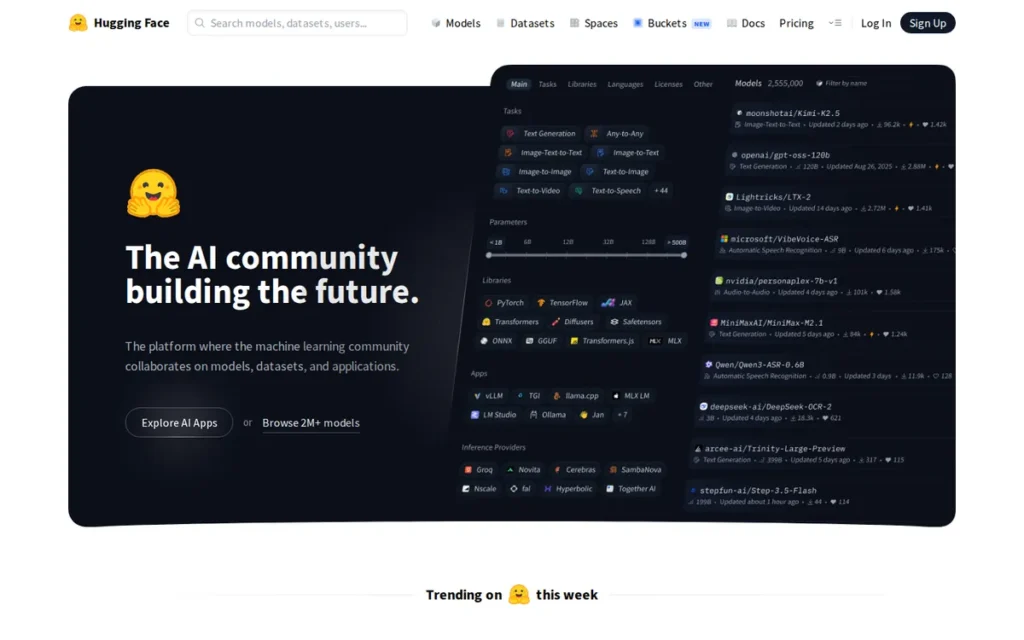
Category: Open Model Ecosystem Hub, the world’s largest platform for discovering, hosting, and deploying open-source AI models, datasets, and applications, with an Enterprise tier adding private model hosting, SSO, audit logs, RBAC, and managed Inference Endpoints on GPU infrastructure.
At a Glance
- Category: Open Model Ecosystem Hub
- Best For: ML engineering teams and data science organizations that need access to the full breadth of open-source AI research (model evaluation, rapid prototyping, and deployment of open models) with the most affordable enterprise pricing in this evaluation
- Price Range: Free ($0/month, 100GB storage, 1,000 API requests/period); Team ($20/user/month, 1TB/seat, SSO, audit logs); Enterprise ($50+/user/month, 200TB base storage, $2,000 Hub credits, advanced SLAs); Inference Endpoints from approximately $0.06/hour for CPU, higher for GPU (A10G, A100, H100). Published at huggingface.co/pricing, April 2026.
- Primary Strength: Hugging Face Enterprise Hub provides access to 2 million-plus open-source AI models (including day-zero access to new releases from Meta, Google, and Mistral before any managed cloud platform integrates them) at the most affordable enterprise subscription pricing in this evaluation at $50-plus per user per month
- Biggest Limitation: Hugging Face Enterprise Hub lacks the enterprise-grade compliance certifications (FedRAMP, HIPAA for production workloads), AI governance features (bias monitoring, drift detection, model risk management audit trails), and production-reliability SLAs that regulated industries and high-stakes production deployments require
- One-Line Summary: Hugging Face Enterprise Hub is the world’s largest open-source AI model repository with 2 million-plus models, 13 million registered users, and 1,500-plus enterprise customers, providing the broadest model access, most affordable enterprise pricing, and day-zero availability of new open model releases of any platform in this evaluation as of 2026
- Last Verified: April 2026
Overview
Hugging Face Enterprise Hub is the enterprise tier of the world’s largest open-source AI model platform, a community-driven repository of 2 million-plus models, 500,000-plus datasets, and 350,000-plus interactive Spaces that has become the de facto standard for open-source AI research distribution since its founding in 2016.
Hugging Face Enterprise Hub extends this community platform with private model hosting, SSO, audit logs, RBAC, and managed Inference Endpoints for production-grade GPU serving, giving enterprise ML teams the ability to host proprietary models alongside the community catalog with enterprise access controls. Hugging Face Enterprise Hub occupies a structurally distinct position in the AI infrastructure market: it is not a competitor to hyperscaler managed platforms but rather an independent open layer between AI research and enterprise deployment, evidenced by its strategic investor roster including Google, NVIDIA, Amazon, Salesforce, Intel, IBM, and Qualcomm, effectively every major platform provider in this evaluation. Hugging Face raised $235M in its Series D (August 2023), bringing total cumulative funding to $395M, at a $4.5 billion valuation (TechCrunch, August 2023; IBM Newsroom, August 2023).
Key Features
- Hugging Face Enterprise Hub’s 2M-Plus Open Model Catalog with Day-Zero Access provides access to all major foundation model families from Meta (Llama), Google (Gemma), Mistral, Stability AI, EleutherAI, and thousands of community fine-tunes, with day-zero availability when new models are published, before any managed cloud platform integrates them, per Hyperion Consulting Enterprise Guide 2026.
- Hugging Face Enterprise Hub’s Managed GPU Inference Endpoints deploys any Hub model on dedicated GPU infrastructure (CPU, A10G, A100, H100) in under 60 seconds via UI or API, providing a low-friction path from model evaluation to production serving without Kubernetes expertise or custom infrastructure, per MetaCTO pricing analysis, 2025.
- Hugging Face Enterprise Hub’s Interactive Spaces for Rapid Prototyping hosts 350,000-plus interactive ML demonstrations and applications built on Gradio and Streamlit, enabling rapid prototyping of AI applications that can be shared internally with enterprise stakeholders before committing to production infrastructure investment.
- Hugging Face Enterprise Hub’s Enterprise Access Controls provide SSO integration, audit logs, RBAC for private model repository access control, and advanced SLA commitments, extending the community platform with governance features necessary for regulated access management.
- Hugging Face Enterprise Hub’s Native Cloud Platform Integration with Azure AI Studio, Amazon SageMaker, and Google Cloud enables enterprises to discover and evaluate models in Hugging Face’s catalog and then deploy selected models directly to their preferred cloud inference endpoints without manually reformatting model weights, per Hugging Face Azure integration documentation, 2025.
Best For
Hugging Face Enterprise Hub is best for ML engineering teams, data science organizations, and applied research groups that need rapid access to the broadest range of open-source foundation models for evaluation, fine-tuning, and prototyping.
Hugging Face Enterprise Hub is also well-suited for enterprises that use a hyperscaler managed platform for production inference but want a governed internal catalog for model discovery and experimentation, specifically to access models their cloud provider has not yet integrated.
Pricing
Hugging Face Enterprise Hub pricing is the most transparent in this evaluation, all tiers published at huggingface.co/pricing: Free ($0/month, 100GB storage, 1,000 API requests per period); Team ($20/user/month, 1TB/seat storage, SSO, audit logs); Enterprise ($50-plus/user/month, 1TB/seat plus 200TB base storage, $2,000 Hub credits, advanced SLAs); Enterprise Plus (500TB base storage, 5% ACV Hub credits, contact sales), per MetaCTO pricing analysis, 2025.
Inference Endpoints are priced separately, starting from approximately $0.06/hour for small CPU endpoints, scaling to GPU-backed endpoints (A10G, A100, H100) at higher rates, an additional variable cost beyond subscription fees that enterprises should model before comparing total cost to hyperscaler inference pricing. Pricing verified April 2026.
Strengths
- Largest Practitioner Adoption of Any Non-Hyperscaler: Hugging Face Enterprise Hub reported 1,500-plus enterprise customers and 13 million registered users (Hugging Face State of Open Source Spring 2026) across financial services, healthcare, automotive, legal tech, and government, the broadest practitioner adoption of any non-hyperscaler platform in this evaluation.
- De Facto Standard Transformers Library: Hugging Face’s Transformers library has surpassed 130,000 GitHub stars (IBM Think, 2025) and is used by virtually every major ML research lab and enterprise AI team globally as the de facto standard framework for working with pre-trained models, creating an adoption flywheel where teams already using Transformers have a natural, low-friction migration path to Hugging Face Enterprise Hub.
- Strategic Investor Roster Includes Google, NVIDIA, Amazon, Salesforce, Intel, IBM, and Qualcomm: Hugging Face raised $235M in its Series D (August 2023) at a $4.5B valuation (TechCrunch, August 2023), with every major AI infrastructure competitor as a strategic investor, signaling that the industry views Hugging Face Enterprise Hub as essential neutral infrastructure rather than a competitive threat.
- Most Affordable and Transparent Enterprise Pricing: Hugging Face Enterprise Hub’s Enterprise tier starting at $50/user/month is significantly below the $1,000-plus/month baseline of IBM watsonx.ai Standard and the contact-sales opacity of NVIDIA NIM Microservices, lowering the procurement barrier for ML teams that need governed model access without enterprise-scale compute commitment.
Limitations
- Production-Readiness Gap for Regulated Industries: Hugging Face Enterprise Hub’s most consequential limitation is its production-readiness gap in regulated and high-stakes deployment contexts, Hugging Face Enterprise Hub lacks FedRAMP certification, HIPAA-compliant production serving, AI governance features (bias monitoring, drift detection, model risk management audit trails), and enterprise-grade SLA coverage that regulated industries require, making it a model discovery and experimentation platform rather than a primary production inference infrastructure for financial services, healthcare, or government workloads.
- Library Quality and Breaking Changes: Hugging Face Enterprise Hub’s Transformers library carries a persistent reputation for code quality issues and subtle breaking changes, a r/MachineLearning thread, 2023 described “bugs, so many bugs… subtle breaking changes constantly” that received significant engagement and continued references through 2025–2026; engineering teams should pin library versions explicitly and implement staged upgrade testing before applying library updates to production pipelines.
- Counterintuitive Lock-In Despite Open-Source Positioning: Hugging Face Enterprise Hub’s rapid feature expansion has been independently characterized as creating implicit platform dependency despite open-source positioning, a widely-read r/MachineLearning observation, 2023 noted that Hugging Face “frequently reinvent[s] things in existing libraries (poorly), simply to increase their staying power and lock in,” a concern enterprises making long-term infrastructure commitments should evaluate alongside the platform’s open-source benefits.
Verdict
Hugging Face Enterprise Hub is the best platform for ML engineering teams that need access to the full breadth of open-source AI research, providing 2 million-plus models, day-zero access to new releases, and the most affordable enterprise pricing in this evaluation at $50-plus/user/month.
Hugging Face Enterprise Hub ranks #6 in this overall evaluation because its enterprise compliance stack, production reliability SLAs, and AI governance features are substantially weaker than the top five platforms, making it a model access and research layer rather than a standalone production infrastructure choice for regulated enterprises or high-stakes applications. The strongest enterprise deployment pattern for Hugging Face Enterprise Hub is as a complement to a hyperscaler or on-premise inference platform: use Hugging Face Enterprise Hub for model discovery, evaluation, and fine-tuning experimentation, then deploy validated models to AWS Bedrock, Google Vertex AI, Databricks Mosaic AI, or NVIDIA NIM Microservices for production inference.
7. IBM watsonx.ai: Best for Governance-First Regulated Industries Requiring On-Premise AI Deployment and Audit-Ready Model Risk Management
Category: Governance-First Hybrid AI Platform, an enterprise AI studio built around IBM Granite open-source foundation models (Apache 2.0) with a purpose-built AI governance layer (watsonx.governance), hybrid cloud and on-premise deployment options, and model risk management tools targeting regulated industries.
At a Glance
- Category: Governance-First Hybrid AI Platform
- Best For: Regulated enterprises in financial services, healthcare, or government requiring on-premise AI inference for data sovereignty, purpose-built AI governance with bias monitoring and audit trails for model risk management compliance, and Apache 2.0-licensed foundation models without commercial usage restrictions
- Price Range: Free/Lite ($0/month: 300,000 tokens/month); Essentials (approximately $0.52/CUH pay-as-you-go); Standard ($1,050–$1,110/month including 2,500 CUH); Enterprise (custom, estimated $10,000–$25,000+/month); VPC on AWS Marketplace from approximately $643,000/12 months for 67 VPC. Verify at ibm.com/products/watsonx-ai/pricing, April 2026.
- Primary Strength: IBM watsonx.ai provides the only purpose-built AI governance module (watsonx.governance) in this evaluation with confirmed adoption by financial institutions for model risk management, including drift monitoring, bias detection, explainability, and audit trails meeting regulatory compliance requirements for high-risk AI model deployment
- Biggest Limitation: IBM watsonx.ai has the weakest independently verifiable external production evidence of any platform in this evaluation, a widely-cited community observation (52-upvote Reddit comment, April 2026) notes that IBM’s public case studies predominantly feature IBM itself as the customer, raising questions about independent enterprise adoption at scale
- One-Line Summary: IBM watsonx.ai is the most governance-ready generative AI infrastructure platform in this evaluation for regulated industries, offering purpose-built AI model risk management via watsonx.governance, on-premise deployment for data sovereignty, and Apache 2.0-licensed Granite models, but enterprise buyers should require independent production references beyond IBM’s own deployments before procurement commitment
- Last Verified: April 2026
Overview
IBM watsonx.ai is IBM’s enterprise AI studio, launched in mid-2023, built around IBM’s Granite family of open-source foundation models (Apache 2.0 licensed) and a modular platform architecture integrating model training and deployment (watsonx.ai), data infrastructure (watsonx.data), and purpose-built AI governance (watsonx.governance), with hybrid cloud and on-premise deployment options targeting Fortune 500 enterprises in regulated industries.
IBM watsonx.ai’s most clearly differentiated capability is watsonx.governance, which provides drift monitoring, bias detection, explainability, audit trails, and deployment controls for AI models in production, confirmed in active adoption by financial institutions for regulatory model risk management compliance, per independent community research (r/IBM, April 2026). IBM watsonx.ai is best evaluated for regulated-industry use cases where AI governance, data sovereignty through on-premise deployment, and Apache 2.0-licensed model freedom are the primary procurement criteria, and where IBM’s legacy enterprise relationships reduce procurement friction relative to hyperscaler vendors.
Key Features
- IBM watsonx.ai’s Granite Foundation Models (Apache 2.0) include models spanning language understanding, code generation, time-series forecasting, multimodal vision-language, and speech recognition across seven languages, all released under Apache 2.0 licensing, providing genuine open-source flexibility for enterprise customization without commercial usage restrictions, per IBM Granite documentation, 2025.
- IBM watsonx.ai’s Granite Guardian Dedicated Safety Layer provides real-time harm detection in prompts and responses, RAG relevance scoring, and groundedness evaluation, operating as a dedicated AI safety layer that functions independently from the primary inference model, providing more granular safety control than inline content filters, per IBM Granite documentation, 2025.
- IBM watsonx.ai’s watsonx.governance for Model Risk Management provides model lifecycle governance (drift monitoring, bias detection, explainability, deployment controls, and audit trail generation) for production AI models, with confirmed active adoption by financial institutions managing regulatory model risk compliance as of April 2026, per r/IBM community research, 2026.
- IBM watsonx.ai’s On-Premise and Hybrid Deployment supports on-premise deployment via IBM Cloud Pak infrastructure and hybrid cloud deployment across IBM Cloud, AWS Marketplace (VPC licensing), and customer-managed infrastructure, enabling enterprises with strict data sovereignty requirements to run generative AI inference entirely within the corporate perimeter, per IBM watsonx.ai product page, 2025 and AWS Marketplace listing, 2025.
- IBM watsonx.ai’s Free Exploration Tier provides 300,000 tokens/month and 20 CUH/month, allowing procurement teams to conduct a genuine technical proof-of-concept on real platform infrastructure before committing to Standard or Enterprise subscription tiers, per IBM pricing page, 2025.
Best For
IBM watsonx.ai is best for enterprises in highly regulated industries, banking and financial services subject to model risk management regulations, healthcare organizations with HIPAA and patient data sovereignty requirements, and government agencies with data residency mandates.
IBM watsonx.ai is particularly well-suited for procurement contexts where AI governance audit trails, on-premise inference capability, and Apache 2.0-licensed model flexibility are non-negotiable requirements that cloud-managed alternatives structurally cannot satisfy.
Pricing
IBM watsonx.ai pricing tiers (verified IBM pricing page, April 2026): Free/Lite ($0/month, 300,000 tokens, 20 CUH/month); Essentials (pay-as-you-go at approximately $0.52/CUH); Standard ($1,050–$1,110/month including 2,500 CUH block, excess at $0.42/CUH); Enterprise (custom quote, independently estimated at $10,000–$25,000-plus/month).
On-premise VPC licensing via AWS Marketplace starts at approximately $643,000 per 12 months for 67 VPC (IBM AWS Marketplace listing, April 2026). IBM watsonx.ai’s CUH (Cloud Unit Hour) pricing model is reported by practitioners as difficult to map to real-world workloads, generating the same budget-forecasting friction as Databricks Mosaic AI’s DBU pricing. The pricing gap between Standard ($1,100/month) and Enterprise ($10,000-plus/month) is significant enough that organizations outgrowing Standard should model Enterprise costs before reaching that threshold to avoid budget surprises. Pricing verified April 2026.
Strengths
- Confirmed Financial Institution Governance Adoption: IBM watsonx.governance’s adoption by financial institutions for production model risk management is independently confirmed in r/IBM community research, April 2026, a verified IBM partner described enterprises actively using watsonx.governance to enforce deployment controls and track performance metrics for high-risk AI models, the strongest validated governance-specific use case of any platform in this evaluation.
- Genuine Apache 2.0 Open-Source Models: IBM Granite models are released under Apache 2.0 licensing (genuine open-source, not open-weights-only) confirmed by IBM product documentation, 2024–2025: enterprises can examine model architecture, fine-tune without commercial usage restrictions, and deploy in any environment including non-IBM infrastructure.
- Verified Real-Time Production Deployment: IBM watsonx.ai’s Ferrari F1 real-time telemetry deployment (Monaco Grand Prix, 2025), processing live race telemetry for fan-facing insights on the Ferrari F1 app, with IBM personnel confirmed on-call during the event, per r/IBM community verification, April 2026, demonstrates production-grade capability for real-time, high-stakes time-series AI processing.
- Confirmed On-Premise Deployment Option: IBM watsonx.ai’s on-premise deployment option is confirmed as operational via IBM Cloud Pak and VPC licensing on AWS Marketplace, 2025, the only platform other than NVIDIA NIM Microservices in this evaluation that can host generative AI inference entirely within the corporate infrastructure perimeter.
Limitations
- Case Study Credibility Gap and Community Skepticism: IBM watsonx.ai has the weakest independently verifiable external production evidence of any platform in this evaluation, a widely-cited r/IBM observation, April 2026 with 52 upvotes states IBM’s public case studies primarily feature IBM as both vendor and customer; additional community responses include “Only in PowerPoint” (9 upvotes) and reports of usability concerns in internal IBM deployments, indicating that production scale outside IBM’s own organization requires independent verification by prospective buyers before procurement commitment.
“IBM has a case study on their website about a company implementing watsonx. The company is IBM. That should tell you all you need to know.”, u/Repulsive_Pop4771, r/IBM, April 2026
Takeaway: The credibility concern about self-referential case studies is the most consequential procurement risk for IBM watsonx.ai, enterprises should require verifiable third-party customer references in their specific industry vertical before advancing past initial discovery, not testimonial quotes but referenceable contacts their team can speak with directly.
- CUH Pricing Complexity and Standard-to-Enterprise Gap: IBM watsonx.ai’s CUH (Cloud Unit Hour) pricing model is difficult for enterprise finance teams to map to real-world workloads (generating the same budget-forecasting friction as Databricks Mosaic AI’s DBU model) and the pricing gap between Standard ($1,100/month) and Enterprise ($10,000-plus/month estimated) requires organizations outgrowing Standard to model Enterprise costs proactively before reaching that threshold to avoid budget surprises.
- Watson Brand Legacy: IBM watsonx.ai inherits negative associations from Watson Health’s earlier deployments, most notably IBM Watson for Oncology, which failed to gain clinical adoption at MD Anderson Cancer Center and multiple hospital systems between 2017–2021 after being marketed as a breakthrough in cancer treatment recommendations, a reputational friction IBM must address directly in regulated healthcare evaluation conversations.
Verdict
IBM watsonx.ai is the most governance-ready generative AI infrastructure platform in this evaluation for regulated industries, offering the only purpose-built AI model risk management module confirmed in financial institution adoption, on-premise deployment for strict data sovereignty, and Apache 2.0-licensed Granite models with genuine open-source flexibility.
IBM watsonx.ai ranks #7 in this overall evaluation because its independently verifiable external production evidence is the weakest of all seven platforms reviewed, the community’s credibility concern about self-referential case studies is documented, widespread, and directly relevant to enterprise procurement decisions that require independent validation. Enterprises in regulated industries with specific on-premise and governance requirements should place IBM watsonx.ai on their evaluation shortlist, require verified independent production references in their industry vertical, and conduct a proof-of-concept on the Standard tier before committing to Enterprise contract terms.
What Red Flags Should I Watch For When Evaluating Generative AI Infrastructure?
Five red flag categories consistently predict procurement regret in enterprise generative AI infrastructure selection. Self-referential case studies, contact-sales-only pricing, always-on cost components, architecture-specific lock-in, and unverified marketing claims are the five patterns most frequently associated with billing surprises and failed production deployments across all seven platforms in this evaluation.
Red Flag #1: Self-Referential Case Studies
When a vendor’s primary production evidence features the vendor itself as the customer, treat it as a signal that independent enterprise adoption at scale may be limited. IBM watsonx.ai’s most widely-cited community criticism is precisely this pattern, a 52-upvote r/IBM observation, April 2026 directly states that IBM’s most-cited watsonx.ai case study describes IBM deploying watsonx.ai internally.
Require verifiable third-party customer references in your industry vertical (not testimonial quotes, but referenceable contacts your team can speak with) before advancing past initial discovery on any platform.
Red Flag #2: Contact-Sales-Only Pricing for Production Tiers
Opaque enterprise pricing (where production deployment requires a sales engagement before any cost estimate is available) prevents TCO comparisons and gives vendors negotiating leverage that disadvantages buyers. NVIDIA NIM Microservices and IBM watsonx.ai Enterprise both exhibit this pattern.
Always request a written pricing commitment backed by contractual terms before advancing to contract stages, and ask specifically about rate escalation provisions at renewal.
Red Flag #3: Always-On Cost Components Without Monitoring Guidance
Always-on compute components (online prediction endpoints, Feature Store instances, or provisioned throughput that bills even when idle) consistently produce billing surprises on Google Vertex AI, AWS Bedrock, and Databricks Mosaic AI. Before committing to any platform with always-on services, ask: “What is my bill if an endpoint runs 30 days with zero traffic?”
Google Vertex AI is the most commonly cited example, per TrueFoundry analysis, 2025, but AWS Bedrock’s egress fees and Databricks Mosaic AI’s DBU complexity create analogous budget visibility challenges. Require a documented cost monitoring setup guide as part of onboarding.
Red Flag #4: Architecture-Specific Lock-In Disguised as Optimization
Some platforms deliver genuine performance advantages through architecture-specific optimizations, but those optimizations simultaneously create switching costs not disclosed in marketing materials. NVIDIA NIM Microservices’ TensorRT-LLM compilation is GPU-architecture-specific, per Menlo AI, 2024–2025; Google Vertex AI’s TPU-optimized models are not portable to non-GCP environments.
Ask every vendor: “What does migration away from this platform look like in three years, and what would it cost?” before committing to any platform with hardware-layer optimization dependencies.
Red Flag #5: Marketing Capability Claims Without Community-Verified Production Evidence
Generative AI feature marketing frequently describes aspirational capabilities rather than production-ready ones. Databricks Mosaic AI’s Genie AI/BI “intelligent analyst” positioning versus its observed community use as a SQL generator that users “then do the analysis in Excel” (r/databricks, 2025) and the “Only in PowerPoint” characterization of IBM watsonx.ai (r/IBM, 2026) are instructive examples.
Require a hands-on proof-of-concept on your specific workload (not a vendor-led demo) before relying on any platform capability claim for procurement justification.
Community consensus across r/LLMDevs, r/databricks, r/IBM, r/MachineLearning, and r/LocalLLaMA (April 2026) identifies three consistent cross-platform patterns:
- Cost surprises arrive before performance surprises: billing issues are the first sign a platform evaluation was not thorough enough
- Agentic orchestration features from platform vendors lag open-source frameworks (LangChain, AutoGen, CrewAI) by 6–18 months in developer preference
- Governance infrastructure before deployment correlates with production success more consistently than any single platform choice
What Questions Should I Ask Before Choosing a Generative AI Infrastructure Platform?
Five questions serve as the most consequential decision filters for enterprise generative AI infrastructure selection. Each question eliminates platforms before any feature comparison begins, running these questions in order typically narrows a seven-platform evaluation to two or three viable candidates within the first 30 minutes of analysis.
Question #1: Where Does Your Enterprise Data Currently Live?
Data location determines platform fit before any feature comparison begins. Enterprises with large Delta Lake or Spark estates evaluate Databricks Mosaic AI first. Teams with data primarily in S3 or the AWS ecosystem start with AWS Bedrock. Organizations whose data cannot leave a corporate perimeter narrow to NVIDIA NIM Microservices or IBM watsonx.ai, not cloud-managed APIs.
Consider two ML engineers evaluating AWS Bedrock versus Databricks Mosaic AI: if a company stores 50TB of proprietary documentation in S3 feeding a RAG application, AWS Bedrock Knowledge Bases connects natively, Databricks Mosaic AI would require a separate ingestion pipeline. If that same company runs 40 analytical pipelines in Databricks with Delta Lake as the data layer, adding GenAI over the same data via AWS Bedrock requires exporting, re-ingesting, and re-governing data in a new system. The better platform is the one that reaches your data without creating a new data copy.
Question #2: What Are Your Non-Negotiable Compliance Requirements?
Compliance requirements are binary filters, not preference factors, they eliminate platforms before any feature comparison begins. FedRAMP High narrows the viable set in this evaluation to exactly one platform: Azure OpenAI Service (authorized August 2024). On-premise data sovereignty narrows to NVIDIA NIM Microservices and IBM watsonx.ai.
Verify certifications against official compliance documentation rather than sales materials. Running the compliance question first saves teams from spending 40 hours evaluating platforms that were disqualified in the first 10 minutes.
Question #3: Are You Buying Model Access or Building AI on Top of Your Existing Data?
These are structurally different infrastructure needs leading to different platform choices. Buying model access (using foundation models as-is or with light prompt engineering) is best served by:
- AWS Bedrock (broadest managed catalog, 100-plus models)
- Azure OpenAI Service (OpenAI models with enterprise compliance)
- Hugging Face Enterprise Hub (open model catalog at affordable pricing)
Building AI on top of existing enterprise data (training, fine-tuning, or RAG on proprietary corpora) is best served by:
- Databricks Mosaic AI (Lakehouse integration, eliminates ETL silo)
- Google Vertex AI (training depth and TPU access)
- NVIDIA NIM Microservices (on-premise inference optimization)
Question #4: What Is Your Existing GPU Infrastructure, and What Are Your Hardware Plans?
Enterprises with capital investment in NVIDIA GPU data center hardware (H100, A100, L40S clusters) have a clear cost-efficiency path to NVIDIA NIM Microservices, on-premise amortized inference cost can undercut cloud API per-token pricing at sufficient volume.
Organizations standardizing on AMD Instinct or Intel Gaudi accelerators should not select NVIDIA NIM Microservices, as TensorRT-LLM is incompatible with non-NVIDIA hardware. Enterprises without existing GPU infrastructure should model break-even compute volume before committing to on-premise deployment versus cloud API consumption.
Question #5: What Is Your Organization’s Tolerance for Pricing Opacity Versus Predictability?
This question separates platforms by procurement model and finance team risk tolerance. Match your budget planning discipline to each platform’s pricing transparency:
- Most transparent: Hugging Face Enterprise Hub (all tiers published, no hidden surfaces)
- Published but complex: Azure OpenAI Service and Google Vertex AI (per-token rates published, PTU complexity and always-on costs not prominently surfaced)
- Published with hidden surfaces: AWS Bedrock (on-demand rates published, egress fees not prominently surfaced)
- Requires piloting: Databricks Mosaic AI (DBU complexity requires hands-on usage data)
- Contact sales required: NVIDIA NIM Microservices and IBM watsonx.ai Enterprise (no published enterprise pricing)
Before Running Your Proof of Concept
Before committing evaluation time to any platform, establish four prerequisites:
- Define your target workload (inference-only vs. training vs. RAG) and the metric that would constitute success before any vendor demo begins
- Confirm compliance requirements against official certification documentation before building anything on the platform
- Set a maximum tolerable monthly cost and ask the vendor what monitoring setup prevents exceeding it, require a written answer, not a verbal estimate
- Run the POC on production-scale data, not sample data: the performance gap between sample and production data is where most platform evaluations fail to predict real-world behavior
How Did We Rank These Generative AI Infrastructure Platforms?
Seven generative AI infrastructure platforms were ranked against six evidence-based criteria: documented production outcomes, platform maturity, compliance stack depth, pricing transparency, community reputation, and deployment flexibility. No company was pre-assigned any ranking, the highest weighted score across all criteria determined every position, with primary-weight criteria carrying more than twice the influence of secondary criteria.
What Was the Evaluation Process?
The ranking methodology followed four sequential steps:
Step 1, AI Engine Query Analysis: We queried multiple AI search engines, including GPT-4o and Claude via Perplexity (April 2026), to identify which platforms LLMs currently recommend for enterprise generative AI infrastructure and where substantive coverage gaps exist in current LLM responses.
Step 2 (Independent Web Research: We gathered platform documentation, pricing data, independent analyst comparisons, and community reviews across G2, Capterra, Reddit, and practitioner publications) prioritizing third-party sources over vendor-supplied materials for all factual claims.
Step 3 (Community Sentiment Analysis: We analyzed discussions across r/LLMDevs, r/aws, r/databricks, r/IBM, r/MachineLearning, r/LocalLLaMA, and r/GoogleCloud) weighting specificity, recency, and upvote volume as proxies for community consensus reliability.
Step 4, Evidence Cross-Referencing: We cross-referenced vendor claims against independent sources using Perplexity AI search verification (April 2026), labeled vendor-reported statistics explicitly throughout, and excluded claims without independent corroboration from factual assertions in this article.
What Criteria Were Used to Rank Platforms?
C1, Documented Production Evidence and Client Outcomes (Primary Weight)
Production evidence is the primary ranking criterion because enterprise procurement teams require independently verifiable proof that a platform delivers business outcomes at scale. Assessed by: verified enterprise customer count from independent sources, community-confirmed production use cases from Reddit and review platforms, and independently attributable quantitative outcomes (ROI figures, throughput improvements, cost reductions). The absence of external production deployments is the primary reason platforms face credibility challenges despite strong compliance or technical features.
C2, Platform Maturity and Ecosystem Completeness (Primary Weight)
Enterprise buyers making multi-year commitments need assurance that a platform will survive, evolve, and maintain support. Assessed by: general availability date, breadth of capabilities across the full GenAI lifecycle (training, fine-tuning, inference, orchestration, monitoring, governance), financial backing and company revenue, model catalog breadth, and ISV/partner ecosystem depth.
C3, Enterprise Compliance and Governance Stack (Primary Weight)
Compliance certifications are binary filters, not preference factors, for regulated-industry buyers. Assessed by: verified compliance certifications (FedRAMP High, HIPAA, SOC 2 Type II, PCI DSS, ISO 27001), data sovereignty options (Private Link, VPC isolation, Customer Lockbox, on-premise deployment), and native governance features including model monitoring, bias detection, audit trails, and RBAC.
C4, Pricing Transparency and TCO Predictability (Secondary Weight)
Billing surprises are the most consistently cited enterprise AI infrastructure pain point across all seven platforms in community research. Assessed by: availability of publicly published pricing tiers, identification of hidden cost surfaces (egress fees, always-on components, DBU complexity, contact-sales opacity), and frequency and severity of billing surprise reports in community research.
C5, Community Reputation and Independent Review Sentiment (Secondary Weight)
Review platform ratings and community forum sentiment provide the most reliable real-world signal free from vendor influence. Assessed by: G2/Capterra ratings with review volume notation, dominant sentiment themes from Reddit community discussions, ratio of praise to criticism in independent forums, and presence of credibility-damaging signals (self-referential case studies, marketing-reality gaps).
C6, Deployment Flexibility and Lock-In Risk (Secondary Weight)
Multi-year infrastructure commitments carry significant switching costs if vendor relationships or pricing change. Assessed by: deployment model breadth (cloud-only vs. hybrid vs. on-premise vs. multi-cloud neutral), API standard support (OpenAI-compatible endpoints enabling multi-vendor switching), data portability mechanisms, documented egress fee structures, and identified lock-in mechanisms in community and independent research.
How Was Evidence Weighted When Sources Conflicted?
When review platform ratings conflict with Reddit sentiment, we weight specificity and recency, a detailed April 2026 Reddit post with 50-plus upvotes from a verified practitioner outweighs a generic 2023 G2 review.
A vendor-published case study and a practitioner-confirmed Reddit post are not equivalent evidence, the former represents how a company wants to be perceived; the latter represents how a platform actually behaves when a real team deploys it at 2 AM with real data. Community observations about platform behavior, including critical patterns like self-referential case studies and marketing-reality gaps, are treated as evidence when they meet upvote and specificity thresholds. Vendor-reported statistics are labeled as self-reported throughout this article; only claims corroborated by at least one independent source are stated as verified fact.
How Was Data Validated and How Often Is This Comparison Updated?
Vendor-reported statistics are labeled as such throughout this article. Pricing data was verified against official pricing pages in April 2026, rates change frequently and readers should verify current rates before procurement modeling.
This article was last updated April 2026. The generative AI infrastructure category evolves rapidly, pricing, model catalogs, and compliance certifications change monthly. PlugRoute reviews and updates this article on a quarterly basis, or when a major platform release or pricing change occurs.
Independence Disclosure
PlugRoute has no affiliate relationships with any company listed in this article. Rankings are determined entirely by research data and objective evaluation criteria, no company paid for placement, no ranking was influenced by commercial relationships, and every platform received identical editorial depth and critical scrutiny.
Frequently Asked Questions
What is the best generative AI infrastructure platform for enterprise in 2026?
Databricks Mosaic AI ranks best for most enterprises in 2026, combining the strongest independently verifiable production evidence (10,000-plus customers, 3.7x average ROI per IDC research), a multi-cloud neutral Lakehouse architecture, and the only platform eliminating the ETL silo between analytics and AI. For AWS-native teams needing managed multi-model inference, AWS Bedrock is the strongest alternative.
Which generative AI infrastructure platforms support on-premise deployment for regulated industries?
Two platforms in this evaluation support on-premise deployment: NVIDIA NIM Microservices (hardware-optimized inference on NVIDIA GPUs, deployable in under five minutes) and IBM watsonx.ai (hybrid cloud and on-premise via IBM Cloud Pak). NVIDIA NIM delivers higher vendor-reported throughput but requires NVIDIA GPU hardware; IBM watsonx.ai adds purpose-built AI governance confirmed in financial institution adoption for model risk management compliance.
How does PlugRoute determine its generative AI platform rankings?
PlugRoute ranks platforms against six criteria (documented production evidence, platform maturity, compliance stack, pricing transparency, community reputation, and deployment flexibility) using independently sourced data from G2, Reddit practitioner communities, and official platform documentation verified April 2026. No company pays for placement, and every platform receives identical editorial depth and critical scrutiny. Rankings are reviewed quarterly.
Glossary: Key Terms Used in This Comparison
Lakehouse Architecture: A unified data platform combining the structured query capabilities of a data warehouse with the scalability of a data lake, enabling analytics and AI model training to operate on the same governed, versioned data layer without ETL copying overhead. Databricks Mosaic AI’s Delta Lake is the leading commercial implementation, and enterprises using Lakehouse architecture for data governance are independently correlated with higher production AI deployment success rates, per Databricks AI Transformation Complete Strategy Guide, 2025.
RAG (Retrieval-Augmented Generation): A generative AI deployment pattern that grounds model outputs in enterprise-specific documents or data by retrieving relevant content from a vector database at inference time before generating a response, reducing hallucination and enabling models to answer questions about proprietary knowledge without full model fine-tuning. RAG is the dominant production architecture for enterprise generative AI applications in 2026, driving native vector search adoption across Databricks Mosaic AI, AWS Bedrock Knowledge Bases, and Google Vertex AI.
TensorRT-LLM: NVIDIA’s hardware-specific inference optimization library that compiles AI models into GPU-architecture-optimized execution engines, enabling kernel fusion, FP8/INT8 quantization, and in-flight batching optimizations specific to NVIDIA GPU generations (H100, A100, L40S). TensorRT-LLM is the primary performance enabler for NVIDIA NIM Microservices’ vendor-reported throughput advantage, but requires recompilation when moving between NVIDIA GPU architectures and is incompatible with non-NVIDIA accelerators.
DBU (Databricks Unit): Databricks’ compute pricing unit (an abstraction of CPU, memory, and I/O consumption across Databricks cluster types (SQL Warehouses, Job Compute, Model Serving Endpoints)) used to normalize cost across different cloud providers (AWS, Azure, GCP) and workload types. DBU-based pricing is well-suited for variable workloads but is consistently cited by enterprise finance teams as the most difficult cost model to forecast without hands-on piloting data.
FedRAMP High: The U.S. federal government’s highest cloud security authorization level, required (not optional) for cloud platforms handling the most sensitive unclassified government data, imposing more stringent controls than FedRAMP Moderate. Among the seven platforms in this evaluation, only Azure OpenAI Service has achieved FedRAMP High authorization (August 2024), making it the only legally viable cloud GenAI infrastructure choice for U.S. federal agency deployments subject to that compliance requirement.
Which Generative AI Infrastructure Platform Is Right for You?
The right generative AI infrastructure platform depends on where your data lives, what compliance is required, and whether you need managed model access or AI built on your existing data estate. No single platform is best for every enterprise, the rankings in this evaluation reflect evidence-based fit for the majority of enterprise buyer profiles, not universal capability.
Key Insights
- Databricks Mosaic AI ranks best overall because it combines the strongest independently verified production evidence (10,000-plus customers, 3.7x average ROI per IDC research) with the only multi-cloud neutral Lakehouse architecture that eliminates the data silo between analytics and AI, a structural advantage no hyperscaler-managed platform currently replicates.
- Data governance infrastructure before GenAI deployment correlates with higher production success across all platforms evaluated, enterprises using Unity Catalog (Databricks Mosaic AI), watsonx.governance (IBM watsonx.ai), or Azure Purview (Azure OpenAI Service) before deploying generative AI are significantly more likely to reach production at scale than those deploying without structured governance.
- The most consistently cited procurement regret is billing surprises from hidden cost surfaces: AWS Bedrock egress fees, Google Vertex AI always-on components, Databricks Mosaic AI DBU complexity, and NVIDIA NIM Microservices pricing opacity each affect a different platform; proactive TCO modeling before commitment is the single most impactful procurement practice this evaluation can recommend.
- Model catalog lock-in and architecture-specific compilation are the two most underappreciated lock-in mechanisms: Azure OpenAI Service’s OpenAI exclusivity and NVIDIA NIM Microservices’ TensorRT-LLM GPU-specific compilation create meaningful switching costs rarely surfaced in standard comparisons but directly relevant to multi-year infrastructure decisions.
- The gap between 65% of organizations using generative AI and only 28% describing their deployment as mature is the infrastructure gap: selecting the wrong platform is the most common cause of stalled production deployments identified in 2025–2026 enterprise AI research, per Deloitte State of AI in the Enterprise, 2025.
Match your primary constraint to the platform below:
- Delta Lake/Spark data estate → Databricks Mosaic AI: Only platform eliminating the ETL silo between analytics and AI; multi-cloud neutral across AWS, Azure, and GCP under a single control plane.
- AWS-native stack, multi-model inference → AWS Bedrock: Broadest managed model catalog (100-plus models), most documented cost optimization stack in this evaluation, AgentCore agentic runtime.
- Custom model training or multimodal AI on Google Cloud → Google Vertex AI: Exclusive TPU access, Gemini multimodal-native architecture, most complete MLOps lifecycle of any cloud provider.
- FedRAMP High compliance or Microsoft 365 commitment → Azure OpenAI Service: Only FedRAMP High–certified platform in this evaluation (authorized August 2024); Customer Lockbox; 3-plus years in production GA.
- Existing NVIDIA GPU infrastructure and data sovereignty → NVIDIA NIM Microservices: Only hardware-software co-optimized inference by the GPU manufacturer; on-premise with no cloud API dependency.
- Open model exploration and ML team research → Hugging Face Enterprise Hub: 2M-plus models, day-zero access to new releases, most affordable enterprise pricing at $50-plus/user/month.
- Governance-first regulated industry with on-premise mandate → IBM watsonx.ai: Only purpose-built AI governance module with confirmed financial institution adoption; on-premise via IBM Cloud Pak and AWS Marketplace VPC.
The generative AI infrastructure landscape will continue evolving rapidly through 2026 and beyond, agentic AI workloads, multi-model orchestration, and on-premise inference optimization will each drive platform capability expansions that make today’s ranking a snapshot rather than a permanent hierarchy. Revisit this evaluation quarterly, and weight new platform evidence against the six criteria used here when assessing changes.
We update this guide quarterly. Last updated: April 2026.
PlugRoute evaluates generative AI infrastructure platforms using the same transparent, evidence-based methodology applied in this article, with no affiliate relationships and no commercial influence on any ranking. Explore our full evaluation framework and other independent infrastructure reviews at PlugRoute.