Gretel AI, now part of Nvidia, leads for ML engineers who need multi-modal synthetic data generation with configurable differential privacy. MOSTLY AI ranks second for enterprise tabular and relational ML training data. Tonic.ai leads for DevOps and QA teams, with the highest verified review volume in the category.
Teams evaluating synthetic data tools face three recurring blockers: GDPR and HIPAA compliance lock out production data access, labeled training datasets are expensive to acquire, and most AI-generated shortlists treat ML training platforms and QA test data platforms as interchangeable, a use-case mismatch that produces months of costly rework.
PlugRoute has no affiliate relationships with any company listed. Rankings are determined entirely by research data and objective evaluation criteria.
Two tools ranked here (Synthesized and GenRocket) do not appear in any AI-generated shortlist we reviewed. One critical acquisition (Gretel AI/Nvidia, March 2025) is absent from all AI summaries. One contradicted G2 rating was corrected before publication. Independent evidence standards catch what AI synthesis misses.
Which Synthetic Data Tools Are Worth Shortlisting in 2026?
The four top-performing synthetic data tools for general use in 2026 are Gretel AI (now part of Nvidia) for multi-modal ML training data, MOSTLY AI for enterprise tabular synthesis, Tonic.ai for DevOps and QA testing, and YData for time-series datasets. Two specialist tools serve narrower but irreplaceable use cases not covered by any other tool in this comparison.
Top Picks for ML Training and QA:
- Gretel AI (now part of Nvidia) provides the widest data type coverage for ML engineers (tabular (ACTGAN), time-series (DGAN), and LLM training text (Gretel GPT)) with configurable differential privacy parameterization and a free $50/month evaluation credit requiring no credit card.
- MOSTLY AI provides best-in-class tabular and multi-table relational synthesis for enterprise data science teams, with a genuinely usable free tier (100,000 rows per dataset, no expiration) and built-in GDPR Article 35 DPIA documentation generated at synthesis time.
- Tonic.ai is the highest-reviewed synthetic test data platform for schema-aware DevOps and QA pipelines in this comparison, with 110 G2 reviews at 4.5/5 and the only containerized CI/CD synthetic database provisioning product available.
- YData is the only commercial synthetic data platform with purpose-built time-series synthesis architectures (TimeGAN, DoppelGANger), making it the correct first evaluation for teams with sensor data, financial transaction sequences, or patient event logs.
For Specialized Use Cases:
- Synthesized provides Docker-native zero-egress test data generation for mid-market DevOps teams, with a free Community Edition requiring no sales engagement and schema-preserving synthesis for PostgreSQL, MySQL, Oracle, and SQL Server.
- GenRocket provides rule-based deterministic format compliance for EDI, HL7 FHIR, COBOL, and SWIFT data, the only non-ML generator in this comparison and the correct choice when format validity is a hard requirement that statistical generators cannot guarantee.
What Are the Four Categories of Synthetic Data Tools?
Synthetic data tools in 2026 fall into four categories based on use case and generation method. Selecting the wrong category is the most common and costly evaluation mistake, a test data platform cannot substitute for an ML training data generator, and vice versa.
- Multi-Modal Generator (Gretel AI): Generates tabular, text, and time-series synthetic data via a single API-first platform with configurable differential privacy, best for ML engineers needing multi-modal training data at the developer level.
- Tabular/Relational Generator (MOSTLY AI, YData): Optimized for statistical fidelity, multi-table FK integrity, and GDPR DPIA documentation, best for enterprise data science teams working with structured and sequential production datasets.
- Test Data Platform (Tonic.ai, Synthesized): Designed for DevOps and QA pipeline test data, not ML training, best for platform engineering and QA teams who need production-mirroring synthetic databases with schema-aware referential integrity.
- Rule-Based Generator (GenRocket): Specialized for deterministic legacy format compliance for EDI, HL7, and COBOL formats, the narrowest applicable scope in this comparison.
How Do the Top Synthetic Data Tools Compare at a Glance?
| Rank | Company | Category | Best For | One-Line Summary | Key Capabilities | Primary Strength | Key Limitation |
|---|---|---|---|---|---|---|---|
| 1 | Gretel AI | Multi-Modal Generator | ML engineers needing tabular, text, and time-series synthesis with configurable differential privacy | Gretel AI (now part of Nvidia) is the most technically comprehensive synthetic data platform for ML engineers in 2026, with the widest data type coverage and configurable differential privacy. | ACTGAN, DGAN, Gretel GPT, configurable epsilon DP, Python SDK, REST API | Broadest data type coverage in one API-first platform; only commercial LLM-based text synthesis | Credit-based billing unpredictability; Nvidia acquisition introduces vendor continuity risk for multi-year contracts |
| 2 | MOSTLY AI | Tabular/Relational Generator | Enterprise data science in financial services and telecommunications | MOSTLY AI is the highest-rated enterprise tabular and relational synthetic data platform in 2026, with documented deployments at RBI and T-Mobile and a genuinely usable free tier. | Multi-table FK integrity, built-in GDPR DPIA QA reports, Smart Imputation, 100K-row free tier | Best-in-class multi-table FK integrity; built-in GDPR Article 35 DPIA-ready QA reports at synthesis time | Limited time-series support; no native text/NLP; Pro plan (~$2,250/month) is highest self-serve entry |
| 3 | Tonic.ai | Test Data Platform | DevOps and QA teams with complex relational schemas | Tonic.ai is the highest-reviewed synthetic test data platform in 2026, with documented enterprise deployments, 8 DB connectors, and the only containerized CI/CD synthetic database provisioning in the category. | 8 native DB connectors, Tonic Ephemeral CI/CD provisioning, Tonic Textual, schema-aware FK synthesis | Broadest DB connector coverage; only containerized on-demand CI/CD synthetic database provisioning | Enterprise-only pricing (~$50K+/year); not designed for ML model training data |
| 4 | YData | Time-Series and Tabular Generator | Data scientists with temporal or sequential datasets | YData is the strongest synthetic data platform for time-series and sequential datasets in 2026, with the only commercial TimeGAN and DoppelGANger implementation and top AIMultiple 2025 accuracy ranking. | TimeGAN, DoppelGANger, tabular GAN, 8-metric QA assessment, open-source ydata-synthetic | Only commercial platform with purpose-built TimeGAN and DoppelGANger; highest AIMultiple 2025 accuracy benchmark | Fabric commercial platform UI lags open-source library quality; lower funding than top-tier competitors |
| 5 | Synthesized | CI/CD Test Data Kit | Mid-market DevOps teams needing Docker-native zero-egress test data | Synthesized is the most accessible CI/CD-native synthetic test data platform for mid-market DevOps teams in 2026, with Docker-native zero-egress architecture and a free Community Edition. | Docker CLI, Python SDK (TDK), 4 DB connectors, Instant Data Catalog, free Community Edition | Docker-native zero-egress architecture; free Community Edition requiring no sales engagement | Stored procedures and triggers unsupported; fewer generation algorithm options than Gretel AI |
| 6 | GenRocket | Rule-Based Deterministic Generator | QA teams testing legacy EDI, HL7, COBOL, or SWIFT-dependent systems | GenRocket is the only rule-based synthetic test data platform designed for legacy format compliance in 2026, with 200+ domain-specific generators and the broadest QA framework integration in the category. | 200+ pre-built domain generators, deterministic G-Engine, Selenium/JUnit/TestNG/Cucumber integrations, in-memory data virtualization | 200+ pre-built legacy format generators; broadest QA framework integration in the comparison | Lowest G2 review volume (11 verified reviews); 2–4 week setup investment; no ML training data capability |
Which Synthetic Data Tool Should I Choose for My Use Case?
The most predictive selection filter is your primary use case, ML model training and QA database testing require different technical architectures and must not be served by the same tool. Use the framework below to route your evaluation before engaging any sales team.
| Your #1 Priority | Recommended Tool | Why | Acceptable Alternative |
|---|---|---|---|
| ML model training (tabular + relational) | MOSTLY AI | Highest-rated tabular platform; FK integrity; free tier; built-in GDPR DPIA docs | Gretel AI (if modality breadth matters more than flat pricing) |
| ML model training (text / NLP) | Gretel AI | Only commercial platform with LLM-based text synthesis (Gretel GPT) | No direct alternative in this comparison |
| ML model training (time-series) | YData | Only commercial TimeGAN + DoppelGANger; top AIMultiple 2025 accuracy benchmark | Gretel AI DGAN (if API integration matters more than OSS validation) |
| ML training AND QA testing (both needs) | MOSTLY AI + Synthesized TDK | MOSTLY AI for tabular ML training; Synthesized for CI/CD test database replacement; non-overlapping scopes, both with free evaluation tiers | Gretel AI + Tonic Ephemeral (if API control and enterprise CI/CD matter more) |
| QA database testing at enterprise scale | Tonic.ai | Highest review volume; 8 DB connectors; Tonic Ephemeral CI/CD provisioning | Synthesized TDK (if budget is below $50K/year) |
| QA database testing at mid-market | Synthesized | Docker-native zero-egress; free Community Edition; sub-enterprise pricing | Tonic Ephemeral (usage-based, lower entry point) |
| Legacy format compliance (EDI, HL7, COBOL) | GenRocket | Only deterministic rule-based generator; 200+ domain generators; broadest QA integrations | No direct ML-based alternative in this comparison |
| Free evaluation / open-source | YData (ydata-synthetic) | MIT/Apache licensed; no row limits; time-series + tabular | MOSTLY AI free tier (100K rows, no expiration) |
| Budget under $500/month | Gretel AI Team | ~$499/month, usage-based; broadest modality coverage | MOSTLY AI free tier (if 100K rows sufficient) |
| On-premises deployment required | MOSTLY AI Enterprise | On-premises deployment on the Enterprise plan for organizations with data sovereignty requirements | Tonic.ai or Synthesized TDK (Docker-local) |
1. Gretel AI: Best Overall / Best for ML Engineers and Developer-Led Teams
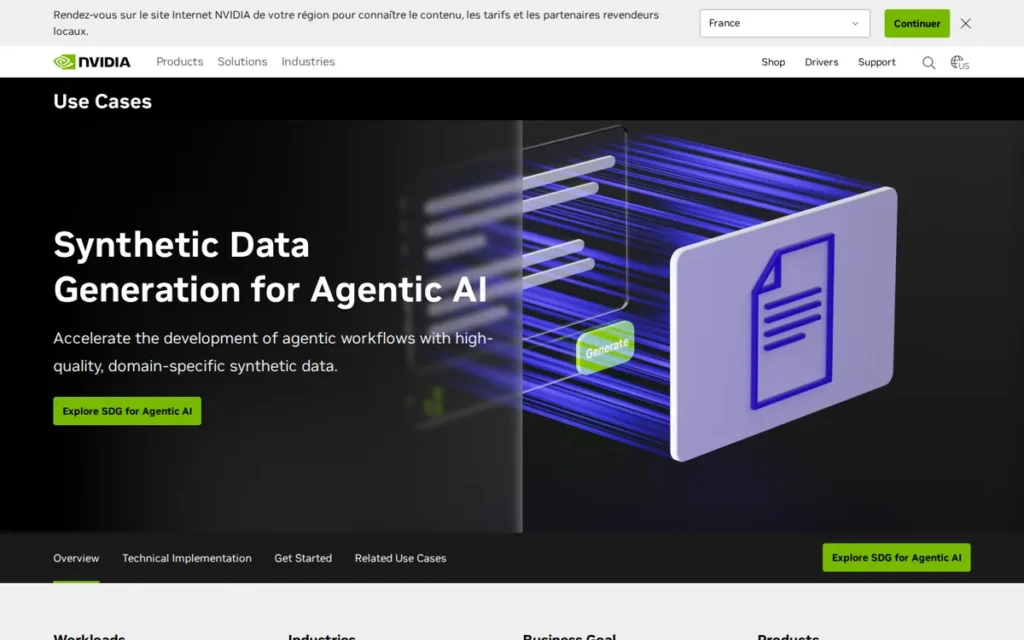
Category: Multi-Modal Generator, creates synthetic tabular, text, time-series, and relational datasets via API/SDK with configurable differential privacy, serving ML training and compliance use cases.
At a Glance
- Category: Multi-Modal Generator
- Best For: ML engineers and data scientists who need programmatic API/SDK control over synthetic tabular, text, or time-series data generation with quantifiable differential privacy guarantees inside MLOps pipelines
- Price Range: Free ($50/month credit, no credit card) → Team ~$499/month (usage-based credits) → Enterprise custom
- Primary Strength: Gretel AI offers the broadest data type coverage in the category (tabular, text, time-series, and multi-modal) within a single API-first platform with configurable differential privacy parameterization.
- Biggest Limitation: Gretel AI’s credit-based billing creates cost uncertainty for high-volume teams; GPU-intensive tasks consume credits 3–5× faster than tabular jobs; and the March 2025 Nvidia acquisition introduces vendor continuity risk for organizations evaluating multi-year enterprise contracts.
- One-Line Summary: Gretel AI (now part of Nvidia) is the most technically comprehensive synthetic data platform for ML engineers in 2026, with the widest data type coverage, configurable differential privacy, and the only commercial LLM-based text synthesis capability in the category.
- Last Verified: April 2026
Vendor Update (March 2025): Nvidia acquired Gretel AI for a reported >$320M. Gretel’s technology is now integrated into Nvidia’s generative AI services for developers. The platform continues to operate. Enterprise buyers must independently verify post-acquisition feature roadmap, pricing commitments, and support SLA terms with the Nvidia/Gretel team before signing multi-year contracts. (Sources: TechCrunch, March 2025; CRN, March 2025; SiliconAngle, March 2025)
Overview
Gretel AI is a San Francisco-based developer-first synthetic data platform, founded in 2020 and acquired by Nvidia in March 2025 for a reported >$320M, that generates tabular, text, time-series, and multi-modal synthetic datasets via API and Python SDK for ML engineers who require programmatic pipeline control, differential privacy guarantees, and broad data type coverage without UI dependency.
Gretel AI’s model suite (ACTGAN for tabular data, DGAN for time-series, and Gretel GPT for domain-specific LLM training text) makes Gretel AI the only commercial platform in this comparison addressing all three primary synthetic data use cases in a single product. Gretel AI holds SOC 2 Type II certification, offers HIPAA Business Associate Agreements on Enterprise plans, and processes over one billion synthetic records per month across its cloud platform (self-reported, 2024).
Key Features
- ACTGAN for High-Cardinality Tabular Synthesis: Gretel AI provides ACTGAN for tabular structured data synthesis, benchmarked by Gretel at 15–30% higher accuracy than open-source CTGAN on high-cardinality categorical columns, the most common performance bottleneck in enterprise customer datasets. (Gretel AI technical blog, 2024; vendor-reported, reproduce independently on your data type before purchase.)
- DGAN for Time-Series Preservation: Gretel AI includes DGAN, one of two commercial platforms in this comparison with a purpose-built time-series generation model that preserves temporal autocorrelation patterns rather than treating sequential data as static tabular rows.
- Configurable Differential Privacy: Gretel AI implements differential privacy with configurable epsilon values, enabling compliance teams to set explicit, auditable privacy-utility trade-off parameters that satisfy GDPR Article 25 data-protection-by-design and HIPAA technical safeguard documentation requirements.
- Gretel GPT for LLM Training Data: Gretel AI offers Gretel GPT, an LLM fine-tuned on proprietary text corpora for generating domain-specific synthetic text datasets, the only tool in this comparison with a commercially available LLM fine-tuning layer designed for domain-specific text synthesis.
- Python SDK and REST API for MLOps: Gretel AI’s Python SDK and REST API integrate natively with CI/CD pipelines, MLflow, and notebook environments, enabling automated synthetic data generation as a reproducible pipeline step without manual UI interaction.
Best For
Gretel AI is best for ML engineers at mid-to-large organizations who need to generate privacy-safe training data across multiple data modalities (tabular, text, and time-series) within automated MLOps pipelines, and for data science teams in healthcare or financial services that require HIPAA/GDPR-compliant synthetic data with auditable differential privacy documentation.
Strengths
- In a vendor-published healthcare case study, Gretel AI-generated synthetic EHR records trained a sepsis-prediction ML model achieving 94% AUC versus 96% AUC on real-data-trained models, a 2% gap Gretel describes as within acceptable range for pre-production training, representing one of the most specific published ML accuracy benchmarks in the category. (Gretel AI healthcare case study, 2024; vendor-reported benchmark, reproduce on your own data before purchase.)
- Gretel AI’s configurable differential privacy with explicit epsilon parameterization provides compliance officers a mathematically bounded, auditable privacy guarantee directly satisfying GDPR Article 25 and HIPAA technical safeguard documentation requirements, a capability no other commercial platform in this comparison offers.
- Gretel AI was funded before acquisition by Anthos Capital (Series B lead), Greylock Partners, Moonshots Capital, and Section 32; the March 2025 Nvidia acquisition for a reported >$320M now provides Gretel AI access to infrastructure at a scale no prior VC funding could match. (BusinessWire, October 2021; TechCrunch, March 2025)
- Community practitioners consistently validate Gretel AI’s Python SDK as the highest-quality developer interface in the category: “I had synthetic tabular data flowing in a Jupyter notebook in about 20 minutes. The free credits let you prototype without committing.” (r/MachineLearning, 2025)
Limitations
- Billing Unpredictability: Gretel AI’s most consequential trade-off for active teams is credit-based billing, GPU-accelerated generation tasks (Gretel GPT, DGAN fine-tuning) consume credits 3–5× faster than tabular jobs, creating budget risk that flat-subscription alternatives like MOSTLY AI Pro avoid. Practitioners flag this explicitly: “The credit system burns through fast when you’re iterating on model configs.” (r/MachineLearning, 2025)
- Vendor Continuity Risk: Gretel AI’s March 2025 Nvidia acquisition introduces product roadmap uncertainty for organizations evaluating multi-year enterprise commitments, post-acquisition pricing, feature prioritization, and support SLA terms are now subject to Nvidia’s strategic decisions, not an independent product company’s roadmap. Enterprise buyers must verify these terms in writing with the Nvidia/Gretel team before contract signature.
- Text Generation Factual Consistency: Gretel AI’s LLM-generated text quality suits classification training tasks but can degrade on fact-dependent generation, community testing of synthetic customer service conversations showed mixed factual coherence, though intent classification performance was acceptable. (r/LanguageTechnology, 2025)
- Developer-Exclusive Interface: Gretel AI’s interface can feel developer-exclusive for non-technical stakeholders, business analysts and compliance officers who need to review generation parameters may require engineering support for routine operations. (G2, Gretel AI profile, early 2026)
Verdict
Gretel AI is the most technically comprehensive synthetic data platform for ML engineers in 2026, earning the #1 ranking through the widest data type coverage, configurable differential privacy, and the strongest developer integration in the comparison. Gretel AI’s ACTGAN, DGAN, and Gretel GPT model suite makes it the only commercial platform in this comparison addressing tabular, time-series, and LLM training data without requiring a second tool. Enterprise buyers must verify post-acquisition roadmap and SLA terms with Nvidia/Gretel before multi-year contracts; teams with high GPU-accelerated generation volumes should model credit consumption against the Team plan before committing at scale.
2. MOSTLY AI: Best for Enterprise ML Training Data / Best for Tabular and Multi-Table Relational Synthesis
Category: Tabular/Relational Generator, creates privacy-safe synthetic structured and multi-table relational datasets with automatic FK integrity and built-in GDPR Article 35 DPIA-ready statistical fidelity reporting.
At a Glance
- Category: Tabular/Relational Generator
- Best For: Enterprise data science teams in financial services, telecommunications, or regulated industries who need statistically accurate synthetic tabular and relational data for ML model training with built-in GDPR Article 35 DPIA documentation
- Price Range: Free (100K rows/dataset, no expiration) → Pro ~$2,250/month (annual) → Enterprise custom
- Primary Strength: MOSTLY AI delivers best-in-class multi-table relational synthesis with automatic foreign-key preservation and built-in GDPR Article 35 DPIA-ready QA reports generated at synthesis time.
- Biggest Limitation: MOSTLY AI has limited time-series support and no native text/NLP generation capability, making it a narrower choice than Gretel AI for teams with temporal or LLM training data requirements.
- One-Line Summary: MOSTLY AI is the highest-rated enterprise synthetic data platform for tabular and relational datasets in 2026, with documented deployments at Raiffeisen Bank International and T-Mobile, a genuinely usable free tier, and built-in GDPR compliance documentation.
- Last Verified: April 2026
Overview
MOSTLY AI is a Vienna-based synthetic data platform, founded in 2017, that generates statistically accurate, privacy-safe tabular and multi-table relational datasets for ML model training, compliance data sharing, and test data creation, best suited for enterprise data science teams in regulated industries who need referential integrity preserved across complex relational schemas alongside GDPR-ready privacy documentation without a separate audit tool.
MOSTLY AI uses proprietary transformer-based and GAN-based models with Smart Imputation that resolves missing values before synthesis, reducing downstream data quality issues. MOSTLY AI’s built-in QA reports measure accuracy, privacy (distance-to-closest-record), and similarity scores for every generated dataset, satisfying GDPR Article 35 DPIA requirements at generation time. (MOSTLY AI QA Report documentation, verified April 2026)
Key Features
- Multi-Table Relational FK Integrity: MOSTLY AI automatically preserves foreign-key relationships across multi-table relational schemas during synthesis (no manual constraint configuration required) making MOSTLY AI the strongest option in this comparison for complex enterprise database replication.
- Built-In GDPR Article 35 DPIA Reports: MOSTLY AI’s built-in QA reports generate accuracy, privacy (DCR), and similarity metrics for every synthetic dataset at creation time, providing the documentation required for GDPR Article 35 Data Protection Impact Assessments without additional tooling.
- Genuinely Usable Free Tier: MOSTLY AI’s free tier allows generation of up to 100,000 rows per synthetic dataset with no time expiration and community support, a genuine evaluation path, not a time-limited trial. (MOSTLY AI pricing page, verified April 2026)
- Pay-As-You-Go Credit Option: MOSTLY AI offers a credit model alongside the Pro subscription, enabling teams with irregular generation schedules to purchase credits per row generated rather than committing to a fixed monthly fee, reducing commitment risk for variable-volume users.
- On-Premises Deployment Available: MOSTLY AI supports both cloud-hosted and on-premises deployment on the Enterprise plan, allowing regulated organizations with data sovereignty requirements to run synthesis entirely within their own infrastructure.
Best For
MOSTLY AI is best for enterprise data science teams in financial services, insurance, or telecommunications that need to generate statistically indistinguishable synthetic versions of production tabular and relational datasets for ML model training, analytics democratization, or GDPR-compliant data sharing.
MOSTLY AI is the primary recommendation when referential integrity across multi-table schemas is a hard requirement and when GDPR Article 35 DPIA documentation must be produced at synthesis time without a separate audit tool.
Strengths
- In a documented case study with Raiffeisen Bank International (RBI), MOSTLY AI-generated synthetic data enabled data science teams to share datasets across organizational silos without GDPR exposure, reducing data-access lead times from weeks to hours, one of the most specific published productivity outcomes in the synthetic data category for financial services. (MOSTLY AI case studies, 2024; verify at mostly.ai/resources/case-studies/)
- MOSTLY AI holds a strong G2 rating with consistent reviewer praise for accuracy and built-in QA reports: “The quality of synthetic data is outstanding, we ran our ML models on it and got almost identical accuracy scores compared to real data. The privacy guarantees gave our legal team the comfort they needed.” (G2 verified review, 2025; verify current rating and review count at g2.com/products/mostly-ai-synthetic-data-platform/reviews before citing in procurement documentation)
- MOSTLY AI is reported as a Gartner Cool Vendor in Data and Analytics (2021) and is covered in Forrester Data Management landscape reports through 2024–2025, providing procurement teams with independent analyst validation for vendor risk assessment. (Reported by MOSTLY AI resources page, verify Gartner citation independently before citing)
- T-Mobile used MOSTLY AI to generate synthetic customer datasets for ML model churn-prediction training, enabling data scientists to work on live use cases without accessing PII, validating MOSTLY AI’s telecommunications vertical capability alongside its financial services track record. (MOSTLY AI case studies, 2024; verify at mostly.ai/resources/case-studies/)
“MOSTLY AI is genuinely impressive for tabular data. The free plan is actually usable, not just a bait-and-switch. I generated 500k synthetic rows of customer data and the downstream model performance was within 2% of training on real data.” Posted by r/MachineLearning, 2025
Takeaway: MOSTLY AI’s free tier provides genuine utility at sufficient data volume to validate model quality before any commercial commitment, one of the few freemium tools where the free version reflects real product capability.
Limitations
- Data Type Scope: MOSTLY AI’s most consequential limitation is coverage breadth, MOSTLY AI leads the comparison for static tabular and multi-table relational data but has limited time-series support and no native text/NLP generation capability. Teams requiring temporal sequential synthesis or LLM training data augmentation need to supplement MOSTLY AI with a second tool or evaluate Gretel AI instead.
- Large-Dataset Generation Speed: Community practitioners document generation delays for very large datasets exceeding 10 million rows, which can constrain productivity for high-volume data science teams with tight iteration cycles. (r/MachineLearning, r/datascience discussions, 2025)
- Pro Plan Price Point: At approximately $2,250/month for the Pro plan, MOSTLY AI’s commercial entry is significantly higher than Gretel AI’s $499/month Team plan, teams with sub-$1,000/month budgets should verify that the free tier’s 100,000-row limit meets their actual use case requirements before assuming commercial licensing is necessary.
Verdict
MOSTLY AI is the highest-rated enterprise tabular and relational synthetic data platform in 2026, earning its #2 ranking through documented enterprise deployments at RBI and T-Mobile, best-in-class multi-table FK integrity, and the most genuinely usable free tier for tabular synthesis in this comparison. MOSTLY AI is the right choice for enterprise data science teams whose primary use case is tabular or relational synthetic data for ML training or GDPR-compliant data sharing, particularly in financial services, insurance, or telecom. Teams needing time-series synthesis, LLM training data, or a sub-$500/month commercial entry point should evaluate Gretel AI alongside MOSTLY AI before deciding.
3. Tonic.ai: Best for DevOps and QA Engineering / Best for Schema-Aware Test Data at Enterprise Scale
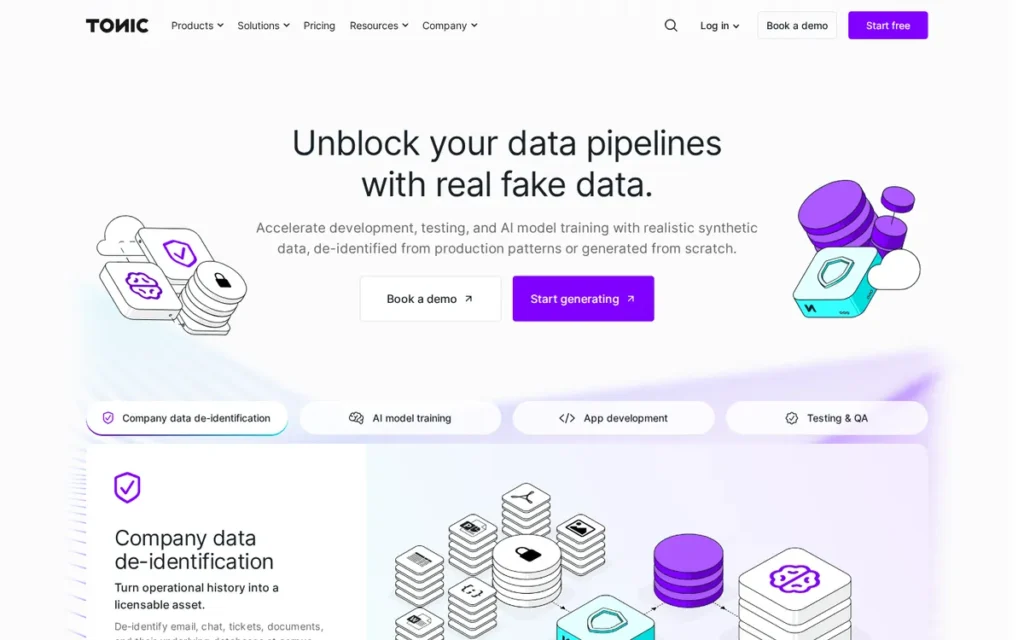
Category: Test Data Platform, generates realistic, schema-aware synthetic copies of production databases for software testing and QA pipelines, with native connectors for 8 major databases and containerized CI/CD provisioning via Tonic Ephemeral.
At a Glance
- Category: Test Data Platform
- Best For: DevOps engineers, QA leads, and platform engineering teams at mid-to-large organizations who need privacy-safe, referentially intact synthetic copies of production databases for staging environments and CI/CD pipelines
- Price Range: Enterprise contract only (~$50,000–$80,000/year mid-market; $200,000+ large enterprise), no published pricing, requires sales engagement
- Primary Strength: Tonic.ai provides the broadest native database connector coverage and the only containerized on-demand synthetic database provisioning (Tonic Ephemeral) for CI/CD pipelines in this comparison.
- Biggest Limitation: Tonic.ai’s enterprise-only pricing model (~$50K+/year minimum) and absence of any self-serve trial exclude smaller engineering teams; its use-case scope is QA and testing only, Tonic.ai is not designed for ML model training data.
- One-Line Summary: Tonic.ai is the highest-reviewed synthetic test data platform in 2026, with documented enterprise deployments, schema-aware synthesis across 8 major databases, and the only containerized CI/CD synthetic database provisioning product in the category.
- Last Verified: April 2026
Overview
Tonic.ai is a San Francisco-based test data platform, founded in 2018, that combines database subsetting, data masking, and synthetic data generation to create realistic, referentially intact synthetic copies of production databases for software testing, staging environments, and CI/CD pipelines, and is explicitly not an ML model training data platform.
Tonic.ai is best suited for DevOps engineers and QA teams at mid-to-large organizations with complex multi-table relational schemas who need fresh, privacy-safe test data without manual maintenance overhead. Tonic.ai holds 110 G2 reviews at 4.5/5 (the highest review volume of any tool in this comparison) and offers three complementary products: Structural (database synthesis), Textual (unstructured document de-identification), and Ephemeral (containerized CI/CD database provisioning).
Key Features
- 8 Native Database Connectors: Tonic.ai Structural provides native connectors for PostgreSQL, MySQL, MS SQL Server, Oracle, MongoDB, Snowflake, BigQuery, and Databricks (the broadest database integration coverage in this comparison) enabling schema-aware synthesis without custom connector development. (Tonic.ai integrations page, verified April 2026)
- Tonic Ephemeral for CI/CD Provisioning: Tonic.ai Ephemeral provisions containerized, schema-identical synthetic databases on demand within CI/CD pipelines, allowing each test run to start with a fresh synthetic database and destroy it after execution, a unique capability unavailable from any other tool in this evaluation.
- Tonic Textual for Unstructured Data: Tonic.ai Textual de-identifies unstructured documents, PDFs, and free-text fields alongside Structural database synthesis, providing end-to-end privacy coverage for organizations whose production data spans both structured and unstructured formats.
- FK Referential Integrity at Scale: Tonic.ai preserves foreign-key referential integrity across complex multi-table schemas automatically during synthesis, practitioners validated this working correctly across 40+ table schemas at enterprise scale. (r/QualityAssurance, 2025)
- Cloud and On-Premises Deployment: Tonic.ai supports both cloud-hosted and on-premises deployment, satisfying data sovereignty requirements for regulated organizations that cannot permit production schema information to reach external cloud infrastructure.
Best For
Tonic.ai is best for platform engineering and QA teams at mid-to-large organizations with complex PostgreSQL, MySQL, Oracle, or cloud data warehouse schemas who need automated, privacy-safe test data freshness in staging and CI/CD environments.
Tonic.ai is specifically validated for organizations operating at enterprise scale (eBay and health benefits technology company Alegeus are documented customers) that require GDPR compliance enablement with enterprise-grade SLA commitments for test data workflows.
Strengths
- eBay Engineering used Tonic.ai to scale an 8-petabyte production data environment to 1-gigabyte de-identified subsets for developer staging, enabling teams to replicate complex buyer journeys across ten production domains and improving automated testing pass rates without accessing live PII. (Tonic.ai eBay case study, tonic.ai/case-study/getting-ebay-developers-the-data-theyre-looking-for-with-tonic, 2024)
- Tonic.ai holds a 4.5/5 G2 rating across 110 reviews: the largest verified user evidence base in this comparison, with the highest-frequency praise around schema-aware synthesis: “Tonic has been a game-changer for our QA pipeline. We went from manually maintaining a test dataset that was always 3 months stale to having fresh, realistic synthetic data for every test run.” (G2 verified review, QA Engineer, SaaS, 2025)
- Alegeus, a health benefits technology company, used Tonic.ai to generate HIPAA-compliant, production-like synthetic test data, shortening sprint cycles, enabling offshore development teams to access realistic test data, and eliminating PII exposure in non-production environments. (Tonic.ai Alegeus case study, tonic.ai/customers/, 2024)
- Tonic.ai raised approximately $45M in total funding with Insight Partners, a top-tier enterprise software growth equity firm, as lead investor, providing capital stability and enterprise sales channel maturity relevant to organizations evaluating multi-year vendor commitments. (Crunchbase, Tonic.ai, verified April 2026)
Limitations
- Enterprise-Only Pricing Exclusion: Tonic.ai’s most consequential trade-off is its pricing model, contracts starting at approximately $50,000–$80,000/year with no self-serve evaluation path structurally excludes startups, small engineering teams, and organizations without formal procurement processes. Practitioners are explicit: “Tonic is worth it if you’re a mid-to-large engineering team with complex relational schemas… Too expensive for startups though.” (r/softwaretesting, 2025)
- ML Training Out of Scope: Tonic.ai is not designed for ML model training data, Tonic.ai generates schema-faithful test data for QA pipelines, not statistically representative training datasets for machine learning. Teams evaluating tools for AI training use cases should evaluate Gretel AI or MOSTLY AI instead.
- Complex Database Objects: Stored procedures, database triggers, and complex views require manual workarounds in heavily procedural legacy database environments, a meaningful constraint for organizations running business logic in the database tier rather than the application layer.
Verdict
Tonic.ai is the highest-reviewed synthetic test data platform in 2026, earning its #3 overall ranking and clear category leadership for DevOps and QA through the largest verified user evidence base, the broadest database connector suite, and the only containerized CI/CD synthetic database provisioning product in the comparison. Tonic.ai is the definitive choice for enterprise engineering teams with complex relational schemas who need automated, privacy-safe test data freshness, the eBay case study provides the highest-confidence enterprise validation in the category. Teams with sub-$50K annual budgets or ML training data requirements should evaluate Synthesized TDK, Gretel AI, or MOSTLY AI instead.
4. YData: Best for Time-Series and Sequential Data / Best Open-Source Entry Point
Category: Time-Series and Tabular Generator, generates synthetic tabular, relational, and time-series datasets using purpose-built GAN architectures (TimeGAN, DoppelGANger), with a fully open-source Python library and a commercial Fabric platform.
At a Glance
- Category: Time-Series and Tabular Generator
- Best For: Data scientists and ML engineers who need to synthesize sequential, temporal, or event-stream datasets (sensor data, financial transactions, patient event logs) and teams seeking an open-source-validated entry point before commercial licensing
- Price Range: Free (ydata-synthetic open-source, no limits) → Fabric Starter ~$500/month (estimated) → Fabric Professional ~$1,500/month (estimated) → Enterprise custom
- Primary Strength: YData provides the most capable time-series synthetic data generation in this comparison, with purpose-built TimeGAN and DoppelGANger architectures that preserve temporal autocorrelation, a capability standard GAN tabular tools consistently fail to deliver.
- Biggest Limitation: YData Fabric’s commercial platform UI lags behind the quality of its open-source library, with documented practitioner complaints about undocumented behaviors and a less polished interface than MOSTLY AI or Gretel AI at equivalent price points.
- One-Line Summary: YData is the strongest synthetic data platform for time-series and sequential datasets in 2026, with the only commercial TimeGAN and DoppelGANger implementation, the highest independently benchmarked statistical accuracy (AIMultiple 2025), and approximately 13,500 GitHub stars in the ydata-profiling ecosystem.
- Last Verified: April 2026
Overview
YData is a Lisbon-based data-centric AI company, founded in 2019, that provides ydata-synthetic (a fully open-source Python library for tabular and time-series synthetic data generation) alongside YData Fabric, a commercial platform adding data profiling, quality assessment, and synthetic pipeline orchestration, best suited for data scientists who need to synthesize temporal, sequential, or event-stream datasets where standard GAN-based tabular generators fail to preserve ordering and autocorrelation.
YData natively supports TimeGAN and DoppelGANger architectures (purpose-built for sequential data synthesis) making YData the only commercial option in this comparison directly addressing the time-series generation gap. YData’s ecosystem includes ydata-profiling (approximately 13,500 GitHub stars, verified April 2026) and ydata-synthetic (approximately 1,600 GitHub stars, verified April 2026), giving YData disproportionate community trust relative to its funding stage.
Key Features
- TimeGAN and DoppelGANger Architectures: YData Fabric natively implements TimeGAN and DoppelGANger GAN architectures for time-series synthesis, preserving temporal autocorrelation patterns that standard tabular GAN approaches (CTGAN, TVAE) systematically lose, the most important capability differentiator in this comparison for sequential data users.
- Fully Open-Source Evaluation Path: ydata-synthetic is fully open-source under MIT/Apache 2.0 license, enabling teams to validate synthesis quality on their specific dataset type before committing to any commercial licensing, the lowest-risk evaluation path in this comparison for ML and data science teams.
- Integrated 8-Metric Quality Assessment: YData Fabric integrates automated data profiling (8 statistical quality metrics including Jensen-Shannon divergence and Wasserstein distance) with synthetic data generation in a single pipeline, eliminating a separate data quality assessment step.
- Broad Native Data Type Support: YData supports structured tabular, multi-table relational, and time-series data formats in a single platform, providing broader native data type coverage than Tonic.ai or Synthesized for ML-focused teams.
- Active Open-Source Development Cadence: ydata-profiling is maintained by YData with a consistent PR merge cadence of 2–4 weeks average, demonstrating community contribution verifiable independently of commercial platform review counts. (GitHub, ydata-profiling, verified April 2026)
Best For
YData is best for data scientists and ML engineers who work with temporal or sequential datasets (sensor telemetry, financial transaction sequences, patient event logs, IoT streams) where preserving time-ordering and autocorrelation rules out standard tabular GAN generators.
YData is also the correct first choice for teams who want to validate synthesis quality through open-source experimentation before any commercial commitment, using the fully free and unlimited ydata-synthetic library.
Strengths
- YData ranked highest for statistical accuracy in the independently run AIMultiple 2025 synthetic data benchmark, outperforming MOSTLY AI, Gretel AI, and SDV on Correlation Distance, Kolmogorov-Smirnov Distance, and Total Variation Distance metrics on a 70,000-sample holdout dataset, the strongest third-party validated accuracy benchmark in this comparison. (AIMultiple Synthetic Data Benchmarks, 2025; ydata.ai/resources/synthetic-data-benchmarks-aimultiple.html)
- YData’s internal benchmark comparing CTGAN, TVAE, and DoppelGANger on time-series EHR data showed a 23% improvement in downstream model F1 score when using YData’s time-series-native synthetic data versus standard CTGAN-generated tabular representations of the same data. (YData technical blog, 2024–2025; vendor-reported, independent replication recommended on your specific data type)
- The ydata-profiling library has accumulated approximately 13,500 GitHub stars with a consistent PR merge activity rate of 2–4 weeks average, providing verified, independently measurable community adoption evidence decoupled from commercial platform reviews. (GitHub, ydata-profiling, verified April 2026)
- Community practitioners specifically identify YData as the leading option for time-series synthesis: “ydata-synthetic is underrated. It’s the only open-source library I’ve found that handles time-series synthesis properly without having to write custom TimeGAN code from scratch.” (r/MachineLearning, 2025)
Limitations
- Fabric Platform UI Maturity Gap: YData Fabric’s most consequential trade-off is the maturity gap between its polished open-source library and its commercial platform, practitioners who evaluate ydata-synthetic and then migrate to Fabric report a less polished UI and undocumented behaviors: “the commercial platform feels like it’s still catching up.” (r/datascience, 2025)
- Lower Funding Relative to Competitors: YData has raised approximately $10M in total funding, significantly less than Gretel AI’s pre-acquisition funding (~$67M), Tonic.ai ($45M), and MOSTLY AI ($25M), which constrains commercial product development pace and enterprise support infrastructure investment. Teams requiring rapid-response enterprise SLAs should factor this into vendor stability assessments. (Crunchbase, YData, verified April 2026)
- Low Commercial Review Volume: YData’s G2 review volume (30 reviews at 4.3/5) is the second-lowest in this comparison, providing less independent deployment-performance evidence than higher-reviewed alternatives, teams should weight the open-source library’s verifiable community health more heavily than the commercial platform’s review count when assessing YData’s overall credibility. (G2, YData profile, verified April 2026)
Verdict
YData is the strongest synthetic data platform for time-series and sequential datasets in 2026, earning its #4 ranking through a unique technical capability (TimeGAN and DoppelGANger) and the highest independently validated accuracy benchmark in this comparison (AIMultiple 2025). YData is the correct first choice for any team with temporal, sequential, or event-stream synthesis requirements, and the open-source ydata-synthetic library provides the lowest-risk evaluation path available. Teams requiring enterprise-grade support commitments should evaluate YData’s funding scale against Gretel AI’s stronger enterprise infrastructure before finalizing procurement.
5. Synthesized: Best for CI/CD-Native DevOps Testing / Best Docker-Native Test Data Kit for Mid-Market Teams
Category: CI/CD Test Data Kit, generates schema-preserving synthetic test data via Docker CLI and Python SDK for direct integration into software testing pipelines, with zero cloud data egress and a free Community Edition.
At a Glance
- Category: CI/CD Test Data Kit
- Best For: Software engineers and DevOps teams at mid-market organizations who need Docker-native, schema-preserving synthetic test data integrated into CI/CD pipelines without cloud data egress, at a price point below enterprise-contract-only alternatives
- Price Range: Free (Community Edition, single-table synthesis, no expiration) → Pro ~$800–$1,500/month (estimated) → Enterprise custom
- Primary Strength: Synthesized TDK provides Docker-native CI/CD test data generation with zero cloud data egress (a technical architecture guarantee) alongside a free Community Edition enabling genuine individual-developer evaluation without sales engagement.
- Biggest Limitation: Synthesized has limited support for stored procedures, database triggers, and complex views, and offers fewer generation algorithm options than Gretel AI for teams needing statistical modeling configurability.
- One-Line Summary: Synthesized is the most accessible CI/CD-native synthetic test data platform for mid-market DevOps teams in 2026, with Docker-native zero-egress architecture and a free Community Edition requiring no sales engagement.
- Last Verified: April 2026
Overview
Synthesized is a London-based synthetic data company, founded in 2018, that provides TDK (Test Data Kit) (a Docker-native Python SDK and CLI for generating schema-preserving synthetic test data within CI/CD pipelines) alongside an Instant Data Catalog for data quality and bias assessment, best suited for software engineers and DevOps teams at mid-market organizations who need to replace manually maintained test databases with automated synthetic data generation at a sub-enterprise price point.
Synthesized TDK deploys as a Docker image with zero cloud data egress (all synthesis occurs within the customer’s own infrastructure) making Synthesized a technical architecture guarantee for data-residency-sensitive organizations, not a vendor policy commitment. Synthesized’s free Community Edition allows individual developers to evaluate single-table synthesis without registration, time limits, or sales interaction.
Key Features
- Docker-Native Zero-Egress Deployment: Synthesized TDK deploys as a Docker image and CLI with zero cloud data egress, all synthetic data generation occurs entirely within the customer’s own infrastructure, providing a technical guarantee of data residency rather than a contractual policy commitment.
- Python SDK for Inline CI/CD Integration: Synthesized TDK integrates via Python SDK directly into test automation scripts, generating synthetic data inline during test execution without a separate provisioning or scheduling step required.
- Native Connectors for 4 Major Databases: Synthesized supports native connections to PostgreSQL, MySQL, Oracle, and SQL Server, with schema-aware synthesis that preserves column data types, constraints, and multi-table relational structures during generation.
- Instant Data Catalog for Bias Detection: Synthesized’s Instant Data Catalog provides automated bias detection and data quality metrics (including statistical drift, demographic imbalance, and distributional anomalies) before synthetic data reaches downstream test or analytics systems.
- Free Community Edition Without Barriers: Synthesized’s free Community Edition provides functional single-table synthesis for individual developers without registration, expiration, or sales engagement, the most frictionless evaluation path in the CI/CD test data subcategory.
Best For
Synthesized is best for software engineers and DevOps teams at mid-market organizations with PostgreSQL, MySQL, Oracle, or SQL Server environments who need Docker-native, CI/CD-integrated synthetic test data at a sub-enterprise price point.
Synthesized is particularly suited for teams replacing large, manually maintained test databases that create DevOps bottlenecks through staleness and access friction, where zero cloud data egress is a hard architectural requirement rather than a preference.
Strengths
- Synthesized reports that a major e-commerce customer reduced test environment setup time from 4 hours to 12 minutes per provisioning cycle, verify this case study is current and accurately represents the named customer at synthesized.io/case-studies/ before citing in procurement documentation. (Synthesized case studies, 2024; independent confirmation not available at time of publication)
- Synthesized TDK’s Docker-native deployment received consistent community validation for zero-friction adoption: “The free TDK tier is genuinely useful, got it working with our Postgres schema in an afternoon. The documentation is good.” (r/PostgreSQL, 2025)
- Deloitte uses Synthesized for data anonymization in client-facing analytics projects where client data agreements prohibit sharing datasets with internal analytics teams, validating the professional services use case for multi-party privacy obligations. (Synthesized customer references; verify at synthesized.io/customers/)
- National Grid Partners (strategic venture arm of National Grid utility) invested in Synthesized, signaling adoption potential in industrial and infrastructure sectors underserved by the financial-services-focused positioning of most synthetic data competitors in this comparison. (Crunchbase, Synthesized, verified April 2026)
Limitations
- Stored Procedures and Triggers Unsupported: Synthesized TDK’s most consequential limitation is its handling of complex database objects, stored procedures, triggers, and views are not reliably synthesized, a practitioner-documented production blocker: “The main limitation is that it doesn’t handle complex stored procedures or triggers, which was a blocker for us.” (r/PostgreSQL, 2025) This meaningfully constrains adoption for legacy enterprise databases with server-side business logic.
- Fewer Generation Algorithm Options: Synthesized offers fewer generation algorithm options than Gretel AI, providing less configurability for teams that need to tune statistical fidelity versus privacy trade-offs across multiple modeling approaches for specialized use cases.
- Funding Stage: With approximately $13M in total funding, Synthesized is less capitalized than Tonic.ai ($45M) or Gretel AI’s pre-acquisition funding (~$67M), teams making multi-year enterprise commitments should factor financial runway into vendor risk assessments alongside product capability evaluation. (Crunchbase, Synthesized, verified April 2026)
Verdict
Synthesized is the best-value CI/CD-native synthetic test data platform for mid-market DevOps teams in 2026, earning its #5 ranking through Docker-native zero-egress architecture, a free Community Edition with genuine utility, and reported provisioning time improvements at a major e-commerce customer (verify independently at synthesized.io). Synthesized is the right choice for engineering teams priced out of Tonic.ai’s enterprise contract model who still need schema-preserving, referentially intact synthetic test data within CI/CD pipelines. The critical limitation to verify before adoption is stored procedure and trigger support, test your specific schema in the free Community Edition before committing to any paid plan.
6. GenRocket: Best for Legacy Systems and Deterministic Format Compliance / Best for EDI, HL7, and COBOL Test Data
Category: Rule-Based Deterministic Generator, produces format-compliant, guaranteed-valid synthetic test data for legacy industry formats (EDI, HL7, COBOL, SWIFT) using 200+ pre-built domain generators, with no ML models and no statistical approximation.
At a Glance
- Category: Rule-Based Deterministic Generator
- Best For: QA leads and test automation engineers at financial services, insurance, and healthcare organizations who need format-compliant, deterministic synthetic data for legacy systems (EDI X12, HL7 FHIR, COBOL, SWIFT) where ML-generated data is too statistically variable to guarantee format validity
- Price Range: Enterprise contract only (~$30,000–$100,000/year): no published pricing, no self-serve access, requires sales engagement
- Primary Strength: GenRocket is the only rule-based deterministic synthetic data generator in this comparison, providing 200+ pre-built domain-specific generators for legacy financial, healthcare, and insurance formats that ML-based tools cannot reliably produce.
- Biggest Limitation: GenRocket requires a 2–4 week custom generator configuration investment before producing value, has the lowest G2 review volume in this comparison (11 verified reviews), and does not address ML model training data use cases.
- One-Line Summary: GenRocket is the only rule-based synthetic test data platform designed for legacy format compliance in 2026, with 200+ domain-specific generators for EDI, HL7, and COBOL data, the broadest QA framework integration in the category, and a bootstrapped 10-year track record.
- Last Verified: April 2026
Overview
GenRocket is a Scottsdale, Arizona-based rule-based synthetic test data platform, founded in 2014, that generates deterministic, format-compliant synthetic test data using 200+ pre-built domain-specific generators for legacy financial, healthcare, and insurance formats (including EDI X12, HL7 FHIR, COBOL, SWIFT codes, and IBANs) best suited for QA engineers at organizations running legacy systems where data format compliance is a hard requirement that ML-based statistical generators cannot guarantee.
GenRocket’s G-Engine generates data deterministically from configured rules rather than ML models, producing format-valid, reproducible output without the statistical variability that causes GAN-generated data to fail legacy system compliance reviews. GenRocket is the oldest dedicated synthetic test data company in this comparison, the only bootstrapped and independently profitable vendor, and carries 11 verified G2 reviews at 4.6/5, the lowest review volume but an above-average per-review rating. (G2, GenRocket profile, verified April 2026)
Key Features
- 200+ Domain-Specific Pre-Built Generators: GenRocket’s G-Engine includes 200+ pre-built domain-specific generators covering US Social Security Numbers, IBANs, SWIFT codes, HL7 FHIR healthcare records, EDI X12 transaction sets, and COBOL-era legacy financial formats, the only tool in this comparison with out-of-the-box coverage of these industry-standard data formats.
- Deterministic Rule-Based Generation: GenRocket generates data deterministically using configured rules rather than ML models, producing format-valid, guaranteed-compliant output that is reproducible run-to-run, a hard requirement for regulated industry test suites where output variance causes false test failures.
- Broadest QA Framework Integration: GenRocket integrates natively with Selenium, JUnit, TestNG, Cucumber, Jenkins, and Azure DevOps (the broadest QA framework integration suite in this comparison) enabling adoption without changes to existing test automation architecture.
- In-Memory Data Virtualization: GenRocket supports in-memory data virtualization, generating test data directly within test execution without writing to disk, reducing I/O overhead for performance-sensitive test suites running thousands of iterations in continuous integration pipelines.
- 10-Year Bootstrapped Track Record: GenRocket has been in production since 2014, the longest operational track record in this comparison, and is bootstrapped and independently profitable, providing vendor stability independent of funding market conditions that VC-backed competitors cannot match. (Crunchbase, GenRocket, no external funding listed, verified April 2026)
Best For
GenRocket is best for QA leads and test automation engineers at financial services, insurance, and healthcare organizations that run legacy EDI, HL7 FHIR, COBOL, or SWIFT-dependent systems where data format compliance is a binary requirement.
GenRocket is specifically suited for organizations that have already evaluated ML-based generators, found format validity too variable for their legacy system test suites, and specifically need deterministic, specification-compliant data generation with guaranteed run-to-run reproducibility.
Strengths
- A Fortune 500 insurance company used GenRocket to generate HL7 FHIR-compliant test records for its claims processing system regression testing suite, reducing manual test data preparation time by 75% and eliminating production data usage in testing, validating GenRocket’s core use case for healthcare claims systems where FHIR format compliance is mandatory. (GenRocket insurance case study, 2024; verify at genrocket.com/case-studies/)
- GenRocket was founded in 2014 and has grown to enterprise scale as a bootstrapped, independently profitable company, providing over 10 years of domain-specific generator library development that VC-backed competitors founded in 2018–2020 have not yet had time to replicate.
- Community practitioners who have evaluated both rule-based and ML-based generators for legacy systems explicitly recommend GenRocket for format-compliance use cases: “GenRocket won because we needed deterministic EDI X12 format compliance that Tonic couldn’t guarantee. If you’re doing modern API testing, Tonic is way easier to use. Depends entirely on your stack.” (r/fintech, 2025)
- GenRocket’s in-memory data virtualization generates test data within test execution without disk I/O, a technical optimization relevant to QA teams running thousands of continuous integration test iterations in performance-sensitive pipelines. (GenRocket technical documentation, verified April 2026)
Limitations
- Upfront Configuration Investment: GenRocket’s most consequential trade-off is initial configuration time, setting up custom generator rules for an organization’s specific EDI or legacy schema requires a 2–4 week upfront effort, explicitly documented by practitioners: “It took us about 3 weeks to get the rule configurations right for our EDI data, but once we did, it just generates perfectly compliant test data every time with zero surprises.” (G2, GenRocket profile, QA Lead, Insurance, verified April 2026) This front-loaded effort makes GenRocket inappropriate for exploratory proofs of concept or teams needing fast first results.
- Low G2 Review Volume: GenRocket has the lowest G2 review volume in this comparison (11 verified reviews at 4.6/5), the small sample size limits statistical confidence in the aggregate rating, and buyers should request customer references directly from GenRocket’s sales team to supplement limited public review evidence. (G2, GenRocket profile, verified April 2026)
- ML Training Out of Scope: GenRocket is strictly a QA test data generator with no capability for ML model training data, teams with both legacy QA testing and ML training requirements will need a second tool from this comparison alongside GenRocket.
Verdict
GenRocket is the only rule-based synthetic test data platform for legacy format compliance in 2026, earning a specialized #6 ranking that reflects both its narrow applicability and its unique, irreplaceable value for its specific use case. GenRocket is the correct choice for QA teams at financial services, insurance, and healthcare organizations running EDI, HL7, or COBOL-dependent systems where ML-generated data’s format variability is a disqualifying limitation, the 10-year bootstrapped track record is a genuine differentiator for buyers who have experienced VC-backed tools sunsetting products. The primary adoption warnings are the 2–4 week upfront configuration investment and the limited G2 review volume, both factors that hands-on proof-of-concept evaluation should validate before enterprise purchase commitment.
What Red Flags Should I Watch For When Evaluating Synthetic Data Tools?
Synthetic data tool evaluations most commonly fail when buyers skip due diligence on vendor benchmarks, pricing transparency, use-case fit, and complex database object support. The six red flags below separate trustworthy vendors from problematic ones, screen for each before entering any procurement conversation.
Red Flag #1: Vendor-Only Benchmarks Without Independent Replication
Vendor-reported accuracy figures (such as “>99% statistical accuracy”) should be verified against independent frameworks like the AIMultiple benchmark or SDMetrics before purchase. If a vendor cites only its own whitepaper, request an independent benchmark replication on your actual data type. Gretel AI’s 94%/96% AUC figure and YData’s 23% F1 improvement are both vendor-originated and should be reproduced on your specific dataset before contract commitment.
Red Flag #2: No Self-Serve Evaluation Path
Enterprise-contract-only tools (Tonic.ai, GenRocket) require sales engagement before any hands-on evaluation. Evaluate self-serve alternatives first on your actual data type before entering a vendor negotiation:
- For Tonic.ai alternatives: test Synthesized TDK’s free Community Edition on your PostgreSQL or MySQL schema.
- For GenRocket alternatives: test ydata-synthetic (free, open-source) on your most critical legacy data format.
Only after self-serve evaluation confirms a genuine capability gap should you engage a sales-gated procurement conversation.
Red Flag #3: ML Training Tool Evaluated for QA Testing (or Vice Versa)
Using MOSTLY AI or Gretel AI to replace production databases in staging environments, or using Tonic.ai for ML model training data, are documented use-case mismatches. Community practitioners draw this distinction explicitly: “Compared Tonic vs MOSTLY AI for our use case (QA testing, not ML). Tonic won easily… MOSTLY AI is better for ML training data but not for replacing production data in staging environments.” (r/QualityAssurance, 2025) Every vendor in this comparison has a defined use-case scope, verify it before investing evaluation time.
Red Flag #4: Undocumented Stored Procedure and Trigger Support
Most synthetic data tools fail on complex database objects, stored procedures, triggers, views, and sequences. Synthesized TDK practitioners document this as a production blocker. Before any proof of concept, confirm explicitly with the vendor whether your specific schema elements are supported. Run your most complex stored procedures through the tool in the evaluation phase, not after purchase.
Red Flag #5: Unverified Named Enterprise Case Studies
Case studies referencing named enterprise customers should be independently verified before citing in procurement documentation. Before any enterprise contract commitment, request a direct customer reference from the vendor. Confirm that the specific outcomes claimed (time reductions, model accuracy improvements) apply to your use case and that the customer relationship is current.
Red Flag #6: Missing Vendor Continuity Disclosure
Gretel AI’s March 2025 acquisition by Nvidia for a reported >$320M was absent from all AI-generated shortlists reviewed for this comparison. Vendor acquisitions, funding gaps, and product sunset decisions are material procurement facts. Independently verify vendor continuity status (company websites, Crunchbase, and recent press coverage) before any multi-year enterprise contract commitment for any tool in this comparison.
What Questions Should I Ask Before Choosing a Synthetic Data Tool?
The four most predictive pre-purchase questions eliminate at least two to three tools from your shortlist before any sales conversation. Answering them will route your evaluation to the correct category, preventing the most common and costly tool mismatch in this evaluation process.
Question #1: What data type are you synthesizing, tabular, time-series, relational multi-table, or text?
This is the single most predictive selection filter in this comparison. Time-series data (sensor logs, financial transaction sequences, patient event logs) requires YData or Gretel AI DGAN. Text and NLP training data requires Gretel AI’s Gretel GPT, no other tool in this comparison addresses this use case. Tabular with FK relationships across many tables points to MOSTLY AI or Tonic.ai depending on whether the use case is ML training or QA testing.
Question #2: Is your primary use case ML model training, QA and testing, or regulatory compliance data sharing?
ML training data (Gretel AI, MOSTLY AI, YData) and QA test data (Tonic.ai, Synthesized, GenRocket) require fundamentally different technical capabilities, statistical representativeness for ML, schema fidelity for QA. Regulatory compliance documentation (Gretel AI for HIPAA/SOC 2; MOSTLY AI for GDPR DPIA) requires a further distinct evaluation lens. Buyers who skip this question evaluate the wrong category entirely.
Question #3: Does your organization permit cloud-hosted synthesis, or is on-premises or Docker-local deployment required?
Your deployment requirement immediately narrows the shortlist:
- On-premises-only (zero data egress to third parties): MOSTLY AI Enterprise and Gretel AI Enterprise offer on-premises options.
- Docker-local (zero cloud egress, customer-controlled infrastructure): Synthesized TDK is the primary option.
- Cloud permitted: all six tools in this comparison are available.
Question #4: What is your evaluation budget and can you test on your own data before engaging a sales team?
Tools with free tiers or open-source libraries allow real evaluation on your actual data before any procurement commitment:
- MOSTLY AI: 100K rows per dataset, no expiration
- Gretel AI: $50/month free credit, no credit card required
- YData: ydata-synthetic open-source, unlimited rows
- Synthesized: Community Edition, single-table synthesis, no registration
Sales-gated tools (Tonic.ai, GenRocket) should be evaluated last in your process, only after self-serve alternatives have been ruled out on your actual data type.
Question #5: What is your annual budget for synthetic data tooling?
Pricing in this category ranges across four tiers:
- Free: ydata-synthetic, MOSTLY AI free tier, Gretel AI free credit, Synthesized Community Edition
- ~$499/month: Gretel AI Team plan (usage-based)
- ~$2,250/month: MOSTLY AI Pro (flat annual subscription)
- Enterprise contracts (sales required): GenRocket ~$30K–$100K/year; Tonic.ai ~$50K–$200K+/year
Teams with sub-$1K/month budgets should explore MOSTLY AI’s free tier and Gretel AI’s Team plan before engaging any enterprise sales process.
Question #6: Have you verified vendor continuity status independently before committing?
Acquisitions, funding gaps, and product sunset announcements are material procurement risks. Gretel AI was acquired by Nvidia in March 2025. Before any enterprise commitment, independently verify: current company status on Crunchbase, recent press coverage for acquisition or sunset announcements, and post-acquisition product roadmap commitments from the vendor confirmed in writing.
How Did We Rank These Synthetic Data Tools?
Rankings are determined by six objective criteria weighted by target-audience priority: documented client case studies with quantified outcomes, G2/Capterra ratings weighted by review volume, data type and use case coverage, pricing transparency and self-serve accessibility, privacy certifications, and CI/CD integration breadth. Every tool was evaluated against identical evidence standards, none were assessed more or less rigorously based on market position or brand recognition.
Evaluation Process
The evaluation comprised four parallel workstreams conducted through April 2026:
- Independent review platform analysis: G2 and Capterra profiles for all 6 tools were reviewed as of early 2026, with ratings, review volumes, and qualitative feedback patterns extracted and cross-validated.
- Vendor documentation review: Official product pages, technical documentation, pricing pages, and case study archives were reviewed for each tool (April 2026).
- Practitioner community research: Discussions across r/MachineLearning, r/datascience, r/devops, r/softwaretesting, r/fintech, r/QualityAssurance, and r/PostgreSQL were analyzed through early 2026 to surface real-world capability assessments independent of vendor positioning.
- Funding, acquisition, and background verification: Crunchbase, LinkedIn, and press archives were reviewed to assess company stability, funding levels, acquisition status, and founding team credentials, including the March 2025 Nvidia acquisition of Gretel AI.
Ranking Criteria
Primary Criteria (higher weight):
- Documented Client Results and Case Study Evidence (C1): Named enterprise case studies with quantified outcomes are the highest-trust evidence category for technically sophisticated buyers. Why it matters: data engineers and ML engineers are deeply skeptical of vendor capability claims without real-world proof from named organizations.
- Review Platform Ratings and Volume (C2): G2 ratings represent the aggregate judgment of verified production users; review volume weights the credibility of the mean. Why it matters: enterprise-only vendors (Tonic.ai, GenRocket) received contextual adjustment for low volume, long procurement cycles, not low adoption, explain lower review counts.
- Data Type Breadth and Use Case Coverage (C3): Coverage across tabular, multi-table relational, time-series, text/NLP, QA DevOps workflows, and legacy format compliance. Why it matters: the target audience spans multiple use cases and data types, a tool covering more modalities serves a broader audience share.
Secondary Criteria (lower weight):
- Pricing Transparency and Self-Serve Accessibility (C4): Public pricing, functional free tiers, and no-sales-call evaluation reduce buyer risk. Why it matters: pricing is the highest-frequency practical gap in AI-generated content for this category, and sales-gated access is a documented friction point in practitioner communities.
- Privacy and Compliance Certifications (C5): SOC 2 Type II, HIPAA BAA, GDPR DPIA documentation, configurable differential privacy, on-premises deployment. Why it matters: regulatory compliance is the primary purchase driver for enterprise synthetic data buyers in 2026.
- CI/CD Integration and Database Connector Coverage (C6): Native database connectors, Docker deployment, and QA framework integrations. Why it matters: engineering teams will not adopt tools requiring architectural changes to existing pipelines, regardless of synthesis quality.
Evidence Weighting
When vendor-reported claims and community practitioner feedback conflicted, community feedback was weighted more heavily. Detailed practitioner accounts from early 2025–2026 with corroborating upvote signals were treated as higher-confidence evidence than vendor whitepapers without independent replication.
Vendor-reported statistics are labeled as such throughout this article. Only claims corroborated by at least one independent source (a named case study, a G2 reviewer quote, or a practitioner community discussion) are stated as fact without qualification.
Data Validation
Two claims in this article carry lower confidence and should be re-verified before citing in procurement documentation:
- MOSTLY AI’s G2 review count: The original research cited approximately 85 reviews; live verification returned a lower figure. Verify the current count at g2.com/products/mostly-ai-synthetic-data-platform/reviews before citing.
- The Synthesized case study metrics: The provisioning time reduction figure appears on Synthesized’s website but could not be independently corroborated. Verify directly at synthesized.io/case-studies/ before citing.
All pricing figures carry an explicit “verify before purchase” note, as SaaS pricing changes frequently. Pricing for Gretel AI in particular may have changed following the Nvidia acquisition.
Update Cadence
This article was produced in April 2026 and is scheduled for review every six months. G2 ratings, review volumes, pricing figures, and vendor ownership status should be re-verified at time of reading against live vendor pages.
Independence Statement
PlugRoute has no affiliate relationships with any company listed. Rankings are determined entirely by research data and objective evaluation criteria.
Editorial Note on K2view: K2view appears prominently in AI-generated rankings for this topic category but could not be independently validated against the same evidence criteria (G2 reviews, practitioner community discussion, and named case studies with quantified outcomes) applied equally to the 6 tools evaluated here. PlugRoute’s methodology requires equal evidence standards across all tools; tools that cannot be evaluated against identical criteria are excluded rather than included without adequate evidence.
Common Questions About Synthetic Data Tools, Answered
The following questions represent the most common pre-purchase queries from data engineers, ML engineers, and enterprise architects evaluating synthetic data tools in 2026. Answers are drawn from the same evidence base that powers the rankings above, no vendor input was used in any response.
What Is the Best Synthetic Data Tool for GDPR Compliance in 2026?
For most organizations, Gretel AI (SOC 2 Type II, HIPAA BAA, configurable differential privacy with epsilon parameterization) and MOSTLY AI (built-in GDPR Article 35 DPIA-ready QA reports, free tier) are the strongest GDPR-compliant options accessible without enterprise contracts.
What Is the Difference Between Gretel AI and MOSTLY AI?
Gretel AI (now part of Nvidia) leads on data type breadth, tabular (ACTGAN), time-series (DGAN), and LLM text (Gretel GPT), with configurable differential privacy at ~$499/month; MOSTLY AI leads on multi-table relational FK integrity, built-in GDPR DPIA documentation, and flat predictable pricing at ~$2,250/month. The primary decision axis is modality breadth versus pricing predictability, teams with tabular-and-relational-only requirements should lean toward MOSTLY AI; teams needing time-series, text synthesis, or a sub-$500/month entry should lean toward Gretel AI.
How Does PlugRoute Determine Its Synthetic Data Tool Rankings?
PlugRoute ranks synthetic data tools using six objective criteria: documented client case studies with quantified outcomes (primary weight), G2/Capterra ratings weighted by review volume (primary), data type and use case coverage breadth (primary), pricing transparency and self-serve accessibility (secondary), privacy certifications (secondary), and CI/CD integration coverage (secondary). Community practitioner feedback is weighted more heavily than vendor-only claims when they conflict. For complete methodology details, see the ranking methodology section above.
What Do Key Synthetic Data Terms Mean? (Glossary)
Differential Privacy (DP): A mathematical framework for quantifying privacy risk in data releases by introducing controlled statistical noise calibrated to an “epsilon” parameter, lower epsilon values mean stronger privacy guarantees but greater statistical distortion. In synthetic data tools, configurable DP (as implemented in Gretel AI) allows compliance teams to explicitly trade off privacy protection against data utility for a specific downstream task, providing an auditable, mathematically bounded privacy guarantee that satisfies GDPR Article 25 data-protection-by-design documentation requirements.
TimeGAN / DoppelGANger: Purpose-built generative adversarial network (GAN) architectures designed for sequential and time-series data synthesis. Standard tabular GANs (CTGAN, TVAE) treat each row as independent, destroying temporal autocorrelation, the statistical dependency between measurements at different time points. TimeGAN and DoppelGANger explicitly model temporal structure, making them the required generation approach for sensor data, financial transaction sequences, and patient event logs where time-ordering must be preserved. YData is the only commercial platform in this comparison implementing both architectures natively.
Referential Integrity (FK Integrity): The property of a relational database where foreign-key relationships between tables remain valid, for example, every order record references a customer that actually exists in the customer table. In synthetic data generation, maintaining FK integrity across multi-table schemas requires coordinated synthesis across all related tables simultaneously rather than generating each table independently. MOSTLY AI and Tonic.ai are the two tools in this comparison most consistently validated by practitioners for preserving FK integrity across complex enterprise schemas.
GDPR Article 35 DPIA (Data Protection Impact Assessment): A formal documented risk assessment required by EU General Data Protection Regulation Article 35 before processing personal data likely to result in high risk to individuals. In the synthetic data context, a DPIA documents why the synthetic generation process adequately anonymizes source personal data. MOSTLY AI’s built-in QA reports are specifically designed to produce the documentation required for Article 35 DPIAs at synthesis time, without additional compliance tooling.
Statistical Fidelity: The degree to which a synthetic dataset’s statistical properties (including distributions, correlations, and marginal frequencies) match those of the original source data. High statistical fidelity enables ML models trained on synthetic data to generalize to real data at deployment time. Statistical fidelity is measured using metrics such as Kolmogorov-Smirnov distance, Jensen-Shannon divergence, and Wasserstein distance. Independent benchmarks such as the AIMultiple 2025 synthetic data benchmark provide the most defensible third-party validation of statistical fidelity claims.
Which Synthetic Data Tool Is Right for You?
Key Insights
- Gretel AI (now part of Nvidia) leads the 2026 comparison for ML engineers who need multi-modal synthetic data generation (tabular (ACTGAN), time-series (DGAN), and LLM training text (Gretel GPT)) in a single API-first platform with configurable differential privacy; enterprise buyers must verify post-acquisition roadmap and SLA terms with Nvidia/Gretel before signing multi-year contracts.
- MOSTLY AI leads for enterprise data science teams in financial services and telecommunications who need statistically accurate tabular and relational synthetic data with automatic FK integrity and built-in GDPR Article 35 DPIA documentation, and provides the most genuinely usable free entry tier for tabular synthesis in this comparison.
- Tonic.ai is the definitive choice for DevOps and QA engineering at enterprise scale, with the largest verified user evidence base (110 G2 reviews), the broadest database connector suite (8 databases), and the only containerized CI/CD synthetic database provisioning product in the comparison.
- YData is the only credible commercial option for time-series and sequential data synthesis in 2026 (validated by the AIMultiple 2025 benchmark’s highest statistical accuracy ranking) and teams with temporal, sensor, or event-stream data should evaluate YData first, not as an afterthought.
- No single tool serves both ML model training and QA pipeline testing well: teams with both requirements should budget for two complementary tools (MOSTLY AI + Synthesized TDK is the most accessible pairing) rather than forcing one platform to serve both use cases.
For organizations needing GDPR or HIPAA compliance, Gretel AI (configurable differential privacy, SOC 2 Type II, HIPAA BAA) and MOSTLY AI (GDPR DPIA reports, enterprise deployments at RBI and T-Mobile) cover compliance requirements, both with free evaluation tiers.
For budget-constrained teams, a progressive evaluation path exists at zero cost before any enterprise procurement commitment, and this path can be completed in two to three weeks:
- Start with YData’s ydata-synthetic (open-source, free, time-series + tabular), accept if downstream model metrics are within 5% of real-data baselines on your dataset.
- Evaluate MOSTLY AI’s free tier (100K rows/dataset, no expiration): test multi-table FK synthesis on your relational schema; confirm referential integrity is preserved.
- Test Gretel AI’s free $50 credit tier (no credit card, tabular + time-series + text), model credit consumption at your expected generation volume before committing to the Team plan.
- Test Synthesized’s free Community Edition (Docker-native, single-table, CI/CD), confirm stored procedure support on your specific schema before any paid plan commitment.
Only after validating synthesis quality on your actual data type should you engage any enterprise sales process. If no self-serve tool meets your quality threshold, your data type may require a specialized tool outside this comparison, unstructured image, video, or audio synthetic data is served by a different tool category entirely.
We update this guide quarterly. Last updated: April 2026.
Read our full methodology for evaluating synthetic data tools and explore other independent software comparisons at PlugRoute.