Award Force is the best overall awards management software for paid-entry, international and judging-intensive programs. Evalato is best for transparent pricing and public voting, and OpenWater is best for associations on iMIS or NetForum. All three claim similar features but differ on pricing units, plan limits and judging depth. Judgify offers this review’s only free production plan.
Awards coordinators rarely get straight answers when they choose software. Many vendors hide pricing behind quotes, and most “best of” lists are written by competing vendors. Plan limits often appear only late in the sales process. This review ranks seven platforms on six published criteria using dated, labelled evidence.
PlugRoute has no affiliate relationships with any company listed, and rankings are determined entirely by research data and objective evaluation criteria.
Every ranked entry below uses the same structure. Every statistic carries its source and year, so you can check any section on its own.
What Are the 5 Categories of Awards Management Software Tools?
Awards management software falls into five categories. Each category is defined by what the platform runs alongside the core awards cycle. The category matters more than the feature list, because most vendors claim the same end-to-end features. They differ on what else they manage and who they serve.
- Awards Specialists handle nomination management, entries, judging, public voting and winner galleries in one purpose-built system. Award Force and Evalato are the Awards Specialists in this review.
- Association Suites pair awards with abstracts, conference sessions and deep association management system (AMS) integration. OpenWater is the Association Suite in this review.
- Multi-Program Application Platforms manage awards alongside grants, scholarships and fellowships. Submittable and Reviewr are the Multi-Program Application Platforms in this review.
- Awards Website Builders bundle a public awards website and ceremony ticketing with entries and judging. AwardStage is the Awards Website Builder in this review.
- Lightweight Starters offer free or per-event pricing for simple, small or one-off programs. Judgify is the Lightweight Starter in this review.
Employee recognition software is out of scope, even though it appears under the same search terms:
- Awards management software serves outside entrants and judging panels, and it connects to AMS or CRM systems.
- Employee recognition software rewards staff with points and perks, and it connects to HR and payroll systems.
How Do the Top Awards Management Software Platforms Compare at a Glance?
Award Force leads on judging depth and verified reputation. Evalato leads on published pricing and public voting, and OpenWater leads on AMS integration. Each of the other four platforms serves a narrower program profile. The table compares all seven on the same eight dimensions, using evidence verified in November 2026.
| Rank | Company | Category | Best For | One-Line Summary | Key Capabilities | Primary Strength | Key Limitation |
|---|---|---|---|---|---|---|---|
| 1 | Award Force | Awards Specialist | Paid-entry, international, multi-round programs | Award Force is the strongest overall awards platform for paid-entry and international programs that need deep judging and commission-free fees in 160+ currencies. | Four judging modes, VIP judging, gallery voting, Salesforce sync, API | Deepest documented judging; largest awards-specialist review base | Steep admin learning curve; no free production plan |
| 2 | Evalato | Awards Specialist | Single programs wanting published pricing and public voting | Evalato is the most transparent awards platform for single programs, combining published per-program pricing, a free test build and six public-voting types. | Six voting types, winner galleries, unlimited judges, HubSpot/Salesforce | Full published price list and free unlimited test build | Grow plans cap entries at 50–100 without score normalization |
| 3 | OpenWater | Association Suite | Associations on iMIS, NetForum or Personify | OpenWater is the best awards platform for associations that need deep AMS integration and want awards, abstracts and sessions in one system. | iMIS, NetForum, Personify, Dynamics, abstracts, Event Cloud | Strongest documented AMS integrations | Starting price only; usability trails category average |
| 4 | AwardStage | Awards Website Builder | Gala-driven programs under about 1,000 submissions | AwardStage is the best awards platform for gala-driven programs that want the website, entries, judging, voting and ticketing in one tool. | Website builder, public voting, ticketing add-on, tablet judging | Only included awards website and ceremony ticketing | Small G2 sample (12 reviews); API on Enterprise only |
| 5 | Submittable | Multi-Program Application Platform | Awards run alongside grants, scholarships and CSR | Submittable is the best choice for organizations running awards within a wider grants or CSR operation that need review and payouts in one platform. | Multi-stage and blind review, fund payouts, CSR tools | Largest review base in this review (407 Capterra reviews) | Quote-only pricing; reported seat blocks and add-ons |
| 6 | Reviewr | Multi-Program Application Platform | Scholarships and competitions with large reviewer panels | Reviewr is the best platform for programs with large volunteer reviewer panels that need blind, normalized, auditable scoring under one annual quote. | Field-level redaction, weighted rubrics, normalization, audit trails | Strong documented judging-integrity toolkit | No public pricing; small review sample |
| 7 | Judgify | Lightweight Starter | Small, first-time or one-off programs | Judgify is the best free awards management software for small programs that need simple submissions and private judging without upfront commitment. | Free plan, private rounds, abstention, per-event Pro | Only free production plan in this review | Basic judging; lowest verified rating; no free-plan public voting |
Which Awards Management Software Should I Choose for My Use Case?
Choose awards management software by your single deciding requirement, not by overall rank. Award Force leads PlugRoute’s scoring, but each of the other six platforms fits a specific program profile better, such as a free first program or an association on iMIS. The table below matches each priority to a tool and a fallback.
| Your #1 Priority | Recommended Tool | Why | Acceptable Alternative |
|---|---|---|---|
| Free or first-time program | Judgify | Free production plan covers 100 submissions per event | Evalato (free test build; fee charged at go-live) |
| Small paid program under 250 entries | AwardStage Standard | Published £2,350/$3,150 price covers up to 249 submissions | Evalato Grow 100 (€3,500, up to 100 entries) |
| Mid-size or high-volume paid-entry program | Award Force | Up to 10,000 entries with no commission on fees (vendor-stated) | Evalato Pro |
| International or multilingual program | Award Force | 160+ currencies and 40+ languages (vendor-stated) | Evalato Pro (multilingual mentioned; confirm languages in demo) |
| Several programs per year | Judgify Pro Unlimited | $2,399/year covers unlimited Pro events | Award Force (priced by yearly entry volume; ask whether programs can share a plan) |
| Association on iMIS or NetForum, or abstracts alongside awards | OpenWater | Authorized iMIS partner owned by ASI; NetForum member pricing | Award Force, if your CRM is Salesforce (two-way sync) |
| Grants, scholarships or CSR alongside awards | Submittable | Review and fund payouts in one system | OpenWater (awards, grants and scholarships) |
| Large volunteer reviewer panels | Reviewr | One quote covers unlimited reviewers and rounds | Evalato (unlimited judges on every plan) |
| Program ending in a gala | AwardStage | Included awards website plus ticket and table sales | Award Force (winner galleries; ticketing separate) |
| Public voting | Evalato | Six documented public-voting types | Award Force or AwardStage |
| Judging integrity and normalization | Reviewr | Documents field-level blind redaction, weighted rubrics, normalized scoring and audit trails | Award Force (four judging modes; test normalization in a demo) |
Three of the seven awards platforms reviewed publish full price lists, and two publish no prices at all. Pricing units also differ, so compare year-one totals rather than headline prices (vendor pricing pages, 2026):
- Award Force prices per year by submitted-entry volume, publishes Growth and Pro prices, and quotes Premier on request.
- Evalato charges a fee per program for 12 months, in euros and excluding VAT, at the point the program goes live.
- OpenWater lists a $5,100/year starting price and quotes the final price.
- AwardStage charges a one-time fee per program, in GBP or USD, that covers 12 months without auto-renewal.
- Submittable publishes no prices and prices every plan by custom quote.
- Reviewr publishes no prices and issues one annual quote per program.
- Judgify offers a free plan, charges $699 per event for Pro, or charges $2,399 per year for unlimited Pro events.
What Are the Best Awards Management Software Platforms in 2026?
The best awards management software in 2026 is Award Force, which scored 40 of 45 points in PlugRoute’s six-criterion evaluation, followed by Evalato at 38 and OpenWater at 32. Judging depth, verified user reputation and pricing transparency count double. Verified user reputation breaks any tie.
- Award Force scored 40 of 45 points.
- Evalato scored 38 of 45 points.
- OpenWater scored 32 of 45 points.
- AwardStage scored 31 of 45 points.
- Submittable scored 29 of 45 points.
- Reviewr scored 27 of 45 points.
- Judgify scored 26 of 45 points.
Each entry below uses the same sections in the same order, so you can compare any two products directly.
1. Award Force: Best Overall for Paid-Entry, International and Judging-Intensive Programs

Category: Awards Specialist, a purpose-built platform that runs the full awards cycle from entry to winner announcement.
At a Glance
- Category: Awards Specialist
- Best For: Associations, media companies and corporate teams running paid-entry, multi-round or international awards
- Price Range: A$4,375–A$8,750/year (Pro also US$6,500); Premier on request
- Primary Strength: Award Force has the deepest documented judging setup in this review, with four judging modes, VIP judging and unlimited judges.
- Biggest Limitation: Award Force has a steep admin learning curve, and reviewers say it works best with one dedicated staff member running it.
- One-Line Summary: Award Force is the strongest overall awards management platform for paid-entry and international programs that need deep, configurable judging and commission-free entry fees in 160+ currencies.
- Last Verified: November 2026
Overview
Award Force is a purpose-built awards management platform from Creative Force. It serves associations, media companies and corporate teams that run paid-entry, multi-round or international awards and need configurable judging.
Award Force prices by submitted-entry volume rather than per user, with unlimited managers, judges and entrants on every published plan (Award Force, 2026; vendor-published).
Key Features
- Award Force supports four judging modes (qualification, ranking or top pick, voting, and scoring) plus VIP judging, so one program can mix screening rounds with scored finals.
- Award Force accepts entry fees in 160+ currencies through the customer’s own payment gateway and states that it takes no commission.
- Award Force includes gallery voting, winner galleries, support for 40+ languages (vendor-stated) and AI entry summaries that support human judges rather than replace them.
- Award Force connects to other systems through Salesforce two-way sync, an API, Zapier, Make and WordPress single sign-on.
Best For
Award Force is best for mid-size to high-volume paid-entry programs and for international awards that need multiple currencies and languages. It also suits associations that want deep, configurable judging.
Pricing
- Award Force Growth costs A$4,375/year for up to 10,000 submitted entries (Award Force, 2026).
- Award Force Pro costs US$6,500/year (also €5,250, £4,600, A$8,750 or C$8,400) for up to 10,000 submitted entries (Award Force, 2026).
- Award Force counts only submitted entries toward plan limits, sells extra entry blocks, and prices Premier (from 20,000 entries) on request.
- Award Force’s Capterra listing of €2,625/year appears to match the euro Growth price, so confirm it on the official page (Capterra, 2026).
Strengths
- Award Force holds 4.7/5 from 291 G2 reviews and 4.8/5 from 193 Capterra reviews, the largest review base among the awards specialists (G2 and Capterra, 2026).
- Award Force handles high volume: one Capterra reviewer reports managing more than 19,000 submissions a year on the platform (Capterra, 2026).
- Award Force client Summit Awards reports 30–35% less time on manual tasks and thousands of dollars saved on judges’ travel (Award Force, 2026; vendor case study).
- Award Force reviewers repeatedly praise its help videos and patient support staff (Capterra, 2026).
Limitations
Award Force trades ease of setup for depth. G2 reviewers describe “a steep learning curve” and say the platform works best with one dedicated staff member (G2, 2026).
- Award Force judging comments and reports can be hard to find, according to G2 reviewers (G2, 2026).
- Award Force sends judges no confirmation when they finish, and yes/no questions appear as 0/1 fields (Capterra, 2026).
- Award Force’s HubSpot integration did not cover everything for one reviewer, who still needed Zapier (G2, 2026).
- Award Force markets score normalization and conflict-of-interest workflows without detailing how they work, has no free production plan, and its ISO/IEC 27001, SOC 2 Type II and PCI-DSS claims are vendor-stated (Award Force, 2026).
Verdict
Award Force is the best overall awards management software in 2026 for paid-entry, international and judging-intensive programs. Award Force scored 40/45. It led on judging depth, verified reputation and public-facing and payment capabilities.
Award Force lost points for having no free production plan and an incomplete HubSpot integration. Buyers should budget admin time for the learning curve and confirm which features require Pro.
2. Evalato: Best for Transparent Pricing, Free Testing and Public Voting
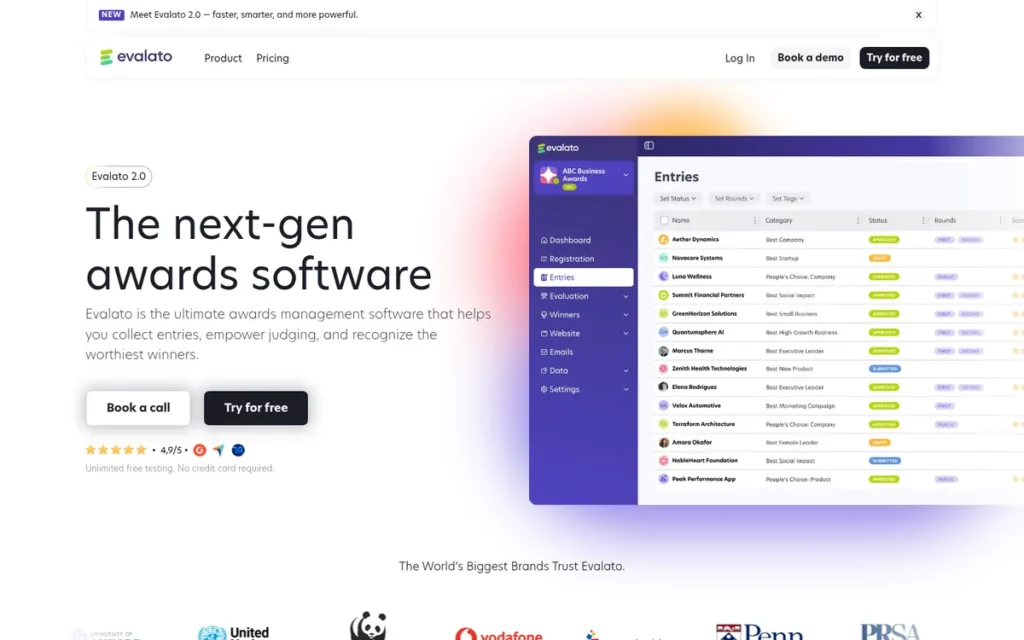
Category: Awards Specialist, a purpose-built platform that runs the full awards cycle from entry to winner announcement.
At a Glance
- Category: Awards Specialist
- Best For: Single standalone awards programs wanting published pricing, free testing and public voting
- Price Range: €2,500–€5,500 per program (12 months, excluding VAT); Enterprise on request
- Primary Strength: Evalato publishes its full price list with entry limits and lets buyers build and test a whole program free.
- Biggest Limitation: Evalato’s Grow plans cap entries at 50–100 and exclude score normalization and advanced judging.
- One-Line Summary: Evalato is the most transparent awards management platform for single programs, combining published per-program pricing, a free unlimited test build and six public-voting types.
- Last Verified: November 2026
Overview
Evalato is an awards-focused management platform for organizations running a single awards, grants or scholarship program. Evalato suits teams that want published per-program pricing, a free test build and six public-voting types.
Evalato has operated since 2018 and claims 7,000+ customers in 80 countries (Evalato, 2026; vendor-stated).
Key Features
- Evalato provides entry forms, templates, nominations and entry-fee collection, with a custom domain and full branding on Pro.
- Evalato supports multi-round judging, offers score normalization on Pro, and includes unlimited judges on every plan.
- Evalato offers six public-voting types, a “PreciseSelect” winner-selection feature, winner galleries and embeddable winner lists.
- Evalato integrates natively with HubSpot, Salesforce and Intercom, and connects to 5,000+ apps through Zapier.
- Evalato includes 24/7 email and chat support on every plan.
Best For
Evalato is best for marketing and events teams running one standalone awards program. These teams want to test the full build before buying, need public voting and want a published price.
Pricing
Each Evalato plan is a one-off fee per program, valid for 12 months. Evalato charges the fee when the program goes live, and prices exclude VAT (Evalato, 2026):
- Evalato Grow 50 costs €2,500 for 50 entries.
- Evalato Grow 100 costs €3,500 for 100 entries.
- Evalato Pro costs €5,500 for up to 10,000 entries and adds score normalization.
- Evalato Enterprise is custom-priced and adds white-label and a priority SLA.
Evalato states it charges no setup or training fees. A Grow 200 tier at €4,500 appeared in earlier research but was not listed on the November 2026 pricing page (Evalato, 2026).
Strengths
- Evalato holds 4.8/5 from 64–66 G2 reviews, the highest G2 rating among the awards specialists, and 5.0/5 from 37 Capterra reviews (G2 and Capterra, 2026).
- Evalato lets buyers build and test a complete program free, with no time limit and no card required (Evalato, 2026).
- Evalato client AIBD reports 70% staff time saved (Evalato, 2026; vendor case study).
- Evalato’s published per-program prices make year-one cost easier to calculate than for any quote-only competitor (Evalato, 2026).
Limitations
Evalato’s low entry price comes with tight caps. A 90-entry program needing normalization across two panels must move from Grow 100 at €3,500 to Pro at €5,500, which costs 57% more for the same volume (Evalato, 2026).
- Evalato customization “can be somewhat limited,” according to G2’s review summary, and a G2 comparison says costs can still be high for small NGOs (G2, 2026).
- Evalato has no documented iMIS or other AMS integration, and its multilingual and AI features are mentioned but not detailed (Evalato, 2026).
- Evalato’s review samples are each under 100 reviews, so its ratings are less stable than Award Force’s (G2 and Capterra, 2026).
- Evalato charges per program in euros excluding VAT, so organizations running several programs a year pay one fee per program (Evalato, 2026).
Verdict
Evalato is the best awards management software for buyers who want published per-program pricing, free testing before commitment and strong public voting. Evalato scored 38/45 and ranks second. Its review samples are smaller than Award Force’s, and score normalization requires the €5,500 Pro plan.
Evalato Pro adds score normalization and advanced judging, which closes much of the judging gap with Award Force at a published per-program price. Grow plans suit small programs only if they stay under the entry cap.
3. OpenWater: Best for Associations on iMIS or NetForum
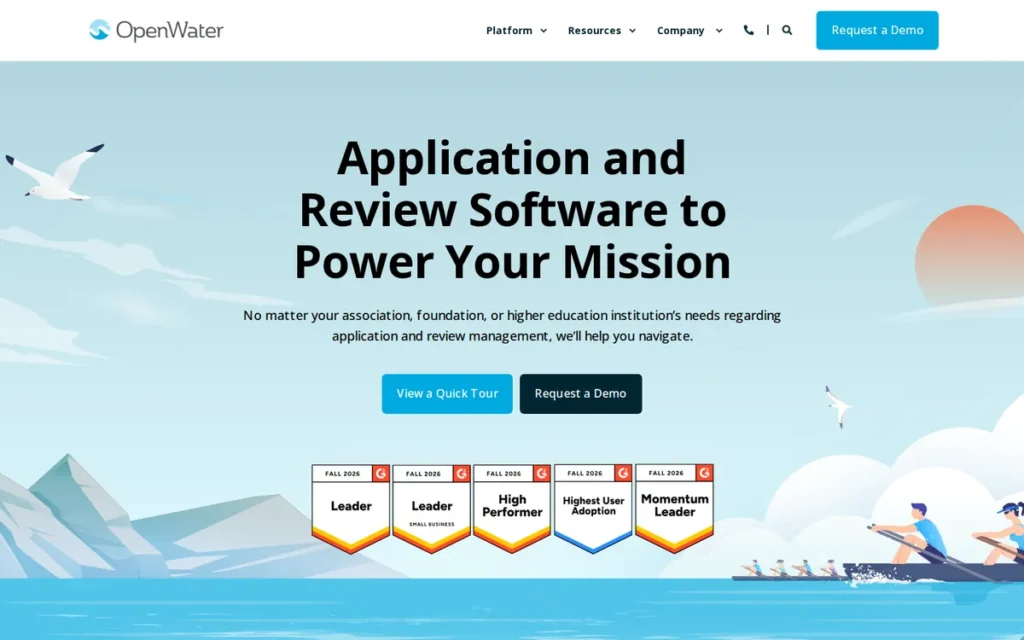
Category: Association Suite, awards combined with abstracts, conference content and deep AMS integration.
At a Glance
- Category: Association Suite
- Best For: Associations and societies on iMIS, NetForum or Personify running awards alongside abstracts and conferences
- Price Range: From $5,100/year; full pricing on quote
- Primary Strength: OpenWater has the strongest documented AMS integrations in this review, including iMIS, NetForum and Personify.
- Biggest Limitation: OpenWater publishes only a starting price, offers no free trial, and scores below the category average on usability.
- One-Line Summary: OpenWater is the best awards management platform for associations that need deep AMS integration and want awards, abstracts and conference sessions in one system.
- Last Verified: November 2026
Overview
OpenWater is an application and review platform owned by ASI, the maker of iMIS. It is built for associations, societies and universities that run awards alongside abstracts, scholarships and conference sessions and need documented AMS integrations.
OpenWater says more than 1,000 organizations use it, including ASAE (OpenWater, 2026; vendor-stated).
Key Features
- OpenWater manages awards, grants, scholarships, fellowships, abstracts and calls for proposals with multi-round judging in one platform.
- OpenWater integrates with iMIS (all versions), Salesforce, Personify, Microsoft Dynamics and Avectra/NetForum.
- OpenWater can use NetForum membership status to set submission prices, and payments post back to the AMS as orders.
- OpenWater accepts payments through Stripe, PayPal and Authorize.Net.
- OpenWater Event Cloud adds session scheduling and virtual or hybrid events with a branded attendee app, used by 250+ associations (vendor-stated).
Best For
OpenWater is best for associations whose awards data must sync with iMIS, NetForum or Personify. It also suits organizations that want awards, abstracts and conference content in one tool.
Pricing
- OpenWater lists a starting price of $5,100/year, called “Basic” on G2, with no free trial (Capterra and G2, 2026).
- OpenWater quotes the final price based on size, features, branding and training, so buyers should request an itemized written quote.
- OpenWater does not charge per application or participant, according to a G2 reviewer, which keeps costs predictable when volumes change (G2, 2026).
Strengths
- OpenWater is the only product here owned by an AMS vendor: ASI, the maker of iMIS, announced the acquisition in January 2022, and OpenWater is an authorized iMIS partner (ASI, 2022).
- OpenWater holds 4.6/5 from 73 Capterra reviews and 4.4/5 from 153 G2 reviews, and reviewers say entrants and judges find it easy (Capterra and G2, 2026).
- OpenWater is listed as a Leader in G2’s Awards Management grid for Fall 2026, including the Small-Business and Mid-Market grids (G2, 2026).
- OpenWater says more than 1,000 organizations now use it, up from 500+ in 2022 (OpenWater, 2026; vendor-stated).
Limitations
OpenWater trades interface simplicity for breadth. In G2’s scholarship category, OpenWater scores 8.3/10 on ease of use and 8.5/10 on ease of admin, against category averages of 8.9 and 8.8 (G2, 2026).
- OpenWater scores 8.0/10 on reporting and 8.0/10 on applicant communications in G2’s Awards Management category, against averages of 8.3 and 8.5 (G2, 2026).
- OpenWater users call the interface “somewhat clunky,” and admins usually need its Essentials certification training (G2, 2026).
- OpenWater’s $5,100/year starting price is among the highest published entry prices in this review, and OpenWater offers no free trial (Capterra and G2, 2026).
- OpenWater documents public voting and winner galleries less fully than the awards specialists do, and third-party security certifications were not confirmed (PlugRoute research, 2026).
Verdict
OpenWater is the best awards management software for associations whose deciding requirement is deep AMS integration, especially iMIS or NetForum. OpenWater scored 32/45. It earned the only top integration score, offset by publishing only a starting price and having no trial.
Standalone awards programs without AMS needs will usually find Award Force or Evalato easier to run and to price.
4. AwardStage: Best for Gala-Driven Programs Needing a Website and Ticketing
Category: Awards Website Builder, awards entry and judging combined with a public awards website and ceremony tools.
At a Glance
- Category: Awards Website Builder
- Best For: Small and mid-size awards programs that end in a gala
- Price Range: £2,350–£3,500 ($3,150–$4,690) per program per year; Enterprise on request
- Primary Strength: AwardStage is the only product in this review that includes a full public awards website and ceremony ticket and table sales.
- Biggest Limitation: AwardStage has a small review base (4.7/5 from 12 G2 reviews), caps Standard at 249 submissions, and reserves API access for Enterprise.
- One-Line Summary: AwardStage is the best awards management platform for gala-driven programs that want the awards website, entries, judging, public voting and ceremony ticketing in a single tool.
- Last Verified: November 2026
Overview
AwardStage is an awards platform headquartered just outside London. It combines a public awards website, entry forms, multi-criteria judging, public voting and paid ceremony ticketing for small and mid-size programs that end in a gala.
AwardStage publishes its price list and includes assisted setup on every tier (AwardStage, 2026).
Key Features
- AwardStage includes a drag-and-drop awards website builder with its own content system, so no separate website is needed.
- AwardStage supports multiple entry forms, discount codes and Stripe payments for entry fees.
- AwardStage offers multi-criteria scoring with sliders and stars on judging screens designed for tablets.
- AwardStage includes public voting and a sponsor-logo showcase.
- AwardStage sells ceremony tickets and tables through a paid add-on available on every tier.
Best For
AwardStage is best for industry, regional or diversity awards under about 1,000 submissions that end in a gala. These programs want the website, entries, judging and ticketing in one tool.
Pricing
AwardStage charges a one-time fee per program that covers 12 months and does not auto-renew (AwardStage, 2026):
- AwardStage Standard costs £2,350 or $3,150 for up to 249 submissions, 30 categories, 50 judges, 5 admins and 25 form fields.
- AwardStage Pro costs £3,500 or $4,690 for 250–999 submissions and 100 categories, with unlimited judges, admins and form fields, plus webhooks and an account manager.
- AwardStage Enterprise is priced on request and adds unlimited submissions, multiple programs and API access.
AwardStage has no free plan, and ceremony ticketing costs extra.
Strengths
- AwardStage is the only product here that includes a public awards website and ceremony ticket and table sales (AwardStage, 2026).
- AwardStage holds 4.7/5 from 12 G2 reviews, 91% of them five-star, though the sample is small (G2, 2026).
- AwardStage publishes every price and plan limit except Enterprise, making it one of the three most transparent vendors in this review (AwardStage, 2026).
- AwardStage users rate it easier to do business with, easier to administer and better supported than Judgify, according to G2’s Judgify-alternatives comparison (G2, 2026).
Limitations
AwardStage trades judging depth and proven reputation for an all-in-one public experience. Its 12 G2 reviews are too few for a stable rating, and no Capterra or Trustpilot profile was found (G2, 2026).
- AwardStage’s judging is shallower than Award Force’s, according to a competitor-published comparison, and no score normalization or conflict-of-interest workflow was documented (Zealous, 2026).
- AwardStage Standard caps submissions at 249 and judges at 50, AwardStage accepts payments through Stripe only, and API access requires Enterprise (AwardStage, 2026).
- AwardStage’s founders, ownership and certifications could not be verified (PlugRoute research, 2026).
Verdict
AwardStage is the best awards management platform for gala-driven programs that want the awards website, entries, judging, public voting and ticketing in one tool. AwardStage scored 31/45, with full price transparency and the only bundled website and ticketing. A 12-review G2 sample and moderate judging depth held it back.
Buyers who need normalization, AMS integration or a proven review-site reputation at scale should choose Award Force, Evalato or OpenWater.
5. Submittable: Best for Awards Alongside Grants, Scholarships and CSR
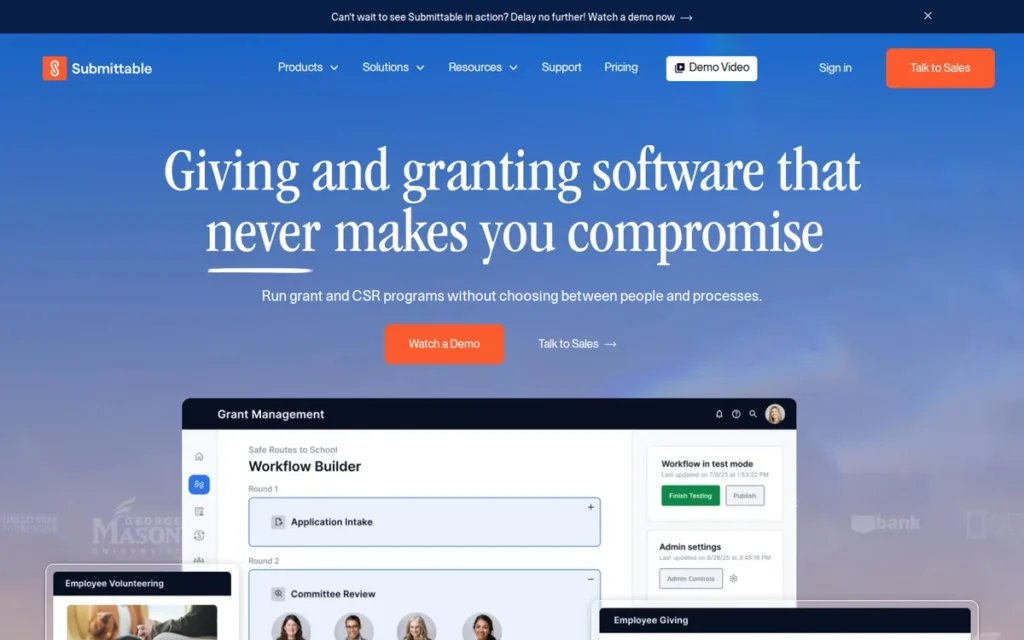
Category: Multi-Program Application Platform, awards managed alongside grants, scholarships and other application programs.
At a Glance
- Category: Multi-Program Application Platform
- Best For: Foundations, nonprofits and corporate CSR teams running awards alongside grants and employee giving
- Price Range: Pricing on request; competitor-published estimate of $10,000+/year
- Primary Strength: Submittable has the largest verified review base in this review (4.8/5 from 407 Capterra reviews) and handles awards, grants and payouts in one system.
- Biggest Limitation: Submittable is quote-only, and users report reviewer seats sold in fixed blocks and features locked behind expensive add-ons.
- One-Line Summary: Submittable is the best choice for organizations that run awards as one part of a wider grants, scholarship or CSR operation and want one platform for review and payouts.
- Last Verified: November 2026
Overview
Submittable is a broad application and grants management platform for foundations, nonprofits and corporate CSR teams. These teams run awards alongside grants, scholarships and employee giving, with review and fund payouts in one system.
Submittable was founded in 2010 in Missoula, Montana, and names customers including The LEGO Foundation, Dell and AT&T (Submittable, 2026).
Key Features
- Submittable provides a drag-and-drop form builder with conditional logic, eligibility screening and reference forms.
- Submittable supports multi-stage review and blind review for awards, grants and scholarship panels.
- Submittable collects fees within forms and can pay out grant or award money directly to recipients.
- Submittable includes CSR tools for employee giving, volunteering, employee resource groups and an employee-facing Impact Wallet.
- Submittable integrates with Salesforce, Dynamics 365, DocuSign, Mailchimp, Airtable, Google Sheets, Slack and Trello (Capterra, 2026).
Best For
Submittable is best for organizations whose awards are one part of a wider grants, scholarship or giving operation. These organizations want one system for applications, review and payouts.
Pricing
- Submittable is quote-only: Capterra lists three plans (CSR Platform, Grant & Application Management and Enterprise), all on custom quote with no free plan or trial (Capterra, 2026).
- Submittable is estimated at “$10,000 or more” by Zealous, a competing vendor, so treat that figure as a competitor’s claim (Zealous, 2026).
- Submittable reserves funds distribution, custom branding, integrations, premium support and advanced reporting for higher tiers (Capterra, 2026).
Strengths
- Submittable holds 4.8/5 from 407 Capterra reviews, the largest review base in this review, alongside 4.4–4.5/5 from about 167 G2 reviews (Capterra and G2, 2026).
- Submittable reports that 89% of customers launch in two weeks or less, from an internal survey of about 750 customers (Submittable, 2026; vendor-published).
- Submittable says it has supported about 200,000 programs and more than 30 million applications (Submittable, 2026; vendor-stated).
- Submittable has raised venture funding, including a $47M Series C led by Accel-KKR (Submittable, 2026; vendor-published).
Limitations
Submittable trades awards focus and cost clarity for breadth. One Capterra reviewer bought 10 extra reviewer licences for a one- to two-month review period because Submittable sells seats in fixed blocks (Capterra, 2026).
- Submittable features shown during sales turned out to need a “prohibitively expensive” add-on for one reviewer, and support is charged after initial setup (Capterra, 2026).
- Submittable’s advanced reporting and reference-form exports can require a much more expensive tier (G2, 2026).
- Submittable’s number fields break when applicants type “$” or commas, and native iMIS integration and public voting were not confirmed (Capterra, 2026).
- Submittable’s SOC 2 Type 2 compliance with an annual third-party audit is vendor-stated, and its complaints should be read against its 407-review sample (Submittable and Capterra, 2026).
Verdict
Submittable is the best awards management option for organizations that run awards inside a wider grants, scholarship or CSR program. Submittable scored 29/45. Its top reputation score, from 407 Capterra reviews, was offset by the lowest pricing-transparency score in this review.
Standalone awards programs will usually get more awards-specific features for less from Award Force or Evalato. Submittable buyers should get reviewer-seat terms and add-on costs in writing.
6. Reviewr: Best for Scholarships and Competitions with Large Reviewer Panels
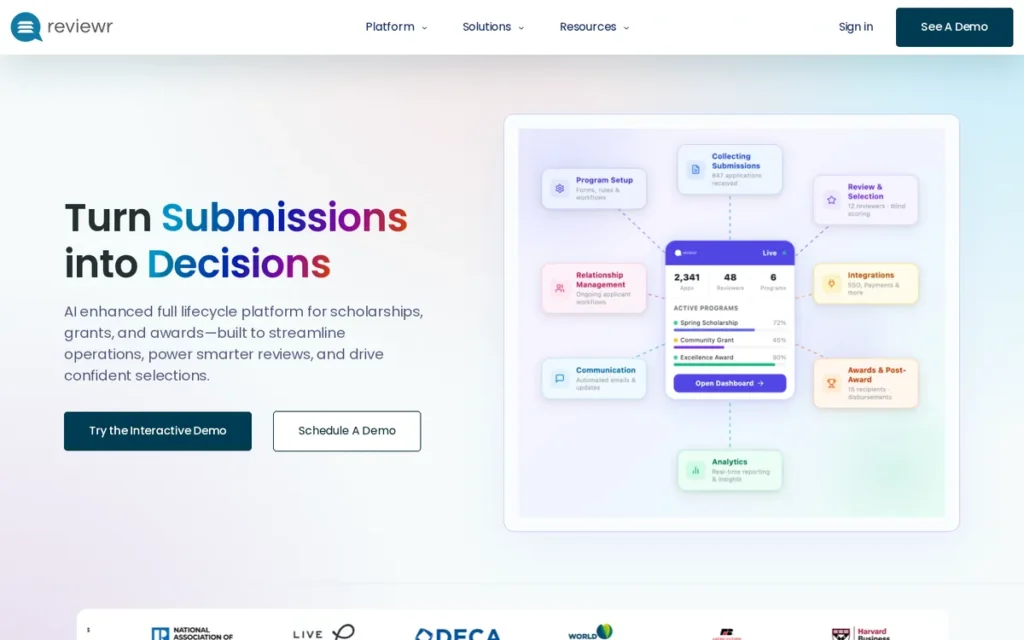
Category: Multi-Program Application Platform, awards managed alongside grants, scholarships and other application programs.
At a Glance
- Category: Multi-Program Application Platform
- Best For: Scholarship funds, foundations and competitions with large volunteer reviewer panels
- Price Range: Pricing on request; one annual program quote with no per-seat fees
- Primary Strength: Reviewr documents some of the strongest judging-integrity tools here, including field-level blind redaction, weighted rubrics and normalized scoring.
- Biggest Limitation: Reviewr publishes no prices and has a small review sample, so buyers can’t compare its cost or reputation upfront.
- One-Line Summary: Reviewr is the best platform for scholarship and competition programs that rely on large volunteer reviewer panels and need blind, normalized, auditable scoring under one annual quote.
- Last Verified: November 2026
Overview
Reviewr is a review-focused application management platform for scholarship funds, foundations and competition organizers with large volunteer reviewer panels. Reviewr provides blind review with field-level redaction, weighted rubrics, normalized scoring and audit trails.
Reviewr has operated since 2011 and serves scholarships, grants, awards, pitch competitions and challenges (Reviewr, 2026).
Key Features
- Reviewr provides applicant portals with save-and-resume and automatic reference requests.
- Reviewr assigns reviewers manually, in batches or at random, and supports blind review with field-level redaction.
- Reviewr shows the application and scorecard side by side, with weighted rubrics, normalized scoring, leaderboards and audit trails.
- Reviewr handles application-fee collection, award notifications, acceptance and renewal workflows, and impact reporting.
- Reviewr accepts full payment or a base amount plus monthly instalments, and accepts purchase orders.
Best For
Reviewr is best for scholarship funds, foundations and civic or pitch competitions where judging fairness and predictable costs matter more than public voting or a branded showcase.
Pricing
- Reviewr publishes no prices: each program gets one annual quote covering every reviewer, applicant and review round with no per-seat fees (Reviewr, 2026).
- Reviewr’s Basic, Standard and Prestige editions are listed as “Contact Us” on G2 (G2, 2026).
- Reviewr is quoted in some AI answers at “about $500/year plus per-entry fees,” which conflicts with Reviewr’s own quote-only, no-per-seat-fee pricing page (Reviewr, 2026).
Strengths
- Reviewr documents a full judging-integrity toolkit of field-level blind redaction, weighted rubrics, normalized scoring, leaderboards and audit trails (Reviewr, 2026; vendor-published).
- Reviewr scores 4.9/5 for customer support and 4.8/5 for value on Capterra, from 18 reviews (Capterra, 2026).
- Reviewr claims up to 79% less reviewer workload and 60% less admin time, and a scholarship customer review also cites the 60% figure (Reviewr and FeaturedCustomers, 2026).
- Reviewr lists case studies with AACOM, March of Dimes, the Army Scholarship Foundation and the JFK Library Foundation Earthshot challenge, though these publish no figures (Reviewr, 2026).
Limitations
Reviewr trades price transparency for a bundled annual quote, so buyers can’t compare its cost before talking to sales (Reviewr, 2026).
- Reviewr’s 4.7/5 from 18 Capterra reviews and 4.4/5 from 14 G2 reviews are too few for stable ratings (Capterra and G2, 2026).
- Reviewr scores 4.3/5 on both ease of use and features on Capterra, and some reviewers say building forms independently is restrictive and small changes need back-and-forth with support (Capterra, 2026).
- Reviewr was “not as intuitive as an administrator” for one G2 user, and Reviewr’s own comparison page admits slower fixes for complex issues (G2 and Reviewr, 2026).
- Reviewr has no published integration catalogue, its public voting is mentioned but not documented, and its SOC 2 Type II claim is vendor-stated (Reviewr, 2026).
Verdict
Reviewr is the best choice for scholarship and competition programs that rely on large volunteer reviewer panels and need blind, normalized, auditable scoring under one predictable annual price. Reviewr scored 27/45 and tied for the top judging score. Small review samples and quote-only pricing held it back.
Programs that need AMS integration or public voting should look first at OpenWater, Evalato or Award Force.
7. Judgify: Best Free Plan for Small, First-Time and One-Off Programs
Category: Lightweight Starter, low-cost or free awards tools for simple, small or one-off programs.
At a Glance
- Category: Lightweight Starter
- Best For: Small, first-time or one-off awards and competitions with simple judging needs
- Price Range: Free; Pro $699/event; Pro Unlimited $2,399/year (plus onboarding fee); Enterprise custom
- Primary Strength: Judgify offers the only free production plan in this review, covering 100 submissions per event.
- Biggest Limitation: Judgify’s judging is described by users as very basic, and its free plan excludes public voting.
- One-Line Summary: Judgify is the best free awards management software for small or first-time programs that need simple submissions and private judging without upfront commitment.
- Last Verified: November 2026
Overview
Judgify is a Singapore-based awards and competition platform for small, first-time or one-off programs. These programs need submission forms, private judging rounds and optional public voting without upfront cost.
Judgify is the only product in this review with a free production plan. Judgify Pte Ltd has run the platform since 2013 (Judgify, 2026).
Key Features
- Judgify provides custom submission forms, landing pages and nominations.
- Judgify collects paid submissions through a third-party payment processor.
- Judgify runs private judging rounds in which judges can abstain, with automatic score totals and reports.
- Judgify offers public-voting rounds on paid plans, with one public round included on Pro.
- Judgify’s free plan allows 100 submissions per event, 5 categories, 5MB files and one private judging round.
Best For
Judgify is best for first-time, small or one-off competitions that want to run a live program free or for one per-event fee. It fits programs whose judging needs stop at simple private scoring.
Pricing
Judgify publishes four tiers (Judgify, 2026):
- Judgify Free costs $0 for 100 submissions per event, 5 categories, 5MB files, one private round and self-service support, with no public voting.
- Judgify Pro costs $699 per event plus an onboarding fee for 500 submissions, 25 categories, 5 private rounds and 1 public-voting round.
- Judgify Pro Unlimited costs $2,399/year plus an onboarding fee and covers unlimited Pro events.
- Judgify Enterprise is custom-priced, and Judgify does not publish the onboarding fee amount.
Strengths
- Judgify is the only product here with a free production plan, which runs a live program of up to 100 submissions per event at no cost (Judgify, 2026).
- Judgify client UPS finished the pre-judging round of its 2017 X-Port Challenge within one hour of opening (Judgify, 2017; vendor case study).
- Judgify users call it “user-friendly and efficient” and “quick to set up,” and G2 users praise its low cost and public voting (Capterra and G2, 2026).
- Judgify Pro Unlimited at $2,399/year can be a low-cost route for organizations running several small events a year (Judgify, 2026).
Limitations
Judgify trades judging depth for a free start. Capterra reviewers call its judging “very basic,” and Judgify holds 4.2/5 from 29 Capterra reviews, the lowest verified rating in this review (Capterra, 2026).
- Judgify results are hard to tally, according to reviewers, who also report no bulk file export and, at the time of one review, no required fields or dropdowns (Capterra, 2026).
- Judgify lacks score normalization and single-transferable-vote voting, according to a competitor-published comparison (Evalato, 2026).
- Judgify excludes public voting from the free plan, documents no integrations and does not publish its onboarding fee (Judgify, 2026).
- Judgify’s terms list two different company registration numbers, so buyers should check the Singapore company registry (Judgify, 2026).
Verdict
Judgify is the best free awards management software for small or first-time programs that need simple submissions and private judging without upfront commitment. Judgify scored 26/45, with top marks for price transparency and low-commitment access but the weakest judging and integration scores.
Judgify users who expect more than 100 submissions or need normalized judging should plan to move to Evalato, AwardStage or Award Force.
What Red Flags Should I Watch For When Evaluating Awards Management Software?
The biggest red flags in awards management software are pricing and plan terms that only come out after the demo. They raise year-one cost or make results harder to defend. Six warning signs came up repeatedly across the seven platforms reviewed, and you can check each one with a direct question before signing.
Red Flag #1: Quote-Only Pricing with Undisclosed Add-Ons Quote-only pricing becomes a red flag when features shown in a demo later require paid add-ons. One Submittable customer on Capterra reported exactly this, calling the add-on “prohibitively expensive” (Capterra, 2026). Ask for an itemized quote that lists every feature you saw.
Red Flag #2: Reviewer Seats Sold in Fixed Blocks Fixed reviewer-seat blocks can make short review periods expensive. One Submittable customer bought 10 extra licences for a one- to two-month review window (Capterra, 2026).
Award Force, Evalato and Reviewr advertise unlimited judges or reviewers on every plan, and AwardStage Pro removes its 50-judge cap (vendor pricing pages, 2026).
Red Flag #3: Core Judging Features Locked to Higher Tiers Score normalization is often missing from entry-level plans, and that gap changes the real price. A 90-entry Evalato program fits Grow 100 at €3,500, but needing normalization moves it to Pro at €5,500 (Evalato, 2026).
Judgify Free allows one private judging round and no public voting (Judgify, 2026). Check which tier includes each judging feature before signing.
Red Flag #4: Integrations That Still Need Middleware In awards software, a listed integration is a starting point, not proof of field-level sync. One Award Force reviewer found the HubSpot integration incomplete and still needed Zapier (G2, 2026). Ask which fields sync, in which direction, and whether middleware costs extra.
Red Flag #5: Vendor-Published Comparison Rankings Many “best awards software” articles are published by vendors that rank themselves against competitors. Research for this review found comparison pages from Evalato, Award Force, Reviewr, Submittable and Zealous (PlugRoute research, 2026). Treat every vendor-published ranking as a claim, not independent evidence.
Red Flag #6: Review-Site Badges Presented as Security Certifications G2 Leader and support badges reflect user reviews, not security audits, so they cannot replace SOC 2 Type II, ISO/IEC 27001 or PCI-DSS certificates. The security certification claims found for this review are vendor-stated, so ask each vendor for its current reports.
What Questions Should I Ask Before Choosing Awards Management Software?
Before you choose awards management software, ask questions that make vendors show you their features rather than describe them. Each of the six questions below targets a gap that marketing pages rarely cover. You can test each one in a live demo by running the same sample program with every finalist.
Question #1: Can you show score normalization and conflict-of-interest handling in a live demo? Ask vendors to run a sample panel through normalization and recusal in a live demo, not a slide deck. Vendors widely market these features, but public sources rarely document how they work (PlugRoute research, 2026). A credible answer shows raw and normalized scores side by side.
Question #2: What will year one cost, including onboarding, add-ons and transaction fees? Ask for one all-in year-one figure in writing, with the currency and pricing unit stated. Card processing typically runs about 1.4–2.9%, and some platforms add up to 5% on top (Zealous, 2026; vendor-published). The figure should cover each of these costs:
- The quote should state the license fee and its pricing unit.
- The quote should list any onboarding or setup fee.
- The quote should price every add-on shown in the demo.
- The quote should explain how reviewer or judge seats are licensed.
- The quote should include payment processing and any platform commission.
Question #3: Which plan limit will we hit first, and what does the next tier cost? Ask which cap your program will reach first, and what the next tier costs. AwardStage Standard caps submissions at 249, Evalato Grow at 100 entries, and Judgify Free at 100 submissions per event (vendor pricing pages, 2026). Check every limit:
- Submission or entry limits often decide the tier.
- Category limits can force an upgrade for multi-category awards.
- Judge and admin limits affect large panels and teams.
- File-size and form-field limits affect complex entry forms.
Question #4: Exactly which fields sync with our AMS or CRM, and in which direction? Ask for a field-level integration map that shows what syncs and whether sync is one-way or two-way. OpenWater documents NetForum member-based pricing with payments posting back as orders (OpenWater, 2026). Every buyer should test their own AMS or CRM during the demo.
Question #5: Which tier includes public voting, and how is voting fraud prevented? Ask which plan includes public voting, how many rounds it allows, and how votes are verified. Judgify excludes public voting from its free plan and allows one round on Pro, while Evalato documents six voting types (Judgify and Evalato, 2026). Ask about these fraud controls:
- Email verification confirms that each voter is a real person.
- One-vote-per-person rules block repeat voting.
- CAPTCHA checks block automated voting.
Question #6: Can you share current SOC 2 or ISO 27001 certificates? Ask for dated SOC 2 Type II or ISO/IEC 27001 reports, not marketing statements. Award Force, Reviewr and Submittable each state SOC 2 compliance on their websites (Award Force, Reviewr and Submittable, 2026; vendor-stated). Only a current audit report confirms the claim.
Before any demo, prepare one test script and ask every vendor to run it live:
- The test script should include one sample entry with an attachment.
- The test script should include two judges with deliberately different scoring habits.
- The test script should include one declared conflict of interest.
- The test script should include one public-voting round.
How Did We Rank These Awards Management Software Platforms?
PlugRoute scored each platform from 1 to 5 on six criteria using dated, source-labelled evidence collected in November 2026. The three primary criteria count double and the three secondary criteria count once, for a maximum of 45 points. Verified user reputation (C2) breaks ties because it is the most independent evidence available.
PlugRoute used these ranking criteria:
- C1: Judging Depth and Integrity (primary): Judging matters because it is the main reason organizations buy purpose-built awards software instead of form tools.
- C2: Verified User Reputation (primary): Reputation matters because G2 and Capterra ratings are the main independent evidence in a niche dominated by vendor content. A 5 requires 4.6+ with 150+ reviews on one platform, a 2 covers a verified rating below 4.4, and a 1 means no verified presence.
- C3: Pricing Transparency (primary): Pricing transparency matters because hidden quotes and split fees are buyers’ main cost frustration.
- C4: Integrations and Ecosystem Fit (secondary): Integration fit matters because buyers need confirmed connections to AMS and CRM systems such as iMIS, NetForum and Salesforce.
- C5: Public-Facing and Payment Capabilities (secondary): Public-facing features matter because branding, voting, galleries and currencies shape the entrant experience.
- C6: Low-Commitment Access and Scale Fit (secondary): Low-commitment access matters because free plans and published caps decide whether small programs can start safely.
| Rank | Product | C1 | C2 | C3 | C4 | C5 | C6 | Total /45 |
|---|---|---|---|---|---|---|---|---|
| 1 | Award Force | 5 | 5 | 4 | 4 | 5 | 3 | 40 |
| 2 | Evalato | 4 | 4 | 5 | 3 | 5 | 4 | 38 |
| 3 | OpenWater | 4 | 4 | 3 | 5 | 3 | 2 | 32 |
| 4 | AwardStage | 3 | 3 | 5 | 2 | 4 | 3 | 31 |
| 5 | Submittable | 4 | 5 | 1 | 4 | 3 | 2 | 29 |
| 6 | Reviewr | 5 | 3 | 2 | 2 | 2 | 3 | 27 |
| 7 | Judgify | 2 | 2 | 5 | 1 | 2 | 5 | 26 |
No ties occurred in the November 2026 scoring, and verified user reputation remains the published tie-breaker. Evidence gaps lowered the score on the affected criterion rather than being filled with assumptions.
PlugRoute considered these products but did not rank them:
- Sessionboard Awards was excluded because research found too little verifiable evidence.
- SurveyMonkey Apply and WizeHive Zengine were excluded because they are mainly grant and application tools.
- Zealous and Awards Absolute were excluded because too little verified data was available.
- Employee recognition tools were excluded because they serve staff rewards, not external awards programs.
This review’s evidence has these limits:
- Reddit discussion of awards software is almost nonexistent.
- YouTube content was not covered.
- Several review samples are small, and some G2 and Capterra figures differ between pages.
- Some review sites reward reviewers with gift cards, which affects how much weight review counts deserve.
Analysts estimate the core award management software market at roughly $0.6–0.9 billion in 2024–2025, growing about 8–14% a year (Verified Market Research, Grand View Research and Mordor Intelligence, 2025). Estimates vary because firms define the category differently.
PlugRoute has no affiliate relationships with any company listed, and rankings are determined entirely by research data and objective evaluation criteria.
What Do Buyers Most Often Ask About Awards Management Software?
Buyers most often ask what awards management software costs, whether a free option exists, and how independent rankings are produced. The answers below summarize pricing and product pages verified in November 2026. Each answer stands on its own, so you can go straight to the question that matches your program.
How much does awards management software cost per year?
Published paid plans in this review range from $699 per event (Judgify Pro) to US$6,500 a year (Award Force Pro), but the pricing unit decides the real cost. Evalato and AwardStage charge per program, Award Force by yearly entry volume, and Submittable and Reviewr quote individually (vendor pricing pages, 2026).
Is there free awards management software for small programs?
Yes. Judgify offers the only free production plan among the seven platforms reviewed. It accepts 100 real submissions per event with one private judging round, but no public voting (Judgify, 2026). Evalato’s free build lets you configure a full program, but Evalato charges the program fee, from €2,500, when the program goes live (Evalato, 2026).
How does PlugRoute determine its awards software rankings?
PlugRoute scores every product from 1 to 5 on six published criteria. Judging, reputation and pricing transparency count double, and the maximum total is 45 points. Verified user reputation breaks any tie. Vendor claims are labelled and never scored as verified facts, and evidence gaps lower a score rather than being filled with assumptions.
What Do Key Awards Management Software Terms Mean?
The five awards software terms that most affect cost and fairness are score normalization, submitted entry limit, per-program pricing, AMS integration and blind review. Each one affects which plan tier a program needs and whether its judging results hold up if challenged. The definitions below are written so you can compare each term across vendors.
Score normalization: Score normalization is a statistical adjustment that corrects for judges who score consistently higher or lower than others. Score normalization matters because it keeps results fair when different panels review different entries.
Multi-round judging: Multi-round judging moves entries through successive stages, such as eligibility screening, scored review and a final panel. Buyers should check how many rounds each plan allows.
Blind review: Blind review hides information that identifies the entrant from judges, to reduce bias. Field-level redaction lets administrators choose exactly which form fields judges cannot see.
Conflict-of-interest controls: Conflict-of-interest controls let judges declare conflicts or recuse themselves, and let administrators block specific judge-entry assignments. Conflict-of-interest controls protect the credibility of results if they are challenged.
Public voting: Public voting is a round in which the public, rather than appointed judges, votes for entries. Buyers should confirm which tier includes public voting and which vote-verification controls apply.
Ranked-choice (STV) voting: Single-transferable-vote voting lets voters rank entries, and it transfers votes from eliminated entries to the voter’s next choice. Ranked-choice voting matters for programs that want winners with broad support rather than a simple plurality.
Submitted entry limit: A submitted entry limit is the cap on how many completed entries a plan allows. Some vendors count only submitted entries, not drafts, which affects which tier a program needs.
Per-program pricing: Per-program pricing charges a licence fee for each separate awards program, usually valid for 12 months. Organizations running several programs a year should multiply this cost accordingly.
Association management system (AMS): An association management system is the membership database an association uses. AMS integration lets member status set entry prices and sends entry data back automatically.
Payment gateway: A payment gateway is the service that processes card payments for entry fees. The choice of gateway, and any platform commission, affects the net revenue from paid entries.
Middleware: Middleware is a connector service that links systems lacking a direct integration. Middleware can add cost and maintenance when native integrations fall short.
SOC 2 Type II: A SOC 2 Type II report is an independent audit confirming that a vendor’s security controls operated effectively over time. Buyers should request the current SOC 2 Type II report rather than relying on website claims.
Which Awards Management Software Tool Is Right for You?
Key Insights
The right awards management software is the one whose pricing unit, plan limits and judging tools match your program. Award Force leads overall on evidence, but each of the other six platforms wins a specific use case. Shortlist two or three and test them with the same sample entry.
- Award Force leads overall on evidence, combining the deepest documented judging setup with the largest awards-specialist review base (G2 and Capterra, 2026).
- Evalato is the most transparent paid leader, because Evalato publishes every non-Enterprise price and offers a free unlimited test build (Evalato, 2026).
- OpenWater is the association integration pick, because ASI, the maker of iMIS, owns OpenWater and it documents NetForum and Personify connections (ASI, 2022; OpenWater, 2026).
- Judgify offers the only free production plan in this review, capped at 100 submissions per event without public voting (Judgify, 2026).
- The starting price of awards software is rarely its year-one price, because the pricing unit and tier gating decide total cost.
- Score normalization and conflict-of-interest features should be tested in a live demo, because vendors rarely document how they work publicly.
Start your shortlist from your program profile:
- Programs that need fair cross-panel scoring at volume should shortlist Award Force and Evalato Pro, and scholarship panels should add Reviewr.
- Associations where AMS sync is non-negotiable should start with OpenWater.
- Gala-driven programs that need a website and ticketing should start with AwardStage.
- First-time programs should begin with Judgify Free or Evalato’s free build.
Before you sign, run the same sample entry and judging workflow through two or three finalists, and get the full year-one cost in writing. For PlugRoute’s full scoring methodology and more independent, evidence-ranked software reviews, explore PlugRoute’s other category guides.
We update this guide quarterly. Last updated: November 12, 2026.