Apryse leads for enterprise deployments requiring verified security certifications and self-hosted infrastructure; Nutrient is best for the widest cross-platform coverage, including Flutter, React Native, and a shipped AI document intelligence layer; Foxit PDF SDK is the only major commercial SDK with a publicly findable entry price. The most consequential differentiators in 2026 are AGPL licensing compliance risk, pricing transparency, and cross-platform coverage, not feature counts alone.
Most PDF SDK comparisons omit three critical evaluation gaps:
- The AGPL Section 13 clause that can legally require open-sourcing an entire proprietary SaaS codebase when iText or MuPDF/PyMuPDF is deployed in any network-accessible application without a commercial license
- Publicly findable pricing signals from independent resellers that enable budget estimates without initiating a vendor sales call
- Cross-platform matrix gaps: particularly Flutter and React Native, that surface only after deep integration begins
Users on r/dotnet identified this cost pattern directly:
“Unless reading PDFs is part of your product’s core competency, you might be better off delegating that functionality to a paid library. For example, in the past I worked on a team where we spent considerable development time patching together open source libraries to create a Node.js program to generate a PDF from several docx files (and then additional time to maintain that program). But looking back, it would have been much more cost effective (and saved us considerable time) if we had just used a paid service for that instead.” Posted by u/binarynate
Takeaway: Developers who attempt to assemble free and open-source PDF toolchains consistently find that hidden maintenance and integration costs exceed the licensing cost of a purpose-built commercial SDK.
PlugRoute has no affiliate relationships with any company listed. Rankings are determined entirely by research data and objective evaluation criteria.
TL;DR: Top Picks at a Glance
- Apryse: enterprise self-hosted workflows with confirmed ISO 27001 and SOC 2 certifications; founded 1998, 25+ years of PDF SDK development
- Nutrient: broadest cross-platform coverage (Web/WASM, Flutter, React Native, iOS, Android.NET, Java, Node.js) with the only shipped AI document intelligence layer in this evaluation
- Foxit PDF SDK: the only major commercial SDK with a publicly findable entry price (~$3,000/platform/yr per TrustRadius, 2026); Chinese parent company structure requires formal vendor risk assessment for U.S. federal environments
- ComPDFKit: startup-accessible commercial SDK; KDAN-backed (founded 2009, publicly traded); free community license; Flutter and React Native confirmed; iOS entry from ~$300–$783 ComponentSource, 2025
How Are These 7 PDF SDKs Categorized?
These 7 PDF SDKs fall into three categories: Full-Stack Enterprise (Apryse, Nutrient, Foxit) covers proprietary commercial SDKs with enterprise-only pricing and complete PDF lifecycle support; Accessible Commercial (ComPDFKit) covers commercially licensed SDKs with startup-friendly pricing and Flutter/React Native coverage; Open-Source and Specialist (iText, MuPDF, GdPicture.NET) covers AGPL-licensed libraries and legacy .NET specialist tools.
Group 1 (Full-Stack Enterprise SDKs: Proprietary commercial products with enterprise-only pricing and complete PDF lifecycle coverage) viewing, editing, annotation, signing, redaction, OCR, and generation. Entries: Apryse (#1), Nutrient (#2), Foxit PDF SDK (#3).
Group 2, Accessible Commercial SDKs: Commercially licensed products with publicly findable pricing, startup-friendly entry tiers, and broad cross-platform coverage including Flutter and React Native. Entry: ComPDFKit (#4).
Group 3, Open-Source and Specialist SDKs: AGPL-licensed libraries requiring either open-source compliance or a purchased commercial license for SaaS deployment, or domain-specific tools targeting narrow platform combinations. Entries: iText (#5), MuPDF (#6), GdPicture.NET (#7).
How Do These 7 PDF SDKs Compare at a Glance?
| Rank | SDK | Category | Best For | One-Line Summary | Key Capabilities | Primary Strength | Key Limitation |
|---|---|---|---|---|---|---|---|
| #1 | Apryse | Full-Stack Enterprise | Regulated-industry, self-hosted enterprise document workflows | Apryse is a full-stack enterprise PDF SDK founded in 1998 with confirmed ISO 27001 and SOC 2 certifications and a vendor-stated 85% Fortune 100 adoption rate, deployable entirely on customer-owned infrastructure. | Viewing, editing, annotation, redaction, OCR, signing, document generation.NET/Java/Web/iOS/Android | Confirmed ISO 27001 and SOC 2; only SDK in this evaluation with named independent security certifications (Apryse security page, February 2025) | No public pricing; all cost information requires direct sales engagement |
| #2 | Nutrient | Full-Stack Enterprise | Cross-platform including Flutter, React Native, WASM, and AI-powered document workflows | Nutrient is a full-stack enterprise PDF SDK with the broadest confirmed cross-platform matrix in this evaluation and the only shipped AI document intelligence layer of any SDK evaluated as of June 2026. | WebAssembly viewing, real-time collaboration, AI redaction, annotation, OCR, signing, Flutter, React Native | Only SDK in this evaluation with a shipped AI document intelligence layer (PRNewswire, 2025) | No public pricing; review presence split across PSPDFKit and Nutrient brand identities |
| #3 | Foxit PDF SDK | Full-Stack Enterprise | Enterprise .NET teams needing a budget-plannable commercial PDF SDK | Foxit PDF SDK is the only major commercial enterprise PDF SDK in this evaluation with a publicly findable entry-level price, built on the same rendering engine as Foxit’s enterprise end-user products used by millions worldwide. | Viewing, editing, annotation, signing, redaction, Web WASM (v11), .NET MAUI, NuGet distribution | Only major commercial SDK with a publicly findable entry-level price (TrustRadius, 2026) | Chinese parent company (Fujian Foxit Software Development Joint Stock Co., Ltd.) requires formal vendor risk assessment for U.S. federal and defense deployments |
| #4 | ComPDFKit | Accessible Commercial | Startups and mid-market teams needing commercial licensing with Flutter/React Native and accessible pricing | ComPDFKit is a commercially licensed PDF SDK operated by PDF Technologies Pte. Ltd. (Singapore), a KDAN company, covering the widest cross-platform matrix in this evaluation with the most accessible entry-level commercial pricing. | Viewing, editing, OCR, signing, redaction, Flutter, React Native, Electron, Linux, WASM | Free community license for startups/nonprofits; iOS entry from ~$300–$783 (ComponentSource, 2025) | Smaller organizational scale than market leaders; thinner community troubleshooting resources |
| #5 | iText | Standards Compliance | Java/.NET back-end document generation with PDF/A and PDF/UA-2 compliance | iText is a Java and .NET PDF SDK with first-to-market PDF/UA-2 compliance and active PDF Association membership; acquired by Apryse (then PDFTron) in 2022; evaluated here as a distinct product due to its separate AGPL codebase and Java/.NET use case. | PDF creation, PDF/A, PDF/UA-2, digital signatures, forms, redaction, HTML-to-PDF | First commercial SDK with confirmed PDF/UA-2 compliance; active PDF Association member (pdfa.org) | AGPL v3: network use triggers full open-source obligation for SaaS codebases without a commercial license |
| #6 | MuPDF | Open-Source Rendering Engine | Open-source projects, Python AI/ML pipelines, embedded low-footprint environments | MuPDF is an AGPL-licensed C-based PDF rendering engine; the documented Python text-extraction performance leader via PyMuPDF; with a WebAssembly delivery path and the smallest binary footprint of any SDK in this evaluation. | Rendering, text extraction, PyMuPDF bindings, MuPDF.js WASM, annotation, signing, forms | PyMuPDF processes text extraction in approximately 8 seconds versus pypdf at 101+ seconds for equivalent document sets (py-pdf/benchmarks, 2024) | AGPL v3 SaaS compliance hard stop; no built-in UI, no collaboration, no cloud services |
| #7 | GdPicture.NET | .NET Imaging Specialist | .NET enterprises with VB6/Delphi legacy systems requiring PDF, OCR, barcode, and scanning | GdPicture.NET is the only PDF SDK in this specific evaluation with confirmed support for Visual Basic 6, Delphi, and COM/ActiveX alongside PDF processing, OCR, barcode recognition, and TWAIN scanning in a single product. | PDF editing, OCR, barcode, TWAIN scanning, 100+ formats, VB6/Delphi/COM/ActiveX, .NET 6/Linux | Only evaluated SDK with confirmed VB6/Delphi/COM/ActiveX support (gdpicture.com, 2026) | Steepest learning curve; zero findable reseller pricing data; near-zero developer community resources |
Which PDF SDK Should I Choose for My Use Case?
| Your #1 Priority | Recommended Tool | Why | Acceptable Alternative |
|---|---|---|---|
| Enterprise security certifications + self-hosted deployment | Apryse | Confirmed ISO 27001 and SOC 2; vendor-stated 85% Fortune 100 penetration | Nutrient (enterprise-grade but no published certifications) |
| Widest cross-platform including Flutter + React Native + AI features | Nutrient | Only SDK with shipped AI layer; broadest verified platform matrix | ComPDFKit (Flutter/React Native; more accessible pricing) |
| Known budget number without initiating a sales call | Foxit PDF SDK | Only major commercial SDK with a public entry price (~$3,000/platform/yr) | ComPDFKit (~$300–$783 iOS entry; free community tier) |
| Startup or mid-market budget + commercial license | ComPDFKit | Free community license; iOS entry from ~$300–$783; Flutter/React Native confirmed | Foxit PDF SDK (higher entry price; stronger enterprise validation) |
| Java/.NET back-end + PDF/A + PDF/UA-2 standards | iText (with commercial license) | Deepest standards compliance; first with PDF/UA-2; PDF Association member | Apryse (proprietary commercial; broader platform coverage) |
| Python AI/ML pipeline + maximum text extraction speed | MuPDF via PyMuPDF | Benchmarked at ~8s text extraction vs. pypdf at 101+s (py-pdf/benchmarks, 2024) | iText (Java pipelines; same AGPL caveat applies) |
| .NET + VB6/Delphi legacy + OCR + barcode in one SDK | GdPicture.NET | Only evaluated SDK confirming VB6/Delphi/COM support + PDF + OCR + barcode | No comparable alternative in this evaluation |
| Open-source project qualifying under AGPL | MuPDF or iText | Free under AGPL v3; no commercial license required for qualifying open-source | N/A |
Before you evaluate: Confirm two things before beginning SDK integration, (1) verify license type against your deployment architecture (SaaS, on-premises, mobile binary) before writing any integration code; (2) confirm each target platform appears in official SDK documentation or an active package registry, not only in marketing copy. These two checks prevent the two most costly PDF SDK integration mistakes identified across all research sources.
What Are the 4 PDF SDK License Types, and Which Is Safe for Your Application?
Four license types govern these 7 SDKs: AGPL v3 (iText, MuPDF) requires open-sourcing your entire codebase for any SaaS or network-accessible application without a commercial license; dual-licensed AGPL with a purchased commercial license is safe for all deployment types; proprietary commercial (Apryse, Nutrient, Foxit, ComPDFKit, GdPicture.NET) creates no open-source obligation and is safe under commercial license terms.
Concrete scenario: Your Python team installs PyMuPDF via pip, ships a SaaS product, and a user formally requests your entire application source code (including proprietary business logic and unreleased features) which AGPL Section 13 legally entitles them to receive unless you have purchased an Artifex commercial license.
License Tier 1, AGPL v3 (iText, MuPDF/PyMuPDF): AGPL Section 13 classifies running AGPL-licensed code in any network-accessible application, including SaaS products, customer-facing web applications, and externally accessible APIs, as “distribution,” triggering a copyleft obligation to open-source the entire application codebase.
For proprietary SaaS products, this is a binary hard stop without a purchased commercial license from the respective vendor.
License Tier 2, Apache 2.0 / BSD (not represented in this evaluation): Permissive licenses allow use in proprietary commercial applications without open-sourcing the host codebase. These are safe for SaaS, on-premises, and open-source deployments with no conditions beyond attribution requirements.
License Tier 3, Dual-Licensed AGPL + Commercial (iText, MuPDF): Both iText and MuPDF offer a commercial license as an alternative to AGPL. Purchasing the commercial license removes the open-source obligation entirely, making the SDK safe for proprietary SaaS, on-premises, or mobile binary deployment.
License Tier 4, Proprietary Commercial (Apryse, Nutrient, Foxit, ComPDFKit, GdPicture.NET): Commercially licensed SDKs with no AGPL component create no open-source obligation. Only commercial license terms, scope, seat count, and platform coverage, govern permissible use.
License quick reference:
- AGPL v3 without commercial license: safe only for qualifying open-source projects; hard stop for SaaS
- AGPL v3 with commercial license purchased: safe for any deployment type
- Apache 2.0 / BSD: permissive, safe for proprietary use with attribution (not present in this evaluation)
- Proprietary Commercial (Apryse, Nutrient, Foxit, ComPDFKit, GdPicture.NET): safe under commercial license terms for any deployment type
Three deployment scenarios:
| Deployment Scenario | AGPL v3 (no commercial license) | AGPL v3 (with commercial license) | Proprietary Commercial |
|---|---|---|---|
| Open-source project (code public) | Safe | Safe | Safe (license required) |
| Internal enterprise tool (no external users) | Conditional; depends on network access | Safe | Safe |
| Customer-facing SaaS or web app | Not safe; must open-source entire codebase or purchase commercial license | Safe | Safe |
“Anyone look at the licensing for pymupdf? If I deploy it inside my network, I have to make the ENTIRE CODE BASE OF MY APPLICATION available to my users. Not going to happen in a million years.”, developer, r/learnpython
Takeaway: A developer discovering PyMuPDF’s AGPL compliance obligations mid-project typically cannot reverse course without significant remediation cost, making license verification the single most important pre-integration step in any PDF SDK evaluation.
1. Apryse: Best Overall: Enterprise Document Workflows Requiring Verified Security Certifications and Self-Hosted Deployment
Category: Full-Stack Enterprise SDK, a proprietary, end-to-end document processing library covering PDF viewing, editing, annotation, signing, redaction, OCR, and generation, deployable entirely on customer-owned infrastructure without third-party service dependencies.
At a Glance
- Category: Full-Stack Enterprise SDK
- Best For: Enterprise development teams in regulated industries (legal, healthcare, financial services, government) building high-volume, self-hosted document workflows requiring independently verified security certifications and full PDF lifecycle coverage from a single vendor
- Price Range: Pricing on request: enterprise-only; no public tiers confirmed as of June 2026
- Primary Strength: Apryse holds confirmed ISO 27001 and SOC 2 certifications: the only SDK in this specific evaluation with named, independently documented security certifications as of June 2026, confirmed via the Apryse security compliance page (Statement of Applicability, February 2025)
- Biggest Limitation: Apryse publishes no pricing as of June 2026, requiring a direct sales engagement before any cost estimate is possible, a documented evaluation blocker for engineering leads doing self-serve preliminary budget planning
- One-Line Summary: Apryse is a full-stack enterprise PDF SDK founded in 1998, with confirmed ISO 27001 and SOC 2 certifications, a proprietary rendering engine deployable entirely on customer infrastructure, and a vendor-stated 85% Fortune 100 adoption rate, making it the highest-validated option in this specific evaluation as of June 2026.
- Last Verified: June 2026
Overview
Apryse (formerly PDFTron) is a full-stack enterprise PDF SDK built on a proprietary in-house rendering engine that covers the complete document lifecycle, viewing, editing, annotation, redaction, OCR, signing, and generation, designed for development teams embedding PDF capabilities into production applications at enterprise scale. Apryse holds confirmed ISO 27001 and SOC 2 certifications, documented on its security compliance page with a Statement of Applicability dated February 2025, and claims deployment by 85% of Fortune 100 companies, the strongest enterprise validation statement of any SDK in this specific evaluation.
Apryse processes documents entirely on customer-owned infrastructure with no external third-party service dependencies. This architecture makes Apryse a strong evaluation starting point for regulated industries where data sovereignty is a standard procurement requirement.
Apryse was founded as PDFTron in 1998 in Vancouver, BC, Canada and rebranded as Apryse in 2023 after 25+ years of PDF SDK development, including multiple documented acquisitions of PDF technology companies. In 2022, while operating as PDFTron, Apryse acquired iText Group NV, evaluated separately at #5 in this article due to its distinct AGPL-based codebase and Java/.NET target use case. The corporate relationship is disclosed in the Methodology section.
Key Features
- Proprietary In-House Rendering Engine: Apryse is built on a rendering engine with zero third-party component dependencies, enabling fully self-hosted deployment in air-gapped, HIPAA-regulated, and SOC 2-audited environments where document data must not leave customer infrastructure.
- ISO 27001 and SOC 2 Certifications: Apryse holds both certifications, confirmed on the Apryse security compliance page (Statement of Applicability, February 2025), enabling Apryse to clear enterprise security procurement gates in financial services, healthcare, and government without requiring supplemental vendor security assessments.
- XFDF-Based Annotation Storage: Apryse supports XFDF-based annotation storage, allowing annotation metadata to be maintained separately from the base PDF, a critical design pattern for legal evidence documents and regulated financial reports where the source file must remain unaltered during collaborative review.
- Comprehensive Feature Coverage: Apryse covers 100+ documented features across the full PDF lifecycle (including OCR, JSON-based document generation with loop and conditional logic, redaction, digital signatures, form creation, and Office format conversion) per the Apryse capabilities page.
- Multi-Platform Proprietary Engine: Apryse targets .NET, Java, JavaScript/Web, iOS, Android, and Linux using the same underlying proprietary rendering engine across platforms, providing rendering consistency from a single codebase for intelligent document processing (IDP) applications at enterprise scale.
Best For
Apryse is best for enterprise engineering teams in regulated industries (legal, healthcare, financial services, and government) that require a self-hosted SDK with verified security certifications and a vendor capable of supporting Fortune 100-scale production deployments.
Strengths
- Confirmed Security Certifications: Apryse’s ISO 27001 and SOC 2 certifications are documented on the Apryse security compliance page (Statement of Applicability, February 2025), the only SDK in this specific comparison with named, independently verifiable security certifications at the time of this evaluation, making Apryse the default compliant option for regulated-industry procurement gates as of June 2026.
- Organic Enterprise Community Validation: A r/softwaredevelopment commenter (January 2025) described Apryse as “pretty big in the U.S., especially in industries that deal with a lot of document-heavy workflows like legal and finance”, practitioner validation from community context rather than vendor marketing channels.
- Developer Experience Confirmed by G2 Reviewers: G2 reviewers specifically praised Apryse for “rich documentation,” “high customisability,” and seamless integration with .NET applications, with one reviewer describing production use for “advanced PDF operations like creation, editing, annotation, redaction, and digital signatures” (G2, Apryse PDF SDK reviews).
- Cross-Thread Organic Community Advocacy: A r/csharp commenter (June 2024) independently recommended Apryse’s document generation in a non-Apryse thread, noting “Apryse’s Document generation uses JSON as the data format, supports loops and conditionals”, unsolicited advocacy confirming real-world deployment beyond the evaluation phase.
Limitations
- Pricing Opacity: Apryse’s most consequential trade-off is complete pricing opacity, the SDK requires a direct sales engagement before any cost estimate is available, making it impossible for engineering leads to build a preliminary business case without initiating procurement. This is a documented evaluation blocker for teams at organizations with self-serve procurement cultures or pre-approval budget requirements.
- Acquisition Integration Complexity: Apryse’s multiple documented acquisitions (including Solid Documents, PDF3D, iText Group NV (2022), eversign, XODO, and LEAD Technologies (2024)) provide exceptional feature breadth but also mean the codebase incorporates multiple acquired technical stacks. Teams should probe architectural consistency during technical evaluation, as neither integration strategy nor roadmap priorities are publicly documented in detail.
- Limited Community Troubleshooting Resources: Apryse’s enterprise sales model means its user base seeks support through official channels rather than public forums, independent community troubleshooting threads are sparse compared to open-source alternatives, increasing post-integration support dependency on official Apryse channels.
- Low Organic Developer Forum Visibility: Apryse does not surface as a first-instinct recommendation in developer community discussions (a community awareness gap documented in a r/softwaredevelopment thread (January 2025)) meaning evaluation discovery requires deliberate product research rather than peer recommendation.
Users on r/softwaredevelopment captured this dynamic precisely:
“That’s a great point, and I think you’re right. Apryse seems to cater more to enterprises and developers who need powerful integrations for large-scale projects. Their tools probably shine the most in professional or industry-specific workflows, so they might not prioritize visibility for individuals or smaller teams. It’s more of a ‘you’ll find it if you’re looking for a robust solution’ kind of thing.” Posted by u/AcidentalPhilosopher
Takeaway: Apryse’s low developer forum visibility is a structural consequence of its deliberate enterprise focus (not a product deficiency) but it means teams that need it must seek it out rather than encountering it through organic peer recommendation.
Verdict
Apryse is the best-evidenced enterprise PDF SDK in this specific evaluation, combining confirmed ISO 27001 and SOC 2 certifications with a vendor-stated 85% Fortune 100 adoption rate and a 25+ year proprietary rendering engine history, no other SDK in this comparison matches this combination of independently verifiable enterprise validation as of June 2026. Apryse ranks above Nutrient (#2) on enterprise validation because it is the only SDK in this evaluation with confirmed, independently documented security certifications. Enterprise teams in regulated industries with self-hosted deployment requirements should treat Apryse as a strong evaluation starting point. Apryse’s primary procurement obstacle is pricing opacity: all cost conversations require direct sales engagement, and teams should budget both evaluation time and procurement bandwidth alongside the technical assessment.
2. Nutrient: Best for Full Cross-Platform Coverage Including Flutter, React Native, and AI Document Intelligence
Category: Full-Stack Enterprise SDK, a proprietary, end-to-end document platform covering PDF viewing, editing, signing, redaction, real-time collaboration, and AI-powered document intelligence across web, mobile, and desktop platforms from a single vendor.
At a Glance
- Category: Full-Stack Enterprise SDK
- Best For: Development teams building multi-platform document applications targeting Flutter, React Native, or WebAssembly browser deployment, especially teams with roadmaps including AI-powered document intelligence such as automated redaction, document comparison, or real-time collaborative review
- Price Range: Pricing on request: enterprise-only; free trial available with no credit card required (verified June 2026)
- Primary Strength: Nutrient is the only PDF SDK in this comparison with a documented AI document intelligence layer and confirmed support for Flutter and React Native alongside Web, iOS, Android.NET, Java, and Node.js, the broadest verified cross-platform matrix in this evaluation as of June 2026
- Biggest Limitation: Nutrient publishes no pricing as of June 2026, and its review platform presence is fragmented across “PSPDFKit SDK” and “Nutrient SDK” brand identities, making independent review aggregation and community sentiment research more difficult than for competitors with stable brand histories
- One-Line Summary: Nutrient is a full-stack enterprise PDF SDK with the broadest confirmed cross-platform support in this evaluation, spanning Web/WASM, Flutter, React Native, iOS, Android.NET, Java, and Node.js, and is the only SDK in this comparison with a documented AI document intelligence layer, confirmed via PRNewswire in 2025 and Nutrient’s Q2 2025 engineering blog.
- Last Verified: June 2026
Overview
Nutrient (formerly PSPDFKit) is a full-stack enterprise PDF SDK and document platform covering viewing, editing, annotation, signing, redaction, OCR, real-time collaboration, and AI-powered document intelligence across Web/WASM, iOS, Android.NET, Java, Node.js, Flutter, and React Native, the widest confirmed cross-platform matrix of any SDK in this specific evaluation. Nutrient’s WebAssembly-first web SDK performs fully client-side PDF rendering and editing in the browser without server round-trips, a documented architectural property verified on the Nutrient SDK Web Overview page that directly addresses HIPAA and GDPR data-residency requirements.
Nutrient added an AI document intelligence layer in 2025 (including contextual text comparison, multi-document AI assistance, and AI-driven redaction) per its PRNewswire announcement. Nutrient’s Q2 2025 engineering blog additionally confirmed AI Assistant support specifically for Flutter and React Native, making Nutrient the only SDK in this comparison with a confirmed, shipped AI feature set as of June 2026.
Nutrient’s PSPDFKit lineage, founded in 2011, provides over a decade of production-tested mobile PDF SDK architecture. Active development is confirmed via the npm package @nutrient-sdk/viewer and the GitHub pspdfkit organization as of 2025–2026.
Key Features
- WebAssembly-First Web SDK: Nutrient’s web SDK uses WebAssembly (WASM) for fully client-side PDF rendering, editing, and processing, documents are processed locally in the user’s browser without server round-trips, satisfying data-residency requirements for healthcare, legal, and financial applications where documents must not traverse external servers.
- Real-Time Collaborative Annotation: Nutrient supports real-time multi-user collaboration on PDF documents, enabling simultaneous annotation and review workflows, a feature category not confirmed by any other commercial PDF SDK evaluated in this comparison, verified on the Nutrient web-examples demo environment.
- AI Document Intelligence Layer: Nutrient’s AI SDK layer: announced via PRNewswire in 2025 and further confirmed in the Nutrient Q2 2025 engineering blog for Flutter and React Native, includes contextual text comparison across document versions, multi-document AI assistance, and AI-driven redaction, making Nutrient the only SDK in this evaluation with a shipping, documented AI document intelligence capability as of June 2026.
- Widest Verified Cross-Platform Matrix: Nutrient explicitly confirms SDK support across Web/WASM, iOS, Android.NET, Java, Node.js, Flutter, and React Native (verified against official Nutrient SDK product pages as of June 2026) the broadest single-vendor cross-platform coverage confirmed in this evaluation.
- Decade-Long Mobile SDK Heritage: Nutrient’s PSPDFKit founding in 2011 provides over a decade of production-tested mobile PDF SDK architecture, with active npm package publication and GitHub repository maintenance confirmed as of 2025–2026, signaling continued product investment.
Best For
Nutrient is best for development teams building multi-platform document applications (particularly those targeting Flutter, React Native, or WebAssembly browser deployment alongside native mobile) and for organizations whose product roadmap includes AI-powered document intelligence features such as automated redaction, document comparison, or LLM-assisted document review.
Strengths
- Only SDK in This Evaluation With a Shipped AI Document Intelligence Layer: Nutrient’s PRNewswire announcement (2025) confirmed AI-driven redaction, contextual text comparison, and multi-document AI assistance, with Nutrient’s Q2 2025 engineering blog further confirming AI Assistant support for Flutter and React Native, no other SDK in this comparison has announced equivalent shipped AI document intelligence features as of June 2026.
- Broadest Single-Vendor Platform Matrix: Nutrient’s cross-platform support: Web/WASM, iOS, Android.NET, Java, Node.js, Flutter, and React Native, was verified against official Nutrient SDK product pages as of June 2026, representing the widest single-vendor platform coverage confirmed in this specific evaluation.
- Client-Side Data Residency Architecture: Nutrient’s WebAssembly web SDK performs fully client-side PDF processing without server round-trips (a documented architectural property confirmed on the Nutrient SDK Web Overview page) directly enabling browser-based document applications to satisfy HIPAA and GDPR data-residency requirements without architectural workarounds.
- Decade-Plus Mobile SDK Credibility: Nutrient’s PSPDFKit founding in 2011 gives it the longest iOS-native PDF SDK track record of any commercial SDK in this comparison, with active npm and GitHub activity confirmed as of 2025–2026.
Limitations
- Pricing Opacity: Nutrient’s most consequential trade-off is pricing opacity: no public pricing exists, and cost information requires a sales engagement, making preliminary budgeting impossible through self-serve research alone.
- Fragmented Review Platform Identity: Nutrient’s recent rebranding from PSPDFKit creates a split review footprint, G2 and Capterra list both “Nutrient SDK” and “PSPDFKit SDK” as separate entries, dividing aggregate review volume and making community satisfaction signals harder to interpret than for competitors with consistent brand histories.
- Enterprise-Only Positioning Excludes Budget-Constrained Teams: Competitor comparison content (CloudPDF blog, 2024) independently frames Nutrient as “powerful but may not be the best fit for every project,” specifically flagging it as unsuitable for teams with open-source mandates or limited budgets, a characterization consistent with Nutrient’s premium commercial positioning.
This pricing reality is corroborated by developer community experience on r/reactjs:
“PSPDFKit and PDFTron (now Apryse) both had similar pricing which was outrageous if you’re doing anything start-up related. Their pricing models are based off either super enterprise SaaS or internal apps. We were quoted something like $20K annually capped at 1000 users, with no break for the period of time where we would have had no usage.” Posted by u/x12superhacker
Takeaway: Nutrient’s (PSPDFKit) pricing structure is designed exclusively for enterprise contracts, start-up and growth-stage teams consistently report being quoted costs that render the product commercially unviable without enterprise-scale volume.
- Thin Organic Developer Forum Presence: Nutrient does not generate dedicated community discussions on Reddit or developer forums at the volume of open-source alternatives, the r/FlutterDev mention (March 2025) reflects casual awareness rather than practitioner depth, limiting community-sourced troubleshooting resources for post-integration issues.
Verdict
Nutrient is the best PDF SDK in this specific evaluation for teams that need genuine multi-platform coverage (specifically including Flutter and React Native alongside web and native mobile) and for organizations whose roadmap includes AI-powered document intelligence features. Nutrient is the only SDK in this comparison with a shipping, documented AI document layer as of June 2026, and its WebAssembly-first web SDK makes it the strongest option for browser-native document applications with data-residency constraints. Teams should enter the evaluation prepared for enterprise-tier pricing, a sales-mediated cost conversation, and the need to search under both “Nutrient” and “PSPDFKit” brand names when gathering independent community evidence.
3. Foxit PDF SDK: Best for Enterprise Teams Needing a Known Entry Price and a Rendering Engine Proven at Commercial Product Scale
Category: Commercial Cross-Platform SDK, a proprietary, full-featured PDF library for viewing, editing, annotation, signing, and redaction, built on the same rendering engine powering Foxit’s enterprise end-user PDF products used by millions worldwide.
At a Glance
- Category: Commercial Cross-Platform SDK
- Best For: Enterprise .NET development teams that need a commercially licensed, full-featured PDF SDK with a known entry-level price and a rendering engine proven at commercial product scale, particularly teams targeting .NET MAUI multi-platform deployment or replacing Adobe Acrobat SDK on a cost-reduction initiative
- Price Range: From approximately $3,000/platform/year (unconfirmed by vendor; TrustRadius, 2026); enterprise negotiated pricing available
- Primary Strength: Foxit PDF SDK is the only major commercial enterprise PDF SDK in this comparison with a publicly findable entry-level price, making it the most budget-plannable option among the premium commercial tier for engineering leads building business cases
- Biggest Limitation: Foxit Software is a subsidiary of Fujian Foxit Software Development Joint Stock Co., Ltd. (Shanghai-listed Chinese technology company, ticker 688095), a vendor ownership structure that U.S. government agencies have been reported to flag as a procurement concern for sensitive environments
- One-Line Summary: Foxit PDF SDK is a commercially licensed, full-featured PDF SDK built on the same rendering engine as Foxit’s enterprise end-user products, and is the only major commercial SDK in this evaluation with a publicly findable entry-level price of approximately $3,000 per platform per year as of June 2026.
- Last Verified: June 2026
Overview
Foxit PDF SDK is a commercially licensed, full-featured PDF library covering viewing, editing, annotation, signing, redaction, and form processing across Windows, Linux, iOS, Android, Web/WASM, and .NET MAUI, built on the same proprietary rendering engine used in Foxit PDF Editor, which serves millions of enterprise end users worldwide. Foxit PDF SDK is the only major commercial enterprise PDF SDK in this comparison with a publicly findable entry-level price, enabling preliminary budget estimates without initiating a sales conversation.
Foxit’s Web SDK v11, rebuilt in C++/WebAssembly and documented by TechRSeries (2025), delivers a vendor-reported performance improvement of up to 50% over prior versions, placing Foxit’s browser-native PDF processing in direct technical competition with WebAssembly-first rivals.
Foxit Software is a subsidiary of Fujian Foxit Software Development Joint Stock Co., Ltd. (Shanghai-listed Chinese technology company, ticker 688095). U.S. government agencies have been reported distancing from Foxit software due to concerns about Chinese-owned software in sensitive environments (Fox News, confirmed via Perplexity research, June 2026). Enterprise teams in U.S. federal, defense, intelligence, or data-sovereignty-sensitive sectors must conduct formal vendor risk assessment before deploying Foxit SDK in environments processing sensitive data.
Key Features
- Rendering Engine Shared With Commercial End-User Products: Foxit PDF SDK is built on the same core rendering engine powering Foxit PDF Editor (a product used by millions of enterprise end users) providing rendering fidelity validated at commercial product scale across a wide range of real-world PDF document types before any SDK buyer conducts a stress test.
- Web SDK v11 C++/WebAssembly Rebuild: Foxit PDF SDK for Web v11 was rebuilt with its rendering engine in C++/WebAssembly and JavaScript execution migrated to Web Workers, delivering a vendor-reported performance improvement of up to 50% for PDF handling compared to prior versions, as documented by TechRSeries (2025).
- .NET MAUI Cross-Platform Support: Foxit PDF SDK supports .NET MAUI, enabling a single .NET codebase to target Windows, Android, iOS, and macOS, available via the official foxitsoftware/FoxitPDFSDKForMAUI GitHub repository.
- Standard Package Manager Distribution: Foxit PDF SDK for .NET is distributed as an official NuGet package (Foxit.SDK.Dotnet), enabling standard build-system installation in any .NET environment without bespoke dependency management.
- Comprehensive Core Operation Set: Foxit PDF SDK for Windows covers the full documented PDF operation set (viewing, navigating, editing, annotating, signing, filling forms, securing, redacting, manipulating, marking up, and printing) as stated on the Foxit developers portal.
Best For
Foxit PDF SDK is best for enterprise .NET development teams that need a commercially licensed, full-featured PDF SDK with a known entry-level price for preliminary budgeting, particularly teams targeting .NET MAUI cross-platform deployment or replacing Adobe Acrobat SDK as part of a licensing cost-reduction initiative.
Strengths
- Web SDK v11 Documented Performance Improvement: Foxit PDF SDK for Web v11’s C++/WebAssembly rebuild (reported by TechRSeries (2025)) delivered a vendor-claimed improvement of up to 50% for PDF handling, representing a documented architectural investment that brings Foxit’s web SDK into technical competition with WebAssembly-native rivals.
- Independent Reviewer Validation on Price and UX: A TrustRadius reviewer stated Foxit’s UI is “much nicer and easier to understand than pdfXChange or Nitro” and described Foxit as “priced more reasonably than Adobe” (TrustRadius, 2026), providing both a developer experience validation and an independent pricing benchmark relative to the highest-cost competitor in the category.
- Production Stability Confirmed Over Two Years: A r/csharp commenter (2017) with two years of production use of the Foxit .NET SDK reported only one substantive issue (a single API naming inconsistency in one update) providing credible evidence of strong API stability across a multi-year production deployment.
- G2 2026 Best Software List Recognition: Foxit was named to G2’s 2026 Best Software List (Foxit blog, 2026), confirming sufficient review volume and satisfaction scores across the Foxit product family for independent third-party platform recognition.
Limitations
- Chinese Parent Company Procurement Risk: Foxit Software is a subsidiary of Fujian Foxit Software Development Joint Stock Co., Ltd. (Shanghai-listed Chinese technology company, ticker 688095). U.S. government agencies have been documented distancing from Foxit software over concerns about Chinese-owned software in sensitive environments. Enterprise teams in U.S. federal, defense, intelligence, or data-sovereignty-sensitive sectors must conduct formal vendor risk assessment (citing the Chinese parent company structure in the vendor risk questionnaire) before deploying Foxit SDK in production environments processing sensitive data.
- No Confirmed Flutter or React Native Support: Foxit PDF SDK does not appear to have confirmed Flutter or React Native support in available documentation as of June 2026, a meaningful coverage gap for teams targeting cross-platform hybrid mobile frameworks where ComPDFKit and Nutrient have confirmed support.
- SDK-Specific Community Presence is Limited: Foxit’s enterprise PDF products (Reader, Editor) have strong brand recognition, but the developer SDK has limited organic community presence, r/csharp forum discussions show developers redirecting toward iText rather than Foxit, indicating an awareness gap specific to the SDK product.
- Per-Platform Pricing Stacks Significantly: The approximately $3,000/platform/year entry price (TrustRadius, 2026 (unconfirmed by vendor) means a three-platform deployment (Web + iOS + Android) reaches a $9,000+/year floor before enterprise negotiation) a budget reality teams should factor into total cost of ownership modeling.
Verdict
Foxit PDF SDK is the most budget-plannable option among the enterprise commercial PDF SDKs in this evaluation, it is the only major commercial SDK with a publicly findable entry-level price, enabling engineering leads to build preliminary business cases without a sales engagement. Foxit PDF SDK ranks above ComPDFKit (#4) because its rendering engine is proven at commercial product scale across millions of enterprise end users, its G2 2026 Best Software List recognition provides independent validation, and its operating history provides enterprise procurement confidence that ComPDFKit has not yet accumulated. The primary procurement risk to formally assess is Foxit’s ownership structure: as a subsidiary of a Shanghai-listed Chinese technology company, Foxit SDK requires formal vendor risk assessment for teams in U.S. federal, defense, and data-sovereignty-sensitive sectors before any deployment.
4. ComPDFKit: Best for Startups and Mid-Market Teams Needing Accessible Commercial Pricing and the Widest Cross-Platform Matrix Including Flutter and React Native
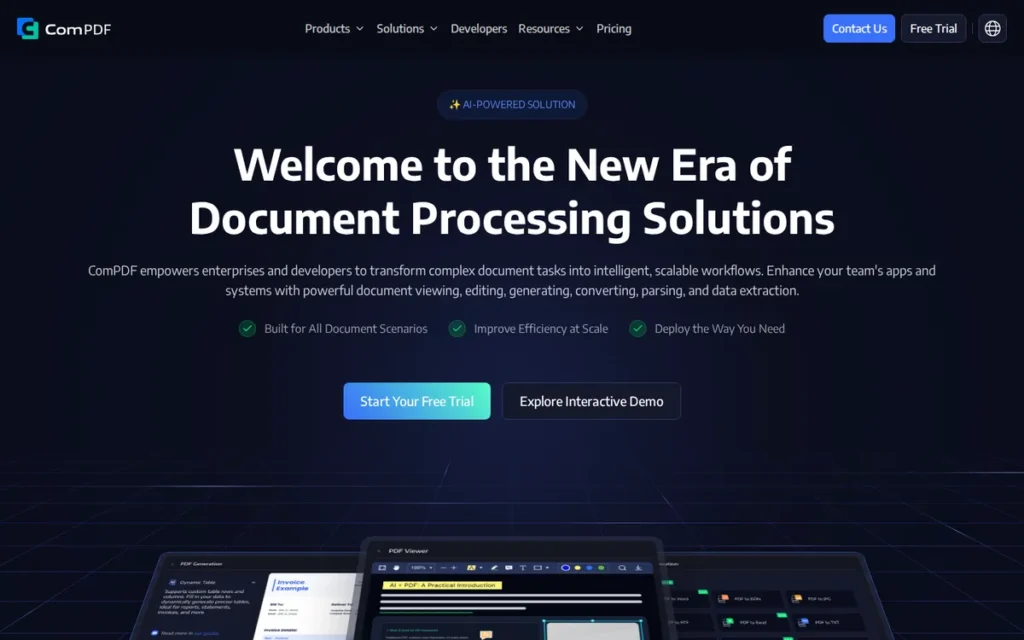
Category: Accessible Commercial SDK, a commercially licensed PDF library from KDAN (PDF Technologies Pte. Ltd., Singapore), covering the widest verified platform matrix in this evaluation, including Flutter and React Native, with the most accessible entry-level pricing of any full-featured commercial PDF SDK in this comparison.
At a Glance
- Category: Accessible Commercial SDK
- Best For: Startup and mid-market development teams building cross-platform document applications on Flutter, React Native, or Electron who need a commercially licensed SDK with accessible entry pricing and a free community tier, without enterprise-minimum pricing structures
- Price Range: From approximately $300–$783/platform for iOS (unconfirmed by vendor; ComponentSource, March 2025; verify current pricing before budgeting); Community License free for startups/nonprofits; 100 free API calls/month; enterprise pricing on request
- Primary Strength: ComPDFKit offers the most accessible entry-level commercial pricing of any full-featured PDF SDK in this comparison (including a publicly findable iOS price range, a free community license for qualifying organizations, and a free API tier) all verified as of June 2026
- Biggest Limitation: ComPDFKit is a KDAN company of smaller organizational scale than market leaders, enterprise procurement teams should request formal vendor documentation, including financial disclosures and security certifications, before making ComPDFKit a critical-path dependency for high-volume production workflows
- One-Line Summary: ComPDFKit is a commercially licensed PDF SDK operated by PDF Technologies Pte. Ltd. (Singapore), a KDAN company, covering the widest verified cross-platform matrix in this evaluation (including Web/WASM, Flutter, React Native, Electron, iOS, Android, Windows, macOS, and Linux) with the most accessible entry-level commercial pricing of any full-featured PDF SDK in this comparison, including a free community license for startups and nonprofits.
- Last Verified: June 2026
Overview
ComPDFKit is a commercially licensed PDF SDK operated by PDF Technologies Pte. Ltd. (Singapore), a KDAN company, per ComPDF’s own about page at compdf.com/company/about. ComPDFKit covers viewing, editing, annotation, OCR, signing, redaction, form processing, and document comparison across the widest verified platform matrix in this evaluation, Web/WASM, Flutter, React Native, Electron, Windows, macOS, iOS, Android, Linux, and server-side. KDAN was founded in 2009 by Kenny Su and is a publicly traded document software company.
ComPDFKit positions itself as a price-transparent alternative to the enterprise-opaque pricing of market leaders. An iOS SDK price range of approximately $300–$783 is findable on ComponentSource (version v2.3.0, March 2025, unconfirmed directly by the ComPDFKit vendor; verify current pricing before budgeting). ComPDFKit also confirms a free community license for individual developers, startups, and nonprofits.
ComPDFKit’s GitHub organization maintains active, platform-specific repositories for Windows, Flutter.NET Core, and React Native, confirming multi-platform engineering investment as of June 2026. Editorial note: A DEV Community comparison article presenting ComPDFKit as superior to Apryse was authored by a “derek-compdf” account, vendor-authored content that has not been accepted at face value in this evaluation; all ComPDFKit claims are independently sourced.
Key Features
- Widest Verified Cross-Platform Matrix: ComPDFKit supports Web/WASM, Flutter, React Native, Electron, Windows, macOS, iOS, Android, Linux, and server-side deployment, with active GitHub repositories maintained for platform-specific SDK variants, confirming ongoing engineering investment across each target as of June 2026.
- Free Community License Tier: ComPDFKit offers a free Community License for individual developers, startups, and nonprofits, and a 100 free files/month API tier, making it the only full-featured commercial PDF SDK in this comparison with a confirmed no-cost entry for qualifying organizations.
- Comprehensive Core Feature Coverage: ComPDFKit covers viewing, editing, annotation, conversion, OCR, form filling and creation, digital signing, redaction, document comparison, measurement tools, and page operations, confirmed across official product documentation at compdf.com/pdf-sdk.
- Lowest Publicly Findable Per-Platform Price Range: ComPDFKit’s iOS SDK price range of approximately $300–$783 was findable on ComponentSource (version v2.3.0, March 2025 (unconfirmed by vendor)) the lowest publicly findable per-platform price range for a full-featured commercial PDF SDK in this specific comparison.
- Accessible Support Model: ComPDFKit claims 24/5 email and chat support with unlimited bug requests, a support accessibility model positioned for smaller development teams without dedicated enterprise support budgets or vendor relationship management resources.
Best For
ComPDFKit is best for startup and mid-market development teams that need a commercially licensed PDF SDK (with clean, AGPL-free licensing) across multiple platforms including Flutter and React Native, without the enterprise-minimum pricing structures that make Apryse, Nutrient, and Foxit inaccessible for pre-Series B organizations.
Strengths
- Lowest Publicly Findable Per-Platform Price Range: ComponentSource, a major independent developer component reseller, listed ComPDFKit PDF SDK for iOS in a range of approximately $300–$783 (version v2.3.0, updated March 2025 (unconfirmed by vendor)) the only publicly findable per-platform price range below $1,000 for a full-featured commercial PDF SDK in this comparison.
- Active Multi-Platform GitHub Repositories: ComPDFKit’s GitHub organization maintains active, platform-specific repositories for Windows, Flutter.NET Core, and React Native, confirmed as of June 2026, demonstrating engineering resources dedicated to each platform rather than a single-SDK core with tokenized wrappers.
- Flutter Community Organic Awareness: A r/FlutterDev community member independently mentioned ComPDFKit as a Flutter PDF SDK option (March 2025), organic community awareness in the Flutter mobile developer ecosystem, which is entirely underserved by the top-tier commercial SDK vendors evaluated above.
- Free Community License With Confirmed Scope: ComPDFKit explicitly confirms a free Community License for startups and nonprofits, the only full-featured commercial PDF SDK in this comparison with a documented no-cost entry tier for qualifying organizations, providing a legitimate evaluation path before commercial commitment.
Limitations
- Smaller Organizational Scale Relative to Market Leaders: ComPDFKit is a KDAN company (PDF Technologies Pte. Ltd., Singapore), and KDAN is substantially smaller in scale than the parent companies behind Apryse (Silversmith Capital Partners) or Foxit (Shanghai public markets). Enterprise procurement teams with vendor financial stability minimums should request formal vendor documentation (including financial disclosures, SLA terms, and security certifications) before making ComPDFKit a critical-path dependency for high-volume production workflows.
- Thin Independent Review and Community Footprint: ComPDFKit’s developer forum presence (Reddit threads, independent user reviews on G2 or Capterra, third-party tutorials) is significantly thinner than market leaders, meaning teams will find fewer community-sourced troubleshooting resources when encountering integration challenges outside standard documented use cases.
- Vendor-Authored Comparison Content: The primary publicly available comparison of ComPDFKit versus Apryse was authored by a DEV Community account identified as a ComPDFKit vendor representative (“derek-compdf”), creating an evidence gap for buyers who need independent third-party assessment of the product’s competitive positioning.
- Limited Enterprise Validation Record: ComPDFKit has no named Fortune-level production references, no published security certifications, and no publicly documented standards body participation, a meaningful validation gap for enterprise procurement teams with formal third-party vendor risk assessment requirements.
Verdict
ComPDFKit is the best option in this evaluation for startup and mid-market development teams that need a commercially licensed PDF SDK with genuine cross-platform coverage (including Flutter and React Native) without the enterprise-minimum pricing structures of Apryse, Nutrient, or Foxit. ComPDFKit’s publicly findable price range, free community license tier, and broadest confirmed platform matrix make it the most accessible commercial SDK in the category as of June 2026. The primary risk is organizational scale: teams with formal enterprise vendor risk requirements should conduct additional due diligence on KDAN’s corporate structure and financial stability before making ComPDFKit a critical-path dependency.
5. iText: Best for Java and .NET Back-End Document Generation With PDF/A and PDF/UA-2 Standards Compliance, With a Critical AGPL Licensing Warning for SaaS Applications
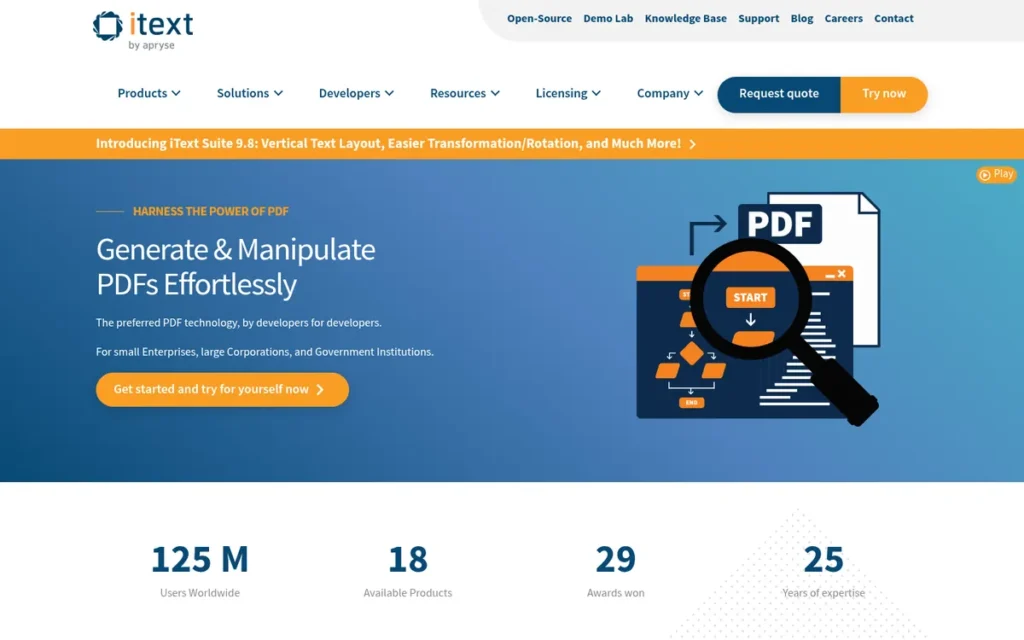
Category: Document Generation and Standards Compliance SDK, a Java and .NET PDF creation, manipulation, and standards-compliance library covering PDF/A, PDF/UA-2, digital signatures, forms, and redaction, licensed under AGPL v3 (free for qualifying open-source) or commercial license (required for proprietary and SaaS applications). iText Group NV was acquired by Apryse (then PDFTron) in 2022, see the Methodology section for the full corporate relationship disclosure.
At a Glance
- Category: Document Generation and Standards Compliance SDK
- Best For: Java and .NET back-end development teams building server-side document generation systems requiring PDF/A, PDF/UA-2, or PDF 2.0 standards compliance, particularly in regulated sectors using qualifying open-source projects or carrying a purchased iText commercial license
- Price Range: Free under AGPL v3 (qualifying open-source use only); commercial license required for proprietary and SaaS applications (pricing on request; a 2017 Reddit reference cited $0.12/document, unverified, historical reference only; do not use for current budget planning)
- Primary Strength: iText is the first commercial PDF SDK to publicly confirm PDF/UA-2 compliance and is an active PDF Association member contributing to PDF 2.0 and PDF/UA-2 standards, the most authoritative standards-compliance implementation of any SDK in this evaluation
- Biggest Limitation: iText’s AGPL v3 license requires any team running iText in a network-accessible SaaS product or web application to open-source their entire codebase (or purchase a commercial license) making it a binary hard stop for proprietary commercial applications that have not budgeted for iText commercial licensing
- One-Line Summary: iText is a Java and .NET PDF generation SDK with the deepest standards compliance in this evaluation (including first-to-market PDF/UA-2 support and active PDF Association membership) but its AGPL v3 license creates a binary compliance requirement that eliminates it as a safe option for any proprietary SaaS or network-accessible commercial application without a paid commercial license; iText Group NV was acquired by Apryse (then PDFTron) in 2022.
- Last Verified: June 2026
Overview
iText is a Java and .NET PDF SDK providing document creation, manipulation, forms, digital signatures, encryption, redaction, and standards compliance, including PDF/A, PDF/UA-2, and PDF 2.0, licensed under AGPL v3 for open-source use and a commercial license for proprietary applications, with the deepest standards-compliance track record of any SDK in this evaluation. iText Group NV was acquired by PDFTron (now Apryse) in 2022 and is evaluated as a distinct product from Apryse (#1) in this article due to its different codebase, AGPL-based licensing structure, and Java/.NET-exclusive target use case, the corporate relationship is disclosed in the Methodology section.
iText is an active PDF Association member, confirmed at pdfa.org, contributing to PDF 2.0 and PDF/UA-2 standards development. iText 8 was the first commercial SDK to publicly confirm PDF/UA-2 compliance, added in iText Core 8.0.3 per the iText engineering blog.
iText’s AGPL v3 license is its most consequential attribute for commercial developers. The AGPL Section 13 provision classifies running AGPL-licensed code in any network-accessible application (including a SaaS product or web application) as “distribution,” triggering a copyleft obligation requiring open-sourcing of the entire application codebase for teams that have not purchased a commercial iText license.
Key Features
- Deepest Standards Compliance in This Evaluation: iText provides PDF/A (archival), PDF/UA-2 (universal accessibility), PDF 2.0, and digital signature standards support, backed by active PDF Association membership and documented contribution to emerging standards, the most authoritative compliance implementation of any evaluated SDK.
- First-to-Market PDF/UA-2 Compliance: iText 8 was the first commercial SDK to publicly confirm PDF/UA-2 compliance, added in iText Core 8.0.3 per the iText engineering blog, a differentiator for government, education, and regulated-sector buyers facing legal accessibility mandates as of June 2026.
- Modular Add-On Architecture: iText’s product suite extends the core library with documented add-ons (iText DITO for template-based document generation, pdfHTML for HTML/CSS-to-PDF conversion, iText Sign for digital signature workflows, plus OCR and barcode processing modules) each carrying separate commercial licensing.
- Standard Ecosystem Distribution: iText is distributed via official NuGet packages for .NET and Maven/Gradle packages for Java, enabling standard build-system integration without bespoke dependency management in either ecosystem.
- Large Community Adoption Base: iText’s AGPL v3 free tier has generated a large community adoption base with active Stack Overflow presence and a rich third-party tutorial ecosystem (including a CodeMag developer tutorial documenting practical implementation patterns) reducing integration friction for Java and .NET developers during evaluation.
Best For
iText is best for Java and .NET development teams building server-side back-end document generation systems that require rigorous PDF/A or PDF/UA-2 standards compliance (particularly for government, education, financial services, or legal archive applications) where the team is operating under a qualifying open-source project or has explicitly budgeted for an iText commercial license.
Strengths
- First Commercial SDK With PDF/UA-2 Compliance: iText Core 8.0.3 was confirmed as the first commercial SDK to publicly announce PDF/UA-2 compliance per the iText engineering blog, positioning iText as the leading standards-compliance choice for government and institutional buyers under legal accessibility mandates as of June 2026.
- USPS Production Reference at Government Scale: The U.S. Postal Service has been independently documented (via community observation of PDF document metadata in a r/java thread) as an iText production user for generating package shipping label barcodes at tens of millions of documents annually, validating iText’s scalability for mission-critical, high-volume generation.
- Active PDF Standards Body Participation: iText is a confirmed PDF Association member (pdfa.org/member/itext-group-nv), contributing to PDF 2.0 and PDF/UA-2 standards development, the most authoritative standards body participation of any SDK evaluated in this comparison.
- 25+ Year History With Active Package Distributions: iText’s continuous NuGet and Maven distributions confirm it as one of the most mature and actively maintained Java/.NET PDF libraries in the category, with a Stack Overflow community presence and third-party tutorial ecosystem that reduces integration friction.
Limitations
- AGPL v3 SaaS Compliance Hard Stop: iText’s most consequential trade-off (and the primary reason it ranks fifth despite strong feature and validation scores) is its AGPL v3 licensing. The AGPL Section 13 provision classifies running iText in a network-accessible application (any SaaS product, web application, or externally accessible API) as “distribution,” triggering a copyleft obligation to open-source the entire application codebase. A r/java commenter described AGPL as “a very bad idea to use unless you’re working on another open source/free software product.” A team integrating iText under AGPL into a proprietary SaaS product without a commercial license is in silent compliance violation.
Users on r/libreoffice who investigated iText enforcement practices noted a consequential shift in how the license is applied post-acquisition:
“This is essentially a sales motion to try and get people to pay for use, which may infringe AGPL. AGPL is a pretty vague opensource license, and can be interpreted in different ways. There are actually very few ‘clear’ infringements. The founder of iText moved licensing to AGPL in order to support the spirit of opensource software; sadly, following the acquisition by the PE firm behind PDFTron it has become a straight-up $$ model.” Posted by u/Suharisaint
Takeaway: Community observers characterize Apryse’s post-acquisition management of iText as a shift from open-source stewardship to active commercial enforcement, a material change in how the AGPL license is applied against users that teams should account for before adopting iText under any AGPL assumption.
- Complex Licensing History: iText’s mid-project license switch from LGPL to AGPL v3 with iText 5 creates an unusual legal audit challenge. iText’s founder Bruno Lowagie warned that versions prior to iText 5 “may have included code that was not legally licensed under the LGPL” (r/java community thread), meaning organizations with long-running iText integrations should confirm which version is in production before assuming LGPL safety.
- Java/.NET Platform Scope Only: iText’s platform scope is limited to Java and .NET, with no mobile SDK, no web viewer, and no WebAssembly delivery. Teams targeting web, iOS, Android, Flutter, or React Native require a completely separate SDK regardless of iText selection.
- Add-On Module Cost Accumulation: iText’s modular commercial licensing means costs escalate significantly beyond the base core when OCR, HTML-to-PDF, digital signature, and template generation modules are added, procurement teams must enumerate all required modules before requesting a commercial license quote to avoid post-contract cost surprises.
Verdict
iText is the strongest option in this evaluation for Java and .NET back-end document generation with rigorous standards compliance (particularly PDF/UA-2 accessibility, PDF/A archival, and digital signatures) validated by 25+ years of continuous development, PDF Association membership, and an independently documented USPS production reference at government scale. iText belongs in any evaluation only for teams that have explicitly addressed the AGPL compliance requirement: any team building a proprietary SaaS product or network-accessible web application must purchase a commercial iText license before deployment, or face potential copyleft obligations on their entire codebase. Teams that qualify under AGPL or have budgeted for commercial licensing will find iText’s standards depth and Java ecosystem integration unmatched in this specific evaluation.
6. MuPDF: Best for Open-Source Projects, Python AI/ML Pipelines, and Embedded Environments Requiring Minimal Binary Footprint
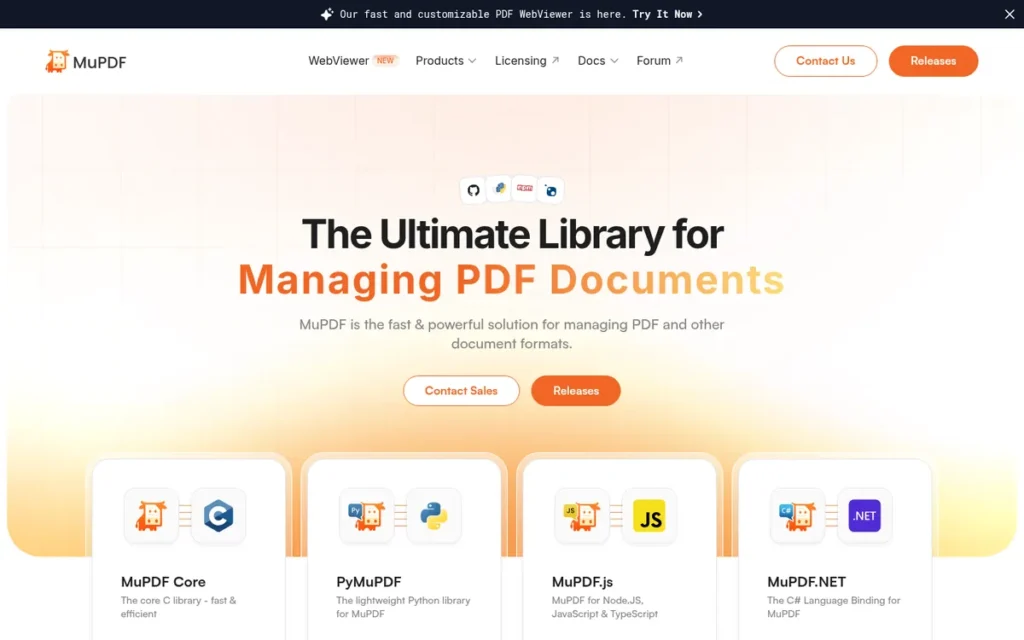
Category: Open-Source Rendering Engine, a C-based, AGPL-licensed (with commercial option from Artifex) lightweight PDF and document rendering engine providing the highest performance-per-footprint ratio in this evaluation, with a WebAssembly delivery path and documented dominance in Python AI/ML document pipelines via PyMuPDF.
At a Glance
- Category: Open-Source Rendering Engine
- Best For: Open-source projects qualifying under AGPL, Python developers building LLM/RAG document ingestion or AI/ML preprocessing pipelines, and engineering teams deploying PDF processing in resource-constrained environments where binary size and raw processing speed are the primary selection constraints
- Price Range: Free under AGPL v3 (open-source qualifying use only); commercial licensing approximately $749/platform (reseller estimate, unconfirmed by Artifex; Slashdot comparison database, 2026; contact Artifex Software for verified pricing)
- Primary Strength: MuPDF: via PyMuPDF, is the documented Python PDF text-extraction performance leader: independent benchmarks show PyMuPDF processing text extraction in approximately 8 seconds versus pypdf at 101+ seconds for equivalent document sets (py-pdf/benchmarks, 2024)
- Biggest Limitation: MuPDF’s AGPL v3 license requires any team running MuPDF or PyMuPDF in a network-accessible SaaS product or web application to open-source their entire codebase, developer communities describe this as a definitive hard stop for proprietary commercial SaaS without a paid Artifex commercial license
- One-Line Summary: MuPDF is an open-source, AGPL-licensed C-based PDF rendering engine with the smallest binary footprint and highest documented text-extraction performance of any SDK in this evaluation, powering Python AI/ML document pipelines via PyMuPDF and delivering browser-based processing via MuPDF.js, but its AGPL license makes it a compliance risk for any proprietary SaaS or network-accessible commercial application without a paid Artifex commercial license.
- Last Verified: June 2026
Overview
MuPDF is an open-source, AGPL-licensed C-based PDF and document rendering engine maintained by Artifex Software (founded 1993) that provides the smallest binary footprint and highest documented processing speed of any SDK in this evaluation, and is the de facto rendering engine powering Python AI/ML and LLM/RAG (Retrieval-Augmented Generation) document pipelines via the PyMuPDF library. MuPDF supports rendering, conversion, text extraction, annotation, digital signatures, forms, and redaction across PDF, XPS, EPUB, and other formats, with a WebAssembly delivery path (MuPDF.js) for browser-based deployment and bindings for C, Python, Java, and .NET.
MuPDF’s AGPL v3 license is its most consequential constraint for commercial developers. The AGPL Section 13 provisionmeans any team running MuPDF in a network-accessible application (including a Python SaaS application using PyMuPDF) must open-source their entire codebase or purchase an Artifex commercial license.
The MuPDF codebase on GitHub (ArtifexSoftware/mupdf) remains forkable under AGPL regardless of Artifex’s corporate status, providing a long-term continuity assurance that purely proprietary SDKs cannot match.
Key Features
- Smallest Binary Footprint in This Evaluation: MuPDF provides the smallest binary footprint of any SDK evaluated, with a C-based architecture and minimal dependencies, the strongest option among the seven SDKs in this evaluation for resource-constrained environments including embedded Linux devices, IoT document terminals, and mobile applications where bundle size directly impacts download size and memory consumption.
- Python AI/ML Pipeline Performance Leader: MuPDF powers PyMuPDF (also known as “fitz”), the dominant Python PDF library for text extraction, OCR preprocessing, and document manipulation in AI/ML and LLM/RAG pipelines, independently benchmarked at approximately 8 seconds for text extraction versus pypdf at 101+ seconds for equivalent document sets (py-pdf/benchmarks, 2024).
- WebAssembly Browser Delivery via MuPDF.js: MuPDF delivers browser-based PDF processing via MuPDF.js (confirmed via the Artifex engineering blog) providing an AGPL/commercial alternative to proprietary WASM SDK implementations for organizations that accept the applicable licensing terms.
- Multi-Format Document Engine: MuPDF supports the core document operation set: rendering, conversion, text extraction, annotation, digital signatures, form filling, redaction, merging, and splitting, across PDF, XPS, OpenXPS, EPUB, FictionBook 2, and CBZ formats from its core C engine, as documented at mupdf.com.
- Complementary Ghostscript Ecosystem: Artifex Software maintains both MuPDF and Ghostscript as complementary document processing engines, meaning a single Artifex commercial license can potentially cover both a lightweight PDF renderer (MuPDF) and a full PostScript/PCL/PDF interpreter (Ghostscript) for comprehensive document processing pipelines.
Best For
MuPDF is best for open-source projects that qualify under AGPL, for Python developers building AI/ML document ingestion or LLM/RAG (Retrieval-Augmented Generation) preprocessing pipelines who understand and accept the AGPL license terms, and for engineering teams deploying PDF processing in embedded or resource-constrained environments where binary size and raw processing performance are the decisive selection criteria.
Strengths
- Independent Benchmark Performance Confirmation: Community discussion in r/learnpython cited the independent py-pdf/benchmarks GitHub repository, confirming PyMuPDF processes text extraction in approximately 8 seconds versus pypdf at 101+ seconds for equivalent document sets, a finding supported by PyMuPDF’s own benchmark documentation (py-pdf/benchmarks, 2024), representing one of the strongest independently documented performance validations in this category.
- At-Scale Production Performance Testimony: A production-scale Python developer processing hundreds of thousands of PDFs reported switching all code from PyPDF to PyMuPDF after observing order-of-magnitude speed differences: “WOW PyMuPDF is way faster than PyPDF. I just switched all of my code over to it” (u/nickthib, r/learnpython), practitioner testimony at scale, not a controlled benchmark environment.
Practitioners in the r/learnpython community have documented PyMuPDF’s capability advantages beyond raw speed alone:
“Rendering: pypdf/pypdf2 cannot do page rendering. PyMuPDF can do that with a speed beyond all competition. Table of Contents handling: possible in pypdf but a sheer nightmare. Super elegant in PyMuPDF with hierarchy levels, expand/collapse and color support, input and output. File merging: PyMuPDF is 100+ times faster than pypdf and supports merging everything (not only PDF) with a target PDF. Annotation & Form Field support for input and output. Elegant text output and image extraction and insertion.” Posted by u/NoZebra4503
Takeaway: PyMuPDF’s advantages over pypdf extend well beyond text extraction speed, it leads across rendering, table of contents handling, file merging, and annotation support, making it the clear Python PDF capability leader for AI/ML pipelines that require more than basic text extraction.
- 33-Year Organizational History Provides Continuity Assurance: Artifex Software was founded in 1993 (confirmed via Slashdot software comparison database, 2026), giving MuPDF one of the longest organizational histories in the document processing software category, and the open-source AGPL codebase provides additional continuity insurance, remaining forkable regardless of Artifex’s corporate status.
- Publicly Testable Reference Implementation: MuPDF’s viewer application is published on the Google Play Store by Artifex (com.artifex.mupdf.viewer.app), providing a publicly testable reference implementation that any developer can evaluate for rendering quality and performance before committing to integration.
Limitations
- AGPL v3 SaaS Compliance Hard Stop: MuPDF’s most consequential trade-off is its AGPL v3 license, the AGPL Section 13 provision classifies running MuPDF in a network-accessible application as “distribution,” requiring the operator to open-source their entire application codebase or purchase an Artifex commercial license. Developer communities are explicit and decisive: one r/learnpython commenter stated “If I deploy it inside my network, I have to make the ENTIRE CODE BASE OF MY APPLICATION available to my users. Not going to happen in a million years”, a rejection pattern that characterizes how commercial developers respond when they encounter MuPDF’s AGPL implications.
- Documented Crash and Stability Risk With Malformed PDFs: MuPDF has a documented crash and hang risk with certain malformed or unusual PDF inputs, noted by a r/learnpython community member who linked to a specific Ghostscript/MuPDF bug tracker entry, a real production risk for applications that process PDFs from untrusted external sources at scale, where commercial SDKs with broader hardening resources may have an advantage.
- No Built-In UI, Collaboration, or Cloud Services: MuPDF provides no built-in UI components, no collaboration features, and no cloud services, significant development effort is required to build any end-user-facing document application on top of the raw rendering engine, adding total cost of ownership that offsets the low licensing cost.
- AGPL SaaS Compliance Discovery Often Happens Post-Integration: The AGPL compliance problem for SaaS applications is frequently discovered after significant development investment, because developers adopt PyMuPDF through pip without reading the license terms. Teams using PyMuPDF in any commercial application should confirm their licensing situation before any production deployment.
Verdict
MuPDF is the highest-performing PDF rendering engine in this evaluation for Python AI/ML pipelines and resource-constrained embedded deployments (confirmed by independent benchmark data showing approximately 8-second text extraction versus pypdf’s 101+ seconds) and is the only SDK combining near-zero licensing cost, minimal binary footprint, and WebAssembly browser delivery. The hard constraint is AGPL licensing: MuPDF and PyMuPDF are only safe choices for open-source projects or for teams with a paid Artifex commercial license. Any team deploying MuPDF or PyMuPDF in a proprietary SaaS product without a commercial license carries potential AGPL violation risk that frequently surfaces only after significant integration investment.
7. GdPicture.NET: Best for .NET Enterprise Systems Combining PDF, OCR, Barcode, and Scanning, Including Legacy Windows Environments No Other SDK in This Evaluation Supports
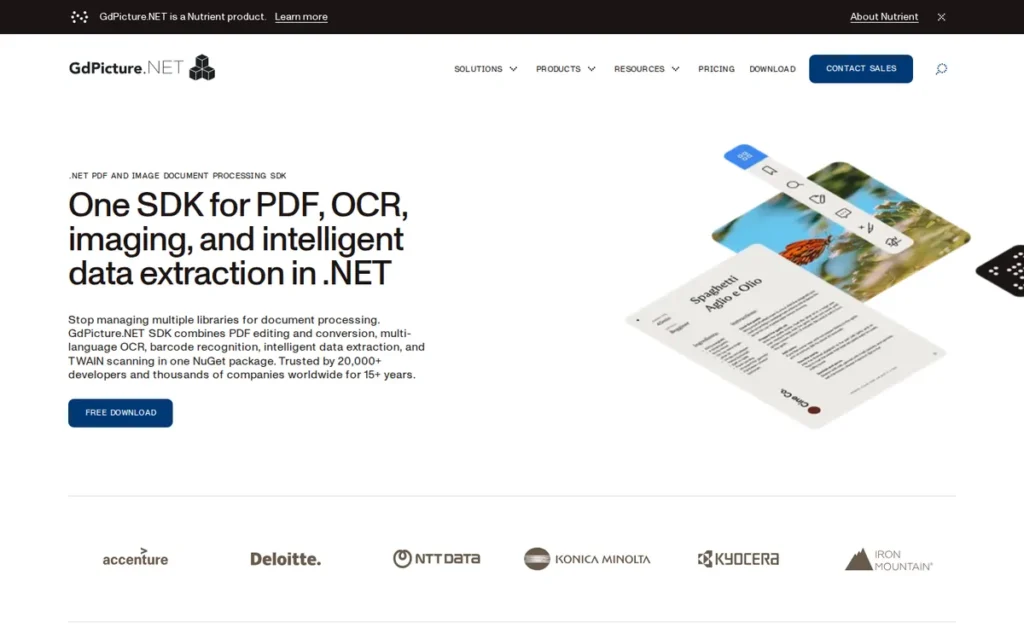
Category: .NET Document Imaging and PDF SDK, an all-in-one .NET library combining PDF processing, multi-language OCR, barcode recognition, TWAIN document scanning, and 100+ document format support, with unique legacy Windows environment compatibility including Visual Basic 6, Delphi, and COM/ActiveX.
At a Glance
- Category: .NET Document Imaging and PDF SDK
- Best For: Enterprise .NET developers at organizations with legacy document systems on VB6, Delphi, or COM/ActiveX codebases that cannot migrate to modern frameworks, or systems integrators building comprehensive document management platforms requiring PDF, OCR, barcode, and scanning from a single vendor
- Price Range: Pricing on request: commercial license; no public tiers or reseller pricing confirmed as of June 2026 (the only SDK in this evaluation with zero findable pricing signals from any independent source)
- Primary Strength: GdPicture.NET is the only SDK in this specific evaluation with confirmed support for Visual Basic 6, Delphi, and COM/ActiveX legacy Windows development environments, a unique capability for enterprises with critical document systems on aging codebases that no other evaluated SDK addresses
- Biggest Limitation: GdPicture.NET has approximately 3,000 API functions spanning PDF, OCR, barcode, scanning, and 100+ formats, making it overkill for PDF-only projects with a steeper learning curve than more focused competitors, as confirmed by a direct commercial competitor’s independent comparison (IronSoftware, 2024)
- One-Line Summary: GdPicture.NET is an all-in-one .NET document imaging and PDF SDK from ORPALIS that combines PDF processing, multi-language OCR, barcode recognition, and TWAIN scanning in approximately 3,000 API functions, and is the only SDK in this specific comparison with confirmed support for legacy Windows development environments including Visual Basic 6 and Delphi.
- Last Verified: June 2026
Overview
GdPicture.NET is an all-in-one .NET document imaging and PDF SDK from ORPALIS that covers PDF editing and conversion, multi-language OCR, barcode recognition and generation, TWAIN document scanning, and 100+ document and image formats in a single product, and is the only SDK in this specific evaluation with confirmed support for legacy Windows development environments including Visual Basic 6, Delphi, and COM/ActiveX. GdPicture.NET claims approximately 3,000 API functions, the largest documented function count of any SDK in this comparison, making it the broadest single-vendor choice for systems integrators building comprehensive document management platforms.
GdPicture.NET expanded from Windows-only to .NET 6 with Linux x64 and arm64 support in late 2022 (ORPALIS Newsletter, October 2022), enabling deployment in Docker containers and Linux-based cloud architectures alongside its legacy Windows compatibility.
ORPALIS, the developer of GdPicture.NET, also publishes DocuVieware, a web-based document viewer and editor built on GdPicture.NET technology, extending the platform into browser-based document workflows from a single vendor.
Key Features
- Only SDK in This Evaluation With Confirmed Legacy Windows Environment Support: GdPicture.NET is the only SDK in this specific comparison with confirmed support for Visual Basic 6, Delphi, COM/ActiveX, Microsoft Access, and WinDev, legacy Windows development environments found in long-running insurance, government, and manufacturing document systems, confirmed via the gdpicture.com/products/comactivex/ product page as of June 2026.
- All-in-One Document Capture and Processing: GdPicture.NET integrates PDF editing and conversion, multi-language OCR, barcode recognition and generation, TWAIN document scanning, and support for 100+ document and image formats in a single SDK, eliminating the need for multiple specialist SDK licenses in comprehensive document capture and processing workflows.
- .NET 6 and Linux Cloud Deployment: GdPicture.NET expanded to .NET 6 with Linux x64 and arm64 support in late 2022 (ORPALIS Newsletter, October 2022), enabling deployment in Docker containers and Linux-based cloud environments while maintaining legacy Windows/.NET Framework compatibility from the same codebase.
- DocuVieware Web Viewer Companion: ORPALIS publishes DocuVieware: a web-based document viewer and editor built on GdPicture.NET technology, providing a single-vendor path for organizations that need both server-side .NET PDF processing and browser-based document display without switching vendors.
- Largest Documented API Surface: GdPicture.NET documents approximately 3,000 API functions (the largest count of any SDK in this comparison) providing the broadest API surface for systems integrators and ISVs building comprehensive document management platforms spanning PDF, imaging, OCR, and capture workflows.
Best For
GdPicture.NET is best for .NET enterprise developers and systems integrators at organizations with legacy document processing systems on VB6 or Delphi codebases, or for organizations that need a single vendor covering PDF processing, OCR, barcode handling, and TWAIN document scanning without assembling and maintaining multiple specialist SDK licenses.
Strengths
- Unique Legacy Windows Environment Coverage: GdPicture.NET official product documentation confirms support for Visual Basic 6, Delphi, COM/ActiveX, WinDev, and Microsoft Access, legacy Windows environments absent from every other SDK in this specific evaluation, confirmed via the gdpicture.com/products/comactivex/ product page as of June 2026.
- .NET 6 Linux Expansion Without Losing Legacy Compatibility: GdPicture.NET added .NET 6 assemblies with Linux x64 and arm64 support in late 2022 (ORPALIS Newsletter, October 2022), enabling cloud-native and containerized Linux deployment from the same SDK codebase that supports VB6, an unusual combination of modern cloud-readiness and legacy breadth.
- Competitor Acknowledgment of All-in-One Scope Advantage: IronSoftware’s published comparison of GdPicture.NET versus IronPDF acknowledged GdPicture.NET’s “all-in-one scope” as a genuine differentiator versus PDF-only competitors (IronSoftware comparison, 2024), a concession from a direct commercial competitor validating GdPicture.NET’s multi-capability positioning for document management platform integrators.
- Integrated DocuVieware Web Viewer: ORPALIS publishes DocuVieware as a companion web document viewer and editor built on GdPicture.NET technology (documented on ORPALIS product pages) demonstrating continued platform investment and providing an integrated single-vendor path for browser-based document workflows.
Limitations
- Scope Mismatch for PDF-Only Teams: GdPicture.NET’s most consequential trade-off for most development teams is scope mismatch, with approximately 3,000 API functions spanning PDF, OCR, barcode, scanning, and 100+ formats, it is, as a direct commercial competitor explicitly stated, “overkill for PDF-only projects” with “a steeper learning curve than more PDF-focused competitors” (IronSoftware, 2024). Teams with pure PDF use cases will find the cognitive overhead unjustified relative to more focused SDKs ranked above it.
- Most Opaque Corporate Background in This Evaluation: GdPicture.NET has the most opaque corporate profile of any SDK in this comparison, ORPALIS’s founding date, headquarters city, team size, and leadership team are not publicly documented, a significant due diligence gap for enterprise procurement teams with formal vendor risk requirements.
- Near-Zero Developer Community Presence: GdPicture.NET generated no meaningful Reddit discussion threads in a targeted search, no significant independent review volume on G2 or Capterra, and no substantial community troubleshooting resources, meaning teams must rely entirely on official ORPALIS support channels for post-integration issues.
- No Mobile, WASM, Flutter, or React Native Coverage: GdPicture.NET has no confirmed support for iOS, Android, WebAssembly, Flutter, or React Native as of June 2026, teams building cross-platform applications targeting modern mobile or browser-native deployment require a separate SDK regardless of GdPicture.NET selection.
- Zero Findable Reseller Pricing: GdPicture.NET is the only SDK in this evaluation for which no pricing signal (not even a directional range) is findable from any independent reseller source (ComponentSource, TrustRadius, Slashdot comparison database) as of June 2026, making it the most budget-inaccessible SDK to evaluate without initiating a direct ORPALIS sales conversation.
Verdict
GdPicture.NET is a genuinely specialized tool that earns a place in this specific evaluation for a specific and underserved segment: .NET enterprise organizations with legacy document systems on VB6 or Delphi codebases, or systems integrators building platforms requiring PDF, OCR, barcode, and scanning from a single vendor, for that segment, GdPicture.NET is the only option among the seven SDKs evaluated with confirmed VB6/Delphi/COM support. For any team outside that specific combination of requirements, GdPicture.NET’s steep learning curve, corporate opacity, pricing opacity, and limited community resources make it a lower-priority evaluation candidate compared to the more focused, better-documented, and better-validated SDKs ranked above it.
What Red Flags Should I Watch For When Evaluating PDF SDKs?
Six specific red flags distinguish high-risk PDF SDK selections from sound procurement decisions, each identified from research patterns across all seven SDKs in this evaluation.
Red Flag #1: AGPL License Without a Purchased Commercial License in a SaaS Application
AGPL Section 13 classifies running AGPL-licensed code in any network-accessible application as “distribution”, triggering a copyleft obligation requiring the operator to open-source their entire application codebase.
Any team using iText or MuPDF/PyMuPDF in a proprietary SaaS or customer-facing web application without a commercial license is in silent compliance violation. This risk is frequently discovered after significant integration work, because developers install PyMuPDF via pip without reading the license terms. Verify license tier before writing the first line of integration code.
Red Flag #2: No Public Pricing From Any Source
Complete pricing opacity (where no pricing data is findable from the vendor, resellers, review platforms, or community discussions) blocks engineering leads from building preliminary business cases without initiating a formal sales cycle.
Apryse, Nutrient, and GdPicture.NET currently have no publicly findable pricing as of June 2026. While this is standard practice at the enterprise tier, teams should account for a minimum 2–4 week procurement timeline before cost information becomes available, a planning constraint that directly affects evaluation scheduling.
Red Flag #3: Recent Corporate Ownership Change Without a Published SDK-Specific Roadmap Statement
A recent change of corporate ownership (particularly when the acquiring company’s core business is not developer tooling) introduces uncertainty about long-term product investment.
Before finalizing any SDK procurement that follows a recent ownership change or corporate restructuring, ask the vendor directly: “Is this SDK maintained as an independently roadmapped product with dedicated engineering headcount, or is it being absorbed into a parent platform?” A vague answer is a procurement risk signal.
Red Flag #4: Missing Platform Coverage Discovered Post-Integration
Marketing pages frequently list platform names without distinguishing between actively maintained SDKs, community-maintained ports, and deprecated wrappers.
Cross-platform support should be verified against official SDK documentation, active package registry distributions (npm, NuGet, Maven, pub.dev), and active GitHub repositories, not marketing landing pages alone. Foxit PDF SDK, for example, lacks confirmed Flutter or React Native support despite broad platform marketing. Discovering a missing platform after deep integration creates costly remediation work.
Red Flag #5: Performance Claims With No Benchmark Evidence
Marketing vocabulary like “lightning-fast,” “ultra-fast,” and “native-like performance” appears across every PDF SDK in this category without differentiation.
Only one SDK in this evaluation (MuPDF via PyMuPDF) has performance claims confirmed by independent benchmark data: the py-pdf/benchmarks GitHub repository showing PyMuPDF at approximately 8 seconds versus pypdf at 101+ seconds for text extraction (py-pdf/benchmarks, 2024). For all other SDKs, treat performance claims as unverified marketing unless a vendor provides reproducible benchmark methodology and independent corroboration.
Red Flag #6: Vendor-Authored Content Presented as Independent Comparison
Vendor-authored comparison articles (published on developer platforms under employee accounts) present competitive claims without the independence required for procurement decisions.
The ComPDFKit entry in this article explicitly identifies a DEV Community comparison article authored by “derek-compdf” as vendor-authored content. Apply the same scrutiny to any comparison article where the author account name includes a company name, or where the comparison consistently finds the publishing company superior on every criterion.
What Questions Should I Ask Before Choosing a PDF SDK?
Six questions every engineering team should answer before finalizing a PDF SDK selection, derived from the most common and costly integration mistakes identified across all research sources for this evaluation.
Question #1: Does this SDK’s license allow deployment in our specific application architecture (SaaS, on-premises, mobile binary) without additional commercial licensing?
Ask the vendor to provide a written license scenario confirmation for your specific deployment type. For AGPL-licensed SDKs (iText, MuPDF), ask specifically: “Does our network-accessible SaaS application deployment qualify as ‘distribution’ under your AGPL v3 license?” The answer (always yes under AGPL Section 13) means you must purchase a commercial license before any SaaS or externally accessible application deployment.
Question #2: Which of our target platforms are confirmed in official documentation or active package registry distributions, not just marketing pages?
Request a list of officially maintained SDK distributions (npm packages, NuGet packages, Maven artifacts, pub.dev packages, GitHub repositories) for each platform you need. An SDK claiming Flutter support should have an active pub.dev package or a GitHub repository with recent commits. Marketing claims without package registry evidence should be treated as unconfirmed.
Question #3: What is the total cost of ownership, including per-platform licensing, add-on modules, support tier, and estimated integration time?
For iText, enumerate all required add-on modules (OCR, HTML-to-PDF, digital signatures) and request pricing for each separately. For Foxit, model per-platform cost stacking for all target platforms. For Apryse and Nutrient, request an all-in price including annual support and upgrade rights. Integration time estimates should account for documentation quality, community troubleshooting resources, and the presence or absence of a free evaluation period.
Question #4: What security certifications does the vendor hold, and can they provide attestation documents?
For regulated industry procurement, request the vendor’s current ISO 27001 or SOC 2 attestation documents. Apryse confirmed both certifications via its security compliance page (Statement of Applicability, February 2025). None of the other SDKs in this evaluation have published equivalent certifications. Do not accept “we are compliant with…” language in place of actual third-party-audited certification attestation documents.
Question #5: Who owns this company today, and what is this SDK product’s roadmap independence within that corporate structure?
Ask for the current corporate parent (relevant for Foxit as a subsidiary of a Shanghai-listed Chinese technology company, and for ComPDFKit as a KDAN subsidiary), the dedicated product roadmap for the SDK as a standalone product, and whether the SDK team has its own budget and engineering headcount. For GdPicture.NET (ORPALIS), ask for basic company history: founding year, headquarters, and team size.
Question #6: Where can I find independent community troubleshooting resources for this SDK beyond official documentation?
Search Reddit (r/java, r/csharp, r/learnpython, r/FlutterDev), Stack Overflow, and GitHub Issues for your candidate SDK before evaluating. MuPDF and iText have the richest independent community troubleshooting resources in this evaluation. Apryse, Nutrient, Foxit, ComPDFKit, and GdPicture.NET have limited to no organic developer community presence, meaning post-integration issues outside standard documented use cases will require escalation to official vendor support channels.
How Did We Rank These 7 PDF SDKs?
These 7 PDF SDKs were ranked using six weighted criteria applied to independently sourced data from review platforms, developer community discussions, package registries, and vendor documentation, with no vendor input, no sponsored placements, and no affiliate relationships. Rankings reflect the state of each product as of June 2026.
Evaluation Process
The ranking was produced in three sequential phases:
- Product discovery: identifying commercially relevant PDF SDKs through developer community discussions, review platform searches (G2, Capterra, TrustRadius, SourceForge, Crozdesk), and software comparison databases
- Independent research: querying Perplexity AI for web-sourced data, conducting targeted Reddit searches across r/java, r/csharp, r/learnpython, r/FlutterDev, and r/softwaredevelopment, and cross-referencing vendor documentation against package registry distributions
- AI gap analysis: evaluating both Perplexity and ChatGPT responses against the research corpus to identify material decision factors absent from AI-generated PDF SDK recommendations
Ranking Criteria and Weights
Documented Enterprise Validation and Production Track Record (Primary): Named production references, confirmed security certifications (ISO 27001, SOC 2), standards body participation, and verified operating history. Without independently verifiable production evidence, SDK selection requires accepting vendor marketing claims without corroboration.
Feature Depth and Breadth for Core PDF Use Cases (Primary): Coverage verified across eight documented core operations, viewing, editing, annotation, signing, form filling, OCR, redaction, and document generation. Missing a required capability post-integration creates costly architectural remediation.
Cross-Platform and Ecosystem Coverage (Primary): Verified against official documentation, active package manager distributions, and GitHub repository maintenance, not marketing pages alone. Single-vendor coverage across multiple platforms reduces licensing complexity.
Licensing Clarity and Commercial Compliance Safety (Primary): License type (AGPL, proprietary commercial), SaaS deployment compliance risk, and clarity of the commercial license upgrade path. AGPL’s Section 13 network-use-as-distribution clause is a silent compliance risk that developer communities identify as a definitive hard stop for SaaS applications.
Pricing Transparency and Accessibility (Secondary): Whether any public pricing data is findable from any source, whether a free tier exists, and whether entry-level pricing is accessible without a sales engagement. Engineering leads cannot build business cases without cost estimates.
Developer Experience and Community Resources (Secondary): Review platform presence, documentation quality cited by independent reviewers, active SDK maintenance signals, and organic developer community mentions. Thin community footprints increase integration timelines and post-launch support risk.
Evidence Weighting
When review platform ratings conflict with Reddit community sentiment, specificity and recency are weighted above star averages, a detailed 2025 Reddit post describing a production failure outweighs a generic 2023 G2 review with no technical detail.
Cross-competitor acknowledgments (such as independent community discussion confirming PyMuPDF’s benchmark superiority over pypdf, citing the py-pdf/benchmarks repository) are treated as among the highest-quality evidence available, as they carry professional credibility cost to the person making them.
Data Validation
Vendor-reported statistics are labeled as such throughout. Claims corroborated by at least one independent source are stated as fact; unilateral vendor claims are qualified with “vendor-stated” or “vendor-reported.” Third-party pricing data is presented with source attribution, publication date, and an explicit “unconfirmed by vendor” qualifier. No vendor-authored comparison content is accepted as independent evidence.
Corporate Relationship Disclosure
Apryse (formerly PDFTron) acquired iText Group NV in 2022, before rebranding as Apryse in 2023. Both products appear in this evaluation as distinct entries because they have fundamentally different codebases (Apryse: proprietary commercial; iText: AGPL v3 with commercial option), licensing structures, and target use cases. This relationship does not affect scoring, each was evaluated independently against the same six criteria. Practical implication for buyers: organizations selecting both Apryse and iText are licensing from the same corporate parent, which may create leverage in commercial negotiation but also means iText’s future licensing terms are subject to Apryse’s portfolio decisions.
Update Cadence
This article was last verified in June 2026. Pricing data, security certifications, platform support matrices, and corporate ownership information are subject to change. Entries are reviewed and updated annually; material changes are updated as discovered.
Independence Statement
PlugRoute has no affiliate relationships with any company listed. Rankings are determined entirely by research data and objective evaluation criteria.
What Counts as a Safe License?
| License Type | Open-Source Project | Internal Enterprise Tool | Customer-Facing SaaS or Web App |
|---|---|---|---|
| AGPL v3 (no commercial license) | Safe | Conditional; depends on network access scope | Not safe; must open-source entire codebase or purchase commercial license |
| AGPL v3 (with commercial license purchased) | Safe | Safe | Safe |
| Proprietary Commercial (Apryse, Nutrient, Foxit, ComPDFKit, GdPicture.NET) | Requires license purchase | Safe under license terms | Safe under license terms |
Frequently Asked Questions About PDF SDK Selection in 2026
These questions address the most common PDF SDK procurement decisions in 2026, with a focus on licensing compliance, pricing transparency, and cross-platform coverage. Each answer is a standalone response usable independently of the full article.
What is the best PDF SDK for a SaaS application in 2026?
Apryse, Nutrient, Foxit PDF SDK, and ComPDFKit are all safe for SaaS deployment, all four are proprietary commercial products with no AGPL obligation. iText and MuPDF require a purchased commercial license before deployment in any network-accessible SaaS application; using either under AGPL without that license creates a copyleft obligation to open-source the entire application codebase. Choose based on platform coverage, budget, and enterprise validation requirements.
Is PyMuPDF safe to use in a commercial Python SaaS application without buying a license?
PyMuPDF is not safe for commercial SaaS applications under AGPL v3 without purchasing an Artifex commercial license. AGPL Section 13 classifies running PyMuPDF in any network-accessible application (including a Python web API or SaaS platform) as “distribution,” triggering a requirement to provide the entire application’s source code to users. PyMuPDF is safe for AGPL-qualifying open-source projects and for teams who have purchased an Artifex commercial license.
How does PlugRoute determine its PDF SDK rankings?
PlugRoute ranks PDF SDKs using six weighted criteria (enterprise validation, feature depth, cross-platform coverage, licensing compliance safety, pricing transparency, and developer experience) applied entirely to independently sourced data from review platforms, community discussions, package registries, and vendor documentation. No vendor provides input, sponsorship, or affiliate compensation. Every ranking decision is explained in the Methodology section above, and every cited data point is attributed to a dated, named source.
Glossary: Key Terms Used in This Comparison
These terms appear throughout this PDF SDK comparison. Each definition is written to be independently understandable without reading the full article.
AGPL v3 (Affero General Public License version 3): An open-source software license that includes Section 13, which classifies running AGPL-licensed code in a network-accessible application (including any SaaS product, web application, or externally accessible API) as “distribution,” triggering a copyleft obligation requiring the operator to make the entire application’s source code available to all users.
AGPL v3 is the license used by both iText and MuPDF/PyMuPDF. Commercial SaaS deployment using either library requires purchasing a separate commercial license from the respective vendor (iText Group/Apryse or Artifex Software).
WebAssembly (WASM): A binary instruction format that enables high-performance code execution directly in web browsers without plugins, allowing traditionally server-side or native-application workloads (like PDF rendering) to run client-side in the browser at near-native speed. PDF SDKs with WASM delivery paths (Nutrient, Foxit Web SDK v11, MuPDF.js) can process documents entirely in the user’s browser without server round-trips, a critical architecture property for data-residency-sensitive deployments.
PDF/UA-2 (PDF Universal Accessibility version 2): The current international standard (ISO 14289-2) governing PDF accessibility, defining how PDF documents must be structured so screen readers, assistive technologies, and accessibility tools can correctly interpret and present content to users with disabilities. Government, education, and regulated-sector organizations frequently face legal mandates requiring PDF/UA compliance; iText 8 (Core 8.0.3) was the first commercial PDF SDK to publicly confirm PDF/UA-2 support.
PyMuPDF (fitz): A Python binding for the MuPDF C rendering engine, distributed as the pymupdf package on PyPI. PyMuPDF is the dominant Python library for PDF text extraction, OCR preprocessing, and document manipulation in AI/ML and LLM/RAG pipelines, independently benchmarked at approximately 8 seconds for text extraction versus pypdf at 101+ seconds for equivalent document sets (py-pdf/benchmarks, 2024). PyMuPDF inherits MuPDF’s AGPL v3 license, meaning all AGPL SaaS compliance constraints described for MuPDF apply equally to PyMuPDF.
XFDF (XML Forms Data Format): An XML-based format for storing PDF annotation and form data separately from the base PDF document. XFDF-based annotation storage preserves the base PDF as an immutable, unmodified file while annotation metadata lives in a separate XFDF document, a critical design pattern for legal evidence documents, regulated financial reports, and any use case where the source PDF must remain unaltered while collaborative review occurs.
Which PDF SDK Is Right for You?
For regulated enterprise deployments requiring security certifications, start with Apryse. For broadest cross-platform coverage including Flutter and AI features, start with Nutrient. For budget-predictable commercial licensing, compare Foxit and ComPDFKit. For Java/.NET standards compliance with AGPL awareness, evaluate iText. For Python AI pipelines or open-source projects, consider MuPDF.
Key Insights
- Apryse is the highest-validated enterprise PDF SDK in this evaluation: the only option with confirmed ISO 27001 and SOC 2 certifications and a vendor-stated 85% Fortune 100 adoption rate, making it the strongest evaluation starting point for regulated-industry self-hosted deployments.
- Nutrient is the only SDK in this evaluation with a shipped AI document intelligence layer, and its broadest confirmed cross-platform matrix (Web/WASM, Flutter, React Native, iOS, Android.NET, Java, Node.js) makes it the strongest choice for organizations whose roadmap includes AI-powered document workflows.
- Foxit PDF SDK is the only major commercial SDK with a publicly findable entry price: approximately $3,000/platform/year per TrustRadius, but its Chinese parent company structure (Fujian Foxit Software Development Joint Stock Co., Ltd.) requires formal vendor risk assessment for U.S. federal and defense deployments.
- ComPDFKit fills the most underserved gap in the category: accessible commercial pricing (iOS entry ~$300–$783, free community license for startups/nonprofits) with Flutter and React Native coverage, and is entirely absent from AI-generated PDF SDK comparisons despite being the most relevant option for pre-Series B development teams.
- iText and MuPDF are powerful but carry AGPL compliance risk: both are excellent for their intended use cases (iText for Java/.NET standards compliance; MuPDF for Python AI/ML pipelines) but require either AGPL-qualifying open-source compliance or a purchased commercial license before any SaaS or network-accessible commercial deployment.
- Apryse and iText share a corporate parent: Apryse (formerly PDFTron) acquired iText Group NV in 2022; organizations selecting both tools are licensing from the same corporate family, which may create negotiating leverage but also means iText’s future licensing terms are subject to Apryse’s portfolio decisions.
- GdPicture.NET serves a niche no other evaluated SDK addresses: Visual Basic 6, Delphi, and COM/ActiveX legacy Windows environment support combined with integrated PDF, OCR, barcode, and TWAIN scanning, but it is the wrong choice for any team outside that specific combination of requirements.
The single most preventable cost in PDF SDK integration in 2026 is discovering AGPL licensing obligations after building a SaaS product on iText or PyMuPDF, a compliance hard stop that developer communities describe as universally decisive, and that is consistently discovered post-integration rather than pre-evaluation.
For teams that have identified their primary decision axis, the Quick Decision Framework table above provides a direct tool-to-use-case mapping. Use the licensing table in the Methodology section to confirm safe deployment before writing the first line of integration code.
We update this guide quarterly. Last updated: June 2026. Bookmark this review and see our other independent developer tool reviews at PlugRoute.